

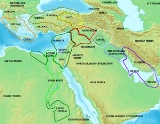
Historical powers

Encyclopedia
Historical powers include great powers, nations, or empires in history
.
The term "Great power
" represent the most important world powers. In a modern context, recognised great powers came about first in Europe
during the post-Napoleonic
era. The formalization of the division between small powers
and great powers came about with the signing of the Treaty of Chaumont
in 1814. A "great power" is a nation
or state
that, through its great economic, political
and military
strength, is able to exert power and influence
over not only its own region of the world, but beyond to others.
The historical term "Great Nation", distinguished aggregate of people inhabiting a particular country or territory, and "Great Empire", considerable group of states or countries under a single supreme authority, are colloquial; use is seen in ordinary historical conversations (historical jargon
).
The terms ancient Near East
or ancient Orient encompass the early civilization
s during the time roughly spanning the Bronze Age
from the rise of Sumer
and Gerzeh
in the 4th millennium BCE to the expansion of the Persian Empire in the 6th century BCE. The ancient Near East is generally understood as encompassing Mesopotamia
(modern Iraq
and Syria
), Persia (modern Iran
), Armenia
, the Levant
(modern Israel
, Jordan
, Lebanon
, Syria
, Palestinian Authority), and at times Anatolia
(modern Turkey
) and Ancient Egypt
.
Sumer (or Šumer) was one of the early civilizations of the Ancient Near East
, located in the southern part of Mesopotamia
(modern day Iraq
) from the time of the earliest records in the mid 4th millennium BC
until the rise of Babylonia
in the late 3rd millennium BC
. The term "Sumerian" applies to all speakers of the Sumerian language
. Sumer (together with Ancient Egypt
and the Indus Valley Civilization
) is considered the first settled society in the world to have manifested all the features needed to qualify fully as a "civilization
", eventually expanding into the first empire
in history, the Akkadian Empire.
The profound political, social, and cultural influence imposed upon the Near East by the civilization known as the Ancient Babylonian Empire
was the most pervasive in this historical period. The city itself - Babylon
- positioned itself as a center of pivotal historical developments for centuries. There were 3 major Babylonian Dynasties: Amorite,Kassite, and Chaldean. This political entity was most predominate within the southern portion of Mesopotamia.It existed as an unremitting rival of the northern Assyrian Mesopotamians. Although it was assaulted and militarily overcome on several occasions,it did exist as a stalwart presence from the latter 3rd millennium BCE to the middle of the 6th century BCE, when it expanded its boarders under the auspices of the rather famous Nebuchadnezzar the Great, and thereby overcame the Assyrians swiftly, and established and maintained strongholds throughout the Near Eastern region with a centralized administrative methodology and unyielding system of control. This period would be considered the apex of the Babylonian City-State's dominance in its two-and-a-half millennium history.
Ancient Babylon was officially conquered by the Achemidian Persian Empire in the late 6th century BCE.
Elam
was situated just to the east of Mesopotamia
and was one of the oldest recorded civilization
s. Elam was centered in the far west and southwest of modern-day Iran, stretching from the lowlands of Khuzestan and Ilam Province
(which takes its name from Elam), as well as a small part of southern Iraq. In the Old Elamite period (Middle Bronze Age), Elam consisted of kingdoms on the Iranian plateau
, centered in Anshan
, and from the mid-2nd millennium BC, it was centered in Susa
in the Khuzestan lowlands.
Elam was part of the early cities of the Ancient Near East
during the Chalcolithic (Copper Age
). The emergence of written records from around 3000 BC also parallels Mesopotamian history where writing was used slightly earlier. Elamite strength was based on an ability to hold various areas together under a coordinated government that permitted the maximum interchange of the natural resources unique to each region. Traditionally, this was done through a federated governmental structure.
Elamite culture played a crucial role in the Gutian Empire (Persian Empire) especially during the Achaemenid dynasty that succeeded it, when the Elamite language
remained among those in official use. The Elamite language is generally treated as an isolate language. As such, the Elamite period is considered a starting point for the history of Iran
.
The Hurrians
refer to a people who inhabited northern Mesopotamia beginning approximately 2500 BC. The Hurrian kingdoms of the Ancient Near East was in Northern Mesopotamia and it's people lived in the adjacent regions during the Bronze Age
. The largest and most influential Hurrian nation was the kingdom of Mitanni. The population of the Hittite Empire in Anatolia to a large part consisted of Hurrians, and there is significant Hurrian influence in Hittite mythology.
By the Early Iron Age, the Hurrians had been assimilated with other peoples, except perhaps in the kingdom of Urartu. The Hurrian peoples were not incredibly united, existing as quasi-feudal kingdoms. The kingdom of Mitanni was at its height towards the close of the 14th century BC. By the 13th century BC, the Hurrian kingdoms had been conquered by foreign powers, chiefly the Assyrians.
In the earliest historical times, the term Assyria
referred to a region on the Upper Tigris
river, named for its original capital, the ancient city of Assur
. Later, as a nation and empire that came to control all of the Fertile Crescent
, Egypt
and much of Anatolia
, the term "Assyria proper" referred to roughly the northern half of Mesopotamia
(the southern half being Babylonia
), with Nineveh
as its capital. The Assyrian homeland was located near a mountainous region, extending along the Tigris as far as the high Gordiaean or Carduchian mountain range of Armenia
, sometimes known as the "Mountains of Ashur". The Assyrian kings controlled a large kingdom at three different times in history. These are called the Old, Middle, and Neo-Assyrian kingdoms, or periods. The most powerful and best-known nation of these periods is the Neo-Assyrian Empire, 934-609 BC.
Shalmaneser III
(858–823 BC) attacked and reduced Babylonia
to vassalage, and defeated Aramea, Israel
, Urartu
, Phoenicia
and the neo Hittite
states, forcing all of these to pay tribute to Assyria. Shamshi-Adad V
(822-811 BC) inherited an empire beset by civil war which he took most of his reign to quell. He was succeeded by Adad-nirari III
who was merely a boy. The Empire was thus ruled by the famed queen Semiramis
until 806 BC. In that year Adad-nirari III
took the reins of power. After his premature death, Assyria failed to expand further during the reigns of Shalmaneser IV
(782-773 BC), Ashur-dan III
(772-755 BC) and Ashur-nirari V
(754-746 BC).
Under Ashurbanipal
(669-627 BC) its domination spanned from the Caucasus Mountains
in the north to Nubia
, Egypt
and Arabia in the south, and from Cyprus
and Antioch
in the west to Persia in the east. Ashurbanipal destroyed Elam
and smashed a rebellion led by his own brother Shamash-shum-ukim who was the Assyrian king of Babylon
, exacting savage revenge on the Chaldea
ns, Nabateans, Arabs and Elamites who had supported him. Persia and Media were regarded as vassals of Ashurbanipal. He built vast libraries and initiated a surge in the building of temples and palaces.
The Hittites
were an ancient people who spoke an Indo-European language, and established a kingdom centered at Hattusa
in north-central Anatolia
from the 18th century BC. In the 14th century BC, the Hittite empire was at its height, encompassing central Anatolia
, north-western Syria
as far as Ugarit
, and upper Mesopotamia
. After 1180 BC, the empire disintegrated into several independent "Neo-Hittite
" city-states, some surviving until as late as the 8th century BC.
The Hittites were also famous for their skill in building and using chariots, as the Battle of Kadesh
demonstrates. The Hittites were pioneers of the Iron Age
, manufacturing iron
artifacts from as early as the 14th century BC, making them possibly even the first to do so. The Hittites passed much knowledge and lore from the Ancient Near East
to the newly arrived Greeks
in Europe
.
Hittite prosperity was mostly dependent on control of the trade routes and metal sources. Because of the importance of Northern Syria to the vital routes linking the Cilician gates with Mesopotamia, defense of this area was crucial, and was soon put to the test by Egyptian expansion under Pharaoh Rameses II. The outcome of the Battle of Kadesh is uncertain, though it seems that the timely arrival of Egyptian reinforcements prevented total Hittite victory. The Egyptians forced the Hittites to take refuge in the fortress of Kadesh, but their own losses prevented them from sustaining a siege. This battle took place in the 5th year of Rameses (c.1274 BC by the most commonly used chronology).
625-550 BC
The Median Empire was the first empire on the territory of Persia. By the 6th century BC, after having together with the Babylonians
defeated the Neo-Assyrian Empire. In Greek references to "Median" people there is no clear distinction between the "Persians" and the "Medians"; in fact for a Greek to become "too closely associated with Iranian culture" was "to become medianized, not persianized". The Median kingdom was a short-lived Iranian state and the textual and archaeological sources of that period are rare and little could be known from the Median culture which nevertheless made a "profound, and lasting, contribution to the greater world of Iranian culture". The Medes were able to establish their own empire, the largest of its day, lasting for about sixty years, from the sack of Nineveh in 612 BC until 549 BC when Cyrus the Great
established the Achaemenid Empire
by defeating his overlord and grandfather, Astyages
, king of Media.
559 BC–330 BC
The Achaemenid Empire
was the first of the Persian Empires to rule over significant portions of Greater Iran
. At the height of its power, the Empire spanned over three continents and was the most powerful empire of his time. It also eventually incorporated the following territories: in the east modern Afghanistan
and beyond into central Asia, and parts of Pakistan
; in the north and west all of Asia Minor
(modern Turkey
), the upper Balkans
peninsula (Thrace
), and most of the Black Sea
coastal regions; in the west and southwest the territories of modern Iraq
, northern Saudi-Arabia, Jordan
, Israel
, Lebanon
, Syria
, all significant population centers of ancient Egypt
and as far west as portions of Libya
.
Encompassing approximately 7.5 million square kilometers, the Achaemenid Empire was territorially the largest empire of antiquity
. In its time it had political power over neighboring countries, and had high cultural and economic achievements during its lengthy rule over a vast region from its picturesque capital at Persepolis
.
Alexander the Great (Alexander III of Macedon) defeated the Persian armies at Granicus (334 BC), followed by Issus (333 BC), and lastly at Gaugamela (331 BC). Afterwards, he marched on Susa and Persepolis
which surrendered in early 330 BC. From Persepolis, Alexander headed north to Pasargadae where he visited the tomb of Cyrus, the burial of the man whom he had heard of from Cyropedia.
The Parthian Empire
was the third Iran
ian Empire. At the height of its power, the empire ruled most of Greater Iran
, Mesopotamia
and Armenia
. But unlike most other Iranian monarchies, the Parthian followed a vassalary system, which they adopted from the Seleucids. The Arsacid culture was not a single coherent state, but instead made up of numerous tributary (but otherwise independent) kingdoms.
The Parthians largely adopted the art, architecture, religious beliefs, and royal insignia of their culturally heterogeneous empire, which encompassed Persian, Hellenistic, and regional cultures. For about the first half of its existence, the Arsacid court adopted elements of Greek culture, though it eventually saw a gradual revival of Iranian traditions. The Arsacid rulers were titled the 'King of Kings', as a claim to be the heirs to the Achaemenid Empire; indeed, they accepted many local kings as vassals where the Achaemenids would have had centrally appointed, albeit largely autonomous, satraps. The court did appoint a small number of satraps, largely outside Iran, but these satrapies were smaller and less powerful than the Achaemenid potentates. With the expansion of Arsacid power, the seat of central government shifted from Nisa, Turkmenistan to Ctesiphon along the Tigris (south of modern Baghdad, Iraq), although several other sites also served as capitals.
The Sassanid Empire
is the name used for the fourth Iranian dynasty, and the second Persian Empire (226 - 651). The empire's territory encompassed all of today's Iran
, Iraq
, Armenia
, Afghanistan
, eastern parts of Turkey
, and parts of Syria
, Pakistan
, Caucasia
, Central Asia
and Arabia. During Khosrau II
's rule in 590–628 Egypt
, Jordan
, Palestine
, Lebanon
were also briefly annexed to the Empire. The Sassanid era, encompassing the length of the Late Antiquity
period, is considered to be one of the most important and influential historical periods in Iran. In many ways the Sassanid period witnessed the highest achievement of Persian civilization.
The empire constituted the last great Iranian Empire before the Muslim conquest
and adoption of Islam
. The Sassanids never mounted a truly effective resistance to the pressure applied by the initial Arab armies. Ctesiphon fell after a prolonged siege. Yazdegerd fled eastward from Ctesiphon, leaving behind him most of the Empire's vast treasury. The Arabs captured Ctesiphon shortly afterward, leaving the Sassanid government strapped for funds and acquiring a powerful financial resource for their own use. A number of Sassanid governors attempted to combine their forces to throw back the invaders, but the effort was crippled by the lack of a strong central authority, and the governors were defeated at the Battle of Nihawānd. The empire, with its military command structure non-existent, its non-noble troop levies decimated, its financial resources effectively destroyed, and the Asawaran knightly caste destroyed piecemeal, was utterly helpless in the face of the invaders. Upon hearing the defeat, Persian nobilities fled further inland to the eastern province of Khorasan.
Ancient Egypt was one of the world's first civilizations, with its beginnings in the fertile Nile valley around 3000BC. Ancient Egypt
reached the zenith of its power during the New Kingdom
(1570–1070 BC) under great pharaohs. It expanded far south into Nubia
and held wide territories in the Near East
. The combination of a fertile river valley, natural borders that made an invasion unfeasible, and a military
able to rise to the challenge when needed
, turned Egypt a major power. It was one of the first nations to have a system of writing and large scale construction projects. However, as neighboring civilizations developed militaries capable of crossing Egypt's natural barriers, the Egyptian armies were not always able to repel them and so by 1000 BC Egyptian influence as an independent civilization waned.
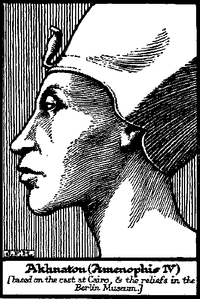 The New Kingdom pharaohs established a period of unprecedented prosperity by securing their borders and strengthening diplomatic ties with their neighbors. Military campaigns waged under Tuthmosis I and his grandson Tuthmosis III extended the influence of the pharaohs to the largest empire Egypt had ever seen. Amenhotep IV ascended the throne and instituted a series of radical and chaotic reforms. Changing his name to Akhenaten
, he touted the god Aten
as the supreme deity, suppressed the worship of other deities, and attacked the power of the priestly establishment. Moving the capital to the new city of Akhetaten, he turned a deaf ear to foreign affairs and absorbed himself in his new religion and artistic style. After his death, the religion of the Aten was quickly abandoned, and the subsequent pharaohs erased all mention of Akhenaten's Egyptian heresy, now known as the Amarna Period
.
 Ramesses the Great
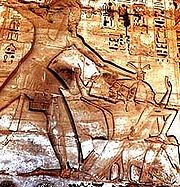
ascended the throne, and went on to build more temples, erect more statues and obelisks, and sire more children than any other pharaoh in history. Ramesses led his army against the Hittites in the Battle of Kadesh and, after fighting to a stalemate, finally agreed to the first recorded peace treaty. Egypt's wealth, however, made it a tempting target for invasion, particularly by the Libyans and the Sea Peoples. Initially, the military was able to repel these invasions, but Egypt eventually lost control of Syria and Palestine. The impact of external threats was exacerbated by internal problems such as corruption, tomb robbery and civil unrest. The high priests at the temple of Amun in Thebes accumulated vast tracts of land and wealth, and their growing power splintered the country during the Third Intermediate Period.
The many achievements of the ancient Egyptians include the quarrying, surveying and construction techniques that facilitated the building of monumental pyramids, temples, and obelisks; a system of mathematics, a practical and effective system of medicine, irrigation systems and agricultural production techniques, the first known ships, Egyptian faience and glass technology, new forms of literature, and the earliest known peace treaty. Egypt left a lasting legacy. Its art and architecture were widely copied, and its antiquities carried off to far corners of the world. Its monumental ruins have inspired the imaginations of travellers and writers for centuries. A new-found respect for antiquities and excavations in the early modern period led to the scientific investigation of Egyptian civilization and a greater appreciation of its cultural legacy, for Egypt and the world.
The Kingdom of Kush was the earliest of the Subsaharan states in Africa as well as the first to implement iron weapons. It was heavily influenced by Egyptian colonists, but in 1070 BC it became not only independent of Egypt but a fierce rival. It successfully fought off attempts by Egypt to reconquer it, and it began to extend influence over Upper Egypt. By the end of King Kashta's
reign in 752 BC, Thebes was under Kushite control.
A slew of able successors took the rest of Egypt and reigned as the Twenty-fifth dynasty of Egypt
stretching Kushite control from central Sudan to modern day Israel. The Kushites did not maintain this empire for long and were beaten back by the Assyrians in 653 BC. However, Kush remained a powerful entity in the region. It continued to meddle in Egyptian affairs and control trade resources originating in Subsaharan Africa. It waged a hard-fought campaign against the Roman Empire
(27 BC - 22 BC) under the leadership of Queen Amanirenas
, and achieved a more than amicable peace with the young Augustus Caesar. The two states work as allies with Kush lending cavalry support to Rome in its conquest of Jerusalem in 70 AD.
The kingdom of Kush maintained its status as a regional power until its conquest by the Axumite Empire in 350.
The Aksumite Empire
was an important trading nation in northeastern Africa
, growing from the proto-Aksumite period ca. 4th century BC to achieve prominence by the 1st century AD. It was a major player in the commerce between the Roman Empire
and Ancient India
and the Aksumite rulers facilitated trade by minting their own currency
. The state established its hegemony
over the declining Kingdom of Kush
and regularly entered the politics of the kingdoms on the Arabian peninsula
, and would eventually extend its rule over the region with the conquest of the Himyarite Kingdom.
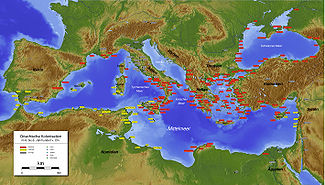 Ancient Greece is the civilization belonging to the period of Greek history lasting from the Archaic period of the 8th to 6th centuries BC to 146 BC and the Roman conquest of Greece after the Battle of Corinth. At the center of this time period is Classical Greece, which flourished during the 5th to 4th centuries BC, at first under Athenian leadership successfully repelling the military threat of Persian invasion. The Athenian Golden Age ends with the defeat of Athens at the hands of Sparta in the Peloponnesian War
in 404 BC. Following the conquests of Alexander the Great, Hellenistic civilization flourished from Central Asia to the western end of the Mediterranean Sea. Classical Greek culture had a powerful influence on the Roman Empire, which carried a version of it to many parts of the Mediterranean region and Europe, for which reason Classical Greece is generally considered to be the seminal culture which provided the foundation of Western civilization.
Athens, after a tyranny in the second half of the 6th century, founded the world's first democracy as a radical solution to prevent the aristocracy regaining power. A citizens' assembly (the Ecclesia), for the discussion of city policy, had existed since the reforms of Draco; all citizens were permitted to attend after the reforms of Solon, but the poorest citizens could not address the assembly or run for office. With the establishment of the democracy, the assembly became the de jure mechanism of government; all citizens had equal privileges in the assembly. However, non-citizens, such as foreigners living in Athens or slaves, had no political rights at all. After the rise of the democracy in Athens, other city-states founded democracies. However, many retained more traditional forms of government. As so often in other matters, Sparta was a notable exception to the rest of Greece, ruled through the whole period by not one, but two hereditary monarchs. This was a form of diarchy.
Ancient Athens was inhabited around 3,000 years ago. Athens
was one of the longest histories of any city in Europe
and in the world. It became the leading city of Ancient Greece in the first millennium BC. Its cultural achievements during the 5th century BC laid the foundations of western civilization
. During the Middle Ages
, Athens experienced decline and then a recovery under the Byzantine Empire
. Athens was relatively prosperous during the Crusades
, benefiting from Italian
trade.
Fifth-century Athens refers to the Greek city-state Athens in period of roughly 480 BCE-404 BCE. This was a period of Athenian political hegemony, economic growth and cultural flourishing known as the Golden Age of Athens or Age of Pericles
. The period began in 480 BCE when an Athenian-led coalition of city-states, known as the Delian League, defeated the Persians at Salamis. As the fifth century wore on, what started as an alliance of independent city-states gradually became an Athenian empire. Eventually, Athens abandoned the pretense of parity among its allies and relocated the Delian League treasury from Delos to Athens, where it funded the building of the Athenian Acropolis. With its enemies under its feet and its political fortunes guided by legendary statesman and orator Pericles, Athens as a center of literature, philosophy (see Greek philosophy
) and the arts (see Greek theatre). Some of the most important figures of Western cultural and intellectual history lived in Athens during this period: the dramatists Aeschylus
, Aristophanes
, Euripides
and Sophocles
, the philosophers Aristotle
, Plato
and Socrates
,
Sparta
was a Dorian Greek military state, originally centered in Laconia
. As a city-state
devoted to military training, Sparta possessed the most formidable army in the Greek world, and after achieving notable victories over the Athenian and Persian
Empires, regarded itself as the natural protector of Greece. Laconia
or Lacedaemon was the name of the wider city-state
centered at the city of Sparta, though the name "Sparta" is now used for both.
Following the victories in the Messenian Wars (631 BC), Sparta's reputation as a land-fighting force was unequaled. In 480 BC a small Spartan unit under King Leonidas
made a legendary last stand
against a massive, invading Persian army at the Battle of Thermopylae
. One year later, Sparta assembled at full strength and led a Greek alliance against the Persians at Plataea
. There, a decisive Greek victory put an end to the Greco-Persian War along with Persian ambition of expanding into Europe. Even though this war was won by a pan-Greek army, credit was given to Sparta, who besides being the protagonist at Thermopylae and Plataea, had been the nominal leader of the entire Greek expedition.
In later Classical times, Sparta along with Athens
, Thebes
and Persia had been the main regional powers fighting for supremacy against each other. As a result of the Peloponnesian War
, Sparta, a traditionally continental culture, became a naval power. At the peak of her power she subdued many of the key Greek states and even managed to overpower the powerful Athenian navy. By the end of the 5th century she stood out as a state which had defeated at war both the Persian
and Athenian Empires, a period which marks the Spartan Hegemony
.
Sparta was, above all, a militarist state, and emphasis on military fitness began virtually at birth.
Macedon
was the name of an ancient kingdom in the northern-most part of ancient Greece
, bordering the kingdom of Epirus
on the west and the region of Thrace
to the east. For a brief period it became the most powerful state in the world after Alexander the Great conquered most of the known world, including the entire Achaemenid Empire, inaugurating the Hellenistic period
of Greek history.
The rise of Macedon
, from a small kingdom at the periphery of Classical Greek affairs, to one which came to dominate the entire Hellenic world (and beyond), occurred in the space of just 25 years, between 359–336 BC. This ascendancy is largely attributable to the personality and policies of Philip II of Macedon
. Philip's military skills and expansionist vision of Macedonian greatness brought him early success. He had however first to re-establish a situation which had been greatly worsened by the defeat against the Illyrians in which King Perdiccas himself had died. The Paionians and the Thracians had sacked and invaded the eastern regions of the country, while the Athenians had landed, at Methoni on the coast, a contingent under a Macedonian pretender called Argeus. Using diplomacy, Philip pushed back Paionians and Thracians promising tributes, and crushed the 3,000 Athenian hoplites (359). Momentarily free from his opponents, he concentrated on strengthening his internal position and, above all, his army. His most important innovation was doubtless the introduction of the phalanx infantry corps, armed with the famous sarissa, an exceedingly long spear, at the time the most important army corps in Macedonia.
Philip's son, Alexander the Great, managed to briefly extend Macedonian power not only over the central Greek city-states, but also to the Persian empire, including Egypt and lands as far east as the fringes of India. Alexander's adoption of the styles of government of the conquered territories was accompanied by the spread of Greek culture and learning through his vast empire. Although the empire fractured into multiple Hellenic regimes shortly after his death, his conquests left a lasting legacy, not least in the new Greek-speaking cities founded across Persia's western territories, heralding the Hellenistic period. In the partition of Alexander's empire among the Diadochi, Macedonia fell to the Antipatrid dynasty, which was overthrown by the Antigonid dynasty after only a few years.
between his generals (the Diadochi
, or 'Successors'), which lasted for forty years before a more-or-less stable arrangement was established, consisting of four major domains:
A further two kingdoms later emerged, the so called Greco-Bactrian
and Indo-Greek kingdom
. Hellenistic culture thrived in its preservation of the past. The states of the Hellenistic period were deeply fixated with the past and its seemingly lost glories. Athens retained its position as the most prestigious seat of higher education, especially in the domains of philosophy and rhetoric, with considerable libraries. Alexandria was a center of Greek learning and the Library of Alexandria had 700,000 volumes. The city of Pergamon became a major center of book production, possessing a library of some 200,000 volumes, second only to Alexandria's. The island of Rhodes boasted a famous finishing school for politics and diplomacy. Antioch was founded as a metropolis and center of Greek learning which retained its status into the era of Christianity. Seleucia replaced Babylon as the metropolis of the lower Tigris.
The Seleucid Empire
was a Hellenistic empire, and the eastern remnant of the former Achaemenid Persian Empire following its breakup after Alexander the Great's invasion. The Seleucid Empire was centered in the near East. It was a center of Hellenistic culture which maintained the Greek customs and Greek-speaking Macedonian elite.
Seleucid expansion into Greece was abruptly halted after decisive defeats at the hands of the Roman army. Much of the eastern part of the empire was conquered by the Parthians under Mithridates I of Parthia in the mid-2nd century BC, yet the Seleucid kings continued to rule a rump state from Syria until the invasion by Armenian king Tigranes the Great and their ultimate overthrow by the Roman general Pompey.
The Ptolemaic dynasty
, sometimes also known as the Lagids, was a Greek royal family which ruled the Ptolemaic Empire in Egypt during the Hellenistic period.
Ptolemy, one of the seven somatophylakes (bodyguards) who served as Alexander the Great's generals and deputies, was appointed satrap of Egypt after Alexander's death in 323 BC. In 305 BC, he declared himself King Ptolemy I, later known as "Soter" (saviour). The Egyptians soon accepted the Ptolemies as the successors to the pharaohs of independent Egypt. Ptolemy's family ruled Egypt until the Roman conquest of 30 BC. All the male rulers of the dynasty took the name Ptolemy.
Ptolemaic Egypt began when Ptolemy I Soter declared himself Pharaoh of Egypt in 305 BC and ended with the death of queen Cleopatra VII of Egypt and the Roman conquest in 30 BC. The Ptolemaic Kingdom was a powerful Hellenistic state, extending from southern Syria in the east, to Cyrene to the west, and south to the frontier with Nubia. Alexandria became the capital city and a center of Greek culture and trade. To gain recognition by the native Egyptian populace, they named themselves as the successors to the Pharaohs. The later Ptolemies took on Egyptian traditions, had themselves portrayed on public monuments in Egyptian style and dress, and participated in Egyptian religious life. Hellenistic culture continued to thrive in Egypt well after the Muslim conquest. The Ptolemies faced rebellions of native Egyptians often caused by an unwanted regime and were involved in foreign and civil wars that led to the decline of the kingdom and its annexation by Rome.
Carthage
was a major power over the Western Mediterranean between 575 BC and 272 BC. Carthage as a major power was originally a Phoenicia
n settlement, and when Tyre fell to the Assyrians, Carthage assumed power over the former settlements of the region. The foundation of Carthaginian power was seafaring trade throughout the Western Mediterranean (following the tracks of the Phoenicians). Some 300 colonies were established in Tunisia, Morocco, Algeria, Iberia, and to a much lesser extent, on the arid coast of Libya. The Phoenicians controlled Cyprus, Sardinia, Corsica, and the Balearic Islands, as well as minor possessions in Crete and Sicily; the latter settlements were in perpetual conflict with the Greeks. The Phoenicians managed to control all of Sicily for a limited time. The entire area later came under the leadership and protection of Carthage, which in turn dispatched its own colonists to found new cities or to reinforce those that declined with Tyre and Sidon.
 The first colonies were made on the two paths to Iberia's mineral wealth — along the North African coast and on Sicily, Sardinia and the Balearic Islands. The centre of the Phoenician world was Tyre, serving as an economic and political hub. The power of this city waned following numerous sieges and its eventual destruction by Alexander the Great, and the role as leader passed to Sidon, and eventually to Carthage. Each colony paid tribute to either Tyre or Sidon, but neither had actual control of the colonies. This changed with the rise of Carthage, since the Carthaginians appointed their own magistrates to rule the towns and Carthage retained much direct control over the colonies. This policy resulted in a number of Iberian towns siding with the Romans during the Punic Wars. Although Rome
was originally a land based military power, its sphere of influence
soon collided with Carthage's. Carthage was in a constant state of struggle with the Roman Republic, which led to a series of conflicts known as the Punic Wars
. After the third and final Punic War, Carthage was destroyed and then occupied by Roman forces. Nearly all of the other Phoenician city-states and former Carthaginian dependencies fell into Roman hands from then on.
(the modern-day states of India
, Pakistan
, Nepal
, and Bangladesh
) was unified under many emperors and governments in history. Ancient texts mention India under the legendary emperor Bharata
, these regions roughly form the entities of modern day greater India
. Several Indian empires were able to expand across southern Asia, and sometimes into parts of the Middle East
, Central Asia
and Southeast Asia
.
The Nanda Empire originated from Magadha
in Ancient India
during the 5th and 4th centuries BC. At its greatest extent, the Nandas ruled much of Northern India
. The Nandas are sometimes described as the first empire builders in the recorded history of India. They inherited the large kingdom of Magadha. They built up a vast army.
The Nandas never had the opportunity to see their army up against Alexander the Great, who invaded India at the time of Dhana Nanda, since Alexander had to confine his campaign to the plains of Punjab, for his forces, at the prospect of facing a further foe, mutinied at the Hyphasis River (the modern Beas River) refusing to march any further. The Persian and Greek invasions had important repercussions on Indian civilization.
The political systems of the Persians were to influence future forms of governance on the subcontinent, including the administration of the Mauryan dynasty. In addition, the region of Gandhara, or present-day eastern Afghanistan and northwest Pakistan, became a melting pot of Indian, Persian, Central Asian, and Greek cultures and gave rise to a hybrid culture, Greco-Buddhism, which lasted until the 5th century CE and influenced the artistic development of Mahayana Buddhism.
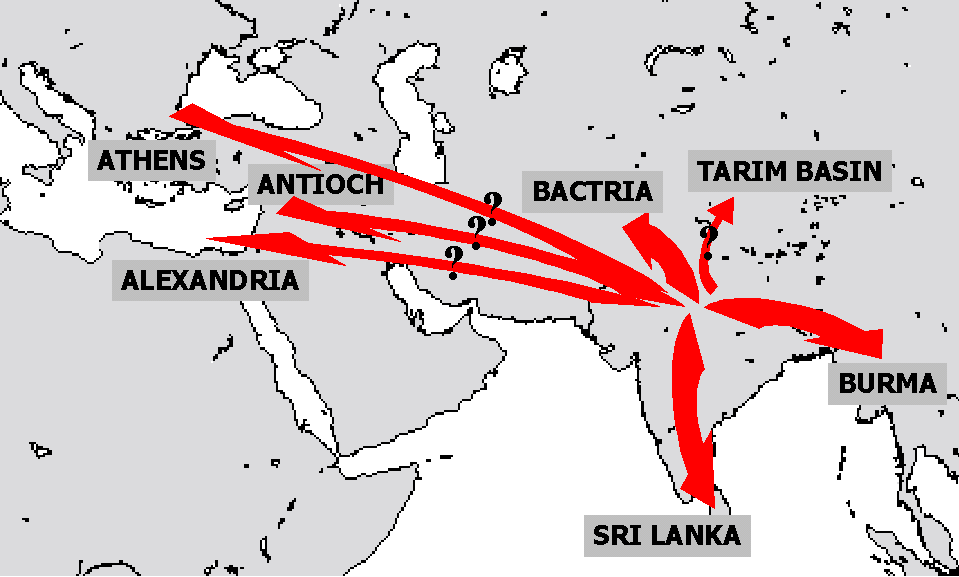
The Mauryan Empire was the first political entity to unite most of the Indian subcontinent and expand into Central Asia and the Middle East. Its soft power further spread into much of Persia and Greece
due to its military victories over these regions. Its cultural influence also extended west into Egypt
and Syria
, and east into Thailand
, China
and Burma.
The Empire was founded in 322 BC by Chandragupta Maurya
. Chandragupta waged a war against the nearby Greek
powers and won, forcing the Greeks to surrender large amounts of land. Under the reign of Ashoka the Great, the empire became pacifist and turned to spreading its soft power in the form of Buddhism
. It has been estimated that the Maurya Dynasty controlled an unprecedented one-third of the world's entire economy, was home to one-third of the world's population at the time (an estimated 50 million out of 150 million human), contained the world's largest city of the time (Pataliputra, estimated to be larger than Rome under Emperor Trajan).
 The Empire was divided into four provinces, which one of the four, look like a giant crescents. with the imperial capital at Pataliputra. From Ashokan edicts, the names of the four provincial capitals are Tosali
(in the east), Ujjain
in the west, Suvarnagiri (in the south), and Taxila
(in the north). The head of the provincial administration was the Kumara (royal prince), who governed the provinces as king's representative. The kumara was assisted by Mahamatyas and council of ministers. This organizational structure was reflected at the imperial level with the Emperor and his Mantriparishad (Council of Ministers).
Historians theorize that the organization of the Empire was in line with the extensive bureaucracy described by Kautilya in the Arthashastra
: a sophisticated civil service governed everything from municipal hygiene to international trade. According to Megasthenes
, the empire wielded a military of 600,000 infantry, 30,000 cavalry, and 9,000 war elephants. A vast espionage
system collected intelligence for both internal and external security purposes. Having renounced offensive warfare and expansionism, Ashoka nevertheless continued to maintain this large army, to protect the Empire and instill stability and peace across West and South Asia.
The Shunga Empire is a Magadha
dynasty that controlled North-central and Eastern India as well as parts of the northwest (now Pakistan
) from around 185 to 73 BCE. It was established after the fall of the Indian Maurya Empire
. The capital of the Sungas was Pataliputra. Later kings such as Bhagabhadra
also held court at Vidisha
, modern Besnagar in Eastern Malwa. The Sunga Empire is noted for its numerous wars with both foreign and indigenous powers.
While there is much debate on the religious politics of the Sunga dynasty, it is recognized for a number of contributions. Art, education, philosophy, and other learning flowered during this period. Most notably, Patanjali's Yoga Sutras and Mahabhasya were composed in this period, Panini composed the first Sanskrit grammarian Ashtadayai. It is also noted for its subsequent mention in the Malavikaagnimitra. This work was composed by Kalidasa in the later Gupta period, and romanticized the love of Malavika and King Agnimitra, with a background of court intrigue.
Artistry on the subcontinent also progressed with the rise of the Mathura school, which is considered the indigenous counterpart to the more Hellenistic Gandhara school of Afghanistan and Pakistan. During the historical Sunga period (185 to 73 BCE), Buddhist activity also managed to survive somewhat in central India (Madhya Pradesh) as suggested by some architectural expansions that were done at the stupas of Sanchi and Barhut, originally started under Emperor Ashoka. It remains uncertain whether these works were due to the weakness of the control of the Sungas in these areas, or a sign of tolerance on their part.
The last of the Sunga emperor was Devabhuti (83–73 BCE). He was assassinated by his minister (Vasudeva Kanva) and is said to have been overfond of the company of women. The Sunga dynasty was then replaced by the subsequent Kanvas.
The Sâtavâhana Empire started out as feudatories to the Mauryan Empire but declared independence soon after the death of Ashoka
(232 BC). They were the first Indic rulers to issue coins struck with their rulers embossed and are known for their patronage of Buddhism
resulting in Buddhist monuments from Ellora to Amaravati
.
After becoming independent around 230 BCE, Simuka, the founder of the dynasty, conquered Maharashtra, Malwa and part of Madhya Pradesh. He was succeeded by his brother Kanha (or Krishna) (r. 207–189 BCE), who further extended his kingdom to the west and the south. Sātakarnī I was the sixth ruler of the Satavahana. He is said to have ruled for 56 years. Satakarni defeated the Sunga dynasty of North India by wresting Western Malwa from them, and performed several Vedic sacrifices at huge cost, including the Horse Sacrifice – Ashwamedha yajna. He also was in conflict with the Kalinga ruler Kharavela, who mentions him in the Hathigumpha inscription. According to the Yuga Purana he conquered Kalinga following the death of Kharavela. He extended Satavahana rule over Madhya Pradesh and pushed back the Sakas from Pataliputra (he is thought to be the Yuga Purana's "Shata", an abbreviation of the full name “Shri Sata” that occurs on coins from Ujjain), where he subsequently ruled for 10 years. By this time the dynasty was well established, with its capital at Pratishthānapura (Paithan) in Maharashtra, and its power spreading into all of South India.
The Satavahanas formed a cultural bridge and played a vital role in trade and the transfer of ideas and culture to and from the Gangetic plains to the southern tip of India.
In the 4th and 5th centuries, the Gupta Empire
unified much of India. This period is called the Golden Age of India and was marked by extensive achievements in science, technology
, engineering, art
, dialectic, literature
, logic
, mathematics
, astronomy, religion and philosophy
that crystallized the elements of what is generally known as Hindu culture. Chandragupta I
, Samudragupta
, and Chandragupta II
were the most notable rulers of the Gupta dynasty.
The high points of this cultural creativity are magnificent architectures, sculptures and paintings. The Gupta period produced scholars such as Kalidasa
, Aryabhata
, Varahamihira
, Vishnu Sharma, and Vatsyayana
who made great advancements in many academic fields. Science and political administration reached new heights during the Gupta era. Strong trade ties also made the region an important cultural center and set the region up as a base that would influence nearby kingdoms and regions in Burma, Sri Lanka
, Malay Archipelago
and Indochina
.
The Pāla's were a multifaith Bengal
i Hindu
and Buddhist dynasty, which lasted for four centuries (750–1120 CE). The empire reached its peak under Dharmapala
and Devapala
to cover much of South Asia
and beyond up to Kamboja (modern day Afghanistan
), shattering the pride of many a ruler, including the Huna. Followers of the Mahayana
and Tantric schools of Buddhism, they were responsible for the introduction of Mahayana Buddhism in Nepal
, Bhutan
, Tibet
, Myanmar
and the Malay archipelago, creation of temples and works of art and patronage of great universities formerly patronised by the Hindu king Harsha Vardhana
. The Palas had extensive trade as well as influence in south-east Asia. The Pala Empire eventually disintegrated in the 12th century under the attack of the Hindu
Sena dynasty
.
The Qin Dynasty was preceded by the feudal Zhou Dynasty
and followed by the Han Dynasty
in China
. The unification of China in 221 BCE under the First Emperor Qin Shi Huang
marked the beginning of Imperial China, a period which lasted until the fall of the Qing Dynasty
in 1912.
In 214 BC Qin Shihuang secured his boundaries to the north with a fraction (100,000 men) of his large army, and sent the majority (500,000 men) south to seize still more land. Prior to the events leading to Qin dominance over China, they had gained possession of much of Sichuan to the southwest. The Qin army was unfamiliar with the jungle terrain, and it was defeated by the southern tribes' guerrilla warfare tactics with over 100,000 men lost. However, in the defeat Qin was successful in building a canal to the south, which they used heavily for supplying and reinforcing their troops during their second attack to the south. Building on these gains, the Qin armies conquered the coastal lands surrounding Guangzhou, and took the provinces of Fuzhou and Guilin. They struck as far south as Hanoi. After these victories in the south, Qin Shihuang moved over 100,000 prisoners and exiles to colonize the newly conquered area. In terms of extending the boundaries of his empire, the First Emperor was extremely successful in the south.
Despite its military strength, the Qin Dynasty did not last long. When the first emperor died in 210 BC, his son was placed on the throne by two of the previous emperor's advisers, in an attempt to influence and control the administration of the entire country through him. The advisors squabbled among themselves, however, which resulted in both their deaths and that of the second Qin emperor. Popular revolt broke out a few years later, and the weakened empire soon fell to a Chu lieutenant, who went on to found the Han Dynasty. Despite its rapid end, the Qin Dynasty influenced future Chinese regimes, particularly the Han, and the European name for China is derived from it
The Han Dynasty (206 BC – AD 220), lasting 400 years, is commonly considered within China to be one of the greatest periods in the entire history of China
. At its height, the Han empire extended over a vast territory of 6 million km² and housed a population of approximately 55 million. During this time period, China
became a military, economic, and cultural powerhouse. The empire extended its political and cultural influence over Korea
, Japan
, Mongolia
, Vietnam
, and Central Asia
before it finally collapsed under a combination of domestic and external pressures.
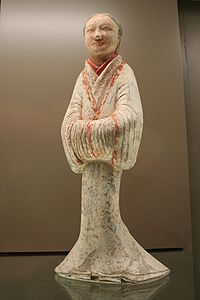 The Han Empire was divided into areas directly controlled by the central government, known as commanderies, and a number of semi-autonomous kingdoms. These kingdoms gradually lost all vestiges of their independence, particularly following the Rebellion of the Seven States
. The Xiongnu
, a nomadic confederation which dominated the eastern Eurasian Steppe, defeated the Han army in battle in 200 BCE. Following the defeat, a political marriage alliance was negotiated in which the Han became the de facto inferior partner. When, despite the treaty, the Xiongnu continued to raid Han borders, Emperor Wu of Han
(r. 141–87 BCE) launched several military campaigns against them. The ultimate Han victory in these wars eventually forced the Xiongnu to accept vassal status as Han tributaries. These campaigns expanded Han sovereignty into the Tarim Basin of Central Asia and helped establish the vast trade network known as the Silk Road
, which reached as far as the Mediterranean world. Han forces managed to divide the Xiongnu into two competing nations, the Southern and Northern Xiongnu, and forced the Northern Xiongnu across the Ili River. Despite these victories, the territories north of Han's borders were quickly overrun by the nomadic Xianbei Confederation. The Han Dynasty was arguably one of the strongest's empires in the world during the reign of Emperor Wu, though was established as the largest.
Xiongnu (Hsiung nu) was an empire flourished in the central Asia. Their origin is debatable, but they probably spoke either a Proto Turkic
, or a Proto Mongolic
or a Yeniseian language. They conquered most of modern Mongolia
under their leader Toumen
(220-209 BC) in the 3rd century BC. During Modu
‘s reign (209-174 BC) they defeated both the Donghu
in the east and Yuezhi
in the west and they began threatening Han China.
The Great Wall of China
had been constructed to protect Chinese towns from the Xiongnu attacks. While the Chinese were trying to bring the Xiongnu under control, something of high significance happened: cross-cultural encounters. A large variety of people (such as traders, ambassadors, hostages, parents in cross-cultural marriages, etc.) served as helpers that passed on ideas, values, and techniques across cultural boundary lines. These encounters helped cultures learn from other cultures. Xiongnu empire disintegrated into two parts during the 1st century, eventually the Xiongnu fell due to the defeat in the Sino-Xiongnu War
.
The Roman Empire
is widely known as ancient Europe
's largest and most powerful civilization
. After the Punic Wars
Rome was already one of the biggest empires on the planet but its expansion continued with the invasions of Greece and Asia Minor. By 27 BC Rome had control over half of Europe
as well as Northern Africa and large amounts of the Middle East. Rome also had a developed culture, building on the earlier Greek culture. From the time of Augustus
to the Fall of the Western Empire
, Rome dominated Western Eurasia, comprising the majority of its population.
Roman expansion began long before the state was changed into an Empire and reached its zenith under emperor Trajan
with the conquest of Mesopotamia
and Armenia
in AD 113. The period of the "Five Good Emperors" saw a successions of peaceful years and the Empire was prosperous. Each emperor of this period was adopted by his predecessor. The Nerva–Antonine dynasty was a dynasty of seven consecutive Roman Emperors who ruled over the Roman Empire from 96 to 192. These Emperors are Nerva, Trajan, Hadrian, Antoninus Pius, Marcus Aurelius, Lucius Verus, and Commodus.
The last two of the "Five Good Emperors" and Commodus
are also called Antonines. After his accession, Nerva, who succeeded Domitian, set a new tone: he restored much confiscated property and involved the Roman Senate
in his rule. Starting in 101, Trajan
undertook two military campaigns against the gold rich Dacia, which he finally conquered in 106 (see Trajan's Dacian Wars). In 112, Trajan marched on Armenia and annexed it to the Roman Empire. Then he turned south into Parthia, taking several cities before declaring Mesopotamia a new province of the empire, and lamenting that he was too old to follow in the steps of Alexander the Great. During his rule, the Roman Empire expanded to its largest extent, and would never again advance so far to the east. Hadrian's reign was marked by a general lack of major military conflicts, but he had to defend the vast territories that Trajan had acquired.
At this territorial peak, the Roman Empire controlled approximately 5,900,000 km² (2,300,000 sq.mi.) of land surface. Ancient Rome
's influence upon the culture, law, technology, arts, language, religion, government, military, and architecture of Western civilization
continues to this day.
Huns were nomadic people who were known for their hordes of mounted archers. Their language seems to be Turkic
; but Mongolic, Yeniseian, Uralic etc., are also postulated. After 370 under a certain Balamber
they founded an empire in the East Europe defeating Alans
and Goths
. They triggered the great migration
which eventually caused the collapse of the West Roman Empire.
The death of Rugila in 434 left the sons of his brother Mundzuk, Attila and Bleda, in control of the united Hun tribes. Attila the Hun
ruled of the Huns from 434 until his death in 453. uUnder his rule and leader of the Hunnic Empire, the empire stretched from Germany to the Ural River and from the Danube River to the Baltic Sea. Hunnic khagan Atilla invaded Europe. The rise of the Huns around 370 overwhelmed the Gothic kingdoms. Many of the Goths migrated into Roman territory in the Balkans, while others remained north of the Danube under Hunnic rule.
During Attila the Hun's rule, he was one of the most fearsome enemies of the Western and Eastern Roman Empire. He invaded the Balkans twice and marched through Gaul (modern France) as far as Orléans before being defeated at the Battle of Châlons
. Although his invasion of Gaul
was checked at Chalons, he appeared in North Italy in the next year. After Atilla’s death in 453, the Hunnic empire collapsed.
The Byzantine Empire
is the name for the medieval eastern Roman Empire, which survived 1000 years after the fall of the western Roman Empire
. The Byzantines managed to reconquer great parts of it. Ancient Roman
cultural heritage survived there and gave birth to the Italian Renaissance
after its capital, Constantinople
, was captured by the Turks
in the 15th century. The Byzantines
were the only Europeans to produce fine silk
which was an important source of their wealth along with trade.
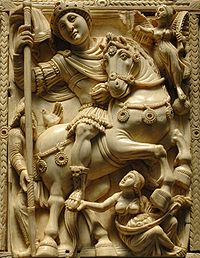 Byzantium under the Justinian dynasty
saw a period of recovery of former territories. The period is marked with internal strife within the Empire, from Ostrogoths, and from the Persians. The strength of the dynasty was shown under Justinian I
, in which the territorial borders of the Empire were expanded because of numerous campaigns by his favored general, Belisarius
. The western conquests began with Justinian sending his general to reclaim the former province of Africa from the Vandals
who had been in control with their capital at Carthage. Their success came with surprising ease, but the major local tribes were subdued. In Ostrogoth
ic Italy, the deaths of Theodoric the Great
, his nephew and heir, and his daughter had left her murderer Theodahad on the throne despite his weakened authority. A small Byzantine expedition to Sicily was met with easy success, but the Goths soon stiffened their resistance, and victory did not come until later, when Belisarius captured Ravenna, after successful sieges of Naples and Rome.
Byzantium
continued to be a major military power with a huge army and strong fleet, and was a major cultural and religious center. Byzantium was the stronghold of Eastern Orthodox Christianity and thus influenced many states. Byzantium fought against the Arabs to the south, the Bulgarians
to the north and the Crusaders, who managed to seize Constantinople in 1204. The Byzantines restored their state in 1261, but its strength never recovered and it was eventually destroyed and replaced by the nascent Ottoman Empire
in 1453.
Turks
, who were the residents around Altai mountains in Central Asia
, founded a number of empires prior to their conversion to Islam
. The Turkic Khaganate (or Göktürk, meaning Celestial Turk)(another possibility is "East Türk" since Blue (Gök) represent east direction in ancient Türks) was founded in 551 in what is now Kazakhstan
and Mongolia
by Bumin Khan
of Ashina clan
. Following a Turkish tradition, Bumin Khan ruled the east part of the empire and assigned his brother Istämi
to the west part of the empire as his vassal. Bumin’s successor Muhan Khan
defeated China and began controlling the prosperous silk road
. Meanwhile, Istemi and his successors conquered Transoxania and Caucasus
. It is one of Istemi's grandsons (Tong Yabgu) who founded another Turkic empire; the Khazarian Khaganate
in the Caucasus. Another state emerged in the realm of Western Turks was that of Turgesh
in west Turkistan
. (Both Khazars and Turgesh fought against the invading Arabic armies in the 8th century). Although, the empire was briefly dominated by Tang China during 650s, Kutluk Khan, another member of Ashina clan was able to defeat China. In the early 8th century, during Bilge Khan
’s reign, first Turkish monuments in Turkish alphabet were erected.(Orkhon monuments) In 744, Uyghurs, another branch of Turks replaced Turkish Khaganate in Central Asia.
The Uyghur Khaganate established itself as a major power in Central Asia
the late 8th century. At their height, they controlled an area of land stretching from the Sea of Okhotsk
to the Tibetan Plateau
. They built their capital Ordu balik in modern Mongolia
. Although they were replaced by their Kyrghyz vassals in 840s, they managed to survive in three smaller states. Those who were called Sari Uyghurs (yellow Uyghur) settled in Gansu
(north China
). Most Uyghurs settled in Xinjiang
(west China). Some Uyghurs together with Karluks ( their former vassals in Transoxania, modern Uzbekistan
), founded Karakhanid state which soon embraced Islam
.
in China
after the end of the turbulent and chaotic Northern and Southern Dynasty marks China as one of the most powerful countries in the world economically and militarily. Below are some of the dynasties that occurred during this era:
630s - 760s
The Tang Dynasty
was an imperial dynasty of China preceded by the Sui Dynasty and followed by the Five Dynasties and Ten Kingdoms Period. It was founded by the Li (李) family, who seized power during the decline and collapse of the Sui Empire. The dynasty was interrupted briefly by the Second Zhou Dynasty (October 16, 690–March 3, 705) when Empress Wu Zetian seized the throne, becoming the first and only Chinese empress regnant, ruling in her own right.
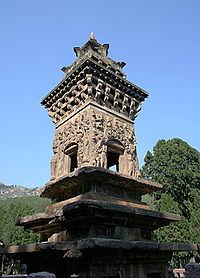 The Tang Dynasty, with its capital at Chang'an
, the most populous city in the world at the time, is generally regarded as a high point in Chinese civilization—equal to, or surpassing that of, the earlier Han Dynasty—a golden age of cosmopolitan culture. Its territory, acquired through the military campaigns of its early rulers, was greater than that of the Han period, and it rivalled that of the later Yuan Dynasty and Qing Dynasty. In two censuses of the 7th and 8th centuries, the Tang records estimated the population by number of registered households at about 50 million people. Yet, even when the central government was breaking down and unable to compile an accurate census of the population in the 9th century, it is estimated that the population had grown by then to about 80 million people. With its large population base, the dynasty was able to raise professional and conscripted armies of hundreds of thousands of troops to contend with nomadic powers in dominating Inner Asia and the lucrative trade routes along the Silk Road.
Various kingdoms and states paid tribute to the Tang court, while the Tang also conquered or subdued several regions which it indirectly controlled through a protectorate system. Besides political hegemony, the Tang also exerted a powerful cultural influence over neighboring states such as those in Korea, Japan, and Vietnam. Such was the dynasty's influence that even today, the Chinese term for a Chinatown
bears the title, the Tang People's Street.
The Tang Dynasty was largely a period of progress and stability, except during the An Shi Rebellion
and the decline of central authority in the latter half of the dynasty. Like the previous Sui Dynasty, the Tang Dynasty maintained a civil service system by drafting officials through standardized examinations and recommendations to office. This civil order was undermined by the rise of regional military governors known as jiedushi
during the 9th century. Chinese culture flourished and further matured during the Tang era; it is considered the greatest age for Chinese poetry. Two of China's most famous poets, Du Fu
and Li Bai
, belonged to this age, as did many famous painters such as Han Gan
, Zhang Xuan
, and Zhou Fang. There was a rich variety of historical literature compiled by scholars, as well as encyclopedias and geographical works.
There were many notable innovations during the Tang, including the development of woodblock printing
. Buddhism became a major influence in Chinese culture, with native Chinese sects gaining prominence. However, Buddhism would later be persecuted by the state and decline in influence. Although the dynasty and central government were in decline by the 9th century, art and culture continued to flourish. The weakened central government largely withdrew from managing the economy, though the country's mercantile affairs stayed intact and commercial trade continued to thrive regardless
990s - 1080s
_001.jpg) During the Song Dynasty
During the Song Dynasty
, the wealth of China
attracted numerous attacks from the north and the dynasty gradually retreated to the south. For the first time in history, China needed to pay tribute annually to buy peace. Ironically, the development of Chinese culture reached the highest peak in history due to the artistic character of the emperors. The technological advancement and policies also led to rapid growth of wealth and improvement of living standard.
The Song Dynasty is divided into two distinct periods: the Northern Song and Southern Song. During the Northern Song (Chinese: 北宋, 960–1127), the Song capital was in the northern city of Bianjing (now Kaifeng) and the dynasty controlled most of inner China. The Southern Song (Chinese: 南宋, 1127–1279) refers to the period after the Song lost control of northern China to the Jin Dynasty. During this time, the Song court retreated south of the Yangtze River and established their capital at Lin'an (now Hangzhou). Although the Song Dynasty had lost control of the traditional birthplace of Chinese civilization along the Yellow River, the Song economy was not in ruins, as the Southern Song Empire contained 60 percent of China's population and a majority of the most productive agricultural land. The Southern Song Dynasty considerably bolstered its naval strength to defend its waters and land borders and to conduct maritime missions abroad.
To repel the Jin, and later the Mongols, the Song developed revolutionary new military technology augmented by the use of gunpowder. In 1234, the Jin Dynasty was conquered by the Mongols, who took control of northern China, maintaining uneasy relations with the Southern Song. Möngke Khan, the fourth Great Khan of the Mongol Empire, died in 1259 while besieging a city in Chongqing. His younger brother Kublai Khan was proclaimed the new Great Khan, though his claim was only partially recognized by the Mongols in the west. In 1271, Kublai Khan was proclaimed the Emperor of China. After two decades of sporadic warfare, Kublai Khan's armies conquered the Song Dynasty in 1279. China was once again unified, under the Yuan Dynasty (1271–1368).
The population of China doubled in size during the 10th and 11th centuries. This growth came through expanded rice cultivation in central and southern China, the use of early-ripening rice from southeast and southern Asia, and the production of abundant food surpluses. The Northern Song census recorded a population of roughly 50 million, much like the Han and Tang dynasties
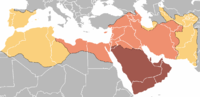 In 622, a new world religion emerged, Islam
, founded by Muhammad
in Arabia. After his death, his successors began a century of rapid Arab
expansion across most of the known world, establishing the Islamic Empire as one of the largest in the world.
 Under the Rashidun Caliphate, the newly united and religiously inspired Muslim
Arab
s invaded the powerful Sassanid Persian Empire
during the Rashidun conquest of Persia and the Byzantine Empire
during the Byzantine-Arab Wars
. The war of conquest resulted in a complete conquest of the Sassanid Persian Empire and two-thirds of the Byzantine Empire. Within a decade, Rashidun caliphs controlled an empire stretching from the Indus River
to the Atlas mountains
. Khalid ibn Walid was responsible for most of the conquests on the Byzantine front. After a civil war
in 657-661, the almost republic disintegrated and was succeeded by the Ummayad monarchy.
The Umayyad Caliphate completed the Muslim expansion after conquering Roman North Africa
, Visigothic Hispania
, and a small part of the border of the Indian subcontinent
and northwestern China
. As a result, the Arab Empire became the largest empire the world had yet seen. However, Umayyad expeditions into the Frankish Kingdom
and Byzantium
were unsuccessful, as they were eventually stopped by the Bulgarians
and Byzantines in 718 and the Franks
in 732. Nonetheless, the Caliphate remained a huge military power with a mighty navy.
The period of the Abbasid Caliphate is considered the Golden Age of Islam
. The empire was rich with flourishing trade across Asia
, Europe
and Africa
. Its culture was thriving, influenced by the Persians
, and boasted great achievements in its economy, arts
, architecture
, literature
, mathematics
, philosophy
, science, and technology. Many cities grew with large populations, beautiful palaces and gardens such as Baghdad
, which had a population of a million at its peak, as well as Damascus
, Cairo
and Cordoba
. The Caliphate eventually diminished in size, and was further reduced during the Crusades
. The Caliphate later disintegrated after invasions from the Mongol Empire
from the east, ending with the sack of Baghdad in 1258
.
Al-Andalus
was the Arabic name given to those parts of the Iberian Peninsula
governed by Muslim
s, or Moors
, at various times in the period between 711 and 1492. As a political domain or domains, it was successively a province of the Umayyad
Caliphate
initiated successfully by the Caliph Al-Walid I (711-750), the Emirate of Córdoba (c. 750-929), the Caliphate of Córdoba
(929-1031), and finally the Caliphate of Córdoba's taifa
(successor) kingdoms.
The Caliphate enjoyed immense prosperity throughout the 10th century. Abd-ar-Rahman III not only united al-Andalus, but brought the Christian kingdoms of the north, through force and diplomacy, under control. Abd-ar-Rahman stopped the Fatimid advance into Caliphate lands in Morocco and al-Andalus. This period of prosperity is marked by growing diplomatic relations with Berber tribes in North African, Christian kings from the north, with France and Germany, and Constantinople. The death of Abd-ar-Rahman III led to the rise of his 46 year old son Al-Hakam II in 961. Al-Hakam II more-or-less followed in his father's footsteps, occasionally dealing with a few disruptive Christian kings and North African rebels, though trying not to be too severe. Unlike his father, al-Hakam's dependence upon his advisers was more distinct.
The al-Fātimiyyūn was the Arab
Shi'a dynasty that ruled over varying areas of the Maghreb
, Egypt
, and the Levant
from 5 January 909 to 1171, and established the Egyptian city of Cairo
as their capital. The term Fatimite is sometimes used to refer to the citizens of this caliphate. The ruling elite of the state belonged to the Ismaili
branch of Shi'ism. The leaders of the dynasty were also Shia Ismaili Imams
, hence, they had a religious significance to Ismaili Muslims. They are also part of the chain of holders of the office of Caliph
, as recognized by most Muslims. Therefore, this constitutes a rare period in history in which some form of the Shia Imamate and the Caliphate
were united to any degree, excepting the Caliphate of Ali
himself.
The Fatimids were known to a great extent for their exquisite arts. A type of ceramic, lustreware, was prevalent during the Fatimid period. Glassware and metalworking was also popular. Many traces of Fatimid architecture exist in Cairo today, the most defining examples include the Al Azhar University and the Al Hakim mosque. The Al Azhar University was the first university in the East. It was founded by Caliph Muizz and was one of the highest educational facilities of the Fatimid Empire.
Unlike other governments in the area, Fatimid advancement in state offices was based more on merit than on heredity. Members of other branches of Islam, like the Sunnis, were just as likely to be appointed to government posts as Shiites. Tolerance was extended to non-Muslims such as Christians, and Jews, who occupied high levels in government based on ability.
The reliance on the Iqta'
system ate into Fatimid central authority, as more and more the military officers at the further ends of the empire became semi-independent and were often a source of problems.
1171–1246
The Ayyubid dynasty
was a Muslim dynasty of Kurdish origin, founded by Saladin and centered in Egypt. The dynasty ruled much of the Middle East during the 12th and 13th centuries CE. The Ayyubid family, under the brothers Ayyub and Shirkuh, originally served as soldiers for the Zengids until they supplanted them under Saladin, Ayyub's son. The Ayyubid Sultanate in the Middle East managed to rebuild the weakened Arab State. In 1174, Saladin proclaimed himself Sultan following the death of Nur al-Din. The Ayyubids spent the next decade launching conquests throughout the region and by 1183, the territories under their control included Egypt, Syria, northern Mesopotamia, Hejaz, Yemen, and the North African coast up to the borders of modern-day Tunisia. Most of the Kingdom of Jerusalem and beyond Jordan River fell to Saladin after his victory at the Battle of Hattin in 1187. However, the Crusaders regained control of Palestine's coastline in the 1190s.
After the death of Saladin, his sons contested control over the sultanate, but Saladin's brother al-Adil eventually established himself as Sultan in 1200. In the 1230s, the Ayyubid rulers of Syria attempted to assert their independence from Egypt and remained divided until Egyptian Sultan as-Salih Ayyub restored Ayyubid unity by taking over most of Syria, excluding Aleppo, by 1247. During their relatively short tenure, the Ayyubids ushered in an era of economic prosperity in the lands they ruled and the facilities and patronage provided by the Ayyubids led to a resurgence in intellectual activity in the Islamic world. This period was also marked by an Ayyubid process of vigorously strengthening Sunni Muslim dominance in the region by constructing numerous madrasas (schools) in their major cities.
1250–1380
The Bahriyya Mamluks (Bahri dynasty
) was a Mamluk
dynasty of mostly Kipchak
Turkic
origin that ruled Egypt
, the Levant
, and some parts of Iraq
, Saudi Arabia
and Libya
, from 1250 to 1382. Their name means 'of the sea', referring to the location of their original residence on Al-Rodah Island in the Nile (Baḥr an-Nīl) in Cairo
at the castle of Al-Rodah which was built by the Ayyubid Sultan as-Salih Ayyub
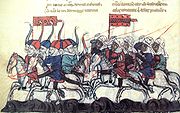 Under Saladin
and the Ayyubids of Egypt, the power of the mamluks increased until they claimed the sultanate in 1250, ruling as the Mamluk Sultanate
. Mamluk regiments constituted the backbone of the late Ayyubid military. Each sultan and high-ranking amir had his private corps, and the sultan as-Salih Ayyub (r. 1240-1249) had especially relied on this means to maintaining power. His mamluks, numbering between 800 and 1,000 horsemen, were called the Bahris, after the Arabic word bahr (بحر), meaning sea or large river, because their barracks were located on the island of Rawda in the Nile. They were mostly drawn from among the Kipchak Turks who controlled the steppes north of the Black Sea.
The Bahriyya were succeeded by the Burji dynasty
, another group of Mamluks. Tehj Burji saw a turbulent and short-lived Sultanate. Political power-plays often became important in designating a new sultan.
In 681 the Bulgarians established a powerful state which played a major military and cultural role in Medieval Europe. Bulgaria
decisively defeated the Arabs in the battle before Constantinople (718) and stopped the Arab
invasion in the eastern parts of the continent effectively stopping the migrations of the barbarian tribes (Pechenegs, Magyars, Khazars
) further to the west. It destroyed the Avars
Khanate in 806.
With the adoption of Christianity
and the invention of the Cyrillic Alphabet
, the Bulgarian Empire
became the cultural and spiritual centre of the whole Slavic
world. The Bulgarian Orthodox Church
became the first National Church in Europe
to gain its independence in 927 with its own Patriarch. The Bulgarian Empire reached its biggest size in the early 10th century stretching from the Black Sea to Bosnia.
The medieval Bulgarian state was restored as the Second Bulgarian Empire after a successful uprising of two nobles from Tarnovo, Asen and Peter, in 1185, and existed until it was conquered during the Ottoman invasion of the Balkans in the late 14th century, with the date of its subjugation usually given as 1396 or 1422. Under Ivan Asen II in the first half of the 13th century it gradually recovered much of its former power, though this did not last long due to internal problems and foreign invasions.
The Serbian Empire was a medieval empire
in the Balkans
that emerged from the Serbian Kingdom. Stephen Uroš IV Dušan was crowned Emperor of Serbs and Greeks on 16 April, 1346, a title signifying a successorship to the Eastern Roman Empire (Byzantines). Dušan the Mighty significantly expanded the state, stretching over half of the Balkan peninsula, also promoting the church to a Patriarchate. The Empire crumbled during Uroš V the Weak (hence his epithet). The Serbian Empire existed nominally from 1346 to 1402. It was de facto
the last of the three orthodox christian empires of the east (Byzantine
, Bulgarian
and Serbian
Empire), before the Ottoman occupation of the Balkans
.
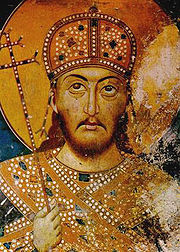 Stefan Uroš IV Dušan of Serbia
, before ascending the throne as king of all Serbs
, proved himself as a very skilled military leader in the Battle of Velbazhd, in which Serbia memorably defeated the Bulgarian Empire
. As his father was not an able conqueror, Dušan, with the help of Serbian nobility, removed his father from the throne, ordering his people to strangle him. The medieval Serbian state reached its apex in the mid-14th century, during the rule of Stefan Dušan
, who proclaimed himself in 1345 tsar in Serres
and was crowned in Skopje
on the 16th April 1346 as the "Emperor of the Serbs and Greeks" by the newly proclaimed Serbian Patriach
Joanikie II with the help of the Bulgarian Patriarch Simeon and the Archbishop of Ohrid, Nicholas.
Tsar Dušan enacted Dušan's Code
, a medieval constitution, in 1349 and 1354. The Code was based on Roman
-Byzantine law
and the first Serbian constitution
— St. Sava's Nomocanon (1219). It was a Civil
and Canon law
(based on the Ecumenical Councils) for the functioning of the state and church. The Serbian Empire flourished, becoming one of the most developed countries and cultures in Europe.
Tsar Dušan doubled the size of his former kingdom, seizing territories to the south, southeast and east at the expense of Byzantium
. He did not fight a single field battle, instead winning his empire by besieging cities. He was succeeded by his son Stefan Uroš V, called the Weak, a term that might also apply to the state of the empire, as it slowly slid into feudal anarchy. The combination of sudden conquest, backwards administration, and failure to consolidate his holdings led to the fragmenting of the empire. This is a period marked by the rise of a new threat: the Ottoman Turkish
sultanate gradually spreading from Asia
to Europe and conquering Byzantine
Thrace first, and then the other Balkans
states. Too incompetent to sustain the great empire created by his father, Stefan V could neither repel attacks of foreign enemies, nor combat the independence of his nobility. The Serbian Empire of Stefan Uroš fragmented into a conglomeration of principalities, some of which did not even nominally acknowledge his rule. Stefan Uroš V died childless on 4 December 1371, after much of the Serbian nobility had been slaughtered by the Ottoman Turks in the Battle of Maritsa
earlier that year.
1184–1225
The unified monarchy maintained its precarious independence from the Byzantine and Seljuk empires throughout the 11th century, and flourished under David IV the Builder (1089–1125), who repelled the Seljuk attacks and essentially completed the unification of Georgia with the re-conquest of Tbilisi in 1122.
With the decline of Byzantine power and the dissolution of the Great Seljuk Empire, Georgia became one of the pre-eminent nations of the Christian East, her pan-Caucasian empire stretching, at its largest extent, from North Caucasus to northern Iran, and eastwards into Asia Minor. In spite of repeated incidents of dynastic strife, the kingdom continued to prosper during the reigns of Demetrios I (1125–1156), George III (1156–1184), and especially, his daughter Tamar (1184–1213). With the death of George III the main male line went extinct and the dynasty was continued by the marriage of Queen Tamar with the Alan prince David Soslan of reputed Bagratid descent.
The Ghaznavids were a Persianate Muslim
dynasty of Turkic
mamluk
origin which existed from 975 to 1187 and ruled much of Persia, Transoxania, and the northern parts of the Indian subcontinent
. The Ghaznavid state was centered in Ghazni, a city in present Afghanistan
. Due to the political and cultural influence of their predecessors - that of the Persian
Samanid Empire - the originally Turkic Ghaznavids became thoroughly Persianized
.
Saboktekin (Mahmud of Ghazni
) made himself lord of nearly all the present territory of Afghanistan and of the Punjab by conquest of Samanid and Shahi lands. In 997, Mahmud, the son of Sebük Tigin, succeeded his father upon his death, and with him Ghazni and the Ghaznavid dynasty have become perpetually associated. He completed the conquest of Samanid, Shahi lands, the Ismaili Kingdom of Multan, Sindh as well as some Buwayhid territory. Under him all accounts was the golden age and the height of the Ghaznevid Empire. Mahmud carried out seventeen expeditions through northern India establishing his control and setting up tributary states. His raids also resulted in the looting of a great deal of plunder. From the borders of Kurdistan to Samarkand, from the Caspian Sea to the Yamuna, he established his authority. The wealth brought back from the Indian expeditions to Ghazni was enormous, and contemporary historians (e.g. Abolfazl Beyhaghi, Ferdowsi) give glowing descriptions of the magnificence of the capital, as well as of the conquerors munificent support of literature. Mahmud died in (1030). Even though there was some revival of importance under Ibrahim (1059–1099), the empire never reached anything like the same splendor and power. It was soon overshadowed by the Seljuqs of Iran.
790s - 840s
The Merovingian dynasty
founded one of the monarchies which replaced the Western Roman Empire from the fifth century. The Frankish state consolidated its hold over large parts of western Europe by the end of the eighth century, developing into the Carolingian Empire
which dominated most of Western Europe. This empire would gradually evolve into France and the Holy Roman Empire. Under the nearly continuous campaigns of Charles Martel
, Pepin the Short, and Charlemagne
—father, son, grandson — the greatest expansion of the Frankish empire was secured by the early 9th century. The tradition of dividing patrimonies among brothers meant that the Frankish realm was ruled, nominally, as one polity subdivided into several regna (kingdoms or subkingdoms).
 The Franks
were united for the first time by Clovis I
in the late 5th century. The geography and number of subkingdoms varied over time, but the particular term Francia came generally to refer to just one regnum, that of Austrasia, centred on the Rhine and Meuse rivers in northern Europe; even so, sometimes the term was used as well to encompass Neustria north of the Loire and west of the Seine. Eventually, the singular use of the name Francia shifted towards Paris, and settled on the region of the Seine basin surrounding Paris, which still today bears the name Île-de-France, and which region gave its name to the entire Kingdom of France. In 732 the Franks managed to defeat the Arabs at Poitiers
, thereby halting their invasion of Western Europe
.
 During the reign of Charlemagne
, it reached its greatest extent, encompassing most of the territory of the Western Roman Empire
, and eventually he was proclaimed Emperor by the Pope in 800. He Christianised the pagan peoples he defeated. This was a period of cultural revival known as the Carolingian Renaissance
with important educational and writing reforms. On Christmas Day, 800, Pope Leo III crowned Charles as "Emperor of the Romans" in Rome in a ceremony presented as a surprise (Charlemagne did not wish to be indebted to the bishop of Rome), a further papal move in the series of symbolic gestures that had been defining the mutual roles of papal auctoritas and imperial potestas. Though Charlemagne, in deference to Byzantine outrage, preferred the title "Emperor, king of the Franks and Lombards", the ceremony formally acknowledged the Frankish Empire as the successor of the (Western) Roman one (although only the forged "Donation" gave the pope political authority to do this), thus triggering a series of disputes with the Byzantines around the Roman name. After an initial protest at the usurpation, in 812, the Byzantine Emperor Michael I Rhangabes acknowledged Charlemagne as co-Emperor. The coronation gave permanent legitimacy to Carolingian primacy among the Franks. The Ottonians later resurrected this connection in 962. The empire disintegrated into three parts after the death of his son Louis the Pious
, from which later emerged France
and Germany
.
The Kingdom of Germany grew out of East Francia in the 10th century. The eastern partition of the Treaty of Verdun
of 843, or East Francia, encompassed a population that was never entirely Frankish
, but also included large numbers of Saxons
, Bavarii
, Thuringii
, Alemanni and Frisii
. When the crown passed to a non-Frankish dynasty (the Liudolfings), the term regnum Teutonicum or Teutonicorum came into informal use. By the High Middle Ages
, the German character of the united stem duchies
was generally recognised.
As the other various states removed themselves from its orbit, leaving solely Germany, her kings holding the imperial title and struggling for it, the German state became synonymous with the Empire and in the time of the Renaissance
, the "Holy Roman Empire of the German Nation" united the two concepts of empire and kingdom. Although the term "sacrum" (i.e. "holy") in connection with the medieval Roman Empire did not appear until 1157 under Frederick I Barbarossa, it is Otto I (also known as Otto the Great and Otto the German), crowned King of Germany in 962, who is generally considered to have been the first Holy Roman Emperor. Otto was the first emperor of the realm that later became known as the Holy Roman Empire who was not a member of the earlier Carolingian dynasty. The last Holy Roman Emperor was Francis II, who abdicated and dissolved the Empire in 1806 during the Napoleonic Wars. In a decree following the 1512 Diet of Cologne, the name was officially changed to Holy Roman Empire of the German Nation.
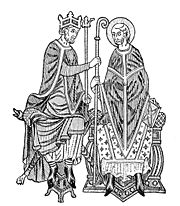 The term rex teutonicorum (king of the Germans) first came into use in the chancery of Pope Gregory VII
during the Investiture Controversy
(late 11th century), perhaps as a polemical tool against the Emperor Henry IV. In the twelfth century, in order to stress the imperial and transnational character of their office, the emperors began to employ the title rex Romanorum (king of the Romans
) on their election (by the prince-electors, seven German bishops and noblemen). Distinct titulature for Germany, Italy and Burgundy, which traditionally had their own courts, laws, and chanceries, gradually dropped from use. After the Reichsreform and Reformation settlement, the German part of the Holy Roman Empire was divided into Reichskreise (imperial circles), which effectively defined Germany against imperial Italy and the Kingdom of Bohemia. The archepiscopal electors continued to bear the titles of chancellors of Germany, Italy and Burgundy. After the Peace of Westphalia
(1648), Germany was effectively a congeries of independent states and statelets, over which the remaining institutions of Kingdom and Empire claimed a declining authority. The German kingdom survived until the abdication of Francis II
in 1806.
1000-1526
The origin of the system of the tribe
s among the Magyars has not been discovered yet, but the distribution into seven tribes had been established by the middle of the 9th century. The seven tribes (Jenő
, Kér, Keszi, Kürt-Gyarmat, Megyer, Nyék and Tarján) formed a confederation called "Hétmagyar" (ie, "The Seven Magyars"). Their leaders, who besides Álmos
included Előd, Ond, Kond, Tas, Huba and Töhötöm, took a blood oath, swearing eternal loyalty to Álmos. The confederation of the tribes was probably led by two high princes: the kende (their spiritual ruler) and the gyula (their military leader). The high princes were either elected by the leaders of the tribes or appointed by the Khagan
of the Khazars
who had been exerting influence over the Magyars.
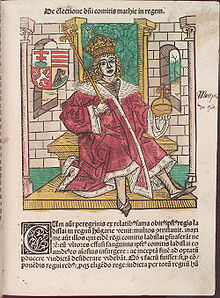 The Kingdom of Hungary in the Middle Ages
, after its sedentarization and conversion to Christianity, became a European power and served as the "gate to Europe" from Asia. A "kingdom" arose only in AD 1000 and a Hungarian state or principality only in the late 9th century, but the concept describes its early development after the year 896 when the Magyars arrived in the Carpathian Basin. The Hungarian kingdom's golden age was during the reign of Matthias Corvinus, the son of John Hunyadi
. His nickname was "Matthias the Just". He further improved the Hungarian economy and practised astute diplomacy in place of military action whenever possible. Matthias did undertake campaigning when necessary. In 1485, aiming to limit the influence and meddling of the Holy Roman Empire in Hungary's affairs, he occupied Vienna for 5 years. After his death, Vladislaus II of Hungary of the Jagiellonians
was placed on the Hungarian throne.
1386–1572
The Kingdom of Poland
grew out of Central-East Europa in the 15th century. After Union of Krewo
and Battle of Grunwald
, Kingdom of Poland and Grand Duchy of Lithuania
, where the power wielded Jagiellon dynasty
. Jagiellon dynasty were the most powerful dynasty in Central-East Europe. Later the Jagiellonian dynasty ruled also in the Kingdom of Bohemia
and Kingdom of Hungary
.
 The Jagiellonian dynasty was a royal dynasty
originating from the Lithuania
n House of Gediminas
. 14 August 1385 by Jogaila
, Grand Duke of Lithuania, in exchange for marriage to the underage reigning Queen Jadwiga of Poland
.Jogaila converted to Christianity, married Jadwiga, and was crowned King of Poland in 1386. Jagiellonian dynasty that reigned in Central Europe
an countries (present day Lithuania, Belarus, Poland, Ukraine, Latvia, Estonia, parts of Russia (including nowadays Kaliningrad oblast), Hungary, Czech Republic, Slovakia) between the 14th and 16th century. Members of the dynasty were Grand Dukes of Lithuania
(1377–1392 and 1440–1572), king
s of Poland (1386–1572), kings of Hungary
(1440–1444 and 1490–1526), and kings of Bohemia
(1471–1526).
The dynastic union between the two countries (converted into a full administrative union only in 1569) is the reason for the common appellation "Poland–Lithuania
" in discussions about the area from the Late Middle Ages
onwards. One Jagiellonian briefly ruled both Poland and Hungary (1440–44), and two others ruled both Bohemia
(from 1490) and Hungary
(1490–1526) and then continued in the distaff
line as the Eastern branch of the House of Habsburg
.
The Normans
were the people who gave their names to Normandy
, a region in northern France
. They descended from Viking
conquerors of the territory and the native population of mostly Frankish
and Gallo-Roman stock. Their identity emerged initially in the first half of the 10th century, and gradually evolved over succeeding centuries until they disappeared as an ethnic group in the early 13th century. The name "Normans" derives from "Northmen" or "Norsemen
", after the Vikings from Scandinavia
who founded Normandy (Northmannia in its original Latin).
 They played a major political, military, and cultural role in medieval Europe and even the Near East. They were famed for their martial spirit and Christian piety. They quickly adopted the Romance language
of the land they settled in, their dialect becoming known as Norman
, an important literary language. The Duchy of Normandy
, which they formed by treaty with the French crown, was one of the great large fiefs of medieval France. The Normans are famed both for their culture, such as their unique Romanesque architecture
, and their musical traditions, as well as for the military accomplishments and innovations. Norman adventurers established a kingdom in Sicily and southern Italy
by conquest, and a Norman expedition on behalf of their duke led to the Norman Conquest of England
. Norman influence spread from these new centres to the Crusader States
in the Near East, to Scotland
and Wales
in Great Britain
, and to Ireland
.
The name Seljuk refers to an Oghuz
Turkic
leader whose tribe had migrated from North (probably Khazar Khanette
) to Khorosan
where they embraced Islam
., Seljuk’s grand sons after defeating Ghaznavids in 1040 founded an empire and decleared themselves to be the protectors of the caliph
. Their empire with caliphs prestige, Turkish army and Persian breucracy proved to be one of the most powerful of states of 11th century. In 1071 after Alp Arslan
of Seljuks defeated Byzantine
army at Manzikert, Turks began to settle in Anatolia
(Asiatic side of Turkey). But Great Seljuk Empire began to disintegrate in the second half of the 12th century. Soon, they were replaced by a number of states ruled by members of Seljuk house or by atabegs. The most important of these was the Sultanate of Rûm
which continued up to 14th century and Khwarezmid Empire in Iran
and Turkmenistan
which fell prey to Mongols
in 1220s.
1059–1250
 With Robert Guiscard
the Norman armies (see Norman conquest of southern Italy
) became the main power in the central-west Mediterranean, influencing the policy of the Popes and the Holy Roman Emperors. Successively under the rule of his descendants, the Norman Kings Roger II
, William I
, William II
the Kingdom of Sicily
dominated with his fleet, army and trade the regions of south Europe and north Africa for more than two centuries. In the same time some of the sons and nephews of Robert, participated at the First Crusade
and conquered the Principality of Antioch
and the County of Edessa
.
 The apogee of the Kingdom of Sicily was under the rule of Holy Roman Emperor Frederick II
, who inherited it by his mother, Constance of Sicily
. Frederick II used the powerful Kingdom of Sicily as a solid base for his imperial policy, in fact the Norman kings had created one of the first relatively modern bureaucracy and so at that time, Sicily was one of the first well ruled states in Europe, the kingdom also had a very flourishing agriculture and was at the center of the Mediterranean trade.
The decline of Sicily started in 1266, when the last son of Frederick, Manfred of Sicily
, died in the Battle of Benevento
: the Kingdom was initially conquered by Charles, Count of Anjou
and Provence
and some years later, in 1282, it was divided in two halves during the so called Sicilian Vespers
.
1099–1380
The Republic of Genoa was a state originating from the city of Genoa
, and existed from 1005 to 1797. During the high Middle Ages the Republic of Genoa was able to become a very wealthy and powerful state through the rich trade between Europe and the Mediterranean sea, becoming one of the early model of capitalistic empires. Genoa started her main expansion expelling the Arab pirates from the Tyrrhenian Sea and west Mediterranean; in 1099 Genoa participated at the Crusades
directly or more often supplying the armies, and so the city gained many settlements and commercial bases in the Levant
. The apogee of Genoa was during the 13th century when her fleet dominated the western Mediterranean trade and in the same time the city was able to match the power of the rival Republic of Venice
in the East. The Battle of Chioggia
(1380) started the decline of Genoa.
1204–1489
The Republic of Venice
was a state originating from the city of Venice
, and existed for a millennium from the late 7th century (697) until the year 1797 when the Austrians took its possessions. The leader of Venetian Republic was called a Doge
. Doges of Venice were elected for life by the Republic's aristocracy.
In the Medieval times Venice was able to become the main trade center between Europe and the East, and also one of the most rich cities in the world. During the Fourth Crusade
(1204) the Franco-Venetian force conquered 1/4 of the Byzantine Empire, especially some important isles (as Candia
) and commercial bases around the Aegean Sea
and Black Sea
. In the successive centuries the Republic was able to consolidate her position, against powerful rivals as the Republic of Genoa
, meanwhile dominating with her fleet the Adriatic Sea and Est Mediterranean. During the 13th and 14th centuries Venice, participating in the Italians wars, was also able to conquest a more land based dominion (the so called Domini di Terraferma
). The conquest of the Kingdom of Cyprus
in 1489 signed the end of the expanding period of Venice.
The Angevin Empire was a collection of states ruled by the Plantagenet dynasty. The Plantagenets ruled over the Kingdom of England
, the Duchy of Normandy
, the Duchy of Aquitaine, the Duchy of Gascony and various French counties (constituting approximately half of the then kingdom of France
), the Lordship of Ireland
, and the Kingdom of Jerusalem
. Their empire in France stretched from the Pyrenees
to the English Channel
over the 12th to the 15th century.
The empire started when Plantegenet Henry II
was made King of England. Successive Plantegenet kings of England possessed large areas of territory in France throughout much of the middle ages
. Although England was the main source of revenue, the strategic situation meant the early Plantagenets usually ruled their empire from France, notably from Poitiers
, the capital of Aquitaine
, which was the birthplace of the dynasty, and they were buried in the Fontevraud Abbey
near Poitiers. Starting with John Lackland
the centre of political activity shifted to England due to the loss of most of their continental territories.
The end of the empire began when the Plantagenets were defeated by the king of France, Philip II Augustus, of the House of Capet
, which left their empire split in two, losing the provinces Normandy
and Anjou
. This defeat, which left the ruling Plantagenets with their English territories and Gascony
in France, set the scene for the Hundred Years' War
, which started when the Plantagenet kings, provoked by French aggression against their trading partners in the Low Countries
, proclaimed themselves rightful kings of France. The war lasted 116 years and the rival Valois claimants eventually conquered the majority of France, except for enclaves such as Calais
, which ended the empire.
1340s - 1480s
The Crown of Aragon
was a Maritime Empire
in the late Middle Ages
that controlled a large portion of present-day northeastern Spain and southeastern Italy, as well as possessions stretching across the Mediterranean Sea
as far as Greece. It originated in 1137, when the Kingdom of Aragon
and the possessions of the County of Barcelona merged by dynastic union
into what later would be known as the Crown of Aragon.
In 1479 a new dynastic union merged the Crown of Aragon with the Crown of Castile
, thus making the dawn of the Spanish Empire
. Ferdinand married Infanta Isabella of Castile, half-sister of King Henry IV of Castile, who became Queen of Castile and Léon after his death in 1474. Their marriage was a dynastic union which became the constituent event for the dawn of the Kingdom of Spain. At that point both Castile and the Crown of Aragon remained distinct territories, each keeping its own traditional institutions, parliaments and laws.
The process of territorial consolidation was completed when King Charles I, becoming known as Charles V, in 1516 united all the kingdoms on the Iberian peninsula minus Portugal under one monarch (his co-monarch and mother Queen Joanna I in confinement), thereby furthering the creation of the Spanish state, albeit a decentralized one. The Crown of Aragon lasted through 1716, when it was abolished by the Nueva Planta decrees
as a result of the Aragonese defeat in the War of the Spanish Succession
.
1230–1480
The Kingdom of Castile
was one of the medieval kingdoms of the Iberian Peninsula
. It was created as a politically autonomous entity in the 9th century: it was called County of Castile and was held in vassal
age from the Kingdom of León
, which was later incorporated. Its name is supposed to be related to the host of castle
s constructed in the region. It was one of the ancestor kingdoms of the Kingdom of Spain.
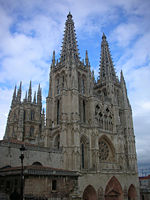 As with all medieval kingdoms, supreme power was understood to reside in the monarch "by the grace of God," as the legal formula explained. Nevertheless, rural and urban communities began to form assemblies to issue regulations to deal with everyday problems. Over time, these assemblies evolved into municipal councils, known as variously as ayuntamientos or cabildos, in which some of the inhabitants, the property-owning heads of households (vecinos), represented the rest.
By the fourteenth century these councils had gained more powers, such as the right to elect municipal magistrates and officers (alcaldes, speakers, clerks, etc.) and representatives to the parliaments (Cortes). Due to the increasing power of the municipal councils and the need for communication between these and the King, cortes were established in the Kingdom of León in 1188, and in Castile in 1250. In the earliest Leonese and Castilian Cortes, the inhabitants of the cities (known as "laboratores") formed a small group of the representatives and had no legislative powers, but they were a link between the king and the general population, something that was pioneered by the kingdoms of Castile and León. Eventually the representatives of the cities gained the right to vote in the Cortes, often allying with the monarchs against the great noble lords.
The Kalmar Union
was a Personal union
between the three kingdoms in the region Scandinavia
, Denmark, Norway and Sweden often seen as a reaction against the powerful Hanseatic League
and Teutonic Knights
which at that time had a major influence in northern Europe. The union was established in a meeting in Kalmar
1397. Copenhagen
became the capital of the Union and the Danish regent became the ruler of the Union which in the end were the reason for severe tensions between Sweden and Denmark-Norway. The Kalmar Union had a larger area than any other country in Europe at the time. The most prominent regent during this time was Margarethe I.
 The last Danish king of the Union, Christian II, populary called Christian the Tyrant in Sweden, ordered a massacre called the Stockholm Bloodbath
of approximately 84 Swedish nobelmen and other leading men in 1520 just after his own coronation. Before that, he had promised the Swedish people that he would forget earlier hostilities. Gustav Vasa, a Swedish nobelman was starting a successful rebellion with the help of the notorious rebellious miners from the region Dalarna
against Danmark-Norway and became the founder of the first Swedish royal dynasty in 1523 with inheritance from father to son.
1300–1450
The Mali Empire
was a medieval state of West Africa
. The empire was founded by Sundiata Keita
and became renowned for the generosity and wealth of its rulers, especially Mansa
Kankan Musa I
. The Mali Empire had profound cultural influences on West Africa allowing the spread of its language, laws and customs along the Niger River
. Musa was a devoted Muslim and Islamic scholarship flourished under his rule; the Sankore University
in Timbuktu
reached its height, bringing together Islamic scholars from all over the Muslim World
.
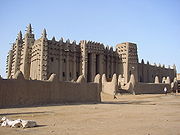 Imperial Mali is best known to us through three primary sources: The first is the account of Shihab al-Din ibn Fadl Allah al-'Umari, written about 1340 by a geographer-administrator in Egypt. His information about the empire came from visiting Malians taking the hajj, or pilgrim's voyage to Mecca. He had first hand information from several, and at second hand, he learned of the visit of Mansa Musa. The second account is that of the traveler Shams al-Din Abu Abd'Allah ibn Battua, who visited Mali in 1352. This is the first account of a West African kingdom made directly by an eyewitness, the others are usually at second hand. The third great account is that of Abu Zayd Abd-al-Rahman ibn Khaldun, who wrote in the early 15th century. While the accounts are of limited length, they provide us with a fairly good picture of the empire at its height.
1137 - 1975
The Ethiopian Empire
(Abyssinia) existed at the end of the late Middle Ages, approximately 1137 (beginning of Zagwe Dynasty
). In 1270, the Zagwe dynasty
was overthrown by a king claiming lineage with the Aksumite emperors and thus that of Solomon (hence the name "Solomonid"). The Solomonid Dynasty was born of and ruled by the Habesha, from whom Abyssinia gets its name. The Habesha reigned with only a few interruptions from 1270 until the modern age
.
543–753
The Chalukya Empire was an India
n royal dynasty that ruled large parts of southern
and central India between the 6th and the 12th centuries. The rule of the Chalukyas marks an important milestone in the history of South India
and a golden age in the history of Karnataka
.
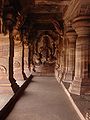 The political atmosphere in South India shifted from smaller kingdoms to large empires with the ascendancy of Badami Chalukyas. For the first time, a South Indian kingdom took control and consolidated the entire region between the Kaveri and the Narmada
rivers. The rise of this empire saw the birth of efficient administration, overseas trade and commerce and the development of new style of architecture called "Badami Chalukya architecture
(Western Chalukya architecture
during the rule of Western Chalukyas
)".
The Chalukyas ruled over the Deccan plateau in India for over 600 years. During this period, they ruled as three closely related, but individual dynasties. These are the "Chalukyas of Badami
" (also called "Early Chalukyas"), who ruled between the 6th and the 8th century, and the two sibling dynasties, the "Chalukyas of Kalyani
" (also called Western Chalukyas
or "Later Chalukyas") and the "Chalukyas of Vengi" (also called Eastern Chalukyas
).
Vikramaditya VI
was an ambitious and skilled military leader. Under his leadership the Western Chalukyas were able to end the Chola influence over Vengi (coastal Andhra) and become the dominant power in the Deccan. The Western Chalukya period was an important age in the development of Kannada literature and Sanskrit literature. They went into their final dissolution towards the end of the 12th century.
753–982
The Rashtrakuta Empire was a royal
India
n dynasty
ruling large parts of southern, central and northern India between the 6th and the 10th centuries. An Arabic writing, the Silsilatuttavarikh (851) called the Rashtrakutas one among the four principle empires of the world. The Kitab-ul-Masalik-ul-Mumalik (912) called them the "greatest kings of India" and there were other contemporaneous books written in their praise.
The Rashtrakutas quickly became the most powerful Deccan empire, making their initial successful forays into the doab
region of Ganges River
and Jamuna River
during the rule of Dhruva Dharavarsha
. The rule of his son Govinda III
signaled a new era with Rashtrakuta victories against the Pala Dynasty of Bengal
and Gurjara Pratihara
of north western India resulting in the capture of Kannauj
. The Rashtrakuta empire at its peak spread from Cape Comorin in the south to Kannauj in the north and from Banaras in the east to Broach (Bharuch) in the west.
The Carnatic expansion of people and influences to the North from Karnataka during 10-12th century period is well attested by the sources but has not yet been studied carefully.
750–1174
The Pala Empire
was a Buddhist dynasty that ruled from the north-eastern region of the Indian subcontinent
. The Palas were followers of the Mahayana
and Tantric
schools of Buddhism. Gopala
was the first ruler from the dynasty. He came to power in 750 in Gaur
by a democratic election
.
The empire reached its peak under Dharmapala
and Devapala
. Dharmapala extended the empire into the northern parts of the Indian Subcontinent
. This triggered once again the power struggle for the control of the subcontinent. Devapala
, successor of Dharmapala, expanded the empire to cover much of South Asia
and beyond. His empire stretched from Assam
and Utkala in the east, Kamboja (modern day Afghanistan
) in the north-west and Deccan in the south.
The Pala Empire can be considered as the golden era of Bengal. Never had the Bengali people reached such height of power and glory to that extent. The Palas had extensive trade as well as influence in south-east Asia. This can be seen in the sculptures and architectural style of the Sailendra Empire (present-day Malaya, Java, Sumatra). The Pala Empire eventually disintegrated in the 12th century weakened by attacks of the Sena dynasty followed by the invasion of Bakhtiyar Khilji's Muslim armies.
985-1200
The Chola Empire ruled much of India
and Southeast Asia
. By the 9th century, under Rajaraja Chola and his son Rajendra Chola, the Cholas rose as a notable power in south Asia
. The Chola Empire stretched as far as Bengal
. At its peak, the empire spanned almost 3600000 km² (1,389,967.8 sq mi). Rajaraja Chola conquered all of peninsular South India
and parts of the Sri Lanka
. Rajendra Chola's navies went even further, occupying coasts from Burma (now Myanmar
) to Vietnam
, the Andaman and Nicobar Islands, Lakshadweep
, Sumatra
, Java
, Malaya
in South East Asia and Pegu islands. He defeated Mahipala
, the king of the Bengal, and to commemorate his victory he built a new capital and named it Gangaikonda Cholapuram
.
The Cholas left a lasting legacy. Their patronage of Tamil literature and their zeal in building temples have resulted in some great works of Tamil literature and architecture. The Chola kings were avid builders and envisioned the temples in their kingdoms not only as places of worship but also as centres of economic activity. They pioneered a centralised form of government and established a disciplined bureaucracy.
1206 - 1370s
The Mongol Empire
was an empire from the 13th and 14th century spanning from Eastern Europe across Asia. It is the largest contiguous empire in the history of the world. It emerged from the unification of Mongol and Turkic tribes in modern day Mongolia, and grew through invasions, after Genghis Khan had been proclaimed ruler of all Mongols in 1206. At its greatest extent it stretched from the Danube to the Sea of Japan and from northern Siberia to Camboja, covering over 24000000 km² (9,266,451.8 sq mi), 22% of the Earth's total land area, and held sway over a population of over 100 million people. It is often identified as the "Mongol World Empire" because it spanned much of Eurasia. As a result of the empire's conquests and political and economic impact on most of the Old World, its wars with other great powers in Africa, Asia and Europe are also believed to be an ancient world war. Under the Mongols new technologies, various commodities and ideologies were disseminated and exchanged across Eurasia.
However, the empire began to split following the succession war in 1260-1264, with the Golden Horde and the Chagatai Khanate being de facto independent and refusing to accept Kublai Khan as Khagan. By the time of Kublai Khan's death, the Mongol Empire had already fractured into four separate khanates or empires, each pursuing its own separate interests and objectives: the Golden Horde
in Russia
, the Chagatai Khanate
in Central Asia
, the Ilkhanate
in Persia and the Yuan dynasty
in China
. The Mongol rulers of Central Asia successfully resisted Kublai's attempt to reduce the Chagatayid and Ogedeid families to obedience. It was not until 1304, when the Yuan Dynasty re-established nominal suzerainty over the western khanates. However, with the breakup of the Yuan Dynasty in 1368, the Mongol Empire finally dissolved.
1271–1368
The Yuan Dynasty
lasting from 1271 to 1368. The dynasty was established by ethnic Mongols
, and it had nominal control over the entire Mongol Empire
(stretching from Eastern Europe
to the fertile crescent
to Russia
); however, the Mongol rulers in Asia were only interested in China. Later successors did not even attempt to stake claim over the Khakhan title and saw themselves as Emperor of China
, as the Yuan Dynasty grew from being an Imperial Mongol administration under Kublai Khan
to becoming a basically Chinese institution under his successors.
In according to the Chinese historians, the Mongolian Yuan Dynasty followed the Song Dynasty and preceded the Ming Dynasty
in the historiography of China.
A rich cultural diversity developed during the Yuan Dynasty. The major cultural achievements were the development of drama and the novel and the increased use of the written vernacular. The political unity of China and much of central Asia promoted trade between East and West. The Mongols' extensive West Asian and European contacts produced a fair amount of cultural exchange. The other cultures and peoples in the Mongol World Empire permanently influenced China. Tibetan-rite Tantric Buddhism also had a significant impact in Chinese Buddhism during that period. The Muslims of the Yuan Dynasty introduced Middle Eastern cartography, astronomy, medicine, clothing, and diet in East Asia. Middle Eastern crops such as carrots, turnips, new varieties of lemons, eggplants, and melons, high-quality granulated sugar, and cotton were all either introduced or successfully popularized by the Yuan Mongols.
The Yuan undertook extensive public works. Road and water communications were reorganized and improved. To provide against possible famines, granaries were ordered built throughout the empire. The city of Beijing was rebuilt with new palace grounds that included artificial lakes, hills and mountains, and parks. During the Yuan period, Beijing became the terminus of the Grand Canal of China, which was completely renovated. These commercially oriented improvements encouraged overland and maritime commerce throughout Asia and facilitated direct Chinese contacts with Europe. Chinese travelers to the West were able to provide assistance in such areas as hydraulic engineering. Contacts with the West also brought the introduction to China of a major food crop, sorghum, along with other foreign food products and methods of preparation.
In historiography of Mongolia, the Yuan Dynasty is generally considered to be the continuation of the Mongol Empire. In traditional historiography of China on the other hand, the Yuan Dynasty is usually considered to be the legitimate dynasty between the Song Dynasty and the Ming Dynasty. Note, however, Yuan Dynasty is traditionally often extended to cover the Mongol Empire before Kublai Khan's formal establishment of the Yuan in 1271, partly because Kublai had his grandfather Genghis Khan placed on the official record as the founder of the dynasty or Taizu. Despite the traditional historiography as well as the official views (including the government of the Ming Dynasty which overthrew the Yuan Dynasty), there also exist Chinese people who did not consider Yuan Dynasty as a legitimate dynasty of China, but a period of foreign domination. The latter believe that Han Chinese were treated as second-class citizens, and China stagnated economically and scientifically; in addition, Chinese technologies such as gunpowder and the compass spread to Europe under the Yuan.
1370s - 1600s
The Ming Dynasty
(Empire of the Great Ming), was the ruling dynasty of China from 1368 to 1644, following the collapse of the Mongol-led Yuan Dynasty. The Ming, "one of the greatest eras of orderly government and social stability in human history", was the last dynasty in China ruled by ethnic Hans. Although the Ming capital Beijing fell in 1644 to a rebellion led by Li Zicheng who established the Shun Dynasty, which was soon replaced by the Manchu-led Qing Dynasty, regimes loyal to the Ming throne (collectively called the Southern Ming Dynasty) survived until 1662.
Ming rule saw the construction of a navy and a standing army. Although private maritime trade and official tribute missions from China had taken place in previous dynasties, the tributary fleet under the Muslim eunuch admiral Zheng He in the 15th century. There were enormous construction projects, including the restoration of the Grand Canal and the Great Wall and the establishment of the Forbidden City in Beijing during the first quarter of the 15th century. Estimates for the late-Ming population vary from 160 to 200 million. The Ming dynasty is often regarded as both a high point in Chinese civilization as well as a dynasty in which early signs of capitalism emerged.
Emperor Hongwu attempted to create a society of self-sufficient rural communities in a rigid, immobile system that would have no need to engage with the commercial life and trade of urban centers. His rebuilding of China's agricultural base and strengthening of communication routes through the militarized courier system had the unintended effect of creating a vast agricultural surplus that could be sold at burgeoning markets located along courier routes. Rural culture and commerce became influenced by urban trends. The upper echelons of society embodied in the scholarly gentry class were also affected by this new consumption-based culture. In a departure from tradition, merchant families began to produce examination candidates to become scholar-officials and adopted cultural traits and practices typical of the gentry. Parallel to this trend involving social class and commercial consumption were changes in social and political philosophy, bureaucracy and governmental institutions, and even arts and literature
The Timurids were a Persianate Central Asia
n Sunni Muslim
dynasty of originally Turko-Mongol descent whose empire included the whole of Central Asia, Iran
, modern Afghanistan
, as well as large parts of Pakistan
, India, Mesopotamia
and Caucasus
.
It was founded by the legendary conqueror Timur
(Tamerlane) in the 14th century. In the 16th century, Timurid prince Babur, the ruler of Ferghana, invaded North India and founded the Mughal Empire, which ruled most of the North India until its decline after Aurangzeb in the early 18th century, and was formally dissolved by the British Raj after the Indian rebellion of 1857. Later princes of the dynasty predominantly used the title Mirza to show descent from the Amir.
Although the Timurids hailed from the Barlas tribe which was of Turkicized Mongol origin, they had embraced Persian culture, converted to Islam and resided in Turkestan and Khorasan. Thus, the Timurid era had a dual character, which reflected both the Turco-Mongol origins and the Persian literary, artistic, and courtly high culture of the dynasty.
802-1431
The Khmer Empire
was one of the most powerful empires in Southeast Asia
, based in what is now Cambodia
. The empire, which grow out of former kingdom of Chenla
, at times ruled over and/or vassalized parts of modern-day Laos
, Thailand
, Vietnam
, Myanmar
, and Malaysia. Its greatest legacy is Angkor
, the site of capitals cities during the empire's zenith. Angkor bears testimony to the Khmer empire's immense power and wealth, as well as the variety of belief systems that it patronised over time. The empire's official religions included Hinduism
and Mahayana Buddhism, until Theravada Buddhism prevailed, even among plain folks, after its introduction from Sri Lanka
as of the 13th century. Modern researches by satellites have revealed Angkor to be the largest pre-industrial urban center in the world.
From Kambuja itself - and so also from the Angkor region - no written records have survived other than stone inscriptions. Therefore the current knowledge of the historical Khmer civilization is derived primarily from:
The beginning of the era of the Khmer Empire is conventionally dated to 802 AD. In this year, king Jayavarman II had himself declared chakravartin ("king of the world", or "king of kings") on Phnom Kulen.
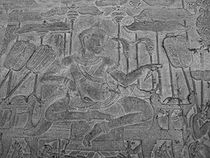 The 11th century was a time of conflict and brutal power struggles. Only with Suryavarman II
was the kingdom united internally and extended externally. Under his rule, the largest temple of Angkor was built in a period of 37 years: Angkor Wat, dedicated to the god Vishnu. Suryavarman II conquered the Mon kingdom of Haripunjaya to the west, and the area further west to the border with the kingdom of Bagan, in the south further parts of the Malay peninsula down to the kingdom of Grahi, in the east several provinces of Champa and the countries in the north as far as the southern border of modern Laos. Suryavarman II's end is unclear. The last inscription, which mentions his name in connection with a planned invasion of Vietnam, is from the year 1145. He died during a failed military expedition in Đại Việt territory around 1145 and 1150.
The First Nusantara Kingdom (Srivijaya Empire) has success uniting most western part of Nusantara
or maritime Southeast Asia. Srivijaya was a coastal trading centre and was a thalassocracy
. As such, it did not extend its influence far beyond the coastal areas of the islands of Southeast Asia, with the exception of contributing to the population of Madagascar
3,300 miles to the west.
According to the Kota Kapur Inscription, discovered on Bangka Island
, the empire conquered most of Southern Sumatra
and neighboring island of Bangka, as far as Lampung
. Also according to this inscription, Jayanasa launched a military campaign against Bhumi Java in late 7th century, a period which coincides with the decline of Tarumanagara
in West Java
and Holing (Kalingga) in Central Java
. The empire thus grew to control the trade on the Strait of Malacca
, Sunda Strait
, the South China Sea
, the Java Sea
, and Karimata Strait
.During the same century, Langkasuka
on the Malay Peninsula
became part of Srivijaya. Soon after this, Pan Pan and Trambralinga, which were located north of Langkasuka, came under Srivijayan influence. These kingdoms on the peninsula were major trading nations that transported goods across the peninsula's isthmus. With the expansion into Java and the Malay Peninsula, Srivijaya controlled two major trade choke point
s in Southeast Asia. Some Srivijayan temple ruins are observable in Thailand
and Cambodia
.
At some point in the 7th century, Cham ports in eastern Indochina started to attract traders. This diverted the flow of trade from Srivijaya. In an effort to divert the flow, the Srivijayan king or maharaja
, Dharmasetu
, launched various raids against the coastal cities of Indochina. The city of Indrapura
by the Mekong River was temporarily controlled from Palembang, capital of the empire during the century, in the early 8th century. By that century, Srivijaya controlled both the spice route traffic and local trade, charging a toll on passing ships. Serving as an entrepôt for Chinese, Malay, and Indian markets, the port of Palembang, accessible from the coast by way of a river, accumulated great wealth. Envoys travelled to and from China frequently.
The migration to Madagascar
accelerated in the 9th century, when the powerful Sumatran empire of Srivijaya controlled much of the maritime trade in the Indian Ocean
.
The Maya
is a Mesoamerica
n civilization
, noted for the only known fully developed written language
of the pre-Columbian
Americas, as well as its art
, architecture
, and mathematical and astronomical systems. Initially established during the Preclassic period
(c. 2000 BC to 250 AD), many Maya cities reached their highest state development during the Classic period
(c. 250 to 900), and continued throughout the Postclassic period until the arrival of the Spanish
. At its peak, it was one of the most densely populated and culturally dynamic societies in the world.
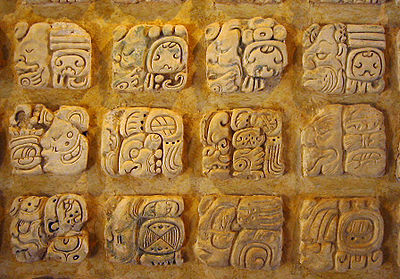 The Maya civilization shares many features with other Mesoamerican civilizations due to the high degree of interaction and cultural diffusion that characterized the region. Advances such as writing, epigraphy, and the calendar did not originate with the Maya; however, their civilization fully developed them. Maya influence can be detected from Honduras, Guatemala, Northern El Salvador and to as far as central Mexico, more than 1000 km (621.4 mi) from the Maya area. Many outside influences are found in Maya art and architecture, which are thought to result from trade and cultural exchange rather than direct external conquest.
The Classic period (c. 250–900 AD) witnessed the peak of large-scale construction and urbanism, the recording of monumental inscriptions, and a period of significant intellectual and artistic development, particularly in the southern lowland regions. They developed an agriculturally intensive, city-centered empire consisting of numerous independent city-states. This includes the well-known cities of Tikal, Palenque, Copán and Calakmul, but also the lesser known Dos Pilas, Uaxactun, Altun Ha, and Bonampak, among others.
The Inca Empire
was the largest empire in pre-Columbian America. The administrative, political and military center of the empire was located in Cusco
in modern-day Peru
. The Inca Empire arose from the highlands of Peru sometime in early 13th century. From 1438 to 1533, the Incas used a variety of methods, from conquest to peaceful assimilation, to incorporate a large portion of western South America
, centered on the Andean
mountain ranges, including large parts of modern Ecuador
, Peru, western and south central Bolivia
, northwest Argentina
, north and north-central Chile
, and southern Colombia
.
There is some debate about the number of people inhabiting Tawantinsuyu at its peak, with estimates ranging from as few as 4 million people, to more than 37 million. The reason for these various estimates is that in spite of the fact that the Inca kept excellent census records using their quipu, knowledge of how to read them has been lost, and almost all of them had been destroyed by the Spaniards in the course of their conquest.
The most powerful figure in the empire was the Sapa Inca ('the unique Inca'). Only descendants of the original Inca tribe ascended to the level of Inca. Most young members of the Inca's family attended Yachay Wasis (houses of knowledge) to obtain their education.
The Inca Empire was a federalist system which consisted of a central government with the Inca at its head and four provinces. The four corners of these provinces met at the center, Cusco
. Each province had a governor who oversaw local officials, who in turn supervised agriculturally productive river valleys, cities and mines. The local officials were responsible for settling disputes and keeping track of each family's contribution to the mita (mandatory public service).
Architecture was by far the most important of the Inca arts, with textiles reflecting motifs that were at their height in architecture. The main example is the capital city of Cusco. The breathtaking site of Machu Picchu was constructed by Inca engineers. The stone temples constructed by the Inca used a mortarless construction that fit together so well that a knife could not be fitted through the stonework. This was a process first used on a large scale by the Pucara
peoples (ca. 300 BC–AD 300) and later in the great city of Tiwanaku
(ca. AD 400–1100). The rocks used in construction were sculpted to fit together exactly by repeatedly lowering a rock onto another and carving away any sections on the lower rock where the dust was compressed. The tight fit and the concavity on the lower rocks made them extraordinarily stable.
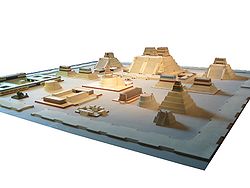 The Aztec
people were certain ethnic groups of central Mexico
, particularly those groups who spoke the Nahuatl language
and who dominated large parts of Mesoamerica
in the 14th, 15th and 16th centuries, a period referred to as the Late post-Classic period in Mesoamerican chronology
. From the 13th century Valley of Mexico
was the core of Aztec civilization: here the capital of the Aztec Triple Alliance, the city of Tenochtitlan, was built upon raised islets in Lake Texcoco
. The Triple Alliance formed its tributary empire expanding its political hegemony far beyond the Valley of Mexico, conquering other city states throughout Mesoamerica. In 1521, in what is probably the most widely known episode in the Spanish colonization of the Americas
, Hernán Cortés
, along with a large number of Nahuatl speaking indigenous allies, conquered Tenochtitlan and defeated the Aztec Triple Alliance under the leadership of Hueyi Tlatoani Moctezuma II
; In the series of events often referred to as "The Fall of the Aztec Empire". Subsequently the Spanish founded the new settlement of Mexico City
on the site of the ruined Aztec capital.
The Aztec Empire was an example of an empire that ruled by indirect means. It was ethnically very diverse and was structured by a system of tribute. The Aztec empire as an hegemonic empire did not exert supreme authority over the conquered lands, it merely expected tributes to be paid. It was also a discontinuous empire because not all dominated territories were connected. The hegemonic nature of the Aztec empire can be seen in the fact that generally local rulers were restored to their positions once their city-state was conquered and the Aztecs did not interfere in local affairs as long as the tribute payments were made. Although the form of government is often referred to as an empire, in fact most areas within the empire were organized as city-states, known as altepetl
. These were small polities ruled by a king (tlatoani) from a legitimate dynasty.
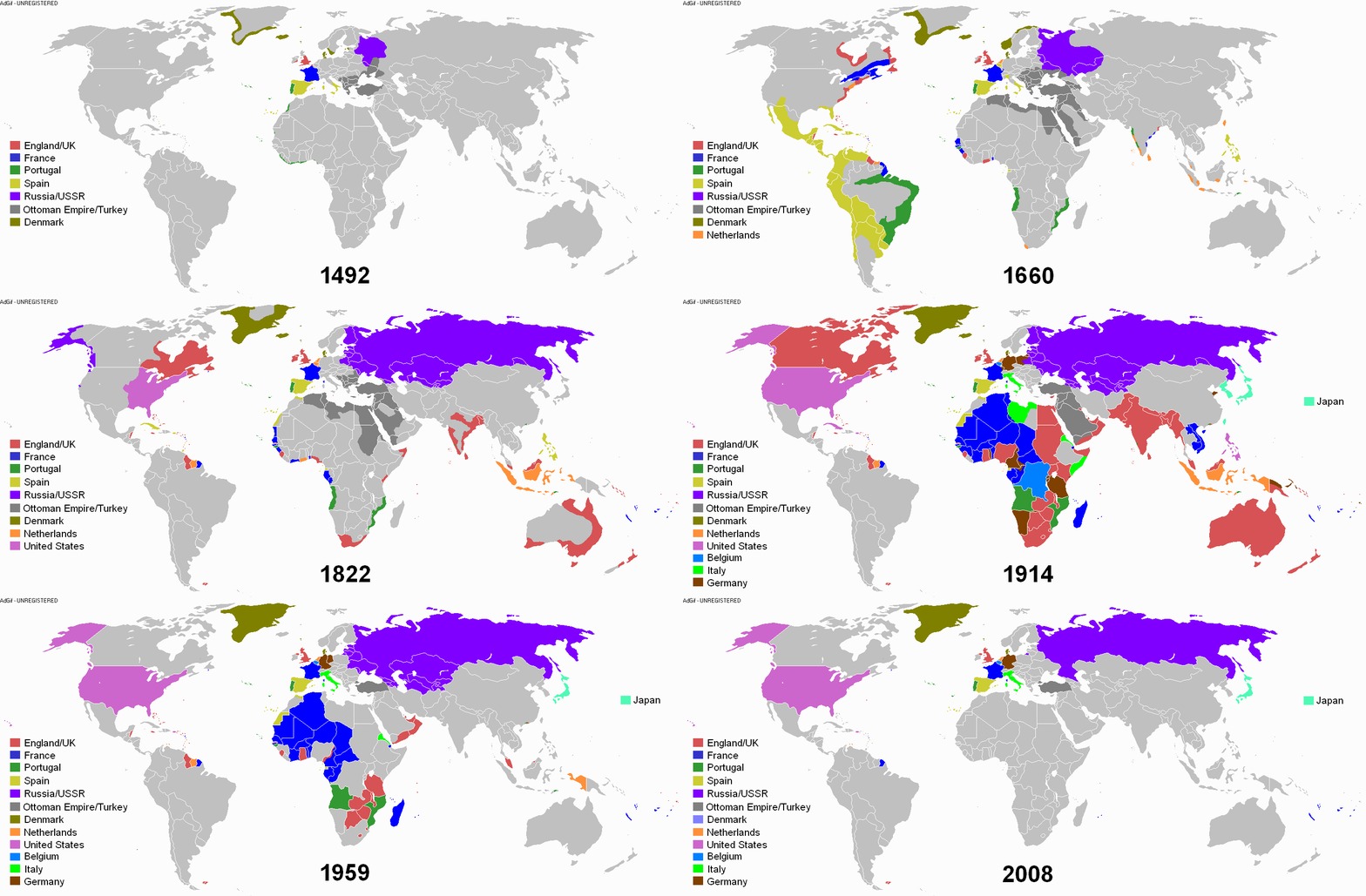
1450s - 1815
France was a dominant empire possessing many colonies in various locations around the world. The Empire of the French
(1804–1814), also known as the Greater French Empire or First French Empire
, but more commonly known as the Napoleonic Empire, was the empire of Napoleon I in France. It was the dominant power of much of continental Europe during the early 19th Century.
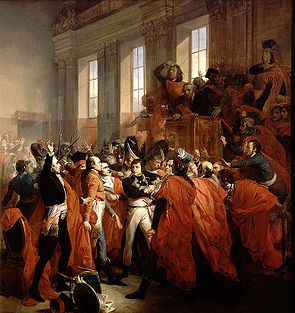 Napoleon became Emperor of the French
(L'Empereur des Français) on 18 May 1804 and crowned Emperor December 2, 1804, ending the period of the French Consulate, and won early military victories in the War of the Third Coalition against Austria, Prussia, Russia, Portugal, and allied nations, notably at the Battle of Austerlitz
(1805) and the Battle of Friedland
(1807). The Treaty of Tilsit in July 1807 ended two years of bloodshed on the European continent. Subsequent years of military victories known collectively as the Napoleonic Wars extended French influence over much of Western Europe and into Poland. At its height in 1812, the French Empire had 130 départements, ruled over 50 million subjects, maintained extensive military presence in Germany, Italy, Spain, and the Duchy of Warsaw, and could count Prussia and Austria as nominal allies.
Early French victories exported many ideological features of the French Revolution throughout Europe. Napoleon gained support by appealing to some common concerns of French people. These included dislike of the emigrant nobility who had escaped persecution, fear by some of a restoration of the ancien régime, a dislike and suspicion of foreign countries had tried to reverse the Revolution – and a wish by Jacobins to extend France's revolutionary ideals. Seigneurial dues and seigneurial justice were abolished, aristocratic privileges were eliminated in all places except Poland, and the introduction of the Napoleonic Code
throughout the continent increased legal equality, established jury systems, and legalized divorce. Napoleon placed relatives on the thrones of several European countries and granted many noble titles, most of which expired with the fall of the Empire.
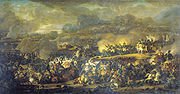 Historians have estimated the death toll from the Napoleonic Wars to be 6.5 million people, or 15% of the French Empire's subjects. The War of the Sixth Coalition
, a coalition of Austria, Prussia, Russia, the United Kingdom, Sweden, Spain and a number of German States finally defeated France and drove Napoleon Bonaparte into exile on Elba. After Napoleon's disastrous invasion of Russia, the continental powers joined Russia, Britain, Portugal and the rebels in Spain. With their armies reorganized, they drove Napoleon out of Germany in 1813 and invaded France in 1814, forcing Napoleon to abdicate and restoring the Bourbons.
1489–1718
In the high Middle Ages the Republic of Venice was able to become a very wealthy and powerful state through the rich trade between Europe and the Levant
. During the Modern Era started the decline of Venice, but it was a very long and "golden" decadence, in fact for almost three centuries the Republic was the only Italian state able to preserve his independence; in particular Venice was able to match the invading powers of the French and Spanish monarchies in Italy and in the same time, the Republic was also able to stop many times the expansion of Ottoman Empire
in South-East Europe and Mediterranean. The last main success of Venice was the conquest of Morea
between 1669 and 1718. The Republic of Venice ended in 1797 when Napoleon conquered the city and ceded its territories to Austria.
1660s - 1800s
The Qing Dynasty
(Manchu Dynasty), was the last ruling dynasty of China, ruling from 1644 to 1912 (with a brief, abortive restoration in 1917). It was preceded by the Ming Dynasty and followed by the Republic of China. The dynasty was founded by the Manchu clan Aisin Gioro in what is today northeast China (also known as Manchuria). Starting in 1644 it expanded into China proper and its surrounding territories, establishing the Empire of the Great Qing. Complete pacification of China was accomplished around 1683 under the Kangxi Emperor
.
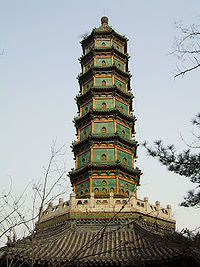 The dynasty changed its name to "Qing", meaning "clear" or "pellucid" around 1636. In 1644 Beijing was sacked by a coalition of rebel forces led by Li Zicheng, a minor Ming official turned leader of the peasant revolt. The last Ming Emperor Chongzhen committed suicide when the city fell, marking the official end of the dynasty. The Manchus then allied with Ming Dynasty general Wu Sangui and seized control of Beijing and overthrew Li's short-lived Shun Dynasty.
During its reign the Qing Dynasty became highly integrated with Chinese culture. The dynasty reached its height in the 18th century, during which both territory and population were increased. However, its military power weakened hereafter and faced with massive rebellions and defeats in wars, the Qing Dynasty declined after the mid-19th century. The Qing Dynasty was overthrown following the Xinhai Revolution.
1550s - 1700s
The Safavids (1501–1736) are considered as the greatest Iranian Empire since the Islamic conquest of Persia
. The Safavid empire originated from Ardabil
in Iranian Azerbaijan in northern Iran. It was a Turkic-speaking dynasty whose classical and cultural language was Persian. The Safavid dynasty had its origins in a long established Sufi order, called the Safaviyeh. The Safavids established an independent unified Iranian state for the first time after the Islamic conquest of Persia and reasserted Iranian political identity, and established Shia Islam as the official religion in Iran.
1581–1795
The Dutch Republic
controlled various territories after the Dutch achieved independence from Spain
in the 16th century. Their skills in shipping
and trading
aided the building of an overseas colonial empire which lasted from the 16th to the 20th century. The Dutch initially built up colonial possessions on the basis of indirect state capitalist corporate colonialism, with the dominant Dutch East India Company
. A cultural flowering roughly spanning the 17th century is known as the Dutch Golden Age
, in which Dutch trade, science and art were among the most acclaimed in the world. Dutch military power was at its height in the middle of the 17th century and in that era the Dutch navy
was the most powerful navy in the world.
By the middle of the 17th century, the Dutch had overtaken Portugal as the dominant player in the spice and silk trade, and in 1652 founded a colony at Cape Town on the coast of South Africa, as a way-station for its ships on the route between Europe and Asia. After the first settlers spread out around the Company station, nomadic white livestock farmers, or Trekboers, moved more widely afield, leaving the richer, but limited, farming lands of the coast for the drier interior tableland. Between 1602 and 1796, million Europeans were sent to work in the Asia trade. The majority died of disease or made their way back to Europe, but some of them made the Indies their new home. Interaction between the Dutch and native population mainly took place in Sri Lanka and the modern Indonesian Islands. Through the centuries there developed a relatively large Dutch-speaking population of mixed Dutch and Indonesian descent, known as Indos or Dutch-Indonesians.
1600–1815
The empire began in the 17th century as a combination of factors led to its creation, such as the growth in British trade with India
and the Far East
, the success of the British East India Company
, numerous British maritime explorations around the world, and the vast Royal Navy
. The British Empire comprised the dominions, colonies, protectorates, mandates, and other territories ruled or administered by the United Kingdom. It originated with the overseas colonies and trading posts established by England in the late 16th and early 17th centuries. At its height it was the largest empire in history and, for over a century, was the foremost global power.
British colonies were created along the east coast of North America
during the 17th and 18th centuries but by the late 18th century most of these colonies rebelled against British rule, leading to the American War of Independence and formation of the United States of America. Nevertheless Great Britain retained significant colonies in Canada
, the Caribbean
and India, and shortly thereafter began the settlement of Australia
and New Zealand
. Following France's defeat in the Napoleonic Wars
in 1815, Great Britain took possession of many more overseas territories in Africa
and Asia
, and established informal empires of free trade in South America
, China
and Persia.
1550s - 1700s
The Mughal Empire
was an Islamic
imperial power that ruled the Indian subcontinent
which began in 1526, invaded and ruled most of Hindustan
(South Asia
) by the late 17th and early 18th centuries, and ended in the mid-19th century. In 1526, Babur
, a Timurid
descendant of Timur
and Genghis Khan
, swept across the Khyber Pass
and established the Mughal Empire
, which lasted for over 200 years. The Mughal Dynasty ruled most of the Indian subcontinent by 1600; it went into a slow decline after 1707 and was finally defeated during the 1857 War of Independence also called the Indian Rebellion of 1857. This period marked vast social change in the subcontinent as the Hindu majority were ruled over by the Mughal
emperors; most of them showed religious tolerance, liberally patronising Hindu culture. The famous emperor Akbar, who was the grandson of Babar, tried to establish a good relationship with the Hindus. However, later emperors such as Aurangazeb tried to establish complete Muslim dominance and as a result several historical temples were destroyed during this period and taxes imposed on non-Muslims. During the decline of the Mughal Empire
, which at its peak occupied an area similar to the ancient Maurya Empire
, several smaller empires rose to fill the power vacuum or themselves were contributing factors to the decline. The Mughals were perhaps the richest single dynasty to have ever existed.
1674–1820
The Maratha Empire
(Maratha Confederacy) was a Hindu
state located in present-day India
. It existed from 1674 to 1818. At its peak, the empire's territories covered much of South Asia
. It expanded greatly after the death of Mughal Emperor Aurangzeb
in 1707, only to lose Punjab region
in Third battle of Panipat
in 1761. A large portion of the empire was coastline which was secured by a potent navy under commanders such as Kanhoji Angre. He was very successful at keeping foreign naval ships, particularly of the Portuguese and British, at bay.[7] Securing the coastal areas and building land-based fortifications were crucial aspects of the Maratha's defensive strategy and regional military history.
The Maratha Empire was at its height in the 18th century under Shahu and the Peshwa Baji Rao I. Losses at the Third Battle of Panipat in 1761 suspended further expansion of the empire in the North-west and reduced the power of the Peshwas. In 1761, after severe losses in the Panipat war, the Peshwas slowly started losing the control of the kingdom. Many military chiefs of the Maratha Empire like Shinde, Holkar, Gaikwad, Pant Pratinidhi, Bhosale of Nagpur, Pandit of Bhor, Patwardhan, and Newalkar started to work towards their ambition of becoming kings in their respective regions. However, under Madhavrao Peshwa, Maratha authority in North India was restored, 10 years after the battle of Panipat.
After the death of Madhavrao, the empire gave way to a loose Confederacy, with political power resting in a 'pentarchy' of five mostly Maratha dynasties: the Peshwas of Pune; the Sindhias (originally "Shindes") of Malwa and Gwalior; the Holkars of Indore; the Bhonsles of Nagpur; and the Gaekwads of Baroda. A rivalry between the Sindhia and Holkar dominated the confederation's affairs into the early 19th century, as did the clashes with the British and the British East India Company in the three Anglo-Maratha Wars. In the Third Anglo-Maratha War, the last Peshwa, Baji Rao II, was defeated by the British in 1818. Most of the former Maratha Empire was absorbed by British India, although some of the Maratha states persisted as quasi-independent princely states until India became independent in 1947.
1400s - 1815
the Ottoman Empire
was a Turkish
state, which at the height of its power (16th - 17th centuries) spanned three continents (see: extent of Ottoman territories) controlling much of Southeastern Europe, the Middle East
and most of North Africa
. The empire has been called by historians a "Universal Empire" due to both Roman
and Islamic traditions.
The empire was at the center of interactions between the Eastern
and Western world
s for six centuries. The Ottoman Empire was the only Islamic power to seriously challenge the rising power of Western Europe
between the 15th and 19th centuries. With Istanbul
(or Constantinople
) as its capital, the Empire was in some respects an Islamic successor of earlier Mediterranean empires - the Roman
and Byzantine
empires.
Ottoman military reform efforts begin with Selim III (1789–1807) who made the first major attempts to modernize the army along European lines. These efforts, however, were hampered by reactionary movements, partly from the religious leadership, but primarily from the Janissary corps, who had become anarchic and ineffectual. Jealous of their privileges and firmly opposed to change, they created a Janissary revolt. Selim's efforts cost him his throne and his life, but were resolved in spectacular and bloody fashion by his successor, the dynamic Mahmud II, who massacred the Janissary corps in 1826.
The effective military and bureaucratic structures of the previous century also came under strain during a protracted period of misrule by weak Sultans. But in spite of these difficulties, the Empire remained a major expansionist power until the Battle of Vienna
in 1683, which marked the end of Ottoman expansion into Europe.
1569–1795
The Polish-Lithuanian Commonwealth
was one of the largest, most powerful and most populous countries in 16th, 17th, and 18th century Europe
. Its political structure — that of a semi-federal, semi-confederal noble
republic
— was formed in 1569 by the Union of Lublin
, which united the Kingdom of Poland and the Grand Duchy of Lithuania
, and lasted in this form until the adoption of the Constitution of May 3, 1791
.
The Union possessed features unique among contemporary states. This political system unusual for its time stemmed from the ascendance of the szlachta noble class
over other social classes and over the political system
of monarchy
. In time, the szlachta accumulated enough privileges (such as those established by the Nihil novi
Act of 1505) that no monarch could hope to break the szlachta's grip on power. The Commonwealth's political system is difficult to fit into a simple category, but it can be tentatively described as a mixture of:
1415 - 1815
The Portuguese Empire
was the first global empire in history, and also the earliest and longest lived of the Western Europe
an colonial
empires, existing from 1415 to 1999. Portugal
's small size and population restricted the empire to a collection of small but well defended outposts along the shoreline. The height of the empire power was reached in the 16th century but the indifference of the Habsburg
kings and the competition with new colonial empires like the British
, French
and Dutch
started its long and gradual decline. After the 18th century Portugal concentrated in the colonization of Brazil
and African possessions.
Between the Spanish and Portuguese, the Treaty of Tordesillas
divided the world outside of Europe in an exclusive duopoly along a north-south meridian 370 leagues, or 970 miles (1,561.1 km), west of the Cape Verde islands. However, as it was not possible at the time to correctly measure longitude, the exact boundary was disputed by the two countries until 1777. The completion of these negotiations with Spain is one of several reasons proposed by historians for why it took nine years for the Portuguese to follow up on Dias's voyage to the Cape of Good Hope, though it has also been speculated that other voyages were in fact taking place in secret during this time. Whether or not this was the case, the long-standing Portuguese goal of finding a sea route to Asia was finally achieved in a ground-breaking voyage commanded by Vasco da Gama
.
The Kingdom of Prussia
dominated northern Germany
politically, economically, and in terms of population, and was the core of the unified North German Confederation
formed in 1867, which became part of the German Empire
or Deutsches Reich
in 1871.
Prussia attained its greatest importance in the 18th and 19th centuries. During the 18th century, it became a Europe
an great power under the reign of Frederick II of Prussia
(1740–86). During the 19th century, Chancellor Otto von Bismarck
pursued a policy of uniting the German principalities into a "Lesser Germany" which would exclude the Austrian Empire
.
1492-1815
In the 16th century Spain and Portugal were in the vanguard of European global exploration and colonial expansion and the opening of trade routes across the oceans, with trade flourishing across the Atlantic Ocean between Spain and the Americas and across the Pacific Ocean between Asia-Pacific and Mexico via the Philippines. Conquistadors toppled the Aztec, Inca, and Maya civilizations, and laid claim to vast stretches of land in North and South America. For a time, the Spanish Empire dominated the oceans with its navy and ruled the European battlefield with its infantry, the famous tercios. Spain enjoyed a cultural golden age in the 16th and 17th centuries as Europe's foremost power.
From 1580 to 1640 the Portuguese Empire
and the Spanish Empire
were conjoined in a personal union
of its Habsburg monarchs
, during the period of the Iberian Union
, though the empires continued to be administered separately.
From the middle of the 16th century silver and gold from the American mines increasingly financed the military capability of Habsburg Spain in its long series of European and North African wars. Until the loss of its American colonies in the 19th century, Spain maintained one of the largest empires in the world, even though it suffered fluctuating military and economic fortunes from the 1640s. Confronted by the new experiences, difficulties and suffering created by empire-building, Spanish thinkers formulated some of the first modern thoughts on natural law, sovereignty, international law, war, and economics — they even questioned the legitimacy of imperialism — in related schools of thought referred to collectively as the School of Salamanca.
Constant contention with rival powers caused territorial, commercial, and religious conflict that contributed to the slow decline of Spanish power from the mid-17th century. In the Mediterranean, Spain warred constantly with the Ottoman Empire; on the European continent, France
became comparably strong. Overseas, Spain was initially rivaled by Portugal
, and later by the English
and Dutch
. In addition, English-, French-, and Dutch-sponsored privateering and piracy, overextension of Spanish military commitments in its territories, increasing government corruption, and economic stagnation caused by military expenditures ultimately contributed to the empire's weakening.
Spain's European empire was finally undone by the Peace of Utrecht (1713), which stripped Spain of its remaining territories in Italy and the Low Countries. Spain's fortunes improved thereafter, but it remained a second rate power in Continental European politics. However, Spain maintained and enlarged its vast overseas empire until the 19th century, when the shock of the Peninsular War
sparked declarations of independence in Quito (1809), Venezuela
and Paraguay
(1811) and successive revolutions that split away its territories on the mainland (the Spanish Main) of the Americas.
The 17th century saw the rise of Sweden
as one of the Great Power
s in Europe. Sweden also had colonial possessions as a minor colonial Empire
that existed from 1638–1663 and later 1784-1878.
The mid-17th and early 18th centuries were Sweden's most successful years as a Great Power. Sweden reached its largest territorial extent during the rule of Charles X (1622–1660) after the treaty of Roskilde
in 1658. However, after more than a half century of almost constant warfare the Swedish economy had deteriorated. It would become the lifetime task of Charles' son, Charles XI
(1655–1697), to rebuild the economy and refit the army. His legacy to his son, the coming ruler of Sweden Charles XII
, was one of the finest arsenals in the world, a large standing army and a great fleet. Sweden's largest threat at this time, Russia
, had a larger army but was far behind in both equipment and training. The Swedish army crushed the Russians at the Battle of Narva
in 1700, one of the first battles of the Great Northern War
. This led to an overambitious campaign against Russia in 1707, however, ending in a decisive Russian victory at the Battle of Poltava
(1709). The campaign had a successful opening for Sweden, which came to occupy half of Poland
and making Charles able to claim the Polish throne. But after a long march exposed by cossack
raids, the Russian Tsar Peter the Great's scorched-earth techniques and the cold Russian climate
, the Swedes stood weakened with a shattered confidence, and enormously outnumbered against the Russian army at Poltava. The defeat meant the beginning of the end for Sweden as an empire.
1400-1815
The Russian Empire
formed from what was Tsardom of Russia
under Peter the Great. Peter I, (1672–1725), played a major role in bringing his country into the European state system, and laid the foundations of a modern state in Russia
. From its modest beginnings in the 14th century, Russia had become the largest state in the world by Peter's time. Three times the size of continental Europe, it spanned the Eurasian landmass
from the Baltic Sea
to the Pacific Ocean
.
1794–1925
The Empire of Persia under the Qajar dynasty during the 19th century was still a considerable power, with a considerable extension of territories; but during the century it was not able to prevent the expansion of other powers, so the empire lost some external territories and by 1907 it was divided under spheres of influence by the Russian and the British empires.
1815–1949
The Kingdom of the Netherlands
was a major colonial power in the 19th and 20th century until the independence recognition of Indonesia
in 1949. The last major colony Suriname
became independent in 1975 and since then only the islands of the former Netherlands Antilles
are part of the Kingdom.
1815–1956
France was a dominant empire possessing many colonies in various locations around the world. The French colonial empire
is the set of territories outside Europe that were under French rule primarily from the 17th century to the late 1960s (some see the French control of places such as New Caledonia as a continuation of that colonial empire). In the 19th and 20th centuries, the colonial empire of France was the second largest in the world behind the British Empire. The French colonial empire extended over 12890000 km² (4,976,856.8 sq mi) of land at its height in the 1920s and 1930s. Including metropolitan France, the total amount of land under French sovereignty reached 13500000 km² (5,212,379.1 sq mi) at the time, which is 8.7% of the Earth's total land area.
France began to establish colonies in North America, the Caribbean and India, following Spanish and Portuguese successes during the Age of Discovery, in rivalry with Britain for supremacy. A series of wars with Britain during the 18th and early 19th centuries which France lost ended its colonial ambitions on these continents, and with it is what some historians term the "first" French colonial empire. In the 19th century, France established a new empire in Africa and South East Asia. Some of these colonies lasted beyond the invasion and occupation of France by Nazi Germany during World War II.
1815–1956
The British Empire
was the largest empire in world history. It was after this period during the 19th century that the United Kingdom
became the first country in the world to industrialise and embrace free trade, giving birth to the Industrial Revolution
. This rapid industrial growth transformed Great Britain into the world's largest industrial and financial power, while the world's largest navy gave it undisputed control of the seas and international trade routes, an unassailable advantage which helped the British Empire, after a mid-century liberal reaction against empire-building, to grow faster than ever before. The Victorian empire colonised large parts of Africa
, including such territories as South Africa
, Egypt
, Kenya
, Sudan
, Nigeria
, and Ghana
, most of Oceania
, colonies in the Far East
, such as Singapore
, Malaysia, and Hong Kong
, and took control over all the Indian Subcontinent
, making it the largest empire in the world.
After victory in the First World War the empire gained control of territories such as Tanzania
, and Namibia
, from the German Empire
, and Iraq
, and Palestine
from the Ottoman Empire
. By this point in 1920 the British empire had grown to become the largest empire in history, controlling approximately 25% of the world's land surface and 25% of the world's population. It covered about 36.6 million km² (14.2 million square miles). Because of its magnitude, it was often referred to as the empire on which the sun never sets
.
The political and social changes and economic disruption in the United Kingdom and throughout the world caused by First World War followed only two decades later by the Second World War caused the empire to gradually break up as colonies were given independence. Much of the reason the empire ceased was because many colonies by the mid-20th century were no longer as undeveloped as at the arrival of British control nor as dependent and social changes throughout the world during the first half of the 20th century gave rise to national identity. The British Government, reeling from the economic cost of two successive world wars and changing social attitudes towards empire, felt it could no longer afford to maintain it if the country were to recover economically, pay for the newly created welfare state
, and fight the newly emerged Cold War
with the Soviet Union
.
So the influence and the power of the British Empire dropped dramatically after the Second World War, especially after the independence of India in 1947 and the Suez Crisis
1956.
1815–1898
After the Napoleonic period the Bourbon dynasty was restored in Spain and over the huge amount of Spanish territories around the world. But the shock of the Peninsular War
sparked declarations of independence in the Latin America controlled by Spain and by 1835 successive revolutions signed the end of the Spanish rule over the majority of this countries. Spain retained significant fragments of its empire in the Caribbean (Cuba
and Puerto Rico
); Asia (Philippines
); and Oceania (Guam
, Micronesia
, Palau
, and Northern Marianas) until the Spanish–American War of 1898. Spanish participation in the Scramble for Africa
was minimal: Spanish Morocco
was held until 1956 and Spanish Guinea
and the Spanish Sahara
were held until 1968 and 1975 respectively. The Canary Islands
, Ceuta
, Melilla
and the other Plazas de Soberanía
on the northern African coast have remained part of Spain.
1867–1918 and 1815–1867
After the Napoleonic era, Austria was one of the main powers in Europe with great influence over Germany, Italy and Eastern Europe. During the second half of the 19th century Austria was not able to prevent the unification of Italy and Germany and was also obliged to give autonomy to Hungary. Nonetheless the empire remained one of the major players in European affairs until its destruction after the First World War.
1815–1871 and 1871–1945
The Kingdom of Prussia
dominated northern Germany
politically, economically, and in terms of population, and was the core of the unified North German Confederation
formed in 1867, which became part of the German Empire
or Deutsches Reich
in 1871. Prussia attained its greatest importance in the 18th and 19th centuries. During the 19th century, Chancellor Otto von Bismarck
pursued a policy of uniting the German principalities into a "Lesser Germany" which would exclude the Austrian Empire
.
1815–1918
The Ottoman Empire during the 19th century was still a considerable power, with a great extension of territories over Europe, Asia and Africa; but the empire was in a condition of decadence and during this period lost progressively its influence, and the majority of his territories were conquered by other powers. The empire ended during the First World War in 1918 when the Republic of Turkey was proclaimed.
1815–1917 and 1917–1991
The Russian Empire as a state, existed from 1721 until it was declared a republic
the 1st of September 1917. The Russian Empire was the successor to the Tsardom of Russia and the predecessor of the Soviet Union. It was one of the largest empires in world history, surpassed in landmass only by the British and Mongolian empires: at one point in 1866, it stretched from eastern Europe across Asia and into North America.
At the beginning of the 19th century the Russian Empire extended from the Arctic Ocean in the north to the Black Sea on the south, from the Baltic Sea on the west to the Pacific Ocean on the east. With 125.6 million subjects registered by the 1897 census, it had the third largest population of the world at the time, after Qing China and the British Empire. Like all empires it represented a large disparity in economic, ethnic, and religious positions. Its government, ruled by the Emperor, was one of the last absolute monarchies in Europe. Prior to the outbreak of World War I in August 1914 Russia was one of the five major Great Powers of Europe. After the October revolution
it was transformed into the Soviet Union
.
Following the death of the first Soviet leader, Vladimir Lenin, in 1924, Joseph Stalin eventually won a power struggle and led the country through a large-scale industrialization with a command economy and political repression. In World War II, in June 1941, Germany and its allies invaded the Soviet Union, a country with which it had signed a non-aggression pact. After four years of brutal warfare, the Soviet Union emerged victorious as one of the world's two superpowers, the other being the United States.
The Soviet Union and its Eastern European satellite states engaged in the Cold War, a prolonged global ideological and political struggle against the United States and its Western Bloc allies, which it ultimately lost in the face of economic troubles and both domestic and foreign political unrest. In the late 1980s, the last Soviet leader Mikhail Gorbachev tried to reform the state with his policies of perestroika
and glasnost
, but the Soviet Union collapsed and was formally dissolved in December 1991 after the abortive August coup attempt. The Russian Federation assumed its rights and obligations.
1895–1945
The Italian colonial empire was created after the Kingdom of Italy
joined other European powers in establishing colonies overseas during the "scramble for Africa
". Modern Italy as a unified state
only existed from 1861. By this time France
, Spain
, Portugal
, Britain
, and the Netherlands
, had already carved out large empires over several hundred years. One of the last remaining areas open to colonisation was on the African continent.
By the outbreak of World War I
in 1914, Italy had annexed Eritrea
and Somalia, and had wrested control of portions of the Ottoman Empire
, including Libya
, though it was defeated in its attempt to conquer Ethiopia
. The Fascist government under Italian dictator Benito Mussolini
which came to power in 1922 sought to increase the size of the empire further. Ethiopia was successfully taken, four decades after the previous failure, and Italy's European borders were expanded. An official "Italian Empire" was proclaimed on 9 May 1936 following the conquering of Ethiopia. Italy sided with Nazi Germany
during World War II and initially enjoyed successes. However, Allied
forces eventually captured Italian overseas colonies and by the time Italy itself was invaded in 1943, its empire had all but ceased to exist.
1895–1945
After winning wars against China (First Sino-Japanese War
, 1894–95) and Russia (Russo-Japanese War
, 1904–05) the Japanese Empire was considered to be one of the major powers worldwide. The maximum extent of the empire was gained during Second World War, when Japan conquered many Asian and Pacific countries (see Greater East Asian Co-Prosperity Sphere).
1898-Contemporary
While not formally an empire, the United States of America has exercised and continues to exercise worldwide economic, cultural, and military influence.
Founded in 1776 by thirteen coastal colonies that declared their independence from Great Britain
, the United States began its western expansion following the end of the American Revolutionary War
and the recognition of U.S. sovereignty in the 1783 Treaty of Paris. The treaty bequeathed to the nascent republic all land between the Appalachian Mountains
and the Mississippi River
, and Americans began migrating there in large numbers at the end of the 18th Century, resulting in the displacement of Native American cultures, often through native peoples' forcible deportation and violent wars of eviction. These efforts at expansion were greatly strengthened by the 1787 Constitutional Convention, which resulted in the ratification of the United States Constitution
and transformed the U.S. from a loose confederation of semi-autonomous states into a federal entity with a strong national core. In 1803, the United States acquired Louisiana from France
, doubling the country's size and extending its borders to the Rocky Mountains
.
American power and population grew rapidly, so that by 1823 President James Monroe
felt confident enough to issue his Monroe Doctrine
, which proclaimed the Americas as the express sphere of the United States and threatened military action against any European power that attempted to make advances in the area. This was the beginning of the U.S.'s emergence as a regional power
in North America. That process was confirmed in the Mexican-American War of 1846-1848, in which the United States, following a skirmish between Mexican and U.S. forces in land disputed between Mexico and the U.S., invaded Mexico. The war, which included the deployment of U.S. forces into Mexico, the taking of Veracruz by sea, and the occupation of Mexico City by American troops (which finally resulted in Mexico's defeat), stunned much of the world. In the peace treaty (Treaty of Guadelupe-Hidalgo) that followed, the U.S. annexed the northern half of Mexico
, comprising what is now the Southwestern United States
. During the course of the war, the United States also negotiated by treaty
the acquisition of the Oregon Territory's southern half from Great Britain
.
In 1861 the United States had a civil war the "Confederate States of America" spit away In 1865 The United States defeated The Confederates. In 1867 William H. Seward
, the U.S. Secretary of State, negotiated the purchase of Alaska
from the Russian Empire
. The United States defeated Spain
in the Spanish-American war
in 1898, and gained the possessions of Cuba
, Puerto Rico
, and the Philippines
. The territory of Hawaii
also was acquired in 1898.
Political science: Power in international relations
, Expansionism
(List of examples of expansionism)
General Lists: List of largest empires, List of countries spanning more than one continent, List of historical countries and empires spanning more than one continent
History
History is the discovery, collection, organization, and presentation of information about past events. History can also mean the period of time after writing was invented. Scholars who write about history are called historians...
.
The term "Great power
Great power
A great power is a nation or state that has the ability to exert its influence on a global scale. Great powers characteristically possess military and economic strength and diplomatic and cultural influence which may cause small powers to consider the opinions of great powers before taking actions...
" represent the most important world powers. In a modern context, recognised great powers came about first in Europe
Europe
Europe is, by convention, one of the world's seven continents. Comprising the westernmost peninsula of Eurasia, Europe is generally 'divided' from Asia to its east by the watershed divides of the Ural and Caucasus Mountains, the Ural River, the Caspian and Black Seas, and the waterways connecting...
during the post-Napoleonic
Napoleonic Wars
The Napoleonic Wars were a series of wars declared against Napoleon's French Empire by opposing coalitions that ran from 1803 to 1815. As a continuation of the wars sparked by the French Revolution of 1789, they revolutionised European armies and played out on an unprecedented scale, mainly due to...
era. The formalization of the division between small powers
Small powers
There is a considerable literature on the foreign policy challenges of non-great powers, termed variously as middle powers, small states, regional powers, secondary powers and the like. The formalization of the division between small and great powers came about with the signing of the Treaty of...
and great powers came about with the signing of the Treaty of Chaumont
Treaty of Chaumont
The Treaty of Chaumont was a rejected cease-fire offered by the Allies of the Sixth Coalition to Napoleon Bonaparte in 1814.Following discussions in late February 1814, representatives of Austria, Prussia, Russia, and Great Britain reconvened a meeting at Chaumont, Haute-Marne on 1 March 1814...
in 1814. A "great power" is a nation
Nation
A nation may refer to a community of people who share a common language, culture, ethnicity, descent, and/or history. In this definition, a nation has no physical borders. However, it can also refer to people who share a common territory and government irrespective of their ethnic make-up...
or state
State (polity)
A state is an organized political community, living under a government. States may be sovereign and may enjoy a monopoly on the legal initiation of force and are not dependent on, or subject to any other power or state. Many states are federated states which participate in a federal union...
that, through its great economic, political
Politics
Politics is a process by which groups of people make collective decisions. The term is generally applied to the art or science of running governmental or state affairs, including behavior within civil governments, but also applies to institutions, fields, and special interest groups such as the...
and military
Military
A military is an organization authorized by its greater society to use lethal force, usually including use of weapons, in defending its country by combating actual or perceived threats. The military may have additional functions of use to its greater society, such as advancing a political agenda e.g...
strength, is able to exert power and influence
Sphere of influence
In the field of international relations, a sphere of influence is a spatial region or conceptual division over which a state or organization has significant cultural, economic, military or political influence....
over not only its own region of the world, but beyond to others.
The historical term "Great Nation", distinguished aggregate of people inhabiting a particular country or territory, and "Great Empire", considerable group of states or countries under a single supreme authority, are colloquial; use is seen in ordinary historical conversations (historical jargon
Jargon
Jargon is terminology which is especially defined in relationship to a specific activity, profession, group, or event. The philosophe Condillac observed in 1782 that "Every science requires a special language because every science has its own ideas." As a rationalist member of the Enlightenment he...
).
Ancient powers
3000 BC. – 476 AD.- Ancient historyAncient historyAncient history is the study of the written past from the beginning of recorded human history to the Early Middle Ages. The span of recorded history is roughly 5,000 years, with Cuneiform script, the oldest discovered form of coherent writing, from the protoliterate period around the 30th century BC...
Ancient Near East
| Ancient Near East Ancient Near East The ancient Near East was the home of early civilizations within a region roughly corresponding to the modern Middle East: Mesopotamia , ancient Egypt, ancient Iran The ancient Near East was the home of early civilizations within a region roughly corresponding to the modern Middle East: Mesopotamia... |
|---|
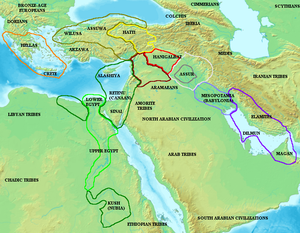 |
The terms ancient Near East
Ancient Near East
The ancient Near East was the home of early civilizations within a region roughly corresponding to the modern Middle East: Mesopotamia , ancient Egypt, ancient Iran The ancient Near East was the home of early civilizations within a region roughly corresponding to the modern Middle East: Mesopotamia...
or ancient Orient encompass the early civilization
Civilization
Civilization is a sometimes controversial term that has been used in several related ways. Primarily, the term has been used to refer to the material and instrumental side of human cultures that are complex in terms of technology, science, and division of labor. Such civilizations are generally...
s during the time roughly spanning the Bronze Age
Bronze Age
The Bronze Age is a period characterized by the use of copper and its alloy bronze as the chief hard materials in the manufacture of some implements and weapons. Chronologically, it stands between the Stone Age and Iron Age...
from the rise of Sumer
Sumer
Sumer was a civilization and historical region in southern Mesopotamia, modern Iraq during the Chalcolithic and Early Bronze Age....
and Gerzeh
Gerzeh
Gerzeh, also Girza or Jirzah, was a predynastic Egyptian cemetery located along the west bank of the Nile and today named after al-Girza, the nearby present day town in Egypt. Gerzeh is situated only several miles due east of the lake of the Al Fayyum.The Gerzean culture is a material culture...
in the 4th millennium BCE to the expansion of the Persian Empire in the 6th century BCE. The ancient Near East is generally understood as encompassing Mesopotamia
Mesopotamia
Mesopotamia is a toponym for the area of the Tigris–Euphrates river system, largely corresponding to modern-day Iraq, northeastern Syria, southeastern Turkey and southwestern Iran.Widely considered to be the cradle of civilization, Bronze Age Mesopotamia included Sumer and the...
(modern Iraq
Iraq
Iraq ; officially the Republic of Iraq is a country in Western Asia spanning most of the northwestern end of the Zagros mountain range, the eastern part of the Syrian Desert and the northern part of the Arabian Desert....
and Syria
Syria
Syria , officially the Syrian Arab Republic , is a country in Western Asia, bordering Lebanon and the Mediterranean Sea to the West, Turkey to the north, Iraq to the east, Jordan to the south, and Israel to the southwest....
), Persia (modern Iran
Iran
Iran , officially the Islamic Republic of Iran , is a country in Southern and Western Asia. The name "Iran" has been in use natively since the Sassanian era and came into use internationally in 1935, before which the country was known to the Western world as Persia...
), Armenia
Prehistoric Armenia
The Armenian Highland shows traces of settlement from the Neolithic era. The Shulaveri-Shomu culture of the central Transcaucasus region is one of the earliest known prehistoric culture in the area, carbon-dated to roughly 6000 - 4000 BC. Another early culture in the area is the Kura-Araxes...
, the Levant
Levant
The Levant or ) is the geographic region and culture zone of the "eastern Mediterranean littoral between Anatolia and Egypt" . The Levant includes most of modern Lebanon, Syria, Jordan, Israel, the Palestinian territories, and sometimes parts of Turkey and Iraq, and corresponds roughly to the...
(modern Israel
Israel
The State of Israel is a parliamentary republic located in the Middle East, along the eastern shore of the Mediterranean Sea...
, Jordan
Jordan
Jordan , officially the Hashemite Kingdom of Jordan , Al-Mamlaka al-Urduniyya al-Hashemiyya) is a kingdom on the East Bank of the River Jordan. The country borders Saudi Arabia to the east and south-east, Iraq to the north-east, Syria to the north and the West Bank and Israel to the west, sharing...
, Lebanon
Lebanon
Lebanon , officially the Republic of LebanonRepublic of Lebanon is the most common term used by Lebanese government agencies. The term Lebanese Republic, a literal translation of the official Arabic and French names that is not used in today's world. Arabic is the most common language spoken among...
, Syria
Syria
Syria , officially the Syrian Arab Republic , is a country in Western Asia, bordering Lebanon and the Mediterranean Sea to the West, Turkey to the north, Iraq to the east, Jordan to the south, and Israel to the southwest....
, Palestinian Authority), and at times Anatolia
Anatolia
Anatolia is a geographic and historical term denoting the westernmost protrusion of Asia, comprising the majority of the Republic of Turkey...
(modern Turkey
Turkey
Turkey , known officially as the Republic of Turkey , is a Eurasian country located in Western Asia and in East Thrace in Southeastern Europe...
) and Ancient Egypt
Ancient Egypt
Ancient Egypt was an ancient civilization of Northeastern Africa, concentrated along the lower reaches of the Nile River in what is now the modern country of Egypt. Egyptian civilization coalesced around 3150 BC with the political unification of Upper and Lower Egypt under the first pharaoh...
.
Sumer and Akkad
Sumer (or Šumer) was one of the early civilizations of the Ancient Near East
Ancient Near East
The ancient Near East was the home of early civilizations within a region roughly corresponding to the modern Middle East: Mesopotamia , ancient Egypt, ancient Iran The ancient Near East was the home of early civilizations within a region roughly corresponding to the modern Middle East: Mesopotamia...
, located in the southern part of Mesopotamia
Mesopotamia
Mesopotamia is a toponym for the area of the Tigris–Euphrates river system, largely corresponding to modern-day Iraq, northeastern Syria, southeastern Turkey and southwestern Iran.Widely considered to be the cradle of civilization, Bronze Age Mesopotamia included Sumer and the...
(modern day Iraq
Iraq
Iraq ; officially the Republic of Iraq is a country in Western Asia spanning most of the northwestern end of the Zagros mountain range, the eastern part of the Syrian Desert and the northern part of the Arabian Desert....
) from the time of the earliest records in the mid 4th millennium BC
4th millennium BC
The 4th millennium BC saw major changes in human culture. It marked the beginning of the Bronze Age and of writing.The city states of Sumer and the kingdom of Egypt were established and grew to prominence. Agriculture spread widely across Eurasia...
until the rise of Babylonia
Babylonia
Babylonia was an ancient cultural region in central-southern Mesopotamia , with Babylon as its capital. Babylonia emerged as a major power when Hammurabi Babylonia was an ancient cultural region in central-southern Mesopotamia (present-day Iraq), with Babylon as its capital. Babylonia emerged as...
in the late 3rd millennium BC
3rd millennium BC
The 3rd millennium BC spans the Early to Middle Bronze Age.It represents a period of time in which imperialism, or the desire to conquer, grew to prominence, in the city states of the Middle East, but also throughout Eurasia, with Indo-European expansion to Anatolia, Europe and Central Asia. The...
. The term "Sumerian" applies to all speakers of the Sumerian language
Sumerian language
Sumerian is the language of ancient Sumer, which was spoken in southern Mesopotamia since at least the 4th millennium BC. During the 3rd millennium BC, there developed a very intimate cultural symbiosis between the Sumerians and the Akkadians, which included widespread bilingualism...
. Sumer (together with Ancient Egypt
Ancient Egypt
Ancient Egypt was an ancient civilization of Northeastern Africa, concentrated along the lower reaches of the Nile River in what is now the modern country of Egypt. Egyptian civilization coalesced around 3150 BC with the political unification of Upper and Lower Egypt under the first pharaoh...
and the Indus Valley Civilization
Indus Valley Civilization
The Indus Valley Civilization was a Bronze Age civilization that was located in the northwestern region of the Indian subcontinent, consisting of what is now mainly modern-day Pakistan and northwest India...
) is considered the first settled society in the world to have manifested all the features needed to qualify fully as a "civilization
Civilization
Civilization is a sometimes controversial term that has been used in several related ways. Primarily, the term has been used to refer to the material and instrumental side of human cultures that are complex in terms of technology, science, and division of labor. Such civilizations are generally...
", eventually expanding into the first empire
Empire
The term empire derives from the Latin imperium . Politically, an empire is a geographically extensive group of states and peoples united and ruled either by a monarch or an oligarchy....
in history, the Akkadian Empire.
The profound political, social, and cultural influence imposed upon the Near East by the civilization known as the Ancient Babylonian Empire
Babylonia
Babylonia was an ancient cultural region in central-southern Mesopotamia , with Babylon as its capital. Babylonia emerged as a major power when Hammurabi Babylonia was an ancient cultural region in central-southern Mesopotamia (present-day Iraq), with Babylon as its capital. Babylonia emerged as...
was the most pervasive in this historical period. The city itself - Babylon
Babylon
Babylon was an Akkadian city-state of ancient Mesopotamia, the remains of which are found in present-day Al Hillah, Babil Province, Iraq, about 85 kilometers south of Baghdad...
- positioned itself as a center of pivotal historical developments for centuries. There were 3 major Babylonian Dynasties: Amorite,Kassite, and Chaldean. This political entity was most predominate within the southern portion of Mesopotamia.It existed as an unremitting rival of the northern Assyrian Mesopotamians. Although it was assaulted and militarily overcome on several occasions,it did exist as a stalwart presence from the latter 3rd millennium BCE to the middle of the 6th century BCE, when it expanded its boarders under the auspices of the rather famous Nebuchadnezzar the Great, and thereby overcame the Assyrians swiftly, and established and maintained strongholds throughout the Near Eastern region with a centralized administrative methodology and unyielding system of control. This period would be considered the apex of the Babylonian City-State's dominance in its two-and-a-half millennium history.
Ancient Babylon was officially conquered by the Achemidian Persian Empire in the late 6th century BCE.
Elam
| Elamite Empire |
|---|
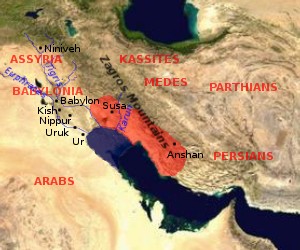 |
Elam
Elam
Elam was an ancient civilization located in what is now southwest Iran. Elam was centered in the far west and the southwest of modern-day Iran, stretching from the lowlands of Khuzestan and Ilam Province, as well as a small part of southern Iraq...
was situated just to the east of Mesopotamia
Mesopotamia
Mesopotamia is a toponym for the area of the Tigris–Euphrates river system, largely corresponding to modern-day Iraq, northeastern Syria, southeastern Turkey and southwestern Iran.Widely considered to be the cradle of civilization, Bronze Age Mesopotamia included Sumer and the...
and was one of the oldest recorded civilization
Civilization
Civilization is a sometimes controversial term that has been used in several related ways. Primarily, the term has been used to refer to the material and instrumental side of human cultures that are complex in terms of technology, science, and division of labor. Such civilizations are generally...
s. Elam was centered in the far west and southwest of modern-day Iran, stretching from the lowlands of Khuzestan and Ilam Province
Ilam Province
Ilam Province is one of the 31 provinces of Iran. It is in the south-west of the country, bordering Iraq. Its provincial center is the city of Ilam. Covering an area of 19,086 square kilometers, the cities of the province are Ilam, Mehran, Dehloran, Dareh Shahr, Sarable, Eyvan, Abdanan and Arkwaz...
(which takes its name from Elam), as well as a small part of southern Iraq. In the Old Elamite period (Middle Bronze Age), Elam consisted of kingdoms on the Iranian plateau
Iranian plateau
The Iranian plateau, or Iranic plateau, is a geological formation in Southwest Asia. It is the part of the Eurasian Plate wedged between the Arabian and Indian plates, situated between the Zagros mountains to the west, the Caspian Sea and the Kopet Dag to the north, the Hormuz Strait and Persian...
, centered in Anshan
Anshan (Persia)
Anshan - History :Before 1973, when it was identified as Tall-i Malyan, Anshan had been assumed by scholars to be somewhere in the central Zagros mountain range....
, and from the mid-2nd millennium BC, it was centered in Susa
Susa
Susa was an ancient city of the Elamite, Persian and Parthian empires of Iran. It is located in the lower Zagros Mountains about east of the Tigris River, between the Karkheh and Dez Rivers....
in the Khuzestan lowlands.
Elam was part of the early cities of the Ancient Near East
Cities of the ancient Near East
The largest cities in the Bronze Age ancient Near East housed several tens of thousands. Memphis in the Early Bronze Age with some 30,000 inhabitants was the largest city of the time by far...
during the Chalcolithic (Copper Age
Copper Age
The Chalcolithic |stone]]") period or Copper Age, also known as the Eneolithic/Æneolithic , is a phase of the Bronze Age in which the addition of tin to copper to form bronze during smelting remained yet unknown by the metallurgists of the times...
). The emergence of written records from around 3000 BC also parallels Mesopotamian history where writing was used slightly earlier. Elamite strength was based on an ability to hold various areas together under a coordinated government that permitted the maximum interchange of the natural resources unique to each region. Traditionally, this was done through a federated governmental structure.
Elamite culture played a crucial role in the Gutian Empire (Persian Empire) especially during the Achaemenid dynasty that succeeded it, when the Elamite language
Elamite language
Elamite is an extinct language spoken by the ancient Elamites. Elamite was the primary language in present day Iran from 2800–550 BCE. The last written records in Elamite appear about the time of the conquest of the Persian Empire by Alexander the Great....
remained among those in official use. The Elamite language is generally treated as an isolate language. As such, the Elamite period is considered a starting point for the history of Iran
History of Iran
The history of Iran has been intertwined with the history of a larger historical region, comprising the area from the Danube River in the west to the Indus River and Jaxartes in the east and from the Caucasus, Caspian Sea, and Aral Sea in the north to the Persian Gulf and the Gulf of Oman and Egypt...
.
Hurrian kingdoms
| Hurrians Hurrians The Hurrians were a people of the Ancient Near East who lived in Northern Mesopotamia and adjacent regions during the Bronze Age.The largest and most influential Hurrian nation was the kingdom of Mitanni. The population of the Hittite Empire in Anatolia to a large part consisted of Hurrians, and... |
|---|
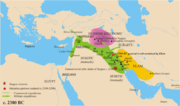 |
The Hurrians
Hurrians
The Hurrians were a people of the Ancient Near East who lived in Northern Mesopotamia and adjacent regions during the Bronze Age.The largest and most influential Hurrian nation was the kingdom of Mitanni. The population of the Hittite Empire in Anatolia to a large part consisted of Hurrians, and...
refer to a people who inhabited northern Mesopotamia beginning approximately 2500 BC. The Hurrian kingdoms of the Ancient Near East was in Northern Mesopotamia and it's people lived in the adjacent regions during the Bronze Age
Bronze Age
The Bronze Age is a period characterized by the use of copper and its alloy bronze as the chief hard materials in the manufacture of some implements and weapons. Chronologically, it stands between the Stone Age and Iron Age...
. The largest and most influential Hurrian nation was the kingdom of Mitanni. The population of the Hittite Empire in Anatolia to a large part consisted of Hurrians, and there is significant Hurrian influence in Hittite mythology.
By the Early Iron Age, the Hurrians had been assimilated with other peoples, except perhaps in the kingdom of Urartu. The Hurrian peoples were not incredibly united, existing as quasi-feudal kingdoms. The kingdom of Mitanni was at its height towards the close of the 14th century BC. By the 13th century BC, the Hurrian kingdoms had been conquered by foreign powers, chiefly the Assyrians.
Assyria
| Neo-Assyrian Empire |
|---|
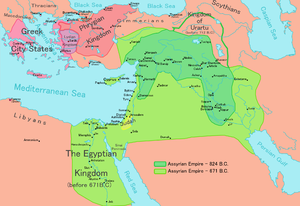 |
In the earliest historical times, the term Assyria
Assyria
Assyria was a Semitic Akkadian kingdom, extant as a nation state from the mid–23rd century BC to 608 BC centred on the Upper Tigris river, in northern Mesopotamia , that came to rule regional empires a number of times through history. It was named for its original capital, the ancient city of Assur...
referred to a region on the Upper Tigris
Tigris
The Tigris River is the eastern member of the two great rivers that define Mesopotamia, the other being the Euphrates. The river flows south from the mountains of southeastern Turkey through Iraq.-Geography:...
river, named for its original capital, the ancient city of Assur
Assur
Assur , was one of the capitals of ancient Assyria. The remains of the city are situated on the western bank of river Tigris, north of the confluence with the tributary Little Zab river, in modern day Iraq, more precisely in the Al-Shirqat District .Assur is also...
. Later, as a nation and empire that came to control all of the Fertile Crescent
Fertile Crescent
The Fertile Crescent, nicknamed "The Cradle of Civilization" for the fact the first civilizations started there, is a crescent-shaped region containing the comparatively moist and fertile land of otherwise arid and semi-arid Western Asia. The term was first used by University of Chicago...
, Egypt
Egypt
Egypt , officially the Arab Republic of Egypt, Arabic: , is a country mainly in North Africa, with the Sinai Peninsula forming a land bridge in Southwest Asia. Egypt is thus a transcontinental country, and a major power in Africa, the Mediterranean Basin, the Middle East and the Muslim world...
and much of Anatolia
Anatolia
Anatolia is a geographic and historical term denoting the westernmost protrusion of Asia, comprising the majority of the Republic of Turkey...
, the term "Assyria proper" referred to roughly the northern half of Mesopotamia
Mesopotamia
Mesopotamia is a toponym for the area of the Tigris–Euphrates river system, largely corresponding to modern-day Iraq, northeastern Syria, southeastern Turkey and southwestern Iran.Widely considered to be the cradle of civilization, Bronze Age Mesopotamia included Sumer and the...
(the southern half being Babylonia
Babylonia
Babylonia was an ancient cultural region in central-southern Mesopotamia , with Babylon as its capital. Babylonia emerged as a major power when Hammurabi Babylonia was an ancient cultural region in central-southern Mesopotamia (present-day Iraq), with Babylon as its capital. Babylonia emerged as...
), with Nineveh
Nineveh
Nineveh was an ancient Assyrian city on the eastern bank of the Tigris River, and capital of the Neo Assyrian Empire. Its ruins are across the river from the modern-day major city of Mosul, in the Ninawa Governorate of Iraq....
as its capital. The Assyrian homeland was located near a mountainous region, extending along the Tigris as far as the high Gordiaean or Carduchian mountain range of Armenia
Armenia
Armenia , officially the Republic of Armenia , is a landlocked mountainous country in the Caucasus region of Eurasia...
, sometimes known as the "Mountains of Ashur". The Assyrian kings controlled a large kingdom at three different times in history. These are called the Old, Middle, and Neo-Assyrian kingdoms, or periods. The most powerful and best-known nation of these periods is the Neo-Assyrian Empire, 934-609 BC.
Shalmaneser III
Shalmaneser III
Shalmaneser III was king of Assyria , and son of the previous ruler, Ashurnasirpal II....
(858–823 BC) attacked and reduced Babylonia
Babylonia
Babylonia was an ancient cultural region in central-southern Mesopotamia , with Babylon as its capital. Babylonia emerged as a major power when Hammurabi Babylonia was an ancient cultural region in central-southern Mesopotamia (present-day Iraq), with Babylon as its capital. Babylonia emerged as...
to vassalage, and defeated Aramea, Israel
Israel
The State of Israel is a parliamentary republic located in the Middle East, along the eastern shore of the Mediterranean Sea...
, Urartu
Urartu
Urartu , corresponding to Ararat or Kingdom of Van was an Iron Age kingdom centered around Lake Van in the Armenian Highland....
, Phoenicia
Phoenicia
Phoenicia , was an ancient civilization in Canaan which covered most of the western, coastal part of the Fertile Crescent. Several major Phoenician cities were built on the coastline of the Mediterranean. It was an enterprising maritime trading culture that spread across the Mediterranean from 1550...
and the neo Hittite
Neo-Hittite
The states that are called Neo-Hittite, or more recently Syro-Hittite, were Luwian, Aramaic and Phoenician-speaking political entities of the Iron Age northern Syria and southern Anatolia that arose following the collapse of the Hittite Empire around 1180 BC and lasted until roughly 700 BC...
states, forcing all of these to pay tribute to Assyria. Shamshi-Adad V
Shamshi-Adad V
Shamshi-Adad V was the King of Assyria from 824 to 811 BC.-Biography:He was the son and successor of Shalmaneser III, the husband of Shammuramat , and the father of Adad-nirari III, who succeeded him as king....
(822-811 BC) inherited an empire beset by civil war which he took most of his reign to quell. He was succeeded by Adad-nirari III
Adad-nirari III
Adad-nirari III was King of Assyria from 811 to 783 BC. He was the son and successor of Shamshi-Adad V, and was apparently quite young at the time of his accession, because for the first five years of his reign his mother Shammuramat acted as regent, which may have given rise to the legend of...
who was merely a boy. The Empire was thus ruled by the famed queen Semiramis
Semiramis
The real and historical Shammuramat , was the Assyrian queen of Shamshi-Adad V , King of Assyria and ruler of the Neo Assyrian Empire, and its regent for four years until her son Adad-nirari III came of age....
until 806 BC. In that year Adad-nirari III
Adad-nirari III
Adad-nirari III was King of Assyria from 811 to 783 BC. He was the son and successor of Shamshi-Adad V, and was apparently quite young at the time of his accession, because for the first five years of his reign his mother Shammuramat acted as regent, which may have given rise to the legend of...
took the reins of power. After his premature death, Assyria failed to expand further during the reigns of Shalmaneser IV
Shalmaneser IV
Shalmaneser IV was king of Assyria . He succeeded his father Adad-nirari III, and was succeeded by his brother Ashur-dan III. Very little information about his reign has survived....
(782-773 BC), Ashur-dan III
Ashur-dan III
Ashur-dan III was King of Assyria from 773 to 755 BC.Ashur-dan III was the son of Adad-nirari III, and succeeded his brother Shalmaneser IV in 773 BC. Ashur-dan's reign was a difficult age for the Assyrian monarchy. The rulership was severely limited by the influence of court dignitaries,...
(772-755 BC) and Ashur-nirari V
Ashur-nirari V
Ashur-nirari V was King of Assyria from 755 to 745 BC. He was succeeded by Tiglath-Pileser III.Ashur-nirari V was a son of Adad-nirari III, and succeeded his brother, Ashur-dan III. He inherited a difficult situation from his predecessor...
(754-746 BC).
Under Ashurbanipal
Ashurbanipal
Ashurbanipal |Ashur]] is creator of an heir"; 685 BC – c. 627 BC), also spelled Assurbanipal or Ashshurbanipal, was an Assyrian king, the son of Esarhaddon and the last great king of the Neo-Assyrian Empire...
(669-627 BC) its domination spanned from the Caucasus Mountains
Caucasus Mountains
The Caucasus Mountains is a mountain system in Eurasia between the Black Sea and the Caspian Sea in the Caucasus region .The Caucasus Mountains includes:* the Greater Caucasus Mountain Range and* the Lesser Caucasus Mountains....
in the north to Nubia
Nubia
Nubia is a region along the Nile river, which is located in northern Sudan and southern Egypt.There were a number of small Nubian kingdoms throughout the Middle Ages, the last of which collapsed in 1504, when Nubia became divided between Egypt and the Sennar sultanate resulting in the Arabization...
, Egypt
Egypt
Egypt , officially the Arab Republic of Egypt, Arabic: , is a country mainly in North Africa, with the Sinai Peninsula forming a land bridge in Southwest Asia. Egypt is thus a transcontinental country, and a major power in Africa, the Mediterranean Basin, the Middle East and the Muslim world...
and Arabia in the south, and from Cyprus
Cyprus
Cyprus , officially the Republic of Cyprus , is a Eurasian island country, member of the European Union, in the Eastern Mediterranean, east of Greece, south of Turkey, west of Syria and north of Egypt. It is the third largest island in the Mediterranean Sea.The earliest known human activity on the...
and Antioch
Antioch
Antioch on the Orontes was an ancient city on the eastern side of the Orontes River. It is near the modern city of Antakya, Turkey.Founded near the end of the 4th century BC by Seleucus I Nicator, one of Alexander the Great's generals, Antioch eventually rivaled Alexandria as the chief city of the...
in the west to Persia in the east. Ashurbanipal destroyed Elam
Elam
Elam was an ancient civilization located in what is now southwest Iran. Elam was centered in the far west and the southwest of modern-day Iran, stretching from the lowlands of Khuzestan and Ilam Province, as well as a small part of southern Iraq...
and smashed a rebellion led by his own brother Shamash-shum-ukim who was the Assyrian king of Babylon
Babylon
Babylon was an Akkadian city-state of ancient Mesopotamia, the remains of which are found in present-day Al Hillah, Babil Province, Iraq, about 85 kilometers south of Baghdad...
, exacting savage revenge on the Chaldea
Chaldea
Chaldea or Chaldaea , from Greek , Chaldaia; Akkadian ; Hebrew כשדים, Kaśdim; Aramaic: ܟܐܠܕܘ, Kaldo) was a marshy land located in modern-day southern Iraq which came to briefly rule Babylon...
ns, Nabateans, Arabs and Elamites who had supported him. Persia and Media were regarded as vassals of Ashurbanipal. He built vast libraries and initiated a surge in the building of temples and palaces.
Hittite Empire
| Hittite Empire |
|---|
 |
The Hittites
Hittites
The Hittites were a Bronze Age people of Anatolia.They established a kingdom centered at Hattusa in north-central Anatolia c. the 18th century BC. The Hittite empire reached its height c...
were an ancient people who spoke an Indo-European language, and established a kingdom centered at Hattusa
Hattusa
Hattusa was the capital of the Hittite Empire in the late Bronze Age. It was located near modern Boğazkale, Turkey, within the great loop of the Kızıl River ....
in north-central Anatolia
Anatolia
Anatolia is a geographic and historical term denoting the westernmost protrusion of Asia, comprising the majority of the Republic of Turkey...
from the 18th century BC. In the 14th century BC, the Hittite empire was at its height, encompassing central Anatolia
Anatolia
Anatolia is a geographic and historical term denoting the westernmost protrusion of Asia, comprising the majority of the Republic of Turkey...
, north-western Syria
Syria
Syria , officially the Syrian Arab Republic , is a country in Western Asia, bordering Lebanon and the Mediterranean Sea to the West, Turkey to the north, Iraq to the east, Jordan to the south, and Israel to the southwest....
as far as Ugarit
Ugarit
Ugarit was an ancient port city in the eastern Mediterranean at the Ras Shamra headland near Latakia, Syria. It is located near Minet el-Beida in northern Syria. It is some seven miles north of Laodicea ad Mare and approximately fifty miles east of Cyprus...
, and upper Mesopotamia
Mesopotamia
Mesopotamia is a toponym for the area of the Tigris–Euphrates river system, largely corresponding to modern-day Iraq, northeastern Syria, southeastern Turkey and southwestern Iran.Widely considered to be the cradle of civilization, Bronze Age Mesopotamia included Sumer and the...
. After 1180 BC, the empire disintegrated into several independent "Neo-Hittite
Neo-Hittite
The states that are called Neo-Hittite, or more recently Syro-Hittite, were Luwian, Aramaic and Phoenician-speaking political entities of the Iron Age northern Syria and southern Anatolia that arose following the collapse of the Hittite Empire around 1180 BC and lasted until roughly 700 BC...
" city-states, some surviving until as late as the 8th century BC.
The Hittites were also famous for their skill in building and using chariots, as the Battle of Kadesh
Battle of Kadesh
The Battle of Kadesh took place between the forces of the Egyptian Empire under Ramesses II and the Hittite Empire under Muwatalli II at the city of Kadesh on the Orontes River, in what is now the Syrian Arab Republic....
demonstrates. The Hittites were pioneers of the Iron Age
Iron Age
The Iron Age is the archaeological period generally occurring after the Bronze Age, marked by the prevalent use of iron. The early period of the age is characterized by the widespread use of iron or steel. The adoption of such material coincided with other changes in society, including differing...
, manufacturing iron
Iron
Iron is a chemical element with the symbol Fe and atomic number 26. It is a metal in the first transition series. It is the most common element forming the planet Earth as a whole, forming much of Earth's outer and inner core. It is the fourth most common element in the Earth's crust...
artifacts from as early as the 14th century BC, making them possibly even the first to do so. The Hittites passed much knowledge and lore from the Ancient Near East
Ancient Near East
The ancient Near East was the home of early civilizations within a region roughly corresponding to the modern Middle East: Mesopotamia , ancient Egypt, ancient Iran The ancient Near East was the home of early civilizations within a region roughly corresponding to the modern Middle East: Mesopotamia...
to the newly arrived Greeks
Greeks
The Greeks, also known as the Hellenes , are a nation and ethnic group native to Greece, Cyprus and neighboring regions. They also form a significant diaspora, with Greek communities established around the world....
in Europe
Europe
Europe is, by convention, one of the world's seven continents. Comprising the westernmost peninsula of Eurasia, Europe is generally 'divided' from Asia to its east by the watershed divides of the Ural and Caucasus Mountains, the Ural River, the Caspian and Black Seas, and the waterways connecting...
.
Hittite prosperity was mostly dependent on control of the trade routes and metal sources. Because of the importance of Northern Syria to the vital routes linking the Cilician gates with Mesopotamia, defense of this area was crucial, and was soon put to the test by Egyptian expansion under Pharaoh Rameses II. The outcome of the Battle of Kadesh is uncertain, though it seems that the timely arrival of Egyptian reinforcements prevented total Hittite victory. The Egyptians forced the Hittites to take refuge in the fortress of Kadesh, but their own losses prevented them from sustaining a siege. This battle took place in the 5th year of Rameses (c.1274 BC by the most commonly used chronology).
Median Empire
625-550 BC
| Median Empire |
|---|
 |
The Median Empire was the first empire on the territory of Persia. By the 6th century BC, after having together with the Babylonians
Neo-Babylonian Empire
The Neo-Babylonian Empire or Second Babylonian Empire was a period of Mesopotamian history which began in 626 BC and ended in 539 BC. During the preceding three centuries, Babylonia had been ruled by their fellow Akkadian speakers and northern neighbours, Assyria. Throughout that time Babylonia...
defeated the Neo-Assyrian Empire. In Greek references to "Median" people there is no clear distinction between the "Persians" and the "Medians"; in fact for a Greek to become "too closely associated with Iranian culture" was "to become medianized, not persianized". The Median kingdom was a short-lived Iranian state and the textual and archaeological sources of that period are rare and little could be known from the Median culture which nevertheless made a "profound, and lasting, contribution to the greater world of Iranian culture". The Medes were able to establish their own empire, the largest of its day, lasting for about sixty years, from the sack of Nineveh in 612 BC until 549 BC when Cyrus the Great
Cyrus the Great
Cyrus II of Persia , commonly known as Cyrus the Great, also known as Cyrus the Elder, was the founder of the Achaemenid Empire. Under his rule, the empire embraced all the previous civilized states of the ancient Near East, expanded vastly and eventually conquered most of Southwest Asia and much...
established the Achaemenid Empire
Achaemenid Empire
The Achaemenid Empire , sometimes known as First Persian Empire and/or Persian Empire, was founded in the 6th century BCE by Cyrus the Great who overthrew the Median confederation...
by defeating his overlord and grandfather, Astyages
Astyages
Astyages Astyages Astyages (spelled by Herodotus as Ἀστυάγης - Astyages; by Ctesias as Astyigas; by Diodorus as Aspadas; Akkadian: Ištumegu, was the last king of the Median Empire, r...
, king of Media.
Achaemenid Empire
559 BC–330 BC
| Achaemenid Empire Achaemenid Empire The Achaemenid Empire , sometimes known as First Persian Empire and/or Persian Empire, was founded in the 6th century BCE by Cyrus the Great who overthrew the Median confederation... |
|---|
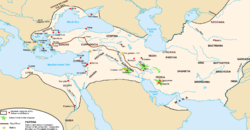 |
The Achaemenid Empire
Achaemenid Empire
The Achaemenid Empire , sometimes known as First Persian Empire and/or Persian Empire, was founded in the 6th century BCE by Cyrus the Great who overthrew the Median confederation...
was the first of the Persian Empires to rule over significant portions of Greater Iran
Greater Iran
Greater Iran refers to the regions that have significant Iranian cultural influence. It roughly corresponds to the territory on the Iranian plateau and its bordering plains, stretching from Iraq, the Caucasus, and Turkey in the west to the Indus River in the east...
. At the height of its power, the Empire spanned over three continents and was the most powerful empire of his time. It also eventually incorporated the following territories: in the east modern Afghanistan
Afghanistan
Afghanistan , officially the Islamic Republic of Afghanistan, is a landlocked country located in the centre of Asia, forming South Asia, Central Asia and the Middle East. With a population of about 29 million, it has an area of , making it the 42nd most populous and 41st largest nation in the world...
and beyond into central Asia, and parts of Pakistan
Pakistan
Pakistan , officially the Islamic Republic of Pakistan is a sovereign state in South Asia. It has a coastline along the Arabian Sea and the Gulf of Oman in the south and is bordered by Afghanistan and Iran in the west, India in the east and China in the far northeast. In the north, Tajikistan...
; in the north and west all of Asia Minor
Asia Minor
Asia Minor is a geographical location at the westernmost protrusion of Asia, also called Anatolia, and corresponds to the western two thirds of the Asian part of Turkey...
(modern Turkey
Turkey
Turkey , known officially as the Republic of Turkey , is a Eurasian country located in Western Asia and in East Thrace in Southeastern Europe...
), the upper Balkans
Balkans
The Balkans is a geopolitical and cultural region of southeastern Europe...
peninsula (Thrace
Thrace
Thrace is a historical and geographic area in southeast Europe. As a geographical concept, Thrace designates a region bounded by the Balkan Mountains on the north, Rhodope Mountains and the Aegean Sea on the south, and by the Black Sea and the Sea of Marmara on the east...
), and most of the Black Sea
Black Sea
The Black Sea is bounded by Europe, Anatolia and the Caucasus and is ultimately connected to the Atlantic Ocean via the Mediterranean and the Aegean seas and various straits. The Bosphorus strait connects it to the Sea of Marmara, and the strait of the Dardanelles connects that sea to the Aegean...
coastal regions; in the west and southwest the territories of modern Iraq
Iraq
Iraq ; officially the Republic of Iraq is a country in Western Asia spanning most of the northwestern end of the Zagros mountain range, the eastern part of the Syrian Desert and the northern part of the Arabian Desert....
, northern Saudi-Arabia, Jordan
Jordan
Jordan , officially the Hashemite Kingdom of Jordan , Al-Mamlaka al-Urduniyya al-Hashemiyya) is a kingdom on the East Bank of the River Jordan. The country borders Saudi Arabia to the east and south-east, Iraq to the north-east, Syria to the north and the West Bank and Israel to the west, sharing...
, Israel
Israel
The State of Israel is a parliamentary republic located in the Middle East, along the eastern shore of the Mediterranean Sea...
, Lebanon
Lebanon
Lebanon , officially the Republic of LebanonRepublic of Lebanon is the most common term used by Lebanese government agencies. The term Lebanese Republic, a literal translation of the official Arabic and French names that is not used in today's world. Arabic is the most common language spoken among...
, Syria
Syria
Syria , officially the Syrian Arab Republic , is a country in Western Asia, bordering Lebanon and the Mediterranean Sea to the West, Turkey to the north, Iraq to the east, Jordan to the south, and Israel to the southwest....
, all significant population centers of ancient Egypt
Egypt
Egypt , officially the Arab Republic of Egypt, Arabic: , is a country mainly in North Africa, with the Sinai Peninsula forming a land bridge in Southwest Asia. Egypt is thus a transcontinental country, and a major power in Africa, the Mediterranean Basin, the Middle East and the Muslim world...
and as far west as portions of Libya
Libya
Libya is an African country in the Maghreb region of North Africa bordered by the Mediterranean Sea to the north, Egypt to the east, Sudan to the southeast, Chad and Niger to the south, and Algeria and Tunisia to the west....
.
Encompassing approximately 7.5 million square kilometers, the Achaemenid Empire was territorially the largest empire of antiquity
Ancient history
Ancient history is the study of the written past from the beginning of recorded human history to the Early Middle Ages. The span of recorded history is roughly 5,000 years, with Cuneiform script, the oldest discovered form of coherent writing, from the protoliterate period around the 30th century BC...
. In its time it had political power over neighboring countries, and had high cultural and economic achievements during its lengthy rule over a vast region from its picturesque capital at Persepolis
Persepolis
Perspolis was the ceremonial capital of the Achaemenid Empire . Persepolis is situated northeast of the modern city of Shiraz in the Fars Province of modern Iran. In contemporary Persian, the site is known as Takht-e Jamshid...
.
Alexander the Great (Alexander III of Macedon) defeated the Persian armies at Granicus (334 BC), followed by Issus (333 BC), and lastly at Gaugamela (331 BC). Afterwards, he marched on Susa and Persepolis
Persepolis
Perspolis was the ceremonial capital of the Achaemenid Empire . Persepolis is situated northeast of the modern city of Shiraz in the Fars Province of modern Iran. In contemporary Persian, the site is known as Takht-e Jamshid...
which surrendered in early 330 BC. From Persepolis, Alexander headed north to Pasargadae where he visited the tomb of Cyrus, the burial of the man whom he had heard of from Cyropedia.
Parthian Empire
| Parthian Empire Parthian Empire The Parthian Empire , also known as the Arsacid Empire , was a major Iranian political and cultural power in ancient Persia... |
|---|
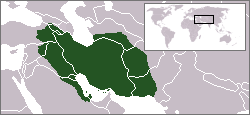 |
The Parthian Empire
Parthian Empire
The Parthian Empire , also known as the Arsacid Empire , was a major Iranian political and cultural power in ancient Persia...
was the third Iran
Iran
Iran , officially the Islamic Republic of Iran , is a country in Southern and Western Asia. The name "Iran" has been in use natively since the Sassanian era and came into use internationally in 1935, before which the country was known to the Western world as Persia...
ian Empire. At the height of its power, the empire ruled most of Greater Iran
Greater Iran
Greater Iran refers to the regions that have significant Iranian cultural influence. It roughly corresponds to the territory on the Iranian plateau and its bordering plains, stretching from Iraq, the Caucasus, and Turkey in the west to the Indus River in the east...
, Mesopotamia
Mesopotamia
Mesopotamia is a toponym for the area of the Tigris–Euphrates river system, largely corresponding to modern-day Iraq, northeastern Syria, southeastern Turkey and southwestern Iran.Widely considered to be the cradle of civilization, Bronze Age Mesopotamia included Sumer and the...
and Armenia
Armenia
Armenia , officially the Republic of Armenia , is a landlocked mountainous country in the Caucasus region of Eurasia...
. But unlike most other Iranian monarchies, the Parthian followed a vassalary system, which they adopted from the Seleucids. The Arsacid culture was not a single coherent state, but instead made up of numerous tributary (but otherwise independent) kingdoms.
The Parthians largely adopted the art, architecture, religious beliefs, and royal insignia of their culturally heterogeneous empire, which encompassed Persian, Hellenistic, and regional cultures. For about the first half of its existence, the Arsacid court adopted elements of Greek culture, though it eventually saw a gradual revival of Iranian traditions. The Arsacid rulers were titled the 'King of Kings', as a claim to be the heirs to the Achaemenid Empire; indeed, they accepted many local kings as vassals where the Achaemenids would have had centrally appointed, albeit largely autonomous, satraps. The court did appoint a small number of satraps, largely outside Iran, but these satrapies were smaller and less powerful than the Achaemenid potentates. With the expansion of Arsacid power, the seat of central government shifted from Nisa, Turkmenistan to Ctesiphon along the Tigris (south of modern Baghdad, Iraq), although several other sites also served as capitals.
Sassanid Empire
| Sassanid Empire Sassanid Empire The Sassanid Empire , known to its inhabitants as Ērānshahr and Ērān in Middle Persian and resulting in the New Persian terms Iranshahr and Iran , was the last pre-Islamic Persian Empire, ruled by the Sasanian Dynasty from 224 to 651... |
|---|
The Sassanid Empire
Sassanid Empire
The Sassanid Empire , known to its inhabitants as Ērānshahr and Ērān in Middle Persian and resulting in the New Persian terms Iranshahr and Iran , was the last pre-Islamic Persian Empire, ruled by the Sasanian Dynasty from 224 to 651...
is the name used for the fourth Iranian dynasty, and the second Persian Empire (226 - 651). The empire's territory encompassed all of today's Iran
Iran
Iran , officially the Islamic Republic of Iran , is a country in Southern and Western Asia. The name "Iran" has been in use natively since the Sassanian era and came into use internationally in 1935, before which the country was known to the Western world as Persia...
, Iraq
Iraq
Iraq ; officially the Republic of Iraq is a country in Western Asia spanning most of the northwestern end of the Zagros mountain range, the eastern part of the Syrian Desert and the northern part of the Arabian Desert....
, Armenia
Armenia
Armenia , officially the Republic of Armenia , is a landlocked mountainous country in the Caucasus region of Eurasia...
, Afghanistan
Afghanistan
Afghanistan , officially the Islamic Republic of Afghanistan, is a landlocked country located in the centre of Asia, forming South Asia, Central Asia and the Middle East. With a population of about 29 million, it has an area of , making it the 42nd most populous and 41st largest nation in the world...
, eastern parts of Turkey
Turkey
Turkey , known officially as the Republic of Turkey , is a Eurasian country located in Western Asia and in East Thrace in Southeastern Europe...
, and parts of Syria
Syria
Syria , officially the Syrian Arab Republic , is a country in Western Asia, bordering Lebanon and the Mediterranean Sea to the West, Turkey to the north, Iraq to the east, Jordan to the south, and Israel to the southwest....
, Pakistan
Pakistan
Pakistan , officially the Islamic Republic of Pakistan is a sovereign state in South Asia. It has a coastline along the Arabian Sea and the Gulf of Oman in the south and is bordered by Afghanistan and Iran in the west, India in the east and China in the far northeast. In the north, Tajikistan...
, Caucasia
Caucasus
The Caucasus, also Caucas or Caucasia , is a geopolitical region at the border of Europe and Asia, and situated between the Black and the Caspian sea...
, Central Asia
Central Asia
Central Asia is a core region of the Asian continent from the Caspian Sea in the west, China in the east, Afghanistan in the south, and Russia in the north...
and Arabia. During Khosrau II
Khosrau II
250px|thumb|Khosrau II 250px|thumb|Khosrau II 250px|thumb|Khosrau II (Khosrow II, Chosroes II, or Xosrov II in classical sources, sometimes called Parvez, "the Ever Victorious" – (in Persian: خسرو پرویز), was the twenty-second Sassanid King of Persia, reigning from 590 to 628...
's rule in 590–628 Egypt
Egypt
Egypt , officially the Arab Republic of Egypt, Arabic: , is a country mainly in North Africa, with the Sinai Peninsula forming a land bridge in Southwest Asia. Egypt is thus a transcontinental country, and a major power in Africa, the Mediterranean Basin, the Middle East and the Muslim world...
, Jordan
Jordan
Jordan , officially the Hashemite Kingdom of Jordan , Al-Mamlaka al-Urduniyya al-Hashemiyya) is a kingdom on the East Bank of the River Jordan. The country borders Saudi Arabia to the east and south-east, Iraq to the north-east, Syria to the north and the West Bank and Israel to the west, sharing...
, Palestine
Palestine
Palestine is a conventional name, among others, used to describe the geographic region between the Mediterranean Sea and the Jordan River, and various adjoining lands....
, Lebanon
Lebanon
Lebanon , officially the Republic of LebanonRepublic of Lebanon is the most common term used by Lebanese government agencies. The term Lebanese Republic, a literal translation of the official Arabic and French names that is not used in today's world. Arabic is the most common language spoken among...
were also briefly annexed to the Empire. The Sassanid era, encompassing the length of the Late Antiquity
Late Antiquity
Late Antiquity is a periodization used by historians to describe the time of transition from Classical Antiquity to the Middle Ages, in both mainland Europe and the Mediterranean world. Precise boundaries for the period are a matter of debate, but noted historian of the period Peter Brown proposed...
period, is considered to be one of the most important and influential historical periods in Iran. In many ways the Sassanid period witnessed the highest achievement of Persian civilization.
The empire constituted the last great Iranian Empire before the Muslim conquest
Islamic conquest of Persia
The Muslim conquest of Persia led to the end of the Sassanid Empire in 644, the fall of Sassanid dynasty in 651 and the eventual decline of the Zoroastrian religion in Persia...
and adoption of Islam
Islam
Islam . The most common are and . : Arabic pronunciation varies regionally. The first vowel ranges from ~~. The second vowel ranges from ~~~...
. The Sassanids never mounted a truly effective resistance to the pressure applied by the initial Arab armies. Ctesiphon fell after a prolonged siege. Yazdegerd fled eastward from Ctesiphon, leaving behind him most of the Empire's vast treasury. The Arabs captured Ctesiphon shortly afterward, leaving the Sassanid government strapped for funds and acquiring a powerful financial resource for their own use. A number of Sassanid governors attempted to combine their forces to throw back the invaders, but the effort was crippled by the lack of a strong central authority, and the governors were defeated at the Battle of Nihawānd. The empire, with its military command structure non-existent, its non-noble troop levies decimated, its financial resources effectively destroyed, and the Asawaran knightly caste destroyed piecemeal, was utterly helpless in the face of the invaders. Upon hearing the defeat, Persian nobilities fled further inland to the eastern province of Khorasan.
Ancient Africa
Very few powers emerged in Africa in the early centuries of recorded history, but those that did were quite influential in and outside of their own realms. Ancient Egypt was a power to be contended with by both the Near East, the Mediterranean and Subsahran Africa. Further to the south, the distant but never reclusive Kingdom of Kush gained a reputation for wealth and military vigor throughout the ancient world.Ancient Egypt
| Ancient Egypt Ancient Egypt Ancient Egypt was an ancient civilization of Northeastern Africa, concentrated along the lower reaches of the Nile River in what is now the modern country of Egypt. Egyptian civilization coalesced around 3150 BC with the political unification of Upper and Lower Egypt under the first pharaoh... |
|---|
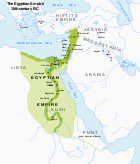 |
Ancient Egypt was one of the world's first civilizations, with its beginnings in the fertile Nile valley around 3000BC. Ancient Egypt
Ancient Egypt
Ancient Egypt was an ancient civilization of Northeastern Africa, concentrated along the lower reaches of the Nile River in what is now the modern country of Egypt. Egyptian civilization coalesced around 3150 BC with the political unification of Upper and Lower Egypt under the first pharaoh...
reached the zenith of its power during the New Kingdom
New Kingdom
The New Kingdom of Egypt, also referred to as the Egyptian Empire is the period in ancient Egyptian history between the 16th century BC and the 11th century BC, covering the Eighteenth, Nineteenth, and Twentieth Dynasties of Egypt....
(1570–1070 BC) under great pharaohs. It expanded far south into Nubia
Nubia
Nubia is a region along the Nile river, which is located in northern Sudan and southern Egypt.There were a number of small Nubian kingdoms throughout the Middle Ages, the last of which collapsed in 1504, when Nubia became divided between Egypt and the Sennar sultanate resulting in the Arabization...
and held wide territories in the Near East
Near East
The Near East is a geographical term that covers different countries for geographers, archeologists, and historians, on the one hand, and for political scientists, economists, and journalists, on the other...
. The combination of a fertile river valley, natural borders that made an invasion unfeasible, and a military
Military history of Ancient Egypt
Ancient Egypt was an ancient civilization of eastern North Africa, concentrated along the lower reaches of the Nile River in what is now the modern country of Egypt. The civilization coalesced around 3150 BC with the political unification of Upper and Lower Egypt under the first pharaoh, and...
able to rise to the challenge when needed
Battle of the Delta
The Battle of the Delta was a sea battle between Egypt and the so-called Sea Peoples, circa 1178 BCE or 1175 BCE when the Egyptian pharaoh Ramesses III repulsed a major sea invasion by the 'Peoples of the Sea'. The conflict occurred somewhere at the shores of the eastern Nile Delta and partly on...
, turned Egypt a major power. It was one of the first nations to have a system of writing and large scale construction projects. However, as neighboring civilizations developed militaries capable of crossing Egypt's natural barriers, the Egyptian armies were not always able to repel them and so by 1000 BC Egyptian influence as an independent civilization waned.
Akhenaten
Akhenaten also spelled Echnaton,Ikhnaton,and Khuenaten;meaning "living spirit of Aten") known before the fifth year of his reign as Amenhotep IV , was a Pharaoh of the Eighteenth dynasty of Egypt who ruled for 17 years and died perhaps in 1336 BC or 1334 BC...
, he touted the god Aten
Aten
Aten is the disk of the sun in ancient Egyptian mythology, and originally an aspect of Ra. The deified Aten is the focus of the monolatristic, henotheistic, or monotheistic religion of Atenism established by Amenhotep IV, who later took the name Akhenaten in worship in recognition of Aten...
as the supreme deity, suppressed the worship of other deities, and attacked the power of the priestly establishment. Moving the capital to the new city of Akhetaten, he turned a deaf ear to foreign affairs and absorbed himself in his new religion and artistic style. After his death, the religion of the Aten was quickly abandoned, and the subsequent pharaohs erased all mention of Akhenaten's Egyptian heresy, now known as the Amarna Period
Amarna Period
The Amarna Period was an era of Egyptian history during the latter half of the Eighteenth Dynasty when the royal residence of the pharaoh and his queen was shifted to Akhetaten in what is now modern-day Amarna...
.
Ramesses II
Ramesses II , referred to as Ramesses the Great, was the third Egyptian pharaoh of the Nineteenth dynasty. He is often regarded as the greatest, most celebrated, and most powerful pharaoh of the Egyptian Empire...
ascended the throne, and went on to build more temples, erect more statues and obelisks, and sire more children than any other pharaoh in history. Ramesses led his army against the Hittites in the Battle of Kadesh and, after fighting to a stalemate, finally agreed to the first recorded peace treaty. Egypt's wealth, however, made it a tempting target for invasion, particularly by the Libyans and the Sea Peoples. Initially, the military was able to repel these invasions, but Egypt eventually lost control of Syria and Palestine. The impact of external threats was exacerbated by internal problems such as corruption, tomb robbery and civil unrest. The high priests at the temple of Amun in Thebes accumulated vast tracts of land and wealth, and their growing power splintered the country during the Third Intermediate Period.
The many achievements of the ancient Egyptians include the quarrying, surveying and construction techniques that facilitated the building of monumental pyramids, temples, and obelisks; a system of mathematics, a practical and effective system of medicine, irrigation systems and agricultural production techniques, the first known ships, Egyptian faience and glass technology, new forms of literature, and the earliest known peace treaty. Egypt left a lasting legacy. Its art and architecture were widely copied, and its antiquities carried off to far corners of the world. Its monumental ruins have inspired the imaginations of travellers and writers for centuries. A new-found respect for antiquities and excavations in the early modern period led to the scientific investigation of Egyptian civilization and a greater appreciation of its cultural legacy, for Egypt and the world.
Kush
| Kingdom of Kush Kingdom of Kush The native name of the Kingdom was likely kaš, recorded in Egyptian as .The name Kash is probably connected to Cush in the Hebrew Bible , son of Ham .... |
|---|
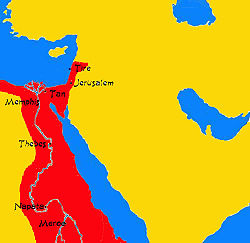 |
The Kingdom of Kush was the earliest of the Subsaharan states in Africa as well as the first to implement iron weapons. It was heavily influenced by Egyptian colonists, but in 1070 BC it became not only independent of Egypt but a fierce rival. It successfully fought off attempts by Egypt to reconquer it, and it began to extend influence over Upper Egypt. By the end of King Kashta's
Kashta
Kashta was a king of the Kushite Dynasty and the successor of Alara. His name translates literally as "The Kushite".-Family:Kashta is thought to be a brother of his predecessor Alara. Both Alara and Kashta were thought to have married their sisters...
reign in 752 BC, Thebes was under Kushite control.
A slew of able successors took the rest of Egypt and reigned as the Twenty-fifth dynasty of Egypt
Twenty-fifth dynasty of Egypt
The twenty-fifth dynasty of Egypt, known as the Nubian Dynasty or the Kushite Empire, was the last dynasty of the Third Intermediate Period of Ancient Egypt....
stretching Kushite control from central Sudan to modern day Israel. The Kushites did not maintain this empire for long and were beaten back by the Assyrians in 653 BC. However, Kush remained a powerful entity in the region. It continued to meddle in Egyptian affairs and control trade resources originating in Subsaharan Africa. It waged a hard-fought campaign against the Roman Empire
Roman Empire
The Roman Empire was the post-Republican period of the ancient Roman civilization, characterised by an autocratic form of government and large territorial holdings in Europe and around the Mediterranean....
(27 BC - 22 BC) under the leadership of Queen Amanirenas
Amanirenas
Amanirenas was a warrior-queen of Kingdom Kush.Her full name and title was Amnirense qore li kdwe li ....
, and achieved a more than amicable peace with the young Augustus Caesar. The two states work as allies with Kush lending cavalry support to Rome in its conquest of Jerusalem in 70 AD.
The kingdom of Kush maintained its status as a regional power until its conquest by the Axumite Empire in 350.
Aksumite Empire
The Aksumite Empire
Aksumite Empire
The Kingdom of Aksum or Axum, also known as the Aksumite Empire, was an important trading nation in northeastern Africa, growing from the proto-Aksumite Iron Age period ca. 4th century BC to achieve prominence by the 1st century AD...
was an important trading nation in northeastern Africa
Africa
Africa is the world's second largest and second most populous continent, after Asia. At about 30.2 million km² including adjacent islands, it covers 6% of the Earth's total surface area and 20.4% of the total land area...
, growing from the proto-Aksumite period ca. 4th century BC to achieve prominence by the 1st century AD. It was a major player in the commerce between the Roman Empire
Roman Empire
The Roman Empire was the post-Republican period of the ancient Roman civilization, characterised by an autocratic form of government and large territorial holdings in Europe and around the Mediterranean....
and Ancient India
History of India
The history of India begins with evidence of human activity of Homo sapiens as long as 75,000 years ago, or with earlier hominids including Homo erectus from about 500,000 years ago. The Indus Valley Civilization, which spread and flourished in the northwestern part of the Indian subcontinent from...
and the Aksumite rulers facilitated trade by minting their own currency
Aksumite currency
Aksumite currency was the first native currency to be issued in Africa without direct control by an outside culture like the Romans or Greeks. It was issued and circulated from the middle of the height of the Kingdom of Aksum under King Endubis around AD 270 until it began its decline in the first...
. The state established its hegemony
Hegemony
Hegemony is an indirect form of imperial dominance in which the hegemon rules sub-ordinate states by the implied means of power rather than direct military force. In Ancient Greece , hegemony denoted the politico–military dominance of a city-state over other city-states...
over the declining Kingdom of Kush
Kingdom of Kush
The native name of the Kingdom was likely kaš, recorded in Egyptian as .The name Kash is probably connected to Cush in the Hebrew Bible , son of Ham ....
and regularly entered the politics of the kingdoms on the Arabian peninsula
Arabian Peninsula
The Arabian Peninsula is a land mass situated north-east of Africa. Also known as Arabia or the Arabian subcontinent, it is the world's largest peninsula and covers 3,237,500 km2...
, and would eventually extend its rule over the region with the conquest of the Himyarite Kingdom.
Greek powers
Peloponnesian War
The Peloponnesian War, 431 to 404 BC, was an ancient Greek war fought by Athens and its empire against the Peloponnesian League led by Sparta. Historians have traditionally divided the war into three phases...
in 404 BC. Following the conquests of Alexander the Great, Hellenistic civilization flourished from Central Asia to the western end of the Mediterranean Sea. Classical Greek culture had a powerful influence on the Roman Empire, which carried a version of it to many parts of the Mediterranean region and Europe, for which reason Classical Greece is generally considered to be the seminal culture which provided the foundation of Western civilization.
Athens, after a tyranny in the second half of the 6th century, founded the world's first democracy as a radical solution to prevent the aristocracy regaining power. A citizens' assembly (the Ecclesia), for the discussion of city policy, had existed since the reforms of Draco; all citizens were permitted to attend after the reforms of Solon, but the poorest citizens could not address the assembly or run for office. With the establishment of the democracy, the assembly became the de jure mechanism of government; all citizens had equal privileges in the assembly. However, non-citizens, such as foreigners living in Athens or slaves, had no political rights at all. After the rise of the democracy in Athens, other city-states founded democracies. However, many retained more traditional forms of government. As so often in other matters, Sparta was a notable exception to the rest of Greece, ruled through the whole period by not one, but two hereditary monarchs. This was a form of diarchy.
Athens
| Ancient Athens |
|---|
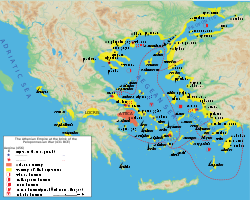 |
Ancient Athens was inhabited around 3,000 years ago. Athens
Athens
Athens , is the capital and largest city of Greece. Athens dominates the Attica region and is one of the world's oldest cities, as its recorded history spans around 3,400 years. Classical Athens was a powerful city-state...
was one of the longest histories of any city in Europe
Europe
Europe is, by convention, one of the world's seven continents. Comprising the westernmost peninsula of Eurasia, Europe is generally 'divided' from Asia to its east by the watershed divides of the Ural and Caucasus Mountains, the Ural River, the Caspian and Black Seas, and the waterways connecting...
and in the world. It became the leading city of Ancient Greece in the first millennium BC. Its cultural achievements during the 5th century BC laid the foundations of western civilization
Western world
The Western world, also known as the West and the Occident , is a term referring to the countries of Western Europe , the countries of the Americas, as well all countries of Northern and Central Europe, Australia and New Zealand...
. During the Middle Ages
Middle Ages
The Middle Ages is a periodization of European history from the 5th century to the 15th century. The Middle Ages follows the fall of the Western Roman Empire in 476 and precedes the Early Modern Era. It is the middle period of a three-period division of Western history: Classic, Medieval and Modern...
, Athens experienced decline and then a recovery under the Byzantine Empire
Byzantine Empire
The Byzantine Empire was the Eastern Roman Empire during the periods of Late Antiquity and the Middle Ages, centred on the capital of Constantinople. Known simply as the Roman Empire or Romania to its inhabitants and neighbours, the Empire was the direct continuation of the Ancient Roman State...
. Athens was relatively prosperous during the Crusades
Crusades
The Crusades were a series of religious wars, blessed by the Pope and the Catholic Church with the main goal of restoring Christian access to the holy places in and near Jerusalem...
, benefiting from Italian
Italy
Italy , officially the Italian Republic languages]] under the European Charter for Regional or Minority Languages. In each of these, Italy's official name is as follows:;;;;;;;;), is a unitary parliamentary republic in South-Central Europe. To the north it borders France, Switzerland, Austria and...
trade.
Fifth-century Athens refers to the Greek city-state Athens in period of roughly 480 BCE-404 BCE. This was a period of Athenian political hegemony, economic growth and cultural flourishing known as the Golden Age of Athens or Age of Pericles
Age of Pericles
Fifth-century Athens refers to the Greek city-state of Athens in the period of roughly 480 BC-404 BC. This was a period of Athenian political hegemony, economic growth and cultural flourishing formerly known as the Golden Age of Athens or The Age of Pericles. The period began in 480 BC when an...
. The period began in 480 BCE when an Athenian-led coalition of city-states, known as the Delian League, defeated the Persians at Salamis. As the fifth century wore on, what started as an alliance of independent city-states gradually became an Athenian empire. Eventually, Athens abandoned the pretense of parity among its allies and relocated the Delian League treasury from Delos to Athens, where it funded the building of the Athenian Acropolis. With its enemies under its feet and its political fortunes guided by legendary statesman and orator Pericles, Athens as a center of literature, philosophy (see Greek philosophy
Greek philosophy
Ancient Greek philosophy arose in the 6th century BCE and continued through the Hellenistic period, at which point Ancient Greece was incorporated in the Roman Empire...
) and the arts (see Greek theatre). Some of the most important figures of Western cultural and intellectual history lived in Athens during this period: the dramatists Aeschylus
Aeschylus
Aeschylus was the first of the three ancient Greek tragedians whose work has survived, the others being Sophocles and Euripides, and is often described as the father of tragedy. His name derives from the Greek word aiskhos , meaning "shame"...
, Aristophanes
Aristophanes
Aristophanes , son of Philippus, of the deme Cydathenaus, was a comic playwright of ancient Athens. Eleven of his forty plays survive virtually complete...
, Euripides
Euripides
Euripides was one of the three great tragedians of classical Athens, the other two being Aeschylus and Sophocles. Some ancient scholars attributed ninety-five plays to him but according to the Suda it was ninety-two at most...
and Sophocles
Sophocles
Sophocles is one of three ancient Greek tragedians whose plays have survived. His first plays were written later than those of Aeschylus, and earlier than or contemporary with those of Euripides...
, the philosophers Aristotle
Aristotle
Aristotle was a Greek philosopher and polymath, a student of Plato and teacher of Alexander the Great. His writings cover many subjects, including physics, metaphysics, poetry, theater, music, logic, rhetoric, linguistics, politics, government, ethics, biology, and zoology...
, Plato
Plato
Plato , was a Classical Greek philosopher, mathematician, student of Socrates, writer of philosophical dialogues, and founder of the Academy in Athens, the first institution of higher learning in the Western world. Along with his mentor, Socrates, and his student, Aristotle, Plato helped to lay the...
and Socrates
Socrates
Socrates was a classical Greek Athenian philosopher. Credited as one of the founders of Western philosophy, he is an enigmatic figure known chiefly through the accounts of later classical writers, especially the writings of his students Plato and Xenophon, and the plays of his contemporary ...
,
Sparta
| Lacedaemon |
|---|
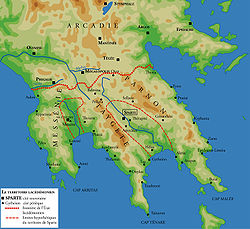 |
Sparta
Sparta
Sparta or Lacedaemon, was a prominent city-state in ancient Greece, situated on the banks of the River Eurotas in Laconia, in south-eastern Peloponnese. It emerged as a political entity around the 10th century BC, when the invading Dorians subjugated the local, non-Dorian population. From c...
was a Dorian Greek military state, originally centered in Laconia
Laconia
Laconia , also known as Lacedaemonia, is one of the regional units of Greece. It is part of the region of Peloponnese. It is situated in the southeastern part of the Peloponnese peninsula. Its administrative capital is Sparti...
. As a city-state
City-state
A city-state is an independent or autonomous entity whose territory consists of a city which is not administered as a part of another local government.-Historical city-states:...
devoted to military training, Sparta possessed the most formidable army in the Greek world, and after achieving notable victories over the Athenian and Persian
Achaemenid Empire
The Achaemenid Empire , sometimes known as First Persian Empire and/or Persian Empire, was founded in the 6th century BCE by Cyrus the Great who overthrew the Median confederation...
Empires, regarded itself as the natural protector of Greece. Laconia
Laconia
Laconia , also known as Lacedaemonia, is one of the regional units of Greece. It is part of the region of Peloponnese. It is situated in the southeastern part of the Peloponnese peninsula. Its administrative capital is Sparti...
or Lacedaemon was the name of the wider city-state
City-state
A city-state is an independent or autonomous entity whose territory consists of a city which is not administered as a part of another local government.-Historical city-states:...
centered at the city of Sparta, though the name "Sparta" is now used for both.
Following the victories in the Messenian Wars (631 BC), Sparta's reputation as a land-fighting force was unequaled. In 480 BC a small Spartan unit under King Leonidas
Leonidas I
Leonidas I was a hero-king of Sparta, the 17th of the Agiad line, one of the sons of King Anaxandridas II of Sparta, who was believed in mythology to be a descendant of Heracles, possessing much of the latter's strength and bravery...
made a legendary last stand
Last stand
Last stand is a loose military term used to describe a body of troops holding a defensive position in the face of overwhelming odds. The defensive force usually takes very heavy casualties or is completely destroyed, as happened in "Custer's Last Stand" at the Battle of Little Big HornBryan Perrett...
against a massive, invading Persian army at the Battle of Thermopylae
Battle of Thermopylae
The Battle of Thermopylae was fought between an alliance of Greek city-states, led by King Leonidas of Sparta, and the Persian Empire of Xerxes I over the course of three days, during the second Persian invasion of Greece. It took place simultaneously with the naval battle at Artemisium, in August...
. One year later, Sparta assembled at full strength and led a Greek alliance against the Persians at Plataea
Battle of Plataea
The Battle of Plataea was the final land battle during the second Persian invasion of Greece. It took place in 479 BC near the city of Plataea in Boeotia, and was fought between an alliance of the Greek city-states, including Sparta, Athens, Corinth and Megara, and the Persian Empire of Xerxes...
. There, a decisive Greek victory put an end to the Greco-Persian War along with Persian ambition of expanding into Europe. Even though this war was won by a pan-Greek army, credit was given to Sparta, who besides being the protagonist at Thermopylae and Plataea, had been the nominal leader of the entire Greek expedition.
In later Classical times, Sparta along with Athens
Athens
Athens , is the capital and largest city of Greece. Athens dominates the Attica region and is one of the world's oldest cities, as its recorded history spans around 3,400 years. Classical Athens was a powerful city-state...
, Thebes
Thebes, Greece
Thebes is a city in Greece, situated to the north of the Cithaeron range, which divides Boeotia from Attica, and on the southern edge of the Boeotian plain. It played an important role in Greek myth, as the site of the stories of Cadmus, Oedipus, Dionysus and others...
and Persia had been the main regional powers fighting for supremacy against each other. As a result of the Peloponnesian War
Peloponnesian War
The Peloponnesian War, 431 to 404 BC, was an ancient Greek war fought by Athens and its empire against the Peloponnesian League led by Sparta. Historians have traditionally divided the war into three phases...
, Sparta, a traditionally continental culture, became a naval power. At the peak of her power she subdued many of the key Greek states and even managed to overpower the powerful Athenian navy. By the end of the 5th century she stood out as a state which had defeated at war both the Persian
Achaemenid Empire
The Achaemenid Empire , sometimes known as First Persian Empire and/or Persian Empire, was founded in the 6th century BCE by Cyrus the Great who overthrew the Median confederation...
and Athenian Empires, a period which marks the Spartan Hegemony
Spartan hegemony
The city-state of Sparta was the greatest military land power of classical Greek antiquity. During the classical period, Sparta owned, dominated or influenced the entire Peloponnese. Additionally, the defeat of the Athenians and the Delian League in the Peloponnesian War in 431-404 BCE resulted in...
.
Sparta was, above all, a militarist state, and emphasis on military fitness began virtually at birth.
Macedonia
| Macedon Macedon Macedonia or Macedon was an ancient kingdom, centered in the northeastern part of the Greek peninsula, bordered by Epirus to the west, Paeonia to the north, the region of Thrace to the east and Thessaly to the south.... |
|---|
 |
Macedon
Macedon
Macedonia or Macedon was an ancient kingdom, centered in the northeastern part of the Greek peninsula, bordered by Epirus to the west, Paeonia to the north, the region of Thrace to the east and Thessaly to the south....
was the name of an ancient kingdom in the northern-most part of ancient Greece
Ancient Greece
Ancient Greece is a civilization belonging to a period of Greek history that lasted from the Archaic period of the 8th to 6th centuries BC to the end of antiquity. Immediately following this period was the beginning of the Early Middle Ages and the Byzantine era. Included in Ancient Greece is the...
, bordering the kingdom of Epirus
Epirus
The name Epirus, from the Greek "Ήπειρος" meaning continent may refer to:-Geographical:* Epirus - a historical and geographical region of the southwestern Balkans, straddling modern Greece and Albania...
on the west and the region of Thrace
Thrace
Thrace is a historical and geographic area in southeast Europe. As a geographical concept, Thrace designates a region bounded by the Balkan Mountains on the north, Rhodope Mountains and the Aegean Sea on the south, and by the Black Sea and the Sea of Marmara on the east...
to the east. For a brief period it became the most powerful state in the world after Alexander the Great conquered most of the known world, including the entire Achaemenid Empire, inaugurating the Hellenistic period
Hellenistic civilization
Hellenistic civilization represents the zenith of Greek influence in the ancient world from 323 BCE to about 146 BCE...
of Greek history.
The rise of Macedon
Rise of Macedon
The rise of Macedon, from a small kingdom at the periphery of Classical Greek affairs, to one which came to dominate the entire Hellenic world , occurred in the space of just 25 years, between 359–336 BC...
, from a small kingdom at the periphery of Classical Greek affairs, to one which came to dominate the entire Hellenic world (and beyond), occurred in the space of just 25 years, between 359–336 BC. This ascendancy is largely attributable to the personality and policies of Philip II of Macedon
Philip II of Macedon
Philip II of Macedon "friend" + ἵππος "horse" — transliterated ; 382 – 336 BC), was a king of Macedon from 359 BC until his assassination in 336 BC. He was the father of Alexander the Great and Philip III.-Biography:...
. Philip's military skills and expansionist vision of Macedonian greatness brought him early success. He had however first to re-establish a situation which had been greatly worsened by the defeat against the Illyrians in which King Perdiccas himself had died. The Paionians and the Thracians had sacked and invaded the eastern regions of the country, while the Athenians had landed, at Methoni on the coast, a contingent under a Macedonian pretender called Argeus. Using diplomacy, Philip pushed back Paionians and Thracians promising tributes, and crushed the 3,000 Athenian hoplites (359). Momentarily free from his opponents, he concentrated on strengthening his internal position and, above all, his army. His most important innovation was doubtless the introduction of the phalanx infantry corps, armed with the famous sarissa, an exceedingly long spear, at the time the most important army corps in Macedonia.
Philip's son, Alexander the Great, managed to briefly extend Macedonian power not only over the central Greek city-states, but also to the Persian empire, including Egypt and lands as far east as the fringes of India. Alexander's adoption of the styles of government of the conquered territories was accompanied by the spread of Greek culture and learning through his vast empire. Although the empire fractured into multiple Hellenic regimes shortly after his death, his conquests left a lasting legacy, not least in the new Greek-speaking cities founded across Persia's western territories, heralding the Hellenistic period. In the partition of Alexander's empire among the Diadochi, Macedonia fell to the Antipatrid dynasty, which was overthrown by the Antigonid dynasty after only a few years.
Hellenistic Kingdoms
Alexander had made no special preparations for his succession in his newly founded empire and the Apocrypha of his death state that on his death-bed he willed it to those that performed actions well and powerfully. The result was the wars of the DiadochiWars of the Diadochi
The Wars of the Diadochi were a series of conflicts fought between Alexander the Great's generals over the rule of his empire between 322 and 275 BC.-Background:...
between his generals (the Diadochi
Diadochi
The Diadochi were the rival generals, family and friends of Alexander the Great who fought for the control of Alexander's empire after his death in 323 BC...
, or 'Successors'), which lasted for forty years before a more-or-less stable arrangement was established, consisting of four major domains:
- The Antigonid dynastyAntigonid dynastyThe Antigonid dynasty was a dynasty of Hellenistic kings descended from Alexander the Great's general Antigonus I Monophthalmus .-History:...
in MacedonMacedonMacedonia or Macedon was an ancient kingdom, centered in the northeastern part of the Greek peninsula, bordered by Epirus to the west, Paeonia to the north, the region of Thrace to the east and Thessaly to the south....
and central Greece; - The Ptolemaic dynastyPtolemaic dynastyThe Ptolemaic dynasty, was a Macedonian Greek royal family which ruled the Ptolemaic Empire in Egypt during the Hellenistic period. Their rule lasted for 275 years, from 305 BC to 30 BC...
in EgyptEgyptEgypt , officially the Arab Republic of Egypt, Arabic: , is a country mainly in North Africa, with the Sinai Peninsula forming a land bridge in Southwest Asia. Egypt is thus a transcontinental country, and a major power in Africa, the Mediterranean Basin, the Middle East and the Muslim world...
based at AlexandriaAlexandriaAlexandria is the second-largest city of Egypt, with a population of 4.1 million, extending about along the coast of the Mediterranean Sea in the north central part of the country; it is also the largest city lying directly on the Mediterranean coast. It is Egypt's largest seaport, serving...
; - The Seleucid dynastySeleucid dynastyThe Seleucid dynasty or the Seleucidae was a Greek Macedonian royal family, founded by Seleucus I Nicator , which ruled the Seleucid Kingdom centered in the Near East and regions of the Asian part of the earlier Achaemenid Persian Empire during the Hellenistic period.-History:Seleucus was an...
in SyriaSyriaSyria , officially the Syrian Arab Republic , is a country in Western Asia, bordering Lebanon and the Mediterranean Sea to the West, Turkey to the north, Iraq to the east, Jordan to the south, and Israel to the southwest....
and MesopotamiaMesopotamiaMesopotamia is a toponym for the area of the Tigris–Euphrates river system, largely corresponding to modern-day Iraq, northeastern Syria, southeastern Turkey and southwestern Iran.Widely considered to be the cradle of civilization, Bronze Age Mesopotamia included Sumer and the...
based at AntiochAntiochAntioch on the Orontes was an ancient city on the eastern side of the Orontes River. It is near the modern city of Antakya, Turkey.Founded near the end of the 4th century BC by Seleucus I Nicator, one of Alexander the Great's generals, Antioch eventually rivaled Alexandria as the chief city of the...
; - The Attalid dynastyAttalid dynastyThe Attalid dynasty was a Hellenistic dynasty that ruled the city of Pergamon after the death of Lysimachus, a general of Alexander the Great. The Attalid kingdom was the rump state left after the collapse of the Lysimachian Empire. One of Lysimachus' officers, Philetaerus, took control of the city...
in AnatoliaAnatoliaAnatolia is a geographic and historical term denoting the westernmost protrusion of Asia, comprising the majority of the Republic of Turkey...
based at PergamumPergamonPergamon , or Pergamum, was an ancient Greek city in modern-day Turkey, in Mysia, today located from the Aegean Sea on a promontory on the north side of the river Caicus , that became the capital of the Kingdom of Pergamon during the Hellenistic period, under the Attalid dynasty, 281–133 BC...
.
A further two kingdoms later emerged, the so called Greco-Bactrian
Greco-Bactrian Kingdom
The Greco-Bactrian Kingdom was the easternmost part of the Hellenistic world, covering Bactria and Sogdiana in Central Asia from 250 to 125 BC...
and Indo-Greek kingdom
Indo-Greek Kingdom
The Indo-Greek Kingdom or Graeco-Indian Kingdom covered various parts of the northwest regions of the Indian subcontinent during the last two centuries BC, and was ruled by more than 30 Hellenistic kings, often in conflict with each other...
. Hellenistic culture thrived in its preservation of the past. The states of the Hellenistic period were deeply fixated with the past and its seemingly lost glories. Athens retained its position as the most prestigious seat of higher education, especially in the domains of philosophy and rhetoric, with considerable libraries. Alexandria was a center of Greek learning and the Library of Alexandria had 700,000 volumes. The city of Pergamon became a major center of book production, possessing a library of some 200,000 volumes, second only to Alexandria's. The island of Rhodes boasted a famous finishing school for politics and diplomacy. Antioch was founded as a metropolis and center of Greek learning which retained its status into the era of Christianity. Seleucia replaced Babylon as the metropolis of the lower Tigris.
Seleucid Empire
| Seleucid Empire Seleucid Empire The Seleucid Empire was a Greek-Macedonian state that was created out of the eastern conquests of Alexander the Great. At the height of its power, it included central Anatolia, the Levant, Mesopotamia, Persia, today's Turkmenistan, Pamir and parts of Pakistan.The Seleucid Empire was a major centre... |
|---|
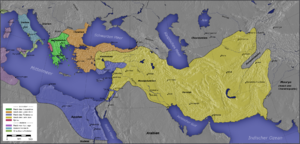 |
The Seleucid Empire
Seleucid Empire
The Seleucid Empire was a Greek-Macedonian state that was created out of the eastern conquests of Alexander the Great. At the height of its power, it included central Anatolia, the Levant, Mesopotamia, Persia, today's Turkmenistan, Pamir and parts of Pakistan.The Seleucid Empire was a major centre...
was a Hellenistic empire, and the eastern remnant of the former Achaemenid Persian Empire following its breakup after Alexander the Great's invasion. The Seleucid Empire was centered in the near East. It was a center of Hellenistic culture which maintained the Greek customs and Greek-speaking Macedonian elite.
Seleucid expansion into Greece was abruptly halted after decisive defeats at the hands of the Roman army. Much of the eastern part of the empire was conquered by the Parthians under Mithridates I of Parthia in the mid-2nd century BC, yet the Seleucid kings continued to rule a rump state from Syria until the invasion by Armenian king Tigranes the Great and their ultimate overthrow by the Roman general Pompey.
Ptolemaic Egypt
| Ptolemaic empire |
|---|
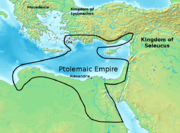 |
The Ptolemaic dynasty
Ptolemaic dynasty
The Ptolemaic dynasty, was a Macedonian Greek royal family which ruled the Ptolemaic Empire in Egypt during the Hellenistic period. Their rule lasted for 275 years, from 305 BC to 30 BC...
, sometimes also known as the Lagids, was a Greek royal family which ruled the Ptolemaic Empire in Egypt during the Hellenistic period.
Ptolemy, one of the seven somatophylakes (bodyguards) who served as Alexander the Great's generals and deputies, was appointed satrap of Egypt after Alexander's death in 323 BC. In 305 BC, he declared himself King Ptolemy I, later known as "Soter" (saviour). The Egyptians soon accepted the Ptolemies as the successors to the pharaohs of independent Egypt. Ptolemy's family ruled Egypt until the Roman conquest of 30 BC. All the male rulers of the dynasty took the name Ptolemy.
Ptolemaic Egypt began when Ptolemy I Soter declared himself Pharaoh of Egypt in 305 BC and ended with the death of queen Cleopatra VII of Egypt and the Roman conquest in 30 BC. The Ptolemaic Kingdom was a powerful Hellenistic state, extending from southern Syria in the east, to Cyrene to the west, and south to the frontier with Nubia. Alexandria became the capital city and a center of Greek culture and trade. To gain recognition by the native Egyptian populace, they named themselves as the successors to the Pharaohs. The later Ptolemies took on Egyptian traditions, had themselves portrayed on public monuments in Egyptian style and dress, and participated in Egyptian religious life. Hellenistic culture continued to thrive in Egypt well after the Muslim conquest. The Ptolemies faced rebellions of native Egyptians often caused by an unwanted regime and were involved in foreign and civil wars that led to the decline of the kingdom and its annexation by Rome.
Carthage
| Ancient Carthage |
|---|
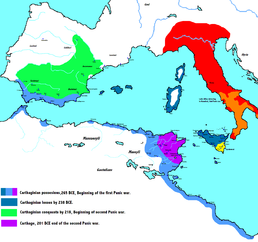 |
Carthage
Carthage
Carthage , implying it was a 'new Tyre') is a major urban centre that has existed for nearly 3,000 years on the Gulf of Tunis, developing from a Phoenician colony of the 1st millennium BC...
was a major power over the Western Mediterranean between 575 BC and 272 BC. Carthage as a major power was originally a Phoenicia
Phoenicia
Phoenicia , was an ancient civilization in Canaan which covered most of the western, coastal part of the Fertile Crescent. Several major Phoenician cities were built on the coastline of the Mediterranean. It was an enterprising maritime trading culture that spread across the Mediterranean from 1550...
n settlement, and when Tyre fell to the Assyrians, Carthage assumed power over the former settlements of the region. The foundation of Carthaginian power was seafaring trade throughout the Western Mediterranean (following the tracks of the Phoenicians). Some 300 colonies were established in Tunisia, Morocco, Algeria, Iberia, and to a much lesser extent, on the arid coast of Libya. The Phoenicians controlled Cyprus, Sardinia, Corsica, and the Balearic Islands, as well as minor possessions in Crete and Sicily; the latter settlements were in perpetual conflict with the Greeks. The Phoenicians managed to control all of Sicily for a limited time. The entire area later came under the leadership and protection of Carthage, which in turn dispatched its own colonists to found new cities or to reinforce those that declined with Tyre and Sidon.
Ancient Rome
Ancient Rome was a thriving civilization that grew on the Italian Peninsula as early as the 8th century BC. Located along the Mediterranean Sea and centered on the city of Rome, it expanded to one of the largest empires in the ancient world....
was originally a land based military power, its sphere of influence
Sphere of influence
In the field of international relations, a sphere of influence is a spatial region or conceptual division over which a state or organization has significant cultural, economic, military or political influence....
soon collided with Carthage's. Carthage was in a constant state of struggle with the Roman Republic, which led to a series of conflicts known as the Punic Wars
Punic Wars
The Punic Wars were a series of three wars fought between Rome and Carthage from 264 B.C.E. to 146 B.C.E. At the time, they were probably the largest wars that had ever taken place...
. After the third and final Punic War, Carthage was destroyed and then occupied by Roman forces. Nearly all of the other Phoenician city-states and former Carthaginian dependencies fell into Roman hands from then on.
Ancient India
Ancient India, which consisted of the Indian subcontinentIndian subcontinent
The Indian subcontinent, also Indian Subcontinent, Indo-Pak Subcontinent or South Asian Subcontinent is a region of the Asian continent on the Indian tectonic plate from the Hindu Kush or Hindu Koh, Himalayas and including the Kuen Lun and Karakoram ranges, forming a land mass which extends...
(the modern-day states of India
India
India , officially the Republic of India , is a country in South Asia. It is the seventh-largest country by geographical area, the second-most populous country with over 1.2 billion people, and the most populous democracy in the world...
, Pakistan
Pakistan
Pakistan , officially the Islamic Republic of Pakistan is a sovereign state in South Asia. It has a coastline along the Arabian Sea and the Gulf of Oman in the south and is bordered by Afghanistan and Iran in the west, India in the east and China in the far northeast. In the north, Tajikistan...
, Nepal
Nepal
Nepal , officially the Federal Democratic Republic of Nepal, is a landlocked sovereign state located in South Asia. It is located in the Himalayas and bordered to the north by the People's Republic of China, and to the south, east, and west by the Republic of India...
, and Bangladesh
Bangladesh
Bangladesh , officially the People's Republic of Bangladesh is a sovereign state located in South Asia. It is bordered by India on all sides except for a small border with Burma to the far southeast and by the Bay of Bengal to the south...
) was unified under many emperors and governments in history. Ancient texts mention India under the legendary emperor Bharata
Bharata (emperor)
Bharata was a legendary emperor of India, and is referred to in Hindu and Jain mythology. He was son of King Dushyanta and Shakuntala and thus a descendant of the Lunar Dynasty of the Kshatriya caste. Bharata conquered all of greater Greater India, uniting it into a single entity which was named...
, these regions roughly form the entities of modern day greater India
Greater India
Greater India is a term that refers to the historical spread of the culture of India beyond the Indian subcontinent...
. Several Indian empires were able to expand across southern Asia, and sometimes into parts of the Middle East
Middle East
The Middle East is a region that encompasses Western Asia and Northern Africa. It is often used as a synonym for Near East, in opposition to Far East...
, Central Asia
Central Asia
Central Asia is a core region of the Asian continent from the Caspian Sea in the west, China in the east, Afghanistan in the south, and Russia in the north...
and Southeast Asia
Southeast Asia
Southeast Asia, South-East Asia, South East Asia or Southeastern Asia is a subregion of Asia, consisting of the countries that are geographically south of China, east of India, west of New Guinea and north of Australia. The region lies on the intersection of geological plates, with heavy seismic...
.
Nanda Empire
| Nanda Empire |
|---|
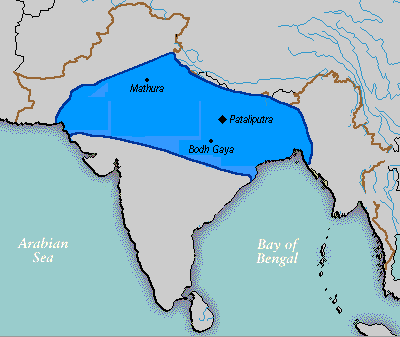 |
The Nanda Empire originated from Magadha
Magadha
Magadha formed one of the sixteen Mahājanapadas or kingdoms in ancient India. The core of the kingdom was the area of Bihar south of the Ganga; its first capital was Rajagriha then Pataliputra...
in Ancient India
History of India
The history of India begins with evidence of human activity of Homo sapiens as long as 75,000 years ago, or with earlier hominids including Homo erectus from about 500,000 years ago. The Indus Valley Civilization, which spread and flourished in the northwestern part of the Indian subcontinent from...
during the 5th and 4th centuries BC. At its greatest extent, the Nandas ruled much of Northern India
Hindustan
Hindustan or Indostan, literal translation "Land of River Sindhu ", is one of the popular names of South Asia. It can also mean "the land of the Hindus"...
. The Nandas are sometimes described as the first empire builders in the recorded history of India. They inherited the large kingdom of Magadha. They built up a vast army.
The Nandas never had the opportunity to see their army up against Alexander the Great, who invaded India at the time of Dhana Nanda, since Alexander had to confine his campaign to the plains of Punjab, for his forces, at the prospect of facing a further foe, mutinied at the Hyphasis River (the modern Beas River) refusing to march any further. The Persian and Greek invasions had important repercussions on Indian civilization.
The political systems of the Persians were to influence future forms of governance on the subcontinent, including the administration of the Mauryan dynasty. In addition, the region of Gandhara, or present-day eastern Afghanistan and northwest Pakistan, became a melting pot of Indian, Persian, Central Asian, and Greek cultures and gave rise to a hybrid culture, Greco-Buddhism, which lasted until the 5th century CE and influenced the artistic development of Mahayana Buddhism.
Maurya Empire
| Maurya Empire Maurya Empire The Maurya Empire was a geographically extensive Iron Age historical power in ancient India, ruled by the Mauryan dynasty from 321 to 185 BC... |
|---|
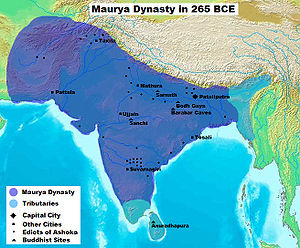 |
The Mauryan Empire was the first political entity to unite most of the Indian subcontinent and expand into Central Asia and the Middle East. Its soft power further spread into much of Persia and Greece
Greece
Greece , officially the Hellenic Republic , and historically Hellas or the Republic of Greece in English, is a country in southeastern Europe....
due to its military victories over these regions. Its cultural influence also extended west into Egypt
Egypt
Egypt , officially the Arab Republic of Egypt, Arabic: , is a country mainly in North Africa, with the Sinai Peninsula forming a land bridge in Southwest Asia. Egypt is thus a transcontinental country, and a major power in Africa, the Mediterranean Basin, the Middle East and the Muslim world...
and Syria
Syria
Syria , officially the Syrian Arab Republic , is a country in Western Asia, bordering Lebanon and the Mediterranean Sea to the West, Turkey to the north, Iraq to the east, Jordan to the south, and Israel to the southwest....
, and east into Thailand
Thailand
Thailand , officially the Kingdom of Thailand , formerly known as Siam , is a country located at the centre of the Indochina peninsula and Southeast Asia. It is bordered to the north by Burma and Laos, to the east by Laos and Cambodia, to the south by the Gulf of Thailand and Malaysia, and to the...
, China
China
Chinese civilization may refer to:* China for more general discussion of the country.* Chinese culture* Greater China, the transnational community of ethnic Chinese.* History of China* Sinosphere, the area historically affected by Chinese culture...
and Burma.
The Empire was founded in 322 BC by Chandragupta Maurya
Chandragupta Maurya
Chandragupta Maurya , was the founder of the Maurya Empire. Chandragupta succeeded in conquering most of the Indian subcontinent. Chandragupta is considered the first unifier of India and its first genuine emperor...
. Chandragupta waged a war against the nearby Greek
Greeks
The Greeks, also known as the Hellenes , are a nation and ethnic group native to Greece, Cyprus and neighboring regions. They also form a significant diaspora, with Greek communities established around the world....
powers and won, forcing the Greeks to surrender large amounts of land. Under the reign of Ashoka the Great, the empire became pacifist and turned to spreading its soft power in the form of Buddhism
Buddhism
Buddhism is a religion and philosophy encompassing a variety of traditions, beliefs and practices, largely based on teachings attributed to Siddhartha Gautama, commonly known as the Buddha . The Buddha lived and taught in the northeastern Indian subcontinent some time between the 6th and 4th...
. It has been estimated that the Maurya Dynasty controlled an unprecedented one-third of the world's entire economy, was home to one-third of the world's population at the time (an estimated 50 million out of 150 million human), contained the world's largest city of the time (Pataliputra, estimated to be larger than Rome under Emperor Trajan).
Tosali
Tosali or Toshali was an ancient city in the present day Orissa state in eastern India. It was the capital of the eastern province of the Maurya empire...
(in the east), Ujjain
Ujjain
Ujjain , is an ancient city of Malwa region in central India, on the eastern bank of the Kshipra River , today part of the state of Madhya Pradesh. It is the administrative centre of Ujjain District and Ujjain Division.In ancient times the city was called Ujjayini...
in the west, Suvarnagiri (in the south), and Taxila
Taxila
Taxila is a Tehsil in the Rawalpindi District of Punjab province of Pakistan. It is an important archaeological site.Taxila is situated about northwest of Islamabad Capital Territory and Rawalpindi in Panjab; just off the Grand Trunk Road...
(in the north). The head of the provincial administration was the Kumara (royal prince), who governed the provinces as king's representative. The kumara was assisted by Mahamatyas and council of ministers. This organizational structure was reflected at the imperial level with the Emperor and his Mantriparishad (Council of Ministers).
Historians theorize that the organization of the Empire was in line with the extensive bureaucracy described by Kautilya in the Arthashastra
Arthashastra
The Arthashastra is an ancient Indian treatise on statecraft, economic policy and military strategy which identifies its author by the names Kautilya and , who are traditionally identified with The Arthashastra (IAST: Arthaśāstra) is an ancient Indian treatise on statecraft, economic policy and...
: a sophisticated civil service governed everything from municipal hygiene to international trade. According to Megasthenes
Megasthenes
Megasthenes was a Greek ethnographer in the Hellenistic period, author of the work Indica.He was born in Asia Minor and became an ambassador of Seleucus I of Syria possibly to Chandragupta Maurya in Pataliputra, India. However the exact date of his embassy is uncertain...
, the empire wielded a military of 600,000 infantry, 30,000 cavalry, and 9,000 war elephants. A vast espionage
Espionage
Espionage or spying involves an individual obtaining information that is considered secret or confidential without the permission of the holder of the information. Espionage is inherently clandestine, lest the legitimate holder of the information change plans or take other countermeasures once it...
system collected intelligence for both internal and external security purposes. Having renounced offensive warfare and expansionism, Ashoka nevertheless continued to maintain this large army, to protect the Empire and instill stability and peace across West and South Asia.
Sunga Empire
| Sunga Empire Sunga Empire The Sunga Empire or Shunga Empire was a royal Indian dynasty from Magadha that controlled vast areas of the Indian Subcontinent from around 185 to 73 BCE. The dynasty was established by Pusyamitra Sunga, after the fall of the Maurya Empire... |
|---|
The Shunga Empire is a Magadha
Magadha
Magadha formed one of the sixteen Mahājanapadas or kingdoms in ancient India. The core of the kingdom was the area of Bihar south of the Ganga; its first capital was Rajagriha then Pataliputra...
dynasty that controlled North-central and Eastern India as well as parts of the northwest (now Pakistan
Pakistan
Pakistan , officially the Islamic Republic of Pakistan is a sovereign state in South Asia. It has a coastline along the Arabian Sea and the Gulf of Oman in the south and is bordered by Afghanistan and Iran in the west, India in the east and China in the far northeast. In the north, Tajikistan...
) from around 185 to 73 BCE. It was established after the fall of the Indian Maurya Empire
Maurya Empire
The Maurya Empire was a geographically extensive Iron Age historical power in ancient India, ruled by the Mauryan dynasty from 321 to 185 BC...
. The capital of the Sungas was Pataliputra. Later kings such as Bhagabhadra
Bhagabhadra
Bhagabhadra was one of the kings of the Indian Sunga dynasty. He ruled in north, central, and eastern India around 110 BCE. Although the capital of the Sungas was at Pataliputra, he was also known to have held court at Vidisha....
also held court at Vidisha
Vidisha
Vidisha is a city in the state of Madhya Pradesh, India, located near the state capital Bhopal. Vidishā is the administrative headquarters of Vidisha District. The city was also known as Bhilsa during the medieval period.-Geography:...
, modern Besnagar in Eastern Malwa. The Sunga Empire is noted for its numerous wars with both foreign and indigenous powers.
While there is much debate on the religious politics of the Sunga dynasty, it is recognized for a number of contributions. Art, education, philosophy, and other learning flowered during this period. Most notably, Patanjali's Yoga Sutras and Mahabhasya were composed in this period, Panini composed the first Sanskrit grammarian Ashtadayai. It is also noted for its subsequent mention in the Malavikaagnimitra. This work was composed by Kalidasa in the later Gupta period, and romanticized the love of Malavika and King Agnimitra, with a background of court intrigue.
Artistry on the subcontinent also progressed with the rise of the Mathura school, which is considered the indigenous counterpart to the more Hellenistic Gandhara school of Afghanistan and Pakistan. During the historical Sunga period (185 to 73 BCE), Buddhist activity also managed to survive somewhat in central India (Madhya Pradesh) as suggested by some architectural expansions that were done at the stupas of Sanchi and Barhut, originally started under Emperor Ashoka. It remains uncertain whether these works were due to the weakness of the control of the Sungas in these areas, or a sign of tolerance on their part.
The last of the Sunga emperor was Devabhuti (83–73 BCE). He was assassinated by his minister (Vasudeva Kanva) and is said to have been overfond of the company of women. The Sunga dynasty was then replaced by the subsequent Kanvas.
Satavahana Empire
| Satavahanas |
|---|
 |
The Sâtavâhana Empire started out as feudatories to the Mauryan Empire but declared independence soon after the death of Ashoka
Ashoka
Ashok Maurya or Ashoka , popularly known as Ashoka the Great, was an Indian emperor of the Maurya Dynasty who ruled almost all of the Indian subcontinent from ca. 269 BC to 232 BC. One of India's greatest emperors, Ashoka reigned over most of present-day India after a number of military conquests...
(232 BC). They were the first Indic rulers to issue coins struck with their rulers embossed and are known for their patronage of Buddhism
Buddhism
Buddhism is a religion and philosophy encompassing a variety of traditions, beliefs and practices, largely based on teachings attributed to Siddhartha Gautama, commonly known as the Buddha . The Buddha lived and taught in the northeastern Indian subcontinent some time between the 6th and 4th...
resulting in Buddhist monuments from Ellora to Amaravati
Amaravati, Andhra Pradesh
Amaravathi is a small town situated on the banks of the River Krishna in the Guntur District of Andhra Pradesh, India. It is famous for its Amareswara temple dedicated to Lord Shiva. The temple is one of the famous Pancharamas. Amaravati, also known as Dhanyakataka/Dharanikota was the site of a...
.
After becoming independent around 230 BCE, Simuka, the founder of the dynasty, conquered Maharashtra, Malwa and part of Madhya Pradesh. He was succeeded by his brother Kanha (or Krishna) (r. 207–189 BCE), who further extended his kingdom to the west and the south. Sātakarnī I was the sixth ruler of the Satavahana. He is said to have ruled for 56 years. Satakarni defeated the Sunga dynasty of North India by wresting Western Malwa from them, and performed several Vedic sacrifices at huge cost, including the Horse Sacrifice – Ashwamedha yajna. He also was in conflict with the Kalinga ruler Kharavela, who mentions him in the Hathigumpha inscription. According to the Yuga Purana he conquered Kalinga following the death of Kharavela. He extended Satavahana rule over Madhya Pradesh and pushed back the Sakas from Pataliputra (he is thought to be the Yuga Purana's "Shata", an abbreviation of the full name “Shri Sata” that occurs on coins from Ujjain), where he subsequently ruled for 10 years. By this time the dynasty was well established, with its capital at Pratishthānapura (Paithan) in Maharashtra, and its power spreading into all of South India.
The Satavahanas formed a cultural bridge and played a vital role in trade and the transfer of ideas and culture to and from the Gangetic plains to the southern tip of India.
Gupta Empire
| Gupta Empire Gupta Empire The Gupta Empire was an ancient Indian empire which existed approximately from 320 to 550 CE and covered much of the Indian Subcontinent. Founded by Maharaja Sri-Gupta, the dynasty was the model of a classical civilization. The peace and prosperity created under leadership of Guptas enabled the... |
|---|
In the 4th and 5th centuries, the Gupta Empire
Gupta Empire
The Gupta Empire was an ancient Indian empire which existed approximately from 320 to 550 CE and covered much of the Indian Subcontinent. Founded by Maharaja Sri-Gupta, the dynasty was the model of a classical civilization. The peace and prosperity created under leadership of Guptas enabled the...
unified much of India. This period is called the Golden Age of India and was marked by extensive achievements in science, technology
Science and technology in ancient India
The history of science and technology in the Indian subcontinent begins with prehistoric human activity at Mehrgarh, in present-day Pakistan, and continues through the Indus Valley Civilization to early states and empires. The British colonial rule introduced some elements of western education in...
, engineering, art
Indian art
Indian Art is the visual art produced on the Indian subcontinent from about the 3rd millennium BC to modern times. To viewers schooled in the Western tradition, Indian art may seem overly ornate and sensuous; appreciation of its refinement comes only gradually, as a rule. Voluptuous feeling is...
, dialectic, literature
Indian literature
Indian literature refers to the literature produced on the Indian subcontinent until 1947 and in the Republic of India thereafter. The Republic of India has 22 officially recognized languages....
, logic
Indian logic
The development of Indian logic dates back to the anviksiki of Medhatithi Gautama the Sanskrit grammar rules of Pāṇini ; the Vaisheshika school's analysis of atomism ; the analysis of inference by Gotama , founder of the Nyaya school of Hindu philosophy; and the tetralemma of Nagarjuna...
, mathematics
Indian mathematics
Indian mathematics emerged in the Indian subcontinent from 1200 BCE until the end of the 18th century. In the classical period of Indian mathematics , important contributions were made by scholars like Aryabhata, Brahmagupta, and Bhaskara II. The decimal number system in use today was first...
, astronomy, religion and philosophy
Indian philosophy
India has a rich and diverse philosophical tradition dating back to ancient times. According to Radhakrishnan, the earlier Upanisads constitute "...the earliest philosophical compositions of the world."...
that crystallized the elements of what is generally known as Hindu culture. Chandragupta I
Chandragupta I
The Gupta dynasty first seems to be in eminence with the accession of Chandra Gupta I, son of Ghatotkacha to the throne of the ancestral Gupta kingdom. While his two ancestors were given the title of Maharaja , Chandra Gupta I is described in his inscriptions as Maharajadhiraj signifying a rise in...
, Samudragupta
Samudragupta
Samudragupta , ruler of the Gupta Empire , and successor to Chandragupta I, is considered to be one of the greatest military geniuses in Indian history according to Historian V. A. Smith. His name is taken to be a title acquired by his conquests...
, and Chandragupta II
Chandragupta II
Chandragupta II the Great, very often referred to as Vikramaditya or Chandragupta Vikramaditya in Sanskrit; was one of the most powerful emperors of the Gupta empire in northern India. His rule spanned c...
were the most notable rulers of the Gupta dynasty.
The high points of this cultural creativity are magnificent architectures, sculptures and paintings. The Gupta period produced scholars such as Kalidasa
Kalidasa
Kālidāsa was a renowned Classical Sanskrit writer, widely regarded as the greatest poet and dramatist in the Sanskrit language...
, Aryabhata
Aryabhata
Aryabhata was the first in the line of great mathematician-astronomers from the classical age of Indian mathematics and Indian astronomy...
, Varahamihira
Varahamihira
Varāhamihira , also called Varaha or Mihira, was an Indian astronomer, mathematician, and astrologer who lived in Ujjain...
, Vishnu Sharma, and Vatsyayana
Vatsyayana
Vātsyāyana is the name of a Hindu philosopher in the Vedic tradition who is believed to have lived during time of the Gupta Empire in India...
who made great advancements in many academic fields. Science and political administration reached new heights during the Gupta era. Strong trade ties also made the region an important cultural center and set the region up as a base that would influence nearby kingdoms and regions in Burma, Sri Lanka
Sri Lanka
Sri Lanka, officially the Democratic Socialist Republic of Sri Lanka is a country off the southern coast of the Indian subcontinent. Known until 1972 as Ceylon , Sri Lanka is an island surrounded by the Indian Ocean, the Gulf of Mannar and the Palk Strait, and lies in the vicinity of India and the...
, Malay Archipelago
Malay Archipelago
The Malay Archipelago refers to the archipelago between mainland Southeastern Asia and Australia. The name was derived from the anachronistic concept of a Malay race....
and Indochina
Indochina
The Indochinese peninsula, is a region in Southeast Asia. It lies roughly southwest of China, and east of India. The name has its origins in the French, Indochine, as a combination of the names of "China" and "India", and was adopted when French colonizers in Vietnam began expanding their territory...
.
Pāla Empire
The Pāla's were a multifaith Bengal
Bengal
Bengal is a historical and geographical region in the northeast region of the Indian Subcontinent at the apex of the Bay of Bengal. Today, it is mainly divided between the sovereign land of People's Republic of Bangladesh and the Indian state of West Bengal, although some regions of the previous...
i Hindu
Hindu
Hindu refers to an identity associated with the philosophical, religious and cultural systems that are indigenous to the Indian subcontinent. As used in the Constitution of India, the word "Hindu" is also attributed to all persons professing any Indian religion...
and Buddhist dynasty, which lasted for four centuries (750–1120 CE). The empire reached its peak under Dharmapala
Dharmapala of Bengal
Dharama Pala was the second ruler of the Pala Empire of Bengal region in the Indian Subcontinent. He was the son and succeessor of Gopala , the founder of the Pala Dynasty. He greatly expanded the boundaries of the Pala Empire founded by his father and made the Palas the most dominant power in...
and Devapala
Devapala
Deva Pala , was a powerful emperor from the Pala Empire of Bengal region in the Indian Subcontinent. He was the third king in the line and had succeeded his father, emperor Dharamapala...
to cover much of South Asia
South Asia
South Asia, also known as Southern Asia, is the southern region of the Asian continent, which comprises the sub-Himalayan countries and, for some authorities , also includes the adjoining countries to the west and the east...
and beyond up to Kamboja (modern day Afghanistan
Afghanistan
Afghanistan , officially the Islamic Republic of Afghanistan, is a landlocked country located in the centre of Asia, forming South Asia, Central Asia and the Middle East. With a population of about 29 million, it has an area of , making it the 42nd most populous and 41st largest nation in the world...
), shattering the pride of many a ruler, including the Huna. Followers of the Mahayana
Mahayana
Mahāyāna is one of the two main existing branches of Buddhism and a term for classification of Buddhist philosophies and practice...
and Tantric schools of Buddhism, they were responsible for the introduction of Mahayana Buddhism in Nepal
Nepal
Nepal , officially the Federal Democratic Republic of Nepal, is a landlocked sovereign state located in South Asia. It is located in the Himalayas and bordered to the north by the People's Republic of China, and to the south, east, and west by the Republic of India...
, Bhutan
Bhutan
Bhutan , officially the Kingdom of Bhutan, is a landlocked state in South Asia, located at the eastern end of the Himalayas and bordered to the south, east and west by the Republic of India and to the north by the People's Republic of China...
, Tibet
Tibet
Tibet is a plateau region in Asia, north-east of the Himalayas. It is the traditional homeland of the Tibetan people as well as some other ethnic groups such as Monpas, Qiang, and Lhobas, and is now also inhabited by considerable numbers of Han and Hui people...
, Myanmar
Myanmar
Burma , officially the Republic of the Union of Myanmar , is a country in Southeast Asia. Burma is bordered by China on the northeast, Laos on the east, Thailand on the southeast, Bangladesh on the west, India on the northwest, the Bay of Bengal to the southwest, and the Andaman Sea on the south....
and the Malay archipelago, creation of temples and works of art and patronage of great universities formerly patronised by the Hindu king Harsha Vardhana
Harsha
Harsha or Harsha Vardhana or Harshvardhan was an Indian emperor who ruled northern India from 606 to 647 AD. He was the son of Prabhakara Vardhana and younger brother of Rajya Vardhana, a king of Thanesar, Haryana...
. The Palas had extensive trade as well as influence in south-east Asia. The Pala Empire eventually disintegrated in the 12th century under the attack of the Hindu
Hindu
Hindu refers to an identity associated with the philosophical, religious and cultural systems that are indigenous to the Indian subcontinent. As used in the Constitution of India, the word "Hindu" is also attributed to all persons professing any Indian religion...
Sena dynasty
Sena dynasty
The Sena Empire was a Hindu dynasty that ruled from Bengal through the 11th and 12th centuries. At its peak the empire covered much of the north-eastern region in the Indian Subcontinent. They were called Brahma-Kshatriyas, as evidenced through their surname, which is derived from the Sanskrit,...
.
Qin Dynasty
| Qin Dynasty |
|---|
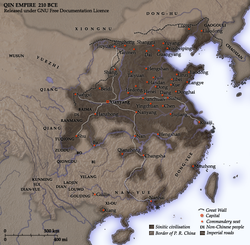 |
The Qin Dynasty was preceded by the feudal Zhou Dynasty
Zhou Dynasty
The Zhou Dynasty was a Chinese dynasty that followed the Shang Dynasty and preceded the Qin Dynasty. Although the Zhou Dynasty lasted longer than any other dynasty in Chinese history, the actual political and military control of China by the Ji family lasted only until 771 BC, a period known as...
and followed by the Han Dynasty
Han Dynasty
The Han Dynasty was the second imperial dynasty of China, preceded by the Qin Dynasty and succeeded by the Three Kingdoms . It was founded by the rebel leader Liu Bang, known posthumously as Emperor Gaozu of Han. It was briefly interrupted by the Xin Dynasty of the former regent Wang Mang...
in China
China
Chinese civilization may refer to:* China for more general discussion of the country.* Chinese culture* Greater China, the transnational community of ethnic Chinese.* History of China* Sinosphere, the area historically affected by Chinese culture...
. The unification of China in 221 BCE under the First Emperor Qin Shi Huang
Qin Shi Huang
Qin Shi Huang , personal name Ying Zheng , was king of the Chinese State of Qin from 246 BC to 221 BC during the Warring States Period. He became the first emperor of a unified China in 221 BC...
marked the beginning of Imperial China, a period which lasted until the fall of the Qing Dynasty
Qing Dynasty
The Qing Dynasty was the last dynasty of China, ruling from 1644 to 1912 with a brief, abortive restoration in 1917. It was preceded by the Ming Dynasty and followed by the Republic of China....
in 1912.
In 214 BC Qin Shihuang secured his boundaries to the north with a fraction (100,000 men) of his large army, and sent the majority (500,000 men) south to seize still more land. Prior to the events leading to Qin dominance over China, they had gained possession of much of Sichuan to the southwest. The Qin army was unfamiliar with the jungle terrain, and it was defeated by the southern tribes' guerrilla warfare tactics with over 100,000 men lost. However, in the defeat Qin was successful in building a canal to the south, which they used heavily for supplying and reinforcing their troops during their second attack to the south. Building on these gains, the Qin armies conquered the coastal lands surrounding Guangzhou, and took the provinces of Fuzhou and Guilin. They struck as far south as Hanoi. After these victories in the south, Qin Shihuang moved over 100,000 prisoners and exiles to colonize the newly conquered area. In terms of extending the boundaries of his empire, the First Emperor was extremely successful in the south.
Despite its military strength, the Qin Dynasty did not last long. When the first emperor died in 210 BC, his son was placed on the throne by two of the previous emperor's advisers, in an attempt to influence and control the administration of the entire country through him. The advisors squabbled among themselves, however, which resulted in both their deaths and that of the second Qin emperor. Popular revolt broke out a few years later, and the weakened empire soon fell to a Chu lieutenant, who went on to found the Han Dynasty. Despite its rapid end, the Qin Dynasty influenced future Chinese regimes, particularly the Han, and the European name for China is derived from it
Han Dynasty
| Han Dynasty Han Dynasty The Han Dynasty was the second imperial dynasty of China, preceded by the Qin Dynasty and succeeded by the Three Kingdoms . It was founded by the rebel leader Liu Bang, known posthumously as Emperor Gaozu of Han. It was briefly interrupted by the Xin Dynasty of the former regent Wang Mang... |
|---|
 |
The Han Dynasty (206 BC – AD 220), lasting 400 years, is commonly considered within China to be one of the greatest periods in the entire history of China
History of China
Chinese civilization originated in various regional centers along both the Yellow River and the Yangtze River valleys in the Neolithic era, but the Yellow River is said to be the Cradle of Chinese Civilization. With thousands of years of continuous history, China is one of the world's oldest...
. At its height, the Han empire extended over a vast territory of 6 million km² and housed a population of approximately 55 million. During this time period, China
China
Chinese civilization may refer to:* China for more general discussion of the country.* Chinese culture* Greater China, the transnational community of ethnic Chinese.* History of China* Sinosphere, the area historically affected by Chinese culture...
became a military, economic, and cultural powerhouse. The empire extended its political and cultural influence over Korea
Korea
Korea ) is an East Asian geographic region that is currently divided into two separate sovereign states — North Korea and South Korea. Located on the Korean Peninsula, Korea is bordered by the People's Republic of China to the northwest, Russia to the northeast, and is separated from Japan to the...
, Japan
Japan
Japan is an island nation in East Asia. Located in the Pacific Ocean, it lies to the east of the Sea of Japan, China, North Korea, South Korea and Russia, stretching from the Sea of Okhotsk in the north to the East China Sea and Taiwan in the south...
, Mongolia
Mongolia
Mongolia is a landlocked country in East and Central Asia. It is bordered by Russia to the north and China to the south, east and west. Although Mongolia does not share a border with Kazakhstan, its western-most point is only from Kazakhstan's eastern tip. Ulan Bator, the capital and largest...
, Vietnam
Vietnam
Vietnam – sometimes spelled Viet Nam , officially the Socialist Republic of Vietnam – is the easternmost country on the Indochina Peninsula in Southeast Asia. It is bordered by China to the north, Laos to the northwest, Cambodia to the southwest, and the South China Sea –...
, and Central Asia
Central Asia
Central Asia is a core region of the Asian continent from the Caspian Sea in the west, China in the east, Afghanistan in the south, and Russia in the north...
before it finally collapsed under a combination of domestic and external pressures.
Rebellion of the Seven States
The Rebellion of the Seven States or Revolt of the Seven Kingdoms took place in 154 BC against China's Han Dynasty to resist the emperor's attempt to centralise the government further.-Prelude to the rebellion:...
. The Xiongnu
Xiongnu
The Xiongnu were ancient nomadic-based people that formed a state or confederation north of the agriculture-based empire of the Han Dynasty. Most of the information on the Xiongnu comes from Chinese sources...
, a nomadic confederation which dominated the eastern Eurasian Steppe, defeated the Han army in battle in 200 BCE. Following the defeat, a political marriage alliance was negotiated in which the Han became the de facto inferior partner. When, despite the treaty, the Xiongnu continued to raid Han borders, Emperor Wu of Han
Emperor Wu of Han
Emperor Wu of Han , , personal name Liu Che , was the seventh emperor of the Han Dynasty of China, ruling from 141 BC to 87 BC. Emperor Wu is best remembered for the vast territorial expansion that occurred under his reign, as well as the strong and centralized Confucian state he organized...
(r. 141–87 BCE) launched several military campaigns against them. The ultimate Han victory in these wars eventually forced the Xiongnu to accept vassal status as Han tributaries. These campaigns expanded Han sovereignty into the Tarim Basin of Central Asia and helped establish the vast trade network known as the Silk Road
Silk Road
The Silk Road or Silk Route refers to a historical network of interlinking trade routes across the Afro-Eurasian landmass that connected East, South, and Western Asia with the Mediterranean and European world, as well as parts of North and East Africa...
, which reached as far as the Mediterranean world. Han forces managed to divide the Xiongnu into two competing nations, the Southern and Northern Xiongnu, and forced the Northern Xiongnu across the Ili River. Despite these victories, the territories north of Han's borders were quickly overrun by the nomadic Xianbei Confederation. The Han Dynasty was arguably one of the strongest's empires in the world during the reign of Emperor Wu, though was established as the largest.
Xiongnu
| Xiongnu Xiongnu The Xiongnu were ancient nomadic-based people that formed a state or confederation north of the agriculture-based empire of the Han Dynasty. Most of the information on the Xiongnu comes from Chinese sources... |
|---|
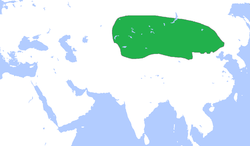 |
Xiongnu (Hsiung nu) was an empire flourished in the central Asia. Their origin is debatable, but they probably spoke either a Proto Turkic
Proto-Turkic language
The Proto-Turkic language is the proto-language of the family of Turkic languages that predates the separation of the Turkic peoples and separation into Oguz and Ogur branches. The Ogur languages are characterized by sound correspondences such as Oguric r versus Common Turkic z and Oguric l versus...
, or a Proto Mongolic
Mongolic languages
The Mongolic languages are a group of languages spoken in East-Central Asia, mostly in Mongolia and surrounding areas plus in Kalmykia. The best-known member of this language family, Mongolian, is the primary language of most of the residents of Mongolia and the Mongolian residents of Inner...
or a Yeniseian language. They conquered most of modern Mongolia
Mongolia
Mongolia is a landlocked country in East and Central Asia. It is bordered by Russia to the north and China to the south, east and west. Although Mongolia does not share a border with Kazakhstan, its western-most point is only from Kazakhstan's eastern tip. Ulan Bator, the capital and largest...
under their leader Toumen
Toumen
Touman – was the earliest known Xiongnu chanyu , reigning from c. 220 to 209 BCE. The name Touman is likely related to Middle Chinese *muan, West Tokharian tmāne, Old Turkic/Mongolian tümen, Modern Persian tumân, all meaning '10,000', a myriad).By the time the Qin Dynasty conquered the other six...
(220-209 BC) in the 3rd century BC. During Modu
Modu
modu is an Israeli mobile phone company that was founded in 2007 by Dov Moran. modu company holds the record for the world’s lightest mobile phone...
‘s reign (209-174 BC) they defeated both the Donghu
Donghu District
Donghu District , literally meaning "east lake district", is a district of Nanchang, the capital of Jiangxi Province, China. The district was created in the Tang Dynasty when a bridge was built across Nanchang's Taihu lake, dividing the area into the East and West Lake districts...
in the east and Yuezhi
Yuezhi
The Yuezhi, or Rouzhi , also known as the Da Yuezhi or Da Rouzhi , were an ancient Central Asian people....
in the west and they began threatening Han China.
The Great Wall of China
Great Wall of China
The Great Wall of China is a series of stone and earthen fortifications in northern China, built originally to protect the northern borders of the Chinese Empire against intrusions by various nomadic groups...
had been constructed to protect Chinese towns from the Xiongnu attacks. While the Chinese were trying to bring the Xiongnu under control, something of high significance happened: cross-cultural encounters. A large variety of people (such as traders, ambassadors, hostages, parents in cross-cultural marriages, etc.) served as helpers that passed on ideas, values, and techniques across cultural boundary lines. These encounters helped cultures learn from other cultures. Xiongnu empire disintegrated into two parts during the 1st century, eventually the Xiongnu fell due to the defeat in the Sino-Xiongnu War
Sino-Xiongnu War
The Sino-Xiongnu War is a name given to a series of battles between the Han Dynasty and the tribes of Xiongnu between 133 BC and 89 AD. The nature of these battles varied through time between Han conquest and the possession of city-states in central Asia. The war culminated in Geng Kui driving the...
.
Roman Empire
| Roman Empire Roman Empire The Roman Empire was the post-Republican period of the ancient Roman civilization, characterised by an autocratic form of government and large territorial holdings in Europe and around the Mediterranean.... |
|---|
The Roman Empire
Roman Empire
The Roman Empire was the post-Republican period of the ancient Roman civilization, characterised by an autocratic form of government and large territorial holdings in Europe and around the Mediterranean....
is widely known as ancient Europe
Europe
Europe is, by convention, one of the world's seven continents. Comprising the westernmost peninsula of Eurasia, Europe is generally 'divided' from Asia to its east by the watershed divides of the Ural and Caucasus Mountains, the Ural River, the Caspian and Black Seas, and the waterways connecting...
's largest and most powerful civilization
Civilization
Civilization is a sometimes controversial term that has been used in several related ways. Primarily, the term has been used to refer to the material and instrumental side of human cultures that are complex in terms of technology, science, and division of labor. Such civilizations are generally...
. After the Punic Wars
Punic Wars
The Punic Wars were a series of three wars fought between Rome and Carthage from 264 B.C.E. to 146 B.C.E. At the time, they were probably the largest wars that had ever taken place...
Rome was already one of the biggest empires on the planet but its expansion continued with the invasions of Greece and Asia Minor. By 27 BC Rome had control over half of Europe
Europe
Europe is, by convention, one of the world's seven continents. Comprising the westernmost peninsula of Eurasia, Europe is generally 'divided' from Asia to its east by the watershed divides of the Ural and Caucasus Mountains, the Ural River, the Caspian and Black Seas, and the waterways connecting...
as well as Northern Africa and large amounts of the Middle East. Rome also had a developed culture, building on the earlier Greek culture. From the time of Augustus
Augustus
Augustus ;23 September 63 BC – 19 August AD 14) is considered the first emperor of the Roman Empire, which he ruled alone from 27 BC until his death in 14 AD.The dates of his rule are contemporary dates; Augustus lived under two calendars, the Roman Republican until 45 BC, and the Julian...
to the Fall of the Western Empire
Decline of the Roman Empire
The decline of the Roman Empire refers to the gradual societal collapse of the Western Roman Empire. Many theories of causality prevail, but most concern the disintegration of political, economic, military, and other social institutions, in tandem with foreign invasions and usurpers from within the...
, Rome dominated Western Eurasia, comprising the majority of its population.
Roman expansion began long before the state was changed into an Empire and reached its zenith under emperor Trajan
Trajan
Trajan , was Roman Emperor from 98 to 117 AD. Born into a non-patrician family in the province of Hispania Baetica, in Spain Trajan rose to prominence during the reign of emperor Domitian. Serving as a legatus legionis in Hispania Tarraconensis, in Spain, in 89 Trajan supported the emperor against...
with the conquest of Mesopotamia
Mesopotamia
Mesopotamia is a toponym for the area of the Tigris–Euphrates river system, largely corresponding to modern-day Iraq, northeastern Syria, southeastern Turkey and southwestern Iran.Widely considered to be the cradle of civilization, Bronze Age Mesopotamia included Sumer and the...
and Armenia
Armenia
Armenia , officially the Republic of Armenia , is a landlocked mountainous country in the Caucasus region of Eurasia...
in AD 113. The period of the "Five Good Emperors" saw a successions of peaceful years and the Empire was prosperous. Each emperor of this period was adopted by his predecessor. The Nerva–Antonine dynasty was a dynasty of seven consecutive Roman Emperors who ruled over the Roman Empire from 96 to 192. These Emperors are Nerva, Trajan, Hadrian, Antoninus Pius, Marcus Aurelius, Lucius Verus, and Commodus.
The last two of the "Five Good Emperors" and Commodus
Commodus
Commodus , was Roman Emperor from 180 to 192. He also ruled as co-emperor with his father Marcus Aurelius from 177 until his father's death in 180. His name changed throughout his reign; see changes of name for earlier and later forms. His accession as emperor was the first time a son had succeeded...
are also called Antonines. After his accession, Nerva, who succeeded Domitian, set a new tone: he restored much confiscated property and involved the Roman Senate
Roman Senate
The Senate of the Roman Republic was a political institution in the ancient Roman Republic, however, it was not an elected body, but one whose members were appointed by the consuls, and later by the censors. After a magistrate served his term in office, it usually was followed with automatic...
in his rule. Starting in 101, Trajan
Trajan
Trajan , was Roman Emperor from 98 to 117 AD. Born into a non-patrician family in the province of Hispania Baetica, in Spain Trajan rose to prominence during the reign of emperor Domitian. Serving as a legatus legionis in Hispania Tarraconensis, in Spain, in 89 Trajan supported the emperor against...
undertook two military campaigns against the gold rich Dacia, which he finally conquered in 106 (see Trajan's Dacian Wars). In 112, Trajan marched on Armenia and annexed it to the Roman Empire. Then he turned south into Parthia, taking several cities before declaring Mesopotamia a new province of the empire, and lamenting that he was too old to follow in the steps of Alexander the Great. During his rule, the Roman Empire expanded to its largest extent, and would never again advance so far to the east. Hadrian's reign was marked by a general lack of major military conflicts, but he had to defend the vast territories that Trajan had acquired.
At this territorial peak, the Roman Empire controlled approximately 5,900,000 km² (2,300,000 sq.mi.) of land surface. Ancient Rome
Ancient Rome
Ancient Rome was a thriving civilization that grew on the Italian Peninsula as early as the 8th century BC. Located along the Mediterranean Sea and centered on the city of Rome, it expanded to one of the largest empires in the ancient world....
's influence upon the culture, law, technology, arts, language, religion, government, military, and architecture of Western civilization
Western culture
Western culture, sometimes equated with Western civilization or European civilization, refers to cultures of European origin and is used very broadly to refer to a heritage of social norms, ethical values, traditional customs, religious beliefs, political systems, and specific artifacts and...
continues to this day.
Hunnic Empire
370-454| Hunnic Empire Hunnic Empire The Hunnic Empire was an empire established by the Huns. The Huns were a confederation of Eurasian tribes from the steppes of Central Asia. Appearing from beyond the Volga River some years after the middle of the 4th century, they first overran the Alani, who occupied the plains between the Volga... |
|---|
 |
Huns were nomadic people who were known for their hordes of mounted archers. Their language seems to be Turkic
Turkic languages
The Turkic languages constitute a language family of at least thirty five languages, spoken by Turkic peoples across a vast area from Eastern Europe and the Mediterranean to Siberia and Western China, and are considered to be part of the proposed Altaic language family.Turkic languages are spoken...
; but Mongolic, Yeniseian, Uralic etc., are also postulated. After 370 under a certain Balamber
Balamber
Balamber is only mentioned by Jordanes, who simply called him "king of the Huns" and who tells us the story of Balamber crushing the kingdom of Ostrogoths in around 375. Balamber may have been a member of a royal house, but more probably he was - if he ever existed - just a warrior chieftain,...
they founded an empire in the East Europe defeating Alans
Alans
The Alans, or the Alani, occasionally termed Alauni or Halani, were a group of Sarmatian tribes, nomadic pastoralists of the 1st millennium AD who spoke an Eastern Iranian language which derived from Scytho-Sarmatian and which in turn evolved into modern Ossetian.-Name:The various forms of Alan —...
and Goths
Goths
The Goths were an East Germanic tribe of Scandinavian origin whose two branches, the Visigoths and the Ostrogoths, played an important role in the fall of the Roman Empire and the emergence of Medieval Europe....
. They triggered the great migration
Migration Period
The Migration Period, also called the Barbarian Invasions , was a period of intensified human migration in Europe that occurred from c. 400 to 800 CE. This period marked the transition from Late Antiquity to the Early Middle Ages...
which eventually caused the collapse of the West Roman Empire.
The death of Rugila in 434 left the sons of his brother Mundzuk, Attila and Bleda, in control of the united Hun tribes. Attila the Hun
Attila the Hun
Attila , more frequently referred to as Attila the Hun, was the ruler of the Huns from 434 until his death in 453. He was leader of the Hunnic Empire, which stretched from the Ural River to the Rhine River and from the Danube River to the Baltic Sea. During his reign he was one of the most feared...
ruled of the Huns from 434 until his death in 453. uUnder his rule and leader of the Hunnic Empire, the empire stretched from Germany to the Ural River and from the Danube River to the Baltic Sea. Hunnic khagan Atilla invaded Europe. The rise of the Huns around 370 overwhelmed the Gothic kingdoms. Many of the Goths migrated into Roman territory in the Balkans, while others remained north of the Danube under Hunnic rule.
During Attila the Hun's rule, he was one of the most fearsome enemies of the Western and Eastern Roman Empire. He invaded the Balkans twice and marched through Gaul (modern France) as far as Orléans before being defeated at the Battle of Châlons
Battle of Chalons
The Battle of the Catalaunian Plains , also called the Battle of Châlons sur Marne, took place in AD 451 between a coalition led by the Visigothic king Theodoric I and the Roman general Flavius Aëtius, against the Huns and their allies commanded by their leader Attila...
. Although his invasion of Gaul
Gaul
Gaul was a region of Western Europe during the Iron Age and Roman era, encompassing present day France, Luxembourg and Belgium, most of Switzerland, the western part of Northern Italy, as well as the parts of the Netherlands and Germany on the left bank of the Rhine. The Gauls were the speakers of...
was checked at Chalons, he appeared in North Italy in the next year. After Atilla’s death in 453, the Hunnic empire collapsed.
Medieval Powers
476-1492- Middle AgesMiddle AgesThe Middle Ages is a periodization of European history from the 5th century to the 15th century. The Middle Ages follows the fall of the Western Roman Empire in 476 and precedes the Early Modern Era. It is the middle period of a three-period division of Western history: Classic, Medieval and Modern...
Byzantine Empire
330 - 1453| Byzantine Empire Byzantine Empire The Byzantine Empire was the Eastern Roman Empire during the periods of Late Antiquity and the Middle Ages, centred on the capital of Constantinople. Known simply as the Roman Empire or Romania to its inhabitants and neighbours, the Empire was the direct continuation of the Ancient Roman State... |
|---|
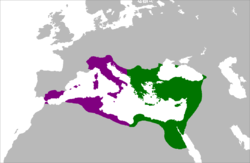 |
The Byzantine Empire
Byzantine Empire
The Byzantine Empire was the Eastern Roman Empire during the periods of Late Antiquity and the Middle Ages, centred on the capital of Constantinople. Known simply as the Roman Empire or Romania to its inhabitants and neighbours, the Empire was the direct continuation of the Ancient Roman State...
is the name for the medieval eastern Roman Empire, which survived 1000 years after the fall of the western Roman Empire
Western Roman Empire
The Western Roman Empire was the western half of the Roman Empire after its division by Diocletian in 285; the other half of the Roman Empire was the Eastern Roman Empire, commonly referred to today as the Byzantine Empire....
. The Byzantines managed to reconquer great parts of it. Ancient Roman
Ancient Rome
Ancient Rome was a thriving civilization that grew on the Italian Peninsula as early as the 8th century BC. Located along the Mediterranean Sea and centered on the city of Rome, it expanded to one of the largest empires in the ancient world....
cultural heritage survived there and gave birth to the Italian Renaissance
Italian Renaissance
The Italian Renaissance began the opening phase of the Renaissance, a period of great cultural change and achievement in Europe that spanned the period from the end of the 13th century to about 1600, marking the transition between Medieval and Early Modern Europe...
after its capital, Constantinople
Constantinople
Constantinople was the capital of the Roman, Eastern Roman, Byzantine, Latin, and Ottoman Empires. Throughout most of the Middle Ages, Constantinople was Europe's largest and wealthiest city.-Names:...
, was captured by the Turks
Turkish people
Turkish people, also known as the "Turks" , are an ethnic group primarily living in Turkey and in the former lands of the Ottoman Empire where Turkish minorities had been established in Bulgaria, Cyprus, Bosnia and Herzegovina, Georgia, Greece, Kosovo, Macedonia, and Romania...
in the 15th century. The Byzantines
Byzantine Empire
The Byzantine Empire was the Eastern Roman Empire during the periods of Late Antiquity and the Middle Ages, centred on the capital of Constantinople. Known simply as the Roman Empire or Romania to its inhabitants and neighbours, the Empire was the direct continuation of the Ancient Roman State...
were the only Europeans to produce fine silk
Byzantine silk
Byzantine silk is silk woven in the Byzantine Empire from about the 4th century until the Fall of Constantinople in 1453.The Byzantine capital of Constantinople was the first significant silk-weaving center in Europe. Silk was one of the most important commodities in the Byzantine economy, used by...
which was an important source of their wealth along with trade.
Byzantium under the Justinian dynasty
Byzantium under the Justinian Dynasty began with the ascension of Justin I, a career soldier whose reign was marked with internal strife within the Empire, from Ostrogoths, and from the Persians...
saw a period of recovery of former territories. The period is marked with internal strife within the Empire, from Ostrogoths, and from the Persians. The strength of the dynasty was shown under Justinian I
Justinian I
Justinian I ; , ; 483– 13 or 14 November 565), commonly known as Justinian the Great, was Byzantine Emperor from 527 to 565. During his reign, Justinian sought to revive the Empire's greatness and reconquer the lost western half of the classical Roman Empire.One of the most important figures of...
, in which the territorial borders of the Empire were expanded because of numerous campaigns by his favored general, Belisarius
Belisarius
Flavius Belisarius was a general of the Byzantine Empire. He was instrumental to Emperor Justinian's ambitious project of reconquering much of the Mediterranean territory of the former Western Roman Empire, which had been lost less than a century previously....
. The western conquests began with Justinian sending his general to reclaim the former province of Africa from the Vandals
Vandals
The Vandals were an East Germanic tribe that entered the late Roman Empire during the 5th century. The Vandals under king Genseric entered Africa in 429 and by 439 established a kingdom which included the Roman Africa province, besides the islands of Sicily, Corsica, Sardinia and the Balearics....
who had been in control with their capital at Carthage. Their success came with surprising ease, but the major local tribes were subdued. In Ostrogoth
Ostrogoth
The Ostrogoths were a branch of the Goths , a Germanic tribe who developed a vast empire north of the Black Sea in the 3rd century AD and, in the late 5th century, under Theodoric the Great, established a Kingdom in Italy....
ic Italy, the deaths of Theodoric the Great
Theodoric the Great
Theodoric the Great was king of the Ostrogoths , ruler of Italy , regent of the Visigoths , and a viceroy of the Eastern Roman Empire...
, his nephew and heir, and his daughter had left her murderer Theodahad on the throne despite his weakened authority. A small Byzantine expedition to Sicily was met with easy success, but the Goths soon stiffened their resistance, and victory did not come until later, when Belisarius captured Ravenna, after successful sieges of Naples and Rome.
Byzantium
Byzantium
Byzantium was an ancient Greek city, founded by Greek colonists from Megara in 667 BC and named after their king Byzas . The name Byzantium is a Latinization of the original name Byzantion...
continued to be a major military power with a huge army and strong fleet, and was a major cultural and religious center. Byzantium was the stronghold of Eastern Orthodox Christianity and thus influenced many states. Byzantium fought against the Arabs to the south, the Bulgarians
Bulgarians
The Bulgarians are a South Slavic nation and ethnic group native to Bulgaria and neighbouring regions. Emigration has resulted in immigrant communities in a number of other countries.-History and ethnogenesis:...
to the north and the Crusaders, who managed to seize Constantinople in 1204. The Byzantines restored their state in 1261, but its strength never recovered and it was eventually destroyed and replaced by the nascent Ottoman Empire
Ottoman Empire
The Ottoman EmpireIt was usually referred to as the "Ottoman Empire", the "Turkish Empire", the "Ottoman Caliphate" or more commonly "Turkey" by its contemporaries...
in 1453.
Göktürk
| Göktürk |
|---|
.png) |
Turks
Turkic peoples
The Turkic peoples are peoples residing in northern, central and western Asia, southern Siberia and northwestern China and parts of eastern Europe. They speak languages belonging to the Turkic language family. They share, to varying degrees, certain cultural traits and historical backgrounds...
, who were the residents around Altai mountains in Central Asia
Central Asia
Central Asia is a core region of the Asian continent from the Caspian Sea in the west, China in the east, Afghanistan in the south, and Russia in the north...
, founded a number of empires prior to their conversion to Islam
Islam
Islam . The most common are and . : Arabic pronunciation varies regionally. The first vowel ranges from ~~. The second vowel ranges from ~~~...
. The Turkic Khaganate (or Göktürk, meaning Celestial Turk)(another possibility is "East Türk" since Blue (Gök) represent east direction in ancient Türks) was founded in 551 in what is now Kazakhstan
Kazakhstan
Kazakhstan , officially the Republic of Kazakhstan, is a transcontinental country in Central Asia and Eastern Europe. Ranked as the ninth largest country in the world, it is also the world's largest landlocked country; its territory of is greater than Western Europe...
and Mongolia
Mongolia
Mongolia is a landlocked country in East and Central Asia. It is bordered by Russia to the north and China to the south, east and west. Although Mongolia does not share a border with Kazakhstan, its western-most point is only from Kazakhstan's eastern tip. Ulan Bator, the capital and largest...
by Bumin Khan
Bumin Khan
Bumin Qaghan or Illig Qaghan was the founder of the Turkic Khaganate...
of Ashina clan
Ashina clan
The , descended from Taira clan through the Miura clan, was a Japanese clan during the Sengoku period. Sometimes the kanji characters "芦名" and "葦名" are used also. The name came from the area called Ashina in the city of Yokosuka in Kanagawa Prefecture....
. Following a Turkish tradition, Bumin Khan ruled the east part of the empire and assigned his brother Istämi
Istämi
Istämi was the ruler of the western part of the Göktürks, the Western Turkic Khaganate and dominated the Sogdians. He was the yabgu of his brother Bumin Qaghan in 553 AD...
to the west part of the empire as his vassal. Bumin’s successor Muhan Khan
Muhan Khan
Muqan Qaghan; was the second son of Bumin Qaghan and the third khagan of the Göktürks who expanded their khagan and secured the borders against the Hephthalites.This expansion also pushed against the...
defeated China and began controlling the prosperous silk road
Silk Road
The Silk Road or Silk Route refers to a historical network of interlinking trade routes across the Afro-Eurasian landmass that connected East, South, and Western Asia with the Mediterranean and European world, as well as parts of North and East Africa...
. Meanwhile, Istemi and his successors conquered Transoxania and Caucasus
Caucasus
The Caucasus, also Caucas or Caucasia , is a geopolitical region at the border of Europe and Asia, and situated between the Black and the Caspian sea...
. It is one of Istemi's grandsons (Tong Yabgu) who founded another Turkic empire; the Khazarian Khaganate
Khazars
The Khazars were semi-nomadic Turkic people who established one of the largest polities of medieval Eurasia, with the capital of Atil and territory comprising much of modern-day European Russia, western Kazakhstan, eastern Ukraine, Azerbaijan, large portions of the northern Caucasus , parts of...
in the Caucasus. Another state emerged in the realm of Western Turks was that of Turgesh
Turgesh
The Türgesh, Turgish or Türgish were a Turkic tribal confederation who emerged from the ruins of the Western Turkic Kaganate...
in west Turkistan
Türkistan
*Türkistan is the local name for Turkestan, a region of Central Asia.*Türkistan, Kazakhstan is a historic city and place of pilgrimage in southern Kazakhstan...
. (Both Khazars and Turgesh fought against the invading Arabic armies in the 8th century). Although, the empire was briefly dominated by Tang China during 650s, Kutluk Khan, another member of Ashina clan was able to defeat China. In the early 8th century, during Bilge Khan
Bilge Khan
Bilge Qaghan was khagan of the Second Eastern Turkic Khaganate...
’s reign, first Turkish monuments in Turkish alphabet were erected.(Orkhon monuments) In 744, Uyghurs, another branch of Turks replaced Turkish Khaganate in Central Asia.
Uyghur Khaganate
The Uyghur Khaganate established itself as a major power in Central Asia
Central Asia
Central Asia is a core region of the Asian continent from the Caspian Sea in the west, China in the east, Afghanistan in the south, and Russia in the north...
the late 8th century. At their height, they controlled an area of land stretching from the Sea of Okhotsk
Sea of Okhotsk
The Sea of Okhotsk is a marginal sea of the western Pacific Ocean, lying between the Kamchatka Peninsula on the east, the Kuril Islands on the southeast, the island of Hokkaidō to the far south, the island of Sakhalin along the west, and a long stretch of eastern Siberian coast along the west and...
to the Tibetan Plateau
Tibetan Plateau
The Tibetan Plateau , also known as the Qinghai–Tibetan Plateau is a vast, elevated plateau in Central Asia covering most of the Tibet Autonomous Region and Qinghai, in addition to smaller portions of western Sichuan, southwestern Gansu, and northern Yunnan in Western China and Ladakh in...
. They built their capital Ordu balik in modern Mongolia
Mongolia
Mongolia is a landlocked country in East and Central Asia. It is bordered by Russia to the north and China to the south, east and west. Although Mongolia does not share a border with Kazakhstan, its western-most point is only from Kazakhstan's eastern tip. Ulan Bator, the capital and largest...
. Although they were replaced by their Kyrghyz vassals in 840s, they managed to survive in three smaller states. Those who were called Sari Uyghurs (yellow Uyghur) settled in Gansu
Gansu
' is a province located in the northwest of the People's Republic of China.It lies between the Tibetan and Huangtu plateaus, and borders Mongolia, Inner Mongolia, and Ningxia to the north, Xinjiang and Qinghai to the west, Sichuan to the south, and Shaanxi to the east...
(north China
China
Chinese civilization may refer to:* China for more general discussion of the country.* Chinese culture* Greater China, the transnational community of ethnic Chinese.* History of China* Sinosphere, the area historically affected by Chinese culture...
). Most Uyghurs settled in Xinjiang
Xinjiang
Xinjiang is an autonomous region of the People's Republic of China. It is the largest Chinese administrative division and spans over 1.6 million km2...
(west China). Some Uyghurs together with Karluks ( their former vassals in Transoxania, modern Uzbekistan
Uzbekistan
Uzbekistan , officially the Republic of Uzbekistan is a doubly landlocked country in Central Asia and one of the six independent Turkic states. It shares borders with Kazakhstan to the west and to the north, Kyrgyzstan and Tajikistan to the east, and Afghanistan and Turkmenistan to the south....
), founded Karakhanid state which soon embraced Islam
Islam
Islam . The most common are and . : Arabic pronunciation varies regionally. The first vowel ranges from ~~. The second vowel ranges from ~~~...
.
Medieval China
The start of the Sui DynastySui Dynasty
The Sui Dynasty was a powerful, but short-lived Imperial Chinese dynasty. Preceded by the Southern and Northern Dynasties, it ended nearly four centuries of division between rival regimes. It was followed by the Tang Dynasty....
in China
China
Chinese civilization may refer to:* China for more general discussion of the country.* Chinese culture* Greater China, the transnational community of ethnic Chinese.* History of China* Sinosphere, the area historically affected by Chinese culture...
after the end of the turbulent and chaotic Northern and Southern Dynasty marks China as one of the most powerful countries in the world economically and militarily. Below are some of the dynasties that occurred during this era:
Tang Dynasty
630s - 760s
| Tang Dynasty Tang Dynasty The Tang Dynasty was an imperial dynasty of China preceded by the Sui Dynasty and followed by the Five Dynasties and Ten Kingdoms Period. It was founded by the Li family, who seized power during the decline and collapse of the Sui Empire... |
|---|
.png) |
The Tang Dynasty
Tang Dynasty
The Tang Dynasty was an imperial dynasty of China preceded by the Sui Dynasty and followed by the Five Dynasties and Ten Kingdoms Period. It was founded by the Li family, who seized power during the decline and collapse of the Sui Empire...
was an imperial dynasty of China preceded by the Sui Dynasty and followed by the Five Dynasties and Ten Kingdoms Period. It was founded by the Li (李) family, who seized power during the decline and collapse of the Sui Empire. The dynasty was interrupted briefly by the Second Zhou Dynasty (October 16, 690–March 3, 705) when Empress Wu Zetian seized the throne, becoming the first and only Chinese empress regnant, ruling in her own right.
Chang'an
Chang'an is an ancient capital of more than ten dynasties in Chinese history, today known as Xi'an. Chang'an literally means "Perpetual Peace" in Classical Chinese. During the short-lived Xin Dynasty, the city was renamed "Constant Peace" ; yet after its fall in AD 23, the old name was restored...
, the most populous city in the world at the time, is generally regarded as a high point in Chinese civilization—equal to, or surpassing that of, the earlier Han Dynasty—a golden age of cosmopolitan culture. Its territory, acquired through the military campaigns of its early rulers, was greater than that of the Han period, and it rivalled that of the later Yuan Dynasty and Qing Dynasty. In two censuses of the 7th and 8th centuries, the Tang records estimated the population by number of registered households at about 50 million people. Yet, even when the central government was breaking down and unable to compile an accurate census of the population in the 9th century, it is estimated that the population had grown by then to about 80 million people. With its large population base, the dynasty was able to raise professional and conscripted armies of hundreds of thousands of troops to contend with nomadic powers in dominating Inner Asia and the lucrative trade routes along the Silk Road.
Various kingdoms and states paid tribute to the Tang court, while the Tang also conquered or subdued several regions which it indirectly controlled through a protectorate system. Besides political hegemony, the Tang also exerted a powerful cultural influence over neighboring states such as those in Korea, Japan, and Vietnam. Such was the dynasty's influence that even today, the Chinese term for a Chinatown
Chinatown
A Chinatown is an ethnic enclave of overseas Chinese people, although it is often generalized to include various Southeast Asian people. Chinatowns exist throughout the world, including East Asia, Southeast Asia, the Americas, Australasia, and Europe. Binondo's Chinatown located in Manila,...
bears the title, the Tang People's Street.
The Tang Dynasty was largely a period of progress and stability, except during the An Shi Rebellion
An Shi Rebellion
The An Lushan Rebellion took place in China during the Tang Dynasty from CE December 16, 755 to CE February 17, 763, beginning when general An Lushan declared himself emperor, establishing the rival Yan Dynasty in Northern China...
and the decline of central authority in the latter half of the dynasty. Like the previous Sui Dynasty, the Tang Dynasty maintained a civil service system by drafting officials through standardized examinations and recommendations to office. This civil order was undermined by the rise of regional military governors known as jiedushi
Jiedushi
The Jiedushi were regional military governors in China during the Tang Dynasty and the Five Dynasties and Ten Kingdoms Period. Originally set up to counter external threats, the jiedushi were given enormous power, including the ability to maintain their own armies, collect taxes, and pass their...
during the 9th century. Chinese culture flourished and further matured during the Tang era; it is considered the greatest age for Chinese poetry. Two of China's most famous poets, Du Fu
Du Fu
Du Fu was a prominent Chinese poet of the Tang Dynasty.Along with Li Bai , he is frequently called the greatest of the Chinese poets. His greatest ambition was to serve his country as a successful civil servant, but he proved unable to make the necessary accommodations...
and Li Bai
Li Bai
Li Bai , also known in the West by various other transliterations, especially Li Po, was a major Chinese poet of the Tang dynasty poetry period. He has been regarded as one of the greatest poets in China's Tang period, which is often called China's "golden age" of poetry. Around a thousand existing...
, belonged to this age, as did many famous painters such as Han Gan
Han Gan
Han Gan was a Tang Dynasty painter.He came from a poor family in either Chang'an, modern day Xi'an, Shaanxi; Lantian, modern day Shaanxi; or Daliang, modern day Kaifeng, Henan. As a young man, Han Gan was recognized by Wang Wei, a prominent poet, who sponsored Han in learning arts...
, Zhang Xuan
Zhang Xuan
Zhang Xuan was a Chinese painter who lived during the Tang Dynasty .Zhang Xuan painted many pieces of art, one of his best known paintings is Court Ladies Preparing Newly-Woven Silk, of which a single copy survives painted by Emperor Huizong of Song in the early 12th century...
, and Zhou Fang. There was a rich variety of historical literature compiled by scholars, as well as encyclopedias and geographical works.
There were many notable innovations during the Tang, including the development of woodblock printing
Woodblock printing
Woodblock printing is a technique for printing text, images or patterns used widely throughout East Asia and originating in China in antiquity as a method of printing on textiles and later paper....
. Buddhism became a major influence in Chinese culture, with native Chinese sects gaining prominence. However, Buddhism would later be persecuted by the state and decline in influence. Although the dynasty and central government were in decline by the 9th century, art and culture continued to flourish. The weakened central government largely withdrew from managing the economy, though the country's mercantile affairs stayed intact and commercial trade continued to thrive regardless
Song Dynasty
990s - 1080s
| Song Dynasty Song Dynasty The Song Dynasty was a ruling dynasty in China between 960 and 1279; it succeeded the Five Dynasties and Ten Kingdoms Period, and was followed by the Yuan Dynasty. It was the first government in world history to issue banknotes or paper money, and the first Chinese government to establish a... |
|---|
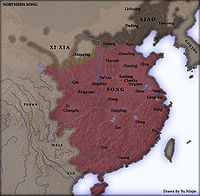 |
Song Dynasty
The Song Dynasty was a ruling dynasty in China between 960 and 1279; it succeeded the Five Dynasties and Ten Kingdoms Period, and was followed by the Yuan Dynasty. It was the first government in world history to issue banknotes or paper money, and the first Chinese government to establish a...
, the wealth of China
China
Chinese civilization may refer to:* China for more general discussion of the country.* Chinese culture* Greater China, the transnational community of ethnic Chinese.* History of China* Sinosphere, the area historically affected by Chinese culture...
attracted numerous attacks from the north and the dynasty gradually retreated to the south. For the first time in history, China needed to pay tribute annually to buy peace. Ironically, the development of Chinese culture reached the highest peak in history due to the artistic character of the emperors. The technological advancement and policies also led to rapid growth of wealth and improvement of living standard.
The Song Dynasty is divided into two distinct periods: the Northern Song and Southern Song. During the Northern Song (Chinese: 北宋, 960–1127), the Song capital was in the northern city of Bianjing (now Kaifeng) and the dynasty controlled most of inner China. The Southern Song (Chinese: 南宋, 1127–1279) refers to the period after the Song lost control of northern China to the Jin Dynasty. During this time, the Song court retreated south of the Yangtze River and established their capital at Lin'an (now Hangzhou). Although the Song Dynasty had lost control of the traditional birthplace of Chinese civilization along the Yellow River, the Song economy was not in ruins, as the Southern Song Empire contained 60 percent of China's population and a majority of the most productive agricultural land. The Southern Song Dynasty considerably bolstered its naval strength to defend its waters and land borders and to conduct maritime missions abroad.
To repel the Jin, and later the Mongols, the Song developed revolutionary new military technology augmented by the use of gunpowder. In 1234, the Jin Dynasty was conquered by the Mongols, who took control of northern China, maintaining uneasy relations with the Southern Song. Möngke Khan, the fourth Great Khan of the Mongol Empire, died in 1259 while besieging a city in Chongqing. His younger brother Kublai Khan was proclaimed the new Great Khan, though his claim was only partially recognized by the Mongols in the west. In 1271, Kublai Khan was proclaimed the Emperor of China. After two decades of sporadic warfare, Kublai Khan's armies conquered the Song Dynasty in 1279. China was once again unified, under the Yuan Dynasty (1271–1368).
The population of China doubled in size during the 10th and 11th centuries. This growth came through expanded rice cultivation in central and southern China, the use of early-ripening rice from southeast and southern Asia, and the production of abundant food surpluses. The Northern Song census recorded a population of roughly 50 million, much like the Han and Tang dynasties
Arab Caliphates
632 - 1258Islam
Islam . The most common are and . : Arabic pronunciation varies regionally. The first vowel ranges from ~~. The second vowel ranges from ~~~...
, founded by Muhammad
Muhammad
Muhammad |ligature]] at U+FDF4 ;Arabic pronunciation varies regionally; the first vowel ranges from ~~; the second and the last vowel: ~~~. There are dialects which have no stress. In Egypt, it is pronounced not in religious contexts...
in Arabia. After his death, his successors began a century of rapid Arab
Arab
Arab people, also known as Arabs , are a panethnicity primarily living in the Arab world, which is located in Western Asia and North Africa. They are identified as such on one or more of genealogical, linguistic, or cultural grounds, with tribal affiliations, and intra-tribal relationships playing...
expansion across most of the known world, establishing the Islamic Empire as one of the largest in the world.
Rashidun Caliphate
Muslim
A Muslim, also spelled Moslem, is an adherent of Islam, a monotheistic, Abrahamic religion based on the Quran, which Muslims consider the verbatim word of God as revealed to prophet Muhammad. "Muslim" is the Arabic term for "submitter" .Muslims believe that God is one and incomparable...
Arab
Arab
Arab people, also known as Arabs , are a panethnicity primarily living in the Arab world, which is located in Western Asia and North Africa. They are identified as such on one or more of genealogical, linguistic, or cultural grounds, with tribal affiliations, and intra-tribal relationships playing...
s invaded the powerful Sassanid Persian Empire
Sassanid Empire
The Sassanid Empire , known to its inhabitants as Ērānshahr and Ērān in Middle Persian and resulting in the New Persian terms Iranshahr and Iran , was the last pre-Islamic Persian Empire, ruled by the Sasanian Dynasty from 224 to 651...
during the Rashidun conquest of Persia and the Byzantine Empire
Byzantine Empire
The Byzantine Empire was the Eastern Roman Empire during the periods of Late Antiquity and the Middle Ages, centred on the capital of Constantinople. Known simply as the Roman Empire or Romania to its inhabitants and neighbours, the Empire was the direct continuation of the Ancient Roman State...
during the Byzantine-Arab Wars
Byzantine-Arab Wars
The Byzantine–Arab Wars were a series of wars between the Arab Caliphates and the East Roman or Byzantine Empire between the 7th and 12th centuries AD. These started during the initial Muslim conquests under the expansionist Rashidun and Umayyad caliphs and continued in the form of an enduring...
. The war of conquest resulted in a complete conquest of the Sassanid Persian Empire and two-thirds of the Byzantine Empire. Within a decade, Rashidun caliphs controlled an empire stretching from the Indus River
Indus River
The Indus River is a major river which flows through Pakistan. It also has courses through China and India.Originating in the Tibetan plateau of western China in the vicinity of Lake Mansarovar in Tibet Autonomous Region, the river runs a course through the Ladakh district of Jammu and Kashmir and...
to the Atlas mountains
Atlas Mountains
The Atlas Mountains is a mountain range across a northern stretch of Africa extending about through Morocco, Algeria, and Tunisia. The highest peak is Toubkal, with an elevation of in southwestern Morocco. The Atlas ranges separate the Mediterranean and Atlantic coastlines from the Sahara Desert...
. Khalid ibn Walid was responsible for most of the conquests on the Byzantine front. After a civil war
First Fitna
The First Islamic Civil War , also called the First Fitna , was the first major civil war within the Islamic Caliphate. It arose as a struggle over who had the legitimate right to become the ruling Caliph...
in 657-661, the almost republic disintegrated and was succeeded by the Ummayad monarchy.
Umayyad Caliphate
The Umayyad Caliphate completed the Muslim expansion after conquering Roman North Africa
Umayyad conquest of North Africa
The Umayyad conquest of North Africa continued the century of rapid Arab Muslim expansion following the death of Muhammad in 632 CE. By 640 the Arabs controlled Mesopotamia, had invaded Armenia, and were concluding their conquest of Byzantine Syria. Damascus was the seat of the Umayyad caliphate....
, Visigothic Hispania
Umayyad conquest of Hispania
The Umayyad conquest of Hispania is the initial Islamic Ummayad Caliphate's conquest, between 711 and 718, of the Christian Visigothic Kingdom of Hispania, centered in the Iberian Peninsula, which was known to them under the Arabic name al-Andalus....
, and a small part of the border of the Indian subcontinent
Muslim conquest in the Indian subcontinent
Muslim conquest in South Asia mainly took place from the 13th to the 16th centuries, though earlier Muslim conquests made limited inroads into the region, beginning during the period of the ascendancy of the Rajput Kingdoms in North India, from the 7th century onwards.However, the Himalayan...
and northwestern China
Battle of Talas
The Battle of Talas in 751 AD was an especially notable conflict between the Arab Abbasid Caliphate and the Chinese Tang Dynasty for control not only of the Syr Darya region, but even more...
. As a result, the Arab Empire became the largest empire the world had yet seen. However, Umayyad expeditions into the Frankish Kingdom
Franks
The Franks were a confederation of Germanic tribes first attested in the third century AD as living north and east of the Lower Rhine River. From the third to fifth centuries some Franks raided Roman territory while other Franks joined the Roman troops in Gaul. Only the Salian Franks formed a...
and Byzantium
Byzantium
Byzantium was an ancient Greek city, founded by Greek colonists from Megara in 667 BC and named after their king Byzas . The name Byzantium is a Latinization of the original name Byzantion...
were unsuccessful, as they were eventually stopped by the Bulgarians
Bulgarians
The Bulgarians are a South Slavic nation and ethnic group native to Bulgaria and neighbouring regions. Emigration has resulted in immigrant communities in a number of other countries.-History and ethnogenesis:...
and Byzantines in 718 and the Franks
Franks
The Franks were a confederation of Germanic tribes first attested in the third century AD as living north and east of the Lower Rhine River. From the third to fifth centuries some Franks raided Roman territory while other Franks joined the Roman troops in Gaul. Only the Salian Franks formed a...
in 732. Nonetheless, the Caliphate remained a huge military power with a mighty navy.
Abbasid Caliphate
| Abbasid Caliphate |
|---|
.png) |
The period of the Abbasid Caliphate is considered the Golden Age of Islam
Islamic Golden Age
During the Islamic Golden Age philosophers, scientists and engineers of the Islamic world contributed enormously to technology and culture, both by preserving earlier traditions and by adding their own inventions and innovations...
. The empire was rich with flourishing trade across Asia
Asia
Asia is the world's largest and most populous continent, located primarily in the eastern and northern hemispheres. It covers 8.7% of the Earth's total surface area and with approximately 3.879 billion people, it hosts 60% of the world's current human population...
, Europe
Europe
Europe is, by convention, one of the world's seven continents. Comprising the westernmost peninsula of Eurasia, Europe is generally 'divided' from Asia to its east by the watershed divides of the Ural and Caucasus Mountains, the Ural River, the Caspian and Black Seas, and the waterways connecting...
and Africa
Africa
Africa is the world's second largest and second most populous continent, after Asia. At about 30.2 million km² including adjacent islands, it covers 6% of the Earth's total surface area and 20.4% of the total land area...
. Its culture was thriving, influenced by the Persians
Persian people
The Persian people are part of the Iranian peoples who speak the modern Persian language and closely akin Iranian dialects and languages. The origin of the ethnic Iranian/Persian peoples are traced to the Ancient Iranian peoples, who were part of the ancient Indo-Iranians and themselves part of...
, and boasted great achievements in its economy, arts
Islamic art
Islamic art encompasses the visual arts produced from the 7th century onwards by people who lived within the territory that was inhabited by or ruled by culturally Islamic populations...
, architecture
Islamic architecture
Islamic architecture encompasses a wide range of both secular and religious styles from the foundation of Islam to the present day, influencing the design and construction of buildings and structures in Islamic culture....
, literature
Islamic literature
Islamic literature is literature written with an Islamic perspective, in any language.The most well known fiction from the Islamic world was The Book of One Thousand and One Nights , which was a compilation of many earlier folk tales told by the Persian Queen Scheherazade...
, mathematics
Islamic mathematics
In the history of mathematics, mathematics in medieval Islam, often termed Islamic mathematics or Arabic mathematics, covers the body of mathematics preserved and developed under the Islamic civilization between circa 622 and 1600...
, philosophy
Early Islamic philosophy
Early Islamic philosophy or classical Islamic philosophy is a period of intense philosophical development beginning in the 2nd century AH of the Islamic calendar and lasting until the 6th century AH...
, science, and technology. Many cities grew with large populations, beautiful palaces and gardens such as Baghdad
Baghdad
Baghdad is the capital of Iraq, as well as the coterminous Baghdad Governorate. The population of Baghdad in 2011 is approximately 7,216,040...
, which had a population of a million at its peak, as well as Damascus
Damascus
Damascus , commonly known in Syria as Al Sham , and as the City of Jasmine , is the capital and the second largest city of Syria after Aleppo, both are part of the country's 14 governorates. In addition to being one of the oldest continuously inhabited cities in the world, Damascus is a major...
, Cairo
Cairo
Cairo , is the capital of Egypt and the largest city in the Arab world and Africa, and the 16th largest metropolitan area in the world. Nicknamed "The City of a Thousand Minarets" for its preponderance of Islamic architecture, Cairo has long been a centre of the region's political and cultural life...
and Cordoba
Córdoba, Spain
-History:The first trace of human presence in the area are remains of a Neanderthal Man, dating to c. 32,000 BC. In the 8th century BC, during the ancient Tartessos period, a pre-urban settlement existed. The population gradually learned copper and silver metallurgy...
. The Caliphate eventually diminished in size, and was further reduced during the Crusades
Crusades
The Crusades were a series of religious wars, blessed by the Pope and the Catholic Church with the main goal of restoring Christian access to the holy places in and near Jerusalem...
. The Caliphate later disintegrated after invasions from the Mongol Empire
Mongol Empire
The Mongol Empire , initially named as Greater Mongol State was a great empire during the 13th and 14th centuries...
from the east, ending with the sack of Baghdad in 1258
Battle of Baghdad (1258)
The Siege of Baghdad, which occurred in 1258, was an invasion, siege and sacking of the city of Baghdad, the capital of the Abbasid Caliphate at the time and the modern-day capital of Iraq, by the Ilkhanate Mongol forces along with other allied troops under Hulagu Khan.The invasion left Baghdad in...
.
Al-Andalus
| Caliphate of Córdoba Caliphate of Córdoba The Caliphate of Córdoba ruled the Iberian peninsula and part of North Africa, from the city of Córdoba, from 929 to 1031. This period was characterized by remarkable success in trade and culture; many of the masterpieces of Islamic Iberia were constructed in this period, including the famous... |
|---|
Al-Andalus
Al-Andalus
Al-Andalus was the Arabic name given to a nation and territorial region also commonly referred to as Moorish Iberia. The name describes parts of the Iberian Peninsula and Septimania governed by Muslims , at various times in the period between 711 and 1492, although the territorial boundaries...
was the Arabic name given to those parts of the Iberian Peninsula
Iberian Peninsula
The Iberian Peninsula , sometimes called Iberia, is located in the extreme southwest of Europe and includes the modern-day sovereign states of Spain, Portugal and Andorra, as well as the British Overseas Territory of Gibraltar...
governed by Muslim
Muslim
A Muslim, also spelled Moslem, is an adherent of Islam, a monotheistic, Abrahamic religion based on the Quran, which Muslims consider the verbatim word of God as revealed to prophet Muhammad. "Muslim" is the Arabic term for "submitter" .Muslims believe that God is one and incomparable...
s, or Moors
Moors
The description Moors has referred to several historic and modern populations of the Maghreb region who are predominately of Berber and Arab descent. They came to conquer and rule the Iberian Peninsula for nearly 800 years. At that time they were Muslim, although earlier the people had followed...
, at various times in the period between 711 and 1492. As a political domain or domains, it was successively a province of the Umayyad
Umayyad
The Umayyad Caliphate was the second of the four major Arab caliphates established after the death of Muhammad. It was ruled by the Umayyad dynasty, whose name derives from Umayya ibn Abd Shams, the great-grandfather of the first Umayyad caliph. Although the Umayyad family originally came from the...
Caliphate
Caliphate
The term caliphate, "dominion of a caliph " , refers to the first system of government established in Islam and represented the political unity of the Muslim Ummah...
initiated successfully by the Caliph Al-Walid I (711-750), the Emirate of Córdoba (c. 750-929), the Caliphate of Córdoba
Caliphate of Córdoba
The Caliphate of Córdoba ruled the Iberian peninsula and part of North Africa, from the city of Córdoba, from 929 to 1031. This period was characterized by remarkable success in trade and culture; many of the masterpieces of Islamic Iberia were constructed in this period, including the famous...
(929-1031), and finally the Caliphate of Córdoba's taifa
Taifa
In the history of the Iberian Peninsula, a taifa was an independent Muslim-ruled principality, usually an emirate or petty kingdom, though there was one oligarchy, of which a number formed in the Al-Andalus after the final collapse of the Umayyad Caliphate of Córdoba in 1031.-Rise:The origins of...
(successor) kingdoms.
The Caliphate enjoyed immense prosperity throughout the 10th century. Abd-ar-Rahman III not only united al-Andalus, but brought the Christian kingdoms of the north, through force and diplomacy, under control. Abd-ar-Rahman stopped the Fatimid advance into Caliphate lands in Morocco and al-Andalus. This period of prosperity is marked by growing diplomatic relations with Berber tribes in North African, Christian kings from the north, with France and Germany, and Constantinople. The death of Abd-ar-Rahman III led to the rise of his 46 year old son Al-Hakam II in 961. Al-Hakam II more-or-less followed in his father's footsteps, occasionally dealing with a few disruptive Christian kings and North African rebels, though trying not to be too severe. Unlike his father, al-Hakam's dependence upon his advisers was more distinct.
Fatimid Caliphate
| Fatimid Caliphate |
|---|
.png) |
The al-Fātimiyyūn was the Arab
Arab
Arab people, also known as Arabs , are a panethnicity primarily living in the Arab world, which is located in Western Asia and North Africa. They are identified as such on one or more of genealogical, linguistic, or cultural grounds, with tribal affiliations, and intra-tribal relationships playing...
Shi'a dynasty that ruled over varying areas of the Maghreb
Maghreb
The Maghreb is the region of Northwest Africa, west of Egypt. It includes five countries: Morocco, Algeria, Tunisia, Libya, and Mauritania and the disputed territory of Western Sahara...
, Egypt
Egypt
Egypt , officially the Arab Republic of Egypt, Arabic: , is a country mainly in North Africa, with the Sinai Peninsula forming a land bridge in Southwest Asia. Egypt is thus a transcontinental country, and a major power in Africa, the Mediterranean Basin, the Middle East and the Muslim world...
, and the Levant
Levant
The Levant or ) is the geographic region and culture zone of the "eastern Mediterranean littoral between Anatolia and Egypt" . The Levant includes most of modern Lebanon, Syria, Jordan, Israel, the Palestinian territories, and sometimes parts of Turkey and Iraq, and corresponds roughly to the...
from 5 January 909 to 1171, and established the Egyptian city of Cairo
Cairo
Cairo , is the capital of Egypt and the largest city in the Arab world and Africa, and the 16th largest metropolitan area in the world. Nicknamed "The City of a Thousand Minarets" for its preponderance of Islamic architecture, Cairo has long been a centre of the region's political and cultural life...
as their capital. The term Fatimite is sometimes used to refer to the citizens of this caliphate. The ruling elite of the state belonged to the Ismaili
Ismaili
' is a branch of Shia Islam. It is the second largest branch of Shia Islam, after the Twelvers...
branch of Shi'ism. The leaders of the dynasty were also Shia Ismaili Imams
Imamah (Shi'a Ismaili doctrine)
The Ismaili view on the Imamah differs from the Twelver Shi'a view, in particular because the Imam in Ismailism is the Noor of God . Ismailis believe that the Noor of God is present in the Imam, and that there is only a Ẓāhirī difference between each one...
, hence, they had a religious significance to Ismaili Muslims. They are also part of the chain of holders of the office of Caliph
Caliph
The Caliph is the head of state in a Caliphate, and the title for the ruler of the Islamic Ummah, an Islamic community ruled by the Shari'ah. It is a transcribed version of the Arabic word which means "successor" or "representative"...
, as recognized by most Muslims. Therefore, this constitutes a rare period in history in which some form of the Shia Imamate and the Caliphate
Caliphate
The term caliphate, "dominion of a caliph " , refers to the first system of government established in Islam and represented the political unity of the Muslim Ummah...
were united to any degree, excepting the Caliphate of Ali
Ali
' |Ramaḍān]], 40 AH; approximately October 23, 598 or 600 or March 17, 599 – January 27, 661).His father's name was Abu Talib. Ali was also the cousin and son-in-law of the Islamic prophet Muhammad, and ruled over the Islamic Caliphate from 656 to 661, and was the first male convert to Islam...
himself.
The Fatimids were known to a great extent for their exquisite arts. A type of ceramic, lustreware, was prevalent during the Fatimid period. Glassware and metalworking was also popular. Many traces of Fatimid architecture exist in Cairo today, the most defining examples include the Al Azhar University and the Al Hakim mosque. The Al Azhar University was the first university in the East. It was founded by Caliph Muizz and was one of the highest educational facilities of the Fatimid Empire.
Unlike other governments in the area, Fatimid advancement in state offices was based more on merit than on heredity. Members of other branches of Islam, like the Sunnis, were just as likely to be appointed to government posts as Shiites. Tolerance was extended to non-Muslims such as Christians, and Jews, who occupied high levels in government based on ability.
The reliance on the Iqta'
Iqta'
Iqta‘ was an islamic practice of tax farming that became common in Muslim Asia during the Buyid dynasty. The prominent Orientalist Claude Cahen described the Iqta‘ as follows:...
system ate into Fatimid central authority, as more and more the military officers at the further ends of the empire became semi-independent and were often a source of problems.
Ayyubid Sultanate
1171–1246
| Ayyubid Sultanate |
|---|
.png) |
The Ayyubid dynasty
Ayyubid dynasty
The Ayyubid dynasty was a Muslim dynasty of Kurdish origin, founded by Saladin and centered in Egypt. The dynasty ruled much of the Middle East during the 12th and 13th centuries CE. The Ayyubid family, under the brothers Ayyub and Shirkuh, originally served as soldiers for the Zengids until they...
was a Muslim dynasty of Kurdish origin, founded by Saladin and centered in Egypt. The dynasty ruled much of the Middle East during the 12th and 13th centuries CE. The Ayyubid family, under the brothers Ayyub and Shirkuh, originally served as soldiers for the Zengids until they supplanted them under Saladin, Ayyub's son. The Ayyubid Sultanate in the Middle East managed to rebuild the weakened Arab State. In 1174, Saladin proclaimed himself Sultan following the death of Nur al-Din. The Ayyubids spent the next decade launching conquests throughout the region and by 1183, the territories under their control included Egypt, Syria, northern Mesopotamia, Hejaz, Yemen, and the North African coast up to the borders of modern-day Tunisia. Most of the Kingdom of Jerusalem and beyond Jordan River fell to Saladin after his victory at the Battle of Hattin in 1187. However, the Crusaders regained control of Palestine's coastline in the 1190s.
After the death of Saladin, his sons contested control over the sultanate, but Saladin's brother al-Adil eventually established himself as Sultan in 1200. In the 1230s, the Ayyubid rulers of Syria attempted to assert their independence from Egypt and remained divided until Egyptian Sultan as-Salih Ayyub restored Ayyubid unity by taking over most of Syria, excluding Aleppo, by 1247. During their relatively short tenure, the Ayyubids ushered in an era of economic prosperity in the lands they ruled and the facilities and patronage provided by the Ayyubids led to a resurgence in intellectual activity in the Islamic world. This period was also marked by an Ayyubid process of vigorously strengthening Sunni Muslim dominance in the region by constructing numerous madrasas (schools) in their major cities.
Bahri Mamluks Empire
1250–1380
| Mamluk Empire |
|---|
.png) |
The Bahriyya Mamluks (Bahri dynasty
Bahri dynasty
The Bahri dynasty or Bahriyya Mamluks was a Mamluk dynasty of mostly Kipchak Turkic origin that ruled Egypt from 1250 to 1382 when they were succeeded by the Burji dynasty, another group of Mamluks...
) was a Mamluk
Mamluk
A Mamluk was a soldier of slave origin, who were predominantly Cumans/Kipchaks The "mamluk phenomenon", as David Ayalon dubbed the creation of the specific warrior...
dynasty of mostly Kipchak
Kipchaks
Kipchaks were a Turkic tribal confederation...
Turkic
Turkic peoples
The Turkic peoples are peoples residing in northern, central and western Asia, southern Siberia and northwestern China and parts of eastern Europe. They speak languages belonging to the Turkic language family. They share, to varying degrees, certain cultural traits and historical backgrounds...
origin that ruled Egypt
Egypt
Egypt , officially the Arab Republic of Egypt, Arabic: , is a country mainly in North Africa, with the Sinai Peninsula forming a land bridge in Southwest Asia. Egypt is thus a transcontinental country, and a major power in Africa, the Mediterranean Basin, the Middle East and the Muslim world...
, the Levant
Levant
The Levant or ) is the geographic region and culture zone of the "eastern Mediterranean littoral between Anatolia and Egypt" . The Levant includes most of modern Lebanon, Syria, Jordan, Israel, the Palestinian territories, and sometimes parts of Turkey and Iraq, and corresponds roughly to the...
, and some parts of Iraq
Iraq
Iraq ; officially the Republic of Iraq is a country in Western Asia spanning most of the northwestern end of the Zagros mountain range, the eastern part of the Syrian Desert and the northern part of the Arabian Desert....
, Saudi Arabia
Saudi Arabia
The Kingdom of Saudi Arabia , commonly known in British English as Saudi Arabia and in Arabic as as-Sa‘ūdiyyah , is the largest state in Western Asia by land area, constituting the bulk of the Arabian Peninsula, and the second-largest in the Arab World...
and Libya
Libya
Libya is an African country in the Maghreb region of North Africa bordered by the Mediterranean Sea to the north, Egypt to the east, Sudan to the southeast, Chad and Niger to the south, and Algeria and Tunisia to the west....
, from 1250 to 1382. Their name means 'of the sea', referring to the location of their original residence on Al-Rodah Island in the Nile (Baḥr an-Nīl) in Cairo
Cairo
Cairo , is the capital of Egypt and the largest city in the Arab world and Africa, and the 16th largest metropolitan area in the world. Nicknamed "The City of a Thousand Minarets" for its preponderance of Islamic architecture, Cairo has long been a centre of the region's political and cultural life...
at the castle of Al-Rodah which was built by the Ayyubid Sultan as-Salih Ayyub
As-Salih Ayyub
Al-Malik as-Salih Najm al-Din Ayyub , also known as al-Malik al-Salih was the Ayyubid ruler of Egypt from 1240 to 1249.-Biography:...
Saladin
Ṣalāḥ ad-Dīn Yūsuf ibn Ayyūb , better known in the Western world as Saladin, was an Arabized Kurdish Muslim, who became the first Sultan of Egypt and Syria, and founded the Ayyubid dynasty. He led Muslim and Arab opposition to the Franks and other European Crusaders in the Levant...
and the Ayyubids of Egypt, the power of the mamluks increased until they claimed the sultanate in 1250, ruling as the Mamluk Sultanate
Mamluk Sultanate (Cairo)
The Mamluk Sultanate of Egypt was the final independent Egyptian state prior to the establishment of the Muhammad Ali Dynasty in 1805. It lasted from the overthrow of the Ayyubid Dynasty until the Ottoman conquest of Egypt in 1517. The sultanate's ruling caste was composed of Mamluks, Arabised...
. Mamluk regiments constituted the backbone of the late Ayyubid military. Each sultan and high-ranking amir had his private corps, and the sultan as-Salih Ayyub (r. 1240-1249) had especially relied on this means to maintaining power. His mamluks, numbering between 800 and 1,000 horsemen, were called the Bahris, after the Arabic word bahr (بحر), meaning sea or large river, because their barracks were located on the island of Rawda in the Nile. They were mostly drawn from among the Kipchak Turks who controlled the steppes north of the Black Sea.
The Bahriyya were succeeded by the Burji dynasty
Burji dynasty
The Burji dynasty المماليك البرجية ruled Egypt from 1382 until 1517. It proved especially turbulent, with short-lived sultans. Political power-plays often became important in designating a new sultan. During this time Mamluks fought Timur Lenk and conquered Cyprus. Constant bickering may have...
, another group of Mamluks. Tehj Burji saw a turbulent and short-lived Sultanate. Political power-plays often became important in designating a new sultan.
Bulgaria
800s - 1000s| Bulgarian Empire Bulgarian Empire Bulgarian Empire is a term used to describe two periods in the medieval history of Bulgaria, during which it acted as a key regional power in Europe in general and in Southeastern Europe in particular, rivalling Byzantium... |
|---|
.svg.png) |
In 681 the Bulgarians established a powerful state which played a major military and cultural role in Medieval Europe. Bulgaria
Bulgaria
Bulgaria , officially the Republic of Bulgaria , is a parliamentary democracy within a unitary constitutional republic in Southeast Europe. The country borders Romania to the north, Serbia and Macedonia to the west, Greece and Turkey to the south, as well as the Black Sea to the east...
decisively defeated the Arabs in the battle before Constantinople (718) and stopped the Arab
Arab
Arab people, also known as Arabs , are a panethnicity primarily living in the Arab world, which is located in Western Asia and North Africa. They are identified as such on one or more of genealogical, linguistic, or cultural grounds, with tribal affiliations, and intra-tribal relationships playing...
invasion in the eastern parts of the continent effectively stopping the migrations of the barbarian tribes (Pechenegs, Magyars, Khazars
Khazars
The Khazars were semi-nomadic Turkic people who established one of the largest polities of medieval Eurasia, with the capital of Atil and territory comprising much of modern-day European Russia, western Kazakhstan, eastern Ukraine, Azerbaijan, large portions of the northern Caucasus , parts of...
) further to the west. It destroyed the Avars
Eurasian Avars
The Eurasian Avars or Ancient Avars were a highly organized nomadic confederacy of mixed origins. They were ruled by a khagan, who was surrounded by a tight-knit entourage of nomad warriors, an organization characteristic of Turko-Mongol groups...
Khanate in 806.
With the adoption of Christianity
Christianity
Christianity is a monotheistic religion based on the life and teachings of Jesus as presented in canonical gospels and other New Testament writings...
and the invention of the Cyrillic Alphabet
Cyrillic alphabet
The Cyrillic script or azbuka is an alphabetic writing system developed in the First Bulgarian Empire during the 10th century AD at the Preslav Literary School...
, the Bulgarian Empire
Bulgarian Empire
Bulgarian Empire is a term used to describe two periods in the medieval history of Bulgaria, during which it acted as a key regional power in Europe in general and in Southeastern Europe in particular, rivalling Byzantium...
became the cultural and spiritual centre of the whole Slavic
Slavic peoples
The Slavic people are an Indo-European panethnicity living in Eastern Europe, Southeast Europe, North Asia and Central Asia. The term Slavic represents a broad ethno-linguistic group of people, who speak languages belonging to the Slavic language family and share, to varying degrees, certain...
world. The Bulgarian Orthodox Church
Bulgarian Orthodox Church
The Bulgarian Orthodox Church - Bulgarian Patriarchate is an autocephalous Eastern Orthodox Church with some 6.5 million members in the Republic of Bulgaria and between 1.5 and 2.0 million members in a number of European countries, the Americas and Australia...
became the first National Church in Europe
Europe
Europe is, by convention, one of the world's seven continents. Comprising the westernmost peninsula of Eurasia, Europe is generally 'divided' from Asia to its east by the watershed divides of the Ural and Caucasus Mountains, the Ural River, the Caspian and Black Seas, and the waterways connecting...
to gain its independence in 927 with its own Patriarch. The Bulgarian Empire reached its biggest size in the early 10th century stretching from the Black Sea to Bosnia.
The medieval Bulgarian state was restored as the Second Bulgarian Empire after a successful uprising of two nobles from Tarnovo, Asen and Peter, in 1185, and existed until it was conquered during the Ottoman invasion of the Balkans in the late 14th century, with the date of its subjugation usually given as 1396 or 1422. Under Ivan Asen II in the first half of the 13th century it gradually recovered much of its former power, though this did not last long due to internal problems and foreign invasions.
Serbia
1346 - 1402| Serbian Empire Serbian Empire The Serbian Empire was a short-lived medieval empire in the Balkans that emerged from the Serbian Kingdom. Stephen Uroš IV Dušan was crowned Emperor of Serbs and Greeks on 16 April, 1346, a title signifying a successorship to the Eastern Roman Empire... |
|---|
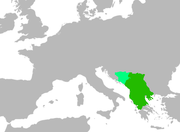 |
The Serbian Empire was a medieval empire
Empire
The term empire derives from the Latin imperium . Politically, an empire is a geographically extensive group of states and peoples united and ruled either by a monarch or an oligarchy....
in the Balkans
Balkans
The Balkans is a geopolitical and cultural region of southeastern Europe...
that emerged from the Serbian Kingdom. Stephen Uroš IV Dušan was crowned Emperor of Serbs and Greeks on 16 April, 1346, a title signifying a successorship to the Eastern Roman Empire (Byzantines). Dušan the Mighty significantly expanded the state, stretching over half of the Balkan peninsula, also promoting the church to a Patriarchate. The Empire crumbled during Uroš V the Weak (hence his epithet). The Serbian Empire existed nominally from 1346 to 1402. It was de facto
De facto
De facto is a Latin expression that means "concerning fact." In law, it often means "in practice but not necessarily ordained by law" or "in practice or actuality, but not officially established." It is commonly used in contrast to de jure when referring to matters of law, governance, or...
the last of the three orthodox christian empires of the east (Byzantine
Byzantine Empire
The Byzantine Empire was the Eastern Roman Empire during the periods of Late Antiquity and the Middle Ages, centred on the capital of Constantinople. Known simply as the Roman Empire or Romania to its inhabitants and neighbours, the Empire was the direct continuation of the Ancient Roman State...
, Bulgarian
Bulgarian Empire
Bulgarian Empire is a term used to describe two periods in the medieval history of Bulgaria, during which it acted as a key regional power in Europe in general and in Southeastern Europe in particular, rivalling Byzantium...
and Serbian
Serbian Empire
The Serbian Empire was a short-lived medieval empire in the Balkans that emerged from the Serbian Kingdom. Stephen Uroš IV Dušan was crowned Emperor of Serbs and Greeks on 16 April, 1346, a title signifying a successorship to the Eastern Roman Empire...
Empire), before the Ottoman occupation of the Balkans
Ottoman wars in Europe
The wars of the Ottoman Empire in Europe are also sometimes referred to as the Ottoman Wars or as Turkish Wars, particularly in older, European texts.- Rise :...
.
Stefan Uroš IV Dušan of Serbia
Stephen Uroš IV Dušan the Mighty , was the King of Serbia and Emperor of the Serbs and Greeks until his death on 20 December 1355. Dušan managed to conquer a large part of Southeast Europe, becoming one of the most powerful monarchs in his time...
, before ascending the throne as king of all Serbs
Serbs
The Serbs are a South Slavic ethnic group of the Balkans and southern Central Europe. Serbs are located mainly in Serbia, Montenegro and Bosnia and Herzegovina, and form a sizable minority in Croatia, the Republic of Macedonia and Slovenia. Likewise, Serbs are an officially recognized minority in...
, proved himself as a very skilled military leader in the Battle of Velbazhd, in which Serbia memorably defeated the Bulgarian Empire
Second Bulgarian Empire
The Second Bulgarian Empire was a medieval Bulgarian state which existed between 1185 and 1396 . A successor of the First Bulgarian Empire, it reached the peak of its power under Kaloyan and Ivan Asen II before gradually being conquered by the Ottomans in the late 14th-early 15th century...
. As his father was not an able conqueror, Dušan, with the help of Serbian nobility, removed his father from the throne, ordering his people to strangle him. The medieval Serbian state reached its apex in the mid-14th century, during the rule of Stefan Dušan
Stefan Uroš IV Dušan of Serbia
Stephen Uroš IV Dušan the Mighty , was the King of Serbia and Emperor of the Serbs and Greeks until his death on 20 December 1355. Dušan managed to conquer a large part of Southeast Europe, becoming one of the most powerful monarchs in his time...
, who proclaimed himself in 1345 tsar in Serres
Serres, Greece
Sérres is a city in Macedonia, Greece. It is situated in a fertile plain at an elevation of about 70 m, some 24 km northeast of the Strymon river and 69 km north-east of the Macedonian capital, Thessaloniki. The Rhodope Mountains rise to the north and east of the city...
and was crowned in Skopje
Skopje
Skopje is the capital and largest city of the Republic of Macedonia with about a third of the total population. It is the country's political, cultural, economic, and academic centre...
on the 16th April 1346 as the "Emperor of the Serbs and Greeks" by the newly proclaimed Serbian Patriach
Serbian Orthodox Church
The Serbian Orthodox Church is one of the autocephalous Orthodox Christian churches, ranking sixth in order of seniority after Constantinople, Alexandria, Antioch, Jerusalem, and Russia...
Joanikie II with the help of the Bulgarian Patriarch Simeon and the Archbishop of Ohrid, Nicholas.
Tsar Dušan enacted Dušan's Code
Dušan's Code
Dušan's Code was enacted by Tsar Dušan in two state congresses: in May 21, 1349 in Skopje and amended in 1354 in Serres. It regulated all social spheres, so it can be considered a medieval Serbian constitution. The Code included 201 articles. The original manuscript is not preserved, but around...
, a medieval constitution, in 1349 and 1354. The Code was based on Roman
Roman law
Roman law is the legal system of ancient Rome, and the legal developments which occurred before the 7th century AD — when the Roman–Byzantine state adopted Greek as the language of government. The development of Roman law comprises more than a thousand years of jurisprudence — from the Twelve...
-Byzantine law
Byzantine law
Byzantine Law was essentially a continuation of Roman Law with Christian influence, however, this is not to doubt its later influence on the western practice of jurisprudence...
and the first Serbian constitution
Constitution
A constitution is a set of fundamental principles or established precedents according to which a state or other organization is governed. These rules together make up, i.e. constitute, what the entity is...
— St. Sava's Nomocanon (1219). It was a Civil
Civil law (legal system)
Civil law is a legal system inspired by Roman law and whose primary feature is that laws are codified into collections, as compared to common law systems that gives great precedential weight to common law on the principle that it is unfair to treat similar facts differently on different...
and Canon law
Canon law
Canon law is the body of laws & regulations made or adopted by ecclesiastical authority, for the government of the Christian organization and its members. It is the internal ecclesiastical law governing the Catholic Church , the Eastern and Oriental Orthodox churches, and the Anglican Communion of...
(based on the Ecumenical Councils) for the functioning of the state and church. The Serbian Empire flourished, becoming one of the most developed countries and cultures in Europe.
Tsar Dušan doubled the size of his former kingdom, seizing territories to the south, southeast and east at the expense of Byzantium
Byzantium
Byzantium was an ancient Greek city, founded by Greek colonists from Megara in 667 BC and named after their king Byzas . The name Byzantium is a Latinization of the original name Byzantion...
. He did not fight a single field battle, instead winning his empire by besieging cities. He was succeeded by his son Stefan Uroš V, called the Weak, a term that might also apply to the state of the empire, as it slowly slid into feudal anarchy. The combination of sudden conquest, backwards administration, and failure to consolidate his holdings led to the fragmenting of the empire. This is a period marked by the rise of a new threat: the Ottoman Turkish
Ottoman Empire
The Ottoman EmpireIt was usually referred to as the "Ottoman Empire", the "Turkish Empire", the "Ottoman Caliphate" or more commonly "Turkey" by its contemporaries...
sultanate gradually spreading from Asia
Asia
Asia is the world's largest and most populous continent, located primarily in the eastern and northern hemispheres. It covers 8.7% of the Earth's total surface area and with approximately 3.879 billion people, it hosts 60% of the world's current human population...
to Europe and conquering Byzantine
Byzantine
Byzantine usually refers to the Roman Empire during the Middle Ages.Byzantine may also refer to:* A citizen of the Byzantine Empire, or native Greek during the Middle Ages...
Thrace first, and then the other Balkans
Balkans
The Balkans is a geopolitical and cultural region of southeastern Europe...
states. Too incompetent to sustain the great empire created by his father, Stefan V could neither repel attacks of foreign enemies, nor combat the independence of his nobility. The Serbian Empire of Stefan Uroš fragmented into a conglomeration of principalities, some of which did not even nominally acknowledge his rule. Stefan Uroš V died childless on 4 December 1371, after much of the Serbian nobility had been slaughtered by the Ottoman Turks in the Battle of Maritsa
Battle of Maritsa
The Battle of Maritsa, or Battle of Chernomen, took place at the Maritsa River near the village of Chernomen on September 26, 1371 between the forces of the Ottoman sultan Murad I's lieutenant Lala Şâhin Paşa and the...
earlier that year.
Kingdom of Georgia
1184–1225
| Kingdom of Georgia Kingdom of Georgia The Kingdom of Georgia was a medieval monarchy established in AD 978 by Bagrat III.It flourished during the 11th and 12th centuries, the so-called "golden age" of the history of Georgia. It fell to the Mongol invasions of the 13th century, but managed to re-assert sovereignty by 1327... |
|---|
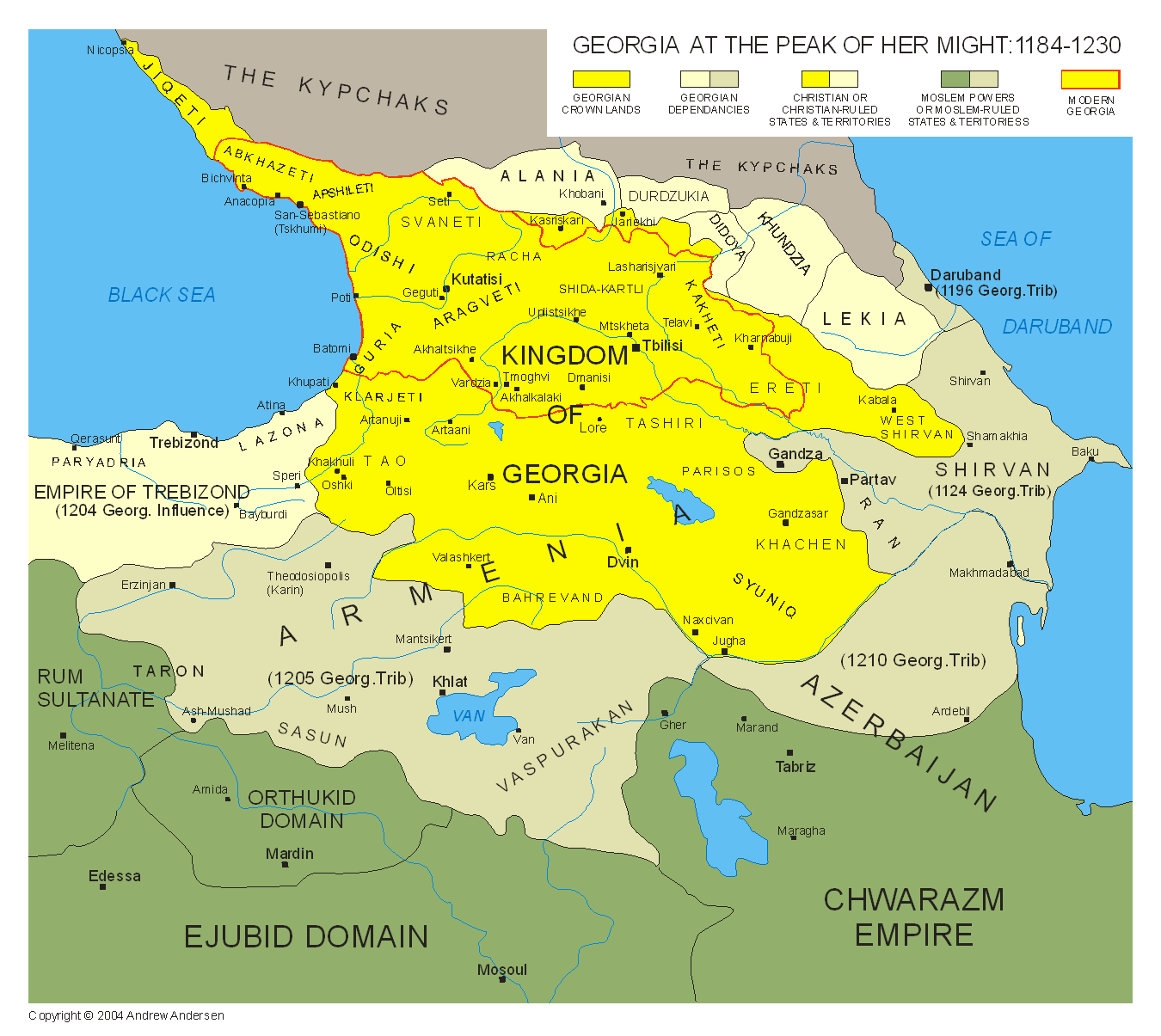 |
The unified monarchy maintained its precarious independence from the Byzantine and Seljuk empires throughout the 11th century, and flourished under David IV the Builder (1089–1125), who repelled the Seljuk attacks and essentially completed the unification of Georgia with the re-conquest of Tbilisi in 1122.
With the decline of Byzantine power and the dissolution of the Great Seljuk Empire, Georgia became one of the pre-eminent nations of the Christian East, her pan-Caucasian empire stretching, at its largest extent, from North Caucasus to northern Iran, and eastwards into Asia Minor. In spite of repeated incidents of dynastic strife, the kingdom continued to prosper during the reigns of Demetrios I (1125–1156), George III (1156–1184), and especially, his daughter Tamar (1184–1213). With the death of George III the main male line went extinct and the dynasty was continued by the marriage of Queen Tamar with the Alan prince David Soslan of reputed Bagratid descent.
Ghaznavid Empire
960s - 998| Ghaznavid Empire Ghaznavid Empire The Ghaznavids were a Persianate Muslim dynasty of Turkic slave origin which existed from 975 to 1187 and ruled much of Persia, Transoxania, and the northern parts of the Indian subcontinent. The Ghaznavid state was centered in Ghazni, a city in modern-day Afghanistan... |
|---|
.png) |
The Ghaznavids were a Persianate Muslim
Muslim
A Muslim, also spelled Moslem, is an adherent of Islam, a monotheistic, Abrahamic religion based on the Quran, which Muslims consider the verbatim word of God as revealed to prophet Muhammad. "Muslim" is the Arabic term for "submitter" .Muslims believe that God is one and incomparable...
dynasty of Turkic
Turkic peoples
The Turkic peoples are peoples residing in northern, central and western Asia, southern Siberia and northwestern China and parts of eastern Europe. They speak languages belonging to the Turkic language family. They share, to varying degrees, certain cultural traits and historical backgrounds...
mamluk
Mamluk
A Mamluk was a soldier of slave origin, who were predominantly Cumans/Kipchaks The "mamluk phenomenon", as David Ayalon dubbed the creation of the specific warrior...
origin which existed from 975 to 1187 and ruled much of Persia, Transoxania, and the northern parts of the Indian subcontinent
Indian subcontinent
The Indian subcontinent, also Indian Subcontinent, Indo-Pak Subcontinent or South Asian Subcontinent is a region of the Asian continent on the Indian tectonic plate from the Hindu Kush or Hindu Koh, Himalayas and including the Kuen Lun and Karakoram ranges, forming a land mass which extends...
. The Ghaznavid state was centered in Ghazni, a city in present Afghanistan
Afghanistan
Afghanistan , officially the Islamic Republic of Afghanistan, is a landlocked country located in the centre of Asia, forming South Asia, Central Asia and the Middle East. With a population of about 29 million, it has an area of , making it the 42nd most populous and 41st largest nation in the world...
. Due to the political and cultural influence of their predecessors - that of the Persian
Persian people
The Persian people are part of the Iranian peoples who speak the modern Persian language and closely akin Iranian dialects and languages. The origin of the ethnic Iranian/Persian peoples are traced to the Ancient Iranian peoples, who were part of the ancient Indo-Iranians and themselves part of...
Samanid Empire - the originally Turkic Ghaznavids became thoroughly Persianized
Persianization
Persianization or Persianisation is a sociological process of cultural change in which something non-Persian becomes Persianate. It is a specific form of cultural assimilation that often includes linguistic assimilation...
.
Saboktekin (Mahmud of Ghazni
Mahmud of Ghazni
Mahmud of Ghazni , actually ', was the most prominent ruler of the Ghaznavid dynasty who ruled from 997 until his death in 1030 in the eastern Iranian lands. Mahmud turned the former provincial city of Ghazni into the wealthy capital of an extensive empire which covered most of today's Iran,...
) made himself lord of nearly all the present territory of Afghanistan and of the Punjab by conquest of Samanid and Shahi lands. In 997, Mahmud, the son of Sebük Tigin, succeeded his father upon his death, and with him Ghazni and the Ghaznavid dynasty have become perpetually associated. He completed the conquest of Samanid, Shahi lands, the Ismaili Kingdom of Multan, Sindh as well as some Buwayhid territory. Under him all accounts was the golden age and the height of the Ghaznevid Empire. Mahmud carried out seventeen expeditions through northern India establishing his control and setting up tributary states. His raids also resulted in the looting of a great deal of plunder. From the borders of Kurdistan to Samarkand, from the Caspian Sea to the Yamuna, he established his authority. The wealth brought back from the Indian expeditions to Ghazni was enormous, and contemporary historians (e.g. Abolfazl Beyhaghi, Ferdowsi) give glowing descriptions of the magnificence of the capital, as well as of the conquerors munificent support of literature. Mahmud died in (1030). Even though there was some revival of importance under Ibrahim (1059–1099), the empire never reached anything like the same splendor and power. It was soon overshadowed by the Seljuqs of Iran.
Frankish Empire
790s - 840s
| Frankish Empire Frankish Empire Francia or Frankia, later also called the Frankish Empire , Frankish Kingdom , Frankish Realm or occasionally Frankland, was the territory inhabited and ruled by the Franks from the 3rd to the 10th century... |
|---|
 |
The Merovingian dynasty
Merovingian dynasty
The Merovingians were a Salian Frankish dynasty that came to rule the Franks in a region largely corresponding to ancient Gaul from the middle of the 5th century. Their politics involved frequent civil warfare among branches of the family...
founded one of the monarchies which replaced the Western Roman Empire from the fifth century. The Frankish state consolidated its hold over large parts of western Europe by the end of the eighth century, developing into the Carolingian Empire
Carolingian Empire
Carolingian Empire is a historiographical term which has been used to refer to the realm of the Franks under the Carolingian dynasty in the Early Middle Ages. This dynasty is seen as the founders of France and Germany, and its beginning date is based on the crowning of Charlemagne, or Charles the...
which dominated most of Western Europe. This empire would gradually evolve into France and the Holy Roman Empire. Under the nearly continuous campaigns of Charles Martel
Charles Martel
Charles Martel , also known as Charles the Hammer, was a Frankish military and political leader, who served as Mayor of the Palace under the Merovingian kings and ruled de facto during an interregnum at the end of his life, using the title Duke and Prince of the Franks. In 739 he was offered the...
, Pepin the Short, and Charlemagne
Charlemagne
Charlemagne was King of the Franks from 768 and Emperor of the Romans from 800 to his death in 814. He expanded the Frankish kingdom into an empire that incorporated much of Western and Central Europe. During his reign, he conquered Italy and was crowned by Pope Leo III on 25 December 800...
—father, son, grandson — the greatest expansion of the Frankish empire was secured by the early 9th century. The tradition of dividing patrimonies among brothers meant that the Frankish realm was ruled, nominally, as one polity subdivided into several regna (kingdoms or subkingdoms).
Franks
The Franks were a confederation of Germanic tribes first attested in the third century AD as living north and east of the Lower Rhine River. From the third to fifth centuries some Franks raided Roman territory while other Franks joined the Roman troops in Gaul. Only the Salian Franks formed a...
were united for the first time by Clovis I
Clovis I
Clovis Leuthwig was the first King of the Franks to unite all the Frankish tribes under one ruler, changing the leadership from a group of royal chieftains, to rule by kings, ensuring that the kingship was held by his heirs. He was also the first Catholic King to rule over Gaul . He was the son...
in the late 5th century. The geography and number of subkingdoms varied over time, but the particular term Francia came generally to refer to just one regnum, that of Austrasia, centred on the Rhine and Meuse rivers in northern Europe; even so, sometimes the term was used as well to encompass Neustria north of the Loire and west of the Seine. Eventually, the singular use of the name Francia shifted towards Paris, and settled on the region of the Seine basin surrounding Paris, which still today bears the name Île-de-France, and which region gave its name to the entire Kingdom of France. In 732 the Franks managed to defeat the Arabs at Poitiers
Battle of Tours
The Battle of Tours , also called the Battle of Poitiers and in Battle of the Court of the Martyrs, was fought in an area between the cities of Poitiers and Tours, located in north-central France, near the village of Moussais-la-Bataille, about northeast of Poitiers...
, thereby halting their invasion of Western Europe
Western Europe
Western Europe is a loose term for the collection of countries in the western most region of the European continents, though this definition is context-dependent and carries cultural and political connotations. One definition describes Western Europe as a geographic entity—the region lying in the...
.
Charlemagne
Charlemagne was King of the Franks from 768 and Emperor of the Romans from 800 to his death in 814. He expanded the Frankish kingdom into an empire that incorporated much of Western and Central Europe. During his reign, he conquered Italy and was crowned by Pope Leo III on 25 December 800...
, it reached its greatest extent, encompassing most of the territory of the Western Roman Empire
Western Roman Empire
The Western Roman Empire was the western half of the Roman Empire after its division by Diocletian in 285; the other half of the Roman Empire was the Eastern Roman Empire, commonly referred to today as the Byzantine Empire....
, and eventually he was proclaimed Emperor by the Pope in 800. He Christianised the pagan peoples he defeated. This was a period of cultural revival known as the Carolingian Renaissance
Carolingian Renaissance
In the history of ideas the Carolingian Renaissance stands out as a period of intellectual and cultural revival in Europe occurring from the late eighth century, in the generation of Alcuin, to the 9th century, and the generation of Heiric of Auxerre, with the peak of the activities coordinated...
with important educational and writing reforms. On Christmas Day, 800, Pope Leo III crowned Charles as "Emperor of the Romans" in Rome in a ceremony presented as a surprise (Charlemagne did not wish to be indebted to the bishop of Rome), a further papal move in the series of symbolic gestures that had been defining the mutual roles of papal auctoritas and imperial potestas. Though Charlemagne, in deference to Byzantine outrage, preferred the title "Emperor, king of the Franks and Lombards", the ceremony formally acknowledged the Frankish Empire as the successor of the (Western) Roman one (although only the forged "Donation" gave the pope political authority to do this), thus triggering a series of disputes with the Byzantines around the Roman name. After an initial protest at the usurpation, in 812, the Byzantine Emperor Michael I Rhangabes acknowledged Charlemagne as co-Emperor. The coronation gave permanent legitimacy to Carolingian primacy among the Franks. The Ottonians later resurrected this connection in 962. The empire disintegrated into three parts after the death of his son Louis the Pious
Louis the Pious
Louis the Pious , also called the Fair, and the Debonaire, was the King of Aquitaine from 781. He was also King of the Franks and co-Emperor with his father, Charlemagne, from 813...
, from which later emerged France
France
The French Republic , The French Republic , The French Republic , (commonly known as France , is a unitary semi-presidential republic in Western Europe with several overseas territories and islands located on other continents and in the Indian, Pacific, and Atlantic oceans. Metropolitan France...
and Germany
Germany
Germany , officially the Federal Republic of Germany , is a federal parliamentary republic in Europe. The country consists of 16 states while the capital and largest city is Berlin. Germany covers an area of 357,021 km2 and has a largely temperate seasonal climate...
.
Kingdom of Germany and after
| The Holy Roman Empire | |
|---|---|
 |
|
The Kingdom of Germany grew out of East Francia in the 10th century. The eastern partition of the Treaty of Verdun
Treaty of Verdun
The Treaty of Verdun was a treaty between the three surviving sons of Louis the Pious, the son and successor of Charlemagne, which divided the Carolingian Empire into three kingdoms...
of 843, or East Francia, encompassed a population that was never entirely Frankish
Franks
The Franks were a confederation of Germanic tribes first attested in the third century AD as living north and east of the Lower Rhine River. From the third to fifth centuries some Franks raided Roman territory while other Franks joined the Roman troops in Gaul. Only the Salian Franks formed a...
, but also included large numbers of Saxons
Saxons
The Saxons were a confederation of Germanic tribes originating on the North German plain. The Saxons earliest known area of settlement is Northern Albingia, an area approximately that of modern Holstein...
, Bavarii
Bavarii
The Bavarii were a Germanic tribe whose name emerged late in Teutonic tribal times. The full name originally was the Germanic *baio-warioz. This name has been handed down as Baiwaren, Baioaren, Bioras, latinised Bavarii, Baioarii. or Bavarii, Bavarians, Bajuwaren, Bajuvarii, Bajuwaren and Baiern....
, Thuringii
Thuringii
The Thuringii or Toringi were a Germanic tribe which appeared late during the Völkerwanderung in the Harz Mountains of central Germania around 280, in a region which still bears their name to this day — Thuringia. They evidently filled a void left when the previous inhabitants — the...
, Alemanni and Frisii
Frisii
The Frisii were an ancient Germanic tribe living in the low-lying region between the Zuiderzee and the River Ems. In the Germanic pre-Migration Period the Frisii and the related Chauci, Saxons, and Angles inhabited the Continental European coast from the Zuyder Zee to south Jutland...
. When the crown passed to a non-Frankish dynasty (the Liudolfings), the term regnum Teutonicum or Teutonicorum came into informal use. By the High Middle Ages
High Middle Ages
The High Middle Ages was the period of European history around the 11th, 12th, and 13th centuries . The High Middle Ages were preceded by the Early Middle Ages and followed by the Late Middle Ages, which by convention end around 1500....
, the German character of the united stem duchies
Stem duchy
Stem duchies were essentially the domains of the old German tribes of the area, associated with the Frankish Kingdom, especially the East, in the Early Middle Ages. These tribes were originally the Franks, the Saxons, the Alamanni, the Burgundians, the Thuringii, and the Rugii...
was generally recognised.
As the other various states removed themselves from its orbit, leaving solely Germany, her kings holding the imperial title and struggling for it, the German state became synonymous with the Empire and in the time of the Renaissance
Renaissance
The Renaissance was a cultural movement that spanned roughly the 14th to the 17th century, beginning in Italy in the Late Middle Ages and later spreading to the rest of Europe. The term is also used more loosely to refer to the historical era, but since the changes of the Renaissance were not...
, the "Holy Roman Empire of the German Nation" united the two concepts of empire and kingdom. Although the term "sacrum" (i.e. "holy") in connection with the medieval Roman Empire did not appear until 1157 under Frederick I Barbarossa, it is Otto I (also known as Otto the Great and Otto the German), crowned King of Germany in 962, who is generally considered to have been the first Holy Roman Emperor. Otto was the first emperor of the realm that later became known as the Holy Roman Empire who was not a member of the earlier Carolingian dynasty. The last Holy Roman Emperor was Francis II, who abdicated and dissolved the Empire in 1806 during the Napoleonic Wars. In a decree following the 1512 Diet of Cologne, the name was officially changed to Holy Roman Empire of the German Nation.
Pope Gregory VII
Pope St. Gregory VII , born Hildebrand of Sovana , was Pope from April 22, 1073, until his death. One of the great reforming popes, he is perhaps best known for the part he played in the Investiture Controversy, his dispute with Henry IV, Holy Roman Emperor affirming the primacy of the papal...
during the Investiture Controversy
Investiture Controversy
The Investiture Controversy or Investiture Contest was the most significant conflict between Church and state in medieval Europe. In the 11th and 12th centuries, a series of Popes challenged the authority of European monarchies over control of appointments, or investitures, of church officials such...
(late 11th century), perhaps as a polemical tool against the Emperor Henry IV. In the twelfth century, in order to stress the imperial and transnational character of their office, the emperors began to employ the title rex Romanorum (king of the Romans
King of the Romans
King of the Romans was the title used by the ruler of the Holy Roman Empire following his election to the office by the princes of the Kingdom of Germany...
) on their election (by the prince-electors, seven German bishops and noblemen). Distinct titulature for Germany, Italy and Burgundy, which traditionally had their own courts, laws, and chanceries, gradually dropped from use. After the Reichsreform and Reformation settlement, the German part of the Holy Roman Empire was divided into Reichskreise (imperial circles), which effectively defined Germany against imperial Italy and the Kingdom of Bohemia. The archepiscopal electors continued to bear the titles of chancellors of Germany, Italy and Burgundy. After the Peace of Westphalia
Peace of Westphalia
The Peace of Westphalia was a series of peace treaties signed between May and October of 1648 in Osnabrück and Münster. These treaties ended the Thirty Years' War in the Holy Roman Empire, and the Eighty Years' War between Spain and the Dutch Republic, with Spain formally recognizing the...
(1648), Germany was effectively a congeries of independent states and statelets, over which the remaining institutions of Kingdom and Empire claimed a declining authority. The German kingdom survived until the abdication of Francis II
Francis II, Holy Roman Emperor
Francis II was the last Holy Roman Emperor, ruling from 1792 until 6 August 1806, when he dissolved the Empire after the disastrous defeat of the Third Coalition by Napoleon at the Battle of Austerlitz...
in 1806.
Medieval Kingdom of Hungary
1000-1526
| Magyar tribes Magyar tribes The Magyar tribes were the fundamental political units whose framework the Hungarians lived within, until these clans from Asia, more accurately from the region of Ural Mountains, invaded the Carpathian Basin and established the Principality of Hungary.The locality in which the Hungarians, the... |
|---|
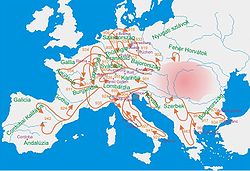 |
The origin of the system of the tribe
Tribe
A tribe, viewed historically or developmentally, consists of a social group existing before the development of, or outside of, states.Many anthropologists use the term tribal society to refer to societies organized largely on the basis of kinship, especially corporate descent groups .Some theorists...
s among the Magyars has not been discovered yet, but the distribution into seven tribes had been established by the middle of the 9th century. The seven tribes (Jenő
Jeno
- External links :*...
, Kér, Keszi, Kürt-Gyarmat, Megyer, Nyék and Tarján) formed a confederation called "Hétmagyar" (ie, "The Seven Magyars"). Their leaders, who besides Álmos
High Prince Álmos
Álmos , the first Grand Prince of the Magyars . The Gesta Hungarorum records that his father was Ügyek, while the Chronicon Pictum mentions his father as Előd ; his mother was Emese.-Birth:The medieval chronicle recounts the story of his...
included Előd, Ond, Kond, Tas, Huba and Töhötöm, took a blood oath, swearing eternal loyalty to Álmos. The confederation of the tribes was probably led by two high princes: the kende (their spiritual ruler) and the gyula (their military leader). The high princes were either elected by the leaders of the tribes or appointed by the Khagan
Khagan
Khagan or qagan , alternatively spelled kagan, khaghan, qaghan, or chagan, is a title of imperial rank in the Mongolian and Turkic languages equal to the status of emperor and someone who rules a khaganate...
of the Khazars
Khazars
The Khazars were semi-nomadic Turkic people who established one of the largest polities of medieval Eurasia, with the capital of Atil and territory comprising much of modern-day European Russia, western Kazakhstan, eastern Ukraine, Azerbaijan, large portions of the northern Caucasus , parts of...
who had been exerting influence over the Magyars.
Kingdom of Hungary in the Middle Ages
The Kingdom of Hungary was formed from the previous Principality of Hungarywith the coronation of Stephen I in AD 1000. This was a result of the conversion of Géza of Hungary to the Western Church in the 970s....
, after its sedentarization and conversion to Christianity, became a European power and served as the "gate to Europe" from Asia. A "kingdom" arose only in AD 1000 and a Hungarian state or principality only in the late 9th century, but the concept describes its early development after the year 896 when the Magyars arrived in the Carpathian Basin. The Hungarian kingdom's golden age was during the reign of Matthias Corvinus, the son of John Hunyadi
John Hunyadi
John Hunyadi John Hunyadi (Hungarian: Hunyadi János , Medieval Latin: Ioannes Corvinus or Ioannes de Hunyad, Romanian: Iancu (Ioan) de Hunedoara, Croatian: Janko Hunjadi, Serbian: Сибињанин Јанко / Sibinjanin Janko, Slovak: Ján Huňady) John Hunyadi (Hungarian: Hunyadi János , Medieval Latin: ...
. His nickname was "Matthias the Just". He further improved the Hungarian economy and practised astute diplomacy in place of military action whenever possible. Matthias did undertake campaigning when necessary. In 1485, aiming to limit the influence and meddling of the Holy Roman Empire in Hungary's affairs, he occupied Vienna for 5 years. After his death, Vladislaus II of Hungary of the Jagiellonians
Jagiellon dynasty
The Jagiellonian dynasty was a royal dynasty originating from the Lithuanian House of Gediminas dynasty that reigned in Central European countries between the 14th and 16th century...
was placed on the Hungarian throne.
Jagiellon dynasty
1386–1572
The Kingdom of Poland
Kingdom of Poland (1385–1569)
The Kingdom of Poland of the Jagiellons was the Polish state created by the accession of Jogaila , Grand Duke of Lithuania, to the Polish throne in 1386. The Union of Krewo or Krėva Act, united Poland and Lithuania under the rule of a single monarch...
grew out of Central-East Europa in the 15th century. After Union of Krewo
Union of Krewo
In a strict sense, the Union of Krewo or Act of Krėva was a set of prenuptial promises made in the Kreva Castle on 14 August 1385 by Jogaila, Grand Duke of Lithuania, in exchange for marriage to the underage reigning Queen Jadwiga of Poland...
and Battle of Grunwald
Battle of Grunwald
The Battle of Grunwald or 1st Battle of Tannenberg was fought on 15 July 1410, during the Polish–Lithuanian–Teutonic War. The alliance of the Kingdom of Poland and the Grand Duchy of Lithuania, led respectively by King Jogaila and Grand Duke Vytautas , decisively defeated the Teutonic Knights, led...
, Kingdom of Poland and Grand Duchy of Lithuania
Grand Duchy of Lithuania
The Grand Duchy of Lithuania was a European state from the 12th /13th century until 1569 and then as a constituent part of Polish-Lithuanian Commonwealth until 1791 when Constitution of May 3, 1791 abolished it in favor of unitary state. It was founded by the Lithuanians, one of the polytheistic...
, where the power wielded Jagiellon dynasty
Jagiellon dynasty
The Jagiellonian dynasty was a royal dynasty originating from the Lithuanian House of Gediminas dynasty that reigned in Central European countries between the 14th and 16th century...
. Jagiellon dynasty were the most powerful dynasty in Central-East Europe. Later the Jagiellonian dynasty ruled also in the Kingdom of Bohemia
Kingdom of Bohemia
The Kingdom of Bohemia was a country located in the region of Bohemia in Central Europe, most of whose territory is currently located in the modern-day Czech Republic. The King was Elector of Holy Roman Empire until its dissolution in 1806, whereupon it became part of the Austrian Empire, and...
and Kingdom of Hungary
Kingdom of Hungary
The Kingdom of Hungary comprised present-day Hungary, Slovakia and Croatia , Transylvania , Carpatho Ruthenia , Vojvodina , Burgenland , and other smaller territories surrounding present-day Hungary's borders...
.
Dynasty
A dynasty is a sequence of rulers considered members of the same family. Historians traditionally consider many sovereign states' history within a framework of successive dynasties, e.g., China, Ancient Egypt and the Persian Empire...
originating from the Lithuania
Lithuania
Lithuania , officially the Republic of Lithuania is a country in Northern Europe, the biggest of the three Baltic states. It is situated along the southeastern shore of the Baltic Sea, whereby to the west lie Sweden and Denmark...
n House of Gediminas
House of Gediminas
The family of Gediminas is a group of family members of Gediminas, Grand Duke of Lithuania , who interacted in the 14th century. The family included the siblings, children, and grandchildren of the Grand Duke and played the pivotal role in the history of Lithuania for the period as the Lithuanian...
. 14 August 1385 by Jogaila
Jogaila
Jogaila, later 'He is known under a number of names: ; ; . See also: Jogaila : names and titles. was Grand Duke of Lithuania , king consort of Kingdom of Poland , and sole King of Poland . He ruled in Lithuania from 1377, at first with his uncle Kęstutis...
, Grand Duke of Lithuania, in exchange for marriage to the underage reigning Queen Jadwiga of Poland
Jadwiga of Poland
Jadwiga was monarch of Poland from 1384 to her death. Her official title was 'king' rather than 'queen', reflecting that she was a sovereign in her own right and not merely a royal consort. She was a member of the Capetian House of Anjou, the daughter of King Louis I of Hungary and Elizabeth of...
.Jogaila converted to Christianity, married Jadwiga, and was crowned King of Poland in 1386. Jagiellonian dynasty that reigned in Central Europe
Central Europe
Central Europe or alternatively Middle Europe is a region of the European continent lying between the variously defined areas of Eastern and Western Europe...
an countries (present day Lithuania, Belarus, Poland, Ukraine, Latvia, Estonia, parts of Russia (including nowadays Kaliningrad oblast), Hungary, Czech Republic, Slovakia) between the 14th and 16th century. Members of the dynasty were Grand Dukes of Lithuania
Grand Duchy of Lithuania
The Grand Duchy of Lithuania was a European state from the 12th /13th century until 1569 and then as a constituent part of Polish-Lithuanian Commonwealth until 1791 when Constitution of May 3, 1791 abolished it in favor of unitary state. It was founded by the Lithuanians, one of the polytheistic...
(1377–1392 and 1440–1572), king
Kingdom of Poland (1385–1569)
The Kingdom of Poland of the Jagiellons was the Polish state created by the accession of Jogaila , Grand Duke of Lithuania, to the Polish throne in 1386. The Union of Krewo or Krėva Act, united Poland and Lithuania under the rule of a single monarch...
s of Poland (1386–1572), kings of Hungary
Kingdom of Hungary
The Kingdom of Hungary comprised present-day Hungary, Slovakia and Croatia , Transylvania , Carpatho Ruthenia , Vojvodina , Burgenland , and other smaller territories surrounding present-day Hungary's borders...
(1440–1444 and 1490–1526), and kings of Bohemia
Bohemia
Bohemia is a historical region in central Europe, occupying the western two-thirds of the traditional Czech Lands. It is located in the contemporary Czech Republic with its capital in Prague...
(1471–1526).
The dynastic union between the two countries (converted into a full administrative union only in 1569) is the reason for the common appellation "Poland–Lithuania
Poland-Lithuania
Poland–Lithuania can refer to:* Polish–Lithuanian union from 1385 until 1569* Polish–Lithuanian Commonwealth from 1569 until 1795See also: Polish-Lithuanian...
" in discussions about the area from the Late Middle Ages
Late Middle Ages
The Late Middle Ages was the period of European history generally comprising the 14th to the 16th century . The Late Middle Ages followed the High Middle Ages and preceded the onset of the early modern era ....
onwards. One Jagiellonian briefly ruled both Poland and Hungary (1440–44), and two others ruled both Bohemia
Bohemia
Bohemia is a historical region in central Europe, occupying the western two-thirds of the traditional Czech Lands. It is located in the contemporary Czech Republic with its capital in Prague...
(from 1490) and Hungary
Hungary
Hungary , officially the Republic of Hungary , is a landlocked country in Central Europe. It is situated in the Carpathian Basin and is bordered by Slovakia to the north, Ukraine and Romania to the east, Serbia and Croatia to the south, Slovenia to the southwest and Austria to the west. The...
(1490–1526) and then continued in the distaff
Distaff
As a noun, a distaff is a tool used in spinning. It is designed to hold the unspun fibers, keeping them untangled and thus easing the spinning process. It is most commonly used to hold flax, and sometimes wool, but can be used for any type of fiber. Fiber is wrapped around the distaff, and tied in...
line as the Eastern branch of the House of Habsburg
Habsburg
The House of Habsburg , also found as Hapsburg, and also known as House of Austria is one of the most important royal houses of Europe and is best known for being an origin of all of the formally elected Holy Roman Emperors between 1438 and 1740, as well as rulers of the Austrian Empire and...
.
Norman Empire
1017–1154| Normans Normans The Normans were the people who gave their name to Normandy, a region in northern France. They were descended from Norse Viking conquerors of the territory and the native population of Frankish and Gallo-Roman stock... |
|---|
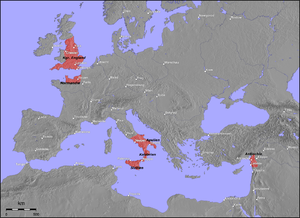 |
The Normans
Normans
The Normans were the people who gave their name to Normandy, a region in northern France. They were descended from Norse Viking conquerors of the territory and the native population of Frankish and Gallo-Roman stock...
were the people who gave their names to Normandy
Normandy
Normandy is a geographical region corresponding to the former Duchy of Normandy. It is in France.The continental territory covers 30,627 km² and forms the preponderant part of Normandy and roughly 5% of the territory of France. It is divided for administrative purposes into two régions:...
, a region in northern France
France
The French Republic , The French Republic , The French Republic , (commonly known as France , is a unitary semi-presidential republic in Western Europe with several overseas territories and islands located on other continents and in the Indian, Pacific, and Atlantic oceans. Metropolitan France...
. They descended from Viking
Viking
The term Viking is customarily used to refer to the Norse explorers, warriors, merchants, and pirates who raided, traded, explored and settled in wide areas of Europe, Asia and the North Atlantic islands from the late 8th to the mid-11th century.These Norsemen used their famed longships to...
conquerors of the territory and the native population of mostly Frankish
Franks
The Franks were a confederation of Germanic tribes first attested in the third century AD as living north and east of the Lower Rhine River. From the third to fifth centuries some Franks raided Roman territory while other Franks joined the Roman troops in Gaul. Only the Salian Franks formed a...
and Gallo-Roman stock. Their identity emerged initially in the first half of the 10th century, and gradually evolved over succeeding centuries until they disappeared as an ethnic group in the early 13th century. The name "Normans" derives from "Northmen" or "Norsemen
Norsemen
Norsemen is used to refer to the group of people as a whole who spoke what is now called the Old Norse language belonging to the North Germanic branch of Indo-European languages, especially Norwegian, Icelandic, Faroese, Swedish and Danish in their earlier forms.The meaning of Norseman was "people...
", after the Vikings from Scandinavia
Scandinavia
Scandinavia is a cultural, historical and ethno-linguistic region in northern Europe that includes the three kingdoms of Denmark, Norway and Sweden, characterized by their common ethno-cultural heritage and language. Modern Norway and Sweden proper are situated on the Scandinavian Peninsula,...
who founded Normandy (Northmannia in its original Latin).
Gallo-Romance languages
The Gallo-Romance branch of Romance languages include French and the other langue d'oïl dialects, Occitan , Catalan, Franco-Provençal, Gallo-Italic, and other languages - Other possible classifications :...
of the land they settled in, their dialect becoming known as Norman
Norman language
Norman is a Romance language and one of the Oïl languages. Norman can be classified as one of the northern Oïl languages along with Picard and Walloon...
, an important literary language. The Duchy of Normandy
Duchy of Normandy
The Duchy of Normandy stems from various Danish, Norwegian, Hiberno-Norse, Orkney Viking and Anglo-Danish invasions of France in the 9th century...
, which they formed by treaty with the French crown, was one of the great large fiefs of medieval France. The Normans are famed both for their culture, such as their unique Romanesque architecture
Romanesque architecture
Romanesque architecture is an architectural style of Medieval Europe characterised by semi-circular arches. There is no consensus for the beginning date of the Romanesque architecture, with proposals ranging from the 6th to the 10th century. It developed in the 12th century into the Gothic style,...
, and their musical traditions, as well as for the military accomplishments and innovations. Norman adventurers established a kingdom in Sicily and southern Italy
Norman conquest of southern Italy
The Norman conquest of southern Italy spanned the late eleventh and much of the twelfth centuries, involving many battles and many independent players conquering territories of their own...
by conquest, and a Norman expedition on behalf of their duke led to the Norman Conquest of England
Norman conquest of England
The Norman conquest of England began on 28 September 1066 with the invasion of England by William, Duke of Normandy. William became known as William the Conqueror after his victory at the Battle of Hastings on 14 October 1066, defeating King Harold II of England...
. Norman influence spread from these new centres to the Crusader States
Crusader states
The Crusader states were a number of mostly 12th- and 13th-century feudal states created by Western European crusaders in Asia Minor, Greece and the Holy Land , and during the Northern Crusades in the eastern Baltic area...
in the Near East, to Scotland
Scotland
Scotland is a country that is part of the United Kingdom. Occupying the northern third of the island of Great Britain, it shares a border with England to the south and is bounded by the North Sea to the east, the Atlantic Ocean to the north and west, and the North Channel and Irish Sea to the...
and Wales
Wales
Wales is a country that is part of the United Kingdom and the island of Great Britain, bordered by England to its east and the Atlantic Ocean and Irish Sea to its west. It has a population of three million, and a total area of 20,779 km²...
in Great Britain
Great Britain
Great Britain or Britain is an island situated to the northwest of Continental Europe. It is the ninth largest island in the world, and the largest European island, as well as the largest of the British Isles...
, and to Ireland
Ireland
Ireland is an island to the northwest of continental Europe. It is the third-largest island in Europe and the twentieth-largest island on Earth...
.
Great Seljuk empire
1040–1154| Seljuk empire |
|---|
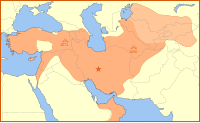 |
The name Seljuk refers to an Oghuz
Oghuz Turks
The Turkomen also known as Oghuz Turks were a historical Turkic tribal confederation in Central Asia during the early medieval Turkic expansion....
Turkic
Turkic peoples
The Turkic peoples are peoples residing in northern, central and western Asia, southern Siberia and northwestern China and parts of eastern Europe. They speak languages belonging to the Turkic language family. They share, to varying degrees, certain cultural traits and historical backgrounds...
leader whose tribe had migrated from North (probably Khazar Khanette
Khazars
The Khazars were semi-nomadic Turkic people who established one of the largest polities of medieval Eurasia, with the capital of Atil and territory comprising much of modern-day European Russia, western Kazakhstan, eastern Ukraine, Azerbaijan, large portions of the northern Caucasus , parts of...
) to Khorosan
Greater Khorasan
Greater Khorasan or Ancient Khorasan is a historical region of Greater Iran mentioned in sources from Sassanid and Islamic eras which "frequently" had a denotation wider than current three provinces of Khorasan in Iran...
where they embraced Islam
Islam
Islam . The most common are and . : Arabic pronunciation varies regionally. The first vowel ranges from ~~. The second vowel ranges from ~~~...
., Seljuk’s grand sons after defeating Ghaznavids in 1040 founded an empire and decleared themselves to be the protectors of the caliph
Caliph
The Caliph is the head of state in a Caliphate, and the title for the ruler of the Islamic Ummah, an Islamic community ruled by the Shari'ah. It is a transcribed version of the Arabic word which means "successor" or "representative"...
. Their empire with caliphs prestige, Turkish army and Persian breucracy proved to be one of the most powerful of states of 11th century. In 1071 after Alp Arslan
Alp Arslan
Alp Arslan was the third sultan of the Seljuq dynasty and great-grandson of Seljuk, the eponymous founder of the dynasty...
of Seljuks defeated Byzantine
Byzantine
Byzantine usually refers to the Roman Empire during the Middle Ages.Byzantine may also refer to:* A citizen of the Byzantine Empire, or native Greek during the Middle Ages...
army at Manzikert, Turks began to settle in Anatolia
Anatolia
Anatolia is a geographic and historical term denoting the westernmost protrusion of Asia, comprising the majority of the Republic of Turkey...
(Asiatic side of Turkey). But Great Seljuk Empire began to disintegrate in the second half of the 12th century. Soon, they were replaced by a number of states ruled by members of Seljuk house or by atabegs. The most important of these was the Sultanate of Rûm
Sultanate of Rûm
The Sultanate of Rum , also known as the Anatolian Seljuk State , was a Turkic state centered in in Anatolia, with capitals first at İznik and then at Konya. Since the court of the sultanate was highly mobile, cities like Kayseri and Sivas also functioned at times as capitals...
which continued up to 14th century and Khwarezmid Empire in Iran
Iran
Iran , officially the Islamic Republic of Iran , is a country in Southern and Western Asia. The name "Iran" has been in use natively since the Sassanian era and came into use internationally in 1935, before which the country was known to the Western world as Persia...
and Turkmenistan
Turkmenistan
Turkmenistan , formerly also known as Turkmenia is one of the Turkic states in Central Asia. Until 1991, it was a constituent republic of the Soviet Union, the Turkmen Soviet Socialist Republic . Turkmenistan is one of the six independent Turkic states...
which fell prey to Mongols
Mongol Empire
The Mongol Empire , initially named as Greater Mongol State was a great empire during the 13th and 14th centuries...
in 1220s.
Kingdom of Sicily
1059–1250
Robert Guiscard
Robert d'Hauteville, known as Guiscard, Duke of Apulia and Calabria, from Latin Viscardus and Old French Viscart, often rendered the Resourceful, the Cunning, the Wily, the Fox, or the Weasel was a Norman adventurer conspicuous in the conquest of southern Italy and Sicily...
the Norman armies (see Norman conquest of southern Italy
Norman conquest of southern Italy
The Norman conquest of southern Italy spanned the late eleventh and much of the twelfth centuries, involving many battles and many independent players conquering territories of their own...
) became the main power in the central-west Mediterranean, influencing the policy of the Popes and the Holy Roman Emperors. Successively under the rule of his descendants, the Norman Kings Roger II
Roger II of Sicily
Roger II was King of Sicily, son of Roger I of Sicily and successor to his brother Simon. He began his rule as Count of Sicily in 1105, later became Duke of Apulia and Calabria , then King of Sicily...
, William I
William I of Sicily
William I , called the Bad or the Wicked, was the second king of Sicily, ruling from his father's death in 1154 to his own...
, William II
William II of Sicily
William II , called the Good, was king of Sicily from 1166 to 1189. William's character is very indistinct. Lacking in military enterprise, secluded and pleasure-loving, he seldom emerged from his palace life at Palermo. Yet his reign is marked by an ambitious foreign policy and a vigorous diplomacy...
the Kingdom of Sicily
Kingdom of Sicily
The Kingdom of Sicily was a state that existed in the south of Italy from its founding by Roger II in 1130 until 1816. It was a successor state of the County of Sicily, which had been founded in 1071 during the Norman conquest of southern Italy...
dominated with his fleet, army and trade the regions of south Europe and north Africa for more than two centuries. In the same time some of the sons and nephews of Robert, participated at the First Crusade
First Crusade
The First Crusade was a military expedition by Western Christianity to regain the Holy Lands taken in the Muslim conquest of the Levant, ultimately resulting in the recapture of Jerusalem...
and conquered the Principality of Antioch
Principality of Antioch
The Principality of Antioch, including parts of modern-day Turkey and Syria, was one of the crusader states created during the First Crusade.-Foundation:...
and the County of Edessa
County of Edessa
The County of Edessa was one of the Crusader states in the 12th century, based around Edessa, a city with an ancient history and an early tradition of Christianity....
.
Frederick II, Holy Roman Emperor
Frederick II , was one of the most powerful Holy Roman Emperors of the Middle Ages and head of the House of Hohenstaufen. His political and cultural ambitions, based in Sicily and stretching through Italy to Germany, and even to Jerusalem, were enormous...
, who inherited it by his mother, Constance of Sicily
Constance of Sicily
Constance of Hauteville was the heiress of the Norman kings of Sicily and the wife of Henry VI, Holy Roman Emperor...
. Frederick II used the powerful Kingdom of Sicily as a solid base for his imperial policy, in fact the Norman kings had created one of the first relatively modern bureaucracy and so at that time, Sicily was one of the first well ruled states in Europe, the kingdom also had a very flourishing agriculture and was at the center of the Mediterranean trade.
The decline of Sicily started in 1266, when the last son of Frederick, Manfred of Sicily
Manfred of Sicily
Manfred was the King of Sicily from 1258 to 1266. He was a natural son of the emperor Frederick II of Hohenstaufen but his mother, Bianca Lancia , is reported by Matthew of Paris to have been married to the emperor while on her deathbed.-Background:Manfred was born in Venosa...
, died in the Battle of Benevento
Battle of Benevento
The Battle of Benevento was fought near Benevento, in present-day Southern Italy, on February 26, 1266, between the troops of Charles of Anjou and Manfred of Sicily. Manfred's defeat and death resulted in the capture of the Kingdom of Sicily by Charles....
: the Kingdom was initially conquered by Charles, Count of Anjou
Anjou
Anjou is a former county , duchy and province centred on the city of Angers in the lower Loire Valley of western France. It corresponds largely to the present-day département of Maine-et-Loire...
and Provence
Provence
Provence ; Provençal: Provença in classical norm or Prouvènço in Mistralian norm) is a region of south eastern France on the Mediterranean adjacent to Italy. It is part of the administrative région of Provence-Alpes-Côte d'Azur...
and some years later, in 1282, it was divided in two halves during the so called Sicilian Vespers
Sicilian Vespers
The Sicilian Vespers is the name given to the successful rebellion on the island of Sicily that broke out on the Easter of 1282 against the rule of the French/Angevin king Charles I, who had ruled the Kingdom of Sicily since 1266. Within six weeks three thousand French men and women were slain by...
.
Republic of Genoa
1099–1380
| Republic of Genoa Republic of Genoa The Most Serene Republic of Genoa |Ligurian]]: Repúbrica de Zêna) was an independent state from 1005 to 1797 in Liguria on the northwestern Italian coast, as well as Corsica from 1347 to 1768, and numerous other territories throughout the Mediterranean.... |
|---|
The Republic of Genoa was a state originating from the city of Genoa
Genoa
Genoa |Ligurian]] Zena ; Latin and, archaically, English Genua) is a city and an important seaport in northern Italy, the capital of the Province of Genoa and of the region of Liguria....
, and existed from 1005 to 1797. During the high Middle Ages the Republic of Genoa was able to become a very wealthy and powerful state through the rich trade between Europe and the Mediterranean sea, becoming one of the early model of capitalistic empires. Genoa started her main expansion expelling the Arab pirates from the Tyrrhenian Sea and west Mediterranean; in 1099 Genoa participated at the Crusades
Crusades
The Crusades were a series of religious wars, blessed by the Pope and the Catholic Church with the main goal of restoring Christian access to the holy places in and near Jerusalem...
directly or more often supplying the armies, and so the city gained many settlements and commercial bases in the Levant
Levant
The Levant or ) is the geographic region and culture zone of the "eastern Mediterranean littoral between Anatolia and Egypt" . The Levant includes most of modern Lebanon, Syria, Jordan, Israel, the Palestinian territories, and sometimes parts of Turkey and Iraq, and corresponds roughly to the...
. The apogee of Genoa was during the 13th century when her fleet dominated the western Mediterranean trade and in the same time the city was able to match the power of the rival Republic of Venice
Republic of Venice
The Republic of Venice or Venetian Republic was a state originating from the city of Venice in Northeastern Italy. It existed for over a millennium, from the late 7th century until 1797. It was formally known as the Most Serene Republic of Venice and is often referred to as La Serenissima, in...
in the East. The Battle of Chioggia
Battle of Chioggia
The naval Battle of Chioggia took place on June 21, 1380 in the lagoon off Chioggia, Italy, between the Venetian and the Genoese fleets, who had captured the little fishing port in August the preceding year. This occurred during the War of Chioggia....
(1380) started the decline of Genoa.
Medieval Venetian Republic
1204–1489
| Venetian Republic |
|---|
The Republic of Venice
Republic of Venice
The Republic of Venice or Venetian Republic was a state originating from the city of Venice in Northeastern Italy. It existed for over a millennium, from the late 7th century until 1797. It was formally known as the Most Serene Republic of Venice and is often referred to as La Serenissima, in...
was a state originating from the city of Venice
Venice
Venice is a city in northern Italy which is renowned for the beauty of its setting, its architecture and its artworks. It is the capital of the Veneto region...
, and existed for a millennium from the late 7th century (697) until the year 1797 when the Austrians took its possessions. The leader of Venetian Republic was called a Doge
Doge
Doge is a dialectal Italian word that descends from the Latin dux , meaning "leader", especially in a military context. The wife of a Doge is styled a Dogaressa....
. Doges of Venice were elected for life by the Republic's aristocracy.
In the Medieval times Venice was able to become the main trade center between Europe and the East, and also one of the most rich cities in the world. During the Fourth Crusade
Fourth Crusade
The Fourth Crusade was originally intended to conquer Muslim-controlled Jerusalem by means of an invasion through Egypt. Instead, in April 1204, the Crusaders of Western Europe invaded and conquered the Christian city of Constantinople, capital of the Eastern Roman Empire...
(1204) the Franco-Venetian force conquered 1/4 of the Byzantine Empire, especially some important isles (as Candia
Kingdom of Candia
The Kingdom of Candia or Duchy of Candia was the official name of Crete during the island's period as an overseas colony of the Republic of Venice, from the initial Venetian conquest in 1205–1212 to its fall to the Ottoman Empire during the Cretan War...
) and commercial bases around the Aegean Sea
Aegean Sea
The Aegean Sea[p] is an elongated embayment of the Mediterranean Sea located between the southern Balkan and Anatolian peninsulas, i.e., between the mainlands of Greece and Turkey. In the north, it is connected to the Marmara Sea and Black Sea by the Dardanelles and Bosporus...
and Black Sea
Black Sea
The Black Sea is bounded by Europe, Anatolia and the Caucasus and is ultimately connected to the Atlantic Ocean via the Mediterranean and the Aegean seas and various straits. The Bosphorus strait connects it to the Sea of Marmara, and the strait of the Dardanelles connects that sea to the Aegean...
. In the successive centuries the Republic was able to consolidate her position, against powerful rivals as the Republic of Genoa
Republic of Genoa
The Most Serene Republic of Genoa |Ligurian]]: Repúbrica de Zêna) was an independent state from 1005 to 1797 in Liguria on the northwestern Italian coast, as well as Corsica from 1347 to 1768, and numerous other territories throughout the Mediterranean....
, meanwhile dominating with her fleet the Adriatic Sea and Est Mediterranean. During the 13th and 14th centuries Venice, participating in the Italians wars, was also able to conquest a more land based dominion (the so called Domini di Terraferma
Domini di Terraferma
The Domini di Terraferma or Stato da Tera was the name given to the territories of the Republic of Venice conquered in the Padano–Veneto hinterland....
). The conquest of the Kingdom of Cyprus
Kingdom of Cyprus
The Kingdom of Cyprus was a Crusader kingdom on the island of Cyprus in the high and late Middle Ages, between 1192 and 1489. It was ruled by the French House of Lusignan.-History:...
in 1489 signed the end of the expanding period of Venice.
Angevin Empire
1154–1453| Angevin Empire Angevin Empire The term Angevin Empire is a modern term describing the collection of states once ruled by the Angevin Plantagenet dynasty.The Plantagenets ruled over an area stretching from the Pyrenees to Ireland during the 12th and early 13th centuries, located north of Moorish Iberia. This "empire" extended... |
|---|
 |
The Angevin Empire was a collection of states ruled by the Plantagenet dynasty. The Plantagenets ruled over the Kingdom of England
Kingdom of England
The Kingdom of England was, from 927 to 1707, a sovereign state to the northwest of continental Europe. At its height, the Kingdom of England spanned the southern two-thirds of the island of Great Britain and several smaller outlying islands; what today comprises the legal jurisdiction of England...
, the Duchy of Normandy
Duchy of Normandy
The Duchy of Normandy stems from various Danish, Norwegian, Hiberno-Norse, Orkney Viking and Anglo-Danish invasions of France in the 9th century...
, the Duchy of Aquitaine, the Duchy of Gascony and various French counties (constituting approximately half of the then kingdom of France
France
The French Republic , The French Republic , The French Republic , (commonly known as France , is a unitary semi-presidential republic in Western Europe with several overseas territories and islands located on other continents and in the Indian, Pacific, and Atlantic oceans. Metropolitan France...
), the Lordship of Ireland
Lordship of Ireland
The Lordship of Ireland refers to that part of Ireland that was under the rule of the king of England, styled Lord of Ireland, between 1177 and 1541. It was created in the wake of the Norman invasion of Ireland in 1169–71 and was succeeded by the Kingdom of Ireland...
, and the Kingdom of Jerusalem
Kingdom of Jerusalem
The Kingdom of Jerusalem was a Catholic kingdom established in the Levant in 1099 after the First Crusade. The kingdom lasted nearly two hundred years, from 1099 until 1291 when the last remaining possession, Acre, was destroyed by the Mamluks, but its history is divided into two distinct periods....
. Their empire in France stretched from the Pyrenees
Pyrenees
The Pyrenees is a range of mountains in southwest Europe that forms a natural border between France and Spain...
to the English Channel
English Channel
The English Channel , often referred to simply as the Channel, is an arm of the Atlantic Ocean that separates southern England from northern France, and joins the North Sea to the Atlantic. It is about long and varies in width from at its widest to in the Strait of Dover...
over the 12th to the 15th century.
The empire started when Plantegenet Henry II
Henry II of England
Henry II ruled as King of England , Count of Anjou, Count of Maine, Duke of Normandy, Duke of Aquitaine, Duke of Gascony, Count of Nantes, Lord of Ireland and, at various times, controlled parts of Wales, Scotland and western France. Henry, the great-grandson of William the Conqueror, was the...
was made King of England. Successive Plantegenet kings of England possessed large areas of territory in France throughout much of the middle ages
Middle Ages
The Middle Ages is a periodization of European history from the 5th century to the 15th century. The Middle Ages follows the fall of the Western Roman Empire in 476 and precedes the Early Modern Era. It is the middle period of a three-period division of Western history: Classic, Medieval and Modern...
. Although England was the main source of revenue, the strategic situation meant the early Plantagenets usually ruled their empire from France, notably from Poitiers
Poitiers
Poitiers is a city on the Clain river in west central France. It is a commune and the capital of the Vienne department and of the Poitou-Charentes region. The centre is picturesque and its streets are interesting for predominant remains of historical architecture, especially from the Romanesque...
, the capital of Aquitaine
Aquitaine
Aquitaine , archaic Guyenne/Guienne , is one of the 27 regions of France, in the south-western part of metropolitan France, along the Atlantic Ocean and the Pyrenees mountain range on the border with Spain. It comprises the 5 departments of Dordogne, :Lot et Garonne, :Pyrénées-Atlantiques, Landes...
, which was the birthplace of the dynasty, and they were buried in the Fontevraud Abbey
Fontevraud Abbey
Fontevraud Abbey or Fontevrault Abbey is a religious building hosting a cultural centre since 1975, the Centre Culturel de l'Ouest, in the village of Fontevraud-l'Abbaye, near Chinon, in Anjou, France. It was founded by the itinerant reforming preacher Robert of Arbrissel, who had just created a...
near Poitiers. Starting with John Lackland
John of England
John , also known as John Lackland , was King of England from 6 April 1199 until his death...
the centre of political activity shifted to England due to the loss of most of their continental territories.
The end of the empire began when the Plantagenets were defeated by the king of France, Philip II Augustus, of the House of Capet
House of Capet
The House of Capet, or The Direct Capetian Dynasty, , also called The House of France , or simply the Capets, which ruled the Kingdom of France from 987 to 1328, was the most senior line of the Capetian dynasty – itself a derivative dynasty from the Robertians. As rulers of France, the dynasty...
, which left their empire split in two, losing the provinces Normandy
Normandy
Normandy is a geographical region corresponding to the former Duchy of Normandy. It is in France.The continental territory covers 30,627 km² and forms the preponderant part of Normandy and roughly 5% of the territory of France. It is divided for administrative purposes into two régions:...
and Anjou
Anjou
Anjou is a former county , duchy and province centred on the city of Angers in the lower Loire Valley of western France. It corresponds largely to the present-day département of Maine-et-Loire...
. This defeat, which left the ruling Plantagenets with their English territories and Gascony
Gascony
Gascony is an area of southwest France that was part of the "Province of Guyenne and Gascony" prior to the French Revolution. The region is vaguely defined and the distinction between Guyenne and Gascony is unclear; sometimes they are considered to overlap, and sometimes Gascony is considered a...
in France, set the scene for the Hundred Years' War
Hundred Years' War
The Hundred Years' War was a series of separate wars waged from 1337 to 1453 by the House of Valois and the House of Plantagenet, also known as the House of Anjou, for the French throne, which had become vacant upon the extinction of the senior Capetian line of French kings...
, which started when the Plantagenet kings, provoked by French aggression against their trading partners in the Low Countries
Low Countries
The Low Countries are the historical lands around the low-lying delta of the Rhine, Scheldt, and Meuse rivers, including the modern countries of Belgium, the Netherlands, Luxembourg and parts of northern France and western Germany....
, proclaimed themselves rightful kings of France. The war lasted 116 years and the rival Valois claimants eventually conquered the majority of France, except for enclaves such as Calais
Calais
Calais is a town in Northern France in the department of Pas-de-Calais, of which it is a sub-prefecture. Although Calais is by far the largest city in Pas-de-Calais, the department's capital is its third-largest city of Arras....
, which ended the empire.
Kingdoms of Aragon
1340s - 1480s
| Crown of Aragon Crown of Aragon The Crown of Aragon Corona d'Aragón Corona d'Aragó Corona Aragonum controlling a large portion of the present-day eastern Spain and southeastern France, as well as some of the major islands and mainland possessions stretching across the Mediterranean as far as Greece... |
|---|
The Crown of Aragon
Crown of Aragon
The Crown of Aragon Corona d'Aragón Corona d'Aragó Corona Aragonum controlling a large portion of the present-day eastern Spain and southeastern France, as well as some of the major islands and mainland possessions stretching across the Mediterranean as far as Greece...
was a Maritime Empire
Empire
The term empire derives from the Latin imperium . Politically, an empire is a geographically extensive group of states and peoples united and ruled either by a monarch or an oligarchy....
in the late Middle Ages
Late Middle Ages
The Late Middle Ages was the period of European history generally comprising the 14th to the 16th century . The Late Middle Ages followed the High Middle Ages and preceded the onset of the early modern era ....
that controlled a large portion of present-day northeastern Spain and southeastern Italy, as well as possessions stretching across the Mediterranean Sea
Mediterranean Sea
The Mediterranean Sea is a sea connected to the Atlantic Ocean surrounded by the Mediterranean region and almost completely enclosed by land: on the north by Anatolia and Europe, on the south by North Africa, and on the east by the Levant...
as far as Greece. It originated in 1137, when the Kingdom of Aragon
Kingdom of Aragon
The Kingdom of Aragon was a medieval and early modern kingdom in the Iberian Peninsula, corresponding to the modern-day autonomous community of Aragon, in Spain...
and the possessions of the County of Barcelona merged by dynastic union
Dynastic union
A dynastic union is the combination by which two different states are governed by the same dynasty, while their boundaries, their laws and their interests remain distinct...
into what later would be known as the Crown of Aragon.
In 1479 a new dynastic union merged the Crown of Aragon with the Crown of Castile
Crown of Castile
The Crown of Castile was a medieval and modern state in the Iberian Peninsula that formed in 1230 as a result of the third and definitive union of the crowns and parliaments of the kingdoms of Castile and León upon the accession of the then King Ferdinand III of Castile to the vacant Leonese throne...
, thus making the dawn of the Spanish Empire
Spanish Empire
The Spanish Empire comprised territories and colonies administered directly by Spain in Europe, in America, Africa, Asia and Oceania. It originated during the Age of Exploration and was therefore one of the first global empires. At the time of Habsburgs, Spain reached the peak of its world power....
. Ferdinand married Infanta Isabella of Castile, half-sister of King Henry IV of Castile, who became Queen of Castile and Léon after his death in 1474. Their marriage was a dynastic union which became the constituent event for the dawn of the Kingdom of Spain. At that point both Castile and the Crown of Aragon remained distinct territories, each keeping its own traditional institutions, parliaments and laws.
The process of territorial consolidation was completed when King Charles I, becoming known as Charles V, in 1516 united all the kingdoms on the Iberian peninsula minus Portugal under one monarch (his co-monarch and mother Queen Joanna I in confinement), thereby furthering the creation of the Spanish state, albeit a decentralized one. The Crown of Aragon lasted through 1716, when it was abolished by the Nueva Planta decrees
Nueva Planta decrees
The Nueva Planta decrees were a number of decrees signed between 1707 and 1716 by Philip V—the first Bourbon king of Spain—during and shortly after the end of the War of the Spanish Succession which he won....
as a result of the Aragonese defeat in the War of the Spanish Succession
War of the Spanish Succession
The War of the Spanish Succession was fought among several European powers, including a divided Spain, over the possible unification of the Kingdoms of Spain and France under one Bourbon monarch. As France and Spain were among the most powerful states of Europe, such a unification would have...
.
Kingdom of Castile
1230–1480
| Kingdom of Castile Kingdom of Castile Kingdom of Castile was one of the medieval kingdoms of the Iberian Peninsula. It emerged as a political autonomous entity in the 9th century. It was called County of Castile and was held in vassalage from the Kingdom of León. Its name comes from the host of castles constructed in the region... |
|---|
 |
The Kingdom of Castile
Kingdom of Castile
Kingdom of Castile was one of the medieval kingdoms of the Iberian Peninsula. It emerged as a political autonomous entity in the 9th century. It was called County of Castile and was held in vassalage from the Kingdom of León. Its name comes from the host of castles constructed in the region...
was one of the medieval kingdoms of the Iberian Peninsula
Iberian Peninsula
The Iberian Peninsula , sometimes called Iberia, is located in the extreme southwest of Europe and includes the modern-day sovereign states of Spain, Portugal and Andorra, as well as the British Overseas Territory of Gibraltar...
. It was created as a politically autonomous entity in the 9th century: it was called County of Castile and was held in vassal
Vassal
A vassal or feudatory is a person who has entered into a mutual obligation to a lord or monarch in the context of the feudal system in medieval Europe. The obligations often included military support and mutual protection, in exchange for certain privileges, usually including the grant of land held...
age from the Kingdom of León
Kingdom of León
The Kingdom of León was an independent kingdom situated in the northwest region of the Iberian Peninsula. It was founded in AD 910 when the Christian princes of Asturias along the northern coast of the peninsula shifted their capital from Oviedo to the city of León...
, which was later incorporated. Its name is supposed to be related to the host of castle
Castle
A castle is a type of fortified structure built in Europe and the Middle East during the Middle Ages by European nobility. Scholars debate the scope of the word castle, but usually consider it to be the private fortified residence of a lord or noble...
s constructed in the region. It was one of the ancestor kingdoms of the Kingdom of Spain.
By the fourteenth century these councils had gained more powers, such as the right to elect municipal magistrates and officers (alcaldes, speakers, clerks, etc.) and representatives to the parliaments (Cortes). Due to the increasing power of the municipal councils and the need for communication between these and the King, cortes were established in the Kingdom of León in 1188, and in Castile in 1250. In the earliest Leonese and Castilian Cortes, the inhabitants of the cities (known as "laboratores") formed a small group of the representatives and had no legislative powers, but they were a link between the king and the general population, something that was pioneered by the kingdoms of Castile and León. Eventually the representatives of the cities gained the right to vote in the Cortes, often allying with the monarchs against the great noble lords.
Kalmar Union
1397–1523| Kalmar Union Kalmar Union The Kalmar Union is a historiographical term meaning a series of personal unions that united the three kingdoms of Denmark, Norway , and Sweden under a single monarch, though intermittently and with a population... |
|---|
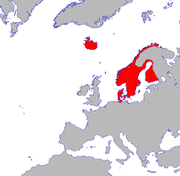 |
The Kalmar Union
Kalmar Union
The Kalmar Union is a historiographical term meaning a series of personal unions that united the three kingdoms of Denmark, Norway , and Sweden under a single monarch, though intermittently and with a population...
was a Personal union
Personal union
A personal union is the combination by which two or more different states have the same monarch while their boundaries, their laws and their interests remain distinct. It should not be confused with a federation which is internationally considered a single state...
between the three kingdoms in the region Scandinavia
Scandinavia
Scandinavia is a cultural, historical and ethno-linguistic region in northern Europe that includes the three kingdoms of Denmark, Norway and Sweden, characterized by their common ethno-cultural heritage and language. Modern Norway and Sweden proper are situated on the Scandinavian Peninsula,...
, Denmark, Norway and Sweden often seen as a reaction against the powerful Hanseatic League
Hanseatic League
The Hanseatic League was an economic alliance of trading cities and their merchant guilds that dominated trade along the coast of Northern Europe...
and Teutonic Knights
Teutonic Knights
The Order of Brothers of the German House of Saint Mary in Jerusalem , commonly the Teutonic Order , is a German medieval military order, in modern times a purely religious Catholic order...
which at that time had a major influence in northern Europe. The union was established in a meeting in Kalmar
Kalmar
Kalmar is a city in Småland in the south-east of Sweden, situated by the Baltic Sea. It had 62,767 inhabitants in 2010 and is the seat of Kalmar Municipality. It is also the capital of Kalmar County, which comprises 12 municipalities with a total of 233,776 inhabitants .From the thirteenth to the...
1397. Copenhagen
Copenhagen
Copenhagen is the capital and largest city of Denmark, with an urban population of 1,199,224 and a metropolitan population of 1,930,260 . With the completion of the transnational Øresund Bridge in 2000, Copenhagen has become the centre of the increasingly integrating Øresund Region...
became the capital of the Union and the Danish regent became the ruler of the Union which in the end were the reason for severe tensions between Sweden and Denmark-Norway. The Kalmar Union had a larger area than any other country in Europe at the time. The most prominent regent during this time was Margarethe I.
Stockholm Bloodbath
The Stockholm Bloodbath, or the Stockholm Massacre , took place as the result of a successful invasion of Sweden by Danish forces under the command of King Christian II...
of approximately 84 Swedish nobelmen and other leading men in 1520 just after his own coronation. Before that, he had promised the Swedish people that he would forget earlier hostilities. Gustav Vasa, a Swedish nobelman was starting a successful rebellion with the help of the notorious rebellious miners from the region Dalarna
Dalarna
', English exonym: Dalecarlia, is a historical province or landskap in central Sweden. Another English language form established in literature is the Dales. Places involving the element Dalecarlia exist in the United States....
against Danmark-Norway and became the founder of the first Swedish royal dynasty in 1523 with inheritance from father to son.
Mali Empire
1300–1450
| Mali Empire Mali Empire The Mali Empire or Mandingo Empire or Manden Kurufa was a West African empire of the Mandinka from c. 1230 to c. 1600. The empire was founded by Sundiata Keita and became renowned for the wealth of its rulers, especially Mansa Musa I... |
|---|
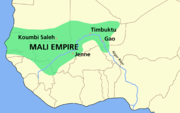 |
The Mali Empire
Mali Empire
The Mali Empire or Mandingo Empire or Manden Kurufa was a West African empire of the Mandinka from c. 1230 to c. 1600. The empire was founded by Sundiata Keita and became renowned for the wealth of its rulers, especially Mansa Musa I...
was a medieval state of West Africa
West Africa
West Africa or Western Africa is the westernmost region of the African continent. Geopolitically, the UN definition of Western Africa includes the following 16 countries and an area of approximately 5 million square km:-Flags of West Africa:...
. The empire was founded by Sundiata Keita
Sundiata Keita
Sundiata Keita, Sundjata Keyita, Mari Djata I or just Sundiata was the founder of the Mali Empire and celebrated as a hero of the Malinke people of West Africa in the semi-historical Epic of Sundiata....
and became renowned for the generosity and wealth of its rulers, especially Mansa
Mansa
Mansa is a Mandinka word meaning "king of kings". It is particularly associated with the Keita Dynasty of the Mali Empire, which dominated West Africa from the thirteenth to the fifthteenth century...
Kankan Musa I
Mansa Musa
Musa I , commonly referred to as Mansa Musa, was the tenth mansa, which translates as "king of kings" or "emperor", of the Malian Empire...
. The Mali Empire had profound cultural influences on West Africa allowing the spread of its language, laws and customs along the Niger River
Niger River
The Niger River is the principal river of western Africa, extending about . Its drainage basin is in area. Its source is in the Guinea Highlands in southeastern Guinea...
. Musa was a devoted Muslim and Islamic scholarship flourished under his rule; the Sankore University
Sankore University
Sankoré Madrasah, The University of Sankoré, or Sankore Masjid is one of three ancient centers of learning located in Timbuktu, Mali, West Africa. The three mosques of Sankoré, Djinguereber Mosque and Sidi Yahya compose the famous University of Timbuktu...
in Timbuktu
Timbuktu
Timbuktu , formerly also spelled Timbuctoo, is a town in the West African nation of Mali situated north of the River Niger on the southern edge of the Sahara Desert. The town is the capital of the Timbuktu Region, one of the eight administrative regions of Mali...
reached its height, bringing together Islamic scholars from all over the Muslim World
Muslim world
The term Muslim world has several meanings. In a religious sense, it refers to those who adhere to the teachings of Islam, referred to as Muslims. In a cultural sense, it refers to Islamic civilization, inclusive of non-Muslims living in that civilization...
.
Ethiopian Empire
1137 - 1975
The Ethiopian Empire
Ethiopian Empire
The Ethiopian Empire also known as Abyssinia, covered a geographical area that the present-day northern half of Ethiopia and Eritrea covers, and included in its peripheries Zeila, Djibouti, Yemen and Western Saudi Arabia...
(Abyssinia) existed at the end of the late Middle Ages, approximately 1137 (beginning of Zagwe Dynasty
Zagwe dynasty
The Zagwe dynasty was an historical kingdom in present-day Ethiopia. It ruled large parts of the territory from approximately 1137 to 1270, when the last Zagwe King Za-Ilmaknun was killed in battle by the forces of Yekuno Amlak...
). In 1270, the Zagwe dynasty
Zagwe dynasty
The Zagwe dynasty was an historical kingdom in present-day Ethiopia. It ruled large parts of the territory from approximately 1137 to 1270, when the last Zagwe King Za-Ilmaknun was killed in battle by the forces of Yekuno Amlak...
was overthrown by a king claiming lineage with the Aksumite emperors and thus that of Solomon (hence the name "Solomonid"). The Solomonid Dynasty was born of and ruled by the Habesha, from whom Abyssinia gets its name. The Habesha reigned with only a few interruptions from 1270 until the modern age
Modern Age
Modern Age is an American conservative academic quarterly journal, founded in 1957 by Russell Kirk in close collaboration with Henry Regnery...
.
Chalukya Empire
543–753
| Chalukya Empire |
|---|
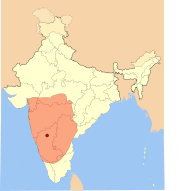 |
The Chalukya Empire was an India
India
India , officially the Republic of India , is a country in South Asia. It is the seventh-largest country by geographical area, the second-most populous country with over 1.2 billion people, and the most populous democracy in the world...
n royal dynasty that ruled large parts of southern
South India
South India is the area encompassing India's states of Andhra Pradesh, Karnataka, Kerala and Tamil Nadu as well as the union territories of Lakshadweep and Pondicherry, occupying 19.31% of India's area...
and central India between the 6th and the 12th centuries. The rule of the Chalukyas marks an important milestone in the history of South India
South India
South India is the area encompassing India's states of Andhra Pradesh, Karnataka, Kerala and Tamil Nadu as well as the union territories of Lakshadweep and Pondicherry, occupying 19.31% of India's area...
and a golden age in the history of Karnataka
Karnataka
Karnataka , the land of the Kannadigas, is a state in South West India. It was created on 1 November 1956, with the passing of the States Reorganisation Act and this day is annually celebrated as Karnataka Rajyotsava...
.
Narmada River
The Narmada , also called Rewa is a river in central India and the fifth largest river in the Indian subcontinent. It is the third largest river that completely flows within India after Ganges and Godavari...
rivers. The rise of this empire saw the birth of efficient administration, overseas trade and commerce and the development of new style of architecture called "Badami Chalukya architecture
Badami Chalukya Architecture
The Badami Chalukya architecture was a temple building idiom that evolved in the time period of 5th – 8th centuries AD. in the area of Malaprabha basin, in present day Bagalkot district of Karnataka state. This style is sometimes called the Vesara style and Chalukya style...
(Western Chalukya architecture
Western Chalukya architecture
Western Chalukya architecture , also known as Kalyani Chalukya or Later Chalukya architecture, is the distinctive style of ornamented architecture that evolved during the rule of the Western Chalukya Empire in the Tungabhadra region of central Karnataka, India, during the 11th and 12th centuries...
during the rule of Western Chalukyas
Western Chalukyas
The Western Chalukya Empire ruled most of the western Deccan, South India, between the 10th and 12th centuries. This dynasty is sometimes called the Kalyani Chalukya after its regal capital at Kalyani, today's Basavakalyan in Karnataka and alternatively the Later Chalukya from its theoretical...
)".
The Chalukyas ruled over the Deccan plateau in India for over 600 years. During this period, they ruled as three closely related, but individual dynasties. These are the "Chalukyas of Badami
Badami
Badami , formerly known as Vatapi, is a town and headquarters of a taluk by the same name, in the Bagalkot district of Karnataka, India. It was the regal capital of the Badami Chalukyas from 540 to 757 AD. It is famous for rock cut and other structural temples...
" (also called "Early Chalukyas"), who ruled between the 6th and the 8th century, and the two sibling dynasties, the "Chalukyas of Kalyani
Basavakalyan
Basavakalyan is a town in Bidar District of the state of Karnataka, India, and was historically known as Kalyan.-History:Basavakalyan's history dates back to 3000 years with its name being mentioned in Guru Charitra....
" (also called Western Chalukyas
Western Chalukyas
The Western Chalukya Empire ruled most of the western Deccan, South India, between the 10th and 12th centuries. This dynasty is sometimes called the Kalyani Chalukya after its regal capital at Kalyani, today's Basavakalyan in Karnataka and alternatively the Later Chalukya from its theoretical...
or "Later Chalukyas") and the "Chalukyas of Vengi" (also called Eastern Chalukyas
Eastern Chalukyas
Eastern Chalukyas were a South Indian dynasty whose kingdom was located in the present day Andhra Pradesh. Their capital was Vengi and their dynasty lasted for around 500 years from the 7th century until c. 1130 C.E. when the Vengi kingdom merged with the Chola empire...
).
Vikramaditya VI
Vikramaditya VI
Vikramaditya VI became the Western Chalukya King after deposing his elder brother Somesvara II. Vikramaditya's reign is marked by the start of the Chalukya-Vikrama era. Vikramaditya VI was the greatest of the Western Chalukya kings and had the longest reign in the dynasty. He earned the title...
was an ambitious and skilled military leader. Under his leadership the Western Chalukyas were able to end the Chola influence over Vengi (coastal Andhra) and become the dominant power in the Deccan. The Western Chalukya period was an important age in the development of Kannada literature and Sanskrit literature. They went into their final dissolution towards the end of the 12th century.
Rashtrakuta Empire
753–982
| Rashtrakuta Empire |
|---|
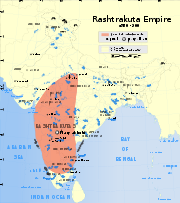 |
The Rashtrakuta Empire was a royal
Royal family
A royal family is the extended family of a king or queen regnant. The term imperial family appropriately describes the extended family of an emperor or empress, while the terms "ducal family", "grand ducal family" or "princely family" are more appropriate to describe the relatives of a reigning...
India
India
India , officially the Republic of India , is a country in South Asia. It is the seventh-largest country by geographical area, the second-most populous country with over 1.2 billion people, and the most populous democracy in the world...
n dynasty
Dynasty
A dynasty is a sequence of rulers considered members of the same family. Historians traditionally consider many sovereign states' history within a framework of successive dynasties, e.g., China, Ancient Egypt and the Persian Empire...
ruling large parts of southern, central and northern India between the 6th and the 10th centuries. An Arabic writing, the Silsilatuttavarikh (851) called the Rashtrakutas one among the four principle empires of the world. The Kitab-ul-Masalik-ul-Mumalik (912) called them the "greatest kings of India" and there were other contemporaneous books written in their praise.
The Rashtrakutas quickly became the most powerful Deccan empire, making their initial successful forays into the doab
Doab
A Doab is a term used in India and Pakistan for a "tongue" or tract of land lying between two confluent rivers...
region of Ganges River
Ganges River
The Ganges or Ganga, , is a trans-boundary river of India and Bangladesh. The river rises in the western Himalayas in the Indian state of Uttarakhand, and flows south and east through the Gangetic Plain of North India into Bangladesh, where it empties into the Bay of Bengal. By discharge it...
and Jamuna River
Yamuna
The Yamuna is the largest tributary river of the Ganges in northern India...
during the rule of Dhruva Dharavarsha
Dhruva Dharavarsha
Dhruva was one of greatest ruler of the Rashtrakuta Empire. He ascended the throne after replacing his elder brother Govinda II. Govinda II had become unpopular among his subjects on account of his various misconducts and demeanors as a ruler, including excessive indulgence in sensual pleasure....
. The rule of his son Govinda III
Govinda III
Govinda III was a famous Rashtrakuta ruler who succeeded his illustrious father Dhruva Dharavarsha. He was militarily the most successful emperor of the dynasty with successful conquests from Cape Comorin in the south to Kannauj in the north, from Banaras in the east to Broach in the west...
signaled a new era with Rashtrakuta victories against the Pala Dynasty of Bengal
Bengal
Bengal is a historical and geographical region in the northeast region of the Indian Subcontinent at the apex of the Bay of Bengal. Today, it is mainly divided between the sovereign land of People's Republic of Bangladesh and the Indian state of West Bengal, although some regions of the previous...
and Gurjara Pratihara
Pratihara
The Gurjara Pratihara , often simply called Pratihara Empire, was an imperial Indian dynasty that ruled much of Northern India from the 6th to the 11th centuries. At its peak of prosperity and power , the Gurajara-Pratihara Empire rivaled or even exceeded the Gupta Empire in the extent of its...
of north western India resulting in the capture of Kannauj
Kannauj
Kannauj , also spelt Kanauj, is a city, administrative headquarters and a municipal board or Nagar Palika Parishad in Kannauj district in the Indian state of Uttar Pradesh. The city's name is traditionally derived from the term Kanyakubja . Kannauj is an ancient city, in earlier times the capital...
. The Rashtrakuta empire at its peak spread from Cape Comorin in the south to Kannauj in the north and from Banaras in the east to Broach (Bharuch) in the west.
The Carnatic expansion of people and influences to the North from Karnataka during 10-12th century period is well attested by the sources but has not yet been studied carefully.
Pala Empire
750–1174
| Pala Empire Pala Empire The Pāla Empire was one of the major middle kingdoms of India existed from 750–1174 CE. It was ruled by a Buddhist dynasty from Bengal in the eastern region of the Indian subcontinent, all the rulers bearing names ending with the suffix Pala , which means protector. The Palas were often described... |
|---|
The Pala Empire
Pala Empire
The Pāla Empire was one of the major middle kingdoms of India existed from 750–1174 CE. It was ruled by a Buddhist dynasty from Bengal in the eastern region of the Indian subcontinent, all the rulers bearing names ending with the suffix Pala , which means protector. The Palas were often described...
was a Buddhist dynasty that ruled from the north-eastern region of the Indian subcontinent
Indian subcontinent
The Indian subcontinent, also Indian Subcontinent, Indo-Pak Subcontinent or South Asian Subcontinent is a region of the Asian continent on the Indian tectonic plate from the Hindu Kush or Hindu Koh, Himalayas and including the Kuen Lun and Karakoram ranges, forming a land mass which extends...
. The Palas were followers of the Mahayana
Mahayana
Mahāyāna is one of the two main existing branches of Buddhism and a term for classification of Buddhist philosophies and practice...
and Tantric
Vajrayana
Vajrayāna Buddhism is also known as Tantric Buddhism, Tantrayāna, Mantrayāna, Secret Mantra, Esoteric Buddhism and the Diamond Vehicle...
schools of Buddhism. Gopala
Gopala (Pala king)
Gopala was the founder of the Pala Dynasty of Bengal. The last morpheme of his name pala means "protector" and was used as an ending for the names of all the Pala monarchs...
was the first ruler from the dynasty. He came to power in 750 in Gaur
Gaur, West Bengal
Gour, or Gaur , as it is spelt mostly in modern times, or Lakhnauti is a ruined city, in the Malda district of West Bengal, India, on the west bank of the Ganges river, 40 kilometers downstream from Rajmahal.-History:...
by a democratic election
Election
An election is a formal decision-making process by which a population chooses an individual to hold public office. Elections have been the usual mechanism by which modern representative democracy operates since the 17th century. Elections may fill offices in the legislature, sometimes in the...
.
The empire reached its peak under Dharmapala
Dharmapala of Bengal
Dharama Pala was the second ruler of the Pala Empire of Bengal region in the Indian Subcontinent. He was the son and succeessor of Gopala , the founder of the Pala Dynasty. He greatly expanded the boundaries of the Pala Empire founded by his father and made the Palas the most dominant power in...
and Devapala
Devapala
Deva Pala , was a powerful emperor from the Pala Empire of Bengal region in the Indian Subcontinent. He was the third king in the line and had succeeded his father, emperor Dharamapala...
. Dharmapala extended the empire into the northern parts of the Indian Subcontinent
Indian subcontinent
The Indian subcontinent, also Indian Subcontinent, Indo-Pak Subcontinent or South Asian Subcontinent is a region of the Asian continent on the Indian tectonic plate from the Hindu Kush or Hindu Koh, Himalayas and including the Kuen Lun and Karakoram ranges, forming a land mass which extends...
. This triggered once again the power struggle for the control of the subcontinent. Devapala
Devapala
Deva Pala , was a powerful emperor from the Pala Empire of Bengal region in the Indian Subcontinent. He was the third king in the line and had succeeded his father, emperor Dharamapala...
, successor of Dharmapala, expanded the empire to cover much of South Asia
South Asia
South Asia, also known as Southern Asia, is the southern region of the Asian continent, which comprises the sub-Himalayan countries and, for some authorities , also includes the adjoining countries to the west and the east...
and beyond. His empire stretched from Assam
Assam
Assam , also, rarely, Assam Valley and formerly the Assam Province , is a northeastern state of India and is one of the most culturally and geographically distinct regions of the country...
and Utkala in the east, Kamboja (modern day Afghanistan
Afghanistan
Afghanistan , officially the Islamic Republic of Afghanistan, is a landlocked country located in the centre of Asia, forming South Asia, Central Asia and the Middle East. With a population of about 29 million, it has an area of , making it the 42nd most populous and 41st largest nation in the world...
) in the north-west and Deccan in the south.
The Pala Empire can be considered as the golden era of Bengal. Never had the Bengali people reached such height of power and glory to that extent. The Palas had extensive trade as well as influence in south-east Asia. This can be seen in the sculptures and architectural style of the Sailendra Empire (present-day Malaya, Java, Sumatra). The Pala Empire eventually disintegrated in the 12th century weakened by attacks of the Sena dynasty followed by the invasion of Bakhtiyar Khilji's Muslim armies.
Chola Empire
985-1200
| Chola Empire |
|---|
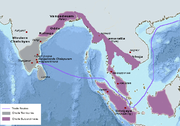 |
The Chola Empire ruled much of India
India
India , officially the Republic of India , is a country in South Asia. It is the seventh-largest country by geographical area, the second-most populous country with over 1.2 billion people, and the most populous democracy in the world...
and Southeast Asia
Southeast Asia
Southeast Asia, South-East Asia, South East Asia or Southeastern Asia is a subregion of Asia, consisting of the countries that are geographically south of China, east of India, west of New Guinea and north of Australia. The region lies on the intersection of geological plates, with heavy seismic...
. By the 9th century, under Rajaraja Chola and his son Rajendra Chola, the Cholas rose as a notable power in south Asia
Asia
Asia is the world's largest and most populous continent, located primarily in the eastern and northern hemispheres. It covers 8.7% of the Earth's total surface area and with approximately 3.879 billion people, it hosts 60% of the world's current human population...
. The Chola Empire stretched as far as Bengal
Bengal
Bengal is a historical and geographical region in the northeast region of the Indian Subcontinent at the apex of the Bay of Bengal. Today, it is mainly divided between the sovereign land of People's Republic of Bangladesh and the Indian state of West Bengal, although some regions of the previous...
. At its peak, the empire spanned almost 3600000 km² (1,389,967.8 sq mi). Rajaraja Chola conquered all of peninsular South India
South India
South India is the area encompassing India's states of Andhra Pradesh, Karnataka, Kerala and Tamil Nadu as well as the union territories of Lakshadweep and Pondicherry, occupying 19.31% of India's area...
and parts of the Sri Lanka
Sri Lanka
Sri Lanka, officially the Democratic Socialist Republic of Sri Lanka is a country off the southern coast of the Indian subcontinent. Known until 1972 as Ceylon , Sri Lanka is an island surrounded by the Indian Ocean, the Gulf of Mannar and the Palk Strait, and lies in the vicinity of India and the...
. Rajendra Chola's navies went even further, occupying coasts from Burma (now Myanmar
Myanmar
Burma , officially the Republic of the Union of Myanmar , is a country in Southeast Asia. Burma is bordered by China on the northeast, Laos on the east, Thailand on the southeast, Bangladesh on the west, India on the northwest, the Bay of Bengal to the southwest, and the Andaman Sea on the south....
) to Vietnam
Vietnam
Vietnam – sometimes spelled Viet Nam , officially the Socialist Republic of Vietnam – is the easternmost country on the Indochina Peninsula in Southeast Asia. It is bordered by China to the north, Laos to the northwest, Cambodia to the southwest, and the South China Sea –...
, the Andaman and Nicobar Islands, Lakshadweep
Lakshadweep
Lakshadweep , formerly known as the Laccadive, Minicoy, and Amindivi Islands, is a group of islands in the Laccadive Sea, 200 to 440 km off the coast of the South West Indian state of Kerala...
, Sumatra
Sumatra
Sumatra is an island in western Indonesia, westernmost of the Sunda Islands. It is the largest island entirely in Indonesia , and the sixth largest island in the world at 473,481 km2 with a population of 50,365,538...
, Java
Java
Java is an island of Indonesia. With a population of 135 million , it is the world's most populous island, and one of the most densely populated regions in the world. It is home to 60% of Indonesia's population. The Indonesian capital city, Jakarta, is in west Java...
, Malaya
Malay Peninsula
The Malay Peninsula or Thai-Malay Peninsula is a peninsula in Southeast Asia. The land mass runs approximately north-south and, at its terminus, is the southern-most point of the Asian mainland...
in South East Asia and Pegu islands. He defeated Mahipala
Mahipala
Mahipala I is considered the second founder of the Pala dynasty. Gopala I established the dynastic rule of the Palas in the middle of the 8th century CE. The Pala Dynasty ruled Bengal and Bihar for about four centuries from the middle of the 8th century CE...
, the king of the Bengal, and to commemorate his victory he built a new capital and named it Gangaikonda Cholapuram
Gangaikonda Cholapuram
Gangaikonda Cholapuram was erected as the capital of the Cholas by Rajendra Chola I, the son and successor of Rajaraja Chola, the great Chola who conquered a large area in South India at the beginning of the 11th century C.E. It occupies an important place in the history of India. As the capital...
.
The Cholas left a lasting legacy. Their patronage of Tamil literature and their zeal in building temples have resulted in some great works of Tamil literature and architecture. The Chola kings were avid builders and envisioned the temples in their kingdoms not only as places of worship but also as centres of economic activity. They pioneered a centralised form of government and established a disciplined bureaucracy.
Mongol Empire
1206 - 1370s
| Mongol Empire Mongol Empire The Mongol Empire , initially named as Greater Mongol State was a great empire during the 13th and 14th centuries... |
|---|
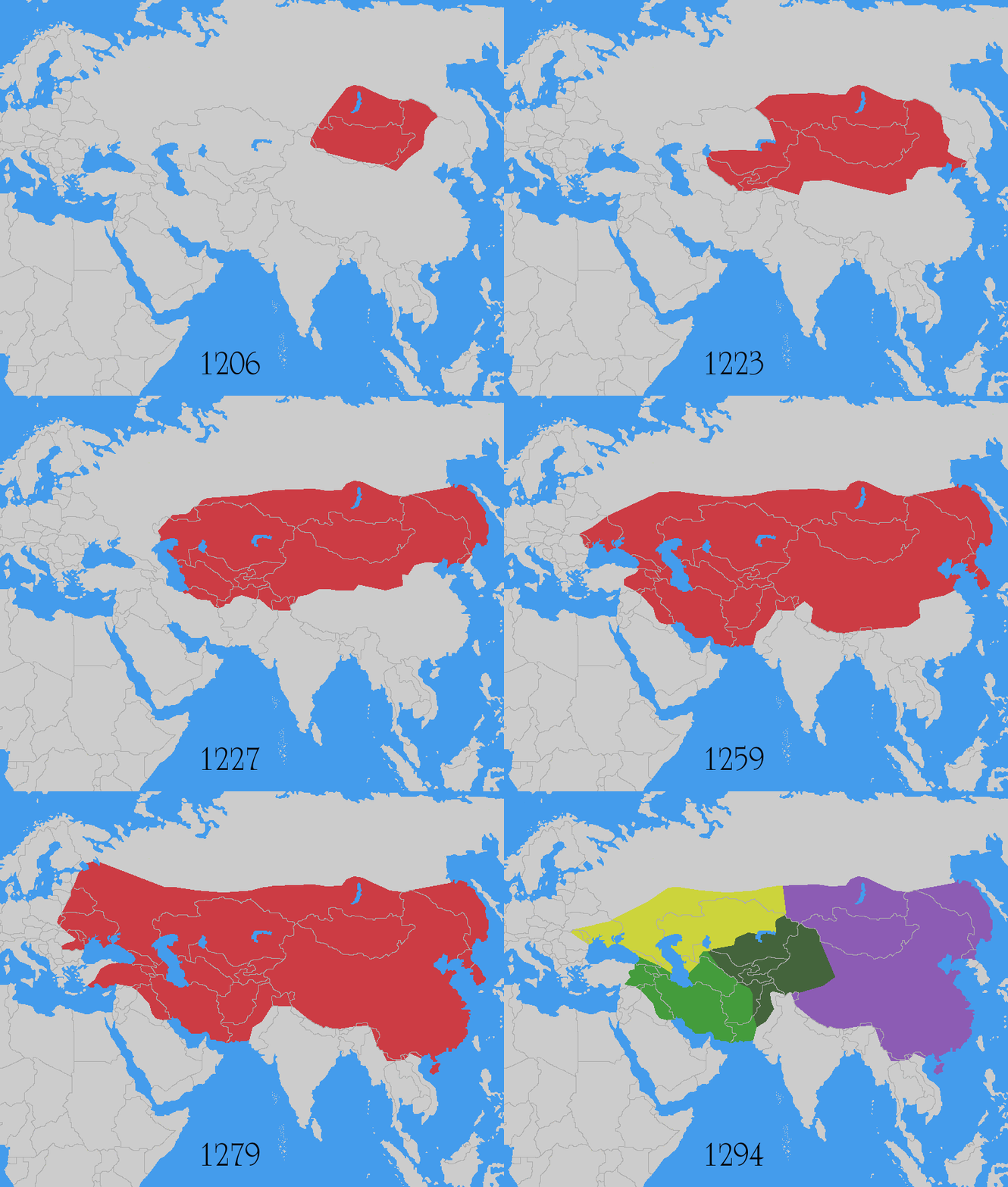 |
The Mongol Empire
Mongol Empire
The Mongol Empire , initially named as Greater Mongol State was a great empire during the 13th and 14th centuries...
was an empire from the 13th and 14th century spanning from Eastern Europe across Asia. It is the largest contiguous empire in the history of the world. It emerged from the unification of Mongol and Turkic tribes in modern day Mongolia, and grew through invasions, after Genghis Khan had been proclaimed ruler of all Mongols in 1206. At its greatest extent it stretched from the Danube to the Sea of Japan and from northern Siberia to Camboja, covering over 24000000 km² (9,266,451.8 sq mi), 22% of the Earth's total land area, and held sway over a population of over 100 million people. It is often identified as the "Mongol World Empire" because it spanned much of Eurasia. As a result of the empire's conquests and political and economic impact on most of the Old World, its wars with other great powers in Africa, Asia and Europe are also believed to be an ancient world war. Under the Mongols new technologies, various commodities and ideologies were disseminated and exchanged across Eurasia.
However, the empire began to split following the succession war in 1260-1264, with the Golden Horde and the Chagatai Khanate being de facto independent and refusing to accept Kublai Khan as Khagan. By the time of Kublai Khan's death, the Mongol Empire had already fractured into four separate khanates or empires, each pursuing its own separate interests and objectives: the Golden Horde
Golden Horde
The Golden Horde was a Mongol and later Turkicized khanate that formed the north-western sector of the Mongol Empire...
in Russia
Russia
Russia or , officially known as both Russia and the Russian Federation , is a country in northern Eurasia. It is a federal semi-presidential republic, comprising 83 federal subjects...
, the Chagatai Khanate
Chagatai Khanate
The Chagatai Khanate was a Turko-Mongol khanate that comprised the lands ruled by Chagatai Khan , second son of the Great Khan Genghis Khan, and his descendents and successors...
in Central Asia
Central Asia
Central Asia is a core region of the Asian continent from the Caspian Sea in the west, China in the east, Afghanistan in the south, and Russia in the north...
, the Ilkhanate
Ilkhanate
The Ilkhanate, also spelled Il-khanate , was a Mongol khanate established in Azerbaijan and Persia in the 13th century, considered a part of the Mongol Empire...
in Persia and the Yuan dynasty
Yuan Dynasty
The Yuan Dynasty , or Great Yuan Empire was a ruling dynasty founded by the Mongol leader Kublai Khan, who ruled most of present-day China, all of modern Mongolia and its surrounding areas, lasting officially from 1271 to 1368. It is considered both as a division of the Mongol Empire and as an...
in China
China
Chinese civilization may refer to:* China for more general discussion of the country.* Chinese culture* Greater China, the transnational community of ethnic Chinese.* History of China* Sinosphere, the area historically affected by Chinese culture...
. The Mongol rulers of Central Asia successfully resisted Kublai's attempt to reduce the Chagatayid and Ogedeid families to obedience. It was not until 1304, when the Yuan Dynasty re-established nominal suzerainty over the western khanates. However, with the breakup of the Yuan Dynasty in 1368, the Mongol Empire finally dissolved.
Yuan Dynasty
1271–1368
The Yuan Dynasty
Yuan Dynasty
The Yuan Dynasty , or Great Yuan Empire was a ruling dynasty founded by the Mongol leader Kublai Khan, who ruled most of present-day China, all of modern Mongolia and its surrounding areas, lasting officially from 1271 to 1368. It is considered both as a division of the Mongol Empire and as an...
lasting from 1271 to 1368. The dynasty was established by ethnic Mongols
Mongols
Mongols ) are a Central-East Asian ethnic group that lives mainly in the countries of Mongolia, China, and Russia. In China, ethnic Mongols can be found mainly in the central north region of China such as Inner Mongolia...
, and it had nominal control over the entire Mongol Empire
Mongol Empire
The Mongol Empire , initially named as Greater Mongol State was a great empire during the 13th and 14th centuries...
(stretching from Eastern Europe
Eastern Europe
Eastern Europe is the eastern part of Europe. The term has widely disparate geopolitical, geographical, cultural and socioeconomic readings, which makes it highly context-dependent and even volatile, and there are "almost as many definitions of Eastern Europe as there are scholars of the region"...
to the fertile crescent
Fertile Crescent
The Fertile Crescent, nicknamed "The Cradle of Civilization" for the fact the first civilizations started there, is a crescent-shaped region containing the comparatively moist and fertile land of otherwise arid and semi-arid Western Asia. The term was first used by University of Chicago...
to Russia
Russia
Russia or , officially known as both Russia and the Russian Federation , is a country in northern Eurasia. It is a federal semi-presidential republic, comprising 83 federal subjects...
); however, the Mongol rulers in Asia were only interested in China. Later successors did not even attempt to stake claim over the Khakhan title and saw themselves as Emperor of China
Emperor of China
The Emperor of China refers to any sovereign of Imperial China reigning between the founding of Qin Dynasty of China, united by the King of Qin in 221 BCE, and the fall of Yuan Shikai's Empire of China in 1916. When referred to as the Son of Heaven , a title that predates the Qin unification, the...
, as the Yuan Dynasty grew from being an Imperial Mongol administration under Kublai Khan
Kublai Khan
Kublai Khan , born Kublai and also known by the temple name Shizu , was the fifth Great Khan of the Mongol Empire from 1260 to 1294 and the founder of the Yuan Dynasty in China...
to becoming a basically Chinese institution under his successors.
In according to the Chinese historians, the Mongolian Yuan Dynasty followed the Song Dynasty and preceded the Ming Dynasty
Ming Dynasty
The Ming Dynasty, also Empire of the Great Ming, was the ruling dynasty of China from 1368 to 1644, following the collapse of the Mongol-led Yuan Dynasty. The Ming, "one of the greatest eras of orderly government and social stability in human history", was the last dynasty in China ruled by ethnic...
in the historiography of China.
A rich cultural diversity developed during the Yuan Dynasty. The major cultural achievements were the development of drama and the novel and the increased use of the written vernacular. The political unity of China and much of central Asia promoted trade between East and West. The Mongols' extensive West Asian and European contacts produced a fair amount of cultural exchange. The other cultures and peoples in the Mongol World Empire permanently influenced China. Tibetan-rite Tantric Buddhism also had a significant impact in Chinese Buddhism during that period. The Muslims of the Yuan Dynasty introduced Middle Eastern cartography, astronomy, medicine, clothing, and diet in East Asia. Middle Eastern crops such as carrots, turnips, new varieties of lemons, eggplants, and melons, high-quality granulated sugar, and cotton were all either introduced or successfully popularized by the Yuan Mongols.
The Yuan undertook extensive public works. Road and water communications were reorganized and improved. To provide against possible famines, granaries were ordered built throughout the empire. The city of Beijing was rebuilt with new palace grounds that included artificial lakes, hills and mountains, and parks. During the Yuan period, Beijing became the terminus of the Grand Canal of China, which was completely renovated. These commercially oriented improvements encouraged overland and maritime commerce throughout Asia and facilitated direct Chinese contacts with Europe. Chinese travelers to the West were able to provide assistance in such areas as hydraulic engineering. Contacts with the West also brought the introduction to China of a major food crop, sorghum, along with other foreign food products and methods of preparation.
In historiography of Mongolia, the Yuan Dynasty is generally considered to be the continuation of the Mongol Empire. In traditional historiography of China on the other hand, the Yuan Dynasty is usually considered to be the legitimate dynasty between the Song Dynasty and the Ming Dynasty. Note, however, Yuan Dynasty is traditionally often extended to cover the Mongol Empire before Kublai Khan's formal establishment of the Yuan in 1271, partly because Kublai had his grandfather Genghis Khan placed on the official record as the founder of the dynasty or Taizu. Despite the traditional historiography as well as the official views (including the government of the Ming Dynasty which overthrew the Yuan Dynasty), there also exist Chinese people who did not consider Yuan Dynasty as a legitimate dynasty of China, but a period of foreign domination. The latter believe that Han Chinese were treated as second-class citizens, and China stagnated economically and scientifically; in addition, Chinese technologies such as gunpowder and the compass spread to Europe under the Yuan.
Ming Dynasty
1370s - 1600s
| Ming Dynasty Ming Dynasty The Ming Dynasty, also Empire of the Great Ming, was the ruling dynasty of China from 1368 to 1644, following the collapse of the Mongol-led Yuan Dynasty. The Ming, "one of the greatest eras of orderly government and social stability in human history", was the last dynasty in China ruled by ethnic... |
|---|
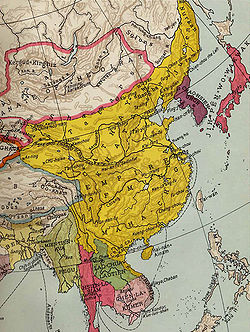 |
The Ming Dynasty
Ming Dynasty
The Ming Dynasty, also Empire of the Great Ming, was the ruling dynasty of China from 1368 to 1644, following the collapse of the Mongol-led Yuan Dynasty. The Ming, "one of the greatest eras of orderly government and social stability in human history", was the last dynasty in China ruled by ethnic...
(Empire of the Great Ming), was the ruling dynasty of China from 1368 to 1644, following the collapse of the Mongol-led Yuan Dynasty. The Ming, "one of the greatest eras of orderly government and social stability in human history", was the last dynasty in China ruled by ethnic Hans. Although the Ming capital Beijing fell in 1644 to a rebellion led by Li Zicheng who established the Shun Dynasty, which was soon replaced by the Manchu-led Qing Dynasty, regimes loyal to the Ming throne (collectively called the Southern Ming Dynasty) survived until 1662.
Ming rule saw the construction of a navy and a standing army. Although private maritime trade and official tribute missions from China had taken place in previous dynasties, the tributary fleet under the Muslim eunuch admiral Zheng He in the 15th century. There were enormous construction projects, including the restoration of the Grand Canal and the Great Wall and the establishment of the Forbidden City in Beijing during the first quarter of the 15th century. Estimates for the late-Ming population vary from 160 to 200 million. The Ming dynasty is often regarded as both a high point in Chinese civilization as well as a dynasty in which early signs of capitalism emerged.
Emperor Hongwu attempted to create a society of self-sufficient rural communities in a rigid, immobile system that would have no need to engage with the commercial life and trade of urban centers. His rebuilding of China's agricultural base and strengthening of communication routes through the militarized courier system had the unintended effect of creating a vast agricultural surplus that could be sold at burgeoning markets located along courier routes. Rural culture and commerce became influenced by urban trends. The upper echelons of society embodied in the scholarly gentry class were also affected by this new consumption-based culture. In a departure from tradition, merchant families began to produce examination candidates to become scholar-officials and adopted cultural traits and practices typical of the gentry. Parallel to this trend involving social class and commercial consumption were changes in social and political philosophy, bureaucracy and governmental institutions, and even arts and literature
Timurid Empire
1370–1526| Timurid Empire |
|---|
The Timurids were a Persianate Central Asia
Central Asia
Central Asia is a core region of the Asian continent from the Caspian Sea in the west, China in the east, Afghanistan in the south, and Russia in the north...
n Sunni Muslim
Islam
Islam . The most common are and . : Arabic pronunciation varies regionally. The first vowel ranges from ~~. The second vowel ranges from ~~~...
dynasty of originally Turko-Mongol descent whose empire included the whole of Central Asia, Iran
Iran
Iran , officially the Islamic Republic of Iran , is a country in Southern and Western Asia. The name "Iran" has been in use natively since the Sassanian era and came into use internationally in 1935, before which the country was known to the Western world as Persia...
, modern Afghanistan
Afghanistan
Afghanistan , officially the Islamic Republic of Afghanistan, is a landlocked country located in the centre of Asia, forming South Asia, Central Asia and the Middle East. With a population of about 29 million, it has an area of , making it the 42nd most populous and 41st largest nation in the world...
, as well as large parts of Pakistan
Pakistan
Pakistan , officially the Islamic Republic of Pakistan is a sovereign state in South Asia. It has a coastline along the Arabian Sea and the Gulf of Oman in the south and is bordered by Afghanistan and Iran in the west, India in the east and China in the far northeast. In the north, Tajikistan...
, India, Mesopotamia
Mesopotamia
Mesopotamia is a toponym for the area of the Tigris–Euphrates river system, largely corresponding to modern-day Iraq, northeastern Syria, southeastern Turkey and southwestern Iran.Widely considered to be the cradle of civilization, Bronze Age Mesopotamia included Sumer and the...
and Caucasus
Caucasus
The Caucasus, also Caucas or Caucasia , is a geopolitical region at the border of Europe and Asia, and situated between the Black and the Caspian sea...
.
It was founded by the legendary conqueror Timur
Timur
Timur , historically known as Tamerlane in English , was a 14th-century conqueror of West, South and Central Asia, and the founder of the Timurid dynasty in Central Asia, and great-great-grandfather of Babur, the founder of the Mughal Dynasty, which survived as the Mughal Empire in India until...
(Tamerlane) in the 14th century. In the 16th century, Timurid prince Babur, the ruler of Ferghana, invaded North India and founded the Mughal Empire, which ruled most of the North India until its decline after Aurangzeb in the early 18th century, and was formally dissolved by the British Raj after the Indian rebellion of 1857. Later princes of the dynasty predominantly used the title Mirza to show descent from the Amir.
Although the Timurids hailed from the Barlas tribe which was of Turkicized Mongol origin, they had embraced Persian culture, converted to Islam and resided in Turkestan and Khorasan. Thus, the Timurid era had a dual character, which reflected both the Turco-Mongol origins and the Persian literary, artistic, and courtly high culture of the dynasty.
Khmer Empire
802-1431
| Khmer Empire Khmer Empire The Khmer Empire was one of the most powerful empires in Southeast Asia. The empire, which grew out of the former kingdom of Chenla, at times ruled over and/or vassalized parts of modern-day Laos, Thailand, Vietnam, Burma, and Malaysia. Its greatest legacy is Angkor, the site of the capital city... |
|---|
The Khmer Empire
Khmer Empire
The Khmer Empire was one of the most powerful empires in Southeast Asia. The empire, which grew out of the former kingdom of Chenla, at times ruled over and/or vassalized parts of modern-day Laos, Thailand, Vietnam, Burma, and Malaysia. Its greatest legacy is Angkor, the site of the capital city...
was one of the most powerful empires in Southeast Asia
Southeast Asia
Southeast Asia, South-East Asia, South East Asia or Southeastern Asia is a subregion of Asia, consisting of the countries that are geographically south of China, east of India, west of New Guinea and north of Australia. The region lies on the intersection of geological plates, with heavy seismic...
, based in what is now Cambodia
Cambodia
Cambodia , officially known as the Kingdom of Cambodia, is a country located in the southern portion of the Indochina Peninsula in Southeast Asia...
. The empire, which grow out of former kingdom of Chenla
Chenla
Chenla is the Chinese designation for Cambodia after the fall of Funan. That name was still used in the 13th century by the Chinese envoy Zhou Daguan, author of the Manners and Customs of Cambodia...
, at times ruled over and/or vassalized parts of modern-day Laos
Laos
Laos Lao: ສາທາລະນະລັດ ປະຊາທິປະໄຕ ປະຊາຊົນລາວ Sathalanalat Paxathipatai Paxaxon Lao, officially the Lao People's Democratic Republic, is a landlocked country in Southeast Asia, bordered by Burma and China to the northwest, Vietnam to the east, Cambodia to the south and Thailand to the west...
, Thailand
Thailand
Thailand , officially the Kingdom of Thailand , formerly known as Siam , is a country located at the centre of the Indochina peninsula and Southeast Asia. It is bordered to the north by Burma and Laos, to the east by Laos and Cambodia, to the south by the Gulf of Thailand and Malaysia, and to the...
, Vietnam
Vietnam
Vietnam – sometimes spelled Viet Nam , officially the Socialist Republic of Vietnam – is the easternmost country on the Indochina Peninsula in Southeast Asia. It is bordered by China to the north, Laos to the northwest, Cambodia to the southwest, and the South China Sea –...
, Myanmar
Myanmar
Burma , officially the Republic of the Union of Myanmar , is a country in Southeast Asia. Burma is bordered by China on the northeast, Laos on the east, Thailand on the southeast, Bangladesh on the west, India on the northwest, the Bay of Bengal to the southwest, and the Andaman Sea on the south....
, and Malaysia. Its greatest legacy is Angkor
Angkor
Angkor is a region of Cambodia that served as the seat of the Khmer Empire, which flourished from approximately the 9th to 15th centuries. The word Angkor is derived from the Sanskrit nagara , meaning "city"...
, the site of capitals cities during the empire's zenith. Angkor bears testimony to the Khmer empire's immense power and wealth, as well as the variety of belief systems that it patronised over time. The empire's official religions included Hinduism
Hinduism
Hinduism is the predominant and indigenous religious tradition of the Indian Subcontinent. Hinduism is known to its followers as , amongst many other expressions...
and Mahayana Buddhism, until Theravada Buddhism prevailed, even among plain folks, after its introduction from Sri Lanka
Sri Lanka
Sri Lanka, officially the Democratic Socialist Republic of Sri Lanka is a country off the southern coast of the Indian subcontinent. Known until 1972 as Ceylon , Sri Lanka is an island surrounded by the Indian Ocean, the Gulf of Mannar and the Palk Strait, and lies in the vicinity of India and the...
as of the 13th century. Modern researches by satellites have revealed Angkor to be the largest pre-industrial urban center in the world.
From Kambuja itself - and so also from the Angkor region - no written records have survived other than stone inscriptions. Therefore the current knowledge of the historical Khmer civilization is derived primarily from:
- archaeological excavation, reconstruction and investigation
- stone inscriptions (most important are foundation steles of temples), which report on the political and religious deeds of the kings
- reliefs in a series of temple walls with depictions of military marches, life in the palace, market scenes and also the everyday lives of the population
- reports and chronicles of Chinese diplomats, traders and travellers.
The beginning of the era of the Khmer Empire is conventionally dated to 802 AD. In this year, king Jayavarman II had himself declared chakravartin ("king of the world", or "king of kings") on Phnom Kulen.
Suryavarman II
Suryavarman II was king of the Khmer Empire from 1113 AD to 1145-1150 AD and the builder of Angkor Wat, which he dedicated to the Hindu god Vishnu...
was the kingdom united internally and extended externally. Under his rule, the largest temple of Angkor was built in a period of 37 years: Angkor Wat, dedicated to the god Vishnu. Suryavarman II conquered the Mon kingdom of Haripunjaya to the west, and the area further west to the border with the kingdom of Bagan, in the south further parts of the Malay peninsula down to the kingdom of Grahi, in the east several provinces of Champa and the countries in the north as far as the southern border of modern Laos. Suryavarman II's end is unclear. The last inscription, which mentions his name in connection with a planned invasion of Vietnam, is from the year 1145. He died during a failed military expedition in Đại Việt territory around 1145 and 1150.
Srivijaya
| Srivijaya Srivijaya Srivijaya was a powerful ancient thalassocratic Malay empire based on the island of Sumatra, modern day Indonesia, which influenced much of Southeast Asia. The earliest solid proof of its existence dates from the 7th century; a Chinese monk, I-Tsing, wrote that he visited Srivijaya in 671 for 6... |
|---|
The First Nusantara Kingdom (Srivijaya Empire) has success uniting most western part of Nusantara
Nusantara
Nusantara is an Indonesian word for the Indonesian archipelago. It is originated from Old Javanese and literally means "archipelago".The word Nusantara was taken from an oath by Gajah Mada, as written on an old Javanese manuscript Pararaton and Negarakertagama...
or maritime Southeast Asia. Srivijaya was a coastal trading centre and was a thalassocracy
Thalassocracy
The term thalassocracy refers to a state with primarily maritime realms—an empire at sea, such as Athens or the Phoenician network of merchant cities...
. As such, it did not extend its influence far beyond the coastal areas of the islands of Southeast Asia, with the exception of contributing to the population of Madagascar
Madagascar
The Republic of Madagascar is an island country located in the Indian Ocean off the southeastern coast of Africa...
3,300 miles to the west.
According to the Kota Kapur Inscription, discovered on Bangka Island
Bangka Island
Bangka is an island lying east of Sumatra, Indonesia. Population 626,955. Area: c.4,600 sq mi .There is an additional small island named Pulau Bangka in northern Sulawesi, Indonesia.-Geography:...
, the empire conquered most of Southern Sumatra
Sumatra
Sumatra is an island in western Indonesia, westernmost of the Sunda Islands. It is the largest island entirely in Indonesia , and the sixth largest island in the world at 473,481 km2 with a population of 50,365,538...
and neighboring island of Bangka, as far as Lampung
Lampung
Lampung is a province of Indonesia. It is located on the southern tip of the island of Sumatra and borders the provinces of Bengkulu and South Sumatra. Lampung is the original home of the Lampung people, who speak a distinct language from other people in Sumatra and have their own alphabet. Its...
. Also according to this inscription, Jayanasa launched a military campaign against Bhumi Java in late 7th century, a period which coincides with the decline of Tarumanagara
Tarumanagara
Tarumanagara or Taruma Kingdom or just Taruma is an early Sundanese Indianized kingdom, whose fifth-century ruler, Purnavarman, produced the earliest known inscriptions on Java island...
in West Java
West Java
West Java , with a population of over 43 million, is the most populous and most densely populated province of Indonesia. Located on the island of Java, it is slightly smaller in area than densely populated Taiwan, but with nearly double the population...
and Holing (Kalingga) in Central Java
Central Java
Central Java is a province of Indonesia. The administrative capital is Semarang. It is one of six provinces on the island of Java.This province is the province of high Human Development in Indonesia and its Points Development Index countries is equivalent to Lebanon. The province of Central Java...
. The empire thus grew to control the trade on the Strait of Malacca
Strait of Malacca
The Strait of Malacca is a narrow, stretch of water between the Malay Peninsula and the Indonesian island of Sumatra. It is named after the Malacca Sultanate that ruled over the archipelago between 1414 to 1511.-Extent:...
, Sunda Strait
Sunda Strait
The Sunda Strait is the strait between the Indonesian islands of Java and Sumatra. It connects the Java Sea to the Indian Ocean...
, the South China Sea
South China Sea
The South China Sea is a marginal sea that is part of the Pacific Ocean, encompassing an area from the Singapore and Malacca Straits to the Strait of Taiwan of around...
, the Java Sea
Java Sea
The Java Sea is a large shallow sea on the Sunda Shelf. It was formed as sea levels rose at the end of the last ice age. The Java Sea lies between the Indonesian islands of Borneo to the north, Java to the south; Sumatra to the west, and Sulawesi to the east...
, and Karimata Strait
Karimata Strait
The Karimata Strait is the wide strait that connects the South China Sea to the Java Sea, dividing the islands of Sumatra from Borneo , both in Indonesia....
.During the same century, Langkasuka
Langkasuka
Langkasuka was an ancient Hindu Malay kingdom located in the Malay Peninsula...
on the Malay Peninsula
Malay Peninsula
The Malay Peninsula or Thai-Malay Peninsula is a peninsula in Southeast Asia. The land mass runs approximately north-south and, at its terminus, is the southern-most point of the Asian mainland...
became part of Srivijaya. Soon after this, Pan Pan and Trambralinga, which were located north of Langkasuka, came under Srivijayan influence. These kingdoms on the peninsula were major trading nations that transported goods across the peninsula's isthmus. With the expansion into Java and the Malay Peninsula, Srivijaya controlled two major trade choke point
Choke point
In military strategy, a choke point is a geographical feature on land such as a valley, defile or a bridge, or at sea such as a strait which an armed force is forced to pass, sometimes on a substantially narrower front, and therefore greatly decreasing its combat power, in order to reach its...
s in Southeast Asia. Some Srivijayan temple ruins are observable in Thailand
Thailand
Thailand , officially the Kingdom of Thailand , formerly known as Siam , is a country located at the centre of the Indochina peninsula and Southeast Asia. It is bordered to the north by Burma and Laos, to the east by Laos and Cambodia, to the south by the Gulf of Thailand and Malaysia, and to the...
and Cambodia
Cambodia
Cambodia , officially known as the Kingdom of Cambodia, is a country located in the southern portion of the Indochina Peninsula in Southeast Asia...
.
At some point in the 7th century, Cham ports in eastern Indochina started to attract traders. This diverted the flow of trade from Srivijaya. In an effort to divert the flow, the Srivijayan king or maharaja
Maharaja
Mahārāja is a Sanskrit title for a "great king" or "high king". The female equivalent title Maharani denotes either the wife of a Maharaja or, in states where that was customary, a woman ruling in her own right. The widow of a Maharaja is known as a Rajamata...
, Dharmasetu
Dharmasetu
Dharmasetu was an 8th century maharaja of Srivijaya. Under his reign, he successfully incorporated Pan Pan, a kingdom located in the north of the Malay Peninsula into Srivijayan sphere of influence before 775 AD....
, launched various raids against the coastal cities of Indochina. The city of Indrapura
Indrapura (Champa)
Indrapura from 875 CE was the capital city of the ancient kingdom of Champa for several decades, under the reign of Indravarman II and some of his followers belonging to the 6th dynasty.The site is near the present-day village of Đông Dương, not far from the modern city of Da...
by the Mekong River was temporarily controlled from Palembang, capital of the empire during the century, in the early 8th century. By that century, Srivijaya controlled both the spice route traffic and local trade, charging a toll on passing ships. Serving as an entrepôt for Chinese, Malay, and Indian markets, the port of Palembang, accessible from the coast by way of a river, accumulated great wealth. Envoys travelled to and from China frequently.
The migration to Madagascar
Madagascar
The Republic of Madagascar is an island country located in the Indian Ocean off the southeastern coast of Africa...
accelerated in the 9th century, when the powerful Sumatran empire of Srivijaya controlled much of the maritime trade in the Indian Ocean
Indian Ocean
The Indian Ocean is the third largest of the world's oceanic divisions, covering approximately 20% of the water on the Earth's surface. It is bounded on the north by the Indian Subcontinent and Arabian Peninsula ; on the west by eastern Africa; on the east by Indochina, the Sunda Islands, and...
.
Maya Civilization
The Maya
Maya civilization
The Maya is a Mesoamerican civilization, noted for the only known fully developed written language of the pre-Columbian Americas, as well as for its art, architecture, and mathematical and astronomical systems. Initially established during the Pre-Classic period The Maya is a Mesoamerican...
is a Mesoamerica
Mesoamerica
Mesoamerica is a region and culture area in the Americas, extending approximately from central Mexico to Belize, Guatemala, El Salvador, Honduras, Nicaragua, and Costa Rica, within which a number of pre-Columbian societies flourished before the Spanish colonization of the Americas in the 15th and...
n civilization
Civilization
Civilization is a sometimes controversial term that has been used in several related ways. Primarily, the term has been used to refer to the material and instrumental side of human cultures that are complex in terms of technology, science, and division of labor. Such civilizations are generally...
, noted for the only known fully developed written language
Maya script
The Maya script, also known as Maya glyphs or Maya hieroglyphs, is the writing system of the pre-Columbian Maya civilization of Mesoamerica, presently the only Mesoamerican writing system that has been substantially deciphered...
of the pre-Columbian
Pre-Columbian
The pre-Columbian era incorporates all period subdivisions in the history and prehistory of the Americas before the appearance of significant European influences on the American continents, spanning the time of the original settlement in the Upper Paleolithic period to European colonization during...
Americas, as well as its art
Maya art
Maya art, here taken to mean the visual arts, is the artistic style typical of the Maya civilization, that took shape in the course the Preclassic period , and grew greater during the Classic period Maya art, here taken to mean the visual arts, is the artistic style typical of the Maya...
, architecture
Maya architecture
A unique and spectacular style, Maya architecture spans several thousands of years. Often the most dramatic and easily recognizable as Maya are the stepped pyramids from the Terminal Pre-classic period and beyond. Being based on the general Mesoamerican architectural traditions these pyramids...
, and mathematical and astronomical systems. Initially established during the Preclassic period
Mesoamerican chronology
Mesoamerican chronology divides the history of pre-Columbian Mesoamerica into several periods: the Paleo-Indian , the Archaic , the Preclassic , the Classic , and the Postclassic...
(c. 2000 BC to 250 AD), many Maya cities reached their highest state development during the Classic period
Mesoamerican chronology
Mesoamerican chronology divides the history of pre-Columbian Mesoamerica into several periods: the Paleo-Indian , the Archaic , the Preclassic , the Classic , and the Postclassic...
(c. 250 to 900), and continued throughout the Postclassic period until the arrival of the Spanish
Spanish conquest of Yucatán
The Spanish conquest of Yucatán was the campaign undertaken by the Spanish conquistadores against the Late Postclassic Maya states and polities, particularly in the northern and central Yucatán Peninsula but also involving the Maya polities of the Guatemalan highlands region...
. At its peak, it was one of the most densely populated and culturally dynamic societies in the world.
The Classic period (c. 250–900 AD) witnessed the peak of large-scale construction and urbanism, the recording of monumental inscriptions, and a period of significant intellectual and artistic development, particularly in the southern lowland regions. They developed an agriculturally intensive, city-centered empire consisting of numerous independent city-states. This includes the well-known cities of Tikal, Palenque, Copán and Calakmul, but also the lesser known Dos Pilas, Uaxactun, Altun Ha, and Bonampak, among others.
Inca Empire
| Inca Empire Inca Empire The Inca Empire, or Inka Empire , was the largest empire in pre-Columbian America. The administrative, political and military center of the empire was located in Cusco in modern-day Peru. The Inca civilization arose from the highlands of Peru sometime in the early 13th century... |
|---|
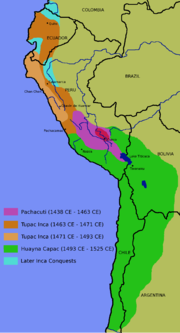 |
The Inca Empire
Inca Empire
The Inca Empire, or Inka Empire , was the largest empire in pre-Columbian America. The administrative, political and military center of the empire was located in Cusco in modern-day Peru. The Inca civilization arose from the highlands of Peru sometime in the early 13th century...
was the largest empire in pre-Columbian America. The administrative, political and military center of the empire was located in Cusco
Cusco
Cusco , often spelled Cuzco , is a city in southeastern Peru, near the Urubamba Valley of the Andes mountain range. It is the capital of the Cusco Region as well as the Cuzco Province. In 2007, the city had a population of 358,935 which was triple the figure of 20 years ago...
in modern-day Peru
Peru
Peru , officially the Republic of Peru , is a country in western South America. It is bordered on the north by Ecuador and Colombia, on the east by Brazil, on the southeast by Bolivia, on the south by Chile, and on the west by the Pacific Ocean....
. The Inca Empire arose from the highlands of Peru sometime in early 13th century. From 1438 to 1533, the Incas used a variety of methods, from conquest to peaceful assimilation, to incorporate a large portion of western South America
South America
South America is a continent situated in the Western Hemisphere, mostly in the Southern Hemisphere, with a relatively small portion in the Northern Hemisphere. The continent is also considered a subcontinent of the Americas. It is bordered on the west by the Pacific Ocean and on the north and east...
, centered on the Andean
Andes
The Andes is the world's longest continental mountain range. It is a continual range of highlands along the western coast of South America. This range is about long, about to wide , and of an average height of about .Along its length, the Andes is split into several ranges, which are separated...
mountain ranges, including large parts of modern Ecuador
Ecuador
Ecuador , officially the Republic of Ecuador is a representative democratic republic in South America, bordered by Colombia on the north, Peru on the east and south, and by the Pacific Ocean to the west. It is one of only two countries in South America, along with Chile, that do not have a border...
, Peru, western and south central Bolivia
Bolivia
Bolivia officially known as Plurinational State of Bolivia , is a landlocked country in central South America. It is the poorest country in South America...
, northwest Argentina
Argentina
Argentina , officially the Argentine Republic , is the second largest country in South America by land area, after Brazil. It is constituted as a federation of 23 provinces and an autonomous city, Buenos Aires...
, north and north-central Chile
Chile
Chile ,officially the Republic of Chile , is a country in South America occupying a long, narrow coastal strip between the Andes mountains to the east and the Pacific Ocean to the west. It borders Peru to the north, Bolivia to the northeast, Argentina to the east, and the Drake Passage in the far...
, and southern Colombia
Colombia
Colombia, officially the Republic of Colombia , is a unitary constitutional republic comprising thirty-two departments. The country is located in northwestern South America, bordered to the east by Venezuela and Brazil; to the south by Ecuador and Peru; to the north by the Caribbean Sea; to the...
.
 |
 |
There is some debate about the number of people inhabiting Tawantinsuyu at its peak, with estimates ranging from as few as 4 million people, to more than 37 million. The reason for these various estimates is that in spite of the fact that the Inca kept excellent census records using their quipu, knowledge of how to read them has been lost, and almost all of them had been destroyed by the Spaniards in the course of their conquest.
The most powerful figure in the empire was the Sapa Inca ('the unique Inca'). Only descendants of the original Inca tribe ascended to the level of Inca. Most young members of the Inca's family attended Yachay Wasis (houses of knowledge) to obtain their education.
The Inca Empire was a federalist system which consisted of a central government with the Inca at its head and four provinces. The four corners of these provinces met at the center, Cusco
Cusco
Cusco , often spelled Cuzco , is a city in southeastern Peru, near the Urubamba Valley of the Andes mountain range. It is the capital of the Cusco Region as well as the Cuzco Province. In 2007, the city had a population of 358,935 which was triple the figure of 20 years ago...
. Each province had a governor who oversaw local officials, who in turn supervised agriculturally productive river valleys, cities and mines. The local officials were responsible for settling disputes and keeping track of each family's contribution to the mita (mandatory public service).
Architecture was by far the most important of the Inca arts, with textiles reflecting motifs that were at their height in architecture. The main example is the capital city of Cusco. The breathtaking site of Machu Picchu was constructed by Inca engineers. The stone temples constructed by the Inca used a mortarless construction that fit together so well that a knife could not be fitted through the stonework. This was a process first used on a large scale by the Pucara
Pucará
A pucará is a term that refers to the ruins of the fortifications made by the natives of the central Andean cultures and particularly to those of the Inca...
peoples (ca. 300 BC–AD 300) and later in the great city of Tiwanaku
Tiwanaku
Tiwanaku, is an important Pre-Columbian archaeological site in western Bolivia, South America. Tiwanaku is recognized by Andean scholars as one of the most important precursors to the Inca Empire, flourishing as the ritual and administrative capital of a major state power for approximately five...
(ca. AD 400–1100). The rocks used in construction were sculpted to fit together exactly by repeatedly lowering a rock onto another and carving away any sections on the lower rock where the dust was compressed. The tight fit and the concavity on the lower rocks made them extraordinarily stable.
Aztec Empire
Aztec
The Aztec people were certain ethnic groups of central Mexico, particularly those groups who spoke the Nahuatl language and who dominated large parts of Mesoamerica in the 14th, 15th and 16th centuries, a period referred to as the late post-classic period in Mesoamerican chronology.Aztec is the...
people were certain ethnic groups of central Mexico
Mexico
The United Mexican States , commonly known as Mexico , is a federal constitutional republic in North America. It is bordered on the north by the United States; on the south and west by the Pacific Ocean; on the southeast by Guatemala, Belize, and the Caribbean Sea; and on the east by the Gulf of...
, particularly those groups who spoke the Nahuatl language
Nahuatl
Nahuatl is thought to mean "a good, clear sound" This language name has several spellings, among them náhuatl , Naoatl, Nauatl, Nahuatl, Nawatl. In a back formation from the name of the language, the ethnic group of Nahuatl speakers are called Nahua...
and who dominated large parts of Mesoamerica
Mesoamerica
Mesoamerica is a region and culture area in the Americas, extending approximately from central Mexico to Belize, Guatemala, El Salvador, Honduras, Nicaragua, and Costa Rica, within which a number of pre-Columbian societies flourished before the Spanish colonization of the Americas in the 15th and...
in the 14th, 15th and 16th centuries, a period referred to as the Late post-Classic period in Mesoamerican chronology
Mesoamerican chronology
Mesoamerican chronology divides the history of pre-Columbian Mesoamerica into several periods: the Paleo-Indian , the Archaic , the Preclassic , the Classic , and the Postclassic...
. From the 13th century Valley of Mexico
Valley of Mexico
The Valley of Mexico is a highlands plateau in central Mexico roughly coterminous with the present-day Distrito Federal and the eastern half of the State of Mexico. Surrounded by mountains and volcanoes, the Valley of Mexico was a centre for several pre-Columbian civilizations, including...
was the core of Aztec civilization: here the capital of the Aztec Triple Alliance, the city of Tenochtitlan, was built upon raised islets in Lake Texcoco
Lake Texcoco
Lake Texcoco was a natural lake formation within the Valley of Mexico. The Aztecs built the city of Tenochtitlan on an island in the lake. The Spaniards built Mexico City over Tenochtitlan...
. The Triple Alliance formed its tributary empire expanding its political hegemony far beyond the Valley of Mexico, conquering other city states throughout Mesoamerica. In 1521, in what is probably the most widely known episode in the Spanish colonization of the Americas
Spanish colonization of the Americas
Colonial expansion under the Spanish Empire was initiated by the Spanish conquistadores and developed by the Monarchy of Spain through its administrators and missionaries. The motivations for colonial expansion were trade and the spread of the Christian faith through indigenous conversions...
, Hernán Cortés
Hernán Cortés
Hernán Cortés de Monroy y Pizarro, 1st Marquis of the Valley of Oaxaca was a Spanish Conquistador who led an expedition that caused the fall of the Aztec Empire and brought large portions of mainland Mexico under the rule of the King of Castile in the early 16th century...
, along with a large number of Nahuatl speaking indigenous allies, conquered Tenochtitlan and defeated the Aztec Triple Alliance under the leadership of Hueyi Tlatoani Moctezuma II
Moctezuma II
Moctezuma , also known by a number of variant spellings including Montezuma, Moteuczoma, Motecuhzoma and referred to in full by early Nahuatl texts as Motecuhzoma Xocoyotzin, was the ninth tlatoani or ruler of Tenochtitlan, reigning from 1502 to 1520...
; In the series of events often referred to as "The Fall of the Aztec Empire". Subsequently the Spanish founded the new settlement of Mexico City
Mexico City
Mexico City is the Federal District , capital of Mexico and seat of the federal powers of the Mexican Union. It is a federal entity within Mexico which is not part of any one of the 31 Mexican states but belongs to the federation as a whole...
on the site of the ruined Aztec capital.
The Aztec Empire was an example of an empire that ruled by indirect means. It was ethnically very diverse and was structured by a system of tribute. The Aztec empire as an hegemonic empire did not exert supreme authority over the conquered lands, it merely expected tributes to be paid. It was also a discontinuous empire because not all dominated territories were connected. The hegemonic nature of the Aztec empire can be seen in the fact that generally local rulers were restored to their positions once their city-state was conquered and the Aztecs did not interfere in local affairs as long as the tribute payments were made. Although the form of government is often referred to as an empire, in fact most areas within the empire were organized as city-states, known as altepetl
Altepetl
The altepetl, in Pre-Columbian and Spanish conquest-era Aztec society, was the local, ethnically based political entity. The word is a combination of the Nahuatl words ā-tl, meaning water, and tepē-tl, meaning mountain....
. These were small polities ruled by a king (tlatoani) from a legitimate dynasty.
Modern powers
France
1450s - 1815
| French colonial empire French colonial empire The French colonial empire was the set of territories outside Europe that were under French rule primarily from the 17th century to the late 1960s. In the 19th and 20th centuries, the colonial empire of France was the second-largest in the world behind the British Empire. The French colonial empire... |
|---|
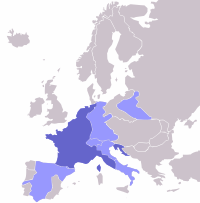 |
France was a dominant empire possessing many colonies in various locations around the world. The Empire of the French
First French Empire
The First French Empire , also known as the Greater French Empire or Napoleonic Empire, was the empire of Napoleon I of France...
(1804–1814), also known as the Greater French Empire or First French Empire
First French Empire
The First French Empire , also known as the Greater French Empire or Napoleonic Empire, was the empire of Napoleon I of France...
, but more commonly known as the Napoleonic Empire, was the empire of Napoleon I in France. It was the dominant power of much of continental Europe during the early 19th Century.
Emperor of the French
The Emperor of the French was the title used by the Bonaparte Dynasty starting when Napoleon Bonaparte was given the title Emperor on 18 May 1804 by the French Senate and was crowned emperor of the French on 02 December 1804 at the cathedral of Notre Dame de Paris, in Paris with the Crown of...
(L'Empereur des Français) on 18 May 1804 and crowned Emperor December 2, 1804, ending the period of the French Consulate, and won early military victories in the War of the Third Coalition against Austria, Prussia, Russia, Portugal, and allied nations, notably at the Battle of Austerlitz
Battle of Austerlitz
The Battle of Austerlitz, also known as the Battle of the Three Emperors, was one of Napoleon's greatest victories, where the French Empire effectively crushed the Third Coalition...
(1805) and the Battle of Friedland
Battle of Friedland
The Battle of Friedland saw Napoleon I's French army decisively defeat Count von Bennigsen's Russian army about twenty-seven miles southeast of Königsberg...
(1807). The Treaty of Tilsit in July 1807 ended two years of bloodshed on the European continent. Subsequent years of military victories known collectively as the Napoleonic Wars extended French influence over much of Western Europe and into Poland. At its height in 1812, the French Empire had 130 départements, ruled over 50 million subjects, maintained extensive military presence in Germany, Italy, Spain, and the Duchy of Warsaw, and could count Prussia and Austria as nominal allies.
Early French victories exported many ideological features of the French Revolution throughout Europe. Napoleon gained support by appealing to some common concerns of French people. These included dislike of the emigrant nobility who had escaped persecution, fear by some of a restoration of the ancien régime, a dislike and suspicion of foreign countries had tried to reverse the Revolution – and a wish by Jacobins to extend France's revolutionary ideals. Seigneurial dues and seigneurial justice were abolished, aristocratic privileges were eliminated in all places except Poland, and the introduction of the Napoleonic Code
Napoleonic code
The Napoleonic Code — or Code Napoléon — is the French civil code, established under Napoléon I in 1804. The code forbade privileges based on birth, allowed freedom of religion, and specified that government jobs go to the most qualified...
throughout the continent increased legal equality, established jury systems, and legalized divorce. Napoleon placed relatives on the thrones of several European countries and granted many noble titles, most of which expired with the fall of the Empire.
War of the Sixth Coalition
In the War of the Sixth Coalition , a coalition of Austria, Prussia, Russia, the United Kingdom, Portugal, Sweden, Spain and a number of German States finally defeated France and drove Napoleon Bonaparte into exile on Elba. After Napoleon's disastrous invasion of Russia, the continental powers...
, a coalition of Austria, Prussia, Russia, the United Kingdom, Sweden, Spain and a number of German States finally defeated France and drove Napoleon Bonaparte into exile on Elba. After Napoleon's disastrous invasion of Russia, the continental powers joined Russia, Britain, Portugal and the rebels in Spain. With their armies reorganized, they drove Napoleon out of Germany in 1813 and invaded France in 1814, forcing Napoleon to abdicate and restoring the Bourbons.
Modern Venetian Republic
1489–1718
In the high Middle Ages the Republic of Venice was able to become a very wealthy and powerful state through the rich trade between Europe and the Levant
Levant
The Levant or ) is the geographic region and culture zone of the "eastern Mediterranean littoral between Anatolia and Egypt" . The Levant includes most of modern Lebanon, Syria, Jordan, Israel, the Palestinian territories, and sometimes parts of Turkey and Iraq, and corresponds roughly to the...
. During the Modern Era started the decline of Venice, but it was a very long and "golden" decadence, in fact for almost three centuries the Republic was the only Italian state able to preserve his independence; in particular Venice was able to match the invading powers of the French and Spanish monarchies in Italy and in the same time, the Republic was also able to stop many times the expansion of Ottoman Empire
Ottoman Empire
The Ottoman EmpireIt was usually referred to as the "Ottoman Empire", the "Turkish Empire", the "Ottoman Caliphate" or more commonly "Turkey" by its contemporaries...
in South-East Europe and Mediterranean. The last main success of Venice was the conquest of Morea
Morea
The Morea was the name of the Peloponnese peninsula in southern Greece during the Middle Ages and the early modern period. It also referred to a Byzantine province in the region, known as the Despotate of Morea.-Origins of the name:...
between 1669 and 1718. The Republic of Venice ended in 1797 when Napoleon conquered the city and ceded its territories to Austria.
Qing Empire
1660s - 1800s
| Qing Empire |
|---|
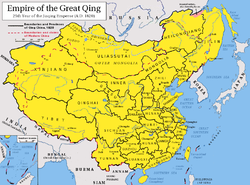 |
The Qing Dynasty
Qing Dynasty
The Qing Dynasty was the last dynasty of China, ruling from 1644 to 1912 with a brief, abortive restoration in 1917. It was preceded by the Ming Dynasty and followed by the Republic of China....
(Manchu Dynasty), was the last ruling dynasty of China, ruling from 1644 to 1912 (with a brief, abortive restoration in 1917). It was preceded by the Ming Dynasty and followed by the Republic of China. The dynasty was founded by the Manchu clan Aisin Gioro in what is today northeast China (also known as Manchuria). Starting in 1644 it expanded into China proper and its surrounding territories, establishing the Empire of the Great Qing. Complete pacification of China was accomplished around 1683 under the Kangxi Emperor
Kangxi Emperor
The Kangxi Emperor ; Manchu: elhe taifin hūwangdi ; Mongolian: Энх-Амгалан хаан, 4 May 1654 –20 December 1722) was the fourth emperor of the Qing Dynasty, the first to be born on Chinese soil south of the Pass and the second Qing emperor to rule over China proper, from 1661 to 1722.Kangxi's...
.
During its reign the Qing Dynasty became highly integrated with Chinese culture. The dynasty reached its height in the 18th century, during which both territory and population were increased. However, its military power weakened hereafter and faced with massive rebellions and defeats in wars, the Qing Dynasty declined after the mid-19th century. The Qing Dynasty was overthrown following the Xinhai Revolution.
Persian Safavid Empire
1550s - 1700s
The Safavids (1501–1736) are considered as the greatest Iranian Empire since the Islamic conquest of Persia
Islamic conquest of Persia
The Muslim conquest of Persia led to the end of the Sassanid Empire in 644, the fall of Sassanid dynasty in 651 and the eventual decline of the Zoroastrian religion in Persia...
. The Safavid empire originated from Ardabil
Ardabil
Ardabil is a historical city in north-western Iran. The name Ardabil probably comes from the Zoroastrian name of "Artavil" which means a holy place. Ardabil is the center of Ardabil Province. At the 2006 census, its population was 412,669, in 102,818 families...
in Iranian Azerbaijan in northern Iran. It was a Turkic-speaking dynasty whose classical and cultural language was Persian. The Safavid dynasty had its origins in a long established Sufi order, called the Safaviyeh. The Safavids established an independent unified Iranian state for the first time after the Islamic conquest of Persia and reasserted Iranian political identity, and established Shia Islam as the official religion in Iran.
Dutch Republic
1581–1795
| Dutch Empire Dutch Empire The Dutch Empire consisted of the overseas territories controlled by the Dutch Republic and later, the modern Netherlands from the 17th to the 20th century. The Dutch followed Portugal and Spain in establishing an overseas colonial empire, but based on military conquest of already-existing... |
|---|
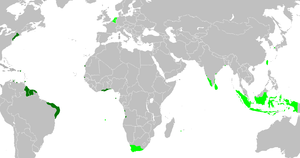 |
The Dutch Republic
Dutch Republic
The Dutch Republic — officially known as the Republic of the Seven United Netherlands , the Republic of the United Netherlands, or the Republic of the Seven United Provinces — was a republic in Europe existing from 1581 to 1795, preceding the Batavian Republic and ultimately...
controlled various territories after the Dutch achieved independence from Spain
Spain
Spain , officially the Kingdom of Spain languages]] under the European Charter for Regional or Minority Languages. In each of these, Spain's official name is as follows:;;;;;;), is a country and member state of the European Union located in southwestern Europe on the Iberian Peninsula...
in the 16th century. Their skills in shipping
Shipping
Shipping has multiple meanings. It can be a physical process of transporting commodities and merchandise goods and cargo, by land, air, and sea. It also can describe the movement of objects by ship.Land or "ground" shipping can be by train or by truck...
and trading
Trade
Trade is the transfer of ownership of goods and services from one person or entity to another. Trade is sometimes loosely called commerce or financial transaction or barter. A network that allows trade is called a market. The original form of trade was barter, the direct exchange of goods and...
aided the building of an overseas colonial empire which lasted from the 16th to the 20th century. The Dutch initially built up colonial possessions on the basis of indirect state capitalist corporate colonialism, with the dominant Dutch East India Company
Dutch East India Company
The Dutch East India Company was a chartered company established in 1602, when the States-General of the Netherlands granted it a 21-year monopoly to carry out colonial activities in Asia...
. A cultural flowering roughly spanning the 17th century is known as the Dutch Golden Age
Dutch Golden Age
The Golden Age was a period in Dutch history, roughly spanning the 17th century, in which Dutch trade, science, military and art were among the most acclaimed in the world. The first half is characterised by the Eighty Years' War till 1648...
, in which Dutch trade, science and art were among the most acclaimed in the world. Dutch military power was at its height in the middle of the 17th century and in that era the Dutch navy
Royal Netherlands Navy
The Koninklijke Marine is the navy of the Netherlands. In the mid-17th century the Dutch Navy was the most powerful navy in the world and it played an active role in the wars of the Dutch Republic and later those of the Batavian Republic and the Kingdom of the Netherlands...
was the most powerful navy in the world.
By the middle of the 17th century, the Dutch had overtaken Portugal as the dominant player in the spice and silk trade, and in 1652 founded a colony at Cape Town on the coast of South Africa, as a way-station for its ships on the route between Europe and Asia. After the first settlers spread out around the Company station, nomadic white livestock farmers, or Trekboers, moved more widely afield, leaving the richer, but limited, farming lands of the coast for the drier interior tableland. Between 1602 and 1796, million Europeans were sent to work in the Asia trade. The majority died of disease or made their way back to Europe, but some of them made the Indies their new home. Interaction between the Dutch and native population mainly took place in Sri Lanka and the modern Indonesian Islands. Through the centuries there developed a relatively large Dutch-speaking population of mixed Dutch and Indonesian descent, known as Indos or Dutch-Indonesians.
Early British Empire
1600–1815
| British Empire British Empire The British Empire comprised the dominions, colonies, protectorates, mandates and other territories ruled or administered by the United Kingdom. It originated with the overseas colonies and trading posts established by England in the late 16th and early 17th centuries. At its height, it was the... |
|---|
 |
|
The empire began in the 17th century as a combination of factors led to its creation, such as the growth in British trade with India
India
India , officially the Republic of India , is a country in South Asia. It is the seventh-largest country by geographical area, the second-most populous country with over 1.2 billion people, and the most populous democracy in the world...
and the Far East
Far East
The Far East is an English term mostly describing East Asia and Southeast Asia, with South Asia sometimes also included for economic and cultural reasons.The term came into use in European geopolitical discourse in the 19th century,...
, the success of the British East India Company
British East India Company
The East India Company was an early English joint-stock company that was formed initially for pursuing trade with the East Indies, but that ended up trading mainly with the Indian subcontinent and China...
, numerous British maritime explorations around the world, and the vast Royal Navy
Royal Navy
The Royal Navy is the naval warfare service branch of the British Armed Forces. Founded in the 16th century, it is the oldest service branch and is known as the Senior Service...
. The British Empire comprised the dominions, colonies, protectorates, mandates, and other territories ruled or administered by the United Kingdom. It originated with the overseas colonies and trading posts established by England in the late 16th and early 17th centuries. At its height it was the largest empire in history and, for over a century, was the foremost global power.
British colonies were created along the east coast of North America
North America
North America is a continent wholly within the Northern Hemisphere and almost wholly within the Western Hemisphere. It is also considered a northern subcontinent of the Americas...
during the 17th and 18th centuries but by the late 18th century most of these colonies rebelled against British rule, leading to the American War of Independence and formation of the United States of America. Nevertheless Great Britain retained significant colonies in Canada
Canada
Canada is a North American country consisting of ten provinces and three territories. Located in the northern part of the continent, it extends from the Atlantic Ocean in the east to the Pacific Ocean in the west, and northward into the Arctic Ocean...
, the Caribbean
Caribbean
The Caribbean is a crescent-shaped group of islands more than 2,000 miles long separating the Gulf of Mexico and the Caribbean Sea, to the west and south, from the Atlantic Ocean, to the east and north...
and India, and shortly thereafter began the settlement of Australia
Australia
Australia , officially the Commonwealth of Australia, is a country in the Southern Hemisphere comprising the mainland of the Australian continent, the island of Tasmania, and numerous smaller islands in the Indian and Pacific Oceans. It is the world's sixth-largest country by total area...
and New Zealand
New Zealand
New Zealand is an island country in the south-western Pacific Ocean comprising two main landmasses and numerous smaller islands. The country is situated some east of Australia across the Tasman Sea, and roughly south of the Pacific island nations of New Caledonia, Fiji, and Tonga...
. Following France's defeat in the Napoleonic Wars
Napoleonic Wars
The Napoleonic Wars were a series of wars declared against Napoleon's French Empire by opposing coalitions that ran from 1803 to 1815. As a continuation of the wars sparked by the French Revolution of 1789, they revolutionised European armies and played out on an unprecedented scale, mainly due to...
in 1815, Great Britain took possession of many more overseas territories in Africa
Africa
Africa is the world's second largest and second most populous continent, after Asia. At about 30.2 million km² including adjacent islands, it covers 6% of the Earth's total surface area and 20.4% of the total land area...
and Asia
Asia
Asia is the world's largest and most populous continent, located primarily in the eastern and northern hemispheres. It covers 8.7% of the Earth's total surface area and with approximately 3.879 billion people, it hosts 60% of the world's current human population...
, and established informal empires of free trade in South America
South America
South America is a continent situated in the Western Hemisphere, mostly in the Southern Hemisphere, with a relatively small portion in the Northern Hemisphere. The continent is also considered a subcontinent of the Americas. It is bordered on the west by the Pacific Ocean and on the north and east...
, China
China
Chinese civilization may refer to:* China for more general discussion of the country.* Chinese culture* Greater China, the transnational community of ethnic Chinese.* History of China* Sinosphere, the area historically affected by Chinese culture...
and Persia.
Mughal Empire
1550s - 1700s
| Mughal Empire Mughal Empire The Mughal Empire , or Mogul Empire in traditional English usage, was an imperial power from the Indian Subcontinent. The Mughal emperors were descendants of the Timurids... |
|---|
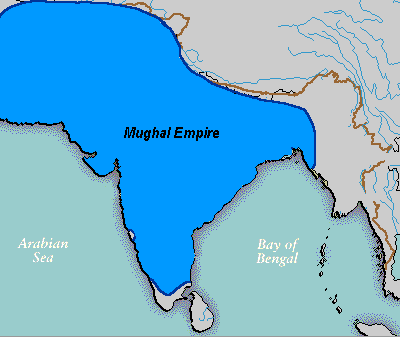 |
The Mughal Empire
Mughal Empire
The Mughal Empire , or Mogul Empire in traditional English usage, was an imperial power from the Indian Subcontinent. The Mughal emperors were descendants of the Timurids...
was an Islamic
Islamic State
An Islamic state is a type of government, in which the primary basis for government is Islamic religious law...
imperial power that ruled the Indian subcontinent
Indian subcontinent
The Indian subcontinent, also Indian Subcontinent, Indo-Pak Subcontinent or South Asian Subcontinent is a region of the Asian continent on the Indian tectonic plate from the Hindu Kush or Hindu Koh, Himalayas and including the Kuen Lun and Karakoram ranges, forming a land mass which extends...
which began in 1526, invaded and ruled most of Hindustan
Hindustan
Hindustan or Indostan, literal translation "Land of River Sindhu ", is one of the popular names of South Asia. It can also mean "the land of the Hindus"...
(South Asia
South Asia
South Asia, also known as Southern Asia, is the southern region of the Asian continent, which comprises the sub-Himalayan countries and, for some authorities , also includes the adjoining countries to the west and the east...
) by the late 17th and early 18th centuries, and ended in the mid-19th century. In 1526, Babur
Babur
Babur was a Muslim conqueror from Central Asia who, following a series of setbacks, finally succeeded in laying the basis for the Mughal dynasty of South Asia. He was a direct descendant of Timur through his father, and a descendant also of Genghis Khan through his mother...
, a Timurid
Timurid Dynasty
The Timurids , self-designated Gurkānī , were a Persianate, Central Asian Sunni Muslim dynasty of Turko-Mongol descent whose empire included the whole of Iran, modern Afghanistan, and modern Uzbekistan, as well as large parts of contemporary Pakistan, North India, Mesopotamia, Anatolia and the...
descendant of Timur
Timur
Timur , historically known as Tamerlane in English , was a 14th-century conqueror of West, South and Central Asia, and the founder of the Timurid dynasty in Central Asia, and great-great-grandfather of Babur, the founder of the Mughal Dynasty, which survived as the Mughal Empire in India until...
and Genghis Khan
Descent from Genghis Khan
Descent from Genghis Khan is traceable primarily in Central Asia. His four sons and other immediate descendants are famous by names and by deeds. Later Asian potentates attempted to claim descent from the House of Borjigin even on flimsy grounds. In the 14th century, valid sources all but dried...
, swept across the Khyber Pass
Khyber Pass
The Khyber Pass, is a mountain pass linking Pakistan and Afghanistan.The Pass was an integral part of the ancient Silk Road. It is mentioned in the Bible as the "Pesh Habor," and it is one of the oldest known passes in the world....
and established the Mughal Empire
Mughal Empire
The Mughal Empire , or Mogul Empire in traditional English usage, was an imperial power from the Indian Subcontinent. The Mughal emperors were descendants of the Timurids...
, which lasted for over 200 years. The Mughal Dynasty ruled most of the Indian subcontinent by 1600; it went into a slow decline after 1707 and was finally defeated during the 1857 War of Independence also called the Indian Rebellion of 1857. This period marked vast social change in the subcontinent as the Hindu majority were ruled over by the Mughal
Mughal Empire
The Mughal Empire , or Mogul Empire in traditional English usage, was an imperial power from the Indian Subcontinent. The Mughal emperors were descendants of the Timurids...
emperors; most of them showed religious tolerance, liberally patronising Hindu culture. The famous emperor Akbar, who was the grandson of Babar, tried to establish a good relationship with the Hindus. However, later emperors such as Aurangazeb tried to establish complete Muslim dominance and as a result several historical temples were destroyed during this period and taxes imposed on non-Muslims. During the decline of the Mughal Empire
Mughal Empire
The Mughal Empire , or Mogul Empire in traditional English usage, was an imperial power from the Indian Subcontinent. The Mughal emperors were descendants of the Timurids...
, which at its peak occupied an area similar to the ancient Maurya Empire
Maurya Empire
The Maurya Empire was a geographically extensive Iron Age historical power in ancient India, ruled by the Mauryan dynasty from 321 to 185 BC...
, several smaller empires rose to fill the power vacuum or themselves were contributing factors to the decline. The Mughals were perhaps the richest single dynasty to have ever existed.
Maratha Empire
1674–1820
| Maratha Empire Maratha Empire The Maratha Empire or the Maratha Confederacy was an Indian imperial power that existed from 1674 to 1818. At its peak, the empire covered much of South Asia, encompassing a territory of over 2.8 million km².... |
|---|
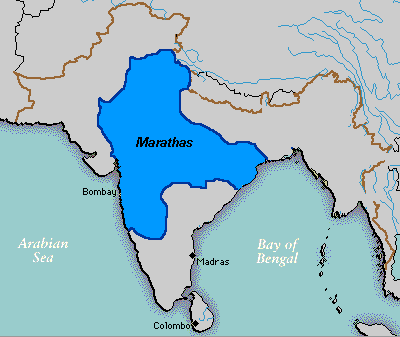 |
The Maratha Empire
Maratha Empire
The Maratha Empire or the Maratha Confederacy was an Indian imperial power that existed from 1674 to 1818. At its peak, the empire covered much of South Asia, encompassing a territory of over 2.8 million km²....
(Maratha Confederacy) was a Hindu
Hindu
Hindu refers to an identity associated with the philosophical, religious and cultural systems that are indigenous to the Indian subcontinent. As used in the Constitution of India, the word "Hindu" is also attributed to all persons professing any Indian religion...
state located in present-day India
India
India , officially the Republic of India , is a country in South Asia. It is the seventh-largest country by geographical area, the second-most populous country with over 1.2 billion people, and the most populous democracy in the world...
. It existed from 1674 to 1818. At its peak, the empire's territories covered much of South Asia
South Asia
South Asia, also known as Southern Asia, is the southern region of the Asian continent, which comprises the sub-Himalayan countries and, for some authorities , also includes the adjoining countries to the west and the east...
. It expanded greatly after the death of Mughal Emperor Aurangzeb
Aurangzeb
Abul Muzaffar Muhy-ud-Din Muhammad Aurangzeb Alamgir , more commonly known as Aurangzeb or by his chosen imperial title Alamgir , was the sixth Mughal Emperor of India, whose reign lasted from 1658 until his death in 1707.Badshah Aurangzeb, having ruled most of the Indian subcontinent for nearly...
in 1707, only to lose Punjab region
Punjab region
The Punjab , also spelled Panjab |water]]s"), is a geographical region straddling the border between Pakistan and India which includes Punjab province in Pakistan and the states of the Punjab, Haryana, Himachal Pradesh, Chandigarh and some northern parts of the National Capital Territory of Delhi...
in Third battle of Panipat
Third battle of Panipat
The Third Battle of Panipat took place on 14 January 1761, at Panipat , about 60 miles north of Delhi between a northern expeditionary force of the Maratha Confederacy and a coalition of the King of Afghanistan, Ahmad Shah Abdali with 2 Indian Muslim allies—the Rohilla Afghans of the Doab, and the...
in 1761. A large portion of the empire was coastline which was secured by a potent navy under commanders such as Kanhoji Angre. He was very successful at keeping foreign naval ships, particularly of the Portuguese and British, at bay.[7] Securing the coastal areas and building land-based fortifications were crucial aspects of the Maratha's defensive strategy and regional military history.
The Maratha Empire was at its height in the 18th century under Shahu and the Peshwa Baji Rao I. Losses at the Third Battle of Panipat in 1761 suspended further expansion of the empire in the North-west and reduced the power of the Peshwas. In 1761, after severe losses in the Panipat war, the Peshwas slowly started losing the control of the kingdom. Many military chiefs of the Maratha Empire like Shinde, Holkar, Gaikwad, Pant Pratinidhi, Bhosale of Nagpur, Pandit of Bhor, Patwardhan, and Newalkar started to work towards their ambition of becoming kings in their respective regions. However, under Madhavrao Peshwa, Maratha authority in North India was restored, 10 years after the battle of Panipat.
After the death of Madhavrao, the empire gave way to a loose Confederacy, with political power resting in a 'pentarchy' of five mostly Maratha dynasties: the Peshwas of Pune; the Sindhias (originally "Shindes") of Malwa and Gwalior; the Holkars of Indore; the Bhonsles of Nagpur; and the Gaekwads of Baroda. A rivalry between the Sindhia and Holkar dominated the confederation's affairs into the early 19th century, as did the clashes with the British and the British East India Company in the three Anglo-Maratha Wars. In the Third Anglo-Maratha War, the last Peshwa, Baji Rao II, was defeated by the British in 1818. Most of the former Maratha Empire was absorbed by British India, although some of the Maratha states persisted as quasi-independent princely states until India became independent in 1947.
Early Ottoman Empire
1400s - 1815
| Ottoman Empire Ottoman Empire The Ottoman EmpireIt was usually referred to as the "Ottoman Empire", the "Turkish Empire", the "Ottoman Caliphate" or more commonly "Turkey" by its contemporaries... |
|---|
|
the Ottoman Empire
Ottoman Empire
The Ottoman EmpireIt was usually referred to as the "Ottoman Empire", the "Turkish Empire", the "Ottoman Caliphate" or more commonly "Turkey" by its contemporaries...
was a Turkish
Turkish people
Turkish people, also known as the "Turks" , are an ethnic group primarily living in Turkey and in the former lands of the Ottoman Empire where Turkish minorities had been established in Bulgaria, Cyprus, Bosnia and Herzegovina, Georgia, Greece, Kosovo, Macedonia, and Romania...
state, which at the height of its power (16th - 17th centuries) spanned three continents (see: extent of Ottoman territories) controlling much of Southeastern Europe, the Middle East
Middle East
The Middle East is a region that encompasses Western Asia and Northern Africa. It is often used as a synonym for Near East, in opposition to Far East...
and most of North Africa
North Africa
North Africa or Northern Africa is the northernmost region of the African continent, linked by the Sahara to Sub-Saharan Africa. Geopolitically, the United Nations definition of Northern Africa includes eight countries or territories; Algeria, Egypt, Libya, Morocco, South Sudan, Sudan, Tunisia, and...
. The empire has been called by historians a "Universal Empire" due to both Roman
Roman Empire
The Roman Empire was the post-Republican period of the ancient Roman civilization, characterised by an autocratic form of government and large territorial holdings in Europe and around the Mediterranean....
and Islamic traditions.
The empire was at the center of interactions between the Eastern
Eastern world
__FORCETOC__The term Eastern world refers very broadly to the various cultures or social structures and philosophical systems of Eastern Asia or geographically the Eastern Culture...
and Western world
Western world
The Western world, also known as the West and the Occident , is a term referring to the countries of Western Europe , the countries of the Americas, as well all countries of Northern and Central Europe, Australia and New Zealand...
s for six centuries. The Ottoman Empire was the only Islamic power to seriously challenge the rising power of Western Europe
Western Europe
Western Europe is a loose term for the collection of countries in the western most region of the European continents, though this definition is context-dependent and carries cultural and political connotations. One definition describes Western Europe as a geographic entity—the region lying in the...
between the 15th and 19th centuries. With Istanbul
Istanbul
Istanbul , historically known as Byzantium and Constantinople , is the largest city of Turkey. Istanbul metropolitan province had 13.26 million people living in it as of December, 2010, which is 18% of Turkey's population and the 3rd largest metropolitan area in Europe after London and...
(or Constantinople
Constantinople
Constantinople was the capital of the Roman, Eastern Roman, Byzantine, Latin, and Ottoman Empires. Throughout most of the Middle Ages, Constantinople was Europe's largest and wealthiest city.-Names:...
) as its capital, the Empire was in some respects an Islamic successor of earlier Mediterranean empires - the Roman
Roman Empire
The Roman Empire was the post-Republican period of the ancient Roman civilization, characterised by an autocratic form of government and large territorial holdings in Europe and around the Mediterranean....
and Byzantine
Byzantine Empire
The Byzantine Empire was the Eastern Roman Empire during the periods of Late Antiquity and the Middle Ages, centred on the capital of Constantinople. Known simply as the Roman Empire or Romania to its inhabitants and neighbours, the Empire was the direct continuation of the Ancient Roman State...
empires.
Ottoman military reform efforts begin with Selim III (1789–1807) who made the first major attempts to modernize the army along European lines. These efforts, however, were hampered by reactionary movements, partly from the religious leadership, but primarily from the Janissary corps, who had become anarchic and ineffectual. Jealous of their privileges and firmly opposed to change, they created a Janissary revolt. Selim's efforts cost him his throne and his life, but were resolved in spectacular and bloody fashion by his successor, the dynamic Mahmud II, who massacred the Janissary corps in 1826.
The effective military and bureaucratic structures of the previous century also came under strain during a protracted period of misrule by weak Sultans. But in spite of these difficulties, the Empire remained a major expansionist power until the Battle of Vienna
Battle of Vienna
The Battle of Vienna took place on 11 and 12 September 1683 after Vienna had been besieged by the Ottoman Empire for two months...
in 1683, which marked the end of Ottoman expansion into Europe.
Poland-Lithuania
1569–1795
| Polish–Lithuanian Commonwealth |
|---|
 |
The Polish-Lithuanian Commonwealth
Polish-Lithuanian Commonwealth
The Polish–Lithuanian Commonwealth was a dualistic state of Poland and Lithuania ruled by a common monarch. It was the largest and one of the most populous countries of 16th- and 17th‑century Europe with some and a multi-ethnic population of 11 million at its peak in the early 17th century...
was one of the largest, most powerful and most populous countries in 16th, 17th, and 18th century Europe
Europe
Europe is, by convention, one of the world's seven continents. Comprising the westernmost peninsula of Eurasia, Europe is generally 'divided' from Asia to its east by the watershed divides of the Ural and Caucasus Mountains, the Ural River, the Caspian and Black Seas, and the waterways connecting...
. Its political structure — that of a semi-federal, semi-confederal noble
Szlachta
The szlachta was a legally privileged noble class with origins in the Kingdom of Poland. It gained considerable institutional privileges during the 1333-1370 reign of Casimir the Great. In 1413, following a series of tentative personal unions between the Grand Duchy of Lithuania and the Kingdom of...
republic
Republic
A republic is a form of government in which the people, or some significant portion of them, have supreme control over the government and where offices of state are elected or chosen by elected people. In modern times, a common simplified definition of a republic is a government where the head of...
— was formed in 1569 by the Union of Lublin
Union of Lublin
The Union of Lublin replaced the personal union of the Kingdom of Poland and the Grand Duchy of Lithuania with a real union and an elective monarchy, since Sigismund II Augustus, the last of the Jagiellons, remained childless after three marriages. In addition, the autonomy of Royal Prussia was...
, which united the Kingdom of Poland and the Grand Duchy of Lithuania
Grand Duchy of Lithuania
The Grand Duchy of Lithuania was a European state from the 12th /13th century until 1569 and then as a constituent part of Polish-Lithuanian Commonwealth until 1791 when Constitution of May 3, 1791 abolished it in favor of unitary state. It was founded by the Lithuanians, one of the polytheistic...
, and lasted in this form until the adoption of the Constitution of May 3, 1791
Constitution of May 3, 1791
The Constitution of May 3, 1791 was adopted as a "Government Act" on that date by the Sejm of the Polish–Lithuanian Commonwealth. Historian Norman Davies calls it "the first constitution of its type in Europe"; other scholars also refer to it as the world's second oldest constitution...
.
The Union possessed features unique among contemporary states. This political system unusual for its time stemmed from the ascendance of the szlachta noble class
Nobility
Nobility is a social class which possesses more acknowledged privileges or eminence than members of most other classes in a society, membership therein typically being hereditary. The privileges associated with nobility may constitute substantial advantages over or relative to non-nobles, or may be...
over other social classes and over the political system
Political system
A political system is a system of politics and government. It is usually compared to the legal system, economic system, cultural system, and other social systems...
of monarchy
Monarchy
A monarchy is a form of government in which the office of head of state is usually held until death or abdication and is often hereditary and includes a royal house. In some cases, the monarch is elected...
. In time, the szlachta accumulated enough privileges (such as those established by the Nihil novi
Nihil novi
Nihil novi nisi commune consensu is the original Latin title of a 1505 act adopted by the Polish Sejm , meeting in the royal castle at Radom.-History:...
Act of 1505) that no monarch could hope to break the szlachta's grip on power. The Commonwealth's political system is difficult to fit into a simple category, but it can be tentatively described as a mixture of:
- confederationConfederationA confederation in modern political terms is a permanent union of political units for common action in relation to other units. Usually created by treaty but often later adopting a common constitution, confederations tend to be established for dealing with critical issues such as defense, foreign...
and federationFederationA federation , also known as a federal state, is a type of sovereign state characterized by a union of partially self-governing states or regions united by a central government...
, with regard to the broad autonomy of its regions. It is, however, difficult to decisively call the Commonwealth either confederation or federation, as it had some qualities of both of them; - oligarchyOligarchyOligarchy is a form of power structure in which power effectively rests with an elite class distinguished by royalty, wealth, family ties, commercial, and/or military legitimacy...
, as only the szlachta—around 15% of the population—had political rights; - democracyDemocracyDemocracy is generally defined as a form of government in which all adult citizens have an equal say in the decisions that affect their lives. Ideally, this includes equal participation in the proposal, development and passage of legislation into law...
, since all the szlachta were equal in rights and privileges, and the Sejm could veto the king on important matters, including legislationLegislationLegislation is law which has been promulgated by a legislature or other governing body, or the process of making it...
(the adoption of new laws), foreign affairs, declaration of war, and taxation (changes of existing taxes or the levying of new ones). Also, the 15% of Commonwealth population who enjoyed those political rights (the szlachta) was a substantially larger percentage than in majority European countries; note that in 1789 in France only about 1% of the population had the right to vote, and in 1867 in the United Kingdom, only about 3%. - elective monarchyElective monarchyAn elective monarchy is a monarchy ruled by an elected rather than hereditary monarch. The manner of election, the nature of the candidacy and the electors vary from case to case...
, since the monarch, elected by the szlachta, was Head of State; - constitutional monarchyConstitutional monarchyConstitutional monarchy is a form of government in which a monarch acts as head of state within the parameters of a constitution, whether it be a written, uncodified or blended constitution...
, since the monarch was bound by pacta conventa and other laws, and the szlachta could disobey any king's decrees they deemed illegal.
Portugal
1415 - 1815
| Portuguese Empire Portuguese Empire The Portuguese Empire , also known as the Portuguese Overseas Empire or the Portuguese Colonial Empire , was the first global empire in history... |
|---|
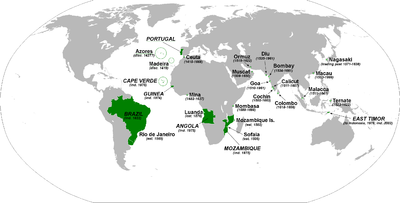 |
The Portuguese Empire
Portuguese Empire
The Portuguese Empire , also known as the Portuguese Overseas Empire or the Portuguese Colonial Empire , was the first global empire in history...
was the first global empire in history, and also the earliest and longest lived of the Western Europe
Western Europe
Western Europe is a loose term for the collection of countries in the western most region of the European continents, though this definition is context-dependent and carries cultural and political connotations. One definition describes Western Europe as a geographic entity—the region lying in the...
an colonial
Colonialism
Colonialism is the establishment, maintenance, acquisition and expansion of colonies in one territory by people from another territory. It is a process whereby the metropole claims sovereignty over the colony and the social structure, government, and economics of the colony are changed by...
empires, existing from 1415 to 1999. Portugal
Portugal
Portugal , officially the Portuguese Republic is a country situated in southwestern Europe on the Iberian Peninsula. Portugal is the westernmost country of Europe, and is bordered by the Atlantic Ocean to the West and South and by Spain to the North and East. The Atlantic archipelagos of the...
's small size and population restricted the empire to a collection of small but well defended outposts along the shoreline. The height of the empire power was reached in the 16th century but the indifference of the Habsburg
Habsburg
The House of Habsburg , also found as Hapsburg, and also known as House of Austria is one of the most important royal houses of Europe and is best known for being an origin of all of the formally elected Holy Roman Emperors between 1438 and 1740, as well as rulers of the Austrian Empire and...
kings and the competition with new colonial empires like the British
British Empire
The British Empire comprised the dominions, colonies, protectorates, mandates and other territories ruled or administered by the United Kingdom. It originated with the overseas colonies and trading posts established by England in the late 16th and early 17th centuries. At its height, it was the...
, French
French colonial empires
The French colonial empire was the set of territories outside Europe that were under French rule primarily from the 17th century to the late 1960s. In the 19th and 20th centuries, the colonial empire of France was the second-largest in the world behind the British Empire. The French colonial empire...
and Dutch
Dutch Empire
The Dutch Empire consisted of the overseas territories controlled by the Dutch Republic and later, the modern Netherlands from the 17th to the 20th century. The Dutch followed Portugal and Spain in establishing an overseas colonial empire, but based on military conquest of already-existing...
started its long and gradual decline. After the 18th century Portugal concentrated in the colonization of Brazil
Brazil
Brazil , officially the Federative Republic of Brazil , is the largest country in South America. It is the world's fifth largest country, both by geographical area and by population with over 192 million people...
and African possessions.
Between the Spanish and Portuguese, the Treaty of Tordesillas
Treaty of Tordesillas
The Treaty of Tordesillas , signed at Tordesillas , , divided the newly discovered lands outside Europe between Spain and Portugal along a meridian 370 leagueswest of the Cape Verde islands...
divided the world outside of Europe in an exclusive duopoly along a north-south meridian 370 leagues, or 970 miles (1,561.1 km), west of the Cape Verde islands. However, as it was not possible at the time to correctly measure longitude, the exact boundary was disputed by the two countries until 1777. The completion of these negotiations with Spain is one of several reasons proposed by historians for why it took nine years for the Portuguese to follow up on Dias's voyage to the Cape of Good Hope, though it has also been speculated that other voyages were in fact taking place in secret during this time. Whether or not this was the case, the long-standing Portuguese goal of finding a sea route to Asia was finally achieved in a ground-breaking voyage commanded by Vasco da Gama
Vasco da Gama
Vasco da Gama, 1st Count of Vidigueira was a Portuguese explorer, one of the most successful in the Age of Discovery and the commander of the first ships to sail directly from Europe to India...
.
Prussia
The Kingdom of Prussia
Kingdom of Prussia
The Kingdom of Prussia was a German kingdom from 1701 to 1918. Until the defeat of Germany in World War I, it comprised almost two-thirds of the area of the German Empire...
dominated northern Germany
Germany
Germany , officially the Federal Republic of Germany , is a federal parliamentary republic in Europe. The country consists of 16 states while the capital and largest city is Berlin. Germany covers an area of 357,021 km2 and has a largely temperate seasonal climate...
politically, economically, and in terms of population, and was the core of the unified North German Confederation
North German Confederation
The North German Confederation 1866–71, was a federation of 22 independent states of northern Germany. It was formed by a constitution accepted by the member states in 1867 and controlled military and foreign policy. It included the new Reichstag, a parliament elected by universal manhood...
formed in 1867, which became part of the German Empire
German Empire
The German Empire refers to Germany during the "Second Reich" period from the unification of Germany and proclamation of Wilhelm I as German Emperor on 18 January 1871, to 1918, when it became a federal republic after defeat in World War I and the abdication of the Emperor, Wilhelm II.The German...
or Deutsches Reich
Deutsches Reich
Deutsches Reich was the official name for Germany from 1871 to 1945 in the German language.As the literal English translation "German Empire" denotes a monarchy, the term is used only in reference to Germany prior to the fall of the monarchies at the end of World War I in 1918...
in 1871.
Prussia attained its greatest importance in the 18th and 19th centuries. During the 18th century, it became a Europe
Europe
Europe is, by convention, one of the world's seven continents. Comprising the westernmost peninsula of Eurasia, Europe is generally 'divided' from Asia to its east by the watershed divides of the Ural and Caucasus Mountains, the Ural River, the Caspian and Black Seas, and the waterways connecting...
an great power under the reign of Frederick II of Prussia
Frederick II of Prussia
Frederick II was a King in Prussia and a King of Prussia from the Hohenzollern dynasty. In his role as a prince-elector of the Holy Roman Empire, he was also Elector of Brandenburg. He was in personal union the sovereign prince of the Principality of Neuchâtel...
(1740–86). During the 19th century, Chancellor Otto von Bismarck
Otto von Bismarck
Otto Eduard Leopold, Prince of Bismarck, Duke of Lauenburg , simply known as Otto von Bismarck, was a Prussian-German statesman whose actions unified Germany, made it a major player in world affairs, and created a balance of power that kept Europe at peace after 1871.As Minister President of...
pursued a policy of uniting the German principalities into a "Lesser Germany" which would exclude the Austrian Empire
Austrian Empire
The Austrian Empire was a modern era successor empire, which was centered on what is today's Austria and which officially lasted from 1804 to 1867. It was followed by the Empire of Austria-Hungary, whose proclamation was a diplomatic move that elevated Hungary's status within the Austrian Empire...
.
Early Spanish Empire
1492-1815
| Spanish Empire Spanish Empire The Spanish Empire comprised territories and colonies administered directly by Spain in Europe, in America, Africa, Asia and Oceania. It originated during the Age of Exploration and was therefore one of the first global empires. At the time of Habsburgs, Spain reached the peak of its world power.... |
|---|
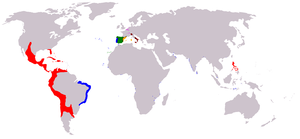 |
|
In the 16th century Spain and Portugal were in the vanguard of European global exploration and colonial expansion and the opening of trade routes across the oceans, with trade flourishing across the Atlantic Ocean between Spain and the Americas and across the Pacific Ocean between Asia-Pacific and Mexico via the Philippines. Conquistadors toppled the Aztec, Inca, and Maya civilizations, and laid claim to vast stretches of land in North and South America. For a time, the Spanish Empire dominated the oceans with its navy and ruled the European battlefield with its infantry, the famous tercios. Spain enjoyed a cultural golden age in the 16th and 17th centuries as Europe's foremost power.
From 1580 to 1640 the Portuguese Empire
Portuguese Empire
The Portuguese Empire , also known as the Portuguese Overseas Empire or the Portuguese Colonial Empire , was the first global empire in history...
and the Spanish Empire
Spanish Empire
The Spanish Empire comprised territories and colonies administered directly by Spain in Europe, in America, Africa, Asia and Oceania. It originated during the Age of Exploration and was therefore one of the first global empires. At the time of Habsburgs, Spain reached the peak of its world power....
were conjoined in a personal union
Personal union
A personal union is the combination by which two or more different states have the same monarch while their boundaries, their laws and their interests remain distinct. It should not be confused with a federation which is internationally considered a single state...
of its Habsburg monarchs
Philippine Dynasty
The Portuguese House of Habsburg, commonly known as the Philippine Dynasty, is the third royal dynasty of Portugal. It was named after the three Spanish kings who ruled Portugal between 1580 and 1640 in a dynastic union of the two crowns...
, during the period of the Iberian Union
Iberian Union
The Iberian union was a political unit that governed all of the Iberian Peninsula south of the Pyrenees from 1580–1640, through a dynastic union between the monarchies of Portugal and Spain after the War of the Portuguese Succession...
, though the empires continued to be administered separately.
From the middle of the 16th century silver and gold from the American mines increasingly financed the military capability of Habsburg Spain in its long series of European and North African wars. Until the loss of its American colonies in the 19th century, Spain maintained one of the largest empires in the world, even though it suffered fluctuating military and economic fortunes from the 1640s. Confronted by the new experiences, difficulties and suffering created by empire-building, Spanish thinkers formulated some of the first modern thoughts on natural law, sovereignty, international law, war, and economics — they even questioned the legitimacy of imperialism — in related schools of thought referred to collectively as the School of Salamanca.
Constant contention with rival powers caused territorial, commercial, and religious conflict that contributed to the slow decline of Spanish power from the mid-17th century. In the Mediterranean, Spain warred constantly with the Ottoman Empire; on the European continent, France
France
The French Republic , The French Republic , The French Republic , (commonly known as France , is a unitary semi-presidential republic in Western Europe with several overseas territories and islands located on other continents and in the Indian, Pacific, and Atlantic oceans. Metropolitan France...
became comparably strong. Overseas, Spain was initially rivaled by Portugal
Portugal
Portugal , officially the Portuguese Republic is a country situated in southwestern Europe on the Iberian Peninsula. Portugal is the westernmost country of Europe, and is bordered by the Atlantic Ocean to the West and South and by Spain to the North and East. The Atlantic archipelagos of the...
, and later by the English
England
England is a country that is part of the United Kingdom. It shares land borders with Scotland to the north and Wales to the west; the Irish Sea is to the north west, the Celtic Sea to the south west, with the North Sea to the east and the English Channel to the south separating it from continental...
and Dutch
Netherlands
The Netherlands is a constituent country of the Kingdom of the Netherlands, located mainly in North-West Europe and with several islands in the Caribbean. Mainland Netherlands borders the North Sea to the north and west, Belgium to the south, and Germany to the east, and shares maritime borders...
. In addition, English-, French-, and Dutch-sponsored privateering and piracy, overextension of Spanish military commitments in its territories, increasing government corruption, and economic stagnation caused by military expenditures ultimately contributed to the empire's weakening.
Spain's European empire was finally undone by the Peace of Utrecht (1713), which stripped Spain of its remaining territories in Italy and the Low Countries. Spain's fortunes improved thereafter, but it remained a second rate power in Continental European politics. However, Spain maintained and enlarged its vast overseas empire until the 19th century, when the shock of the Peninsular War
Peninsular War
The Peninsular War was a war between France and the allied powers of Spain, the United Kingdom, and Portugal for control of the Iberian Peninsula during the Napoleonic Wars. The war began when French and Spanish armies crossed Spain and invaded Portugal in 1807. Then, in 1808, France turned on its...
sparked declarations of independence in Quito (1809), Venezuela
Venezuela
Venezuela , officially called the Bolivarian Republic of Venezuela , is a tropical country on the northern coast of South America. It borders Colombia to the west, Guyana to the east, and Brazil to the south...
and Paraguay
Paraguay
Paraguay , officially the Republic of Paraguay , is a landlocked country in South America. It is bordered by Argentina to the south and southwest, Brazil to the east and northeast, and Bolivia to the northwest. Paraguay lies on both banks of the Paraguay River, which runs through the center of the...
(1811) and successive revolutions that split away its territories on the mainland (the Spanish Main) of the Americas.
Sweden
| Swedish Empire Swedish Empire The Swedish Empire refers to the Kingdom of Sweden between 1561 and 1721 . During this time, Sweden was one of the great European powers. In Swedish, the period is called Stormaktstiden, literally meaning "the Great Power Era"... |
|---|
The 17th century saw the rise of Sweden
Rise of Sweden as a Great Power
During the 17th century, despite having scarcely more than 1 million inhabitants, Sweden emerged to have greater foreign influence, after winning wars against Denmark–Norway, The Holy Roman Empire, Russia, and The Commonwealth of Poland and Lithuania...
as one of the Great Power
Great power
A great power is a nation or state that has the ability to exert its influence on a global scale. Great powers characteristically possess military and economic strength and diplomatic and cultural influence which may cause small powers to consider the opinions of great powers before taking actions...
s in Europe. Sweden also had colonial possessions as a minor colonial Empire
Swedish colonial empire
Sweden possessed overseas colonies from 1638 to 1663 and from 1784 to 1878. The former Swedish colonies in Africa were:*Swedish Gold Coast Including the Cape Coast consisting of the following settlements:...
that existed from 1638–1663 and later 1784-1878.
The mid-17th and early 18th centuries were Sweden's most successful years as a Great Power. Sweden reached its largest territorial extent during the rule of Charles X (1622–1660) after the treaty of Roskilde
Treaty of Roskilde
The Treaty of Roskilde was concluded on 26 February or 8 March 1658 during the Second Northern War between Frederick III of Denmark–Norway and Charles X Gustav of Sweden in the Danish city of Roskilde...
in 1658. However, after more than a half century of almost constant warfare the Swedish economy had deteriorated. It would become the lifetime task of Charles' son, Charles XI
Charles XI of Sweden
Charles XI also Carl, was King of Sweden from 1660 until his death, in a period in Swedish history known as the Swedish empire ....
(1655–1697), to rebuild the economy and refit the army. His legacy to his son, the coming ruler of Sweden Charles XII
Charles XII of Sweden
Charles XII also Carl of Sweden, , Latinized to Carolus Rex, Turkish: Demirbaş Şarl, also known as Charles the Habitué was the King of the Swedish Empire from 1697 to 1718...
, was one of the finest arsenals in the world, a large standing army and a great fleet. Sweden's largest threat at this time, Russia
Russia
Russia or , officially known as both Russia and the Russian Federation , is a country in northern Eurasia. It is a federal semi-presidential republic, comprising 83 federal subjects...
, had a larger army but was far behind in both equipment and training. The Swedish army crushed the Russians at the Battle of Narva
Battle of Narva (1700)
The Battle of Narva on 19 November 1700 was an early battle in the Great Northern War. A Swedish relief army under Charles XII of Sweden defeated a Russian siege force three times its size. Before, Charles XII had forced Denmark-Norway to sign the Treaty of Travendal...
in 1700, one of the first battles of the Great Northern War
Great Northern War
The Great Northern War was a conflict in which a coalition led by the Tsardom of Russia successfully contested the supremacy of the Swedish Empire in northern Central Europe and Eastern Europe. The initial leaders of the anti-Swedish alliance were Peter I the Great of Russia, Frederick IV of...
. This led to an overambitious campaign against Russia in 1707, however, ending in a decisive Russian victory at the Battle of Poltava
Battle of Poltava
The Battle of Poltava on 27 June 1709 was the decisive victory of Peter I of Russia over the Swedish forces under Field Marshal Carl Gustav Rehnskiöld in one of the battles of the Great Northern War. It is widely believed to have been the beginning of Sweden's decline as a Great Power; the...
(1709). The campaign had a successful opening for Sweden, which came to occupy half of Poland
Poland
Poland , officially the Republic of Poland , is a country in Central Europe bordered by Germany to the west; the Czech Republic and Slovakia to the south; Ukraine, Belarus and Lithuania to the east; and the Baltic Sea and Kaliningrad Oblast, a Russian exclave, to the north...
and making Charles able to claim the Polish throne. But after a long march exposed by cossack
Cossack
Cossacks are a group of predominantly East Slavic people who originally were members of democratic, semi-military communities in what is today Ukraine and Southern Russia inhabiting sparsely populated areas and islands in the lower Dnieper and Don basins and who played an important role in the...
raids, the Russian Tsar Peter the Great's scorched-earth techniques and the cold Russian climate
Russian Winter
The Russian Winter is a common explanation for military failures of invaders in Russia. Common nicknames are General Frost, General Winter and General Snow. Another was "General Mud"....
, the Swedes stood weakened with a shattered confidence, and enormously outnumbered against the Russian army at Poltava. The defeat meant the beginning of the end for Sweden as an empire.
Moscovian Empire and after
1400-1815
| Russian Empire Russian Empire The Russian Empire was a state that existed from 1721 until the Russian Revolution of 1917. It was the successor to the Tsardom of Russia and the predecessor of the Soviet Union... |
|---|
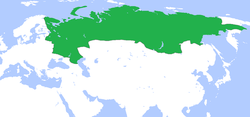 |
|
The Russian Empire
Russian Empire
The Russian Empire was a state that existed from 1721 until the Russian Revolution of 1917. It was the successor to the Tsardom of Russia and the predecessor of the Soviet Union...
formed from what was Tsardom of Russia
Tsardom of Russia
The Tsardom of Russia was the name of the centralized Russian state from Ivan IV's assumption of the title of Tsar in 1547 till Peter the Great's foundation of the Russian Empire in 1721.From 1550 to 1700, Russia grew 35,000 km2 a year...
under Peter the Great. Peter I, (1672–1725), played a major role in bringing his country into the European state system, and laid the foundations of a modern state in Russia
Russia
Russia or , officially known as both Russia and the Russian Federation , is a country in northern Eurasia. It is a federal semi-presidential republic, comprising 83 federal subjects...
. From its modest beginnings in the 14th century, Russia had become the largest state in the world by Peter's time. Three times the size of continental Europe, it spanned the Eurasian landmass
Eurasian Plate
The Eurasian Plate is a tectonic plate which includes most of the continent of Eurasia , with the notable exceptions of the Indian subcontinent, the Arabian subcontinent, and the area east of the Chersky Range in East Siberia...
from the Baltic Sea
Baltic Sea
The Baltic Sea is a brackish mediterranean sea located in Northern Europe, from 53°N to 66°N latitude and from 20°E to 26°E longitude. It is bounded by the Scandinavian Peninsula, the mainland of Europe, and the Danish islands. It drains into the Kattegat by way of the Øresund, the Great Belt and...
to the Pacific Ocean
Pacific Ocean
The Pacific Ocean is the largest of the Earth's oceanic divisions. It extends from the Arctic in the north to the Southern Ocean in the south, bounded by Asia and Australia in the west, and the Americas in the east.At 165.2 million square kilometres in area, this largest division of the World...
.
High modern historical powers
19th, 20th, and 21st centuries- Late ModernModern historyModern history, or the modern era, describes the historical timeline after the Middle Ages. Modern history can be further broken down into the early modern period and the late modern period after the French Revolution and the Industrial Revolution...
and Contemporary historyContemporary historyContemporary history describes the period timeframe that is without any intervening time closely connected to the present and is a certain perspective of modern history. The term "contemporary history" has been in use at least by the early 19th century. In the widest context of this use,...
Persian Qajar Empire
1794–1925
The Empire of Persia under the Qajar dynasty during the 19th century was still a considerable power, with a considerable extension of territories; but during the century it was not able to prevent the expansion of other powers, so the empire lost some external territories and by 1907 it was divided under spheres of influence by the Russian and the British empires.
The Netherlands
1815–1949
The Kingdom of the Netherlands
Kingdom of the Netherlands
The Kingdom of the Netherlands is a sovereign state and constitutional monarchy with territory in Western Europe and in the Caribbean. The four parts of the Kingdom—Aruba, Curaçao, the Netherlands, and Sint Maarten—are referred to as "countries", and participate on a basis of equality...
was a major colonial power in the 19th and 20th century until the independence recognition of Indonesia
Indonesia
Indonesia , officially the Republic of Indonesia , is a country in Southeast Asia and Oceania. Indonesia is an archipelago comprising approximately 13,000 islands. It has 33 provinces with over 238 million people, and is the world's fourth most populous country. Indonesia is a republic, with an...
in 1949. The last major colony Suriname
Suriname
Suriname , officially the Republic of Suriname , is a country in northern South America. It borders French Guiana to the east, Guyana to the west, Brazil to the south, and on the north by the Atlantic Ocean. Suriname was a former colony of the British and of the Dutch, and was previously known as...
became independent in 1975 and since then only the islands of the former Netherlands Antilles
Netherlands Antilles
The Netherlands Antilles , also referred to informally as the Dutch Antilles, was an autonomous Caribbean country within the Kingdom of the Netherlands, consisting of two groups of islands in the Lesser Antilles: Aruba, Bonaire and Curaçao , in Leeward Antilles just off the Venezuelan coast; and Sint...
are part of the Kingdom.
France
1815–1956
| French colonial empire French colonial empire The French colonial empire was the set of territories outside Europe that were under French rule primarily from the 17th century to the late 1960s. In the 19th and 20th centuries, the colonial empire of France was the second-largest in the world behind the British Empire. The French colonial empire... |
|---|
France was a dominant empire possessing many colonies in various locations around the world. The French colonial empire
French colonial empire
The French colonial empire was the set of territories outside Europe that were under French rule primarily from the 17th century to the late 1960s. In the 19th and 20th centuries, the colonial empire of France was the second-largest in the world behind the British Empire. The French colonial empire...
is the set of territories outside Europe that were under French rule primarily from the 17th century to the late 1960s (some see the French control of places such as New Caledonia as a continuation of that colonial empire). In the 19th and 20th centuries, the colonial empire of France was the second largest in the world behind the British Empire. The French colonial empire extended over 12890000 km² (4,976,856.8 sq mi) of land at its height in the 1920s and 1930s. Including metropolitan France, the total amount of land under French sovereignty reached 13500000 km² (5,212,379.1 sq mi) at the time, which is 8.7% of the Earth's total land area.
France began to establish colonies in North America, the Caribbean and India, following Spanish and Portuguese successes during the Age of Discovery, in rivalry with Britain for supremacy. A series of wars with Britain during the 18th and early 19th centuries which France lost ended its colonial ambitions on these continents, and with it is what some historians term the "first" French colonial empire. In the 19th century, France established a new empire in Africa and South East Asia. Some of these colonies lasted beyond the invasion and occupation of France by Nazi Germany during World War II.
Late British Empire
1815–1956
| British Empire British Empire The British Empire comprised the dominions, colonies, protectorates, mandates and other territories ruled or administered by the United Kingdom. It originated with the overseas colonies and trading posts established by England in the late 16th and early 17th centuries. At its height, it was the... |
|---|
|
|
The British Empire
British Empire
The British Empire comprised the dominions, colonies, protectorates, mandates and other territories ruled or administered by the United Kingdom. It originated with the overseas colonies and trading posts established by England in the late 16th and early 17th centuries. At its height, it was the...
was the largest empire in world history. It was after this period during the 19th century that the United Kingdom
United Kingdom
The United Kingdom of Great Britain and Northern IrelandIn the United Kingdom and Dependencies, other languages have been officially recognised as legitimate autochthonous languages under the European Charter for Regional or Minority Languages...
became the first country in the world to industrialise and embrace free trade, giving birth to the Industrial Revolution
Industrial Revolution
The Industrial Revolution was a period from the 18th to the 19th century where major changes in agriculture, manufacturing, mining, transportation, and technology had a profound effect on the social, economic and cultural conditions of the times...
. This rapid industrial growth transformed Great Britain into the world's largest industrial and financial power, while the world's largest navy gave it undisputed control of the seas and international trade routes, an unassailable advantage which helped the British Empire, after a mid-century liberal reaction against empire-building, to grow faster than ever before. The Victorian empire colonised large parts of Africa
Africa
Africa is the world's second largest and second most populous continent, after Asia. At about 30.2 million km² including adjacent islands, it covers 6% of the Earth's total surface area and 20.4% of the total land area...
, including such territories as South Africa
South Africa
The Republic of South Africa is a country in southern Africa. Located at the southern tip of Africa, it is divided into nine provinces, with of coastline on the Atlantic and Indian oceans...
, Egypt
Egypt
Egypt , officially the Arab Republic of Egypt, Arabic: , is a country mainly in North Africa, with the Sinai Peninsula forming a land bridge in Southwest Asia. Egypt is thus a transcontinental country, and a major power in Africa, the Mediterranean Basin, the Middle East and the Muslim world...
, Kenya
Kenya
Kenya , officially known as the Republic of Kenya, is a country in East Africa that lies on the equator, with the Indian Ocean to its south-east...
, Sudan
Sudan
Sudan , officially the Republic of the Sudan , is a country in North Africa, sometimes considered part of the Middle East politically. It is bordered by Egypt to the north, the Red Sea to the northeast, Eritrea and Ethiopia to the east, South Sudan to the south, the Central African Republic to the...
, Nigeria
Nigeria
Nigeria , officially the Federal Republic of Nigeria, is a federal constitutional republic comprising 36 states and its Federal Capital Territory, Abuja. The country is located in West Africa and shares land borders with the Republic of Benin in the west, Chad and Cameroon in the east, and Niger in...
, and Ghana
Ghana
Ghana , officially the Republic of Ghana, is a country located in West Africa. It is bordered by Côte d'Ivoire to the west, Burkina Faso to the north, Togo to the east, and the Gulf of Guinea to the south...
, most of Oceania
Oceania
Oceania is a region centered on the islands of the tropical Pacific Ocean. Conceptions of what constitutes Oceania range from the coral atolls and volcanic islands of the South Pacific to the entire insular region between Asia and the Americas, including Australasia and the Malay Archipelago...
, colonies in the Far East
Far East
The Far East is an English term mostly describing East Asia and Southeast Asia, with South Asia sometimes also included for economic and cultural reasons.The term came into use in European geopolitical discourse in the 19th century,...
, such as Singapore
Singapore
Singapore , officially the Republic of Singapore, is a Southeast Asian city-state off the southern tip of the Malay Peninsula, north of the equator. An island country made up of 63 islands, it is separated from Malaysia by the Straits of Johor to its north and from Indonesia's Riau Islands by the...
, Malaysia, and Hong Kong
Hong Kong
Hong Kong is one of two Special Administrative Regions of the People's Republic of China , the other being Macau. A city-state situated on China's south coast and enclosed by the Pearl River Delta and South China Sea, it is renowned for its expansive skyline and deep natural harbour...
, and took control over all the Indian Subcontinent
Indian subcontinent
The Indian subcontinent, also Indian Subcontinent, Indo-Pak Subcontinent or South Asian Subcontinent is a region of the Asian continent on the Indian tectonic plate from the Hindu Kush or Hindu Koh, Himalayas and including the Kuen Lun and Karakoram ranges, forming a land mass which extends...
, making it the largest empire in the world.
After victory in the First World War the empire gained control of territories such as Tanzania
Tanzania
The United Republic of Tanzania is a country in East Africa bordered by Kenya and Uganda to the north, Rwanda, Burundi, and the Democratic Republic of the Congo to the west, and Zambia, Malawi, and Mozambique to the south. The country's eastern borders lie on the Indian Ocean.Tanzania is a state...
, and Namibia
Namibia
Namibia, officially the Republic of Namibia , is a country in southern Africa whose western border is the Atlantic Ocean. It shares land borders with Angola and Zambia to the north, Botswana to the east and South Africa to the south and east. It gained independence from South Africa on 21 March...
, from the German Empire
German Empire
The German Empire refers to Germany during the "Second Reich" period from the unification of Germany and proclamation of Wilhelm I as German Emperor on 18 January 1871, to 1918, when it became a federal republic after defeat in World War I and the abdication of the Emperor, Wilhelm II.The German...
, and Iraq
Iraq
Iraq ; officially the Republic of Iraq is a country in Western Asia spanning most of the northwestern end of the Zagros mountain range, the eastern part of the Syrian Desert and the northern part of the Arabian Desert....
, and Palestine
Palestine
Palestine is a conventional name, among others, used to describe the geographic region between the Mediterranean Sea and the Jordan River, and various adjoining lands....
from the Ottoman Empire
Ottoman Empire
The Ottoman EmpireIt was usually referred to as the "Ottoman Empire", the "Turkish Empire", the "Ottoman Caliphate" or more commonly "Turkey" by its contemporaries...
. By this point in 1920 the British empire had grown to become the largest empire in history, controlling approximately 25% of the world's land surface and 25% of the world's population. It covered about 36.6 million km² (14.2 million square miles). Because of its magnitude, it was often referred to as the empire on which the sun never sets
The empire on which the sun never sets
The phrase, "the Empire on which the sun never sets", has been used with variations to describe certain global empires that were so extensive that there was always at least one part of their territory in daylight....
.
The political and social changes and economic disruption in the United Kingdom and throughout the world caused by First World War followed only two decades later by the Second World War caused the empire to gradually break up as colonies were given independence. Much of the reason the empire ceased was because many colonies by the mid-20th century were no longer as undeveloped as at the arrival of British control nor as dependent and social changes throughout the world during the first half of the 20th century gave rise to national identity. The British Government, reeling from the economic cost of two successive world wars and changing social attitudes towards empire, felt it could no longer afford to maintain it if the country were to recover economically, pay for the newly created welfare state
Welfare state
A welfare state is a "concept of government in which the state plays a key role in the protection and promotion of the economic and social well-being of its citizens. It is based on the principles of equality of opportunity, equitable distribution of wealth, and public responsibility for those...
, and fight the newly emerged Cold War
Cold War
The Cold War was the continuing state from roughly 1946 to 1991 of political conflict, military tension, proxy wars, and economic competition between the Communist World—primarily the Soviet Union and its satellite states and allies—and the powers of the Western world, primarily the United States...
with the Soviet Union
Soviet Union
The Soviet Union , officially the Union of Soviet Socialist Republics , was a constitutionally socialist state that existed in Eurasia between 1922 and 1991....
.
So the influence and the power of the British Empire dropped dramatically after the Second World War, especially after the independence of India in 1947 and the Suez Crisis
Suez Crisis
The Suez Crisis, also referred to as the Tripartite Aggression, Suez War was an offensive war fought by France, the United Kingdom, and Israel against Egypt beginning on 29 October 1956. Less than a day after Israel invaded Egypt, Britain and France issued a joint ultimatum to Egypt and Israel,...
1956.
Late Spanish Empire
1815–1898
| Spanish Empire Spanish Empire The Spanish Empire comprised territories and colonies administered directly by Spain in Europe, in America, Africa, Asia and Oceania. It originated during the Age of Exploration and was therefore one of the first global empires. At the time of Habsburgs, Spain reached the peak of its world power.... |
|---|
 |
|
After the Napoleonic period the Bourbon dynasty was restored in Spain and over the huge amount of Spanish territories around the world. But the shock of the Peninsular War
Peninsular War
The Peninsular War was a war between France and the allied powers of Spain, the United Kingdom, and Portugal for control of the Iberian Peninsula during the Napoleonic Wars. The war began when French and Spanish armies crossed Spain and invaded Portugal in 1807. Then, in 1808, France turned on its...
sparked declarations of independence in the Latin America controlled by Spain and by 1835 successive revolutions signed the end of the Spanish rule over the majority of this countries. Spain retained significant fragments of its empire in the Caribbean (Cuba
Cuba
The Republic of Cuba is an island nation in the Caribbean. The nation of Cuba consists of the main island of Cuba, the Isla de la Juventud, and several archipelagos. Havana is the largest city in Cuba and the country's capital. Santiago de Cuba is the second largest city...
and Puerto Rico
Puerto Rico
Puerto Rico , officially the Commonwealth of Puerto Rico , is an unincorporated territory of the United States, located in the northeastern Caribbean, east of the Dominican Republic and west of both the United States Virgin Islands and the British Virgin Islands.Puerto Rico comprises an...
); Asia (Philippines
Philippines
The Philippines , officially known as the Republic of the Philippines , is a country in Southeast Asia in the western Pacific Ocean. To its north across the Luzon Strait lies Taiwan. West across the South China Sea sits Vietnam...
); and Oceania (Guam
Guam
Guam is an organized, unincorporated territory of the United States located in the western Pacific Ocean. It is one of five U.S. territories with an established civilian government. Guam is listed as one of 16 Non-Self-Governing Territories by the Special Committee on Decolonization of the United...
, Micronesia
Micronesia
Micronesia is a subregion of Oceania, comprising thousands of small islands in the western Pacific Ocean. It is distinct from Melanesia to the south, and Polynesia to the east. The Philippines lie to the west, and Indonesia to the southwest....
, Palau
Palau
Palau , officially the Republic of Palau , is an island nation in the Pacific Ocean, east of the Philippines and south of Tokyo. In 1978, after three decades as being part of the United Nations trusteeship, Palau chose independence instead of becoming part of the Federated States of Micronesia, a...
, and Northern Marianas) until the Spanish–American War of 1898. Spanish participation in the Scramble for Africa
Scramble for Africa
The Scramble for Africa, also known as the Race for Africa or Partition of Africa was a process of invasion, occupation, colonization and annexation of African territory by European powers during the New Imperialism period, between 1881 and World War I in 1914...
was minimal: Spanish Morocco
Spanish Morocco
The Spanish protectorate of Morocco was the area of Morocco under colonial rule by the Spanish Empire, established by the Treaty of Fez in 1912 and ending in 1956, when both France and Spain recognized Moroccan independence.-Territorial borders:...
was held until 1956 and Spanish Guinea
Spanish Guinea
Spanish Guinea was an African colony of Spain that became the independent nation of Equatorial Guinea.-History:The Portuguese explorer, Fernão do Pó, seeking a route to India, is credited with having discovered the island of Bioko in 1472. He called it Formosa , but it quickly took on the name of...
and the Spanish Sahara
Spanish Sahara
Spanish Sahara was the name used for the modern territory of Western Sahara when it was ruled as a territory by Spain between 1884 and 1975...
were held until 1968 and 1975 respectively. The Canary Islands
Canary Islands
The Canary Islands , also known as the Canaries , is a Spanish archipelago located just off the northwest coast of mainland Africa, 100 km west of the border between Morocco and the Western Sahara. The Canaries are a Spanish autonomous community and an outermost region of the European Union...
, Ceuta
Ceuta
Ceuta is an autonomous city of Spain and an exclave located on the north coast of North Africa surrounded by Morocco. Separated from the Iberian peninsula by the Strait of Gibraltar, Ceuta lies on the border of the Mediterranean Sea and the Atlantic Ocean. Ceuta along with the other Spanish...
, Melilla
Melilla
Melilla is a autonomous city of Spain and an exclave on the north coast of Morocco. Melilla, along with the Spanish exclave Ceuta, is one of the two Spanish territories located in mainland Africa...
and the other Plazas de Soberanía
Plazas de soberanía
The plazas de soberanía or sovereign territories, referred to in English as Spanish North Africa or simply Spanish Africa, are the current Spanish territories in continental North Africa bordering Morocco, except the autonomous cities of Ceuta and Melilla.After the Reconquista, forces of the...
on the northern African coast have remained part of Spain.
Austrian Empire (Austria-Hungary)
1867–1918 and 1815–1867
After the Napoleonic era, Austria was one of the main powers in Europe with great influence over Germany, Italy and Eastern Europe. During the second half of the 19th century Austria was not able to prevent the unification of Italy and Germany and was also obliged to give autonomy to Hungary. Nonetheless the empire remained one of the major players in European affairs until its destruction after the First World War.
Prussia and after
1815–1871 and 1871–1945
The Kingdom of Prussia
Kingdom of Prussia
The Kingdom of Prussia was a German kingdom from 1701 to 1918. Until the defeat of Germany in World War I, it comprised almost two-thirds of the area of the German Empire...
dominated northern Germany
Germany
Germany , officially the Federal Republic of Germany , is a federal parliamentary republic in Europe. The country consists of 16 states while the capital and largest city is Berlin. Germany covers an area of 357,021 km2 and has a largely temperate seasonal climate...
politically, economically, and in terms of population, and was the core of the unified North German Confederation
North German Confederation
The North German Confederation 1866–71, was a federation of 22 independent states of northern Germany. It was formed by a constitution accepted by the member states in 1867 and controlled military and foreign policy. It included the new Reichstag, a parliament elected by universal manhood...
formed in 1867, which became part of the German Empire
German Empire
The German Empire refers to Germany during the "Second Reich" period from the unification of Germany and proclamation of Wilhelm I as German Emperor on 18 January 1871, to 1918, when it became a federal republic after defeat in World War I and the abdication of the Emperor, Wilhelm II.The German...
or Deutsches Reich
Deutsches Reich
Deutsches Reich was the official name for Germany from 1871 to 1945 in the German language.As the literal English translation "German Empire" denotes a monarchy, the term is used only in reference to Germany prior to the fall of the monarchies at the end of World War I in 1918...
in 1871. Prussia attained its greatest importance in the 18th and 19th centuries. During the 19th century, Chancellor Otto von Bismarck
Otto von Bismarck
Otto Eduard Leopold, Prince of Bismarck, Duke of Lauenburg , simply known as Otto von Bismarck, was a Prussian-German statesman whose actions unified Germany, made it a major player in world affairs, and created a balance of power that kept Europe at peace after 1871.As Minister President of...
pursued a policy of uniting the German principalities into a "Lesser Germany" which would exclude the Austrian Empire
Austrian Empire
The Austrian Empire was a modern era successor empire, which was centered on what is today's Austria and which officially lasted from 1804 to 1867. It was followed by the Empire of Austria-Hungary, whose proclamation was a diplomatic move that elevated Hungary's status within the Austrian Empire...
.
Late Ottoman Empire
1815–1918
The Ottoman Empire during the 19th century was still a considerable power, with a great extension of territories over Europe, Asia and Africa; but the empire was in a condition of decadence and during this period lost progressively its influence, and the majority of his territories were conquered by other powers. The empire ended during the First World War in 1918 when the Republic of Turkey was proclaimed.
- See also: Early Ottoman Empire (above)
Russian Empire and after
1815–1917 and 1917–1991
| Russian Empire Russian Empire The Russian Empire was a state that existed from 1721 until the Russian Revolution of 1917. It was the successor to the Tsardom of Russia and the predecessor of the Soviet Union... |
|---|
|
The Russian Empire as a state, existed from 1721 until it was declared a republic
Republic
A republic is a form of government in which the people, or some significant portion of them, have supreme control over the government and where offices of state are elected or chosen by elected people. In modern times, a common simplified definition of a republic is a government where the head of...
the 1st of September 1917. The Russian Empire was the successor to the Tsardom of Russia and the predecessor of the Soviet Union. It was one of the largest empires in world history, surpassed in landmass only by the British and Mongolian empires: at one point in 1866, it stretched from eastern Europe across Asia and into North America.
At the beginning of the 19th century the Russian Empire extended from the Arctic Ocean in the north to the Black Sea on the south, from the Baltic Sea on the west to the Pacific Ocean on the east. With 125.6 million subjects registered by the 1897 census, it had the third largest population of the world at the time, after Qing China and the British Empire. Like all empires it represented a large disparity in economic, ethnic, and religious positions. Its government, ruled by the Emperor, was one of the last absolute monarchies in Europe. Prior to the outbreak of World War I in August 1914 Russia was one of the five major Great Powers of Europe. After the October revolution
October Revolution
The October Revolution , also known as the Great October Socialist Revolution , Red October, the October Uprising or the Bolshevik Revolution, was a political revolution and a part of the Russian Revolution of 1917...
it was transformed into the Soviet Union
Soviet Union
The Soviet Union , officially the Union of Soviet Socialist Republics , was a constitutionally socialist state that existed in Eurasia between 1922 and 1991....
.
Following the death of the first Soviet leader, Vladimir Lenin, in 1924, Joseph Stalin eventually won a power struggle and led the country through a large-scale industrialization with a command economy and political repression. In World War II, in June 1941, Germany and its allies invaded the Soviet Union, a country with which it had signed a non-aggression pact. After four years of brutal warfare, the Soviet Union emerged victorious as one of the world's two superpowers, the other being the United States.
The Soviet Union and its Eastern European satellite states engaged in the Cold War, a prolonged global ideological and political struggle against the United States and its Western Bloc allies, which it ultimately lost in the face of economic troubles and both domestic and foreign political unrest. In the late 1980s, the last Soviet leader Mikhail Gorbachev tried to reform the state with his policies of perestroika
Perestroika
Perestroika was a political movement within the Communist Party of the Soviet Union during 1980s, widely associated with the Soviet leader Mikhail Gorbachev...
and glasnost
Glasnost
Glasnost was the policy of maximal publicity, openness, and transparency in the activities of all government institutions in the Soviet Union, together with freedom of information, introduced by Mikhail Gorbachev in the second half of the 1980s...
, but the Soviet Union collapsed and was formally dissolved in December 1991 after the abortive August coup attempt. The Russian Federation assumed its rights and obligations.
Italian Empire
1895–1945
The Italian colonial empire was created after the Kingdom of Italy
Kingdom of Italy (1861–1946)
The Kingdom of Italy was a state forged in 1861 by the unification of Italy under the influence of the Kingdom of Sardinia, which was its legal predecessor state...
joined other European powers in establishing colonies overseas during the "scramble for Africa
Scramble for Africa
The Scramble for Africa, also known as the Race for Africa or Partition of Africa was a process of invasion, occupation, colonization and annexation of African territory by European powers during the New Imperialism period, between 1881 and World War I in 1914...
". Modern Italy as a unified state
Italian unification
Italian unification was the political and social movement that agglomerated different states of the Italian peninsula into the single state of Italy in the 19th century...
only existed from 1861. By this time France
French colonial empire
The French colonial empire was the set of territories outside Europe that were under French rule primarily from the 17th century to the late 1960s. In the 19th and 20th centuries, the colonial empire of France was the second-largest in the world behind the British Empire. The French colonial empire...
, Spain
Spanish Empire
The Spanish Empire comprised territories and colonies administered directly by Spain in Europe, in America, Africa, Asia and Oceania. It originated during the Age of Exploration and was therefore one of the first global empires. At the time of Habsburgs, Spain reached the peak of its world power....
, Portugal
Portuguese Empire
The Portuguese Empire , also known as the Portuguese Overseas Empire or the Portuguese Colonial Empire , was the first global empire in history...
, Britain
British Empire
The British Empire comprised the dominions, colonies, protectorates, mandates and other territories ruled or administered by the United Kingdom. It originated with the overseas colonies and trading posts established by England in the late 16th and early 17th centuries. At its height, it was the...
, and the Netherlands
Dutch Empire
The Dutch Empire consisted of the overseas territories controlled by the Dutch Republic and later, the modern Netherlands from the 17th to the 20th century. The Dutch followed Portugal and Spain in establishing an overseas colonial empire, but based on military conquest of already-existing...
, had already carved out large empires over several hundred years. One of the last remaining areas open to colonisation was on the African continent.
By the outbreak of World War I
World War I
World War I , which was predominantly called the World War or the Great War from its occurrence until 1939, and the First World War or World War I thereafter, was a major war centred in Europe that began on 28 July 1914 and lasted until 11 November 1918...
in 1914, Italy had annexed Eritrea
Italian Eritrea
Italian Eritrea was the first colony of the Kingdom of Italy. It was created in 1890 and lasted officially until 1947.-Acquisition of Assab and creation of the colony:...
and Somalia, and had wrested control of portions of the Ottoman Empire
Ottoman Empire
The Ottoman EmpireIt was usually referred to as the "Ottoman Empire", the "Turkish Empire", the "Ottoman Caliphate" or more commonly "Turkey" by its contemporaries...
, including Libya
Libya
Libya is an African country in the Maghreb region of North Africa bordered by the Mediterranean Sea to the north, Egypt to the east, Sudan to the southeast, Chad and Niger to the south, and Algeria and Tunisia to the west....
, though it was defeated in its attempt to conquer Ethiopia
Ethiopia
Ethiopia , officially known as the Federal Democratic Republic of Ethiopia, is a country located in the Horn of Africa. It is the second-most populous nation in Africa, with over 82 million inhabitants, and the tenth-largest by area, occupying 1,100,000 km2...
. The Fascist government under Italian dictator Benito Mussolini
Benito Mussolini
Benito Amilcare Andrea Mussolini was an Italian politician who led the National Fascist Party and is credited with being one of the key figures in the creation of Fascism....
which came to power in 1922 sought to increase the size of the empire further. Ethiopia was successfully taken, four decades after the previous failure, and Italy's European borders were expanded. An official "Italian Empire" was proclaimed on 9 May 1936 following the conquering of Ethiopia. Italy sided with Nazi Germany
Nazi Germany
Nazi Germany , also known as the Third Reich , but officially called German Reich from 1933 to 1943 and Greater German Reich from 26 June 1943 onward, is the name commonly used to refer to the state of Germany from 1933 to 1945, when it was a totalitarian dictatorship ruled by...
during World War II and initially enjoyed successes. However, Allied
Allies
In everyday English usage, allies are people, groups, or nations that have joined together in an association for mutual benefit or to achieve some common purpose, whether or not explicit agreement has been worked out between them...
forces eventually captured Italian overseas colonies and by the time Italy itself was invaded in 1943, its empire had all but ceased to exist.
Empire of Japan
1895–1945
After winning wars against China (First Sino-Japanese War
First Sino-Japanese War
The First Sino-Japanese War was fought between Qing Dynasty China and Meiji Japan, primarily over control of Korea...
, 1894–95) and Russia (Russo-Japanese War
Russo-Japanese War
The Russo-Japanese War was "the first great war of the 20th century." It grew out of rival imperial ambitions of the Russian Empire and Japanese Empire over Manchuria and Korea...
, 1904–05) the Japanese Empire was considered to be one of the major powers worldwide. The maximum extent of the empire was gained during Second World War, when Japan conquered many Asian and Pacific countries (see Greater East Asian Co-Prosperity Sphere).
United States
1898-Contemporary
| United States of America |
|---|
 |
While not formally an empire, the United States of America has exercised and continues to exercise worldwide economic, cultural, and military influence.
Founded in 1776 by thirteen coastal colonies that declared their independence from Great Britain
United States Declaration of Independence
The Declaration of Independence was a statement adopted by the Continental Congress on July 4, 1776, which announced that the thirteen American colonies then at war with Great Britain regarded themselves as independent states, and no longer a part of the British Empire. John Adams put forth a...
, the United States began its western expansion following the end of the American Revolutionary War
American Revolutionary War
The American Revolutionary War , the American War of Independence, or simply the Revolutionary War, began as a war between the Kingdom of Great Britain and thirteen British colonies in North America, and ended in a global war between several European great powers.The war was the result of the...
and the recognition of U.S. sovereignty in the 1783 Treaty of Paris. The treaty bequeathed to the nascent republic all land between the Appalachian Mountains
Appalachian Mountains
The Appalachian Mountains #Whether the stressed vowel is or ,#Whether the "ch" is pronounced as a fricative or an affricate , and#Whether the final vowel is the monophthong or the diphthong .), often called the Appalachians, are a system of mountains in eastern North America. The Appalachians...
and the Mississippi River
Mississippi River
The Mississippi River is the largest river system in North America. Flowing entirely in the United States, this river rises in western Minnesota and meanders slowly southwards for to the Mississippi River Delta at the Gulf of Mexico. With its many tributaries, the Mississippi's watershed drains...
, and Americans began migrating there in large numbers at the end of the 18th Century, resulting in the displacement of Native American cultures, often through native peoples' forcible deportation and violent wars of eviction. These efforts at expansion were greatly strengthened by the 1787 Constitutional Convention, which resulted in the ratification of the United States Constitution
United States Constitution
The Constitution of the United States is the supreme law of the United States of America. It is the framework for the organization of the United States government and for the relationship of the federal government with the states, citizens, and all people within the United States.The first three...
and transformed the U.S. from a loose confederation of semi-autonomous states into a federal entity with a strong national core. In 1803, the United States acquired Louisiana from France
Louisiana Purchase
The Louisiana Purchase was the acquisition by the United States of America of of France's claim to the territory of Louisiana in 1803. The U.S...
, doubling the country's size and extending its borders to the Rocky Mountains
Rocky Mountains
The Rocky Mountains are a major mountain range in western North America. The Rocky Mountains stretch more than from the northernmost part of British Columbia, in western Canada, to New Mexico, in the southwestern United States...
.
American power and population grew rapidly, so that by 1823 President James Monroe
James Monroe
James Monroe was the fifth President of the United States . Monroe was the last president who was a Founding Father of the United States, and the last president from the Virginia dynasty and the Republican Generation...
felt confident enough to issue his Monroe Doctrine
Monroe Doctrine
The Monroe Doctrine is a policy of the United States introduced on December 2, 1823. It stated that further efforts by European nations to colonize land or interfere with states in North or South America would be viewed as acts of aggression requiring U.S. intervention...
, which proclaimed the Americas as the express sphere of the United States and threatened military action against any European power that attempted to make advances in the area. This was the beginning of the U.S.'s emergence as a regional power
Regional power
In international relations, a regional power is a state that has power within a geographic region. States which wield unrivaled power and influence within a region of the world possess regional hegemony.-Characteristics:...
in North America. That process was confirmed in the Mexican-American War of 1846-1848, in which the United States, following a skirmish between Mexican and U.S. forces in land disputed between Mexico and the U.S., invaded Mexico. The war, which included the deployment of U.S. forces into Mexico, the taking of Veracruz by sea, and the occupation of Mexico City by American troops (which finally resulted in Mexico's defeat), stunned much of the world. In the peace treaty (Treaty of Guadelupe-Hidalgo) that followed, the U.S. annexed the northern half of Mexico
Mexican Cession
The Mexican Cession of 1848 is a historical name in the United States for the region of the present day southwestern United States that Mexico ceded to the U.S...
, comprising what is now the Southwestern United States
Southwestern United States
The Southwestern United States is a region defined in different ways by different sources. Broad definitions include nearly a quarter of the United States, including Arizona, California, Colorado, Nevada, New Mexico, Oklahoma, Texas and Utah...
. During the course of the war, the United States also negotiated by treaty
Oregon Treaty
The Oregon Treaty is a treaty between the United Kingdom and the United States that was signed on June 15, 1846, in Washington, D.C. The treaty brought an end to the Oregon boundary dispute by settling competing American and British claims to the Oregon Country, which had been jointly occupied by...
the acquisition of the Oregon Territory's southern half from Great Britain
Great Britain
Great Britain or Britain is an island situated to the northwest of Continental Europe. It is the ninth largest island in the world, and the largest European island, as well as the largest of the British Isles...
.
In 1861 the United States had a civil war the "Confederate States of America" spit away In 1865 The United States defeated The Confederates. In 1867 William H. Seward
William H. Seward
William Henry Seward, Sr. was the 12th Governor of New York, United States Senator and the United States Secretary of State under Abraham Lincoln and Andrew Johnson...
, the U.S. Secretary of State, negotiated the purchase of Alaska
Alaska
Alaska is the largest state in the United States by area. It is situated in the northwest extremity of the North American continent, with Canada to the east, the Arctic Ocean to the north, and the Pacific Ocean to the west and south, with Russia further west across the Bering Strait...
from the Russian Empire
Russian Empire
The Russian Empire was a state that existed from 1721 until the Russian Revolution of 1917. It was the successor to the Tsardom of Russia and the predecessor of the Soviet Union...
. The United States defeated Spain
Spain
Spain , officially the Kingdom of Spain languages]] under the European Charter for Regional or Minority Languages. In each of these, Spain's official name is as follows:;;;;;;), is a country and member state of the European Union located in southwestern Europe on the Iberian Peninsula...
in the Spanish-American war
Spanish-American War
The Spanish–American War was a conflict in 1898 between Spain and the United States, effectively the result of American intervention in the ongoing Cuban War of Independence...
in 1898, and gained the possessions of Cuba
Cuba
The Republic of Cuba is an island nation in the Caribbean. The nation of Cuba consists of the main island of Cuba, the Isla de la Juventud, and several archipelagos. Havana is the largest city in Cuba and the country's capital. Santiago de Cuba is the second largest city...
, Puerto Rico
Puerto Rico
Puerto Rico , officially the Commonwealth of Puerto Rico , is an unincorporated territory of the United States, located in the northeastern Caribbean, east of the Dominican Republic and west of both the United States Virgin Islands and the British Virgin Islands.Puerto Rico comprises an...
, and the Philippines
Philippines
The Philippines , officially known as the Republic of the Philippines , is a country in Southeast Asia in the western Pacific Ocean. To its north across the Luzon Strait lies Taiwan. West across the South China Sea sits Vietnam...
. The territory of Hawaii
Hawaii
Hawaii is the newest of the 50 U.S. states , and is the only U.S. state made up entirely of islands. It is the northernmost island group in Polynesia, occupying most of an archipelago in the central Pacific Ocean, southwest of the continental United States, southeast of Japan, and northeast of...
also was acquired in 1898.
See also
General topics: History of warfarePolitical science: Power in international relations
Power in international relations
Power in international relations is defined in several different ways. Political scientists, historians, and practitioners of international relations have used the following concepts of political power:...
, Expansionism
Expansionism
In general, expansionism consists of expansionist policies of governments and states. While some have linked the term to promoting economic growth , more commonly expansionism refers to the doctrine of a state expanding its territorial base usually, though not necessarily, by means of military...
(List of examples of expansionism)
General Lists: List of largest empires, List of countries spanning more than one continent, List of historical countries and empires spanning more than one continent