
Encyclopedia
Great Britain is an island lying off the northwestern coast of mainland
Europe and to the east of
Ireland, comprising the main territory of the
United Kingdom. Great Britain is also used as a geopolitical term describing the combination of
England,
Scotland, and
Wales, which together comprise the entire island and some outlying islands. Great Britain, and simply Britain, are used as informal names for the sovereign state properly known as the
United Kingdom of Great Britain and Northern Ireland.
The nationality of the indigenous population of the island, being wholly contained within the
United Kingdom, is
British.
In American English, the term Great Britain is synonymous with the
British Empire.
Geographical definition
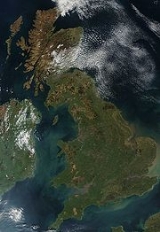
With an area of 80,800 square miles the island of Great Britain is the largest of the
British Isles.
It is the largest island in
Europe, and
eighth largest in the world.
Great Britain stretches over approximately ten degrees of
latitude on its longer, north-south axis. Geographically, the island is marked by low, rolling countryside in the east and south, while hills and mountains predominate in the western and northern regions. Before the end of the last
ice age, Great Britain was a
peninsula of Europe; the rising sea levels caused by glacial melting at the end of the ice age caused the formation of the
English Channel, the body of water which now separates Great Britain from continental Europe at a minimum distance of 21 miles .
The
climate of Great Britain is milder than that of other regions of the
Northern Hemisphere at the same latitude, because the warm waters of the
Gulf Stream pass by the British Isles and exert a moderating influence on the weather. Cool, but not cold, temperatures, clouds more often than sun, and abundant rain are the rule in most years.
Political definition
Politically,
Great Britain describes the combination of
England,
Scotland, and
Wales. It includes outlying islands such as the
Isle of Wight,
Anglesey, the
Isles of Scilly, the
Hebrides, and the island groups of
Orkney and
Shetland but does not include the
Isle of Man or the
Channel Islands.
Over the centuries, Great Britain has evolved politically from several independent countries through two kingdoms with a shared monarch , a single all-island
Kingdom of Great Britain, to the situation following 1801, in which Great Britain together with the island of
Ireland constituted the larger
United Kingdom of Great Britain and Ireland . The UK became the
United Kingdom of Great Britain and Northern Ireland in the 1920s following the independence of five-sixths of Ireland as first the
Irish Free State, a Dominion of the then
British Commonwealth, and then later as an independent republic outside the British Commonwealth as the
Republic of Ireland.
History
As recently as 9,000 years ago, Great Britain was not an island at all. The end of the last
ice age saw the southeastern part of Great Britain still connected by a strip of low
marshes to the European mainland in what is now northeastern France. In
Cheddar Gorge near
Bristol, the remains of animals native to mainland Europe such as
antelopes,
Brown Bears, and
Wild Horses have been found alongside a human skeleton, Cheddar Man, dated to about 7150 B.C. Thus, animals and humans must have moved between mainland Europe and Great Britain via a crossing.
Albion is the most ancient name of Great Britain. It sometimes is used to refer to England specifically. Occasionally, it refers to Scotland, or Alba in Gaelic, Albain in Irish, and Yr Alban in Welsh[1]. Pliny the Elder in his Natural History applies it unequivocally to Great Britain. The origin of the name Britain may be connected with the Brythonic 'Prydyn' , a name used to describe some northern inhabitants of the island by Britons or pre-Roman Celts in the south. "It was itself named Albion, while all the islands about which we shall soon briefly speak were called the Britanniae." The name Albion was taken by medieval writers from Pliny and Ptolemy. For etymology, see below.
The term was used officially for the first time during the reign of
King James VI of Scotland, I of England. Though England and Scotland each remained legally in existence as separate countries with their own parliaments, on 20 October 1604 King James proclaimed himself as 'King of Great Brittaine, France and Ireland', a title that continued to be used by many of his successors. In 1707, an
Act of Union joined both parliaments. That Act used two different terms to describe the new all island nation, a 'United Kingdom' and the 'Kingdom of Great Britain'. However, the former term is regarded by many as having been a
description of the union rather than its name at that stage. Most reference books therefore describe the all-island kingdom that existed between 1707 and 1800 as the Kingdom of Great Britain."
In 1801, under a new
Act of Union, this kingdom merged with the
Kingdom of Ireland, over which the monarch of Great Britain had ruled. The new kingdom was from then onwards unambiguously called the
United Kingdom of Great Britain and Ireland. In 1922, 26 of Ireland's
32 counties were given independence to form a separate
Irish Free State. The remaining truncated kingdom has therefore since then been known as the
United Kingdom of Great Britain and Northern Ireland.
Usage and nomenclature
Usage of the term Great Britain
Great Britain is an informal name for the political state properly known as the
United Kingdom.
This common usage is technically inaccurate as the United Kingdom includes
Northern Ireland, in addition to the three countries that make up Great Britain, as shown by its full name
“the United Kingdom of Great Britain and Northern Ireland”, and also because the three countries that make up Great Britain itself collectively include over 100 other islands.
The United Kingdom has been assigned the international foreign vehicle identification code of
GB, and the ISO 3166 geocodes
and
GBR, as abbreviations for
“the United Kingdom of Great Britain and Northern Ireland”.
The same abbreviation, 'GB', is used informally, for example, in the
Olympic Games, where the United Kingdom team may refer to themselves as 'Team GB'.
The
UK abbreviation, as used in Internet domain names, can be confused with
Ukraine.
There is a similar situation with the terms
Britain and
British, which are used to relate to the whole of the United Kingdom and not just the island of Great Britain. This usage is generally considered to be correct. Examples of this are "British monarchs", "British culture" and "British citizens" - which would generally be considered to embrace the whole of the United Kingdom. As if this was not confusion enough, the term "British" also has specific historical and archaeological usage, referring to the Celtic
Brython peoples on the island prior to and during the
Roman occupation.
The designation '
British Isles', usually refers to Great Britain, Ireland, the Isle of Man and all other islands as listed above. The Channel Islands are often not included in this designation, as they are located approximately 12 miles off the coast of northwestern France and are geologically related to mainland France.
In
rugby league the
RFL fields its representative side under the name
Great Britain.
Nomenclature
The name
Britain is derived from the name
Britannia, used by the Romans from
circa 55 BC. The etymology of this term has been the subject of speculation, but is generally thought to derive from pre-Roman Celts. Possibilities are the Celtic word,
Pritani, "painted", a reference to the inhabitants of the islands' use of body-paint and tattoos. Alternatively, links have been made with the name of the
Pictish tribe who inhabited the north of Great Britain. .
Great Britain may well be a translation of the
French term
Grande Bretagne, which is used in
France to distinguish Britain from
Brittany , which had been settled in late Roman times by Romano-Celtic troops from Maximus' army and later by refugees from
Roman Britain, who were then under attack by the
Anglo-Saxons. Since the English court and aristocracy was largely French-speaking for about two centuries after the
Norman Conquest of 1066, the French term naturally passed into English usage. The
Normans being descendants of
Vikings who had occupied the area of Normandy for some time demanding land and tithes from Gaul in exchange for peace and no more invasions.
Where is 'Little' Britain?
In Geoffrey of Monmouth's
Historia Regum Britanniae , the island of Great Britain was referred to as
Britannia major , to distinguish it from
Britannia minor , the Gaulish region which approximates to modern
Brittany. The term "Bretayne the grete" was used by chroniclers as early as 1338, but it was not used officially until
James I proclaimed himself "King of Great Britain" on 20 October 1604 to avoid the more cumbersome title "King of England and Scotland".
In
Irish,
Wales is referred to as
An Bhreatain Bheag which means 'Little Britain' although the closely related
Scottish Gaelic uses this term - "
A'Bhreatainn Bheag" - to refer to
Brittany.
Little Britain is a character-based BBC [i] radio [i] and television [i] sketch show [i] written by...
is also the name of a BBC radio and television sketch show, and the name of a street in the
City of London.
Territories associated with Great Britain
Other lands of the archipelago
See also
References
External links
- – the BBC explores the coast of Great Britain
- – one explanation of the terms "Great Britain", "United Kingdom" and so on
- – from the Ordnance Survey; various formats
-
-
- [https://www.cia.gov/cia/publications/factbook/geos/uk.html CIA Factbook United Kingdom]