
|
|
|
|
Russo-Japanese War
|
| |
|
| |
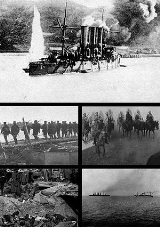
The Russo–Japanese War (; Romaji: Nichi-Ro Senso; Russko-Yaponskaya Voyna; , February 10, 1904 – September 5, 1905) was a conflict that grew out of the rival imperialist ambitions of the Russian Empire and Japanese Empire over Manchuria and Korea. The major theatres of operations were Southern Manchuria, specifically the area around the Liaodong Peninsula and Mukden, and the seas around Korea, Japan, and the Yellow Sea.
The Russians were in constant pursuit of a warm water port on the Pacific Ocean, for their navy as well as for maritime trade. The recently established Pacific seaport of Vladivostok was the only active Russian port that was reasonably operational during the summer season; but Port Arthur would be operational all year. From the end of the First Sino-Japanese War and 1903 negotiations between the Tsar's government and Japan had proved futile.

Discussion
Ask a question about 'Russo-Japanese War'
Start a new discussion about 'Russo-Japanese War'
Answer questions from other users
|
Timeline
Encyclopedia
The Russo–Japanese War (; Romaji: Nichi-Ro Senso; Russko-Yaponskaya Voyna; , February 10, 1904 – September 5, 1905) was a conflict that grew out of the rival imperialist ambitions of the Russian Empire and Japanese Empire over Manchuria and Korea. The major theatres of operations were Southern Manchuria, specifically the area around the Liaodong Peninsula and Mukden, and the seas around Korea, Japan, and the Yellow Sea.
The Russians were in constant pursuit of a warm water port on the Pacific Ocean, for their navy as well as for maritime trade. The recently established Pacific seaport of Vladivostok was the only active Russian port that was reasonably operational during the summer season; but Port Arthur would be operational all year. From the end of the First Sino-Japanese War and 1903 negotiations between the Tsar's government and Japan had proved futile. Japan chose war to protect its country by maintaining exclusive dominance in Korea, while all European countries expected Russia would win.
The resulting campaigns, in which the fledgling Japanese military consistently attained victory over the Russian forces arrayed against them, were unexpected by world observers. These victories, as time transpired, would dramatically transform the balance of power in East Asia, resulting in a reassessment of Japan's recent entry onto the world stage. The embarrassing string of defeats increased Russian populace's dissatisfaction with the inefficient and corrupt Tsarist government and proved a major cause of the Russian Revolution of 1905.
Origins of the Russo-Japanese warAfter the Meiji Restoration in 1868, the Meiji government embarked on an endeavor to assimilate Western ideas, technological advances and customs. By the late 19th century, Japan had emerged from isolation and transformed itself into a modernized industrial state in a remarkably short time. The Japanese wished to preserve their sovereignty and to be recognized as an equal with the Western powers.
Russia, a major Imperial power, had ambitions in the East. By the 1890s it had extended its realm across Central Asia to Afghanistan, absorbing local states in the process. The Russian Empire stretched from Poland in the west to the Kamchatka peninsula in the East. With its construction of the Trans-Siberian Railway to the port of Vladivostok, Russia hoped to further consolidate its influence and presence in the region. This was precisely what Japan feared, as they regarded Korea (and to a lesser extent Manchuria) as a protective buffer.
Sino-Japanese War (1894-1895)The Japanese government regarded Korea, which was geo-politically close to Japan, as an essential part of its national security. The Japanese wanted, at the very least, to keep Korea independent under Japanese influence. Japan's subsequent defeat of China during the war led to the Treaty of Shimonoseki under which China abandoned its own suzerainty over Korea and ceded Taiwan, Pescadores and the Liaodong Peninsula to Japan.
However, the Russians, having their own ambitions in the region persuaded Germany and France to apply pressure on Japan. Through the Triple Intervention, Japan relinquished its claim on the Liaodong Peninsula for an increased financial indemnity.
Russian EncroachmentIn December 1897, a Russian fleet appeared off Port Arthur. After three months, in 1898, a convention was agreed between China and Russia by which Russia was leased Port Arthur, Talienwan and the surrounding waters. It was further agreed that the convention could be extended by mutual agreement. The Russians clearly believed that would be the case for they lost no time in occupation and in fortifying Port Arthur, their sole warm-water port on the Pacific coast, and of great strategic value. A year later, in order to consolidate their position, the Russians began a new railway from Harbin through Mukden to Port Arthur. The development of the railway was a contributory factor towards the Boxer Rebellion and the railway stations at Tiehling and Lioyang were burnt. The Russians also began to make inroads into Korea, by 1898 they acquired mining and forestry concessions near Yalu and Tumen rivers, causing the Japanese much anxiety.
The Boxer RebellionThe Russians and Japanese were both part of the eight member international force which was sent into quell the Boxer Rebellion and to relieve the international legations under siege in the Chinese capital. As with other member nations, the Russians sent troops into China, specifically Manchuria to protect its interests. Russia assured other powers that it would vacate the area after the crisis. However, by 1903 the Russian had not yet adhered to any timetable for withdrawal and actually strengthened their position in Manchuria.
NegotiationsThe Japanese statesman, Ito Hirobumi, started to negotiate with the Russians. He believed that Japan was too weak to evict Russia militarily, so he proposed giving Russia control over Manchuria in exchange for Japanese control of northern Korea. Meanwhile, Japan and Britain had signed the Anglo-Japanese Alliance in 1902, the British seeking to restrict naval competition by keeping the Russian Pacific seaports of Vladivostok and Port Arthur from their full use. The alliance with the British meant, in part, that if any nation allied itself with Russia during any war with Japan, then Britain would enter the war on Japan's side. Russia could no longer count on receiving help from either Germany or France without there being a danger of the British involvement with the war. With such an alliance, Japan felt free to commence hostilities, if necessary.
On 28 July 1903, the Japanese Minister at St. Petersburg was instructed to represent his country's view opposing Russia's consolidation plans over Manchuria. Trade-offs followed and the situation was reached on 13 January 1904 whereby Japan proposed a formula of Manchuria being outside her sphere of influence and sought in return a similar statement relating to Russia's discontinuing interest in Korea. By 4 February 1904, no formal reply had been forthcoming and on the 6th February Mr. Kurino Shinichiro, the Japanese Minister, called on the Russian Foreign Minister, Count Lamsdorf, to take his leave. Japan severed diplomatic relations on February 6, 1904.
WarDeclaration of WarJapan issued a declaration of war on 8 February 1904. However, three hours before Japan's declaration of war was received by the Russian Government, the Japanese Imperial Navy attacked the Russian Far East Fleet at Port Arthur. Tsar Nicholas II was stunned by news of the attack. He could not believe that Japan could initiate a warlike act without a formal declaration of war, and had been assured by his ministers that the Japanese would not fight. Russia declared war on Japan eight days later. However, the requirement to declare war before commencing hostilities was not made international law until after the war had ended in October 1907, effective from 26 January 1910. Montenegro also declared war against Japan as a gesture of moral support for Russia out of gratefulness for Russian support in Montenegro's struggles against the Ottoman Empire. However, due to logistical reasons and distance, Montenegro's contribution to the war effort was limited to those Montenegrins who served in the Russian armed forces.
Campaign of 1904Port Arthur, on the Liaodong Peninsula in the south of Manchuria, had been fortified into a major naval base by the Imperial Russian Army. Since it needed to control the sea in order to fight a war on the Asian mainland, Japan's first military objective was to neutralize the Russian fleet at Port Arthur.
Battle of Port ArthurOn the night of 8 February 1904, the Japanese fleet under Admiral Heihachiro Togo opened the war with a surprise torpedo boat attack on the Russian ships at Port Arthur. The attack badly damaged the Tsesarevich and Retvizan, the heaviest battleships in Russia's far Eastern theater, and the 6,600 ton cruiser Pallada. These attacks developed into the Battle of Port Arthur the next morning. A series of indecisive naval engagements followed, in which Admiral Togo was unable to attack the Russian fleet successfully as it was protected by the shore batteries of the harbor, and the Russians were reluctant to leave the harbor for the open seas, especially after the death of Admiral Stepan Osipovich Makarov on 13 April 1904.
However, these engagements provided cover for a Japanese landing near Incheon in Korea. From Incheon the Japanese occupied Seoul and then the rest of Korea. By the end of April, the Imperial Japanese Army under Kuroki Itei was ready to cross the Yalu river into Russian-occupied Manchuria.
Battle of Yalu RiverIn contrast to the Japanese strategy of rapidly gaining ground to control Manchuria, Russian strategy focused on fighting delaying actions to gain time for reinforcements to arrive via the long Trans-Siberian railway which was at the time incomplete near Irkutsk. On 1 May 1904, the Battle of the Yalu River became the first major land battle of the war, when Japanese troops stormed a Russian position after an unopposed crossing of the river. Japanese troops proceeded to land at several points on the Manchurian coast, and, in a series of engagements, drove the Russians back towards Port Arthur. These battles, including the Battle of Nanshan on 25 May 1904, were marked by heavy Japanese losses from attacking entrenched Russian positions, but the Russians maintained their focus on defending, and did not counterattack.
Blockade of Port ArthurThe Japanese attempted to deny the Russians use of Port Arthur. During the night of 13 February-14 February, the Japanese attempted to block the entrance to Port Arthur by sinking several cement-filled steamers in the deep water channel to the port, but they sank too deep to be effective. Another similar attempt to block the harbor entrance during the night of 3-4 May also failed. In March, the charismatic Vice Admiral Makarov had taken command of the First Russian Pacific Squadron with the intention of breaking out of the Port Arthur blockade.
On 12 April 1904, two Russian pre-dreadnought battleships, the flagship Petropavlovsk and the Pobeda slipped out of port but struck Japanese mines off Port Arthur. The Petropavlovsk sank almost immediately, while the Pobeda had to be towed back to port for extensive repairs. Admiral Makarov, the single most effective Russian naval strategist of the war, had perished on the battleship Petropavlovsk.
On 15 April 1904, the Russian government made overtures threatening to seize the British war correspondents who were taking the ship Haimun into warzones to report for the London-based The Times newspaper, citing concerns about the possibility of the British giving away Russian positions to the Japanese fleet.
The Russians learned quickly, and soon employed the Japanese tactic of offensive minelaying. On 15 May 1904, two Japanese battleships, the Yashima and the Hatsuse, were lured into a recently laid Russian minefield off Port Arthur, each striking at least two mines. The Hatsue sank within minutes, taking 450 sailors with her, while the Yashima sank while under tow towards Korea for repairs. On June 23, 1904, a breakout attempt by the Russian squadron, now under the command of Admiral Wilgelm Vitgeft failed. By the end of the month, Japanese artillery were firing shells into the harbor.
Siege of Port ArthurJapan began a long siege of Port Arthur. On 10 August 1904, the Russian fleet again attempted to break out and proceed to Vladivostok, but upon reaching the open sea were confronted by Admiral Togo's battleship squadron. Known to the Russians as the Battle of August 10 , but more commonly referred to as the Battle of the Yellow Sea, battleships from both sides exchanged gunfire. The battle had the elements of a decisive battle, though Admiral Togo knew that another Russian battleship fleet would soon be sent to the Pacific. The Japanese had only one battleship fleet and Togo had already lost two battleships to Russian mines. The Russian and Japanese battleships continued to exchange gunfire, until the Russian flagship, the battleship Tsesarevich, received a direct hit on the bridge, killing the fleet commander, Admiral Vitgeft. At this, the Russian fleet turned around and headed back into Port Arthur. Though no warships were sunk by either side in the battle, the Russians were now back in port and the Japanese navy still had battleships to meet the new Russian fleet when it arrived.
Fall of Port ArthurEventually, the Russian warships at Port Arthur were sunk by the artillery of the besieging army. Attempts to relieve the besieged city by land also failed, and, after the Battle of Liaoyang in late August, the Russians retreated to Mukden. Port Arthur finally fell on 2 January 1905 when the garrison's commanding officer ceded the port to the Japanese without consulting his high command.
Baltic FleetMeanwhile, at sea, the Russians were preparing to reinforce the Far East Fleet by sending the Baltic Fleet, under Admiral Zinovy Rozhestvensky The fleet sailed around the world from the Baltic Sea to China via the Cape of Good Hope. The Baltic Fleet would not reach the Far East until May 1905.
On 21 October 1904, while passing by the United Kingdom (an ally of Japan but neutral in this war), vessels of the Baltic Fleet nearly provoked a war in the Dogger Bank incident by firing on British fishing boats that they mistook for enemy torpedo boats.
Campaign of 1905Harsh winter and final battlesWith the fall of Port Arthur, the Japanese 3rd army was now able to continue northward and reinforce positions south of Russian-held Mukden. With the onset of the severe Manchurian winter, there had been no major land engagements since the Battle of Shaho the previous year. Both sides camped opposite each other along 60 to of front lines, south of Mukden.
The Russian Second Army under General Oskar Grippenberg, between January 25–29, attacked the Japanese left flank near the town of Sandepu, almost breaking through. This caught the Japanese by surprise. However, without support from other Russian units the attack was stalled, Grippenberg was ordered to halt by Kuropatkin and the battle was inconclusive. The Japanese knew that they needed to destroy the Russian army in Manchuria before Russian reinforcements arrived via the Trans-Siberian railroad.
The Battle of Mukden commenced on February 20, 1905. In the following days Japanese forces proceeded to assault the right and left flanks of Russian forces surrounding Mukden, along a front. Both sides were well entrenched and were backed with hundreds of artillery pieces. After days of harsh fighting, added pressure from both flanks forced both ends of the Russian defensive line to curve backwards. Seeing they were about to be encircled, the Russians began a general retreat, fighting a series of fierce rearguard actions, which soon deteriorated in the confusion and collapse of Russian forces. On March 10, 1905 after three weeks of fighting, General Kuropatkin decided to withdraw to the north of Mukden.
The retreating Russian Manchurian Army formations disintegrated as fighting units, but the Japanese failed to destroy them completely. The Japanese themselves had suffered large casualties and were in no condition to pursue. Although the battle of Mukden was a major defeat for the Russians it had not been decisive, and the final victory would depend on the navy.
Victory at Tsushima The Russian Second Pacific Squadron (the renamed Baltic Fleet) voyaged the unprecedented to relieve Port Arthur. The demoralizing news that Port Arthur had fallen reached the fleet while at Madagascar. Admiral Rozhestvensky's only hope now was to reach the port of Vladivostok. There were three routes to Vladivostok, with the shortest and most direct passing through Tsushima Straits between Korea and Japan. However, this was also the most dangerous route as it passed very close to the Japanese home islands.
Admiral Togo was aware of the Russian progress and understood that with the fall of Port Arthur, the Second and Third Pacific Squadrons would try to reach the only other Russian port in the Far East, Vladivostok. Battle plans were laid down and ships were repaired and refitted to intercept the Russian fleet.
The Japanese Combined Fleet, which had originally consisted of six battleships, was now down to four (two had been lost to mines), but still retained its cruisers, destroyers, and torpedo boats. The Second Pacific Squadron contained eight battleships, including four new battleships of the Borodino class, as well as cruisers, destroyers and other auxiliaries for a total of 38 ships.
By the end of May the Second Pacific Squadron was on the last leg of its journey to Vladivostok. They decided to take the shorter, more risky route between Korea and Japan. They travelled at night so they might not be discovered. Unfortunately for the Russians, one of their hospital ships exposed a light, which was sighted by the Japanese armed merchant cruiser Shinano Maru. Wireless communication was used to inform Togo's headquarters, where the Combined Fleet was immediately ordered to sortie. Still receiving naval intelligence from scouting forces, the Japanese were able to position their fleet so that they would "cross the T" of the Russian fleet. The Japanese engaged the Russian fleet in the Tsushima Straits on 27 May–28 May, 1905. The Russian fleet was virtually annihilated, losing eight battleships, numerous smaller vessels, and more than 5,000 men, while the Japanese lost three torpedo boats and 116 men. Only three Russian vessels escaped to Vladivostok. After the Battle of Tsushima, the Japanese army occupied the entire Sakhalin Islands chain to force the Russians to sue for peace.
Peace and aftermath Treaty of PortsmouthThe defeats of the Russian Army and Navy shook Russian confidence. Throughout 1905, the Imperial Russian government was rocked by revolution. Tsar Nicholas II elected to negotiate peace so he could concentrate on internal matters.
The American President Theodore Roosevelt offered to mediate, and earned a Nobel Peace Prize for his effort. Sergius Witte led the Russian delegation and Baron Komura, a graduate of Harvard, led the Japanese Delegation. The Treaty of Portsmouth was signed on 5 September 1905 in the U.S. naval station in Portsmouth, New Hampshire. Witte became Russian Prime Minister the same year.
However a peace treaty with Montenegro was not signed by the Japanese and a state of war technically remained with the country until its 1918 inclusion in the State of Serbs, Croats and Slovenes which inherited foreign relations of Kingdom of Serbia. The issue resurfaced after the Montenegro's decision to leave the union with Serbia in 2006 (see List of wars extended by diplomatic irregularity).
Russia recognized Korea as part of the Japanese sphere of influence and agreed to evacuate Manchuria. Japan would annex Korea in 1910, with scant protest from other powers.
Russia also signed over its 25-year leasehold rights to Port Arthur, including the naval base and the peninsula around it. Russia also ceded the southern half of Sakhalin Island to Japan. It was regained by the USSR in 1952 under the Treaty of San Francisco following the Second World War. However, the cessation of Southern Sakhalin to the USSR was not supported by the majority of Japanese politicians.
CasualtiesSources do not agree on a precise number of deaths from the war because of lack of body counts for confirmation. The number of Japanese dead in combat is put at around 47,000 with around 80,000 if disease is included. Estimates of Russian dead range from around 40,000 to around 70,000. The total number of dead is generally stated at around 130,000. China suffered 20,000 collateral deaths, and financially the loss amounted to over 69 million taels worth of silver.
Political consequencesThis was the first major victory of an Asian power over a European one in the modern era. Russia's defeat had been met with shock both in the West and across the Far East, that an Asian country could defeat an established European power in a large military conflict. Japan's prestige rose greatly as it began to be considered a modern Great Power. Concurrently, Russia lost virtually its entire Pacific and Baltic fleets, and also lost international esteem. This was particularly true in the eyes of Germany and Austria-Hungary; Russia was France's and Serbia's ally, and that loss of prestige would have a significant effect on Germany's future when planning for war with France, and Austria-Hungary's war with Serbia.
In the absence of Russian competition and with the distraction of European nations during World War I, combined with the Great Depression which followed, the Japanese military began its efforts to dominate China and the rest of Asia, which would eventually lead to the Second Sino-Japanese War and the Pacific War, theatres of World War II.
Revolution in RussiaPopular discontent in Russia after the war added more fuel to the already simmering Russian Revolution of 1905, an event Nicholas II of Russia had hoped to avoid entirely by taking intransigent negotiating stances prior to coming to the table at all. In ten more years, that discontent would boil over into the Bolshevik Revolution of 1917. In Poland, which Russia partitioned in the late 18th century, and where Russian rule already caused two major uprisings, the population was so restless that an army of 250,000-300,000 - larger than the one facing the Japanese - had to be stationed to put down the unrest. Notably, some political leaders of Polish insurrection movement (in particular, Józef Pilsudski) sent emissaries to Japan to collaborate on sabotage and intelligence gathering within the Russian Empire and even plan a Japanese-aided uprising.
In Russia, the defeat of 1905 led in the short term to a reform of the Russian military that allowed it to face Germany in World War I. However, the revolts at home following the war planted the seeds that presaged the Russian Revolution of 1917.
All above dates are believed to be New-Style.
Effects on JapanAlthough the war had ended in a victory for Japan, there was a noteworthy gap between Japanese public opinion and the very restrained peace terms which negotiated at the war's end. Widespread discontent spread through the populace upon the announcement of the treaty terms. Riots erupted in major cities in Japan. Two specific demands, expected from such a costly victory, were especially lacking: territorial gains and monetary reparations to Japan. The peace accord led to feelings of distrust, as the Japanese had intended to retain all of Sakhalin Island, but they were forced to settle for half of it after being pressured by the U.S.
Assessment of war resultsRussia had lost two of its three fleets. Only its Black Sea Fleet remained, and this was that result of an earlier treaty that had prevented the fleet from leaving the Black Sea. Japan became the sixth powerful naval power while the Russian navy declined to one barely stronger that of Austria Hungary.
A lock of Admiral Nelson's hair was given to the Imperial Japanese Navy from the Royal Navy after the war to commemorate the victory of the 1905 Battle of Tsushima; which was in tune with Britain's victory at Trafalgar in 1805. It is still on display at Kyouiku Sankoukan, a public museum maintained by the Japan Self-Defense Force.
The Japanese were on the offensive for most of the war and used massed infantry tactics against defensive positions, which would be the standard by all European armies during World War I. Battles during the Russo-Japanese War were a precursor to trench warfare of World War I, in which machine guns and artillery had taken their toll on Japanese troops. Jakob Meckel, a German military advisor sent to Japan, had a tremendous impact on the development of the Japanese military training, tactics, strategy and organization. His reforms were credited with Japan's overwhelming victory over China in the First Sino-Japanese War of 1894–1895. However, his over-reliance on the use of infantry in offensive campaigns also led to the large number of Japanese casualties in the War.
Military and economic exhaustion affected both countries. Japanese historians consider this war to be a turning point for Japan, and a key to understanding the reasons why Japan may have failed militarily and politically later on. The acrimony was felt at every stratum of Japanese society and it became the consensus within Japan that their nation had been treated as the defeated power during the peace conference. As time went on, this feeling, coupled with the sense of arrogance of becoming a Great Power, grew and added to their growing hostility towards the West and fueled their own militarist and imperialist ambitions, which would cumulate in Japan's invasion of East, Southeast, and South Asia in World War II in an attempt to create their own great colonial empire in the name of creating the Greater East Asia Co-prosperity Sphere. Only five years after the war, Japan de jure annexed Korea as its colonial empire, and invaded Manchuria in the Mukden Incident 21 years after in 1931. As a result, most Chinese historians note the war as a key development of Japanese militarism.
List of battles- 1904 Battle of Port Arthur, February 8: naval battle Inconclusive
- 1904 Battle of Chemulpo Bay, February 9: naval battle Japanese victory
- 1904 Battle of Yalu River, April 30 to May 1: Japanese victory
- 1904 Battle of Nanshan, May 25 – May 26, Japanese victory
- 1904 Battle of Telissu, June 14 – June 15 , Japanese victory
- 1904 Battle of Motien Pass, July 17, Japanese victory
- 1904 Battle of Ta-shih-chiao, July 24, Japanese victory
- 1904 Battle of Hsimucheng, July 31, Japanese victory
- 1904 Battle of the Yellow Sea, August 10: naval battle Japanese victory strategically/tactically inconclusive
- 1904 Battle off Ulsan, August 14: naval battle Japanese victory
- 1904–1905 Siege of Port Arthur, August 19 to January 2: Japanese victory
- 1904 Battle of Liaoyang, August 25 to September 3: Inconclusive
- 1904 Battle of Shaho, October 5 to October 17: Inconclusive
- 1905 Battle of Sandepu, January 26 to January 27: Inconclusive
- 1905 Battle of Mukden, February 21 to March 10: Japanese victory
- 1905 Battle of Tsushima, May 27 to 28 May naval battle: Japanese victory
See also
External links -
- Database of Russian Army Jewish soldiers injured, killed, or missing in action from the war: http://www.bfcollection.net/fast/rjmain.html
- Text of the Treaty of Portsmouth: http://www.lib.byu.edu/~rdh/wwi/1914m/portsmouth.html
- Russian Navy history of war: http://www.navy.ru/history/hrn10-e.htm
- Meeting of Frontiers (Library of Congress):
- from the Christian Science Monitor, by Robert Marquand, December 30, 2005
|
| |
|
|