


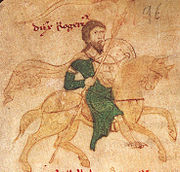
Roger II of Sicily

Encyclopedia
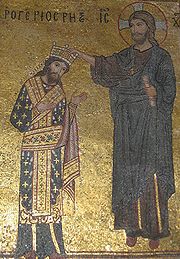
Sicily
Sicily is a region of Italy, and is the largest island in the Mediterranean Sea. Along with the surrounding minor islands, it constitutes an autonomous region of Italy, the Regione Autonoma Siciliana Sicily has a rich and unique culture, especially with regard to the arts, music, literature,...
, son of Roger I of Sicily
Roger I of Sicily
Roger I , called Bosso and the Great Count, was the Norman Count of Sicily from 1071 to 1101. He was the last great leader of the Norman conquest of southern Italy.-Conquest of Calabria and Sicily:...
and successor to his brother Simon
Simon, Count of Sicily
Simon of Hauteville , called Simon de Hauteville in French and Simone D'Altavilla in Italian, was the eldest son and successor of Roger the Great Count, count of Sicily, and Adelaide del Vasto, under whose regency he reigned....
. He began his rule as Count of Sicily in 1105, later became Duke of Apulia and Calabria (1127), then King of Sicily (1130). Roger had succeeded in uniting all the Norman conquests in Italy into one kingdom with a strong centralized government.
Background
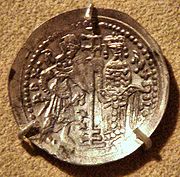
Normans
The Normans were the people who gave their name to Normandy, a region in northern France. They were descended from Norse Viking conquerors of the territory and the native population of Frankish and Gallo-Roman stock...
adventurers had come to southern Italy. By 1016, they were involved in the complex local politics where Lombards were fighting against the Saracens pirates or the Byzantine Empire
Byzantine Empire
The Byzantine Empire was the Eastern Roman Empire during the periods of Late Antiquity and the Middle Ages, centred on the capital of Constantinople. Known simply as the Roman Empire or Romania to its inhabitants and neighbours, the Empire was the direct continuation of the Ancient Roman State...
. These mercenaries fought the enemies of the Italian city-states, but in the following century they gradually became the rulers of the major polities
Polity
Polity is a form of government Aristotle developed in his search for a government that could be most easily incorporated and used by the largest amount of people groups, or states...
south of Rome.
At the time of the birth of his youngest son, in 1095, Roger I ruled the County of Sicily
County of Sicily
The County of Sicily was a Norman state comprising the islands of Sicily and Malta from 1071 until 1130. The county began to form during the Christian reconquest of Sicily from the Muslim Emirate, established by conquest in 965. The county is thus a transitionary period in the history of Sicily...
, his nephew, Roger Borsa
Roger Borsa
Roger Borsa was the Norman Duke of Apulia and effective ruler of southern Italy from 1085 until his death. He was the son of Robert Guiscard, the conqueror of southern Italy and Sicily; Roger was not as adept as his father, and most of his reign was spent in feudal anarchy.-Biography:Roger was the...
, was the Duke of Apulia and Calabria, and his great nephew, Richard II of Capua
Richard II of Capua
Richard II , called the Bald, was the count of Aversa and the prince of Capua from 1090 or 1091.The eldest son and successor of Jordan I of Capua and Gaitelgrima, daughter of Prince Guaimar IV of Salerno, he was named after his grandfather, Richard I of Capua...
, was the Prince of Capua
Principality of Capua
The Principality of Capua was a Lombard state in Southern Italy, usually de facto independent, but under the varying suzerainty of Western and Eastern Roman Empires. It was originally a gastaldate, then a county, within the principality of Salerno....
.
Alongside these three major rulers were a large number of minor count
Count
A count or countess is an aristocratic nobleman in European countries. The word count came into English from the French comte, itself from Latin comes—in its accusative comitem—meaning "companion", and later "companion of the emperor, delegate of the emperor". The adjective form of the word is...
s, who effectively exercised sovereign power in their own localities. These counts at least nominally owed their allegiance to one of these three Norman rulers, but such allegiance was usually weak and often ignored.
When Roger I, Count of Sicily, died in 1101, his young son, Simon of Hauteville, became Count, with his mother Adelaide del Vasto
Adelaide del Vasto
Adelaide del Vasto was the third wife of Roger I of Sicily and mother of Roger II of Sicily, as well as Queen consort of Jerusalem due to her later marriage to Baldwin I of Jerusalem, as his third wife.-Family:She was the daughter of Manfred del Vasto Adelaide del Vasto (Adelasia, Azalaïs) (c....
as regent. Simon died four years later in 1105, at the age of 12. Adelaide continued as regent to her younger son Roger, who was just 9 years old.
Reign
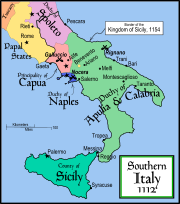
Rise to power in Sicily
On the death of his elder brother, Simon of Hauteville, in 1105, Roger inherited the County of Sicily under the regencyRegent
A regent, from the Latin regens "one who reigns", is a person selected to act as head of state because the ruler is a minor, not present, or debilitated. Currently there are only two ruling Regencies in the world, sovereign Liechtenstein and the Malaysian constitutive state of Terengganu...
of his mother, Adelaide del Vasto
Adelaide del Vasto
Adelaide del Vasto was the third wife of Roger I of Sicily and mother of Roger II of Sicily, as well as Queen consort of Jerusalem due to her later marriage to Baldwin I of Jerusalem, as his third wife.-Family:She was the daughter of Manfred del Vasto Adelaide del Vasto (Adelasia, Azalaïs) (c....
. During this time the mother was assisted by such notables as Christodulus
Christodulus
Christodulus , probably either a Moslem convert or a Greek Orthodox, was the first emir of Palermo . His rise occurred after the death of Count Simon of Sicily in 1105 and he held the position of emir by 1107, during the regency of Adelaide del Vasto for her son, King Roger II of...
, the emir
Emir
Emir , meaning "commander", "general", or "prince"; also transliterated as Amir, Aamir or Ameer) is a title of high office, used throughout the Muslim world...
of Palermo
Palermo
Palermo is a city in Southern Italy, the capital of both the autonomous region of Sicily and the Province of Palermo. The city is noted for its history, culture, architecture and gastronomy, playing an important role throughout much of its existence; it is over 2,700 years old...
.
In the summer of 1110, he was visited by the Norwegian king Sigurd Jorsalfare
Sigurd I of Norway
Sigurd I Magnusson , also known as Sigurd the Crusader , was King of Norway from 1103 to 1130. His rule, together with his brother Eystein I of Norway , has been regarded by historians as a golden age for the medieval Kingdom of Norway...
on his way to Jerusalem. The story suggests that Sigurd gave him the name King of Sicily, 20 years before he actually obtained this title.
In 1112, at the age of 16, Roger began his personal rule, being named "now knight, now Count of Sicily and Calabria" in a charter document dated June 12, 1112.
In 1117, his mother, who had married Baldwin I of Jerusalem
Baldwin I of Jerusalem
Baldwin I of Jerusalem, formerly Baldwin I of Edessa, born Baldwin of Boulogne , 1058? – 2 April 1118, was one of the leaders of the First Crusade, who became the first Count of Edessa and then the second ruler and first titled King of Jerusalem...
, returned to Sicily, since the Patriarch of Jerusalem had declared the marriage invalid. Roger seems to have felt the slight, and this might explain his later reluctance to go crusading. Roger married his first wife, Elvira, daughter of Alfonso VI of Castile
Alfonso VI of Castile
Alfonso VI , nicknamed the Brave or the Valiant, was King of León from 1065, King of Castile and de facto King of Galicia from 1072, and self-proclaimed "Emperor of all Spain". After the conquest of Toledo he was also self-proclaimed victoriosissimo rege in Toleto, et in Hispania et Gallecia...
and his fourth queen, Isabella, who may be identical to his former concubine, the converted Moor, Zaida, baptised Isabella.
In 1122, William II, the Duke of Apulia and Roger's first cousin once removed, offered to renounce his remaining claims to Sicily as well as part of Calabria
Calabria
Calabria , in antiquity known as Bruttium, is a region in southern Italy, south of Naples, located at the "toe" of the Italian Peninsula. The capital city of Calabria is Catanzaro....
. Roger, in exchange, crossed the Straits of Messina to subjugate the duke's vassal, Count Jordan of Ariano
Jordan of Ariano
Jordan , count of Ariano , was a petty baron in Apulia during the reign of the Duke William II. He was the son and successor of Count Eribert and Altrude of Buonalbergo....
. In doing so, he penetrated the Basilicata
Basilicata
Basilicata , also known as Lucania, is a region in the south of Italy, bordering on Campania to the west, Apulia to the north and east, and Calabria to the south, having one short southwestern coastline on the Tyrrhenian Sea between Campania in the northwest and Calabria in the southwest, and a...
and took Montescaglioso
Montescaglioso
Montescaglioso is a town and comune in the Province of Matera, Basilicata, southern Italy.The economy is mostly based on agriculture, including production of renowned oil and wine, as well as traditional food....
.
Rise to power in southern Italy
When William II of Apulia died childless in July 1127, Roger claimed all Hauteville familyHauteville family
The family of the Hauteville was a petty baronial Norman family from the Cotentin which rose to prominence in Europe, Asia, and Africa through its conquests in the Mediterranean, especially Southern Italy and Sicily...
possessions in the peninsula as well as the overlordship of the Principality of Capua
Principality of Capua
The Principality of Capua was a Lombard state in Southern Italy, usually de facto independent, but under the varying suzerainty of Western and Eastern Roman Empires. It was originally a gastaldate, then a county, within the principality of Salerno....
, which had been nominally given to Apulia almost thirty years earlier. However, the union of Sicily
Sicily
Sicily is a region of Italy, and is the largest island in the Mediterranean Sea. Along with the surrounding minor islands, it constitutes an autonomous region of Italy, the Regione Autonoma Siciliana Sicily has a rich and unique culture, especially with regard to the arts, music, literature,...
and Apulia was resisted by Pope Honorius II
Pope Honorius II
Pope Honorius II , born Lamberto Scannabecchi, was pope from December 21, 1124, to February 13, 1130. Although from a humble background, his obvious intellect and outstanding abilities saw him promoted through the ecclesiastical hierarchy...
and by the subjects of the duchy itself.
Royal investiture
Robert II of Capua
Robert II was the count of Aversa and the prince of Capua from 1127 until his death .He was the only son and successor of Jordan II of Capua...
and Ranulf II of Alife (his own brother-in-law) against him. After this coalition failed, in August 1128 Honorius invested Roger at Benevento
Benevento
Benevento is a town and comune of Campania, Italy, capital of the province of Benevento, 50 km northeast of Naples. It is situated on a hill 130 m above sea-level at the confluence of the Calore Irpino and Sabato...
as Duke of Apulia. The baronial resistance, which was backed by Naples
Naples
Naples is a city in Southern Italy, situated on the country's west coast by the Gulf of Naples. Lying between two notable volcanic regions, Mount Vesuvius and the Phlegraean Fields, it is the capital of the region of Campania and of the province of Naples...
, Bari
Bari
Bari is the capital city of the province of Bari and of the Apulia region, on the Adriatic Sea, in Italy. It is the second most important economic centre of mainland Southern Italy after Naples, and is well known as a port and university city, as well as the city of Saint Nicholas...
, Salerno
Salerno
Salerno is a city and comune in Campania and is the capital of the province of the same name. It is located on the Gulf of Salerno on the Tyrrhenian Sea....
, and other cities whose aim was civic freedom, gave way. In September 1129 Roger was generally recognized as duke of Apulia by Sergius VII of Naples
Sergius VII of Naples
Sergius VII was the thirty-ninth and last duke of Naples. He succeeded his father John VI on the Neapolitan throne in 1120 or 1123 at a time when Roger II of Sicily was rising rapidly in power...
, Robert of Capua, and the rest. He began at once to enforce order in the duchy, where the ducal power had long been fading.
Upon the death of Pope Honorius in February 1130 there were two claimants to the papal throne. Roger supported Antipope Anacletus II
Antipope Anacletus II
Anacletus II , born Pietro Pierleoni, was an Antipope who ruled from 1130 to his death, in a schism against the contested, hasty election of Pope Innocent II....
against Innocent II
Pope Innocent II
Pope Innocent II , born Gregorio Papareschi, was pope from 1130 to 1143, and was probably one of the clergy in personal attendance on the antipope Clement III .-Early years:...
. The reward was a crown, and, on 27 September 1130, Anacletus' papal bull
Papal bull
A Papal bull is a particular type of letters patent or charter issued by a Pope of the Catholic Church. It is named after the bulla that was appended to the end in order to authenticate it....
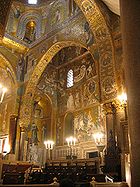
made Roger king of Sicily. He was crowned in Palermo
Palermo
Palermo is a city in Southern Italy, the capital of both the autonomous region of Sicily and the Province of Palermo. The city is noted for its history, culture, architecture and gastronomy, playing an important role throughout much of its existence; it is over 2,700 years old...
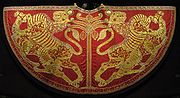
on the Christmas Day 1130. Roger II's elaborate royal mantle bears the date 528 of the Islamic calendar
Islamic calendar
The Hijri calendar , also known as the Muslim calendar or Islamic calendar , is a lunar calendar consisting of 12 lunar months in a year of 354 or 355 days. It is used to date events in many Muslim countries , and used by Muslims everywhere to determine the proper day on which to celebrate Islamic...
(1133-34 A.D.), therefore it could not be used for his coronation. It was later used as coronation cloak by the Holy Roman Emperors and is now in the Imperial Treasury
Schatzkammer
Schatzkammer is a German word which translates as Treasure Room, and is a term also used in English for the collection of treasures, especially those in precious metals and jewels, of a ruler or other collector, kept in a secure room, often in the basement of a palace or castle...
(Schatzkammer) in Vienna
Vienna
Vienna is the capital and largest city of the Republic of Austria and one of the nine states of Austria. Vienna is Austria's primary city, with a population of about 1.723 million , and is by far the largest city in Austria, as well as its cultural, economic, and political centre...
.
Peninsular rebellions
This plunged Roger into a ten-year war. The famous Bernard of ClairvauxBernard of Clairvaux
Bernard of Clairvaux, O.Cist was a French abbot and the primary builder of the reforming Cistercian order.After the death of his mother, Bernard sought admission into the Cistercian order. Three years later, he was sent to found a new abbey at an isolated clearing in a glen known as the Val...
, Innocent's champion, organized a coalition against Anacletus and his "half-heathen king." He was joined by Louis VI of France
Louis VI of France
Louis VI , called the Fat , was King of France from 1108 until his death . Chronicles called him "roi de Saint-Denis".-Reign:...
, Henry I of England
Henry I of England
Henry I was the fourth son of William I of England. He succeeded his elder brother William II as King of England in 1100 and defeated his eldest brother, Robert Curthose, to become Duke of Normandy in 1106...
, and the Lothair III, Holy Roman Emperor
Lothair III, Holy Roman Emperor
Lothair III of Supplinburg , was Duke of Saxony , King of Germany , and Holy Roman Emperor from 1133 to 1137. The son of Count Gebhard of Supplinburg, his reign was troubled by the constant intriguing of Frederick I, Duke of Swabia and Duke Conrad of Franconia...
. Meanwhile southern Italy revolted.
In 1130, the Duchy of Amalfi
Duchy of Amalfi
The Duchy of Amalfi or the Republic of Amalfi was a de facto independent state centred on the Southern Italian city of Amalfi during the 10th and 11th centuries. The city and its territory were originally part of the larger ducatus Neapolitanus, governed by a patrician, but it extracted itself...
revolted and in 1131, Roger sent John of Palermo
John (Sicilian admiral)
John was the amiratus or emir of Roger II of Sicily. John was born to the Admiral Eugenius in Palermo, where his family had moved from Troina. His brothers were the logothete Philip and the amiratus Nicholas. His uncle was the notary Basil. All his family members were closely connected to the royal...
across the Strait of Messina
Strait of Messina
The Strait of Messina is the narrow passage between the eastern tip of Sicily and the southern tip of Calabria in the south of Italy. It connects the Tyrrhenian Sea with the Ionian Sea, within the central Mediterranean...
to join up with a royal troop from Apulia and Calabria and march on Amalfi
Amalfi
Amalfi is a town and comune in the province of Salerno, in the region of Campania, Italy, on the Gulf of Salerno, c. 35 km southeast of Naples. It lies at the mouth of a deep ravine, at the foot of Monte Cerreto , surrounded by dramatic cliffs and coastal scenery...
by land while George of Antioch
George of Antioch
George of Antioch was the first true ammiratus ammiratorum, successor of the great Christodulus. George was a Greek Melchite, born in Antioch, whence he moved with his father, Michael, and mother to Tunisia. His parents found employment under the Zirid Sultan, Tamim ibn Muizz...
blockaded the town by sea and set up a base on Capri
Capri
Capri is an Italian island in the Tyrrhenian Sea off the Sorrentine Peninsula, on the south side of the Gulf of Naples, in the Campania region of Southern Italy...
. Amalfi soon capitulated.
In 1132, Roger sent Robert II of Capua
Robert II of Capua
Robert II was the count of Aversa and the prince of Capua from 1127 until his death .He was the only son and successor of Jordan II of Capua...
and Ranulf II of Alife to Rome
Rome
Rome is the capital of Italy and the country's largest and most populated city and comune, with over 2.7 million residents in . The city is located in the central-western portion of the Italian Peninsula, on the Tiber River within the Lazio region of Italy.Rome's history spans two and a half...
in a show of force in support of Anacletus. While they were away, Roger's half-sister Matilda, the wife of Ranulf, fled to Roger claiming abuse. Simultaneously, Roger annexed Ranulf's brother's County of Avellino
Avellino
Avellino is a town and comune, capital of the province of Avellino in the Campania region of southern Italy. It is situated in a plain surrounded by mountains 42 km north-east of Naples and is an important hub on the road from Salerno to Benevento.-History:Before the Roman conquest, the...
. Ranulf demanded the restitution of both wife and countship. Both were denied, and Ranulf left Rome against orders, with Robert following.
Grimoald, Prince of Bari
Grimoald Alferanites was the prince of Bari from 1121 to 1132.After a civil war broke out in Bari, Risone, the archbishop of the city, was murdered and the princess of Taranto, Constance of France, was imprisoned at Giovinazzo by Grimoald and Alexander, Count of Conversano...
, replacing him with his second son Tancred
Tancred, Prince of Bari
Tancred of Hauteville , one of many of that name, was the Prince of Bari and Taranto from 1132 to 1138.He was the second son of Roger II of Sicily and his first wife Elvira of Castile...
. Meanwhile, Robert and Ranulf took papal Benevento
Benevento
Benevento is a town and comune of Campania, Italy, capital of the province of Benevento, 50 km northeast of Naples. It is situated on a hill 130 m above sea-level at the confluence of the Calore Irpino and Sabato...
. Roger went to meet them but was defeated at the Battle of Nocera
Battle of Nocera
The Battle of Nocera or Scafati was the first major battle of Roger II of Sicily and one of two of his major defeats at the hands of Count Ranulf of Alife.-Background:...
on 25 July 1132. Roger retreated to Salerno.
The next year, Lothair III came down to Rome for his imperial coronation. The rebel leaders met with him there, but they were refused help because Lothair's force was too small. With the emperor's departure, divisions in his opponents' ranks allowed Roger to reverse his fortunes. By July 1134, Roger's troops had forced Ranulf, Sergius, and the other ringleaders to submit. Robert was expelled from Capua and Roger installed his third son, Alfonso of Hauteville
Alfonso of Hauteville
Alfonso of Hauteville , third son of Roger II of Sicily and Elvira of Castile, was the prince of Capua from 1135 to his death.He was named after his maternal grandfather, Alfonso VI of Castile...
as Prince of Capua. Roger II's eldest son Roger
Roger III, Duke of Apulia
Roger III was the Norman duke of Apulia from 1135. He was the eldest son of King Roger II of Sicily and Elvira of Castile....
was given the title of Duke of Apulia.
Meanwhile, Lothair's contemplated attack upon Roger had gained the backing of Pisa
Pisa
Pisa is a city in Tuscany, Central Italy, on the right bank of the mouth of the River Arno on the Tyrrhenian Sea. It is the capital city of the Province of Pisa...
, Genoa
Genoa
Genoa |Ligurian]] Zena ; Latin and, archaically, English Genua) is a city and an important seaport in northern Italy, the capital of the Province of Genoa and of the region of Liguria....
, and the Byzantine emperor, each of whom feared the growth of a powerful Norman kingdom. A Pisan fleet led by the exiled prince of Capua laid anchor in Naples (1135). Ranulf joined Robert and Sergius there, encouraged by news coming from Sicily that Roger was fatally ill or even already dead. The important fortress of Aversa
Aversa
Aversa is a town and comune in the Province of Caserta in Campania southern Italy, about 15 kilometres north of Naples. It is the centre of an agricultural district, the agro aversano, producing wine and cheese...
, among others, passed to the rebels, and only Capua resisted under the royal chancellor, Guarin
Guarin
Guarin was the chaplain and chancellor of Roger II of Sicily from about 1130 to his death, during the first decade of the Norman kingdom of Sicily. According to Alexander of Telese, the contemporary chronicler, he was "erudite ... and most prudent in negotiations .....
. On June 5, however, Roger disembarked in Salerno, much to the surprise of the whole mainland provinces. The royal army, split in several forces, easily conquered Aversa and even Alife, the base of the natural rebel leader, Ranulf. Most of the rebels took refuge in Naples, which was besieged in July, but despite the poor health conditions within the city, Roger was not able to take it, and returned to Messina late in the year.
Imperial invasion
Salerno
Salerno is a city and comune in Campania and is the capital of the province of the same name. It is located on the Gulf of Salerno on the Tyrrhenian Sea....
. Roger remained in Sicily, leaving its mainland garrisons helpless under the chancellor Robert of Selby
Robert of Selby
Robert of Selby was an Englishman, a courtier of Roger II and chancellor of the Kingdom of Sicily. His name possibly indicates that he hailed from Selby. He probably journeyed to Sicily about 1130...
, while even the Byzantine emperor John II Comnenus sent subsidies to Lothair. Salerno surrendered, and the large army of Germans and Normans marched to the very south of Apulia. There, in June 1137, Lothair besieged and took Bari
Bari
Bari is the capital city of the province of Bari and of the Apulia region, on the Adriatic Sea, in Italy. It is the second most important economic centre of mainland Southern Italy after Naples, and is well known as a port and university city, as well as the city of Saint Nicholas...
. At San Severino
San Severino
-Places in Italy:*Mercato San Severino, a commune of the Province of Salerno*San Severino Lucano, a commune of the Province of Potenza*San Severino Marche, a commune in the Province of Macerata*San Severino, an hamlet of Centola in the Province of Salerno...
, after the victorious campaign, he and the pope jointly invested Ranulf as duke of Apulia (August 1137), and the emperor then retired to Germany. Roger, freed from the utmost danger, immediately disembarked in Calabria, at Tropea
Tropea
Tropea is a municipality located within the province of Vibo Valentia, in Calabria .The town is a famous bathing place, situated on a reef, in the gulf of St...
, with 400 knights and other troops, probably mostly Muslims. After having been welcomed by the Salernitans, he recovered ground in Campania
Campania
Campania is a region in southern Italy. The region has a population of around 5.8 million people, making it the second-most-populous region of Italy; its total area of 13,590 km² makes it the most densely populated region in the country...
, sacking Pozzuoli
Pozzuoli
Pozzuoli is a city and comune of the province of Naples, in the Italian region of Campania. It is the main city of the Phlegrean peninsula.-History:Pozzuoli began as the Greek colony of Dicaearchia...
, Alife, Capua, and Avellino. Sergius, terrified, was forced to acknowledge him as overlord of Naples and sway his allegiance to Anacletus: that moment marked the fall of an independent Neapolitan duchy, and thereafter the ancient city was fully integrated into the Norman realm.
Thence Roger moved to Benevento and northern Apulia, where Duke Ranulf, although steadily losing his bases of power, had some German troops plus some 1,500 knight from the cities of Melfi
Melfi
Melfi is a town and comune in the Vulture area of the province of Potenza, in the Southern Italian region of Basilicata.-Geography:On a hill at the foot of Mount Vulture, Melfi is the most important town in Basilicata's Vulture, both as a tourist resort and economic centre.-Early history:Inhabited...
, Trani
Trani
Trani is a seaport of Apulia, southern Italy, on the Adriatic Sea, in the new Province of Barletta-Andria-Trani , and 40 km by railway West-Northwest of Bari.- History :...
, Troia
Troia (Italy)
Troia is a town and comune in the province of Foggia, Puglia .-History:...
, and Bari, who were "ready to die instead to lead a miserable life." On 30 October 1137, at the Battle of Rignano
Battle of Rignano
The Battle of Rignano was the second great defeat of the career of Roger II of Sicily and, like the first, the Battle of Nocera, it too came at the hands of Ranulf II, Count of Alife...
(next to Monte Gargano
Gargano
Gargano is a historical and geographical Italian sub-region situated in Apulia, consisting of a wide isolated mountain massif made of highland and several peaks and forming the backbone of the Gargano Promontory projecting into the Adriatic Sea. The high point is Monte Calvo at . Most of the upland...
), the younger Roger and his father, with Sergius of Naples, met the defensive army of Duke Ranulf. It was the greatest defeat of Roger II's career. His son fought with courage, and Sergius died honourably in battle, but Roger himself fled the field to Salerno. It capped the meteoric career of Ranulf: twice victor over Roger. Anacletus II died in January 1138, but Innocent II refused to reconcile with the King.
In Spring 1138, the royal army invaded the Principality of Capua
Principality of Capua
The Principality of Capua was a Lombard state in Southern Italy, usually de facto independent, but under the varying suzerainty of Western and Eastern Roman Empires. It was originally a gastaldate, then a county, within the principality of Salerno....
, with the precise intent of avoiding a pitched battle and of dispersing Ranulf's army with a series of marches along sharp terrain. While the count of Alife lacked decision, Roger, now supported by Benevento, destroyed all the rebels' castles in the region, capturing an immense booty. Ranulf himself, who had taken refuge in Troia, his capital, was killed by a malaric fever on 30 April 1139. Later, Roger exhumed him from the Troian cathedral in which he was buried and threw him in a ditch, only to later repent and rebury him decently.
At this time, Sergius being dead, Alfonso was elected in his place and together with his brother Roger, went off to conquer the Abruzzi.
Consolidation of kingship
After the death of Anacletus in January 1138, Roger had sought the confirmation of his title from Innocent. However, the pope wanted an independent Principality of Capua as a buffer state between the Kingdom of SicilyKingdom of Sicily
The Kingdom of Sicily was a state that existed in the south of Italy from its founding by Roger II in 1130 until 1816. It was a successor state of the County of Sicily, which had been founded in 1071 during the Norman conquest of southern Italy...
and the Papal States
Papal States
The Papal State, State of the Church, or Pontifical States were among the major historical states of Italy from roughly the 6th century until the Italian peninsula was unified in 1861 by the Kingdom of Piedmont-Sardinia .The Papal States comprised territories under...
, something Roger would not accept. In the summer of 1139, Innocent II invaded the kingdom with a large army, but was ambushed at Galluccio
Galluccio
Galluccio is a comune in the Province of Caserta in the Italian region Campania, located about 60 km northwest of Naples and about 45 km northwest of Caserta.-History:...
on (22 July 1139), southeast of present-day Cassino, by Roger's son and was captured. Three days later, by the Treaty of Mignano
Treaty of Mignano
The Treaty of Mignano of 1139 was the treaty which ended more than a decade of constant war in the Italian Mezzogiorno following the union of the mainland duchy of Apulia and Calabria with the County of Sicily in 1127...
, the pope proclaimed Roger II as rex Siciliae ducatus Apuliae et principatus Capuae. The boundaries of his regno were only later fixed by a truce with the pope in October 1144. These lands were for the next seven centuries to constitute the kingdoms of Naples and Sicily.
In 1139, Bari, where during the wars of the past year 50,000 inhabitants had remained unscathed behind the massive walls, decided to surrender: the excellentissimus princeps Jaquintus
Jaquintus, Prince of Bari
Jaquintus was the prince of Bari from the death of Tancred, the son of Roger II of Sicily, in 1138 to his own death the next year....
, who had led the rebellion of the city, was hanged together with many of his followers, but the city avoided a sack. His execution of the prince and his counsellors was perhaps the most violent act of Roger's life.
While his sons overcame pockets of resistance on the mainland, on 5 November 1139 Roger returned to Palermo to plan a great act of legislation: the Assizes of Ariano
Assizes of Ariano
The Assizes of Ariano were a series of laws promulgated in the summer of 1140 at Ariano, near Benevento in the Mezzogiorno, by Roger II of Sicily. Having recently pacified the peninsula, constantly in revolt, he had decided to make a move to more centralised government...
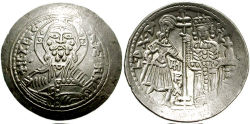
an attempt to establish his dominions in southern Italy as a coherent state. He returned to check up on his sons' progress in 1140 and then went to Ariano, a town central to the peninsular possessions (and a centre of rebellion under his predecessors). There he promulgated the great law regulating all Sicilian affairs. It invested the king and his bureaucracy with absolute powers and reduced the authority of the often rebellious vassals. While there, centralising his kingdom, Roger declared a new standard coinage, named after the duchy of Apulia: the ducat
Ducat
The ducat is a gold coin that was used as a trade coin throughout Europe before World War I. Its weight is 3.4909 grams of .986 gold, which is 0.1107 troy ounce, actual gold weight...
.
Economy
Roger’s reforms in laws and administration not only aimed to strengthen his rule but also to improve the economic standing of Sicily and Southern Italy. He was “very concerned to gain money, but hardly very prodigal in expending it."In 1140 at his assembly at Ariano he introduced new coinage to make it easier to trade with the rest of the Mediterranean, as there were smaller denominations of the previous coins, to allow more accurate and efficient trading. However, although this new coinage made long distance trade easier it was very detrimental to local trade which spread “hatred throughout Italy.” By the 1150s most of this coinage was no longer in use and soon after, it disappeared all together.
Nevertheless, the controversy over the coinage did not hinder the Kingdom’s prosperity. Roger II had not only acquired large wealth through his royal patrimony but also through his military campaigns and their financial rewards. For example gold and silver were gained through the campaigns in Apulia in 1133 and Greece in 1147.
Sicily's geographic location put it at the centre of Mediterranean and thus made it a brilliant location for trade with Europe, North Africa and the Middle East. Its primary export was durum wheat, and as well as other foods like cheese and vine fruits. Unlike other states, Sicily also had a strong political and military standing so its merchants were supported and to some extent protected. This standing allowed for an increase internal trade and a stronger market which led to noticeable developments in agriculture.
Later reign
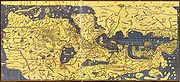
Muhammad al-Idrisi
Abu Abd Allah Muhammad al-Idrisi al-Qurtubi al-Hasani al-Sabti or simply Al Idrisi was a Moroccan Muslim geographer, cartographer, Egyptologist and traveller who lived in Sicily, at the court of King Roger II. Muhammed al-Idrisi was born in Ceuta then belonging to the Almoravid Empire and died in...
and the Greek historian
Greek historiography
The historical period of Ancient Greece is unique in world history as the first period attested directly in proper historiography, while earlier ancient history or proto-history is known by much more circumstantial evidence, such as annals, chronicles, king lists, and pragmatic epigraphy.Herodotus...
Nilus Doxopatrius. The king welcomed the learned, and he practised toleration towards the several creeds, races and languages of his realm. To administer his domain he hired many Greeks
Greeks
The Greeks, also known as the Hellenes , are a nation and ethnic group native to Greece, Cyprus and neighboring regions. They also form a significant diaspora, with Greek communities established around the world....
and Arab
Arab
Arab people, also known as Arabs , are a panethnicity primarily living in the Arab world, which is located in Western Asia and North Africa. They are identified as such on one or more of genealogical, linguistic, or cultural grounds, with tribal affiliations, and intra-tribal relationships playing...
s, who were trained in long-established traditions of centralized government. He was served by men of nationality as dissimilar as the Englishman Thomas Brun
Thomas Brun
Thomas Brun, also le Brun or Brown, was son or nephew of William Brun , a clerk of Henry I of England. He travelled to Sicily as a child in the entourage of Robert of Selby about the year 1130...
, a kaid
Kaid
A kaid or caïd was a title in the Norman kingdom of Sicily. It applied to palatine officials and members of the curia, usually to those who were Muslims or converts from Islam, often eunuchs, but sometimes to others...
of the Curia, and, in the fleet, first by Christodulus and then George of Antioch
George of Antioch
George of Antioch was the first true ammiratus ammiratorum, successor of the great Christodulus. George was a Greek Melchite, born in Antioch, whence he moved with his father, Michael, and mother to Tunisia. His parents found employment under the Zirid Sultan, Tamim ibn Muizz...
, whom he made in 1132 ammiratus ammiratorum or "Emir of Emirs", in effect prime vizier
Vizier
A vizier or in Arabic script ; ; sometimes spelled vazir, vizir, vasir, wazir, vesir, or vezir) is a high-ranking political advisor or minister in a Muslim government....
. (This title later became the English word admiral
Admiral
Admiral is the rank, or part of the name of the ranks, of the highest naval officers. It is usually considered a full admiral and above vice admiral and below admiral of the fleet . It is usually abbreviated to "Adm" or "ADM"...
). Roger made Sicily the leading maritime power in the Mediterranean.
A powerful fleet was built up under several admirals, or "emirs", of whom the greatest was George, formerly in the service of the Muslim
Muslim
A Muslim, also spelled Moslem, is an adherent of Islam, a monotheistic, Abrahamic religion based on the Quran, which Muslims consider the verbatim word of God as revealed to prophet Muhammad. "Muslim" is the Arabic term for "submitter" .Muslims believe that God is one and incomparable...
prince of Mahdia
Mahdia
Mahdia is a provincial centre north of Sfax. It is important for the associated fish-processing industry, as well as weaving. It is the capital of Mahdia Governorate.- History :...
. Mainly thanks to him, a series of conquests were made on the African coast
Kingdom of Africa
The Kingdom of Africa was an ephemeral frontier zone of the Siculo-Norman state in the former Roman province of Africa , corresponding to parts of Algeria, Tunisia and Libya today. The main primary sources for the kingdom are Arabic ; the Latin sources are scanter...
(1146–1153). Tripoli
Tripoli
Tripoli is the capital and largest city in Libya. It is also known as Western Tripoli , to distinguish it from Tripoli, Lebanon. It is affectionately called The Mermaid of the Mediterranean , describing its turquoise waters and its whitewashed buildings. Tripoli is a Greek name that means "Three...
was captured in 1146 and Cape Bona
Bone
Bones are rigid organs that constitute part of the endoskeleton of vertebrates. They support, and protect the various organs of the body, produce red and white blood cells and store minerals. Bone tissue is a type of dense connective tissue...
in 1148. These conquests were lost in the reign of Roger's successor William and never formed an integral part of the kingdom.
The Second Crusade
Second Crusade
The Second Crusade was the second major crusade launched from Europe. The Second Crusade was started in response to the fall of the County of Edessa the previous year to the forces of Zengi. The county had been founded during the First Crusade by Baldwin of Boulogne in 1098...
(1147–1148) offered Roger an opportunity to revive the attacks against the Byzantine Empire
Byzantine Empire
The Byzantine Empire was the Eastern Roman Empire during the periods of Late Antiquity and the Middle Ages, centred on the capital of Constantinople. Known simply as the Roman Empire or Romania to its inhabitants and neighbours, the Empire was the direct continuation of the Ancient Roman State...
, the traditional Norman enemy to the East. It also afforded him an opportunity, through the agency of Theodwin
Theodwin
Theodwin was a German cardinal and papal legate of the 12th century.-Biography:Theodwin was Abbot of Gorze from 1126 to ca...
, a cardinal ever-vigilant for Crusade supporters, to strike up a correspondance with Conrad III of Germany
Conrad III of Germany
Conrad III was the first King of Germany of the Hohenstaufen dynasty. He was the son of Frederick I, Duke of Swabia, and Agnes, a daughter of the Salian Emperor Henry IV.-Life and reign:...
in an effort to break his alliance with Manuel I Comnenus. Roger never went himself on an expedition against Byzantium
Byzantium
Byzantium was an ancient Greek city, founded by Greek colonists from Megara in 667 BC and named after their king Byzas . The name Byzantium is a Latinization of the original name Byzantion...
, handing over the command to the skillful George. In 1147, George set sail from Otranto
Otranto
Otranto is a town and comune in the province of Lecce , in a fertile region once famous for its breed of horses.It is located on the east coast of the Salento peninsula. The Strait of Otranto, to which the city gives its name, connects the Adriatic Sea with the Ionian Sea and Italy with Albania...
with seventy galleys to assault Corfu
Corfu
Corfu is a Greek island in the Ionian Sea. It is the second largest of the Ionian Islands, and, including its small satellite islands, forms the edge of the northwestern frontier of Greece. The island is part of the Corfu regional unit, and is administered as a single municipality. The...
. According to Nicetas Choniates
Nicetas Choniates
Nicetas or Niketas Choniates , sometimes called Acominatos, was a Greek historian – like his brother Michael Acominatus, whom he accompanied from their birthplace Chonae to Constantinople...
, the island capitulated thanks to George's bribes (and the tax burden of the imperial government), welcoming the Normans as their liberators. Leaving a garrison of 1,000 men, George sailed on to the Peloponnesus. He sacked Athens
Athens
Athens , is the capital and largest city of Greece. Athens dominates the Attica region and is one of the world's oldest cities, as its recorded history spans around 3,400 years. Classical Athens was a powerful city-state...
and quickly moved on to the Ionian Islands
Ionian Islands
The Ionian Islands are a group of islands in Greece. They are traditionally called the Heptanese, i.e...
. He ravaged the coast all along Euboea
Euboea
Euboea is the second largest Greek island in area and population, after Crete. The narrow Euripus Strait separates it from Boeotia in mainland Greece. In general outline it is a long and narrow, seahorse-shaped island; it is about long, and varies in breadth from to...
and the Gulf of Corinth
Gulf of Corinth
The Gulf of Corinth or the Corinthian Gulf is a deep inlet of the Ionian Sea separating the Peloponnese from western mainland Greece...
and penetrated as far as Thebes, Greece
Thebes, Greece
Thebes is a city in Greece, situated to the north of the Cithaeron range, which divides Boeotia from Attica, and on the southern edge of the Boeotian plain. It played an important role in Greek myth, as the site of the stories of Cadmus, Oedipus, Dionysus and others...
, where he pillaged the silk factories and carried off the Jewish damask, brocade, and silk weavers, taking them back to Palermo where they formed the basis for the Sicilian silk industry. George capped the expedition with a sack of Corinth
Corinth
Corinth is a city and former municipality in Corinthia, Peloponnese, Greece. Since the 2011 local government reform it is part of the municipality Corinth, of which it is the seat and a municipal unit...
, in which the relics of Saint Theodore
Saint Theodore
-People:*See Theodore, Philippa, and Companions for Theodore of Perge, 3rd century martyr and saint*Theodore of Amasea, or of Tyre, "the Tyro", "the Recruit", 4th century military saint and martyr...
were stolen, and then returned to Sicily. In 1149, however, Corfu was retaken. George went on a punitive expedition
Punitive expedition
A punitive expedition is a military journey undertaken to punish a state or any group of persons outside the borders of the punishing state. It is usually undertaken in response to perceived disobedient or morally wrong behavior, but may be also be a covered revenge...
against Constantinople, but could not land and instead defied the Byzantine emperor by firing arrows against the palace windows. Yet the attack on the empire had no enduring results.
The king died at Palermo
Palermo
Palermo is a city in Southern Italy, the capital of both the autonomous region of Sicily and the Province of Palermo. The city is noted for its history, culture, architecture and gastronomy, playing an important role throughout much of its existence; it is over 2,700 years old...
on 26 February 1154, and was buried in the Cathedral of Palermo
Cathedral of Palermo
The Cathedral of Palermo is an architectural complex in Palermo, Sicily, southern Italy. It is characterized by the presence of different styles, due to a long history of additions, alterations and restorations, the last of which occurred in the 18th century....
. He was succeeded by his fourth son William
William I of Sicily
William I , called the Bad or the Wicked, was the second king of Sicily, ruling from his father's death in 1154 to his own...
. Roger is the subject of King Roger
King Roger
King Roger is an opera by the Polish composer Karol Szymanowski set to a libretto by Jarosław Iwaszkiewicz. It was first performed on 19 June 1926 in Warsaw, Poland...
, a 1926 opera by Polish composer Karol Szymanowski
Karol Szymanowski
Karol Maciej Szymanowski was a Polish composer and pianist.-Life:Szymanowski was born into a wealthy land-owning Polish gentry family in Tymoszówka, then in the Russian Empire, now in Cherkasy Oblast, Ukraine. He studied music privately with his father before going to Gustav Neuhaus'...
.
Ancestors
Roger was the grandson of Tancred of HautevilleTancred of Hauteville
Tancred of Hauteville was an 11th-century Norman petty lord about whom little is known. His historical importance comes entirely from the accomplishments of his sons and later descendants...
and the great great grandson of Hiallt
Hiallt
Hiallt was a Norseman who settled in Normandy, France in the 10th century, following the success of Rollo 1st Duke of Normandy and the Treaty of Saint-Clair-sur-Epte. He settled in the Cotentin Peninsula and founded the village of Hialtus Villa...
believed to be the name of a Norseman (Viking)
Norsemen
Norsemen is used to refer to the group of people as a whole who spoke what is now called the Old Norse language belonging to the North Germanic branch of Indo-European languages, especially Norwegian, Icelandic, Faroese, Swedish and Danish in their earlier forms.The meaning of Norseman was "people...
who settled in Normandy
Normandy
Normandy is a geographical region corresponding to the former Duchy of Normandy. It is in France.The continental territory covers 30,627 km² and forms the preponderant part of Normandy and roughly 5% of the territory of France. It is divided for administrative purposes into two régions:...
, in the 10th century.
Family
_-_foto_g._dallorto_28-09-2006.jpg)
Alfonso VI of Castile
Alfonso VI , nicknamed the Brave or the Valiant, was King of León from 1065, King of Castile and de facto King of Galicia from 1072, and self-proclaimed "Emperor of all Spain". After the conquest of Toledo he was also self-proclaimed victoriosissimo rege in Toleto, et in Hispania et Gallecia...
. When she died, rumors flew that Roger had died as well, as his grief had made him a recluse. They had six children:
- RogerRoger III, Duke of ApuliaRoger III was the Norman duke of Apulia from 1135. He was the eldest son of King Roger II of Sicily and Elvira of Castile....
(b. 1118 - d. 12 May 1148), heir, Duke of Apulia (from 1135), possibly also Count of LecceLecceLecce is a historic city of 95,200 inhabitants in southern Italy, the capital of the province of Lecce, the second province in the region by population, as well as one of the most important cities of Puglia...
; - TancredTancred, Prince of BariTancred of Hauteville , one of many of that name, was the Prince of Bari and Taranto from 1132 to 1138.He was the second son of Roger II of Sicily and his first wife Elvira of Castile...
(b. 1119 - d. 1138), Prince of Bari (from 1135). - AlfonsoAlfonso of HautevilleAlfonso of Hauteville , third son of Roger II of Sicily and Elvira of Castile, was the prince of Capua from 1135 to his death.He was named after his maternal grandfather, Alfonso VI of Castile...
(b. 1120/1121 - d. 10 October 1144), Prince of Capua (from 1135) and Duke of Naples; - A daughter (d. young, 1135);
- WilliamWilliam I of SicilyWilliam I , called the Bad or the Wicked, was the second king of Sicily, ruling from his father's death in 1154 to his own...
(b. 1131 - d. 7 May 1166), his successor, Duke of Apulia (from 1148); - Henry (b. 1135 - d. young).
Roger's second marriage was in 1149 to Sibylla of Burgundy, daughter of Hugh II, Duke of Burgundy
Hugh II, Duke of Burgundy
Hugh II of Burgundy was duke of Burgundy between 1103 and 1143. Hugh was son of Odo I, Duke of Burgundy.-Marriage and issue:He married, in about 1115, Felicia-Matilda of Mayenne, daughter of...
. They had two children:
- Henry (b. 29 August 1149 - d. young);
- Stillborn child (16 September 1150).
Roger's third marriage was in 1151 to Beatrice of Rethel, a grandniece of King Baldwin II of Jerusalem
Baldwin II of Jerusalem
Baldwin II of Jerusalem , formerly Baldwin II of Edessa, also called Baldwin of Bourcq, born Baldwin of Rethel was the second count of Edessa from 1100 to 1118, and the third king of Jerusalem from 1118 until his death.-Ancestry:Baldwin was the son of Hugh, count of Rethel, and his wife Melisende,...
. They had one daughter:
- ConstanceConstance of SicilyConstance of Hauteville was the heiress of the Norman kings of Sicily and the wife of Henry VI, Holy Roman Emperor...
(b. posthumously, 2 November 1154 - d. 28 November 1198), who married with the Emperor Henry VIHenry VI, Holy Roman EmperorHenry VI was King of Germany from 1190 to 1197, Holy Roman Emperor from 1191 to 1197 and King of Sicily from 1194 to 1197.-Early years:Born in Nijmegen,...
, later King of Sicily in his right.
Roger also had five known illegitimate children:
—By a daughter of Hugues I, Count of Molise:
- Simon, who became Prince of Taranto in 1144.
—With unknown mistresses:
- A daughter, wife of the napolitan noblemen Adam;
- A daughter, married Hugues II, Count of Molise;
- Adelisa (d. aft. 1184/87) married firstly Joscelin, Count of Loreto, and secondly Robert of Bassonville, Count of Loritello;
- Marina, married the great admiral Margaritus of BrindisiMargaritus of BrindisiMargaritus of Brindisi , called the new Neptune, was the last great ammiratus ammiratorum of Sicily...
.
In Memoriam
In memory of this great ruler, The Roger II University (Universitas Studiorum Roger II), a free independent University for Advanced Studies was incorporated in the State of Florida in the United States of America. It currently operates in Italy.External links
- Adrian Fletcher’s Paradoxplace – Palermo and the First Normans – Photos
- Al-Idrisi And Roger’s Book , written by Frances Carney Gies.