
All Topics  
Norman language


   Email Print
   Bookmark   Link


Norman language


Norman is a Romance language
Romance languages

The Romance languages are a branch of the Indo-European languages comprising all the languages that descend from Latin language, the language of ancient Rome....
 and one of the Oïl languages
Langues d'oïl

Langues d'o?l is the linguistic and historical designation of the Gallo-Romance languages originating from the northern territories of Roman Gaul, which today make up northern France, part of Belgium, and the Channel Islands....
. The northern Norman can be classified in the septentrional Oïl languages with Picard
Picard language

Picard is a language closely related to French language, and as such is one of the larger group of Romance languages. It is spoken in two List of regions in France in the far north of France – Nord-Pas-de-Calais and Picardy – and in parts of the Belgium region Wallonia ....
 and Walloon
Walloon language

Walloon is a Romance language spoken as a second language by some in Wallonia, Belgium. It belongs to the langue d'o?l language family, whose most prominent member is the French language, but should not be considered a French dialect: a French speaking person can only understand Walloon with difficulty, especially in its eastern forms....
. The name Norman-French is sometimes used to describe not only the modern Norman language, but also the administrative languages of Anglo-Norman
Anglo-Norman language

The Anglo-Norman language is a term traditionally used to refer to the variety of French used in England and to some extent elsewhere in the British Isles following the Norman conquest in 1066....
 and Law French
Law French

Law French is an archaic language originally based on Old Norman and Anglo-Norman language, but increasingly influenced by Parisian French and, later, English....
 used in England
England

native_name =|conventional_long_name = England|common_name = England|image_flag = Flag of England.svg|image_coat = England COA.svg|symbol_type = Royal Coat of Arms...
.

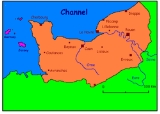
an is spoken in mainland Normandy
Normandy

Normandy is a geographical region corresponding to the former Duchy of Normandy. It is situated along the coast of France south of the English Channel between Brittany and Picardy and comprises territory in northern France and the Channel Islands....
 in France
France

France , officially the French Republic , is a country whose Metropolitan France is located in Western Europe and that also comprises various Overseas departments and territories of France....
 where it has no official status, but is classed as a regional language.

In the Channel Islands
Channel Islands

The Channel Islands are a group of islands in the English Channel, off the France coast of Normandy. They include two separate bailiwicks: the Bailiwick of Guernsey and the Bailiwick of Jersey....
, the Norman language has developed separately, but not in isolation, to form what are recognised as Jèrriais
Jèrriais

J?rriais is the form of the Norman language spoken in Jersey, in the Channel Islands, off the coast of France. It has been in decline over the past century as English language has increasingly become the language of education, commerce and administration....
 (in Jersey
Jersey

The Bailiwick of Jersey is a British Crown dependency off the coast of Normandy, France. As well as the island of Jersey itself, the bailiwick includes the nearly uninhabited islands of the Minquiers, ?cr?hous, the Pierres de Lecq and other rocks and reefs....
), Guernésiais or Guernsey French (in Guernsey
Guernsey

The Bailiwick of Guernsey is a British Isles Crown dependency in the English Channel off the coast of Normandy.As well as the island of Guernsey itself, it also includes Alderney, Sark, Herm, Jethou, Brecqhou, Burhou, Lihou and other islets....
) and Sercquiais
Sercquiais

also known as 'Sarkese' or 'Sark-French' is the Norman language dialect of the Channel Islands of Sark. In the island it is sometimes known, slightly disparagingly, as the "patois", a French term meaning "regional language"....
 (or Sarkese, in Sark
Sark

Sark is a small island in the southwestern English Channel. It is one of the Channel Islands, is part of the Bailiwick of Guernsey, and as such is a British crown dependency....
).


Discussion
Ask a question about 'Norman language'
Start a new discussion about 'Norman language'
Answer questions from other users
Full Discussion Forum


Recent Posts


Encyclopedia


Norman is a Romance language
Romance languages

The Romance languages are a branch of the Indo-European languages comprising all the languages that descend from Latin language, the language of ancient Rome....
 and one of the Oïl languages
Langues d'oïl

Langues d'o?l is the linguistic and historical designation of the Gallo-Romance languages originating from the northern territories of Roman Gaul, which today make up northern France, part of Belgium, and the Channel Islands....
. The northern Norman can be classified in the septentrional Oïl languages with Picard
Picard language

Picard is a language closely related to French language, and as such is one of the larger group of Romance languages. It is spoken in two List of regions in France in the far north of France – Nord-Pas-de-Calais and Picardy – and in parts of the Belgium region Wallonia ....
 and Walloon
Walloon language

Walloon is a Romance language spoken as a second language by some in Wallonia, Belgium. It belongs to the langue d'o?l language family, whose most prominent member is the French language, but should not be considered a French dialect: a French speaking person can only understand Walloon with difficulty, especially in its eastern forms....
. The name Norman-French is sometimes used to describe not only the modern Norman language, but also the administrative languages of Anglo-Norman
Anglo-Norman language

The Anglo-Norman language is a term traditionally used to refer to the variety of French used in England and to some extent elsewhere in the British Isles following the Norman conquest in 1066....
 and Law French
Law French

Law French is an archaic language originally based on Old Norman and Anglo-Norman language, but increasingly influenced by Parisian French and, later, English....
 used in England
England

native_name =|conventional_long_name = England|common_name = England|image_flag = Flag of England.svg|image_coat = England COA.svg|symbol_type = Royal Coat of Arms...
.

Geographical distribution

Norman is spoken in mainland Normandy
Normandy

Normandy is a geographical region corresponding to the former Duchy of Normandy. It is situated along the coast of France south of the English Channel between Brittany and Picardy and comprises territory in northern France and the Channel Islands....
 in France
France

France , officially the French Republic , is a country whose Metropolitan France is located in Western Europe and that also comprises various Overseas departments and territories of France....
 where it has no official status, but is classed as a regional language.

In the Channel Islands
Channel Islands

The Channel Islands are a group of islands in the English Channel, off the France coast of Normandy. They include two separate bailiwicks: the Bailiwick of Guernsey and the Bailiwick of Jersey....
, the Norman language has developed separately, but not in isolation, to form what are recognised as Jèrriais
Jèrriais

J?rriais is the form of the Norman language spoken in Jersey, in the Channel Islands, off the coast of France. It has been in decline over the past century as English language has increasingly become the language of education, commerce and administration....
 (in Jersey
Jersey

The Bailiwick of Jersey is a British Crown dependency off the coast of Normandy, France. As well as the island of Jersey itself, the bailiwick includes the nearly uninhabited islands of the Minquiers, ?cr?hous, the Pierres de Lecq and other rocks and reefs....
), Guernésiais or Guernsey French (in Guernsey
Guernsey

The Bailiwick of Guernsey is a British Isles Crown dependency in the English Channel off the coast of Normandy.As well as the island of Guernsey itself, it also includes Alderney, Sark, Herm, Jethou, Brecqhou, Burhou, Lihou and other islets....
) and Sercquiais
Sercquiais

also known as 'Sarkese' or 'Sark-French' is the Norman language dialect of the Channel Islands of Sark. In the island it is sometimes known, slightly disparagingly, as the "patois", a French term meaning "regional language"....
 (or Sarkese, in Sark
Sark

Sark is a small island in the southwestern English Channel. It is one of the Channel Islands, is part of the Bailiwick of Guernsey, and as such is a British crown dependency....
). Jèrriais and Guernésiais are recognised as regional language
Regional language

A regional language is a language spoken in an area of a nation state, whether it be a small area, a Federalism state or province, or some wider area....
s by the British and Irish governments within the framework of the British-Irish Council
British-Irish Council

The British-Irish Council is a body created by the Belfast Agreement in 1998, and formally established on 2 December 1999 on the entry into force of the consequent legislation....
.

Sercquiais is in fact a descendant of the 16th century Jèrriais used by the original colonists from Jersey who settled the then uninhabited island.

The last native speakers of Auregnais
Auregnais

Auregnais, Aoeur'gnaeux or Aurignais was the Norman language dialect of the Channel Islands of Alderney .Very little Auregnais survives in written form....
, the Norman language of Alderney
Alderney

Alderney is the most northerly of the Channel Islands and a British Crown dependency. It is part of the Bailiwick of Guernsey. It is long and wide....
, died during the 20th century, although some rememberer
Rememberer

In linguistics, a rememberer is a person who knows individual words or phrases of a language death, but cannot use the language productively. This is contrasted with fluency or full speakers, who have a good command of the language, and semi-speakers, who have a partial command of it....
s still exist. The dialect of Herm
Herm

Herm is the smallest of the Channel Islands that is open to the public. Auto-free zone from the small island just like its Channel Island neighbour, Sark....
 also lapsed, at an unknown date.

An isogloss
Isogloss

An isogloss is the geographical boundary or delineation of a certain linguistics feature, e.g. the pronunciation of a vowel, the meaning of a word, or use of some syntactic feature....
 termed the ligne Joret separates the northern and southern dialects of the Norman language (the line is from Granville
Granville

There are a number of uses of the term Granville.See also Grandville....
 to the Belgian
Belgium

* A small German-speaking Community of Belgium exists in eastern Wallonia. Belgium's linguistic diversity and related political and cultural conflicts are reflected in the history of Belgium and a complex Communities and regions of Belgium....
 border). There are also dialectal differences between western and eastern dialects.

Three different standardised spellings are used: continental Norman, Jèrriais, and Dgèrnésiais. These represent the different developments and particular literary histories of the varieties of Norman. Norman may therefore be described as a pluricentric language
Pluricentric language

A pluricentric language is a language with several Standard language versions, both in spoken and in orthography. This situation usually arises when language and the nation of its native speakers do not coincide....
.

Today, the Norman language is strongest in the less accessible areas of the former Duchy of Normandy
Duchy of Normandy

The 'Duchy of Normandy' stems from various Denmark, Hiberno-Norse, Orkney Viking and Anglo-Danish invasions of France in the 8th century. A fief, probably as a county, was created by the treaty of Saint-Clair-sur-Epte in 911 out of concessions made by Charles the Simple, and granted to Rollo of Normandy, leader of the Vikings known as Nort...
: the Channel Islands
Channel Islands

The Channel Islands are a group of islands in the English Channel, off the France coast of Normandy. They include two separate bailiwicks: the Bailiwick of Guernsey and the Bailiwick of Jersey....
 and the Cotentin Peninsula
Cotentin Peninsula

The Cotentin Peninsula, also known as the Cherbourg Peninsula, is a peninsula in Normandy, forming part of the north-western coast of France....
 (Cotentinais
Cotentinais

Cotentinais is the dialect of the Norman language spoken in the Cotentin Peninsula. It is one of the strongest dialects of the language on the mainland....
) in the west, and the Pays de Caux
Pays de Caux

The Pays de Caux is an area in Normandy occupying the greater part of the France d?partement in France of Seine Maritime in Haute-Normandie....
 (Cauchois
Cauchois

Cauchois is one of the eastern dialects of the Norman language, spoken in, and taking its name from, the Pays de Caux region of the Seine-Maritime d?partment....
) in the east. Ease of access from Paris
Paris

Paris is the Capital of France and the country's largest city. It is situated on the river Seine, in northern France, at the heart of the ?le-de-France Regions of France ....
 and the popularity of the coastal resorts of central Normandy, such as Deauville
Deauville

Deauville is a Communes of the Calvados d?partement in the Calvados d?partements of France in the Basse-Normandie r?gions of France of France....
, in the 19th century led to a significant loss of distinctive Norman culture.

The Anglo-Norman
Anglo-Norman language

The Anglo-Norman language is a term traditionally used to refer to the variety of French used in England and to some extent elsewhere in the British Isles following the Norman conquest in 1066....
 dialect of Norman was a language of administration in England
England

native_name =|conventional_long_name = England|common_name = England|image_flag = Flag of England.svg|image_coat = England COA.svg|symbol_type = Royal Coat of Arms...
 following the Norman Conquest. This left a legacy of Law French
Law French

Law French is an archaic language originally based on Old Norman and Anglo-Norman language, but increasingly influenced by Parisian French and, later, English....
 in the language of English courts (though it was also influenced by Parisian French). In Ireland, Norman remained strongest in the area of south-east Ireland where the Normans
Hiberno-Norman

The term Hiberno-Norman is used of those Normans lords who settled in Ireland, admitting little if any real fealty to the Anglo-Norman settlers in England....
 invaded in 1169. Norman is still in (limited) use for some very formal legal purposes in the UK, such as when the monarch gives Royal Assent
Royal Assent

The granting of Royal Assent is the formal method by which a constitutional monarchy completes the legislative process of lawmaking by formally assenting to an Act of Parliament....
 to an Act of Parliament
Act of Parliament

An act of Parliament is a statute wikt:enacted as primary legislation by a national or sub-national parliament. It is broadly equivalent to an act of Congress in the United States....
.

Literature

Coup D'oeil Purin 1773
Among representative writers of the early Anglo-Norman literary tradition, the Jersey-born poet and chronicler Wace
Wace

Wace was an Anglo-Norman poet, who was born in Jersey and brought up in mainland Normandy , ending his career as canon of Bayeux.His extant works include:...
 is considered as the founding figure of literature in Jèrriais
Jèrriais literature

J?rriais literature is literature in J?rriais, the Norman language dialect of Jersey in the Channel Islands.The literary tradition in Jersey is traced back to Wace, the 12th century Jersey-born poet, although there is little surviving literature in J?rriais dating to before the introduction of the first printing press in Jersey in the 178...
.

In the 16th and 17th centuries, the workers and merchants of Rouen
Rouen

Rouen is the historical capital city of Normandy, in northwestern France on the River Seine, and currently the capital of the Haute-Normandie r?gion in France....
 established a tradition of polemical and satirical literature in a form of language called the parler purin. La Fricassée crotestyllonnée of 1552 and La Farce des Quiolards of 1735 are notable texts.

David Ferrand (1589–1660) published La Muse Normande, an anthology of writings in the dialect of the Pays de Caux
Pays de Caux

The Pays de Caux is an area in Normandy occupying the greater part of the France d?partement in France of Seine Maritime in Haute-Normandie....
. Pierre Genty (1706–1821) represents the Perche dialect. In Calvados
Calvados

The France departments of France of Calvados forms part of the regions of France of Basse-Normandie in Normandy. It takes its name from a cluster of rocks off the coast....
, a text entitled L'agréable conférence de deux normands was published around 1650. In 1773 Le Coup d'oeil purin protested against the suppression of the parlement
Parlement

The political institutions of the Parlement in ancien r?gime France developed out of the previous council of the king, the Conseil du roi or curia regis, and consequently had ancient and customary rights of consultation and deliberation....
 of Rouen.

Surviving vernacular literature after 1650 in Calvados is sparse, with only a few texts appearing around the end of the 18th century and beginning of the 19th century (authors Bernardin Anquetil 1755–1826 from the Bessin
Bessin

The Bessin is an area in Normandy, France, corresponding to the territory of the Bajocasse tribe of Celts who also gave their name to the city of Bayeux, central town of the Bessin....
, and Nicolas Lalleman 1764–1814 from Vire
Vire

Vire is a Communes of the Calvados department and the seat of a Cantons of France of the Calvados departments of France in the Basse-Normandie r?gion in France of France....
).

At the end of the 18th century and beginning of the 19th century a new movement arose in the Channel Islands, led by writers such as George Métivier (Guernsey, 1790–1881 — dubbed the Guernsey Burns
Robert Burns

Robert Burns was a poet and a lyricist. He is widely regarded as the national poet of Scotland, and is celebrated worldwide. He is the best known of the poets who have written in the Scots language, although much of his writing is also in English and a 'light' Scots dialect, accessible to an audience beyond Scotland....
) and writers from Jersey. The independent governments, lack of censorship and diverse social and political milieu of the islands enabled a growth in the publication of vernacular literature — often satirical and political.

Most literature was published in the large number of competing newspapers, which also circulated in the neighbouring Cotentin Peninsula
Cotentin Peninsula

The Cotentin Peninsula, also known as the Cherbourg Peninsula, is a peninsula in Normandy, forming part of the north-western coast of France....
, sparking a literary renaissance on the Norman mainland.

The work of Jersey poet Sir Robert Pipon Marett
Robert Pipon Marett

Sir Robert Pipon Marett was a lawyer, journalist, poet, politician, and Bailiff of Jersey from 1880 until his death.He was born in Saint Peter, Jersey on 20 November 1820 and studied at the University of Caen and the University of Paris....
 (1820–1884, Bailiff
Bailiff (Channel Islands)

The Bailiff is the first civil officer in each of the Channel Islands bailiwicks of Jersey and Guernsey, serving as president of the legislature and the Royal Court....
 of Jersey) was highly regarded, being quoted in François-Victor Hugo’s La Normandie inconnue. Marett’s work also advanced the standardisation of Jèrriais orthography according to basic principles of the French writing system.

In exile in Jersey and then Guernsey, Victor Hugo
Victor Hugo

Victor-Marie Hugo was a France poet, playwright, novelist, essayist, visual artist, statesman, human rights activist and exponent of the Romanticism movement in France....
 took an interest in the vernacular literature, associating himself with island writers and introducing Norman expressions to the wider French-speaking readership.

The boom in insular literature in the early 19th century encouraged production especially in La Hague and around Cherbourg, where Alfred Rossel became active.

Literary production revived in Calvados in the late 19th century, under the influence of Arthur Marye.

The typical medium for literary expression in Norman has traditionally been newspaper columns and almanacs — the topicality and satirical nature is typical of the proverbially deadpan Norman character. Poems, songs and tales often appeared in chapbook
Chapbook

File:CalasChapbook.jpgChapbook is a generic term to cover a particular genre of pocket-sized booklet, popular from the sixteenth through to the later part of the nineteenth century....
 form between around 1870–1939. The novel Zabeth by André Louis which appeared in 1969 was the first novel published in Norman. Some works originally published in periodicals have been collected in book form, but the ephemeral nature of the publications in which the bulk of Norman literature appears has led to comparative inaccessibility of much of the oeuvre of important writers. The destruction during the Battle of Normandy
Battle of Normandy

The Invasion of Normandy was the invasion and establishment of Western Allies forces in Normandy, France, during Operation Overlord in World War II....
 of departmental and municipal archives meant the loss of many sources of Norman literature from the end of the 19th century and the first half of the 20th century.

However, the Norman literary tradition places high value on the written text, as opposed to other cultures (for example, neighbouring Gallo
Gallo language

Gallo is a languages of France. Gallo is a Romance language, one of the Langues d'o?l. It is spoken in Brittany and the west of France along the border with Normandy....
 and Breton
Breton language

The Breton language is a Celtic languages spoken by some of the inhabitants of Brittany in France....
) which have a livelier tradition of oral performance and spontaneous storytelling. The song tradition is also much less evident than in neighbouring cultures.

An annual festival of the Norman language brings together enthusiasts and performers from insular and continental Normandy. The festival alternates between the islands and the mainland.

Writers

Le Pucheux 2005
Here is a list of significant writers in Norman (and published works) of more recent times (for Channel Island authors, see Jèrriais literature
Jèrriais literature

J?rriais literature is literature in J?rriais, the Norman language dialect of Jersey in the Channel Islands.The literary tradition in Jersey is traced back to Wace, the 12th century Jersey-born poet, although there is little surviving literature in J?rriais dating to before the introduction of the first printing press in Jersey in the 178...
 and Dgèrnésiais
Dgèrnésiais

Guern?siais, also known as Dg?rn?siais, Guernsey French, Guernsey Norman French, is the variety of Norman language spoken in Guernsey....
) :

Alfred Rossel (1841-1926, from Cherbourg)
Author of songs, including the Cotentin anthem Sus la mé
Bon-Prosper Lepesqueur (6 August 1846 – 31 January 1921, from Digulleville)
Wrote under the pseudonyms of Boûnnin Poulidot and P. Lecacheux. His prose stories appeared regularly in Le Phare de la Manche 1899–1905, and he was also the author of a number of songs published in sheet form in Cherbourg signed P. Lecacheux.
Charles Lemaître (1854–1928, from Saint-Georges-d'Aunay)
Author and performer of monologues, published in sheet form and later collected in volumes Les Joyeux Bocains (1917), Hélas qu'c'est drôle (1924), Eiou qui va lés trachi (1912), Bonnes gens de Normandie
Octave Maillot (1861–1949, from Tinchebray)
One of the less-numerous authors writing in southern Norman (below the ligne Joret), two volumes of his prose stories in Norman were published under the title Contes normands in 1937 and 1948.
Arnould-Désiré Galopin
Arnould Galopin

Arnould Galopin was a prolific France writer with more than 50 novels to his credit. Galopin won the French Academy's Grand Prize for his Sur le Front de Mer , a critically-acclaimed novel about the Merchant Navy during World War I, and wrote several equally acclaimed novels about his experiences during the war....
 (9 February 1863 – 9 December 1934, from Marbeuf)
Best known as a prolific author in French of popular fiction: adventure stories, historical novels, travel writing and detective fiction, Galopin also wrote the article Le Patois normand published in Le livre du Millénaire de la Normandie, 911–1911 (Paris 1911) and is known to be responsible for the authorship of a small number of poems in the La Hague
La Hague

La Hague is a region on the tip of the Cotentin peninsula in Normandy, France.La Hague is a picturesque place of Precambrian granite cliffs, coves and small fields surrounded by hedges....
 dialect of Norman.
Louis Beuve (1869–1949, from Quettreville-sur-Sienne
Quettreville-sur-Sienne

Quettreville-sur-Sienne is a Communes of France in the Manche Departments of France in northwestern France....
)
Poet, follower of Roussel and friend of Frédéric Mistral
Frédéric Mistral

Fr?d?ric Mistral was a France poet who led the 19th century revival of Occitan language language and literature. He was a key figure in the literary f?librige movement....
, co-founder of Le Bouais-Jan with Enault, manager of Le Courrier de la Manche, collection published in 1950 Œuvres choisies
François Enault (1869–1918, from the Cotentin)
Born in Varenguebec 28 May 1869, the eldest of twelve children. Went to Paris in 1887 to study for a legal career, but followed his inclination for the visual arts. He became a cartoonist under the pseudonym Mob for a number of publications. In 1900 he drew and wrote for La France Illustrée and, using the pseudonym Jean Frinot, contributed texts in Norman for the Journal de la Manche published in St-Lô. Founder of Le Bouais-Jan with Louis Beuve. He became chief editor of La France Illustrée in 1911. His health suffered during the First World War and he died as a result 24 November 1918. A collection of his stories Les propos de Jean Frinot was published in 1930. His stories about the characters Pierre and Catheraine Loustalot continue to be republished nowadays, notably by the Almanach de la Manche.
Henri Ermice (1870–1958)
Born 17 September 1870 in Saint-Germain-sur-Ay. After working as a teacher in Vire, he became a bookseller and publisher of postcards on which he printed Gallicised
Gallicism

A Gallicism can be* a mode of Speech communication peculiar to the French language;* a French idiom;* in general, a French mode or custom.* loanwords, words or phrases borrowed from French....
 versions of verses in Norman — Monologues humoristiques en patois normand of which more purely Norman forms also exist, but the more French-influenced texts were considered to have wider commercial appeal. Some more purely Norman pieces were published in a collection Choix de poésies normandes et de monologues en patois de notre pays in 1956.
Joseph Mague (1875–1940, born in Brittany of Norman parents but raised in the Bessin)
Active in literary societies, published Les Chansons du Bessin in 1912 in postcard form for commercial sale.
Louis Gouget (1877–1915)
Collection Au Val d'Orne (1922)
Maurice Le Sieutre
Maurice Le Sieutre (1879–?, from Le Havre)
Poet and sculptor, who also set his own words to music; songs and poems published in Vie normande, Bulletin des parlers normands, Bulletin des parlers populaires.
Charles Birette (1878–1941)
Born in Montfarville in the Val de Saire, he published a collection of stories in Norman A l'Entoue de la Cremillie and a number of historical studies. He is best known for his Dialecte et Légendes du Val de Saire. He died in Dinan 18 June 1941.
Charles Le Boulanger (1880–1929)
Born in Cerisy-la-Salle 20 January 1880, published two collections of poetry in 1908 and 1920 both entitled Ciz nous. He also performed his poems and monologues in public at local fairs around the Cotentin. A friend of Louis Beuve. He died in Touques 29 June 1929.
Alfred Noël (1883–1918, from Valognes
Valognes

Valognes is a Communes of France in the Manche Departments of France in Normandy in northwestern France.It lies on the Merderet river, southeast of Cherbourg....
)
A writer and performer of songs.
Gaston Lerévérend (1885–1962, from Calvados
Calvados

The France departments of France of Calvados forms part of the regions of France of Basse-Normandie in Normandy. It takes its name from a cluster of rocks off the coast....
)
Collections of poetry include L'hus entrebâyei (1919), Mei-j'vo-l'dis, and L'hus bâyi (1955)
Gaston Demongé (1888–1973, from the Pays de Caux)
Wrote under the pseudonym Mait' Arsène, published a collection of poetry and prose Les Terreux in 1925 prefaced by a brief overview of Norman literature. A collection of histoires cauchoises titled Aux Gars de Normandie appeared in 1917.
Pierre Gueroult (1890–1962)
Born in Pont-l'Abbé 11 June 1890, worked as a teacher, and served as deputy mayor of Cherbourg. Published his first pamphlet En Tisounants around 1920. Author of poems, monologues, dramatic works and prose works. Published works include: Vûles gens, vûs métyis (1948), collections Théâtre normand (1972), Poésies et chansons (1974), Contes et récits (1978 and 1980). His dramatic verse monologue La pouore vuule folle du Bouon-Sâoveu is considered a classic of modern Norman literature; it tells of a woman driven to madness waiting years for her soldier son to return from the war in which he died.
Thanase Pequeu 1933
Gabriel Benoist
Cauchois author of Thanase Pequeu stories of which three volumes were published in the 1930s
Jean-Baptiste Pasturel (1895–1962, from Périers
Périers

P?riers or Perri?res is the name or part of the name of several commune in France in France:*P?riers, Manche, in the Manche d?partement...
)
Collection Histouères de tchu nous (1968)
Jean Tolvast (Auguste Toullec 1898–1945, from Cherbourg)
Wrote regular columns in newspapers Le Réveil and Le Journal de Valognes. Collections of his stories were published as Chroniques normandes (1934 and 1941)
Marceau Rieul (Marcel Sorieul 1900–1977, from Bolbec
Bolbec

Bolbec is a communes of France and chief town of a cantons of France in the Seine-Maritime departments of France of the Haute-Normandie region of northern France....
)
Author of Arseine Toupétit
Jehan Le Povremoyne (Ernest Coquin 1903–1970, from Le Havre)
A Cauchois author who wrote mostly in French, but frequently employed dialogue in Norman to a greater or lesser extent in his writings.
Gires Ganne (Fernand Lechanteur 1910–1971)
Author of La Normandie traditionnelle, a collection of articles on language and traditions, his poetry (Es Set vents du Cotentin, 1972) only became widely known after his death. He worked to unify the orthography of the Norman language, proposing reforms. In 1968, he founded an association Parlers et Traditions Populaires de Normandie. A Viking-boat-shaped stone monument to his memory was erected after his death near the seashore of his native Agon.
Christian Lambert (1912–2000, from Livarot
Livarot

Livarot is a Communes of the Calvados d?partement in the Calvados d?partement in France in the Basse-Normandie r?gion in France of France. Its postal code is 14140....
)
Wrote regular pieces in Norman for the Lisieux
Lisieux

Lisieux is a Communes of the Calvados d?partement in the Calvados D?partement in France in the Basse-Normandie r?gion in France of France....
 nespaper L'Éveil de Lisieux under the title of Radotages de Maît' Jules (collected for publication 1984)
Côtis-Capel
Côtis-Capel

C?tis-Capel was the pen name of Albert Lohier, a Norman language poet. He was from La Hague and wrote in the Haguais dialect of Cotentinais....
 (Albert Lohier 1915–1986, from Cherbourg)
Priest and fisherman, highly influential poet in La Hague, Rocâles (1951), A Gravage (1965), Raz Bannes (1971), Graund Câté (1980), Les Côtis (1985), Ganache (1987); winner of the Prix littéraire du Cotentin in 1964
Aundré-Joseph Desnouettes (André Dupont 1920–200?, from Equeurdreville)
Winner of the Prix littéraire du Cotentin in 1970. As a historian, published a history in French of the département of Manche. His literary career in Norman started in 1952 with the publication of a collection of comic poems En Ritounaunt. A cycle of a hundred sonnet
Sonnet

The sonnet is one of the Poetry that can be found in lyric poetry from Europe.The term "sonnet" derives from the Occitan word sonet and the Italian language word sonetto, both meaning "little song"....
s were published as Sonnets cotentinais en parler populaire du pays in 1958 and 1961 in Études normandes. In 1968, he published L'Épopée cotentine, an epic poem of 4628 lines inspired by the models of Wace and other Anglo-Norman poets. His poetry frequently evokes Norman history, but also treats daily life.
Hippolyte Gancel (born 1920)
Flleurs et plleurs dé men villâche (1982 and 1986), winner of the Prix littéraire du Cotentin in 1984
André Louis (1922–1999 from Octeville)
Born 6 February 1922, he was a teacher by profession, wounded in the French Resistance during the Second World War, became president of the Société Alfred Rossel, and president of the Fédération de l'Ouest des Groupes Folkloriques de France. Worked with Fernand Lechanteur on the reform of Norman orthography and became a founder member and secretary of Parlers et Traditions Populaires de Normandie which developed into the magazine Le Viquet. He wrote a novel Zabeth (1969), untypically for Norman literature, a rural love story rather than a light-hearted satire. He was awarded the Prix littéraire du Cotentin in 1971. He died 27 December 1999.
René Saint-Clair (born 1923)
Poet from the Cotentin
Marcel Dalarun (born 1922)
Poet from the Cotentin has produced poems for children and to be set to music, collection A men leisi (2004)


History

See also: Old Norman
Old Norman

Old Norman was one of many langue d'o?l dialects. It was spoken throughout the region of what is now called Normandy and spread into England, Southern Italy, Sicily, and the Levant....
.


When Norse
Norsemen

Norsemen is used to refer to the group of people as a whole who speak one of the North Germanic languages as their native language. The meaning of Norseman was "people from the North" and was applied primarily to Nordic people originating from southern and central Scandinavia....
 invaders arrived in the then province of Neustria
Neustria

The territory of Neustria or Neustrasia, meaning "new [western] land", originated in 511, made up of the regions from Aquitaine to the English Channel, approximating most of the north of present-day France, with Paris and Soissons as its main cities....
 and settled the land which became known as Normandy, they adopted the Gallo-Romance speech of the existing populations — much as Norman rulers later adopted in England the speech of the administered people. However in both cases the élites contributed elements of their own language to the newly enriched languages that developed in the territories.

In Normandy, the new Norman language inherited vocabulary from Norse. The influence on phonology
Phonology

Phonology is the systematic use of sound to encode meaning in any spoken human language, or the field of linguistics studying this use. Just as a language has syntax and vocabulary, it also has a phonology in the sense of a sound system....
 is more disputed, although it is argued that the retention of aspirated /h/ and /k/ in Norman is due to Norse influence.

Examples of Norman words of Norse origin:
NormanEnglishOld East NorseFrench
bel[court, yard (cf.
Cf.

Cf. is an abbreviation for the Latin-derived word confer, meaning "compare" or "consult", and is hence used to refer to other material or ideas which may provide auxiliary information or arguments....
 bailey
Bailey

Bailey may refer to:*"Bailey", the outer wall of a castle, or the area within these walls ; see Motte-and-bailey*Bailey is also a name. Either for a boy or girl :]...
?)
b?licour (cf. bal)
bètebait (borrowed from Norman)bæitaappât
cannecan (borrowed from Norman)kannacruche
catcat (Germanic cognate)katt?chat
gardîngardengarð?jardin
guernotte, guénotte, jarnotteearth nutjorðnotrterre-noix
gradile, gradelle, gadelle(black)currantgadd?cassis, groseille
graiepreparegræiðapréparer
griller, égrillerslide, slipskriðlaglisser
hardellegirlhóra (whore)fille (cf. hardi)
hèrnaiscart (cf. harness)járnað? (shod (horse))charrette (cf. harnais, harnâcher)
hommet/houmetislet (diminutive of hou)hulm?îlot
hou
-hou

-hou is a suffix found commonly in Channel Islands and Normandy names. It is the Norman language version of the Old Norse holmr, meaning a small island, and often found anglicised elsewhere as "holm"....
islet ( cf. holm, mainly in placenames)hulm?îlot
houguemound ( cf. howe
Bowl barrow

A bowl barrow, sometimes referred to as a cairn circle, cairn ring, howe, kerb cairn, tump or rotunda grave is a type of tumulus first identified by John Thurnam....
, high)
haug?monticule
mauveseagullmáva? (pl.)gaviote (Pre-Norman) /
mouette (Post-Norman)
mielledunemjal?dune
mucredamp (cf. muggy)myglahumide
nezheadland or cliff (cf. Sheerness
Sheerness

Sheerness is a town located beside the mouth of the River Medway on the northwest corner of the Isle of Sheppey in north Kent, England. With a population of 12,000 it is the largest town on the island....
, etc.)
næsfalaise (cf. nez)
pouquepouch, bag (cf. north of England poke
, proverb "pig in a poke"; also pocket)
pukisac (cf. poche)
viquetwicket (borrowed from Norman)víkjasguichet (borrowed from Norman)


In some cases, Norse words adopted in Norman have been borrowed
Loanword

A loanword is a word directly taken into one language from another with little or no translation. By contrast, a calque or loan translation is a related concept whereby it is the Meaning or idiom that is borrowed rather than the lexical item itself....
 into French - and more recently some of the English words used in French can be traced back to Norman origins.

Following the Norman conquest of 1066, the Norman language spoken by the new rulers of England left traces of specifically Norman words which can be distinguished from the equivalent lexical items in French:

English Norman French
fashion < faichon = façon
cabbage < caboche = chou (cf. caboche)
candle < ca(u)ndelle = chandelle, bougie
castle < castel (now catè) = château, castelet
cauldron < caudron = chaudron
causeway < caucie (now cauchie) = chaussée
catch < cachier (now cachi) = chasser
cater < acater = acheter
cherry (ies) < cherise (chrise, chise ) = cerise
mug < mogue/moque = mug, boc
poor < paur = pauvre
wait < waitier (old Norman) = gaitier (mod. guetter )
war < werre (old Norman) = guerre
wicket < viquet = guichet (cf. piquet)


Other words such as captain, kennel, cattle and canvas introduced from Norman exemplify how Norman retained a /k/ from Latin that was not retained in French.

There is also some influence from the Breton language
Breton language

The Breton language is a Celtic languages spoken by some of the inhabitants of Brittany in France....
, perhaps via Gallo
Gallo language

Gallo is a languages of France. Gallo is a Romance language, one of the Langues d'o?l. It is spoken in Brittany and the west of France along the border with Normandy....
. That is because Gallo is spoken on the border of Normandy and Brittany, south of Mont Saint-Michel
Mont Saint-Michel

Le Mont-Saint-Michel is a rocky tidal island and a Communes of France in Normandy, France. It is located approximately one kilometer off the country's north coast, at the mouth of the Couesnon near Avranches....
 and was the language (at least, an earlier form) spoken in the March of Neustria.

Norman immigrants to North America
North America

North America is the northern continent of the Americas, situated in the Earth's northern hemisphere and almost totally in the western hemisphere....
, also introduced many "Normanisms" to Quebec French
Quebec French

Quebec French , or less often Qu?b?cois French, is the predominant variety of the French language in Canada, in its Register #Register as formality scale registers....
 and French in Canada
French in Canada

French language is the mother language of about 6.7 million Canada . While most native French speakers in Canada live in Quebec, where it is the majority and sole official language, about one million native francophones live in other provinces, forming sizeable minorities in Manitoba, New Brunswick which is officially a bilingual...
 generally. Joual
Joual

Joual is the common name for the linguistic features of basilectal Quebec French that are associated with the French-speaking working class in Montreal which has become a symbol of national identity for a large number of artists from that area....
, a working class sociolect
Sociolect

In linguistics, a sociolect is a variety of language associated with a particular social group. The term derives from the morphemes ?socio-,? meaning social and ?-lect,? meaning a variety of language....
 of Quebec
Quebec

Quebec , in French language, Qu?bec , is a Provinces and territories of Canada in the Central Canada and Eastern Canada regions of Canada....
 particularly exhibits strong Norman influence.

See also

  • Anglo-Norman literature
    Anglo-Norman literature

    Anglo-Norman literature is literature composed in the Anglo-Norman language developed during the period 1066?1204 when the Duchy of Normandy and England were united in the Anglo-Norman realm....


Footnotes