

Dutch Empire

Encyclopedia

Dutch Republic
The Dutch Republic — officially known as the Republic of the Seven United Netherlands , the Republic of the United Netherlands, or the Republic of the Seven United Provinces — was a republic in Europe existing from 1581 to 1795, preceding the Batavian Republic and ultimately...
and later, the modern Netherlands
Netherlands
The Netherlands is a constituent country of the Kingdom of the Netherlands, located mainly in North-West Europe and with several islands in the Caribbean. Mainland Netherlands borders the North Sea to the north and west, Belgium to the south, and Germany to the east, and shares maritime borders...
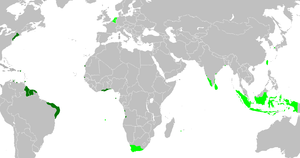
from the 17th to the 20th century. The Dutch followed Portugal
Portuguese Empire
The Portuguese Empire , also known as the Portuguese Overseas Empire or the Portuguese Colonial Empire , was the first global empire in history...
and Spain
Spanish Empire
The Spanish Empire comprised territories and colonies administered directly by Spain in Europe, in America, Africa, Asia and Oceania. It originated during the Age of Exploration and was therefore one of the first global empires. At the time of Habsburgs, Spain reached the peak of its world power....
in establishing an overseas colonial empire
Empire
The term empire derives from the Latin imperium . Politically, an empire is a geographically extensive group of states and peoples united and ruled either by a monarch or an oligarchy....
, but based on military conquest of already-existing Portuguese and Spanish settlements, and not on discovery and colonisation. For this, they were aided by their skills in shipping and trade and the surge of nationalism accompanying the struggle for independence from Spain. Alongside the British
British Empire
The British Empire comprised the dominions, colonies, protectorates, mandates and other territories ruled or administered by the United Kingdom. It originated with the overseas colonies and trading posts established by England in the late 16th and early 17th centuries. At its height, it was the...
, the Dutch initially built up colonial possessions on the basis of indirect state capitalist corporate colonialism, via the Dutch East
Dutch East India Company
The Dutch East India Company was a chartered company established in 1602, when the States-General of the Netherlands granted it a 21-year monopoly to carry out colonial activities in Asia...
and West
Dutch West India Company
Dutch West India Company was a chartered company of Dutch merchants. Among its founding fathers was Willem Usselincx...
India Companies. Dutch exploratory voyages such as those led by Willem Barents
Willem Barents
Willem Barentsz was a Dutch navigator, cartographer, explorer, and a leader of early expeditions to the far north....
, Henry Hudson
Henry Hudson
Henry Hudson was an English sea explorer and navigator in the early 17th century. Hudson made two attempts on behalf of English merchants to find a prospective Northeast Passage to Cathay via a route above the Arctic Circle...
and Abel Tasman
Abel Tasman
Abel Janszoon Tasman was a Dutch seafarer, explorer, and merchant, best known for his voyages of 1642 and 1644 in the service of the VOC . His was the first known European expedition to reach the islands of Van Diemen's Land and New Zealand and to sight the Fiji islands...
revealed to Europeans vast new territories.
With Dutch naval power rising rapidly as a major force from the late 16th century, the Netherlands dominated global commerce during the second half of the 17th century during a cultural flowering known as the Dutch Golden Age
Dutch Golden Age
The Golden Age was a period in Dutch history, roughly spanning the 17th century, in which Dutch trade, science, military and art were among the most acclaimed in the world. The first half is characterised by the Eighty Years' War till 1648...
. The Netherlands lost many of its colonial possessions, as well as its global power status, to the British when the metropole
Metropole
The metropole, from the Greek Metropolis 'mother city' was the name given to the British metropolitan centre of the British Empire, i.e. the United Kingdom itself...
fell to French armies during the Revolutionary Wars
French Revolutionary Wars
The French Revolutionary Wars were a series of major conflicts, from 1792 until 1802, fought between the French Revolutionary government and several European states...
. The restored portions of the Dutch Empire, notably the Dutch East Indies
Dutch East Indies
The Dutch East Indies was a Dutch colony that became modern Indonesia following World War II. It was formed from the nationalised colonies of the Dutch East India Company, which came under the administration of the Netherlands government in 1800....
and Suriname
Suriname
Suriname , officially the Republic of Suriname , is a country in northern South America. It borders French Guiana to the east, Guyana to the west, Brazil to the south, and on the north by the Atlantic Ocean. Suriname was a former colony of the British and of the Dutch, and was previously known as...
, remained under Dutch control until the decline of European imperialism
Imperialism
Imperialism, as defined by Dictionary of Human Geography, is "the creation and/or maintenance of an unequal economic, cultural, and territorial relationships, usually between states and often in the form of an empire, based on domination and subordination." The imperialism of the last 500 years,...
following World War II
World War II
World War II, or the Second World War , was a global conflict lasting from 1939 to 1945, involving most of the world's nations—including all of the great powers—eventually forming two opposing military alliances: the Allies and the Axis...
.
Today, the Netherlands are part of a federacy
Federacy
A federacy is a form of government where one or several substate units enjoy considerably more independence than the majority of the substate units. To some extent, such an arrangement can be considered as similar to asymmetric federalism.-Description:...
called the Kingdom of the Netherlands
Kingdom of the Netherlands
The Kingdom of the Netherlands is a sovereign state and constitutional monarchy with territory in Western Europe and in the Caribbean. The four parts of the Kingdom—Aruba, Curaçao, the Netherlands, and Sint Maarten—are referred to as "countries", and participate on a basis of equality...
. As of October 10, 2010, the constituent countries within the Kingdom of the Netherlands are the Netherlands
Netherlands
The Netherlands is a constituent country of the Kingdom of the Netherlands, located mainly in North-West Europe and with several islands in the Caribbean. Mainland Netherlands borders the North Sea to the north and west, Belgium to the south, and Germany to the east, and shares maritime borders...
, Aruba
Aruba
Aruba is a 33 km-long island of the Lesser Antilles in the southern Caribbean Sea, located 27 km north of the coast of Venezuela and 130 km east of Guajira Peninsula...
, Curaçao
Curaçao
Curaçao is an island in the southern Caribbean Sea, off the Venezuelan coast. The Country of Curaçao , which includes the main island plus the small, uninhabited island of Klein Curaçao , is a constituent country of the Kingdom of the Netherlands...
, and Sint Maarten.
Origins (1543–1602)
Dutch Republic
The Dutch Republic — officially known as the Republic of the Seven United Netherlands , the Republic of the United Netherlands, or the Republic of the Seven United Provinces — was a republic in Europe existing from 1581 to 1795, preceding the Batavian Republic and ultimately...
were originally part of a loose federation of seventeen provinces
Seventeen Provinces
The Seventeen Provinces were a personal union of states in the Low Countries in the 15th century and 16th century, roughly covering the current Netherlands, Belgium, Luxembourg, a good part of the North of France , and a small part of Western Germany.The Seventeen Provinces were originally held by...
, which Charles V
Charles V, Holy Roman Emperor
Charles V was ruler of the Holy Roman Empire from 1519 and, as Charles I, of the Spanish Empire from 1516 until his voluntary retirement and abdication in favor of his younger brother Ferdinand I and his son Philip II in 1556.As...
, Holy Roman Emperor
Holy Roman Emperor
The Holy Roman Emperor is a term used by historians to denote a medieval ruler who, as German King, had also received the title of "Emperor of the Romans" from the Pope...
and King of Spain had inherited and brought under his direct rule in 1543. In 1567 a Protestant revolt broke out against rule by Roman Catholic Spain, sparking the Eighty Years War. Led by William of Orange
William the Silent
William I, Prince of Orange , also widely known as William the Silent , or simply William of Orange , was the main leader of the Dutch revolt against the Spanish that set off the Eighty Years' War and resulted in the formal independence of the United Provinces in 1648. He was born in the House of...
, independence was declared in the 1581 Act of Abjuration. The revolt resulted in the establishment of an independent Protestant republic in the north, although Spain did not officially recognize Dutch independence until 1648.
The coastal provinces of Holland and Zeeland
Zeeland
Zeeland , also called Zealand in English, is the westernmost province of the Netherlands. The province, located in the south-west of the country, consists of a number of islands and a strip bordering Belgium. Its capital is Middelburg. With a population of about 380,000, its area is about...
had for a long time prior to Spanish rule been important hubs of the European maritime trade network. Their geographical location provided convenient access to the markets of France, Germany, England and the Baltic. The war with Spain led many financiers and traders to emigrate from Antwerp a major city in Flanders
Flanders
Flanders is the community of the Flemings but also one of the institutions in Belgium, and a geographical region located in parts of present-day Belgium, France and the Netherlands. "Flanders" can also refer to the northern part of Belgium that contains Brussels, Bruges, Ghent and Antwerp...
and then one of Europe's most important commercial centres, to Dutch cities, particularly Amsterdam
Amsterdam
Amsterdam is the largest city and the capital of the Netherlands. The current position of Amsterdam as capital city of the Kingdom of the Netherlands is governed by the constitution of August 24, 1815 and its successors. Amsterdam has a population of 783,364 within city limits, an urban population...
, which became Europe's foremost centre for shipping, banking, and insurance. Efficient access to capital enabled the Dutch in the 1580s to extend their trade networks beyond northern Europe to new markets in the Mediterranean and the Levant
Levant
The Levant or ) is the geographic region and culture zone of the "eastern Mediterranean littoral between Anatolia and Egypt" . The Levant includes most of modern Lebanon, Syria, Jordan, Israel, the Palestinian territories, and sometimes parts of Turkey and Iraq, and corresponds roughly to the...
. In the 1590s, Dutch ships began to trade with Brazil
Brazil
Brazil , officially the Federative Republic of Brazil , is the largest country in South America. It is the world's fifth largest country, both by geographical area and by population with over 192 million people...
and the Dutch Gold Coast
Dutch Gold Coast
The Dutch Gold Coast or Dutch Guinea, officially Dutch possessions on the Coast of Guinea was a portion of coastal West Africa that was gradually colonized by the Dutch, beginning in 1598...
of Africa, and towards the Indian Ocean and the source of the lucrative spice trade
Spice trade
Civilizations of Asia were involved in spice trade from the ancient times, and the Greco-Roman world soon followed by trading along the Incense route and the Roman-India routes...
. This brought the Dutch into direct competition with Portugal
Portugal
Portugal , officially the Portuguese Republic is a country situated in southwestern Europe on the Iberian Peninsula. Portugal is the westernmost country of Europe, and is bordered by the Atlantic Ocean to the West and South and by Spain to the North and East. The Atlantic archipelagos of the...
, which had dominated these trade networks for several decades, and had established colonial outposts on the coasts of Brazil, Africa and the Indian Ocean to facilitate them. The rivalry with Portugal, however, was not entirely economic: from 1580, after the battle of Ksar El Kebir, the Portuguese crown had been joined to that of Spain in an "Iberian Union
Iberian Union
The Iberian union was a political unit that governed all of the Iberian Peninsula south of the Pyrenees from 1580–1640, through a dynastic union between the monarchies of Portugal and Spain after the War of the Portuguese Succession...
" under Philip II of Spain
Philip II of Spain
Philip II was King of Spain, Portugal, Naples, Sicily, and, while married to Mary I, King of England and Ireland. He was lord of the Seventeen Provinces from 1556 until 1581, holding various titles for the individual territories such as duke or count....
. By attacking Portuguese overseas possessions, the Dutch forced Spain to divert financial and military resources away from its attempt to quell Dutch independence. Thus began the several decade-long Dutch-Portuguese War
Dutch-Portuguese War
The Dutch–Portuguese War was an armed conflict involving Dutch forces, in the form of the Dutch East India Company and the Dutch West India Company, against the Portuguese Empire. Beginning in 1602, the conflict primarily involved the Dutch companies invading Portuguese colonies in the Americas,...
.
In 1594, the "Company of Far Lands" was founded in Amsterdam, with the aim of sending two fleets to the spice islands of Maluku
Maluku Islands
The Maluku Islands are an archipelago that is part of Indonesia, and part of the larger Maritime Southeast Asia region. Tectonically they are located on the Halmahera Plate within the Molucca Sea Collision Zone...
. The first fleet sailed in 1596 and returned in 1597 with a cargo of pepper, which more than covered the costs of the voyage. The second voyage (1598–1599), returned its investors a 400% profit. The success of these voyages led to the founding of a number of companies competing for the trade. The competition was counterproductive to the companies' interests as it threatened to drive up the price of spices at their source in Indonesia whilst driving them down in Europe.
Rise of Dutch hegemony (1602–1652)
As a result of the problems caused by intercompany rivalry, the Dutch East India CompanyDutch East India Company
The Dutch East India Company was a chartered company established in 1602, when the States-General of the Netherlands granted it a 21-year monopoly to carry out colonial activities in Asia...
(Dutch: Verenigde Oost-Indische Compagnie, VOC) was founded in 1602. The charter awarded to the Company by the States-General granted it sole rights, for an initial period of 21 years, to Dutch trade and navigation east of the Cape of Good Hope
Cape of Good Hope
The Cape of Good Hope is a rocky headland on the Atlantic coast of the Cape Peninsula, South Africa.There is a misconception that the Cape of Good Hope is the southern tip of Africa, because it was once believed to be the dividing point between the Atlantic and Indian Oceans. In fact, the...
and west of the Straits of Magellan. The directors of the company, the "Heeren XVII" were given the legal authority to establish "fortresses and strongholds", to sign treaties, to enlist its own army and navy, and to wage defensive war. The company itself was founded as a joint stock company
Joint stock company
A joint-stock company is a type of corporation or partnership involving two or more individuals that own shares of stock in the company...
, similarly to its English rival that had been founded two years earlier, the English East India Company. In 1621 the Dutch West India Company
Dutch West India Company
Dutch West India Company was a chartered company of Dutch merchants. Among its founding fathers was Willem Usselincx...
was set up and given a twenty five year monopoly to those parts of the world that were not controlled by its East India counterpart: the Atlantic, the Americas and the west coast of Africa.
Asia
The VOC began immediately to prise away the string of coastal fortresses that at the time comprised the Portuguese Empire. The settlements were isolated, difficult to reinforce if attacked, and prone to being picked off one by one, but nevertheless the Dutch only enjoyed mixed success in its attempts to do so. AmboinaAmbon Island
Ambon Island is part of the Maluku Islands of Indonesia. The island has an area of , and is mountainous, well watered, and fertile. Ambon Island consists of 2 territories: The main city and seaport is Ambon , which is also the capital of Maluku province and Maluku Tengah Ambon Island is part of the...
was captured from the Portuguese in 1605, but an attack on Malacca
Malacca
Malacca , dubbed The Historic State or Negeri Bersejarah among locals) is the third smallest Malaysian state, after Perlis and Penang. It is located in the southern region of the Malay Peninsula, on the Straits of Malacca. It borders Negeri Sembilan to the north and the state of Johor to the south...
the following year narrowly failed in its objective to provide a more strategically located base in the East Indies with favourable monsoon winds. The Dutch found what they were looking for in Jakarta
Jakarta
Jakarta is the capital and largest city of Indonesia. Officially known as the Special Capital Territory of Jakarta, it is located on the northwest coast of Java, has an area of , and a population of 9,580,000. Jakarta is the country's economic, cultural and political centre...
, conquered by Jan Coen in 1619, later renamed Batavia after the putative Dutch ancestors the Batavians, and which would become the capital of the Dutch East Indies
Dutch East Indies
The Dutch East Indies was a Dutch colony that became modern Indonesia following World War II. It was formed from the nationalised colonies of the Dutch East India Company, which came under the administration of the Netherlands government in 1800....
. Meanwhile, the Dutch continued to drive out the Portuguese from their bases in Asia. Malacca
Malacca
Malacca , dubbed The Historic State or Negeri Bersejarah among locals) is the third smallest Malaysian state, after Perlis and Penang. It is located in the southern region of the Malay Peninsula, on the Straits of Malacca. It borders Negeri Sembilan to the north and the state of Johor to the south...
finally succumbed in 1641
Battle of Malacca (1641)
In the early 17th century, the Dutch East India Company began the campaign to destroy Portuguese power in the East. At that time, the Portuguese had transformed Malacca into an impregnable fortress , controlling access to the sea lanes of the Straits of Malacca and the spice trade there...
(after a second attempt to capture it), Colombo
Colombo
Colombo is the largest city of Sri Lanka. It is located on the west coast of the island and adjacent to Sri Jayawardenapura Kotte, the capital of Sri Lanka. Colombo is often referred to as the capital of the country, since Sri Jayawardenapura Kotte is a satellite city of Colombo...
in 1656, Ceylon in 1658, Nagappattinam in 1662 and Cranganore and Cochin in 1662. Goa
Goa
Goa , a former Portuguese colony, is India's smallest state by area and the fourth smallest by population. Located in South West India in the region known as the Konkan, it is bounded by the state of Maharashtra to the north, and by Karnataka to the east and south, while the Arabian Sea forms its...
, the capital of the Portuguese Empire in the East, was unsuccessfully attacked by the Dutch in 1603 and 1610. Whilst the Dutch were unable in four attempts to capture Macau
Macau
Macau , also spelled Macao , is, along with Hong Kong, one of the two special administrative regions of the People's Republic of China...
from where Portugal monopolised the lucrative China-Japan trade
Nanban trade
The or the in Japanese history extends from the arrival of the first Europeans to Japan in 1543, to their near-total exclusion from the archipelago in 1614, under the promulgation of the "Sakoku" Seclusion Edicts.- Etymology :...
, the Japanese shogunate's increasing suspicion of the intentions of the Catholic Portuguese led to their expulsion in 1639. Under the subsequent sakoku policy
Sakoku
was the foreign relations policy of Japan under which no foreigner could enter nor could any Japanese leave the country on penalty of death. The policy was enacted by the Tokugawa shogunate under Tokugawa Iemitsu through a number of edicts and policies from 1633–39 and remained in effect until...
, from 1639 till 1854 (215 years) the Dutch were the only European power allowed to operate in Japan, confined in 1639 to Hirado and then from 1641 at Deshima. In the mid 17th century the Dutch also explored the western Australian coasts, naming many places
Australian places with Dutch names
There are many Australian places which have Dutch names dating from the 17th century due to the Dutch voyages of exploration along the western, northern and southern Australian coasts. Other places were named after the early Dutch explorers by later British explorers or colonists, for instance the...
.
The Dutch colonised Mauritius
Mauritius
Mauritius , officially the Republic of Mauritius is an island nation off the southeast coast of the African continent in the southwest Indian Ocean, about east of Madagascar...
in 1638, several decades after three ships out of the Dutch Second Fleet sent to the Spice Islands were blown off course in a storm and landed in 1598. They named it in honour of Prince Maurice of Nassau
Maurice of Nassau, Prince of Orange
Maurice of Nassau, Prince of Orange was sovereign Prince of Orange from 1618, on the death of his eldest half brother, Philip William, Prince of Orange,...
, the Stadtholder
Stadtholder
A Stadtholder A Stadtholder A Stadtholder (Dutch: stadhouder [], "steward" or "lieutenant", literally place holder, holding someones place, possibly a calque of German Statthalter, French lieutenant, or Middle Latin locum tenens...
of the Netherlands. The Dutch found the climate hostile and abandoned the island after several further decades.
By the middle of the 17th century, the Dutch had overtaken Portugal as the dominant player in the spice and silk trade, and in 1652 founded a colony at Cape Town
Cape Colony
The Cape Colony, part of modern South Africa, was established by the Dutch East India Company in 1652, with the founding of Cape Town. It was subsequently occupied by the British in 1795 when the Netherlands were occupied by revolutionary France, so that the French revolutionaries could not take...
on the coast of South Africa, as a way-station for its ships on the route between Europe and Asia. After the first settlers spread out around the Company station, nomad
Nomad
Nomadic people , commonly known as itinerants in modern-day contexts, are communities of people who move from one place to another, rather than settling permanently in one location. There are an estimated 30-40 million nomads in the world. Many cultures have traditionally been nomadic, but...
ic white livestock farmers, or Trekboer
Trekboer
The Trekboers were nomadic pastoralists descended from almost equal numbers of Dutch colonists, French Huguenots and German Protestants. The Trekboere began migrating from the areas surrounding what is now Cape Town during the 17th century throughout the 18th century.-Origins:The Trekboere were...
s, moved more widely afield, leaving the richer, but limited, farming lands of the coast for the drier interior tableland. In 1795 the heavily taxed Boers of the frontier districts, who received no protection against the Africans, expelled the officials of the Dutch East India Company, and established independent governments at Swellendam and at Graaff Reinet.
Between 1602 and 1796, the VOC
Dutch East India Company
The Dutch East India Company was a chartered company established in 1602, when the States-General of the Netherlands granted it a 21-year monopoly to carry out colonial activities in Asia...
sent almost a million Europeans
European ethnic groups
The ethnic groups in Europe are the various ethnic groups that reside in the nations of Europe. European ethnology is the field of anthropology focusing on Europe....
to work in the Asia trade. The majority died of disease or made their way back to Europe, but some of them made the Indies their new home. Interaction between the Dutch
Dutch people
The Dutch people are an ethnic group native to the Netherlands. They share a common culture and speak the Dutch language. Dutch people and their descendants are found in migrant communities worldwide, notably in Suriname, Chile, Brazil, Canada, Australia, South Africa, New Zealand, and the United...
and native population mainly took place in Sri Lanka
Sri Lanka
Sri Lanka, officially the Democratic Socialist Republic of Sri Lanka is a country off the southern coast of the Indian subcontinent. Known until 1972 as Ceylon , Sri Lanka is an island surrounded by the Indian Ocean, the Gulf of Mannar and the Palk Strait, and lies in the vicinity of India and the...
and the modern Indonesian Islands
Islands of Indonesia
This is a list of islands of Indonesian Archipelago. Indonesia comprises 17,508 - 18,306 islands and 8,844 that have been named according to estimates made by the Government of Indonesia, with 922 of those permanently inhabited. The islands span eastward from Sabang in northern Sumatra to Merauke...
. Through the centuries there developed a relatively large Dutch-speaking population of mixed Dutch and Indonesian descent, known as Indos or Dutch-Indonesians.
Americas
In the Atlantic, the West India Company concentrated on wresting from Portugal its grip on the sugarHistory of sugar
The long history of sugar is interwoven with that of trade, religion, colonialism, capitalism, industry and technology. The labor-intensive nature of sugar cultivation and processing has meant that much of the history of the sugar industry has had associations with large-scale slavery...
and slave
History of slavery
The history of slavery covers slave systems in historical perspective in which one human being is legally the property of another, can be bought or sold, is not allowed to escape and must work for the owner without any choice involved...
trade, and on opportunistic attacks on the Spanish treasure fleets on their homeward bound voyage. Bahia
Bahia
Bahia is one of the 26 states of Brazil, and is located in the northeastern part of the country on the Atlantic coast. It is the fourth most populous Brazilian state after São Paulo, Minas Gerais and Rio de Janeiro, and the fifth-largest in size...
on the north east coast of Brazil was captured in 1624 but only held for a year before it was recaptured by a joint Spanish-Portuguese expedition. In 1628, Piet Heyn captured the entire Spanish treasure fleet
Spanish treasure fleet
The Spanish treasure fleets was a convoy system adopted by the Spanish Empire from 1566 to 1790...
, and made off with a vast fortune in precious metals and goods that enabled the Company two years later to pay its shareholders a cash dividend of 70%, though the Company was to have relatively few other successes against the Spanish. In 1630, the Dutch occupied the Portuguese sugar-settlement of Pernambuco
Pernambuco
Pernambuco is a state of Brazil, located in the Northeast region of the country. To the north are the states of Paraíba and Ceará, to the west is Piauí, to the south are Alagoas and Bahia, and to the east is the Atlantic Ocean. There are about of beaches, some of the most beautiful in the...
and over the next few years pushed inland, annexing the sugar plantations that surrounded it. In order to supply the plantations with the manpower they required, a successful expedition was launched
Battle of Elmina (1637)
In 1637 the Dutch West India Company detached 9 ships from the forces attacking the Portuguese in brazil to send them against the Portuguese in Fort Elmina. They appointed Colonel Hans Coine to command the fleet which consisted of a total of 1,300 men...
in 1637 from Brazil to capture the Portuguese slaving post of Elmina
Elmina
Elmina, is a town in the Central Region, situated on a south-facing bay on the Atlantic Ocean coast of Ghana, about 12 km west of Cape Coast...
, and in 1641 successfully captured
Capture of Luanda
In 1641 the Dutch captured Luanda from the Portuguese. The Portuguese, upon the arrival of the Dutch, fled upriver.The Portuguese would return and retake the city in 1648....
the Portuguese settlements in Angola
Angola
Angola, officially the Republic of Angola , is a country in south-central Africa bordered by Namibia on the south, the Democratic Republic of the Congo on the north, and Zambia on the east; its west coast is on the Atlantic Ocean with Luanda as its capital city...
. In 1642 the Dutch captured the Portuguese possession of Axim
Axim
Axim is a town, district and kingdom on the coast of Ghana. It lies 64 kilometers west of the port city of Takoradi, south of the highway leading to the Côte d'Ivoire border, in the Western Region to the west of Cape Three Points....
in Africa. By 1650, the West India Company was firmly in control of both the sugar and slave trades, and had occupied the Caribbean islands of Sint Maarten, Curaçao
Curaçao
Curaçao is an island in the southern Caribbean Sea, off the Venezuelan coast. The Country of Curaçao , which includes the main island plus the small, uninhabited island of Klein Curaçao , is a constituent country of the Kingdom of the Netherlands...
, Aruba
Aruba
Aruba is a 33 km-long island of the Lesser Antilles in the southern Caribbean Sea, located 27 km north of the coast of Venezuela and 130 km east of Guajira Peninsula...
and Bonaire in order to guarantee access to the islands' salt-pans
Salt evaporation pond
Salt evaporation ponds, also called salterns or salt pans, are shallow artificial ponds designed to produce salts from sea water or other brines. The seawater or brine is fed into large ponds and water is drawn out through natural evaporation which allows the salt to be subsequently harvested...
.
Pernambuco
Pernambuco is a state of Brazil, located in the Northeast region of the country. To the north are the states of Paraíba and Ceará, to the west is Piauí, to the south are Alagoas and Bahia, and to the east is the Atlantic Ocean. There are about of beaches, some of the most beautiful in the...
rebelled against their Dutch masters, and by 1654, the Dutch had been ousted from Brazil. In the intervening years, a Portuguese expedition had been sent from Brazil to recapture Luanda
Luanda
Luanda, formerly named São Paulo da Assunção de Loanda, is the capital and largest city of Angola. Located on Angola's coast with the Atlantic Ocean, Luanda is both Angola's chief seaport and its administrative center. It has a population of at least 5 million...
in Angola, by 1648 the Dutch were expelled from there also.
On the north-east coast of North America, the West India Company took over a settlement that had been established by the Company of New Netherland
New Netherland Company
New Netherland Company was a chartered company of Dutch merchants.Following Henry Hudson's exploration of the east coast of North America on behalf of the Dutch East India Company in 1609, several Dutch merchants sent ships to trade with the Native Americans and to search for the Northwest Passage...
(1614–18) at Fort Orange
Fort Orange
Fort Orange was the first permanent Dutch settlement in New Netherland and was on the site of the present-day city of Albany, New York. It was a replacement for Fort Nassau, which had been built on nearby Castle Island in the Hudson River, and which served as a trading post until 1617 or 1618,...
at Albany
Albany, New York
Albany is the capital city of the U.S. state of New York, the seat of Albany County, and the central city of New York's Capital District. Roughly north of New York City, Albany sits on the west bank of the Hudson River, about south of its confluence with the Mohawk River...
on the Hudson River
Hudson River
The Hudson is a river that flows from north to south through eastern New York. The highest official source is at Lake Tear of the Clouds, on the slopes of Mount Marcy in the Adirondack Mountains. The river itself officially begins in Henderson Lake in Newcomb, New York...
, relocated from Fort Nassau
Fort Nassau (North)
Fort Nassau was the first Dutch settlement in North America, and was located along the Hudson River in present-day Albany, New York, United States. The factorij was a small fortification which served as a trading post and warehouse...
which had been founded in 1614. The Dutch had been sending ships annually to the Hudson River to trade fur since Henry Hudson
Henry Hudson
Henry Hudson was an English sea explorer and navigator in the early 17th century. Hudson made two attempts on behalf of English merchants to find a prospective Northeast Passage to Cathay via a route above the Arctic Circle...
's voyage of 1609. In order to protect its precarious position at Albany from the nearby English and French, the Company founded the fortified town of New Amsterdam
New Amsterdam
New Amsterdam was a 17th-century Dutch colonial settlement that served as the capital of New Netherland. It later became New York City....
in 1625 at the mouth of the Hudson, encouraging settlement of the surrounding areas of Long Island
Long Island
Long Island is an island located in the southeast part of the U.S. state of New York, just east of Manhattan. Stretching northeast into the Atlantic Ocean, Long Island contains four counties, two of which are boroughs of New York City , and two of which are mainly suburban...
and New Jersey
New Jersey
New Jersey is a state in the Northeastern and Middle Atlantic regions of the United States. , its population was 8,791,894. It is bordered on the north and east by the state of New York, on the southeast and south by the Atlantic Ocean, on the west by Pennsylvania and on the southwest by Delaware...
. The fur trade ultimately proved impossible for the Company to monopolise due to the massive illegal private trade in furs, and the settlement of New Netherland
New Netherland
New Netherland, or Nieuw-Nederland in Dutch, was the 17th-century colonial province of the Republic of the Seven United Netherlands on the East Coast of North America. The claimed territories were the lands from the Delmarva Peninsula to extreme southwestern Cape Cod...
was unprofitable. In 1655, the nearby colony of New Sweden
New Sweden
New Sweden was a Swedish colony along the Delaware River on the Mid-Atlantic coast of North America from 1638 to 1655. Fort Christina, now in Wilmington, Delaware, was the first settlement. New Sweden included parts of the present-day American states of Delaware, New Jersey, and Pennsylvania....
on the Delaware River
Delaware River
The Delaware River is a major river on the Atlantic coast of the United States.A Dutch expedition led by Henry Hudson in 1609 first mapped the river. The river was christened the South River in the New Netherland colony that followed, in contrast to the North River, as the Hudson River was then...
was forcibly absorbed into New Netherland after ships and soldiers were sent to capture it by the Dutch governor, Pieter Stuyvesant.
Ever since its inception, the Dutch East India Company had been in competition with its counterpart, the English East India Company, founded two years earlier but with a capital base eight times smaller, for the same goods and markets in the East. In 1619, the rivalry resulted in the Amboyna massacre
Amboyna massacre
The Amboyna massacre was the 1623 torture and execution on Ambon Island , of twenty men, ten of whom were in the service of the British East India Company, by agents of the Dutch East India Company, on accusations of treason...
, when several English Company men were executed by agents of the Dutch. The event remained a source of English resentment for several decades, and in the late 1620s the English Company shifted its focus from Indonesia to India.
In 1643 the Dutch West India Company
Dutch West India Company
Dutch West India Company was a chartered company of Dutch merchants. Among its founding fathers was Willem Usselincx...
established a settlement in the ruins of the Spanish settlement of Valdivia
Valdivia, Chile
Valdivia is a city and commune in southern Chile administered by the Municipality of Valdivia. The city is named after its founder Pedro de Valdivia and is located at the confluence of the Calle-Calle, Valdivia and Cau-Cau Rivers, approximately east of the coastal towns of Corral and Niebla...
, in southern Chile. The purpose of the expedition was to gain a foothold on the west coast of the Americas, an area that - at the time - was almost an internal sea of Spain, and to extract gold from nearby mines. Uncooperative indigenous peoples that had forced the Spanish to leave Valdivia in 1604 contributed to get the expedition to leave after some months of occupation. This occupation triggered the return of the Spanish to Valdivia and the building of one of the largest defensive complexes
Valdivian Fort System
The Fort System of Valdivia are a series of Spanish colonial fortifications at Corral Bay, Valdivia and Cruces River established to protect the city of Valdivia, in southern Chile. During the period of Spanish rule , it was one of the biggest systems of fortification in the Americas. It was also a...
of colonial America.
Rivalry with Great Britain and France (1652–1795)
In 1651, the English parliament passed the first of the Navigation ActsNavigation Acts
The English Navigation Acts were a series of laws that restricted the use of foreign shipping for trade between England and its colonies, a process which had started in 1651. Their goal was to force colonial development into lines favorable to England, and stop direct colonial trade with the...
which excluded Dutch shipping from the lucrative trade between England and its Caribbean colonies, and led directly to the outbreak of hostilities between the two countries the following year, the first of three Anglo-Dutch Wars
Anglo-Dutch Wars
The Anglo–Dutch Wars were a series of wars fought between the English and the Dutch in the 17th and 18th centuries for control over the seas and trade routes. The first war took place during the English Interregnum, and was fought between the Commonwealth of England and the Dutch Republic...
that would last on and off for two decades and slowly erode Dutch naval power to England's benefit.
The Second Anglo-Dutch War was precipitated in 1664 when English forces moved to capture New Netherland
New Netherland
New Netherland, or Nieuw-Nederland in Dutch, was the 17th-century colonial province of the Republic of the Seven United Netherlands on the East Coast of North America. The claimed territories were the lands from the Delmarva Peninsula to extreme southwestern Cape Cod...
. Under the Treaty of Breda (1667), New Netherland was ceded to England in exchange for the English settlements in Suriname, which had been conquered by Dutch forces earlier that year. Though the Dutch would again take New Netherland in 1673, during the Third Anglo-Dutch War, it was returned to England the following year, thereby ending the Dutch Empire in continental North America, but leaving behind a large Dutch community under English rule that persisted with its language, church and customs until the mid-18th century. In South America, the Dutch seized Cayenne
Cayenne (Dutch colony)
This article contains content derived from the Dutch WikipediaCayenne was a Dutch colony in South America, seized from France by the Dutch West Indies Company in 1658. The territory is now known as French Guiana. Among its original settlers were a significant body of Jews...
from the French in 1658 and drove off a French attempt to retake it a year later. However, it was returned to France in 1664 since the colony proved to be unprofitable. It was recaptured by the Dutch in 1676, but was returned again a year later, this time permanently. The Glorious Revolution
Glorious Revolution
The Glorious Revolution, also called the Revolution of 1688, is the overthrow of King James II of England by a union of English Parliamentarians with the Dutch stadtholder William III of Orange-Nassau...
of 1688 saw the Dutch William of Orange
William III of England
William III & II was a sovereign Prince of Orange of the House of Orange-Nassau by birth. From 1672 he governed as Stadtholder William III of Orange over Holland, Zeeland, Utrecht, Guelders, and Overijssel of the Dutch Republic. From 1689 he reigned as William III over England and Ireland...
ascend to the throne, and win the English, Scottish, and Irish crowns, ending eighty years of rivalry between the Netherlands and England, while the rivalry with France remained strong.
During the American Revolutionary War
American Revolutionary War
The American Revolutionary War , the American War of Independence, or simply the Revolutionary War, began as a war between the Kingdom of Great Britain and thirteen British colonies in North America, and ended in a global war between several European great powers.The war was the result of the...
, Britain declared war on the Netherlands, the Fourth Anglo-Dutch War
Fourth Anglo-Dutch War
The Fourth Anglo–Dutch War was a conflict between the Kingdom of Great Britain and the Dutch Republic. The war, tangentially related to the American Revolutionary War, broke out over British and Dutch disagreements on the legality and conduct of Dutch trade with Britain's enemies in that...
, in which Britain seized the Dutch colony of Ceylon. Under the Peace of Paris (1783)
Peace of Paris (1783)
The Peace of Paris was the set of treaties which ended the American Revolutionary War. On 3 September 1783, representatives of King George III of Great Britain signed a treaty in Paris with representatives of the United States of America—commonly known as the Treaty of Paris —and two treaties at...
, Ceylon was returned to the Netherlands and Negapatnam ceded to Britain.
Napoleonic era (1795–1815)
In 1795, the French revolutionary army invaded the Dutch Republic and turned the nation into a satellite of France, named the Batavian RepublicBatavian Republic
The Batavian Republic was the successor of the Republic of the United Netherlands. It was proclaimed on January 19, 1795, and ended on June 5, 1806, with the accession of Louis Bonaparte to the throne of the Kingdom of Holland....
. Britain, which was at war with France, soon moved to occupy Dutch colonies in Asia, South Africa
Battle of Muizenberg
The Battle of Muizenberg was a small but significant military engagement which took place near Muizenberg, South Africa in 1795; it led to the capture of the Cape Colony by Kingdom of Great Britain.- Background :...
and the Caribbean.
Under the terms of the Treaty of Amiens
Treaty of Amiens
The Treaty of Amiens temporarily ended hostilities between the French Republic and the United Kingdom during the French Revolutionary Wars. It was signed in the city of Amiens on 25 March 1802 , by Joseph Bonaparte and the Marquess Cornwallis as a "Definitive Treaty of Peace"...
signed by Britain and France in 1802, the Cape Colony
Cape Colony
The Cape Colony, part of modern South Africa, was established by the Dutch East India Company in 1652, with the founding of Cape Town. It was subsequently occupied by the British in 1795 when the Netherlands were occupied by revolutionary France, so that the French revolutionaries could not take...
and the islands of the Dutch West Indies that the British had seized were returned to the Republic. Ceylon was not returned to the Dutch and was made a British Crown Colony
Crown colony
A Crown colony, also known in the 17th century as royal colony, was a type of colonial administration of the English and later British Empire....
. After the outbreak of hostilities between Britain and France again in 1803, the British retook
Battle of Blaauwberg
The Battle of Blaauwberg, also known as the Battle of Cape Town, fought near Cape Town on 8 January 1806, was a small but significant military engagement. It established British rule in South Africa, which was to have many ramifications during the nineteenth and twentieth centuries...
the Cape Colony. The British also invaded the island of Java in 1810 which resulted in Anglo-Dutch Java War
Anglo-Dutch Java War
The Anglo-Dutch Java War in 1810–1811 was a war between Britain and the Netherlands , fought entirely on the Island of Java in colonial Indonesia.-Background:...
. The entire colony fell under British control in 1811.
In 1806 Napoleon dissolved the Batavian Republic and established a monarchy with his brother, Louis
Louis Bonaparte
Louis Napoléon Bonaparte, Prince Français, Comte de Saint-Leu , King of Holland , was the fifth surviving child and the fourth surviving son of Carlo Buonaparte and Letizia Ramolino...
, on the throne as King of Holland. Louis was removed from power by Napoleon in 1810, and the country was ruled directly from France until its liberation in 1813. The following year, the independent Netherlands signed the Anglo-Dutch Treaty of 1814
Anglo-Dutch Treaty of 1814
The Anglo-Dutch Treaty of 1814 was a treaty signed between Great Britain and the Netherlands in London on August 13, 1814...
with Britain. All of the colonies that Britain had seized were returned to the Netherlands, with the exception of the Cape Colony
Cape Colony
The Cape Colony, part of modern South Africa, was established by the Dutch East India Company in 1652, with the founding of Cape Town. It was subsequently occupied by the British in 1795 when the Netherlands were occupied by revolutionary France, so that the French revolutionaries could not take...
and Guyana
Guyana
Guyana , officially the Co-operative Republic of Guyana, previously the colony of British Guiana, is a sovereign state on the northern coast of South America that is culturally part of the Anglophone Caribbean. Guyana was a former colony of the Dutch and of the British...
.
Post-Napoleonic era (1815–1945)
After Napoleon's defeat in 1815, Europe's borders were redrawn at the Congress of ViennaCongress of Vienna
The Congress of Vienna was a conference of ambassadors of European states chaired by Klemens Wenzel von Metternich, and held in Vienna from September, 1814 to June, 1815. The objective of the Congress was to settle the many issues arising from the French Revolutionary Wars, the Napoleonic Wars,...
. For the first time since the declaration of independence
Declaration of independence
A declaration of independence is an assertion of the independence of an aspiring state or states. Such places are usually declared from part or all of the territory of another nation or failed nation, or are breakaway territories from within the larger state...
from Spain in 1581, the Dutch were reunited with the Southern Netherlands
Southern Netherlands
Southern Netherlands were a part of the Low Countries controlled by Spain , Austria and annexed by France...
in a constitutional monarchy, the United Kingdom of the Netherlands
United Kingdom of the Netherlands
United Kingdom of the Netherlands is the unofficial name used to refer to Kingdom of the Netherlands during the period after it was first created from part of the First French Empire and before the new kingdom of Belgium split out in 1830...
. The union lasted just 15 years. In 1830, a revolution
Belgian Revolution
The Belgian Revolution was the conflict which led to the secession of the Southern provinces from the United Kingdom of the Netherlands and established an independent Kingdom of Belgium....
in the southern half of the country led to the de facto independence of the new state of Belgium
Belgium
Belgium , officially the Kingdom of Belgium, is a federal state in Western Europe. It is a founding member of the European Union and hosts the EU's headquarters, and those of several other major international organisations such as NATO.Belgium is also a member of, or affiliated to, many...
.
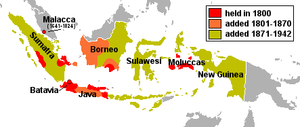
Dutch East Indies
The Dutch East Indies was a Dutch colony that became modern Indonesia following World War II. It was formed from the nationalised colonies of the Dutch East India Company, which came under the administration of the Netherlands government in 1800....
.
Anglo-Dutch rivalry in Southeast Asia continued to fester over the port of Singapore
Singapore
Singapore , officially the Republic of Singapore, is a Southeast Asian city-state off the southern tip of the Malay Peninsula, north of the equator. An island country made up of 63 islands, it is separated from Malaysia by the Straits of Johor to its north and from Indonesia's Riau Islands by the...
, which had been ceded to the British East India Company
Founding of modern Singapore
The founding of modern Singapore in 1819 by Sir Stamford Raffles paved the way for Singapore to become a modern port and established its status as a gateway between the Western and Eastern markets....
in 1819 by the sultan of Johore. The Dutch claimed that a treaty signed with the sultan's predecessor the year earlier had granted them control of the region. However, the impossibility of removing the British from Singapore, which was becoming an increasingly important centre of trade, became apparent to the Dutch, and the disagreement was resolved with the Anglo-Dutch Treaty of 1824
Anglo-Dutch Treaty of 1824
The Anglo-Dutch Treaty of 1824, also known as the Treaty of London, was a treaty signed between the United Kingdom and the Netherlands in London on 17 March 1824. The treaty was to resolve disputes arising from the execution of the Anglo-Dutch Treaty of 1814...
. Under its terms, the Netherlands ceded Malacca
Malacca
Malacca , dubbed The Historic State or Negeri Bersejarah among locals) is the third smallest Malaysian state, after Perlis and Penang. It is located in the southern region of the Malay Peninsula, on the Straits of Malacca. It borders Negeri Sembilan to the north and the state of Johor to the south...
and their bases in India to the British, and recognised the British claim to Singapore. In return, the British handed over Bencoolen and agreed not to sign treaties with rulers in the "islands south of the Straits of Singapore". Thus the archipelago
Maritime Southeast Asia
Maritime Southeast Asia refers to the maritime region of Southeast Asia as opposed to mainland Southeast Asia and includes the modern countries of Indonesia, Malaysia, the Philippines, Brunei, East Timor and Singapore....
was divided into two spheres of influence: a British one, on the Malay Peninsula
Malay Peninsula
The Malay Peninsula or Thai-Malay Peninsula is a peninsula in Southeast Asia. The land mass runs approximately north-south and, at its terminus, is the southern-most point of the Asian mainland...
, and a Dutch one in the East Indies.

Java
Java is an island of Indonesia. With a population of 135 million , it is the world's most populous island, and one of the most densely populated regions in the world. It is home to 60% of Indonesia's population. The Indonesian capital city, Jakarta, is in west Java...
was under Dutch domination for most of the 350 years of the combined VOC and Dutch East Indies era, many areas remained independent for much of this time including Aceh
Aceh
Aceh is a special region of Indonesia, located on the northern tip of the island of Sumatra. Its full name is Daerah Istimewa Aceh , Nanggroë Aceh Darussalam and Aceh . Past spellings of its name include Acheh, Atjeh and Achin...
, Lombok
Lombok
Lombok is an island in West Nusa Tenggara province, Indonesia. It forms part of the chain of the Lesser Sunda Islands, with the Lombok Strait separating it from Bali to the west and the Alas Strait between it and Sumbawa to the east...
, Bali
Bali
Bali is an Indonesian island located in the westernmost end of the Lesser Sunda Islands, lying between Java to the west and Lombok to the east...
and Borneo
Borneo
Borneo is the third largest island in the world and is located north of Java Island, Indonesia, at the geographic centre of Maritime Southeast Asia....
.
In 1871, all of the Dutch possessions on the Dutch Gold Coast
Dutch Gold Coast
The Dutch Gold Coast or Dutch Guinea, officially Dutch possessions on the Coast of Guinea was a portion of coastal West Africa that was gradually colonized by the Dutch, beginning in 1598...
were sold to Britain
Anglo-Dutch Treaties of 1870-1871
The Anglo-Dutch Treaties of 1871 were three related treaties between Great Britain and the Netherlands, dealing with colonial disputes and other colonial affairs between the two countries.-History:...
.
The Dutch West India company was abolished in 1791, and its colonies in Suriname and the Caribbean brought under the direct rule of the state. The economies of the Dutch colonies in the Caribbean had been based on the smuggling of goods and slaves into Spanish America, but with the end of the slave trade in 1814 and the independence of the new nations of South and Central America from Spain, profitability rapidly declined. Dutch traders moved en masse from the islands to the United States or Latin America, leaving behind a small populations with little income and which required subsidies from the Dutch government. The Antilles were combined under one administration with Suriname from 1828 to 1845. Slavery was not abolished in the Dutch Caribbean colonies until 1863, long after those of Britain and France, though by this time only 6,500 slaves remained. In Suriname, slave holders demanded compensation from the Dutch government for freeing slaves, whilst in Sint Maarten, abolition of slavery in the French half in 1848 led slaves in the Dutch half to take their own freedom. In Suriname, after the abolition of slavery, Chinese workers were encouraged to immigrate as indentured labourers, as were Javanese, between 1890 and 1939.
Indonesia
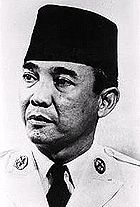
Japanese Occupation of Indonesia
The Japanese Empire occupied Indonesia, known then as the Dutch East Indies, during World War II from March 1942 until after the end of War in 1945...
during the remainder of World War II saw the fundamental dismantling of the Dutch colonial state's
Dutch East Indies
The Dutch East Indies was a Dutch colony that became modern Indonesia following World War II. It was formed from the nationalised colonies of the Dutch East India Company, which came under the administration of the Netherlands government in 1800....
economic, political and social structures, replacing it with a Japanese regime. In the decades before the war, the Dutch had been overwhelmingly successful in suppressing the small nationalist movement in Indonesia such that the Japanese occupation proved fundamental for Indonesian independence. However, the Indonesian Communist Party founded by Dutch socialist Henk Sneevliet
Henk Sneevliet
Hendricus Josephus Franciscus Marie Sneevliet, known as Henk Sneevliet or the pseudonym Maring , was a Dutch Communist, who was active in both the Netherlands and the Dutch East-Indies...
in 1914, popular also with Dutch workers and sailors at the time, was in strategic alliance with Sarekat Islam
Sarekat Islam
Sarekat Islam, formerly Sarekat Dagang Islam, was a Javanese batik traders's cooperative in Indonesia.Sarekat Dagang Islam was founded by Haji Samanhudi, a businessman in Surakarta, in 1905 or 1912. His business was trading in batik, the traditional cloth made in Java...
(q.v.) as early as 1917 until the Proclamation of Indonesian Independence and was particularly important in the fight against Japanese occupation of the Dutch East Indies in the Second World War. The Japanese encouraged and backed Indonesian nationalism in which new indigenous institutions were created and nationalist leaders such as Sukarno
Sukarno
Sukarno, born Kusno Sosrodihardjo was the first President of Indonesia.Sukarno was the leader of his country's struggle for independence from the Netherlands and was Indonesia's first President from 1945 to 1967...
were promoted. The internment of all Dutch citizens meant that Indonesians filled many leadership and administrative positions, although the top positions were still held by the Japanese.
Two days after the Japanese surrender in August 1945, Sukarno and fellow nationalist leader Hatta
Mohammad Hatta
was born in Bukittinggi, West Sumatra, Dutch East Indies . He was Indonesia's first vice president, later also serving as the country's Prime Minister. Known as "The Proclamator", he and a number of Indonesians, including the first president of Indonesia, Sukarno, fought for the independence of...
unilaterally declared Indonesian independence. A four and a half-year struggle
Indonesian National Revolution
The Indonesian National Revolution or Indonesian War of Independence was an armed conflict and diplomatic struggle between Indonesia and the Dutch Empire, and an internal social revolution...
followed as the Dutch tried to re-establish their colony. Dutch forces eventually re-occupied most of the colonial territory and a guerrilla struggle ensued. The majority of Indonesians, and - ultimately - international opinion, favored independence, and in December 1949, the Netherlands formally recognized Indonesian sovereignty. Under the terms of the 1949 agreement, Western New Guinea
Western New Guinea
West Papua informally refers to the Indonesian western half of the island of New Guinea and other smaller islands to its west. The region is officially administered as two provinces: Papua and West Papua. The eastern half of New Guinea is Papua New Guinea.The population of approximately 3 million...
remained under the auspices of Netherlands New Guinea
Netherlands New Guinea
Netherlands New Guinea refers to the West Papua region while it was an overseas territory of the Kingdom of the Netherlands from 1949 to 1962. Until 1949 it was a part of the Netherlands Indies. It was commonly known as Dutch New Guinea...
. The new Indonesian government under President Sukarno pressured for the territory to come under Indonesian control as Indonesian nationalists initially intended. Following United States pressure, the Netherlands transferred it to Indonesia under the 1962 New York Agreement
New York Agreement
The Agreement between the Republic of Indonesia and the Kingdom of the Netherlands Concerning West New Guinea , also known as the New York Agreement, was a treaty signed between Indonesia and the Netherlands on the political status of West New Guinea...
.
Suriname and the Netherlands Antilles
In 1954, under the "Charter for the Kingdom of the NetherlandsCharter for the Kingdom of the Netherlands
The Charter for the Kingdom of the Netherlands describes the political relationship between the four different countries which form the Kingdom of the Netherlands: Aruba, Curaçao, and Sint Maarten in the Caribbean and the Netherlands in Europe...
", the Netherlands, Suriname and the Netherlands Antilles (at the time including Aruba) became a composite kingdom. The former colonies were granted autonomy save for certain matters including defense, foreign affairs and citizenship, which were the responsibility of the Realm. In 1969, unrest in Curaçao led to Dutch marines being sent to quell rioting. In 1973, negotiations started in Suriname for independence, and full independence was granted in 1975, with 60,000 emigrants taking the opportunity of moving to the Netherlands. In 1986, Aruba
Aruba
Aruba is a 33 km-long island of the Lesser Antilles in the southern Caribbean Sea, located 27 km north of the coast of Venezuela and 130 km east of Guajira Peninsula...
was allowed to secede from the Netherlands Antilles federation, and was pressured by the Netherlands to move to independence within ten years. However, in 1994, it was agreed that its status as a Realm in its own right could continue.
On October 10, 2010, the Netherlands Antilles were dissolved. Effective on that date, Curaçao and Sint Maarten acceded to the same country status within the Kingdom that Aruba already enjoyed. The islands of Bonaire, Sint Eustatius and Saba were granted a status similar to Dutch municipalities, and are now sometimes referred to as the Caribbean Netherlands.
Legacy
In general the Dutch do not celebrate their imperial past and anti-colonial sentiments prevail since the 1960s. Subsequently colonial history is not featured prominently in Dutch schoolbooks. This perspective on their imperial past only recently shifted with prime minister Jan Peter BalkenendeJan Peter Balkenende
Jan Pieter "Jan Peter" Balkenende is a Dutch politician of the party Christian Democratic Appeal .He was the Prime Minister of the Netherlands from 22 July 2002 until 14 October 2010, having led four coalition governments, cabinets Balkenende I, II, III and IV, none of which served a full...
's contentious call for the return of the VOC mentality.
Dutch diaspora
In some Dutch colonies there are major ethnic groups of DutchDutch people
The Dutch people are an ethnic group native to the Netherlands. They share a common culture and speak the Dutch language. Dutch people and their descendants are found in migrant communities worldwide, notably in Suriname, Chile, Brazil, Canada, Australia, South Africa, New Zealand, and the United...
ancestry descending from emigrated Dutch settlers. In South Africa the Boer
Boer
Boer is the Dutch and Afrikaans word for farmer, which came to denote the descendants of the Dutch-speaking settlers of the eastern Cape frontier in Southern Africa during the 18th century, as well as those who left the Cape Colony during the 19th century to settle in the Orange Free State,...
s and Cape Dutch
Cape Dutch
Cape Dutch are people of the Western Cape of South Africa who descended primarily from Dutch and Flemish as well as smaller numbers of French, German and other European immigrants along with a percentage of their Asian and African slaves, who, from the 17th century into the 19th century, remained...
collectively known as the Afrikaner
Afrikaner
Afrikaners are an ethnic group in Southern Africa descended from almost equal numbers of Dutch, French and German settlers whose native tongue is Afrikaans: a Germanic language which derives primarily from 17th century Dutch, and a variety of other languages.-Related ethno-linguistic groups:The...
s. The Burgher people
Burgher people
The Burghers are a Eurasian ethnic group, historically from Sri Lanka, consisting for the most part of male-line descendants of European colonists from the 16th to 20th centuries and local women, with some minorities of Swedish, Norwegian, French and Irish.Today the mother tongue of the Burghers...
of Sri Lanka and the Indo people of Indonesia as well as the Creoles
Creole peoples
The term Creole and its cognates in other languages — such as crioulo, criollo, créole, kriolu, criol, kreyol, kreol, kriulo, kriol, krio, etc. — have been applied to people in different countries and epochs, with rather different meanings...
of Suriname
Suriname
Suriname , officially the Republic of Suriname , is a country in northern South America. It borders French Guiana to the east, Guyana to the west, Brazil to the south, and on the north by the Atlantic Ocean. Suriname was a former colony of the British and of the Dutch, and was previously known as...
(previously known as Dutch Guyana) are mixed race people of Dutch
Dutch people
The Dutch people are an ethnic group native to the Netherlands. They share a common culture and speak the Dutch language. Dutch people and their descendants are found in migrant communities worldwide, notably in Suriname, Chile, Brazil, Canada, Australia, South Africa, New Zealand, and the United...
descent.
In the USA there have been three American presidents of Dutch descent: Martin Van Buren
Martin Van Buren
Martin Van Buren was the eighth President of the United States . Before his presidency, he was the eighth Vice President and the tenth Secretary of State, under Andrew Jackson ....
, the first president who was not of British descent, and whose first language was Dutch, the 26th president Theodore Roosevelt
Theodore Roosevelt
Theodore "Teddy" Roosevelt was the 26th President of the United States . He is noted for his exuberant personality, range of interests and achievements, and his leadership of the Progressive Movement, as well as his "cowboy" persona and robust masculinity...
and Franklin D. Roosevelt
Franklin D. Roosevelt
Franklin Delano Roosevelt , also known by his initials, FDR, was the 32nd President of the United States and a central figure in world events during the mid-20th century, leading the United States during a time of worldwide economic crisis and world war...
, the 32nd president, elected to four terms in office (1933 to 1945) and the only U.S. president to have served more than two terms.
Dutch language
Despite the Dutch presence in Indonesia for almost three hundred and fifty years, the Dutch language has no official status and the small minority that can speak the language fluently are either educated members of the oldest generation, or employed in the legal profession, as some legal codes are still only available in Dutch. The Indonesian language inherited many words from Dutch, both in words for everyday life, and as well in scientific or technological terminology. One scholar argues that 20% of IndonesianIndonesian language
Indonesian is the official language of Indonesia. Indonesian is a normative form of the Riau Islands dialect of Malay, an Austronesian language which has been used as a lingua franca in the Indonesian archipelago for centuries....
words can be traced back to Dutch words.
The century and half of Dutch rule in Ceylon and southern India left few to no traces of the Dutch language. Today, in Suriname, Dutch is the official language and 58 percent of the population speak it as their mother tongue. Twenty-four percent of the population speaks Dutch as a second language, and in total 82 percent of the population can speak Dutch. In Aruba
Aruba
Aruba is a 33 km-long island of the Lesser Antilles in the southern Caribbean Sea, located 27 km north of the coast of Venezuela and 130 km east of Guajira Peninsula...
, Bonaire, and Curaçao
Curaçao
Curaçao is an island in the southern Caribbean Sea, off the Venezuelan coast. The Country of Curaçao , which includes the main island plus the small, uninhabited island of Klein Curaçao , is a constituent country of the Kingdom of the Netherlands...
, Dutch is the official language but spoken as a first language by only seven to eight percent of the population, although most people on the islands can speak the language and the education system on these islands is in Dutch at some or all levels. The population of the three northern Antilles, Sint Maarten, Saba, and Sint Eustatius, is predominantly English-speaking.
In New Jersey
New Jersey
New Jersey is a state in the Northeastern and Middle Atlantic regions of the United States. , its population was 8,791,894. It is bordered on the north and east by the state of New York, on the southeast and south by the Atlantic Ocean, on the west by Pennsylvania and on the southwest by Delaware...
in the United States, an extinct dialect of Dutch, Jersey Dutch
Jersey Dutch
Jersey Dutch was a variant of the Dutch language spoken in and around Bergen and Passaic counties in New Jersey from the late 17th century until the early 20th century. It may have been a partial creole language based on Zeelandic and West Flemish Dutch dialects with English and possibly some...
, spoken by descendants of 17th century Dutch settlers in Bergen and Passaic counties, was noted to still be spoken as late as 1921.
The greatest linguistic legacy of the Netherlands was in its colony in South Africa, which attracted large numbers of Dutch farmer (in Dutch, Boer
Boer
Boer is the Dutch and Afrikaans word for farmer, which came to denote the descendants of the Dutch-speaking settlers of the eastern Cape frontier in Southern Africa during the 18th century, as well as those who left the Cape Colony during the 19th century to settle in the Orange Free State,...
) settlers, who spoke a simplified form of Dutch called Afrikaans
Afrikaans
Afrikaans is a West Germanic language, spoken natively in South Africa and Namibia. It is a daughter language of Dutch, originating in its 17th century dialects, collectively referred to as Cape Dutch .Afrikaans is a daughter language of Dutch; see , , , , , .Afrikaans was historically called Cape...
, which is largely mutually intelligible with Dutch. After the colony passed into British hands, the settlers spread into the hinterland, taking their language with them. As of 2005, there were 10 million people for whom Afrikaans is either a primary and secondary language, compared with over 22 million speakers of Dutch.
Other Creole language
Creole language
A creole language, or simply a creole, is a stable natural language developed from the mixing of parent languages; creoles differ from pidgins in that they have been nativized by children as their primary language, making them have features of natural languages that are normally missing from...
s with Dutch linguistic roots are Papiamento
Papiamento
Papiamento is the most widely spoken language on the Caribbean ABC islands, having the official status on the islands of Aruba and Curaçao. The language is also recognized on Bonaire by the Dutch government....
still spoken in Aruba
Aruba
Aruba is a 33 km-long island of the Lesser Antilles in the southern Caribbean Sea, located 27 km north of the coast of Venezuela and 130 km east of Guajira Peninsula...
, Bonaire, Curaçao
Curaçao
Curaçao is an island in the southern Caribbean Sea, off the Venezuelan coast. The Country of Curaçao , which includes the main island plus the small, uninhabited island of Klein Curaçao , is a constituent country of the Kingdom of the Netherlands...
, and Sint Eustatius; Saramaccan
Saramaccan language
Saramaccan is a creole language spoken by about 24,000 people near the Saramacca and upper Suriname Rivers in Suriname , and 2,000 in French Guiana...
and Sranan Tongo
Sranan Tongo
Sranan is a creole language spoken as a lingua franca by approximately 300,000 people in Suriname...
still spoken in Suriname
Suriname
Suriname , officially the Republic of Suriname , is a country in northern South America. It borders French Guiana to the east, Guyana to the west, Brazil to the south, and on the north by the Atlantic Ocean. Suriname was a former colony of the British and of the Dutch, and was previously known as...
; Berbice spoken but in danger of extinction in Guyana
Guyana
Guyana , officially the Co-operative Republic of Guyana, previously the colony of British Guiana, is a sovereign state on the northern coast of South America that is culturally part of the Anglophone Caribbean. Guyana was a former colony of the Dutch and of the British...
; Pecok spoken but in danger of extinction in Indonesia
Indonesia
Indonesia , officially the Republic of Indonesia , is a country in Southeast Asia and Oceania. Indonesia is an archipelago comprising approximately 13,000 islands. It has 33 provinces with over 238 million people, and is the world's fourth most populous country. Indonesia is a republic, with an...
and the Netherlands
Netherlands
The Netherlands is a constituent country of the Kingdom of the Netherlands, located mainly in North-West Europe and with several islands in the Caribbean. Mainland Netherlands borders the North Sea to the north and west, Belgium to the south, and Germany to the east, and shares maritime borders...
; Albany Dutch spoken but in danger of extinction in the USA.
Extinct Dutch-based creole languages
Dutch-based creole languages
A Dutch creole is a creole language that has been substantially influenced by the Dutch language.Most Dutch-based creoles originated in Dutch colonies in the Americas and Southeast Asia, after the 17th century expansion of Dutch maritime power...
include: Skepi (Guyana
Guyana
Guyana , officially the Co-operative Republic of Guyana, previously the colony of British Guiana, is a sovereign state on the northern coast of South America that is culturally part of the Anglophone Caribbean. Guyana was a former colony of the Dutch and of the British...
); Negerhollands
Negerhollands
Negerhollands is a Dutch-based creole language that was once spoken in the Danish West Indies, now known as the U.S. Virgin Islands. Dutch is its superstrate language with Danish, English, French, Spanish, and African elements incorporated...
(aka "Negro Dutch"), Jersey Dutch
Jersey Dutch
Jersey Dutch was a variant of the Dutch language spoken in and around Bergen and Passaic counties in New Jersey from the late 17th century until the early 20th century. It may have been a partial creole language based on Zeelandic and West Flemish Dutch dialects with English and possibly some...
and Mohawk Dutch
Mohawk Dutch
Mohawk Dutch is a now extinct Dutch-based creole language mainly spoken during the 17th century west of Albany, New York, by the Dutch colonists who traded with or to a lesser extent mixed with the local population from the Mohawk nation....
(USA) and Javindo
Javindo language
Javindo, also known by the pejorative name Krontjong, was a Dutch-based creole language spoken on Java, Indonesia. The name Javindo is a portmanteau of Java and Indo, the Dutch word for a person of mixed Indonesian and Dutch descent. This contact language developed from communication between...
(Java
Java
Java is an island of Indonesia. With a population of 135 million , it is the world's most populous island, and one of the most densely populated regions in the world. It is home to 60% of Indonesia's population. The Indonesian capital city, Jakarta, is in west Java...
).
Placenames
Some towns of New York and areas of New York City, once part of the colony of New NetherlandNew Netherland
New Netherland, or Nieuw-Nederland in Dutch, was the 17th-century colonial province of the Republic of the Seven United Netherlands on the East Coast of North America. The claimed territories were the lands from the Delmarva Peninsula to extreme southwestern Cape Cod...
have names of Dutch origin, such as Brooklyn
Brooklyn
Brooklyn is the most populous of New York City's five boroughs, with nearly 2.6 million residents, and the second-largest in area. Since 1896, Brooklyn has had the same boundaries as Kings County, which is now the most populous county in New York State and the second-most densely populated...
(after Breukelen
Breukelen
Breukelen is a town and former municipality in the Netherlands, in the province of Utrecht. It is situated to the north west of Utrecht, along the river Vecht and close to the lakes of the Loosdrechtse Plassen, an area of natural and touristic interest...
), Flushing
Flushing, Netherlands
Vlissingen is a municipality and a city in the southwestern Netherlands on the former island of Walcheren. With its strategic location between the Scheldt river and the North Sea, Vlissingen has been an important harbour for centuries. It was granted city rights in 1315. In the 17th century...
(after Vlissingen), the Bowery
Bowery
Bowery may refer to:Streets:* The Bowery, a thoroughfare in Manhattan, New York City* Bowery Street is a street on Coney Island in Brooklyn, N.Y.In popular culture:* Bowery Amphitheatre, a building on the Bowery in New York City...
(after Bouwerij, construction site), Harlem
Harlem
Harlem is a neighborhood in the New York City borough of Manhattan, which since the 1920s has been a major African-American residential, cultural and business center. Originally a Dutch village, formally organized in 1658, it is named after the city of Haarlem in the Netherlands...
(after Haarlem
Haarlem
Haarlem is a municipality and a city in the Netherlands. It is the capital of the province of North Holland, the northern half of Holland, which at one time was the most powerful of the seven provinces of the Dutch Republic...
), Coney Island
Coney Island
Coney Island is a peninsula and beach on the Atlantic Ocean in southern Brooklyn, New York, United States. The site was formerly an outer barrier island, but became partially connected to the mainland by landfill....
(from Conyne Eylandt, modern Dutch spelling Konijneneiland: Rabbit island) and Staten Island
Staten Island
Staten Island is a borough of New York City, New York, United States, located in the southwest part of the city. Staten Island is separated from New Jersey by the Arthur Kill and the Kill Van Kull, and from the rest of New York by New York Bay...
(meaning "Island of the States"). The last Director-General of the colony of New Netherland, Pieter Stuyvesant, has bequeathed his name to a street, a neighborhood and a few schools in New York City, and the town of Stuyvesant
Stuyvesant, New York
Stuyvesant is a town in Columbia County, New York, United States. The population was 2,188 at the 2000 census.The Town of Stuyvesant is in the northwest part of Columbia County...
. Many of the towns and cities along the Hudson in upstate New York have placenames with Dutch origins (for example Yonkers, Hoboken, Haverstraw, Newburgh, Staatsburg, Catskill, Kinderhook, Coeymans, Rensselaer, Watervliet).
Many towns and cities in Suriname
Suriname
Suriname , officially the Republic of Suriname , is a country in northern South America. It borders French Guiana to the east, Guyana to the west, Brazil to the south, and on the north by the Atlantic Ocean. Suriname was a former colony of the British and of the Dutch, and was previously known as...
share names with cities in the Netherlands, such as Alkmaar
Alkmaar, Suriname
Alkmaar is a resort in Suriname, located in the Commewijne District. Its population at the 2004 census was 4,213.Named after the town of Alkmaar in the Dutch province of North Holland, Alkmaar has regional significance as a government post and a medical centre. The Moravian Church is an important...
and Groningen. The capital of Curaçao
Curaçao
Curaçao is an island in the southern Caribbean Sea, off the Venezuelan coast. The Country of Curaçao , which includes the main island plus the small, uninhabited island of Klein Curaçao , is a constituent country of the Kingdom of the Netherlands...
is named Willemstad
Willemstad
Willemstad can refer to:*Willemstad, the capital of Curaçao*Willemstad , a town in Moerdijk, the Netherlands*Willemstad , a hamlet near Marum, the Netherlands*Willemstad , a hamlet in the Netherlands...
and the capital of Aruba
Aruba
Aruba is a 33 km-long island of the Lesser Antilles in the southern Caribbean Sea, located 27 km north of the coast of Venezuela and 130 km east of Guajira Peninsula...
is named Oranjestad
Oranjestad, Aruba
Oranjestad is the capital and largest city of Aruba, which is in the Caribbean north of Venezuela. Oranjestad is located on the southern coast near the western end of the island country...
. Both are named after the Dutch King Willem van Oranje-Nassau (William of Orange-Nassau) - the first heir to the Dutch House of Orange.
Half of South Africa's major cities have Dutch names i.e. Johannesburg
Johannesburg
Johannesburg also known as Jozi, Jo'burg or Egoli, is the largest city in South Africa, by population. Johannesburg is the provincial capital of Gauteng, the wealthiest province in South Africa, having the largest economy of any metropolitan region in Sub-Saharan Africa...
, Kaapstad, Vereeniging, Bloemfontein
Bloemfontein
Bloemfontein is the capital city of the Free State Province of South Africa; and, as the judicial capital of the nation, one of South Africa's three national capitals – the other two being Cape Town, the legislative capital, and Pretoria, the administrative capital.Bloemfontein is popularly and...
and Vanderbijlpark.
The country name New Zealand originated with Dutch cartographers, who called the islands Nova Zeelandia, after the Dutch province
Seventeen Provinces
The Seventeen Provinces were a personal union of states in the Low Countries in the 15th century and 16th century, roughly covering the current Netherlands, Belgium, Luxembourg, a good part of the North of France , and a small part of Western Germany.The Seventeen Provinces were originally held by...
of Zeeland
Zeeland
Zeeland , also called Zealand in English, is the westernmost province of the Netherlands. The province, located in the south-west of the country, consists of a number of islands and a strip bordering Belgium. Its capital is Middelburg. With a population of about 380,000, its area is about...
. British explorer James Cook
James Cook
Captain James Cook, FRS, RN was a British explorer, navigator and cartographer who ultimately rose to the rank of captain in the Royal Navy...
subsequently anglicised the name to New Zealand.
The Australian island state Tasmania
Tasmania
Tasmania is an Australian island and state. It is south of the continent, separated by Bass Strait. The state includes the island of Tasmania—the 26th largest island in the world—and the surrounding islands. The state has a population of 507,626 , of whom almost half reside in the greater Hobart...
is named after Dutch explorer Abel Tasman
Abel Tasman
Abel Janszoon Tasman was a Dutch seafarer, explorer, and merchant, best known for his voyages of 1642 and 1644 in the service of the VOC . His was the first known European expedition to reach the islands of Van Diemen's Land and New Zealand and to sight the Fiji islands...
, who made the first reported European sighting of the island on 24 November 1642. He first named the island Anthony van Diemen's Land after his sponsor Anthony van Diemen
Anthony van Diemen
Anthony van Diemen , Dutch colonial governor, was born in Culemborg in the Netherlands, the son of Meeus Anthonisz van Diemen and Christina Hoevenaar. In 1616 he moved to Amsterdam, in hope of improving his fortune as a merchant; in this he failed and was declared bankrupt...
, the Governor of the Dutch East Indies
Dutch East Indies
The Dutch East Indies was a Dutch colony that became modern Indonesia following World War II. It was formed from the nationalised colonies of the Dutch East India Company, which came under the administration of the Netherlands government in 1800....
. The name was later shortened to Van Diemen's Land
Van Diemen's Land
Van Diemen's Land was the original name used by most Europeans for the island of Tasmania, now part of Australia. The Dutch explorer Abel Tasman was the first European to land on the shores of Tasmania...
by the British. It was officially renamed in honour of its first European discoverer on 1 January 1856. Arnhem Land
Arnhem Land
The Arnhem Land Region is one of the five regions of the Northern Territory of Australia. It is located in the north-eastern corner of the territory and is around 500 km from the territory capital Darwin. The region has an area of 97,000 km² which also covers the area of Kakadu National...
is named after the Dutch city of Arnhem
Arnhem
Arnhem is a city and municipality, situated in the eastern part of the Netherlands. It is the capital of the province of Gelderland and located near the river Nederrijn as well as near the St. Jansbeek, which was the source of the city's development. Arnhem has 146,095 residents as one of the...
.
Architecture
In the Surinamese Capital of Paramaribo, the Dutch Fort ZeelandiaFort Zeelandia (Paramaribo)
Fort Zeelandia is a fortress in Paramaribo, Suriname, that was built by British colonists in 1651 around a small trading post, created by the Dutch...
still stands today. In the centre of Malacca, Malaysia, the Stadthuys Building
Stadthuys
The Stadthuys , also known as the Red Square, is a historical structure situated in the heart of Malacca Town, the administrative capital of the state of Malacca, Malaysia...
and Christ Church still stand. There are still archaeological remains of Fort Goede Hoop (modern Hartford, Connecticut
Hartford, Connecticut
Hartford is the capital of the U.S. state of Connecticut. The seat of Hartford County until Connecticut disbanded county government in 1960, it is the second most populous city on New England's largest river, the Connecticut River. As of the 2010 Census, Hartford's population was 124,775, making...
) and Fort Orange
Fort Orange
Fort Orange was the first permanent Dutch settlement in New Netherland and was on the site of the present-day city of Albany, New York. It was a replacement for Fort Nassau, which had been built on nearby Castle Island in the Hudson River, and which served as a trading post until 1617 or 1618,...
(modern Albany, New York
Albany, New York
Albany is the capital city of the U.S. state of New York, the seat of Albany County, and the central city of New York's Capital District. Roughly north of New York City, Albany sits on the west bank of the Hudson River, about south of its confluence with the Mohawk River...
).
Dutch architecture is easy to see in Aruba, Curaçao, and Bonaire. The Dutch style buildings are especially visible in Willemstad
Willemstad, Netherlands Antilles
Willemstad is the capital city of Curaçao, an island in the southern Caribbean Sea that forms a constituent country of the Kingdom of the Netherlands. Formerly the capital of the Netherlands Antilles prior to its dissolution in 2010, it has an estimated population of 140,000. The historic centre of...
, with its steeply pitched gables, large windows and soaring finials.
During the period of Dutch colonisation in South Africa
South Africa
The Republic of South Africa is a country in southern Africa. Located at the southern tip of Africa, it is divided into nine provinces, with of coastline on the Atlantic and Indian oceans...
, a distinctive type of architecture, known as Cape Dutch architecture
Cape Dutch architecture
-Introduction:Cape Dutch architecture is an architectural style found in the Western Cape of South Africa. The style was prominent in the early days of the Cape Colony, and the name derives from the fact that the initial settlers of the Cape were primarily Dutch...
, was developed.
Although the Dutch already started erecting buildings shortly after they arrived on the shores of Batavia, most Dutch-built constructions still standing today in Indonesia stem from the 19th and 20th centuries. Forts from the colonial era, used for defense purposes, still line a number of major coastal cities across the archipelago. The largest number of Dutch buildings is found on Java, particularly in the big cities such as Jakarta
Jakarta
Jakarta is the capital and largest city of Indonesia. Officially known as the Special Capital Territory of Jakarta, it is located on the northwest coast of Java, has an area of , and a population of 9,580,000. Jakarta is the country's economic, cultural and political centre...
, Bandung
Bandung
Bandung is the capital of West Java province in Indonesia, and the country's third largest city, and 2nd largest metropolitan area in Indonesia, with a population of 7.4 million in 2007. Located 768 metres above sea level, approximately 140 km southeast of Jakarta, Bandung has cooler...
, Semarang
Semarang
- Economy :The western part of the city is home to many industrial parks and factories. The port of Semarang is located on the north coast and it is the main shipping port for the province of Central Java. Many small manufacturers are located in Semarang, producing goods such as textiles,...
, Yogyakarta, Surabaya
Surabaya
Surabaya is Indonesia's second-largest city with a population of over 2.7 million , and the capital of the province of East Java...
and Malang
Malang
Malang is the second largest city in East Java province, Indonesia. It has an ancient history dating back to the Mataram Kingdom. The city population at the 2010 Census was 819,708. During the period of Dutch colonization, it was a popular destination for European residents. The city is famous for...
. “In the beginning (of the Dutch presence), Dutch construction on Java was based on colonial architecture which was modified according to the tropical and local cultural conditions,” Indonesian art and design professor Pamudji Suptandar wrote. This was dubbed arsitektur Indis (Indies architecture), which combines the existing traditional Hindu-Javanese style with European forms.
Many public buildings still standing and in use in Jakarta, such as the presidential palace, the finance ministry and the performing arts theatre, were built in the 19th century in the classicist
Classicism
Classicism, in the arts, refers generally to a high regard for classical antiquity, as setting standards for taste which the classicists seek to emulate. The art of classicism typically seeks to be formal and restrained: of the Discobolus Sir Kenneth Clark observed, "if we object to his restraint...
style. As the 20th century approached, the number of Dutch people in Indonesia increase, and smaller residential dwellings were built, many in the more modern art-deco style. The most ‘Dutch’ city in Indonesia, architecturally speaking, is Bandung, some 180 kilometres east of Jakarta. This city, situated on the higher plains of West Java, was largely rural grounds until the Dutch decided to develop it into a city in the late 19th century.
Since Indonesia’s independence, few governments have shown interest in the conservation of historical buildings. Many architecturally grand buildings have been torn down in the past decades to erect shopping centres or office buildings e.g. Hotel des Indes (Batavia)
Hotel des Indes (Batavia)
Hotel des Indes was one of the oldest and most prestigious hotels in Asia. Located in Batavia , in the Dutch East Indies . The hotel had accommodated countless famous patrons throughout its existence from 1829 to 1971...
. Presently, however, more Indonesians have become aware of the value of preserving their old buildings.
“A decade ago, most people thought I was crazy when they learned of my efforts to save the old part of Jakarta. A few years later, the negative voices started to disappear, and now many people are starting to think with me: how are we going to save our city. In the past using the negative sentiment towards the colonial era was often used as an excuse to disregard protests against the demolition of historical buildings. An increasing number of people now see the old colonial buildings as part of their city’s overall heritage rather than focusing on its colonial aspect.”, leading Indonesian architect and conservationist Budi Lim said.
Infrastructure
Beyond Indonesia’s art deco architecture also much of the country’s rail and road infrastructure as well as its major cities were built during the colonial period. Many of Indonesia’s main cities were mere rural townships before colonial industrialization and urban development. Examples on Java include the capital Jakarta and Bandung, outside Java examples include Ambon and Menado city. Most main railroads and rail stations on Java as well as the main road, called Daendels Great Post RoadGreat Post Road
The Great Post Road , is the name for the historical road that runs across Java that connects Anyer and Panarukan. It was built during the reign of governor-general of the Dutch East Indies Herman Willem Daendels .-Construction:...
(Dutch: Grote Postweg) after the Governor General commissioning the work, connecting west to east Java were also build during the Dutch East Indies era.
Between 1800 to 1950 Dutch engineers created an infrastructure including 67000 kilometres (41,632 mi) of roads, 7500 kilometres (4,660.3 mi) of railways, many large bridges, modern irrigation systems covering 1.4 million hectares (5,400 sq mi) of rice fields, several international harbors, and 140 public drinking water systems. These Dutch constructed public works became the material base of the colonial and postcolonial Indonesian state.
Agriculture
Crops such like coffee, tea, cacao, tobacco and rubberRubber
Natural rubber, also called India rubber or caoutchouc, is an elastomer that was originally derived from latex, a milky colloid produced by some plants. The plants would be ‘tapped’, that is, an incision made into the bark of the tree and the sticky, milk colored latex sap collected and refined...
were all introduced by the Dutch. The Dutch were the first to start the spread of the coffee plant in Central and South America, and by the early 19th century Java
Java
Java is an island of Indonesia. With a population of 135 million , it is the world's most populous island, and one of the most densely populated regions in the world. It is home to 60% of Indonesia's population. The Indonesian capital city, Jakarta, is in west Java...
was the third largest producer in the world. In 1778 the Dutch brought cacao from the Philippines
Philippines
The Philippines , officially known as the Republic of the Philippines , is a country in Southeast Asia in the western Pacific Ocean. To its north across the Luzon Strait lies Taiwan. West across the South China Sea sits Vietnam...
to Indonesia
Indonesia
Indonesia , officially the Republic of Indonesia , is a country in Southeast Asia and Oceania. Indonesia is an archipelago comprising approximately 13,000 islands. It has 33 provinces with over 238 million people, and is the world's fourth most populous country. Indonesia is a republic, with an...
and commenced mass production. Currently Indonesia is the world's second largest producer of natural rubber, a crop that was introduced by the Dutch in the early 20th century. Tobacco was introduced from the Americas and in 1863 the first plantation was established by the Dutch. Today Indonesia is not only the oldest industrial producer of tobacco, but also the second largest consumer of tobacco.
See also
- Dutch colonization of the AmericasDutch colonization of the AmericasDutch trading posts and plantations in the Americas precede the much wider known colonization activities of the Dutch in Asia. Whereas the first Dutch fort in Asia was built in 1600 , the first forts and settlements on the Essequibo river in Guyana and on the Amazon date from the 1590s...
- Dutch East India CompanyDutch East India CompanyThe Dutch East India Company was a chartered company established in 1602, when the States-General of the Netherlands granted it a 21-year monopoly to carry out colonial activities in Asia...
- Dutch West India CompanyDutch West India CompanyDutch West India Company was a chartered company of Dutch merchants. Among its founding fathers was Willem Usselincx...
- Dutch Language UnionDutch Language UnionThe Dutch Language Union is an international institution for discussing issues regarding the Dutch language. It was founded on 9 September 1980 by the Netherlands and Belgium...
- List of Dutch East India Company trading posts