


Caliphate

Encyclopedia
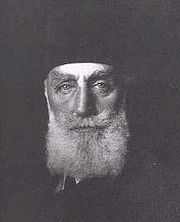
Caliph
The Caliph is the head of state in a Caliphate, and the title for the ruler of the Islamic Ummah, an Islamic community ruled by the Shari'ah. It is a transcribed version of the Arabic word which means "successor" or "representative"...
('successor')" (from the Arabic
Arabic language
Arabic is a name applied to the descendants of the Classical Arabic language of the 6th century AD, used most prominently in the Quran, the Islamic Holy Book...
خلافة or khilāfa), refers to the first system of government established in Islam and represented the political unity of the Muslim Ummah
Ummah
Ummah is an Arabic word meaning "community" or "nation." It is commonly used to mean either the collective nation of states, or the whole Arab world...
(community). In theory, it is an aristocratic
Aristocracy
Aristocracy , is a form of government in which a few elite citizens rule. The term derives from the Greek aristokratia, meaning "rule of the best". In origin in Ancient Greece, it was conceived of as rule by the best qualified citizens, and contrasted with monarchy...
–constitutional republic
Constitutional republic
A constitutional republic is a state in which the head of state and other officials are representatives of the people and must govern according to existing constitutional law that limits the government's power over all of its citizens...
(the Constitution
Constitution
A constitution is a set of fundamental principles or established precedents according to which a state or other organization is governed. These rules together make up, i.e. constitute, what the entity is...
being the Constitution of Medina
Constitution of Medina
The Constitution of Medina , also known as the Charter of Medina, was drafted by the Islamic prophet Muhammad. It constituted a formal agreement between Muhammad and all of the significant tribes and families of Yathrib , including Muslims, Jews, Christians and pagans. This constitution formed the...
), which means that the head of state
Head of State
A head of state is the individual that serves as the chief public representative of a monarchy, republic, federation, commonwealth or other kind of state. His or her role generally includes legitimizing the state and exercising the political powers, functions, and duties granted to the head of...
, the Caliph
Caliph
The Caliph is the head of state in a Caliphate, and the title for the ruler of the Islamic Ummah, an Islamic community ruled by the Shari'ah. It is a transcribed version of the Arabic word which means "successor" or "representative"...
, and other officials are representatives of the people and of Islam
Islam
Islam . The most common are and . : Arabic pronunciation varies regionally. The first vowel ranges from ~~. The second vowel ranges from ~~~...
and must govern according to constitutional and religious law
Religious law
In some religions, law can be thought of as the ordering principle of reality; knowledge as revealed by a God defining and governing all human affairs. Law, in the religious sense, also includes codes of ethics and morality which are upheld and required by the God...
, or Sharia
Sharia
Sharia law, is the moral code and religious law of Islam. Sharia is derived from two primary sources of Islamic law: the precepts set forth in the Quran, and the example set by the Islamic prophet Muhammad in the Sunnah. Fiqh jurisprudence interprets and extends the application of sharia to...
. In its early days, it resembled elements of direct democracy
Direct democracy
Direct democracy is a form of government in which people vote on policy initiatives directly, as opposed to a representative democracy in which people vote for representatives who then vote on policy initiatives. Direct democracy is classically termed "pure democracy"...
(see shura
Shura
Shura is an Arabic word for "consultation". The Quran and Muhammad encourage Muslims to decide their affairs in consultation with those who will be affected by that decision....
) and an elective monarchy
Elective monarchy
An elective monarchy is a monarchy ruled by an elected rather than hereditary monarch. The manner of election, the nature of the candidacy and the electors vary from case to case...
.
It was initially led by Muhammad
Muhammad
Muhammad |ligature]] at U+FDF4 ;Arabic pronunciation varies regionally; the first vowel ranges from ~~; the second and the last vowel: ~~~. There are dialects which have no stress. In Egypt, it is pronounced not in religious contexts...
's disciples as a continuation of the political and religious system the prophet established, known as the 'Rashidun
Rashidun
The Rightly Guided Caliphs or The Righteous Caliphs is a term used in Sunni Islam to refer to the first four Caliphs who established the Rashidun Caliphate. The concept of "Rightly Guided Caliphs" originated with the Abbasid Dynasty...
caliphates'. A "caliphate" is also a state
Sovereign state
A sovereign state, or simply, state, is a state with a defined territory on which it exercises internal and external sovereignty, a permanent population, a government, and the capacity to enter into relations with other sovereign states. It is also normally understood to be a state which is neither...
which implements such a governmental system.
Sunni Islam
Sunni Islam
Sunni Islam is the largest branch of Islam. Sunni Muslims are referred to in Arabic as ʾAhl ūs-Sunnah wa āl-Ǧamāʿah or ʾAhl ūs-Sunnah for short; in English, they are known as Sunni Muslims, Sunnis or Sunnites....
stipulates that the head of state, the caliph
Caliph
The Caliph is the head of state in a Caliphate, and the title for the ruler of the Islamic Ummah, an Islamic community ruled by the Shari'ah. It is a transcribed version of the Arabic word which means "successor" or "representative"...
, should be selected by Shura
Shura
Shura is an Arabic word for "consultation". The Quran and Muhammad encourage Muslims to decide their affairs in consultation with those who will be affected by that decision....
– elected
Election
An election is a formal decision-making process by which a population chooses an individual to hold public office. Elections have been the usual mechanism by which modern representative democracy operates since the 17th century. Elections may fill offices in the legislature, sometimes in the...
by Muslim
Muslim
A Muslim, also spelled Moslem, is an adherent of Islam, a monotheistic, Abrahamic religion based on the Quran, which Muslims consider the verbatim word of God as revealed to prophet Muhammad. "Muslim" is the Arabic term for "submitter" .Muslims believe that God is one and incomparable...
s or their representatives. Followers of Shia Islam believe the caliph should be an imam
Imam
An imam is an Islamic leadership position, often the worship leader of a mosque and the Muslim community. Similar to spiritual leaders, the imam is the one who leads Islamic worship services. More often, the community turns to the mosque imam if they have a religious question...
chosen by God from the Ahl al-Bayt
Ahl al-Bayt
Ahl al-Bayt is an Arabic phrase literally meaning People of the House, or family of the House. The phrase "ahl al-bayt" was used in Arabia before the advent of Islam to refer to one's clan, and would be adopted by the ruling family of a tribe. Within the Islamic tradition, the term refers to the...
(Muhammad's purified progeny). After the Rashidun
Rashidun
The Rightly Guided Caliphs or The Righteous Caliphs is a term used in Sunni Islam to refer to the first four Caliphs who established the Rashidun Caliphate. The concept of "Rightly Guided Caliphs" originated with the Abbasid Dynasty...
period until 1924, caliphates, sometimes two at a single time, real and illusory, were ruled by dynasties. The first dynasty was the Umayyad
Umayyad
The Umayyad Caliphate was the second of the four major Arab caliphates established after the death of Muhammad. It was ruled by the Umayyad dynasty, whose name derives from Umayya ibn Abd Shams, the great-grandfather of the first Umayyad caliph. Although the Umayyad family originally came from the...
. This was followed by the Abbasid
Abbasid
The Abbasid Caliphate or, more simply, the Abbasids , was the third of the Islamic caliphates. It was ruled by the Abbasid dynasty of caliphs, who built their capital in Baghdad after overthrowing the Umayyad caliphate from all but the al-Andalus region....
, the Fatimid
Fatimid
The Fatimid Islamic Caliphate or al-Fāṭimiyyūn was a Berber Shia Muslim caliphate first centered in Tunisia and later in Egypt that ruled over varying areas of the Maghreb, Sudan, Sicily, the Levant, and Hijaz from 5 January 909 to 1171.The caliphate was ruled by the Fatimids, who established the...
(not recognized by others outside Fatimid domain), and finally the Ottoman Dynasty
Ottoman Dynasty
The Ottoman Dynasty ruled the Ottoman Empire from 1299 to 1922, beginning with Osman I , though the dynasty was not proclaimed until Orhan Bey declared himself sultan...
.
The caliphate was "the core political concept of Sunni Islam, by the consensus of the Muslim majority in the early centuries."
History
The caliph was often known as Amir al-Mu'minin (أمير المؤمنين) "Commander of the Believers". Muhammad established his capital in MedinaMedina
Medina , or ; also transliterated as Madinah, or madinat al-nabi "the city of the prophet") is a city in the Hejaz region of western Saudi Arabia, and serves as the capital of the Al Madinah Province. It is the second holiest city in Islam, and the burial place of the Islamic Prophet Muhammad, and...
, and after he died it remained the capital for the Rashidun
Rashidun
The Rightly Guided Caliphs or The Righteous Caliphs is a term used in Sunni Islam to refer to the first four Caliphs who established the Rashidun Caliphate. The concept of "Rightly Guided Caliphs" originated with the Abbasid Dynasty...
period. At times in Muslim history
Muslim history
Muslim history is the history of Muslim people. In the history of Islam the followers of the religion of Islam have impacted political history, economic history, and military history...
there have been rival claimant caliphs in different parts of the Islamic world, and divisions between the Shi'a and Sunni communities.
According to Sunni Muslims, the first caliph to be called Amir al-Mu'minin was Abu Bakr Siddique, followed by Umar ibn al-Khattāb, the second of the Four Rightly Guided Caliphs
Rashidun
The Rightly Guided Caliphs or The Righteous Caliphs is a term used in Sunni Islam to refer to the first four Caliphs who established the Rashidun Caliphate. The concept of "Rightly Guided Caliphs" originated with the Abbasid Dynasty...
. Uthman ibn Affan and Ali ibn Abi Talib also were called by the same title, while the Shi'a consider Ali to have been the first and only truly legitimate caliph.
The rulers preceding these first four did not receive this title by consensus, and as it was turned into a monarchy thereafter.
After the first four caliphs, the Caliphate was claimed by dynasties such as the Umayyads, the Abbasids, and the Ottomans, and for relatively short periods by other, competing dynasties in al-Andalus
Al-Andalus
Al-Andalus was the Arabic name given to a nation and territorial region also commonly referred to as Moorish Iberia. The name describes parts of the Iberian Peninsula and Septimania governed by Muslims , at various times in the period between 711 and 1492, although the territorial boundaries...
, North Africa
North Africa
North Africa or Northern Africa is the northernmost region of the African continent, linked by the Sahara to Sub-Saharan Africa. Geopolitically, the United Nations definition of Northern Africa includes eight countries or territories; Algeria, Egypt, Libya, Morocco, South Sudan, Sudan, Tunisia, and...
, and Egypt
Egypt
Egypt , officially the Arab Republic of Egypt, Arabic: , is a country mainly in North Africa, with the Sinai Peninsula forming a land bridge in Southwest Asia. Egypt is thus a transcontinental country, and a major power in Africa, the Mediterranean Basin, the Middle East and the Muslim world...
. Mustafa Kemal Atatürk
Mustafa Kemal Atatürk
Mustafa Kemal Atatürk was an Ottoman and Turkish army officer, revolutionary statesman, writer, and the first President of Turkey. He is credited with being the founder of the Republic of Turkey....
, who received the throne after Abdülmecid II officially abolished the system of Caliphate in Islam (the Ottoman Empire) and founded the Republic of Turkey
Turkey
Turkey , known officially as the Republic of Turkey , is a Eurasian country located in Western Asia and in East Thrace in Southeastern Europe...
, in 1924. The Kings of Morocco still label themselves with the title Amir al-Mu'minin for the Moroccans
Demographics of Morocco
This article is about the demographic features of the population of Morocco, including population density, ethnicity, education level, health of the populace, economic status, religious affiliations and other aspects of the population....
, but lay no claim to the Caliphate.
Some Muslim countries, like Indonesia
Indonesia
Indonesia , officially the Republic of Indonesia , is a country in Southeast Asia and Oceania. Indonesia is an archipelago comprising approximately 13,000 islands. It has 33 provinces with over 238 million people, and is the world's fourth most populous country. Indonesia is a republic, with an...
and Malaysia were never subject to the authority of a Caliphate, with the exception of Aceh
Aceh
Aceh is a special region of Indonesia, located on the northern tip of the island of Sumatra. Its full name is Daerah Istimewa Aceh , Nanggroë Aceh Darussalam and Aceh . Past spellings of its name include Acheh, Atjeh and Achin...
, which briefly acknowledged Ottoman suzerainty. Consequently these countries had their own, local, sultans or rulers who did not fully accept the authority of the Caliph.
Rashidun, 632–661
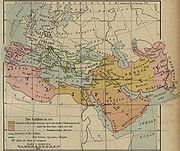
Majlis
' , is an Arabic term meaning "a place of sitting", used in the context of "council", to describe various types of special gatherings among common interest groups be it administrative, social or religious in countries with linguistic or cultural connections to Islamic countries...
), but was soon perceived by some to be ruling as a "king" rather than an elected leader. Uthman was killed by members of a disaffected group. Ali then took control but was not universally accepted as caliph by the governors of Egypt, and later by some of his own guard. He faced two major rebellions and was assassinated after a tumultuous rule of only five years. This period is known as the Fitna
First Fitna
The First Islamic Civil War , also called the First Fitna , was the first major civil war within the Islamic Caliphate. It arose as a struggle over who had the legitimate right to become the ruling Caliph...
, or the first Islamic civil war. Under the Rashidun each region (Sultan
Sultan
Sultan is a title with several historical meanings. Originally, it was an Arabic language abstract noun meaning "strength", "authority", "rulership", and "dictatorship", derived from the masdar سلطة , meaning "authority" or "power". Later, it came to be used as the title of certain rulers who...
ate, Wilayah
Wilayah
A wilāyah or vilâyet , or vilayat in Urdu and Turkish, is an administrative division, usually translated as "province", rarely as "governorate". The word comes from the Arabic "w-l-y", "to govern": a wāli — "governor" — governs a wilayah, "that which is governed"...
, or Emirate
Emirate
An emirate is a political territory that is ruled by a dynastic Muslim monarch styled emir.-Etymology:Etymologically emirate or amirate is the quality, dignity, office or territorial competence of any emir ....
) of the Caliphate had its own governor (Sultan, Wāli
Wali
Walī , is an Arabic word meaning "custodian", "protector", "sponsor", or authority as denoted by its definition "crown". "Wali" is someone who has "Walayah" over somebody else. For example, in Fiqh the father is wali of his children. In Islam, the phrase ولي الله walīyu 'llāh...
or Emir
Emir
Emir , meaning "commander", "general", or "prince"; also transliterated as Amir, Aamir or Ameer) is a title of high office, used throughout the Muslim world...
).
Muawiyah
Muawiyah I
Muawiyah I was the first Caliph of the Umayyad Dynasty. After the conquest of Mecca by the Muslims, Muawiyah's family converted to Islam. Muawiyah is brother-in-law to Muhammad who married his sister Ramlah bint Abi-Sufyan in 1AH...
, a relative of Uthman and governor (Wali) of Syria
Syria
Syria , officially the Syrian Arab Republic , is a country in Western Asia, bordering Lebanon and the Mediterranean Sea to the West, Turkey to the north, Iraq to the east, Jordan to the south, and Israel to the southwest....
, became one of Ali's challengers and after Ali's death managed to overcome the other claimants to the Caliphate. Muawiyah transformed the caliphate into a hereditary
Inherit
Inherit may refer to:* Inheritance, passing on of property after someone's death* Heredity, passing of genetic traits to offspring* Inheritance , way to compartmentalize and re-use computer code...
office, thus founding the Umayyad dynasty
Dynasty
A dynasty is a sequence of rulers considered members of the same family. Historians traditionally consider many sovereign states' history within a framework of successive dynasties, e.g., China, Ancient Egypt and the Persian Empire...
.
In areas which were previously under Sassanid Persian or Byzantine
Byzantine Empire
The Byzantine Empire was the Eastern Roman Empire during the periods of Late Antiquity and the Middle Ages, centred on the capital of Constantinople. Known simply as the Roman Empire or Romania to its inhabitants and neighbours, the Empire was the direct continuation of the Ancient Roman State...
rule, the Caliphs lowered taxes, provided greater local autonomy (to their delegated governors), greater religious freedom for Jews, and some indigenous Christian
Christian
A Christian is a person who adheres to Christianity, an Abrahamic, monotheistic religion based on the life and teachings of Jesus of Nazareth as recorded in the Canonical gospels and the letters of the New Testament...
s, and brought peace to peoples demoralized and disaffected by the casualties and heavy taxation that resulted from the decades of Byzantine-Persian warfare.
Umayyads, 7th–8th centuries
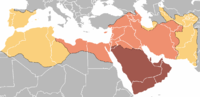
Hispania
Another theory holds that the name derives from Ezpanna, the Basque word for "border" or "edge", thus meaning the farthest area or place. Isidore of Sevilla considered Hispania derived from Hispalis....
and eastward through Persia and ultimately to the ancient lands of Indus Valley, in modern day Pakistan
Pakistan
Pakistan , officially the Islamic Republic of Pakistan is a sovereign state in South Asia. It has a coastline along the Arabian Sea and the Gulf of Oman in the south and is bordered by Afghanistan and Iran in the west, India in the east and China in the far northeast. In the north, Tajikistan...
. This made it one of the largest unitary states in history and one of the few states to ever extend direct rule over three continents (Africa
Africa
Africa is the world's second largest and second most populous continent, after Asia. At about 30.2 million km² including adjacent islands, it covers 6% of the Earth's total surface area and 20.4% of the total land area...
, Europe
Europe
Europe is, by convention, one of the world's seven continents. Comprising the westernmost peninsula of Eurasia, Europe is generally 'divided' from Asia to its east by the watershed divides of the Ural and Caucasus Mountains, the Ural River, the Caspian and Black Seas, and the waterways connecting...
, and Asia
Asia
Asia is the world's largest and most populous continent, located primarily in the eastern and northern hemispheres. It covers 8.7% of the Earth's total surface area and with approximately 3.879 billion people, it hosts 60% of the world's current human population...
). Although not ruling all of the Sahara
Sahara
The Sahara is the world's second largest desert, after Antarctica. At over , it covers most of Northern Africa, making it almost as large as Europe or the United States. The Sahara stretches from the Red Sea, including parts of the Mediterranean coasts, to the outskirts of the Atlantic Ocean...
, homage was paid to the Caliph by Saharan Africa, usually via various nomad
Nomad
Nomadic people , commonly known as itinerants in modern-day contexts, are communities of people who move from one place to another, rather than settling permanently in one location. There are an estimated 30-40 million nomads in the world. Many cultures have traditionally been nomadic, but...
Berber
Berber people
Berbers are the indigenous peoples of North Africa west of the Nile Valley. They are continuously distributed from the Atlantic to the Siwa oasis, in Egypt, and from the Mediterranean to the Niger River. Historically they spoke the Berber language or varieties of it, which together form a branch...
tribes. However, it should be noted that, although these vast areas may have recognised the supremacy of the Caliph, de facto power was in the hands of local sultans and emirs.
For a variety of reasons, including that they were not elected via Shura
Shura
Shura is an Arabic word for "consultation". The Quran and Muhammad encourage Muslims to decide their affairs in consultation with those who will be affected by that decision....
and suggestions of impious behaviour, the Umayyad dynasty was not universally supported within the Muslim community. Some supported prominent early Muslims like Al-Zubayr; others felt that only members of Muhammad's clan, the Banu Hashim
Banu Hashim
Banū Hāshim was a clan in the Quraysh tribe. Muhammad, was a member of this clan; his great-grandfather was Hashim, for whom the clan is named. Members of this clan are referred to by the Anglicised version of their name as Hashemites, or Huseini or Hasani...
, or his own lineage, the descendants of Ali, should rule.
There were numerous rebellions against the Umayyads, as well as splits within the Umayyad ranks (notably, the rivalry between Yaman and Qays). Eventually, supporters of the Banu Hashim and the supporters of the lineage of Ali united to bring down the Umayyads in 750. However, the , "the Party of Ali", were again disappointed when the Abbasid dynasty took power, as the Abbasids were descended from Muhammad's uncle, `Abbas ibn `Abd al-Muttalib
`Abbas ibn `Abd al-Muttalib
‘Abbas ibn ‘Abd al-Muttalib was a paternal uncle and Sahabi of Muhammad, just a few years older than his nephew. A wealthy merchant, during the early years of Islam he protected Muhammad while he was in Mecca, but only became a convert after the Battle of Badr in 624 CE...
and not from Ali. Following this disappointment, the finally split from the majority Sunni Muslims and formed what are today the several denominations.
The Caliphate in Hispania
During the Ummayad dynasty, Hispania was an integral province of the Ummayad Caliphate ruled from DamascusDamascus
Damascus , commonly known in Syria as Al Sham , and as the City of Jasmine , is the capital and the second largest city of Syria after Aleppo, both are part of the country's 14 governorates. In addition to being one of the oldest continuously inhabited cities in the world, Damascus is a major...
, Syria. When the Caliphate was seized by the Abbasids, Al-Andalus
Al-Andalus
Al-Andalus was the Arabic name given to a nation and territorial region also commonly referred to as Moorish Iberia. The name describes parts of the Iberian Peninsula and Septimania governed by Muslims , at various times in the period between 711 and 1492, although the territorial boundaries...
(the Arab name for Hispania) split from the Abbasid Caliph in Baghdad
Baghdad
Baghdad is the capital of Iraq, as well as the coterminous Baghdad Governorate. The population of Baghdad in 2011 is approximately 7,216,040...
to form their own caliphate. The Caliphate of Córdoba (خليفة قرطبة) ruled most of the Iberian Peninsula
Iberian Peninsula
The Iberian Peninsula , sometimes called Iberia, is located in the extreme southwest of Europe and includes the modern-day sovereign states of Spain, Portugal and Andorra, as well as the British Overseas Territory of Gibraltar...
from the city of Córdoba
Córdoba, Spain
-History:The first trace of human presence in the area are remains of a Neanderthal Man, dating to c. 32,000 BC. In the 8th century BC, during the ancient Tartessos period, a pre-urban settlement existed. The population gradually learned copper and silver metallurgy...
from 929 to 1031. This period was characterized by remarkable flourishing in technology, trade and culture; many of the masterpieces of Spain
Spain
Spain , officially the Kingdom of Spain languages]] under the European Charter for Regional or Minority Languages. In each of these, Spain's official name is as follows:;;;;;;), is a country and member state of the European Union located in southwestern Europe on the Iberian Peninsula...
were constructed in this period, including the famous Great Mosque of Córdoba. The title Caliph (خليفة) was claimed by Abd-ar-Rahman III
Abd-ar-Rahman III
Abd-ar-Rahman III was the Emir and Caliph of Córdoba of the Ummayad dynasty in al-Andalus. Called al-Nasir li-Din Allah , he ascended the throne in his early 20s, and reigned for half a century as the most powerful prince of Iberia...
on 16 January 929; he was previously known as the Emir of Córdoba (أمير قرطبة).
All Caliphs of Córdoba were members of the Umayyad dynasty; the same dynasty had held the title Emir of Córdoba and ruled over roughly the same territory since 756. The rule of the Caliphate is considered as the heyday of Muslim presence in the Iberian peninsula, before it fragmented into various taifa
Taifa
In the history of the Iberian Peninsula, a taifa was an independent Muslim-ruled principality, usually an emirate or petty kingdom, though there was one oligarchy, of which a number formed in the Al-Andalus after the final collapse of the Umayyad Caliphate of Córdoba in 1031.-Rise:The origins of...
s in the 11th century.
Abbasids, 8th–13th centuries
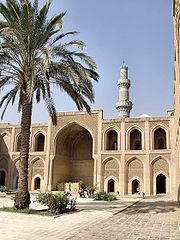
Mecca
Mecca is a city in the Hijaz and the capital of Makkah province in Saudi Arabia. The city is located inland from Jeddah in a narrow valley at a height of above sea level...
n origin, the Abbasids, in 750. The Abbasids had an unbroken line of Caliphs for over three centuries, consolidating Islamic rule and cultivating great intellectual and cultural developments in the Middle East
Middle East
The Middle East is a region that encompasses Western Asia and Northern Africa. It is often used as a synonym for Near East, in opposition to Far East...
. By 940, however, the power of the Caliphate under the Abbasids was waning as non-Arabs, particularly the Berbers of the Maghreb
Maghreb
The Maghreb is the region of Northwest Africa, west of Egypt. It includes five countries: Morocco, Algeria, Tunisia, Libya, and Mauritania and the disputed territory of Western Sahara...
, the Turks
Turkic peoples
The Turkic peoples are peoples residing in northern, central and western Asia, southern Siberia and northwestern China and parts of eastern Europe. They speak languages belonging to the Turkic language family. They share, to varying degrees, certain cultural traits and historical backgrounds...
, and later, in the latter half of the 13th century, the Mamluk
Mamluk
A Mamluk was a soldier of slave origin, who were predominantly Cumans/Kipchaks The "mamluk phenomenon", as David Ayalon dubbed the creation of the specific warrior...
s in Egypt, gained influence, and the various subordinate sultans and emirs became increasingly independent.
However, the Caliphate endured as a symbolic position. During the period of the Abbasid dynasty, Abbasid claims to the caliphate did not go unchallenged. The Ubayd Allah al-Mahdi Billah
Ubayd Allah al-Mahdi Billah
Abdullah al-Mahdi Billah , often referred to as Ubayd Allah, is the founder of the Fatimid dynasty, the only major Shi'a caliphate in Islam, and established Fatimid rule throughout much of North Africa.- History :...
of the Fatimid dynasty, which claimed descent from Muhammad through his daughter, claimed the title of Caliph in 909, creating a separate line of caliphs in North Africa.
Initially controlling Morocco
Morocco
Morocco , officially the Kingdom of Morocco , is a country located in North Africa. It has a population of more than 32 million and an area of 710,850 km², and also primarily administers the disputed region of the Western Sahara...
, Algeria
Algeria
Algeria , officially the People's Democratic Republic of Algeria , also formally referred to as the Democratic and Popular Republic of Algeria, is a country in the Maghreb region of Northwest Africa with Algiers as its capital.In terms of land area, it is the largest country in Africa and the Arab...
, Tunisia
Tunisia
Tunisia , officially the Tunisian RepublicThe long name of Tunisia in other languages used in the country is: , is the northernmost country in Africa. It is a Maghreb country and is bordered by Algeria to the west, Libya to the southeast, and the Mediterranean Sea to the north and east. Its area...
and Libya
Libya
Libya is an African country in the Maghreb region of North Africa bordered by the Mediterranean Sea to the north, Egypt to the east, Sudan to the southeast, Chad and Niger to the south, and Algeria and Tunisia to the west....
, the Fatimid caliphs extended their rule for the next 150 years, taking Egypt and Palestine
Palestine
Palestine is a conventional name, among others, used to describe the geographic region between the Mediterranean Sea and the Jordan River, and various adjoining lands....
, before the Abbasid dynasty was able to turn the tide, limiting Fatimid rule to Egypt. The Fatimid dynasty finally ended in 1171. The Umayyad dynasty, which had survived and come to rule over the Muslim provinces of Spain, reclaimed the title of Caliph in 929, lasting until it was overthrown in 1031.
Fatimids, 10th–12th centuries
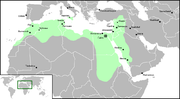
Shadow Caliphate, 13th–16th centuries
1258 saw the conquest of Baghdad and the execution of Abbasid caliph al-Musta'simAl-Musta'sim
Al-Musta'sim Billah was the last Abbasid Caliph in Baghdad; he ruled from 1242 until his death.-Biography:...
by Mongol
Mongols
Mongols ) are a Central-East Asian ethnic group that lives mainly in the countries of Mongolia, China, and Russia. In China, ethnic Mongols can be found mainly in the central north region of China such as Inner Mongolia...
forces under Hulagu Khan
Hulagu Khan
Hulagu Khan, also known as Hülegü, Hulegu , was a Mongol ruler who conquered much of Southwest Asia...
. A surviving member of the Abbasid house was installed as caliph at Cairo under the patronage of the newly formed Mamluk Sultanate three years later; however, this line of caliphs had generally little authority although some Abbasid rulers had the actual rule over the Mamluk Sultans. Later Muslim historians referred to it as a "shadow" caliphate. Thus, the title continued into the early 16th century.
Ottomans, 16th–20th century
Ottoman rulers (generally known as Sultans in the West) were known primarily by the title of PadishahPadishah
Padishah, Padshah, Padeshah, Badishah or Badshah is a superlative royal title, composed of the Persian pād "master" and the widespread shāh "king", which was adopted by several monarchs claiming the highest rank, roughly equivalent to the ancient Persian notion of "The Great" or "Great King", and...
and used the title of Caliph only sporadically. Mehmed II
Mehmed II
Mehmed II , was Sultan of the Ottoman Empire for a short time from 1444 to September 1446, and later from...
and his grandson Selim I
Selim I
Selim I, Yavuz Sultân Selim Khan, Hâdim-ül Haramain-ish Sharifain , nicknamed Yavuz "the Stern" or "the Steadfast", but often rendered in English as "the Grim" , was the Sultan of the Ottoman Empire from 1512 to...
used it to justify their conquest of Islamic countries. As the Ottoman Empire grew in size and strength, Ottoman rulers beginning with Selim I began to claim Caliphal authority.
Ottoman rulers used the title "Caliph" symbolically on many occasions but it was strengthened when the Ottoman Empire defeated the Mamluk Sultanate in 1517 and took control of most Arab lands. The last Abbasid Caliph at Cairo, al-Mutawakkil III
Al-Mutawakkil III
Al-Mutawakkil III was caliph from 1508 to 1516, and again in 1517. He was the last caliph of the later, Egyptian-based period of the Abbasid dynasty...
, was taken into custody and was transported to Constantinople
Istanbul
Istanbul , historically known as Byzantium and Constantinople , is the largest city of Turkey. Istanbul metropolitan province had 13.26 million people living in it as of December, 2010, which is 18% of Turkey's population and the 3rd largest metropolitan area in Europe after London and...
, where he reportedly surrendered the Caliphate to Selim I. According to Barthold, the first time the title of "Caliph" was used as a political instead of symbolic religious title by the Ottomans was the peace treaty with Russia
Treaty of Kucuk Kaynarca
The Treaty of Küçük Kaynarca was signed on 21 July 1774, in Küçük Kaynarca , Dobruja between the Russian Empire and the Ottoman Empire after the Ottoman Empire was defeated in the...
in 1774.
The outcome of Russo-Turkish War of 1768-1774 war was disastrous for the Ottomans. Large territories, including those with large Muslim populations, such as Crimea
Crimea
Crimea , or the Autonomous Republic of Crimea , is a sub-national unit, an autonomous republic, of Ukraine. It is located on the northern coast of the Black Sea, occupying a peninsula of the same name...
, were lost to the Russian Empire
Russian Empire
The Russian Empire was a state that existed from 1721 until the Russian Revolution of 1917. It was the successor to the Tsardom of Russia and the predecessor of the Soviet Union...
. However, the Ottomans under Abdul Hamid I claimed a diplomatic victory by being allowed to remain the religious leader of Muslims in the now-independent Crimea as part of the peace treaty: in return Russia became the official protector of Christians in Ottoman territory. This was the first time the Ottoman caliph was acknowledged as having significance outside of Ottoman borders by a European power.
Around 1880 Sultan Abdul Hamid II
Abdul Hamid II
His Imperial Majesty, The Sultan Abdülhamid II, Emperor of the Ottomans, Caliph of the Faithful was the 34th sultan of the Ottoman Empire...
reasserted the title as a way of countering Russian expansion into Muslim lands. His claim was most fervently accepted by the Muslims of British India
British Raj
British Raj was the British rule in the Indian subcontinent between 1858 and 1947; The term can also refer to the period of dominion...
. By the eve of the First World War
World War I
World War I , which was predominantly called the World War or the Great War from its occurrence until 1939, and the First World War or World War I thereafter, was a major war centred in Europe that began on 28 July 1914 and lasted until 11 November 1918...
, the Ottoman state, despite its weakness relative to Europe, represented the largest and most powerful independent Islamic political entity. The sultan also enjoyed some authority beyond the borders of his shrinking empire as caliph of Muslims in Egypt, India
India
India , officially the Republic of India , is a country in South Asia. It is the seventh-largest country by geographical area, the second-most populous country with over 1.2 billion people, and the most populous democracy in the world...
and Central Asia
Central Asia
Central Asia is a core region of the Asian continent from the Caspian Sea in the west, China in the east, Afghanistan in the south, and Russia in the north...
.
Sokoto, 19th century
The Sokoto Caliphate was an IslamIslam
Islam . The most common are and . : Arabic pronunciation varies regionally. The first vowel ranges from ~~. The second vowel ranges from ~~~...
ic spiritual community in Nigeria
Nigeria
Nigeria , officially the Federal Republic of Nigeria, is a federal constitutional republic comprising 36 states and its Federal Capital Territory, Abuja. The country is located in West Africa and shares land borders with the Republic of Benin in the west, Chad and Cameroon in the east, and Niger in...
, led by the Sultan of Sokoto, Sa’adu Abubakar
Sa’adu Abubakar
Amirul Mumineen Sultan Muhammadu Sa'ad Abubakar III is the 20th Sultan of Sokoto, the titular ruler of Sokoto in northern Nigeria, head of Jama’atu Nasril Islam , and president-general of the Nigerian National Supreme Council for Islamic Affairs...
. Founded during the Fulani Jihad in the early 19th century, it was one of the most powerful empires in sub-Saharan Africa prior to European conquest and colonization. The caliphate remained extant through the colonial period and afterwards, though with reduced power.
Ahmadiyya Caliphate, 1908-Present
The AhmadiyyaAhmadiyya
Ahmadiyya is an Islamic religious revivalist movement founded in India near the end of the 19th century, originating with the life and teachings of Mirza Ghulam Ahmad , who claimed to have fulfilled the prophecies about the world reformer of the end times, who was to herald the Eschaton as...
a messianic
Messianic
Messianic primarily means 'of the Messiah .Messianic may also mean:*Messianic Complex, a psychological state of mind*Messianic democracy, democracy by force*Messianic prophecies*MessianismMessianic may refer to:...
movement in Islam, believe that the Ahmadiyya Caliphate
Khalifatul Masih
Khalifatul Masih sometimes simply referred to as Khalifah is the elected spiritual leader of the worldwide Ahmadiyya Muslim Community and is the successor of Mirza Ghulam Ahmad of Qadian...
established after the passing of the community's founder Mirza Ghulam Ahmad
Mirza Ghulam Ahmad
Mīrzā Ghulām Aḥmad was a religious figure from India and the founder of the Ahmadiyya Community. He claimed to be the Mujaddid of the 14th Islamic century, the promised Messiah , and the Mahdi awaited by the Muslims in the end days...
, is the re-establishment of the Rashdin Caliphate, as prophesized by Muhammad. The current successor to Mirza Ghulam Ahmad is Khalifatul Masih
Khalifatul Masih
Khalifatul Masih sometimes simply referred to as Khalifah is the elected spiritual leader of the worldwide Ahmadiyya Muslim Community and is the successor of Mirza Ghulam Ahmad of Qadian...
V, Mirza Masroor Ahmad
Mirza Masroor Ahmad
His Holiness Mirza Masroor Ahmad is Khalifatul Masih V, the spiritual leader of the Ahmadiyya Muslim Community. He was elected as the fifth successor of Mirza Ghulam Ahmad on April 22, 2003, a few days after the death of his predecessor Mirza Tahir Ahmad, the fourth Caliph for the Ahmadiiya...
residing in London
London
London is the capital city of :England and the :United Kingdom, the largest metropolitan area in the United Kingdom, and the largest urban zone in the European Union by most measures. Located on the River Thames, London has been a major settlement for two millennia, its history going back to its...
, England
England
England is a country that is part of the United Kingdom. It shares land borders with Scotland to the north and Wales to the west; the Irish Sea is to the north west, the Celtic Sea to the south west, with the North Sea to the east and the English Channel to the south separating it from continental...
.
The Ahmadiyya
Ahmadiyya
Ahmadiyya is an Islamic religious revivalist movement founded in India near the end of the 19th century, originating with the life and teachings of Mirza Ghulam Ahmad , who claimed to have fulfilled the prophecies about the world reformer of the end times, who was to herald the Eschaton as...
Community was founded in 1889 by Mirza Ghulam Ahmad
Mirza Ghulam Ahmad
Mīrzā Ghulām Aḥmad was a religious figure from India and the founder of the Ahmadiyya Community. He claimed to be the Mujaddid of the 14th Islamic century, the promised Messiah , and the Mahdi awaited by the Muslims in the end days...
of Qadian
Qadian
Qadian is a small town and a municipal council in Gurdaspur District, north-east of Amritsar, situated north-east of Batala city in the state of Punjab, India....
, India
India
India , officially the Republic of India , is a country in South Asia. It is the seventh-largest country by geographical area, the second-most populous country with over 1.2 billion people, and the most populous democracy in the world...
, who claimed to be the Promised Messiah
Messiah
A messiah is a redeemer figure expected or foretold in one form or another by a religion. Slightly more widely, a messiah is any redeemer figure. Messianic beliefs or theories generally relate to eschatological improvement of the state of humanity or the world, in other words the World to...
and Mahdi
Mahdi
In Islamic eschatology, the Mahdi is the prophesied redeemer of Islam who will stay on Earth for seven, nine or nineteen years- before the Day of Judgment and, alongside Jesus, will rid the world of wrongdoing, injustice and tyranny.In Shia Islam, the belief in the Mahdi is a "central religious...
, the one awaited by followers of all major religions. After his demise in 1908, his first successor, Maulvi Hakeem Noor-ud-Din became head of the community and assumed the title of Khalifatul Masih
Khalifatul Masih
Khalifatul Masih sometimes simply referred to as Khalifah is the elected spiritual leader of the worldwide Ahmadiyya Muslim Community and is the successor of Mirza Ghulam Ahmad of Qadian...
(Caliph). The line of successors continues to this day to Khalifatul Masih V Mirza Masroor Ahmad
Mirza Masroor Ahmad
His Holiness Mirza Masroor Ahmad is Khalifatul Masih V, the spiritual leader of the Ahmadiyya Muslim Community. He was elected as the fifth successor of Mirza Ghulam Ahmad on April 22, 2003, a few days after the death of his predecessor Mirza Tahir Ahmad, the fourth Caliph for the Ahmadiiya...
, residing in London
London
London is the capital city of :England and the :United Kingdom, the largest metropolitan area in the United Kingdom, and the largest urban zone in the European Union by most measures. Located on the River Thames, London has been a major settlement for two millennia, its history going back to its...
, England
England
England is a country that is part of the United Kingdom. It shares land borders with Scotland to the north and Wales to the west; the Irish Sea is to the north west, the Celtic Sea to the south west, with the North Sea to the east and the English Channel to the south separating it from continental...
. From its outset, the Ahmadiyya Community has been viewed as heretical by mainstream Muslim groups due to the founder's claim to prophethood. Majority of Muslims today hold the view that Muhammad
Muhammad
Muhammad |ligature]] at U+FDF4 ;Arabic pronunciation varies regionally; the first vowel ranges from ~~; the second and the last vowel: ~~~. There are dialects which have no stress. In Egypt, it is pronounced not in religious contexts...
was the final prophet
Seal of the Prophets
Seal of the Prophets is a title given to the Islamic prophet Muhammad by a verse in the Qur'an. Muslims traditionally agree upon that Muhammad received the final revelation in the form of the Qur'an for all mankind, for all time....
and no apostle can come after him. Ahmadis however call themselves Muslims and claim to practice Islam in its pristine form.
Although the Ahmadiyya Caliphate is not recognized by mainstream Islam, the community continues to operate under this structure, with the Khalifa having overall authority for all religious and organizational matters. According to Ahmadis, it is not essential for a Khalifa to be the head of a state, rather the spiritual and religious significance of the Khalifatul Masih is emphasized. Ahmadis believe that the Ahmadiyya Caliphate is the re-establishment of the Rashidun Caliphate
Rashidun Caliphate
The Rashidun Caliphate , comprising the first four caliphs in Islam's history, was founded after Muhammad's death in 632, Year 10 A.H.. At its height, the Caliphate extended from the Arabian Peninsula, to the Levant, Caucasus and North Africa in the west, to the Iranian highlands and Central Asia...
(The Rightly Guided Calphs).
Khilafat Movement, 1920
In the 1920s, the Khilafat MovementKhilafat Movement
The Khilafat movement was a pan-Islamic, political campaign launched by Muslims in British India to influence the British government and to protect the Ottoman Empire during the aftermath of World War I...
, a movement to defend the Ottoman Caliphate, spread throughout the British colonial territories. It was particularly strong in British India, where it formed a rallying point for some Indian Muslims as one of many anti-British Indian political movements. Its leaders included Maulana Mohammad Ali
Maulana Mohammad Ali
Maulana Mohammad Ali Jouhar was an Indian Muslim leader, activist, scholar, journalist and poet, and was among the leading figures of the Khilafat Movement....
, his brother Shawkat Ali, and Abul Kalam Azad, Mukhtar Ahmed Ansari
Mukhtar Ahmed Ansari
Dr. Mukhtar Ahmed Ansari was an Indian nationalist and political leader, and former president of the Indian National Congress and the Muslim League during the Indian Independence Movement...
, and Barrister Muhammad Jan Abbasi. For a time it worked in alliance with Hindu
Hindu
Hindu refers to an identity associated with the philosophical, religious and cultural systems that are indigenous to the Indian subcontinent. As used in the Constitution of India, the word "Hindu" is also attributed to all persons professing any Indian religion...
communities and was supported by Mohandas Karamchand Gandhi, who was a member of the Central Khilafat Committee. However, the movement lost its momentum after the arrest or flight of its leaders, and a series of offshoots splintered off from the main organization.
End of the Caliphate, 1924
On March 3, 1924, the first President of the Turkish Republic, Mustafa Kemal AtatürkMustafa Kemal Atatürk
Mustafa Kemal Atatürk was an Ottoman and Turkish army officer, revolutionary statesman, writer, and the first President of Turkey. He is credited with being the founder of the Republic of Turkey....
, as part of his reforms
Atatürk's Reforms
Atatürk's Reforms were a series of political, legal, cultural, social and economic reforms that were designed to modernize the new Republic of Turkey into a democratic and secular nation-state...
, constitutionally abolished the institution of the Caliphate. Its powers within Turkey were transferred to the Grand National Assembly of Turkey
Grand National Assembly of Turkey
The Grand National Assembly of Turkey , usually referred to simply as the Meclis , is the unicameral Turkish legislature. It is the sole body given the legislative prerogatives by the Turkish Constitution. It was founded in Ankara on 23 April 1920 in the midst of the Turkish War of Independence...
, the parliament of the newly formed Turkish Republic. The title was then claimed
Sharifian Caliphate
The Sharifian Caliphate is the term used to describe the unsuccessful attempts at the beginning of the 20th century to establish an Arab caliphate headed by the Sharifs of Mecca in replacement of the Ottoman Caliphate. The idea had been floating around since at least the 15th century...
by King Hussein bin Ali
Hussein bin Ali, Sharif of Mecca
Sayyid Hussein bin Ali, GCB was the Sharif of Mecca, and Emir of Mecca from 1908 until 1917, when he proclaimed himself King of Hejaz, which received international recognition. He initiated the Arab Revolt in 1916 against the increasingly nationalistic Ottoman Empire during the course of the...
of Hejaz
Hejaz
al-Hejaz, also Hijaz is a region in the west of present-day Saudi Arabia. Defined primarily by its western border on the Red Sea, it extends from Haql on the Gulf of Aqaba to Jizan. Its main city is Jeddah, but it is probably better known for the Islamic holy cities of Mecca and Medina...
, leader of the Arab Revolt
Arab Revolt
The Arab Revolt was initiated by the Sherif Hussein bin Ali with the aim of securing independence from the ruling Ottoman Turks and creating a single unified Arab state spanning from Aleppo in Syria to Aden in Yemen.- Background :...
, but his kingdom was defeated and annexed by Ibn Saud in 1925. The title has since been inactive.
Ottoman influence on other nations, such as in India, may have also been lossed due to its ending of caliphate
A summit was convened at Cairo
Cairo
Cairo , is the capital of Egypt and the largest city in the Arab world and Africa, and the 16th largest metropolitan area in the world. Nicknamed "The City of a Thousand Minarets" for its preponderance of Islamic architecture, Cairo has long been a centre of the region's political and cultural life...
in 1926 to discuss the revival of the Caliphate, but most Muslim countries did not participate and no action was taken to implement the summit's resolutions.
Though the title Ameer al-Mumineen was adopted by the King of Morocco and by Mullah
Mullah
Mullah is generally used to refer to a Muslim man, educated in Islamic theology and sacred law. The title, given to some Islamic clergy, is derived from the Arabic word مَوْلَى mawlā , meaning "vicar", "master" and "guardian"...
Mohammed Omar
Mohammed Omar
Mullah Mohammed Omar , often simply called Mullah Omar, is the leader of the Taliban movement that operates in Afghanistan. He was Afghanistan's de facto head of state from 1996 to late 2001, under the official title "Head of the Supreme Council"...
, former head of the Taliban regime of Afghanistan
Afghanistan
Afghanistan , officially the Islamic Republic of Afghanistan, is a landlocked country located in the centre of Asia, forming South Asia, Central Asia and the Middle East. With a population of about 29 million, it has an area of , making it the 42nd most populous and 41st largest nation in the world...
, neither claimed any legal standing or authority over Muslims outside the borders of their respective countries, there power had also been partially yet not fully restricted in an on-going war with the western NATO military alliance.
Qur'an
The following excerpt from the Qur'anQur'an
The Quran , also transliterated Qur'an, Koran, Alcoran, Qur’ān, Coran, Kuran, and al-Qur’ān, is the central religious text of Islam, which Muslims consider the verbatim word of God . It is regarded widely as the finest piece of literature in the Arabic language...
, known as the 'Istikhlaf Verse', is used by some to argue for a Quranic basis for Caliphate:
In the above verse the word Khulifa (the plural of Khalifa) has been variously translated as "successors" and "ones who accede to power".
Small subsections of Sunni Islamism argue that to govern a state by Islamic law (Shariah) is, by definition, to rule via the Caliphate, and use the following verses to sustain their claim.
Hadith
The following HadithHadith
The term Hadīth is used to denote a saying or an act or tacit approval or criticism ascribed either validly or invalidly to the Islamic prophet Muhammad....
from Musnad Ahmad ibn Hanbal
Musnad Ahmad ibn Hanbal
Musnad Ahmad ibn Hanbal is a collection of Hadith collected by the famous Sunni scholar Ibn Hanbal to whom the Hanbali madhab of Sunnis is attributed.-Description:...
can be understood to prophesy two eras of Caliphate (both on the lines/precepts of prophethood).
In the above Hadith the first era of Caliphate is commonly accepted by the Muslims as that of the Rashidun Caliphate
Rashidun
The Rightly Guided Caliphs or The Righteous Caliphs is a term used in Sunni Islam to refer to the first four Caliphs who established the Rashidun Caliphate. The concept of "Rightly Guided Caliphs" originated with the Abbasid Dynasty...
.
Nafi'a reported saying:
Hisham ibn Urwah
Hisham ibn Urwah
Hishām ibn ʿUrwah was a prominent narrator of hadith, son of Urwah ibn al-Zubayr, grandson of Zubayr ibn al-Awwam and Asma bint Abu Bakr. In Medinah, his pupils included people as well known as Malik ibn Anas....
reported on the authority of Abu Saleh on the authority of Abu Hurairah
Abu Hurairah
Abu Hurairah , was a companion of the Islamic prophet Muhammad and the narrator of Hadith most quoted in the isnad by Sunnis.-Early life:...
that Muhammad said:
Muslim narrated on the authority of al-A'araj, on the authority of Abu Hurairah
Abu Hurairah
Abu Hurairah , was a companion of the Islamic prophet Muhammad and the narrator of Hadith most quoted in the isnad by Sunnis.-Early life:...
, that Muhammad said:
Muslim reported on the authority of Abdel Aziz al-Muqrin, who said,
The Sahaba of Muhammad
Al-Habbab Ibn ul-Munthir said, when the Sahaba met in the wake of the death of Muhammad, (at the thaqifaSaqifah
The Saqīfah , also known as Saqīfah banī Sāˤidat , was a roofed building used by the tribe called the banū Sāˤidat of the faction of the banū Khazraj tribe of the city of Medina in the Hejaz, northwestern Arabia.- Significance of Saqifah :...
hall) of Bani Sa’ida: Upon this Abu Bakr replied:
Then he got up and addressed the Muslims.
It has additionally been reported that Abu Bakr went on to say on the day of Al-Saqifa:
The Sahaba agreed to this and selected Abu Bakr as their first Khaleef. Habbab ibn Mundhir who suggested the idea of two Ameers corrected himself and was the first to give Abu Bakr the Bay'ah
Bay'ah
Bay'ah , in Islamic terminology, is an oath of allegiance to a leader. It is known to have been practiced by the Islamic prophet Muhammad...
. This indicates an Ijma as-Sahaba of all of the Sahaba. Ali ibni abi Talib, who was attending the body of Muhammad at the time, also consented to this.
Imam Ali whom the Shia revere said:
The sayings of Islamic scholars
Al-MawardiAl-Mawardi
Abu al-Hasan Ali Ibn Muhammad Ibn Habib al-Mawardi , known in Latin as Alboacen , was an Arab Muslim jurist of the Shafi'i school most remembered for his works on religion, government, the caliphate, and public and constitutional law during a time of political turmoil...
says:
Yahya ibn Sharaf al-Nawawi (Al-Nawawi) says:
Ahmad al-Qalqashandi
Ahmad al-Qalqashandi
Shihab al-Din abu 'l-Abbas Ahmad ben Ali ben Ahmad Abd Allah al-Qalqashandi was a medieval Egyptian writer and mathematician born in a village in the Nile Delta. He is the author of Subh al-a 'sha, a fourteen volume encyclopedia in Arabic, which included a section on cryptology...
says:
Ibnu Hazm says:
Al-sha’rani says:
Al-Qadhi Abdul-Jabbar (he is a Mu’tazela scholar), says:
Al-Joziri says:
The Shia schools of thought and others expressed the same opinion about this However, the Shia school of thought believe that the leader (Imam) must not be appointed by the islamic ummah, but must be appointed by God.
Al-Qurtubi
Al-Qurtubi
Imam Abu 'Abdullah Al-Qurtubi or Abu 'Abdullah Muhammad ibn Ahmad ibn Abu Bakr al-Ansari al-Qurtubi was a famous mufassir, muhaddith and faqih scholar from Cordoba of maliki origin. He is most famous for his commentary of the Quran, Tafsir al-Qurtubi....
said in his Tafsir
Tafsir
Tafseer is the Arabic word for exegesis or commentary, usually of the Qur'an. Ta'wīl is a subset of tafsir and refers to esoteric or mystical interpretation. An author of tafsir is a mufassir .- Etymology :...
of the verse, "Indeed, man is made upon this earth a Caliph" that:
Al-Qurtubi also said:
An-Nawawi said:
Al-Ghazali
Al-Ghazali
Abu Hāmed Mohammad ibn Mohammad al-Ghazzālī , known as Algazel to the western medieval world, born and died in Tus, in the Khorasan province of Persia was a Persian Muslim theologian, jurist, philosopher, and mystic....
when writing of the potential consequences of losing the Caliphate said:
Ibn Taymiyyah said:
Re-establishment of the Caliphate
Once the subject of intense conflict and rivalry amongst Muslim rulers, the caliphate has lain dormant and largely unclaimed since the 1920s. For the vast majority of Muslims the caliph as leader of the ummahUmmah
Ummah is an Arabic word meaning "community" or "nation." It is commonly used to mean either the collective nation of states, or the whole Arab world...
, "is cherished both as memory and ideal"
as a time when Muslims "enjoyed scientific and military superiority globally,"
though "not an urgent concern" compared to issues such as the Israeli-Palestinian conflict
Israeli-Palestinian conflict
The Israeli–Palestinian conflict is the ongoing conflict between Israelis and Palestinians. The conflict is wide-ranging, and the term is also used in reference to the earlier phases of the same conflict, between Jewish and Zionist yishuv and the Arab population living in Palestine under Ottoman or...
.
However, though many Muslims would like to re-establish the Caliphate, according to Hadith
Hadith
The term Hadīth is used to denote a saying or an act or tacit approval or criticism ascribed either validly or invalidly to the Islamic prophet Muhammad....
the Caliphate will be followed by the arrival of the Promised Messiah and Imam Mahdi:
Ahmadiyya View
The first era of Caliphate mentioned in the above saying of MuhammadMuhammad
Muhammad |ligature]] at U+FDF4 ;Arabic pronunciation varies regionally; the first vowel ranges from ~~; the second and the last vowel: ~~~. There are dialects which have no stress. In Egypt, it is pronounced not in religious contexts...
is commonly accepted by Muslims as that of the Rashidun
Rashidun
The Rightly Guided Caliphs or The Righteous Caliphs is a term used in Sunni Islam to refer to the first four Caliphs who established the Rashidun Caliphate. The concept of "Rightly Guided Caliphs" originated with the Abbasid Dynasty...
.
Islamic call
A number of Islamist political parties and mujahideenMujahideen
Mujahideen are Muslims who struggle in the path of God. The word is from the same Arabic triliteral as jihad .Mujahideen is also transliterated from Arabic as mujahedin, mujahedeen, mudžahedin, mudžahidin, mujahidīn, mujaheddīn and more.-Origin of the concept:The beginnings of Jihad are traced...
have called for the restoration of the caliphate by uniting Muslim nations, either through political action (e.g., Hizb ut-Tahrir
Hizb ut-Tahrir
Hizb ut-Tahrir is an international Sunni. pan-Islamic political organisation but keeps it open for all including shias,some of its beliefs are against sunni school of thought, whose goal is for all Muslim countries to unify as an Islamic state or caliphate ruled by Islamic law and with a caliph...
), or through force (e.g., al-Qaeda
Al-Qaeda
Al-Qaeda is a global broad-based militant Islamist terrorist organization founded by Osama bin Laden sometime between August 1988 and late 1989. It operates as a network comprising both a multinational, stateless army and a radical Sunni Muslim movement calling for global Jihad...
). Various Islamist movements have gained momentum in recent years with the ultimate aim of establishing a Caliphate; however, they differ in their methodology and approach. Some are locally oriented, mainstream political parties that have no apparent transnational objectives.
Abul Ala Maududi
Abul Ala Maududi
Syed Abul A'ala Maududi , also known as Molana or Shaikh Syed Abul A'ala Mawdudi, was a Sunni Pakistani journalist, theologian, Muslim revivalist leader and political philosopher, and a major 20th century Islamist thinker. He was also a prominent political figure in Pakistan and was the first...
believed the caliph was not just an individual ruler who had to be restored, but was man's representation of God
God
God is the English name given to a singular being in theistic and deistic religions who is either the sole deity in monotheism, or a single deity in polytheism....
's authority on earth:
Khilafa means representative. Man, according to Islam is the representative of "people", His (God's) viceregent; that is to say, by virtue of the powers delegated to him, and within the limits prescribed by the Qu'ran and the teaching of the prophet, the caliph is required to exercise Divine authority.
The Muslim Brotherhood advocates pan-Islamic
Pan-Islamism
Pan-Islamism is a political movement advocating the unity of Muslims under one Islamic state — often a Caliphate. As a form of religious nationalism, Pan-Islamism differentiates itself from other pan-nationalistic ideologies, for example Pan-Arabism, by excluding culture and ethnicity as primary...
unity and implementing Islamic law
Sharia
Sharia law, is the moral code and religious law of Islam. Sharia is derived from two primary sources of Islamic law: the precepts set forth in the Quran, and the example set by the Islamic prophet Muhammad in the Sunnah. Fiqh jurisprudence interprets and extends the application of sharia to...
. Founder Hassan al-Banna
Hassan al-Banna
Sheikh Hasan Ahmed Abdel Rahman Muhammed al-Banna known as Hasan al-Banna was a schoolteacher and imam, best known for founding the Muslim Brotherhood, one of the largest and most influential 20th century Muslim revivalist organizations.-Early life:Banna was born in 1906 in Mahmoudiyah, Egypt...
wrote about the restoration of the Caliphate.
One transnational group whose ideology is based specifically on restoring the caliphate as a pan-Islamic state is Hizb ut-Tahrir
Hizb ut-Tahrir
Hizb ut-Tahrir is an international Sunni. pan-Islamic political organisation but keeps it open for all including shias,some of its beliefs are against sunni school of thought, whose goal is for all Muslim countries to unify as an Islamic state or caliphate ruled by Islamic law and with a caliph...
(literally: "party of liberation"). It is particularly strong in Central Asia and Europe and is growing in strength in the Arab world. It is based on the claim that Muslims can prove that God
God
God is the English name given to a singular being in theistic and deistic religions who is either the sole deity in monotheism, or a single deity in polytheism....
exists and that the Qur'an is the word of God. Hizb-Ut-Tahrir's stated strategy is a non-violent political and intellectual struggle.
In South-East Asia, groups such as Jemaah Islamiyah
Jemaah Islamiyah
Jemaah Islamiah , is a Southeast Asian militant Islamic organization dedicated to the establishment of a Daulah Islamiyah in Southeast Asia incorporating Indonesia, Malaysia, the southern Philippines, Singapore and Brunei...
aim to establish a Caliphate stretching from Sumatra to New Guinea, and from the Philippines to Java.
Views of al-Qaeda
Al-QaedaAl-Qaeda
Al-Qaeda is a global broad-based militant Islamist terrorist organization founded by Osama bin Laden sometime between August 1988 and late 1989. It operates as a network comprising both a multinational, stateless army and a radical Sunni Muslim movement calling for global Jihad...
has as one of its clearly stated goals the re-establishment of a caliphate. The late al-Quaeda leader, Osama Bin Laden, called for Muslims to "establish the righteous caliphate of our umma." Al-Qaeda
Al-Qaeda
Al-Qaeda is a global broad-based militant Islamist terrorist organization founded by Osama bin Laden sometime between August 1988 and late 1989. It operates as a network comprising both a multinational, stateless army and a radical Sunni Muslim movement calling for global Jihad...
chiefs released a statement in 2005, under which, in what they call "Phase five" there will be "an Islamic state
Islamic State
An Islamic state is a type of government, in which the primary basis for government is Islamic religious law...
, or caliphate". Al Qaeda has named its Internet newscast from Iraq
Iraq
Iraq ; officially the Republic of Iraq is a country in Western Asia spanning most of the northwestern end of the Zagros mountain range, the eastern part of the Syrian Desert and the northern part of the Arabian Desert....
"The Voice of the Caliphate." According to author Lawrence Wright
Lawrence Wright
Lawrence Wright is a Pulitzer Prize-winning American author, screenwriter, staff writer for The New Yorker magazine, and fellow at the Center for Law and Security at the New York University School of Law...
, an Egyptian native, Ayman al-Zawahiri
Ayman al-Zawahiri
Ayman Mohammed Rabie al-Zawahiri is an Egyptian physician, Islamic theologian and current leader of al-Qaeda. He was previously the second and last "emir" of the Egyptian Islamic Jihad, having succeeded Abbud al-Zumar in the latter role when Egyptian authorities sentenced al-Zumar to life...
(Bin Laden's mentor and al-Qaeda second-in-command until 2011), once "sought to restore the caliphate...which had formally ended in 1924 following the dissolution of the Ottoman Empire but which had not exercised real power since the thirteenth century." Once the caliphate is re-established, Zawahiri believes, Egypt would become a rallying point for the rest of the Islamic world, leading the jihad against the West. "Then history would make a new turn, God willing," Zawahiri later wrote, "in the opposite direction against the empire of the United States and the world's Jewish government."
Opposition
Scholar Olivier Roy writes that "early on, Islamists replace the concept of the caliphate ... with that of the amir." There were a number of reasons including "that according to the classical authors, a caliph must be a member of the tribe of the Prophet (the Quraysh) ... moreover, caliphs ruled societies that the Islamists do not consider to have been Islamic (the Ottoman EmpireOttoman Empire
The Ottoman EmpireIt was usually referred to as the "Ottoman Empire", the "Turkish Empire", the "Ottoman Caliphate" or more commonly "Turkey" by its contemporaries...
)." This is not the view of the majority of Islamist groups, as both the Muslim Brotherhood
Muslim Brotherhood
The Society of the Muslim Brothers is the world's oldest and one of the largest Islamist parties, and is the largest political opposition organization in many Arab states. It was founded in 1928 in Egypt by the Islamic scholar and schoolteacher Hassan al-Banna and by the late 1940s had an...
(the largest) and Hizb ut-Tahrir
Hizb ut-Tahrir
Hizb ut-Tahrir is an international Sunni. pan-Islamic political organisation but keeps it open for all including shias,some of its beliefs are against sunni school of thought, whose goal is for all Muslim countries to unify as an Islamic state or caliphate ruled by Islamic law and with a caliph...
view the Ottoman state as a caliphate.
Electing or appointing a Caliph
Fred DonnerFred Donner
Fred McGraw Donner is an Islamic scholar and Professor of Near Eastern History at the University of Chicago.-Early life:Donner was born in Washington, D.C. and grew up in Basking Ridge, New Jersey, where he attended public schools...
, in his book The Early Islamic Conquests (1981), argues that the standard Arabian practice during the early Caliphates was for the prominent men of a kinship group, or tribe, to gather after a leader's death and elect a leader from amongst themselves, although there was no specified procedure for this shura
Shura
Shura is an Arabic word for "consultation". The Quran and Muhammad encourage Muslims to decide their affairs in consultation with those who will be affected by that decision....
, or consultative assembly. Candidates were usually from the same lineage as the deceased leader, but they were not necessarily his sons. Capable men who would lead well were preferred over an ineffectual direct heir, as there was no basis in the majority Sunni view that the head of state or governor should be chosen based on lineage alone.
This argument is advanced by Sunni Muslims, who believe that Muhammad's companion Abu Bakr was elected by the community and that this was the proper procedure. They further argue that a caliph is ideally chosen by election or community consensus, even though the caliphate soon became a hereditary office, or the prize of the strongest general.
Al-Mawardi has written that the caliph should be Qurayshi. Abu Bakr Al-Baqillani
Al-Baqillani
Abu Bakr Muḥammad ibn al-Ṭayyib al-Bāqillānī was an Ashari Islamic scholar and Maliki lawyer, influential in popularising SunniAsharism.Born in Basra c. 950, he spent most of his life in Baghdad, and studied under disciples of al-Ash'ari. He held the office of chief Qadi outside the capital of the...
has said that the leader of the Muslims simply should be from the majority. The founder of the biggest Sunni Madh'hab, Imam Abu Hanifa also wrote that the Caliph must be chosen by the majority.
Sunni belief
Following the death of Muhammad, a meeting took place at SaqifahSaqifah
The Saqīfah , also known as Saqīfah banī Sāˤidat , was a roofed building used by the tribe called the banū Sāˤidat of the faction of the banū Khazraj tribe of the city of Medina in the Hejaz, northwestern Arabia.- Significance of Saqifah :...
. At that meeting, Abu Bakr was elected caliph by the Muslim community. Sunni Muslims developed the belief that the caliph is a temporal political ruler, appointed to rule within the bounds of Islamic law (Sharia). The job of adjudicating orthodoxy and Islamic law was left to Islamic lawyers
Ijtihad
Ijtihad is the making of a decision in Islamic law by personal effort , independently of any school of jurisprudence . as opposed to taqlid, copying or obeying without question....
, judiciary, or specialists individually termed as Mujtahids and collectively named the Ulema
Ulema
Ulama , also spelt ulema, refers to the educated class of Muslim legal scholars engaged in the several fields of Islamic studies. They are best known as the arbiters of shari‘a law...
. Many Muslims call the first four caliphs the Rashidun meaning the Rightly Guided Caliphs, because they are believed to have followed the Qur'an and the sunnah
Sunnah
The word literally means a clear, well trodden, busy and plain surfaced road. In the discussion of the sources of religion, Sunnah denotes the practice of Prophet Muhammad that he taught and practically instituted as a teacher of the sharī‘ah and the best exemplar...
(example) of Muhammad.
Shi'a belief
Shia Muslims believe in the ImamateImamah (Shi'a doctrine)
Imāmah is the Shia doctrine of religious, spiritual and political leadership of the Ummah. The Shīa believe that the A'immah are the true Caliphs or rightful successors of Muḥammad, and further that Imams are possessed of divine knowledge and authority as well as being part of the Ahl al-Bayt,...
, in which the rulers are Imams divinely chosen, infallible, and sinless from Muhammad's family – Ahl al-Bayt
Ahl al-Bayt
Ahl al-Bayt is an Arabic phrase literally meaning People of the House, or family of the House. The phrase "ahl al-bayt" was used in Arabia before the advent of Islam to refer to one's clan, and would be adopted by the ruling family of a tribe. Within the Islamic tradition, the term refers to the...
literally "People of the House (of Muhammad)" regardless of majority opinion, shura
Shura
Shura is an Arabic word for "consultation". The Quran and Muhammad encourage Muslims to decide their affairs in consultation with those who will be affected by that decision....
or election. They claim that before his death, Muhammad had given many indications, in Ghadir Khumm
Hadith of the pond of Khumm
The Hadith of the pond of Khumm refers to the saying about a historical event crucial to Islamic history. This event took place on 18th of Dhu al-Hijjah of 10 AH in the Islamic calendar at a place called Ghadir Khumm, which is located near the city of al-Juhfah, Saudi Arabia and was a place...
particularly, that he considered Ali, his cousin and son-in-law, as his successor. As per Twelver/Ithna Ashery Shia ,Ali and his eleven descendants, the twelve Imams, are believed to have been considered, even before their birth, as the only valid Islamic rulers appointed and decreed by God.
After these twelve Imams, the potential Caliphs, had passed, and in the absence of the possibility of a government headed by their Imams, some Shi'a believe it was necessary that a system of Shia Islamic government based on Vilayat-e Faqih be developed, due to the need for some form of government, where an Islamic jurist or faqih
Faqih
A Faqīh is an expert in fiqh, or, Islamic jurisprudence.A faqih is an expert in Islamic Law, and, as such, the word Faqih can literally be generally translated as Jurist.- The definition of Fiqh and its relation to the Faqih:...
rules Muslims, suffices. However this idea, developed by the Marja
Marja
Marja , also known as a marja-i taqlid or marja dini , literally means "Source to Imitate/Follow" or "Religious Reference"...
(Ayatollah
Ayatollah
Ayatollah is a high ranking title given to Usuli Twelver Shī‘ah clerics. Those who carry the title are experts in Islamic studies such as jurisprudence, ethics, and philosophy and usually teach in Islamic seminaries. The next lower clerical rank is Hojatoleslam wal-muslemin...
) Ruhollah Khomeini
Ruhollah Khomeini
Grand Ayatollah Sayyed Ruhollah Musavi Khomeini was an Iranian religious leader and politician, and leader of the 1979 Iranian Revolution which saw the overthrow of Mohammad Reza Pahlavi, the Shah of Iran...
and established in Iran, is not universally accepted among Shi'as.
Shia group of Ismaili
Ismaili
' is a branch of Shia Islam. It is the second largest branch of Shia Islam, after the Twelvers...
/ Fatimid
Fatimid
The Fatimid Islamic Caliphate or al-Fāṭimiyyūn was a Berber Shia Muslim caliphate first centered in Tunisia and later in Egypt that ruled over varying areas of the Maghreb, Sudan, Sicily, the Levant, and Hijaz from 5 January 909 to 1171.The caliphate was ruled by the Fatimids, who established the...
/ Dawoodi Bohra
Dawoodi Bohra
Dawoodi Bohra is a subsect of Ismāʿīlī Shīʿa Islām. While the Dawoodi Bohra is based in India, their belief system originates in Yemen, where it evolved from the Fatimid Caliphate and where they were persecuted due to their differences from mainstream Sunni Islam...
believe in Imamate principle mentioned above, but they need not be ruler. To safe guard divine authority of Allah the "Din", from politics of World "Duniya" the 'external World', they have instituted office of Dai al-Mutlaq even from the era of their 21st Imam Tayyab
Taiyab abi al-Qasim
aṭ-Ṭayyib Abī l-Qāṣim was, according to Ṭayyibī Musta‘lid Isma‘ili Muslims, the 21st and the last Fatimid Imām, the hereditary leader of the Muslim community in the direct line of ‘Ali). Abī l-Qāṣim was the son of the 20th Fatimid Imām, Mansur al-Amir Bi-Ahkamillah, was the ruler of Egypt from...
(1130 AD), under juridiction of Suleyhid Queen
Arwa al-Sulayhi
Arwa al-Sulayhi c. 1048–1138,death:22nd Shabaan,532 AH) was the long-reigning ruler of Yemen, firstly through her first two husbands and then as sole ruler, from 1067 until her death in 1138...
, as Imam was under seclusion. In the twelver shia also many Imams were not ruler ,and they sacrificed much to upheld "Din".
Take the case of Imam Hasan, After Ali, Imam Hasan was his successor. It is told that there was power struggle between Imam Hasan and Muawwia ,finally agreement reached between them. As Hasan was more interested in safeguarding Islam, he has kept the 'Din' with him and sacrificed Caliphate to Muawwia. One thing is very clear that Imamat need not have power of ruler , but there cannot be two representative of Allah at one moment,hence to have two Imam at a time is ruled out. Even a small organization have clear hierarchy, a clear cut single line of downward delegation, how come the almighty organisation of Allah be governed in anarchy.
The same was philosophy of Fatimid
Fatimid
The Fatimid Islamic Caliphate or al-Fāṭimiyyūn was a Berber Shia Muslim caliphate first centered in Tunisia and later in Egypt that ruled over varying areas of the Maghreb, Sudan, Sicily, the Levant, and Hijaz from 5 January 909 to 1171.The caliphate was ruled by the Fatimids, who established the...
, and same being literally followed by Dawoodi Bohra
Dawoodi Bohra
Dawoodi Bohra is a subsect of Ismāʿīlī Shīʿa Islām. While the Dawoodi Bohra is based in India, their belief system originates in Yemen, where it evolved from the Fatimid Caliphate and where they were persecuted due to their differences from mainstream Sunni Islam...
's Dai in absence and on behalf of their hidden Imam.This is the result that Bohra have unity amongst them all over the world. There is universal brotherhood amongst them, a same culture, same habits of living, togetherness for the cause of Islam and same time dedication to the land they live. This was the Islam and Fatimid
Fatimid
The Fatimid Islamic Caliphate or al-Fāṭimiyyūn was a Berber Shia Muslim caliphate first centered in Tunisia and later in Egypt that ruled over varying areas of the Maghreb, Sudan, Sicily, the Levant, and Hijaz from 5 January 909 to 1171.The caliphate was ruled by the Fatimids, who established the...
's true dream, and the Fatimid
Fatimid
The Fatimid Islamic Caliphate or al-Fāṭimiyyūn was a Berber Shia Muslim caliphate first centered in Tunisia and later in Egypt that ruled over varying areas of the Maghreb, Sudan, Sicily, the Levant, and Hijaz from 5 January 909 to 1171.The caliphate was ruled by the Fatimids, who established the...
/Dawoodi Bohra
Dawoodi Bohra
Dawoodi Bohra is a subsect of Ismāʿīlī Shīʿa Islām. While the Dawoodi Bohra is based in India, their belief system originates in Yemen, where it evolved from the Fatimid Caliphate and where they were persecuted due to their differences from mainstream Sunni Islam...
seems champion to this cause.There is quotation from web;
"...All five of us had different nationality passports. 1 Kenyan, 1 British, 1 Yemeni, 1 Indian passport issued in Egypt & another Indian passport issued in Nairobi. The Jordanian Immigration officer did not have to be explained why such a mixed group. He knew & he smilingly made a statement, that was actually a stunner. He jokingly said, “Why don’t you have a Bohra Passport? It will make things so much more easier for you, & us too.”
"....We .. people .. do not have a nation .. treated like a single nationality, do not have a kingdom, but are treated royally. From Japan in the East to he West Coast of USA, .. have a common bond, a unique culture, a common language, a standard calendar, a uniform code of conduct that..defines the rights & the wrongs, one goal, one platform & one base of knowledge..Our geographic existence might be checkered, but the entire mosaic of our community is a beautiful picture of harmony, painted by a divine hand,..Our Tryst with destiny begins & ends in the same spiritual allegiance,..loyal to the country reside in,.. contributing to..socio-economic progress and prosperity of the country, .. peace loving community,..and yet in spite of all diversities, we are one. What really makes us..special? We have a Maula, ..given us an identity, .. no other government in the world can provide."
Majlis al-Shura: Parliament
Traditional Sunni Islamic lawyers agree that shura, loosely translated as 'consultation of the people', is a function of the caliphate. The Majlis al ShuraMajlis al Shura
Majlis al Shura is a transliteration of the Arabicمجلس الشورىwhich means approximately "consultative council", although it has been co-opted as a term for Parliament or Advisory Council. Its pronunciation is approximately "majlis ash-shura"....
(literally consultative assembly) or parliament was a representation of this idea of consultative governance. The importance of this is premised by the following verses of the Qur'an:
The majlis is also the means to elect a new caliph. Al-Mawardi has written that members of the majlis should satisfy three conditions: they must be just, have enough knowledge to distinguish a good caliph from a bad one, and have sufficient wisdom and judgment to select the best caliph. Al-Mawardi also said that in emergencies when there is no caliphate and no majlis, the people themselves should create a majlis and select a list of candidates for caliph; then the majlis should select a caliph from the list of candidates.
Some modern interpretations of the role of the Majlis al-Shura include those by Islamist author Sayyid Qutb
Sayyid Qutb
Sayyid Qutb was an Egyptian author, educator, Islamist theorist, poet, and the leading member of the Egyptian Muslim Brotherhood in the 1950s and '60s....
and Taqiuddin al-Nabhani
Taqiuddin al-Nabhani
Taqiuddin al-Nabhani was the founder of the Islamic political party Hizb ut-Tahrir.He died aged 68 in 1977.- Philosophy and Theology :Nabhani in his books 'Thought' and 'System of Islam' placed...
, the founder of a transnational political movement devoted to the revival of the Caliphate. In an analysis of the shura chapter of the Qur'an, Qutb argued that Islam requires only that the ruler consult with at least some of the ruled (usually their representatives) and govern within the general context of God-made laws. Taqiuddin al-Nabhani
Taqiuddin al-Nabhani
Taqiuddin al-Nabhani was the founder of the Islamic political party Hizb ut-Tahrir.He died aged 68 in 1977.- Philosophy and Theology :Nabhani in his books 'Thought' and 'System of Islam' placed...
writes that Shura is an important part of "the ruling structure" of the Islamic caliphate "but not one of its pillars," meaning that its neglect would not make the Caliphate's rule unislamic, hence justifying rebellion. Non-Muslims may serve in the Majlis. Islamists from the Muslim Brotherhood
Muslim Brotherhood
The Society of the Muslim Brothers is the world's oldest and one of the largest Islamist parties, and is the largest political opposition organization in many Arab states. It was founded in 1928 in Egypt by the Islamic scholar and schoolteacher Hassan al-Banna and by the late 1940s had an...
, the largest Islamist movement and main opposition in Egypt, argue that in the modern age Shura is democracy
Democracy
Democracy is generally defined as a form of government in which all adult citizens have an equal say in the decisions that affect their lives. Ideally, this includes equal participation in the proposal, development and passage of legislation into law...
and that Islam and the caliphate system is inherently democratic without any need to conform to western political notions.
Accountability of rulers
Sunni Islamic lawyers have commented on when it is permissible to disobey, impeachImpeachment
Impeachment is a formal process in which an official is accused of unlawful activity, the outcome of which, depending on the country, may include the removal of that official from office as well as other punishment....
or remove rulers in the Caliphate. This is usually when the rulers are not meeting their obligations to the public under Islam.
Al-Mawardi said that if the rulers meet their Islamic responsibilities to the public the people must obey their laws, but a Caliph or ruler who becomes either unjust or severely ineffective must be impeached via the Majlis al-Shura. Similarly, Al-Baghdadi believed that if the rulers do not uphold justice
Justice
Justice is a concept of moral rightness based on ethics, rationality, law, natural law, religion, or equity, along with the punishment of the breach of said ethics; justice is the act of being just and/or fair.-Concept of justice:...
, the ummah via the majlis should warn them, and a Caliph who does not heed the warning can be impeached. Al-Juwayni
Al-Juwayni
Imam al-Haramayn Dhia' ul-Din Abd al-Malik ibn Yusuf al-Juwayni al-Shafi'i was a Sunni Shafi'i hadith and Kalam scholar...
argued that Islam is the goal of the ummah, so any ruler who deviates from this goal must be impeached. Al-Ghazali believed that oppression
Oppression
Oppression is the exercise of authority or power in a burdensome, cruel, or unjust manner. It can also be defined as an act or instance of oppressing, the state of being oppressed, and the feeling of being heavily burdened, mentally or physically, by troubles, adverse conditions, and...
by a caliph is sufficient grounds for impeachment. Rather than just relying on impeachment, Ibn Hajar al-Asqalani
Ibn Hajar al-Asqalani
Al-Haafidh Shihabuddin Abu'l-Fadl Ahmad ibn Ali ibn Muhammad, better known as Ibn Hajar due to the fame of his forefathers, al-Asqalani due to his family origin , was a medieval Shafiite Sunni scholar of Islam who represents the entire realm of the Sunni world in the field of Hadith...
stated that the people have an obligation to rebel if the caliph begins to act with no regard for Islamic law. Ibn Hajar al-Asqalani said that to ignore such a situation is haraam
Haraam
Haraam is an Arabic term meaning "forbidden", or "sacred". In Islam it is used to refer to anything that is prohibited by the word of Allah in the Qur'an or the Hadith Qudsi. Haraam is the highest status of prohibition given to anything that would result in sin when a Muslim commits it...
and those who cannot revolt from inside the caliphate should launch a struggle from outside. Al-Asqalani used two ayah
Ayah
Ayah or Aayah is the Arabic word for sign or proof:"These are the Ayat of Allah, which We recite to you with truth...
s from the Qur'an to justify this:
Islamic lawyers commented that when the rulers refuse to step down after being impeached through the Majlis, becoming dictators through the support of a corrupt army, if the majority is in agreement they have the option to launch a revolution
Revolution
A revolution is a fundamental change in power or organizational structures that takes place in a relatively short period of time.Aristotle described two types of political revolution:...
. Many noted that this option is to be exercised only after factoring in the potential cost of life.
Rule of law
The following hadithHadith
The term Hadīth is used to denote a saying or an act or tacit approval or criticism ascribed either validly or invalidly to the Islamic prophet Muhammad....
establishes the principle of rule of law
Rule of law
The rule of law, sometimes called supremacy of law, is a legal maxim that says that governmental decisions should be made by applying known principles or laws with minimal discretion in their application...
in relation to nepotism
Nepotism
Nepotism is favoritism granted to relatives regardless of merit. The word nepotism is from the Latin word nepos, nepotis , from which modern Romanian nepot and Italian nipote, "nephew" or "grandchild" are also descended....
and accountability
Various Islamic lawyers, however, place multiple conditions and stipulations on the execution of such a law, making it difficult to implement. For example, the poor cannot be penalized for stealing out of poverty, and during a time of drought in the Rashidun caliphate
Rashidun Empire
The Rashidun Caliphate , comprising the first four caliphs in Islam's history, was founded after Muhammad's death in 632, Year 10 A.H.. At its height, the Caliphate extended from the Arabian Peninsula, to the Levant, Caucasus and North Africa in the west, to the Iranian highlands and Central Asia...
, capital punishment
Capital punishment
Capital punishment, the death penalty, or execution is the sentence of death upon a person by the state as a punishment for an offence. Crimes that can result in a death penalty are known as capital crimes or capital offences. The term capital originates from the Latin capitalis, literally...
was suspended until the effects of the drought passed.
Islamic jurists
Ulema
Ulama , also spelt ulema, refers to the educated class of Muslim legal scholars engaged in the several fields of Islamic studies. They are best known as the arbiters of shari‘a law...
later formulated the concept that all classes were subject to the law of the land, and no person is above the law; official
Official
An official is someone who holds an office in an organization or government and participates in the exercise of authority .A government official or functionary is an official who is involved in public...
s and private citizens alike have a duty
Duty
Duty is a term that conveys a sense of moral commitment to someone or something. The moral commitment is the sort that results in action and it is not a matter of passive feeling or mere recognition...
to obey the same law. Furthermore, a Qadi
Qadi
Qadi is a judge ruling in accordance with Islamic religious law appointed by the ruler of a Muslim country. Because Islam makes no distinction between religious and secular domains, qadis traditionally have jurisdiction over all legal matters involving Muslims...
(Islamic judge) was not allowed to discriminate on the grounds of religion
Religion
Religion is a collection of cultural systems, belief systems, and worldviews that establishes symbols that relate humanity to spirituality and, sometimes, to moral values. Many religions have narratives, symbols, traditions and sacred histories that are intended to give meaning to life or to...
, race, colour
Human skin color
Human skin color is primarily due to the presence of melanin in the skin. Skin color ranges from almost black to white with a pinkish tinge due to blood vessels underneath. Variation in natural skin color is mainly due to genetics, although the evolutionary causes are not completely certain...
, kinship
Kinship
Kinship is a relationship between any entities that share a genealogical origin, through either biological, cultural, or historical descent. And descent groups, lineages, etc. are treated in their own subsections....
or prejudice
Prejudice
Prejudice is making a judgment or assumption about someone or something before having enough knowledge to be able to do so with guaranteed accuracy, or "judging a book by its cover"...
. In a number of cases, Caliph
Caliph
The Caliph is the head of state in a Caliphate, and the title for the ruler of the Islamic Ummah, an Islamic community ruled by the Shari'ah. It is a transcribed version of the Arabic word which means "successor" or "representative"...
s had to appear before judges as they prepared to render their verdict.
According to Noah Feldman, a law professor at Harvard University
Harvard University
Harvard University is a private Ivy League university located in Cambridge, Massachusetts, United States, established in 1636 by the Massachusetts legislature. Harvard is the oldest institution of higher learning in the United States and the first corporation chartered in the country...
, the system of legal scholars and jurists responsible for the rule of law
Rule of law
The rule of law, sometimes called supremacy of law, is a legal maxim that says that governmental decisions should be made by applying known principles or laws with minimal discretion in their application...
was replaced by the codification of Sharia by the Ottoman Empire
Ottoman Empire
The Ottoman EmpireIt was usually referred to as the "Ottoman Empire", the "Turkish Empire", the "Ottoman Caliphate" or more commonly "Turkey" by its contemporaries...
in the early 19th century:
Economy
During the Muslim Agricultural RevolutionMuslim Agricultural Revolution
The Arab Agricultural Revolution is a term coined by the historian Andrew Watson in his influential 1974 paper postulating a fundamental transformation in agriculture from the 8th century to the 13th century in the Muslim...
, the Caliphate understood that real incentive
Incentive
In economics and sociology, an incentive is any factor that enables or motivates a particular course of action, or counts as a reason for preferring one choice to the alternatives. It is an expectation that encourages people to behave in a certain way...
s were needed to increase productivity
Productivity
Productivity is a measure of the efficiency of production. Productivity is a ratio of what is produced to what is required to produce it. Usually this ratio is in the form of an average, expressing the total output divided by the total input...
and wealth
Wealth
Wealth is the abundance of valuable resources or material possessions. The word wealth is derived from the old English wela, which is from an Indo-European word stem...
and thus enhance tax revenue
Tax revenue
Tax revenue is the income that is gained by governments through taxation.Just as there are different types of tax, the form in which tax revenue is collected also differs; furthermore, the agency that collects the tax may not be part of central government, but may be an alternative third-party...
s. A social transformation took place as a result of changing land ownership
Ownership
Ownership is the state or fact of exclusive rights and control over property, which may be an object, land/real estate or intellectual property. Ownership involves multiple rights, collectively referred to as title, which may be separated and held by different parties. The concept of ownership has...
giving individuals of any gender
Gender
Gender is a range of characteristics used to distinguish between males and females, particularly in the cases of men and women and the masculine and feminine attributes assigned to them. Depending on the context, the discriminating characteristics vary from sex to social role to gender identity...
, ethnic or religious background the right to buy, sell, mortgage, and inherit
Inheritance
Inheritance is the practice of passing on property, titles, debts, rights and obligations upon the death of an individual. It has long played an important role in human societies...
land for farming or any other purpose. Based on the Quran, signatures were required on contract
Contract
A contract is an agreement entered into by two parties or more with the intention of creating a legal obligation, which may have elements in writing. Contracts can be made orally. The remedy for breach of contract can be "damages" or compensation of money. In equity, the remedy can be specific...
s for every major financial transaction
Financial transaction
A financial transaction is an event or condition under the contract between a buyer and a seller to exchange an asset for payment. It involves a change in the status of the finances of two or more businesses or individuals.-History:...
concerning agriculture
Agriculture
Agriculture is the cultivation of animals, plants, fungi and other life forms for food, fiber, and other products used to sustain life. Agriculture was the key implement in the rise of sedentary human civilization, whereby farming of domesticated species created food surpluses that nurtured the...
, industry
Industry
Industry refers to the production of an economic good or service within an economy.-Industrial sectors:There are four key industrial economic sectors: the primary sector, largely raw material extraction industries such as mining and farming; the secondary sector, involving refining, construction,...
, commerce
Commerce
While business refers to the value-creating activities of an organization for profit, commerce means the whole system of an economy that constitutes an environment for business. The system includes legal, economic, political, social, cultural, and technological systems that are in operation in any...
, and employment
Employment
Employment is a contract between two parties, one being the employer and the other being the employee. An employee may be defined as:- Employee :...
. Copies of the contract were usually kept by both parties involved.
There are similarities between Islamic economics and leftist or socialist economic policies. Islamic jurists have argued that privatization of the origin of oil, gas, and other fire-producing fuels, agricultural land, and water is forbidden. The principle of public or joint ownership has been drawn by Muslim jurists from the following hadith
Hadith
The term Hadīth is used to denote a saying or an act or tacit approval or criticism ascribed either validly or invalidly to the Islamic prophet Muhammad....
of the Prophet of Islam:
Ibn Abbas reported that the Messenger of Allah said: "All Muslims are partners in three things- in water, herbage and fire." (Narrated in Abu Daud, & Ibn Majah) Anas added to the above hadith, "Its price is Haram (forbidden)."
Jurists have argued by qiyas
Qiyas
In Islamic jurisprudence, qiyās is the process of deductive analogy in which the teachings of the Hadith are compared and contrasted with those of the Qur'an, in order to apply a known injunction to a new circumstance and create a new injunction...
that the above restriction on privatization can be extended to all essential resources that benefit the community as a whole.
Aside from similarities to socialism, early forms of proto-capitalism
Capitalism
Capitalism is an economic system that became dominant in the Western world following the demise of feudalism. There is no consensus on the precise definition nor on how the term should be used as a historical category...
and free market
Free market
A free market is a competitive market where prices are determined by supply and demand. However, the term is also commonly used for markets in which economic intervention and regulation by the state is limited to tax collection, and enforcement of private ownership and contracts...
s were present in the Caliphate, since an early market economy
Market economy
A market economy is an economy in which the prices of goods and services are determined in a free price system. This is often contrasted with a state-directed or planned economy. Market economies can range from hypothetically pure laissez-faire variants to an assortment of real-world mixed...
and early form of merchant capitalism
Merchant capitalism
Merchant capitalism is a term used by economic historians to refer to the earliest phase in the development of capitalism as an economic and social system. Early forms of merchant capitalism were developed in the medieval Islamic world from the 9th century, and in medieval Europe from the 12th...
developed between the 8th and 12th centuries, which some refer to as "Islamic capitalism". A vigorous monetary economy developed based on the circulation of a stable high-value currency
Currency
In economics, currency refers to a generally accepted medium of exchange. These are usually the coins and banknotes of a particular government, which comprise the physical aspects of a nation's money supply...
(the dinar
Dinar
The dinar is the official currency of several countries.The history of the dinar dates to the gold dinar, an early Islamic coin corresponding to the Byzantine denarius auri...
) and the integration of previously independent monetary areas. Business techniques and forms of business organization employed during this time included early contract
Contract
A contract is an agreement entered into by two parties or more with the intention of creating a legal obligation, which may have elements in writing. Contracts can be made orally. The remedy for breach of contract can be "damages" or compensation of money. In equity, the remedy can be specific...
s, bills of exchange, long-distance international trade
International trade
International trade is the exchange of capital, goods, and services across international borders or territories. In most countries, such trade represents a significant share of gross domestic product...
, early forms of partnership
Partnership
A partnership is an arrangement where parties agree to cooperate to advance their mutual interests.Since humans are social beings, partnerships between individuals, businesses, interest-based organizations, schools, governments, and varied combinations thereof, have always been and remain commonplace...
(mufawada) such as limited partnership
Limited partnership
A limited partnership is a form of partnership similar to a general partnership, except that in addition to one or more general partners , there are one or more limited partners . It is a partnership in which only one partner is required to be a general partner.The GPs are, in all major respects,...
s (mudaraba), and early forms of credit
Credit (finance)
Credit is the trust which allows one party to provide resources to another party where that second party does not reimburse the first party immediately , but instead arranges either to repay or return those resources at a later date. The resources provided may be financial Credit is the trust...
, debt
Debt
A debt is an obligation owed by one party to a second party, the creditor; usually this refers to assets granted by the creditor to the debtor, but the term can also be used metaphorically to cover moral obligations and other interactions not based on economic value.A debt is created when a...
, profit
Profit (accounting)
In accounting, profit can be considered to be the difference between the purchase price and the costs of bringing to market whatever it is that is accounted as an enterprise in terms of the component costs of delivered goods and/or services and any operating or other expenses.-Definition:There are...
, loss
Income statement
Income statement is a company's financial statement that indicates how the revenue Income statement (also referred to as profit and loss statement (P&L), statement of financial performance, earnings statement, operating statement or statement of operations) is a company's financial statement that...
, capital
Capital (economics)
In economics, capital, capital goods, or real capital refers to already-produced durable goods used in production of goods or services. The capital goods are not significantly consumed, though they may depreciate in the production process...
(al-mal), capital accumulation
Capital accumulation
The accumulation of capital refers to the gathering or amassing of objects of value; the increase in wealth through concentration; or the creation of wealth. Capital is money or a financial asset invested for the purpose of making more money...
(nama al-mal), circulating capital
Circulating capital
Circulating capital refers to physical capital and operating expenses, i.e., short-lived items that are used in production and used up in the process of creating other goods or services. This is roughly equal to Intermediate consumption. It includes raw materials, intermediate goods, inventories,...
, capital expenditure
Capital expenditure
Capital expenditures are expenditures creating future benefits. A capital expenditure is incurred when a business spends money either to buy fixed assets or to add to the value of an existing fixed asset with a useful life extending beyond the taxable year...
, revenue
Revenue
In business, revenue is income that a company receives from its normal business activities, usually from the sale of goods and services to customers. In many countries, such as the United Kingdom, revenue is referred to as turnover....
, cheque
Cheque
A cheque is a document/instrument See the negotiable cow—itself a fictional story—for discussions of cheques written on unusual surfaces. that orders a payment of money from a bank account...
s, promissory note
Promissory note
A promissory note is a negotiable instrument, wherein one party makes an unconditional promise in writing to pay a determinate sum of money to the other , either at a fixed or determinable future time or on demand of the payee, under specific terms.Referred to as a note payable in accounting, or...
s, trusts (waqf
Waqf
A waqf also spelled wakf formally known as wakf-alal-aulad is an inalienable religious endowment in Islamic law, typically denoting a building or plot of land for Muslim religious or charitable purposes. The donated assets are held by a charitable trust...
), startup companies, savings account
Savings account
Savings accounts are accounts maintained by retail financial institutions that pay interest but cannot be used directly as money . These accounts let customers set aside a portion of their liquid assets while earning a monetary return...
s, transactional accounts, pawn
Pawn
Pawn may refer to:* Pawn , the weakest and most numerous piece in the game* Pawn, another name for a pledge in certain jurisdictions ** Pawnshop/pawnbroker* Pawn , an embeddable programming language...
ing, loan
Loan
A loan is a type of debt. Like all debt instruments, a loan entails the redistribution of financial assets over time, between the lender and the borrower....
ing, exchange rate
Exchange rate
In finance, an exchange rate between two currencies is the rate at which one currency will be exchanged for another. It is also regarded as the value of one country’s currency in terms of another currency...
s, bank
Bank
A bank is a financial institution that serves as a financial intermediary. The term "bank" may refer to one of several related types of entities:...
ers, money changer
Money changer
A money changer is a person who exchanges the coins or currency of one country for that of another. This trade is thought generally to be the origin of modern banking in Europe....
s, ledger
Ledger
A ledger is the principal book or computer file for recording and totaling monetary transactions by account, with debits and credits in separate columns and a beginning balance and ending balance for each account. The ledger is a permanent summary of all amounts entered in supporting journals which...
s, deposits
Deposit account
A deposit account is a current account, savings account, or other type of bank account, at a banking institution that allows money to be deposited and withdrawn by the account holder. These transactions are recorded on the bank's books, and the resulting balance is recorded as a liability for the...
, assignments
Assignment (law)
An assignment is a term used with similar meanings in the law of contracts and in the law of real estate. In both instances, it encompasses the transfer of rights held by one party—the assignor—to another party—the assignee...
, the double-entry bookkeeping system
Double-entry bookkeeping system
A double-entry bookkeeping system is a set of rules for recording financial information in a financial accounting system in which every transaction or event changes at least two different nominal ledger accounts....
, and lawsuit
Lawsuit
A lawsuit or "suit in law" is a civil action brought in a court of law in which a plaintiff, a party who claims to have incurred loss as a result of a defendant's actions, demands a legal or equitable remedy. The defendant is required to respond to the plaintiff's complaint...
s. Organization
Organization
An organization is a social group which distributes tasks for a collective goal. The word itself is derived from the Greek word organon, itself derived from the better-known word ergon - as we know `organ` - and it means a compartment for a particular job.There are a variety of legal types of...
al enterprises
Business
A business is an organization engaged in the trade of goods, services, or both to consumers. Businesses are predominant in capitalist economies, where most of them are privately owned and administered to earn profit to increase the wealth of their owners. Businesses may also be not-for-profit...
similar to corporation
Corporation
A corporation is created under the laws of a state as a separate legal entity that has privileges and liabilities that are distinct from those of its members. There are many different forms of corporations, most of which are used to conduct business. Early corporations were established by charter...
s independent from the state
Sovereign state
A sovereign state, or simply, state, is a state with a defined territory on which it exercises internal and external sovereignty, a permanent population, a government, and the capacity to enter into relations with other sovereign states. It is also normally understood to be a state which is neither...
also existed in the medieval Islamic world. Many of these concepts were adopted and further advanced in medieval Europe from the 13th century onwards.
The concepts of welfare and pension
Pension
In general, a pension is an arrangement to provide people with an income when they are no longer earning a regular income from employment. Pensions should not be confused with severance pay; the former is paid in regular installments, while the latter is paid in one lump sum.The terms retirement...
were introduced in early Islamic law
Sharia
Sharia law, is the moral code and religious law of Islam. Sharia is derived from two primary sources of Islamic law: the precepts set forth in the Quran, and the example set by the Islamic prophet Muhammad in the Sunnah. Fiqh jurisprudence interprets and extends the application of sharia to...
as forms of Zakat
Zakat
Zakāt , one of the Five Pillars of Islam, is the giving of a fixed portion of one's wealth to charity, generally to the poor and needy.-History:Zakat, a practice initiated by Muhammed himself, has played an important role throughout Islamic history...
(charity), one of the Five Pillars of Islam
Five Pillars of Islam
The Pillars of Islam are basic concepts and duties for accepting the religion for the Muslims.The Shi'i and Sunni both agree on the essential details for the performance of these acts, but the Shi'a do not refer to them by the same name .-Pillars of Shia:According to Shia Islam, the...
, since the time of the Rashidun caliph
Rashidun Caliphate
The Rashidun Caliphate , comprising the first four caliphs in Islam's history, was founded after Muhammad's death in 632, Year 10 A.H.. At its height, the Caliphate extended from the Arabian Peninsula, to the Levant, Caucasus and North Africa in the west, to the Iranian highlands and Central Asia...
Umar
Umar
`Umar ibn al-Khattāb c. 2 November , was a leading companion and adviser to the Islamic prophet Muhammad who later became the second Muslim Caliph after Muhammad's death....
in the 7th century. The tax
Tax
To tax is to impose a financial charge or other levy upon a taxpayer by a state or the functional equivalent of a state such that failure to pay is punishable by law. Taxes are also imposed by many subnational entities...
es (including Zakat and Jizya
Jizya
Under Islamic law, jizya or jizyah is a per capita tax levied on a section of an Islamic state's non-Muslim citizens, who meet certain criteria...
) collected in the treasury
Treasury
A treasury is either*A government department related to finance and taxation.*A place where currency or precious items is/are kept....
(Bayt al-mal
Bayt al-mal
Bayt al-mal is an Arabic term that is translated as "House of money" or "House of Wealth." Historically, it was a financial institution responsible for the administration of taxes in Islamic states, particularly in the early Islamic Caliphate. It served as a royal treasury for the caliphs and...
) of an Islamic government
Government
Government refers to the legislators, administrators, and arbitrators in the administrative bureaucracy who control a state at a given time, and to the system of government by which they are organized...
were used to provide income
Income
Income is the consumption and savings opportunity gained by an entity within a specified time frame, which is generally expressed in monetary terms. However, for households and individuals, "income is the sum of all the wages, salaries, profits, interests payments, rents and other forms of earnings...
for the needy
Needy
Needy may refer to:* Poverty* Codependent, a tendency to behave in overly passive or excessively caretaking ways that negatively impact one's relationships and quality of life...
, including the poor
Poverty
Poverty is the lack of a certain amount of material possessions or money. Absolute poverty or destitution is inability to afford basic human needs, which commonly includes clean and fresh water, nutrition, health care, education, clothing and shelter. About 1.7 billion people are estimated to live...
, elderly
Old age
Old age consists of ages nearing or surpassing the average life span of human beings, and thus the end of the human life cycle...
, orphan
Orphan
An orphan is a child permanently bereaved of or abandoned by his or her parents. In common usage, only a child who has lost both parents is called an orphan...
s, widow
Widow
A widow is a woman whose spouse has died, while a widower is a man whose spouse has died. The state of having lost one's spouse to death is termed widowhood or occasionally viduity. The adjective form is widowed...
s, and the disabled
Disability
A disability may be physical, cognitive, mental, sensory, emotional, developmental or some combination of these.Many people would rather be referred to as a person with a disability instead of handicapped...
. According to the Islamic jurist Al-Ghazali
Al-Ghazali
Abu Hāmed Mohammad ibn Mohammad al-Ghazzālī , known as Algazel to the western medieval world, born and died in Tus, in the Khorasan province of Persia was a Persian Muslim theologian, jurist, philosopher, and mystic....
(Algazel, 1058–1111), the government was also expected to stockpile food supplies in every region in case a disaster
Disaster
A disaster is a natural or man-made hazard that has come to fruition, resulting in an event of substantial extent causing significant physical damage or destruction, loss of life, or drastic change to the environment...
or famine
Famine
A famine is a widespread scarcity of food, caused by several factors including crop failure, overpopulation, or government policies. This phenomenon is usually accompanied or followed by regional malnutrition, starvation, epidemic, and increased mortality. Every continent in the world has...
occurred.
The demographics
Demographics
Demographics are the most recent statistical characteristics of a population. These types of data are used widely in sociology , public policy, and marketing. Commonly examined demographics include gender, race, age, disabilities, mobility, home ownership, employment status, and even location...
of medieval Islamic society varied in some significant aspects from other agricultural societies, including a decline in birth rate
Birth rate
Crude birth rate is the nativity or childbirths per 1,000 people per year . Another word used interchangeably with "birth rate" is "natality". When the crude birth rate is subtracted from the crude death rate, it reveals the rate of natural increase...
s as well as a change in life expectancy
Life expectancy
Life expectancy is the expected number of years of life remaining at a given age. It is denoted by ex, which means the average number of subsequent years of life for someone now aged x, according to a particular mortality experience...
. Other traditional agrarian societies are estimated to have had an average life expectancy of 20 to 25 years, while ancient Rome
Roman Empire
The Roman Empire was the post-Republican period of the ancient Roman civilization, characterised by an autocratic form of government and large territorial holdings in Europe and around the Mediterranean....
and medieval Europe
Middle Ages
The Middle Ages is a periodization of European history from the 5th century to the 15th century. The Middle Ages follows the fall of the Western Roman Empire in 476 and precedes the Early Modern Era. It is the middle period of a three-period division of Western history: Classic, Medieval and Modern...
are estimated at 20 to 30 years. The life expectancy of Islamic society diverged from that of other traditional agrarian societies, with several studies on the lifespans of Islamic scholars
Ulema
Ulama , also spelt ulema, refers to the educated class of Muslim legal scholars engaged in the several fields of Islamic studies. They are best known as the arbiters of shari‘a law...
concluding that members of this occupational group enjoyed a life expectancy between 69 and 75 years. Such studies have given the following estimates for the average lifespans of religious scholars at various times and places: 72.8 years in the Middle East
Middle East
The Middle East is a region that encompasses Western Asia and Northern Africa. It is often used as a synonym for Near East, in opposition to Far East...
, 69–75 years in 11th century Islamic Spain
Al-Andalus
Al-Andalus was the Arabic name given to a nation and territorial region also commonly referred to as Moorish Iberia. The name describes parts of the Iberian Peninsula and Septimania governed by Muslims , at various times in the period between 711 and 1492, although the territorial boundaries...
, 75 years in 12th century Persia, and 59–72 years in 13th century Persia. However, Maya Shatzmiller considers these religious scholars to be a misleading sample who are not representative of the general population. Conrad I. Lawrence estimates the average lifespan in the early Islamic Caliphate to be above 35 years for the general population.
The early Islamic Empire also had the highest literacy rates among pre-modern societies, alongside the city of classical Athens
Classical Athens
The city of Athens during the classical period of Ancient Greece was a notable polis of Attica, Greece, leading the Delian League in the Peloponnesian War against Sparta and the Peloponnesian League. Athenian democracy was established in 508 BC under Cleisthenes following the tyranny of Hippias...
in the 4th century BC, and later, China
China
Chinese civilization may refer to:* China for more general discussion of the country.* Chinese culture* Greater China, the transnational community of ethnic Chinese.* History of China* Sinosphere, the area historically affected by Chinese culture...
after the introduction of printing
Printing
Printing is a process for reproducing text and image, typically with ink on paper using a printing press. It is often carried out as a large-scale industrial process, and is an essential part of publishing and transaction printing....
from the 10th century. One factor for the relatively high literacy rates in the early Islamic Empire was its parent-driven educational marketplace, as the state did not systematically subsidize educational services until the introduction of state funding under Nizam al-Mulk
Nizam al-Mulk
Abu Ali al-Hasan al-Tusi Nizam al-Mulk, better known as Khwaja Nizam al-Mulk Tusi ; born in 1018 – 14 October 1092) was a Persian scholar and vizier of the Seljuq Empire...
in the 11th century. Another factor was the diffusion of paper
Paper
Paper is a thin material mainly used for writing upon, printing upon, drawing or for packaging. It is produced by pressing together moist fibers, typically cellulose pulp derived from wood, rags or grasses, and drying them into flexible sheets....
from China, which led to an efflorescence of books and written culture in Islamic society, thus papermaking
Papermaking
Papermaking is the process of making paper, a substance which is used universally today for writing and packaging.In papermaking a dilute suspension of fibres in water is drained through a screen, so that a mat of randomly interwoven fibres is laid down. Water is removed from this mat of fibres by...
technology transformed Islamic society (and later, the rest of Afro-Eurasia
Afro-Eurasia
Afro-Eurasia or less commonly Afrasia or Eurafrasia is the term used to describe the largest landmass on earth. It may be defined as a supercontinent, consisting of Africa and Eurasia...
) from an oral
Speech
Speech is the human faculty of speaking.It may also refer to:* Public speaking, the process of speaking to a group of people* Manner of articulation, how the body parts involved in making speech are manipulated...
to scribal
Scribe
A scribe is a person who writes books or documents by hand as a profession and helps the city keep track of its records. The profession, previously found in all literate cultures in some form, lost most of its importance and status with the advent of printing...
culture, comparable to the later shifts from scribal to typographic
Typography
Typography is the art and technique of arranging type in order to make language visible. The arrangement of type involves the selection of typefaces, point size, line length, leading , adjusting the spaces between groups of letters and adjusting the space between pairs of letters...
culture, and from typographic culture to the Internet
Internet
The Internet is a global system of interconnected computer networks that use the standard Internet protocol suite to serve billions of users worldwide...
. Other factors include the widespread use of paper book
Book
A book is a set or collection of written, printed, illustrated, or blank sheets, made of hot lava, paper, parchment, or other materials, usually fastened together to hinge at one side. A single sheet within a book is called a leaf or leaflet, and each side of a leaf is called a page...
s in Islamic society (more so than any other previously existing society), the study and memorization of the Qur'an
Qur'an
The Quran , also transliterated Qur'an, Koran, Alcoran, Qur’ān, Coran, Kuran, and al-Qur’ān, is the central religious text of Islam, which Muslims consider the verbatim word of God . It is regarded widely as the finest piece of literature in the Arabic language...
, flourishing commercial activity
Islamic economics in the world
Islamic economics in practice, or economic policies supported by self-identified Islamic groups, has varied throughout its long history. Traditional Islamic concepts having to do with economics included...
, and the emergence of the Maktab
Maktab
Maktab , also called kuttab , is an Arabic word meaning elementary schools...
and Madrasah
Madrasah
Madrasah is the Arabic word for any type of educational institution, whether secular or religious...
educational institutions.
Famous caliphs
- Abu BakrAbu BakrAbu Bakr was a senior companion and the father-in-law of the Islamic prophet Muhammad. He ruled over the Rashidun Caliphate from 632-634 CE when he became the first Muslim Caliph following Muhammad's death...
– First Rashidun (Four Righteously Guided Caliphs) of the Sunnis. Subdued rebel tribes in the Ridda warsRidda warsThe Ridda wars , also known as the Wars of Apostasy, were a series of military campaigns against the rebellion of several Arabian tribes launched by the Caliph Abu Bakr during 632 and 633 AD, after prophet Muhammad died....
. - UmarUmar`Umar ibn al-Khattāb c. 2 November , was a leading companion and adviser to the Islamic prophet Muhammad who later became the second Muslim Caliph after Muhammad's death....
(Umar ibn al-Khattab) – Second Rashidun. During his reign, the Islamic empire expanded to include Egypt, Jerusalem, and Persia. - Uthman Ibn Affan – Third Rashidun. The various written copies Qur'an was compiled and standardized under his direction. Killed by rebels.
- AliAli' |Ramaḍān]], 40 AH; approximately October 23, 598 or 600 or March 17, 599 – January 27, 661).His father's name was Abu Talib. Ali was also the cousin and son-in-law of the Islamic prophet Muhammad, and ruled over the Islamic Caliphate from 656 to 661, and was the first male convert to Islam...
(Ali ibn Abu Talib) – Fourth and last Rashidun, and considered the first imam by Shi'a Muslims. His reign was fraught with internal conflict. - Hasan ibn AliHasan ibn AliAl-Hasan ibn ‘Alī ibn Abī Tālib is an important figure in Islam, the son of Fatimah the daughter of the Islamic prophet Muhammad, and of the fourth Caliph Ali ibn Abi Talib. Hasan is a member of the Ahl al-Bayt and Ahl al-Kisa...
– Fifth Caliph (considered as "rightly guided" by many Sunnis as well as Shias). He ruled for six months only and handed the powers to Muawiyah I in order to unite the Muslims again. - Muawiyah IMuawiyah IMuawiyah I was the first Caliph of the Umayyad Dynasty. After the conquest of Mecca by the Muslims, Muawiyah's family converted to Islam. Muawiyah is brother-in-law to Muhammad who married his sister Ramlah bint Abi-Sufyan in 1AH...
– First caliph of the Umayyad dynasty. Muawiyah instituted dynastic rule by appointing his son Yazid IYazid IYazīd ibn Mu‘āwiya ibn Abī Sufyān , commonly known as Yazid I, was the second Caliph of the Umayyad Caliphate . He ruled for three years from 680 CE until his death in 683 CE. Many Muslims condemn Yazid's rule as contentious and unjust...
as his successor, a trend that would continue through subsequent caliphates. - Umar ibn AbdulAziz – Umayyad caliph considered by some (mainly Sunnis) to be a sixth true and legitimate caliph under Islamic Laws of electing Caliph.
- Harun al-RashidHarun al-RashidHārūn al-Rashīd was the fifth Arab Abbasid Caliph in Iraq. He was born in Rey, Iran, close to modern Tehran. His birth date remains a point of discussion, though, as various sources give the dates from 763 to 766)....
– An Abbasid caliph during whose reign Baghdad became the world's prominent centre of trade, learning, and culture. Harun is the subject of many stories in the famous work One Thousand and One Nights. - Abū Tamīm Ma'add al-Mu'izz li-Dīn Allāh – (953–975) 4th Fatimid Caliph (Egypt is conquered during his reign and city of Cairo founded).
- Suleiman the MagnificentSuleiman the MagnificentSuleiman I was the tenth and longest-reigning Sultan of the Ottoman Empire, from 1520 to his death in 1566. He is known in the West as Suleiman the Magnificent and in the East, as "The Lawgiver" , for his complete reconstruction of the Ottoman legal system...
– Early Ottoman Sultan during whose reign the Ottoman Empire reached its zenith. - Abdul Hamid IIAbdul Hamid IIHis Imperial Majesty, The Sultan Abdülhamid II, Emperor of the Ottomans, Caliph of the Faithful was the 34th sultan of the Ottoman Empire...
– The last Ottoman Sultan to rule with absolute power. - Abdülmecid II – The last Caliph of the Ottoman Dynasty, the 101st Caliph in line from Caliph Abu Bakr and nominally the 37th Head of the Ottoman Imperial House.
See also
- Al-MuhajirounAl-MuhajirounAl-Muhajiroun is a banned Islamist organisation that was based in Britain and which has been linked to international terrorism, homophobia and anti-semitism...
- Islamic Golden AgeIslamic Golden AgeDuring the Islamic Golden Age philosophers, scientists and engineers of the Islamic world contributed enormously to technology and culture, both by preserving earlier traditions and by adding their own inventions and innovations...
- List of countries spanning more than one continent
- ShahShahShāh is the title of the ruler of certain Southwest Asian and Central Asian countries, especially Persia , and derives from the Persian word shah, meaning "king".-History:...
- ShariaShariaSharia law, is the moral code and religious law of Islam. Sharia is derived from two primary sources of Islamic law: the precepts set forth in the Quran, and the example set by the Islamic prophet Muhammad in the Sunnah. Fiqh jurisprudence interprets and extends the application of sharia to...
law - Sheikh ul-IslamSheikh ul-IslamShaykh al-Islām is a title of superior authority in the issues of Islam....
- Twelver Shi`ism
Further reading
- The theory of government in Islam, by The Internet Islamic University
- The History of Al-Khilafah Ar-Rashidah (The Rightly Guided Caliphates) School Textbook, By Dr. 'Abdullah al-Ahsan, `Abdullah Ahsan
- The Crisis of the Early Caliphate By Richard Stephen Humphreys, Stephen (EDT) Humphreys from The History of al-TabariMuhammad ibn Jarir al-TabariAbu Ja'far Muhammad ibn Jarir al-Tabari was a prominent and influential Sunni scholar and exegete of the Qur'an from Persia...
- Reunification of the Abbasid Caliphate By Clifford Edmund (TRN) Bosworth, from The History of al-TabariMuhammad ibn Jarir al-TabariAbu Ja'far Muhammad ibn Jarir al-Tabari was a prominent and influential Sunni scholar and exegete of the Qur'an from Persia...
- Return of the Caliphate to Baghdad By Franz Rosenthal from The History of al-TabariMuhammad ibn Jarir al-TabariAbu Ja'far Muhammad ibn Jarir al-Tabari was a prominent and influential Sunni scholar and exegete of the Qur'an from Persia...
- Pan-Islamism: Indian Muslims, the Ottomans and Britain (1877–1924) By Azmi Özcan
- Baghdad during the Abbasid Caliphate from Contemporary Arabic and Persian Sources By Guy Le Strange
- The Fall of the Caliphate of Cordoba: Berbers and Andalusis in conflict By Peter C. Scales
- Khilafat and Caliphate, By Mubasher Ahmad
- The abolition of the Caliphate, From The Economist Mar 8th 1924
External links
- The return of the caliphate The GuardianThe GuardianThe Guardian, formerly known as The Manchester Guardian , is a British national daily newspaper in the Berliner format...
Newspaper - Islamists urge caliphate revival BBCBBCThe British Broadcasting Corporation is a British public service broadcaster. Its headquarters is at Broadcasting House in the City of Westminster, London. It is the largest broadcaster in the world, with about 23,000 staff...
News