
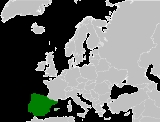
The
Iberian Peninsula (
AsturianAsturian is a Romance language of the West Iberian group, Astur-Leonese Subgroup, spoken in the Spanish Region of Asturias by the Asturian people...
,
LeoneseThe Leonese language is the endonym term used to refer to all vernacular Romance dialects of the Astur-Leonese linguistic group in the Spanish provinces of León and Zamora; Astur-Leonese also includes the dialects...
,
MirandeseThe Mirandese language is a Romance language belonging to the Astur-Leonese linguistic group, sparsely spoken in a small area of northeastern Portugal, in the municipalities of Miranda do Douro, Mogadouro and Vimioso...
,
SpanishSpanish , also known as Castilian , is a Romance language in the Ibero-Romance group that evolved from several languages and dialects in central-northern Iberia around the 9th century and gradually spread with the expansion of the Kingdom of Castile into central and southern Iberia during the...
,
PortuguesePortuguese is a Romance language that arose in the medieval Kingdom of Galicia, nowadays Galicia and Northern Portugal. The southern part of the Kingdom of Galicia became independent as the County of Portugal in 1095...
and , ,
AragoneseAragonese is a Romance language now spoken in a number of local varieties by between 10,000 and 30,000 people over the valleys of the Aragón River, Sobrarbe and Ribagorza in Aragon, Spain...
and , ), sometimes called
Iberia, is located in the extreme southwest of
EuropeEurope is, by convention, one of the world's seven continents. Comprising the westernmost peninsula of Eurasia, Europe is generally 'divided' from Asia to its east by the watershed divides of the Ural and Caucasus Mountains, the Ural River, the Caspian and Black Seas, and the waterways connecting...
and includes the modern-day
sovereign stateA sovereign state, or simply, state, is a state with a defined territory on which it exercises internal and external sovereignty, a permanent population, a government, and the capacity to enter into relations with other sovereign states. It is also normally understood to be a state which is neither...
s of
SpainSpain , officially the Kingdom of Spain languages]] under the European Charter for Regional or Minority Languages. In each of these, Spain's official name is as follows:;;;;;;), is a country and member state of the European Union located in southwestern Europe on the Iberian Peninsula...
,
PortugalPortugal , officially the Portuguese Republic is a country situated in southwestern Europe on the Iberian Peninsula. Portugal is the westernmost country of Europe, and is bordered by the Atlantic Ocean to the West and South and by Spain to the North and East. The Atlantic archipelagos of the...
and
AndorraAndorra , officially the Principality of Andorra , also called the Principality of the Valleys of Andorra, , is a small landlocked country in southwestern Europe, located in the eastern Pyrenees mountains and bordered by Spain and France. It is the sixth smallest nation in Europe having an area of...
, as well as the British Overseas Territory of
GibraltarGibraltar is a British overseas territory located on the southern end of the Iberian Peninsula at the entrance of the Mediterranean. A peninsula with an area of , it has a northern border with Andalusia, Spain. The Rock of Gibraltar is the major landmark of the region...
. It is the westernmost of the three major southern European
peninsulaA peninsula is a piece of land that is bordered by water on three sides but connected to mainland. In many Germanic and Celtic languages and also in Baltic, Slavic and Hungarian, peninsulas are called "half-islands"....
s — the Iberian,
ItalianThe Italian Peninsula or Apennine Peninsula is one of the three large peninsulas of Southern Europe , spanning from the Po Valley in the north to the central Mediterranean Sea in the south. The peninsula's shape gives it the nickname Lo Stivale...
, and
BalkanThe Balkans is a geopolitical and cultural region of southeastern Europe...
peninsulas. It is bordered on the southeast and east by the
Mediterranean SeaThe Mediterranean Sea is a sea connected to the Atlantic Ocean surrounded by the Mediterranean region and almost completely enclosed by land: on the north by Anatolia and Europe, on the south by North Africa, and on the east by the Levant...
, and on the north, west and southwest by the
Atlantic OceanThe Atlantic Ocean is the second-largest of the world's oceanic divisions. With a total area of about , it covers approximately 20% of the Earth's surface and about 26% of its water surface area...
. The
PyreneesThe Pyrenees is a range of mountains in southwest Europe that forms a natural border between France and Spain...
form the northeast edge of the peninsula, separating it from the rest of Europe. In the south, it approaches the northern coast of
AfricaAfrica is the world's second largest and second most populous continent, after Asia. At about 30.2 million km² including adjacent islands, it covers 6% of the Earth's total surface area and 20.4% of the total land area...
. It is the second-largest peninsula in Europe, with an area of approximately 580000 km² (223,939.3 sq mi).
Greek name
The English word
Iberia was adapted from the use of the
Ancient GreekAncient Greek is the stage of the Greek language in the periods spanning the times c. 9th–6th centuries BC, , c. 5th–4th centuries BC , and the c. 3rd century BC – 6th century AD of ancient Greece and the ancient world; being predated in the 2nd millennium BC by Mycenaean Greek...
word Ιβηρία (Ibēría) by the Greek geographers under the
Roman EmpireThe Roman Empire was the post-Republican period of the ancient Roman civilization, characterised by an autocratic form of government and large territorial holdings in Europe and around the Mediterranean....
to refer to what is known today in English as the Iberian Peninsula. At that time the name did not describe a single political entity or a distinct population of people. Strabo's Iberia was delineated from Keltikē by the Pyrenees and included the entire land mass south-west (he named it "west") of there.
The Ancient Greeks discovered the Iberian peninsula by voyaging westward. Hecataeus of Miletus was the first known to use the term around 500 BC.
HerodotusHerodotus was an ancient Greek historian who was born in Halicarnassus, Caria and lived in the 5th century BC . He has been called the "Father of History", and was the first historian known to collect his materials systematically, test their accuracy to a certain extent and arrange them in a...
of Halicarnassus says of the
PhocaeaPhocaea, or Phokaia, was an ancient Ionian Greek city on the western coast of Anatolia. Greek colonists from Phocaea founded the colony of Massalia in 600 BC, Emporion in 575 BC and Elea in 540 BC.-Geography:Phocaea was the northernmost...
ns that "it was they who made the Greeks acquainted with ... Iberia." According to
StraboStrabo, also written Strabon was a Greek historian, geographer and philosopher.-Life:Strabo was born to an affluent family from Amaseia in Pontus , a city which he said was situated the approximate equivalent of 75 km from the Black Sea...
prior historians used Iberia to mean the country "this side of the Ἶβηρος (Ibēros)" as far north as the
Rhone riverThe Rhone is one of the major rivers of Europe, rising in Switzerland and running from there through southeastern France. At Arles, near its mouth on the Mediterranean Sea, the river divides into two branches, known as the Great Rhone and the Little Rhone...
in
FranceThe French Republic , The French Republic , The French Republic , (commonly known as France , is a unitary semi-presidential republic in Western Europe with several overseas territories and islands located on other continents and in the Indian, Pacific, and Atlantic oceans. Metropolitan France...
but currently they set the
PyreneesThe Pyrenees is a range of mountains in southwest Europe that forms a natural border between France and Spain...
as the limit.
PolybiusPolybius , Greek ) was a Greek historian of the Hellenistic Period noted for his work, The Histories, which covered the period of 220–146 BC in detail. The work describes in part the rise of the Roman Republic and its gradual domination over Greece...
respects that limit but identifies Iberia as the Mediterranean side as far south as
GibraltarGibraltar is a British overseas territory located on the southern end of the Iberian Peninsula at the entrance of the Mediterranean. A peninsula with an area of , it has a northern border with Andalusia, Spain. The Rock of Gibraltar is the major landmark of the region...
, with the Atlantic side having no name. Elsewhere he says that
SaguntumSagunto or Sagunt is an ancient city in Eastern Spain, in the modern fertile comarca of Camp de Morvedre in the province of Valencia. It is located in a hilly site, c. 30 km north of Valencia, close to the Costa del Azahar on the Mediterranean Sea...
is "on the seaward foot of the range of hills connecting Iberia and Celtiberia."
Strabo refers to the Carretanians as people "of the Iberian stock" living in the Pyrenees, who are to be distinguished from either Celts or Celtiberians.
Roman names
When the Romans encountered the Greek geographers they used Iberia poetically and spoke of the Iberi. First mention was in 200 BC by the poet Quintus Ennius. The Romans had already had independent experience with the peoples on the peninsula during the long conflict with
CarthageCarthage , implying it was a 'new Tyre') is a major urban centre that has existed for nearly 3,000 years on the Gulf of Tunis, developing from a Phoenician colony of the 1st millennium BC...
. The Roman geographers and other prose writers from the time of the late
Roman RepublicThe Roman Republic was the period of the ancient Roman civilization where the government operated as a republic. It began with the overthrow of the Roman monarchy, traditionally dated around 508 BC, and its replacement by a government headed by two consuls, elected annually by the citizens and...
called the entire peninsula
HispaniaAnother theory holds that the name derives from Ezpanna, the Basque word for "border" or "edge", thus meaning the farthest area or place. Isidore of Sevilla considered Hispania derived from Hispalis....
.
As they became politically interested in the former territories of Carthage, the Romans came to use Hispania Citerior and Hispania Ulterior for 'near' and 'far Spain'. Even at that time large sections of it were
LusitaniaLusitania or Hispania Lusitania was an ancient Roman province including approximately all of modern Portugal south of the Douro river and part of modern Spain . It was named after the Lusitani or Lusitanian people...
(
PortugalPortugal , officially the Portuguese Republic is a country situated in southwestern Europe on the Iberian Peninsula. Portugal is the westernmost country of Europe, and is bordered by the Atlantic Ocean to the West and South and by Spain to the North and East. The Atlantic archipelagos of the...
south of
DouroThe Douro or Duero is one of the major rivers of the Iberian Peninsula, flowing from its source near Duruelo de la Sierra in Soria Province across northern-central Spain and Portugal to its outlet at Porto...
river and
ExtremaduraExtremadura is an autonomous community of western Spain whose capital city is Mérida. Its component provinces are Cáceres and Badajoz. It is bordered by Portugal to the west...
in western Spain),
GallaeciaGallaecia or Callaecia, also known as Hispania Gallaecia, was the name of a Roman province and an early Mediaeval kingdom that comprised a territory in the north-west of Hispania...
(Northern Portugal and Galicia in Spain), Celtiberia (central Spain), Baetica (
AndalusiaAndalusia is the most populous and the second largest in area of the autonomous communities of Spain. The Andalusian autonomous community is officially recognised as a nationality of Spain. The territory is divided into eight provinces: Huelva, Seville, Cádiz, Córdoba, Málaga, Jaén, Granada and...
),
CantabriaCantabria is a Spanish historical region and autonomous community with Santander as its capital city. It is bordered on the east by the Basque Autonomous Community , on the south by Castile and León , on the west by the Principality of Asturias, and on the north by the Cantabrian Sea.Cantabria...
(northwest Spain) and the Vascones (Basques). Strabo says that the Romans use Hispania and Iberia synonymously, and distance them as near and far. He was living in a time when the peninsula was divided into Roman provinces, of which
BaetiaHispania Baetica was one of three Imperial Roman provinces in Hispania, . Hispania Baetica was bordered to the west by Lusitania, and to the northeast by Hispania Tarraconensis. Baetica was part of Al-Andalus under the Moors in the 8th century and approximately corresponds to modern Andalucia...
was supervised by the Senate, whereas the others were governed on behalf of the Emperor. Whatever language may have been spoken on the peninsula soon gave way to Latin, except for Basque, protected by the Pyrenees.
Etymology
The Iberian Peninsula has always been associated with the Ebro river, Ibēros in
ancient GreekAncient Greek is the stage of the Greek language in the periods spanning the times c. 9th–6th centuries BC, , c. 5th–4th centuries BC , and the c. 3rd century BC – 6th century AD of ancient Greece and the ancient world; being predated in the 2nd millennium BC by Mycenaean Greek...
and Ibērus or Hibērus in Latin. The association was so well known it was hardly necessary to state; for example, Ibēria was the country "this side of the Ibērus" in Strabo.
PlinyGaius Plinius Secundus , better known as Pliny the Elder, was a Roman author, naturalist, and natural philosopher, as well as naval and army commander of the early Roman Empire, and personal friend of the emperor Vespasian...
goes so far as to assert that the Greeks had called "the whole of Spain" Hiberia because of the river Hiberus. The river appears in the
Ebro TreatyThe Ebro Treaty was a treaty signed in 226 BC by Hasdrubal the Fair of Carthage and the Roman Republic, which fixed the river Ebro in Iberia as the boundary between the two powers. Under the terms of the treaty, Carthage would not expand north of the Ebro, as long as Rome likewise did not expand to...
of 226 BC between Rome and Carthage, setting the limit of Carthaginian interest at the Ebro. The fullest description of the treaty, stated in
AppianAppian of Alexandria was a Roman historian of Greek ethnicity who flourished during the reigns of Trajan, Hadrian, and Antoninus Pius.He was born ca. 95 in Alexandria. He tells us that, after having filled the chief offices in the province of Egypt, he went to Rome ca. 120, where he practised as...
, uses Ibērus. With reference to this border,
PolybiusPolybius , Greek ) was a Greek historian of the Hellenistic Period noted for his work, The Histories, which covered the period of 220–146 BC in detail. The work describes in part the rise of the Roman Republic and its gradual domination over Greece...
states that the "native name" is Ibēr, apparently the original word, stripped of its Greek or Latin -os or -us termination.
The early range of these natives, stated by the geographers and historians to be from southern Spain to southern France along the Mediterranean coast, is marked by instances of a readable script expressing a yet unknown language, dubbed '
IberianThe Iberian language was the language of a people identified by Greek and Roman sources who lived in the eastern and southeastern regions of the Iberian peninsula. The ancient Iberians can be identified as a rather nebulous local culture between the 7th and 1st century BC...
'. Whether this was the native name or was given to them by the Greeks for their residence on the Ebro remains unknown. Credence in Polybius imposes certain limitations on etymologizing: if the language remains unknown, the meanings of the words, including Iber, must remain unknown also.
Overall characteristics
The Iberian peninsula extends from the southernmost extremity at
Punta de TarifaPunta de Tarifa is the southernmost point of the Iberian Peninsula and continental Europe. It is located in the province of Cádiz and the autonomous community of Andalusia on the Atlantic end of the Straits of Gibraltar. The coast of Morocco can be seen from this point....
(36°00′15"N 5°36′37"W) to the northernmost extremity at Estaca de Bares Point (43°47′38"N 7°41′17"W) over a distance between lines of latitude of about 865 km (537.5 mi) based on a degree length of 111 km (69 mi) per degree, and from the westernmost extremity at
Cabo da RocaCabo da Roca is a cape which forms the westernmost extent of mainland Portugal and continental Europe...
(38°46′51"N 9°29′54"W) to the easternmost extremity at
Cap de CreusCap de Creus is a peninsula and a headland located at the far NE of Catalonia, some 25 km south from the French border. The nearest town is Figueres, capital of the Alt Empordà and birthplace of Salvador Dalí...
(42°19′09"N 3°19′19"E) over a distance between lines of longitude at 40° N latitude of about 1155 km (717.7 mi) based on an estimated degree length of about 90 km (55.9 mi) for that latitude. The irregular, roughly octagonal shape of the peninsula contained within this spherical
quadrangleIn geology or geography, the word "quadrangle" usually refers to a United States Geological Survey 7.5-minute quadrangle map, which are usually named after a local physiographic feature. The shorthand "quad" is also used, especially with the name of the map; for example, "the Ranger Creek, Texas...
was compared to an ox-hide by the geographer,
StraboStrabo, also written Strabon was a Greek historian, geographer and philosopher.-Life:Strabo was born to an affluent family from Amaseia in Pontus , a city which he said was situated the approximate equivalent of 75 km from the Black Sea...
.
Approximately ¾ of the octagon is the Meseta Central, a low and rolling plateau of up to several hundred metres in altitude. It is located roughly in the centre, staggered slightly to the east and tilted slightly toward the west (the conventional centre of the Iberian Peninsula has long been considered to be
GetafeGetafe is a city in the southern zone of the Madrid metropolitan area, Spain, and one of the most populated and industrialized cities in the municipality. The city is home to one of the oldest Spanish military air bases, as well as the Universidad Carlos III de Madrid...
just south of
MadridMadrid is the capital and largest city of Spain. The population of the city is roughly 3.3 million and the entire population of the Madrid metropolitan area is calculated to be 6.271 million. It is the third largest city in the European Union, after London and Berlin, and its metropolitan...
). It is ringed by mountains and contains the sources of most of the rivers, which find their way through gaps in the mountain barriers on all sides.
Coastline
The coastline of the Iberian Peninsula is 3313 km (2,058.6 mi), 1660 km (1,031.5 mi) on the Mediterranean side and 1653 km (1,027.1 mi) on the Atlantic side. The coast is a drowned one, with sea levels having risen from a minimum of 115–120 m (377.3–393.7 ft) lower than today at the
Last Glacial MaximumThe Last Glacial Maximum refers to a period in the Earth's climate history when ice sheets were at their maximum extension, between 26,500 and 19,000–20,000 years ago, marking the peak of the last glacial period. During this time, vast ice sheets covered much of North America, northern Europe and...
(LGM) to its current level at 4000 years
BPBP p.l.c. is a global oil and gas company headquartered in London, United Kingdom. It is the third-largest energy company and fourth-largest company in the world measured by revenues and one of the six oil and gas "supermajors"...
. The coastal shelf created by sedimentation during that time remains below the surface; however, it was never very extensive on the Atlantic side, as the continental shelf drops rather steeply into the depths. An estimated 700 km (435 mi) length of Atlantic shelf is only 10–65 km (6.2–40.4 mi) wide. At the 500 m (1,640.4 ft) isobath, on the edge, the shelf drops off to 1000 m (3,280.8 ft).
The submarine topography of the coastal waters of the Iberian Peninsula has been studied extensively in the process of drilling for oil. Ultimately the shelf drops into the
Bay of BiscayThe Bay of Biscay is a gulf of the northeast Atlantic Ocean located south of the Celtic Sea. It lies along the western coast of France from Brest south to the Spanish border, and the northern coast of Spain west to Cape Ortegal, and is named in English after the province of Biscay, in the Spanish...
on the north (an abyss), the Iberian abyssal plain at 4800 m (15,748 ft) on the west and Tagus abyssal plain to the south. In the north between the continental shelf and the abyss is an extension, the Galicia Bank, a plateau containing also the Porto, Vigo and Vasco da Gama
seamountA seamount is a mountain rising from the ocean seafloor that does not reach to the water's surface , and thus is not an island. These are typically formed from extinct volcanoes, that rise abruptly and are usually found rising from a seafloor of depth. They are defined by oceanographers as...
s, creating the Galicia interior basin. The southern border of these features is marked by
Nazare CanyonThe Nazaré Canyon is an undersea canyon just off the coast of Nazaré, Portugal, in the Eastern Atlantic Ocean. It has a maximum depth of at least and is about long. It is larger than the Grand Canyon....
, splitting the continental shelf and leading directly into the abyss.
Mountains
Mountains consist mainly of serrated ridges aligned in an east-west direction, due to the
orogenicOrogeny refers to forces and events leading to a severe structural deformation of the Earth's crust due to the engagement of tectonic plates. Response to such engagement results in the formation of long tracts of highly deformed rock called orogens or orogenic belts...
factors of the region's geologic history. Rivers generally flow through the valleys between the ridges. In a counterclockwise direction, the major mountain ranges are: the
PyreneesThe Pyrenees is a range of mountains in southwest Europe that forms a natural border between France and Spain...
crossing the isthmus of the peninsula so completely as to allow no passage except by mountain road or trail or coastal road, the
Cantabrian MountainsThe Cantabrian Mountains or Cantabrian Range are one of the main systems of mountain ranges in Spain.They extend for more than approximately 180 miles across northern Spain, from the western limit of the Pyrenees to the edges of the Galician Massif close to Galicia, along the coast of the...
perched on the northern coastline, the
Sistema IbéricoThe Sistema Ibérico or Iberian System is one of the main systems of mountain ranges in Spain.It is a vast and complex system of mountain chains and massifs located in the central regions of the Iberian Peninsula, but reaching almost the Mediterranean coast in the Land of Valencia in the east.From...
, the
Sistema CentralThe Sistema Central is one of the main systems of mountain ranges in the Iberian Peninsula.-Description:The Sistema Central is a primary feature of the Meseta Central, the inner Iberian plateau, splitting the meseta into two parts...
, the
Montes de ToledoThe Montes de Toledo are one of the main systems of mountain ranges in Spain. They divide the drainage basin of the Tagus from the basin of the Guadiana.-Description:...
, the
Sierra MorenaThe Sierra Morena is one of the main systems of mountain ranges in Spain.It stretches for 400 kilometres East-West across southern Spain, forming the southern border of the Meseta Central plateau of the Iberian Peninsula, and providing the watershed between the valleys of the Guadiana to the...
and the
Sierra NevadaThe Sierra Nevada is a mountain range in the region of provinces of Granada and Almería in Spain. It contains the highest point of continental Spain, Mulhacén at 3478 m above sea level....
.
Modern countries and territories
Political divisions of the Iberian Peninsula sorted by area:
| Country/Territory |
Peninsular area |
Description |
| Population |
km2 |
sq mi |
Share |
SpainSpain , officially the Kingdom of Spain languages]] under the European Charter for Regional or Minority Languages. In each of these, Spain's official name is as follows:;;;;;;), is a country and member state of the European Union located in southwestern Europe on the Iberian Peninsula...
|
46,000,000 |
505519 | 195,182 |
85% |
occupies most of the peninsula |
PortugalPortugal , officially the Portuguese Republic is a country situated in southwestern Europe on the Iberian Peninsula. Portugal is the westernmost country of Europe, and is bordered by the Atlantic Ocean to the West and South and by Spain to the North and East. The Atlantic archipelagos of the...
|
10,000,000 |
89261 | 34,463.9 |
15% |
occupies most of the west of the peninsula |
FranceThe French Republic , The French Republic , The French Republic , (commonly known as France , is a unitary semi-presidential republic in Western Europe with several overseas territories and islands located on other continents and in the Indian, Pacific, and Atlantic oceans. Metropolitan France...
|
12,035 |
540 | 208.5 |
<1% |
French Cerdagne French Cerdagne is the northern half of Cerdanya, which came under French control as a result of the Treaty of the Pyrenees in 1659, while the southern half remained in Spain . Catalonians often refer to French Cerdagne as Upper Cerdanya... is in the south side of the PyreneesThe Pyrenees is a range of mountains in southwest Europe that forms a natural border between France and Spain... range between Spain and France, so it is technically located in the Iberian peninsula |
AndorraAndorra , officially the Principality of Andorra , also called the Principality of the Valleys of Andorra, , is a small landlocked country in southwestern Europe, located in the eastern Pyrenees mountains and bordered by Spain and France. It is the sixth smallest nation in Europe having an area of...
|
84,082 |
468 | 180.7 |
<1% |
a northern edge of the peninsula in the south side of the Pyrenees range between Spain and France |
GibraltarGibraltar is a British overseas territory located on the southern end of the Iberian Peninsula at the entrance of the Mediterranean. A peninsula with an area of , it has a northern border with Andalusia, Spain. The Rock of Gibraltar is the major landmark of the region...
|
29,431 |
7 | 3 |
<1% |
a British overseas territory near the southernmost tip of the peninsula |
Major cities
The principal urban centres are:
MadridMadrid is the capital and largest city of Spain. The population of the city is roughly 3.3 million and the entire population of the Madrid metropolitan area is calculated to be 6.271 million. It is the third largest city in the European Union, after London and Berlin, and its metropolitan...
,
BarcelonaBarcelona is the second largest city in Spain after Madrid, and the capital of Catalonia, with a population of 1,621,537 within its administrative limits on a land area of...
, Valencia,
SevilleSeville is the artistic, historic, cultural, and financial capital of southern Spain. It is the capital of the autonomous community of Andalusia and of the province of Seville. It is situated on the plain of the River Guadalquivir, with an average elevation of above sea level...
,
ZaragozaZaragoza , also called Saragossa in English, is the capital city of the Zaragoza Province and of the autonomous community of Aragon, Spain...
,
MálagaMálaga is a city and a municipality in the Autonomous Community of Andalusia, Spain. With a population of 568,507 in 2010, it is the second most populous city of Andalusia and the sixth largest in Spain. This is the southernmost large city in Europe...
,
LisbonLisbon is the capital city and largest city of Portugal with a population of 545,245 within its administrative limits on a land area of . The urban area of Lisbon extends beyond the administrative city limits with a population of 3 million on an area of , making it the 9th most populous urban...
,
Murcia-History:It is widely believed that Murcia's name is derived from the Latin words of Myrtea or Murtea, meaning land of Myrtle , although it may also be a derivation of the word Murtia, which would mean Murtius Village...
, Palma,
Las Palmas de Gran CanariaLas Palmas de Gran Canaria commonly known as Las Palmas is the political capital, jointly with Santa Cruz, the most populous city in the Autonomous Community of the Canary Islands and the ninth largest city in Spain, with a population of 383,308 in 2010. Nearly half of the people of the island...
,
BilbaoBilbao ) is a Spanish municipality, capital of the province of Biscay, in the autonomous community of the Basque Country. With a population of 353,187 , it is the largest city of its autonomous community and the tenth largest in Spain...
,
AlicanteAlicante or Alacant is a city in Spain, the capital of the province of Alicante and of the comarca of Alacantí, in the south of the Valencian Community. It is also a historic Mediterranean port. The population of the city of Alicante proper was 334,418, estimated , ranking as the second-largest...
,
Córdoba-History:The first trace of human presence in the area are remains of a Neanderthal Man, dating to c. 32,000 BC. In the 8th century BC, during the ancient Tartessos period, a pre-urban settlement existed. The population gradually learned copper and silver metallurgy...
,
ValladolidValladolid is a historic city and municipality in north-central Spain, situated at the confluence of the Pisuerga and Esgueva rivers, and located within three wine-making regions: Ribera del Duero, Rueda and Cigales...
,
VigoVigo is a city and municipality in north-west Spain, in Galicia, situated on the ria of the same name on the Atlantic Ocean.-Population:...
,
Vila Nova de GaiaVila Nova de Gaia, or simply Gaia is a city in Vila Nova de Gaia Municipality, Portugal. It is located in the Porto District, south of the city of Porto on the other side of the Douro River. The city proper has a population of 178,255 and the municipality contains 24 parishes with a total...
,
GijónGijón , officially Gijón / Xixón, is a coastal industrial city and a municipality in the autonomous community of Asturias in Spain. Early mediaeval texts mention it as "Gigia". It was an important regional Roman city, although the area has been settled since earliest history...
,
L'Hospitalet de LlobregatL'Hospitalet de Llobregat or briefly L'Hospitalet is a city to the immediate southwest of Barcelona in Catalonia, Spain, and the second largest in Catalonia by population...
,
A CoruñaA Coruña or La Coruña is a city and municipality of Galicia, Spain. It is the second-largest city in the autonomous community and seventeenth overall in the country...
,
PortoPorto , also known as Oporto in English, is the second largest city in Portugal and one of the major urban areas in the Iberian Peninsula. Its administrative limits include a population of 237,559 inhabitants distributed within 15 civil parishes...
,
Vitoria-GasteizVitoria-Gasteiz is the capital city of the province of Álava and of the autonomous community of the Basque Country in northern Spain with a population of 235,661 people. It is the second largest Basque city...
,
GranadaGranada is a city and the capital of the province of Granada, in the autonomous community of Andalusia, Spain. Granada is located at the foot of the Sierra Nevada mountains, at the confluence of three rivers, the Beiro, the Darro and the Genil. It sits at an elevation of 738 metres above sea...
, Elche,
OviedoOviedo is the capital city of the Principality of Asturias in northern Spain. It is also the name of the municipality that contains the city....
,
BragaBraga , a city in the Braga Municipality in northwestern Portugal, is the capital of the Braga District, the oldest archdiocese and the third major city of the country. Braga is the oldest Portuguese city and one of the oldest Christian cities in the World...
,
SintraSintra is a town within the municipality of Sintra in the Grande Lisboa subregion of Portugal. Owing to its 19th century Romantic architecture and landscapes, becoming a major tourist centre, visited by many day-trippers who travel from the urbanized suburbs and capital of Lisbon.In addition to...
,
CoimbraCoimbra is a city in the municipality of Coimbra in Portugal. Although it served as the nation's capital during the High Middle Ages, it is better-known for its university, the University of Coimbra, which is one of the oldest in Europe and the oldest academic institution in the...
and
SetúbalSetúbal is the main city in Setúbal Municipality in Portugal with a total area of 172.0 km² and a total population of 118,696 inhabitants in the municipality. The city proper has 89,303 inhabitants....
.
Various other notable cities are also present on the peninsula.
Major metropolitan areas
The main metropolitan areas and conurbations over a million are:
MadridThe Madrid Metropolitan Area comprises the city of Madridand forty surrounding municipalities. It has a populationof slightly more than 6.4 million people and covers an areaof 4.609,7 km²...
,
BarcelonaThis article is about the metropolitan area. For the administrative area, see Àrea Metropolitana de Barcelona .Barcelona metropolitan area is the metropolitan area in Catalonia, north of Spain, centered on the city of Barcelona...
, Lisbon, Valencia, Porto, Seville,
BilbaoThe Bilbao Metropolian Area is the metropolitan area or continuous urban area based around the city of Bilbao, in the Basque Country, Spain...
and Málaga.
Forests
The woodlands of the Iberian Peninsula are distinct
ecosystemAn ecosystem is a biological environment consisting of all the organisms living in a particular area, as well as all the nonliving , physical components of the environment with which the organisms interact, such as air, soil, water and sunlight....
s. Although the various regions are each characterized by distinct vegetation, there are some similarities across the peninsula.
While the borders between these regions are not clearly defined, there is a mutual influence which makes it very hard to establish boundaries and some species find their optimal habitat in the intermediate areas.
East Atlantic flyway
The Iberian Peninsula in an important stopover on the East Atlantic
flywayA flyway is a flight path used in bird migration. Flyways generally span over continents and often oceans.-Flyways of the Americas:*Atlantic Flyway*Central Flyway*Mississippi Flyway*Pacific Flyway*Allegheny Front...
for birds migrating from northern Europe to Africa. For example,
Calidis ferrugineaThe Curlew Sandpiper is a small wader that breeds on the tundra of Arctic Siberia. It is strongly migratory, wintering mainly in Africa, but also in south and southeast Asia and in Australasia...
rests in the region of
CadizCadiz is a city and port in southwestern Spain. It is the capital of the homonymous province, one of eight which make up the autonomous community of Andalusia....
Bay.
In addition to the birds migrating through, some seven million wading birds from the north spend the winter in the estuaries and wetlands of the Iberian Peninsula, mainly at locations on the Atlantic coast. In Galicia are the Ria de Arousa (a home of
Pluvialis squatarolaThe Grey Plover , known as the Black-bellied Plover in North America, is a medium-sized plover breeding in arctic regions. It is a long-distance migrant, with a nearly worldwide coastal distribution when not breeding....
), Ria de
OrtigueiraOrtigueira is a seaport and municipality in the Province of A Coruña, Galicia, Spain; it is located on the northern slope of the Serra da Faladoira, the river Mera and on the eastern shore of the Ria de Santa Marta—a winding, rock-bound and much indented inlet of the Bay of Biscay, between Capes...
, Ria de Corme and Ria de Laxe. In
PortugalPortugal , officially the Portuguese Republic is a country situated in southwestern Europe on the Iberian Peninsula. Portugal is the westernmost country of Europe, and is bordered by the Atlantic Ocean to the West and South and by Spain to the North and East. The Atlantic archipelagos of the...
the
Aveiro LagoonThe Aveiro lagoon is a lagoon in Portugal. It is located on the Atlantic coast of Portugal, south the municipalitiy of Espinho and north of Mira . Its average area covers approximately 75 km². It is named after the city of Aveiro, which is the chief urban centre located nearby the lagoon...
hosts
Recurvirostra avosettaThe four species of Avocets are a genus, Recurvirostra, of waders in the same avian family as the stilts.Avocets have long legs and long, thin, upcurved bills which they sweep from side to side when feeding in the brackish or saline wetlands they prefer...
,
Charadrius hiaticulaThe Common Ringed Plover or Ringed Plover is a small plover.Adults are 17-19.5 cm in length with a 35–41 cm wingspan. They have a grey-brown back and wings, a white belly, and a white breast with one black neckband. They have a brown cap, a white forehead, a black mask around the eyes...
,
Pluvialis squatarolaThe Grey Plover , known as the Black-bellied Plover in North America, is a medium-sized plover breeding in arctic regions. It is a long-distance migrant, with a nearly worldwide coastal distribution when not breeding....
and
Calidris minutaThe Little Stint, Calidris minuta , is a very small wader. It breeds in arctic Europe and Asia, and is a long-distance migrant, wintering south to Africa and south Asia...
.
RibatejoThe Ribatejo is the most central of the traditional provinces of Portugal, with no coastline or border with Spain. The region is crossed by the Tagus River...
on the Tagus River supports
Recurvirostra arosettaThe four species of Avocets are a genus, Recurvirostra, of waders in the same avian family as the stilts.Avocets have long legs and long, thin, upcurved bills which they sweep from side to side when feeding in the brackish or saline wetlands they prefer...
,
Pluvialis squatarolaThe Grey Plover , known as the Black-bellied Plover in North America, is a medium-sized plover breeding in arctic regions. It is a long-distance migrant, with a nearly worldwide coastal distribution when not breeding....
,
Culidris alpinaThe Dunlin, Calidris alpina, is a small wader, sometimes separated with the other "stints" in Erolia. It is a circumpolar breeder in Arctic or subarctic regions. Birds that breed in northern Europe and Asia are long-distance migrants, wintering south to Africa, southeast Asia and the Middle East...
,
Limosa lapponicaThe Bar-tailed Godwit is a large wader in the family Scolopacidae, which breeds on Arctic coasts and tundra mainly in the Old World, and winters on coasts in temperate and tropical regions of the Old World...
and
Tringa totanusThe Common Redshank or simply Redshank is an Eurasian wader in the large family Scolopacidae.- Description and systematics :...
. In the Estuário do
SadoThe Sado River is a river in Southern Portugal, and is one of the major rivers in the country. It flows in a South/North direction through 175 km from its springs in the Caldeirão hills before entering the Atlantic Ocean in an estuary in the city of Setúbal.In Setúbal, its estuary is famous...
are
Calidris alpinaThe Dunlin, Calidris alpina, is a small wader, sometimes separated with the other "stints" in Erolia. It is a circumpolar breeder in Arctic or subarctic regions. Birds that breed in northern Europe and Asia are long-distance migrants, wintering south to Africa, southeast Asia and the Middle East...
,
Numenius arquataThe Eurasian Curlew, Numenius arquata, is a wader in the large family Scolopacidae. It is one of the most widespread of the curlews, breeding across temperate Europe and Asia...
,
Pluvialis squatarolaThe Grey Plover , known as the Black-bellied Plover in North America, is a medium-sized plover breeding in arctic regions. It is a long-distance migrant, with a nearly worldwide coastal distribution when not breeding....
and
Tringa totanusThe Common Redshank or simply Redshank is an Eurasian wader in the large family Scolopacidae.- Description and systematics :...
. The
Algarve hosts
Calidris canutusThe Red Knot, Calidris canutus , is a medium sized shorebird which breeds in tundra and the Arctic Cordillera in the far north of Canada, Europe, and Russia. It is a large member of the Calidris sandpipers, second only to the Great Knot...
,
Tringa nebulariaThe Common Greenshank is a wader in the large family Scolopacidae, the typical waders. Its closest relative is the Greater Yellowlegs, together with which and the Spotted Redshank it forms a close-knit group...
and
Arenaria interpresTurnstones are the bird species in the genus Arenaria in the family Scolopacidae. They are closely related to calidrid sandpipers and might be considered members of the tribe Calidriini....
. The
Marismas de GuadalquivirThe Guadalquivir Marshes is an area of marshy lowlands near the banks of Guadalquivir River, part of Seville province, in Western Andalusia , which contains part of the territories of the municipalities of Isla Mayor, Los Palacios y Villafranca, La Puebla del Río, Villafranco del Guadalquivir,...
region of
AndalusiaAndalusia is the most populous and the second largest in area of the autonomous communities of Spain. The Andalusian autonomous community is officially recognised as a nationality of Spain. The territory is divided into eight provinces: Huelva, Seville, Cádiz, Córdoba, Málaga, Jaén, Granada and...
and the Salinas de
CádizCadiz is a city and port in southwestern Spain. It is the capital of the homonymous province, one of eight which make up the autonomous community of Andalusia....
are especially rich in wintering wading birds:
Charadrius alexandrinusThe Kentish Plover, Charadrius alexandrinus, is a small wader in the plover bird family. Despite its name, this species no longer breeds in Kent, or even Great Britain...
,
Charadrius hiaticulaThe Common Ringed Plover or Ringed Plover is a small plover.Adults are 17-19.5 cm in length with a 35–41 cm wingspan. They have a grey-brown back and wings, a white belly, and a white breast with one black neckband. They have a brown cap, a white forehead, a black mask around the eyes...
,
Calidris albaThe Sanderling is a small wader. It is a circumpolar Arctic breeder, and is a long-distance migrant, wintering south to South America, South Europe, Africa, and Australia...
, and
Limosa limosaThe Black-tailed Godwit, Limosa limosa, is a large, long-legged, long-billed shorebird first described by Carolus Linnaeus in 1758. It is a member of the Limosa genus, the godwits...
in addition to the others. And finally, the
EbroThe Ebro or Ebre is one of the most important rivers in the Iberian Peninsula. It is the biggest river by discharge volume in Spain.The Ebro flows through the following cities:*Reinosa in Cantabria.*Miranda de Ebro in Castile and León....
delta is home to all the species mentioned above.
Geology
The Iberian Peninsula contains rocks from every age from
EdiacaranThe Ediacaran Period , named after the Ediacara Hills of South Australia, is the last geological period of the Neoproterozoic Era and of the Proterozoic Eon, immediately preceding the Cambrian Period, the first period of the Paleozoic Era and of the Phanerozoic Eon...
to Recent, and almost every kind of rock is represented. World class mineral deposits can also be found there. The core of the Iberian Peninsula consists of a Hercynian
cratonA craton is an old and stable part of the continental lithosphere. Having often survived cycles of merging and rifting of continents, cratons are generally found in the interiors of tectonic plates. They are characteristically composed of ancient crystalline basement rock, which may be covered by...
ic block known as the Iberian Massif. On the northeast this is bounded by The
Pyrenean fold beltThe Pyrenees is a range of mountains in southwest Europe that forms a natural border between France and Spain...
, and on the southeast it is bounded by the
Betic FoldchainThe Baetic System is the main system of mountain ranges in Spain. Located in southern and eastern Spain, it is also known as the Baetic Cordillera, Baetic Ranges or Baetic Mountains...
. These twofold chains are part of the
Alpine beltThe Alps form part of a Tertiary orogenic belt of mountain chains, called the Alpide belt, that stretches through southern Europe and Asia from the Atlantic all the way to the Himalayas. This belt of mountain chains was formed during the Alpine orogeny. A gap in these mountain chains in central...
. To the west, the peninsula is delimited by the continental boundary formed by the
magmaMagma is a mixture of molten rock, volatiles and solids that is found beneath the surface of the Earth, and is expected to exist on other terrestrial planets. Besides molten rock, magma may also contain suspended crystals and dissolved gas and sometimes also gas bubbles. Magma often collects in...
poor opening of the
Atlantic OceanThe Atlantic Ocean is the second-largest of the world's oceanic divisions. With a total area of about , it covers approximately 20% of the Earth's surface and about 26% of its water surface area...
. The Hercynian Foldbelt is mostly buried by Mesozoic and Tertiary cover rocks to the east, but nevertheless outcrops through the Iberian Chain and the
CataloniaCatalonia is an autonomous community in northeastern Spain, with the official status of a "nationality" of Spain. Catalonia comprises four provinces: Barcelona, Girona, Lleida, and Tarragona. Its capital and largest city is Barcelona. Catalonia covers an area of 32,114 km² and has an...
n Coastal Ranges.
Prehistory
Palaeolithic
The Iberian Peninsula has been inhabited for at least 1,000,000 years as remains found in the sites at
AtapuercaThe Atapuerca Mountains is an ancient karstic region of Spain, in the province of Burgos and near Atapuerca and Ibeas de Juarros. It contains several caves, where fossils and stone tools of the earliest known Hominins in West Europe have been found. The earliest hominids may have dated to 1.2...
demonstrate. Among these sites is the cave of Gran Dolina, where six hominin skeletons, dated between 780,000 and one million years ago, were found in 1994. Experts have debated whether these skeletons belong to the species
Homo erectusHomo erectus is an extinct species of hominid that lived from the end of the Pliocene epoch to the later Pleistocene, about . The species originated in Africa and spread as far as India, China and Java. There is still disagreement on the subject of the classification, ancestry, and progeny of H...
,
Homo heidelbergensisHomo heidelbergensis is an extinct species of the genus Homo which may be the direct ancestor of both Homo neanderthalensis in Europe and Homo sapiens. The best evidence found for these hominins date between 600,000 and 400,000 years ago. H...
, or a new species called
Homo antecessorHomo antecessor is an extinct human species dating from 1.2 million to 800,000 years ago, that was discovered by Eudald Carbonell, Juan Luis Arsuaga and J. M. Bermúdez de Castro. H. antecessor is one of the earliest known human varieties in Europe. Various archaeologists and anthropologists have...
.
Around 200,000 BCE, during the
Lower PaleolithicThe Lower Paleolithic is the earliest subdivision of the Paleolithic or Old Stone Age. It spans the time from around 2.5 million years ago when the first evidence of craft and use of stone tools by hominids appears in the current archaeological record, until around 300,000 years ago, spanning the...
period, Neanderthals first entered the Iberian Peninsula. Around 70,000 BCE, during the
Middle PaleolithicThe Middle Paleolithic is the second subdivision of the Paleolithic or Old Stone Age as it is understood in Europe, Africa and Asia. The term Middle Stone Age is used as an equivalent or a synonym for the Middle Paleolithic in African archeology. The Middle Paleolithic and the Middle Stone Age...
period, the last ice age began and the Neanderthal
MousterianMousterian is a name given by archaeologists to a style of predominantly flint tools associated primarily with Homo neanderthalensis and dating to the Middle Paleolithic, the middle part of the Old Stone Age.-Naming:...
culture was established. Around 35,000 BCE, during the
Upper PaleolithicThe Upper Paleolithic is the third and last subdivision of the Paleolithic or Old Stone Age as it is understood in Europe, Africa and Asia. Very broadly it dates to between 40,000 and 10,000 years ago, roughly coinciding with the appearance of behavioral modernity and before the advent of...
, the Neanderthal
ChâtelperronianChâtelperronian was the earliest industry of the Upper Palaeolithic in central and south western France, extending also into Northern Spain. It derives its name from the site of la Grotte des Fées, in Châtelperron, Allier, France....
cultural period began. Emanating from
Southern FranceSouthern France , colloquially known as le Midi is defined geographical area consisting of the regions of France that border the Atlantic Ocean south of the Gironde, Spain, the Mediterranean, and Italy...
this culture extended into the north of the peninsula. It continued to exist until around 28,000 BCE when Neanderthal man faced extinction.
At about the 40th millennium BCE
Modern HumansHumans are the only living species in the Homo genus...
entered the Iberian peninsula, coming from
Southern FranceSouthern France , colloquially known as le Midi is defined geographical area consisting of the regions of France that border the Atlantic Ocean south of the Gironde, Spain, the Mediterranean, and Italy...
. Here, this
genetically homogeneous populationPopulation genetics is the study of allele frequency distribution and change under the influence of the four main evolutionary processes: natural selection, genetic drift, mutation and gene flow. It also takes into account the factors of recombination, population subdivision and population...
(characterized by the M173
mutationIn molecular biology and genetics, mutations are changes in a genomic sequence: the DNA sequence of a cell's genome or the DNA or RNA sequence of a virus. They can be defined as sudden and spontaneous changes in the cell. Mutations are caused by radiation, viruses, transposons and mutagenic...
in the
Y-chromosomeThe Y chromosome is one of the two sex-determining chromosomes in most mammals, including humans. In mammals, it contains the gene SRY, which triggers testis development if present. The human Y chromosome is composed of about 60 million base pairs...
), developed the M343 mutation, giving rise to the R1b
HaplogroupIn the study of molecular evolution, a haplogroup is a group of similar haplotypes that share a common ancestor having the same single nucleotide polymorphism mutation in both haplotypes. Because a haplogroup consists of similar haplotypes, this is what makes it possible to predict a haplogroup...
, still the most common in modern
PortugueseThe Portuguese are a nation and ethnic group native to the country of Portugal, in the west of the Iberian peninsula of south-west Europe. Their language is Portuguese, and Roman Catholicism is the predominant religion....
and
SpanishThe Spanish are citizens of the Kingdom of Spain. Within Spain, there are also a number of vigorous nationalisms and regionalisms, reflecting the country's complex history....
males. On the Iberian peninsula, Modern Humans developed a series of different cultures, such as the
AurignacianThe Aurignacian culture is an archaeological culture of the Upper Palaeolithic, located in Europe and southwest Asia. It lasted broadly within the period from ca. 45,000 to 35,000 years ago in terms of conventional radiocarbon dating, or between ca. 47,000 and 41,000 years ago in terms of the most...
,
Gravettianthumb|right|Burins to the Gravettian culture.The Gravettian toolmaking culture was a specific archaeological industry of the European Upper Palaeolithic era prevalent before the last glacial epoch. It is named after the type site of La Gravette in the Dordogne region of France where its...
,
SolutreanThe Solutrean industry is a relatively advanced flint tool-making style of the Upper Palaeolithic, from around 22,000 to 17,000 BP.-Details:...
and Magdalenian cultures, some of them characterized by complex forms of Paleolithic art.
Neolithic
During the
Neolithic expansionNeolithic Europe refers to a prehistoric period in which Neolithic technology was present in Europe. This corresponds roughly to a time between 7000 BC and c. 1700 BC...
, various megalithic cultures developed in the Iberian peninsula. An open seas navigation culture from the east Mediterranean, called the
Cardium cultureCardium Pottery or Cardial Ware is a Neolithic decorative style that gets its name from the imprinting of the clay with the shell of the Cardium edulis, a marine mollusk...
, also extended its influence to the eastern coasts of the peninsula, possibly as early as the 5th millennium BCE. These people may have had some relation to the subsequent development of the
Iberian civilizationThe Iberians were a set of peoples that Greek and Roman sources identified with that name in the eastern and southern coasts of the Iberian peninsula at least from the 6th century BC...
.
Chalcolithic
In the Chalcolithic or Copper Age (c. 3000 BCE) a series of complex cultures developed, which would give rise to the peninsula's first civilizations and to extensive exchange networks reaching to the
BalticThe Baltic Sea is a brackish mediterranean sea located in Northern Europe, from 53°N to 66°N latitude and from 20°E to 26°E longitude. It is bounded by the Scandinavian Peninsula, the mainland of Europe, and the Danish islands. It drains into the Kattegat by way of the Øresund, the Great Belt and...
, the
Middle EastThe Middle East is a region that encompasses Western Asia and Northern Africa. It is often used as a synonym for Near East, in opposition to Far East...
and
North AfricaNorth Africa or Northern Africa is the northernmost region of the African continent, linked by the Sahara to Sub-Saharan Africa. Geopolitically, the United Nations definition of Northern Africa includes eight countries or territories; Algeria, Egypt, Libya, Morocco, South Sudan, Sudan, Tunisia, and...
. At about 2150 BCE the Bell Beaker culture intruded into the peninsula, being of
Central EuropeCentral Europe or alternatively Middle Europe is a region of the European continent lying between the variously defined areas of Eastern and Western Europe...
an origin.
Bronze Age
Bronze Age cultures developed beginning c.1800 BCE, when the civilization of
Los MillaresLos Millares is the name of a Chalcolithic occupation site 17 km north of Almería, in the municipality of Santa Fe de Mondújar, Andalusia, Spain. The complex was in use from the end of the fourth millennium to the end of the second millennium BC and probably supported somewhere around 1000...
was followed by that of
El ArgarEl Argar is the type site of an Early Bronze Age culture called the Argaric culture, which flourished from the town of Antas, in what is now the province of Almería, south-east of Spain, between c. 1800 BC and 1300 BC....
. From this centre, bronze technology spread to other areas, such as those of the
Bronze of LevanteBronze of Levante is the name of the proto-Iberian culture extending approximately by the Land of Valencia in the 2nd millennium BCE. It is contemporary of the culture of El Argar by which it is strongly influenced.Between c...
,
South-Western Iberian BronzeThe South-Western Iberian Bronze is a loosely-defined Bronze Age culture of Southern Portugal and nearby areas of SW Spain . It replaced the earlier urban and Megalithic existing in that same region in the Chalcolithic age....
and Cogotas I.
In the Late Bronze Age the urban civilisation of
TartessosTartessos or Tartessus was a harbor city and surrounding culture on the south coast of the Iberian peninsula , at the mouth of the Guadalquivir River. It appears in sources from Greece and the Near East starting in the middle of the first millennium BC, for example Herodotus, who describes it as...
developed in the area of modern western
AndalusiaAndalusia is the most populous and the second largest in area of the autonomous communities of Spain. The Andalusian autonomous community is officially recognised as a nationality of Spain. The territory is divided into eight provinces: Huelva, Seville, Cádiz, Córdoba, Málaga, Jaén, Granada and...
, characterized by
PhoeniciaPhoenicia , was an ancient civilization in Canaan which covered most of the western, coastal part of the Fertile Crescent. Several major Phoenician cities were built on the coastline of the Mediterranean. It was an enterprising maritime trading culture that spread across the Mediterranean from 1550...
n influence and using the Tartessian script for its
Tartessian languageThe Tartessian language is the extinct Paleohispanic language of inscriptions in the Southwestern script found in the southwest of the Iberian Peninsula: mainly in the south of Portugal , but also in Spain . There are 95 of these inscriptions with the longest having 82 readable signs...
, a
language isolateA language isolate, in the absolute sense, is a natural language with no demonstrable genealogical relationship with other languages; that is, one that has not been demonstrated to descend from an ancestor common with any other language. They are in effect language families consisting of a single...
not related to the
Iberian languageThe Iberian language was the language of a people identified by Greek and Roman sources who lived in the eastern and southeastern regions of the Iberian peninsula. The ancient Iberians can be identified as a rather nebulous local culture between the 7th and 1st century BC...
.
Early in the first millennium BCE, several waves of Pre-Celts and Celts migrated from
central EuropeCentral Europe or alternatively Middle Europe is a region of the European continent lying between the variously defined areas of Eastern and Western Europe...
, thus partially changing the peninsula's ethnic landscape into
Indo-EuropeanIndo-European may refer to:* Indo-European languages** Aryan race, a 19th century and early 20th century term for those peoples who are the native speakers of Indo-European languages...
space in its northern and western regions.
Proto-history
By the
Iron AgeThe Iron Age is the archaeological period generally occurring after the Bronze Age, marked by the prevalent use of iron. The early period of the age is characterized by the widespread use of iron or steel. The adoption of such material coincided with other changes in society, including differing...
, starting in the 7th century BCE, the Iberian peninsula consisted of complex agrarian and urban civilizations, either Pre-Celtic or Celtic (such as the
LusitaniansThe Lusitanians were an Indo-European people living in the Western Iberian Peninsula long before it became the Roman province of Lusitania . They spoke the Lusitanian language which might have been Celtic. The modern Portuguese people see the Lusitanians as their ancestors...
, the
CeltiberiansThe Celtiberians were Celtic-speaking people of the Iberian Peninsula in the final centuries BC. The group used the Celtic Celtiberian language.Archaeologically, the Celtiberians participated in the Hallstatt culture in what is now north-central Spain...
, the Gallaeci, the
AsturThe Astures were the Hispano-Celtic Gallaecian inhabitants of the northwest area of Hispania that now comprises almost the entire modern autonomous community of Asturias and the modern provinces León, and northern Zamora , and east of Trás os Montes in Portugal...
, or the
Celtici]The Celtici were a Celtic tribe or group of tribes of the Iberian peninsula, inhabiting three definite areas: in what today are the provinces of Alentejo and the Algarve in Portugal; in the Province of Badajoz and north of Province of Huelva in Spain, in the ancient Baeturia; and along the...
, amongst others), the cultures of the
IberiansThe Iberians were a set of peoples that Greek and Roman sources identified with that name in the eastern and southern coasts of the Iberian peninsula at least from the 6th century BC...
in the eastern and southern zones and the cultures of the
AquitanianThe Aquitanian language was spoken in ancient Aquitaine before the Roman conquest and, probably much later, until the Early Middle Ages....
in the western portion of the
PyreneesThe Pyrenees is a range of mountains in southwest Europe that forms a natural border between France and Spain...
.
The seafaring Phoenicians,
GreeksThe Greeks, also known as the Hellenes , are a nation and ethnic group native to Greece, Cyprus and neighboring regions. They also form a significant diaspora, with Greek communities established around the world....
and Carthaginians successively settled along the Mediterranean coast and founded trading colonies there over a period of several centuries. Around 1100 BCE, Phoenician merchants founded the trading colony of Gadir or Gades (modern day
CádizCadiz is a city and port in southwestern Spain. It is the capital of the homonymous province, one of eight which make up the autonomous community of Andalusia....
) near
TartessosTartessos or Tartessus was a harbor city and surrounding culture on the south coast of the Iberian peninsula , at the mouth of the Guadalquivir River. It appears in sources from Greece and the Near East starting in the middle of the first millennium BC, for example Herodotus, who describes it as...
. In the 8th century BCE, the first Greek colonies, such as Emporion (modern
EmpúriesEmpúries , formerly known by its Spanish name Ampurias , was a town on the Mediterranean coast of the Catalan comarca of Alt Empordà in Catalonia, Spain. It was founded in 575 BC by Greek colonists from Phocaea with the name of Ἐμπόριον...
), were founded along the Mediterranean coast on the East, leaving the south coast to the Phoenicians. The Greeks coined the name Iberia, after the river Iber (
EbroThe Ebro or Ebre is one of the most important rivers in the Iberian Peninsula. It is the biggest river by discharge volume in Spain.The Ebro flows through the following cities:*Reinosa in Cantabria.*Miranda de Ebro in Castile and León....
). In the 6th century BCE the Carthaginians arrived in the peninsula while struggling with the Greeks for control of the Western Mediterranean. Their most important colony was Carthago Nova (Latin name of modern day
CartagenaCartagena is a Spanish city and a major naval station located in the Region of Murcia, by the Mediterranean coast, south-eastern Spain. As of January 2011, it has a population of 218,210 inhabitants being the Region’s second largest municipality and the country’s 6th non-Province capital...
).
History
Roman rule
In 219 BC the first
RomanAncient Rome was a thriving civilization that grew on the Italian Peninsula as early as the 8th century BC. Located along the Mediterranean Sea and centered on the city of Rome, it expanded to one of the largest empires in the ancient world....
troops invaded the Iberian Peninsula, during the
Second Punic warThe Second Punic War, also referred to as The Hannibalic War and The War Against Hannibal, lasted from 218 to 201 BC and involved combatants in the western and eastern Mediterranean. This was the second major war between Carthage and the Roman Republic, with the participation of the Berbers on...
against the Carthaginians, and annexed it under
AugustusAugustus ;23 September 63 BC – 19 August AD 14) is considered the first emperor of the Roman Empire, which he ruled alone from 27 BC until his death in 14 AD.The dates of his rule are contemporary dates; Augustus lived under two calendars, the Roman Republican until 45 BC, and the Julian...
after two centuries of war with the Celtic and Iberian tribes and the Phoenician, Greek and Carthaginian colonies, resulting in the creation of the province of
HispaniaAnother theory holds that the name derives from Ezpanna, the Basque word for "border" or "edge", thus meaning the farthest area or place. Isidore of Sevilla considered Hispania derived from Hispalis....
. It was divided into
Hispania UlteriorDuring the Roman Republic, Hispania Ulterior was a region of Hispania roughly located in Baetica and in the Guadalquivir valley of modern Spain and extending to all of Lusitania and Gallaecia...
and
Hispania CiteriorDuring the Roman Republic, Hispania Citerior was a region of Hispania roughly occupying the northeastern coast and the Ebro Valley of what is now Spain. Hispania Ulterior was located west of Hispania Citerior—that is, farther away from Rome.-External links:*...
during the late
Roman RepublicThe Roman Republic was the period of the ancient Roman civilization where the government operated as a republic. It began with the overthrow of the Roman monarchy, traditionally dated around 508 BC, and its replacement by a government headed by two consuls, elected annually by the citizens and...
, and during the
Roman EmpireThe Roman Empire was the post-Republican period of the ancient Roman civilization, characterised by an autocratic form of government and large territorial holdings in Europe and around the Mediterranean....
, it was divided into Hispania Taraconensis in the northeast,
Hispania BaeticaHispania Baetica was one of three Imperial Roman provinces in Hispania, . Hispania Baetica was bordered to the west by Lusitania, and to the northeast by Hispania Tarraconensis. Baetica was part of Al-Andalus under the Moors in the 8th century and approximately corresponds to modern Andalucia...
in the south and
LusitaniaLusitania or Hispania Lusitania was an ancient Roman province including approximately all of modern Portugal south of the Douro river and part of modern Spain . It was named after the Lusitani or Lusitanian people...
in the southwest.
Hispania supplied the Roman Empire with food, olive oil, wine, and metal. The emperors
TrajanTrajan , was Roman Emperor from 98 to 117 AD. Born into a non-patrician family in the province of Hispania Baetica, in Spain Trajan rose to prominence during the reign of emperor Domitian. Serving as a legatus legionis in Hispania Tarraconensis, in Spain, in 89 Trajan supported the emperor against...
,
HadrianHadrian , was Roman Emperor from 117 to 138. He is best known for building Hadrian's Wall, which marked the northern limit of Roman Britain. In Rome, he re-built the Pantheon and constructed the Temple of Venus and Roma. In addition to being emperor, Hadrian was a humanist and was philhellene in...
, and
Theodosius ITheodosius I , also known as Theodosius the Great, was Roman Emperor from 379 to 395. Theodosius was the last emperor to rule over both the eastern and the western halves of the Roman Empire. During his reign, the Goths secured control of Illyricum after the Gothic War, establishing their homeland...
, the philosopher
SenecaLucius Annaeus Seneca was a Roman Stoic philosopher, statesman, dramatist, and in one work humorist, of the Silver Age of Latin literature. He was tutor and later advisor to emperor Nero...
, and the poets
MartialMarcus Valerius Martialis , was a Latin poet from Hispania best known for his twelve books of Epigrams, published in Rome between AD 86 and 103, during the reigns of the emperors Domitian, Nerva and Trajan...
and Lucan were born from families living on the peninsula.
Germanic kingdoms
In the early 5th century, Germanic tribes invaded the peninsula, namely the Suevi, the
VandalsThe Vandals were an East Germanic tribe that entered the late Roman Empire during the 5th century. The Vandals under king Genseric entered Africa in 429 and by 439 established a kingdom which included the Roman Africa province, besides the islands of Sicily, Corsica, Sardinia and the Balearics....
(
SilingiThe Silings or Silingi supposedly were an East Germanic tribe, probably part of the larger Vandal group. According to most scholars, examples Jerzy Strzelczyk, Norman Davies, Jerzy Krasuski, Andrzej Kokowski, Henryk Łowmiański, the Silingi may have lived in Silesia...
and
HasdingiThe Hasdingi were the southern tribes of the Vandals, an East Germanic tribe. They lived in areas of today's southern Poland, Slovakia and Hungary...
) and their allies, the Sarmatian
AlansThe Alans, or the Alani, occasionally termed Alauni or Halani, were a group of Sarmatian tribes, nomadic pastoralists of the 1st millennium AD who spoke an Eastern Iranian language which derived from Scytho-Sarmatian and which in turn evolved into modern Ossetian.-Name:The various forms of Alan —...
. Only the kingdom of the Suevi (
QuadiThe Quadi were a smaller Germanic tribe, about which little is definitively known. We only know the Germanic tribe the Romans called the 'Quadi' through reports of the Romans themselves...
and
MarcomanniThe Marcomanni were a Germanic tribe, probably related to the Buri, Suebi or Suevi.-Origin:Scholars believe their name derives possibly from Proto-Germanic forms of "march" and "men"....
) would endure after the arrival of another wave of Germanic invaders, the Visigoths, who conquered all of the Iberian peninsula and expelled or partially integrated the Vandals and the Alans. The Visigoths eventually conquered the Suevi kingdom and its capital city Bracara (modern day
BragaBraga , a city in the Braga Municipality in northwestern Portugal, is the capital of the Braga District, the oldest archdiocese and the third major city of the country. Braga is the oldest Portuguese city and one of the oldest Christian cities in the World...
) in 584-585. They would also conquer the
provinceIn Ancient Rome, a province was the basic, and, until the Tetrarchy , largest territorial and administrative unit of the empire's territorial possessions outside of Italy...
of the
Byzantine EmpireThe Byzantine Empire was the Eastern Roman Empire during the periods of Late Antiquity and the Middle Ages, centred on the capital of Constantinople. Known simply as the Roman Empire or Romania to its inhabitants and neighbours, the Empire was the direct continuation of the Ancient Roman State...
(552-624) of
SpaniaSpania was a province of the Roman Empire from 552 until 624 in the south of the Iberian Peninsula and the Balearic Islands. It was a part of the conquests of Roman Emperor Justinian I in an effort to restore the western half of the Empire....
in the south of the peninsula and the
Balearic IslandsThe Balearic Islands are an archipelago of Spain in the western Mediterranean Sea, near the eastern coast of the Iberian Peninsula.The four largest islands are: Majorca, Minorca, Ibiza and Formentera. The archipelago forms an autonomous community and a province of Spain with Palma as the capital...
.
Islamic rule
In AD 711, a
North AfricaNorth Africa or Northern Africa is the northernmost region of the African continent, linked by the Sahara to Sub-Saharan Africa. Geopolitically, the United Nations definition of Northern Africa includes eight countries or territories; Algeria, Egypt, Libya, Morocco, South Sudan, Sudan, Tunisia, and...
n
MoorishThe description Moors has referred to several historic and modern populations of the Maghreb region who are predominately of Berber and Arab descent. They came to conquer and rule the Iberian Peninsula for nearly 800 years. At that time they were Muslim, although earlier the people had followed...
Umayyad army invadedThe Umayyad conquest of Hispania is the initial Islamic Ummayad Caliphate's conquest, between 711 and 718, of the Christian Visigothic Kingdom of Hispania, centered in the Iberian Peninsula, which was known to them under the Arabic name al-Andalus....
Visigothic
ChristianA Christian is a person who adheres to Christianity, an Abrahamic, monotheistic religion based on the life and teachings of Jesus of Nazareth as recorded in the Canonical gospels and the letters of the New Testament...
HispaniaAnother theory holds that the name derives from Ezpanna, the Basque word for "border" or "edge", thus meaning the farthest area or place. Isidore of Sevilla considered Hispania derived from Hispalis....
. Under their leader
Tariq ibn-ZiyadTariq ibn Ziyad was a Muslim Berber general who led the Islamic conquest of Visigothic Hispania in 711 A.D. He is considered to be one of the most important military commanders in Iberian history. Under the orders of the Umayyad Caliph Al-Walid I he led a large army from the north coast of...
, they landed at
GibraltarGibraltar is a British overseas territory located on the southern end of the Iberian Peninsula at the entrance of the Mediterranean. A peninsula with an area of , it has a northern border with Andalusia, Spain. The Rock of Gibraltar is the major landmark of the region...
and brought most of the Iberian Peninsula under Islamic rule in an eight-year campaign.
Al-ʾAndalūsAl-Andalus was the Arabic name given to a nation and territorial region also commonly referred to as Moorish Iberia. The name describes parts of the Iberian Peninsula and Septimania governed by Muslims , at various times in the period between 711 and 1492, although the territorial boundaries...
(
ArabicArabic is a name applied to the descendants of the Classical Arabic language of the 6th century AD, used most prominently in the Quran, the Islamic Holy Book...
الإندلس : Land of the Vandals) is the Arabic name given the Iberian Peninsula by its
MuslimA Muslim, also spelled Moslem, is an adherent of Islam, a monotheistic, Abrahamic religion based on the Quran, which Muslims consider the verbatim word of God as revealed to prophet Muhammad. "Muslim" is the Arabic term for "submitter" .Muslims believe that God is one and incomparable...
conquerors and its subsesquent inhabitants.
From the 8th-15th centuries, parts of the Iberian peninsula were ruled by the
MoorsThe description Moors has referred to several historic and modern populations of the Maghreb region who are predominately of Berber and Arab descent. They came to conquer and rule the Iberian Peninsula for nearly 800 years. At that time they were Muslim, although earlier the people had followed...
(mainly
BerberBerbers are the indigenous peoples of North Africa west of the Nile Valley. They are continuously distributed from the Atlantic to the Siwa oasis, in Egypt, and from the Mediterranean to the Niger River. Historically they spoke the Berber language or varieties of it, which together form a branch...
and
ArabArab people, also known as Arabs , are a panethnicity primarily living in the Arab world, which is located in Western Asia and North Africa. They are identified as such on one or more of genealogical, linguistic, or cultural grounds, with tribal affiliations, and intra-tribal relationships playing...
) who had crossed over from
North AfricaNorth Africa or Northern Africa is the northernmost region of the African continent, linked by the Sahara to Sub-Saharan Africa. Geopolitically, the United Nations definition of Northern Africa includes eight countries or territories; Algeria, Egypt, Libya, Morocco, South Sudan, Sudan, Tunisia, and...
.
Reconquest
Many of the ousted
GothicThe Goths were an East Germanic tribe of Scandinavian origin whose two branches, the Visigoths and the Ostrogoths, played an important role in the fall of the Roman Empire and the emergence of Medieval Europe....
nobles took refuge in the unconquered north
Asturian highlandsThe Kingdom of Asturias was a Kingdom in the Iberian peninsula founded in 718 by Visigothic nobles under the leadership of Pelagius of Asturias. It was the first Christian political entity established following the collapse of the Visigothic kingdom after Islamic conquest of Hispania...
. From there, they aimed to reconquer their lands from the Moors; this war of reconquest is known as the
ReconquistaThe Reconquista was a period of almost 800 years in the Middle Ages during which several Christian kingdoms succeeded in retaking the Muslim-controlled areas of the Iberian Peninsula broadly known as Al-Andalus...
. Christian and Muslim kingdoms fought and allied among themselves. The Muslim
taifaIn the history of the Iberian Peninsula, a taifa was an independent Muslim-ruled principality, usually an emirate or petty kingdom, though there was one oligarchy, of which a number formed in the Al-Andalus after the final collapse of the Umayyad Caliphate of Córdoba in 1031.-Rise:The origins of...
kings competed in patronage of the arts, the Way of Saint James attracted pilgrims from all Western Europe, and the
Jewish populationThe golden age of Jewish culture in Spain coincided with the Middle Ages in Europe, a period of Muslim rule throughout much of the Iberian Peninsula. During that time, Jews were generally accepted in society and Jewish religious, cultural, and economic life blossomed.The nature and length of this...
set the basis of Sephardic culture.
In
medieval timesMedieval Times Dinner and Tournament is a family dinner theater featuring staged medieval-style games, sword-fighting, and jousting performed by a cast of 75 actors and 20 horses. Each location is housed in a replica 11th-century castle, with the exception of the Toronto location, which is housed...
the peninsula housed many small states including
CastileKingdom of Castile was one of the medieval kingdoms of the Iberian Peninsula. It emerged as a political autonomous entity in the 9th century. It was called County of Castile and was held in vassalage from the Kingdom of León. Its name comes from the host of castles constructed in the region...
,
AragonThe Crown of Aragon Corona d'Aragón Corona d'Aragó Corona Aragonum controlling a large portion of the present-day eastern Spain and southeastern France, as well as some of the major islands and mainland possessions stretching across the Mediterranean as far as Greece...
,
NavarreThe Kingdom of Navarre , originally the Kingdom of Pamplona, was a European kingdom which occupied lands on either side of the Pyrenees alongside the Atlantic Ocean....
,
LeónThe Kingdom of León was an independent kingdom situated in the northwest region of the Iberian Peninsula. It was founded in AD 910 when the Christian princes of Asturias along the northern coast of the peninsula shifted their capital from Oviedo to the city of León...
and
PortugalThe Kingdom of Portugal was Portugal's general designation under the monarchy. The kingdom was located in the west of the Iberian Peninsula, Europe and existed from 1139 to 1910...
. The peninsula was part of the Islamic
AlmohadThe Almohad Dynasty , was a Moroccan Berber-Muslim dynasty founded in the 12th century that established a Berber state in Tinmel in the Atlas Mountains in roughly 1120.The movement was started by Ibn Tumart in the Masmuda tribe, followed by Abd al-Mu'min al-Gumi between 1130 and his...
empire until they were finally uprooted. The last major Muslim stronghold was
GranadaGranada is a city and the capital of the province of Granada, in the autonomous community of Andalusia, Spain. Granada is located at the foot of the Sierra Nevada mountains, at the confluence of three rivers, the Beiro, the Darro and the Genil. It sits at an elevation of 738 metres above sea...
which was eliminated by a combined Castilian and Aragonese force in 1492.
Post reconquest
The small states gradually amalgamated over time, with the exception of Portugal, even if for a brief period (1580–1640) the whole peninsula was united politically under the
Iberian UnionThe Iberian union was a political unit that governed all of the Iberian Peninsula south of the Pyrenees from 1580–1640, through a dynastic union between the monarchies of Portugal and Spain after the War of the Portuguese Succession...
. After that point the modern position was reached and the peninsula now consists of the countries of
SpainSpain , officially the Kingdom of Spain languages]] under the European Charter for Regional or Minority Languages. In each of these, Spain's official name is as follows:;;;;;;), is a country and member state of the European Union located in southwestern Europe on the Iberian Peninsula...
and
PortugalPortugal , officially the Portuguese Republic is a country situated in southwestern Europe on the Iberian Peninsula. Portugal is the westernmost country of Europe, and is bordered by the Atlantic Ocean to the West and South and by Spain to the North and East. The Atlantic archipelagos of the...
(excluding their islands — the Portuguese
AzoresThe Archipelago of the Azores is composed of nine volcanic islands situated in the middle of the North Atlantic Ocean, and is located about west from Lisbon and about east from the east coast of North America. The islands, and their economic exclusion zone, form the Autonomous Region of the...
and Madeira Islands and the Spanish
Canary IslandsThe Canary Islands , also known as the Canaries , is a Spanish archipelago located just off the northwest coast of mainland Africa, 100 km west of the border between Morocco and the Western Sahara. The Canaries are a Spanish autonomous community and an outermost region of the European Union...
and
Balearic IslandsThe Balearic Islands are an archipelago of Spain in the western Mediterranean Sea, near the eastern coast of the Iberian Peninsula.The four largest islands are: Majorca, Minorca, Ibiza and Formentera. The archipelago forms an autonomous community and a province of Spain with Palma as the capital...
; and the Spanish exclaves of
CeutaCeuta is an autonomous city of Spain and an exclave located on the north coast of North Africa surrounded by Morocco. Separated from the Iberian peninsula by the Strait of Gibraltar, Ceuta lies on the border of the Mediterranean Sea and the Atlantic Ocean. Ceuta along with the other Spanish...
and
MelillaMelilla is a autonomous city of Spain and an exclave on the north coast of Morocco. Melilla, along with the Spanish exclave Ceuta, is one of the two Spanish territories located in mainland Africa...
),
AndorraAndorra , officially the Principality of Andorra , also called the Principality of the Valleys of Andorra, , is a small landlocked country in southwestern Europe, located in the eastern Pyrenees mountains and bordered by Spain and France. It is the sixth smallest nation in Europe having an area of...
,
French CerdagneFrench Cerdagne is the northern half of Cerdanya, which came under French control as a result of the Treaty of the Pyrenees in 1659, while the southern half remained in Spain . Catalonians often refer to French Cerdagne as Upper Cerdanya...
and
GibraltarGibraltar is a British overseas territory located on the southern end of the Iberian Peninsula at the entrance of the Mediterranean. A peninsula with an area of , it has a northern border with Andalusia, Spain. The Rock of Gibraltar is the major landmark of the region...
.
Languages
Most modern languages of Iberia descend from
Vulgar LatinVulgar Latin is any of the nonstandard forms of Latin from which the Romance languages developed. Because of its nonstandard nature, it had no official orthography. All written works used Classical Latin, with very few exceptions...
, except for Basque which is of
unknown originA language isolate, in the absolute sense, is a natural language with no demonstrable genealogical relationship with other languages; that is, one that has not been demonstrated to descend from an ancestor common with any other language. They are in effect language families consisting of a single...
. Throughout history (and pre-history), many different languages have been spoken in the Iberian peninsula contributing to the formation and differentiation of the contemporanean languages of Iberia, however most of them have become extinct or fallen into disuse. Basque is the only non-Indo-European surviving language in Iberia and Western Europe.
In modern times,
SpanishSpanish , also known as Castilian , is a Romance language in the Ibero-Romance group that evolved from several languages and dialects in central-northern Iberia around the 9th century and gradually spread with the expansion of the Kingdom of Castile into central and southern Iberia during the...
(cf. 30 to 40 million speakers),
PortuguesePortuguese is a Romance language that arose in the medieval Kingdom of Galicia, nowadays Galicia and Northern Portugal. The southern part of the Kingdom of Galicia became independent as the County of Portugal in 1095...
(cf. around 10 million speakers),
CatalanCatalan is a Romance language, the national and only official language of Andorra and a co-official language in the Spanish autonomous communities of Catalonia, the Balearic Islands and Valencian Community, where it is known as Valencian , as well as in the city of Alghero, on the Italian island...
(cf. around 9 million speakers),
GalicianGalician is a language of the Western Ibero-Romance branch, spoken in Galicia, an autonomous community located in northwestern Spain, where it is co-official with Castilian Spanish, as well as in border zones of the neighbouring territories of Asturias and Castile and León.Modern Galician and...
(cf. around 3 million speakers) and
BasqueBasque is the ancestral language of the Basque people, who inhabit the Basque Country, a region spanning an area in northeastern Spain and southwestern France. It is spoken by 25.7% of Basques in all territories...
(cf. around half a million speakers) are the most widely spoken languages in the Iberian peninsula. Out of these languages; only two, Spanish and Portuguese, have expanded beyond Iberia to the rest of world, thus becoming
global languageA world language is a language spoken internationally which is learned by many people as a second language. A world language is not only characterized by the number of its speakers , but also by its geographical distribution, and its use in international organizations and in diplomatic relations...
s.