


Oghuz Turks

Encyclopedia
The Turkomen also known as Oghuz Turks (a linguistic term designating the Western Turkic or Oghuz languages
from the Oghur languages
)
were a historical Turkic tribal confederation in Central Asia during the early medieval Turkic expansion.
The name Oghuz is just the Common Turkic
word for "tribe"
.
They are referred to as "Western Turks" because they moved west from other Turkic peoples after the Göktürk empire collapsed, and because the majority of the areas in which they inhabit today (except Turkmenistan
and the Turkmen Sahra
) are west of the Caspian Sea
, while those referred to as "Eastern Turks" live east of the Caspian Sea. The founders of the Ottoman Empire
were also Oghuz Turks.
In the 9th century, the Oghuz Turks from the Aral
steppes drove the Pecheneg Turks of the Emba
region and the River Ural
toward the west. In the 10th century they inhabited the steppe of the rivers Sari-su
, Turgai
, and Emba to the north of Lake Balkhash
of modern day Kazakhstan
. A clan of this nation, the Seljuks
, embraced Islam
and in the 11th century entered Persia, where they founded the Great Seljuk Empire.
Similarly, in the 11th century a Tengriist Oghuz clan—referred to as Uzes or Torks in the Russian chronicles—overthrew Pecheneg supremacy in the Russian steppe. Harried by another Turkic horde, the Kipchaks
—a branch of the Kimaks of the middle Irtysh
or of the Ob
—these Oghuz penetrated as far as the lower Danube
, crossed it and invaded the Balkans, where they were either crushed or struck down by an outbreak of plague, causing the survivors either to flee or to join the Byzantine imperial forces as mercenaries (1065).
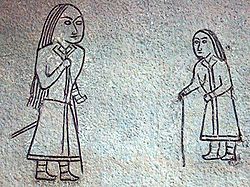
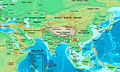 The Oghuz seem to have been related to the Pechenegs, some of whom were clean-shaven and others of whom had small 'goatee' beards. According to the book Attila and the Nomad Hordes, "Like the Kimaks they set up many carved wooden funerary statues surrounded by simple stone balbal monoliths." The authors of the book go on to note that "Those Uzes or Torks who settled along the Russian frontier were gradually Slavicized though they also played a leading role as cavalry in twelfth and early thirteenth century Russian armies where they were known as Black Hats.... Oghuz warriors served in almost all Islamic armies of the Middle East from the eleventh century onwards, in Byzantium from the ninth century, and even in Spain and Morocco." In later centuries, they adapted and applied their own traditions and institutions to the ends of the Islamic world and emerged as empire-builders with a constructive sense of statecraft.
Linguistically, the Oghuz are listed together with the old Kimaks of the middle Yenisei of the Ob, the old Kipchaks who later emigrated to southern Russia, and the modern Kirghiz in one particular Turkic group, distinguished from the rest by the mutation of the initial y sound to j (dj).
"The term 'Oghuz' was gradually supplanted among the Turks themselves by Türkmen
, 'Turcoman
', from the mid tenth century on, a process which was completed by the beginning of the thirteenth."
"The Ottoman dynasty, who gradually took over Anatolia after the fall of the Seljuks, toward the end of the thirteenth century, led an army that was also predominantly Oghuz."
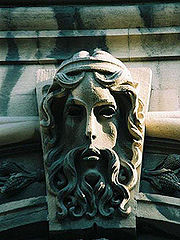
shan-yü Mao-tun subdued a people called Hu-chieh, west of Wu-sun. The early pronunciation of this transliteration suggests that they were ancestors of Oghur
/Oghuz." They were certainly related to the Chinese tribes of the east.
 The original homeland of the Oghuz, like other Turks, was the Ural
-Altay
region of Central Asia, which has been the domain of Turkic peoples since antiquity. Although their mass-migrations from Central Asia occurred from the 9th century onwards, they were present in areas west of the Caspian Sea centuries prior, although smaller in numbers and perhaps living with other Turks. For example, the Book of Dede Korkut
, the historical epic of the Oghuz Turks, was written from the ninth and tenth centuries.
According to many historians, the usage of the word "Oghuz" is dated back to the advent
of the Huns
(220 BC). The title of "Oghuz" (Oguz Khan) was given to Mau-Tun
, the founder of the Hun Empire, which is often considered the first Turkic political entity
in Central Asia.
Also in the 2nd century BC, a Turkic tribe called O-kut or Wuqi 呼揭, 呼得, 乌揭, 乌护 who were described as a western enemy of the Huns (referred to in Chinese
sources, Shiji, 110 and Suishu, 84) were mentioned in the area of the Irtysh River, in present-day Lake Zaysan
. It must be noted that the Greek
sources used the name Oufi (or Ouvvi) to describe the Oghuz Turks, a name they had also used to describe the Huns centuries earlier.
A number of tribal groupings bearing the name Oghuz, often with a numeral representing the number of united tribes in the union, are noted.
 The mention of the "six Oghuz tribal union" in the Turkic Orhun inscriptions
(6th century) pertains to the unification of the six Turkic tribes which became known as the Oghuz. This was the first written reference to Oghuz, and was dated to the period of the Göktürk empire. The Oghuz community gradually grew larger, uniting more Turkic tribes prior and during the Göktürk establishment.
Prior to the Göktürk state, there are references to the Sekiz-Oghuz ("eight-Oghuz") and the Dokuz-Oghuz ("nine-Oghuz") union. The Oghuz Turks under Sekiz-Oghuz and the Dokuz-Oghuz state formations ruled different areas in the vicinity of the Altay mountains. During the establishment of the Göktürk state, Oghuz tribes inhabited the Altay mountain region and also lived in northeastern areas of the Altay mountains along the Tula River
. They were also present as a community near the Barlik River in present-day northern Mongolia
.
Their main homeland and domain in the ensuing centuries was the area of Transoxiana
, in western Turkestan.
This land became known as the "Oghuz steppe," which is an area between the Caspian
and Aral Sea
s. Ibn al-Athir, an Arab
historian, declared that the Oghuz Turks had come to Transoxiana in the period of the caliph
Al-Mahdi
in the years between 775 and 785. In the period of the Abbasid
caliph Al-Ma'mun
(813–833), the name Oghuz starts to appear in the works of Islamic writers. By 780, the eastern parts of the Syr Darya
were ruled by the Karluk Turks and the western region (Oghuz steppe) was ruled by the Oghuz Turks.
 The militarism
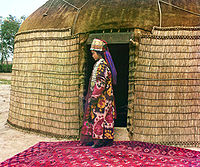
that the Oghuz empires were very well known for was rooted in their centuries-long nomadic lifestyle. In general they were a herding society which possessed certain military advantages that other societies did not have, particularly mobility. Alliances by marriage and kinship, and systems of "social distance" based on family relationships were the connective tissues of their society.
In Oghuz traditions, "society was simply the result of the growth of individual families". But such a society also grew by alliances and the expansion of different groups, normally through marriages. The shelter of the Oghuz tribes was a tent-like dwelling, erected on wooden poles and covered with skin, felt, or hand-woven textiles, which is called a yurt
.
Their cuisine included yahni (stew), kebabs, Toyga çorbası (lit. "wedding soup;" a soup made from wheat flour and yogurt), Kımız (a traditional drink of the Turks, made from horse milk), Pekmez
(a syrup made of boiled grape juice) and helva made with wheat starch or rice flour, tutmac (noodle soup), yufka (flattened bread), katmer (layered pastry), chorek (ring-shaped buns), bread, clotted cream, cheese, milk and ayran (diluted yogurt beverage), as well as wine.
Social order was maintained by emphasizing "correctness in conduct as well as ritual and ceremony." Ceremonies brought together the scattered members of the society to celebrate birth, puberty, marriage, and death. Such ceremonies had the effect of minimizing social dangers and also of adjusting persons to each other under controlled emotional conditions.
Patrilineally related men and their families were regarded as a group with rights over a particular territory and were distinguished from neighbours on a territorial basis. Marriages were often arranged among territorial groups so that neighbouring groups could become related, but this was the only organizing principle that extended territorial unity. Each community of the Oghuz Turks was thought of as part of a larger society composed of distant as well as close relatives. This signified "tribal allegiance." Wealth and materialistic objects were not commonly emphasized in Oghuz society and most remained herders, and when settled they would be active in agriculture.
Status within the family was based on age, gender, relationships by blood, or marriageability. Males as well as females were active in society, yet men were the backbones of leadership and organization. According to the Book of Dede Korkut which demonstrates the culture of the Oghuz Turks, women were "expert horse riders, archers, and athletes." The elders were respected as repositories of both "secular and spiritual wisdom."
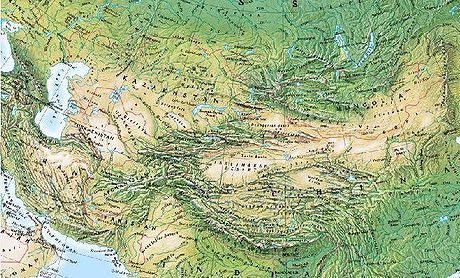 In the 8th century, the Oghuz Turks made a new home and domain for themselves in the area between the Caspian and Aral seas, a region that is often referred to as Transoxiana
, the western portion of Turkestan. They had moved westward from the Altay mountains passing through the Siberian steppes and settled in this region, and also penetrated into southern Russia
and the Volga from their bases in west China.
In his accredited work titled Diwan Lughat al-Turk, Mahmud of Kashgar, a Turkic scholar of the 11th century, described the Karachuk Mountains which are located just east of the Aral Sea as the original homeland of the Oghuz Turks. The Karachuk mountains are now known as the Tengri Tagh (Tian Shan
in Chinese) Mountains, and they are adjacent to Syr Darya.
The extension from the Karachuk Mountains towards the Caspian Sea (Transoxiana) was called the "Oghuz Steppe Lands" from where the Oghuz Turks established trading, religious and cultural contacts with the Abbasid Arab caliphate who ruled to the south. This is around the same time that they first converted to Islam and renounced their shamanist belief system. The Arab historians mentioned that the Oghuz Turks in their domain in Transoxiana were ruled by a number of kings and chieftains.
It was in this area that they later founded the Seljuk Empire, and it was from this area that they spread west into western Asia and eastern Europe during Turkic migrations from the 9th until the 12th century. The founders of the Ottoman Empire
were also Oghuz Turks.
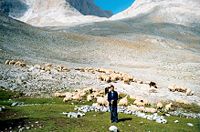 The Yörük, also Yürüks or Yuruks are a Turkic
people ultimately of Oghuz descent, some of whom are still semi-nomadic, primarily inhabiting the mountains of Anatolia and partly Balkan peninsula.Their name derives from the Turkish verb from [Eastern Turkish dialekt (Çagatay dialekt]- yörü "yörümek" , but Western Turkish dialekt (Garbi Türkçe) yürü- (yürümek in infinitive), which means "to walk", with the word Yörük or Yürük designating "those who walk, walkers".
The Yörük to this day appear as a distinct segment of the population of Macedonia
and Thrace
where they settled as early as the 14th century. While today the Yörük are increasingly settled, many of them still maintain their nomad
ic lifestyle, breeding goats and sheep in the Pindus
(Epirus
, Greece
and southern Albania
), the Šar Mountain
s (Republic of Macedonia
), the Pirin
and Rhodope Mountains
(Bulgaria
) and Dobrudja. An earlier offshoot of the Yörüks, the Kailars or Kayılar Turks were amongst the first Turkish colonists in Europe, (Kailar or Kayılar being the Turkish
name for the Greek town of Ptolemaida
which took its current name in 1928) formerly inhabiting parts of the Greek regions of Thessaly
and Macedonia
. Settled Yörüks could be found until 1923, especially near and in the town of Kozani
. The Yörüks are credited with the conversion to Islam in the 18th century, after a period of cohabitation, of a part of the native Meglen Vlachs
of Greece who in 1923 were expelled to Turkey
under the terms of the population exchange
between the two countries.
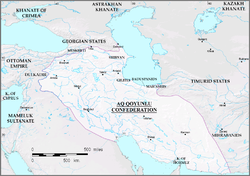
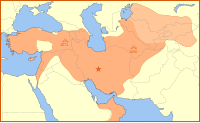 Bozoklar (Grey Arrows)
Üçoklar (Three Arrows)
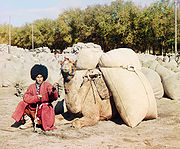 The terms "Turkmen" and "Turcoman" were often used as a designation for the Muslim-Oghuz Turks (Azerbaijanis, Turks of Turkey, Central Asian Turks) in periods of history although other Turkic factions described as Turks (Kumans, Khazars
, Uyghurs
, etc.), and the ethnic name that the modern Turkmens of Central Asia use to designate their nationality was formed later.
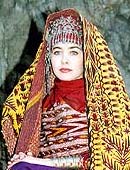 Although a term most commonly used for the Oghuz of Central Asia, the name "Turkmen" or "Turcoman" once applied to Azerbaijanis and the Turks of Turkey as well, distinguishing between other Turks and non-Muslim Turks. Some western books which were written prior to the modern age use the terms "Turcoman" for the descendants of the Oghuz Turks who were not from the Turkmen nationality of Central Asia, which is one of the branches of the Oghuz.
For example, it is written in many sources prior to the modern age that the largest component of the population of Azerbaijan is composed of "Turcoman tribes." The "Turkmen" reference in history books which is often used for Azerbaijanis and Turks of Turkey simply means "Muslim Turk" or "Muslim western Turk," which means Oghuz Turk.
In Turkey the word "Turkmen" refers to nomadic Turkish tribes (all Muslims), some of whom still continue this lifestyle.
According to the Encyclopædia Britannica
the name Turkmen is a synonym of Oghuz, which includes all the Turkish (Turkic) population who live to the southwest of Central Asia:
The Turkish historian Yılmaz Öztuna presents almost the same definition of the name "Turkmen." He labels the Turkmen Oghuz or western Turkish populations as:
which was UNESCO
's 2000 literacy work of the year, as well as the Oguznama and Köroğlu
epics which are part of the literary history of Azerbaijanis, Turks of Turkey and Turkmens. The modern and classical literature of Azerbaijan
, Turkey
and Central Asia are also considered Oghuz literature, since it was produced by their descendants.
The Book of Dede Korkut
is an invaluable collection of epics and stories, bearing witness to the language, the way of life, religions, traditions and social norms of the Oghuz Turks in Azerbaijan, Turkey and Central Asia.
Oghuz languages
The Oghuz languages, a major branch of the Turkic language family, are spoken by more than 110 million people in an area spanning from the Balkans to China.-Linguistic features:...
from the Oghur languages
Oghur languages
The Oghur or Bulgar , are a separate branch of the Turkic language family. It was historically spoken in Volga Bulgaria...
)
were a historical Turkic tribal confederation in Central Asia during the early medieval Turkic expansion.
The name Oghuz is just the Common Turkic
Common Turkic
Common Turkic or Shaz Turkic is a taxon in some of the classifications of the Turkic languages which in Lars Johanson proposal contain the following subgroups:...
word for "tribe"
Turkic tribal confederations
The Turkic term oğuz or oğur is a historical term for "military division; clan, tribe".The oguz were divisions of the early Turkic Nomadic empires of the 6th to 11th centuries, including Khazars, Avars, Bulgars and Uyghurs.With the Mongol invasions of 1206-1221, the Turkic khaganates were...
.
They are referred to as "Western Turks" because they moved west from other Turkic peoples after the Göktürk empire collapsed, and because the majority of the areas in which they inhabit today (except Turkmenistan
Turkmenistan
Turkmenistan , formerly also known as Turkmenia is one of the Turkic states in Central Asia. Until 1991, it was a constituent republic of the Soviet Union, the Turkmen Soviet Socialist Republic . Turkmenistan is one of the six independent Turkic states...
and the Turkmen Sahra
Turkmen Sahra
Turkmen Sahra that means Plain of Turkmens, is a region in the northeast of Iran near the Caspian Sea, bordering Turkmenistan, the majority of whose inhabitants are ethnic Turkmen. The biggest city is Gorgan which is dominated by Persian inhabitants though in recent years there has been...
) are west of the Caspian Sea
Caspian Sea
The Caspian Sea is the largest enclosed body of water on Earth by area, variously classed as the world's largest lake or a full-fledged sea. The sea has a surface area of and a volume of...
, while those referred to as "Eastern Turks" live east of the Caspian Sea. The founders of the Ottoman Empire
Ottoman Empire
The Ottoman EmpireIt was usually referred to as the "Ottoman Empire", the "Turkish Empire", the "Ottoman Caliphate" or more commonly "Turkey" by its contemporaries...
were also Oghuz Turks.
In the 9th century, the Oghuz Turks from the Aral
Aral
Aral, also known as Aralsk or Aral'sk, is a small city in south-western Kazakhstan, located in the oblast of Kyzylorda. It serves as the administrative center of Aral District. Population roughly 39,000...
steppes drove the Pecheneg Turks of the Emba
Emba
Emba is one of the largest villages in Paphos, Cyprus. It is spread over a wide area and not only borders Paphos but also the villages of Chlorakas, Kissonerga, Tala, Tremithousa and Mesogi. It has a population of 4,500 people....
region and the River Ural
Ural River
The Ural or Jayıq/Zhayyq , known as Yaik before 1775, is a river flowing through Russia and Kazakhstan. It arises in the southern Ural Mountains and ends at the Caspian Sea. Its total length is 1,511 mi making it the third longest river in Europe after the Volga and the Danube...
toward the west. In the 10th century they inhabited the steppe of the rivers Sari-su
Sary su River
The Sary su is a river in central Kazakhstan. It arises above Atasu and flows generally westward to Kzyl-Dzhar where it turns southwestard past Birlestik and Zhanabas, then heading ever-more southerly it ends at a series of small lakes called the Ozera Segiz...
, Turgai
Turgai
Turgai may refer to:* Turgai river-valley system in Kazakhstan* Turgai Oblast - an administrative unit of the Russian Empire* Turgai Sea or Turgai Strait, an inland sea in palaeogeography...
, and Emba to the north of Lake Balkhash
Lake Balkhash
Lake Balkhash is one of the largest lakes in Asia and 12th largest continental lake in the world. It is located in southeastern Kazakhstan, in Central Asia, and belongs to an endorheic basin shared by Kazakhstan and China, with a small part in Kyrgyzstan. The basin drains into the lake via seven...
of modern day Kazakhstan
Kazakhstan
Kazakhstan , officially the Republic of Kazakhstan, is a transcontinental country in Central Asia and Eastern Europe. Ranked as the ninth largest country in the world, it is also the world's largest landlocked country; its territory of is greater than Western Europe...
. A clan of this nation, the Seljuks
Seljuq dynasty
The Seljuq ; were a Turco-Persian Sunni Muslim dynasty that ruled parts of Central Asia and the Middle East from the 11th to 14th centuries...
, embraced Islam
Islam
Islam . The most common are and . : Arabic pronunciation varies regionally. The first vowel ranges from ~~. The second vowel ranges from ~~~...
and in the 11th century entered Persia, where they founded the Great Seljuk Empire.
Similarly, in the 11th century a Tengriist Oghuz clan—referred to as Uzes or Torks in the Russian chronicles—overthrew Pecheneg supremacy in the Russian steppe. Harried by another Turkic horde, the Kipchaks
Kipchaks
Kipchaks were a Turkic tribal confederation...
—a branch of the Kimaks of the middle Irtysh
Irtysh
The Irtysh River is a river in Siberia and is the chief tributary of the Ob River. Its name means White River. Irtysh's main affluent is the Tobol River...
or of the Ob
Ob River
The Ob River , also Obi, is a major river in western Siberia, Russia and is the world's seventh longest river. It is the westernmost of the three great Siberian rivers that flow into the Arctic Ocean .The Gulf of Ob is the world's longest estuary.-Names:The Ob is known to the Khanty people as the...
—these Oghuz penetrated as far as the lower Danube
Danube
The Danube is a river in the Central Europe and the Europe's second longest river after the Volga. It is classified as an international waterway....
, crossed it and invaded the Balkans, where they were either crushed or struck down by an outbreak of plague, causing the survivors either to flee or to join the Byzantine imperial forces as mercenaries (1065).
Linguistically, the Oghuz are listed together with the old Kimaks of the middle Yenisei of the Ob, the old Kipchaks who later emigrated to southern Russia, and the modern Kirghiz in one particular Turkic group, distinguished from the rest by the mutation of the initial y sound to j (dj).
"The term 'Oghuz' was gradually supplanted among the Turks themselves by Türkmen
Turkmen
Turkmen or Turkoman or Turkman may refer to:* Of or relating to Turkmenistan, a country in Central Asia, specifically:** Turkmen SSR, that country as a constituent republic of the former Soviet Union...
, 'Turcoman
Turkmen people
The Turkmen are a Turkic people located primarily in the Central Asian states of Turkmenistan, Afghanistan, and northeastern Iran. They speak the Turkmen language, which is classified as a part of the Western Oghuz branch of the Turkic languages family together with Turkish, Azerbaijani, Qashqai,...
', from the mid tenth century on, a process which was completed by the beginning of the thirteenth."
"The Ottoman dynasty, who gradually took over Anatolia after the fall of the Seljuks, toward the end of the thirteenth century, led an army that was also predominantly Oghuz."
Origins
"In 178-177 BC, the XiongnuXiongnu
The Xiongnu were ancient nomadic-based people that formed a state or confederation north of the agriculture-based empire of the Han Dynasty. Most of the information on the Xiongnu comes from Chinese sources...
shan-yü Mao-tun subdued a people called Hu-chieh, west of Wu-sun. The early pronunciation of this transliteration suggests that they were ancestors of Oghur
Oghur
Oghur may be:* an early Turkic word for "tribe", see Oghur * the Turkic Oghur languages...
/Oghuz." They were certainly related to the Chinese tribes of the east.
Ural Mountains
The Ural Mountains , or simply the Urals, are a mountain range that runs approximately from north to south through western Russia, from the coast of the Arctic Ocean to the Ural River and northwestern Kazakhstan. Their eastern side is usually considered the natural boundary between Europe and Asia...
-Altay
Altay Mountains
The Altai Mountains are a mountain range in East-Central Asia, where Russia, China, Mongolia and Kazakhstan come together, and where the rivers Irtysh and Ob have their sources. The Altai Mountains are known as the original locus of the speakers of Turkic as well as other members of the proposed...
region of Central Asia, which has been the domain of Turkic peoples since antiquity. Although their mass-migrations from Central Asia occurred from the 9th century onwards, they were present in areas west of the Caspian Sea centuries prior, although smaller in numbers and perhaps living with other Turks. For example, the Book of Dede Korkut
Book of Dede Korkut
The Book of Dede Korkut, also spelled as Dada Gorgud, Dede Qorqut or Korkut-ata , is the most famous epic stories of the Oghuz Turks The stories carry morals and values significant to the social lifestyle of the nomadic Turks and their pre-Islamic beliefs...
, the historical epic of the Oghuz Turks, was written from the ninth and tenth centuries.
According to many historians, the usage of the word "Oghuz" is dated back to the advent
Advent
Advent is a season observed in many Western Christian churches, a time of expectant waiting and preparation for the celebration of the Nativity of Jesus at Christmas. It is the beginning of the Western liturgical year and commences on Advent Sunday, called Levavi...
of the Huns
Huns
The Huns were a group of nomadic people who, appearing from east of the Volga River, migrated into Europe c. AD 370 and established the vast Hunnic Empire there. Since de Guignes linked them with the Xiongnu, who had been northern neighbours of China 300 years prior to the emergence of the Huns,...
(220 BC). The title of "Oghuz" (Oguz Khan) was given to Mau-Tun
Modu Shanyu
Modu Chanyu was born c. 234 BCE was the fourth known emperor and founder of the Xiongnu Empire after he killed his father in 209 BCE. The years of his rule were 209 BCE to 174 BCE...
, the founder of the Hun Empire, which is often considered the first Turkic political entity
Entity
An entity is something that has a distinct, separate existence, although it need not be a material existence. In particular, abstractions and legal fictions are usually regarded as entities. In general, there is also no presumption that an entity is animate.An entity could be viewed as a set...
in Central Asia.
Also in the 2nd century BC, a Turkic tribe called O-kut or Wuqi 呼揭, 呼得, 乌揭, 乌护 who were described as a western enemy of the Huns (referred to in Chinese
China
Chinese civilization may refer to:* China for more general discussion of the country.* Chinese culture* Greater China, the transnational community of ethnic Chinese.* History of China* Sinosphere, the area historically affected by Chinese culture...
sources, Shiji, 110 and Suishu, 84) were mentioned in the area of the Irtysh River, in present-day Lake Zaysan
Lake Zaysan
Lake Zaysan is a freshwater lake, ca. 1,810 km² , in eastern Kazakhstan, in a hollow between the Altai and Tarbagatai Mountains. It is the largest lake in the East Kazakhstan Province....
. It must be noted that the Greek
Greece
Greece , officially the Hellenic Republic , and historically Hellas or the Republic of Greece in English, is a country in southeastern Europe....
sources used the name Oufi (or Ouvvi) to describe the Oghuz Turks, a name they had also used to describe the Huns centuries earlier.
A number of tribal groupings bearing the name Oghuz, often with a numeral representing the number of united tribes in the union, are noted.
Orkhon inscriptions
"Orkhon inscription" may refer to:*two monuments in the Orkhon valley, see Khöshöö Tsaidam Monuments*inscriptions in the Old Turkic "Orkhon alphabet" in general, see Old Turkic epigraphy...
(6th century) pertains to the unification of the six Turkic tribes which became known as the Oghuz. This was the first written reference to Oghuz, and was dated to the period of the Göktürk empire. The Oghuz community gradually grew larger, uniting more Turkic tribes prior and during the Göktürk establishment.
Prior to the Göktürk state, there are references to the Sekiz-Oghuz ("eight-Oghuz") and the Dokuz-Oghuz ("nine-Oghuz") union. The Oghuz Turks under Sekiz-Oghuz and the Dokuz-Oghuz state formations ruled different areas in the vicinity of the Altay mountains. During the establishment of the Göktürk state, Oghuz tribes inhabited the Altay mountain region and also lived in northeastern areas of the Altay mountains along the Tula River
Tula River
Rio Tula is a river in Hidalgo state in central Mexico. It runs through the ancient town of Tula....
. They were also present as a community near the Barlik River in present-day northern Mongolia
Mongolia
Mongolia is a landlocked country in East and Central Asia. It is bordered by Russia to the north and China to the south, east and west. Although Mongolia does not share a border with Kazakhstan, its western-most point is only from Kazakhstan's eastern tip. Ulan Bator, the capital and largest...
.
Their main homeland and domain in the ensuing centuries was the area of Transoxiana
Transoxiana
Transoxiana is the ancient name used for the portion of Central Asia corresponding approximately with modern-day Uzbekistan, Tajikistan, southern Kyrgystan and southwest Kazakhstan. Geographically, it is the region between the Amu Darya and Syr Darya rivers...
, in western Turkestan.
This land became known as the "Oghuz steppe," which is an area between the Caspian
Caspian Sea
The Caspian Sea is the largest enclosed body of water on Earth by area, variously classed as the world's largest lake or a full-fledged sea. The sea has a surface area of and a volume of...
and Aral Sea
Aral Sea
The Aral Sea was a lake that lay between Kazakhstan in the north and Karakalpakstan, an autonomous region of Uzbekistan, in the south...
s. Ibn al-Athir, an Arab
Arab
Arab people, also known as Arabs , are a panethnicity primarily living in the Arab world, which is located in Western Asia and North Africa. They are identified as such on one or more of genealogical, linguistic, or cultural grounds, with tribal affiliations, and intra-tribal relationships playing...
historian, declared that the Oghuz Turks had come to Transoxiana in the period of the caliph
Caliph
The Caliph is the head of state in a Caliphate, and the title for the ruler of the Islamic Ummah, an Islamic community ruled by the Shari'ah. It is a transcribed version of the Arabic word which means "successor" or "representative"...
Al-Mahdi
Al-Mahdi
Muhammad ibn Mansur al-Mahdi , was the third Abbasid Caliph who reigned from 158 AH to 169 AH . He succeeded his father, al-Mansur....
in the years between 775 and 785. In the period of the Abbasid
Abbasid
The Abbasid Caliphate or, more simply, the Abbasids , was the third of the Islamic caliphates. It was ruled by the Abbasid dynasty of caliphs, who built their capital in Baghdad after overthrowing the Umayyad caliphate from all but the al-Andalus region....
caliph Al-Ma'mun
Al-Ma'mun
Abū Jaʿfar Abdullāh al-Māʾmūn ibn Harūn was an Abbasid caliph who reigned from 813 until his death in 833...
(813–833), the name Oghuz starts to appear in the works of Islamic writers. By 780, the eastern parts of the Syr Darya
Syr Darya
The Syr Darya , also transliterated Syrdarya or Sirdaryo, is a river in Central Asia, sometimes known as the Jaxartes or Yaxartes from its Ancient Greek name . The Greek name is derived from Old Persian, Yakhsha Arta , a reference to the color of the river's water...
were ruled by the Karluk Turks and the western region (Oghuz steppe) was ruled by the Oghuz Turks.
Social units
Militarism
Militarism is defined as: the belief or desire of a government or people that a country should maintain a strong military capability and be prepared to use it aggressively to defend or promote national interests....
that the Oghuz empires were very well known for was rooted in their centuries-long nomadic lifestyle. In general they were a herding society which possessed certain military advantages that other societies did not have, particularly mobility. Alliances by marriage and kinship, and systems of "social distance" based on family relationships were the connective tissues of their society.
In Oghuz traditions, "society was simply the result of the growth of individual families". But such a society also grew by alliances and the expansion of different groups, normally through marriages. The shelter of the Oghuz tribes was a tent-like dwelling, erected on wooden poles and covered with skin, felt, or hand-woven textiles, which is called a yurt
Yurt
A yurt is a portable, bent wood-framed dwelling structure traditionally used by Turkic nomads in the steppes of Central Asia. The structure comprises a crown or compression wheel usually steam bent, supported by roof ribs which are bent down at the end where they meet the lattice wall...
.
Their cuisine included yahni (stew), kebabs, Toyga çorbası (lit. "wedding soup;" a soup made from wheat flour and yogurt), Kımız (a traditional drink of the Turks, made from horse milk), Pekmez
Pekmez
Pekmez or dibs is amolasses-like syrup obtained after condensing juices of fruit must, especially grape, fig or mulberry, by boiling it with a coagulant agent. It is used as a syrup or mixed with tahini for breakfast....
(a syrup made of boiled grape juice) and helva made with wheat starch or rice flour, tutmac (noodle soup), yufka (flattened bread), katmer (layered pastry), chorek (ring-shaped buns), bread, clotted cream, cheese, milk and ayran (diluted yogurt beverage), as well as wine.
Social order was maintained by emphasizing "correctness in conduct as well as ritual and ceremony." Ceremonies brought together the scattered members of the society to celebrate birth, puberty, marriage, and death. Such ceremonies had the effect of minimizing social dangers and also of adjusting persons to each other under controlled emotional conditions.
Patrilineally related men and their families were regarded as a group with rights over a particular territory and were distinguished from neighbours on a territorial basis. Marriages were often arranged among territorial groups so that neighbouring groups could become related, but this was the only organizing principle that extended territorial unity. Each community of the Oghuz Turks was thought of as part of a larger society composed of distant as well as close relatives. This signified "tribal allegiance." Wealth and materialistic objects were not commonly emphasized in Oghuz society and most remained herders, and when settled they would be active in agriculture.
Status within the family was based on age, gender, relationships by blood, or marriageability. Males as well as females were active in society, yet men were the backbones of leadership and organization. According to the Book of Dede Korkut which demonstrates the culture of the Oghuz Turks, women were "expert horse riders, archers, and athletes." The elders were respected as repositories of both "secular and spiritual wisdom."
Homeland in Transoxiana
Transoxiana
Transoxiana is the ancient name used for the portion of Central Asia corresponding approximately with modern-day Uzbekistan, Tajikistan, southern Kyrgystan and southwest Kazakhstan. Geographically, it is the region between the Amu Darya and Syr Darya rivers...
, the western portion of Turkestan. They had moved westward from the Altay mountains passing through the Siberian steppes and settled in this region, and also penetrated into southern Russia
Russia
Russia or , officially known as both Russia and the Russian Federation , is a country in northern Eurasia. It is a federal semi-presidential republic, comprising 83 federal subjects...
and the Volga from their bases in west China.
In his accredited work titled Diwan Lughat al-Turk, Mahmud of Kashgar, a Turkic scholar of the 11th century, described the Karachuk Mountains which are located just east of the Aral Sea as the original homeland of the Oghuz Turks. The Karachuk mountains are now known as the Tengri Tagh (Tian Shan
Tian Shan
The Tian Shan , also spelled Tien Shan, is a large mountain system located in Central Asia. The highest peak in the Tian Shan is Victory Peak , ....
in Chinese) Mountains, and they are adjacent to Syr Darya.
The extension from the Karachuk Mountains towards the Caspian Sea (Transoxiana) was called the "Oghuz Steppe Lands" from where the Oghuz Turks established trading, religious and cultural contacts with the Abbasid Arab caliphate who ruled to the south. This is around the same time that they first converted to Islam and renounced their shamanist belief system. The Arab historians mentioned that the Oghuz Turks in their domain in Transoxiana were ruled by a number of kings and chieftains.
It was in this area that they later founded the Seljuk Empire, and it was from this area that they spread west into western Asia and eastern Europe during Turkic migrations from the 9th until the 12th century. The founders of the Ottoman Empire
Ottoman Empire
The Ottoman EmpireIt was usually referred to as the "Ottoman Empire", the "Turkish Empire", the "Ottoman Caliphate" or more commonly "Turkey" by its contemporaries...
were also Oghuz Turks.
Oghuz and Yörüks
Turkic peoples
The Turkic peoples are peoples residing in northern, central and western Asia, southern Siberia and northwestern China and parts of eastern Europe. They speak languages belonging to the Turkic language family. They share, to varying degrees, certain cultural traits and historical backgrounds...
people ultimately of Oghuz descent, some of whom are still semi-nomadic, primarily inhabiting the mountains of Anatolia and partly Balkan peninsula.Their name derives from the Turkish verb from [Eastern Turkish dialekt (Çagatay dialekt]- yörü "yörümek" , but Western Turkish dialekt (Garbi Türkçe) yürü- (yürümek in infinitive), which means "to walk", with the word Yörük or Yürük designating "those who walk, walkers".
The Yörük to this day appear as a distinct segment of the population of Macedonia
Macedonia (region)
Macedonia is a geographical and historical region of the Balkan peninsula in southeastern Europe. Its boundaries have changed considerably over time, but nowadays the region is considered to include parts of five Balkan countries: Greece, the Republic of Macedonia, Bulgaria, Albania, Serbia, as...
and Thrace
Thrace
Thrace is a historical and geographic area in southeast Europe. As a geographical concept, Thrace designates a region bounded by the Balkan Mountains on the north, Rhodope Mountains and the Aegean Sea on the south, and by the Black Sea and the Sea of Marmara on the east...
where they settled as early as the 14th century. While today the Yörük are increasingly settled, many of them still maintain their nomad
Nomad
Nomadic people , commonly known as itinerants in modern-day contexts, are communities of people who move from one place to another, rather than settling permanently in one location. There are an estimated 30-40 million nomads in the world. Many cultures have traditionally been nomadic, but...
ic lifestyle, breeding goats and sheep in the Pindus
Pindus
The Pindus mountain range is located in northern Greece and southern Albania. It is roughly 160 km long, with a maximum elevation of 2637 m . Because it runs along the border of Thessaly and Epirus, the Pindus range is often called the "spine of Greece"...
(Epirus
Epirus (periphery)
Epirus , formally the Epirus Region , is a geographical and administrative region in northwestern Greece. It borders the regions of West Macedonia and Thessaly to the east, West Greece to the south, the Ionian Sea and the Ionian Islands to the west and the country of Albania to the north. The...
, Greece
Greece
Greece , officially the Hellenic Republic , and historically Hellas or the Republic of Greece in English, is a country in southeastern Europe....
and southern Albania
Albania
Albania , officially known as the Republic of Albania , is a country in Southeastern Europe, in the Balkans region. It is bordered by Montenegro to the northwest, Kosovo to the northeast, the Republic of Macedonia to the east and Greece to the south and southeast. It has a coast on the Adriatic Sea...
), the Šar Mountain
Šar Mountain
The Šar Mountains , formerly known as the Shar Dagh , is a mountain range in the Balkans that extends from southern Kosovo and the northwest of the Republic of Macedonia to northeastern Albania.-Etymology:...
s (Republic of Macedonia
Republic of Macedonia
Macedonia , officially the Republic of Macedonia , is a country located in the central Balkan peninsula in Southeast Europe. It is one of the successor states of the former Yugoslavia, from which it declared independence in 1991...
), the Pirin
Pirin
The Pirin Mountains are a mountain range in southwestern Bulgaria, with Vihren the highest peak, situated at . The range extends about 40 km northwest-southeast, and about 25 km wide. Most of the range is protected in the Pirin National Park...
and Rhodope Mountains
Rhodope Mountains
The Rhodopes are a mountain range in Southeastern Europe, with over 83% of its area in southern Bulgaria and the remainder in Greece. Its highest peak, Golyam Perelik , is the seventh highest Bulgarian mountain...
(Bulgaria
Bulgaria
Bulgaria , officially the Republic of Bulgaria , is a parliamentary democracy within a unitary constitutional republic in Southeast Europe. The country borders Romania to the north, Serbia and Macedonia to the west, Greece and Turkey to the south, as well as the Black Sea to the east...
) and Dobrudja. An earlier offshoot of the Yörüks, the Kailars or Kayılar Turks were amongst the first Turkish colonists in Europe, (Kailar or Kayılar being the Turkish
Turkish language
Turkish is a language spoken as a native language by over 83 million people worldwide, making it the most commonly spoken of the Turkic languages. Its speakers are located predominantly in Turkey and Northern Cyprus with smaller groups in Iraq, Greece, Bulgaria, the Republic of Macedonia, Kosovo,...
name for the Greek town of Ptolemaida
Ptolemaida
Ptolemaida is a town and a former municipality in Kozani peripheral unit, West Macedonia, Greece. Since the 2011 local government reform it is part of the municipality Eordaia, of which it is the seat and a municipal unit...
which took its current name in 1928) formerly inhabiting parts of the Greek regions of Thessaly
Thessaly
Thessaly is a traditional geographical region and an administrative region of Greece, comprising most of the ancient region of the same name. Before the Greek Dark Ages, Thessaly was known as Aeolia, and appears thus in Homer's Odyssey....
and Macedonia
Macedonia (Greece)
Macedonia is a geographical and historical region of Greece in Southern Europe. Macedonia is the largest and second most populous Greek region...
. Settled Yörüks could be found until 1923, especially near and in the town of Kozani
Kozani
Kozani is a city in northern Greece, capital of Kozani regional unit and of West Macedonia region. It is located in the western part of Macedonia, in the northern part of the Aliakmonas river valley...
. The Yörüks are credited with the conversion to Islam in the 18th century, after a period of cohabitation, of a part of the native Meglen Vlachs
Megleno-Romanians
The Megleno-Romanians or Meglen Vlachs or Moglenite Vlachs, are a small Eastern Romance people, currently inhabiting seven villages in the Moglena region spanning the Pella and Kilkis prefectures of Central Macedonia, Greece, and one village, Huma, across the border in the Republic of...
of Greece who in 1923 were expelled to Turkey
Turkey
Turkey , known officially as the Republic of Turkey , is a Eurasian country located in Western Asia and in East Thrace in Southeastern Europe...
under the terms of the population exchange
Population exchange between Greece and Turkey
The 1923 population exchange between Greece and Turkey was based upon religious identity, and involved the Greek Orthodox citizens of Turkey and the Muslim citizens of Greece...
between the two countries.
Oghuz Turk dynasties
- Seljuks
- White Sheep TurcomansAk KoyunluThe Aq Qoyunlu or Ak Koyunlu, also called the White Sheep Turkomans , was an Sunni Oghuz Turkic tribal federation that ruled parts of present-day Eastern Turkey, Armenia, Azerbaijan, northern Iraq, and Iran from 1378 to 1508.-History:According to chronicles from the Byzantine Empire, the Aq Qoyunlu...
- Black Sheep TurcomansKara KoyunluThe Kara Koyunlu or Qara Qoyunlu, also called the Black Sheep Turkomans , were a Shi'ite Oghuz Turkic tribal federation that ruled over the territory comprising the present-day Armenia, Azerbaijan, north-western Iran, eastern Turkey and Iraq from about 1375 to 1468.The Kara Koyunlu Turkomans at one...
- Afsharids
- OttomansOttoman DynastyThe Ottoman Dynasty ruled the Ottoman Empire from 1299 to 1922, beginning with Osman I , though the dynasty was not proclaimed until Orhan Bey declared himself sultan...
- Qajars
- Artuqids
Traditional tribal organization
- Kayı (founders of the OttomanOttoman DynastyThe Ottoman Dynasty ruled the Ottoman Empire from 1299 to 1922, beginning with Osman I , though the dynasty was not proclaimed until Orhan Bey declared himself sultan...
dynasty and Ghaznavids Dynasty and Jandarids)
- Bayat (founders of the Qajar dynastyQajar dynastyThe Qajar dynasty was an Iranian royal family of Turkic descent who ruled Persia from 1785 to 1925....
and Dulkadirids FuzûlîFuzûlîFużūlī was the pen name of the Azerbaijani or the Bayat branch of Oghuz Turkish and Ottoman poet, writer and thinker Muhammad bin Suleyman...
) - Alkaevli
- Karaevli
- Yazır
- Döger (founders of the Artuqid dynastyArtuqid dynastyThe Artquids or Artuqid dynasty was a Turkmen dynasty that ruled in Eastern Anatolia, Northern Syria and Northern Iraq in the eleventh and twelfth centuries...
) - Dodurga
- Yaparlı
- AfsharAfshar tribeAfshars, also called Avshar are a branch of the Turkic Oghuz groups. These originally nomadic Oghuz tribes moved from Central Asia through Iran, Afghanistan, Syria, and finally most of them settled in Anatolia.Most of Afshars are followers of Shia Islam....
(founders of the Afsharid dynasty Nader ShahNader ShahNāder Shāh Afshār ruled as Shah of Iran and was the founder of the Afsharid dynasty. Because of his military genius, some historians have described him as the Napoleon of Persia or the Second Alexander...
and Karamanid dynasty ) - Kızık
- Begdili (founders of the Khwarazmian dynasty )
- Kargın
Üçoklar (Three Arrows)
- Bayındır (founders of the Ak KoyunluAk KoyunluThe Aq Qoyunlu or Ak Koyunlu, also called the White Sheep Turkomans , was an Sunni Oghuz Turkic tribal federation that ruled parts of present-day Eastern Turkey, Armenia, Azerbaijan, northern Iraq, and Iran from 1378 to 1508.-History:According to chronicles from the Byzantine Empire, the Aq Qoyunlu...
dynasty and Safavid dynastySafavid dynastyThe Safavid dynasty was one of the most significant ruling dynasties of Iran. They ruled one of the greatest Persian empires since the Muslim conquest of Persia and established the Twelver school of Shi'a Islam as the official religion of their empire, marking one of the most important turning...
) - Pecheneg
- Çavuldur Tzachas
- Chepni
- SalurSalur tribeSalur, Salyr or Salgur were an ancient Oghuz Turkic people and a sub-branch of the Üçok tribal federation. The medieval Karamanid principality in Anatolia belonged to the Karaman branch of the Salur...
(founders of the Kara KoyunluKara KoyunluThe Kara Koyunlu or Qara Qoyunlu, also called the Black Sheep Turkomans , were a Shi'ite Oghuz Turkic tribal federation that ruled over the territory comprising the present-day Armenia, Azerbaijan, north-western Iran, eastern Turkey and Iraq from about 1375 to 1468.The Kara Koyunlu Turkomans at one...
dynasty and Kadi Burhan al-DinKadi Burhan al-DinKadi Burhan al-Din Ahmed was vizier and atabeg to the Eretnid rulers of Anatolia. In 783 AH he took over Eretnid lands and claimed the title of sultan for himself. He was an outstanding Turkish poet. He was also a poet who wrote primarily in Persian...
and Salgurlular State in IraqIraqIraq ; officially the Republic of Iraq is a country in Western Asia spanning most of the northwestern end of the Zagros mountain range, the eastern part of the Syrian Desert and the northern part of the Arabian Desert....
Salar people ) - EymürEymurEymur is a village and municipality in the Agdash Rayon of Azerbaijan. It has a population of 953. The municipality consists of the villages of Eymur, Ağcaqovaq, and Ərəbşəki....
KarakalpaksKarakalpaksThe Karakalpaks are a Turkic speaking people. They mainly live in the lower reaches of the Amu Darya and in the delta of Amu Darya on the southern shore of the Aral Sea in Uzbekistan. The name "Karakalpak" comes from two words: "qara" meaning black, and "qalpaq" meaning hat... - Alayuntlu
- Yüreğir (founders of the Ramadanid dynasty)
- İgdirIgdirIğdır is the capital of Iğdır Province in the Eastern Anatolia Region, Turkey, and borders Armenia, Azerbaijan and Iran. The border with Armenia is formed by the Aras River...
- Büğdüz
- Yıva
- Kınık (founders of the Seljuk Empire
Turcoman & Turkmen
Khazars
The Khazars were semi-nomadic Turkic people who established one of the largest polities of medieval Eurasia, with the capital of Atil and territory comprising much of modern-day European Russia, western Kazakhstan, eastern Ukraine, Azerbaijan, large portions of the northern Caucasus , parts of...
, Uyghurs
Uyghur people
The Uyghur are a Turkic ethnic group living in Eastern and Central Asia. Today, Uyghurs live primarily in the Xinjiang Uyghur Autonomous Region in the People's Republic of China...
, etc.), and the ethnic name that the modern Turkmens of Central Asia use to designate their nationality was formed later.
For example, it is written in many sources prior to the modern age that the largest component of the population of Azerbaijan is composed of "Turcoman tribes." The "Turkmen" reference in history books which is often used for Azerbaijanis and Turks of Turkey simply means "Muslim Turk" or "Muslim western Turk," which means Oghuz Turk.
In Turkey the word "Turkmen" refers to nomadic Turkish tribes (all Muslims), some of whom still continue this lifestyle.
According to the Encyclopædia Britannica
Encyclopædia Britannica
The Encyclopædia Britannica , published by Encyclopædia Britannica, Inc., is a general knowledge English-language encyclopaedia that is available in print, as a DVD, and on the Internet. It is written and continuously updated by about 100 full-time editors and more than 4,000 expert...
the name Turkmen is a synonym of Oghuz, which includes all the Turkish (Turkic) population who live to the southwest of Central Asia:
- TurkeyTurkeyTurkey , known officially as the Republic of Turkey , is a Eurasian country located in Western Asia and in East Thrace in Southeastern Europe...
- AzerbaijanAzerbaijanAzerbaijan , officially the Republic of Azerbaijan is the largest country in the Caucasus region of Eurasia. Located at the crossroads of Western Asia and Eastern Europe, it is bounded by the Caspian Sea to the east, Russia to the north, Georgia to the northwest, Armenia to the west, and Iran to...
- TurkmeneliTurkmeneliTurkmeneli is the territory claimed as homeland by the Iraqi Turkmen Front.Turkmeneli includes within its boundaries Kirkuk, Tel Afar, Erbil, Madali, Mosul, and Tuz Khormato.-External links:...
- TurkmenistanTurkmenistanTurkmenistan , formerly also known as Turkmenia is one of the Turkic states in Central Asia. Until 1991, it was a constituent republic of the Soviet Union, the Turkmen Soviet Socialist Republic . Turkmenistan is one of the six independent Turkic states...
- in other countries:
- AfghanistanAfghanistanAfghanistan , officially the Islamic Republic of Afghanistan, is a landlocked country located in the centre of Asia, forming South Asia, Central Asia and the Middle East. With a population of about 29 million, it has an area of , making it the 42nd most populous and 41st largest nation in the world...
- IraqIraqIraq ; officially the Republic of Iraq is a country in Western Asia spanning most of the northwestern end of the Zagros mountain range, the eastern part of the Syrian Desert and the northern part of the Arabian Desert....
, SyriaSyriaSyria , officially the Syrian Arab Republic , is a country in Western Asia, bordering Lebanon and the Mediterranean Sea to the West, Turkey to the north, Iraq to the east, Jordan to the south, and Israel to the southwest....
and other Arab countries - GreeceGreeceGreece , officially the Hellenic Republic , and historically Hellas or the Republic of Greece in English, is a country in southeastern Europe....
, CyprusCyprusCyprus , officially the Republic of Cyprus , is a Eurasian island country, member of the European Union, in the Eastern Mediterranean, east of Greece, south of Turkey, west of Syria and north of Egypt. It is the third largest island in the Mediterranean Sea.The earliest known human activity on the...
, BulgariaBulgariaBulgaria , officially the Republic of Bulgaria , is a parliamentary democracy within a unitary constitutional republic in Southeast Europe. The country borders Romania to the north, Serbia and Macedonia to the west, Greece and Turkey to the south, as well as the Black Sea to the east...
, SerbiaSerbiaSerbia , officially the Republic of Serbia , is a landlocked country located at the crossroads of Central and Southeast Europe, covering the southern part of the Carpathian basin and the central part of the Balkans...
, MoldovaMoldovaMoldova , officially the Republic of Moldova is a landlocked state in Eastern Europe, located between Romania to the West and Ukraine to the North, East and South. It declared itself an independent state with the same boundaries as the preceding Moldavian Soviet Socialist Republic in 1991, as part...
and the Republic of MacedoniaRepublic of MacedoniaMacedonia , officially the Republic of Macedonia , is a country located in the central Balkan peninsula in Southeast Europe. It is one of the successor states of the former Yugoslavia, from which it declared independence in 1991...
- Afghanistan
The Turkish historian Yılmaz Öztuna presents almost the same definition of the name "Turkmen." He labels the Turkmen Oghuz or western Turkish populations as:
- Ottomans
- Azerbaijan
- Turkmen (Turkmenistan)
Literature
Oghuz Turkish literature includes the famous Book of Dede KorkutBook of Dede Korkut
The Book of Dede Korkut, also spelled as Dada Gorgud, Dede Qorqut or Korkut-ata , is the most famous epic stories of the Oghuz Turks The stories carry morals and values significant to the social lifestyle of the nomadic Turks and their pre-Islamic beliefs...
which was UNESCO
UNESCO
The United Nations Educational, Scientific and Cultural Organization is a specialized agency of the United Nations...
's 2000 literacy work of the year, as well as the Oguznama and Köroğlu
Epic of Köroglu
The Epic of Köroğlu is a heroic legend prominent in the oral traditions of the Turkic peoples. The legend typically describes a hero who seeks to avenge a wrong. It was often put to music and played at sporting events as an inspiration to the competing athletes.The legend first began to take shape...
epics which are part of the literary history of Azerbaijanis, Turks of Turkey and Turkmens. The modern and classical literature of Azerbaijan
Azerbaijani literature
Azerbaijani literature refers to the literature written in Azerbaijani, which currently is the official state language of the Republic of Azerbaijan and is widely spoken in northwestern Iran and eastern Turkey...
, Turkey
Turkish literature
Turkish literature comprises both oral compositions and written texts in the Turkish language, either in its Ottoman form or in less exclusively literary forms, such as that spoken in the Republic of Turkey today...
and Central Asia are also considered Oghuz literature, since it was produced by their descendants.
The Book of Dede Korkut
Book of Dede Korkut
The Book of Dede Korkut, also spelled as Dada Gorgud, Dede Qorqut or Korkut-ata , is the most famous epic stories of the Oghuz Turks The stories carry morals and values significant to the social lifestyle of the nomadic Turks and their pre-Islamic beliefs...
is an invaluable collection of epics and stories, bearing witness to the language, the way of life, religions, traditions and social norms of the Oghuz Turks in Azerbaijan, Turkey and Central Asia.
See also
- AfsharAfsharAfshar is a district of Kabul, Afghanistan. Most of its population are of the Shia-Hazara ethnic group....
- GokturksGöktürksThe Göktürks or Kök Türks, were a nomadic confederation of peoples in medieval Inner Asia. Known in Chinese sources as 突厥 , the Göktürks under the leadership of Bumin Qaghan The Göktürks or Kök Türks, (Old Turkic: Türük or Kök Türük or Türük; Celestial Turks) were a nomadic confederation of...
- KimekKimekThe Kimek or Kimak were one of the Turkic tribes known from Arab and Persian medieval geographers as one of the seven tribes in the Kimek Khanate in the period of 743-1050 AD. The other six constituent tribes, according to Abu Said Gardizi The Kimek or Kimak (Yemek, Yamak, Djamuk) were one of the...
- Oghuz languagesOghuz languagesThe Oghuz languages, a major branch of the Turkic language family, are spoken by more than 110 million people in an area spanning from the Balkans to China.-Linguistic features:...
- Salar people
- Tokuz-OguzesTokuz-OguzesToquz Oghuz is a political alliance of nine Turkic tribes. Toquz Oghuz consolidated within the Turkic Kaganate , and after its fragmentation preserved their union...
- Oghuz KhanOghuz KhanOghuz Khan was a legendary and semi-mythological Khan of Turks. Some Turkic cultures use this legend to describe their ethnic origins and the origin of the system of political clans used by Turkmen, Ottoman, and other Oghuz Turks...
- Mythology of the Turkic and Mongolian peoples
- Timeline of Turks (500-1300)
External links
- The Book of Dede Korkut (pdf format) at the Uysal-Walker Archive of Turkish Oral NarrativeUysal-Walker Archive of Turkish Oral NarrativeThe Uysal-Walker Archive of Turkish Oral Narrative is a searchable archive of oral Turkish literature. The archive is housed in the Southwest Collection/Special Collections Library of Texas Tech University in Lubbock, Texas, United States. It includes links to numerous audio recordings in MP3...
- Similarities between the epics of Dede Korkut and Alpamysh
- A page dedicated to Oguz Khan
- The Old Turkic Inscriptions.