
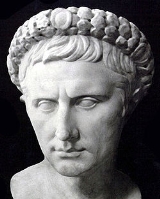
Gaius Julius Caesar Augustus (23 September 63 BC – 19 August AD 14) was the first
emperorThe Roman emperor was the ruler of the Roman State during the imperial period . The Romans had no single term for the office: Latin titles such as imperator , augustus, caesar and princeps were all associated with it...
of the
Roman EmpireThe Roman Empire was the post-Republican phase of the ancient Roman civilization, characterised by an autocratic form of government and large territorial holdings in Europe and around the Mediterranean. The term is used to describe the Roman state during and after the time of the first emperor,...
, which he ruled alone from 27 BC until his death in AD 14.
[These are the contemporary dates; Augustus lived under two calendars, the Roman Republican until 45 BC, and the Julian after 45 BC. Due to departures from Julius Caesar's intentions, Augustus restored the Julian calendar in 8 BC, and the correspondence between the proleptic Julian calendar]The proleptic Julian calendar is produced by extending the Julian calendar to dates preceding AD 4 when its quadrennial leap year stabilized. The leap years actually observed between its official implementation in 45 BC and AD 4 were erratic, see the Julian calendar article for details.A calendar...
and the actual calendar observed in Rome is uncertain before 8 BC.(Blackburn & Holford-Strevens 2003: 670–1) Born
Gaius Octavius Thurinus, he was
adoptedAdoption is a process whereby a person assumes the parenting for another who is not kin and, in so doing, permanently transfers all rights and responsibilities from the original parent or parents...
by his great-uncle
Julius CaesarGaius Julius Caesar , , was a Roman military and political leader. He played a critical role in the transformation of the Roman Republic into the Roman Empire....
in 44 BC, and between then and 27 BC was officially named
Gaius Julius Caesar. In 27 BC the Senate awarded him the honorific
AugustusAugustus , Latin for "majestic," "the increaser," or "venerable", was an Ancient Roman title, which was first held by Caesar Augustus and subsequently came to be considered one of the titles of what are now known as the Roman Emperors...
, and thus consequently he was
Gaius Julius Caesar Augustus.
[Formally Imperator]The Latin word Imperator was a title originally roughly equivalent to commander during the period of the Roman Republic. It later went on to become a part of the titulature of the Roman Emperors as part of their cognomen...
CaesarCaesar , Latin: Caesar , is a title of imperial character. It derives from the cognomen of Julius Caesar, the Roman dictator...
, Divi filius, AugustusAugustus , Latin for "majestic," "the increaser," or "venerable", was an Ancient Roman title, which was first held by Caesar Augustus and subsequently came to be considered one of the titles of what are now known as the Roman Emperors...
which means Imperator Caesar, Son of the Divus (Divus JuliusGaius Julius Caesar , , was a Roman military and political leader. He played a critical role in the transformation of the Roman Republic into the Roman Empire....
), Augustus. Because of the various names he bore, it is common to call him
Octavius when referring to events between 63 and 44 BC,
Octavian (or
Octavianus) when referring to events between 44 and 27 BC, and
Augustus when referring to events after 27 BC. In Greek sources, Augustus is known as
(
Octavius),
(
Caesar),
(
Augustus), or
Σεβαστός (
SebastosSebastos was a honorific used by the ancient Greeks to render the Roman imperial title of Augustus. From the late 11th century on, during the Komnenian period, it and variants derived from it formed the basis of a new system of court titles for the Byzantine Empire. The female form of the title...
), depending on context.
The young Octavius came into his inheritance after Caesar's assassination in 44 BC. In 43 BC, Octavian joined forces with
Mark AntonyMarcus Antonius , known in English as Mark Antony, was a Roman politician and General. He was an important supporter and the loyal friend of Gaius Julius Caesar as a military commander and administrator, being Caesar's second cousin, once removed, by his mother Julia Antonia...
and
Marcus Aemilius LepidusMarcus Aemilius Lepidus , was a Roman patrician who rose to become a member of the Second Triumvirate and Pontifex Maximus. His father, Marcus Aemilius Lepidus, had been involved in a rebellion against the Roman Republic which led to his death.Lepidus was among Julius Caesar's greatest...
in a
military dictatorshipA military dictatorship is a form of government wherein the political power resides with the military. It is similar but not identical to a stratocracy, a state ruled directly by the military....
known as the
Second TriumvirateThe Second Triumvirate is the name historians give to the official political alliance of Gaius Julius Caesar Octavianus , Marcus Aemilius Lepidus, and Mark Antony, formed on 26 November 43 BC with the enactment of the Lex Titia, the adoption of which marked the end of the Roman Republic...
. As a triumvir, Octavian ruled Rome and many of its provinces
[Some provinces were governed by the Senate]The Senate of the Roman Republic was a political institution in the ancient Roman Republic. According to the Greek historian Polybius, our principal source on the Constitution of the Roman Republic, the Roman Senate was the predominant branch of government...
. as an autocrat, seizing consular power after the deaths of the consuls
HirtiusAulus Hirtius was one of the consuls of the Roman Republic and a writer on military subjects.He was known to have been a legate of Caesar's since about 54 BC, and served as an envoy to Pompey in 50. During the Roman Civil Wars he served in Spain, he might have been a tribune in 48, and in 47 was...
and
PansaGaius Vibius Pansa Caetronianus , consul of the Roman Republic in 43 BC. He supported Gaius Julius Caesar in the Civil War.Tribune in 51 BC, during the civil war between Julius Caesar and Pompey, he joined the cause of the Caesarians...
and having himself perpetually re-elected. The triumvirate was eventually torn apart under the competing ambitions of its rulers: Lepidus was driven into exile, and Antony committed suicide following his defeat at the
Battle of ActiumThe Battle of Actium was the decisive confrontation of the Final War of the Roman Republic. It was fought between the forces of Octavian and the combined forces of Mark Antony and Cleopatra. The battle took place on 2 September 31 BC, on the Ionian Sea near the Roman colony of Actium in Greece...
by the fleet of Octavian commanded by
AgrippaMarcus Vipsanius Agrippa was a Roman statesman and general. He was a close friend, son-in-law, lieutenant and defense minister to Octavian, the future emperor Caesar Augustus...
in 31 BC.
After the demise of the Second Triumvirate, Octavian restored the outward facade of the
Roman RepublicThe Roman Republic was the phase of the ancient Roman civilization characterized by a republican form of government. It began with the overthrow of the Roman monarchy, c...
, with governmental power vested in the
Roman SenateThe Senate of the Roman Republic was a political institution in the ancient Roman Republic. According to the Greek historian Polybius, our principal source on the Constitution of the Roman Republic, the Roman Senate was the predominant branch of government...
, but in practice retained his autocratic power. It took several years to determine the exact framework by which a formally republican state could be led by a sole ruler; the result became known as the
Roman EmpireThe Roman Empire was the post-Republican phase of the ancient Roman civilization, characterised by an autocratic form of government and large territorial holdings in Europe and around the Mediterranean. The term is used to describe the Roman state during and after the time of the first emperor,...
. The emperorship was never an office like the
Roman dictatorIn the Roman Republic, the dictator , was an extraordinary magistrate with the absolute authority to perform tasks beyond the authority of the ordinary magistrate . The office of dictator was a legal innovation originally named Magister Populi , i.e...
ship which Caesar and Sulla had held before him; indeed, he declined it when the Roman populace "entreated him to take on the dictatorship". By law, Augustus held a collection of powers granted to him for life by the Senate, including those of
tribuneTribune was a title shared by 10 elected officials in the Roman Republic. Tribunes had the power to convene the Plebeian Council and to act as its president, which also gave them the right to propose legislation before it. Also, the tribune could summon the Senate and lay proposals before it...
of the plebs and censor. He was
consulA consul served in the highest elected political office of the Roman Republic and Empire.During the time of ancient Rome as a republic, the consuls were the highest civil and military magistrates, serving as the heads of government for the Republic. An election occurred every year for new consul...
until 23 BC. His substantive power stemmed from financial success and resources gained in conquest, the building of patronage relationships throughout the Empire, the loyalty of many military soldiers and veterans, the authority of the many honors granted by the Senate, and the respect of the people. Augustus' control over the majority of Rome's legions established an armed threat that could be used against the Senate, allowing him to coerce the Senate's decisions. With his ability to eliminate senatorial opposition by means of arms, the Senate became docile towards his paramount position. His rule through patronage, military power, and accumulation of the offices of the defunct Republic became the model for all later imperial government.
The rule of Augustus initiated an era of relative peace known as the
Pax RomanaPax Romana was the long period of relative peace and minimal expansion by military force experienced by the Roman Empire in the first and second centuries AD. Since it was established by Caesar Augustus it is sometimes called Pax Augusta...
, or
Roman peace. Despite continuous frontier wars, and one year-long civil war over the imperial succession, the Mediterranean world remained at peace for more than two centuries. Augustus expanded the Roman Empire, secured its boundaries with
client stateClient state is one of several terms used to describe the subordination of one state to a more powerful state in international affairs. It is the least specific of these terms and may be treated as a broad category which includes satellite state, puppet state, neo-colony, protectorate, vassal...
s, and made peace with
ParthiaParthia is a region of north-eastern Iran, best known for having been the political and cultural base of the Arsacid dynasts, after which the Arsacid Empire is then also known as the 'Parthian Empire'....
through diplomacy. He reformed the Roman system of taxation, developed networks of roads with an official
courierA courier is a person or company employed to deliver messages, packages and mail. Couriers are distinguished from ordinary mail services by features such as speed, security, tracking, signature, specialization and individualization of services, and committed delivery times, which are optional for...
system, established a standing army (and a small navy), established the
Praetorian GuardThe Praetorian Guard was a force of bodyguards used by Roman Emperors. Before being appropriated for the use of the Emperors' personal guards, the title was used for the guards of Roman generals, at least since the rise to prominence of the Scipio family around 275 BC...
, and created official police and fire-fighting forces for Rome. Much of the city was rebuilt under Augustus; and he wrote a record of his own accomplishments, known as the
Res Gestae Divi AugustiRes Gestae Divi Augusti, is the funerary inscription of the first Roman emperor, Augustus, giving a first-person record of his life and accomplishments.-Structure of the text:...
, which has survived. Upon his death in AD 14, Augustus was declared a god by the Senate, to be worshipped by the Romans. His names Augustus and Caesar were adopted by every subsequent emperor, and the month of
SextilisSextilis was the original Latin name for the sixth month in the Roman calendar. It was renamed Augustus in 8 BC in honor of the first Roman emperor, Augustus Caesar because it came after the month of July and because of several fortunate events that occurred in his life during this month: the...
was officially renamed August in his honour. He was succeeded by his stepson and son-in-law,
TiberiusTiberius Julius Caesar Augustus, born Tiberius Claudius Nero , was the second Roman Emperor, from the death of Augustus in AD 14 until his own death in 37. Tiberius was by birth a Claudian, son of Tiberius Claudius Nero and Livia Drusilla...
.
Early life
While his paternal family was from the town of Velitrae, about 25 miles from Rome, Augustus was born in the city of Rome on 23 September 63 BC. He was born at Ox Heads, which was a small property on the
Palatine HillThe Palatine Hill is the centermost of the Seven Hills of Rome and is one of the most ancient parts of the city...
, very close to the
Roman ForumThe Roman Forum , sometimes known by its original Latin name, is located between the Palatine hill and the Capitoline hill of the city of Rome. It is the central area around which the ancient Roman civilization developed...
. An astrologer had given a warning to his father, but his father chose to ignore it (rather than leave the child in the open to be eaten by dogs). He was given the name
Gaius Octavius Thurinus, his
cognomenThe cognomen was the third name of a citizen of Ancient Rome, under Roman naming conventions. The cognomen started as a nickname, but lost that purpose when it became hereditary...
possibly commemorating his father's victory at
ThuriiThurii – Greek: , called also by some Latin writers and by Ptolemy, Thurium , for a time also Copia and Copiae and sometimes written as Turios; – was a city of Magna Graecia, situated on the Tarentine gulf, within a short distance of the site of Sybaris, of which it may be considered...
over a rebellious band of slaves. Due to the crowded nature of Rome at the time, Octavius was taken to his father's home village at Velitrae to be raised. Octavius only mentions his father's
equestrianThe Roman equestrian order constituted the lower of the two aristocratic classes of ancient Rome, ranking below the Senatorial Order...
family briefly in his memoirs. His paternal great-grandfather was a military tribune in
SicilySicily is the largest island in the Mediterranean Sea. It is an autonomous region of Italy. Several much smaller islands surrounding it are considered to be part of Sicily....
during the
Second Punic WarThe Second Punic War, also referred to as The Hannibalic War and The War Against Hannibal, lasted from 218 to 201 BC and involved combatants in the western and eastern Mediterranean. This was the second major war between Carthage and the Roman Republic, who had three warring conflicts against each...
. His grandfather had served in several local political offices.
His father, also named Gaius OctaviusGaius Octavius was the father of emperor Augustus. He descended from an old, wealthy equestrian branch of the Octavii family. Despite being from a wealthy family, his family was plebeian, rather than patrician...
, had been governor of
MacedoniaThe Roman province of Macedonia was officially established in 146 BC, after the Roman general Quintus Caecilius Metellus defeated Andriscus of Macedon, the last Ancient King of Macedon in 148 BC, and after the four client republics established by Rome in the region were dissolved...
.
[Suetonius, Augustus The "Marcus Octavius" veto]A veto, Latin for "I forbid", is used to denote that a certain party has the right to stop unilaterally a piece of legislation. In practice, the veto can be absolute A veto, Latin for "I forbid", is used to denote that a certain party has the right to stop unilaterally a piece of legislation....
ing the agrarian lawAgrarian laws were laws among the Romans regulating the division of the public lands, or ager publicus.There existed three types of land in ancient Rome: private land, common pasture, and public land...
suggested by Tiberius GracchusTiberius Sempronius Gracchus was a Roman politician of the 2nd century BC and brother of Gaius Gracchus. As a plebeian tribune, he caused political turmoil in the Republic by his attempts to legislate agrarian reforms...
in 133 BC was possibly his ancestor. 1–4. His mother Atia was the niece of
Julius CaesarGaius Julius Caesar , , was a Roman military and political leader. He played a critical role in the transformation of the Roman Republic into the Roman Empire....
.
Since Octavius' father was a plebeian, Octavius himself was a plebeian, despite the fact that his mother, being
Julius CaesarGaius Julius Caesar , , was a Roman military and political leader. He played a critical role in the transformation of the Roman Republic into the Roman Empire....
's niece, was a patrician.
[By Roman custom, one's status passed through one's father, not one's mother.] Octavius gained patrician status when he was adopted by
Julius CaesarGaius Julius Caesar , , was a Roman military and political leader. He played a critical role in the transformation of the Roman Republic into the Roman Empire....
in 44 BC.
In 59 BC, when he was four years old, his father died. His mother married a former governor of Syria,
Lucius Marcius PhilippusLucius Marcius Philippus was a member of a Roman senatorial family. He was a descendant of Roman King Ancus Marcius and the son of the consul and censor Lucius Marcius Philippus. He was a praetor in 60 BC, and became propraetor of Syria in 59 BC. That same year he married Atia Balba Caesonia,...
. Philippus claimed descent from
Alexander the GreatAlexander III of Macedon, popularly known as Alexander the Great , was an Ancient Greek king of Macedon who created one of the largest empires in ancient history...
, and was elected
consulA consul served in the highest elected political office of the Roman Republic and Empire.During the time of ancient Rome as a republic, the consuls were the highest civil and military magistrates, serving as the heads of government for the Republic. An election occurred every year for new consul...
in 56 BC. Philippus never had much of an interest in young Octavius. Because of this, Octavius was raised by his grandmother (and Julius Caesar's sister),
Julia CaesarisJulia is the name of two daughters of praetor Gaius Julius Caesar and Aurelia Cotta, the parents of dictator Gaius Julius Caesar. The sisters were born and raised in Rome....
.
In 52 or 51 BC, Julia Caesaris died. Octavius delivered the funeral oration for his grandmother. From this point, his mother and stepfather took a more active role in raising him. He donned the
toga virilis four years later, and was elected to the
College of PontiffsThe College of Pontiffs or Collegium Pontificum was a body of the ancient Roman state whose members were the highest-ranking priests of the polytheistic state religion. The college consisted of the Pontifex Maximus, the Vestal Virgins, the Rex Sacrorum, and the flamines...
in 47 BC. The following year he was put in charge of the
Greek games-Olympics:* Olympic Games* Summer Olympic Games* Winter Olympic Games* Special Olympics World Games* Ancient Olympic Games* Paralympic Games-Ancient Greco/Roman Games:*Heraea Games at Olympia*Panathenaic Games at Athens*Panhellenic Games...
that were staged in honor of the
Temple of Venus GenetrixThe Temple of Venus Genetrix is a temple in the Forum of Caesar, Rome, dedicated to the Roman goddess Venus Genetrix, the goddess of motherhood and domesticity. It was dedicated to the goddess in 46 BC by Julius Caesar....
, built by Julius Caesar. According to
Nicolaus of DamascusNicolaus of Damascus was a Greek historian and philosopher who lived during the Augustan age of the Roman Empire. His name is derived from that of his birthplace, Damascus. He was born around 64 BC....
, Octavius wished to join Caesar's staff for his campaign in Africa but gave way when his mother protested. In 46 BC, she consented for him to join Caesar in
HispaniaHispania was the name given by the Romans to the whole of the Iberian Peninsula . When Rome was a republic, Hispania was divided into two provinces: Hispania Citerior and Hispania Ulterior...
, where he planned to fight the forces of
PompeyGnaeus Pompeius Magnus, also known as Pompey /'pɑmpi/, Pompey the Great or Pompey the Triumvir , was a military and political leader of the late Roman Republic...
, Caesar's late enemy, but Octavius fell ill and was unable to travel.
When he had recovered, he sailed to the front, but was shipwrecked; after coming ashore with a handful of companions, he crossed hostile territory to Caesar's camp, which impressed his great-uncle considerably.
Velleius PaterculusMarcus Velleius Paterculus was a Roman historian, also known simply as Velleius. Although his praenomen is given as Marcus by Priscian, some modern scholars identify him with Gaius Velleius Paterculus, whose name occurs in an inscription on a north African milestone .-Biography:Paterculus belonged...
reports that Caesar afterwards allowed the young man to share his carriage. When back in Rome, Caesar deposited a new will with the Vestal Virgins, naming Octavius as the prime beneficiary.
Heir to Caesar
At the time
Caesar was killedThe Assassination of Julius Caesar was the result of a conspiracy of a group of senators, led by Gaius Cassius Longinus and Marcus Junius Brutus, who wanted to overthrow Julius Caesar, who in a civil war had risen from military general to political master of the Roman Republic...
on the
Ides of MarchThe ides of March is the name of March 15 in the Roman calendar. The term ides was used for the 15th day of the months of March, May, July, and October. The Ides of March was a festive day dedicated to the god Mars and a military parade was usually held. In modern times, the term Ides of March is...
(the 15th) 44 BC, Octavius was studying and undergoing military training in
Apollonia, IllyriaA city of the ancient world , known as Apollonia , was located on the right bank of the Aous; its ruins are situated in the Fier region, near the village of Pojan...
. Rejecting the advice of some army officers to take refuge with the troops in
MacedoniaThe Roman province of Macedonia was officially established in 146 BC, after the Roman general Quintus Caecilius Metellus defeated Andriscus of Macedon, the last Ancient King of Macedon in 148 BC, and after the four client republics established by Rome in the region were dissolved...
, he sailed to
ItaliaItalia, under the Roman Republic and later Empire, was the name of the Italian peninsula.-Under the Republic and Augustan organization :During the Republic and the first centuries of the empire, Italia was not a province, but rather the territory of the city of Rome, thus having a special status:...
to ascertain if he had any potential political fortunes or security. After landing at Lupiae near Brundisium, he learned the contents of Caesar's will, and only then did he decide to become Caesar's political heir as well as heir to two-thirds of his estate. Having no living legitimate children, Caesar had adopted his great-nephew Octavius as his son and main heir. Upon his adoption, Octavius assumed his great-uncle's name,
Gaius Julius Caesar. Although Romans who had been adopted into a new family usually retained their old nomen in
cognomenThe cognomen was the third name of a citizen of Ancient Rome, under Roman naming conventions. The cognomen started as a nickname, but lost that purpose when it became hereditary...
form (e.g.
Octavianus for one who had been an Octavius,
Aemilianus for one who had been an Aemilius, etc.) there is no evidence that he ever bore the name
Octavianus, as it would have made his modest origins too obvious. However, despite the fact that he never officially bore the name
Octavianus, to save confusing the dead dictator with his heir, historians often refer to the new Caesar—between his adoption and his assumption, in 27 BC, of the name Augustus—as
Octavian.
Mark AntonyMarcus Antonius , known in English as Mark Antony, was a Roman politician and General. He was an important supporter and the loyal friend of Gaius Julius Caesar as a military commander and administrator, being Caesar's second cousin, once removed, by his mother Julia Antonia...
later charged that Octavian had earned his adoption by Caesar through sexual favours, though
SuetoniusGaius Suetonius Tranquillus, commonly known as Suetonius , was an equestrian and a historian during the Roman Empire. His most important surviving work is a set of biographies of twelve successive Roman rulers, from Julius Caesar until Domitian, entitled De Vita Caesarum...
, in his work
Lives of the Twelve CaesarsDe vita Caesarum commonly known as The Twelve Caesars, is a set of twelve biographies of Julius Caesar and the first 11 emperors of the Roman Empire written by Gaius Suetonius Tranquillus.The work, written in 121 during the reign of the emperor Hadrian, was the most popular work of Suetonius, at...
, describes Antony's accusation as political slander.
To make a successful entry into the echelons of the Roman political hierarchy, Octavian could not rely on his limited funds. After a warm welcome by Caesar's soldiers at Brundisium, Octavian demanded a portion of the funds that were allotted by Caesar for the intended war against
ParthiaParthia is a region of north-eastern Iran, best known for having been the political and cultural base of the Arsacid dynasts, after which the Arsacid Empire is then also known as the 'Parthian Empire'....
in the Middle East. This amounted to 700 million
sestercesThe sestertius, or sesterce, was an ancient Roman coin. During the Roman Republic it was a small, silver coin issued only on rare occasions...
stored at Brundisium, the staging ground in Italy for military operations in the east. A later senatorial investigation into the disappearance of the public funds made no action against Octavian, since he subsequently used that money to raise troops against the Senate's arch enemy, Mark Antony. Octavian made another bold move in 44 BC when without official permission he appropriated the annual tribute that had been sent from Rome's
Near EastNear East today is an ambiguous term that covers different countries for archeologists and historians, on one hand, and for political scientists, economists, and journalists, on the other...
ern province to Italy. Octavian began to bolster his personal forces with Caesar's veteran legionaries and with troops designated for the Parthian war, gathering support by emphasizing his status as heir to Caesar. On his march to Rome through Italy, Octavian's presence and newly-acquired funds attracted many, winning over Caesar's former veterans stationed in
CampaniaCampania is a region of southern Italy in Europe. The region has a population of around 5.8 million people, making it the second-most-populous region of Italy; its total area of 13,595 km² makes it the most densely populated region in the country...
. By June he had gathered an army of 3,000 loyal veterans, paying each a salary of 500
denariiIn the Roman currency system, the denarius was a small silver coin first minted in 211 BC. It was the most common coin produced for circulation but was slowly debased until its replacement by the antoninianus.-History:...
.
Arriving in Rome on 6 May 44 BC, Octavian found the consul
Mark AntonyMarcus Antonius , known in English as Mark Antony, was a Roman politician and General. He was an important supporter and the loyal friend of Gaius Julius Caesar as a military commander and administrator, being Caesar's second cousin, once removed, by his mother Julia Antonia...
, Caesar's former colleague, in an uneasy truce with the dictator's assassins; they had been granted a general amnesty on 17 March, yet Antony succeeded in driving most of them out of Rome. This was due to his "inflammatory" eulogy given at Caesar's funeral, mounting public opinion against the assassins. Although Mark Antony was amassing political support, Octavian still had opportunity to rival him as the leading member of the faction supporting Caesar. Mark Antony had lost the support of many Romans and supporters of Caesar when he at first opposed the motion to elevate Caesar to divine status. Octavian failed to persuade Antony to relinquish Caesar's money to him. However, he managed to win support from Caesarian sympathizers during the summer, who saw the younger heir as the lesser evil in the hopes to manipulate him, or bear him while in their efforts to get rid of Antonius. In September, the
OptimateOptimates were the pro-aristocratic faction of the later Roman Republic. They wished to limit the power of the popular assemblies and the Tribunes of the Plebs, and to extend the power of the Senate, which was viewed as more dedicated to the interests of the aristocrats...
orator
Marcus Tullius CiceroMarcus Tullius Cicero was a Roman philosopher, statesman, lawyer, political theorist, and Roman constitutionalist. Cicero is widely considered one of Rome's greatest orators and prose stylists.Cicero is generally perceived to be one of the most versatile minds of ancient Rome...
began to attack Antony in a
series of speechesA philippic is a fiery, damning speech, or tirade, delivered to condemn a particular political actor. The term originates with Demosthenes, who delivered several attacks on Philip II of Macedon in the 4th century BC....
, seeing Antony as the greatest threat to the order of the Senate. With opinion in Rome turning against him and his year of consular power nearing its end, Antony attempted to pass laws which would lend him control over
Cisalpine GaulCisalpine Gaul was the Roman name for a geographical area , in the territory of modern-day northern Italy , inhabited by the Celts.Sometimes referred to...
, which had been assigned as part of his province, from
Decimus Junius Brutus AlbinusDecimus Junius Brutus Albinus was a Roman politician and general of the 1st century BC and one of Julius Caesar's assassins.-Early life:...
, one of Caesar's assassins. Octavian meanwhile built up a private army in Italy by recruiting Caesarian veterans, and on 28 November won over two of Antony's legions with the enticing offer of monetary gain. In the face of Octavian's large and capable force, Antony saw the danger of staying in Rome, and to the relief of the Senate he fled to Cisalpine Gaul, which was to be handed to him on 1 January.
First conflict with Antony
After Decimus Brutus refused to give up
Cisalpine GaulCisalpine Gaul was the Roman name for a geographical area , in the territory of modern-day northern Italy , inhabited by the Celts.Sometimes referred to...
, Antony besieged him at Mutina. The resolutions passed by the Senate to stop the violence were rejected by Antony, as the Senate had no army of its own to challenge him; this provided an opportunity for Octavian, who was already known to have armed forces. Cicero also defended Octavian against Antony's taunts about Octavian's lack of noble lineage; he stated "we have no more brilliant example of traditional piety among our youth." This was in part a rebuttal to Antony's opinion of Octavian, as Cicero quoted Antony saying to Octavian, "You, boy, owe everything to your name." In this unlikely alliance orchestrated by the arch anti-Caesarian senator Cicero, the Senate inducted Octavian as senator on 1 January 43 BC, yet he was also given the power to vote alongside the former consuls. In addition, Octavian was granted
imperiumImperium in a broad sense translates as 'power'. In ancient Rome the concept applied to people and meant something like 'power status' or 'authority' or could be used with a geographical connotation and meant something like 'territory'...
(commanding power), which made his command of troops legal, sending him to relieve the siege along with
HirtiusAulus Hirtius was one of the consuls of the Roman Republic and a writer on military subjects.He was known to have been a legate of Caesar's since about 54 BC, and served as an envoy to Pompey in 50. During the Roman Civil Wars he served in Spain, he might have been a tribune in 48, and in 47 was...
and
PansaGaius Vibius Pansa Caetronianus , consul of the Roman Republic in 43 BC. He supported Gaius Julius Caesar in the Civil War.Tribune in 51 BC, during the civil war between Julius Caesar and Pompey, he joined the cause of the Caesarians...
(the consuls for 43 BC). In April of 43 BC, Antony's forces were defeated at the battles of
Forum GallorumThe Battle of Forum Gallorum was fought near a village in northern Italy , on April 14, 43 BC, between the forces of Mark Antony and the legions of the Roman Republic under the overall command of consul Gaius Vibius Pansa Caetronianus, aided by Aulus Hirtius and the untested Octavian...
and
MutinaThe Battle of Mutina was fought on April 21, 43 BC between the forces of Mark Antony and the forces of Gaius Vibius Pansa Caetronianus and Aulus Hirtius, who were providing aid to one of Caesar's assassins, Decimus Junius Brutus Albinus.-Prelude:...
, forcing Antony to retreat to Transalpine Gaul. However, both consuls were killed, leaving Octavian in sole command of their armies.
After heaping many more rewards on Decimus Brutus than Octavian for defeating Antony, the Senate attempted to give command of the consular legions to Decimus Brutus, yet Octavian decided not to cooperate. Instead, Octavian stayed in the
Po ValleyThe Po Valley, Po Plain, Plain of the Po, or Padan Plain is a major geographical feature of Italy. It extends approximately in an east-west direction, including its Venetic extension not actually related to the Po river; it runs from the Western Alps to the Adriatic Sea...
and refused to aid any further offensive against Antony. In July, an embassy of
centurion-Military:* Centurion, professional officer of the Roman army* Centurion tank, British battle tank* HMS Centurion, name of several ships and a shore base of the British Royal Navy-Transport:* Centurion Engines, German series of aircraft engines...
s sent by Octavian entered Rome and demanded that he receive the consulship left vacant by Hirtius and Pansa. Octavian also demanded that the decree declaring Antony a public enemy should be rescinded. When this was refused, he marched on the city with eight legions. He encountered no military opposition in Rome, and on 19 August 43 BC was elected consul with his relative
Quintus PediusQuintus Pedius was a Roman who lived during the late Roman Republic. Pedius was the son of a Marcus or Quintus Pedius and nephew or great nephew of the Roman dictator Julius Caesar....
as co-consul. Meanwhile, Antony formed an alliance with
Marcus Aemilius LepidusMarcus Aemilius Lepidus , was a Roman patrician who rose to become a member of the Second Triumvirate and Pontifex Maximus. His father, Marcus Aemilius Lepidus, had been involved in a rebellion against the Roman Republic which led to his death.Lepidus was among Julius Caesar's greatest...
, another leading Caesarian.
Proscriptions
In a meeting near
BolognaBologna is the capital city of Emilia-Romagna, in the Po Valley of northern Italy...
in October of 43 BC, Octavian, Antony, and Lepidus formed a
juntaA military dictatorship is a form of government wherein the political power resides with the military. It is similar but not identical to a stratocracy, a state ruled directly by the military....
called the
Second TriumvirateThe Second Triumvirate is the name historians give to the official political alliance of Gaius Julius Caesar Octavianus , Marcus Aemilius Lepidus, and Mark Antony, formed on 26 November 43 BC with the enactment of the Lex Titia, the adoption of which marked the end of the Roman Republic...
. This explicit arrogation of special powers lasting five years was then supported by law passed by the
plebsThe Plebs was the general body of Roman citizens in Ancient Rome. They were distinct from the higher order of the patricians. A member of the plebs was known as a plebeian...
, unlike the unofficial
First TriumvirateThe First Triumvirate was the political alliance of Gaius Julius Caesar, Marcus Licinius Crassus, and Gnaeus Pompeius Magnus. Unlike the Second Triumvirate, the First Triumvirate had no official status whatsoever – its overwhelming power in the Roman Republic was strictly unofficial...
formed by Gnaeus Pompey Magnus,
Julius CaesarGaius Julius Caesar , , was a Roman military and political leader. He played a critical role in the transformation of the Roman Republic into the Roman Empire....
and
Marcus Licinius CrassusMarcus Licinius Crassus was a Roman general and politician who commanded Sulla's decisive victory at Colline gate, suppressed the slave revolt led by Spartacus and entered into a secret pact, known as the First Triumvirate, with Gnaeus Pompeius Magnus and Gaius Julius Caesar...
. The triumvirs then set in motion
proscriptionProscription is the public identification and official condemnation of enemies of the state. It is defined by the Oxford English Dictionary as a "decree of condemnation to death or banishment" and is a heavily politically-charged word frequently used to refer to state-approved murder or persecution...
s in which allegedly 300 senators and 2,000
equitesThe Roman equestrian order constituted the lower of the two aristocratic classes of ancient Rome, ranking below the Senatorial Order...
were branded as
outlawAn outlaw or bandit is a person living the lifestyle of outlawry; the word literally means "outside the law".In the common law of England, a "Writ of Outlawry" declared the subject to be "Caput gerat lupinum" , and it followed not only that, since the subject was no longer human, he had no legal...
s and deprived of their property and, for those who failed to escape, their lives. The estimation that 300 senators were proscribed was presented by
AppianAppianus , of Alexandria was a Roman historian who flourished during the reigns of Trajan, Hadrian and Antoninus Pius. He is commonly referred to by the anglicised form of his name, Appian....
, although his earlier contemporary
LivyTitus Livius , known as Livy in English, was a Roman historian who wrote a monumental history of Rome and the Roman people, Ab Urbe Condita Libri, "Chapters from the Foundation of the City," covering the period from the earliest legends of Rome well before the traditional foundation in 753 BC...
asserted that only 130 senators had been proscribed. This decree issued by the triumvirate was motivated in part by a need to raise money to pay their troops' salaries for the upcoming conflict against Caesar's assassins,
Marcus Junius BrutusMarcus Junius Brutus , often referred to simply as Brutus, was a politician of the late Roman Republic...
and
Gaius Cassius LonginusGaius Cassius Longinus was a Roman senator, a leading instigator of the plot to kill Julius Caesar, and the brother in-law of Marcus Brutus.-Early life:...
. Rewards for their arrest gave incentive for Romans to capture those proscribed, while the assets and properties of those arrested were seized by the triumvirs.
Contemporary Roman historians provide conflicting reports as to which triumvir was more responsible for the proscriptions and killing. However, the sources agree that enacting the proscriptions was a means by all three factions to eliminate political enemies.
Marcus Velleius PaterculusMarcus Velleius Paterculus was a Roman historian, also known simply as Velleius. Although his praenomen is given as Marcus by Priscian, some modern scholars identify him with Gaius Velleius Paterculus, whose name occurs in an inscription on a north African milestone .-Biography:Paterculus belonged...
asserted that Octavian tried to avoid proscribing officials whereas Lepidus and Antony were to blame for initiating them. Cassius Dio defended Augustus as trying to spare as many as possible, whereas Antony and Lepidus, being older and involved in politics longer, had many more enemies to deal with. This claim was rejected by Appian, who maintained that Octavian shared an equal interest with Lepidus and Antony in eradicating his enemies.
SuetoniusGaius Suetonius Tranquillus, commonly known as Suetonius , was an equestrian and a historian during the Roman Empire. His most important surviving work is a set of biographies of twelve successive Roman rulers, from Julius Caesar until Domitian, entitled De Vita Caesarum...
presents the case that Octavian, although reluctant at first to proscribe officials, nonetheless pursued his enemies with more rigor than the other triumvirs.
PlutarchPlutarch, born Plutarchos then, on his becoming a Roman citizen, Lucius Mestrius Plutarchus , c. AD 46 – 120, was a Greek historian, biographer, essayist, and Middle Platonist known primarily for his Parallel Lives and Moralia...
describes the proscriptions as a ruthless and cutthroat swapping of friends and family between Antony, Lepidus, and Octavian. For example, Octavian allowed the proscription of his ally
CiceroMarcus Tullius Cicero was a Roman philosopher, statesman, lawyer, political theorist, and Roman constitutionalist. Cicero is widely considered one of Rome's greatest orators and prose stylists.Cicero is generally perceived to be one of the most versatile minds of ancient Rome...
, Antony the proscription of his maternal uncle
Lucius Julius Caesar IVLucius Julius Caesar was the son of the consul of 90 BC, Lucius Julius Caesar. He was the father of another Lucius Julius Caesar, the brother of Julia Antonia, and the uncle of the Brothers Antonii, Marcus, Gaius, and Lucius...
, and Lepidus his brother Paulus.
Battle of Philippi and division of territory
On 1 January 42 BC, the
SenateThe Senate of the Roman Republic was a political institution in the ancient Roman Republic. According to the Greek historian Polybius, our principal source on the Constitution of the Roman Republic, the Roman Senate was the predominant branch of government...
recognized Caesar as a divinity of the Roman state,
Divus Iulius. Octavian was able to further his cause by emphasizing the fact that he was
Divi filiusDivi filius is a Latin phrase meaning "Son of God", and was a common title of a Roman Emperor. After the Senate recognised Julius Caesar as a divinity of the Roman state, as Divus Iulius on January 1, 42 BC, his great-nephew Octavian styled himself Divi filius, and printed the phrase on Roman coins...
, "Son of God". Antony and Octavian then sent 28 legions by sea to face the armies of Brutus and Cassius, who had built their base of power in Greece. After two
battles at PhilippiThe Battle of Philippi was the final battle in the Wars of the Second Triumvirate between the forces of Mark Antony and Octavian against the forces of Julius Caesar's assassins Marcus Junius Brutus and Gaius Cassius Longinus in 42 BC, at Philippi in Macedonia...
in
MacedoniaThe Roman province of Macedonia was officially established in 146 BC, after the Roman general Quintus Caecilius Metellus defeated Andriscus of Macedon, the last Ancient King of Macedon in 148 BC, and after the four client republics established by Rome in the region were dissolved...
in October of 42, the Caesarian army was victorious and
BrutusMarcus Junius Brutus , often referred to simply as Brutus, was a politician of the late Roman Republic...
and
CassiusGaius Cassius Longinus was a Roman senator, a leading instigator of the plot to kill Julius Caesar, and the brother in-law of Marcus Brutus.-Early life:...
committed
suicideSuicide is the intentional killing of one's self. Many dictionaries also note the metaphorical sense of "willful destruction of one's self-interest"...
. Mark Antony would later use the examples of these battles as a means to belittle Octavian, as both battles were decisively won with the use of Antony's forces. In addition to claiming responsibility for both victories, Antony also branded Octavian as a coward for handing over his direct military control to
Marcus Vipsanius AgrippaMarcus Vipsanius Agrippa was a Roman statesman and general. He was a close friend, son-in-law, lieutenant and defense minister to Octavian, the future emperor Caesar Augustus...
instead.
After Philippi, a new territorial arrangement was made among the members of the Second Triumvirate. While Antony would leave
GaulGaul is a historical name used in the context of the Roman Empire in references to the region of Western Europe approximating present day France and Belgium, but also sometimes including the Po Valley, western Switzerland, and the parts of the Netherlands and Germany on the west bank of the River...
, the provinces of
HispaniaHispania was the name given by the Romans to the whole of the Iberian Peninsula . When Rome was a republic, Hispania was divided into two provinces: Hispania Citerior and Hispania Ulterior...
, and
ItaliaItalia, under the Roman Republic and later Empire, was the name of the Italian peninsula.-Under the Republic and Augustan organization :During the Republic and the first centuries of the empire, Italia was not a province, but rather the territory of the city of Rome, thus having a special status:...
in the hands of Octavian, Antony traveled east to
EgyptEgypt , officially the Arab Republic of Egypt, is a country mainly in North Africa, with the Sinai Peninsula forming a land bridge in Western Asia...
where he allied himself with Queen
Cleopatra VIICleopatra VII Philopator was the last effective pharaoh of Egypt's Ptolemaic dynasty. She originally shared power with her father Ptolemy XII and later with her brothers Ptolemy XIII and Ptolemy XIV, whom she also married, but eventually gained sole rule...
, the former lover of Julius Caesar and mother of Caesar's infant son,
CaesarionPtolemy XV Philopator Philometor Caesar, nicknamed Caesarion Greek: Πτολεμαῖος ΙΕʹ Φιλοπάτωρ Φιλομήτωρ Καῖσαρ, Καισαρίων, Ptolemaĩos Philopátōr Philomḗtōr Kaĩsar, Kaisaríōn was the last king of the Ptolemaic dynasty of Egypt, who reigned, as a child, jointly with his mother Cleopatra VII of Egypt...
. Lepidus was left with the
province of AfricaThe Roman province of Africa was established after the Romans defeated Carthage in the Third Punic War. It roughly comprised the territory of present-day northern Tunisia, north-eastern Algeria and the Mediterranean coast of modern-day western Libya along the Syrtis Minor...
, stymied by Antony who conceded Hispania to Octavian instead. Octavian was left to decide where in Italy to settle tens of thousands of veterans of the Macedonian campaign whom the triumvirs had promised to discharge. The tens of thousands who had fought on the republican side with Brutus and Cassius, who could easily ally with a political opponent of Octavian if not appeased, also required land. There was no more government-controlled land to allot as settlements for their soldiers, so Octavian had to choose one of two options: alienating many Roman citizens by confiscating their land, or alienating many Roman soldiers who could mount a considerable opposition against him in the Roman heartland; Octavian chose the former. There were as many as eighteen Roman towns affected by the new settlements, with entire populations driven out or at least given partial evictions.
Rebellion and marriage alliances
Widespread dissatisfaction with Octavian over his soldiers' settlements encouraged many to rally at the side of
Lucius AntoniusLucius Antonius was the younger brother and supporter of Mark Antony, a Roman politician.Lucius was son of Marcus Antonius Creticus, son of the rhetorician Marcus Antonius Orator executed by Gaius Marius' supporters in 86 BC, and Julia Antonia, a cousin of Julius Caesar...
, who was brother of Mark Antony and supported by a majority in the Senate. Meanwhile, Octavian asked for a divorce from
Clodia PulchraClodia Pulchra, also known as Claudia was the daughter of Fulvia and her first husband Publius Clodius Pulcher. She was the stepdaughter of Mark Antony and half sister of Marcus Antonius Antyllus and Iullus Antonius.Mark Antony was her mother's third husband...
, the daughter of
FulviaFulvia was a Roman woman who lived in the 1st century BC. According to Plutarch, Fulvia had no interest in spinning nor managing a household nor ruling a husband with no ambition for public life; Fulvia wanted to govern or to command and be a commander-in-chief. Fulvia is remembered in the history...
and her first husband
Publius Clodius PulcherPublius Clodius Pulcher , was a Roman politician known for his popularist tactics...
. Claiming that his marriage with Clodia had never been consummated, he returned her to her mother, Mark Antony's wife. Fulvia decided to take action. Together with Lucius Antonius she raised an army in Italy to fight for Antony's rights against Octavian. However, Lucius and Fulvia took a political and martial gamble in opposing Octavian, since the Roman army still depended on the triumvirs for their salaries. Lucius and his allies ended up in a defensive siege at
PerusiaThe ancient Perusia, now Perugia, first appears in history as one of the 12 confederate cities of Etruria. It is first mentioned in the account of the war of 310 or 309 BC between the Etruscans and the Romans...
(modern
PerugiaPerugia is the capital city of the region of Umbria in central Italy, near the Tiber River, and the capital of the province of Perugia. The city symbol is the griffin, which can be seen in the form of plaques and statues on buildings around the city.Perugia is a notable artistic center of Italy...
), where Octavian forced them into surrender in early 40 BC. Lucius and his army were spared due to his kinship with Antony, the strongman of the East, while Fulvia was exiled to
SicyonSikyon was an ancient Greek city situated in the northern Peloponnesus between Corinth and Achaea on the territory of the present-day prefecture of Corinthia...
. However, Octavian showed no mercy for the mass of allies loyal to Lucius; on 15 March, the anniversary of Julius Caesar's assassination, he had 300 Roman senators and equestrians executed for allying with Lucius. Perusia was also pillaged and burned as a warning for others. This bloody event somewhat sullied Octavian's career and was criticized by many, such as the Augustan poet
Sextus PropertiusSextus Aurelius Propertius was a Latin elegiac poet who was born around 50–45 BC in Assisium) and died shortly after 15 BC.Propertius' surviving work comprises four books of Elegies. He was friends with the poets Gallus and Virgil, and had with them as his patron Maecenas, and through Maecenas, the...
.
Sextus PompeiusSextus Pompeius Magnus Pius, in English Sextus Pompey , was a Roman general from the late Republic . He was the last focus of opposition to the Second Triumvirate....
, son of the first Triumvir and still a renegade general following Caesar's victory over
PompeyGnaeus Pompeius Magnus, also known as Pompey /'pɑmpi/, Pompey the Great or Pompey the Triumvir , was a military and political leader of the late Roman Republic...
, was established in
SicilySicily is the largest island in the Mediterranean Sea. It is an autonomous region of Italy. Several much smaller islands surrounding it are considered to be part of Sicily....
and
SardiniaSardinia is the second-largest island in the Mediterranean Sea . The area of Sardinia is . The nearest land masses to the island are the French island of Corsica, the Italian Peninsula, Tunisia, and the Spanish Balearic Islands...
as part of an agreement reached with the Second Triumvirate in 39 BC. Both Antony and Octavian were vying for an alliance with Pompeius, who was ironically a member of the republican party, not the Caesarian faction. Octavian succeeded in a temporary alliance when in 40 BC he married
ScriboniaScribonia was the second wife of Roman Emperor Augustus and the mother of his only natural child, Julia Caesaris. She was the grandmother of Gaius Caesar, Julia the Younger, Lucius Caesar, Agrippina the Elder and Agrippa Postumus, great-grandmother to Emperor Caligula and Empress Agrippina the...
, a daughter of
Lucius Scribonius LiboSeveral men of plebeian status were named Lucius Scribonius Libo during the Roman Republic and Roman Empire; they were members of the gens Scribonia.-L. Scribonius Libo :...
who was a follower of Pompeius as well as his father-in-law. Scribonia conceived Octavian's only natural child,
JuliaJulia the Elder , known to her contemporaries as Julia Caesaris filia or Julia Augusti filia was the daughter and only natural child of Augustus. Augustus subsequently adopted several male members of his close family as sons...
, who was born the same day that he divorced Scribonia to marry
Livia DrusillaLivia Drusilla, after 14 AD called Julia Augusta was the wife of Augustus and one of the most powerful women in the Roman Empire, being Augustus' faithful advisor...
, little more than a year after his marriage.
While in Egypt, Antony had been engaged in an affair with Cleopatra and had fathered three children with her. Aware of his deteriorating relationship with Octavian, Antony left Cleopatra; he sailed to Italy in 40 BC with a large force to oppose Octavian, laying siege to Brundisium. However, this new conflict proved untenable for both Octavian and Antony. Their
centurion-Military:* Centurion, professional officer of the Roman army* Centurion tank, British battle tank* HMS Centurion, name of several ships and a shore base of the British Royal Navy-Transport:* Centurion Engines, German series of aircraft engines...
s, who had become important figures politically, refused to fight due to their Caesarian cause, while the legions under their command followed suit. Meanwhile in Sicyon, Antony's wife Fulvia died of a sudden illness while Antony was en route to meet her. Fulvia's death and the mutiny of their centurions allowed the two remaining triumvirs to effect a reconciliation. In the autumn of 40, Octavian and Antony approved the Treaty of Brundisium, by which Lepidus would remain in Africa, Antony in the East, Octavian in the West. The Italian peninsula was left open to all for the recruitment of soldiers, but in reality, this provision was useless for Antony in the East. To further cement relations of alliance with Mark Antony, Octavian gave his sister,
Octavia MinorOctavia Minor , also known as Octavia the Younger or simply Octavia, was the sister of the first Roman Emperor, Augustus , half sister of Octavia Major, and fourth wife of Mark Antony....
, in marriage to Antony in late 40 BC. During their marriage, Octavia gave birth to two daughters (known as
Antonia MajorAntonia Major , also known as Antonia the Elder, was a daughter to Mark Antony and Octavia Minor and niece to Augustus, Rome’s first Emperor....
and
Antonia MinorAntonia Minor , also known as Antonia the Younger or simply Antonia was a daughter of Roman politician Mark Antony and Octavia Minor, niece of emperor Augustus, and mother of future emperor Claudius.Antonia is one of the most prominent Roman women. She is celebrated for her virtue and beauty...
).
War with Pompeius
Sextus Pompeius threatened Octavian in Italy by denying to the peninsula shipments of grain through the Mediterranean; Pompeius' own son was put in charge as naval commander in the effort to cause widespread famine in Italy. Pompeius' control over the sea prompted him to take on the name
Neptuni filius, "son of
NeptuneNeptune is the god of water and the sea in Roman mythology, a brother of Jupiter and Pluto. He is analogous with but not identical to the god Poseidon of Greek mythology. The Roman conception of Neptune owed a great deal to the Etruscan god Nethuns....
." A temporary peace agreement was reached in 39 BC with the treaty of Misenum; the blockade on Italy was lifted once Octavian granted Pompeius Sardinia,
CorsicaCorsica is the fourth largest island in the Mediterranean Sea . It is located west of Italy, southeast of the French mainland, and north of the island of Sardinia....
, Sicily, the
PeloponneseThe Peloponnese or Peloponnesus is a large peninsula and region in southern Greece, forming the part of the country south of the Gulf of Corinth...
, and an ensured future position as consul for 35 BC. The territorial agreement amongst the triumvirs and Sextus Pompeius began to crumble once Octavian divorced Scribonia and married Livia on 17 January 38 BC. One of Pompeius' naval commanders betrayed him and handed over Corsica and Sardinia to Octavian; however, Octavian needed Antony's support to attack Pompeius, so an agreement was reached with the Second Triumvirate's extension for another five-year period beginning in 37 BC. Antony in supporting Octavian expected to gain support for his own campaign against Parthia, desiring to avenge Rome's
defeat at CarrhaeThe Battle of Carrhae, fought in 53 BC near the town of Carrhae, was a major battle between the Parthian Empire and the Roman Republic. A Roman invasion force led by Marcus Licinius Crassus was decisively crushed by the Parthian Spahbod Surena...
in 53 BC. In an agreement reached at
TarentumTaranto is a coastal city in Puglia, Southern Italy. It is the capital of the Province of Taranto and is an important commercial port as well as the main Italian naval base.It is the third-largest continental city of southern Italy: according to the 2001 census, it has a population of...
, Antony provided 120 ships for Octavian to use against Pompeius, while Octavian was to send 20,000
legionariesThe Roman legionary was a professional soldier of the Roman army after the Marian reforms of 107 BC. Legionaries had to be Roman citizens under the age of 45. They enlisted in a legion for twenty-five years of service, a change from the early practice of enlisting only for a campaign...
to Antony for use against Parthia. However, Octavian sent only a tenth the number of those promised, an intentional provocation that Antony would not forget six years later when they faced each other in battle.
Octavian and Lepidus launched a joint operation against Sextus in Sicily in 36 BC. Despite setbacks for Octavian, the naval fleet of Sextus Pompeius was almost entirely destroyed on 3 September by general Agrippa at the naval
battle of NaulochusThe naval Battle of Naulochus was fought on 3 September 36 BC between the fleets of Sextus Pompeius and Marcus Vipsanius Agrippa, off Naulochus, Sicily...
. Sextus fled with his remaining forces to the east, where he was captured and executed in
MiletusMiletus was an ancient city on the western coast of Anatolia , near the mouth of the Maeander River in ancient Caria...
by one of Antony's generals the following year. Both Lepidus and Octavian gathered the surrendered troops of Pompeius, yet Lepidus felt empowered enough to claim Sicily for himself, ordering Octavian to leave. However, Lepidus' troops deserted him and defected to Octavian since they were weary of fighting and found Octavian's promises of money to be enticing. Lepidus surrendered to Octavian and was permitted to retain the office of
pontifex maximusThe Pontifex Maximus was the high priest of the Ancient Roman College of Pontiffs. This was the most important position in the ancient Roman religion, open only to patricians until 254 BC, when a plebeian first occupied this post...
(head of the college of priests), but was ejected from the Triumvirate, his public career at an end, and was effectively exiled to a
villaA villa was originally an upper-class country house, though since its origins in Roman times the idea and function of a villa has evolved considerably. After the fall of the Republic, a villa became a small, fortified farming compound, gradually re-evolving through the Middle Ages into luxurious,...
at Cape Circei in Italy. The Roman dominions were now divided between Octavian in the West and Antony in the East. To maintain peace and stability in his portion of the Empire, Octavian ensured Rome's citizens of their rights to property. This time he settled his discharged soldiers outside of Italy while returning 30,000 slaves to former Roman owners that had previously fled to Pompeius to join his army and navy. To ensure his own safety and that of Livia and Octavia once he returned to Rome, Octavian had the Senate grant him, his wife, and his sister
tribunalTribune was a title shared by 10 elected officials in the Roman Republic. Tribunes had the power to convene the Plebeian Council and to act as its president, which also gave them the right to propose legislation before it. Also, the tribune could summon the Senate and lay proposals before it...
immunitySovereign immunity, or crown immunity, is a type of immunity that in common law jurisdictions traces its origins from early English law. Generally speaking it is the doctrine that the sovereign or state cannot commit a legal wrong and is immune from civil suit or criminal prosecution; hence the...
, or
sacrosanctitas.
War with Antony
Meanwhile, Antony's campaign against Parthia turned disastrous, tarnishing his image as a leader, while the mere 2,000 legionaries sent by Octavian to Antony were hardly enough to replenish his forces. On the other hand, Cleopatra could restore his army to full strength, and since he was already engaged in a romantic affair with her, he decided to send Octavia back to Rome. Although Antony had the interests of rebuilding his military in mind, this act played right into the hands of Octavian, who spread
propagandaPropaganda is communication aimed at influencing the attitude of a community toward some cause or position. As opposed to impartially providing information, propaganda in its most basic sense, presents information primarily to influence an audience...
implying that Antony was becoming less than Roman because he rejected a legitimate Roman spouse for an "Oriental
paramourAn intimate relationship is a particularly close interpersonal relationship. It is a relationship in which the participants know or trust one another very well or are confidants of one another, or a relationship in which there is physical or emotional intimacy.Intimate relationships play a central...
". In 36 BC, Octavian used a political ploy to make himself look less autocratic and Antony more the villain by proclaiming that the civil wars were coming to an end, and that he would step down as triumvir if only Antony would do the same; Antony refused. After Roman troops captured
ArmeniaArmenia , officially the Republic of Armenia , is a landlocked mountainous country in the Caucasus region of Eurasia...
in 34 BC, Antony made his son Alexander Helios the ruler of Armenia; he also awarded the title "Queen of Kings" to Cleopatra, acts which Octavian used to convince the Roman Senate that Antony had ambitions to diminish the preeminence of Rome. When Octavian became consul once again on 1 January 33 BC, he opened the following session in the Senate with a vehement attack on Antony's grants of titles and territories to his relatives and to his queen. Defecting consuls and senators rushed over to the side of Antony in disbelief of the propaganda (which turned out to be true), yet so did able ministers desert Antony for Octavian in the autumn of 32 BC. These defectors, Munatius Plancus and Marcus Titius, gave Octavian the information he needed to confirm with the Senate all the accusations he made against Antony. By storming the sanctuary of the Vestal Virgins, Octavian forced their chief priestess to hand over Antony's secret will, which would have given away Roman-conquered territories as kingdoms for his sons to rule, alongside plans to build a tomb in
AlexandriaAlexandria , with a population of 4.1 million, is the second-largest city in Egypt, and is the country's largest seaport, serving about 80% of Egypt's imports and exports...
for him and his queen to reside upon their deaths. In late 32 BC, the Senate officially revoked Antony's powers as consul and declared war on Cleopatra's regime in Egypt.
Octavian gained a preliminary victory in early 31 BC when the navy under command of Agrippa successfully ferried their troops across the
Adriatic SeaThe Adriatic Sea is a body of water separating the Italian Peninsula from the Balkan peninsula, and the system of the Apennine Mountains from that of the Dinaric Alps and adjacent ranges. The Adriatic Sea is a part of the Mediterranean Sea...
. While Agrippa cut off Antony and Cleopatra's main force from their supply routes at sea, Octavian landed on the mainland opposite the island of Corcyra (modern
CorfuCorfu is a Greek island in the Ionian Sea. It is the second largest of the Ionian Islands, and its northern part lies off the coast of Sarandë, Albania from which it is separated by straits varying in breadth from 3 to 23 km , including one near ancient Butrint, while its southern part lies...
) and marched south. Trapped on land and sea, deserters of Antony's army fled to Octavian's side daily while Octavian's forces were comfortable enough to make preparations. In a desperate attempt to break free of the
naval blockadeA blockade is an effort to cut off the communications of a particular area by force. It is distinct from a siege in that a blockade is usually directed at an entire country or region, rather than a fortress or city. Also, a blockade historically took place at sea, with the blockading power seeking...
, Antony's fleet sailed through the bay of
ActiumActium was the ancient name of a promontory of western Greece in northwestern Acarnania, at the mouth of the Sinus Ambracius opposite Nicopolis, built by Augustus on the north side of the strait....
on the western coast of Greece. It was there that Antony's fleet faced the much larger fleet of smaller, more maneuverable ships under commanders Agrippa and
Gaius SosiusGaius Sosius was a Roman general and politician.Gaius Sosius was elected quaestor in 66 BC and praetor in 49 BC. Upon the start of the civil war he joined the party of ther Senate sometimes called optimates by modern scholars...
in the
battle of ActiumThe Battle of Actium was the decisive confrontation of the Final War of the Roman Republic. It was fought between the forces of Octavian and the combined forces of Mark Antony and Cleopatra. The battle took place on 2 September 31 BC, on the Ionian Sea near the Roman colony of Actium in Greece...
on 2 September 31 BC. Antony and his remaining forces were only spared due to a last-ditch effort by Cleopatra's fleet that had been waiting nearby. Octavian pursued them, and after another defeat in Alexandria on 1 August 30 BC, Antony and Cleopatra committed suicide; Antony fell on his own sword and into Cleopatra's arms, while she let a poisonous snake bite her. Having exploited his position as Caesar's heir to further his own political career Octavian was only too well aware of the dangers in allowing another to do so and, reportedly commenting that "two Caesars are one too many", he ordered Caesarion to be killed whilst sparing Cleopatra's children by Antony.
Octavian had previously shown little mercy to military combatants and acted in ways that had proven unpopular with the Roman people, yet he was given credit for pardoning many of his opponents after the Battle of Actium.
Octavian becomes Augustus
After Actium and the defeat of Antony and Cleopatra, Octavian was in a position to rule the entire Republic under an unofficial
principateThe Principate is the first period of the Roman Empire, extending from the beginning of the reign of Caesar Augustus to the Crisis of the Third Century, after which it was replaced with the Dominate. The Principate is characterized by a concerted effort on the part of the Emperors to preserve the...
. However, Octavian would have to achieve this through incremental gaining of power, courting the Senate and people, while upholding republican traditions of Rome to appear that he was not aiming for dictatorship or monarchy. Marching into Rome, Octavian and
Marcus AgrippaMarcus Vipsanius Agrippa was a Roman statesman and general. He was a close friend, son-in-law, lieutenant and defense minister to Octavian, the future emperor Caesar Augustus...
were elected as dual
consul-Ancient Rome:During the time of ancient Rome as a Republic, the consuls were the highest civil and military magistrates, serving as the heads of government for the Republic. New consuls were elected every year. There were two consuls, and they ruled together...
s by the Senate. Years of civil war had left Rome in a state of near-lawlessness, but the Republic was not prepared to accept the control of Octavian as a
despotDespot , was a Byzantine court title, also granted in the states under Byzantine influence, such as the Latin Empire, Bulgaria, Serbia, and the Empire of Trebizond...
. At the same time, Octavian could not simply give up his authority without risking further civil wars amongst the Roman generals, and even if he desired no position of authority whatsoever, his position demanded that he look to the well-being of the city of Rome and the
Roman provinceIn Ancient Rome, a province was the basic, and until the Tetrarchy , largest territorial and administrative unit of the empire's territorial possessions outside of the Italian peninsula...
s. Octavian's aims from this point forward were to return Rome to a state of stability, traditional legality, and civility by lifting the overt political pressure imposed upon the courts of law and ensuring free elections, in name at least.
First settlement
In 27 BC, Octavian formally returned full power to the
Roman SenateThe Senate of the Roman Republic was a political institution in the ancient Roman Republic. According to the Greek historian Polybius, our principal source on the Constitution of the Roman Republic, the Roman Senate was the predominant branch of government...
and relinquished his control of the Roman provinces and their armies. However, under the consulship of Octavian, the Senate had little power in initiating legislation by introducing
billsA bill is a proposed new law introduced for debate within a legislature. Even after a bill has been passed by the legislature, it is still formally called a "bill"...
for senatorial debate. Although Octavian was no longer in direct control of the provinces and their armies, he retained the loyalty of active duty soldiers and veterans alike. The careers of many clients and adherents depended on his patronage, as his financial power in the Roman Republic was unrivaled. The historian Werner Eck states of Augustus:
The sum of his power derived first of all from various powers of office delegated to him by the Senate and people, secondly from his immense private fortune, and thirdly from numerous patron-client relationships he established with individuals and groups throughout the Empire. All of them taken together formed the basis of his auctoritas, which he himself emphasized as the foundation of his political actions.
To a large extent, the public was aware of the vast financial resources Augustus commanded. When Augustus failed to encourage enough senators to finance the building and maintenance of networks of roads in Italy, he took over direct responsibility of building roads in 20 BC. His construction of roads was publicized on the Roman currency issued in 16 BC, after he donated vast amounts of money to the
aerarium SaturniAerarium was the name given in Ancient Rome to the public treasury, and in a secondary sense to the public finances....
, the public treasury.
According to H.H. Scullard, however, Augustus' power was based on the exercise of "...a predominant military power and that the ultimate sanction of his authority was force, however much the fact was disguised."
The Senate proposed to Octavian, the cherished victor of Rome's civil wars, to once again assume command of the provinces. The senate proposal was a ratification of Octavian's extra-constitutional power. Through the senate, Octavian was able to continue the appearance of a still-functional
constitution of the Roman RepublicThe Constitution of the Roman Republic or also known as mos maiorum was an unwritten set of guidelines and principles passed down mainly through precedent. The constitution was largely unwritten, uncodified, and constantly evolving...
. Whilst putting on the appearance of reluctance he accepted a ten year responsibility of overseeing provinces that were considered to be in a somewhat chaotic state. The provinces ceded to him to pacify within the promised ten year period comprised much of the conquered Roman world, including all of
HispaniaHispania was the name given by the Romans to the whole of the Iberian Peninsula . When Rome was a republic, Hispania was divided into two provinces: Hispania Citerior and Hispania Ulterior...
and
GaulGaul is a historical name used in the context of the Roman Empire in references to the region of Western Europe approximating present day France and Belgium, but also sometimes including the Po Valley, western Switzerland, and the parts of the Netherlands and Germany on the west bank of the River...
,
SyriaSyria was a Roman province, annexed in 64 BC by Pompey, as a consequence of his military presence after pursuing victory in the Third Mithridatic War...
,
CiliciaIn antiquity, Cilicia now known as Çukurova, was a commonly used name of the south coastal region of Asia Minor south of the central Anatolian plateau. It existed as a political entity from Hittite times into the Byzantine empire...
,
CyprusCyprus , officially the Republic of Cyprus , is a Eurasian island country situated in the eastern Mediterranean, south of Turkey and west of Syria and Lebanon....
, and Egypt. Moreover, command over these provinces provided Octavian with control over the majority of Rome's legions. While Octavian acted as consul in Rome, he dispatched senators to the provinces under his command as his representatives to manage provincial affairs and ensure his orders were carried out. On the other hand, the provinces not under Octavian's control were overseen by governors chosen by the Roman Senate. Octavian became the most powerful political figure in the city of Rome and in most of its provinces, yet he did not have a sole monopoly on political and martial power. The Senate still controlled North Africa, an important regional
producer of grainIn ancient Rome, agriculture was highly regarded. Virgil in his Georgics argued that simple rural life was endowed with the aura of virtues. Cicero considered farming the best of all Roman occupations...
, as well as
IllyriaIllyria was in Classical antiquity a region in the western part of today's Balkan Peninsula, inhabited by the Illyrians, a heterogeneous coalition of tribes, about whom very little is known, though a number of them are assumed to have been united by a common Illyrian language.Illyria and the...
and Macedonia, two martially strategic regions with several legions. However, with control of only five or six legions distributed amongst three senatorial proconsuls, compared to the 20 legions under the control of Augustus, the Senate's control of these regions did not amount to any political or martial challenge to Octavian. The Senate's control over some of the Roman provinces helped maintain a republican façade for the autocratic Principate. Also, Octavian's control of entire provinces for the objective of securing peace and creating stability followed Republican-era precedents, in which such prominent Romans as
PompeyGnaeus Pompeius Magnus, also known as Pompey /'pɑmpi/, Pompey the Great or Pompey the Triumvir , was a military and political leader of the late Roman Republic...
had been granted similar military powers in times of crisis and instability.
In January of 27 BC, the Senate gave Octavian the new titles of
AugustusAugustus , Latin for "majestic," "the increaser," or "venerable", was an Ancient Roman title, which was first held by Caesar Augustus and subsequently came to be considered one of the titles of what are now known as the Roman Emperors...
and
PrincepsPrinceps is a Latin word meaning "first in time or order; the first, chief, the most eminent, distinguished, or noble; the first man, first person."...
.
Augustus, from the Latin word
Augere (meaning to increase), can be translated as "the illustrious one". It was a title of religious rather than political authority. According to Roman religious beliefs, the title symbolized a stamp of authority over humanity—and in fact nature—that went beyond any constitutional definition of his status. After the harsh methods employed in consolidating his control, the change in name would also serve to demarcate his benign reign as Augustus from his reign of terror as Octavian. His new title of Augustus was also more favorable than
Romulus, the previous one he styled for himself in reference to the story of
Romulus and RemusRomulus and Remus are considered to be the traditional founders of Rome, appearing in Roman mythology as the twin sons of the Vestal Virgin Rhea Silvia, fathered by the god of war, Mars...
(founders of Rome), which would symbolize a second founding of Rome. However, the title of
Romulus was associated too strongly with notions of monarchy and kingship, an image Octavian tried to avoid.
Princeps, comes from the Latin phrase
primum caput, "the first head", originally meaning the oldest or most distinguished senator whose name would appear first on the senatorial
rosterA roster can be a list of people and the times when they are required to work. See schedule .A roster may also mean a list of people who participate in an event...
; in the case of Augustus it became an almost regnal title for a leader who was first in charge.
Princeps had also been a title under the Republic for those who had served the state well; for example,
PompeyGnaeus Pompeius Magnus, also known as Pompey /'pɑmpi/, Pompey the Great or Pompey the Triumvir , was a military and political leader of the late Roman Republic...
had held the title. Augustus also styled himself as
Imperator Caesar divi filius, "Commander Caesar son of the deified one". With this title he not only boasted his familial link to deified Julius Caesar, but the use of
ImperatorThe Latin word Imperator was a title originally roughly equivalent to commander during the period of the Roman Republic. It later went on to become a part of the titulature of the Roman Emperors as part of their cognomen...
signified a permanent link to the Roman tradition of victory. The word
Caesar was merely a
cognomenThe cognomen was the third name of a citizen of Ancient Rome, under Roman naming conventions. The cognomen started as a nickname, but lost that purpose when it became hereditary...
for one branch of the
Julian familyJulius is the nomen of the gens Julia, an important patrician family of ancient Rome supposed to have descended from Julus, and thus from the goddess Venus....
, yet Augustus transformed
Caesar into a new family line that began with him.
Augustus was granted the right to hang the
corona civica, the "civic crown" made from oak, above his door and have laurels drape his doorposts. This crown was usually held above the head of a Roman general during a
triumphThe Roman triumph was a civil ceremony and religious rite of ancient Rome. Its origins and development remain obscure: ancient Roman historians placed the first triumph in the mythical past...
, with the individual holding the crown charged to continually repeat "
memento moriMemento mori is a Latin phrase meaning "Remember you will die". It names a genre of artistic creations that vary widely from one another, but which all share the same purpose: to remind people of their own mortality and the punishment they will receive if they transgress the rules of their...
", or, "Remember, you are mortal", to the triumphant general. Additionally, laurel wreaths were important in several state ceremonies, and crowns of laurel were rewarded to champions of athletic, racing, and dramatic contests. Thus, both the laurel and the oak were integral symbols of Roman religion and statecraft; placing them on Augustus' doorposts was tantamount to declaring his home the capital. However, Augustus renounced flaunting insignia of power such as holding a scepter, wearing a
diademA diadem is a type of crown, specifically an ornamental headband worn by Eastern monarchs and others as a badge of royalty. The word derives from the Greek διάδημα, diádēma, from διαδέω, diadéō, to bind round, or fasten....
, or wearing the golden crown and purple
togaThe toga, a distinctive garment of Ancient Rome, was a cloth of perhaps twenty feet in length which was wrapped around the body and was generally worn over a tunic. The toga was invariably made of wool, and the tunic under it often was made of linen...
of his predecessor Julius Caesar. If he refused to symbolize his power by donning and bearing these items on his person, the Senate nonetheless awarded him with a golden shield displayed in the meeting hall of the
CuriaA curia in early Roman times was a subdivision of the people, i.e. more or less a tribe, and with a metonymy it came to mean also the meeting place where the tribe discussed its affairs...
, bearing the inscription
virtus,
pietas,
clementia,
iustitia—"valor, piety, clemency, and justice."
Second settlement
In 23 BC, there was a political crisis that involved Augustus' co-consul Terentius Varro Murena, who was part of a conspiracy against Augustus. The exact details of the conspiracy are unknown, yet Murena did not serve a full term as consul before Calpurnius Piso was elected to replace him. Piso was a well known member of the republican faction, and serving as co-consul with him was another means by Augustus to show his willingness to make concessions and cooperate with all political parties. In the late spring Augustus suffered a severe illness, and on his supposed deathbed made arrangements that would put in doubt the senators' suspicions of his anti-republicanism. Augustus prepared to hand down his signet ring to his favored general Agrippa. However, Augustus handed over to his co-consul Piso all of his official documents, an account of public finances, and authority over listed troops in the provinces while Augustus' supposedly favored nephew
Marcus Claudius MarcellusMarcus Claudius Marcellus was the eldest son of Octavia Minor, sister of Augustus, and Gaius Claudius Marcellus Minor, a former consul...
came away empty-handed. This was a surprise to many who believed Augustus would have named an heir to his position as an unofficial emperor. Augustus bestowed only properties and possessions to his designated heirs, as a system of institutionalized imperial inheritance would have provoked resistance and hostility amongst the republican-minded Romans fearful of monarchy.
Soon after his bout of illness subsided, Augustus gave up his permanent consulship. The only other times Augustus would serve as consul would be in the years 5 and 2 BC. Although he had resigned as consul, Augustus retained his consular
imperiumImperium in a broad sense translates as 'power'. In ancient Rome the concept applied to people and meant something like 'power status' or 'authority' or could be used with a geographical connotation and meant something like 'territory'...
, leading to a second compromise between him and the Senate known as the Second Settlement. This was a clever ploy by Augustus; by stepping down as one of two consuls, this allowed aspiring senators a better chance to fill that position, while at the same time Augustus could "exercise wider patronage within the senatorial class." Augustus was no longer in an official position to rule the state, yet his dominant position over the Roman provinces remained unchanged as he became a
proconsul-Ancient Rome:In the Roman Republic, a proconsul was a promagistrate who, after serving as consul, spent a year as a governor of a province...
. Earlier as a consul he had the power to intervene, when he deemed necessary, with the affairs of provincial proconsuls appointed by the Senate. As a proconsul Augustus did not want this authority of overriding provincial governors to be stripped from him, so
imperium proconsulare maius, or "power over all the proconsuls" was granted to Augustus by the Senate.
Augustus was also granted the power of a
tribuneTribune was a title shared by 10 elected officials in the Roman Republic. Tribunes had the power to convene the Plebeian Council and to act as its president, which also gave them the right to propose legislation before it. Also, the tribune could summon the Senate and lay proposals before it...
(
tribunicia potestas) for life, though not the official title of tribune. Legally it was closed to patricians, a status that Augustus had acquired years ago when adopted by Julius Caesar. This allowed him to convene the Senate and people at will and lay business before it, veto the actions of either the Assembly or the Senate, preside over elections, and the right to speak first at any meeting. Also included in Augustus' tribunician authority were powers usually reserved for the Roman censor; these included the right to supervise public morals and scrutinize laws to ensure they were in the public interest, as well as the ability to hold a
censusA "census" is the procedure of systematically acquiring and recording information about the members of a given population. It is a regularly occurring and official count of a particular population.In other words every 10 years...next one would be in 2010 The term is used mostly in connection with...
and determine the membership of the Senate. With the powers of a censor, Augustus appealed to virtues of Roman patriotism by banning all other attire besides the classic
togaThe toga, a distinctive garment of Ancient Rome, was a cloth of perhaps twenty feet in length which was wrapped around the body and was generally worn over a tunic. The toga was invariably made of wool, and the tunic under it often was made of linen...
while entering the Forum. There was no precedent within the Roman system for combining the powers of the tribune and the censor into a single position, nor was Augustus ever elected to the office of censor.
Julius CaesarGaius Julius Caesar , , was a Roman military and political leader. He played a critical role in the transformation of the Roman Republic into the Roman Empire....
had been granted similar powers, wherein he was charged with supervising the morals of the state, however this position did not extend to the censor's ability to hold a census and determine the Senate's roster. The office of the
tribune plebis began to lose its prestige due to Augustus' amassing of tribunal powers, so he revived its importance by making it a mandatory appointment for any plebeian desiring the
praetorPraetor was a title granted by the government of Ancient Rome to men acting in one of two official capacities: the commander of an army, either before it was mustered or more typically in the field, or an elected magistrate assigned duties that varied depending on the historical period. The...
ship.
In addition to tribunician authority, Augustus was granted sole
imperium within the city of Rome itself: all armed forces in the city, formerly under the control of the
prefectPrefect is a magisterial title of varying definition....
s and consuls, were now under the sole authority of Augustus. With
maius imperium proconsulare, Augustus was the only individual able to receive a
triumphThe Roman triumph was a civil ceremony and religious rite of ancient Rome. Its origins and development remain obscure: ancient Roman historians placed the first triumph in the mythical past...
as he was ostensibly the head of every Roman army. In 19 BC,
Lucius Cornelius BalbusLucius Cornelius Balbus , received the Roman citizenship at the same time as his uncle.During the civil war, he served under Julius Caesar, by whom he was entrusted with several important missions. He also took part in the Alexandrian and Spanish wars. He was rewarded for his services by being...
, governor of Africa and conqueror of the
GaramantesThe Garamantes were a Saharan Berber people who used an elaborate underground irrigation system, and founded a prosperous kingdom in the Fezzan area of modern-day Libya, in present-day Sahara desert...
, was the first man of provincial origin to receive this award, as well as the last. For every following Roman victory the credit was given to Augustus, due to the fact that Rome's armies were commanded by the
legatusA legatus was a general in the Roman army, equivalent to a modern general officer. Being of senatorial rank, his immediate superior was the dux, and he outranked all military tribunes...
, who were deputies of the princeps in the provinces. Augustus' eldest son by marriage to Livia,
TiberiusTiberius Julius Caesar Augustus, born Tiberius Claudius Nero , was the second Roman Emperor, from the death of Augustus in AD 14 until his own death in 37. Tiberius was by birth a Claudian, son of Tiberius Claudius Nero and Livia Drusilla...
, was the only exception to this rule when he received a triumph for victories in
GermaniaGermania was the Latin exonym for a geographical area of land on the east bank of the River Rhine , which included regions of Sarmatia as well as an area under Roman control on the west bank of the Rhine...
in 7 BC. Ensuring that his status of
maius imperium proconsulare was renewed in 13 BC, Augustus stayed in Rome during the renewal process and provided veterans with lavish donations to gain their support.
Many of the political subtleties of the Second Settlement seem to have evaded the comprehension of the Plebeian class. When Augustus failed to stand for election as consul in 22 BC, fears arose once again that Augustus was being forced from power by the aristocratic Senate. In 22, 21, and 19 BC, the people rioted in response, and only allowed a single consul to be elected for each of those years, ostensibly to leave the other position open for Augustus. In 22 BC there was a food shortage in Rome which sparked panic, while many urban plebs called for Augustus to take on dictatorial powers to personally oversee the crisis. After a theatrical display of refusal before the Senate, Augustus finally accepted authority over Rome's grain supply "by virtue of his proconsular
imperium", and ended the crisis almost immediately. It was not until AD 8 that a food crisis of this sort prompted Augustus to establish a
praefectus annonae, a permanent prefect who was in charge of procuring food supplies for Rome. In 19 BC, the Senate voted to allow Augustus to wear the consul's insignia in public and before the Senate, as well as sit in the symbolic chair between the two consuls and hold the
fascesFasces symbolize summary power and jurisdiction, and/or "strength through unity"...
, an emblem of consular authority. Like his tribune authority, the granting of consular powers to him was another instance of holding power of offices he did not actually hold. This seems to have assuaged the populace; regardless of whether or not Augustus was actually a consul, the importance was that he appeared as one before the people. On 6 March 12 BC, after the death of
LepidusMarcus Aemilius Lepidus , was a Roman patrician who rose to become a member of the Second Triumvirate and Pontifex Maximus. His father, Marcus Aemilius Lepidus, had been involved in a rebellion against the Roman Republic which led to his death.Lepidus was among Julius Caesar's greatest...
, he additionally took up the position of
pontifex maximusThe Pontifex Maximus was the high priest of the Ancient Roman College of Pontiffs. This was the most important position in the ancient Roman religion, open only to patricians until 254 BC, when a plebeian first occupied this post...
, the high priest of the collegium of the Pontifices, the most important position in Roman religion. On 5 February 2 BC, Augustus was also given the title
pater patriaePater Patriae , also seen as Parens Patriae, is a Latin honorific meaning "Father of the Country," or more literally, "Father of the Fatherland".- Roman history :...
, or "father of the country".
Later Roman Emperors would generally be limited to the powers and titles originally granted to Augustus, though often, to display humility, newly-appointed Emperors would often decline one or more of the honorifics given to Augustus. Just as often, as their reign progressed, Emperors would appropriate all of the titles, regardless of whether they had actually been granted them by the Senate. The civic crown, which later Emperors took to actually wearing, consular insignia, and later the purple robes of a Triumphant general (
toga picta) became the imperial insignia well into the
ByzantineThe Byzantine Empire or Eastern Roman Empire, was the continuation of the Roman Empire during the Middle Ages, centered on the capital of Constantinople, and ruled by Emperors in direct and de jure succession to the ancient Roman Emperors...
era.
War and expansion under Augustus
Imperator Caesar Divi Filius Augustus chose
Imperator, "victorious commander" to be his first name, since he wanted to make the notion of victory associated with him emphatically clear. By the year 13, Augustus boasted 21 occasions where his troops proclaimed "imperator" as his title after a successful battle. Almost the entire fourth chapter in his publicly-released memoirs of achievements known as the
Res GestaeRes Gestae Divi Augusti, is the funerary inscription of the first Roman emperor, Augustus, giving a first-person record of his life and accomplishments.-Structure of the text:...
was devoted to his military victories and honors. Pandering to Roman patriots, Augustus promoted the ideal of a superior Roman civilization with a task of ruling the world (the extent to which the Romans knew it), embodied in the phrase
tu regere imperio populos, Romane, memento—"Roman, remember by your strength to rule the Earth's peoples!" This fit well with the Roman elite and the wider public opinion of the day which favored
expansionismIn general, expansionism consists of expansionist policies of governments and states. While some have linked the term to promoting economic growth , more commonly expansionism refers to the doctrine of a nation's expanding its territorial base usually by means of military aggression...
, reflected in a statement by the famous Roman poet
VirgilPublius Vergilius Maro was a classical Roman poet, best known for three major works—the Eclogues , the Georgics, and the Aeneid—although several minor poems are also attributed to him.The son of a farmer, Virgil came to be...
who said that the gods had granted Rome
imperium sine fine, "sovereignty without limit". There was public disappointment and regret for not avenging
CrassusMarcus Licinius Crassus was a Roman general and politician who commanded Sulla's decisive victory at Colline gate, suppressed the slave revolt led by Spartacus and entered into a secret pact, known as the First Triumvirate, with Gnaeus Pompeius Magnus and Gaius Julius Caesar...
' captured battle standards when Augustus decided that the Middle Eastern power of
ParthiaParthia is a region of north-eastern Iran, best known for having been the political and cultural base of the Arsacid dynasts, after which the Arsacid Empire is then also known as the 'Parthian Empire'....
should not be invaded. However, there were many other viable lands to be conquered.
By the end of his reign, the armies of Augustus had conquered northern
HispaniaHispania was the name given by the Romans to the whole of the Iberian Peninsula . When Rome was a republic, Hispania was divided into two provinces: Hispania Citerior and Hispania Ulterior...
(modern
SpainSpain , officially the Kingdom of Spain , is a country located in southwestern Europe on the Iberian Peninsula.
[The Spanish constitution does not establish any official denomination of the country, even though España , Estado español and Nación española are used interchangeably...]
and
PortugalPortugal , officially the Portuguese Republic , is a country located in southwestern Europe on the Iberian Peninsula. Portugal is the westernmost country of mainland Europe and is bordered by the Atlantic Ocean to the west and south and by Spain to the north and east...
), the
AlpineThe Alps are one of the great mountain range systems of Europe, stretching from Austria and Slovenia in the east; through Italy, Switzerland, Liechtenstein and Germany; to France in the west....
regions of
RaetiaRaetia was a province of the Roman Empire, bounded on the west by the country of the Helvetii, on the east by Noricum, on the north by Vindelicia, and on the south by Cisalpine Gaul...
and
NoricumNoricum, in ancient geography, was a Celtic kingdom stretching over the area of today's Austria and a fraction of Slovenia. It became a province of the Roman Empire...
(modern Switzerland, Bavaria, Austria, Slovenia),
IllyricumThe Roman province of Illyricum or Illyris Romana or Illyris Barbara or Illyria Barbara replaced most of the region of Illyria. It stretched from the Drilon river in modern north Albania to Istria in the west and to the Sava river in the north...
and
PannoniaPannonia is an ancient province of the Roman Empire bounded north and east by the Danube, coterminous westward with Noricum and upper Italy, and southward with Dalmatia and upper Moesia....
(modern Albania, Croatia, Hungary, Serbia, etc.), and extended the borders of the
Africa ProvinceThe Roman province of Africa was established after the Romans defeated Carthage in the Third Punic War. It roughly comprised the territory of present-day northern Tunisia, north-eastern Algeria and the Mediterranean coast of modern-day western Libya along the Syrtis Minor...
to the east and south. After the reign of the
client kingClient state is one of several terms used to describe the subordination of one state to a more powerful state in international affairs. It is the least specific of these terms and may be treated as a broad category which includes satellite state, puppet state, neo-colony, protectorate, vassal...
Herod the GreatHerod , also known as Herod I or Herod the Great Herod , also known as Herod I or Herod the Great Herod , also known as Herod I or Herod the Great (born 74 BC, died 4 BC in Jericho, was a Roman client king of Israel. He is often confused...
(73–4 BC),
JudeaIudaea is the term used by historians to refer to the Roman province that extended over parts of the former regions of the Hasmonean and Herodian kingdoms of Israel...
was added to the
province of SyriaSyria was a Roman province, annexed in 64 BC by Pompey, as a consequence of his military presence after pursuing victory in the Third Mithridatic War...
when Augustus deposed his successor
Herod ArchelausHerod Archelaus was the ethnarch of Samaria, Judea, and Edom from 4 BC to 6 AD. He was the son of Herod the Great and Malthace, the brother of Herod Antipas, and the half-brother of Herod Philip I....
. Like Egypt which had been conquered after the defeat of Antony in 30 BC, Syria was governed not by a proconsul or legate of Augustus, but a high prefect of the equestrian class. Again, no military effort was needed in 25 BC when
GalatiaAncient Galatia was an area in the highlands of central Anatolia in modern Turkey. Galatia, an ancient region of Asia Minor, was named for the immigrant Gauls from Thrace , who settled here and became its ruling caste in the 3rd century BC...
(modern Turkey) was converted to a Roman province shortly after
Amyntas of GalatiaAmyntas , Tetrarch of the Trocmi was a King of Galatia and several of the adjacent countries between 36 BC and 25 BC, mentioned by Strabo as contemporary with himself. He was the son of Brogitarix, King of Galatia and his wife, a Princess of Galatia. He seems to have first possessed Lycaonia, where...
was killed by an avenging widow of a slain prince from Homonada. When the rebellious tribes of
CantabriaCantabria is a Spanish province and autonomous community with Santander as its capital city. It is bordered on the east by the Basque Autonomous Community , on the south by Castile and León , on the west by the Principality of Asturias, and on the north by the Cantabrian Sea.Cantabria belongs to...
in modern-day Spain were finally quelled in 19 BC, the territory fell under the provinces of Hispania and
LusitaniaLusitania was an ancient Roman province including approximately all of modern Portugal south of the Douro river and part of modern Spain . It was named after the Lusitani or Lusitanian people...
. This region proved to be a major asset in funding Augustus' future military campaigns, as it was rich in mineral deposits that could be fostered in Roman
miningMining is the extraction of valuable minerals or other geological materials from the earth, usually from an ore body, vein or seam. Materials recovered by mining include base metals, precious metals, iron, uranium, coal, diamonds, limestone, oil shale, rock salt and potash...
projects, especially the very rich
goldGold is a chemical element with the symbol Au and an atomic number of 79. It has been a highly sought-after precious metal for coinage, jewelry, and other arts since the beginning of recorded history. The metal occurs as nuggets or grains in rocks, in veins and in alluvial deposits. Gold is...
deposits at
Las MedulasLas Médulas, located near the town of Ponferrada in the region of El Bierzo , used to be the most important gold mine in the Roman Empire...
for example.
Conquering the peoples of the Alps in 16 BC was another important victory for Rome since it provided a large territorial buffer between the Roman citizens of Italy and Rome's enemies in
GermaniaGermania was the Latin exonym for a geographical area of land on the east bank of the River Rhine , which included regions of Sarmatia as well as an area under Roman control on the west bank of the Rhine...
to the north. The poet
HoraceThis article is about the Roman poet Horace. For other uses, see Horace .Quintus Horatius Flaccus, , known in the English-speaking world as Horace, was the leading Roman lyric poet during the time of Augustus.-Life:Born in the small town of Venusia in the border region between Apulia and Lucania...
dedicated an ode to the victory, while the monument
Trophy of AugustusThe Trophy of the Alps or Trophy of Augustus was built by the Roman emperor Augustus to celebrate his definitive victory over the ancient Celto-Ligurian tribes who populated the region and who had harassed merchants along Roman roads...
near
MonacoMonaco , officially the Principality of Monaco , is a small sovereign city-state located in South Western Europe on the northern central coast of the Mediterranean Sea, having a land border on three sides only with France, and being about away from Italy. Its size is just under 2 km² with an...
was built to honor the occasion. The capture of the Alpine region also served the next offensive in 12 BC, when
TiberiusTiberius Julius Caesar Augustus, born Tiberius Claudius Nero , was the second Roman Emperor, from the death of Augustus in AD 14 until his own death in 37. Tiberius was by birth a Claudian, son of Tiberius Claudius Nero and Livia Drusilla...
began the offensive against the Pannonian tribes of Illyricum and his brother
Nero Claudius DrususNero Claudius Drusus Germanicus , born Decimus Claudius Drusus also called Drusus, Drusus I, Nero Drusus, or Drusus the Elder was a Roman politician and military commander...
against the Germanic tribes of the eastern
RhinelandThe Rhineland is the general name for the land on both sides of the river Rhine in the west of Germany. After the collapse of the French Empire in the early 19th century, the German and Dutch speaking regions at the middle and lower course of the Rhine were annexed to the kingdom of Prussia...
. Both campaigns were successful, as Drusus' forces reached the
ElbeThe River Elbe is one of the major rivers of Central Europe. It originates in the Krkonose Mountains of northwestern Czech Republic before traversing much of Bohemia , then Germany and flowing into the North Sea at Cuxhaven, 110 km northwest of Hamburg...
River by 9 BC, yet he died shortly after by falling off his horse. It was recorded that the pious Tiberius walked in front of his brother's body all the way back to Rome.
To protect the eastern areas of the Empire from the Parthian threat, Augustus relied on the
client stateClient state is one of several terms used to describe the subordination of one state to a more powerful state in international affairs. It is the least specific of these terms and may be treated as a broad category which includes satellite state, puppet state, neo-colony, protectorate, vassal...
s of the east to act as territorial
buffersA buffer state is a country lying between two rival or potentially hostile greater powers, which by its sheer existence is thought to prevent conflict between them. Buffer states, when authentically independent, typically pursue a neutralist foreign policy, which distinguishes them from satellite...
and areas which could raise their own troops for defense. To ensure security of the Empire's eastern flank, Augustus stationed a Roman army in Syria just in case, while his skilled stepson Tiberius negotiated with the Parthians as Rome's diplomat to the East. One of Tiberius' greatest diplomatic achievements was negotiating for the return of Crassus' battle standards, a symbolic victory and great boost of morale for Rome. Tiberius was also responsible for restoring
Tigranes VTigranes V was a prince of Persian, Greek, Jewish, Nabataean and Edomite origin. He was the second son of Cappadocian Princess Glaphyra and Prince Alexander of Judea...
to the throne of
ArmeniaThe Kingdom of Armenia was an independent kingdom from 190 BC to AD 387 and a client state of the Roman and Persian empires until 428, stretching from the Caspian to the Mediterranean seas.- History :...
.
Although Parthia always posed a threat to Rome in the east, the real battlefront was along the
RhineThe Rhine is one of the longest and most important rivers in Europe, at , with an average discharge of more than ....
and
DanubeThe Danube is the longest river in the European Union and Europe's second longest river after the Volga.The river originates in the Black Forest in Germany as the much smaller Brigach and Breg rivers which join at the German town Donaueschingen, after which it is known as the Danube and flows...
rivers. Before the final fight with Antony, Octavian's campaigns against the tribes in
DalmatiaDalmatia , is a region on the eastern coast of the Adriatic Sea and is situated in modern Croatia. It spreads between the island of Rab in the northwest and the Bay of Kotor, in Montenegro, in the southeast...
was the first step in expanding Roman dominions to the Danube. Victory in battle was not always a permanent success, as newly conquered territories were constantly retaken by Rome's enemies in Germania. A prime example of Roman loss in battle was the Battle of Teutoburg Forest in AD 9, where three entire legions led by
Publius Quinctilius VarusPublius Quinctilius Varus was a Roman politician and general under emperor Augustus, mainly remembered for having lost three Roman legions and his own life when attacked by Germanic leader Arminius in the Battle of the Teutoburg Forest.-Life:His paternal grandfather was senator Sextus Quinctilius...
were destroyed with few survivors by
ArminiusGaius Julius Arminius, also known as Arminius, Armin or Hermann was a chieftain of the Cherusci who defeated a Roman army in the Battle of the Teutoburg Forest...
, leader of the
CherusciThe Cherusci were a Germanic tribe that inhabited parts of the northern Rhine valley and the plains and forests of northwestern Germany, in the area between present-day Osnabrück and Hanover), during the 1st century BC and 1st century. The name refers to a sword and *skaz, from Indo-European -skos...
, an apparent Roman 'Ally'. Augustus retaliated by dispatching Tiberius and Drusus to the Rhineland to pacify it, which had some success although the battle of AD 9 brought the end to Roman expansion into Germany. The Roman general
GermanicusGermanicus Julius Caesar was a member of the Julio-Claudian dynasty of the early Roman Empire. He was born in Lugdunum, Gaul . At birth he was named either Nero Claudius Drusus after his father or Tiberius Claudius Nero after his uncle...
took advantage of a Cherusci civil war between Arminius and
SegestesSegestes was a noble of the Germanic tribe of the Cherusci involved in the events surrounding the Roman attempts to conquer northern Germany during the reign of Roman Emperor Augustus....
; they defeated Arminius, who fled that battle but was killed later in 19 due to treachery.
Death and succession
The illness of Augustus in 23 BC brought the problem of succession to the forefront of political issues and the public. To ensure stability, he needed to designate an heir to his unique position in Roman society and government. This was to be achieved in small, undramatic, and incremental ways that did not stir senatorial fears of monarchy. If someone was to succeed his unofficial position of power, they were going to have to earn it through their own publicly-known merits. Some Augustan historians argue that indications pointed toward his sister's son
MarcellusMarcus Claudius Marcellus was the eldest son of Octavia Minor, sister of Augustus, and Gaius Claudius Marcellus Minor, a former consul...
, who had been quickly married to Augustus' daughter
Julia the ElderJulia the Elder , known to her contemporaries as Julia Caesaris filia or Julia Augusti filia was the daughter and only natural child of Augustus. Augustus subsequently adopted several male members of his close family as sons...
. Other historians dispute this due to Augustus' will read aloud to the Senate while he was seriously ill in 23 BC, instead indicating a preference for Marcus Agrippa, who was Augustus' second in charge and arguably the only one of his associates who could have controlled the legions and held the Empire together. After the death of Marcellus in 23 BC, Augustus married his daughter to Agrippa. This union produced five children, three sons and two daughters:
Gaius CaesarGaius Julius Caesar , most commonly known as Gaius Caesar or Caius Caesar, was the oldest son of Marcus Vipsanius Agrippa and Julia the Elder....
,
Lucius CaesarLucius Julius Caesar , most commonly known as Lucius Caesar, was the second son of Marcus Vipsanius Agrippa and Julia the Elder. He was born between 14 of June and 15th of July 17 BC with the name Lucius Vipsanius Agrippa, but when he was adopted by his maternal grandfather Roman Emperor Caesar...
, Vipsania Julia,
Agrippina the ElderJulia Vipsania Agrippina or most commonly known as Agrippina Major was the distinguished and prominent Roman granddaughter of Augustus. She lived between the 1st century BC and 1st century AD...
, and
Postumus AgrippaMarcus Vipsanius Agrippa Postumus , also known as Agrippa Postumus or Postumus Agrippa, was a son of Marcus Vipsanius Agrippa and Julia the Elder...
, so named because he was born after Marcus Agrippa died. Shortly after the Second Settlement, Agrippa was granted a five-year term of administering the eastern half of the Empire with the
imperium of a proconsul and the same
tribunicia potestas granted to Augustus (although not trumping Augustus' authority), his seat of governance stationed at
SamosSamos is a Greek island in the North Aegean sea, south of Chios, north of Patmos and the Dodecanese, and off the coast of Asia Minor.-Geography:...
in the
CycladesThe Cyclades are a Greek island group in the Aegean Sea, south-east of the mainland of Greece; and an administrative prefecture of Greece. They are one of the island groups which constitute the Aegean archipelago. The name refers to the islands around the sacred island of Delos...
. Although this granting of power would have shown Augustus' favor for Agrippa, it was also a measure to please members of his Caesarian party by allowing one of their members to share a considerable amount of power with him.
Augustus' intent to make Gaius and Lucius Caesar his heirs was apparent when he adopted them as his own children. He took the consulship in 5 and 2 BC so he could personally usher them into their political careers, and they were nominated for the consulships of AD 1 and 4. Augustus also showed favor to his stepsons, Livia's children from her first marriage, Nero Claudius Drusus Germanicus and
Tiberius ClaudiusTiberius Julius Caesar Augustus, born Tiberius Claudius Nero , was the second Roman Emperor, from the death of Augustus in AD 14 until his own death in 37. Tiberius was by birth a Claudian, son of Tiberius Claudius Nero and Livia Drusilla...
, granting them military commands and public office, and seeming to favor Drusus. However, Drusus' marriage to Antonia, Augustus' niece, was a relationship far too embedded within the family to disturb over succession issues. After Agrippa died in 12 BC, Livia's son Tiberius was ordered to divorce his own wife Vipsania and marry Agrippa's widow, Augustus' daughter Julia—as soon as a period of mourning for Agrippa had ended. While Drusus' marriage to Antonia was considered an unbreakable affair, Vipsania was "only" the daughter of the late Agrippa from his first marriage.
Tiberius shared in Augustus' tribune powers as of 6 BC, but shortly thereafter went into retirement, reportedly wanting no further role in politics while he exiled himself to
RhodesRhodes is a Greek island approximately southwest of Turkey in eastern Aegean Sea...
. Although no specific reason is known for his departure, it could have been a combination of reasons, including a failing marriage with Julia. It could very well have been from feelings of jealousy and being left out since Augustus' young grandchildren-turned-sons, Gaius and Lucius, joined the college of priests at an early age, were presented to spectators in a more favorable light, and were introduced to the army in Gaul. After the early deaths of both Lucius and Gaius in AD 2 and 4 respectively, and the earlier death of his brother Drusus (9 BC), Tiberius was recalled to Rome in June AD 4, where he was adopted by Augustus on the condition that he, in turn, adopt his nephew
GermanicusGermanicus Julius Caesar was a member of the Julio-Claudian dynasty of the early Roman Empire. He was born in Lugdunum, Gaul . At birth he was named either Nero Claudius Drusus after his father or Tiberius Claudius Nero after his uncle...
. This continued the tradition of presenting at least two generations of heirs. In that year, Tiberius was also granted the powers of a tribune and proconsul, emissaries from foreign kings had to pay their respects to him, and by 13 was awarded with his second triumph and equal level of
imperium with that of Augustus. The only other possible claimant as heir was
Postumus AgrippaMarcus Vipsanius Agrippa Postumus , also known as Agrippa Postumus or Postumus Agrippa, was a son of Marcus Vipsanius Agrippa and Julia the Elder...
, who had been exiled by Augustus in AD 7, his banishment made permanent by senatorial decree, and Augustus officially disowned him. He certainly fell out of Augustus' favor as an heir; historian Erich S. Gruen notes various contemporary sources that state Postumus Agrippa was a "vulgar young man, brutal and brutish, and of depraved character."
On 19 August AD 14, Augustus died while visiting the place of his father's death at
NolaNola is a city of Campania, Italy, in the province of Naples, situated in the plain between Mount Vesuvius and the Apennines. It is served by the Circumvesuviana railway from Naples.-Ancient era:...
, and Tiberius—who was present alongside Livia at Augustus' deathbed—was named his heir. Augustus' famous last words were, "Have I played the part well? Then applaud as I exit"—referring to the play-acting and regal authority that he had put on as emperor. Publicly, though, his last words were, "Behold, I found Rome of clay, and leave her to you of marble." An enormous funerary procession of mourners traveled with Augustus' body from Nola to Rome, and on the day of his burial all public and private businesses closed for the day. Tiberius and his son Drusus delivered the eulogy while standing atop two
rostraThe Rostra was a large platform built in the city of Rome that stood during the republican and imperial periods. Speakers would stand on the rostra and face the north side of the comitium towards the senate house and deliver orations to those assemble in between...
. Coffin-bound, Augustus' body was cremated on a pyre close to
his mausoleumThe Mausoleum of Augustus is a large tomb built by the Roman Emperor Augustus in 28 BC on the Campus Martius in Rome. The Mausoleum, now located on the Piazza Augusto Imperatore, is no longer open to tourists, and the ravages of time and carelessness have stripped the ruins bare...
. It was proclaimed that Augustus joined the company of the gods as a member of the Roman
pantheonA pantheon is a set of all the gods of a particular polytheistic religion or mythology.Max Weber's 1922 opus, Economy and Society...
. In 410, during the
Sack of RomeThe city of Rome has been sacked on several occasions. Among the most famous:*Sack of Rome - Rome is sacked by the Gauls after the Battle of the Allia*Sack of Rome - Rome is sacked by Alaric, King of the Visigoths...
, the mausoleum was despoiled by the Goths and his ashes scattered.
Historian D.C.A. Shotter states that Augustus' policies of favoring the Julian family line over the Claudian should have been sufficient cause for Tiberius to show open disdain for Augustus after the latter's death; instead, Tiberius was always quick to rebuke those who criticized Augustus. Shotter suggests that Augustus' deification, coupled with Tiberius' "extremely conservative" attitude towards religion forced Tiberius to hold back any open resentment he might have harbored. Also, historian R. Shaw-Smith points to letters of Augustus to Tiberius which display affection towards Tiberius and high regard for his military merits. Shotter states that Tiberius focused his anger and criticism on
Gaius Asinius GallusGaius Asinius Gallus Saloninus was an ambitious Roman Senator with family connections to the Julio-Claudian house. Asinius Gallus was consul in 8 BC, and proconsul of Asia in 6 BC/5 BC. He was a friend of Emperor Augustus and opposed Emperor Tiberius. He introduced measures to the senate to...
(for marrying Vipsania after Augustus forced Tiberius to divorce her) as well as the two young Caesars Gaius and Lucius, instead of Augustus, the real architect of his divorce and imperial demotion.
Legacy
Augustus' reign laid the foundations of a regime that lasted hundreds of years until the ultimate
decline of the Roman EmpireThe decline of the Roman Empire refers to both the gradual disintegration of the economy of Rome and the barbarian invasions that were its final doom...
. Both his borrowed surname, Caesar, and his title
Augustus became the permanent titles of the rulers of
Roman EmpireThe Roman Empire was the post-Republican phase of the ancient Roman civilization, characterised by an autocratic form of government and large territorial holdings in Europe and around the Mediterranean. The term is used to describe the Roman state during and after the time of the first emperor,...
for fourteen centuries after his death, in use both at
Old RomeRome is the capital of Italy and the country's largest and most populated municipality , with over 2.7 million residents in , while the population of the urban area is estimated by Eurostat to be 3.46 million. The metropolitan area of Rome is estimated by OECD to have a population of 3.7 million...
and
New RomeConstantinople was the imperial capital of the Roman Empire , the Byzantine/Eastern Roman Empire , the Latin Empire , and the Ottoman Empire...
. In many languages,
caesar became the word for
emperor, as in the German
KaiserKaiser is the German title meaning "Emperor", with Kaiserin being the female equivalent, "Empress". Like the Russian Czar it is directly derived from the Latin Emperors' title of Caesar, which in turn is derived from the name of Julius Caesar...
and in the Bulgarian and subsequently Russian
TsarTsar or czar , occasionally spelled csar or Tzar in English, is a Slavic term with Bulgarian origins used to designate certain monarchs...
. The cult of
Divus Augustus continued until the state religion of the Empire was changed to
ChristianityChristianity is a monotheistic religion based on the life and teachings of Jesus of Nazareth as presented by the revelations in the New Testament....
in 391 by
Theodosius IFlavius Theodosius , also called Theodosius I and Theodosius the Great , was Roman Emperor from 379 to 395. Reuniting the eastern and western portions of the empire, Theodosius was the last emperor of both the Eastern and Western Roman Empire...
. Consequently, there are many excellent statues and busts of the first emperor. He had composed an account of his achievements, the
Res Gestae Divi AugustiRes Gestae Divi Augusti, is the funerary inscription of the first Roman emperor, Augustus, giving a first-person record of his life and accomplishments.-Structure of the text:...
, to be inscribed in bronze in front of
his mausoleumThe Mausoleum of Augustus is a large tomb built by the Roman Emperor Augustus in 28 BC on the Campus Martius in Rome. The Mausoleum, now located on the Piazza Augusto Imperatore, is no longer open to tourists, and the ravages of time and carelessness have stripped the ruins bare...
. Copies of the text were inscribed throughout the Empire upon his death. The inscriptions in Latin featured translations in Greek beside it, and were inscribed on many public edifices, such as the temple in
AnkaraAnkara is the capital of Turkey and the country's second largest city after Istanbul. The city has a mean elevation of , and as of 2007 the city had a population of 4,751,360, which includes eight districts under the city's administration...
dubbed the
Monumentum Ancyranum, called the "queen of inscriptions" by historian
Theodor MommsenChristian Matthias Theodor Mommsen was a German classical scholar, historian, jurist, journalist, politician, archaeologist, and writer generally regarded as the greatest classicist of the 19th century. His work regarding Roman history is still of fundamental importance for contemporary research...
. There are a few known written works by Augustus that have survived. This includes his poems
Sicily,
Epiphanus, and
Ajax, an autobiography of 13 books, a philosophical treatise, and his written rebuttal to Brutus'
Eulogy of Cato. However, historians are able to analyze existing letters penned by Augustus to others for additional facts or clues about his personal life.
Many consider Augustus to be Rome's greatest emperor; his policies certainly extended the Empire's life span and initiated the celebrated
Pax Romana or
Pax Augusta. He was intelligent, decisive, and a shrewd politician, but he was not perhaps as charismatic as
Julius CaesarGaius Julius Caesar , , was a Roman military and political leader. He played a critical role in the transformation of the Roman Republic into the Roman Empire....
, and was influenced on occasion by his third wife, Livia (sometimes for the worse). Nevertheless, his legacy proved more enduring. The city of Rome was utterly transformed under Augustus, with Rome's first institutionalized
police forceThroughout the history of criminal justice, evolving forms of punishment, added rights for offenders and victims, and policing reforms have reflected changing customs, political ideals, and economic conditions.- Ancient China :...
,
fire fightingFirefighting is the act of extinguishing destructive fires. A firefighter fights these fires to prevent destruction of life, property and the environment. Firefighting is a highly technical profession which requires years of training and education in order to become proficient.-Firefighters'...
force, and the establishment of the municipal
prefectPrefect is a magisterial title of varying definition....
as a permanent office. The police force was divided into cohorts of 500 men each, while the units of firemen ranged from 500 to 1,000 men each, with 7 units assigned to 14 divided city sectors. A
praefectus vigilum, or "Prefect of the Watch" was put in charge of the
vigilesThe Vigiles or more properly the Vigiles Urbani or Cohortes Vigilum were the firefighters and police of Ancient Rome.-History:...
, Rome's fire brigade and police. With Rome's civil wars at an end, Augustus was also able to create a
standing armyA standing army is an army composed of full-time career soldiers who 'stand over', in other words, who do not disband during times of peace. They differ from army reserves who are activated only during such times as war or natural disasters. Standing armies tend to be better equipped, better...
for the Roman Empire, fixed at a size of 28 legions of about 170,000 soldiers. This was supported by numerous
auxiliaryAuxiliaries formed the standing non-citizen corps of the Roman army of the Principate , alongside the citizen legions...
units of 500 soldiers each, often recruited from recently conquered areas. With his finances securing the maintenance of roads throughout Italy, Augustus also installed an official
courierA courier is a person or company employed to deliver messages, packages and mail. Couriers are distinguished from ordinary mail services by features such as speed, security, tracking, signature, specialization and individualization of services, and committed delivery times, which are optional for...
system of relay stations overseen by a military officer known as the
praefectus vehiculorum. Besides the advent of swifter communication amongst Italian polities, his extensive building of roads throughout Italy also allowed Rome's armies to march swiftly and at an unprecedented pace across the country. In the year 6 Augustus established the
aerarium militare, donating 170 million sesterces to the new military treasury that provided for both active and retired soldiers. One of the most lasting institutions of Augustus was the establishment of the
Praetorian GuardThe Praetorian Guard was a force of bodyguards used by Roman Emperors. Before being appropriated for the use of the Emperors' personal guards, the title was used for the guards of Roman generals, at least since the rise to prominence of the Scipio family around 275 BC...
in 27 BC, originally a personal bodyguard unit on the battlefield that evolved into an imperial guard as well as an important political force in Rome. They had the power to intimidate the Senate, install new emperors, and depose ones they disliked; the last emperor they served was
MaxentiusMarcus Aurelius Valerius Maxentius was Western Roman Emperor from 306 to 312. He was the son of former emperor Maximian, and the son-in-law of Galerius, also an emperor.-Birth and early life:...
, as it was
Constantine ICaesar Flavius Valerius Aurelius Constantinus Augustus , commonly known in English as Constantine I, Constantine the Great, or Saint Constantine , was Roman emperor from 306, and the sole holder of that office from 324 until his death in...
who disbanded them in the early 4th century and destroyed their barracks, the
Castra PraetoriaCastra Praetoria were the ancient barracks of the Praetorian Guard of Imperial Rome.According to the Roman historian Suetonius, the barracks were built in 23 AD by Lucius Aelius Sejanus, the praetorian prefect serving under the emperor Tiberius, in an effort to consolidate the several divisions of...
.
Although the most powerful individual in the Roman Empire, Augustus wished to embody the spirit of Republican virtue and norms. He also wanted to relate to and connect with the concerns of the plebs and lay people. He achieved this through various means of generosity and a cutting back of lavish excess. In the year 29 BC, Augustus paid 400
sestercesThe sestertius, or sesterce, was an ancient Roman coin. During the Roman Republic it was a small, silver coin issued only on rare occasions...
each to 250,000 citizens, 1,000 sesterces each to 120,000 veterans in the colonies, and spent 700 million sesterces in purchasing land for his soldiers to settle upon. He also restored 82 different temples to display his care for the
Roman pantheonRoman mythology, or Latin mythology, refers to the mythological beliefs of the Italic people inhabiting the region of Latium and its main city, Ancient Rome. It can be considered as having two parts; One part, largely later and literary, consists of borrowings from Greek mythology...
of deities. In 28 BC, he melted down 80 silver statues erected in his likeness and in honor of him, an attempt of his to appear frugal and modest.
The longevity of Augustus' reign and its legacy to the Roman world should not be overlooked as a key factor in its success. As
TacitusPublius Cornelius Tacitus was a senator and a historian of the Roman Empire. The surviving portions of his two major works—the Annals and the Histories—examine the reigns of the Roman Emperors Tiberius, Claudius, Nero and those who reigned in the Year of the Four Emperors...
wrote, the younger generations alive in AD 14 had never known any form of government other than the Principate. Had Augustus died earlier (in 23 BC, for instance), matters might have turned out differently. The attrition of the civil wars on the old Republican oligarchy and the longevity of Augustus, therefore, must be seen as major contributing factors in the transformation of the Roman state into a
de factoDe facto is a Latin expression that means "by [the] fact". In law, it is meant to mean "in practice but not necessarily ordained by law" or "in practice or actuality, but without being officially established"...
monarchy in these years. Augustus' own experience, his patience, his tact, and his political acumen also played their parts. He directed the future of the Empire down many lasting paths, from the existence of a standing professional army stationed at or near the frontiers, to the dynastic principle so often employed in the imperial succession, to the embellishment of the capital at the emperor's expense. Augustus' ultimate legacy was the peace and prosperity the Empire enjoyed for the next two centuries under the system he initiated. His memory was enshrined in the political ethos of the Imperial age as a paradigm of the good emperor. Every emperor of Rome adopted his name, Caesar Augustus, which gradually lost its character as a name and eventually became a title. The Augustan era poets Virgil and Horace praised Augustus as a defender of Rome, an upholder of moral justice, and an individual who bore the brunt of responsibility in maintaining the empire. However, for his rule of Rome and establishing the principate, Augustus has also been subjected to criticism throughout the ages. The contemporary Roman jurist
Marcus Antistius LabeoMarcus Antistius Labeo was a prominent jurist of ancient Rome.He was the son of Pacuvius Antistius Labeo, a jurist who caused himself to be slain after the defeat of his party at Philippi...
(d. 10 or 11 AD), fond of the days of pre-Augustan republican
libertyLiberty is a concept of political philosophy and identifies the condition in which an individual has the right to act according to his or her own will....
in which he had been born, openly criticized the Augustan regime. In the beginning of his
AnnalsThe Annals is a history book by Tacitus covering the reign of the four Roman Emperors succeeding to Caesar Augustus. The parts of the work that survived from antiquity cover most of the reigns of Tiberius and Nero....
, the Roman historian
TacitusPublius Cornelius Tacitus was a senator and a historian of the Roman Empire. The surviving portions of his two major works—the Annals and the Histories—examine the reigns of the Roman Emperors Tiberius, Claudius, Nero and those who reigned in the Year of the Four Emperors...
(c. 56–c.117) wrote that Augustus had cunningly subverted Republican Rome into a position of slavery. He continued to say that, with Augustus' death and swearing of loyalty to Tiberius, the people of Rome simply traded one slaveholder for another. Tacitus, however, records two contradictory but common views of Augustus:
According to the second opposing opinion:
In a recent biography on Augustus, Anthony Everitt asserts that through the centuries, judgments on Augustus' reign have oscillated between these two extremes but stresses that:
Tacitus was of the belief that
NervaMarcus Cocceius Nerva was a Roman Emperor who reigned from 96 until his death in 98. Nerva acceded to this position at the advanced age of 65, after a lifetime of imperial service under Nero and the rulers of the Flavian dynasty—Vespasian, Titus and Domitian...
(r. 96–98) successfully "mingled two formerly alien ideas, principate and liberty." The 3rd century historian Cassius Dio acknowledged Augustus as a benign, moderate ruler, yet like most other historians after the death of Augustus, Dio viewed Augustus as an autocrat. The poet
Marcus Annaeus LucanusMarcus Annaeus Lucanus , better known in English as Lucan, was a Roman poet, born in Corduba , in the Hispania Baetica. Despite his short life, he is regarded as one of the outstanding figures of the Silver Latin period...
(39–65 AD) was of the opinion that Caesar's victory over Pompey and the fall of
Cato the YoungerMarcus Porcius Cato Uticensis , known as Cato the Younger to distinguish him from his great-grandfather , was a politician and statesman in the late Roman Republic, and a follower of the Stoic philosophy...
(95 BC–46 BC) marked the end of traditional liberty in Rome; historian Chester G. Starr, Jr. writes of his avoidance of criticizing Augustus, "perhaps Augustus was too sacred a figure to accuse directly."
The
Anglo-IrishAnglo-Irish was a term used historically to describe a privileged social class in Ireland, whose members were the descendants and successors of the Protestant Ascendancy, mostly belonging to the Anglican Church of Ireland, which was the established church of Ireland until 1871, or to a lesser...
writer
Jonathan SwiftJonathan Swift was an Anglo-Irish satirist, essayist, political pamphleteer , poet and cleric who became Dean of St...
(1667–1745), in his
Discourse on the Contests and Dissentions in Athens and Rome, criticized Augustus for installing tyranny over Rome, and likened what he believed
Great BritainGreat Britain is an island lying to the northwest of Continental Europe. It is the ninth largest island in the world, and the largest European island. With a population of about 59.6 million people, it is the third most populated island on Earth. Great Britain is surrounded by over 1000 smaller...
's virtuous
constitutional monarchyA constitutional monarchy is a form of government in which a monarch acts as head of state within the parameters of a written , unwritten or blended constitution...
to Rome's moral Republic of the 2nd century BC. In his criticism of Augustus, the admiral and historian Thomas Gordon (1658–1741) compared Augustus to the puritanical tyrant
Oliver CromwellOliver Cromwell was an English military and political leader best known for his involvement in making England into a republican Commonwealth and for his later role as Lord Protector of England, Scotland, and Ireland.He was one of the commanders of the New Model Army which defeated the royalists in...
(1599–1658). Thomas Gordon and the
FrenchFrance , officially the French Republic , is a country located in Western Europe, with several overseas islands and territories located on other continents. Metropolitan France extends from the Mediterranean Sea to the English Channel and the North Sea, and from the Rhine to the Atlantic Ocean...
political philosopher
MontesquieuCharles-Louis de Secondat, baron de La Brède et de Montesquieu , was a French social commentator and political thinker who lived during the Era of the Enlightenment...
(1689–1755) both remarked that Augustus was a coward in battle. In his
Memoirs of the Court of Augustus, the
ScottishScotland is a country that is part of the United Kingdom. Occupying the northern third of the island of Great Britain, it shares a border with England to the south and is bounded by the North Sea to the east, the Atlantic Ocean to the north and west, and the North Channel and Irish Sea to the...
scholar
Thomas BlackwellThomas Blackwell, the younger, , classical scholar and historian, was born on 4 August 1701 in the city of Aberdeen, son of Rev. Thomas Blackwell , one of the ministers of Aberdeen. He attended the Grammar School of Aberdeen and studied Greek and philosophy at Marischal College, graduating M.A....
(1701–1757) deemed Augustus a
Machiavellian rulerMachiavellianism is, according to the OED, "the employment of cunning and duplicity in statecraft or in general conduct", deriving from the Italian Renaissance diplomat and writer Niccolò Machiavelli, who wrote Il Principe and other works...
, "a bloodthirsty vindicative usurper", "wicked and worthless", "a mean spirit", and a "tyrant".
Revenue reforms
Augustus' public
revenueIn business, revenue or revenues is income that a company receives from its normal business activities, usually from the sale of goods and services to customers. Some companies also receive revenue from interest, dividends or royalties paid to them by other companies...
reforms had a great impact on the subsequent success of the Empire. Augustus brought a far greater portion of the Empire's expanded land base under consistent, direct taxation from Rome, instead of exacting varying, intermittent, and somewhat arbitrary tributes from each local province as Augustus' predecessors had done. This reform greatly increased Rome's net revenue from its territorial acquisitions, stabilized its flow, and regularized the financial relationship between Rome and the provinces, rather than provoking fresh resentments with each new arbitrary exaction of tribute. The measures of taxation in the reign of Augustus were determined by population
censusA "census" is the procedure of systematically acquiring and recording information about the members of a given population. It is a regularly occurring and official count of a particular population.In other words every 10 years...next one would be in 2010 The term is used mostly in connection with...
, with fixed quotas for each province. Citizens of Rome and Italy paid indirect taxes, while direct taxes were exacted from the provinces. Indirect taxes included a 4% tax on the price of slaves, a 1% tax on goods sold at auction, and a 5% tax on the inheritance of estates valued at over 100,000 sesterces by persons other than the
next of kinNext of kin is the term used to describe a person's closest living blood relative or relatives.In many legal systems, rights regarding inheritance serve a decision making capacity where no clear will or instructions have been given, and the person has no spouse, flow to their closest relative Next...
.
An equally important reform was the abolition of private
tax farmingTax farming was originally a Roman practice whereby the burden of tax collection was reassigned by the Roman State to private individuals or groups. In essence, these individuals or groups paid the taxes for a certain area and for a certain period of time and then attempted to cover their outlay by...
, which was replaced by salaried civil service tax collectors. Private contractors that raised taxes had been the norm in the Republican era, and some had grown powerful enough to influence the amount of votes for politicians in Rome. The tax farmers had gained great infamy for their depredations, as well as great private wealth, by winning the right to tax local areas. Rome's revenue was the amount of the successful bids, and the tax farmers' profits consisted of any additional amounts they could forcibly wring from the populace with Rome's blessing. Lack of effective supervision, combined with tax farmers' desire to maximize their profits, had produced a system of arbitrary exactions that was often barbarously cruel to taxpayers, widely (and accurately) perceived as unfair, and very harmful to investment and the economy.
The use of Egypt's immense land rents to finance the Empire's operations resulted from Augustus' conquest of Egypt and the shift to a Roman form of government. As it was effectively considered Augustus' private property rather than a province of the Empire, it became part of each succeeding emperor's patrimonium. Instead of a legate or proconsul, Augustus installed a prefect from the equestrian class to administer Egypt and maintain its lucrative seaports; this position became the highest political achievement for any equestrian besides becoming
Prefect of the Praetorian GuardPraetorian prefect was the title of a high office in the Roman Empire. Originating as the commander of the Praetorian Guard, the office gradually acquired extensive legal and administrative functions, with its holders becoming the Emperor's chief aides...
. The highly productive agricultural land of Egypt yielded enormous revenues that were available to Augustus and his successors to pay for public works and military expeditions, as well as bread and circuses for the population of Rome.
Month of August
The month of
AugustAugust is the eighth month of the year in the Gregorian Calendar and one of seven Gregorian months with a length of 31 days.This month was originally named Sextilis in Latin, because it was the sixth month in the original ten-month Roman calendar under Romulus in 753 BC, when March was the first...
(Latin:
Augustus) is named after Augustus; until his time it was called
SextilisSextilis was the original Latin name for the sixth month in the Roman calendar. It was renamed Augustus in 8 BC in honor of the first Roman emperor, Augustus Caesar because it came after the month of July and because of several fortunate events that occurred in his life during this month: the...
(named so because it had been the sixth month of the original
Roman calendarThe Roman calendar changed its form several times in the time between the foundation of Rome and the fall of the Roman Empire. This article generally discusses the early Roman or pre-Julian calendars...
and the Latin word for six was
sex). Commonly-repeated lore has it that August has 31 days because Augustus wanted his month to match the length of
Julius CaesarGaius Julius Caesar , , was a Roman military and political leader. He played a critical role in the transformation of the Roman Republic into the Roman Empire....
's July, but this is an invention of the 13th century scholar
Johannes de SacroboscoJohannes de Sacrobosco or Sacro Bosco was an English scholar and astronomer who taught at the University of Paris and wrote the authoritative mediaeval astronomy text Tractatus de Sphaera....
. Sextilis in fact had 31 days before it was renamed, and it was not chosen for its length (see
Julian calendarThe Julian calendar, a reform of the Roman calendar, was introduced by Julius Caesar in 46 BC, and came into force in 45 BC . It was chosen after consultation with the astronomer Sosigenes of Alexandria and was probably designed to approximate the tropical year, known at least since Hipparchus...
). According to a
senatus consultum quoted by
MacrobiusAmbrosius Theodosius Macrobius was a Roman grammarian and Neoplatonist philosopher who flourished during the reigns of Honorius and Arcadius .-Life and Works:Macrobius was of African descent...
, Sextilis was renamed to honor Augustus because several of the most significant events in his rise to power, culminating in the fall of
AlexandriaAlexandria , with a population of 4.1 million, is the second-largest city in Egypt, and is the country's largest seaport, serving about 80% of Egypt's imports and exports...
, fell in that month.(Note that it was not his birthday month.)
Building projects
On his deathbed, Augustus boasted "I found Rome of bricks; I leave it to you of marble". Although there is some truth in the literal meaning of this, Cassius Dio asserts that it was a metaphor for the Empire's strength.
MarbleMarble is a non foliated metamorphic rock resulting from the metamorphism of limestone, composed mostly of calcite . It is extensively used for sculpture, as a building material, and in many other applications...
could be found in buildings of Rome before Augustus, but it was not extensively used as a building material until the reign of Augustus. Although this did not apply to the Subura slums, which were still as rickety and fire-prone as ever, he did leave a mark on the monumental topography of the centre and of the
Campus MartiusThe Campus Martius , was a publicly owned area of ancient Rome about in extent. In the Middle Ages it was the most populous area of Rome...
, with the
Ara PacisThe Ara Pacis Augustae is an altar to Peace, envisioned as a Roman goddess...
(Altar of Peace) and monumental sundial, whose central
gnomonThe gnomon is the part of a sundial that casts the shadow. Gnomon is an ancient Greek word meaning "indicator", "one who discerns," or "that which reveals."It has come to be used for a variety of purposes in mathematics and other fields....
was an obelisk taken from Egypt. The
reliefA relief is a sculptured artwork where a modelled form is raised, or, in a sunken-relief, lowered, from a plane from which the main elements of the composition project . Reliefs are common throughout the world, for example on the walls of monumental buildings. The frieze in the classical Corinthian...
sculptures decorating the Ara Pacis visually augmented the written record of Augustus' triumphs in the
Res GestaeRes Gestae Divi Augusti, is the funerary inscription of the first Roman emperor, Augustus, giving a first-person record of his life and accomplishments.-Structure of the text:...
. Its reliefs depicted the imperial pageants of the
praetorPraetor was a title granted by the government of Ancient Rome to men acting in one of two official capacities: the commander of an army, either before it was mustered or more typically in the field, or an elected magistrate assigned duties that varied depending on the historical period. The...
ians, the Vestals, and the citizenry of Rome. He also built the
Temple of CaesarThe Temple of Caesar or better Temple of Divus Iulius . The Temple was also known as the Temple of the Comet Star...
, the
Baths of AgrippaThe Baths of Agrippa in ancient Rome, built by Marcus Vipsanius Agrippa, were the first of the great thermae constructed in Rome. In their first form, constructed at the same time as the Pantheon and on axis with it, as a balaneion , they were apparently a hot-air bath with a cold plunge, not...
, and the
Forum of AugustusThe Forum of Augustus is one of the Imperial forums of Rome, built by Augustus. It includes the Temple of Mars Ultor.-History:Augustus vowed to build a temple honoring Mars, the Roman God of war, during the battle of Philippi in 42 BC. After winning the battle, with the help of Mark Antony,...
with its Temple of Mars Ultor. Other projects were either encouraged by him, such as the
Theatre of BalbusLucius Cornelius Balbus , received the Roman citizenship at the same time as his uncle.During the civil war, he served under Julius Caesar, by whom he was entrusted with several important missions. He also took part in the Alexandrian and Spanish wars. He was rewarded for his services by being...
, and Agrippa's construction of the
PantheonThe Pantheon is a building in...
, or funded by him in the name of others, often relations (eg
Portico of OctaviaThe Porticus Octaviae is an ancient structure in Rome.Built by Augustus in the name of his sister, Octavia Minor, at some time after 27 BC, in place of the Porticus Metelli, the porticus enclosed within its colonnaded walks the temples of Jupiter Stator and Juno Regina, next to the Theater of...
,
Theatre of MarcellusThe Theatre of Marcellus is an ancient theatre built just before the Roman Empire. Its ancient edifice in the rione of Sant'Angelo, Rome, provides one of the city's many popular spectacles or tourist sites. It was named after Marcus Marcellus, Emperor Augustus's nephew and who died five years...
). Even his
Mausoleum of AugustusThe Mausoleum of Augustus is a large tomb built by the Roman Emperor Augustus in 28 BC on the Campus Martius in Rome. The Mausoleum, now located on the Piazza Augusto Imperatore, is no longer open to tourists, and the ravages of time and carelessness have stripped the ruins bare...
was built before his death to house members of his family. To celebrate his victory at the Battle of Actium, the
Arch of AugustusThe "Arch of Augustus" may mean the triumphal arch of Augustus at any of the following sites:*Aosta*Fano*Rimini*Rome...
was built in 29 BC near the entrance of the
Temple of Castor and PolluxThe temple of Castor and Pollux is an ancient edifice in the Roman Forum, Rome, central Italy. It was originally built in gratitude for victory at the battle of Lake Regillus . Castor and Pollux were the Dioscuri, the "twins" of Gemini, the twin sons of Zeus and Leda...
, and widened in 19 BC to include a triple-arch design. There are also many buildings outside of the city of Rome that bear Augustus' name and legacy, such as the
Theatre of MeridaMérida is the capital of the autonomous community of Extremadura, Spain. It has a population of 55,568 .- History :It was founded in the year 25 BC, with the name of Emerita Augusta by order of Emperor Augustus, to...
in modern Spain, the
Maison CarréeThe Maison Carrée is an ancient building in Nîmes, southern France; it is one of the best preserved temples to be found anywhere in the territory of the former Roman Empire....
built at
NîmesNîmes is a city in southern France. It is the capital of the Gard department. Nîmes has a rich history, dating back to the Roman Empire, and it is a popular tourist destination.-History:...
in today's southern France, as well as the
Trophy of AugustusThe Trophy of the Alps or Trophy of Augustus was built by the Roman emperor Augustus to celebrate his definitive victory over the ancient Celto-Ligurian tribes who populated the region and who had harassed merchants along Roman roads...
at
La TurbieLa Turbie is a commune in the Alpes-Maritimes department in south-eastern France.-History:...
, located near
MonacoMonaco , officially the Principality of Monaco , is a small sovereign city-state located in South Western Europe on the northern central coast of the Mediterranean Sea, having a land border on three sides only with France, and being about away from Italy. Its size is just under 2 km² with an...
.
After the death of Agrippa in 12 BC, a solution had to be found in maintaining Rome's water supply system. This came about because it was overseen by Agrippa when he served as aedile, and was even funded by him afterwards when he was a private citizen paying at his own expense. In that year, Augustus arranged a system where the Senate designated three of its members as prime commissioners in charge of the water supply and to ensure that Rome's aqueducts did not fall into disrepair. In the late Augustan era, the commission of five senators called the
curatores locorum publicorum iudicandorum (translated as "Supervisors of Public Property") was put in charge of maintaining public buildings and temples of the state cult. Augustus created the senatorial group of the
curatores viarum (translated as "Supervisors for Roads") for the upkeep of roads; this senatorial commission worked with local officials and contractors to organize regular repairs.
The
Corinthian orderThe Corinthian order is one of the three biggest classical orders of ancient Greek and Roman architecture. It is the most ornate, characterized by a slender fluted column and an elaborate capital decorated with acanthus leaves and scrolls. The other two orders were the Doric and the Ionic...
of architectural style originating from ancient Greece was the dominant architectural style in the age of Augustus and the imperial phase of Rome.
SuetoniusGaius Suetonius Tranquillus, commonly known as Suetonius , was an equestrian and a historian during the Roman Empire. His most important surviving work is a set of biographies of twelve successive Roman rulers, from Julius Caesar until Domitian, entitled De Vita Caesarum...
once commented that Rome was unworthy of its status as an imperial capital, yet Augustus and Agrippa set out to dismantle this sentiment by transforming the appearance of Rome upon the classical Greek model.
Physical appearance
The biographer
SuetoniusGaius Suetonius Tranquillus, commonly known as Suetonius , was an equestrian and a historian during the Roman Empire. His most important surviving work is a set of biographies of twelve successive Roman rulers, from Julius Caesar until Domitian, entitled De Vita Caesarum...
describes Augustus' outward appearance as follows: "He was unusually handsome ... He had clear, bright eyes ... His teeth were wide apart, small, and ill-kept; his hair was slightly curly and inclining to golden; his eyebrows met. His ears were of moderate size, and his nose projected a little at the top and then bent ever so slightly inward. His complexion was between dark and fair. He was short of stature ..."
Descendants
Augustus's only child was his daughter. Despite the large number of his descendants, the line was extinct less than seventy years after his death.
- 1. Julia the Elder
Julia the Elder , known to her contemporaries as Julia Caesaris filia or Julia Augusti filia was the daughter and only natural child of Augustus. Augustus subsequently adopted several male members of his close family as sons...
, 39BC - AD14, had 5 children;
- A. Gaius Caesar
Gaius Julius Caesar , most commonly known as Gaius Caesar or Caius Caesar, was the oldest son of Marcus Vipsanius Agrippa and Julia the Elder....
, 20BC - AD4, died without issue
- B. Julia the Younger
Julia the Younger or Julilla was a Roman noblewoman of the Julio-Claudian dynasty. She was the second child of Marcus Vipsanius Agrippa and Julia the Elder...
, 19BC - AD28, had 2 children;
- I. Aemilia Lepida (fiancee of Claudius)
Aemilia Lepida was a noble Roman woman and matron. She was the eldest daughter and first born child of Julia the Younger and consul Lucius Aemilius Paullus. Her father was of a distinguished and ancient patrician family...
, 4BC - AD53, had 5 children;
- a. Marcus Junius Silanus Torquatus
Marcus Junius Silanus Torquatus was a consul that lived in the Roman Empire. Marcus was the first born son and child to Aemilia Lepida and Marcus Junius Silanus Torquatus a member of the Junii Silani, a family of Ancient Rome. His maternal grandparents were the princess Julia the Younger and...
, 14 - 54, had 1 child;
- i. Lucius Junius Silanus Torquatus
In the 1st century, lived two noblemen uncle and nephew, that shared the name Lucius Junius Silanus Torquatus who were two descendants of Roman Emperor Augustus....
the younger, 50 - 66, died young
- b. Junia Calvina
Junia Calvina was a noble Roman woman. She was the first born daughter and among the children of Aemilia Lepida and Marcus Junius Silanus Torquatus a member of the Junii Silani, a family of Ancient Rome. Her maternal grandparents were the princess Julia the Younger and consul Lucius Aemilius...
, 15 - 79, died without issue
- c. Decimus Junius Silanus Torquatus
Decimus Junius Silanus Torquatus was a Roman noble who lived in the Roman Empire during the 1st century. He served as a consul in 53. Decimus was the second born son and was among the child born to Aemilia Lepida and Marcus Junius Silanus Torquatus a member of the Junii Silani, a family of Ancient...
, d. 64 without issue
- d. Lucius Junius Silanus Torquatus
In the 1st century, lived two noblemen uncle and nephew, that shared the name Lucius Junius Silanus Torquatus who were two descendants of Roman Emperor Augustus....
the elder, d. 49 without issue
- e. Junia Lepida
Junia Lepida was a Roman noble woman that lived during the Roman Empire in the 1st century. Lepida was the second born daughter and was among the children born of Aemilia Lepida and Marcus Junius Silanus Torquatus a member of the Junii Silani, a family of Ancient Rome...
, ca 18 - 65, had 2 children;
- i. Cassia Longina, ca 35 - ?; had 2 children;
- i. Domitia Corbula, had 1 child;
- i. unknown son
- ii. Domitia Longina
Domitia Longina was an Empress and wife to the Roman Emperor Domitian. She was the youngest daughter of the general and consul Gnaeus Domitius Corbulo. Domitia divorced her first husband Lucius Aelius Lamia in order to marry Domitian in 71...
, c. 53 - 130, wife of DomitianTitus Flavius Domitianus , known as Domitian, was a Roman Emperor who reigned from 14 September 81 until his death...
- ii. Cassius Lepidus, ca 55 - ?, 1 child;
- i. Cassia Lepida, ca 80 - ?; had 1 child;
- i. Julia Cassia Alexandria, had 1 child;
- i. Gaius Avidius Cassius, ca 130 - 175; had 3 children;
- i. Avidius Heliodorus
- ii. Avidius Maecianus
- iii. Avidia Alexandria
- II. Marcus Aemilius Lepidus (executed 39)
Marcus Aemilius Lepidus, was the son of consul Lucius Aemilius Paullus. His older sister Aemilia Lepida was married to Emperor Caligula's elder brother Drusus Caesar. He was also great-grandson of Lucius Aemilius Lepidus Paullus . Some areas of his lineage are unclear...
, 6 - 39, died without issue
- C. Lucius Caesar
Lucius Julius Caesar , most commonly known as Lucius Caesar, was the second son of Marcus Vipsanius Agrippa and Julia the Elder. He was born between 14 of June and 15th of July 17 BC with the name Lucius Vipsanius Agrippa, but when he was adopted by his maternal grandfather Roman Emperor Caesar...
, 17BC - AD2, died without issue
- D. Agrippina the Elder
Julia Vipsania Agrippina or most commonly known as Agrippina Major was the distinguished and prominent Roman granddaughter of Augustus. She lived between the 1st century BC and 1st century AD...
, 14BC - AD33, had 6 children;
- I. Nero Caesar
Nero Julius Caesar Germanicus was a close relative of the Roman Emperors of the Julio-Claudian dynasty.Nero was born in 6 to Germanicus and Agrippina the Elder. His paternal grandparents were Nero Claudius Drusus and Antonia Minor, daughter of Mark Antony and Octavia Minor...
, 6 - 30, died without issue
- II. Drusus Caesar
Drusus Julius Caesar, also referred to as Drusus III , was a member of a noble family of Ancient Rome. He was a son of Germanicus and Agrippina the Elder. He was brother to Emperor Caligula, nephew to Emperor Claudius....
, 7 - 33, died without issue
- III. Caligula
Gaius Julius Caesar Augustus Germanicus , more commonly known by his cognomen Caligula , was the third Roman Emperor, reigning from 16 March 37 until his assassination on 24 January 41...
, 12 - 41, had 1 child;
- a. Julia Drusilla
For the identically named daughter of Germanicus, see Drusilla .Julia Drusilla was the only child and daughter of Roman Emperor Gaius and his fourth and last wife Caesonia.Named after her late aunt and her father's favorite sister, Drusilla, Julia was born not long after Caligula married...
, 39 - 41, died young
- IV. Agrippina the Younger
Julia Agrippina , also known as Agrippina the Younger and Agrippina Minor was a Roman empress...
, 15 - 59, had 1 child;
- a. Nero
Nero Claudius Caesar Augustus Germanicus , born Lucius Domitius Ahenobarbus, also called Nero Claudius Caesar Drusus Germanicus, was the fifth and last Roman emperor of the Julio-Claudian dynasty. Nero was adopted by his great uncle Claudius to become heir to the throne...
, 37 - 68, had 1 child;
- i. Claudia Augusta
Claudia Augusta was the only daughter of the Roman Emperor Nero by his second wife Roman Empress Poppaea Sabina. She was born in Antium on 21 January 63....
, Jan. 63 - April 63; died young
- V. Drusilla (sister of Caligula), 16 - 38, died without issue
- VI. Julia Livilla
Julia Livilla was the youngest child of Germanicus and Agrippina the Elder and one of Caligula's sisters.-Life:Julia Livilla was a great granddaughter of...
, 18 - 42, died without issue
- E. Agrippa Postumus
Marcus Vipsanius Agrippa Postumus , also known as Agrippa Postumus or Postumus Agrippa, was a son of Marcus Vipsanius Agrippa and Julia the Elder...
, 12BC - AD14, died without issue
See also
- Augustan literature
Augustan literature is a style of English literature produced during the reigns of Queen Anne, King George I, and George II in the first half of the 18th century, ending in the 1740s with the deaths of Pope and Swift...
- Augustan poetry
Augustan poetry is the poetry that flourished during the reign of Caesar Augustus as Emperor of Rome, most notably including the works of Virgil, Horace, and Ovid. This poetry was more explicitly political than the poetry that had preceded it, and it was distinguished by a greater degree of satire...
- Gaius Maecenas
Gaius Cilnius Maecenas 13 April 70 BC –October 8 BC was a confidant and political advisor to Octavian as well as an important patron for the new generation of Augustan poets...
- Gaius Octavian (character of Rome)
Gaius Octavian is a character in the HBO/BBC2 original television series Rome, played by Max Pirkis as a child in season one and the beginning of season two, and in the second season he is played by Simon Woods. He is portrayed as a shrewd, if somewhat cold, young man, with an understanding of the...
- Julio-Claudian family tree
The Julio-Claudian dynasty of the early Roman Empire has a family tree complicated by multiple marriages between the members of the gens Julia and the gens Claudia.-Family tree:...
- Roman trade with India
Roman trade with India through the overland caravan routes via Anatolia and Persia, though at a relative trickle comparative to later times, antedated the southern trade route via the Red Sea and Monsoons which started around the beginning of the Common Era following the reign of Augustus and his...
Primary sources
Secondary source material
Related information