


Kingdom of Jerusalem

Encyclopedia
- This article is about the Christian kingdom. For the history of the city, see History of JerusalemHistory of JerusalemDuring its long history, Jerusalem has been destroyed twice, besieged 23 times, attacked 52 times, and captured and recaptured 44 times. The oldest part of the city was settled in the 4th millennium BCE, making Jerusalem one of the oldest cities in the world....
and Jerusalem in ChristianityJerusalem in ChristianityFor Christians, Jerusalem's place in the ministry of Jesus and the Apostolic Age gives it great importance, in addition to its place in the Old Testament, the Hebrew Bible.-Jerusalem in the New Testament and early Christianity:...
The Kingdom of Jerusalem was a Catholic kingdom established in the Levant
Levant
The Levant or ) is the geographic region and culture zone of the "eastern Mediterranean littoral between Anatolia and Egypt" . The Levant includes most of modern Lebanon, Syria, Jordan, Israel, the Palestinian territories, and sometimes parts of Turkey and Iraq, and corresponds roughly to the...
in 1099 after the First Crusade
First Crusade
The First Crusade was a military expedition by Western Christianity to regain the Holy Lands taken in the Muslim conquest of the Levant, ultimately resulting in the recapture of Jerusalem...
. The kingdom lasted nearly two hundred years, from 1099 until 1291 when the last remaining possession, Acre
Acre, Israel
Acre , is a city in the Western Galilee region of northern Israel at the northern extremity of Haifa Bay. Acre is one of the oldest continuously inhabited sites in the country....
, was destroyed by the Mamluk
Mamluk
A Mamluk was a soldier of slave origin, who were predominantly Cumans/Kipchaks The "mamluk phenomenon", as David Ayalon dubbed the creation of the specific warrior...
s, but its history is divided into two distinct periods. The first kingdom lasted from 1099 to 1187, when it was almost entirely overrun by Saladin
Saladin
Ṣalāḥ ad-Dīn Yūsuf ibn Ayyūb , better known in the Western world as Saladin, was an Arabized Kurdish Muslim, who became the first Sultan of Egypt and Syria, and founded the Ayyubid dynasty. He led Muslim and Arab opposition to the Franks and other European Crusaders in the Levant...
. After the subsequent Third Crusade
Third Crusade
The Third Crusade , also known as the Kings' Crusade, was an attempt by European leaders to reconquer the Holy Land from Saladin...
, the kingdom was re-established in Acre in 1192, and lasted until that city's destruction. This second kingdom is sometimes called the Kingdom of Acre.
At first the kingdom was little more than a loose collection of towns and cities captured during the crusade, but at its height in the mid-12th century the kingdom roughly encompassed the territory of modern-day Israel
Israel
The State of Israel is a parliamentary republic located in the Middle East, along the eastern shore of the Mediterranean Sea...
, Lebanon
Lebanon
Lebanon , officially the Republic of LebanonRepublic of Lebanon is the most common term used by Lebanese government agencies. The term Lebanese Republic, a literal translation of the official Arabic and French names that is not used in today's world. Arabic is the most common language spoken among...
, and the Palestinian territories
Palestinian territories
The Palestinian territories comprise the West Bank and the Gaza Strip. Since the Palestinian Declaration of Independence in 1988, the region is today recognized by three-quarters of the world's countries as the State of Palestine or simply Palestine, although this status is not recognized by the...
. From the coast of the Mediterranean Sea
Mediterranean Sea
The Mediterranean Sea is a sea connected to the Atlantic Ocean surrounded by the Mediterranean region and almost completely enclosed by land: on the north by Anatolia and Europe, on the south by North Africa, and on the east by the Levant...
, the kingdom extended from Lebanon in the north to the Sinai Desert in the south, into modern Jordan
Jordan
Jordan , officially the Hashemite Kingdom of Jordan , Al-Mamlaka al-Urduniyya al-Hashemiyya) is a kingdom on the East Bank of the River Jordan. The country borders Saudi Arabia to the east and south-east, Iraq to the north-east, Syria to the north and the West Bank and Israel to the west, sharing...
and Syria
Syria
Syria , officially the Syrian Arab Republic , is a country in Western Asia, bordering Lebanon and the Mediterranean Sea to the West, Turkey to the north, Iraq to the east, Jordan to the south, and Israel to the southwest....
in the east, and towards Fatimid
Fatimid
The Fatimid Islamic Caliphate or al-Fāṭimiyyūn was a Berber Shia Muslim caliphate first centered in Tunisia and later in Egypt that ruled over varying areas of the Maghreb, Sudan, Sicily, the Levant, and Hijaz from 5 January 909 to 1171.The caliphate was ruled by the Fatimids, who established the...
Egypt
Egypt
Egypt , officially the Arab Republic of Egypt, Arabic: , is a country mainly in North Africa, with the Sinai Peninsula forming a land bridge in Southwest Asia. Egypt is thus a transcontinental country, and a major power in Africa, the Mediterranean Basin, the Middle East and the Muslim world...
in the west. To the north were the three other crusader states
Crusader states
The Crusader states were a number of mostly 12th- and 13th-century feudal states created by Western European crusaders in Asia Minor, Greece and the Holy Land , and during the Northern Crusades in the eastern Baltic area...
founded during and after the First Crusade, the County of Edessa
County of Edessa
The County of Edessa was one of the Crusader states in the 12th century, based around Edessa, a city with an ancient history and an early tradition of Christianity....
(1097-1144), the Principality of Antioch
Principality of Antioch
The Principality of Antioch, including parts of modern-day Turkey and Syria, was one of the crusader states created during the First Crusade.-Foundation:...
(1098-1268), and the County of Tripoli
County of Tripoli
The County of Tripoli was the last Crusader state founded in the Levant, located in what today are parts of western Syria and northern Lebanon, where exists the modern city of Tripoli. The Crusader state was captured and created by Christian forces in 1109, originally held by Bertrand of Toulouse...
(1109-1289), which were all independent but closely tied to Jerusalem. To the east were various Muslim emirates, which were ultimately allied with the Abbasid
Abbasid
The Abbasid Caliphate or, more simply, the Abbasids , was the third of the Islamic caliphates. It was ruled by the Abbasid dynasty of caliphs, who built their capital in Baghdad after overthrowing the Umayyad caliphate from all but the al-Andalus region....
caliph in Baghdad
Baghdad
Baghdad is the capital of Iraq, as well as the coterminous Baghdad Governorate. The population of Baghdad in 2011 is approximately 7,216,040...
. Further north and east were Armenian Cilicia
Armenian Kingdom of Cilicia
The Armenian Kingdom of Cilicia , also known as the Cilician Armenia, Kingdom of Cilician Armenia or New Armenia, was an independent principality formed during the High Middle Ages by Armenian refugees fleeing the Seljuk invasion of Armenia...
and the Byzantine Empire
Byzantine Empire
The Byzantine Empire was the Eastern Roman Empire during the periods of Late Antiquity and the Middle Ages, centred on the capital of Constantinople. Known simply as the Roman Empire or Romania to its inhabitants and neighbours, the Empire was the direct continuation of the Ancient Roman State...
, with which Jerusalem had a close relationship in the twelfth century.
The fragmentation of the Muslim east allowed for the initial success of the crusade, but as the 12th century progressed, the kingdom's Muslim neighbours were united by Nur ad-Din Zangi and Saladin
Saladin
Ṣalāḥ ad-Dīn Yūsuf ibn Ayyūb , better known in the Western world as Saladin, was an Arabized Kurdish Muslim, who became the first Sultan of Egypt and Syria, and founded the Ayyubid dynasty. He led Muslim and Arab opposition to the Franks and other European Crusaders in the Levant...
, who vigorously began to recapture lost territory. Jerusalem itself was lost to Saladin in 1187, and in the 13th century the kingdom was reduced to a few cities along the Mediterranean coast. In this period, the kingdom was ruled by the Lusignan
Lusignan
The Lusignan family originated in Poitou near Lusignan in western France in the early 10th century. By the end of the 11th century, they had risen to become the most prominent petty lords in the region from their castle at Lusignan...
dynasty of the Kingdom of Cyprus
Kingdom of Cyprus
The Kingdom of Cyprus was a Crusader kingdom on the island of Cyprus in the high and late Middle Ages, between 1192 and 1489. It was ruled by the French House of Lusignan.-History:...
, another crusader state founded during the Third Crusade. Dynastic ties were also strengthened with Tripoli, Antioch, and Armenia. The kingdom was soon increasingly dominated by the Italian city-states
Italian city-states
The Italian city-states were a political phenomenon of small independent states mostly in the central and northern Italian peninsula between the 10th and 15th centuries....
of Venice
Republic of Venice
The Republic of Venice or Venetian Republic was a state originating from the city of Venice in Northeastern Italy. It existed for over a millennium, from the late 7th century until 1797. It was formally known as the Most Serene Republic of Venice and is often referred to as La Serenissima, in...
and Genoa
Republic of Genoa
The Most Serene Republic of Genoa |Ligurian]]: Repúbrica de Zêna) was an independent state from 1005 to 1797 in Liguria on the northwestern Italian coast, as well as Corsica from 1347 to 1768, and numerous other territories throughout the Mediterranean....
, as well as the imperial ambitions of the Holy Roman Emperor
Holy Roman Emperor
The Holy Roman Emperor is a term used by historians to denote a medieval ruler who, as German King, had also received the title of "Emperor of the Romans" from the Pope...
s. Emperor Frederick II
Frederick II, Holy Roman Emperor
Frederick II , was one of the most powerful Holy Roman Emperors of the Middle Ages and head of the House of Hohenstaufen. His political and cultural ambitions, based in Sicily and stretching through Italy to Germany, and even to Jerusalem, were enormous...
claimed the kingdom by marriage, but his presence sparked a civil war
War of the Lombards
The War of the Lombards was a civil war in the Kingdom of Jerusalem and the Kingdom of Cyprus between the "Lombards" , the representatives of the Emperor Frederick II, largely from Lombardy, and the native aristocracy, led first by the Ibelins and then by the Montforts...
among the kingdom's nobility. The kingdom became little more than a pawn in the politics and warfare of the Ayyubid and Mamluk
Mamluk
A Mamluk was a soldier of slave origin, who were predominantly Cumans/Kipchaks The "mamluk phenomenon", as David Ayalon dubbed the creation of the specific warrior...
dynasties in Egypt, as well as the Khwarezmian
Khwarezmian
The name Khwarezmian may refer to:* Khwarezm, a series of states in what is now known as Greater Iran...
and Mongol invaders. As a relatively minor kingdom there was little financial and military support from Europe; despite numerous small expeditions, Europeans were generally unwilling to undertake an expensive journey to the east for what appeared to be a losing cause. The Mamluk sultans Baibars
Baibars
Baibars or Baybars , nicknamed Abu l-Futuh , was a Mamluk Sultan of Egypt. He was one of the commanders of the forces which inflicted a devastating defeat on the Seventh Crusade of King Louis IX of France and he led the vanguard of the Egyptian army at the Battle of Ain Jalut in 1260, which marked...
and al-Ashraf Khalil eventually reconquered all the remaining crusader strongholds, culminating in the destruction of Acre
Siege of Acre (1291)
The Siege of Acre took place in 1291 and resulted in the loss of the Crusader-controlled city of Acre to the Muslims. It is considered one of the most important battles of the time period. Although the crusading movement continued for several more centuries, the capture of the city marked the end...
in 1291.
The kingdom was ethnically, religiously, and linguistically diverse, although the crusaders themselves and their descendants were an elite Catholic minority. They imported many customs and institutions from their homelands in Western Europe, and there were close familial and political connections with the West throughout the kingdom's existence. The kingdom also inherited "oriental" qualities, influenced by the pre-existing customs and populations. The majority of the kingdom's inhabitants were native Christians, especially Greek and Syrian Orthodox, as well as Sunni and Shi'a Muslims. There were also a small number of Jews
Jews
The Jews , also known as the Jewish people, are a nation and ethnoreligious group originating in the Israelites or Hebrews of the Ancient Near East. The Jewish ethnicity, nationality, and religion are strongly interrelated, as Judaism is the traditional faith of the Jewish nation...
and Samaritans. The native Christians and Muslims, who were a marginalized lower class, tended to speak Greek and Arabic, while the crusaders spoke Latin, French, and other European languages.
Despite its small size and relatively short existence, the exact nature of the kingdom and its origins, customs, laws, and population is still debated. The title to the Kingdom of Jerusalem also continues to be claimed by modern royalty.
The First Crusade and the foundation of the kingdom
The First Crusade was preached at the Council of ClermontCouncil of Clermont
The Council of Clermont was a mixed synod of ecclesiastics and laymen of the Catholic Church, which was held from November 18 to November 28, 1095 at Clermont, France...
in 1095 by Pope Urban II
Pope Urban II
Pope Urban II , born Otho de Lagery , was Pope from 12 March 1088 until his death on July 29 1099...
, with the goal of assisting the Byzantine Empire
Byzantine Empire
The Byzantine Empire was the Eastern Roman Empire during the periods of Late Antiquity and the Middle Ages, centred on the capital of Constantinople. Known simply as the Roman Empire or Romania to its inhabitants and neighbours, the Empire was the direct continuation of the Ancient Roman State...
against the invasions of the Seljuq Turks. However, the main objective quickly became the liberation of the Holy Land
Holy Land
The Holy Land is a term which in Judaism refers to the Kingdom of Israel as defined in the Tanakh. For Jews, the Land's identifiction of being Holy is defined in Judaism by its differentiation from other lands by virtue of the practice of Judaism often possible only in the Land of Israel...
. The Byzantines were frequently at war with the Seljuqs and other Turkish dynasties for control of Anatolia
Anatolia
Anatolia is a geographic and historical term denoting the westernmost protrusion of Asia, comprising the majority of the Republic of Turkey...
and Syria
Syria
Syria , officially the Syrian Arab Republic , is a country in Western Asia, bordering Lebanon and the Mediterranean Sea to the West, Turkey to the north, Iraq to the east, Jordan to the south, and Israel to the southwest....
. The Sunni Seljuqs had formerly ruled the Great Seljuq Empire
Great Seljuq Empire
The Great Seljuq Empire was a medieval Persianate, Turko-Persian Sunni Muslim empire, originating from the Qynyq branch of Oghuz Turks. The Seljuq Empire controlled a vast area stretching from the Hindu Kush to eastern Anatolia and from Central Asia to the Persian Gulf...
, but this empire had collapsed into several smaller states after the death of Malik-Shah I in 1092. Malik-Shah was succeeded in the Anatolian Sultanate of Rûm
Sultanate of Rûm
The Sultanate of Rum , also known as the Anatolian Seljuk State , was a Turkic state centered in in Anatolia, with capitals first at İznik and then at Konya. Since the court of the sultanate was highly mobile, cities like Kayseri and Sivas also functioned at times as capitals...
by Kilij Arslan I
Kilij Arslan I
Kilij Arslan was the Seljuq Sultan of Rûm from 1092 until his death in 1107. He ruled the Sultanate during the time of the First Crusade and thus faced the brunt of the entire attack...
, and in Syria by his brother Tutush I
Tutush I
Abu Sa'id Taj ad-Dawla Tutush I was the Seljuq ruler of Damascus from 1079 to 1095, succeeding Abaaq al-Khwarazmi. He finished the construction of the Citadel of Damascus, a project that had begun under the direction of Abaaq al Khwarizmi...
, who died in 1095. Tutush's sons Fakhr al-Mulk Radwan and Duqaq
Duqaq
Abu Nasr Shams al-Muluk Duqaq was the Seljuq ruler of Damascus from 1095 to 1104.Duqaq was a son of the Seljuq ruler of Syria, Tutush I, and Khatun Safwat al-Mulk, He was the brother of Radwan. When their father died in 1095, Radwan claimed Syria for himself, and Duqaq initially inherited...
inherited Aleppo
Aleppo
Aleppo is the largest city in Syria and the capital of Aleppo Governorate, the most populous Syrian governorate. With an official population of 2,301,570 , expanding to over 2.5 million in the metropolitan area, it is also one of the largest cities in the Levant...
and Damascus
Damascus
Damascus , commonly known in Syria as Al Sham , and as the City of Jasmine , is the capital and the second largest city of Syria after Aleppo, both are part of the country's 14 governorates. In addition to being one of the oldest continuously inhabited cities in the world, Damascus is a major...
respectively, further dividing Syria amongst emirs antagonistic towards each other, as well as Kerbogha
Kerbogha
Kerbogha was Atabeg of Mosul during the First Crusade and was renowned as a soldier. He was a Turk who owed his success to his military talent. In 1098, when he heard that the Crusaders had besieged Antioch, he gathered his troops and marched to relieve the city. By the time he arrived, around...
, the atabeg
Atabeg
Atabeg, Atabek, or Atabey is a hereditary title of nobility of Turkic origin, indicating a governor of a nation or province who was subordinate to a monarch and charged with raising the crown prince...
of Mosul
Mosul
Mosul , is a city in northern Iraq and the capital of the Ninawa Governorate, some northwest of Baghdad. The original city stands on the west bank of the Tigris River, opposite the ancient Assyrian city of Nineveh on the east bank, but the metropolitan area has now grown to encompass substantial...
. This disunity among the Anatolian and Syrian emirs allowed the crusaders to overcome any military opposition they faced on the way to Jerusalem.
Egypt and much of Palestine were controlled by the Arab Shi'ite Fatimid Caliphate, which had extended further into Syria before the arrival of the Seljuqs. Warfare between the Fatimids and Seljuqs caused great disruption for the local Christians and for western pilgrims. The Fatimids, under the nominal rule of caliph
Caliph
The Caliph is the head of state in a Caliphate, and the title for the ruler of the Islamic Ummah, an Islamic community ruled by the Shari'ah. It is a transcribed version of the Arabic word which means "successor" or "representative"...
al-Musta'li
Al-Musta'li
Aḥmad al-Musta‘lī was the ninth Fatimid Caliph, and believed by the Mustaali Ismaili sect to be the 19th imam. Al-Musta‘lī was made caliph by Regent al-Afdal Shahanshah as the successor to al-Mustansir...
but actually controlled by vizier
Vizier
A vizier or in Arabic script ; ; sometimes spelled vazir, vizir, vasir, wazir, vesir, or vezir) is a high-ranking political advisor or minister in a Muslim government....
al-Afdal Shahanshah
Al-Afdal Shahanshah
al-Malik al-Afdal ibn Badr al-Jamali Shahanshah was a vizier of the Fatimid caliphs of Egypt.- Ascent to power :He was born in Acre, the son of Badr al-Jamali, an Armenian who became Muslim. Badr was vizier for the Fatimids in Cairo from 1074 until his death in 1094, when al-Afdal succeeded him...
, had lost Jerusalem to the Seljuqs in 1073; they recaptured it in 1098 from the Artuqids, a smaller Turkish tribe associated with the Seljuqs, just before the arrival of the crusaders.
The crusaders arrived at Jerusalem in June 1099; a few of the neighbouring towns (Ramla
Ramla
Ramla , is a city in central Israel. The city is predominantly Jewish with a significant Arab minority. Ramla was founded circa 705–715 AD by the Umayyad Caliph Suleiman ibn Abed al-Malik after the Arab conquest of the region...
, Lydda
Lod
Lod is a city located on the Sharon Plain southeast of Tel Aviv in the Center District of Israel. At the end of 2010, it had a population of 70,000, roughly 75 percent Jewish and 25 percent Arab.The name is derived from the Biblical city of Lod...
, Bethlehem
Bethlehem
Bethlehem is a Palestinian city in the central West Bank of the Jordan River, near Israel and approximately south of Jerusalem, with a population of about 30,000 people. It is the capital of the Bethlehem Governorate of the Palestinian National Authority and a hub of Palestinian culture and tourism...
, and others) were taken first, and Jerusalem itself was captured
Siege of Jerusalem (1099)
The Siege of Jerusalem took place from June 7 to July 15, 1099 during the First Crusade. The Crusaders stormed and captured the city from Fatimid Egypt.-Background:...
on July 15. On 22 July, a council was held in the Church of the Holy Sepulchre
Church of the Holy Sepulchre
The Church of the Holy Sepulchre, also called the Church of the Resurrection by Eastern Christians, is a church within the walled Old City of Jerusalem. It is a few steps away from the Muristan....
to establish a king for the newly created Kingdom of Jerusalem. Raymond IV of Toulouse
Raymond IV of Toulouse
Raymond IV of Toulouse , sometimes called Raymond of St Gilles, was Count of Toulouse, Duke of Narbonne, and Margrave of Provence and one of the leaders of the First Crusade. He was a son of Pons of Toulouse and Almodis de La Marche...
and Godfrey of Bouillon
Godfrey of Bouillon
Godfrey of Bouillon was a medieval Frankish knight who was one of the leaders of the First Crusade from 1096 until his death. He was the Lord of Bouillon, from which he took his byname, from 1076 and the Duke of Lower Lorraine from 1087...
were recognized as the leaders of the crusade and the siege of Jerusalem. Raymond was the wealthier and more powerful of the two, but at first he refused to become king, perhaps attempting to show his piety and probably hoping that the other nobles would insist upon his election anyway. The more popular Godfrey did not hesitate like Raymond, and accepted a position as secular leader. Although it is widely claimed that he took the title Advocatus Sancti Sepulchri ("advocate" or "defender" of the Holy Sepulchre), this title is only used in a letter that was not written by Godfrey. Instead, Godfrey himself seems to have used the more ambiguous term princeps, or simply retained his title of dux from Lower Lorraine. According to William of Tyre, writing in the later 12th century when Godfrey had become a legendary hero, he refused to wear "a crown of gold" where Christ had worn "a crown of thorns". Robert the Monk
Robert the Monk
Robert the Monk or Robert of Rheims was a chronicler of the First Crusade. He did not participate in the expedition, but rewrote the Gesta Francorum at the request of his abbot, who was appalled at the 'rustic' style of the Gesta....
is the only contemporary chronicler of the crusade to report that Godfrey took the title "king". Raymond was incensed and took his army to forage away from the city. The new kingdom, and Godfrey's reputation, was secured with the defeat of the Fatimid
Fatimid
The Fatimid Islamic Caliphate or al-Fāṭimiyyūn was a Berber Shia Muslim caliphate first centered in Tunisia and later in Egypt that ruled over varying areas of the Maghreb, Sudan, Sicily, the Levant, and Hijaz from 5 January 909 to 1171.The caliphate was ruled by the Fatimids, who established the...
Egypt
Egypt
Egypt , officially the Arab Republic of Egypt, Arabic: , is a country mainly in North Africa, with the Sinai Peninsula forming a land bridge in Southwest Asia. Egypt is thus a transcontinental country, and a major power in Africa, the Mediterranean Basin, the Middle East and the Muslim world...
ian army under al-Afdal Shahanshah
Al-Afdal Shahanshah
al-Malik al-Afdal ibn Badr al-Jamali Shahanshah was a vizier of the Fatimid caliphs of Egypt.- Ascent to power :He was born in Acre, the son of Badr al-Jamali, an Armenian who became Muslim. Badr was vizier for the Fatimids in Cairo from 1074 until his death in 1094, when al-Afdal succeeded him...
at the Battle of Ascalon
Battle of Ascalon
The Battle of Ascalon took place on August 12, 1099, and is often considered the last action of the First Crusade.-Background:The crusaders had negotiated with the Fatimids of Egypt during their march to Jerusalem, but no satisfactory compromise could be reached — the Fatimids were willing to give...
one month after the conquest, on August 12, but Raymond and Godfrey's continued antagonism prevented the crusaders from taking control of Ascalon
Ashkelon
Ashkelon is a coastal city in the South District of Israel on the Mediterranean coast, south of Tel Aviv, and north of the border with the Gaza Strip. The ancient seaport of Ashkelon dates back to the Neolithic Age...
itself.
There was still some uncertainty about what to do with the new kingdom. The papal legate
Papal legate
A papal legate – from the Latin, authentic Roman title Legatus – is a personal representative of the pope to foreign nations, or to some part of the Catholic Church. He is empowered on matters of Catholic Faith and for the settlement of ecclesiastical matters....
Daimbert of Pisa convinced Godfrey to hand over Jerusalem to him as Latin Patriarch
Latin Patriarch of Jerusalem
The Latin Patriarch of Jerusalem is the title possessed by the Latin Rite Catholic Archbishop of Jerusalem. The Archdiocese of Jerusalem has jurisdiction for all Latin Rite Catholics in Israel, the Palestinian Territories, Jordan and Cyprus...
, with the intention to set up a theocratic state directly under papal control. According to William of Tyre, Godfrey may have supported Daimbert's efforts, and he agreed to take possession of "one or two other cities and thus enlarge the kingdom" if Daimbert were permitted to rule Jerusalem. Godfrey did indeed increase the boundaries of the kingdom, by capturing Jaffa
Jaffa
Jaffa is an ancient port city believed to be one of the oldest in the world. Jaffa was incorporated with Tel Aviv creating the city of Tel Aviv-Yafo, Israel. Jaffa is famous for its association with the biblical story of the prophet Jonah.-Etymology:...
, Haifa
Haifa
Haifa is the largest city in northern Israel, and the third-largest city in the country, with a population of over 268,000. Another 300,000 people live in towns directly adjacent to the city including the cities of the Krayot, as well as, Tirat Carmel, Daliyat al-Karmel and Nesher...
, Tiberias, and other cities, and reducing many others to tributary status. He set the foundations for the system of vassalage
Vassals of the Kingdom of Jerusalem
The Crusader state of the Kingdom of Jerusalem, created in 1099, was divided into a number of smaller seigneuries.-Introduction:According to the 13th century jurist John of Ibelin the four highest barons in the kingdom proper were:* the Count of Jaffa and Ascalon...
in the kingdom, establishing the Principality of Galilee
Principality of Galilee
The Principality of Galilee was one of the four major seigneuries of the crusader Kingdom of Jerusalem, according to 13th-century commentator John of Ibelin. The direct holdings of the principality were around Tiberias, in Galilee proper, but with all its vassals, the lordship covered all Galilee...
and the County of Jaffa. But his reign was short, and he died of an illness in 1100. His brother Baldwin of Boulogne
Baldwin I of Jerusalem
Baldwin I of Jerusalem, formerly Baldwin I of Edessa, born Baldwin of Boulogne , 1058? – 2 April 1118, was one of the leaders of the First Crusade, who became the first Count of Edessa and then the second ruler and first titled King of Jerusalem...
successfully outmanoeuvered Daimbert and claimed Jerusalem for himself as "king of the Latins of Jerusalem". Daimbert compromised by crowning Baldwin in Bethlehem rather than Jerusalem, but the path for a secular state had been laid. Within this secular framework, a Catholic church hierarchy was established, overtop of the local Eastern Orthodox
Eastern Orthodox Church
The Orthodox Church, officially called the Orthodox Catholic Church and commonly referred to as the Eastern Orthodox Church, is the second largest Christian denomination in the world, with an estimated 300 million adherents mainly in the countries of Belarus, Bulgaria, Cyprus, Georgia, Greece,...
and Syrian Orthodox authorities, who retained their own hierarchies (the Catholics considered them schismatics and thus illegitimate). Under the Latin Patriarch there were four suffragan archdioceses and numerous dioceses.
Expansion
During Baldwin I's reign the kingdom expanded even further. The numbers of Latin inhabitants increased, as the minor crusade of 1101Crusade of 1101
The Crusade of 1101 was a minor crusade of three separate movements, organized in 1100 and 1101 in the successful aftermath of the First Crusade. It is also called the Crusade of the Faint-Hearted due to the number of participants who joined this crusade after having turned back from the First...
brought reinforcements to the kingdom. Baldwin repopulated Jerusalem with Franks and native Christians, after his expedition across the Jordan
Oultrejordain
Lordship of Oultrejordain or Oultrejourdain was the name used during the Crusades for an extensive and partly undefined region to the east of the Jordan river, an area known in ancient times as Edom and Moab...
in 1115. With help from the Italian city-states and other adventurers, notably King Sigurd I of Norway
Sigurd I of Norway
Sigurd I Magnusson , also known as Sigurd the Crusader , was King of Norway from 1103 to 1130. His rule, together with his brother Eystein I of Norway , has been regarded by historians as a golden age for the medieval Kingdom of Norway...
, Baldwin captured the port cities of Acre (1104), Beirut
Beirut
Beirut is the capital and largest city of Lebanon, with a population ranging from 1 million to more than 2 million . Located on a peninsula at the midpoint of Lebanon's Mediterranean coastline, it serves as the country's largest and main seaport, and also forms the Beirut Metropolitan...
(1110), and Sidon
Sidon
Sidon or Saïda is the third-largest city in Lebanon. It is located in the South Governorate of Lebanon, on the Mediterranean coast, about 40 km north of Tyre and 40 km south of the capital Beirut. In Genesis, Sidon is the son of Canaan the grandson of Noah...
(1111), while exerting his suzerainty
Suzerainty
Suzerainty occurs where a region or people is a tributary to a more powerful entity which controls its foreign affairs while allowing the tributary vassal state some limited domestic autonomy. The dominant entity in the suzerainty relationship, or the more powerful entity itself, is called a...
over the other crusader states to the north – Edessa (which he had founded in 1097 during the crusade), Antioch, and Tripoli, which he helped capture in 1109. He successfully defended against Muslim invasions, from the Fatimids at the numerous battles at Ramla
Battle of Ramla
Battle Ramla may refer to three battles fought near Ramla:*Battle of Ramla *Battle of Ramla *Battle of Ramla...
and elsewhere in the southwest of the kingdom, and from Damascus
Damascus
Damascus , commonly known in Syria as Al Sham , and as the City of Jasmine , is the capital and the second largest city of Syria after Aleppo, both are part of the country's 14 governorates. In addition to being one of the oldest continuously inhabited cities in the world, Damascus is a major...
and Mosul
Mosul
Mosul , is a city in northern Iraq and the capital of the Ninawa Governorate, some northwest of Baghdad. The original city stands on the west bank of the Tigris River, opposite the ancient Assyrian city of Nineveh on the east bank, but the metropolitan area has now grown to encompass substantial...
at the Battle of al-Sannabra
Battle of Al-Sannabra
In the Battle of Al-Sannabra , a Crusader army led by King Baldwin I of Jerusalem was defeated by a Muslim army sent by the Sultan of the Seljuk Turks and commanded by Mawdud ibn Altuntash of Mosul.-Background:...
in the northeast in 1113. As Thomas Madden
Thomas Madden
Thomas F. Madden is an American historian, a former Chair of the History Department at Saint Louis University in St. Louis, Missouri, and Director of Saint Louis University's Center for Medieval and Renaissance Studies...
says, Baldwin was "the true founder of the kingdom of Jerusalem", who "had transformed a tenuous arrangement into a solid feudal state. With brilliance and diligence, he established a strong monarchy, conquered the Palestinian coast, reconciled the crusader barons, and built strong frontiers against the kingdom's Muslim neighbours."
Baldwin brought with him an Armenian wife, traditionally named Arda
Arda of Armenia
Arda was the wife of King Baldwin I of Jerusalem. She was the first Queen consort of the Kingdom of Jerusalem, as Baldwin's brother and predecessor Godfrey of Bouillon was unmarried....
(although never named such by contemporaries), whom he had married to gain political support from the Armenian population in Edessa, and whom he quickly set aside when he no longer needed Armenian support in Jerusalem. He bigamously married Adelaide del Vasto
Adelaide del Vasto
Adelaide del Vasto was the third wife of Roger I of Sicily and mother of Roger II of Sicily, as well as Queen consort of Jerusalem due to her later marriage to Baldwin I of Jerusalem, as his third wife.-Family:She was the daughter of Manfred del Vasto Adelaide del Vasto (Adelasia, Azalaïs) (c....
, regent of Sicily, in 1113, but was convinced to divorce her as well in 1117; Adelaide's son from her first marriage, Roger II of Sicily
Roger II of Sicily
Roger II was King of Sicily, son of Roger I of Sicily and successor to his brother Simon. He began his rule as Count of Sicily in 1105, later became Duke of Apulia and Calabria , then King of Sicily...
, never forgave Jerusalem, and for decades withheld much-needed Sicilian naval support.
Baldwin died without heirs in 1118, during a campaign against Egypt, and the kingdom was offered to his brother Eustace III of Boulogne
Eustace III of Boulogne
Eustace III, was a count of Boulogne, successor to his father Count Eustace II of Boulogne. His mother was Ida of Lorraine.His father Eustace II appeared at the Battle of Hastings in 1066 as an ally of William the Conqueror, and is listed as a possible killer of Harold II; he is also believed to...
, who had accompanied Baldwin and Godfrey on the crusade. Eustace was uninterested, and instead the crown passed to Baldwin's relative, probably a cousin, Baldwin of Le Bourg
Baldwin II of Jerusalem
Baldwin II of Jerusalem , formerly Baldwin II of Edessa, also called Baldwin of Bourcq, born Baldwin of Rethel was the second count of Edessa from 1100 to 1118, and the third king of Jerusalem from 1118 until his death.-Ancestry:Baldwin was the son of Hugh, count of Rethel, and his wife Melisende,...
, who had previously succeeded him in Edessa. Baldwin II was an able ruler, and he too successfully defended against Fatimid and Seljuk invasions. Although Antioch was severely weakened after the Battle of Ager Sanguinis
Battle of Ager Sanguinis
In the Battle of Ager Sanguinis, also known as the Battle of the Field of Blood, the Battle of Sarmada, or the Battle of Balat, Roger of Salerno's Crusader army of the Principality of Antioch was annihilated by the army of Ilghazi of Mardin, the Artuqid ruler of Aleppo on June 28,...
in 1119, and Baldwin himself was held captive by the emir of Aleppo from 1122–1124, Baldwin led the crusader states to victory at the Battle of Azaz
Battle of Azaz
In the Battle of Azaz forces of the Crusader States commanded by King Baldwin II of Jerusalem defeated Aq-Sunqur il-Bursuqi's army of Seljuk Turks on June 11, 1125 and raised the siege of the town....
in 1125. His reign saw the establishment of the first military orders, the Knights Hospitaller
Knights Hospitaller
The Sovereign Military Hospitaller Order of Saint John of Jerusalem of Rhodes and of Malta , also known as the Sovereign Military Order of Malta , Order of Malta or Knights of Malta, is a Roman Catholic lay religious order, traditionally of military, chivalrous, noble nature. It is the world's...
and the Knights Templar
Knights Templar
The Poor Fellow-Soldiers of Christ and of the Temple of Solomon , commonly known as the Knights Templar, the Order of the Temple or simply as Templars, were among the most famous of the Western Christian military orders...
; the earliest surviving written laws of the kingdom, compiled at the Council of Nablus
Council of Nablus
The Council of Nablus was a council of ecclesiastic and secular lords in the crusader Kingdom of Jerusalem, held on January 16, 1120. It established the first written laws for the kingdom.-History:...
in 1120; and the first commercial treaty with Venice
Venice
Venice is a city in northern Italy which is renowned for the beauty of its setting, its architecture and its artworks. It is the capital of the Veneto region...
, the Pactum Warmundi
Pactum Warmundi
The Pactum Warmundi was a treaty of alliance established in 1123 between the Crusader Kingdom of Jerusalem and the Republic of Venice.-Background:...
, in 1124. The increase of naval and military support from Venice led to the capture of Tyre that year. The influence of Jerusalem was further extended over Edessa and Antioch, where Baldwin II acted as regent when their own leaders were killed in battle, although there were regency governments in Jerusalem as well during Baldwin's captivity. Baldwin was married to the Armenian noblewoman Morphia of Melitene
Morphia of Melitene
Morphia of Melitene, or Morfia, or Moraphia was the wife of Baldwin II, king of the crusader Kingdom of Jerusalem....
, and had four daughters: Hodierna
Hodierna of Tripoli
Hodierna of Jerusalem was a Countess consort of Tripoli. She was the daughter of Baldwin II of Jerusalem and the Armenian noblewoman Morphia. She was countess of Tripoli through her marriage to Raymond II of Tripoli...
and Alice
Alice of Antioch
Alice of Jerusalem was a Princess of Jerusalem. She later became Princess of Antioch.- Biography :Alice was the second daughter of King Baldwin II of Jerusalem and Morphia of Melitene. She has three sisters...
, who married into the families of the Count of Tripoli and Prince of Antioch; Ioveta
Ioveta of Bethany
Ioveta was the fourth and youngest daughter of King Baldwin II and Morphia of Melitene. She was the princess of Jerusalem.- Names :...
, who became an influential abbess; and the eldest, Melisende
Melisende of Jerusalem
Melisende was Queen of Jerusalem from 1131 to 1153, and regent for her son between 1153 and 1161 while he was on campaign. She was the eldest daughter of King Baldwin II of Jerusalem, and the Armenian princess Morphia of Melitene. She was named after her paternal grandmother, Melisende of...
, who was his heir and succeeded him upon his death in 1131, with her husband Fulk V of Anjou
Fulk of Jerusalem
Fulk , also known as Fulk the Younger, was Count of Anjou from 1109 to 1129, and King of Jerusalem from 1131 to his death...
as king-consort. Their son, the future Baldwin III
Baldwin III of Jerusalem
Baldwin III was king of Jerusalem from 1143 to 1163. He was the eldest son of Melisende and Fulk of Jerusalem, and the grandson of Baldwin II of Jerusalem.-Succession:...
, was named co-heir by his grandfather.
Edessa, Damascus, and the Second Crusade
Fulk was an experienced crusaderCrusades
The Crusades were a series of religious wars, blessed by the Pope and the Catholic Church with the main goal of restoring Christian access to the holy places in and near Jerusalem...
, who had brought military support to the kingdom during a pilgrimage in 1120. He brought Jerusalem into the sphere of the Angevin Empire
Angevin Empire
The term Angevin Empire is a modern term describing the collection of states once ruled by the Angevin Plantagenet dynasty.The Plantagenets ruled over an area stretching from the Pyrenees to Ireland during the 12th and early 13th centuries, located north of Moorish Iberia. This "empire" extended...
, as the father of Geoffrey V of Anjou and grandfather of the future Henry II of England
Henry II of England
Henry II ruled as King of England , Count of Anjou, Count of Maine, Duke of Normandy, Duke of Aquitaine, Duke of Gascony, Count of Nantes, Lord of Ireland and, at various times, controlled parts of Wales, Scotland and western France. Henry, the great-grandson of William the Conqueror, was the...
. Not everyone appreciated the imposition of a foreigner as king. In 1132 Antioch, Tripoli, and Edessa all asserted their independence and conspired to prevent Fulk from exercising the suzerainty of Jerusalem over them. He defeated Tripoli in battle, and settled the regency in Antioch by arranging a marriage between the countess, Melisende's niece Constance
Constance of Antioch
Constance of Antioch was the only daughter of Bohemund II of Antioch by his wife Alice, princess of Jerusalem. She was also Princess regnant of the Principality of Antioch from 1130 to her death.-Early life:...
, and his own relative Raymond of Poitiers. Meanwhile, in Jerusalem, the native crusader nobles opposed Fulk's preference for his Angevin retinue. In 1134 Hugh II of Jaffa revolted against Fulk, allying with the Muslim garrison at Ascalon, for which he was convicted of treason in absentia. The Latin Patriarch intervened to settle the dispute, but an assassination attempt was then made on Hugh, for which Fulk was blamed. This scandal allowed Melisende and her supporters to gain control of the government, just as her father had intended. Accordingly, Fulk "became so uxorious that...not even in unimportant cases did he take any measures without her knowledge and assistance."
Fulk was then faced with a new and more dangerous enemy: the atabeg Zengi
Zengi
Imad ad-Din Zengi was the atabeg of Mosul, Aleppo, Hama and Edessa and founder of the Zengid dynasty, to which he gave his name.-Early life:...
of Mosul, who had taken control of Aleppo
Aleppo
Aleppo is the largest city in Syria and the capital of Aleppo Governorate, the most populous Syrian governorate. With an official population of 2,301,570 , expanding to over 2.5 million in the metropolitan area, it is also one of the largest cities in the Levant...
and had set his sights on Damascus
Damascus
Damascus , commonly known in Syria as Al Sham , and as the City of Jasmine , is the capital and the second largest city of Syria after Aleppo, both are part of the country's 14 governorates. In addition to being one of the oldest continuously inhabited cities in the world, Damascus is a major...
as well; the union of these three states would have been a serious blow to the growing power of Jerusalem. A brief intervention in 1137–1138 by the Byzantine emperor John II Comnenus, who wished to assert imperial suzerainty over all the crusader states, did nothing to stop the threat of Zengi; in 1139 Damascus and Jerusalem recognized the severity of the threat to both states, and an alliance was concluded which halted Zengi's advance. Fulk used this time to construct numerous castles, including Ibelin
Ibelin
Ibelin was a castle in the Crusader Kingdom of Jerusalem in the 12th century , which gave its name to an important family of nobles.-The castle:...
and Kerak
Kerak
Kerak Castle is a large crusader castle located in Kerak in Jordan. It is one of the largest crusader castles in the Levant.Construction of the castle began in the 1140s, under Pagan, the butler of Fulk of Jerusalem. The Crusaders called it Crac des Moabites or "Karak in Moab", as it is frequently...
. After the death of both Fulk and Emperor John in separate hunting accidents in 1143, Zengi invaded and conquered Edessa
Siege of Edessa
The Siege of Edessa took place from November 28 to December 24, 1144, resulting in the fall of the capital of the crusader County of Edessa to Zengi, the atabeg of Mosul and Aleppo.- Background :...
in 1144. Queen Melisende, now regent for her elder son Baldwin III, appointed a new constable, Manasses of Hierges
Manasses of Hierges
Manasses of Hierges was an important crusader lord, and constable of the Kingdom of Jerusalem.He was the son of Hodierna of Rethel and Héribrand II of Hierges; Hodierna was a sister of King Baldwin II of Jerusalem...
, to head the army after Fulk's death, but Edessa could not be recaptured, despite Zengi's own assassination in 1146. The fall of Edessa shocked Europe, and a Second Crusade
Second Crusade
The Second Crusade was the second major crusade launched from Europe. The Second Crusade was started in response to the fall of the County of Edessa the previous year to the forces of Zengi. The county had been founded during the First Crusade by Baldwin of Boulogne in 1098...
arrived in 1148.
After meeting in Acre
Council of Acre
The Council of Acre met at Palmarea, near Acre, a major city of the crusader Kingdom of Jerusalem, on 24 June 1148. The Haute Cour of Jerusalem met with recently-arrived crusaders from Europe, to decide on the best target for the crusade. The Second Crusade had been called after the fall of Edessa...
in June, the crusading kings Louis VII of France
Louis VII of France
Louis VII was King of France, the son and successor of Louis VI . He ruled from 1137 until his death. He was a member of the House of Capet. His reign was dominated by feudal struggles , and saw the beginning of the long rivalry between France and England...
and Conrad III of Germany
Conrad III of Germany
Conrad III was the first King of Germany of the Hohenstaufen dynasty. He was the son of Frederick I, Duke of Swabia, and Agnes, a daughter of the Salian Emperor Henry IV.-Life and reign:...
agreed with Melisende, Baldwin III and the major nobles of the kingdom to attack Damascus
Damascus
Damascus , commonly known in Syria as Al Sham , and as the City of Jasmine , is the capital and the second largest city of Syria after Aleppo, both are part of the country's 14 governorates. In addition to being one of the oldest continuously inhabited cities in the world, Damascus is a major...
. Zengi's territory had been divided amongst his sons after his death, and Damascus no longer felt threatened, so an alliance had been made with Zengi's son Nur ad-Din, the emir of Aleppo. Perhaps remembering attacks launched on Jerusalem from Damascus in previous decades, Damascus seemed to be the best target for the crusade, rather than Aleppo or another city to the north which would have allowed for the recapture of Edessa. The subsequent Siege of Damascus
Siege of Damascus
The Siege of Damascus took place over four days in July 1148, during the Second Crusade. It ended in a decisive crusader defeat and led to the disintegration of the crusade. The two main Christian forces that marched to the Holy Land in response to Pope Eugenius III and Bernard of Clairvaux's call...
was a complete failure; when the city seemed to be on the verge of collapse, the crusader army suddenly moved against another section of the walls, and were driven back. The crusaders retreated within three days. There were rumours of treachery and bribery, and Conrad III felt betrayed by the nobility of Jerusalem. Whatever the reason for the failure, the French and German armies returned home, and a few years later Damascus was firmly under Nur ad-Din's control.
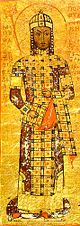
Civil war
The failure of the Second Crusade had dire long-term consequences for the kingdom. The West was hesitant to send large-scale expeditions; for the next few decades, only small armies came, headed by minor European nobles who desired to make a pilgrimage. The Muslim states of Syria were meanwhile gradually united by Nur ad-Din, who defeated the Principality of Antioch at the Battle of InabBattle of Inab
The Battle of Inab, also called Battle of Ard al-Hâtim or Fons Muratus, was fought on June 29, 1149, during the Second Crusade. The Syrian army of Nur ad-Din Zangi destroyed the Crusader army of Raymond of Antioch and the allied followers of Ali ibn-Wafa.-Background:Nur ad-Din had gained control...
in 1149 and gained control of Damascus in 1154. Nur ad-Din was extremely pious and during his rule the concept of jihad
Jihad
Jihad , an Islamic term, is a religious duty of Muslims. In Arabic, the word jihād translates as a noun meaning "struggle". Jihad appears 41 times in the Quran and frequently in the idiomatic expression "striving in the way of God ". A person engaged in jihad is called a mujahid; the plural is...
came to be interpreted as a kind of counter-crusade against the kingdom, which was an impediment to Muslim unity, both political and spiritual.
In Jerusalem, the crusaders were distracted by a conflict between Melisende and Baldwin III. Melisende continued to rule as regent long after Baldwin came of age. She was supported by, among others, Manasses of Hierges, who essentially governed for her as constable; her son Amalric
Amalric I of Jerusalem
Amalric I of Jerusalem was King of Jerusalem 1163–1174, and Count of Jaffa and Ascalon before his accession. Amalric was the second son of Melisende of Jerusalem and Fulk of Jerusalem...
, whom she set up as Count of Jaffa; Philip of Milly
Philip of Milly
Philip of Milly , also known as Philip of Nablus, was a baron in the Kingdom of Jerusalem and the seventh Grand Master of the Knights Templar...
; and the Ibelin
Ibelin
Ibelin was a castle in the Crusader Kingdom of Jerusalem in the 12th century , which gave its name to an important family of nobles.-The castle:...
family. Baldwin asserted his independence by mediating disputes in Antioch and Tripoli, and gained the support of the Ibelin brothers when they began to oppose Manasses' growing power, thanks to his marriage to their widowed mother Helvis of Ramla. In 1153 Baldwin had himself crowned as sole ruler, and a compromise was reached by which the kingdom was divided in two, with Baldwin taking Acre and Tyre in the north and Melisende remaining in control of Jerusalem and the cities of the south. Baldwin was able to replace Manasses with one of his own supporters, Humphrey II of Toron
Humphrey II of Toron
Humphrey II of Toron was lord of Toron and constable of the Kingdom of Jerusalem.Humphrey had become lord of Toron sometime before 1140, when he married the daughter of Renier Brus, lord of Banias . Through this marriage Banias was added to Toron...
. Baldwin and Melisende knew that this situation was untenable. Baldwin soon invaded his mother's possessions, defeated Manasses, and besieged his mother in the Tower of David
Tower of David
The Tower of David is an ancient citadel located near the Jaffa Gate entrance to the Old City of Jerusalem.Built to strengthen a strategically weak point in the Old City's defenses, the citadel that stands today was constructed during the 2nd century BC and subsequently destroyed and rebuilt by,...
in Jerusalem. Melisende surrendered and retired to Nablus, but Baldwin appointed her his regent and chief advisor, and she retained some of her influence, especially in appointing ecclesiastical officials. In 1153, Baldwin launched an offensive against Ascalon, the fortress in the south from which Fatimid Egyptian armies had continually raided Jerusalem since the foundation of the kingdom. The fortress was captured and was added to the County of Jaffa, still in the possession of his brother Amalric.
Byzantine alliance and invasion of Egypt
With the capture of Ascalon the southern border of the kingdom was now secure, and Egypt, formerly been a major threat to the kingdom but now destabilized under the reign of several underaged caliphs, was reduced to a tributary state. Nur ad-Din remained a threat in the east, and Baldwin had to contend with the advances of Byzantine emperor Manuel I Comnenus, who claimed suzerainty over the Principality of Antioch. In order to bolster the defences of the kingdom against the growing strength of the Muslims, Baldwin III made the first direct alliance with the Byzantine Empire, by marrying Theodora Comnena, a niece of emperor Manuel; Manuel married Baldwin's cousin MariaMaria of Antioch
Maria of Antioch was a Byzantine empress as the wife of the Byzantine Emperor Manuel I Komnenos. She was the daughter of Constance of Antioch and her first husband Raymond of Poitiers...
. As William of Tyre put it, it was hoped that Manuel would be able "to relieve from his own abundance the distress under which our realm was suffering and to change our poverty into superabundance".
When Baldwin died childless in 1162, a year after his mother Melisende, the kingdom passed to his brother Amalric, who renewed the alliance negotiated by Baldwin. In 1163 the chaotic situation in Egypt led to a refusal to pay tribute to Jerusalem, and requests were sent to Nur ad-Din for assistance; in response, Amalric invaded
Crusader invasions of Egypt
The Crusader invasion of Egypt was a series of campaigns undertaken by the Kingdom of Jerusalem to strengthen its position in the Levant by taking advantage of the weakness of Fatimid Egypt....
, but was turned back when the Egyptians flooded the Nile at Bilbeis
Bilbeis
Bilbeis is an ancient fortress city on the eastern edge of the southern Nile delta in Egypt.The city played a role in the machinations for control of the Fatimid vizierate: first in 1164, when Shirkuh was besieged in the city by the combined forces of Shiwar and Amalric I of Jerusalem for three...
. The Egyptian vizier Shawar
Shawar
Shawar was a ruler of Egypt, the vizier, from December 1162 until he was assassinated in 1169. He is best known for being part of the three-way power struggle during the Crusades between the Christian King Amalric I of Jerusalem and Shirkuh, a Syrian general and uncle of the man who was to become...
again requested help from Nur ad-Din, who sent his general Shirkuh
Shirkuh
Asad ad-Din Shirkuh bin Shadhi , also known as Shêrko or "Shêrgo" was an important Kurdish military commander, and uncle of Saladin....
, but Shawar quickly turned against him and allied with Amalric. Amalric and Shirkuh both besieged Bilbeis in 1164, but both withdrew due to Nur ad-Din's campaigns against Antioch, where Bohemond III of Antioch and Raymond III of Tripoli
Raymond III of Tripoli
Raymond III of Tripoli was Count of Tripoli from 1152 to 1187 and Prince of Galilee and Tiberias in right of his wife Eschiva.-Early life:...
were defeated at the Battle of Harim
Battle of Harim
The Battle of Harim was fought on 12 August 1164 between the forces of Nur ad-Din Zangi and a combined army from the County of Tripoli, the Principality of Antioch, the Byzantine Empire and Armenia...
. It seemed likely that Antioch itself would fall to Nur ad-Din, but he withdrew when Emperor Manuel sent a large Byzantine force to the area. Nur ad-Din sent Shirkuh back to Egypt in 1166, and Shawar again allied with Amalric, who was defeated at the Battle of al-Babein
Battle of al-Babein
The Battle of al-Babein took place on March 18, 1167, between Amalric I of Jerusalem and a Zengid army under Shirkuh for control of Egypt. Saladin served as Shirkuh’s highest ranking officer in the battle. The battle was a tactical draw between the Zengid forces and King Amalric's invasion...
. Despite the defeat, both sides withdrew, but Shawar remained in control with a crusader garrison in Cairo. Amalric cemented his alliance with Manuel by marrying Manuel's niece Maria Komnene
Maria Komnene, Queen consort of Jerusalem
Maria Komnene or Comnena , , was the second wife of King Amalric I of Jerusalem and mother of Queen Isabella of Jerusalem. She was the daughter of John Komnenos, sometime Byzantine dux in Cyprus, and Maria Taronitissa, a descendant of the ancient Armenian kings...
in 1167, and an embassy led by William of Tyre was sent to Constantinople to negotiate a military expedition, but in 1168 Amalric pillaged Bilbeis without waiting for the naval support promised by Manuel. Amalric accomplished nothing else, but his actions prompted Shawar to switch sides again and seek help from Shirkuh. Shawar was promptly assassinated, and when Shirkuh died in 1169, he was succeeded by his nephew Yusuf, better known as Saladin
Saladin
Ṣalāḥ ad-Dīn Yūsuf ibn Ayyūb , better known in the Western world as Saladin, was an Arabized Kurdish Muslim, who became the first Sultan of Egypt and Syria, and founded the Ayyubid dynasty. He led Muslim and Arab opposition to the Franks and other European Crusaders in the Levant...
. That year, Manuel sent a large Byzantine fleet of some 300 ships to assist Amalric, and the town of Damietta
Damietta
Damietta , also known as Damiata, or Domyat, is a port and the capital of the Damietta Governorate in Egypt. It is located at the intersection between the Mediterranean Sea and the Nile, about north of Cairo.-History:...
was placed under siege. However, the Byzantine fleet sailed with enough provisions for only three months. By the time that the crusaders were ready supplies were already running out and the fleet retired. Each side sought to blame the other for the failure, but both knew that they could not take Egypt without the other's assistance: the alliance was maintained, and plans for another campaign in Egypt were made, which ultimately were to come to naught.
In the end, Nur ad-Din was victorious and Saladin established himself as Sultan of Egypt
Sultan of Egypt
Sultan of Egypt was the status held by the rulers of Egypt after the establishment of the Ayyubid Dynasty of Saladin in 1174 until the Ottoman conquest of Egypt in 1517. Though the extent of the Egyptian Sultanate ebbed and flowed, it generally included Sham and Hejaz, with the consequence that the...
. Saladin soon began to assert his independence from Nur ad-Din, and with the death of both Amalric and Nur ad-Din in 1174, he was well-placed to begin exerting control over Nur ad-Din's Syrian possessions as well. Upon the death of the pro-western Emperor Manuel in 1180, the Kingdom of Jerusalem lost its most powerful ally.
Baldwin IV and the succession crisis

Baldwin IV of Jerusalem
Baldwin IV of Jerusalem , called the Leper or the Leprous, the son of Amalric I of Jerusalem and his first wife, Agnes of Courtenay, was king of Jerusalem from 1174 to 1185. His full sister was Queen Sibylla of Jerusalem and his nephew through this sister was the child-king Baldwin V...
, who was discovered at a very young age to be a leper
Leprosy
Leprosy or Hansen's disease is a chronic disease caused by the bacteria Mycobacterium leprae and Mycobacterium lepromatosis. Named after physician Gerhard Armauer Hansen, leprosy is primarily a granulomatous disease of the peripheral nerves and mucosa of the upper respiratory tract; skin lesions...
. The subsequent events have often been interpreted as a struggle between two opposing factions, the "court party", made up of Baldwin's mother, Amalric's first wife Agnes of Courtenay
Agnes of Courtenay
Agnes of Courtenay was the daughter of Joscelin II of Courtenay by his wife Beatrice , and the mother of king Baldwin IV of Jerusalem and queen Sibylla of Jerusalem.-Dynasty:...
, her immediate family
House of Courtenay
The House of Courtenay was an important dynasty in medieval France originating from the castle of Courtenay in the Gâtinais , going back to the 10th century. The dynasty descended from Athon, the first lord of Courtenay, apparently himself a descendant of the Counts of Sens and from Pharamond,...
, and recent arrivals from Europe who were inexperienced in the affairs of the kingdom and who were in favour of war with Saladin; and the "noble party", led by Raymond of Tripoli and the lesser nobility of the kingdom, who favoured peaceful co-existence with the Muslims. This is the interpretation offered by William of Tyre, who was firmly placed in the "noble" camp, and his view was taken up by subsequent historians; in the 20th century, Marshall W. Baldwin, Steven Runciman
Steven Runciman
The Hon. Sir James Cochran Stevenson Runciman CH — known as Steven Runciman — was a British historian known for his work on the Middle Ages...
, and Hans E. Mayer favoured this interpretation. Peter W. Edbury, on the other hand, argues that William, as well as the thirteenth-century authors who continued William's chronicle in French and were allied to Raymond's supporters in the Ibelin family, cannot be considered impartial. Although the events were clearly a dynastic struggle, "the division was not between native barons and newcomers from the West, but between the king's maternal and paternal kin."
Miles of Plancy
Miles of Plancy
Miles of Plancy , also known as Milon or Milo, was a noble in the crusader Kingdom of Jerusalem.He was born in Champagne and came to the east in the 1160s, where he served King Amalric I, to whom he was distantly related. Amalric made him seneschal of Jerusalem, and in 1167 he participated in...
was briefly bailli or regent during Baldwin IV's minority. Miles was assassinated in October, 1174, and Count Raymond III of Tripoli
Raymond III of Tripoli
Raymond III of Tripoli was Count of Tripoli from 1152 to 1187 and Prince of Galilee and Tiberias in right of his wife Eschiva.-Early life:...
, Amalric's first cousin, became regent. It is highly probable that Raymond or his supporters engineered the assassination. Baldwin reached his majority in 1176, and despite his illness he no longer had any legal need for a regent. Since Raymond was his nearest relative in the male line with a strong claim to the throne, there was concern about the extent of his ambitions, although he had no direct heirs of his own. To balance this, the king turned from time to time to his uncle, Joscelin III of Edessa
Joscelin III of Edessa
Joscelin III of Edessa was the titular Count of Edessa 1159 – after 1190. He was the son of Joscelin II of Edessa and his wife Beatrice...
, who was appointed seneschal in 1176; Joscelin was more closely related to Baldwin than Raymond was, but had no claim to the throne himself.
As a leper, Baldwin could have no children and could not be expected to rule much longer, so the focus of his succession passed to his sister Sibylla
Sibylla of Jerusalem
Sibylla of Jerusalem was the Countess of Jaffa and Ascalon from 1176 and Queen of Jerusalem from 1186 to 1190. She was the eldest daughter of Amalric I of Jerusalem and Agnes of Courtenay, sister of Baldwin IV and half-sister of Isabella I of Jerusalem, and mother of Baldwin V of Jerusalem...
and his younger half-sister Isabella
Isabella of Jerusalem
Isabella I was Queen regnant of Jerusalem from 1190/1192 until her death. By her four marriages, she was successively Lady of Toron, Marchioness of Montferrat, Countess of Champagne and Queen of Cyprus....
. Baldwin and his advisors recognised that it was essential for Sibylla to be married to a Western nobleman in order to access support from Europe in a military crisis; while Raymond was still regent, a marriage was arranged for Sibylla and William of Montferrat
William of Montferrat, Count of Jaffa and Ascalon
William of Montferrat , also called William Longsword , was the Count of Jaffa and Ascalon, the eldest son of William V, Marquess of Montferrat and Judith of Babenberg...
, a cousin of Louis VII of France and of Frederick Barbarossa, Holy Roman Emperor
Frederick I, Holy Roman Emperor
Frederick I Barbarossa was a German Holy Roman Emperor. He was elected King of Germany at Frankfurt on 4 March 1152 and crowned in Aachen on 9 March, crowned King of Italy in Pavia in 1155, and finally crowned Roman Emperor by Pope Adrian IV, on 18 June 1155, and two years later in 1157 the term...
. It was hoped that by allying with a relative of the western emperor, Frederick would come to the kingdom's aid. Jerusalem looked again towards the Byzantine Empire for help, and Emperor Manuel was looking for a way to restore his empire's prestige after his defeat at the Battle of Myriokephalon
Battle of Myriokephalon
The Battle of Myriokephalon, also known as the ', or in Turkish, was a battle between the Byzantine Empire and the Seljuk Turks in Phrygia on September 17, 1176. The battle was a strategic reverse for the Byzantine forces, who were ambushed when moving through a mountain pass...
in 1176; this mission was undertaken by Raynald of Châtillon
Raynald of Chatillon
Raynald of Châtillon was a knight who served in the Second Crusade and remained in the Holy Land after its defeat...
. After William of Montferrat arrived in 1176, he fell ill and died in June 1177, leaving Sibylla widowed and pregnant with the future Baldwin V
Baldwin V of Jerusalem
Baldwin V of Jerusalem was the son of Sibylla of Jerusalem and her first husband, William of Montferrat...
. Raynald was then named regent.
Soon afterwards, Philip of Flanders arrived in Jerusalem on pilgrimage; he was Baldwin IV's cousin, and the king offered him the regency and command of the army, both of which Philip refused, although he objected to the appointment of Raynald as regent. Philip then attempted to intervene in the negotiations for Sibylla's second husband, and suggested one of his own retinue, but the native barons refused his suggestion. In addition, Philip seemed to think he could carve out a territory of his own in Egypt, but he refused to participate with the planned Byzantine-Jerusalem expedition. The expedition was delayed and finally cancelled, and Philip took his army away to the north.
Most of the army of Jerusalem marched north with Philip, Raymond III, and Bohemond III to attack Hama
Hama
Hama is a city on the banks of the Orontes River in west-central Syria north of Damascus. It is the provincial capital of the Hama Governorate. Hama is the fourth-largest city in Syria—behind Aleppo, Damascus, and Homs—with a population of 696,863...
, and Saladin took the opportunity to invade the kingdom. Baldwin proved to be an effective and energetic king as well as being a brilliant military commander: he defeated Saladin at the Battle of Montgisard
Battle of Montgisard
The Battle of Montgisard was fought between the Ayyubids and the Kingdom of Jerusalem on November 25, 1177. The 16 year old King Baldwin IV, seriously afflicted by leprosy, led an out-numbered Christian force against the army of Saladin...
in September 1177 despite being greatly outnumbered and having to rely on a levee-en-masse. Although Baldwin's presence despite his illness was inspirational, direct military decisions were actually made by Raynald.
Hugh III of Burgundy was expected to come to Jerusalem and marry Sibylla, but Hugh was unable to leave France due to the political unrest there in 1179–1180 following the death of Louis VII. Meanwhile, Baldwin IV's stepmother Maria, mother of Isabella and stepmother of Sibylla, married Balian of Ibelin
Balian of Ibelin
Balian of Ibelin was an important noble in the crusader Kingdom of Jerusalem in the 12th century.-Early life:Balian was the youngest son of Barisan of Ibelin, and brother of Hugh and Baldwin. His father, a knight in the County of Jaffa, had been rewarded with the lordship of Ibelin after the...
. At Easter in 1180, Raymond and his cousin Bohemond III of Antioch attempted to force Sibylla to marry Balian's brother Baldwin of Ibelin
Baldwin of Ibelin
Baldwin of Ibelin, also known as Baldwin III of Ramla , was an important noble of the crusader Kingdom of Jerusalem in the 12th century. He was the second son of Barisan of Ibelin, and was the younger brother of Hugh of Ibelin and older brother of Balian of Ibelin...
. Raymond and Bohemond were King Baldwin's nearest male relatives in the paternal line, and could have claimed the throne if the king died without an heir or a suitable replacement. Before Raymond and Bohemond arrived, Agnes and King Baldwin arranged for Sibylla to be married to a Poitevin
Poitou
Poitou was a province of west-central France whose capital city was Poitiers.The region of Poitou was called Thifalia in the sixth century....
newcomer, Guy of Lusignan
Guy of Lusignan
Guy of Lusignan was a Poitevin knight, son of Hugh VIII of the prominent Lusignan dynasty. He was king of the crusader state of Jerusalem from 1186 to 1192 by right of marriage to Sibylla of Jerusalem, and of Cyprus from 1192 to 1194...
, whose older brother Amalric of Lusignan
Amalric II of Jerusalem
Amalric II of Jerusalem or Amalric I of Cyprus, born Amalric of Lusignan , King of Jerusalem 1197–1205, was an older brother of Guy of Lusignan....
was already an established figure at court. Internationally, the Lusignans were useful as vassals of Baldwin and Sibylla's cousin Henry II of England
Henry II of England
Henry II ruled as King of England , Count of Anjou, Count of Maine, Duke of Normandy, Duke of Aquitaine, Duke of Gascony, Count of Nantes, Lord of Ireland and, at various times, controlled parts of Wales, Scotland and western France. Henry, the great-grandson of William the Conqueror, was the...
. Baldwin betrothed eight-year-old Isabella to Humphrey IV of Toron
Humphrey IV of Toron
Humphrey IV of Toron was the lord of Toron, Kerak, and Oultrejordain in the crusader Kingdom of Jerusalem.-Biography:...
, stepson of the powerful Raynald of Châtillon
Raynald of Chatillon
Raynald of Châtillon was a knight who served in the Second Crusade and remained in the Holy Land after its defeat...
, thereby removing her from the influence of the Ibelin
Ibelin
Ibelin was a castle in the Crusader Kingdom of Jerusalem in the 12th century , which gave its name to an important family of nobles.-The castle:...
family and that of her mother.
The dispute between the two factions in the kingdom affected the election of a new Patriarch in 1180. When Patriarch Amalric died on 6 October 1180, the two most obvious choices for his successor were William of Tyre and Heraclius of Caesarea. They were fairly evenly matched in background and education, but politically they were allied with opposite parties, as Heraclius was one of Agnes of Courtenay's supporters. The canons of the Holy Sepulchre asked the king for advice, and Heraclius was chosen through Agnes' influence. There were rumours that Agnes and Heraclius were lovers, but this information comes from the partisan 13th-century continuations of William of Tyre's history, and there is no other evidence to substantiate such a claim.
At the end of 1181, Raynald of Châtillon raided south into Arabia, in the direction of Medina
Medina
Medina , or ; also transliterated as Madinah, or madinat al-nabi "the city of the prophet") is a city in the Hejaz region of western Saudi Arabia, and serves as the capital of the Al Madinah Province. It is the second holiest city in Islam, and the burial place of the Islamic Prophet Muhammad, and...
, although he did not make it that far. It was probably around this time that Raynald also attacked a Muslim caravan. The kingdom had a truce with Saladin at the time, and Raynald's actions have been seen as an independent act of brigandage; it is possible that he was trying to prevent Saladin from moving his forces north to take control of Aleppo, which would have strengthened Saladin's position. In response, Saladin attacked the kingdom in 1182, but was defeated at Belvoir Castle
Battle of Belvoir Castle (1182)
In the campaign and Battle of Belvoir Castle , a Crusader force led by King Baldwin IV of Jerusalem sparred inconclusively with an Ayyubid army from Egypt commanded by Saladin. The theatre of operations included Eilat, the Transjordan, Galilee and Beirut.-Background:Saladin seized control of Egypt...
. King Baldwin, although quite ill, was still able to command the army in person. Saladin attempted to besiege Beirut from land and sea, and Baldwin raided Damascene territory, but neither side did significant damage. In December 1182, Raynald launched a naval expedition on the Red Sea
Red Sea
The Red Sea is a seawater inlet of the Indian Ocean, lying between Africa and Asia. The connection to the ocean is in the south through the Bab el Mandeb strait and the Gulf of Aden. In the north, there is the Sinai Peninsula, the Gulf of Aqaba, and the Gulf of Suez...
, which made it as far south as Rabigh
Rabigh
Rabigh is an ancient town on the western coast of Saudi Arabia . It is in Makkah Province. It used to be named "Al-Johfa" until the early years of the 17th century. In some ancient stories the town had been completely destroyed through a sea water...
. The expedition was defeated and two of Raynald's men were actually taken to Mecca
Mecca
Mecca is a city in the Hijaz and the capital of Makkah province in Saudi Arabia. The city is located inland from Jeddah in a narrow valley at a height of above sea level...
to be executed in public. Like his earlier raids, Raynald's expedition is usually seen as selfish and ultimately fatal for Jerusalem, but according to Bernard Hamilton it was actually shrewd strategy, meant to damage Saladin's prestige and reputation.
In 1183 a general tax was levied throughout the kingdom, which was unprecedented in Jerusalem and almost all of medieval Europe to that point. The tax helped pay for larger armies for the next few years. More troops were certainly needed, since Saladin was finally able to gain control of Aleppo, and with peace in his northern territories he could focus on Jerusalem in the south. King Baldwin was so incapacitated by his leprosy that it was necessary to appoint a regent, and Guy of Lusignan was chosen, as he was Baldwin's legal heir and the king was not expected to live. The inexperienced Guy led the Frankish army against Saladin's incursions into the kingdom, but neither side made any real gains, and Guy was criticized by his opponents for not striking against Saladin when he had the chance.
In October 1183 Isabella married Humphrey of Toron at Kerak
Kerak
Kerak Castle is a large crusader castle located in Kerak in Jordan. It is one of the largest crusader castles in the Levant.Construction of the castle began in the 1140s, under Pagan, the butler of Fulk of Jerusalem. The Crusaders called it Crac des Moabites or "Karak in Moab", as it is frequently...
, during a siege
Siege of Kerak
The Siege of Kerak took place in 1183, with Saladin's forces attacking and being repelled from the Crusader stronghold.- Prelude :Kerak was the stronghold of Raynald of Châtillon, Lord of Oultrejordain, 124 km South of Amman. The fortress was built in 1142 by Pagan the Butler, Lord of Montreal...
by Saladin, who perhaps hoped to take some valuable prisoners. As King Baldwin, although now blind and crippled, had recovered enough to resume his reign and his command of the army, Guy was removed from the regency and his five-year-old son, King Baldwin's nephew and namesake Baldwin
Baldwin V of Jerusalem
Baldwin V of Jerusalem was the son of Sibylla of Jerusalem and her first husband, William of Montferrat...
, was crowned as co-king in November. King Baldwin himself then went to relieve the castle, carried on a litter, and attended by his mother. He was reconciled with Raymond of Tripoli and appointed him military commander. The siege was lifted in December and Saladin retreated to Damascus. Saladin attempted another siege in 1184, but Baldwin repelled that attack as well, and Saladin raided Nablus
Nablus
Nablus is a Palestinian city in the northern West Bank, approximately north of Jerusalem, with a population of 126,132. Located in a strategic position between Mount Ebal and Mount Gerizim, it is the capital of the Nablus Governorate and a Palestinian commercial and cultural center.Founded by the...
and other towns on the way home.
In October 1184, Guy of Lusignan led an attack on the Bedouin
Bedouin
The Bedouin are a part of a predominantly desert-dwelling Arab ethnic group traditionally divided into tribes or clans, known in Arabic as ..-Etymology:...
nomads from his base in Ascalon. Unlike Raynald's attacks on caravans, which may have had some military purpose, Guy attacked a group that was usually loyal to Jerusalem and provided intelligence about the movements of Saladin's troops. At the same time, King Baldwin contracted his final illness and Raymond of Tripoli, rather than Guy, was appointed as his regent. His nephew Baldwin was paraded in public, wearing his crown as Baldwin V. Baldwin IV finally succumbed to his leprosy in May 1185.
Meanwhile, the succession crisis had prompted a mission to the west to seek assistance. In 1184, Patriarch Heraclius travelled throughout the courts of Europe, but no help was forthcoming. Heraclius offered the "keys of the Holy Sepulchre, those of the Tower of David and the banner of the Kingdom of Jerusalem", but not the crown itself, to both Philip II of France
Philip II of France
Philip II Augustus was the King of France from 1180 until his death. A member of the House of Capet, Philip Augustus was born at Gonesse in the Val-d'Oise, the son of Louis VII and his third wife, Adela of Champagne...
and Henry II of England
Henry II of England
Henry II ruled as King of England , Count of Anjou, Count of Maine, Duke of Normandy, Duke of Aquitaine, Duke of Gascony, Count of Nantes, Lord of Ireland and, at various times, controlled parts of Wales, Scotland and western France. Henry, the great-grandson of William the Conqueror, was the...
; the latter, as a grandson of Fulk, was a first cousin of the royal family of Jerusalem, and had promised to go on crusade after the murder of Thomas Becket
Thomas Becket
Thomas Becket was Archbishop of Canterbury from 1162 until his murder in 1170. He is venerated as a saint and martyr by both the Roman Catholic Church and the Anglican Communion...
. Both kings preferred to remain at home to defend their own territories, rather than act as regent for a child in Jerusalem. The few European knights who did travel to Jerusalem did not even see any combat, since the truce with Saladin had been re-established. William V of Montferrat was one of the few who came to his grandson Baldwin V's aid.
Baldwin V's rule, with Raymond of Tripoli as regent and his great-uncle Joscelin of Edessa as his guardian, was short. He was a sickly child and died in the summer of 1186. Raymond and his supporters went to Nablus, presumably in an attempt to prevent Sibylla from claiming the throne, but Sibylla and her supporters went to Jerusalem, where it was decided that the kingdom should pass to her, on the condition that her marriage to Guy be annulled. She agreed but only if she could choose her own husband and king, and after being crowned, she immediately crowned Guy with her own hands. Raymond had refused to attend the coronation, and in Nablus he suggested that Isabella and Humphrey should be crowned instead, but Humphrey refused to agree to this plan which would have certainly started a civil war. Humphrey went to Jerusalem and swore allegiance to Guy and Sibylla, as did most of Raymond's other supporters. Raymond himself refused to do so and left for Tripoli; Baldwin of Ibelin
Baldwin of Ibelin
Baldwin of Ibelin, also known as Baldwin III of Ramla , was an important noble of the crusader Kingdom of Jerusalem in the 12th century. He was the second son of Barisan of Ibelin, and was the younger brother of Hugh of Ibelin and older brother of Balian of Ibelin...
also refused, gave up his fiefs, and left for Antioch.
Loss of Jerusalem and the Third Crusade

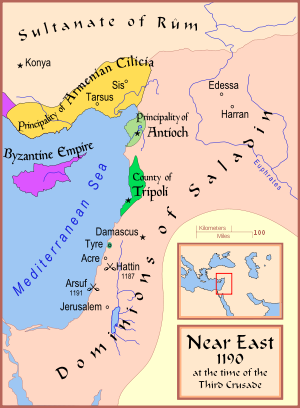
Balian of Ibelin
Balian of Ibelin was an important noble in the crusader Kingdom of Jerusalem in the 12th century.-Early life:Balian was the youngest son of Barisan of Ibelin, and brother of Hugh and Baldwin. His father, a knight in the County of Jaffa, had been rewarded with the lordship of Ibelin after the...
effected a reconciliation between the two during Easter in 1187. Saladin attacked Kerak again in April, and in May, a Muslim raiding party ran into the much smaller embassy on its way to negotiate with Raymond, and defeated it at the Battle of Cresson
Battle of Cresson
The Battle of Cresson was a small battle fought on May 1, 1187, at the springs of Cresson, or 'Ain Gozeh, near Nazareth. It was a prelude to the decisive defeat of the Kingdom of Jerusalem at the Battle of Hattin two months later.-Background:...
near Nazareth. Raymond and Guy finally agreed to attack Saladin at Tiberias, but could not agree on a plan; Raymond thought a pitched battle should be avoided, but Guy probably remembered the criticism he faced for avoiding battle in 1183, and it was decided to march out against Saladin directly. On July 4, 1187, the army of the kingdom was utterly destroyed at the Battle of Hattin
Battle of Hattin
The Battle of Hattin took place on Saturday, July 4, 1187, between the Crusader Kingdom of Jerusalem and the forces of the Ayyubid dynasty....
. Raymond of Tripoli, Balian of Ibelin, and Reginald of Sidon
Reginald of Sidon
Reginald Grenier was Lord of Sidon and an important noble in the late-12th century Kingdom of Jerusalem.-Rise to fame:...
escaped, but Raynald was executed by Saladin and Guy was imprisoned in Damascus.
Over the next few months Saladin easily overran the entire kingdom. Only the port of Tyre remained in Frankish hands, defended by Conrad of Montferrat
Conrad of Montferrat
Conrad of Montferrat was a northern Italian nobleman, one of the major participants in the Third Crusade. He was the de facto King of Jerusalem, by marriage, from 24 November 1190, but officially elected only in 1192, days before his death...
, the paternal uncle of Baldwin V, who had coincidentally arrived just in time from Constantinople
Constantinople
Constantinople was the capital of the Roman, Eastern Roman, Byzantine, Latin, and Ottoman Empires. Throughout most of the Middle Ages, Constantinople was Europe's largest and wealthiest city.-Names:...
. The fall of Jerusalem
Siege of Jerusalem (1187)
On July 4, 1187 the Kingdom's army was defeated at the Battle of Hattin by Saladin and only Balian of Ibelin commanding a small number of soldiers remained in Jerusalem. The Siege of Jerusalem lasted from September 20 to October 2, 1187. On October 2, 1187 Balian of Ibelin surrendered Jerusalem to...
essentially ended the first Kingdom of Jerusalem. Much of the population, swollen with refugees fleeing Saladin's conquest of the surrounding territory, was allowed to flee to Tyre, Tripoli, or Egypt (whence they were sent back to Europe), but those who could not pay for their freedom were sold into slavery, and those who could were often robbed by Christians and Muslims alike on their way into exile. The capture of the city led to the Third Crusade
Third Crusade
The Third Crusade , also known as the Kings' Crusade, was an attempt by European leaders to reconquer the Holy Land from Saladin...
, launched in 1189 and led by Richard the Lionheart
Richard I of England
Richard I was King of England from 6 July 1189 until his death. He also ruled as Duke of Normandy, Duke of Aquitaine, Duke of Gascony, Lord of Cyprus, Count of Anjou, Count of Maine, Count of Nantes, and Overlord of Brittany at various times during the same period...
, Philip Augustus
Philip II of France
Philip II Augustus was the King of France from 1180 until his death. A member of the House of Capet, Philip Augustus was born at Gonesse in the Val-d'Oise, the son of Louis VII and his third wife, Adela of Champagne...
and Frederick Barbarossa
Frederick I, Holy Roman Emperor
Frederick I Barbarossa was a German Holy Roman Emperor. He was elected King of Germany at Frankfurt on 4 March 1152 and crowned in Aachen on 9 March, crowned King of Italy in Pavia in 1155, and finally crowned Roman Emperor by Pope Adrian IV, on 18 June 1155, and two years later in 1157 the term...
, though the last drowned en route.
Guy of Lusignan, who had been refused entry to Tyre by Conrad, began to besiege Acre in 1189. During the lengthy siege, which lasted until 1191, Patriarch Heraclius, Queen Sibylla and her daughters, and many others died of disease. With the death of Sibylla in 1190, Guy now had no legal claim to the kingship, and the succession passed to Sibylla's half-sister Isabella. Isabella's mother Maria and the Ibelins (now closely allied to Conrad) argued that Isabella and Humphrey's marriage was illegal, as she had been underage at the time; underlying this was the fact that Humphrey had betrayed his wife's cause in 1186. The marriage was annulled amid some controversy. Conrad, who was now the nearest kinsman to Baldwin V in the male line, and had already proved himself a capable military leader, then married Isabella, but Guy refused to concede the crown.
When Richard arrived in 1191, he and Philip took different sides in the succession dispute. Richard backed Guy, his vassal from Poitou, while Philip supported Conrad, a cousin of his late father Louis VII. After much ill-feeling and ill-health, Philip returned home in 1191, soon after the fall of Acre. Richard defeated Saladin at the Battle of Arsuf
Battle of Arsuf
The Battle of Arsuf was a battle of the Third Crusade in which Richard I of England defeated Saladin at Arsuf. Following a series of harassing attacks by Saladin's forces, battle was joined on the morning of 7 September 1191...
in 1191 and the Battle of Jaffa
Battle of Jaffa
The Battle of Jaffa took place during the Crusades, as one of a series of campaigns between Saladin's army and the forces of King Richard the Lionheart. It was the final battle of the Third Crusade, after which Saladin and King Richard were able to negotiate a truce...
in 1192, recovering most of the coast, but could not recover Jerusalem or any of the inland territory of the kingdom. Conrad was unanimously elected king in April 1192, but was murdered by the Hashshashin
Hashshashin
The Assassins were an order of Nizari Ismailis, particularly those of Persia that existed from around 1092 to 1265...
only days later. Eight days after that, the pregnant Isabella was married to Count Henry II of Champagne
Henry II of Champagne
Henry II of Champagne was count of Champagne from 1181 to 1197, and King of Jerusalem from 1192 to 1197, although he never used the title of king.- Early Life and Family :...
, nephew of Richard and Philip, but politically allied to Richard. As compensation, Richard sold Guy the island of Cyprus
Kingdom of Cyprus
The Kingdom of Cyprus was a Crusader kingdom on the island of Cyprus in the high and late Middle Ages, between 1192 and 1489. It was ruled by the French House of Lusignan.-History:...
, which Richard had captured on the way to Acre, although Guy continued to claim the throne of Jerusalem until his death in 1194.
The crusade came to an end peacefully, with the Treaty of Ramla
Treaty of Ramla
The Treaty of Ramla was signed by Saladin and Richard the Lionheart in June 1192 after the Battle of Arsuf. Under the terms of the agreement, Jerusalem would remain under Muslim control. However, the city would be open to Christian pilgrimages. Also, the treaty reduced the Latin Kingdom to a...
negotiated in 1192; Saladin allowed pilgrimages to be made to Jerusalem, allowing the crusaders to fulfill their vows, after which they all returned home. The native crusader barons set about rebuilding their kingdom from Acre and the other coastal cities.
The Kingdom of Acre
For the next hundred years, the Kingdom of Jerusalem clung to life as a tiny kingdom hugging the Syrian coastline. Its capital was moved to Acre and controlled most of the coastline of present day Israel and southern and central Lebanon, including the strongholds and towns of Jaffa, Arsuf, Caesarea, Tyre, Sidon, and Beirut. At best, it included only a few other significant cities, such as Ascalon and some interior fortresses, as well as suzeraintySuzerainty
Suzerainty occurs where a region or people is a tributary to a more powerful entity which controls its foreign affairs while allowing the tributary vassal state some limited domestic autonomy. The dominant entity in the suzerainty relationship, or the more powerful entity itself, is called a...
over Tripoli and Antioch. The new king, Henry of Champagne, died accidentally in 1197, and Isabella married for a fourth time, to Amalric of Lusignan
Amalric II of Jerusalem
Amalric II of Jerusalem or Amalric I of Cyprus, born Amalric of Lusignan , King of Jerusalem 1197–1205, was an older brother of Guy of Lusignan....
, Guy's brother. Amalric II had already inherited Cyprus from Guy, and had been crowned king by Frederick Barbarossa's son, Emperor Henry VI
Henry VI, Holy Roman Emperor
Henry VI was King of Germany from 1190 to 1197, Holy Roman Emperor from 1191 to 1197 and King of Sicily from 1194 to 1197.-Early years:Born in Nijmegen,...
. Henry led a crusade in 1197
Crusade of 1197
The Crusade of 1197 was a crusade launched by the Holy Roman Emperor Henry VI in response to the failure of Frederick I Barbarossa's crusade in 1190, and thus is also known as the "Emperor's Crusade." The Crusade ended in utter failure...
but died along the way. Nevertheless, his troops recaptured Beirut and Sidon for the kingdom before returning home in 1198. A five-year truce was then concluded with the Ayyubids in Syria in 1198.
The Ayyubid empire had fallen into civil war after the death of Saladin in 1193. His sons claimed various parts of his empire: az-Zahir
Malik az-Zahir
Az-Zahir Ghazi was governor and then ruler of Aleppo from 1186 to 1216. He was the third son of Saladin and his lands included northern Syria and a small part of Mesopotamia....
took control of Aleppo, al-Aziz Uthman
Al-Aziz Uthman
Al-Malik Al-Aziz Osman bin Salahadin Yusuf was the second Ayyubid Sultan of Egypt. He was the second son of Saladin.Before his death, Saladin had divided his dominions amongst his kin: Al-Afdal received Palestine and Syria, Al-Aziz was made ruler of Egypt, Al-Zahir received Aleppo, Al-Adil...
held Cairo, while his eldest son, al-Afdal
Al-Afdal ibn Salah ad-Din
Al-Afdal ibn Salah ad-din popularly known as Al-Afdal was one of seventeen sons of Saladin. He succeeded his father as the second emir of Damascus. He was the leader of the Ayyubids in the Battle of Cresson.-Biography:...
, retained Damascus. Saladin's brother Al-Adil Sayf ad-Din
Al-Adil I
Al-Adil I was an Ayyubid-Egyptian general and ruler of Kurdish descent. From his honorific "Sayf al-Din" he was sometimes known to the Frankish crusaders as "Saphadin".- Life :...
(often called "Saphadin" by the crusaders) acquired al-Jazira
Al-Jazira, Mesopotamia
Upper Mesopotamia is the name used for the uplands and great outwash plain of northwestern Iraq and northeastern Syria and southeastern Turkey which is known by the traditional Arabic name of Al-Jazira , variously transliterated into Roman script as Djazirah, Djezirah and Jazirah...
(northern Mesopotamia), and al-Adil's son al-Mu'azzam
Al-Mu'azzam
Al-Mu'azzam 'Isa Sharaf ad-Din was an Ayyubid Sultan who ruled Damascus from 1218 to 1227. The son of Sultan Al-Adil I and nephew of Saladin, founder of the dynasty, Al-Mu'azzam was installed by his father as governor of Damascus in 1201. After his father's death in 1218, Al-Mu'azzam ruled the...
took possession of Karak
Karak
The term Karak can refer to:* Karak, Pakistan, a city in Pakistan.* Karak District, a district of Khyber Pakhtunkhwa previously called , Pakistan....
and Transjordan
Transjordan
The Emirate of Transjordan was a former Ottoman territory in the Southern Levant that was part of the British Mandate of Palestine...
. In 1196, al-Afdal was driven out of Damascus by Uthman. He returned when Uthman died in 1198, but was opposed by al-Adil, who occupied the Citadel of Damascus. Al-Adil also conquered Cairo in 1200 and banished al-Afdal from Damascus in 1201. He proclaimed himself Sultan of Egypt and Syria, entrusting Damascus to al-Mu'azzam and al-Jazira to his other son al-Kamil
Al-Kamil
Al-Kamil was a Kurdish Ayyubid sultan who ruled North Africa. During his tenure as sultan, the Ayyubids defeated two crusades. In a temporary agreement with the Crusaders, he ceded Jerusalem to the Christians.-Biography:He was the son of sultan al-Adil, a brother of Saladin...
.
Meanwhile, schemes were hatched to reconquer Jerusalem through Egypt. A Fourth Crusade
Fourth Crusade
The Fourth Crusade was originally intended to conquer Muslim-controlled Jerusalem by means of an invasion through Egypt. Instead, in April 1204, the Crusaders of Western Europe invaded and conquered the Christian city of Constantinople, capital of the Eastern Roman Empire...
was planned after the failure of the Third, but it resulted in the sack of Constantinople
Siege of Constantinople (1204)
The Siege of Constantinople occurred in 1204; it destroyed parts of the capital of the Byzantine Empire as it was confiscated by Western European and Venetian Crusaders...
in 1204, and most of the crusaders involved never arrived in the kingdom. Amalric, however, not knowing of the diversion to Constantinople, raided Egypt in advance of the expected invasion. Both Isabella and Amalric died in 1205 and again an underage girl, Isabella and Conrad's daughter Maria of Montferrat
Maria of Montferrat
Maria of Montferrat was Queen of Jerusalem, the daughter of Conrad of Montferrat and Isabella, Queen of Jerusalem...
, became queen of Jerusalem. Isabella's half-brother John of Ibelin, the Old Lord of Beirut
John of Ibelin, the Old Lord of Beirut
John of Ibelin , called the Old Lord of Beirut, was a powerful crusader noble in the 13th century, one of the best known representatives of the influential Ibelin family...
governed as regent until 1210 when Maria married an experienced French knight, John of Brienne
John of Brienne
John of Brienne was a French nobleman who became King of Jerusalem by marriage, and ruled the Latin Empire of Constantinople as regent.-Life:...
. Maria died in childbirth in 1212, and John of Brienne continued to rule as regent for their daughter Isabella II.
Fifth Crusade and Frederick II
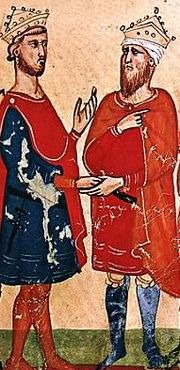
Andrew II of Hungary
Andrew II the Jerosolimitan was King of Hungary and Croatia . He was the younger son of King Béla III of Hungary, who invested him with the government of the Principality of Halych...
and Leopold VI, Duke of Austria
Leopold VI, Duke of Austria
Leopold VI , called the Glorious, from the House of Babenberg, was Duke of Austria from 1198 to 1230 and of Styria from 1194 to 1230....
arrived in Acre and, along with John of Brienne, raided territory further inland, including Mount Tabor
Mount Tabor
-Places:*Mount Tabor, a hill in Israel near Nazareth believed by many to be the site of the Transfiguration of ChristIn the United States:*Mount Tabor, Indiana, an unincorporated community...
, but without success. After the departure of the Hungarians, the remaining crusaders set about refortifying Caesarea and the Templar fortress of Château Pèlerin
Chateau Pelerin
Château Pèlerin, also known as Atlit Castle and Castle Pilgrim, is located on the northern coast of Israel about south of Haifa. The Knights Templar began building it in 1218 during the Fifth Crusade. One of the major Crusader fortresses, it could support up to 4,000 troops in siege conditions. ...
throughout the winter of 1217 and spring of 1218.
In the spring of 1218 the Fifth Crusade
Fifth Crusade
The Fifth Crusade was an attempt to reacquire Jerusalem and the rest of the Holy Land by first conquering the powerful Ayyubid state in Egypt....
began in earnest when German crusader fleets landed at Acre. Along with King John, who was elected leader of the crusade, the fleets sailed to Egypt and besieged Damietta
Damietta
Damietta , also known as Damiata, or Domyat, is a port and the capital of the Damietta Governorate in Egypt. It is located at the intersection between the Mediterranean Sea and the Nile, about north of Cairo.-History:...
at the mouth of the Nile in May. The siege progressed slowly, and the Egyptian sultan al-Adil died in August 1218, supposedly of shock after the crusaders managed to capture one of Damietta's towers. He was succeeded by his son al-Kamil
Al-Kamil
Al-Kamil was a Kurdish Ayyubid sultan who ruled North Africa. During his tenure as sultan, the Ayyubids defeated two crusades. In a temporary agreement with the Crusaders, he ceded Jerusalem to the Christians.-Biography:He was the son of sultan al-Adil, a brother of Saladin...
. In the autumn of 1218 reinforcements arrived from Europe, including the papal legate Pelagius of Albano. In the winter the crusaders were affected by floods and disease, and the siege dragged on throughout 1219, when Francis of Assisi
Francis of Assisi
Saint Francis of Assisi was an Italian Catholic friar and preacher. He founded the men's Franciscan Order, the women’s Order of St. Clare, and the lay Third Order of Saint Francis. St...
arrived to attempt to negotiate a truce. Neither side could agree to terms, despite the Ayyubid offer of a thirty-year truce and the restoration of Jerusalem and most of the rest of the former kingdom. The crusaders finally managed to starve out the city and captured it in November. Al-Kamil retreated to the nearby fortress of al-Mansurah, but the crusaders remained in Damietta throughout 1219 and 1220, awaiting the arrival of Holy Roman Emperor Frederick II
Frederick II, Holy Roman Emperor
Frederick II , was one of the most powerful Holy Roman Emperors of the Middle Ages and head of the House of Hohenstaufen. His political and cultural ambitions, based in Sicily and stretching through Italy to Germany, and even to Jerusalem, were enormous...
, while King John returned to Acre briefly to defend against al-Mu'azzam, who was raiding the kingdom from Damascus in John's absence. Still expecting the emperor's imminent arrival, in July of 1221, the crusaders set off towards Cairo, but they were stopped by the rising Nile
Flooding of the Nile
has been an important natal cycle in Egypt since ancient times. It is celebrated by Egyptians as an annual holiday for two weeks starting August 15, known as Wafaa El-Nil. It is also celebrated in the Coptic Church by ceremonially throwing a martyr's relic into the river, hence the name, Esba`...
, which al-Kamil allowed to flood by breaking the dams along its course. The sultan easily defeated the trapped crusader army and regained Damietta. Emperor Frederick had, in fact, never left Europe at all.
After the failure of the crusade, John travelled throughout Europe seeking assistance, but found support only from Frederick, who then married John and Maria's daughter Isabella II in 1225. The next year, Isabella died giving birth to their son Conrad IV
Conrad IV of Germany
Conrad IV was king of Jerusalem , of Germany , and of Sicily .-Biography:...
, who succeeded his mother to the throne although he never appeared in the east. Frederick had reneged on his promise to lead the Fifth Crusade, but was now eager to cement his claim to the throne through Conrad. There were also plans to join with al-Kamil in attacking al-Mu'azzam in Damascus, an alliance which had been discussed with Egyptian envoys in Italy. But after continually delaying his departure for the Holy Land, including suffering an outbreak of disease in his fleet, he was excommunicated by Pope Gregory IX
Pope Gregory IX
Pope Gregory IX, born Ugolino di Conti, was pope from March 19, 1227 to August 22, 1241.The successor of Pope Honorius III , he fully inherited the traditions of Pope Gregory VII and of his uncle Pope Innocent III , and zealously continued their policy of Papal supremacy.-Early life:Ugolino was...
in 1227. The crusaders whom Frederick was supposed to lead arrived in the east late in 1227, and while waiting for the emperor they set about refortifying Sidon
Sidon
Sidon or Saïda is the third-largest city in Lebanon. It is located in the South Governorate of Lebanon, on the Mediterranean coast, about 40 km north of Tyre and 40 km south of the capital Beirut. In Genesis, Sidon is the son of Canaan the grandson of Noah...
, where they built the sea castle
Sidon Sea Castle
Sidon Sea Castle is a castle in Sidon, Lebanon. It was built by the Crusaders in 1228 on a small island connected to the mainland by a causeway. A climb to the top leads to the roof where there is a good view of the port and the old part of the city.Today the castle consists primarily of two...
, and Montfort
Montfort Castle
Montfort is a ruined crusader castle in the Upper Galilee region in northern Israel, about 22 miles northeast of the city of Haifa and 10 miles south of the border with Lebanon....
, which later became the headquarters of the Teutonic Knights
Teutonic Knights
The Order of Brothers of the German House of Saint Mary in Jerusalem , commonly the Teutonic Order , is a German medieval military order, in modern times a purely religious Catholic order...
. The Ayyubids of Damascus did not dare attack, as al-Mu'azzam had suddenly died not long before. Frederick finally arrived on the Sixth Crusade
Sixth Crusade
The Sixth Crusade started in 1228 as an attempt to regain Jerusalem. It began seven years after the failure of the Fifth Crusade. It involved very little actual fighting...
in September 1228, and claimed the regency of the kingdom in the name of his infant son.
The death of al-Mu'azzam negated the proposed alliance with al-Kamil, who along with his brother al-Ashraf
Al-Ashraf
Al-Ashraf Musa Abu'l-Fath al-Muzaffar ad-Din, called Al-Ashraf was a ruler of the Ayyubid dynasty. The son of Sultan Al-Adil I, Al-Ashraf was installed by his father in Harran in 1201 as Governor of the Jezireh...
had taken possession of Damascus (as well as Jerusalem) from their nephew, al-Mu'azzam's son an-Nasir Dawud
An-Nasir Dawud
An-Nasir Dawud was briefly Ayyubid sultan of Damascus and later Emir of Kerak.An-Nasir Dawud was the son of Al-Mu'azzam, the Ayyubid Sultan of Damascus from 1218 to 1227. On his father's death, An-Nasir succeeded, but soon faced opposition from his uncle, Al-Kamil of Egypt, who made war on him,...
. However, al-Kamil presumably did not know of the small size of Frederick's army, nor the divisions within it caused by his excommunication, and wished to avoid defending his territories against another crusade. Frederick's presence alone was sufficient to regain Jerusalem, Bethlehem, Nazareth, and a number of surrounding castles without a fight: these were recovered in February 1229 by treaty with al-Kamil, in return for a ten-year truce with the Ayyubids and freedom of worship for Jerusalem's Muslim inhabitants. In March, Frederick was crowned in the Church of the Holy Sepulchre, but because of his excommunication, and because, in response to the treaty, the Patriarch of Jerusalem had placed the city under interdict
Interdict
The term Interdict may refer to:* Court order enforcing or prohibiting a certain action* Injunction, such as a restraining order...
, Jerusalem was never truly reincorporated into the kingdom, which continued to be ruled from Acre.
Frederick also came into conflict with the native nobles of Outremer, especially the regent John of Ibelin, whom Frederick demanded give up not only the regency but also his own lordship of Beirut. The nobility resented his attempts to impose Imperial authority over their kingdom, which resulted in a number of confrontations both on the mainland and on Cyprus. Partly in response to this, but also because the Pope had used his excommunication as an excuse to invade his Italian territories, Frederick was forced to return home in 1229, leaving the Holy Land "not in triumph, but showered with offal" by the citizens of Acre.
War of the Lombards
Nevertheless, Frederick sent an Imperial armyWar of the Lombards
The War of the Lombards was a civil war in the Kingdom of Jerusalem and the Kingdom of Cyprus between the "Lombards" , the representatives of the Emperor Frederick II, largely from Lombardy, and the native aristocracy, led first by the Ibelins and then by the Montforts...
in 1231, which occupied Beirut and Tyre. In response, the nobles in Acre organized themselves into a commune
Medieval commune
Medieval communes in the European Middle Ages had sworn allegiances of mutual defense among the citizens of a town or city. They took many forms, and varied widely in organization and makeup. Communes are first recorded in the late 11th and early 12th centuries, thereafter becoming a widespread...
. With the help of the Genoese merchants, John of Ibelin attacked Tyre in 1232, and recaptured Beirut, but was defeated at the Battle of Casal Imbert. The Imperial army then reoccupied Tyre.
Frederick remained regent for his son Conrad, and his representative in the east, Richard Filangieri
Richard Filangieri
Richard Filangieri was an Italian nobleman who played an important part in the Sixth Crusade in 1228–9 and in the War of the Lombards from 1229–43, where he was in charge of the forces of Frederick II, Holy Roman Emperor, battling forces on the other side, local barons first led by...
, remained in control of Tyre and Jerusalem, while John of Ibelin and his supporters controlled the government in Acre. By 1242 Conrad was of age to rule alone, but as he never came to the east, Alice of Champagne
Alice of Champagne
Alice of Champagne was the daughter of Queen Isabella I of Jerusalem and her third husband Henry II, Count of Champagne. Alice and her sister Philippa spent part of their life fighting for their father's homeland of Champagne, over another branch of their family...
, daughter of Henry of Champagne and Conrad's closest relative living in the kingdom, was chosen to rule as regent. Later in 1242 the Ibelins and the Italians recaptured Tyre from Filangieri. In 1244 the combined army of Cyprus and Jerusalem was defeated at the Battle of La Forbie
Battle of La Forbie
The Battle of La Forbie, also known as the Battle of Harbiyah, was fought October 17, 1244 – October 18, 1244 between the allied armies and the Egyptian army of the Ayyubid Sultan as-Salih Ayyub, reinforced with Khwarezmian mercenaries.-Prelude:The capture of...
, and Jerusalem was lost again to the Ayyubids and their Khwarezmian
Khwarezmian Empire
The Khwarazmian dynasty or Khwarezmian dynasty, also known as Khwarezmids, dynasty of Khwarazm Shahs or Khwarezm-Shah dynasty was a Persianate Sunni Muslim dynasty of Turkic mamluk origin.They ruled Greater Iran in the High Middle Ages, in the period of about 1077 to 1231, first as vassals of...
allies, recently displaced by the Mongols
Mongols
Mongols ) are a Central-East Asian ethnic group that lives mainly in the countries of Mongolia, China, and Russia. In China, ethnic Mongols can be found mainly in the central north region of China such as Inner Mongolia...
further to the east. The Khwarezmians completely razed Jerusalem, leaving it in ruins and useless to both Christians and Muslims. Alice died in 1246 and was replaced as regent by King Henry I of Cyprus
Henry I of Cyprus
Henry I of Cyprus, nicknamed the Fat, aka Henry of Lusignan or Henri I le Gros de Lusignan was King of Cyprus from 1218 to 1253. He was the son of Hugh I of Cyprus and Alice of Champagne of Jerusalem. When his father Hugh I died on January 10, 1218, the 8-month-old Henry became king...
, for whom John and his Ibelin relatives served as bailli in Acre. In 1249 Louis IX of France
Louis IX of France
Louis IX , commonly Saint Louis, was King of France from 1226 until his death. He was also styled Louis II, Count of Artois from 1226 to 1237. Born at Poissy, near Paris, he was an eighth-generation descendant of Hugh Capet, and thus a member of the House of Capet, and the son of Louis VIII and...
arrived on the Seventh Crusade
Seventh Crusade
The Seventh Crusade was a crusade led by Louis IX of France from 1248 to 1254. Approximately 800,000 bezants were paid in ransom for King Louis who, along with thousands of his troops, was captured and defeated by the Egyptian army led by the Ayyubid Sultan Turanshah supported by the Bahariyya...
, and although he did not interfere with the governance of the kingdom like Frederick II had, he was seen as the leader of the Christians and spent much of his time rebuilding the coastal cities. He accomplished little else except to effect a revolution in Egypt, in which the Ayyubids were overthrown by their Mamluk
Mamluk
A Mamluk was a soldier of slave origin, who were predominantly Cumans/Kipchaks The "mamluk phenomenon", as David Ayalon dubbed the creation of the specific warrior...
army in 1250. King Henry died in 1253.
When Conrad died in 1254, his son Conradin
Conradin
Conrad , called the Younger or the Boy, but usually known by the diminutive Conradin , was the Duke of Swabia , King of Jerusalem , and King of Sicily .-Early childhood:Conradin was born in Wolfstein, Bavaria, to Conrad...
inherited the kingdom, but he too never appeared in the east. His closest relative was Hugh II of Cyprus
Hugh II of Cyprus
Hugh II of Cyprus was king of Cyprus and, from the age of 5 years, also Regent of the Kingdom of Jerusalem....
, who was himself a child, and Cyprus and Jerusalem were governed by Hugh II's mother Plaisance of Antioch
Plaisance of Antioch
Queen Plaisance of Cyprus, born Plaisance of Antioch or Plaisance de Poitiers was a daughter of Bohemund V of Antioch and his second wife, the Italian noblewoman Lucienne dei Conti di Segni, kinswoman of Pope Innocent III...
, with John of Arsuf
John of Arsuf
John of Ibelin was the Lord of Arsuf from 1236 and Constable of Jerusalem from 1251. He was a younger son of John I of Beirut. His elder brother, Balian, inherited Beirut. He served as regent of Jerusalem on two occasions: 1253-1254 for Conrad II and 1256-1258 for Conrad III...
acting on her behalf as bailli in Acre. In 1256 the War of Saint Sabas
War of Saint Sabas
The War of Saint Sabas or San Saba was a conflict between the Mediterranean maritime republics of Genoa and Venice .The war began when the Venetians were evicted from Tyre in 1256 and war grew out of a dispute concerning land in Acre then...
erupted between Venetian and Genoese merchants in Acre; John of Arsur supported the Genoese, but his relative John of Jaffa
John of Ibelin (jurist)
John of Ibelin , count of Jaffa and Ascalon, was a noted jurist and the author of the longest legal treatise from the Kingdom of Jerusalem. He was the son of Philip of Ibelin, bailli of the Kingdom of Cyprus, and Alice of Montbéliard, and was the nephew of John of Ibelin, the "Old Lord of Beirut"...
supported the Venetians, who won the war in 1257. John of Arsuf died in 1258, and Plaisance in 1261. As Hugh II was still underage, Cyprus passed to his cousin Hugh of Antioch-Lusignan, whose mother Isabella, Hugh II's aunt, took over the regency in Acre, but she died in 1264. The regency in Acre was then claimed by Hugh of Antioch-Lusignan
Hugh III of Cyprus
Hugh III of Cyprus , born Hughues de Poitiers, later Hughues de Lusignan , called the Great, was the King of Cyprus from 1267 and King of Jerusalem from 1268 . He was the son of Henry of Antioch and Isabella of Cyprus, the daughter of Hugh I...
and his cousin Hugh of Brienne
Hugh of Brienne
Hugh de Candie, Count of Brienne and Lecce was the second surviving son of Count Walter IV of Brienne and Marie de Lusignan of Cyprus....
, and Hugh II died in 1267 before he reached the age of majority. Hugh of Antioch-Lusignan won the dispute and succeeded him as Hugh III of Cyprus. When Conradin was executed in Sicily in 1268, there was no other Hohenstaufen heir to succeed him, and Hugh III became king of Jerusalem as well in 1269. Meanwhile, the Ayyubids were essentially wiped out in a war with the Mongols, who captured Damascus in 1260, but later that year the Mongols were defeated by an army from Mamluk Egypt at the Battle of Ain Jalut
Battle of Ain Jalut
The Battle of Ain Jalut took place on 3 September 1260 between Mamluks and the Mongols in eastern Galilee, in the Jezreel Valley, not far from Ein Harod....
; this saved Syria, Egypt, and the crusader cities from falling under Mongol control. The Mamluks appreciated crusader neutrality in the conflict, but the Mamluk sultan Baibars
Baibars
Baibars or Baybars , nicknamed Abu l-Futuh , was a Mamluk Sultan of Egypt. He was one of the commanders of the forces which inflicted a devastating defeat on the Seventh Crusade of King Louis IX of France and he led the vanguard of the Egyptian army at the Battle of Ain Jalut in 1260, which marked...
took advantage of this and began conquering the remaining crusader cities along the coast, including Jaffa and Antioch in 1268.
Louis IX prepared another crusade in 1270, but it was diverted to Tunis
Tunis
Tunis is the capital of both the Tunisian Republic and the Tunis Governorate. It is Tunisia's largest city, with a population of 728,453 as of 2004; the greater metropolitan area holds some 2,412,500 inhabitants....
, where Louis died; only a small force led by the future Edward I of England
Edward I of England
Edward I , also known as Edward Longshanks and the Hammer of the Scots, was King of England from 1272 to 1307. The first son of Henry III, Edward was involved early in the political intrigues of his father's reign, which included an outright rebellion by the English barons...
arrived in the east in 1271. Another dispute arose when Maria of Antioch
Maria of Antioch
Maria of Antioch was a Byzantine empress as the wife of the Byzantine Emperor Manuel I Komnenos. She was the daughter of Constance of Antioch and her first husband Raymond of Poitiers...
, the granddaughter of Queen Isabella I, claimed to be Conradin's rightful heir, and sold her claim to the kingdom to Charles of Anjou, brother of Louis IX and king of Sicily (and who had executed Conradin). Charles sent Roger of San Severino
Roger of San Severino
Roger of San Severino was the bailiff of the Kingdom of Jerusalem from 1277 to 1282. He was sent to Acre, then the capital of the kingdom, with a small force by the new king Charles I, also King of Sicily, to act as regent....
to make his claim in Acre, while Hugh III retained control of Tyre. Hugh died in 1284 without regaining Acre. He was succeeded by his son John II
John II of Jerusalem
John II of Jerusalem was the eldest son of Hugh III of Cyprus and Isabella of Ibelin. He succeeded his father as King of Cyprus on March 24 and was crowned at Santa Sophia, Nicosia on May 11, 1284. His succession as King of Jerusalem was opposed by Charles of Anjou, who had also disrupted his...
, who died soon after in 1285, and was succeeded by his brother, Hugh III's other son Henry II
Henry II of Jerusalem
Henry II of Jerusalem and Henry II of Cyprus, born Henri de Lusignan was the last ruling and first titular King of Jerusalem and also ruled as King of Cyprus as Henry II...
. Henry was recognized as king in Acre by everyone except Charles of Anjou's representative, now Odo Poilechien, although he was driven out within a few months. However, the Mamluks captured Tripoli
Fall of Tripoli
The Fall of Tripoli was the capture and destruction of the Crusader state, the County of Tripoli , by the Muslim Mamluks...
in 1289 and destroyed Acre
Siege of Acre (1291)
The Siege of Acre took place in 1291 and resulted in the loss of the Crusader-controlled city of Acre to the Muslims. It is considered one of the most important battles of the time period. Although the crusading movement continued for several more centuries, the capture of the city marked the end...
in 1291, and the remaining Christian cities quickly fell as well.
After Acre fell, the crusaders moved their headquarters north to cities such as Tortosa, but lost that too, and were forced to relocate their headquarters offshore to Cyprus. Some naval raids and attempts to retake territory were made over the next ten years, but with the loss of the island of Arwad in 1302/1303, the Kingdom of Jerusalem ceased to exist on the mainland. The kings of Cyprus for many decades hatched plans to regain the Holy Land, but without success. For the next seven centuries, up to today, a veritable multitude of European monarchs have used the title of King of Jerusalem.
Life in the early kingdom
The LatinLatins
"Latins" refers to different groups of people and the meaning of the word changes for where and when it is used.The original Latins were an Italian tribe inhabiting central and south-central Italy. Through conquest by their most populous city-state, Rome, the original Latins culturally "Romanized"...
population of the kingdom was always small; although a steady stream of settlers and new crusaders continually arrived, most of the original crusaders who fought in the First Crusade simply went home. According to William of Tyre
William of Tyre
William of Tyre was a medieval prelate and chronicler. As archbishop of Tyre, he is sometimes known as William II to distinguish him from a predecessor, William of Malines...
, "barely three hundred knights and two thousand foot soldiers could be found" in the kingdom in 1100 during Godfrey's siege of Arsuf
Arsuf
Arsuf also known as Arsur or Apollonia, was an ancient city and fortress located in Israel, about 15 kilometres north of modern Tel Aviv, on a cliff above the Mediterranean Sea. The city site, Tel Arsuf, was intensively excavated from 1994...
. From the very beginning, the Latins were little more than a colonial frontier exercising rule over the native Muslim, Greek and Syrian population, who were more populous in number. But Jerusalem came to be known as Outremer
Outremer
Outremer, French for "overseas", was a general name given to the Crusader states established after the First Crusade: the County of Edessa, the Principality of Antioch, the County of Tripoli and especially the Kingdom of Jerusalem...
, the French word for "overseas", and as new generations grew up in the kingdom, they began to think of themselves as natives, rather than immigrants. Although they never gave up their core identity as Western Europeans or Franks
Franks
The Franks were a confederation of Germanic tribes first attested in the third century AD as living north and east of the Lower Rhine River. From the third to fifth centuries some Franks raided Roman territory while other Franks joined the Roman troops in Gaul. Only the Salian Franks formed a...
, their clothing, diet, and commercialism integrated much Oriental, particularly Byzantine, influence. As the chronicler Fulcher of Chartres
Fulcher of Chartres
Fulcher of Chartres was a chronicler of the First Crusade. He wrote in Latin.- Life :His appointment as chaplain of Baldwin of Boulogne in 1097 suggests that he had been trained as a priest, most likely at the school in Chartres...
wrote around 1124,
"For we who were Occidentals now have been made Orientals. He who was a Roman or Frank has in this land been made into a Galilean or a Palestinian. He who was of Rheims or ChartresChartresChartres is a commune and capital of the Eure-et-Loir department in northern France. It is located southwest of Paris.-Geography:Chartres is built on the left bank of the Eure River, on a hill crowned by its famous cathedral, the spires of which are a landmark in the surrounding country...
has now become a citizen of Tyre or Antioch. We have already forgotten the places of our birth; already these are unknown to many of us or not mentioned any more."
The crusaders and their descendants often learned to speak Greek
Greek language
Greek is an independent branch of the Indo-European family of languages. Native to the southern Balkans, it has the longest documented history of any Indo-European language, spanning 34 centuries of written records. Its writing system has been the Greek alphabet for the majority of its history;...
, Arabic
Arabic language
Arabic is a name applied to the descendants of the Classical Arabic language of the 6th century AD, used most prominently in the Quran, the Islamic Holy Book...
, and other eastern languages, and intermarried with the native Christians (whether Greek, Syrian, or Armenian) and sometimes with converted Muslims. Nonetheless, the Frankish principalities remained a distinctive Occidental colony in the heart of Islam.
Fulcher, a participant in the First Crusade and chaplain of Baldwin I, continued his chronicle up to 1127. Fulcher's chronicle was very popular and was used as a source by other historians in the west, such as Orderic Vitalis
Orderic Vitalis
Orderic Vitalis was an English chronicler of Norman ancestry who wrote one of the great contemporary chronicles of 11th and 12th century Normandy and Anglo-Norman England. The modern biographer of Henry I of England, C...
and William of Malmesbury
William of Malmesbury
William of Malmesbury was the foremost English historian of the 12th century. C. Warren Hollister so ranks him among the most talented generation of writers of history since Bede, "a gifted historical scholar and an omnivorous reader, impressively well versed in the literature of classical,...
. Almost as soon as Jerusalem had been captured, and continuing throughout the 12th century, many pilgrims arrived and left accounts of the new kingdom; among them are the English Saewulf, the Russian Abbot Daniel
Daniel Kievsky
Daniel of Kiev, or in Russian Daniel Kievsky or Daniil Polomnik , was the first travel writer from Kievan Rus.Some have identified him as Daniel, Bishop of Suriev, that flourished 1115 CE to 1122 CE.-Travels:...
, the Frank Fretellus, the Byzantine Johannes Phocas, and the Germans John of Würzburg and Theoderich. Aside from these, thereafter there is no eyewitness to events in Jerusalem until William of Tyre
William of Tyre
William of Tyre was a medieval prelate and chronicler. As archbishop of Tyre, he is sometimes known as William II to distinguish him from a predecessor, William of Malines...
, archbishop of Tyre
Archbishop of Tyre
The Archbishop of Tyre was one of the major suffragans of the Latin Patriarch of Jerusalem during the Crusades and was established to serve the Roman Catholic members of the diocese....
and chancellor of Jerusalem
Officers of the Kingdom of Jerusalem
There were six major officers of the kingdom of Jerusalem: the constable, the marshal, the seneschal, the chamberlain , the butler and the chancellor...
, who began writing around 1167 and died around 1184, although he includes much information about the First Crusade and the intervening years from the death of Fulcher to his own time, drawn mainly from the writings of Albert of Aix
Albert of Aix
Albert of Aix-la-Chapelle or Albert of Aachen , historian of the First Crusade, was born during the later part of the 11th century, and afterwards became canon and custos of the church of Aachen....
and Fulcher himself. From the Muslim perspective, a chief source of information is Usamah ibn Munqidh
Usamah ibn Munqidh
Majd ad-Dīn Usāma ibn Murshid ibn ʿAlī ibn Munqidh al-Kināni was a medieval Muslim poet, author, faris , and diplomat from the Banu Munqidh dynasty of Shaizar in northern Syria...
, a soldier and frequent ambassador from Damascus to Jerusalem and Egypt, whose memoirs, Kitab al i'tibar, include lively accounts of crusader society in the east. Further information can be gathered from travellers such as Benjamin of Tudela
Benjamin of Tudela
Benjamin of Tudela was a medieval Jewish traveler who visited Europe, Asia, and Africa in the 12th century. His vivid descriptions of western Asia preceded those of Marco Polo by a hundred years...
and Ibn Jubayr
Ibn Jubayr
Ibn Jubayr was a geographer, traveler and poet from al-Andalus.-Early life:Born in Valencia in Spain, then the seat of an independent emirate. Ibn Jubayr was descendant of a tribe of Andalusian origins, Jubayr was the son of a civil servant...
.
Crusader society and demographics
The Kingdom at first was virtually bereft of a loyal subject population and had few knightKnight
A knight was a member of a class of lower nobility in the High Middle Ages.By the Late Middle Ages, the rank had become associated with the ideals of chivalry, a code of conduct for the perfect courtly Christian warrior....
s to implement the laws and orders of the realm. With the arrival of Italian trading firms, the creation of the military orders, and immigration by European knights, artisans, and farmers, the affairs of the Kingdom improved and a feudal
Feudalism
Feudalism was a set of legal and military customs in medieval Europe that flourished between the 9th and 15th centuries, which, broadly defined, was a system for ordering society around relationships derived from the holding of land in exchange for service or labour.Although derived from the...
society developed, similar to but distinct from the society the crusaders knew in Europe. The nature of this society has long been a subject of debate among crusade historians.
In the 19th and early 20th centuries, French scholars, such as E. G. Rey, Gaston Dodu, and René Grousset
René Grousset
René Grousset was a French historian, curator of both the Cernuschi and Guimet Museums in Paris, and a member of the prestigious Académie française...
believed that the crusaders and the native Muslims and Christians lived in a totally integrated society. Ronnie Ellenblum claims this view was influenced by French imperialism and colonialism; if medieval French crusaders could integrate themselves into local society, then certainly modern French colonies in the Levant could thrive. In the mid-20th century, scholars such as Joshua Prawer
Joshua Prawer
Joshua Prawer was a notable Israeli historian and a scholar of the Crusades and Kingdom of Jerusalem.His work often attempted to portray Crusader society as a forerunner to later European colonialist expansion...
, R. C. Smail, Meron Benvenisti
Meron Benvenisti
Meron Benvenisti is an Israeli political scientist who was Deputy Mayor of Jerusalem under Teddy Kollek from 1971 to 1978, during which he administered East Jerusalem and served as Jerusalem's Chief Planning Officer. He is a medieval scholar and published books and maps on the Crusader period in...
, and Claude Cahen
Claude Cahen
Claude Cahen was a French Marxist orientalist and historian. He specialized in the studies of the Islamic Middle Ages, Muslim sources about the Crusades, and social history of the medieval Islamic society ....
argued instead that the crusaders lived totally segregated from the native inhabitants, who were thoroughly Arabicized and/or Islamicized and were a constant threat to the foreign crusaders. Prawer argued further that the kingdom was an early attempt at colonization, in which the crusaders were a small ruling class, who were dependent on the native population for survival but made no attempt to integrate with them. For this reason, the rural European society to which the crusaders were accustomed was replaced by a more secure urban society in the pre-existing cities of the Levant.
According to Ellenblum's interpretation the inhabitants of the Kingdom (Latin Christians living alongside native Greek and Syrian Christians, Shia and Sunni Arabs, Sufis, Bedouin
Bedouin
The Bedouin are a part of a predominantly desert-dwelling Arab ethnic group traditionally divided into tribes or clans, known in Arabic as ..-Etymology:...
, Turks
Turkish people
Turkish people, also known as the "Turks" , are an ethnic group primarily living in Turkey and in the former lands of the Ottoman Empire where Turkish minorities had been established in Bulgaria, Cyprus, Bosnia and Herzegovina, Georgia, Greece, Kosovo, Macedonia, and Romania...
, Druze
Druze
The Druze are an esoteric, monotheistic religious community, found primarily in Syria, Lebanon, Israel, and Jordan, which emerged during the 11th century from Ismailism. The Druze have an eclectic set of beliefs that incorporate several elements from Abrahamic religions, Gnosticism, Neoplatonism...
, Jews
Jews
The Jews , also known as the Jewish people, are a nation and ethnoreligious group originating in the Israelites or Hebrews of the Ancient Near East. The Jewish ethnicity, nationality, and religion are strongly interrelated, as Judaism is the traditional faith of the Jewish nation...
, and Samaritans) all had major differences between each other as well as with the crusaders. Relations between eastern Christians and the Latin crusaders were "complex and ambiguous", not simply friendly or hostile. The Turks were the common enemy for everyone, as they were only very recent arrivals in the Levant, and although they had imposed their rule prior to the arrival of the crusaders, it is unlikely that they were thoroughly Islamicized as Prawer and others believed. The eastern Christians, at least, probably felt closer ties to their fellow Christian crusaders than to either Turkic overlords or Muslim Arabs.
Although the crusaders came upon an ancient urban society, Ellenblum argues that they neither completely abandoned their rural European lifestyle, nor was European society completely rural to begin with. Crusader settlement in the Levant resembled the types of colonization and settlement that were already being practised in Europe, a mixture of urban and rural civilization centred around fortresses. The crusaders were neither totally integrated with the native population, nor did they segregate themselves in the cities away from the rural natives, but rather that they settled in both urban and rural areas; specifically, they settled in areas that had traditionally been inhabited by the eastern Christians. Areas that were traditionally Muslim had very little crusader settlement, just as they already had very few native Christian inhabitants.
Into this mixed society the crusaders adapted existing institutions and introduced their own familiar customs from Europe. As in Europe the nobles had their own vassals and were themselves vassals to the king. Agricultural production was regulated by the iqta, a Muslim system of land ownership and payments roughly (though far from exactly) equivalent to the feudal system of Europe, and this system was not heavily disrupted by the crusaders.
As Hans Mayer says, "the Muslim inhabitants of the Latin Kingdom hardly ever appear in the Latin chronicles", so information on their role in society is difficult to find. The crusaders "had a natural tendency to ignore these matters as simply without interest and certainly not worthy of record." Although Muslims, as well as Jews and Eastern Christians, had virtually no rights in the countryside, where they were essentially the property of the crusader lord who owned the land, tolerance for other faiths was in general higher than that found elsewhere in the Middle East. Greeks, Syrians, and Jews continued to live as they had before, subject to their own laws and courts, with their former Muslim overlords simply replaced by the crusaders; Muslims now joined them at the lowest level of society. The ra'is, the leader of a Muslim or Syrian community, was a kind of vassal to whatever noble owned his land, but as the crusader nobles were absentee landlords the ra'is and their communities had a high degree of autonomy.
In the cities, Muslims and Eastern Christians were free, although no Muslims were permitted to live in Jerusalem itself. They were second-class citizens and played no part in politics or law, and owed no military service to the crown, although in some cities they may have been the majority of the population. Likewise, citizens of the Italian city-states owed nothing as they lived in autonomous quarters in the port cities.
There were an unknown number of Muslim slaves
Slavery in medieval Europe
Slavery in early medieval Europe was relatively common. It was widespread at the end of antiquity. The etymology of the word slave comes from this period, the word sklabos meaning Slav. Slavery declined in the Middle Ages in most parts of Europe as serfdom slowly rose, but it never completely...
living in the Kingdom. There was a very large slave market in Acre which functioned throughout the twelfth and thirteenth centuries. Although Christians, both Western and Eastern, were by law prohibited from being sold into slavery, the native Christians were often indistinguishable from the Muslim population and the Italian merchants were sometimes accused of selling them along with Muslim slaves. Slavery was less common than ransom, especially for prisoners of war; the large numbers of prisoners taken during raids and battles every year ensured that ransom money flowed freely between the Christian and Muslim states. Escape for prisoners and slaves was probably not difficult, as the inhabitants of the countryside were majority Muslim, and fugitive slaves were always a problem. The only legal means of manumission was conversion to (Catholic) Christianity. No Christian, whether Western or Eastern, was permitted by law to be sold into slavery.
The nomadic Bedouin tribes were considered to be the property of the king and under his protection. They could be sold or alienated just like any other property, and later in the 12th century they were often under the protection of a lesser noble or one of the military orders.
Population
It is impossible to give an accurate estimate of the population of the kingdom. Josiah Russell calculates that all of Syria had about 2.3 million people at the time of the crusades, with perhaps eleven thousand villages; most of these, of course, were outside of crusader rule even at the greatest extent of all four crusader states. It has been estimated by scholars such as Joshua PrawerJoshua Prawer
Joshua Prawer was a notable Israeli historian and a scholar of the Crusades and Kingdom of Jerusalem.His work often attempted to portray Crusader society as a forerunner to later European colonialist expansion...
and Meron Benvenisti
Meron Benvenisti
Meron Benvenisti is an Israeli political scientist who was Deputy Mayor of Jerusalem under Teddy Kollek from 1971 to 1978, during which he administered East Jerusalem and served as Jerusalem's Chief Planning Officer. He is a medieval scholar and published books and maps on the Crusader period in...
that there were at most 120,000 Franks and 100,000 Muslims living in the cities, with another 250,000 Muslim and Eastern Christian peasants in the countryside. The crusaders accounted for 15–25% of the total population. Benjamin Z. Kedar estimates that there were between three hundred thousand and three hundred and sixty thousand non-Franks in the Kingdom, two hundred and fifty thousand of whom were villagers in the countryside, and "one may assume that Muslims were in the majority in some, possibly most parts of the kingdom of Jerusalem…" As Ronnie Ellenblum points out, there simply is not enough existing evidence to accurately count the population and any estimate is inherently unreliable. Contemporary chronicler William of Tyre recorded the census of 1183, which was intended to determine the number of men available to defend against an invasion, and to determine the amount of tax money that could be obtained from the inhabitants, Muslim or Christian. If the population was actually counted, William did not record the number. In the 13th century, John of Ibelin
John of Ibelin (jurist)
John of Ibelin , count of Jaffa and Ascalon, was a noted jurist and the author of the longest legal treatise from the Kingdom of Jerusalem. He was the son of Philip of Ibelin, bailli of the Kingdom of Cyprus, and Alice of Montbéliard, and was the nephew of John of Ibelin, the "Old Lord of Beirut"...
drew up a list of fiefs and the number of knights owed by each, but this gives no indication of the non-noble, non-Latin population.
Economy
The urban composition of the area, combined with the presence of the Italian merchants, led to the development of an economy that was much more commercial than it was agricultural. PalestinePalestine
Palestine is a conventional name, among others, used to describe the geographic region between the Mediterranean Sea and the Jordan River, and various adjoining lands....
had always been a crossroads for trade; now, this trade extended to Europe as well. European goods, such as the wool
Wool
Wool is the textile fiber obtained from sheep and certain other animals, including cashmere from goats, mohair from goats, qiviut from muskoxen, vicuña, alpaca, camel from animals in the camel family, and angora from rabbits....
en textile
Textile
A textile or cloth is a flexible woven material consisting of a network of natural or artificial fibres often referred to as thread or yarn. Yarn is produced by spinning raw fibres of wool, flax, cotton, or other material to produce long strands...
s of northern Europe, made their way to the Middle East and Asia, while Asian goods were transported back to Europe. Jerusalem was especially involved in the silk, cotton and spice trade; other items that first appeared in Europe through trade with crusader Jerusalem included oranges and sugar, the latter of which chronicler William of Tyre called "very necessary for the use and health of mankind." In the countryside, wheat, barley, legumes, olives, grapes, and dates were grown. The Italian city-states made enormous profits from this trade, thanks to commercial treaties like the Pactum Warmundi
Pactum Warmundi
The Pactum Warmundi was a treaty of alliance established in 1123 between the Crusader Kingdom of Jerusalem and the Republic of Venice.-Background:...
, and it influenced their Renaissance
Renaissance
The Renaissance was a cultural movement that spanned roughly the 14th to the 17th century, beginning in Italy in the Late Middle Ages and later spreading to the rest of Europe. The term is also used more loosely to refer to the historical era, but since the changes of the Renaissance were not...
in later centuries.
Jerusalem collected money through tribute payments, first from the coastal cities which had not yet been captured, and later from other neighbouring states such as Damascus and Egypt, which the crusaders could not conquer directly. After Baldwin I extended his rule over Oultrejordain, Jerusalem gained revenue from the taxation of Muslim caravans
Camel train
A camel train is a series of camels carrying goods or passengers in a group as part of a regular or semi-regular service between two points. Although they rarely travelled faster than the walking speed of a man, camels' ability to handle harsh conditions made camel trains a vital part of...
passing from Syria to Egypt or Arabia. The money economy of Jerusalem meant that their manpower problem could be partially solved by paying for mercenaries
Mercenary
A mercenary, is a person who takes part in an armed conflict based on the promise of material compensation rather than having a direct interest in, or a legal obligation to, the conflict itself. A non-conscript professional member of a regular army is not considered to be a mercenary although he...
, an uncommon occurrence in medieval Europe. Mercenaries could be fellow European crusaders, or, perhaps more often, Muslim soldiers, including the famous Turcopoles.
Education
Jerusalem was the center of education in the kingdom. There was a school in the Church of the Holy Sepulchre, where the basic skills of reading and writing Latin were taught; the relative wealth of the merchant class meant that their children could be educated there along with the children of noblesNobility
Nobility is a social class which possesses more acknowledged privileges or eminence than members of most other classes in a society, membership therein typically being hereditary. The privileges associated with nobility may constitute substantial advantages over or relative to non-nobles, or may be...
– it is likely that William of Tyre was a classmate of future king Baldwin III
Baldwin III of Jerusalem
Baldwin III was king of Jerusalem from 1143 to 1163. He was the eldest son of Melisende and Fulk of Jerusalem, and the grandson of Baldwin II of Jerusalem.-Succession:...
. Higher education had to be undertaken at one of the universities in Europe
Medieval university
Medieval university is an institution of higher learning which was established during High Middle Ages period and is a corporation.The first institutions generally considered to be universities were established in Italy, France, and England in the late 11th and the 12th centuries for the study of...
; the development of a university was impossible in the culture of crusader
Crusades
The Crusades were a series of religious wars, blessed by the Pope and the Catholic Church with the main goal of restoring Christian access to the holy places in and near Jerusalem...
Jerusalem, where warfare was far more important than philosophy or theology. Nonetheless, the nobility and general Frankish population were noted for the high literacy: lawyers and clerks were in abundance, and the study of law, history, and other academic subjects was a beloved pastime of the royal family and the nobility. Jerusalem had an extensive library not only of ancient and medieval Latin works but of Arabic literature, much of which was apparently captured from Usamah ibn Munqidh and his entourage after a shipwreck in 1154. The Holy Sepulchre contained the kingdom's scriptorium
Scriptorium
Scriptorium, literally "a place for writing", is commonly used to refer to a room in medieval European monasteries devoted to the copying of manuscripts by monastic scribes...
and the city had a chancery
Chancery (medieval office)
Chancery is a general term for a medieval writing office, responsible for the production of official documents. The title of chancellor, for the head of the office, came to be held by important ministers in a number of states, and remains the title of the heads of government in modern Germany,...
where royal charters and other documents were produced. Aside from Latin, the standard written language of medieval Europe, the populace of crusader Jerusalem communicated in vernacular forms of French and Italian; Greek, Armenian, and even Arabic were used by Frankish settlers.
Art and architecture
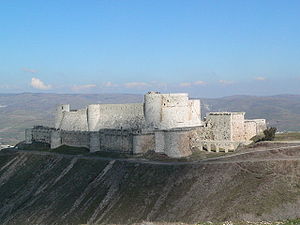
Church of the Holy Sepulchre
The Church of the Holy Sepulchre, also called the Church of the Resurrection by Eastern Christians, is a church within the walled Old City of Jerusalem. It is a few steps away from the Muristan....
in western Gothic style
Gothic architecture
Gothic architecture is a style of architecture that flourished during the high and late medieval period. It evolved from Romanesque architecture and was succeeded by Renaissance architecture....
. This expansion consolidated all the separate shrines on the site into one building, and was completed by 1149. Outside of Jerusalem, castles and fortresses were the major focus of construction: Kerak
Kerak
Kerak Castle is a large crusader castle located in Kerak in Jordan. It is one of the largest crusader castles in the Levant.Construction of the castle began in the 1140s, under Pagan, the butler of Fulk of Jerusalem. The Crusaders called it Crac des Moabites or "Karak in Moab", as it is frequently...
and Montreal
Montreal (Crusader castle)
Montreal is a Crusader castle on the eastern side of the Arabah, perched on the side of a rocky, conical mountain, looking out over fruit trees below...
in Oultrejordain
Oultrejordain
Lordship of Oultrejordain or Oultrejourdain was the name used during the Crusades for an extensive and partly undefined region to the east of the Jordan river, an area known in ancient times as Edom and Moab...
and Ibelin
Ibelin
Ibelin was a castle in the Crusader Kingdom of Jerusalem in the 12th century , which gave its name to an important family of nobles.-The castle:...
near Jaffa are among the numerous examples of crusader castles.
Crusader art was a mix of Western
Medieval art
The medieval art of the Western world covers a vast scope of time and place, over 1000 years of art history in Europe, and at times the Middle East and North Africa...
, Byzantine
Byzantine art
Byzantine art is the term commonly used to describe the artistic products of the Byzantine Empire from about the 5th century until the Fall of Constantinople in 1453....
, and Islamic
Islamic art
Islamic art encompasses the visual arts produced from the 7th century onwards by people who lived within the territory that was inhabited by or ruled by culturally Islamic populations...
styles. The major cities featured baths, interior plumbing, and other advanced hygienic tools which were lacking in most other cities and towns throughout the world. The foremost example of crusader art are perhaps the Melisende Psalter
Melisende Psalter
The Melisende Psalter is an illuminated manuscript commissioned around 1135 in the crusader Kingdom of Jerusalem, probably by King Fulk for his wife Queen Melisende...
, an illuminated manuscript
Illuminated manuscript
An illuminated manuscript is a manuscript in which the text is supplemented by the addition of decoration, such as decorated initials, borders and miniature illustrations...
commissioned between 1135 and 1143 and now located in the British Library
British Library
The British Library is the national library of the United Kingdom, and is the world's largest library in terms of total number of items. The library is a major research library, holding over 150 million items from every country in the world, in virtually all known languages and in many formats,...
, and the sculpted Nazareth Capitals. Paintings and mosaics were popular forms of art in the kingdom, but many of these were destroyed by the Mamluk
Mamluk
A Mamluk was a soldier of slave origin, who were predominantly Cumans/Kipchaks The "mamluk phenomenon", as David Ayalon dubbed the creation of the specific warrior...
s in the 13th century; only the most durable fortresses survived the reconquest.
Government and legal system
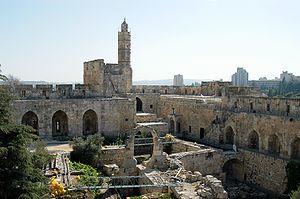
Vassals of the Kingdom of Jerusalem
The Crusader state of the Kingdom of Jerusalem, created in 1099, was divided into a number of smaller seigneuries.-Introduction:According to the 13th century jurist John of Ibelin the four highest barons in the kingdom proper were:* the Count of Jaffa and Ascalon...
within the kingdom. This was continued by Godfrey's successors. The number and importance of the lordships varied throughout the twelfth and thirteenth centuries, and many cities were part of the royal domain. The king was assisted by a number of officers of state
Officers of the Kingdom of Jerusalem
There were six major officers of the kingdom of Jerusalem: the constable, the marshal, the seneschal, the chamberlain , the butler and the chancellor...
. The king and the royal court were normally located in Jerusalem, but due to the prohibition on Muslim inhabitants, the capital was small and underpopulated. The king just as often held court at Acre, Nablus
Nablus
Nablus is a Palestinian city in the northern West Bank, approximately north of Jerusalem, with a population of 126,132. Located in a strategic position between Mount Ebal and Mount Gerizim, it is the capital of the Nablus Governorate and a Palestinian commercial and cultural center.Founded by the...
, Tyre, or wherever else he happened to be. In Jerusalem, the royal family lived firstly on the Temple Mount
Temple Mount
The Temple Mount, known in Hebrew as , and in Arabic as the Haram Ash-Sharif , is one of the most important religious sites in the Old City of Jerusalem. It has been used as a religious site for thousands of years...
, before the foundation of the Knights Templar
Knights Templar
The Poor Fellow-Soldiers of Christ and of the Temple of Solomon , commonly known as the Knights Templar, the Order of the Temple or simply as Templars, were among the most famous of the Western Christian military orders...
, and later in the palace complex surrounding the Tower of David
Tower of David
The Tower of David is an ancient citadel located near the Jaffa Gate entrance to the Old City of Jerusalem.Built to strengthen a strategically weak point in the Old City's defenses, the citadel that stands today was constructed during the 2nd century BC and subsequently destroyed and rebuilt by,...
; there was another palace complex in Acre.
Because the nobles tended to live in Jerusalem rather than on estates in the countryside, they had a larger influence on the king than they would have had in Europe. The nobles, along with the bishops, formed the haute cour
Haute Cour of Jerusalem
The Haute Cour was the feudal council of the kingdom of Jerusalem. It was sometimes also called the curia generalis, the curia regis, or, rarely, the parlement.-Composition of the court:...
(high court), which was responsible for confirming the election of a new king (or a regent if necessary), collecting taxes, minting coins, allotting money to the king, and raising armies. The haute cour was the only judicial body for the nobles of the kingdom, hearing criminal cases such as murder, rape, and treason, and simpler feudal disputes such as recovery of slaves, sales and purchases of fiefs, and default of service. Punishments included forfeiture of land and exile, or in extreme cases death. The first laws of the kingdom were, according to tradition, established during Godfrey of Bouillon's short reign, but were more probably established by Baldwin II at the Council of Nablus
Council of Nablus
The Council of Nablus was a council of ecclesiastic and secular lords in the crusader Kingdom of Jerusalem, held on January 16, 1120. It established the first written laws for the kingdom.-History:...
in 1120. Benjamin Z. Kedar argued that the canons of the Council of Nablus were in force in the 12th century but had fallen out of use by the thirteenth. Marwan Nader questions this and suggests that the canons may not have applied to the whole kingdom at all times. The most extensive collection of laws, together known as Assizes of Jerusalem
Assizes of Jerusalem
The Assizes of Jerusalem are a collection of numerous medieval legal treatises containing the law of the crusader Kingdom of Jerusalem and Kingdom of Cyprus...
, were written in the mid-13th century, although many of them are purported to be twelfth-century in origin.
There were other, lesser courts for non-nobles and non-Latins; the Cour des Bourgeois provided justice for non-noble Latins, dealing with minor criminal offences such as assault and theft, and provided rules for disputes between non-Latins, who had fewer legal rights. Special courts such as the Cour de la Fond (for commercial disputes in the markets) and the Cour de la Mer (an admiralty
Admiralty
The Admiralty was formerly the authority in the Kingdom of England, and later in the United Kingdom, responsible for the command of the Royal Navy...
court) existed in the coastal cities. The extent to which native Islamic and Eastern Christian courts continued to function is unknown, but the ra'is probably exercised some legal authority on a local level. The Cour des Syriens judged non-criminal matters among the native Christians (the "Syrians"). For criminal matters non-Latins were to be tried in the Cour des Bourgeois (or even the Haute Cour if the crime was sufficiently severe).
The Italian communes were granted almost complete autonomy from the very early days of the Kingdom, thanks to their military and naval support in the years following the First Crusade. This autonomy included the right to administer their own justice, although the kinds of cases that fell under their jurisdiction varied at different times.
The king was recognised as head of the Haute Cour, although he was legally only primus inter pares
Primus inter pares
Primus inter pares is Latin phrase describing the most senior person of a group sharing the same rank or office.When not used in reference to a specific title, it may indicate that the person so described is formally equal, but looked upon as an authority of special importance by their peers...
.
Arms of the Kingdom of Jerusalem

Coat of arms
A coat of arms is a unique heraldic design on a shield or escutcheon or on a surcoat or tabard used to cover and protect armour and to identify the wearer. Thus the term is often stated as "coat-armour", because it was anciently displayed on the front of a coat of cloth...
of the Kingdom of Jerusalem, which has gone through several different varieties of a cross Or (gold) on an argent (silver) field, is a famous violation of or exception to the rule of tincture
Rule of tincture
The first rule of heraldic design is the rule of tincture: metal should not be put on metal, nor colour on colour . This means that Or and argent may not be placed on each other; nor may any of the colours be placed on another colour...
in heraldry
Heraldry
Heraldry is the profession, study, or art of creating, granting, and blazoning arms and ruling on questions of rank or protocol, as exercised by an officer of arms. Heraldry comes from Anglo-Norman herald, from the Germanic compound harja-waldaz, "army commander"...
, which prohibits the placement of metal on metal.
It is one of the earliest known coats of arms. The main cross is a cross potent (called a Jerusalem cross for its use here), whereas the smaller crosses are Greek crosses, one of the many Byzantine influences on the kingdom.
See also
- Crusade
- List of Kings of Jerusalem
- Kings of Jerusalem family treeKings of Jerusalem family treeThis a family tree of the kings of Jerusalem.This diagram lists the rulers of the kingdom of Jerusalem, since the conquest of the city in 1099, during the First Crusade, to 1291, year of the fall of Acre.-See also:*Crusade*Kings of Jerusalem...
- Vassals of the Kingdom of JerusalemVassals of the Kingdom of JerusalemThe Crusader state of the Kingdom of Jerusalem, created in 1099, was divided into a number of smaller seigneuries.-Introduction:According to the 13th century jurist John of Ibelin the four highest barons in the kingdom proper were:* the Count of Jaffa and Ascalon...
- Officers of the Kingdom of JerusalemOfficers of the Kingdom of JerusalemThere were six major officers of the kingdom of Jerusalem: the constable, the marshal, the seneschal, the chamberlain , the butler and the chancellor...
- Haute Cour of JerusalemHaute Cour of JerusalemThe Haute Cour was the feudal council of the kingdom of Jerusalem. It was sometimes also called the curia generalis, the curia regis, or, rarely, the parlement.-Composition of the court:...
- Assizes of JerusalemAssizes of JerusalemThe Assizes of Jerusalem are a collection of numerous medieval legal treatises containing the law of the crusader Kingdom of Jerusalem and Kingdom of Cyprus...
- History of PalestineHistory of PalestineThe Southern Levant is the southern portion of the geographical region bordering the Mediterranean between Egypt and Mesopotamia . A narrow definition would take in roughly the same area as the modern states of Israel, the West Bank, the Gaza Strip, and Jordan, while a wider definition would...
- Terra Mariana, contemporary crusader state in the Baltics
Primary sources
- Fulcher of ChartresFulcher of ChartresFulcher of Chartres was a chronicler of the First Crusade. He wrote in Latin.- Life :His appointment as chaplain of Baldwin of Boulogne in 1097 suggests that he had been trained as a priest, most likely at the school in Chartres...
, A History of the Expedition to Jerusalem, 1095–1127, trans. Frances Rita Ryan. University of Tennessee Press, 1969. - William of TyreWilliam of TyreWilliam of Tyre was a medieval prelate and chronicler. As archbishop of Tyre, he is sometimes known as William II to distinguish him from a predecessor, William of Malines...
, A History of Deeds Done Beyond the Sea, trans. E.A. Babcock and A.C. Krey. Columbia University PressColumbia University PressColumbia University Press is a university press based in New York City, and affiliated with Columbia University. It is currently directed by James D. Jordan and publishes titles in the humanities and sciences, including the fields of literary and cultural studies, history, social work, sociology,...
, 1943. - Philip K. Hitti, trans., An Arab-Syrian Gentleman and Warrior in the Period of the Crusades; Memoirs of Usamah ibn-Munqidh (Kitab al i'tibar). New York, 1929
Secondary sources
- Bernard Hamilton, The Leper King & His Heirs. Cambridge, 2000.
- Carole HillenbrandCarole HillenbrandCarole Hillenbrand OBE is professor of Islamic History at the University of Edinburgh. She is currently the Vice-President of the British Society for Middle Eastern Studies and a Member of the Council for Assisting Refugee Academics....
, The Crusades: Islamic Perspectives. Routledge, 2000. - P.M. Holt, The Age of the Crusades: The Near East from the Eleventh Century to 1517. Longman, 1989.
- Benjamin Z. Kedar, Hans Eberhard Mayer & R. C. Smail, ed., Outremer: Studies in the history of the Crusading Kingdom of Jerusalem presented to Joshua Prawer. Yad Izhak Ben-Zvi Institute, 1982.
- John L. La Monte, Feudal Monarchy in the Latin Kingdom of Jerusalem, 1100–1291. Cambridge, Massachusetts, 1932.
- Hans E. Mayer, The Crusades. Oxford University PressOxford University PressOxford University Press is the largest university press in the world. It is a department of the University of Oxford and is governed by a group of 15 academics appointed by the Vice-Chancellor known as the Delegates of the Press. They are headed by the Secretary to the Delegates, who serves as...
, 1965 (trans. John Gillingham, 1972). - Joshua PrawerJoshua PrawerJoshua Prawer was a notable Israeli historian and a scholar of the Crusades and Kingdom of Jerusalem.His work often attempted to portray Crusader society as a forerunner to later European colonialist expansion...
, The Latin Kingdom of Jerusalem: European Colonialism in the Middle Ages. London, 1972. - Joshua PrawerJoshua PrawerJoshua Prawer was a notable Israeli historian and a scholar of the Crusades and Kingdom of Jerusalem.His work often attempted to portray Crusader society as a forerunner to later European colonialist expansion...
, Crusader Institutions. Oxford University Press, 1980. - Jonathan Riley-SmithJonathan Riley-SmithJonathan Simon Christopher Riley-Smith, K.St.J., Ph.D. MA, Litt.D., FRHistS is an historian of the Crusades, and a former Dixie Professor of Ecclesiastical History...
, The Feudal Nobility and the Kingdom of Jerusalem, 1174–1277. The Macmillan Press, 1973. - Jonathan Riley-Smith, The First Crusade and the Idea of Crusading. University of Pennsylvania, 1991.
- Jonathan Riley-Smith, ed., The Oxford History of the Crusades. Oxford, 2002.
- Steven RuncimanSteven RuncimanThe Hon. Sir James Cochran Stevenson Runciman CH — known as Steven Runciman — was a British historian known for his work on the Middle Ages...
, A History of the Crusades. Cambridge University PressCambridge University PressCambridge University Press is the publishing business of the University of Cambridge. Granted letters patent by Henry VIII in 1534, it is the world's oldest publishing house, and the second largest university press in the world...
, 1951–54. - Kenneth SettonKenneth SettonKenneth Meyer Setton was an American historian and an expert on the history of medieval Europe.- Early life, education and awards :...
, ed., A History of the Crusades. Madison, 1969–1989 (available online). - Steven Tibble, Monarchy and Lordships in the Latin Kingdom of Jerusalem, 1099–1291. Clarendon Press, 1989.
- Jerusalem, Latin Kingdom of (1099–1291) – Article in the Catholic Encyclopedia