
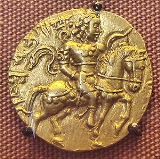
Chandragupta II the Great, very often referred to as
VikramadityaVikramaditya was a legendary emperor of Ujjain, India, famed for his wisdom, valour and magnanimity. The title "Vikramaditya" was later assumed by many other kings in Indian history, notably the Gupta King Chandragupta II and Samrat Hem Chandra Vikramaditya .The name King Vikramaditya is a...
or
Chandragupta Vikramaditya in
SanskritSanskrit , is a historical Indo-Aryan language and the primary liturgical language of Hinduism, Jainism and Buddhism.Buddhism: besides Pali, see Buddhist Hybrid Sanskrit Today, it is listed as one of the 22 scheduled languages of India and is an official language of the state of Uttarakhand...
; was one of the most powerful emperors of the
Gupta empireThe Gupta Empire was an ancient Indian empire which existed approximately from 320 to 550 CE and covered much of the Indian Subcontinent. Founded by Maharaja Sri-Gupta, the dynasty was the model of a classical civilization. The peace and prosperity created under leadership of Guptas enabled the...
in northern
IndiaIndia , officially the Republic of India , is a country in South Asia. It is the seventh-largest country by geographical area, the second-most populous country with over 1.2 billion people, and the most populous democracy in the world...
. His rule spanned c. 380–413/415 CE, during which the Gupta Empire achieved its zenith, art, architecture, and sculpture flourished, and the cultural development of
ancient IndiaAncient India may refer to:* The ancient history of India, which generally includes the ancient history of the Asian Subcontinent, including:*Science and technology in ancient India**Indian mathematics**Astronomy**List of Indian inventions...
reached its climax. The period of prominence of the Gupta dynasty is very often referred to as the
Golden Age of
IndiaIndia , officially the Republic of India , is a country in South Asia. It is the seventh-largest country by geographical area, the second-most populous country with over 1.2 billion people, and the most populous democracy in the world...
. Chandragupta II was the son of the previous ruler,
Samudragupta the GreatSamudragupta , ruler of the Gupta Empire , and successor to Chandragupta I, is considered to be one of the greatest military geniuses in Indian history according to Historian V. A. Smith. His name is taken to be a title acquired by his conquests...
. He attained success by pursuing both a favorable marital alliance and an aggressive expansionist policy in this which his father and grandfather (
Chandragupta IThe Gupta dynasty first seems to be in eminence with the accession of Chandra Gupta I, son of Ghatotkacha to the throne of the ancestral Gupta kingdom. While his two ancestors were given the title of Maharaja , Chandra Gupta I is described in his inscriptions as Maharajadhiraj signifying a rise in...
) set the precedent. Samudragupta set the stage for the emergence of classical art, which occurred under the rule of Chandragupta II. Chandragupta II gave great support to the arts. Artists were so highly valued under his rule that they were paid for their work — a rare phenomenon in ancient civilizations.
From 388 to 409 he subjugated Gujarat, the region north of Mumbai, Saurashtra, in western India, and Malwa, with its capital at Ujjain. Culturally, the reign of Chandragupta II marked a
Golden Age. This is evidenced by later reports of the presence of a circle of poets known as the
Nine Gems in his court. The greatest among them was
KalidasaKālidāsa was a renowned Classical Sanskrit writer, widely regarded as the greatest poet and dramatist in the Sanskrit language...
, who authored numerous immortal pieces of literature including
Abhijñānaśākuntalam Abhijñānashākuntala or Abhijñānaśākuntalam) , is a well-known Sanskrit play by Kālidāsa. Its date is uncertain, but Kalidasa is often placed in the period between the 1st century BCE and 4th century CE....
. The others included
SanskritSanskrit , is a historical Indo-Aryan language and the primary liturgical language of Hinduism, Jainism and Buddhism.Buddhism: besides Pali, see Buddhist Hybrid Sanskrit Today, it is listed as one of the 22 scheduled languages of India and is an official language of the state of Uttarakhand...
grammarian
Amara SinhaAmara Simhan was a Sanskrit grammarian and poet, of whose personal history hardly anything is known. He is said to have been "one of the nine gems that adorned the throne of Vikramaditya," and according to the evidence of Hsuan Tsang, this is the Chandragupta Vikramaditya that flourished about AD...
and the astronomer-mathematician
VarahamihiraVarāhamihira , also called Varaha or Mihira, was an Indian astronomer, mathematician, and astrologer who lived in Ujjain...
.
Mentions in literature
Not much is known about the personal details of Chandragupta II. The most widely accepted details have been built upon the plot of the play
Devi-chandraguptam by Vishakadatta. The play is now lost, but fragments have been preserved in other works (such as Abhinava-bharati, Sringara-prakasha, Natya-darpana, Nataka-lakshana Ratna-kosha). There even exists an Arabic work Mojmal al-tawarikh (12th century CE) which tells a similar tale of a king whose name appears to be a corruption of 'Vikramaditya'. The name '
VikramadityaVikramaditya was a legendary emperor of Ujjain, India, famed for his wisdom, valour and magnanimity. The title "Vikramaditya" was later assumed by many other kings in Indian history, notably the Gupta King Chandragupta II and Samrat Hem Chandra Vikramaditya .The name King Vikramaditya is a...
' holds a semi-mythical status in India. India has many interesting stories about King Vikramaditya, his guru Manva-Patwa and his queens. It is widely believed that the great poet in
SanskritSanskrit , is a historical Indo-Aryan language and the primary liturgical language of Hinduism, Jainism and Buddhism.Buddhism: besides Pali, see Buddhist Hybrid Sanskrit Today, it is listed as one of the 22 scheduled languages of India and is an official language of the state of Uttarakhand...
,
KalidasaKālidāsa was a renowned Classical Sanskrit writer, widely regarded as the greatest poet and dramatist in the Sanskrit language...
was one of the jewels of Vikramaditya's royal court.
Early life and coronation
Chandragupta II's mother, Datta Devi, was the chief queen of
Samudragupta the GreatSamudragupta , ruler of the Gupta Empire , and successor to Chandragupta I, is considered to be one of the greatest military geniuses in Indian history according to Historian V. A. Smith. His name is taken to be a title acquired by his conquests...
. After Samudragupta's death his elder son,
RamaguptaRamagupta was an emperor of the Gupta dynasty in ancient India. He was the elder son and immediate successor of Samudragupta and succeeded by is younger brother Chandragupta II. Initially, he was known from the traditional narratives only. But later, three inscriptions on Jaina tirthankara images...
, took over the throne and married Chandragupta II's fiance Dhruvaswamini by force. The fragment from Vishakadatta's
"Natya-darpana" mentions the king
RamaguptaRamagupta was an emperor of the Gupta dynasty in ancient India. He was the elder son and immediate successor of Samudragupta and succeeded by is younger brother Chandragupta II. Initially, he was known from the traditional narratives only. But later, three inscriptions on Jaina tirthankara images...
, the elder brother of Chandragupta II, deciding to surrender his queen Dhruvaswamini to the
SakaThe Saka were a Scythian tribe or group of tribes....
ruler of the
Western KshatrapasThe Western Satraps, Western Kshatrapas, or Kshaharatas were Saka rulers of the western and central part of India...
Rudrasimha IIIRudrasimha III was the last ruler of the Western Satraps in India, in the 4th century CE.A fragment from the Natya-darpana mentions the Gupta king Ramagupta, the elder brother of Chandragupta II, decided to expand his kingdom by attacking the Western Satraps in Gujarat. The campaign soon took a...
(r. 388 - 395 CE), after a defeat at the Saka ruler's hands. To avoid the ignominy the Guptas decide to send Madhavasena, a courtesan and a beloved of Chandragupta II, disguised as the queen Dhruvaswamini. Chandragupta II changes the plan and himself goes to
Rudrasimha IIIRudrasimha III was the last ruler of the Western Satraps in India, in the 4th century CE.A fragment from the Natya-darpana mentions the Gupta king Ramagupta, the elder brother of Chandragupta II, decided to expand his kingdom by attacking the Western Satraps in Gujarat. The campaign soon took a...
disguised as the queen. He then assassinates Rudrasimha III and later his brother
RamaguptaRamagupta was an emperor of the Gupta dynasty in ancient India. He was the elder son and immediate successor of Samudragupta and succeeded by is younger brother Chandragupta II. Initially, he was known from the traditional narratives only. But later, three inscriptions on Jaina tirthankara images...
. Dhruvaswamini is then married to Chandragupta II.
Historians still don't know what liberties the author Vishakadatta took with the incidents, but Dhruvadevi was indeed Chandragupta II's Chief Queen as seen in the Vaisali Terracotta Seal that calls her "Mahadevi" (Chief Queen) Dhruvasvamini. The Bilsad Pillar Inscription of their son Kumaragupta I (r. 414–455 CE) also refers to her as "Mahadevi Dhruvadevi". Certain "Ramagupta" too is mentioned in inscriptions on Jain figures in the District Archaeological Museum,
VidishaVidisha is a city in the state of Madhya Pradesh, India, located near the state capital Bhopal. Vidishā is the administrative headquarters of Vidisha District. The city was also known as Bhilsa during the medieval period.-Geography:...
and some copper coins found at Vidisha.
The fact that Chandragupta II and Dhruvadevi are the protagonists of Vishakadatta's play indicates that marrying his widowed sister-in-law was not given any significance by the playwright. Later
HinduHindu refers to an identity associated with the philosophical, religious and cultural systems that are indigenous to the Indian subcontinent. As used in the Constitution of India, the word "Hindu" is also attributed to all persons professing any Indian religion...
s did not view such a marriage with favour and some censure of the act is found in the Sanjan Copper Plate Inscription of
RashtrakutaThe Rashtrakuta Empire was a royal dynasty ruling large parts of the Indian Subcontinent between the sixth and the 10th centuries. During this period they ruled as several closely related, but individual clans. Rastrakutas in inscriptions represented as descendants of Satyaki, a Yadava well known...
ruler
Amoghavarsha IAmoghavarsha I was a Rashtrakuta emperor, the greatest ruler of the Rashtrakuta dynasty, and one of the great emperors of India. His nominal reign of 64 years is the longest precisely dated monarchical reign on record in India and one of the longest documented reigns of all monarchy since...
(r. 814-878 CE) and in the Sangali and Cambay Plates of the
Govinda IVGovinda IV was the younger brother of Amoghavarsha II who became the Rashtrakuta emperor in 930 as described in the Kalasa record of Chikmagalur. He was a very unpopular ruler who indulged in licentious acts. Control over Kannauj was lost during his rule. The Chalukyas of Vengi defeated him and...
(r. 930-936 CE).
Vakataka-Gupta Age
The
AllahabadAllahabad , or Settled by God in Persian, is a major city of India and is one of the main holy cities of Hinduism. It was renamed by the Mughals from the ancient name of Prayaga , and is by some accounts the second-oldest city in India. It is located in the north Indian state of Uttar Pradesh,...
Pillar Inscription mentions the marriage of Chandragupta II with a Naga princess Kuberanaga. A pillar from Mathura referring to Chandragupta II has recently been dated to 388 CE.
Chandragupta II's daughter, Prabhavati Gupta, by his Naga queen Kuberanaga was married to the powerful Vakataka dynasty ruler Rudrasena II (r.380-385 CE).
His greatest victory was his victory over the Shaka-Kshatrapa dynasty and annexation of their kingdom in
Gujarat, by defeating their last ruler
Rudrasimha IIIRudrasimha III was the last ruler of the Western Satraps in India, in the 4th century CE.A fragment from the Natya-darpana mentions the Gupta king Ramagupta, the elder brother of Chandragupta II, decided to expand his kingdom by attacking the Western Satraps in Gujarat. The campaign soon took a...
.
Chandragupta II's son-in-law, the Vakataka ruler Rudrasena II, died fortuitously after a very short reign in 385 CE, following which Queen Prabhavati Gupta (r. 385-405) ruled the Vakataka kingdom as a regent on behalf of her two sons. During this twenty-year period the Vakataka realm was practically a part of the
Gupta empireThe Gupta Empire was an ancient Indian empire which existed approximately from 320 to 550 CE and covered much of the Indian Subcontinent. Founded by Maharaja Sri-Gupta, the dynasty was the model of a classical civilization. The peace and prosperity created under leadership of Guptas enabled the...
. The geographical location of the Vakataka kingdom allowed Chandragupta II to take the opportunity to defeat the
Western KshatrapasThe Western Satraps, Western Kshatrapas, or Kshaharatas were Saka rulers of the western and central part of India...
once for all. Many historians refer to this period as the Vakataka-Gupta Age.
Chandragupta II controlled a vast empire, from the mouth of the Ganges to the mouth of the
Indus RiverThe Indus River is a major river which flows through Pakistan. It also has courses through China and India.Originating in the Tibetan plateau of western China in the vicinity of Lake Mansarovar in Tibet Autonomous Region, the river runs a course through the Ladakh district of Jammu and Kashmir and...
and from what is now North
PakistanPakistan , officially the Islamic Republic of Pakistan is a sovereign state in South Asia. It has a coastline along the Arabian Sea and the Gulf of Oman in the south and is bordered by Afghanistan and Iran in the west, India in the east and China in the far northeast. In the north, Tajikistan...
down to the mouth of the
NarmadaThe Narmada , also called Rewa is a river in central India and the fifth largest river in the Indian subcontinent. It is the third largest river that completely flows within India after Ganges and Godavari...
. Pataliputra continued to be the capital of his huge empire but
UjjainUjjain , is an ancient city of Malwa region in central India, on the eastern bank of the Kshipra River , today part of the state of Madhya Pradesh. It is the administrative centre of Ujjain District and Ujjain Division.In ancient times the city was called Ujjayini...
too became a sort of second capital. The large number of beautiful gold coins issued by the Gupta dynasty are a testament to the imperial grandeur of that age. Chandragupta II also started producing silver coins in the
SakaThe Saka were a Scythian tribe or group of tribes....
tradition.
Visit of Faxian
FaxianFaxian was a Chinese Buddhist monk who traveled to India, Sri Lanka and Kapilavastu in today's Nepal between 399 and 412 to acquire Buddhist scriptures...
(337 – c. 422 CE) was the first of three great Chinese pilgrims who visited India from the fifth to the seventh centuries CE, in search of knowledge, manuscripts and relics. Faxian arrived during the reign of Chandragupta II and gave a general description of North India at that time. Among the other things, he reported about the absence of
capital punishmentCapital punishment, the death penalty, or execution is the sentence of death upon a person by the state as a punishment for an offence. Crimes that can result in a death penalty are known as capital crimes or capital offences. The term capital originates from the Latin capitalis, literally...
, the lack of a poll-tax and land tax. Most citizens did not consume onions, garlic, meat, and wine.
Campaigns against foreign tribes
4th century CE
SanskritSanskrit , is a historical Indo-Aryan language and the primary liturgical language of Hinduism, Jainism and Buddhism.Buddhism: besides Pali, see Buddhist Hybrid Sanskrit Today, it is listed as one of the 22 scheduled languages of India and is an official language of the state of Uttarakhand...
poet
KalidasaKālidāsa was a renowned Classical Sanskrit writer, widely regarded as the greatest poet and dramatist in the Sanskrit language...
, credits Chandragupta Vikramaditya with having conquered about twenty one kingdoms, both in and outside India. After finishing his campaign in the East and West India, Vikramaditya (Chandra Gupta II) proceeded northwards, subjugated the Parasikas (Persians), then the
HunasHuna is the name under which the Xionite tribes who invaded northern India during the first half of the 5th century were known.-History:...
and the
KambojasThe Kambojas were a kshatriya tribe of Iron Age India, frequently mentioned in Sanskrit and Pali literature.They were an Indo-Iranian tribe situated at the boundary of the Indo-Aryans and the Iranians, and appear to have moved from the Iranian into the Indo-Aryan sphere over time.The Kambojas...
tribes located in the west and east Oxus valleys respectively. Thereafter, the king proceeds across the Himalaya and reduced the
KinnarasIn Indian epic literature, Kinnara Kingdom refers to the territory of a tribe called Kinnaras who were one among the exotic tribes, mentioned along with others like Devas , Asuras , Pisachas, Gandharvas, Kimpurushas, Vanaras, Suparnas, Rakshasas, Bhutas and Yakshas...
, Kiratas etc. and lands into India proper. The
Brihatkathamanjari of the
KashmirKashmir is the northwestern region of the Indian subcontinent. Until the mid-19th century, the term Kashmir geographically denoted only the valley between the Great Himalayas and the Pir Panjal mountain range...
i writer Kshmendra states, king Vikramaditya (Chandra Gupta II) had "unburdened the sacred earth of the
BarbarianBarbarian and savage are terms used to refer to a person who is perceived to be uncivilized. The word is often used either in a general reference to a member of a nation or ethnos, typically a tribal society as seen by an urban civilization either viewed as inferior, or admired as a noble savage...
s like the Sakas,
MlecchaMleccha , also spelt as Mlechchha, people of foreign extraction in ancient India. Mleccha was used by the Aryans much as the ancient Greeks used barbaros, originally to indicate the uncouth and incomprehensible speech of foreigners and then extended to their unfamiliar behaviour...
s,
KambojasThe Kambojas were a kshatriya tribe of Iron Age India, frequently mentioned in Sanskrit and Pali literature.They were an Indo-Iranian tribe situated at the boundary of the Indo-Aryans and the Iranians, and appear to have moved from the Iranian into the Indo-Aryan sphere over time.The Kambojas...
, Yavanas, Tusharas, Parasikas, Hunas, etc. by annihilating these sinful
MlecchaMleccha , also spelt as Mlechchha, people of foreign extraction in ancient India. Mleccha was used by the Aryans much as the ancient Greeks used barbaros, originally to indicate the uncouth and incomprehensible speech of foreigners and then extended to their unfamiliar behaviour...
s completely".
End of Chandragupta II
Chandragupta II was succeeded by his second son Kumaragupta I, born of Mahadevi Dhruvasvamini.
Religion
From Chandragupta II kings of Gupta dynasty are known as
Parama Bhagavatas or
Bhagavata Vaishnavas.
The
Bhagavata PuranaThe Bhāgavata Purāṇa is one of the "Maha" Puranic texts of Hindu literature, with its primary focus on bhakti to the incarnations of Vishnu, particularly Krishna...
entails the fully developed tenets and philosophy of the Bhagavata tradition wherein Krishna gets fused with
VasudevaIn Hindu itihasa , Vasudeva is the father of Krishna, the son of Shoorsen, of the Yadu and Vrishni dynasties. His sister Kunti was married to Pandu. He was a partial incarnation of Rishi Kashyap....
and transcends Vedic Vishnu and cosmic Hari to be turned into the ultimate object of
bhaktiIn Hinduism Bhakti is religious devotion in the form of active involvement of a devotee in worship of the divine.Within monotheistic Hinduism, it is the love felt by the worshipper towards the personal God, a concept expressed in Hindu theology as Svayam Bhagavan.Bhakti can be used of either...
.
Coinage
Chandragupta continued issuing most of the gold coin types introduced by his father
SamudraguptaSamudragupta , ruler of the Gupta Empire , and successor to Chandragupta I, is considered to be one of the greatest military geniuses in Indian history according to Historian V. A. Smith. His name is taken to be a title acquired by his conquests...
, such as the Sceptre type (rare for Chandragupta II), the Archer type, and the Tiger-Slayer type. However, Chandragupta II also introduced several new types, such as the Horseman type and the Lion-slayer type, both of which were used by his son Kumaragupta I.
In addition, Chandragupta II was the first Gupta king to issue silver coins, such as the one illustrated at right. These coins were intended to replace the silver coinage of the
Western KshatrapasThe Western Satraps, Western Kshatrapas, or Kshaharatas were Saka rulers of the western and central part of India...
after Chandragupta II defeated them, and were modeled on the Kshatrapa coinage. The main difference was to replace the dynastic symbol of the Kshatrapas (the three-arched hill) by the dynastic symbol of the Guptas (the mythic eagle
GarudaThe Garuda is a large mythical bird or bird-like creature that appears in both Hindu and Buddhist mythology.From an Indian perspective, Garuda is the Hindu name for the constellation Aquila and...
). Further, Chandragupta also issued lead coins based on Kshatrapa prototypes and rare copper coins probably inspired by the coins of another tribe he defeated, the Nagas.
Vikram-Samvat Calender
The next day after the Hindu festival
DiwaliDiwali or DeepavaliThe name of the festival in various regional languages include:, , , , , , , , , , , , , popularly known as the "festival of lights," is a festival celebrated between mid-October and mid-December for different reasons...
is called Padwa or Varshapratipada, which marks the coronation of King Vikramaditya. The
HinduHindu refers to an identity associated with the philosophical, religious and cultural systems that are indigenous to the Indian subcontinent. As used in the Constitution of India, the word "Hindu" is also attributed to all persons professing any Indian religion...
Vikram-Samvat calendar was apparently started on this day and this day is celebrated as New Year's Day in Nepal where Vikram Sambat is the official calendar and in some places in India. But, Vikram-Samvat calender is from 57 BCE. So, there was someother king by name Vikram, who started this calender. Shak-Samvat is synchronised with the Saka-Samvat calendar, which starts around April. This calendar was initiated by Gautamiputra Satakarni who defeated the Saka king Vikramaditya, thus starting the Shalivahana era or Shaka Calendar
Iron pillar of Delhi
Close to the
Qutub MinarQutub Minar also Qutb Minar, is a UNESCO World Heritage Site. Located in Delhi, India. The Qutub Minar is constructed with red sandstone and marble, and is the tallest minaret in India, with a height of 72.5 meters , contains 379 stairs to reach the top, and the diameter of base is 14.3 meters...
is one of
DelhiDelhi , officially National Capital Territory of Delhi , is the largest metropolis by area and the second-largest by population in India, next to Mumbai. It is the eighth largest metropolis in the world by population with 16,753,265 inhabitants in the Territory at the 2011 Census...
's most curious structures, an iron pillar, dating back to 4th century CE. The pillar bears an inscription which states that it was erected as a flagstaff in honour of the Hindu god
VishnuVishnu is the Supreme god in the Vaishnavite tradition of Hinduism. Smarta followers of Adi Shankara, among others, venerate Vishnu as one of the five primary forms of God....
, and in the memory of Chandragupta II (A derivation of
"Natya-darpana" by Vishakadata states that the pillar had been put up by Chandragupta II himself after defeating Vahilakas. And after this great feat, he put up this pillar as a memory of the victory). The pillar also highlights ancient
IndiaIndia , officially the Republic of India , is a country in South Asia. It is the seventh-largest country by geographical area, the second-most populous country with over 1.2 billion people, and the most populous democracy in the world...
's achievements in metallurgy. The pillar is made of 98% wrought iron and has stood more than 1,600 years without rusting or decomposing. This iron pillar is similar to the pillars of Asoka.
See also
- Vikramāditya
Vikramaditya was a legendary emperor of Ujjain, India, famed for his wisdom, valour and magnanimity. The title "Vikramaditya" was later assumed by many other kings in Indian history, notably the Gupta King Chandragupta II and Samrat Hem Chandra Vikramaditya .The name King Vikramaditya is a...
- List of people known as The Great