
All Topics  
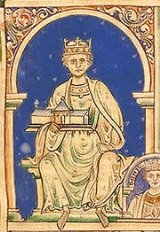
Henry II of England

 
Henry II of England

   Email Print
   Bookmark   Link


Henry II of England


Henry II, called Curtmantle (5 March 1133 – 6 July 1189) ruled as King of England (1154–1189), Count of Anjou, Duke of Normandy
Duke of Normandy

Duke of Normandy is a title held or claimed by various Normans, France, England and United Kingdom rulers from the 10th century until the present, in recognition of their history....
, Duke of Aquitaine
Duke of Aquitaine

The Duke of Aquitaine ruled the historical region of Aquitaine under the supremacy of the List of Frankish kings and later the List of French monarchs....
, Duke of Gascony
Duke of Gascony

The Duchy of Vasconia , later known as Gascony, was a Merovingian creation: a Marches on the Garonne, in the border with the rebel Basque people tribes....
, Count of Nantes, Lord of Ireland and, at various times, controlled parts of Wales, Scotland and western France. Henry was the first of the House of Plantagenet
House of Plantagenet

The House of Plantagenet was a royal house founded by Henry II of England, son of Geoffrey V of Anjou. The Plantagenet kings first ruled the Kingdom of England in the 12th century....
 to rule England and was the great-grandson of William the Conqueror.

y II was born in Le Mans
Le Mans

Le Mans is a commune in France in France, located on the Sarthe River. Traditionally the capital of the province of Maine , it is now the pr?fecture of the Sarthe D?partement in France, and is furthermore the seat of the Roman Catholic diocese of Le Mans....
, France, on 5 March 1133, the first day of the traditional year.


Discussion
Ask a question about 'Henry II of England'
Start a new discussion about 'Henry II of England'
Answer questions from other users
Full Discussion Forum


Recent Posts


Timeline

1133   Born

1151   Geoffrey of Anjou dies, and is succeeded by his son Henry, aged 18.

1152   Eleanor of Aquitaine marries Henry of Anjou.

1153   Henry of Anjou arrives in England.

1154   King Stephen of England dies at Dover, and is succeeded by his adopted son Henry Plantagenet who becomes King Henry II of England, aged 21.

1164   Thomas Becket contends with Henry II, leaves England to solicit support from the Pope and the King of Fran

1165   Henry II of England begins affair with Rosamund Clifford.

1165   Henry II of England invades Wales but is forced to retreat.

1166   Died

1169   Eleanor of Aquitaine leaves the English court of Henry II to establish her great court in Poitiers where the Courts of Love flourished.


Encyclopedia


Henry II, called Curtmantle (5 March 1133 – 6 July 1189) ruled as King of England (1154–1189), Count of Anjou, Duke of Normandy
Duke of Normandy

Duke of Normandy is a title held or claimed by various Normans, France, England and United Kingdom rulers from the 10th century until the present, in recognition of their history....
, Duke of Aquitaine
Duke of Aquitaine

The Duke of Aquitaine ruled the historical region of Aquitaine under the supremacy of the List of Frankish kings and later the List of French monarchs....
, Duke of Gascony
Duke of Gascony

The Duchy of Vasconia , later known as Gascony, was a Merovingian creation: a Marches on the Garonne, in the border with the rebel Basque people tribes....
, Count of Nantes, Lord of Ireland and, at various times, controlled parts of Wales, Scotland and western France. Henry was the first of the House of Plantagenet
House of Plantagenet

The House of Plantagenet was a royal house founded by Henry II of England, son of Geoffrey V of Anjou. The Plantagenet kings first ruled the Kingdom of England in the 12th century....
 to rule England and was the great-grandson of William the Conqueror.

Early life

Henry II was born in Le Mans
Le Mans

Le Mans is a commune in France in France, located on the Sarthe River. Traditionally the capital of the province of Maine , it is now the pr?fecture of the Sarthe D?partement in France, and is furthermore the seat of the Roman Catholic diocese of Le Mans....
, France, on 5 March 1133, the first day of the traditional year. His father, Geoffrey V of Anjou (Geoffrey Plantagenet), was Count of Anjou and Count of Maine. His mother, Empress Matilda
Empress Matilda

Empress Matilda, also known as Matilda of England or Maude was the daughter and heir of King Henry I of England. Matilda and her younger brother, William Adelin, were the only legitimate children of King Henry....
, was a claimant to the English throne as the daughter of Henry I
Henry I of England

Henry I was the fourth son of William I the Conqueror. He succeeded his elder brother William II of England as King of England in 1100 and defeated his eldest brother, Robert Curthose, to become Duke of Normandy in 1106....
 (1100–1135), son of William, Duke of Normandy
Duke of Normandy

Duke of Normandy is a title held or claimed by various Normans, France, England and United Kingdom rulers from the 10th century until the present, in recognition of their history....
. He spent his childhood in his father's land of Anjou. At the age of nine, Robert, 1st Earl of Gloucester
Robert, 1st Earl of Gloucester

Robert, 1st Earl of Gloucester was an illegitimate son of King Henry I of England, and one of the dominant figures of the period of English history sometimes called The Anarchy....
 took him to England where he received education from Master Matthew at Bristol.

Marriage and children

On 18 May 1152, at Bordeaux Cathedral, at the age of 19, Henry married Eleanor of Aquitaine
Eleanor of Aquitaine

Eleanor, Duchess of Aquitaine was one of the wealthiest and most powerful women in Western Europe during the High Middle Ages.Eleanor succeeded her father as suo jure Duchess of Aquitaine and Countess of Poitiers at the age of fifteen, and thus became the most eligible bride in Europe....
. The wedding was "without the pomp or ceremony that befitted their rank," partly because only two months previously Eleanor's marriage to Louis VII of France
Louis VII of France

Louis VII, called the Younger or the Young, , was List of French monarchs, the son and successor of Louis VI of France . He ruled from 1137 until his death....
 had been annulled. Their relationship, always stormy, eventually died: After Eleanor encouraged her children to rebel against their father in 1173, Henry had her placed under house arrest, where she remained for fifteen years.

Henry and Eleanor had eight children, William, Henry
Henry the Young King

Henry, known as the Young King was the second of five sons of King Henry II of England and Eleanor of Aquitaine....
, Richard
Richard I of England

Richard I was King of England from 6 July 1189 until his death in 1199. He also ruled as Duke of Normandy, Duke of Aquitaine, Duke of Gascony, Lord of Ireland, Cyprus, Count of Anjou, Count of Nantes and Brittany at various times during the same period....
, Geoffrey
Geoffrey II, Duke of Brittany

Geoffrey II, Duke of Brittany and Earl of Richmond was Duke of Brittany between 1181 and 1186, through his marriage with the heiress Constance, Duchess of Brittany....
, John
John of England

John reigned as List of English monarchs from 6 April 1199, until his death. He succeeded to the throne as the younger brother of King Richard I of England, who died without issue....
, Matilda, Eleanor
Leonora of England

Eleanor of England was Queen of Castile as wife of Alfonso VIII of Castile.She was born in the castle at Domfront, Normandy, and was baptised by Henry of Marcy....
, and Joan
Joan of England, Queen of Sicily

Joan of England was the seventh child of Henry II of England and his queen consort, Eleanor of Aquitaine. ...
. William died in infancy. As a result Henry was crowned as joint king when he came of age. However, because he was never King in his own right, he is known as "Henry the Young King
Henry the Young King

Henry, known as the Young King was the second of five sons of King Henry II of England and Eleanor of Aquitaine....
", not Henry III. In theory, Henry would have inherited the throne from his father, Richard his mother's possessions, Geoffrey would have Brittany
Brittany

Brittany is a former independent Celtic nations monarchy and duchy, now incorporated into France. It is also, more generally, the name of the cultural area whose limits correspond to the historic province and independent duchy....
 and John would be Lord of Ireland. However, fate would ultimately decide much differently.

It has been suggested by John Speed's 1611 book, History of Great Britain, that another son, Philip, was born to the couple. Speed's sources no longer exist, but Philip would presumably have died in early infancy.

Henry also had illegitimate children. While they were not valid claimants, their Royal blood made them potential problems for Henry's legitimate successors. William Longespée was one such child. He remained largely loyal and contented with the lands and wealth afforded to him as a royal bastard. Geoffrey, Bishop of Lincoln, Archbishop of York
Geoffrey, Archbishop of York

Geoffrey, Archbishop of York was an illegitimate son of Henry II of England, King of England who became Bishop of Lincoln and Archbishop of York....
, on the other hand, was seen as a possible thorn in the side of Richard I of England
Richard I of England

Richard I was King of England from 6 July 1189 until his death in 1199. He also ruled as Duke of Normandy, Duke of Aquitaine, Duke of Gascony, Lord of Ireland, Cyprus, Count of Anjou, Count of Nantes and Brittany at various times during the same period....
. Geoffrey had been the only son to attend Henry II on his deathbed, after even the King's favourite, John Lackland, deserted him. Richard forced him into the clergy at York, thus ending his secular ambitions. Another son, Morgan
Morgan (bishop)

Morgan was a medieval Bishop of Durham elect.He was an illegitimate son of King Henry II of England and provost of Beverley before being nominated to the see of Durham between 7 March and 7 May 1215....
 was elected to the Bishopric of Durham
Bishop of Durham

The Bishop of Durham is the Church of England bishop responsible for the diocese of Diocese of Durham in the province of York. The Diocese is one of the oldest in the country and its bishop is a member of the House of Lords....
, although he was never consecrated due to opposition from Pope Innocent III
Pope Innocent III

Pope Innocent III was born in either 1160 or 1161, and died on July 16, 1216 at Perugia. He was born with the name Lotario de Conti, and he was pope from January 8, 1198 until his death....
.

For a complete list of Henry's descendants, see List of members of the House of Plantagenet
List of members of the House of Plantagenet

This is a list of members of the House of Plantagenet. It includes only those who were members of the male-line descent from King Henry II of England, and consequently bore his "surname", Plantagenet....
.

Appearance

Several sources record Henry's appearance. They all agree that he was very strong, energetic and surpassed his peers athletically.


Character

Like his grandfather, Henry I of England
Henry I of England

Henry I was the fourth son of William I the Conqueror. He succeeded his elder brother William II of England as King of England in 1100 and defeated his eldest brother, Robert Curthose, to become Duke of Normandy in 1106....
, Henry II had an outstanding knowledge of the law. A talented linguist and excellent Latin speaker, he would sit on councils in person whenever possible. His interest in the economy was reflected in his own frugal lifestyle. He dressed casually except when tradition dictated otherwise and ate a sparing diet.

He was modest and mixed with all classes easily. "He does not take upon himself to think high thoughts, his tongue never swells with elated language; he does not magnify himself as more than man." His generosity was well-known and he employed a Templar
Knights Templar

The Poor Fellow-Soldiers of Christ and of the Temple of Solomon , commonly known as the Knights Templar or the Order of the Temple , were among the most famous of the History of Christianity#Sanctification of knighthood military orders....
 to distribute one tenth of all the food bought to the royal court amongst his poorest subjects.

Henry also had a good sense of humour and was never upset at being the butt of the joke. Once while he sat sulking and occupying himself with needlework, a courtier suggested that he looked like a tanner's daughter. The King rocked with laughter and even explained the joke to those who did not immediately grasp it.

"His memory was exceptional: he never failed to recognize a man he had once seen, nor to remember anything which might be of use. More deeply learned than any King of his time in the western world".

Construction of an empire

see also Henry II's 1157 Welsh Campaign
Gwynedd in the High Middle Ages

Kingdom of Gwynedd in the High Middle Ages is a period in the History of Wales spanning the 11th century, 12th century, and 13th century . The High Middle Ages were preceded by the Early Middle Ages and followed by the Late Middle Ages....
 and The Great Welsh Revolt of 1166
Gwynedd in the High Middle Ages

Kingdom of Gwynedd in the High Middle Ages is a period in the History of Wales spanning the 11th century, 12th century, and 13th century . The High Middle Ages were preceded by the Early Middle Ages and followed by the Late Middle Ages....


Henry's claims by blood and marriage

Henry Ii of England   Illustration From Cassell's History of England   Century Edition   Published Circa 1902
Henry's father, Geoffrey Plantagenet
Geoffrey Plantagenet

Geoffrey Plantagenet may refer to:* Geoffrey V of Anjou , Count of Anjou, was the father of Henry II of England and the first to be known as Plantagenet...
, held rich lands as a vassal from Louis VII of France
Louis VII of France

Louis VII, called the Younger or the Young, , was List of French monarchs, the son and successor of Louis VI of France . He ruled from 1137 until his death....
. Maine
Maine (province)

Le Maine is one of the traditional Provinces of France of France . It corresponds to the old county of Maine, with its center, the city of Le Mans....
 and Anjou
Anjou

Anjou is a former county , duchy and Provinces of France centred on the city of Angers in the lower Loire Valley of western France. It corresponds largely to the present-day d?partement in France of Maine-et-Loire....
 were therefore Henry's by birthright, amongst other lands in Western France. By maternal claim, Normandy was also to be his. However, the most valuable inheritance Henry received from his mother was a claim to the English throne. Granddaughter of William I of England
William I of England

William I , better known as William the Conqueror , was Duke of Normandy from 1035 and English monarchy from later 1066 to his death. William is sometimes also referred to as "William II" in relation to his position as the second Duke of Normandy of that name....
, Empress Matilda
Empress Matilda

Empress Matilda, also known as Matilda of England or Maude was the daughter and heir of King Henry I of England. Matilda and her younger brother, William Adelin, were the only legitimate children of King Henry....
 should have been Queen, but was usurped by her cousin, Stephen I of England. Henry's efforts to restore the royal line to his own family would create a dynasty spanning three centuries and thirteen Kings.

Henry's marriage to Eleanor of Aquitaine
Eleanor of Aquitaine

Eleanor, Duchess of Aquitaine was one of the wealthiest and most powerful women in Western Europe during the High Middle Ages.Eleanor succeeded her father as suo jure Duchess of Aquitaine and Countess of Poitiers at the age of fifteen, and thus became the most eligible bride in Europe....
 placed him firmly in the ascendancy. His plentiful lands were added to his new wife's possessions, giving him control of Aquitaine
Aquitaine

Aquitaine , archaic Guyenne/Guienne , is one of the 26 regions of France, in the south-western part of metropolitan France, along the Atlantic Ocean and the Pyrenees mountain range on the border with Spain....
 and Gascony
Gascony

Gascony is an area of southwest France that constituted a Provinces of France prior to the French Revolution. In historic references dating from the beginning of the Roman era, it was part of Gaul and became part of the Kingdom of the Franks during the conquests of Clovis I ....
. The riches of the markets and vineyards in these regions, combined with Henry's already plentiful holdings, made Henry the most powerful vassal in France.

Taking the English Throne

Realising Henry's royal ambition was far from easily fulfilled, his mother had been pushing her claim for the crown for several years to no avail, finally retiring in 1147. It was 1147 when Henry had accompanied Matilda on an invasion of England. It soon failed due to lack of preparation, but it made him determined that England was his mother's right, and so his own. He returned to England again between 1149 and 1150. On 22 May 1149 he was knighted by King David I of Scotland
David I of Scotland

David I or Dabhidh Mac Maol Chaluim was a 12th-century ruler who was Prince of the Cumbrians and later List of monarchs of Scotland . The youngest son of Maol Chaluim Mac Donnchaidh and Saint Margaret of Scotland, David spent most of his childhood in Scotland, but was exiled to England temporarily in 1093....
, his great uncle, at Carlisle
Carlisle

Carlisle is in the City of Carlisle, a district of Cumbria in North West England. It is located at the confluence of the rivers River Eden, Cumbria, River Caldew and River Petteril, south of the Anglo-Scottish border....
.

Early in January 1153, just months after his wedding, he crossed the Channel
The channel

The channel may refer to:*the means of distribution of components involved in producing consumer electronics.*the English Channel...
 one more time. His fleet was 36 ships strong, transporting a force of 3,000 footmen and 140 horses. Sources dispute whether he landed at Dorset
Dorset

Dorset , is a Counties of England in South West England on the English Channel coast. The county town is Dorchester, Dorset, situated in the south of the county at ....
 or Hampshire
Hampshire

Hampshire , sometimes historically Southamptonshire, Hamptonshire, , or the County of Southampton, is a Counties of England on the south coast of England....
, but it is known he entered a small village church. It was 6 January and the locals were observing the Festival of the Three Kings. The correlation between the festivities and Henry's arrival was not lost on them. "Ecce advenit dominator Dominus, et regnum in manu ejus", they exclaimed as the introit for their feast, "Behold the Lord the ruler cometh, and the Kingdom in his hand".

Henry moved quickly and within the year he had secured his right to succession via the Treaty of Wallingford
Treaty of Wallingford

The Treaty of Wallingford of 1153, aka Treaty of Winchester or as the Treaty of Westminster, was an agreement that effectively ended the civil war caused by a dispute between Empress Matilda and her cousin Stephen of England over the English crown....
 with Stephen of England
Stephen of England

Stephen often known as Stephen of Blois was a grandson of William I of England. He was the last Norman dynasty King of England, from 1135 to his death, and also the Count of Boulogne jure uxoris....
. He was now, for all intents and purposes, in control of England. When Stephen died in October 1154, it was only a matter of time until Henry's treaty would bear fruit, and the quest that began with his mother would be ended. On 19 December 1154 he was crowned in Westminster Abbey, "By The Grace Of God, Henry II, King Of England". Henry Plantagenet, vassal of Louis VII, was now more powerful than the French King himself.

Lordship over Ireland

Shortly after his coronation, Henry sent an embassy to the newly elected Pope Adrian IV
Pope Adrian IV

Pope Adrian IV , born Nicholas Breakspear or Breakspeare, was Pope from 1154 to 1159.Adrian IV is the only England who has occupied the papal chair....
. Led by Bishop Arnold of Lisieux, the group of clerics requested authorisation for Henry to invade Ireland. Most historians agree that this resulted in the papal bull Laudabiliter
Laudabiliter

Laudabiliter was a papal bull issued in 1155 by the English Pope Adrian IV purporting to give the Angevin Henry II of England of England lordship over Ireland....
. It is possible Henry acted under the influence of a "Canterbury plot," in which English ecclesiastics strove to dominate the Irish church. However, Henry may have simply intended to secure Ireland as a lordship for his younger brother William.

William died soon after the plan was hatched and Ireland was ignored. It was not until 1166 that it came to the surface again. In that year, Diarmait Mac Murchada, a minor Irish Prince, was driven from his land of Leinster
Leinster

Leinster , one of the Provinces of Ireland, lies in the east of Ireland and comprises the counties of County Carlow, County Dublin, County Kildare, County Kilkenny, County Laois, County Longford, County Louth, County Meath, County Offaly, County Westmeath, County Wexford and County Wicklow....
 by the High King
High king

A high king is a Monarch who holds a position of seniority over a group of other kings, without the title of Emperor; compare King of Kings.Rulers who have been termed "high king" include:...
 of Ireland. Diarmait followed Henry to Aquitaine
Aquitaine

Aquitaine , archaic Guyenne/Guienne , is one of the 26 regions of France, in the south-western part of metropolitan France, along the Atlantic Ocean and the Pyrenees mountain range on the border with Spain....
, seeking an audience. He asked the English king to help him reassert control; Henry agreed and made footmen, knights and nobles available for the cause. The most prominent of these was a Welsh Norman, Richard de Clare, 2nd Earl of Pembroke
Richard de Clare, 2nd Earl of Pembroke

Richard de Clare, 2nd Earl of Pembroke, Lord of Leinster, Justiciar of Ireland , known as Strongbow, was a Cambro-Norman lord notable for his leading role in the Norman invasion of Ireland....
, nicknamed "Strongbow". In exchange for his loyalty, Diarmait offered Earl Richard his daughter Aoife in marriage and made him heir to the kingdom.

The Normans restored Diarmait to his traditional holdings, but it quickly became apparent that Henry had not offered aid purely out of kindness. In 1171, Henry arrived from France, declaring himself Lord
Lord

Lord is a title with various meanings. It can denote a Prince#Prince_as_a_generic_word_for_ruler or a Examples of feudalism . The title today is mostly used in connection with the peerage of the United Kingdom or its predecessor countries, although some users of the title do not themselves hold peerages, and use it 'Courtesy titles in the U...
 of Ireland. All of the Normans
Normans

The Normans were the people who gave their names to Normandy, a region in northern France. They descended from Viking conquerors of the territory and the native population of mostly Frankish and Gallo-Roman stock....
, along with many Irish princes, took oaths of homage to Henry, and he left after six months. He never returned, but he later named his young son, the future King John of England
John of England

John reigned as List of English monarchs from 6 April 1199, until his death. He succeeded to the throne as the younger brother of King Richard I of England, who died without issue....
, Lord of Ireland.

Diarmait's appeal for outside help had made Henry Ireland's Lord, starting 800 years of English overlordship on the island. The change was so profound that Diarmait is still remembered as a traitor of the highest order. In 1172, at the Synod of Cashel
Cashel, County Tipperary

Cashel is a town in County Tipperary, in the southern midlands of Republic of Ireland, which is also the episcopal see of a Roman Catholic archbishopric and of an Anglican bishop ....
, Roman Catholicism was proclaimed as the only permitted religious practice in Ireland.

Consolidation in Scotland

In 1174, a rebellion spearheaded by his own sons was not Henry's biggest problem. An invasion force from Scotland, led by their King, William the Lion
William I of Scotland

William I , known as the Lion or Garbh, "the Rough", reigned as King of Scots from 1165 to 1214. His reign was the second longest in Scottish history before the Acts of Union 1707 with England in 1707, ....
, was advancing from the North. To make matters worse, a Flemish armada was sailing for England, just days from landing. It seemed likely that the King's rapid growth was to be checked.

Henry saw his predicament as a sign from God, that his treatment of Thomas Becket
Thomas Becket

Thomas Becket was Archbishop of Canterbury from 1162 to his death. He is venerated as a saint and martyr by both the Roman Catholic Church and the Anglican Communion....
 would be rewarded with defeat. He immediately did penance at Canterbury for the Archbishop
Archbishop

In Christianity, an archbishop is an elevated bishop. In the Roman Catholic Church, the Anglican Communion and others, this means that they lead a diocese of particular importance called an archdiocese, or in the Anglican Communion an Ecclesiastical Province, but this is not always the case....
's fate and events took a turn for the better.

The hostile armada dispersed in the English Channel
English Channel

The English Channel is an Arm of the Atlantic Ocean that separates England from northern France, and joins the North Sea to the Atlantic. It is about long and varies in width from at its widest, to only in the Strait of Dover....
 and headed back for the continent. Henry had avoided a Flemish invasion, but Scottish invaders were still raiding in the North. Henry sent his troops to meet the Scots at Alnwick
Battle of Alnwick (1174)

The Battle of Alnwick is one of two battles fought near the town of Alnwick, in Northumberland. In the battle, which occurred on 12 July 1174, William I of Scotland, also known as William the Lion, was captured by a small English force led by Ranulf de Glanvill....
, where the English scored a devastating victory. William was captured in the chaos, removing the figurehead for rebellion, and within months all the problem fortresses had been torn down. Southern Scotland was now completely dominated by Henry, another fief in his Angevin Empire
Angevin Empire

The term Angevin Empire describes a collection of states ruled by the Angevin Plantagenet dynasty. The Plantagenets ruled over an area stretching from the Pyrenees to Ireland during the 12th and early 13th centuries....
, that now stretched from the Solway Firth
Solway Firth

The Solway Firth is a firth that forms part of the Anglo-Scottish border, between Cumbria and Dumfries and Galloway. It stretches from St Bees Head, just south of Whitehaven in Cumbria, to the Mull of Galloway, on the western end of Dumfries and Galloway....
 almost to the Mediterranean and from the Somme
Somme River

The Somme is a river in Picardy, northern France. The name Somme comes from a Celtic languages word meaning tranquility. The department Somme was named after this river....
 to the Pyrenees
Pyrenees

The Pyrenees are a mountain range in southwest Europe that form a natural border between France and Spain. They separate the Iberian Peninsula from the rest of continental Europe, and extend for about from the Bay of Biscay to the Mediterranean Sea ....
. By the end of this crisis, and his sons' revolt, the King was "left stronger than ever before".

Domestic policy


Dominating nobles

During Stephen's reign, the baron
Baron

Baron is a specific title of nobility. The word baron comes from Old French baron, itself from Old High German and latin baro meaning " man, warrior"; it merged with cognate Old English language beorn meaning "nobleman."...
s in England had undermined Royal authority. Rebel castles were one problem, nobles avoiding military service was another. The new King immediately moved against the illegal fortresses that had sprung up during Stephen's reign, having them torn down.

To counter the problem of avoiding military service, Scutage
Scutage

The tax of scutage or escuage, in the law of England under the feudal system, allowed a knight to "buy out" of the military service due to the Crown from the holder of a knight's fee....
 became common. This tax, paid by Henry's barons instead of serving in his army, allowed the King to hire mercenaries. These hired troops were used to devastating effect by both Henry and his son Richard
Richard I of England

Richard I was King of England from 6 July 1189 until his death in 1199. He also ruled as Duke of Normandy, Duke of Aquitaine, Duke of Gascony, Lord of Ireland, Cyprus, Count of Anjou, Count of Nantes and Brittany at various times during the same period....
, and by 1159 the tax was central to the King's army and his authority over vassals.

Legal reform

Henry II's reign saw the establishment of Royal Magistrate
Magistrate

A magistrate is a judicial officer; in ancient Rome, the word magistratus denoted one of the highest government officers with judicial and executive powers....
 courts. This allowed court officials under authority of the Crown to adjudicate on local disputes, reducing the workload on Royal courts proper and delivering justice with greater efficiency.

Henry also worked to make the legal system fairer. Trial by ordeal
Trial by ordeal

Trial by ordeal is a judicial practice by which the guilt or innocence of the accused is determined by subjecting them to a painful task. If either the task is completed without injury, or the injuries sustained are healed quickly, the accused is considered innocent....
 and trial by combat
Trial by combat

Trial by combat was a method of Germanic law to settle accusations in the absence of witnesses or a confession, in which two parties in dispute fought in single combat; the winner of the fight was proclaimed to be right....
 were still common and even in the 12th century these methods were outdated. By the Assize of Clarendon
Assize of Clarendon

The Assize Court of Clarendon was an 1166 act of Henry II of England that began the transformation of English law from such systems for deciding the prevailing party in a case as trial by ordeal or trial by battle to an evidentiary model, in which Evidence and inspection was made by laymen....
, in 1166, a precursor to trial by jury
Jury trial

A jury trial is a legal proceeding in which a jury either makes a decision or makes findings of fact which are then applied by a judge. It is be distinguished from a bench trial, in which a judge or panel of judges make all decisions....
 became the standard. However, this group of "twelve lawful men," as the Assize commonly refers to it, provides a service more similar to a grand jury
Grand jury

In the common law, a grand jury is a type of jury that determines whether there is enough evidence for a Criminal procedure. Grand juries carry out this duty by examining evidence presented to them by a prosecutor and issuing indictments, or by investigating alleged crimes and issuing Wiktionary:presentments....
, alerting court officials to matters suitable for prosecution. Trial by combat was still legal in England until 1819, but Henry's support of juries was a great contribution to the country's social history. The Assize of Northampton
Assize of Northampton

The Assize of Northampton, largely based on the Assize of Clarendon of 1166, is among a series of measures taken by King Henry II of England which solidified the rights of the knightly tenants and made all possession of land subject to and guaranteed by royal law....
, in 1176, cemented the earlier agreements at Clarendon.

Religious policy


Strengthening royal control over the Church

In the tradition of Norman
Normans

The Normans were the people who gave their names to Normandy, a region in northern France. They descended from Viking conquerors of the territory and the native population of mostly Frankish and Gallo-Roman stock....
 kings, Henry II was keen to dominate the church like the state. At Clarendon Palace on 30 January 1164, the King set out sixteen constitutions
Constitutions of Clarendon

The Constitutions of Clarendon were a set of legislative procedures passed by Henry II of England in 1164. The Constitutions were composed of 16 articles and represent an attempt to restrict ecclesiastical privileges and curb the power of the Church courts and the extent of Papal authority in England....
, aimed at decreasing ecclesiastical interference from Rome. Secular courts, increasingly under the King's influence, would also have jurisdiction over clerical trials and disputes. Henry's authority guaranteed him majority support, but the newly appointed Archbishop of Canterbury refused to ratify the proposals.

Henry was characteristically stubborn and on 8 October 1164, he called the Archbishop, Thomas Becket
Thomas Becket

Thomas Becket was Archbishop of Canterbury from 1162 to his death. He is venerated as a saint and martyr by both the Roman Catholic Church and the Anglican Communion....
, before the Royal Council. However, Becket had fled to France and was under the protection of Henry's rival, Louis VII of France
Louis VII of France

Louis VII, called the Younger or the Young, , was List of French monarchs, the son and successor of Louis VI of France . He ruled from 1137 until his death....
.

The King continued doggedly in his pursuit of control over his clerics, to the point where his religious policy became detrimental to his subjects. By 1170, the Pope was considering excommunicating
Excommunication

Excommunication is a religious censure used to deprive or suspend membership in a religious community. The word literally means putting [someone] out of full communion....
 all of Britain. Only Henry's agreement that Becket could return to England without penalty prevented this fate.

Murder of Thomas Becket

"What miserable drones and traitors have I nurtured and promoted in my household who let their lord be treated with such shameful contempt by a low-born cleric!" were the words which sparked the darkest event in Henry's religious wranglings. This speech has translated into legend in the form of "Will no one rid me of this troublesome priest?" - a provocative statement which would perhaps have been just as riling to the knights and barons of his household at whom it was aimed as his actual words. Bitter at Becket
Thomas Becket

Thomas Becket was Archbishop of Canterbury from 1162 to his death. He is venerated as a saint and martyr by both the Roman Catholic Church and the Anglican Communion....
, his old friend, constantly thwarting his clerical constitutions, the King shouted in anger but most likely not with intent. However, four of Henry's knights, Reginald Fitzurse, Hugh de Moreville, William de Tracy, and Richard le Breton overheard their King's cries and decided to act on his words.

On 29 December 1170, they entered Canterbury Cathedral, finding Becket near the stairs to the crypt. They beat down the Archbishop, killing him with several blows. Becket's brains were scattered upon the ground with the words; "Let us go, this fellow will not be getting up again." Whatever the rights and wrongs, it certainly tainted Henry's later reign. For the remaining 20 years of his rule, he would personally regret the death of a man who "in happier times...had been a friend".

Just three years later, Becket was canonized and revered as a martyr
Martyr

The term martyr is most commonly used today to describe an individual who sacrifices his or her life in order to further a cause or belief for many....
 against secular interference in God's church; Pope Alexander III
Pope Alexander III

Pope Alexander III , born Rolando of Siena, was Pope from 1159 to 1181....
 had declared Thomas Becket a saint. Plantagenet historian John Harvey believes "The martyrdom of Thomas Becket was a martyrdom which he had repeatedly gone out of his way to seek...one cannot but feel sympathy towards Henry". Wherever the true intent and blame lies, it was yet another failure in Henry's religious policy, an arena which he seemed to lack adequate subtlety. And politically, Henry had to sign the Compromise of Avranches
Compromise of Avranches

The Compromise of Avranches in 1172 marked the reconciliation of Henry II of England with the Catholic Church after the murder in 1170 of Thomas Becket....
 which removed from the secular courts almost all jurisdiction over the clergy.

The Angevin Curse


Civil war and rebellion


The "Angevin Curse" is infamous amongst the Plantagenet rulers. Trying to divide his lands amongst numerous ambitious children resulted in many problems for Henry. The King's plan for an orderly transfer of power relied on Young Henry ruling and his younger brothers doing homage to him for land. However, Richard refused to be subordinate to his brother, because they had the same mother and father, and the same Royal blood.

In 1173, Young Henry and Richard moved against their father and his succession plans, trying to secure the lands they were promised. The King's changing and revising of his inheritance nurtured jealousy in his offspring, which turned to aggression. While both Young Henry and Richard were relatively strong in France, they still lacked the manpower and experience to trouble their father unduly. The King crushed this first rebellion and was fair in his punishment, Richard for example, lost half of the revenue allowed to him as Count of Poitou
Poitou

Poitou was a Provinces of France of west-central France whose capital city was Poitiers.The region of Poitou was called Taifals in the sixth century....
.

In 1182, the Plantagenet children's aggression turned inward. Young Henry, Richard and their brother Geoffrey all began fighting each other for their father's possessions on the continent. The situation was exacerbated by French rebels and the French King, Philip Augustus. This was the most serious threat to come from within the family yet, and the King faced the dynastic tragedy of civil war. However, on 11 June 1183, Henry the Young King
Henry the Young King

Henry, known as the Young King was the second of five sons of King Henry II of England and Eleanor of Aquitaine....
 died. The uprising, which had been built around the Prince, promptly collapsed and the remaining brothers returned to their individual lands. Henry quickly occupied the rebel region of Angoulême
Angoulême

Angoul?me is a communes of France in western France and capital of the Charente Departments of France....
 to keep the peace.

The final battle between Henry's Princes came in 1184. Geoffrey of Brittany
Brittany

Brittany is a former independent Celtic nations monarchy and duchy, now incorporated into France. It is also, more generally, the name of the cultural area whose limits correspond to the historic province and independent duchy....
 and John of Ireland, the youngest brothers, had been promised Aquitaine
Aquitaine

Aquitaine , archaic Guyenne/Guienne , is one of the 26 regions of France, in the south-western part of metropolitan France, along the Atlantic Ocean and the Pyrenees mountain range on the border with Spain....
, which belonged to elder brother Richard. Geoffrey and John invaded, but Richard had been controlling an army for almost 10 years and was an accomplished military commander. Richard expelled his fickle brothers and they would never again face each other in combat, largely because Geoffrey died two years later, leaving only Richard and John.

Death and succession

The final thorn in Henry's side would be an alliance between his eldest son, Richard, and his greatest rival, Philip Augustus. John had become Henry's favourite son and Richard had begun to fear he was being written out of the King's inheritance. In summer 1189, Richard and Philip invaded Henry's heartland of power, Anjou
Anjou

Anjou is a former county , duchy and Provinces of France centred on the city of Angers in the lower Loire Valley of western France. It corresponds largely to the present-day d?partement in France of Maine-et-Loire....
. The unlikely allies took northwest Touraine, attacked Le Mans and overran Maine and Tours. Defeated, Henry II met his opponents and agreed to all their demands, including paying homage to Philip for all his French possessions.

Weak, ill, and deserted by all but an illegitimate son, Geoffrey, Archbishop of York
Geoffrey, Archbishop of York

Geoffrey, Archbishop of York was an illegitimate son of Henry II of England, King of England who became Bishop of Lincoln and Archbishop of York....
, Henry died at Chinon
Chinon

Chinon is a Communes of France in the Indre-et-Loire Departments of France in central France.In the Middle Ages, Chinon developed especially during the reign of Henry II ....
 on 6 July 1189. His legitimate children, chroniclers record him saying, were "the real bastards.". The victorious Prince Richard later paid his respects to Henry's corpse as it travelled to Fontevraud Abbey
Fontevraud Abbey

Fontevraud Abbey is located in the village of Fontevraud-l'Abbaye, near Chinon, in Anjou, France. It was founded by the itinerant reforming preacher Robert of Arbrissel, who had just created a new order, the Order of Fontevrault....
, upon which, according to Roger of Wendover, 'blood flowed from the nostrils of the deceased, as if...indignant at the presence of the one who was believed to have caused his death'. The Prince, Henry's eldest surviving son and conqueror, was crowned "by the grace of God, King Richard I of England
Richard I of England

Richard I was King of England from 6 July 1189 until his death in 1199. He also ruled as Duke of Normandy, Duke of Aquitaine, Duke of Gascony, Lord of Ireland, Cyprus, Count of Anjou, Count of Nantes and Brittany at various times during the same period....
" at Westminster on 1 September 1189.

Ancestry


Descendants

For a list of Henry's direct male-line descendants, see List of members of the House of Plantagenet
List of members of the House of Plantagenet

This is a list of members of the House of Plantagenet. It includes only those who were members of the male-line descent from King Henry II of England, and consequently bore his "surname", Plantagenet....
.

Fictional portrayals

Henry II is a central character in the plays Becket
Becket

Becket or The Honor of God is a Tony Award-winning play written in French language by Jean Anouilh. It is a depiction of the conflict between Thomas Becket and King Henry II of England leading to Becket's murder in 1170....
 by Jean Anouilh
Jean Anouilh

Jean Marie Lucien Pierre Anouilh was a France dramatist....
 and The Lion in Winter
The Lion in Winter

The Lion in Winter is a 1966 Broadway theatre play by James Goldman, who also cinematically adapted it in 1968 for the film directed by Anthony Harvey and a 2003 film by Andrei Konchalovsky....
 by James Goldman
James Goldman

James Goldman was an American, Academy Awards-winning screenwriter and playwright, and the brother of screenwriter and novelist William Goldman....
. Peter O'Toole
Peter O'Toole

Peter Seamus O'Toole is an Irish people actor of stage and screen who achieved instant stardom in 1962 playing T.E. Lawrence in Lawrence of Arabia ....
 portrayed him in the film adaptations of both of these plays - Becket
Becket (film)

Becket is a 1964 in film film adaptation of the play Becket by Jean Anouilh made by Hal Wallis Productions and released by Paramount Pictures....
 (1964) and The Lion in Winter
The Lion in Winter (1968 film)

The Lion in Winter is a 1968 in film historical film costume drama made by Embassy Pictures, based on the Broadway theatre play by James Goldman....
 (1968) - for both of which he received nominations for the Academy Award for Best Actor
Academy Award for Best Actor

Performance by an Actor in a Leading Role is one of the Academy Award presented annually by the Academy of Motion Picture Arts and Sciences to recognize an actor who has delivered an outstanding performance while working within the film industry....
. He was also nominated for the BAFTA Award for Best British Actor for Becket and won the Golden Globe Award for Best Actor - Motion Picture Drama
Golden Globe Award for Best Actor - Motion Picture Drama

The Golden Globe Award for Best Actor - Motion Picture - Drama was first awarded by the Hollywood Foreign Press Association as a separate category in 1951 in film....
 for both films. Patrick Stewart
Patrick Stewart

Patrick Hewes Stewart, Order of the British Empire is an English film, television and Stage actor. He is also Chancellor of the University of Huddersfield....
 portrayed Henry in the TV film adaptation of The Lion in Winter
The Lion in Winter (2003 film)

The Lion in Winter is a 2003 in film made-for-television remake of the The Lion in Winter .A television production of The Lion in Winter was first shown on 26 December 2003 in the United Kingdom....
 (2003), for which he was nominated for the Golden Globe Award for Best Performance by an Actor in a Mini-Series or Motion Picture Made for Television.

Brian Cox
Brian Cox

Brian Denis Cox, Order of the British Empire is a BAFTA- and Emmy Award-winning and Golden Globe-nominated Scotland actor....
 portrayed him in the BBC TV series The Devil's Crown
The Devil's Crown

The Devil's Crown was a BBC television series which dramatised the reigns of three medieval Kings of England: Henry II of England and his sons Richard I of England and John of England....
 (1978), which dramatised his reign and those of his sons. He has also been portrayed on screen by William Shea in the silent short Becket (1910), A. V. Bramble in the silent film Becket (1923), based on a play by Alfred Lord Tennyson, Alexander Gauge
Alexander Gauge

Alexander Gauge was a UK actor best known for playing Friar Tuck in The Adventures of Robin Hood from 1955 to 1960.Born in a Methodist Mission station in Wenzhou in China, Gauge was a well-known English character actor....
 in the film adaptation of the T. S. Eliot
T. S. Eliot

'Thomas Stearns Eliot', Order of Merit , was a poet, dramatist, and literary critic. He received the Nobel Prize in Literature in 1948. Among his most famous writings are the poems The Love Song of J....
 play Murder in the Cathedral
Murder in the Cathedral

Murder in the Cathedral is a poetic drama by T. S. Eliot that portrays the assassination of Archbishop Thomas Becket in Canterbury Cathedral in 1170....
 (1952), and Dominic Roche in the British children's TV series Richard the Lionheart (1962).

Henry II is a significant character in the historical fiction/medieval murder mysteries, Mistress of the Art of Death and The Serpent's Tale by Diana Norman
Diana Norman

Diana Norman is a Great Britain author and journalist writing historical fiction and non-fiction. She also publishes under the pen name Ariana Franklin featuring the fictional medieval pathologist Adelia Aguilar....
 under the pseudonym, Ariana Franklin
Ariana Franklin

Ariana Franklin was born in Devon and, like her father, became a journalist. She is the author of the critically acclaimed Mistress of the Art of Death and The Death Maze....
. He also plays a part in Ken Follet's most popular novel, The Pillars of the Earth
The Pillars of the Earth

The Pillars of the Earth is a historical novel by Ken Follett published in 1989 in literature about the building of a cathedral in Kingsbridge, England....
,
which in its final chapter portrays a fictional account of the King's penance at Canterbury Cathedral for his unknowing role in the murder of Thomas Becket.

External links


|- |-