

Kingdom of Castile

Encyclopedia
Kingdom of Castile was one of the medieval kingdoms of the Iberian Peninsula
. It emerged as a political autonomous entity in the 9th century. It was called County of Castile and was held in vassal
age from the Kingdom of León
. Its name comes from the host of castle
s constructed in the region. It was one of the kingdoms that founded the Crown of Castile
, and the Kingdom of Spain
.
, protected by castles, tower
s or castra
.
The County of Castile, borderd in the south by the Montes de Toledo
, was re-populated by inhabitants of Cantabri
a, Astur
ias, Vasconia and Visigothic and Mozarab
origins. It had its own Romance dialect and laws. The first Count of Castile was Rodrigo
in 850, under Ordoño I of Asturias
and Alfonso III of Asturias. Subsequently, the region was subdivided, separate counts being named to Alava, Burgos, Cerezo & Lantarón, and a reduced Castile. In 931 the County was reunified by Count Fernán González, who rose in rebellion against the Kingdom of León
, successor state to Asturias, and achieved an autonomous status, allowing the county to be inherited by his family instead of being subject to appointment by the Leonese king.
, married to the sister of Count García, as feudal overlord. García was assassinated in 1028 while in León to marry the princess Sancha, sister of Bermudo III of León
. Sancho III, acting as feudal overlord, appointed his younger son (García's nephew) Ferdinand
as Count of Castile, marrying him to his uncle's intended bride, Sancha of León. Following Sancho's 1035 death, Castile returned to the nominal control of León, but Ferdinand, allying himself with his brother García Sánchez III of Navarre, began a war with his brother-in-law Bermudo. At the battle of Tamarón
Bermudo was killed, leaving no surviving offspring. In right of his wife, Ferdinand then assumed the royal title as king of León and Castile, for the first time associating the royal title with the rule of Castile.
When Ferdinand I died in 1065, the territories were divided among his children. Sancho II
became King of Castile, Alfonso VI
, King of León and García, King of Galicia, while his daughters were given towns, Urraca, Zamora, and Elvira, Toro
.
Sancho II allied himself with Alfonso VI of León and together they conquered, then divided Galicia. Sancho later attacked Alfonso VI and invaded León with the help of El Cid
, and drove his brother into exile, thereby reuniting the three kingdoms. Urraca permitted the greater part of the Leonese army to take refuge in the town of Zamora. Sancho laid siege to the town, but the Castilian king was assassinated in 1072 by Bellido Dolfos, a Galician nobleman. The Castilian troops then withdrew.
As a result Alfonso VI recovered all his original territory of León, and now also became the king of Castile and Galicia. This was the second union of León and Castile, although the two kingdoms remained distinct entities joined only in a personal union
. The sworn oath taken by El Cid before Alfonso VI in Santa Gadea de Burgos regarding the innocence of the Alfonso in the matter of the murder of his brother is well known.
Under Alfonso VI, there was an approach to the rest of Europeans kingdoms, including France
. He gave his daughters, Elvira, Urraca and Theresa, in marriage to Raymond of Toulouse, Raymond of Burgundy and Henry of Burgundy respectively. In the Council of Burgos in 1080 the traditional Mozarabic rite
was replaced by the Roman one.
Upon his death, Alfonso VI was succeeded by his daughter the widowed Urraca, who then married Alfonso I of Aragon, but they almost immediately fell out, and Alfonso tried unsuccessfully to conquer Urraca's lands, before he repudiated her in 1114. Urraca also had to contend with attempts by her son (offspring of her first marriage), the king of Galicia, to assert his rights. When Urraca died, this son he became king of León and Castile as Alfonso VII. During his reign Alfonso VII managed to annex parts of the weaker kingdoms of Navarre and Aragón which fought to secede after the death of Alfonso I of Aragon.
Alfonso VII refused his right to conquer the Mediterranean coast for the new union of Aragón with the County of Barcelona (Petronila and Ramón Berenguer IV).
During the 12th century, Europe enjoyed a great advance in intellectual achievements sparked in part by the kingdom of Castile's recovery of the great cultural center of Toledo
(1085). There Islamic classics were discovered, and contacts established with the knowledge and works of Muslim scientists. In the first half of the century a program of translations, traditionally called the "School of Toledo", was undertaken which rendered many philosophical and scientific works from classical Greek and Islamic world into Latin. Many European scholars, including Daniel of Morley
and Gerard of Cremona
travelled to Toledo to gain further education.
The Way of St. James
further enhanced the cultural exchange between the kingdoms of Castile and León; and the rest of Europe.
The 12th century saw the establishment of many new religious orders, after the European fashion, such as Calatrava, Alcantara and Santiago; and the foundation of many Cistercian abbeys.
became King of Castile and Ferdinand II
, King of León.
The rivalry between both kingdoms continued until 1230 when Ferdinand III of Castile
received the Kingdom of León from his father Alfonso IX
, having previously received the Kingdom of Castile from his mother Berenguela of Castile
in 1217. In addition, he took advantage of the decline of the Almohad
empire to conquer the Guadalquivir Valley whilst his son Alfonso took the taifa of Murcia
.
The Courts from León and Castile merged, an event considered as the foundation of the Crown of Castile, consisting of the kingdoms of Castile, León, taifas and other domains conquered by the Moors
, including the taifa of Córdoba, taifa of Murcia, taifa of Jaén
and taifa of Seville
.
from 1369 to 1504, Aragón
from 1412 to 1516, Navarre from 1425 to 1479, and Naples from 1442 to 1501.
Its name was taken from the Count (or Duke) of Trastámara. This title was used by Henry II of Castile, of the Mercedes, before coming to the throne in 1369, during the civil war with his legitimate brother, King Peter of Castile. John II of Aragón
ruled from 1458 to 1479 and upon his death, his daughter became Queen Eleanor of Navarre
and his son became King Ferdinand II of Aragon
.
, in 1469 at the Palacio de los Vivero in Valladolid
, began a familial union of the two kingdoms. They became known as the Catholic Monarchs
(los Reyes Católicos). Isabella succeeded her brother as Queen of Castile and Ferdinand became jure uxoris
King of Castile in 1474. When Ferdinand succeeded his father as King of Aragon in 1479, the Crown of Castile and the various territories of the Crown of Aragon were united in a personal union creating for the first time since the 8th century a single political unit referred to as España
(Spain).
'Los Reyes Católicos' started policies to diminish the power of the bourgeoisie and nobility in Castile, and greatly reduced the powers of the Cortes
(General Courts) to the point where they ' rubberstamped ' the monarch's acts, and brought the nobility to their side.
, became Queen (in name) with her husband Philip I
as King (in authority). After his death Joanna's father was regent, due to her perceived mental illness
, as her son Charles I was only six years old. On Ferdinand II's death in 1516, Charles I
was proclaimed as king of Castile and of Aragon (in authority) jointly with his mother Joanna I as the Queen of Aragon (in name). He became known as Charles V. As the first royal to reign over both Castile and Aragon he may be considered as the first operational King of Spain. Charles I also became Charles V, Holy Roman Emperor in 1519.
, in which some of the inhabitants, the property-owning heads of households
(vecino
s), represented the rest. By the fourteenth century these councils had gained more powers, such as the right to elect municipal magistrates and officers (alcalde
s, speakers, clerks, etc.) and representatives to the parliaments (Cortes
).
Due to the increasing power of the municipal councils and the need for communication between these and the King, cortes were established in the Kingdom of León
in 1188, and in Castile in 1250. In the earliest Leonese and Castilian Cortes, the inhabitants of the cities (known as "laboratores") formed a small group of the representatives and had no legislative powers, but they were a link between the king and the general population, something that was pioneered by the kingdoms of Castile and León. Eventually the representatives of the cities gained the right to vote in the Cortes, often allying with the monarchs against the great noble lords.
s and banners
, the canting arms
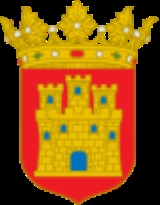
of the Kingdom of Castile: gules, a three towered castle or, masoned sable and ajouré azure.
Iberian Peninsula
The Iberian Peninsula , sometimes called Iberia, is located in the extreme southwest of Europe and includes the modern-day sovereign states of Spain, Portugal and Andorra, as well as the British Overseas Territory of Gibraltar...
. It emerged as a political autonomous entity in the 9th century. It was called County of Castile and was held in vassal
Vassal
A vassal or feudatory is a person who has entered into a mutual obligation to a lord or monarch in the context of the feudal system in medieval Europe. The obligations often included military support and mutual protection, in exchange for certain privileges, usually including the grant of land held...
age from the Kingdom of León
Kingdom of León
The Kingdom of León was an independent kingdom situated in the northwest region of the Iberian Peninsula. It was founded in AD 910 when the Christian princes of Asturias along the northern coast of the peninsula shifted their capital from Oviedo to the city of León...
. Its name comes from the host of castle
Castle
A castle is a type of fortified structure built in Europe and the Middle East during the Middle Ages by European nobility. Scholars debate the scope of the word castle, but usually consider it to be the private fortified residence of a lord or noble...
s constructed in the region. It was one of the kingdoms that founded the Crown of Castile
Crown of Castile
The Crown of Castile was a medieval and modern state in the Iberian Peninsula that formed in 1230 as a result of the third and definitive union of the crowns and parliaments of the kingdoms of Castile and León upon the accession of the then King Ferdinand III of Castile to the vacant Leonese throne...
, and the Kingdom of Spain
Spain
Spain , officially the Kingdom of Spain languages]] under the European Charter for Regional or Minority Languages. In each of these, Spain's official name is as follows:;;;;;;), is a country and member state of the European Union located in southwestern Europe on the Iberian Peninsula...
.
9th to 11th centuries: The beginnings
According to the chronicles of Alfonso III of Asturias; the first reference to the name "Castile" (Castilla) can be found in a document written during 800 A.D. The name reflects its origin as a march on the eastern frontier of the Kingdom of AsturiasKingdom of Asturias
The Kingdom of Asturias was a Kingdom in the Iberian peninsula founded in 718 by Visigothic nobles under the leadership of Pelagius of Asturias. It was the first Christian political entity established following the collapse of the Visigothic kingdom after Islamic conquest of Hispania...
, protected by castles, tower
Tower
A tower is a tall structure, usually taller than it is wide, often by a significant margin. Towers are distinguished from masts by their lack of guy-wires....
s or castra
Castra
The Latin word castra, with its singular castrum, was used by the ancient Romans to mean buildings or plots of land reserved to or constructed for use as a military defensive position. The word appears in both Oscan and Umbrian as well as in Latin. It may have descended from Indo-European to Italic...
.
The County of Castile, borderd in the south by the Montes de Toledo
Montes de Toledo
The Montes de Toledo are one of the main systems of mountain ranges in Spain. They divide the drainage basin of the Tagus from the basin of the Guadiana.-Description:...
, was re-populated by inhabitants of Cantabri
Cantabri
The Cantabri were a pre-Roman Celtic people which lived in the northern Atlantic coastal region of ancient Hispania, from the 4th to late 1st centuries BC.-Origins:...
a, Astur
Astur
The Astures were the Hispano-Celtic Gallaecian inhabitants of the northwest area of Hispania that now comprises almost the entire modern autonomous community of Asturias and the modern provinces León, and northern Zamora , and east of Trás os Montes in Portugal...
ias, Vasconia and Visigothic and Mozarab
Mozarab
The Mozarabs were Iberian Christians who lived under Arab Islamic rule in Al-Andalus. Their descendants remained unconverted to Islam, but did however adopt elements of Arabic language and culture...
origins. It had its own Romance dialect and laws. The first Count of Castile was Rodrigo
Rodrigo of Castile
Rodrigo was the first count of Castile, reigning from about 850 to his death. Some Iberian Muslim writers refer to a brother or brother-in-law of Ordoño I, while others assign the same role to a Ruderick without stating a relationship, and the references have been interpreted as referring to the...
in 850, under Ordoño I of Asturias
Ordoño I of Asturias
Ordoño I was King of Asturias from 850 until his death.-Biography:He was born in Oviedo, where he spent his early life in the court of Alfonso II. He was probably associated with the crown from an early age. He was probably raised in Lugo, capital of the province of Galicia, of which his father,...
and Alfonso III of Asturias. Subsequently, the region was subdivided, separate counts being named to Alava, Burgos, Cerezo & Lantarón, and a reduced Castile. In 931 the County was reunified by Count Fernán González, who rose in rebellion against the Kingdom of León
Kingdom of León
The Kingdom of León was an independent kingdom situated in the northwest region of the Iberian Peninsula. It was founded in AD 910 when the Christian princes of Asturias along the northern coast of the peninsula shifted their capital from Oviedo to the city of León...
, successor state to Asturias, and achieved an autonomous status, allowing the county to be inherited by his family instead of being subject to appointment by the Leonese king.
11th and 12th centuries: Expansion and union with the Kingdom of León
The minority of Count García Sánchez led Castile to accept Sancho III of NavarreSancho III of Navarre
Sancho III Garcés , called the Great , succeeded as a minor to the Kingdom of Navarre in 1004, and through conquest and political maneuvering increased his power, until at the time of his death in 1035 he controlled the majority of Christian Iberia, bearing the title of rex Hispaniarum...
, married to the sister of Count García, as feudal overlord. García was assassinated in 1028 while in León to marry the princess Sancha, sister of Bermudo III of León
Bermudo III of León
Bermudo III , king of León , son of Alfonso V of León by his wife Elvira Mendes, was the last scion of Peter of Cantabria to rule in the Leonese kingdom...
. Sancho III, acting as feudal overlord, appointed his younger son (García's nephew) Ferdinand
Ferdinand I of León
Ferdinand I , called the Great , was the Count of Castile from his uncle's death in 1029 and the King of León after defeating his brother-in-law in 1037. According to tradition, he was the first to have himself crowned Emperor of Spain , and his heirs carried on the tradition...
as Count of Castile, marrying him to his uncle's intended bride, Sancha of León. Following Sancho's 1035 death, Castile returned to the nominal control of León, but Ferdinand, allying himself with his brother García Sánchez III of Navarre, began a war with his brother-in-law Bermudo. At the battle of Tamarón
Battle of Tamarón
The Battle of Tamarón took place on 4 September 1037 between Ferdinand, Count of Castile, and Vermudo III, King of León. Ferdinand, who had married Vermudo's sister Sancha, defeated and killed his brother-in-law near Tamarón after a brief war...
Bermudo was killed, leaving no surviving offspring. In right of his wife, Ferdinand then assumed the royal title as king of León and Castile, for the first time associating the royal title with the rule of Castile.
When Ferdinand I died in 1065, the territories were divided among his children. Sancho II
Sancho II of Castile
Sancho II , called the Strong, or in Spanish, el Fuerte, was King of Castile and León .He was the eldest son of Ferdinand I of Castile and Sancha of León, the eventual heiress to the Leonese crown...
became King of Castile, Alfonso VI
Alfonso VI of Castile
Alfonso VI , nicknamed the Brave or the Valiant, was King of León from 1065, King of Castile and de facto King of Galicia from 1072, and self-proclaimed "Emperor of all Spain". After the conquest of Toledo he was also self-proclaimed victoriosissimo rege in Toleto, et in Hispania et Gallecia...
, King of León and García, King of Galicia, while his daughters were given towns, Urraca, Zamora, and Elvira, Toro
Toro, Zamora
Toro is a town and municipality in the province of Zamora, part of the autonomous community of Castile and León, Spain. It is located on a fertile high plain, northwest of Madrid at an elevation of 740 meters....
.
Sancho II allied himself with Alfonso VI of León and together they conquered, then divided Galicia. Sancho later attacked Alfonso VI and invaded León with the help of El Cid
El Cid
Rodrigo Díaz de Vivar , known as El Cid Campeador , was a Castilian nobleman, military leader, and diplomat...
, and drove his brother into exile, thereby reuniting the three kingdoms. Urraca permitted the greater part of the Leonese army to take refuge in the town of Zamora. Sancho laid siege to the town, but the Castilian king was assassinated in 1072 by Bellido Dolfos, a Galician nobleman. The Castilian troops then withdrew.
As a result Alfonso VI recovered all his original territory of León, and now also became the king of Castile and Galicia. This was the second union of León and Castile, although the two kingdoms remained distinct entities joined only in a personal union
Personal union
A personal union is the combination by which two or more different states have the same monarch while their boundaries, their laws and their interests remain distinct. It should not be confused with a federation which is internationally considered a single state...
. The sworn oath taken by El Cid before Alfonso VI in Santa Gadea de Burgos regarding the innocence of the Alfonso in the matter of the murder of his brother is well known.
Under Alfonso VI, there was an approach to the rest of Europeans kingdoms, including France
France in the Middle Ages
France in the Middle Ages covers an area roughly corresponding to modern day France, from the death of Louis the Pious in 840 to the middle of the 15th century...
. He gave his daughters, Elvira, Urraca and Theresa, in marriage to Raymond of Toulouse, Raymond of Burgundy and Henry of Burgundy respectively. In the Council of Burgos in 1080 the traditional Mozarabic rite
Mozarabic Rite
The Mozarabic, Visigothic, or Hispanic Rite is a form of Catholic worship within the Latin Rite of the Catholic Church, and in the Spanish Reformed Episcopal Church . Its beginning dates to the 7th century, and is localized in the Iberian Peninsula...
was replaced by the Roman one.
Upon his death, Alfonso VI was succeeded by his daughter the widowed Urraca, who then married Alfonso I of Aragon, but they almost immediately fell out, and Alfonso tried unsuccessfully to conquer Urraca's lands, before he repudiated her in 1114. Urraca also had to contend with attempts by her son (offspring of her first marriage), the king of Galicia, to assert his rights. When Urraca died, this son he became king of León and Castile as Alfonso VII. During his reign Alfonso VII managed to annex parts of the weaker kingdoms of Navarre and Aragón which fought to secede after the death of Alfonso I of Aragon.
Alfonso VII refused his right to conquer the Mediterranean coast for the new union of Aragón with the County of Barcelona (Petronila and Ramón Berenguer IV).
12th century: A link between Christianity and Islam
The centuries of Moorish rule had confirmed the high central tableland of Castile as a vast sheep pasturage; the fact that the greater part of Spanish sheep-rearing terminology was drawn from Arabic underscores the debt.During the 12th century, Europe enjoyed a great advance in intellectual achievements sparked in part by the kingdom of Castile's recovery of the great cultural center of Toledo
Toledo, Spain
Toledo's Alcázar became renowned in the 19th and 20th centuries as a military academy. At the outbreak of the Spanish Civil War in 1936 its garrison was famously besieged by Republican forces.-Economy:...
(1085). There Islamic classics were discovered, and contacts established with the knowledge and works of Muslim scientists. In the first half of the century a program of translations, traditionally called the "School of Toledo", was undertaken which rendered many philosophical and scientific works from classical Greek and Islamic world into Latin. Many European scholars, including Daniel of Morley
Daniel of Morley
Daniel of Morley was an English scholastic philosopher.Born in Norfolk, he studied at Oxford and Paris. Disgusted by the limitations of the curriculum in Paris, he then went to Toledo, in search of Arabic translations of Greek philosophy that had become available to European scholars after the...
and Gerard of Cremona
Gerard of Cremona
Gerard of Cremona was an Italian translator of Arabic scientific works found in the abandoned Arab libraries of Toledo, Spain....
travelled to Toledo to gain further education.
The Way of St. James
Way of St. James
The Way of St. James or St. James' Way is the pilgrimage route to the Cathedral of Santiago de Compostela in Galicia in northwestern Spain, where tradition has it that the remains of the apostle Saint James are buried....
further enhanced the cultural exchange between the kingdoms of Castile and León; and the rest of Europe.
The 12th century saw the establishment of many new religious orders, after the European fashion, such as Calatrava, Alcantara and Santiago; and the foundation of many Cistercian abbeys.
13th century: Definitive union with the Kingdom of León
Alfonso VII restored the royal tradition of dividing his kingdom among his children. Sancho IIISancho III of Castile
Sancho III was King of Castile and Toledo for one year, from 1157 to 1158. During the Reconquista, in which he took an active part, he founded the Order of Calatrava...
became King of Castile and Ferdinand II
Ferdinand II of Leon
Ferdinand II was King of León and Galicia from 1157 to his death.-Life:Born in Toledo, Castile, he was the son of King Alfonso VII of León and Castile and of Berenguela, of the House of Barcelona. At his father's death, he received León and Galicia, while his brother Sancho received Castile and...
, King of León.
The rivalry between both kingdoms continued until 1230 when Ferdinand III of Castile
Ferdinand III of Castile
Saint Ferdinand III, T.O.S.F., was the King of Castile from 1217 and León from 1230. He was the son of Alfonso IX of León and Berenguela of Castile. Through his second marriage he was also Count of Aumale. He finished the work done by his maternal grandfather Alfonso VIII and consolidated the...
received the Kingdom of León from his father Alfonso IX
Alfonso IX of Leon
Alfonso IX was king of León and Galicia from the death of his father Ferdinand II in 1188 until his own death...
, having previously received the Kingdom of Castile from his mother Berenguela of Castile
Berenguela of Castile
Berengaria was Queen regnant of Castile in 1217 and Queen consort of León from 1197 to 1204.-Family origins:...
in 1217. In addition, he took advantage of the decline of the Almohad
Almohad
The Almohad Dynasty , was a Moroccan Berber-Muslim dynasty founded in the 12th century that established a Berber state in Tinmel in the Atlas Mountains in roughly 1120.The movement was started by Ibn Tumart in the Masmuda tribe, followed by Abd al-Mu'min al-Gumi between 1130 and his...
empire to conquer the Guadalquivir Valley whilst his son Alfonso took the taifa of Murcia
Taifa of Murcia
The Taifa of Murcia was one of the Taifas of medieval Al-Andalus, in what is now southern Spain. It became independent as a taifa centered on the Moorish city of Murcia after the fall of the Omayyad Caliphate of Córdoba...
.
The Courts from León and Castile merged, an event considered as the foundation of the Crown of Castile, consisting of the kingdoms of Castile, León, taifas and other domains conquered by the Moors
Moors
The description Moors has referred to several historic and modern populations of the Maghreb region who are predominately of Berber and Arab descent. They came to conquer and rule the Iberian Peninsula for nearly 800 years. At that time they were Muslim, although earlier the people had followed...
, including the taifa of Córdoba, taifa of Murcia, taifa of Jaén
Taifa of Jaén
The Taifa of Jaén was a medieval taifa kingdom that existed for only two very short periods, first in 1145 and secondly in 1168.-Huddid dynasty:*Abu Dja'far Ahmad Zafadola : 1145**To Morocco: 1145-1159**To Murcia: 1159-1168...
and taifa of Seville
Taifa of Seville
The Taifa of Seville was a short lived medieval kingdom, in what is now southern Spain and Portugal. It originated in 1023 and lasted until 1091, and was under the rule of the Arab Abbadid family.-History:...
.
14th and 15th centuries: The House of Trastámara
The House of Trastámara was a lineage that ruled CastileTrastámaran Castile
Coming to power in 1369, the House of Trastámara was a lineage of of rulers of the Castilian and Aragonese thrones. The line of Trastámaran royalty in Castile ruled throughout a time period of military struggle with Aragon. Their family was sustained with large amounts of inbreeding, which led to...
from 1369 to 1504, Aragón
Aragon
Aragon is a modern autonomous community in Spain, coextensive with the medieval Kingdom of Aragon. Located in northeastern Spain, the Aragonese autonomous community comprises three provinces : Huesca, Zaragoza, and Teruel. Its capital is Zaragoza...
from 1412 to 1516, Navarre from 1425 to 1479, and Naples from 1442 to 1501.
Its name was taken from the Count (or Duke) of Trastámara. This title was used by Henry II of Castile, of the Mercedes, before coming to the throne in 1369, during the civil war with his legitimate brother, King Peter of Castile. John II of Aragón
John II of Aragon
John II the Faithless, also known as the Great was the King of Aragon from 1458 until 1479, and jure uxoris King of Navarre from 1425 until his death. He was the son of Ferdinand I and his wife Eleanor of Alburquerque...
ruled from 1458 to 1479 and upon his death, his daughter became Queen Eleanor of Navarre
Eleanor of Navarre
Eleanor of Aragon , Regent and the queen regnant of Navarre in 1479...
and his son became King Ferdinand II of Aragon
Ferdinand II of Aragon
Ferdinand the Catholic was King of Aragon , Sicily , Naples , Valencia, Sardinia, and Navarre, Count of Barcelona, jure uxoris King of Castile and then regent of that country also from 1508 to his death, in the name of...
.
Union of the Crowns of Castile and Aragon
The marriage of Ferdinand II and Queen Isabella I of CastileIsabella I of Castile
Isabella I was Queen of Castile and León. She and her husband Ferdinand II of Aragon brought stability to both kingdoms that became the basis for the unification of Spain. Later the two laid the foundations for the political unification of Spain under their grandson, Charles V, Holy Roman Emperor...
, in 1469 at the Palacio de los Vivero in Valladolid
Valladolid
Valladolid is a historic city and municipality in north-central Spain, situated at the confluence of the Pisuerga and Esgueva rivers, and located within three wine-making regions: Ribera del Duero, Rueda and Cigales...
, began a familial union of the two kingdoms. They became known as the Catholic Monarchs
Catholic Monarchs
The Catholic Monarchs is the collective title used in history for Queen Isabella I of Castile and King Ferdinand II of Aragon. They were both from the House of Trastámara and were second cousins, being both descended from John I of Castile; they were given a papal dispensation to deal with...
(los Reyes Católicos). Isabella succeeded her brother as Queen of Castile and Ferdinand became jure uxoris
Jure uxoris
Jure uxoris is a Latin term that means "by right of his wife" or "in right of a wife". It is commonly used to refer to a title held by a man whose wife holds it in her own right. In other words, he acquired the title simply by being her husband....
King of Castile in 1474. When Ferdinand succeeded his father as King of Aragon in 1479, the Crown of Castile and the various territories of the Crown of Aragon were united in a personal union creating for the first time since the 8th century a single political unit referred to as España
Spain
Spain , officially the Kingdom of Spain languages]] under the European Charter for Regional or Minority Languages. In each of these, Spain's official name is as follows:;;;;;;), is a country and member state of the European Union located in southwestern Europe on the Iberian Peninsula...
(Spain).
'Los Reyes Católicos' started policies to diminish the power of the bourgeoisie and nobility in Castile, and greatly reduced the powers of the Cortes
Cortes Generales
The Cortes Generales is the legislature of Spain. It is a bicameral parliament, composed of the Congress of Deputies and the Senate . The Cortes has power to enact any law and to amend the constitution...
(General Courts) to the point where they ' rubberstamped ' the monarch's acts, and brought the nobility to their side.
16th century
On Isabella's death in 1504 her daughter, Joanna IJoanna of Castile
Joanna , nicknamed Joanna the Mad , was the first queen regnant to reign over both the Crown of Castile and the Crown of Aragon , a union which evolved into modern Spain...
, became Queen (in name) with her husband Philip I
Philip I of Castile
Philip I , known as Philip the Handsome or the Fair, was the first Habsburg King of Castile...
as King (in authority). After his death Joanna's father was regent, due to her perceived mental illness
Mental illness
A mental disorder or mental illness is a psychological or behavioral pattern generally associated with subjective distress or disability that occurs in an individual, and which is not a part of normal development or culture. Such a disorder may consist of a combination of affective, behavioural,...
, as her son Charles I was only six years old. On Ferdinand II's death in 1516, Charles I
Charles V, Holy Roman Emperor
Charles V was ruler of the Holy Roman Empire from 1519 and, as Charles I, of the Spanish Empire from 1516 until his voluntary retirement and abdication in favor of his younger brother Ferdinand I and his son Philip II in 1556.As...
was proclaimed as king of Castile and of Aragon (in authority) jointly with his mother Joanna I as the Queen of Aragon (in name). He became known as Charles V. As the first royal to reign over both Castile and Aragon he may be considered as the first operational King of Spain. Charles I also became Charles V, Holy Roman Emperor in 1519.
Government: Municipal councils and parliaments
As with all medieval kingdoms, supreme power was understood to reside in the monarch "by the grace of God", as the legal formula explained. Nevertheless, rural and urban communities began to form assemblies to issue regulations to deal with everyday problems. Over time, these assemblies evolved into municipal councils, known as variously as ayuntamientos or cabildosCabildo (council)
For a discussion of the contemporary Spanish and Latin American cabildo, see Ayuntamiento.A cabildo or ayuntamiento was a former Spanish, colonial administrative council that governed a municipality. Cabildos were sometimes appointed, sometimes elected, but were considered to be representative of...
, in which some of the inhabitants, the property-owning heads of households
Medieval household
The medieval household was, like modern households, the centre of family life for all classes of European society. Yet in contrast to the household of today, it consisted of many more individuals than the nuclear family...
(vecino
Vecino
In Spanish-speaking areas, a vecino is nowadays a neighbor, or a resident of a place.In older times throughout the Spanish Empire, a person who has a house and home in a town or city and contributes to its expenses, not necessarily living near to the person referring to him; a local figure of some...
s), represented the rest. By the fourteenth century these councils had gained more powers, such as the right to elect municipal magistrates and officers (alcalde
Alcalde
Alcalde , or Alcalde ordinario, is the traditional Spanish municipal magistrate, who had both judicial and administrative functions. An alcalde was, in the absence of a corregidor, the presiding officer of the Castilian cabildo and judge of first instance of a town...
s, speakers, clerks, etc.) and representatives to the parliaments (Cortes
Cortes Generales
The Cortes Generales is the legislature of Spain. It is a bicameral parliament, composed of the Congress of Deputies and the Senate . The Cortes has power to enact any law and to amend the constitution...
).
Due to the increasing power of the municipal councils and the need for communication between these and the King, cortes were established in the Kingdom of León
Kingdom of León
The Kingdom of León was an independent kingdom situated in the northwest region of the Iberian Peninsula. It was founded in AD 910 when the Christian princes of Asturias along the northern coast of the peninsula shifted their capital from Oviedo to the city of León...
in 1188, and in Castile in 1250. In the earliest Leonese and Castilian Cortes, the inhabitants of the cities (known as "laboratores") formed a small group of the representatives and had no legislative powers, but they were a link between the king and the general population, something that was pioneered by the kingdoms of Castile and León. Eventually the representatives of the cities gained the right to vote in the Cortes, often allying with the monarchs against the great noble lords.
Arms of the Kingdom of Castile
During the reign of Alfonso VIII, the kingdom began to use as its emblem, both in blazonBlazon
In heraldry and heraldic vexillology, a blazon is a formal description of a coat of arms, flag or similar emblem, from which the reader can reconstruct the appropriate image...
s and banners
Heraldic flag
In heraldry and vexillology, an heraldic flag is any of several types of flags, containing coats of arms, heraldic badges, or other devices, used for personal identification....
, the canting arms
Canting arms
Canting arms are heraldic bearings that represent the bearer's name in a visual pun or rebus. The term cant came into the English language from Anglo-Norman cant, meaning song or singing, from Latin cantāre, and English cognates include canticle, chant, accent, incantation and recant.Canting arms –...
of the Kingdom of Castile: gules, a three towered castle or, masoned sable and ajouré azure.
See also
- Al Andalus
- Crown of CastileCrown of CastileThe Crown of Castile was a medieval and modern state in the Iberian Peninsula that formed in 1230 as a result of the third and definitive union of the crowns and parliaments of the kingdoms of Castile and León upon the accession of the then King Ferdinand III of Castile to the vacant Leonese throne...
- Council of CastileCouncil of CastileThe Council of Castile , known earlier as the Royal Council , was a ruling body and key part of the domestic government of the Crown of Castile, second only to the monarch himself. It was established under Queen Isabella I in 1480 as the chief body dealing with administrative and judicial matters...
- History of SpainHistory of SpainThe history of Spain involves all the other peoples and nations within the Iberian peninsula formerly known as Hispania, and includes still today the nations of Andorra, Gibraltar, Portugal and Spain...
- List of Castilian monarchs