
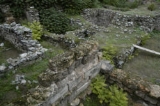
Thebes is a city in
GreeceGreece , officially the Hellenic Republic , is a country in southeastern Europe, situated on the southern end of the Balkan Peninsula....
, situated to the north of the Cithaeron range, which divides
BoeotiaBoeotia, also spelled Beotia and Bœotia , formerly Cadmeis, was a region of ancient Greece, north of the eastern part of the Gulf of Corinth. It was bounded on the south by Megaris and the Kithairon mountain range that forms a natural barrier with Attica, on the north by Opuntian Locris and the...
from Attica, and on the southern edge of the Boeotian plain. It played an important role in Greek myth, as the site of the stories of
CadmusCadmus or Kadmos , in Phoenician and Greek mythologies, was a Phoenician prince, the son of king Agenor of Tyre and the brother of Phoenix, Cilix and Europa. He was originally sent by his royal parents to seek out and escort his sister Europa back to Tyre after she was abducted from the shores of...
,
OedipusOedipus was a mythical Greek king of Thebes. He fulfilled a prophecy that said he would kill his father and marry his mother, and thus brought disaster on his city and family...
,
DionysusIn classical mythology, Dionysus or Dionysos is the god of wine, the inspirer of ritual madness and ecstasy, and a major figure of Greek mythology, and one of the twelve Olympians, amongst whom Greek mythology treated him as a late arrival...
and others. Archaeological excavations in and around Thebes have revealed a
MycenaeanMycenaean Greece is a cultural period of Ancient Greece taking its name from the archaeological site of Mycenae in northeastern Argolis, in the Peloponnese of southern Greece. Athens, Pylos, Thebes, and Tiryns are also important Mycenaean sites...
settlement and
clay tabletIn ancient times, small tablets made out of clay were used as a writing medium.From the 4th millennium BCE in the Sumerian, Babylonian, Assyrian and Hittite civilisations of the Mesopotamia region, cuneiform characters were imprinted on a wet clay tablet with a stylus often made of reed. Once...
s written in the
Linear BLinear B is a script that was used for writing Mycenaean Greek, an early form of Greek. It predated the Greek alphabet by several centuries and seems to have died out with the fall of Mycenaean civilization. Most of the tablets inscribed in Linear B were found in Knossos, Cydonia, Pylos, Thebes...
script, indicating the importance of the site in the
Bronze AgeThe Bronze Age of a culture is the period when the most advanced metalworking in that culture utilised bronze. This could either have been based on the local smelting of copper and tin from ores, or trading for bronze from production areas elsewhere...
. In ancient times, Thebes was the largest city of the region of
BoeotiaBoeotia, also spelled Beotia and Bœotia , formerly Cadmeis, was a region of ancient Greece, north of the eastern part of the Gulf of Corinth. It was bounded on the south by Megaris and the Kithairon mountain range that forms a natural barrier with Attica, on the north by Opuntian Locris and the...
and was the leader of the Boeotian confederacy. It was a major rival of ancient Athens, and sided with the Persians during the 480 BC invasion of
XerxesXerxes the Great, also known as Xerxes I of Persia, was a Zoroastrian Persian Shahanshah of the Achaemenid Empire.Xerxes was the son of Darius the Great and his wife Atossa...
. Theban forces ended the power of
SpartaThis article covers the history of Sparta from its founding to the present, concentrating primarily on the Spartan state during its period as an independent state. Sparta rose to dominance in the 6th century BCE. At the time of Persian Wars it was the obvious leader of the Greeks...
at the
Battle of LeuctraThe Battle of Leuctra was a battle fought between the Thebans and the Spartans and their respective allies amidst the post-Corinthian War conflict. The battle took place in the neighbourhood of Leuctra, a village in Boeotia in the territory of Thespiae...
in 371 BC under the command of
EpaminondasEpaminondas was a Theban general and statesman of the 4th century BC who transformed the Ancient Greek city-state of Thebes, leading it out of Spartan subjugation into a preeminent position in Greek politics...
. The
Sacred Band of ThebesThe Sacred Band of Thebes was a troop of picked soldiers, consisting of 150 age-structured couples, which formed the elite force of the Theban army in the 4th century BC. It was organised by the Theban commander Gorgidas in 378 BC and played a crucial role in the Battle of Leuctra...
(an elite military unit) famously fell at the battle of
ChaeroneaFor the later battle, see Battle of Chaeronea The Battle of Chaeronea 338 BC, fought near Chaeronea, in Boeotia, was the greatest victory of Philip II of Macedon...
in 338 BC against
Philip IIPhilip II of Macedon, Philip II of Macedon, Philip II of Macedon, ( — φίλος = friend + ίππος = horse — transliterated 382 – 336 BC, was an ancient Greek king (basileus) of Macedon from 359 BC until his assassination in 336. He was the father of Alexander the Great and Philip...
and
Alexander the GreatAlexander III of Macedon, popularly known as Alexander the Great , was an Ancient Greek king of Macedon who created one of the largest empires in ancient history...
. Prior to its destruction by Alexander in 335 BC, Thebes was a major force in Greek history, and was the most dominant
city-stateA city-state is an independent republican country whose territory consists of a city which is not administered as part of another local government....
at the time of the Macedonian conquest of Greece. During the
ByzantineThe Byzantine Empire or Eastern Roman Empire, was the continuation of the Roman Empire during the Middle Ages, centered on the capital of Constantinople, and ruled by Emperors in direct and de jure succession to the ancient Roman Emperors...
period, the city was famous for its
silkSilk is a natural protein fiber, some forms of which can be woven into textiles. The best-known type of silk is obtained from cocoons made by the larvae of the mulberry silkworm Bombyx mori reared in captivity...
s. The modern city contains an Archaeological Museum, the remains of the
CadmeaThe Cadmea, or Cadmeia , was the citadel of ancient Thebes, Greece, named after the legendary founder of Thebes, Cadmus. The area is thought to have been settled since at least the early Bronze Age, although the history of settlement can only be reliably dated from the late Mycenaean period The...
(Bronze Age and forward citadel), and scattered ancient remains. Modern Thebes is the largest town of the
Boeotia PrefectureBoeotia is one of the prefectures of Greece. It is within the Central Greece periphery, and its area was known in ancient times. Its capital is Livadeia, the second largest city being Thebes, and the area has access to the island of Euboea via two bridges : one that runs through Chalcis, and...
. It is situated at highway E962, some 4 km south of the junction with
E75Greek National Road 1 is the longest highway and the principal north-south road connection in Greece. It connects the country's capital Athens with its Thessalian and Macedonian provinces and with its second largest city Thessaloniki...
.
Mythic record
The stories of Thebes are mainly tragic tales of death, confusion, war, murder, complete frenzy, and other tragic endings. The record of the earliest days of Thebes was preserved among the Greeks in an abundant mass of legends which rival the myths of
TroyTroy is a legendary city and center of the Trojan War, as described in the Epic Cycle and especially in the Iliad, one of the two epic poems attributed to Homer...
in their wide ramification and the influence which they exerted upon the literature of the classical age. Five main cycles of story may be distinguished:
- The foundation of the citadel Cadmeia by Cadmus
Cadmus or Kadmos , in Phoenician and Greek mythologies, was a Phoenician prince, the son of king Agenor of Tyre and the brother of Phoenix, Cilix and Europa. He was originally sent by his royal parents to seek out and escort his sister Europa back to Tyre after she was abducted from the shores of...
, and the growth of the Spartoi or "Sown Men" (probably an aetiological myth designed to explain the origin of the Theban nobility which bore that name in historical times);
- The building of a "seven-gated" wall by Amphion
There are several characters named Amphion in Greek mythology:* Amphion, son of Zeus and Antiope, and twin brother of Zethus . Together they are famous for building Thebes. Amphion married Niobe, and killed himself after the loss of his wife and children at the hands of Apollo and Artemis...
, and the cognate stories of Zethus, AntiopeIn Greek mythology, Antiope was the name of the daughter of the Boeotian river god Asopus, according to Homer; in later sources she is called the daughter of the "nocturnal" king Nycteus of Thebes or, in the Cypria, of Lycurgus, but for Homer her site is purely Boeotian. Her beauty attracted Zeus,...
and DirceDirce was the wife of Lycus in Greek mythology, and aunt to Antiope whom Zeus impregnated. Antiope fled in shame to King Epopeus of Sicyon, but was brought back by Lycus through force, giving birth to the twins Amphion and Zethus on the way...
;
- The tale of Laius
In Greek mythology, King Laius, or Laios of Thebes was a divine hero and key personage in the Theban founding myth. Son of Labdacus, he was raised by the regent Lycus after the death of his father.-Abduction of Chrysippus:...
, whose misdeeds culminated in the tragedy of OedipusOedipus was a mythical Greek king of Thebes. He fulfilled a prophecy that said he would kill his father and marry his mother, and thus brought disaster on his city and family...
and the wars of the "Seven Against ThebesThe Seven against Thebes is the third play in an Oedipus-themed trilogy produced by Aeschylus in 467 BC. It concerns the battle between an Argive army led by Polynices and the army of Thebes led by Eteocles and his supporters. The trilogy won the first prize at the City Dionysia...
," the EpigoniIn Greek mythology, Epigoni are the sons of the Argive heroes who had fought and been killed in the first Theban war, the subject of the Greek Thebaid, in which Polynices and six allies attacked Thebes because Polynices' brother, Eteocles, refused to give up the throne as promised...
, and the downfall of his house; Laius' pederastic rapeGreek pederasty, as idealised by the Greeks from archaic times onward, was a relationship and bond between an adult man and an adolescent boy outside his immediate family. It was seen by the Greeks as an essential element in their culture from the time of Homer onwards...
of ChrysippusIn Greek mythology, Chrysippus was a divine hero of Elis in the Peloponnesus, a young boy, the bastard son of Pelops king of Pisa in the Peloponnesus and the nymph Axioche. He was kidnapped by the Theban Laius, his tutor, who was escorting him to the Nemean Games, where the boy planned to compete...
was held by some ancients to have been the first instance of homosexualityHomosexuality is the romantic or sexual attraction or behavior among members of the same sex, situationally or as an enduring disposition. As a sexual orientation, homosexuality is considered to lie within the heterosexual-homosexual continuum of human sexuality, and refers to an individual’s...
among mortals, and may have provided an etiology for the practice of pedagogic pederasty for which Thebes was famous. See Theban pederastyTheban pederasty was a social institution by means of which upper class Theban adolescent boys were educated and entered into adult responsibilities through a love and sexual relationship with an adult aristocrat...
and Pederasty in ancient GreeceGreek pederasty, as idealised by the Greeks from archaic times onward, was a relationship and bond between an adult man and an adolescent boy outside his immediate family. It was seen by the Greeks as an essential element in their culture from the time of Homer onwards...
for detailed discussion and background.
- The immolation of Semele
In Greek mythology, Semele, daughter of Cadmus and Harmonia, was the mortal mother of Dionysus by Zeus in one of his many origin myths. The name "Semele", like other elements of Dionysiac cult , is manifestly not Greek but apparently Thraco-Phrygian; the myth of...
and the advent of DionysusIn classical mythology, Dionysus or Dionysos is the god of wine, the inspirer of ritual madness and ecstasy, and a major figure of Greek mythology, and one of the twelve Olympians, amongst whom Greek mythology treated him as a late arrival...
; and
- The exploits of Heracles
In Greek mythology, Heracles or Herakles , Alcides or Alcaeus , was a divine hero, the son of Zeus and Alcmene, foster son of Amphitryon and great-grandson of Perseus...
.
Early history
Archaeological excavations in and around Thebes have revealed cist graves dated to
MycenaeanMycenaean Greece is a cultural period of Ancient Greece taking its name from the archaeological site of Mycenae in northeastern Argolis, in the Peloponnese of southern Greece. Athens, Pylos, Thebes, and Tiryns are also important Mycenaean sites...
times containing weapons, ivory, and tablets written in
Linear BLinear B is a script that was used for writing Mycenaean Greek, an early form of Greek. It predated the Greek alphabet by several centuries and seems to have died out with the fall of Mycenaean civilization. Most of the tablets inscribed in Linear B were found in Knossos, Cydonia, Pylos, Thebes...
. Its name in the local tablets, and in tablets found in Mycenae, was transliterated
TE-QA-I (TH Ft 140.1) understood to be read as * (
Ancient GreekAncient Greek is the historical stage in the development of the Greek language spanning across the Archaic , Classical , and Hellenistic periods of ancient Greece and the ancient world. It is predated in the 2nd millennium BC by Mycenaean Greek...
Thēbai), and
TE-QA-DE (MY X 508; TH Wu 65.a) for * (
Ancient GreekAncient Greek is the historical stage in the development of the Greek language spanning across the Archaic , Classical , and Hellenistic periods of ancient Greece and the ancient world. It is predated in the 2nd millennium BC by Mycenaean Greek...
Thēbasde).
It seems safe to infer that * was one of the first Greek communities to be drawn together within a fortified city, and that it owed its importance in prehistoric days — as later — to its military strength. Deger-Jalkotzy claimed that the statue base from Kom el-Hetan in
Amenhotep IIIAmenhotep III was the ninth pharaoh of the Eighteenth dynasty. According to different authors, he ruled Egypt from June 1386 to 1349 BC or June 1388 BC to December 1351 BC/1350 BC after his father Thutmose IV died...
's kingdom (LHIIIA:1) mentions a name similar to Thebes and considered to be one of four
tj-n3-jj (Danaan?) kingdoms worthy of note (alongside Knossos and Mycenae). * in LHIIIB lost contact with Egypt but gained it with "Milatos" (Hit. Milawata) and "Cyprus" (Hit. Alasiya). In the late LHIIIB, according to Palaima ("Sacrificial Feasting", Hesperia 73, 2004), * was able to pull resources from Lamos near Mount Helicon, and from Karystos and Amarynthos on the Greek side of the isle of Euboia.
As a fortified community, it attracted attention from the invading Dorians, and the fact of their eventual conquest of Thebes lie behind the stories of the successive legendary attacks on that city.
The central position and military security of the city naturally tended to raise it to a commanding position among the Boeotians, and from early days its inhabitants endeavoured to establish a complete supremacy over their kinsmen in the outlying towns. This centralizing policy is as much the cardinal fact of Theban history as the counteracting effort of the smaller towns to resist absorption forms the main chapter of the story of Boeotia. No details of the earlier history of Thebes have been preserved, except that it was governed by a land-holding
aristocracyAristocracy is a form of government, in which a few of the most prominent citizens rule. This may be a hereditary elite, or it may be by a system of cooption where a council of prominent citizens add leading soldiers, merchants, land owners, priests, and lawyers to their number...
who safeguarded their integrity by rigid statutes about the ownership of property and its transmission.
Archaic and classical periods
In the late
6th century BCThe sixth century BC started the first day of 600 BC and ended the last day of 501 BC.In India, Panini, sometime during this century, composed a grammar for Sanskrit, which is the one of oldest extant grammar of any language after 15 other proto-dravidian languages like Brahmi.In the Near East,...
, the Thebans were brought for the first time into hostile contact with the
AtheniansAthens , the capital and largest city of Greece, dominates the Attica periphery; as one of the world's oldest cities, its recorded history spans around 3,400 years....
, who helped the small village of
PlataeaPlataea or Plataeae was an ancient city, located in Greece in southeastern Boeotia, south of Thebes. It was the location of the Battle of Plataea in 479 BC, in which an alliance of Greek city-states defeated the Persians...
to maintain its independence against them, and in 506 BC repelled an inroad into Attica. The aversion to Athens best serves to explain the apparently unpatriotic attitude which Thebes displayed during the Persian invasion of Greece (480–479 BC). Though a contingent of 400 was sent to
ThermopylaeThe Battle of Thermopylae took place over three days during the second Persian invasion of Greece. It took place simultaneously with the naval battle at Artemisium, in August or September 480 BC, at the pass of Thermopylae . It was fought between an alliance of Greek city-states, led by Sparta,...
and remained there with Leonidas until just before the last stand when they surrendered to the Persians, the governing aristocracy soon after joined King
Xerxes I of PersiaXerxes the Great, also known as Xerxes I of Persia, was a Zoroastrian Persian Shahanshah of the Achaemenid Empire.Xerxes was the son of Darius the Great and his wife Atossa...
with great readiness and fought zealously on his behalf at the
Battle of PlataeaThe Battle of Plataea was the final land battle during the second Persian invasion of Greece. It took place in 479 BC near the city of Plataea in Boeotia, and was fought between an alliance of the Greek city-states, including Sparta, Athens, Corinth and Megara, and the Persian Empire of...
in 479 BC. The victorious Greeks subsequently punished Thebes by depriving it of the presidency of the Boeotian League and an attempt by the Spartans to expel it from the Delphic amphictyony was only frustrated by the intercession of Athens.
In 457 BC Sparta, needing a counterpoise against Athens in central Greece, reversed her policy and reinstated Thebes as the dominant power in Boeotia. The great citadel of Cadmea served this purpose well by holding out as a base of resistance when the Athenians overran and occupied the rest of the country (457–447 BC). In the
Peloponnesian WarThe Peloponnesian War, 431 to 404 B.C., was an Ancient Greek war, fought by Athens and its empire against the Peloponnesian League, led by Sparta. Historians have traditionally divided the war into three phases...
the Thebans, embittered by the support which Athens gave to the smaller Boeotian towns, and especially to Plataea, which they vainly attempted to reduce in 431 BC, were firm allies of Sparta, which in turn helped them to besiege Plataea and allowed them to destroy the town after its capture in 427 BC. In 424 BC at the head of the Boeotian levy they inflicted a severe defeat upon an invading force of Athenians at the
Battle of DeliumThe Battle of Delium or of Delion took place in 424 BC between the Athenians and the Boeotians, and ended with the siege of Delium in the following weeks.-Prelude:...
, and for the first time displayed the effects of that firm military organization which eventually raised them to predominant power in Greece.
After the downfall of Athens at the end of the Peloponnesian War, the Thebans, having learned that Sparta intended to protect the states which they desired to annex, broke off the alliance. In 404 BC they had urged the complete destruction of Athens, yet in 403 BC they secretly supported the restoration of its democracy in order to find in it a counterpoise against Sparta. A few years later, influenced perhaps in part by Persian gold, they formed the nucleus of the league against Sparta. At the
Battle of HaliartusThe Battle of Haliartus was fought in 395 BC between Sparta and Thebes. The Thebans defeated a Spartan force attempting to seize the town of Haliartus, killing the Spartan leader Lysander...
(395 BC) and the
Battle of CoroneaThe Battle of Coronea in 394 BC was a battle in the Corinthian War, in which the Spartans and their allies under King Agesilaus II defeated a force of Thebans and Argives that was attempting to block their march back into the Peloponnese.-Prelude:...
(394 BC) they again proved their rising military capacity by standing their ground against the Spartans. The result of the war was especially disastrous to Thebes, as the general settlement of 387 BC stipulated the complete autonomy of all Greek towns and so withdrew the other Boeotians from its political control. Its power was further curtailed in 382 BC, when a Spartan force occupied the citadel by a treacherous coup-de-main. Three years later, the Spartan garrison was expelled and a democratic constitution was set up in place of the traditional oligarchy. In the consequent wars with Sparta, the Theban army, trained and led by
EpaminondasEpaminondas was a Theban general and statesman of the 4th century BC who transformed the Ancient Greek city-state of Thebes, leading it out of Spartan subjugation into a preeminent position in Greek politics...
and
PelopidasPelopidas was an important Theban statesman and general in Greece.-Athlete and warrior:He was a member of a distinguished family, and possessed great wealth which he expended on his friends, while content to lead the life of an athlete...
, proved itself the best in Greece (see also:
Sacred Band of ThebesThe Sacred Band of Thebes was a troop of picked soldiers, consisting of 150 age-structured couples, which formed the elite force of the Theban army in the 4th century BC. It was organised by the Theban commander Gorgidas in 378 BC and played a crucial role in the Battle of Leuctra...
). Years of desultory fighting, in which Thebes established its control over all Boeotia, culminated in 371 BC in a remarkable victory over the pick of the Spartans at
LeuctraThe Battle of Leuctra was a battle fought between the Thebans and the Spartans and their respective allies amidst the post-Corinthian War conflict. The battle took place in the neighbourhood of Leuctra, a village in Boeotia in the territory of Thespiae...
. The winners were hailed throughout Greece as champions of the oppressed. They carried their arms into Peloponnesus and at the head of a large coalition, permanently crippled the power of Sparta, in part by freeing many helot slaves, the basis of the Spartan economy. Similar expeditions were sent to
ThessalyThessaly is one of the 13 peripheries of Greece, and is further sub-divided into 4 prefectures. The capital of the periphery and traditional geographical region is Larissa. Together with the regions of Macedonia and Thrace, it is often referred to unofficially as Northern Greece...
and
MacedonMacedonia or Macedon was an ancient kingdom, centered in the northeastern part of the Greek peninsula, bordered by Epirus to the west, Paionia to the north, the region of Thrace to the east and Thessaly to the south...
to regulate the affairs of those regions.
However, the predominance of Thebes was short-lived as the states which she protected refused to subject themselves permanently to her control. Due to their renewed rivalry with Athens, who had joined with Thebes in 395 BC in fear of Sparta, but since 387 BC had endeavored to maintain the balance of power against her ally, prevented the formation of a Theban empire. With the death of
EpaminondasEpaminondas was a Theban general and statesman of the 4th century BC who transformed the Ancient Greek city-state of Thebes, leading it out of Spartan subjugation into a preeminent position in Greek politics...
at the
Battle of Mantinea (362 BC)The Battle of Mantinea was fought in 362 BC between the Thebans, led by Epaminondas and supported by the Arcadians and the Boeotian league against the Spartans, led by King Agesilaus II and supported by the Eleans, Athenians, and Mantineans...
the city sank again to the position of a secondary power. In a war with the neighboring state of
PhocisPhocis is an ancient district and a modern prefecture of Greece, located in Central Greece, stretching from the western mountainsides of Parnassus on the east to the mountain range of Vardousia on the west, upon the Gulf of Corinth.-Geography:Ancient Phocis was about 1,619 km² in area, bounded on...
(356–346 BC) it could not even maintain its predominance in central Greece, and by inviting
Philip II of MacedonPhilip II of Macedon, Philip II of Macedon, Philip II of Macedon, ( — φίλος = friend + ίππος = horse — transliterated 382 – 336 BC, was an ancient Greek king (basileus) of Macedon from 359 BC until his assassination in 336. He was the father of Alexander the Great and Philip...
to crush the Phocians it extended that monarch's power within dangerous proximity to its frontiers. A revulsion of feeling was completed in 338 BC by the orator
DemosthenesDemosthenes was a prominent Greek statesman and orator of ancient Athens. His orations constitute a significant expression of contemporary Athenian intellectual prowess and provide an insight into the politics and culture of ancient Greece during the 4th century BC. Demosthenes learned rhetoric by...
, who persuaded Thebes to join Athens in a final attempt to bar Philip's advance upon Attica. The Theban contingent lost the decisive
battle of ChaeroneaFor the later battle, see Battle of Chaeronea The Battle of Chaeronea 338 BC, fought near Chaeronea, in Boeotia, was the greatest victory of Philip II of Macedon...
and along with it every hope of reassuming control over Greece. Philip was content to deprive Thebes of her dominion over Boeotia; but an unsuccessful revolt in 335 BC against his son
Alexander the GreatAlexander III of Macedon, popularly known as Alexander the Great , was an Ancient Greek king of Macedon who created one of the largest empires in ancient history...
was punished by Alexander and his Greek allies by the destruction of the city, except, according to tradition, the house of the poet
PindarPindar , was an Ancient Greek lyric poet. Of the canonical nine lyric poets of ancient Greece, Pindar is the one whose work is best preserved...
and the temples.
While he was triumphantly campaigning north, the Thebans and Athenians rebelled once more. Alexander reacted immediately, but, while the other cities once again hesitated, Thebes decided to resist with the utmost vigor. This resistance was useless, however, as the city was razed to the ground amid great bloodshed and its territory divided between the other Boeotian cities. Moreover, the Thebans themselves were sold into
slaverySlavery was common practice and an integral component of ancient Greece throughout its history, as it was in other societies of the time including ancient Israel and early Christian societies. It is estimated that in Athens, the majority of citizens owned at least one slave...
. Alexander spared only priests, leaders of the pro-Macedonian party and descendants of
PindarPindar , was an Ancient Greek lyric poet. Of the canonical nine lyric poets of ancient Greece, Pindar is the one whose work is best preserved...
, whose house was the only one left standing. The end of Thebes cowed Athens into submission. According to Plutarch, a special Athenian embassy, led by
PhocionPhocion was an Athenian statesman and strategos, and the subject of one of Plutarch's Parallel Lives.Phocion was a successful politician of Athens...
, an opponent of the anti-Macedonian faction, was able to persuade Alexander to give up his demand for the exile of leaders of the anti-Macedonian party, most particularly
DemosthenesDemosthenes was a prominent Greek statesman and orator of ancient Athens. His orations constitute a significant expression of contemporary Athenian intellectual prowess and provide an insight into the politics and culture of ancient Greece during the 4th century BC. Demosthenes learned rhetoric by...
.
Plays such as 'The Antigone' were taken place in Thebes.
Byzantine period
During the early
ByzantineThe Byzantine Empire or Eastern Roman Empire, was the continuation of the Roman Empire during the Middle Ages, centered on the capital of Constantinople, and ruled by Emperors in direct and de jure succession to the ancient Roman Emperors...
period it served as a place of refuge against foreign invaders. From the 10th century, Thebes became a centre of the new
silkSilk is a natural protein fiber, some forms of which can be woven into textiles. The best-known type of silk is obtained from cocoons made by the larvae of the mulberry silkworm Bombyx mori reared in captivity...
trade, its silk workshops boosted by imports of soaps and dyes from Athens. The growth of this trade in Thebes continued to such an extent that by the middle of the 12th century, the city had become the biggest producer of silks in the entire Byzantine empire, surpassing even the Byzantine capital,
ConstantinopleConstantinople was the imperial capital of the Roman Empire , the Byzantine/Eastern Roman Empire , the Latin Empire , and the Ottoman Empire...
. The women of Thebes were famed for their skills at weaving. Theban silk was prized above all others during this period, both for its quality and its excellent reputation.
Though severely plundered by the
NormansThe Normans were the people who gave their names to Normandy, a region in northern France. They descended from Viking conquerors of the territory and the native population of mostly Frankish and Gallo-Roman stock...
in 1146, Thebes quickly recovered its prosperity and continued to grow rapidly until the dissolution of the Byzantine empire by the
Fourth CrusadeThe Fourth Crusade was originally intended to conquer Muslim-controlled Jerusalem by means of an invasion through Egypt. Instead, in April 1204, the Crusaders of Western Europe invaded and conquered the Christian city of Constantinople, capital of the Byzantine Empire...
in 1204.
Latin period
Thanks to its wealth, the city was selected by the Frankish dynasty de la Roche as its capital. In 1311 it was used as a capital by the short-lived state of the
Catalan CompanyThe Catalan Company of the East , officially the Company of the Army of the Franks in Romania, sometimes called the Grand Company and widely known as the Catalan Company, was a free company of mercenaries founded by Roger de Flor in the early 14th-century...
.
In 1379, the
Navarrese CompanyThe Navarrese Company was a company of mercenaries, mostly from Navarre and Gascony, which fought in Greece during the late 14th century and early 15th century, in the twilight of Frankish power in the dwindling remnant of the Latin Empire...
took the city with the aid of the archbishop
Simon AtumanoSimon Atumano was the Bishop of Gerace in Calabria from 23 June 1348 until 1366 and the Latin Archbishop of Thebes thereafter until 1380. Born in Constantinople, Atumano was of Greco-Turkish stock, his surname deriving from the word "Ottoman." He was a famous humanist and an influential Greek...
.
Portions of the historical section were taken from the 1911 Encyclopedia Britannica.
Ancient
- Epaminondas
Epaminondas was a Theban general and statesman of the 4th century BC who transformed the Ancient Greek city-state of Thebes, leading it out of Spartan subjugation into a preeminent position in Greek politics...
(c. 418-362BC) general and statesman
- Aristides
Aristides of Thebes was an ancient Greek painter of the 4th century BC. He is said to have excelled in expression. For example, a picture of his representing a dying mother's fear lest her infant should suck death from her breast was much celebrated. He also painted one of Alexander the Great's...
(4th century BCThe 4th century BC started the first day of 400 BC and ended the last day of 300 BC. It is considered part of the Classical era, epoch, or historical period.-Overview:This century marked the height of Classical Greek civilization in all of its aspects...
) painter
- Nicomachus
Nicomachus of Thebes was an ancient Greek painter, a native of Thebes, and a contemporary of the great painters of the Classical period; his father and son were also painters...
(4th century BC) painter
- Kleitomachos
Kleitomachos was a Theban athlete considered a formidable boxer. His achievements were recounted by Pausanias, who notes that he won the boxing and pankration at the 141 Olympiad in 216 BCE, the pankration at three Pythian Games, and the wrestling, boxing, and pankration at an Isthmian Games...
(3rd century BCThe 3rd century BC started the first day of 300 BC and ended the last day of 201 BC. It is considered part of the Classical era, epoch, or historical period.-Overview:...
) athlete
Modern
- Haris Alexiou
Haris Alexiou is a Greek singer. She is one of the most popular singers in Greece and has been commercially successful since the 1970s. She has worked with important Greek songwriters and composers, performed at top musical theatres all over the world and has received several awards...
(1950-), singer
- Panagiotis Bratsiotis, theologian
- Theodoros Vryzakis
Theodoros Vryzakis was a major Greek painter of the 18th century.- Life :Vryzakis's father died in the Greek War of Independence...
(c. 1814-1878) painter
See also
- Sacred Band of Thebes
The Sacred Band of Thebes was a troop of picked soldiers, consisting of 150 age-structured couples, which formed the elite force of the Theban army in the 4th century BC. It was organised by the Theban commander Gorgidas in 378 BC and played a crucial role in the Battle of Leuctra...
- List of traditional Greek place names
- Theban pederasty
Theban pederasty was a social institution by means of which upper class Theban adolescent boys were educated and entered into adult responsibilities through a love and sexual relationship with an adult aristocrat...
External links