

The empire on which the sun never sets

Encyclopedia
The phrase, "the Empire on which the sun never sets", has been used with variations to describe certain global empires that were so extensive that there was always at least one part of their territory in daylight
.
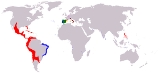
It was originally used for the Spanish Empire
, mainly in the 16th and 17th centuries, and for the British Empire
, mainly in the 19th and early 20th centuries.
Georg Büchmann
traces the idea to a speech in Herodotus
' Histories
, made by Xerxes I of Persia
before invading Greece
: γῆν τὴν Περσίδα ἀποδέξομεν τῷ Διὸς αἰθέρι ὁμουρέουσαν. οὐ γὰρ δὴ χώρην γε οὐδεμίαν κατόψεται ἥλιος ὅμουρον ἐοῦσαν τῇ ἡμετέρῃ ("We shall extend the Persian territory as far as God's heaven reaches. The sun will then shine on no land beyond our borders.")
 In the 16th century, the phrase was first used to describe the Spanish Empire
. It originated with a remark made by Fray Francisco de Ugalde to Charles V, Holy Roman Emperor
(Charles I of Spain), who as emperor of the Holy Roman Empire
and king of Spain
, had an enormous empire
, which included many territories in Europe
and vast territories in the Americas
.
The phrase gained added resonance during the reign of Charles's son, King Philip II of Spain
. The Philippines
was obtained by Spain in 1565. When King Henry of Portugal died, Philip II was recognised as King of Portugal
in 1581, resulting in a personal union of the crowns
. He now reigned over all his father's possessions (except the Holy Roman Empire) and the Portuguese Empire
, which included territories in South America
, Africa
, Asia
and islands in the Atlantic, Indian and Pacific oceans.
In 1585, Giovanni Battista Guarini
wrote Il pastor fido to mark the marriage of Catherine Michelle, daughter of Philip II, to Charles Emmanuel I, Duke of Savoy
. Guarini's dedication read "Altera figlia / Di qel Monarca, a cui / Nö anco, quando annotta, il Sol tramonta." ("The proud daughter / of that monarch to whom / when it grows dark [elsewhere] the sun never sets.")
In the early 17th century, the phrase was familiar to John Smith of Jamestown
, and to Francis Bacon
, who writes: "both the East and the West Indies being met in the crown of Spain, it is come to pass, that, as one saith in a brave kind of expression, the sun never sets in the Spanish dominions, but ever shines upon one part or other of them : which, to say truly, is a beam of glory [...]" Thomas Urquhart
wrote of "that great Don Philippe, Tetrarch of the world, upon whose subjects the sun never sets."
In the German dramatist Friedrich Schiller
's 1787 play, Don Carlos
, Don Carlos's father, Philip II, says ("I am called / The richest monarch in the Christian world; / The sun in my dominions never sets.")
Joseph Fouché
recalled Napoleon
saying before the Peninsular War
, "Reflect that the sun never sets in the immense inheritance of Charles V, and that I shall have the empire of both worlds." This was cited in Walter Scott
's Life of Napoleon
It has been claimed that Louis XIV of France
's emblem of the "Sun King" and associated motto Nec pluribus impar
were based on the solar emblem and motto of Philip II.
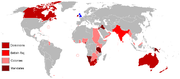 In the 19th century, it became popular to apply the phrase to the British Empire
. It was a time when British world map
s showed the Empire in red or pink to highlight British imperial power spanning the globe. Scottish author, John Wilson
, writing as "Christopher North" in Blackwood's Magazine
in 1829, is sometimes credited as originating the usage. However, George Macartney
wrote in 1773, in the wake of the territorial expansion that followed Britain's victory in the Seven Years' War
, of "this vast empire on which the sun never sets, and whose bounds nature has not yet ascertained." In a speech on 31 July 1827, Rev. R. P. Buddicom said, "It had been said that the sun never set on the British flag; it was certainly an old saying, about the time of Richard the Second
, and was not so applicable then as at the present time." In 1821, the Caledonian Mercury wrote of the British Empire, "On her dominions the sun never sets; before his evening rays leave the spires of Quebec
, his morning beams have shone three hours on Port Jackson
, and while sinking from the waters of Lake Superior
, his eye opens upon the Mouth of the Ganges."
Daniel Webster
famously expressed a similar idea in 1834: "A power which has dotted over the surface of the whole globe with her possessions and military posts, whose morning drumbeat, following the sun and keeping company with the hours, circles the earth with one continuous and unbroken strain of the martial airs of England." In 1839, Sir Henry Ward
said in the House of Commons, "Look at the British Colonial empire — the most magnificent empire that the world ever saw. The old Spanish boast that the sun never set in their dominions, has been more truly realised amongst ourselves." By 1861, Lord Salisbury
complained that the £1.5 million spent on colonial defence by Britain merely enabled the nation "to furnish an agreeable variety of stations to our soldiers, and to indulge in the sentiment that the sun never sets on our Empire".
In James Joyce
's Ulysses
, when Mr. Deasy asks Stephen
what an Englishman's proudest boast is, Stephen offers "That on his empire [...] the sun never sets." Mr. Deasy retorts "That's not English. A French Celt said that." Critics suggest Mr Deasy was mistaken.
, Rev. W. B. Brown of New Jersey quipped that the reason the sun never set upon the Empire was that God did not trust the British in the dark - the quip has been attributed to Abraham Lincoln
, among others.
According to Richard Lederer
's mock history of the world assembled from errors found in student-written papers, "[t]he sun never set on the British Empire because the British Empire was in the east and the sun sets in the west."
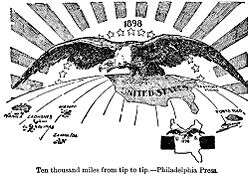 From the mid-nineteenth century, the image of the sun never setting can be found applied to Anglophone
culture, explicitly including America as well as Britain, for example in a speech by Alexander Campbell in 1852.
It was subsequently applied specifically to the American sphere of influence
. An 1897 magazine article titled "The Greatest Nation on Earth" boasted "the sun never sets on Uncle Sam
". In 1906, William Jennings Bryan
wrote "If we can not boast that the sun never sets on American territory, we can find satisfaction in the fact that the sun never sets on American philanthropy"; after which, The New York Times
received letters attempting to disprove his presupposition.
A 1991 history book discussion of U.S. expansion says "Today ... the sun never sets on American territory, properties owned by the U.S. government and its citizens, American armed forces abroad, or countries that conduct their affairs within limits largely defined by American power."
Although the United States no longer has any possessions further west than Guam
or further east than the Virgin Islands
, it currently has military presence in Afghanistan
, the British Indian Ocean Territory
, Germany
, Iraq
, Japan
, South Korea
and other countries. The phrase is sometimes used critically with the implication of American imperialism, as in the title of Joseph Gerson's book, The Sun Never Sets: Confronting the Network of Foreign U.S. Military Bases.
In a 1997 article, Edward Johnson referred to Dag Hammarskjöld
as "The umpire on whom the sun never sets".
The monologue "Tried by the Centre Court" by Flanders and Swann
ends with the line: "The umpire on whom the sun never sets."
Daylight
Daylight or the light of day is the combination of all direct and indirect sunlight outdoors during the daytime. This includes direct sunlight, diffuse sky radiation, and both of these reflected from the Earth and terrestrial objects. Sunlight scattered or reflected from objects in outer space is...
.
It was originally used for the Spanish Empire
Spanish Empire
The Spanish Empire comprised territories and colonies administered directly by Spain in Europe, in America, Africa, Asia and Oceania. It originated during the Age of Exploration and was therefore one of the first global empires. At the time of Habsburgs, Spain reached the peak of its world power....
, mainly in the 16th and 17th centuries, and for the British Empire
British Empire
The British Empire comprised the dominions, colonies, protectorates, mandates and other territories ruled or administered by the United Kingdom. It originated with the overseas colonies and trading posts established by England in the late 16th and early 17th centuries. At its height, it was the...
, mainly in the 19th and early 20th centuries.
Georg Büchmann
Georg Büchmann
Georg Büchmann was a German philologist. He was born in Berlin, and died there in Schöneberg.He became well known as a result of his 1864 book Geflügelte Worte, Der Zitatenschatz des Deutschen Volkes, a collection of quotations...
traces the idea to a speech in Herodotus
Herodotus
Herodotus was an ancient Greek historian who was born in Halicarnassus, Caria and lived in the 5th century BC . He has been called the "Father of History", and was the first historian known to collect his materials systematically, test their accuracy to a certain extent and arrange them in a...
' Histories
Histories (Herodotus)
The Histories of Herodotus is considered one of the seminal works of history in Western literature. Written from the 450s to the 420s BC in the Ionic dialect of classical Greek, The Histories serves as a record of the ancient traditions, politics, geography, and clashes of various cultures that...
, made by Xerxes I of Persia
Xerxes I of Persia
Xerxes I of Persia , Ḫšayāršā, ), also known as Xerxes the Great, was the fifth king of kings of the Achaemenid Empire.-Youth and rise to power:...
before invading Greece
Second Persian invasion of Greece
The second Persian invasion of Greece occurred during the Greco-Persian Wars, as King Xerxes I of Persia sought to conquer all of Greece. The invasion was a direct, if delayed, response to the defeat of the first Persian invasion of Greece at the Battle of Marathon which ended Darius I's attempts...
: γῆν τὴν Περσίδα ἀποδέξομεν τῷ Διὸς αἰθέρι ὁμουρέουσαν. οὐ γὰρ δὴ χώρην γε οὐδεμίαν κατόψεται ἥλιος ὅμουρον ἐοῦσαν τῇ ἡμετέρῃ ("We shall extend the Persian territory as far as God's heaven reaches. The sun will then shine on no land beyond our borders.")
Spain
Spanish Empire
The Spanish Empire comprised territories and colonies administered directly by Spain in Europe, in America, Africa, Asia and Oceania. It originated during the Age of Exploration and was therefore one of the first global empires. At the time of Habsburgs, Spain reached the peak of its world power....
. It originated with a remark made by Fray Francisco de Ugalde to Charles V, Holy Roman Emperor
Charles V, Holy Roman Emperor
Charles V was ruler of the Holy Roman Empire from 1519 and, as Charles I, of the Spanish Empire from 1516 until his voluntary retirement and abdication in favor of his younger brother Ferdinand I and his son Philip II in 1556.As...
(Charles I of Spain), who as emperor of the Holy Roman Empire
Holy Roman Empire
The Holy Roman Empire was a realm that existed from 962 to 1806 in Central Europe.It was ruled by the Holy Roman Emperor. Its character changed during the Middle Ages and the Early Modern period, when the power of the emperor gradually weakened in favour of the princes...
and king of Spain
Spain
Spain , officially the Kingdom of Spain languages]] under the European Charter for Regional or Minority Languages. In each of these, Spain's official name is as follows:;;;;;;), is a country and member state of the European Union located in southwestern Europe on the Iberian Peninsula...
, had an enormous empire
Empire
The term empire derives from the Latin imperium . Politically, an empire is a geographically extensive group of states and peoples united and ruled either by a monarch or an oligarchy....
, which included many territories in Europe
Europe
Europe is, by convention, one of the world's seven continents. Comprising the westernmost peninsula of Eurasia, Europe is generally 'divided' from Asia to its east by the watershed divides of the Ural and Caucasus Mountains, the Ural River, the Caspian and Black Seas, and the waterways connecting...
and vast territories in the Americas
Americas
The Americas, or America , are lands in the Western hemisphere, also known as the New World. In English, the plural form the Americas is often used to refer to the landmasses of North America and South America with their associated islands and regions, while the singular form America is primarily...
.
The phrase gained added resonance during the reign of Charles's son, King Philip II of Spain
Philip II of Spain
Philip II was King of Spain, Portugal, Naples, Sicily, and, while married to Mary I, King of England and Ireland. He was lord of the Seventeen Provinces from 1556 until 1581, holding various titles for the individual territories such as duke or count....
. The Philippines
Philippines
The Philippines , officially known as the Republic of the Philippines , is a country in Southeast Asia in the western Pacific Ocean. To its north across the Luzon Strait lies Taiwan. West across the South China Sea sits Vietnam...
was obtained by Spain in 1565. When King Henry of Portugal died, Philip II was recognised as King of Portugal
Iberian Union
The Iberian union was a political unit that governed all of the Iberian Peninsula south of the Pyrenees from 1580–1640, through a dynastic union between the monarchies of Portugal and Spain after the War of the Portuguese Succession...
in 1581, resulting in a personal union of the crowns
Personal union
A personal union is the combination by which two or more different states have the same monarch while their boundaries, their laws and their interests remain distinct. It should not be confused with a federation which is internationally considered a single state...
. He now reigned over all his father's possessions (except the Holy Roman Empire) and the Portuguese Empire
Portuguese Empire
The Portuguese Empire , also known as the Portuguese Overseas Empire or the Portuguese Colonial Empire , was the first global empire in history...
, which included territories in South America
South America
South America is a continent situated in the Western Hemisphere, mostly in the Southern Hemisphere, with a relatively small portion in the Northern Hemisphere. The continent is also considered a subcontinent of the Americas. It is bordered on the west by the Pacific Ocean and on the north and east...
, Africa
Africa
Africa is the world's second largest and second most populous continent, after Asia. At about 30.2 million km² including adjacent islands, it covers 6% of the Earth's total surface area and 20.4% of the total land area...
, Asia
Asia
Asia is the world's largest and most populous continent, located primarily in the eastern and northern hemispheres. It covers 8.7% of the Earth's total surface area and with approximately 3.879 billion people, it hosts 60% of the world's current human population...
and islands in the Atlantic, Indian and Pacific oceans.
In 1585, Giovanni Battista Guarini
Giovanni Battista Guarini
Giovanni Battista Guarini was an Italian poet, dramatist, and diplomat.- Life :He was born in Ferrara, and spent his early life both in Padua and Ferrara, entering the service of Alfonso II d'Este, Duke of Ferrara, in 1567...
wrote Il pastor fido to mark the marriage of Catherine Michelle, daughter of Philip II, to Charles Emmanuel I, Duke of Savoy
Charles Emmanuel I, Duke of Savoy
Charles Emmanuel I , known as the Great, was the Duke of Savoy from 1580 to 1630...
. Guarini's dedication read "Altera figlia / Di qel Monarca, a cui / Nö anco, quando annotta, il Sol tramonta." ("The proud daughter / of that monarch to whom / when it grows dark [elsewhere] the sun never sets.")
In the early 17th century, the phrase was familiar to John Smith of Jamestown
John Smith of Jamestown
Captain John Smith Admiral of New England was an English soldier, explorer, and author. He was knighted for his services to Sigismund Bathory, Prince of Transylvania and friend Mózes Székely...
, and to Francis Bacon
Francis Bacon
Francis Bacon, 1st Viscount St Albans, KC was an English philosopher, statesman, scientist, lawyer, jurist, author and pioneer of the scientific method. He served both as Attorney General and Lord Chancellor of England...
, who writes: "both the East and the West Indies being met in the crown of Spain, it is come to pass, that, as one saith in a brave kind of expression, the sun never sets in the Spanish dominions, but ever shines upon one part or other of them : which, to say truly, is a beam of glory [...]" Thomas Urquhart
Thomas Urquhart
Sir Thomas Urquhart of Cromarty was a Scottish writer and translator, most famous for his translation of Rabelais.-Life:...
wrote of "that great Don Philippe, Tetrarch of the world, upon whose subjects the sun never sets."
In the German dramatist Friedrich Schiller
Friedrich Schiller
Johann Christoph Friedrich von Schiller was a German poet, philosopher, historian, and playwright. During the last seventeen years of his life , Schiller struck up a productive, if complicated, friendship with already famous and influential Johann Wolfgang von Goethe...
's 1787 play, Don Carlos
Don Carlos (play)
Don Carlos is a historical tragedy in five acts by Friedrich Schiller; it was written between 1783 and 1787 and first produced in Hamburg in 1787...
, Don Carlos's father, Philip II, says ("I am called / The richest monarch in the Christian world; / The sun in my dominions never sets.")
Joseph Fouché
Joseph Fouché
Joseph Fouché, 1st Duc d'Otrante was a French statesman and Minister of Police under Napoleon Bonaparte. In English texts his title is often translated as Duke of Otranto.-Youth:Fouché was born in Le Pellerin, a small village near Nantes...
recalled Napoleon
Napoleon I
Napoleon Bonaparte was a French military and political leader during the latter stages of the French Revolution.As Napoleon I, he was Emperor of the French from 1804 to 1815...
saying before the Peninsular War
Peninsular War
The Peninsular War was a war between France and the allied powers of Spain, the United Kingdom, and Portugal for control of the Iberian Peninsula during the Napoleonic Wars. The war began when French and Spanish armies crossed Spain and invaded Portugal in 1807. Then, in 1808, France turned on its...
, "Reflect that the sun never sets in the immense inheritance of Charles V, and that I shall have the empire of both worlds." This was cited in Walter Scott
Walter Scott
Sir Walter Scott, 1st Baronet was a Scottish historical novelist, playwright, and poet, popular throughout much of the world during his time....
's Life of Napoleon
It has been claimed that Louis XIV of France
Louis XIV of France
Louis XIV , known as Louis the Great or the Sun King , was a Bourbon monarch who ruled as King of France and Navarre. His reign, from 1643 to his death in 1715, began at the age of four and lasted seventy-two years, three months, and eighteen days...
's emblem of the "Sun King" and associated motto Nec pluribus impar
Nec pluribus impar
Nec pluribus impar is a Latin motto adopted by Louis XIV of France from 1658. It was often inscribed together with the symbol of the "Sun King": a head within rays of sunlight.-Meaning:...
were based on the solar emblem and motto of Philip II.
United Kingdom
British Empire
The British Empire comprised the dominions, colonies, protectorates, mandates and other territories ruled or administered by the United Kingdom. It originated with the overseas colonies and trading posts established by England in the late 16th and early 17th centuries. At its height, it was the...
. It was a time when British world map
World map
A world map is a map of the surface of the Earth, which may be made using any of a number of different map projections. A map projection is any method of representing the surface of a sphere or other three-dimensional body on a plane....
s showed the Empire in red or pink to highlight British imperial power spanning the globe. Scottish author, John Wilson
John Wilson (Scottish writer)
John Wilson of Ellerey FRSE was a Scottish advocate, literary critic and author, the writer most frequently identified with the pseudonym Christopher North of Blackwood's Edinburgh Magazine....
, writing as "Christopher North" in Blackwood's Magazine
Blackwood's Magazine
Blackwood's Magazine was a British magazine and miscellany printed between 1817 and 1980. It was founded by the publisher William Blackwood and was originally called the Edinburgh Monthly Magazine. The first number appeared in April 1817 under the editorship of Thomas Pringle and James Cleghorn...
in 1829, is sometimes credited as originating the usage. However, George Macartney
George Macartney, 1st Earl Macartney
George Macartney, 1st Earl Macartney, KB was an Irish-born British statesman, colonial administrator and diplomat. He is often remembered for his observation following Britain's success in the Seven Years War and subsequent territorial expansion at the Treaty of Paris that Britain now controlled...
wrote in 1773, in the wake of the territorial expansion that followed Britain's victory in the Seven Years' War
Great Britain in the Seven Years War
The Kingdom of Great Britain was one of the major participants in the Seven Years' War which lasted between 1756 and 1763. Britain emerged from the war as the world's leading colonial power having gained a number of new territories at the Treaty of Paris in 1763 and established itself as the...
, of "this vast empire on which the sun never sets, and whose bounds nature has not yet ascertained." In a speech on 31 July 1827, Rev. R. P. Buddicom said, "It had been said that the sun never set on the British flag; it was certainly an old saying, about the time of Richard the Second
Richard II of England
Richard II was King of England, a member of the House of Plantagenet and the last of its main-line kings. He ruled from 1377 until he was deposed in 1399. Richard was a son of Edward, the Black Prince, and was born during the reign of his grandfather, Edward III...
, and was not so applicable then as at the present time." In 1821, the Caledonian Mercury wrote of the British Empire, "On her dominions the sun never sets; before his evening rays leave the spires of Quebec
Quebec City
Quebec , also Québec, Quebec City or Québec City is the capital of the Canadian province of Quebec and is located within the Capitale-Nationale region. It is the second most populous city in Quebec after Montreal, which is about to the southwest...
, his morning beams have shone three hours on Port Jackson
Port Jackson
Port Jackson, containing Sydney Harbour, is the natural harbour of Sydney, Australia. It is known for its beauty, and in particular, as the location of the Sydney Opera House and Sydney Harbour Bridge...
, and while sinking from the waters of Lake Superior
Lake Superior
Lake Superior is the largest of the five traditionally-demarcated Great Lakes of North America. It is bounded to the north by the Canadian province of Ontario and the U.S. state of Minnesota, and to the south by the U.S. states of Wisconsin and Michigan. It is the largest freshwater lake in the...
, his eye opens upon the Mouth of the Ganges."
Daniel Webster
Daniel Webster
Daniel Webster was a leading American statesman and senator from Massachusetts during the period leading up to the Civil War. He first rose to regional prominence through his defense of New England shipping interests...
famously expressed a similar idea in 1834: "A power which has dotted over the surface of the whole globe with her possessions and military posts, whose morning drumbeat, following the sun and keeping company with the hours, circles the earth with one continuous and unbroken strain of the martial airs of England." In 1839, Sir Henry Ward
Henry George Ward
Sir Henry George Ward GCMG was an English diplomat and politician. The son of politician and, in his retirement, writer Robert Ward and his first wife Catherine Julia Maling, and the cousin of William Ward and William George Ward, he entered the diplomatic service in 1816...
said in the House of Commons, "Look at the British Colonial empire — the most magnificent empire that the world ever saw. The old Spanish boast that the sun never set in their dominions, has been more truly realised amongst ourselves." By 1861, Lord Salisbury
Robert Gascoyne-Cecil, 3rd Marquess of Salisbury
Robert Arthur Talbot Gascoyne-Cecil, 3rd Marquess of Salisbury, KG, GCVO, PC , styled Lord Robert Cecil before 1865 and Viscount Cranborne from June 1865 until April 1868, was a British Conservative statesman and thrice Prime Minister, serving for a total of over 13 years...
complained that the £1.5 million spent on colonial defence by Britain merely enabled the nation "to furnish an agreeable variety of stations to our soldiers, and to indulge in the sentiment that the sun never sets on our Empire".
In James Joyce
James Joyce
James Augustine Aloysius Joyce was an Irish novelist and poet, considered to be one of the most influential writers in the modernist avant-garde of the early 20th century...
's Ulysses
Ulysses (novel)
Ulysses is a novel by the Irish author James Joyce. It was first serialised in parts in the American journal The Little Review from March 1918 to December 1920, and then published in its entirety by Sylvia Beach on 2 February 1922, in Paris. One of the most important works of Modernist literature,...
, when Mr. Deasy asks Stephen
Stephen Dedalus
Stephen Dedalus is James Joyce's literary alter ego, appearing as the protagonist and antihero of his first, semi-autobiographical novel of artistic existence A Portrait of the Artist as a Young Man and an important character in Joyce's Ulysses...
what an Englishman's proudest boast is, Stephen offers "That on his empire [...] the sun never sets." Mr. Deasy retorts "That's not English. A French Celt said that." Critics suggest Mr Deasy was mistaken.
Satirical references
In an 1865 speech in Oakland, CaliforniaOakland, California
Oakland is a major West Coast port city on San Francisco Bay in the U.S. state of California. It is the eighth-largest city in the state with a 2010 population of 390,724...
, Rev. W. B. Brown of New Jersey quipped that the reason the sun never set upon the Empire was that God did not trust the British in the dark - the quip has been attributed to Abraham Lincoln
Abraham Lincoln
Abraham Lincoln was the 16th President of the United States, serving from March 1861 until his assassination in April 1865. He successfully led his country through a great constitutional, military and moral crisis – the American Civil War – preserving the Union, while ending slavery, and...
, among others.
According to Richard Lederer
Richard Lederer
Richard Lederer is an American author, speaker, and teacher best known for his books on word play and the English language and his use of oxymorons...
's mock history of the world assembled from errors found in student-written papers, "[t]he sun never set on the British Empire because the British Empire was in the east and the sun sets in the west."
United States
Anglosphere
Anglosphere is a neologism which refers to those nations with English as the most common language. The term can be used more specifically to refer to those nations which share certain characteristics within their cultures based on a linguistic heritage, through being former British colonies...
culture, explicitly including America as well as Britain, for example in a speech by Alexander Campbell in 1852.
It was subsequently applied specifically to the American sphere of influence
Sphere of influence
In the field of international relations, a sphere of influence is a spatial region or conceptual division over which a state or organization has significant cultural, economic, military or political influence....
. An 1897 magazine article titled "The Greatest Nation on Earth" boasted "the sun never sets on Uncle Sam
Uncle Sam
Uncle Sam is a common national personification of the American government originally used during the War of 1812. He is depicted as a stern elderly man with white hair and a goatee beard...
". In 1906, William Jennings Bryan
William Jennings Bryan
William Jennings Bryan was an American politician in the late-19th and early-20th centuries. He was a dominant force in the liberal wing of the Democratic Party, standing three times as its candidate for President of the United States...
wrote "If we can not boast that the sun never sets on American territory, we can find satisfaction in the fact that the sun never sets on American philanthropy"; after which, The New York Times
The New York Times
The New York Times is an American daily newspaper founded and continuously published in New York City since 1851. The New York Times has won 106 Pulitzer Prizes, the most of any news organization...
received letters attempting to disprove his presupposition.
A 1991 history book discussion of U.S. expansion says "Today ... the sun never sets on American territory, properties owned by the U.S. government and its citizens, American armed forces abroad, or countries that conduct their affairs within limits largely defined by American power."
Although the United States no longer has any possessions further west than Guam
Guam
Guam is an organized, unincorporated territory of the United States located in the western Pacific Ocean. It is one of five U.S. territories with an established civilian government. Guam is listed as one of 16 Non-Self-Governing Territories by the Special Committee on Decolonization of the United...
or further east than the Virgin Islands
United States Virgin Islands
The Virgin Islands of the United States are a group of islands in the Caribbean that are an insular area of the United States. The islands are geographically part of the Virgin Islands archipelago and are located in the Leeward Islands of the Lesser Antilles.The U.S...
, it currently has military presence in Afghanistan
Afghanistan
Afghanistan , officially the Islamic Republic of Afghanistan, is a landlocked country located in the centre of Asia, forming South Asia, Central Asia and the Middle East. With a population of about 29 million, it has an area of , making it the 42nd most populous and 41st largest nation in the world...
, the British Indian Ocean Territory
British Indian Ocean Territory
The British Indian Ocean Territory or Chagos Islands is an overseas territory of the United Kingdom situated in the Indian Ocean, halfway between Africa and Indonesia...
, Germany
Germany
Germany , officially the Federal Republic of Germany , is a federal parliamentary republic in Europe. The country consists of 16 states while the capital and largest city is Berlin. Germany covers an area of 357,021 km2 and has a largely temperate seasonal climate...
, Iraq
Iraq
Iraq ; officially the Republic of Iraq is a country in Western Asia spanning most of the northwestern end of the Zagros mountain range, the eastern part of the Syrian Desert and the northern part of the Arabian Desert....
, Japan
Japan
Japan is an island nation in East Asia. Located in the Pacific Ocean, it lies to the east of the Sea of Japan, China, North Korea, South Korea and Russia, stretching from the Sea of Okhotsk in the north to the East China Sea and Taiwan in the south...
, South Korea
South Korea
The Republic of Korea , , is a sovereign state in East Asia, located on the southern portion of the Korean Peninsula. It is neighbored by the People's Republic of China to the west, Japan to the east, North Korea to the north, and the East China Sea and Republic of China to the south...
and other countries. The phrase is sometimes used critically with the implication of American imperialism, as in the title of Joseph Gerson's book, The Sun Never Sets: Confronting the Network of Foreign U.S. Military Bases.
Punning variations
San Francisco librarian Dick Dillon is credited with the story of a baseball umpire who spanks his little boy and then, by way of apology, invites him to sit on his lap. The boy refuses, proving that "the son never sits on the brutish umpire".In a 1997 article, Edward Johnson referred to Dag Hammarskjöld
Dag Hammarskjöld
Dag Hjalmar Agne Carl Hammarskjöld was a Swedish diplomat, economist, and author. An early Secretary-General of the United Nations, he served from April 1953 until his death in a plane crash in September 1961. He is the only person to have been awarded a posthumous Nobel Peace Prize. Hammarskjöld...
as "The umpire on whom the sun never sets".
The monologue "Tried by the Centre Court" by Flanders and Swann
Flanders and Swann
The British duo Flanders and Swann were the actor and singer Michael Flanders and the composer, pianist and linguist Donald Swann , who collaborated in writing and performing comic songs....
ends with the line: "The umpire on whom the sun never sets."