
All Topics  
Frederick II of Prussia


   Email Print
   Bookmark   Link


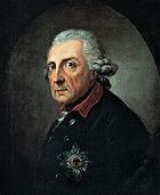
Frederick II of Prussia


Frederick II (; 24 January 1712 in Berlin
Berlin

Berlin is the Capital of Germany city and one of sixteen States of Germany of Germany. With a population of 3.4 million within its city limits, Berlin is the country's largest city....
  17 August 1786 in Potsdam
Potsdam

Potsdam is the capital city of the Germany States of Germany of Brandenburg and is part of the Metropolitan area of Berlin/Brandenburg. It is situated on the River Havel, some 25 kilometres southwest of the center of Berlin....
) was a King of Prussia
Kingdom of Prussia

The Kingdom of Prussia was a Germany monarchy from 1701 to 1918 and, from 1871, was the leading state of the German Empire, comprising almost two-thirds of the area of the empire....
 (1740–1786) from the Hohenzollern dynasty
House of Hohenzollern

The House of Hohenzollern is a noble family and royal dynasty of Prince-elector, kings, and emperors of Prussia, Germany, and Romania. It originated in the area around the town of Hechingen in Swabia during the 11th century....
. In his role as a prince-elector
Prince-elector

The Prince-Electors of the Holy Roman Empire were the members of the electoral college of the Holy Roman Empire, having the function of Imperial election the Holy Roman Emperors....
 of the Holy Roman Empire
Holy Roman Empire

The Holy Roman Empire was a union of territories in Central Europe during the Middle Ages and the Early modern Europe under a Holy Roman Emperor....
, he was Frederick IV (Friedrich IV) of Brandenburg
Margraviate of Brandenburg

The Margraviate of Brandenburg was a major principality of the Holy Roman Empire from 1157 to 1806. Also known as the March of Brandenburg , it played a pivotal role in the history of Germany and Central Europe....
. He became known as Frederick the Great (Friedrich der Große) and was nicknamed der alte Fritz ("Old Fritz
Fritz

Fritz was originally a German nickname for Friedrich , or Frederick . Fritz was also a name given to German troops by the British and others in the first and second world wars equivalent to Tommy as the British troops were called by German and other troops....
").

Interested primarily in the arts during his youth, Frederick unsuccessfully attempted to flee from his authoritarian father, Frederick William I
Frederick William I of Prussia

Frederick William I of the House of Hohenzollern, was the King in Prussia and Elector of Brandenburg from 1713 until his death. He is popularly known as "the Soldier-King" ....
, after which he was forced to watch the execution of a childhood friend named Hans Herman von Katte.


Discussion
Ask a question about 'Frederick II of Prussia'
Start a new discussion about 'Frederick II of Prussia'
Answer questions from other users
Full Discussion Forum


Quotations


Artillery adds dignity to what would otherwise be a vulgar brawl.

Audacity, audacity - always audacity!.

L'audace, l'audace, toujours l'audace!

I am the first servant of my state.

"Ich bin der erste Diener meines Staates."

The greatest and noblest pleasure which men can have in this world is to discover new truths; and the next is to shake off old prejudices.

The

ink1" href="http://www.absoluteastronomy.com/topics/monarch">monarch is a perpetual sentinel, who must watch...enemies of the state...it is not that he should remain the shadow of authority, but that he should fulfill his duties."


Encyclopedia


Frederick II (; 24 January 1712 in Berlin
Berlin

Berlin is the Capital of Germany city and one of sixteen States of Germany of Germany. With a population of 3.4 million within its city limits, Berlin is the country's largest city....
  17 August 1786 in Potsdam
Potsdam

Potsdam is the capital city of the Germany States of Germany of Brandenburg and is part of the Metropolitan area of Berlin/Brandenburg. It is situated on the River Havel, some 25 kilometres southwest of the center of Berlin....
) was a King of Prussia
Kingdom of Prussia

The Kingdom of Prussia was a Germany monarchy from 1701 to 1918 and, from 1871, was the leading state of the German Empire, comprising almost two-thirds of the area of the empire....
 (1740–1786) from the Hohenzollern dynasty
House of Hohenzollern

The House of Hohenzollern is a noble family and royal dynasty of Prince-elector, kings, and emperors of Prussia, Germany, and Romania. It originated in the area around the town of Hechingen in Swabia during the 11th century....
. In his role as a prince-elector
Prince-elector

The Prince-Electors of the Holy Roman Empire were the members of the electoral college of the Holy Roman Empire, having the function of Imperial election the Holy Roman Emperors....
 of the Holy Roman Empire
Holy Roman Empire

The Holy Roman Empire was a union of territories in Central Europe during the Middle Ages and the Early modern Europe under a Holy Roman Emperor....
, he was Frederick IV (Friedrich IV) of Brandenburg
Margraviate of Brandenburg

The Margraviate of Brandenburg was a major principality of the Holy Roman Empire from 1157 to 1806. Also known as the March of Brandenburg , it played a pivotal role in the history of Germany and Central Europe....
. He became known as Frederick the Great (Friedrich der Große) and was nicknamed der alte Fritz ("Old Fritz
Fritz

Fritz was originally a German nickname for Friedrich , or Frederick . Fritz was also a name given to German troops by the British and others in the first and second world wars equivalent to Tommy as the British troops were called by German and other troops....
").

Interested primarily in the arts during his youth, Frederick unsuccessfully attempted to flee from his authoritarian father, Frederick William I
Frederick William I of Prussia

Frederick William I of the House of Hohenzollern, was the King in Prussia and Elector of Brandenburg from 1713 until his death. He is popularly known as "the Soldier-King" ....
, after which he was forced to watch the execution of a childhood friend named Hans Herman von Katte. Upon ascending to the Prussian throne, he attacked Austria
Habsburg Monarchy

The Habsburg Monarchy covered the territories ruled by the junior Austria branch of the House of Habsburg , and then by the successor House of Habsburg-Lorraine , between 1526 and 1867/1918....
 and claimed Silesia
Silesia

Silesia is a historical region of Central Europe located mostly in present-day Poland, with parts in the Czech Republic and Germany.Silesia is rich in mineral and natural resources, and includes several important industrial areas....
 during the Silesian Wars
Silesian Wars

The Silesian Wars were a series of wars between Kingdom of Prussia and Austria for control of Silesia. They formed parts of the larger War of the Austrian Succession and Seven Years' War....
, winning military acclaim for himself and Prussia. Near the end of his life, Frederick united most of his disconnected realm through the First Partition of Poland
First Partition of Poland

The First Partition of Poland or First Partition of the Polish-Lithuanian Commonwealth took place in 1772 as the first of partitions of Poland that ended the existence of the Polish-Lithuanian Commonwealth by 1795....
.

Frederick was a proponent of enlightened absolutism
Enlightened absolutism

Enlightened absolutism is a form of absolute monarchy or despotism in which rulers were influenced by the Age of Enlightenment. Enlightened monarchs embraced the principles of the Enlightenment, especially its emphasis upon rationality, and applied them to their territories....
. For years he was a correspondent of Voltaire
Voltaire

Fran?ois-Marie Arouet , better known by the pen name Voltaire, was a French Age of Enlightenment writer, essayist, and philosophy known for his wit, philosophical sport, and defense of civil liberty, including freedom of religion and free trade....
, with whom the king had an intimate, if turbulent, friendship. He modernized the Prussian bureaucracy and civil service and promoted religious tolerance throughout his realm. Frederick patronized the arts and philosophers. Frederick is buried at his favorite residence, Sanssouci
Sanssouci

Sanssouci is the former summer palace of Frederick the Great, King of Prussia, at Potsdam, near Berlin. It is often counted among the German rivals of Palace of Versailles....
 in Potsdam
Potsdam

Potsdam is the capital city of the Germany States of Germany of Brandenburg and is part of the Metropolitan area of Berlin/Brandenburg. It is situated on the River Havel, some 25 kilometres southwest of the center of Berlin....
. Because he died childless, Frederick was succeeded by his nephew, Frederick William II of Prussia
Frederick William II of Prussia

Frederick William II was the fourth King of Kingdom of Prussia, reigning from 1786 until his death....
, son of his brother, Prince Augustus William of Prussia.

Youth

Frederick was born in Berlin the son of King Frederick William I of Prussia
Frederick William I of Prussia

Frederick William I of the House of Hohenzollern, was the King in Prussia and Elector of Brandenburg from 1713 until his death. He is popularly known as "the Soldier-King" ....
 and Sophia Dorothea of Hanover
Sophia Dorothea of Hanover

Sophia Dorothea of Hanover was a member of the British Royal Family, only daughter of George I of Great Britain. She was, between 1713 and 1740, Queen consort King in Prussia....
. The so-called "Soldier-King", Frederick William had developed a formidable army
Prussian Army

The Prussian Army was the army of the Kingdom of Prussia. It was vital to the development of Brandenburg-Prussia as a European power.The Prussian Army had its roots in the meager mercenary forces of Brandenburg during the Thirty Years' War....
 and encouraged centralization, but was also known for his authoritarianism and temper. He would strike men in the face with his cane and kick women in the street, justifying his outbursts as religious righteousness. In contrast, Sophia was well-mannered and well-educated. Her father, George, Elector
Prince-elector

The Prince-Electors of the Holy Roman Empire were the members of the electoral college of the Holy Roman Empire, having the function of Imperial election the Holy Roman Emperors....
 of Hanover
Electorate of Hanover

The Electorate of Brunswick-L?neburg became the ninth Electorate of the Holy Roman Empire in 1692, when the Holy Roman Emperor, Leopold I, Holy Roman Emperor, elevated Duke Ernest Augustus, Elector of Brunswick-L?neburg to the rank of Prince-elector of the Empire as a reward for aid given in the War of the Grand Alliance....
, was the heir of Queen Anne of Great Britain
Anne of Great Britain

Anne became Queen of England, Queen of Scots and Kingdom of Ireland on 8 March 1702, succeeding her brother-in-law, William III of England. Her Roman Catholic father, James II of England, was Glorious Revolution in 1688/9; her brother-in-law and her sister then became joint monarchs as William III & II and Mary II of England, the only such c...
. George succeeded as King George I of Great Britain
George I of Great Britain

George I was List of British Monarchs#House of Hanover and King of Ireland from 1 August 1714 until his death, and ruler of Electorate of Hanover in the Holy Roman Empire from 1698....
 in 1714.

The birth of Frederick was welcomed by his grandfather with more than usual pleasure, as two of his grandsons had already died at an early age. Frederick William wished his sons and daughters to be educated not as royalty, but as simple folk. He had been educated by a Frenchwoman
French people

French people can refer to:* The legal residents and citizens of France, regardless of ancestry. For a legal discussion, see French nationality law....
, Madame de Montbail, who later became Madame de Rocoulle
Madame de Rocoulle

Madame de Rocoulle was a French woman, who was the educator of Frederick II of Prussia. Her maiden name was Madame de Montbail....
, and he wished that she should educate his children. Frederick was brought up by Huguenot
Huguenot

The Huguenots were members of the Protestantism Reformed Church of France of France from the sixteenth to the eighteenth centuries....
 governess
Governess

A governess is a female employee of a family who teaches children within their home. In contrast to a nanny or a babysitter, she concentrates on teaching children, not their physical needs....
es and tutor
Tutor

In British, Australian, New Zealand, Italian, and some Canadian university, a tutor is often but not always a postgraduate student or a lecturer assigned to conduct a seminar for undergraduate students, often known as a tutorial....
s and learned French
French language

French is a Romance language spoken around the world by around 80 million people as first language, by 190 million as second language, and by about another 200 million people as an acquired tongue, with significant speakers in 54 countries....
 and German simultaneously. In spite of his father's desire that his education be entirely religious and pragmatic, the young Frederick, with the help of his tutor Jacques Duhan
Jacques Duhan de Jandun

Jacques Egide Duhan de Jandun was a Huguenot soldier who served for twelve years as tutor to Frederick the Great....
, procured for himself a three thousand volume secret library of poetry, Greek and Roman classics, and French philosophy to supplement his official lessons.

Although Frederick William was raised a devout Calvinist
Calvinism

Calvinism is a theology system and an approach to the Christian life that emphasizes the rule of God over all things. It was developed by several theologians, but it bears the name of the French Protestant Reformation John Calvin because of his prominent influence on it and because of his role in the confessional and ecclesiastical debates t...
, he feared he was not of the elect
Unconditional election

Unconditional election is the Calvinism teaching that before God created the world, he chose to salvation some people according to his own purposes and apart from any conditions related to those persons....
. To avoid the possibility of Frederick having the same motives, the king ordered that his heir not be taught about predestination
Predestination

Predestination is a religion concept, which involves the relationship between God and His creation. The religious character of predestination distinguishes it from other ideas about determinism and free will....
. Although he was largely irreligious, Frederick adopted this tenet of Calvinism, despite the king's efforts. It is unknown if the crown prince did this to spite his father, or out of genuine religious belief.

Crown Prince

Frederickiiofprussia
In early 1730, Queen Sophia Dorothea attempted to orchestrate a dual marriage of Frederick and his sister Wilhelmina
Wilhelmine of Bayreuth

Friederike Sophie Wilhelmine, Princess of Prussia and Margravine of Bayreuth was a daughter of Friedrich Wilhelm I of Prussia and his queen consort Sophia Dorothea of Hanover....
 with Amelia and Frederick
Frederick, Prince of Wales

The Prince Frederick, Prince of Wales was a member of the Kingdom of Hanover and British Royal Family, the eldest son of George II of Great Britain and father of George III of Great Britain....
, the children of King George II of Great Britain
George II of Great Britain

George II was King of Great Britain and King of Ireland, Duke of Brunswick-L?neburg and Prince-elector#High Offices and Prince-Elector of the Holy Roman Empire from 11 June 1727 until his death....
. Fearing an alliance between Prussia and Great Britain, Field Marshal von Seckendorff, the Austrian
Habsburg Monarchy

The Habsburg Monarchy covered the territories ruled by the junior Austria branch of the House of Habsburg , and then by the successor House of Habsburg-Lorraine , between 1526 and 1867/1918....
 ambassador in Berlin, bribed Field Marshal von Grumbkow
Friedrich Wilhelm von Grumbkow

Friedrich Wilhelm von Grumbkow was a Kingdom of Prussia Generalfeldmarschall and statesman.The cultured Grumbkow was born in Berlin as the son of Joachim Ernst von Grumbkow, General War Minister of Brandenburg-Prussia....
 and Benjamin Reichenbach, the Prussian Minister of War and Prussian ambassador in London, respectively. The pair discreetly slandered the British and Prussian courts in the eyes of the two kings. Angered by the idea of the effete Frederick being so honored by Britain, Frederick William presented impossible demands to the British, such as Prussia acquiring Jülich
Duchy of Jülich

The Duchy of J?lich was a state of the Holy Roman Empire. Its territory is situated in present day Germany and the Netherlands . It was situated on both sides of the river Rur, around its capital J?lich in the lower Rhineland....
 and Berg
Berg (state)

The territory of Berg in today's North Rhine-Westphalia, Germany emerged as a separate domain in mediaeval times. It comprised roughly the area between the rivers Rhine, Ruhr and Sieg....
, leading to the collapse of the marriage proposal.

Frederick found an ally in his sister, Wilhelmina, with whom he remained close for life. At age 16, Frederick had formed an attachment to the king's 13-year-old page, Peter Karl Christoph Keith. Wilhelmina recorded that the two "soon became inseparable. Keith was intelligent, but without education. He served my brother from feelings of real devotion, and kept him informed of all the king's actions."

When he was 18, Frederick plotted to flee to England
England

native_name =|conventional_long_name = England|common_name = England|image_flag = Flag of England.svg|image_coat = England COA.svg|symbol_type = Royal Coat of Arms...
 with Hans Hermann von Katte
Hans Hermann von Katte

Hans Hermann von Katte was a Lieutenant of the Prussian Army and a close friend and reputedly the lover of the future Frederick II of Prussia, then the Crown Prince....
 and other junior army officers. While the royal retinue was near Mannheim
Mannheim

Mannheim is a city in Germany. With 327,318 inhabitants it is the second-largest city in the state of Baden-W?rttemberg after the capital Stuttgart....
 in the Electoral Palatinate, Robert Keith, Peter's brother, had an attack of conscience when the conspirators were preparing to escape and begged Frederick William for forgiveness on 5 August 1730; Frederick and Katte were subsequently arrested and imprisoned in Küstrin
Küstrin

Before 1945 K?strin was a town in Germany on the river Oder. After 1945 a new border was established along the Oder-Neisse line, and the city was divided between Germany and Poland....
. Because they were army officers who had tried to flee Prussia for Great Britain
Kingdom of Great Britain

The Kingdom of Great Britain, also known as the United Kingdom of Great Britain, was a country in North-West Europe, in existence from 1707 to 1801....
, Frederick William leveled an accusation of treason against the pair. The king threatened the crown prince with the death penalty, then considered forcing Frederick to renounce the succession in favor of his brother, Augustus William, although either option would have been difficult to justify to the Reichstag
Reichstag (institution)

The Reichstag was the parliament of the Holy Roman Empire, the North German Confederation, and of Germany until 1945. The main chamber of the German parliament is now called Bundestag , but the building in which it meets is still called "Reichstag" ....
 of the Holy Roman Empire
Holy Roman Empire

The Holy Roman Empire was a union of territories in Central Europe during the Middle Ages and the Early modern Europe under a Holy Roman Emperor....
. The king forced Frederick to watch the decapitation
Decapitation

Decapitation , or beheading, is the cutting off of the head of a person or animal. Beheading typically refers to the act of intentional decapitation, e.g., as a means of murder or capital punishment; it may be accomplished, for example, with an axe, sword, knife, wire, or by means of a guillotine....
 of his confidant Katte at Küstrin on 6 November, leaving the crown prince to faint away and suffer hallucinations for the following two days.

Frederick was granted a royal pardon and released from his cell on 18 November, although he remained stripped of his military rank. Instead of returning to Berlin, however, he was forced to remain in Küstrin and began rigorous schooling in statecraft and administration for the War and Estates Departments on 20 November. Tensions eased slightly when Frederick William visited Küstrin a year later, and Frederick was allowed to visit Berlin on the occasion of his sister Wilhelmina's
Wilhelmine of Bayreuth

Friederike Sophie Wilhelmine, Princess of Prussia and Margravine of Bayreuth was a daughter of Friedrich Wilhelm I of Prussia and his queen consort Sophia Dorothea of Hanover....
 marriage to Margrave Frederick
Frederick, Margrave of Brandenburg-Bayreuth

Frederick, Margrave of Brandenburg-Bayreuth , was a member of the House of Hohenzollern and Principality of Bayreuth.He was the eldest son of George Frederick Charles, Margrave of Brandenburg-Bayreuth, nominal Margrave of Brandenburg-Bayreuth-Kulmbach, by his wife Dorothea von Holstein-Beck....
 of Bayreuth
Principality of Bayreuth

The Principality of Bayreuth or Brandenburg-Bayreuth was a reichsfrei principality in the Holy Roman Empire centered on the Bavarian city of Bayreuth....
 on 20 November 1731. The crown prince returned to Berlin after finally being released from his tutelage at Küstrin on 26 February 1732.

Frederick William considered marrying Frederick to Elisabeth of Mecklenburg-Schwerin
Anna Leopoldovna

Anna Leopoldovna , also known as Anna Karlovna , regent of Russia for a few months during the minority of her baby son Ivan VI of Russia....
, the niece of Empress Anna of Russia
Anna of Russia

Anna Ivanovna reigned as Duchy of Courland and Semigallia from 1711 to 1730 and as Tsarina of Russia from 1730 to 1740....
, but this plan was ardently opposed by Prince Eugene of Savoy
Prince Eugene of Savoy

Fran?ois-Eug?ne, Prince of Savoy-Carignan , was one of the most prominent and successful military commanders in European history. Born in Paris to aristocratic Italian parents, Eugene grew up around the French court of Louis XIV of France....
. Frederick himself proposed marrying Maria Theresa of Austria
Maria Theresa of Austria

Maria Theresa was the List of rulers of Austria, List of rulers of Hungary, List of rulers of Croatia, Queen of Bohemia, Grand Duchy of Tuscany and a Holy Roman Emperor by marriage to Francis I, Holy Roman Emperor....
 in return for renouncing the succession. Instead, Eugene persuaded Frederick William, through Seckendorff, that the crown prince should marry Elisabeth Christine of Brunswick-Bevern
Elisabeth Christine of Brunswick-Bevern

Elizabeth Christine of Brunswick-Bevern was a Prussian queen, queen consort of king Frederick II of Prussia....
, a Protestant relative of the Austrian Habsburg
Habsburg

The House of Habsburg was an important royal house of Europe and is best known as supplying all of the formally elected Holy Roman Emperors between 1452 and 1740, as well as rulers of Spanish Empire and the Austrian Empire....
s. Although Frederick wrote to his sister that, "There can be neither love nor friendship between us," and he considered suicide, he went along with the wedding on 12 June 1733. He had little in common with his bride and resented the political marriage as an example of the Austrian interference which had plagued Prussia since 1701. Once Frederick secured the throne in 1740, he prevented Elisabeth from visiting his court in Potsdam, granting her instead Schönhausen Palace
Schönhausen Palace

Sch?nhausen Palace is a Baroque architecture palace in Berlin's borough of Niedersch?nhausen in the administrative district of Pankow. It is surrounded by gardens through which the River Panke runs....
 and apartments at the Berliner Stadtschloss
Berliner Stadtschloss

The Stadtschloss , was a royal palace in the centre of Berlin, capital of Germany. It was the principal residence of the Kings of Prussia from 1701 and of the German Emperors from 1871....
. Frederick bestowed the title of the heir to the throne, "Prince of Prussia", on his brother Augustus William; despite this, his wife remained devoted to him.

Frederick was restored to the Prussian Army
Prussian Army

The Prussian Army was the army of the Kingdom of Prussia. It was vital to the development of Brandenburg-Prussia as a European power.The Prussian Army had its roots in the meager mercenary forces of Brandenburg during the Thirty Years' War....
 as Colonel of the Regiment von der Goltz, stationed near Nauen
Nauen

Nauen is a town in the Havelland district, in Brandenburg, Germany. It is situated 38 km west of Berlin , and 26 km northwest of Potsdam.Nauen is well known as the location of a transmission site ....
 and Neuruppin
Neuruppin

Neuruppin is a town in Brandenburg, Germany. Located on the shore of the Ruppiner See , it is the capital of the district of Ostprignitz-Ruppin....
. When Prussia provided a contingent of troops to aid Austria during the War of the Polish Succession
War of the Polish Succession

The War of the Polish Succession was sparked by a Polish civil war over the succession to Augustus II of Poland, King of Poland that widened as the two Pacte de Famille powers attempted to check the power of the Habsburg Monarchy in western Europe....
, Frederick studied under Prince Eugene of Savoy
Prince Eugene of Savoy

Fran?ois-Eug?ne, Prince of Savoy-Carignan , was one of the most prominent and successful military commanders in European history. Born in Paris to aristocratic Italian parents, Eugene grew up around the French court of Louis XIV of France....
 during the campaign against France
France

France , officially the French Republic , is a country whose Metropolitan France is located in Western Europe and that also comprises various Overseas departments and territories of France....
 on the Rhine
Rhine

File:Swiss Grand Canyon.jpgThe Rhine is one of the longest and most important rivers in Europe, at , with an average discharge of more than ....
. Frederick William, weakened by gout
Gout

Gout is a crystal deposition disease hallmarked by elevated levels of uric acid in the Circulatory system. In this condition, crystals of monosodium urate or uric acid are deposited on the articular cartilage of joints, tendons and surrounding tissues....
 brought about by the campaign, granted Frederick Schloss Rheinsberg in Rheinsberg
Rheinsberg

Rheinsberg is a town and a municipality in the Ostprignitz-Ruppin district, in Brandenburg, Germany. It is situated on the river Rhin, approx. 20 km north-east of Neuruppin and 75 km north-west of Berlin....
, north of Neuruppin. In Rheinsberg, Frederick assembled a small number of musicians, actors and other artists. He spent his time reading, watching dramatic plays, making and listening to music, and regarded this time as one of the happiest of his life. Frederick formed the "Bayard
Bayard

Bayard is a magic bay horse in the legends derived from the chanson de geste, renowned for his spirit, and possessed the supernatural ability to adjust his size to his riders....
 Order" to discuss warfare with his friends; Heinrich August de la Motte Fouqué was made the grand master of the gathering.

The works of Niccolò Machiavelli
Niccolò Machiavelli

Niccol? di Bernardo dei Machiavelli is the philosopher, writer, and Italian politician considered the founder of modern political science. As a Renaissance Man, he was a Diplomacy, Political philosophy, musician, poet, and playwright, but, foremost, he was a Civil Servant of the Florence....
, such as The Prince
The Prince

Il Principe is a politics treatise by the Florence Civil service and Political philosophy Niccol? Machiavelli. Originally called De Principatibus , it was originally written in 1513, but not published until 1532, five years after Machiavelli's death....
, were considered a guideline for the behavior of a king in Frederick's age. In 1739, Frederick finished his Anti-Machiavel
Anti-Machiavel

Anti-Machiavel is an 18th century essay by Frederick the Great, King of Prussia and patron of Voltaire, rebutting The Prince, the 16th century book by Niccol? Machiavelli, and Machiavellianism in general....
 an idealistic writing in which he opposes Machiavelli. It was published anonymously in 1740, but Voltaire distributed it in Amsterdam
Amsterdam

Amsterdam is the Capital of the Netherlands and List of cities in the Netherlands with over 100,000 people of the Netherlands, located in the Provinces of the Netherlands of North Holland in the west of the country....
 to great popularity. Frederick's years dedicated to the arts instead of politics ended upon the 1740 death of Frederick William and his inheritance of the Kingdom of Prussia.

Kingship

Before his accession, Frederick was told by D'Alembert, "The philosophers and the men of letters in every land have long looked upon you, Sire, as their leader and model." Such devotion, however, had to be tempered by political realities. When Frederick ascended the throne as "King in Prussia
King in Prussia

King in Prussia was a title used by the Elector of Brandenburg from 1701 to 1772. Subsequently they used the title King of Prussia.The Prince-Elector of Brandenburg was a subject of the Holy Roman Emperor....
" in 1740, Prussia consisted of scattered territories, including Cleves
Duchy of Cleves

The Duchy of Cleves was a state of the Holy Roman Empire in present Germany and the Netherlands . Its territory was situated on both sides of the river Rhine, around its capital Cleves and roughly covering today's Cleves , Wesel and the City of Duisburg....
, Mark, and Ravensberg in the west of the Holy Roman Empire
Holy Roman Empire

The Holy Roman Empire was a union of territories in Central Europe during the Middle Ages and the Early modern Europe under a Holy Roman Emperor....
; Brandenburg
Margraviate of Brandenburg

The Margraviate of Brandenburg was a major principality of the Holy Roman Empire from 1157 to 1806. Also known as the March of Brandenburg , it played a pivotal role in the history of Germany and Central Europe....
, Hither Pomerania, and Farther Pomerania
Farther Pomerania

Farther Pomerania, Further Pomerania or Eastern Pomerania is a historical Pomeranian region, which before the Oder-Neisse line comprised the eastern part of the Duchy of Pomerania later Province of Pomerania, roughly stretching from the Oder River in the West to Pomerelia in the East....
 in the east of the Empire; and the former Duchy of Prussia, outside of the Empire bordering the Polish-Lithuanian Commonwealth
Polish-Lithuanian Commonwealth

The Polish?Lithuanian Commonwealth was one of the largest and most populous countries in 16th and 17th-century Europe, formed by a Union of Lublin of Kingdom of Poland and Grand Duchy of Lithuania in 1569....
. He was titled King in Prussia because this was only part of historic Prussia; he was to declare himself King of Prussia after acquiring most of the rest in 1772.

Warfare


Hohenfriedeberg
Frederick's goal was to modernize and unite his vulnerably disconnected lands; toward this end, he fought wars mainly against Austria
Austria

Austria , officially the Republic of Austria , is a landlocked country in Central Europe. It borders both Germany and the Czech Republic to the north, Slovakia and Hungary to the east, Slovenia and Italy to the south, and Switzerland and Liechtenstein to the west....
, whose Habsburg
Habsburg Monarchy

The Habsburg Monarchy covered the territories ruled by the junior Austria branch of the House of Habsburg , and then by the successor House of Habsburg-Lorraine , between 1526 and 1867/1918....
 dynasty reigned as Holy Roman Emperor
Holy Roman Emperor

Image:HRR 14Jh.jpgThe Roman of the Emperor's title was a reflection of the translatio imperii principle that regarded the Holy Roman Emperors as the inheritors of the title of Emperor of the Western Roman Empire, a title left unclaimed in the West after the death of Julius Nepos in 480....
s, almost continuously from the 15th century until 1806. Frederick established Prussia as the fifth and smallest European great power
Great power

A great power is a nation or state that has the ability to exert its influence on a global scale. Great powers characteristically possess economics, military, diplomacy, and soft power strength, which may cause other, smaller nations to consider the opinions of great powers before taking actions of their own....
 by using the resources his frugal father had cultivated.

Desiring the prosperous Austrian province of Silesia
Silesia

Silesia is a historical region of Central Europe located mostly in present-day Poland, with parts in the Czech Republic and Germany.Silesia is rich in mineral and natural resources, and includes several important industrial areas....
, Frederick declined to endorse the Pragmatic Sanction of 1713
Pragmatic Sanction of 1713

The Pragmatic Sanction of 1713, a legal mechanism designed to ensure that the Austrian throne and Habsburg lands would be inherited by Charles VI, Holy Roman Emperor's daughter, Maria Theresa of Austria, was part of the law of the house of Austria....
, a legal mechanism to ensure the inheritance of the Habsburg domains by Maria Theresa of Austria
Maria Theresa of Austria

Maria Theresa was the List of rulers of Austria, List of rulers of Hungary, List of rulers of Croatia, Queen of Bohemia, Grand Duchy of Tuscany and a Holy Roman Emperor by marriage to Francis I, Holy Roman Emperor....
. He was also worried that Augustus III, King of Poland and Elector of Saxony
Electorate of Saxony

The Electorate of Saxony or Duchy of Upper Saxony was an independent hereditary Prince-elector of the Holy Roman Empire from 1356?1806. It was the successor state of the Duchy of Saxe-Wittenberg and was itself replaced in Napoleonic times by the Kingdom of Saxony ....
, would seek to connect his own disparate lands through Silesia. The Prussian king thus invaded Silesia the same year he took power, using as justification an obscure treaty from 1537 between the Hohenzollerns and the Piast dynasty
Piast dynasty

Piast dynasty was the first Polish historical Royal dynasty that ruled Poland from its beginnings starting with the semi-legendary Piast the Wheelwright....
 of Brieg (Brzeg)
Brzeg

Brzeg is a town in southwestern Poland with 38,496 inhabitants , situated in Silesia in the Opole Voivodeship on the left bank of the Oder. It is the capital of Brzeg County....
. The ensuing First Silesian War
Silesian Wars

The Silesian Wars were a series of wars between Kingdom of Prussia and Austria for control of Silesia. They formed parts of the larger War of the Austrian Succession and Seven Years' War....
 (1740–1742), part of the War of the Austrian Succession
War of the Austrian Succession

The War of the Austrian Succession involved nearly all the Power in international relations of Europe. The war began under the pretext that Maria Theresa of Austria was ineligible to succeed to the House of Habsburg throne, because Salic law precluded royal inheritance by a woman, though in reality this was a convenient excuse put forward by...
 (1740–1748), resulted in Frederick conquering the province (with the exception of Austrian Silesia
Czech Silesia

Czech Silesia is one of the three Czech lands and a section of the Silesia historical region. It is located in the north-east of the Czech Republic, predominantly in Moravian-Silesian Region, with a section in northern Olomouc Region....
). Austria attempted to recover Silesia in the Second Silesian War (1744–1745), but Frederick was victorious again and forced Austria to adhere to the previous peace terms. Prussian possession of Silesia gave the kingdom control over the Oder River
Oder River

The Oder is a river in Central Europe Europe. It begins in the Czech Republic and flows through western Poland, later forming of the border between Poland and Germany, part of the Oder-Neisse line....
.

Battle Rossbach Trap
Habsburg Austria and Bourbon
House of Bourbon

The House of Bourbon is an important European royal house, a branch of the Capetian dynasty. Bourbon kings first ruled Kingdom of Navarre and France in the 16th century....
 France
Early Modern France

Early Modern France is the early modern period of French history from the end of the 15th century to the end of the 18th century . During this period France evolved from a feudalism regime to an increasingly centralized state organized around a powerful absolute monarchy that relied on the doctrine of the Divine Right of Kings and the explic...
, traditional enemies, allied together in the Diplomatic Revolution
Diplomatic Revolution

The Diplomatic Revolution of 1756 is a term applied to the reversal of longstanding diplomatic alliances which were upheld until the War of Austrian Succession and then reversed in the Seven Years' War....
 of 1756 following the collapse of the Anglo-Austrian Alliance
Anglo-Austrian Alliance

The Anglo-Austrian Alliance is the name given to the military alliance between the Kingdom of Great Britain and the Habsburg Empire during the first half of the eighteenth century....
. Frederick swiftly made an alliance with Great Britain at the Convention of Westminster. As neighboring countries began conspiring against him, Frederick was determined to strike first. On 29 August 1756 his well-prepared army crossed the frontier and preemptively invaded Saxony
Electorate of Saxony

The Electorate of Saxony or Duchy of Upper Saxony was an independent hereditary Prince-elector of the Holy Roman Empire from 1356?1806. It was the successor state of the Duchy of Saxe-Wittenberg and was itself replaced in Napoleonic times by the Kingdom of Saxony ....
, thus beginning the Seven Years' War
Seven Years' War

The Seven Years' War lasted between 1756?1763 and involved all of the major European powers of the period. The war pitted Kingdom of Prussia and Kingdom of Great Britain and a coalition of smaller German states against an alliance consisting of Archduchy of Austria, Early Modern France, Russian Empire, Kingdom of Sweden, and Electorate of Sa...
 (1756–1763). Facing a coalition which included Austria, France, Russia
Russian Empire

File:Russian Emperor Flag.jpgFile:Romanov Flag.svgThe Russian Empire was a state that existed from 1721 until the Russian Revolution of 1917....
, Saxony, and Sweden
Swedish Empire

Sweden was, between 1611 and 1718, one of the great powers of Europe. In modern historiography this period is known as the Swedish Empire, or stormaktstiden ....
, and having only Great Britain
Kingdom of Great Britain

The Kingdom of Great Britain, also known as the United Kingdom of Great Britain, was a country in North-West Europe, in existence from 1707 to 1801....
 and Hanover
Electorate of Hanover

The Electorate of Brunswick-L?neburg became the ninth Electorate of the Holy Roman Empire in 1692, when the Holy Roman Emperor, Leopold I, Holy Roman Emperor, elevated Duke Ernest Augustus, Elector of Brunswick-L?neburg to the rank of Prince-elector of the Empire as a reward for aid given in the War of the Grand Alliance....
 as his allies, Frederick narrowly kept Prussia in the war despite having his territories frequently invaded. Frederick was frequently at the last gasp. On January 6, 1762, he wrote to Count Karl-Wilhelm Finck von Finckenstein
Count Karl-Wilhelm Finck von Finckenstein

Count Karl Wilhelm Finck von Finckenstein was a Prussian Prime Minister.Count Finck von Finckenstein, son of the General Field Marshal and Governor of the Crown Prince Frederick II of Prussia Count Albrecht Konrad Finck von Finckenstein, studied in Geneva and was engaged after trips in France and Holland 1735 in the Prussian foreign office...
, "We ought now to think of preserving for my nephew, by way of negotiation, whatever fragments of my territory we can save from the avidity of my enemies", which means, that he was resolved to seek a soldier's death on the first opportunity.

The sudden death of Empress Elizabeth of Russia
Elizabeth of Russia

Elizaveta Petrovna , also known as Yelisavet and Elizabeth, was an Empress of Russia who took the country into the War of Austrian Succession and the Seven Years' War ....
, an event dubbed the miracle of the House of Brandenburg
The miracle of the House of Brandenburg

The Miracle of the House of Brandenburg refers to the death of Russia's Elizabeth of Russia at the beginning of 1762.After six years of the Seven Years' War, the Kingdom of Prussia army was greatly weakened....
, led to the collapse of the anti-Prussian coalition. Although Frederick did not gain any territory in the ensuing Treaty of Hubertusburg
Treaty of Hubertusburg

The Treaty of Hubertusburg was signed on 10 February 1763 at Hubertusburg by Kingdom of Prussia, Habsburg Monarchy, and Saxony. Together with the Treaty of Paris , it marked the end of the French and Indian War and of the Seven Years' War....
, his ability to retain Silesia during the Silesian Wars made him and Prussia popular throughout many German-speaking territories.

Late in his life Frederick also involved Prussia in the low-scale War of the Bavarian Succession in 1778, in which he stifled Austrian attempts to exchange the Austrian Netherlands for Bavaria
Bavaria

Bavaria , with an area of and almost 12.5 million inhabitants, is a region located in the southeast of Germany and is the largest States of Germany of Germany by area....
. When Emperor Joseph II
Joseph II, Holy Roman Emperor

Joseph II was Holy Roman Emperor from 1765 to 1790 and ruler of the Habsburg Monarchy from 1780 to 1790. He was the eldest son of Empress Maria Theresa of Austria and her husband, Francis I, Holy Roman Emperor....
 tried the scheme again in 1784, Frederick created the Fürstenbund
Fürstenbund

Frederick the Great created the F?rstenbund in Germany in 1785 to resist the encroachments of Austria. The literal meaning of the word is "league of princes"....
, allowing himself to be seen as a defender of German liberties, in contrast to his earlier role of attacking the imperial Habsburgs.

Frederick frequently led his military forces personally and had six horses shot from under him during battle. Frederick is often admired as one of the greatest tactical
Military tactics

Military tactics are the techniques for using weapons or military units in combination for engaging and defeating an Enemy in battle. Changes in philosophy and technology over time have been reflected in changes to military tactics....
 geniuses of all time, especially for his usage of the oblique order
Oblique order

The Oblique Order is a military tactic where an attacking army focuses its forces to attack a single enemy flank. The force commander concentrates the majority of his strength on one flank and uses the remainder to fix the enemy line....
 of battle. Even more important were his operational successes, especially preventing the unification of numerically superior opposing armies and being at the right place at the right time to keep enemy armies out of Prussian core territory. In a letter to his mother Maria Theresa, the Austrian co-ruler Emperor Joseph II
Joseph II, Holy Roman Emperor

Joseph II was Holy Roman Emperor from 1765 to 1790 and ruler of the Habsburg Monarchy from 1780 to 1790. He was the eldest son of Empress Maria Theresa of Austria and her husband, Francis I, Holy Roman Emperor....
 wrote,

When the King of Prussia speaks on problems connected with the art of war, which he has studied intensively and on which he has read every conceivable book, then everything is taut, solid and uncommonly instructive. There are no circumlocutions, he gives factual and historical proof of the assertions he makes, for he is well versed in history… A genius and a man who talks admirably. But everything he says betrays the knave."


An example of the place that Frederick holds in history as a ruler is seen in Napoleon Bonaparte, who saw the Prussian king as the greatest tactical genius of all time; after Napoleon's defeat of the Fourth Coalition in 1807, he visited Frederick's tomb in Potsdam
Potsdam

Potsdam is the capital city of the Germany States of Germany of Brandenburg and is part of the Metropolitan area of Berlin/Brandenburg. It is situated on the River Havel, some 25 kilometres southwest of the center of Berlin....
 and remarked to his officers, "Gentlemen, if this man were still alive I would not be here".

Frederick the Great's most notable and decisive military victories on the battlefield were the Battles of Hohenfriedberg
Battle of Hohenfriedberg

The Battle of Hohenfriedberg or Hohenfriedeberg, now Dobromierz, was one of the crowning achievements of Frederick the Great. Frederick's Prussian army decisively defeated an Austrian army under Prince Charles Alexander of Lorraine on 4 June 1745 during the War of the Austrian Succession....
, Rossbach
Battle of Rossbach

The Battle of Rossbach took place during the Seven Years' War near the village of Ro?bach , in the Electorate of Saxony.Frederick II of Prussia defeated the allied armies of House of Bourbon and the Habsburg Monarchy....
, and Leuthen
Battle of Leuthen

In the Battle of Leuthen fought on 5 December 1757 Frederick II of Prussia Prussian army used maneuver and terrain to decisively defeat a much larger Austrian army under Prince Charles Alexander of Lorraine, thus ensuring Prussian control of Silesia during the Seven Years' War....
.

First Partition of Poland

Rzeczpospolita Rozbiory 1
Empress Catherine II
Catherine II of Russia

Catherine II, called Catherine the Great .The Russian empress Catherine II, known as Catherine the Great, reigned from 1762 to 1796. Under her direct auspices the Russian Empire expanded, improved in its administration, and underwent a dramatic policy of Westernization....
 took the Imperial Russian
Russian Empire

File:Russian Emperor Flag.jpgFile:Romanov Flag.svgThe Russian Empire was a state that existed from 1721 until the Russian Revolution of 1917....
 throne in 1762 after the murder of her husband, Peter III
Peter III of Russia

Peter III was Emperor of Russian Empire for six months in 1762. According to most historians, he was mentally immature and very pro-Prussian, which made him an unpopular leader....
. Catherine was staunchly opposed to Prussia, while Frederick disapproved of Russia, whose troops had been allowed to freely cross the Polish-Lithuanian Commonwealth
Polish-Lithuanian Commonwealth

The Polish?Lithuanian Commonwealth was one of the largest and most populous countries in 16th and 17th-century Europe, formed by a Union of Lublin of Kingdom of Poland and Grand Duchy of Lithuania in 1569....
 during the Seven Years' War. Despite the two monarchs' dislike of each other, Frederick and Catherine signed a defensive alliance on 11 April 1764 which guaranteed Prussian control of Silesia in return for Prussian support for Russia against Austria or the Ottoman Empire
Ottoman Empire

The Ottoman Empire , also known by its contemporaries as the Turkish Empire or Turkey , was an empire that lasted from 1299?1923. It was Treaty of Lausanne by the Republic of Turkey, which was officially proclaimed on October 29, 1923....
. Catherine's candidate for the Polish throne, Stanislaw August Poniatowski, was then elected King of Poland in September of that year.

Frederick became concerned, however, after Russia gained significant influence over Poland in the Repnin Sejm
Repnin Sejm

The Repnin Sejm was a Sejm that took place from 1767 to 1768 in Warsaw, Polish-Lithuanian Commonwealth. This Sejm was a response to the Sejms of Convocation Sejm to 1766, where the newly elected king of Poland, Stanislaus II Augustus Poniatowski, King of Poland, attempted with some successes to push through reforms to strengthen the g...
 of 1767, an act which also threatened Austria and the Ottoman Turks
Ottoman Turks

The Ottoman Turks were the subdivision of the Ottoman Muslim Millet that dominated the ruling class of the Ottoman Empire. Reliable information about the early history of the Ottomans is scarce....
. In the ensuing Russo-Turkish War
Russo-Turkish War, 1768-1774

The Russo-Turkish War of 1768?1774 was a decisive conflict that brought Southern Ukraine, Northern Caucasus, and Crimea within the orbit of the Russian Empire....
 (1768–1774), Frederick reluctantly supported Catherine with a subsidy of 300,000 roubles, as he did not want Russia to become even stronger through the acquisitions of Ottoman territory. The Prussian king achieved a rapprochement
Rapprochement

In international relations a rapprochement, which comes from the French language word rapprocher , is a re-establishment of cordial relations, as between two countries....
 with Emperor Joseph and the Austrian chancellor Kaunitz
Wenzel Anton Graf Kaunitz

Wenzel Anton Graf Kaunitz was an Habsburg Empiren statesman.Kaunitz was born in Vienna to an old Bohemian noble family settled in Moravia. It was intended that Kaunitz should become a clergyman when he was a boy, but he soon decided otherwise and studied law instead....
. As early as 1731 Frederick had suggested in a letter to Field Marshal Dubislav Gneomar von Natzmer
Dubislav Gneomar von Natzmer

Dubislav Gneomar von Natzmer was a Kingdom of Prussia Generalfeldmarschall and a confidant of the House of Hohenzollern....
 that the country would be well-served by annexing Polish Prussia in order to unite the eastern territories of the Kingdom of Prussia.

After Russia occupied the Danubian Principalities
Danubian Principalities

Danubian Principalities was a conventional name given to the Principality of Moldavia and Wallachia, which emerged in the early 14th century. The term was coined in the Habsburg Monarchy after the Treaty of Kuchuk Kainarji in order to designate an area on the lower Danube with a common Geopolitics situation....
, Frederick's representative in Saint Petersburg
Saint Petersburg

Saint Petersburg is a types of inhabited localities in Russia and a federal subjects of Russia of Russia located on the Neva River at the head of the Gulf of Finland on the Baltic Sea....
, his brother Henry
Prince Henry of Prussia

Frederick Henry Louis , commonly known as Henry , was a Prince of Kingdom of Prussia. He also served as a general and statesman, and, in 1786, was suggested as a candidate for a monarch for the United States....
, convinced Frederick and Maria Theresa that the balance of power
Balance of power in international relations

In international relations, a balance of power exists when there is parity or stability between competing forces. As a term in international law for a 'just equilibrium' between the members of the family of nations, it expresses the doctrine intended to prevent any one nation from becoming sufficiently strong so as to enable it to enforce it...
 would be maintained by a tripartite division of the Polish-Lithuanian Commonwealth instead of Russia taking land from the Ottomans. In the First Partition of Poland
Partitions of Poland

The Partitions of Poland or Partitions of the Polish Lithuanian Commonwealth took place in the second half of the 18th century and ended the existence of the Polish?Lithuanian Commonwealth....
 in 1772, Frederick claimed most of the Polish province of Royal Prussia
Royal Prussia

Royal Prussia was a province of the Kingdom of Poland from 1466 and then the Polish-Lithuanian Commonwealth from 1569 to 1772. Royal Prussia included Pomerelia, Chelmno Land, Malbork Voivodeship, Gdansk, Torun, and Elblag....
. Prussia annexed 20,000 mi² and 600,000 inhabitants, the least of the partitioning powers. However, the new West Prussia
West Prussia

West Prussia was a Provinces of Prussia of the Kingdom of Prussia from 1773–1824 and 1878–1919/20 which was created out of the earlier Polish-Lithuanian Commonwealth province of Royal Prussia....
 united East Prussia
East Prussia

East Prussia refers to the main part of the Prussia along the southeastern Baltic Sea from the 13th century to 1945. From 1772?1829 and 1878?1945, the Province of East Prussia was a province of the Germany state of Prussia....
 with Brandenburg and Hinterpommern and granted Prussia control of the mouth of the Vistula River. Although Maria Theresa had reluctantly agreed to the partition, Frederick commented, "she cries, but she takes".

Frederick quickly began improving the infrastructure of West Prussia, reforming its administrative and legal code, and improving the school system. However, Frederick looked upon many of his new citizens with scorn. He had nothing but contempt for the szlachta
Szlachta

Szlachta refers to the nobility social class in the Kingdom of Poland , the Grand Duchy of Lithuania and the increasingly polonized territories under their control ....
, the numerous Polish nobility, and wrote that Poland had "the worst government in Europe with the exception of Turkey
Ottoman Empire

The Ottoman Empire , also known by its contemporaries as the Turkish Empire or Turkey , was an empire that lasted from 1299?1923. It was Treaty of Lausanne by the Republic of Turkey, which was officially proclaimed on October 29, 1923....
". He considered West Prussia as uncivilized as Colonial Canada
Canada under British Imperial Control (1764-1867)

New France under British Rule In North America, French and Indian War officially ended with the signing of the Treaty of Paris on February 10, 1763....
 and compared the Poles
Poles

The Polish people, or Poles , are a West Slavs ethnic group of Central Europe, living predominantly in Poland. Poles are sometimes defined as people who share a common Polish culture and are of Polish descent....
 to the Iroquois
Iroquois

The Iroquois Confederacy is a group of First Nations/Native Americans in the United States that originally consisted of five nations: the Mohawk nation, the Oneida tribe, the Onondaga , the Cayuga nation, and the Seneca nation....
. In a letter to Henry, Frederick wrote about the province that "it is a very good and advantageous acquisition, both from a financial and a political point of view. In order to excite less jealousy I tell everyone that on my travels I have seen just sand, pine trees, heath land and Jews. Despite that there is a lot of work to be done; there is no order, and no planning and the towns are in a lamentable condition." Frederick invited German immigrants to redevelop the province, also hoping they would displace the Poles. Many German officials also regarded the Poles with contempt. Frederick did befriend some Poles, such as Ignacy Krasicki
Ignacy Krasicki

Ignacy Krasicki , from 1766 Prince-Bishop of Warmia and from 1795 Archbishop of Gniezno , was Poland's leading Polish Enlightenment poet , Fables and Parables, author of the Adventures of Mr....
, whom he asked to consecrate St. Hedwig's Cathedral
St. Hedwig's Cathedral

St. Hedwig's Cathedral is a Roman Catholic cathedral on the Bebelplatz in Berlin, Germany.It was built in the 18th century by Frederick the Great, Kingdom of Prussia....
 in 1773. He also advised his successors to learn Polish, a policy followed by the Hohenzollern dynasty until Frederick III
Frederick III, German Emperor

Frederick III was List of German monarchs and King of Prussia for 99 days in 1888 during the Year of the Three Emperors. Frederick William Nicholas Charles , known informally as Fritz, was the only son of Emperor Wilhelm I, and was raised in his family's tradition of military service....
 decided not to let William II
William II, German Emperor

Wilhelm II was the last German Emperor and King of Prussia , ruling both the German Empire and the Prussia from 15 June 1888 to 9 November 1918....
 learn the language.

Modernization


Frederick managed to transform Prussia from a European backwater to an economically strong and politically reformed state. His acquisition of Silesia
Province of Silesia

The Province of Silesia was a Provinces of Prussia of the Kingdom of Prussia from 1815 to 1919; the territory had been conquered from Habsburg Monarchy during the 18th century Silesian Wars....
 was orchestrated so as to provide Prussia's fledgling industries
Industry

An industry is the manufacturing of a Good or Service within a category. Although industry is a broad term for any kind of economic production, in economics and urban planning industry is a synonym for the secondary sector, which is a type of economic activity involved in the manufacturing of raw materials into goods and products....
 with raw materials, and he protected these industries with high tariffs and minimal restrictions on internal trade. Canal
Canal

Canals are artificial channels for water. There are two types of canals: Aqueduct canals, which are used for the conveyance and delivery of water, and waterways, which are navigable transportation canals used for passage of goods and people, often connected to existing lakes, rivers, or oceans....
s were built, including between the Vistula and the Oder
Oder River

The Oder is a river in Central Europe Europe. It begins in the Czech Republic and flows through western Poland, later forming of the border between Poland and Germany, part of the Oder-Neisse line....
, swamps were drained
Drainage

Drainage is the natural or artificial removal of surface and groundwater from an area. Many agricultural soils need drainage to improve production or to manage water supplies....
 for agricultural cultivation, and new crops, such as the potato
Potato

The potato is a starchy, tuberous crop from the perennial plant Solanum tuberosum of the Solanaceae family. The word potato may refer to the plant itself as well....
 and the turnip
Turnip

The turnip is a root vegetable commonly grown in temperate climates worldwide for its white, bulbous taproot. Small, tender, varieties are grown for human consumption, while larger varieties are grown as fodder for livestock....
, were introduced. Frederick regarded his reclamation of land in the Oderbruch
Oderbruch

The Oderbruch is a region along the river Oder between the towns Oderberg and Bad Freienwalde in the north and Lebus in the south. Its maximum extent from north to south is about 56 km, from east to west about 15 km....
 as a province conquered in peace. With the help of French experts, he reorganized the system of indirect taxes, which provided the state with more revenue than direct taxes. Frederick the Great commissioned Johann Ernst Gotzkowsky
Johann Ernst Gotzkowsky

Johann Ernst Gotzkowsky was a Kingdom of Prussia merchant with asuccessful trade in trinkets, silk, taffeta and porcelain. Moreover he acted as a diplomat and art dealer....
 to promote the trade and - to take on the competition with France - put a silk factory where soon 1,500 persons found employment. Frederick the Great followed his recommendations in the field of toll levies and import restrictions. In 1763 when Gotzkowsky went broke during a financial crisis, which started in Amsterdam, Frederick took over his porcelain factory, known as KPM
KPM

KPM is an acronym or abbreviation for:* The King's Police Medal for Gallantry* The Knuth-Morris-Pratt algorithm* K?nigliche Porzellan-Manufaktur ...
, but refused to buy more of his paintings.

During the reign of Frederick, the effects of the Seven Years' War and the gaining of Silesia greatly changed the economy. The circulation of depreciated money kept prices high. To revalue the Thaler
Thaler

The Thaler was a silver coin used throughout Europe for almost four hundred years. Its name lives on in various currencies as the dollar or Slovenian tolar....
, the Mint Edict of May 1763 was proposed. This stabilized the rates of depreciated coins that not would be accepted and provided for the payments of taxes in currency of prewar value. This was replaced in northern Germany by the Reichsthaler, worth one-fourth of a Conventionsthaler. Prussia used a Thaler containing one-fourteenth of a Cologne mark of silver. Many other rulers soon followed the steps of Frederick in reforming their own currencies this resulted in a shortage of ready money.

Frederick gave his state a modern bureaucracy
Bureaucracy

Bureaucracy is the structure and set of regulations in place to control activity, usually in large organizations and government. As opposed to adhocracy, it is represented by standardized procedure that dictates the execution of most or all processes within the body, formal division of powers, hierarchy, and relationships....
 whose mainstay until 1760 was the able War and Finance Minister Adam Ludwig von Blumenthal, succeeded in 1764 by his nephew Joachim who ran the ministry to the end of the reign and beyond. Prussia's education system was seen as one of the best in Europe. Frederick also abolished torture
Torture

Torture, according to the United Nations Convention Against Torture, is:In addition to state-sponsored torture, individuals or groups may be motivated to inflict torture on others for similar reasons to those of a state; however, the motive for torture can also be for the sadism gratification of the torturer, as was the case in the Moors M...
 and corporal punishment
Corporal punishment

Corporal punishment is the deliberate infliction of pain intended to punish a person or change his/her behavior. Historically speaking, most forms of punishment, whether in judicial, domestic, or educational settings, were corporal in basis....
.

Frederick began titling himself "King of Prussia" after the acquisition of Royal Prussia
Royal Prussia

Royal Prussia was a province of the Kingdom of Poland from 1466 and then the Polish-Lithuanian Commonwealth from 1569 to 1772. Royal Prussia included Pomerelia, Chelmno Land, Malbork Voivodeship, Gdansk, Torun, and Elblag....
 (West Prussia
West Prussia

West Prussia was a Provinces of Prussia of the Kingdom of Prussia from 1773–1824 and 1878–1919/20 which was created out of the earlier Polish-Lithuanian Commonwealth province of Royal Prussia....
) in 1772; the phrasing "King in Prussia
King in Prussia

King in Prussia was a title used by the Elector of Brandenburg from 1701 to 1772. Subsequently they used the title King of Prussia.The Prince-Elector of Brandenburg was a subject of the Holy Roman Emperor....
" had been used since the coronation of Frederick I
Frederick I of Prussia

Frederick I , of the House of Hohenzollern dynasty, was Prince-elector of Brandenburg and the first King in Prussia ....
 in Königsberg
Königsberg

K?nigsberg was after World War II in 1946 renamed Kaliningrad by the Soviet Union.The city was the Capital of East Prussia from the Late Middle Ages until 1945....
 in 1701.

Religious tolerance


Frederick generally supported religious toleration, including the retention of Jesuits
Society of Jesus

The Society of Jesus is a Roman Catholic religious order of clerks regular whose members are called Jesuits, Soldiers of Jesus Christ, and Foot soldiers of the Pope, because the founder, Saint Ignatius of Loyola, was a knight before becoming a Holy Orders....
 as teachers in Silesia, Warmia, and the Netze District
Netze District

The Netze District or District of the Netze was a territory in the Kingdom of Prussia from 1772 to 1793. It included the urban centers of Bydgoszcz , Inowroclaw , and Pila and was given its name for the Notec River that traversed it....
 after their suppression by Pope Clement XIV
Pope Clement XIV

Pope Clement XIV , born Giovanni Vincenzo Antonio Ganganelli, was Pope from 1769 to 1774. At the time of his election, he was the only Franciscan friar in the College of Cardinals....
. He was interested in attracting a diversity of skills to his country, whether from Jesuit teachers, Huguenot citizens, or Jewish merchants and bankers, particularly from Spain
Enlightenment Spain

The Age of Enlightenment came to Spain in the eighteenth century with a House of Bourbon#Spain after the decay of the Spanish economy, bureaucracy, and empire in the latter years of House of Habsburg#Spanish Habsburgs: Kings of Spain.2C Kings of Portugal .281580.E2.80.931640.29....
. He wanted development throughout the country, specifically in areas that he judged as needing a particular kind of development. As an example of this practical-minded but not fully unprejudiced tolerance, Frederick wrote in his Testament politique that:

We have too many Jews in the towns. They are needed on the Polish border because in these areas Hebrews alone perform trade. As soon as you get away from the frontier, the Jews become a disadvantage, they form cliques, they deal in contraband and get up to all manner of rascally tricks which are detrimental to Christian burghers and merchants. I have never persecuted anyone from this or any other sect [sic]; I think, however, it would be prudent to pay attention, so that their numbers do not increase.


Jews on the Polish border were therefore encouraged to perform all the trade they could and received all the protection and support from the king as any other Prussian citizen. The success in integrating the Jews into those areas of society that Frederick encouraged them in can be seen by the role played by Gerson von Bleichröder
Gerson von Bleichröder

Gerson von Bleichr?der was a Jewish Germany banker.Bleichr?der was born in Berlin. He was the eldest son of Samuel Bleichr?der, who founded the Bleichr?der Bank in 1803 in Berlin....
 in financing Bismarck's efforts to reunite Germany.

Frederick's religious tolerance seemed to be motivated by more than a simple ploy to achieve advancement for his country. At a time when much of Europe still keenly remembered the invasions of the Ottoman Empire
Ottoman Empire

The Ottoman Empire , also known by its contemporaries as the Turkish Empire or Turkey , was an empire that lasted from 1299?1923. It was Treaty of Lausanne by the Republic of Turkey, which was officially proclaimed on October 29, 1923....
 in the 17th century, he said, "All religions are equal and good and as long as those practicing are an honest people and wish to populate our land, may they be Turks
Ottoman Turks

The Ottoman Turks were the subdivision of the Ottoman Muslim Millet that dominated the ruling class of the Ottoman Empire. Reliable information about the early history of the Ottomans is scarce....
 or Pagans, we will build them mosques and churches".

The Poles who were overwhemingly Catholic however were persecuted by Frederick, who called them slovenly Polish thrash and sought to remove their presence from Prussia by settling German colonists in Polish areas

Architecture


Frederick had famous buildings constructed in his capital, Berlin, most of which still exist today, such as the Berlin State Opera
Berlin State Opera

Staatsoper Unter den Linden is a prominent Germany opera company. Its permanent home is the Opera House on the Unter den Linden boulevard in Berlin....
, the Royal Library (today the State Library Berlin), St. Hedwig's Cathedral
St. Hedwig's Cathedral

St. Hedwig's Cathedral is a Roman Catholic cathedral on the Bebelplatz in Berlin, Germany.It was built in the 18th century by Frederick the Great, Kingdom of Prussia....
, and Prince Henry's Palace (now the site of Humboldt University
Humboldt University of Berlin

The Humboldt University of Berlin is Berlin's oldest university, founded in 1810 as the University of Berlin by the liberal Prussian educational reformer and linguist Wilhelm von Humboldt, whose university model has strongly influenced other European and Western universities....
). However, the king preferred spending his time in his summer residence Potsdam, where he built the palace of Sanssouci
Sanssouci

Sanssouci is the former summer palace of Frederick the Great, King of Prussia, at Potsdam, near Berlin. It is often counted among the German rivals of Palace of Versailles....
, the most important work of Northern German rococo
Rococo

Rococo is a style of 18th century French art and interior design. Rococo rooms were designed as total works of art with elegant and ornate furniture, small sculptures, ornamental mirrors, and tapestry complementing architecture, reliefs, and wall paintings....
. Sanssouci, which translates from French
French language

French is a Romance language spoken around the world by around 80 million people as first language, by 190 million as second language, and by about another 200 million people as an acquired tongue, with significant speakers in 54 countries....
 as "carefree" or "without worry", was a refuge for Frederick. "Frederician Rococo
Frederician Rococo

Frederician Rococo is a form of rococo, which developed in Prussia during the reign of Frederick the Great and combined influences from both France and the Netherlands....
" developed under Georg Wenzeslaus von Knobelsdorff
Georg Wenzeslaus von Knobelsdorff

Georg Wenzeslaus von Knobelsdorff was a Painting and architect in Prussia.A soldier in the service of Prussia, Knobelsdorff resigned his commission in 1729 as Captain so that he could pursue his interest in architecture....
.

Potsdam   Schloss Sanssouci

Music, arts, and learning


Adolf Friedrich Erdmann Von Menzel 023
Frederick was a gifted musician who played the transverse flute
Flute

The flute is a musical instrument of the woodwind family. Unlike other woodwind instruments, a flute is a reedless wind instrument that produces its sound from the flow of air against an edge....
. He composed 100 sonata
Sonata

Sonata , in music, literally means a piece played as opposed to a cantata , a piece sung. The term, being vague, naturally evolved through the Music history, designating a variety of forms prior to the Classical music era era....
s for the flute as well as four symphonies
Symphony

A symphony is a musical composition, often extended and usually for orchestra. "Symphony" does not imply a specific form. Many symphonies are tonality works in four movement with the first in sonata form, and this is often described by music theorists as the structure of a "Classical period " symphony, although even some symphonies by the ac...
. The Hohenfriedberger Marsch, a military march, was supposedly written by Frederick to commemorate his victory in the Battle of Hohenfriedberg
Battle of Hohenfriedberg

The Battle of Hohenfriedberg or Hohenfriedeberg, now Dobromierz, was one of the crowning achievements of Frederick the Great. Frederick's Prussian army decisively defeated an Austrian army under Prince Charles Alexander of Lorraine on 4 June 1745 during the War of the Austrian Succession....
 during the Second Silesian War. His court musicians included C. P. E. Bach, Johann Joachim Quantz
Johann Joachim Quantz

Johann Joachim Quantz was a Germany flute, flute maker and composer....
, and Franz Benda
Franz Benda

Franz Benda was a Bohemian violinist and composer. He was the brother of Georg Benda, and he worked for much of his life at the court of Frederick the Great....
. A meeting with Johann Sebastian Bach
Johann Sebastian Bach

Johann Sebastian Bach was a German composer and organ whose sacred and secular works for choir, orchestra, and solo instruments drew together the strands of the Baroque music period and brought it to its ultimate maturity....
 in 1747 in Potsdam
Potsdam

Potsdam is the capital city of the Germany States of Germany of Brandenburg and is part of the Metropolitan area of Berlin/Brandenburg. It is situated on the River Havel, some 25 kilometres southwest of the center of Berlin....
 led to Bach writing The Musical Offering
The Musical Offering

The Musical Offering , BWV 1079, is a collection of canon s and fugues and other pieces of music by Johann Sebastian Bach, based on a musical theme by Frederick II of Prussia and dedicated to him....
.

Frederick also aspired to be a philosopher-king like the Roman emperor
Roman Empire

The Roman Empire was the Roman Republic phase of the Ancient Rome, characterised by an autocracy form of government and large territorial holdings in Europe and around the Mediterranean....
 Marcus Aurelius
Marcus Aurelius

Marcus Aurelius Antoninus Augustus was Roman Emperor from 161 to his death in 180. He was the last of the "Five Good Emperors", and is also considered one of the most important stoicism philosophy....
. The king joined the Freemasons
Freemasonry

Freemasonry is a fraternal and service organizations that arose from obscure origins in the late 16th to early 17th century. Freemasonry now exists in various forms all over the world, with a membership estimated at around 5 million ....
 in 1738 and stood close to the French Enlightenment
Age of Enlightenment

The Age of Enlightenment or The Enlightenment is a term used to describe a time in Western philosophy and cultural life centered upon the eighteenth century, in which rationalism was advocated as the primary source and legitimacy for authority....
, admiring above all its greatest thinker, Voltaire
Voltaire

Fran?ois-Marie Arouet , better known by the pen name Voltaire, was a French Age of Enlightenment writer, essayist, and philosophy known for his wit, philosophical sport, and defense of civil liberty, including freedom of religion and free trade....
, with whom he corresponded frequently. The personal friendship of Frederick and Voltaire came to an unpleasant end after Voltaire's visit to Berlin and Potsdam in 1750–1753, although they reconciled from afar in later years.

Frederick invited Joseph-Louis Lagrange to succeed Leonhard Euler
Leonhard Euler

Leonhard Paul Euler was a pioneering Swiss mathematician and physicist who spent most of his life in Russia and Germany.Euler made important discoveries in fields as diverse as calculus and graph theory....
 at the Berlin Academy
Prussian Academy of Sciences

The Prussian Academy of Sciences was an academy established in Berlin on 11 July 1700.Prince-elector Frederick I of Prussia of Brandenburg founded the academy under the name of Kurf?rstlich Brandenburgische Societ?t der Wissenschaften upon the advice of Gottfried Leibniz, who was appointed president....
. Other writers attracted to the philosopher's kingdom were Francesco Algarotti
Francesco Algarotti

Count Francesco Algarotti was an Italy philosopher and art critic.He also completed engravings.He was born in Venice to a rich merchant. He studied at Rome for a year, and then Bologna, he studied natural sciences and mathematics....
, d'Argens
Jean-Baptiste de Boyer, Marquis d'Argens

Jean-Baptiste de Boyer, Marquis d'Argens was a France philosopher and writer.By addressing his polemical writings to a general readership he helped to spread the ideas of the Enlightenment more widely....
, Julien Offray de La Mettrie
Julien Offray de La Mettrie

Julien Offray de La Mettrie was a France physician and philosopher, and one of the earliest of the French materialisms of the Age of Enlightenment....
, and Pierre Louis Maupertuis
Pierre Louis Maupertuis

Pierre-Louis Moreau de Maupertuis was a France mathematician, philosopher and man of letters. He became the Director of the Acad?mie des Sciences, and the first President of the Berlin Academy of Science, at the invitation of Frederick the Great....
. Immanuel Kant
Immanuel Kant

Immanuel Kant was an 18th-century German Philosophy from the Kingdom of Prussia city of K?nigsberg . He is regarded as one of the most influential thinkers of modern Europe and of the late Age of Enlightenment....
 published religious writings in Berlin which would have been censored elsewhere in Europe.

In addition to his native language, German, Frederick spoke French, English, Spanish, Portuguese, and Italian; he also understood Latin, ancient and modern Greek, and Hebrew. Preferring instead French culture, Frederick disliked the German language, literature, and culture, explaining that German authors "pile parenthesis upon parenthesis, and often you find only at the end of an entire page the verb on which depends the meaning of the whole sentence". His criticism led many German writers to attempt to impress Frederick with their writings in the German language and thus prove its worthiness. Many statesmen, including Baron vom und zum Stein
Heinrich Friedrich Karl Reichsfreiherr vom und zum Stein

Heinrich Friedrich Karl Reichsfreiherr vom und zum Stein , commonly known as Baron vom Stein, was a Prussian statesman who introduced reforms that paved the way for the unification of Germany....
, were also inspired by Frederick's statesmanship. Johann Wolfgang von Goethe
Johann Wolfgang von Goethe

was a Germans writer and according to George Eliot, "Germany's greatest man of letters? and the last true polymath to walk the earth." Goethe's works span the fields of poetry, drama, literature, theology, philosophy, humanism and science....
 gave his opinion of Frederick during a visit to Strasbourg (Strassburg)
Strasbourg

Strasbourg is the capital and principal city of the Alsace Regions of France in northeastern France. With 702,412 inhabitants in 2007, its metropolitan area is the Aire urbaine....
 by writing:

Well we had not much to say in favour of the constitution
Imperial Reform

In 1495, an attempt was made at the Reichstag in the City of Worms, Germany to give the disintegrating Holy Roman Empire a new structure, commonly referred to as Imperial Reform ....
 of the Reich
Holy Roman Empire

The Holy Roman Empire was a union of territories in Central Europe during the Middle Ages and the Early modern Europe under a Holy Roman Emperor....
; we admitted that it consisted entirely of lawful misuses, but it rose therefore the higher over the present French constitution which is operating in a maze of lawful misuses, whose government
Ancien Régime in France

The Ancien R?gime, a French language term rendered in English language as ?Old Rule,? ?Old Kingdom,? or simply ?Old Regime,? refers primarily to the aristocracy, sociology and politics system established in France from the 15th century to the 18th century under the Valois Dynasty and House of Bourbon dynasties....
 displays its energies in the wrong places and therefore has to face the challenge that a thorough change in the state of affairs
French Revolution

The French Revolution was a period of political and social upheaval and radical change in the history of France, during which the French governmental structure, previously an absolute monarchy with feudalism for the aristocracy and Roman Catholic Church clergy, underwent radical change to forms based on Age of Enlightenment principles of cit...
 is widely prophesied. In contrast when we looked towards the north, from there shone Frederick, the Pole Star
Polaris

Polaris is the brightest star in the constellation Ursa Minor. It is very close to the north celestial pole , making it the current northern pole star....
, around whom Germany, Europe, even the world seemed to turn…


Sexuality


Some historians have speculated that Frederick the Great was homosexual, bisexual, or celibate
Celibacy

Celibacy is a state of being intentionally unmarried and abstaining from sexual intercourse. A vow of celibacy taken by monks and nuns signifies the promise to refrain from all sexual activity for the purpose of spiritual advancement....
, and his relationship with Hans Hermann von Katte
Hans Hermann von Katte

Hans Hermann von Katte was a Lieutenant of the Prussian Army and a close friend and reputedly the lover of the future Frederick II of Prussia, then the Crown Prince....
 was widely speculated in the Prussian court to be romantic. After Katte's execution by Frederick's father, Frederick was forced to marry Elisabeth Christine of Brunswick-Bevern
Elisabeth Christine of Brunswick-Bevern

Elizabeth Christine of Brunswick-Bevern was a Prussian queen, queen consort of king Frederick II of Prussia....
, with whom he had no children. He immediately separated from his wife when Frederick William I died in 1740. In later years, Frederick would pay his wife formal visits only once a year.

Frederick spent much of his time at Sanssouci, his favourite residence in Potsdam. The grounds there included a Friendship Temple celebrating the homoerotic attachments of Greek Antiquity, decorated with portraits of Orestes
Orestes

Orestes was the son of Agamemnon in Greek mythology; Orestes may also refer to:Drama*Orestes , an Classical Athens tragedy from 408 BCE by Euripides...
 and Pylades
Pylades

In Greek mythology, Pylades is the son of King Strophius of Phocis and is mostly known for his strong friendship or homosexual relationship with Orestes ....
, among others. At Sanssouci Frederick entertained his most privileged guests, especially the French philosopher Voltaire
Voltaire

Fran?ois-Marie Arouet , better known by the pen name Voltaire, was a French Age of Enlightenment writer, essayist, and philosophy known for his wit, philosophical sport, and defense of civil liberty, including freedom of religion and free trade....
, whom he asked in 1750 to come to live with him. The correspondence between Frederick and Voltaire, which spanned almost 50 years, was marked by mutual intellectual fascination. In person, however, their friendship was often contentious, as Voltaire abhorred Frederick's militarism. Voltaire's jealous attack in the press on one of Frederick's literary companions made him no longer welcome in Prussia; on his return to France in 1753 he anonymously published The Private Life of the King of Prussia, wittily claiming Frederick's homosexuality and parade of male lovers. Frederick neither admitted nor denied the contents of the book. Voltaire and Frederick soon thereafter amicably resumed their correspondence.

Other historians disagree on the nature of Frederick's sexuality, saying that Frederick's writings indicate that he simply had greater priorities than women. But the French professor Dieudonné Thiébault declared that Frederick had mistresses at Neuruppin. Frederick's physician, Johann Georg Ritter von Zimmermann, claimed that the king let rumors of homosexuality appear to be true in order to avoid the public knowing that his genitalia were harmed by "a cruel surgical operation" to save his life from an unnamed venereal disease. Historian Christopher Clark
Christopher Clark

Christopher Clark is an Australian historian working in England. He was educated at Sydney Grammar School, the University of Sydney and the Freie Universit?t Berlin....
 concludes Frederick "may well have abstained from sexual acts with anyone of either sex after his accession to the throne, and possibly even before. But if he did not do it, he certainly talked about it; the conversation of the inner court circle around him was peppered with homoerotic banter."

Later years

Near the end of his life Frederick grew increasingly solitary. His circle of friends at Sanssouci gradually died off without replacements, and Frederick became increasingly critical and arbitrary, to the frustration of the civil service
Civil service

The term civil service has two distinct meanings:* Branch of governmental service in which individuals are hired on the basis of merit which is proven by the use of competitive examinations....
 and officer corps. The populace of Berlin always cheered the king when he returned to the city from provincial tours or military reviews, but Frederick took no pleasure from his popularity with the common folk, preferring instead the company of his pet italian greyhound
Italian Greyhound

The Italian Greyhound is a small dog breed of dog of the sight hound Dog type. They are sometimes called an "I.G.", or "Iggy" for short....
s, whom he referred to as his 'marquises de Pompadour' as a jibe at Madame de Pompadour
Madame de Pompadour

Jeanne-Antoinette Poisson, Marquise de Pompadour, also known as Madame de Pompadour , was a talented and beautiful lady who exerted strong cultural, intellectual and political influence at the French court, and was installed as one of the official mistresses of Louis XV from 1745 to 1750....
. Frederick died in an armchair in his study in the palace of Sanssouci on 17 August 1786.

Frederick had wished to be buried next to his greyhounds on the vineyard terrace on the side of the corps de logis of Sanssouci. His nephew and successor Frederick William II
Frederick William II of Prussia

Frederick William II was the fourth King of Kingdom of Prussia, reigning from 1786 until his death....
 instead ordered the body to be buried next to the grave of his father in the church of the Potsdam garrison. During World War II
World War II

World War II, or the Second World War , was a global military conflict which involved a Participants in World War II, including all of the great powers, organised into two opposing military alliances: the Allies of World War II and the Axis powers....
, the catafalque
Catafalque

A catafalque is a raised bier or platform, often movable, that is used to support the casket, coffin, or body of the deceased during a funeral or memorial service....
s of both Frederick and Frederick William I
Frederick William I of Prussia

Frederick William I of the House of Hohenzollern, was the King in Prussia and Elector of Brandenburg from 1713 until his death. He is popularly known as "the Soldier-King" ....
 were transferred first to an underground bunker, later to a mineshaft close to the town of Bernrode to protect them from destruction. In 1945 the US Army transported both kings first to the Elisabeth Church
Elisabeth Church (Marburg)

The Elisabeth Church in Marburg was built by the Order of the Teutonic Knights in honor of Elisabeth of Hungary. Her tomb made the church an important pilgrimage destination in the late Middle Ages....
 of Marburg
Marburg

Marburg is a city in Hesse, Germany, on the River Lahn. It is the main town of the Marburg-Biedenkopf district. Its population is 78,701, and its geographical position is ....
 and then on to Burg Hohenzollern
Burg Hohenzollern

Hohenzollern Castle is a castle, about 50 km south of Stuttgart, considered home to the House of Hohenzollern family that came to power during the Middle Ages and ruled Prussia and Brandenburg until the end of World War I....
 close to the town of Hechingen
Hechingen

Hechingen is a town in the Zollernalbkreis of Baden-W?rttemberg, Germany. It is located under the hill and castle Burg Hohenzollern. Jungingen is nearby....
. After German reunification
German reunification

German reunification took place twice after 1945: first in 1957, the Saarland was permitted to join the Federal Republic of Germany, and again on 3 October 1990, when the five re-established states of the German Democratic Republic joined the Germany , and Berlin was united into a single city-state....
, the body of Frederick William was entombed in the Kaiser Friedrich Mausoleum in Sanssouci's Church of Peace
Church of Peace (Sanssouci)

The Evangelical Church in Germany Church of Peace is situated in the Marly Gardens on the Green Fence in the palace grounds of Sanssouci Park in Potsdam, Germany....
.

There was an emotional debate in Germany whether the funeral of a former king of Prussia, who was responsible for many wars during his time and who had been exploited as a symbol both by Nazi Germany
Nazi Germany

Nazi Germany and the Third Reich are the colloquial English names for Germany under the regime of Adolf Hitler and the Nazi Party , which established a Totalitarianism dictatorship that existed from 1933 to 1945....
 and the German Democratic Republic
German Democratic Republic

The German Democratic Republic was a self-declared socialist state created in the Soviet Zone of occupied Germany and the East Berlin of Allied Occupation Zones in Germany....
, should be regarded as a public matter or not. Despite numerous protests, on the 205th anniversary of his death, on 17 August 1991, Frederick's casket
Casket

A casket, or a jewellery box is a receptacle for trinkets and Gemstone. It may take a very modest form, covered in leather and lined with satin, or it may reach the monumental proportions of the jewel cabinets which were made for Marie Antoinette, one of which is at Windsor, and another at Versailles, the work of Schwerdfeger as cabine...
 lay in state in the court of honor of Sanssouci, covered by a Prussian flag and escorted by a Bundeswehr
Bundeswehr

The Bundeswehr is the name of the unified armed forces of the Germany and their civil administration and procurement authorities. The States of Germany are not allowed to maintain armed forces of their own, since the Constitution determines that matters of defense fall into the sole responsibility of the Federal government....
 guard of honour. After nightfall, Frederick's body was finally laid to rest on the terrace of the vineyard of Sanssouci, according to his last will without pomp and at night ("... Im übrigen will ich, was meine Person anbetrifft, in Sanssouci beigesetzt werden, ohne Prunk, ohne Pomp und bei Nacht..." (1757))..

Legacy

Alterfritz 1a
Frederick remains a controversial figure in Germany and central Europe. With the rise of German romantic nationalism
Romantic nationalism

Romantic nationalism is the form of nationalism in which the state derives its political legitimacy as an organic consequence of the unity of those it governs....
 in the 19th century, Frederick was admired by German nationalists, even though he preferred French over German culture. In the 20th century, Frederick was often cited as a precursor for the Prussian and German militarism
Militarism

File:CaptainJ.R.Jellicoe.jpgMilitarism is the belief or desire of a government or people that a country should maintain a strong military capability and be prepared to use it aggressively to defend or promote national interests....
 that would inspire Otto von Bismarck
Otto von Bismarck

Otto Eduard Leopold von Bismarck, Count of Bismarck-Sch?nhausen, Duke of Lauenburg, Prince of Bismarck, , was a Kingdom of Prussia and Germany statesman and aristocrat of the 19th century....
, Wilhelm II and Adolf Hitler
Adolf Hitler

Adolf Hitler was an Austrian-born Germany politician and the leader of the National Socialist German Workers Party , popularly known as the Nazi Party....
.

Unlike many of his contemporaries, Frederick did not believe in the Divine Right of Kings
Divine Right of Kings

The Divine Right of Kings is a politics and religion doctrine of royal absolutism. It asserts that a monarch is subject to no earthly authority, deriving his right to rule directly from the will of God....
 and, disregarding the exaggerated French style
1750-1795 in fashion

Fashion in the period 1750-1795 in European and European-influenced countries reached heights of fantasy and Rococo, especially among the aristocracy of France, before a long-simmering movement toward simplicity and democratization of dress under the influence of Jean-Jacques Rousseau and the American Revolution led to an entirely new mode a...
 of the time, often wore old military uniforms; he merely believed the crown was "a hat that let the rain in". He called himself the "first servant of the state", but the Austrian empress Maria Theresa
Maria Theresa of Austria

Maria Theresa was the List of rulers of Austria, List of rulers of Hungary, List of rulers of Croatia, Queen of Bohemia, Grand Duchy of Tuscany and a Holy Roman Emperor by marriage to Francis I, Holy Roman Emperor....
 called him "the evil man in Sanssouci." His wars against Austria further weakened the Holy Roman Empire, yet gave to Prussia land and prestige that would prove vital for the 19th century unification of Germany
Unification of Germany

The unification of Germany took place on January 18, 1871, when Otto von Bismarck, the Prime Minister of Prussia, managed to unify a number of independent German people states into a nation-state, and thus create the German Empire, from which all of the states since that time bearing the name of Germany descend....
. He was both an enlightened ruler and a ruthless despot. Through reform, war, and the First Partition of Poland, he turned the Kingdom of Prussia into a European great power.

Regarding Frederick, Lord Macaulay
Thomas Babington Macaulay, 1st Baron Macaulay

Thomas Babington Macaulay, 1st Baron Macaulay, Privy Council of the United Kingdom was a nineteenth-century British poet, historian and British Whig Party politician and one of the two Member of Parliament for Edinburgh ....
 wrote:
If he had not made conquests as vast as those of Alexander
Alexander the Great

Alexander the Great , also known as Alexander III of Macedon was an ancient Greeks King of Macedon . He was one of the most successful military commanders of all time and is presumed undefeated in battle....
, of Caesar
Julius Caesar

'Gaius Julius Caesar' , July 13, 100 BC ? March 15, 44 BC,) was a Roman Republic military and political leader. He played a critical role in the transformation of the Roman Republic into the Roman Empire....
, and of Napoleon
Napoleon I of France

Napoleon Bonaparte later known as Emperor Napoleon I, was a military and political leader of France whose actions shaped European politics in the early 19th century....
, if he had not, on fields of battle, enjoyed the constant success of Marlborough
John Churchill, 1st Duke of Marlborough

John Churchill, 1st Duke of Marlborough Order of the Garter was an England soldier and statesman whose career spanned the reigns of five monarchs throughout the late 17th and early 18th centuries....
 and Wellington
Arthur Wellesley, 1st Duke of Wellington

Field Marshal Arthur Wellesley, 1st Duke of Wellington, Order of the Garter, Order of St Patrick, Order of the Bath, Royal Guelphic Order, Privy Council of the United Kingdom, Royal Society , was an Anglo-Irish soldier and statesman, and one of the leading military and political figures of the nineteenth century....
, he had yet given an example unrivalled in history of what capacity and resolution can effect against the greatest superiority of power and the utmost spite of fortune.


Frederick in popular culture


The armored frigate SMS Friedrich der Grosse (1874) and the battleship SMS Friedrich der Grosse (1911) were named after Frederick. King of Prussia, Pennsylvania
King of Prussia, Pennsylvania

King of Prussia is an unincorporated community in Upper Merion Township, Pennsylvania, Montgomery County, Pennsylvania, United States. As of the 2000 census, its population was 18,511....
, is named after the King of Prussia Inn, itself named in honor of Frederick.

In popular culture, Frederick has been included in the Civilization
Civilization (series)

Civilization is a series of turn-based strategy video games produced by Sid Meier. Basic gameplay functions are similar throughout the series, namely, guiding a civilization on a macro-scale from prehistory to the present day....
 computer game series, the computer games Age of Empires III
Age of Empires III

Age of Empires III is a real-time strategy game developed by Ensemble Studios and published by Microsoft Game Studios. Released on October 18, 2005 in North America and November 4, 2005 in Europe, it is the third game of the Age of Empires series and the sequel to Age of Empires II: The Age of Kings....
 and Empire Earth II
Empire Earth II

Empire Earth II, also called E.E.2, is a real-time strategy computer game video game developer by Mad Doc Software and game publisher by Vivendi Universal on 26 April, 2005....
, and the board game Friedrich
Friedrich (board game)

Friedrich is a strategic board game about the events of the Seven Years' War. It was created by Richard Siv?l, published in 2004 in games, and won the prize for the Best Historical Simulation by Games magazine in 2006....
. He is also the main protagonist in the webcomic Frederick the Great: A Most Lamentable Comedy Breaching Space and Time. In the 2004 German film Der Untergang
Downfall (film)

Downfall is an Academy Award nominated 2004 in film Cinema of Germany / Cinema of Austria drama film depicting the final twelve days of Adolf Hitler in his F?hrerbunker and Nazi Germany in 1945, directed by Oliver Hirschbiegel, written by Bernd Eichinger, and based upon the books: Inside Hitler's Bunker, by historian Joachim Fest; po...
, Adolf Hitler
Adolf Hitler

Adolf Hitler was an Austrian-born Germany politician and the leader of the National Socialist German Workers Party , popularly known as the Nazi Party....
 is shown sitting in a dark room forlornly gazing at a painting of Frederick shortly before taking his own life, possibly a reference to the dictator's fading hopes for another Miracle of the House of Brandenburg.

Ancestry


Footnotes


Further reading


See also

  • History of Friedrich II of Prussia
    History of Friedrich II of Prussia

    History of Friedrich II of Prussia, Called Frederick the Great was a biography of Friedrich II of Prussia written by Scottish historian Thomas Carlyle....
     by Thomas Carlyle
    Thomas Carlyle

    Thomas Carlyle was a Scotland satire writer, essayist, historian and teacher during the Victorian era.He called economics the "dismal science", wrote articles for the Edinburgh Encyclopedia, and became a controversial social commentator....
     published in 1858.


External links

  • by Trier University Library
  • by Lytton Strachey


|- |- |-