
All Topics  
Viking

 
Viking

   Email Print
   Bookmark   Link


Viking


A Viking is one of the Norse
Norsemen

Norsemen is used to refer to the group of people as a whole who speak one of the North Germanic languages as their native language. The meaning of Norseman was "people from the North" and was applied primarily to Nordic people originating from southern and central Scandinavia....
 (Scandinavia
Scandinavia

Scandinavia is a historical and geographical subregion in northern Europe that includes the Scandinavian Peninsula. It consists of the kingdoms of Norway, Sweden, and Denmark; some authorities also include Finland and some might even include Iceland....
n) explorers, warrior
Warrior

According to the Random House Dictionary, the term warrior has two meanings. The first Literal and figurative language use refers to "a person engaged or experienced in warfare." The second Literal and figurative language use refers to "a person who shows or has shown great vigor, courage, or aggressiveness, as in politics or athletics...
s, merchants, and pirates
Piracy

Piracy is a warlike act committed by a foreign nonstate actor, especially robbery or crime committed at sea, on a river, or sometimes on shore, either from a vessel flying no national flag, or one flying a national flag but without authorization from a nation....
  who raided and colonized wide areas of Europe
Europe

Europe is, conventionally, one of the world's seven continents. Comprising the westernmost peninsula of Eurasia, Europe is generally divided from Asia to its east by the water divide of the Ural Mountains, the Ural , the Caspian Sea, and by the Caucasus Mountains to the southeast....
 from the late eighth to the early eleventh century. These Norsemen
Norsemen

Norsemen is used to refer to the group of people as a whole who speak one of the North Germanic languages as their native language. The meaning of Norseman was "people from the North" and was applied primarily to Nordic people originating from southern and central Scandinavia....
 used their famed longship
Longship

Longships were ships primarily used by the Scandinavian Vikings and the Saxons to raid coastal and inland settlements during the European Middle Ages....
s to travel as far east as Constantinople
Constantinople

Constantinople was the empire capital of the Roman Empire , the Byzantine Empire , the Latin Empire , and the Ottoman Empire . Strategically located between the Golden Horn and the Sea of Marmara at the point where Europe meets Asia, Byzantine Constantinople had been the capital of a Christendom empire, successor to ancient ancient Greece...
 and the Volga River
Volga River

The Volga is the largest river in Europe in terms of length, Discharge , and Drainage basin. It flows through the western part of Russia, and is widely viewed as the national river of Russia....
 in Russia
Russia

Russia , or the Russian Federation , is a list of countries spanning more than one continent country extending over much of northern Eurasia....
, and as far west as Iceland
Iceland

Iceland, officially the Republic of Iceland , is an island country located in the North Atlantic Ocean between mainland Europe and Greenland....
, Greenland
Greenland

Greenland is a member country of the Kingdom of Denmark located between the Arctic Ocean and Atlantic Oceans, east of the Canadian Arctic Archipelago....
, and Newfoundland. This period of Viking expansion is known as the Viking Age
Viking Age

Viking Age is the term for the period in European history, especially Northern European and Scandinavian history, spanning the eighth to eleventh centuries....
, and forms a major part of the medieval history of Scandinavia
History of Scandinavia

The history of Scandinavia is the history of the Nordic countries ? Denmark, Norway, Sweden, Finland and Iceland....
, the British Isles
History of the British Isles

The history of the British Isles has witnessed intermittent periods of competition and cooperation between the people that occupy the various parts of Great Britain, Ireland, and the smaller adjacent islands, which together make up the British Isles, as well as with France, Germany, the Low Countries, Denmark, Scandinavia, etc....
 and Europe in general.

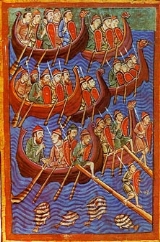
A romanticized picture of Vikings as Germanic
Germanic peoples

File:Germanische-ratsversammlung 1-1250x715.jpgThe Germanic peoples are a historical Ethnolinguistics group, originating in Northern Europe and identified by their use of the Indo-European languages Germanic languages which diversified out of Common Germanic in the course of the Pre-Roman Iron Age....
 noble savage
Noble savage

In the eighteenth-century cult of "Primitivism" the noble savage, uncorrupted by the influences of civilization, was considered more worthy, more authentically noble than the contemporary product of civilized training....
s emerged in the 17th century, and especially during the Victorian era
Victorian era

The Victorian Era of the United Kingdom of Great Britain and Ireland was the period of Victoria of the United Kingdom reign from June 1837 to January 1901....
 Viking revival
Viking revival

The Viking revival was an increase in popular and scholarly interest in and enthusiasm for the history and culture of the Vikings and other Norsemen of the Viking Age....
.


Discussion
Ask a question about 'Viking'
Start a new discussion about 'Viking'
Answer questions from other users
Full Discussion Forum


Recent Posts


Timeline

787   the first three Viking ships landed in Wessex and the Norsemen started to plunder towns and coastal monasteries

793   Vikings sack the monastery of Lindisfarne, Northumbria. First major Viking raid in England. The "start" of the Viking age.

795   Earliest recorded Viking raid on Ireland. Places attacked include Iona, Inisbofin and Inismurray.

802   Vikings sack Iona.

832   Clondalkin, Ireland is sacked by Vikings.

834   First Viking raid of Dorestad.

835   Viking raid of Dorestad. ''

844   Dorestad is raided by Vikings.

845   Vikings also sack Hamburg and Melun.

845   Paris is sacked by Viking raiders, probably under Ragnar Lodbrok, who collect a huge ransom in exchange for leaving.


Encyclopedia


A Viking is one of the Norse
Norsemen

Norsemen is used to refer to the group of people as a whole who speak one of the North Germanic languages as their native language. The meaning of Norseman was "people from the North" and was applied primarily to Nordic people originating from southern and central Scandinavia....
 (Scandinavia
Scandinavia

Scandinavia is a historical and geographical subregion in northern Europe that includes the Scandinavian Peninsula. It consists of the kingdoms of Norway, Sweden, and Denmark; some authorities also include Finland and some might even include Iceland....
n) explorers, warrior
Warrior

According to the Random House Dictionary, the term warrior has two meanings. The first Literal and figurative language use refers to "a person engaged or experienced in warfare." The second Literal and figurative language use refers to "a person who shows or has shown great vigor, courage, or aggressiveness, as in politics or athletics...
s, merchants, and pirates
Piracy

Piracy is a warlike act committed by a foreign nonstate actor, especially robbery or crime committed at sea, on a river, or sometimes on shore, either from a vessel flying no national flag, or one flying a national flag but without authorization from a nation....
  who raided and colonized wide areas of Europe
Europe

Europe is, conventionally, one of the world's seven continents. Comprising the westernmost peninsula of Eurasia, Europe is generally divided from Asia to its east by the water divide of the Ural Mountains, the Ural , the Caspian Sea, and by the Caucasus Mountains to the southeast....
 from the late eighth to the early eleventh century. These Norsemen
Norsemen

Norsemen is used to refer to the group of people as a whole who speak one of the North Germanic languages as their native language. The meaning of Norseman was "people from the North" and was applied primarily to Nordic people originating from southern and central Scandinavia....
 used their famed longship
Longship

Longships were ships primarily used by the Scandinavian Vikings and the Saxons to raid coastal and inland settlements during the European Middle Ages....
s to travel as far east as Constantinople
Constantinople

Constantinople was the empire capital of the Roman Empire , the Byzantine Empire , the Latin Empire , and the Ottoman Empire . Strategically located between the Golden Horn and the Sea of Marmara at the point where Europe meets Asia, Byzantine Constantinople had been the capital of a Christendom empire, successor to ancient ancient Greece...
 and the Volga River
Volga River

The Volga is the largest river in Europe in terms of length, Discharge , and Drainage basin. It flows through the western part of Russia, and is widely viewed as the national river of Russia....
 in Russia
Russia

Russia , or the Russian Federation , is a list of countries spanning more than one continent country extending over much of northern Eurasia....
, and as far west as Iceland
Iceland

Iceland, officially the Republic of Iceland , is an island country located in the North Atlantic Ocean between mainland Europe and Greenland....
, Greenland
Greenland

Greenland is a member country of the Kingdom of Denmark located between the Arctic Ocean and Atlantic Oceans, east of the Canadian Arctic Archipelago....
, and Newfoundland. This period of Viking expansion is known as the Viking Age
Viking Age

Viking Age is the term for the period in European history, especially Northern European and Scandinavian history, spanning the eighth to eleventh centuries....
, and forms a major part of the medieval history of Scandinavia
History of Scandinavia

The history of Scandinavia is the history of the Nordic countries ? Denmark, Norway, Sweden, Finland and Iceland....
, the British Isles
History of the British Isles

The history of the British Isles has witnessed intermittent periods of competition and cooperation between the people that occupy the various parts of Great Britain, Ireland, and the smaller adjacent islands, which together make up the British Isles, as well as with France, Germany, the Low Countries, Denmark, Scandinavia, etc....
 and Europe in general.

A romanticized picture of Vikings as Germanic
Germanic peoples

File:Germanische-ratsversammlung 1-1250x715.jpgThe Germanic peoples are a historical Ethnolinguistics group, originating in Northern Europe and identified by their use of the Indo-European languages Germanic languages which diversified out of Common Germanic in the course of the Pre-Roman Iron Age....
 noble savage
Noble savage

In the eighteenth-century cult of "Primitivism" the noble savage, uncorrupted by the influences of civilization, was considered more worthy, more authentically noble than the contemporary product of civilized training....
s emerged in the 17th century, and especially during the Victorian era
Victorian era

The Victorian Era of the United Kingdom of Great Britain and Ireland was the period of Victoria of the United Kingdom reign from June 1837 to January 1901....
 Viking revival
Viking revival

The Viking revival was an increase in popular and scholarly interest in and enthusiasm for the history and culture of the Vikings and other Norsemen of the Viking Age....
. In Britain it took the form of Septentrionalism, in Germany that of "Wagnerian" pathos or even Germanic mysticism, and in the Scandinavian countries that of Romantic nationalism
Romantic nationalism

Romantic nationalism is the form of nationalism in which the state derives its political legitimacy as an organic consequence of the unity of those it governs....
 or Scandinavism
Scandinavism

Scandinavism and Nordism are literary and political movements that support various degrees of cooperation between the Scandinavian or Nordic countries....
. In contemporary popular culture these clichéd depictions are often ironised
Irony

Irony is a Literary technique or rhetorical device, in which there is an wiktionary:incongruous or wiktionary:discordance between what one says or does and what one means or what is generally understood....
 with the effect of presenting Vikings as cartoonish characters.

Etymology

In Old Norse
Old Norse

Old Norse is a North Germanic languages that was spoken by inhabitants of Scandinavia and inhabitants of their overseas settlements during the Viking Age, until about 1300....
, the word is spelled víkingr. The word appears on several rune stone
Rune stone

A runestone is typically a raised stone with a runic alphabet inscription, but the term can also be applied to inscriptions on boulders and on bedrock....
s found in Scandinavia
Scandinavia

Scandinavia is a historical and geographical subregion in northern Europe that includes the Scandinavian Peninsula. It consists of the kingdoms of Norway, Sweden, and Denmark; some authorities also include Finland and some might even include Iceland....
. In the Icelanders' sagas
Icelanders' sagas

The Sagas of Icelanders —many of which are also known as family sagas—are prose history mostly describing events that took place in Iceland in the 10th and early 11th centuries....
, víking refers to an overseas expedition (Old Norse fara í víking "to go on an expedition"), and víkingr, to a seaman or warrior taking part in such an expedition.

In Old English, the word wicing appears first in the Anglo-Saxon
Anglo-Saxons

Anglo-Saxons is the term usually used to describe the invading tribes in the south and east of Great Britain starting from the early 5th century AD, and their creation of the English nation, lasting until the Norman conquest of England of 1066....
 poem, "Widsith
Widsith

Widsith is an Old English poetry of 144 lines that appears to date from the 9th century, drawing on earlier oral traditions of Anglo-Saxon tale singing....
", which probably dates from the 9th century. In Old English, and in the writings of Adam von Bremen, the term refers to a pirate, and is not a name for a people or a culture in general. Regardless of its possible origins, the word was used more as a verb than as a noun, and connoted an activity and not a distinct group of individuals. To "go Viking" was distinctly different from Norse seaborne missions of trade and commerce.

The word disappeared in Middle English
Middle English

Middle English is the name given by historical linguistics to the diverse forms of the English language spoken between the Norman conquest of England of 1066 and about 1470, when the #Chancery Standard, a form of London-based English, began to become widespread, a process aided by the introduction of the printing press into England by William...
, and was reintroduced as Viking during 18th century Romanticism
Romanticism

Romanticism is a complex artistic, literary, and intellectual movement that originated in the second half of the 18th century in Western Europe, and gained strength during the Industrial Revolution....
 (the "Viking revival
Viking revival

The Viking revival was an increase in popular and scholarly interest in and enthusiasm for the history and culture of the Vikings and other Norsemen of the Viking Age....
"), with heroic overtones of "barbarian
Barbarian

"Barbarian" is a pejorative term for an uncivilized person, either in a general reference to a member of a nation or ethnos, typically a tribal society as seen by an urban civilization either viewed as inferior, or admired as a noble savage....
 warrior" or noble savage
Noble savage

In the eighteenth-century cult of "Primitivism" the noble savage, uncorrupted by the influences of civilization, was considered more worthy, more authentically noble than the contemporary product of civilized training....
.

During the 20th century, the meaning of the term was expanded to refer not only to the raiders, but also to the entire period; it is now, somewhat confusingly, used as a noun both in the original meaning of raiders, warriors or navigators, and to refer to the Scandinavian population in general. As an adjective, the word is used in expressions like "Viking age
Viking Age

Viking Age is the term for the period in European history, especially Northern European and Scandinavian history, spanning the eighth to eleventh centuries....
", "Viking culture", "Viking colony", etc., generally referring to medieval Scandinavia. The pre-Christian Scandinavian population is also referred to as Norse
Norsemen

Norsemen is used to refer to the group of people as a whole who speak one of the North Germanic languages as their native language. The meaning of Norseman was "people from the North" and was applied primarily to Nordic people originating from southern and central Scandinavia....
, although that term is properly applied to the whole civilization of Old-Norse-speaking people. In current Scandinavian languages, the term Viking is applied to the people who went away on Viking expeditions, be it for raiding or trading.

The term Varangians
Varangians

The Varangians or Varyags , sometimes referred to as Variagians, were Vikings, Norsemen, who went eastwards and southwards through what is now Russia, Belarus and Ukraine mainly in the 9th and 10th centuries....
 made its first appearance in Byzantium
Byzantium

Byzantium was an Ancient Greece city, which was founded by Greeks colonists from Megara in 667 BC and named after their king Byzas or Byzantas ....
 where it was introduced to designate a function. In Russia it was extended to apply to Scandinavian warriors journeying to and from Constantinople
Constantinople

Constantinople was the empire capital of the Roman Empire , the Byzantine Empire , the Latin Empire , and the Ottoman Empire . Strategically located between the Golden Horn and the Sea of Marmara at the point where Europe meets Asia, Byzantine Constantinople had been the capital of a Christendom empire, successor to ancient ancient Greece...
. In the Byzantine sources Varangians are first mentioned in 1034 as in garrison in the Thracian theme. The Arabic geographer Al Biruni has mentioned the Baltic Sea
Baltic Sea

The Baltic Sea is a brackish inland sea located in Northern Europe, from 53?N to 66?N latitude and from 20?E to 26?E longitude. It is bounded by the Scandinavian Peninsula, the mainland of Europe, and the Denmark islands....
 as the Varangian Sea and specifies the Varangians as a people dwelling on its coasts. The first datable use of the word in Norse literature appears by Einarr Skúlason
Einarr Skúlason

Einarr Sk?lason was an Icelandic priest and skald. He was the most prominent Norse poet of the 12th century.He was descended from the family of Egill Skallagr?msson, the so called M?ramenn....
 in 1153. According to Icelandic Njalssaga from the 13th century, the institution of Varangian Guard was established by 1000. In the Russian Primary Chronicle
Primary Chronicle

The Primary Chronicle , or Russian Primary Chronicle, is a history of Kievan Rus' from about 850 to 1110, originally compiled in Kiev about 1113....
 the Varangian is used as a generic term for the Germanic nations on the coasts of the Baltic sea that likewise lived in the west as far as the land of the English and the French.

The word Vćringjar itself is regarded in Scandinavia as of Old Norse origin, cognate with the Old English Fćrgenga (literally, an expedition-goer).

The Viking Age

Gokstadskipet1
The period from the earliest recorded raids in the 790s until the Norman Conquest of England in 1066 is commonly known as the Viking Age of Scandinavian history. The Normans
Normans

The Normans were the people who gave their names to Normandy, a region in northern France. They descended from Viking conquerors of the territory and the native population of mostly Frankish and Gallo-Roman stock....
, however, were descended from Danish
Danish people

The term Dane may refer to:* People with a Danish ancestral or ethnic identity, whether living in Denmark, emigrants, or the descendants of emigrants....
 Vikings who were given feudal overlordship of areas in northern France — the Duchy of Normandy
Duchy of Normandy

The 'Duchy of Normandy' stems from various Denmark, Hiberno-Norse, Orkney Viking and Anglo-Danish invasions of France in the 8th century. A fief, probably as a county, was created by the treaty of Saint-Clair-sur-Epte in 911 out of concessions made by Charles the Simple, and granted to Rollo of Normandy, leader of the Vikings known as Nort...
 — in the 8th century. In that respect, descendants of the Vikings continued to have an influence in northern Europe. Likewise, King Harold Godwinson
Harold Godwinson

Harold Godwinson also known as Harold II, was the last Anglo-Saxons King of Kingdom of England before the Norman Conquest of England. Harold reigned from 5 January 1066, until his death at the Battle of Hastings on 14 October of that same year, fighting the Normans invaders, led by William I of England....
, the last Anglo-Saxon
Anglo-Saxons

Anglo-Saxons is the term usually used to describe the invading tribes in the south and east of Great Britain starting from the early 5th century AD, and their creation of the English nation, lasting until the Norman conquest of England of 1066....
 king of England who was killed during the Norman invasion in 1066, had Danish ancestors. Many of the medieval kings of Norway and Denmark married into English and Scottish royalty and occasionally got involved in dynastic disputes.

Geographically, a "Viking Age" may be assigned not only to Scandinavian lands (modern Denmark, Norway and Sweden), but also to territories under North Germanic
Germanic peoples

File:Germanische-ratsversammlung 1-1250x715.jpgThe Germanic peoples are a historical Ethnolinguistics group, originating in Northern Europe and identified by their use of the Indo-European languages Germanic languages which diversified out of Common Germanic in the course of the Pre-Roman Iron Age....
 dominance, mainly the Danelaw
Danelaw

The Danelaw, as recorded in the Anglo-Saxon Chronicle , is a historical name given to the part of Great Britain in which the laws of the "Danes" dominated those of the Anglo-Saxons....
, formerly the Kingdom of Northumbria
Northumbria

Northumbria is primarily the name of both a medieval petty kingdom of the Angles people, in what is now north east England and southern Scotland, and of the earldom which succeeded it when a united Anglo-Saxon kingdom became England....
, parts of Mercia
Mercia

Mercia was one of the kingdoms of the Anglo-Saxons Heptarchy. It was centred on the valley of the River Trent and its tributaries in the region now known as the English Midlands....
, and East Anglia
East Anglia

East Anglia is a region of eastern England. It was named after one of the ancient Heptarchy, the Kingdom of the East Angles, which was in turn named after the homeland of the Angles, Angeln, in northern Germany....
. Viking navigators opened the road to new lands to the north, west and east, resulting in the foundation of independent settlements in the Shetland, Orkney, and Faroe Islands
Faroe Islands

The Faroe Islands or Faeroe Islands or simply Faroe or Faeroes are an island group situated between the Norwegian Sea and the North Atlantic Ocean, approximately half way between Scotland and Iceland....
; Iceland
Iceland

Iceland, officially the Republic of Iceland , is an island country located in the North Atlantic Ocean between mainland Europe and Greenland....
; Greenland
Greenland

Greenland is a member country of the Kingdom of Denmark located between the Arctic Ocean and Atlantic Oceans, east of the Canadian Arctic Archipelago....
; and L'Anse aux Meadows
L'Anse aux Meadows

L'Anse aux Meadows is an archaeological site on the northernmost tip of the island of Newfoundland in the Canada Provinces of Canada of Newfoundland and Labrador....
, a short-lived settlement in Newfoundland, circa 1000 A.D. Many of these lands, specifically Greenland and Iceland, may have been originally discovered by sailors blown off course. They also may well have been deliberately sought out, perhaps on the basis of the accounts of sailors who had seen land in the distance. The Greenland settlement eventually died out, possibly due to climate change. Vikings also explored and settled in territories in Slavic
Slavic peoples

The Slavic Peoples are a linguistic branch of Indo-European peoples, living mainly in eastern Europe. From the early 6th century they spread from their original homeland to inhabit most of eastern Central Europe, Eastern Europe and the Balkans....
-dominated areas of Eastern Europe
Eastern Europe

Eastern Europe is a term that applies to the geopolitical region encompassing the easternmost part of the Europe. Throughout history and to a lesser extent today, parts of Eastern Europe has been distinguishable from Western Europe and other regions due to cultural, religious, economic, and historical reasons, even though there i...
. By 950 AD these settlements were largely Slavicized.

Fyrkat Hus Stor
From 839, Varangian mercenaries in the service of the Byzantine Empire
Byzantine Empire

Byzantine Empire and Eastern Roman Empire are conventional names used to describe the Roman Empire during the Middle Ages, centered on its capital of Constantinople....
, notably Harald Hardrada, campaigned in North Africa
North Africa

North Africa or Northern Africa is the northernmost region of the African continent, separated by the Sahara from Sub-Saharan Africa.Geopolitically, the United Nations subregion of Northern Africa includes the following seven countries or territories:...
, Jerusalem
Jerusalem

Jerusalem is the capital of Israel and its List of Israeli cities in both population and area, with a population of 747,600 residents over an area of if Positions on Jerusalem East Jerusalem is included....
, and other places in the Middle East
Middle East

File:GreaterMiddleEast1.pngThe Middle East is a region that spans southwestern Asia, western Asia, and northeastern Africa. It has no clear boundaries, often used as a synonym to Near East, in opposition to Far East....
. Important trading ports during the period include Birka
Birka

During the Viking Age, Birka , on the island of Bj?rk? in Sweden, was an important trading center which handled goods from Scandinavia as well as Central Europe and Eastern Europe and the Orient....
, Hedeby
Hedeby

Hedeby , mentioned by Alfred the Great as aet Haethe , in German language Haddeby and Haithabu, a modern spelling of the runic Hei?ab? was an important trading settlement in the Denmark-northern Germany borderland during the Viking Age....
, Kaupang
Kaupang

Kaupang is a town founded in the 780s during the time when the Vikings started to launch their raids against Great Britain and other parts of Europe until it was abandoned for unknown reasons in the early 10th century....
, Jorvik
Jórvík

The Kingdom of J?rv?k was a Norsemen Viking kingdom, covering the area of what would become Yorkshire and at times further parts of Northern England....
, Staraya Ladoga
Staraya Ladoga

Staraya Ladoga , Vanha Laatokka in finnish or the Aldeigjuborg of Norse sagas, is a Types of inhabited localities in Russia in the Volkhovsky District of Leningrad Oblast, Russia, located on the Volkhov River near Lake Ladoga....
, Novgorod and Kiev
Kiev

Kiev, also known as Kyiv , is the Capital and the largest city of Ukraine, located in the north central part of the country on the Dnieper River....
.

There is archaeological evidence that Vikings reached the city of Baghdad
Baghdad

Baghdad is the Capital of Iraq and of Baghdad Governorate, with which it is also coterminous. With a municipal population estimated at 6.5 million, it is the largest city in Iraq, and the second largest city in the Arab World....
, the center of the Islamic Empire. The Norse
Norsemen

Norsemen is used to refer to the group of people as a whole who speak one of the North Germanic languages as their native language. The meaning of Norseman was "people from the North" and was applied primarily to Nordic people originating from southern and central Scandinavia....
 regularly plied the Volga with their trade goods: furs, tusks, seal fat for boat sealant and slaves. However, they were far less successful in establishing settlements in the Middle East, due to the more centralized Islamic power.

Generally speaking, the Norwegians expanded to the north and west to places such as Ireland, Iceland and Greenland; the Danes to England and France, settling in the Danelaw
Danelaw

The Danelaw, as recorded in the Anglo-Saxon Chronicle , is a historical name given to the part of Great Britain in which the laws of the "Danes" dominated those of the Anglo-Saxons....
 (northern/eastern England) and Normandy
Normandy

Normandy is a geographical region corresponding to the former Duchy of Normandy. It is situated along the coast of France south of the English Channel between Brittany and Picardy and comprises territory in northern France and the Channel Islands....
; and the Swedes
Swedish people

Swedes are people from Sweden or of Swedish decent. Unlike the United States, United Kingdom, and Australian Censuses, Statistics Sweden does not classify the Swedish population by race or ethnicity....
 to the east. These nations, although distinct, were similar in culture and language. The names of Scandinavian kings are known only for the later part of the Viking Age. Only after the end of the Viking Age did the separate kingdoms acquire distinct identities as nations, which went hand in hand with their Christianization
Christianization

The historical phenomenon of Christianization, the religious conversion of individuals to Christianity or the conversion of entire peoples at once, also includes the practice of converting native Paganism practices and culture, pagan religious imagery, pagan sites and the pagan calendar to Christian uses, due to the Christian efforts at Ch...
. Thus the end of the Viking Age for the Scandinavians also marks the start of their relatively brief Middle Ages.

Viking expansion

The Vikings sailed most of the North Atlantic, reaching south to North Africa
North Africa

North Africa or Northern Africa is the northernmost region of the African continent, separated by the Sahara from Sub-Saharan Africa.Geopolitically, the United Nations subregion of Northern Africa includes the following seven countries or territories:...
 and east to Russia
Russia

Russia , or the Russian Federation , is a list of countries spanning more than one continent country extending over much of northern Eurasia....
, Constantinople
Constantinople

Constantinople was the empire capital of the Roman Empire , the Byzantine Empire , the Latin Empire , and the Ottoman Empire . Strategically located between the Golden Horn and the Sea of Marmara at the point where Europe meets Asia, Byzantine Constantinople had been the capital of a Christendom empire, successor to ancient ancient Greece...
 and the middle east
Middle East

File:GreaterMiddleEast1.pngThe Middle East is a region that spans southwestern Asia, western Asia, and northeastern Africa. It has no clear boundaries, often used as a synonym to Near East, in opposition to Far East....
, as looters, traders, colonists, and mercenaries. Vikings under Leif Eriksson, heir to Erik the Red
Erik the Red

Erik the Red founded the first Nordic countries colonization in Greenland. Born in the J?ren district of Rogaland, Norway, as the son of ?orvaldr ?svaldsson , he therefore also appears, patronymically, as Erik Thorvaldsson ....
, reached North America
North America

North America is the northern continent of the Americas, situated in the Earth's northern hemisphere and almost totally in the western hemisphere....
, and set up a short-lived settlement in present-day L'Anse aux Meadows
L'Anse aux Meadows

L'Anse aux Meadows is an archaeological site on the northernmost tip of the island of Newfoundland in the Canada Provinces of Canada of Newfoundland and Labrador....
, Newfoundland and Labrador
Newfoundland and Labrador

Newfoundland and Labrador is a Provinces and territories of Canada of Canada, on the country's Atlantic Ocean coast in northeastern North America....
, Canada
Canada

Canada is a country occupying most of northern North America, extending from the Atlantic Ocean in the east to the Pacific Ocean in the west and northward into the Arctic Ocean....
.

The motives driving the Viking expansion form a topic of much debate in Nordic history. One common theory posits that the Norse population had outgrown
Overpopulation

Overpopulation is a condition where an organism's numbers exceed the carrying capacity of its habitat. In common parlance, the term usually refers to the relationship between the world population and its environment , the Earth....
 agricultural potential of their Scandinavian homeland. For a coastal population with superior naval technologies, it made sense to expand overseas in the face of a youth bulge
Population pyramid

A population pyramid, also called age-sex pyramid and age structure diagram, is a graphical illustration that shows the distribution of various age groups in a population , which normally forms the shape of a pyramid....
 effect. However, this theory does little to explain why the expansion went overseas rather than into the vast, uncultivated forest areas on the interior of the Scandinavian Peninsula
Scandinavian Peninsula

The Scandinavian Peninsula is a geographic region in northern Europe, consisting of Norway and Sweden. The name Scandinavian is etymology Scania, a region at the southernmost extremity of the peninsula....
. It should be noted that sea raiding was easier than clearing large areas of forest for farm and pasture in a region with a limited growing season. No such rise in population or decline in agricultural production has been definitively proven.

Another explanation is that the Vikings exploited a moment of weakness in the surrounding regions. For instance, the Danish Vikings were aware of the internal divisions within Charlemagne
Charlemagne

Charlemagne was List of Frankish kings from 768 to his death. He expanded the Franks kingdoms into a Carolingian Empire that incorporated much of Western Europe and Central Europe....
's empire that began in the 830s and resulted in schism. England suffered from internal divisions, and was relatively easy prey given the proximity of many towns to the sea or navigable rivers. Lack of organized naval opposition throughout Western Europe allowed Viking ships to travel freely, raiding or trading as opportunity permitted.

The decline in the profitability of old trade routes could also have played a role. Trade between western Europe and the rest of Eurasia suffered a severe blow when the Roman Empire
Roman Empire

The Roman Empire was the Roman Republic phase of the Ancient Rome, characterised by an autocracy form of government and large territorial holdings in Europe and around the Mediterranean....
 fell in the 5th century. The expansion of Islam
Islam

Islam is a Monotheism, Abrahamic religion originating with the teachings of the Prophets of Islam Muhammad, a 7th century Arab religious and political figure....
 in the 7th century had also affected trade with western Europe. Trade on the Mediterranean Sea
Mediterranean Sea

The Mediterranean Sea is a sea or Ocean off the Atlantic Ocean surrounded by the Mediterranean region and almost completely enclosed by land: on the north by Europe, on the south by Africa, and on the east by Asia....
 was historically at its lowest level when the Vikings initiated their expansion. By opening new trade routes in Arabic and Frankish lands, the Vikings profited from international trade by expanding beyond their traditional boundaries. Finally, the destruction of the Frisia
Frisia

Frisia is a coastal region along the southeastern corner of the North Sea, i.e. the German Bight. Frisia is the traditional homeland of the Frisians, a Germanic people who speak Frisian languages, a language group closely related to the English language....
n fleet by the Franks afforded the Vikings an opportunity to take over their trade markets.

Decline

Following a period of thriving trade and Viking settlement, cultural impulses flowed from the rest of Europe to affect Viking dominance. Christianity had an early and growing presence in Scandinavia
Christianization of Scandinavia

The Christianization of Scandinavia refers to the process of Religious conversion to Christianity of the Scandinavian people, starting in the 8th century with the arrival of missionary in Denmark; it was at least nominally complete by the 12th century, although the Sami people remained unconverted until the 18th century....
, and with the rise of centralized authority and the development of more robust coastal defense systems, Viking raids became more risky and less profitable.

Snorri Sturluson
Snorri Sturluson

Snorri Sturluson was an Icelandic historian, poet and politician. He was two-time elected lawspeaker at the Icelandic parliament, the Althing....
 in the saga
Saga

Saga may refer to:...
 of St. Olafr chapter 73, describes the brutal process of Christianisation in Norway
Norway

Norway , officially the Kingdom of Norway, is a constitutional monarchy in Northern Europe that occupies the western portion of the Scandinavian Peninsula....
: “…those who did not give up paganism were banished, with others he (St. Olafr) cut off their hands or their feet or extirpated their eyes, others he ordered hanged or decapitated, but did not leave unpunished any of those who did not want to serve God (…) he afflicted them with great punishments (…) He gave them clerks and instituted some in the districts.”

As the new quasi-feudalistic system became entrenched in Scandinavian rule, organized opposition sealed the Vikings' fate. Eleventh-century chronicles note Scandinavian attempts to combat the Vikings from the eastern shores of the Baltic Sea, which eventually led to Danish and Swedish participation in the Baltic Crusades during the 12th and 13th centuries. It also contributed to the development of the Hanseatic League
Hanseatic League

The Hanseatic League was an Military alliance of Trade cities and their guilds that established and maintained trade monopoly along the coast of Northern Europe, from the Baltic Sea to the North Sea and inland, during the Late Middle Ages and Early modern period ....
.

One of the primary profit centers of Viking trade was slavery
Slavery

Slavery is a form of forced labor where a person is compelled to Labor for another . Slaves are held against their will from the time of their capture, purchase, or birth, and are deprived of the right to leave, to refuse to work, or to receive Remuneration in return for their labor....
. The Church took a position that Christians should not own fellow Christians as slaves, so chattel slavery diminished as a practice throughout Northern Europe. Eventually, outright slavery was outlawed, replaced with serfdom
Serfdom

Serfdom is the socio-economic status of unfree peasants under feudalism, and specifically relates to Manorialism. It was a condition of Debt bondage or modified slavery which developed primarily during the High Middle Ages in Europe....
 at the bottom rung of Medieval society. This took much of the economic incentive out of raiding, though sporadic activity continued for a few decades beyond the Norman conquest of England.

Weapons and warfare

Our knowledge about arms and armor of the Viking age is based on relatively sparse archaeological finds, pictorial representation, and to some extent on the accounts in the Norse sagas and Norse laws recorded in the 13th century.

According to custom, all free Norse men were required to own weapons, as well as permitted to carry them at all times. These arms were also indicative of a Viking's social status: a wealthy Viking would have a complete ensemble of a helmet
Helmet

A helmet is a form of protective gear worn on the head to protect it from injuries, a variation of the hat. The oldest use of helmets was by Ancient Greek soldiers, who wore thick leather or bronze helmets to protect the head from sword blows and arrows....
, shield
Shield

A shield is a protective device, meant to intercept attacks. The term often refers to a device that is held in the hand, as opposed to armour or a bullet proof vest....
, chainmail
Chainmail

Mail is a type of armour consisting of small metal rings linked together in a pattern to form a mesh.The word chainmail is of relatively recent coinage, having been in use only since the 1700s; prior to this it was referred to simply as mail....
 shirt, and sword. A typical bóndi (freeman) was more likely to fight with a spear
Spear

A spear is a pole weapon consisting of a shaft, usually of wood, with a sharpened head. The head may be simply the sharpened end of the shaft itself, as is the case with bamboo spears, or it may be of another material fastened to the shaft, such as obsidian, iron or bronze....
 and shield, and most also carried a seax
Seax

Seax in Old Saxon stands for knife or cutting tool. In modern archeology , the term seax is used specifically for the typically large knives that were worn by men in the 5th to 11th century, in the region roughly enclosed by Ireland, Scandinavia and Northern Italy....
 as a utility knife and side-arm. Bows were used in the opening stages of land battles, and at sea, but tended to be considered less "honorable" than a hand weapon. Vikings were relatively unique for the time in their use of axes as a main battle weapon. The Húscarls, the elite guard of King Cnut (and later King Harold II
Harold Godwinson

Harold Godwinson also known as Harold II, was the last Anglo-Saxons King of Kingdom of England before the Norman Conquest of England. Harold reigned from 5 January 1066, until his death at the Battle of Hastings on 14 October of that same year, fighting the Normans invaders, led by William I of England....
) were armed with two-handed axes which could split shields or metal helmets with ease.

Archaeology

With a distinct lack of totally reliable written sources on the topic, much of the historical investigation of the Viking period relies on archaeology.

Runestones

The vast majority of runic inscriptions from the Viking period come from Sweden
Sweden

Sweden , officially the Kingdom of Sweden , is a Nordic countries on the Scandinavian Peninsula in Northern Europe. Sweden has land borders with Norway to the west and Finland to the northeast, and it is connected to Denmark by the ?resund Bridge in the south....
, especially from the tenth and eleventh century. Many runestones in Scandinavia record the names of participants in Viking expeditions, such as the Kjula Runestone which tells of extensive warfare in Western Europe and the Turinge Runestone which tells of a warband in Eastern Europe. Other runestones mention men who died on Viking expeditions, among them the around 25 Ingvar Runestones
Ingvar Runestones

The Ingvar Runestones is the name of c. 26 Varangian Runestones that were raised in commemoration of those who died in the Swedish Caspian expeditions of the Rus of Ingvar the Far-Travelled....
 in the Mälardalen district of Sweden
Sweden

Sweden , officially the Kingdom of Sweden , is a Nordic countries on the Scandinavian Peninsula in Northern Europe. Sweden has land borders with Norway to the west and Finland to the northeast, and it is connected to Denmark by the ?resund Bridge in the south....
 erected to commemorate members of a disastrous expedition into present-day Russia
Russia

Russia , or the Russian Federation , is a list of countries spanning more than one continent country extending over much of northern Eurasia....
 in the early 11th century. The runestones are important sources in the study of Norse society and early medieval Scandinavia, not only of the 'Viking' segment of the population (Sawyer, P H: 1997).

Runestones attest to voyages to locations, such as Bath, Greece
Greece

Greece , officially the Hellenic Republic , is a country in southeastern Europe, situated on the southern end of the Balkans. It has borders with Albania, Bulgaria and the former Yugoslav Republic of Macedonia to the north, and Turkey to the east....
, Khwaresm, Jerusalem
Jerusalem

Jerusalem is the capital of Israel and its List of Israeli cities in both population and area, with a population of 747,600 residents over an area of if Positions on Jerusalem East Jerusalem is included....
, Italy
Italy

Italy , officially the Italian Republic , is a country located on the Italian Peninsula in Southern Europe and on the two largest islands in the Mediterranean Sea, Sicily and Sardinia....
 (as Langobardland), London
London

London is the capital of both England and the United Kingdom, and the most populous municipality in the European Union. An important settlement for two millennia, History of London goes back to its founding by the Roman Empire....
, Serkland
Serkland

In Old Norse sources, such as sagas and runestones, S?rkland or Serkland was the name of the Abbasid Caliphate and probably some neighbouring Muslim regions....
 (i.e. the Muslim world), England
England

native_name =|conventional_long_name = England|common_name = England|image_flag = Flag of England.svg|image_coat = England COA.svg|symbol_type = Royal Coat of Arms...
, and various locations in Eastern Europe.

The word Viking appears on several runestones found in Scandinavia
Scandinavia

Scandinavia is a historical and geographical subregion in northern Europe that includes the Scandinavian Peninsula. It consists of the kingdoms of Norway, Sweden, and Denmark; some authorities also include Finland and some might even include Iceland....
.

Burial sites

There are numerous burial sites associated with Vikings. As well as providing information on Viking religion, burial sites also provide information on social structure. The items buried with the deceased give some indication as to what was considered important to possess in the afterlife. Some examples of notable burial sites include:
  • Gettlinge gravfält, Öland
    Öland

    is the second largest Islands of Sweden and the smallest of the traditional provinces of Sweden. ?land has an area of 1,342 km? and is located in Baltic Sea just off the coast of Sm?land....
    , Sweden, ship outline
  • Jelling
    Jelling

    Jelling is a village situated in Vejle municipality, Denmark on the Jutland peninsula. Previously a Viking royal locality, today Jelling is a small town with a population of 3,178 ....
    , Denmark, a World Heritage Site
  • Oseberg, Norway.
  • Gokstad, Norway.
  • Borrehaugene
    Borre mound cemetery

    The Borre mound cemetery forms part of the Borre National Park in Horten, Vestfold, Norway. The park covers 45 acres and its collection of burial mounds is exceptional in Scandinavia....
    , Horten
    Horten

    is a List of cities in Norway and Municipalities of Norway in Vestfold Counties of Norway, Norway—located along the Oslofjord. The administrative centre of the municipality is the town of Horten....
    , Norway
  • Tuna
    Tuna

    Tuna are several species of ocean-dwelling fish in the family Scombridae, mostly in the genus Thunnus. Tunas are fast swimmers?they have been clocked at 70 km/h ?and include several species that are warm-blooded....
    , Sweden.
  • Gamla Uppsala
    Gamla Uppsala

    Gamla Uppsala is a parish and a village outside Uppsala in Sweden. It had 16,231 inhabitants in 1991.As early as the 3rd century AD and the 4th century AD and onwards, it was an important religious, economic and political centre....
    , Sweden.
  • Hulterstad gravfält, near the villages of Alby and Hulterstad, Öland
    Öland

    is the second largest Islands of Sweden and the smallest of the traditional provinces of Sweden. ?land has an area of 1,342 km? and is located in Baltic Sea just off the coast of Sm?land....
    , Sweden, ship outline of standing stones


Ships

Vikingeskibsmuseet 12
There were two distinct classes of Viking ships: the longship
Longship

Longships were ships primarily used by the Scandinavian Vikings and the Saxons to raid coastal and inland settlements during the European Middle Ages....
 (sometimes erroneously called "drakkar", a corruption of "dragon" in Norse) and the knarr
Knarr

For the Norse ship, see knaar----...
. The longship, intended for warfare and exploration, was designed for speed and agility, and were equipped with oars to complement the sail as well as making it able to navigate independently of the wind. The longship had a long and narrow hull, as well as a shallow draft, in order to facilitate landings and troop deployments in shallow water. The knarr was a dedicated merchant vessel designed to carry cargo. It was designed with a broader hull, deeper draft and limited number of oars (used primarily to maneuver in harbors and similar situations). One Viking innovation was the beitass
Beitass

A Beitass, or stretching pole, is a wooden spar used on Viking ships that was fitted into a pocket at thelower corner of the sail. This innovation was used to stiffen and hold the edge of the sail when sailing close to the wind....
, a spar mounted to the sail that allowed their ships to sail effectively against the wind.

Longships were used extensively by the Leidang
Leidang

The institution known as lei?angr , leidang , leding, , ledung , expeditio or sometimes lething , was a public levy of free farmers typical for medieval Scandinavians....
, the Scandinavian defense fleets. The term "Viking ships" has entered common usage, however, possibly because of its romantic associations (discussed below).

In Roskilde are the well-preserved remains of five ships, excavated from nearby Roskilde Fjord
Roskilde Fjord

Roskilde Fjord is the fjord north of Roskilde, Denmark, and is located at . It is a long branch of the Isefjord....
 in the late 1960s. The ships were scuttled there in the 11th century to block a navigation channel, thus protecting the city, which was then the Danish capital, from seaborne assault. These five ships represent the two distinct classes of Viking ships, the longship and the knarr. The remains of these ships can be found on display at the Viking Ship Museum in Roskilde
Viking Ship Museum in Roskilde

The Viking Ship Museum in Roskilde is the Denmark national museum for ships, seafaring and boatbuilding in the Prehistory and Middle Ages period....
.

Longships are not to be confused with later-period longboats. It was common for Viking ships to tow or carry a smaller boat to transfer crews and cargo from the ship to shore, however.

Genetic legacy

Studies of genetic diversity provide some indication of the origin and expansion of the Viking population. The Haplogroup I1
Haplogroup I1 (Y-DNA)

In human genetics, Haplogroup I1 is a Y chromosome haplogroup occurring at greatest frequency in Scandinavia, associated with the mutations identified as M253, M307, P30, and P40....
 (defined by specific genetic markers on the Y-chomosome) is sometimes referred to as the "Viking haplogroup". This mutation occurs with the greatest frequency among Scandinavian males: 35 percent in Norway, Denmark and Sweden, and peaking at 40 percent within western Finland. It is also common near the southern Baltic and North Sea coasts, and then successively decreases the further south geographically.

Genetic studies in England have demonstrated that the Vikings settled in the British Isles as well as raiding there. Both male and female descent studies show evidence of Norwegian descent in areas closest to Scandinavia, such as the Shetland and Orkney Islands. Inhabitants of lands further away show most Norse descent in the male Y chromosome lines.

A specialized surname study in Liverpool
Liverpool

Liverpool [] is a city and metropolitan borough of Merseyside, England, along the eastern side of the Mersey Estuary. It was founded as a History of borough status in England and Wales in 1207 and was granted City status in the United Kingdom in 1880....
 demonstrated marked Norse heritage, up to 50 percent of males who belonged to original families, those who lived there before the years of industrialization and population expansion. High percentages of Norse inheritance were also found among males in Wirral
Wirral

Wirral may refer to:* Wirral Peninsula, a peninsula in the northwest of England, near Liverpool* Metropolitan Borough of Wirral in Merseyside, occupying the northern part of the Wirral Peninsula...
 and West Lancashire
West Lancashire

West Lancashire is a Non-metropolitan district of Lancashire, England. Its council is based in Ormskirk. The district was formed in 1974 under the Local Government Act 1972, as a merger of Ormskirk Urban District and Skelmersdale and Holland urban districts along with part of West Lancashire Rural District and part of Wigan Rural District....
. This was similar to the percentage of Norse inheritance found among males in the Orkney Islands.

Historical opinion and cultural legacy

In England
England

native_name =|conventional_long_name = England|common_name = England|image_flag = Flag of England.svg|image_coat = England COA.svg|symbol_type = Royal Coat of Arms...
 the Viking Age began dramatically on 8 June 793 when Norsemen destroyed the abbey
Abbey

An abbey , is a Christianity monastery or convent, under the government of an Abbot or an Abbess, who serves as the spiritual father or mother of the community....
 on the island of Lindisfarne
Lindisfarne

Lindisfarne is a tidal island off the north-east coast of England also known as Holy Island, the name of the civil parish. It has a population of 162 ...
. The devastation of Northumbria
Northumbria

Northumbria is primarily the name of both a medieval petty kingdom of the Angles people, in what is now north east England and southern Scotland, and of the earldom which succeeded it when a united Anglo-Saxon kingdom became England....
's Holy Island shocked and alerted the royal Courts of Europe to the Viking presence. "Never before has such an atrocity been seen," declared the Northumbrian scholar, Alcuin of York. More than any other single event, the attack on Lindisfarne demonized perception of the Vikings for the next twelve centuries. Not until the 1890s did scholars outside Scandinavia begin to seriously reassess the achievements of the Vikings, recognizing their artistry, technological skills and seamanship.

The first challenges to anti-Viking sentiments in Britain emerged in the 17th century. Pioneering scholarly editions of the Viking Age began to reach a small readership in Britain, archaeologists began to dig up Britain's Viking past, and linguistic enthusiasts started to identify the Viking-Age origins for rural idioms and proverbs. The new dictionaries of the Old Norse language enabled the Victorians to grapple with the primary Icelandic sagas.

In Scandinavia, the 17th century Danish scholars Thomas Bartholin
Thomas Bartholin

Thomas Bartholin was a Denmark physician, mathematician, and theology. He is best known for his work in the discovery of the lymphatic system in humans and for his advancements of the theory of refrigeration anesthesia, being the first to describe it scientifically....
 and Ole Worm
Ole Worm

Ole Worm , who often went by the Latinized form of his name Olaus Wormius, was a Denmark physician and antiquary....
, and Olof Rudbeck of Sweden were the first to set the standard for using runic inscriptions and Icelandic Sagas as historical sources. During the Age of Enlightenment
Age of Enlightenment

The Age of Enlightenment or The Enlightenment is a term used to describe a time in Western philosophy and cultural life centered upon the eighteenth century, in which rationalism was advocated as the primary source and legitimacy for authority....
 and the Nordic Renaissance, historical scholarship in Scandinavia became more rational and pragmatic, as witnessed by the works of a Danish historian Ludvig Holberg
Ludvig Holberg

Ludvig Holberg, Baron of Holberg was a writer, essayist, philosopher, historian and playwright born in Bergen, Norway during the time of the Denmark-Norway, and spent most of his adult life in Denmark....
 and Swedish historian Olof von Dalin
Olof von Dalin

Olof von Dalin , the Swedish poet, was born on 29 August 1708 in the parish of Vinberg in Halland, where his father was the minister. He was closely related to Andreas Rydelius, the philosophical bishop of Lund, and he was sent at a very early age to be instructed by him – Linnaeus being one of his fellow-pupils....
. Until recently, the history of the Viking Age was largely based on Icelandic sagas, the history of the Danes written by Saxo Grammaticus
Saxo Grammaticus

Saxo Grammaticus also known as Saxo cognomine Longus is thought to have been a secular clerk or secretary to Absalon, Archbishop of Lund....
, the Russian Primary Chronicle
Primary Chronicle

The Primary Chronicle , or Russian Primary Chronicle, is a history of Kievan Rus' from about 850 to 1110, originally compiled in Kiev about 1113....
 and the The War of the Irish with the Foreigners
The War of the Irish with the Foreigners

Cogad G?edel re Gallaib is a two-part medieval Ireland chronicle that claims to record the depredations of the Vikings in Ireland and the Irish king Brian Boru's great war against them....
. Although few scholars still accept these texts as reliable sources, historians nowadays rely more on archeology and numismatics, disciplines that have made valuable contributions toward understanding the period.

Until the 19th century reign of Queen Victoria
Victoria of the United Kingdom

Victoria was from 20 June 1837 the Queen regnant of the United Kingdom of Great Britain and Ireland and from 1 May 1876 the first Empress of India of the British Raj until her death....
, public perceptions in Britain
United Kingdom of Great Britain and Ireland

The United Kingdom of Great Britain and Ireland was the formal name and the state form of the United Kingdom from 1 January 1801 until 12 April 1927....
 continued to portray Vikings as violent and bloodthirsty. The chronicles of medieval England had always portrayed them as rapacious 'wolves among sheep'. In 1920, a winged-helmeted Viking was introduced as a radiator cap figure on the new Rover car
Rover (car)

The Rover Company was a British automobile manufacturing company originally founded as Starley & Sutton Co. of Coventry in 1878. After developing the template for the modern bicycle with its Rover Safety Bicycle of 1885, the company moved into the automotive industry....
, marking the start of the cultural rehabilitation of the Vikings in Britain.

Icelandic sagas and other texts


Norse mythology
Norse mythology

Norse, Viking or Scandinavian mythology comprises the beliefs, myths and legends of the Norse paganism of the North Germanic language people, including those who settled on Faroe Islands and Iceland, where most of the written sources for Norse mythology were assembled....
, sagas
Norse saga

The sagas , are stories about ancient Scandinavia and Germanic tribes history, about early Viking voyages, about migration to Iceland, and of feuds between Icelandic families....
 and literature
Old Norse literature

Old Norse literature refers to the vernacular literature of the Scandinavian peoples up to ca. 1350. It chiefly consists of Icelandic writings....
 tell of Scandinavian culture and religion through tales of heroic and mythological heroes. However, early transmission of this information was primarily oral, and later texts were reliant upon the writings and transcriptions of Christian scholars, including the Icelanders Snorri Sturluson
Snorri Sturluson

Snorri Sturluson was an Icelandic historian, poet and politician. He was two-time elected lawspeaker at the Icelandic parliament, the Althing....
 and Sćmundur fróđi. Many of these sagas were written in Iceland
Iceland

Iceland, officially the Republic of Iceland , is an island country located in the North Atlantic Ocean between mainland Europe and Greenland....
, and most of them, even if they had no Icelandic provenance, were preserved there after the Middle Ages due to the Icelanders' continued interest in Norse literature and law codes.

The 200-year Viking influence on European history
History of Europe

The history of Europe describes the passage of time from humans inhabiting the European Continental Europe to the present day. For convenience sake, historians divide long periods into more manageable eras....
 is filled with tales of plunder and colonization, and the majority of these chronicles came from western witnesses and their descendants. Less common, though equally relevant, are the Viking chronicles that originated in the east, including the Nestor
Nestor

Nestor may refer to:*Nestor , the son of Neleus, the King of Pylos and Chloris in Greek mythology*Nestor *Nestor , a genus of parrots in ornithology...
 chronicles, Novgorod chronicles, Ibn Fadlan chronicles, Ibn Ruslan chronicles, and many brief mentions by the Fosio bishop from the first big attack on the Byzantine
Byzantine

The word Byzantine may refer to:Topics directly related to the Byzantine Empire* A citizen of Byzantine Empire, or native Greeks during the Middle Ages ....
 Empire.

Other chroniclers of Viking history include Adam of Bremen
Adam of Bremen

Adam of Bremen was one of the most important Germany medieval chroniclers. He lived and worked in the second half of the eleventh century. He is most famous for his chronicle Gesta Hammaburgensis ecclesiae pontificum ....
, who wrote "There is much gold here (in Zealand
Zealand

Zealand is the largest island of Denmark and the List of islands by area. Zealand is connected to Funen by the Great Belt Bridge and to Sweden by the Oresund Bridge....
), accumulated by piracy. These pirates, which are called wichingi by their own people, and Ascomanni by our own people, pay tribute to the Danish king" in the fourth volume of his Gesta Hammaburgensis Ecclesiae Pontificum.

In 991, the Battle of Maldon
Battle of Maldon

The Battle of Maldon took place on 10 August 991 near Maldon, Essex beside the River Blackwater, Essex in Essex, England, during the reign of Ethelred the Unready....
 between Viking raiders and the inhabitants of the town of Maldon
Maldon, Essex

Maldon is a town on the River Blackwater, Essex in Essex, England, England. It is the seat of the Maldon and starting point of the Chelmer and Blackwater Navigation....
 in Essex
Essex

Essex is a counties of England in the East of England England. The county town is Chelmsford, and the highest point of the county is Chrishall Common near the village of Langley, Essex, close to the Hertfordshire border, which reaches ....
, England was commemorated with a poem of the same name.

Modern revivals

Vikings Fight
Early modern publications, dealing with what we now call Viking culture, appeared in the 16th century, e.g. Historia de gentibus septentrionalibus (Olaus Magnus, 1555), and the first edition of the 13th century Gesta Danorum of Saxo Grammaticus
Saxo Grammaticus

Saxo Grammaticus also known as Saxo cognomine Longus is thought to have been a secular clerk or secretary to Absalon, Archbishop of Lund....
 in 1514. The pace of publication increased during the 17th century with Latin translations of the Edda
Edda

The term Edda applies to the Old Norse Poetic Edda and Prose Edda, both of which were written down in medieval Iceland during the 13th century....
 (notably Peder Resen's Edda Islandorum of 1665).

The word Viking was popularized, with positive connotations, by Erik Gustaf Geijer
Erik Gustaf Geijer

Erik Gustaf Geijer , was a Sweden writer, composer, and history. He was a member of the Swedish Academy and a professor of history from 1817 at Uppsala University where a statue commemorates him....
 in the poem, The Viking, written at the beginning of the 19th century. The word was taken to refer to romanticized, idealized naval warriors, who had very little to do with the historical Viking culture. This renewed interest of Romanticism
Romanticism

Romanticism is a complex artistic, literary, and intellectual movement that originated in the second half of the 18th century in Western Europe, and gained strength during the Industrial Revolution....
 in the Old North had political implications. A myth about a glorious and brave past was needed to give the Swedes the courage to retake Finland
Finland

Finland , officially the Republic of Finland , is a Nordic countries situated in the Fennoscandian region of northern Europe. It borders Sweden on the west, Russia on the east, and Norway on the north, while Estonia lies to its south across the Gulf of Finland....
, which had been lost in 1809 during the war between Sweden and Russia
Finnish War

The Finnish War was fought between Kingdom of Sweden and Russian Empire from February 1808 to September 1809. As a result of the war, the eastern third of Sweden was established as the autonomous Grand Duchy of Finland within the Russian Empire....
. The Geatish Society
Geatish Society

The Geatish Society, or Gothic League was created by a number of Swedish poets and authors in 1811, as a social club for literary studies among academics in Sweden with a view to raising the moral tone of society through contemplating Scandinavian antiquity ....
, of which Geijer was a member, popularized this myth to a great extent. Another Swedish author who had great influence on the perception of the Vikings was Esaias Tegnér
Esaias Tegnér

Esaias Tegn?r , was a Sweden writer, professor of Greek language, and bishop. He was during the 19th century regarded as the father of modern poetry in Sweden, mainly through the national romantique epos Frithjof's Saga....
, member of the Geatish Society
Geatish Society

The Geatish Society, or Gothic League was created by a number of Swedish poets and authors in 1811, as a social club for literary studies among academics in Sweden with a view to raising the moral tone of society through contemplating Scandinavian antiquity ....
, who wrote a modern version of Friđţjófs saga ins frśkna
Friđţjófs saga ins frśkna

Fri??j?fs saga hins fr?kna is a legendary saga from Iceland which in its present form is from ca 1300. It is a continuation from ?orsteins saga V?kingssonar, and it takes place in the 8th century....
, which became widely popular in the Nordic countries, the United Kingdom
United Kingdom

The United Kingdom of Great Britain and Northern Ireland, commonly known as the United Kingdom , the UK or Britain,is a sovereign state located off the northwestern coast of continental Europe....
 and Germany
Germany

Germany , officially the Federal Republic of Germany , is a country in Central Europe. It is bordered to the north by the North Sea, Denmark, and the Baltic Sea; to the east by Poland and the Czech Republic; to the south by Austria and Switzerland; and to the west by France, Luxembourg, Belgium, and the Netherlands....
.

A focus for early British enthusiasts was George Hicke, who published a Linguarum vett. septentrionalium thesaurus in 1703 – 05. During the 18th century, British interest and enthusiasm for Iceland and Nordic culture grew dramatically, expressed in English translations as well as original poems, extolling Viking virtues and increased interest in anything Runic that could be found in the Danelaw, rising to a peak during Victorian times
Victorian era

The Victorian Era of the United Kingdom of Great Britain and Ireland was the period of Victoria of the United Kingdom reign from June 1837 to January 1901....
.

Nazi and fascist imagery

Political organizations of the same tradition, such as the former Norwegian nationalist/fascist party, Nasjonal Samling
Nasjonal Samling

Nasjonal Samling was a fascism party in Norway active in the period 1933-45. Founded by former minister of defence Vidkun Quisling and a group of sympathisers such as Johan Bernhard Hjort who was to lead the party's paramilitary wing for a short time before leaving the party in 1937 after internal conflict....
, used an amount of Viking symbolism combined with Roman symbolism and imagery widely in their propaganda and aesthetical approach.

Similar to Wagnerian mythology, the romanticism
Romanticism

Romanticism is a complex artistic, literary, and intellectual movement that originated in the second half of the 18th century in Western Europe, and gained strength during the Industrial Revolution....
 of the heroic Viking ideal appealed to the Germanic supremacist thinkers of Nazi Germany
Nazi Germany

Nazi Germany and the Third Reich are the colloquial English names for Germany under the regime of Adolf Hitler and the Nazi Party , which established a Totalitarianism dictatorship that existed from 1933 to 1945....
. Political organizations of the same tradition, such as the former Norwegian nationalist/fascist party, Nasjonal Samling
Nasjonal Samling

Nasjonal Samling was a fascism party in Norway active in the period 1933-45. Founded by former minister of defence Vidkun Quisling and a group of sympathisers such as Johan Bernhard Hjort who was to lead the party's paramilitary wing for a short time before leaving the party in 1937 after internal conflict....
, used Viking symbolism and imagery widely in its propaganda. The Viking legacy had an impact in parts of Europe, especially the Northern Baltic region, but in no way was the Viking experience particular to Germany. However, the Nazis did not claim themselves to be the descendants of any Viking settlers. Instead, they resorted to the historical and ethnic fact that the Vikings were descendants of other Germanic peoples; this fact is supported by the shared ethnic-genetic elements, and cultural and linguistic traits, of the Germans, Anglo-Saxons, and Viking Scandinavians. In particular, all these peoples also had traditions of Germanic paganism
Germanic paganism

Germanic paganism refers to the religion beliefs of the Germanic peoples preceding Christianization. The best documented version of the Germanic pagan religions is 10th and 11th century Norse paganism, though other information can be found from Anglo-Saxon paganism and Continental Germanic mythology....
 and practiced runelore. This common Germanic identity became - and still is - the foundation for much National Socialist iconography. For example, the runic emblem of the SS utilized the sig rune
Sig Rune

Sig is the name given by Guido von List for the Sowilo rune or s rune of the Armanen runes, and is also used by Karl Maria Wiligut for Wiligut runes....
 of the Elder Futhark
Elder Futhark

The Elder Futhark is the oldest form of the runic alphabet, used by Germanic tribes for Northwest Germanic and Migration period Germanic dialects of the 2nd to 8th centuries for inscriptions on artifacts and runestones....
 and the youth organization Wiking-Jugend
Wiking-Jugend

The "Wiking-Jugend" was a Germany Neo-Nazi organization modelled after the Hitlerjugend.The Sozialistische Reichspartei was outlawed in 1952, together with its youth organization "Reichsjugend"....
 made extensive use of the odal rune
Odal rune

The Elder Futhark Odal rune represents the o sound. Its reconstructed Proto-Germanic name is *??alan. The corresponding Gothic alphabet is o, called o?al....
. This trend still holds true today (see also fascist symbolism
Fascist symbolism

As there were many different manifestations of fascism, especially during the interwar years, there were also many different symbols of Fascist movements....
).

Reenactment

Since the 1960s, there has been rising enthusiasm for historical reenactment
Historical reenactment

Historical reenactment is a type of roleplay in which participants attempt to recreate some aspects of a historical event or period. This may be as narrow as a specific moment from a battle, such as the reenactment of Pickett's Charge at the Great Reunion of 1913, or as broad as an entire period....
. While the earliest groups had little claim for historical accuracy, the seriousness and accuracy of re-enactors has increased. The largest such groups include The Vikings
The Vikings

The Vikings can refer to:* Vikings, a group of Scandinavian peoples* The Vikings , a 1958 film starring Kirk Douglas and Tony Curtis* The Vikings at Helgeland, a play by Henrik Ibsen...
 and Regia Anglorum
Regia Anglorum

Regia Anglorum is a Medieval reenactment organisation dedicated to the re-creation of the life and times of the peoples who lived in and around the Islands of British Islands from the time of Alfred the Great to Richard the Lionheart....
, though many smaller groups exist in Europe, the UK, North America, New Zealand, and Australia. Many reenactor groups participate in live-steel combat, and a few have Viking-style ships or boats.

On 1 July 2007, the reconstructed Viking ship Skuldelev 2, renamed Sea Stallion, began a journey from Roskilde, Denmark to Dublin, Ireland. The remains of that ship and four others were discovered during a 1962 excavation in the Roskilde Fjord. This multi-national experimental archeology project saw 70 crew members sail the ship back to its home in Ireland. Tests of the original wood show that it was made of Irish trees. The Sea Stallion arrived outside Dublin's Custom House on 14 August 2007.

The purpose of the voyage was to test and document the seaworthiness, speed and maneuverability of the ship on the rough open sea and in coastal waters with treacherous currents. The crew tested how the long, narrow, flexible hull withstood the tough ocean waves. The expedition also provided valuable new information on Viking longships and society. The ship was built using Viking tools, materials and much the same methods as the original ship.

In fiction

Led by the operas of German composer Richard Wagner
Richard Wagner

Wilhelm Richard Wagner was a German composer, Conducting, theatre director and essayist, primarily known for his operas . Unlike most other great opera composers, Wagner wrote both the scenario and libretto for his works....
, such as Der Ring des Nibelungen
Der Ring des Nibelungen

Der Ring des Nibelungen is a literature cycle of four epic poetry music dramas by the Germany composer Richard Wagner. The operas are based loosely on characters from the Sagas and the Nibelungenlied....
, Vikings and the Romanticist Viking Revival inspired many creative works.

These included novels directly based on historical events, such as Frans Gunnar Bengtsson
Frans Gunnar Bengtsson

Frans Gunnar Bengtsson was a Sweden novelist, essayist, poet and biographer. He was born in Tossj?, near ?ngelholm, in Sk?ne and died at Ribbingsfors Manor in northern V?sterg?tland....
's The Long Ships
The Long Ships

The Long Ships or Red Orm is a best-selling Swedish language novel written by Frans Gunnar Bengtsson 1894-1954. The novel is divided into two parts, published in 1941 and 1945, with two books each....
 (which was also released as a 1963 film
The Long Ships (1963 film)

The Long Ships is a 1964 in film United Kingdom-Yugoslavian adventure film directed by Jack Cardiff and vaguely based on the Sweden novel The Long Ships by Frans G....
), and historical fantasies such as the film The Vikings
The Vikings (film)

The Vikings was an adventure film directed by Richard Fleischer in 1958 in film, produced by and starring Kirk Douglas, and based on the novel The Viking by Edison Marshall....
, Michael Crichton
Michael Crichton

John Michael Crichton, Doctor of Medicine , was an United States author, film producer, film director, and physician, best known for his work in the science fiction, medical fiction, and techno-thriller genres....
's Eaters of the Dead
Eaters of the Dead

Eaters of the Dead: The Manuscript of Ibn Fadlan Relating His Experiences with the Northmen in A.D. 922 is a 1976 novel by Michael Crichton....
 (movie version called The 13th Warrior
The 13th Warrior

The 13th Warrior is a 1999 action film based on the novel Eaters of the Dead by Michael Crichton, Jurassic Park of Jurassic Park . It is directed by John McTiernan, director of Die Hard, and an uncredited Crichton, and starring Antonio Banderas as Ahmad ibn Fadlan and Vladimir Kulich as Buliwyf ....
) and the comedy film Erik the Viking
Erik the Viking

Erik the Viking is a 1989 in film film written and directed by Terry Jones, who also makes an appearance in it. The film was inspired by Jones's children's book The Saga of Erik the Viking , but the plot is completely different....
. Vikings appear in several books by the Danish American writer Poul Anderson
Poul Anderson

Poul William Anderson was an American science fiction author who wrote during a Golden Age of Science Fiction of the genre. Anderson also authored several works of fantasy....
.

The genre of Viking metal
Viking metal

Viking metal is a subgenre of heavy metal music characterised by its galloping pace, keyboard-rich anthemic sound, bleakness and dramatic emphasis on Norse mythology, Norse paganism, and the Viking Age....
 shows persisting modern influence of the Viking myths. It was a popular sub-genre of heavy metal music
Heavy metal music

Heavy metal is a genre of rock music that developed in the late 1960s and early 1970s, largely in England and the United States. With roots in blues-rock and psychedelic rock, the bands that created heavy metal developed a thick, massive sound, characterized by highly amplified Distortion , extended guitar solos, emphatic beats, and overall...
, originating in the early 1990s as an off-shoot of the black metal
Black metal

Black metal is an extreme metal subgenre of Heavy metal music. It often employs fast tempos, shrieked vocals, highly distorted guitars played with tremolo picking, double-kick drumming, and unconventional song structure....
 sub-genre.

This style is notable for its lyrical and theatrical emphasis on Norse mythology as well as Viking lifestyles and beliefs. Popular bands that contribute to this genre include Turisas
Turisas

Turisas are a Finland viking metal band from H?meenlinna. They were founded in 1997 by Mathias Nyg?rd and Jussi Wickstr?m and named after an Iku-Turso....
, Amon Amarth, Einherjer
Einherjer

Einherjer is a Viking metal band from Haugesund, Norway, founded in 1993. Some of their albums are heavily Traditional music influenced, while other albums feature a more traditional black metal sound....
, Valhalla, Týr
Týr (band)

T?r is a band from the Faroe Islands which plays a combination of heavy metal and folk music, with strong progressive metal elements. Their subject matter revolves almost entirely around old Nordic lore, mythology, and history....
, Ensiferum
Ensiferum

Ensiferum are a heavy metal music band from Helsinki, Finland. The band label themselves as "heroic folk metal." Since their formation, Ensiferum have released three full-length albums, one EP, one compilation, two singles, and three demo albums....
, Falkenbach
Falkenbach

Falkenbach is a Viking metal one-man project from Germany that is currently signed to Napalm Records....
, and Enslaved
Enslaved (band)

Enslaved is a progressive metal black metal Band formed in 1991 in Haugesund, Norway, Norway, and currently based out of Bergen, Norway, Norway....
.

Common misconceptions


Horned helmets

Apart from two or three representations of (ritual) helmets – with protrusions that may be either stylized ravens, snakes or horns – no depiction of Viking Age warriors' helmets, and no preserved helmet, has horns. In fact, the formal close-quarters style of Viking combat (either in shield walls or aboard "ship islands") would have made horned helmets cumbersome and hazardous to the warrior's own side.

Therefore historians believe that Viking warriors did not use horned helmets, but whether or not such helmets were used in Scandinavian culture for other, ritual purposes remains unproven. The general misconception that Viking warriors wore horned helmets was partly promulgated by the 19th century enthusiasts of Götiska Förbundet
Geatish Society

The Geatish Society, or Gothic League was created by a number of Swedish poets and authors in 1811, as a social club for literary studies among academics in Sweden with a view to raising the moral tone of society through contemplating Scandinavian antiquity ....
, founded in 1811 in Stockholm, Sweden. They promoted the use of Norse mythology as the subject of high art and other ethnological and moral aims.

The Vikings were often depicted with winged helmets and in other clothing taken from Classical antiquity, especially in depictions of Norse gods. This was done in order to legitimize the Vikings and their mythology by associating it with the Classical world which had long been idealized in European culture.

The latter-day mythos created by national romantic ideas blended the Viking Age with aspects of the Nordic Bronze Age
Nordic Bronze Age

The Nordic Bronze Age is the name given by Oscar Montelius to a period and a Bronze Age archaeological culture in Scandinavian pre-history, ca 1800 BCE - 500 BCE, with sites that reached as far east as Estonia....
 some 2,000 years earlier. Horned helmets from the Bronze Age were shown in petroglyph
Petroglyph

Petroglyphs are s created by removing part of a Rock surface by incising, pecking, carving, and abrading. Outside North America, scholars often use terms such as "carving", "engraving", or other descriptions of the technique to refer to such images....
s and appeared in archaeological finds (see Bohuslän
Bohuslän

is one of the 25 traditional non-administrative provinces of Sweden , situated on the west coast of the country. It borders Dalsland and V?sterg?tland as well as the Skagerrak arm of the North Sea and ?stfold in Norway....
 and Vikso helmets). They were probably used for ceremonial purposes. ).

Cartoons like Hägar the Horrible
Hägar the Horrible

H?gar the Horrible is the title and the name of the main character of a Print syndication comic strip created by Dik Browne and currently drawn by Chris Browne, first seen in February 1973 and distributed to 1,900 newspapers in 58 countries, in 13 languages....
 and Vicky the Viking
Vicky the Viking

Vicky the Viking, known as Wickie und die starken M?nner in Germany and Austria and in Japan, is an Austrian-German-Japanese cartoon series which tells the adventures of Vicky, a young Viking boy who uses his wits to help his Viking fellows....
, and sports uniforms such as those of the Minnesota Vikings
Minnesota Vikings

The Minnesota Vikings are a professional American football team based out of Minneapolis, Minnesota. The Vikings compete in the NFC North of the National Football Conference in the National Football League ....
 and Canberra Raiders
Canberra Raiders

The Canberra Raiders are an Australian professional rugby league football team based in the city of Canberra, Australian Capital Territory. They compete in the National Rugby League , Australasia's premier rugby league competition....
 football teams have perpetuated the mythic cliché of the horned helmet.

Viking helmets were conical, made from hard leather with wood and metallic reinforcement for regular troops. The iron helmet with mask and chain mail was for the chieftains, based on the previous Vendel
Vendel

Vendel is a parish in the Swedish province of Uppland.The village overlooks a long inland stretch of water, Vendelsj?n, near which the Vendel river has its confluence with the river Fyris....
-age helmets from central Sweden. The only true Viking helmet found is that from Gjermundbu in Norway. This helmet is made of iron and has been dated to the 10th century.

Skull cups

The use of human skulls as drinking vessels is also ahistorical. The rise of this legend can be traced to Ole Worm
Ole Worm

Ole Worm , who often went by the Latinized form of his name Olaus Wormius, was a Denmark physician and antiquary....
's Runer seu Danica literatura antiquissima (1636), in which Danish warriors drinking ór bjúgviđum hausa [from the curved branches of skulls, i.e. from horns] were rendered as drinking ex craniis eorum quos ceciderunt [from the skulls of those whom they had slain]. The skull-cup allegation may also have some history in relation with other Germanic tribes and Eurasian nomads
Eurasian nomads

Eurasian nomads are a large group of peoples of the Eurasian Steppe. This generic title encompasses the ethnic groups inhabiting the steppes of Central Asia, Mongolia, and Eastern Europe....
, such as the Scythians and Pechenegs
Pechenegs

The Pechenegs or Patzinaks were a nomad Turkic peoples people of the Central Asian steppes speaking the Pecheneg language which belonged to the Turkic languages....
, and the vivid example of the Lombard Alboin
Alboin

Alboin or Albo?n was king of the Lombards, and conqueror of Italy. He succeeded his father Audoin about 565. Cognates to these rather alien-looking names in Old English are ?lfwine and Eadwine ....
, made notorious by Paul the Deacon
Paul the Deacon

Paul the Deacon , also known as Paulus Diaconus, Warnefred and Cassinensis, , was a Benedictine monk and historian of the Lombards....
's History.

Uncleanliness

The image of wild-haired, dirty savages sometimes associated with the Vikings in popular culture is a distorted picture of reality. Non-Scandinavian Christians are responsible for most surviving accounts of the Vikings and, consequently, a strong possibility for bias exists. This attitude is likely attributed to Christian misunderstandings regarding paganism. Viking tendencies were often misreported and the work of Adam of Bremen
Adam of Bremen

Adam of Bremen was one of the most important Germany medieval chroniclers. He lived and worked in the second half of the eleventh century. He is most famous for his chronicle Gesta Hammaburgensis ecclesiae pontificum ....
, among others, told largely disputable tales of Viking savagery and uncleanliness.

However, it is now known that the Vikings used a variety of tools for personal grooming
Personal grooming

File:Cygnus atratus preening.jpgPersonal grooming is the art of cleaning, grooming, and maintaining parts of the body. In animals, it is a species-typical behavior that is controlled by Biological neural network in the brain....
 such as comb
Comb

A comb is a device made of solid material, generally flat, always toothed, and is used in hair care for straightening and cleaning hair or other fibers....
s, tweezers
Tweezers

Tweezers are tools used for picking up small objects that are not easily handled with the human hands. They are probably derived from tongs, Pincer s, or scissors-like pliers used to grab or hold hot objects from the dawn of recorded history....
, razor
Razor

A razor is a bladed tool primarily used in the shaving off of unwanted body hair....
s or specialized "ear spoons". In particular, combs are among the most frequent artifacts from Viking Age excavations. The Vikings also made soap
SOAP

SOAP, originally defined as Simple Object Access Protocol, is a protocol specification for exchanging structured information in the implementation of Web Services in computer networks....
, which they used to bleach their hair as well as for cleaning, as blonde hair was ideal in the Viking culture.

The Vikings in England
England

native_name =|conventional_long_name = England|common_name = England|image_flag = Flag of England.svg|image_coat = England COA.svg|symbol_type = Royal Coat of Arms...
 even had a particular reputation for excessive cleanliness, due to their custom of bathing once a week, on Saturdays (unlike the local Anglo-Saxons
Anglo-Saxons

Anglo-Saxons is the term usually used to describe the invading tribes in the south and east of Great Britain starting from the early 5th century AD, and their creation of the English nation, lasting until the Norman conquest of England of 1066....
). To this day, Saturday is referred to as laugardagur / laurdag / lřrdag / lördag, "washing day" in the Scandinavian languages
North Germanic languages

The North Germanic languages or Scandinavian languages make up one of the three branches of the Germanic languages, a sub-family of the Indo-European languages, along with the West Germanic languages and the extinct East Germanic languages....
, though the original meaning is lost in modern speech in most of the Scandinavian languages ("laug" still means "bath" or "pool" in Icelandic).

As for the Vikings in the east, Ibn Rustah explicitly notes their cleanliness, while Ibn Fadlan is disgusted by all of the men sharing the same, used vessel to wash their faces and blow their noses in the morning. Ibn Fadlan's disgust is probably motivated by his ideas of personal hygiene particular to the Muslim world, such as running water and clean vessels. While the example intended to convey his disgust about the customs of the Rus', at the same time it recorded that they did wash every morning.

Vikings of renown

  • Askold and Dir
    Askold and Dir

    Askold and Dir were, according to the Primary Chronicle, two of Rurik's men who ruled Kiev in the 870s. The chronicle implies that they were neither his relatives nor of noble blood....
    , legendary Varangian conquerors of Kiev
    Kiev

    Kiev, also known as Kyiv , is the Capital and the largest city of Ukraine, located in the north central part of the country on the Dnieper River....
    .
  • Björn Ironside
    Björn Ironside

    Bj?rn Ironside was a legendary Swedish king who would have lived sometime in the 9th century. Bj?rn Ironside is said to have been the first ruler of House of Muns?, and in the early 18th century a barrow named after a king Bj?rn on the island of Muns? was claimed by antiquarians to be Bj?rn Ironside's grave....
    , son of Ragnar Lodbrok
    Ragnar Lodbrok

    Ragnar Lodbrok was a Norsemen legendary hero from the Viking Age who was thoroughly reshaped in Old Norse poetry and legendary sagas.The namesake and subject of ?Ragnar?s Saga?, and one of the most popular Viking heroes among the Norse themselves, Ragnar was a great Viking commander and the scourge of France....
    , pillaged in Italy
    Italy

    Italy , officially the Italian Republic , is a country located on the Italian Peninsula in Southern Europe and on the two largest islands in the Mediterranean Sea, Sicily and Sardinia....
    .
  • Brodir of Man, a Danish Viking who killed the High King of Ireland
    High King of Ireland

    A High King of Ireland is a historical or legendary figure who claimed lordship over the whole of Ireland. The High-Kingship was never a political reality in Ireland, but has a strong literary and folkore tradition....
    , Brian Boru
    Brian Boru

    Brian mac Cenn?tig, called Brian B?ruma, Brian Boru, Emperor of the Irish , , was an Ireland king who ended the centuries-long domination of the High King of Ireland by the U? N?ill....
    .
  • Canute the Great
    Canute the Great

    Canute the Great, also known as Cnut in the Anglo-Saxon Chronicles, or Knut was a Viking king of England, Denmark, Norway, and parts of Sweden ....
    , king of England
    England

    native_name =|conventional_long_name = England|common_name = England|image_flag = Flag of England.svg|image_coat = England COA.svg|symbol_type = Royal Coat of Arms...
     and Denmark
    Denmark

    Denmark is a Scandinavian country in northern Europe and the senior member of the Kingdom of Denmark. It is the southernmost of the Nordic countries....
    , Norway
    Norway

    Norway , officially the Kingdom of Norway, is a constitutional monarchy in Northern Europe that occupies the western portion of the Scandinavian Peninsula....
    , and of some of Sweden
    Sweden

    Sweden , officially the Kingdom of Sweden , is a Nordic countries on the Scandinavian Peninsula in Northern Europe. Sweden has land borders with Norway to the west and Finland to the northeast, and it is connected to Denmark by the ?resund Bridge in the south....
    , was possibly the greatest Viking king. A son of Sweyn Forkbeard, and grandson of Harold Bluetooth, he was a member of the dynasty that was key to the unification and Christianisation of Denmark
    Denmark

    Denmark is a Scandinavian country in northern Europe and the senior member of the Kingdom of Denmark. It is the southernmost of the Nordic countries....
    . Some modern historians have dubbed him the ‘Emperor of the North’ because of his position as one of the magnates of medieval Europe and as a reflection of the Holy Roman Empire
    Holy Roman Empire

    The Holy Roman Empire was a union of territories in Central Europe during the Middle Ages and the Early modern Europe under a Holy Roman Emperor....
     to the south.
  • Egill Skallagrímsson
    Egill Skallagrímsson

    Egill Skallagr?msson was a Viking skald and the great anti-hero of Icelandic literature.Several accounts tell of him slaughtering as many as 20 or more armed men single-handedly and even dispatching a feared berserker with relative ease....
    , Icelandic warrior and skald
    Skald

    The skald was a member of a group of poets, whose courtly poetry is associated with the courts of Scandinavian and Icelandic leaders during the Viking age, who composed and performed renditions of aspects of what we now characterise as Old Norse poetry ....
    . (See also Egils saga
    Egils saga

    Egils saga is an Epic poetry Icelandic saga possibly by Snorri Sturluson , who may have written the account between the years 1220 and 1240 AD....
    ).
  • Eric the Victorious, a king of Sweden
    Sweden

    Sweden , officially the Kingdom of Sweden , is a Nordic countries on the Scandinavian Peninsula in Northern Europe. Sweden has land borders with Norway to the west and Finland to the northeast, and it is connected to Denmark by the ?resund Bridge in the south....
     whose dynasty is the first known to have ruled as kings of the nation. It is possible he was king of Denmark for a time.
  • Erik the Red
    Erik the Red

    Erik the Red founded the first Nordic countries colonization in Greenland. Born in the J?ren district of Rogaland, Norway, as the son of ?orvaldr ?svaldsson , he therefore also appears, patronymically, as Erik Thorvaldsson ....
    , colonizer of Greenland
    Greenland

    Greenland is a member country of the Kingdom of Denmark located between the Arctic Ocean and Atlantic Oceans, east of the Canadian Arctic Archipelago....
    .
  • Freydís Eiríksdóttir
    Freydís Eiríksdóttir

    Freyd?s Eir?ksd?ttir was a daughter of Eric the Red, associated with the Norse exploration of North America. The only medieval sources which mention Freyd?s are the two Vinland sagas, believed to be composed in the 13th century but purporting to describe events around 1000....
    , a Viking woman who sailed to Vínland
    Vinland

    Vinland was the name given to an area of North America by the Norsemen Leif Eriksson, about the year A.D. 1001.In 1960 archaeology evidence of the only known Norse colonization of the Americas in North America was found at L'Anse aux Meadows on the northern tip of the island of Newfoundland , in what is now the Canada province of Newfoundl...
    .
  • Gardar Svavarsson
    Gardar Svavarsson

    Gar?arr Svavarsson was a Swedish people man who is considered by many to be the first Scandinavia to live in Iceland, although only for one winter....
    , originally from Sweden, the discoverer of Iceland. There is another contender for the discoverer of Iceland: Naddoddr
    Naddoddr

    Naddoddr was a Viking credited with the discovery of Iceland.Naddoddr was born in S?rlandet, Norway and was one of the first settlers on the Faroe Islands after Gr?mur Kamban was the first Nordic man there around 825....
    , a Norwegian/Faeroese Viking explorer.
  • Godfrid, Duke of Frisia, a pillager of the Low Countries and the Rhine area and briefly a lord of Frisia.
  • Godfrid Haraldsson
    Godfrid Haraldsson

    Godfrid Haraldsson was the son of the Danish king Harald Klak. In 826 he was baptized together with his parents in Mainz in the Frankish Empire, with crown prince Lothair I standing as a godparent....
    , son of Harald Klak
    Harald Klak

    Harald 'Klak' Halfdansson was a king in Jutland around 812–814 and again from 819–827....
     and pillager of the Low Countries and northern France.
  • Grímur Kamban, a Norwegian or Norwegian/Irish Viking who around 825 was, according to the Fćreyinga Saga
    Fćreyinga Saga

    The F?reyinga Saga, the Norse saga of Faroese people, is the story of how the Faroes were converted to Christianity and became a part of the Kingdom of Norway....
    , the first Nordic settler in the Faeroes
    Faroe Islands

    The Faroe Islands or Faeroe Islands or simply Faroe or Faeroes are an island group situated between the Norwegian Sea and the North Atlantic Ocean, approximately half way between Scotland and Iceland....
    .
  • Guthrum
    Guthrum

    The name Guthrum corresponds to Norwegian language Guttom and to Danish language Gorm.The name Guthrum may refer to these kings:* Guthrum, who fought against Alfred the Great...
    , colonizer of Danelaw
    Danelaw

    The Danelaw, as recorded in the Anglo-Saxon Chronicle , is a historical name given to the part of Great Britain in which the laws of the "Danes" dominated those of the Anglo-Saxons....
    .
  • Harald Klak
    Harald Klak

    Harald 'Klak' Halfdansson was a king in Jutland around 812–814 and again from 819–827....
     (Harald Halfdansson), a 9th c. king in Jutland
    Jutland

    File:Jutland peninsula 2.pngJutland , historically also called Cimbria, is a peninsula in Europe. Jutland forms the mainland part of Denmark as well as the northernmost part of Germany....
     who made peace with Louis the Pious
    Louis the Pious

    Louis the Pious , also called the Fair, and the Debonaire, was the King of Aquitaine from 781 and Holy Roman Emperor and King of the Franks with his father, Charlemagne, from 813....
     and was possibly the first Viking to be granted Frankish land in exchange for protection.
  • Harald Bluetooth
    Harald I of Denmark

    Harald Bluetooth Gormson was the son of King Gorm the Old and of Thyra a supposed daughter of Harald Klak, Jarl of Jutland, or daughter of a noblemen of Schleswig who is supposed to have been kindly disposed towards Christianity....
     (Harald Gormson), who according to the Jelling Stones
    Jelling stones

    The Jelling stones are massive carved runestones from the 10th century, found at the town of Jelling in Denmark. The older of the two Jelling stones was raised by King Gorm the Old in memory of his wife Thyra....
     that he had erected, "won the whole of Denmark and Norway and turned the Danes to Christianity". Father of Sweyn Forkbeard; grandfather of Canute the Great
    Canute the Great

    Canute the Great, also known as Cnut in the Anglo-Saxon Chronicles, or Knut was a Viking king of England, Denmark, Norway, and parts of Sweden ....
    .
  • Harald Hardrada
    Harald III of Norway

    Harald Sigurdsson , later given the epithet Hardrada was the Monarch of Norway from 1047 until 1066. He was also claimed to be the King of Denmark until 1064, often defeating Sweyn II army and forcing him to leave the country....
    , a Norwegian king who died, along with his men, at Stamford Bridge
    Battle of Stamford Bridge

    The Battle of Stamford Bridge took place at the village of Stamford Bridge, East Riding of Yorkshire in England on 25 September 1066. This was shortly after an invading Norway army under King Harald III of Norway defeated the army of the northern earls Edwin, Earl of Mercia and Morcar, Earl of Northumbria at the Battle of Fulford two miles s...
     in an unsuccessful attempt to conquer England
    England

    native_name =|conventional_long_name = England|common_name = England|image_flag = Flag of England.svg|image_coat = England COA.svg|symbol_type = Royal Coat of Arms...
     in 1066. Only a fraction of the invasion force is thought to have made their escape.
  • Hastein
    Hastein

    Hastein was a notable Viking chieftain of the late 9th century who made several raiding voyages. Dudo of Saint-Quentin described him as "cruel, harsh, destructive, troublesome, wild, ferocious, lustful, lawless, death-dealing, arrogant, ungodly and much else besides."...
    , a chieftain who raided in the Mediterranean.
  • Ingólfur Arnarson
    Ingólfur Arnarson

    Ing?lfr Arnarson is recognized as the first permanent Nordic countries settler of Iceland. According to Landn?ma he built his homestead in Reykjav?k in 874....
    , colonizer of Iceland
    Iceland

    Iceland, officially the Republic of Iceland , is an island country located in the North Atlantic Ocean between mainland Europe and Greenland....
    .
  • Ingvar the Far-Travelled
    Ingvar the Far-Travelled

    Ingvar the Far-Travelled was the leader of an unsuccessful Viking attack against Persian Empire, in 1036?1042.There were several Caspian expeditions of the Rus in the course of the 10th century....
    , the leader of the last great Swedish Viking expedition to pillage the shores of the Caspian Sea.
  • Ivar the Boneless
    Ivar the Boneless

    Ivar Ragnarsson nicknamed the Boneless , was a Denmark Viking chieftain and by reputation also a berserker. By the late 11th century, he was known as a son of the powerful Ragnar Lodbrok, ruler of an area probably comprising parts of Denmark and Sweden....
    , the disabled Viking who conquered York
    York

    York is a walled city, sited at the confluence of the rivers River Ouse, Yorkshire and River Foss in North Yorkshire, England. The city status in the United Kingdom is noted for its rich heritage and it has played an important role throughout much of its almost 2,000 year existence....
    , despite having to be carried on a shield. Son of Ragnar Lodbrok.
  • Leif Ericsson, discoverer of Vínland
    Vinland

    Vinland was the name given to an area of North America by the Norsemen Leif Eriksson, about the year A.D. 1001.In 1960 archaeology evidence of the only known Norse colonization of the Americas in North America was found at L'Anse aux Meadows on the northern tip of the island of Newfoundland , in what is now the Canada province of Newfoundl...
    , son of Erik the Red
    Erik the Red

    Erik the Red founded the first Nordic countries colonization in Greenland. Born in the J?ren district of Rogaland, Norway, as the son of ?orvaldr ?svaldsson , he therefore also appears, patronymically, as Erik Thorvaldsson ....
    .
  • Naddoddr
    Naddoddr

    Naddoddr was a Viking credited with the discovery of Iceland.Naddoddr was born in S?rlandet, Norway and was one of the first settlers on the Faroe Islands after Gr?mur Kamban was the first Nordic man there around 825....
    , a Norwegian/Faeroese Viking explorer.
  • Olaf Tryggvason, king of Norway from 995 to 1000. He forced thousands to convert to Christianity. He once burned London Bridge down out of anger because people were disobeying his orders (and this is conjectured to be origin of the children's rhyme "London Bridge is Falling Down
    London Bridge is Falling Down

    "London Bridge Is Falling Down" is a well-known traditional nursery rhyme which is found in different versions all over the world.The main verse is:...
    ").
  • St Olaf (Olav Haraldsson), patron saint of Norway, and king of Norway from 1015 to approx. 1030.
  • Oleg of Kiev, led an offensive against Constantinople.
  • Ragnar Lodbrok
    Ragnar Lodbrok

    Ragnar Lodbrok was a Norsemen legendary hero from the Viking Age who was thoroughly reshaped in Old Norse poetry and legendary sagas.The namesake and subject of ?Ragnar?s Saga?, and one of the most popular Viking heroes among the Norse themselves, Ragnar was a great Viking commander and the scourge of France....
    , captured Paris.
  • Rollo of Normandy
    Rollo of Normandy

    Rollo , baptised Robert, was the founder and first ruler of the Viking principality in what soon became known as Normandy.The name Rollo is a Frankish-Latin name probably taken from the Old Norse name Hrolf ....
    , founder of Normandy.
  • Rorik of Dorestad, a Viking lord of Frisia and nephew of Harald Klak
    Harald Klak

    Harald 'Klak' Halfdansson was a king in Jutland around 812–814 and again from 819–827....
    .
  • Rurik
    Rurik

    Rurik or Riurik was a Varangian chieftain who gained control of Staraya Ladoga in 862, built the Holmgard settlement near Novgorod, and founded the Rurik Dynasty which ruled Kievan Rus and then Galicia-Volhynia 14th and Muscovy until the 16th century....
    , founder of the Rus' rule in Eastern Europe.
  • Sigmundur Brestisson
    Sigmundur Brestisson

    Sigmundur Brestisson introduced Christianity to the Faroe Islands in 999. He is one of the main characters of the F?reyinga saga.According to the F?reyinga Saga, emigrants who left Norway to escape the tyranny of Harald I of Norway, settled in the islands about the beginning of the 9th century....
    , Faeroese
    Faroe Islands

    The Faroe Islands or Faeroe Islands or simply Faroe or Faeroes are an island group situated between the Norwegian Sea and the North Atlantic Ocean, approximately half way between Scotland and Iceland....
    , a Viking chieftain who, according to the Fćreyinga Saga
    Fćreyinga Saga

    The F?reyinga Saga, the Norse saga of Faroese people, is the story of how the Faroes were converted to Christianity and became a part of the Kingdom of Norway....
    , introduced Christianity and Norwegian supremacy to the Faeroes
    Faroe Islands

    The Faroe Islands or Faeroe Islands or simply Faroe or Faeroes are an island group situated between the Norwegian Sea and the North Atlantic Ocean, approximately half way between Scotland and Iceland....
     in 999.
  • Sweyn Forkbeard, king of Denmark
    Denmark

    Denmark is a Scandinavian country in northern Europe and the senior member of the Kingdom of Denmark. It is the southernmost of the Nordic countries....
    , Norway
    Norway

    Norway , officially the Kingdom of Norway, is a constitutional monarchy in Northern Europe that occupies the western portion of the Scandinavian Peninsula....
    , and England
    England

    native_name =|conventional_long_name = England|common_name = England|image_flag = Flag of England.svg|image_coat = England COA.svg|symbol_type = Royal Coat of Arms...
    , as well as founder of Swansea
    Swansea

    Swansea is a City status in the United Kingdom and subdivisions of Wales in Wales. Swansea is in the Historic counties of Wales of Glamorgan. Situated on the sandy South West Wales coast, the county area includes the Gower peninsula and the Lliw uplands....
     ("Sweyn's island"). In 1013, the Danes under Sweyn led a Viking offensive against the Anglo-Saxon
    Anglo-Saxon

    Anglo-Saxon may refer to:* Anglo-Saxons, a Germanic people inhabiting parts of England during the Dark Ages* Anglo-Saxon architecture* Anglo-Saxon economy ...
     kingdom of England. The English king was forced into exile, and in late 1013 Sweyn became King of England, though he died early in 1014, and the former king was brought out of exile to challenge his son.
  • Thorgils (Thorgest), founder of Dublin
    Dublin

    Dublin is both the largest city and capital of Republic of Ireland. It is located near the midpoint of Ireland's east coast, at the mouth of the River Liffey and at the centre of the Dublin Region....
    .
  • Tróndur í Gřtu
    Tróndur í Gřtu

    Tr?ndur ? G?tu Chapter 3 of the Saga describes Tr?ndur as having "a shock head of red hair, and was freckled of face and right grim of look", features which were inherent to F?rey-folk, who are said to have descended from Thorstan the Red's daughter....
    , a Faeroese
    Faroe Islands

    The Faroe Islands or Faeroe Islands or simply Faroe or Faeroes are an island group situated between the Norwegian Sea and the North Atlantic Ocean, approximately half way between Scotland and Iceland....
     Viking chieftain who, according to the Fćreyinga Saga
    Fćreyinga Saga

    The F?reyinga Saga, the Norse saga of Faroese people, is the story of how the Faroes were converted to Christianity and became a part of the Kingdom of Norway....
    , was opposed to the introduction of Christianity to, and the Norwegian supremacy of, the Faeroes
    Faroe Islands

    The Faroe Islands or Faeroe Islands or simply Faroe or Faeroes are an island group situated between the Norwegian Sea and the North Atlantic Ocean, approximately half way between Scotland and Iceland....
    .
  • William the Conqueror, ruler of Normandy and the victor at the Battle of Hastings
    Battle of Hastings

    The Battle of Hastings was the decisive Normans victory in the Norman Conquest of England. It was fought between the Norman army of William I of England, and the English people army led by Harold Godwinson....
     in 1066. His kingship of England saw the end of the Anglo-Saxon era and the encroachment of continental magnates and the ideals of Christendom
    Christendom

    Christendom usually refers to Christianity as a territorial phenomenon. It can also refer to the part of the world in which Christianity prevails....
    . His great great uncle was Canute the Great
    Canute the Great

    Canute the Great, also known as Cnut in the Anglo-Saxon Chronicles, or Knut was a Viking king of England, Denmark, Norway, and parts of Sweden ....
    .


External links

  • History of Viking and Danish London with objects and images