

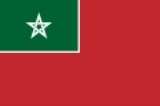
Spanish Morocco

Encyclopedia
The Spanish protectorate of Morocco was the area of Morocco
under colonial
rule by the Spanish Empire
, established by the Treaty of Fez
in 1912 and ending in 1956, when both France
and Spain
recognized Moroccan independence.
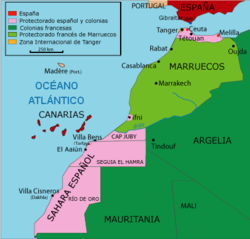 The territories of the Spanish protectorate of Morocco included northern Morocco (except Ceuta
and Melilla
, which have been Spanish since the 16th and 15th century, respectively), and the Cape Juby
or Tarfaya
Strip in the extreme South. On the contrary, the small territory of Ifni
, being of Spanish sovereignty
, was not a part of the Spanish protectorate.
The capital of Spanish protectorate of Morocco was Tetuán (Tétouan
).
The rest of the country was ruled by France, under the name of French Morocco
, also from 1912 to 1956.
The city of Tangier
was declared an international zone
, though this status was suspended during World War II when it was provisionally occupied by Spanish troops, from 14 June 1940, on the pretext that an Italian invasion was imminent.
The Republic of the Rif
led by the guerrilla leader Abd El-Krim was a breakaway state that existed in the Rif
region from 1921 to 1926, when it was dissolved by joint expedition of the Spanish Army of Africa
and French forces during the Rif War
.
had been Portuguese since 1415 before becoming Spanish in 1640. Melilla had been part of Spain since 1497, neither was included formally in the Protectorate, but were ruled with the same provisions as in the rest of the Spanish mainland territory. As for the plazas de soberanía
(Spanish name for various enclaves and islands on the northern Moroccan coast), they were gained in 16th–19th centuries, before the international agreements on the Protectorate.
s system was formally maintained.
The Moroccan Sephardi Jews
—many of them living in this part of the Maghreb
after being expelled from Spain and Portugal in 1492 and 1497 respectively after the end of the Reconquista
process—flourished in commerce, profiting from the similarity of Spanish
and Ladino language
and benefiting from the tax-exempt area in Tangier and a flourishing trading activity in the area.
The Spanish Civil War
started in 1936 with the uprising of the Spanish troops
stationed in
África (as the Protectorate was informally known in the Spanish military parlance) under the command of Francisco Franco
against the Republican Government. These troops became the core of the Nationalist Army, which also recruited a considerable number of Moroccan troops.
The communist parties, the Communist Party of Spain and Workers' Party of Marxist Unification (POUM
), advocated anti-colonialist policies whereby the Republican
Government would support the independence of Spanish Morocco, intending to create a rebellion in Franco's back and cause disaffection among his Moroccan troops. However, the Republican Government under the Spanish Socialist Workers' Party
(PSOE) rejected any such idea - which would have likely resulted in conflict with France, the colonial ruler of the other portion of Morocco.
Because the local Muslim
troops had been among Franco's earliest supporters, the protectorate enjoyed more political freedom than Franco-era Spain proper after Franco's victory, with competing political parties and a Moroccan nationalist press, criticizing the Spanish government.
In 1956, when French Morocco
became independent, Spain discontinued the Protectorate and surrendered the territory to the newly independent kingdom while retaining the plazas de soberanía, Ifni and other colonies outside Morocco, such as Spanish Sahara
.
Unwilling to accept this, the Moroccan Army of Liberation waged war against the Spanish forces and in the Ifni War
of 1958, spreading from Sidi Ifni
to Rio de Oro
, gained Tarfaya
. In 1969, Morocco obtained Ifni. Morocco claims Ceuta and Melilla as integral parts of the country, considering them to be under foreign occupation
, comparing their status to that of Gibraltar
.
Morocco
Morocco , officially the Kingdom of Morocco , is a country located in North Africa. It has a population of more than 32 million and an area of 710,850 km², and also primarily administers the disputed region of the Western Sahara...
under colonial
Colonialism
Colonialism is the establishment, maintenance, acquisition and expansion of colonies in one territory by people from another territory. It is a process whereby the metropole claims sovereignty over the colony and the social structure, government, and economics of the colony are changed by...
rule by the Spanish Empire
Spanish Empire
The Spanish Empire comprised territories and colonies administered directly by Spain in Europe, in America, Africa, Asia and Oceania. It originated during the Age of Exploration and was therefore one of the first global empires. At the time of Habsburgs, Spain reached the peak of its world power....
, established by the Treaty of Fez
Treaty of Fez
By the Treaty of Fez , signed March 30, 1912, Sultan Abdelhafid gave up the sovereignty of Morocco to the French, making the country a protectorate, resolving the Agadir Crisis of July 1, 1911....
in 1912 and ending in 1956, when both France
France
The French Republic , The French Republic , The French Republic , (commonly known as France , is a unitary semi-presidential republic in Western Europe with several overseas territories and islands located on other continents and in the Indian, Pacific, and Atlantic oceans. Metropolitan France...
and Spain
Spain
Spain , officially the Kingdom of Spain languages]] under the European Charter for Regional or Minority Languages. In each of these, Spain's official name is as follows:;;;;;;), is a country and member state of the European Union located in southwestern Europe on the Iberian Peninsula...
recognized Moroccan independence.
Territorial borders
Ceuta
Ceuta is an autonomous city of Spain and an exclave located on the north coast of North Africa surrounded by Morocco. Separated from the Iberian peninsula by the Strait of Gibraltar, Ceuta lies on the border of the Mediterranean Sea and the Atlantic Ocean. Ceuta along with the other Spanish...
and Melilla
Melilla
Melilla is a autonomous city of Spain and an exclave on the north coast of Morocco. Melilla, along with the Spanish exclave Ceuta, is one of the two Spanish territories located in mainland Africa...
, which have been Spanish since the 16th and 15th century, respectively), and the Cape Juby
Cape Juby
Cape Juby is a cape on the coast of southern Morocco, near the border with Western Sahara, directly east of the Canary Islands.Its surrounding area, called Cape Juby strip or Tarfaya strip, while making up presently the far South of Morocco, is in a way a semi-desertic buffer zone between Morocco...
or Tarfaya
Tarfaya
- References :CitationsBibliography* Didier Daurat, , France: Édition Dynamo, 1954....
Strip in the extreme South. On the contrary, the small territory of Ifni
Ifni
Ifni was a Spanish province on the Atlantic coast of Morocco, south of Agadir and across from the Canary Islands.It had a total area of 1,502 km² , and a population of 51,517 in 1964. The main industry was fishing....
, being of Spanish sovereignty
Sovereignty
Sovereignty is the quality of having supreme, independent authority over a geographic area, such as a territory. It can be found in a power to rule and make law that rests on a political fact for which no purely legal explanation can be provided...
, was not a part of the Spanish protectorate.
The capital of Spanish protectorate of Morocco was Tetuán (Tétouan
Tétouan
Tetouan is a city in northern Morocco. The Berber name means literally "the eyes" and figuratively "the water springs". Tetouan is one of the two major ports of Morocco on the Mediterranean Sea. It lies a few miles south of the Strait of Gibraltar, and about 40 mi E.S.E. of Tangier...
).
The rest of the country was ruled by France, under the name of French Morocco
French Morocco
French Protectorate of Morocco was a French protectorate in Morocco, established by the Treaty of Fez. French Morocco did not include the north of the country, which was a Spanish protectorate...
, also from 1912 to 1956.
The city of Tangier
Tangier
Tangier, also Tangiers is a city in northern Morocco with a population of about 700,000 . It lies on the North African coast at the western entrance to the Strait of Gibraltar where the Mediterranean meets the Atlantic Ocean off Cape Spartel...
was declared an international zone
International zone
An international zone is a type of extraterritoriality governed by international law, or similar treaty between two or more nations. They can be found within international airports and can contain duty free shopping. In areas of conflict there may be international zones called green zones that form...
, though this status was suspended during World War II when it was provisionally occupied by Spanish troops, from 14 June 1940, on the pretext that an Italian invasion was imminent.
The Republic of the Rif
Republic of the Rif
The Republic of the Rif , was created in September 1921, when the people of the Rif revolted and declared their independence from Spanish occupation as well as from the Moroccan sultan.Its capital city was Ajdir, its currency the Rif Republic Riffan, its national...
led by the guerrilla leader Abd El-Krim was a breakaway state that existed in the Rif
Rif
The Rif or Riff is a mainly mountainous region of northern Morocco, with some fertile plains, stretching from Cape Spartel and Tangier in the west to Ras Kebdana and the Melwiyya River in the east, and from the Mediterranean Sea in the north to the river of Wergha in the south.It is part of the...
region from 1921 to 1926, when it was dissolved by joint expedition of the Spanish Army of Africa
Spanish Army of Africa
The Army of Africa was a Spanish field army that garrisoned Spanish Morocco from the early 20th century until Morocco's independence in 1956....
and French forces during the Rif War
Rif War (1920)
The Rif War, also called the Second Moroccan War, was fought between Spain and the Moroccan Rif Berbers.-Rifian forces:...
.
Spanish enclaves in northern Morocco
CeutaCeuta
Ceuta is an autonomous city of Spain and an exclave located on the north coast of North Africa surrounded by Morocco. Separated from the Iberian peninsula by the Strait of Gibraltar, Ceuta lies on the border of the Mediterranean Sea and the Atlantic Ocean. Ceuta along with the other Spanish...
had been Portuguese since 1415 before becoming Spanish in 1640. Melilla had been part of Spain since 1497, neither was included formally in the Protectorate, but were ruled with the same provisions as in the rest of the Spanish mainland territory. As for the plazas de soberanía
Plazas de soberanía
The plazas de soberanía or sovereign territories, referred to in English as Spanish North Africa or simply Spanish Africa, are the current Spanish territories in continental North Africa bordering Morocco, except the autonomous cities of Ceuta and Melilla.After the Reconquista, forces of the...
(Spanish name for various enclaves and islands on the northern Moroccan coast), they were gained in 16th–19th centuries, before the international agreements on the Protectorate.
History
The Protectorate system was established in 1912. The legal Islamic qadiQadi
Qadi is a judge ruling in accordance with Islamic religious law appointed by the ruler of a Muslim country. Because Islam makes no distinction between religious and secular domains, qadis traditionally have jurisdiction over all legal matters involving Muslims...
s system was formally maintained.
The Moroccan Sephardi Jews
Jews
The Jews , also known as the Jewish people, are a nation and ethnoreligious group originating in the Israelites or Hebrews of the Ancient Near East. The Jewish ethnicity, nationality, and religion are strongly interrelated, as Judaism is the traditional faith of the Jewish nation...
—many of them living in this part of the Maghreb
Maghreb
The Maghreb is the region of Northwest Africa, west of Egypt. It includes five countries: Morocco, Algeria, Tunisia, Libya, and Mauritania and the disputed territory of Western Sahara...
after being expelled from Spain and Portugal in 1492 and 1497 respectively after the end of the Reconquista
Reconquista
The Reconquista was a period of almost 800 years in the Middle Ages during which several Christian kingdoms succeeded in retaking the Muslim-controlled areas of the Iberian Peninsula broadly known as Al-Andalus...
process—flourished in commerce, profiting from the similarity of Spanish
Spanish language
Spanish , also known as Castilian , is a Romance language in the Ibero-Romance group that evolved from several languages and dialects in central-northern Iberia around the 9th century and gradually spread with the expansion of the Kingdom of Castile into central and southern Iberia during the...
and Ladino language
Judaeo-Spanish
Judaeo-Spanish , in Israel commonly referred to as Ladino, and known locally as Judezmo, Djudeo-Espanyol, Djudezmo, Djudeo-Kasteyano, Spaniolit and other names, is a Romance language derived from Old Spanish...
and benefiting from the tax-exempt area in Tangier and a flourishing trading activity in the area.
The Spanish Civil War
Spanish Civil War
The Spanish Civil WarAlso known as The Crusade among Nationalists, the Fourth Carlist War among Carlists, and The Rebellion or Uprising among Republicans. was a major conflict fought in Spain from 17 July 1936 to 1 April 1939...
started in 1936 with the uprising of the Spanish troops
Spanish coup of July 1936
The Spanish coup of July 1936 marked the beginning of the Spanish Civil War. Following a period of troubles in the Second Spanish Republic, a group of officers attempted to overthrow the democratic government in a military coup. Planning started in early 1936, and the coup was launched on 17 and 18...
stationed in
África (as the Protectorate was informally known in the Spanish military parlance) under the command of Francisco Franco
Francisco Franco
Francisco Franco y Bahamonde was a Spanish general, dictator and head of state of Spain from October 1936 , and de facto regent of the nominally restored Kingdom of Spain from 1947 until his death in November, 1975...
against the Republican Government. These troops became the core of the Nationalist Army, which also recruited a considerable number of Moroccan troops.
The communist parties, the Communist Party of Spain and Workers' Party of Marxist Unification (POUM
Poum
Poum is a commune in the North Province of New Caledonia, an overseas territory of France in the Pacific Ocean. The town of Poum is located in the far northwest, located on the southern part of Banare Bay, with Mouac Island just offshore....
), advocated anti-colonialist policies whereby the Republican
Second Spanish Republic
The Second Spanish Republic was the government of Spain between April 14 1931, and its destruction by a military rebellion, led by General Francisco Franco....
Government would support the independence of Spanish Morocco, intending to create a rebellion in Franco's back and cause disaffection among his Moroccan troops. However, the Republican Government under the Spanish Socialist Workers' Party
Spanish Socialist Workers' Party
The Spanish Socialist Workers' Party is a social-democratic political party in Spain. Its political position is Centre-left. The PSOE is the former ruling party of Spain, until beaten in the elections of November 2011 and the second oldest, exceeded only by the Partido Carlista, founded in...
(PSOE) rejected any such idea - which would have likely resulted in conflict with France, the colonial ruler of the other portion of Morocco.
Because the local Muslim
Muslim
A Muslim, also spelled Moslem, is an adherent of Islam, a monotheistic, Abrahamic religion based on the Quran, which Muslims consider the verbatim word of God as revealed to prophet Muhammad. "Muslim" is the Arabic term for "submitter" .Muslims believe that God is one and incomparable...
troops had been among Franco's earliest supporters, the protectorate enjoyed more political freedom than Franco-era Spain proper after Franco's victory, with competing political parties and a Moroccan nationalist press, criticizing the Spanish government.
In 1956, when French Morocco
French Morocco
French Protectorate of Morocco was a French protectorate in Morocco, established by the Treaty of Fez. French Morocco did not include the north of the country, which was a Spanish protectorate...
became independent, Spain discontinued the Protectorate and surrendered the territory to the newly independent kingdom while retaining the plazas de soberanía, Ifni and other colonies outside Morocco, such as Spanish Sahara
Spanish Sahara
Spanish Sahara was the name used for the modern territory of Western Sahara when it was ruled as a territory by Spain between 1884 and 1975...
.
Unwilling to accept this, the Moroccan Army of Liberation waged war against the Spanish forces and in the Ifni War
Ifni War
The Ifni War, sometimes called the Forgotten War in Spain , was a series of armed incursions into Spanish West Africa by Moroccan insurgents and Sahrawi rebels that began in October 1957 and culminated with the abortive siege of Sidi Ifni.The war, which may be seen as part of the general movement...
of 1958, spreading from Sidi Ifni
Sidi Ifni
Sidi Ifni is a city located in southwest Morocco, on the shores of the Atlantic Ocean. It has a population of 20,000 people. The economic base of the city is fishing. It belongs to the Sous-Massa-Draa economic region and to the Sidi Ifni province. Its inhabitants are mainly Chleuhs from the Ait...
to Rio de Oro
Río de Oro
Río de Oro , is, with Saguia el-Hamra, one of the two territories that formed the Spanish province of Spanish Sahara after 1969; it was originally taken as a Spanish colonial possession in the late 19th century...
, gained Tarfaya
Tarfaya
- References :CitationsBibliography* Didier Daurat, , France: Édition Dynamo, 1954....
. In 1969, Morocco obtained Ifni. Morocco claims Ceuta and Melilla as integral parts of the country, considering them to be under foreign occupation
Military occupation
Military occupation occurs when the control and authority over a territory passes to a hostile army. The territory then becomes occupied territory.-Military occupation and the laws of war:...
, comparing their status to that of Gibraltar
Gibraltar
Gibraltar is a British overseas territory located on the southern end of the Iberian Peninsula at the entrance of the Mediterranean. A peninsula with an area of , it has a northern border with Andalusia, Spain. The Rock of Gibraltar is the major landmark of the region...
.
See also
- List of colonial heads of Spanish Morocco
- History of MoroccoHistory of MoroccoThe History of Morocco spans over 12 centuries, without considering the Classical antiquity. The country was first unified by the Idrisid dynasty in 780, representing the first Islamic state in Africa autonomous from the Arab Empire. Under the Almoravid dynasty and the Almohad dynasty, Morocco...
- History of SpainHistory of SpainThe history of Spain involves all the other peoples and nations within the Iberian peninsula formerly known as Hispania, and includes still today the nations of Andorra, Gibraltar, Portugal and Spain...
- List of Spanish colonial wars in Morocco
- Spanish LegionSpanish LegionThe Spanish Legion , formerly Spanish Foreign Legion, is an elite unit of the Spanish Army and Spain's Rapid Reaction Force. Founded as the Tercio de Extranjeros , it was originally intended as a Spanish equivalent of the French Foreign Legion, but in practice it recruited almost exclusively...
- RegularesRegularesThe Fuerzas Regulares Indígenas , known simply as the Regulares , were the volunteer infantry and cavalry units of the Spanish Army recruited in Spanish Morocco. They consisted of Moroccans officered by Spaniards...
- Spanish GuineaSpanish GuineaSpanish Guinea was an African colony of Spain that became the independent nation of Equatorial Guinea.-History:The Portuguese explorer, Fernão do Pó, seeking a route to India, is credited with having discovered the island of Bioko in 1472. He called it Formosa , but it quickly took on the name of...
- Ahmed Belbachir HaskouriAhmed Belbachir HaskouriAhmed Belbachir Haskouri was a prominent member of the royal court of Morocco during the protectorate period. His name was also transliterated as Si Hamed Ben Baxir Escuri or Escurri, Sidi Ahmed Bel Bashir Haskouri, Ahmer Ben Bazir Hasqouri, Ahamad Benbachir Scouri, Sid Ahmed Ben El Bachil Scuri,...
- French protectorate of Morocco
Further reading
- "Min Khalifa Marrakesh Ila Mu’tamar Maghreb El Arabi." (From the caliph of the king of Morocco to the Conference of the Maghreb). (1947, April). El Ahram.
- Wolf, Jean (1994). Les Secrets du Maroc Espagnol: L’epopee D’Abdelkhalaq Torres. Morocco: Balland Publishing Company
- Ben Brahim, Mohammed (1949). Ilayka Ya Ni Ma Sadiq (To you my dear friend). Tetuan, Morocco: Hassania Publishing Company
- Benumaya, Gil (1940). El Jalifa en Tanger. Madrid: Instituto Jalifiano de Tetuan