
All Topics  
Akhenaten

 
Akhenaten

   Email Print
   Bookmark   Link


Akhenaten


Akhenaten (often also spelled Echnaton, Akhnaton, or rarely Ikhnaton) (In English, his royal name Amenhotep in English is meaning Effective spirit of Aten
Aten

Aten was the disk of the sun in ancient Egyptian mythology, and originally an aspect of Ra. He became the deity of the monotheism ? in fact, monism ? religion Atenism of Amenhotep IV, who took the name Akhenaten....
, first known as Amenhotep IV (sometimes read as Amenophis IV and meaning Amun
Amun

Amun, reconstructed Egyptian language Yamanu , was the name of a deity in Egyptian mythology who gradually rose from being an abstract concept to the patron deity of Thebes, Egypt and one of the most important deities in Ancient Egypt before fading into obscurity....
 is Satisfied
) before the first year of his reign), was a Pharaoh
Pharaoh

Pharaoh is a title used in many modern discussions of the ancient Egyptian rulers of all periods. In antiquity this title began to be used for the ruler who was the religious and political leader of united ancient Egypt, only during the New Kingdom, specifically, during the middle of the Eighteenth dynasty of Egypt....
 of the Eighteenth dynasty of Egypt
Eighteenth dynasty of Egypt

The Eighteenth Dynasty is perhaps the best known of all the dynasties of ancient Egypt. As well as a number of Egypt's most powerful pharaohs, it included Tutankhamun, whose tomb, uncovered by Howard Carter in 1922, was one of the greatest of all archaeological discoveries, being completely undisturbed by tomb robbers....
, who died 1336 BC or 1334 BC. He is especially noted for attempting to compel the Egyptian population in the monotheistic
Monotheism

In theology, monotheism is the belief that only one god exists. The concept of "monotheism" tends to be dominated by the concept of God in the Abrahamic religions, such as Judaism, Christianity and Islam, and the Neoplatonism concept of God as put forward by Pseudo-Dionysius the Areopagite....
 worship of Aten
Aten

Aten was the disk of the sun in ancient Egyptian mythology, and originally an aspect of Ra. He became the deity of the monotheism ? in fact, monism ? religion Atenism of Amenhotep IV, who took the name Akhenaten....
, although there are doubts as to how successful he was at this.


Discussion
Ask a question about 'Akhenaten'
Start a new discussion about 'Akhenaten'
Answer questions from other users
Full Discussion Forum


Encyclopedia


Akhenaten (often also spelled Echnaton, Akhnaton, or rarely Ikhnaton) (In English, his royal name Amenhotep in English is meaning Effective spirit of Aten
Aten

Aten was the disk of the sun in ancient Egyptian mythology, and originally an aspect of Ra. He became the deity of the monotheism ? in fact, monism ? religion Atenism of Amenhotep IV, who took the name Akhenaten....
, first known as Amenhotep IV (sometimes read as Amenophis IV and meaning Amun
Amun

Amun, reconstructed Egyptian language Yamanu , was the name of a deity in Egyptian mythology who gradually rose from being an abstract concept to the patron deity of Thebes, Egypt and one of the most important deities in Ancient Egypt before fading into obscurity....
 is Satisfied
) before the first year of his reign), was a Pharaoh
Pharaoh

Pharaoh is a title used in many modern discussions of the ancient Egyptian rulers of all periods. In antiquity this title began to be used for the ruler who was the religious and political leader of united ancient Egypt, only during the New Kingdom, specifically, during the middle of the Eighteenth dynasty of Egypt....
 of the Eighteenth dynasty of Egypt
Eighteenth dynasty of Egypt

The Eighteenth Dynasty is perhaps the best known of all the dynasties of ancient Egypt. As well as a number of Egypt's most powerful pharaohs, it included Tutankhamun, whose tomb, uncovered by Howard Carter in 1922, was one of the greatest of all archaeological discoveries, being completely undisturbed by tomb robbers....
, who died 1336 BC or 1334 BC. He is especially noted for attempting to compel the Egyptian population in the monotheistic
Monotheism

In theology, monotheism is the belief that only one god exists. The concept of "monotheism" tends to be dominated by the concept of God in the Abrahamic religions, such as Judaism, Christianity and Islam, and the Neoplatonism concept of God as put forward by Pseudo-Dionysius the Areopagite....
 worship of Aten
Aten

Aten was the disk of the sun in ancient Egyptian mythology, and originally an aspect of Ra. He became the deity of the monotheism ? in fact, monism ? religion Atenism of Amenhotep IV, who took the name Akhenaten....
, although there are doubts as to how successful he was at this. He was born to Amenhotep III
Amenhotep III

Amenhotep III was the ninth pharaoh of the Eighteenth dynasty of Egypt. According to different authors, he ruled Egypt from June 1391 BC-December 1353 BC or June 1388 BC to December 1351 BC/1350 BC after his father Thutmose IV died....
 and his Chief Queen Tiye
Tiye

File:Memnon 082005 06.jpgTiye was the daughter of Yuya and Tjuyu . She became the Great Royal Wife of the Ancient Egypt pharaoh Amenhotep III and matriarch of the Amarna family from which many members of the royal family of Ancient Egypt were born....
 and was their younger son. Akhenaten was not originally designated as the successor to the throne until the untimely death of his older brother, the Crown Prince Thutmose.

Amenhotep IV succeeded his father after Amenhotep III's death at the end of his 38-year reign, possibly after a short coregency lasting between either 1 to 2 years. Suggested dates for Akhenaten's reign (subject to the debates surrounding Egyptian chronology
Egyptian chronology

The creation of a reliable Chronology of Ancient Egypt is a task fraught with problems. While the overwhelming majority of Egyptologists agree on the outline and many of the details of a common chronology, disagreements either individually or in groups have resulted in a variety of dates offered for rulers and events....
) are from 1353 BC-1336 BC or 1351 BC–1334 BC. Akhenaten's chief wife was Nefertiti
Nefertiti

Nefertiti was the Great Royal Wife of the Egyptian Pharaoh Akhenaten. Nefertiti and her husband were known for changing Egypt's religion from a polytheistic religion to a monotheistic religion....
, made world-famous by the discovery of her exquisitely moulded and painted bust
Bust (sculpture)

A bust is a sculpture or cast representation of the upper part of the human figure, depicting a person's head and neck, as well as a variable portion of the chest and shoulders....
, now displayed in the Altes Museum
Altes Museum

The Altes Museum , is one of several internationally renowned museums on Berlin's Museum Island in Berlin, Germany. Since restoration work in 1966, it houses the antique collection of the Berlin State Museums....
 of Berlin
Berlin

Berlin is the Capital of Germany city and one of sixteen States of Germany of Germany. With a population of 3.4 million within its city limits, Berlin is the country's largest city....
, and among the most recognised works of art surviving from the ancient world.

After his death and the restoration of traditional religious practice, he and his immediate successors were ignored and excised from history by later rulers. Akhenaten himself is usually referred to as 'the enemy'.

Pharaoh and family depictions

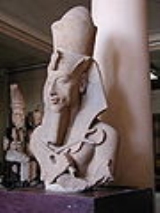
Styles of art that flourished during this short period are markedly different from other Egyptian art, bearing a variety of affectations, from elongated heads to protruding stomachs, exaggerated ugliness and the beauty of Nefertiti. Significantly, and for the only time in the history of Egyptian royal art, Akhenaten's family was depicted in a decidedly naturalistic manner, and they are clearly shown displaying affection for each other. Nefertiti also appears beside the king in actions usually reserved for a Pharaoh, suggesting that she attained unusual power for a queen. Artistic representations of Akhenaten give him a strikingly bizarre appearance, with an elongated face, slender limbs, a protruding belly, wide hips, and an overall pear-shaped body. It has been suggested that the pharaoh had himself depicted in this way for religious reasons, or that it exaggerates his distinctive physical traits. Until Akhenaten's mummy is located and identified, such theories remain speculative. Some scholars have identified Valley of the Kings' Mummy 61074 as Akhenaten's mummy.

Following Akhenaten's death, a comprehensive political, religious and artistic reformation returned Egyptian life to the norms it had followed previously during his father's reign. Much of the art and building infrastructure that was created during Akhenaten's reign was defaced or destroyed in the period immediately following his death. Stone building blocks from his construction projects were later used as foundation stones for subsequent rulers' temples and tombs.

Family and relations


See also: Eighteenth dynasty of Egypt Family Tree


Amenhotep IV was married to Nefertiti at the very beginning of his reign, and the couple had six known daughters and possibly two sons (the sons with his other wife Kiya
Kiya

Kiya was a wife of Egyptian Pharaoh Akhenaten. Little is known about her, and her actions and roles are poorly documented in the historical record in contrast to Akhenaten's first royal wife, Nefertiti....
). This is a list with suggested years of birth:

  • Smenkhkare
    Smenkhkare

    Smenkhkare is an ephemeral Pharaoh of the late Eighteenth dynasty of Egypt of whom very little is know for certain. Traditionally he is seen as Akhenaten's co-regent and immediate successor and predecessor of Tutankhamun and is assumed to be a close, male relative of those two kings ....
    ?– year 35 or 36 of Amenhotep III's reign (though not of Nefertiti)
  • Meritaten
    Meritaten

    Meritaten also spelled Merytaten or Meryetaten was an Ancient Egypt queen of the 18th dynasty, who held the position of Great Royal Wife to Pharaoh Smenkhkare, who may have been a brother or son of Akhenaten....
     – year 1.
  • Meketaten
    Meketaten

    Meketaten was the second daughter of six born to the Egyptian Pharaoh Akhenaten and his Great Royal Wife Nefertiti. She was probably born in year 2 or 3 Akhenaten's reign....
     – year 3, possibly earlier.
  • Ankhesenpaaten
    Ankhesenpaaten

    Born as Ankhesenpaaten, and later renamed, Ankhesenamen, which means. She who lives through the Amun, was the third of six known daughters of the Egyptian Pharaoh Akhenaten and his Great Royal Wife Nefertiti....
    , later Queen of Tutankhamun
    Tutankhamun

    Tutankhamun , Egyptian language was an Ancient Egypt Pharaoh of the Eighteenth dynasty of Egypt , during the period of History of Egypt known as the New Kingdom....
     – year 4.
  • Neferneferuaten Tasherit
    Neferneferuaten Tasherit

    Neferneferuaten Tasherit or Neferneferuaten junior was an Ancient Egyptian princess of the 18th dynasty and the fourth daughter of Pharaoh Akhenaten and his Great Royal Wife Nefertiti....
     – year 8.
  • Neferneferure
    Neferneferure

    Neferneferur? was an Ancient Egyptian princess of the 18th dynasty. She was the fifth of six known daughters of Pharaoh Akhenaten and Great Royal Wife Nefertiti....
     – year 9.
  • Setepenre
    Setepenre

    Setepenre is an often-used title of Egyptian kings , meaning "Elect of Ra".Setepenre also was the name of the sixth and last daughter of Akhenaten and Nefertiti....
     – year 9.
  • Tutankhaten–year 8 or 9 – renamed himself Tutankhamun later.


His known consorts were:

  • Nefertiti
    Nefertiti

    Nefertiti was the Great Royal Wife of the Egyptian Pharaoh Akhenaten. Nefertiti and her husband were known for changing Egypt's religion from a polytheistic religion to a monotheistic religion....
    , his Great Royal Wife
    Great Royal Wife

    File:Ah hotep.jpgGreat Royal Wife or Chief King's Wife is the term used to refer to the chief wife of a male pharaoh of Ancient Egypt on the day of his coronation, as her status in the royal lineage was essential to gaining the position of pharaoh....
     early in his reign.
  • Kiya
    Kiya

    Kiya was a wife of Egyptian Pharaoh Akhenaten. Little is known about her, and her actions and roles are poorly documented in the historical record in contrast to Akhenaten's first royal wife, Nefertiti....
    , a lesser Royal Wife.


Also suggested as his consorts were his daughters:

  • Meritaten, recorded as Great Royal Wife late in his reign, though it is more likely that she got this title due to her marriage to Smenkhkare, Akhenaten's co-regent;
  • Meketaten, Akhenaten's second daughter. The reason for this assumption is Meketaten's death due to childbirth in the fourteenth year of Akhenaten's reign.
  • Ankhesenpaaten, his third daughter. After his death, Ankhesenpaaten married Akhenaten's successor Tutankhamun.


Both Meritaten and Ankhesenpaaten apparently had children – Meritaten-ta-sherit and Ankhesenpaaten-ta-sherit, respectively –, but there are doubts not only regarding their parentage but their existence as well. Both appear only in texts which had belonged to Kiya, and were usurped by the princesses later, and it was suggested that they might have been the daughters of Kiya, or were fictional, replacing Kiya's daughter in those scenes.

Two other lovers have been suggested, but are not widely accepted:

  • Smenkhkare, Akhenaten's successor and/or co-ruler for the last years of his reign. Rather than a lover, however, Smenkhkare is likely to have been a half-brother or a son to Akhenaten. Some have even suggested that Smenkhkare was actually an alias of Nefertiti or Kiya, and therefore one of Akhenaten's wives (see below).
  • Tiye, his mother. Twelve years after the death of Amenhotep III, she is still mentioned in inscriptions as Queen and beloved of the King. It has been suggested that Akhenaten and his mother acted as consorts to each other until her death. This would have been considered incest
    Incest

    Incest refers to any sexual activity between closely related persons that is illegal or socially taboo. The type of sexual activity and the nature of the relationship between persons that constitutes a breach of law or social taboo vary with culture and jurisdiction....
     at the time. Supporters of this theory (notably Immanuel Velikovsky
    Immanuel Velikovsky

    Immanuel Velikovsky was a Russian-born American independent scholar, best known as the author of a number of controversial books reinterpreting the events of ancient history, in particular the US bestseller Worlds in Collision, published in 1950....
    ) consider Akhenaten to be the historical model of legendary King Oedipus
    Oedipus

    Oedipus was a Greek mythology monarch of Thebes, Greece. He fulfilled a prophecy that said he would kill his father and marry his mother, and thus brought disaster on his city and family....
     of Thebes
    Thebes, Greece

    Thebes is a city in Greece, situated to the north of the Cithaeron range, which divides Boeotia from Attica, Greece, and on the southern edge of the Boeotian plain....
    , Greece
    Greece

    Greece , officially the Hellenic Republic , is a country in southeastern Europe, situated on the southern end of the Balkans. It has borders with Albania, Bulgaria and the former Yugoslav Republic of Macedonia to the north, and Turkey to the east....
     and Tiye the model for his mother/wife Jocasta
    Jocasta

    In Greek mythology, Jocasta, also known as Jocaste , Epikast?, or Iokast? was a daughter of Menoeceus and Queen consort of Thebes, Greece....
    .


Akhenaten's international relations

Important evidence about Akhenaten's reign and foreign policy has been provided by the discovery of the Amarna Letters
Amarna letters

The Amarna letters are an archive of correspondence on clay tablets, mostly diplomatic, between the Ancient Egypt administration and its representatives in Canaan and Amurru during the New Kingdom....
, a cache of diplomatic correspondence discovered in modern times at el-Amarna, the modern designation of the Akhetaten site. This correspondence comprises a priceless collection of incoming messages on clay tablets, sent to Akhetaten from various subject rulers through Egyptian military outposts, and from the foreign rulers (recognized as "Great Kings") of Mitanni, Babylon, Assyria and Hatti. The governors and kings of Egypt's subject domains also wrote frequently to plead for gold
Gold

Gold is a chemical element with the symbol Au and atomic number 79. It is a highly sought-after precious metal, having been used as money, as a store of value, in jewelry, in sculpture, and for ornamentation since the beginning of recorded history....
 from Pharaoh, and also complained of being snubbed and cheated by him.

Early on in his reign, Akhenaten fell out with the king of Mitanni
Mitanni

Mitanni or Hanigalbat was a loosely organized Hurrian-speaking Hittite vassal state in northern Syria from ca. 1500 BC-1300 BC."The Assyrians called the lands of Mitanni Hanigalbat while to the Hittites it was the land of the Hurrians....
, Tushratta
Tushratta

Tushratta was a king of Mitanni at the end of the reign of Amenhotep III and throughout the reign of Akhenaten -- approximately the late 14th century BC....
, who had been courting favor with his father against the Hittites. Tushratta complains in numerous letters that Akhenaten had sent him gold plated statues rather than statues made of solid gold; the statues formed part of the bride price which Tushratta received for letting his daughter Tadukhepa be married to Amenhotep III and then Akhenaten. Amarna letter EA 27 preserves a complaint by Tushratta to Akhenaten about the situation:

"I...asked your father, Mimmureya
Amenhotep III

Amenhotep III was the ninth pharaoh of the Eighteenth dynasty of Egypt. According to different authors, he ruled Egypt from June 1391 BC-December 1353 BC or June 1388 BC to December 1351 BC/1350 BC after his father Thutmose IV died....
, for statues of solid cast gold, one of myself and a second statue, a statue of Tadu-Heba (Tadukhepa), my daughter, and your father said, "Don't talk of giving statues just of solid cast gold. I will give you ones made also of lapis lazuli. I will give you, too, along with the statues, much additional gold and (other) goods beyond measure." Every one of my messengers that were staying in Egypt saw the gold for the statues with their own eyes. Your father himself recast the statues [i]n the presence of my messengers, and he made them entirely of pure gold....He showed much additional gold, which was beyond measure and which he was sending to me. He said to my messengers, "See with your own eyes, here the statues, there much gold and goods beyond measure, which I am sending to my brother." And my messengers did see with their own eyes! But my brother (ie: Akhenaten) has not sent the solid (gold) statues that your father was going to send. You have sent plated ones of wood. Nor have you sent me the goods that your father was going to send me, but you have reduced (them) greatly. Yet there is nothing I know of in which I have failed my brother. Any day that I hear the greetings of my brother, that day I make a festive occasion...May my brother send me much gold. [At] the kim[ru fe]ast...[...with] many goods [may my] brother honor me. In my brother's country gold is as plentiful as dust. May my brother cause me no distress. May he send me much gold in order that my brother [with the gold and m]any [good]s, may honor me."(EA 27)


While Akhenaten was certainly not a close friend of Tushratta, he was evidently concerned at the expanding power of the Hittite
Hittites

The Hittites were an ancient Anatolian people who spoke a Hittite language of the Anatolian languages of the Indo-European languages family, and established a kingdom centered at Hattusa in north-central Anatolia ca....
 Empire under its powerful ruler Suppiluliuma I. A successful Hittite attack on Mitanni and its ruler Tushratta would have disrupted the entire international balance of power in the Ancient Middle East at a time when Egypt had made peace with Mitanni; this would cause some of Egypt's vassals to switch their allegiances to the Hittites, as time would prove. A group of Egypt's allies who attempted to rebel against the Hittites were captured, and wrote letters begging Akhenaten for troops, but he did not respond to most of their pleas. Evidence suggests that the troubles on the northern frontier led to difficulties in Canaan
Canaan

Canaan is an ancient term for a region encompassing modern-day Israel and Lebanon, the Palestinian Territories, plus adjoining coastal lands and parts of Jordan, Syria and northeastern Egypt....
, particularly in a struggle for power between Labaya
Labaya

Labaya was a Canaanite warlord who lived contemporaneously with Pharaoh Akhenaten . Labaya is mentioned in several of the Amarna Letters , which is practically all we know about him....
 of Shechem
Shechem

Shechem was Canaanite city mentioned in the Amarna letters, and later became an Israelite city in the tribe of Manasseh. It was the first capital of the Kingdom of Israel....
 and Abdi-Heba
Abdi-Heba

Abdi-Heba was king of Jerusalem during the Amarna period . Abdi-Heba's name can be translated as "servant of Hebat", a Hurrian goddess. Some scholars believe the correct reading is Ebed-Nob....
 of Jerusalem
Jerusalem

Jerusalem is the capital of Israel and its List of Israeli cities in both population and area, with a population of 747,600 residents over an area of if Positions on Jerusalem East Jerusalem is included....
, which required the Pharaoh to intervene in the area by dispatching Medjay
Medjay

The Medjay –from mDA, represents the name Ancient Egyptians gave to a region in northern Sudan–where an ancient people of Nubia inhabited....
 troops northwards. Akhenaten pointedly refused to save his vassal Rib-Hadda
Rib-Hadda

Rib-Hadda was king of Byblos during the mid fourteenth century BCE. He is the author of some sixty of the Amarna letters all to Akhenaten. His name is Akkadian language in form and may invoke the West Semitic god Hadad, though his letters invoke only Ba'alat Gubla, the "Lady of Byblos" ....
 of Byblos
Byblos

Byblos is the Greek language name of the Phoenician city Gebal . It is a Mediterranean city in the Mount Lebanon Governorate of present-day Lebanon under the current Arabic language name of Jbeil and was also referred to as Gibelet during the Crusades....
 whose kingdom was being besieged by the expanding state of Amurru
Amurru

Amurru are names given in Akkadian language and Sumerian language texts to the god of the Amorite/Amurru people, often forming part of personal names....
 under Abdi-Ashirta
Abdi-Ashirta

Abdi-Ashirta was the ruler of Amurru, a new kingdom in southern Syria subject to nominal Egyptian control, that was in conflict with King Rib-Hadda of Byblos....
 and later Aziru
Aziru

Aziru was the Canaanite ruler of Amurru, modern Lebanon, in the 14th century BC. He was the son of Abdi-Ashirta, the previous Egyptian vassal of Amurru and a direct contemporary of Akhenaten....
, son of Abdi-Ashirta, despite Rib-Hadda's numerous pleas for help from the pharaoh. Rib-Hadda wrote a total of 60 letters to Akhenaten pleading for aid from the pharaoh. Akhenaten wearied of Rib-Hadda's constant correspondences and once told Rib-Hadda: "You are the one that writes to me more than all the (other) mayors" or Egyptian vassals in EA 124. What Rib-Hadda did not comprehend was that the Egyptian king would not organize and dispatch an entire army north just to preserve the political status quo of several minor city states on the fringes of Egypt's Asiatic Empire. Rib-Hadda would pay the ultimate price; his exile from Byblos due to a coup led by his brother Ilirabih
Ili-Rapih

Ili-Rapih was the follow-on mayor in Byblos-, and the brother of Rib-Hadda, the former mayor of Gubla, ; Ili-Rapih is in the 1350-1335 BC Amarna letters Text corpus, and wrote 2 follow-on letters to the Pharaoh after the death of Rib-Haddi....
 is mentioned in one letter. When Rib-Hadda appealed in vain for aid to Akhenaten and then turned to Aziru, his sworn enemy to place him back on the throne of his city, Aziru promptly had him dispatched to the king of Sidon where Rib-Hadda was almost certainly executed.

William L. Moran
William L. Moran

William Lambert Moran was an United States Assyriology. He was born in Chicago, United States.In 1939, Moran joined the Jesuit order. He then attended Loyola University Chicago in Chicago, where he received his B.A....
 notes that the Amarna corpus of 380+ letters counters the conventional view that Akhenaten neglected Egypt's foreign territories in favour of his internal reforms. There are several letters from Egyptian vassals notifying Pharaoh that the king's instructions have been followed:

To the king, my lord, my god, my Sun, the Sun from the sky: Message of Yapahu, the ruler of Gazru
Gezer

Gezer was a town in ancient History of ancient Israel and Judah. Scholars believe that Gezer is Tel Gezer , a site around midway on the route between Jerusalem and Tel Aviv....
, your servant, the dirt at your feet. I indeed prostrate myself at the feet of the king, my lord, my god, my Sun...7 times and 7 times, on the stomach and on the back. I am indeed guarding the place of the king, my lord, the Sun of the sky, where I am, and all the things the king, my lord, has written me, I am indeed carrying out--everything! Who am I, a dog, and what is my house...and what is anything I have, that the orders of the king, my lord, the Sun from the sky, should not obey constantly? (EA 378)


When the loyal but unfortunate Rib-Hadda was killed at the instigation of Aziru, Akhenaten sent an angry letter to Aziru containing a barely veiled accusation of outright treachery on the latter's part. Akhenaten wrote:

Say to Aziru, ruler of Amurru: Thus the king, your lord (ie: Akhenaten), saying: The ruler of Gubla (ie: Byblos), whose brother had cast him away at the gate, said to you, "Take me and get me into the city. There is much silver, and I will give it to you. Indeed there is an abundance of everything, but not with me [here]." Thus did the ruler (Rib-Hadda) speak to you. Did you not write to the king, my lord saying, "I am your servant like all the previous mayors (ie: vassals) in his city"? Yet you acted delinquently by taking the mayor whose brother had cast him away at the gate, from his city.
He (Rib-Hadda) was residing in Sidon
Sidon

Sidon,or Sa?da, is the third-largest city in Lebanon. It is located in the South Governorate, Lebanon of Lebanon, on the Mediterranean Sea coast, about 40 km north of Tyre, Lebanon and 40 km south of the capital Beirut....
 and, following your own judgment, you gave him to (some) mayors. Were you ignorant of the treacherousness of the men? If you really are the king's servant, why did you not denounce him before the king, your lord, saying, "This mayor has written to me saying, 'Take me to yourself and get me into my city'"? And if you did act loyally, still all the things you wrote were not true. In fact, the king has reflected on them as follows, "Everything you have said is not friendly."

Now the king has heard as follows, "You are at peace with the ruler of Qidsa. (Kadesh
Kadesh

This article is about Kadesh in the lands of the Amurru, bordering on Damascus Syria up to Hammath; see also Kadesh orKedesh Kadesh was an Cities of the Ancient Near East of the Levant, located on or near the headwaters or ford of the Orontes River It is surmised by Kenneth Kitchen to be the ruins at Tell Nebi Mend, about south...
) The two of you take food and strong drink together." And it is true. Why do you act so? Why are you at peace with a ruler whom the king is fighting? And even if you did act loyally, you considered your own judgment, and his judgment did not count. You have paid no attention to the things that you did earlier. What happened to you among them that you are not on the side of the king, your lord? Consider the people that are training you for their own advantage. They want to throw you into the fire....If for any reason whatsoever you prefer to do evil, and if you plot evil, treacherous things, then you, together with your entire family, shall die by the axe of the king. So perform your service for the king, your lord, and you will live. You yourself know that the king does not fail when he rages against all of Canaan. And when you wrote saying, 'May the king, my Lord, give me leave this year, and then I will go next year to the king, my Lord. (ie: to Egypt) If this is impossible, I will send my son in my place'--the king, your Lord, let you off this year in accordance with what you said. Come yourself, or send your son [now], and you will see the king at whose sight all lands live."(EA 162)


This letter shows that Akhenaten paid close attention to the affairs of his vassals in Canaan and Syria. Akhenaten commanded Aziru to come to Egypt and proceeded to detain him there for at least one year. In the end, Akhenaten was forced to release Aziru back to his homeland when the Hittites advanced southwards into Amki
Amqu

The Amqu is a region , equivalent to the "Beqaa Valley region", named in the 1350 BC-1335 BC Amarna letters Text corpus.In the Amarna letters, two other associated regions appear to be east and north , and are often mentioned in association with Amqu, namely Nuha??e, and Niya -Niye ....
 thereby threatening Egypt's series of Asiatic vassal states including Amurru. Sometime after his return to Amurru, Aziru defected to the Hittite side with his kingdom. While it is known from an Amarna letter by Rib-Hadda that the Hittites "seized all the countries that were vassals of the king of Mitanni"(EA 75) Akhenaten managed to preserve Egypt's control over the core of her Near Eastern Empire which consisted of present day Palestine as well as the Phoenician coast while avoiding conflict with the increasingly powerful Hittite Empire of Suppiluliuma I
Suppiluliuma I

Suppiluliuma I was king of the Hittites . He achieved fame as a great warrior and statesman, successfully challenging the then-dominant New Kingdom for control of the lands between the Mediterranean and the Euphrates....
. Only the Egyptian border province of Amurru in Syria around the Orontes river was permanently lost to the Hittites when its ruler Aziru defected to the Hittites. Finally, contrary to the conventional view of a ruler who neglected Egypt's international relations, Akhenaten is known to have initiated at least one campaign into Nubia in his regnal Year 12, where his campaign is mentioned in Amada stela CG 41806 and on a separate companion stela at Buhen
Buhen

Buhen was an ancient Egyptian settlement situated below the Cataracts of the Nile. It is well known for its fortress, probably constructed during the rule of Senusret III, around the year 1860 BC ....
.

Death, burial and succession

The last dated appearance of Akhenaten and the Amarna family is in the tomb of Meryre II
Tomb of Meryra II

The tomb of the Ancient Egyptian noble Meryre II, known as Amarna Tomb 2, is located in the northern side of the wadi that splits the cluster of tombs known collectively as the Tombs of the Nobles #Northern tombs, near to the city of Amarna, in Egypt....
, and dates from second month, year 12 of his reign. After this the historical record is unclear, and only with the succession of Tutankhamun
Tutankhamun

Tutankhamun , Egyptian language was an Ancient Egypt Pharaoh of the Eighteenth dynasty of Egypt , during the period of History of Egypt known as the New Kingdom....
 is it somewhat clarified.

Akhenaten planned to relocate Egyptian burials on the East side of the Nile (sunrise) rather than on the West side (sunset), in the Royal Wadi
Royal Wadi and tombs

The Royal Wadi at Amarna is a where the Royal Family of Amarna were to be buried. It can be thought of as being an Amarna replacement for the Valley of the Kings....
 in Akhetaten. His body was probably removed after the court returned to Thebes
Thebes, Egypt

Thebes was a city in Ancient Egypt located about 800 km south of the Mediterranean, on the east bank of the river Nile . It was the capital of Waset, the fourth Upper Egyptian Nome ....
, and reburied somewhere in the Valley of the Kings--perhaps in tomb KV55
KV55

KV55 is a tomb in the Valley of the Kings , it was discovered by Edward R. Ayrton in 1907 while he was working in the Valley for Theodore M. Davis....
 which contained numerous Amarna era objects including a royal funerary mask which had been deliberately destroyed. His sarcophagus was destroyed but has since been reconstructed and now sits outside in the Cairo Museum.

There is much controversy around whether Amenhotep IV succeeded to the throne on the death of his father, Amenhotep III, or whether there was a coregency (lasting as long as 12 years according to some Egyptologists). Current literature by Eric Cline, Nicholas Reeves, Peter Dorman
Peter Dorman

Peter Fitzgerald Dorman is an epigraphist, philologist, and cultural anthropologist. He currently serves as the 15th President of the American University of Beirut ....
 and other scholars comes out strongly against the establishment of a long coregency between the 2 rulers and in favour of either no coregency or a brief one lasting 1 to 2 years, at the most. Other literature by Donald Redford, William Murnane, Alan Gardiner
Alan Gardiner

Sir Alan Henderson Gardiner was one of the premier United Kingdom Egyptologists of the early and mid-20th century. Some of his most important publications include a 1959 book on his study of "The Royal Canon of Turin" and his seminal 1961 work Egypt of the Pharaohs, which covered all aspects of Egyptian chronology and history at the time...
 and more recently by Lawrence Berman in 1998 contests the view of any coregency whatsoever between Akhenaten and his father.

Similarly, although it is accepted that Akhenaten himself died in Year 17 of his reign, the question of whether Smenkhkare became co-regent perhaps 2 or 3 years earlier or enjoyed a brief independent reign is unclear. If Smenkhkare outlived Akhenaten, and became sole Pharaoh, he likely ruled Egypt for less than a year. The next successor was Neferneferuaten
Neferneferuaten

Ankhkheperure Neferneferuaten was a woman who reigned as pharaoh toward the end of the Amarna era during the Eighteenth dynasty of Egypt. The royal succession of this period is very unclear....
, a female Pharaoh who reigned in Egypt for 2 years and 1 month. She was, in turn, probably succeeded by Tutankhaten (later, Tutankhamun), with the country being administered by the chief vizier
Vizier (Ancient Egypt)

The vizier was the highest official in Ancient Egypt to serve the king, or pharaoh during the Old, Middle, and New Kingdoms. Vizier is the generally accepted rendering of ancient Egyptian tjati, tjaty etc, among Egyptologists....
, and future Pharaoh, Ay
Ay

Ay was the penultimate Pharaoh of Ancient Egypt's Eighteenth dynasty of Egypt. He held the throne of Egypt for a brief four-year period , although he was a close advisor to two and perhaps three of the pharaohs who ruled before him and was the power behind the throne during Tutankhamun's reign....
. Tutankhamun is believed to be a younger brother of Smenkhkare and a son of Akhenaten, and possibly Kiya although one scholar has suggested that Tutankhamun may have been a son of Smenkhkare instead. It has also been suggested that after the death of Akhenaten, Nefertiti reigned with the name of Neferneferuaten but other scholars believe that this female ruler was rather Meritaten. The so-called Coregency Stela
Coregency Stela

The Coregency Stela is the name given to seven limestone stela-fragments which were found in a tomb at Amarna. The stela dates from the late Eighteenth dynasty of Egypt and shows the figures of Akhenaten, Nefertiti, and Meritaten....
, found in a tomb in Amarna
Amarna

The site of Amarna is located on the east bank of the Nile River in the modern Egyptian province of Minya Governorate, some 58 km south of the city of al-Minya, 312 km south of the Egyptian capital Cairo and 402 km north of Luxor....
 possibly shows his queen Nefertiti
Nefertiti

Nefertiti was the Great Royal Wife of the Egyptian Pharaoh Akhenaten. Nefertiti and her husband were known for changing Egypt's religion from a polytheistic religion to a monotheistic religion....
 as his coregent, ruling alongside him, but this is not certain as the names have been removed and recarved to show Ankhesenpaaten and Neferneferuaten.

With Akhenaten's death, the Aten cult he had founded gradually fell out of favor. Tutankhaten changed his name to Tutankhamun in Year 2 of his reign (1332 BC) and abandoned the city of Akhetaten, which eventually fell into ruin. His successors Ay and Horemheb
Horemheb

Horemheb was the last Pharaoh of the Eighteenth dynasty of Egypt from 1319 BC to late 1292 BC, although he was not related to the preceding royal family and is believed to have been of common birth....
 disassembled temples Akhenaten had built, including the temple at Thebes, using them as a source of easily available building materials and decorations for their own temples.

Finally, Akhenaten, Neferneferuaten, Smenkhkare, Tutankhamun, and Ay were excised from the official lists of Pharaohs, which instead reported that Amenhotep III was immediately succeeded by Horemheb. This is thought to be part of an attempt by Horemheb to delete all trace of Atenism and the pharaohs associated with it from the historical record. Akhenaten's name never appeared on any of the king lists compiled by later Pharaohs and it was not until the late 19th century that his identity was re-discovered and the surviving traces of his reign were unearthed by archaeologists.

Plague and pandemic

This Amarna period
Amarna Period

The first recorded formal relations of Egypt with foreign countries were under Amenhotep III. Under his reign, Egypt enjoyed an economic boom. He built many temples and monuments across Egypt to honor his favorite deity, Sobek, who always was depicted as a crocodile....
 is also associated with a serious outbreak of a pandemic, possibly the plague
Bubonic plague

Plague is a deadly infectious disease caused by the Enterobacteriaceae Yersinia pestis . Plague is a zoonotic, primarily carried by rodents and spread to humans via fleas....
, or polio, or perhaps the world's first recorded outbreak of influenza
Influenza

Influenza, commonly known as the flu, is an infectious disease that affects birds and mammals caused by RNA viruses of the biological family Orthomyxoviridae ....
, which came from Egypt and spread throughout the Middle East, killing Suppiluliuma I, the Hittite King. Influenza is a disease associated with the close proximity of water fowl, pigs and humans, and its origin as a pandemic disease may be due to the development of agricultural systems that allow the mixing of these animals and their wastes. Some of the first archaeological evidence for this agricultural system is during the Amarna period of Ancient Egypt
Ancient Egypt

Ancient Egypt was an Ancient history civilization in eastern North Africa, concentrated along the lower reaches of the Nile in what is now the modern nation of Egypt....
, and the pandemic
Pandemic

A pandemic is an epidemic of infectious disease that spreads through populations across a large region; for instance a continent, or even worldwide....
 that followed this period throughout the Ancient Near East
Ancient Near East

The Ancient Near East refers to early civilizations within a region roughly corresponding to the modern Middle East: Mesopotamia , Fars Province, Elam and Medes , Anatolia , the Levant , and Ancient Egypt, from the rise of Sumer in the 4th millennium BCE until the region's conquest by Alexander the Great in the 4th century BCE, or covering both th...
 may have been the earliest recorded outbreak of influenza. However, the precise nature of this Egyptian plague remains unknown and Asia has also been suggested as a possible site of origin of pandemic influenza in humans. The prevalence of disease may help explain the rapidity with which the site of Akhetaten was subsequently abandoned. It may also explain why later generations considered the gods to have turned against the Amarna monarchs. The black death has also been suggested by Zahi Hawass
Zahi Hawass

Zahi Hawass is an Egyptians archaeology and List of Egyptologists and the current Secretary General of the Egyptian Supreme Council of Antiquities....
 because at Amarna the traces of the plague have been found. Arielle Kozloff discusses the evidence, arguing that the epidemic was caused by Bubonic plague over polio. However, her argument that "polio is only fractionally as virulent as some other diseases" ignores the evidence that diseases become less virulent the longer they are present in the human population, as demonstrated with syphilis
Syphilis

Syphilis is a sexually transmitted disease caused by the spirochete bacterium Treponema pallidum subspecies pallidum. The route of transmission of syphilis is almost always through sexual contact, although there are examples of congenital syphilis via transmission from mother to child in utero....
 and tuberculosis
Tuberculosis

Tuberculosis is a common and often deadly infectious disease caused by mycobacterium, mainly Mycobacterium tuberculosis . Tuberculosis usually attacks the lungs but can also affect the central nervous system, the lymphatic system, the circulatory system, the genitourinary system, the gastrointestinal system, bones, joints, and even the...
.

The Implementation of Atenism


In the early years of his reign, Amenhotep IV lived at Thebes with Nefertiti and his 6 daughters. Initially, he permitted worship of Egypt's traditional deities to continue but near the Temple of Karnak (Amun-Ra's great cult center), he erected several massive buildings including temples to the Aten
Aten

Aten was the disk of the sun in ancient Egyptian mythology, and originally an aspect of Ra. He became the deity of the monotheism ? in fact, monism ? religion Atenism of Amenhotep IV, who took the name Akhenaten....
. These buildings at Thebes were later dismantled by his successors and used as infill for new constructions in the Temple of Karnak; when they were later dismantled by archaeologists, some 36,000 decorated blocks from the original Aton building here were revealed which preserve many elements of the original relief scenes and inscriptions.

The relationship between Amenhotep IV and the priests of Amun-Re gradually deteriorated. In Year 5 of his reign, Amenhotep IV took decisive steps to establish the Aten as the exclusive, monotheistic god of Egypt: the pharaoh "disbanded the priesthoods of all the other gods...and diverted the income from these [other] cults to support the Aten. To emphasize his complete allegiance to the Aten
Aten

Aten was the disk of the sun in ancient Egyptian mythology, and originally an aspect of Ra. He became the deity of the monotheism ? in fact, monism ? religion Atenism of Amenhotep IV, who took the name Akhenaten....
, the king officially changed his name from Amenhotep IV to Akhenaten or 'Servant of the Aten.' Akhenaten's fifth year also marked the beginning of construction on his new capital, Akhetaten or 'Horizon of Aten', at the site known today as Amarna
Amarna

The site of Amarna is located on the east bank of the Nile River in the modern Egyptian province of Minya Governorate, some 58 km south of the city of al-Minya, 312 km south of the Egyptian capital Cairo and 402 km north of Luxor....
. Very soon afterwards, he centralized Egyptian religious practices in Akhetaten, though construction of the city seems to have continued for several more years. In honor of Aten, Akhenaten also oversaw the construction of some of the most massive temple complexes in ancient Egypt. In these new temples, Aten was worshipped in the open sunlight, rather than in dark temple enclosures, as had been the previous custom. Akhenaten is also believed to have composed the Great Hymn to the Aten
Great Hymn to the Aten

The Great Hymn to the Aten was found in the Southern Tomb 25 of Ay, in the rock tombs at Amarna. It is attributed to Pharaoh Akhenaten himself, and gives us a glimpse of the artistic outpouring of the Atenism....
.

Initially, Akhenaten presented Aten as a variant of the familiar supreme deity Amun-Re (itself the result of an earlier rise to prominence of the cult of Amun, resulting in Amun becoming merged with the sun god Ra
Ra

Ra is an ancient Egyptian Solar deity . By the Fifth dynasty of Egypt he became a major deity in ancient Egyptian religion, identified primarily with the noon, with other deities representing other positions of the sun....
), in an attempt to put his ideas in a familiar Egyptian religious context. However, by Year 9 of his reign, Akhenaten declared that Aton was not merely the supreme god, but the only god, and that he, Akhenaten, was the only intermediary between Aton and his people. He ordered the defacing of Amun's temples throughout Egypt and, in a number of instances, inscriptions of the plural 'gods' were also removed.

Aten's name is also written differently after Year 9, to emphasize the radicalism of the new regime, which included a ban on images
Cult image

In the practice of religion, a cult image is a man-made object that is venerated for the deity, spirit or daemon that it embodies or represents....
, with the exception of a rayed solar disc, in which the rays (commonly depicted ending in hands) appear to represent the unseen spirit of Aten, who by then was evidently considered not merely a sun god, but rather a universal deity. It is important to note, however, that representations of the Aten were always accompanied with a sort of "hieroglyphic footnote", stating that the representation of the sun as All-encompassing Creator was to be taken as just that: a representation of something that, by its very nature as something transcending creation, cannot be fully or adequately represented by any one part of that creation.

Speculative theories


Akhenaten's status as a religious revolutionary has led to much speculation
Speculative reason

Speculative reason or pure reason is theoretical thought , as opposed to practical thought. The distinction between the two goes at least as far back as the ancient Greek Greek philosophy, such as Plato and Aristotle, who distinguished between theory and practice , as well as productive knowledge ....
, ranging from bona fide scholarly hypotheses to the academic fringe
Fringe science

Fringe science is science inquiry in an established field of study which departs significantly from mainstream or Orthodoxy theory, and is classified in the "fringes" of a credible mainstream List of academic disciplines....
.

Akhenaten and Moses

The idea of Akhenaten as the pioneer of a monotheistic religion that later became Judaism has been considered by various scholars. One of the first to mention this was Sigmund Freud
Sigmund Freud

Sigmund Freud , born Sigismund Schlomo Freud , was an Austrian psychiatrist who founded the psychoanalysis of psychology. Freud is best known for his theories of the unconscious mind and the defense mechanism of Psychological repression and for creating the clinical practice of psychoanalysis for curing psychopathology through dialogue...
, the founder of psychoanalysis
Psychoanalysis

Psychoanalysis is a body of ideas developed by Austrian physician Sigmund Freud and his followers, which is devoted to the study of human psychological functioning and behaviour....
, in his book
Moses and Monotheism

Moses and Monotheism is a book by Sigmund Freud. It was first published in 1939. In it, Freud hypothesizes that Moses was actually born into Ancient Egyptian nobility and was perhaps a follower of Akhenaten, an ancient Egyptian monotheism....
. Freud argued that Moses had been an Atenist priest forced to leave Egypt with his followers after Akhenaten's death. Freud argued that Akhenaten was striving to promote monotheism, something that the biblical Moses was able to achieve. Following his book, the concept entered popular consciousness and serious research.

Other scholars and mainstream Egyptologists point out that there are direct connections between early Judaism and other Semitic
Semitic

In linguistics and ethnology, Semitic was first used to refer to a language family of largely Middle Eastern origin, now called the Semitic languages....
 religious traditions. They also state that two of the three principal Judaic terms for God, Yahweh
Yahweh

Image:Tetragrammaton scripts.svg[Aramaic alphabet|Aramaic]] and Hebrew alphabet Yahweh is the English rendering of , a vocalization of the Tetragrammaton that was proposed by the Hebrew scholar Gesenius in the 19th century....
, Elohim
Elohim

Elohim is a Hebrew language word which expresses concepts of divinity. It is apparently related to the Hebrew word El , though morphology it consists of the Hebrew word Eloah with a plural suffix....
 (meaning roughly "the lofty one", morphologically plural), and Adonai
Names of God in Judaism

In Judaism, the name of God is more than a distinguishing title. It represents the Jewish conception of the divine nature, and of the relation of God to the Jewish people....
 (meaning "our lord", also morphologically plural) have no connection to Aten. Freud commented on the connection between Adonai, the Egyptian Aten and the Syrian divine name of Adonis as a primeval unity of language between the factions; in this he was following the argument of Egyptologist Arthur Weigall
Arthur Weigall

Arthur Edward Pearse Brome Weigall was an England Egyptologist, stage designer, journalist and author whose works span the whole range from histories of Ancient Egypt through historical biographies, guide-books, popular novels, screenplays and lyrics....
, but the argument was groundless as 'Aten' and 'Adonai' are not, in fact, linguistically related.

Akhenaten appears in history almost two-centuries prior to the first archaeological and written evidence for Judaism and Israelite culture is found in the Levant. Abundant visual imagery of the Aten disk was central to Atenism, which celebrated the natural world, while such imagery is not a feature of early Israelite culture, Although pottery found throughout Judea
Judea

Judea or Jud?a is the name given to the mountainous southern part of the historic Land of Israel , an area now divided between Israel and the West Bank ....
 dated to the end of the 8th century BC have seals resembling a winged sun disk burned on their handles, presumedly thought to be the royal seal of the Judean Kingdom
Kingdom of Judah

The Kingdom of Judah existed at two periods in Jewish history. According to the Hebrew Bible, a kingdom emerged in Judah after the death of Saul, when the tribe of Judah elevated David to rule over it....
.

Ahmed Osman
Ahmed Osman

Ahmed Osman is an Egyptian-born author and Egyptologist. He has put forward several theories which are mainly rejected by mainstream Egyptologists....
 has claimed that Akhenaten's maternal grandfather Yuya
Yuya

Yuya , also known as Yaa, Ya, Yiya, Yayi, Yu, Yuyu, Yaya, Yiay, Yia, and Yuy was a powerful Ancient Egypt courtier of the Eighteenth dynasty of Egypt ....
 was the same person as the Biblical Joseph
Joseph (Hebrew Bible)

Joseph or Yosef , is a major figure in the Book of Genesis in the Hebrew Bible . He was Jacob's eleventh son and Rachel's first. He is also mentioned favourably in the Qur'an....
. Yuya held the title "Overseer of the Cattle of Min at Akhmin" during his life.

He likely belonged to the local nobility of Akhmim. Egyptologists hold this view because Yuya had strong connections to the city of Akhmin in Upper Egypt. This makes it unlikely that he was a foreigner since most Asiatic settlers tended to cloister around the Nile
Nile

The Nile is a major north-flowing river in Africa, generally regarded as the List of rivers by length in the world.The Nile has two major tributary, the White Nile and Blue Nile, the latter being the source of most of the Nile's water and silt, but the former being the longer of the two....
 Delta region of Lower Egypt
Lower Egypt

Lower Egypt is the northern-most section of Egypt. It refers to the Fertile Crescent Nile Delta region, which stretches from the area between El-Aiyat and Zawyet Dahshur, south of modern-day Cairo, and the Mediterranean Sea....
. Some Egyptologists, however, give him a Mitannian origin. It is widely accepted that there are strong similarities between Akhenaten's Great Hymn to the Aten
Great Hymn to the Aten

The Great Hymn to the Aten was found in the Southern Tomb 25 of Ay, in the rock tombs at Amarna. It is attributed to Pharaoh Akhenaten himself, and gives us a glimpse of the artistic outpouring of the Atenism....
 and the Biblical Psalm 104
Psalm 104

Psalm 104 is a poem from the Book of Psalms in the Bible....
, though this form is found widespread in ancient Near Eastern hymn
Hymn

A hymn is a type of song, usually religious, specifically written for the purpose of praise, adoration or prayer, and typically addressed to a deity/deities, a prominent figure or an epic tale....
ology both before and after the period and whether this implies a direct influence or a common literary convention remains in dispute.

Possible illness

The rather strange and eccentric portrayals of Akhenaten, with a sagging stomach, thick thighs, larger breasts, and long, thin face - so different from the athletic norm in the portrayal of Pharaohs - has led certain Egyptologists to suppose that Akhenaten suffered some kind of genetic abnormality. Various illnesses have been put forward. On the basis of his longer jaw and his feminine appearance, Cyril Aldred
Cyril Aldred

Cyril Aldred was a noted United Kingdom Egyptologist, art historian and author....
 suggested he may be suffering from Froelich's Syndrome. However, this is unlikely because this disorder results in sterility
Sterility

The term 'sterility' has several meanings:* The quality or state of being unable to reproduce; of being Infertility. The term may be used of higher animals....
 and Akhenaten is believed to have fathered numerous children - at least six daughters by Nefertiti, and possibly his successor Tutankhamen by a minor wife.

Another suggestion by Burridge is that Akhenaten may have suffered from Marfan's Syndrome. Marfan's syndrome, unlike Froelich's, does not result in any lack of intelligence or sterility. It is associated with a sunken chest, long curved spider-like fingers (arachnodactyly
Arachnodactyly

Arachnodactyly or achromachia, is a condition in which the fingers are abnormally long and slender in comparison to the palm of the hand....
), occasional congenital heart difficuties, a high curved or slightly cleft palate, and a highly curved cornea or dislocated lens of the eye, with the requirement for bright light to see well. Marfan's sufferers tend towards being taller than average, with a long, thin face, and elongated skull, overgrown ribs, a funnel or pigeon chest, and larger pelvis, with enlarged thighs and spindly calves. Marfan's syndrome is a dominant characteristic, and sufferers have a 50% chance of passing it on to their children. All of these symptoms appear in depictions of Akhenaten and of his children. Recent CT scans of Tutankhamun report a cleft palate and a fairly long head.

However, Dominic Montserrat in
Akhenaten: History, Fantasy and Ancient Egypt argues that "there is now a broad consensus among Egyptologists that the exaggerated forms of Akhenaten's physical portrayal...are not to be read literally" Montserrat and others argue that the body-shape relates to some form of religious symbolism. Because the god Aten was referred to as "the mother and father of all humankind" it has been suggested that Akhenaten was made to look androgynous in artwork as a symbol of the androgyny of the god. This required "a symbolic gathering of all the attributes of the creator god into the physical body of the king himself", which will "display on earth the Aten's multiple life-giving functions". Akhenaten did refer to himself as "The Unique One of Re," and he may have used his control of artistic expression to distance himself from the common people, though such a radical departure from the idealised traditional representation of the image of the Pharaoh would be truly extraordinary. It should be observed that representations of other persons than Akhenaten in the 'Amarna style' are equally unflattering - for example, a carving of his father Amenhotep III as a languid, overweight figure; Nefertiti is shown in some statues as well past her prime, with a severe face and a stomach swollen by repeated pregnancies.

Another claim was made by Immanuel Velikovsky
Immanuel Velikovsky

Immanuel Velikovsky was a Russian-born American independent scholar, best known as the author of a number of controversial books reinterpreting the events of ancient history, in particular the US bestseller Worlds in Collision, published in 1950....
, who hypothesized an incestuous relationship with his mother, Tiye. Velikovsky also posited that Akhenaten had elephantiasis
Elephantiasis

Elephantiasis is a disease that is characterized by the thickening of the skin and underlying tissues, especially in the legs and genitals. In some cases, the disease can cause certain body parts, such as the scrotum, to swell to the size of a softball or basketball ....
, producing enlarged legs. Based on this, he identified Akhenaten as the history behind the Oedipus
Oedipus

Oedipus was a Greek mythology monarch of Thebes, Greece. He fulfilled a prophecy that said he would kill his father and marry his mother, and thus brought disaster on his city and family....
 myth, Oedipus being Greek for "swollen feet," and moved the setting from the Greek Thebes to the Egyptian Thebes. As part of his argument, Velikovsky uses the fact that Akhenaten viciously carried out a campaign to erase the name of his father, which he argues could have developed into Oedipus killing his father. This point seems to be disproved, however, in that Akhenaten in fact mummified and buried his father in the honorable traditional Egyptian fashion prior to beginning his monotheistic revolution.

In the same 1960 work,
Oedipus and Akhnaton, Velikovsky not only saw Akhenaten as the origin of Oedipus, but also identified him with a Pharaoh mentioned only in Herodotus
Herodotus

Herodotus of Halicarnassus was a Greeks historian who lived in the 5th century BC and is regarded as the "Father of History" in Western culture....
, "Anysis of the city of the same name" - Akhenaten of Akhetaten. Like Oedipus, Anysis was blinded, deposed and exiled. Some scholars have argued that Akhenaten went blind at the end of his life and was supported by his wife Nefertiti.

First "individual"

Akhenaten has been called by historian James Henry Breasted
James Henry Breasted

James Henry Breasted was an American archaeologist and historian....
 "the first individual in history", as well as the first monotheist, first scientist, and first romantic. As early as 1899 Flinders Petrie declared that,

If this were a new religion, invented to satisfy our modern scientific conceptions, we could not find a flaw in the correctness of this view of the energy of the solar system. How much Akhenaten understood, we cannot say, but he certainly bounded forward in his views and symbolism to a position which we cannot logically improve upon at the present day. Not a rag of superstition or of falsity can be found clinging to this new worship evolved out of the old Aton of Heliopolis, the sole Lord of the universe.


H.R. Hall even claimed that the pharaoh was the "first example of the scientific mind".

On the contrary, Nicholas Reeves in his book
Akhenaten: Egypt's False Prophet portrays a totally different image of Pharaoh, seeing his religious reformations as mere attempts for centralizing power and solidify his role as "divine monarch".

Smenkhkare

There has also been interest in the identity of the Pharaoh Smenkhkare
Smenkhkare

Smenkhkare is an ephemeral Pharaoh of the late Eighteenth dynasty of Egypt of whom very little is know for certain. Traditionally he is seen as Akhenaten's co-regent and immediate successor and predecessor of Tutankhamun and is assumed to be a close, male relative of those two kings ....
 who was the immediate successor to Akhenaten. In particular descriptions on a small box seemed to refer to
Smenkhkare
Smenkhkare

Smenkhkare is an ephemeral Pharaoh of the late Eighteenth dynasty of Egypt of whom very little is know for certain. Traditionally he is seen as Akhenaten's co-regent and immediate successor and predecessor of Tutankhamun and is assumed to be a close, male relative of those two kings ....
 beloved of Akhenaten.

This gave rise to the idea that Akhenaten might have been bisexual. This theory seems to originate from objects found in the tomb of Tutankhamen in the 1920s. The Egyptologist Percy Newberry
Percy Newberry

Percy Edward Newberry was a United Kingdom Egyptologist....
 then linked this to one of the stele
Stele

A stele is a stone or wooden slab, generally taller than it is wide, erected for funerals or commemorative purposes, most usually decorated with the names and titles of the deceased or living ? inscribed, carved in relief , or painted onto the slab....
 exhibited in the Berlin Museum which pictured two rulers, naked and seated together – the older caressing the younger and the shoulder offering support. He identified these with the rulers Akhenaten and Smenkhkare. Coinciding with the disappearance of Nefertiti’s name from all records towards the end of Akhenaten’s reign..

In the 1970s John Harris identified the figure pictured alongside Akhenaten as Nefertiti, arguing that she may have actually been elevated to co-regent and perhaps even succeeded temporarily as an independent ruler; changing her name to Smenkhkare.

Egyptologists like Nicholas Reeves contend that Smenkhkare was the same person as Neferneferuaten
Neferneferuaten

Ankhkheperure Neferneferuaten was a woman who reigned as pharaoh toward the end of the Amarna era during the Eighteenth dynasty of Egypt. The royal succession of this period is very unclear....
 who ruled together with Akhenaten as co-regents for the final one or two years of Akhenaten's reign. On several monuments, the two are shown seated side-by-side.

Some others believe Smenkhkare was likely to have been a half-brother or a son to Akhenaten.

In the arts


Plays

  • Savitri Devi: play Akhnaton: A Play (Philosophical Publishing House [London], 1948)
  • Agatha Christie
    Agatha Christie

    Agatha Mary Clarissa, Lady Mallowan, Order of the British Empire , commonly known as Agatha Christie, was an English people crime writer of novels, short stories and Play ....
    : play,
    Akhnaton
    Akhnaton (play)

    Akhnaton, is a play by Agatha Christie. It was written in 1937, around the same time she was writing Death on the Nile. It is set in Ancient Egypt, and followed the exploits of the Egyptian Pharaoh Akhenaten, his wife Nefertiti and his successor Tutankhaton ....
    (written in 1937, published by Dodd, Mead and Company
    Dodd, Mead and Company

    Dodd, Mead and Company was a publishing company in New York City.Moses Woodruff Dodd and John S. Taylor formed the company of "Taylor and Dodd" in 1839 as a publisher of religious books....
     [New York], 1973, ISBN 0-396-06822-7; Collins
    William Collins (publisher)

    William Collins was a Scotland schoolmaster and publisher.Collins was born near Glasgow in 1789. In 1819 he set up a publishing business, initially selling Religion books....
     [London], 1973, ISBN 0-00-211038-5)

Novels

  • Thomas Mann
    Thomas Mann

    Paul Thomas Mann was a German literature, short story writer, social critic, philanthropist, essayist, and 1929 Nobel Prize for Literature, known for his series of highly symbolic and irony epic novels and novellas, noted for their insight into the psychology of the artist and the intellectual....
    , in his fictional biblical tetralogy
    Joseph and His Brothers
    Joseph and His Brothers

    Joseph and His Brothers is a tetralogy novel by Thomas Mann, written over the course of 16 years. Mann retells the familiar stories of Genesis, from Jacob to Joseph , setting it in the historical context of the Amarna period....
    (1933-1943), makes Akhenaten the "dreaming pharaoh" of Joseph's story.
  • Anthony Holmes: Tutankhamun-Speak my Name published in 2005 portrays Akhenaten as the Aten obsessed, but loving father of Tutankhamun. He fakes his death to join the Israelite monotheists and becomes Aaron, the brother of his real life sibling Thutmoses who had modified his name to Moses.
  • Tom Holland
    Tom Holland

    Tom Holland may refer to:*Tom Holland , American film director*Tom Holland , British author*Tom Holland , English football player...
    :
    The Sleeper in the Sands (Little, Brown & Company, 1998, ISBN 0-316-64480-3)
  • Mika Waltari
    Mika Waltari

    Mika Toimi Waltari was a Finland historical novelist, best known for his magnum opus The Egyptian ....
    :
    The Egyptian
    The Egyptian

    The Egyptian is a historical novel by Mika Waltari. It was first published in Finnish language in 1945, and in an abridged English language translation by Naomi Walford in 1949....
    , first published in Finnish (Sinuhe egyptiläinen) in 1945, translated by Naomi Walford (G.P. Putnam’s Sons, 1949, ISBN 0-399-10234-5; Chicago Review Press, 2002, paperback, ISBN 1-55652-441-2)
  • Gwendolyn MacEwen
    Gwendolyn MacEwen

    Gwendolyn Margaret MacEwen was a Canada novelist and poet. During her lifetime she wrote 26 books.MacEwen was born in Toronto, Ontario. Her first poem was published in The Canadian Forum when she was only 17, and she left school at 18 to pursue a writing career....
    :
    King of Egypt, King of Dreams (1971, ISBN 1-894663-60-8)
  • Allen Drury
    Allen Drury

    Allen Stuart Drury was a United States of America novelist. He wrote the 1959 novel Advise and Consent, for which he won the Pulitzer Prize for Fiction in 1960....
    :
    A God Against the Gods (Doubleday, 1976) and Return to Thebes (Doubleday, 1976)
  • Naguib Mahfouz
    Naguib Mahfouz

    Naguib Mahfouz was an Egyptians novelist who won the 1988 Nobel Prize for Literature. He is regarded as one of the first contemporary writers of Arabic literature, along with Tawfiq el-Hakim, to explore themes of existentialism....
    :
    Akhenaten, Dweller in Truth
    Akhenaten, Dweller in Truth

    Akhenaten, Dweller in Truth is a novel written and publishd by Nobel Prize in Literature-winning Egyptian author Naguib Mahfouz in 1985. It was translated from Arabic language into English language in 1998 by Tagreid Abu-Hassabo....
    (?????? ?? ???????) (1985)
  • Andree Chedid
    Andrée Chedid

    Andr?e Chedid is a poet and novelist, born in 1920 in Cairo to Lebanon parents. When she was ten, she was sent to a boarding house, where she learned English language and France....
    : " Akhenaten and Nefertiti's dream"
  • Wolfgang Hohlbein
    Wolfgang Hohlbein

    Wolfgang Hohlbein is a Germany writer of science fiction, fantasy and horror fiction who was born in Weimar, Thuringia and today lives near Neuss, North Rhine-Westphalia....
    :
    Die Prophezeihung (The Prophecy), in which Echnaton is killed by Ay and curses him into eternal life until a prophecy is fulfilled.
  • Moyra Caldecott
    Moyra Caldecott

    Moyra Caldecott is a British author of historical fiction, fantasy, science fiction and non-fiction. Her works include "Guardians of the Tall Stones" and The Egyptian Sequence....
    :
    Akhenaten: Son of the Sun
    Akhenaten: Son of the Sun

    Akhenaten: Son of the Sun is a novel written by Moyra Caldecott in 1986. It was first published in 1986 as The Son of the Sun in hardback by Alison & Busby, UK....
    (1989; eBook, 2000, ISBN 1-899142-86-X; 2003, ISBN 1-899142-25-8)
  • P.B. Kerr: The Akhenaten Adventure
    The Akhenaten Adventure

    The Akhenaten Adventure is a novel by Philip Kerr and the first book of the Children of the Lamp series. It tells the story of John and Philippa Gaunt and their adventures of finding out they are djinn....
     Akhenaten is said to be the holder of 70 lost Djinn
  • Pauline Gedge
    Pauline Gedge

    Pauline Gedge is an award-winning and best-selling Canada novelist who lives in Edgerton, Alberta, Alberta. Born in Auckland, New Zealand, New Zealand, she spent a portion of her childhood in Oxfordshire, England, before her family settled in Virden, Manitoba, Manitoba....
    :
    The Twelfth Transforming (1984), set in the reign of Akhenaten, details the construction of Akhetaten and fictionalized accounts of his sexual relationships with Nefertiti, Tiye and successor Smenkhkare
    Smenkhkare

    Smenkhkare is an ephemeral Pharaoh of the late Eighteenth dynasty of Egypt of whom very little is know for certain. Traditionally he is seen as Akhenaten's co-regent and immediate successor and predecessor of Tutankhamun and is assumed to be a close, male relative of those two kings ....
    .
  • Dorothy Porter
    Dorothy Porter

    Dorothy Featherstone Porter was an Australian poet....
    : verse novel
    Verse novel

    A verse novel is a type of narrative poetry in which a novel-length narrative is told through the medium of poetry rather than prose.Although the narrative structure of a verse novel is similar to that of a novella, the organisation of the story is usually in a series of short sections, often with changing perspectives....
    ,
    Akhenaten (1991)
  • Judith Tarr
    Judith Tarr

    Judith Tarr is an United States author, best known for her fantasy books. She received her B.A. in Latin and English from Mount Holyoke College in 1976, and has an M.A....
    :
    Pillar of Fire
    Pillar of Fire (book)

    Pillar of Fire is a 1995 historical fantasy by Judith Tarr. It deals with the reigns of Akhenaten and Tutankhamun and the Exodus from the perspective of a Hittites slave girl of Ankhesenpaaten....
    (1995)
  • Carol Thurston: The Eye of Horus (William Morrow & Co., 2000), posits the "Akhenaten was Moses" theory.
  • Moyra Caldecott: The Ghost of Akhenaten (eBook, 2001, ISBN 1-899142-89-4; 2003, ISBN 1-84319-024-9)
  • Lynda Robinson
    Lynda Robinson

    Lynda Suzanne Robinson is an United States writer, author of Romance novel and Mystery fiction novels . She is best known for her series of historical whodunnits set in Ancient Egypt during the reign of Tutankhamun and starring Lord Meren, "the Eyes and Ears of Pharaoh"....
    : mystery
    Mystery fiction

    Mystery fiction is a loosely-defined term that is often used as a synonym of detective fiction — in other words a novel or short story in which a detective solves a crime....
    ,
    Drinker of Blood (2001, ISBN 0-446-67751-5)
  • Spelled 'Akenhaten', he appears as a major character in the first of a trilogy of historical novels by P. C. Doherty, "An Evil Spirit out of the West".
  • Michelle Moran
    Michelle Moran

    Michelle Moran is a bestselling United States writer.Born in Los Angeles, California and educated at Pomona College and Claremont Graduate University, she worked as a high-school English language teacher for six years before turning to fiction writing full-time....
    :
    Nefertiti (2007)


Music

  • is a stage musical based on the Amarna period in the life of Akhenaten. Book by Christopher Gore
    Christopher Gore

    Christopher Gore was a prominent Massachusetts lawyer, Federalist Party politician, and diplomat....
     and Rick Gore, Music by David Spangler
    David Spangler

    David Spangler is an American spiritual philosophy and self-described "practical mystic". Instrumental in helping establish Findhorn Foundation in northern Scotland, and a friend of William Irwin Thompson, he is considered one of the founding figures of the modern New Age movement, although he is highly critical of what much of the movement...
    .


  • Philip Glass
    Philip Glass

    Philip Glass is an American music composer. He is considered one of the most influential composers of the late-20th century and is widely acknowledged as a composer who has brought art music to the public ....
    : opera
    Opera

    Opera is an Performing arts in which singers and musicians perform a dramatic work which combines a text and a musical score. Opera is part of the Western classical music tradition....
    ,
    Akhnaten
    Akhnaten (opera)

    Akhnaten is an opera in three acts based on the life and religious convictions of the pharaoh Akhenaten , written by the United States minimalism composer Philip Glass in 1983....
    : An Opera in Three Acts (1983; CBS Records, 1987)


  • Julian Cope
    Julian Cope

    Julian Cope is a British Rock music musician, author, antiquary, musicologist, and poet who came to prominence in 1978 as the singer and songwriter in Liverpool post-punk band The Teardrop Explodes....
    , track on 1992 album Jehovahkill
    Jehovahkill

    Jehovahkill is the eighth album by Julian Cope, released in 1992....
  • The song 'Cast Down the Heretic' by the death metal
    Death metal

    Death metal is an extreme metal subgenre of heavy metal music. It typically employs fast tempos, heavily distorted guitars, deep death growl vocals, morbid lyrics, blast beat drumming, and complex song structures with multiple tempo changes....
     band Nile on the album
    Annihilation of the Wicked
    Annihilation of the Wicked

    Annihilation of the Wicked is the fourth studio album by American death metal band Nile . The album was released on May 23, 2005 through Relapse Records....
    .
  • The song 'Son Of The Sun' by Swedish Symphonic Metal band Therion
    Therion (band)

    Therion is a Swedish Heavy metal music band founded by Christofer Johnsson in 1987. The word "therion" comes from the Greek language therion , meaning "Beast," i.e., that of the Christianity Book of Revelation....
     on the album Sirius B.
  • Ikhnaton is referenced in a section of the epic progressive rock
    Progressive rock

    Progressive rock is a form of rock music that evolved in the late 1960s and early 1970s as part of a "mostly British attempt to elevate rock music to new levels of artistic credibility." The term "art rock" is often used interchangeably with "progressive rock", but while there are crossovers between the two genres, they are not identical....
     song Supper's Ready
    Supper's Ready

    Supper's Ready is a song by the band Genesis . A recorded version appeared on their 1972 album Foxtrot , and the band performed the song regularly on stage for several years following this....
     by the English rock band Genesis
    Genesis (band)

    Genesis are an English rock music band formed in 1967. With approximately 150 million albums sold worldwide, Genesis are among the top 30 List of best-selling music artists....
  • Roy Campbell
    Roy Campbell, Jr.

    Roy Campbell, Jr. is versatile trumpeter frequently linked to free jazz, though he has also performed rhythm and blues, bebop and funk at times during his career....
     - The Akhnaten Suite - a modern jazz epic - read . Released in 2008 by AUM Fidelity.
  • The song 'Cursing Akhenaten' by hardcore progressive metal band After The Burial on the album Rareform.


Other


  • Edgar P. Jacobs: comic book
    Comic book

    A comic book is a magazine or book of narrative artwork and dialog and descriptive prose. The style was introduced in 1934. Despite the term, comic books do not necessarily feature humorous subject-matter; in fact, it is often serious and action-oriented....
    ,
    Blake et Mortimer: La Mystère de la Grande Pyramide vol. 1+2
    The Mystery of the Great Pyramid, Volume 1: Manetho's Papyrus

    The Mystery of the Great Pyramid, Volume 1: Manetho's Papyrus by the Belgian artist Edgar P. Jacobs was the fourth comic book in the Blake and Mortimer series, first published in Tintin from March 23, 1950 to February 21, 1951....
     (1950), adventure story in which the mystery of Akhenaten provides much of the background.


  • The Egyptian, motion picture (1954, directed by Michael Curtiz
    Michael Curtiz

    Michael Curtiz was an Academy Award-winning Hungarian-American film director. He directed at least 50 films in Europe and a further hundred in the United States, among the best-known being The Adventures of Robin Hood , Angels with Dirty Faces, Casablanca , Yankee Doodle Dandy, and White Christmas ....
    , Twentieth Century-Fox Film Corporation), based on the novel by Mika Waltari.


See also

  • Pharaoh of the Exodus
    Pharaoh of the Exodus

    In the Bible, the name of the Pharaoh of the Exodus is not given. He is simply called "Pharaoh." Muslims also believe in the exodus, as the story is told in the Muslim holy book the Qur'an , although some details of the story are different....


Bibliography

  • Peter Clayton, Chronicle of the Pharaohs, Thames and Hudson, 2006
  • Jürgen von Beckerath
    Jürgen von Beckerath

    J?rgen von Beckerath is a prominent Germany egyptology. He is a prolific writer who has published countless articles in journals such as Orientalia, G?ttinger Miszellen , Journal of the American Research Center in Egypt , Archiv f?r Orientforschung and Studien zur Alt?gyptischen Kultur among others....
    , Chronologie des Pharaonischen Ägypten. Philipp von Zabern, Mainz, (1997)
  • Rosalie David, Handbook to Life in Ancient Egypt, Facts on File Inc., 1998
  • William L. Moran
    William L. Moran

    William Lambert Moran was an United States Assyriology. He was born in Chicago, United States.In 1939, Moran joined the Jesuit order. He then attended Loyola University Chicago in Chicago, where he received his B.A....
    , The Amarna Letters, Johns Hopkins University Press, 1992
  • Trevor Bryce, The Kingdom of the Hittites, Clarendon Press, 1998.
  • A.R. Schulman, "The Nubian War of Akhenaten" in L'Egyptologie en 1979: Axes prioritaires de recherchs II (Paris: 1982)
  • Lawrence M. Berman, 'Overview of Amenhotep III and His Reign,' in Amenhotep III: Perspectives on his Reign, ed: David O'Connor & Eric Cline
  • Nicholas Reeves, Akhenaten: Egypt's False Prophet, Thames & Hudson, 2000**

Further reading


External links

  • by Peter Dorman, Univ. of Chicago