All Topics  
Aristotle

 
Aristotle

   Email Print
   Bookmark   Link


Aristotle


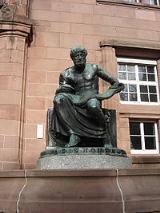
Aristotle (Aristotéles) (384 BC – 322 BC) was a Greek
Greeks

The '''Greeks''' , also known as '''Hellenes''', are a nation and ethnic group native to Greece, Cyprus and neighbouring regions, who can also be found in Greek diaspora communities around the world....
 philosopher, a student of Plato
Plato

'''Plato''' , was a Classical Greece Greeks philosopher, mathematician, writer of philosophical dialogues, and founder of the Platonic Academy in Ancient Athens, the first institution of higher learning in the western world....
 and teacher of Alexander the Great
Alexander the Great

'''Alexander the Great''' , also known as '''Alexander III of Macedon''' was an ancient Greeks King of Macedon . He was one of the most successful military commanders of all time and is presumed undefeated in battle....
. He wrote on many subjects, including physics, metaphysics
Metaphysics

'''Metaphysics''' investigates principles of reality transcending those of any particular science. cosmology and ontology are traditional branches of metaphysics....
, poetry, theater, music, logic, rhetoric, politics, government, ethics, biology and zoology.

Together with Plato and Socrates
Socrates

''' Socrates''' was a Classical Greece Philosophy. Credited as one of the founders of Western philosophy, he is an enigmatic figure known only through the classical accounts of his students....
 (Plato's teacher), Aristotle is one of the most important founding figures in Western philosophy
Western philosophy

'''Western philosophy''' is a term that refers to philosophy thinking in the Western world, as distinct from Eastern philosophy and the varieties of indigenous philosophies....
. He was the first to create a comprehensive system of Western philosophy, encompassing morality and aesthetics, logic and science, politics and metaphysics.


Discussion
Ask a question about 'Aristotle'
Start a new discussion about 'Aristotle'
Answer questions from other users
Full Discussion Forum


Recent Posts


Quotations


A whole is that which has beginning, middle and end.

Again, men in general desire the good, and not merely what their fathers had.

Both oligarch and tyrant mistrust the people, and therefore deprive them of their arms.

Even when laws have been written down, they ought not always to remain unaltered.

He who is unable to live in society, or who has no need because he is sufficient for himself, must be either a beast or a god.

I have gained this by philosophy: that I do without being commanded what others do only from fear of the law.


Encyclopedia


Aristotle (Aristotéles) (384 BC – 322 BC) was a Greek
Greeks

The '''Greeks''' , also known as '''Hellenes''', are a nation and ethnic group native to Greece, Cyprus and neighbouring regions, who can also be found in Greek diaspora communities around the world....
 philosopher, a student of Plato
Plato

'''Plato''' , was a Classical Greece Greeks philosopher, mathematician, writer of philosophical dialogues, and founder of the Platonic Academy in Ancient Athens, the first institution of higher learning in the western world....
 and teacher of Alexander the Great
Alexander the Great

'''Alexander the Great''' , also known as '''Alexander III of Macedon''' was an ancient Greeks King of Macedon . He was one of the most successful military commanders of all time and is presumed undefeated in battle....
. He wrote on many subjects, including physics, metaphysics
Metaphysics

'''Metaphysics''' investigates principles of reality transcending those of any particular science. cosmology and ontology are traditional branches of metaphysics....
, poetry, theater, music, logic, rhetoric, politics, government, ethics, biology and zoology.

Together with Plato and Socrates
Socrates

''' Socrates''' was a Classical Greece Philosophy. Credited as one of the founders of Western philosophy, he is an enigmatic figure known only through the classical accounts of his students....
 (Plato's teacher), Aristotle is one of the most important founding figures in Western philosophy
Western philosophy

'''Western philosophy''' is a term that refers to philosophy thinking in the Western world, as distinct from Eastern philosophy and the varieties of indigenous philosophies....
. He was the first to create a comprehensive system of Western philosophy, encompassing morality and aesthetics, logic and science, politics and metaphysics. Aristotle's views on the physical sciences
Aristotelian physics

The Greek philosopher Aristotle developed many '''theories on the nature of physics'''. These involved what Aristotle described as the Classical element, as well as a variety of other principles that differ significantly from modern ideas about the laws of physics....
 profoundly shaped medieval scholarship, and their influence extended well into the Renaissance
Renaissance

The '''Renaissance''' was a cultural movement that spanned roughly the 14th to the 17th century, beginning in Italy in the late Middle Ages and later spreading to the rest of Europe....
, although they were ultimately replaced by modern physics
Modern physics

The term '''modern physics''' refers to the post-classical physics of physics. The term implies that classical physics of phenomena are lacking, and that an accurate, "modern", description of reality requires theories to incorporate elements of quantum mechanics or theory of relativity, or both....
. In the biological sciences, some of his observations were confirmed to be accurate only in the nineteenth century. His works contain the earliest known formal study of logic, which were incorporated in the late nineteenth century into modern formal logic. In metaphysics, Aristotelianism
Aristotelianism

'''Aristotelianism''' is a Tradition#Philosophical tradition of philosophy that takes its defining inspiration from the work of Aristotle. Sometimes contrasted by critics with the rationalism and Platonic idealism of Plato, Aristotelianism is understood by its proponents as critically developing Plato?s theories....
 had a profound influence on philosophical and theological thinking in the Islamic and Jewish traditions in the Middle Ages
Middle Ages

File:Karl 1 mit papst gelasius gregor1 sacramentar v karl d kahlen.jpgThe '''Middle Ages''' of European history are a period in history which lasted for roughly a millennium, commonly dated from the fall of the Roman Empire in the 5th century to the beginning of the Early Modern Period in the 16th century, marked by the division of Western Christi...
, and it continues to influence Christian theology
Christian theology

'''Christian theology''' is discourse concerning Christianity faith. Christian theologians use biblical exegesis, rationality analysis and argument to understanding, explanation, test, critic#critique, defend or promote Christianity....
, especially Eastern Orthodox theology, and the scholastic
Scholasticism

'''Scholasticism''' was the dominant form of theology and philosophy in the Western Europe in the Middle Ages, particularly in the 12th, 13th, and 14th centuries....
 tradition of the Roman Catholic Church
Roman Catholic Church

The '''Roman Catholic Church''', officially known as the '''Catholic Church''' is the world's largest Christianity Ecclesia , representing over half of all Christians and one-sixth of the world population....
. All aspects of Aristotle's philosophy continue to be the object of active academic study today.

Though Aristotle wrote many elegant treatises and dialogues (Cicero
Cicero

'''Marcus Tullius Cicero''' was a Ancient Rome philosopher, statesman, lawyer, political theorist, and Constitution of the Roman Republic. Cicero is widely considered one of Rome's greatest rhetoric and prose stylists....
 described his literary style as "a river of gold"), it is thought that the majority of his writings are now lost and only about one-third of the original works have survived.

Life

Aristotle was born in Stageira
Stageira

'''Stageira''' was an ancient Greece city on the Chalcidice peninsula and is chiefly known for being the birthplace of Aristotle. The city lies a few kilometres north of the present-day village of Stagira, close to the city now called Olympias....
, Chalcidice
Chalcidice

'''Chalkidiki''', also '''Halkidiki''' or '''Chalcidice''', less often '''Khalkidiki''' and rarely '''Chalkidice''' , is one of the prefectures of Greece....
, in 384 BC, about 55 km east of modern-day Thessaloniki
Thessaloniki

'''Thessaloniki''' , '''Thessalonica''', or '''Salonica''' is the List of largest cities and second largest cities by country in Greece and the capital of Macedonia , the nation's largest Regions of Greece....
. His father Nicomachus
Nicomachus (father of Aristotle)

'''Nicomachus''' , lived c. 375 BC, was the father of Aristotle.The Suda states that he was a doctor descended from Nicomachus, son of Machaon the son of Asclepius....
 was the personal physician to King Amyntas of Macedon
Amyntas III of Macedon

'''Amyntas III''' son of Arrhidaeus and father of Philip II of Macedon, was king of Macedon in 393 BC, and again from 392 to 369 BC.He came to the throne after the ten years of confusion which followed the death of Archelaus II of Macedon, the patron of art and literature....
. Aristotle was trained and educated as a member of the aristocracy
Aristocracy

'''Aristocracy''' is a form of government, in which a few of the most prominent citizens rule. This may be a hereditary elite, or it may be by a system of cooption where a council of prominent citizens add leading soldiers, merchants, land owners, priests, and lawyers to their number....
. At about the age of eighteen, he went to Athens
Athens

'''Athens''' , the Capital and largest city of Greece, dominates the Attica periphery; as one of the List of cities by time of continuous habitation, its recorded history spans around 3,400 years....
 to continue his education at Plato's Academy
Platonic Academy

''For the Raphael painting, see The School of Athens''The '''Academy''' was founded by Plato in ca. 387 BC in Classical Athens. It persisted throughout the Hellenistic period as a philosophical skepticism school, until coming to an end after the death of Philo of Larissa in 83 BC....
. Aristotle remained at the academy for nearly twenty years, not leaving until after Plato's death in 347 BC. He then traveled with Xenocrates
Xenocrates

'''Xenocrates''' of Chalcedon was a Ancient Greece philosopher, mathematician, and leader of the Platonic Academy from 339 to 314 BC. His teachings followed those of Plato's, which he attempted to define more closely, often with mathematical elements....
 to the court of his friend Hermias of Atarneus
Hermias of Atarneus

'''Hermias of Atarneus''', who lived in Atarneus, was Aristotle's father-in-law.The first mention of Hermias is as a slave to Eubulus, a Bithynian banker who ruled Atarneus....
 in Asia Minor. While in Asia, Aristotle traveled with Theophrastus
Theophrastus

'''Theophrastus''' , a Greek native of Eressos in Lesbos Island, was the successor of Aristotle in the Peripatetic school. His interests were wide-ranging, extending from biology and physics to ethics and metaphysics....
 to the island of Lesbos
Lesbos Island

'''Lesbos''' is a Greece List of islands of Greece located in the northeastern Aegean Sea. It has an area of 1632 Square kilometre with 320 kilometres of coastline, making it the third largest Greek island and the largest of the numerous Greek islands scattered in the Aegean....
, where together they researched the botany
Botany

'''Botany''', '''plant science''', '''phytology''', or '''plant biology''' is a branch of biology and is the Scientific method of plant life and development....
 and zoology of the island. Aristotle married Hermias's adoptive daughter (or niece) Pythias
Pythias

'''Pythias''' was the adoptive daughter of Hermias of Atarneus, as well as Aristotle's first wife.She was probably born about 362 BC and died in Athens after 335 BC....
. She bore him a daughter, whom they named Pythias. Soon after Hermias' death, Aristotle was invited by Philip of Macedon
Philip II of Macedon

'''Philip II of Macedon''',...
 to become tutor to Alexander the Great
Alexander the Great

'''Alexander the Great''' , also known as '''Alexander III of Macedon''' was an ancient Greeks King of Macedon . He was one of the most successful military commanders of all time and is presumed undefeated in battle....
 in 343 B.C.

During his time as the head of Macedon's royal academy, Aristotle gave lessons not only to Alexander, but also to two other future kings: Ptolemy
Ptolemy I Soter

'''Ptolemy I Soter''' was a Macedonian general under Alexander the Great who became ruler of Egypt and founder of both the Ptolemaic Kingdom and the Ptolemaic Dynasty....
 and Cassander
Cassander

'''Cassander''' , King of Macedon , was a son of Antipater, and founder of the short-lived Antipatrid dynasty....
. In his Politics, Aristotle states that only one thing could justify monarchy, and that was if the virtue of the king and his family were greater than the virtue of the rest of the citizens put together. Tactfully, he included the young prince and his father in that category. Aristotle encouraged Alexander toward eastern conquest, and his attitude towards Persia was unabashedly ethnocentric. In one famous example, he counsels Alexander to be 'a leader to the Greeks and a despot to the barbarians, to look after the former as after friends and relatives, and to deal with the latter as with beasts or plants'. Near the end of Alexander's life he began to suspect plots, and threatened Aristotle in letters. Aristotle had made no secret of his contempt for Alexander's pretense of divinity, and the king had executed Aristotle's grand-nephew Callisthenes
Callisthenes

'''Callisthenes of Olynthus''' was a Ancient Greece historian. He was the son of Hero and Proxenus of Atarneus, which made him the great nephew of Aristotle by his sister Arimneste....
 as a traitor. A widespread tradition in antiquity suspected Aristotle of playing a role in Alexander's death, but there is little evidence for this.

By 335 BC he had returned to Athens, establishing his own school there known as the Lyceum
Lyceum

A '''Lyceum''' can be*an educational institution , or*a public hall used for cultural events like concerts.*Mount Lyceum . The holy mount of the Arcadians....
. Aristotle conducted courses at the school for the next twelve years. While in Athens, his wife Pythias died, and Aristotle became involved with Herpyllis
Herpyllis

'''Herpyllis''' of Stagira was Aristotle's mistress after his wife, Pythias, died.Together Aristotle and Herpyllis had a son, named Nicomachus after Aristotle's father....
 of Stageira
Stageira

'''Stageira''' was an ancient Greece city on the Chalcidice peninsula and is chiefly known for being the birthplace of Aristotle. The city lies a few kilometres north of the present-day village of Stagira, close to the city now called Olympias....
, who bore him a son whom he named after his father, Nicomachus
Nicomachus (son of Aristotle)

'''Nicomachus''' , lived c. 325 BC, was the son of Aristotle.The Suda states that he was from Stageira, a philosopher, a pupil of Theophrastus. He may have written a commentary on his father's lectures in physics....
. According to the Suda
Suda

The '''Suda''' or '''Souda''' is a massive 10th century Byzantine Empire Medieval Greek historical encyclopedia of the ancient Mediterranean world. It is an Encyclopedia lexicon with 30,000 entries, many drawing from ancient sources that have since been lost, and often derived from medieval Christian compilers....
, he also had an eromenos
Eromenos

In the Pederasty in ancient Greece of Athens, the '''''eromenos''''' was an adolescence boy who was in a love relationship with an adult man, known as the ''erastes'' ....
, Palaephatus of Abydus
Palaephatus

'''Palaephatus''' was the original author of a rationalizing text on Greek mythology, ''On Incredible Tales'' , which survives in a Byzantine edition....
.

It is during this period in Athens from 335 B.C. to 323 B.C. when Aristotle is believed to have composed many of his works. Aristotle wrote many dialogues, only fragments of which survived. The works that have survived are in treatise
Treatise

A '''treatise''' is a formal and systematic exposition in writing of the principles of a subject, generally longer and more detailed than an essay. A lengthy discourse on some subject....
 form and were not, for the most part, intended for widespread publication, as they are generally thought to be lecture aids for his students. His most important treatises include Physics
Physics (Aristotle)

'''''Physics''''' is a key text in the philosophy of Aristotle. It stands at the head of the current Andronicus of Rhodes order, the long series of Aristotle's physical, cosmological and biological works, and is foundational to them....
, Metaphysics
Metaphysics (Aristotle)

'''''Metaphysics''''' is one of the principal works of Aristotle and the first major work of the Metaphysics with the same name. The principal subject is "being qua being", or being understood as being....
, Nicomachean Ethics
Nicomachean Ethics

'''Nicomachean Ethics''', or ''Ta Ethika'', is a work by Aristotle on virtue and moral character which plays a prominent role in defining Aristotelian ethics....
, Politics
Politics (Aristotle)

Aristotle '''''Politics''''' is a work of political philosophy. The Nicomachean_Ethics#Chapters_6-9:_Politics declared that the inquiry into ethics necessarily follows into politics, and the two works are frequently considered to be parts of a larger treatise, or perhaps connected lectures, dealing with the "philosophy of human affairs." The tit...
, De Anima (On the Soul) and Poetics.

Aristotle not only studied almost every subject possible at the time, but made significant contributions to most of them. In physical science, Aristotle studied anatomy, astronomy, economics, embryology
Embryology

'''Embryology''' is the study of the development of an embryo. An embryo is defined as any organism in a stage before birth or hatching, or in plants, before germination occurs....
, geography, geology, meteorology, physics and zoology. In philosophy, he wrote on aesthetics, ethics, government, metaphysics, politics, psychology, rhetoric and theology. He also studied education, foreign customs, literature and poetry. His combined works constitute a virtual encyclopedia of Greek knowledge. It has been suggested that Aristotle was probably the last person to know everything there was to be known in his own time.

Upon Alexander's death, anti-Macedonian sentiment in Athens once again flared. Eurymedon the hierophant
Eurymedon the hierophant

'''Eurymedon the hierophant''' was the representative of Elephsinias Demitras. Together with the school of Isocrates and Demophilos they brought a charge of impiety against Aristotle....
 denounced Aristotle for not holding the gods in honor. Aristotle fled the city to his mother's family estate in Chalcis
Chalcis

'''Chalcis''' or '''Chalkida''', '''Halkida''', '''Halkis''' or '''Chalkis''' , the chief town of the island of Euboea in Greece, is situated on the strait of the Euripus Strait at its narrowest point....
, explaining, "I will not allow the Athenians to sin twice against philosophy
Trial of Socrates

The '''trial of Socrates''' refers to the trial and the subsequent execution of the Athenian philosopher Socrates in 399 BC. Socrates was tried and convicted by the courts of democratic Athens on a charge of corrupting the youth and disbelieving in the ancestral gods....
," a reference to Athens's prior trial and execution of Socrates. However, he died in Euboea of natural causes within the year (in 322 BC). Aristotle named chief executor his student Antipater
Antipater

'''Antipater''' was a Macedonian general and a supporter of kings Philip II of Macedon and Alexander the Great. In 320 BC, he became regent of all of Alexander's empire....
 and left a will
Will (law)

In common law, a '''will''' or '''testament''' is a document by which a person regulates the rights of others over his or her property or family after death....
 in which he asked to be buried next to his wife.

Logic


Aristotle's conception of logic was the dominant form of logic until 19th century advances in mathematical logic
Mathematical logic

'''Mathematical logic''' is a subfield of mathematics and logic with close connections to computer science and philosophical logic. The field includes the mathematical study of logic and the applications of formal logic to other areas of mathematics....
. Kant
KANT

'''KANT''' is a computer algebra system for mathematicians interested in algebraic number theory, performing sophisticated computations in algebraic number fields, in Global field function fields, and in local fields....
 stated in the Critique of Pure Reason that Aristotle's theory of logic completely accounted for the core of deductive inference.

History

Aristotle "says that 'on the subject of reasoning' he 'had nothing else on an earlier date to speak of'". However, Plato reports that syntax
Syntax

In linguistics, '''syntax''' is the study of the principles and rules for constructing Sentence s in natural languages. In addition to referring to the discipline, the term ''syntax'' is also used to refer directly to the rules and principles that govern the sentence structure of any individual language, as in "the Irish syntax"....
 was devised before him, by Prodicus of Ceos, who was concerned by the correct use of words. Logic seems to have emerged from dialectics; the earlier philosophers made frequent use of concepts like reductio ad absurdum
Reductio ad absurdum

'''''Reductio ad absurdum''''' , also known as an '''apagogical argument''', '''reductio ad impossibile''', or '''proof by contradiction''', is a type of logical argument where one assumes a claim for the sake of argument and derives an absurd or ridiculous outcome, and then concludes that the original claim must have been wrong as it led to an abs...
 in their discussions, but never truly understood the logical implications. Even Plato had difficulties with logic; although he had a reasonable conception of a deduction
Deduction

'''Deduction''' can refer to one of the following usages: lower price on something* Deductive reasoning, inference in which the conclusion is of no greater generality than the premises...
 system, he could never actually construct one and relied instead on his dialectic
Dialectic

'''Dialectic''' is a method of argument, which has been central to both Eastern and Western philosophy since ancient times. The word "dialectic" originates in Ancient Greece, and was made popular by Plato's Socratic dialogues....
. Plato believed that deduction would simply follow from premise
Premise

'''Premise''' can refer to:* Premise, a claim that is a reason for, or an objection against, some other claim as part of an argument* Premises, land and buildings together considered as a property...
s, hence he focused on maintaining solid premises so that the conclusion
Logical consequence

'''Logical consequence''' is a fundamental concept in logic. It is the Relation that holds between a Set of Sentence and a sentence when the former Entailment the latter....
 would logically follow. Consequently, Plato realized that a method for obtaining conclusions would be most beneficial. He never succeeded in devising such a method, but his best attempt was published in his book Sophist
Sophist (dialogue)

The '''''Sophist ''''' is one of the late Dialogues of Plato, which was written much later than the ''Parmenides '' and the ''Theaetetus '', probably in 360 BC....
, where he introduced his division method.

Analytics and the Organon

What we today call Aristotelian logic, Aristotle himself would have labeled "analytics". The term "logic" he reserved to mean dialectics. Most of Aristotle's work is probably not in its original form, since it was most likely edited by students and later lecturers. The logical works of Aristotle were compiled into six books in about the early 1st century AD:
  1. Categories
  2. On Interpretation
  3. Prior Analytics
  4. Posterior Analytics
  5. Topics
  6. On Sophistical Refutations


The order of the books (or the teachings from which they are composed) is not certain, but this list was derived from analysis of Aristotle's writings. It goes from the basics, the analysis of simple terms in the Categories, to the study of more complex forms, namely, syllogisms (in the Analytics) and dialectics (in the Topics and Sophistical Refutations). There is one volume of Aristotle's concerning logic not found in the Organon, namely the fourth book of Metaphysics..

Aristotle's scientific method

Sanzio 01 Plato Aristotle
Like his teacher Plato, Aristotle's philosophy aims at the universal
Universality (philosophy)

In philosophy, '''universalism''' is a doctrine or school claiming universal facts can be discovered and is therefore understood as being in opposition to relativism....
. Aristotle, however, found the universal in particular
Particular

In philosophy, '''particulars''' are concrete entitles existing in space and time as opposed to abstractions. There are, however, theories of ''abstract particulars'' or ''Trope ''....
 things, which he called the essence of things, while Plato finds that the universal exists apart from particular things, and is related to them as their prototype
Prototype

A '''prototype''' is an original type, form, or instance of something serving as a typical example, basis, or standard for other things of the same category....
 or exemplar
Exemplar

'''Exemplar,''' in the sense developed by philosophy of science Thomas Samuel Kuhn, is a well known usage of a Scientific theories.According to Kuhn, scientific practice alternates between periods of normal science and extraordinary/revolutionary science....
. For Aristotle, therefore, philosophic method implies the ascent from the study of particular phenomena to the knowledge of essences, while for Plato philosophic method means the descent from a knowledge of universal Forms
Theory of Forms

Plato's '''Theory of Forms''' asserts that '''Forms''' , and not the material world of change Plato's allegory of the cave, possess the highest and most fundamental kind of reality....
 (or ideas) to a contemplation of particular imitations of these. For Aristotle, "form" still refers to the unconditional basis of phenomena but is "instantiated" in a particular substance (see Universals and particulars
Aristotle

'''Aristotle''' was a Greeks philosopher, a student of Plato and teacher of Alexander the Great. He wrote on many subjects, including physics, metaphysics, Poetics , theater, music, logic, rhetoric, politics, government, ethics, biology and zoology....
, below). In a certain sense, Aristotle's method is both inductive
Inductive reasoning

'''Induction''' or '''inductive reasoning''', sometimes called '''inductive logic''', is reasoning which takes us "beyond the confines of our current evidence or knowledge to conclusions about the unknown." The premises of an inductive logical argument support the conclusion but do not entailment it; i.e....
 and deductive
Deductive reasoning

'''Deductive reasoning''', sometimes called '''deductive logic''', is reasoning which constructs or evaluates deductive Argument s.In logic, an argument is said to be deductive when the truth of the conclusion is purported to follow necessarily or be a logical consequence of the premises and its corresponding conditional is a necessary truth....
, while Plato's is essentially deductive from a priori
A priori and a posteriori (philosophy)

The terms "'''''a priori'''''" and "'''''a posteriori'''''" are used in philosophy to distinguish two types of knowledge, justifications or arguments....
 principles.

In Aristotle's terminology, "natural philosophy" is a branch of philosophy examining the phenomena of the natural world, and includes fields that would be regarded today as physics, biology and other natural sciences. In modern times, the scope of philosophy has become limited to more generic or abstract inquiries, such as ethics and metaphysics, in which logic plays a major role. Today's philosophy tends to exclude empirical study of the natural world by means of the scientific method
Scientific method

'''Scientific method''' refers to techniques for investigating phenomenon, acquiring new knowledge, or correcting and integrating previous knowledge. To be termed scientific, a method of inquiry must be based on gathering observable, empirical and Measure evidence subject to specific principles of reasoning....
. In contrast, Aristotle's philosophical endeavors encompassed virtually all facets of intellectual inquiry.

In the larger sense of the word, Aristotle makes philosophy coextensive with reasoning, which he also would describe as "science". Note, however, that his use of the term science carries a different meaning than that covered by the term "scientific method
Scientific method

'''Scientific method''' refers to techniques for investigating phenomenon, acquiring new knowledge, or correcting and integrating previous knowledge. To be termed scientific, a method of inquiry must be based on gathering observable, empirical and Measure evidence subject to specific principles of reasoning....
". For Aristotle, "all science (dianoia) is either practical, poetical or theoretical" (Metaphysics 1025b25). By practical science, he means ethics and politics; by poetical science, he means the study of poetry and the other fine arts; by theoretical science, he means physics, mathematics
Mathematics

'''Mathematics''' is the study of quantity, structure, space, change, and related topics of pattern and form. Mathematicians seek out patterns whether found in numbers, space, natural science, computers, imaginary abstractions, or elsewhere....
 and metaphysics.

If logic (or "analytics") is regarded as a study preliminary to philosophy, the divisions of Aristotelian philosophy would consist of: (1) Logic
Logic

'''Logic''' is the study of the principles of valid demonstration and inference. Logic is a branch of philosophy, a part of the classical Trivium . The word derives from Greek language ''??????'' , fem....
; (2) Theoretical Philosophy, including Metaphysics, Physics, Mathematics, (3) Practical Philosophy and (4) Poetical Philosophy.

In the period between his two stays in Athens, between his times at the Academy and the Lyceum, Aristotle conducted most of the scientific thinking and research for which he is renowned today. In fact, most of Aristotle's life was devoted to the study of the objects of natural science. Aristotle's metaphysics contains observations on the nature of numbers but he made no original contributions to mathematics. He did, however, perform original research
Original research

'''Original research''' is research that is not exclusively based on a summary, review or synthesis of earlier publications on the subject of research....
 in the natural sciences, e.g., botany, zoology, physics, astronomy, chemistry, meteorology, and several other sciences.

Aristotle's writings on science are largely qualitative, as opposed to quantitative. Beginning in the sixteenth century, scientists began applying mathematics to the physical sciences, and Aristotle's work in this area was deemed hopelessly inadequate. His failings were largely due to the absence of concepts like mass, velocity, force and temperature. He had a conception of speed and temperature, but no quantitative understanding of them, which was partly due to the absence of basic experimental devices, like clocks and thermometers. His writings provide an account of many scientific observations, a mixture of precocious accuracy and curious errors. For example, in his History of Animals
History of Animals

'''History of Animals''' is a zoology natural history text by Aristotle.The work consists of lengthy descriptions of countless species of fish, shellfish, and other animals and their anatomies....
 he claimed that human males have more teeth than females. In a similar vein, John Philoponus
John Philoponus

'''John Philoponus''' , also known as John Grammarian of Alexandria, was a Christian and commentaries on Aristotle and the author of a considerable number of philosophical treatises and theological works....
, and later Galileo
Galileo Galilei

'''Galileo Galilei''' was a Grand Duchy of Tuscany physicist, mathematician, astronomer, and philosopher who played a major role in the Scientific Revolution....
, showed by simple experiments that Aristotle's theory that a heavier object falls faster than a lighter object is incorrect. On the other hand, Aristotle refuted Democritus
Democritus

'''Democritus''' was an Ancient Greek philosopher born in Abdera in the north of Greece. He was the most prolific, and ultimately the most influential, of the pre-Socratic philosophers; his atomic theory may be regarded as the culmination of early Greek thought....
's claim that the Milky Way
Milky Way

The '''Milky Way''', sometimes called simply '''the Galaxy''', is the galaxy in which the Solar System is located. It is a barred spiral galaxy that is part of the Local Group of galaxies....
 was made up of "those stars which are shaded by the earth from the sun's rays," pointing out (correctly, even if such reasoning was bound to be dismissed for a long time) that, given "current astronomical demonstrations" that "the size of the sun is greater than that of the earth and the distance of the stars from the earth many times greater than that of the sun, then...the sun shines on all the stars and the earth screens none of them."

In places, Aristotle goes too far in deriving 'laws of the universe' from simple observation and over-stretched reason
Reason

'''Reason''' may refer to Mind#Mental faculties that consciously create explanations in order to judge, decide, solve problems, generalize, and give examples, among other activities....
. Today's scientific method
Scientific method

'''Scientific method''' refers to techniques for investigating phenomenon, acquiring new knowledge, or correcting and integrating previous knowledge. To be termed scientific, a method of inquiry must be based on gathering observable, empirical and Measure evidence subject to specific principles of reasoning....
 assumes that such thinking without sufficient facts is ineffective, and that discerning the validity of one's hypothesis requires far more rigorous experimentation than that which Aristotle used to support his laws.

Aristotle also had some scientific blind spots. He posited a geocentric cosmology that we may discern in selections of the Metaphysics, which was widely accepted up until the 1500s. From the 3rd century to the 1500s, the dominant view held that the Earth was the center of the universe (geocentrism).

Since he was perhaps the philosopher most respected by European thinkers during and after the Renaissance, these thinkers often took Aristotle's erroneous positions as given, which held back science in this epoch. However, Aristotle's scientific shortcomings should not mislead one into forgetting his great advances in the many scientific fields. For instance, he founded logic as a formal science and created foundations to biology that were not superseded for two millennia. Moreover, he introduced the fundamental notion that nature is composed of things that change and that studying such changes can provide useful knowledge of underlying constants.

Physics


The five elements

  • Fire
    Fire (classical element)

    '''Fire''' has been an important part of many cultures and religions, from pre-history to modern day, and was vital to the development of civilization....
    , which is hot and dry.
  • Earth
    Earth (classical element)

    '''Earth''', home and origin of humanity, has often been worshipped in its own right with its own unique spiritual tradition....
    , which is cold and dry.
  • Air
    Air (classical element)

    In traditional cultures, '''air''' is often seen as a universal power or pure substance. Its fundamental importance to life can be seen in words such as ''aspire'', ''conspire'', ''inspire'', ''perspire'', and ''spirit'', all derived from the Latin ''spirare'' ....
    , which is hot and wet.
  • Water
    Water (classical element)

    '''''Water''''' has been important to all peoples of the earth, and it is rich in spiritual tradition....
    , which is cold and wet.
  • Aether
    Aether (classical element)

    According to ancient and History of science in the Middle Ages, '''aether''' , also spelled '''?ther''' or '''ether''', is the material that fills the region of the Universe above the Sublunary sphere....
    , which is the divine substance that makes up the heavenly spheres and heavenly bodies (stars and planets).


Each of the four earthly elements has its natural place; the earth at the centre of the universe, then water, then air, then fire. When they are out of their natural place they have natural motion, requiring no external cause, which is towards that place; so bodies sink in water, air bubbles rise up, rain falls, flame rises in air. The heavenly element has perpetual circular motion.

Causality, The Four Causes

  • The material cause is that from which a thing comes into existence as from its part, constituents, substratum or materials. This reduces the explanation of causes to the parts (factors, elements, constituents, ingredients) forming the whole (system, structure, compound, complex, composite, or combination), a relationship known as the part-whole causation. Simply put it is the influence of the material substances on the event. So imagine two dominos, the first of which is lighter. The first is knocked over into the second but does not have enough power to knock it over; this is material cause.
  • The formal cause tells us what a thing is, that any thing is determined by the definition, form, pattern, essence, whole, synthesis or archetype. It embraces the account of causes in terms of fundamental principles or general laws, as the whole (i.e., macrostructure) is the cause of its parts, a relationship known as the whole-part causation. Plainly put it is the influence of the form (essence) of the things on the event. So take the two dominos again except this time the second is shaped to prevent it from falling *eg. triangular.* this is formal cause.
  • The efficient cause is that from which the change or the ending of the change first starts. It identifies 'what makes of what is made and what causes change of what is changed' and so suggests all sorts of agents, nonliving or living, acting as the sources of change or movement or rest. Representing the current understanding of causality as the relation of cause and effect, this covers the modern definitions of "cause" as either the agent or agency or particular events or states of affairs. More simply again that which immediately sets the thing in motion. So take the two dominos this time of equal weighting, the first is knocked over causing the second also to fall over. This is effectively efficient cause.
  • The final cause is that for the sake of which a thing exists or is done, including both purposeful and instrumental actions and activities. The final cause or telos is the purpose or end that something is supposed to serve, or it is that from which and that to which the change is. This also covers modern ideas of mental causation involving such psychological causes as volition, need, motivation or motives, rational, irrational, ethical, and all that gives purpose to behaviour.


Additionally, things can be causes of one another, causing each other reciprocally, as hard work causes fitness and vice versa, although not in the same way or function, the one is as the beginning of change, the other as the goal. (Thus Aristotle first suggested a reciprocal or circular causality as a relation of mutual dependence or influence of cause upon effect). Moreover, Aristotle indicated that the same thing can be the cause of contrary effects; its presence and absence may result in different outcomes. Simply it is the goal or purpose that brings about an event (not necessarily a mental goal). Taking our two dominos, it requires someone to intentionally knock the dominos over as they cannot fall themselves.

Aristotle marked two modes of causation: proper (prior) causation and accidental (chance) causation. All causes, proper and incidental, can be spoken as potential or as actual, particular or generic. The same language refers to the effects of causes, so that generic effects assigned to generic causes, particular effects to particular causes, operating causes to actual effects. Essentially, causality does not suggest a temporal relation between the cause and the effect.

All further investigations of causality will consist of imposing the favorite hierarchies on the order causes, such as final > efficient > material > formal (Thomas Aquinas
Thomas Aquinas

'''Saint Thomas Aquinas''', Dominican Order was a priest of the Roman Catholic Church in the Dominican Order from Italy, and an immensely influential philosopher and theologian in the tradition of scholasticism, known as '''Doctor Angelicus''' and '''Doctor Communis'''....
), or of restricting all causality to the material and efficient causes or to the efficient causality (deterministic or chance) or just to regular sequences and correlations of natural phenomena (the natural sciences describing how things happen instead of explaining the whys and wherefores).

Optics

Aristotle held more accurate theories on some optical concepts than other philosophers of his day. He rejected the theory of Plato
Plato

'''Plato''' , was a Classical Greece Greeks philosopher, mathematician, writer of philosophical dialogues, and founder of the Platonic Academy in Ancient Athens, the first institution of higher learning in the western world....
 that light rays were emitted from the eyes. Additionaly, the earliest known written evidence of a camera obscura
Camera obscura

The '''camera obscura''' is an optical device used, for example, in drawing or for entertainment. It is one of the inventions leading to photography....
 can be found in Aristotle's documentation of such a device in 350 BC in Problemata. Aristotle's apparatus contained a dark chamber that had a single small hole to allow for sunlight to enter. Aristotle used the device to make observations of the sun and noted that no matter what shape the hole was, the sun would still be correctly displayed as a round object. Aristotle also made the observation that when the distance between the tiny hole (the aperture in modern terms) and the surface with the image increased, the image was amplified. In modern cameras, this is analogous to the diaphragm
Diaphragm

'''Diaphragm''' may refer to any of the following:Anatomy* Thoracic diaphragm, a tissue of muscle separating the thorax and abdomen of mammals...
.

Chance and spontaneity

Spontaneity and chance are causes of effects. Chance as an incidental cause lies in the realm of accidental things. It is "from what is spontaneous" (but note that what is spontaneous does not come from chance). For a better understanding of Aristotle's conception of "chance" it might be better to think of "coincidence": Something takes place by chance if a person sets out with the intent of having one thing take place, but with the result of another thing (not intended) taking place. For example: A person seeks donations. That person may find another person willing to donate a substantial sum. However, if the person seeking the donations met the person donating, not for the purpose of collecting donations, but for some other purpose, Aristotle would call the collecting of the donation by that particular donator a result of chance. It must be unusual that something happens by chance. In other words, if something happens all or most of the time, we cannot say that it is by chance.

There is also more specific kind of chance, which Aristotle names "luck", that can only apply to human beings, since it is in the sphere of moral actions. According to Aristotle, luck must involve choice (and thus deliberation), and only humans are capable of deliberation and choice. "What is not capable of action cannot do anything by chance".

Metaphysics

Aristotle defines metaphysics as "the knowledge of immaterial being," or of "being in the highest degree of abstraction." He refers to metaphysics as "first philosophy", as well as "the theologic science."

Substance, potentiality and actuality

Aristotle examines the concept of substance and essence (ousia
Ousia

'''Ousia''' is the Greek language noun formed on the feminine present participle of ; it is analogous to the English participle ''being'', and the Greek ontic....
) in his Metaphysics, Book VII and he concludes that a particular substance is a combination of both matter and form. As he proceeds to the book VIII, he concludes that the matter of the substance is the substratum
Substratum

In linguistics, a '''stratum''' or '''strate''' refers to a language that influences, or is influenced by another through language contact. A substratum is a language which is influenced by another, while a superstratum is the language that exerts the influence....
 or the stuff of which it is composed, e.g. the matter of the house are the bricks, stones, timbers etc., or whatever constitutes the potential house. While the form of the substance, is the actual house, namely 'covering for bodies and chattels' or any other differentia
Genus-differentia definition

A '''genus-differentia definition''' is one in which a word or concept that indicates a ''species'' -- a specific type of item, not necessarily a biological category -- is described first by a broader category, the ''genus,'' then distinguished from other items in that category by a ''differentia.'' The differentiae of a species are the species' p...
 (see also predicables
Predicables

'''Predicables''' is, in term logic, a term applied to a Categorization of the possible relations in which a Predicate may stand to its Subject . The list given by the schoolmen and generally adopted by modern logicians is based on the original fivefold classification given by Aristotle : definition , genus , differentia , property , accident...
). The formula that gives the components is the account of the matter, and the formula that gives the differentia is the account of the form.

With regard to the change (kinesis
Kinesis

'''Kinesis''', like a taxis, is a movement or activity of a cell or an organism in response to a stimulus . However, unlike taxis, the response to the stimulus provided is non-directional....
) and its causes now, as he defines in his Physics
Physics (Aristotle)

'''''Physics''''' is a key text in the philosophy of Aristotle. It stands at the head of the current Andronicus of Rhodes order, the long series of Aristotle's physical, cosmological and biological works, and is foundational to them....
 and On Generation and Corruption
On Generation and Corruption

'''''On Generation and Corruption''''' , , also known as ''On Coming to Be and Passing Away'') is a treatise by Aristotle. Like many of his texts, it is both scientific and philosophic ....
 319b-320a, he distinguishes the coming to be from: 1) growth and diminution, which is change in quantity; 2) locomotion, which is change in space; and 3) alteration, which is change in quality.

The coming to be is a change where nothing persists of which the resultant is a property. In that particular change he introduces the concept of potentiality
Potentiality and actuality (Aristotle)

The theory of '''Potentiality and Actuality''' is one of the central themes of Aristotle's philosophy and metaphysics. With these two notions, Aristotle intends to provide a structure for the comprehension of reality....
 (dynamis) and actuality
Potentiality and actuality (Aristotle)

The theory of '''Potentiality and Actuality''' is one of the central themes of Aristotle's philosophy and metaphysics. With these two notions, Aristotle intends to provide a structure for the comprehension of reality....
 (entelecheia) in association with the matter and the form.

Referring to potentiality, this is what a thing is capable of doing, or being acted upon, if it is not prevented by something else. For example, the seed of a plant in the soil is potentially (dynamei) plant, and if is not prevented by something, it will become a plant. Potentially beings can either 'act' (poiein) or 'be acted upon' (paschein), which can be either innate or learned. For example, the eyes possess the potentiality of sight (innate - being acted upon), while the capability of playing the flute can be possessed by learning (exercise - acting).

Actuality is the fulfillment of the end of the potentiality. Because the end (telos) is the principle of every change, and for the sake of the end exists potentiality, therefore actuality is the end. Referring then to our previous example, we could say that actuality is when the seed of the plant becomes a plant.

" For that for the sake of which a thing is, is its principle, and the becoming is for the sake of the end; and the actuality is the end, and it is for the sake of this that the potentiality is acquired. For animals do not see in order that they may have sight, but they have sight that they may see."

In conclusion, the matter of the house is its potentiality and the form is its actuality. The formal cause (aitia) then of that change from potential to actual house, is the reason
Reason

'''Reason''' may refer to Mind#Mental faculties that consciously create explanations in order to judge, decide, solve problems, generalize, and give examples, among other activities....
 (logos) of the house builder and the final cause is the end, namely the house itself. Then Aristotle proceeds and concludes that the actuality is prior to potentiality in formula, in time and in substantiality.

With this definition
Definition

A '''definition''' is a statement of the Meaning of a word or phrase. The term to be defined is known as the '''definiendum''' . The words which define it are known as the '''definiens''' ....
 of the particular substance (i.e., matter and form), Aristotle tries to solve the problem of the unity of the beings, e.g., what is that makes the man one? Since, according to Plato there are two Ideas: animal and biped, how then is man a unity? However, according to Aristotle, the potential being (matter) and the actual one (form) are one and the same thing.

Universals and particulars


Aristotle's predecessor, Plato, argued that all things have a universal form, which could be either a property, or a relation to other things. When we look at an apple, for example, we see an apple, and we can also analyze a form of an apple. In this distinction, there is a particular apple and a universal form of an apple. Moreover, we can place an apple next to a book, so that we can speak of both the book and apple as being next to each other.

Plato argued that there are some universal forms that are not a part of particular things. For example, it is possible that there is no particular good in existence, but "good" is still a proper universal form. Bertrand Russell
Bertrand Russell

'''Bertrand Arthur William Russell, 3rd Earl Russell''', Order of Merit , Fellow of the Royal Society , was a British people philosopher, mathematical logic, mathematician, historian, advocate for social reform, and pacifism....
 is a contemporary philosopher that agreed with Plato on the existence of "uninstantiated universals".

Aristotle disagreed with Plato on this point, arguing that all universals are instantiated. Aristotle argued that there are no universals that are unattached to existing things. According to Aristotle, if a universal exists, either as a particular or a relation, then there must have been, must be currently, or must be in the future, something on which the universal can be predicated. Consequently, according to Aristotle, if it is not the case that some universal can be predicated to an object that exists at some period of time, then it does not exist.

One way for contemporary philosophers to justify this position is by asserting the eleatic principle.

In addition, Aristotle disagreed with Plato about the location of universals. As Plato spoke of the world of the forms, a location where all universal forms subsist, Aristotle maintained that universals exist within each thing on which each universal is predicated. So, according to Aristotle, the form of apple exists within each apple, rather than in the world of the forms.

Biology and medicine

In Aristotelian science, most especially in biology, things he saw himself have stood the test of time better than his retelling of the reports of others, which contain error and superstition. He dissected animals, but not humans and his ideas on how the human body works have been almost entirely superseded.

Empirical research program

Torpedo Fuscomaculata2
Aristotle is the earliest natural historian whose work has survived in some detail. Aristotle certainly did research on the natural history of Lesbos, and the surrounding seas and neighbouring areas. The works that reflect this research, such as History of Animals
History of Animals

'''History of Animals''' is a zoology natural history text by Aristotle.The work consists of lengthy descriptions of countless species of fish, shellfish, and other animals and their anatomies....
, Generation of Animals
Generation of Animals

'''Generation of Animals''' is a text by Aristotle....
, and Parts of Animals, contain some observations and interpretations, along with sundry myths and mistakes. The most striking passages are about the sea-life visible from observation on Lesbos and available from the catches of fishermen. His observations on catfish
Catfish

'''Catfish''' are a very diverse group of Actinopterygii fish. Named for their prominent barbel s, which resemble a cat's whiskers , catfish range in size and behavior from the heaviest, the Pangasius gigas from Southeast Asia and the longest, the wels catfish of Eurasia, to detritivores , and even to a tiny parasite species commonly called the ca...
, electric fish
Electric ray

The '''electric rays''' are a group of batoid, flattened cartilaginous fish with enlarged pectoral fins, that comprise the order '''Torpediniformes'''....
 (Torpedo
Torpedo (genus)

'''''Torpedo''''' is a group of batoid, commonly called '''electric rays''' or '''torpedoes'''. It is the only genus in the family '''Torpedinidae''', in the order Torpediniformes....
) and angler-fish are detailed, as is his writing on cephalopod
Cephalopod

The '''cephalopods''' are the mollusc class '''Cephalopoda''' characterized by bilateral symmetry, a prominent head, and a modification of the mollusk foot, a muscular hydrostat, into the form of cephalopod arms or tentacles....
s, namely, Octopus
Octopus

The '''octopus''' is a cephalopod of the order '''Octopoda''' that inhabits many diverse regions of the ocean, especially coral reefs. The term may also refer to only those creatures in the genus ''Octopus ''....
, Sepia (cuttlefish
Cuttlefish

'''Cuttlefish''' are Marine animals of the order '''Sepiida''' belonging to the Cephalopoda class . Despite their common name, cuttlefish are not fish but molluscs....
) and the paper nautilus (Argonauta argo). His description of the hectocotyl arm
Hectocotylus

A '''hectocotylus''' is one of the cephalopod arms of the male of most kinds of cephalopods that is modified in various ways to effect the fertilization of the female's eggs....
 was about two thousand years ahead of its time, and widely disbelieved until its rediscovery in the nineteenth century. He separated the aquatic mammals from fish, and knew that sharks and rays were part of the group he called Selache (selachians).

Triakis Semifasciata
Another good example of his methods comes from the Generation of Animals in which Aristotle describes breaking open fertilized chicken eggs at intervals to observe when visible organs were generated.

He gave accurate descriptions of ruminant
Ruminant

Physiologically, a '''ruminant''' is a mammal of the order Artiodactyla that digests plant-based food by initially softening it within the animal's first stomach, known as the rumen, then regurgitating the semi-digested mass, now known as cud, and chewing it again....
s' four-chambered fore-stomachs, and of the ovoviviparous
Ovoviviparity

'''Ovoviviparous''', also known as '''oviviparous''', animals develop within Egg s that remain within the mother's body up until they hatch or are about to hatch....
 embryological development of the hound shark
Hound shark

'''Hound sharks''' are a family, '''Triakidae''', of Carcharhiniformes, consisting of about 40 species in 9 genera. In some classifications, the family is split in two, with ''Mustelus'', ''Scylliogaleus'', and ''Triakis'' in Triakidae, and the remaining genera in '''Galeorhinidae'''....
 Mustelus mustelus.

Classification of living things

Aristotle's classification of living things contains some elements which still existed in the nineteenth century. What the modern zoologist would call vertebrates and invertebrates, Aristotle called 'animals with blood' and 'animals without blood' (he was not to know that complex invertebrates do make use of haemoglobin, but of a different kind from vertebrates). Animals with blood were divided into live-bearing (humans and mammals), and egg-bearing (birds and fish). Invertebrates ('animals without blood') are insects, crustacea (divided into non-shelled – cephalopods – and shelled) and testacea (molluscs). In some respects, this incomplete classification is better than that of Linnaeus, who crowded the invertebrata together into two groups, Insecta and Vermes (worms).

For Charles Singer
Charles Singer

'''Charles Joseph Singer''' was a United Kingdom History of science....
, "Nothing is more remarkable than [Aristotle's] efforts to [exhibit] the relationships of living things as a scala naturae" Aristotle's History of Animals classified organisms in relation to a hierarchical "Ladder of Life
Great chain of being

The '''great chain of being''' or '''scala naturae''' is a classical and western medieval concept of God?s strict and natural hierarchical structure over the universe....
" (scala naturae), placing them according to complexity of structure and function so that higher organisms showed greater vitality and ability to move.

Aristotle believed that intellectual purposes, i.e., formal causes, guided all natural processes. Such a teleological view gave Aristotle cause to justify his observed data as an expression of formal design. Noting that "no animal has, at the same time, both tusks and horns," and "a single-hooved animal with two horns I have never seen," Aristotle suggested that Nature, giving no animal both horns and tusks, was staving off vanity, and giving creatures faculties only to such a degree as they are necessary. Noting that ruminants had a multiple stomachs and weak teeth, he supposed the first was to compensate for the latter, with Nature trying to preserve a type of balance.

In a similar fashion, Aristotle believed that creatures were arranged in a graded scale of perfection rising from plants on up to man, the scala naturae or Great Chain of Being
Great chain of being

The '''great chain of being''' or '''scala naturae''' is a classical and western medieval concept of God?s strict and natural hierarchical structure over the universe....
. His system had eleven grades, arranged according "to the degree to which they are infected with potentiality", expressed in their form at birth. The highest animals laid warm and wet creatures alive, the lowest bore theirs cold, dry, and in thick eggs.

Theory of biological forms and souls

Aristotle also held that the level of a creature's perfection was reflected in its form, but not preordained by that form. Ideas like this, and his ideas about souls, are not regarded as science at all in modern times.

He placed emphasis on the type(s) of soul an organism possessed, asserting that plants possess a vegetative soul, responsible for reproduction and growth, animals a vegetative and a sensitive soul, responsible for mobility and sensation, and humans a vegetative, a sensitive, and a rational soul, capable of thought and reflection.

Aristotle, in contrast to earlier philosophers, but in accordance with the Egyptians, placed the rational soul in the heart, rather than the brain. Notable is Aristotle's division of sensation and thought, which generally went against previous philosophers, with the exception of Alcmaeon
Alcmaeon of Croton

'''Alcmaeon''' of Crotone was one of the most eminent natural philosophers and medical theorists of antiquity. His father's name was Pirithus, and he is said by some to have been a pupil of Pythagoras, and must therefore have lived in the latter half of the 6th century BC....
.

His analysis of procreation is frequently criticized on the grounds that it presupposes an active, ensouling masculine element bringing life to an inert, passive, lumpen female element; it is on these grounds that Aristotle is considered by some feminist critics to have been a misogynist
Misogyny

'''Misogyny''' is hatred of women or girls. It is parallel to misandry?the hatred of men. Misogyny is also comparable with misanthropy which is the hatred of humanity generally....
.

Aristotle's successor: Theophrastus

Aristotle's successor at the Lyceum
Lyceum

A '''Lyceum''' can be*an educational institution , or*a public hall used for cultural events like concerts.*Mount Lyceum . The holy mount of the Arcadians....
, Theophrastus
Theophrastus

'''Theophrastus''' , a Greek native of Eressos in Lesbos Island, was the successor of Aristotle in the Peripatetic school. His interests were wide-ranging, extending from biology and physics to ethics and metaphysics....
, wrote a series of books on botany—the History of Plants
Historia Plantarum

'''''Historia Plantarum''''' is Latin and literally means ''History of Plants'', although in reality it means something closer to "on plants" or "treatise on plants"....
—which survived as the most important contribution of antiquity to botany, even into the Middle Ages
Middle Ages

File:Karl 1 mit papst gelasius gregor1 sacramentar v karl d kahlen.jpgThe '''Middle Ages''' of European history are a period in history which lasted for roughly a millennium, commonly dated from the fall of the Roman Empire in the 5th century to the beginning of the Early Modern Period in the 16th century, marked by the division of Western Christi...
. Many of Theophrastus' names survive into modern times, such as carpos for fruit, and pericarpion for seed vessel.

Rather than focus on formal causes, as Aristotle did, Theophrastus suggested a mechanistic scheme, drawing analogies between natural and artificial processes, and relying on Aristotle's concept of the efficient cause. Theophrastus also recognized the role of sex in the reproduction of some higher plants, though this last discovery was lost in later ages.

Influence on Hellenistic medicine

After Theophrastus, the Lyceum failed to produce any original work. Though interest in Aristotle's ideas survived, they were generally taken unquestioningly. It is not until the age of Alexandria
Alexandria

'''Alexandria''' , with a population of 4.1 million, is the second-largest city in Egypt, and is the country's largest seaport, serving about 80% of Egypt's imports and exports....
 under the Ptolemies
Ptolemaic dynasty

The '''Ptolemaic dynasty''' was a Hellenistic Macedonian royal family which ruled the Ptolemaic Empire in Egypt for nearly 300 years, from 305 BC to 30 BC....
 that advances in biology can be again found.

The first medical teacher at Alexandria Herophilus of Chalcedon
Herophilos

'''Herophilos''', sometimes Latin '''Herophilus''' , was a Greece physician. Born in Chalcedon, he spent the majority of his life in Alexandria. He was the first scientist to systematically perform scientific dissections of human cadavers and is deemed to be the first anatomist....
, corrected Aristotle, placing intelligence in the brain, and connected the nervous system to motion and sensation. Herophilus also distinguished between vein
Vein

In the circulatory system, '''veins''' are blood vessels that carry blood toward the heart. Most veins carry deoxygenated blood from the tissues back to the heart; exceptions are the pulmonary vein and umbilical veins, both of which carry oxygenated blood....
s and arteries
Artery

'''Arteries''' are blood vessels that carry blood away from the heart. All arteries, with the exception of the pulmonary and umbilical arteries, carry oxygenated blood....
, noting that the latter pulse
Pulse

In medicine, a person's '''pulse''' is the throbbing of their artery. It can be palpated in any place that allows for an artery to be compressed against a bone, such as at the neck , at the wrist , behind the knee , on the inside of the elbow , and near the ankle joint ....
 while the former do not. Though a few ancient atomists
Atomism

In natural philosophy, '''atomism''' is the philosophical theses that was theoryzed by Leucippus in the fifth century BC. For it all the objects in the universe are composed of very small, indestructible building blocks ? atoms ....
 such as Lucretius
Lucretius

'''Titus Lucretius Carus''' was a Roman Republic poet and philosopher. His only known work is the epic philosophical poem on Epicureanism ''De rerum natura'', translated into English as ''On the Nature of Things''....
 challenged the teleological
Teleology

'''Teleology''' is the philosophy study of design and purpose. A teleological school of thought is one that holds all things to be designed for or directed toward a final result, that there is an inherent purpose or final cause for all that exists....
 viewpoint of Aristotelian ideas about life, teleology (and after the rise of Christianity, natural theology
Natural theology

'''Natural theology''' is a branch of theology based on reason and ordinary experience. Thus it is distinguished from ''revealed theology'' which is based on scripture and religious experiences of various kinds; and also from ''transcendental theology'', theology from ''a priori'' reasoning ....
) would remain central to biological thought essentially until the 18th and 19th centuries. Ernst Mayr claimed that there was "nothing of any real consequence in biology after Lucretius and Galen until the Renaissance." Aristotle's ideas of natural history and medicine survived, but they were generally taken unquestioningly.

Practical philosophy


Ethics


Aristotle considered ethics to be a practical science, i.e., one mastered by doing rather than merely reasoning. Further, Aristotle believed that ethical knowledge is not certain knowledge (such as metaphysics or epistemology
Epistemology

'''Epistemology''' or '''theory of knowledge''' is the branch of philosophy concerned with the nature and scope of knowledge. It addresses the questions:...
) but is general knowledge. He wrote several treatises on ethics, including most notably, Nichomachean Ethics, in which he outlines what is commonly called virtue ethics
Virtue ethics

'''Virtue theory''' is a branch of moral philosophy that emphasizes character, rather than rules or consequences, as the key element of ethical thinking....
.

Aristotle taught that virtue has to do with the proper function of a thing. An eye is only a good eye in so much as it can see, because the proper function of an eye is sight. Aristotle reasoned that man must have a function uncommon to anything else, and that this function must be an activity of the soul. Aristotle identified the best activity of the soul as eudaimonia
Eudaimonia

'''''Eudaimonia''''' is a classical Greek word commonly translated as 'happiness'. Etymologically, it consists of the word "''eu''" and "''Daemon ''" ....
: a happiness or joy that pervades the good life. Aristotle taught that to achieve the good life, one must live a balanced life and avoid excess. This balance, he taught, varies among different persons and situations, and exists as a golden mean
Golden mean (philosophy)

In philosophy, especially that of Aristotle, the '''golden mean''' is the desirable middle between two extremes, one of excess and the other of deficiency....
 between two vices - one an excess and one a deficiency.

Politics

In addition to his works on ethics, which address the individual, Aristotle addressed the city in his work titled Politics
Politics (Aristotle)

Aristotle '''''Politics''''' is a work of political philosophy. The Nicomachean_Ethics#Chapters_6-9:_Politics declared that the inquiry into ethics necessarily follows into politics, and the two works are frequently considered to be parts of a larger treatise, or perhaps connected lectures, dealing with the "philosophy of human affairs." The tit...
. Aristotle's conception of the city is organic, and he is considered one of the first to conceive of the city in this manner. Aristotle considered the city to be a natural community. Moreover, he considered the city to be prior to the family
Family

'''Family''' denotes a group of people affiliated by a common ancestry, affinity or co-residence. Although the concept of consanguinity originally referred to relations by "blood," some cultural anthropology have argued that one must understand the idea of "blood" metaphorically, and that many societies understand 'family' through other concepts r...
 which in turn is prior to the individual, i.e., last in the order of becoming, but first in the order of being . He is also famous for his statement that "man is by nature a political animal." Aristotle conceived of politics as being like an organism
Organism

In biology, an '''organism''' is any life thing . In at least some form, all organisms are capable of response to stimulus , reproduction, growth and developmental biology, and maintenance of homeostasis as a stable whole....
 rather than like a machine
Machine

A '''machine''' is any device that uses energy to perform some activity. In common usage, the meaning is that of a device having parts that perform or assist in performing any type of work....
, and as a collection of parts none of which can exist without the others.

It should be noted that the modern understanding of a political community is that of the state. However, the state was foreign to Aristotle. He referred to political communities as cities. Aristotle understood a city as a political "partnership" and not one of a social contract
Social contract

'''Social contract''' describes a broad class of theories that try to explain the ways in which people form nations and maintain social order. The notion of the social contract implies that the people give up some rights to a government or other authority in order to receive or maintain social order....
 (or compact) or a political community as understood by Niccolò Machiavelli
Niccolò Machiavelli

'''Niccol? di Bernardo dei Machiavelli''' is the philosopher, writer, and Italian politician considered the founder of modern political science. As a Renaissance Man, he was a Diplomacy, Political philosophy, musician, poet, and playwright, but, foremost, he was a Civil Servant of the Florence....
. Subsequently, a city is created not to avoid injustice or for economic stability , but rather to live a good life: "The political partnership must be regarded, therefore, as being for the sake of noble actions, not for the sake of living together" . This can be distinguished from the social contract theory which individuals leave the state of nature
State of nature

'''State of nature''' is a term in political philosophy used in social contract theories to describe the hypothetical condition of humanity before the state's foundation and its monopoly on the legitimate use of physical force....
 because of "fear of violent death" or its "inconveniences."

Rhetoric and poetics

Aristotle considered epic poetry
Epic poetry

An '''epic''' is a lengthy narrative poem, ordinarily concerning a serious subject containing details of heroic deeds and events significant to a culture or nation....
, tragedy, comedy, dithyrambic poetry
Dithyramb

The '''dithyramb''' was originally an Ancient Greece hymn sung to the god Dionysus and was also a term used as an epithet of the god.. Its wild and ecstatic character was contrasted by Plutarch with that of the paean....
 and music to be imitative
Mimesis

'''Mimesis''' is a Critical theory and philosophical term that carries a wide range of meanings, which include: imitation, Representation , mimicry, ''imitatio'', nonsensuous similarity, the act of Resemblance, the act of expression, and the Impression management....
, each varying in imitation by media, object, and manner. For example, music imitates with the media of rhythm and harmony, whereas dance imitates with rhythm alone, and poetry with language. The forms also differ in their object of imitation. Comedy, for instance, is a dramatic imitation of men worse than average; whereas tragedy imitates men slightly better than average. Lastly, the forms differ in their manner of imitation - through narrative or character, through change or no change, and through drama or no drama. Aristotle believed that imitation is natural to mankind and constitutes one of mankind's advantages over animals.

While it is believed that Aristotle's Poetics comprised two books - one on comedy and one on tragedy - only the portion that focuses on tragedy has survived. Aristotle taught that tragedy is composed of six elements: plot-structure, character, style, spectacle, and lyric poetry. The characters in a tragedy are merely a means of driving the story; and the plot, not the characters, is the chief focus of tragedy. Tragedy is the imitation of action arousing pity and fear, and is meant to effect the catharsis
Catharsis

'''Catharsis''' is a Ancient Greek word meaning "purification", "cleansing" or "clarification." It is derived from the infinitive verb of Transliteration as ''kathairein'' "to purify, purge," and adjective ''katharos'' "pure or clean."...
 of those same emotions. Aristotle concludes Poetics with a discussion on which, if either, is superior: epic or tragic mimesis
Mimesis

'''Mimesis''' is a Critical theory and philosophical term that carries a wide range of meanings, which include: imitation, Representation , mimicry, ''imitatio'', nonsensuous similarity, the act of Resemblance, the act of expression, and the Impression management....
. He suggests that because tragedy possesses all the attributes of an epic, possibly possesses additional attributes such as spectacle and music, is more unified, and achieves the aim of its mimesis in shorter scope, it can be considered superior to epic.

Aristotle was a keen systematic collector of riddles, folklore, and proverbs; he and his school had a special interest in the riddles of the Delphic Oracle
Pythia

The '''Pythia''' was the priestess presiding over the Oracle of Apollo at Delphi, located on the slopes of Mount Parnassus. The Pythia was widely credited with giving prophecy inspired by Apollo, giving her a prominence unusual for a woman in male-dominated ancient Greece....
 and studied the fables of Aesop
Aesop

File:Aesop pushkin01.jpg'''Aesop''' , known only for the genre of fables ascribed to him, was by tradition a Slavery in Ancient Greece who was a contemporary of Croesus and Peisistratos in the mid-6th century BC in ancient Greece....
.

Loss of his works

According to a distinction that originates with Aristotle himself, his writings are divisible into two groups: the "exoteric" and the "esoteric". Most scholars have understood this as a distinction between works Aristotle intended for the public (exoteric), and the more technical works (esoteric) intended for the narrower audience of Aristotle's students and other philosophers who were familiar with the jargon and issues typical of the Platonic and Aristotelian schools. Another common assumption is that none of the exoteric works is extant - that all of Aristotle's extant writings are of the esoteric kind. Current knowledge of what exactly the exoteric writings were like is scant and dubious, though many of them may have been in dialogue form. (Fragments of some of Aristotle's dialogues have survived.) Perhaps it is to these that Cicero
Cicero

'''Marcus Tullius Cicero''' was a Ancient Rome philosopher, statesman, lawyer, political theorist, and Constitution of the Roman Republic. Cicero is widely considered one of Rome's greatest rhetoric and prose stylists....
 refers when he characterized Aristotle's writing style as "a river of gold"; it is hard for many modern readers to accept that one could seriously so admire the style of those works currently available to us. However, some modern scholars have warned that we cannot know for certain that Cicero's praise was reserved specifically for the exoteric works; a few modern scholars have actually admired the concise writing style found in Aristotle's extant works.

One major question in the history of Aristotle's works, then, is how were the exoteric writings all lost, and how did the ones we now possess come to us? The story of the original manuscripts of the esoteric treatises is described by Strabo
Strabo

'''Strabo''' was a Ancient Greeks history, geography and philosophy....
 in his Geography and Plutarch
Plutarch

'''Lucius Mestrius Plutarchus''' , ''c.'' AD 46 ? 120 ? commonly known in English as '''Plutarch''' ? was a Ancient Rome historian , biographer, essayist, and Middle Platonism....
 in his Parallel Lives
Parallel Lives

File:Plutarchs LIVES.jpgPlutarch's '''''Lives of the Noble Greeks and Romans''''', commonly called '''''Parallel Lives''''' or '''''Plutarch's Lives''''', is a series of biography of famous men, arranged in tandem to illuminate their common moral virtues or failings....
. The manuscripts were left from Aristotle to his successor Theophrastus
Theophrastus

'''Theophrastus''' , a Greek native of Eressos in Lesbos Island, was the successor of Aristotle in the Peripatetic school. His interests were wide-ranging, extending from biology and physics to ethics and metaphysics....
, who in turn willed them to Neleus of Scepsis
Neleus of Scepsis

'''Neleus''' of Scepsis, was the son of Coriscus of Scepsis. He was a disciple of Aristotle and Theophrastus, the latter of whom bequeathed to him his library, and appointed him one of his executors....
. Neleus supposedly took the writings from Athens to Scepsis, where his heirs let them languish in a cellar until the first century BC, when Apellicon of Teos
Apellicon of Teos

'''Apellicon''' , a wealthy native of Teos, afterwards an Athens citizen, was a famous book collecting of the 1st century BCE.He not only spent large sums in the acquisition of his library, but stole original documents from the archives of Athens and other cities of Ancient Greece....
 discovered and purchased the manuscripts, bringing them back to Athens. According to the story, Apellicon tried to repair some of the damage that was done during the manuscripts' stay in the basement, introducing a number of errors into the text. When Lucius Cornelius Sulla
Lucius Cornelius Sulla

'''Lucius Cornelius Sulla Felix''' , or simply '''Sulla''', was a Roman general and politician, holding the office of consul twice as well as the Roman dictator....
 occupied Athens in 86 BC, he carried off the library of Apellicon to Rome
Rome

'''Rome''' is the capital city of Italy and Lazio, and is Italy's largest and most populous city, with 2,724,347 residents in an urban area of some ....
, where they were first published in 60 BC by the grammarian Tyrannion of Amisus
Tyrannion of Amisus

'''Tyrannion''' , a Greek grammarian, a native of Amisus in Pontus, the son of Epicratides, or according to some accounts, of Corymbus. He was a pupil of Hestiaeus of Amisus, and was originally called Theophrastus, but received from his instructor the name of Tyrannion on account of his domineering behaviour to his fellow disciples....
 and then by philosopher Andronicus of Rhodes
Andronicus of Rhodes

'''Andronicus of Rhodes''' , was an ancient Greek philosopher from Rhodes who was also the eleventh scholarch of the Peripatetics.He was at the head of the Peripatetic school at Rome, about 58 BC, and was the teacher of Boethus of Sidon, with whom Strabo studied....
.

Carnes Lord attributes the popular belief in this story to the fact that it provides "the most plausible explanation for the rapid eclipse of the Peripatetic school after the middle of the third century, and for the absence of widespread knowledge of the specialized treatises of Aristotle throughout the Hellenistic period, as well as for the sudden reappearance of a flourishing Aristotelianism during the first century B.C." Lord voices a number of reservations concerning this story, however. First, the condition of the texts is far too good for them to have suffered considerable damage followed by Apellicon's inexpert attempt at repair. Second, there is "incontrovertible evidence," Lord says, that the treatises were in circulation during the time in which Strabo and Plutarch suggest they were confined within the cellar in Scepsis. Third, the definitive edition of Aristotle's texts seems to have been made in Athens some fifty years before Andronicus supposedly compiled his. And fourth, ancient library catalogues predating Andronicus' intervention list an Aristotelean corpus quite similar to the one we currently possess. Lord sees a number of post-Aristotelean interpolations in the Politics
Politics (Aristotle)

Aristotle '''''Politics''''' is a work of political philosophy. The Nicomachean_Ethics#Chapters_6-9:_Politics declared that the inquiry into ethics necessarily follows into politics, and the two works are frequently considered to be parts of a larger treatise, or perhaps connected lectures, dealing with the "philosophy of human affairs." The tit...
, for example, but is generally confident that the work has come down to us relatively intact.

As the influence of the falsafa grew in the West, in part due to Gerard of Cremona
Gerard of Cremona

'''Gerard of Cremona''' , was a Lombardy translator of Arabic language Islamic science.He was one of a small group of scholars who invigorated medieval Europe in the twelfth century by transmitting Greece and Arab traditions in astronomy, medicine and other sciences, in the form of Translations into Latin , which made them available to every lit...
's translations and the spread of Averroism
Averroism

'''Averroism''' is the term applied to either of two philosophy trends among scholasticism in the late 13th century, the first of which was based on the Early Islamic philosophy Averroes's interpretations of Aristotle and his reconciliation of Aristotelianism with the Islamic faith....
, the demand for Aristotle's works grew. William of Moerbeke
William of Moerbeke

'''Willem van Moerbeke''', known in the English speaking world as '''William of Moerbeke''' was a prolific medieval translator of philosophical, medical, and scientific texts from Greek into Latin....
 translated a number of them into Latin. When Thomas Aquinas
Thomas Aquinas

'''Saint Thomas Aquinas''', Dominican Order was a priest of the Roman Catholic Church in the Dominican Order from Italy, and an immensely influential philosopher and theologian in the tradition of scholasticism, known as '''Doctor Angelicus''' and '''Doctor Communis'''....
 wrote his theology
Theology

'''Theology''' is the study of the existence or attributes of a deity or gods, or more generally the study of religion or spirituality. It is sometimes contrasted with religious studies: theology is understood as the study of religion from an internal perspective , and religious studies as the study of religion from an external perspective....
, working from Moerbeke's translations, the demand for Aristotle's writings grew and the Greek
Greek language

'''Greek''' is an Indo-European languages native to the southern Balkan peninsula, the language of the Greek people. It forms an independent branch within Indo-European....
 manuscripts returned to the West, stimulating a revival of Aristotelianism in Europe
Europe

'''Europe''' is, conventionally, one of the world's seven continents. Comprising the westernmost peninsula of Eurasia, Europe is generally divided from Asia to its east by the water divide of the Ural Mountains, the Ural , the Caspian Sea, and by the Caucasus Mountains to the southeast....
, and ultimately revitalizing European thought through Muslim influence in Spain to fan the embers of the Renaissance.

Legacy

Twenty-three hundred years after his death, Aristotle remains one of the most influential people who ever lived. He was the founder of formal logic, pioneered the study of zoology
Zoology

'''Zoology''' is the branch of biology concerned with the study of animals. The most common pronunciation of "zoology" is ; however, an alternative pronunciation is ....
, and left every future scientist and philosopher in his debt through his contributions to the scientific method. Despite these accolades, many of Aristotle's errors held back science considerably. Bertrand Russell
Bertrand Russell

'''Bertrand Arthur William Russell, 3rd Earl Russell''', Order of Merit , Fellow of the Royal Society , was a British people philosopher, mathematical logic, mathematician, historian, advocate for social reform, and pacifism....
 notes that "almost every serious intellectual advance has had to begin with an attack on some Aristotelian doctrine". Russell also refers to Aristotle's ethics as "repulsive", and calls his logic "as definitely antiquated as Ptolemaic astronomy". Russell notes that these errors make it difficult to do historical justice to Aristotle, until one remembers how large of an advance he made upon all of his predecessors.

The immediate influence of Aristotle's work was felt as the Lyceum grew into the Peripatetic school. Aristotle's notable students included Aristoxenus
Aristoxenus

'''Aristoxenus''' of Taranto was a Greek peripatetic philosopher, and writer on music and rhythm.He was taught first by his father Spintharus , a pupil of Socrates and also a musician, and later by the Pythagoras, Lamprus of Erythrae and Xenophilus, from whom he learned the theory of music....
, Dicaearchus
Dicaearchus

'''Dicaearchus of Messina, Italy''' was a Greeks philosopher, cartographer, geographer, mathematician and author. Dicaearchus was Aristotle's student in Lyceum....
, Demetrius of Phalerum, Eudemos of Rhodes, Harpalus
Harpalus

'''Harpalus''' son of Machatas was an aristocrat of Macedon and boyhood friend of Alexander the Great in the 4th century BC. Being lame in a leg, and therefore exempt from military service, Harpalus did not follow Alexander in his advance within the Persian Empire but received nonetheless a post in Asia Minor....
, Hephaestion
Hephaestion

'''Hephaestion''' , son of Amyntor, was a Ancient Macedonians nobleman and a general in the army of Alexander the Great. He was "... by far the dearest of all the king's friends; he had been brought up with Alexander and shared all his secrets." This friendship lasted their whole lives, and was compared, by others as well as themselves, to t...
, Meno
Meno

'''''Meno''''' is a Socratic dialogue written by Plato. Written in the Socratic method, it attempts to determine the definition of virtue, or arete , meaning in this case virtue in general, rather than particular virtues ....
, Mnason of Phocis
Mnason of Phocis

'''Mnason of Phocis''' was the son of Mnaseas, who took command of the Phokian army after the death of Phayllus. Mnason was a student of Aristotle. Mnason was infamous for the large number of slaves he kept....
, Nicomachus
Nicomachus (son of Aristotle)

'''Nicomachus''' , lived c. 325 BC, was the son of Aristotle.The Suda states that he was from Stageira, a philosopher, a pupil of Theophrastus. He may have written a commentary on his father's lectures in physics....
, and Theophrastus
Theophrastus

'''Theophrastus''' , a Greek native of Eressos in Lesbos Island, was the successor of Aristotle in the Peripatetic school. His interests were wide-ranging, extending from biology and physics to ethics and metaphysics....
. Aristotle's influence over Alexander the Great is seen in the latter's bringing with him on his expedition a host of zoologists, botanists, and researchers. He had also learned a great deal about Persian customs and traditions from his teacher. Although his respect for Aristotle was diminished as his travels made it clear that much of Aristotle's geography was clearly wrong, when the old philosopher released his works to the public, Alexander complained "Thou hast not done well to publish thy acroamatic doctrines; for in what shall I surpass other men if those doctrines wherein I have been trained are to be all men's common property?"

Aristotle is referred to as "The Philosopher" by Scholastic
Scholasticism

'''Scholasticism''' was the dominant form of theology and philosophy in the Western Europe in the Middle Ages, particularly in the 12th, 13th, and 14th centuries....
 thinkers such as Thomas Aquinas
Thomas Aquinas

'''Saint Thomas Aquinas''', Dominican Order was a priest of the Roman Catholic Church in the Dominican Order from Italy, and an immensely influential philosopher and theologian in the tradition of scholasticism, known as '''Doctor Angelicus''' and '''Doctor Communis'''....
. See Summa Theologica
Summa Theologica

The '''''Summa Theologica''''' is the most famous work of Thomas Aquinas although it was never finished. It was intended as a manual for beginners as a compilation of all of the main theology teachings of that time....
, Part I, Question 3, etc. These thinkers blended Aristotelian philosophy
Aristotelianism

'''Aristotelianism''' is a Tradition#Philosophical tradition of philosophy that takes its defining inspiration from the work of Aristotle. Sometimes contrasted by critics with the rationalism and Platonic idealism of Plato, Aristotelianism is understood by its proponents as critically developing Plato?s theories....
 with Christianity, bringing the thought of Ancient Greece into the Middle Ages. It required a repudiation of some Aristotelian principles for the sciences and the arts to free themselves for the discovery of modern scientific laws and empirical methods. The medieval English poet Chaucer
Geoffrey Chaucer

'''Geoffrey Chaucer''' was an English author, poet, philosopher, Bureaucracy, Noble court and diplomat. Although he wrote many works, he is best remembered for his unfinished frame narrative ''The Canterbury Tales''....
 describes his student as being happy by having
                     At his bedded hed
Twenty books clothed in blake or red
Of Aristotle and his philosophie
The Italian poet Dante
Dante Alighieri

'''Durante degli Alighieri''' , commonly known as '''Dante Alighieri''', was a Florence poet of the Middle Ages. His Magnum opus, the ''Divine Comedy'' , is often considered the greatest literary work composed in the Italian language and a masterpiece of world literature....
 says of Aristotle in the first circles of hell
The Divine Comedy

The '''''Divine Comedy''''' , written by Dante Alighieri between 1308 and his death in 1321, is widely considered the central epic poem of Italian literature, and is seen as one of the greatest works of world literature....
,
I saw the Master there of those who know,
Amid the philosophic family,
By all admired, and by all reverenced;
There Plato too I saw, and Socrates,
Who stood beside him closer than the rest.


The German philosopher Friedrich Nietzsche
Friedrich Nietzsche

'''Friedrich Wilhelm Nietzsche''' was a 19th century philosophy Germans philosophy and classical philology. He wrote critical texts on religion, morality, contemporary culture, philosophy, and science, using a distinctive German language style and displaying a fondness for metaphor and aphorism....
 has been said to have taken nearly all of his political philosophy from Aristotle. However implausible this is, it is certainly the case that Aristotle's rigid separation of action from production, and his justification of the subservience of slaves and others to the virtue - or arete - of a few justified the ideal of aristocracy. It is Martin Heidegger
Martin Heidegger

'''Martin Heidegger''' was an influential Germany Philosophy. His best known book, ''Being and Time'', is generally considered to be one of the most important philosophical works of the 20th century....
, not Nietzsche, who elaborated a new interpretation of Aristotle, intended to warrant his deconstruction of scholastic and philosophical tradition. More recently, Alasdair MacIntyre
Alasdair MacIntyre

'''Alasdair Chalmers MacIntyre''' is a philosopher primarily known for his contribution to moral philosophy and political philosophy but known also for his work in history of philosophy and theology....
 has attempted to reform what he calls the Aristotelian tradition in a way that is anti-elitist and capable of disputing the claims of both liberals and Nietzscheans.

List of Aristotle's works


Further reading

The secondary literature on Aristotle is vast. The following references are only a small selection.
  • Ackrill J. L.
    J. L. Ackrill

    '''John Lloyd Ackrill''' Fellow of the British Academy was a philosopher and classicist who specialized in Greek philosophy, especially the philosophy of Plato and Aristotle....
     2001. Essays on Plato and Aristotle, Oxford University Press, USA
  • A popular exposition for the general reader.
  • Bakalis Nikolaos. 2005. Handbook of Greek Philosophy: From Thales to the Stoics Analysis and Fragments, Trafford Publishing ISBN 1-4120-4843-5
  • Barnes J. 1995. The Cambridge Companion to Aristotle, Cambridge University Press*Bolotin, David (1998). An Approach to Aristotle's Physics: With Particular Attention to the Role of His Manner of Writing. Albany: SUNY Press. A contribution to our understanding of how to read Aristotle's scientific works.
  • Burnyeat, M. F.
    Myles Burnyeat

    '''Myles Fredric Burnyeat''' Order of the British Empire is an England classicist and philosopher.Educated at Bryanston School and King?s College, Cambridge, Burnyeat was a student of Bernard Williams at University College London....
     et al. 1979. Notes on Book Zeta of Aristotle's Metaphysics. Oxford: Sub-faculty of Philosophy
  • Chappell, V. 1973. Aristotle's Conception of Matter, Journal of Philosophy 70: 679-696
  • Code, Alan. 1995. Potentiality in Aristotle's Science and Metaphysics, Pacific Philosophical Quarterly 76
  • Frede, Michael. 1987. Essays in Ancient Philosophy. Minneapolis: University of Minnesota Press
  • Gill, Mary Louise. 1989. Aristotle on Substance: The Paradox of Unity. Princeton: Princeton University Press
  • Halper, Edward C. (2007) One and Many in Aristotle's Metaphysics, Volume 1: Books Alpha — Delta, Parmenides Publishing, ISBN 978-1-930972-21-6
  • Halper, Edward C. (2005) One and Many in Aristotle's Metaphysics, Volume 2: The Central Books, Parmenides Publishing, ISBN 978-1-930972-05-6
  • Irwin, T. H. 1988. Aristotle's First Principles. Oxford: Clarendon Press
  • Jori, Alberto
    Alberto Jori

    '''Alberto Jori''' is an Italy Neo-Aristotelian philosopher.Born in Mantua, he studied in Padua, Cambridge and Heidelberg. In 2003 he won with his book on Aristotle the Prize of the Acad?mie Internationale d'Histoire des Sciences - International Academy of the History of Science ....
    . 2003. Aristotele, Milano: Bruno Mondadori Editore (Prize 2003 of the "International Academy of the History of Science") ISBN 88-424-9737-1
  • Knight, Kelvin. 2007. Aristotelian Philosophy: Ethics and Politics from Aristotle to MacIntyre, Polity Press.
  • Lewis, Frank A. 1991. Substance and Predication in Aristotle. Cambridge: Cambridge University Press.
  • Lloyd, G. E. R.
    G. E. R. Lloyd

    '''Sir Geoffrey Ernest Richard Lloyd''' is a historian of Ancient Science and Medicine at the University of Cambridge. He is the Senior Scholar in Residence at the Needham Research Institute in Cambridge....
     1968. Aristotle: The Growth and Structure of his Thought. Cambridge: Cambridge Univ. Pr., ISBN 0-521-09456-9.
  • Lord, Carnes. 1984. Introduction to The Politics, by Aristotle. Chicago: Chicago University Press.
  • Loux, Michael J. 1991. Primary Ousia: An Essay on Aristotle's Metaphysics ? and ?. Ithaca, NY: Cornell University Press
  • Owen, G. E. L. 1965c. The Platonism of Aristotle, Proceedings of the British Academy 50 125-150. Reprinted in J. Barnes, M. Schofield, and R. R. K. Sorabji (eds.), Articles on Aristotle, Vol 1. Science. London: Duckworth (1975). 14-34
  • Pangle, Lorraine Smith (2003). Aristotle and the Philosophy of Friendship. Cambridge: Cambridge University Press. Aristotle's conception of the deepest human relationship viewed in the light of the history of philosophic thought on friendship.
  • Reeve, C. D. C. 2000. Substantial Knowledge: Aristotle's Metaphysics. Indianapolis: Hackett.
An classic overview by one of Aristotle's most prominent English translators, in print since 1923.
  • Scaltsas, T. 1994. Substances and Universals in Aristotle's Metaphysics. Ithaca: Cornell University Press.
  • Strauss, Leo. "On Aristotle's Politics" (1964), in The City and Man, Chicago; Rand McNally.
For the general reader.
  • Woods, M. J. 1991b. "Universals and Particular Forms in Aristotle's Metaphysics." Oxford Studies in Ancient Philosophy supplement. 41-56


See also

  • Aristotelian ethics
    Aristotelian ethics

    Aristotle believed that ethical knowledge is not ''certain'' knowledge but is ''general knowledge''. Because it is not a theory discipline, he thought a person must have "experience of the actions in life" and have been "brought up in fine habits" in order to become good ....
  • Aristotelian physics
    Aristotelian physics

    The Greek philosopher Aristotle developed many '''theories on the nature of physics'''. These involved what Aristotle described as the Classical element, as well as a variety of other principles that differ significantly from modern ideas about the laws of physics....
  • Aristotelian view of God
    Aristotelian view of God

    File:Francesco Hayez 001.jpgThe '''Aristotelian''' and '''Neo-Aristotelian views of God''' have been very influential in Western intellectual history....
  • Aristotelianism
    Aristotelianism

    '''Aristotelianism''' is a Tradition#Philosophical tradition of philosophy that takes its defining inspiration from the work of Aristotle. Sometimes contrasted by critics with the rationalism and Platonic idealism of Plato, Aristotelianism is understood by its proponents as critically developing Plato?s theories....
  • Conimbricenses
    Conimbricenses

    '''Conimbricenses''' or '''Collegium Conimbricenses''' is the name by which Jesuits of the University of Coimbra in Coimbra, Portugal were known. The Conimbricenses were Jesuits who, from the end of 16th century took over the intellectual leadership of the Roman Catholic world from the Dominican Orders....
  • Hylomorphism
    Hylomorphism

    'Hylomorphism' is the philosophical theory, originating with Socrates, which conceptually identifies substance theory as matter and form. More exactly, substances are conceived as forms Inherence in matter....
  • List of teachings attributed to Aristotle
    List of teachings attributed to Aristotle

    '''Aristotle's''' teachings include:*Aristotle*Organon, Aristotelian logic** Square of opposition*Aristotelian physics**Aristotelian theory of gravity...
  • Philia
    Philia

    '''Philia''' in Aristotle's ''Nicomachean Ethics'' is usually translated as 'friendship', though in fact his use of the term is rather broader than that....
  • Phronesis
    Phronesis

    '''Phronesis''' in Aristotle's ''Nicomachean Ethics'' is the virtue of moral thought, usually translated "practical wisdom", sometimes as "prudence"....
  • Potentiality and actuality (Aristotle)
    Potentiality and actuality (Aristotle)

    The theory of '''Potentiality and Actuality''' is one of the central themes of Aristotle's philosophy and metaphysics. With these two notions, Aristotle intends to provide a structure for the comprehension of reality....


External links


Collections of Aristotle's works

  • - primarily in English
  • - primarily Greek
    Greek language

    '''Greek''' is an Indo-European languages native to the southern Balkan peninsula, the language of the Greek people. It forms an independent branch within Indo-European....
     texts
  • - English texts
  • - at the Perseus Project
    Perseus Project

    '''The Perseus Project''' is a digital library project of Tufts University that assembles digital collections of humanities resources. It is hosted by the Department of Classics....
    , in both English and Greek
  • - primarily in English


Articles on Aristotle

  • (general article)
  • (general article)
  • Scholarly surveys of focused topics from the Stanford Encyclopedia of Philosophy
    Stanford Encyclopedia of Philosophy

    The '''Stanford Encyclopedia of Philosophy''' is a Open access online encyclopedia of philosophy maintained by Stanford University. The SEP was initially developed with U.S....
    : articles on , , , , , , , , , , , , ,