Christianity is a
monotheisticMonotheism is the belief in the existence of one and only one god. Monotheism is characteristic of the Baha'i Faith, Christianity, Druzism, Hinduism, Islam, Judaism, Samaritanism, Sikhism and Zoroastrianism.While they profess the existence of only one deity, monotheistic religions may still...
religionReligion is a collection of cultural systems, belief systems, and worldviews that establishes symbols that relate humanity to spirituality and, sometimes, to moral values. Many religions have narratives, symbols, traditions and sacred histories that are intended to give meaning to life or to...
based on the life and teachings of
JesusJesus of Nazareth , commonly referred to as Jesus Christ or simply as Jesus or Christ, is the central figure of Christianity...
as presented in canonical gospels and other
New TestamentThe four canonical gospels of the New Testament are the primary sources of information for the doctrinal Christian narrative of the life of Jesus. There is not a single New Testament "view" on the life of Jesus, the four Canonical gospels tell different but connected stories...
writings. Adherents of the Christian faith are known as
ChristianA Christian is a person who adheres to Christianity, an Abrahamic, monotheistic religion based on the life and teachings of Jesus of Nazareth as recorded in the Canonical gospels and the letters of the New Testament...
s.
Christianity teaches that Jesus is the
Son of God"Son of God" is a phrase which according to most Christian denominations, Trinitarian in belief, refers to the relationship between Jesus and God, specifically as "God the Son"...
,
God having become humanThe Incarnation in traditional Christianity is the belief that Jesus Christ the second person of the Trinity, also known as God the Son or the Logos , "became flesh" by being conceived in the womb of a woman, the Virgin Mary, also known as the Theotokos .The Incarnation is a fundamental theological...
and the
saviour of humanityWithin religion salvation is the phenomenon of being saved from the undesirable condition of bondage or suffering experienced by the psyche or soul that has arisen as a result of unskillful or immoral actions generically referred to as sins. Salvation may also be called "deliverance" or...
. Because of this, Christians commonly refer to
JesusJesus of Nazareth , commonly referred to as Jesus Christ or simply as Jesus or Christ, is the central figure of Christianity...
as
ChristChrist is the English term for the Greek meaning "the anointed one". It is a translation of the Hebrew , usually transliterated into English as Messiah or Mashiach...
or
MessiahA messiah is a redeemer figure expected or foretold in one form or another by a religion. Slightly more widely, a messiah is any redeemer figure. Messianic beliefs or theories generally relate to eschatological improvement of the state of humanity or the world, in other words the World to...
. The three largest groups in the world of Christianity are the
Roman Catholic ChurchThe Catholic Church, also known as the Roman Catholic Church, is the world's largest Christian church, with over a billion members. Led by the Pope, it defines its mission as spreading the gospel of Jesus Christ, administering the sacraments and exercising charity...
, the
Eastern Orthodox churchesThe Orthodox Church, officially called the Orthodox Catholic Church and commonly referred to as the Eastern Orthodox Church, is the second largest Christian denomination in the world, with an estimated 300 million adherents mainly in the countries of Belarus, Bulgaria, Cyprus, Georgia, Greece,...
, and the various denominations of
ProtestantismProtestantism is one of the three major groupings within Christianity. It is a movement that began in Germany in the early 16th century as a reaction against medieval Roman Catholic doctrines and practices, especially in regards to salvation, justification, and ecclesiology.The doctrines of the...
. The Roman Catholic and Eastern Orthodox

patriarchateA patriarchate is the office or jurisdiction of a patriarch. A patriarch, as the term is used here, is either* one of the highest-ranking bishops in Eastern Orthodoxy, earlier, the five that were included in the Pentarchy: Rome, Constantinople, Alexandria, Antioch, and Jerusalem, but now nine,...
s split from one another in the
East–West SchismThe East–West Schism of 1054, sometimes known as the Great Schism, formally divided the State church of the Roman Empire into Eastern and Western branches, which later became known as the Eastern Orthodox Church and the Roman Catholic Church, respectively...
of 1054 AD, and Protestantism came into existence during the
Protestant ReformationThe Protestant Reformation was a 16th-century split within Western Christianity initiated by Martin Luther, John Calvin and other early Protestants. The efforts of the self-described "reformers", who objected to the doctrines, rituals and ecclesiastical structure of the Roman Catholic Church, led...
of the 16th century, splitting from the Roman Catholic Church.
Christianity began as a Jewish sect in the mid-1st century. Originating in the eastern
MediterraneanThe history of the Mediterranean region is the history of the interaction of the cultures and people of the lands surrounding the Mediterranean Sea —the central superhighway of transport, trade and cultural exchange between diverse peoples...
coast of the Middle East (modern
IsraelThe State of Israel is a parliamentary republic located in the Middle East, along the eastern shore of the Mediterranean Sea...
and
PalestinePalestine is a conventional name, among others, used to describe the geographic region between the Mediterranean Sea and the Jordan River, and various adjoining lands....
), it quickly spread to
SyriaSyria , officially the Syrian Arab Republic , is a country in Western Asia, bordering Lebanon and the Mediterranean Sea to the West, Turkey to the north, Iraq to the east, Jordan to the south, and Israel to the southwest....
,
MesopotamiaMesopotamia is a toponym for the area of the Tigris–Euphrates river system, largely corresponding to modern-day Iraq, northeastern Syria, southeastern Turkey and southwestern Iran.Widely considered to be the cradle of civilization, Bronze Age Mesopotamia included Sumer and the...
,
Asia MinorAsia Minor is a geographical location at the westernmost protrusion of Asia, also called Anatolia, and corresponds to the western two thirds of the Asian part of Turkey...
and
EgyptEgypt , officially the Arab Republic of Egypt, Arabic: , is a country mainly in North Africa, with the Sinai Peninsula forming a land bridge in Southwest Asia. Egypt is thus a transcontinental country, and a major power in Africa, the Mediterranean Basin, the Middle East and the Muslim world...
, it grew in size and influence over a few decades, and by the 4th century had become the dominant religion within the
Roman EmpireThe Roman Empire was the post-Republican period of the ancient Roman civilization, characterised by an autocratic form of government and large territorial holdings in Europe and around the Mediterranean....
. During the
Middle AgesThe Middle Ages is a periodization of European history from the 5th century to the 15th century. The Middle Ages follows the fall of the Western Roman Empire in 476 and precedes the Early Modern Era. It is the middle period of a three-period division of Western history: Classic, Medieval and Modern...
, most of the remainder of Europe was
ChristianizedThe historical phenomenon of Christianization is the conversion of individuals to Christianity or the conversion of entire peoples at once...
, with Christians also being a sometimes large religious minority in the
Middle EastThe Middle East is a region that encompasses Western Asia and Northern Africa. It is often used as a synonym for Near East, in opposition to Far East...
,
North AfricaNorth Africa or Northern Africa is the northernmost region of the African continent, linked by the Sahara to Sub-Saharan Africa. Geopolitically, the United Nations definition of Northern Africa includes eight countries or territories; Algeria, Egypt, Libya, Morocco, South Sudan, Sudan, Tunisia, and...
,
EthiopiaEthiopia , officially known as the Federal Democratic Republic of Ethiopia, is a country located in the Horn of Africa. It is the second-most populous nation in Africa, with over 82 million inhabitants, and the tenth-largest by area, occupying 1,100,000 km2...
and parts of
IndiaThe Syrian Malabar Nasrani people, also known as Saint Thomas Christians, "'Nasrani Mappila'" and Nasranis, are an ethnoreligious group from Kerala, India, adhering to the various churches of the Saint Thomas Christian tradition...
. Following the
Age of DiscoveryThe Age of Discovery, also known as the Age of Exploration and the Great Navigations , was a period in history starting in the early 15th century and continuing into the early 17th century during which Europeans engaged in intensive exploration of the world, establishing direct contacts with...
, through
missionary workA missionary is a member of a religious group sent into an area to do evangelism or ministries of service, such as education, literacy, social justice, health care and economic development. The word "mission" originates from 1598 when the Jesuits sent members abroad, derived from the Latin...
and colonization, Christianity spread to the
AmericasThe Americas, or America , are lands in the Western hemisphere, also known as the New World. In English, the plural form the Americas is often used to refer to the landmasses of North America and South America with their associated islands and regions, while the singular form America is primarily...
,
AustralasiaAustralasia is a region of Oceania comprising Australia, New Zealand, the island of New Guinea, and neighbouring islands in the Pacific Ocean. The term was coined by Charles de Brosses in Histoire des navigations aux terres australes...
, sub Saharan
AfricaAfrica is the world's second largest and second most populous continent, after Asia. At about 30.2 million km² including adjacent islands, it covers 6% of the Earth's total surface area and 20.4% of the total land area...
and the rest of the world. In order to follow Jesus' command to
serve othersThe Works of Mercy or Acts of Mercy are actions and practices which Christianity in general, and the Methodist Church, Roman Catholic Church and the Eastern Orthodox Church in particular, consider expectations to be fulfilled by believers, and are a means of grace, which aid in sanctification.The...
, Christians established hospitals, churches, schools, charities, orphanages, homeless shelters, and universities in the areas in which they spread Christianity.
Christians believe that Jesus is the Messiah
prophesiedBible prophecy or biblical prophecy is the prediction of future events based on the action, function, or faculty of a prophet. Such passages are widely distributed throughout the Bible, but those most often cited are from Ezekiel, Daniel, Matthew 24, Matthew 25, and Revelation.Believers in biblical...
in the
Hebrew BibleThe Hebrew Bible is a term used by biblical scholars outside of Judaism to refer to the Tanakh , a canonical collection of Jewish texts, and the common textual antecedent of the several canonical editions of the Christian Old Testament...
, referred to as the "Old Testament" in Christianity. The foundation of Christian
theologyTheology is the systematic and rational study of religion and its influences and of the nature of religious truths, or the learned profession acquired by completing specialized training in religious studies, usually at a university or school of divinity or seminary.-Definition:Augustine of Hippo...
is expressed in the early Christian
ecumenical creedsEcumenical creeds is an umbrella term used in the western church to refer to the Nicene Creed, the Apostles' Creed, and the Athanasian Creed. The ecumenical creeds are also known as the universal creeds. These creeds are accepted by almost all mainstream Christian denominations in the western...
which contain claims predominantly accepted by followers of the Christian faith. These
professionsThe term religious profession is defined in the 1983 Code of Canon Law of the Roman Catholic Church in relation to members of religious institutes as follows:By religious profession members make a public vow to observe the three evangelical counsels...
state that Jesus suffered, died, was buried, and was
resurrectedResurrection refers to the literal coming back to life of the biologically dead. It is used both with respect to particular individuals or the belief in a General Resurrection of the dead at the end of the world. The General Resurrection is featured prominently in Jewish, Christian, and Muslim...
from the dead to open
heavenHeaven, the Heavens or Seven Heavens, is a common religious cosmological or metaphysical term for the physical or transcendent place from which heavenly beings originate, are enthroned or inhabit...
to those who believe in him and trust him for the remission of their
sinIn religion, sin is the violation or deviation of an eternal divine law or standard. The term sin may also refer to the state of having committed such a violation. Christians believe the moral code of conduct is decreed by God In religion, sin (also called peccancy) is the violation or deviation...
s (
salvationWithin religion salvation is the phenomenon of being saved from the undesirable condition of bondage or suffering experienced by the psyche or soul that has arisen as a result of unskillful or immoral actions generically referred to as sins. Salvation may also be called "deliverance" or...
). They further maintain that Jesus bodily ascended into heaven where he rules and reigns with
God the FatherGod the Father is a gendered title given to God in many monotheistic religions, particularly patriarchal, Abrahamic ones. In Judaism, God is called Father because he is the creator, life-giver, law-giver, and protector...
. Most
denominationsA Christian denomination is an identifiable religious body under a common name, structure, and doctrine within Christianity. In the Orthodox tradition, Churches are divided often along ethnic and linguistic lines, into separate churches and traditions. Technically, divisions between one group and...
teach that Jesus will
returnIn Christian doctrine, the Second Coming of Christ, the Second Advent, or the Parousia, is the anticipated return of Jesus Christ from Heaven, where he sits at the Right Hand of God, to Earth. This prophecy is found in the canonical gospels and in most Christian and Islamic eschatologies...
to
judgeThe Last Judgment, Final Judgment, Day of Judgment, Judgment Day, or The Day of the Lord in Christian theology, is the final and eternal judgment by God of every nation. The concept is found in all the Canonical gospels, particularly the Gospel of Matthew. It will purportedly take place after the...
all humans, living and dead, and grant
eternal lifeIn Christianity the term eternal life traditionally refers to continued life after death, rather than immortality. While scholars such as John H. Leith assert that...
to his followers. He is considered the
modelThe term role model generally means any "person who serves as an example, whose behaviour is emulated by others".The term first appeared in Robert K. Merton's socialization research of medical students...
of a
virtuousVirtue is moral excellence. A virtue is a positive trait or quality subjectively deemed to be morally excellent and thus is valued as a foundation of principle and good moral being....
life, and both the
revealerIn religion and theology, revelation is the revealing or disclosing, through active or passive communication with a supernatural or a divine entity...
and physical
incarnationThe Incarnation in traditional Christianity is the belief that Jesus Christ the second person of the Trinity, also known as God the Son or the Logos , "became flesh" by being conceived in the womb of a woman, the Virgin Mary, also known as the Theotokos .The Incarnation is a fundamental theological...
of
GodIn Christianity, God is the eternal being that created and preserves the universe. God is believed by most Christians to be immanent , while others believe the plan of redemption show he will be immanent later...
. Christians call the message of Jesus Christ the Gospel ("good news") and hence refer to the earliest written accounts of his
ministryIn the Christian gospels, the Ministry of Jesus begins with his Baptism in the countryside of Judea, near the River Jordan and ends in Jerusalem, following the Last Supper with his disciples. The Gospel of Luke states that Jesus was "about 30 years of age" at the start of his ministry...
as
gospelA gospel is an account, often written, that describes the life of Jesus of Nazareth. In a more general sense the term "gospel" may refer to the good news message of the New Testament. It is primarily used in reference to the four canonical gospels of Matthew, Mark, Luke, and John...
s.
As of the early 21st century, Christianity has approximately 2.2 billion adherents. Christianity represents about a quarter to a third of the world's population and is the
world's largest religionThe world's principal religions and spiritual traditions may be classified into a small number of major groups, although this is by no means a uniform practice...
. Christianity is the
state religionA state religion is a religious body or creed officially endorsed by the state...
of several countries. Among all Christians, 37.5% live in the
AmericasThe Americas, or America , are lands in the Western hemisphere, also known as the New World. In English, the plural form the Americas is often used to refer to the landmasses of North America and South America with their associated islands and regions, while the singular form America is primarily...
(11.4% in the
United StatesThe United States of America is a federal constitutional republic comprising fifty states and a federal district...
), 25.7% live in
EuropeEurope is, by convention, one of the world's seven continents. Comprising the westernmost peninsula of Eurasia, Europe is generally 'divided' from Asia to its east by the watershed divides of the Ural and Caucasus Mountains, the Ural River, the Caspian and Black Seas, and the waterways connecting...
, 22.5% live in
AfricaAfrica is the world's second largest and second most populous continent, after Asia. At about 30.2 million km² including adjacent islands, it covers 6% of the Earth's total surface area and 20.4% of the total land area...
, 13.1% live in
AsiaAsia is the world's largest and most populous continent, located primarily in the eastern and northern hemispheres. It covers 8.7% of the Earth's total surface area and with approximately 3.879 billion people, it hosts 60% of the world's current human population...
, 1.2% live in
OceaniaOceania is a region centered on the islands of the tropical Pacific Ocean. Conceptions of what constitutes Oceania range from the coral atolls and volcanic islands of the South Pacific to the entire insular region between Asia and the Americas, including Australasia and the Malay Archipelago...
and 0.9% live in the
Middle EastThe Middle East is a region that encompasses Western Asia and Northern Africa. It is often used as a synonym for Near East, in opposition to Far East...
.
Beliefs
Though there are many important differences of interpretation and opinion of the Bible on which Christianity is based, Christians share a set of beliefs that they hold as essential to their faith.
Creeds
Creeds (from Latin
credo meaning "I believe") are concise doctrinal statements or confessions, usually of religious beliefs. They began as baptismal formulae and were later expanded during the
ChristologicalChristology is the field of study within Christian theology which is primarily concerned with the nature and person of Jesus Christ as recorded in the Canonical gospels and the letters of the New Testament. Primary considerations include the relationship of Jesus' nature and person with the nature...
controversies of the 4th and 5th centuries to become statements of faith.
Many evangelical Protestants reject creeds as definitive statements of faith, even while agreeing with some or all of the substance of the creeds. The Baptists have been non-creedal “in that they have not sought to establish binding authoritative confessions of faith on one another.” Also rejecting creeds are groups with roots in the
Restoration MovementThe Restoration Movement is a Christian movement that began on the American frontier during the Second Great Awakening of the early 19th century...
, such as the
Christian Church (Disciples of Christ)The Christian Church is a Mainline Protestant denomination in North America. It is often referred to as The Christian Church, The Disciples of Christ, or more simply as The Disciples...
, the Evangelical Christian Church in Canada and the Churches of Christ.
The
Apostles' CreedThe Apostles' Creed , sometimes titled Symbol of the Apostles, is an early statement of Christian belief, a creed or "symbol"...
remains the most popular statement of the articles of Christian faith that are generally acceptable to most Christian denominations that are creedal. It is widely used by a number of
Christian denominations for both
liturgicalLiturgy is either the customary public worship done by a specific religious group, according to its particular traditions or a more precise term that distinguishes between those religious groups who believe their ritual requires the "people" to do the "work" of responding to the priest, and those...
and catechetical purposes, most visibly by liturgical Churches of Western tradition, including the Latin Rite of the Catholic Church,
LutheranismLutheranism is a major branch of Western Christianity that identifies with the theology of Martin Luther, a German reformer. Luther's efforts to reform the theology and practice of the church launched the Protestant Reformation...
,
AnglicanismAnglicanism is a tradition within Christianity comprising churches with historical connections to the Church of England or similar beliefs, worship and church structures. The word Anglican originates in ecclesia anglicana, a medieval Latin phrase dating to at least 1246 that means the English...
, and Western Orthodoxy. It is also used by
PresbyteriansPresbyterianism refers to a number of Christian churches adhering to the Calvinist theological tradition within Protestantism, which are organized according to a characteristic Presbyterian polity. Presbyterian theology typically emphasizes the sovereignty of God, the authority of the Scriptures,...
,
MethodistsMethodism is a movement of Protestant Christianity represented by a number of denominations and organizations, claiming a total of approximately seventy million adherents worldwide. The movement traces its roots to John Wesley's evangelistic revival movement within Anglicanism. His younger brother...
, and
CongregationalistsCongregational churches are Protestant Christian churches practicing Congregationalist church governance, in which each congregation independently and autonomously runs its own affairs....
. This particular creed was developed between the 2nd and 9th centuries. Its central doctrines are those of the Trinity and God the Creator. Each of the doctrines found in this creed can be traced to statements current in the
apostolic periodThe Apostolic Age of the history of Christianity is traditionally the period of the Twelve Apostles, dating from the Crucifixion of Jesus and the Great Commission in Jerusalem until the death of John the Apostle in Anatolia...
. The creed was apparently used as a summary of Christian doctrine for baptismal candidates in the churches of Rome.
Its main points:
- belief in God the Father
God the Father is a gendered title given to God in many monotheistic religions, particularly patriarchal, Abrahamic ones. In Judaism, God is called Father because he is the creator, life-giver, law-giver, and protector...
, Jesus Christ as the Son of God"Son of God" is a phrase which according to most Christian denominations, Trinitarian in belief, refers to the relationship between Jesus and God, specifically as "God the Son"...
and the Holy SpiritFor the majority of Christians, the Holy Spirit is the third person of the Holy Trinity—Father, Son, and Holy Spirit, and is Almighty God...
- the death
The crucifixion of Jesus and his ensuing death is an event that occurred during the 1st century AD. Jesus, who Christians believe is the Son of God as well as the Messiah, was arrested, tried, and sentenced by Pontius Pilate to be scourged, and finally executed on a cross...
, descent into hellThe Harrowing of Hell is a doctrine in Christian theology referenced in the Apostles' Creed and the Athanasian Creed that states that Jesus Christ "descended into Hell"...
, resurrectionThe Christian belief in the resurrection of Jesus states that Jesus returned to bodily life on the third day following his death by crucifixion. It is a key element of Christian faith and theology and part of the Nicene Creed: "On the third day he rose again in fulfillment of the Scriptures"...
, and ascension of Christ
- the holiness of the Church and the communion of saints
The communion of saints , when referred to persons, is the spiritual union of the members of the Christian Church, living and the dead, those on earth, in heaven, and, for those who believe in purgatory, those also who are in that state of purification.They are all part of a single "mystical body",...
- Christ's second coming
In Christian doctrine, the Second Coming of Christ, the Second Advent, or the Parousia, is the anticipated return of Jesus Christ from Heaven, where he sits at the Right Hand of God, to Earth. This prophecy is found in the canonical gospels and in most Christian and Islamic eschatologies...
, the Day of Judgement and salvationWithin religion salvation is the phenomenon of being saved from the undesirable condition of bondage or suffering experienced by the psyche or soul that has arisen as a result of unskillful or immoral actions generically referred to as sins. Salvation may also be called "deliverance" or...
of the faithful.
The
Nicene CreedThe Nicene Creed is the creed or profession of faith that is most widely used in Christian liturgy. It is called Nicene because, in its original form, it was adopted in the city of Nicaea by the first ecumenical council, which met there in the year 325.The Nicene Creed has been normative to the...
, largely a response to
ArianismArianism is the theological teaching attributed to Arius , a Christian presbyter from Alexandria, Egypt, concerning the relationship of the entities of the Trinity and the precise nature of the Son of God as being a subordinate entity to God the Father...
, was formulated at the Councils of
NicaeaThe First Council of Nicaea was a council of Christian bishops convened in Nicaea in Bithynia by the Roman Emperor Constantine I in AD 325...
and
ConstantinopleThe First Council of Constantinople is recognized as the Second Ecumenical Council by the Assyrian Church of the East, the Oriental Orthodox, the Eastern Orthodox, the Roman Catholics, the Old Catholics, and a number of other Western Christian groups. It was the first Ecumenical Council held in...
in 325 and 381 respectively and ratified as the universal creed of
ChristendomChristendom, or the Christian world, has several meanings. In a cultural sense it refers to the worldwide community of Christians, adherents of Christianity...
by the First Council of Ephesus in 431.
The
Chalcedonian CreedThe Confession of Chalcedon , also known as the Doctrine of the Hypostatic Union or the Two-Nature Doctrine, was adopted at the Council of Chalcedon in 451 in Asia Minor. That Council of Chalcedon is one of the first seven Ecumenical Councils accepted by Eastern Orthodox, Catholic, and many...
, developed at the
Council of ChalcedonThe Council of Chalcedon was a church council held from 8 October to 1 November, 451 AD, at Chalcedon , on the Asian side of the Bosporus. The council marked a significant turning point in the Christological debates that led to the separation of the church of the Eastern Roman Empire in the 5th...
in 451, though rejected by the Oriental Orthodox Churches, taught Christ "to be acknowledged in two natures, inconfusedly, unchangeably, indivisibly, inseparably": one divine and one human, and that both natures are perfect but are nevertheless
perfectly united into one personHypostatic union is a technical term in Christian theology employed in mainstream Christology to describe the union of Christ's humanity and divinity in one hypostasis.The First Council of Ephesus recognised this doctrine and affirmed its importance, stating that the...
.
The
Athanasian CreedThe Athanasian Creed is a Christian statement of belief, focusing on Trinitarian doctrine and Christology. The Latin name of the creed, Quicumque vult, is taken from the opening words, "Whosoever wishes." The Athanasian Creed has been used by Christian churches since the sixth century...
, received in the western Church as having the same status as the Nicene and Chalcedonian, says: "We worship one God in Trinity, and Trinity in Unity; neither confounding the Persons nor dividing the
SubstanceConsubstantial is an adjective used in Latin Christian christology, coined by Tertullian in Against Hermogenes 44, used to translate the Greek term homoousios...
."
Most Christians (Roman Catholics,
Eastern OrthodoxThe Orthodox Church, officially called the Orthodox Catholic Church and commonly referred to as the Eastern Orthodox Church, is the second largest Christian denomination in the world, with an estimated 300 million adherents mainly in the countries of Belarus, Bulgaria, Cyprus, Georgia, Greece,...
,
Eastern RiteEastern Christianity comprises the Christian traditions and churches that developed in the Balkans, Eastern Europe, Asia Minor, the Middle East, Northeastern Africa, India and parts of the Far East over several centuries of religious antiquity. The term is generally used in Western Christianity to...
and
ProtestantsProtestantism is one of the three major groupings within Christianity. It is a movement that began in Germany in the early 16th century as a reaction against medieval Roman Catholic doctrines and practices, especially in regards to salvation, justification, and ecclesiology.The doctrines of the...
alike) accept the use of creeds, and subscribe to at least one of the creeds mentioned above.
Jesus Christ
The central tenet of Christianity is the belief in
JesusJesus of Nazareth , commonly referred to as Jesus Christ or simply as Jesus or Christ, is the central figure of Christianity...
as the
Son of God"Son of God" is a phrase which according to most Christian denominations, Trinitarian in belief, refers to the relationship between Jesus and God, specifically as "God the Son"...
and the
MessiahA messiah is a redeemer figure expected or foretold in one form or another by a religion. Slightly more widely, a messiah is any redeemer figure. Messianic beliefs or theories generally relate to eschatological improvement of the state of humanity or the world, in other words the World to...
(Christ). The title "Messiah" comes from the
HebrewHebrew is a Semitic language of the Afroasiatic language family. Culturally, is it considered by Jews and other religious groups as the language of the Jewish people, though other Jewish languages had originated among diaspora Jews, and the Hebrew language is also used by non-Jewish groups, such...
word מָשִׁיחַ (
māšiáħ) meaning
anointed one. The Greek translation (
Christos) is the source of the English word "Christ".
Christians believe that Jesus, as the Messiah, was
anointedTo anoint is to pour or smear with perfumed oil, milk, water, melted butter or other substances, a process employed ritually by many religions. People and things are anointed to symbolize the introduction of a sacramental or divine influence, a holy emanation, spirit, power or God...
by God as saviour of humanity, and hold that Jesus' coming was the fulfillment of
messianic propheciesJews and Christians do not agree on what Biblical statements constitute messianic prophecies. Christians point to many statements that they assert are messianic prophecies that Jews do not hold as referring to the Jewish Messiah at all....
of the
Old TestamentThe Old Testament, of which Christians hold different views, is a Christian term for the religious writings of ancient Israel held sacred and inspired by Christians which overlaps with the 24-book canon of the Masoretic Text of Judaism...
. The Christian concept of the Messiah differs significantly from
the contemporary Jewish conceptMessiah, ; mashiah, moshiah, mashiach, or moshiach, is a term used in the Hebrew Bible to describe priests and kings, who were traditionally anointed with holy anointing oil as described in Exodus 30:22-25...
. The core Christian belief is that through belief in and acceptance of
the death and resurrection of JesusThe Christian belief in the resurrection of Jesus states that Jesus returned to bodily life on the third day following his death by crucifixion. It is a key element of Christian faith and theology and part of the Nicene Creed: "On the third day he rose again in fulfillment of the Scriptures"...
,
sinfulOriginal sin is, according to a Christian theological doctrine, humanity's state of sin resulting from the Fall of Man. This condition has been characterized in many ways, ranging from something as insignificant as a slight deficiency, or a tendency toward sin yet without collective guilt, referred...
humans can be reconciled to God and thereby are offered salvation and the promise of
eternal lifeImmortality is the ability to live forever. It is unknown whether human physical immortality is an achievable condition. Biological forms have inherent limitations which may or may not be able to be overcome through medical interventions or engineering...
.
While there have been many
theological- Divisions of Christian theology :There are many methods of categorizing different approaches to Christian theology. For a historical analysis, see the main article on the History of Christian theology.- Sub-disciplines :...
disputes over the
nature of JesusChristology is the field of study within Christian theology which is primarily concerned with the nature and person of Jesus Christ as recorded in the Canonical gospels and the letters of the New Testament. Primary considerations include the relationship of Jesus' nature and person with the nature...
over the earliest centuries of Christian history, Christians generally believe that Jesus is
God incarnateThe Incarnation in traditional Christianity is the belief that Jesus Christ the second person of the Trinity, also known as God the Son or the Logos , "became flesh" by being conceived in the womb of a woman, the Virgin Mary, also known as the Theotokos .The Incarnation is a fundamental theological...
and "
true God and true manHypostatic union is a technical term in Christian theology employed in mainstream Christology to describe the union of Christ's humanity and divinity in one hypostasis.The First Council of Ephesus recognised this doctrine and affirmed its importance, stating that the...
" (or both fully divine and fully human). Jesus, having become
fully humanThe Incarnation in traditional Christianity is the belief that Jesus Christ the second person of the Trinity, also known as God the Son or the Logos , "became flesh" by being conceived in the womb of a woman, the Virgin Mary, also known as the Theotokos .The Incarnation is a fundamental theological...
, suffered the pains and temptations of a mortal man, but did not
sinIn religion, sin is the violation or deviation of an eternal divine law or standard. The term sin may also refer to the state of having committed such a violation. Christians believe the moral code of conduct is decreed by God In religion, sin (also called peccancy) is the violation or deviation...
. As fully God, he rose to life again. According to the
BibleThe Bible refers to any one of the collections of the primary religious texts of Judaism and Christianity. There is no common version of the Bible, as the individual books , their contents and their order vary among denominations...
, "God raised him from the dead", he ascended to heaven, is "seated at the right hand of the Father" and will ultimately return to fulfill the rest of Messianic prophecy such as the
Resurrection of the deadResurrection of the Dead is a belief found in a number of eschatologies, most commonly in Christian, Islamic, Jewish and Zoroastrian. In general, the phrase refers to a specific event in the future; multiple prophesies in the histories of these religions assert that the dead will be brought back to...
, the
Last JudgmentThe Last Judgment, Final Judgment, Day of Judgment, Judgment Day, or The Day of the Lord in Christian theology, is the final and eternal judgment by God of every nation. The concept is found in all the Canonical gospels, particularly the Gospel of Matthew. It will purportedly take place after the...
and final establishment of the
Kingdom of GodThe Kingdom of God or Kingdom of Heaven is a foundational concept in the Abrahamic religions: Judaism, Christianity and Islam.The term "Kingdom of God" is found in all four canonical gospels and in the Pauline epistles...
.
According to the
GospelA gospel is an account, often written, that describes the life of Jesus of Nazareth. In a more general sense the term "gospel" may refer to the good news message of the New Testament. It is primarily used in reference to the four canonical gospels of Matthew, Mark, Luke, and John...
s of
MatthewThe Gospel According to Matthew is one of the four canonical gospels, one of the three synoptic gospels, and the first book of the New Testament. It tells of the life, ministry, death, and resurrection of Jesus of Nazareth...
and
LukeThe Gospel According to Luke , commonly shortened to the Gospel of Luke or simply Luke, is the third and longest of the four canonical Gospels. This synoptic gospel is an account of the life and ministry of Jesus of Nazareth. It details his story from the events of his birth to his Ascension.The...
, Jesus was
conceivedThe Incarnation in traditional Christianity is the belief that Jesus Christ the second person of the Trinity, also known as God the Son or the Logos , "became flesh" by being conceived in the womb of a woman, the Virgin Mary, also known as the Theotokos .The Incarnation is a fundamental theological...
by the
Holy SpiritHoly Spirit is a term introduced in English translations of the Hebrew Bible, but understood differently in the main Abrahamic religions.While the general concept of a "Spirit" that permeates the cosmos has been used in various religions Holy Spirit is a term introduced in English translations of...
and
bornThe Nativity of Jesus, or simply The Nativity, refers to the accounts of the birth of Jesus in two of the Canonical gospels and in various apocryphal texts....
from
the Virgin MaryMary , commonly referred to as "Saint Mary", "Mother Mary", the "Virgin Mary", the "Blessed Virgin Mary", or "Mary, Mother of God", was a Jewish woman of Nazareth in Galilee...
. Little of Jesus' childhood is recorded in the canonical Gospels, however infancy Gospels were popular in antiquity. In comparison, his adulthood, especially the week before his death, is well documented in the Gospels contained within the
New TestamentThe New Testament is the second major division of the Christian biblical canon, the first such division being the much longer Old Testament....
. The Biblical accounts of Jesus' ministry include:
his baptismThe baptism of Jesus marks the beginning of Jesus Christ's public ministry. This event is recorded in the Canonical Gospels of Matthew, Mark and Luke. In John 1:29-33 rather than a direct narrative, the Baptist bears witness to the episode...
, miracles, preaching,
teaching, and deedsIn the Christian gospels, the Ministry of Jesus begins with his Baptism in the countryside of Judea, near the River Jordan and ends in Jerusalem, following the Last Supper with his disciples. The Gospel of Luke states that Jesus was "about 30 years of age" at the start of his ministry...
.
Death and resurrection of Jesus
Christians consider the resurrection of Jesus to be the cornerstone of their faith (see
1 Corinthians 151 Corinthians: 15 is the fifteenth chapter of the First Epistle to the Corinthians by Paul the Apostle. The first eleven verses are the earliest account of the Resurrection appearances of Jesus in the New Testament. The rest of the chapter stresses the primacy of the resurrection for Christianity...
) and the most important event in human history. Among Christian beliefs, the death and resurrection of Jesus are two core events on which much of Christian doctrine and theology is based. According to the New Testament Jesus was
crucifiedCrucifixion is an ancient method of painful execution in which the condemned person is tied or nailed to a large wooden cross and left to hang until dead...
, died a physical death, was buried within a tomb, and rose from the dead three days later. The New Testament mentions several
resurrection appearances of JesusThe major Resurrection appearances of Jesus in the Canonical gospels are reported to have occurred after his death, burial and resurrection, but prior to his Ascension. Among these primary sources, most scholars believe First Corinthians was written first, authored by Paul of Tarsus along with...
on different occasions to his twelve apostles and
disciplesIn Christianity, the disciples were the students of Jesus during his ministry. While Jesus attracted a large following, the term disciple is commonly used to refer specifically to "the Twelve", an inner circle of men whose number perhaps represented the twelve tribes of Israel...
, including "more than five hundred brethren at once", before Jesus' Ascension to heaven. Jesus' death and resurrection are commemorated by Christians in all worship services, with special emphasis during
Holy WeekHoly Week in Christianity is the last week of Lent and the week before Easter...
which includes
Good FridayGood Friday , is a religious holiday observed primarily by Christians commemorating the crucifixion of Jesus Christ and his death at Calvary. The holiday is observed during Holy Week as part of the Paschal Triduum on the Friday preceding Easter Sunday, and may coincide with the Jewish observance of...
and
EasterEaster is the central feast in the Christian liturgical year. According to the Canonical gospels, Jesus rose from the dead on the third day after his crucifixion. His resurrection is celebrated on Easter Day or Easter Sunday...
Sunday.
The death and resurrection of Jesus are usually considered the most important events in
Christian Theology- Divisions of Christian theology :There are many methods of categorizing different approaches to Christian theology. For a historical analysis, see the main article on the History of Christian theology.- Sub-disciplines :...
, partly because they demonstrate that Jesus has power over life and death and therefore has the authority and power to give people
eternal lifeIn Christianity the term eternal life traditionally refers to continued life after death, rather than immortality. While scholars such as John H. Leith assert that...
.
Christian churches accept and teach the New Testament account of the resurrection of Jesus with very few exceptions. Some modern scholars use the belief of Jesus' followers in the resurrection as a point of departure for establishing the continuity of the
historical JesusThe term historical Jesus refers to scholarly reconstructions of the 1st-century figure Jesus of Nazareth. These reconstructions are based upon historical methods including critical analysis of gospel texts as the primary source for his biography, along with consideration of the historical and...
and the proclamation of the early church. Some
liberal ChristiansLiberal Christianity, sometimes called liberal theology, is an umbrella term covering diverse, philosophically and biblically informed religious movements and ideas within Christianity from the late 18th century and onward...
do not accept a literal bodily resurrection, seeing the story as richly symbolic and spiritually nourishing
mythThe term mythology can refer either to the study of myths, or to a body or collection of myths. As examples, comparative mythology is the study of connections between myths from different cultures, whereas Greek mythology is the body of myths from ancient Greece...
. Arguments over death and resurrection claims occur at many religious
debateDebate or debating is a method of interactive and representational argument. Debate is a broader form of argument than logical argument, which only examines consistency from axiom, and factual argument, which only examines what is or isn't the case or rhetoric which is a technique of persuasion...
s and
interfaith dialoguesThe term interfaith dialogue refers to cooperative, constructive and positive interaction between people of different religious traditions and/or spiritual or humanistic beliefs, at both the individual and institutional levels...
. Paul the Apostle, an early Christian convert and missionary, wrote, "If Christ was not raised, then all our preaching is useless, and your trust in God is useless."
Salvation
Paul of TarsusPaul the Apostle , also known as Saul of Tarsus, is described in the Christian New Testament as one of the most influential early Christian missionaries, with the writings ascribed to him by the church forming a considerable portion of the New Testament...
, like Jews and Roman pagans of his time, believed that sacrifice can bring about new kinship ties, purity, and eternal life. For Paul the necessary sacrifice was the death of Jesus: Gentiles who are "Christ's" are, like Israel, descendants of Abraham and "heirs according to the promise". The God who raised Jesus from the dead would also give new life to the "mortal bodies" of Gentile Christians, who had become with Israel the "children of God" and were therefore no longer "in the flesh".
Modern Christian churches tend to be much more concerned with how humanity can be saved from a universal condition of sin and death than the question of how both Jews and Gentiles can be in God's family. According to both Catholic and Protestant doctrine, salvation comes by Jesus'
substitutionary death and resurrectionTechnically speaking, substitutionary atonement is the name given to a number of Christian models of the atonement that all regard Jesus as dying as a substitute for others, "instead of" them...
. The Catholic Church teaches that salvation does not occur without faithfulness on the part of Christians; converts must live in accordance with principles of love and ordinarily must be baptized. Martin Luther taught that baptism was necessary for salvation, but modern Lutherans and other Protestants tend to teach that salvation is a gift that comes to an individual by
God's graceIn Christian theology, grace is God’s gift of God’s self to humankind. It is understood by Christians to be a spontaneous gift from God to man - "generous, free and totally unexpected and undeserved" - that takes the form of divine favour, love and clemency. It is an attribute of God that is most...
, sometimes defined as "unmerited favor", even apart from baptism.
Christians differ in their views on the extent to which individuals' salvation is pre-ordained by God. Reformed theology places distinctive emphasis on grace by teaching that individuals are
completely incapable of self-redemptionTotal depravity is a theological doctrine that derives from the Augustinian concept of original sin...
, but that
sanctifying grace is irresistibleIrresistible Grace is a doctrine in Christian theology particularly associated with Calvinism, which teaches that the saving grace of God is effectually applied to those whom he has determined to save and, in God's timing, overcomes their resistance to obeying the call of the gospel, bringing...
. In contrast Catholics, Orthodox Christians and
ArminianArminianism is a school of soteriological thought within Protestant Christianity based on the theological ideas of the Dutch Reformed theologian Jacobus Arminius and his historic followers, the Remonstrants...
Protestants believe that the exercise of
free will"To make my own decisions whether I am successful or not due to uncontrollable forces" -Troy MorrisonA pragmatic definition of free willFree will is the ability of agents to make choices free from certain kinds of constraints. The existence of free will and its exact nature and definition have long...
is necessary to have faith in Jesus.
Trinity
Trinity refers to the teaching that the one God comprises three distinct, eternally co-existing persons; the
FatherGod the Father is a gendered title given to God in many monotheistic religions, particularly patriarchal, Abrahamic ones. In Judaism, God is called Father because he is the creator, life-giver, law-giver, and protector...
, the
Son (incarnate in Jesus Christ), and the
Holy SpiritHoly Spirit is a term introduced in English translations of the Hebrew Bible, but understood differently in the main Abrahamic religions.While the general concept of a "Spirit" that permeates the cosmos has been used in various religions Holy Spirit is a term introduced in English translations of...
. Together, these three persons are sometimes called the
GodheadGodhead is a Middle English variant of the word godhood, and denotes the Divine Nature or Substance of the Christian God, or the Trinity. Within some traditions such as Mormonism, the term is used as a nontrinitarian substitute for the term Trinity, denoting the Father, Son, and Holy Spirit not as...
, although there is no single term in use in Scripture to denote the unified Godhead. In the words of the
Athanasian CreedThe Athanasian Creed is a Christian statement of belief, focusing on Trinitarian doctrine and Christology. The Latin name of the creed, Quicumque vult, is taken from the opening words, "Whosoever wishes." The Athanasian Creed has been used by Christian churches since the sixth century...
, an early statement of Christian belief, "the Father is God, the Son is God, and the Holy Spirit is God, and yet there are not three Gods but one God". They are distinct from another: the Father has no source, the Son is begotten of the Father, and the Spirit proceeds from the Father. Though distinct, the three persons cannot be divided from one another in being or in operation.
The
TrinityThe Christian doctrine of the Trinity defines God as three divine persons : the Father, the Son , and the Holy Spirit. The three persons are distinct yet coexist in unity, and are co-equal, co-eternal and consubstantial . Put another way, the three persons of the Trinity are of one being...
is an essential doctrine of mainstream Christianity. "Father, Son and Holy Spirit" represents both the
immanenceImmanence refers to philosophical and metaphysical theories of divine presence, in which the divine is seen to be manifested in or encompassing of the material world. It is often contrasted with theories of transcendence, in which the divine is seen to be outside the material world...
and
transcendenceIn religion transcendence refers to the aspect of God's nature which is wholly independent of the physical universe. This is contrasted with immanence where God is fully present in the physical world and thus accessible to creatures in various ways...
of God. God is believed to be infinite and God's presence may be perceived through the actions of Jesus Christ and the Holy Spirit.
According to this doctrine, God is not divided in the sense that each person has a third of the whole; rather, each person is considered to be fully God (see
PerichoresisPerichoresis is a term in Christian theology first found within the Church Fathers but now reinvigorated among contemporary figures such as C. Baxter Kruger, Jurgen Moltmann, Miroslav Volf and John Zizioulas, amongst others. The term first appears in Gregory of Nazianzus but was explored more...
). The distinction lies in their relations, the Father being unbegotten; the Son being begotten of the Father; and the Holy Spirit proceeding from the Father and (in Western theology) from the Son. Regardless of this apparent difference, the three 'persons' are each
eternalWhile in the popular mind, eternity often simply means existence for a limitless amount of time, many have used it to refer to a timeless existence altogether outside time. By contrast, infinite temporal existence is then called sempiternity. Something eternal exists outside time; by contrast,...
and omnipotent.
The word
trias, from which
trinity is derived, is first seen in the works of
Theophilus of AntiochTheophilus, Patriarch of Antioch, succeeded Eros c. 169, and was succeeded by Maximus I c.183, according to Henry Fynes Clinton, but these dates are only approximations...
. He wrote of "the Trinity of God (the Father), His Word (the Son) and His Wisdom (Holy Spirit)". The term may have been in use before this time. Afterwards it appears in
TertullianQuintus Septimius Florens Tertullianus, anglicised as Tertullian , was a prolific early Christian author from Carthage in the Roman province of Africa. He is the first Christian author to produce an extensive corpus of Latin Christian literature. He also was a notable early Christian apologist and...
. In the following century the word was in general use. It is found in many passages of
OrigenOrigen , or Origen Adamantius, 184/5–253/4, was an early Christian Alexandrian scholar and theologian, and one of the most distinguished writers of the early Church. As early as the fourth century, his orthodoxy was suspect, in part because he believed in the pre-existence of souls...
.
Trinitarians
Trinitarianism denotes those Christians who believe in the concept of the
TrinityThe Christian doctrine of the Trinity defines God as three divine persons : the Father, the Son , and the Holy Spirit. The three persons are distinct yet coexist in unity, and are co-equal, co-eternal and consubstantial . Put another way, the three persons of the Trinity are of one being...
. Almost all Christian denominations and Churches hold Trinitarian beliefs. Although the words "Trinity" and "Triune" do not appear in the Bible, theologians beginning in the 3rd century developed the term and concept to facilitate comprehension of the New Testament teachings of God as Father, God as Jesus the Son, and God as the Holy Spirit. Since that time, Christian theologians have been careful to emphasize that Trinity does not imply three gods, nor that each member of the Trinity is one-third of an infinite God; Trinity is defined as one God in three Persons.
Nontrinitarians
NontrinitarianismNontrinitarianism includes all Christian belief systems that disagree with the doctrine of the Trinity, namely, the teaching that God is three distinct hypostases and yet co-eternal, co-equal, and indivisibly united in one essence or ousia...
refers to
beliefs systems- Divisions of Christian theology :There are many methods of categorizing different approaches to Christian theology. For a historical analysis, see the main article on the History of Christian theology.- Sub-disciplines :...
that reject the doctrine of the
TrinityThe Christian doctrine of the Trinity defines God as three divine persons : the Father, the Son , and the Holy Spirit. The three persons are distinct yet coexist in unity, and are co-equal, co-eternal and consubstantial . Put another way, the three persons of the Trinity are of one being...
. They are a small minority of Christians. Various nontrinitarian views, such as
adoptionismAdoptionism, sometimes called dynamic monarchianism, is a minority Christian belief that Jesus was adopted as God's son at his baptism...
or modalism, existed in early Christianity, leading to the disputes about
ChristologyChristology is the field of study within Christian theology which is primarily concerned with the nature and person of Jesus Christ as recorded in the Canonical gospels and the letters of the New Testament. Primary considerations include the relationship of Jesus' nature and person with the nature...
. Nontrinitarianism later appeared again in the
GnosticismGnosticism is a scholarly term for a set of religious beliefs and spiritual practices common to early Christianity, Hellenistic Judaism, Greco-Roman mystery religions, Zoroastrianism , and Neoplatonism.A common characteristic of some of these groups was the teaching that the realisation of Gnosis...
of the Cathars in the 11th through 13th centuries, in the
Age of EnlightenmentThe Age of Enlightenment was an elite cultural movement of intellectuals in 18th century Europe that sought to mobilize the power of reason in order to reform society and advance knowledge. It promoted intellectual interchange and opposed intolerance and abuses in church and state...
of the 18th century, and in some groups arising during the
Second Great AwakeningThe Second Great Awakening was a Christian revival movement during the early 19th century in the United States. The movement began around 1800, had begun to gain momentum by 1820, and was in decline by 1870. The Second Great Awakening expressed Arminian theology, by which every person could be...
of the 19th century.
Scriptures
Christianity, like other religions, has adherents whose beliefs and biblical interpretations vary. However, this article's purpose is to describe those distinctives that set Christianity apart as a unique belief system. Christianity regards the Bible, a collection of
canonicalA biblical canon, or canon of scripture, is a list of books considered to be authoritative as scripture by a particular religious community. The term itself was first coined by Christians, but the idea is found in Jewish sources. The internal wording of the text can also be specified, for example...
books in two parts (the
Old TestamentThe Old Testament, of which Christians hold different views, is a Christian term for the religious writings of ancient Israel held sacred and inspired by Christians which overlaps with the 24-book canon of the Masoretic Text of Judaism...
and the
New TestamentThe New Testament is the second major division of the Christian biblical canon, the first such division being the much longer Old Testament....
), as the authoritative word of God. Christians believe the Bible was written by human authors under the inspiration of the Holy Spirit. Some believe that divine inspiration makes our present Bibles "inerrant". Others claim inerrancy for the Bible in its original manuscripts, though none of those are extant. Still others maintain that only a particular translation is inerrant, such as the King James Version. Jews, Catholics, Orthodox and Protestants each define separate lists of
Books of the BibleThe Books of the Bible are listed differently in the canons of Judaism and the Catholic, Protestant, Greek Orthodox, Slavonic Orthodox, Georgian, Armenian Apostolic, Syriac and Ethiopian churches, although there is substantial overlap. A table comparing the canons of some of these traditions...
that each considers canonical. These variations are a reflection of the range of traditions and
councilsAn ecumenical council is a conference of ecclesiastical dignitaries and theological experts convened to discuss and settle matters of Church doctrine and practice....
that have convened on the subject. Every version of the complete Bible always includes books of the Jewish scriptures, the
TanakhThe Tanakh is a name used in Judaism for the canon of the Hebrew Bible. The Tanakh is also known as the Masoretic Text or the Miqra. The name is an acronym formed from the initial Hebrew letters of the Masoretic Text's three traditional subdivisions: The Torah , Nevi'im and Ketuvim —hence...
, and includes additional books and reorganizes them into two parts: the books of the Old Testament primarily sourced from the Tanakh (with some variations), and the 27 books of the New Testament containing books originally written primarily in Greek. The Roman Catholic and Orthodox canons include other books from the
Septuagint which Roman Catholics call
DeuterocanonicalDeuterocanonical books is a term used since the sixteenth century in the Catholic Church and Eastern Christianity to describe certain books and passages of the Christian Old Testament that are not part of the Hebrew Bible. The term is used in contrast to the protocanonical books, which are...
. Protestants consider these books to be
apocryphalThe word "apocrypha" is today often used to refer to the collection of ancient books printed in some editions of the Bible in a separate section between the Old and New Testaments...
. Some versions of the Christian Bible have a separate Apocrypha section for the books not considered canonical by some Churches or by the groups publishing them.
Catholic and Orthodox interpretations
In antiquity, two schools of exegesis developed in
AlexandriaAlexandria is the second-largest city of Egypt, with a population of 4.1 million, extending about along the coast of the Mediterranean Sea in the north central part of the country; it is also the largest city lying directly on the Mediterranean coast. It is Egypt's largest seaport, serving...
and
AntiochThe School of Antioch was one of the two major centers of the study of biblical exegesis and theology during Late Antiquity; the other was the catechetical school of Alexandria...
. Alexandrine interpretation, exemplified by
OrigenOrigen , or Origen Adamantius, 184/5–253/4, was an early Christian Alexandrian scholar and theologian, and one of the most distinguished writers of the early Church. As early as the fourth century, his orthodoxy was suspect, in part because he believed in the pre-existence of souls...
, tended to read Scripture
allegoricallyAllegory is a demonstrative form of representation explaining meaning other than the words that are spoken. Allegory communicates its message by means of symbolic figures, actions or symbolic representation...
, while Antiochene interpretation adhered to the literal sense, holding that other meanings (called
theoriaFor other uses of the term "contemplation", see Contemplation Theoria is Greek for contemplation. It corresponds to the Latin word contemplatio, "looking at", "gazing at", "being aware of".- Introduction :...
) could only be accepted if based on the literal meaning.
Catholic theology distinguishes two senses of scripture: the literal and the spiritual.
The
literal sense of understanding scripture is the meaning conveyed by the words of Scripture. The
spiritual sense is further subdivided into:
- the allegorical sense, which includes typology
Typology in Christian theology and Biblical exegesis is a doctrine or theory concerning the relationship between the Old and New Testaments...
. An example would be the parting of the Red SeaThe Crossing of the Red Sea is a passage in the Biblical narrative of the escape of the Israelites from the pursuing Egyptians in the Book of Exodus . This story is also mentioned in the Qur'an in Surah 26: Al-Shu'ara' in verses 60-67...
being understood as a "type" (sign) of baptism.
- the moral
A moral is a message conveyed or a lesson to be learned from a story or event. The moral may be left to the hearer, reader or viewer to determine for themselves, or may be explicitly encapsulated in a maxim...
sense, which understands the scripture to contain some ethical teaching.
- the anagogical
Anagoge is a Greek word suggesting a "climb" or "ascent" upwards. The anagogical is a method of spiritual interpretation of literal statements or events, especially the Scriptures....
sense, which applies to eschatologyEschatology is a part of theology, philosophy, and futurology concerned with what are believed to be the final events in history, or the ultimate destiny of humanity, commonly referred to as the end of the world or the World to Come...
, eternity and the consummation of the worldAn Apocalypse is a disclosure of something hidden from the majority of mankind in an era dominated by falsehood and misconception, i.e. the veil to be lifted. The Apocalypse of John is the Book of Revelation, the last book of the New Testament...
Regarding
exegesisExegesis is a critical explanation or interpretation of a text, especially a religious text. Traditionally the term was used primarily for exegesis of the Bible; however, in contemporary usage it has broadened to mean a critical explanation of any text, and the term "Biblical exegesis" is used...
, following the rules of sound interpretation, Catholic theology holds:
- the injunction that all other senses of sacred scripture are based on the literal
- that the historicity of the Gospels must be absolutely and constantly held
- that scripture must be read within the "living Tradition of the whole Church" and
- that "the task of interpretation has been entrusted to the bishops in communion with the successor of Peter, the Bishop
A bishop is an ordained or consecrated member of the Christian clergy who is generally entrusted with a position of authority and oversight. Within the Catholic Church, Eastern Orthodox, Oriental Orthodox Churches, in the Assyrian Church of the East, in the Independent Catholic Churches, and in the...
of RomeThe Diocese of Rome is a diocese of the Catholic Church in Rome, Italy. The bishop of Rome is the Pope, who is the Supreme Pontiff and leader of the Catholic Church...
".
Protestant interpretation
Clarity of Scripture:Protestant Christians believe that the Bible is a self-sufficient revelation, the final authority on all Christian doctrine, and
revealed all truthIn religion and theology, revelation is the revealing or disclosing, through active or passive communication with a supernatural or a divine entity...
necessary for salvation. This concept is known as
sola scripturaSola scriptura is the doctrine that the Bible contains all knowledge necessary for salvation and holiness. Consequently, sola scriptura demands that only those doctrines are to be admitted or confessed that are found directly within or indirectly by using valid logical deduction or valid...
. Protestants characteristically believe that ordinary believers may reach an adequate understanding of Scripture because Scripture itself is clear (or "perspicuous"), because of the help of the Holy Spirit, or both. Martin Luther believed that without God's help Scripture would be "enveloped in darkness". He advocated "one definite and simple understanding of Scripture".
John CalvinJohn Calvin was an influential French theologian and pastor during the Protestant Reformation. He was a principal figure in the development of the system of Christian theology later called Calvinism. Originally trained as a humanist lawyer, he broke from the Roman Catholic Church around 1530...
wrote, "all who...follow the Holy Spirit as their guide, find in the Scripture a clear light." The Second Helvetic (Latin for "Swiss") Confession, composed by the pastor of the Reformed church in Zurich (successor to Protestant reformer Zwingli) was adopted as a declaration of doctrine by most European Reformed churches.
Original intended meaning of Scripture:Protestants stress the meaning conveyed by the words of Scripture, the
historical-grammatical methodThe historical-grammatical method is a Christian hermeneutical method that strives to discover the Biblical author's original intended meaning in the text. It is the primary method of interpretation for many conservative Protestant exegetes who reject the so-called historical-critical method used...
. The historical-grammatical method or grammatico-historical method is an effort in
Biblical hermeneuticsBiblical hermeneutics is the study of the principles of interpretation concerning the books of the Bible. It is part of the broader field of hermeneutics which involves the study of principles for the text and includes all forms of communication: verbal and nonverbal.While Jewish and Christian...
to find the intended original meaning in the text. This original intended meaning of the text is drawn out through examination of the passage in light of the grammatical and syntactical aspects, the historical background, the literary genre as well as theological (canonical) considerations. The historical-grammatical method distinguishes between the one original meaning and the significance of the text. The significance of the text includes the ensuing use of the text or application. The original passage is seen as having only a single meaning or sense. As Milton S. Terry said: "A fundamental principle in grammatico-historical exposition is that the words and sentences can have but one significance in one and the same connection. The moment we neglect this principle we drift out upon a sea of uncertainty and conjecture." Technically speaking, the grammatical-historical method of interpretation is distinct from the determination of the passage's significance in light of that interpretation. Taken together, both define the term (Biblical) hermeneutics.
Some Protestant interpreters make use of typology.
Afterlife and Eschaton
Most Christians believe that human beings experience divine judgment and are rewarded either with eternal life or
eternal damnationIn many religious traditions, a hell is a place of suffering and punishment in the afterlife. Religions with a linear divine history often depict hells as endless. Religions with a cyclic history often depict a hell as an intermediary period between incarnations...
. This includes the
general judgementThe Last Judgment, Final Judgment, Day of Judgment, Judgment Day, or The Day of the Lord in Christian theology, is the final and eternal judgment by God of every nation. The concept is found in all the Canonical gospels, particularly the Gospel of Matthew. It will purportedly take place after the...
at the
Resurrection of the deadResurrection of the Dead is a belief found in a number of eschatologies, most commonly in Christian, Islamic, Jewish and Zoroastrian. In general, the phrase refers to a specific event in the future; multiple prophesies in the histories of these religions assert that the dead will be brought back to...
(see below) as well as the belief (held by Roman Catholics, Orthodox and most Protestants) in a
judgment particular to the individual soulParticular judgment, according to Christian eschatology, is the judgment given by God that a departed person undergoes immediately after death, in contradistinction to the General judgment of all people at the end of the world....
upon physical death.
In Roman Catholicism, those who die in a state of grace, i.e., without any mortal sin separating them from God, but are still imperfectly purified from the effects of sin, undergo purification through the intermediate state of
purgatoryPurgatory is the condition or process of purification or temporary punishment in which, it is believed, the souls of those who die in a state of grace are made ready for Heaven...
to achieve the holiness necessary for entrance into God's presence. Those who have attained this goal are called
saints (Latin
sanctus, "holy").
Christians believe that the second coming of Christ will occur at the
end of timeEschatology is a part of theology, philosophy, and futurology concerned with what are believed to be the final events in history, or the ultimate destiny of humanity, commonly referred to as the end of the world or the World to Come...
. All who have died will be
resurrected bodily from the deadResurrection of the Dead is a belief found in a number of eschatologies, most commonly in Christian, Islamic, Jewish and Zoroastrian. In general, the phrase refers to a specific event in the future; multiple prophesies in the histories of these religions assert that the dead will be brought back to...
for the
Last JudgmentThe Last Judgment, Final Judgment, Day of Judgment, Judgment Day, or The Day of the Lord in Christian theology, is the final and eternal judgment by God of every nation. The concept is found in all the Canonical gospels, particularly the Gospel of Matthew. It will purportedly take place after the...
. Jesus will fully establish the
Kingdom of GodThe Kingdom of God or Kingdom of Heaven is a foundational concept in the Abrahamic religions: Judaism, Christianity and Islam.The term "Kingdom of God" is found in all four canonical gospels and in the Pauline epistles...
in fulfillment of
scriptural propheciesBible prophecy or biblical prophecy is the prediction of future events based on the action, function, or faculty of a prophet. Such passages are widely distributed throughout the Bible, but those most often cited are from Ezekiel, Daniel, Matthew 24, Matthew 25, and Revelation.Believers in biblical...
.
Jehovah's Witnesses deny the existence of hell. Instead, they hold that the souls of the wicked will be
annihilatedAnnihilationism is a Christian belief that apart from salvation the death of human beings results in their total destruction rather than their everlasting torment. It is directly related to the doctrine of conditional immortality, the idea that a human soul is not immortal unless it is given...
.
Worship
Justin MartyrJustin Martyr, also known as just Saint Justin , was an early Christian apologist. Most of his works are lost, but two apologies and a dialogue survive. He is considered a saint by the Roman Catholic Church and the Eastern Orthodox Church....
described 2nd century Christian
liturgyLiturgy is either the customary public worship done by a specific religious group, according to its particular traditions or a more precise term that distinguishes between those religious groups who believe their ritual requires the "people" to do the "work" of responding to the priest, and those...
in his
First Apology (
c. 150) to
EmperorThe Roman emperor was the ruler of the Roman State during the imperial period . The Romans had no single term for the office although at any given time, a given title was associated with the emperor...
Antoninus PiusAntoninus Pius , also known as Antoninus, was Roman Emperor from 138 to 161. He was a member of the Nerva-Antonine dynasty and the Aurelii. He did not possess the sobriquet "Pius" until after his accession to the throne...
, and his description remains relevant to the basic structure of Christian liturgical worship:
Thus, as Justin described, Christians assemble for communal worship on Sunday, the day of the resurrection, though other liturgical practices often occur outside this setting. Scripture readings are drawn from the Old and New Testaments, but especially the Gospels. Often these are arranged on an
annual cycleIn geosciences, an annual cycle is the part of a measured quantity's fluctuation that is attributed to Earth's changing position in orbit over the course of the year. Such quantities might be influenced directly or indirectly In geosciences, an annual cycle is the part of a measured quantity's...
, using a book called a
lectionaryA Lectionary is a book or listing that contains a collection of scripture readings appointed for Christian or Judaic worship on a given day or occasion.-History:...
. Instruction is given based on these readings, called a
sermonA sermon is an oration by a prophet or member of the clergy. Sermons address a Biblical, theological, religious, or moral topic, usually expounding on a type of belief, law or behavior within both past and present contexts...
, or homily. There are a variety of congregational
prayerPrayer is a form of religious practice that seeks to activate a volitional rapport to a deity through deliberate practice. Prayer may be either individual or communal and take place in public or in private. It may involve the use of words or song. When language is used, prayer may take the form of...
s, including thanksgiving, confession, and intercession, which occur throughout the service and take a variety of forms including recited, responsive, silent, or sung. The
Lord's PrayerThe Lord's Prayer is a central prayer in Christianity. In the New Testament of the Christian Bible, it appears in two forms: in the Gospel of Matthew as part of the discourse on ostentation in the Sermon on the Mount, and in the Gospel of Luke, which records Jesus being approached by "one of his...
, or Our Father, is regularly prayed. The
EucharistThe Eucharist , also called Holy Communion, the Sacrament of the Altar, the Blessed Sacrament, the Lord's Supper, and other names, is a Christian sacrament or ordinance...
(called Holy Communion, or the Lord's Supper) is the part of liturgical worship that consists of a consecrated meal, usually bread and wine. Justin Martyr described the Eucharist:
Some Christian denominations practice
closed communionClosed communion is the practice of restricting the serving of the elements of Holy Communion to those who are members of a particular church, denomination, sect, or congregation...
. They offer communion to those who are already united in that denomination or sometimes individual church. Catholics restrict participation to their members who are not in a state of
mortal sinMortal sins are in the theology of some, but not all Christian denominations wrongful acts that condemn a person to Hell after death. These sins are considered "mortal" because they constitute a rupture in a person's link to God's saving grace: the person's soul becomes "dead", not merely weakened...
. Most other churches practice
open communionOpen communion is the practice of Christian churches that allow individuals other than members of that church to receive Holy Communion...
since they view communion as a means to unity, rather than an end, and invite all believing Christians to participate.
Some groups depart from this traditional liturgical structure. A division is often made between "
HighThe term "High Church" refers to beliefs and practices of ecclesiology, liturgy and theology, generally with an emphasis on formality, and resistance to "modernization." Although used in connection with various Christian traditions, the term has traditionally been principally associated with the...
"
church serviceIn Christianity, a church service is a term used to describe a formalized period of communal worship, often but not exclusively occurring on Sunday, or Saturday in the case of those churches practicing seventh-day Sabbatarianism. The church service is the gathering together of Christians to be...
s, characterized by greater solemnity and ritual, and "
LowLow church is a term of distinction in the Church of England or other Anglican churches initially designed to be pejorative. During the series of doctrinal and ecclesiastic challenges to the established church in the 16th and 17th centuries, commentators and others began to refer to those groups...
" services, but even within these two categories there is great diversity in forms of worship.
Seventh-day AdventistsThe Seventh-day Adventist Church is a Protestant Christian denomination distinguished by its observance of Saturday, the original seventh day of the Judeo-Christian week, as the Sabbath, and by its emphasis on the imminent second coming of Jesus Christ...
meet on Saturday, while others do not meet on a weekly basis.
CharismaticThe term charismatic movement is used in varying senses to describe 20th century developments in various Christian denominations. It describes an ongoing international, cross-denominational/non-denominational Christian movement in which individual, historically mainstream congregations adopt...
or Pentecostal congregations may spontaneously feel led by the Holy Spirit to action rather than follow a formal order of service, including spontaneous prayer. Quakers sit quietly until moved by the Holy Spirit to speak. Some
EvangelicalEvangelicalism is a Protestant Christian movement which began in Great Britain in the 1730s and gained popularity in the United States during the series of Great Awakenings of the 18th and 19th century.Its key commitments are:...
services resemble concerts with
rock and pop musicChristian rock is a form of rock music played by individuals and bands whose members are Christians and who often focus the lyrics on matters concerned with the Christian faith. The extent to which their lyrics are explicitly Christian varies between bands...
, dancing, and use of multimedia. For groups which do not recognize a priesthood distinct from ordinary believers the services are generally led by a
ministerIn Christian churches, a minister is someone who is authorized by a church or religious organization to perform functions such as teaching of beliefs; leading services such as weddings, baptisms or funerals; or otherwise providing spiritual guidance to the community...
,
preacherPreacher is a term for someone who preaches sermons or gives homilies. A preacher is distinct from a theologian by focusing on the communication rather than the development of doctrine. Others see preaching and theology as being intertwined...
, or
pastorThe word pastor usually refers to an ordained leader of a Christian congregation. When used as an ecclesiastical styling or title, this role may be abbreviated to "Pr." or often "Ps"....
. Still others may lack any formal leaders, either in principle or by local necessity. Some churches use only
a cappellaA cappella music is specifically solo or group singing without instrumental sound, or a piece intended to be performed in this way. It is the opposite of cantata, which is accompanied singing. A cappella was originally intended to differentiate between Renaissance polyphony and Baroque concertato...
music, either on principle (for example,, many Churches of Christ object to the use of instruments in worship) or by tradition (as in Orthodoxy).
Worship can be varied for special events like
baptismIn Christianity, baptism is for the majority the rite of admission , almost invariably with the use of water, into the Christian Church generally and also membership of a particular church tradition...
s or weddings in the service or significant
feast daysThe calendar of saints is a traditional Christian method of organizing a liturgical year by associating each day with one or more saints and referring to the feast day of said saint...
. In the
early churchEarly Christianity is generally considered as Christianity before 325. The New Testament's Book of Acts and Epistle to the Galatians records that the first Christian community was centered in Jerusalem and its leaders included James, Peter and John....
, Christians and those yet to complete initiation would separate for the Eucharistic part of the worship. In many churches today, adults and children will separate for all or some of the service to receive age-appropriate teaching. Such children's worship is often called
Sunday schoolSunday school is the generic name for many different types of religious education pursued on Sundays by various denominations.-England:The first Sunday school may have been opened in 1751 in St. Mary's Church, Nottingham. Another early start was made by Hannah Ball, a native of High Wycombe in...
or
Sabbath schoolSabbath School is a function of the Seventh-day Adventist Church, Seventh Day Baptist and some other sabbatarian denominations.-Program Context:...
(Sunday schools are often held before rather than during services).
Sacraments
In Christian belief and practice, a
sacrament is a
riteA rite is an established, ceremonious, usually religious act. Rites in this sense fall into three major categories:* rites of passage, generally changing an individual's social status, such as marriage, baptism, or graduation....
, instituted by Christ, that mediates
graceIn Christian theology, grace is God’s gift of God’s self to humankind. It is understood by Christians to be a spontaneous gift from God to man - "generous, free and totally unexpected and undeserved" - that takes the form of divine favour, love and clemency. It is an attribute of God that is most...
, constituting a
sacred mysteryThe term sacred mysteries generally denotes the area of supernatural phenomena associated with a divinity or a religious ideology.-Pre-Christian religious mysteries:...
. The term is derived from the
LatinLatin is an Italic language originally spoken in Latium and Ancient Rome. It, along with most European languages, is a descendant of the ancient Proto-Indo-European language. Although it is considered a dead language, a number of scholars and members of the Christian clergy speak it fluently, and...
word
sacramentum, which was used to translate the Greek word for
mystery. Views concerning both what rites are sacramental, and what it means for an act to be a sacrament vary among Christian denominations and traditions.
The most conventional functional definition of a sacrament is that it is an outward sign, instituted by Christ, that conveys an inward, spiritual grace through Christ. The two most widely accepted sacraments are
BaptismIn Christianity, baptism is for the majority the rite of admission , almost invariably with the use of water, into the Christian Church generally and also membership of a particular church tradition...
and the
EucharistThe Eucharist , also called Holy Communion, the Sacrament of the Altar, the Blessed Sacrament, the Lord's Supper, and other names, is a Christian sacrament or ordinance...
, however, the majority of Christians recognize seven Sacraments or Divine Mysteries: Baptism,
ConfirmationConfirmation is a rite of initiation in Christian churches, normally carried out through anointing and/or the laying on of hands and prayer for the purpose of bestowing the Gift of the Holy Spirit....
(
ChrismationChrismation is the name given in Eastern Orthodox, Oriental Orthodox and Eastern Catholic churches, as well as in the Assyrian Church of the East, Anglican, and in Lutheran initiation rites, to the Sacrament or Sacred Mystery more commonly known in the West as confirmation, although Italian...
in the Orthodox tradition), and the Eucharist,
Holy OrdersThe term Holy Orders is used by many Christian churches to refer to ordination or to those individuals ordained for a special role or ministry....
,
Reconciliation of a PenitentThis article is for the religious practice of confessing one's sins.Confession is the acknowledgment of sin or wrongs...
(confession),
Anointing of the SickAnointing of the Sick, known also by other names, is distinguished from other forms of religious anointing or "unction" in that it is intended, as its name indicates, for the benefit of a sick person...
, and
MatrimonyChristian views on marriage typically regard it as instituted and ordained by God for the lifelong relationship between one man as husband and one woman as wife, and is to be "held in honour among all...."...
. Taken together, these are the
Seven SacramentsThe Sacraments of the Catholic Church are, the Roman Catholic Church teaches, "efficacious signs of grace, instituted by Christ and entrusted to the Church, by which divine life is dispensed to us. The visible rites by which the sacraments are celebrated signify and make present the graces proper...
as recognised by churches in the
High churchThe term "High Church" refers to beliefs and practices of ecclesiology, liturgy and theology, generally with an emphasis on formality, and resistance to "modernization." Although used in connection with various Christian traditions, the term has traditionally been principally associated with the...
tradition—notably
Roman CatholicThe Sacraments of the Catholic Church are, the Roman Catholic Church teaches, "efficacious signs of grace, instituted by Christ and entrusted to the Church, by which divine life is dispensed to us. The visible rites by which the sacraments are celebrated signify and make present the graces proper...
, Eastern Orthodox, Oriental Orthodox,
Independent CatholicIndependent Catholic churches are Catholic congregations that are not in communion with the Roman Catholic Church or any other churches whose sacraments are recognized by the Roman Catholic Church...
, Old Catholic most
AnglicansIn keeping with its prevailing self-identity as a via media or "middle path" of Western Christianity, Anglican sacramental theology expresses elements in keeping with its status as a church in the Catholic tradition and a church of the Reformation...
, and some Lutherans. Most other denominations and traditions typically affirm only Baptism and Eucharist as sacraments, while some Protestant groups, such as the Quakers, reject sacramental theology. Most Protestant Christian denominations who believe these rites do not communicate grace prefer to call them
ordinancesOrdinance is a Protestant Christian term for baptism, communion and other religious rituals. Some Protestants, like the Mennonites, do not call them "sacraments" because they believe these rituals are outward expressions of faith, rather than impartations of God's grace.While a sacrament is seen...
.
Liturgical calendar
Roman Catholics, Anglicans, Eastern Christians, and traditional Protestant communities frame worship around a
liturgical calendarThe liturgical year, also known as the church year, consists of the cycle of liturgical seasons in Christian churches which determines when feast days, including celebrations of saints, are to be observed, and which portions of Scripture are to be read. Distinct liturgical colours may appear in...
. This includes
holy daysIn the Catholic Church, Holy Days of Obligation or Holidays of Obligation, less commonly called Feasts of Precept, are the days on which, as of the Code of Canon Law states,-Eastern Catholic Churches:...
, such as
solemnitiesA Solemnity of the Roman Catholic Church is a principal holy day in the liturgical calendar, usually commemorating an event in the life of Jesus, his mother Mary, or other important saints. The observance begins with the vigil on the evening before the actual date of the feast...
which commemorate an event in the life of Jesus or the
saintA saint is a holy person. In various religions, saints are people who are believed to have exceptional holiness.In Christian usage, "saint" refers to any believer who is "in Christ", and in whom Christ dwells, whether in heaven or in earth...
s, periods of
fastingFasting is primarily the act of willingly abstaining from some or all food, drink, or both, for a period of time. An absolute fast is normally defined as abstinence from all food and liquid for a defined period, usually a single day , or several days. Other fasts may be only partially restrictive,...
such as
LentIn the Christian tradition, Lent is the period of the liturgical year from Ash Wednesday to Easter. The traditional purpose of Lent is the preparation of the believer – through prayer, repentance, almsgiving and self-denial – for the annual commemoration during Holy Week of the Death and...
, and other pious events such as
memoriaMemoria was the term for aspects involving memory in Western classical rhetoric. The word is Latin, and can be translated as "memory."It was one of five canons in classical rhetoric concerned with the crafting and delivery of speeches and prose.The art of rhetoric grew out of oratory, which was...
or lesser festivals commemorating saints. Christian groups that do not follow a liturgical tradition often retain certain celebrations, such as
ChristmasChristmas or Christmas Day is an annual holiday generally celebrated on December 25 by billions of people around the world. It is a Christian feast that commemorates the birth of Jesus Christ, liturgically closing the Advent season and initiating the season of Christmastide, which lasts twelve days...
,
EasterEaster is the central feast in the Christian liturgical year. According to the Canonical gospels, Jesus rose from the dead on the third day after his crucifixion. His resurrection is celebrated on Easter Day or Easter Sunday...
and
PentecostPentecost is a prominent feast in the calendar of Ancient Israel celebrating the giving of the Law on Sinai, and also later in the Christian liturgical year commemorating the descent of the Holy Spirit upon the disciples of Christ after the Resurrection of Jesus...
. A few churches make no use of a liturgical calendar.
Symbols
The
crossThe Christian cross, seen as a representation of the instrument of the crucifixion of Jesus Christ, is the best-known religious symbol of Christianity...
, which is today one of the most widely recognised symbols in the world, was used as a Christian symbol from the earliest times. Tertullian, in his book
De Corona, tells how it was already a tradition for Christians to trace repeatedly on their foreheads the sign of the cross. Although the cross was known to the early Christians, the
crucifixA crucifix is an independent image of Jesus on the cross with a representation of Jesus' body, referred to in English as the corpus , as distinct from a cross with no body....
did not appear in use until the 5th century.
Among the symbols employed by the primitive Christians, that of the fish seems to have ranked first in importance. From monumental sources such as tombs it is known that the symbolic fish was familiar to Christians from the earliest times. The fish was depicted as a Christian symbol in the first decades of the 2nd century. Its popularity among Christians was due principally, it would seem, to the famous acrostic consisting of the initial letters of five Greek words forming the word for fish (Ichthys), which words briefly but clearly described the character of Christ and the claim to worship of believers:
Iesous Christos Theou Yios Soter, meaning,
Jesus Christ, Son of God, Saviour.
Christians from the very beginning adorned their
tombsCatacombs, human-made subterranean passageways for religious practice. Any chamber used as a burial place can be described as a catacomb, although the word is most commonly associated with the Roman empire...
with paintings of Christ, of the saints, of scenes from the Bible and allegorical groups. The catacombs are the cradle of all Christian art. The first Christians had no prejudice against images, pictures, or statues. The idea that they must have feared the danger of idolatry among their new converts is disproved in the simplest way by the pictures, even statues, that remain from the 1st centuries. Other major Christian symbols include the
chi-rho monogramA chrismon is one of number of Christian symbols intended to represent aspects of the Person, life or ministry of Jesus Christ and the life, ministry or history of the Church through a single image, emblem or monogram. The term "chrismon" comes from the Latin phrase "Christi Monogramma", meaning...
, the
dovePigeons and doves constitute the bird family Columbidae within the order Columbiformes, which include some 300 species of near passerines. In general terms "dove" and "pigeon" are used somewhat interchangeably...
(symbolic of the Holy Spirit), the sacrificial lamb (symbolic of Christ's sacrifice), the
vineA vine in the narrowest sense is the grapevine , but more generally it can refer to any plant with a growth habit of trailing or scandent, that is to say climbing, stems or runners...
(symbolising the necessary connectedness of the Christian with Christ) and many others. These all derive from writings found in the New Testament.
Baptism
BaptismIn Christianity, baptism is for the majority the rite of admission , almost invariably with the use of water, into the Christian Church generally and also membership of a particular church tradition...
is the ritual act, with the use of water, by which a person is admitted to membership of the
ChurchThe Christian Church is the assembly or association of followers of Jesus Christ. The Greek term ἐκκλησία that in its appearances in the New Testament is usually translated as "church" basically means "assembly"...
.
Prayer
Jesus' teaching on prayer in the
Sermon on the MountThe Sermon on the Mount is a collection of sayings and teachings of Jesus, which emphasizes his moral teaching found in the Gospel of Matthew...
displays a distinct lack of interest in the external aspects of prayer. A concern with the techniques of prayer is condemned as 'pagan', and instead a simple trust in God's fatherly goodness is encouraged. Elsewhere in the New Testament this same freedom of access to God is also emphasized. This confident position should be understood in light of Christian belief in the unique relationship between the believer and Christ through the indwelling of the Holy Spirit.
In subsequent Christian traditions, certain physical gestures are emphasised, including medieval gestures such as
genuflectionGenuflection , bending at least one knee to the ground, was from early times a gesture of deep respect for a superior. In 328 BC, Alexander the Great introduced into his court etiquette some form of genuflection already in use in Persia. In the Byzantine Empire even senators were required to...
or making the
sign of the crossThe Sign of the Cross , or crossing oneself, is a ritual hand motion made by members of many branches of Christianity, often accompanied by spoken or mental recitation of a trinitarian formula....
.
KneelingKneeling is a human position in which the weight is distributed on the knees and feet on a surface close to horizontal.The position of kneeling may be assumed for practical reasons and for reasons of social or religious custom.- Practical reasons :...
, bowing and
prostrationProstration is the placement of the body in a reverentially or submissively prone position. Major world religions employ prostration either as a means of embodying reverence for a noble person, persons or doctrine, or as an act of submissiveness to a supreme being or beings...
s (see also poklon) are often practiced in more traditional branches of Christianity. Frequently in Western Christianity the hands are placed palms together and forward as in the feudal
commendation ceremonyA commendation ceremony is a formal ceremony that evolved during the Early Medieval period to create a bond between a lord and his fighting man, called his vassal . The first recorded ceremony of commendatio was in 7th century France, but the relationship of vassalage was older, and predated even...
. At other times the older
oransOrans , is a figure with extended arms or bodily attitude of prayer, usually standing, with the elbows close to the sides of the body and with the hands outstretched sideways, palms up....
posture may be used, with palms up and elbows in.
Intercessory prayer is prayer offered for the benefit of other people. There are many intercessory prayers recorded in the Bible, included prayers of the Apostle Peter on behalf of sick persons and by
prophetIn religion, a prophet, from the Greek word προφήτης profitis meaning "foreteller", is an individual who is claimed to have been contacted by the supernatural or the divine, and serves as an intermediary with humanity, delivering this newfound knowledge from the supernatural entity to other people...
s of the Old Testament in favor of other people. In the New Testament book of James no distinction is made between the intercessory prayer offered by ordinary believers and the prominent Old Testament prophet Elijah. The effectiveness of prayer in Christianity derives from the power of God rather than the status of the one praying
The ancient church, in both
Eastern ChristianityEastern Christianity comprises the Christian traditions and churches that developed in the Balkans, Eastern Europe, Asia Minor, the Middle East, Northeastern Africa, India and parts of the Far East over several centuries of religious antiquity. The term is generally used in Western Christianity to...
and
Western ChristianityWestern Christianity is a term used to include the Latin Rite of the Catholic Church and groups historically derivative thereof, including the churches of the Anglican and Protestant traditions, which share common attributes that can be traced back to their medieval heritage...
, developed a tradition of asking for the
intercession of (deceased) saintsIntercession of the saints is a Christian doctrine held by Eastern Orthodox, Oriental Orthodox, Roman Catholic, and some Anglican churches, that deceased saints and the Blessed Virgin Mary intercede for believers, and that it is possible to ask deceased saints for their prayers...
, and this remains the practice of most Eastern Orthodox, Oriental Orthodox, Roman Catholic, and some Anglican churches. Churches of the
Protestant ReformationThe Protestant Reformation was a 16th-century split within Western Christianity initiated by Martin Luther, John Calvin and other early Protestants. The efforts of the self-described "reformers", who objected to the doctrines, rituals and ecclesiastical structure of the Roman Catholic Church, led...
however rejected prayer to the saints, largely on the basis of the sole mediatorship of Christ. The reformer
Huldrych ZwingliUlrich Zwingli was a leader of the Reformation in Switzerland. Born during a time of emerging Swiss patriotism and increasing criticism of the Swiss mercenary system, he attended the University of Vienna and the University of Basel, a scholarly centre of humanism...
admitted that he had offered prayers to the saints until his reading of the Bible convinced him that this was idolatrous.
According to the
Catechism of the Catholic ChurchThe Catechism of the Catholic Church is the official text of the teachings of the Catholic Church. A provisional, "reference text" was issued by Pope John Paul II on October 11, 1992 — "the thirtieth anniversary of the opening of the Second Vatican Ecumenical Council" — with his apostolic...
: "Prayer is the raising of one's mind and heart to God or the requesting of good things from God." The
Book of Common PrayerThe Book of Common Prayer is the short title of a number of related prayer books used in the Anglican Communion, as well as by the Continuing Anglican, "Anglican realignment" and other Anglican churches. The original book, published in 1549 , in the reign of Edward VI, was a product of the English...
in the Anglican tradition is a guide which provides a set order for church services, containing set prayers, scripture readings, and hymns or sung Psalms.
Early Church and Christological Councils
Christianity began as a Jewish sect in the eastern Mediterranean in the mid-1st century. Its earliest development took place under the leadership of the Twelve Apostles, particularly
Saint PeterSaint Peter or Simon Peter was an early Christian leader, who is featured prominently in the New Testament Gospels and the Acts of the Apostles. The son of John or of Jonah and from the village of Bethsaida in the province of Galilee, his brother Andrew was also an apostle...
and Paul the Apostle, followed by the early
bishopA bishop is an ordained or consecrated member of the Christian clergy who is generally entrusted with a position of authority and oversight. Within the Catholic Church, Eastern Orthodox, Oriental Orthodox Churches, in the Assyrian Church of the East, in the Independent Catholic Churches, and in the...
s, whom Christians consider the
successors of the ApostlesApostolic succession is a doctrine, held by some Christian denominations, which asserts that the chosen successors of the Twelve Apostles, from the first century to the present day, have inherited the spiritual, ecclesiastical and sacramental authority, power, and responsibility that were...
.
According to the scriptures, Christians were from the beginning subject to
persecutionPersecution of Christians as a consequence of professing their faith can be traced both historically and in the current era. Early Christians were persecuted for their faith, at the hands of both Jews from whose religion Christianity arose, and the Roman Empire which controlled much of the land...
by some Jewish religious authorities, who disagreed with the apostles' teachings (See Split of early Christianity and Judaism). This involved punishments, including death, for Christians such as
StephenStephen or Steven is a masculine first name, derived from the Greek name Στέφανος meaning "crown, garland", in turn from the Greek word "στέφανος", meaning "wreath, crown, honour, reward", literally "that which surrounds or encompasses". In ancient Greece a wreath was given to the winner of a...
and James, son of Zebedee. Larger-scale persecutions followed at the hands of the authorities of the Roman Empire, first in the year 64, when Emperor Nero blamed them for the
Great Fire of RomeThe Great Fire of Rome was an urban fire that occurred beginning July 19, AD 64.-Background:According to Tacitus, the fire spread quickly and burned for six days. Only four of the fourteen districts of Rome escaped the fire; three districts were completely destroyed and the other seven suffered...
. According to Church tradition, it was under Nero's persecution that early Church leaders Peter and
Paul of TarsusPaul the Apostle , also known as Saul of Tarsus, is described in the Christian New Testament as one of the most influential early Christian missionaries, with the writings ascribed to him by the church forming a considerable portion of the New Testament...
were each martyred in Rome. Further widespread persecutions of the Church occurred under nine subsequent Roman emperors, most intensely under
DeciusTrajan Decius , was Roman Emperor from 249 to 251. In the last year of his reign, he co-ruled with his son Herennius Etruscus until they were both killed in the Battle of Abrittus.-Early life and rise to power:...
and
DiocletianDiocletian |latinized]] upon his accession to Diocletian . c. 22 December 244 – 3 December 311), was a Roman Emperor from 284 to 305....
. From the year 150, Christian teachers began to produce theological and apologetic works aimed at defending the faith. These authors are known as the
Church FathersThe Church Fathers, Early Church Fathers, Christian Fathers, or Fathers of the Church were early and influential theologians, eminent Christian teachers and great bishops. Their scholarly works were used as a precedent for centuries to come...
, and study of them is called
PatristicsPatristics or Patrology is the study of Early Christian writers, known as the Church Fathers. The names derive from the Latin pater . The period is generally considered to run from the end of New Testament times or end of the Apostolic Age Patristics or Patrology is the study of Early Christian...
. Notable early Fathers include
Ignatius of AntiochIgnatius of Antioch was among the Apostolic Fathers, was the third Bishop of Antioch, and was a student of John the Apostle. En route to his martyrdom in Rome, Ignatius wrote a series of letters which have been preserved as an example of very early Christian theology...
,
PolycarpSaint Polycarp was a 2nd century Christian bishop of Smyrna. According to the Martyrdom of Polycarp, he died a martyr, bound and burned at the stake, then stabbed when the fire failed to touch him...
,
Justin MartyrJustin Martyr, also known as just Saint Justin , was an early Christian apologist. Most of his works are lost, but two apologies and a dialogue survive. He is considered a saint by the Roman Catholic Church and the Eastern Orthodox Church....
,
IrenaeusSaint Irenaeus , was Bishop of Lugdunum in Gaul, then a part of the Roman Empire . He was an early church father and apologist, and his writings were formative in the early development of Christian theology...
,
TertullianQuintus Septimius Florens Tertullianus, anglicised as Tertullian , was a prolific early Christian author from Carthage in the Roman province of Africa. He is the first Christian author to produce an extensive corpus of Latin Christian literature. He also was a notable early Christian apologist and...
,
Clement of AlexandriaTitus Flavius Clemens , known as Clement of Alexandria , was a Christian theologian and the head of the noted Catechetical School of Alexandria. Clement is best remembered as the teacher of Origen...
, and
OrigenOrigen , or Origen Adamantius, 184/5–253/4, was an early Christian Alexandrian scholar and theologian, and one of the most distinguished writers of the early Church. As early as the fourth century, his orthodoxy was suspect, in part because he believed in the pre-existence of souls...
. However,
ArmeniaArmenia , officially the Republic of Armenia , is a landlocked mountainous country in the Caucasus region of Eurasia...
is considered the first nation to accept Christianity in 301 AD.
State persecution ceased in the 4th century, when
Constantine IConstantine the Great , also known as Constantine I or Saint Constantine, was Roman Emperor from 306 to 337. Well known for being the first Roman emperor to convert to Christianity, Constantine and co-Emperor Licinius issued the Edict of Milan in 313, which proclaimed religious tolerance of all...
issued an
edict of tolerationThe Edict of Milan was a letter signed by emperors Constantine I and Licinius that proclaimed religious toleration in the Roman Empire...
in 313. On 27 February 380, Emperor
Theodosius ITheodosius I , also known as Theodosius the Great, was Roman Emperor from 379 to 395. Theodosius was the last emperor to rule over both the eastern and the western halves of the Roman Empire. During his reign, the Goths secured control of Illyricum after the Gothic War, establishing their homeland...
enacted a law establishing Christianity as the
official religion of the Roman EmpireThe state church of the Roman Empire was a Christian institution organized within the Roman Empire during the 4th century that came to represent the Empire's sole authorized religion. Both the Roman Catholic Church and the Eastern Orthodox churches claim to be the historical continuation of this...
. From at least the 4th century, Christianity has played a prominent role in the
shaping of Western civilizationRoots of the Western civilization in its broader sense may be traced back to 9000 BC, when around the headwaters of the Euphrates, Tigris, and Jordan Rivers farming began, spreading outwards across Europe; the West thus produced the world's first cities, states, and empires. However, Western...
.
Constantine was also instrumental in the convocation of the
First Council of NicaeaThe First Council of Nicaea was a council of Christian bishops convened in Nicaea in Bithynia by the Roman Emperor Constantine I in AD 325...
in 325, which sought to address the
Arian heresyArianism is the theological teaching attributed to Arius , a Christian presbyter from Alexandria, Egypt, concerning the relationship of the entities of the Trinity and the precise nature of the Son of God as being a subordinate entity to God the Father...
and formulated the
Nicene CreedThe Nicene Creed is the creed or profession of faith that is most widely used in Christian liturgy. It is called Nicene because, in its original form, it was adopted in the city of Nicaea by the first ecumenical council, which met there in the year 325.The Nicene Creed has been normative to the...
, which is still used by the
Roman Catholic ChurchThe Catholic Church, also known as the Roman Catholic Church, is the world's largest Christian church, with over a billion members. Led by the Pope, it defines its mission as spreading the gospel of Jesus Christ, administering the sacraments and exercising charity...
, Eastern Orthodoxy,
Anglican CommunionThe Anglican Communion is an international association of national and regional Anglican churches in full communion with the Church of England and specifically with its principal primate, the Archbishop of Canterbury...
, and many Protestant churches. Nicaea was the first of a series of
Ecumenical (worldwide) CouncilsAn ecumenical council is a conference of ecclesiastical dignitaries and theological experts convened to discuss and settle matters of Church doctrine and practice....
which formally defined critical elements of the theology of the Church, notably concerning
ChristologyChristology is the field of study within Christian theology which is primarily concerned with the nature and person of Jesus Christ as recorded in the Canonical gospels and the letters of the New Testament. Primary considerations include the relationship of Jesus' nature and person with the nature...
. The
Assyrian Church of the EastThe Assyrian Church of the East, officially the Holy Apostolic Catholic Assyrian Church of the East ʻIttā Qaddishtā w-Shlikhāitā Qattoliqi d-Madnĕkhā d-Āturāyē), is a Syriac Church historically centered in Mesopotamia. It is one of the churches that claim continuity with the historical...
did not accept the third and following Ecumenical Councils, and are still separate today. In 395, the most Christianized regions of the world were Crete, Cyprus,
AnatoliaAnatolia is a geographic and historical term denoting the westernmost protrusion of Asia, comprising the majority of the Republic of Turkey...
, Armenia, the Nile delta, and
NumidiaNumidia was an ancient Berber kingdom in part of present-day Eastern Algeria and Western Tunisia in North Africa. It is known today as the Chawi-land, the land of the Chawi people , the direct descendants of the historical Numidians or the Massyles The kingdom began as a sovereign state and later...
(present-day Tunisia and Algeria).
The presence of Christianity in Africa began in the middle of the 1st century in
EgyptEgypt , officially the Arab Republic of Egypt, Arabic: , is a country mainly in North Africa, with the Sinai Peninsula forming a land bridge in Southwest Asia. Egypt is thus a transcontinental country, and a major power in Africa, the Mediterranean Basin, the Middle East and the Muslim world...
, and by the end of the 2nd century in the region around
CarthageCarthage , implying it was a 'new Tyre') is a major urban centre that has existed for nearly 3,000 years on the Gulf of Tunis, developing from a Phoenician colony of the 1st millennium BC...
. Important Africans who influenced the early development of Christianity includes
TertullianQuintus Septimius Florens Tertullianus, anglicised as Tertullian , was a prolific early Christian author from Carthage in the Roman province of Africa. He is the first Christian author to produce an extensive corpus of Latin Christian literature. He also was a notable early Christian apologist and...
,
Clement of AlexandriaTitus Flavius Clemens , known as Clement of Alexandria , was a Christian theologian and the head of the noted Catechetical School of Alexandria. Clement is best remembered as the teacher of Origen...
, Origen of Alexandria,
CyprianCyprian was bishop of Carthage and an important Early Christian writer, many of whose Latin works are extant. He was born around the beginning of the 3rd century in North Africa, perhaps at Carthage, where he received a classical education...
, Athanasius and
Augustine of HippoAugustine of Hippo , also known as Augustine, St. Augustine, St. Austin, St. Augoustinos, Blessed Augustine, or St. Augustine the Blessed, was Bishop of Hippo Regius . He was a Latin-speaking philosopher and theologian who lived in the Roman Africa Province...
. The later rise of
IslamIslam . The most common are and . : Arabic pronunciation varies regionally. The first vowel ranges from ~~. The second vowel ranges from ~~~...
in
North AfricaNorth Africa or Northern Africa is the northernmost region of the African continent, linked by the Sahara to Sub-Saharan Africa. Geopolitically, the United Nations definition of Northern Africa includes eight countries or territories; Algeria, Egypt, Libya, Morocco, South Sudan, Sudan, Tunisia, and...
reduced the size and numbers of Christian congregations, leaving only the Coptic Church in Egypt and the
Ethiopian Orthodox Tewahedo ChurchThe Ethiopian Orthodox Tewahedo Church is the predominant Oriental Orthodox Christian church in Ethiopia. The Ethiopian Church was administratively part of the Coptic Orthodox Church until 1959, when it was granted its own Patriarch by Coptic Orthodox Pope of Alexandria and Patriarch of All...
in the
Horn of AfricaThe Horn of Africa is a peninsula in East Africa that juts hundreds of kilometers into the Arabian Sea and lies along the southern side of the Gulf of Aden. It is the easternmost projection of the African continent...
. The History of Christianity in Africa began in the 1st century when
Mark the EvangelistMark the Evangelist is the traditional author of the Gospel of Mark. He is one of the Seventy Disciples of Christ, and the founder of the Church of Alexandria, one of the original four main sees of Christianity....
started the Orthodox Church of Alexandria in about 43 AD.
Early Middle Ages
With the decline and fall of the Roman Empire in the west, the papacy became a political player, first visible in
Pope LeoPope Leo I was pope from September 29, 440 to his death.He was an Italian aristocrat, and is the first pope of the Catholic Church to have been called "the Great". He is perhaps best known for having met Attila the Hun in 452, persuading him to turn back from his invasion of Italy...
's diplomatic dealings with
HunsAttila , more frequently referred to as Attila the Hun, was the ruler of the Huns from 434 until his death in 453. He was leader of the Hunnic Empire, which stretched from the Ural River to the Rhine River and from the Danube River to the Baltic Sea. During his reign he was one of the most feared...
and
VandalsThe Vandals were an East Germanic tribe that entered the late Roman Empire during the 5th century. The Vandals under king Genseric entered Africa in 429 and by 439 established a kingdom which included the Roman Africa province, besides the islands of Sicily, Corsica, Sardinia and the Balearics....
. The church also entered into a long period of missionary activity and expansion among the various tribes. Whilst arianists instituted the death penalty for practicing pagans (see Massacre of Verden as example),
CatholicismCatholicism is a broad term for the body of the Catholic faith, its theologies and doctrines, its liturgical, ethical, spiritual, and behavioral characteristics, as well as a religious people as a whole....
also spread among the
Germanic peoplesThe Germanic peoples are an Indo-European ethno-linguistic group of Northern European origin, identified by their use of the Indo-European Germanic languages which diversified out of Proto-Germanic during the Pre-Roman Iron Age.Originating about 1800 BCE from the Corded Ware Culture on the North...
, the Celtic and
Slavic peoplesThe Slavic people are an Indo-European panethnicity living in Eastern Europe, Southeast Europe, North Asia and Central Asia. The term Slavic represents a broad ethno-linguistic group of people, who speak languages belonging to the Slavic language family and share, to varying degrees, certain...
, the Hungarians, and the Baltic peoples.
Around 500, St. Benedict set out his Monastic Rule, establishing a system of regulations for the foundation and running of monasteries.
MonasticismMonasticism is a religious way of life characterized by the practice of renouncing worldly pursuits to fully devote one's self to spiritual work...
became a powerful force throughout Europe, and gave rise to many early centers of learning, most famously in
IrelandIreland is an island to the northwest of continental Europe. It is the third-largest island in Europe and the twentieth-largest island on Earth...
,
ScotlandScotland is a country that is part of the United Kingdom. Occupying the northern third of the island of Great Britain, it shares a border with England to the south and is bounded by the North Sea to the east, the Atlantic Ocean to the north and west, and the North Channel and Irish Sea to the...
and
GaulGaul was a region of Western Europe during the Iron Age and Roman era, encompassing present day France, Luxembourg and Belgium, most of Switzerland, the western part of Northern Italy, as well as the parts of the Netherlands and Germany on the left bank of the Rhine. The Gauls were the speakers of...
, contributing to the
Carolingian RenaissanceIn the history of ideas the Carolingian Renaissance stands out as a period of intellectual and cultural revival in Europe occurring from the late eighth century, in the generation of Alcuin, to the 9th century, and the generation of Heiric of Auxerre, with the peak of the activities coordinated...
of the 9th century.
From the 7th century onwards,
IslamIslam . The most common are and . : Arabic pronunciation varies regionally. The first vowel ranges from ~~. The second vowel ranges from ~~~...
conquered the Christian lands of the
Middle EastThe Middle East is a region that encompasses Western Asia and Northern Africa. It is often used as a synonym for Near East, in opposition to Far East...
,
North AfricaNorth Africa or Northern Africa is the northernmost region of the African continent, linked by the Sahara to Sub-Saharan Africa. Geopolitically, the United Nations definition of Northern Africa includes eight countries or territories; Algeria, Egypt, Libya, Morocco, South Sudan, Sudan, Tunisia, and...
and much of
SpainSpain , officially the Kingdom of Spain languages]] under the European Charter for Regional or Minority Languages. In each of these, Spain's official name is as follows:;;;;;;), is a country and member state of the European Union located in southwestern Europe on the Iberian Peninsula...
, resulting in oppression of Christianity and numerous military struggles, including the
CrusadesThe Crusades were a series of religious wars, blessed by the Pope and the Catholic Church with the main goal of restoring Christian access to the holy places in and near Jerusalem...
, the Spanish
ReconquistaThe Reconquista was a period of almost 800 years in the Middle Ages during which several Christian kingdoms succeeded in retaking the Muslim-controlled areas of the Iberian Peninsula broadly known as Al-Andalus...
and wars against the
TurksTurkish people, also known as the "Turks" , are an ethnic group primarily living in Turkey and in the former lands of the Ottoman Empire where Turkish minorities had been established in Bulgaria, Cyprus, Bosnia and Herzegovina, Georgia, Greece, Kosovo, Macedonia, and Romania...
.
The Middle Ages brought about major changes within the church. Pope Gregory the Great dramatically reformed
ecclesiastical structureEcclesiastical polity is the operational and governance structure of a church or Christian denomination. It also denotes the ministerial structure of the church and the authority relationships between churches...
and administration. In the early 8th century,
iconoclasmIconoclasm is the deliberate destruction of religious icons and other symbols or monuments, usually with religious or political motives. It is a frequent component of major political or religious changes...
became a divisive issue, when it was sponsored by the
ByzantineByzantium was an ancient Greek city, founded by Greek colonists from Megara in 667 BC and named after their king Byzas . The name Byzantium is a Latinization of the original name Byzantion...
emperors. The
Second Ecumenical Council of NicaeaThe Second Council of Nicaea is regarded as the Seventh Ecumenical Council by Roman Catholics, Eastern Orthodox, Eastern Catholic Churches and various other Western Christian groups...
(787) finally pronounced in favor of icons. In the early 10th century, western monasticism was further rejuvenated through the leadership of the great Benedictine monastery of
ClunyCluny Abbey is a Benedictine monastery in Cluny, Saône-et-Loire, France. It was built in the Romanesque style, with three churches built in succession from the 10th to the early 12th centuries....
.
High and Late Middle Ages
In the west, from the 11th century onward, older cathedral schools developed into universities (see
University of OxfordThe University of Oxford is a university located in Oxford, United Kingdom. It is the second-oldest surviving university in the world and the oldest in the English-speaking world. Although its exact date of foundation is unclear, there is evidence of teaching as far back as 1096...
,
University of ParisThe University of Paris was a university located in Paris, France and one of the earliest to be established in Europe. It was founded in the mid 12th century, and officially recognized as a university probably between 1160 and 1250...
, and
University of BolognaThe Alma Mater Studiorum - University of Bologna is the oldest continually operating university in the world, the word 'universitas' being first used by this institution at its foundation. The true date of its founding is uncertain, but believed by most accounts to have been 1088...
.) Originally teaching only
theologyTheology is the systematic and rational study of religion and its influences and of the nature of religious truths, or the learned profession acquired by completing specialized training in religious studies, usually at a university or school of divinity or seminary.-Definition:Augustine of Hippo...
, these steadily added subjects including medicine, philosophy and law, becoming the direct ancestors of modern western institutions of learning.
Accompanying the rise of the "new towns" throughout Western Europe, mendicant orders were founded, bringing the
consecrated religious lifeIn the Roman Catholic Church, the term "consecrated life" denotes a stable form of Christian living by those faithful who feel called to follow Jesus Christ in a more exacting way recognized by the Church...
out of the monastery and into the new urban setting. The two principal mendicant movements were the Franciscans and the
DominicansThe Order of Preachers , after the 15th century more commonly known as the Dominican Order or Dominicans, is a Catholic religious order founded by Saint Dominic and approved by Pope Honorius III on 22 December 1216 in France...
founded by
St. FrancisSaint Francis of Assisi was an Italian Catholic friar and preacher. He founded the men's Franciscan Order, the women’s Order of St. Clare, and the lay Third Order of Saint Francis. St...
and St. Dominic respectively. Both orders made significant contributions to the development of the great universities of Europe. Another new order were the
Cistercians, whose large isolated monasteries spearheaded the settlement of former wilderness areas. In this period church building and ecclesiastical architecture reached new heights, culminating in the orders of
RomanesqueRomanesque architecture is an architectural style of Medieval Europe characterised by semi-circular arches. There is no consensus for the beginning date of the Romanesque architecture, with proposals ranging from the 6th to the 10th century. It developed in the 12th century into the Gothic style,...
and
Gothic architectureGothic architecture is a style of architecture that flourished during the high and late medieval period. It evolved from Romanesque architecture and was succeeded by Renaissance architecture....
and the building of the great European cathedrals.
From 1095 under the pontificate of Urban II, the
CrusadesThe Crusades were a series of religious wars, blessed by the Pope and the Catholic Church with the main goal of restoring Christian access to the holy places in and near Jerusalem...
were launched. These were a series of military campaigns in the
Holy LandThe Holy Land is a term which in Judaism refers to the Kingdom of Israel as defined in the Tanakh. For Jews, the Land's identifiction of being Holy is defined in Judaism by its differentiation from other lands by virtue of the practice of Judaism often possible only in the Land of Israel...
and elsewhere, initiated in response to pleas from the Byzantine Emperor Alexios I for aid against
TurkishTurkish people, also known as the "Turks" , are an ethnic group primarily living in Turkey and in the former lands of the Ottoman Empire where Turkish minorities had been established in Bulgaria, Cyprus, Bosnia and Herzegovina, Georgia, Greece, Kosovo, Macedonia, and Romania...
expansion. The Crusades ultimately failed to stifle Islamic aggression and even contributed to Christian enmity with the sacking of
ConstantinopleConstantinople was the capital of the Roman, Eastern Roman, Byzantine, Latin, and Ottoman Empires. Throughout most of the Middle Ages, Constantinople was Europe's largest and wealthiest city.-Names:...
during the
Fourth CrusadeThe Fourth Crusade was originally intended to conquer Muslim-controlled Jerusalem by means of an invasion through Egypt. Instead, in April 1204, the Crusaders of Western Europe invaded and conquered the Christian city of Constantinople, capital of the Eastern Roman Empire...
.
Over a period stretching from the 7th to the 13th century, the Christian Church underwent gradual alienation, resulting in a
schismThe East–West Schism of 1054, sometimes known as the Great Schism, formally divided the State church of the Roman Empire into Eastern and Western branches, which later became known as the Eastern Orthodox Church and the Roman Catholic Church, respectively...
dividing it into a so-called Latin or
WesternWestern Christianity is a term used to include the Latin Rite of the Catholic Church and groups historically derivative thereof, including the churches of the Anglican and Protestant traditions, which share common attributes that can be traced back to their medieval heritage...
branch, the Roman Catholic Church, and an
EasternEastern Christianity comprises the Christian traditions and churches that developed in the Balkans, Eastern Europe, Asia Minor, the Middle East, Northeastern Africa, India and parts of the Far East over several centuries of religious antiquity. The term is generally used in Western Christianity to...
, largely Greek, branch, the
Orthodox ChurchThe Orthodox Church, officially called the Orthodox Catholic Church and commonly referred to as the Eastern Orthodox Church, is the second largest Christian denomination in the world, with an estimated 300 million adherents mainly in the countries of Belarus, Bulgaria, Cyprus, Georgia, Greece,...
. These two churches disagree on a number of administrative, liturgical, and doctrinal issues, most notably papal primacy of jurisdiction. The
Second Council of LyonThe Second Council of Lyon was the fourteenth ecumenical council of the Catholic Church, convoked on 31 March 1272 and convened in Lyon, France, in 1274. Pope Gregory X presided over the council, called to act on a pledge by Byzantine emperor Michael VIII to reunite the Eastern church with the West...
(1274) and the
Council of FlorenceThe Council of Florence was an Ecumenical Council of the Roman Catholic Church. It began in 1431 in Basel, Switzerland, and became known as the Council of Ferrara after its transfer to Ferrara was decreed by Pope Eugene IV, to convene in 1438...
(1439) attempted to reunite the churches, but in both cases the Eastern Orthodox refused to implement the decisions and the two principal churches remain in schism to the present day. However, the Roman Catholic Church has achieved union with various smaller eastern churches.
Beginning around 1184, following the crusade against the Cathar heresy, various institutions, broadly referred to as the
InquisitionThe Inquisition, Inquisitio Haereticae Pravitatis , was the "fight against heretics" by several institutions within the justice-system of the Roman Catholic Church. It started in the 12th century, with the introduction of torture in the persecution of heresy...
, were established with the aim of suppressing
heresyHeresy is a controversial or novel change to a system of beliefs, especially a religion, that conflicts with established dogma. It is distinct from apostasy, which is the formal denunciation of one's religion, principles or cause, and blasphemy, which is irreverence toward religion...
and securing religious and doctrinal unity within Christianity through
conversionReligious conversion is the adoption of a new religion that differs from the convert's previous religion. Changing from one denomination to another within the same religion is usually described as reaffiliation rather than conversion.People convert to a different religion for various reasons,...
and prosecution.
Protestant Reformation and Counter-Reformation
The 15th-century
RenaissanceThe Renaissance was a cultural movement that spanned roughly the 14th to the 17th century, beginning in Italy in the Late Middle Ages and later spreading to the rest of Europe. The term is also used more loosely to refer to the historical era, but since the changes of the Renaissance were not...
brought about a renewed interest in ancient and classical learning. Another major schism, the
ReformationThe Protestant Reformation was a 16th-century split within Western Christianity initiated by Martin Luther, John Calvin and other early Protestants. The efforts of the self-described "reformers", who objected to the doctrines, rituals and ecclesiastical structure of the Roman Catholic Church, led...
, resulted in the splintering of the Western Christendom into several Christian denominations.
Martin LutherMartin Luther was a German priest, professor of theology and iconic figure of the Protestant Reformation. He strongly disputed the claim that freedom from God's punishment for sin could be purchased with money. He confronted indulgence salesman Johann Tetzel with his Ninety-Five Theses in 1517...
in 1517
protestedThe Ninety-Five Theses on the Power and Efficacy of Indulgences , commonly known as , was written by Martin Luther, 1517 and is widely regarded as the primary catalyst for the Protestant Reformation...
against the sale of indulgences and soon moved on to deny several key points of Roman Catholic
doctrineDoctrine is a codification of beliefs or a body of teachings or instructions, taught principles or positions, as the body of teachings in a branch of knowledge or belief system...
. Others like Zwingli and
CalvinJohn Calvin was an influential French theologian and pastor during the Protestant Reformation. He was a principal figure in the development of the system of Christian theology later called Calvinism. Originally trained as a humanist lawyer, he broke from the Roman Catholic Church around 1530...
further criticized Roman Catholic teaching and worship. These challenges developed into the movement called
ProtestantismProtestantism is one of the three major groupings within Christianity. It is a movement that began in Germany in the early 16th century as a reaction against medieval Roman Catholic doctrines and practices, especially in regards to salvation, justification, and ecclesiology.The doctrines of the...
, which repudiated the primacy of the pope, the role of tradition, the seven sacraments, and other doctrines and practices. The
Reformation in EnglandThe English Reformation was the series of events in 16th-century England by which the Church of England broke away from the authority of the Pope and the Roman Catholic Church....
began in 1534, when
King Henry VIIIHenry VIII was King of England from 21 April 1509 until his death. He was Lord, and later King, of Ireland, as well as continuing the nominal claim by the English monarchs to the Kingdom of France...
had himself declared head of the
Church of EnglandThe Church of England is the officially established Christian church in England and the Mother Church of the worldwide Anglican Communion. The church considers itself within the tradition of Western Christianity and dates its formal establishment principally to the mission to England by St...
. Beginning in 1536, the monasteries throughout England, Wales and Ireland were
dissolvedThe Dissolution of the Monasteries, sometimes referred to as the Suppression of the Monasteries, was the set of administrative and legal processes between 1536 and 1541 by which Henry VIII disbanded monasteries, priories, convents and friaries in England, Wales and Ireland; appropriated their...
.
Partly in response to the Protestant Reformation, the Roman Catholic Church engaged in a substantial process of reform and renewal, known as the
Counter-ReformationThe Counter-Reformation was the period of Catholic revival beginning with the Council of Trent and ending at the close of the Thirty Years' War, 1648 as a response to the Protestant Reformation.The Counter-Reformation was a comprehensive effort, composed of four major elements:#Ecclesiastical or...
or Catholic Reform. The
Council of TrentThe Council of Trent was the 16th-century Ecumenical Council of the Roman Catholic Church. It is considered to be one of the Church's most important councils. It convened in Trent between December 13, 1545, and December 4, 1563 in twenty-five sessions for three periods...
clarified and reasserted Roman Catholic doctrine. During the following centuries, competition between Roman Catholicism and Protestantism became deeply entangled with political struggles among European states.
Meanwhile, the discovery of America by
Christopher ColumbusChristopher Columbus was an explorer, colonizer, and navigator, born in the Republic of Genoa, in northwestern Italy. Under the auspices of the Catholic Monarchs of Spain, he completed four voyages across the Atlantic Ocean that led to general European awareness of the American continents in the...
in 1492 brought about a new wave of missionary activity. Partly from missionary zeal, but under the impetus of
colonial expansionColonialism is the establishment, maintenance, acquisition and expansion of colonies in one territory by people from another territory. It is a process whereby the metropole claims sovereignty over the colony and the social structure, government, and economics of the colony are changed by...
by the European powers, Christianity spread to the Americas, Oceania,
East AsiaEast Asia or Eastern Asia is a subregion of Asia that can be defined in either geographical or cultural terms...
, and
sub-Saharan AfricaSub-Saharan Africa as a geographical term refers to the area of the African continent which lies south of the Sahara. A political definition of Sub-Saharan Africa, instead, covers all African countries which are fully or partially located south of the Sahara...
.
Throughout Europe, the divides caused by the Reformation led to outbreaks of
religious violenceReligious violence is a term that covers all phenomena where religion, in any of its forms, is either the subject or object of violent behaviour. Religious violence is, specifically, violence that is motivated by or in reaction to religious precepts, texts or doctrines...
and the establishment of separate state churches in Western Europe:
LutheranismLutheranism is a major branch of Western Christianity that identifies with the theology of Martin Luther, a German reformer. Luther's efforts to reform the theology and practice of the church launched the Protestant Reformation...
in parts of Germany and in Scandinavia and
AnglicanismAnglicanism is a tradition within Christianity comprising churches with historical connections to the Church of England or similar beliefs, worship and church structures. The word Anglican originates in ecclesia anglicana, a medieval Latin phrase dating to at least 1246 that means the English...
in England in 1534. Ultimately, these differences led to the outbreak of
conflictsA religious war; Latin: bellum sacrum; is a war caused by, or justified by, religious differences. It can involve one state with an established religion against another state with a different religion or a different sect within the same religion, or a religiously motivated group attempting to...
in which religion played a key factor. The
Thirty Years' WarThe Thirty Years' War was fought primarily in what is now Germany, and at various points involved most countries in Europe. It was one of the most destructive conflicts in European history....
, the
English Civil WarThe English Civil War was a series of armed conflicts and political machinations between Parliamentarians and Royalists...
, and the
French Wars of ReligionThe French Wars of Religion is the name given to a period of civil infighting and military operations, primarily fought between French Catholics and Protestants . The conflict involved the factional disputes between the aristocratic houses of France, such as the House of Bourbon and House of Guise...
are prominent examples. These events intensified the Christian debate on persecution and toleration.
Post-Enlightenment
In the era known as the
Great DivergenceThe Great Divergence, a term coined by Samuel Huntington , refers to the process by which the Western world The Great Divergence, a term coined by Samuel Huntington (also known as the European miracle, a term coined by Eric Jones in 1981), refers to the process by which the Western world The Great...
, when in the West the
Age of EnlightenmentThe Age of Enlightenment was an elite cultural movement of intellectuals in 18th century Europe that sought to mobilize the power of reason in order to reform society and advance knowledge. It promoted intellectual interchange and opposed intolerance and abuses in church and state...
and the
Scientific revolutionThe Scientific Revolution is an era associated primarily with the 16th and 17th centuries during which new ideas and knowledge in physics, astronomy, biology, medicine and chemistry transformed medieval and ancient views of nature and laid the foundations for modern science...
brought about great societal changes, Christianity was confronted with various forms of
skepticismSkepticism has many definitions, but generally refers to any questioning attitude towards knowledge, facts, or opinions/beliefs stated as facts, or doubt regarding claims that are taken for granted elsewhere...
and with certain modern
political ideologiesAn ideology is a set of ideas that constitutes one's goals, expectations, and actions. An ideology can be thought of as a comprehensive vision, as a way of looking at things , as in common sense and several philosophical tendencies , or a set of ideas proposed by the dominant class of a society to...
such as versions of
socialismSocialism is an economic system characterized by social ownership of the means of production and cooperative management of the economy; or a political philosophy advocating such a system. "Social ownership" may refer to any one of, or a combination of, the following: cooperative enterprises,...
and
liberalismLiberalism is the belief in the importance of liberty and equal rights. Liberals espouse a wide array of views depending on their understanding of these principles, but generally, liberals support ideas such as constitutionalism, liberal democracy, free and fair elections, human rights,...
. Events ranged from mere
anti-clericalismAnti-clericalism is a historical movement that opposes religious institutional power and influence, real or alleged, in all aspects of public and political life, and the involvement of religion in the everyday life of the citizen...
to violent outbursts against Christianity such as the
DechristianisationThe dechristianisation of France during the French Revolution is a conventional description of the results of a number of separate policies, conducted by various governments of France between the start of the French Revolution in 1789 and the Concordat of 1801, forming the basis of the later and...
during the
French RevolutionThe French Revolution , sometimes distinguished as the 'Great French Revolution' , was a period of radical social and political upheaval in France and Europe. The absolute monarchy that had ruled France for centuries collapsed in three years...
, the
Spanish Civil WarThe Spanish Civil WarAlso known as The Crusade among Nationalists, the Fourth Carlist War among Carlists, and The Rebellion or Uprising among Republicans. was a major conflict fought in Spain from 17 July 1936 to 1 April 1939...
, and general hostility of
MarxistMarxism is an economic and sociopolitical worldview and method of socioeconomic inquiry that centers upon a materialist interpretation of history, a dialectical view of social change, and an analysis and critique of the development of capitalism. Marxism was pioneered in the early to mid 19th...
movements, especially the Russian Revolution.
Especially pressing in Europe was the formation of nation states after the
Napoleonic eraThe Napoleonic Era is a period in the history of France and Europe. It is generally classified as including the fourth and final stage of the French Revolution, the first being the National Assembly, the second being the Legislative Assembly, and the third being the Directory...
. In all European countries, different Christian denominations found themselves in competition, to greater or lesser extents, with each other and with the state. Variables are the relative sizes of the denominations and the religious, political, and ideological orientation of the state. Urs Altermatt of the
University of FribourgThe University of Fribourg is a university in the city of Fribourg, Switzerland.The roots of the University can be traced back to 1582, when the notable Jesuit Peter Canisius founded the Collège Saint-Michel in the City of Fribourg. In 1763, an Academy of law was founded by the state of Frobourg...
, looking specifically at Catholicisms in Europe, identifies four models for the European nations. In traditionally Catholic countries such as
BelgiumBelgium , officially the Kingdom of Belgium, is a federal state in Western Europe. It is a founding member of the European Union and hosts the EU's headquarters, and those of several other major international organisations such as NATO.Belgium is also a member of, or affiliated to, many...
,
SpainSpain , officially the Kingdom of Spain languages]] under the European Charter for Regional or Minority Languages. In each of these, Spain's official name is as follows:;;;;;;), is a country and member state of the European Union located in southwestern Europe on the Iberian Peninsula...
, and to some extent
AustriaAustria , officially the Republic of Austria , is a landlocked country of roughly 8.4 million people in Central Europe. It is bordered by the Czech Republic and Germany to the north, Slovakia and Hungary to the east, Slovenia and Italy to the south, and Switzerland and Liechtenstein to the...
, religious and national communities are more or less identical. Cultural symbiosis and separation are found in
PolandPoland , officially the Republic of Poland , is a country in Central Europe bordered by Germany to the west; the Czech Republic and Slovakia to the south; Ukraine, Belarus and Lithuania to the east; and the Baltic Sea and Kaliningrad Oblast, a Russian exclave, to the north...
,
IrelandIreland is an island to the northwest of continental Europe. It is the third-largest island in Europe and the twentieth-largest island on Earth...
, and
SwitzerlandSwitzerland name of one of the Swiss cantons. ; ; ; or ), in its full name the Swiss Confederation , is a federal republic consisting of 26 cantons, with Bern as the seat of the federal authorities. The country is situated in Western Europe,Or Central Europe depending on the definition....
, all countries with competing denominations. Competition is found in
GermanyGermany , officially the Federal Republic of Germany , is a federal parliamentary republic in Europe. The country consists of 16 states while the capital and largest city is Berlin. Germany covers an area of 357,021 km2 and has a largely temperate seasonal climate...
, the
NetherlandsThe Netherlands is a constituent country of the Kingdom of the Netherlands, located mainly in North-West Europe and with several islands in the Caribbean. Mainland Netherlands borders the North Sea to the north and west, Belgium to the south, and Germany to the east, and shares maritime borders...
, and again Switzerland, all countries with minority Catholic populations who to a greater or lesser extent did identify with the nation. Finally, separation between religion (again, specifically Catholicism) and the state is found to a great degree in France and
ItalyItaly , officially the Italian Republic languages]] under the European Charter for Regional or Minority Languages. In each of these, Italy's official name is as follows:;;;;;;;;), is a unitary parliamentary republic in South-Central Europe. To the north it borders France, Switzerland, Austria and...
, countries where the state actively opposed itself to the authority of the Catholic Church. The combined factors of the formation of nation states and
ultramontanismUltramontanism is a religious philosophy within the Roman Catholic community that places strong emphasis on the prerogatives and powers of the Pope...
, especially in Germany and the Netherlands but also in
EnglandEngland is a country that is part of the United Kingdom. It shares land borders with Scotland to the north and Wales to the west; the Irish Sea is to the north west, the Celtic Sea to the south west, with the North Sea to the east and the English Channel to the south separating it from continental...
(to a much lesser extent), often forced Catholic churches, organizations, and believers to choose between the national demands of the state and the authority of the Church, specifically the papacy. This conflict came to a head in the
First Vatican CouncilThe First Vatican Council was convoked by Pope Pius IX on 29 June 1868, after a period of planning and preparation that began on 6 December 1864. This twentieth ecumenical council of the Roman Catholic Church, held three centuries after the Council of Trent, opened on 8 December 1869 and adjourned...
, and in Germany would lead directly to the
KulturkampfThe German term refers to German policies in relation to secularity and the influence of the Roman Catholic Church, enacted from 1871 to 1878 by the Prime Minister of Prussia, Otto von Bismarck. The Kulturkampf did not extend to the other German states such as Bavaria...
, where liberals and Protestants under the leadership of
BismarckOtto Eduard Leopold, Prince of Bismarck, Duke of Lauenburg , simply known as Otto von Bismarck, was a Prussian-German statesman whose actions unified Germany, made it a major player in world affairs, and created a balance of power that kept Europe at peace after 1871.As Minister President of...
managed to severely restrict Catholic expression and organization.
Christian commitment in Europe dropped as modernity and secularism came into their own in Western Europe, while religious commitments in America have been generally high in comparison to Western Europe. The late 20th century has shown the shift of Christian adherence to the Third World and southern hemisphere in general, with western civilization no longer the chief standard bearer of Christianity.
Some Europeans (including diaspora),
Indigenous peoples of the AmericasThe indigenous peoples of the Americas are the pre-Columbian inhabitants of North and South America, their descendants and other ethnic groups who are identified with those peoples. Indigenous peoples are known in Canada as Aboriginal peoples, and in the United States as Native Americans...
, and natives of other continents have revived their respective peoples' historical folk religions. (see Neo-paganism, Native Americans in the United States#Religion) Approximately 7.1 to 10% of Arabs are Christians most prevalent in Egypt, Syria and Lebanon.
Demographics
With around 2.2 billion adherents, split into 3 main branches of
CatholicThe word catholic comes from the Greek phrase , meaning "on the whole," "according to the whole" or "in general", and is a combination of the Greek words meaning "about" and meaning "whole"...
, Protestant and
OrthodoxEastern Christianity comprises the Christian traditions and churches that developed in the Balkans, Eastern Europe, Asia Minor, the Middle East, Northeastern Africa, India and parts of the Far East over several centuries of religious antiquity. The term is generally used in Western Christianity to...
, Christianity is the
world's largest religionThe world's principal religions and spiritual traditions may be classified into a small number of major groups, although this is by no means a uniform practice...
. The Christian share of the world's population has stood at around 33 per cent for the last hundred years, which says that one in three persons on earth are
ChristianA Christian is a person who adheres to Christianity, an Abrahamic, monotheistic religion based on the life and teachings of Jesus of Nazareth as recorded in the Canonical gospels and the letters of the New Testament...
s. This masks a major shift in the demographics of Christianity; large increases in the developing world (around 23,000 per day) have been accompanied by substantial declines in the developed world, mainly in Europe and North America (around 7,600 per day). It is still the predominant religion in Europe, the Americas and Southern Africa. In Asia, it is the dominant religion in Georgia, Armenia, East Timor and the Philippines. However, it is declining in many areas including the Northern and Western
United StatesThe United States of America is a federal constitutional republic comprising fifty states and a federal district...
, Oceania (Australia and New Zealand), northern Europe (including Great Britain,
ScandinaviaScandinavia is a cultural, historical and ethno-linguistic region in northern Europe that includes the three kingdoms of Denmark, Norway and Sweden, characterized by their common ethno-cultural heritage and language. Modern Norway and Sweden proper are situated on the Scandinavian Peninsula,...
and other places), France, Germany, the Canadian provinces of
OntarioOntario is a province of Canada, located in east-central Canada. It is Canada's most populous province and second largest in total area. It is home to the nation's most populous city, Toronto, and the nation's capital, Ottawa....
,
British ColumbiaBritish Columbia is the westernmost of Canada's provinces and is known for its natural beauty, as reflected in its Latin motto, Splendor sine occasu . Its name was chosen by Queen Victoria in 1858...
, and
QuebecQuebec or is a province in east-central Canada. It is the only Canadian province with a predominantly French-speaking population and the only one whose sole official language is French at the provincial level....
, and parts of Asia (especially the Middle East,
South KoreaThe Republic of Korea , , is a sovereign state in East Asia, located on the southern portion of the Korean Peninsula. It is neighbored by the People's Republic of China to the west, Japan to the east, North Korea to the north, and the East China Sea and Republic of China to the south...
,
TaiwanTaiwan , also known, especially in the past, as Formosa , is the largest island of the same-named island group of East Asia in the western Pacific Ocean and located off the southeastern coast of mainland China. The island forms over 99% of the current territory of the Republic of China following...
and
MacauMacau , also spelled Macao , is, along with Hong Kong, one of the two special administrative regions of the People's Republic of China...
). The
ChristianA Christian is a person who adheres to Christianity, an Abrahamic, monotheistic religion based on the life and teachings of Jesus of Nazareth as recorded in the Canonical gospels and the letters of the New Testament...
population is not decreasing in
BrazilBrazil , officially the Federative Republic of Brazil , is the largest country in South America. It is the world's fifth largest country, both by geographical area and by population with over 192 million people...
, the
Southern United StatesThe Southern United States—commonly referred to as the American South, Dixie, or simply the South—constitutes a large distinctive area in the southeastern and south-central United States...
and the province of
AlbertaAlberta is a province of Canada. It had an estimated population of 3.7 million in 2010 making it the most populous of Canada's three prairie provinces...
,
CanadaCanada is a North American country consisting of ten provinces and three territories. Located in the northern part of the continent, it extends from the Atlantic Ocean in the east to the Pacific Ocean in the west, and northward into the Arctic Ocean...
, but the percentage is decreasing. In countries such as
AustraliaAustralia , officially the Commonwealth of Australia, is a country in the Southern Hemisphere comprising the mainland of the Australian continent, the island of Tasmania, and numerous smaller islands in the Indian and Pacific Oceans. It is the world's sixth-largest country by total area...
and
New ZealandNew Zealand is an island country in the south-western Pacific Ocean comprising two main landmasses and numerous smaller islands. The country is situated some east of Australia across the Tasman Sea, and roughly south of the Pacific island nations of New Caledonia, Fiji, and Tonga...
, the
ChristianA Christian is a person who adheres to Christianity, an Abrahamic, monotheistic religion based on the life and teachings of Jesus of Nazareth as recorded in the Canonical gospels and the letters of the New Testament...
population are declining in both numbers and percentage.
However, there are many charismatic movements that have become well established over large parts of the world, especially
AfricaAfrica is the world's second largest and second most populous continent, after Asia. At about 30.2 million km² including adjacent islands, it covers 6% of the Earth's total surface area and 20.4% of the total land area...
,
Latin AmericaLatin America is a region of the Americas where Romance languages – particularly Spanish and Portuguese, and variably French – are primarily spoken. Latin America has an area of approximately 21,069,500 km² , almost 3.9% of the Earth's surface or 14.1% of its land surface area...
and
AsiaAsia is the world's largest and most populous continent, located primarily in the eastern and northern hemispheres. It covers 8.7% of the Earth's total surface area and with approximately 3.879 billion people, it hosts 60% of the world's current human population...
. A leading
Saudi ArabiaThe Kingdom of Saudi Arabia , commonly known in British English as Saudi Arabia and in Arabic as as-Sa‘ūdiyyah , is the largest state in Western Asia by land area, constituting the bulk of the Arabian Peninsula, and the second-largest in the Arab World...
n
MuslimA Muslim, also spelled Moslem, is an adherent of Islam, a monotheistic, Abrahamic religion based on the Quran, which Muslims consider the verbatim word of God as revealed to prophet Muhammad. "Muslim" is the Arabic term for "submitter" .Muslims believe that God is one and incomparable...
leader Sheikh Ahmad al Qatanni reported on Aljazeera that every day 16,000
AfricaAfrica is the world's second largest and second most populous continent, after Asia. At about 30.2 million km² including adjacent islands, it covers 6% of the Earth's total surface area and 20.4% of the total land area...
n
MuslimA Muslim, also spelled Moslem, is an adherent of Islam, a monotheistic, Abrahamic religion based on the Quran, which Muslims consider the verbatim word of God as revealed to prophet Muhammad. "Muslim" is the Arabic term for "submitter" .Muslims believe that God is one and incomparable...
s convert to Christianity. He claimed that
IslamIslam . The most common are and . : Arabic pronunciation varies regionally. The first vowel ranges from ~~. The second vowel ranges from ~~~...
was losing 6 million
AfricaAfrica is the world's second largest and second most populous continent, after Asia. At about 30.2 million km² including adjacent islands, it covers 6% of the Earth's total surface area and 20.4% of the total land area...
n
MuslimA Muslim, also spelled Moslem, is an adherent of Islam, a monotheistic, Abrahamic religion based on the Quran, which Muslims consider the verbatim word of God as revealed to prophet Muhammad. "Muslim" is the Arabic term for "submitter" .Muslims believe that God is one and incomparable...
s a year to becoming
ChristianA Christian is a person who adheres to Christianity, an Abrahamic, monotheistic religion based on the life and teachings of Jesus of Nazareth as recorded in the Canonical gospels and the letters of the New Testament...
s, including
MuslimA Muslim, also spelled Moslem, is an adherent of Islam, a monotheistic, Abrahamic religion based on the Quran, which Muslims consider the verbatim word of God as revealed to prophet Muhammad. "Muslim" is the Arabic term for "submitter" .Muslims believe that God is one and incomparable...
s in
AlgeriaAlgeria , officially the People's Democratic Republic of Algeria , also formally referred to as the Democratic and Popular Republic of Algeria, is a country in the Maghreb region of Northwest Africa with Algiers as its capital.In terms of land area, it is the largest country in Africa and the Arab...
,
FranceThe French Republic , The French Republic , The French Republic , (commonly known as France , is a unitary semi-presidential republic in Western Europe with several overseas territories and islands located on other continents and in the Indian, Pacific, and Atlantic oceans. Metropolitan France...
,
IndiaIndia , officially the Republic of India , is a country in South Asia. It is the seventh-largest country by geographical area, the second-most populous country with over 1.2 billion people, and the most populous democracy in the world...
,
MoroccoMorocco , officially the Kingdom of Morocco , is a country located in North Africa. It has a population of more than 32 million and an area of 710,850 km², and also primarily administers the disputed region of the Western Sahara...
,
RussiaRussia or , officially known as both Russia and the Russian Federation , is a country in northern Eurasia. It is a federal semi-presidential republic, comprising 83 federal subjects...
, and
TurkeyTurkey , known officially as the Republic of Turkey , is a Eurasian country located in Western Asia and in East Thrace in Southeastern Europe...
. It is also reported that Christianity is popular among people of different backgrounds in
IndiaIndia , officially the Republic of India , is a country in South Asia. It is the seventh-largest country by geographical area, the second-most populous country with over 1.2 billion people, and the most populous democracy in the world...
(mostly
HinduHindu refers to an identity associated with the philosophical, religious and cultural systems that are indigenous to the Indian subcontinent. As used in the Constitution of India, the word "Hindu" is also attributed to all persons professing any Indian religion...
s),
Malaysia,
MongoliaMongolia is a landlocked country in East and Central Asia. It is bordered by Russia to the north and China to the south, east and west. Although Mongolia does not share a border with Kazakhstan, its western-most point is only from Kazakhstan's eastern tip. Ulan Bator, the capital and largest...
,
NigeriaNigeria , officially the Federal Republic of Nigeria, is a federal constitutional republic comprising 36 states and its Federal Capital Territory, Abuja. The country is located in West Africa and shares land borders with the Republic of Benin in the west, Chad and Cameroon in the east, and Niger in...
,
North KoreaThe Democratic People’s Republic of Korea , , is a country in East Asia, occupying the northern half of the Korean Peninsula. Its capital and largest city is Pyongyang. The Korean Demilitarized Zone serves as the buffer zone between North Korea and South Korea...
, and
VietnamVietnam – sometimes spelled Viet Nam , officially the Socialist Republic of Vietnam – is the easternmost country on the Indochina Peninsula in Southeast Asia. It is bordered by China to the north, Laos to the northwest, Cambodia to the southwest, and the South China Sea –...
.
In most countries in the developed world, church attendance among people who continue to identify themselves as Christians has been falling over the last few decades. Some sources view this simply as part of a drift away from traditional membership institutions, while others link it to signs of a decline in belief in the importance of religion in general.
Christianity, in one form or another, is the sole
state religionA state religion is a religious body or creed officially endorsed by the state...
of the following nations:
Costa RicaCosta Rica , officially the Republic of Costa Rica is a multilingual, multiethnic and multicultural country in Central America, bordered by Nicaragua to the north, Panama to the southeast, the Pacific Ocean to the west and the Caribbean Sea to the east....
(Roman Catholic),
DenmarkDenmark is a Scandinavian country in Northern Europe. The countries of Denmark and Greenland, as well as the Faroe Islands, constitute the Kingdom of Denmark . It is the southernmost of the Nordic countries, southwest of Sweden and south of Norway, and bordered to the south by Germany. Denmark...
(Evangelical Lutheran),
El SalvadorEl Salvador or simply Salvador is the smallest and the most densely populated country in Central America. The country's capital city and largest city is San Salvador; Santa Ana and San Miguel are also important cultural and commercial centers in the country and in all of Central America...
(Roman Catholic),
EnglandEngland is a country that is part of the United Kingdom. It shares land borders with Scotland to the north and Wales to the west; the Irish Sea is to the north west, the Celtic Sea to the south west, with the North Sea to the east and the English Channel to the south separating it from continental...
(Anglican),
FinlandFinland , officially the Republic of Finland, is a Nordic country situated in the Fennoscandian region of Northern Europe. It is bordered by Sweden in the west, Norway in the north and Russia in the east, while Estonia lies to its south across the Gulf of Finland.Around 5.4 million people reside...
(Evangelical Lutheran & Orthodox),
GeorgiaGeorgia is a sovereign state in the Caucasus region of Eurasia. Located at the crossroads of Western Asia and Eastern Europe, it is bounded to the west by the Black Sea, to the north by Russia, to the southwest by Turkey, to the south by Armenia, and to the southeast by Azerbaijan. The capital of...
(Georgian Orthodox),
GreeceGreece , officially the Hellenic Republic , and historically Hellas or the Republic of Greece in English, is a country in southeastern Europe....
(Greek Orthodox),
IcelandIceland , described as the Republic of Iceland, is a Nordic and European island country in the North Atlantic Ocean, on the Mid-Atlantic Ridge. Iceland also refers to the main island of the country, which contains almost all the population and almost all the land area. The country has a population...
(Evangelical Lutheran),
LiechtensteinThe Principality of Liechtenstein is a doubly landlocked alpine country in Central Europe, bordered by Switzerland to the west and south and by Austria to the east. Its area is just over , and it has an estimated population of 35,000. Its capital is Vaduz. The biggest town is Schaan...
(Roman Catholic),
MaltaMalta , officially known as the Republic of Malta , is a Southern European country consisting of an archipelago situated in the centre of the Mediterranean, south of Sicily, east of Tunisia and north of Libya, with Gibraltar to the west and Alexandria to the east.Malta covers just over in...
(Roman Catholic),
MonacoMonaco , officially the Principality of Monaco , is a sovereign city state on the French Riviera. It is bordered on three sides by its neighbour, France, and its centre is about from Italy. Its area is with a population of 35,986 as of 2011 and is the most densely populated country in the...
(Roman Catholic),
NorwayNorway , officially the Kingdom of Norway, is a Nordic unitary constitutional monarchy whose territory comprises the western portion of the Scandinavian Peninsula, Jan Mayen, and the Arctic archipelago of Svalbard and Bouvet Island. Norway has a total area of and a population of about 4.9 million...
(Evangelical Lutheran), and
Vatican CityVatican City , or Vatican City State, in Italian officially Stato della Città del Vaticano , which translates literally as State of the City of the Vatican, is a landlocked sovereign city-state whose territory consists of a walled enclave within the city of Rome, Italy. It has an area of...
(Roman Catholic).
There are numerous other countries, such as
CyprusCyprus , officially the Republic of Cyprus , is a Eurasian island country, member of the European Union, in the Eastern Mediterranean, east of Greece, south of Turkey, west of Syria and north of Egypt. It is the third largest island in the Mediterranean Sea.The earliest known human activity on the...
, which although do not have an established church, still give official recognition to a specific
Christian denominationA Christian denomination is an identifiable religious body under a common name, structure, and doctrine within Christianity. In the Orthodox tradition, Churches are divided often along ethnic and linguistic lines, into separate churches and traditions. Technically, divisions between one group and...
.
Major groupings within Christianity
The three primary divisions of Christianity are Catholicism, Eastern Orthodoxy, and
ProtestantismProtestantism is one of the three major groupings within Christianity. It is a movement that began in Germany in the early 16th century as a reaction against medieval Roman Catholic doctrines and practices, especially in regards to salvation, justification, and ecclesiology.The doctrines of the...
. There are other Christian groups that do not fit neatly into one of these primary categories. The Nicene Creed is "accepted as authoritative by the Roman Catholic, Eastern Orthodox, Anglican, and major Protestant churches." There is a diversity of
doctrineDoctrine is a codification of beliefs or a body of teachings or instructions, taught principles or positions, as the body of teachings in a branch of knowledge or belief system...
s and practices among groups calling themselves Christian. These groups are sometimes classified under
denominationsA Christian denomination is an identifiable religious body under a common name, structure, and doctrine within Christianity. In the Orthodox tradition, Churches are divided often along ethnic and linguistic lines, into separate churches and traditions. Technically, divisions between one group and...
, though for theological reasons many groups reject this classification system. Another distinction that is sometimes drawn is between
Eastern ChristianityEastern Christianity comprises the Christian traditions and churches that developed in the Balkans, Eastern Europe, Asia Minor, the Middle East, Northeastern Africa, India and parts of the Far East over several centuries of religious antiquity. The term is generally used in Western Christianity to...
and
Western ChristianityWestern Christianity is a term used to include the Latin Rite of the Catholic Church and groups historically derivative thereof, including the churches of the Anglican and Protestant traditions, which share common attributes that can be traced back to their medieval heritage...
.
Catholic
The Catholic Church comprises those
particular churchesIn Catholic canon law, a Particular Church is an ecclesial community headed by a bishop or someone recognised as the equivalent of a bishop.There are two kinds of particular Churches:# Local particular Churches ...
, headed by bishops, in communion with the
PopeThe Pope is the Bishop of Rome, a position that makes him the leader of the worldwide Catholic Church . In the Catholic Church, the Pope is regarded as the successor of Saint Peter, the Apostle...
, the Bishop of Rome, as its highest authority in matters of faith, morality and Church governance. Like the Eastern Orthodox, the Roman Catholic Church through
Apostolic successionApostolic succession is a doctrine, held by some Christian denominations, which asserts that the chosen successors of the Twelve Apostles, from the first century to the present day, have inherited the spiritual, ecclesiastical and sacramental authority, power, and responsibility that were...
traces its origins to the Christian community founded by Jesus Christ. Catholics maintain that the "
one, holy, catholic and apostolic churchThe Four Marks of the Church is a term describing four specific adjectives—one, holy, catholic and apostolic—indicating four major distinctive marks or distinguishing characteristics of the Christian Church...
" founded by Jesus subsists fully in the Roman Catholic Church, but also acknowledges other Christian churches and communities and works towards
reconciliationEcumenism or oecumenism mainly refers to initiatives aimed at greater Christian unity or cooperation. It is used predominantly by and with reference to Christian denominations and Christian Churches separated by doctrine, history, and practice...
among all Christians. The Catholic faith is detailed in the
Catechism of the Catholic ChurchThe Catechism of the Catholic Church is the official text of the teachings of the Catholic Church. A provisional, "reference text" was issued by Pope John Paul II on October 11, 1992 — "the thirtieth anniversary of the opening of the Second Vatican Ecumenical Council" — with his apostolic...
.
The 2,782
seesAn episcopal see is, in the original sense, the official seat of a bishop. This seat, which is also referred to as the bishop's cathedra, is placed in the bishop's principal church, which is therefore called the bishop's cathedral...
are grouped into 23 particular rites, the largest being the Latin Rite, each with distinct traditions regarding the
liturgyLiturgy is either the customary public worship done by a specific religious group, according to its particular traditions or a more precise term that distinguishes between those religious groups who believe their ritual requires the "people" to do the "work" of responding to the priest, and those...
and the administering the
sacramentsThe Sacraments of the Catholic Church are, the Roman Catholic Church teaches, "efficacious signs of grace, instituted by Christ and entrusted to the Church, by which divine life is dispensed to us. The visible rites by which the sacraments are celebrated signify and make present the graces proper...
. With more than 1.1 billion baptized members, the Catholic Church is the largest church representing over half of all Christians and one sixth of the
world's populationThe world population is the total number of living humans on the planet Earth. As of today, it is estimated to be billion by the United States Census Bureau...
.
Various smaller communities, such as the
Old CatholicThe term Old Catholic Church is commonly used to describe a number of Ultrajectine Christian churches that originated with groups that split from the Roman Catholic Church over certain doctrines, most importantly that of Papal Infallibility...
and
Independent Catholic ChurchesIndependent Catholic churches are Catholic congregations that are not in communion with the Roman Catholic Church or any other churches whose sacraments are recognized by the Roman Catholic Church...
, include the word
Catholic in their title, and share much in common with Roman Catholicism but are no longer in
communionThe term communion is derived from Latin communio . The corresponding term in Greek is κοινωνία, which is often translated as "fellowship". In Christianity, the basic meaning of the term communion is an especially close relationship of Christians, as individuals or as a Church, with God and with...
with the
See of RomeThe Holy See is the episcopal jurisdiction of the Catholic Church in Rome, in which its Bishop is commonly known as the Pope. It is the preeminent episcopal see of the Catholic Church, forming the central government of the Church. As such, diplomatically, and in other spheres the Holy See acts and...
. The
Old Catholic ChurchThe term Old Catholic Church is commonly used to describe a number of Ultrajectine Christian churches that originated with groups that split from the Roman Catholic Church over certain doctrines, most importantly that of Papal Infallibility...
is in communion with the
Anglican CommunionThe Anglican Communion is an international association of national and regional Anglican churches in full communion with the Church of England and specifically with its principal primate, the Archbishop of Canterbury...
.
Orthodox
Eastern Orthodoxy comprises those churches in communion with the Patriarchal Sees of the East, such as the Ecumenical Patriarch of Constantinople. Like the Roman Catholic Church, the Eastern Orthodox Church also traces its heritage to the foundation of Christianity through
Apostolic successionApostolic succession is a doctrine, held by some Christian denominations, which asserts that the chosen successors of the Twelve Apostles, from the first century to the present day, have inherited the spiritual, ecclesiastical and sacramental authority, power, and responsibility that were...
and has an
episcopalEpiscopal polity is a form of church governance that is hierarchical in structure with the chief authority over a local Christian church resting in a bishop...
structure, though the
autonomyAutocephaly , in hierarchical Christian churches and especially Eastern Orthodox and Oriental Orthodox churches, is the status of a hierarchical church whose head bishop does not report to any higher-ranking bishop...
of the individual, mostly national churches is emphasized. A number of conflicts with Western Christianity over questions of doctrine and authority culminated in the
Great SchismThe East–West Schism of 1054, sometimes known as the Great Schism, formally divided the State church of the Roman Empire into Eastern and Western branches, which later became known as the Eastern Orthodox Church and the Roman Catholic Church, respectively...
. Eastern Orthodoxy is the second largest single denomination in Christianity, with over 200 million adherents.
The
Oriental Orthodox ChurchesOriental Orthodoxy is the faith of those Eastern Christian Churches that recognize only three ecumenical councils — the First Council of Nicaea, the First Council of Constantinople and the First Council of Ephesus. They rejected the dogmatic definitions of the Council of Chalcedon...
(also called
Old Oriental Churches) are those eastern churches that recognize the first three ecumenical councils—
NicaeaThe First Council of Nicaea was a council of Christian bishops convened in Nicaea in Bithynia by the Roman Emperor Constantine I in AD 325...
,
ConstantinopleThe First Council of Constantinople is recognized as the Second Ecumenical Council by the Assyrian Church of the East, the Oriental Orthodox, the Eastern Orthodox, the Roman Catholics, the Old Catholics, and a number of other Western Christian groups. It was the first Ecumenical Council held in...
and Ephesus—but reject the dogmatic definitions of the
Council of ChalcedonThe Council of Chalcedon was a church council held from 8 October to 1 November, 451 AD, at Chalcedon , on the Asian side of the Bosporus. The council marked a significant turning point in the Christological debates that led to the separation of the church of the Eastern Roman Empire in the 5th...
and instead espouse a Miaphysite
christologyChristology is the field of study within Christian theology which is primarily concerned with the nature and person of Jesus Christ as recorded in the Canonical gospels and the letters of the New Testament. Primary considerations include the relationship of Jesus' nature and person with the nature...
. The Oriental Orthodox communion comprises six groups: Syriac Orthodox, Coptic Orthodox, Ethiopian Orthodox, Eritrean Orthodox, Malankara Orthodox Syrian Church (India) and Armenian Apostolic churches. These six churches, while being in communion with each other are completely independent hierarchically. These churches are generally not in communion with Eastern Orthodox Churches with whom they are in dialogue for a return to unity.
Protestant
In the 16th century,
Martin LutherMartin Luther was a German priest, professor of theology and iconic figure of the Protestant Reformation. He strongly disputed the claim that freedom from God's punishment for sin could be purchased with money. He confronted indulgence salesman Johann Tetzel with his Ninety-Five Theses in 1517...
,
Huldrych ZwingliUlrich Zwingli was a leader of the Reformation in Switzerland. Born during a time of emerging Swiss patriotism and increasing criticism of the Swiss mercenary system, he attended the University of Vienna and the University of Basel, a scholarly centre of humanism...
, and
John CalvinJohn Calvin was an influential French theologian and pastor during the Protestant Reformation. He was a principal figure in the development of the system of Christian theology later called Calvinism. Originally trained as a humanist lawyer, he broke from the Roman Catholic Church around 1530...
inaugurated what has come to be called
ProtestantismProtestantism is one of the three major groupings within Christianity. It is a movement that began in Germany in the early 16th century as a reaction against medieval Roman Catholic doctrines and practices, especially in regards to salvation, justification, and ecclesiology.The doctrines of the...
. Luther's primary theological heirs are known as
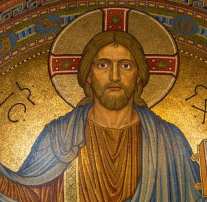
LutheransLutheranism is a major branch of Western Christianity that identifies with the theology of Martin Luther, a German reformer. Luther's efforts to reform the theology and practice of the church launched the Protestant Reformation...
. Zwingli and Calvin's heirs are far broader denominationally, and are broadly referred to as the Reformed Tradition. Most Protestant traditions branch out from the Reformed tradition in some way. In addition to the Lutheran and Reformed branches of the Reformation, there is
AnglicanismAnglicanism is a tradition within Christianity comprising churches with historical connections to the Church of England or similar beliefs, worship and church structures. The word Anglican originates in ecclesia anglicana, a medieval Latin phrase dating to at least 1246 that means the English...
after the
English ReformationThe English Reformation was the series of events in 16th-century England by which the Church of England broke away from the authority of the Pope and the Roman Catholic Church....
. The
AnabaptistAnabaptists are Protestant Christians of the Radical Reformation of 16th-century Europe, and their direct descendants, particularly the Amish, Brethren, Hutterites, and Mennonites....
tradition was largely ostracized by the other Protestant parties at the time, but has achieved a measure of affirmation in more recent history. Some but not most Baptists prefer not to be called Protestants, claiming a direct ancestral line going back to the apostles in the 1st century.
The oldest Protestant groups separated from the Catholic Church in the 16th century
Protestant ReformationThe Protestant Reformation was a 16th-century split within Western Christianity initiated by Martin Luther, John Calvin and other early Protestants. The efforts of the self-described "reformers", who objected to the doctrines, rituals and ecclesiastical structure of the Roman Catholic Church, led...
, followed in many cases by further divisions. For example, the Methodist Church grew out of Anglican minister
John WesleyJohn Wesley was a Church of England cleric and Christian theologian. Wesley is largely credited, along with his brother Charles Wesley, as founding the Methodist movement which began when he took to open-air preaching in a similar manner to George Whitefield...
's
evangelicalEvangelism refers to the practice of relaying information about a particular set of beliefs to others who do not hold those beliefs. The term is often used in reference to Christianity....
and
revival movementThe holiness movement refers to a set of beliefs and practices emerging from the Methodist Christian church in the mid 19th century. The movement is distinguished by its emphasis on John Wesley's doctrine of "Christian perfection" - the belief that it is possible to live free of voluntary sin - and...
in the Anglican Church. Several Pentecostal and non-denominational Churches, which emphasize the cleansing power of the
Holy SpiritHoly Spirit is a term introduced in English translations of the Hebrew Bible, but understood differently in the main Abrahamic religions.While the general concept of a "Spirit" that permeates the cosmos has been used in various religions Holy Spirit is a term introduced in English translations of...
, in turn grew out of the Methodist Church. Because Methodists, Pentecostals, and other evangelicals stress "accepting Jesus as your personal Lord and Saviour", which comes from
John WesleyJohn Wesley was a Church of England cleric and Christian theologian. Wesley is largely credited, along with his brother Charles Wesley, as founding the Methodist movement which began when he took to open-air preaching in a similar manner to George Whitefield...
's emphasis of the New Birth, they often refer to themselves as being born-again.
Estimates of the total number of Protestants are very uncertain, partly because of the difficulty in determining which denominations should be placed in these categories, but it seems clear that Protestantism is the second largest major group of Christians after Catholicism in number of followers (although the Orthodox Church is larger than any single Protestant denomination).
A special grouping are the Anglican churches descended from the
Church of EnglandThe Church of England is the officially established Christian church in England and the Mother Church of the worldwide Anglican Communion. The church considers itself within the tradition of Western Christianity and dates its formal establishment principally to the mission to England by St...
and organised in the
Anglican CommunionThe Anglican Communion is an international association of national and regional Anglican churches in full communion with the Church of England and specifically with its principal primate, the Archbishop of Canterbury...
. Some Anglican churches consider themselves both Protestant and Catholic. Some Anglicans consider their church a
branch of the "One Holy Catholic Church"The Branch Theory is a theological concept within Anglicanism, holding that the Roman Catholic Church, the Eastern Orthodox Church and the Anglican Communion are the three principal branches of the One, Holy, Catholic, and Apostolic Church.-Theory:...
alongside of the Roman Catholic and Eastern Orthodox Churches, a concept rejected by the Roman Catholic Church and some Eastern Orthodox.
Some groups of individuals who hold basic Protestant tenets identify themselves simply as "Christians" or "born-again Christians". They typically distance themselves from the
confessionalismConfessionalism, in a religious sense, is a belief in the importance of full and unambiguous assent to the whole of a religious teaching...
and/or
creedA creed is a statement of belief—usually a statement of faith that describes the beliefs shared by a religious community—and is often recited as part of a religious service. When the statement of faith is longer and polemical, as well as didactic, it is not called a creed but a Confession of faith...
alism of other Christian communities by calling themselves "
non-denominationalIn Christianity, nondenominational institutions or churches are those not formally aligned with an established denomination, or that remain otherwise officially autonomous. This, however, does not preclude an identifiable standard among such congregations...
". Often founded by individual pastors, they have little affiliation with historic denominations.
Non-Trinitarian
Non-Trinitarianism includes all
ChristianA Christian is a person who adheres to Christianity, an Abrahamic, monotheistic religion based on the life and teachings of Jesus of Nazareth as recorded in the Canonical gospels and the letters of the New Testament...
belief systems- Divisions of Christian theology :There are many methods of categorizing different approaches to Christian theology. For a historical analysis, see the main article on the History of Christian theology.- Sub-disciplines :...
that reject, wholly or partly, the
doctrineDoctrine is a codification of beliefs or a body of teachings or instructions, taught principles or positions, as the body of teachings in a branch of knowledge or belief system...
of the
TrinityThe Christian doctrine of the Trinity defines God as three divine persons : the Father, the Son , and the Holy Spirit. The three persons are distinct yet coexist in unity, and are co-equal, co-eternal and consubstantial . Put another way, the three persons of the Trinity are of one being...
, namely, the teaching that God is three distinct yet coeternal and coequal
hypostases who are indivisibly united in one essence. In antiquity, sporadically in the Middle Ages, and again following the Reformation until today, differing views existed concerning the Godhead from those of Trinitarians and the related traditional
ChristologyChristology is the field of study within Christian theology which is primarily concerned with the nature and person of Jesus Christ as recorded in the Canonical gospels and the letters of the New Testament. Primary considerations include the relationship of Jesus' nature and person with the nature...
. Though diverse, these views may be generally classified into those that hold Christ to be only divine and not differing from the Father hypostatically; those that hold Christ to be less fully God than the Father; in other forms being completely human and a messenger as the perfect created human.
Others
Esoteric Christianity is a term which refers to an ensemble of
spiritualSpirituality can refer to an ultimate or an alleged immaterial reality; an inner path enabling a person to discover the essence of his/her being; or the “deepest values and meanings by which people live.” Spiritual practices, including meditation, prayer and contemplation, are intended to develop...
currents which regard Christianity as a mystery religion, and profess the existence and possession of certain
esotericEsotericism or Esoterism signifies the holding of esoteric opinions or beliefs, that is, ideas preserved or understood by a small group or those specially initiated, or of rare or unusual interest. The term derives from the Greek , a compound of : "within", thus "pertaining to the more inward",...
doctrines or practices, hidden from the public but accessible only to a narrow circle of "enlightened", "initiated", or highly educated people. A special characteristic common in these mystical denominations is the belief in
reincarnationReincarnation best describes the concept where the soul or spirit, after the death of the body, is believed to return to live in a new human body, or, in some traditions, either as a human being, animal or plant...
.
Some of the esoteric christian institutions include the
Rosicrucian FellowshipThe Rosicrucian Fellowship – "An International Association of Christian Mystics" – was founded in 1909 by Max Heindel as herald of the Aquarian Age and with the aim of publicly promulgating "the true Philosophy" of the Rosicrucians....
, the
Anthroposophical SocietyThe General Anthroposophical Society is an organization dedicated to supporting the community of those interested in the form of spiritual philosophy known as anthroposophy. The society was initiated during 1913 by members of the Theosophical Society in Germany, including Rudolf Steiner who was at...
and the
MartinismMartinism is a form of mystical and esoteric Christianity concerned with the fall of the first man, his state of material privation from his divine source, and the process of his return, called 'Reintegration' or illumination....
.
The
Second Great AwakeningThe Second Great Awakening was a Christian revival movement during the early 19th century in the United States. The movement began around 1800, had begun to gain momentum by 1820, and was in decline by 1870. The Second Great Awakening expressed Arminian theology, by which every person could be...
, a period of religious revival that occurred in the
U.S.The United States of America is a federal constitutional republic comprising fifty states and a federal district...
during the early 1800s, saw the development of a number of unrelated churches. They generally saw themselves as restoring the original church of Jesus Christ rather than reforming one of the existing churches. A common belief held by Restorationists was that the other divisions of Christianity had introduced doctrinal defects into Christianity, which was known as the
Great ApostasyThe Great Apostasy is a term used by some religious groups to describe a general fallen state of traditional Christianity, especially the Papacy, because it allowed the traditional Roman mysteries and deities of solar monism such as Mithras and Sol Invictus and idol worship back into the church,...
.
Some of the churches originating during this period are historically connected to early-19th century camp meetings in the Midwest and Upstate New York. American
MillennialismMillennialism , or chiliasm in Greek, is a belief held by some Christian denominations that there will be a Golden Age or Paradise on Earth in which "Christ will reign" for 1000 years prior to the final judgment and future eternal state...
and
AdventismAdventism is a Christian movement which began in the 19th century, in the context of the Second Great Awakening revival in the United States. The name refers to belief in the imminent Second Coming of Jesus Christ. It was started by William Miller, whose followers became known as Millerites...
, which arose from Evangelical Protestantism, influenced the
Jehovah's WitnessesJehovah's Witnesses is a millenarian restorationist Christian denomination with nontrinitarian beliefs distinct from mainstream Christianity. The religion reports worldwide membership of over 7 million adherents involved in evangelism, convention attendance of over 12 million, and annual...
movement (with 7 million members), and, as a reaction specifically to
William MillerWilliam Miller was an American Baptist preacher who is credited with beginning the mid-nineteenth century North American religious movement now known as Adventism. Among his direct spiritual heirs are several major religious denominations, including Seventh-day Adventists and Advent Christians...
, the
Seventh-day AdventistsThe Seventh-day Adventist Church is a Protestant Christian denomination distinguished by its observance of Saturday, the original seventh day of the Judeo-Christian week, as the Sabbath, and by its emphasis on the imminent second coming of Jesus Christ...
. Others, including the
Christian Church (Disciples of Christ)The Christian Church is a Mainline Protestant denomination in North America. It is often referred to as The Christian Church, The Disciples of Christ, or more simply as The Disciples...
, Evangelical Christian Church in Canada, Churches of Christ, and the Christian churches and churches of Christ, have their roots in the contemporaneous Stone-Campbell
Restoration MovementThe Restoration Movement is a Christian movement that began on the American frontier during the Second Great Awakening of the early 19th century...
, which was centered in Kentucky and Tennessee. Other groups originating in this time period include the
ChristadelphiansChristadelphians is a Christian group that developed in the United Kingdom and North America in the 19th century...
and The Church of Jesus Christ of Latter-day Saints, the largest denomination of the
Latter Day Saint movementThe Latter Day Saint movement is a group of independent churches tracing their origin to a Christian primitivist movement founded by Joseph Smith, Jr. in the late 1820s. Collectively, these churches have over 14 million members...
with over 13 million members. While the churches originating in the Second Great Awakening have some superficial similarities, their doctrine and practices vary significantly.
Cultural Christian
Cultural ChristianA cultural Christian is a secular or irreligious individual who still significantly identifies with Christian culture. The term is used, for example, by atheist Richard Dawkins in reference to himself...
is a broad term used to describe people with either ethnic or religious
ChristianA Christian is a person who adheres to Christianity, an Abrahamic, monotheistic religion based on the life and teachings of Jesus of Nazareth as recorded in the Canonical gospels and the letters of the New Testament...
heritage who may not believe in the religious claims of Christianity, but who retain an affinity for the
cultureChristian pop culture , is the vernacular Christian culture that prevails in any given society. The content of popular culture is determined by the daily interactions, needs and desires, and cultural 'movements' that make up everyday lives of Christians...
,
artChristian art is sacred art produced in an attempt to illustrate, supplement and portray in tangible form the principles of Christianity, though other definitions are possible. Most Christian groups use or have used art to some extent, although some have had strong objections to some forms of...
,
musicChristian music is music that has been written to express either personal or a communal belief regarding Christian life and faith. Common themes of Christian music include praise, worship, penitence, and lament, and its forms vary widely across the world....
, and so on related to it.
Many of the population of the Western hemisphere could broadly be described as cultural Christians, due to the predominance of the Christian faith in
Western cultureWestern culture, sometimes equated with Western civilization or European civilization, refers to cultures of European origin and is used very broadly to refer to a heritage of social norms, ethical values, traditional customs, religious beliefs, political systems, and specific artifacts and...
, as well as widely celebrated religious holidays such as
EasterEaster is the central feast in the Christian liturgical year. According to the Canonical gospels, Jesus rose from the dead on the third day after his crucifixion. His resurrection is celebrated on Easter Day or Easter Sunday...
and
ChristmasChristmas or Christmas Day is an annual holiday generally celebrated on December 25 by billions of people around the world. It is a Christian feast that commemorates the birth of Jesus Christ, liturgically closing the Advent season and initiating the season of Christmastide, which lasts twelve days...
. Another frequent application of the term is to distinguish political groups in areas of mixed religious backgrounds.
Ecumenism
Most
churchesA local church is a Christian religious organization that meets in a particular location. Many are formally organized, with constitutions and by-laws, maintain offices, are served by pastors or lay leaders, and, in nations where this is permissible, often seek seek non-profit corporate status...
have long expressed ideals of being reconciled with each other, and in the 20th century Christian
ecumenismEcumenism or oecumenism mainly refers to initiatives aimed at greater Christian unity or cooperation. It is used predominantly by and with reference to Christian denominations and Christian Churches separated by doctrine, history, and practice...
advanced in two ways. One way was greater cooperation between groups, such as the
Edinburgh Missionary ConferenceThe 1910 World Missionary Conference, or the Edinburgh Missionary Conference, was held June 14 to 23, 1910. Some have seen it as both the culmination of nineteenth-century Protestant Christian missions and the formal beginning of the modern Protestant Christian ecumenical movement.- Edinburgh 1910...
of Protestants in 1910, the Justice, Peace and Creation Commission of the
World Council of ChurchesThe World Council of Churches is a worldwide fellowship of 349 global, regional and sub-regional, national and local churches seeking unity, a common witness and Christian service. It is a Christian ecumenical organization that is based in the Ecumenical Centre in Geneva, Switzerland...
founded in 1948 by Protestant and Orthodox churches, and similar national councils like the
National Council of Churches in AustraliaThe National Council of Churches in Australia is an ecumenical organisation bringing together a number of Australia's Christian Churches in dialogue and practical cooperation.It works in collaboration with state ecumenical councils around Australia...
which includes Roman Catholics.
The other way was institutional union with new
United and uniting churchesUnited and uniting churches are churches formed from the merger or other form of union of two or more different Protestant denominations.Perhaps the oldest example of a united church is found in Germany, where the Evangelical Church in Germany is a federation of Lutheran, United and Reformed...
.
CongregationalistCongregational churches are Protestant Christian churches practicing Congregationalist church governance, in which each congregation independently and autonomously runs its own affairs....
, Methodist, and Presbyterian churches united in 1925 to form the
United Church of CanadaThe United Church of Canada is a Protestant Christian denomination in Canada. It is the largest Protestant church and, after the Roman Catholic Church, the second-largest Christian church in Canada...
, and in 1977 to form the
Uniting Church in AustraliaThe Uniting Church in Australia was formed on 22 June 1977 when many congregations of the Methodist Church of Australasia, the Presbyterian Church of Australia and the Congregational Union of Australia came together under the Basis of Union....
. The
Church of South IndiaThe Church of South India is the successor of the Church of England in India. It came into being in 1947 as a union of Anglican and Protestant churches in South India. With a membership of over 3.8 million, it is India's second largest Christian church after the Roman Catholic Church in India...
was formed in 1947 by the union of Anglican,
MethodistMethodism is a movement of Protestant Christianity represented by a number of denominations and organizations, claiming a total of approximately seventy million adherents worldwide. The movement traces its roots to John Wesley's evangelistic revival movement within Anglicanism. His younger brother...
,
CongregationalistCongregational churches are Protestant Christian churches practicing Congregationalist church governance, in which each congregation independently and autonomously runs its own affairs....
,
PresbyterianPresbyterianism refers to a number of Christian churches adhering to the Calvinist theological tradition within Protestantism, which are organized according to a characteristic Presbyterian polity. Presbyterian theology typically emphasizes the sovereignty of God, the authority of the Scriptures,...
, and Reformed churches.
Steps towards reconciliation on a global level were taken in 1965 by the Roman Catholic and Orthodox churches mutually revoking the excommunications that marked their
Great SchismThe East–West Schism of 1054, sometimes known as the Great Schism, formally divided the State church of the Roman Empire into Eastern and Western branches, which later became known as the Eastern Orthodox Church and the Roman Catholic Church, respectively...
in 1054; the
Anglican Roman Catholic International CommissionThe Anglican—Roman Catholic International Commission is an organization which seeks to make ecumenical progress between the Roman Catholic Church and the Anglican Communion...
(ARCIC) working towards full communion between those churches since 1970; and the
LutheranThe Lutheran World Federation is a global communion of national and regional Lutheran churches headquartered in the Ecumenical Centre in Geneva, Switzerland. The federation was founded in the Swedish city of Lund in the aftermath of the Second World War in 1947 to coordinate the activities of the...
and Roman Catholic churches signing The
Joint Declaration on the Doctrine of JustificationThe Joint Declaration on the Doctrine of Justification is a document created by and agreed to by the Pontifical Council for Promoting Christian Unity and the Lutheran World Federation in 1999, as a result of extensive ecumenical dialogue...
in 1999 to address conflicts at the root of the Protestant Reformation. In 2006, the
Methodist churchThe World Methodist Council, founded in 1881, is an association of churches in the Methodist tradition which comprises most of the world's Wesleyan denominations.- Extension and organization:...
adopted the declaration.
Another example of ecumenism is the invention of and growing usage of the
Christian FlagThe Christian Flag is a flag designed in the early 20th century to represent all of Christianity and Christendom, and has been most popular among Christian churches in North America, Africa and Latin America. The flag has a white field, with a red Latin cross inside a blue canton. The shade of red...
, which was designed to represent all of
ChristendomChristendom, or the Christian world, has several meanings. In a cultural sense it refers to the worldwide community of Christians, adherents of Christianity...
. The flag has a white
fieldFlag terminology is a jargon used in vexillology, the study of flags, to describe precisely the parts, patterns, and other attributes of flags and their display.-Description of standard flag parts and terms:...
, with a red Latin cross inside a blue
cantonFlag terminology is a jargon used in vexillology, the study of flags, to describe precisely the parts, patterns, and other attributes of flags and their display.-Description of standard flag parts and terms:...
.
See also
- Bible
The Bible refers to any one of the collections of the primary religious texts of Judaism and Christianity. There is no common version of the Bible, as the individual books , their contents and their order vary among denominations...
- Christian apologetics
Christian apologetics is a field of Christian theology that aims to present a rational basis for the Christian faith, defend the faith against objections, and expose the perceived flaws of other world views...
- Christian architecture
- Christian art
Christian art is sacred art produced in an attempt to illustrate, supplement and portray in tangible form the principles of Christianity, though other definitions are possible. Most Christian groups use or have used art to some extent, although some have had strong objections to some forms of...
- Christian mythology
Christian mythology is the body of myths associated with Christianity. In the study of mythology, the term "myth" refers to a traditional story, often one which is regarded as sacred and which explains how the world and its inhabitants came to have their present form.Classicist G.S. Kirk defines a...
- Christian philosophy
Christian philosophy may refer to any development in philosophy that is characterised by coming from a Christian tradition.- Origins of Christian philosophy :...
- Christian symbolism
Christian symbolism invests objects or actions with an inner meaning expressing Christian ideas. Christianity has borrowed from the common stock of significant symbols known to most periods and to all regions of the world. Religious symbolism is effective when it appeals to both the intellect and...
- Christian views on marriage
- Christian World
Christendom, or the Christian world, has several meanings. In a cultural sense it refers to the worldwide community of Christians, adherents of Christianity...
- Christianity and politics
The relationship between Christianity and politics is a historically complex subject and a frequent source of disagreement throughout Church history, and in modern politics between the Christian right and Christian left.-Foundations:...
- Christianity and sexuality
- Criticism of Christianity
Throughout the history of Christianity, many have criticized Christianity, the church, and Christians themselves. Some criticism specifically addresses Christian beliefs, teachings and interpretation of scripture...
- Evangelical environmentalism
Evangelical environmentalism is an environmental movement in the United States in which some Evangelicals have emphasized biblical mandates concerning humanity's role as steward and subsequent responsibility for the caretaking of Creation...
- Evangelism
Evangelism refers to the practice of relaying information about a particular set of beliefs to others who do not hold those beliefs. The term is often used in reference to Christianity....
- Freedom of religion
Freedom of religion is a principle that supports the freedom of an individual or community, in public or private, to manifest religion or belief in teaching, practice, worship, and observance; the concept is generally recognized also to include the freedom to change religion or not to follow any...
- Good news (Christianity), concerning the gospel message
- Gospel
A gospel is an account, often written, that describes the life of Jesus of Nazareth. In a more general sense the term "gospel" may refer to the good news message of the New Testament. It is primarily used in reference to the four canonical gospels of Matthew, Mark, Luke, and John...
- Messianic Judaism
Messianic Judaism is a syncretic religious movement that arose in the 1960s and 70s. It blends evangelical Christian theology with elements of Jewish terminology and ritual....
- One true church
- One true faith
The concept of a one true faith, one true religion, or one true church, stem from the concept of the One True God asserted by believers in a monotheistic view of God...
- Political catholicism
Political catholicism is a political and cultural conception which promotes the ideas and social teaching of the Catholic Church in public life...
Not to be confused with
- Messianism
Messianism is the belief in a messiah, a savior or redeemer. Many religions have a messiah concept, including the Jewish Messiah, the Christian Christ, the Muslim Mahdi and Isa , the Buddhist Maitreya, the Hindu Kalki and the Zoroastrian Saoshyant...
Further reading
- MacCulloch, Diarmaid. Christianity: The First Three Thousand Years (Viking; 2010) 1,161 pages; survey by leading historian
External links