

Slavic peoples

Encyclopedia
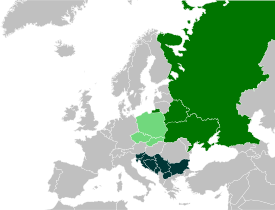
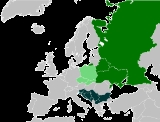
The Slavic people are an Indo-European panethnicity
Panethnicity
Panethnicity is the grouping together, and collective labeling, of various independently distinguishable, self-identified and self-sustained ethnicities into one all-encompassing group of people.Often labels of panethnicity group together people of different nationalities and/or ethnicities that...
living in Eastern Europe
Eastern Europe
Eastern Europe is the eastern part of Europe. The term has widely disparate geopolitical, geographical, cultural and socioeconomic readings, which makes it highly context-dependent and even volatile, and there are "almost as many definitions of Eastern Europe as there are scholars of the region"...
, Southeast Europe
Southeast Europe
Southeast Europe or Southeastern Europe is a relatively recent political designation for the states of the Balkans. Writers such as Maria Todorova and Vesna Goldsworthy have suggested the use of the term Southeastern Europe to replace the word Balkans for the region, to minimize potential...
, North Asia
North Asia
North Asia or Northern Asia is a subregion of Asia, consisting of the Asian portion of Russia.The Phillips Illustrated Atlas of the World 1988 defines it as being most of the former USSR, the part that is to the east of the Ural Mountains...
and Central Asia
Central Asia
Central Asia is a core region of the Asian continent from the Caspian Sea in the west, China in the east, Afghanistan in the south, and Russia in the north...
. The term Slavic represents a broad ethno-linguistic group of people, who speak languages belonging to the Slavic language family
Slavic languages
The Slavic languages , a group of closely related languages of the Slavic peoples and a subgroup of Indo-European languages, have speakers in most of Eastern Europe, in much of the Balkans, in parts of Central Europe, and in the northern part of Asia.-Branches:Scholars traditionally divide Slavic...
and share, to varying degrees, certain cultural traits and historical backgrounds. From the early 6th century they spread to inhabit most of central and eastern Europe and the Balkans
Balkans
The Balkans is a geopolitical and cultural region of southeastern Europe...
. In addition to their main population centre in Europe, some East Slavs also settled later in Siberia
Siberia
Siberia is an extensive region constituting almost all of Northern Asia. Comprising the central and eastern portion of the Russian Federation, it was part of the Soviet Union from its beginning, as its predecessor states, the Tsardom of Russia and the Russian Empire, conquered it during the 16th...
and Central Asia
Central Asia
Central Asia is a core region of the Asian continent from the Caspian Sea in the west, China in the east, Afghanistan in the south, and Russia in the north...
. Part of all Slavic ethnicities emigrated to other parts of the world. Over half of Europe
Europe
Europe is, by convention, one of the world's seven continents. Comprising the westernmost peninsula of Eurasia, Europe is generally 'divided' from Asia to its east by the watershed divides of the Ural and Caucasus Mountains, the Ural River, the Caspian and Black Seas, and the waterways connecting...
's territory is inhabited by Slavic-speaking communities. The worldwide population of people of Slavic descent is close to 400 million.
Modern nations and ethnic groups called by the ethnonym
Ethnonym
An ethnonym is the name applied to a given ethnic group. Ethnonyms can be divided into two categories: exonyms and autonyms or endonyms .As an example, the ethnonym for...
Slavs are considerably diverse both in appearance and culturally, and relations between them – even within the individual ethnic groups themselves – are varied, ranging from a sense of connection to feelings of mutual hostility.
Present-day Slavic people are classified into East Slavic
East Slavs
The East Slavs are Slavic peoples speaking East Slavic languages. Formerly the main population of the medieval state of Kievan Rus, by the seventeenth century they evolved into the Russian, Ukrainian, and Belarusian peoples.-Sources:...
(including Russians
Russians
The Russian people are an East Slavic ethnic group native to Russia, speaking the Russian language and primarily living in Russia and neighboring countries....
, Ukrainians
Ukrainians
Ukrainians are an East Slavic ethnic group native to Ukraine, which is the sixth-largest nation in Europe. The Constitution of Ukraine applies the term 'Ukrainians' to all its citizens...
, and Belarusians
Belarusians
Belarusians ; are an East Slavic ethnic group who populate the majority of the Republic of Belarus. Introduced to the world as a new state in the early 1990s, the Republic of Belarus brought with it the notion of a re-emerging Belarusian ethnicity, drawn upon the lines of the Old Belarusian...
), West Slavic
West Slavs
The West Slavs are Slavic peoples speaking West Slavic languages. They include Poles , Czechs, Slovaks, Lusatian Sorbs and the historical Polabians. The northern or Lechitic group includes, along with Polish, the extinct Polabian and Pomeranian languages...
(including Poles
Poles
thumb|right|180px|The state flag of [[Poland]] as used by Polish government and diplomatic authoritiesThe Polish people, or Poles , are a nation indigenous to Poland. They are united by the Polish language, which belongs to the historical Lechitic subgroup of West Slavic languages of Central Europe...
, Czechs and Slovaks
Slovaks
The Slovaks, Slovak people, or Slovakians are a West Slavic people that primarily inhabit Slovakia and speak the Slovak language, which is closely related to the Czech language.Most Slovaks today live within the borders of the independent Slovakia...
), and South Slavic
South Slavs
The South Slavs are the southern branch of the Slavic peoples and speak South Slavic languages. Geographically, the South Slavs are native to the Balkan peninsula, the southern Pannonian Plain and the eastern Alps...
(including Bulgarians
Bulgarians
The Bulgarians are a South Slavic nation and ethnic group native to Bulgaria and neighbouring regions. Emigration has resulted in immigrant communities in a number of other countries.-History and ethnogenesis:...
, Macedonians
Macedonians (ethnic group)
The Macedonians also referred to as Macedonian Slavs: "... the term Slavomacedonian was introduced and was accepted by the community itself, which at the time had a much more widespread non-Greek Macedonian ethnic consciousness...
, Slovenes, Croats
Croats
Croats are a South Slavic ethnic group mostly living in Croatia, Bosnia and Herzegovina and nearby countries. There are around 4 million Croats living inside Croatia and up to 4.5 million throughout the rest of the world. Responding to political, social and economic pressure, many Croats have...
, Bosniaks
Bosniaks
The Bosniaks or Bosniacs are a South Slavic ethnic group, living mainly in Bosnia and Herzegovina, with a smaller minority also present in other lands of the Balkan Peninsula especially in Serbia, Montenegro and Croatia...
, Serbs
Serbs
The Serbs are a South Slavic ethnic group of the Balkans and southern Central Europe. Serbs are located mainly in Serbia, Montenegro and Bosnia and Herzegovina, and form a sizable minority in Croatia, the Republic of Macedonia and Slovenia. Likewise, Serbs are an officially recognized minority in...
and Montenegrins). For a more comprehensive list, see the ethnocultural subdivisions.
Ethnonym
The Slavic autonym is reconstructed in Proto-SlavicProto-Slavic language
Proto-Slavic is the proto-language from which Slavic languages later emerged. It was spoken before the seventh century AD. As with most other proto-languages, no attested writings have been found; the language has been reconstructed by applying the comparative method to all the attested Slavic...
as Slověninъ. The oldest documents written in Old Church Slavonic
Old Church Slavonic
Old Church Slavonic or Old Church Slavic was the first literary Slavic language, first developed by the 9th century Byzantine Greek missionaries Saints Cyril and Methodius who were credited with standardizing the language and using it for translating the Bible and other Ancient Greek...
and dating from the 9th century attest Словѣне Slověne to describe the Slavs. Other early Slavic attestations include Old East Slavic Словене Slověně for "an East Slavic group near Novgorod." However, the earliest written references to the Slavs under this name are in other languages. In the 6th century AD Procopius
Procopius
Procopius of Caesarea was a prominent Byzantine scholar from Palestine. Accompanying the general Belisarius in the wars of the Emperor Justinian I, he became the principal historian of the 6th century, writing the Wars of Justinian, the Buildings of Justinian and the celebrated Secret History...
writing in Byzantine Greek, refers to the Sklaboi, Sklabēnoi, Sklauenoi, Sthlauenoi, or Σκλαβῖνοι Sklabinoi, while his contemporary Jordanes
Jordanes
Jordanes, also written Jordanis or Jornandes, was a 6th century Roman bureaucrat, who turned his hand to history later in life....
refers to the Sclaveni in Latin
Latin
Latin is an Italic language originally spoken in Latium and Ancient Rome. It, along with most European languages, is a descendant of the ancient Proto-Indo-European language. Although it is considered a dead language, a number of scholars and members of the Christian clergy speak it fluently, and...
.
The Slavic autonym Slověninъ is usually considered a derivation from slovo "word," originally denoting "people who speak (the same language)," i.e. people who understand each other, in contrast to Slavic word denoting "foreign people" – němci, meaning "mumbling, murmuring people" (from Slavic němъ – "mumbling, mute
Muteness
Muteness or mutism is an inability to speak caused by a speech disorder. The term originates from the Latin word mutus, meaning "silent".-Causes:...
"). The latter word may be the derivation of words to denote German/Germanic people in many later Slavic languages: e.g., Polish Niemiec, Ukrainian Німець, Czech Němec, Slovak Nemec, Russian and Bulgarian Немец, Slovenian Nemec, Serbian Немац, Bosnian and Croatian Nijemac etc.
Proposals for the etymology of Slověninъ propounded by some scholars enjoy much less support. B.P. Lozinski argues that the word slava once had the meaning of worshipper, in this context meaning "practicer of a common Slavic religion," and from that evolved into an ethnonym. S.B. Bernstein speculates that it derives from a reconstructed Proto-Indo-European
Proto-Indo-European language
The Proto-Indo-European language is the reconstructed common ancestor of the Indo-European languages, spoken by the Proto-Indo-Europeans...
, cognate to Ancient Greek λαός laós "population, people," which itself has no commonly accepted etymology. Meanwhile others have pointed out that the suffix -enin indicates a man from a certain place, which in this case should be a place called Slova or Slava, possibly a river name. The Old East Slavic Slavuta for the Dnieper River
Dnieper River
The Dnieper River is one of the major rivers of Europe that flows from Russia, through Belarus and Ukraine, to the Black Sea.The total length is and has a drainage basin of .The river is noted for its dams and hydroelectric stations...
was argued by Henrich Bartek (1907–1986) to be derived from slova and also the origin of Slovene.
Homeland debate
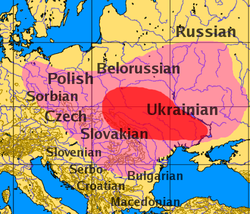
The location of the Slavic homeland has been the subject of significant debate. The Prague-Penkov-Kolochin complex of cultures of the 6th to 7th centuries CE are generally accepted to reflect the expansion of Slavic-speakers at that time. Serious candidates for the core from which they expanded are cultures within the territories of modern BelarusBelarus
Belarus , officially the Republic of Belarus, is a landlocked country in Eastern Europe, bordered clockwise by Russia to the northeast, Ukraine to the south, Poland to the west, and Lithuania and Latvia to the northwest. Its capital is Minsk; other major cities include Brest, Grodno , Gomel ,...
, Poland
Poland
Poland , officially the Republic of Poland , is a country in Central Europe bordered by Germany to the west; the Czech Republic and Slovakia to the south; Ukraine, Belarus and Lithuania to the east; and the Baltic Sea and Kaliningrad Oblast, a Russian exclave, to the north...
, and Ukraine
Ukraine
Ukraine is a country in Eastern Europe. It has an area of 603,628 km², making it the second largest contiguous country on the European continent, after Russia...
. The proposed frameworks are:
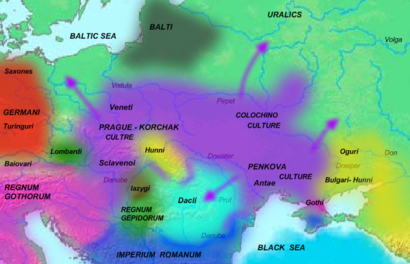
- Milograd culture hypothesis: The pre-Proto-Slavs (or Balto-Slavs) were the bearers of the Milograd cultureMilograd cultureThe Milograd culture is an archaeological culture, lasting from about the 7th century BC to the 1st century AD. Geographically, it corresponds to present day southern Belarus and northern Ukraine, in the area of the confluence of the Dnieper and the Pripyat, north of Kiev...
(7th century BCE to 1st century CE) of northern UkraineUkraineUkraine is a country in Eastern Europe. It has an area of 603,628 km², making it the second largest contiguous country on the European continent, after Russia...
and southern BelarusBelarusBelarus , officially the Republic of Belarus, is a landlocked country in Eastern Europe, bordered clockwise by Russia to the northeast, Ukraine to the south, Poland to the west, and Lithuania and Latvia to the northwest. Its capital is Minsk; other major cities include Brest, Grodno , Gomel ,...
. - Chernoles culture hypothesis: The pre-Proto-Slavs were the bearers of the Chernoles cultureChernoles cultureThe Chernoles culture is an Iron Age archaeological unit dating ca. 1025–700 BC. It was located in the forest-steppe between the Dniester and Dnieper Rivers, in what is now northern Ukraine. This location corresponds to where Herodotus later placed his Scythian ploughmen...
(750–200 BCE) of northern Ukraine, and later the Zarubintsy cultureZarubintsy cultureThe Zarubintsy culture was a culture that from the 3rd century BC until 1st century AD flourished in the area north of the Black Sea along the upper and middle Dnieper and Pripyat Rivers, stretching west towards the Southern Bug river. Zarubintsy sites were particularly dense between the Rivers...
(3rd century BCE to 1st century CE). - Lusatian culture hypothesis: The pre-Proto-Slavs were present in north-eastern Central EuropeCentral EuropeCentral Europe or alternatively Middle Europe is a region of the European continent lying between the variously defined areas of Eastern and Western Europe...
since at least the late 2nd millennium BCE, and were the bearers of the Lusatian cultureLusatian cultureThe Lusatian culture existed in the later Bronze Age and early Iron Age in most of today's Poland, parts of Czech Republic and Slovakia, parts of eastern Germany and parts of Ukraine...
(1300–500 BCE), and later the Przeworsk culturePrzeworsk cultureThe Przeworsk culture is part of an Iron Age archaeological complex that dates from the 2nd century BC to the 5th century AD. It was located in what is now central and southern Poland, later spreading to parts of eastern Slovakia and Carpathian Ruthenia ranging between the Oder and the middle and...
(2nd century BCE to 4th century CE). - DanubeDanubeThe Danube is a river in the Central Europe and the Europe's second longest river after the Volga. It is classified as an international waterway....
basin hypothesis: postulated by Oleg TrubachyovOleg TrubachyovOleg Nikolayevich Trubachyov was a Russian doctor in philology. He was an academician of the Russian Academy of Sciences and served as the editor-in-chief of Etimologiya. His works are on the etymology of Slavic languages and on East Slavic onomastics....
; sustained at present by Florin CurtaFlorin CurtaFlorin Curta is a Romanian-born American historian, expert medievalist and archaeologist on Eastern Europe. He is one of the top authorities in the field, especially regarding Balkan history, in the Western historiography; among others like John Fine and Dennis Hupchik...
, also supported by an early Medieval Slavic narrative source - Nestor's Chronicle
Research history
The starting point in the autochtonic/allochtonic debate was the year 1745, when Johann Christoph de Jordan
Johann Christoph Jordan
Johann Christoph Jordan or Johann Christoph de Jordan was an author who published in 1745 in Latin the history of Slavic Peoples, De Originibus Slavicis.-External links:*...
published De Originibus Slavicis. The works of Slovak philologist and poet Pavel Jozef Šafárik
Pavel Jozef Šafárik
Pavol Jozef Šafárik Pavol Jozef Šafárik (Safáry / Schaffáry/ Schafary/ Saf(f)arik / Šafarík/ Szafarzik, Czech Pavel Josef Šafařík, German Paul Joseph Schaffarik, Serbian Павле Јосиф Шафарик, Latin Paulus Josephus Schaffarik, Hungarian Pál József Saf(f)arik) Pavol Jozef Šafárik (Safáry /...
(1795–1861) has influenced generations of scholars. The foundation of his theory was the work of Jordanes, Getica. Jordanes had equated the Sclavenes and the Antes to the Venethi (or Venedi) also known from much earlier sources, such as Pliny the Elder, Tacitus, and Ptolemy.
Pavel Jozef Šafárik bequeathed to posterity not only his vision of a Slavic history, but also a powerful methodology for exploring its Dark Ages: language.
The Polish scholar Tadeusz Wojciechowski (1839–1919) was the first to use place names to write Slavic history. He was followed by A. L. Pogodin and the Polish botanist, J. Rostafinski.
The first to introduce archaeological data into the scholarly discourse about the early Slavs, Lubor Niederle (1865–1944), endorsed Rostafinski’s theory in his multi-volume work The Antiquities of the Slavs. Vykentyi V.Khvoika (1850–1914), a Ukrainian archaeologist of Czech origin, linked the Slavs with Neolithic Cucuteni culture
Cucuteni culture
The Cucuteni-Trypillian culture, also known as Cucuteni culture , Trypillian culture or Tripolye culture , is a late Neolithic archaeological culture which flourished between ca...
. A. A. Spicyn (1858–1931) assigned to the Antes the finds of silver and bronze in central and southern Ukraine. Czech archaeologist Ivan Borkovsky (1897–1976) postulated the existence of a pottery “Prague type” which was a national, exclusively Slavic, pottery. Boris Rybakov, has issue a theory that made a link between both Spicyn’s “Antian antiquities” and the remains excavated by Khvoika from Chernyakhov culture and that those should be should be attributed to the Slavs.
From the 19th century onwards, the debate became politically charged, particularly in connection with the history of the Partitions of Poland
Partitions of Poland
The Partitions of Poland or Partitions of the Polish–Lithuanian Commonwealth took place in the second half of the 18th century and ended the existence of the Polish–Lithuanian Commonwealth, resulting in the elimination of sovereign Poland for 123 years...
and German imperialism known as Drang nach Osten
Drang nach Osten
Drang nach Osten was a term coined in the 19th century to designate German expansion into Slavic lands. The term became a motto of the German nationalist movement in the late nineteenth century...
. The question whether Germanic or Slavic peoples were indigenous on the land east of the Oder
Oder
The Oder is a river in Central Europe. It rises in the Czech Republic and flows through western Poland, later forming of the border between Poland and Germany, part of the Oder-Neisse line...
river was used by factions to pursue their respective German and Polish political claims to governance of those lands.
Geneticists entered the debate in the 21st century. See the Genetics section below.
Earliest accounts
The relationship between the Slavs and a tribe called the Veneti east of the river VistulaVistula
The Vistula is the longest and the most important river in Poland, at 1,047 km in length. The watershed area of the Vistula is , of which lies within Poland ....
in the Roman period is uncertain. The name may refer both to Balts and Slavs.
The Slavs under name of the Antes
Antes (people)
The Antes or Antae were an ancient Slavic-Iranian tribal union in Eastern Europe who lived north of the lower Danube and the Black Sea in the 6th and 7th century AD and who are associated with the archaeological Penkovka culture.- Historiography :Procopius and Jordanes mention the Antes as one of...
and the Sclaveni make their first appearance in Byzantine records in the early 6th century. Byzantine
Byzantine Empire
The Byzantine Empire was the Eastern Roman Empire during the periods of Late Antiquity and the Middle Ages, centred on the capital of Constantinople. Known simply as the Roman Empire or Romania to its inhabitants and neighbours, the Empire was the direct continuation of the Ancient Roman State...
historiographers under Justinian I
Justinian I
Justinian I ; , ; 483– 13 or 14 November 565), commonly known as Justinian the Great, was Byzantine Emperor from 527 to 565. During his reign, Justinian sought to revive the Empire's greatness and reconquer the lost western half of the classical Roman Empire.One of the most important figures of...
(527-565), such as Procopius of Caesarea, Jordanes
Jordanes
Jordanes, also written Jordanis or Jornandes, was a 6th century Roman bureaucrat, who turned his hand to history later in life....
and Theophylact Simocatta
Theophylact Simocatta
Theophylact Simocatta was an early seventh-century Byzantine historiographer, arguably ranking as the last historian of Late Antiquity, writing in the time of Heraclius about the late Emperor Maurice .-Life:His history of the reign of emperor Maurice is in eight books...
describe tribes of these names emerging from the area of the Carpathian Mountains
Carpathian Mountains
The Carpathian Mountains or Carpathians are a range of mountains forming an arc roughly long across Central and Eastern Europe, making them the second-longest mountain range in Europe...
, the lower Danube
Danube
The Danube is a river in the Central Europe and the Europe's second longest river after the Volga. It is classified as an international waterway....
and the Black Sea
Black Sea
The Black Sea is bounded by Europe, Anatolia and the Caucasus and is ultimately connected to the Atlantic Ocean via the Mediterranean and the Aegean seas and various straits. The Bosphorus strait connects it to the Sea of Marmara, and the strait of the Dardanelles connects that sea to the Aegean...
, invading the Danubian provinces of the Eastern Empire.
Procopius
Procopius
Procopius of Caesarea was a prominent Byzantine scholar from Palestine. Accompanying the general Belisarius in the wars of the Emperor Justinian I, he became the principal historian of the 6th century, writing the Wars of Justinian, the Buildings of Justinian and the celebrated Secret History...
wrote in 545 that "the Sclaveni and the Antae actually had a single name in the remote past; for they were both called Spori in olden times." He describes their social structure and beliefs:
For these nations, the Sclaveni and the Antae, are not ruled by one man, but they have lived from of old under a democracy, and consequently everything which involves their welfare, whether for good or for ill, is referred to the people. It is also true that in all other matters, practically speaking, these two barbarian peoples have had from ancient times the same institutions and customs. For they believe that one god, the maker of lightning, is alone lord of all things, and they sacrifice to him cattle and all other victims.
He mentions that they were tall and hardy:
"They live in pitiful hovels which they set up far apart from one another, but, as a general thing, every man is constantly changing his place of abode. When they enter battle, the majority of them go against their enemy on foot carrying little shields and javelins in their hands, but they never wear corselets. Indeed, some of them do not wear even a shirt or a cloak, but gathering their trews up as far as to their private parts they enter into battle with their opponents. And both the two peoples have also the same language, an utterly barbarous tongue. Nay further, they do not differ at all from one another in appearance. For they are all exceptionally tall and stalwart men, while their bodies and hair are neither very fair or blond, nor indeed do they incline entirely to the dark type, but they are all slightly ruddy in color. And they live a hard life, giving no heed to bodily comforts...".
Jordanes tells us that the Sclaveni had swamps and forests for their cities. Another 6th-century source refers to them living among nearly impenetrable forests, rivers, lakes, and marshes.
Menander Protector
Menander Protector
Menander Protector , Byzantine historian, was born in Constantinople in the middle of the 6th century AD. The little that is known of his life is contained in the account of himself quoted by Suidas. He at first took up the study of law, but abandoned it for a life of pleasure...
mentions a Daurentius
Daurentius
Daurentius or Dauritas was a 6th-century South Slavic chieftain and warlord.His realm was situated in the basin of the Zala river, roughly in the territory of the old Roman province of Pannonia Prima, in present-day Hungary....
(577-579) that slew an Avar envoy of Khagan Bayan I. The Avars asked the Slavs to accept the suzerainty of the Avars, he however declined and is reported as saying: "Others do not conquer our land, we conquer theirs [...] so it shall always be for us".
Scenarios of ethnogenesis
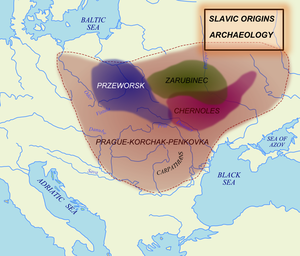
Globular Amphora culture
The Globular Amphora Culture , German Kugelamphoren-Kultur , ca. 3400-2800 BC, is an archaeological culture preceding the central area occupied by the Corded Ware culture. Somewhat to the south and west, it was bordered by the Baden culture. To the northeast was the Narva culture. It occupied much...
stretches from the middle Dniepr to the Elbe in the late 4th and early 3rd millennia BC. It has been suggested as the locus of a Germano-Balto-Slavic continuum (compare Germanic substrate hypothesis
Germanic substrate hypothesis
The Germanic substrate hypothesis is an attempt to explain the distinctive nature of the Germanic languages within the context of the Indo-European language family...
), but the identification of its bearers as Indo-Europeans is uncertain. The area of this culture contains numerous tumuli – typical for IE originators.
The Chernoles culture
Chernoles culture
The Chernoles culture is an Iron Age archaeological unit dating ca. 1025–700 BC. It was located in the forest-steppe between the Dniester and Dnieper Rivers, in what is now northern Ukraine. This location corresponds to where Herodotus later placed his Scythian ploughmen...
(8th to 3rd c. BC, sometimes associated with the "Scythian farmers" of Herodotus
Herodotus
Herodotus was an ancient Greek historian who was born in Halicarnassus, Caria and lived in the 5th century BC . He has been called the "Father of History", and was the first historian known to collect his materials systematically, test their accuracy to a certain extent and arrange them in a...
) is "sometimes portrayed as either a state in the development of the Slavic languages or at least some form of late Indo-European ancestral to the evolution of the Slavic stock." The Milograd culture (700 BC - 100 AD), centered roughly on present-day Belarus, north of the contemporaneous Chernoles culture, has also been proposed as ancestral to either Slavs or Balts.
The ethnic composition of the bearers of the Przeworsk culture
Przeworsk culture
The Przeworsk culture is part of an Iron Age archaeological complex that dates from the 2nd century BC to the 5th century AD. It was located in what is now central and southern Poland, later spreading to parts of eastern Slovakia and Carpathian Ruthenia ranging between the Oder and the middle and...
(2nd c. BC to 4th c. AD, associated with the Lugii
Lugii
The Lugii, Lugi, Lygii, Ligii, Lugiones, Lygians, Ligians, Lugians, or Lougoi were an ancient Germanic tribe attested in the book Germania by the Roman historian Tacitus. They lived in ca...
) of central and southern Poland, northern Slovakia and Ukraine, including the Zarubintsy culture
Zarubintsy culture
The Zarubintsy culture was a culture that from the 3rd century BC until 1st century AD flourished in the area north of the Black Sea along the upper and middle Dnieper and Pripyat Rivers, stretching west towards the Southern Bug river. Zarubintsy sites were particularly dense between the Rivers...
(2nd c. BC to 2nd c. AD, also connected with the Bastarnae
Bastarnae
The Bastarnae or Basternae were an ancient Germanic tribe,, who between 200 BC and 300 AD inhabited the region between the eastern Carpathian mountains and the Dnieper river...
tribe) and the Oksywie culture
Oksywie culture
The Oksywie Culture, was an archaeological culture which existed in the area of modern day Eastern Pomerania around the lower Vistula river, from the 2nd century BC to the early 1st century AD....
are other candidates.
The area of southern Ukraine is known to have been inhabited by Scythian and Sarmatian tribes prior to the foundation of the Gothic kingdom. Early Slavic stone stelae found in the middle Dniester
Dniester
The Dniester is a river in Eastern Europe. It runs through Ukraine and Moldova and separates most of Moldova's territory from the breakaway de facto state of Transnistria.-Names:...
region are markedly different from the Scythian and Sarmatian stelae found in the Crimea.
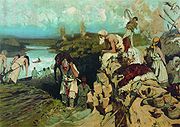
Chernyakhov culture
The Sântana de Mureș–Chernyakhiv culture is the name given to an archaeological culture which flourished between the 2nd and 5th centuries in a wide area of Eastern Europe, specifically in what today constitutes Ukraine, Romania, Moldova, and parts of Belarus...
(2nd to 5th c. AD, identified with the multi-ethnic kingdom established by the Goths) leads to the decline of the late Sarmatian culture in the 2nd to 4th centuries, the western part of the Przeworsk culture remains intact until the 4th century, and the Kiev culture
Kiev culture
The Kiev culture is an archaeological culture dating from about the 3rd to 5th centuries, named after Kiev, the capital of Ukraine. The dwellings are overwhelmingly of the semi-subterranean type, common among earlier Germanic tribes like the Scirii and Bastarnae, and later in Slavic cultures...
flourishes during the same time, in the 2nd-5th c. AD. This latter culture is recognized as the direct predecessor of the Prague-Korchak and Pen'kovo cultures
Antes (people)
The Antes or Antae were an ancient Slavic-Iranian tribal union in Eastern Europe who lived north of the lower Danube and the Black Sea in the 6th and 7th century AD and who are associated with the archaeological Penkovka culture.- Historiography :Procopius and Jordanes mention the Antes as one of...
(6th-7th c. AD), the first archaeological cultures the bearers of which are indisputably identified as Slavic.
Proto-Slavic is thus likely to have reached its final stage in the Kiev area; there is, however, substantial disagreement in the scientific community over the identity of the Kiev culture's predecessors, with some scholars tracing it from the Ruthenian
Ruthenians
The name Ruthenian |Rus']]) is a culturally loaded term and has different meanings according to the context in which it is used. Initially, it was the ethnonym used for the East Slavic peoples who lived in Rus'. Later it was used predominantly for Ukrainians...
Milograd culture, others from the "Ukrainian" Chernoles and Zarubintsy cultures and still others from the "Polish" Przeworsk culture.
Genetics
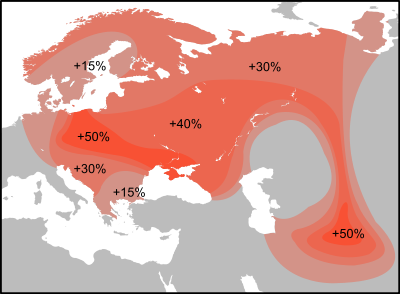

Haplogroup R1a (Y-DNA)
Haplogroup R1a is the phylogenetic name of a major clade of Human Y-chromosome DNA haplogroups. In other words, it is a way of grouping a significant part of all modern men according to a shared male-line ancestor. It is common in many parts of Eurasia and is frequently discussed in human...
ranges from 63.39% in the Sorbs
Sorbs
Sorbs are a Western Slavic people of Central Europe living predominantly in Lusatia, a region on the territory of Germany and Poland. In Germany they live in the states of Brandenburg and Saxony. They speak the Sorbian languages - closely related to Polish and Czech - officially recognized and...
, through 56.4% in Poland, 54% in Ukraine, 52% in Russia, Belarus, to 15.2% in Republic of Macedonia, 14.7% in Bulgaria and 12.1% in Herzegovina
Herzegovina
Herzegovina is the southern region of Bosnia and Herzegovina. While there is no official border distinguishing it from the Bosnian region, it is generally accepted that the borders of the region are Croatia to the west, Montenegro to the south, the canton boundaries of the Herzegovina-Neretva...
. The correlation between R1a1a [M17] and the speakers of Indo-European languages
Indo-European languages
The Indo-European languages are a family of several hundred related languages and dialects, including most major current languages of Europe, the Iranian plateau, and South Asia and also historically predominant in Anatolia...
, particularly those of Eastern Europe and Central and Southern Asia, was noticed in the late 1990s. From this Spencer Wells and colleagues, following the Kurgan hypothesis
Kurgan hypothesis
The Kurgan hypothesis is one of the proposals about early Indo-European origins, which postulates that the people of an archaeological "Kurgan culture" in the Pontic steppe were the most likely speakers of the Proto-Indo-European language...
, deduced that R1a1a arose on the Pontic-Caspian steppe
Pontic-Caspian steppe
The Pontic-Caspian steppe is the vast steppeland stretching from the north of the Black Sea as far as the east of the Caspian Sea, from western Ukraine across the Southern Federal District and the Volga Federal District of Russia to western Kazakhstan,...
.
Specific studies of Slavic genetics followed. In 2007 Rębała and colleagues studied several Slavic populations with the aim of localizing the Proto-Slavic homeland. The significant findings of this study are that:
- Two genetically distant groups of Slavic populations were revealed: One encompassing all Western-Slavic, Eastern-Slavic, and few Southern-Slavic populations (north-western CroatsCroatsCroats are a South Slavic ethnic group mostly living in Croatia, Bosnia and Herzegovina and nearby countries. There are around 4 million Croats living inside Croatia and up to 4.5 million throughout the rest of the world. Responding to political, social and economic pressure, many Croats have...
and Slovenes), and one encompassing all remaining Southern Slavs. According to the authors most Slavic populations have similar Y chromosome pools — R1a. They speculate that this similarity can be traced to an origin in the middle DnieperDnieper RiverThe Dnieper River is one of the major rivers of Europe that flows from Russia, through Belarus and Ukraine, to the Black Sea.The total length is and has a drainage basin of .The river is noted for its dams and hydroelectric stations...
basin of Ukraine during the Late Glacial Maximum 15 kya. - However, some southern Slavic populations such as BulgariansBulgariansThe Bulgarians are a South Slavic nation and ethnic group native to Bulgaria and neighbouring regions. Emigration has resulted in immigrant communities in a number of other countries.-History and ethnogenesis:...
, SerbsSerbsThe Serbs are a South Slavic ethnic group of the Balkans and southern Central Europe. Serbs are located mainly in Serbia, Montenegro and Bosnia and Herzegovina, and form a sizable minority in Croatia, the Republic of Macedonia and Slovenia. Likewise, Serbs are an officially recognized minority in...
and MacedoniansMacedonians (ethnic group)The Macedonians also referred to as Macedonian Slavs: "... the term Slavomacedonian was introduced and was accepted by the community itself, which at the time had a much more widespread non-Greek Macedonian ethnic consciousness...
are clearly separated from the tight DNA cluster of the rest of the Slavic populations. According to the authors this phenomenon is explained by "...contribution to the Y chromosomes of peoples who settled in the Balkan region before the Slavic expansion to the genetic heritage of Southern Slavs...."
Marcin Woźniak and colleagues (2010) searched for specifically Slavic sub-group of R1a1a [M17]. Working with haplotypes, they found a pattern among Western Slavs which turned out to correspond to a newly-discovered marker, M458, which defines subclade R1a1a7. This marker correlates remarkably well with the distribution of Slavic-speakers today. The team, led by Peter Underhill, which discovered M458 did not consider the possibility that this was a Slavic marker, since they used the "evolutionary effective" mutation rate, which gave a date far too old to be Slavic. Woźniak and colleagues pointed out that the pedigree mutation rate, giving a later date, is more consistent with the archaeological record.
Pomors
Pomors
Pomors or Pomory are Russian settlers and their descendants on the White Sea coast. It is also term of self-identification for the descendants of Russian, primarily Novgorod, settlers of Pomorye , living on the White Sea coasts and the territory whose southern border lies on a watershed which...
are distinguished by the presence of Y Haplogroup N
Haplogroup N (Y-DNA)
In human genetics, Haplogroup N is a Y-chromosome DNA haplogroup, defined by the presence of the marker M231. The b2/b3 deletion in the AZFc region of the human Y-chromosome is a characteristic of Haplogroup N haplotypes. This deletion, however, appears to have occurred independently on four...
among them. Postulated to originate from southeast Asia, it is found at high rates in Uralic peoples. Its presence in Pomors
Pomors
Pomors or Pomory are Russian settlers and their descendants on the White Sea coast. It is also term of self-identification for the descendants of Russian, primarily Novgorod, settlers of Pomorye , living on the White Sea coasts and the territory whose southern border lies on a watershed which...
(called "Northern Russians" in the report) attests to the non-Slavic tribes (mixing with Finnic tribes of northern Eurasia).
On the other hand I2a1b1 (P41.2)
Haplogroup I2 (Y-DNA)
In human genetics, Haplogroup I2 is a Y-chromosome haplogroup. Until 2008, it was known as Haplogroup I1b. Haplogroup I2 might have originated in Southeastern Europe some 15,000 - 17,000 years ago and developed into three main subgroups : I2*, I2a, and I2b.-Subclades:Note: The systematic subclade...
is typical of the South Slavic
South Slavs
The South Slavs are the southern branch of the Slavic peoples and speak South Slavic languages. Geographically, the South Slavs are native to the Balkan peninsula, the southern Pannonian Plain and the eastern Alps...
populations, being highest in Bosnia-Herzegovina (>50%). Haplogroup I2a2 is also commonly found in north-eastern Italians. There is also a high concentration of I2a2a in north-east Romania
Romania
Romania is a country located at the crossroads of Central and Southeastern Europe, on the Lower Danube, within and outside the Carpathian arch, bordering on the Black Sea...
, Moldova
Moldova
Moldova , officially the Republic of Moldova is a landlocked state in Eastern Europe, located between Romania to the West and Ukraine to the North, East and South. It declared itself an independent state with the same boundaries as the preceding Moldavian Soviet Socialist Republic in 1991, as part...
and western Ukraine
Ukraine
Ukraine is a country in Eastern Europe. It has an area of 603,628 km², making it the second largest contiguous country on the European continent, after Russia...
. According to original studies, Hg I2a2 was believed to have arisen in the west Balkans sometime after the LGM
Last Glacial Maximum
The Last Glacial Maximum refers to a period in the Earth's climate history when ice sheets were at their maximum extension, between 26,500 and 19,000–20,000 years ago, marking the peak of the last glacial period. During this time, vast ice sheets covered much of North America, northern Europe and...
, subsequently spreading from the Balkans through eastern Europe. Recently, Ken Nordtvedt
Ken Nordtvedt
Kenneth Leon Nordtvedt is a professor emeritus in the Physics Department at Montana State University and a senior researcher specializing in relativistic theories of gravity. He was born on April 16, 1939, in Chicago, Illinois. Nordtvedt graduated from the Massachusetts Institute of Technology and...
has split I2a2 into two clades - N (northern) and S (southern), in relation where they arose compared to Danube river. He proposes that N is slightly older than S. He recalculated the age of I2a2 to be ~ 2550 years and proposed that the its current distribution is explained by a Slavic expansion from the area north-east of the Carpathians. There is a much lower level of I2a2a among Greeks
Greeks
The Greeks, also known as the Hellenes , are a nation and ethnic group native to Greece, Cyprus and neighboring regions. They also form a significant diaspora, with Greek communities established around the world....
and Albanians
Albanians
Albanians are a nation and ethnic group native to Albania and neighbouring countries. They speak the Albanian language. More than half of all Albanians live in Albania and Kosovo...
(including those in Kosovo and R. of Macedonia), which retain their non-Slavic languages, than in present-day majority South Slavic-speaking nations.
Physical characteristics
Whilst physical anthropology has suffered criticism ever since the abuses of the discipline by Nazi Germany, it continues to enjoy popularity in eastern European scholarship. Some of the conclusions reached by physical anthropologists have recently been disproven by molecular and DNA technology; however, it remains useful in describing general phenotypic variations between populations. Tatyana Alexeyeva has recently described five cardinal Slavic physical types:(1) White Sea and Baltic type: characterized by their fair skin and blond hair, and medium facial features; they are predominantly meso- and brachy-cephals. Typical of northern Russians, Belarusians. Compared to the related West Baltic type (Scandinavians), they possess less prominent noses, sparser beards and a slight swelling of the upper eyelid.
(2) Eastern European type: this group includes virtually all Russian people (except northern Russians) and part of the Belarusians populating predominantly Russia's east and south. This type is distinguished by their darker hair and eyes. The anthropological composition of East European populations emerged through intermixing among the indigenous northern, southern and Ural tribes. The indigenous types had long or medium heads, large facial features, sharp horizontal profiles and prominent noses. The Uralic admixture is characterized by somewhat flattened faces and less prominent noses. Both groups must have created an anthropological groundwork for the formation of a significant part of the population inhabiting the East European Plain (apparently, of the Finno-Ugric type) that mixed with the Eastern Slavs.
(3) Dnieper-Carpathian type: includes Ukrainians and Poles, ethnic groups populating the Carpathian area, Slovaks and some of the Czechs. These are rather dark brachycephals with relatively broad faces. Such types have been found in Slavic burial grounds of Slovakia and Moldavia. Morphologically, those people were akin to the Alpine ethnic type of Ripley which stretched westward to what is now Austria, Switzerland and part of northern Italy. It might be that the Dnieper- Carpathian populations are a northeastern variant of this local race.
(4) Pontic type. It is represented mostly by Bulgarians: dark-haired, of medium height, with longish or medium heads. Their facial features are moderately
broad or else narrow. Judging by paleoanthropo-logical data, this combination type, a variant of the southern branch of Europeoids, must have originated in the Eastern Europe of the Neolithic time, though its origins might be traced earlier than that, when its tribes settled in these parts. The propagation of the Pontic type from the Mediterranean and Caucasia to southern Russian steppes continued down to the Late Bronze Age (1st millennium B.C.). Its traces are present in Eastern Slavs, the plainsmen of the Middle Age, in the contemporary Ukrainian population related to the Prut anthropological type, and among the Russians of the Don-Sura Region.
(5) Dinaric type takes in Yugoslavia's high-landers (Bosnia, Croatia, Serbia, Macedonia, Montenegro). They are known for having broad faces, prominent cheekbones and prominent or snubbed noses. Color of hair varies from blonde to brunette. Usually, tall, smooth straight hair, pale to rosy complexion and high stature. They differ from the other southern Europeoids in the lighter color of eyes.
Migrations
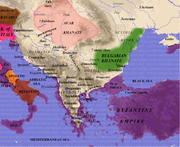
Ancient Rome
Ancient Rome was a thriving civilization that grew on the Italian Peninsula as early as the 8th century BC. Located along the Mediterranean Sea and centered on the city of Rome, it expanded to one of the largest empires in the ancient world....
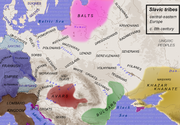
world, Slavic speaking tribes were part of the many multi-ethnic confederacies of Eurasia
Eurasia
Eurasia is a continent or supercontinent comprising the traditional continents of Europe and Asia ; covering about 52,990,000 km2 or about 10.6% of the Earth's surface located primarily in the eastern and northern hemispheres...
- such as the Sarmatian, Hun and Gothic empires. The Slavs emerged from obscurity when the westward movement of Germans in the 5th and 6th centuries AD (thought to be in conjunction with the movement of peoples from Siberia and Eastern Europe: Huns
Huns
The Huns were a group of nomadic people who, appearing from east of the Volga River, migrated into Europe c. AD 370 and established the vast Hunnic Empire there. Since de Guignes linked them with the Xiongnu, who had been northern neighbours of China 300 years prior to the emergence of the Huns,...
, and later Avars
Eurasian Avars
The Eurasian Avars or Ancient Avars were a highly organized nomadic confederacy of mixed origins. They were ruled by a khagan, who was surrounded by a tight-knit entourage of nomad warriors, an organization characteristic of Turko-Mongol groups...
and Bulgars
Bulgars
The Bulgars were a semi-nomadic who flourished in the Pontic Steppe and the Volga basin in the 7th century.The Bulgars emerge after the collapse of the Hunnic Empire in the 5th century....
) started the great migration of the Slavs, who settled the lands abandoned by Germanic tribes fleeing the Huns and their allies: westward into the country between the Oder and the Elbe
Elbe
The Elbe is one of the major rivers of Central Europe. It rises in the Krkonoše Mountains of the northwestern Czech Republic before traversing much of Bohemia , then Germany and flowing into the North Sea at Cuxhaven, 110 km northwest of Hamburg...
-Saale
Saale
The Saale, also known as the Saxon Saale and Thuringian Saale , is a river in Germany and a left-bank tributary of the Elbe. It is not to be confused with the smaller Franconian Saale, a right-bank tributary of the Main, or the Saale in Lower Saxony, a tributary of the Leine.-Course:The Saale...
line; southward into Bohemia
Bohemia
Bohemia is a historical region in central Europe, occupying the western two-thirds of the traditional Czech Lands. It is located in the contemporary Czech Republic with its capital in Prague...
, Moravia
Moravia
Moravia is a historical region in Central Europe in the east of the Czech Republic, and one of the former Czech lands, together with Bohemia and Silesia. It takes its name from the Morava River which rises in the northwest of the region...
, much of present day Austria
Austria
Austria , officially the Republic of Austria , is a landlocked country of roughly 8.4 million people in Central Europe. It is bordered by the Czech Republic and Germany to the north, Slovakia and Hungary to the east, Slovenia and Italy to the south, and Switzerland and Liechtenstein to the...
, the Pannonian plain and the Balkans
Balkans
The Balkans is a geopolitical and cultural region of southeastern Europe...
; and northward along the upper Dnieper river. Perhaps some Slavs migrated with the movement of the Vandals
Vandals
The Vandals were an East Germanic tribe that entered the late Roman Empire during the 5th century. The Vandals under king Genseric entered Africa in 429 and by 439 established a kingdom which included the Roman Africa province, besides the islands of Sicily, Corsica, Sardinia and the Balearics....
to Iberia and north Africa.
Around the 6th century, Slavs appeared on Byzantine
Byzantine Empire
The Byzantine Empire was the Eastern Roman Empire during the periods of Late Antiquity and the Middle Ages, centred on the capital of Constantinople. Known simply as the Roman Empire or Romania to its inhabitants and neighbours, the Empire was the direct continuation of the Ancient Roman State...
borders in great numbers. The Byzantine records note that grass would not regrow in places where the Slavs had marched through, so great were their numbers. After a military movement even the Peloponnese
Peloponnese
The Peloponnese, Peloponnesos or Peloponnesus , is a large peninsula , located in a region of southern Greece, forming the part of the country south of the Gulf of Corinth...
and Asia Minor
Asia Minor
Asia Minor is a geographical location at the westernmost protrusion of Asia, also called Anatolia, and corresponds to the western two thirds of the Asian part of Turkey...
were reported to have Slavic settlements. This southern movement has traditionally been seen as an invasive expansion. By the end of the 6th century, Slavs had settled the Eastern Alps region
Slavic settlement of the Eastern Alps
Slavic settlement of the Eastern Alps region was a historic process that took place between the 6th and 9th century AD, having culminated in the final quarter of the 6th century...
.
Early Slavic states
When their migratory movements ended, there appeared among the Slavs the first rudiments of stateSovereign state
A sovereign state, or simply, state, is a state with a defined territory on which it exercises internal and external sovereignty, a permanent population, a government, and the capacity to enter into relations with other sovereign states. It is also normally understood to be a state which is neither...
organizations, each headed by a prince with a treasury and a defense force. Moreover, it was the beginnings of class differentiation, and nobles pledged allegiance either to the Frankish
Franks
The Franks were a confederation of Germanic tribes first attested in the third century AD as living north and east of the Lower Rhine River. From the third to fifth centuries some Franks raided Roman territory while other Franks joined the Roman troops in Gaul. Only the Salian Franks formed a...
/ Holy Roman Emperors or the Byzantine Emperors.
In the 7th century, the Frankish merchant Samo
Samo
Samo was a Frankish merchant from the "Senonian country" , probably modern Soignies, Belgium or Sens, France. He was the first ruler of the Slavs whose name is known, and established one of the earliest Slav states, a supra-tribal union usually called Samo's empire, realm, kingdom, or tribal...
, who supported the Slavs fighting their Avar
Eurasian Avars
The Eurasian Avars or Ancient Avars were a highly organized nomadic confederacy of mixed origins. They were ruled by a khagan, who was surrounded by a tight-knit entourage of nomad warriors, an organization characteristic of Turko-Mongol groups...
rulers, became the ruler of the first known Slav state in Central Europe, which, however, most probably did not outlive its founder and ruler. This provided the foundation for subsequent Slavic states to arise on the former territory of this realm with Carantania being the oldest of them. Very old also are the Principality of Nitra
Principality of Nitra
The Principality of Nitra also Nitrian Principality or Slovak Principality is the name for a polity of Nitra Sloviens, centered on large agglomeration, a multi-tribal centre around Nitra, Slovakia. The initially independent Principality of Nitra came into existence in the early 9th century...
and the Moravia
Moravia
Moravia is a historical region in Central Europe in the east of the Czech Republic, and one of the former Czech lands, together with Bohemia and Silesia. It takes its name from the Morava River which rises in the northwest of the region...
n principality (see under Great Moravia
Great Moravia
Great Moravia was a Slavic state that existed in Central Europe and lasted for nearly seventy years in the 9th century whose creators were the ancestors of the Czechs and Slovaks. It was a vassal state of the Germanic Frankish kingdom and paid an annual tribute to it. There is some controversy as...
). In this period, there existed central Slavic groups and states such as the Balaton Principality
Balaton Principality
The Principality of Lower Pannonia was a Slavic principality located in the western part of the Pannonian plain, between the rivers Danube to its east The Principality of Lower Pannonia (also called Pannonia, Lower Pannonia, Pannonian Principality, Transdanubian Principality, Slavic Pannonian...
, but the subsequent expansion of the Magyars, as well as the Germanisation
Germanisation
Germanisation is both the spread of the German language, people and culture either by force or assimilation, and the adaptation of a foreign word to the German language in linguistics, much like the Romanisation of many languages which do not use the Latin alphabet...
of Austria
Austria
Austria , officially the Republic of Austria , is a landlocked country of roughly 8.4 million people in Central Europe. It is bordered by the Czech Republic and Germany to the north, Slovakia and Hungary to the east, Slovenia and Italy to the south, and Switzerland and Liechtenstein to the...
, separated the northern and southern Slavs. The First Bulgarian Empire
First Bulgarian Empire
The First Bulgarian Empire was a medieval Bulgarian state founded in the north-eastern Balkans in c. 680 by the Bulgars, uniting with seven South Slavic tribes...
was founded in AD 681, the Slavic language Old Bulgarian
Old Church Slavonic
Old Church Slavonic or Old Church Slavic was the first literary Slavic language, first developed by the 9th century Byzantine Greek missionaries Saints Cyril and Methodius who were credited with standardizing the language and using it for translating the Bible and other Ancient Greek...
became the main and official of the empire in AD 864. Bulgaria was instrumental in the spread of Slavic literacy and Christianity to the rest of the Slavic world.
Assimilation
Throughout their history, Slavs came into contact with non-Slavic groups. In the postulated homeland region (present-day Northern Ukraine), they had contacts with SarmatiansSarmatians
The Iron Age Sarmatians were an Iranian people in Classical Antiquity, flourishing from about the 5th century BC to the 4th century AD....
and the Germanic Goths
Goths
The Goths were an East Germanic tribe of Scandinavian origin whose two branches, the Visigoths and the Ostrogoths, played an important role in the fall of the Roman Empire and the emergence of Medieval Europe....
. After their subsequent spread, they began assimilating non-Slavic peoples. For example, in the Balkans, there were Paleo-Balkan
Prehistory of Southeastern Europe
The prehistory of Southeastern Europe , defined roughly as the territory of the wider Balkans peninsula covers the period from the Upper Paleolithic, beginning with the presence of Homo sapiens in the area some 44,000 years ago, until the...
peoples, such as Illyrians
Illyrians
The Illyrians were a group of tribes who inhabited part of the western Balkans in antiquity and the south-eastern coasts of the Italian peninsula...
, Greeks
Greeks
The Greeks, also known as the Hellenes , are a nation and ethnic group native to Greece, Cyprus and neighboring regions. They also form a significant diaspora, with Greek communities established around the world....
and romanized (North of the Jireček Line
Jirecek Line
The Jireček Line is an imaginary line through the ancient Balkans that divided the influences of the Latin and Greek languages until the 4th century...
) or hellenized (South of the Jirecek-line) Thracians
Thracians
The ancient Thracians were a group of Indo-European tribes inhabiting areas including Thrace in Southeastern Europe. They spoke the Thracian language – a scarcely attested branch of the Indo-European language family...
. Over time, due to the larger number of Slavs, the descendants most of the indigenous populations of the Balkans were Slavicized. The Thracians and Illyrians vanish from history during this period. An exception was Greece, where the smaller number Slavs scattered there came to be Hellenized (aided in time by more Greeks returning to Greece in the 9th century and the role of the church and administration). The Romance speakers within the fortified Dalmatian cities managed to retain their culture and language for a long time, as Dalmatian Romance was spoken until the high Middle Ages. However, they too were eventually assimilated into the body of Slavs. In contrast, the Romano-Dacians in Wallachia managed to maintain their Latin-based language, despite much Slavic influence. After centuries of peaceful co-existence, the groups fused to form the Romanians.
In the western Balkans, south Slavs and Germanic Gepids intermarried with Avar
Eurasian Avars
The Eurasian Avars or Ancient Avars were a highly organized nomadic confederacy of mixed origins. They were ruled by a khagan, who was surrounded by a tight-knit entourage of nomad warriors, an organization characteristic of Turko-Mongol groups...
invaders, eventually producing a Slavicised population. In central Europe, the Slavs intermixed with Germanic
Germanic peoples
The Germanic peoples are an Indo-European ethno-linguistic group of Northern European origin, identified by their use of the Indo-European Germanic languages which diversified out of Proto-Germanic during the Pre-Roman Iron Age.Originating about 1800 BCE from the Corded Ware Culture on the North...
and Celtic, while the eastern Slavs encountered Uralic and Scandinavian people
Varangians
The Varangians or Varyags , sometimes referred to as Variagians, were people from the Baltic region, most often associated with Vikings, who from the 9th to 11th centuries ventured eastwards and southwards along the rivers of Eastern Europe, through what is now Russia, Belarus and Ukraine.According...
s. Scandinavians (Varangians
Varangians
The Varangians or Varyags , sometimes referred to as Variagians, were people from the Baltic region, most often associated with Vikings, who from the 9th to 11th centuries ventured eastwards and southwards along the rivers of Eastern Europe, through what is now Russia, Belarus and Ukraine.According...
) and Finnic peoples were involved in the early formation of the Rus state
Kievan Rus'
Kievan Rus was a medieval polity in Eastern Europe, from the late 9th to the mid 13th century, when it disintegrated under the pressure of the Mongol invasion of 1237–1240....
but were completely Slavicised after a century. Some Finno-Ugric
Finno-Ugric peoples
The Finno-Ugric peoples are any of several peoples of Europe who speak languages of the proposed Finno-Ugric language family, such as the Finns, Estonians, Mordvins, and Hungarians...
tribes in the north were also absorbed into the expanding Rus population. At the time of the Magyar migration, the present-day Hungary
Hungary
Hungary , officially the Republic of Hungary , is a landlocked country in Central Europe. It is situated in the Carpathian Basin and is bordered by Slovakia to the north, Ukraine and Romania to the east, Serbia and Croatia to the south, Slovenia to the southwest and Austria to the west. The...
was inhabited by Slavs, numbering about 200,000, who were either assimilated or enslaved by the Magyars. In the 11th and 12th centuries, constant incursions by nomadic Turkic
Turkic peoples
The Turkic peoples are peoples residing in northern, central and western Asia, southern Siberia and northwestern China and parts of eastern Europe. They speak languages belonging to the Turkic language family. They share, to varying degrees, certain cultural traits and historical backgrounds...
tribes, such as the Kipchaks
Kipchaks
Kipchaks were a Turkic tribal confederation...
and the Pechenegs, caused a massive migration of East Slavic
East Slavs
The East Slavs are Slavic peoples speaking East Slavic languages. Formerly the main population of the medieval state of Kievan Rus, by the seventeenth century they evolved into the Russian, Ukrainian, and Belarusian peoples.-Sources:...
populations to the safer, heavily forested regions of the north. In the Middle Ages, groups of Saxon
Saxons
The Saxons were a confederation of Germanic tribes originating on the North German plain. The Saxons earliest known area of settlement is Northern Albingia, an area approximately that of modern Holstein...
ore miners settled in medieval Bosnia, Serbia
Serbia
Serbia , officially the Republic of Serbia , is a landlocked country located at the crossroads of Central and Southeast Europe, covering the southern part of the Carpathian basin and the central part of the Balkans...
and Bulgaria
Bulgaria
Bulgaria , officially the Republic of Bulgaria , is a parliamentary democracy within a unitary constitutional republic in Southeast Europe. The country borders Romania to the north, Serbia and Macedonia to the west, Greece and Turkey to the south, as well as the Black Sea to the east...
where they were Slavicised.
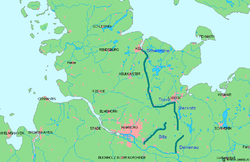
Polabian Slavs
Polabian Slavs - is a collective term applied to a number of Lechites tribes who lived along the Elbe river, between the Baltic Sea to the north, the Saale and the Limes Saxoniae to the west, the Ore Mountains and the Western Sudetes to the south, and Poland to the east. They have also been known...
(Wends) settled in parts of England
England
England is a country that is part of the United Kingdom. It shares land borders with Scotland to the north and Wales to the west; the Irish Sea is to the north west, the Celtic Sea to the south west, with the North Sea to the east and the English Channel to the south separating it from continental...
(Danelaw
Danelaw
The Danelaw, as recorded in the Anglo-Saxon Chronicle , is a historical name given to the part of England in which the laws of the "Danes" held sway and dominated those of the Anglo-Saxons. It is contrasted with "West Saxon law" and "Mercian law". The term has been extended by modern historians to...
), apparently as Danish
Denmark
Denmark is a Scandinavian country in Northern Europe. The countries of Denmark and Greenland, as well as the Faroe Islands, constitute the Kingdom of Denmark . It is the southernmost of the Nordic countries, southwest of Sweden and south of Norway, and bordered to the south by Germany. Denmark...
allies. Polabian-Pomeranian Slavs are also known to have even settled on Norse age Iceland
Iceland
Iceland , described as the Republic of Iceland, is a Nordic and European island country in the North Atlantic Ocean, on the Mid-Atlantic Ridge. Iceland also refers to the main island of the country, which contains almost all the population and almost all the land area. The country has a population...
. Saqaliba
Saqaliba
Saqaliba refers to the Slavs, particularly Slavic slaves and mercenaries in the medieval Arab world, in the Middle East, North Africa, Sicily and Al-Andalus. It is generally thought that the Arabic term is a Byzantine loanword: saqlab, siklab, saqlabi etc. is a corruption of Greek Sklavinoi for...
refers to the Slavic mercenaries
Mercenary
A mercenary, is a person who takes part in an armed conflict based on the promise of material compensation rather than having a direct interest in, or a legal obligation to, the conflict itself. A non-conscript professional member of a regular army is not considered to be a mercenary although he...
and slave
Slavery
Slavery is a system under which people are treated as property to be bought and sold, and are forced to work. Slaves can be held against their will from the time of their capture, purchase or birth, and deprived of the right to leave, to refuse to work, or to demand compensation...
s in the medieval Arab world in North Africa
North Africa
North Africa or Northern Africa is the northernmost region of the African continent, linked by the Sahara to Sub-Saharan Africa. Geopolitically, the United Nations definition of Northern Africa includes eight countries or territories; Algeria, Egypt, Libya, Morocco, South Sudan, Sudan, Tunisia, and...
, Sicily
Sicily
Sicily is a region of Italy, and is the largest island in the Mediterranean Sea. Along with the surrounding minor islands, it constitutes an autonomous region of Italy, the Regione Autonoma Siciliana Sicily has a rich and unique culture, especially with regard to the arts, music, literature,...
and Al-Andalus
Al-Andalus
Al-Andalus was the Arabic name given to a nation and territorial region also commonly referred to as Moorish Iberia. The name describes parts of the Iberian Peninsula and Septimania governed by Muslims , at various times in the period between 711 and 1492, although the territorial boundaries...
. Saqaliba served as caliph's guards. In the 12th century, there was intensification of Slavic piracy
Slavic piracy
In the Baltic Sea region, groups of pirates of Slavic descent lived dating as far back as the 8th century to the 14th century.Baltic Slavs, whose agriculture was not highly developed in early 800, were in dire need of resources, since the dry islets were the only ones capable of cultivation and...
. The Wendish Crusade
Wendish Crusade
The Wendish Crusade was an 1147 campaign, one of the Northern Crusades and also a part of the Second Crusade, led primarily by the Kingdom of Germany inside the Holy Roman Empire and directed against the Polabian Slavs ....
was started against the Polabian Slavs in 1147, as a part of the Northern Crusades
Northern Crusades
The Northern Crusades or Baltic Crusades were crusades undertaken by the Christian kings of Denmark and Sweden, the German Livonian and Teutonic military orders, and their allies against the pagan peoples of Northern Europe around the southern and eastern shores of the Baltic Sea...
. Niklot
Niklot
Niklot or Nyklot was a pagan chief or prince of the Slavic Obotrites and an ancestor of the House of Mecklenburg. From 1130 or 1131 until his death he was chief of the Obotrite confederacy, the Kissini, and the Circipani. At the same time he was Lord of Schwerin, Quetzin, and Malchow...
, pagan chief of the Slavic Obodrites began his open resistance when Lothar III, Holy Roman Emperor
Holy Roman Emperor
The Holy Roman Emperor is a term used by historians to denote a medieval ruler who, as German King, had also received the title of "Emperor of the Romans" from the Pope...
invaded Slavic lands. In August 1160 Niklot was killed and German colonization (Ostsiedlung
Ostsiedlung
Ostsiedlung , also called German eastward expansion, was the medieval eastward migration and settlement of Germans from modern day western and central Germany into less-populated regions and countries of eastern Central Europe and Eastern Europe. The affected area roughly stretched from Slovenia...
) of the Elbe-Oder region began. In Hanoverian Wendland, Mecklenburg-Vorpommern and Lusatia
Lusatia
Lusatia is a historical region in Central Europe. It stretches from the Bóbr and Kwisa rivers in the east to the Elbe valley in the west, today located within the German states of Saxony and Brandenburg as well as in the Lower Silesian and Lubusz voivodeships of western Poland...
invaders started germanization. Early forms of germanization were described by German monks: Helmold
Helmold
Helmold of Bosau was a Saxon historian of the 12th century and a priest at Bosau near Plön. He was a friend of the two bishops of Oldenburg in Holstein, Vicelinus and Gerold , who did much to Christianize the Polabian Slavs.Helmold was born near Goslar...
in the manuscript Chronicon Slavorum
Chronicon Slavorum
Chronica Slavorum is a historical record attributed to Helmold. It is a continuation of Deeds of bishops of the Hamburg Church by Adam von Bremen. Chronica describes events related to North-West Slavic tribes known as the Wends up to 1171. Chronica is a very significant historic record of...
and Adam of Bremen
Adam of Bremen
Adam of Bremen was a German medieval chronicler. He lived and worked in the second half of the eleventh century. He is most famous for his chronicle Gesta Hammaburgensis Ecclesiae Pontificum .-Background:Little is known of his life other than hints from his own chronicles...
in Gesta Hammaburgensis ecclesiae pontificum
Gesta Hammaburgensis ecclesiae pontificum
Gesta Hammaburgensis ecclesiae pontificum is a historical treatise written between 1075 and 1080 by Adam of Bremen. It covers the period from 788 to the time it was written. The treatise consist of:*Liber I...
. The Polabian language
Polabian language
The Polabian language is an extinct West Slavic language that was spoken by the Polabian Slavs in present-day North-Eastern Germany around the Elbe river, from which derives its name...
survived until the beginning of the 19th century in what is now the German state of Lower Saxony
Lower Saxony
Lower Saxony is a German state situated in north-western Germany and is second in area and fourth in population among the sixteen states of Germany...
.
Cossacks
History of the Cossacks
- Early history :The origins of the first Cossacks are uncertain. The traditional historiography dates the emergence of Cossacks to the 14-15th centuries...
, although Slavic-speaking and Orthodox Christians, came from a mix of ethnic backgrounds, including Tatars
Tatars
Tatars are a Turkic speaking ethnic group , numbering roughly 7 million.The majority of Tatars live in the Russian Federation, with a population of around 5.5 million, about 2 million of which in the republic of Tatarstan.Significant minority populations are found in Uzbekistan, Kazakhstan,...
and other Turks
Turkic peoples
The Turkic peoples are peoples residing in northern, central and western Asia, southern Siberia and northwestern China and parts of eastern Europe. They speak languages belonging to the Turkic language family. They share, to varying degrees, certain cultural traits and historical backgrounds...
. Many early members of the Terek Cossacks were Ossetians
Ossetians
The Ossetians are an Iranic ethnic group of the Caucasus Mountains, eponymous of the region known as Ossetia.They speak Ossetic, an Iranian language of the Eastern branch, with most also fluent in Russian as a second language....
.
The Gorals
Gorals
The Gorale are a group of indigenous people found along southern Poland, northern Slovakia, and in the region of Cieszyn Silesia in the Czech Republic...
of southern Poland
Poland
Poland , officially the Republic of Poland , is a country in Central Europe bordered by Germany to the west; the Czech Republic and Slovakia to the south; Ukraine, Belarus and Lithuania to the east; and the Baltic Sea and Kaliningrad Oblast, a Russian exclave, to the north...
and northern Slovakia
Slovakia
The Slovak Republic is a landlocked state in Central Europe. It has a population of over five million and an area of about . Slovakia is bordered by the Czech Republic and Austria to the west, Poland to the north, Ukraine to the east and Hungary to the south...
are partially descended from Romance-speaking Vlachs
Vlachs
Vlach is a blanket term covering several modern Latin peoples descending from the Latinised population in Central, Eastern and Southeastern Europe. English variations on the name include: Walla, Wlachs, Wallachs, Vlahs, Olahs or Ulahs...
who migrated into the region from the 14th to 17th centuries and were absorbed into the local population. The population of Moravian Wallachia
Moravian Wallachia
Moravian Wallachia is a mountainous region located in the easternmost part of Moravia, Czech Republic, near the Slovakian border. The name Wallachia was formerly applied to all the highlands of Moravia and neighboring Silesia, although in the nineteenth century a smaller area came to be defined...
also descend of this population.
Conversely, some Slavs were assimilated into other populations. Although the majority continued south, attracted by the riches of the territory which would become Bulgaria, a few remained in the Carpathian basin and were ultimately assimilated into the Magyar or Romanian
Romanians
The Romanians are an ethnic group native to Romania, who speak Romanian; they are the majority inhabitants of Romania....
population. There is a large number of river names and other placenames of Slavic origin in Romania. Similarly, the populations of the respective eastern parts of Austria and Germany are to some degree made up of people with Slavic ancestry.
Modern history
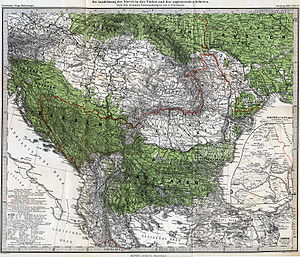
.jpg)
Russian Empire
The Russian Empire was a state that existed from 1721 until the Russian Revolution of 1917. It was the successor to the Tsardom of Russia and the predecessor of the Soviet Union...
, Serbia
Serbia
Serbia , officially the Republic of Serbia , is a landlocked country located at the crossroads of Central and Southeast Europe, covering the southern part of the Carpathian basin and the central part of the Balkans...
and Montenegro
Montenegro
Montenegro Montenegrin: Crna Gora Црна Гора , meaning "Black Mountain") is a country located in Southeastern Europe. It has a coast on the Adriatic Sea to the south-west and is bordered by Croatia to the west, Bosnia and Herzegovina to the northwest, Serbia to the northeast and Albania to the...
. Bulgaria
Bulgaria
Bulgaria , officially the Republic of Bulgaria , is a parliamentary democracy within a unitary constitutional republic in Southeast Europe. The country borders Romania to the north, Serbia and Macedonia to the west, Greece and Turkey to the south, as well as the Black Sea to the east...
was also free but was de jure vassal to the Ottoman Empire
Ottoman Empire
The Ottoman EmpireIt was usually referred to as the "Ottoman Empire", the "Turkish Empire", the "Ottoman Caliphate" or more commonly "Turkey" by its contemporaries...
until official independence was declared in 1908. In the entire Austro-Hungarian Empire of approximately 50 million people, about 23 million were Slavs. The Slavic peoples who were, for the most part, denied a voice in the affairs of the Austro-Hungarian Empire, were calling for national self-determination. During World War I
World War I
World War I , which was predominantly called the World War or the Great War from its occurrence until 1939, and the First World War or World War I thereafter, was a major war centred in Europe that began on 28 July 1914 and lasted until 11 November 1918...
, representatives of the Czechs, Slovaks, Poles, Serbs, Croats, and Slovenes set up organizations in the Allied
Allies of World War I
The Entente Powers were the countries at war with the Central Powers during World War I. The members of the Triple Entente were the United Kingdom, France, and the Russian Empire; Italy entered the war on their side in 1915...
countries to gain sympathy and recognition. In 1918, after World War I ended, the Slavs established such independent states as Czechoslovakia
Czechoslovakia
Czechoslovakia or Czecho-Slovakia was a sovereign state in Central Europe which existed from October 1918, when it declared its independence from the Austro-Hungarian Empire, until 1992...
, the Second Polish Republic
Second Polish Republic
The Second Polish Republic, Second Commonwealth of Poland or interwar Poland refers to Poland between the two world wars; a period in Polish history in which Poland was restored as an independent state. Officially known as the Republic of Poland or the Commonwealth of Poland , the Polish state was...
, and the Kingdom of Serbs, Croats and Slovenes.
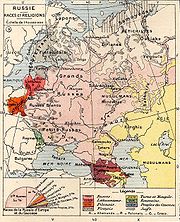
World War II
World War II, or the Second World War , was a global conflict lasting from 1939 to 1945, involving most of the world's nations—including all of the great powers—eventually forming two opposing military alliances: the Allies and the Axis...
was to exterminate, expel, or enslave most or all East
East Slavs
The East Slavs are Slavic peoples speaking East Slavic languages. Formerly the main population of the medieval state of Kievan Rus, by the seventeenth century they evolved into the Russian, Ukrainian, and Belarusian peoples.-Sources:...
and West Slavs
West Slavs
The West Slavs are Slavic peoples speaking West Slavic languages. They include Poles , Czechs, Slovaks, Lusatian Sorbs and the historical Polabians. The northern or Lechitic group includes, along with Polish, the extinct Polabian and Pomeranian languages...
from their native lands and killing 30 millions Slavic people, so as to make living space
Lebensraum
was one of the major political ideas of Adolf Hitler, and an important component of Nazi ideology. It served as the motivation for the expansionist policies of Nazi Germany, aiming to provide extra space for the growth of the German population, for a Greater Germany...
for German settlers. This plan of genocide
Generalplan Ost
Generalplan Ost was a secret Nazi German plan for the colonization of Eastern Europe. Implementing it would have necessitated genocide and ethnic cleansing to be undertaken in the Eastern European territories occupied by Germany during World War II...
was to be carried into effect gradually over 25 to 30 years.
Because of the vastness and diversity of the territory occupied by Slavic people, there were several centers of Slavic consolidation. In the 19th century, Pan-Slavism
Pan-Slavism
Pan-Slavism was a movement in the mid-19th century aimed at unity of all the Slavic peoples. The main focus was in the Balkans where the South Slavs had been ruled for centuries by other empires, Byzantine Empire, Austria-Hungary, the Ottoman Empire, and Venice...
developed as a movement among intellectuals, scholars, and poets, but it rarely influenced practical politics and did not find support in some nations that had Slavic origins. Pan-Slavism became compromised when the Russian Empire
Russian Empire
The Russian Empire was a state that existed from 1721 until the Russian Revolution of 1917. It was the successor to the Tsardom of Russia and the predecessor of the Soviet Union...
started to use it as an ideology justifying its territorial conquests in Central Europe as well as subjugation of other ethnic groups of Slavic origins such as Poles and Ukrainians, and the ideology became associated with Russian imperialism. The common Slavic experience of communism
Communism
Communism is a social, political and economic ideology that aims at the establishment of a classless, moneyless, revolutionary and stateless socialist society structured upon common ownership of the means of production...
combined with the repeated usage of the ideology by Soviet
Soviet Union
The Soviet Union , officially the Union of Soviet Socialist Republics , was a constitutionally socialist state that existed in Eurasia between 1922 and 1991....
propaganda
Propaganda
Propaganda is a form of communication that is aimed at influencing the attitude of a community toward some cause or position so as to benefit oneself or one's group....
after World War II within the Eastern bloc
Eastern bloc
The term Eastern Bloc or Communist Bloc refers to the former communist states of Eastern and Central Europe, generally the Soviet Union and the countries of the Warsaw Pact...
(Warsaw Pact
Warsaw Pact
The Warsaw Treaty Organization of Friendship, Cooperation, and Mutual Assistance , or more commonly referred to as the Warsaw Pact, was a mutual defense treaty subscribed to by eight communist states in Eastern Europe...
) was a forced high-level political and economic hegemony
Hegemony
Hegemony is an indirect form of imperial dominance in which the hegemon rules sub-ordinate states by the implied means of power rather than direct military force. In Ancient Greece , hegemony denoted the politico–military dominance of a city-state over other city-states...
of the USSR dominated by Russians. A notable political union of the 20th century that covered most South Slavs was Yugoslavia
Yugoslavia
Yugoslavia refers to three political entities that existed successively on the western part of the Balkans during most of the 20th century....
, but it ultimately broke apart in the 1990s along with the Soviet Union
Soviet Union
The Soviet Union , officially the Union of Soviet Socialist Republics , was a constitutionally socialist state that existed in Eurasia between 1922 and 1991....
.
The word "Slavs" was used in the national anthem of the Slovak Republic (1939–1945), Yugoslavia (1943–1992) and the Federal Republic of Yugoslavia (1992–2003), later Serbia and Montenegro
Serbia and Montenegro
Serbia and Montenegro was a country in southeastern Europe, formed from two former republics of the Socialist Federal Republic of Yugoslavia : Serbia and Montenegro. Following the breakup of Yugoslavia, it was established in 1992 as a federation called the Federal Republic of Yugoslavia...
(2003–2006).
Population
The worldwide population of people of Slavic descent is close to 400 million. The three largest Slavic ethnic groups are RussiansRussians
The Russian people are an East Slavic ethnic group native to Russia, speaking the Russian language and primarily living in Russia and neighboring countries....
(150 million), Poles
Poles
thumb|right|180px|The state flag of [[Poland]] as used by Polish government and diplomatic authoritiesThe Polish people, or Poles , are a nation indigenous to Poland. They are united by the Polish language, which belongs to the historical Lechitic subgroup of West Slavic languages of Central Europe...
(60 million), and Ukrainians
Ukrainians
Ukrainians are an East Slavic ethnic group native to Ukraine, which is the sixth-largest nation in Europe. The Constitution of Ukraine applies the term 'Ukrainians' to all its citizens...
(50 million). Other Slavic ethnic groups include Czechs (11 million), Serbs
Serbs
The Serbs are a South Slavic ethnic group of the Balkans and southern Central Europe. Serbs are located mainly in Serbia, Montenegro and Bosnia and Herzegovina, and form a sizable minority in Croatia, the Republic of Macedonia and Slovenia. Likewise, Serbs are an officially recognized minority in...
(10,5 million), Bulgarians
Bulgarians
The Bulgarians are a South Slavic nation and ethnic group native to Bulgaria and neighbouring regions. Emigration has resulted in immigrant communities in a number of other countries.-History and ethnogenesis:...
(10 million), Belarusians
Belarusians
Belarusians ; are an East Slavic ethnic group who populate the majority of the Republic of Belarus. Introduced to the world as a new state in the early 1990s, the Republic of Belarus brought with it the notion of a re-emerging Belarusian ethnicity, drawn upon the lines of the Old Belarusian...
(10 million), Croats
Croats
Croats are a South Slavic ethnic group mostly living in Croatia, Bosnia and Herzegovina and nearby countries. There are around 4 million Croats living inside Croatia and up to 4.5 million throughout the rest of the world. Responding to political, social and economic pressure, many Croats have...
(8 million), Slovaks
Slovaks
The Slovaks, Slovak people, or Slovakians are a West Slavic people that primarily inhabit Slovakia and speak the Slovak language, which is closely related to the Czech language.Most Slovaks today live within the borders of the independent Slovakia...
(7 million), Bosniaks
Bosniaks
The Bosniaks or Bosniacs are a South Slavic ethnic group, living mainly in Bosnia and Herzegovina, with a smaller minority also present in other lands of the Balkan Peninsula especially in Serbia, Montenegro and Croatia...
(3 million), Macedonians (3 million), Slovenes (2,5 million), Montenegrins (700 000).
Religion
Most Slavic populations gradually adopted ChristianityChristianity
Christianity is a monotheistic religion based on the life and teachings of Jesus as presented in canonical gospels and other New Testament writings...
(the East Slavs Orthodox Christianity
Orthodox Christianity
The term Orthodox Christianity may refer to:* the Eastern Orthodox Church and its various geographical subdivisions...
and the West Slavs Roman Catholicism, with South Slavs split by the two religions) between 6th and 10th century, and consequently their old pagan
Slavic mythology
Slavic mythology is the mythological aspect of the polytheistic religion that was practised by the Slavs before Christianisation.The religion possesses many common traits with other religions descended from the Proto-Indo-European religion....
beliefs declined. See also Rodnovery.
The majority of contemporary Slavs who profess a religion are Orthodox, followed by Roman Catholic. A very small minority are Protestant. Bosniaks
Bosniaks
The Bosniaks or Bosniacs are a South Slavic ethnic group, living mainly in Bosnia and Herzegovina, with a smaller minority also present in other lands of the Balkan Peninsula especially in Serbia, Montenegro and Croatia...
are the Muslim
Muslim
A Muslim, also spelled Moslem, is an adherent of Islam, a monotheistic, Abrahamic religion based on the Quran, which Muslims consider the verbatim word of God as revealed to prophet Muhammad. "Muslim" is the Arabic term for "submitter" .Muslims believe that God is one and incomparable...
Slavic ethnic group, Gorani are also Muslims, but their ethnic group is miniature, inhabiting some villages. Religious delineations by nationality can be very sharp; usually in the Slavic ethnic groups the vast majority of religious people share the same religion. Some Slavs are atheist or agnostic: only 19% of Czechs professed
Religion in the European Union
The most common religion in the European Union is Christianity, although many other religions are practiced as well. The European Union is officially secular, though some member states have state churches: these are Malta , Greece , Denmark , and part of the United Kingdom - England...
belief in god/s in the 2005 Eurobarometer survey, making them one of the most irreligious people in the world.
The main Slavic ethnic groups by religion:
Mainly Orthodox Christians
- RussiansRussiansThe Russian people are an East Slavic ethnic group native to Russia, speaking the Russian language and primarily living in Russia and neighboring countries....
- UkrainiansUkrainiansUkrainians are an East Slavic ethnic group native to Ukraine, which is the sixth-largest nation in Europe. The Constitution of Ukraine applies the term 'Ukrainians' to all its citizens...
- SerbsSerbsThe Serbs are a South Slavic ethnic group of the Balkans and southern Central Europe. Serbs are located mainly in Serbia, Montenegro and Bosnia and Herzegovina, and form a sizable minority in Croatia, the Republic of Macedonia and Slovenia. Likewise, Serbs are an officially recognized minority in...
- BulgariansBulgariansThe Bulgarians are a South Slavic nation and ethnic group native to Bulgaria and neighbouring regions. Emigration has resulted in immigrant communities in a number of other countries.-History and ethnogenesis:...
- BelarusiansBelarusiansBelarusians ; are an East Slavic ethnic group who populate the majority of the Republic of Belarus. Introduced to the world as a new state in the early 1990s, the Republic of Belarus brought with it the notion of a re-emerging Belarusian ethnicity, drawn upon the lines of the Old Belarusian...
- MacedoniansMacedonians (ethnic group)The Macedonians also referred to as Macedonian Slavs: "... the term Slavomacedonian was introduced and was accepted by the community itself, which at the time had a much more widespread non-Greek Macedonian ethnic consciousness...
- Montenegrins
Mainly Roman Catholic:
- PolesPolesthumb|right|180px|The state flag of [[Poland]] as used by Polish government and diplomatic authoritiesThe Polish people, or Poles , are a nation indigenous to Poland. They are united by the Polish language, which belongs to the historical Lechitic subgroup of West Slavic languages of Central Europe...
- CroatsCroatsCroats are a South Slavic ethnic group mostly living in Croatia, Bosnia and Herzegovina and nearby countries. There are around 4 million Croats living inside Croatia and up to 4.5 million throughout the rest of the world. Responding to political, social and economic pressure, many Croats have...
- SlovaksSlovaksThe Slovaks, Slovak people, or Slovakians are a West Slavic people that primarily inhabit Slovakia and speak the Slovak language, which is closely related to the Czech language.Most Slovaks today live within the borders of the independent Slovakia...
- Slovenes
Mainly Muslim
Muslim
A Muslim, also spelled Moslem, is an adherent of Islam, a monotheistic, Abrahamic religion based on the Quran, which Muslims consider the verbatim word of God as revealed to prophet Muhammad. "Muslim" is the Arabic term for "submitter" .Muslims believe that God is one and incomparable...
:
- BosniaksBosniaksThe Bosniaks or Bosniacs are a South Slavic ethnic group, living mainly in Bosnia and Herzegovina, with a smaller minority also present in other lands of the Balkan Peninsula especially in Serbia, Montenegro and Croatia...
Mainly Atheist or Agnostic:
- Czechs
Alphabet
The alphabet depends on what religion is usual for the respective Slavic ethnic groups, the Orthodox use the Cyrillic alphabetCyrillic alphabet
The Cyrillic script or azbuka is an alphabetic writing system developed in the First Bulgarian Empire during the 10th century AD at the Preslav Literary School...
and the Roman Catholics use Latin alphabet
Latin alphabet
The Latin alphabet, also called the Roman alphabet, is the most recognized alphabet used in the world today. It evolved from a western variety of the Greek alphabet called the Cumaean alphabet, which was adopted and modified by the Etruscans who ruled early Rome...
, the Bosniaks which are Muslims also use the Latin. Few Greek Roman and Roman Catholics use the Cyrillic alphabet however. The Serbian language
Serbian language
Serbian is a form of Serbo-Croatian, a South Slavic language, spoken by Serbs in Serbia, Bosnia and Herzegovina, Montenegro, Croatia and neighbouring countries....
and Montenegrin language
Montenegrin language
Montenegrin is a name used for the Serbo-Croatian language as spoken by Montenegrins; it also refers to an incipient standardized form of the Shtokavian dialect of Serbo-Croatian used as the official language of Montenegro...
can be written using both the Cyrillic and Latin alphabets, but the Cyrillic remains preferred by a large majority. There is also a Latin script to write in Belarusian
Belarusian language
The Belarusian language , sometimes referred to as White Russian or White Ruthenian, is the language of the Belarusian people...
, called the Lacinka alphabet.
Language
Slavic studies began as an almost exclusively linguistic and philological enterprise. As early as 1833, Slavic languages were recognized as Indo-European.Slavic standard language
Standard language
A standard language is a language variety used by a group of people in their public discourse. Alternatively, varieties become standard by undergoing a process of standardization, during which it is organized for description in grammars and dictionaries and encoded in such reference works...
s which are official in at least one country:
- BelarusianBelarusian languageThe Belarusian language , sometimes referred to as White Russian or White Ruthenian, is the language of the Belarusian people...
- BosnianBosnian languageBosnian is a South Slavic language, spoken by Bosniaks. As a standardized form of the Shtokavian dialect, it is one of the three official languages of Bosnia and Herzegovina....
- BulgarianBulgarian languageBulgarian is an Indo-European language, a member of the Slavic linguistic group.Bulgarian, along with the closely related Macedonian language, demonstrates several linguistic characteristics that set it apart from all other Slavic languages such as the elimination of case declension, the...
- CroatianCroatian languageCroatian is the collective name for the standard language and dialects spoken by Croats, principally in Croatia, Bosnia and Herzegovina, the Serbian province of Vojvodina and other neighbouring countries...
- CzechCzech languageCzech is a West Slavic language with about 12 million native speakers; it is the majority language in the Czech Republic and spoken by Czechs worldwide. The language was known as Bohemian in English until the late 19th century...
- MacedonianMacedonian languageMacedonian is a South Slavic language spoken as a first language by approximately 2–3 million people principally in the region of Macedonia but also in the Macedonian diaspora...
- MontenegrinMontenegrin languageMontenegrin is a name used for the Serbo-Croatian language as spoken by Montenegrins; it also refers to an incipient standardized form of the Shtokavian dialect of Serbo-Croatian used as the official language of Montenegro...
- PolishPolish languagePolish is a language of the Lechitic subgroup of West Slavic languages, used throughout Poland and by Polish minorities in other countries...
- RussianRussian languageRussian is a Slavic language used primarily in Russia, Belarus, Uzbekistan, Kazakhstan, Tajikistan and Kyrgyzstan. It is an unofficial but widely spoken language in Ukraine, Moldova, Latvia, Turkmenistan and Estonia and, to a lesser extent, the other countries that were once constituent republics...
- SerbianSerbian languageSerbian is a form of Serbo-Croatian, a South Slavic language, spoken by Serbs in Serbia, Bosnia and Herzegovina, Montenegro, Croatia and neighbouring countries....
- SlovakSlovak languageSlovak , is an Indo-European language that belongs to the West Slavic languages .Slovak is the official language of Slovakia, where it is spoken by 5 million people...
- Slovene
- UkrainianUkrainian languageUkrainian is a language of the East Slavic subgroup of the Slavic languages. It is the official state language of Ukraine. Written Ukrainian uses a variant of the Cyrillic alphabet....
Proto-Slavic language
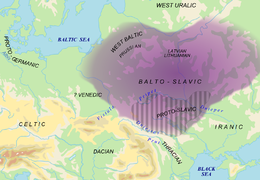
Proto-language
A proto-language in the tree model of historical linguistics is the common ancestor of the languages that form a language family. Occasionally, the German term Ursprache is used instead.Often the proto-language is not known directly...
of all Slavic languages, is a descendant of common Proto-Indo-European
Proto-Indo-European language
The Proto-Indo-European language is the reconstructed common ancestor of the Indo-European languages, spoken by the Proto-Indo-Europeans...
, via a Balto-Slavic stage in which it developed numerous lexical and morphophonological isoglosses with Baltic languages. In the framework of the Kurgan hypothesis
Kurgan hypothesis
The Kurgan hypothesis is one of the proposals about early Indo-European origins, which postulates that the people of an archaeological "Kurgan culture" in the Pontic steppe were the most likely speakers of the Proto-Indo-European language...
, "the Indo-Europeans who remained after the migrations [from the steppe] became speakers of Balto-Slavic".
Proto-Slavic, sometimes referred to as Common Slavic or Late Proto-Slavic, is defined as the last stage of the language preceding the geographical split of the historical Slavic languages
Slavic languages
The Slavic languages , a group of closely related languages of the Slavic peoples and a subgroup of Indo-European languages, have speakers in most of Eastern Europe, in much of the Balkans, in parts of Central Europe, and in the northern part of Asia.-Branches:Scholars traditionally divide Slavic...
. That language was uniform, and on the basis of borrowings from foreign languages and Slavic borrowings into other languages, cannot be said to have any recognizable dialects, suggesting a comparatively compact homeland. Slavic linguistic unity was to some extent visible as late as Old Church Slavonic
Old Church Slavonic
Old Church Slavonic or Old Church Slavic was the first literary Slavic language, first developed by the 9th century Byzantine Greek missionaries Saints Cyril and Methodius who were credited with standardizing the language and using it for translating the Bible and other Ancient Greek...
manuscripts which, though based on local Slavic speech of Thessaloniki
Thessaloniki
Thessaloniki , historically also known as Thessalonica, Salonika or Salonica, is the second-largest city in Greece and the capital of the region of Central Macedonia as well as the capital of the Decentralized Administration of Macedonia and Thrace...
in Macedonia, could still serve the purpose of the first common Slavic
Slavic languages
The Slavic languages , a group of closely related languages of the Slavic peoples and a subgroup of Indo-European languages, have speakers in most of Eastern Europe, in much of the Balkans, in parts of Central Europe, and in the northern part of Asia.-Branches:Scholars traditionally divide Slavic...
literary language
Language
Language may refer either to the specifically human capacity for acquiring and using complex systems of communication, or to a specific instance of such a system of complex communication...
.
Ethnocultural subdivisions
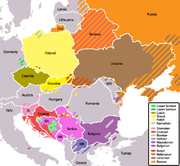
East Slavs
The East Slavs are Slavic peoples speaking East Slavic languages. Formerly the main population of the medieval state of Kievan Rus, by the seventeenth century they evolved into the Russian, Ukrainian, and Belarusian peoples.-Sources:...
may all be traced to Slavic-speaking populations that were loosely organized under the Kievan Rus'
Kievan Rus'
Kievan Rus was a medieval polity in Eastern Europe, from the late 9th to the mid 13th century, when it disintegrated under the pressure of the Mongol invasion of 1237–1240....
empire beginning in the 10th century AD.
Almost all of the South Slavs
South Slavs
The South Slavs are the southern branch of the Slavic peoples and speak South Slavic languages. Geographically, the South Slavs are native to the Balkan peninsula, the southern Pannonian Plain and the eastern Alps...
can be traced to ethnic Slavs who mixed with the local European population of the Balkans
Balkans
The Balkans is a geopolitical and cultural region of southeastern Europe...
(Illyrians
Illyrians
The Illyrians were a group of tribes who inhabited part of the western Balkans in antiquity and the south-eastern coasts of the Italian peninsula...
, Dacians
Dacians
The Dacians were an Indo-European people, very close or part of the Thracians. Dacians were the ancient inhabitants of Dacia...
/Thracians
Thracians
The ancient Thracians were a group of Indo-European tribes inhabiting areas including Thrace in Southeastern Europe. They spoke the Thracian language – a scarcely attested branch of the Indo-European language family...
, Romans
Ancient Rome
Ancient Rome was a thriving civilization that grew on the Italian Peninsula as early as the 8th century BC. Located along the Mediterranean Sea and centered on the city of Rome, it expanded to one of the largest empires in the ancient world....
, Celts); the Bulgarians
Bulgarians
The Bulgarians are a South Slavic nation and ethnic group native to Bulgaria and neighbouring regions. Emigration has resulted in immigrant communities in a number of other countries.-History and ethnogenesis:...
' Slavs also mixed largely with local European tribes but also with the Bulgars
Bulgars
The Bulgars were a semi-nomadic who flourished in the Pontic Steppe and the Volga basin in the 7th century.The Bulgars emerge after the collapse of the Hunnic Empire in the 5th century....
. They were particularly influenced by the Orthodox Church
Orthodox Christianity
The term Orthodox Christianity may refer to:* the Eastern Orthodox Church and its various geographical subdivisions...
, although Roman Catholicism and Latin influences were more pertinent in Dalmatia
Dalmatia
Dalmatia is a historical region on the eastern coast of the Adriatic Sea. It stretches from the island of Rab in the northwest to the Bay of Kotor in the southeast. The hinterland, the Dalmatian Zagora, ranges from fifty kilometers in width in the north to just a few kilometers in the south....
. The West Slavs
West Slavs
The West Slavs are Slavic peoples speaking West Slavic languages. They include Poles , Czechs, Slovaks, Lusatian Sorbs and the historical Polabians. The northern or Lechitic group includes, along with Polish, the extinct Polabian and Pomeranian languages...
and the Croats and Slovenes do not share either of these backgrounds, as they expanded to the West and integrated into the cultural sphere of Western (Roman Catholic) Christianity around this time also mixing with nearby Germanic
Germanic peoples
The Germanic peoples are an Indo-European ethno-linguistic group of Northern European origin, identified by their use of the Indo-European Germanic languages which diversified out of Proto-Germanic during the Pre-Roman Iron Age.Originating about 1800 BCE from the Corded Ware Culture on the North...
tribes.
In addition there has been a tendency to consider the category of Northern Slavs
North Slavic languages
The term North Slavic languages has three meanings.- North versus South Slavic :It is sometimes used to combine the West Slavic and the East Slavic languages into one group, as opposed to the South Slavic languages...
. Presently this category is considered to be of East and West Slavs, in opposition to South Slavs, however in 19th century opinions about individual languages/ethnicities varied.
East Slavs
- RussiansRussiansThe Russian people are an East Slavic ethnic group native to Russia, speaking the Russian language and primarily living in Russia and neighboring countries....
- GoryunsGoryunsGoryuns is a little-documented ethnic group of East Slavs living around Putyvl in the Sumy Oblast of Ukraine. The dialect of the Russian language spoken by Goryuns has some features of Belarusian and Ukrainian....
- KamchadalsKamchadalsThe Kamchadals is a former name of the Itelmens, the native people of Kamchatka, used in the 18th century by Russians. Subsequently, the name applied to the descendants of the local Russians and aboriginal peoples , who has assimilated with the Russians...
- Lipovan Russians
- PolekhsPolekhsPolekhs are a subethnic group of Russians settled along the Desna River and Seym River and mixed with local populations of Belarusians and Lithuanians. Most of them retained the Russian Orthodox religion, with some turning to Roman Catholicism....
- PomorsPomorsPomors or Pomory are Russian settlers and their descendants on the White Sea coast. It is also term of self-identification for the descendants of Russian, primarily Novgorod, settlers of Pomorye , living on the White Sea coasts and the territory whose southern border lies on a watershed which...
- Goryuns
- UkrainiansUkrainiansUkrainians are an East Slavic ethnic group native to Ukraine, which is the sixth-largest nation in Europe. The Constitution of Ukraine applies the term 'Ukrainians' to all its citizens...
- Bojko
- HutsulsHutsulsHutsuls are an ethno-cultural group of Ukrainian highlanders who for centuries have inhabited the Carpathian mountains, mainly in Ukraine, the northern extremity of Romania .-Etymology:...
- Lemko
- PoleszukPoleszukPoleszuk is the name given to the people who populated the swamps of Polesia.The Poleszuk dialect is close to the Ukrainian, Belarusian and Polish languages...
s
- BelarusiansBelarusiansBelarusians ; are an East Slavic ethnic group who populate the majority of the Republic of Belarus. Introduced to the world as a new state in the early 1990s, the Republic of Belarus brought with it the notion of a re-emerging Belarusian ethnicity, drawn upon the lines of the Old Belarusian...
- PoleszukPoleszukPoleszuk is the name given to the people who populated the swamps of Polesia.The Poleszuk dialect is close to the Ukrainian, Belarusian and Polish languages...
s
- Poleszuk
Czech-Slovak group
- Czechs
- Bohemians
- MoraviansMoravians (ethnic group)Moravians are the modern West Slavic inhabitants of the historical land of Moravia, the easternmost part of the Czech Republic, which includes the Moravian Slovakia. They speak the two main groups of Moravian dialects , the transitional Bohemian-Moravian dialect subgroup and standard Czech...
- SilesiansSilesiansSilesians , are the inhabitants of Silesia in Poland, Germany and the Czech Republic. A small diaspora community also exists in Karnes County, Texas in the USA....
- SlovaksSlovaksThe Slovaks, Slovak people, or Slovakians are a West Slavic people that primarily inhabit Slovakia and speak the Slovak language, which is closely related to the Czech language.Most Slovaks today live within the borders of the independent Slovakia...
Lechitic group
- PolesPolesthumb|right|180px|The state flag of [[Poland]] as used by Polish government and diplomatic authoritiesThe Polish people, or Poles , are a nation indigenous to Poland. They are united by the Polish language, which belongs to the historical Lechitic subgroup of West Slavic languages of Central Europe...
- MasoviansMasoviansThe Masovians or Mazovians are a Lechitic tribe or an ethnic group associated with the region of Mazovia. They were first referenced by Nestor the Chronicler in the 11th century. Originally, their main settlements were in the area of Płock, Łomża, Wizna, Czersk, Ciechanów, Płońsk, Zakroczym and...
- PolansPolans (western)The Polans were a West Slavic tribe, part of the Lechitic group, inhabiting the Warta river basin of the historic Greater Poland region in the 8th century.During the reign of King Svatopluk I of Great Moravia , who subdued the tribes of the Vistulans and Ślężanie...
- VistulansVistulansVistulans were an early medieval West Slavic tribe inhabiting the land of modern Lesser Poland.From the 1st century and possibly earlier, the Vistulans , were part of the Carpian Tribe, which got its name from the area that they lived in, which was beside the Carpathian Mountain Range...
- Masovians
- Pomeranians
- KashubiansKashubiansKashubians/Kaszubians , also called Kashubs, Kashubes, Kaszubians, Kassubians or Cassubians, are a West Slavic ethnic group in Pomerelia, north-central Poland. Their settlement area is referred to as Kashubia ....
- Slovincians
- Kashubians
- SilesiansSilesiansSilesians , are the inhabitants of Silesia in Poland, Germany and the Czech Republic. A small diaspora community also exists in Karnes County, Texas in the USA....
- Bieżuńczanie
- BobrzanieBobrzanieThe Bobrzanie are one of the Silesian tribes mentioned in the Prague document from the 11th century AD. The area they inhabited was located on the Bóbr river, from which they took their name.-References:**...
- Dziadoszanie
- Golęszyce
- Lubuszanie
- OpolanieOpolanieOpolanie – West Slavic tribe that lived in the region of upper Odra. Their main settlement was Opole. They were mentioned in the Bavarian Geographer, under the name Opolini, as one of the seven tribes living in Silesia...
- ŚlężanieSlezanieŚlężanie were a tribe of West Slavs, specifically of the Lechitic , inhabiting territories of Lower Silesia, near Ślęża mountain and Ślęza river, on the both banks of the Oder, up to the area of modern city of Wrocław...
- Trzebowianie
- Polabians
- SorbsSorbsSorbs are a Western Slavic people of Central Europe living predominantly in Lusatia, a region on the territory of Germany and Poland. In Germany they live in the states of Brandenburg and Saxony. They speak the Sorbian languages - closely related to Polish and Czech - officially recognized and...
(Serbo-Lusatians)- MilceniMilceniThe Milceni or Milzeni were a West Slavic tribe, who settled in the present-day Upper Lusatia region. They were first mentioned in the middle of the 9th century AD by the Bavarian Geographer, who wrote of 30 civitates which possibly had fortifications. They were gradually conquered by Germans...
(Upper Sorbs) - LusatiansLusatiansLusatians are people living in or coming from Lusatia. It may refer to:*Sorbs, Slavic people *Germans, main ethnic group of Lusatia...
(Lower Sorbs)
- Milceni
- Obodrites/Abodrites
- Obotrites proper
- Wagrians
- WarnabiWarnabiThe Warnabi, Warnavi, Warnahi, Wranovi, Wranefzi, Wrani, Varnes, or Warnower were a West Slavic tribe of the Abodrite confederation in the ninth through eleventh centuries. They were one of the minor tribes of the confederation living in the Billung Mark on the eastern frontier of the Holy Roman...
- Polabians properPolabians (tribe)The Polabians were a constituent Lechitic tribe of the Obotrites who lived between the Trave and the Elbe. The main settlement of the Polabians was Racisburg , named after their Prince Ratibor...
- Linonen
- Travnjane
- DrevaniDrevaniThe Drevani were a tribe of Polabian Slavs settling on the Elbe river in the area of the present-day Lüchow-Dannenberg district of Lower Saxony, Germany....
- Veleti (Wilzi)VeletiThe Veleti or Wilzi were a group of medieval Lechites tribes within the territory of modern northeastern Germany; see Polabian Slavs. In common with other Slavic groups between the Elbe and Oder Rivers, they were often described by Germanic sources as Wends. In the late 10th century, they were...
- LuticiLuticiThe Lutici were a federation of West Slavic Polabian tribes, who between the 10th and 12th centuries lived in what is now northeastern Germany. Four tribes made up the core of the federation: the Redarians , Circipanians , Kessinians and Tollensians...
(Liutici)- Kissini (Kessiner, Chizzinen, Kyzziner)
- Circipani (Zirzipanen)
- Tollenser
- Redarier
- Ucri (Ukr(an)i, Ukranen)
- Rani (Rujani)Rani (Slavic tribe)The Rani or Rujani were a West Slavic tribe based on the island of Rugia and the southwestern mainland across the Strelasund in what is today northeastern Germany....
- Hevelli (Stodorani)
- Volinians (Velunzani)
- Pyritzans (Prissani)
- Lutici
Eastern group
- BulgariansBulgariansThe Bulgarians are a South Slavic nation and ethnic group native to Bulgaria and neighbouring regions. Emigration has resulted in immigrant communities in a number of other countries.-History and ethnogenesis:...
- PomaksPomaksPomaks is a term used for a Slavic Muslim population native to some parts of Bulgaria, Turkey, Greece, the Republic of Macedonia, Albania and Kosovo. The Pomaks speak Bulgarian as their native language, also referred to in Greece and Turkey as Pomak language, and some are fluent in Turkish,...
(Muslim Bulgarians) - PalćeneBanat BulgariansThe Banat Bulgarians are a distinct Bulgarian minority group which settled in the 18th century in the region of the Banat, which was then ruled by the Habsburgs and after World War I was divided between Romania, Serbia, and Hungary...
(Banat BulgariansBanat BulgariansThe Banat Bulgarians are a distinct Bulgarian minority group which settled in the 18th century in the region of the Banat, which was then ruled by the Habsburgs and after World War I was divided between Romania, Serbia, and Hungary...
) - Anatolian BulgariansAnatolian BulgariansThe Anatolian Bulgarians or Bulgarians of Asia Minor were Eastern Orthodox Bulgarians who settled in Ottoman-ruled northwestern Anatolia , possibly in the 18th century, and remained there until 1914....
- Pomaks
- MacedoniansMacedonians (ethnic group)The Macedonians also referred to as Macedonian Slavs: "... the term Slavomacedonian was introduced and was accepted by the community itself, which at the time had a much more widespread non-Greek Macedonian ethnic consciousness...
- TorbešMacedonian MuslimsThe Macedonian Muslims , also known as Muslim Macedonians, Torbeš, ; , in older sources Pomaks are a minority religious group within the community of ethnic Macedonians who are Muslims...
- Torbeš
- GoraniGoraniGorani may refer to:In culture:* Gorani people, a Balkan ethnic groupIn geography:* Gorani, a village in Uda Commune, Argeş County, Romania* Gorani, a village in Odăile Commune, Buzău County, Romania...
(recognized ethnicity)
Western group
- SerbsSerbsThe Serbs are a South Slavic ethnic group of the Balkans and southern Central Europe. Serbs are located mainly in Serbia, Montenegro and Bosnia and Herzegovina, and form a sizable minority in Croatia, the Republic of Macedonia and Slovenia. Likewise, Serbs are an officially recognized minority in...
- CroatsCroatsCroats are a South Slavic ethnic group mostly living in Croatia, Bosnia and Herzegovina and nearby countries. There are around 4 million Croats living inside Croatia and up to 4.5 million throughout the rest of the world. Responding to political, social and economic pressure, many Croats have...
- BunjevciBunjevciBunjevci are a South Slavic community and ethnic group living mostly in the Bačka region of Serbia and southern Hungary...
(subgroup of Croats) - JanjevciJanjevciJanjevci are Croatian inhabitants of the Kosovo town of Janjevo and surrounding villages, located near Pristina as well as villages centered on Letnica near Vitina ....
(Croats in Kosovo) - Burgenland CroatsBurgenland CroatsBurgenland Croats are ethnic Croats in the Austrian state of Burgenland. Although an enclave hundreds of kilometres away from their original homeland, they have managed to preserve culture and language for centuries...
(in Austria) - Molise CroatsMolise CroatsMolise Croats live in the Molise region of Italy in the villages Acquaviva Collecroce , San Felice del Molise , Montemitro and elsewhere. In these three villages they are a majority. There are about 5,000 speakers of the Molise Croatian dialect...
(in eastern Italy) - Krashovans (Croats in Romania)
- Šokci
- Bosniaks (Croats in Hungary)Bosniaks (Croats in Hungary)Bosniaks are a Croat population, living in various settlements in the historic region Baranja, in its Hungarian part. Bosniaks Croats should not be confused with Bosnian Muslims that mostly live in Bosnia and Herzegovina also called Bosniaks....
(Croats in Hungary)
- Bunjevci
- Slovenes
- Carantanians
- PrekmuriansPrekmuriansThe Prekmurje Slovenes are Slovenes from Prekmurje in Slovenia and Vendvidék and Somogy in Hungary. The Prekmurje Slovenes speak the Prekmurje dialect and have a common culture...
- Hungarian SlovenesHungarian SlovenesHungarian Slovenes are an autochthonous ethnic and linguistic Slovene minority living in Hungary. The largest groups are the Rába Slovenes in the Rába Valley in western Hungary between the town of Szentgotthárd and the borders with Slovenia and Austria. They speak the Prekmurje dialect of Slovene...
- Somogy Slovenes
- Carinthian SlovenesCarinthian SlovenesCarinthian Slovenes are the Slovene-speaking population group in the Austrian State of Carinthia. The Carinthian Slovenes send representatives to the National Ethnic Groups Advisory Council...
- Venetian SlovenesVenetian SloveniaVenetian Slovenia is a small mountainous region in northeastern Italy . Most of the region is located in the Italian region of Friuli Venezia Giulia, in the area between the towns of Cividale del Friuli, Tarcento and Gemona ....
- ResiaResian dialectThe Resian dialect is a distinct dialect of Slovene spoken in the Resia Valley, Province of Udine, Italy, close to the border with Slovenia...
ns
- BosniaksBosniaksThe Bosniaks or Bosniacs are a South Slavic ethnic group, living mainly in Bosnia and Herzegovina, with a smaller minority also present in other lands of the Balkan Peninsula especially in Serbia, Montenegro and Croatia...
- Muslims by nationalityMuslims by nationalityMuslims by nationality was a term used in Socialist Federal Republic of Yugoslavia as an official designation of nationality of Slavic Muslims. They were one of the constitutive groups of Bosnia and Herzegovina...
(recognized ethnicity)
- YugoslavsYugoslavsYugoslavs is a national designation used by a minority of South Slavs across the countries of the former Yugoslavia and in the diaspora...
See also
- Early East Slavs
- Early SlavsEarly SlavsThe early Slavs were a diverse group of tribal societies in Migration period and early medieval Europe whose tribal organizations indirectly created the foundations for today’s Slavic nations .The first mention of the name Slavs dates to the 6th century, by which time the Slavic tribes inhabited a...
- East SlavsEast SlavsThe East Slavs are Slavic peoples speaking East Slavic languages. Formerly the main population of the medieval state of Kievan Rus, by the seventeenth century they evolved into the Russian, Ukrainian, and Belarusian peoples.-Sources:...
- European ethnic groupsEuropean ethnic groupsThe ethnic groups in Europe are the various ethnic groups that reside in the nations of Europe. European ethnology is the field of anthropology focusing on Europe....
- Gord (Slavic settlement)Gord (Slavic settlement)Gord is a medieval Slavic fortified settlement. This Proto-Slavic word for town or city, later differentiated into grad , gard, gorod , etc. The ancient peoples were known for building wooden fortified settlements...
- Lech, Czech and RusLech, Czech and RusLech, Čech, and Rus is a legend of three brothers – Lech, Čech, and Rus – who founded three Slavic nations: Poland , Bohemia, and Ruthenia...
- List of ethnic groups
- North Slavic languagesNorth Slavic languagesThe term North Slavic languages has three meanings.- North versus South Slavic :It is sometimes used to combine the West Slavic and the East Slavic languages into one group, as opposed to the South Slavic languages...
- Pan-Slavic coloursPan-Slavic coloursThe Pan-Slavic colors, red, blue and white, are colors used on the flags of some Slavic peoples and states in which the majority of inhabitants possess a Slavic background. Their use symbolizes the common origin of the Slavic peoples...
- Pan-SlavismPan-SlavismPan-Slavism was a movement in the mid-19th century aimed at unity of all the Slavic peoples. The main focus was in the Balkans where the South Slavs had been ruled for centuries by other empires, Byzantine Empire, Austria-Hungary, the Ottoman Empire, and Venice...
- Slavic languagesSlavic languagesThe Slavic languages , a group of closely related languages of the Slavic peoples and a subgroup of Indo-European languages, have speakers in most of Eastern Europe, in much of the Balkans, in parts of Central Europe, and in the northern part of Asia.-Branches:Scholars traditionally divide Slavic...
- Slavic mythologySlavic mythologySlavic mythology is the mythological aspect of the polytheistic religion that was practised by the Slavs before Christianisation.The religion possesses many common traits with other religions descended from the Proto-Indo-European religion....
- Slavic names
- Slavisphere
- SlavisticsSlavisticsSlavic studies or Slavistics is the academic field of area studies concerned with Slavic areas, Slavic languages, literature, history, and culture. Originally, a Slavist or Slavicist was primarily a linguist or philologist who researches Slavistics, a Slavic or Slavonic scholar...
- South SlavsSouth SlavsThe South Slavs are the southern branch of the Slavic peoples and speak South Slavic languages. Geographically, the South Slavs are native to the Balkan peninsula, the southern Pannonian Plain and the eastern Alps...
- West SlavsWest SlavsThe West Slavs are Slavic peoples speaking West Slavic languages. They include Poles , Czechs, Slovaks, Lusatian Sorbs and the historical Polabians. The northern or Lechitic group includes, along with Polish, the extinct Polabian and Pomeranian languages...
- Other European ethnic groups:
- Armenian peoples
- Baltic peoples
- Brythonic peoples
- Celtic peoples
- Finno-Ugric peoplesFinno-Ugric peoplesThe Finno-Ugric peoples are any of several peoples of Europe who speak languages of the proposed Finno-Ugric language family, such as the Finns, Estonians, Mordvins, and Hungarians...
- Germanic peoples
- Illyrian peoplesIllyriansThe Illyrians were a group of tribes who inhabited part of the western Balkans in antiquity and the south-eastern coasts of the Italian peninsula...
- Italic peoples
- Romance peoples
- Thracian peoplesThraciansThe ancient Thracians were a group of Indo-European tribes inhabiting areas including Thrace in Southeastern Europe. They spoke the Thracian language – a scarcely attested branch of the Indo-European language family...
- Uralic peoples
Further reading
- P.M. Barford, The Early Slavs: Culture and Society in Early Medieval Eastern Europe, British Museum Press, London 2001, ISBN 9780714128047
- F. Curta, The Making of the Slavs: History and Archaeology of the Lower Danube Region, Cambridge University Press, Cambridge 2001, ISBN 0 521 80202 4.
- P. Vlasto, The Entry of the Slavs into Christendom, An Introduction to the Medieval History of the Slavs, Cambridge University Press, Cambridge 1970, ISBN 9780521074599, ISBN 9780521107587
External links
- The Slavic Ethnogenesis, Identifying the Slavic Stock and Origins of the Slavs
- Some problems of the ethnogenesis of the Slavs and of the settlement process of the Central Danubian Slovenes – Slovaks in the 6th and 7th century
- The Ancient Slavs ancientmilitary.com
- The expansion of The Slavs, Third Millenium Library.
- The origin of the Baltic, Germand and Slavic people. The Iceland ages.
- "Najstariji period istorije Slovena (Venedi, Sloveni i Anti)" - N. S. Deržavin
- Sloveni: Unde orti estis? Slováci, KDE sú vaše korene? , by Cyril A. Hromník (mainly in Slova).
- Site about Slavics, Slavic Countries, Cultures, Languages, etc (mainly in Russian)
- The early wars between the Macedonian Slavs and the Byzantines (from medieval sources)
- "The Genetic Legacy of Paleolithic Homo sapiens sapiens in Extant Europeans: A Y Chromosome Perspective"
- Mitochondrial DNA Phylogeny in Eastern and Western Slavs, B. Malyarchuk, T. Grzybowski, M. Derenko, M. Perkova, T. Vanecek, J. Lazur, P. Gomolcaknd I. Tsybovsky, Oxford Journals