


Angkor

Encyclopedia
Angkor is a region of Cambodia
that served as the seat of the Khmer Empire
, which flourished from approximately the 9th to 15th centuries. The word Angkor is derived from the Sanskrit
nagara (नगर), meaning "city". The Angkorian period began in AD 802, when the Khmer
Hindu
monarch Jayavarman II
declared himself a "universal monarch" and "god-king", until 1351, when Angkor first fell under Ayutthayan suzainry, to 1431, when Ayutthaya
put down a rebellion and sacked the Khmer capital, causing its population to migrate south to the area of Phnom Penh
.
The ruins of Angkor are located amid forests and farmland to the north of the Great Lake (Tonlé Sap
) and south of the Kulen Hills
, near modern-day Siem Reap
(13°24′N, 103°51′E), and are a UNESCO
World Heritage Site
. The temples of the Angkor area number over one thousand, ranging in scale from nondescript piles of brick rubble scattered through rice fields to the magnificent Angkor Wat
, said to be the world's largest single religious monument. Many of the temples at Angkor have been restored, and together, they comprise the most significant site of Khmer architecture. Visitor numbers approach two million annually.
In 2007, an international team of researchers using satellite photographs and other modern techniques concluded that Angkor had been the largest preindustrial city in the world, with an elaborate system of infrastructure connecting an urban sprawl of at least 1000 square kilometres (386.1 sq mi) to the well-known temples at its core. The closest rival to Angkor, the Mayan city of Tikal
in Guatemala, was between 100 and 150 km² (38.6 and 57.9 ) in total size. Although its population remains a topic of research and debate, newly identified agricultural systems in the Angkor area may have supported up to one million people.
announced the independence of Kambujadesa (Cambodia
) from Java
and established his capital of Hariharalaya
(now known as Roluos) at the northern end of Tonlé Sap
. Through a program of military campaigns, alliances, marriages and land grants, he achieved a unification of the country bordered by China
to the north, Champa
(now Central Vietnam) to the east, the ocean to the south and a place identified by a stone inscription as "the land of cardamom
s and mango
es" to the west. In 802, Jayavarman articulated his new status by declaring himself "universal monarch" (chakravartin) and, in a move that was to be imitated by his successors and that linked him to the cult of Siva
, taking on the epithet of "god-king" (devaraja). Before Jayavarman, Cambodia had consisted of a number of politically independent principalities collectively known to the Chinese by the names Funan and Chenla
.
In 889, Yasovarman
ascended to the throne. A great king and an accomplished builder, he was celebrated by one inscription as "a lion-man; he tore the enemy with the claws of his grandeur; his teeth were his policies; his eyes were the Veda." Near the old capital of Hariharalaya, Yasovarman constructed a new city, called Yasodharapura
. In the tradition of his predecessors, he also constructed a massive reservoir called baray
. The significance of such reservoirs has been debated by modern scholars, some of whom have seen in them a means of irrigating rice fields, and others of whom have regarded them as religiously charged symbols of the great mythological oceans surrounding Mount Meru, the abode of the gods. The mountain, in turn, was represented by an elevated temple, in which the "god-king" was represented by a lingam
. In accordance with this cosmic symbolism, Yasovarman built his central temple on a low hill known as Phnom Bakheng
, surrounding it with a moat fed from the baray. He also built numerous other Hindu temples and ashram
s, or retreats for ascetics.
Over the next 300 years, between 900 and 1200, the Khmer Empire
produced some of the world's most magnificent architectural masterpieces in the area known as Angkor. Most are concentrated in an area approximately 15 miles (24.1 km) east to west and 5 miles (8 km) north to south, although the Angkor Archaeological Park, which administers the area, includes sites as far away as Kbal Spean
, about 30 miles (48.3 km) to the north. Some 72 major temples or other buildings are found within this area, and the remains of several hundred additional minor temple sites are scattered throughout the landscape beyond. Because of the dispersed, low-density nature of the medieval Khmer settlement pattern, Angkor lacks a formal boundary, and its extent is therefore difficult to determine. However, a specific area of at least 1000 km² (386.1 sq mi) beyond the major temples is defined by a complex system of infrastructure, including roads and canals that indicate a high degree of connectivity and functional integration with the urban core. In terms of spatial extent (although not in terms of population), this makes it the largest urban agglomeration in human history prior to the Industrial Revolution
, easily surpassing the nearest claim, that of the Maya
n city of Tikal
. In fact, in terms of its urban sprawl
, medieval Angkor even approaches the size of modern Los Angeles
, and is said to have been seventeen times larger than Manhattan
Island.
, was built between 1113 and 1150 by King Suryavarman II
. Suryavarman ascended to the throne after prevailing in a battle with a rival prince. An inscription says that, in the course of combat, Suryavarman leapt onto his rival's war elephant and killed him, just as the mythical bird-man Garuda
slays a serpent.
After consolidating his political position through military campaigns, diplomacy, and a firm domestic administration, Suryavarman launched into the construction of Angkor Wat as his personal temple mausoleum. Breaking with the tradition of the Khmer kings, and influenced perhaps by the concurrent rise of Vaisnavism in India, he dedicated the temple to Vishnu
rather than to Siva
. With walls nearly one-half mile long on each side, Angkor Wat grandly portrays the Hindu
cosmology, with the central towers representing Mount Meru, home of the gods; the outer walls, the mountains enclosing the world; and the moat, the oceans beyond. The traditional theme of identifying the Cambodian devaraja with the gods, and his residence with that of the celestials, is very much in evidence. The measurements themselves of the temple and its parts in relation to one another have cosmological significance. Suryavarman had the walls of the temple decorated with bas reliefs depicting not only scenes from mythology, but also from the life of his own imperial court. In one of the scenes, the king himself is portrayed as larger in size than his subjects, sitting cross-legged on an elevated throne and holding court, while a bevy of attendants make him comfortable with the aid of parasols and fans.
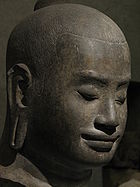 Following the death of Suryavarman around 1150 AD, the kingdom fell into a period of internal strife. Its neighbors to the east, the Cham of what is now southern Vietnam, took advantage of the situation in 1177 to launch a seaborne invasion up the Mekong
River and across Tonlé Sap
. The Cham forces were successful in sacking the Khmer capital of Yasodharapura
and in killing the reigning king. However, a Khmer prince who was to become King Jayavarman VII
rallied his people and defeated the Cham in battles on the lake and on the land. In 1181, Jayavarman assumed the throne. He was to be the greatest of the Angkorian kings. Over the ruins of Yasodharapura, Jayavarman constructed the walled city of Angkor Thom
, as well as its geographic and spiritual center, the temple known as the Bayon
. Bas-reliefs at the Bayon depict not only the king's battles with the Cham, but also scenes from the life of Khmer villagers and courtiers. In addition, Jayavarman constructed the well-known temples of Ta Prohm
and Preah Khan
, dedicating them to his parents. This massive program of construction coincided with a transition in the state religion from Hinduism
to Mahayana Buddhism, since Jayavarman himself had adopted the latter as his personal faith. During Jayavarman's reign, Hindu temples were altered to display images of the Buddha
, and Angkor Wat briefly became a Buddhist shrine. Following his death, a Hindu revival included a large-scale campaign of desecrating Buddhist images, until Theravada Buddhism became established as the land's dominant religion from the 14th century.
. Zhou's one-year sojourn in the Khmer capital during the reign of King Indravarman III
is historically significant, because he penned a still-surviving account
of approximately 40 pages detailing his observations of Khmer society. Some of the topics he addressed in the account were those of religion, justice, kingship, agriculture, slavery, birds, vegetables, bathing, clothing, tools, draft animals, and commerce. In one passage, he described a royal procession consisting of soldiers, numerous servant women and concubines, ministers and princes, and finally, "the sovereign, standing on an elephant, holding his sacred sword in his hand." Together with the inscriptions that have been found on Angkorian stelas, temples and other monuments, and with the bas-reliefs at the Bayon
and Angkor Wat
, Zhou's journal is the most important source of information about everyday life at Angkor. Filled with vivid anecdotes and sometimes incredulous observations of a civilization that struck Zhou as colorful and exotic, it is an entertaining travel memoir as well.
invaders, though the civilization already had been in decline in the 13th and 14th centuries. During the course of the 15th century, nearly all of Angkor was abandoned, except for Angkor Wat
, which remained a Buddhist shrine.
Several theories have been advanced to account for the decline and abandonment of Angkor:
toward the end of the 13th century. In his memoirs, Zhou reported that the country had been completely devastated by such a war, in which the entire population had been obligated to participate. After the collapse of Angkor in 1431, many persons, texts and institutions were taken to the Ayutthaya capital of Ayutthaya
in the west, while others departed for the new center of Khmer society at Longvek further south, though the official capital later moved, first to Oudong
around 45 kilometres (28 mi) from Phnom Penh
in Ponhea Leu District
, and then to the present site of Phnom Penh.
, arguing that this religious transition eroded the Hindu conception of kingship that undergirded the Angkorian civilization. According to Angkor scholar George Coedès
, Theravada Buddhism's denial of the ultimate reality of the individual served to sap the vitality of the royal personality cult which had provided the inspiration for the grand monuments of Angkor.
, the weakening of Angkor's royal government by ongoing war and the erosion of the cult of the devaraja undermined the government's ability to engage in important public works, such as the construction and maintenance of the waterways essential for irrigation of the rice fields upon which Angkor's large population depended for its sustenance. As a result, Angkorian civilization suffered from a reduced economic base, and the population was forced to scatter.
to the Little Ice Age
. LDEO dendrochronological research
has established tree-ring chronologies indicating severe periods of drought
across mainland Southeast Asia
in the early 15th century, raising the possibility that Angkor's canals and reservoirs ran dry and ended expansion of available farmland.
, which cleared away the forest, repaired foundations, and installed drains to protect the buildings from water damage. In addition, scholars associated with the school and including George Coedès
, Maurice Glaize
, Paul Mus
, Philippe Stern
and others initiated a program of historical scholarship and interpretation that is fundamental to the current understanding of Angkor.
Work resumed after the end of the Cambodian Civil War
and, since 1993, has been jointly co-ordinated by the French, Japanese and UNESCO through the International Co-ordinating Committee on the Safeguarding and Development of the Historic Site of Angkor (ICC), while Cambodian work is carried out by the Authority for the Protection and Management of Angkor and the Region of Siem Reap (APSARA
), created in 1995. Some temples have been carefully taken apart stone by stone and reassembled on concrete foundations, in accordance with the method of anastylosis
. World Monuments Fund
has aided Preah Khan
, the Churning of the Sea of Milk (a 49-meter-long bas-relief frieze in Angkor Wat), Ta Som
, and Phnom Bakheng
. International tourism to Angkor has increased significantly in recent years, with visitor numbers reaching 900,000 in 2006; this poses additional conservation problems but has also provided financial assistance to the restoration effort.
With the increased growth in tourism at Angkor, new hotels and restaurants are being built to accommodate such growth. Each new construction project drills underground to reach the water table
, which has a limited storage capacity. This demand on the water table could undermine the stability of the sandy soils under the monuments at Angkor, leading to cracks, fissures and collapses.
Looting
has been an ever-growing threat to the Angkor archaeological landscape. According to APSARA, the official Cambodian
agency charged with overseeing the management of Angkor, "vandalism has multiplied at a phenomenal rate, employing local populations to carry out the actual thefts, heavily armed intermediaries transport objects, often in tanks or armored personnel carriers, often for sale across the Cambodian border."
The increasing number of tourists, which the Cambodian government hopes will reach three million by 2010, exerts pressure on the archaeological sites at Angkor by walking and climbing on the (mostly) sandstone monuments at Angkor. This direct pressure created by unchecked tourism is expected to cause significant damage to the monuments in the future.
Several religious movements contributed to the historical development of religion at Angkor:
Temples from the period of Chenla bear stone inscriptions, in both Sanskrit
and Khmer
, naming both Hindu and local ancestral deities, with Shiva supreme among the former. The cult of Harihara
was prominent; Buddhism was not, because, as reported by the Chinese pilgrim Yi Jing
, a "wicked king" had destroyed it. Characteristic of the religion of Chenla also was the cult of the lingam, or stone phallus that patronized and guaranteed fertility to the community in which it was located.
, whose assumption of power around 800 AD marks the beginning of the Angkorian period, established his capital at a place called Hariharalaya
(today known as Roluos
), at the northern end of the great lake, Tonlé Sap
. Harihara
is the name of a deity that combines the essence of Vishnu
(Hari) with that of Shiva
(Hara) and that was much favored by the Khmer kings. Jayavarman II's adoption of the epithet "devaraja" (god-king) signified the monarch's special connection with Shiva.
The beginning of the Angkorian period was also marked by changes in religious architecture. During the reign of Jayavarman II, the single-chambered sanctuaries typical of Chenla gave way to temples constructed as a series of raised platforms bearing multiple towers. Increasingly impressive temple pyramids came to represent Mount Meru, the home of the Hindu gods, with the moats surrounding the temples representing the mythological oceans.
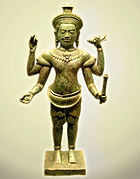 Typically, a lingam
served as the central religious image of the Angkorian temple-mountain. The temple-mountain was the center of the city, and the lingam in the main sanctuary was the focus of the temple. The name of the central lingam was the name of the king himself, combined with the suffix -esvara, which designated Shiva. Through the worship of the lingam, the king was identified with Shiva, and Shaivism
became the state religion. Thus, an inscription dated 881 AD indicates that king Indravarman I
erected a lingam named Indresvara. Another inscription tells us that Indravarman erected eight lingams in his courts and that they were named for the "eight elements of Shiva". Similarly, Rajendravarman, whose reign began in 944 AD, constructed the temple of Pre Rup
, the central tower of which housed the royal lingam called Rajendrabhadresvara.
was secondary to that of Shiva
. The relationship seems to have changed with the construction of Angkor Wat
by King Suryavarman II
as his personal mausoleum at the beginning of the 12th century. The central religious image of Angkor Wat was an image of Vishnu, and an inscription identifies Suryavarman as "Paramavishnuloka," or "he who enters the heavenly world of Vishnu." Religious syncretism
, however, remained thoroughgoing in Khmer society: the state religion of Shaivism was not necessarily abrogated by Suryavarman's turn to Vishnu, and the temple may well have housed a royal lingam. Furthermore, the turn to Vaishnavism
did not abrogate the royal personality cult of Angkor. by which the reigning king was identified with the deity. According to Angkor scholar Georges Coedès, "Angkor Wat is, if you like, a vaishnavite sanctuary, but the Vishnu venerated there was not the ancient Hindu deity nor even one of the deity's traditional incarnations, but the king Suryavarman II posthumously identified with Vishnu, consubstantial with him, residing in a mausoleum decorated with the graceful figures of apsaras just like Vishnu in his celestial palace." Suryavarman proclaimed his identity with Vishnu, just as his predecessors had claimed consubstantiation with Shiva.
departed radically from the tradition of his predecessors when he adopted Mahayana
Buddhism as his personal faith. Jayavarman also made Buddhism the state religion of his kingdom when he constructed the Buddhist temple known as the Bayon
at the heart of his new capital city of Angkor Thom
. In the famous face towers of the Bayon, the king represented himself as the bodhisattva
Avalokiteshvara moved by compassion for his subjects. Thus, Jayavarman was able to perpetuate the royal personality cult of Angkor, while identifying the divine component of the cult with the bodhisattva rather than with Shiva.
, was a Shaivite iconoclast who specialized in destroying Buddhist images and in reestablishing the Hindu shrines that his illustrious predecessor had converted to Buddhism. During the restoration, the Bayon was made a temple to Shiva, and its central 3.6 meter tall statue of the Buddha was cast to the bottom of a nearby well. Everywhere, cultist statues of the Buddha were replaced by lingams.
came to Angkor in AD 1296, he found what he took to be three separate religious groups. The dominant religion was that of Theravada
Buddhism. Zhou observed that the monks had shaven heads and wore yellow robes. The Buddhist temples impressed Zhou with their simplicity. He noted that the images of Buddha were made of gilded plaster. The other two groups identified by Zhou appear to have been those of the Brahmans
and of the Shaivites. About the Brahmans, Zhou had little to say, except that they were often employed as high officials. Of the Shaivites, whom he called "Taoists", Zhou wrote, "the only image which they revere is a block of stone analogous to the stone found in shrines of the god of the soil in China."
kingdoms of Dvaravati
and Haripunchai
made its appearance at Angkor. Gradually, it became the dominant religion of Cambodia, displacing both Mahayana Buddhism and Shaivism. The practice of Theravada Buddhism at Angkor continues until this day.
, Angkor Wat
, Baksei Chamkrong
, Banteay Kdei
, Banteay Samré
, Banteay Srei
, Baphuon
, the Bayon
, Chau Say Tevoda
, East Baray
, East Mebon
, Kbal Spean
, the Khleangs
, Krol Ko
, Lolei
, Neak Pean
, Phimeanakas
, Phnom Bakheng
, Phnom Krom
, Prasat Ak Yum
, Prasat Kravan
, Preah Khan
, Preah Ko
, Preah Palilay
, Preah Pithu
, Pre Rup
, Spean Thma
, Srah Srang
, Ta Nei
, Ta Prohm
, Ta Som
, Ta Keo
, Terrace of the Elephants
, Terrace of the Leper King
, Thommanon
, West Baray
, West Mebon
.
Cambodia
Cambodia , officially known as the Kingdom of Cambodia, is a country located in the southern portion of the Indochina Peninsula in Southeast Asia...
that served as the seat of the Khmer Empire
Khmer Empire
The Khmer Empire was one of the most powerful empires in Southeast Asia. The empire, which grew out of the former kingdom of Chenla, at times ruled over and/or vassalized parts of modern-day Laos, Thailand, Vietnam, Burma, and Malaysia. Its greatest legacy is Angkor, the site of the capital city...
, which flourished from approximately the 9th to 15th centuries. The word Angkor is derived from the Sanskrit
Sanskrit
Sanskrit , is a historical Indo-Aryan language and the primary liturgical language of Hinduism, Jainism and Buddhism.Buddhism: besides Pali, see Buddhist Hybrid Sanskrit Today, it is listed as one of the 22 scheduled languages of India and is an official language of the state of Uttarakhand...
nagara (नगर), meaning "city". The Angkorian period began in AD 802, when the Khmer
Khmer people
Khmer people are the predominant ethnic group in Cambodia, accounting for approximately 90% of the 14.8 million people in the country. They speak the Khmer language, which is part of the larger Mon–Khmer language family found throughout Southeast Asia...
Hindu
Hinduism
Hinduism is the predominant and indigenous religious tradition of the Indian Subcontinent. Hinduism is known to its followers as , amongst many other expressions...
monarch Jayavarman II
Jayavarman II
Jayavarman II was a 9th century king of Cambodia, widely recognized as the founder of the Khmer Empire, which ruled much of the Southeast Asian mainland for more than six hundred years. Historians formerly dated his reign as running from 802 AD to 850 AD, but some scholars now have set it back to...
declared himself a "universal monarch" and "god-king", until 1351, when Angkor first fell under Ayutthayan suzainry, to 1431, when Ayutthaya
Ayutthaya kingdom
Ayutthaya was a Siamese kingdom that existed from 1350 to 1767. Ayutthaya was friendly towards foreign traders, including the Chinese, Vietnamese , Indians, Japanese and Persians, and later the Portuguese, Spanish, Dutch and French, permitting them to set up villages outside the walls of the...
put down a rebellion and sacked the Khmer capital, causing its population to migrate south to the area of Phnom Penh
Phnom Penh
Phnom Penh is the capital and largest city of Cambodia. Located on the banks of the Mekong River, Phnom Penh has been the national capital since the French colonized Cambodia, and has grown to become the nation's center of economic and industrial activities, as well as the center of security,...
.
The ruins of Angkor are located amid forests and farmland to the north of the Great Lake (Tonlé Sap
Tonlé Sap
The Tonlé Sap is a combined lake and river system of major importance to Cambodia.The Tonlé Sap is the largest freshwater lake in South East Asia and is an ecological hot spot that was designated as a UNESCO biosphere in 1997....
) and south of the Kulen Hills
Phnom Kulen
Phnom Kulen, Phnom Koulen, Phnum Kulén or Koulen Mountain is a mountain range in Siem Reap Province, Northern Cambodia.-Geography:...
, near modern-day Siem Reap
Siem Reap
Siem Reap is the capital city of Siem Reap Province in northwestern Cambodia, and is the gateway to Angkor region.Siem Reap has colonial and Chinese-style architecture in the Old French Quarter, and around the Old Market...
(13°24′N, 103°51′E), and are a UNESCO
UNESCO
The United Nations Educational, Scientific and Cultural Organization is a specialized agency of the United Nations...
World Heritage Site
World Heritage Site
A UNESCO World Heritage Site is a place that is listed by the UNESCO as of special cultural or physical significance...
. The temples of the Angkor area number over one thousand, ranging in scale from nondescript piles of brick rubble scattered through rice fields to the magnificent Angkor Wat
Angkor Wat
Angkor Wat is a temple complex at Angkor, Cambodia, built for the king Suryavarman II in the early 12th century as his state temple and capital city. As the best-preserved temple at the site, it is the only one to have remained a significant religious centre since its foundation – first Hindu,...
, said to be the world's largest single religious monument. Many of the temples at Angkor have been restored, and together, they comprise the most significant site of Khmer architecture. Visitor numbers approach two million annually.
In 2007, an international team of researchers using satellite photographs and other modern techniques concluded that Angkor had been the largest preindustrial city in the world, with an elaborate system of infrastructure connecting an urban sprawl of at least 1000 square kilometres (386.1 sq mi) to the well-known temples at its core. The closest rival to Angkor, the Mayan city of Tikal
Tikal
Tikal is one of the largest archaeological sites and urban centres of the pre-Columbian Maya civilization. It is located in the archaeological region of the Petén Basin in what is now northern Guatemala...
in Guatemala, was between 100 and 150 km² (38.6 and 57.9 ) in total size. Although its population remains a topic of research and debate, newly identified agricultural systems in the Angkor area may have supported up to one million people.
Seat of the Khmer Empire
The Angkorian period may be said to have begun shortly after 800 AD, when the Khmer King Jayavarman IIJayavarman II
Jayavarman II was a 9th century king of Cambodia, widely recognized as the founder of the Khmer Empire, which ruled much of the Southeast Asian mainland for more than six hundred years. Historians formerly dated his reign as running from 802 AD to 850 AD, but some scholars now have set it back to...
announced the independence of Kambujadesa (Cambodia
Cambodia
Cambodia , officially known as the Kingdom of Cambodia, is a country located in the southern portion of the Indochina Peninsula in Southeast Asia...
) from Java
Java
Java is an island of Indonesia. With a population of 135 million , it is the world's most populous island, and one of the most densely populated regions in the world. It is home to 60% of Indonesia's population. The Indonesian capital city, Jakarta, is in west Java...
and established his capital of Hariharalaya
Hariharalaya
Hariharalaya was an ancient city and capital of the Khmer empire located near Siem Reap, Cambodia in an area now called Roluos. Today, all that remains of the city are the ruins of several royal temples: Preah Ko, the Bakong, Lolei.-Etymology:...
(now known as Roluos) at the northern end of Tonlé Sap
Tonlé Sap
The Tonlé Sap is a combined lake and river system of major importance to Cambodia.The Tonlé Sap is the largest freshwater lake in South East Asia and is an ecological hot spot that was designated as a UNESCO biosphere in 1997....
. Through a program of military campaigns, alliances, marriages and land grants, he achieved a unification of the country bordered by China
China
Chinese civilization may refer to:* China for more general discussion of the country.* Chinese culture* Greater China, the transnational community of ethnic Chinese.* History of China* Sinosphere, the area historically affected by Chinese culture...
to the north, Champa
Champa
The kingdom of Champa was an Indianized kingdom that controlled what is now southern and central Vietnam from approximately the 7th century through to 1832.The Cham people are remnants...
(now Central Vietnam) to the east, the ocean to the south and a place identified by a stone inscription as "the land of cardamom
Cardamom
Cardamom refers to several plants of the genera Elettaria and Amomum in the ginger family Zingiberaceae. Both genera are native to India and Bhutan; they are recognised by their small seed pod, triangular in cross-section and spindle-shaped, with a thin papery outer shell and small black seeds...
s and mango
Mango
The mango is a fleshy stone fruit belonging to the genus Mangifera, consisting of numerous tropical fruiting trees in the flowering plant family Anacardiaceae. The mango is native to India from where it spread all over the world. It is also the most cultivated fruit of the tropical world. While...
es" to the west. In 802, Jayavarman articulated his new status by declaring himself "universal monarch" (chakravartin) and, in a move that was to be imitated by his successors and that linked him to the cult of Siva
Shiva
Shiva is a major Hindu deity, and is the destroyer god or transformer among the Trimurti, the Hindu Trinity of the primary aspects of the divine. God Shiva is a yogi who has notice of everything that happens in the world and is the main aspect of life. Yet one with great power lives a life of a...
, taking on the epithet of "god-king" (devaraja). Before Jayavarman, Cambodia had consisted of a number of politically independent principalities collectively known to the Chinese by the names Funan and Chenla
Chenla
Chenla is the Chinese designation for Cambodia after the fall of Funan. That name was still used in the 13th century by the Chinese envoy Zhou Daguan, author of the Manners and Customs of Cambodia...
.
In 889, Yasovarman
Yasovarman
Yasovarman I was an Angkorian king who reigned in 889–910 CE.-Early years:After the death of Indravarman I, a succession war was fought by his two sons. It's believed that the war was fought on land and on sea by the Tonle Sap. In the end Yasovarman I prevailed. Because of his father had sought...
ascended to the throne. A great king and an accomplished builder, he was celebrated by one inscription as "a lion-man; he tore the enemy with the claws of his grandeur; his teeth were his policies; his eyes were the Veda." Near the old capital of Hariharalaya, Yasovarman constructed a new city, called Yasodharapura
Yasodharapura
Yaśodharapura was the first capital of the Khmer empire to be built at the Angkor site. The city was built during the reign of King Yasovarman I after the palace in the previous capital at Roluos was burned during his struggle to consolidate power upon the death of the previous king, his...
. In the tradition of his predecessors, he also constructed a massive reservoir called baray
Baray
A baray is an artificial body of water which is a common element of the architectural style of the Khmer Empire of Southeast Asia. The largest are the East Baray and West Baray in the Angkor area, each rectangular in shape, oriented east-west and measuring roughly five by one and a half miles....
. The significance of such reservoirs has been debated by modern scholars, some of whom have seen in them a means of irrigating rice fields, and others of whom have regarded them as religiously charged symbols of the great mythological oceans surrounding Mount Meru, the abode of the gods. The mountain, in turn, was represented by an elevated temple, in which the "god-king" was represented by a lingam
Lingam
The Lingam is a representation of the Hindu deity Shiva used for worship in temples....
. In accordance with this cosmic symbolism, Yasovarman built his central temple on a low hill known as Phnom Bakheng
Phnom Bakheng
-See also:* Angkor* Architecture of Cambodia* List of archaeoastronomical sites by country-References:* Goloubev, Victor. Le Phnom Bakheng et la ville de Yasovarman. Bulletin de l'EFEO , 33 : 319-344....
, surrounding it with a moat fed from the baray. He also built numerous other Hindu temples and ashram
Ashram
Traditionally, an ashram is a spiritual hermitage. Additionally, today the term ashram often denotes a locus of Indian cultural activity such as yoga, music study or religious instruction, the moral equivalent of a studio or dojo....
s, or retreats for ascetics.
Over the next 300 years, between 900 and 1200, the Khmer Empire
Khmer Empire
The Khmer Empire was one of the most powerful empires in Southeast Asia. The empire, which grew out of the former kingdom of Chenla, at times ruled over and/or vassalized parts of modern-day Laos, Thailand, Vietnam, Burma, and Malaysia. Its greatest legacy is Angkor, the site of the capital city...
produced some of the world's most magnificent architectural masterpieces in the area known as Angkor. Most are concentrated in an area approximately 15 miles (24.1 km) east to west and 5 miles (8 km) north to south, although the Angkor Archaeological Park, which administers the area, includes sites as far away as Kbal Spean
Kbal Spean
Kbal Spean is an Angkorian era archaeological site on the southwest slopes of the Kulen Hills to the northeast of Angkor in Siem Reap District, Siem Reap Province, Cambodia...
, about 30 miles (48.3 km) to the north. Some 72 major temples or other buildings are found within this area, and the remains of several hundred additional minor temple sites are scattered throughout the landscape beyond. Because of the dispersed, low-density nature of the medieval Khmer settlement pattern, Angkor lacks a formal boundary, and its extent is therefore difficult to determine. However, a specific area of at least 1000 km² (386.1 sq mi) beyond the major temples is defined by a complex system of infrastructure, including roads and canals that indicate a high degree of connectivity and functional integration with the urban core. In terms of spatial extent (although not in terms of population), this makes it the largest urban agglomeration in human history prior to the Industrial Revolution
Industrial Revolution
The Industrial Revolution was a period from the 18th to the 19th century where major changes in agriculture, manufacturing, mining, transportation, and technology had a profound effect on the social, economic and cultural conditions of the times...
, easily surpassing the nearest claim, that of the Maya
Maya civilization
The Maya is a Mesoamerican civilization, noted for the only known fully developed written language of the pre-Columbian Americas, as well as for its art, architecture, and mathematical and astronomical systems. Initially established during the Pre-Classic period The Maya is a Mesoamerican...
n city of Tikal
Tikal
Tikal is one of the largest archaeological sites and urban centres of the pre-Columbian Maya civilization. It is located in the archaeological region of the Petén Basin in what is now northern Guatemala...
. In fact, in terms of its urban sprawl
Urban sprawl
Urban sprawl, also known as suburban sprawl, is a multifaceted concept, which includes the spreading outwards of a city and its suburbs to its outskirts to low-density and auto-dependent development on rural land, high segregation of uses Urban sprawl, also known as suburban sprawl, is a...
, medieval Angkor even approaches the size of modern Los Angeles
Los Ángeles
Los Ángeles is the capital of the province of Biobío, in the commune of the same name, in Region VIII , in the center-south of Chile. It is located between the Laja and Biobío rivers. The population is 123,445 inhabitants...
, and is said to have been seventeen times larger than Manhattan
Manhattan
Manhattan is the oldest and the most densely populated of the five boroughs of New York City. Located primarily on the island of Manhattan at the mouth of the Hudson River, the boundaries of the borough are identical to those of New York County, an original county of the state of New York...
Island.
Construction of Angkor Wat
The principal temple of the Angkorian region, Angkor WatAngkor Wat
Angkor Wat is a temple complex at Angkor, Cambodia, built for the king Suryavarman II in the early 12th century as his state temple and capital city. As the best-preserved temple at the site, it is the only one to have remained a significant religious centre since its foundation – first Hindu,...
, was built between 1113 and 1150 by King Suryavarman II
Suryavarman II
Suryavarman II was king of the Khmer Empire from 1113 AD to 1145-1150 AD and the builder of Angkor Wat, which he dedicated to the Hindu god Vishnu...
. Suryavarman ascended to the throne after prevailing in a battle with a rival prince. An inscription says that, in the course of combat, Suryavarman leapt onto his rival's war elephant and killed him, just as the mythical bird-man Garuda
Garuda
The Garuda is a large mythical bird or bird-like creature that appears in both Hindu and Buddhist mythology.From an Indian perspective, Garuda is the Hindu name for the constellation Aquila and...
slays a serpent.
After consolidating his political position through military campaigns, diplomacy, and a firm domestic administration, Suryavarman launched into the construction of Angkor Wat as his personal temple mausoleum. Breaking with the tradition of the Khmer kings, and influenced perhaps by the concurrent rise of Vaisnavism in India, he dedicated the temple to Vishnu
Vishnu
Vishnu is the Supreme god in the Vaishnavite tradition of Hinduism. Smarta followers of Adi Shankara, among others, venerate Vishnu as one of the five primary forms of God....
rather than to Siva
Shiva
Shiva is a major Hindu deity, and is the destroyer god or transformer among the Trimurti, the Hindu Trinity of the primary aspects of the divine. God Shiva is a yogi who has notice of everything that happens in the world and is the main aspect of life. Yet one with great power lives a life of a...
. With walls nearly one-half mile long on each side, Angkor Wat grandly portrays the Hindu
Hindu
Hindu refers to an identity associated with the philosophical, religious and cultural systems that are indigenous to the Indian subcontinent. As used in the Constitution of India, the word "Hindu" is also attributed to all persons professing any Indian religion...
cosmology, with the central towers representing Mount Meru, home of the gods; the outer walls, the mountains enclosing the world; and the moat, the oceans beyond. The traditional theme of identifying the Cambodian devaraja with the gods, and his residence with that of the celestials, is very much in evidence. The measurements themselves of the temple and its parts in relation to one another have cosmological significance. Suryavarman had the walls of the temple decorated with bas reliefs depicting not only scenes from mythology, but also from the life of his own imperial court. In one of the scenes, the king himself is portrayed as larger in size than his subjects, sitting cross-legged on an elevated throne and holding court, while a bevy of attendants make him comfortable with the aid of parasols and fans.
Jayavarman VII
Mekong
The Mekong is a river that runs through China, Burma, Laos, Thailand, Cambodia and Vietnam. It is the world's 10th-longest river and the 7th-longest in Asia. Its estimated length is , and it drains an area of , discharging of water annually....
River and across Tonlé Sap
Tonlé Sap
The Tonlé Sap is a combined lake and river system of major importance to Cambodia.The Tonlé Sap is the largest freshwater lake in South East Asia and is an ecological hot spot that was designated as a UNESCO biosphere in 1997....
. The Cham forces were successful in sacking the Khmer capital of Yasodharapura
Yasodharapura
Yaśodharapura was the first capital of the Khmer empire to be built at the Angkor site. The city was built during the reign of King Yasovarman I after the palace in the previous capital at Roluos was burned during his struggle to consolidate power upon the death of the previous king, his...
and in killing the reigning king. However, a Khmer prince who was to become King Jayavarman VII
Jayavarman VII
Jayavarman VII was a king of the Khmer Empire in present day Siem Reap, Cambodia. He was the son of King Dharanindravarman II and Queen Sri Jayarajacudamani. He married Jayarajadevi and then, after her death, married her sister Indradevi...
rallied his people and defeated the Cham in battles on the lake and on the land. In 1181, Jayavarman assumed the throne. He was to be the greatest of the Angkorian kings. Over the ruins of Yasodharapura, Jayavarman constructed the walled city of Angkor Thom
Angkor Thom
Angkor Thom , located in present day Cambodia, was the last and most enduring capital city of the Khmer empire. It was established in the late twelfth century by king Jayavarman VII. It covers an area of 9 km², within which are located several monuments from earlier eras as well as those...
, as well as its geographic and spiritual center, the temple known as the Bayon
Bayon
The Bayon is a well-known and richly decorated Khmer temple at Angkor in Cambodia. Built in the late 12th century or early 13th century as the official state temple of the Mahayana Buddhist King Jayavarman VII, the Bayon stands at the centre of Jayavarman's capital, Angkor Thom...
. Bas-reliefs at the Bayon depict not only the king's battles with the Cham, but also scenes from the life of Khmer villagers and courtiers. In addition, Jayavarman constructed the well-known temples of Ta Prohm
Ta Prohm
Ta Prohm is the modern name of a temple at Angkor, Siem Reap Province, Cambodia, built in the Bayon style largely in the late 12th and early 13th centuries and originally called Rajavihara...
and Preah Khan
Preah Khan
Preah Khan , sometimes transliterated as Prah Khan, is a temple at Angkor, Cambodia, built in the 12th century for King Jayavarman VII. It is located northeast of Angkor Thom and just west of the Jayatataka baray, with which it was associated. It was the centre of a substantial organisation,...
, dedicating them to his parents. This massive program of construction coincided with a transition in the state religion from Hinduism
Hinduism
Hinduism is the predominant and indigenous religious tradition of the Indian Subcontinent. Hinduism is known to its followers as , amongst many other expressions...
to Mahayana Buddhism, since Jayavarman himself had adopted the latter as his personal faith. During Jayavarman's reign, Hindu temples were altered to display images of the Buddha
Gautama Buddha
Siddhārtha Gautama was a spiritual teacher from the Indian subcontinent, on whose teachings Buddhism was founded. In most Buddhist traditions, he is regarded as the Supreme Buddha Siddhārtha Gautama (Sanskrit: सिद्धार्थ गौतम; Pali: Siddhattha Gotama) was a spiritual teacher from the Indian...
, and Angkor Wat briefly became a Buddhist shrine. Following his death, a Hindu revival included a large-scale campaign of desecrating Buddhist images, until Theravada Buddhism became established as the land's dominant religion from the 14th century.
Zhou Daguan
The year 1296 marked the arrival at Angkor of the Chinese diplomat Zhou DaguanZhou Daguan
Zhou Daguan was a Chinese diplomat under the Temür Khan, Emperor Chengzong of Yuan. He is most well known for his accounts of the customs of Cambodia and the Angkor temple complexes during his visit there. He arrived at Angkor in August 1296, and remained at the court of King Indravarman III...
. Zhou's one-year sojourn in the Khmer capital during the reign of King Indravarman III
Indravarman III
Indravarman II was a ruler of the Khmer Empire, son of Jayavarman VII. There is some dispute regarding the actual period of his reign, even because his successor, Jayavarman VIII, probably destroyed historical records about him, but the only inscription which directly mention him reports that he...
is historically significant, because he penned a still-surviving account
Customs of Cambodia
The Customs of Cambodia or A Record of Cambodia: The Land and Its People is the English translated name of the document written by the Chinese diplomat Zhou Daguan during his stay at Angkor between 1296 AD and 1297 AD...
of approximately 40 pages detailing his observations of Khmer society. Some of the topics he addressed in the account were those of religion, justice, kingship, agriculture, slavery, birds, vegetables, bathing, clothing, tools, draft animals, and commerce. In one passage, he described a royal procession consisting of soldiers, numerous servant women and concubines, ministers and princes, and finally, "the sovereign, standing on an elephant, holding his sacred sword in his hand." Together with the inscriptions that have been found on Angkorian stelas, temples and other monuments, and with the bas-reliefs at the Bayon
Bayon
The Bayon is a well-known and richly decorated Khmer temple at Angkor in Cambodia. Built in the late 12th century or early 13th century as the official state temple of the Mahayana Buddhist King Jayavarman VII, the Bayon stands at the centre of Jayavarman's capital, Angkor Thom...
and Angkor Wat
Angkor Wat
Angkor Wat is a temple complex at Angkor, Cambodia, built for the king Suryavarman II in the early 12th century as his state temple and capital city. As the best-preserved temple at the site, it is the only one to have remained a significant religious centre since its foundation – first Hindu,...
, Zhou's journal is the most important source of information about everyday life at Angkor. Filled with vivid anecdotes and sometimes incredulous observations of a civilization that struck Zhou as colorful and exotic, it is an entertaining travel memoir as well.
End of the Angkorian period
The end of the Angkorian period is generally set as 1431, the year Angkor was sacked and looted by AyutthayaAyutthaya kingdom
Ayutthaya was a Siamese kingdom that existed from 1350 to 1767. Ayutthaya was friendly towards foreign traders, including the Chinese, Vietnamese , Indians, Japanese and Persians, and later the Portuguese, Spanish, Dutch and French, permitting them to set up villages outside the walls of the...
invaders, though the civilization already had been in decline in the 13th and 14th centuries. During the course of the 15th century, nearly all of Angkor was abandoned, except for Angkor Wat
Angkor Wat
Angkor Wat is a temple complex at Angkor, Cambodia, built for the king Suryavarman II in the early 12th century as his state temple and capital city. As the best-preserved temple at the site, it is the only one to have remained a significant religious centre since its foundation – first Hindu,...
, which remained a Buddhist shrine.
Several theories have been advanced to account for the decline and abandonment of Angkor:
War with the Ayutthaya Kingdom
It is widely believed that the abandonment of the Khmer capital occurred as a result of Ayutthaya invasions. Ongoing wars with the Siamese were already sapping the strength of Angkor at the time of Zhou DaguanZhou Daguan
Zhou Daguan was a Chinese diplomat under the Temür Khan, Emperor Chengzong of Yuan. He is most well known for his accounts of the customs of Cambodia and the Angkor temple complexes during his visit there. He arrived at Angkor in August 1296, and remained at the court of King Indravarman III...
toward the end of the 13th century. In his memoirs, Zhou reported that the country had been completely devastated by such a war, in which the entire population had been obligated to participate. After the collapse of Angkor in 1431, many persons, texts and institutions were taken to the Ayutthaya capital of Ayutthaya
Ayutthaya (city)
Ayutthaya city is the capital of Ayutthaya province in Thailand. Located in the valley of the Chao Phraya River. The city was founded in 1350 by King U Thong, who went there to escape a smallpox outbreak in Lop Buri and proclaimed it the capital of his kingdom, often referred to as the Ayutthaya...
in the west, while others departed for the new center of Khmer society at Longvek further south, though the official capital later moved, first to Oudong
Oudong
Udong is a town in Cambodia, situated in the north-western part of Kandal Province. The town is located on top of the mountain Phnom Udong, about 40 km northwest of the capital Phnom Penh...
around 45 kilometres (28 mi) from Phnom Penh
Phnom Penh
Phnom Penh is the capital and largest city of Cambodia. Located on the banks of the Mekong River, Phnom Penh has been the national capital since the French colonized Cambodia, and has grown to become the nation's center of economic and industrial activities, as well as the center of security,...
in Ponhea Leu District
Ponhea Leu District
Ponhea Leu District is a district of Kandal Province, Cambodia. The district is subdivided into 14 communes and 141 villages . In the northern part of the district, near the border between Kampong Speu and Kampong Chhnang is the old royal capital of Oudong.-External links:**...
, and then to the present site of Phnom Penh.
Erosion of the state religion
Some scholars have connected the decline of Angkor with the conversion of Cambodia to Theravada Buddhism following the reign of Jayavarman VIIJayavarman VII
Jayavarman VII was a king of the Khmer Empire in present day Siem Reap, Cambodia. He was the son of King Dharanindravarman II and Queen Sri Jayarajacudamani. He married Jayarajadevi and then, after her death, married her sister Indradevi...
, arguing that this religious transition eroded the Hindu conception of kingship that undergirded the Angkorian civilization. According to Angkor scholar George Coedès
George Coedès
Georges Cœdès was a 20th century scholar of southeast Asian archaeology and history. Coedès was born in Paris to a family of supposed Hungarian-Jewish emigres. In fact, the family was known as having settled in the region of Strasbourg before 1740. His ancestors were working for the royal Treasury...
, Theravada Buddhism's denial of the ultimate reality of the individual served to sap the vitality of the royal personality cult which had provided the inspiration for the grand monuments of Angkor.
Neglect of public works
According to George CoedèsGeorge Coedès
Georges Cœdès was a 20th century scholar of southeast Asian archaeology and history. Coedès was born in Paris to a family of supposed Hungarian-Jewish emigres. In fact, the family was known as having settled in the region of Strasbourg before 1740. His ancestors were working for the royal Treasury...
, the weakening of Angkor's royal government by ongoing war and the erosion of the cult of the devaraja undermined the government's ability to engage in important public works, such as the construction and maintenance of the waterways essential for irrigation of the rice fields upon which Angkor's large population depended for its sustenance. As a result, Angkorian civilization suffered from a reduced economic base, and the population was forced to scatter.
Natural disaster
Other scholars attempting to account for the rapid decline and abandonment of Angkor have hypothesized natural disasters such as disease (Bubonic Plague), earthquakes, inundations, or drastic climate changes as the relevant agents of destruction. Recent research by Australian archaeologists suggests that the decline may have been due to a shortage of water caused by the transition from the Medieval Warm PeriodMedieval Warm Period
The Medieval Warm Period , Medieval Climate Optimum, or Medieval Climatic Anomaly was a time of warm climate in the North Atlantic region, that may also have been related to other climate events around the world during that time, including in China, New Zealand, and other countries lasting from...
to the Little Ice Age
Little Ice Age
The Little Ice Age was a period of cooling that occurred after the Medieval Warm Period . While not a true ice age, the term was introduced into the scientific literature by François E. Matthes in 1939...
. LDEO dendrochronological research
Dendrochronology
Dendrochronology or tree-ring dating is the scientific method of dating based on the analysis of patterns of tree-rings. Dendrochronology can date the time at which tree rings were formed, in many types of wood, to the exact calendar year...
has established tree-ring chronologies indicating severe periods of drought
Drought
A drought is an extended period of months or years when a region notes a deficiency in its water supply. Generally, this occurs when a region receives consistently below average precipitation. It can have a substantial impact on the ecosystem and agriculture of the affected region...
across mainland Southeast Asia
Indochina
The Indochinese peninsula, is a region in Southeast Asia. It lies roughly southwest of China, and east of India. The name has its origins in the French, Indochine, as a combination of the names of "China" and "India", and was adopted when French colonizers in Vietnam began expanding their territory...
in the early 15th century, raising the possibility that Angkor's canals and reservoirs ran dry and ended expansion of available farmland.
Restoration, preservation, and threats
Although there is evidence to the contrary (Leonowens, 1870), many scholars believe the great city and temples remained largely cloaked by the forest until the late 19th century, when French archaeologists began a long restoration process. From 1907 to 1970, work was under the direction of the École française d'Extrême-OrientÉcole française d'Extrême-Orient
The École française d'Extrême-Orient is a French institute dedicated to the study of Asian societies. Translated into English, it approximately means the French School of the Far East. It was founded in 1900 with headquarters in Hanoi in what was then French Indochina. After independence, its...
, which cleared away the forest, repaired foundations, and installed drains to protect the buildings from water damage. In addition, scholars associated with the school and including George Coedès
George Coedès
Georges Cœdès was a 20th century scholar of southeast Asian archaeology and history. Coedès was born in Paris to a family of supposed Hungarian-Jewish emigres. In fact, the family was known as having settled in the region of Strasbourg before 1740. His ancestors were working for the royal Treasury...
, Maurice Glaize
Maurice Glaize
Maurice Glaize was a French architect and archeologist, Conservator of Angkor from 1937 to 1945.-Early years: education, wedding, war and professional experiences:...
, Paul Mus
Paul Mus
Paul Mus was a French author and scholar. His studies focused on Vietnam and other Southeast Asian cultures.He was born in Bourges to an academic family, and grew up in northern Vietnam . He volunteered for the Free French Forces during World War II in Africa...
, Philippe Stern
Philippe Stern
Philippe Stern was a French art historian.He worked at the Guimet Museum .- Literary works :* Le Bàyon d'Angkor et l'évolution de l'art Khmer , 1927* L'art du Champa et son évolution , 1942...
and others initiated a program of historical scholarship and interpretation that is fundamental to the current understanding of Angkor.
Work resumed after the end of the Cambodian Civil War
Cambodian Civil War
The Cambodian Civil War was a conflict that pitted the forces of the Communist Party of Kampuchea and their allies the Democratic Republic of Vietnam and the Viet Cong against the government forces of Cambodia , which were supported by the United States and the Republic of Vietnam The Cambodian...
and, since 1993, has been jointly co-ordinated by the French, Japanese and UNESCO through the International Co-ordinating Committee on the Safeguarding and Development of the Historic Site of Angkor (ICC), while Cambodian work is carried out by the Authority for the Protection and Management of Angkor and the Region of Siem Reap (APSARA
APSARA
APSARA is the Cambodian management authority responsible for protecting the archaeological park of Angkor...
), created in 1995. Some temples have been carefully taken apart stone by stone and reassembled on concrete foundations, in accordance with the method of anastylosis
Anastylosis
Anastylosis is an archaeological term for a reconstruction technique whereby a ruined building or monument is restored using the original architectural elements to the greatest degree possible...
. World Monuments Fund
World Monuments Fund
World Monuments Fund is a private, international, non-profit organization dedicated to the preservation of historic architecture and cultural heritage sites around the world through fieldwork, advocacy, grantmaking, education, and training....
has aided Preah Khan
Preah Khan
Preah Khan , sometimes transliterated as Prah Khan, is a temple at Angkor, Cambodia, built in the 12th century for King Jayavarman VII. It is located northeast of Angkor Thom and just west of the Jayatataka baray, with which it was associated. It was the centre of a substantial organisation,...
, the Churning of the Sea of Milk (a 49-meter-long bas-relief frieze in Angkor Wat), Ta Som
Ta Som
Ta Som is a small temple at Angkor, Cambodia, built at the end of the 12th century for King Jayavarman VII. It is located north east of Angkor Thom and just east of Neak Pean. The King dedicated the temple to his father Dharanindravarman II who was King of the Khmer Empire from 1150 to 1160...
, and Phnom Bakheng
Phnom Bakheng
-See also:* Angkor* Architecture of Cambodia* List of archaeoastronomical sites by country-References:* Goloubev, Victor. Le Phnom Bakheng et la ville de Yasovarman. Bulletin de l'EFEO , 33 : 319-344....
. International tourism to Angkor has increased significantly in recent years, with visitor numbers reaching 900,000 in 2006; this poses additional conservation problems but has also provided financial assistance to the restoration effort.
- Water-table dropping
With the increased growth in tourism at Angkor, new hotels and restaurants are being built to accommodate such growth. Each new construction project drills underground to reach the water table
Water table
The water table is the level at which the submarine pressure is far from atmospheric pressure. It may be conveniently visualized as the 'surface' of the subsurface materials that are saturated with groundwater in a given vicinity. However, saturated conditions may extend above the water table as...
, which has a limited storage capacity. This demand on the water table could undermine the stability of the sandy soils under the monuments at Angkor, leading to cracks, fissures and collapses.
- Looting
Looting
Looting
Looting —also referred to as sacking, plundering, despoiling, despoliation, and pillaging—is the indiscriminate taking of goods by force as part of a military or political victory, or during a catastrophe, such as during war, natural disaster, or rioting...
has been an ever-growing threat to the Angkor archaeological landscape. According to APSARA, the official Cambodian
Cambodia
Cambodia , officially known as the Kingdom of Cambodia, is a country located in the southern portion of the Indochina Peninsula in Southeast Asia...
agency charged with overseeing the management of Angkor, "vandalism has multiplied at a phenomenal rate, employing local populations to carry out the actual thefts, heavily armed intermediaries transport objects, often in tanks or armored personnel carriers, often for sale across the Cambodian border."
- Unsustainable tourism
The increasing number of tourists, which the Cambodian government hopes will reach three million by 2010, exerts pressure on the archaeological sites at Angkor by walking and climbing on the (mostly) sandstone monuments at Angkor. This direct pressure created by unchecked tourism is expected to cause significant damage to the monuments in the future.
Religious history
Historical Angkor was more than a site for religious art and architecture. It was the site of vast cities that served all the needs of the Khmer people. Aside from a few old bridges, however, all of the remaining monuments are religious edifices. In Angkorian times, all non-religious buildings, including the residence of the king himself, were constructed of perishable materials, such as wood, "because only the gods had a right to residences made of stone." Similarly, the vast majority of the surviving stone inscriptions are about the religious foundations of kings and other potentates. As a result, it is easier to write the history of Angkorian state religion than it is to write that of just about any other aspect of Angkorian society.Several religious movements contributed to the historical development of religion at Angkor:
- Indigenous religious cults, including those centered on worship of the ancestors and of the lingamLingamThe Lingam is a representation of the Hindu deity Shiva used for worship in temples....
; - A royal cult of personalityCult of personalityA cult of personality arises when an individual uses mass media, propaganda, or other methods, to create an idealized and heroic public image, often through unquestioning flattery and praise. Cults of personality are usually associated with dictatorships...
, identifying the king with the deity, characteristic not only of Angkor, but of other Indic civilizations in southeast Asia, such as ChampaChampaThe kingdom of Champa was an Indianized kingdom that controlled what is now southern and central Vietnam from approximately the 7th century through to 1832.The Cham people are remnants...
and JavaJavaJava is an island of Indonesia. With a population of 135 million , it is the world's most populous island, and one of the most densely populated regions in the world. It is home to 60% of Indonesia's population. The Indonesian capital city, Jakarta, is in west Java...
; - HinduismHinduismHinduism is the predominant and indigenous religious tradition of the Indian Subcontinent. Hinduism is known to its followers as , amongst many other expressions...
, especially ShaivismShaivismShaivism is one of the four major sects of Hinduism, the others being Vaishnavism, Shaktism and Smartism. Followers of Shaivism, called "Shaivas," and also "Saivas" or "Saivites," revere Shiva as the Supreme Being. Shaivas believe that Shiva is All and in all, the creator, preserver, destroyer,...
, the form of Hinduism focussed on the worship of ShivaShivaShiva is a major Hindu deity, and is the destroyer god or transformer among the Trimurti, the Hindu Trinity of the primary aspects of the divine. God Shiva is a yogi who has notice of everything that happens in the world and is the main aspect of life. Yet one with great power lives a life of a...
and the lingam as the symbol of Shiva, but also VaishnavismVaishnavismVaishnavism is a tradition of Hinduism, distinguished from other schools by its worship of Vishnu, or his associated Avatars such as Rama and Krishna, as the original and supreme God....
, the form of Hinduism focussed on the worship of VishnuVishnuVishnu is the Supreme god in the Vaishnavite tradition of Hinduism. Smarta followers of Adi Shankara, among others, venerate Vishnu as one of the five primary forms of God....
; - BuddhismBuddhismBuddhism is a religion and philosophy encompassing a variety of traditions, beliefs and practices, largely based on teachings attributed to Siddhartha Gautama, commonly known as the Buddha . The Buddha lived and taught in the northeastern Indian subcontinent some time between the 6th and 4th...
, in both its MahayanaMahayanaMahāyāna is one of the two main existing branches of Buddhism and a term for classification of Buddhist philosophies and practice...
and TheravadaTheravadaTheravada ; literally, "the Teaching of the Elders" or "the Ancient Teaching", is the oldest surviving Buddhist school. It was founded in India...
varieties.
Pre-Angkorian religion
The religion of pre-Angkorian Cambodia, known to the Chinese as Funan (1st century AD to ca. 550) and Chenla (ca. 550 - ca. 800 AD), included elements of Hinduism, Buddhism and indigenous ancestor cults.Temples from the period of Chenla bear stone inscriptions, in both Sanskrit
Sanskrit
Sanskrit , is a historical Indo-Aryan language and the primary liturgical language of Hinduism, Jainism and Buddhism.Buddhism: besides Pali, see Buddhist Hybrid Sanskrit Today, it is listed as one of the 22 scheduled languages of India and is an official language of the state of Uttarakhand...
and Khmer
Khmer script
The Khmer script is an alphasyllabary script used to write the Khmer language . It is also used to write Pali among the Buddhist liturgy of Cambodia and Thailand....
, naming both Hindu and local ancestral deities, with Shiva supreme among the former. The cult of Harihara
Harihara
Harihara is the name of a combined deity form of both Vishnu and Shiva from the Hindu tradition. Also known as Shankaranarayana , Harihara is thus worshipped by both Vaishnavites and Shaivities as a form of the Supreme God, as well as being a figure of worship for other Hindu traditions in general...
was prominent; Buddhism was not, because, as reported by the Chinese pilgrim Yi Jing
I Ching (monk)
Yijing was a Tang Dynasty Chinese Buddhist monk, originally named Zhang Wenming . The written records of his travels contributed to the world knowledge of the ancient kingdom of Srivijaya, as well as providing information about the other kingdoms lying on the route between China and the Nālandā...
, a "wicked king" had destroyed it. Characteristic of the religion of Chenla also was the cult of the lingam, or stone phallus that patronized and guaranteed fertility to the community in which it was located.
Shiva and the lingam
The Khmer king Jayavarman IIJayavarman II
Jayavarman II was a 9th century king of Cambodia, widely recognized as the founder of the Khmer Empire, which ruled much of the Southeast Asian mainland for more than six hundred years. Historians formerly dated his reign as running from 802 AD to 850 AD, but some scholars now have set it back to...
, whose assumption of power around 800 AD marks the beginning of the Angkorian period, established his capital at a place called Hariharalaya
Hariharalaya
Hariharalaya was an ancient city and capital of the Khmer empire located near Siem Reap, Cambodia in an area now called Roluos. Today, all that remains of the city are the ruins of several royal temples: Preah Ko, the Bakong, Lolei.-Etymology:...
(today known as Roluos
Roluos
Roluos is a khum of Svay Chek District in Banteay Meanchey Province in north-western Cambodia.-Villages:* Baek Chan Thmei* Khvav Kaeut* Stueng* Ta Ong Kaeut* Slaeng* Roluos* Ta Sman-References:...
), at the northern end of the great lake, Tonlé Sap
Tonlé Sap
The Tonlé Sap is a combined lake and river system of major importance to Cambodia.The Tonlé Sap is the largest freshwater lake in South East Asia and is an ecological hot spot that was designated as a UNESCO biosphere in 1997....
. Harihara
Harihara
Harihara is the name of a combined deity form of both Vishnu and Shiva from the Hindu tradition. Also known as Shankaranarayana , Harihara is thus worshipped by both Vaishnavites and Shaivities as a form of the Supreme God, as well as being a figure of worship for other Hindu traditions in general...
is the name of a deity that combines the essence of Vishnu
Vishnu
Vishnu is the Supreme god in the Vaishnavite tradition of Hinduism. Smarta followers of Adi Shankara, among others, venerate Vishnu as one of the five primary forms of God....
(Hari) with that of Shiva
Shiva
Shiva is a major Hindu deity, and is the destroyer god or transformer among the Trimurti, the Hindu Trinity of the primary aspects of the divine. God Shiva is a yogi who has notice of everything that happens in the world and is the main aspect of life. Yet one with great power lives a life of a...
(Hara) and that was much favored by the Khmer kings. Jayavarman II's adoption of the epithet "devaraja" (god-king) signified the monarch's special connection with Shiva.
The beginning of the Angkorian period was also marked by changes in religious architecture. During the reign of Jayavarman II, the single-chambered sanctuaries typical of Chenla gave way to temples constructed as a series of raised platforms bearing multiple towers. Increasingly impressive temple pyramids came to represent Mount Meru, the home of the Hindu gods, with the moats surrounding the temples representing the mythological oceans.
Lingam
The Lingam is a representation of the Hindu deity Shiva used for worship in temples....
served as the central religious image of the Angkorian temple-mountain. The temple-mountain was the center of the city, and the lingam in the main sanctuary was the focus of the temple. The name of the central lingam was the name of the king himself, combined with the suffix -esvara, which designated Shiva. Through the worship of the lingam, the king was identified with Shiva, and Shaivism
Shaivism
Shaivism is one of the four major sects of Hinduism, the others being Vaishnavism, Shaktism and Smartism. Followers of Shaivism, called "Shaivas," and also "Saivas" or "Saivites," revere Shiva as the Supreme Being. Shaivas believe that Shiva is All and in all, the creator, preserver, destroyer,...
became the state religion. Thus, an inscription dated 881 AD indicates that king Indravarman I
Indravarman I
Indravarman I was a ruler of Khmer Empire who reigned from Hariharalaya between 877/78 and 889/890 AD.-Indravarman's ancestors:According to the inscriptions of the Práḥ Kô temple, consecrated on Monday, the 25th January 880 AD Indravarman I was a ruler of Khmer Empire who reigned from Hariharalaya...
erected a lingam named Indresvara. Another inscription tells us that Indravarman erected eight lingams in his courts and that they were named for the "eight elements of Shiva". Similarly, Rajendravarman, whose reign began in 944 AD, constructed the temple of Pre Rup
Pre Rup
Pre Rup is a temple at Angkor, Cambodia, built as the state temple of Khmer king Rajendravarman and dedicated in 961 or early 962. It is a temple mountain of combined brick, laterite and sandstone construction....
, the central tower of which housed the royal lingam called Rajendrabhadresvara.
Vaishnavism
In the early days of Angkor, the worship of VishnuVishnu
Vishnu is the Supreme god in the Vaishnavite tradition of Hinduism. Smarta followers of Adi Shankara, among others, venerate Vishnu as one of the five primary forms of God....
was secondary to that of Shiva
Shiva
Shiva is a major Hindu deity, and is the destroyer god or transformer among the Trimurti, the Hindu Trinity of the primary aspects of the divine. God Shiva is a yogi who has notice of everything that happens in the world and is the main aspect of life. Yet one with great power lives a life of a...
. The relationship seems to have changed with the construction of Angkor Wat
Angkor Wat
Angkor Wat is a temple complex at Angkor, Cambodia, built for the king Suryavarman II in the early 12th century as his state temple and capital city. As the best-preserved temple at the site, it is the only one to have remained a significant religious centre since its foundation – first Hindu,...
by King Suryavarman II
Suryavarman II
Suryavarman II was king of the Khmer Empire from 1113 AD to 1145-1150 AD and the builder of Angkor Wat, which he dedicated to the Hindu god Vishnu...
as his personal mausoleum at the beginning of the 12th century. The central religious image of Angkor Wat was an image of Vishnu, and an inscription identifies Suryavarman as "Paramavishnuloka," or "he who enters the heavenly world of Vishnu." Religious syncretism
Syncretism
Syncretism is the combining of different beliefs, often while melding practices of various schools of thought. The term means "combining", but see below for the origin of the word...
, however, remained thoroughgoing in Khmer society: the state religion of Shaivism was not necessarily abrogated by Suryavarman's turn to Vishnu, and the temple may well have housed a royal lingam. Furthermore, the turn to Vaishnavism
Vaishnavism
Vaishnavism is a tradition of Hinduism, distinguished from other schools by its worship of Vishnu, or his associated Avatars such as Rama and Krishna, as the original and supreme God....
did not abrogate the royal personality cult of Angkor. by which the reigning king was identified with the deity. According to Angkor scholar Georges Coedès, "Angkor Wat is, if you like, a vaishnavite sanctuary, but the Vishnu venerated there was not the ancient Hindu deity nor even one of the deity's traditional incarnations, but the king Suryavarman II posthumously identified with Vishnu, consubstantial with him, residing in a mausoleum decorated with the graceful figures of apsaras just like Vishnu in his celestial palace." Suryavarman proclaimed his identity with Vishnu, just as his predecessors had claimed consubstantiation with Shiva.
Mahayana Buddhism
In the last quarter of the 12th century, King Jayavarman VIIJayavarman VII
Jayavarman VII was a king of the Khmer Empire in present day Siem Reap, Cambodia. He was the son of King Dharanindravarman II and Queen Sri Jayarajacudamani. He married Jayarajadevi and then, after her death, married her sister Indradevi...
departed radically from the tradition of his predecessors when he adopted Mahayana
Mahayana
Mahāyāna is one of the two main existing branches of Buddhism and a term for classification of Buddhist philosophies and practice...
Buddhism as his personal faith. Jayavarman also made Buddhism the state religion of his kingdom when he constructed the Buddhist temple known as the Bayon
Bayon
The Bayon is a well-known and richly decorated Khmer temple at Angkor in Cambodia. Built in the late 12th century or early 13th century as the official state temple of the Mahayana Buddhist King Jayavarman VII, the Bayon stands at the centre of Jayavarman's capital, Angkor Thom...
at the heart of his new capital city of Angkor Thom
Angkor Thom
Angkor Thom , located in present day Cambodia, was the last and most enduring capital city of the Khmer empire. It was established in the late twelfth century by king Jayavarman VII. It covers an area of 9 km², within which are located several monuments from earlier eras as well as those...
. In the famous face towers of the Bayon, the king represented himself as the bodhisattva
Bodhisattva
In Buddhism, a bodhisattva is either an enlightened existence or an enlightenment-being or, given the variant Sanskrit spelling satva rather than sattva, "heroic-minded one for enlightenment ." The Pali term has sometimes been translated as "wisdom-being," although in modern publications, and...
Avalokiteshvara moved by compassion for his subjects. Thus, Jayavarman was able to perpetuate the royal personality cult of Angkor, while identifying the divine component of the cult with the bodhisattva rather than with Shiva.
Hindu restoration
The Hindu restoration began around 1243 AD, with the death of Jayavarman VII's successor, Indravarman II. The next king, Jayavarman VIIIJayavarman VIII
Jayavarman VIII was one of the kings of the Khmer empire. His rule lasted from 1243 till 1295, when he abdicated.It was during the reign of Jayavarman VIII that the Mongol forces under the command of Kublai Khan attacked the Angkor empire in 1283. Jayavarman VIII decided to pay tribute and buy...
, was a Shaivite iconoclast who specialized in destroying Buddhist images and in reestablishing the Hindu shrines that his illustrious predecessor had converted to Buddhism. During the restoration, the Bayon was made a temple to Shiva, and its central 3.6 meter tall statue of the Buddha was cast to the bottom of a nearby well. Everywhere, cultist statues of the Buddha were replaced by lingams.
Religious pluralism
When Chinese traveller Zhou DaguanZhou Daguan
Zhou Daguan was a Chinese diplomat under the Temür Khan, Emperor Chengzong of Yuan. He is most well known for his accounts of the customs of Cambodia and the Angkor temple complexes during his visit there. He arrived at Angkor in August 1296, and remained at the court of King Indravarman III...
came to Angkor in AD 1296, he found what he took to be three separate religious groups. The dominant religion was that of Theravada
Theravada
Theravada ; literally, "the Teaching of the Elders" or "the Ancient Teaching", is the oldest surviving Buddhist school. It was founded in India...
Buddhism. Zhou observed that the monks had shaven heads and wore yellow robes. The Buddhist temples impressed Zhou with their simplicity. He noted that the images of Buddha were made of gilded plaster. The other two groups identified by Zhou appear to have been those of the Brahmans
Brahmin
Brahmin Brahman, Brahma and Brahmin.Brahman, Brahmin and Brahma have different meanings. Brahman refers to the Supreme Self...
and of the Shaivites. About the Brahmans, Zhou had little to say, except that they were often employed as high officials. Of the Shaivites, whom he called "Taoists", Zhou wrote, "the only image which they revere is a block of stone analogous to the stone found in shrines of the god of the soil in China."
Theravada Buddhism
During the course of the 13th century, Theravada Buddhism transmitted through the MonMon people
The Mon are an ethnic group from Burma , living mostly in Mon State, Bago Division, the Irrawaddy Delta, and along the southern Thai–Burmese border. One of the earliest peoples to reside in Southeast Asia, the Mon were responsible for the spread of Theravada Buddhism in Burma and Thailand...
kingdoms of Dvaravati
Dvaravati
The Dvaravati period lasted from the 6th to the 13th centuries. Dvaravati refers to both a culture and a disparate conglomerate of principalities.- History :...
and Haripunchai
Haripunchai
Hariphunchai was a Mon kingdom in the north of present Thailand in the centuries before the Thais moved into the area. Its capital was at Lamphun, which at the time was also called Hariphunchai...
made its appearance at Angkor. Gradually, it became the dominant religion of Cambodia, displacing both Mahayana Buddhism and Shaivism. The practice of Theravada Buddhism at Angkor continues until this day.
Archaeological sites
The area of Angkor has many significant archaeological sites, including the following: Angkor ThomAngkor Thom
Angkor Thom , located in present day Cambodia, was the last and most enduring capital city of the Khmer empire. It was established in the late twelfth century by king Jayavarman VII. It covers an area of 9 km², within which are located several monuments from earlier eras as well as those...
, Angkor Wat
Angkor Wat
Angkor Wat is a temple complex at Angkor, Cambodia, built for the king Suryavarman II in the early 12th century as his state temple and capital city. As the best-preserved temple at the site, it is the only one to have remained a significant religious centre since its foundation – first Hindu,...
, Baksei Chamkrong
Baksei Chamkrong
Baksei Chamkrong is a small Hindu temple located in the Angkor complex . It is dedicated to Lord Shiva and used to hold a golden image of him. The temple can be seen on the left side when entering Angkor Thom at the southern gate. It was dedicated to Yasovarman by his son, King Harshavarman I...
, Banteay Kdei
Banteay Kdei
Banteay Kdei , meaning "A Citadel of Chambers", also known as "Citadel of Monks' cells", is a Buddhist temple in Angkor, Cambodia. It is located southeast of Ta Prohm and east of Angkor Thom...
, Banteay Samré
Banteay Samré
Banteay Samré is a temple at Angkor, Cambodia located east of the East Baray. Built under Suryavarman II and Yasovarman II in the early 12th century, it is a Hindu temple in the Angkor Wat style....
, Banteay Srei
Banteay Srei
Banteay Srei or Banteay Srey is a 10th century Cambodian temple dedicated to the Hindu god Shiva. Located in the area of Angkor in Cambodia. It lies near the hill of Phnom Dei, north-east of the main group of temples that once belonged to the medieval capitals of Yasodharapura and Angkor Thom...
, Baphuon
Baphuon
The Baphuon is a temple at Angkor, Cambodia. It is located in Angkor Thom, northwest of the Bayon. Built in the mid-11th century, it is a three-tiered temple mountain built as the state temple of Udayadityavarman II dedicated to the Hindu God Shiva. It is the archetype of the Baphuon style...
, the Bayon
Bayon
The Bayon is a well-known and richly decorated Khmer temple at Angkor in Cambodia. Built in the late 12th century or early 13th century as the official state temple of the Mahayana Buddhist King Jayavarman VII, the Bayon stands at the centre of Jayavarman's capital, Angkor Thom...
, Chau Say Tevoda
Chau Say Tevoda
Chau Say Tevoda is a temple at Angkor, Cambodia. It is located just east of Angkor Thom, directly south of Thommanon across the Victory Way . Built in the mid-12th century, it is a Hindu temple in the Angkor Wat style...
, East Baray
East Baray
The East Baray is a now-dry baray, or artificial body of water, at Angkor, Cambodia, oriented east-west and located just east of the walled city Angkor Thom. It was built around the year 900 AD during the reign of King Yasovarman...
, East Mebon
East Mebon
The East Mebon is a 10th Century temple at Angkor, Cambodia. Built during the reign of King Rajendravarman, it stands on what was an artificial island at the center of the now dry East Baray reservoir....
, Kbal Spean
Kbal Spean
Kbal Spean is an Angkorian era archaeological site on the southwest slopes of the Kulen Hills to the northeast of Angkor in Siem Reap District, Siem Reap Province, Cambodia...
, the Khleangs
Khleangs
The Khleangs are two buildings of unknown purpose on the east side of the Royal Square in Angkor Thom, Cambodia, located just behind the twelve towers of Prasat Suor Prat and separated by the royal route that leads from the Royal Palace to the Victory Gate. They are oriented along the north-south...
, Krol Ko
Krol Ko
Krol Ko at Angkor, Cambodia, is a Buddhist temple built at the end of the 12th century under the rule of Jayavarman VII. It is north of Neak Pean....
, Lolei
Lolei
Lolei is the northernmost temple of the Roluos group of three late 9th century Hindu temples at Angkor, Cambodia, the others members of which are Preah Ko and the Bakong. Lolei was the last of the three temples to be built as part of the city of Hariharalaya that once flourished at Roluos, and...
, Neak Pean
Neak Pean
Neak Pean at Angkor, Cambodia is an artificial island with a Buddhist temple on a circular island in Preah Khan Baray built during the reign of King Jayavarman VII...
, Phimeanakas
Phimeanakas
Phimeanakas or Vimeanakas at Angkor, Cambodia, is a Hindu temple in the Khleang style, built at the end of the 10th century, during the reign of Rajendravarman , then rebuilt by Suryavarman II in the shape of a three tier pyramid as a Hindu temple...
, Phnom Bakheng
Phnom Bakheng
-See also:* Angkor* Architecture of Cambodia* List of archaeoastronomical sites by country-References:* Goloubev, Victor. Le Phnom Bakheng et la ville de Yasovarman. Bulletin de l'EFEO , 33 : 319-344....
, Phnom Krom
Phnom Krom
Phnom Krom is a 140 m high hill close to Siem Reap, Cambodia.-Location:Phnom Krom is located to 12 kilometers southwest of Siem Reap town....
, Prasat Ak Yum
Prasat Ak Yum
Prasat Ak Yum is temple in the Angkor region of Cambodia. The first structure on the site was a single-chamber brick sanctuary, probably constructed toward the end of the 8th Century, scholars believe. Later the temple was remade as a stepped pyramid structure, with a base approximately 100 meters...
, Prasat Kravan
Prasat Kravan
Prasat Kravan is a small 10th century temple consisting of five reddish brick towers on a common terrace, located at Angkor, Cambodia south of the artificial lake or baray called Srah Srang. Its original Sanskrit name is unknown. The modern name in Khmer, "Prasat Kravan", means cardamom temple...
, Preah Khan
Preah Khan
Preah Khan , sometimes transliterated as Prah Khan, is a temple at Angkor, Cambodia, built in the 12th century for King Jayavarman VII. It is located northeast of Angkor Thom and just west of the Jayatataka baray, with which it was associated. It was the centre of a substantial organisation,...
, Preah Ko
Preah Ko
Preah Ko was the first temple to be built in the ancient and now defunct city of Hariharalaya , some 15 kilometers south-east of the main group of temples at Angkor, Cambodia...
, Preah Palilay
Preah Palilay
Preah Palilay is a temple at Angkor, Cambodia. It is located in Angkor Thom, 400 m north-west of Phimeanakas.-History:The coexistence of hindu and buddhist elements and lacking of foundation stele or inscriptions make somewhat difficult dating this temple...
, Preah Pithu
Preah Pithu
Preah Pithu , or Prah Pithu, is a group of five temples at Angkor, Cambodia.-The site:They're located in Angkor Thom, north-east of the Bayon, in front of Tep Pranam. The temples are near but they weren't built in the same period, except for two of them, so there is no apparent order. They're...
, Pre Rup
Pre Rup
Pre Rup is a temple at Angkor, Cambodia, built as the state temple of Khmer king Rajendravarman and dedicated in 961 or early 962. It is a temple mountain of combined brick, laterite and sandstone construction....
, Spean Thma
Spean Thma
Spean Thma in Angkor, Cambodia is known as the bridge of stone and it is located west of Ta Keo. It is one of the few Khmer Empire era bridges to have survived to the modern day....
, Srah Srang
Srah Srang
Srah Srang is a baray at Angkor, Cambodia, located south of the East Baray and east of Banteay Kdei.-History:It was dug in the mid-10th century, by initiative of Kavindrarimathana, Buddhist minister of Rajendravarman II...
, Ta Nei
Ta Nei
Ta Nei is a late 12th Century stone temple located in Angkor, Cambodia. Built during the reign of King Jayavarman VII, it is located near the northwest corner of the East Baray, a large holy reservoir. It was dedicated to the Buddha....
, Ta Prohm
Ta Prohm
Ta Prohm is the modern name of a temple at Angkor, Siem Reap Province, Cambodia, built in the Bayon style largely in the late 12th and early 13th centuries and originally called Rajavihara...
, Ta Som
Ta Som
Ta Som is a small temple at Angkor, Cambodia, built at the end of the 12th century for King Jayavarman VII. It is located north east of Angkor Thom and just east of Neak Pean. The King dedicated the temple to his father Dharanindravarman II who was King of the Khmer Empire from 1150 to 1160...
, Ta Keo
Ta Keo
Ta Keo is a temple-mountain, in Angkor , possibly the first to be built entirely of sandstone by Khmers.-The site:Ta Keo had to be the state temple of Jayavarman V, son of Rajendravarman, who had built Pre Rup...
, Terrace of the Elephants
Terrace of the Elephants
thumb|200px|right|Terrace of the Elephants, Angkor, CambodiaThe Terrace of the Elephants is part of the walled city of Angkor Thom, a ruined temple complex in Cambodia. The terrace was used by Angkor's king Jayavarman VII as a platform from which to view his victorious returning army. It was...
, Terrace of the Leper King
Terrace of the Leper King
The Terrace of the Leper King is located in the northwest corner of the Royal Square of Angkor Thom, Cambodia. It was built in the Bayon style under Jayavarman VII, though its modern name derives from a 15th century sculpture discovered at the site. The statue depicts the Hindu god Yama, the...
, Thommanon
Thommanon
Thommanon is one of a pair of Hindu temples built during the reign of Suryavarman II at Angkor, Cambodia. This small and elegant temple is located east of the Gate of Victory of Angkor Thom and north of Chau Say Tevoda. It is part of the UNESCO World Heritage Site, inscribed by UNESCO in 1992...
, West Baray
West Baray
The West Baray is a baray, or reservoir, at Angkor, Cambodia, oriented east-west and located just west of the walled city Angkor Thom. Rectangular in shape and measuring approximately 8 by 2.1 kilometers, the West Baray is the largest baray at Angkor. Its waters are contained by tall earthen dikes...
, West Mebon
West Mebon
The West Mebon is a temple at Angkor, Cambodia, located in the center of the West Baray, the largest reservoir of the Angkor area. The temple's date of construction is not known, but evidence suggests the 11th Century during the reign of King Suryavarman I or Udayadityavarman II.-Location:In the...
.
Terms and phrases
- Angkor is a Khmer term meaning "city". It comes from the Sanskrit nagara.
- Banteay is a Khmer term meaning "citadelCitadelA citadel is a fortress for protecting a town, sometimes incorporating a castle. The term derives from the same Latin root as the word "city", civis, meaning citizen....
" or "fortress" that is also applied to walled temples. - Baray means "reservoir".
- Esvara, or Isvara, is a suffix referring to the god ShivaShivaShiva is a major Hindu deity, and is the destroyer god or transformer among the Trimurti, the Hindu Trinity of the primary aspects of the divine. God Shiva is a yogi who has notice of everything that happens in the world and is the main aspect of life. Yet one with great power lives a life of a...
. - Gopura is a Sanskrit term meaning "entrance pavilion" or "gateway".
- Jaya is a prefix meaning "victory".
- Phnom is a Khmer term meaning "mountain".
- Prasat is a Khmer term meaning "tower". It comes from the Sanskrit prasada.
- Preah is a Khmer term meaning "God" or "King" it can also be a prefix meaning "sacred" or "holy". (Preah Khan means "sacred sword".)
- Srei is a Khmer term meaning "woman". (Banteay Srei means "citadel of women".)
- Ta is a Khmer term meaning "grandfather," or under some circumstances "ancestor." (Ta Prohm means "Ancestor Brahma". Neak ta means "ancestors" or "ancestral spirits".)
- Thom is a Khmer term meaning "large". (Angkor Thom means "large city".)
- Varman is a suffix meaning "shield" or "protector". (Suryavarman means "protected by Surya, the sun-god".)
- Wat is a Khmer term, derived from the Sanskrit vattaram[citation needed], meaning (Buddhist) "temple". (Angkor Wat means "temple city".)
See also
- Architecture of CambodiaArchitecture of CambodiaThe period of Angkor is the period from approximately the latter half of the 8th century AD to the first half of the 15th century. If precise dates are required, the beginning may be set in 802 AD, when the founder of the Khmer Empire , Jayavarman II pronounced himself universal monarch and...
- Funan
- Hindu temple architectureHindu temple architectureIndia's temple architecture developed from the sthapathis' and shilpis' creativit, but n general these are from the Vishwakarma . A small Hindu temple consists of an inner sanctum, the garbha griha or womb-chamber, in which the image is housed, often circumambulation, a congregation hall, and...
- Greater IndiaGreater IndiaGreater India is a term that refers to the historical spread of the culture of India beyond the Indian subcontinent...
External links
- Google Maps Map centered on Angkor WatAngkor WatAngkor Wat is a temple complex at Angkor, Cambodia, built for the king Suryavarman II in the early 12th century as his state temple and capital city. As the best-preserved temple at the site, it is the only one to have remained a significant religious centre since its foundation – first Hindu,...
, with the Tonle SapTonlé SapThe Tonlé Sap is a combined lake and river system of major importance to Cambodia.The Tonlé Sap is the largest freshwater lake in South East Asia and is an ecological hot spot that was designated as a UNESCO biosphere in 1997....
at the bottom - Greater Angkor Project International research project investigating the settlement context of the temples at Angkor
- GreatAngkor Khmer temples, maps and photos
- www.theangkorguide.com Illustrated online guide to Angkor with plans and maps
- Angkor Wat High-resolution NASA image
- Bulletin de l'Ecole française d'Extrême-Orient, 1901-1936. Now online at gallica.bnf.fr, this journal documents cutting-edge early 20th-century French scholarship on Angkor and other topics related to Asian civilizations.
- The World Monuments Fund in Angkor - background, interactive map, travel tips, panoramas, e-cards
- Angkor digital media archive - Photos, laser scans, panoramas of Angkor Wat and Banteay Kdei from a CyArkCyArkCyArk is a 501 nonprofit organization located in Oakland, California, United States. The company's website refers to it as a "digital archive of the world’s heritage sites for preservation and education"...
/Sophia UniversitySophia UniversityThere are several rankings below related to Sophia University.-General Rankings:The university was ranked 61st in 2010 in the ranking Truly Strong Universities by Toyo Keizai...
partnership - Royal Angkor Foundation - Foundation concerned with the safeguarding and the development of the cultural site of Angkor. In charge of various cultural projects.
- Images from Angkor - Images from Angkor.