

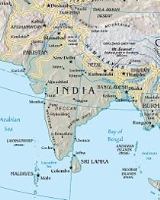
South Asia

Encyclopedia
South Asia, also known as Southern Asia, is the south
ern region
of the Asia
n continent
, which comprises the sub-Himalayan countries and, for some authorities (see below), also includes the adjoining countries to the west and the east. Topographically, it is dominated by the Indian Plate, which rises above sea level as the Indian subcontinent
south of the Himalayas and the Hindu Kush
. South Asia is surrounded (clockwise, from west
) by Western Asia, Central Asia
, Eastern Asia
, Southeastern Asia
and the Indian Ocean
.
According to the United Nations
geographical region classification, Southern Asia comprises the countries of Afghanistan
, Bangladesh
, Bhutan
, India
, Iran
, Maldives
, Nepal
, Pakistan
, and Sri Lanka
. By other definitions and interpretations (see below), Burma and Tibet
are also sometimes included in the region of South Asia. South Asia is home to well over one fifth of the world's population, making it both the most populous and most densely populated geographical region in the world. The South Asian Association for Regional Cooperation
is an economic cooperation organization in the region.
update.png) Along with a number of core countries, South Asia differs in inclusion by different clubbing of countries, though essentially it mostly encompasses countries that were part of the former British Empire
Along with a number of core countries, South Asia differs in inclusion by different clubbing of countries, though essentially it mostly encompasses countries that were part of the former British Empire
in the region, including the current territories of India, Pakistan, and Bangladesh at the core, but also including Sri Lanka
, Burma and Sikkim
(now a state of India). The Aden Colony, British Somaliland
and Singapore
, though administered at various times under the Raj have not been proposed as any part of South Asia.
The Raj also encompassed the 562 protected princely state
s that were not directly ruled by the Raj, some of which joined the Union of India (including Hyderabad State
, Kingdom of Mysore
, Baroda
, Gwalior and a part of the State of Jammu and Kashmir), while some joined the Dominion of Pakistan
(including Bahawalpur, Kalat, Khayrpur, Swat and parts of the princely state of Jammu and Kashmir ). Sikkim
joined India in 1975. One part
of Jammu and Kashmir became a part of China.
The South Asian Association for Regional Cooperation
(SAARC), a contiguous block of countries, started in with seven countries — Bangladesh, Bhutan, India, the Maldives, Nepal, Pakistan and Sri Lanka — when it was established in 1985, but was extended to include Afghanistan
as an eighth member in 2006. The World Bank
grouping includes only the original seven members of SAARC, and leaves Afghanistan out. This bloc of countries include three independent countries that were not under the British rule - Nepal, Bhutan and Afghanistan. The South Asia Free Trade Agreement endorsed by SAARC has been signed by the seven original members of the organization, though it has a special provision for the Maldives.
The United Nations
Population Information Network (POPIN) includes Afghanistan, Bangladesh, Burma, India, Iran, Nepal, Pakistan and Sri Lanka as part of South Asia, while Maldives, in view of its characteristics, was admitted as a member country of the Pacific POPIN subregional network in principle. The British Indian Ocean Territory
is connected to the region by a publication of Jane's
for security considerations. The United Nations scheme of sub-regions include all eight members of the SAARC as part of Southern Asia, along with Iran, while the Hirschmann-Herfindahl Index of United Nations Economic and Social Commission for Asia and the Pacific
for the region includes only the original seven signatories of SAARC.
A lack of coherent definition for South Asia has resulted in not only a lack of academic studies, but also in a lack interest for such studies. Identification with a South Asian identity was also found to be significantly low among respondents in a two-year survey across Bangladesh, India, Nepal, Pakistan, and Sri Lanka.
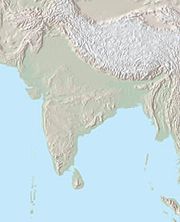 The term "Indian subcontinent" refers to a large, self-contained landmass which is geographically separated from the rest of the Asian continent. Due to similar scope, the terms "South Asia" and "Indian subcontinent" are used by some academics interchangeably. Due to political sensitivities, some prefer to use the terms "South Asian Subcontinent", the "Indo-Pak Subcontinent", or simply "South Asia" or "the Subcontinent" over the term "Indian subcontinent".
According to some academics, the term "South Asia" is in more common use in Europe and North America, rather than the terms "Subcontinent" or the "Indian Subcontinent". Indologist Ronald B. Inden argues that the usage of the term "South Asia" is getting more widespread since it clearly distinguishes the region from East Asia
. However, this opinion is not shared by all.
By dictionary entries, the term subcontinent
signifies "having a certain geographical or political independence" from the rest of the continent, or "a vast and more or less self-contained subdivision of a continent." It may be noted that geophysically
the Yarlung Zangbo River
river in Tibet is situated at the outside of the border of the Subcontinental structure, while the Pamir Mountains
in Tajikistan
are situated inside that border.
According to one clubbing of countries, it includes most parts of South Asia, including those on the continental crust
(Bangladesh
, Bhutan
, India
, Nepal
, and Pakistan
), an island country on the continental shelf
(Sri Lanka
), and an island country rising above the oceanic crust
(the Maldives
). Another clubbing includes only Bangladesh, India and Pakistan, the mainstay of the British Raj
, as the Subcontinent.
This version also includes the disputed territory of Aksai Chin
, which, according to India, was part of British Indian princely state Jammu and Kashmir, but is currently administered as a part of Chinese autonomous region of Xinjiang
. A booklet published by the United States Department of State
in 1959 includes Afghanistan, Ceylon (Sri Lanka), India, Nepal, and Pakistan as part of the "Subcontinent of South Asia". When the term Indian Subcontinent is used to mean South Asia, the islands countries of Sri Lanka and the Maldives are sometimes not included, while Tibet and Nepal are included and excluded intermittently, depending on the context.
, the Himalayan Kingdoms (Nepal
, Bhutan
, and Sikkim), and Burma (now officially Myanmar). But, over the years it has also extended its activities to include Thailand
, Malaysia, Singapore
, Vietnam
, Cambodia
, Laos
, Indonesia
, the Philippines
and Hong Kong
. The Centers for South Asian Studies at both University of Michigan
and University of Virginia
include Tibet along with seven members of SAARC in their research programs, but leave the Maldives out.
The South Asian Studies Program of Rutgers University
and the University of California, Berkeley
Center for South Asia Studies do the same without leaving out the Maldives, while the South Asian Studies Program of Brandeis University
defines the region as comprising "India, Pakistan, Bangladesh, Sri Lanka, Nepal, Bhutan, and in certain contexts Afghanistan, Burma, Maldives and Tibet". The similar program of Columbia University
also includes Tibet, but leaves out both Afghanistan and the Maldives.
 While South Asia had never been a coherent geopolitical
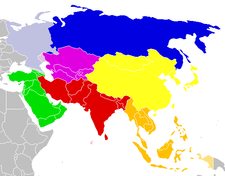
region, it has a distinct geographical identity. The boundaries of South Asia vary based on how the region is defined. South Asia's northern, eastern, and western boundaries vary based on definitions used, while the Indian Ocean
is the southern periphery.
Much of the region comprises a peninsula
in south-central Asia, rather resembling a diamond which is delineated by the Himalayas on the north, the Hindu Kush
in the west, and the Arakanese
in the east, and which extends southward into the Indian Ocean with the Arabian Sea
to the southwest and the Bay of Bengal
to the southeast.
Per the UN, the wider subregion's northern frontier is the Himalayas
and southerly post-Soviet states
of Central Asia
(Tajikistan
, Uzbekistan
, and Turkmenistan
, bordering northern Afghanistan
and Iran
), its western boundary is the westerly border of Iran (with Azerbaijan
, Armenia
, Turkey
, and Iraq
), and its eastern boundary is the westerly border of Burma (with India and Bangladesh).
Most of this region is a subcontinent
resting on the Indian Plate (the northerly portion of the Indo-Australian Plate
) separated from the rest of the Eurasian Plate
. It was once a small continent
before colliding with the Eurasian Plate
about 50-55 million years ago and giving birth to the Himalayan range and the Tibetan plateau
. It is the peninsula
r region south of the Himalayas and Kuen Lun mountain ranges and east of the Indus River
and the Iranian Plateau
, extending southward into the Indian Ocean between the Arabian Sea
(to the southwest) and the Bay of Bengal
(to the southeast).
The region is home to an astounding variety of geographical features, such as glacier
s, rainforest
s, valley
s, desert
s, and grassland
s that are typical of much larger continents. It is surrounded by three water bodies — the Bay of Bengal
, the Indian Ocean
and the Arabian Sea
. The climate of this vast region varies considerably from area to area from tropical monsoon in the south to temperate in the north. The variety is influenced by not only the altitude, but also by factors such as proximity to the sea coast and the seasonal impact of the monsoon
s.
Southern parts are mostly hot in summers and receive rain during monsoon period(s). The northern belt of Indo-Gangetic plain
s also is hot in summer, but cooler in winter. The mountainous north is colder and receives snowfall at higher altitudes of Himalyan ranges.
As the Himalayas
block the north-Asian bitter cold winds, the temperatures are considerably moderate in the plains down below. For most part, the climate of the region is called the Monsoon
climate, which keeps the region humid during summer and dry during winter, and favors the cultivation of jute
, tea
, rice
, and various vegetables in this region.
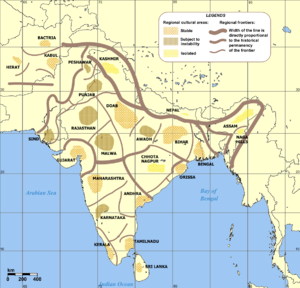 The remote pre-history of South Asia culminates in the Indus Valley Civilization
, which is followed by the legends of ancient Vedic period
and the sketchy references to the rise and fall of Mahajanapadas
- the precursors of regional kingdoms and later ancient empires - ending in the historical accounts of medieval empires and the arrival of European traders who later became the rulers.
Almost all South Asian countries were under direct or indirect European Colonial
subjugation at some point. Much of modern India, Pakistan, Bangladesh and Burma were gradually occupied by Great Britain
- starting from 1757, reaching their zenith in 1857 and ruling till 1947. Nepal and Bhutan were to some extent protectorates of Great Britain
until after World War II. In the millennia long history of South Asia, this European occupation period is rather short, but its proximity to the present and its lasting impact on the region make it prominent.
The network of means of transportation and communication as well as banking and training of requisite workforce, and also the existing rail, post, telegraph, and education facilities have evolved out of the base established in the colonial era, often called the British Raj
. As an aftermath of World War II
, most of the region gained independence from Europe by the late 1940s.
Since 1947, most South Asian countries have achieved tremendous progress in all spheres. Most notable achievements are in the fields of education
; industry
; health care
; information technology
and other services based on its applications; research in the fields of cutting edge sciences and technologies; defence related self-reliance projects; international/global trade and business enterprises and outsourcing of human resources
. Areas of difficulty remain, however, including religious extremism, high levels of corruption, disagreements on political boundaries, and inequitable distribution of wealth.
 South Asia, which consists of the nations of Bangladesh
, Bhutan
, India
, Maldives
, Nepal
, Pakistan
, and Sri Lanka
, is ethnically
diverse, with more than 2,000 ethnic entities with populations ranging from hundreds of millions to small tribal groups. South Asia has been invaded and settled by many ethnic groups over the centuries - including various Dravidian, Indo-Aryan
and Iranian
groups - and amalgamation of Dravidian, Indo-Aryan and native societies has produced composite cultures with many common traditions and beliefs. But, the traditions of different ethnic groups in South Asia have diverged throughout earlier times, sometimes giving rise to strong local traditions such as the distinct South India
n culture.
Other ethnic groups, successively streaming in later mainly from Central Asia and Iran, e.g. Sakas, Kushans, Huns
etc. influenced pre-existing South Asian cultures. Among the last of these new arrivals were the Arab
s followed by the Turks
, the Pashtuns
and the Moghuls
. However, Arab influence remained relatively limited in comparison to that of the Turks, Pashtuns and Moghuls, who brought in much cultural influence and contributed to the birth of Urdu
, a syncretic language of combined Indo-Persian heritage, which is widely spoken today. Ethnic Englishmen and other Britons
are now practically absent after their two centuries long colonial presence, although they have left an imprint of western culture in the elite society.
, its speakers numbering almost 422 million; the second largest spoken language is Bengali
, with about 210 million speakers.
Urdu
is also a major language spoken in the subcontinent, especially in Pakistan
and India
, and is similar linguistically to Hindi
; Hindi and Urdu together make up Hindustānī
. Hindi
is spoken is some states of India
, and is similar linguistically to Urdu
. Many people are not aware of the fact that most of the Indians speak local languages and are not familiar with Hindi. Other languages of this region fall into a few major linguistic groups: the Dravidian languages
and the Indo-Aryan languages
, a sub-branch of the Indo-Iranian
branch of the Indo-European languages
.
The other great sub-branch of Indo-Iranian
, the Iranian languages
, also have significant minority representation in South Asia, with Pashtu and Baluchi
being widely spoken along the northwestern fringes of the region, in modern-day Pakistan
. Many Tibeto-Burman
ethnic groups, who are speakers of their language-group, are found in northeast India, Tibet, Nepal, and Bhutan. Other small groups, speaking Austro-Asiatic languages
, are also present in South Asia. English
is another language which dominates South Asia, especially as a medium of advanced education and government administration.
Most of South Asia writes using various abugida
s of Brāhmī
origin while languages such as Urdu, Pashto, and Sindhi use derivatives of the Perso-Arabic script
. Not all languages in South Asia follow this strict dichotomy though. For example, Kashmiri
is written in both the Perso-Arabic script
and in the Devanagari
script. The same can be said for Punjabi
, which is written in both Shahmukhi
and Gurmukhī
. Dhivehi
is written in a script called Tāna that shows characteristics of both the Arabic alphabet
and of an abugida
.
and Islam
and in some of its countries Buddhism
are the dominant religions. Other Indian religions and Christianity
are practiced by significant number of people.
Historically, fusion
of Indo-Aryan Vedic religion
with native South Asian non-Vedic Shramana
traditions and other Dravidian and local tribal beliefs gave rise to the ancient religions of Hinduism
and Jainism
. As a consequence, these two religions share many similar cultural practices, festivals and traditions.
Arabs brought the Abrahamic religion of Islam
to South Asia, first in the present day Kerala
and the Maldive Islands and later in Sindh
, Balochistan
and much of Punjab
. Subsequently, Muslim Turks/Pashtuns/Moghuls furthered it not only among the Punjabi
and Kashmiri people
but also throughout the Indo-Gangetic plain
s and farther east, and deep south up to the Deccan.
Sri Lanka has the highest GDP per capita in the region, while Nepal has the lowest. India is the largest economy in the region (US$ 1.54 trillion) and makes up almost 82% of the South Asian economy; it is the world's 10th largest in nominal terms and 4th largest by purchasing power adjusted exchange rates. Pakistan has the next largest economy and the 5th highest GDP per capita in the region, followed by Bangladesh. If Iran is counted, it will become the second largest in terms of region and the economy . According to a World Bank
report in 2007, South Asia is the least integrated region in the world; trade between South Asian states is only 2% of the region's combined GDP, compared to 20% in East Asia
.
is the dominant political power in the region. It is contributed by the fact that it is by far the largest country in the covering around three-fourths the land area of the subcontinent. It also has the largest population of around three times the combined population of the 6 other countries in the subcontinent. India is also the most populous democracy
in the world and is a nuclear power.
The second largest country in the subcontinent area-wise and population-wise is Pakistan
and has traditionally maintained the balance of power in the region due to its strategic relationships with nearby Arab states and neighboring China
. Pakistan
is the 6th most populous country in the world and is also a nuclear power.
Bangladesh
is the third largest populous country in the region and identified, along with Pakistan, as Next Eleven
. As of 31 March 2011, the largest contributor to UN peacekeeping operations is Bangladesh
. Pakistan
& India
catch 2nd & 3rd place respectively, according to the number of troops.
Diplomacy among the countries of South Asia has been mainly driven by populist politics
, with the center stage taken by India
-Pakistan
conflict ever since their independence in 1947, and then the creation of Bangladesh
under tense circumstances in 1971. While the elite rulers of Pakistan chose the USA led bloc during the cold war era, India formed the Non-Aligned Movement
.
The political situation in Sri Lanka
has been dominated by a increasingly assertive Sinhalese
nationalism, and the emergence of a Tamil separatist movement under LTTE, which was suppressed recently. Burma's politics is dominated by a military Junta
, which has sidelined the democratic forces led by Aung San Suu Kyi
.
, 70% of the South Asian population and about 75% of South Asia's poor live in rural areas and most rely on agriculture for their livelihood. According to the Global Hunger Index
, South Asia has one of the highest child malnutrition
rates in the world. In a latest report published by UNICEF in 2008 on global hunger shows that the actual number of child deaths was around 2.1 million. As of 2008 India is ranked 66th on the global hunger index.
The 2006 report stated that "the low status of women in South Asian countries and their lack of nutritional knowledge are important determinants of high prevalence of underweight children in the region". Corruption and the lack of initiative on the part of the government has been one of the major problems associated with nutrition in India. Illiteracy in villages has been found to be one of the major issues that need more government attention. The report mentioned that, although there has been a reduction in malnutrition due to the Green Revolution
in South Asia, there is concern that South Asia has "inadequate feeding and caring practices for young children".
South
South is a noun, adjective, or adverb indicating direction or geography.South is one of the four cardinal directions or compass points. It is the opposite of north and is perpendicular to east and west.By convention, the bottom side of a map is south....
ern region
Region
Region is most commonly found as a term used in terrestrial and astrophysics sciences also an area, notably among the different sub-disciplines of geography, studied by regional geographers. Regions consist of subregions that contain clusters of like areas that are distinctive by their uniformity...
of the Asia
Asia
Asia is the world's largest and most populous continent, located primarily in the eastern and northern hemispheres. It covers 8.7% of the Earth's total surface area and with approximately 3.879 billion people, it hosts 60% of the world's current human population...
n continent
Continent
A continent is one of several very large landmasses on Earth. They are generally identified by convention rather than any strict criteria, with seven regions commonly regarded as continents—they are : Asia, Africa, North America, South America, Antarctica, Europe, and Australia.Plate tectonics is...
, which comprises the sub-Himalayan countries and, for some authorities (see below), also includes the adjoining countries to the west and the east. Topographically, it is dominated by the Indian Plate, which rises above sea level as the Indian subcontinent
Indian subcontinent
The Indian subcontinent, also Indian Subcontinent, Indo-Pak Subcontinent or South Asian Subcontinent is a region of the Asian continent on the Indian tectonic plate from the Hindu Kush or Hindu Koh, Himalayas and including the Kuen Lun and Karakoram ranges, forming a land mass which extends...
south of the Himalayas and the Hindu Kush
Hindu Kush
The Hindu Kush is an mountain range that stretches between central Afghanistan and northern Pakistan. The highest point in the Hindu Kush is Tirich Mir in the Chitral region of Khyber-Pakhtunkhwa, Pakistan.It is the westernmost extension of the Pamir Mountains, the Karakoram Range, and is a...
. South Asia is surrounded (clockwise, from west
West
West is a noun, adjective, or adverb indicating direction or geography.West is one of the four cardinal directions or compass points. It is the opposite of east and is perpendicular to north and south.By convention, the left side of a map is west....
) by Western Asia, Central Asia
Central Asia
Central Asia is a core region of the Asian continent from the Caspian Sea in the west, China in the east, Afghanistan in the south, and Russia in the north...
, Eastern Asia
East Asia
East Asia or Eastern Asia is a subregion of Asia that can be defined in either geographical or cultural terms...
, Southeastern Asia
Southeast Asia
Southeast Asia, South-East Asia, South East Asia or Southeastern Asia is a subregion of Asia, consisting of the countries that are geographically south of China, east of India, west of New Guinea and north of Australia. The region lies on the intersection of geological plates, with heavy seismic...
and the Indian Ocean
Indian Ocean
The Indian Ocean is the third largest of the world's oceanic divisions, covering approximately 20% of the water on the Earth's surface. It is bounded on the north by the Indian Subcontinent and Arabian Peninsula ; on the west by eastern Africa; on the east by Indochina, the Sunda Islands, and...
.
According to the United Nations
United Nations
The United Nations is an international organization whose stated aims are facilitating cooperation in international law, international security, economic development, social progress, human rights, and achievement of world peace...
geographical region classification, Southern Asia comprises the countries of Afghanistan
Afghanistan
Afghanistan , officially the Islamic Republic of Afghanistan, is a landlocked country located in the centre of Asia, forming South Asia, Central Asia and the Middle East. With a population of about 29 million, it has an area of , making it the 42nd most populous and 41st largest nation in the world...
, Bangladesh
Bangladesh
Bangladesh , officially the People's Republic of Bangladesh is a sovereign state located in South Asia. It is bordered by India on all sides except for a small border with Burma to the far southeast and by the Bay of Bengal to the south...
, Bhutan
Bhutan
Bhutan , officially the Kingdom of Bhutan, is a landlocked state in South Asia, located at the eastern end of the Himalayas and bordered to the south, east and west by the Republic of India and to the north by the People's Republic of China...
, India
India
India , officially the Republic of India , is a country in South Asia. It is the seventh-largest country by geographical area, the second-most populous country with over 1.2 billion people, and the most populous democracy in the world...
, Iran
Iran
Iran , officially the Islamic Republic of Iran , is a country in Southern and Western Asia. The name "Iran" has been in use natively since the Sassanian era and came into use internationally in 1935, before which the country was known to the Western world as Persia...
, Maldives
Maldives
The Maldives , , officially Republic of Maldives , also referred to as the Maldive Islands, is an island nation in the Indian Ocean formed by a double chain of twenty-six atolls oriented north-south off India's Lakshadweep islands, between Minicoy Island and...
, Nepal
Nepal
Nepal , officially the Federal Democratic Republic of Nepal, is a landlocked sovereign state located in South Asia. It is located in the Himalayas and bordered to the north by the People's Republic of China, and to the south, east, and west by the Republic of India...
, Pakistan
Pakistan
Pakistan , officially the Islamic Republic of Pakistan is a sovereign state in South Asia. It has a coastline along the Arabian Sea and the Gulf of Oman in the south and is bordered by Afghanistan and Iran in the west, India in the east and China in the far northeast. In the north, Tajikistan...
, and Sri Lanka
Sri Lanka
Sri Lanka, officially the Democratic Socialist Republic of Sri Lanka is a country off the southern coast of the Indian subcontinent. Known until 1972 as Ceylon , Sri Lanka is an island surrounded by the Indian Ocean, the Gulf of Mannar and the Palk Strait, and lies in the vicinity of India and the...
. By other definitions and interpretations (see below), Burma and Tibet
Tibet
Tibet is a plateau region in Asia, north-east of the Himalayas. It is the traditional homeland of the Tibetan people as well as some other ethnic groups such as Monpas, Qiang, and Lhobas, and is now also inhabited by considerable numbers of Han and Hui people...
are also sometimes included in the region of South Asia. South Asia is home to well over one fifth of the world's population, making it both the most populous and most densely populated geographical region in the world. The South Asian Association for Regional Cooperation
South Asian Association for Regional Cooperation
The South Asian Association for Regional Cooperation is an organisation of South Asian nations, founded in December 1985 by Ziaur Rahman and dedicated to economic, technological, social, and cultural development emphasising collective self-reliance. Its seven founding members are Bangladesh,...
is an economic cooperation organization in the region.
Definitions
British Empire
The British Empire comprised the dominions, colonies, protectorates, mandates and other territories ruled or administered by the United Kingdom. It originated with the overseas colonies and trading posts established by England in the late 16th and early 17th centuries. At its height, it was the...
in the region, including the current territories of India, Pakistan, and Bangladesh at the core, but also including Sri Lanka
Sri Lanka
Sri Lanka, officially the Democratic Socialist Republic of Sri Lanka is a country off the southern coast of the Indian subcontinent. Known until 1972 as Ceylon , Sri Lanka is an island surrounded by the Indian Ocean, the Gulf of Mannar and the Palk Strait, and lies in the vicinity of India and the...
, Burma and Sikkim
Sikkim
Sikkim is a landlocked Indian state nestled in the Himalayan mountains...
(now a state of India). The Aden Colony, British Somaliland
British Somaliland
British Somaliland was a British protectorate in the northern part of present-day Somalia. For much of its existence, British Somaliland was bordered by French Somaliland, Ethiopia, and Italian Somaliland. From 1940 to 1941, it was occupied by the Italians and was part of Italian East Africa...
and Singapore
Singapore
Singapore , officially the Republic of Singapore, is a Southeast Asian city-state off the southern tip of the Malay Peninsula, north of the equator. An island country made up of 63 islands, it is separated from Malaysia by the Straits of Johor to its north and from Indonesia's Riau Islands by the...
, though administered at various times under the Raj have not been proposed as any part of South Asia.
The Raj also encompassed the 562 protected princely state
Princely state
A Princely State was a nominally sovereign entitity of British rule in India that was not directly governed by the British, but rather by an Indian ruler under a form of indirect rule such as suzerainty or paramountcy.-British relationship with the Princely States:India under the British Raj ...
s that were not directly ruled by the Raj, some of which joined the Union of India (including Hyderabad State
Hyderabad State
-After Indian independence :When India gained independence in 1947 and Pakistan came into existence in 1947, the British left the local rulers of the princely states the choice of whether to join one of the new dominions or to remain independent...
, Kingdom of Mysore
Kingdom of Mysore
The Kingdom of Mysore was a kingdom of southern India, traditionally believed to have been founded in 1399 in the vicinity of the modern city of Mysore. The kingdom, which was ruled by the Wodeyar family, initially served as a vassal state of the Vijayanagara Empire...
, Baroda
Vadodara
Vadodara formerly known as Baroda is the third most populated city in the Indian State of Gujarat . It is one of the four cities with the population of over 1 million...
, Gwalior and a part of the State of Jammu and Kashmir), while some joined the Dominion of Pakistan
Dominion of Pakistan
The Dominion of Pakistan was an independent federal Commonwealth realm in South Asia that was established in 1947 on the partition of British India into two sovereign dominions . The Dominion of Pakistan, which included modern-day Pakistan and Bangladesh, was intended to be a homeland for the...
(including Bahawalpur, Kalat, Khayrpur, Swat and parts of the princely state of Jammu and Kashmir ). Sikkim
Sikkim
Sikkim is a landlocked Indian state nestled in the Himalayan mountains...
joined India in 1975. One part
Aksai Chin
Aksai Chin is one of the two main disputed border areas between China and India, and the other is South Tibet, which comprises most of India's Arunachal Pradesh. It is administered by China as part of Hotan County in the Hotan Prefecture of Xinjiang Autonomous Region, but is also claimed by India...
of Jammu and Kashmir became a part of China.
The South Asian Association for Regional Cooperation
South Asian Association for Regional Cooperation
The South Asian Association for Regional Cooperation is an organisation of South Asian nations, founded in December 1985 by Ziaur Rahman and dedicated to economic, technological, social, and cultural development emphasising collective self-reliance. Its seven founding members are Bangladesh,...
(SAARC), a contiguous block of countries, started in with seven countries — Bangladesh, Bhutan, India, the Maldives, Nepal, Pakistan and Sri Lanka — when it was established in 1985, but was extended to include Afghanistan
Afghanistan
Afghanistan , officially the Islamic Republic of Afghanistan, is a landlocked country located in the centre of Asia, forming South Asia, Central Asia and the Middle East. With a population of about 29 million, it has an area of , making it the 42nd most populous and 41st largest nation in the world...
as an eighth member in 2006. The World Bank
World Bank
The World Bank is an international financial institution that provides loans to developing countries for capital programmes.The World Bank's official goal is the reduction of poverty...
grouping includes only the original seven members of SAARC, and leaves Afghanistan out. This bloc of countries include three independent countries that were not under the British rule - Nepal, Bhutan and Afghanistan. The South Asia Free Trade Agreement endorsed by SAARC has been signed by the seven original members of the organization, though it has a special provision for the Maldives.
The United Nations
United Nations
The United Nations is an international organization whose stated aims are facilitating cooperation in international law, international security, economic development, social progress, human rights, and achievement of world peace...
Population Information Network (POPIN) includes Afghanistan, Bangladesh, Burma, India, Iran, Nepal, Pakistan and Sri Lanka as part of South Asia, while Maldives, in view of its characteristics, was admitted as a member country of the Pacific POPIN subregional network in principle. The British Indian Ocean Territory
British Indian Ocean Territory
The British Indian Ocean Territory or Chagos Islands is an overseas territory of the United Kingdom situated in the Indian Ocean, halfway between Africa and Indonesia...
is connected to the region by a publication of Jane's
Jane's Information Group
Jane's Information Group is a publishing company specializing in transportation and military topics.-History:It was founded by Fred T...
for security considerations. The United Nations scheme of sub-regions include all eight members of the SAARC as part of Southern Asia, along with Iran, while the Hirschmann-Herfindahl Index of United Nations Economic and Social Commission for Asia and the Pacific
United Nations Economic and Social Commission for Asia and the Pacific
The Economic and Social Commission for Asia and the Pacific , located in Bangkok, Thailand, is the regional arm of the United Nations Secretariat for the Asian and Pacific region. It was established in 1947 to encourage economic cooperation among its member states...
for the region includes only the original seven signatories of SAARC.
A lack of coherent definition for South Asia has resulted in not only a lack of academic studies, but also in a lack interest for such studies. Identification with a South Asian identity was also found to be significantly low among respondents in a two-year survey across Bangladesh, India, Nepal, Pakistan, and Sri Lanka.
Indian subcontinent
According to some academics, the term "South Asia" is in more common use in Europe and North America, rather than the terms "Subcontinent" or the "Indian Subcontinent". Indologist Ronald B. Inden argues that the usage of the term "South Asia" is getting more widespread since it clearly distinguishes the region from East Asia
East Asia
East Asia or Eastern Asia is a subregion of Asia that can be defined in either geographical or cultural terms...
. However, this opinion is not shared by all.
By dictionary entries, the term subcontinent
Subcontinent
A subcontinent is a large, relatively self-contained landmass forming a subdivision of a continent. By dictionary entries, the term subcontinent signifies "having a certain geographical or political independence" from the rest of the continent, or "a vast and more or less self-contained subdivision...
signifies "having a certain geographical or political independence" from the rest of the continent, or "a vast and more or less self-contained subdivision of a continent." It may be noted that geophysically
Geophysics
Geophysics is the physics of the Earth and its environment in space; also the study of the Earth using quantitative physical methods. The term geophysics sometimes refers only to the geological applications: Earth's shape; its gravitational and magnetic fields; its internal structure and...
the Yarlung Zangbo River
Yarlung Zangbo River
Yarlung River is a watercourse that originates upstream from the South Tibet Valley and Yarlung Zangbo Grand Canyon, in Tibet. It then passes through the state of Arunachal Pradesh, India, where it is known as the Dihang....
river in Tibet is situated at the outside of the border of the Subcontinental structure, while the Pamir Mountains
Pamir Mountains
The Pamir Mountains are a mountain range in Central Asia formed by the junction or knot of the Himalayas, Tian Shan, Karakoram, Kunlun, and Hindu Kush ranges. They are among the world’s highest mountains and since Victorian times they have been known as the "Roof of the World" a probable...
in Tajikistan
Tajikistan
Tajikistan , officially the Republic of Tajikistan , is a mountainous landlocked country in Central Asia. Afghanistan borders it to the south, Uzbekistan to the west, Kyrgyzstan to the north, and China to the east....
are situated inside that border.
According to one clubbing of countries, it includes most parts of South Asia, including those on the continental crust
Continental crust
The continental crust is the layer of igneous, sedimentary, and metamorphic rocks which form the continents and the areas of shallow seabed close to their shores, known as continental shelves. This layer is sometimes called sial due to more felsic, or granitic, bulk composition, which lies in...
(Bangladesh
Bangladesh
Bangladesh , officially the People's Republic of Bangladesh is a sovereign state located in South Asia. It is bordered by India on all sides except for a small border with Burma to the far southeast and by the Bay of Bengal to the south...
, Bhutan
Bhutan
Bhutan , officially the Kingdom of Bhutan, is a landlocked state in South Asia, located at the eastern end of the Himalayas and bordered to the south, east and west by the Republic of India and to the north by the People's Republic of China...
, India
India
India , officially the Republic of India , is a country in South Asia. It is the seventh-largest country by geographical area, the second-most populous country with over 1.2 billion people, and the most populous democracy in the world...
, Nepal
Nepal
Nepal , officially the Federal Democratic Republic of Nepal, is a landlocked sovereign state located in South Asia. It is located in the Himalayas and bordered to the north by the People's Republic of China, and to the south, east, and west by the Republic of India...
, and Pakistan
Pakistan
Pakistan , officially the Islamic Republic of Pakistan is a sovereign state in South Asia. It has a coastline along the Arabian Sea and the Gulf of Oman in the south and is bordered by Afghanistan and Iran in the west, India in the east and China in the far northeast. In the north, Tajikistan...
), an island country on the continental shelf
Continental shelf
The continental shelf is the extended perimeter of each continent and associated coastal plain. Much of the shelf was exposed during glacial periods, but is now submerged under relatively shallow seas and gulfs, and was similarly submerged during other interglacial periods. The continental margin,...
(Sri Lanka
Sri Lanka
Sri Lanka, officially the Democratic Socialist Republic of Sri Lanka is a country off the southern coast of the Indian subcontinent. Known until 1972 as Ceylon , Sri Lanka is an island surrounded by the Indian Ocean, the Gulf of Mannar and the Palk Strait, and lies in the vicinity of India and the...
), and an island country rising above the oceanic crust
Oceanic crust
Oceanic crust is the part of Earth's lithosphere that surfaces in the ocean basins. Oceanic crust is primarily composed of mafic rocks, or sima, which is rich in iron and magnesium...
(the Maldives
Maldives
The Maldives , , officially Republic of Maldives , also referred to as the Maldive Islands, is an island nation in the Indian Ocean formed by a double chain of twenty-six atolls oriented north-south off India's Lakshadweep islands, between Minicoy Island and...
). Another clubbing includes only Bangladesh, India and Pakistan, the mainstay of the British Raj
British Raj
British Raj was the British rule in the Indian subcontinent between 1858 and 1947; The term can also refer to the period of dominion...
, as the Subcontinent.
This version also includes the disputed territory of Aksai Chin
Aksai Chin
Aksai Chin is one of the two main disputed border areas between China and India, and the other is South Tibet, which comprises most of India's Arunachal Pradesh. It is administered by China as part of Hotan County in the Hotan Prefecture of Xinjiang Autonomous Region, but is also claimed by India...
, which, according to India, was part of British Indian princely state Jammu and Kashmir, but is currently administered as a part of Chinese autonomous region of Xinjiang
Xinjiang
Xinjiang is an autonomous region of the People's Republic of China. It is the largest Chinese administrative division and spans over 1.6 million km2...
. A booklet published by the United States Department of State
United States Department of State
The United States Department of State , is the United States federal executive department responsible for international relations of the United States, equivalent to the foreign ministries of other countries...
in 1959 includes Afghanistan, Ceylon (Sri Lanka), India, Nepal, and Pakistan as part of the "Subcontinent of South Asia". When the term Indian Subcontinent is used to mean South Asia, the islands countries of Sri Lanka and the Maldives are sometimes not included, while Tibet and Nepal are included and excluded intermittently, depending on the context.
Definition by South Asian Studies programs
When the Centre of South Asian Studies at the University of Cambridge established in 1964, it was primarily responsible for promoting within the University the study of India, Pakistan, Sri Lanka, BangladeshBangladesh
Bangladesh , officially the People's Republic of Bangladesh is a sovereign state located in South Asia. It is bordered by India on all sides except for a small border with Burma to the far southeast and by the Bay of Bengal to the south...
, the Himalayan Kingdoms (Nepal
Nepal
Nepal , officially the Federal Democratic Republic of Nepal, is a landlocked sovereign state located in South Asia. It is located in the Himalayas and bordered to the north by the People's Republic of China, and to the south, east, and west by the Republic of India...
, Bhutan
Bhutan
Bhutan , officially the Kingdom of Bhutan, is a landlocked state in South Asia, located at the eastern end of the Himalayas and bordered to the south, east and west by the Republic of India and to the north by the People's Republic of China...
, and Sikkim), and Burma (now officially Myanmar). But, over the years it has also extended its activities to include Thailand
Thailand
Thailand , officially the Kingdom of Thailand , formerly known as Siam , is a country located at the centre of the Indochina peninsula and Southeast Asia. It is bordered to the north by Burma and Laos, to the east by Laos and Cambodia, to the south by the Gulf of Thailand and Malaysia, and to the...
, Malaysia, Singapore
Singapore
Singapore , officially the Republic of Singapore, is a Southeast Asian city-state off the southern tip of the Malay Peninsula, north of the equator. An island country made up of 63 islands, it is separated from Malaysia by the Straits of Johor to its north and from Indonesia's Riau Islands by the...
, Vietnam
Vietnam
Vietnam – sometimes spelled Viet Nam , officially the Socialist Republic of Vietnam – is the easternmost country on the Indochina Peninsula in Southeast Asia. It is bordered by China to the north, Laos to the northwest, Cambodia to the southwest, and the South China Sea –...
, Cambodia
Cambodia
Cambodia , officially known as the Kingdom of Cambodia, is a country located in the southern portion of the Indochina Peninsula in Southeast Asia...
, Laos
Laos
Laos Lao: ສາທາລະນະລັດ ປະຊາທິປະໄຕ ປະຊາຊົນລາວ Sathalanalat Paxathipatai Paxaxon Lao, officially the Lao People's Democratic Republic, is a landlocked country in Southeast Asia, bordered by Burma and China to the northwest, Vietnam to the east, Cambodia to the south and Thailand to the west...
, Indonesia
Indonesia
Indonesia , officially the Republic of Indonesia , is a country in Southeast Asia and Oceania. Indonesia is an archipelago comprising approximately 13,000 islands. It has 33 provinces with over 238 million people, and is the world's fourth most populous country. Indonesia is a republic, with an...
, the Philippines
Philippines
The Philippines , officially known as the Republic of the Philippines , is a country in Southeast Asia in the western Pacific Ocean. To its north across the Luzon Strait lies Taiwan. West across the South China Sea sits Vietnam...
and Hong Kong
Hong Kong
Hong Kong is one of two Special Administrative Regions of the People's Republic of China , the other being Macau. A city-state situated on China's south coast and enclosed by the Pearl River Delta and South China Sea, it is renowned for its expansive skyline and deep natural harbour...
. The Centers for South Asian Studies at both University of Michigan
University of Michigan
The University of Michigan is a public research university located in Ann Arbor, Michigan in the United States. It is the state's oldest university and the flagship campus of the University of Michigan...
and University of Virginia
University of Virginia
The University of Virginia is a public research university located in Charlottesville, Virginia, United States, founded by Thomas Jefferson...
include Tibet along with seven members of SAARC in their research programs, but leave the Maldives out.
The South Asian Studies Program of Rutgers University
Rutgers University
Rutgers, The State University of New Jersey , is the largest institution for higher education in New Jersey, United States. It was originally chartered as Queen's College in 1766. It is the eighth-oldest college in the United States and one of the nine Colonial colleges founded before the American...
and the University of California, Berkeley
University of California, Berkeley
The University of California, Berkeley , is a teaching and research university established in 1868 and located in Berkeley, California, USA...
Center for South Asia Studies do the same without leaving out the Maldives, while the South Asian Studies Program of Brandeis University
Brandeis University
Brandeis University is an American private research university with a liberal arts focus. It is located in the southwestern corner of Waltham, Massachusetts, nine miles west of Boston. The University has an enrollment of approximately 3,200 undergraduate and 2,100 graduate students. In 2011, it...
defines the region as comprising "India, Pakistan, Bangladesh, Sri Lanka, Nepal, Bhutan, and in certain contexts Afghanistan, Burma, Maldives and Tibet". The similar program of Columbia University
Columbia University
Columbia University in the City of New York is a private, Ivy League university in Manhattan, New York City. Columbia is the oldest institution of higher learning in the state of New York, the fifth oldest in the United States, and one of the country's nine Colonial Colleges founded before the...
also includes Tibet, but leaves out both Afghanistan and the Maldives.
Geography
Geopolitics
Geopolitics, from Greek Γη and Πολιτική in broad terms, is a theory that describes the relation between politics and territory whether on local or international scale....
region, it has a distinct geographical identity. The boundaries of South Asia vary based on how the region is defined. South Asia's northern, eastern, and western boundaries vary based on definitions used, while the Indian Ocean
Indian Ocean
The Indian Ocean is the third largest of the world's oceanic divisions, covering approximately 20% of the water on the Earth's surface. It is bounded on the north by the Indian Subcontinent and Arabian Peninsula ; on the west by eastern Africa; on the east by Indochina, the Sunda Islands, and...
is the southern periphery.
Much of the region comprises a peninsula
Peninsula
A peninsula is a piece of land that is bordered by water on three sides but connected to mainland. In many Germanic and Celtic languages and also in Baltic, Slavic and Hungarian, peninsulas are called "half-islands"....
in south-central Asia, rather resembling a diamond which is delineated by the Himalayas on the north, the Hindu Kush
Hindu Kush
The Hindu Kush is an mountain range that stretches between central Afghanistan and northern Pakistan. The highest point in the Hindu Kush is Tirich Mir in the Chitral region of Khyber-Pakhtunkhwa, Pakistan.It is the westernmost extension of the Pamir Mountains, the Karakoram Range, and is a...
in the west, and the Arakanese
Chin Hills
The Chin Hills are a range of mountains in Chin State, northwestern Burma , that extends northward into India's Manipur state. They are part of the Arakan Mountain Range . The highest peak in the Chin Hills is Nat Ma Taung, or Khonumthung , in southern Chin State, which reaches 3,053 meters...
in the east, and which extends southward into the Indian Ocean with the Arabian Sea
Arabian Sea
The Arabian Sea is a region of the Indian Ocean bounded on the east by India, on the north by Pakistan and Iran, on the west by the Arabian Peninsula, on the south, approximately, by a line between Cape Guardafui in northeastern Somalia and Kanyakumari in India...
to the southwest and the Bay of Bengal
Bay of Bengal
The Bay of Bengal , the largest bay in the world, forms the northeastern part of the Indian Ocean. It resembles a triangle in shape, and is bordered mostly by the Eastern Coast of India, southern coast of Bangladesh and Sri Lanka to the west and Burma and the Andaman and Nicobar Islands to the...
to the southeast.
Per the UN, the wider subregion's northern frontier is the Himalayas
Himalayas
The Himalaya Range or Himalaya Mountains Sanskrit: Devanagari: हिमालय, literally "abode of snow"), usually called the Himalayas or Himalaya for short, is a mountain range in Asia, separating the Indian subcontinent from the Tibetan Plateau...
and southerly post-Soviet states
Post-Soviet states
The post-Soviet states, also commonly known as the Former Soviet Union or former Soviet republics, are the 15 independent states that split off from the Union of Soviet Socialist Republics in its dissolution in December 1991...
of Central Asia
Central Asia
Central Asia is a core region of the Asian continent from the Caspian Sea in the west, China in the east, Afghanistan in the south, and Russia in the north...
(Tajikistan
Tajikistan
Tajikistan , officially the Republic of Tajikistan , is a mountainous landlocked country in Central Asia. Afghanistan borders it to the south, Uzbekistan to the west, Kyrgyzstan to the north, and China to the east....
, Uzbekistan
Uzbekistan
Uzbekistan , officially the Republic of Uzbekistan is a doubly landlocked country in Central Asia and one of the six independent Turkic states. It shares borders with Kazakhstan to the west and to the north, Kyrgyzstan and Tajikistan to the east, and Afghanistan and Turkmenistan to the south....
, and Turkmenistan
Turkmenistan
Turkmenistan , formerly also known as Turkmenia is one of the Turkic states in Central Asia. Until 1991, it was a constituent republic of the Soviet Union, the Turkmen Soviet Socialist Republic . Turkmenistan is one of the six independent Turkic states...
, bordering northern Afghanistan
Afghanistan
Afghanistan , officially the Islamic Republic of Afghanistan, is a landlocked country located in the centre of Asia, forming South Asia, Central Asia and the Middle East. With a population of about 29 million, it has an area of , making it the 42nd most populous and 41st largest nation in the world...
and Iran
Iran
Iran , officially the Islamic Republic of Iran , is a country in Southern and Western Asia. The name "Iran" has been in use natively since the Sassanian era and came into use internationally in 1935, before which the country was known to the Western world as Persia...
), its western boundary is the westerly border of Iran (with Azerbaijan
Azerbaijan
Azerbaijan , officially the Republic of Azerbaijan is the largest country in the Caucasus region of Eurasia. Located at the crossroads of Western Asia and Eastern Europe, it is bounded by the Caspian Sea to the east, Russia to the north, Georgia to the northwest, Armenia to the west, and Iran to...
, Armenia
Armenia
Armenia , officially the Republic of Armenia , is a landlocked mountainous country in the Caucasus region of Eurasia...
, Turkey
Turkey
Turkey , known officially as the Republic of Turkey , is a Eurasian country located in Western Asia and in East Thrace in Southeastern Europe...
, and Iraq
Iraq
Iraq ; officially the Republic of Iraq is a country in Western Asia spanning most of the northwestern end of the Zagros mountain range, the eastern part of the Syrian Desert and the northern part of the Arabian Desert....
), and its eastern boundary is the westerly border of Burma (with India and Bangladesh).
Most of this region is a subcontinent
Subcontinent
A subcontinent is a large, relatively self-contained landmass forming a subdivision of a continent. By dictionary entries, the term subcontinent signifies "having a certain geographical or political independence" from the rest of the continent, or "a vast and more or less self-contained subdivision...
resting on the Indian Plate (the northerly portion of the Indo-Australian Plate
Indo-Australian Plate
The Indo-Australian Plate is a major tectonic plate that includes the continent of Australia and surrounding ocean, and extends northwest to include the Indian subcontinent and adjacent waters...
) separated from the rest of the Eurasian Plate
Eurasian Plate
The Eurasian Plate is a tectonic plate which includes most of the continent of Eurasia , with the notable exceptions of the Indian subcontinent, the Arabian subcontinent, and the area east of the Chersky Range in East Siberia...
. It was once a small continent
Continent
A continent is one of several very large landmasses on Earth. They are generally identified by convention rather than any strict criteria, with seven regions commonly regarded as continents—they are : Asia, Africa, North America, South America, Antarctica, Europe, and Australia.Plate tectonics is...
before colliding with the Eurasian Plate
Eurasian Plate
The Eurasian Plate is a tectonic plate which includes most of the continent of Eurasia , with the notable exceptions of the Indian subcontinent, the Arabian subcontinent, and the area east of the Chersky Range in East Siberia...
about 50-55 million years ago and giving birth to the Himalayan range and the Tibetan plateau
Tibetan Plateau
The Tibetan Plateau , also known as the Qinghai–Tibetan Plateau is a vast, elevated plateau in Central Asia covering most of the Tibet Autonomous Region and Qinghai, in addition to smaller portions of western Sichuan, southwestern Gansu, and northern Yunnan in Western China and Ladakh in...
. It is the peninsula
Peninsula
A peninsula is a piece of land that is bordered by water on three sides but connected to mainland. In many Germanic and Celtic languages and also in Baltic, Slavic and Hungarian, peninsulas are called "half-islands"....
r region south of the Himalayas and Kuen Lun mountain ranges and east of the Indus River
Indus River
The Indus River is a major river which flows through Pakistan. It also has courses through China and India.Originating in the Tibetan plateau of western China in the vicinity of Lake Mansarovar in Tibet Autonomous Region, the river runs a course through the Ladakh district of Jammu and Kashmir and...
and the Iranian Plateau
Iranian plateau
The Iranian plateau, or Iranic plateau, is a geological formation in Southwest Asia. It is the part of the Eurasian Plate wedged between the Arabian and Indian plates, situated between the Zagros mountains to the west, the Caspian Sea and the Kopet Dag to the north, the Hormuz Strait and Persian...
, extending southward into the Indian Ocean between the Arabian Sea
Arabian Sea
The Arabian Sea is a region of the Indian Ocean bounded on the east by India, on the north by Pakistan and Iran, on the west by the Arabian Peninsula, on the south, approximately, by a line between Cape Guardafui in northeastern Somalia and Kanyakumari in India...
(to the southwest) and the Bay of Bengal
Bay of Bengal
The Bay of Bengal , the largest bay in the world, forms the northeastern part of the Indian Ocean. It resembles a triangle in shape, and is bordered mostly by the Eastern Coast of India, southern coast of Bangladesh and Sri Lanka to the west and Burma and the Andaman and Nicobar Islands to the...
(to the southeast).
The region is home to an astounding variety of geographical features, such as glacier
Glacier
A glacier is a large persistent body of ice that forms where the accumulation of snow exceeds its ablation over many years, often centuries. At least 0.1 km² in area and 50 m thick, but often much larger, a glacier slowly deforms and flows due to stresses induced by its weight...
s, rainforest
Rainforest
Rainforests are forests characterized by high rainfall, with definitions based on a minimum normal annual rainfall of 1750-2000 mm...
s, valley
Valley
In geology, a valley or dale is a depression with predominant extent in one direction. A very deep river valley may be called a canyon or gorge.The terms U-shaped and V-shaped are descriptive terms of geography to characterize the form of valleys...
s, desert
Desert
A desert is a landscape or region that receives an extremely low amount of precipitation, less than enough to support growth of most plants. Most deserts have an average annual precipitation of less than...
s, and grassland
Grassland
Grasslands are areas where the vegetation is dominated by grasses and other herbaceous plants . However, sedge and rush families can also be found. Grasslands occur naturally on all continents except Antarctica...
s that are typical of much larger continents. It is surrounded by three water bodies — the Bay of Bengal
Bay of Bengal
The Bay of Bengal , the largest bay in the world, forms the northeastern part of the Indian Ocean. It resembles a triangle in shape, and is bordered mostly by the Eastern Coast of India, southern coast of Bangladesh and Sri Lanka to the west and Burma and the Andaman and Nicobar Islands to the...
, the Indian Ocean
Indian Ocean
The Indian Ocean is the third largest of the world's oceanic divisions, covering approximately 20% of the water on the Earth's surface. It is bounded on the north by the Indian Subcontinent and Arabian Peninsula ; on the west by eastern Africa; on the east by Indochina, the Sunda Islands, and...
and the Arabian Sea
Arabian Sea
The Arabian Sea is a region of the Indian Ocean bounded on the east by India, on the north by Pakistan and Iran, on the west by the Arabian Peninsula, on the south, approximately, by a line between Cape Guardafui in northeastern Somalia and Kanyakumari in India...
. The climate of this vast region varies considerably from area to area from tropical monsoon in the south to temperate in the north. The variety is influenced by not only the altitude, but also by factors such as proximity to the sea coast and the seasonal impact of the monsoon
Monsoon
Monsoon is traditionally defined as a seasonal reversing wind accompanied by corresponding changes in precipitation, but is now used to describe seasonal changes in atmospheric circulation and precipitation associated with the asymmetric heating of land and sea...
s.
Southern parts are mostly hot in summers and receive rain during monsoon period(s). The northern belt of Indo-Gangetic plain
Indo-Gangetic plain
The northern Plains also known as the Indo - Gangetic Plain and The North Indian River Plain is a large and fertile plain encompassing most of northern and eastern India, the most populous parts of Pakistan, parts of southern Nepal and virtually all of Bangladesh...
s also is hot in summer, but cooler in winter. The mountainous north is colder and receives snowfall at higher altitudes of Himalyan ranges.
As the Himalayas
Himalayas
The Himalaya Range or Himalaya Mountains Sanskrit: Devanagari: हिमालय, literally "abode of snow"), usually called the Himalayas or Himalaya for short, is a mountain range in Asia, separating the Indian subcontinent from the Tibetan Plateau...
block the north-Asian bitter cold winds, the temperatures are considerably moderate in the plains down below. For most part, the climate of the region is called the Monsoon
Monsoon
Monsoon is traditionally defined as a seasonal reversing wind accompanied by corresponding changes in precipitation, but is now used to describe seasonal changes in atmospheric circulation and precipitation associated with the asymmetric heating of land and sea...
climate, which keeps the region humid during summer and dry during winter, and favors the cultivation of jute
Jute
Jute is a long, soft, shiny vegetable fibre that can be spun into coarse, strong threads. It is produced from plants in the genus Corchorus, which has been classified in the family Tiliaceae, or more recently in Malvaceae....
, tea
Tea
Tea is an aromatic beverage prepared by adding cured leaves of the Camellia sinensis plant to hot water. The term also refers to the plant itself. After water, tea is the most widely consumed beverage in the world...
, rice
Rice
Rice is the seed of the monocot plants Oryza sativa or Oryza glaberrima . As a cereal grain, it is the most important staple food for a large part of the world's human population, especially in East Asia, Southeast Asia, South Asia, the Middle East, and the West Indies...
, and various vegetables in this region.
History
Indus Valley Civilization
The Indus Valley Civilization was a Bronze Age civilization that was located in the northwestern region of the Indian subcontinent, consisting of what is now mainly modern-day Pakistan and northwest India...
, which is followed by the legends of ancient Vedic period
Vedic period
The Vedic period was a period in history during which the Vedas, the oldest scriptures of Hinduism, were composed. The time span of the period is uncertain. Philological and linguistic evidence indicates that the Rigveda, the oldest of the Vedas, was composed roughly between 1700–1100 BCE, also...
and the sketchy references to the rise and fall of Mahajanapadas
Mahajanapadas
Mahājanapadas , literally "great realms", were ancient Indian kingdoms or countries...
- the precursors of regional kingdoms and later ancient empires - ending in the historical accounts of medieval empires and the arrival of European traders who later became the rulers.
Almost all South Asian countries were under direct or indirect European Colonial
Colonialism
Colonialism is the establishment, maintenance, acquisition and expansion of colonies in one territory by people from another territory. It is a process whereby the metropole claims sovereignty over the colony and the social structure, government, and economics of the colony are changed by...
subjugation at some point. Much of modern India, Pakistan, Bangladesh and Burma were gradually occupied by Great Britain
Great Britain
Great Britain or Britain is an island situated to the northwest of Continental Europe. It is the ninth largest island in the world, and the largest European island, as well as the largest of the British Isles...
- starting from 1757, reaching their zenith in 1857 and ruling till 1947. Nepal and Bhutan were to some extent protectorates of Great Britain
Great Britain
Great Britain or Britain is an island situated to the northwest of Continental Europe. It is the ninth largest island in the world, and the largest European island, as well as the largest of the British Isles...
until after World War II. In the millennia long history of South Asia, this European occupation period is rather short, but its proximity to the present and its lasting impact on the region make it prominent.
The network of means of transportation and communication as well as banking and training of requisite workforce, and also the existing rail, post, telegraph, and education facilities have evolved out of the base established in the colonial era, often called the British Raj
British Raj
British Raj was the British rule in the Indian subcontinent between 1858 and 1947; The term can also refer to the period of dominion...
. As an aftermath of World War II
World War II
World War II, or the Second World War , was a global conflict lasting from 1939 to 1945, involving most of the world's nations—including all of the great powers—eventually forming two opposing military alliances: the Allies and the Axis...
, most of the region gained independence from Europe by the late 1940s.
Since 1947, most South Asian countries have achieved tremendous progress in all spheres. Most notable achievements are in the fields of education
Education
Education in its broadest, general sense is the means through which the aims and habits of a group of people lives on from one generation to the next. Generally, it occurs through any experience that has a formative effect on the way one thinks, feels, or acts...
; industry
Industry
Industry refers to the production of an economic good or service within an economy.-Industrial sectors:There are four key industrial economic sectors: the primary sector, largely raw material extraction industries such as mining and farming; the secondary sector, involving refining, construction,...
; health care
Health care
Health care is the diagnosis, treatment, and prevention of disease, illness, injury, and other physical and mental impairments in humans. Health care is delivered by practitioners in medicine, chiropractic, dentistry, nursing, pharmacy, allied health, and other care providers...
; information technology
Information technology
Information technology is the acquisition, processing, storage and dissemination of vocal, pictorial, textual and numerical information by a microelectronics-based combination of computing and telecommunications...
and other services based on its applications; research in the fields of cutting edge sciences and technologies; defence related self-reliance projects; international/global trade and business enterprises and outsourcing of human resources
Human resources
Human resources is a term used to describe the individuals who make up the workforce of an organization, although it is also applied in labor economics to, for example, business sectors or even whole nations...
. Areas of difficulty remain, however, including religious extremism, high levels of corruption, disagreements on political boundaries, and inequitable distribution of wealth.
Core countries
With the core seven countries, the area covers about 4.48 million km² (1.7 million mi²), which is 10% of the Asian continent or 2.4% of the world's land surface area. They account for about 34% of Asia's population (or over 16.5% of the world's population) and are home to a vast array of peoples.| country Country A country is a region legally identified as a distinct entity in political geography. A country may be an independent sovereign state or one that is occupied by another state, as a non-sovereign or formerly sovereign political division, or a geographic region associated with a previously... |
Area (km²) |
Population(2009) | density (/km²) |
GDP(nominal) (2009) |
per capita (2009) |
Capital | Currency Currency In economics, currency refers to a generally accepted medium of exchange. These are usually the coins and banknotes of a particular government, which comprise the physical aspects of a nation's money supply... |
Government Government Government refers to the legislators, administrators, and arbitrators in the administrative bureaucracy who control a state at a given time, and to the system of government by which they are organized... |
Official languages | Coat of Arms Coat of arms A coat of arms is a unique heraldic design on a shield or escutcheon or on a surcoat or tabard used to cover and protect armour and to identify the wearer. Thus the term is often stated as "coat-armour", because it was anciently displayed on the front of a coat of cloth... |
|---|---|---|---|---|---|---|---|---|---|---|
 Bangladesh Bangladesh |
147,570 | 162,221,000 | 1,099 | $100,002 million | $551 | Dhaka Dhaka Dhaka is the capital of Bangladesh and the principal city of Dhaka Division. Dhaka is a megacity and one of the major cities of South Asia. Located on the banks of the Buriganga River, Dhaka, along with its metropolitan area, had a population of over 15 million in 2010, making it the largest city... |
Taka | Parliamentary democracy | Bengali Bengali language Bengali or Bangla is an eastern Indo-Aryan language. It is native to the region of eastern South Asia known as Bengal, which comprises present day Bangladesh, the Indian state of West Bengal, and parts of the Indian states of Tripura and Assam. It is written with the Bengali script... |
 |
 Bhutan Bhutan |
38,394 | 697,000 | 18 | $1,269 million | $1,832 | Thimphu Thimphu Thimphu also spelt Thimpu, is the capital and largest city of Bhutan. It is situated in the western central part of Bhutan and the surrounding valley is one of Bhutan's dzongkhags, the Thimphu District. The city became the capital of Bhutan in 1961... |
Ngultrum, Indian rupee Indian rupee The Indian rupee is the official currency of the Republic of India. The issuance of the currency is controlled by the Reserve Bank of India.... |
Constitutional monarchy Constitutional monarchy Constitutional monarchy is a form of government in which a monarch acts as head of state within the parameters of a constitution, whether it be a written, uncodified or blended constitution... |
Dzongkha Dzongkha language Dzongkha , occasionally Ngalopkha, is the national language of Bhutan. The word "dzongkha" means the language spoken in the dzong, – dzong being the fortress-like monasteries established throughout Bhutan by Shabdrung Ngawang Namgyal in the 17th century."Bhutani" is not another name for... |
 |
 India India |
3,287,240 | 1,210,193,422 | 382 | $1,537,966 million | $1,271 | New Delhi New Delhi New Delhi is the capital city of India. It serves as the centre of the Government of India and the Government of the National Capital Territory of Delhi. New Delhi is situated within the metropolis of Delhi. It is one of the nine districts of Delhi Union Territory. The total area of the city is... |
Indian rupee Indian rupee The Indian rupee is the official currency of the Republic of India. The issuance of the currency is controlled by the Reserve Bank of India.... |
Federal republic Federal republic A federal republic is a federation of states with a republican form of government. A federation is the central government. The states in a federation also maintain the federation... , Parliamentary democracy |
22 official languages |  |
 Maldives Maldives |
298 | 396,334 | 1,330 | $1,357 million | $4,388 | Malé Malé Malé , is the capital and most populous city in the Republic of Maldives. It is located at the southern edge of North Malé Atoll . It is also one of the Administrative divisions of the Maldives. Traditionally it was the King's Island, from where the ancient Maldive Royal dynasties ruled and where... |
Rufiyaa | Republic Republic A republic is a form of government in which the people, or some significant portion of them, have supreme control over the government and where offices of state are elected or chosen by elected people. In modern times, a common simplified definition of a republic is a government where the head of... |
Dhivehi Dhivehi language Maldivian is an Indo-Aryan language predominantly spoken by about 350,000 people in the Maldives where it is the national language. It is also the first language of nearly 10,000 people in the island of Minicoy in the Union territory of Lakshadweep, India where the Mahl dialect of the Maldivian... |
|
 Nepal Nepal |
147,181 | 29,331,000 | 200 | $12,615 million | $427 | Kathmandu | Nepalese rupee Nepalese rupee The rupee is the official currency of Nepal. The present rupee has the ISO 4217 code NPR and is normally abbreviated with the sign ₨. It is subdivided into 100 paisa. The issuance of the currency is controlled by the Nepal Rastra Bank... |
Democratic Republic Democratic republic A democratic republic is a country which is both a republic and a democracy. However, in practice countries which describe themselves as democratic republics do not always hold free or fair elections. An example of this was the German Democratic Republic, a communist state commonly known as East... |
Nepali Nepali language Nepali or Nepalese is a language in the Indo-Aryan branch of the Indo-European language family.It is the official language and de facto lingua franca of Nepal and is also spoken in Bhutan, parts of India and parts of Myanmar... |
 |
 Pakistan Pakistan |
796,095 | 170,608,000 | 225 | $174,866 million | $1023 | Islamabad Islamabad Islamabad is the capital of Pakistan and the tenth largest city in the country. Located within the Islamabad Capital Territory , the population of the city has grown from 100,000 in 1951 to 1.7 million in 2011... |
Pakistani rupee Pakistani rupee The rupee is the currency of Pakistan. The issuance of the currency is controlled by the State Bank of Pakistan, the central bank of the country. The most commonly used symbol for the rupee is Rs, used on receipts when purchasing goods and services. In Pakistan, the rupee is referred to as the... |
Islamic Republic Islamic republic Islamic republic is the name given to several states in the Muslim world including the Islamic Republics of Pakistan, Iran, Afghanistan, and Mauritania. Pakistan adopted the title under the constitution of 1956. Mauritania adopted it on 28 November 1958. Iran adopted it after the 1979 Iranian... |
Urdu Urdu Urdu is a register of the Hindustani language that is identified with Muslims in South Asia. It belongs to the Indo-European family. Urdu is the national language and lingua franca of Pakistan. It is also widely spoken in some regions of India, where it is one of the 22 scheduled languages and an... , English English language English is a West Germanic language that arose in the Anglo-Saxon kingdoms of England and spread into what was to become south-east Scotland under the influence of the Anglian medieval kingdom of Northumbria... |
 |
 Sri Lanka Sri Lanka |
65,610 | 20,238,000 | 309 | $53,241 million | $5,300 | Sri Jayawardenapura-Kotte | Sri Lankan rupee Sri Lankan rupee The rupee is the currency of Sri Lanka, divided into 100 cents. It is issued by the Central Bank of Sri Lanka and is generally written Rs. The rupee (Sinhala: රුපියල , Tamil: ரூபாய்) (sign: ₨; code: LKR) is the currency of Sri Lanka, divided into 100 cents. It is issued by the Central Bank of Sri... |
Democratic Socialist Republic Republic A republic is a form of government in which the people, or some significant portion of them, have supreme control over the government and where offices of state are elected or chosen by elected people. In modern times, a common simplified definition of a republic is a government where the head of... |
Sinhala, Tamil Tamil language Tamil is a Dravidian language spoken predominantly by Tamil people of the Indian subcontinent. It has official status in the Indian state of Tamil Nadu and in the Indian union territory of Pondicherry. Tamil is also an official language of Sri Lanka and Singapore... |
 |
Countries and territories from extended definitions
| country Country A country is a region legally identified as a distinct entity in political geography. A country may be an independent sovereign state or one that is occupied by another state, as a non-sovereign or formerly sovereign political division, or a geographic region associated with a previously... or region Region Region is most commonly found as a term used in terrestrial and astrophysics sciences also an area, notably among the different sub-disciplines of geography, studied by regional geographers. Regions consist of subregions that contain clusters of like areas that are distinctive by their uniformity... |
Area (km²) |
Population (2009) |
density (per km²) |
GDP(nominal) (2009) |
per capita (2009) |
Capital | Currency Currency In economics, currency refers to a generally accepted medium of exchange. These are usually the coins and banknotes of a particular government, which comprise the physical aspects of a nation's money supply... |
Government Government Government refers to the legislators, administrators, and arbitrators in the administrative bureaucracy who control a state at a given time, and to the system of government by which they are organized... |
Official languages | Coat of Arms Coat of arms A coat of arms is a unique heraldic design on a shield or escutcheon or on a surcoat or tabard used to cover and protect armour and to identify the wearer. Thus the term is often stated as "coat-armour", because it was anciently displayed on the front of a coat of cloth... |
|---|---|---|---|---|---|---|---|---|---|---|
 Afghanistan Afghanistan |
647,500 | 33,609,937 | 52 | $14,044 million | $486 | Kabul Kabul Kabul , spelt Caubul in some classic literatures, is the capital and largest city of Afghanistan. It is also the capital of the Kabul Province, located in the eastern section of Afghanistan... |
Afghan afghani Afghan afghani The Afghani is the currency of Afghanistan. It is notionally subdivided into 100 pul , although there are no pul coins in circulation.-Original Afghani :... |
Islamic republic Islamic republic Islamic republic is the name given to several states in the Muslim world including the Islamic Republics of Pakistan, Iran, Afghanistan, and Mauritania. Pakistan adopted the title under the constitution of 1956. Mauritania adopted it on 28 November 1958. Iran adopted it after the 1979 Iranian... |
Dari (Persian) Dari (Persian) Dari or Fārsī-ye Darī in historical terms refers to the Persian court language of the Sassanids. In contemporary usage, the term refers to the dialects of modern Persian language spoken in Afghanistan, and hence known as Afghan Persian in some Western sources. It is the term officially recognized... , Pashto Pashto language Pashto , known as Afghani in Persian and Pathani in Punjabi , is the native language of the indigenous Pashtun people or Afghan people who are found primarily between an area south of the Amu Darya in Afghanistan and... |
 |
 British Indian Ocean Territory British Indian Ocean Territory |
60 | 3,500 | 59 | N/A | N/A | Diego Garcia Diego Garcia Diego Garcia is a tropical, footprint-shaped coral atoll located south of the equator in the central Indian Ocean at 7 degrees, 26 minutes south latitude. It is part of the British Indian Ocean Territory [BIOT] and is positioned at 72°23' east longitude.... |
US Dollar | British Overseas Territory | English English language English is a West Germanic language that arose in the Anglo-Saxon kingdoms of England and spread into what was to become south-east Scotland under the influence of the Anglian medieval kingdom of Northumbria... |
 |
 Myanmar Myanmar |
676,578 | 48,137,141 | 71 | $27,553 million | $459 | Yangon Yangon Yangon is a former capital of Burma and the capital of Yangon Region . Although the military government has officially relocated the capital to Naypyidaw since March 2006, Yangon, with a population of over four million, continues to be the country's largest city and the most important commercial... |
Myanma kyat Myanma kyat The kyat is the currency of Burma . It is often abbreviated as "K", which is placed before the numerical value.-First kyat, 1852-1889:... |
Military Junta Military junta A junta or military junta is a government led by a committee of military leaders. The term derives from the Spanish language junta meaning committee, specifically a board of directors... |
Burmese Burmese language The Burmese language is the official language of Burma. Although the constitution officially recognizes it as the Myanmar language, most English speakers continue to refer to the language as Burmese. Burmese is the native language of the Bamar and related sub-ethnic groups of the Bamar, as well as... ; Jingpho Jingpho language The Jingpho language or Kachin language is a Tibeto-Burman language mainly spoken in Kachin State, Burma and Yunnan Province, China... , Shan Shan language The Shan language is the native language of Shan people and spoken mostly in Shan State, Burma. It is also used in pockets of Kachin State in Burma, in northern Thailand, and in Xishuangbanna Dai Autonomous Prefecture, Yunnan Province, China. Shan is a member of the Tai–Kadai language family, and... , Karen, Mon Mon language The Mon language is an Austroasiatic language spoken by the Mon, who live in Burma and Thailand. Mon, like the related language Cambodian—but unlike most languages in Mainland Southeast Asia—is not tonal. Mon is spoken by more than a million people today. In recent years, usage of Mon has... , (Spoken in Burma's Autonomous States.) |
|
 Iran Iran |
1,648,195 | 70,495,782 (2006 Census) | 40 | $330,461 million | $4,459 | Tehran Tehran Tehran , sometimes spelled Teheran, is the capital of Iran and Tehran Province. With an estimated population of 8,429,807; it is also Iran's largest urban area and city, one of the largest cities in Western Asia, and is the world's 19th largest city.In the 20th century, Tehran was subject to... |
Iranian rial Iranian rial The rial is the currency of Iran. It is subdivided into 100 dinar but, because of the very low current value of the rial, no fraction of the rial is used in accounting.... |
Islamic republic Islamic republic Islamic republic is the name given to several states in the Muslim world including the Islamic Republics of Pakistan, Iran, Afghanistan, and Mauritania. Pakistan adopted the title under the constitution of 1956. Mauritania adopted it on 28 November 1958. Iran adopted it after the 1979 Iranian... |
Persian Persian language Persian is an Iranian language within the Indo-Iranian branch of the Indo-European languages. It is primarily spoken in Iran, Afghanistan, Tajikistan and countries which historically came under Persian influence... , Constitutional status for regional languages |
 |
 People's Republic of China - Tibet Autonomous Region People's Republic of China - Tibet Autonomous RegionTibet Autonomous Region The Tibet Autonomous Region , Tibet or Xizang for short, also called the Xizang Autonomous Region is a province-level autonomous region of the People's Republic of China , created in 1965.... |
1,228,400 | 2,740,000 | 2 | $6,458 million | $2,357 | Lhasa Lhasa Lhasa is the administrative capital of the Tibet Autonomous Region in the People's Republic of China and the second most populous city on the Tibetan Plateau, after Xining. At an altitude of , Lhasa is one of the highest cities in the world... |
Chinese yuan Renminbi The Renminbi is the official currency of the People's Republic of China . Renminbi is legal tender in mainland China, but not in Hong Kong or Macau. It is issued by the People's Bank of China, the monetary authority of the PRC... |
Autonomous region of China | Tibetan Tibetan language The Tibetan languages are a cluster of mutually-unintelligible Tibeto-Burman languages spoken primarily by Tibetan peoples who live across a wide area of eastern Central Asia bordering the Indian subcontinent, including the Tibetan Plateau and the northern Indian subcontinent in Baltistan, Ladakh,... , Mandarin Chinese |
Regional groups of countries
| Name of country Country A country is a region legally identified as a distinct entity in political geography. A country may be an independent sovereign state or one that is occupied by another state, as a non-sovereign or formerly sovereign political division, or a geographic region associated with a previously... /region Region Region is most commonly found as a term used in terrestrial and astrophysics sciences also an area, notably among the different sub-disciplines of geography, studied by regional geographers. Regions consist of subregions that contain clusters of like areas that are distinctive by their uniformity... , with flag Flag A flag is a piece of fabric with a distinctive design that is usually rectangular and used as a symbol, as a signaling device, or decoration. The term flag is also used to refer to the graphic design employed by a flag, or to its depiction in another medium.The first flags were used to assist... |
Area (km²) |
Population* | Population density (per km²) |
Capital or Secretariat | Currency Currency In economics, currency refers to a generally accepted medium of exchange. These are usually the coins and banknotes of a particular government, which comprise the physical aspects of a nation's money supply... |
Countries included | Official languages | Coat of Arms Coat of arms A coat of arms is a unique heraldic design on a shield or escutcheon or on a surcoat or tabard used to cover and protect armour and to identify the wearer. Thus the term is often stated as "coat-armour", because it was anciently displayed on the front of a coat of cloth... |
|---|---|---|---|---|---|---|---|---|
| Core Definition (above) of South Asia | 4,482,388 | 1,596,000,000 | 400.1 | N/A | N/A | Bangladesh, Bhutan, India, Maldives, Nepal, Pakistan, Sri Lanka | N/A | N/A |
| UN subregion of South Asia | 6,778,083 | 1,702,000,000 | 270.77 | N/A | N/A | Afghanistan, Bangladesh, Bhutan, India, Iran, Maldives, Nepal, Pakistan, Sri Lanka | N/A | N/A |
| SAARC | 4,637,469 | 1,626,000,000 | 350.6 | Kathmandu | N/A | Bangladesh, Bhutan, India, Maldives, Nepal, Pakistan, Sri Lanka | None |
Ethnic groups
Bangladesh
Bangladesh , officially the People's Republic of Bangladesh is a sovereign state located in South Asia. It is bordered by India on all sides except for a small border with Burma to the far southeast and by the Bay of Bengal to the south...
, Bhutan
Bhutan
Bhutan , officially the Kingdom of Bhutan, is a landlocked state in South Asia, located at the eastern end of the Himalayas and bordered to the south, east and west by the Republic of India and to the north by the People's Republic of China...
, India
India
India , officially the Republic of India , is a country in South Asia. It is the seventh-largest country by geographical area, the second-most populous country with over 1.2 billion people, and the most populous democracy in the world...
, Maldives
Maldives
The Maldives , , officially Republic of Maldives , also referred to as the Maldive Islands, is an island nation in the Indian Ocean formed by a double chain of twenty-six atolls oriented north-south off India's Lakshadweep islands, between Minicoy Island and...
, Nepal
Nepal
Nepal , officially the Federal Democratic Republic of Nepal, is a landlocked sovereign state located in South Asia. It is located in the Himalayas and bordered to the north by the People's Republic of China, and to the south, east, and west by the Republic of India...
, Pakistan
Pakistan
Pakistan , officially the Islamic Republic of Pakistan is a sovereign state in South Asia. It has a coastline along the Arabian Sea and the Gulf of Oman in the south and is bordered by Afghanistan and Iran in the west, India in the east and China in the far northeast. In the north, Tajikistan...
, and Sri Lanka
Sri Lanka
Sri Lanka, officially the Democratic Socialist Republic of Sri Lanka is a country off the southern coast of the Indian subcontinent. Known until 1972 as Ceylon , Sri Lanka is an island surrounded by the Indian Ocean, the Gulf of Mannar and the Palk Strait, and lies in the vicinity of India and the...
, is ethnically
Ethnic group
An ethnic group is a group of people whose members identify with each other, through a common heritage, often consisting of a common language, a common culture and/or an ideology that stresses common ancestry or endogamy...
diverse, with more than 2,000 ethnic entities with populations ranging from hundreds of millions to small tribal groups. South Asia has been invaded and settled by many ethnic groups over the centuries - including various Dravidian, Indo-Aryan
Indo-Aryans
Indo-Aryan is an ethno-linguistic term referring to the wide collection of peoples united as native speakers of the Indo-Aryan branch of the Indo-Iranian family of Indo-European languages...
and Iranian
Iranian peoples
The Iranian peoples are an Indo-European ethnic-linguistic group, consisting of the speakers of Iranian languages, a major branch of the Indo-European language family, as such forming a branch of Indo-European-speaking peoples...
groups - and amalgamation of Dravidian, Indo-Aryan and native societies has produced composite cultures with many common traditions and beliefs. But, the traditions of different ethnic groups in South Asia have diverged throughout earlier times, sometimes giving rise to strong local traditions such as the distinct South India
South India
South India is the area encompassing India's states of Andhra Pradesh, Karnataka, Kerala and Tamil Nadu as well as the union territories of Lakshadweep and Pondicherry, occupying 19.31% of India's area...
n culture.
Other ethnic groups, successively streaming in later mainly from Central Asia and Iran, e.g. Sakas, Kushans, Huns
Huns
The Huns were a group of nomadic people who, appearing from east of the Volga River, migrated into Europe c. AD 370 and established the vast Hunnic Empire there. Since de Guignes linked them with the Xiongnu, who had been northern neighbours of China 300 years prior to the emergence of the Huns,...
etc. influenced pre-existing South Asian cultures. Among the last of these new arrivals were the Arab
Arab
Arab people, also known as Arabs , are a panethnicity primarily living in the Arab world, which is located in Western Asia and North Africa. They are identified as such on one or more of genealogical, linguistic, or cultural grounds, with tribal affiliations, and intra-tribal relationships playing...
s followed by the Turks
Turkic peoples
The Turkic peoples are peoples residing in northern, central and western Asia, southern Siberia and northwestern China and parts of eastern Europe. They speak languages belonging to the Turkic language family. They share, to varying degrees, certain cultural traits and historical backgrounds...
, the Pashtuns
Pashtun people
Pashtuns or Pathans , also known as ethnic Afghans , are an Eastern Iranic ethnic group with populations primarily between the Hindu Kush mountains in Afghanistan and the Indus River in Pakistan...
and the Moghuls
Mughal (tribe)
The term Mughal is simply a Turkic word and many groups in India, Pakistan, Afghanistan, and Bangladesh use the term Mughal to describe themselves...
. However, Arab influence remained relatively limited in comparison to that of the Turks, Pashtuns and Moghuls, who brought in much cultural influence and contributed to the birth of Urdu
Urdu
Urdu is a register of the Hindustani language that is identified with Muslims in South Asia. It belongs to the Indo-European family. Urdu is the national language and lingua franca of Pakistan. It is also widely spoken in some regions of India, where it is one of the 22 scheduled languages and an...
, a syncretic language of combined Indo-Persian heritage, which is widely spoken today. Ethnic Englishmen and other Britons
British people
The British are citizens of the United Kingdom, of the Isle of Man, any of the Channel Islands, or of any of the British overseas territories, and their descendants...
are now practically absent after their two centuries long colonial presence, although they have left an imprint of western culture in the elite society.
Languages
The largest spoken language in this region is now HindustānīHindustani
Hindustani means 'of Hindustan '. It may refer to:* the Hindustani language, Hindi-Urdu* Hindustani , the Hindi version of the 1996 Tamil film Indian* Hindustani classical music* Hindustani people-See also:...
, its speakers numbering almost 422 million; the second largest spoken language is Bengali
Bengali language
Bengali or Bangla is an eastern Indo-Aryan language. It is native to the region of eastern South Asia known as Bengal, which comprises present day Bangladesh, the Indian state of West Bengal, and parts of the Indian states of Tripura and Assam. It is written with the Bengali script...
, with about 210 million speakers.
Urdu
Urdu
Urdu is a register of the Hindustani language that is identified with Muslims in South Asia. It belongs to the Indo-European family. Urdu is the national language and lingua franca of Pakistan. It is also widely spoken in some regions of India, where it is one of the 22 scheduled languages and an...
is also a major language spoken in the subcontinent, especially in Pakistan
Pakistan
Pakistan , officially the Islamic Republic of Pakistan is a sovereign state in South Asia. It has a coastline along the Arabian Sea and the Gulf of Oman in the south and is bordered by Afghanistan and Iran in the west, India in the east and China in the far northeast. In the north, Tajikistan...
and India
India
India , officially the Republic of India , is a country in South Asia. It is the seventh-largest country by geographical area, the second-most populous country with over 1.2 billion people, and the most populous democracy in the world...
, and is similar linguistically to Hindi
Hindi
Standard Hindi, or more precisely Modern Standard Hindi, also known as Manak Hindi , High Hindi, Nagari Hindi, and Literary Hindi, is a standardized and sanskritized register of the Hindustani language derived from the Khariboli dialect of Delhi...
; Hindi and Urdu together make up Hindustānī
Hindustani language
Hindi-Urdu is an Indo-Aryan language and the lingua franca of North India and Pakistan. It is also known as Hindustani , and historically, as Hindavi or Rekhta...
. Hindi
Hindi
Standard Hindi, or more precisely Modern Standard Hindi, also known as Manak Hindi , High Hindi, Nagari Hindi, and Literary Hindi, is a standardized and sanskritized register of the Hindustani language derived from the Khariboli dialect of Delhi...
is spoken is some states of India
India
India , officially the Republic of India , is a country in South Asia. It is the seventh-largest country by geographical area, the second-most populous country with over 1.2 billion people, and the most populous democracy in the world...
, and is similar linguistically to Urdu
Urdu
Urdu is a register of the Hindustani language that is identified with Muslims in South Asia. It belongs to the Indo-European family. Urdu is the national language and lingua franca of Pakistan. It is also widely spoken in some regions of India, where it is one of the 22 scheduled languages and an...
. Many people are not aware of the fact that most of the Indians speak local languages and are not familiar with Hindi. Other languages of this region fall into a few major linguistic groups: the Dravidian languages
Dravidian languages
The Dravidian language family includes approximately 85 genetically related languages, spoken by about 217 million people. They are mainly spoken in southern India and parts of eastern and central India as well as in northeastern Sri Lanka, Pakistan, Nepal, Bangladesh, Afghanistan, Iran, and...
and the Indo-Aryan languages
Indo-Aryan languages
The Indo-Aryan languages constitutes a branch of the Indo-Iranian languages, itself a branch of the Indo-European language family...
, a sub-branch of the Indo-Iranian
Indo-Iranian languages
The Indo-Iranian language group constitutes the easternmost extant branch of the Indo-European family of languages. It consists of three language groups: the Indo-Aryan, Iranian and Nuristani...
branch of the Indo-European languages
Indo-European languages
The Indo-European languages are a family of several hundred related languages and dialects, including most major current languages of Europe, the Iranian plateau, and South Asia and also historically predominant in Anatolia...
.
The other great sub-branch of Indo-Iranian
Indo-Iranian languages
The Indo-Iranian language group constitutes the easternmost extant branch of the Indo-European family of languages. It consists of three language groups: the Indo-Aryan, Iranian and Nuristani...
, the Iranian languages
Iranian languages
The Iranian languages form a subfamily of the Indo-Iranian languages which in turn is a subgroup of Indo-European language family. They have been and are spoken by Iranian peoples....
, also have significant minority representation in South Asia, with Pashtu and Baluchi
Balochi language
Balochi is a Northwestern Iranian language. It is the principal language of the Baloch of Balochistan, Pakistan, eastern Iran and southern Afghanistan. It is also spoken as a second language by some Brahui. It is designated as one of nine official languages of Pakistan.-Vowels:The Balochi vowel...
being widely spoken along the northwestern fringes of the region, in modern-day Pakistan
Pakistan
Pakistan , officially the Islamic Republic of Pakistan is a sovereign state in South Asia. It has a coastline along the Arabian Sea and the Gulf of Oman in the south and is bordered by Afghanistan and Iran in the west, India in the east and China in the far northeast. In the north, Tajikistan...
. Many Tibeto-Burman
Tibeto-Burman languages
The Tibeto-Burman languages are the non-Chinese members of the Sino-Tibetan language family, over 400 of which are spoken thoughout the highlands of southeast Asia, as well as lowland areas in Burma ....
ethnic groups, who are speakers of their language-group, are found in northeast India, Tibet, Nepal, and Bhutan. Other small groups, speaking Austro-Asiatic languages
Austro-Asiatic languages
The Austro-Asiatic languages, in recent classifications synonymous with Mon–Khmer, are a large language family of Southeast Asia, also scattered throughout India and Bangladesh. The name Austro-Asiatic comes from the Latin words for "south" and "Asia", hence "South Asia"...
, are also present in South Asia. English
English language
English is a West Germanic language that arose in the Anglo-Saxon kingdoms of England and spread into what was to become south-east Scotland under the influence of the Anglian medieval kingdom of Northumbria...
is another language which dominates South Asia, especially as a medium of advanced education and government administration.
Most of South Asia writes using various abugida
Abugida
An abugida , also called an alphasyllabary, is a segmental writing system in which consonant–vowel sequences are written as a unit: each unit is based on a consonant letter, and vowel notation is obligatory but secondary...
s of Brāhmī
Brāhmī script
Brāhmī is the modern name given to the oldest members of the Brahmic family of scripts. The best-known Brāhmī inscriptions are the rock-cut edicts of Ashoka in north-central India, dated to the 3rd century BCE. These are traditionally considered to be early known examples of Brāhmī writing...
origin while languages such as Urdu, Pashto, and Sindhi use derivatives of the Perso-Arabic script
Perso-Arabic script
The Persian or Perso-Arabic alphabet is a writing system based on the Arabic script. Originally used exclusively for the Arabic language, the Arabic alphabet was adapted to the Persian language, adding four letters: , , , and . Many languages which use the Perso-Arabic script add other letters...
. Not all languages in South Asia follow this strict dichotomy though. For example, Kashmiri
Kashmiri language
Kashmiri is a language from the Dardic sub-group and it is spoken primarily in the Kashmir Valley, in Jammu and Kashmir. There are approximately 5,554,496 speakers in Jammu and Kashmir, according to the Census of 2001. Most of the 105,000 speakers or so in Pakistan are émigrés from the Kashmir...
is written in both the Perso-Arabic script
Perso-Arabic script
The Persian or Perso-Arabic alphabet is a writing system based on the Arabic script. Originally used exclusively for the Arabic language, the Arabic alphabet was adapted to the Persian language, adding four letters: , , , and . Many languages which use the Perso-Arabic script add other letters...
and in the Devanagari
Devanagari
Devanagari |deva]]" and "nāgarī" ), also called Nagari , is an abugida alphabet of India and Nepal...
script. The same can be said for Punjabi
Punjabi language
Punjabi is an Indo-Aryan language spoken by inhabitants of the historical Punjab region . For Sikhs, the Punjabi language stands as the official language in which all ceremonies take place. In Pakistan, Punjabi is the most widely spoken language...
, which is written in both Shahmukhi
Shahmukhi script
Shahmukhi is a local variant of the Urdu alphabet, which itself is a Perso-Arabic derivation that has used to write and record the Urdu language in the Indian subcontinent for centuries. Nastaʿlīq is a portmanteau word of naskh of Arabic and ta'aliq,...
and Gurmukhī
Gurmukhi script
Gurmukhi is the most common script used for writing the Punjabi language. An abugida derived from the Laṇḍā script and ultimately descended from Brahmi, Gurmukhi was standardized by the second Sikh guru, Guru Angad Dev Ji, in the 16th century. The whole of the Sri Guru Granth Sahib Ji's 1430...
. Dhivehi
Dhivehi language
Maldivian is an Indo-Aryan language predominantly spoken by about 350,000 people in the Maldives where it is the national language. It is also the first language of nearly 10,000 people in the island of Minicoy in the Union territory of Lakshadweep, India where the Mahl dialect of the Maldivian...
is written in a script called Tāna that shows characteristics of both the Arabic alphabet
Arabic alphabet
The Arabic alphabet or Arabic abjad is the Arabic script as it is codified for writing the Arabic language. It is written from right to left, in a cursive style, and includes 28 letters. Because letters usually stand for consonants, it is classified as an abjad.-Consonants:The Arabic alphabet has...
and of an abugida
Abugida
An abugida , also called an alphasyllabary, is a segmental writing system in which consonant–vowel sequences are written as a unit: each unit is based on a consonant letter, and vowel notation is obligatory but secondary...
.
Religions
In South Asia HinduismHinduism
Hinduism is the predominant and indigenous religious tradition of the Indian Subcontinent. Hinduism is known to its followers as , amongst many other expressions...
and Islam
Islam
Islam . The most common are and . : Arabic pronunciation varies regionally. The first vowel ranges from ~~. The second vowel ranges from ~~~...
and in some of its countries Buddhism
Buddhism
Buddhism is a religion and philosophy encompassing a variety of traditions, beliefs and practices, largely based on teachings attributed to Siddhartha Gautama, commonly known as the Buddha . The Buddha lived and taught in the northeastern Indian subcontinent some time between the 6th and 4th...
are the dominant religions. Other Indian religions and Christianity
Christianity
Christianity is a monotheistic religion based on the life and teachings of Jesus as presented in canonical gospels and other New Testament writings...
are practiced by significant number of people.
Historically, fusion
Acculturation
Acculturation explains the process of cultural and psychological change that results following meeting between cultures. The effects of acculturation can be seen at multiple levels in both interacting cultures. At the group level, acculturation often results in changes to culture, customs, and...
of Indo-Aryan Vedic religion
Historical Vedic religion
The religion of the Vedic period is a historical predecessor of Hinduism. Its liturgy is reflected in the mantra portion of the four Vedas, which are compiled in Sanskrit. The religious practices centered on a clergy administering rites...
with native South Asian non-Vedic Shramana
Shramana
A shramana is a wandering monk in certain ascetic traditions of ancient India including Jainism, Buddhism, and Ājīvikism. Famous śramaṇas include Mahavira and Gautama Buddha....
traditions and other Dravidian and local tribal beliefs gave rise to the ancient religions of Hinduism
Hinduism
Hinduism is the predominant and indigenous religious tradition of the Indian Subcontinent. Hinduism is known to its followers as , amongst many other expressions...
and Jainism
Jainism
Jainism is an Indian religion that prescribes a path of non-violence towards all living beings. Its philosophy and practice emphasize the necessity of self-effort to move the soul towards divine consciousness and liberation. Any soul that has conquered its own inner enemies and achieved the state...
. As a consequence, these two religions share many similar cultural practices, festivals and traditions.
Arabs brought the Abrahamic religion of Islam
Islam
Islam . The most common are and . : Arabic pronunciation varies regionally. The first vowel ranges from ~~. The second vowel ranges from ~~~...
to South Asia, first in the present day Kerala
Kerala
or Keralam is an Indian state located on the Malabar coast of south-west India. It was created on 1 November 1956 by the States Reorganisation Act by combining various Malayalam speaking regions....
and the Maldive Islands and later in Sindh
Sindh
Sindh historically referred to as Ba'ab-ul-Islam , is one of the four provinces of Pakistan and historically is home to the Sindhi people. It is also locally known as the "Mehran". Though Muslims form the largest religious group in Sindh, a good number of Christians, Zoroastrians and Hindus can...
, Balochistan
Balochistan (Pakistan)
Balochistan is one of the four provinces or federating units of Pakistan. With an area of 134,051 mi2 or , it is the largest province of Pakistan, constituting approximately 44% of the total land mass of Pakistan. According to the 1998 population census, Balochistan had a population of...
and much of Punjab
Punjab region
The Punjab , also spelled Panjab |water]]s"), is a geographical region straddling the border between Pakistan and India which includes Punjab province in Pakistan and the states of the Punjab, Haryana, Himachal Pradesh, Chandigarh and some northern parts of the National Capital Territory of Delhi...
. Subsequently, Muslim Turks/Pashtuns/Moghuls furthered it not only among the Punjabi
Punjabi people
The Punjabi people , ਪੰਜਾਬੀ ), also Panjabi people, are an Indo-Aryan group from South Asia. They are the second largest of the many ethnic groups in South Asia. They originate in the Punjab region, which has been been the location of some of the oldest civilizations in the world including, the...
and Kashmiri people
Kashmiri people
The Kashmiri people are a Dardic linguistic group living in Kashmir Valley in Indian state of Jammu and Kashmir and parts of the Pakistani territory of Azad Kashmir who speak the Kashmiri language...
but also throughout the Indo-Gangetic plain
Indo-Gangetic plain
The northern Plains also known as the Indo - Gangetic Plain and The North Indian River Plain is a large and fertile plain encompassing most of northern and eastern India, the most populous parts of Pakistan, parts of southern Nepal and virtually all of Bangladesh...
s and farther east, and deep south up to the Deccan.
| Afghanistan Religion in Afghanistan The official religion in Afghanistan is Islam, which is practiced by over 99% of its citizens. Sunni Islam makes up 80-89% of the total population while the remaining 10-19% are Shi'as and about 1% or less practice other religions.... |
Muslim (99%), other (1%) |
| Bangladesh Religion in Bangladesh Islam is the largest religion of Bangladesh; Muslims constitute 89.5 % of the population followed by Hindus who constitute 9.6 %. The remainder of Bangladeshis practice other religions such as Buddhism and Christianity. Religion has always been a strong part of identity, but this has varied at... |
Muslim (90%), Hindu (9%), Christian (.5%), Buddhist (.5%), Believers in tribal faiths (0.1%) |
| British Indian Ocean Territory British Indian Ocean Territory The British Indian Ocean Territory or Chagos Islands is an overseas territory of the United Kingdom situated in the Indian Ocean, halfway between Africa and Indonesia... |
Christian (45.55%), Hindu (38.55%), Muslim (9.25%), Non-Religious (6.50%), Atheist (0.10%), Other (0.05%) |
| Bhutan Religion in Bhutan Approximately two-thirds to three-quarters of the population practice Drukpa Kagyupa or Ningmapa Buddhism, both of which are disciplines of Mahayana Buddhism. Approximately one-quarter of the population is ethnic Nepalese and practice Hinduism... |
Buddhist (75%), Hindu (25%) |
| Burma Religion in Burma Myanmar is a multi-religious country. There is no official state religion, but the government shows preference for Theravada Buddhism, the majority religion.... |
Theravada Buddhist (89%), Muslim (4%), Christian (4%) (Baptist 3%, Roman Catholic 1%), Animist (1%), others (including Hinduism) (2%) |
| India Religion in India Indian religions is a classification for religions that originated in the Indian subcontinent; namely Hinduism, Jainism, Buddhism and Sikhism. These religions are also classified as Eastern religions... |
Hindu (80.5%), Muslim (13.4%), Christian (2.3%), Sikh (1.9%), Buddhist (0.8%), Jain (0.4%), Others (0.6%) |
| Iran Religion in Iran Most Iranians are Muslims. Around 89% belong to Shi'a branch of Islam, the official state religion, and about 9% belong to the Sunni branch of Islam. The remaining 2% are non-Muslim religious minorities, including Bahá'ís, Mandeans, Yarsanis, Zoroastrians, Jews, and Christians... |
Shi'a Muslim (89%), Sunni Muslim (9%), Zoroastrian, Jewish, Christian, and Baha'i (2%) |
| Maldives | Sunni Muslim (100%) (One must be a Sunni Muslim to be a citizen on the Maldives) |
| Nepal Religion in Nepal Nepal was the world's last constitutionally declared Hindu state. But after the movement for democracy in early 2006 and the sacking of King Gyanendra, the Nepali Parliament amended the constitution to make Nepal a secular state.- History :... |
Hindu (80.6%), Buddhist (10.7%), Muslim (4.2%), Kirat (3.6%) |
| Pakistan Religion in Pakistan The state religion in Pakistan is Islam, which is practised by about 95-98% of the 187,343,000 people of the nation. The remaining 2-5% practice Christianity, Hinduism and other religions. Muslims are divided into two major sects: the majority of them practice Sunni Islam, while the Shias are a... |
Muslim (96.28%), Hindu (1.85%), Christian (1.59%), Ahmadi (0.22%) |
| Sri Lanka Religion in Sri Lanka Sri Lanka's population practices a variety of religions. 70% of Sri Lankans are Theravada Buddhists, 15% are Hindus, 7.5% are Muslims and 7.5% Christians... |
Theravada Buddhist (70.42%), Hindu (10.89%), Muslim (8.78%), Catholic (7.77%), Other Christian (1.96%), Other (0.13%) |
Economy
South Asia is the poorest region on the earth after Sub-Saharan Africa. Three South Asian nations — Bangladesh, Bhutan and Nepal — are characterized as least developed country. Poverty is commonly spread within this region. According to the poverty data of World Bank, more than 40% of the population in the region lived on less than the International Poverty Line of $1.25 per day in 2005, compared to 50% of the population in Sub-Saharan Africa.Sri Lanka has the highest GDP per capita in the region, while Nepal has the lowest. India is the largest economy in the region (US$ 1.54 trillion) and makes up almost 82% of the South Asian economy; it is the world's 10th largest in nominal terms and 4th largest by purchasing power adjusted exchange rates. Pakistan has the next largest economy and the 5th highest GDP per capita in the region, followed by Bangladesh. If Iran is counted, it will become the second largest in terms of region and the economy . According to a World Bank
World Bank
The World Bank is an international financial institution that provides loans to developing countries for capital programmes.The World Bank's official goal is the reduction of poverty...
report in 2007, South Asia is the least integrated region in the world; trade between South Asian states is only 2% of the region's combined GDP, compared to 20% in East Asia
East Asia
East Asia or Eastern Asia is a subregion of Asia that can be defined in either geographical or cultural terms...
.
Governance
IndiaIndia
India , officially the Republic of India , is a country in South Asia. It is the seventh-largest country by geographical area, the second-most populous country with over 1.2 billion people, and the most populous democracy in the world...
is the dominant political power in the region. It is contributed by the fact that it is by far the largest country in the covering around three-fourths the land area of the subcontinent. It also has the largest population of around three times the combined population of the 6 other countries in the subcontinent. India is also the most populous democracy
Democracy
Democracy is generally defined as a form of government in which all adult citizens have an equal say in the decisions that affect their lives. Ideally, this includes equal participation in the proposal, development and passage of legislation into law...
in the world and is a nuclear power.
The second largest country in the subcontinent area-wise and population-wise is Pakistan
Pakistan
Pakistan , officially the Islamic Republic of Pakistan is a sovereign state in South Asia. It has a coastline along the Arabian Sea and the Gulf of Oman in the south and is bordered by Afghanistan and Iran in the west, India in the east and China in the far northeast. In the north, Tajikistan...
and has traditionally maintained the balance of power in the region due to its strategic relationships with nearby Arab states and neighboring China
People's Republic of China
China , officially the People's Republic of China , is the most populous country in the world, with over 1.3 billion citizens. Located in East Asia, the country covers approximately 9.6 million square kilometres...
. Pakistan
Pakistan
Pakistan , officially the Islamic Republic of Pakistan is a sovereign state in South Asia. It has a coastline along the Arabian Sea and the Gulf of Oman in the south and is bordered by Afghanistan and Iran in the west, India in the east and China in the far northeast. In the north, Tajikistan...
is the 6th most populous country in the world and is also a nuclear power.
Bangladesh
Bangladesh
Bangladesh , officially the People's Republic of Bangladesh is a sovereign state located in South Asia. It is bordered by India on all sides except for a small border with Burma to the far southeast and by the Bay of Bengal to the south...
is the third largest populous country in the region and identified, along with Pakistan, as Next Eleven
Next Eleven
The Next Eleven are eleven countries—Bangladesh, Egypt, Indonesia, Iran, Mexico, Nigeria, Pakistan, Philippines, South Korea, Turkey, and Vietnam — identified by Goldman Sachs investment bank and Jim O'Neill as having a high potential of becoming, along with the BRICS, the world's largest...
. As of 31 March 2011, the largest contributor to UN peacekeeping operations is Bangladesh
Bangladesh
Bangladesh , officially the People's Republic of Bangladesh is a sovereign state located in South Asia. It is bordered by India on all sides except for a small border with Burma to the far southeast and by the Bay of Bengal to the south...
. Pakistan
Pakistan
Pakistan , officially the Islamic Republic of Pakistan is a sovereign state in South Asia. It has a coastline along the Arabian Sea and the Gulf of Oman in the south and is bordered by Afghanistan and Iran in the west, India in the east and China in the far northeast. In the north, Tajikistan...
& India
India
India , officially the Republic of India , is a country in South Asia. It is the seventh-largest country by geographical area, the second-most populous country with over 1.2 billion people, and the most populous democracy in the world...
catch 2nd & 3rd place respectively, according to the number of troops.
Diplomacy among the countries of South Asia has been mainly driven by populist politics
Politics
Politics is a process by which groups of people make collective decisions. The term is generally applied to the art or science of running governmental or state affairs, including behavior within civil governments, but also applies to institutions, fields, and special interest groups such as the...
, with the center stage taken by India
India
India , officially the Republic of India , is a country in South Asia. It is the seventh-largest country by geographical area, the second-most populous country with over 1.2 billion people, and the most populous democracy in the world...
-Pakistan
Pakistan
Pakistan , officially the Islamic Republic of Pakistan is a sovereign state in South Asia. It has a coastline along the Arabian Sea and the Gulf of Oman in the south and is bordered by Afghanistan and Iran in the west, India in the east and China in the far northeast. In the north, Tajikistan...
conflict ever since their independence in 1947, and then the creation of Bangladesh
Bangladesh
Bangladesh , officially the People's Republic of Bangladesh is a sovereign state located in South Asia. It is bordered by India on all sides except for a small border with Burma to the far southeast and by the Bay of Bengal to the south...
under tense circumstances in 1971. While the elite rulers of Pakistan chose the USA led bloc during the cold war era, India formed the Non-Aligned Movement
Non-Aligned Movement
The Non-Aligned Movement is a group of states considering themselves not aligned formally with or against any major power bloc. As of 2011, the movement had 120 members and 17 observer countries...
.
The political situation in Sri Lanka
Sri Lanka
Sri Lanka, officially the Democratic Socialist Republic of Sri Lanka is a country off the southern coast of the Indian subcontinent. Known until 1972 as Ceylon , Sri Lanka is an island surrounded by the Indian Ocean, the Gulf of Mannar and the Palk Strait, and lies in the vicinity of India and the...
has been dominated by a increasingly assertive Sinhalese
Sinhalese people
The Sinhalese are an Indo-Aryan ethnic group,forming the majority of Sri Lanka,constituting 74% of the Sri Lankan population.They number approximately 15 million worldwide.The Sinhalese identity is based on language, heritage and religion. The Sinhalese speak Sinhala, an Indo-Aryan language and the...
nationalism, and the emergence of a Tamil separatist movement under LTTE, which was suppressed recently. Burma's politics is dominated by a military Junta
Military junta
A junta or military junta is a government led by a committee of military leaders. The term derives from the Spanish language junta meaning committee, specifically a board of directors...
, which has sidelined the democratic forces led by Aung San Suu Kyi
Aung San Suu Kyi
Aung San Suu Kyi, AC is a Burmese opposition politician and the General Secretary of the National League for Democracy. In the 1990 general election, her National League for Democracy party won 59% of the national votes and 81% of the seats in Parliament. She had, however, already been detained...
.
Health and nutrition
According to the World BankWorld Bank
The World Bank is an international financial institution that provides loans to developing countries for capital programmes.The World Bank's official goal is the reduction of poverty...
, 70% of the South Asian population and about 75% of South Asia's poor live in rural areas and most rely on agriculture for their livelihood. According to the Global Hunger Index
Global Hunger Index
The Global Hunger Index is a multidimensional statistical tool used to describe the state of countries’ hunger situation. The GHI measures progress and failures in the global fight against hunger...
, South Asia has one of the highest child malnutrition
Malnutrition
Malnutrition is the condition that results from taking an unbalanced diet in which certain nutrients are lacking, in excess , or in the wrong proportions....
rates in the world. In a latest report published by UNICEF in 2008 on global hunger shows that the actual number of child deaths was around 2.1 million. As of 2008 India is ranked 66th on the global hunger index.
The 2006 report stated that "the low status of women in South Asian countries and their lack of nutritional knowledge are important determinants of high prevalence of underweight children in the region". Corruption and the lack of initiative on the part of the government has been one of the major problems associated with nutrition in India. Illiteracy in villages has been found to be one of the major issues that need more government attention. The report mentioned that, although there has been a reduction in malnutrition due to the Green Revolution
Green Revolution
Green Revolution refers to a series of research, development, and technology transfer initiatives, occurring between the 1940s and the late 1970s, that increased agriculture production around the world, beginning most markedly in the late 1960s....
in South Asia, there is concern that South Asia has "inadequate feeding and caring practices for young children".
See also
- Greater IndiaGreater IndiaGreater India is a term that refers to the historical spread of the culture of India beyond the Indian subcontinent...
- Indian subcontinentIndian subcontinentThe Indian subcontinent, also Indian Subcontinent, Indo-Pak Subcontinent or South Asian Subcontinent is a region of the Asian continent on the Indian tectonic plate from the Hindu Kush or Hindu Koh, Himalayas and including the Kuen Lun and Karakoram ranges, forming a land mass which extends...
- IndologyIndologyIndology is the academic study of the history and cultures, languages, and literature of the Indian subcontinent , and as such is a subset of Asian studies....
- South Asia Disaster ReportSouth Asia Disaster ReportSouth Asia Disaster Report is a series of intended reports that looks at disasters affecting the South Asian region's "countries and communities are connected to each other geologically, geographically and culturally".-2005 report:The report covering 2005 has Pakistani journalist Amjad Bhatti as...
(book) - South Asian cuisineSouth Asian cuisineSouth Asian cuisine, also known as Desi cuisine, includes the cuisines from the Indian subcontinent. It has roots in South Asia, including practices taken from the Hindu beliefs practiced by the large population found in the region, alongside influences from neighbouring regions and cultures,...