
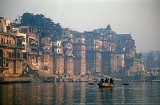
The Ganges (ˈɡændʒiːz ;) or Ganga, ( Ganga ˈɡəŋɡaː; Gônga), is a
trans-boundary riverA trans-boundary river is a river that crosses at least one political border, either a border within a nation or an international boundary. The country of Bangladesh has the greatest number of these rivers, almost all of which cross national boundaries....
of
IndiaIndia , officially the Republic of India , is a country in South Asia. It is the seventh-largest country by geographical area, the second-most populous country with over 1.2 billion people, and the most populous democracy in the world...
and
BangladeshBangladesh , officially the People's Republic of Bangladesh is a sovereign state located in South Asia. It is bordered by India on all sides except for a small border with Burma to the far southeast and by the Bay of Bengal to the south...
. The 2525 km (1,569 mi) river rises in the western
HimalayasThe Himalaya Range or Himalaya Mountains Sanskrit: Devanagari: हिमालय, literally "abode of snow"), usually called the Himalayas or Himalaya for short, is a mountain range in Asia, separating the Indian subcontinent from the Tibetan Plateau...
in the Indian state of
UttarakhandUttarakhand , formerly Uttaranchal, is a state in the northern part of India. It is often referred to as the Land of Gods due to the many holy Hindu temples and cities found throughout the state, some of which are among Hinduism's most spiritual and auspicious places of pilgrimage and worship...
, and flows south and east through the Gangetic Plain of North India into Bangladesh, where it empties into the
Bay of BengalThe Bay of Bengal , the largest bay in the world, forms the northeastern part of the Indian Ocean. It resembles a triangle in shape, and is bordered mostly by the Eastern Coast of India, southern coast of Bangladesh and Sri Lanka to the west and Burma and the Andaman and Nicobar Islands to the...
. By
dischargeIn hydrology, discharge is the volume rate of water flow, including any suspended solids , dissolved chemical species and/or biologic material , which is transported through a given cross-sectional area...
it ranks among the world's top 20 rivers. The Ganges basin is the most heavily populated river basin in the world, with over 400 million people and a
population densityPopulation density is a measurement of population per unit area or unit volume. It is frequently applied to living organisms, and particularly to humans...
of about 1000 PD/sqmi.
The Ganges is the most sacred river to Hindus and is also a lifeline to millions of Indians who live along its course and depend on it for their daily needs. It is worshiped as the goddess Ganga in
HinduismHinduism is the predominant and indigenous religious tradition of the Indian Subcontinent. Hinduism is known to its followers as , amongst many other expressions...
. It has also been important historically: many former provincial or imperial capitals (such as
PatliputraPāṭaliputra , modern-day Patna, was a city in ancient India, originally built by Ajatashatru in 490 BC as a small fort near the River Ganges, and later the capital of the ancient Mahājanapadas kingdom of Magadha....
,
KannaujKannauj , also spelt Kanauj, is a city, administrative headquarters and a municipal board or Nagar Palika Parishad in Kannauj district in the Indian state of Uttar Pradesh. The city's name is traditionally derived from the term Kanyakubja . Kannauj is an ancient city, in earlier times the capital...
,
KaraKara is an old township situated near Sirathu, on the banks of Ganges, west of the city of Allahabad in Kaushambi district in Uttar Pradesh state in India...
, Kashi,
AllahabadAllahabad , or Settled by God in Persian, is a major city of India and is one of the main holy cities of Hinduism. It was renamed by the Mughals from the ancient name of Prayaga , and is by some accounts the second-oldest city in India. It is located in the north Indian state of Uttar Pradesh,...
,
MurshidabadMurshidabad is a city in Murshidabad district of West Bengal state in India. The city of Murshidabad is located on the southern bank of the Bhagirathi, a distributary of the Ganges River. It was the capital of undivided Bengal during the Mughal rule. Nawabs of Bengal used to rule Bengal from this...
,
MungerMunger town is the headquarters of Munger district, in the Indian state of Bihar. Historically, Munger is known for its manufacturing of iron articles such as firearms and swords. One of the major institutions in Munger is Bihar School of Yoga. It is one of the foremost learning center in the...
,
BaharampurBaharampur is a city in the West Bengal state of India. Baharampur is the sixth largest city in West Bengal and situated in central part of West Bengal. Baharampur is nominated for becoming the municipal corporation...
and
KolkataKolkata , formerly known as Calcutta, is the capital of the Indian state of West Bengal. Located on the east bank of the Hooghly River, it was the commercial capital of East India...
) have been located on its banks.
The Ganges was ranked among the top five most polluted rivers of the world in 2007, with fecal coliform levels in the river near
Varanasi-Etymology:The name Varanasi has its origin possibly from the names of the two rivers Varuna and Assi, for the old city lies in the north shores of the Ganga bounded by its two tributaries, the Varuna and the Asi, with the Ganges being to its south...
more than hundred times the official Indian government limits. Pollution threatens not only humans, but also more than 140 fish species, 90 amphibian species and the endangered Ganges river dolphin. The Ganga Action Plan, an environmental initiative to clean up the river, has been a major failure thus far, due to corruption and lack of technical expertise, lack of good environmental planning, Indian traditions and beliefs, and lack of support from religious authorities.
Course
The Ganges proper begins at the
confluenceConfluence, in geography, describes the meeting of two or more bodies of water.Confluence may also refer to:* Confluence , a property of term rewriting systems...
of the
BhagirathiThe Bhāgīrathī is a turbulent Himalayan river in the state of Uttarakhand, India, that is the source stream of the Ganges—the major river of the Gangetic plain of Northern India and the holy river of Hinduism.-Etymology:...
and Alaknanda rivers. The Bhagirathi is considered to be the true
sourceThe source or headwaters of a river or stream is the place from which the water in the river or stream originates.-Definition:There is no universally agreed upon definition for determining a stream's source...
in Hindu culture and mythology, although the Alaknanda is longer. The headwaters of the Alakananda are formed by snowmelt from such peaks as
Nanda DeviNanda Devi is the second highest mountain in India and the highest entirely within the country ; owing to this geography it was the highest known mountain in the world until computations on Dhaulagiri by western surveyors in 1808...
,
TrisulTrisul is a group of three Himalayan mountain peaks of western Kumaun, with the highest reaching 7120m. The three peaks resemble a trident - in Hindi/Sanskrit, Trishul, trident, is the weapon of Shiva. The Trishul group forms the southeast corner of the ring of peaks enclosing the Nanda Devi...
, and
KametKamet is the second highest mountain in the Garhwal region of India, after Nanda Devi. It lies in the Chamoli District of Uttarakhand, close to the border with Tibet. It is the third highest mountain in India Kamet is the second highest mountain in the Garhwal region of India, after Nanda Devi....
. The Bhagirathi rises at the foot of
Gangotri GlacierGangotri Glacier is located in Uttarkashi District, Uttarakhand, India in a region bordering China. This glacier, source of the Ganges, is one of the largest in the Himalayas with an estimated volume of over 27 cubic kilometers. The glacier is about 30 kilometres long and 2 to 4 km wide...
, at Gaumukh, at an elevation of 3892 m (12,769 ft).
Although many small streams comprise the headwaters of the Ganges, the six longest and their five confluences are considered sacred. The six headstreams are the Alaknanda,
DhauligangaThe Dhauliganga is one of the six source streams of the Ganges river. It meets the Alaknanda River at Vishnuprayag in Uttarakhand.-Path:The -long Dhauliganga rises at an altitude of in the Niti Pass in Chamoli District of Uttarakhand, and subsequently flows through Darma valley. At Raini, from...
,
NandakiniNandakini is one of the five main tributaries of the Ganga river. Originating in the glaciers below Nanda Ghunti on the Nanda Devi Sanctuary, the river joins the Alaknanda at Nandprayag , which is one of the panch prayags or holy confluences on the Alaknanda....
,
PindarThe Pindar River is a river in Uttarakhand, India.Pindar or Pindari River originates from Pindari Glacier in Devaal. It passes small towns and villages like Devaal, Tharali, Kulsari, Harmani, Meeng, Narain Bagar, Nalgaon, Simli inhabited in Pindar Valley and finally merges with River Alaknanda at...
,
MandakiniMandakini is a tributary of the Alaknanda River. Mandakini originates from the Charabari Glacier near Kedarnath in Uttarakhand, India. Mandakini is fed by Vasukiganga River at Sonprayag. Mandakini joins Alaknanda at Rudraprayag...
, and
BhagirathiThe Bhāgīrathī is a turbulent Himalayan river in the state of Uttarakhand, India, that is the source stream of the Ganges—the major river of the Gangetic plain of Northern India and the holy river of Hinduism.-Etymology:...
rivers. The five confluences, known as the
Panch PrayagPanch Prayag is an expression in Hindu religious ethos, specifically used to connote the five sacred river confluences in the Garhwal Himalayas in the state of Uttarakhand, India...
, are all along the Alaknanda. They are, in downstream order,
VishnuprayagVishnuprayag is one of the Panch Prayag of Alaknanda River, and lies at the confluence of Alaknanda River and Dhauliganga River on the Joshimath-Badrinath route, in Chamoli district in the Indian state of Uttarakhand....
, where the Dhauliganga joins the Alaknanda; Nandprayag, where the Nandakini joins; Karnaprayag, where the Pindar joins, Rudraprayag, where the Mandakini joins; and finally,
DevprayagDevprayag is a town and a nagar panchayat in Tehri Garhwal district in the state of Uttarakhand, India, and is one of the Panch Prayag of Alaknanda River and where the Ganges River is formed.-Overview:Traditionally, it is considered to be the place where sage Devasharma led his ascetic life,...
, where the Bhagirathi joins the Alaknanda to form the Ganges River proper.
After flowing 250 kilometres (155.3 mi) through its narrow Himalayan valley, the Ganges emerges from the mountains at Rishikesh, then
debouchDebouch is a term used in river and stream geography, and the military.-Geography:In fluvial geography, a debouch is a place where a body of water pours forth from a narrow opening...
es onto the Gangetic Plain at the pilgrimage town of
HaridwarHaridwar is an important pilgrimage city and municipality in the Haridwar district of Uttarakhand, India...
. At Haridwar, a dam diverts some of its waters into the Ganges Canal, which irrigates the
DoabA Doab is a term used in India and Pakistan for a "tongue" or tract of land lying between two confluent rivers...
region of
Uttar PradeshUttar Pradesh abbreviation U.P. , is a state located in the northern part of India. With a population of over 200 million people, it is India's most populous state, as well as the world's most populous sub-national entity...
, whereas the river, whose course has been roughly southwest until this point, now begins to flow southeast through the plains of northern India.
The Ganges follows an 800 kilometres (497.1 mi) arching course passing through the cities of
KannaujKannauj , also spelt Kanauj, is a city, administrative headquarters and a municipal board or Nagar Palika Parishad in Kannauj district in the Indian state of Uttar Pradesh. The city's name is traditionally derived from the term Kanyakubja . Kannauj is an ancient city, in earlier times the capital...
, Farukhabad, and
Kanpur. Along the way it is joined by the
RamgangaRamganga West river originates from Doodhatoli ranges in the district of Pauri Garhwal, Uttarakhand state of India. The river Ramganga flows to south west from Kumaun Himalaya. It is a tributary of the river Ganges, originates from the high altitude zone of 800m-900m. Ramganga flows by the Corbett...
, which contributes an average annual flow of about 500 m3/s. The Ganges joins the
YamunaThe Yamuna is the largest tributary river of the Ganges in northern India...
at the Triveni Sangam at
AllahabadAllahabad , or Settled by God in Persian, is a major city of India and is one of the main holy cities of Hinduism. It was renamed by the Mughals from the ancient name of Prayaga , and is by some accounts the second-oldest city in India. It is located in the north Indian state of Uttar Pradesh,...
, a holy confluence in Hinduism. At their confluence the Yamuna is larger than the Ganges, contributing about 2950 m3/s, or about 58.5% of the combined flow.
Now flowing east, the river meets the
Tamsa RiverThe Tamsa River is a tributary of the Ganges flowing through the Indian states of Madhya Pradesh and Uttar Pradesh.-Course:...
(also called Tons), which flows north from the Kaimur Range and contributes an average flow of about 190 m3/s. After the Tamsa the
Gomti RiverThe Gomti, Gumti or Gomati River is a tributary of the Ganges River. According to Hindu mythology the river is the daughter of Sage Vashist, and bathing in the waters of the Gomati on Ekadashi can wash away one's sins...
joins, flowing south from the Himalayas. The Gomti contributes an average annual flow of about 234 m3/s. Then the
Ghaghara RiverKarnali or Ghaghara is a perennial trans-boundary river originating on the Tibetan Plateau near Lake Mansarovar. It cuts through the Himalayas in Nepal and joins the Sarda River at Brahmaghat in India. Together they form the Ghaghra River, a major left bank tributary of the Ganges. With a length of...
, also flowing south from the Himalayas, joins. The Ghaghara, with its average annual flow of about 2990 m3/s, is the largest tributary of the Ganges. After the Ghaghara confluence the Ganges is joined from the south by the
Son RiverSon River of central India is the largest of the Ganges' southern tributaries. A British 1850s diary shows that the river was written in English as Soane.-Course:...
, contributing about 1000 m3/s. The Gandaki River, then the Kosi River, join from the north, contributing about 1654 m3/s and 2166 m3/s, respectively. The Kosi is the third largest tributary of the Ganges, after the Ghaghara and Yamuna.
Along the way between
AllahabadAllahabad , or Settled by God in Persian, is a major city of India and is one of the main holy cities of Hinduism. It was renamed by the Mughals from the ancient name of Prayaga , and is by some accounts the second-oldest city in India. It is located in the north Indian state of Uttar Pradesh,...
and Malda,
West BengalWest Bengal is a state in the eastern region of India and is the nation's fourth-most populous. It is also the seventh-most populous sub-national entity in the world, with over 91 million inhabitants. A major agricultural producer, West Bengal is the sixth-largest contributor to India's GDP...
, the Ganges passes the towns of Chhunar,
MirzapurMirzapur is a city in the heart of North India, nearly 650 km between Delhi and Kolkata and also equidistant from Allahabad and Varanasi. Located in the state of Uttar Pradesh, Mirzapur has a population of a little over 205,264 and is renowned for its famous carpet and brassware industry...
,
Varanasi-Etymology:The name Varanasi has its origin possibly from the names of the two rivers Varuna and Assi, for the old city lies in the north shores of the Ganga bounded by its two tributaries, the Varuna and the Asi, with the Ganges being to its south...
,
GhazipurGhazipur , or Ghazipur City, previously spelt Ghazeepore, is a city/town and a municipal corporation and headquarter of Ghazipur district in the state of Uttar Pradesh, India. It is the administrative headquarters of Ghazipur Division and Sub-division...
,
PatnaPaṭnā , is the capital of the Indian state of Bihar and the second largest city in Eastern India . Patna is one of the oldest continuously inhabited places in the world...
,
BhagalpurBhagdattpuram was one of the most influential towns in "Aryavarta" . It is supposed to have been concurrent to Patliputra or Patna. Bhagdattpuram finds its mention in the Vedas and Ramayana as well. It is supposed to be the kingdom of Daanvir Karna, the son of Kunti and the Sun God...
,
BalliaBallia is a city with a municipal board in the Indian state of Uttar Pradesh. The eastern boundary of the city lies at the junction of the Ganges and the Ghaghara...
,
BuxarBuxar district is one of the thirty-eight districts of Bihar state, India. The district headquarters are located at Buxar.-Mythology:This place was also known as "Siddhashram", "Vedgarbhapuri", "Karush", "Tapovan", "Chaitrath", "VyaghraSar", "Buxar" in ancient history. The History of Buxar dates...
, Simaria,
SultanganjSultanganj is a city and a notified area in Bhagalpur district in the Indian state of Bihar.-History:Sultanganj is a town in Bhagalpur district and has a railway station, of the same name on the loop-line of the Eastern Railway running from kolkata to Kiul. An excellent all-weather road connecting...
, and
SaidpurSaidpur is a city of Nilphamari district in Rangpur Division of Bangladesh . The city becomes a very important communication hub for adjoining major district headquarters. Saidpur Airport is one of the domestic airports in Bangladesh. The Saidpur Railway Workshop, established in 1870, is the...
. At Bhagalpur, the river begins to flow south-southeast and at
PakurPakur is the district headquarters of Pakur District, Jharkhand state, India.It is located in the north east corner of Jharkhand State: at 23°40' to 25°18' latitude and 86°25' to 87°57' E. longitude...
, it begins its attrition with the branching away of its first
distributaryA distributary, or a distributary channel, is a stream that branches off and flows away from a main stream channel. They are a common feature of river deltas. The phenomenon is known as river bifurcation. The opposite of a distributary is a tributary...
, the Bhāgirathi-Hooghly, which goes on to become the Hooghly River. Just before the border with
BangladeshBangladesh , officially the People's Republic of Bangladesh is a sovereign state located in South Asia. It is bordered by India on all sides except for a small border with Burma to the far southeast and by the Bay of Bengal to the south...
the
Farakka BarrageFarakka Barrage is a barrage across the Ganges River, located in the Indian state of West Bengal, roughly from the border with Bangladesh near Chapai Nawabganj District. Construction was started in 1961 and completed in 1975. Operations began on April 21, 1975. The barrage is about long...
controls the flow of the Ganges, diverting some of the water into a feeder canal linked to the Hooghly for the purpose of keeping it relatively silt-free. The Hooghly River is formed by the confluence of the Bhagirathi River and
Jalangi RiverJalangi River , is a branch of the Ganges in Murshidabad and Nadia districts in the Indian state of West Bengal. The Jalangi and the Mathabhanga flow into the Bhagirathi-Hooghly and strengthens its lower channel, the Hooghly....
at
NabadwipNabadwip is a city and a municipality in Nadia district in the Indian state of West Bengal. Its name means "9 islands" in the Bengali language. The islands are named Antardwip , Simantadwip, Rudradwip, Madhyadwip, Godrumdwip, Ritudwip, Jahnudwip, Modadrumdwip, and Koladwip...
, and Hooghly has a number of tributaries of its own. The largest is the
Damodar RiverDamodar River originates near Chandwa village, Palamau district, on the Chota Nagpur Plateau in the Jharkhand state in eastern India, and flows eastward for about 592 km through the states of Jharkhand and West Bengal to the estaury of the River Hooghly...
, which is 541 km (336.2 mi) long, with a drainage basin of 25820 km² (9,969.2 sq mi). The Hooghly River empties into the Bay of Bengal near
Sagar IslandSagar Island lies on the continental shelf of Bay of Bengal about 150 km south of Kolkata. It belongs to the Republic of India and is governed by the State government of West Bengal. The island is large — with an area of around 300 km². It has 43 villages and a population of over...
.
After entering Bangladesh, the main branch of the Ganges is known as the
PadmaThe Padma is a major trans-boundary river in Bangladesh. It is the main distributary of the Ganges , which originates in the Himalayas. The Padma enters Bangladesh from India near Chapai Nababganj...
. The Padma is joined by the Jamuna River, the largest distributary of the Brahmaputra. Further downstream, the Padma joins the
Meghna RiverThe Meghna River is an important river in Bangladesh, one of the three that forms the Ganges Delta, the largest on earth fanning out to the Bay of Bengal. Being a part of the Surma-Meghna River System, Meghna is formed inside Bangladesh by the joining of different rivers originaing from the hilly...
, the second largest distributary of the Brahmaputra, and takes on the Meghna's name as it enters the Meghna Estuary, which empties into the Bay of Bengal.
The
Ganges DeltaThe Ganges Delta is a river delta in the South Asia region of Bengal, consisting of Bangladesh and the state of West Bengal, India. It is the world's largest delta, and empties into the Bay of Bengal...
, formed mainly by the large, sediment-laden flows of the Ganges and Brahmaputra rivers, is the world's largest delta, at about 59000 km² (22,780 sq mi). It stretches 322 km (200.1 mi) along the Bay of Bengal.
Only the
AmazonThe Amazon of South America is the second longest river in the world and by far the largest by waterflow with an average discharge greater than the next seven largest rivers combined...
and
CongoThe Congo River is a river in Africa, and is the deepest river in the world, with measured depths in excess of . It is the second largest river in the world by volume of water discharged, though it has only one-fifth the volume of the world's largest river, the Amazon...
rivers have a greater average discharge than the combined flow of the Ganges, the Brahmaputra, and the
Surma-Meghna river systemThe Surma-Meghna River System is a river complex in South Asia, one of the three that form the Ganges Delta, the largest on earth. It rises in the Manipur Hills of northeast India as the Barak River and flows west becoming the Surma River and then flows south as the Meghna River, a total of...
. In full flood only the Amazon is larger.
Geology
The Indian subcontinent lies atop the Indian tectonic plate, a minor plate within the
Indo-Australian PlateThe Indo-Australian Plate is a major tectonic plate that includes the continent of Australia and surrounding ocean, and extends northwest to include the Indian subcontinent and adjacent waters...
. Its defining geological processes commenced seventy-five million years ago, when, as a part of the southern supercontinent
GondwanaIn paleogeography, Gondwana , originally Gondwanaland, was the southernmost of two supercontinents that later became parts of the Pangaea supercontinent. It existed from approximately 510 to 180 million years ago . Gondwana is believed to have sutured between ca. 570 and 510 Mya,...
, it began a northeastwards
driftPlate tectonics is a scientific theory that describes the large scale motions of Earth's lithosphere...
—lasting fifty million years—across the then unformed Indian Ocean. The subcontinent's subsequent collision with the
Eurasian PlateThe Eurasian Plate is a tectonic plate which includes most of the continent of Eurasia , with the notable exceptions of the Indian subcontinent, the Arabian subcontinent, and the area east of the Chersky Range in East Siberia...
and
subductionIn geology, subduction is the process that takes place at convergent boundaries by which one tectonic plate moves under another tectonic plate, sinking into the Earth's mantle, as the plates converge. These 3D regions of mantle downwellings are known as "Subduction Zones"...
under it, gave rise to the
HimalayasThe Himalaya Range or Himalaya Mountains Sanskrit: Devanagari: हिमालय, literally "abode of snow"), usually called the Himalayas or Himalaya for short, is a mountain range in Asia, separating the Indian subcontinent from the Tibetan Plateau...
, the planet's highest mountains. In the former seabed immediately south of the emerging Himalayas, plate movement created a vast
troughIn geology, a trough generally refers to a linear structural depression that extends laterally over a distance, while being less steep than a trench.A trough can be a narrow basin or a geologic rift....
, which, having gradually been filled with sediment borne by the
IndusThe Indus River is a major river which flows through Pakistan. It also has courses through China and India.Originating in the Tibetan plateau of western China in the vicinity of Lake Mansarovar in Tibet Autonomous Region, the river runs a course through the Ladakh district of Jammu and Kashmir and...
and its tributaries and the
GangesThe Ganges or Ganga, , is a trans-boundary river of India and Bangladesh. The river rises in the western Himalayas in the Indian state of Uttarakhand, and flows south and east through the Gangetic Plain of North India into Bangladesh, where it empties into the Bay of Bengal. By discharge it...
and its tributaries, now forms the
Indo-Gangetic PlainThe northern Plains also known as the Indo - Gangetic Plain and The North Indian River Plain is a large and fertile plain encompassing most of northern and eastern India, the most populous parts of Pakistan, parts of southern Nepal and virtually all of Bangladesh...
.
The Indo-Gengetic Plain is geologically known as a foredeep or
foreland basinA foreland basin is a depression that develops adjacent and parallel to a mountain belt. Foreland basins form because the immense mass created by crustal thickening associated with the evolution of a mountain belt causes the lithosphere to bend, by a process known as lithospheric flexure...
.
Hydrology
The
hydrologyHydrology is the study of the movement, distribution, and quality of water on Earth and other planets, including the hydrologic cycle, water resources and environmental watershed sustainability...
of the Ganges River is very complicated, especially in the Ganges Delta region. One result is different ways to determine the river's length, its
dischargeIn hydrology, discharge is the volume rate of water flow, including any suspended solids , dissolved chemical species and/or biologic material , which is transported through a given cross-sectional area...
, and the size of its
drainage basinA drainage basin is an extent or an area of land where surface water from rain and melting snow or ice converges to a single point, usually the exit of the basin, where the waters join another waterbody, such as a river, lake, reservoir, estuary, wetland, sea, or ocean...
.
The name Ganges is used for the river between the confluence of the Bhagirathi and Alaknanda rivers, in the Himalayas, and the India-Bangladesh border, near the Farakka Barrage and the first
bifurcationRiver bifurcation occurs when a river flowing in a single stream separates into two or more separate streams which continue downstream. Some rivers form complex networks of distributaries, especially in their deltas...
of the river. The length of the Ganges is frequently said to be slightly over 2500 km (1,553.4 mi) long, about 2505 km (1,556.5 mi), to 2525 km (1,569 mi), or perhaps 2550 km (1,584.5 mi). In these cases the river's source is usually assumed to be the source of the Bhagirathi River,
Gangotri GlacierGangotri Glacier is located in Uttarkashi District, Uttarakhand, India in a region bordering China. This glacier, source of the Ganges, is one of the largest in the Himalayas with an estimated volume of over 27 cubic kilometers. The glacier is about 30 kilometres long and 2 to 4 km wide...
at
GomukhGomukh, the terminus or snout of the Gangotri Glacier, from where Bhagirathi River originates. The place is situated at a height of 11,500 ft. It is one of the largest in the Himalayas with an estimated volume of over 27 cubic kilometers....
, and its mouth being the mouth of the Meghna River on the Bay of Bengal. Sometimes the source of the Ganges is considered to be at
HaridwarHaridwar is an important pilgrimage city and municipality in the Haridwar district of Uttarakhand, India...
, where its Himalayan headwater streams debouch onto the Gangetic Plain.
In some cases, the length of the Ganges is given for its Hooghly River distributary, which is longer than its main outlet via the Meghna River, resulting in a total length of about 2620 km (1,628 mi), from the source of the Bhagirathi, or 2135 km (1,326.6 mi), from Haridwar to the Hooghly's mouth. In other cases the length is said to be about 2240 km (1,391.9 mi), from the source of the Bhagirathi to the Bangladesh border, where its name changes to Padma.
For similar reasons, sources differ over the size of the river's drainage basin. The basin covers parts of four countries,
IndiaIndia , officially the Republic of India , is a country in South Asia. It is the seventh-largest country by geographical area, the second-most populous country with over 1.2 billion people, and the most populous democracy in the world...
,
NepalNepal , officially the Federal Democratic Republic of Nepal, is a landlocked sovereign state located in South Asia. It is located in the Himalayas and bordered to the north by the People's Republic of China, and to the south, east, and west by the Republic of India...
,
ChinaChina , officially the People's Republic of China , is the most populous country in the world, with over 1.3 billion citizens. Located in East Asia, the country covers approximately 9.6 million square kilometres...
, and
BangladeshBangladesh , officially the People's Republic of Bangladesh is a sovereign state located in South Asia. It is bordered by India on all sides except for a small border with Burma to the far southeast and by the Bay of Bengal to the south...
; eleven Indian states,
Himachal PradeshHimachal Pradesh is a state in Northern India. It is spread over , and is bordered by the Indian states of Jammu and Kashmir on the north, Punjab on the west and south-west, Haryana and Uttar Pradesh on the south, Uttarakhand on the south-east and by the Tibet Autonomous Region on the east...
,
UttarakhandUttarakhand , formerly Uttaranchal, is a state in the northern part of India. It is often referred to as the Land of Gods due to the many holy Hindu temples and cities found throughout the state, some of which are among Hinduism's most spiritual and auspicious places of pilgrimage and worship...
,
Uttar PradeshUttar Pradesh abbreviation U.P. , is a state located in the northern part of India. With a population of over 200 million people, it is India's most populous state, as well as the world's most populous sub-national entity...
,
Madhya PradeshMadhya Pradesh , often called the Heart of India, is a state in central India. Its capital is Bhopal and Indore is the largest city....
, Chattisgarh,
BiharBihar is a state in eastern India. It is the 12th largest state in terms of geographical size at and 3rd largest by population. Almost 58% of Biharis are below the age of 25, which is the highest proportion in India....
,
JharkhandJharkhand is a state in eastern India. It was carved out of the southern part of Bihar on 15 November 2000. Jharkhand shares its border with the states of Bihar to the north, Uttar Pradesh and Chhattisgarh to the west, Orissa to the south, and West Bengal to the east...
, Punjab,
HaryanaHaryana is a state in India. Historically, it has been a part of the Kuru region in North India. The name Haryana is found mentioned in the 12th century AD by the apabhramsha writer Vibudh Shridhar . It is bordered by Punjab and Himachal Pradesh to the north, and by Rajasthan to the west and south...
,
RajasthanRājasthān the land of Rajasthanis, , is the largest state of the Republic of India by area. It is located in the northwest of India. It encompasses most of the area of the large, inhospitable Great Indian Desert , which has an edge paralleling the Sutlej-Indus river valley along its border with...
,
West BengalWest Bengal is a state in the eastern region of India and is the nation's fourth-most populous. It is also the seventh-most populous sub-national entity in the world, with over 91 million inhabitants. A major agricultural producer, West Bengal is the sixth-largest contributor to India's GDP...
, and the Union Territory of
DelhiDelhi , officially National Capital Territory of Delhi , is the largest metropolis by area and the second-largest by population in India, next to Mumbai. It is the eighth largest metropolis in the world by population with 16,753,265 inhabitants in the Territory at the 2011 Census...
. The Ganges basin, including the delta but not the Brahmaputra or Meghna basins, is about 1080000 km² (416,990.3 sq mi), of which 861000 km² (332,434 sq mi) are in India (about 80%), 140000 km² (54,054.3 sq mi) in Nepal (13%), 46000 km² (17,760.7 sq mi) in Bangladesh (4%), and 33000 km² (12,741.4 sq mi) in China (3%). Sometimes the Ganges and Brahmaputra–Meghna drainage basins are combined for a total of about 1600000 km² (617,763.5 sq mi), or 1621000 km² (625,871.6 sq mi). The combined Ganges-Brahmaputra-Meghna basin (abbreviated GBM or GMB)
drainage basinA drainage basin is an extent or an area of land where surface water from rain and melting snow or ice converges to a single point, usually the exit of the basin, where the waters join another waterbody, such as a river, lake, reservoir, estuary, wetland, sea, or ocean...
is spread across Bangladesh,
BhutanBhutan , officially the Kingdom of Bhutan, is a landlocked state in South Asia, located at the eastern end of the Himalayas and bordered to the south, east and west by the Republic of India and to the north by the People's Republic of China...
, India, Nepal, and China.
The Ganges basin ranges from the Himalaya and the Transhimalaya in the north, to the northern slopes of the Vindhya range in the south, from the eastern slopes of the Aravalli in the west to the
Chota Nagpur plateauThe Chota Nagpur Plateau is a plateau in eastern India, which covers much of Jharkhand state as well as adjacent parts of Orissa, West Bengal, Bihar and Chhattisgarh. The Indo-Gangetic plain lies to the north and east of the plateau, and the basin of the Mahanadi River lies to the south...
and the Sunderbans delta in the east. A significant portion of the discharge from the Ganges comes from the Himalayan mountain system. Within the Himalaya, the Ganges basin goes from the Yamuna-Satluj divide along the Simla ridge forming the boundary with the Indus basin in the west to the Singalila Ridge along the Nepal-Sikkim border forming the boundary with the Brahmaputra basin in the east. This section of the Himalaya contains 9 of the 14 highest peaks in the world over 8,000m in height, including
Mount EverestMount Everest is the world's highest mountain, with a peak at above sea level. It is located in the Mahalangur section of the Himalayas. The international boundary runs across the precise summit point...
which is the high point of the Ganges basin. The other peaks over 8,000m in the basin are
KangchenjungaKangchenjunga is the third highest mountain of the world with an elevation of and located along the India-Nepal border in the Himalayas.Kangchenjunga is also the name of the section of the Himalayas and means "The Five Treasures of Snows", as it contains five peaks, four of them over...
,
LhotseLhotse is the fourth highest mountain on Earth and is connected to Everest via the South Col. In addition to the main summit at 8,516 metres above sea level, Lhotse Middle is and Lhotse Shar is...
,
MakaluMakalu is the fifth highest mountain in the world at and is located southeast of Mount Everest, on the border between Nepal and China...
,
Cho OyuCho Oyu is the sixth highest mountain in the world at above sea level. Cho Oyu lies in the Himalayas and is 20 km west of Mount Everest, at the border between China and Nepal...
,
DhaulagiriDhaulagiri is Earth's seventh highest mountain at ; one of fourteen over eight thousand metres. Dhaulagiri was first climbed May 13, 1960 by a Swiss/Austrian expedition....
,
ManasluManaslu , also known as Kutang) is the eighth highest mountain in the world, and is located in the Mansiri Himal, part of the Nepalese Himalayas, in the west-central part of Nepal. Its name, which means "Mountain of the Spirit", comes from the Sanskrit word Manasa, meaning "intellect" or "soul"...
,
AnnapurnaAnnapurna is a section of the Himalayas in north-central Nepal that includes Annapurna I, thirteen additional peaks over and 16 more over ....
and
ShishapangmaXixabangma, frequently spelled Shishapangma or Shisha Pangma , also called Gosainthān , is the fourteenth-highest mountain in the world and, at 8,013 m , the lowest of the eight-thousanders...
. The Himalayan portion of the basin includes the south-eastern portion of the state of Himachal Pradesh, the entire state of Uttarakhand, the entire country of Nepal and the extreme north-western portion of the state of West Bengal.
The discharge of the Ganges also differs by source. Frequently, discharge is described for the mouth of the Meghna River, thus combining the Ganges with the Brahmaputra and Meghna. This results in a total average annual discharge of about 38000 m3/s, or 42470 m3/s. In other cases the average annual discharges of the Ganges, Brahmaputra, and Meghna are given separately, at about 16650 m3/s for the Ganges, about 19820 m3/s for the Brahmaputra, and about 5100 m3/s for the Meghna.
The maximum peak discharge of the Ganges, as recorded at
Hardinge BridgeHardinge Bridge is a steel railway bridge over the river Padma located in western Bangladesh. It is named after Lord Hardinge, who was the Viceroy of India from 1910 to 1916. The bridge is 1.8 kilometers long.-Construction:...
in Bangladesh, exceeded 70000 m3/s. The minimum recorded at the same place was about 180 m3/s, in 1997.
The hydrologic cycle in the Ganges basin is governed by the
Southwest MonsoonA Monsoon of the India is among the several geographically distributed observations of the global monsoons. In the subcontinent, it is one of oldest weather observations, an economically important weather pattern and the most anticipated weather event and unique weather phenomenon. Yet it is only...
. About 84% of the total rainfall occurs in the monsoon from June to September. Consequently,
streamflowStreamflow, or channel runoff, is the flow of water in streams, rivers, and other channels, and is a major element of the water cycle. It is one component of the runoff of water from the land to waterbodies, the other component being surface runoff...
in the Ganges is highly seasonal. The average dry season to monsoon discharge ratio is about 1:6, as measured at
Hardinge BridgeHardinge Bridge is a steel railway bridge over the river Padma located in western Bangladesh. It is named after Lord Hardinge, who was the Viceroy of India from 1910 to 1916. The bridge is 1.8 kilometers long.-Construction:...
. This strong seasonal variation underlies many problems of land and water resource development in the region. The seasonality of flow is so acute it can cause both
droughtA drought is an extended period of months or years when a region notes a deficiency in its water supply. Generally, this occurs when a region receives consistently below average precipitation. It can have a substantial impact on the ecosystem and agriculture of the affected region...
and
floodA flood is an overflow of an expanse of water that submerges land. The EU Floods directive defines a flood as a temporary covering by water of land not normally covered by water...
s. Bangladesh, in particular, frequently experiences drought during the dry season and regularly suffers extreme floods during the monsoon.
In the Ganges Delta many large rivers come together, both merging and
bifurcatingRiver bifurcation occurs when a river flowing in a single stream separates into two or more separate streams which continue downstream. Some rivers form complex networks of distributaries, especially in their deltas...
in a complicated network of
channelsIn physical geography, a channel is the physical confine of a river, slough or ocean strait consisting of a bed and banks.A channel is also the natural or human-made deeper course through a reef, sand bar, bay, or any shallow body of water...
. The two largest rivers, the Ganges and Brahmaputra, both split into distributary channels, the largest of which merge with other large rivers before themselves joining. This current channel pattern was not always the case. Over time the rivers in Ganges Delta have
changed courseIn sedimentary geology and fluvial geomorphology, avulsion is the rapid abandonment of a river channel and the formation of a new river channel. Avulsions occur as a result of channel slopes that are much lower than the slope that the river could travel if it took a new course.-Deltaic and...
, sometimes altering the network of channels in significant ways.
Before the late 12th century the Bhagirathi-Hooghly distributary was the main channel of the Ganges and the Padma was only a minor spill-channel. The main flow of the river reached the sea not via the modern Hooghly River but rather by the
Adi GangaAdi Ganga , also known as Gobindapur creek, Surman’s Nullah and Tolly’s Nullah, was the main flow of the Hooghly River from the 15th to 17th century but has subsequently virtually dried up.-History:...
. Between the 12th and 16th centuries the Bhagirathi-Hooghly and Padma channels were more or less equally significant. After the 16th century the Padma grew to become the main channel of the Ganges. It is thought that the Bhagirathi-Hooghly became increasingly choked with silt, causing the main flow of the Ganges to shift to the southeast and the Padma River. By the end of the 18th century the Padma had become the main distributary of the Ganges. One result of this shift to the Padma was that the Ganges joined the Meghna and Brahmaputra rivers before emptying into the Bay of Bengal, together instead of separately. The present confluence of the Ganges and Meghna formed about 150 years ago.
Also near the end of the 18th century, the course of the lower Brahmaputra changed dramatically, altering its relationship with the Ganges. In 1787 there was a great flood on the
Teesta RiverRiver Teesta or Tista is said to be the lifeline of the Indian state of Sikkim, flowing for almost the entire length of the state and carving out verdant Himalayan temperate and tropical river valleys. The emerald-coloured river then forms the border between Sikkim and West Bengal before joining...
, which at the time was a tributary of the Ganges-Padma River. The flood of 1787 caused the Teesta to undergo a sudden change course (an
avulsionIn sedimentary geology and fluvial geomorphology, avulsion is the rapid abandonment of a river channel and the formation of a new river channel. Avulsions occur as a result of channel slopes that are much lower than the slope that the river could travel if it took a new course.-Deltaic and...
), shifting east to join the Brahmaputra and causing the Brahmaputra to shift its course south, cutting a new channel. This new main channel of the Brahmaputra is called the Jamuna River. It flows south to join the Ganges-Padma. Since ancient times the main flow of the Brahmaputra was more easterly, passing by the city of
MymensinghMymensingh , pronounced moy-mon-shing-haw, is a city of Bangladesh situated on the river Brahmaputra. It is the headquarters of the administrative unit Mymensingh District. Mymensingh is the anglicized pronunciation of the original name Momenshahi, referring to a ruler called Momen Shah. The cadet...
and joining the Meghna River. Today this channel is a small distributary but retains the name Brahmaputra, sometimes Old Brahmaputra. The site of the old Brahmaputra-Meghna confluence, in the locality of
LangalbandhLangalbandh , is a place located in Bangladesh, and is considered to be holy by Hindus. It is located in the Dhaka District, on the bank of the Brahmaputra River near the Dhaka-Chittagong highway.-External links:*, from Banglapedia...
, is still considered sacred by Hindus. Near the confluence is a major early historic site called
Wari-BateshwarWari-Bateshwar is the site of an ancient fort city dating back to 450 BC situated in the north-eastern part of Bangladesh. This 2500 years old site is a significant archaeological discovery...
.
History
The Late Harappan period, about 1900–1300 BCE, saw the spread of Harappan settlement eastward from the
Indus RiverThe Indus River is a major river which flows through Pakistan. It also has courses through China and India.Originating in the Tibetan plateau of western China in the vicinity of Lake Mansarovar in Tibet Autonomous Region, the river runs a course through the Ladakh district of Jammu and Kashmir and...
basin to the Ganges-Yamuna
doabA Doab is a term used in India and Pakistan for a "tongue" or tract of land lying between two confluent rivers...
, although none crossed the Ganges to settle its eastern bank. The disintegration of the Harappan civilization, in the early
2nd millennium BCThe 2nd millennium BC marks the transition from the Middle to the Late Bronze Age.Its first half is dominated by the Middle Kingdom of Egypt and Babylonia. The alphabet develops. Indo-Iranian migration onto the Iranian plateau and onto the Indian subcontinent propagates the use of the chariot...
, marks the point when the center of Indian civilization shifted from the Indus basin to the Ganges basin. There may be links between the Late Harappan settlement of the Ganges basin and the
archaeological cultureAn archaeological culture is a recurring assemblage of artifacts from a specific time and place, which are thought to constitute the material culture remains of a particular past human society. The connection between the artifacts is based on archaeologists' understanding and interpretation and...
known as "
Cemetery HThe Cemetery H culture developed out of the northern part of the Indus Valley Civilization around 1900 BCE, in and around western Punjab region located in present-day India and Pakistan...
", the Indo-Aryan people, and the
Vedic periodThe Vedic period was a period in history during which the Vedas, the oldest scriptures of Hinduism, were composed. The time span of the period is uncertain. Philological and linguistic evidence indicates that the Rigveda, the oldest of the Vedas, was composed roughly between 1700–1100 BCE, also...
.
This river is the longest in India.
During the early Vedic Age of the
RigvedaThe Rigveda is an ancient Indian sacred collection of Vedic Sanskrit hymns...
, the Indus and the
Sarasvati RiverThe Sarasvati River is one of the chief Rigvedic rivers mentioned in ancient Hindu texts. The Nadistuti hymn in the Rigveda mentions the Sarasvati between the Yamuna in the east and the Sutlej in the west, and later Vedic texts like Tandya and Jaiminiya Brahmanas as well as the Mahabharata...
were the major sacred rivers, not the Ganges. But the later three
VedasThe Vedas are a large body of texts originating in ancient India. Composed in Vedic Sanskrit, the texts constitute the oldest layer of Sanskrit literature and the oldest scriptures of Hinduism....
give much more importance to the Ganges. The Gangetic Plain became the cradle of successive civilizations, from the
Maurya EmpireThe Maurya Empire was a geographically extensive Iron Age historical power in ancient India, ruled by the Mauryan dynasty from 321 to 185 BC...
to the
Mughal EmpireThe Mughal Empire , or Mogul Empire in traditional English usage, was an imperial power from the Indian Subcontinent. The Mughal emperors were descendants of the Timurids...
.
The first European traveler to mention the Ganges was
MegasthenesMegasthenes was a Greek ethnographer in the Hellenistic period, author of the work Indica.He was born in Asia Minor and became an ambassador of Seleucus I of Syria possibly to Chandragupta Maurya in Pataliputra, India. However the exact date of his embassy is uncertain...
(ca. 350–290 BCE). He did so several times in his work Indica: "India, again, possesses many rivers both large and navigable, which, having their sources in the mountains which stretch along the northern frontier, traverse the level country, and not a few of these, after uniting with each other, fall into the river called the Ganges. Now this river, which at its source is 30 stadia broad, flows from north to south, and empties its waters into the ocean forming the eastern boundary of the
GangaridaiGangaridai was an ancient state found around 300 BC where the Bengal region lies today . It was described by the Greek traveller Megasthenes in his work Indica...
, a nation which possesses a vast force of the largest-sized elephants." (Diodorus II.37)
In the rainy season of 1809, the
lower channel of the Bhagirathi, leading to Kolkata, had been entirely shut; but in the following year it opened again, and was nearly of the same size with the upper channel; both however suffered a considerable diminution, owing probably to the new communication opened below the Jalanggi. On the upper channel.
In 1951 a water sharing dispute arose between India and Bangladesh (then
East PakistanEast Pakistan was a provincial state of Pakistan established in 14 August 1947. The provincial state existed until its declaration of independence on 26 March 1971 as the independent nation of Bangladesh. Pakistan recognized the new nation on 16 December 1971. East Pakistan was created from Bengal...
), after India declared its intention to build the
Farakka BarrageFarakka Barrage is a barrage across the Ganges River, located in the Indian state of West Bengal, roughly from the border with Bangladesh near Chapai Nawabganj District. Construction was started in 1961 and completed in 1975. Operations began on April 21, 1975. The barrage is about long...
. The original purpose of the barrage, which was completed in 1975, was to divert up to 40000 cuft/s of water from the Ganges to the Bhagirathi-Hooghly distributary in order to restore navigability at the Port of Kolkata. It was assumed that during the worst dry season the Ganges flow would be around 50000 cuft/s, thus leaving 10000 cuft/s for East Pakistan. East Pakistan objected and a protracted dispute ensued. In 1996 a 30-year treaty was signed. The terms of the agreement are complicated, but in essence they state that if the Ganges flow at Farakka was less than 70000 cuft/s then India and Bangladesh would each receive 50% of the water, with each receiving at least 35000 cuft/s for alternating ten day periods. However, within a year the flow at Farakka fell to levels far below the historic average, making it impossible to implement the guaranteed sharing of water. In March 1997, flow of the Ganges in Bangladesh dropped to its lowest ever, 6500 cuft/s. Dry season flows returned to normal levels in the years following, but efforts were made to address the problem. One plan is for another barrage to be built in Bangladesh at
PangshaPangsha is an Upazila of Rajbari District in the Division of Dhaka, Bangladesh.-Geography:Pangsha is located at . It has 54424 units of house hold and total area 414.24 km².-Demographics:...
, west of
DhakaDhaka is the capital of Bangladesh and the principal city of Dhaka Division. Dhaka is a megacity and one of the major cities of South Asia. Located on the banks of the Buriganga River, Dhaka, along with its metropolitan area, had a population of over 15 million in 2010, making it the largest city...
. This barrage would help Bangladesh better utilize its share of the waters of the Ganges.
Embodiment of sacredness
The Ganges is a sacred river along every fragment of her length. All along her course, Hindus bathe in her waters. All along her course, they pay homage to their ancestors and to their gods by cupping her water in their hands, lifting it and letting it fall back into her; they offer flowers and rose petals and float shallow clay dishes filled with oil and lit with wicks. On the journey back home from the Ganges, they carry small quantities of her water with them for use in rituals. When a loved one dies, they return to the Ganges to consign the ashes to her custody.
The Ganges is the embodiment of all sacred waters in
Hindu mythologyHindu religious literature is the large body of traditional narratives related to Hinduism, notably as contained in Sanskrit literature, such as the Sanskrit epics and the Puranas. As such, it is a subset of Nepali and Indian culture...
. Local rivers are said to be like the Ganges, they are sometimes called the local "Ganga". The
Kaveri riverThe Kaveri , also spelled Cauvery in English, is a large Indian river. The origin of the river is traditionally placed at Talakaveri, Kodagu in the Western Ghats in Karnataka, flows generally south and east through Karnataka and Tamil Nadu and across the southern Deccan plateau through the...
of
KarnatakaKarnataka , the land of the Kannadigas, is a state in South West India. It was created on 1 November 1956, with the passing of the States Reorganisation Act and this day is annually celebrated as Karnataka Rajyotsava...
and
Tamil NaduTamil Nadu is one of the 28 states of India. Its capital and largest city is Chennai. Tamil Nadu lies in the southernmost part of the Indian Peninsula and is bordered by the union territory of Pondicherry, and the states of Kerala, Karnataka, and Andhra Pradesh...
in Southern India is called the Ganga of the South; the
GodavariThe Godavari is a river that runs from western to southern India and is considered to be one of the big river basins in India. With a length of 1465 km, it is the second longest river in India , that runs within the country and also the longest river in South India...
, is the Ganga that was led by the sage
GautamaGautama Maharishi is one of the Saptarishis Gautama Maharishi is one of the Saptarishis Gautama Maharishi is one of the Saptarishis (Seven Great Sages Rishi of the current Manvantara (seventh). He was one of the Maharishis of Vedic times, known to have been the discoverer of Mantras --...
to flow through Central India. The Ganges is invoked whenever water is used in Hindu ritual, and is therefore present in all sacred waters. In spite of this, nothing is more stirring for a Hindu than a dip in the actual river, especially at one of the famous
tirthaIn Hinduism, Tirtha and Kshetra are two terms denoting sites of pilgrimage.-Tirtha:A tīrtha , which literally means "a ford, a shallow part of a body of water that may be easily crossed" has come to connote places of pilgrimage associated with sacred water.-Kshetra:A Kṣētra denotes a holy precinct...
s such as
Gangotri,
HaridwarHaridwar is an important pilgrimage city and municipality in the Haridwar district of Uttarakhand, India...
, Prayag, or
Varanasi-Etymology:The name Varanasi has its origin possibly from the names of the two rivers Varuna and Assi, for the old city lies in the north shores of the Ganga bounded by its two tributaries, the Varuna and the Asi, with the Ganges being to its south...
. The symbolic and religious importance of the Ganges is one of the few things that Hindu India, even its skeptics, are agreed upon. Jawaharlal Nehru, a religious iconoclast himself, asked for a handful of his ashes to be thrown into the Ganges. "The Ganga," he wrote in his will, "is the river of India, beloved of her people, round which are intertwined her racial memories, her hopes and fears, her songs of triumph, her victories and her defeats. She has been a symbol of India's age-long culture and civilization, ever-changing, ever-flowing, and yet ever the same Ganga."
Avatarana or Descent of the Ganges
In late May or early June every year, Hindus celebrate the avatarana or descent of the Ganges from heaven to earth. The day of the celebration, Ganga Dashahara, the dashami (tenth day) of the waxing moon of the
Hindu calendarThe hindu calendar used in ancient times has undergone many changes in the process of regionalization, and today there are several regional Indian calendars, as well as an Indian national calendar. Nepali calendar, Bengali calendar, Malayalam calendar, Tamil calendar, Telugu calendar, Kannada...
month Jyestha, brings throngs of bathers to the banks of the river. A soak in the Ganges on this day is said to rid the bather of ten sins (dasha = Sanskrit "ten"; hara = to destroy) or alternatively, ten lifetimes of sins. Those who cannot journey to the river, however, can achieve the same results by bathing in any nearby body of water, which, for the true believer, in the Hindu tradition, takes on all the attributes of the Ganges.
The avatarana is an old theme in Hinduism with a number of different versions of the story. In the
VedicThe Vedas are a large body of texts originating in ancient India. Composed in Vedic Sanskrit, the texts constitute the oldest layer of Sanskrit literature and the oldest scriptures of Hinduism....
version,
Indra' or is the King of the demi-gods or Devas and Lord of Heaven or Svargaloka in Hindu mythology. He is also the God of War, Storms, and Rainfall.Indra is one of the chief deities in the Rigveda...
, the Lord of
SvargaIn Hinduism, Svarga is a set of heavenly worlds located on and above Mt. Meru. It is a heaven where the righteous live in a paradise before their next reincarnation...
(
HeavenHeaven, the Heavens or Seven Heavens, is a common religious cosmological or metaphysical term for the physical or transcendent place from which heavenly beings originate, are enthroned or inhabit...
) slays the celestial serpent,
VritraIn the early Vedic religion, Vritra , is an Asura and also a serpent or dragon, the personification of drought and enemy of Indra. Vritra was also known in the Vedas as Ahi...
, releasing the celestial liquid, the
somaSoma , or Haoma , from Proto-Indo-Iranian *sauma-, was a ritual drink of importance among the early Indo-Iranians, and the subsequent Vedic and greater Persian cultures. It is frequently mentioned in the Rigveda, whose Soma Mandala contains 114 hymns, many praising its energizing qualities...
, or the nectar of the gods which then plunges to the earth and waters it with sustenance.
In the Vaishnava version of the myth, Indra has been replaced by his former helper
VishnuVishnu is the Supreme god in the Vaishnavite tradition of Hinduism. Smarta followers of Adi Shankara, among others, venerate Vishnu as one of the five primary forms of God....
. The heavenly waters are now a river called Vishnupadi (padi: Skt. "from the foot of"). As he completes his celebrated three strides—of earth, sky, and heaven—Vishnu as
VamanaVamana is described in the Puranic texts of Hinduism as the Fifth Avatar of Vishnu, and the first incarnation of the Second Age, or the Treta yuga. Also he is the first Avatar of Vishnu which appears with a completely human form, though it was that of a dwarf brahmin. He is also sometimes known as...
stubs his toe on the vault of heaven, punches open a hole, and releases the Vishnupadi, which until now had been circling around the cosmic egg within. Flowing out of the vault, she plummets down to Indra's heaven, where she is received by
DhruvaIn the Hindu mythology, Dhruva is a devotee of the god Vishnu, who blessed to attain the position of the polar star, also known as Dhruva in Sanskrit. Dhruva was the son of Uttānapāda...
, the once steadfast worshipper of Vishnu, now fixed in the sky as the
polestarThe term "Pole Star" usually refers to Polaris, which is the current northern pole star, also known as the North Star.In general, however, a pole star is a visible star, especially a prominent one, that is approximately aligned with the Earth's axis of rotation; that is, a star whose apparent...
. Next, she streams across the sky forming the
Milky WayThe Milky Way is the galaxy that contains the Solar System. This name derives from its appearance as a dim un-resolved "milky" glowing band arching across the night sky...
and arrives on the moon. She then flows down earthwards to
BrahmaBrahma is the Hindu god of creation and one of the Trimurti, the others being Vishnu and Shiva. According to the Brahma Purana, he is the father of Mānu, and from Mānu all human beings are descended. In the Ramayana and the...
's realm, a divine lotus atop Mount Meru, whose petals form the earthly continents. There, the divine waters break up, with one stream, the
AlaknandaThe Alaknanda is a Himalayan river in the state of Uttarakhand, India that is one of the two headstreams of the Ganges, the major river of Northern India and the holy river of Hinduism...
, flowing down one petal into Bharatvarsha (India) as the Ganga.
It is
ShivaShiva is a major Hindu deity, and is the destroyer god or transformer among the Trimurti, the Hindu Trinity of the primary aspects of the divine. God Shiva is a yogi who has notice of everything that happens in the world and is the main aspect of life. Yet one with great power lives a life of a...
, however, among the major deities of the Hindu pantheon, who appears in the most widely known version of the avatarana story. Told and retold in the
RamayanaThe Ramayana is an ancient Sanskrit epic. It is ascribed to the Hindu sage Valmiki and forms an important part of the Hindu canon , considered to be itihāsa. The Ramayana is one of the two great epics of India and Nepal, the other being the Mahabharata...
, the
MahabharataThe Mahabharata is one of the two major Sanskrit epics of ancient India and Nepal, the other being the Ramayana. The epic is part of itihasa....
and several
PuranasThe Puranas are a genre of important Hindu, Jain and Buddhist religious texts, notably consisting of narratives of the history of the universe from creation to destruction, genealogies of kings, heroes, sages, and demigods, and descriptions of Hindu cosmology, philosophy, and geography.Puranas...
, the story begins with a sage, Kapila, whose intense meditation has been disturbed by the sixty thousand sons of King
SagaraKing Sagara is one of the greatest kings of the Suryavansha in the Satya Yuga, also known as the Ikshvaku dynasty, he has two wives, one a princess of the Vidarbha, and the other from royal lineage of Sivi He was an ancestor to King Dasharatha and Lord Rama .-Birth of Ganga:King Sagara performed a...
. Livid at being disturbed, Kapila sears them with his angry gaze, reduces them to ashes, and dispatches them to the netherworld. Only the waters of the Ganga, then in heaven, can bring the dead sons their salvation. A descendant of these sons, King
BhagirathaBhageeratha was a great king in Hindu mythology who brought the River Ganges to Earth.-Early life:Bhageeratha was the king of Kosala, a kingdom in ancient India. He was a descendent of the great king Sagara of the Suryavamsa, or Sun Dynasty...
, anxious to restore his ancestors, undertakes rigorous penance and is eventually granted the prize of Ganga's descent from heaven. However, since her turbulent force will also shatter the earth, Bhagiratha persuades Shiva in his abode on
Mount KailashMount Kailash is a peak in the Gangdisê Mountains, which are part of the Himalayas in Tibet...
to receive Ganga in the coils of his tangled hair and break her fall. Ganga descends, is tamed in Shiva's locks, and arrives in the Himalayas. She is then led by the waiting Bhagiratha down into the plains at Haridwar, across the plains first to the confluence with the Yamuna at Prayag and then to Varanasi, and eventually to
Ganga SagarThe Ganges Delta is a river delta in the South Asia region of Bengal, consisting of Bangladesh and the state of West Bengal, India. It is the world's largest delta, and empties into the Bay of Bengal...
, where she meets the ocean, sinks to the netherworld, and saves the sons of Sagara. In honour of Bhagirath's pivotal role in the avatarana, the source stream of the Ganges in the Himalayas is named
BhagirathiThe Bhāgīrathī is a turbulent Himalayan river in the state of Uttarakhand, India, that is the source stream of the Ganges—the major river of the Gangetic plain of Northern India and the holy river of Hinduism.-Etymology:...
, (Sanskrit, "of Bhagiratha").
Redemption of the Dead
Since Ganga had descended from heaven to earth, she is also the vehicle of ascent, from earth to heaven. As the Triloka-patha-gamini, (Skt. triloka= "three worlds", patha = "road", gamini = "one who travels") of the Hindu tradition, she flows in
heavenIn Hinduism, Svarga is a set of heavenly worlds located on and above Mt. Meru. It is a heaven where the righteous live in a paradise before their next reincarnation...
,
earthPrithvi is the sanskrit name for earth and its essence Prithivi Tattwa, in the form of a mother goddess or godmother. Prithvi is also called Dhra, Dharti, Dhrithri, meaning that which holds everything. As Prithvi Devi, she is one of two wives of Lord Vishnu. His other wife is Lakshmi. Prithvi is...
, and the
netherworldPatala is a town and a nagar panchayat in Ghaziabad district in the Indian state of Uttar Pradesh.-Demographics: India census, Patala had a population of 9730. Males constitute 54% of the population and females 46%. Patala has an average literacy rate of 61%, higher than the national average of...
, and, consequently, is a "tirtha," or crossing point of all beings, the living as well as the dead. It is for this reason that the story of the avatarana is told at
ShraddhaŚrāddha or Shraaddha is a Sanskrit word which literally means anything or any act that is performed with all sincerity and faith . In the Hindu religion, it is the ritual that one performs to pay homage to one’s 'ancestors' , especially to one’s dead parents...
ceremonies for the deceased in Hinduism, and Ganges water is used in
Vedic rituals after deathThe rituals that may be followed in Vedic religions after the death of a human being, for his or her peace and ascent to heaven are:*Niravapanjali is a sacred ritual in Hinduism where after the cremation rites, the ashes are ceremonially immersed in holy water by the closest relatives, so that the...
. Among all hymns devoted to the Ganges, there are none more popular than the ones expressing the worshipers wish to breathe his last surrounded by her waters. The Gangashtakam expresses this longing fervently:
O Mother! ... Necklace adorning the worlds! Banner rising to heaven! I ask that I may leave of this body on your banks, Drinking your water, rolling in your waves, Remembering your name, bestowing my gaze upon you.
No place along her banks is more longed for at the moment of death by Hindus than Varanasi, the Great Cremation Ground, or
MahashmshanaShmashāna also spelled as Smashan is the name for Hindu cremation ground, where dead bodies are brought and then lit on pyre to be burnt.The word has its origin from Sanskrit language, Sham means Shava, a corpse. Shana means Shanya a bed. It is usually located near a river or water body in...
. Those who are lucky enough to die in Varanasi, are cremated on the banks of the Ganges, and are granted instant salvation. If the death has occurred elsewhere, salvation can be achieved by immersing the ashes in the Ganges. If the ashes have been immersed in another body of water, a relative can still gain salvation for the deceased by journeying to the Ganges, if possible during the lunar "fortnight of the ancestors" in the Hindu calendar month of Ashwin (September or October), and performing the Shraddha rites.
Hindus also perform pinda pradana, a rite for the dead, in which balls of rice and sesame seed are offered to the Ganges while the names of the deceased relatives are recited. Every sesame seed in every ball thus offered, according to one story, assures a thousand years of heavenly salvation for the each relative. Indeed, the Ganges is so important in the rituals after death that the Mahabharata, in one of its popular ślokas, says, "If only (one) bone of a (deceased) person should touch the water of the Ganges, that person shall dwell honoured in heaven." As if to illustrate this truism, the Kashi Khanda (Varanasi Chapter) of the
Skanda PuranaThe Skanda Purana is the largest Mahapurana, a genre of eighteen Hindu religious texts. The text is devoted mainly to the lilas of Kartikeya , a son of Shiva and Parvati. It also contains a number of legends about Shiva, and the holy places associated with him...
recounts the remarkable story of Vahika, a profligate and unrepentant sinner, who is killed by a tiger in the forest. His soul arrives before
YamaYama is the lord of death in Hinduism, first recorded in the Vedas. Yama belongs to an early stratum of Indo-Iranian theology. In Vedic tradition Yama was considered to have been the first mortal who died and espied the way to the celestial abodes, thus in virtue of precedence he became the ruler...
, the Lord of Death, to be judged for the hereafter. Having no compensating virtue, Vahika's soul is at once dispatched to
hellNaraka is the Sanskrit word for the underworld; literally, of man. According to Hinduism, Sikhism, Jainism and Buddhism, Naraka is a place of torment, or Hell...
. While this is happening, his body on earth, however, is being picked at by vultures, one of whom flies away with a foot bone. Another bird comes after the vulture, and in fighting him off, the vulture accidentally drops the bone into the Ganges below. Blessed by this happenstance, Vahika, on his way to hell, is rescued by a celestial chariot which takes him instead to heaven.
The purifying Ganges
Hindus consider the waters of the Ganges to be both pure and purifying. Nothing reclaims order from disorder more than the waters of the Ganges. Moving water, as in a river, is considered purifying in Hindu culture because it is thought to both absorb impurities and take them away. The swiftly moving Ganges, especially in its upper reaches, where a bather has to grasp an anchored chain in order to not be carried away, is considered especially purifying. What the Ganges removes, however, is not necessarily physical dirt, but symbolic dirt; it wipes away the sins of the bather, not just of the present, but of a lifetime.
A popular paen to the Ganges is the Ganga Lahiri composed by a seventeenth century poet Jagannatha who, legend has it, was turned out of his Hindu
BrahminBrahmin Brahman, Brahma and Brahmin.Brahman, Brahmin and Brahma have different meanings. Brahman refers to the Supreme Self...
caste for carrying on an affair with a Muslim woman. Having attempted futilely to be rehabilitated within the Hindu fold, the poet finally appeals to Ganga, the hope of the hopeless, and the comforter of last resort. Along with his beloved, Jagannatha sits at the top of the flight of steps leading to the water at the famous Panchganga
GhatGhat is the capital of the Ghat District in the Fezzan region of southwestern Libya.-History:In historical times, Ghat was a major terminal point on the Trans-Saharan trade route and a major administrative center in the Fezzan...
in Varanasi. As he recites each verse of the poem, the water of the Ganges rises up one step, until in the end it envelops the lovers and carry them away. "I come to you as a child to his mother," begins the Ganga Lahiri.
I come as an orphan to you, moist with love. I come without refuge to you, giver of sacred rest. I come a fallen man to you, uplifter of all. I come undone by disease to you, the perfect physician. I come, my heart dry with thirst, to you, ocean of sweet wine. Do with me whatever you will.
Consort, Shakti, and Mother
Ganga is a consort to all three major male deities of Hinduism. As
BrahmaBrahma is the Hindu god of creation and one of the Trimurti, the others being Vishnu and Shiva. According to the Brahma Purana, he is the father of Mānu, and from Mānu all human beings are descended. In the Ramayana and the...
's partner she always travels with him in the form of water in his
kamandaluKamandalu or Kamandal or Kamandalam is an oblong water pot made of a dry gourd or coconut shell or metal or wood of Kamandalataru tree or from clay, usually with a handle and sometimes with a spout. Hindu ascetics or yogis often use it for storing drinking water...
(water-pot). She is also
VishnuVishnu is the Supreme god in the Vaishnavite tradition of Hinduism. Smarta followers of Adi Shankara, among others, venerate Vishnu as one of the five primary forms of God....
's consort. Not only does she emanate from his foot as Vishnupadi in the avatarana story, but is also, with Sarasvati and
LakshmiLakshmi or Lakumi is the Hindu goddess of wealth, prosperity , light, wisdom, fortune, fertility, generosity and courage; and the embodiment of beauty, grace and charm. Representations of Lakshmi are also found in Jain monuments...
, one of his co-wives. In one popular story, envious of being outdone by each other, the co-wives begin to quarrel. While Lakshmi attempts to mediate the quarrel, Ganga and Sarasvati, heap misfortune on each other. They curse each other to become rivers, and to carry within them, by washing, the sins of their human worshippers. Soon their husband, Vishnu, arrives and decides to calm the situation by separating the goddesses. He orders Sarasvati to become the wife of Brahma, Ganga to become the wife of Shiva, and Lakshmi, as the blameless conciliator, to remain as his own wife. Ganga and Sarasvati, however, are so distraught at this dispensation, and wail so loudly, that Vishnu is forced to take back his words. Consequently, in their lives as rivers they are still thought to be with him.
It is
ShivaShiva is a major Hindu deity, and is the destroyer god or transformer among the Trimurti, the Hindu Trinity of the primary aspects of the divine. God Shiva is a yogi who has notice of everything that happens in the world and is the main aspect of life. Yet one with great power lives a life of a...
's relationship with Ganga, that is the best-known in Ganges mythology. Her descent, the avatarana is not a one time event, but a continuously occurring one in which she is forever falling from heaven into his locks and being forever tamed. Shiva, is depicted in Hindu iconography as Gangadhara, the "Bearer of the Ganga," with Ganga, shown as spout of water, rising from his hair. The Shiva-Ganga relationship is both perpetual and intimate. Shiva is sometimes called Uma-Ganga-Patiswara ("Husband and Lord of Uma (Parvati) and Ganga"), and Ganga often arouses the jealousy of Shiva's better-known consort.
Ganga is the
shaktiShakti from Sanskrit shak - "to be able," meaning sacred force or empowerment, is the primordial cosmic energy and represents the dynamic forces that are thought to move through the entire universe in Hinduism. Shakti is the concept, or personification, of divine feminine creative power, sometimes...
or the moving, restless, rolling energy in the form of which the otherwise recluse and unapproachable Shiva appears on earth. As water, this moving energy can be felt, tasted, and absorbed. The war-god
SkandaMurugan also called Kartikeya, Skanda and Subrahmanya, is a popular Hindu deity especially among Tamil Hindus, worshipped primarily in areas with Tamil influences, especially South India, Singapore, Sri Lanka, Malaysia, Mauritius and Reunion Island. His six most important shrines in India are the...
addresses the sage
AgastyaAgastya was a Tamil/Vedic Siddhar or sage. Agastya and his clan are also generally credited with uncovering many mantras of the Rig Veda, the earliest and most revered Hindu scripture, in the sense of first having the mantras revealed in his mind by the Supreme Brahman...
in the Kashi Khand of the
Skanda PuranaThe Skanda Purana is the largest Mahapurana, a genre of eighteen Hindu religious texts. The text is devoted mainly to the lilas of Kartikeya , a son of Shiva and Parvati. It also contains a number of legends about Shiva, and the holy places associated with him...
in these words:
One should not be amazed ... that this Ganges is really Power, for is she not the Supreme Shakti of the Eternal Shiva, taken in the form of water? This Ganges, filled with the sweet wine of compassion, was sent out for the salvation of the world by Shiva, the Lord of the Lords. Good people should not think this Triple-Pathed River to be like the thousand other earthly rivers, filled with water.
The Ganges is also the mother, the Ganga Mata (mata="mother") of Hindu worship and culture, accepting all and forgiving all. Unlike other goddesses, she has no destructive or fearsome aspect, destructive though she might be as a river in nature. She is also a mother to other gods. She accepts Shiva's incandescent seed from the fire-god
AgniAgni is a Hindu deity, one of the most important of the Vedic gods. He is the god of fire and the acceptor of sacrifices. The sacrifices made to Agni go to the deities because Agni is a messenger from and to the other gods...
, which is too hot for this world, and cools it in her waters. This union produces Skanda, or Kartikeya, the god of war. In the
MahabharataThe Mahabharata is one of the two major Sanskrit epics of ancient India and Nepal, the other being the Ramayana. The epic is part of itihasa....
, she is the wife of Shantanu, and the mother of heroic warrior-patriarch,
BhishmaBhishma or Bheeshma or Devavrata or 'Bhishma Pitamah' was the eighth son of Kuru King Shantanu who was blessed with wish-long life and had sworn to serve the ruling Kuru king. He was one of the most prominent characters of the great Indian epic, the Mahabharata. He was the grand uncle of both the...
. When Bhishma is mortally wounded in battle, Ganga comes out of the water in human form and weeps uncontrollably over his body.
The Ganges is the distilled lifeblood of the Hindu tradition, of its divinities, holy books, and enlightenment. As such, her worship does not require the usual rites of invocation (avahana) at the beginning and dismissal (visarjana) at the end, required in the worship of other gods. Her divinity is immediate and everlasting.
Ganges in classical Indian iconography
The Ganges (ˈɡændʒiːz ;) or Ganga, ( Ganga ˈɡəŋɡaː; Gônga), is a trans-boundary riverA trans-boundary river is a river that crosses at least one political border, either a border within a nation or an international boundary. The country of Bangladesh has the greatest number of these rivers, almost all of which cross national boundaries....
of IndiaIndia , officially the Republic of India , is a country in South Asia. It is the seventh-largest country by geographical area, the second-most populous country with over 1.2 billion people, and the most populous democracy in the world...
and BangladeshBangladesh , officially the People's Republic of Bangladesh is a sovereign state located in South Asia. It is bordered by India on all sides except for a small border with Burma to the far southeast and by the Bay of Bengal to the south...
. The 2525 km (1,569 mi) river rises in the western HimalayasThe Himalaya Range or Himalaya Mountains Sanskrit: Devanagari: हिमालय, literally "abode of snow"), usually called the Himalayas or Himalaya for short, is a mountain range in Asia, separating the Indian subcontinent from the Tibetan Plateau...
in the Indian state of UttarakhandUttarakhand , formerly Uttaranchal, is a state in the northern part of India. It is often referred to as the Land of Gods due to the many holy Hindu temples and cities found throughout the state, some of which are among Hinduism's most spiritual and auspicious places of pilgrimage and worship...
, and flows south and east through the Gangetic Plain of North India into Bangladesh, where it empties into the Bay of BengalThe Bay of Bengal , the largest bay in the world, forms the northeastern part of the Indian Ocean. It resembles a triangle in shape, and is bordered mostly by the Eastern Coast of India, southern coast of Bangladesh and Sri Lanka to the west and Burma and the Andaman and Nicobar Islands to the...
. By dischargeIn hydrology, discharge is the volume rate of water flow, including any suspended solids , dissolved chemical species and/or biologic material , which is transported through a given cross-sectional area...
it ranks among the world's top 20 rivers. The Ganges basin is the most heavily populated river basin in the world, with over 400 million people and a population densityPopulation density is a measurement of population per unit area or unit volume. It is frequently applied to living organisms, and particularly to humans...
of about 1000 PD/sqmi.
The Ganges is the most sacred river to Hindus and is also a lifeline to millions of Indians who live along its course and depend on it for their daily needs. It is worshiped as the goddess Ganga in HinduismHinduism is the predominant and indigenous religious tradition of the Indian Subcontinent. Hinduism is known to its followers as , amongst many other expressions...
. It has also been important historically: many former provincial or imperial capitals (such as PatliputraPāṭaliputra , modern-day Patna, was a city in ancient India, originally built by Ajatashatru in 490 BC as a small fort near the River Ganges, and later the capital of the ancient Mahājanapadas kingdom of Magadha....
, KannaujKannauj , also spelt Kanauj, is a city, administrative headquarters and a municipal board or Nagar Palika Parishad in Kannauj district in the Indian state of Uttar Pradesh. The city's name is traditionally derived from the term Kanyakubja . Kannauj is an ancient city, in earlier times the capital...
, KaraKara is an old township situated near Sirathu, on the banks of Ganges, west of the city of Allahabad in Kaushambi district in Uttar Pradesh state in India...
, Kashi, AllahabadAllahabad , or Settled by God in Persian, is a major city of India and is one of the main holy cities of Hinduism. It was renamed by the Mughals from the ancient name of Prayaga , and is by some accounts the second-oldest city in India. It is located in the north Indian state of Uttar Pradesh,...
, MurshidabadMurshidabad is a city in Murshidabad district of West Bengal state in India. The city of Murshidabad is located on the southern bank of the Bhagirathi, a distributary of the Ganges River. It was the capital of undivided Bengal during the Mughal rule. Nawabs of Bengal used to rule Bengal from this...
, MungerMunger town is the headquarters of Munger district, in the Indian state of Bihar. Historically, Munger is known for its manufacturing of iron articles such as firearms and swords. One of the major institutions in Munger is Bihar School of Yoga. It is one of the foremost learning center in the...
, BaharampurBaharampur is a city in the West Bengal state of India. Baharampur is the sixth largest city in West Bengal and situated in central part of West Bengal. Baharampur is nominated for becoming the municipal corporation...
and KolkataKolkata , formerly known as Calcutta, is the capital of the Indian state of West Bengal. Located on the east bank of the Hooghly River, it was the commercial capital of East India...
) have been located on its banks.
The Ganges was ranked among the top five most polluted rivers of the world in 2007, with fecal coliform levels in the river near Varanasi-Etymology:The name Varanasi has its origin possibly from the names of the two rivers Varuna and Assi, for the old city lies in the north shores of the Ganga bounded by its two tributaries, the Varuna and the Asi, with the Ganges being to its south...
more than hundred times the official Indian government limits. Pollution threatens not only humans, but also more than 140 fish species, 90 amphibian species and the endangered Ganges river dolphin. The Ganga Action Plan, an environmental initiative to clean up the river, has been a major failure thus far, due to corruption and lack of technical expertise, lack of good environmental planning, Indian traditions and beliefs, and lack of support from religious authorities.
Course
The Ganges proper begins at the confluenceConfluence, in geography, describes the meeting of two or more bodies of water.Confluence may also refer to:* Confluence , a property of term rewriting systems...
of the BhagirathiThe Bhāgīrathī is a turbulent Himalayan river in the state of Uttarakhand, India, that is the source stream of the Ganges—the major river of the Gangetic plain of Northern India and the holy river of Hinduism.-Etymology:...
and Alaknanda rivers. The Bhagirathi is considered to be the true sourceThe source or headwaters of a river or stream is the place from which the water in the river or stream originates.-Definition:There is no universally agreed upon definition for determining a stream's source...
in Hindu culture and mythology, although the Alaknanda is longer. The headwaters of the Alakananda are formed by snowmelt from such peaks as Nanda DeviNanda Devi is the second highest mountain in India and the highest entirely within the country ; owing to this geography it was the highest known mountain in the world until computations on Dhaulagiri by western surveyors in 1808...
, TrisulTrisul is a group of three Himalayan mountain peaks of western Kumaun, with the highest reaching 7120m. The three peaks resemble a trident - in Hindi/Sanskrit, Trishul, trident, is the weapon of Shiva. The Trishul group forms the southeast corner of the ring of peaks enclosing the Nanda Devi...
, and KametKamet is the second highest mountain in the Garhwal region of India, after Nanda Devi. It lies in the Chamoli District of Uttarakhand, close to the border with Tibet. It is the third highest mountain in India Kamet is the second highest mountain in the Garhwal region of India, after Nanda Devi....
. The Bhagirathi rises at the foot of Gangotri GlacierGangotri Glacier is located in Uttarkashi District, Uttarakhand, India in a region bordering China. This glacier, source of the Ganges, is one of the largest in the Himalayas with an estimated volume of over 27 cubic kilometers. The glacier is about 30 kilometres long and 2 to 4 km wide...
, at Gaumukh, at an elevation of 3892 m (12,769 ft).
Although many small streams comprise the headwaters of the Ganges, the six longest and their five confluences are considered sacred. The six headstreams are the Alaknanda, DhauligangaThe Dhauliganga is one of the six source streams of the Ganges river. It meets the Alaknanda River at Vishnuprayag in Uttarakhand.-Path:The -long Dhauliganga rises at an altitude of in the Niti Pass in Chamoli District of Uttarakhand, and subsequently flows through Darma valley. At Raini, from...
, NandakiniNandakini is one of the five main tributaries of the Ganga river. Originating in the glaciers below Nanda Ghunti on the Nanda Devi Sanctuary, the river joins the Alaknanda at Nandprayag , which is one of the panch prayags or holy confluences on the Alaknanda....
, PindarThe Pindar River is a river in Uttarakhand, India.Pindar or Pindari River originates from Pindari Glacier in Devaal. It passes small towns and villages like Devaal, Tharali, Kulsari, Harmani, Meeng, Narain Bagar, Nalgaon, Simli inhabited in Pindar Valley and finally merges with River Alaknanda at...
, MandakiniMandakini is a tributary of the Alaknanda River. Mandakini originates from the Charabari Glacier near Kedarnath in Uttarakhand, India. Mandakini is fed by Vasukiganga River at Sonprayag. Mandakini joins Alaknanda at Rudraprayag...
, and BhagirathiThe Bhāgīrathī is a turbulent Himalayan river in the state of Uttarakhand, India, that is the source stream of the Ganges—the major river of the Gangetic plain of Northern India and the holy river of Hinduism.-Etymology:...
rivers. The five confluences, known as the Panch PrayagPanch Prayag is an expression in Hindu religious ethos, specifically used to connote the five sacred river confluences in the Garhwal Himalayas in the state of Uttarakhand, India...
, are all along the Alaknanda. They are, in downstream order, VishnuprayagVishnuprayag is one of the Panch Prayag of Alaknanda River, and lies at the confluence of Alaknanda River and Dhauliganga River on the Joshimath-Badrinath route, in Chamoli district in the Indian state of Uttarakhand....
, where the Dhauliganga joins the Alaknanda; Nandprayag, where the Nandakini joins; Karnaprayag, where the Pindar joins, Rudraprayag, where the Mandakini joins; and finally, DevprayagDevprayag is a town and a nagar panchayat in Tehri Garhwal district in the state of Uttarakhand, India, and is one of the Panch Prayag of Alaknanda River and where the Ganges River is formed.-Overview:Traditionally, it is considered to be the place where sage Devasharma led his ascetic life,...
, where the Bhagirathi joins the Alaknanda to form the Ganges River proper.
After flowing 250 kilometres (155.3 mi) through its narrow Himalayan valley, the Ganges emerges from the mountains at Rishikesh, then debouchDebouch is a term used in river and stream geography, and the military.-Geography:In fluvial geography, a debouch is a place where a body of water pours forth from a narrow opening...
es onto the Gangetic Plain at the pilgrimage town of HaridwarHaridwar is an important pilgrimage city and municipality in the Haridwar district of Uttarakhand, India...
. At Haridwar, a dam diverts some of its waters into the Ganges Canal, which irrigates the DoabA Doab is a term used in India and Pakistan for a "tongue" or tract of land lying between two confluent rivers...
region of Uttar PradeshUttar Pradesh abbreviation U.P. , is a state located in the northern part of India. With a population of over 200 million people, it is India's most populous state, as well as the world's most populous sub-national entity...
, whereas the river, whose course has been roughly southwest until this point, now begins to flow southeast through the plains of northern India.
The Ganges follows an 800 kilometres (497.1 mi) arching course passing through the cities of KannaujKannauj , also spelt Kanauj, is a city, administrative headquarters and a municipal board or Nagar Palika Parishad in Kannauj district in the Indian state of Uttar Pradesh. The city's name is traditionally derived from the term Kanyakubja . Kannauj is an ancient city, in earlier times the capital...
, Farukhabad, and Kanpur. Along the way it is joined by the RamgangaRamganga West river originates from Doodhatoli ranges in the district of Pauri Garhwal, Uttarakhand state of India. The river Ramganga flows to south west from Kumaun Himalaya. It is a tributary of the river Ganges, originates from the high altitude zone of 800m-900m. Ramganga flows by the Corbett...
, which contributes an average annual flow of about 500 m3/s. The Ganges joins the YamunaThe Yamuna is the largest tributary river of the Ganges in northern India...
at the Triveni Sangam at AllahabadAllahabad , or Settled by God in Persian, is a major city of India and is one of the main holy cities of Hinduism. It was renamed by the Mughals from the ancient name of Prayaga , and is by some accounts the second-oldest city in India. It is located in the north Indian state of Uttar Pradesh,...
, a holy confluence in Hinduism. At their confluence the Yamuna is larger than the Ganges, contributing about 2950 m3/s, or about 58.5% of the combined flow.
Now flowing east, the river meets the Tamsa RiverThe Tamsa River is a tributary of the Ganges flowing through the Indian states of Madhya Pradesh and Uttar Pradesh.-Course:...
(also called Tons), which flows north from the Kaimur Range and contributes an average flow of about 190 m3/s. After the Tamsa the Gomti RiverThe Gomti, Gumti or Gomati River is a tributary of the Ganges River. According to Hindu mythology the river is the daughter of Sage Vashist, and bathing in the waters of the Gomati on Ekadashi can wash away one's sins...
joins, flowing south from the Himalayas. The Gomti contributes an average annual flow of about 234 m3/s. Then the Ghaghara RiverKarnali or Ghaghara is a perennial trans-boundary river originating on the Tibetan Plateau near Lake Mansarovar. It cuts through the Himalayas in Nepal and joins the Sarda River at Brahmaghat in India. Together they form the Ghaghra River, a major left bank tributary of the Ganges. With a length of...
, also flowing south from the Himalayas, joins. The Ghaghara, with its average annual flow of about 2990 m3/s, is the largest tributary of the Ganges. After the Ghaghara confluence the Ganges is joined from the south by the Son RiverSon River of central India is the largest of the Ganges' southern tributaries. A British 1850s diary shows that the river was written in English as Soane.-Course:...
, contributing about 1000 m3/s. The Gandaki River, then the Kosi River, join from the north, contributing about 1654 m3/s and 2166 m3/s, respectively. The Kosi is the third largest tributary of the Ganges, after the Ghaghara and Yamuna.
Along the way between AllahabadAllahabad , or Settled by God in Persian, is a major city of India and is one of the main holy cities of Hinduism. It was renamed by the Mughals from the ancient name of Prayaga , and is by some accounts the second-oldest city in India. It is located in the north Indian state of Uttar Pradesh,...
and Malda, West BengalWest Bengal is a state in the eastern region of India and is the nation's fourth-most populous. It is also the seventh-most populous sub-national entity in the world, with over 91 million inhabitants. A major agricultural producer, West Bengal is the sixth-largest contributor to India's GDP...
, the Ganges passes the towns of Chhunar, MirzapurMirzapur is a city in the heart of North India, nearly 650 km between Delhi and Kolkata and also equidistant from Allahabad and Varanasi. Located in the state of Uttar Pradesh, Mirzapur has a population of a little over 205,264 and is renowned for its famous carpet and brassware industry...
, Varanasi-Etymology:The name Varanasi has its origin possibly from the names of the two rivers Varuna and Assi, for the old city lies in the north shores of the Ganga bounded by its two tributaries, the Varuna and the Asi, with the Ganges being to its south...
, GhazipurGhazipur , or Ghazipur City, previously spelt Ghazeepore, is a city/town and a municipal corporation and headquarter of Ghazipur district in the state of Uttar Pradesh, India. It is the administrative headquarters of Ghazipur Division and Sub-division...
, PatnaPaṭnā , is the capital of the Indian state of Bihar and the second largest city in Eastern India . Patna is one of the oldest continuously inhabited places in the world...
, BhagalpurBhagdattpuram was one of the most influential towns in "Aryavarta" . It is supposed to have been concurrent to Patliputra or Patna. Bhagdattpuram finds its mention in the Vedas and Ramayana as well. It is supposed to be the kingdom of Daanvir Karna, the son of Kunti and the Sun God...
, BalliaBallia is a city with a municipal board in the Indian state of Uttar Pradesh. The eastern boundary of the city lies at the junction of the Ganges and the Ghaghara...
, BuxarBuxar district is one of the thirty-eight districts of Bihar state, India. The district headquarters are located at Buxar.-Mythology:This place was also known as "Siddhashram", "Vedgarbhapuri", "Karush", "Tapovan", "Chaitrath", "VyaghraSar", "Buxar" in ancient history. The History of Buxar dates...
, Simaria, SultanganjSultanganj is a city and a notified area in Bhagalpur district in the Indian state of Bihar.-History:Sultanganj is a town in Bhagalpur district and has a railway station, of the same name on the loop-line of the Eastern Railway running from kolkata to Kiul. An excellent all-weather road connecting...
, and SaidpurSaidpur is a city of Nilphamari district in Rangpur Division of Bangladesh . The city becomes a very important communication hub for adjoining major district headquarters. Saidpur Airport is one of the domestic airports in Bangladesh. The Saidpur Railway Workshop, established in 1870, is the...
. At Bhagalpur, the river begins to flow south-southeast and at PakurPakur is the district headquarters of Pakur District, Jharkhand state, India.It is located in the north east corner of Jharkhand State: at 23°40' to 25°18' latitude and 86°25' to 87°57' E. longitude...
, it begins its attrition with the branching away of its first distributaryA distributary, or a distributary channel, is a stream that branches off and flows away from a main stream channel. They are a common feature of river deltas. The phenomenon is known as river bifurcation. The opposite of a distributary is a tributary...
, the Bhāgirathi-Hooghly, which goes on to become the Hooghly River. Just before the border with BangladeshBangladesh , officially the People's Republic of Bangladesh is a sovereign state located in South Asia. It is bordered by India on all sides except for a small border with Burma to the far southeast and by the Bay of Bengal to the south...
the Farakka BarrageFarakka Barrage is a barrage across the Ganges River, located in the Indian state of West Bengal, roughly from the border with Bangladesh near Chapai Nawabganj District. Construction was started in 1961 and completed in 1975. Operations began on April 21, 1975. The barrage is about long...
controls the flow of the Ganges, diverting some of the water into a feeder canal linked to the Hooghly for the purpose of keeping it relatively silt-free. The Hooghly River is formed by the confluence of the Bhagirathi River and Jalangi RiverJalangi River , is a branch of the Ganges in Murshidabad and Nadia districts in the Indian state of West Bengal. The Jalangi and the Mathabhanga flow into the Bhagirathi-Hooghly and strengthens its lower channel, the Hooghly....
at NabadwipNabadwip is a city and a municipality in Nadia district in the Indian state of West Bengal. Its name means "9 islands" in the Bengali language. The islands are named Antardwip , Simantadwip, Rudradwip, Madhyadwip, Godrumdwip, Ritudwip, Jahnudwip, Modadrumdwip, and Koladwip...
, and Hooghly has a number of tributaries of its own. The largest is the Damodar RiverDamodar River originates near Chandwa village, Palamau district, on the Chota Nagpur Plateau in the Jharkhand state in eastern India, and flows eastward for about 592 km through the states of Jharkhand and West Bengal to the estaury of the River Hooghly...
, which is 541 km (336.2 mi) long, with a drainage basin of 25820 km² (9,969.2 sq mi). The Hooghly River empties into the Bay of Bengal near Sagar IslandSagar Island lies on the continental shelf of Bay of Bengal about 150 km south of Kolkata. It belongs to the Republic of India and is governed by the State government of West Bengal. The island is large — with an area of around 300 km². It has 43 villages and a population of over...
.
After entering Bangladesh, the main branch of the Ganges is known as the PadmaThe Padma is a major trans-boundary river in Bangladesh. It is the main distributary of the Ganges , which originates in the Himalayas. The Padma enters Bangladesh from India near Chapai Nababganj...
. The Padma is joined by the Jamuna River, the largest distributary of the Brahmaputra. Further downstream, the Padma joins the Meghna RiverThe Meghna River is an important river in Bangladesh, one of the three that forms the Ganges Delta, the largest on earth fanning out to the Bay of Bengal. Being a part of the Surma-Meghna River System, Meghna is formed inside Bangladesh by the joining of different rivers originaing from the hilly...
, the second largest distributary of the Brahmaputra, and takes on the Meghna's name as it enters the Meghna Estuary, which empties into the Bay of Bengal.
The Ganges DeltaThe Ganges Delta is a river delta in the South Asia region of Bengal, consisting of Bangladesh and the state of West Bengal, India. It is the world's largest delta, and empties into the Bay of Bengal...
, formed mainly by the large, sediment-laden flows of the Ganges and Brahmaputra rivers, is the world's largest delta, at about 59000 km² (22,780 sq mi). It stretches 322 km (200.1 mi) along the Bay of Bengal.
Only the AmazonThe Amazon of South America is the second longest river in the world and by far the largest by waterflow with an average discharge greater than the next seven largest rivers combined...
and CongoThe Congo River is a river in Africa, and is the deepest river in the world, with measured depths in excess of . It is the second largest river in the world by volume of water discharged, though it has only one-fifth the volume of the world's largest river, the Amazon...
rivers have a greater average discharge than the combined flow of the Ganges, the Brahmaputra, and the Surma-Meghna river systemThe Surma-Meghna River System is a river complex in South Asia, one of the three that form the Ganges Delta, the largest on earth. It rises in the Manipur Hills of northeast India as the Barak River and flows west becoming the Surma River and then flows south as the Meghna River, a total of...
. In full flood only the Amazon is larger.
Geology
The Indian subcontinent lies atop the Indian tectonic plate, a minor plate within the Indo-Australian PlateThe Indo-Australian Plate is a major tectonic plate that includes the continent of Australia and surrounding ocean, and extends northwest to include the Indian subcontinent and adjacent waters...
. Its defining geological processes commenced seventy-five million years ago, when, as a part of the southern supercontinent GondwanaIn paleogeography, Gondwana , originally Gondwanaland, was the southernmost of two supercontinents that later became parts of the Pangaea supercontinent. It existed from approximately 510 to 180 million years ago . Gondwana is believed to have sutured between ca. 570 and 510 Mya,...
, it began a northeastwards driftPlate tectonics is a scientific theory that describes the large scale motions of Earth's lithosphere...
—lasting fifty million years—across the then unformed Indian Ocean. The subcontinent's subsequent collision with the Eurasian PlateThe Eurasian Plate is a tectonic plate which includes most of the continent of Eurasia , with the notable exceptions of the Indian subcontinent, the Arabian subcontinent, and the area east of the Chersky Range in East Siberia...
and subductionIn geology, subduction is the process that takes place at convergent boundaries by which one tectonic plate moves under another tectonic plate, sinking into the Earth's mantle, as the plates converge. These 3D regions of mantle downwellings are known as "Subduction Zones"...
under it, gave rise to the HimalayasThe Himalaya Range or Himalaya Mountains Sanskrit: Devanagari: हिमालय, literally "abode of snow"), usually called the Himalayas or Himalaya for short, is a mountain range in Asia, separating the Indian subcontinent from the Tibetan Plateau...
, the planet's highest mountains. In the former seabed immediately south of the emerging Himalayas, plate movement created a vast troughIn geology, a trough generally refers to a linear structural depression that extends laterally over a distance, while being less steep than a trench.A trough can be a narrow basin or a geologic rift....
, which, having gradually been filled with sediment borne by the IndusThe Indus River is a major river which flows through Pakistan. It also has courses through China and India.Originating in the Tibetan plateau of western China in the vicinity of Lake Mansarovar in Tibet Autonomous Region, the river runs a course through the Ladakh district of Jammu and Kashmir and...
and its tributaries and the GangesThe Ganges or Ganga, , is a trans-boundary river of India and Bangladesh. The river rises in the western Himalayas in the Indian state of Uttarakhand, and flows south and east through the Gangetic Plain of North India into Bangladesh, where it empties into the Bay of Bengal. By discharge it...
and its tributaries, now forms the Indo-Gangetic PlainThe northern Plains also known as the Indo - Gangetic Plain and The North Indian River Plain is a large and fertile plain encompassing most of northern and eastern India, the most populous parts of Pakistan, parts of southern Nepal and virtually all of Bangladesh...
.
The Indo-Gengetic Plain is geologically known as a foredeep or foreland basinA foreland basin is a depression that develops adjacent and parallel to a mountain belt. Foreland basins form because the immense mass created by crustal thickening associated with the evolution of a mountain belt causes the lithosphere to bend, by a process known as lithospheric flexure...
.
Hydrology
The hydrologyHydrology is the study of the movement, distribution, and quality of water on Earth and other planets, including the hydrologic cycle, water resources and environmental watershed sustainability...
of the Ganges River is very complicated, especially in the Ganges Delta region. One result is different ways to determine the river's length, its dischargeIn hydrology, discharge is the volume rate of water flow, including any suspended solids , dissolved chemical species and/or biologic material , which is transported through a given cross-sectional area...
, and the size of its drainage basinA drainage basin is an extent or an area of land where surface water from rain and melting snow or ice converges to a single point, usually the exit of the basin, where the waters join another waterbody, such as a river, lake, reservoir, estuary, wetland, sea, or ocean...
.
The name Ganges is used for the river between the confluence of the Bhagirathi and Alaknanda rivers, in the Himalayas, and the India-Bangladesh border, near the Farakka Barrage and the first bifurcationRiver bifurcation occurs when a river flowing in a single stream separates into two or more separate streams which continue downstream. Some rivers form complex networks of distributaries, especially in their deltas...
of the river. The length of the Ganges is frequently said to be slightly over 2500 km (1,553.4 mi) long, about 2505 km (1,556.5 mi), to 2525 km (1,569 mi), or perhaps 2550 km (1,584.5 mi). In these cases the river's source is usually assumed to be the source of the Bhagirathi River, Gangotri GlacierGangotri Glacier is located in Uttarkashi District, Uttarakhand, India in a region bordering China. This glacier, source of the Ganges, is one of the largest in the Himalayas with an estimated volume of over 27 cubic kilometers. The glacier is about 30 kilometres long and 2 to 4 km wide...
at GomukhGomukh, the terminus or snout of the Gangotri Glacier, from where Bhagirathi River originates. The place is situated at a height of 11,500 ft. It is one of the largest in the Himalayas with an estimated volume of over 27 cubic kilometers....
, and its mouth being the mouth of the Meghna River on the Bay of Bengal. Sometimes the source of the Ganges is considered to be at HaridwarHaridwar is an important pilgrimage city and municipality in the Haridwar district of Uttarakhand, India...
, where its Himalayan headwater streams debouch onto the Gangetic Plain.
In some cases, the length of the Ganges is given for its Hooghly River distributary, which is longer than its main outlet via the Meghna River, resulting in a total length of about 2620 km (1,628 mi), from the source of the Bhagirathi, or 2135 km (1,326.6 mi), from Haridwar to the Hooghly's mouth. In other cases the length is said to be about 2240 km (1,391.9 mi), from the source of the Bhagirathi to the Bangladesh border, where its name changes to Padma.
For similar reasons, sources differ over the size of the river's drainage basin. The basin covers parts of four countries, IndiaIndia , officially the Republic of India , is a country in South Asia. It is the seventh-largest country by geographical area, the second-most populous country with over 1.2 billion people, and the most populous democracy in the world...
, NepalNepal , officially the Federal Democratic Republic of Nepal, is a landlocked sovereign state located in South Asia. It is located in the Himalayas and bordered to the north by the People's Republic of China, and to the south, east, and west by the Republic of India...
, ChinaChina , officially the People's Republic of China , is the most populous country in the world, with over 1.3 billion citizens. Located in East Asia, the country covers approximately 9.6 million square kilometres...
, and BangladeshBangladesh , officially the People's Republic of Bangladesh is a sovereign state located in South Asia. It is bordered by India on all sides except for a small border with Burma to the far southeast and by the Bay of Bengal to the south...
; eleven Indian states, Himachal PradeshHimachal Pradesh is a state in Northern India. It is spread over , and is bordered by the Indian states of Jammu and Kashmir on the north, Punjab on the west and south-west, Haryana and Uttar Pradesh on the south, Uttarakhand on the south-east and by the Tibet Autonomous Region on the east...
, UttarakhandUttarakhand , formerly Uttaranchal, is a state in the northern part of India. It is often referred to as the Land of Gods due to the many holy Hindu temples and cities found throughout the state, some of which are among Hinduism's most spiritual and auspicious places of pilgrimage and worship...
, Uttar PradeshUttar Pradesh abbreviation U.P. , is a state located in the northern part of India. With a population of over 200 million people, it is India's most populous state, as well as the world's most populous sub-national entity...
, Madhya PradeshMadhya Pradesh , often called the Heart of India, is a state in central India. Its capital is Bhopal and Indore is the largest city....
, Chattisgarh, BiharBihar is a state in eastern India. It is the 12th largest state in terms of geographical size at and 3rd largest by population. Almost 58% of Biharis are below the age of 25, which is the highest proportion in India....
, JharkhandJharkhand is a state in eastern India. It was carved out of the southern part of Bihar on 15 November 2000. Jharkhand shares its border with the states of Bihar to the north, Uttar Pradesh and Chhattisgarh to the west, Orissa to the south, and West Bengal to the east...
, Punjab, HaryanaHaryana is a state in India. Historically, it has been a part of the Kuru region in North India. The name Haryana is found mentioned in the 12th century AD by the apabhramsha writer Vibudh Shridhar . It is bordered by Punjab and Himachal Pradesh to the north, and by Rajasthan to the west and south...
, RajasthanRājasthān the land of Rajasthanis, , is the largest state of the Republic of India by area. It is located in the northwest of India. It encompasses most of the area of the large, inhospitable Great Indian Desert , which has an edge paralleling the Sutlej-Indus river valley along its border with...
, West BengalWest Bengal is a state in the eastern region of India and is the nation's fourth-most populous. It is also the seventh-most populous sub-national entity in the world, with over 91 million inhabitants. A major agricultural producer, West Bengal is the sixth-largest contributor to India's GDP...
, and the Union Territory of DelhiDelhi , officially National Capital Territory of Delhi , is the largest metropolis by area and the second-largest by population in India, next to Mumbai. It is the eighth largest metropolis in the world by population with 16,753,265 inhabitants in the Territory at the 2011 Census...
. The Ganges basin, including the delta but not the Brahmaputra or Meghna basins, is about 1080000 km² (416,990.3 sq mi), of which 861000 km² (332,434 sq mi) are in India (about 80%), 140000 km² (54,054.3 sq mi) in Nepal (13%), 46000 km² (17,760.7 sq mi) in Bangladesh (4%), and 33000 km² (12,741.4 sq mi) in China (3%). Sometimes the Ganges and Brahmaputra–Meghna drainage basins are combined for a total of about 1600000 km² (617,763.5 sq mi), or 1621000 km² (625,871.6 sq mi). The combined Ganges-Brahmaputra-Meghna basin (abbreviated GBM or GMB) drainage basinA drainage basin is an extent or an area of land where surface water from rain and melting snow or ice converges to a single point, usually the exit of the basin, where the waters join another waterbody, such as a river, lake, reservoir, estuary, wetland, sea, or ocean...
is spread across Bangladesh, BhutanBhutan , officially the Kingdom of Bhutan, is a landlocked state in South Asia, located at the eastern end of the Himalayas and bordered to the south, east and west by the Republic of India and to the north by the People's Republic of China...
, India, Nepal, and China.
The Ganges basin ranges from the Himalaya and the Transhimalaya in the north, to the northern slopes of the Vindhya range in the south, from the eastern slopes of the Aravalli in the west to the Chota Nagpur plateauThe Chota Nagpur Plateau is a plateau in eastern India, which covers much of Jharkhand state as well as adjacent parts of Orissa, West Bengal, Bihar and Chhattisgarh. The Indo-Gangetic plain lies to the north and east of the plateau, and the basin of the Mahanadi River lies to the south...
and the Sunderbans delta in the east. A significant portion of the discharge from the Ganges comes from the Himalayan mountain system. Within the Himalaya, the Ganges basin goes from the Yamuna-Satluj divide along the Simla ridge forming the boundary with the Indus basin in the west to the Singalila Ridge along the Nepal-Sikkim border forming the boundary with the Brahmaputra basin in the east. This section of the Himalaya contains 9 of the 14 highest peaks in the world over 8,000m in height, including Mount EverestMount Everest is the world's highest mountain, with a peak at above sea level. It is located in the Mahalangur section of the Himalayas. The international boundary runs across the precise summit point...
which is the high point of the Ganges basin. The other peaks over 8,000m in the basin are KangchenjungaKangchenjunga is the third highest mountain of the world with an elevation of and located along the India-Nepal border in the Himalayas.Kangchenjunga is also the name of the section of the Himalayas and means "The Five Treasures of Snows", as it contains five peaks, four of them over...
, LhotseLhotse is the fourth highest mountain on Earth and is connected to Everest via the South Col. In addition to the main summit at 8,516 metres above sea level, Lhotse Middle is and Lhotse Shar is...
, MakaluMakalu is the fifth highest mountain in the world at and is located southeast of Mount Everest, on the border between Nepal and China...
, Cho OyuCho Oyu is the sixth highest mountain in the world at above sea level. Cho Oyu lies in the Himalayas and is 20 km west of Mount Everest, at the border between China and Nepal...
, DhaulagiriDhaulagiri is Earth's seventh highest mountain at ; one of fourteen over eight thousand metres. Dhaulagiri was first climbed May 13, 1960 by a Swiss/Austrian expedition....
, ManasluManaslu , also known as Kutang) is the eighth highest mountain in the world, and is located in the Mansiri Himal, part of the Nepalese Himalayas, in the west-central part of Nepal. Its name, which means "Mountain of the Spirit", comes from the Sanskrit word Manasa, meaning "intellect" or "soul"...
, AnnapurnaAnnapurna is a section of the Himalayas in north-central Nepal that includes Annapurna I, thirteen additional peaks over and 16 more over ....
and ShishapangmaXixabangma, frequently spelled Shishapangma or Shisha Pangma , also called Gosainthān , is the fourteenth-highest mountain in the world and, at 8,013 m , the lowest of the eight-thousanders...
. The Himalayan portion of the basin includes the south-eastern portion of the state of Himachal Pradesh, the entire state of Uttarakhand, the entire country of Nepal and the extreme north-western portion of the state of West Bengal.
The discharge of the Ganges also differs by source. Frequently, discharge is described for the mouth of the Meghna River, thus combining the Ganges with the Brahmaputra and Meghna. This results in a total average annual discharge of about 38000 m3/s, or 42470 m3/s. In other cases the average annual discharges of the Ganges, Brahmaputra, and Meghna are given separately, at about 16650 m3/s for the Ganges, about 19820 m3/s for the Brahmaputra, and about 5100 m3/s for the Meghna.
The maximum peak discharge of the Ganges, as recorded at Hardinge BridgeHardinge Bridge is a steel railway bridge over the river Padma located in western Bangladesh. It is named after Lord Hardinge, who was the Viceroy of India from 1910 to 1916. The bridge is 1.8 kilometers long.-Construction:...
in Bangladesh, exceeded 70000 m3/s. The minimum recorded at the same place was about 180 m3/s, in 1997.
The hydrologic cycle in the Ganges basin is governed by the Southwest MonsoonA Monsoon of the India is among the several geographically distributed observations of the global monsoons. In the subcontinent, it is one of oldest weather observations, an economically important weather pattern and the most anticipated weather event and unique weather phenomenon. Yet it is only...
. About 84% of the total rainfall occurs in the monsoon from June to September. Consequently, streamflowStreamflow, or channel runoff, is the flow of water in streams, rivers, and other channels, and is a major element of the water cycle. It is one component of the runoff of water from the land to waterbodies, the other component being surface runoff...
in the Ganges is highly seasonal. The average dry season to monsoon discharge ratio is about 1:6, as measured at Hardinge BridgeHardinge Bridge is a steel railway bridge over the river Padma located in western Bangladesh. It is named after Lord Hardinge, who was the Viceroy of India from 1910 to 1916. The bridge is 1.8 kilometers long.-Construction:...
. This strong seasonal variation underlies many problems of land and water resource development in the region. The seasonality of flow is so acute it can cause both droughtA drought is an extended period of months or years when a region notes a deficiency in its water supply. Generally, this occurs when a region receives consistently below average precipitation. It can have a substantial impact on the ecosystem and agriculture of the affected region...
and floodA flood is an overflow of an expanse of water that submerges land. The EU Floods directive defines a flood as a temporary covering by water of land not normally covered by water...
s. Bangladesh, in particular, frequently experiences drought during the dry season and regularly suffers extreme floods during the monsoon.
In the Ganges Delta many large rivers come together, both merging and bifurcatingRiver bifurcation occurs when a river flowing in a single stream separates into two or more separate streams which continue downstream. Some rivers form complex networks of distributaries, especially in their deltas...
in a complicated network of channelsIn physical geography, a channel is the physical confine of a river, slough or ocean strait consisting of a bed and banks.A channel is also the natural or human-made deeper course through a reef, sand bar, bay, or any shallow body of water...
. The two largest rivers, the Ganges and Brahmaputra, both split into distributary channels, the largest of which merge with other large rivers before themselves joining. This current channel pattern was not always the case. Over time the rivers in Ganges Delta have changed courseIn sedimentary geology and fluvial geomorphology, avulsion is the rapid abandonment of a river channel and the formation of a new river channel. Avulsions occur as a result of channel slopes that are much lower than the slope that the river could travel if it took a new course.-Deltaic and...
, sometimes altering the network of channels in significant ways.
Before the late 12th century the Bhagirathi-Hooghly distributary was the main channel of the Ganges and the Padma was only a minor spill-channel. The main flow of the river reached the sea not via the modern Hooghly River but rather by the Adi GangaAdi Ganga , also known as Gobindapur creek, Surman’s Nullah and Tolly’s Nullah, was the main flow of the Hooghly River from the 15th to 17th century but has subsequently virtually dried up.-History:...
. Between the 12th and 16th centuries the Bhagirathi-Hooghly and Padma channels were more or less equally significant. After the 16th century the Padma grew to become the main channel of the Ganges. It is thought that the Bhagirathi-Hooghly became increasingly choked with silt, causing the main flow of the Ganges to shift to the southeast and the Padma River. By the end of the 18th century the Padma had become the main distributary of the Ganges. One result of this shift to the Padma was that the Ganges joined the Meghna and Brahmaputra rivers before emptying into the Bay of Bengal, together instead of separately. The present confluence of the Ganges and Meghna formed about 150 years ago.
Also near the end of the 18th century, the course of the lower Brahmaputra changed dramatically, altering its relationship with the Ganges. In 1787 there was a great flood on the Teesta RiverRiver Teesta or Tista is said to be the lifeline of the Indian state of Sikkim, flowing for almost the entire length of the state and carving out verdant Himalayan temperate and tropical river valleys. The emerald-coloured river then forms the border between Sikkim and West Bengal before joining...
, which at the time was a tributary of the Ganges-Padma River. The flood of 1787 caused the Teesta to undergo a sudden change course (an avulsionIn sedimentary geology and fluvial geomorphology, avulsion is the rapid abandonment of a river channel and the formation of a new river channel. Avulsions occur as a result of channel slopes that are much lower than the slope that the river could travel if it took a new course.-Deltaic and...
), shifting east to join the Brahmaputra and causing the Brahmaputra to shift its course south, cutting a new channel. This new main channel of the Brahmaputra is called the Jamuna River. It flows south to join the Ganges-Padma. Since ancient times the main flow of the Brahmaputra was more easterly, passing by the city of MymensinghMymensingh , pronounced moy-mon-shing-haw, is a city of Bangladesh situated on the river Brahmaputra. It is the headquarters of the administrative unit Mymensingh District. Mymensingh is the anglicized pronunciation of the original name Momenshahi, referring to a ruler called Momen Shah. The cadet...
and joining the Meghna River. Today this channel is a small distributary but retains the name Brahmaputra, sometimes Old Brahmaputra. The site of the old Brahmaputra-Meghna confluence, in the locality of LangalbandhLangalbandh , is a place located in Bangladesh, and is considered to be holy by Hindus. It is located in the Dhaka District, on the bank of the Brahmaputra River near the Dhaka-Chittagong highway.-External links:*, from Banglapedia...
, is still considered sacred by Hindus. Near the confluence is a major early historic site called Wari-BateshwarWari-Bateshwar is the site of an ancient fort city dating back to 450 BC situated in the north-eastern part of Bangladesh. This 2500 years old site is a significant archaeological discovery...
.
History
The Late Harappan period, about 1900–1300 BCE, saw the spread of Harappan settlement eastward from the Indus RiverThe Indus River is a major river which flows through Pakistan. It also has courses through China and India.Originating in the Tibetan plateau of western China in the vicinity of Lake Mansarovar in Tibet Autonomous Region, the river runs a course through the Ladakh district of Jammu and Kashmir and...
basin to the Ganges-Yamuna doabA Doab is a term used in India and Pakistan for a "tongue" or tract of land lying between two confluent rivers...
, although none crossed the Ganges to settle its eastern bank. The disintegration of the Harappan civilization, in the early 2nd millennium BCThe 2nd millennium BC marks the transition from the Middle to the Late Bronze Age.Its first half is dominated by the Middle Kingdom of Egypt and Babylonia. The alphabet develops. Indo-Iranian migration onto the Iranian plateau and onto the Indian subcontinent propagates the use of the chariot...
, marks the point when the center of Indian civilization shifted from the Indus basin to the Ganges basin. There may be links between the Late Harappan settlement of the Ganges basin and the archaeological cultureAn archaeological culture is a recurring assemblage of artifacts from a specific time and place, which are thought to constitute the material culture remains of a particular past human society. The connection between the artifacts is based on archaeologists' understanding and interpretation and...
known as "Cemetery HThe Cemetery H culture developed out of the northern part of the Indus Valley Civilization around 1900 BCE, in and around western Punjab region located in present-day India and Pakistan...
", the Indo-Aryan people, and the Vedic periodThe Vedic period was a period in history during which the Vedas, the oldest scriptures of Hinduism, were composed. The time span of the period is uncertain. Philological and linguistic evidence indicates that the Rigveda, the oldest of the Vedas, was composed roughly between 1700–1100 BCE, also...
.
This river is the longest in India.
During the early Vedic Age of the RigvedaThe Rigveda is an ancient Indian sacred collection of Vedic Sanskrit hymns...
, the Indus and the Sarasvati RiverThe Sarasvati River is one of the chief Rigvedic rivers mentioned in ancient Hindu texts. The Nadistuti hymn in the Rigveda mentions the Sarasvati between the Yamuna in the east and the Sutlej in the west, and later Vedic texts like Tandya and Jaiminiya Brahmanas as well as the Mahabharata...
were the major sacred rivers, not the Ganges. But the later three VedasThe Vedas are a large body of texts originating in ancient India. Composed in Vedic Sanskrit, the texts constitute the oldest layer of Sanskrit literature and the oldest scriptures of Hinduism....
give much more importance to the Ganges. The Gangetic Plain became the cradle of successive civilizations, from the Maurya EmpireThe Maurya Empire was a geographically extensive Iron Age historical power in ancient India, ruled by the Mauryan dynasty from 321 to 185 BC...
to the Mughal EmpireThe Mughal Empire , or Mogul Empire in traditional English usage, was an imperial power from the Indian Subcontinent. The Mughal emperors were descendants of the Timurids...
.
The first European traveler to mention the Ganges was MegasthenesMegasthenes was a Greek ethnographer in the Hellenistic period, author of the work Indica.He was born in Asia Minor and became an ambassador of Seleucus I of Syria possibly to Chandragupta Maurya in Pataliputra, India. However the exact date of his embassy is uncertain...
(ca. 350–290 BCE). He did so several times in his work Indica: "India, again, possesses many rivers both large and navigable, which, having their sources in the mountains which stretch along the northern frontier, traverse the level country, and not a few of these, after uniting with each other, fall into the river called the Ganges. Now this river, which at its source is 30 stadia broad, flows from north to south, and empties its waters into the ocean forming the eastern boundary of the GangaridaiGangaridai was an ancient state found around 300 BC where the Bengal region lies today . It was described by the Greek traveller Megasthenes in his work Indica...
, a nation which possesses a vast force of the largest-sized elephants." (Diodorus II.37)
In the rainy season of 1809, the lower channel of the Bhagirathi, leading to Kolkata, had been entirely shut; but in the following year it opened again, and was nearly of the same size with the upper channel; both however suffered a considerable diminution, owing probably to the new communication opened below the Jalanggi. On the upper channel.
In 1951 a water sharing dispute arose between India and Bangladesh (then East PakistanEast Pakistan was a provincial state of Pakistan established in 14 August 1947. The provincial state existed until its declaration of independence on 26 March 1971 as the independent nation of Bangladesh. Pakistan recognized the new nation on 16 December 1971. East Pakistan was created from Bengal...
), after India declared its intention to build the Farakka BarrageFarakka Barrage is a barrage across the Ganges River, located in the Indian state of West Bengal, roughly from the border with Bangladesh near Chapai Nawabganj District. Construction was started in 1961 and completed in 1975. Operations began on April 21, 1975. The barrage is about long...
. The original purpose of the barrage, which was completed in 1975, was to divert up to 40000 cuft/s of water from the Ganges to the Bhagirathi-Hooghly distributary in order to restore navigability at the Port of Kolkata. It was assumed that during the worst dry season the Ganges flow would be around 50000 cuft/s, thus leaving 10000 cuft/s for East Pakistan. East Pakistan objected and a protracted dispute ensued. In 1996 a 30-year treaty was signed. The terms of the agreement are complicated, but in essence they state that if the Ganges flow at Farakka was less than 70000 cuft/s then India and Bangladesh would each receive 50% of the water, with each receiving at least 35000 cuft/s for alternating ten day periods. However, within a year the flow at Farakka fell to levels far below the historic average, making it impossible to implement the guaranteed sharing of water. In March 1997, flow of the Ganges in Bangladesh dropped to its lowest ever, 6500 cuft/s. Dry season flows returned to normal levels in the years following, but efforts were made to address the problem. One plan is for another barrage to be built in Bangladesh at PangshaPangsha is an Upazila of Rajbari District in the Division of Dhaka, Bangladesh.-Geography:Pangsha is located at . It has 54424 units of house hold and total area 414.24 km².-Demographics:...
, west of DhakaDhaka is the capital of Bangladesh and the principal city of Dhaka Division. Dhaka is a megacity and one of the major cities of South Asia. Located on the banks of the Buriganga River, Dhaka, along with its metropolitan area, had a population of over 15 million in 2010, making it the largest city...
. This barrage would help Bangladesh better utilize its share of the waters of the Ganges.
Embodiment of sacredness
The Ganges is a sacred river along every fragment of her length. All along her course, Hindus bathe in her waters. All along her course, they pay homage to their ancestors and to their gods by cupping her water in their hands, lifting it and letting it fall back into her; they offer flowers and rose petals and float shallow clay dishes filled with oil and lit with wicks. On the journey back home from the Ganges, they carry small quantities of her water with them for use in rituals. When a loved one dies, they return to the Ganges to consign the ashes to her custody.
The Ganges is the embodiment of all sacred waters in Hindu mythologyHindu religious literature is the large body of traditional narratives related to Hinduism, notably as contained in Sanskrit literature, such as the Sanskrit epics and the Puranas. As such, it is a subset of Nepali and Indian culture...
. Local rivers are said to be like the Ganges, they are sometimes called the local "Ganga". The Kaveri riverThe Kaveri , also spelled Cauvery in English, is a large Indian river. The origin of the river is traditionally placed at Talakaveri, Kodagu in the Western Ghats in Karnataka, flows generally south and east through Karnataka and Tamil Nadu and across the southern Deccan plateau through the...
of KarnatakaKarnataka , the land of the Kannadigas, is a state in South West India. It was created on 1 November 1956, with the passing of the States Reorganisation Act and this day is annually celebrated as Karnataka Rajyotsava...
and Tamil NaduTamil Nadu is one of the 28 states of India. Its capital and largest city is Chennai. Tamil Nadu lies in the southernmost part of the Indian Peninsula and is bordered by the union territory of Pondicherry, and the states of Kerala, Karnataka, and Andhra Pradesh...
in Southern India is called the Ganga of the South; the GodavariThe Godavari is a river that runs from western to southern India and is considered to be one of the big river basins in India. With a length of 1465 km, it is the second longest river in India , that runs within the country and also the longest river in South India...
, is the Ganga that was led by the sage GautamaGautama Maharishi is one of the Saptarishis Gautama Maharishi is one of the Saptarishis Gautama Maharishi is one of the Saptarishis (Seven Great Sages Rishi of the current Manvantara (seventh). He was one of the Maharishis of Vedic times, known to have been the discoverer of Mantras --...
to flow through Central India. The Ganges is invoked whenever water is used in Hindu ritual, and is therefore present in all sacred waters. In spite of this, nothing is more stirring for a Hindu than a dip in the actual river, especially at one of the famous tirthaIn Hinduism, Tirtha and Kshetra are two terms denoting sites of pilgrimage.-Tirtha:A tīrtha , which literally means "a ford, a shallow part of a body of water that may be easily crossed" has come to connote places of pilgrimage associated with sacred water.-Kshetra:A Kṣētra denotes a holy precinct...
s such as Gangotri, HaridwarHaridwar is an important pilgrimage city and municipality in the Haridwar district of Uttarakhand, India...
, Prayag, or Varanasi-Etymology:The name Varanasi has its origin possibly from the names of the two rivers Varuna and Assi, for the old city lies in the north shores of the Ganga bounded by its two tributaries, the Varuna and the Asi, with the Ganges being to its south...
. The symbolic and religious importance of the Ganges is one of the few things that Hindu India, even its skeptics, are agreed upon. Jawaharlal Nehru, a religious iconoclast himself, asked for a handful of his ashes to be thrown into the Ganges. "The Ganga," he wrote in his will, "is the river of India, beloved of her people, round which are intertwined her racial memories, her hopes and fears, her songs of triumph, her victories and her defeats. She has been a symbol of India's age-long culture and civilization, ever-changing, ever-flowing, and yet ever the same Ganga."
Avatarana or Descent of the Ganges
In late May or early June every year, Hindus celebrate the avatarana or descent of the Ganges from heaven to earth. The day of the celebration, Ganga Dashahara, the dashami (tenth day) of the waxing moon of the Hindu calendarThe hindu calendar used in ancient times has undergone many changes in the process of regionalization, and today there are several regional Indian calendars, as well as an Indian national calendar. Nepali calendar, Bengali calendar, Malayalam calendar, Tamil calendar, Telugu calendar, Kannada...
month Jyestha, brings throngs of bathers to the banks of the river. A soak in the Ganges on this day is said to rid the bather of ten sins (dasha = Sanskrit "ten"; hara = to destroy) or alternatively, ten lifetimes of sins. Those who cannot journey to the river, however, can achieve the same results by bathing in any nearby body of water, which, for the true believer, in the Hindu tradition, takes on all the attributes of the Ganges.
The avatarana is an old theme in Hinduism with a number of different versions of the story. In the VedicThe Vedas are a large body of texts originating in ancient India. Composed in Vedic Sanskrit, the texts constitute the oldest layer of Sanskrit literature and the oldest scriptures of Hinduism....
version, Indra' or is the King of the demi-gods or Devas and Lord of Heaven or Svargaloka in Hindu mythology. He is also the God of War, Storms, and Rainfall.Indra is one of the chief deities in the Rigveda...
, the Lord of SvargaIn Hinduism, Svarga is a set of heavenly worlds located on and above Mt. Meru. It is a heaven where the righteous live in a paradise before their next reincarnation...
(HeavenHeaven, the Heavens or Seven Heavens, is a common religious cosmological or metaphysical term for the physical or transcendent place from which heavenly beings originate, are enthroned or inhabit...
) slays the celestial serpent, VritraIn the early Vedic religion, Vritra , is an Asura and also a serpent or dragon, the personification of drought and enemy of Indra. Vritra was also known in the Vedas as Ahi...
, releasing the celestial liquid, the somaSoma , or Haoma , from Proto-Indo-Iranian *sauma-, was a ritual drink of importance among the early Indo-Iranians, and the subsequent Vedic and greater Persian cultures. It is frequently mentioned in the Rigveda, whose Soma Mandala contains 114 hymns, many praising its energizing qualities...
, or the nectar of the gods which then plunges to the earth and waters it with sustenance.
In the Vaishnava version of the myth, Indra has been replaced by his former helper VishnuVishnu is the Supreme god in the Vaishnavite tradition of Hinduism. Smarta followers of Adi Shankara, among others, venerate Vishnu as one of the five primary forms of God....
. The heavenly waters are now a river called Vishnupadi (padi: Skt. "from the foot of"). As he completes his celebrated three strides—of earth, sky, and heaven—Vishnu as VamanaVamana is described in the Puranic texts of Hinduism as the Fifth Avatar of Vishnu, and the first incarnation of the Second Age, or the Treta yuga. Also he is the first Avatar of Vishnu which appears with a completely human form, though it was that of a dwarf brahmin. He is also sometimes known as...
stubs his toe on the vault of heaven, punches open a hole, and releases the Vishnupadi, which until now had been circling around the cosmic egg within. Flowing out of the vault, she plummets down to Indra's heaven, where she is received by DhruvaIn the Hindu mythology, Dhruva is a devotee of the god Vishnu, who blessed to attain the position of the polar star, also known as Dhruva in Sanskrit. Dhruva was the son of Uttānapāda...
, the once steadfast worshipper of Vishnu, now fixed in the sky as the polestarThe term "Pole Star" usually refers to Polaris, which is the current northern pole star, also known as the North Star.In general, however, a pole star is a visible star, especially a prominent one, that is approximately aligned with the Earth's axis of rotation; that is, a star whose apparent...
. Next, she streams across the sky forming the Milky WayThe Milky Way is the galaxy that contains the Solar System. This name derives from its appearance as a dim un-resolved "milky" glowing band arching across the night sky...
and arrives on the moon. She then flows down earthwards to BrahmaBrahma is the Hindu god of creation and one of the Trimurti, the others being Vishnu and Shiva. According to the Brahma Purana, he is the father of Mānu, and from Mānu all human beings are descended. In the Ramayana and the...
's realm, a divine lotus atop Mount Meru, whose petals form the earthly continents. There, the divine waters break up, with one stream, the AlaknandaThe Alaknanda is a Himalayan river in the state of Uttarakhand, India that is one of the two headstreams of the Ganges, the major river of Northern India and the holy river of Hinduism...
, flowing down one petal into Bharatvarsha (India) as the Ganga.
It is ShivaShiva is a major Hindu deity, and is the destroyer god or transformer among the Trimurti, the Hindu Trinity of the primary aspects of the divine. God Shiva is a yogi who has notice of everything that happens in the world and is the main aspect of life. Yet one with great power lives a life of a...
, however, among the major deities of the Hindu pantheon, who appears in the most widely known version of the avatarana story. Told and retold in the RamayanaThe Ramayana is an ancient Sanskrit epic. It is ascribed to the Hindu sage Valmiki and forms an important part of the Hindu canon , considered to be itihāsa. The Ramayana is one of the two great epics of India and Nepal, the other being the Mahabharata...
, the MahabharataThe Mahabharata is one of the two major Sanskrit epics of ancient India and Nepal, the other being the Ramayana. The epic is part of itihasa....
and several PuranasThe Puranas are a genre of important Hindu, Jain and Buddhist religious texts, notably consisting of narratives of the history of the universe from creation to destruction, genealogies of kings, heroes, sages, and demigods, and descriptions of Hindu cosmology, philosophy, and geography.Puranas...
, the story begins with a sage, Kapila, whose intense meditation has been disturbed by the sixty thousand sons of King SagaraKing Sagara is one of the greatest kings of the Suryavansha in the Satya Yuga, also known as the Ikshvaku dynasty, he has two wives, one a princess of the Vidarbha, and the other from royal lineage of Sivi He was an ancestor to King Dasharatha and Lord Rama .-Birth of Ganga:King Sagara performed a...
. Livid at being disturbed, Kapila sears them with his angry gaze, reduces them to ashes, and dispatches them to the netherworld. Only the waters of the Ganga, then in heaven, can bring the dead sons their salvation. A descendant of these sons, King BhagirathaBhageeratha was a great king in Hindu mythology who brought the River Ganges to Earth.-Early life:Bhageeratha was the king of Kosala, a kingdom in ancient India. He was a descendent of the great king Sagara of the Suryavamsa, or Sun Dynasty...
, anxious to restore his ancestors, undertakes rigorous penance and is eventually granted the prize of Ganga's descent from heaven. However, since her turbulent force will also shatter the earth, Bhagiratha persuades Shiva in his abode on Mount KailashMount Kailash is a peak in the Gangdisê Mountains, which are part of the Himalayas in Tibet...
to receive Ganga in the coils of his tangled hair and break her fall. Ganga descends, is tamed in Shiva's locks, and arrives in the Himalayas. She is then led by the waiting Bhagiratha down into the plains at Haridwar, across the plains first to the confluence with the Yamuna at Prayag and then to Varanasi, and eventually to Ganga SagarThe Ganges Delta is a river delta in the South Asia region of Bengal, consisting of Bangladesh and the state of West Bengal, India. It is the world's largest delta, and empties into the Bay of Bengal...
, where she meets the ocean, sinks to the netherworld, and saves the sons of Sagara. In honour of Bhagirath's pivotal role in the avatarana, the source stream of the Ganges in the Himalayas is named BhagirathiThe Bhāgīrathī is a turbulent Himalayan river in the state of Uttarakhand, India, that is the source stream of the Ganges—the major river of the Gangetic plain of Northern India and the holy river of Hinduism.-Etymology:...
, (Sanskrit, "of Bhagiratha").
Redemption of the Dead
Since Ganga had descended from heaven to earth, she is also the vehicle of ascent, from earth to heaven. As the Triloka-patha-gamini, (Skt. triloka= "three worlds", patha = "road", gamini = "one who travels") of the Hindu tradition, she flows in heavenIn Hinduism, Svarga is a set of heavenly worlds located on and above Mt. Meru. It is a heaven where the righteous live in a paradise before their next reincarnation...
, earthPrithvi is the sanskrit name for earth and its essence Prithivi Tattwa, in the form of a mother goddess or godmother. Prithvi is also called Dhra, Dharti, Dhrithri, meaning that which holds everything. As Prithvi Devi, she is one of two wives of Lord Vishnu. His other wife is Lakshmi. Prithvi is...
, and the netherworldPatala is a town and a nagar panchayat in Ghaziabad district in the Indian state of Uttar Pradesh.-Demographics: India census, Patala had a population of 9730. Males constitute 54% of the population and females 46%. Patala has an average literacy rate of 61%, higher than the national average of...
, and, consequently, is a "tirtha," or crossing point of all beings, the living as well as the dead. It is for this reason that the story of the avatarana is told at ShraddhaŚrāddha or Shraaddha is a Sanskrit word which literally means anything or any act that is performed with all sincerity and faith . In the Hindu religion, it is the ritual that one performs to pay homage to one’s 'ancestors' , especially to one’s dead parents...
ceremonies for the deceased in Hinduism, and Ganges water is used in Vedic rituals after deathThe rituals that may be followed in Vedic religions after the death of a human being, for his or her peace and ascent to heaven are:*Niravapanjali is a sacred ritual in Hinduism where after the cremation rites, the ashes are ceremonially immersed in holy water by the closest relatives, so that the...
. Among all hymns devoted to the Ganges, there are none more popular than the ones expressing the worshipers wish to breathe his last surrounded by her waters. The Gangashtakam expresses this longing fervently: O Mother! ... Necklace adorning the worlds! Banner rising to heaven! I ask that I may leave of this body on your banks, Drinking your water, rolling in your waves, Remembering your name, bestowing my gaze upon you.
No place along her banks is more longed for at the moment of death by Hindus than Varanasi, the Great Cremation Ground, or MahashmshanaShmashāna also spelled as Smashan is the name for Hindu cremation ground, where dead bodies are brought and then lit on pyre to be burnt.The word has its origin from Sanskrit language, Sham means Shava, a corpse. Shana means Shanya a bed. It is usually located near a river or water body in...
. Those who are lucky enough to die in Varanasi, are cremated on the banks of the Ganges, and are granted instant salvation. If the death has occurred elsewhere, salvation can be achieved by immersing the ashes in the Ganges. If the ashes have been immersed in another body of water, a relative can still gain salvation for the deceased by journeying to the Ganges, if possible during the lunar "fortnight of the ancestors" in the Hindu calendar month of Ashwin (September or October), and performing the Shraddha rites.
Hindus also perform pinda pradana, a rite for the dead, in which balls of rice and sesame seed are offered to the Ganges while the names of the deceased relatives are recited. Every sesame seed in every ball thus offered, according to one story, assures a thousand years of heavenly salvation for the each relative. Indeed, the Ganges is so important in the rituals after death that the Mahabharata, in one of its popular ślokas, says, "If only (one) bone of a (deceased) person should touch the water of the Ganges, that person shall dwell honoured in heaven." As if to illustrate this truism, the Kashi Khanda (Varanasi Chapter) of the Skanda PuranaThe Skanda Purana is the largest Mahapurana, a genre of eighteen Hindu religious texts. The text is devoted mainly to the lilas of Kartikeya , a son of Shiva and Parvati. It also contains a number of legends about Shiva, and the holy places associated with him...
recounts the remarkable story of Vahika, a profligate and unrepentant sinner, who is killed by a tiger in the forest. His soul arrives before YamaYama is the lord of death in Hinduism, first recorded in the Vedas. Yama belongs to an early stratum of Indo-Iranian theology. In Vedic tradition Yama was considered to have been the first mortal who died and espied the way to the celestial abodes, thus in virtue of precedence he became the ruler...
, the Lord of Death, to be judged for the hereafter. Having no compensating virtue, Vahika's soul is at once dispatched to hellNaraka is the Sanskrit word for the underworld; literally, of man. According to Hinduism, Sikhism, Jainism and Buddhism, Naraka is a place of torment, or Hell...
. While this is happening, his body on earth, however, is being picked at by vultures, one of whom flies away with a foot bone. Another bird comes after the vulture, and in fighting him off, the vulture accidentally drops the bone into the Ganges below. Blessed by this happenstance, Vahika, on his way to hell, is rescued by a celestial chariot which takes him instead to heaven.
The purifying Ganges
Hindus consider the waters of the Ganges to be both pure and purifying. Nothing reclaims order from disorder more than the waters of the Ganges. Moving water, as in a river, is considered purifying in Hindu culture because it is thought to both absorb impurities and take them away. The swiftly moving Ganges, especially in its upper reaches, where a bather has to grasp an anchored chain in order to not be carried away, is considered especially purifying. What the Ganges removes, however, is not necessarily physical dirt, but symbolic dirt; it wipes away the sins of the bather, not just of the present, but of a lifetime.
A popular paen to the Ganges is the Ganga Lahiri composed by a seventeenth century poet Jagannatha who, legend has it, was turned out of his Hindu BrahminBrahmin Brahman, Brahma and Brahmin.Brahman, Brahmin and Brahma have different meanings. Brahman refers to the Supreme Self...
caste for carrying on an affair with a Muslim woman. Having attempted futilely to be rehabilitated within the Hindu fold, the poet finally appeals to Ganga, the hope of the hopeless, and the comforter of last resort. Along with his beloved, Jagannatha sits at the top of the flight of steps leading to the water at the famous Panchganga GhatGhat is the capital of the Ghat District in the Fezzan region of southwestern Libya.-History:In historical times, Ghat was a major terminal point on the Trans-Saharan trade route and a major administrative center in the Fezzan...
in Varanasi. As he recites each verse of the poem, the water of the Ganges rises up one step, until in the end it envelops the lovers and carry them away. "I come to you as a child to his mother," begins the Ganga Lahiri. I come as an orphan to you, moist with love. I come without refuge to you, giver of sacred rest. I come a fallen man to you, uplifter of all. I come undone by disease to you, the perfect physician. I come, my heart dry with thirst, to you, ocean of sweet wine. Do with me whatever you will.
Consort, Shakti, and Mother
Ganga is a consort to all three major male deities of Hinduism. As BrahmaBrahma is the Hindu god of creation and one of the Trimurti, the others being Vishnu and Shiva. According to the Brahma Purana, he is the father of Mānu, and from Mānu all human beings are descended. In the Ramayana and the...
's partner she always travels with him in the form of water in his kamandaluKamandalu or Kamandal or Kamandalam is an oblong water pot made of a dry gourd or coconut shell or metal or wood of Kamandalataru tree or from clay, usually with a handle and sometimes with a spout. Hindu ascetics or yogis often use it for storing drinking water...
(water-pot). She is also VishnuVishnu is the Supreme god in the Vaishnavite tradition of Hinduism. Smarta followers of Adi Shankara, among others, venerate Vishnu as one of the five primary forms of God....
's consort. Not only does she emanate from his foot as Vishnupadi in the avatarana story, but is also, with Sarasvati and LakshmiLakshmi or Lakumi is the Hindu goddess of wealth, prosperity , light, wisdom, fortune, fertility, generosity and courage; and the embodiment of beauty, grace and charm. Representations of Lakshmi are also found in Jain monuments...
, one of his co-wives. In one popular story, envious of being outdone by each other, the co-wives begin to quarrel. While Lakshmi attempts to mediate the quarrel, Ganga and Sarasvati, heap misfortune on each other. They curse each other to become rivers, and to carry within them, by washing, the sins of their human worshippers. Soon their husband, Vishnu, arrives and decides to calm the situation by separating the goddesses. He orders Sarasvati to become the wife of Brahma, Ganga to become the wife of Shiva, and Lakshmi, as the blameless conciliator, to remain as his own wife. Ganga and Sarasvati, however, are so distraught at this dispensation, and wail so loudly, that Vishnu is forced to take back his words. Consequently, in their lives as rivers they are still thought to be with him.
It is ShivaShiva is a major Hindu deity, and is the destroyer god or transformer among the Trimurti, the Hindu Trinity of the primary aspects of the divine. God Shiva is a yogi who has notice of everything that happens in the world and is the main aspect of life. Yet one with great power lives a life of a...
's relationship with Ganga, that is the best-known in Ganges mythology. Her descent, the avatarana is not a one time event, but a continuously occurring one in which she is forever falling from heaven into his locks and being forever tamed. Shiva, is depicted in Hindu iconography as Gangadhara, the "Bearer of the Ganga," with Ganga, shown as spout of water, rising from his hair. The Shiva-Ganga relationship is both perpetual and intimate. Shiva is sometimes called Uma-Ganga-Patiswara ("Husband and Lord of Uma (Parvati) and Ganga"), and Ganga often arouses the jealousy of Shiva's better-known consort.
Ganga is the shaktiShakti from Sanskrit shak - "to be able," meaning sacred force or empowerment, is the primordial cosmic energy and represents the dynamic forces that are thought to move through the entire universe in Hinduism. Shakti is the concept, or personification, of divine feminine creative power, sometimes...
or the moving, restless, rolling energy in the form of which the otherwise recluse and unapproachable Shiva appears on earth. As water, this moving energy can be felt, tasted, and absorbed. The war-god SkandaMurugan also called Kartikeya, Skanda and Subrahmanya, is a popular Hindu deity especially among Tamil Hindus, worshipped primarily in areas with Tamil influences, especially South India, Singapore, Sri Lanka, Malaysia, Mauritius and Reunion Island. His six most important shrines in India are the...
addresses the sage AgastyaAgastya was a Tamil/Vedic Siddhar or sage. Agastya and his clan are also generally credited with uncovering many mantras of the Rig Veda, the earliest and most revered Hindu scripture, in the sense of first having the mantras revealed in his mind by the Supreme Brahman...
in the Kashi Khand of the Skanda PuranaThe Skanda Purana is the largest Mahapurana, a genre of eighteen Hindu religious texts. The text is devoted mainly to the lilas of Kartikeya , a son of Shiva and Parvati. It also contains a number of legends about Shiva, and the holy places associated with him...
in these words: One should not be amazed ... that this Ganges is really Power, for is she not the Supreme Shakti of the Eternal Shiva, taken in the form of water? This Ganges, filled with the sweet wine of compassion, was sent out for the salvation of the world by Shiva, the Lord of the Lords. Good people should not think this Triple-Pathed River to be like the thousand other earthly rivers, filled with water.
The Ganges is also the mother, the Ganga Mata (mata="mother") of Hindu worship and culture, accepting all and forgiving all. Unlike other goddesses, she has no destructive or fearsome aspect, destructive though she might be as a river in nature. She is also a mother to other gods. She accepts Shiva's incandescent seed from the fire-god AgniAgni is a Hindu deity, one of the most important of the Vedic gods. He is the god of fire and the acceptor of sacrifices. The sacrifices made to Agni go to the deities because Agni is a messenger from and to the other gods...
, which is too hot for this world, and cools it in her waters. This union produces Skanda, or Kartikeya, the god of war. In the MahabharataThe Mahabharata is one of the two major Sanskrit epics of ancient India and Nepal, the other being the Ramayana. The epic is part of itihasa....
, she is the wife of Shantanu, and the mother of heroic warrior-patriarch, BhishmaBhishma or Bheeshma or Devavrata or 'Bhishma Pitamah' was the eighth son of Kuru King Shantanu who was blessed with wish-long life and had sworn to serve the ruling Kuru king. He was one of the most prominent characters of the great Indian epic, the Mahabharata. He was the grand uncle of both the...
. When Bhishma is mortally wounded in battle, Ganga comes out of the water in human form and weeps uncontrollably over his body.
The Ganges is the distilled lifeblood of the Hindu tradition, of its divinities, holy books, and enlightenment. As such, her worship does not require the usual rites of invocation (avahana) at the beginning and dismissal (visarjana) at the end, required in the worship of other gods. Her divinity is immediate and everlasting.
Ganges in classical Indian iconography
The Ganges (ˈɡændʒiːz ;) or Ganga, ( Ganga ˈɡəŋɡaː; Gônga), is a trans-boundary riverA trans-boundary river is a river that crosses at least one political border, either a border within a nation or an international boundary. The country of Bangladesh has the greatest number of these rivers, almost all of which cross national boundaries....
of IndiaIndia , officially the Republic of India , is a country in South Asia. It is the seventh-largest country by geographical area, the second-most populous country with over 1.2 billion people, and the most populous democracy in the world...
and BangladeshBangladesh , officially the People's Republic of Bangladesh is a sovereign state located in South Asia. It is bordered by India on all sides except for a small border with Burma to the far southeast and by the Bay of Bengal to the south...
. The 2525 km (1,569 mi) river rises in the western HimalayasThe Himalaya Range or Himalaya Mountains Sanskrit: Devanagari: हिमालय, literally "abode of snow"), usually called the Himalayas or Himalaya for short, is a mountain range in Asia, separating the Indian subcontinent from the Tibetan Plateau...
in the Indian state of UttarakhandUttarakhand , formerly Uttaranchal, is a state in the northern part of India. It is often referred to as the Land of Gods due to the many holy Hindu temples and cities found throughout the state, some of which are among Hinduism's most spiritual and auspicious places of pilgrimage and worship...
, and flows south and east through the Gangetic Plain of North India into Bangladesh, where it empties into the Bay of BengalThe Bay of Bengal , the largest bay in the world, forms the northeastern part of the Indian Ocean. It resembles a triangle in shape, and is bordered mostly by the Eastern Coast of India, southern coast of Bangladesh and Sri Lanka to the west and Burma and the Andaman and Nicobar Islands to the...
. By dischargeIn hydrology, discharge is the volume rate of water flow, including any suspended solids , dissolved chemical species and/or biologic material , which is transported through a given cross-sectional area...
it ranks among the world's top 20 rivers. The Ganges basin is the most heavily populated river basin in the world, with over 400 million people and a population densityPopulation density is a measurement of population per unit area or unit volume. It is frequently applied to living organisms, and particularly to humans...
of about 1000 PD/sqmi.
The Ganges is the most sacred river to Hindus and is also a lifeline to millions of Indians who live along its course and depend on it for their daily needs. It is worshiped as the goddess Ganga in HinduismHinduism is the predominant and indigenous religious tradition of the Indian Subcontinent. Hinduism is known to its followers as , amongst many other expressions...
. It has also been important historically: many former provincial or imperial capitals (such as PatliputraPāṭaliputra , modern-day Patna, was a city in ancient India, originally built by Ajatashatru in 490 BC as a small fort near the River Ganges, and later the capital of the ancient Mahājanapadas kingdom of Magadha....
, KannaujKannauj , also spelt Kanauj, is a city, administrative headquarters and a municipal board or Nagar Palika Parishad in Kannauj district in the Indian state of Uttar Pradesh. The city's name is traditionally derived from the term Kanyakubja . Kannauj is an ancient city, in earlier times the capital...
, KaraKara is an old township situated near Sirathu, on the banks of Ganges, west of the city of Allahabad in Kaushambi district in Uttar Pradesh state in India...
, Kashi, AllahabadAllahabad , or Settled by God in Persian, is a major city of India and is one of the main holy cities of Hinduism. It was renamed by the Mughals from the ancient name of Prayaga , and is by some accounts the second-oldest city in India. It is located in the north Indian state of Uttar Pradesh,...
, MurshidabadMurshidabad is a city in Murshidabad district of West Bengal state in India. The city of Murshidabad is located on the southern bank of the Bhagirathi, a distributary of the Ganges River. It was the capital of undivided Bengal during the Mughal rule. Nawabs of Bengal used to rule Bengal from this...
, MungerMunger town is the headquarters of Munger district, in the Indian state of Bihar. Historically, Munger is known for its manufacturing of iron articles such as firearms and swords. One of the major institutions in Munger is Bihar School of Yoga. It is one of the foremost learning center in the...
, BaharampurBaharampur is a city in the West Bengal state of India. Baharampur is the sixth largest city in West Bengal and situated in central part of West Bengal. Baharampur is nominated for becoming the municipal corporation...
and KolkataKolkata , formerly known as Calcutta, is the capital of the Indian state of West Bengal. Located on the east bank of the Hooghly River, it was the commercial capital of East India...
) have been located on its banks.
The Ganges was ranked among the top five most polluted rivers of the world in 2007, with fecal coliform levels in the river near Varanasi-Etymology:The name Varanasi has its origin possibly from the names of the two rivers Varuna and Assi, for the old city lies in the north shores of the Ganga bounded by its two tributaries, the Varuna and the Asi, with the Ganges being to its south...
more than hundred times the official Indian government limits. Pollution threatens not only humans, but also more than 140 fish species, 90 amphibian species and the endangered Ganges river dolphin. The Ganga Action Plan, an environmental initiative to clean up the river, has been a major failure thus far, due to corruption and lack of technical expertise, lack of good environmental planning, Indian traditions and beliefs, and lack of support from religious authorities.
Course
The Ganges proper begins at the confluenceConfluence, in geography, describes the meeting of two or more bodies of water.Confluence may also refer to:* Confluence , a property of term rewriting systems...
of the BhagirathiThe Bhāgīrathī is a turbulent Himalayan river in the state of Uttarakhand, India, that is the source stream of the Ganges—the major river of the Gangetic plain of Northern India and the holy river of Hinduism.-Etymology:...
and Alaknanda rivers. The Bhagirathi is considered to be the true sourceThe source or headwaters of a river or stream is the place from which the water in the river or stream originates.-Definition:There is no universally agreed upon definition for determining a stream's source...
in Hindu culture and mythology, although the Alaknanda is longer. The headwaters of the Alakananda are formed by snowmelt from such peaks as Nanda DeviNanda Devi is the second highest mountain in India and the highest entirely within the country ; owing to this geography it was the highest known mountain in the world until computations on Dhaulagiri by western surveyors in 1808...
, TrisulTrisul is a group of three Himalayan mountain peaks of western Kumaun, with the highest reaching 7120m. The three peaks resemble a trident - in Hindi/Sanskrit, Trishul, trident, is the weapon of Shiva. The Trishul group forms the southeast corner of the ring of peaks enclosing the Nanda Devi...
, and KametKamet is the second highest mountain in the Garhwal region of India, after Nanda Devi. It lies in the Chamoli District of Uttarakhand, close to the border with Tibet. It is the third highest mountain in India Kamet is the second highest mountain in the Garhwal region of India, after Nanda Devi....
. The Bhagirathi rises at the foot of Gangotri GlacierGangotri Glacier is located in Uttarkashi District, Uttarakhand, India in a region bordering China. This glacier, source of the Ganges, is one of the largest in the Himalayas with an estimated volume of over 27 cubic kilometers. The glacier is about 30 kilometres long and 2 to 4 km wide...
, at Gaumukh, at an elevation of 3892 m (12,769 ft).
Although many small streams comprise the headwaters of the Ganges, the six longest and their five confluences are considered sacred. The six headstreams are the Alaknanda, DhauligangaThe Dhauliganga is one of the six source streams of the Ganges river. It meets the Alaknanda River at Vishnuprayag in Uttarakhand.-Path:The -long Dhauliganga rises at an altitude of in the Niti Pass in Chamoli District of Uttarakhand, and subsequently flows through Darma valley. At Raini, from...
, NandakiniNandakini is one of the five main tributaries of the Ganga river. Originating in the glaciers below Nanda Ghunti on the Nanda Devi Sanctuary, the river joins the Alaknanda at Nandprayag , which is one of the panch prayags or holy confluences on the Alaknanda....
, PindarThe Pindar River is a river in Uttarakhand, India.Pindar or Pindari River originates from Pindari Glacier in Devaal. It passes small towns and villages like Devaal, Tharali, Kulsari, Harmani, Meeng, Narain Bagar, Nalgaon, Simli inhabited in Pindar Valley and finally merges with River Alaknanda at...
, MandakiniMandakini is a tributary of the Alaknanda River. Mandakini originates from the Charabari Glacier near Kedarnath in Uttarakhand, India. Mandakini is fed by Vasukiganga River at Sonprayag. Mandakini joins Alaknanda at Rudraprayag...
, and BhagirathiThe Bhāgīrathī is a turbulent Himalayan river in the state of Uttarakhand, India, that is the source stream of the Ganges—the major river of the Gangetic plain of Northern India and the holy river of Hinduism.-Etymology:...
rivers. The five confluences, known as the Panch PrayagPanch Prayag is an expression in Hindu religious ethos, specifically used to connote the five sacred river confluences in the Garhwal Himalayas in the state of Uttarakhand, India...
, are all along the Alaknanda. They are, in downstream order, VishnuprayagVishnuprayag is one of the Panch Prayag of Alaknanda River, and lies at the confluence of Alaknanda River and Dhauliganga River on the Joshimath-Badrinath route, in Chamoli district in the Indian state of Uttarakhand....
, where the Dhauliganga joins the Alaknanda; Nandprayag, where the Nandakini joins; Karnaprayag, where the Pindar joins, Rudraprayag, where the Mandakini joins; and finally, DevprayagDevprayag is a town and a nagar panchayat in Tehri Garhwal district in the state of Uttarakhand, India, and is one of the Panch Prayag of Alaknanda River and where the Ganges River is formed.-Overview:Traditionally, it is considered to be the place where sage Devasharma led his ascetic life,...
, where the Bhagirathi joins the Alaknanda to form the Ganges River proper.
After flowing 250 kilometres (155.3 mi) through its narrow Himalayan valley, the Ganges emerges from the mountains at Rishikesh, then debouchDebouch is a term used in river and stream geography, and the military.-Geography:In fluvial geography, a debouch is a place where a body of water pours forth from a narrow opening...
es onto the Gangetic Plain at the pilgrimage town of HaridwarHaridwar is an important pilgrimage city and municipality in the Haridwar district of Uttarakhand, India...
. At Haridwar, a dam diverts some of its waters into the Ganges Canal, which irrigates the DoabA Doab is a term used in India and Pakistan for a "tongue" or tract of land lying between two confluent rivers...
region of Uttar PradeshUttar Pradesh abbreviation U.P. , is a state located in the northern part of India. With a population of over 200 million people, it is India's most populous state, as well as the world's most populous sub-national entity...
, whereas the river, whose course has been roughly southwest until this point, now begins to flow southeast through the plains of northern India.
The Ganges follows an 800 kilometres (497.1 mi) arching course passing through the cities of KannaujKannauj , also spelt Kanauj, is a city, administrative headquarters and a municipal board or Nagar Palika Parishad in Kannauj district in the Indian state of Uttar Pradesh. The city's name is traditionally derived from the term Kanyakubja . Kannauj is an ancient city, in earlier times the capital...
, Farukhabad, and Kanpur. Along the way it is joined by the RamgangaRamganga West river originates from Doodhatoli ranges in the district of Pauri Garhwal, Uttarakhand state of India. The river Ramganga flows to south west from Kumaun Himalaya. It is a tributary of the river Ganges, originates from the high altitude zone of 800m-900m. Ramganga flows by the Corbett...
, which contributes an average annual flow of about 500 m3/s. The Ganges joins the YamunaThe Yamuna is the largest tributary river of the Ganges in northern India...
at the Triveni Sangam at AllahabadAllahabad , or Settled by God in Persian, is a major city of India and is one of the main holy cities of Hinduism. It was renamed by the Mughals from the ancient name of Prayaga , and is by some accounts the second-oldest city in India. It is located in the north Indian state of Uttar Pradesh,...
, a holy confluence in Hinduism. At their confluence the Yamuna is larger than the Ganges, contributing about 2950 m3/s, or about 58.5% of the combined flow.
Now flowing east, the river meets the Tamsa RiverThe Tamsa River is a tributary of the Ganges flowing through the Indian states of Madhya Pradesh and Uttar Pradesh.-Course:...
(also called Tons), which flows north from the Kaimur Range and contributes an average flow of about 190 m3/s. After the Tamsa the Gomti RiverThe Gomti, Gumti or Gomati River is a tributary of the Ganges River. According to Hindu mythology the river is the daughter of Sage Vashist, and bathing in the waters of the Gomati on Ekadashi can wash away one's sins...
joins, flowing south from the Himalayas. The Gomti contributes an average annual flow of about 234 m3/s. Then the Ghaghara RiverKarnali or Ghaghara is a perennial trans-boundary river originating on the Tibetan Plateau near Lake Mansarovar. It cuts through the Himalayas in Nepal and joins the Sarda River at Brahmaghat in India. Together they form the Ghaghra River, a major left bank tributary of the Ganges. With a length of...
, also flowing south from the Himalayas, joins. The Ghaghara, with its average annual flow of about 2990 m3/s, is the largest tributary of the Ganges. After the Ghaghara confluence the Ganges is joined from the south by the Son RiverSon River of central India is the largest of the Ganges' southern tributaries. A British 1850s diary shows that the river was written in English as Soane.-Course:...
, contributing about 1000 m3/s. The Gandaki River, then the Kosi River, join from the north, contributing about 1654 m3/s and 2166 m3/s, respectively. The Kosi is the third largest tributary of the Ganges, after the Ghaghara and Yamuna.
Along the way between AllahabadAllahabad , or Settled by God in Persian, is a major city of India and is one of the main holy cities of Hinduism. It was renamed by the Mughals from the ancient name of Prayaga , and is by some accounts the second-oldest city in India. It is located in the north Indian state of Uttar Pradesh,...
and Malda, West BengalWest Bengal is a state in the eastern region of India and is the nation's fourth-most populous. It is also the seventh-most populous sub-national entity in the world, with over 91 million inhabitants. A major agricultural producer, West Bengal is the sixth-largest contributor to India's GDP...
, the Ganges passes the towns of Chhunar, MirzapurMirzapur is a city in the heart of North India, nearly 650 km between Delhi and Kolkata and also equidistant from Allahabad and Varanasi. Located in the state of Uttar Pradesh, Mirzapur has a population of a little over 205,264 and is renowned for its famous carpet and brassware industry...
, Varanasi-Etymology:The name Varanasi has its origin possibly from the names of the two rivers Varuna and Assi, for the old city lies in the north shores of the Ganga bounded by its two tributaries, the Varuna and the Asi, with the Ganges being to its south...
, GhazipurGhazipur , or Ghazipur City, previously spelt Ghazeepore, is a city/town and a municipal corporation and headquarter of Ghazipur district in the state of Uttar Pradesh, India. It is the administrative headquarters of Ghazipur Division and Sub-division...
, PatnaPaṭnā , is the capital of the Indian state of Bihar and the second largest city in Eastern India . Patna is one of the oldest continuously inhabited places in the world...
, BhagalpurBhagdattpuram was one of the most influential towns in "Aryavarta" . It is supposed to have been concurrent to Patliputra or Patna. Bhagdattpuram finds its mention in the Vedas and Ramayana as well. It is supposed to be the kingdom of Daanvir Karna, the son of Kunti and the Sun God...
, BalliaBallia is a city with a municipal board in the Indian state of Uttar Pradesh. The eastern boundary of the city lies at the junction of the Ganges and the Ghaghara...
, BuxarBuxar district is one of the thirty-eight districts of Bihar state, India. The district headquarters are located at Buxar.-Mythology:This place was also known as "Siddhashram", "Vedgarbhapuri", "Karush", "Tapovan", "Chaitrath", "VyaghraSar", "Buxar" in ancient history. The History of Buxar dates...
, Simaria, SultanganjSultanganj is a city and a notified area in Bhagalpur district in the Indian state of Bihar.-History:Sultanganj is a town in Bhagalpur district and has a railway station, of the same name on the loop-line of the Eastern Railway running from kolkata to Kiul. An excellent all-weather road connecting...
, and SaidpurSaidpur is a city of Nilphamari district in Rangpur Division of Bangladesh . The city becomes a very important communication hub for adjoining major district headquarters. Saidpur Airport is one of the domestic airports in Bangladesh. The Saidpur Railway Workshop, established in 1870, is the...
. At Bhagalpur, the river begins to flow south-southeast and at PakurPakur is the district headquarters of Pakur District, Jharkhand state, India.It is located in the north east corner of Jharkhand State: at 23°40' to 25°18' latitude and 86°25' to 87°57' E. longitude...
, it begins its attrition with the branching away of its first distributaryA distributary, or a distributary channel, is a stream that branches off and flows away from a main stream channel. They are a common feature of river deltas. The phenomenon is known as river bifurcation. The opposite of a distributary is a tributary...
, the Bhāgirathi-Hooghly, which goes on to become the Hooghly River. Just before the border with BangladeshBangladesh , officially the People's Republic of Bangladesh is a sovereign state located in South Asia. It is bordered by India on all sides except for a small border with Burma to the far southeast and by the Bay of Bengal to the south...
the Farakka BarrageFarakka Barrage is a barrage across the Ganges River, located in the Indian state of West Bengal, roughly from the border with Bangladesh near Chapai Nawabganj District. Construction was started in 1961 and completed in 1975. Operations began on April 21, 1975. The barrage is about long...
controls the flow of the Ganges, diverting some of the water into a feeder canal linked to the Hooghly for the purpose of keeping it relatively silt-free. The Hooghly River is formed by the confluence of the Bhagirathi River and Jalangi RiverJalangi River , is a branch of the Ganges in Murshidabad and Nadia districts in the Indian state of West Bengal. The Jalangi and the Mathabhanga flow into the Bhagirathi-Hooghly and strengthens its lower channel, the Hooghly....
at NabadwipNabadwip is a city and a municipality in Nadia district in the Indian state of West Bengal. Its name means "9 islands" in the Bengali language. The islands are named Antardwip , Simantadwip, Rudradwip, Madhyadwip, Godrumdwip, Ritudwip, Jahnudwip, Modadrumdwip, and Koladwip...
, and Hooghly has a number of tributaries of its own. The largest is the Damodar RiverDamodar River originates near Chandwa village, Palamau district, on the Chota Nagpur Plateau in the Jharkhand state in eastern India, and flows eastward for about 592 km through the states of Jharkhand and West Bengal to the estaury of the River Hooghly...
, which is 541 km (336.2 mi) long, with a drainage basin of 25820 km² (9,969.2 sq mi). The Hooghly River empties into the Bay of Bengal near Sagar IslandSagar Island lies on the continental shelf of Bay of Bengal about 150 km south of Kolkata. It belongs to the Republic of India and is governed by the State government of West Bengal. The island is large — with an area of around 300 km². It has 43 villages and a population of over...
.
After entering Bangladesh, the main branch of the Ganges is known as the PadmaThe Padma is a major trans-boundary river in Bangladesh. It is the main distributary of the Ganges , which originates in the Himalayas. The Padma enters Bangladesh from India near Chapai Nababganj...
. The Padma is joined by the Jamuna River, the largest distributary of the Brahmaputra. Further downstream, the Padma joins the Meghna RiverThe Meghna River is an important river in Bangladesh, one of the three that forms the Ganges Delta, the largest on earth fanning out to the Bay of Bengal. Being a part of the Surma-Meghna River System, Meghna is formed inside Bangladesh by the joining of different rivers originaing from the hilly...
, the second largest distributary of the Brahmaputra, and takes on the Meghna's name as it enters the Meghna Estuary, which empties into the Bay of Bengal.
The Ganges DeltaThe Ganges Delta is a river delta in the South Asia region of Bengal, consisting of Bangladesh and the state of West Bengal, India. It is the world's largest delta, and empties into the Bay of Bengal...
, formed mainly by the large, sediment-laden flows of the Ganges and Brahmaputra rivers, is the world's largest delta, at about 59000 km² (22,780 sq mi). It stretches 322 km (200.1 mi) along the Bay of Bengal.
Only the AmazonThe Amazon of South America is the second longest river in the world and by far the largest by waterflow with an average discharge greater than the next seven largest rivers combined...
and CongoThe Congo River is a river in Africa, and is the deepest river in the world, with measured depths in excess of . It is the second largest river in the world by volume of water discharged, though it has only one-fifth the volume of the world's largest river, the Amazon...
rivers have a greater average discharge than the combined flow of the Ganges, the Brahmaputra, and the Surma-Meghna river systemThe Surma-Meghna River System is a river complex in South Asia, one of the three that form the Ganges Delta, the largest on earth. It rises in the Manipur Hills of northeast India as the Barak River and flows west becoming the Surma River and then flows south as the Meghna River, a total of...
. In full flood only the Amazon is larger.
Geology
The Indian subcontinent lies atop the Indian tectonic plate, a minor plate within the Indo-Australian PlateThe Indo-Australian Plate is a major tectonic plate that includes the continent of Australia and surrounding ocean, and extends northwest to include the Indian subcontinent and adjacent waters...
. Its defining geological processes commenced seventy-five million years ago, when, as a part of the southern supercontinent GondwanaIn paleogeography, Gondwana , originally Gondwanaland, was the southernmost of two supercontinents that later became parts of the Pangaea supercontinent. It existed from approximately 510 to 180 million years ago . Gondwana is believed to have sutured between ca. 570 and 510 Mya,...
, it began a northeastwards driftPlate tectonics is a scientific theory that describes the large scale motions of Earth's lithosphere...
—lasting fifty million years—across the then unformed Indian Ocean. The subcontinent's subsequent collision with the Eurasian PlateThe Eurasian Plate is a tectonic plate which includes most of the continent of Eurasia , with the notable exceptions of the Indian subcontinent, the Arabian subcontinent, and the area east of the Chersky Range in East Siberia...
and subductionIn geology, subduction is the process that takes place at convergent boundaries by which one tectonic plate moves under another tectonic plate, sinking into the Earth's mantle, as the plates converge. These 3D regions of mantle downwellings are known as "Subduction Zones"...
under it, gave rise to the HimalayasThe Himalaya Range or Himalaya Mountains Sanskrit: Devanagari: हिमालय, literally "abode of snow"), usually called the Himalayas or Himalaya for short, is a mountain range in Asia, separating the Indian subcontinent from the Tibetan Plateau...
, the planet's highest mountains. In the former seabed immediately south of the emerging Himalayas, plate movement created a vast troughIn geology, a trough generally refers to a linear structural depression that extends laterally over a distance, while being less steep than a trench.A trough can be a narrow basin or a geologic rift....
, which, having gradually been filled with sediment borne by the IndusThe Indus River is a major river which flows through Pakistan. It also has courses through China and India.Originating in the Tibetan plateau of western China in the vicinity of Lake Mansarovar in Tibet Autonomous Region, the river runs a course through the Ladakh district of Jammu and Kashmir and...
and its tributaries and the GangesThe Ganges or Ganga, , is a trans-boundary river of India and Bangladesh. The river rises in the western Himalayas in the Indian state of Uttarakhand, and flows south and east through the Gangetic Plain of North India into Bangladesh, where it empties into the Bay of Bengal. By discharge it...
and its tributaries, now forms the Indo-Gangetic PlainThe northern Plains also known as the Indo - Gangetic Plain and The North Indian River Plain is a large and fertile plain encompassing most of northern and eastern India, the most populous parts of Pakistan, parts of southern Nepal and virtually all of Bangladesh...
.
The Indo-Gengetic Plain is geologically known as a foredeep or foreland basinA foreland basin is a depression that develops adjacent and parallel to a mountain belt. Foreland basins form because the immense mass created by crustal thickening associated with the evolution of a mountain belt causes the lithosphere to bend, by a process known as lithospheric flexure...
.
Hydrology
The hydrologyHydrology is the study of the movement, distribution, and quality of water on Earth and other planets, including the hydrologic cycle, water resources and environmental watershed sustainability...
of the Ganges River is very complicated, especially in the Ganges Delta region. One result is different ways to determine the river's length, its dischargeIn hydrology, discharge is the volume rate of water flow, including any suspended solids , dissolved chemical species and/or biologic material , which is transported through a given cross-sectional area...
, and the size of its drainage basinA drainage basin is an extent or an area of land where surface water from rain and melting snow or ice converges to a single point, usually the exit of the basin, where the waters join another waterbody, such as a river, lake, reservoir, estuary, wetland, sea, or ocean...
.
The name Ganges is used for the river between the confluence of the Bhagirathi and Alaknanda rivers, in the Himalayas, and the India-Bangladesh border, near the Farakka Barrage and the first bifurcationRiver bifurcation occurs when a river flowing in a single stream separates into two or more separate streams which continue downstream. Some rivers form complex networks of distributaries, especially in their deltas...
of the river. The length of the Ganges is frequently said to be slightly over 2500 km (1,553.4 mi) long, about 2505 km (1,556.5 mi), to 2525 km (1,569 mi), or perhaps 2550 km (1,584.5 mi). In these cases the river's source is usually assumed to be the source of the Bhagirathi River, Gangotri GlacierGangotri Glacier is located in Uttarkashi District, Uttarakhand, India in a region bordering China. This glacier, source of the Ganges, is one of the largest in the Himalayas with an estimated volume of over 27 cubic kilometers. The glacier is about 30 kilometres long and 2 to 4 km wide...
at GomukhGomukh, the terminus or snout of the Gangotri Glacier, from where Bhagirathi River originates. The place is situated at a height of 11,500 ft. It is one of the largest in the Himalayas with an estimated volume of over 27 cubic kilometers....
, and its mouth being the mouth of the Meghna River on the Bay of Bengal. Sometimes the source of the Ganges is considered to be at HaridwarHaridwar is an important pilgrimage city and municipality in the Haridwar district of Uttarakhand, India...
, where its Himalayan headwater streams debouch onto the Gangetic Plain.
In some cases, the length of the Ganges is given for its Hooghly River distributary, which is longer than its main outlet via the Meghna River, resulting in a total length of about 2620 km (1,628 mi), from the source of the Bhagirathi, or 2135 km (1,326.6 mi), from Haridwar to the Hooghly's mouth. In other cases the length is said to be about 2240 km (1,391.9 mi), from the source of the Bhagirathi to the Bangladesh border, where its name changes to Padma.
For similar reasons, sources differ over the size of the river's drainage basin. The basin covers parts of four countries, IndiaIndia , officially the Republic of India , is a country in South Asia. It is the seventh-largest country by geographical area, the second-most populous country with over 1.2 billion people, and the most populous democracy in the world...
, NepalNepal , officially the Federal Democratic Republic of Nepal, is a landlocked sovereign state located in South Asia. It is located in the Himalayas and bordered to the north by the People's Republic of China, and to the south, east, and west by the Republic of India...
, ChinaChina , officially the People's Republic of China , is the most populous country in the world, with over 1.3 billion citizens. Located in East Asia, the country covers approximately 9.6 million square kilometres...
, and BangladeshBangladesh , officially the People's Republic of Bangladesh is a sovereign state located in South Asia. It is bordered by India on all sides except for a small border with Burma to the far southeast and by the Bay of Bengal to the south...
; eleven Indian states, Himachal PradeshHimachal Pradesh is a state in Northern India. It is spread over , and is bordered by the Indian states of Jammu and Kashmir on the north, Punjab on the west and south-west, Haryana and Uttar Pradesh on the south, Uttarakhand on the south-east and by the Tibet Autonomous Region on the east...
, UttarakhandUttarakhand , formerly Uttaranchal, is a state in the northern part of India. It is often referred to as the Land of Gods due to the many holy Hindu temples and cities found throughout the state, some of which are among Hinduism's most spiritual and auspicious places of pilgrimage and worship...
, Uttar PradeshUttar Pradesh abbreviation U.P. , is a state located in the northern part of India. With a population of over 200 million people, it is India's most populous state, as well as the world's most populous sub-national entity...
, Madhya PradeshMadhya Pradesh , often called the Heart of India, is a state in central India. Its capital is Bhopal and Indore is the largest city....
, Chattisgarh, BiharBihar is a state in eastern India. It is the 12th largest state in terms of geographical size at and 3rd largest by population. Almost 58% of Biharis are below the age of 25, which is the highest proportion in India....
, JharkhandJharkhand is a state in eastern India. It was carved out of the southern part of Bihar on 15 November 2000. Jharkhand shares its border with the states of Bihar to the north, Uttar Pradesh and Chhattisgarh to the west, Orissa to the south, and West Bengal to the east...
, Punjab, HaryanaHaryana is a state in India. Historically, it has been a part of the Kuru region in North India. The name Haryana is found mentioned in the 12th century AD by the apabhramsha writer Vibudh Shridhar . It is bordered by Punjab and Himachal Pradesh to the north, and by Rajasthan to the west and south...
, RajasthanRājasthān the land of Rajasthanis, , is the largest state of the Republic of India by area. It is located in the northwest of India. It encompasses most of the area of the large, inhospitable Great Indian Desert , which has an edge paralleling the Sutlej-Indus river valley along its border with...
, West BengalWest Bengal is a state in the eastern region of India and is the nation's fourth-most populous. It is also the seventh-most populous sub-national entity in the world, with over 91 million inhabitants. A major agricultural producer, West Bengal is the sixth-largest contributor to India's GDP...
, and the Union Territory of DelhiDelhi , officially National Capital Territory of Delhi , is the largest metropolis by area and the second-largest by population in India, next to Mumbai. It is the eighth largest metropolis in the world by population with 16,753,265 inhabitants in the Territory at the 2011 Census...
. The Ganges basin, including the delta but not the Brahmaputra or Meghna basins, is about 1080000 km² (416,990.3 sq mi), of which 861000 km² (332,434 sq mi) are in India (about 80%), 140000 km² (54,054.3 sq mi) in Nepal (13%), 46000 km² (17,760.7 sq mi) in Bangladesh (4%), and 33000 km² (12,741.4 sq mi) in China (3%). Sometimes the Ganges and Brahmaputra–Meghna drainage basins are combined for a total of about 1600000 km² (617,763.5 sq mi), or 1621000 km² (625,871.6 sq mi). The combined Ganges-Brahmaputra-Meghna basin (abbreviated GBM or GMB) drainage basinA drainage basin is an extent or an area of land where surface water from rain and melting snow or ice converges to a single point, usually the exit of the basin, where the waters join another waterbody, such as a river, lake, reservoir, estuary, wetland, sea, or ocean...
is spread across Bangladesh, BhutanBhutan , officially the Kingdom of Bhutan, is a landlocked state in South Asia, located at the eastern end of the Himalayas and bordered to the south, east and west by the Republic of India and to the north by the People's Republic of China...
, India, Nepal, and China.
The Ganges basin ranges from the Himalaya and the Transhimalaya in the north, to the northern slopes of the Vindhya range in the south, from the eastern slopes of the Aravalli in the west to the Chota Nagpur plateauThe Chota Nagpur Plateau is a plateau in eastern India, which covers much of Jharkhand state as well as adjacent parts of Orissa, West Bengal, Bihar and Chhattisgarh. The Indo-Gangetic plain lies to the north and east of the plateau, and the basin of the Mahanadi River lies to the south...
and the Sunderbans delta in the east. A significant portion of the discharge from the Ganges comes from the Himalayan mountain system. Within the Himalaya, the Ganges basin goes from the Yamuna-Satluj divide along the Simla ridge forming the boundary with the Indus basin in the west to the Singalila Ridge along the Nepal-Sikkim border forming the boundary with the Brahmaputra basin in the east. This section of the Himalaya contains 9 of the 14 highest peaks in the world over 8,000m in height, including Mount EverestMount Everest is the world's highest mountain, with a peak at above sea level. It is located in the Mahalangur section of the Himalayas. The international boundary runs across the precise summit point...
which is the high point of the Ganges basin. The other peaks over 8,000m in the basin are KangchenjungaKangchenjunga is the third highest mountain of the world with an elevation of and located along the India-Nepal border in the Himalayas.Kangchenjunga is also the name of the section of the Himalayas and means "The Five Treasures of Snows", as it contains five peaks, four of them over...
, LhotseLhotse is the fourth highest mountain on Earth and is connected to Everest via the South Col. In addition to the main summit at 8,516 metres above sea level, Lhotse Middle is and Lhotse Shar is...
, MakaluMakalu is the fifth highest mountain in the world at and is located southeast of Mount Everest, on the border between Nepal and China...
, Cho OyuCho Oyu is the sixth highest mountain in the world at above sea level. Cho Oyu lies in the Himalayas and is 20 km west of Mount Everest, at the border between China and Nepal...
, DhaulagiriDhaulagiri is Earth's seventh highest mountain at ; one of fourteen over eight thousand metres. Dhaulagiri was first climbed May 13, 1960 by a Swiss/Austrian expedition....
, ManasluManaslu , also known as Kutang) is the eighth highest mountain in the world, and is located in the Mansiri Himal, part of the Nepalese Himalayas, in the west-central part of Nepal. Its name, which means "Mountain of the Spirit", comes from the Sanskrit word Manasa, meaning "intellect" or "soul"...
, AnnapurnaAnnapurna is a section of the Himalayas in north-central Nepal that includes Annapurna I, thirteen additional peaks over and 16 more over ....
and ShishapangmaXixabangma, frequently spelled Shishapangma or Shisha Pangma , also called Gosainthān , is the fourteenth-highest mountain in the world and, at 8,013 m , the lowest of the eight-thousanders...
. The Himalayan portion of the basin includes the south-eastern portion of the state of Himachal Pradesh, the entire state of Uttarakhand, the entire country of Nepal and the extreme north-western portion of the state of West Bengal.
The discharge of the Ganges also differs by source. Frequently, discharge is described for the mouth of the Meghna River, thus combining the Ganges with the Brahmaputra and Meghna. This results in a total average annual discharge of about 38000 m3/s, or 42470 m3/s. In other cases the average annual discharges of the Ganges, Brahmaputra, and Meghna are given separately, at about 16650 m3/s for the Ganges, about 19820 m3/s for the Brahmaputra, and about 5100 m3/s for the Meghna.
The maximum peak discharge of the Ganges, as recorded at Hardinge BridgeHardinge Bridge is a steel railway bridge over the river Padma located in western Bangladesh. It is named after Lord Hardinge, who was the Viceroy of India from 1910 to 1916. The bridge is 1.8 kilometers long.-Construction:...
in Bangladesh, exceeded 70000 m3/s. The minimum recorded at the same place was about 180 m3/s, in 1997.
The hydrologic cycle in the Ganges basin is governed by the Southwest MonsoonA Monsoon of the India is among the several geographically distributed observations of the global monsoons. In the subcontinent, it is one of oldest weather observations, an economically important weather pattern and the most anticipated weather event and unique weather phenomenon. Yet it is only...
. About 84% of the total rainfall occurs in the monsoon from June to September. Consequently, streamflowStreamflow, or channel runoff, is the flow of water in streams, rivers, and other channels, and is a major element of the water cycle. It is one component of the runoff of water from the land to waterbodies, the other component being surface runoff...
in the Ganges is highly seasonal. The average dry season to monsoon discharge ratio is about 1:6, as measured at Hardinge BridgeHardinge Bridge is a steel railway bridge over the river Padma located in western Bangladesh. It is named after Lord Hardinge, who was the Viceroy of India from 1910 to 1916. The bridge is 1.8 kilometers long.-Construction:...
. This strong seasonal variation underlies many problems of land and water resource development in the region. The seasonality of flow is so acute it can cause both droughtA drought is an extended period of months or years when a region notes a deficiency in its water supply. Generally, this occurs when a region receives consistently below average precipitation. It can have a substantial impact on the ecosystem and agriculture of the affected region...
and floodA flood is an overflow of an expanse of water that submerges land. The EU Floods directive defines a flood as a temporary covering by water of land not normally covered by water...
s. Bangladesh, in particular, frequently experiences drought during the dry season and regularly suffers extreme floods during the monsoon.
In the Ganges Delta many large rivers come together, both merging and bifurcatingRiver bifurcation occurs when a river flowing in a single stream separates into two or more separate streams which continue downstream. Some rivers form complex networks of distributaries, especially in their deltas...
in a complicated network of channelsIn physical geography, a channel is the physical confine of a river, slough or ocean strait consisting of a bed and banks.A channel is also the natural or human-made deeper course through a reef, sand bar, bay, or any shallow body of water...
. The two largest rivers, the Ganges and Brahmaputra, both split into distributary channels, the largest of which merge with other large rivers before themselves joining. This current channel pattern was not always the case. Over time the rivers in Ganges Delta have changed courseIn sedimentary geology and fluvial geomorphology, avulsion is the rapid abandonment of a river channel and the formation of a new river channel. Avulsions occur as a result of channel slopes that are much lower than the slope that the river could travel if it took a new course.-Deltaic and...
, sometimes altering the network of channels in significant ways.
Before the late 12th century the Bhagirathi-Hooghly distributary was the main channel of the Ganges and the Padma was only a minor spill-channel. The main flow of the river reached the sea not via the modern Hooghly River but rather by the Adi GangaAdi Ganga , also known as Gobindapur creek, Surman’s Nullah and Tolly’s Nullah, was the main flow of the Hooghly River from the 15th to 17th century but has subsequently virtually dried up.-History:...
. Between the 12th and 16th centuries the Bhagirathi-Hooghly and Padma channels were more or less equally significant. After the 16th century the Padma grew to become the main channel of the Ganges. It is thought that the Bhagirathi-Hooghly became increasingly choked with silt, causing the main flow of the Ganges to shift to the southeast and the Padma River. By the end of the 18th century the Padma had become the main distributary of the Ganges. One result of this shift to the Padma was that the Ganges joined the Meghna and Brahmaputra rivers before emptying into the Bay of Bengal, together instead of separately. The present confluence of the Ganges and Meghna formed about 150 years ago.
Also near the end of the 18th century, the course of the lower Brahmaputra changed dramatically, altering its relationship with the Ganges. In 1787 there was a great flood on the Teesta RiverRiver Teesta or Tista is said to be the lifeline of the Indian state of Sikkim, flowing for almost the entire length of the state and carving out verdant Himalayan temperate and tropical river valleys. The emerald-coloured river then forms the border between Sikkim and West Bengal before joining...
, which at the time was a tributary of the Ganges-Padma River. The flood of 1787 caused the Teesta to undergo a sudden change course (an avulsionIn sedimentary geology and fluvial geomorphology, avulsion is the rapid abandonment of a river channel and the formation of a new river channel. Avulsions occur as a result of channel slopes that are much lower than the slope that the river could travel if it took a new course.-Deltaic and...
), shifting east to join the Brahmaputra and causing the Brahmaputra to shift its course south, cutting a new channel. This new main channel of the Brahmaputra is called the Jamuna River. It flows south to join the Ganges-Padma. Since ancient times the main flow of the Brahmaputra was more easterly, passing by the city of MymensinghMymensingh , pronounced moy-mon-shing-haw, is a city of Bangladesh situated on the river Brahmaputra. It is the headquarters of the administrative unit Mymensingh District. Mymensingh is the anglicized pronunciation of the original name Momenshahi, referring to a ruler called Momen Shah. The cadet...
and joining the Meghna River. Today this channel is a small distributary but retains the name Brahmaputra, sometimes Old Brahmaputra. The site of the old Brahmaputra-Meghna confluence, in the locality of LangalbandhLangalbandh , is a place located in Bangladesh, and is considered to be holy by Hindus. It is located in the Dhaka District, on the bank of the Brahmaputra River near the Dhaka-Chittagong highway.-External links:*, from Banglapedia...
, is still considered sacred by Hindus. Near the confluence is a major early historic site called Wari-BateshwarWari-Bateshwar is the site of an ancient fort city dating back to 450 BC situated in the north-eastern part of Bangladesh. This 2500 years old site is a significant archaeological discovery...
.
History
The Late Harappan period, about 1900–1300 BCE, saw the spread of Harappan settlement eastward from the Indus RiverThe Indus River is a major river which flows through Pakistan. It also has courses through China and India.Originating in the Tibetan plateau of western China in the vicinity of Lake Mansarovar in Tibet Autonomous Region, the river runs a course through the Ladakh district of Jammu and Kashmir and...
basin to the Ganges-Yamuna doabA Doab is a term used in India and Pakistan for a "tongue" or tract of land lying between two confluent rivers...
, although none crossed the Ganges to settle its eastern bank. The disintegration of the Harappan civilization, in the early 2nd millennium BCThe 2nd millennium BC marks the transition from the Middle to the Late Bronze Age.Its first half is dominated by the Middle Kingdom of Egypt and Babylonia. The alphabet develops. Indo-Iranian migration onto the Iranian plateau and onto the Indian subcontinent propagates the use of the chariot...
, marks the point when the center of Indian civilization shifted from the Indus basin to the Ganges basin. There may be links between the Late Harappan settlement of the Ganges basin and the archaeological cultureAn archaeological culture is a recurring assemblage of artifacts from a specific time and place, which are thought to constitute the material culture remains of a particular past human society. The connection between the artifacts is based on archaeologists' understanding and interpretation and...
known as "Cemetery HThe Cemetery H culture developed out of the northern part of the Indus Valley Civilization around 1900 BCE, in and around western Punjab region located in present-day India and Pakistan...
", the Indo-Aryan people, and the Vedic periodThe Vedic period was a period in history during which the Vedas, the oldest scriptures of Hinduism, were composed. The time span of the period is uncertain. Philological and linguistic evidence indicates that the Rigveda, the oldest of the Vedas, was composed roughly between 1700–1100 BCE, also...
.
This river is the longest in India.
During the early Vedic Age of the RigvedaThe Rigveda is an ancient Indian sacred collection of Vedic Sanskrit hymns...
, the Indus and the Sarasvati RiverThe Sarasvati River is one of the chief Rigvedic rivers mentioned in ancient Hindu texts. The Nadistuti hymn in the Rigveda mentions the Sarasvati between the Yamuna in the east and the Sutlej in the west, and later Vedic texts like Tandya and Jaiminiya Brahmanas as well as the Mahabharata...
were the major sacred rivers, not the Ganges. But the later three VedasThe Vedas are a large body of texts originating in ancient India. Composed in Vedic Sanskrit, the texts constitute the oldest layer of Sanskrit literature and the oldest scriptures of Hinduism....
give much more importance to the Ganges. The Gangetic Plain became the cradle of successive civilizations, from the Maurya EmpireThe Maurya Empire was a geographically extensive Iron Age historical power in ancient India, ruled by the Mauryan dynasty from 321 to 185 BC...
to the Mughal EmpireThe Mughal Empire , or Mogul Empire in traditional English usage, was an imperial power from the Indian Subcontinent. The Mughal emperors were descendants of the Timurids...
.
The first European traveler to mention the Ganges was MegasthenesMegasthenes was a Greek ethnographer in the Hellenistic period, author of the work Indica.He was born in Asia Minor and became an ambassador of Seleucus I of Syria possibly to Chandragupta Maurya in Pataliputra, India. However the exact date of his embassy is uncertain...
(ca. 350–290 BCE). He did so several times in his work Indica: "India, again, possesses many rivers both large and navigable, which, having their sources in the mountains which stretch along the northern frontier, traverse the level country, and not a few of these, after uniting with each other, fall into the river called the Ganges. Now this river, which at its source is 30 stadia broad, flows from north to south, and empties its waters into the ocean forming the eastern boundary of the GangaridaiGangaridai was an ancient state found around 300 BC where the Bengal region lies today . It was described by the Greek traveller Megasthenes in his work Indica...
, a nation which possesses a vast force of the largest-sized elephants." (Diodorus II.37)
In the rainy season of 1809, the lower channel of the Bhagirathi, leading to Kolkata, had been entirely shut; but in the following year it opened again, and was nearly of the same size with the upper channel; both however suffered a considerable diminution, owing probably to the new communication opened below the Jalanggi. On the upper channel.
In 1951 a water sharing dispute arose between India and Bangladesh (then East PakistanEast Pakistan was a provincial state of Pakistan established in 14 August 1947. The provincial state existed until its declaration of independence on 26 March 1971 as the independent nation of Bangladesh. Pakistan recognized the new nation on 16 December 1971. East Pakistan was created from Bengal...
), after India declared its intention to build the Farakka BarrageFarakka Barrage is a barrage across the Ganges River, located in the Indian state of West Bengal, roughly from the border with Bangladesh near Chapai Nawabganj District. Construction was started in 1961 and completed in 1975. Operations began on April 21, 1975. The barrage is about long...
. The original purpose of the barrage, which was completed in 1975, was to divert up to 40000 cuft/s of water from the Ganges to the Bhagirathi-Hooghly distributary in order to restore navigability at the Port of Kolkata. It was assumed that during the worst dry season the Ganges flow would be around 50000 cuft/s, thus leaving 10000 cuft/s for East Pakistan. East Pakistan objected and a protracted dispute ensued. In 1996 a 30-year treaty was signed. The terms of the agreement are complicated, but in essence they state that if the Ganges flow at Farakka was less than 70000 cuft/s then India and Bangladesh would each receive 50% of the water, with each receiving at least 35000 cuft/s for alternating ten day periods. However, within a year the flow at Farakka fell to levels far below the historic average, making it impossible to implement the guaranteed sharing of water. In March 1997, flow of the Ganges in Bangladesh dropped to its lowest ever, 6500 cuft/s. Dry season flows returned to normal levels in the years following, but efforts were made to address the problem. One plan is for another barrage to be built in Bangladesh at PangshaPangsha is an Upazila of Rajbari District in the Division of Dhaka, Bangladesh.-Geography:Pangsha is located at . It has 54424 units of house hold and total area 414.24 km².-Demographics:...
, west of DhakaDhaka is the capital of Bangladesh and the principal city of Dhaka Division. Dhaka is a megacity and one of the major cities of South Asia. Located on the banks of the Buriganga River, Dhaka, along with its metropolitan area, had a population of over 15 million in 2010, making it the largest city...
. This barrage would help Bangladesh better utilize its share of the waters of the Ganges.
Embodiment of sacredness
The Ganges is a sacred river along every fragment of her length. All along her course, Hindus bathe in her waters. All along her course, they pay homage to their ancestors and to their gods by cupping her water in their hands, lifting it and letting it fall back into her; they offer flowers and rose petals and float shallow clay dishes filled with oil and lit with wicks. On the journey back home from the Ganges, they carry small quantities of her water with them for use in rituals. When a loved one dies, they return to the Ganges to consign the ashes to her custody.
The Ganges is the embodiment of all sacred waters in Hindu mythologyHindu religious literature is the large body of traditional narratives related to Hinduism, notably as contained in Sanskrit literature, such as the Sanskrit epics and the Puranas. As such, it is a subset of Nepali and Indian culture...
. Local rivers are said to be like the Ganges, they are sometimes called the local "Ganga". The Kaveri riverThe Kaveri , also spelled Cauvery in English, is a large Indian river. The origin of the river is traditionally placed at Talakaveri, Kodagu in the Western Ghats in Karnataka, flows generally south and east through Karnataka and Tamil Nadu and across the southern Deccan plateau through the...
of KarnatakaKarnataka , the land of the Kannadigas, is a state in South West India. It was created on 1 November 1956, with the passing of the States Reorganisation Act and this day is annually celebrated as Karnataka Rajyotsava...
and Tamil NaduTamil Nadu is one of the 28 states of India. Its capital and largest city is Chennai. Tamil Nadu lies in the southernmost part of the Indian Peninsula and is bordered by the union territory of Pondicherry, and the states of Kerala, Karnataka, and Andhra Pradesh...
in Southern India is called the Ganga of the South; the GodavariThe Godavari is a river that runs from western to southern India and is considered to be one of the big river basins in India. With a length of 1465 km, it is the second longest river in India , that runs within the country and also the longest river in South India...
, is the Ganga that was led by the sage GautamaGautama Maharishi is one of the Saptarishis Gautama Maharishi is one of the Saptarishis Gautama Maharishi is one of the Saptarishis (Seven Great Sages Rishi of the current Manvantara (seventh). He was one of the Maharishis of Vedic times, known to have been the discoverer of Mantras --...
to flow through Central India. The Ganges is invoked whenever water is used in Hindu ritual, and is therefore present in all sacred waters. In spite of this, nothing is more stirring for a Hindu than a dip in the actual river, especially at one of the famous tirthaIn Hinduism, Tirtha and Kshetra are two terms denoting sites of pilgrimage.-Tirtha:A tīrtha , which literally means "a ford, a shallow part of a body of water that may be easily crossed" has come to connote places of pilgrimage associated with sacred water.-Kshetra:A Kṣētra denotes a holy precinct...
s such as Gangotri, HaridwarHaridwar is an important pilgrimage city and municipality in the Haridwar district of Uttarakhand, India...
, Prayag, or Varanasi-Etymology:The name Varanasi has its origin possibly from the names of the two rivers Varuna and Assi, for the old city lies in the north shores of the Ganga bounded by its two tributaries, the Varuna and the Asi, with the Ganges being to its south...
. The symbolic and religious importance of the Ganges is one of the few things that Hindu India, even its skeptics, are agreed upon. Jawaharlal Nehru, a religious iconoclast himself, asked for a handful of his ashes to be thrown into the Ganges. "The Ganga," he wrote in his will, "is the river of India, beloved of her people, round which are intertwined her racial memories, her hopes and fears, her songs of triumph, her victories and her defeats. She has been a symbol of India's age-long culture and civilization, ever-changing, ever-flowing, and yet ever the same Ganga."
Avatarana or Descent of the Ganges
In late May or early June every year, Hindus celebrate the avatarana or descent of the Ganges from heaven to earth. The day of the celebration, Ganga Dashahara, the dashami (tenth day) of the waxing moon of the Hindu calendarThe hindu calendar used in ancient times has undergone many changes in the process of regionalization, and today there are several regional Indian calendars, as well as an Indian national calendar. Nepali calendar, Bengali calendar, Malayalam calendar, Tamil calendar, Telugu calendar, Kannada...
month Jyestha, brings throngs of bathers to the banks of the river. A soak in the Ganges on this day is said to rid the bather of ten sins (dasha = Sanskrit "ten"; hara = to destroy) or alternatively, ten lifetimes of sins. Those who cannot journey to the river, however, can achieve the same results by bathing in any nearby body of water, which, for the true believer, in the Hindu tradition, takes on all the attributes of the Ganges.
The avatarana is an old theme in Hinduism with a number of different versions of the story. In the VedicThe Vedas are a large body of texts originating in ancient India. Composed in Vedic Sanskrit, the texts constitute the oldest layer of Sanskrit literature and the oldest scriptures of Hinduism....
version, Indra' or is the King of the demi-gods or Devas and Lord of Heaven or Svargaloka in Hindu mythology. He is also the God of War, Storms, and Rainfall.Indra is one of the chief deities in the Rigveda...
, the Lord of SvargaIn Hinduism, Svarga is a set of heavenly worlds located on and above Mt. Meru. It is a heaven where the righteous live in a paradise before their next reincarnation...
(HeavenHeaven, the Heavens or Seven Heavens, is a common religious cosmological or metaphysical term for the physical or transcendent place from which heavenly beings originate, are enthroned or inhabit...
) slays the celestial serpent, VritraIn the early Vedic religion, Vritra , is an Asura and also a serpent or dragon, the personification of drought and enemy of Indra. Vritra was also known in the Vedas as Ahi...
, releasing the celestial liquid, the somaSoma , or Haoma , from Proto-Indo-Iranian *sauma-, was a ritual drink of importance among the early Indo-Iranians, and the subsequent Vedic and greater Persian cultures. It is frequently mentioned in the Rigveda, whose Soma Mandala contains 114 hymns, many praising its energizing qualities...
, or the nectar of the gods which then plunges to the earth and waters it with sustenance.
In the Vaishnava version of the myth, Indra has been replaced by his former helper VishnuVishnu is the Supreme god in the Vaishnavite tradition of Hinduism. Smarta followers of Adi Shankara, among others, venerate Vishnu as one of the five primary forms of God....
. The heavenly waters are now a river called Vishnupadi (padi: Skt. "from the foot of"). As he completes his celebrated three strides—of earth, sky, and heaven—Vishnu as VamanaVamana is described in the Puranic texts of Hinduism as the Fifth Avatar of Vishnu, and the first incarnation of the Second Age, or the Treta yuga. Also he is the first Avatar of Vishnu which appears with a completely human form, though it was that of a dwarf brahmin. He is also sometimes known as...
stubs his toe on the vault of heaven, punches open a hole, and releases the Vishnupadi, which until now had been circling around the cosmic egg within. Flowing out of the vault, she plummets down to Indra's heaven, where she is received by DhruvaIn the Hindu mythology, Dhruva is a devotee of the god Vishnu, who blessed to attain the position of the polar star, also known as Dhruva in Sanskrit. Dhruva was the son of Uttānapāda...
, the once steadfast worshipper of Vishnu, now fixed in the sky as the polestarThe term "Pole Star" usually refers to Polaris, which is the current northern pole star, also known as the North Star.In general, however, a pole star is a visible star, especially a prominent one, that is approximately aligned with the Earth's axis of rotation; that is, a star whose apparent...
. Next, she streams across the sky forming the Milky WayThe Milky Way is the galaxy that contains the Solar System. This name derives from its appearance as a dim un-resolved "milky" glowing band arching across the night sky...
and arrives on the moon. She then flows down earthwards to BrahmaBrahma is the Hindu god of creation and one of the Trimurti, the others being Vishnu and Shiva. According to the Brahma Purana, he is the father of Mānu, and from Mānu all human beings are descended. In the Ramayana and the...
's realm, a divine lotus atop Mount Meru, whose petals form the earthly continents. There, the divine waters break up, with one stream, the AlaknandaThe Alaknanda is a Himalayan river in the state of Uttarakhand, India that is one of the two headstreams of the Ganges, the major river of Northern India and the holy river of Hinduism...
, flowing down one petal into Bharatvarsha (India) as the Ganga.
It is ShivaShiva is a major Hindu deity, and is the destroyer god or transformer among the Trimurti, the Hindu Trinity of the primary aspects of the divine. God Shiva is a yogi who has notice of everything that happens in the world and is the main aspect of life. Yet one with great power lives a life of a...
, however, among the major deities of the Hindu pantheon, who appears in the most widely known version of the avatarana story. Told and retold in the RamayanaThe Ramayana is an ancient Sanskrit epic. It is ascribed to the Hindu sage Valmiki and forms an important part of the Hindu canon , considered to be itihāsa. The Ramayana is one of the two great epics of India and Nepal, the other being the Mahabharata...
, the MahabharataThe Mahabharata is one of the two major Sanskrit epics of ancient India and Nepal, the other being the Ramayana. The epic is part of itihasa....
and several PuranasThe Puranas are a genre of important Hindu, Jain and Buddhist religious texts, notably consisting of narratives of the history of the universe from creation to destruction, genealogies of kings, heroes, sages, and demigods, and descriptions of Hindu cosmology, philosophy, and geography.Puranas...
, the story begins with a sage, Kapila, whose intense meditation has been disturbed by the sixty thousand sons of King SagaraKing Sagara is one of the greatest kings of the Suryavansha in the Satya Yuga, also known as the Ikshvaku dynasty, he has two wives, one a princess of the Vidarbha, and the other from royal lineage of Sivi He was an ancestor to King Dasharatha and Lord Rama .-Birth of Ganga:King Sagara performed a...
. Livid at being disturbed, Kapila sears them with his angry gaze, reduces them to ashes, and dispatches them to the netherworld. Only the waters of the Ganga, then in heaven, can bring the dead sons their salvation. A descendant of these sons, King BhagirathaBhageeratha was a great king in Hindu mythology who brought the River Ganges to Earth.-Early life:Bhageeratha was the king of Kosala, a kingdom in ancient India. He was a descendent of the great king Sagara of the Suryavamsa, or Sun Dynasty...
, anxious to restore his ancestors, undertakes rigorous penance and is eventually granted the prize of Ganga's descent from heaven. However, since her turbulent force will also shatter the earth, Bhagiratha persuades Shiva in his abode on Mount KailashMount Kailash is a peak in the Gangdisê Mountains, which are part of the Himalayas in Tibet...
to receive Ganga in the coils of his tangled hair and break her fall. Ganga descends, is tamed in Shiva's locks, and arrives in the Himalayas. She is then led by the waiting Bhagiratha down into the plains at Haridwar, across the plains first to the confluence with the Yamuna at Prayag and then to Varanasi, and eventually to Ganga SagarThe Ganges Delta is a river delta in the South Asia region of Bengal, consisting of Bangladesh and the state of West Bengal, India. It is the world's largest delta, and empties into the Bay of Bengal...
, where she meets the ocean, sinks to the netherworld, and saves the sons of Sagara. In honour of Bhagirath's pivotal role in the avatarana, the source stream of the Ganges in the Himalayas is named BhagirathiThe Bhāgīrathī is a turbulent Himalayan river in the state of Uttarakhand, India, that is the source stream of the Ganges—the major river of the Gangetic plain of Northern India and the holy river of Hinduism.-Etymology:...
, (Sanskrit, "of Bhagiratha").
Redemption of the Dead
Since Ganga had descended from heaven to earth, she is also the vehicle of ascent, from earth to heaven. As the Triloka-patha-gamini, (Skt. triloka= "three worlds", patha = "road", gamini = "one who travels") of the Hindu tradition, she flows in heavenIn Hinduism, Svarga is a set of heavenly worlds located on and above Mt. Meru. It is a heaven where the righteous live in a paradise before their next reincarnation...
, earthPrithvi is the sanskrit name for earth and its essence Prithivi Tattwa, in the form of a mother goddess or godmother. Prithvi is also called Dhra, Dharti, Dhrithri, meaning that which holds everything. As Prithvi Devi, she is one of two wives of Lord Vishnu. His other wife is Lakshmi. Prithvi is...
, and the netherworldPatala is a town and a nagar panchayat in Ghaziabad district in the Indian state of Uttar Pradesh.-Demographics: India census, Patala had a population of 9730. Males constitute 54% of the population and females 46%. Patala has an average literacy rate of 61%, higher than the national average of...
, and, consequently, is a "tirtha," or crossing point of all beings, the living as well as the dead. It is for this reason that the story of the avatarana is told at ShraddhaŚrāddha or Shraaddha is a Sanskrit word which literally means anything or any act that is performed with all sincerity and faith . In the Hindu religion, it is the ritual that one performs to pay homage to one’s 'ancestors' , especially to one’s dead parents...
ceremonies for the deceased in Hinduism, and Ganges water is used in Vedic rituals after deathThe rituals that may be followed in Vedic religions after the death of a human being, for his or her peace and ascent to heaven are:*Niravapanjali is a sacred ritual in Hinduism where after the cremation rites, the ashes are ceremonially immersed in holy water by the closest relatives, so that the...
. Among all hymns devoted to the Ganges, there are none more popular than the ones expressing the worshipers wish to breathe his last surrounded by her waters. The Gangashtakam expresses this longing fervently: O Mother! ... Necklace adorning the worlds! Banner rising to heaven! I ask that I may leave of this body on your banks, Drinking your water, rolling in your waves, Remembering your name, bestowing my gaze upon you.
No place along her banks is more longed for at the moment of death by Hindus than Varanasi, the Great Cremation Ground, or MahashmshanaShmashāna also spelled as Smashan is the name for Hindu cremation ground, where dead bodies are brought and then lit on pyre to be burnt.The word has its origin from Sanskrit language, Sham means Shava, a corpse. Shana means Shanya a bed. It is usually located near a river or water body in...
. Those who are lucky enough to die in Varanasi, are cremated on the banks of the Ganges, and are granted instant salvation. If the death has occurred elsewhere, salvation can be achieved by immersing the ashes in the Ganges. If the ashes have been immersed in another body of water, a relative can still gain salvation for the deceased by journeying to the Ganges, if possible during the lunar "fortnight of the ancestors" in the Hindu calendar month of Ashwin (September or October), and performing the Shraddha rites.
Hindus also perform pinda pradana, a rite for the dead, in which balls of rice and sesame seed are offered to the Ganges while the names of the deceased relatives are recited. Every sesame seed in every ball thus offered, according to one story, assures a thousand years of heavenly salvation for the each relative. Indeed, the Ganges is so important in the rituals after death that the Mahabharata, in one of its popular ślokas, says, "If only (one) bone of a (deceased) person should touch the water of the Ganges, that person shall dwell honoured in heaven." As if to illustrate this truism, the Kashi Khanda (Varanasi Chapter) of the Skanda PuranaThe Skanda Purana is the largest Mahapurana, a genre of eighteen Hindu religious texts. The text is devoted mainly to the lilas of Kartikeya , a son of Shiva and Parvati. It also contains a number of legends about Shiva, and the holy places associated with him...
recounts the remarkable story of Vahika, a profligate and unrepentant sinner, who is killed by a tiger in the forest. His soul arrives before YamaYama is the lord of death in Hinduism, first recorded in the Vedas. Yama belongs to an early stratum of Indo-Iranian theology. In Vedic tradition Yama was considered to have been the first mortal who died and espied the way to the celestial abodes, thus in virtue of precedence he became the ruler...
, the Lord of Death, to be judged for the hereafter. Having no compensating virtue, Vahika's soul is at once dispatched to hellNaraka is the Sanskrit word for the underworld; literally, of man. According to Hinduism, Sikhism, Jainism and Buddhism, Naraka is a place of torment, or Hell...
. While this is happening, his body on earth, however, is being picked at by vultures, one of whom flies away with a foot bone. Another bird comes after the vulture, and in fighting him off, the vulture accidentally drops the bone into the Ganges below. Blessed by this happenstance, Vahika, on his way to hell, is rescued by a celestial chariot which takes him instead to heaven.
The purifying Ganges
Hindus consider the waters of the Ganges to be both pure and purifying. Nothing reclaims order from disorder more than the waters of the Ganges. Moving water, as in a river, is considered purifying in Hindu culture because it is thought to both absorb impurities and take them away. The swiftly moving Ganges, especially in its upper reaches, where a bather has to grasp an anchored chain in order to not be carried away, is considered especially purifying. What the Ganges removes, however, is not necessarily physical dirt, but symbolic dirt; it wipes away the sins of the bather, not just of the present, but of a lifetime.
A popular paen to the Ganges is the Ganga Lahiri composed by a seventeenth century poet Jagannatha who, legend has it, was turned out of his Hindu BrahminBrahmin Brahman, Brahma and Brahmin.Brahman, Brahmin and Brahma have different meanings. Brahman refers to the Supreme Self...
caste for carrying on an affair with a Muslim woman. Having attempted futilely to be rehabilitated within the Hindu fold, the poet finally appeals to Ganga, the hope of the hopeless, and the comforter of last resort. Along with his beloved, Jagannatha sits at the top of the flight of steps leading to the water at the famous Panchganga GhatGhat is the capital of the Ghat District in the Fezzan region of southwestern Libya.-History:In historical times, Ghat was a major terminal point on the Trans-Saharan trade route and a major administrative center in the Fezzan...
in Varanasi. As he recites each verse of the poem, the water of the Ganges rises up one step, until in the end it envelops the lovers and carry them away. "I come to you as a child to his mother," begins the Ganga Lahiri. I come as an orphan to you, moist with love. I come without refuge to you, giver of sacred rest. I come a fallen man to you, uplifter of all. I come undone by disease to you, the perfect physician. I come, my heart dry with thirst, to you, ocean of sweet wine. Do with me whatever you will.
Consort, Shakti, and Mother
Ganga is a consort to all three major male deities of Hinduism. As BrahmaBrahma is the Hindu god of creation and one of the Trimurti, the others being Vishnu and Shiva. According to the Brahma Purana, he is the father of Mānu, and from Mānu all human beings are descended. In the Ramayana and the...
's partner she always travels with him in the form of water in his kamandaluKamandalu or Kamandal or Kamandalam is an oblong water pot made of a dry gourd or coconut shell or metal or wood of Kamandalataru tree or from clay, usually with a handle and sometimes with a spout. Hindu ascetics or yogis often use it for storing drinking water...
(water-pot). She is also VishnuVishnu is the Supreme god in the Vaishnavite tradition of Hinduism. Smarta followers of Adi Shankara, among others, venerate Vishnu as one of the five primary forms of God....
's consort. Not only does she emanate from his foot as Vishnupadi in the avatarana story, but is also, with Sarasvati and LakshmiLakshmi or Lakumi is the Hindu goddess of wealth, prosperity , light, wisdom, fortune, fertility, generosity and courage; and the embodiment of beauty, grace and charm. Representations of Lakshmi are also found in Jain monuments...
, one of his co-wives. In one popular story, envious of being outdone by each other, the co-wives begin to quarrel. While Lakshmi attempts to mediate the quarrel, Ganga and Sarasvati, heap misfortune on each other. They curse each other to become rivers, and to carry within them, by washing, the sins of their human worshippers. Soon their husband, Vishnu, arrives and decides to calm the situation by separating the goddesses. He orders Sarasvati to become the wife of Brahma, Ganga to become the wife of Shiva, and Lakshmi, as the blameless conciliator, to remain as his own wife. Ganga and Sarasvati, however, are so distraught at this dispensation, and wail so loudly, that Vishnu is forced to take back his words. Consequently, in their lives as rivers they are still thought to be with him.
It is ShivaShiva is a major Hindu deity, and is the destroyer god or transformer among the Trimurti, the Hindu Trinity of the primary aspects of the divine. God Shiva is a yogi who has notice of everything that happens in the world and is the main aspect of life. Yet one with great power lives a life of a...
's relationship with Ganga, that is the best-known in Ganges mythology. Her descent, the avatarana is not a one time event, but a continuously occurring one in which she is forever falling from heaven into his locks and being forever tamed. Shiva, is depicted in Hindu iconography as Gangadhara, the "Bearer of the Ganga," with Ganga, shown as spout of water, rising from his hair. The Shiva-Ganga relationship is both perpetual and intimate. Shiva is sometimes called Uma-Ganga-Patiswara ("Husband and Lord of Uma (Parvati) and Ganga"), and Ganga often arouses the jealousy of Shiva's better-known consort.
Ganga is the shaktiShakti from Sanskrit shak - "to be able," meaning sacred force or empowerment, is the primordial cosmic energy and represents the dynamic forces that are thought to move through the entire universe in Hinduism. Shakti is the concept, or personification, of divine feminine creative power, sometimes...
or the moving, restless, rolling energy in the form of which the otherwise recluse and unapproachable Shiva appears on earth. As water, this moving energy can be felt, tasted, and absorbed. The war-god SkandaMurugan also called Kartikeya, Skanda and Subrahmanya, is a popular Hindu deity especially among Tamil Hindus, worshipped primarily in areas with Tamil influences, especially South India, Singapore, Sri Lanka, Malaysia, Mauritius and Reunion Island. His six most important shrines in India are the...
addresses the sage AgastyaAgastya was a Tamil/Vedic Siddhar or sage. Agastya and his clan are also generally credited with uncovering many mantras of the Rig Veda, the earliest and most revered Hindu scripture, in the sense of first having the mantras revealed in his mind by the Supreme Brahman...
in the Kashi Khand of the Skanda PuranaThe Skanda Purana is the largest Mahapurana, a genre of eighteen Hindu religious texts. The text is devoted mainly to the lilas of Kartikeya , a son of Shiva and Parvati. It also contains a number of legends about Shiva, and the holy places associated with him...
in these words: One should not be amazed ... that this Ganges is really Power, for is she not the Supreme Shakti of the Eternal Shiva, taken in the form of water? This Ganges, filled with the sweet wine of compassion, was sent out for the salvation of the world by Shiva, the Lord of the Lords. Good people should not think this Triple-Pathed River to be like the thousand other earthly rivers, filled with water.
The Ganges is also the mother, the Ganga Mata (mata="mother") of Hindu worship and culture, accepting all and forgiving all. Unlike other goddesses, she has no destructive or fearsome aspect, destructive though she might be as a river in nature. She is also a mother to other gods. She accepts Shiva's incandescent seed from the fire-god AgniAgni is a Hindu deity, one of the most important of the Vedic gods. He is the god of fire and the acceptor of sacrifices. The sacrifices made to Agni go to the deities because Agni is a messenger from and to the other gods...
, which is too hot for this world, and cools it in her waters. This union produces Skanda, or Kartikeya, the god of war. In the MahabharataThe Mahabharata is one of the two major Sanskrit epics of ancient India and Nepal, the other being the Ramayana. The epic is part of itihasa....
, she is the wife of Shantanu, and the mother of heroic warrior-patriarch, BhishmaBhishma or Bheeshma or Devavrata or 'Bhishma Pitamah' was the eighth son of Kuru King Shantanu who was blessed with wish-long life and had sworn to serve the ruling Kuru king. He was one of the most prominent characters of the great Indian epic, the Mahabharata. He was the grand uncle of both the...
. When Bhishma is mortally wounded in battle, Ganga comes out of the water in human form and weeps uncontrollably over his body.
The Ganges is the distilled lifeblood of the Hindu tradition, of its divinities, holy books, and enlightenment. As such, her worship does not require the usual rites of invocation (avahana) at the beginning and dismissal (visarjana) at the end, required in the worship of other gods. Her divinity is immediate and everlasting.
Ganges in classical Indian iconography
Early in ancient Indian culture, the river Ganges was associated with fecundity, its redeeming waters and its rich silt providing sustenance to all who lived along its banks. A counterpoise to the dazzling heat of the Indian summer, the Ganges came to be imbued with magical qualities and to be revered in anthropomorphic form. By the 5th century CE, an elaborate mythology surrounded the Ganges, now a goddess in her own right, and a symbol for all rivers of India. Hindu temples all over India had statues and reliefs of the goddess carved at their entrances, symbolically washing the sins of arriving worshippers and guarding the gods within. As protector of the
sanctum sanctorumThe Latin phrase sanctum sanctorum is a Latin translation of the biblical term: "Holy of Holies" which generally refers in Latin texts to the Holiest place of the Tabernacle of Ancient Israel and later the Temples in Jerusalem, but also has some derivative use in application to imitations of the...
, the goddess soon came to depicted with several characteristic accessories: the makara (a crocodile-like undersea monster, often shown with an elephant-like trunk), the
kumbhaThe Kumbha , is a full vase, pot, a jar or a pitcher. In the context of Hinduism and Hindu mythology, it is also symbolic of the womb. It represents fertility, life, generative power of human beings and sustenance; and is generally associated with the mother goddesses, particularly Ganga.In...
(an overfull vase), various overhead parasol-like coverings, and a gradually increasing retinue of humans.
Central to the goddess's visual identification is the makara, which is also her
vahanaVāhana denotes the being, typically an animal or mythical entity, a particular deva is said to use as a vehicle. In this capacity, the vāhana is often called the deity's mount. Upon the partnership between the deva and his vāhana is woven much iconography and mythology...
, or mount. An ancient symbol in India, it pre-dates all appearances of the goddess Ganga in art. The makara has a dual symbolism. On the one hand, it represents the life-affirming waters and plants of its environment; on the other, it represents fear, both fear of the unknown it elicits by lurking in those waters and real fear it instils by appearing in sight. The earliest extant unambiguous pairing of the makara with Ganga is at Udayagiri Caves in Central India (circa 400 CE). Here, in Cave V, flanking the main figure of Vishnu shown in his boar incarnation, two river goddesses, Ganga and Yamuna appear atop their respective mounts, makara and
kurmaIn Hinduism, Kurma was the second Avatar of Vishnu. Like the Matsya Avatar also belongs to the Satya yuga.-Samudra manthan :...
(a turtle or tortoise).
The makara is often accompanied by a
ganaThe word ' , in Sanskrit, means "flock, troop, multitude, number, tribe, series, class" . It can also be used to refer to a "body of attendants" and can refer to "a company, any assemblage or association of men formed for the attainment of the same aims".In Hinduism, the s are attendants of Shiva...
, a small boy or child, near its mouth, as, for example, shown in the Gupta period relief from Besnagar, Central India, in the left-most frame above. The gana represents both posterity and development (udbhava). The pairing of the fearsome, life-destroying makara with the youthful, life-affirming gana speaks to two aspects of the Ganges herself. Although she has provided sustenance to millions, she has also brought hardship, injury, and death by causing major floods along her banks. The goddess Ganga is also accompanied by a dwarf attendant, who carries a cosmetic bag, and on whom she sometimes leans, as if for support. (See, for example, frames 1, 2, and 4 above.)
The purna kumbha or full pot of water is the second most discernible element of the Ganga iconography. Appearing first also in the relief in Udayagiri Caves (5th century), it gradually appeared more frequently as the theme of the goddess matured. By the seventh century it had become a established feature, as seen, for example, the Dashavatara temple,
Deogarh, Uttar PradeshDeogarh is a small farming village near the town of Lalitpur in Lalitpur district, in the state of Uttar Pradesh, India. Located at the border with the former princely state of Gwalior, which is now part of Madhya Pradesh, it is known for its Gupta monuments, located on and near the hill fort on...
(seventh century), the
Trimurti templeSituated on way from Kota in Rajasthan to Rawatbhata , ancient temples of Badoli are situated. With exquisite stonework of stunning carvings, they are very fine examples of ancient Indian artwork.-References:...
, Badoli,
ChittorgarhChittorgarh is a city and a municipality in Rajasthan state of western India. It lies on the Berach River, a tributary of the Banas, and is the administrative headquarters of Chittorgharh District and a former capital of the Sisodia clans of Rajputs of Mewar...
,
RajasthanRājasthān the land of Rajasthanis, , is the largest state of the Republic of India by area. It is located in the northwest of India. It encompasses most of the area of the large, inhospitable Great Indian Desert , which has an edge paralleling the Sutlej-Indus river valley along its border with...
, and at the Lakshmaneshwar temple,
KharodKharod is a town and a nagar panchayat in Janjgir-Champa district in the Indian state of Chhattisgarh.-Geography:Kharod is located at . It has an average elevation of 240 metres .-Demographics:...
,
Bilaspur, ChhattisgarhBilaspur is a city in Bilaspur District in the Indian state of Chhattisgarh, situated 111 km north of state capital, Raipur. It is the second-largest city in the state. It is the administrative headquarter of Bilaspur district...
, (ninth or tenth century), and seen very clearly in frame 3 above and less clearly in the remaining frames. Worshipped even today, the full pot is emblematic of the formless
BrahmanIn Hinduism, Brahman is the one supreme, universal Spirit that is the origin and support of the phenomenal universe. Brahman is sometimes referred to as the Absolute or Godhead which is the Divine Ground of all being...
, as well as of woman, of the womb, and of birth. Furthermore, The river goddesses Ganga and Saraswati were both born from Brahma's pot, containing the celestial waters.
In her earliest depictions at temple entrances, the goddess Ganga appeared standing beneath the overhanging branch of a tree, as seen as well in the Udayagiri caves. However, soon the tree cover had evolved into a
chatraChatra is a genus of Moth in the family Lasiocampidae....
or parasol held by an attendant, for example, in the seventh-century Dasavatara temple at Deogarh. (The parasol can be clearly seen in frame 3 above; its stem can be seen in frame 4, but the rest has broken off.) The cover undergoes another transformation in the temple at Kharod, Bilaspur (ninth or tenth century), where the parasol is lotus-shaped, and yet another at the Trimurti temple at Badoli where the parasol has been replaced entirely by a lotus.
As the iconography evolved, sculptors in the central India especially were producing animated scenes of the goddess, replete with an entourage and suggestive of a queen en route to a river to bathe. A relief similar to the depiction in frame 4 above, is described in as follows:
A typical relief of about the ninth century that once stood at the entrance of a temple, the river goddess Ganga is shown as a voluptuously endowed lady with a retinue. Following the iconographic prescription, she stands gracefully on her composite makara mount and holds a water pot. The dwarf attendant carries her cosmetic bag, and a ... female holds the stem of a giant lotus leaf that serves as her mistress's parasol. The fourth figure is a male guardian. Often in such reliefs the makaras tail is extended with great flourish into a scrolling design symbolizing both vegetation and water.
Kumbh Mela
Kumbh Mela is a mass Hindu
pilgrimageA pilgrimage is a journey or search of great moral or spiritual significance. Typically, it is a journey to a shrine or other location of importance to a person's beliefs and faith...
in which Hindus gather at the Ganges river. The normal Kumbh
MelaMela is a Sanskrit word meaning 'gathering' or 'to meet' or a Fair. It is used in the Indian subcontinent for all sizes of gathering and can be religious, commercial, cultural or sports. In rural traditions melas or village fairs were of great importance...
is celebrated every 3 years, the Ardh (half) Kumbh Mela is celebrated every six years at Haridwar and Prayag, the Purna (complete) Kumbh takes place every twelve years, at four places (Prayag (Allahabad),
HaridwarHaridwar is an important pilgrimage city and municipality in the Haridwar district of Uttarakhand, India...
,
UjjainUjjain , is an ancient city of Malwa region in central India, on the eastern bank of the Kshipra River , today part of the state of Madhya Pradesh. It is the administrative centre of Ujjain District and Ujjain Division.In ancient times the city was called Ujjayini...
, and
Nashik). The Maha (great) Kumbh Mela which comes after 12 'Purna Kumbh Melas', or 144 years, is held at Allahabad.
The major event of the festival is
ritual bathingRitual purification is a feature of many religions. The aim of these rituals is to remove specifically defined uncleanliness prior to a particular type of activity, and especially prior to the worship of a deity...
at the banks of the river in whichever town it is being held. Other activities include religious discussions, devotional singing, mass feeding of holy men and women and the poor, and religious assemblies where doctrines are debated and standardized. Kumbh Mela is the most sacred of all the pilgrimages. Thousands of holy men and women attend, and the auspiciousness of the festival is in part attributable to this. The
sadhuIn Hinduism, sādhu denotes an ascetic, wandering monk. Although the vast majority of sādhus are yogīs, not all yogīs are sādhus. The sādhu is solely dedicated to achieving mokṣa , the fourth and final aśrama , through meditation and contemplation of brahman...
s are seen clad in saffron sheets with ashes and powder dabbed on their skin per the requirements of ancient traditions. Some, called naga sanyasis, may not wear any clothes even in severe winter.
Irrigation
The Ganges and its tributaries, especially the Yamuna, have been used for irrigation since ancient times. Dams and canals were common in gangetic plain by fourth century BCE.
Canals
MegasthenesMegasthenes was a Greek ethnographer in the Hellenistic period, author of the work Indica.He was born in Asia Minor and became an ambassador of Seleucus I of Syria possibly to Chandragupta Maurya in Pataliputra, India. However the exact date of his embassy is uncertain...
, a Greek ethnographer who visited India during third century BCE when Mauryans ruled India described the existence of canals in the gangetic plain. Kautilya (also known as Chanakya), an advisor to
Chandragupta MauryaChandragupta Maurya , was the founder of the Maurya Empire. Chandragupta succeeded in conquering most of the Indian subcontinent. Chandragupta is considered the first unifier of India and its first genuine emperor...
, the founder of Maurya empire, included the destruction of dams and levees as a strategy during war. Firuz Shah Tughlaq had many canals built, the longest of which, 240 km (149.1 mi), was built in 1356 on the Yamuna River. Now known as the Western Yamuna Canal, it has fallen into disrepair and been restored several times. The Mughal emperor
Shah Jahan Shah Jahan Shah Jahan (also spelled Shah Jehan, Shahjehan, , Persian: شاه جهان) (January 5, 1592 – January 22, 1666) Shah Jahan (also spelled Shah Jehan, Shahjehan, , Persian: شاه جهان) (January 5, 1592 – January 22, 1666) (Full title: His Imperial Majesty Al-Sultan al-'Azam wal Khaqan...
built an irrigation canal on the Yamuna River in the early 18th century. It fell into disuse until 1830, when it was reopened as the Eastern Yamuna Canal, under British control. The reopened canal became a model for the Upper Ganges Canal and all following canal projects. The Western and Eastern Yamuna Canals are regulated by the
TajewalaTajewala Barrage is a barrage across the Yamuna River, located in Yamuna Nagar District, in the state of Haryana, India. Completed in 1873, it regulated the flow of the Yamuna for irrigation in Uttar Pradesh and Haryana through two canals originating at this place namely Western Yamuna Canal and...
barrage on the Yamuna River.
The
Agra CanalThe Agra Canal is an important Indian irrigation work which starts from Okhla in Delhi. The Agra canal originates from Okhla barrage, downstream of Nizamuddin bridge. It opened in 1874....
, off the Yamuna River, opened in 1874. It was used for irrigation and navigation until 1904, since when it is used solely for irrigation.
There are plans for possible large-scale irrigation and navigation canal projects such as the
Indian Rivers Inter-linkThe Indian Rivers Inter-link is a large-scale civil engineering project that aims to join the majority of India's rivers by canals and so reduce persistent water shortages in parts of India.-History:...
and the
Sutlej Yamuna link canalSutlej Yamuna link Canal or SYL as it is popularly known, is a long heavy freight canal in India to connect the Sutlej and Yamuna rivers...
.
Dams and barrages
A major
barrageA barrage is a type of dam which consists of a line of large gates that can be opened or closed to control the amount of water passing the dam. The gates are set between flanking piers which are responsible for supporting the water load...
at Farakka was opened on 21 April 1975, It is located close to the point where the main flow of the river enters Bangladesh, and the tributary Hooghly (also known as Bhagirathi) continues in West Bengal past
Kolkata. This barrage, which feeds the Hooghly branch of the river by a 26 miles (41.8 km) long feeder canal, and its water flow management has been a long-lingering source of dispute with Bangladesh. Indo-Bangladesh Ganges Water Treaty signed in December 1996 addressed some of the water sharing issues between India and Bangladesh.
Tehri DamThe Tehri Dam is a multi-purpose rock and earth-fill embankment dam on the Bhagirathi River near Tehri in Uttarakhand, India. It is the primary dam of the Tehri Hydro Development Corporation Ltd. and the Tehri hydroelectric complex...
was constructed on Bhagirathi River, tributary of the Ganges. It's located 1.5 km downstream of Ganesh Prayag, the place where Bhilangana meets Bhagirathi. Bhagirathi is called Ganges after Devprayag. Construction of the dam in an earthquake prone area was controversial.
Bansagar Dam was built on the
Son RiverSon River of central India is the largest of the Ganges' southern tributaries. A British 1850s diary shows that the river was written in English as Soane.-Course:...
, a tributary of the Ganges, for both irrigation and hydroelectric power generation.
Economy
The Ganges Basin with its fertile soil is instrumental to the agricultural economies of India and Bangladesh. The Ganges and its tributaries provide a perennial source of irrigation to a large area. Chief crops cultivated in the area include rice,
sugarcaneSugarcane refers to any of six to 37 species of tall perennial grasses of the genus Saccharum . Native to the warm temperate to tropical regions of South Asia, they have stout, jointed, fibrous stalks that are rich in sugar, and measure two to six metres tall...
,
lentilThe lentil is an edible pulse. It is a bushy annual plant of the legume family, grown for its lens-shaped seeds...
s, oil seeds, potatoes, and wheat. Along the banks of the river, the presence of
swampA swamp is a wetland with some flooding of large areas of land by shallow bodies of water. A swamp generally has a large number of hammocks, or dry-land protrusions, covered by aquatic vegetation, or vegetation that tolerates periodical inundation. The two main types of swamp are "true" or swamp...
s and lakes provide a rich growing area for crops such as legumes, chillies, mustard, sesame, sugarcane, and jute. There are also many fishing opportunities to many along the river, though it remains highly polluted.
Kanpur, largest leather producing city in the world is situated on the banks of this river.
Tourism is another related activity. Three towns holy to Hinduism Haridwar,
AllahabadAllahabad , or Settled by God in Persian, is a major city of India and is one of the main holy cities of Hinduism. It was renamed by the Mughals from the ancient name of Prayaga , and is by some accounts the second-oldest city in India. It is located in the north Indian state of Uttar Pradesh,...
, and
Varanasi-Etymology:The name Varanasi has its origin possibly from the names of the two rivers Varuna and Assi, for the old city lies in the north shores of the Ganga bounded by its two tributaries, the Varuna and the Asi, with the Ganges being to its south...
attract thousands of pilgrims to its waters. Thousands of Hindu pilgrims arrive at these three towns to take a dip in the Ganges, which is believed to cleanse oneself of sins and help attain salvation. The rapids of the Ganges also are popular for
river raftingRafting or white water rafting is a challenging recreational outdoor activity using an inflatable raft to navigate a river or other bodies of water. This is usually done on white water or different degrees of rough water, in order to thrill and excite the raft passengers. The development of this...
, attracting hundreds of adventure seekers in the summer months. Street vendors sell homemade bowls of flowers with tea light for visitors to set on the water at sunset.
The Ganges-Brahmaputra-Meghna basin has a huge
hydroelectricHydroelectricity is the term referring to electricity generated by hydropower; the production of electrical power through the use of the gravitational force of falling or flowing water. It is the most widely used form of renewable energy...
potential, on the order of 200,000 to 250,000 megawatts, nearly half of which could be easily harnessed. As of 1999, India tapped about 12% of the hydroelectric potential of the Ganges and just 1% of the vast potential of the Brahmaputra.
Pollution
The Ganges suffers from extreme pollution levels, which affect the 400 million people who live close to the river. Sewage from many cities along the river's course, industrial waste and religious offerings wrapped in non-degradable plastics add large amounts of pollutants to the river as it flows through densely populated areas. The problem is exacerbated by the fact that many poorer people rely on the river on a daily basis for bathing, washing, and cooking. The
World BankThe World Bank is an international financial institution that provides loans to developing countries for capital programmes.The World Bank's official goal is the reduction of poverty...
estimates that the health costs of water pollution in India equal three per cent of India's GDP. It has also been suggested that eighty per cent of all illnesses in India and one-third of deaths can be attributed to water-borne diseases.
Varanasi-Etymology:The name Varanasi has its origin possibly from the names of the two rivers Varuna and Assi, for the old city lies in the north shores of the Ganga bounded by its two tributaries, the Varuna and the Asi, with the Ganges being to its south...
, a city of one million people that many pilgrims visit to take a "holy dip" in the Ganges, releases around 200 million litres of untreated human sewage into the river each day, leading to large concentrations of faecal coliform bacteria. According to official standards, water safe for bathing should not contain more than 500 faecal coliforms per 100ml, yet upstream of
Varanasi's ghatsVaranasi has nearly 100 ghats, steps leading to the banks of River Ganges. Many of the ghats were built when the city was under Maratha control. Marathas, Shindes , Holkars, Bhonsles, and Peshwes stand out as patrons of present-day Varanasi. Most of the ghats are bathing ghats, while others are...
the river water already contains 120 times as much, 60,000 faecal coliform bacteria per 100 ml.
After the
cremationCremation is the process of reducing bodies to basic chemical compounds such as gasses and bone fragments. This is accomplished through high-temperature burning, vaporization and oxidation....
of the deceased at Varanasi's ghats the bones and ashes are thrown into the Ganges. However, in the past thousands of uncremated bodies were thrown into the Ganges during
choleraCholera is an infection of the small intestine that is caused by the bacterium Vibrio cholerae. The main symptoms are profuse watery diarrhea and vomiting. Transmission occurs primarily by drinking or eating water or food that has been contaminated by the diarrhea of an infected person or the feces...
epidemics, spreading the disease. Even today, holy men, pregnant women, people with
leprosyLeprosy or Hansen's disease is a chronic disease caused by the bacteria Mycobacterium leprae and Mycobacterium lepromatosis. Named after physician Gerhard Armauer Hansen, leprosy is primarily a granulomatous disease of the peripheral nerves and mucosa of the upper respiratory tract; skin lesions...
/chicken pox, people who had been bitten by snakes, people who had committed suicide, the poor, and children under 5 are not cremated at the ghats but are floated free to decompose in the waters. In addition, those who can not afford the large amount of wood needed to incinerate the entire body, leave behind a lot of half burned body parts.
After passing through Varanasi, and receiving 32 streams of raw sewage from the city, the concentration of faecal coliforms in the river's waters rises from 60,000 to 1.5 million, with observed peak values of 100 million per 100 ml. Drinking and bathing in its waters therefore carries a high risk of infection.
Between 1985 and 2000,
Rs.The rupee is the common name for the monetary unit of account in India, Sri Lanka, Nepal, Pakistan, Mauritius, Seychelles, Maldives, and formerly in Burma, and Afghanistan. Historically, the first currency called "rupee" was introduced in the 16th century...
1,000
croreA crore is a unit in the Indian number system equal to ten million , or 100 lakhs. It is widely used in India, Bangladesh, Nepal, and Pakistan....
(Rs. 10 billion, around US$ 226 miilion, or less than 4 cents per person per year) were spent on the Ganga Action Plan, an environmental initiative that was "the largest single attempt to clean up a polluted river anywhere in the world." The Ganga Action Plan has been described variously as a "failure," a "major failure, a "colossal failure," and a "widely recognized failure."
According to one study,
The Ganga Action Plan, which was taken on priority and with much enthusiasm, was delayed for two years. The expenditure was almost doubled. But the result was not very appreciable. Much expenditure was done over the political propaganda. The concerning governments and the related agencies were not very prompt to make it a success. The public of the areas was not taken into consideration. The releasing of urban and industrial wastes in the river was not controlled fully. The flowing of dirty water through drains and sewers were not adequately diverted. The continuing customs of burning dead bodies, throwing carcasses, washing of dirty clothes by washermen, and immersion of idols and cattle wallowing were not checked. Very little provision of public latrines was made and the open defecation of lakhs of people continued along the riverside. All these made the Action Plan a failure.
The failure of the Ganga Action Plan, has also been variously attributed to "environmental planning without proper understanding of the human–environment interactions," Indian "traditions and beliefs," "corruption and a lack of technical knowledge" and "lack of support from religious authorities."
In December 2009 the World Bank agreed to loan India US$ 1 billion over the next five years to help save the river. According to 2010 Planning Commission estimates, an investment of almost Rs. 7,000 crore (Rs. 70 billion, approximately US$ 1.5 billion) is needed to clean up the river.
In November 2008, the Ganges, alone among India's rivers, was declared a "National River", facilitating the formation of a Ganga River Basin Authority that would have greater powers to plan, implement and monitor measures aimed at protecting the river.
The incidence of water-borne and
entericEnteric can refer to:* A general term describing something related to or associated with the intestines** Microorganisms that inhabit the intestines are commonly known as enteric bacteria* Enteric nervous system...
diseases – such as gastrointestinal disease,
choleraCholera is an infection of the small intestine that is caused by the bacterium Vibrio cholerae. The main symptoms are profuse watery diarrhea and vomiting. Transmission occurs primarily by drinking or eating water or food that has been contaminated by the diarrhea of an infected person or the feces...
,
dysenteryDysentery is an inflammatory disorder of the intestine, especially of the colon, that results in severe diarrhea containing mucus and/or blood in the faeces with fever and abdominal pain. If left untreated, dysentery can be fatal.There are differences between dysentery and normal bloody diarrhoea...
,
hepatitis AHepatitis A is an acute infectious disease of the liver caused by the hepatitis A virus , an RNA virus, usually spread the fecal-oral route; transmitted person-to-person by ingestion of contaminated food or water or through direct contact with an infectious person...
and typhoid – among people who use the river's waters for bathing, washing dishes and brushing teeth is high, at an estimated 66% per year.
Ecology and environment
Human development, mostly agriculture, has replaced nearly all of the original natural vegetation of the Ganges basin. More than 95% of the upper Gangetic Plain has been degraded or converted to agriculture or urban areas. Only one large block of relatively intact habitat remains, running along the Himalayan foothills and including
Rajaji National ParkRajaji National Park is an Indian national park that encompasses the Shivaliks, near the foothills of the Himalayas. It is spread over 820 km²., and three districts of Uttarakhand: Haridwar, Dehradun and Pauri Garhwal. In 1983, three wildlife sanctuaries in the area namely, Chilla, Motichur...
,
Jim Corbett National ParkJim Corbett National Park—named for the hunter and conservationist Jim Corbett who played a key role in its establishment—is the oldest national park in India. The park was established in 1936 as Hailey National Park...
, and
Dudhwa National ParkDudhwa National Park is located in the Terai of Uttar Pradesh, India and covers an area of 680 km2 with a buffer area of almost 190 km2. In altitude it ranges from about to . The international border with Nepal forms the northern boundary, and the River Suheli the southern boundary. Its...
. As recently as the 16th and 17th centuries the upper Gangetic Plain harbored impressive populations of wild
Asian elephantThe Asian or Asiatic elephant is the only living species of the genus Elephas and distributed in Southeast Asia from India in the west to Borneo in the east. Three subspecies are recognized — Elephas maximus maximus from Sri Lanka, the Indian elephant or E. m. indicus from mainland Asia, and E. m....
s (Elephas maximus),
tigerThe tiger is the largest cat species, reaching a total body length of up to and weighing up to . Their most recognizable feature is a pattern of dark vertical stripes on reddish-orange fur with lighter underparts...
s (Panthera tigris), Indian Rhinoceros (Rhinoceros unicornis),
gaurThe gaur , also called Indian bison, is a large bovine native to South Asia and Southeast Asia. The species is listed as vulnerable on the IUCN Red List since 1986 as the population decline in parts of the species' range is likely to be well over 70% over the last three generations...
s (Bos gaurus),
barasinghaThe Barasingha or Swamp deer is a deer species currently found in isolated localities in north and central India, and southwestern Nepal, and is extinct in Pakistan and Bangladesh....
s (Rucervus duvaucelii),
sloth BearThe sloth bear , also known as the labiated bear, is a nocturnal insectivorous species of bear found wild within the Indian subcontinent. The sloth bear evolved from ancestral brown bears during the Pleistocene and shares features found in insect-eating mammals through convergent evolution...
s (Melursus ursinus) and
Indian lionThe Asiatic lion also known as the Indian lion, Persian lion and Eurasian Lion is a subspecies of lion. The only place in the wild where the lion is found is in the Gir Forest of Gujarat, India...
s. In the 21st century there are few large wild animals, mostly deer, boars, wildcats, and small numbers of wolves, jackals, and foxes.
Bengal tigerThe Bengal tiger is a tiger subspecies native to the Indian subcontinent that in 2010 has been classified as endangered by IUCN...
s survive only in the
SundarbansThe Sundarbans [Sundarban Tour Booking-9051115228] is the largest single block of tidal halophytic mangrove forest in the world.The name Sundarban can be literally translated as "beautiful jungle" or "beautiful forest" in the Bengali language...
area of the Ganges Delta. Crocodiles and barasingha are also found in the Sundarbans. The Sundarbands freshwater swamp ecoregion, however, is nearly extinct.
ThreatenedThreatened species are any speciesg animals, plants, fungi, etc.) which are vulnerable to endangerment in the near future.The World Conservation Union is the foremost authority on threatened species, and treats threatened species not as a single category, but as a group of three categories,...
mammals in the upper Gangetic Plain include the tiger, elephant, sloth bear, and
chousinghaThe Four-horned Antelope , or Chousingha, is a small antelope found in open forest in India and Nepal. It is the only species currently classified in the genus Tetracerus.-Description:...
(Tetracerus quadricornis).
Fish are found in all the major rivers of the Ganges basin, and are a vital food source for many people. In the Bengal area common fish include featherbacks (
NotopteridaeThe family Notopteridae contains eight species of osteoglossiform fishes, commonly known as featherbacks and knifefishes. They are small fishes living in freshwater or brackish environments in Africa and South-east Asia....
family), barbs (Cyprinidae),
walking catfishThe walking catfish, Clarias batrachus, is a species of freshwater airbreathing catfish found primarily in Southeast Asia, so named for its ability to "walk" across dry land, to find food or suitable environments...
(Clarias batrachus),
gouramiGouramis are a family, Osphronemidae, of freshwater perciform fishes. The fish are native to Asia, from Pakistan and India to the Malay Archipelago and north-easterly towards Korea. The name "gourami" is also used for fish of the families Helostomatidae and Anabantidae. "Gouramis" is an example of...
s (Anabantidae), and
milkfishThe milkfish is the sole living species in the family Chanidae. - Description and biology :...
(Chanos chanos). The
critically endangeredVersion 2010.3 of the IUCN Red List of Threatened Species identified 3744 Critically Endangered species, subspecies and varieties, stocks and subpopulations.Critically Endangered by kingdom:*1993 Animalia*2 Fungi*1745 Plantae*4 Protista-References:...
Ganges sharkThe Ganges shark is a rare species of requiem shark found in the Ganges River of India. It should not be confused with the Bull shark, which also inhabits the Ganges River and is sometimes incorrectly referred to as the Ganges shark....
(Glyphis gangeticus) is also found in the river and other places in south Asia.
Many types of birds are founds throughout the basin, such as
mynaThe myna is a bird of the starling family . This is a group of passerine birds which occur naturally only in southern and eastern Asia...
,
parrotParrots, also known as psittacines , are birds of the roughly 372 species in 86 genera that make up the order Psittaciformes, found in most tropical and subtropical regions. The order is subdivided into three families: the Psittacidae , the Cacatuidae and the Strigopidae...
s,
crowCrows form the genus Corvus in the family Corvidae. Ranging in size from the relatively small pigeon-size jackdaws to the Common Raven of the Holarctic region and Thick-billed Raven of the highlands of Ethiopia, the 40 or so members of this genus occur on all temperate continents and several...
s,
kitesKites are raptors with long wings and weak legs which spend a great deal of time soaring. Most feed mainly on carrion but some take various amounts of live prey.They are birds of prey which, along with hawks and eagles, are from the family Accipitridae....
,
partridgePartridges are birds in the pheasant family, Phasianidae. They are a non-migratory Old World group.These are medium-sized birds, intermediate between the larger pheasants and the smaller quails. Partridges are native to Europe, Asia, Africa, and the Middle East...
s, and
fowlFowl is a word for birds in general but usually refers to birds belonging to one of two biological orders, namely the gamefowl or landfowl and the waterfowl...
s.
DuckDuck is the common name for a large number of species in the Anatidae family of birds, which also includes swans and geese. The ducks are divided among several subfamilies in the Anatidae family; they do not represent a monophyletic group but a form taxon, since swans and geese are not considered...
s and
snipeA snipe is any of about 25 wading bird species in three genera in the family Scolopacidae. They are characterized by a very long, slender bill and crypsis plumage. The Gallinago snipes have a nearly worldwide distribution, the Lymnocryptes Jack Snipe is restricted to Asia and Europe and the...
s migrate across the Himalayas during the winter, attracted in large numbers to wetland areas. There are no endemic birds in the upper Gangetic Plain. The
Great Indian BustardThe Great Indian Bustard or Indian Bustard is a bustard found in India and the adjoining regions of Pakistan. A large bird with a horizontal body and long bare legs giving it an ostrich like appearance, this bird is among the heaviest of the flying birds...
(Ardeotis nigriceps) and
Lesser FloricanThe Lesser Florican , also known as the Likh, is a large bird in the bustard family and the only member of the genus Sypheotides. It is endemic to the Indian Subcontinent where it is found in tall grasslands and is best known for the leaping breeding displays made by the males during the Monsoon...
(Sypheotides indicus) are considered globally threatened.
The natural forest of the upper Gangetic Plain has been so thoroughly eliminated it is difficult to assign a natural vegetation type with certainty. There are a few small patches of forest left, and they suggest that much of the upper plains may have supported a
tropical moist deciduous forestTropical and subtropical moist broadleaf forests , also known as tropical moist forests, are a tropical and subtropical forest biome....
with sal (Shorea robusta) as a
climax speciesClimax species, also called late seral, late-successional, K-selected or equilibrium species, are plant species that will remain essentially unchanged in terms of species composition for as long as a site remains undisturbed. They are the most shade-tolerant species of tree to establish in the...
.
The Ganges River itself supports the
mugger crocodileThe mugger crocodile , also called the Indian, Indus, Persian, or marsh crocodile, is found throughout the Indian subcontinent and the surrounding countries...
(Crocodylus palustris) and the
gharialThe gharial , , also called Indian gavial or gavial, is the only surviving member of the once well-represented family Gavialidae, a long-established group of crocodilians with long, slender snouts...
(Gavialis gangeticus). The river's most famed fauna is the freshwater dolphin Platanista gangetica gangetica, the Ganges River dolphin, recently declared India's national aquatic animal.
A similar situation is found in the lower Gangetic Plain, which includes the lower Brahmaputra River. The lower plains contain more open forests, which tend to be dominated by
Bombax ceibaBombax ceiba, like other trees of the genus Bombax, is commonly known as cotton tree or tree cotton. This tropical tree has a straight tall trunk and its leaves are deciduous in winter. Red flowers with 5 petals appear in the spring before the new foliage. It produces a capsule which, when ripe,...
in association with Albizzia procera,
Duabanga grandifloraFrom its peculiar habit, Duabanga grandiflora is a singular feature in its native forests. The trunk is erect, 40–80 feet high, undivided but sometimes forking from the base. The lower limbs spread drooping from the trunk; these are long, slender, sparingly branched, and the branches are...
, and Sterculia vilosa. There are early seral forest communities that would eventually become dominated by the climax species sal (Shorea robusta), if forest succession was allowed to proceed. In most places forests fail to reach climax conditions due to human causes. The forests of the lower Gangetic Plain, despite thousands of years of human settlement, remained largely intact until the early 20th century. Today only about 3% of the ecoregion is under natural forest and only one large block, south of Varanasi, remains. There are over forty protected areas in the ecoregion, but over half of these are less than 100 square kilometres (38.6 sq mi). The fauna of the lower Gangetic Plain is similar to the upper plains, with the addition of a number of other species such as the
Smooth-coated OtterThe Smooth-coated Otter is a species of otter, the only extant representative of the genus Lutrogale. The species is found from southern Pakistan and parts of the India east to Southeast Asia, and there is a disjunct population in Iraq...
(Lutrogale perspicillata) and the
Large Indian CivetThe Large Indian Civet is a member of the Viverrid family native to Southeast Asia. In 2008, the IUCN classified the species as Near Threatened, mainly because of the known heavy trade as wild meat.- Characteristics :...
(Viverra zibetha).
Ganges river dolphin
The Ganges River Dolphin, which used to exist in large schools near to urban centres in both the Ganges and Brahmaputra rivers, is now seriously threatened by pollution and dam construction. Their numbers have now dwindled to a quarter of their numbers of fifteen years before, and they have become extinct in the Ganges's main tributaries. A recent survey by the World Wildlife Fund found only 3,000 left in the water catchment of both river systems.
The Ganges river dolphin is one of only four freshwater dolphins in the world. The other three are the
baijiBaiji may refer to:* The Baiji or Yangtze River Dolphin * Baiji, Iraq, a city of northern Iraq.* "Baiji" is the pinyin Romanization for Baekje....
(Lipotes vexillifer) of the
Yangtze RiverThe Yangtze, Yangzi or Cháng Jiāng is the longest river in Asia, and the third-longest in the world. It flows for from the glaciers on the Tibetan Plateau in Qinghai eastward across southwest, central and eastern China before emptying into the East China Sea at Shanghai. It is also one of the...
in China, now likely extinct, the bhulan of the Indus River in Pakistan, and the
botoThe Amazon river dolphin, alternatively Bufeo, Bufeo Colorado, Boto Cor de Rosa, Boutu, Nay, Tonina, or Pink Dolphin , is a freshwater river dolphin endemic to the Orinoco, Amazon and Araguaia/Tocantins River systems of Brazil, Bolivia, Peru, Ecuador, Colombia and Venezuela...
of the Amazon River in Brazil. There are several marine dolphines whose ranges include some freshwater habitats, but these four are the only dolphins who live only in freshwater rivers and lakes.
Water shortages
Along with ever-increasing pollution, water shortages are getting noticeably worse. Some sections of the river are already completely dry. Around Varanasi the river once had an average depth of 60 metres (196.9 ft), but in some places it is now only 10 metres (32.8 ft).
- "To cope with its chronic water shortages, India employs electric groundwater pumps, diesel-powered tankers and coal-fed power plants. If the country increasingly relies on these energy-intensive short-term fixes, the whole planet's climate will bear the consequences. India is under enormous pressure to develop its economic potential while also protecting its environment—something few, if any, countries have accomplished. What India does with its water will be a test of whether that combination is possible."
The effects of climate change on the river
The
Tibetan PlateauThe Tibetan Plateau , also known as the Qinghai–Tibetan Plateau is a vast, elevated plateau in Central Asia covering most of the Tibet Autonomous Region and Qinghai, in addition to smaller portions of western Sichuan, southwestern Gansu, and northern Yunnan in Western China and Ladakh in...
contains the world's third-largest store of ice. Qin Dahe, the former head of the China Meteorological Administration, said that the recent fast pace of melting and warmer temperatures will be good for agriculture and tourism in the short term; but issued a strong warning:
"Temperatures are rising four times faster than elsewhere in China, and the Tibetan glaciers are retreating at a higher speed than in any other part of the world.... In the short term, this will cause lakes to expand and bring floods and mudflows... In the long run, the glaciers are vital lifelines for Asian rivers, including the Indus and the Ganges. Once they vanish, water supplies in those regions will be in peril."
In 2007, the
Intergovernmental Panel on Climate ChangeThe Intergovernmental Panel on Climate Change is a scientific intergovernmental body which provides comprehensive assessments of current scientific, technical and socio-economic information worldwide about the risk of climate change caused by human activity, its potential environmental and...
(IPCC), in its Fourth Report, stated that the Himalayan glaciers which feed the river, were at risk of melting by 2035. The IPCC has now withdrawn that prediction, as the original source admitted that it was speculative and the cited source was not a peer reviewed finding. In its statement, the IPCC stands by its general findings relating to the Himalayan glaciers being at risk from global warming (with consequent risks to water flow into the Gangetic basin).
Illegal mining and stone-crushing in the river bed
Illegal mining in the Ganges river bed for stones and sand for construction work has been a long problem in
Haridwar districtHaridwar district is a district in the state of Uttarakhand, India. It is headquartered at Haridwar which is also its largest city. The district is ringed by the districts Dehradun in the north and east, Pauri Garhwal in the east and the Uttar Pradesh districts of Muzaffarnagar and Bijnor in the...
, Uttarakhand, where it touches the plains for the first time. This is despite the fact that quarrying has been banned in
Kumbh MelaKumbh Mela is a mass Hindu pilgrimage in which Hindus gather at the Ganges river.The normal Kumbh Mela is celebrated every 3 years, the Ardh Kumbh Mela is celebrated every six years at Haridwar and Prayag, the Purna Kumbh takes place every twelve years, at four places Prayag, Haridwar, Ujjain,...
area zone covering 140 km
2 area in Haridwar. On June 14, Swami Nigamanada, a 34-year old monk who was fasting since February 19, 2011 against illegal mining and stone crushing along the Ganges near
HaridwarHaridwar is an important pilgrimage city and municipality in the Haridwar district of Uttarakhand, India...
, died at the Himalayan Hospital in Jollygrant in Dehradun, after prolonged coma in the hospital's intensive care unit. His death put spotlight on the activity including intervention by Union Environment minister.
See also
- Bengal Fan
- List of rivers of India
- National Waterway 1 (India)
The National Waterway 1 is located in India and runs from Haldia to Allahabad .It was declared as a waterway during October 1986....
- Swach Ganga (Clean Ganges) Campaign
Sankat Mochan Foundation is a non-governmental organization devoted to cleaning the pollution of the Ganges and protecting the Ganges river in India...
External links