

Angevin Empire

Encyclopedia
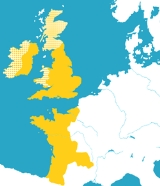
The term Angevin Empire is a modern term describing the collection of states once ruled by the Angevin Plantagenet dynasty.
The Plantagenets ruled over an area stretching from the Pyrenees
to Ireland
during the 12th and early 13th centuries, located north of Moorish Iberia. This "empire" extended over roughly half of medieval France
, all of England
, and some of Ireland. However, despite the extent of Plantagenet rule, they were defeated by the King of France, Philip II Augustus
of the House of Capet
, which left the empire split in two, having lost the provinces of Normandy
and Anjou
. This defeat, after which the ruling Plantagenets retained their English territories and the French province of Gascony
, set the scene for the Saintonge
and the Hundred Years' War
.
and his sons Richard I
and John
. Another son Geoffrey II, Duke of Brittany
ruled Brittany
and established a separate line there. As far as historians know, there was no contemporary term for the region under Angevin control; however descriptions such as "our kingdom and everything subject to our rule whatever it may be" were used. The term Angevin Empire was coined by Kate Norgate
in her 1887 publication, England under the Angevin Kings. In France, the term Espace Plantagenêt (Plantagenet Area) is sometimes used to describe the fiefdoms the Plantagenets had acquired.
The adoption of the Angevin Empire label marked a re-evaluation of the times, considering that both English and French influence spread throughout the dominion in the half century during which the union lasted. The term Angevin itself is the adjective applied to the residents of Anjou
and its historic capital, Angers
; the Plantagenets were descended from Geoffrey, Count of Anjou, hence the term.
The use of the term Empire has raised controversy among some historians, as the area was a collection of the lands inherited and acquired by Henry. It is unclear whether or not these dominions shared any common identity. Some historians argue that the term should be reserved solely for the Holy Roman Empire
, the only Western European political structure actually named an empire at that time. Other historians argue that Henry II's
empire was neither powerful, centralised, nor large enough to be seriously called an empire. There was no imperial title, as implied by the term Angevin Empire. However, even if the Plantagenets themselves did not claim any imperial title some chroniclers, often working for Henry II himself, did use the term empire to describe this assemblage of lands. In essence the highest title was "king of England", to which were added the titles of dukes and counts held in France that were completely and totally independent from the royal title, and not subject to any English royal law. Because of this some historians prefer the term commonwealth to empire, emphasising that the Angevin Empire was more of an assemblage of seven fully independent, sovereign states loosely bound to each other.
, the Lordship of Ireland
, the duchies of Normandy
, Gascony
and Aquitaine
(also called Guyenne) as well as of the Counties of Anjou
, Poitou
, Maine, Touraine
, Saintonge
, Marche
, Périgord
, Limousin
, Nantes
and Quercy
. While the duchies and counties were held with various levels of vassalage to the King of France, the Plantagenets held various levels of control over the Duchies of Brittany
and Cornwall
, the Welsh princedoms
, the county of Toulouse
, and the Kingdom of Scotland
, although those regions were not formal parts of the empire. Further claims were laid over Berry
and Auvergne
, but these were not fulfilled.
The frontiers were sometimes well known and easy to draw, like the one between the royal Demesne
of the King of France and the Duchy of Normandy
, while in other places they were not so clear, especially as regards the eastern frontier of Aquitaine where there often was a difference between the frontiers Henry II
and, later, Richard I
claimed and the ones where their real power ended. One of the most important characteristics of the Angevin Empire was its "polycratic" nature, a term taken from one of the most important political pamphlets written by a subject of the Angevin Empire: the Policraticus by John of Salisbury
.
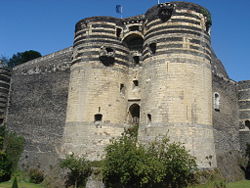
In Aquitaine and Anjou although ducal and comital authorities did exist it was not homogeneous. For example, the family of the Lusignans, very powerful in these lands, proved themselves opponents of importance to the Plantagenets.
It is commonly believed that money raised in England was used for continental issues. Also, due to the high level of administration of England and, to a lesser extent, Normandy, it was the only area where revenue was fairly consistent.
The English revenues themselves varied from a year to year:
In Ireland, the revenue was fairly low, a mere £2,000 for 1212; however, records are missing for the most part.
For Normandy, there were a lot of fluctuations relative to the politics of the Duchy. In 1180, the Norman revenues were only £6,750 while they reached £25,000 a year in 1198, higher than in England. What was more impressive was the fact the Norman population was considerably smaller than England's, an estimated 1.5 million as opposed to England's 3.5 million.
For Aquitaine, Anjou and Gascony there is no record about revenues. It is not that these regions were poor; there were large vineyards, important cities and iron mines. This is what Ralph of Diceto, an English chronicler, wrote about Aquitaine:
The Capetian kings did not record such incomes, although the royal principality was more centralized under Louis VII and Philip II than it used to be under Hugh Capet or Robert the Pious
. The wealth of the Plantagenet kings was definitely regarded as bigger, Gerald of Wales commented on this wealth with these words:
Petit Dutailli had commented that: "Richard maintained a superiority in resources which would have given him the opportunity, had he lived, to crush his rival." There is another interpretation, not widely followed and proven wrong, that the king of France could have raised a stronger income, that the royal principality of the king of France generated alone more incomes than all of the Angevin Empire combined.
 The Counts of Anjou had been vying for power in north-western France for a long time. The Counts were recurrent enemies of the Dukes of Normandy and of the Dukes of Brittany and sometimes even of the King himself. Fulk IV
claimed rule over Touraine
, Maine
and Nantes
; however, of these only Touraine proved to be effectively ruled, as the construction of the castles of Chinon
, Loches
and Loudun
exemplify. Fulk IV married his son Fulk V to Eremburga, the heiress of Maine, thus unifying it with Anjou. While the dynasty of the Angevins was successful, their rivals, the Normans, had conquered England, while the Poitevins had become Dukes of Aquitaine as well as Dukes of Gascony and the Count of Blois
became Count of Champagne
.
King Henry I of England had defeated his brother Robert Curthose, made an enemy of Robert's son William Clito
(who became Count of Flanders
in 1127), and used his paternal inheritance to claim the Duchy of Normandy and the Kingdom of England. Henry I tried to establish an alliance with Anjou against Flanders
by marrying his only legitimate son, William Adelin
, to Fulk V's daughter, but William died in the White Ship disaster
in 1120. Then, Henry I married his daughter Matilda
to Geoffrey V
, however, the Anglo-Normans had to accept Matilda's inheritance to the throne of England. There had been only one occurrence of a medieval Europan queen regnant
before, Urraca of Castile
, and it wasn't an encouraging precedent; nevertheless, in January 1127 the Anglo-Normans barons and prelates recognized Matilda as heiress to the throne in an oath
. On June 17, 1128, the wedding was celebrated in Le Mans
.
, Matilda's cousin and another contender for the throne, was in Boulogne
. Stephen rushed to England upon the news of Henry I's death and was crowned King of England in December 1135.
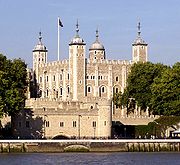 Geoffrey V first sent Matilda alone to Normandy, in a diplomatic mission to be recognized Duchess of Normandy to replace Stephen. However, Geoffrey V wasn't far behind, at the head of his army, and he quickly captured several fortresses in southern Normandy, which he never lost again. It was then that an Angevin noble, Robert III of Sablé, rose up, opening a front on Geoffrey's rear and forcing him to withdraw to Anjou to end the revolt.
When Geoffrey V returned to Normandy in September 1136, the region was plagued with local struggles and infighting among the barons. Stephen was not able to travel to Normandy and as result, the situation remained chaotic. Geoffrey had found new allies with the Count of Vendôme and, most importantly, the Duke of Aquitaine
. At the head of a new army and prepared to conquer Normandy, Geoffrey V was wounded and was forced to return to Anjou once more. Adding to that, an outbreak of diarrhea plagued his army. Orderic Vitalis stated "the invaders had to run for home leaving a trail of filth behind them". Stephen finally arrived in Normandy in 1137 and restored order, but he had lost much of credibility in the eyes of his supporter Robert of Gloucester
. Geoffrey took control of the strongholds of Caen
and Argentan
without resistance, but he now had to defend Robert's possession in England against the anger of the King. In 1139, Robert and Matilda crossed the channel and arrived in England while Geoffrey kept the pressure on Normandy. Stephen was captured in February 1141 at the Battle of Lincoln
, which prompted the collapse of Normandy.
Geoffrey now controlled almost all of Normandy, but no longer had the support of Aquitaine: King Louis VII of France
was now Duke of Aquitaine by his marriage to Duchess Eleanor of Aquitaine
in 1137; he had no interest in the shifts in Norman politics, since he already ruled vast and powerful territories. While Geoffrey V asserted control of Normandy, Matilda was suffering defeats against Stephen's allies. At Winchester
, Robert of Gloucester was captured while covering Matilda's retreat. Matilda freed Stephen in exchange for Robert.
In 1142, Geoffrey V was beseeched to cross the channel and assist Matilda but he refused; he had become more interested in Normandy. Following the capture of Avranches
, Mortain
and Cherbourg, Geoffrey V launched a decisive attack on Rouen
capturing it in 1144. He then anointed himself as Duke of Normandy and, in exchange for the cession of Gisors
to Louis VII, was formally recognized by the King. Satisfied with his new role in Normandy, Geoffrey V made no effort to assist Matilda in England even as she was on the verge of defeat. Helie (Elias), Geoffrey's younger brother, felt that he deserved his fair share and asked for Maine. No sooner had that issue been settled, another Angevin noble rebelled: Gerald Berlay, newly appointed seneschal of Poitou by Louis VII, led a revolt in southern Anjou against Geoffrey V.
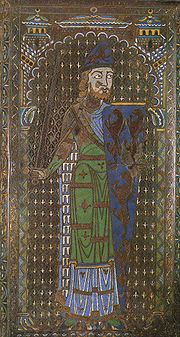 Stephen had by no means given up his claims on Normandy. Even though Louis VII had clearly recognised Geoffrey Plantagenet as duke, an alliance between the two Kings was possible because of the issue over Gerald Berlay. Louis VII agreed to recognise Geoffrey's son Henry as the new duke in 1151 in exchange of concessions in Norman Vexin
. The death of Geoffrey, aged only 38, made Henry
count of Anjou in 1151. According to the story told by William of Newburgh
(in the 1190s) Geoffrey declared that Henry would have to hand down Anjou to one of his young brothers, also called Geoffrey, if he was to win the crown of England. To compel Henry to follow his will, Geoffrey V had ordered that he be left without sepulture until Henry swore an oath that he would renounce Anjou if he were to acquire England.
 In March 1152, Louis VII and Eleanor of Aquitaine divorced under the pretext of consanguinity at the council of Beaugency because the couple was not getting along. The terms of the divorce left Eleanor as Duchess of Aquitaine but under rule of the King; eight weeks later she married Henry (who was no less related to her than was Louis VII). With Henry thus becoming Duke of Aquitaine and Gascony, it was obvious he would never give Anjou up to his brother, since it would mean splitting his land into two parts. A coalition of all of Henry's enemies was set up by Louis VII: King Stephen of England and his son Eustace IV of Boulogne
(married to Louis' sister), Henry the Liberal
(promised to Eleanor's daughter), Robert of Dreux
(Louis VII's brother) and Geoffrey who no longer had hope of being given Anjou.
In July 1152, Capetian troops attacked Aquitaine while Louis VII himself, along with Eustace IV, Henry of Champagne and Robert of Dreux attacked Normandy. Geoffrey raised a revolt in Anjou while Stephen attacked Angevin loyalists in England. Several Anglo-Norman nobles switched allegiance, feeling the forthcoming disaster. Henry was about to sail for England to pursue his claim when his lands were attacked. He first reached Anjou and compelled Geoffrey to surrender, and then took the decision to sail for England in January 1153 in order to meet Stephen. Luckily enough Louis VII fell ill and had to retire from the conflict while Henry's defences held against his enemies. After seven months of both battles and political gambles Henry failed to get rid of King Stephen; then Eustace IV died in dubious circumstances, "struck by the wrath of god." This was the last straw and King Stephen gave up the struggle by ratifying the Treaty of Winchester
. He made Henry his heir on condition that the land possessions of his family were guaranteed in England and France—the same terms Matilda had refused after her victory at Lincoln
. Henry became Henry II of England in December 1154. Subsequently the question was again raised of Henry's oath to cede Anjou to his brother Geoffrey. Henry II received a dispensation from Pope Adrian IV
under the pretext the oath had been forced upon him, and he proposed compensations to Geoffrey at Rouen in 1156, but the latter refused and returned to Anjou to rise once again against his brother. If Geoffrey had a solid moral claim, his position was nonetheless very weak. Louis VII wouldn't interfere since Henry II paid homage to the King of France for Normandy, Anjou and Aquitaine as vassal. Henry II crushed Geoffrey's revolt, and Geoffrey had to be satisfied with an annual pension.
David of Scotland
had taken advantage of The Anarchy
to seize Cumberland
, Westmorland
and Northumberland
. In Wales important leaders like Rhys of Deheubarth
and Owain Gwynedd
had emerged. In Brittany, there is no evidence that the Duke of Brittany, namely Eudes
, had recognised the Norman overlordship. Two vital frontier castles, Moulins-la-Marche
and Bonmoulins, had never been taken back by Geoffrey Plantagenet and were in the hands of Robert of Dreux. Count Thierry of Flanders
had joined the alliance formed by Louis VII in 1153. Further south, the Count of Blois acquired Amboise
. From Henry II's perspective, there were some issues to solve.
King Henry II showed himself to be an audacious and daring king; he was also active and mobile. Though he was often more present in France than in England as Ralph of Diss, Dean of St Paul's, said with irony:

and Neufmarché back in 1154. From now on this new strategy regulated the Plantagenets-Capetians relationship. Louis VII couldn't deny his own unsuccessful attempt at breaking Henry II down. Because of the Angevin control of England in 1154 it was pointless to object to the superiority of the overall Angevin forces over the Capetian ones. Yet, Henry II wouldn't stop claiming the land until the Norman Vexin was entirely recovered. Thomas Beckett was sent as ambassador to Paris in 1158 for leading negotiations and he displayed all the wealth the Angevins could boast of to the Capetians. Louis VII's daughter, Margaret
who was still a baby was promised to Henry
the "future young king" (King Henry II's son). Although a baby, Margaret was old enough to be given a dowry
at her wedding. This dowry happened to be the Norman Vexin. Henry II was given back the castles of Moulins-la-Marche and Bonmoulins. Theobald the Good
handed Amboise back to him.
died without an inheritance, he was Stephen's last son, leaving the titles of Count of Boulogne
and Count of Mortain vacant. Henry II absorbed the County of Mortain but wanted to grant Boulogne to Thierry's son, Matthew, who married Marie of Boulogne
. The title of Count of Boulogne
was accompanied with important manors in London and Colchester
.
England traded much of its wool with Flanders via the port of Boulogne. An alliance with these two counties was then logically sealed by this wedding and the concessions of manors. Henry II had to get Marie out of her convent first, which had been a common practice in England since the Normans. In 1163, the few official remaining documents showed Henry II and Thierry renewed the treaty signed by William the Conqueror. Flanders would provide Henry II with knights in exchange of an annual tribute in money.
declared his son Hoël
a bastard and disinherited him. It was his sister Bertha
who became Duchess of Brittany making her husband of the time, Eudes
, nominally Duke. Hoël was then co-ruler with his brother in law, and had to be satisfied as Count of Nantes. Bertha was the widow of Alan de Bretagne
with whom she already had a son, Conan
. Conan who had become Earl of Richmond
in 1148 was Henry II's perfect candidate to become the new Duke of Brittany as any Duke with possessions of importance in England could be easier to control.
In 1156, the Duchy of Brittany was hit by civil unrest which led to Conan IV's accession while in Nantes
the population called for Henry II's help against Hoël. Geoffrey (Henry II's brother again) was made new Count of Nantes by Henry II, but he did not hold the position for long, as he died in 1158 at only 24 years of age. In 1158, Conan IV
briefly ruled as Count of Nantes however, Henry II took the title that same year by mustering an army in Avranches
to threaten Conan. In 1160 Henry II married his cousin Margaret of Scotland
to Conan in an arranged wedding. He then appointed the archbishop of Dol
. Without a tradition of a strong rule in Brittany, discontent grew among the nobles. This led to a revolt that Henry II answered in 1166. He betrothed his own 7-year-old son, Geoffrey
, to Conan's daughter and later forced Conan to abdicate for his future son-in-law, making Henry II the ruler of Brittany, yet not the Duke. Breton
nobles strongly opposed this, and more attacks on Brittany followed, first in 1167, then in 1168, and finally in 1173. Each of these invasions were followed by confiscations, and Henry II installed his men, William Fitzhamo and Rolland of Dinan, in the area. Although it was not formally part of the Plantagenet fiefdom, Brittany was under firm control.
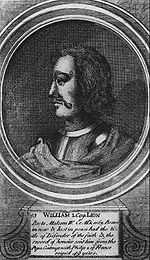 Henry II met Malcolm IV
in 1157 about Cumberland
, Westmorland
and Northumberland
previously seized by his grandfather, David I of Scotland
. In 1149, before Henry II became powerful, he made an oath to David that the lands north of Newcastle
should belong to the King of Scotland forever. Malcolm reminded him of this oath but Henry II did not comply. There is no evidence that Henry II got a dispensation from the pope
this time, as William of Newburgh put it, "prudently considering it was the king of England who had the better of the argument by reason of his much greater power."
Malcolm IV gave up and paid homage in return for Huntingdon
, which he inherited from his father.
William the Lion
, the next King of Scotland, was unhappy with Henry II since he was given Northumberland by David I in 1152 and therefore lost it to Henry II when Malcolm IV handed it back in 1157.
As a part of the coalition set by Louis VII, William the Lion first invaded Northumberland in 1173 and then again in 1174, as a result he was captured near Alnwick
and had to sign the tough Treaty of Falaise
. Garrisons were to be set in the castles of Edinburgh
, Roxburgh
, Jedburgh
and Berwick
. Southern Scotland was from then under firm control just as Brittany was. Richard I of England would end the Treaty of Falaise in exchange for money to fund his crusade
, setting a context for cordial relationships between the two lion kings.
, also called Lord Rhys, and Owain Gwynedd
were closed to negotiations. Henry II had to attack Wales three times, in 1157, 1158 and 1163 to have them answer his summons to the court. The Welsh found his terms too harsh and largely revolted against him. Henry then undertook a fourth invasion in 1164, this time with a massive army. According to the Welsh chronicle Brut y Tywysogion
, Henry raised "a mighty host of the picked warriors of England and Normandy and Flanders and Anjou and Gascony and Scotland" in order to "carry into bondage and to destroy all the Britons
."
Bad weather, rains, floods, and constant harassment from the Welsh armies slowed the Angevin army and prevented the capture of Wales (see the Battle of Crogen
); a furious Henry II had Welsh hostages mutilated. Wales would remain safe for a while, but the invasion of Ireland in 1171 pressured Henry II to end the issue through negotiations with Lord Rhys.
 Further plans of expansion were considered as Henry II's last brother didn't have a fiefdom. The Holy See
was most likely to support a campaign in Ireland which would bring its church into the Christian Latin world of Rome. Henry II was given Rome's blessing in 1155 under the form of a Papal bull
but had to postpone the invasion of Ireland because of all the issues in his domains and around them. In the terms of the Bull Laudabiliter, "Laudably and profitably does your magnificence contemplate extending your glorious name on earth."
William X, Count of Poitou died in 1164 without being installed in Ireland, but Henry II didn't gave up on the conquest of Ireland. In 1167 -Dermot of Leinster
- an Irish King, was recognised as "prince of Leinster
" by Henry II and was allowed to recruit soldiers in England and Wales to use in Ireland against the other Kings. The knights first met great success in carving themselves lands in Ireland, so much it worried Henry II enough to land himself in Ireland in October 1171 near Waterford
and confronted to such demonstration of power most native kings of Ireland recognised him as their lord. Even Rory O' Connor
, the king of Connacht
who claimed to be High King of Ireland paid homage to Henry II. Henry II installed some of his men in strongholds like Dublin and Leinster
(as Dermot was dead). He also gave unconquered kingdoms such as Cork
, Limerick
and Ulster
to his men and left the Normans carving their lands in Ireland. In 1177 he made John
, his son, the first Lord of Ireland
, though John was too young and landed in Ireland
only in 1185. He failed to install his authority on the land and had to return to Henry II. Only 25 years later John would return to Ireland while others built castles and installed their interests.
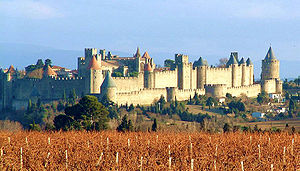 Much less tenable was the claim over Toulouse
. Eleanor's ancestors claimed the huge County of Toulouse as it used to be the central power of the ancient Duchy of Aquitaine back in the times of Odo the Great
. Henry II and maybe even Eleanor were probably totally unrelated to this ancient line of dukes (Eleanor was a Ramnulfid
while Henry II was an Angevin). Toulouse was a very large city, heavily fortified and much richer than many cities of the time. It was of strategical importance as it is between the Atlantic Ocean and the Mediterranean. The County of Toulouse was the largest state of the Kingdom of France with its large access to the Mediterranean Sea itself, and included significant cities like Narbonne
, Cahors
, Albi, Nîmes
and Carcassonne
.
Toulouse wasn't easy prey though. The city was incredibly large and fortified for a medieval city. Not to mention the least, Raymond V
was married to Louis VII's sister therefore attacking Toulouse would have endangered the policy of peace with the King of France. The County of Toulouse
had also many heavily fortified areas like Carcassonne and its five sons: Queribus
, Aguila, Termes
, Peyrepertuse
and Puylaurens
and many more castles and fortified cities.
In June 1159 Henry II gathered in Poitiers
what probably was the biggest army he had ever sent, formed by troops from all of his fiefdom (from Gascony to England), that army also included reinforcements sent by Thierry and Malcolm IV. Henry II attacked from the north while other of his allies, namely the Trencavel
s and Ramon Berenguer
opened a different front. Henry II couldn't capture Toulouse proper and the recurrent conflicts with Toulouse would be called the Forty Years War with Toulouse by William of Newburgh
. Henry II captured Cahors
though as well as various castles in the Garonne
valley (in the Quercy
region), he came back in 1161 and then too busy with conflicts elsewhere in his fiefdom he left his allies fighting against Toulouse. Alfonso II
the King of Aragon himself having interests there joined the war. In 1171 Henry II set an alliance with Humbert of Maurienne
adding one more enemy of Raymond V to his alliance. In 1173, in Limoges
, Raymond
finally gave up after over a decade of constant fights. He paid homage to Henry II, to his son also called Henry
and to his other son Richard the Lionheart newly appointed new Duke of Aquitaine.
Even Walter Map
, a contemporary English satirical chronicler, had been kind toward Louis VII and praised him marking a contrast with the harsh critiques he did toward other kings.
King Louis VII was a man of peace who hated violence and war but the attacks on Toulouse made clear that peace with Henry II wasn't peace at all but just the opportunity to make war elsewhere. Louis VII himself was in an awkward position: his subject was more powerful than he was by a large degree and worst of all he had no male heir. Constance
, his second wife, died in childbirth in 1160 and Louis VII announced he would remarry at once, in the urgent need of a male heir, with Adèle of Champagne
. The young Henry was finally married to Margaret aged only 2, under the pressure of Henry II, and as declared in 1158 the Norman Vexin went to him as the dowry. Had Louis VII died without male heir, Henry the Young would have been in a comfortable position to become the next King of France himself.
In 1164 King Louis found a rather turbulent ally in Archbishop Thomas Beckett. King Louis and Thomas Beckett had met previously in 1158, but now the circumstances were very different. Louis had got already a few clerical refugees in his land, and was then called Rex Christianisimus (most Christian king) by John of Salisbury
.
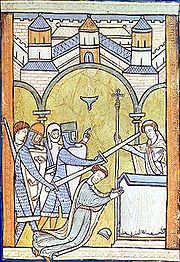 Indeed there were growing conflicts between the king of England and the archbishop and Henry II provoked Thomas Beckett's murder by pronouncing words like, "What miserable traitors have I nourished in my household who led their lord be treated with such shameful contempt by a low-born clerck!"
Thomas Beckett was murdered in 1170, and the Christian world blamed Henry for this. Louis, who had protected Thomas Beckett, gained general approval against Henry. Although his secular power was still much weaker than Henry's, Louis now had the moral advantage.
In 1165, the idea of a possible succession of Henry the Young to the throne of France was all gone away as Philip
was given birth by Adèle. With the birth of the next King of France it was clear peace was over, Henry II claimed Auvergne
in and marched on it in 1167 while he also claimed Bourges
and attacked it in 1170. Louis VII answered by raiding the Norman Vexin forcing Henry II to relocate his troops to the north and Louis VII then marched south and freed Bourges. At that point, not just Louis VII was wondering if Henry II's expansionism would ever end.
Henry II never treated his land as a coherent sovereign but much more as private possessions he planned to distribute his children. Henry the young was crowned King of England in 1170 but never actually ruled, in 1172 Richard the Lionheart became Duke of Aquitaine, in 1181 Geoffrey became Duke of Brittany, John became Lord of Ireland in 1185 while Leonora
(born in 1161) was promised to Alfonso VII with Gascony as dowry during the campaign against Toulouse in 1170. This partition of the lands between his children made it much harder for him to control them, as several of them would then turn against him.
Following his coronation Henry the Young King
asked for part of his inheritance, at least England or Normandy or Anjou, but Henry II the Old King refused to hand down anything. Henry the Young then joined Louis VII at his court, Eleanor of Aquitaine herself joined the conflict and both Richard the Lionheart and Geoffrey of Brittany joined their brother at the court of the King. From then, states that Henry II had pressured joined the conflict against him. Another King to join Louis VII was William the Lion, King of Scotland. Philip
, the Count of Flanders
also joined the conflict, as well as the Count of Boulogne
and Theobald
the Count of Blois
. Henry II emerged victorious of that conflict: because of his wealth he could recruit very large amount of mercenaries, and he had captured and imprisoned Eleanor early on as well as captured William the Lion and forced him into the Treaty of Falaise
. Henry II bought the County of Marche
, then he asserted the French Vexin and Bourges should be given at once, but this time there was no invasion to back the claim.
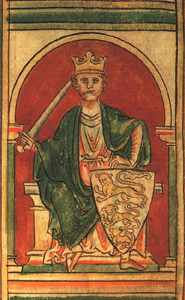
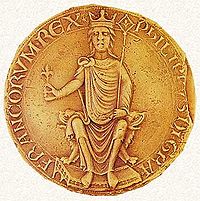 Louis VII died and was buried in the Saint Denis Basilica
in 1180. His son, aged only 15, ascended of France and in 1183. Philip II of France
's policy was to use Henry II's sons against him. Richard the Lionheart was administrating Aquitaine since 1175 but his policy of centralisation of the Aquitanian government had grown unpopular in the eastern part of the Duchy, notably Périgord
and Limousin
. Richard the Lionheart was accused of many crimes there, among which murders and rapes. If Richard was not so popular in Aquitaine, Philip II was not really liked either by contemporaries with comments describing him as: astute, manipulative, calculating, penurious and ungallant ruler.
In 1183, Henry the Young King joined a revolt led by Limoges
and Geoffrey of Lusignan against Richard in order to take Richard's place. They were joined by Philip II, Raymond V and by Duke Hugh III of Burgundy
. Henry the Young died suddenly of a fatal illness in 1183, saving Richard's position. Henry the Young King was buried in Notre Dame de Rouen
.
Richard was then Henry II's oldest son and inherited much of Henry the Young King's status. Henry II ordered him to hand down Aquitaine to John Lackland, but Richard refused to comply. Henry II had too much to cope with at the time to take care of this, Welsh princes were now contesting his authority, William the Lion was asking for his castles to be given back and as Henry the Young was dead Philip II asked for the Norman Vexin to be given back. Henry II finally asked Richard I to surrender Aquitaine to Eleanor while Richard retained the control. Still in 1183, Raymond V had taken Cahors back and Henry II asked Richard to mount an expedition against Toulouse. Geoffrey of Brittany was quarrelling violently with his brother Richard and it was obvious Geoffrey could be used by the Capetians but his sudden death in 1186 in a tournament killed the plot. In 1187, Philip II and Richard were more than strong allies, as Roger of Hoveden
reported:
In 1188 Raymond V attacked again, joined by the Lusignans. It was rumoured that Henry II himself financed the revolts. By this time Philip II attacked Henry II in Normandy and captured strongholds in Berry
. In 1188, Philip II and Henry II met to discuss peace again, Henry II refused to make Richard his heir. One story reports that Richard said "Now at last, I must believe what I had always thought impossible."
This was the final collapse of all Henry's strategy. First Richard paid homage to the King of France for all the lands his father held. As Richard and Philip II attacked Henry II no one in Aquitaine stood for him and the Bretons seized the opportunity to attack him too. Even Henry's birthplace, Le Mans, was captured and Tours also soon fell. He was simply encircled in his castle of Chinon. Henry was finally compelled to surrender. He gave a large tribute in money to Philip II and swore that all his subjects in France and England would recognise Richard as their lord. Henry II died two days later, learning John had joined Richard and Philip. The old king was buried in Fontevraud Abbey
.
Eleanor, who was Henry's hostage, was then freed while Lord Rhys raised and began to reconquer the southern parts of Wales that Henry had annexed. Richard I was crowned King in Westminster Abbey
in November 1189, while he was already installed as Duke of Normandy, Count of Anjou and Duke of Aquitaine. Philip II asked for the Norman Vexin to be given back but the issue was settled when Richard I announced he would marry Alys
, Philip II's sister. Richard I also recognised Auvergne was meant to belong to the crown of France and not to the Duke of Aquitaine ending Henry's claim on the place. In Britain King William of Scotland opened negotiations with King Richard of England (the two lion kings) to revoke the Treaty of Falaise and an agreement was reached.
- was no less than Richard's cousin. The crusade as well as French issues would be the reason for Richard's absence in England: the Lion Heart would spend less than six months of his reign in England.
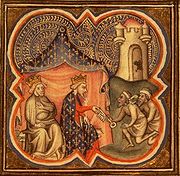 Before leaving, Richard I had to make sure nothing went wrong while he was in the Holy Land
. There was little doubt Raymond V would take the opportunity to expand his lands in Aquitaine. To counter that threat, he built an alliance with Sancho VI the Wise
the King of Navarre. On the way to the Holy Land, Richard I married Berengaria
the princess of Navarre
in 1191, therefore repudiating Alys. To calm down Philip II, he accepted that if he had two sons the youngest should take Normandy or Aquitaine or Anjou and rule it for the King of France.
The administration left behind worked rather well, as an attack from the Count of Toulouse was repelled with the help of Sancho VI. The Siege of Acre was over. (Richard I had also upset Leopold V the Virtuous
by removing his banner from Acre.) Much has been said about the reasons Philip II went back to France; it is often considered his dysentery was the principal reason. Other causes could have been the way his sister had been treated by Richard I or that he couldn't stand that his subject had more power and wealth than he did or even that following the Count of Flanders's death, Philip came back to ask for his share of the land of Artois
.
Richard I left Palestine
in October 1192 and would have retrieved his lands intact had he reached home in time. But Leopold V
arrested him near Vienna
, accusing him of the murder of his cousin Conrad, and then handed him down to Emperor Henry VI
. John Lackland was summoned to Philip II's court and accepted to marry Alys with no less than Artois has a dowry. In return, the entire Norman Vexin would be given to the King of France. After all, no one was sure if Richard I would be ever released. Yet, all of the forces John could gather were a bunch of mercenaries as even William the Lion did not join his revolt and also sent money for Richard's ransom. Another revolt in Aquitaine was suppressed by Elias de la Celle, but in Normandy Philip II himself was leading the operations. By April 1193 he had reached Rouen
and although the ducal capital couldn't be taken, he and his allies were then controlling all the ports from the Rhine to Dieppe
. Confronted to the situation, Richard's regents conceded the Treaty of Mantes
in July 1193, confirming Philip II's control on all the land he had taken including the entire Norman Vexin, the castles of Drincourt and Arques
in Normandy and the castles of Loches
and Châtillon
in Tourraine as well as adding a substantial payment once Richard is back.
In a new treaty in 1194, concessions to the King of France went much further, when Tours with all the castles of Tourraine and all of Eastern Normandy except for Rouen were surrendered. The County of Angoulême
was declared independent of Aquitaine, Vendôme
was given to Louis of Blois
and Geoffrey III of Perche acquired Moulins
and Bonmoulins. Emperor Henry VI finally released Richard I in 1194 in exchange of the ransom.
and Artois. England was Richard's most secure possessions, Hubert Walter
who had been to the crusade with the King of England was appointed his justiciar. King Richard took over John's lordship over Ireland and rejected William the Lion's claim over the northern territories.
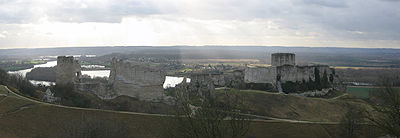 Richard I had merely crossed the English Channel
to claim back his territories that John Lackland betrayed Philip II by murdering the garrison of Évreux
and handing the town down to Richard I. "He had first betrayed his father
, then his brother
and now our King
" said William the Breton
. Sancho the Strong
, the future King of Navarre, joined the conflict and attacked Aquitaine, capturing Angoulème and Tours. Richard himself was known to be a great military commander. The first part of this war was difficult for Richard who suffered several setbacks, for Philip II was also a great commander and politician. But by October the new Count of Toulouse, Raymond VI
, left the Capetian side and joined Richard's. He was followed by Baldwin IV of Flanders
, the future Latin Emperor
, as this one was contesting Artois to Philip II. In 1197, Henry VI died and was replaced by Otto IV
, Richard I's own nephew. Renaud de Dammartin
, the Count of Boulogne and a skilled commander, also deserted Philip II. Baldwin IV was invading Artois and captured Saint-Omer
while Richard I was campaigning in Berry and inflicted a severe defeat to Philip II at Gisors
, close to Paris. A truce was accepted, and Richard I had almost recovered all Normandy and now held more territories in Aquitaine than he had before. Richard I had to deal with a revolt once again, but this time from Limousin
. He was struck by a bolt in April 1199 at Châlus-Chabrol
and died of a subsequent infection. His body was buried at Fontevraud
like his father.
in a rush. John tried to take the Angevin treasure and the castle of Chinon to install his power. But, in the local custom, the son of an older brother was preferred to a claimant. Henceforth they recognised Arthur
as their ruler, son of Geoffrey of Brittany
, depriving John of the Angevins' ancestral land. Only in Normandy and England he could install his rule. In Rouen, Normandy, he was made Duke in April 1199 and he was crowned King of England in May at Westminster Abbey
. He left his mother, Eleanor, controlling Aquitaine.
His allies, Aimeri of Thouars and three Lusignan nobles led an attack on Tours in an attempt to capture Arthur and install John as count. Aimeri of Thouars was promised the title of seneschal had he captured Arthur. By this time John went to Normandy to negotiate a truce with Philip II. He took profit of this truce to gather Richard's former allies, especially the Count of Boulogne, the Count of Flanders and the Holy Roman Emperor. In the end no less than 15 French counts swore allegiance to John who was now definitely in a much stronger position than Philip II. A strong supporter of the King—William des Roches
—even switched side in front of so much power and handed down Arthur, whom he was supposed to protect, to John. Arthur managed to espace and join Philip II's court very soon though. It was also the moment the Count of Flanders and many knights decided to join the crusade
in 1199 and deserted John's court. John's dominant position was short-lived and then he had to accept the Treaty of Le Goulet
in 1200. Philip II was confirmed over the lands he had taken in Normandy joined by further concessions in Auvergne and Berry. John was recognised at the head of Anjou in return of what he swore he would not interfere if Baldwin IV or Otto IV attacked Philip II.
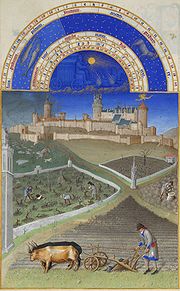 Hugh IX of Lusignan
took Eleanor in hostage; John then recognised him as Count of Marche
, thus expanding Lusignan power in the region. In August 1200, John had his first marriage annulled and he married Isabella
who was already betrothed to Hugh X
. John then confiscated La Marche. The Lusignans themselves called for Philip II's intervention, and he summoned John to his court. John refused to meet his King, so Philip II used his power of suzerainty
to confiscate all the lands John held in France. Phillip then accepted Arthur's homage, granting Arthur control of Poitou, Anjou, Maine, and Tours in 1202. Raymond VI
, Count of Toulouse, joined Philip II, as did Renaud de Dammartin. Most of John's other allies were either in the Holy Land or had deserted him. Of them, only Sancho VII the Strong remained, and he was in a weak position and unable to render much assistance to John.
Arthur launched an attack in Poitou with his Lusignan allies, while Philip II attacked Normandy and captured many castles on the frontier. John was in Le Mans when the attacks were launched and decided to move southward. John's forces captured Arthur along with Hugh X and 200 knights; this success was quickly followed by the capture of the Viscount of Limoges, who John imprisoned in Chinon. The year 1202 was a time of triumph for John, who had distinguished himself from Richard I nor Henry II by succeessfully stifling his enemies.
Unfortunately, John suffered from a fatal character flaw: "he could not resist the temptation to kick a man when he was down." He took pleasure in humiliating his enemies. After Arthur was murdered in prison (almost certainly at John's command), many of John's supporters deserted him.
John's former allies, many of whom now actively fought against him, handed Alençon
over to Philip II in Normandy. Vaudreuil
was delivered to the King of France without a fight. John, who was trying to retake Alençon, was forced to withdraw once Philip II arrived. Château Gaillard itself had fallen in 1204 after a six month siege; this was a devastating loss for the Angevins. Philip II continued campaigning in Normandy and successfully captured Argentan
, Falaise
, Caen
, Bayeux
and Lisieux
in only three weeks. At the same time, a force of Breton knights captured the Mont Saint-Michel
and Avranches
. Tours fell in 1204, Loches and even Chinon followed in 1205; only Rouen and Arques continued to resist. Rouen finally capitulated and opened its gates to the King. The ducal castle was then destroyed and a bigger one was commissioned.
Eleanor died in 1204. Most of the Poitevin nobles joined Philip II since they were loyal to Eleanor, but not to John. After Eleanor's death, Alfonso VIII asked for Gascony, which was part of the dowry Henry II had given his daughter. Gascony was one of the few French portions of the once-powerful "Angevin Empire" to remain loyal to the Angevins; the Gascons resisted Alfonso and the territory remained under John's control.
The two kings finally agreed to a truce in 1206. The "Angevin Empire" had been reduced to only Gascony, Ireland, and England.
In 1212, John was ready to land and invade France, but a revolt in Wales forced him to delay his plans and then a baronnal revolt in England made it worse. Philip II was then also in preparation for an invasion of England, but his fleet was destroyed while anchored at Damme
by the Earl of Salisbury
, William Longespee. Hearing of the news, John ordered all the forces he had set to defend England to sail for Poitou. He landed in La Rochelle in 1214 and was then allied with Renaud de Dammartin, Count Ferdinand of Flanders
and of course with Otto IV. His allies would attack in the northeast of France while he would attack from the southwest. John went to Gascony and tried to install his garrison in Agens, but it was expelled. Unlike Normandy, Philip II had never invaded Poitou; it had just switched its allegiance. In order to invade Paris from England, it was much easier to go through Normandy than through the southwest. Thus, King Philip II concentrated his efforts there.
The sword swung two ways, as for Philip II it was easier to launch an invasion of England from Normandy. As a consequence, Poitou was left without a strong royal presence. John betrothed his daughter, Joan, to Hugh IX of Lusignan
's son Hugh X
, in return for which the Lusignans were granted Saintonge and the Island of Oleron
, as well as possibilities of further concessions in Touraine and Anjou. These were huge gains for the Lusignans, yet John called that bringing them to submit.
Peter
was the Duke of Brittany of the time. He was loyal to the King of France, but his claim to the rule of Brittany was fairly weak. If anything, Eleanor
of Brittany had a stronger claim, as she was the elder sister of the defunct Arthur. John had her captured and used her as blackmail against Peter with one hand, while tempting him by offering Richmond
with the other hand. Peter refused to change allegiance in the end, and not even the capture of his brother Robert III of Dreux
near Nantes made him change his stance.
John entered Angers
and captured a newly built castle at Roche-au-Moine
; but Prince Louis
rushed from Chinon with an army and took it back by pushing John to retreat. Even though this was a setback, John had at least made the job of his allies easier by dividing the Capetian army. Then happened the disastrous Battle of Bouvines
, in which all his allies were defeated by King Philip II.
John was beaten, the economy of the Kingdom of England was bankrupted, and he was seen as a failed plunderer. All of the money that he could gather and all of the power that he used, brought nothing and his allies were all dead or captured. Unable to regain Brittany, he also abandoned the idea to release his niece, in order to prevent her potential threat to his throne, leading the deserted princess to end up in prison decades later.
This quote, taken from Capetian France 987–1328, summarises the reasons of the Angevin collapse:
, sent a letter to the French court offering the crown of England to Prince Louis, now a maternal grandson-in-law of Henry II. By November a Capetian garrison was sent to London to support the rebels. On 22 May 1216 Capetian forces landed at Sandwich
led by Prince Louis himself. John fled, allowing Louis to capture London and Winchester. By August, Louis controlled most of eastern England; only Dover
, Lincoln
, and Windsor
remained loyal to John. Even King Alexander II
of Scotland travelled to Canterbury
and paid homage to Prince Louis, recognizing him as King of England.
John died two months later, defeated even in England. In contrast to John's failure to honour the terms of Magna Carta
, the regency
which followed him (Henry III
being a minor) ruled in compliance with it. The Anglo-Norman barons therefore withdrew their support from Louis. He was defeated nearly a year later at Lincoln
and Sandwich, and dropped his claim to the English crown by the Treaty of Lambeth
in September 1217.
. Historically both English and French historians had viewed the juxtaposition of England and French lands under Angevin control as something of an aberration and an offence to national identity. To English historians the lands in France were an encumbrance, while French historians considered the union to be an English empire.
This is what Whig historian Macaulay
, in 1849, wrote in his History of England about the union of the two lands.
The Plantagenet kings had adopted wine
as main drink, replacing beer
and cider
used by the Norman kings. The ruling class of the Angevin Empire was also French speaking
.
The 12th century is also the century of the Gothic architecture
, first known as "Opus Francigenum", from the work of the Abbot Suger
at Saint Denis
in 1140. The Early English Period began around 1180 or 1190, in the times of the Angevin Empire, but this religious architecture was totally independent of the Angevin Empire, it was just born at the same moment and spread at those times in England. The strongest influence on architecture directly associated with the Plantagenets is about kitchens.
Richard I's personal arms of three golden lions passant guardant on a red field appear in most subsequent English royal heraldry
, and in variations on the flags of both Normandy and Aquitaine.
From a political point of view the continental issues were given more attention from the monarchs of England than the British ones already under the Normans. Under Angevin lordship things became even more clear as the balance of power was dramatically set in France and the Angevin kings often spent more times in France than England. With the loss of Normandy and Anjou the fiefdom was cut in two and then the descendants of the Plantagenets can be regarded as English kings accounting Gascony in their domain. This is accordant with the newfound Lordship of Aquitaine being conferred upon the Black Prince of Wales, passing thence to the House of Lancaster, which had pretensions to the Crown of Castile, much as Edward III had to France. It was this assertion of power from England onto France and from Aquitaine onto Castile which marked the difference from earlier in the Angevin period.
The Plantagenets ruled over an area stretching from the Pyrenees
Pyrenees
The Pyrenees is a range of mountains in southwest Europe that forms a natural border between France and Spain...
to Ireland
Ireland
Ireland is an island to the northwest of continental Europe. It is the third-largest island in Europe and the twentieth-largest island on Earth...
during the 12th and early 13th centuries, located north of Moorish Iberia. This "empire" extended over roughly half of medieval France
France
The French Republic , The French Republic , The French Republic , (commonly known as France , is a unitary semi-presidential republic in Western Europe with several overseas territories and islands located on other continents and in the Indian, Pacific, and Atlantic oceans. Metropolitan France...
, all of England
England
England is a country that is part of the United Kingdom. It shares land borders with Scotland to the north and Wales to the west; the Irish Sea is to the north west, the Celtic Sea to the south west, with the North Sea to the east and the English Channel to the south separating it from continental...
, and some of Ireland. However, despite the extent of Plantagenet rule, they were defeated by the King of France, Philip II Augustus
Philip II of France
Philip II Augustus was the King of France from 1180 until his death. A member of the House of Capet, Philip Augustus was born at Gonesse in the Val-d'Oise, the son of Louis VII and his third wife, Adela of Champagne...
of the House of Capet
House of Capet
The House of Capet, or The Direct Capetian Dynasty, , also called The House of France , or simply the Capets, which ruled the Kingdom of France from 987 to 1328, was the most senior line of the Capetian dynasty – itself a derivative dynasty from the Robertians. As rulers of France, the dynasty...
, which left the empire split in two, having lost the provinces of Normandy
Normandy
Normandy is a geographical region corresponding to the former Duchy of Normandy. It is in France.The continental territory covers 30,627 km² and forms the preponderant part of Normandy and roughly 5% of the territory of France. It is divided for administrative purposes into two régions:...
and Anjou
Anjou
Anjou is a former county , duchy and province centred on the city of Angers in the lower Loire Valley of western France. It corresponds largely to the present-day département of Maine-et-Loire...
. This defeat, after which the ruling Plantagenets retained their English territories and the French province of Gascony
Gascony
Gascony is an area of southwest France that was part of the "Province of Guyenne and Gascony" prior to the French Revolution. The region is vaguely defined and the distinction between Guyenne and Gascony is unclear; sometimes they are considered to overlap, and sometimes Gascony is considered a...
, set the scene for the Saintonge
Saintonge War
The Saintonge War was a feudal dynastic encounter that occurred in 1242 between forces of Louis IX of France and those of Henry III of England. Saintonge is the region around Saintes in the center-west of France. The conflict arose because some vassals of Louis were displeased with accession of his...
and the Hundred Years' War
Hundred Years' War
The Hundred Years' War was a series of separate wars waged from 1337 to 1453 by the House of Valois and the House of Plantagenet, also known as the House of Anjou, for the French throne, which had become vacant upon the extinction of the senior Capetian line of French kings...
.
Origin of the term and its application
The Angevin Empire is a neologism defining the lands of the Plantagenets: Henry IIHenry II of England
Henry II ruled as King of England , Count of Anjou, Count of Maine, Duke of Normandy, Duke of Aquitaine, Duke of Gascony, Count of Nantes, Lord of Ireland and, at various times, controlled parts of Wales, Scotland and western France. Henry, the great-grandson of William the Conqueror, was the...
and his sons Richard I
Richard I of England
Richard I was King of England from 6 July 1189 until his death. He also ruled as Duke of Normandy, Duke of Aquitaine, Duke of Gascony, Lord of Cyprus, Count of Anjou, Count of Maine, Count of Nantes, and Overlord of Brittany at various times during the same period...
and John
John of England
John , also known as John Lackland , was King of England from 6 April 1199 until his death...
. Another son Geoffrey II, Duke of Brittany
Geoffrey II, Duke of Brittany
Geoffrey II, Duke of Brittany and Earl of Richmond was Duke of Brittany between 1181 and 1186, through his marriage with the heiress Constance. Geoffrey was the fourth son of King Henry II of England and Eleanor, Duchess of Aquitaine.-Family:He was a younger maternal half-brother of Marie de...
ruled Brittany
Brittany
Brittany is a cultural and administrative region in the north-west of France. Previously a kingdom and then a duchy, Brittany was united to the Kingdom of France in 1532 as a province. Brittany has also been referred to as Less, Lesser or Little Britain...
and established a separate line there. As far as historians know, there was no contemporary term for the region under Angevin control; however descriptions such as "our kingdom and everything subject to our rule whatever it may be" were used. The term Angevin Empire was coined by Kate Norgate
Kate Norgate
Kate Norgate was a British historian. She was one of the first women to achieve academic success in this sphere. She is best known for her history of England under the Angevin kings and the name Angevin Empire to describe their domains.-Works:...
in her 1887 publication, England under the Angevin Kings. In France, the term Espace Plantagenêt (Plantagenet Area) is sometimes used to describe the fiefdoms the Plantagenets had acquired.
The adoption of the Angevin Empire label marked a re-evaluation of the times, considering that both English and French influence spread throughout the dominion in the half century during which the union lasted. The term Angevin itself is the adjective applied to the residents of Anjou
Anjou
Anjou is a former county , duchy and province centred on the city of Angers in the lower Loire Valley of western France. It corresponds largely to the present-day département of Maine-et-Loire...
and its historic capital, Angers
Angers
Angers is the main city in the Maine-et-Loire department in western France about south-west of Paris. Angers is located in the French region known by its pre-revolutionary, provincial name, Anjou, and its inhabitants are called Angevins....
; the Plantagenets were descended from Geoffrey, Count of Anjou, hence the term.
The use of the term Empire has raised controversy among some historians, as the area was a collection of the lands inherited and acquired by Henry. It is unclear whether or not these dominions shared any common identity. Some historians argue that the term should be reserved solely for the Holy Roman Empire
Holy Roman Empire
The Holy Roman Empire was a realm that existed from 962 to 1806 in Central Europe.It was ruled by the Holy Roman Emperor. Its character changed during the Middle Ages and the Early Modern period, when the power of the emperor gradually weakened in favour of the princes...
, the only Western European political structure actually named an empire at that time. Other historians argue that Henry II's
Henry II of England
Henry II ruled as King of England , Count of Anjou, Count of Maine, Duke of Normandy, Duke of Aquitaine, Duke of Gascony, Count of Nantes, Lord of Ireland and, at various times, controlled parts of Wales, Scotland and western France. Henry, the great-grandson of William the Conqueror, was the...
empire was neither powerful, centralised, nor large enough to be seriously called an empire. There was no imperial title, as implied by the term Angevin Empire. However, even if the Plantagenets themselves did not claim any imperial title some chroniclers, often working for Henry II himself, did use the term empire to describe this assemblage of lands. In essence the highest title was "king of England", to which were added the titles of dukes and counts held in France that were completely and totally independent from the royal title, and not subject to any English royal law. Because of this some historians prefer the term commonwealth to empire, emphasising that the Angevin Empire was more of an assemblage of seven fully independent, sovereign states loosely bound to each other.
Geography and administration
At its largest extent, the Angevin Empire consisted of the Kingdom of EnglandKingdom of England
The Kingdom of England was, from 927 to 1707, a sovereign state to the northwest of continental Europe. At its height, the Kingdom of England spanned the southern two-thirds of the island of Great Britain and several smaller outlying islands; what today comprises the legal jurisdiction of England...
, the Lordship of Ireland
Lordship of Ireland
The Lordship of Ireland refers to that part of Ireland that was under the rule of the king of England, styled Lord of Ireland, between 1177 and 1541. It was created in the wake of the Norman invasion of Ireland in 1169–71 and was succeeded by the Kingdom of Ireland...
, the duchies of Normandy
Normandy
Normandy is a geographical region corresponding to the former Duchy of Normandy. It is in France.The continental territory covers 30,627 km² and forms the preponderant part of Normandy and roughly 5% of the territory of France. It is divided for administrative purposes into two régions:...
, Gascony
Gascony
Gascony is an area of southwest France that was part of the "Province of Guyenne and Gascony" prior to the French Revolution. The region is vaguely defined and the distinction between Guyenne and Gascony is unclear; sometimes they are considered to overlap, and sometimes Gascony is considered a...
and Aquitaine
Aquitaine
Aquitaine , archaic Guyenne/Guienne , is one of the 27 regions of France, in the south-western part of metropolitan France, along the Atlantic Ocean and the Pyrenees mountain range on the border with Spain. It comprises the 5 departments of Dordogne, :Lot et Garonne, :Pyrénées-Atlantiques, Landes...
(also called Guyenne) as well as of the Counties of Anjou
Anjou
Anjou is a former county , duchy and province centred on the city of Angers in the lower Loire Valley of western France. It corresponds largely to the present-day département of Maine-et-Loire...
, Poitou
Poitou
Poitou was a province of west-central France whose capital city was Poitiers.The region of Poitou was called Thifalia in the sixth century....
, Maine, Touraine
Touraine
The Touraine is one of the traditional provinces of France. Its capital was Tours. During the political reorganization of French territory in 1790, the Touraine was divided between the departments of Indre-et-Loire, :Loir-et-Cher and Indre.-Geography:...
, Saintonge
Saintonge
Saintonge is a small region on the Atlantic coast of France within the département Charente-Maritime, west and south of Charente in the administrative region of Poitou-Charentes....
, Marche
County of Marche
The County of Marche was a medieval French county, approximately corresponding to the modern département of Creuse.Marche first appeared as a separate fief about the middle of the 10th century, when William III, Duke of Aquitaine, gave it to one of his vassals named Boso, who took the title of...
, Périgord
Périgord
The Périgord is a former province of France, which corresponds roughly to the current Dordogne département, now forming the northern part of the Aquitaine région. It is divided into four regions, the Périgord Noir , the Périgord Blanc , the Périgord Vert and the Périgord Pourpre...
, Limousin
Limousin (province)
Limousin is one of the traditional provinces of France around the city of Limoges. Limousin lies in the foothills of the western edge of the Massif Central, with cold weather in the winter...
, Nantes
Nantes
Nantes is a city in western France, located on the Loire River, from the Atlantic coast. The city is the 6th largest in France, while its metropolitan area ranks 8th with over 800,000 inhabitants....
and Quercy
Quercy
Quercy is a former province of France located in the country's southwest, bounded on the north by Limousin, on the west by Périgord and Agenais, on the south by Gascony and Languedoc, and on the east by Rouergue and Auvergne....
. While the duchies and counties were held with various levels of vassalage to the King of France, the Plantagenets held various levels of control over the Duchies of Brittany
Brittany
Brittany is a cultural and administrative region in the north-west of France. Previously a kingdom and then a duchy, Brittany was united to the Kingdom of France in 1532 as a province. Brittany has also been referred to as Less, Lesser or Little Britain...
and Cornwall
Cornwall
Cornwall is a unitary authority and ceremonial county of England, within the United Kingdom. It is bordered to the north and west by the Celtic Sea, to the south by the English Channel, and to the east by the county of Devon, over the River Tamar. Cornwall has a population of , and covers an area of...
, the Welsh princedoms
Wales
Wales is a country that is part of the United Kingdom and the island of Great Britain, bordered by England to its east and the Atlantic Ocean and Irish Sea to its west. It has a population of three million, and a total area of 20,779 km²...
, the county of Toulouse
Toulouse
Toulouse is a city in the Haute-Garonne department in southwestern FranceIt lies on the banks of the River Garonne, 590 km away from Paris and half-way between the Atlantic Ocean and the Mediterranean Sea...
, and the Kingdom of Scotland
Kingdom of Scotland
The Kingdom of Scotland was a Sovereign state in North-West Europe that existed from 843 until 1707. It occupied the northern third of the island of Great Britain and shared a land border to the south with the Kingdom of England...
, although those regions were not formal parts of the empire. Further claims were laid over Berry
Berry (province)
Berry is a region located in the center of France. It was a province of France until the provinces were replaced by départements on 4 March 1790....
and Auvergne
Auvergne (province)
Auvergne was a historic province in south central France. It was originally the feudal domain of the Counts of Auvergne. It is now the geographical and cultural area that corresponds to the former province....
, but these were not fulfilled.
The frontiers were sometimes well known and easy to draw, like the one between the royal Demesne
Demesne
In the feudal system the demesne was all the land, not necessarily all contiguous to the manor house, which was retained by a lord of the manor for his own use and support, under his own management, as distinguished from land sub-enfeoffed by him to others as sub-tenants...
of the King of France and the Duchy of Normandy
Duchy of Normandy
The Duchy of Normandy stems from various Danish, Norwegian, Hiberno-Norse, Orkney Viking and Anglo-Danish invasions of France in the 9th century...
, while in other places they were not so clear, especially as regards the eastern frontier of Aquitaine where there often was a difference between the frontiers Henry II
Henry II of England
Henry II ruled as King of England , Count of Anjou, Count of Maine, Duke of Normandy, Duke of Aquitaine, Duke of Gascony, Count of Nantes, Lord of Ireland and, at various times, controlled parts of Wales, Scotland and western France. Henry, the great-grandson of William the Conqueror, was the...
and, later, Richard I
Richard I of England
Richard I was King of England from 6 July 1189 until his death. He also ruled as Duke of Normandy, Duke of Aquitaine, Duke of Gascony, Lord of Cyprus, Count of Anjou, Count of Maine, Count of Nantes, and Overlord of Brittany at various times during the same period...
claimed and the ones where their real power ended. One of the most important characteristics of the Angevin Empire was its "polycratic" nature, a term taken from one of the most important political pamphlets written by a subject of the Angevin Empire: the Policraticus by John of Salisbury
John of Salisbury
John of Salisbury , who described himself as Johannes Parvus , was an English author, educationalist, diplomat and bishop of Chartres, and was born at Salisbury.-Early life and education:...
.
- England was under a rather firm control and was probably one of the most controlled areas. The Kingdom was divided in shires with sheriffSheriffA sheriff is in principle a legal official with responsibility for a county. In practice, the specific combination of legal, political, and ceremonial duties of a sheriff varies greatly from country to country....
es enforcing the common lawCommon lawCommon law is law developed by judges through decisions of courts and similar tribunals rather than through legislative statutes or executive branch action...
. A JusticiarJusticiarIn medieval England and Ireland the Chief Justiciar was roughly equivalent to a modern Prime Minister as the monarch's chief minister. Similar positions existed on the Continent, particularly in Norman Italy. The term is the English form of the medieval Latin justiciarius or justitiarius In...
was appointed by the King to make his voice respected while he was away. As the kings of England were more often in France than England they used a larger amount of writs than the Anglo-Saxon kings did, curiously this rather helped England than anything else. Under WilliamWilliam I of EnglandWilliam I , also known as William the Conqueror , was the first Norman King of England from Christmas 1066 until his death. He was also Duke of Normandy from 3 July 1035 until his death, under the name William II...
's rule, Anglo-SaxonAnglo-SaxonsAnglo-Saxon is a term used by historians to designate the Germanic tribes who invaded and settled the south and east of Great Britain beginning in the early 5th century AD, and the period from their creation of the English nation to the Norman conquest. The Anglo-Saxon Era denotes the period of...
nobles were often replaced by Anglo-Norman ones who could not own large expanses of contiguous lands, which made it much harder for them to rise against the King and defend all of their lands in the same time. EarlEarlAn earl is a member of the nobility. The title is Anglo-Saxon, akin to the Scandinavian form jarl, and meant "chieftain", particularly a chieftain set to rule a territory in a king's stead. In Scandinavia, it became obsolete in the Middle Ages and was replaced with duke...
s held a status similar to that of the continental countCountA count or countess is an aristocratic nobleman in European countries. The word count came into English from the French comte, itself from Latin comes—in its accusative comitem—meaning "companion", and later "companion of the emperor, delegate of the emperor". The adjective form of the word is...
s. Yet none of them were really strong enough to be a match for the King.
- In Greater Anjou, for instance, two kinds of officials enforced the rule: prévots or seneschals. These were based at ToursToursTours is a city in central France, the capital of the Indre-et-Loire department.It is located on the lower reaches of the river Loire, between Orléans and the Atlantic coast. Touraine, the region around Tours, is known for its wines, the alleged perfection of its local spoken French, and for the...
, ChinonChinonChinon is a commune in the Indre-et-Loire department in central France well known for Château de Chinon.In the Middle Ages, Chinon developed especially during the reign of Henry II . The castle was rebuilt and extended, becoming one of his favorite residences...
, BaugéBaugéBaugé is a commune in the Maine-et-Loire department in western France.-Geography and transport:Baugé is located 40 km east of Angers, 280 km from Paris, and 70 km from Tours....
, BeaufortBeaufort-People and titles:* Beaufort , the surname of many people* House of Beaufort, English nobility* Duke of Beaufort , a title in the peerage of England* Duke of Beaufort , a title in the French nobility-Places:...
, BrissacBrissacBrissac is a commune in the Hérault department in southern France.-Population:-Sights:*Castle , rebuilt in the early 16th century.*Parish church of Saint-Nazaire et Saint-Celse *Church of Notre-Dame du Suc...
, AngersAngersAngers is the main city in the Maine-et-Loire department in western France about south-west of Paris. Angers is located in the French region known by its pre-revolutionary, provincial name, Anjou, and its inhabitants are called Angevins....
, SaumurSaumurSaumur is a commune in the Maine-et-Loire department in western France.The historic town is located between the Loire and Thouet rivers, and is surrounded by the vineyards of Saumur itself, Chinon, Bourgueil, Coteaux du Layon, etc...
, LoudunLoudunLoudun is a commune in the Vienne department in the Poitou-Charentes region in western France.It is located south of the town of Chinon and 25 km to the east of the town Thouars...
, LochesLochesLoches is a commune in the Indre-et-Loire department in central France.It is situated southeast of Tours by railway, on the left bank of the Indre River.-History:...
, LangeaisLangeaisLangeais is a commune in the Indre-et-Loire department in central France.-Sights:Langeais has a church of the 11th, 12th and 15th centuries, but is chiefly interesting for its large and historic château built soon after the middle of the 15th century by Jean Bourré, minister of Louis XI. Here the...
and MontbazonMontbazonMontbazon is a commune in the Indre-et-Loire department in central France.Montbazon is located on the river Indre between the towns Veigné, Monts and Sorigny...
. However the other places were not administered by the Plantagenets but by other families. For instance Maine was, at first, largely self-ruling and lacked of administration. The Plantagenets made efforts to improve the administration of this land by installing new administrators such as the seneschal of Le Mans. These reforms came too late though and the Capetians were the ones that really took benefits from these reforms after annexing Greater Anjou. - Gascony was a very loosely administrated region, with officials only stationed in Entre-deux-mers, BayonneBayonneBayonne is a city and commune in south-western France at the confluence of the Nive and Adour rivers, in the Pyrénées-Atlantiques department, of which it is a sub-prefecture...
, DaxDax, LandesDax is a commune in Aquitaine in south-western France, sub-prefecture of the Landes department.It is particularly famous as a spa, specialising in mud treatment for rheumatism and similar ailments....
, as well as on the pilgrimage route to Santiago de CompostelaSantiago de CompostelaSantiago de Compostela is the capital of the autonomous community of Galicia, Spain.The city's Cathedral is the destination today, as it has been throughout history, of the important 9th century medieval pilgrimage route, the Way of St. James...
and on river GaronneGaronneThe Garonne is a river in southwest France and northern Spain, with a length of .-Source:The Garonne's headwaters are to be found in the Aran Valley in the Pyrenees, though three different locations have been proposed as the true source: the Uelh deth Garona at Plan de Beret , the Ratera-Saboredo...
up to AgenAgenAgen is a commune in the Lot-et-Garonne department in Aquitaine in south-western France. It lies on the river Garonne southeast of Bordeaux. It is the capital of the department.-Economy:The town has a higher level of unemployment than the national average...
. The rest of Gascony was left without an administrator, and was a large area compared to several other provinces. It was very difficult for the Angevin, just like it was for the previous Poitevin dukes, to install their authority over the duchy.
- As for Poitou and Guyenne, the castles were concentrated in Poitou where there were official representatives while in the eastern provinces of PérigordPérigordThe Périgord is a former province of France, which corresponds roughly to the current Dordogne département, now forming the northern part of the Aquitaine région. It is divided into four regions, the Périgord Noir , the Périgord Blanc , the Périgord Vert and the Périgord Pourpre...
and Limousin there simply were none. Indeed there were lords that ruled these regions as if they were "sovereign princePrincePrince is a general term for a ruler, monarch or member of a monarch's or former monarch's family, and is a hereditary title in the nobility of some European states. The feminine equivalent is a princess...
s" and they had powers in fields such as minting coins. Richard the LionheartRichard I of EnglandRichard I was King of England from 6 July 1189 until his death. He also ruled as Duke of Normandy, Duke of Aquitaine, Duke of Gascony, Lord of Cyprus, Count of Anjou, Count of Maine, Count of Nantes, and Overlord of Brittany at various times during the same period...
himself met his demise in Limousin. - Normandy was probably one of the most administrated states of the Angevin Empire. Prévots and vicomtesViscountA viscount or viscountess is a member of the European nobility whose comital title ranks usually, as in the British peerage, above a baron, below an earl or a count .-Etymology:...
lost of their importance to the advantage of baillis who held both judicial and executive powers. They were introduced in the 12th century in Normandy and organised the country more like the sheriffs did in England. The Ducal authority was strong on the frontier between the Royal Demesne and the Duchy but was more loose elsewhere. - Ireland was ruled by the Lord of Ireland who had a hard time imposing his rule at first. Dublin and LeinsterLeinsterLeinster is one of the Provinces of Ireland situated in the east of Ireland. It comprises the ancient Kingdoms of Mide, Osraige and Leinster. Following the Norman invasion of Ireland, the historic fifths of Leinster and Mide gradually merged, mainly due to the impact of the Pale, which straddled...
were Angevin stronghold while CorkCounty CorkCounty Cork is a county in Ireland. It is located in the South-West Region and is also part of the province of Munster. It is named after the city of Cork . Cork County Council is the local authority for the county...
, LimerickLimerickLimerick is the third largest city in the Republic of Ireland, and the principal city of County Limerick and Ireland's Mid-West Region. It is the fifth most populous city in all of Ireland. When taking the extra-municipal suburbs into account, Limerick is the third largest conurbation in the...
and UlsterUlsterUlster is one of the four provinces of Ireland, located in the north of the island. In ancient Ireland, it was one of the fifths ruled by a "king of over-kings" . Following the Norman invasion of Ireland, the ancient kingdoms were shired into a number of counties for administrative and judicial...
were taken by Anglo-NormanAnglo-NormanThe Anglo-Normans were mainly the descendants of the Normans who ruled England following the Norman conquest by William the Conqueror in 1066. A small number of Normans were already settled in England prior to the conquest...
nobles.
In Aquitaine and Anjou although ducal and comital authorities did exist it was not homogeneous. For example, the family of the Lusignans, very powerful in these lands, proved themselves opponents of importance to the Plantagenets.
- ScotlandScotlandScotland is a country that is part of the United Kingdom. Occupying the northern third of the island of Great Britain, it shares a border with England to the south and is bounded by the North Sea to the east, the Atlantic Ocean to the north and west, and the North Channel and Irish Sea to the...
was an independent KingdomMonarchyA monarchy is a form of government in which the office of head of state is usually held until death or abdication and is often hereditary and includes a royal house. In some cases, the monarch is elected...
, but after the disastrous campaign led by William the LionWilliam I of ScotlandWilliam the Lion , sometimes styled William I, also known by the nickname Garbh, "the Rough", reigned as King of the Scots from 1165 to 1214...
, English garrisons were established in the castles of EdinburghEdinburghEdinburgh is the capital city of Scotland, the second largest city in Scotland, and the eighth most populous in the United Kingdom. The City of Edinburgh Council governs one of Scotland's 32 local government council areas. The council area includes urban Edinburgh and a rural area...
, RoxburghRoxburghRoxburgh , also known as Rosbroch, is a village, civil parish and now-destroyed royal burgh. It was an important trading burgh in High Medieval to early modern Scotland...
, JedburghJedburghJedburgh is a town and former royal burgh in the Scottish Borders and historically in Roxburghshire.-Location:Jedburgh lies on the Jed Water, a tributary of the River Teviot, it is only ten miles from the border with England and is dominated by the substantial ruins of Jedburgh Abbey...
and BerwickBerwick-upon-TweedBerwick-upon-Tweed or simply Berwick is a town in the county of Northumberland and is the northernmost town in England, on the east coast at the mouth of the River Tweed. It is situated 2.5 miles south of the Scottish border....
in southern Scotland as defined in the Treaty of FalaiseTreaty of FalaiseThe Treaty of Falaise was an agreement made in December 1174 between the captive William I, King of Scots, and the English King Henry II.Having been captured at the Battle of Alnwick during an invasion of Northumbria, William was being held in Falaise in Normandy while Henry sent an army north and...
. - Toulouse was held through vassalage by the count of Toulouse but the latter did rarely comply. Only Quercy was directly administrated by the Plantagenets and it remained a contested area for the time being.
- Brittany, a region where nobles were traditionally very independent, was under firm Plantagenet control. NantesNantesNantes is a city in western France, located on the Loire River, from the Atlantic coast. The city is the 6th largest in France, while its metropolitan area ranks 8th with over 800,000 inhabitants....
was under undisputed Angevin rule while the Plantagenets often involved themselves in BretonBrittanyBrittany is a cultural and administrative region in the north-west of France. Previously a kingdom and then a duchy, Brittany was united to the Kingdom of France in 1532 as a province. Brittany has also been referred to as Less, Lesser or Little Britain...
affairs and installed archbishops and imposed authority on the region. - Wales obtained good terms provided it paid homage to the Plantagenets and recognised them as lords. However it remained almost self-ruling. It supplied the Plantagenets with knives and longbows which England later used with great success.
Economy and revenue
The economics of the Angevin Empire was quite complicated due to the varying political structure of the fiefdoms. Areas like England which had a centralised power structure generated larger revenues than the more loosely administrated regions such as Limousin; where local princes could mint their own coins.It is commonly believed that money raised in England was used for continental issues. Also, due to the high level of administration of England and, to a lesser extent, Normandy, it was the only area where revenue was fairly consistent.
The English revenues themselves varied from a year to year:
- When Henry II became king, his income for England was a mere £10,500 a year or half of what the English revenue were under Henry I Beauclerc. This was due in part to The AnarchyThe AnarchyThe Anarchy or The Nineteen-Year Winter was a period of English history during the reign of King Stephen, which was characterised by civil war and unsettled government...
and Stephen of Blois' loose rule. As time went on, Henry II installed his authority and incomes consequently went up to £22,000 a year. - When it was time to prepare for the crusadeThird CrusadeThe Third Crusade , also known as the Kings' Crusade, was an attempt by European leaders to reconquer the Holy Land from Saladin...
, revenues increased to £31,050 per year but they dropped down to £11,000 a year when Richard I the Lionheart was away. - Under John Lackland incomes remained stable for a time at £22,000 a year. In order to pay for the reconquest of France, he registered an income of £83,291 and yet that didn't include all sources like the JewsJewsThe Jews , also known as the Jewish people, are a nation and ethnoreligious group originating in the Israelites or Hebrews of the Ancient Near East. The Jewish ethnicity, nationality, and religion are strongly interrelated, as Judaism is the traditional faith of the Jewish nation...
which could have increased it to £145,000 in the year of 1211.
In Ireland, the revenue was fairly low, a mere £2,000 for 1212; however, records are missing for the most part.
For Normandy, there were a lot of fluctuations relative to the politics of the Duchy. In 1180, the Norman revenues were only £6,750 while they reached £25,000 a year in 1198, higher than in England. What was more impressive was the fact the Norman population was considerably smaller than England's, an estimated 1.5 million as opposed to England's 3.5 million.
For Aquitaine, Anjou and Gascony there is no record about revenues. It is not that these regions were poor; there were large vineyards, important cities and iron mines. This is what Ralph of Diceto, an English chronicler, wrote about Aquitaine:
The Capetian kings did not record such incomes, although the royal principality was more centralized under Louis VII and Philip II than it used to be under Hugh Capet or Robert the Pious
Robert II of France
Robert II , called the Pious or the Wise , was King of France from 996 until his death. The second reigning member of the House of Capet, he was born in Orléans to Hugh Capet and Adelaide of Aquitaine....
. The wealth of the Plantagenet kings was definitely regarded as bigger, Gerald of Wales commented on this wealth with these words:
Petit Dutailli had commented that: "Richard maintained a superiority in resources which would have given him the opportunity, had he lived, to crush his rival." There is another interpretation, not widely followed and proven wrong, that the king of France could have raised a stronger income, that the royal principality of the king of France generated alone more incomes than all of the Angevin Empire combined.
Context before the Anarchy
Fulk IV of Anjou
Fulk IV , called le Réchin, was the Count of Anjou from 1068 until his death. The nickname by which he is usually referred has no certain translation...
claimed rule over Touraine
Touraine
The Touraine is one of the traditional provinces of France. Its capital was Tours. During the political reorganization of French territory in 1790, the Touraine was divided between the departments of Indre-et-Loire, :Loir-et-Cher and Indre.-Geography:...
, Maine
Maine (province)
Le Maine is one of the traditional provinces of France . It corresponds to the old county of Maine, with its center, the city of Le Mans.-Location:...
and Nantes
Nantes
Nantes is a city in western France, located on the Loire River, from the Atlantic coast. The city is the 6th largest in France, while its metropolitan area ranks 8th with over 800,000 inhabitants....
; however, of these only Touraine proved to be effectively ruled, as the construction of the castles of Chinon
Chinon
Chinon is a commune in the Indre-et-Loire department in central France well known for Château de Chinon.In the Middle Ages, Chinon developed especially during the reign of Henry II . The castle was rebuilt and extended, becoming one of his favorite residences...
, Loches
Château de Loches
The Château de Loches is a castle located in the département of Indre-et-Loire in the Loire Valley in France; it was constructed in the 9th century...
and Loudun
Loudun
Loudun is a commune in the Vienne department in the Poitou-Charentes region in western France.It is located south of the town of Chinon and 25 km to the east of the town Thouars...
exemplify. Fulk IV married his son Fulk V to Eremburga, the heiress of Maine, thus unifying it with Anjou. While the dynasty of the Angevins was successful, their rivals, the Normans, had conquered England, while the Poitevins had become Dukes of Aquitaine as well as Dukes of Gascony and the Count of Blois
Count of Blois
The County of Blois was originally centred on Blois, south of Paris, France. One of the chief cities, along with Blois itself, was Chartres. Blois was associated with Champagne, Châtillon , and later with the French royal family, to whom the county passed in 1391...
became Count of Champagne
Count of Champagne
The Counts of Champagne ruled the region of Champagne from 950 to 1316. Champagne evolved from the county of Troyes in the late eleventh century and Hugh I was the first to officially use the title "Count of Champagne". When Louis became King of France in 1314, upon the death of his father Philip...
.
King Henry I of England had defeated his brother Robert Curthose, made an enemy of Robert's son William Clito
William Clito
William Clito was the son of Robert Curthose, Duke of Normandy, by his marriage with Sibylla of Conversano...
(who became Count of Flanders
Count of Flanders
The Count of Flanders was the ruler or sub-ruler of the county of Flanders from the 9th century until the abolition of the position by the French revolutionaries in 1790....
in 1127), and used his paternal inheritance to claim the Duchy of Normandy and the Kingdom of England. Henry I tried to establish an alliance with Anjou against Flanders
Flanders
Flanders is the community of the Flemings but also one of the institutions in Belgium, and a geographical region located in parts of present-day Belgium, France and the Netherlands. "Flanders" can also refer to the northern part of Belgium that contains Brussels, Bruges, Ghent and Antwerp...
by marrying his only legitimate son, William Adelin
William Adelin
William , surnamed Adelin , was the son of Henry I of England by his wife Matilda of Scotland, and was thus heir-apparent to the throne. His early death without issue caused a succession crisis.William was born in Winchester...
, to Fulk V's daughter, but William died in the White Ship disaster
White Ship
The White Ship was a vessel that sank in the English Channel near the Normandy coast off Barfleur, on 25 November 1120. Only one of those aboard survived. Those who drowned included William Adelin, the only surviving legitimate son and heir of King Henry I of England...
in 1120. Then, Henry I married his daughter Matilda
Empress Matilda
Empress Matilda , also known as Matilda of England or Maude, was the daughter and heir of King Henry I of England. Matilda and her younger brother, William Adelin, were the only legitimate children of King Henry to survive to adulthood...
to Geoffrey V
Geoffrey V, Count of Anjou
Geoffrey V , called the Handsome and Plantagenet, was the Count of Anjou, Touraine, and Maine by inheritance from 1129 and then Duke of Normandy by conquest from 1144...
, however, the Anglo-Normans had to accept Matilda's inheritance to the throne of England. There had been only one occurrence of a medieval Europan queen regnant
Queen regnant
A queen regnant is a female monarch who reigns in her own right, in contrast to a queen consort, who is the wife of a reigning king. An empress regnant is a female monarch who reigns in her own right over an empire....
before, Urraca of Castile
Urraca of Castile
Urraca was Queen regnant of León, Castile, and Galicia, and claimed the imperial title as suo jure Empress of All the Spains from 1109 until her death in childbirth, as well as Empress of All Galicia.- Childhood :...
, and it wasn't an encouraging precedent; nevertheless, in January 1127 the Anglo-Normans barons and prelates recognized Matilda as heiress to the throne in an oath
Oath
An oath is either a statement of fact or a promise calling upon something or someone that the oath maker considers sacred, usually God, as a witness to the binding nature of the promise or the truth of the statement of fact. To swear is to take an oath, to make a solemn vow...
. On June 17, 1128, the wedding was celebrated in Le Mans
Le Mans
Le Mans is a city in France, located on the Sarthe River. Traditionally the capital of the province of Maine, it is now the capital of the Sarthe department and the seat of the Roman Catholic diocese of Le Mans. Le Mans is a part of the Pays de la Loire region.Its inhabitants are called Manceaux...
.
The Anarchy and the question of the Norman succession
In order to secure the succession, castles and supporters were needed in both England and Normandy. Had Matilda and Geoffrey succeeded, there would have been two authorities in England: King Henry I and his daughter, Matilda. Henry I prevented the disunion by refusing to hand over any castle to Matilda as well as confiscating the lands of the nobles he suspected of supporting her. By 1135, major disputes between Henry I and Matilda drove the barons loyal to Henry I against Matilda. In November 1135, Henry "Beauclerc" was dying; Matilda was with her husband in Maine and Anjou while Stephen of BloisStephen of England
Stephen , often referred to as Stephen of Blois , was a grandson of William the Conqueror. He was King of England from 1135 to his death, and also the Count of Boulogne by right of his wife. Stephen's reign was marked by the Anarchy, a civil war with his cousin and rival, the Empress Matilda...
, Matilda's cousin and another contender for the throne, was in Boulogne
Boulogne-sur-Mer
-Road:* Metropolitan bus services are operated by the TCRB* Coach services to Calais and Dunkerque* A16 motorway-Rail:* The main railway station is Gare de Boulogne-Ville and located in the south of the city....
. Stephen rushed to England upon the news of Henry I's death and was crowned King of England in December 1135.
When Geoffrey V returned to Normandy in September 1136, the region was plagued with local struggles and infighting among the barons. Stephen was not able to travel to Normandy and as result, the situation remained chaotic. Geoffrey had found new allies with the Count of Vendôme and, most importantly, the Duke of Aquitaine
William X of Aquitaine
William X , called the Saint, was Duke of Aquitaine, Duke of Gascony, and Count of Poitou between 1126 and 1137. He was the son of William IX by his second wife, Philippa of Toulouse....
. At the head of a new army and prepared to conquer Normandy, Geoffrey V was wounded and was forced to return to Anjou once more. Adding to that, an outbreak of diarrhea plagued his army. Orderic Vitalis stated "the invaders had to run for home leaving a trail of filth behind them". Stephen finally arrived in Normandy in 1137 and restored order, but he had lost much of credibility in the eyes of his supporter Robert of Gloucester
Robert, 1st Earl of Gloucester
Robert Fitzroy, 1st Earl of Gloucester was an illegitimate son of King Henry I of England. He was called "Rufus" and occasionally "de Caen", he is also known as Robert "the Consul"...
. Geoffrey took control of the strongholds of Caen
Caen
Caen is a commune in northwestern France. It is the prefecture of the Calvados department and the capital of the Basse-Normandie region. It is located inland from the English Channel....
and Argentan
Argentan
Argentan is a commune, and the seat of two cantons and of an arrondissement in the Orne department in north-western France.Argentan is located NE of Rennes, ENE of the Mont Saint-Michel, SE of Cherbourg, SSE of Caen, SW of Rouen and N of Le Mans....
without resistance, but he now had to defend Robert's possession in England against the anger of the King. In 1139, Robert and Matilda crossed the channel and arrived in England while Geoffrey kept the pressure on Normandy. Stephen was captured in February 1141 at the Battle of Lincoln
Battle of Lincoln (1141)
The Battle of Lincoln or First Battle of Lincoln occurred on 2 February 1141. In it Stephen of England was captured, imprisoned and effectively deposed while Empress Matilda ruled for a short time.-Account:...
, which prompted the collapse of Normandy.
Geoffrey now controlled almost all of Normandy, but no longer had the support of Aquitaine: King Louis VII of France
Louis VII of France
Louis VII was King of France, the son and successor of Louis VI . He ruled from 1137 until his death. He was a member of the House of Capet. His reign was dominated by feudal struggles , and saw the beginning of the long rivalry between France and England...
was now Duke of Aquitaine by his marriage to Duchess Eleanor of Aquitaine
Eleanor of Aquitaine
Eleanor of Aquitaine was one of the wealthiest and most powerful women in Western Europe during the High Middle Ages. As well as being Duchess of Aquitaine in her own right, she was queen consort of France and of England...
in 1137; he had no interest in the shifts in Norman politics, since he already ruled vast and powerful territories. While Geoffrey V asserted control of Normandy, Matilda was suffering defeats against Stephen's allies. At Winchester
Winchester
Winchester is a historic cathedral city and former capital city of England. It is the county town of Hampshire, in South East England. The city lies at the heart of the wider City of Winchester, a local government district, and is located at the western end of the South Downs, along the course of...
, Robert of Gloucester was captured while covering Matilda's retreat. Matilda freed Stephen in exchange for Robert.
In 1142, Geoffrey V was beseeched to cross the channel and assist Matilda but he refused; he had become more interested in Normandy. Following the capture of Avranches
Avranches
Avranches is a commune in the Manche department in the Basse-Normandie region in north-western France. It is a sub-prefecture of the department. The inhabitants are called Avranchinais.-History:...
, Mortain
Mortain
Mortain is a commune in the Manche department in Normandy in north-western France.-Geography:Mortain is situated on a rocky hill rising above the gorge of the Cance, a tributary of the Sélune.-Administration:Mortain is the seat of a canton...
and Cherbourg, Geoffrey V launched a decisive attack on Rouen
Rouen
Rouen , in northern France on the River Seine, is the capital of the Haute-Normandie region and the historic capital city of Normandy. Once one of the largest and most prosperous cities of medieval Europe , it was the seat of the Exchequer of Normandy in the Middle Ages...
capturing it in 1144. He then anointed himself as Duke of Normandy and, in exchange for the cession of Gisors
Gisors
Gisors is a commune in the metropolitan area of Paris, France. It is located northwest from the center of Paris.Gisors, together with the neighbouring communes of Trie-Château and Trie-la-Ville, form an urban area of 12,669 inhabitants...
to Louis VII, was formally recognized by the King. Satisfied with his new role in Normandy, Geoffrey V made no effort to assist Matilda in England even as she was on the verge of defeat. Helie (Elias), Geoffrey's younger brother, felt that he deserved his fair share and asked for Maine. No sooner had that issue been settled, another Angevin noble rebelled: Gerald Berlay, newly appointed seneschal of Poitou by Louis VII, led a revolt in southern Anjou against Geoffrey V.
Accession of Henry and nominal foundation of the Angevin Empire
Vexin
The Vexin is a historical county of northwestern France. It covers a verdant plateau on the right bank of the Seine comprising an area east-to-west between Pontoise and Romilly-sur-Andelle , and north-to-south between Auneuil and the Seine near Vernon...
. The death of Geoffrey, aged only 38, made Henry
Henry II of England
Henry II ruled as King of England , Count of Anjou, Count of Maine, Duke of Normandy, Duke of Aquitaine, Duke of Gascony, Count of Nantes, Lord of Ireland and, at various times, controlled parts of Wales, Scotland and western France. Henry, the great-grandson of William the Conqueror, was the...
count of Anjou in 1151. According to the story told by William of Newburgh
William of Newburgh
William of Newburgh or Newbury , also known as William Parvus, was a 12th-century English historian and Augustinian canon from Bridlington, Yorkshire.-Biography:...
(in the 1190s) Geoffrey declared that Henry would have to hand down Anjou to one of his young brothers, also called Geoffrey, if he was to win the crown of England. To compel Henry to follow his will, Geoffrey V had ordered that he be left without sepulture until Henry swore an oath that he would renounce Anjou if he were to acquire England.
Eustace IV of Boulogne
Eustace IV was a Count of Boulogne and the son and heir of King Stephen of England. He became the Heir Apparent to his father's lands by the death of an elder brother before 1135, and inherited Boulogne through his mother, Matilda of Boulogne.In 1137, he did homage for Normandy to Louis VII of...
(married to Louis' sister), Henry the Liberal
Henry I of Champagne
Henry I of Champagne , known as "the Liberal", was count of Champagne from 1152 to 1181. He was the eldest son of Count Thibaut II of Champagne and his wife, Matilda of Carinthia....
(promised to Eleanor's daughter), Robert of Dreux
Robert I of Dreux
Robert I of Dreux, nicknamed the Great , was the fifth son of Louis VI of France and Adélaide de Maurienne. Through his mother he was related to the Carolingians and to the Marquess William V of Montferrat.In 1137 he received the County of Dreux as an appanage from his father...
(Louis VII's brother) and Geoffrey who no longer had hope of being given Anjou.
In July 1152, Capetian troops attacked Aquitaine while Louis VII himself, along with Eustace IV, Henry of Champagne and Robert of Dreux attacked Normandy. Geoffrey raised a revolt in Anjou while Stephen attacked Angevin loyalists in England. Several Anglo-Norman nobles switched allegiance, feeling the forthcoming disaster. Henry was about to sail for England to pursue his claim when his lands were attacked. He first reached Anjou and compelled Geoffrey to surrender, and then took the decision to sail for England in January 1153 in order to meet Stephen. Luckily enough Louis VII fell ill and had to retire from the conflict while Henry's defences held against his enemies. After seven months of both battles and political gambles Henry failed to get rid of King Stephen; then Eustace IV died in dubious circumstances, "struck by the wrath of god." This was the last straw and King Stephen gave up the struggle by ratifying the Treaty of Winchester
Treaty of Wallingford
The Treaty of Wallingford of 1153, aka Treaty of Winchester or as the Treaty of Westminster, was an agreement that effectively ended the civil war known as the Anarchy, caused by a dispute between Empress Matilda and her cousin King Stephen of England over the English crown...
. He made Henry his heir on condition that the land possessions of his family were guaranteed in England and France—the same terms Matilda had refused after her victory at Lincoln
Lincoln, Lincolnshire
Lincoln is a cathedral city and county town of Lincolnshire, England.The non-metropolitan district of Lincoln has a population of 85,595; the 2001 census gave the entire area of Lincoln a population of 120,779....
. Henry became Henry II of England in December 1154. Subsequently the question was again raised of Henry's oath to cede Anjou to his brother Geoffrey. Henry II received a dispensation from Pope Adrian IV
Pope Adrian IV
Pope Adrian IV , born Nicholas Breakspear or Breakspeare, was Pope from 1154 to 1159.Adrian IV is the only Englishman who has occupied the papal chair...
under the pretext the oath had been forced upon him, and he proposed compensations to Geoffrey at Rouen in 1156, but the latter refused and returned to Anjou to rise once again against his brother. If Geoffrey had a solid moral claim, his position was nonetheless very weak. Louis VII wouldn't interfere since Henry II paid homage to the King of France for Normandy, Anjou and Aquitaine as vassal. Henry II crushed Geoffrey's revolt, and Geoffrey had to be satisfied with an annual pension.
Expansions of the Angevin Empire
Henry II clearly claimed further lands and worked on the creation of a ring of vassal states, especially around England and Normandy, as buffers. The most obvious ones were Scotland, Wales, Brittany and Flanders, which could be also used as starting points for further expansions.David of Scotland
David I of Scotland
David I or Dabíd mac Maíl Choluim was a 12th-century ruler who was Prince of the Cumbrians and later King of the Scots...
had taken advantage of The Anarchy
The Anarchy
The Anarchy or The Nineteen-Year Winter was a period of English history during the reign of King Stephen, which was characterised by civil war and unsettled government...
to seize Cumberland
Cumberland
Cumberland is a historic county of North West England, on the border with Scotland, from the 12th century until 1974. It formed an administrative county from 1889 to 1974 and now forms part of Cumbria....
, Westmorland
Westmorland
Westmorland is an area of North West England and one of the 39 historic counties of England. It formed an administrative county from 1889 to 1974, after which the entirety of the county was absorbed into the new county of Cumbria.-Early history:...
and Northumberland
Northumberland
Northumberland is the northernmost ceremonial county and a unitary district in North East England. For Eurostat purposes Northumberland is a NUTS 3 region and is one of three boroughs or unitary districts that comprise the "Northumberland and Tyne and Wear" NUTS 2 region...
. In Wales important leaders like Rhys of Deheubarth
Rhys ap Gruffydd
Rhys ap Gruffydd or ap Gruffudd was the ruler of the kingdom of Deheubarth in south Wales. He is commonly known as The Lord Rhys, in Welsh Yr Arglwydd Rhys, but this title may not have been used in his lifetime...
and Owain Gwynedd
Owain Gwynedd
Owain Gwynedd ap Gruffydd , in English also known as Owen the Great, was King of Gwynedd from 1137 until his death in 1170. He is occasionally referred to as "Owain I of Gwynedd"; and as "Owain I of Wales" on account of his claim to be King of Wales. He is considered to be the most successful of...
had emerged. In Brittany, there is no evidence that the Duke of Brittany, namely Eudes
Eudes, Viscount of Porhoet
Eudes/Odo II, count of Porhoet was the son of Geoffroy, Vicomte de Porhoët, and his wife Hawise . In 1148, after his marriage to Bertha, Duchess of Brittany, he became Duke of Brittany....
, had recognised the Norman overlordship. Two vital frontier castles, Moulins-la-Marche
Moulins-la-Marche
Moulins-la-Marche is a commune in the Orne department in north-western France.-Heraldry:-References:*...
and Bonmoulins, had never been taken back by Geoffrey Plantagenet and were in the hands of Robert of Dreux. Count Thierry of Flanders
Thierry, Count of Flanders
Thierry of Alsace , in Flanders known as Diederik van den Elzas, was count of Flanders from 1128 to 1168. He was the youngest son of Duke Thierry II of Lorraine and Gertrude of Flanders...
had joined the alliance formed by Louis VII in 1153. Further south, the Count of Blois acquired Amboise
Amboise
Amboise is a commune in the Indre-et-Loire department in central France. It lies on the banks of the Loire River, east of Tours. Today a small market town, it was once home of the French royal court...
. From Henry II's perspective, there were some issues to solve.
King Henry II showed himself to be an audacious and daring king; he was also active and mobile. Though he was often more present in France than in England as Ralph of Diss, Dean of St Paul's, said with irony:
Castles and strongholds in France
Henry II bought VernonVernon, Eure
Vernon is a commune in the department of Eure in the Haute-Normandie region in northern France.It lies on the banks of the Seine River, about midway between Paris and Rouen...
and Neufmarché back in 1154. From now on this new strategy regulated the Plantagenets-Capetians relationship. Louis VII couldn't deny his own unsuccessful attempt at breaking Henry II down. Because of the Angevin control of England in 1154 it was pointless to object to the superiority of the overall Angevin forces over the Capetian ones. Yet, Henry II wouldn't stop claiming the land until the Norman Vexin was entirely recovered. Thomas Beckett was sent as ambassador to Paris in 1158 for leading negotiations and he displayed all the wealth the Angevins could boast of to the Capetians. Louis VII's daughter, Margaret
Marguerite of France (born 1158)
Margaret of France was the eldest daughter of Louis VII of France by his second wife Constance of Castile....
who was still a baby was promised to Henry
Henry the Young King
Henry, known as the Young King was the second of five sons of King Henry II of England and Eleanor of Aquitaine but the first to survive infancy. He was officially King of England; Duke of Normandy, Count of Anjou and Maine.-Early life:Little is known of the young prince Henry before the events...
the "future young king" (King Henry II's son). Although a baby, Margaret was old enough to be given a dowry
Dowry
A dowry is the money, goods, or estate that a woman brings forth to the marriage. It contrasts with bride price, which is paid to the bride's parents, and dower, which is property settled on the bride herself by the groom at the time of marriage. The same culture may simultaneously practice both...
at her wedding. This dowry happened to be the Norman Vexin. Henry II was given back the castles of Moulins-la-Marche and Bonmoulins. Theobald the Good
Theobald V, Count of Blois
Theobald V of Blois , also known as Theobald the Good , was Count of Blois from 1151 to 1191. He was son of Theobald II of Champagne and Matilda of Carinthia...
handed Amboise back to him.
Flanders
Although Thierry of Alsace had taken part in the assaults against Henry II along with Louis VII the wool trade between England and Flanders favoured a cordial relationship between the two men up to the point that the Count appointed Henry II guardian of his lands so that he undertake on a pilgrimage to Jerusalem without concerns. In 1159, William of BloisWilliam of Blois
William I of Blois was Count of Boulogne and Earl of Surrey jure uxoris . He was the third son of King Stephen of England and Matilda of Boulogne....
died without an inheritance, he was Stephen's last son, leaving the titles of Count of Boulogne
Count of Boulogne
The county of Boulogne was a historical region in the Low Countries. It consisted of a part of the present-day French département of the Pas-de-Calais , in parts of which there is still a Dutch-speaking minority....
and Count of Mortain vacant. Henry II absorbed the County of Mortain but wanted to grant Boulogne to Thierry's son, Matthew, who married Marie of Boulogne
Marie of Boulogne
Marie I was the suo jure Countess of Boulogne from 1159 to 1170. She also held the post of Abbess of Romsey for five years until her abduction by Matthew of Alsace, who forced her to marry him.-Early years:Marie was the youngest daughter of King Stephen of England and his wife Matilda I, Countess...
. The title of Count of Boulogne
Count of Boulogne
The county of Boulogne was a historical region in the Low Countries. It consisted of a part of the present-day French département of the Pas-de-Calais , in parts of which there is still a Dutch-speaking minority....
was accompanied with important manors in London and Colchester
Colchester
Colchester is an historic town and the largest settlement within the borough of Colchester in Essex, England.At the time of the census in 2001, it had a population of 104,390. However, the population is rapidly increasing, and has been named as one of Britain's fastest growing towns. As the...
.
England traded much of its wool with Flanders via the port of Boulogne. An alliance with these two counties was then logically sealed by this wedding and the concessions of manors. Henry II had to get Marie out of her convent first, which had been a common practice in England since the Normans. In 1163, the few official remaining documents showed Henry II and Thierry renewed the treaty signed by William the Conqueror. Flanders would provide Henry II with knights in exchange of an annual tribute in money.
Brittany
In Brittany, the duke Conan IIIConan III, Duke of Brittany
Conan III of Cornwall or the Fat , was duke of Brittany, from 1112 to his death. He was son of Duke Alan IV and Ermengarde of Anjou....
declared his son Hoël
Hoel III, Duke of Brittany
Hoèl of Cornwall was count of Nantes, from 1148 to his death. He was raised the son of Duke Conan III and Maud of England, an illegitimate daughter of King Henry I of England. However, he was disinherited by his father when on his death-bed, as Conan III claimed that Hoèl was illegitimate and no...
a bastard and disinherited him. It was his sister Bertha
Bertha, Duchess of Brittany
Bertha of Cornwall , also known as Bertha of Brittany , was hereditary Duchess of Brittany between 1148 until her death. Bertha was the eldest daughter of Conan III of Brittany by Maude, the illegitimate daughter of King Henry I of England...
who became Duchess of Brittany making her husband of the time, Eudes
Eudes, Viscount of Porhoet
Eudes/Odo II, count of Porhoet was the son of Geoffroy, Vicomte de Porhoët, and his wife Hawise . In 1148, after his marriage to Bertha, Duchess of Brittany, he became Duke of Brittany....
, nominally Duke. Hoël was then co-ruler with his brother in law, and had to be satisfied as Count of Nantes. Bertha was the widow of Alan de Bretagne
Alan de Bretagne, 1st Earl of Richmond
Alan of Penthièvre of Brittany, 1st Earl of Cornwall, 1st Earl of Richmond , Breton Alan Penteur, also known as "Alan the Black", was a Breton noble who fought for Stephen of England...
with whom she already had a son, Conan
Conan IV, Duke of Brittany
Conan IV of Penthièvre , called "the Young", was duke of Brittany, from 1156 to his death. He was son of Alan the Black, 1st Earl of Richmond and Bertha of Brittany. He was his mother's heir as Duke Conan III...
. Conan who had become Earl of Richmond
Earl of Richmond
The now-extinct title of Earl of Richmond was created many times in the Peerage of England. The earldom of Richmond was held by various Bretons, Normans, the royal families of Plantagenet, Capet, Savoy, Tudor and Stuart.-History:...
in 1148 was Henry II's perfect candidate to become the new Duke of Brittany as any Duke with possessions of importance in England could be easier to control.
In 1156, the Duchy of Brittany was hit by civil unrest which led to Conan IV's accession while in Nantes
Nantes
Nantes is a city in western France, located on the Loire River, from the Atlantic coast. The city is the 6th largest in France, while its metropolitan area ranks 8th with over 800,000 inhabitants....
the population called for Henry II's help against Hoël. Geoffrey (Henry II's brother again) was made new Count of Nantes by Henry II, but he did not hold the position for long, as he died in 1158 at only 24 years of age. In 1158, Conan IV
Conan IV, Duke of Brittany
Conan IV of Penthièvre , called "the Young", was duke of Brittany, from 1156 to his death. He was son of Alan the Black, 1st Earl of Richmond and Bertha of Brittany. He was his mother's heir as Duke Conan III...
briefly ruled as Count of Nantes however, Henry II took the title that same year by mustering an army in Avranches
Avranches
Avranches is a commune in the Manche department in the Basse-Normandie region in north-western France. It is a sub-prefecture of the department. The inhabitants are called Avranchinais.-History:...
to threaten Conan. In 1160 Henry II married his cousin Margaret of Scotland
Margaret of Huntingdon, Princess of Scotland
Margaret of Huntingdon was a Scottish noblewoman. Two of her brothers, Malcolm IV and William I were Scottish kings. She was the wife of Conan IV, Duke of Brittany and the mother of Constance, Duchess of Brittany. Her second husband was Humphrey de Bohun, hereditary Constable of England...
to Conan in an arranged wedding. He then appointed the archbishop of Dol
Dol-de-Bretagne
Dol-de-Bretagne , cited in most historical records under its Breton name of Dol, is a commune in the Ille-et-Vilaine département in Brittany in north-western France.-History:...
. Without a tradition of a strong rule in Brittany, discontent grew among the nobles. This led to a revolt that Henry II answered in 1166. He betrothed his own 7-year-old son, Geoffrey
Geoffrey II, Duke of Brittany
Geoffrey II, Duke of Brittany and Earl of Richmond was Duke of Brittany between 1181 and 1186, through his marriage with the heiress Constance. Geoffrey was the fourth son of King Henry II of England and Eleanor, Duchess of Aquitaine.-Family:He was a younger maternal half-brother of Marie de...
, to Conan's daughter and later forced Conan to abdicate for his future son-in-law, making Henry II the ruler of Brittany, yet not the Duke. Breton
Breton people
The Bretons are an ethnic group located in the region of Brittany in France. They trace much of their heritage to groups of Brythonic speakers who emigrated from southwestern Great Britain in waves from the 3rd to 6th century into the Armorican peninsula, subsequently named Brittany after them.The...
nobles strongly opposed this, and more attacks on Brittany followed, first in 1167, then in 1168, and finally in 1173. Each of these invasions were followed by confiscations, and Henry II installed his men, William Fitzhamo and Rolland of Dinan, in the area. Although it was not formally part of the Plantagenet fiefdom, Brittany was under firm control.
Scotland
Malcolm IV of Scotland
Malcolm IV , nicknamed Virgo, "the Maiden" , King of Scots, was the eldest son of Earl Henry and Ada de Warenne...
in 1157 about Cumberland
Cumberland
Cumberland is a historic county of North West England, on the border with Scotland, from the 12th century until 1974. It formed an administrative county from 1889 to 1974 and now forms part of Cumbria....
, Westmorland
Westmorland
Westmorland is an area of North West England and one of the 39 historic counties of England. It formed an administrative county from 1889 to 1974, after which the entirety of the county was absorbed into the new county of Cumbria.-Early history:...
and Northumberland
Northumberland
Northumberland is the northernmost ceremonial county and a unitary district in North East England. For Eurostat purposes Northumberland is a NUTS 3 region and is one of three boroughs or unitary districts that comprise the "Northumberland and Tyne and Wear" NUTS 2 region...
previously seized by his grandfather, David I of Scotland
David I of Scotland
David I or Dabíd mac Maíl Choluim was a 12th-century ruler who was Prince of the Cumbrians and later King of the Scots...
. In 1149, before Henry II became powerful, he made an oath to David that the lands north of Newcastle
Newcastle upon Tyne
Newcastle upon Tyne is a city and metropolitan borough of Tyne and Wear, in North East England. Historically a part of Northumberland, it is situated on the north bank of the River Tyne...
should belong to the King of Scotland forever. Malcolm reminded him of this oath but Henry II did not comply. There is no evidence that Henry II got a dispensation from the pope
Pope
The Pope is the Bishop of Rome, a position that makes him the leader of the worldwide Catholic Church . In the Catholic Church, the Pope is regarded as the successor of Saint Peter, the Apostle...
this time, as William of Newburgh put it, "prudently considering it was the king of England who had the better of the argument by reason of his much greater power."
Malcolm IV gave up and paid homage in return for Huntingdon
Huntingdon
Huntingdon is a market town in Cambridgeshire, England. The town was chartered by King John in 1205. It is the traditional county town of Huntingdonshire, and is currently the seat of the Huntingdonshire district council. It is known as the birthplace in 1599 of Oliver Cromwell.-History:Huntingdon...
, which he inherited from his father.
William the Lion
William I of Scotland
William the Lion , sometimes styled William I, also known by the nickname Garbh, "the Rough", reigned as King of the Scots from 1165 to 1214...
, the next King of Scotland, was unhappy with Henry II since he was given Northumberland by David I in 1152 and therefore lost it to Henry II when Malcolm IV handed it back in 1157.
As a part of the coalition set by Louis VII, William the Lion first invaded Northumberland in 1173 and then again in 1174, as a result he was captured near Alnwick
Alnwick
Alnwick is a small market town in north Northumberland, England. The town's population was just over 8000 at the time of the 2001 census and Alnwick's district population was 31,029....
and had to sign the tough Treaty of Falaise
Treaty of Falaise
The Treaty of Falaise was an agreement made in December 1174 between the captive William I, King of Scots, and the English King Henry II.Having been captured at the Battle of Alnwick during an invasion of Northumbria, William was being held in Falaise in Normandy while Henry sent an army north and...
. Garrisons were to be set in the castles of Edinburgh
Edinburgh
Edinburgh is the capital city of Scotland, the second largest city in Scotland, and the eighth most populous in the United Kingdom. The City of Edinburgh Council governs one of Scotland's 32 local government council areas. The council area includes urban Edinburgh and a rural area...
, Roxburgh
Roxburgh
Roxburgh , also known as Rosbroch, is a village, civil parish and now-destroyed royal burgh. It was an important trading burgh in High Medieval to early modern Scotland...
, Jedburgh
Jedburgh
Jedburgh is a town and former royal burgh in the Scottish Borders and historically in Roxburghshire.-Location:Jedburgh lies on the Jed Water, a tributary of the River Teviot, it is only ten miles from the border with England and is dominated by the substantial ruins of Jedburgh Abbey...
and Berwick
Berwick-upon-Tweed
Berwick-upon-Tweed or simply Berwick is a town in the county of Northumberland and is the northernmost town in England, on the east coast at the mouth of the River Tweed. It is situated 2.5 miles south of the Scottish border....
. Southern Scotland was from then under firm control just as Brittany was. Richard I of England would end the Treaty of Falaise in exchange for money to fund his crusade
Third Crusade
The Third Crusade , also known as the Kings' Crusade, was an attempt by European leaders to reconquer the Holy Land from Saladin...
, setting a context for cordial relationships between the two lion kings.
Wales
Rhys of DeheubarthRhys ap Gruffydd
Rhys ap Gruffydd or ap Gruffudd was the ruler of the kingdom of Deheubarth in south Wales. He is commonly known as The Lord Rhys, in Welsh Yr Arglwydd Rhys, but this title may not have been used in his lifetime...
, also called Lord Rhys, and Owain Gwynedd
Owain Gwynedd
Owain Gwynedd ap Gruffydd , in English also known as Owen the Great, was King of Gwynedd from 1137 until his death in 1170. He is occasionally referred to as "Owain I of Gwynedd"; and as "Owain I of Wales" on account of his claim to be King of Wales. He is considered to be the most successful of...
were closed to negotiations. Henry II had to attack Wales three times, in 1157, 1158 and 1163 to have them answer his summons to the court. The Welsh found his terms too harsh and largely revolted against him. Henry then undertook a fourth invasion in 1164, this time with a massive army. According to the Welsh chronicle Brut y Tywysogion
Brut y Tywysogion
Brut y Tywysogion is one of the most important primary sources for Welsh history. It is an annalistic chronicle that serves as a continuation of Geoffrey of Monmouth’s Historia Regum Britanniae. Brut y Tywysogion has survived as several Welsh translations of an original Latin version, which has...
, Henry raised "a mighty host of the picked warriors of England and Normandy and Flanders and Anjou and Gascony and Scotland" in order to "carry into bondage and to destroy all the Britons
Britons (historical)
The Britons were the Celtic people culturally dominating Great Britain from the Iron Age through the Early Middle Ages. They spoke the Insular Celtic language known as British or Brythonic...
."
Bad weather, rains, floods, and constant harassment from the Welsh armies slowed the Angevin army and prevented the capture of Wales (see the Battle of Crogen
Battle of Crogen
The Battle of Crogen took place in Wales in 1165, between the vanguard of the forces of Henry II of England and an alliance of Welsh princes led by Owain Gwynedd. The battle was fought in north-east Wales, in the Ceiriog Valley. Although outnumbered, the ambush tactics and valour of the Welsh...
); a furious Henry II had Welsh hostages mutilated. Wales would remain safe for a while, but the invasion of Ireland in 1171 pressured Henry II to end the issue through negotiations with Lord Rhys.
Ireland
Holy See
The Holy See is the episcopal jurisdiction of the Catholic Church in Rome, in which its Bishop is commonly known as the Pope. It is the preeminent episcopal see of the Catholic Church, forming the central government of the Church. As such, diplomatically, and in other spheres the Holy See acts and...
was most likely to support a campaign in Ireland which would bring its church into the Christian Latin world of Rome. Henry II was given Rome's blessing in 1155 under the form of a Papal bull
Papal bull
A Papal bull is a particular type of letters patent or charter issued by a Pope of the Catholic Church. It is named after the bulla that was appended to the end in order to authenticate it....
but had to postpone the invasion of Ireland because of all the issues in his domains and around them. In the terms of the Bull Laudabiliter, "Laudably and profitably does your magnificence contemplate extending your glorious name on earth."
William X, Count of Poitou died in 1164 without being installed in Ireland, but Henry II didn't gave up on the conquest of Ireland. In 1167 -Dermot of Leinster
Dermot MacMurrough
Diarmait Mac Murchada , anglicized as Dermot MacMurrough or Dermod MacMurrough , was a King of Leinster in Ireland. In 1167, he was deprived of his kingdom by the High King of Ireland - Turlough Mór O'Connor...
- an Irish King, was recognised as "prince of Leinster
Leinster
Leinster is one of the Provinces of Ireland situated in the east of Ireland. It comprises the ancient Kingdoms of Mide, Osraige and Leinster. Following the Norman invasion of Ireland, the historic fifths of Leinster and Mide gradually merged, mainly due to the impact of the Pale, which straddled...
" by Henry II and was allowed to recruit soldiers in England and Wales to use in Ireland against the other Kings. The knights first met great success in carving themselves lands in Ireland, so much it worried Henry II enough to land himself in Ireland in October 1171 near Waterford
Waterford
Waterford is a city in the South-East Region of Ireland. It is the oldest city in the country and fifth largest by population. Waterford City Council is the local government authority for the city and its immediate hinterland...
and confronted to such demonstration of power most native kings of Ireland recognised him as their lord. Even Rory O' Connor
Ruaidrí Ua Conchobair
Ruaidrí Ua Conchobair , often anglicised Rory O'Connor, reigned as King of Connacht from 1156 to 1186, and from 1166 to 1198 was the last High King before the Norman invasion of Ireland .Ruaidrí was one of over twenty sons of King...
, the king of Connacht
Connacht
Connacht , formerly anglicised as Connaught, is one of the Provinces of Ireland situated in the west of Ireland. In Ancient Ireland, it was one of the fifths ruled by a "king of over-kings" . Following the Norman invasion of Ireland, the ancient kingdoms were shired into a number of counties for...
who claimed to be High King of Ireland paid homage to Henry II. Henry II installed some of his men in strongholds like Dublin and Leinster
Leinster
Leinster is one of the Provinces of Ireland situated in the east of Ireland. It comprises the ancient Kingdoms of Mide, Osraige and Leinster. Following the Norman invasion of Ireland, the historic fifths of Leinster and Mide gradually merged, mainly due to the impact of the Pale, which straddled...
(as Dermot was dead). He also gave unconquered kingdoms such as Cork
County Cork
County Cork is a county in Ireland. It is located in the South-West Region and is also part of the province of Munster. It is named after the city of Cork . Cork County Council is the local authority for the county...
, Limerick
Limerick
Limerick is the third largest city in the Republic of Ireland, and the principal city of County Limerick and Ireland's Mid-West Region. It is the fifth most populous city in all of Ireland. When taking the extra-municipal suburbs into account, Limerick is the third largest conurbation in the...
and Ulster
Ulster
Ulster is one of the four provinces of Ireland, located in the north of the island. In ancient Ireland, it was one of the fifths ruled by a "king of over-kings" . Following the Norman invasion of Ireland, the ancient kingdoms were shired into a number of counties for administrative and judicial...
to his men and left the Normans carving their lands in Ireland. In 1177 he made John
John of England
John , also known as John Lackland , was King of England from 6 April 1199 until his death...
, his son, the first Lord of Ireland
Lordship of Ireland
The Lordship of Ireland refers to that part of Ireland that was under the rule of the king of England, styled Lord of Ireland, between 1177 and 1541. It was created in the wake of the Norman invasion of Ireland in 1169–71 and was succeeded by the Kingdom of Ireland...
, though John was too young and landed in Ireland
John's first expedition to Ireland
The 1185 expedition of the future King John of England to Ireland has attracted much historical debate due to the lack of government records available and the subsequent reliance on sources such as the Irish Annals and the writings of Gerald of Wales....
only in 1185. He failed to install his authority on the land and had to return to Henry II. Only 25 years later John would return to Ireland while others built castles and installed their interests.
Toulouse
Toulouse
Toulouse is a city in the Haute-Garonne department in southwestern FranceIt lies on the banks of the River Garonne, 590 km away from Paris and half-way between the Atlantic Ocean and the Mediterranean Sea...
. Eleanor's ancestors claimed the huge County of Toulouse as it used to be the central power of the ancient Duchy of Aquitaine back in the times of Odo the Great
Odo of Aquitaine
Odo the Great , Duke of Aquitaine, obtained this dignity by 700. His territory included the Duchy of Vasconia in the south-west of Gaul and the Duchy of Aquitaine , a realm extending from the Loire to the Pyrenees, with capital in Toulouse...
. Henry II and maybe even Eleanor were probably totally unrelated to this ancient line of dukes (Eleanor was a Ramnulfid
Ramnulfids
The Ramnulfids, or the House of Poitiers, were a French dynasty ruling the County of Poitou and Duchy of Aquitaine in the ninth through twelfth centuries. Their power base was Poitou. In the early tenth century, they contested the dominance of northern Aquitaine and the ducal title to the whole...
while Henry II was an Angevin). Toulouse was a very large city, heavily fortified and much richer than many cities of the time. It was of strategical importance as it is between the Atlantic Ocean and the Mediterranean. The County of Toulouse was the largest state of the Kingdom of France with its large access to the Mediterranean Sea itself, and included significant cities like Narbonne
Narbonne
Narbonne is a commune in southern France in the Languedoc-Roussillon region. It lies from Paris in the Aude department, of which it is a sub-prefecture. Once a prosperous port, it is now located about from the shores of the Mediterranean Sea...
, Cahors
Cahors
Cahors is the capital of the Lot department in south-western France.Its site is dramatic being contained on three sides within an udder shaped twist in the river Lot known as a 'presqu'île' or peninsula...
, Albi, Nîmes
Nîmes
Nîmes is the capital of the Gard department in the Languedoc-Roussillon region in southern France. Nîmes has a rich history, dating back to the Roman Empire, and is a popular tourist destination.-History:...
and Carcassonne
Carcassonne
Carcassonne is a fortified French town in the Aude department, of which it is the prefecture, in the former province of Languedoc.It is divided into the fortified Cité de Carcassonne and the more expansive lower city, the ville basse. Carcassone was founded by the Visigoths in the fifth century,...
.
Toulouse wasn't easy prey though. The city was incredibly large and fortified for a medieval city. Not to mention the least, Raymond V
Raymond V of Toulouse
Raymond V was count of Toulouse from 1148 until his death in 1194.He was the son of Alphonse-Jordan. When Alphonse died in the Holy Land in 1148, the county of Toulouse passed to his son Raymond, at the time 14 years old....
was married to Louis VII's sister therefore attacking Toulouse would have endangered the policy of peace with the King of France. The County of Toulouse
Languedoc
Languedoc is a former province of France, now continued in the modern-day régions of Languedoc-Roussillon and Midi-Pyrénées in the south of France, and whose capital city was Toulouse, now in Midi-Pyrénées. It had an area of approximately 42,700 km² .-Geographical Extent:The traditional...
had also many heavily fortified areas like Carcassonne and its five sons: Queribus
Queribus
The Château de Quéribus is a ruined castle in the commune of Cucugnan in the Aude département of France...
, Aguila, Termes
Termes, Aude
Termes is a commune in the Aude department in southern France.-Population:-External links:*...
, Peyrepertuse
Peyrepertuse
Peyrepertuse is a ruined fortress and one of the so-called Cathar castles located high in the French Pyrénées in the commune of Duilhac-sous-Peyrepertuse, in the Aude département, and has been associated with the Counts of Narbonne and Barcelona...
and Puylaurens
Puylaurens
Puylaurens is a commune in the Tarn department in southern France.-References:*...
and many more castles and fortified cities.
In June 1159 Henry II gathered in Poitiers
Poitiers
Poitiers is a city on the Clain river in west central France. It is a commune and the capital of the Vienne department and of the Poitou-Charentes region. The centre is picturesque and its streets are interesting for predominant remains of historical architecture, especially from the Romanesque...
what probably was the biggest army he had ever sent, formed by troops from all of his fiefdom (from Gascony to England), that army also included reinforcements sent by Thierry and Malcolm IV. Henry II attacked from the north while other of his allies, namely the Trencavel
Trencavel
The Trencavel were an important noble family in Languedoc during the 10th through 13th centuries. The name "Trencavel," originally a nickname and later a family name, may derive from the Occitan words for "nutcracker"...
s and Ramon Berenguer
Ramon Berenguer IV, Count of Barcelona
Ramon Berenguer IV , sometimes called the Holy, was the Count of Barcelona who effected the union between the Kingdom of Aragon and the Principality of Catalonia into the Crown of Aragon....
opened a different front. Henry II couldn't capture Toulouse proper and the recurrent conflicts with Toulouse would be called the Forty Years War with Toulouse by William of Newburgh
William of Newburgh
William of Newburgh or Newbury , also known as William Parvus, was a 12th-century English historian and Augustinian canon from Bridlington, Yorkshire.-Biography:...
. Henry II captured Cahors
Cahors
Cahors is the capital of the Lot department in south-western France.Its site is dramatic being contained on three sides within an udder shaped twist in the river Lot known as a 'presqu'île' or peninsula...
though as well as various castles in the Garonne
Garonne
The Garonne is a river in southwest France and northern Spain, with a length of .-Source:The Garonne's headwaters are to be found in the Aran Valley in the Pyrenees, though three different locations have been proposed as the true source: the Uelh deth Garona at Plan de Beret , the Ratera-Saboredo...
valley (in the Quercy
Quercy
Quercy is a former province of France located in the country's southwest, bounded on the north by Limousin, on the west by Périgord and Agenais, on the south by Gascony and Languedoc, and on the east by Rouergue and Auvergne....
region), he came back in 1161 and then too busy with conflicts elsewhere in his fiefdom he left his allies fighting against Toulouse. Alfonso II
Alfonso II of Aragon
Alfonso II or Alfons I ; Huesca, 1-25 March 1157 – 25 April 1196), called the Chaste or the Troubadour, was the King of Aragon and Count of Barcelona from 1164 until his death. He was the son of Ramon Berenguer IV of Barcelona and Petronilla of Aragon and the first King of Aragon who was...
the King of Aragon himself having interests there joined the war. In 1171 Henry II set an alliance with Humbert of Maurienne
Humbert III of Savoy
Umberto III , surnamed the Blessed, was Count of Savoy from 1148 to 1189. His parents were Amadeus III of Savoy and Mahaut of Albon, the sister of Guy IV of Dauphinois. His memorial day is March 4.According to CopeHis first wife died young; his second marriage ended in divorce...
adding one more enemy of Raymond V to his alliance. In 1173, in Limoges
Limoges
Limoges |Limousin]] dialect of Occitan) is a city and commune, the capital of the Haute-Vienne department and the administrative capital of the Limousin région in west-central France....
, Raymond
Raymond V of Toulouse
Raymond V was count of Toulouse from 1148 until his death in 1194.He was the son of Alphonse-Jordan. When Alphonse died in the Holy Land in 1148, the county of Toulouse passed to his son Raymond, at the time 14 years old....
finally gave up after over a decade of constant fights. He paid homage to Henry II, to his son also called Henry
Henry the Young King
Henry, known as the Young King was the second of five sons of King Henry II of England and Eleanor of Aquitaine but the first to survive infancy. He was officially King of England; Duke of Normandy, Count of Anjou and Maine.-Early life:Little is known of the young prince Henry before the events...
and to his other son Richard the Lionheart newly appointed new Duke of Aquitaine.
Pinnacle of the Angevin Empire (1160–1199)
Louis VII was known by his contemporaries for his piety and love of peace. Stephen of Paris wrote of King Louis VII:Even Walter Map
Walter Map
Walter Map was a medieval writer of works written in Latin. Only one work is attributed to Map with any certainty: De Nugis Curialium.-Life:...
, a contemporary English satirical chronicler, had been kind toward Louis VII and praised him marking a contrast with the harsh critiques he did toward other kings.
King Louis VII was a man of peace who hated violence and war but the attacks on Toulouse made clear that peace with Henry II wasn't peace at all but just the opportunity to make war elsewhere. Louis VII himself was in an awkward position: his subject was more powerful than he was by a large degree and worst of all he had no male heir. Constance
Constance of Castile, Queen of France
Constance of Castile was the second wife of Louis VII, King of France, following his divorce from Eleanor of Aquitaine. She was a daughter of Alphonse VII, King of Galicia, León and Castile, and Berenguela of Barcelona...
, his second wife, died in childbirth in 1160 and Louis VII announced he would remarry at once, in the urgent need of a male heir, with Adèle of Champagne
Adèle of Champagne
Adèle of Champagne , also known as Adelaide and Alix, was the third wife of Louis VII of France and the mother of his only male heir, the future Philip II...
. The young Henry was finally married to Margaret aged only 2, under the pressure of Henry II, and as declared in 1158 the Norman Vexin went to him as the dowry. Had Louis VII died without male heir, Henry the Young would have been in a comfortable position to become the next King of France himself.
In 1164 King Louis found a rather turbulent ally in Archbishop Thomas Beckett. King Louis and Thomas Beckett had met previously in 1158, but now the circumstances were very different. Louis had got already a few clerical refugees in his land, and was then called Rex Christianisimus (most Christian king) by John of Salisbury
John of Salisbury
John of Salisbury , who described himself as Johannes Parvus , was an English author, educationalist, diplomat and bishop of Chartres, and was born at Salisbury.-Early life and education:...
.
Thomas Beckett was murdered in 1170, and the Christian world blamed Henry for this. Louis, who had protected Thomas Beckett, gained general approval against Henry. Although his secular power was still much weaker than Henry's, Louis now had the moral advantage.
In 1165, the idea of a possible succession of Henry the Young to the throne of France was all gone away as Philip
Philip II of France
Philip II Augustus was the King of France from 1180 until his death. A member of the House of Capet, Philip Augustus was born at Gonesse in the Val-d'Oise, the son of Louis VII and his third wife, Adela of Champagne...
was given birth by Adèle. With the birth of the next King of France it was clear peace was over, Henry II claimed Auvergne
Auvergne (province)
Auvergne was a historic province in south central France. It was originally the feudal domain of the Counts of Auvergne. It is now the geographical and cultural area that corresponds to the former province....
in and marched on it in 1167 while he also claimed Bourges
Bourges
Bourges is a city in central France on the Yèvre river. It is the capital of the department of Cher and also was the capital of the former province of Berry.-History:...
and attacked it in 1170. Louis VII answered by raiding the Norman Vexin forcing Henry II to relocate his troops to the north and Louis VII then marched south and freed Bourges. At that point, not just Louis VII was wondering if Henry II's expansionism would ever end.
Henry II never treated his land as a coherent sovereign but much more as private possessions he planned to distribute his children. Henry the young was crowned King of England in 1170 but never actually ruled, in 1172 Richard the Lionheart became Duke of Aquitaine, in 1181 Geoffrey became Duke of Brittany, John became Lord of Ireland in 1185 while Leonora
Leonora of England
Eleanor of England was Queen of Castile and Toledo as wife of Alfonso VIII of Castile. She was a daughter of Henry II of England and his wife, Duchess Eleanor of Aquitaine.-Early life:...
(born in 1161) was promised to Alfonso VII with Gascony as dowry during the campaign against Toulouse in 1170. This partition of the lands between his children made it much harder for him to control them, as several of them would then turn against him.
Following his coronation Henry the Young King
Henry the Young King
Henry, known as the Young King was the second of five sons of King Henry II of England and Eleanor of Aquitaine but the first to survive infancy. He was officially King of England; Duke of Normandy, Count of Anjou and Maine.-Early life:Little is known of the young prince Henry before the events...
asked for part of his inheritance, at least England or Normandy or Anjou, but Henry II the Old King refused to hand down anything. Henry the Young then joined Louis VII at his court, Eleanor of Aquitaine herself joined the conflict and both Richard the Lionheart and Geoffrey of Brittany joined their brother at the court of the King. From then, states that Henry II had pressured joined the conflict against him. Another King to join Louis VII was William the Lion, King of Scotland. Philip
Philip, Count of Flanders
Philip of Alsace was count of Flanders from 1168 to 1191. He succeeded his father Thierry of Alsace.-Count of Flanders:...
, the Count of Flanders
Count of Flanders
The Count of Flanders was the ruler or sub-ruler of the county of Flanders from the 9th century until the abolition of the position by the French revolutionaries in 1790....
also joined the conflict, as well as the Count of Boulogne
Count of Boulogne
The county of Boulogne was a historical region in the Low Countries. It consisted of a part of the present-day French département of the Pas-de-Calais , in parts of which there is still a Dutch-speaking minority....
and Theobald
Theobald V, Count of Blois
Theobald V of Blois , also known as Theobald the Good , was Count of Blois from 1151 to 1191. He was son of Theobald II of Champagne and Matilda of Carinthia...
the Count of Blois
Count of Blois
The County of Blois was originally centred on Blois, south of Paris, France. One of the chief cities, along with Blois itself, was Chartres. Blois was associated with Champagne, Châtillon , and later with the French royal family, to whom the county passed in 1391...
. Henry II emerged victorious of that conflict: because of his wealth he could recruit very large amount of mercenaries, and he had captured and imprisoned Eleanor early on as well as captured William the Lion and forced him into the Treaty of Falaise
Treaty of Falaise
The Treaty of Falaise was an agreement made in December 1174 between the captive William I, King of Scots, and the English King Henry II.Having been captured at the Battle of Alnwick during an invasion of Northumbria, William was being held in Falaise in Normandy while Henry sent an army north and...
. Henry II bought the County of Marche
County of Marche
The County of Marche was a medieval French county, approximately corresponding to the modern département of Creuse.Marche first appeared as a separate fief about the middle of the 10th century, when William III, Duke of Aquitaine, gave it to one of his vassals named Boso, who took the title of...
, then he asserted the French Vexin and Bourges should be given at once, but this time there was no invasion to back the claim.
Philip II Augustus and Richard I the Lionheart
Saint Denis Basilica
The Cathedral Basilica of Saint Denis is a large medieval abbey church in the commune of Saint-Denis, now a northern suburb of Paris. The abbey church was created a cathedral in 1966 and is the seat of the Bishop of Saint-Denis, Pascal Michel Ghislain Delannoy...
in 1180. His son, aged only 15, ascended of France and in 1183. Philip II of France
Philip II of France
Philip II Augustus was the King of France from 1180 until his death. A member of the House of Capet, Philip Augustus was born at Gonesse in the Val-d'Oise, the son of Louis VII and his third wife, Adela of Champagne...
's policy was to use Henry II's sons against him. Richard the Lionheart was administrating Aquitaine since 1175 but his policy of centralisation of the Aquitanian government had grown unpopular in the eastern part of the Duchy, notably Périgord
Périgord
The Périgord is a former province of France, which corresponds roughly to the current Dordogne département, now forming the northern part of the Aquitaine région. It is divided into four regions, the Périgord Noir , the Périgord Blanc , the Périgord Vert and the Périgord Pourpre...
and Limousin
Limousin (province)
Limousin is one of the traditional provinces of France around the city of Limoges. Limousin lies in the foothills of the western edge of the Massif Central, with cold weather in the winter...
. Richard the Lionheart was accused of many crimes there, among which murders and rapes. If Richard was not so popular in Aquitaine, Philip II was not really liked either by contemporaries with comments describing him as: astute, manipulative, calculating, penurious and ungallant ruler.
In 1183, Henry the Young King joined a revolt led by Limoges
Limoges
Limoges |Limousin]] dialect of Occitan) is a city and commune, the capital of the Haute-Vienne department and the administrative capital of the Limousin région in west-central France....
and Geoffrey of Lusignan against Richard in order to take Richard's place. They were joined by Philip II, Raymond V and by Duke Hugh III of Burgundy
Hugh III, Duke of Burgundy
Hugh III of Burgundy was duke of Burgundy between 1162 and 1192. Hugh was the eldest son of duke Odo II and Marie of Champagne, daughter of Theobald and Mathilda of Carinthia....
. Henry the Young died suddenly of a fatal illness in 1183, saving Richard's position. Henry the Young King was buried in Notre Dame de Rouen
Rouen Cathedral
Rouen Cathedral is a Roman Catholic Gothic cathedral in Rouen, in northwestern France. It is the seat of the Archbishop of Rouen and Normandy.-History:...
.
Richard was then Henry II's oldest son and inherited much of Henry the Young King's status. Henry II ordered him to hand down Aquitaine to John Lackland, but Richard refused to comply. Henry II had too much to cope with at the time to take care of this, Welsh princes were now contesting his authority, William the Lion was asking for his castles to be given back and as Henry the Young was dead Philip II asked for the Norman Vexin to be given back. Henry II finally asked Richard I to surrender Aquitaine to Eleanor while Richard retained the control. Still in 1183, Raymond V had taken Cahors back and Henry II asked Richard to mount an expedition against Toulouse. Geoffrey of Brittany was quarrelling violently with his brother Richard and it was obvious Geoffrey could be used by the Capetians but his sudden death in 1186 in a tournament killed the plot. In 1187, Philip II and Richard were more than strong allies, as Roger of Hoveden
Roger of Hoveden
Roger of Hoveden, or Howden , was a 12th-century English chronicler.From Hoveden's name and the internal evidence of his work, he is believed to have been a native of Howden in East Yorkshire. Nothing is known of him before the year 1174. He was then in attendance upon Henry II, by whom he was sent...
reported:
In 1188 Raymond V attacked again, joined by the Lusignans. It was rumoured that Henry II himself financed the revolts. By this time Philip II attacked Henry II in Normandy and captured strongholds in Berry
Berry (province)
Berry is a region located in the center of France. It was a province of France until the provinces were replaced by départements on 4 March 1790....
. In 1188, Philip II and Henry II met to discuss peace again, Henry II refused to make Richard his heir. One story reports that Richard said "Now at last, I must believe what I had always thought impossible."
This was the final collapse of all Henry's strategy. First Richard paid homage to the King of France for all the lands his father held. As Richard and Philip II attacked Henry II no one in Aquitaine stood for him and the Bretons seized the opportunity to attack him too. Even Henry's birthplace, Le Mans, was captured and Tours also soon fell. He was simply encircled in his castle of Chinon. Henry was finally compelled to surrender. He gave a large tribute in money to Philip II and swore that all his subjects in France and England would recognise Richard as their lord. Henry II died two days later, learning John had joined Richard and Philip. The old king was buried in Fontevraud Abbey
Fontevraud Abbey
Fontevraud Abbey or Fontevrault Abbey is a religious building hosting a cultural centre since 1975, the Centre Culturel de l'Ouest, in the village of Fontevraud-l'Abbaye, near Chinon, in Anjou, France. It was founded by the itinerant reforming preacher Robert of Arbrissel, who had just created a...
.
Eleanor, who was Henry's hostage, was then freed while Lord Rhys raised and began to reconquer the southern parts of Wales that Henry had annexed. Richard I was crowned King in Westminster Abbey
Westminster Abbey
The Collegiate Church of St Peter at Westminster, popularly known as Westminster Abbey, is a large, mainly Gothic church, in the City of Westminster, London, United Kingdom, located just to the west of the Palace of Westminster. It is the traditional place of coronation and burial site for English,...
in November 1189, while he was already installed as Duke of Normandy, Count of Anjou and Duke of Aquitaine. Philip II asked for the Norman Vexin to be given back but the issue was settled when Richard I announced he would marry Alys
Alys, Countess of the Vexin
Alys, Countess of the Vexin was the daughter of King Louis VII of France and his second wife Constance of Castile.- Life :...
, Philip II's sister. Richard I also recognised Auvergne was meant to belong to the crown of France and not to the Duke of Aquitaine ending Henry's claim on the place. In Britain King William of Scotland opened negotiations with King Richard of England (the two lion kings) to revoke the Treaty of Falaise and an agreement was reached.
The Third Crusade
The next priority was the crusade, it had been delayed long enough and Richard I considered it was time to do his religious duty. Beyond purely religious matter, his ancestor Fulk V had been King of Jerusalem and Guy de Lusignan was a Poitevin noble while his wife -SybillaSibylla of Jerusalem
Sibylla of Jerusalem was the Countess of Jaffa and Ascalon from 1176 and Queen of Jerusalem from 1186 to 1190. She was the eldest daughter of Amalric I of Jerusalem and Agnes of Courtenay, sister of Baldwin IV and half-sister of Isabella I of Jerusalem, and mother of Baldwin V of Jerusalem...
- was no less than Richard's cousin. The crusade as well as French issues would be the reason for Richard's absence in England: the Lion Heart would spend less than six months of his reign in England.
Holy Land
The Holy Land is a term which in Judaism refers to the Kingdom of Israel as defined in the Tanakh. For Jews, the Land's identifiction of being Holy is defined in Judaism by its differentiation from other lands by virtue of the practice of Judaism often possible only in the Land of Israel...
. There was little doubt Raymond V would take the opportunity to expand his lands in Aquitaine. To counter that threat, he built an alliance with Sancho VI the Wise
Sancho VI of Navarre
Sancho VI Garcés , called the Wise , was the king of Navarre from 1150 until his death in 1194....
the King of Navarre. On the way to the Holy Land, Richard I married Berengaria
Berengaria of Navarre
Berengaria of Navarre was Queen of the English as the wife of King Richard I of England. She was the eldest daughter of King Sancho VI of Navarre and Sancha of Castile. As is the case with many of the medieval queens consort of the Kingdom of England, relatively little is known of her life...
the princess of Navarre
Kingdom of Navarre
The Kingdom of Navarre , originally the Kingdom of Pamplona, was a European kingdom which occupied lands on either side of the Pyrenees alongside the Atlantic Ocean....
in 1191, therefore repudiating Alys. To calm down Philip II, he accepted that if he had two sons the youngest should take Normandy or Aquitaine or Anjou and rule it for the King of France.
The administration left behind worked rather well, as an attack from the Count of Toulouse was repelled with the help of Sancho VI. The Siege of Acre was over. (Richard I had also upset Leopold V the Virtuous
Leopold V, Duke of Austria
Leopold V , the Virtuous, was a Babenberg duke of Austria from 1177 and of Styria from 1192 until his death...
by removing his banner from Acre.) Much has been said about the reasons Philip II went back to France; it is often considered his dysentery was the principal reason. Other causes could have been the way his sister had been treated by Richard I or that he couldn't stand that his subject had more power and wealth than he did or even that following the Count of Flanders's death, Philip came back to ask for his share of the land of Artois
Artois
Artois is a former province of northern France. Its territory has an area of around 4000 km² and a population of about one million. Its principal cities are Arras , Saint-Omer, Lens and Béthune.-Location:...
.
Richard I left Palestine
Palestine
Palestine is a conventional name, among others, used to describe the geographic region between the Mediterranean Sea and the Jordan River, and various adjoining lands....
in October 1192 and would have retrieved his lands intact had he reached home in time. But Leopold V
Leopold V, Duke of Austria
Leopold V , the Virtuous, was a Babenberg duke of Austria from 1177 and of Styria from 1192 until his death...
arrested him near Vienna
Vienna
Vienna is the capital and largest city of the Republic of Austria and one of the nine states of Austria. Vienna is Austria's primary city, with a population of about 1.723 million , and is by far the largest city in Austria, as well as its cultural, economic, and political centre...
, accusing him of the murder of his cousin Conrad, and then handed him down to Emperor Henry VI
Henry VI, Holy Roman Emperor
Henry VI was King of Germany from 1190 to 1197, Holy Roman Emperor from 1191 to 1197 and King of Sicily from 1194 to 1197.-Early years:Born in Nijmegen,...
. John Lackland was summoned to Philip II's court and accepted to marry Alys with no less than Artois has a dowry. In return, the entire Norman Vexin would be given to the King of France. After all, no one was sure if Richard I would be ever released. Yet, all of the forces John could gather were a bunch of mercenaries as even William the Lion did not join his revolt and also sent money for Richard's ransom. Another revolt in Aquitaine was suppressed by Elias de la Celle, but in Normandy Philip II himself was leading the operations. By April 1193 he had reached Rouen
Rouen
Rouen , in northern France on the River Seine, is the capital of the Haute-Normandie region and the historic capital city of Normandy. Once one of the largest and most prosperous cities of medieval Europe , it was the seat of the Exchequer of Normandy in the Middle Ages...
and although the ducal capital couldn't be taken, he and his allies were then controlling all the ports from the Rhine to Dieppe
Dieppe, Seine-Maritime
Dieppe is a commune in the Seine-Maritime department in France. In 1999, the population of the whole Dieppe urban area was 81,419.A port on the English Channel, famous for its scallops, and with a regular ferry service from the Gare Maritime to Newhaven in England, Dieppe also has a popular pebbled...
. Confronted to the situation, Richard's regents conceded the Treaty of Mantes
Treaty of Mantes
The Treaty of Mantes was affirmed between Charles II of Navarre and John II of France on 22 February 1354. After Charles began negotiating with Edward the Black Prince and Henry of Grosmont, John II, in order to secure his alliance against England, sent Robert le Coq to Mantes to negotiate his own...
in July 1193, confirming Philip II's control on all the land he had taken including the entire Norman Vexin, the castles of Drincourt and Arques
Arques, Pas-de-Calais
Arques is a commune in the Pas-de-Calais department in northern France.-Geography:Arques is situated in the middle of the region 40 km from Calais and Dunkerque, and 45 km from Boulogne-sur-Mer. It lies on the border between the departments of Pas-de-Calais and Nord.The town is crossed by...
in Normandy and the castles of Loches
Loches
Loches is a commune in the Indre-et-Loire department in central France.It is situated southeast of Tours by railway, on the left bank of the Indre River.-History:...
and Châtillon
Châtillon, Vienne
Châtillon is a commune in the Vienne department in the Poitou-Charentes region in western France.-References:*...
in Tourraine as well as adding a substantial payment once Richard is back.
In a new treaty in 1194, concessions to the King of France went much further, when Tours with all the castles of Tourraine and all of Eastern Normandy except for Rouen were surrendered. The County of Angoulême
Angoulême
-Main sights:In place of its ancient fortifications, Angoulême is encircled by boulevards above the old city walls, known as the Remparts, from which fine views may be obtained in all directions. Within the town the streets are often narrow. Apart from the cathedral and the hôtel de ville, the...
was declared independent of Aquitaine, Vendôme
Vendôme
Vendôme is a commune in the Centre region of France.-Administration:Vendôme is the capital of the arrondissement of Vendôme in the Loir-et-Cher department, of which it is a sub-prefecture. It has a tribunal of first instance.-Geography:...
was given to Louis of Blois
Louis I, Count of Blois
Louis I of Blois was count of Blois from 1191 to 1205. He was the son of Theobald V and Alix of France. His maternal grandparents were Louis VII of France and his first wife Eleanor of Aquitaine....
and Geoffrey III of Perche acquired Moulins
Moulins-la-Marche
Moulins-la-Marche is a commune in the Orne department in north-western France.-Heraldry:-References:*...
and Bonmoulins. Emperor Henry VI finally released Richard I in 1194 in exchange of the ransom.
Richard freed, recovers his lands, and finally dies
Richard I was in a difficult position, Philip II had taken over large parts of his lands and had inherited of AmiensAmiens
Amiens is a city and commune in northern France, north of Paris and south-west of Lille. It is the capital of the Somme department in Picardy...
and Artois. England was Richard's most secure possessions, Hubert Walter
Hubert Walter
Hubert Walter was an influential royal adviser in the late twelfth and early thirteenth centuries in the positions of Chief Justiciar of England, Archbishop of Canterbury, and Lord Chancellor. As chancellor, Walter began the keeping of the Charter Roll, a record of all charters issued by the...
who had been to the crusade with the King of England was appointed his justiciar. King Richard took over John's lordship over Ireland and rejected William the Lion's claim over the northern territories.
English Channel
The English Channel , often referred to simply as the Channel, is an arm of the Atlantic Ocean that separates southern England from northern France, and joins the North Sea to the Atlantic. It is about long and varies in width from at its widest to in the Strait of Dover...
to claim back his territories that John Lackland betrayed Philip II by murdering the garrison of Évreux
Évreux
Évreux is a commune in the Eure department, of which it is the capital, in Haute Normandie in northern France.-History:In late Antiquity, the town, attested in the fourth century CE, was named Mediolanum Aulercorum, "the central town of the Aulerci", the Gallic tribe then inhabiting the area...
and handing the town down to Richard I. "He had first betrayed his father
Henry II of England
Henry II ruled as King of England , Count of Anjou, Count of Maine, Duke of Normandy, Duke of Aquitaine, Duke of Gascony, Count of Nantes, Lord of Ireland and, at various times, controlled parts of Wales, Scotland and western France. Henry, the great-grandson of William the Conqueror, was the...
, then his brother
Richard I of England
Richard I was King of England from 6 July 1189 until his death. He also ruled as Duke of Normandy, Duke of Aquitaine, Duke of Gascony, Lord of Cyprus, Count of Anjou, Count of Maine, Count of Nantes, and Overlord of Brittany at various times during the same period...
and now our King
Philip II of France
Philip II Augustus was the King of France from 1180 until his death. A member of the House of Capet, Philip Augustus was born at Gonesse in the Val-d'Oise, the son of Louis VII and his third wife, Adela of Champagne...
" said William the Breton
William the Breton
William the Breton , French chronicler and poet, was as his name indicates born in Brittany.He was educated at Nantes and at the University of Paris, afterwards becoming chaplain to the French king Philip Augustus, who employed him on diplomatic errands, and entrusted him with the education of his...
. Sancho the Strong
Sancho VII of Navarre
Sancho VII Sánchez , called the Strong or the Prudent, was the King of Navarre from 1194 to his death...
, the future King of Navarre, joined the conflict and attacked Aquitaine, capturing Angoulème and Tours. Richard himself was known to be a great military commander. The first part of this war was difficult for Richard who suffered several setbacks, for Philip II was also a great commander and politician. But by October the new Count of Toulouse, Raymond VI
Raymond VI of Toulouse
Raymond VI was count of Toulouse and marquis of Provence from 1194 to 1222. He was also count of Melgueil from 1173 to 1190.-Early life:...
, left the Capetian side and joined Richard's. He was followed by Baldwin IV of Flanders
Baldwin I of Constantinople
Baldwin I , the first emperor of the Latin Empire of Constantinople, as Baldwin IX Count of Flanders and as Baldwin VI Count of Hainaut, was one of the most prominent leaders of the Fourth Crusade, which resulted in the capture of Constantinople, the conquest of the greater part of the Byzantine...
, the future Latin Emperor
Latin Empire
The Latin Empire or Latin Empire of Constantinople is the name given by historians to the feudal Crusader state founded by the leaders of the Fourth Crusade on lands captured from the Byzantine Empire. It was established after the capture of Constantinople in 1204 and lasted until 1261...
, as this one was contesting Artois to Philip II. In 1197, Henry VI died and was replaced by Otto IV
Otto IV, Holy Roman Emperor
Otto IV of Brunswick was one of two rival kings of the Holy Roman Empire from 1198 on, sole king from 1208 on, and emperor from 1209 on. The only king of the Welf dynasty, he incurred the wrath of Pope Innocent III and was excommunicated in 1215.-Early life:Otto was the third son of Henry the...
, Richard I's own nephew. Renaud de Dammartin
Renaud de Dammartin
Renaud de Dammartin was Count of Boulogne from 1190, Count of Dammartin from 1200 to 1214 and Count of Aumale from 1204 to 1214. He was son of Alberic II of Dammartin, and Mathilde of Clermont....
, the Count of Boulogne and a skilled commander, also deserted Philip II. Baldwin IV was invading Artois and captured Saint-Omer
Saint-Omer
Saint-Omer , a commune and sub-prefecture of the Pas-de-Calais department west-northwest of Lille on the railway to Calais. The town is named after Saint Audomar, who brought Christianity to the area....
while Richard I was campaigning in Berry and inflicted a severe defeat to Philip II at Gisors
Gisors
Gisors is a commune in the metropolitan area of Paris, France. It is located northwest from the center of Paris.Gisors, together with the neighbouring communes of Trie-Château and Trie-la-Ville, form an urban area of 12,669 inhabitants...
, close to Paris. A truce was accepted, and Richard I had almost recovered all Normandy and now held more territories in Aquitaine than he had before. Richard I had to deal with a revolt once again, but this time from Limousin
Limousin (province)
Limousin is one of the traditional provinces of France around the city of Limoges. Limousin lies in the foothills of the western edge of the Massif Central, with cold weather in the winter...
. He was struck by a bolt in April 1199 at Châlus-Chabrol
Châlus
Châlus is a commune in the Haute-Vienne department in the Limousin region in western France.-History:Châlus' is where Richard I of England was wounded by a crossbow bolt and killed as a result of the wound...
and died of a subsequent infection. His body was buried at Fontevraud
Fontevraud Abbey
Fontevraud Abbey or Fontevrault Abbey is a religious building hosting a cultural centre since 1975, the Centre Culturel de l'Ouest, in the village of Fontevraud-l'Abbaye, near Chinon, in Anjou, France. It was founded by the itinerant reforming preacher Robert of Arbrissel, who had just created a...
like his father.
John's reign and the collapse (1199–1217)
John was not king yet; he had to fight to keep his lands. Following the news of Richard's death, Philip II captured ÉvreuxÉvreux
Évreux is a commune in the Eure department, of which it is the capital, in Haute Normandie in northern France.-History:In late Antiquity, the town, attested in the fourth century CE, was named Mediolanum Aulercorum, "the central town of the Aulerci", the Gallic tribe then inhabiting the area...
in a rush. John tried to take the Angevin treasure and the castle of Chinon to install his power. But, in the local custom, the son of an older brother was preferred to a claimant. Henceforth they recognised Arthur
Arthur I, Duke of Brittany
Arthur I was Duke of Brittany between 1194 and 1202. He was the posthumous son of Geoffrey II, Duke of Brittany and Constance, Duchess of Brittany...
as their ruler, son of Geoffrey of Brittany
Geoffrey II, Duke of Brittany
Geoffrey II, Duke of Brittany and Earl of Richmond was Duke of Brittany between 1181 and 1186, through his marriage with the heiress Constance. Geoffrey was the fourth son of King Henry II of England and Eleanor, Duchess of Aquitaine.-Family:He was a younger maternal half-brother of Marie de...
, depriving John of the Angevins' ancestral land. Only in Normandy and England he could install his rule. In Rouen, Normandy, he was made Duke in April 1199 and he was crowned King of England in May at Westminster Abbey
Westminster Abbey
The Collegiate Church of St Peter at Westminster, popularly known as Westminster Abbey, is a large, mainly Gothic church, in the City of Westminster, London, United Kingdom, located just to the west of the Palace of Westminster. It is the traditional place of coronation and burial site for English,...
. He left his mother, Eleanor, controlling Aquitaine.
His allies, Aimeri of Thouars and three Lusignan nobles led an attack on Tours in an attempt to capture Arthur and install John as count. Aimeri of Thouars was promised the title of seneschal had he captured Arthur. By this time John went to Normandy to negotiate a truce with Philip II. He took profit of this truce to gather Richard's former allies, especially the Count of Boulogne, the Count of Flanders and the Holy Roman Emperor. In the end no less than 15 French counts swore allegiance to John who was now definitely in a much stronger position than Philip II. A strong supporter of the King—William des Roches
William des Roches
William des Roches , seneschal of Anjou, was a knight in the service of the Angevin Kings of England, and King Philip II of France after 1202. Guillaume was born somewhere in Anjou, most likely at Longué-Jumelles....
—even switched side in front of so much power and handed down Arthur, whom he was supposed to protect, to John. Arthur managed to espace and join Philip II's court very soon though. It was also the moment the Count of Flanders and many knights decided to join the crusade
Fourth Crusade
The Fourth Crusade was originally intended to conquer Muslim-controlled Jerusalem by means of an invasion through Egypt. Instead, in April 1204, the Crusaders of Western Europe invaded and conquered the Christian city of Constantinople, capital of the Eastern Roman Empire...
in 1199 and deserted John's court. John's dominant position was short-lived and then he had to accept the Treaty of Le Goulet
Treaty of Le Goulet
The Treaty of Le Goulet was signed by the kings John of England and Philip II of France in May 1200 and meant to settle once and for all the claims the Norman kings of England had as Norman dukes on French lands...
in 1200. Philip II was confirmed over the lands he had taken in Normandy joined by further concessions in Auvergne and Berry. John was recognised at the head of Anjou in return of what he swore he would not interfere if Baldwin IV or Otto IV attacked Philip II.
The Lusignans' case and decisive defeats
Hugh IX of Lusignan
Hugh IX the Brown of Lusignan was the grandson of Hugh VIII. His father, also Hugh , was the co-seigneur of Lusignan from 1164, marrying a woman named Orengarde before 1162 or about 1167 and dying in 1169...
took Eleanor in hostage; John then recognised him as Count of Marche
County of Marche
The County of Marche was a medieval French county, approximately corresponding to the modern département of Creuse.Marche first appeared as a separate fief about the middle of the 10th century, when William III, Duke of Aquitaine, gave it to one of his vassals named Boso, who took the title of...
, thus expanding Lusignan power in the region. In August 1200, John had his first marriage annulled and he married Isabella
Isabella of Angoulême
Isabella of Angoulême was queen consort of England as the second wife of King John from 1200 until John's death in 1216. They had five children by the king including his heir, later Henry III...
who was already betrothed to Hugh X
Hugh X of Lusignan
Hugh X de Lusignan, Hugh V of La Marche or Hugh I of Angoulême or Hugues X & V & I de Lusignan succeeded his father Hugh IX as Seigneur de Lusignan and Count of La Marche in November, 1219 and was Count of Angoulême by marriage.Hugh X de Lusignan was betrothed to marry 12 year-old Isabel of...
. John then confiscated La Marche. The Lusignans themselves called for Philip II's intervention, and he summoned John to his court. John refused to meet his King, so Philip II used his power of suzerainty
Suzerainty
Suzerainty occurs where a region or people is a tributary to a more powerful entity which controls its foreign affairs while allowing the tributary vassal state some limited domestic autonomy. The dominant entity in the suzerainty relationship, or the more powerful entity itself, is called a...
to confiscate all the lands John held in France. Phillip then accepted Arthur's homage, granting Arthur control of Poitou, Anjou, Maine, and Tours in 1202. Raymond VI
Raymond VI of Toulouse
Raymond VI was count of Toulouse and marquis of Provence from 1194 to 1222. He was also count of Melgueil from 1173 to 1190.-Early life:...
, Count of Toulouse, joined Philip II, as did Renaud de Dammartin. Most of John's other allies were either in the Holy Land or had deserted him. Of them, only Sancho VII the Strong remained, and he was in a weak position and unable to render much assistance to John.
Arthur launched an attack in Poitou with his Lusignan allies, while Philip II attacked Normandy and captured many castles on the frontier. John was in Le Mans when the attacks were launched and decided to move southward. John's forces captured Arthur along with Hugh X and 200 knights; this success was quickly followed by the capture of the Viscount of Limoges, who John imprisoned in Chinon. The year 1202 was a time of triumph for John, who had distinguished himself from Richard I nor Henry II by succeessfully stifling his enemies.
Unfortunately, John suffered from a fatal character flaw: "he could not resist the temptation to kick a man when he was down." He took pleasure in humiliating his enemies. After Arthur was murdered in prison (almost certainly at John's command), many of John's supporters deserted him.
John's former allies, many of whom now actively fought against him, handed Alençon
Alençon
Alençon is a commune in Normandy, France, capital of the Orne department. It is situated west of Paris. Alençon belongs to the intercommunality of Alençon .-History:...
over to Philip II in Normandy. Vaudreuil
Vaudreuil
-Places:Canada* Vaudreuil-Dorion, a city located west of Montreal, Quebec* Terrasse-Vaudreuil, Quebec, a small Quebec municipality located near Montreal* Vaudreuil-Soulanges Regional County Municipality, Quebec...
was delivered to the King of France without a fight. John, who was trying to retake Alençon, was forced to withdraw once Philip II arrived. Château Gaillard itself had fallen in 1204 after a six month siege; this was a devastating loss for the Angevins. Philip II continued campaigning in Normandy and successfully captured Argentan
Argentan
Argentan is a commune, and the seat of two cantons and of an arrondissement in the Orne department in north-western France.Argentan is located NE of Rennes, ENE of the Mont Saint-Michel, SE of Cherbourg, SSE of Caen, SW of Rouen and N of Le Mans....
, Falaise
Falaise, Calvados
Falaise is a commune in the Calvados department in the Basse-Normandie region in northwestern France.-History:The town was the birthplace of William I the Conqueror, first of the Norman Kings of England. The Château de Falaise , which overlooks the town from a high crag, was formerly the seat of...
, Caen
Caen
Caen is a commune in northwestern France. It is the prefecture of the Calvados department and the capital of the Basse-Normandie region. It is located inland from the English Channel....
, Bayeux
Bayeux
Bayeux is a commune in the Calvados department in Normandy in northwestern France.Bayeux is the home of the Bayeux Tapestry, which depicts the events leading up to the Norman conquest of England.-Administration:Bayeux is a sub-prefecture of Calvados...
and Lisieux
Lisieux
Lisieux is a commune in the Calvados department in the Basse-Normandie region in northwestern France.Lisieux is the capital of the Pays d'Auge area, which is characterised by valleys and hedged farmland...
in only three weeks. At the same time, a force of Breton knights captured the Mont Saint-Michel
Mont Saint-Michel
Mont Saint-Michel is a rocky tidal island and a commune in Normandy, France. It is located approximately one kilometre off the country's north-western coast, at the mouth of the Couesnon River near Avranches...
and Avranches
Avranches
Avranches is a commune in the Manche department in the Basse-Normandie region in north-western France. It is a sub-prefecture of the department. The inhabitants are called Avranchinais.-History:...
. Tours fell in 1204, Loches and even Chinon followed in 1205; only Rouen and Arques continued to resist. Rouen finally capitulated and opened its gates to the King. The ducal castle was then destroyed and a bigger one was commissioned.
Eleanor died in 1204. Most of the Poitevin nobles joined Philip II since they were loyal to Eleanor, but not to John. After Eleanor's death, Alfonso VIII asked for Gascony, which was part of the dowry Henry II had given his daughter. Gascony was one of the few French portions of the once-powerful "Angevin Empire" to remain loyal to the Angevins; the Gascons resisted Alfonso and the territory remained under John's control.
The two kings finally agreed to a truce in 1206. The "Angevin Empire" had been reduced to only Gascony, Ireland, and England.
Campaigns in the British Isles and return to France
John had to make his rule on the isles undisputed following the loss of Normandy and Anjou. He campaigned in South Wales in 1208, the Scottish border in 1209, Ireland in 1210, and North Wales in 1211. These campaigns often met with success. John used all resources he could muster to finance a campaign in France. Taxation of the Jews generated additional incomes, while all land property of the church was seized, which led to John's excommunication.In 1212, John was ready to land and invade France, but a revolt in Wales forced him to delay his plans and then a baronnal revolt in England made it worse. Philip II was then also in preparation for an invasion of England, but his fleet was destroyed while anchored at Damme
Damme
Damme is a municipality located in the Belgian province of West Flanders, six kilometres northeast of Brugge . The municipality comprises the city of Damme proper and the towns of Hoeke, Lapscheure, Moerkerke, Oostkerke, Sijsele, Vivenkapelle, and Sint-Rita. On 1 January 2006, the municipality had...
by the Earl of Salisbury
Earl of Salisbury
Earl of Salisbury is a title that has been created several times in British history. It has a complex history, being first created for Patrick de Salisbury in the middle twelfth century. It was eventually inherited by Alice, wife of Thomas, Earl of Lancaster...
, William Longespee. Hearing of the news, John ordered all the forces he had set to defend England to sail for Poitou. He landed in La Rochelle in 1214 and was then allied with Renaud de Dammartin, Count Ferdinand of Flanders
Infante Fernando, Count of Flanders
Infante Ferdinand of Portugal, Count of Flanders was a Portuguese infante, fourth son of Portuguese King Sancho I and Dulce of Aragon...
and of course with Otto IV. His allies would attack in the northeast of France while he would attack from the southwest. John went to Gascony and tried to install his garrison in Agens, but it was expelled. Unlike Normandy, Philip II had never invaded Poitou; it had just switched its allegiance. In order to invade Paris from England, it was much easier to go through Normandy than through the southwest. Thus, King Philip II concentrated his efforts there.
The sword swung two ways, as for Philip II it was easier to launch an invasion of England from Normandy. As a consequence, Poitou was left without a strong royal presence. John betrothed his daughter, Joan, to Hugh IX of Lusignan
Hugh IX of Lusignan
Hugh IX the Brown of Lusignan was the grandson of Hugh VIII. His father, also Hugh , was the co-seigneur of Lusignan from 1164, marrying a woman named Orengarde before 1162 or about 1167 and dying in 1169...
's son Hugh X
Hugh X of Lusignan
Hugh X de Lusignan, Hugh V of La Marche or Hugh I of Angoulême or Hugues X & V & I de Lusignan succeeded his father Hugh IX as Seigneur de Lusignan and Count of La Marche in November, 1219 and was Count of Angoulême by marriage.Hugh X de Lusignan was betrothed to marry 12 year-old Isabel of...
, in return for which the Lusignans were granted Saintonge and the Island of Oleron
Oléron
Île d'Oléron is an island off the Atlantic coast of France , on the southern side of the Pertuis d'Antioche strait....
, as well as possibilities of further concessions in Touraine and Anjou. These were huge gains for the Lusignans, yet John called that bringing them to submit.
Peter
Peter I, Duke of Brittany
Pierre Mauclerc , also known as Peter of Dreux or Pierre de Dreux, was duke of Brittany jure uxoris from 1213 to 1221, then regent of the duchy from 1221 to 1237 as well as Earl of Richmond from 1219 to 1235.-Biography:He was the second son of Robert II, Count of Dreux...
was the Duke of Brittany of the time. He was loyal to the King of France, but his claim to the rule of Brittany was fairly weak. If anything, Eleanor
Eleanor, Fair Maid of Brittany
Eleanor the "Fair Maid of Brittany", 5th Countess of Richmond , also known as Damsel of Brittany or Pearl of Brittany for her peerless beauty, was the eldest daughter of Geoffrey Plantagenet and Constance, Duchess of Brittany...
of Brittany had a stronger claim, as she was the elder sister of the defunct Arthur. John had her captured and used her as blackmail against Peter with one hand, while tempting him by offering Richmond
Richmond, North Yorkshire
Richmond is a market town and civil parish on the River Swale in North Yorkshire, England and is the administrative centre of the district of Richmondshire. It is situated on the edge of the Yorkshire Dales National Park, and serves as the Park's main tourist centre...
with the other hand. Peter refused to change allegiance in the end, and not even the capture of his brother Robert III of Dreux
Robert III of Dreux
Robert III of Dreux , Count of Dreux and Braine, was the son of Robert II, Count of Dreux, and Yolanda de Coucy. He was given the byname Gasteblé Robert III of Dreux (1185–1234), Count of Dreux and Braine, was the son of Robert II, Count of Dreux, and Yolanda de Coucy. He was given the byname...
near Nantes made him change his stance.
John entered Angers
Angers
Angers is the main city in the Maine-et-Loire department in western France about south-west of Paris. Angers is located in the French region known by its pre-revolutionary, provincial name, Anjou, and its inhabitants are called Angevins....
and captured a newly built castle at Roche-au-Moine
Roche-au-Moine
The Battle of Roche-au-Moine was a battle between the Kingdom of France and the Kingdom of England in 1214. When John besieged the castle, he retreated after he was refused support from Angevin nobles.- Battle :...
; but Prince Louis
Louis VIII of France
Louis VIII the Lion reigned as King of France from 1223 to 1226. He was a member of the House of Capet. Louis VIII was born in Paris, France, the son of Philip II Augustus and Isabelle of Hainaut. He was also Count of Artois, inheriting the county from his mother, from 1190–1226...
rushed from Chinon with an army and took it back by pushing John to retreat. Even though this was a setback, John had at least made the job of his allies easier by dividing the Capetian army. Then happened the disastrous Battle of Bouvines
Battle of Bouvines
The Battle of Bouvines, 27 July 1214, was a conclusive medieval battle ending the twelve year old Angevin-Flanders War that was important to the early development of both the French state by confirming the French crown's sovereignty over the Angevin lands of Brittany and Normandy.Philip Augustus of...
, in which all his allies were defeated by King Philip II.
- FerdinandInfante Fernando, Count of FlandersInfante Ferdinand of Portugal, Count of Flanders was a Portuguese infante, fourth son of Portuguese King Sancho I and Dulce of Aragon...
was captured and jailed. - Otto IVOtto IV, Holy Roman EmperorOtto IV of Brunswick was one of two rival kings of the Holy Roman Empire from 1198 on, sole king from 1208 on, and emperor from 1209 on. The only king of the Welf dynasty, he incurred the wrath of Pope Innocent III and was excommunicated in 1215.-Early life:Otto was the third son of Henry the...
was close to being captured. His position in Germany collapsed when he was overthrown by Frederick IIFrederick II, Holy Roman EmperorFrederick II , was one of the most powerful Holy Roman Emperors of the Middle Ages and head of the House of Hohenstaufen. His political and cultural ambitions, based in Sicily and stretching through Italy to Germany, and even to Jerusalem, were enormous...
son of Philip of SwabiaPhilip of SwabiaPhilip of Swabia was king of Germany and duke of Swabia, the rival of the emperor Otto IV.-Biography:Philip was the fifth and youngest son of Emperor Frederick I and Beatrice I, Countess of Burgundy, daughter of Renaud III, count of Burgundy, and brother of the emperor Henry VI...
and allied to King Philip II. - Renaud de DammartinRenaud de DammartinRenaud de Dammartin was Count of Boulogne from 1190, Count of Dammartin from 1200 to 1214 and Count of Aumale from 1204 to 1214. He was son of Alberic II of Dammartin, and Mathilde of Clermont....
languished in jail for the rest of his life, until his suicide. - William Longespee, who had led the English forces, was himself captured and exchanged for Robert IIIRobert III of DreuxRobert III of Dreux , Count of Dreux and Braine, was the son of Robert II, Count of Dreux, and Yolanda de Coucy. He was given the byname Gasteblé Robert III of Dreux (1185–1234), Count of Dreux and Braine, was the son of Robert II, Count of Dreux, and Yolanda de Coucy. He was given the byname...
, whose father, Robert IIRobert II of DreuxRobert II of Dreux , Count of Dreux and Braine, was the eldest surviving son of Robert I, Count of Dreux, and Agnes de Baudemont, countess of Braine, and a grandson of King Louis VI of France....
, had fought in the battle.
John was beaten, the economy of the Kingdom of England was bankrupted, and he was seen as a failed plunderer. All of the money that he could gather and all of the power that he used, brought nothing and his allies were all dead or captured. Unable to regain Brittany, he also abandoned the idea to release his niece, in order to prevent her potential threat to his throne, leading the deserted princess to end up in prison decades later.
This quote, taken from Capetian France 987–1328, summarises the reasons of the Angevin collapse:
Capetians in England
In 1215, the English barons, convinced that John would not respect the terms of the recently signed Magna CartaMagna Carta
Magna Carta is an English charter, originally issued in the year 1215 and reissued later in the 13th century in modified versions, which included the most direct challenges to the monarch's authority to date. The charter first passed into law in 1225...
, sent a letter to the French court offering the crown of England to Prince Louis, now a maternal grandson-in-law of Henry II. By November a Capetian garrison was sent to London to support the rebels. On 22 May 1216 Capetian forces landed at Sandwich
Sandwich, Kent
Sandwich is a historic town and civil parish on the River Stour in the Non-metropolitan district of Dover, within the ceremonial county of Kent, south-east England. It has a population of 6,800....
led by Prince Louis himself. John fled, allowing Louis to capture London and Winchester. By August, Louis controlled most of eastern England; only Dover
Dover
Dover is a town and major ferry port in the home county of Kent, in South East England. It faces France across the narrowest part of the English Channel, and lies south-east of Canterbury; east of Kent's administrative capital Maidstone; and north-east along the coastline from Dungeness and Hastings...
, Lincoln
Lincoln, Lincolnshire
Lincoln is a cathedral city and county town of Lincolnshire, England.The non-metropolitan district of Lincoln has a population of 85,595; the 2001 census gave the entire area of Lincoln a population of 120,779....
, and Windsor
Windsor Castle
Windsor Castle is a medieval castle and royal residence in Windsor in the English county of Berkshire, notable for its long association with the British royal family and its architecture. The original castle was built after the Norman invasion by William the Conqueror. Since the time of Henry I it...
remained loyal to John. Even King Alexander II
Alexander II of Scotland
Alexander II was King of Scots from1214 to his death.-Early life:...
of Scotland travelled to Canterbury
Canterbury
Canterbury is a historic English cathedral city, which lies at the heart of the City of Canterbury, a district of Kent in South East England. It lies on the River Stour....
and paid homage to Prince Louis, recognizing him as King of England.
John died two months later, defeated even in England. In contrast to John's failure to honour the terms of Magna Carta
Magna Carta
Magna Carta is an English charter, originally issued in the year 1215 and reissued later in the 13th century in modified versions, which included the most direct challenges to the monarch's authority to date. The charter first passed into law in 1225...
, the regency
Regent
A regent, from the Latin regens "one who reigns", is a person selected to act as head of state because the ruler is a minor, not present, or debilitated. Currently there are only two ruling Regencies in the world, sovereign Liechtenstein and the Malaysian constitutive state of Terengganu...
which followed him (Henry III
Henry III of England
Henry III was the son and successor of John as King of England, reigning for 56 years from 1216 until his death. His contemporaries knew him as Henry of Winchester. He was the first child king in England since the reign of Æthelred the Unready...
being a minor) ruled in compliance with it. The Anglo-Norman barons therefore withdrew their support from Louis. He was defeated nearly a year later at Lincoln
Battle of Lincoln (1217)
The Second Battle of Lincoln occurred at Lincoln Castle on 20 May 1217, during the First Barons' War, between the forces of the future Louis VIII of France and those of King Henry III of England. Louis' forces were attacked by a relief force under the command of William Marshal, 1st Earl of Pembroke...
and Sandwich, and dropped his claim to the English crown by the Treaty of Lambeth
Treaty of Lambeth
The Treaty of Lambeth may refer to either of two agreements signed following conflict with King John and Philip Augustus of France which broke out in 1202.-Treaty of Lambeth :...
in September 1217.
Cultural influence
The hypothetical continuation and expansion of the Angevin Empire over several centuries has been the subject of several tales of alternate historyAlternate history (fiction)
Alternate history or alternative history is a genre of fiction consisting of stories that are set in worlds in which history has diverged from the actual history of the world. It can be variously seen as a sub-genre of literary fiction, science fiction, and historical fiction; different alternate...
. Historically both English and French historians had viewed the juxtaposition of England and French lands under Angevin control as something of an aberration and an offence to national identity. To English historians the lands in France were an encumbrance, while French historians considered the union to be an English empire.
This is what Whig historian Macaulay
Thomas Babington Macaulay, 1st Baron Macaulay
Thomas Babington Macaulay, 1st Baron Macaulay PC was a British poet, historian and Whig politician. He wrote extensively as an essayist and reviewer, and on British history...
, in 1849, wrote in his History of England about the union of the two lands.
The Plantagenet kings had adopted wine
Wine
Wine is an alcoholic beverage, made of fermented fruit juice, usually from grapes. The natural chemical balance of grapes lets them ferment without the addition of sugars, acids, enzymes, or other nutrients. Grape wine is produced by fermenting crushed grapes using various types of yeast. Yeast...
as main drink, replacing beer
Beer
Beer is the world's most widely consumed andprobably oldest alcoholic beverage; it is the third most popular drink overall, after water and tea. It is produced by the brewing and fermentation of sugars, mainly derived from malted cereal grains, most commonly malted barley and malted wheat...
and cider
Cider
Cider or cyder is a fermented alcoholic beverage made from apple juice. Cider varies in alcohol content from 2% abv to 8.5% abv or more in traditional English ciders. In some regions, such as Germany and America, cider may be termed "apple wine"...
used by the Norman kings. The ruling class of the Angevin Empire was also French speaking
Langues d'oïl
The langues d'oïl or langues d'oui , in English the Oïl or Oui languages, are a dialect continuum that includes standard French and its closest autochthonous relatives spoken today in the northern half of France, southern Belgium, and the Channel Islands...
.
The 12th century is also the century of the Gothic architecture
Gothic architecture
Gothic architecture is a style of architecture that flourished during the high and late medieval period. It evolved from Romanesque architecture and was succeeded by Renaissance architecture....
, first known as "Opus Francigenum", from the work of the Abbot Suger
Abbot Suger
Suger was one of the last Frankish abbot-statesmen, an historian, and the influential first patron of Gothic architecture....
at Saint Denis
Saint Denis Basilica
The Cathedral Basilica of Saint Denis is a large medieval abbey church in the commune of Saint-Denis, now a northern suburb of Paris. The abbey church was created a cathedral in 1966 and is the seat of the Bishop of Saint-Denis, Pascal Michel Ghislain Delannoy...
in 1140. The Early English Period began around 1180 or 1190, in the times of the Angevin Empire, but this religious architecture was totally independent of the Angevin Empire, it was just born at the same moment and spread at those times in England. The strongest influence on architecture directly associated with the Plantagenets is about kitchens.
Richard I's personal arms of three golden lions passant guardant on a red field appear in most subsequent English royal heraldry
Royal coat of arms of the United Kingdom
The Royal coat of arms of the United Kingdom is the official coat of arms of the British monarch, currently Queen Elizabeth II. These arms are used by the Queen in her official capacity as monarch of the United Kingdom, and are officially known as her Arms of Dominion...
, and in variations on the flags of both Normandy and Aquitaine.
From a political point of view the continental issues were given more attention from the monarchs of England than the British ones already under the Normans. Under Angevin lordship things became even more clear as the balance of power was dramatically set in France and the Angevin kings often spent more times in France than England. With the loss of Normandy and Anjou the fiefdom was cut in two and then the descendants of the Plantagenets can be regarded as English kings accounting Gascony in their domain. This is accordant with the newfound Lordship of Aquitaine being conferred upon the Black Prince of Wales, passing thence to the House of Lancaster, which had pretensions to the Crown of Castile, much as Edward III had to France. It was this assertion of power from England onto France and from Aquitaine onto Castile which marked the difference from earlier in the Angevin period.
Further reading
Due to the nature of the Angevin Empire there are a good number of sources in French. Thus to enjoy the largest array of sources requires a good knowledge of both English and French.- "The Angevin Empire" by John Gillingham, editions Arnold.This book as been largely used as English source for this article.
- "L'Empire des Plantagenet" by Martin Aurell, editions Tempus, in French. From 2007 available in an English translation by David CrouchDavid Crouch (historian)David Crouch is an English historian, and Professor of Medieval History at the University of Hull. Crouch's main focus is on the social and political history of the period from 1000 to 1300, primarily in England...
. - "Noblesse de l'espace Plantagenêt (1154-1224)", editions Civilisations Medievales; it's a collection of essays by various French and English historians on the Angevin ruling class. It's a bilingual sourcebook which articles in French or English (but not both at a time).
- "The Plantagenet Chronicles" by Elizabeth Hallam. This book tells the history of the Angevin Dynasty and it is written in English.