

Kannauj

Encyclopedia
Kannauj also spelt Kanauj, is a city, administrative headquarters and a municipal board or Nagar Palika Parishad
in Kannauj district
in the India
n state
of Uttar Pradesh
. The city's name is traditionally derived from the term Kanyakubja (maiden's hunchback). Kannauj is an ancient city, in earlier times the capital of Emperor Harshavardhan. It is said that Kanyakubja Brahmin
's are originally from Kannauj. Kannauj is known for the distilling of scents and is a market center for tobacco, perfume, and rose water. It has given its name to a distinct dialect of the Hindi
language known as Kanauji.
and Rashtrakuta
s, between the 8th and 10th centuries. The conflict between the three dynasties has been referred to as the Tripartite Struggle by many historians.
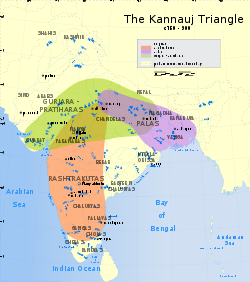 There were initial struggles but ultimately the Gurjar Pratihars succeeded in retaining the city. The Gurjar Pratihars ruled Malwa, which was bounded to the South by the Rashtrakuta Empire
, and the Pala
dynasty to the East. The Tripartite Struggle began with the defeat of Indrayudh at the hands of Gurjar Pratihar ruler Vatsaraja
. Pala
ruler Dharampala was also keen to establish his authority at Kannauj, giving rise to a struggle between Vatsaraja
and Dharampala. Dharampala was however defeated. Taking advantage of the chaos, the Rastrakuta
ruler Dhruva surged northwards, defeated Vatsaraja, and took Kannauj for himself, completing the furthest northern expansion by a South Indian ruler.
When the Rashtrakuta
ruler advanced back to south, Dharampala was left in control of Kannauj for some time. The struggle between the two northern dynasties continued: the Pala Chakrayudh was defeated by the Pratihara Nagabhata II
, and Kannauj was again occupied by the Gurjar Pratihars. Dharampala tried to take control of Kannauj but was defeated badly at Moongher by the Gurjar Pratihars. However, Nagabhata II
was in turn soon defeated by the Rashtrakuta
Govinda III
, who had initiated a second northern surge. An inscription states that Chakrayudh and Dharampala invited Govinda III
to war against the Gurjar Pratihars, but Dharampala and Chakrayudh both submitted to the Govinda III
, in order to win his sympathy. After this defeat Pratihara power degenarated for some time. After the death of Dharampala, Nagabhata II
regained hold over Kannuaj and made it the capital of the Gurjara Pratihara Empire. During this period the Rashtrakutas were facing some internal conflicts, and so they, as well as the Palas
, did not contest this. Thus Gurjar Pratihars became the greatest power in Northern India after occupying Kannauj.
sept named Chandradeva, arose into this region and by his "noble prowess" put an end to "all distress of the people". The rule of Gahadavala dynasty over the district is incontestably proved by the discovery at Kudarkot of a copper plate grant dated in the reign of Chandradeva. Chandradova founded the Gahadavala dynasty at Kanyakubja after defeating a chief named Gopala. His jurisdiction extended almost over the whole of the present Uttar Pradesh
including this district. Chandradeva was succeeded by Madanpala. However, he ruled for a very short period. Madanapala was succeeded by hit son Govindachandra. Two copper plate grants of Govindachandra, dated respectively Samvat 1161, or A. D. 1104, and Samvat 1174 or 1117 A. D. have been found in village Bisahi, two miles north-east of tahsil Bidhuna of the district. Another copper plate grant of this king dated Samvat 1166 or A. D. 1109 has been found at Rahan in the district. Govindachandra seems to have wielded substantial power in the state while he was only a "juvaraja" or crown prince. He defeated the invading bands of Muslim
s sometimes before 1109 A. D., for the Rahan plate records that he "again and again by the play of his matchless fighting" compelled the Hammira (i e. Amir) to "lay aside his enmity". The Rahan plate further described Govindachandra as "terrific" in cleaving the frontal gloves of arrays of irresistible mighty large elephants from Gauda", which shows that Govindachandra must have made some encroachments in Magadha
. In short, Govindachandra made himself a considerable power and under him the glories of this region revised.
Govindachandra was succeeded by his son Vijayachandra sometime in 1155 A. D. Like his father, Vijayachandra also successfully faced Muslim aggressions. By the very beginning of the reign of Vijayachandra an unmistakable symptom of decline of the Gahadavala power manifested itself in the loss of Delhi. The full significance of this loss was realised when, about a generation later, the Muslims attacked Delhi
region and occupied it, rendering the Gahadavala frontier practically defenceless. Vijayachandra was succeeded by his son Jaichandra in 1170 A. D. He may be described as the last great king of the Gahadavala dynasty, whose power and extensive jurisdiction struck even Muslim historians. During the reign of Jaichand of Kannauj
, the Chauhan
s, who starting from their territories in Ajmer
had annexed Delhi and were at this time bidding for supremacy in the North under the vigorous rule of Prithviraj Chauhan. Towards the south there were the Chandellas whose power at this time was at its height. Apart from this, there were repeated Muslim invasions in North-western India which had already threatened the unity of India The most important event of his region was the celebration of the Swayamvara of his daughter Sanyogita, who was however, carried away by force, in the midst of the ceremonies by Prithviraja. Perhaps, this was the cause which sowed the seed of enemity between these two northern monarrmes. Though there is no reliable evidence of conflict between these two kings, it is quite probable that they were positively hostile to each other; lack of sympathy between these two kings is shown by their mutual non-cooperation on the eve of the final conquest of India by the Muslims, led by Mohammad Ghori.
structures remain intact, the "great mosque", constructed by Ibrahim Shah of Jaunpur
in 1406 still remains. Some Brahmins in Assam
, Bengal
and Orissa
trace their origin to a migration eastwards from this city in the 9th and 10th centuries. There are also eight to nine sacred temples of Hindu goddess.These include the seven temples of seven sisters,the Singhavahini temple and the Kalika Devi temple.
Gauri Shanker Mandir, dedicated to Lord Shiva and his consort,Gauri, is the greatest of all temples. Its name is recorded in the holy Ramayana
and later on followed in the records of the tour of Xuanzang
.
, Kannauj had a population of 71,530. Males constitute 53% of the population and females 47%. Kannauj has an average literacy rate of 58%, lower than the national average of 59.5%: male literacy is 64%, and female literacy is 52%. In Kannauj, 15% of the population is under 6 years of age.
Nagar Palika
In India, a nagar palika or municipality is a urban local body that administers a city of population 20,000 or more. Under the Panchayati Raj system, it interacts directly with the state government, though it is administratively part of the district it is located in...
in Kannauj district
Kannauj District
Kannauj District is an administrative district of Uttar Pradesh state in northern India, along the river Ganges. The historic town of Kannauj, northwest of Kanpur, is the administrative center.-Geography:...
in the India
India
India , officially the Republic of India , is a country in South Asia. It is the seventh-largest country by geographical area, the second-most populous country with over 1.2 billion people, and the most populous democracy in the world...
n state
States and territories of India
India is a federal union of states comprising twenty-eight states and seven union territories. The states and territories are further subdivided into districts and so on.-List of states and territories:...
of Uttar Pradesh
Uttar Pradesh
Uttar Pradesh abbreviation U.P. , is a state located in the northern part of India. With a population of over 200 million people, it is India's most populous state, as well as the world's most populous sub-national entity...
. The city's name is traditionally derived from the term Kanyakubja (maiden's hunchback). Kannauj is an ancient city, in earlier times the capital of Emperor Harshavardhan. It is said that Kanyakubja Brahmin
Brahmin
Brahmin Brahman, Brahma and Brahmin.Brahman, Brahmin and Brahma have different meanings. Brahman refers to the Supreme Self...
's are originally from Kannauj. Kannauj is known for the distilling of scents and is a market center for tobacco, perfume, and rose water. It has given its name to a distinct dialect of the Hindi
Hindi
Standard Hindi, or more precisely Modern Standard Hindi, also known as Manak Hindi , High Hindi, Nagari Hindi, and Literary Hindi, is a standardized and sanskritized register of the Hindustani language derived from the Khariboli dialect of Delhi...
language known as Kanauji.
The Kannauj Triangle
Kannuaj remained a focal point for the three powerful dynasties, namely the Gurjara Pratiharas, PalasPala Empire
The Pāla Empire was one of the major middle kingdoms of India existed from 750–1174 CE. It was ruled by a Buddhist dynasty from Bengal in the eastern region of the Indian subcontinent, all the rulers bearing names ending with the suffix Pala , which means protector. The Palas were often described...
and Rashtrakuta
Rashtrakuta
The Rashtrakuta Empire was a royal dynasty ruling large parts of the Indian Subcontinent between the sixth and the 10th centuries. During this period they ruled as several closely related, but individual clans. Rastrakutas in inscriptions represented as descendants of Satyaki, a Yadava well known...
s, between the 8th and 10th centuries. The conflict between the three dynasties has been referred to as the Tripartite Struggle by many historians.
Rashtrakuta Dynasty
The Rashtrakuta Empire was a royal dynasty ruling large parts of the Indian Subcontinent between the sixth and the 10th centuries. During this period they ruled as several closely related, but individual clans. Rastrakutas in inscriptions represented as descendants of Satyaki, a Yadava well known...
, and the Pala
Pala Empire
The Pāla Empire was one of the major middle kingdoms of India existed from 750–1174 CE. It was ruled by a Buddhist dynasty from Bengal in the eastern region of the Indian subcontinent, all the rulers bearing names ending with the suffix Pala , which means protector. The Palas were often described...
dynasty to the East. The Tripartite Struggle began with the defeat of Indrayudh at the hands of Gurjar Pratihar ruler Vatsaraja
Vatsraja
Vatsaraja or Vatsraja was one of the great rulers of Gurjar Pratihar dynasty. He was grand-nephew of Nagabhata I and his mother was queen Bhuyikadevi.-Reign:...
. Pala
Pala Empire
The Pāla Empire was one of the major middle kingdoms of India existed from 750–1174 CE. It was ruled by a Buddhist dynasty from Bengal in the eastern region of the Indian subcontinent, all the rulers bearing names ending with the suffix Pala , which means protector. The Palas were often described...
ruler Dharampala was also keen to establish his authority at Kannauj, giving rise to a struggle between Vatsaraja
Vatsraja
Vatsaraja or Vatsraja was one of the great rulers of Gurjar Pratihar dynasty. He was grand-nephew of Nagabhata I and his mother was queen Bhuyikadevi.-Reign:...
and Dharampala. Dharampala was however defeated. Taking advantage of the chaos, the Rastrakuta
Rashtrakuta Dynasty
The Rashtrakuta Empire was a royal dynasty ruling large parts of the Indian Subcontinent between the sixth and the 10th centuries. During this period they ruled as several closely related, but individual clans. Rastrakutas in inscriptions represented as descendants of Satyaki, a Yadava well known...
ruler Dhruva surged northwards, defeated Vatsaraja, and took Kannauj for himself, completing the furthest northern expansion by a South Indian ruler.
When the Rashtrakuta
Rashtrakuta
The Rashtrakuta Empire was a royal dynasty ruling large parts of the Indian Subcontinent between the sixth and the 10th centuries. During this period they ruled as several closely related, but individual clans. Rastrakutas in inscriptions represented as descendants of Satyaki, a Yadava well known...
ruler advanced back to south, Dharampala was left in control of Kannauj for some time. The struggle between the two northern dynasties continued: the Pala Chakrayudh was defeated by the Pratihara Nagabhata II
Nagabhata II
Nagabhata II ascended the throne of the Gurjara-Pratihara dynasty after his father Vatsaraja. His mother was queen Sundari-Devi. He was designated with imperial titles - Paramabhattaraka, Maharajadhiraja, and Paramesvara after conquest of Kannauj.-Reign:Nagabhata II finds a mention in the Gwalior...
, and Kannauj was again occupied by the Gurjar Pratihars. Dharampala tried to take control of Kannauj but was defeated badly at Moongher by the Gurjar Pratihars. However, Nagabhata II
Nagabhata II
Nagabhata II ascended the throne of the Gurjara-Pratihara dynasty after his father Vatsaraja. His mother was queen Sundari-Devi. He was designated with imperial titles - Paramabhattaraka, Maharajadhiraja, and Paramesvara after conquest of Kannauj.-Reign:Nagabhata II finds a mention in the Gwalior...
was in turn soon defeated by the Rashtrakuta
Rashtrakuta
The Rashtrakuta Empire was a royal dynasty ruling large parts of the Indian Subcontinent between the sixth and the 10th centuries. During this period they ruled as several closely related, but individual clans. Rastrakutas in inscriptions represented as descendants of Satyaki, a Yadava well known...
Govinda III
Govinda III
Govinda III was a famous Rashtrakuta ruler who succeeded his illustrious father Dhruva Dharavarsha. He was militarily the most successful emperor of the dynasty with successful conquests from Cape Comorin in the south to Kannauj in the north, from Banaras in the east to Broach in the west...
, who had initiated a second northern surge. An inscription states that Chakrayudh and Dharampala invited Govinda III
Govinda III
Govinda III was a famous Rashtrakuta ruler who succeeded his illustrious father Dhruva Dharavarsha. He was militarily the most successful emperor of the dynasty with successful conquests from Cape Comorin in the south to Kannauj in the north, from Banaras in the east to Broach in the west...
to war against the Gurjar Pratihars, but Dharampala and Chakrayudh both submitted to the Govinda III
Govinda III
Govinda III was a famous Rashtrakuta ruler who succeeded his illustrious father Dhruva Dharavarsha. He was militarily the most successful emperor of the dynasty with successful conquests from Cape Comorin in the south to Kannauj in the north, from Banaras in the east to Broach in the west...
, in order to win his sympathy. After this defeat Pratihara power degenarated for some time. After the death of Dharampala, Nagabhata II
Nagabhata II
Nagabhata II ascended the throne of the Gurjara-Pratihara dynasty after his father Vatsaraja. His mother was queen Sundari-Devi. He was designated with imperial titles - Paramabhattaraka, Maharajadhiraja, and Paramesvara after conquest of Kannauj.-Reign:Nagabhata II finds a mention in the Gwalior...
regained hold over Kannuaj and made it the capital of the Gurjara Pratihara Empire. During this period the Rashtrakutas were facing some internal conflicts, and so they, as well as the Palas
Pala Empire
The Pāla Empire was one of the major middle kingdoms of India existed from 750–1174 CE. It was ruled by a Buddhist dynasty from Bengal in the eastern region of the Indian subcontinent, all the rulers bearing names ending with the suffix Pala , which means protector. The Palas were often described...
, did not contest this. Thus Gurjar Pratihars became the greatest power in Northern India after occupying Kannauj.
Gahrwar Rajputs and Kannauj
After the dismemberment of the Gurjara Pratihara Empire, there were repeated incursions in this region. When the "earth" was thus badly disturbed by political upheavals and destructive raids, a bold adventurer of the GahadvalaGahadvala
The Gahadvala or Gaharwar is a Hindu Rajput dynasty that ruled the kingdom of Kannauj for around a hundred years, beginning the late 11th century.-Rebuilding of Kannauj Kingdom:...
sept named Chandradeva, arose into this region and by his "noble prowess" put an end to "all distress of the people". The rule of Gahadavala dynasty over the district is incontestably proved by the discovery at Kudarkot of a copper plate grant dated in the reign of Chandradeva. Chandradova founded the Gahadavala dynasty at Kanyakubja after defeating a chief named Gopala. His jurisdiction extended almost over the whole of the present Uttar Pradesh
Uttar Pradesh
Uttar Pradesh abbreviation U.P. , is a state located in the northern part of India. With a population of over 200 million people, it is India's most populous state, as well as the world's most populous sub-national entity...
including this district. Chandradeva was succeeded by Madanpala. However, he ruled for a very short period. Madanapala was succeeded by hit son Govindachandra. Two copper plate grants of Govindachandra, dated respectively Samvat 1161, or A. D. 1104, and Samvat 1174 or 1117 A. D. have been found in village Bisahi, two miles north-east of tahsil Bidhuna of the district. Another copper plate grant of this king dated Samvat 1166 or A. D. 1109 has been found at Rahan in the district. Govindachandra seems to have wielded substantial power in the state while he was only a "juvaraja" or crown prince. He defeated the invading bands of Muslim
Muslim
A Muslim, also spelled Moslem, is an adherent of Islam, a monotheistic, Abrahamic religion based on the Quran, which Muslims consider the verbatim word of God as revealed to prophet Muhammad. "Muslim" is the Arabic term for "submitter" .Muslims believe that God is one and incomparable...
s sometimes before 1109 A. D., for the Rahan plate records that he "again and again by the play of his matchless fighting" compelled the Hammira (i e. Amir) to "lay aside his enmity". The Rahan plate further described Govindachandra as "terrific" in cleaving the frontal gloves of arrays of irresistible mighty large elephants from Gauda", which shows that Govindachandra must have made some encroachments in Magadha
Magadha
Magadha formed one of the sixteen Mahājanapadas or kingdoms in ancient India. The core of the kingdom was the area of Bihar south of the Ganga; its first capital was Rajagriha then Pataliputra...
. In short, Govindachandra made himself a considerable power and under him the glories of this region revised.
Govindachandra was succeeded by his son Vijayachandra sometime in 1155 A. D. Like his father, Vijayachandra also successfully faced Muslim aggressions. By the very beginning of the reign of Vijayachandra an unmistakable symptom of decline of the Gahadavala power manifested itself in the loss of Delhi. The full significance of this loss was realised when, about a generation later, the Muslims attacked Delhi
Delhi
Delhi , officially National Capital Territory of Delhi , is the largest metropolis by area and the second-largest by population in India, next to Mumbai. It is the eighth largest metropolis in the world by population with 16,753,265 inhabitants in the Territory at the 2011 Census...
region and occupied it, rendering the Gahadavala frontier practically defenceless. Vijayachandra was succeeded by his son Jaichandra in 1170 A. D. He may be described as the last great king of the Gahadavala dynasty, whose power and extensive jurisdiction struck even Muslim historians. During the reign of Jaichand of Kannauj
Jaichand of Kannauj
Jaichand was the Rajput ruler of Kannauj. He was the father of Sanyogita, Prithvi Raj Chauhan's wife. Jaichand was the name of the last ruler of Kannauj belonging to the Rathore dynasty.-Sources:...
, the Chauhan
Chauhan
Chauhan, Chouhan or Chohan , , - is a clan who ruled parts of northern India in the Middle Ages. The clan is most famous for Rajput King Maharaja Prithviraj Chauhan...
s, who starting from their territories in Ajmer
Ajmer
Ajmer , formerly written as Ajmere, is a city in Ajmer District in Rajasthan state in India. Ajmer has a population of around 800,000 , and is located west of the Rajasthan state capital Jaipur, 200 km from Jodhpur, 274 km from Udaipur, 439 km from Jaisalmer, and 391 km from...
had annexed Delhi and were at this time bidding for supremacy in the North under the vigorous rule of Prithviraj Chauhan. Towards the south there were the Chandellas whose power at this time was at its height. Apart from this, there were repeated Muslim invasions in North-western India which had already threatened the unity of India The most important event of his region was the celebration of the Swayamvara of his daughter Sanyogita, who was however, carried away by force, in the midst of the ceremonies by Prithviraja. Perhaps, this was the cause which sowed the seed of enemity between these two northern monarrmes. Though there is no reliable evidence of conflict between these two kings, it is quite probable that they were positively hostile to each other; lack of sympathy between these two kings is shown by their mutual non-cooperation on the eve of the final conquest of India by the Muslims, led by Mohammad Ghori.
Monuments
The size and scale of the ancient town can be gauged from the fact that existing ruins extend over the lands of five villages, occupying a semicircle fully 4 miles in diameter. While no historic HinduHindu
Hindu refers to an identity associated with the philosophical, religious and cultural systems that are indigenous to the Indian subcontinent. As used in the Constitution of India, the word "Hindu" is also attributed to all persons professing any Indian religion...
structures remain intact, the "great mosque", constructed by Ibrahim Shah of Jaunpur
Jaunpur Sultanate
The Jaunpur sultanate was an independent kingdom of northern India between 1394 to 1479, whose rulers ruled from Jaunpur in the present day state of Uttar Pradesh. The Jaunpur sultanate was ruled by the Sharqi dynasty. The Khwajah-i-Jahan Malik Sarwar, the first ruler of the dynasty was a wazir ...
in 1406 still remains. Some Brahmins in Assam
Assam
Assam , also, rarely, Assam Valley and formerly the Assam Province , is a northeastern state of India and is one of the most culturally and geographically distinct regions of the country...
, Bengal
Bengal
Bengal is a historical and geographical region in the northeast region of the Indian Subcontinent at the apex of the Bay of Bengal. Today, it is mainly divided between the sovereign land of People's Republic of Bangladesh and the Indian state of West Bengal, although some regions of the previous...
and Orissa
Orissa
Orissa , officially Odisha since Nov 2011, is a state of India, located on the east coast of India, by the Bay of Bengal. It is the modern name of the ancient nation of Kalinga, which was invaded by the Maurya Emperor Ashoka in 261 BC. The modern state of Orissa was established on 1 April...
trace their origin to a migration eastwards from this city in the 9th and 10th centuries. There are also eight to nine sacred temples of Hindu goddess.These include the seven temples of seven sisters,the Singhavahini temple and the Kalika Devi temple.
Gauri Shanker Mandir, dedicated to Lord Shiva and his consort,Gauri, is the greatest of all temples. Its name is recorded in the holy Ramayana
Ramayana
The Ramayana is an ancient Sanskrit epic. It is ascribed to the Hindu sage Valmiki and forms an important part of the Hindu canon , considered to be itihāsa. The Ramayana is one of the two great epics of India and Nepal, the other being the Mahabharata...
and later on followed in the records of the tour of Xuanzang
Xuanzang
Xuanzang was a famous Chinese Buddhist monk, scholar, traveler, and translator who described the interaction between China and India in the early Tang period...
.
Geography
Kannauj is located at 27.07°N 79.92°E. It has an average elevation of 139 metres (456 feet).Demographics
India censusCensus
A census is the procedure of systematically acquiring and recording information about the members of a given population. It is a regularly occurring and official count of a particular population. The term is used mostly in connection with national population and housing censuses; other common...
, Kannauj had a population of 71,530. Males constitute 53% of the population and females 47%. Kannauj has an average literacy rate of 58%, lower than the national average of 59.5%: male literacy is 64%, and female literacy is 52%. In Kannauj, 15% of the population is under 6 years of age.