

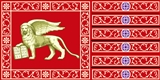
Republic of Venice

Encyclopedia
The Republic of Venice or Venetian Republic was a state originating from the city of Venice
in Northeastern
Italy
. It existed for over a millennium, from the late 7th century until 1797. It was formally known as the Most Serene Republic of Venice and is often referred to as La Serenissima, in reference to its title as one of the "Most Serene Republic
s". The Republic's modern reputation is widely based on its preference for economic supremacy
over military might, despite its long history of war and conquest.
, Huns
and other invading peoples as the power of the Western Roman Empire
dwindled in northern Italy
. At some point in the first decades of the eighth century, the people of the lagoon elected their first leader Ursus
(or Orso Ipato), who was confirmed by Byzantium
and given the titles of hypatus
and dux
. He was the first historical Doge of Venice
. Tradition, however, first attested in the early 11th century, states that the Venetians first proclaimed one Anafestus Paulicius
duke in 697, though this story dates to no earlier than the chronicle of John the Deacon
. Whichever the case, the first doges had their power base in Heraclea
.
, moved his seat from Heraclea to Malamocco
in the 740s. He was the son of Ursus and represented the attempt of his father to establish a dynasty. Such attempts were more than commonplace among the doges of the first few centuries of Venetian history, but all were ultimately unsuccessful. During the reign of Deusdedit, Venice became the only remaining Byzantine possession in the north and the changing politics of the Frankish Empire
began to change the factional divisions within Venetia. One faction was decidedly pro-Byzantine. They desired to remain well-connected to the Empire. Another faction, republican in nature, believed in continuing along a course towards practical independence. The other main faction was pro-Frankish. Supported mostly by clergy (in line with papal
sympathies of the time), they looked towards the new Carolingian
king of the Franks
, Pepin the Short, as the best provider of defence against the Lombards
. A minor, pro-Lombard, faction was opposed to close ties with any of these further-off powers and interested in maintaining peace with the neighbouring (and surrounding, but for the sea) Lombard kingdom.
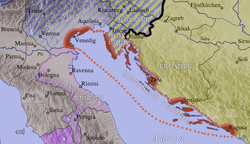 The successors of Obelerio inherited a united Venice. By the Pax Nicephori
(803) the two emperors had recognised Venetian de facto independence, while it remained nominally Byzantine in subservience. During the reign of the Participazio family, Venice grew into its modern form. Though Heraclean by birth, Agnello
, the first Participazio doge, was an early immigrant to Rialto and his dogeship was marked by the expansion of Venice towards the sea via the construction of bridges, canals, bulwarks, fortifications, and stone buildings. The modern Venice, at one with the sea, was being born. Agnello was succeeded by his son Giustiniano
, who stole the remains of Saint Mark the Evangelist from Alexandria
, took them to Venice, and made him the Republic's patron saint
.
During the reign of the successor of the Participazio, Pietro Tradonico
, Venice began to establish its military might which would influence many a later crusade and dominate the Adriatic for centuries. Tradonico secured the sea by fighting Slavic
and Saracen
pirates. Tradonico's reign was long and successful (837–64), but he was succeeded by the Participazio and it appeared that a dynasty may have finally been established. Around 841, the Republic of Venice sent a fleet of 60 galleys (each carrying 200 men) to assist the Byzantines in driving the Arabs from Crotone
, but it failed. In 1000, Pietro II Orseolo
sent a fleet of 6 ships to defeat the Narentine and Croatian
pirates from Dalmatia
.
, Venice became extremely wealthy through its control of trade between Europe and the Levant
, and began to expand into the Adriatic Sea
and beyond. In 1084, Domenico Selvo
personally led a fleet against the Normans
, but he was defeated and lost 9 great galleys, the largest and most heavily armed ships in the Venetian war
fleet
. Venice was involved in the Crusades almost from the very beginning; 200 Venetian ships assisted in capturing the coastal cities of Syria
after the First Crusade
, and in 1123 they were granted virtual autonomy in the Kingdom of Jerusalem
through the Pactum Warmundi
. In 1110, Ordelafo Faliero
personally commanded a Venetian fleet of 100 ships to assist Baldwin I
of Jerusalem
and Sigurd I of Norway
in capturing the city of Sidon
. In the 12th century, the Venetians also gained extensive trading privileges in the Byzantine Empire and their ships often provided the Empire with a navy.
In 1182, there was a vicious anti-Western riot in Constantinople
, of which the Latins were the targets, the Venetians in particular. Many in the Empire had become jealous of Venetian power and influence, and thus, when in 1182 the pretender Andronikos I Komnenos
marched on Constantinople, Venetian property was seized and the owners imprisoned or banished, an act which humiliated and angered the Republic. The Venetian fleet was crucial to the transportation of the Fourth Crusade
, but when the crusaders could not pay for the ships, the cunning and manipulative Doge Enrico Dandolo
quickly exploited the situation and offered transport to the crusaders if they were to capture the (Christian) Dalmatian city of Zara
, which had rebelled against the Venetian rule in 1183, placed itself under the dual protection of the Papacy and King Emeric of Hungary
and had proven too well fortified to retake for Venice alone, because 90% of the shipowners had changed the opinion of Enrico Dandolo
.
Upon accomplishing this, the crusade was again diverted to Constantinople
, the capital of the Byzantine Empire
, another rival of Venice, in order to avenge the 1182 massacre of Venetian citizens living in Constantinople
. The Dalmatians separated from Hungary by a treaty in 1199 and they paid Hungary with a portion of Macedonia (theme). In 1201 the city of Zadar, formerly under the protection of the Republic of Venice, recognized Emeric, King of Hungary, again as overlord, perhaps because he could not realize Hungary's portion on Macedonia (theme).
The city was captured and sacked in 1204; when Macedonia (theme) became disputed between the Crusaders and the Bulgarian Empire
; the sack of the city has been described as one of the most profitable and disgraceful sacks of a city in history. The Republic of Venice signed a trade treaty with the Mongol Empire
in 1221. Koloman of Croatia counted 77 judges in Dalmatia
in 1235 and wrote their names.
The Byzantine Empire, which until 1204 had resisted several attacks and kept the Islamic invaders out of Western Anatolia
and the Balkans
, was re-established in 1261 by Michael VIII Palaiologos
but never recovered its previous power and was eventually conquered by the Ottoman Turks
, who later occupied the Balkans and Hungary
and on two occasions even besieged Vienna
.
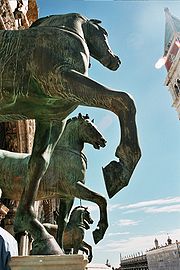
The Venetians, who accompanied the crusader fleet, claimed much of the plunder, including the famous four bronze horses
which were brought back to adorn St. Mark's basilica. As a result of the subsequent partition
of the Byzantine Empire, Venice gained a great deal of territory in the Aegean Sea
(three-eighths of the Byzantine Empire), including the islands of Crete
(Candia
) and Euboea
(Negroponte
); for example, the present core city of Chania
on Crete is largely of Venetian construction, built atop the ruins
of the ancient city of Cydonia. The Aegean islands came to form the Venetian Duchy of the Archipelago
.
In 1295, Pietro Gradenigo
sent a fleet of 68 ships to attack a Genoese
fleet at Alexandretta, then another fleet of 100 ships were sent to attack the Genoese in 1299. From 1350 to 1381, Venice fought an intermittent war with the Genoese
. Initially defeated, they devastated the Genoese fleet at the Battle of Chioggia
in 1380 and retained their prominent position in eastern Mediterranean affairs at the expense of Genoa's declining empire.
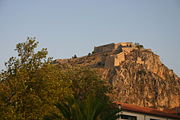
, as well as along the Dalmatia
n coast from Istria to Albania
, which was acquired from King Ladislaus of Naples during the civil war in Hungary. Ladislaus was about to lose the conflict and had decided to escape to Naples, but before doing so he agreed to sell his now practically forfeit rights on the Dalmatian cities for a meager sum of 100,000 ducats.
Venice exploited the situation and quickly installed nobility to govern the area, for example, Count Filippo Stipanov in Zadar. This move by the Venetians was a response to the threatening expansion of Giangaleazzo Visconti, Duke of Milan. Control over the north-east main land routes was also a necessity for the safety of the trades. By 1410, Venice had a navy of 3,300 ships (manned by 36,000 men) and taken over most of Venetia, including such important cities as Verona
(which swore its loyalty in the Devotion of Verona to Venice
in 1405) and Padua
.
The situation in Dalmatia had been settled in 1408 by a truce with King Sigismund of Hungary but the difficulties of Hungary finally granted to the Republic the consolidation of its Adriatic dominions. At the expiration of the truce, Venice immediately invaded the Patriarchate of Aquileia
, and subjected Traù
, Spalato
, Durazzo
and other Dalmatian cities.
Slaves were plentiful in the Italian city-states as late as the 15th century. Between 1414 and 1423, some 10,000 slaves
were sold in Venice, almost all of whom were "nubile" young women from the Balkans.
In February 1489, the island of Cyprus
, previously a crusader state (the Kingdom of Cyprus
), was annexed to Venice.
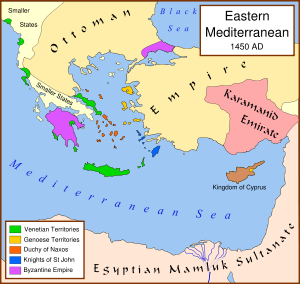
started sea campaigns as early as 1423, when it waged a seven year war with the Venetian Republic over maritime control of the Aegean Sea
and the Adriatic Sea. The wars with Venice resumed in 1463 until a favorable peace treaty was signed in 1479. In 1480, (now no longer hampered by the Venetian fleet) the Ottomans besieged Rhodes
and captured Otranto. By 1490, the population of Venice had risen to about 180,000 people.
War with the Ottomans resumed from 1499 to 1503. In 1499, Venice allied itself with Louis XII of France
against Milan
, gaining Cremona
. In the same year, the Ottoman sultan moved to attack Lepanto
by land, and sent a large fleet to support his offensive by sea. Antonio Grimani
, more a businessman and diplomat than a sailor, was defeated in the sea battle of Zonchio
in 1499. The Turks
once again sacked Friuli. Preferring peace to total war both against the Turks and by sea, Venice surrendered the bases of Lepanto, Durazzo, Modon
and Coron
.
Venice's attention was diverted from its usual maritime position by the delicate situation in Romagna
, then one of the richest lands in Italy, which was nominally part of the Papal States
but effectively divided into a series of small lordships which were difficult for Rome's troops to control. Eager to take some of Venice's lands, all neighbouring powers joined in the League of Cambrai in 1508, under the leadership of Pope Julius II
. The pope wanted Romagna
; Emperor
Maximilian I
: Friuli
and Veneto
; Spain
: the Apulia
n ports; the king of France: Cremona; the king of Hungary
: Dalmatia, and each of the others some part. The offensive against the huge army enlisted by Venice was launched from France.
On 14 May 1509, Venice was crushingly defeated at the battle of Agnadello
, in the Ghiara d'Adda, marking one of the most delicate points in Venetian history. French and imperial troops were occupying Veneto, but Venice managed to extricate itself through diplomatic efforts. The Apulian ports were ceded in order to come to terms with Spain, and pope Julius II soon recognized the danger brought by the eventual destruction of Venice (then the only Italian power able to face kingdoms like France or empires like the Ottomans).
The citizens of the mainland rose to the cry of "Marco, Marco", and Andrea Gritti
recaptured Padua
in July 1509, successfully defending it against the besieging imperial troops. Spain and the pope broke off their alliance with France, and Venice regained Brescia
and Verona
from France also. After seven years of ruinous war, the Serenissima regained its mainland dominions west to the Adda river. Although the defeat had turned into a victory, the events of 1509 marked the end of the Venetian expansion.
In 1489, the first year of Venetian control of Cyprus, Turks attacked the Karpasia Peninsula, pillaging and taking captives to be sold into slavery. In 1539 the Turkish fleet attacked and destroyed Limassol
. Fearing the ever-expanding Ottoman Empire, the Venetians had fortified Famagusta
, Nicosia
, and Kyrenia
, but most other cities were easy prey. By 1563, the population of Venice had dropped to about 168,000 people.
In the summer of 1570, the Turks struck again, but this time with a full-scale invasion
rather than a raid. About 60,000 troops, including cavalry and artillery, under the command of Mustafa Pasha
landed unopposed near Limassol on July 2, 1570, and laid siege to Nicosia. In an orgy of victory on the day that the city fell — September 9, 1570 — 20,000 Nicosians were put to death, and every church, public building, and palace was looted. Word of the massacre spread, and a few days later Mustafa took Kyrenia without having to fire a shot. Famagusta, however, resisted and put up a heroic defense that lasted from September 1570 until August 1571.
The fall of Famagusta marked the beginning of the Ottoman period in Cyprus. Two months later, the naval forces of the Holy League
, composed mainly of Venetian, Spanish
, and Papal
ships under the command of Don John of Austria, defeated the Turkish fleet at Battle of Lepanto
. The victory over the Turks, however, came too late to help Cyprus, and the island remained under Ottoman rule for the next three centuries. By 1575, the population of Venice was about 175,000 people, but partly as a result of the plague of 1575-76 dropped to 124,000 people by 1581.
began with the arrest of two clerics accused of petty crimes, and with a law restricting the Church's right to enjoy and acquire landed property. Pope Paul V
held that these provisions were contrary to canon law, and demanded that they be repealed. When this was refused, he placed Venice under an interdict. The Republic paid no attention to the interdict or the act of excommunication
, and ordered its priests to carry out their ministry. It was supported in its decisions by the Servite monk Paolo Sarpi
, a sharp polemical writer who was nominated to be the Signoria's adviser on theology and canon law in 1606. The interdict was lifted after a year, when France intervened and proposed a formula of compromise. Venice was satisfied with reaffirming the principle that no citizen was superior to the normal processes of law.
The latter half of the 17th century saw also prolonged wars with the Ottoman Empire
: in the Cretan War (1645–1669)
, after an heroic siege that lasted 24 years, Venice lost its major overseas possession, the island of Crete
. In 1684 however, taking advantage of the Ottoman involvement against Austria in the Great Turkish War
, the Republic initiated the Morean War
, which lasted until 1699 and in which it was able to conquer the Morea
peninsula in southern Greece.
 These gains were not meant to last, however: in December 1714, the Turks began the last Turkish–Venetian War
, when the Morea was "without any of those supplies which are so desirable even in countries where aid is near at hand which are not liable to attack from the sea".
The Turks took the islands of Tinos
and Aegina
, crossed the isthmus and took Corinth
. Daniele Dolfin, commander of the Venetian fleet, thought it better to save the fleet than risk it for the Morea. When he eventually arrived on the scene, Nauplia, Modon, Corone and Malvasia had fallen. Levkas in the Ionian islands
, and the bases of Spinalonga and Suda on Crete
which still remained in Venetian hands, were abandoned. The Turks finally landed on Corfù
, but its defenders managed to throw them back.
In the meantime, the Turks had suffered a grave defeat by the Austria
ns in the Battle of Petrovaradin
on 5 August 1716. Venetian naval efforts in the Aegean
and the Dardanelles
in 1717 and 1718, however, met with little success. With the Treaty of Passarowitz
(21 July 1718), Austria made large territorial gains, but Venice lost the Morea, for which its small gains in Albania
and Dalmatia were little compensation. This was the last war with the Ottoman Empire. By the year 1792, the once great Venetian merchant fleet had declined to a mere 309 merchantmen
.
In spring 1796, Piedmont
fell and the Austrians were beaten from Montenotte
to Lodi. The army under Bonaparte crossed the frontiers of neutral Venice in pursuit of the enemy. By the end of the year the French troops were occupying the Venetian state up to the Adige
. Vicenza, Cadore and Friuli were held by the Austrians. With the campaigns of the next year, Napoleon aimed for the Austrian possessions across the Alps
. In the preliminaries to the Peace of Leoben
, the terms of which remained secret, the Austrians were to take the Venetian possessions in the Balkans
as the price of peace (18 April 1797), while France
required the Lombard
part of the State.
After Napoleon's ultimatum, Doge Ludovico Manin
surrendered unconditionally on May 12, and abdicated himself, while the Major Council declared the end of the Republic. According to Bonaparte's orders, the public powers passed to a Provisional Municipality under the French Military Governor. On October 17, France and Austria signed the Treaty of Campo Formio
, according the sharing of all the territory of the ancient republic, with a new border just west of the Adige River. Italian democrats, especially young poet Ugo Foscolo
, viewed the treaty as a betrayal. The metropolitan part of the disbanded republic became an Austrian territory, under the name of Venetian Province
(Provincia Veneta in Italian
, Venedig Provinz in German
).
of the city), in the coat of arms of the city and in the yellow-red-blue flag of Veneto
(which has seven tails representing the seven provinces of the region).
The winged Lion also appears in the Navy flag of the Italian Republic together with other 3 ancient flags (Genoa
, Pisa
and Amalfi), as well as the Golden Lion
, awarded at the Venice Film Festival
, and in the insignia of the large Assicurazioni Generali
insurance company.
ruled Venice in an autocratic fashion
, but later his powers were limited by the promissione, a pledge he had to take when elected. As a result, powers were shared with the Maggior Consiglio or Great Council
, composed of 480 members taken from patrician families, so that "He could do nothing without the Major Council and the Major Council could do nothing without him".
In the 12th century, the aristocratic families of Rialto further diminished the Doge's powers by establishing the Minor Council (1175), composed of six advisers of the Doge, and the Quarantia (1179) as a supreme tribunal. In 1223, these institutions were combined into the Signoria
, which consisted of the Doge, the Minor Council and the three leaders of the Quarantia. The Signoria was the central body of government, representing the continuity of the republic as shown in the expression: "si è morto il Doge, no la Signoria" ("The Doge is dead, but the Signoria is not").
Also created were the sapientes, two (later six) bodies that combined with other groups to form a collegio, which formed an executive branch. In 1229, the Consiglio dei Pregadi, a senate, was formed, being 60 members elected by the Major Council. These developments left the Doge with little personal power and saw actual authority in the hands of the Major Council.
Whilst Venice claimed to be a "Republic", in reality it followed a mixed government
model, combining monarchy in the Doge, aristocracy in the senate, and a "democracy" of Rialto families in the Major Council. Machiavelli also refers to Venice as a republic, considering it "excellent among modern republics" (unlike his native Florence
).
In 1310, a Council of Ten was established, becoming the central political body whose members operated in secret. Around 1600, its dominance over the Major Council was considered a threat and efforts were made in the Council and elsewhere to reduce its powers, with limited success.
In 1454, the Supreme Tribunal of the three state inquisitors was established to guard the security of the republic. By means of espionage
, counterespionage, internal surveillance
and a network of informers, they ensured that Venice did not come under the rule of a single "signore", as many other Italian cities did at the time. One of the inquisitors - popularly known as Il Rosso ("the red one") because of his scarlet robe - was chosen from the Doge's councillors, two – popularly known as I negri ("the black ones") because of their black robes – were chosen from the Council of Ten. The Supreme Tribunal gradually assumed some of the powers of the Council of Ten.
In 1556, the provveditori ai beni inculti were also created for the improvement of agriculture by increasing the area under cultivation and encouraging private investment in agricultural improvement. The consistent rise in the price of grain during the 16th century encouraged the transfer of capital from trade to the land.
Venice
Venice is a city in northern Italy which is renowned for the beauty of its setting, its architecture and its artworks. It is the capital of the Veneto region...
in Northeastern
Northern Italy
Northern Italy is a wide cultural, historical and geographical definition, without any administrative usage, used to indicate the northern part of the Italian state, also referred as Settentrione or Alta Italia...
Italy
Italy
Italy , officially the Italian Republic languages]] under the European Charter for Regional or Minority Languages. In each of these, Italy's official name is as follows:;;;;;;;;), is a unitary parliamentary republic in South-Central Europe. To the north it borders France, Switzerland, Austria and...
. It existed for over a millennium, from the late 7th century until 1797. It was formally known as the Most Serene Republic of Venice and is often referred to as La Serenissima, in reference to its title as one of the "Most Serene Republic
Most Serene Republic
Most Serene Republic is a title attached to the following countries:* Republic of Venice , city-state that existed from 697 to 1797 based in the city of Venice with continuously controlled territory along the eastern Adriatic at its strongest period...
s". The Republic's modern reputation is widely based on its preference for economic supremacy
Economic history of Venice
Venice, situated at the far end of the Adriatic Sea, gained large scale profit of the adjacent middle european markets. So did the fact that the town belonged to the Byzantine Empire. Along with increasing autonomy it gained far reaching privileges in both Empires...
over military might, despite its long history of war and conquest.
History
The city of Venice originated as a collection of lagoon communities banded together for mutual defence from the LombardsLombards
The Lombards , also referred to as Longobards, were a Germanic tribe of Scandinavian origin, who from 568 to 774 ruled a Kingdom in Italy...
, Huns
Huns
The Huns were a group of nomadic people who, appearing from east of the Volga River, migrated into Europe c. AD 370 and established the vast Hunnic Empire there. Since de Guignes linked them with the Xiongnu, who had been northern neighbours of China 300 years prior to the emergence of the Huns,...
and other invading peoples as the power of the Western Roman Empire
Western Roman Empire
The Western Roman Empire was the western half of the Roman Empire after its division by Diocletian in 285; the other half of the Roman Empire was the Eastern Roman Empire, commonly referred to today as the Byzantine Empire....
dwindled in northern Italy
Northern Italy
Northern Italy is a wide cultural, historical and geographical definition, without any administrative usage, used to indicate the northern part of the Italian state, also referred as Settentrione or Alta Italia...
. At some point in the first decades of the eighth century, the people of the lagoon elected their first leader Ursus
Orso Ipato
Orso Ipato was the third traditional Doge of Venice and the first historically known. Sometime in the early 8th century, he was elected to lead the Venetians and granted the title of dux or duke, which has morphed in the Venetian dialect into doge.Orso himself came from Heraclea...
(or Orso Ipato), who was confirmed by Byzantium
Byzantine Empire
The Byzantine Empire was the Eastern Roman Empire during the periods of Late Antiquity and the Middle Ages, centred on the capital of Constantinople. Known simply as the Roman Empire or Romania to its inhabitants and neighbours, the Empire was the direct continuation of the Ancient Roman State...
and given the titles of hypatus
Hypatus
Hýpatos and the variant apó hypátōn was a Byzantine court dignity, originally the Greek translation of Latin consul . The dignity arose from the honorary consulships awarded in the late Roman Empire, and survived until the early 12th century...
and dux
Dux
Dux is Latin for leader and later for Duke and its variant forms ....
. He was the first historical Doge of Venice
Doge of Venice
The Doge of Venice , often mistranslated Duke was the chief magistrate and leader of the Most Serene Republic of Venice for over a thousand years. Doges of Venice were elected for life by the city-state's aristocracy. Commonly the person selected as Doge was the shrewdest elder in the city...
. Tradition, however, first attested in the early 11th century, states that the Venetians first proclaimed one Anafestus Paulicius
Paolo Lucio Anafesto
Paoluccio or Paolo Lucio Anafesto was the reputed first doge of Venice. A noble of Eraclea, then the primary city of the region, he was elected in 697 as an official over the entire lagoon that surrounded Venice, both to put an end to the conflicts between the various tribunes who until then had...
duke in 697, though this story dates to no earlier than the chronicle of John the Deacon
John, deacon of Venice
John the Deacon was a Venetian deacon, secretary to the doge of Venice and a chronicler.-The Venetian chronicle:According to the New Advent encyclopedia:...
. Whichever the case, the first doges had their power base in Heraclea
Eraclea
thumb|250px|right|Location of Eraclea in the province of Venice.Eraclea is a town and comune in the province of Venice, Veneto, Italy. SP42 goes through it.Eraclea Mare is the Lido of Eraclea....
.
Rise
Ursus's successor, DeusdeditTeodato Ipato
Teodato Ipato was the doge of Venice after a brief interregnum following the death of his father, Orso Ipato, in 742. His surname is in fact the Byzantine title hypatos...
, moved his seat from Heraclea to Malamocco
Malamocco
Malamocco is one of the three narrow inlets in the enclosing coastal dune bar that connect the Venetian Lagoon with the Adriatic Sea, together with the Lido and Chioggia inlets...
in the 740s. He was the son of Ursus and represented the attempt of his father to establish a dynasty. Such attempts were more than commonplace among the doges of the first few centuries of Venetian history, but all were ultimately unsuccessful. During the reign of Deusdedit, Venice became the only remaining Byzantine possession in the north and the changing politics of the Frankish Empire
Frankish Empire
Francia or Frankia, later also called the Frankish Empire , Frankish Kingdom , Frankish Realm or occasionally Frankland, was the territory inhabited and ruled by the Franks from the 3rd to the 10th century...
began to change the factional divisions within Venetia. One faction was decidedly pro-Byzantine. They desired to remain well-connected to the Empire. Another faction, republican in nature, believed in continuing along a course towards practical independence. The other main faction was pro-Frankish. Supported mostly by clergy (in line with papal
Pope
The Pope is the Bishop of Rome, a position that makes him the leader of the worldwide Catholic Church . In the Catholic Church, the Pope is regarded as the successor of Saint Peter, the Apostle...
sympathies of the time), they looked towards the new Carolingian
Carolingian
The Carolingian dynasty was a Frankish noble family with origins in the Arnulfing and Pippinid clans of the 7th century AD. The name "Carolingian", Medieval Latin karolingi, an altered form of an unattested Old High German *karling, kerling The Carolingian dynasty (known variously as the...
king of the Franks
Franks
The Franks were a confederation of Germanic tribes first attested in the third century AD as living north and east of the Lower Rhine River. From the third to fifth centuries some Franks raided Roman territory while other Franks joined the Roman troops in Gaul. Only the Salian Franks formed a...
, Pepin the Short, as the best provider of defence against the Lombards
Lombards
The Lombards , also referred to as Longobards, were a Germanic tribe of Scandinavian origin, who from 568 to 774 ruled a Kingdom in Italy...
. A minor, pro-Lombard, faction was opposed to close ties with any of these further-off powers and interested in maintaining peace with the neighbouring (and surrounding, but for the sea) Lombard kingdom.
Early Middle Ages
Pax Nicephori
Pax Nicephori is a term used to refer to both a 803 peace treaty allegedly concluded between the Frankish ruler Charlemagne and Nikephoros I, emperor of Byzantium, and the outcome of negotiations that took place between the same parties, but were concluded by different emperors, between 811 and 814...
(803) the two emperors had recognised Venetian de facto independence, while it remained nominally Byzantine in subservience. During the reign of the Participazio family, Venice grew into its modern form. Though Heraclean by birth, Agnello
Agnello Participazio
Agnello Participazio was the tenth or eighth Doge of Venice from 811 to 827...
, the first Participazio doge, was an early immigrant to Rialto and his dogeship was marked by the expansion of Venice towards the sea via the construction of bridges, canals, bulwarks, fortifications, and stone buildings. The modern Venice, at one with the sea, was being born. Agnello was succeeded by his son Giustiniano
Giustiniano Participazio
Giustiniano Participazio was the eleventh or ninth Doge of Venice briefly from 825 to his death. His four years on the ducal throne were very eventful...
, who stole the remains of Saint Mark the Evangelist from Alexandria
Alexandria
Alexandria is the second-largest city of Egypt, with a population of 4.1 million, extending about along the coast of the Mediterranean Sea in the north central part of the country; it is also the largest city lying directly on the Mediterranean coast. It is Egypt's largest seaport, serving...
, took them to Venice, and made him the Republic's patron saint
Patron saint
A patron saint is a saint who is regarded as the intercessor and advocate in heaven of a nation, place, craft, activity, class, clan, family, or person...
.
During the reign of the successor of the Participazio, Pietro Tradonico
Pietro Tradonico
Pietro Tradonico , an Istrian by birth, was the Doge of Venice from 836 to 864. He was, according to tradition, the thirteenth doge, though historically he is only the eleventh. His election broke the power of the Participazio. He was illiterate, and forced to sign all state documents with the...
, Venice began to establish its military might which would influence many a later crusade and dominate the Adriatic for centuries. Tradonico secured the sea by fighting Slavic
Slavic peoples
The Slavic people are an Indo-European panethnicity living in Eastern Europe, Southeast Europe, North Asia and Central Asia. The term Slavic represents a broad ethno-linguistic group of people, who speak languages belonging to the Slavic language family and share, to varying degrees, certain...
and Saracen
Muslim conquests
Muslim conquests also referred to as the Islamic conquests or Arab conquests, began with the Islamic prophet Muhammad. He established a new unified polity in the Arabian Peninsula which under the subsequent Rashidun and Umayyad Caliphates saw a century of rapid expansion of Muslim power.They...
pirates. Tradonico's reign was long and successful (837–64), but he was succeeded by the Participazio and it appeared that a dynasty may have finally been established. Around 841, the Republic of Venice sent a fleet of 60 galleys (each carrying 200 men) to assist the Byzantines in driving the Arabs from Crotone
Crotone
Crotone is a city and comune in Calabria, southern Italy, on the Ionian Sea. Founded circa 710 BC as the Achaean colony of Croton , it was known as Cotrone from the Middle Ages until 1928, when its name was changed to the current one. In 1994 it became the capital of the newly established...
, but it failed. In 1000, Pietro II Orseolo
Pietro II Orseolo
Pietro II Orseolo was the Doge of Venice from 991 to 1009.He began the period of eastern expansion of Venice that lasted for the better part of 500 years...
sent a fleet of 6 ships to defeat the Narentine and Croatian
Croats
Croats are a South Slavic ethnic group mostly living in Croatia, Bosnia and Herzegovina and nearby countries. There are around 4 million Croats living inside Croatia and up to 4.5 million throughout the rest of the world. Responding to political, social and economic pressure, many Croats have...
pirates from Dalmatia
Dalmatia
Dalmatia is a historical region on the eastern coast of the Adriatic Sea. It stretches from the island of Rab in the northwest to the Bay of Kotor in the southeast. The hinterland, the Dalmatian Zagora, ranges from fifty kilometers in width in the north to just a few kilometers in the south....
.
High Middle Ages
In the High Middle AgesHigh Middle Ages
The High Middle Ages was the period of European history around the 11th, 12th, and 13th centuries . The High Middle Ages were preceded by the Early Middle Ages and followed by the Late Middle Ages, which by convention end around 1500....
, Venice became extremely wealthy through its control of trade between Europe and the Levant
Levant
The Levant or ) is the geographic region and culture zone of the "eastern Mediterranean littoral between Anatolia and Egypt" . The Levant includes most of modern Lebanon, Syria, Jordan, Israel, the Palestinian territories, and sometimes parts of Turkey and Iraq, and corresponds roughly to the...
, and began to expand into the Adriatic Sea
Adriatic Sea
The Adriatic Sea is a body of water separating the Italian Peninsula from the Balkan peninsula, and the system of the Apennine Mountains from that of the Dinaric Alps and adjacent ranges...
and beyond. In 1084, Domenico Selvo
Domenico Selvo
Domenico Selvo was the 31st Doge of Venice, serving from 1071 to 1084. During his reign as Doge, his domestic policies, the alliances that he forged, and the battles that the Venetian military won and lost laid the foundations for much of the subsequent foreign and domestic policy of the Republic...
personally led a fleet against the Normans
Normans
The Normans were the people who gave their name to Normandy, a region in northern France. They were descended from Norse Viking conquerors of the territory and the native population of Frankish and Gallo-Roman stock...
, but he was defeated and lost 9 great galleys, the largest and most heavily armed ships in the Venetian war
War
War is a state of organized, armed, and often prolonged conflict carried on between states, nations, or other parties typified by extreme aggression, social disruption, and usually high mortality. War should be understood as an actual, intentional and widespread armed conflict between political...
fleet
Naval fleet
A fleet, or naval fleet, is a large formation of warships, and the largest formation in any navy. A fleet at sea is the direct equivalent of an army on land....
. Venice was involved in the Crusades almost from the very beginning; 200 Venetian ships assisted in capturing the coastal cities of Syria
Syria
Syria , officially the Syrian Arab Republic , is a country in Western Asia, bordering Lebanon and the Mediterranean Sea to the West, Turkey to the north, Iraq to the east, Jordan to the south, and Israel to the southwest....
after the First Crusade
First Crusade
The First Crusade was a military expedition by Western Christianity to regain the Holy Lands taken in the Muslim conquest of the Levant, ultimately resulting in the recapture of Jerusalem...
, and in 1123 they were granted virtual autonomy in the Kingdom of Jerusalem
Kingdom of Jerusalem
The Kingdom of Jerusalem was a Catholic kingdom established in the Levant in 1099 after the First Crusade. The kingdom lasted nearly two hundred years, from 1099 until 1291 when the last remaining possession, Acre, was destroyed by the Mamluks, but its history is divided into two distinct periods....
through the Pactum Warmundi
Pactum Warmundi
The Pactum Warmundi was a treaty of alliance established in 1123 between the Crusader Kingdom of Jerusalem and the Republic of Venice.-Background:...
. In 1110, Ordelafo Faliero
Ordelafo Faliero
Ordelafo Faliero de Doni was the 34th Doge of Venice. He was the son of the 32nd doge, Vitale Faliero de' Doni. He was a member of the Minor Council , an assembly formed from members of the so-called "apostolic families" that, in oligarchical Venice, assumed the governmental functions of...
personally commanded a Venetian fleet of 100 ships to assist Baldwin I
Baldwin I of Jerusalem
Baldwin I of Jerusalem, formerly Baldwin I of Edessa, born Baldwin of Boulogne , 1058? – 2 April 1118, was one of the leaders of the First Crusade, who became the first Count of Edessa and then the second ruler and first titled King of Jerusalem...
of Jerusalem
Kingdom of Jerusalem
The Kingdom of Jerusalem was a Catholic kingdom established in the Levant in 1099 after the First Crusade. The kingdom lasted nearly two hundred years, from 1099 until 1291 when the last remaining possession, Acre, was destroyed by the Mamluks, but its history is divided into two distinct periods....
and Sigurd I of Norway
Sigurd I of Norway
Sigurd I Magnusson , also known as Sigurd the Crusader , was King of Norway from 1103 to 1130. His rule, together with his brother Eystein I of Norway , has been regarded by historians as a golden age for the medieval Kingdom of Norway...
in capturing the city of Sidon
Siege of Sidon (1110)
The Siege of Sidon was an event in the aftermath of the First Crusade. The coastal city of Sidon was captured by the forces of Baldwin I of Jerusalem and Sigurd I of Norway, with assistance from the Ordelafo Faliero, Doge of Venice.- Background :...
. In the 12th century, the Venetians also gained extensive trading privileges in the Byzantine Empire and their ships often provided the Empire with a navy.
In 1182, there was a vicious anti-Western riot in Constantinople
Constantinople
Constantinople was the capital of the Roman, Eastern Roman, Byzantine, Latin, and Ottoman Empires. Throughout most of the Middle Ages, Constantinople was Europe's largest and wealthiest city.-Names:...
, of which the Latins were the targets, the Venetians in particular. Many in the Empire had become jealous of Venetian power and influence, and thus, when in 1182 the pretender Andronikos I Komnenos
Andronikos I Komnenos
Andronikos I Komnenos was Byzantine Emperor from 1183 to 1185). He was the son of Isaac Komnenos and grandson of Emperor Alexios I Komnenos.-Early years:...
marched on Constantinople, Venetian property was seized and the owners imprisoned or banished, an act which humiliated and angered the Republic. The Venetian fleet was crucial to the transportation of the Fourth Crusade
Fourth Crusade
The Fourth Crusade was originally intended to conquer Muslim-controlled Jerusalem by means of an invasion through Egypt. Instead, in April 1204, the Crusaders of Western Europe invaded and conquered the Christian city of Constantinople, capital of the Eastern Roman Empire...
, but when the crusaders could not pay for the ships, the cunning and manipulative Doge Enrico Dandolo
Enrico Dandolo
Enrico Dandolo — anglicised as Henry Dandolo and Latinized as Henricus Dandulus — was the 41st Doge of Venice from 1195 until his death...
quickly exploited the situation and offered transport to the crusaders if they were to capture the (Christian) Dalmatian city of Zara
Siege of Zara
The Siege of Zara or Siege of Zadar was the first major action of the Fourth Crusade and the first attack against a Catholic city by Catholic crusaders...
, which had rebelled against the Venetian rule in 1183, placed itself under the dual protection of the Papacy and King Emeric of Hungary
Emeric of Hungary
Emeric I , , King of Hungary and Croatia . He was crowned during his father's lifetime, but after his father's death he had to fight against his brother, Andrew, who forced Emeric to assign the government of Croatia and Dalmatia to him...
and had proven too well fortified to retake for Venice alone, because 90% of the shipowners had changed the opinion of Enrico Dandolo
Enrico Dandolo
Enrico Dandolo — anglicised as Henry Dandolo and Latinized as Henricus Dandulus — was the 41st Doge of Venice from 1195 until his death...
.
Upon accomplishing this, the crusade was again diverted to Constantinople
Constantinople
Constantinople was the capital of the Roman, Eastern Roman, Byzantine, Latin, and Ottoman Empires. Throughout most of the Middle Ages, Constantinople was Europe's largest and wealthiest city.-Names:...
, the capital of the Byzantine Empire
Byzantine Empire
The Byzantine Empire was the Eastern Roman Empire during the periods of Late Antiquity and the Middle Ages, centred on the capital of Constantinople. Known simply as the Roman Empire or Romania to its inhabitants and neighbours, the Empire was the direct continuation of the Ancient Roman State...
, another rival of Venice, in order to avenge the 1182 massacre of Venetian citizens living in Constantinople
Constantinople
Constantinople was the capital of the Roman, Eastern Roman, Byzantine, Latin, and Ottoman Empires. Throughout most of the Middle Ages, Constantinople was Europe's largest and wealthiest city.-Names:...
. The Dalmatians separated from Hungary by a treaty in 1199 and they paid Hungary with a portion of Macedonia (theme). In 1201 the city of Zadar, formerly under the protection of the Republic of Venice, recognized Emeric, King of Hungary, again as overlord, perhaps because he could not realize Hungary's portion on Macedonia (theme).
The city was captured and sacked in 1204; when Macedonia (theme) became disputed between the Crusaders and the Bulgarian Empire
Bulgarian Empire
Bulgarian Empire is a term used to describe two periods in the medieval history of Bulgaria, during which it acted as a key regional power in Europe in general and in Southeastern Europe in particular, rivalling Byzantium...
; the sack of the city has been described as one of the most profitable and disgraceful sacks of a city in history. The Republic of Venice signed a trade treaty with the Mongol Empire
Mongol Empire
The Mongol Empire , initially named as Greater Mongol State was a great empire during the 13th and 14th centuries...
in 1221. Koloman of Croatia counted 77 judges in Dalmatia
Dalmatia
Dalmatia is a historical region on the eastern coast of the Adriatic Sea. It stretches from the island of Rab in the northwest to the Bay of Kotor in the southeast. The hinterland, the Dalmatian Zagora, ranges from fifty kilometers in width in the north to just a few kilometers in the south....
in 1235 and wrote their names.
The Byzantine Empire, which until 1204 had resisted several attacks and kept the Islamic invaders out of Western Anatolia
Anatolia
Anatolia is a geographic and historical term denoting the westernmost protrusion of Asia, comprising the majority of the Republic of Turkey...
and the Balkans
Balkans
The Balkans is a geopolitical and cultural region of southeastern Europe...
, was re-established in 1261 by Michael VIII Palaiologos
Michael VIII Palaiologos
Michael VIII Palaiologos or Palaeologus reigned as Byzantine Emperor 1259–1282. Michael VIII was the founder of the Palaiologan dynasty that would rule the Byzantine Empire until the Fall of Constantinople in 1453...
but never recovered its previous power and was eventually conquered by the Ottoman Turks
Ottoman Turks
The Ottoman Turks were the Turkish-speaking population of the Ottoman Empire who formed the base of the state's military and ruling classes. Reliable information about the early history of Ottoman Turks is scarce, but they take their Turkish name, Osmanlı , from the house of Osman I The Ottoman...
, who later occupied the Balkans and Hungary
Hungary
Hungary , officially the Republic of Hungary , is a landlocked country in Central Europe. It is situated in the Carpathian Basin and is bordered by Slovakia to the north, Ukraine and Romania to the east, Serbia and Croatia to the south, Slovenia to the southwest and Austria to the west. The...
and on two occasions even besieged Vienna
Vienna
Vienna is the capital and largest city of the Republic of Austria and one of the nine states of Austria. Vienna is Austria's primary city, with a population of about 1.723 million , and is by far the largest city in Austria, as well as its cultural, economic, and political centre...
.
The Venetians, who accompanied the crusader fleet, claimed much of the plunder, including the famous four bronze horses
Horses of Saint Mark
The Triumphal Quadriga or Horses of St Mark's is a set of bronze statues of four horses, originally part of a monument depicting a quadriga , which have been set into the facade of St Mark's Basilica in Venice, northern Italy, since the 13th century.-Origins:The sculptures date from late classical...
which were brought back to adorn St. Mark's basilica. As a result of the subsequent partition
Partitio terrarum imperii Romaniae
The Partitio terrarum imperii Romaniae was a treaty signed after the sack of the Byzantine capital, Constantinople, by the Fourth Crusade in 1204...
of the Byzantine Empire, Venice gained a great deal of territory in the Aegean Sea
Aegean Sea
The Aegean Sea[p] is an elongated embayment of the Mediterranean Sea located between the southern Balkan and Anatolian peninsulas, i.e., between the mainlands of Greece and Turkey. In the north, it is connected to the Marmara Sea and Black Sea by the Dardanelles and Bosporus...
(three-eighths of the Byzantine Empire), including the islands of Crete
Crete
Crete is the largest and most populous of the Greek islands, the fifth largest island in the Mediterranean Sea, and one of the thirteen administrative regions of Greece. It forms a significant part of the economy and cultural heritage of Greece while retaining its own local cultural traits...
(Candia
Kingdom of Candia
The Kingdom of Candia or Duchy of Candia was the official name of Crete during the island's period as an overseas colony of the Republic of Venice, from the initial Venetian conquest in 1205–1212 to its fall to the Ottoman Empire during the Cretan War...
) and Euboea
Euboea
Euboea is the second largest Greek island in area and population, after Crete. The narrow Euripus Strait separates it from Boeotia in mainland Greece. In general outline it is a long and narrow, seahorse-shaped island; it is about long, and varies in breadth from to...
(Negroponte
Lordship of Negroponte
The Lordship of Negroponte was a crusader state established on the island of Euboea after the partition of the Byzantine Empire following the Fourth Crusade. Partitioned into three baronies run by a few interrelated Lombard families, the island soon fell under the influence of the Republic of...
); for example, the present core city of Chania
Chania
Chaniá , , also transliterated Chania, Hania, and Xania, older form Chanea and Venetian Canea, Ottoman Turkish خانيه Hanya) is the second largest city of Crete and the capital of the Chania peripheral unit...
on Crete is largely of Venetian construction, built atop the ruins
Ruins
Ruins are the remains of human-made architecture: structures that were once complete, as time went by, have fallen into a state of partial or complete disrepair, due to lack of maintenance or deliberate acts of destruction...
of the ancient city of Cydonia. The Aegean islands came to form the Venetian Duchy of the Archipelago
Duchy of the Archipelago
The Duchy of the Archipelago or also Duchy of Naxos or Duchy of the Aegean was a maritime state created by Venetian interests in the Cyclades archipelago in the Aegean Sea, in the aftermath of the Fourth Crusade, centered on the islands of Naxos and Paros.-Background and establishment of the...
.
In 1295, Pietro Gradenigo
Pietro Gradenigo
Pietro Gradenigo was the 49th Doge of Venice, reigning from 1289 to his death.When he was elected Doge, he was serving as the podestà of Koper / Capodistria in Slovenia. Venice suffered a serious blow with the fall of Acre, the last Crusader stronghold in the Holy Land, to the Mamluks of Egypt in...
sent a fleet of 68 ships to attack a Genoese
Republic of Genoa
The Most Serene Republic of Genoa |Ligurian]]: Repúbrica de Zêna) was an independent state from 1005 to 1797 in Liguria on the northwestern Italian coast, as well as Corsica from 1347 to 1768, and numerous other territories throughout the Mediterranean....
fleet at Alexandretta, then another fleet of 100 ships were sent to attack the Genoese in 1299. From 1350 to 1381, Venice fought an intermittent war with the Genoese
Venetian-Genoese War
The Venetian–Genoese Wars were a long-standing conflict between the Republic of Genoa and the Republic of Venice for dominance in the eastern Mediterranean Sea between 1256 and 1381. It occurred in four spurts of open warfare. The first three were primarily naval conflicts, fought in the Eastern...
. Initially defeated, they devastated the Genoese fleet at the Battle of Chioggia
Battle of Chioggia
The naval Battle of Chioggia took place on June 21, 1380 in the lagoon off Chioggia, Italy, between the Venetian and the Genoese fleets, who had captured the little fishing port in August the preceding year. This occurred during the War of Chioggia....
in 1380 and retained their prominent position in eastern Mediterranean affairs at the expense of Genoa's declining empire.
15th century
In the early fifteenth century, the Venetians also began to expand in ItalyItaly
Italy , officially the Italian Republic languages]] under the European Charter for Regional or Minority Languages. In each of these, Italy's official name is as follows:;;;;;;;;), is a unitary parliamentary republic in South-Central Europe. To the north it borders France, Switzerland, Austria and...
, as well as along the Dalmatia
Dalmatia
Dalmatia is a historical region on the eastern coast of the Adriatic Sea. It stretches from the island of Rab in the northwest to the Bay of Kotor in the southeast. The hinterland, the Dalmatian Zagora, ranges from fifty kilometers in width in the north to just a few kilometers in the south....
n coast from Istria to Albania
Albania
Albania , officially known as the Republic of Albania , is a country in Southeastern Europe, in the Balkans region. It is bordered by Montenegro to the northwest, Kosovo to the northeast, the Republic of Macedonia to the east and Greece to the south and southeast. It has a coast on the Adriatic Sea...
, which was acquired from King Ladislaus of Naples during the civil war in Hungary. Ladislaus was about to lose the conflict and had decided to escape to Naples, but before doing so he agreed to sell his now practically forfeit rights on the Dalmatian cities for a meager sum of 100,000 ducats.
Venice exploited the situation and quickly installed nobility to govern the area, for example, Count Filippo Stipanov in Zadar. This move by the Venetians was a response to the threatening expansion of Giangaleazzo Visconti, Duke of Milan. Control over the north-east main land routes was also a necessity for the safety of the trades. By 1410, Venice had a navy of 3,300 ships (manned by 36,000 men) and taken over most of Venetia, including such important cities as Verona
Verona
Verona ; German Bern, Dietrichsbern or Welschbern) is a city in the Veneto, northern Italy, with approx. 265,000 inhabitants and one of the seven chef-lieus of the region. It is the second largest city municipality in the region and the third of North-Eastern Italy. The metropolitan area of Verona...
(which swore its loyalty in the Devotion of Verona to Venice
Devotion of Verona to Venice
The Devotion of Verona to Venice was a feudal oath of loyalty made by Verona to Venice, via Veronese ambassadors to Venice, pronounced on June 24 1405...
in 1405) and Padua
Padua
Padua is a city and comune in the Veneto, northern Italy. It is the capital of the province of Padua and the economic and communications hub of the area. Padua's population is 212,500 . The city is sometimes included, with Venice and Treviso, in the Padua-Treviso-Venice Metropolitan Area, having...
.
The situation in Dalmatia had been settled in 1408 by a truce with King Sigismund of Hungary but the difficulties of Hungary finally granted to the Republic the consolidation of its Adriatic dominions. At the expiration of the truce, Venice immediately invaded the Patriarchate of Aquileia
Patriarchate of Aquileia (State)
The Patriarchate of Aquileia was an Imperial State in the Friulian region of Northeastern Italy under the control of the Patriarchs of Aquileia.- Foundation :...
, and subjected Traù
Trogir
Trogir is a historic town and harbour on the Adriatic coast in Split-Dalmatia County, Croatia, with a population of 12,995 and a total municipality population of 13,322 . The historic city of Trogir is situated on a small island between the Croatian mainland and the island of Čiovo...
, Spalato
Split (city)
Split is a Mediterranean city on the eastern shores of the Adriatic Sea, centered around the ancient Roman Palace of the Emperor Diocletian and its wide port bay. With a population of 178,192 citizens, and a metropolitan area numbering up to 467,899, Split is by far the largest Dalmatian city and...
, Durazzo
Durrës
Durrës is the second largest city of Albania located on the central Albanian coast, about west of the capital Tirana. It is one of the most ancient and economically important cities of Albania. Durres is situated at one of the narrower points of the Adriatic Sea, opposite the Italian ports of Bari...
and other Dalmatian cities.
Slaves were plentiful in the Italian city-states as late as the 15th century. Between 1414 and 1423, some 10,000 slaves
Slavery
Slavery is a system under which people are treated as property to be bought and sold, and are forced to work. Slaves can be held against their will from the time of their capture, purchase or birth, and deprived of the right to leave, to refuse to work, or to demand compensation...
were sold in Venice, almost all of whom were "nubile" young women from the Balkans.
In February 1489, the island of Cyprus
Cyprus
Cyprus , officially the Republic of Cyprus , is a Eurasian island country, member of the European Union, in the Eastern Mediterranean, east of Greece, south of Turkey, west of Syria and north of Egypt. It is the third largest island in the Mediterranean Sea.The earliest known human activity on the...
, previously a crusader state (the Kingdom of Cyprus
Kingdom of Cyprus
The Kingdom of Cyprus was a Crusader kingdom on the island of Cyprus in the high and late Middle Ages, between 1192 and 1489. It was ruled by the French House of Lusignan.-History:...
), was annexed to Venice.
League of Cambrai, the loss of Cyprus and Battle of Lepanto
The Ottoman EmpireOttoman Empire
The Ottoman EmpireIt was usually referred to as the "Ottoman Empire", the "Turkish Empire", the "Ottoman Caliphate" or more commonly "Turkey" by its contemporaries...
started sea campaigns as early as 1423, when it waged a seven year war with the Venetian Republic over maritime control of the Aegean Sea
Aegean Sea
The Aegean Sea[p] is an elongated embayment of the Mediterranean Sea located between the southern Balkan and Anatolian peninsulas, i.e., between the mainlands of Greece and Turkey. In the north, it is connected to the Marmara Sea and Black Sea by the Dardanelles and Bosporus...
and the Adriatic Sea. The wars with Venice resumed in 1463 until a favorable peace treaty was signed in 1479. In 1480, (now no longer hampered by the Venetian fleet) the Ottomans besieged Rhodes
Siege of Rhodes (1480)
In 1480 the small Knights Hospitaller garrison of Rhodes withstood an attack of the Ottoman Empire.-Preparation:In 1470, the island of Tilos was evacuated to Rhodes because they were susceptible to attacks from the Ottoman Empire...
and captured Otranto. By 1490, the population of Venice had risen to about 180,000 people.
War with the Ottomans resumed from 1499 to 1503. In 1499, Venice allied itself with Louis XII of France
Louis XII of France
Louis proved to be a popular king. At the end of his reign the crown deficit was no greater than it had been when he succeeded Charles VIII in 1498, despite several expensive military campaigns in Italy. His fiscal reforms of 1504 and 1508 tightened and improved procedures for the collection of taxes...
against Milan
Milan
Milan is the second-largest city in Italy and the capital city of the region of Lombardy and of the province of Milan. The city proper has a population of about 1.3 million, while its urban area, roughly coinciding with its administrative province and the bordering Province of Monza and Brianza ,...
, gaining Cremona
Cremona
Cremona is a city and comune in northern Italy, situated in Lombardy, on the left bank of the Po River in the middle of the Pianura Padana . It is the capital of the province of Cremona and the seat of the local City and Province governments...
. In the same year, the Ottoman sultan moved to attack Lepanto
Naupactus
Naupactus or Nafpaktos , is a town and a former municipality in Aetolia-Acarnania, West Greece, Greece. Since the 2011 local government reform it is part of the municipality Nafpaktia, of which it is the seat and a municipal unit...
by land, and sent a large fleet to support his offensive by sea. Antonio Grimani
Antonio Grimani
Antonio Grimani was the Doge of Venice from 1521 to 1523.-Biography:He was born in Venice into a relatively poor family and in his early years he worked as a tradesman, soon becoming one of the most important ones in the city...
, more a businessman and diplomat than a sailor, was defeated in the sea battle of Zonchio
Battle of Zonchio
The naval Battle of Zonchio took place on four separate days: August 12, 20, 22 and 25, 1499. It was a part of the Ottoman–Venetian War of 1499–1503...
in 1499. The Turks
Ottoman Empire
The Ottoman EmpireIt was usually referred to as the "Ottoman Empire", the "Turkish Empire", the "Ottoman Caliphate" or more commonly "Turkey" by its contemporaries...
once again sacked Friuli. Preferring peace to total war both against the Turks and by sea, Venice surrendered the bases of Lepanto, Durazzo, Modon
Methoni, Messenia
Methoni is a village and a former municipality in Messenia, Peloponnese, Greece. Since the 2011 local government reform it is part of the municipality Pylos-Nestoras, of which it is a municipal unit. Its name may be derived from Mothona, a mythical rock. It is located 11 km south of Pylos and...
and Coron
Koroni
Koroni or Coroni is a town and a former municipality in Messenia, Peloponnese, Greece. Since the 2011 local government reform it is part of the municipality Pylos-Nestoras, of which it is a municipal unit. Known as Corone by the Venetians and Ottomans, the town of Koroni Koroni or Coroni is a...
.
Venice's attention was diverted from its usual maritime position by the delicate situation in Romagna
Romagna
Romagna is an Italian historical region that approximately corresponds to the south-eastern portion of present-day Emilia-Romagna. Traditionally, it is limited by the Apennines to the south-west, the Adriatic to the east, and the rivers Reno and Sillaro to the north and west...
, then one of the richest lands in Italy, which was nominally part of the Papal States
Papal States
The Papal State, State of the Church, or Pontifical States were among the major historical states of Italy from roughly the 6th century until the Italian peninsula was unified in 1861 by the Kingdom of Piedmont-Sardinia .The Papal States comprised territories under...
but effectively divided into a series of small lordships which were difficult for Rome's troops to control. Eager to take some of Venice's lands, all neighbouring powers joined in the League of Cambrai in 1508, under the leadership of Pope Julius II
Pope Julius II
Pope Julius II , nicknamed "The Fearsome Pope" and "The Warrior Pope" , born Giuliano della Rovere, was Pope from 1503 to 1513...
. The pope wanted Romagna
Romagna
Romagna is an Italian historical region that approximately corresponds to the south-eastern portion of present-day Emilia-Romagna. Traditionally, it is limited by the Apennines to the south-west, the Adriatic to the east, and the rivers Reno and Sillaro to the north and west...
; Emperor
Holy Roman Empire
The Holy Roman Empire was a realm that existed from 962 to 1806 in Central Europe.It was ruled by the Holy Roman Emperor. Its character changed during the Middle Ages and the Early Modern period, when the power of the emperor gradually weakened in favour of the princes...
Maximilian I
Maximilian I, Holy Roman Emperor
Maximilian I , the son of Frederick III, Holy Roman Emperor and Eleanor of Portugal, was King of the Romans from 1486 and Holy Roman Emperor from 1493 until his death, though he was never in fact crowned by the Pope, the journey to Rome always being too risky...
: Friuli
Friuli
Friuli is an area of northeastern Italy with its own particular cultural and historical identity. It comprises the major part of the autonomous region Friuli-Venezia Giulia, i.e. the province of Udine, Pordenone, Gorizia, excluding Trieste...
and Veneto
Veneto
Veneto is one of the 20 regions of Italy. Its population is about 5 million, ranking 5th in Italy.Veneto had been for more than a millennium an independent state, the Republic of Venice, until it was eventually annexed by Italy in 1866 after brief Austrian and French rule...
; Spain
Spain
Spain , officially the Kingdom of Spain languages]] under the European Charter for Regional or Minority Languages. In each of these, Spain's official name is as follows:;;;;;;), is a country and member state of the European Union located in southwestern Europe on the Iberian Peninsula...
: the Apulia
Apulia
Apulia is a region in Southern Italy bordering the Adriatic Sea in the east, the Ionian Sea to the southeast, and the Strait of Òtranto and Gulf of Taranto in the south. Its most southern portion, known as Salento peninsula, forms a high heel on the "boot" of Italy. The region comprises , and...
n ports; the king of France: Cremona; the king of Hungary
King of Hungary
The King of Hungary was the head of state of the Kingdom of Hungary from 1000 to 1918.The style of title "Apostolic King" was confirmed by Pope Clement XIII in 1758 and used afterwards by all the Kings of Hungary, so after this date the kings are referred to as "Apostolic King of...
: Dalmatia, and each of the others some part. The offensive against the huge army enlisted by Venice was launched from France.
On 14 May 1509, Venice was crushingly defeated at the battle of Agnadello
Battle of Agnadello
The Battle of Agnadello, also known as Vailà, was one of the more significant battles of the War of the League of Cambrai and one of the major battles of the Italian Wars....
, in the Ghiara d'Adda, marking one of the most delicate points in Venetian history. French and imperial troops were occupying Veneto, but Venice managed to extricate itself through diplomatic efforts. The Apulian ports were ceded in order to come to terms with Spain, and pope Julius II soon recognized the danger brought by the eventual destruction of Venice (then the only Italian power able to face kingdoms like France or empires like the Ottomans).
The citizens of the mainland rose to the cry of "Marco, Marco", and Andrea Gritti
Andrea Gritti
Andrea Gritti was the Doge of Venice from 1523 to 1538, following a distinguished diplomatic and military career.Gritti was born in Bardolino, near Verona. He spent much of his early life in Constantinople as a grain merchant, looking after Venetian interests...
recaptured Padua
Padua
Padua is a city and comune in the Veneto, northern Italy. It is the capital of the province of Padua and the economic and communications hub of the area. Padua's population is 212,500 . The city is sometimes included, with Venice and Treviso, in the Padua-Treviso-Venice Metropolitan Area, having...
in July 1509, successfully defending it against the besieging imperial troops. Spain and the pope broke off their alliance with France, and Venice regained Brescia
Brescia
Brescia is a city and comune in the region of Lombardy in northern Italy. It is situated at the foot of the Alps, between the Mella and the Naviglio, with a population of around 197,000. It is the second largest city in Lombardy, after the capital, Milan...
and Verona
Verona
Verona ; German Bern, Dietrichsbern or Welschbern) is a city in the Veneto, northern Italy, with approx. 265,000 inhabitants and one of the seven chef-lieus of the region. It is the second largest city municipality in the region and the third of North-Eastern Italy. The metropolitan area of Verona...
from France also. After seven years of ruinous war, the Serenissima regained its mainland dominions west to the Adda river. Although the defeat had turned into a victory, the events of 1509 marked the end of the Venetian expansion.
In 1489, the first year of Venetian control of Cyprus, Turks attacked the Karpasia Peninsula, pillaging and taking captives to be sold into slavery. In 1539 the Turkish fleet attacked and destroyed Limassol
Limassol
Limassol is the second-largest city in Cyprus, with a population of 228,000 . It is the largest city in geographical size, and the biggest municipality on the island. The city is located on Akrotiri Bay, on the island's southern coast and it is the capital of Limassol District.Limassol is the...
. Fearing the ever-expanding Ottoman Empire, the Venetians had fortified Famagusta
Famagusta
Famagusta is a city on the east coast of Cyprus and is capital of the Famagusta District. It is located east of Nicosia, and possesses the deepest harbour of the island.-Name:...
, Nicosia
Nicosia
Nicosia from , known locally as Lefkosia , is the capital and largest city in Cyprus, as well as its main business center. Nicosia is the only divided capital in the world, with the southern and the northern portions divided by a Green Line...
, and Kyrenia
Kyrenia
Kyrenia is a town on the northern coast of Cyprus, noted for its historic harbour and castle. Internationally recognised as part of the Republic of Cyprus, Kyrenia has been under Turkish control since the Turkish invasion of Cyprus in 1974...
, but most other cities were easy prey. By 1563, the population of Venice had dropped to about 168,000 people.
In the summer of 1570, the Turks struck again, but this time with a full-scale invasion
Ottoman–Venetian War (1570–1573)
The Fourth Ottoman–Venetian War, also known as the War of Cyprus was fought between 1570–1573. It was waged between the Ottoman Empire and the Republic of Venice, the latter joined by the Holy League, a coalition of Christian states formed under the auspices of the Pope, which included Spain , the...
rather than a raid. About 60,000 troops, including cavalry and artillery, under the command of Mustafa Pasha
Lala Kara Mustafa Pasha
Lala Kara Mustafa Pasha was an Ottoman general and Grand Vizier of the Ottoman Empire.He had risen to the position of Beylerbey of Damascus and then to that of Fifth Vizier...
landed unopposed near Limassol on July 2, 1570, and laid siege to Nicosia. In an orgy of victory on the day that the city fell — September 9, 1570 — 20,000 Nicosians were put to death, and every church, public building, and palace was looted. Word of the massacre spread, and a few days later Mustafa took Kyrenia without having to fire a shot. Famagusta, however, resisted and put up a heroic defense that lasted from September 1570 until August 1571.
The fall of Famagusta marked the beginning of the Ottoman period in Cyprus. Two months later, the naval forces of the Holy League
Holy League (Mediterranean)
The Holy League of 1571 was arranged by Pope St. Pius V and included almost all the major Catholic maritime states in the Mediterranean. It was intended to break the Ottoman Turks' control of the eastern Mediterranean Sea and was formally concluded on 25 May 1571...
, composed mainly of Venetian, Spanish
Spanish Empire
The Spanish Empire comprised territories and colonies administered directly by Spain in Europe, in America, Africa, Asia and Oceania. It originated during the Age of Exploration and was therefore one of the first global empires. At the time of Habsburgs, Spain reached the peak of its world power....
, and Papal
Papal States
The Papal State, State of the Church, or Pontifical States were among the major historical states of Italy from roughly the 6th century until the Italian peninsula was unified in 1861 by the Kingdom of Piedmont-Sardinia .The Papal States comprised territories under...
ships under the command of Don John of Austria, defeated the Turkish fleet at Battle of Lepanto
Battle of Lepanto (1571)
The Battle of Lepanto took place on 7 October 1571 when a fleet of the Holy League, a coalition of Catholic maritime states, decisively defeated the main fleet of the Ottoman Empire in five hours of fighting on the northern edge of the Gulf of Patras, off western Greece...
. The victory over the Turks, however, came too late to help Cyprus, and the island remained under Ottoman rule for the next three centuries. By 1575, the population of Venice was about 175,000 people, but partly as a result of the plague of 1575-76 dropped to 124,000 people by 1581.
17th century
In 1606, a conflict between Venice and the Holy SeeHoly See
The Holy See is the episcopal jurisdiction of the Catholic Church in Rome, in which its Bishop is commonly known as the Pope. It is the preeminent episcopal see of the Catholic Church, forming the central government of the Church. As such, diplomatically, and in other spheres the Holy See acts and...
began with the arrest of two clerics accused of petty crimes, and with a law restricting the Church's right to enjoy and acquire landed property. Pope Paul V
Pope Paul V
-Theology:Paul met with Galileo Galilei in 1616 after Cardinal Bellarmine had, on his orders, warned Galileo not to hold or defend the heliocentric ideas of Copernicus. Whether there was also an order not to teach those ideas in any way has been a matter for controversy...
held that these provisions were contrary to canon law, and demanded that they be repealed. When this was refused, he placed Venice under an interdict. The Republic paid no attention to the interdict or the act of excommunication
Excommunication
Excommunication is a religious censure used to deprive, suspend or limit membership in a religious community. The word means putting [someone] out of communion. In some religions, excommunication includes spiritual condemnation of the member or group...
, and ordered its priests to carry out their ministry. It was supported in its decisions by the Servite monk Paolo Sarpi
Paolo Sarpi
Fra Paolo Sarpi was a Venetian patriot, scholar, scientist and church reformer. His most important roles were as a canon lawyer and historian active on behalf of the Venetian Republic.- Early years :...
, a sharp polemical writer who was nominated to be the Signoria's adviser on theology and canon law in 1606. The interdict was lifted after a year, when France intervened and proposed a formula of compromise. Venice was satisfied with reaffirming the principle that no citizen was superior to the normal processes of law.
The latter half of the 17th century saw also prolonged wars with the Ottoman Empire
Ottoman Empire
The Ottoman EmpireIt was usually referred to as the "Ottoman Empire", the "Turkish Empire", the "Ottoman Caliphate" or more commonly "Turkey" by its contemporaries...
: in the Cretan War (1645–1669)
Cretan War (1645–1669)
The Cretan War or War of Candia , as the Fifth Ottoman–Venetian War is better known, was a conflict between the Republic of Venice and her allies against the Ottoman Empire and the Barbary States, fought over the island of Crete, Venice's largest and richest overseas possession...
, after an heroic siege that lasted 24 years, Venice lost its major overseas possession, the island of Crete
Crete
Crete is the largest and most populous of the Greek islands, the fifth largest island in the Mediterranean Sea, and one of the thirteen administrative regions of Greece. It forms a significant part of the economy and cultural heritage of Greece while retaining its own local cultural traits...
. In 1684 however, taking advantage of the Ottoman involvement against Austria in the Great Turkish War
Great Turkish War
The Great Turkish War refers to a series of conflicts between the Ottoman Empire and contemporary European powers, then joined into a Holy League, during the second half of the 17th century.-1667–1683:...
, the Republic initiated the Morean War
Morean War
The Morean War is the better known name for the Sixth Ottoman–Venetian War. The war was fought between 1684–1699, as part of the wider conflict known as the "Great Turkish War", between the Republic of Venice and the Ottoman Empire...
, which lasted until 1699 and in which it was able to conquer the Morea
Morea
The Morea was the name of the Peloponnese peninsula in southern Greece during the Middle Ages and the early modern period. It also referred to a Byzantine province in the region, known as the Despotate of Morea.-Origins of the name:...
peninsula in southern Greece.
Decline
Turkish–Venetian War (1714–1718)
The Seventh Ottoman–Venetian War was fought between the Republic of Venice and the Ottoman Empire between 1714 and 1718. It was the last conflict between the two powers, and ended with an Ottoman victory and the loss of Venice's major possession in the Greek peninsula, the Peloponnese . Venice was...
, when the Morea was "without any of those supplies which are so desirable even in countries where aid is near at hand which are not liable to attack from the sea".
The Turks took the islands of Tinos
Tinos
Tinos is a Greek island situated in the Aegean Sea. It is located in the Cyclades archipelago. In antiquity, Tinos was also known as Ophiussa and Hydroessa . The closest islands are Andros, Delos, and Mykonos...
and Aegina
Aegina
Aegina is one of the Saronic Islands of Greece in the Saronic Gulf, from Athens. Tradition derives the name from Aegina, the mother of Aeacus, who was born in and ruled the island. During ancient times, Aegina was a rival to Athens, the great sea power of the era.-Municipality:The municipality...
, crossed the isthmus and took Corinth
Corinth
Corinth is a city and former municipality in Corinthia, Peloponnese, Greece. Since the 2011 local government reform it is part of the municipality Corinth, of which it is the seat and a municipal unit...
. Daniele Dolfin, commander of the Venetian fleet, thought it better to save the fleet than risk it for the Morea. When he eventually arrived on the scene, Nauplia, Modon, Corone and Malvasia had fallen. Levkas in the Ionian islands
Ionian Islands
The Ionian Islands are a group of islands in Greece. They are traditionally called the Heptanese, i.e...
, and the bases of Spinalonga and Suda on Crete
Crete
Crete is the largest and most populous of the Greek islands, the fifth largest island in the Mediterranean Sea, and one of the thirteen administrative regions of Greece. It forms a significant part of the economy and cultural heritage of Greece while retaining its own local cultural traits...
which still remained in Venetian hands, were abandoned. The Turks finally landed on Corfù
Corfu
Corfu is a Greek island in the Ionian Sea. It is the second largest of the Ionian Islands, and, including its small satellite islands, forms the edge of the northwestern frontier of Greece. The island is part of the Corfu regional unit, and is administered as a single municipality. The...
, but its defenders managed to throw them back.
In the meantime, the Turks had suffered a grave defeat by the Austria
Austria
Austria , officially the Republic of Austria , is a landlocked country of roughly 8.4 million people in Central Europe. It is bordered by the Czech Republic and Germany to the north, Slovakia and Hungary to the east, Slovenia and Italy to the south, and Switzerland and Liechtenstein to the...
ns in the Battle of Petrovaradin
Battle of Petrovaradin
The Battle of Petrovaradin or Battle of Peterwardein was a decisive victory for Austrian forces in the war between Austria and the Ottoman Empire , at Petrovaradin, now part of Novi Sad, Vojvodina, in Serbia.-History:...
on 5 August 1716. Venetian naval efforts in the Aegean
Aegean Sea
The Aegean Sea[p] is an elongated embayment of the Mediterranean Sea located between the southern Balkan and Anatolian peninsulas, i.e., between the mainlands of Greece and Turkey. In the north, it is connected to the Marmara Sea and Black Sea by the Dardanelles and Bosporus...
and the Dardanelles
Dardanelles
The Dardanelles , formerly known as the Hellespont, is a narrow strait in northwestern Turkey connecting the Aegean Sea to the Sea of Marmara. It is one of the Turkish Straits, along with its counterpart the Bosphorus. It is located at approximately...
in 1717 and 1718, however, met with little success. With the Treaty of Passarowitz
Treaty of Passarowitz
The Treaty of Passarowitz or Treaty of Požarevac was the peace treaty signed in Požarevac , a town in Ottoman Empire , on 21 July 1718 between the Ottoman Empire on one side and the Habsburg Monarchy of Austria and the Republic of Venice on the other.During the years 1714-1718, the Ottomans had...
(21 July 1718), Austria made large territorial gains, but Venice lost the Morea, for which its small gains in Albania
Albania
Albania , officially known as the Republic of Albania , is a country in Southeastern Europe, in the Balkans region. It is bordered by Montenegro to the northwest, Kosovo to the northeast, the Republic of Macedonia to the east and Greece to the south and southeast. It has a coast on the Adriatic Sea...
and Dalmatia were little compensation. This was the last war with the Ottoman Empire. By the year 1792, the once great Venetian merchant fleet had declined to a mere 309 merchantmen
Cargo ship
A cargo ship or freighter is any sort of ship or vessel that carries cargo, goods, and materials from one port to another. Thousands of cargo carriers ply the world's seas and oceans each year; they handle the bulk of international trade...
.
Fall
By 1796, the Republic of Venice could no longer defend itself since its war fleet numbered only four galleys and seven galliots.In spring 1796, Piedmont
Piedmont
Piedmont is one of the 20 regions of Italy. It has an area of 25,402 square kilometres and a population of about 4.4 million. The capital of Piedmont is Turin. The main local language is Piedmontese. Occitan is also spoken by a minority in the Occitan Valleys situated in the Provinces of...
fell and the Austrians were beaten from Montenotte
Montenotte
Montenotte was a département of the First French Empire in present Italy. It was named after the village Montenotte near Savona to commemorate the Battle of Montenotte in 1796. It was formed in 1805, when Napoleon Bonaparte occupied the Republic of Genoa. Its capital was Savona. It was divided into...
to Lodi. The army under Bonaparte crossed the frontiers of neutral Venice in pursuit of the enemy. By the end of the year the French troops were occupying the Venetian state up to the Adige
Adige
The Adige is a river with its source in the Alpine province of South Tyrol near the Italian border with Austria and Switzerland. At in length, it is the second longest river in Italy, after the River Po with ....
. Vicenza, Cadore and Friuli were held by the Austrians. With the campaigns of the next year, Napoleon aimed for the Austrian possessions across the Alps
Alps
The Alps is one of the great mountain range systems of Europe, stretching from Austria and Slovenia in the east through Italy, Switzerland, Liechtenstein and Germany to France in the west....
. In the preliminaries to the Peace of Leoben
Treaty of Leoben
The Treaty of Leoben was signed on 17 April 1797 by Napoleon Bonaparte. It was a preliminary accord that contained many secret clauses. From these clauses, Austria would lose the Austrian Netherlands and Lombardy in exchange for the Venetian territories of Istria and Dalmatia...
, the terms of which remained secret, the Austrians were to take the Venetian possessions in the Balkans
Balkans
The Balkans is a geopolitical and cultural region of southeastern Europe...
as the price of peace (18 April 1797), while France
France
The French Republic , The French Republic , The French Republic , (commonly known as France , is a unitary semi-presidential republic in Western Europe with several overseas territories and islands located on other continents and in the Indian, Pacific, and Atlantic oceans. Metropolitan France...
required the Lombard
Lombardy
Lombardy is one of the 20 regions of Italy. The capital is Milan. One-sixth of Italy's population lives in Lombardy and about one fifth of Italy's GDP is produced in this region, making it the most populous and richest region in the country and one of the richest in the whole of Europe...
part of the State.
After Napoleon's ultimatum, Doge Ludovico Manin
Ludovico Manin
Ludovico Manin was the last Doge of Venice. He governed Venice from 9 March 1789 until 1797, when he was forced to abdicate by Napoleon Bonaparte.-Early life:...
surrendered unconditionally on May 12, and abdicated himself, while the Major Council declared the end of the Republic. According to Bonaparte's orders, the public powers passed to a Provisional Municipality under the French Military Governor. On October 17, France and Austria signed the Treaty of Campo Formio
Treaty of Campo Formio
The Treaty of Campo Formio was signed on 18 October 1797 by Napoleon Bonaparte and Count Philipp von Cobenzl as representatives of revolutionary France and the Austrian monarchy...
, according the sharing of all the territory of the ancient republic, with a new border just west of the Adige River. Italian democrats, especially young poet Ugo Foscolo
Ugo Foscolo
Ugo Foscolo , born Niccolò Foscolo, was an Italian writer, revolutionary and poet.-Biography:Foscolo was born on the Ionian island of Zakynthos...
, viewed the treaty as a betrayal. The metropolitan part of the disbanded republic became an Austrian territory, under the name of Venetian Province
Venetian Province
The Venetian Province was the name of the territory of former Republic of Venice ceded by the French First Republic to the Habsburg Monarchy under the terms of the 1797 Treaty of Campo Formio that ended the War of the First Coalition...
(Provincia Veneta in Italian
Italian language
Italian is a Romance language spoken mainly in Europe: Italy, Switzerland, San Marino, Vatican City, by minorities in Malta, Monaco, Croatia, Slovenia, France, Libya, Eritrea, and Somalia, and by immigrant communities in the Americas and Australia...
, Venedig Provinz in German
German language
German is a West Germanic language, related to and classified alongside English and Dutch. With an estimated 90 – 98 million native speakers, German is one of the world's major languages and is the most widely-spoken first language in the European Union....
).
Present day use of the Winged Lion
The winged Lion of St. Mark, which had appeared on the Republic's Flag and Coat of Arms, survives in the red-yellow flag of the city of Venice (which has six tails, one for each sestierSestiere
A sestiere is a subdivision of certain Italian towns and cities. The word is from sesto, or sixth; and is thus used only for towns divided into six districts. The best-known example are the sestieri of Venice, but Ascoli Piceno, Genoa, Milan and Rapallo, for example, were also divided into sestieri...
of the city), in the coat of arms of the city and in the yellow-red-blue flag of Veneto
Veneto
Veneto is one of the 20 regions of Italy. Its population is about 5 million, ranking 5th in Italy.Veneto had been for more than a millennium an independent state, the Republic of Venice, until it was eventually annexed by Italy in 1866 after brief Austrian and French rule...
(which has seven tails representing the seven provinces of the region).
The winged Lion also appears in the Navy flag of the Italian Republic together with other 3 ancient flags (Genoa
Republic of Genoa
The Most Serene Republic of Genoa |Ligurian]]: Repúbrica de Zêna) was an independent state from 1005 to 1797 in Liguria on the northwestern Italian coast, as well as Corsica from 1347 to 1768, and numerous other territories throughout the Mediterranean....
, Pisa
Republic of Pisa
The Republic of Pisa was a de facto independent state centered on the Tuscan city of Pisa during the late tenth and eleventh centuries. It rose to become an economic powerhouse, a commercial center whose merchants dominated Mediterranean and Italian trade for a century before being surpassed and...
and Amalfi), as well as the Golden Lion
Golden Lion
Il Leone d’Oro is the highest prize given to a film at the Venice Film Festival. The prize was introduced in 1949 by the organizing committee and is now regarded as one of the film industry's most distinguished prizes...
, awarded at the Venice Film Festival
Venice Film Festival
The Venice International Film Festival is the oldest international film festival in the world. Founded by Count Giuseppe Volpi in 1932 as the "Esposizione Internazionale d'Arte Cinematografica", the festival has since taken place every year in late August or early September on the island of the...
, and in the insignia of the large Assicurazioni Generali
Assicurazioni Generali
Assicurazioni Generali S.p.A. is the largest insurance company in Italy and one of the largest in Europe. It has its headquarters in Trieste...
insurance company.
Government
In the early years of the republic, the DogeDoge of Venice
The Doge of Venice , often mistranslated Duke was the chief magistrate and leader of the Most Serene Republic of Venice for over a thousand years. Doges of Venice were elected for life by the city-state's aristocracy. Commonly the person selected as Doge was the shrewdest elder in the city...
ruled Venice in an autocratic fashion
Autocracy
An autocracy is a form of government in which one person is the supreme power within the state. It is derived from the Greek : and , and may be translated as "one who rules by himself". It is distinct from oligarchy and democracy...
, but later his powers were limited by the promissione, a pledge he had to take when elected. As a result, powers were shared with the Maggior Consiglio or Great Council
Great Council of Venice
The Great Council of Venice , originally the Consilium Sapientis was a political organ of the Republic of Venice between 1172 and 1797 and met in a special large hall of the Palazzo Ducale....
, composed of 480 members taken from patrician families, so that "He could do nothing without the Major Council and the Major Council could do nothing without him".
In the 12th century, the aristocratic families of Rialto further diminished the Doge's powers by establishing the Minor Council (1175), composed of six advisers of the Doge, and the Quarantia (1179) as a supreme tribunal. In 1223, these institutions were combined into the Signoria
Signoria of Venice
The Signoria of Venice was the supreme body of government of the Republic of Venice. The original Greek name of the family was Spandounes...
, which consisted of the Doge, the Minor Council and the three leaders of the Quarantia. The Signoria was the central body of government, representing the continuity of the republic as shown in the expression: "si è morto il Doge, no la Signoria" ("The Doge is dead, but the Signoria is not").
Also created were the sapientes, two (later six) bodies that combined with other groups to form a collegio, which formed an executive branch. In 1229, the Consiglio dei Pregadi, a senate, was formed, being 60 members elected by the Major Council. These developments left the Doge with little personal power and saw actual authority in the hands of the Major Council.
Whilst Venice claimed to be a "Republic", in reality it followed a mixed government
Mixed government
Mixed government, also known as a mixed constitution, is a form of government that integrates elements of democracy, aristocracy, and monarchy. In a mixed government, some issues are decided by the majority of the people, some other issues by few, and some other issues by a single person...
model, combining monarchy in the Doge, aristocracy in the senate, and a "democracy" of Rialto families in the Major Council. Machiavelli also refers to Venice as a republic, considering it "excellent among modern republics" (unlike his native Florence
Republic of Florence
The Republic of Florence , or the Florentine Republic, was a city-state that was centered on the city of Florence, located in modern Tuscany, Italy. The republic was founded in 1115, when the Florentine people rebelled against the Margraviate of Tuscany upon Margravine Matilda's death. The...
).
In 1310, a Council of Ten was established, becoming the central political body whose members operated in secret. Around 1600, its dominance over the Major Council was considered a threat and efforts were made in the Council and elsewhere to reduce its powers, with limited success.
In 1454, the Supreme Tribunal of the three state inquisitors was established to guard the security of the republic. By means of espionage
Espionage
Espionage or spying involves an individual obtaining information that is considered secret or confidential without the permission of the holder of the information. Espionage is inherently clandestine, lest the legitimate holder of the information change plans or take other countermeasures once it...
, counterespionage, internal surveillance
Surveillance
Surveillance is the monitoring of the behavior, activities, or other changing information, usually of people. It is sometimes done in a surreptitious manner...
and a network of informers, they ensured that Venice did not come under the rule of a single "signore", as many other Italian cities did at the time. One of the inquisitors - popularly known as Il Rosso ("the red one") because of his scarlet robe - was chosen from the Doge's councillors, two – popularly known as I negri ("the black ones") because of their black robes – were chosen from the Council of Ten. The Supreme Tribunal gradually assumed some of the powers of the Council of Ten.
In 1556, the provveditori ai beni inculti were also created for the improvement of agriculture by increasing the area under cultivation and encouraging private investment in agricultural improvement. The consistent rise in the price of grain during the 16th century encouraged the transfer of capital from trade to the land.
See also
- Timeline of the Venetian RepublicTimeline of the Venetian RepublicThis article presents a detailed timeline of the history of the Venetian Republic from its legendary foundation to its collapse under the efforts of Napoleon.-5th century:...
- Republic of PisaRepublic of PisaThe Republic of Pisa was a de facto independent state centered on the Tuscan city of Pisa during the late tenth and eleventh centuries. It rose to become an economic powerhouse, a commercial center whose merchants dominated Mediterranean and Italian trade for a century before being surpassed and...
(11th century–1406) - Republic of San MarcoRepublic of San MarcoThe Republic of San Marco was an Italian revolutionary state existing for 17 months in 1848–49. Based on the Venetian Lagoon, it extended into most of Venetia, or the Terraferma territory of the Venetian Republic, suppressed 51 years before in the French Revolutionary Wars...
(1848–49) - Historic states of Italy
- History of the Eastern Roman EmpireHistory of the Eastern Roman EmpireThis article continues the History of the Roman Empire, referring mainly to the Eastern Roman or Byzantine Empire. It begins with the division of the Roman Empire by Diocletian in 286 AD, and the founding of Constantinople as the capital of the Roman Empire by Constantine I in 330, while it...
- Wars in LombardyWars in LombardyThe wars in Lombardy were a series of conflicts fought in central-northern Italy between the Republic of Venice and the Duchy of Milan, and their different allies. They lasted from 1425 until the signing of the Treaty of Lodi in 1454...
(1425–54)
- Ottoman wars in EuropeOttoman wars in EuropeThe wars of the Ottoman Empire in Europe are also sometimes referred to as the Ottoman Wars or as Turkish Wars, particularly in older, European texts.- Rise :...
- Patriarchate of AquileiaPatriarchate of Aquileia (State)The Patriarchate of Aquileia was an Imperial State in the Friulian region of Northeastern Italy under the control of the Patriarchs of Aquileia.- Foundation :...
(1077–1445) - Italian WarsItalian WarsThe Italian Wars, often referred to as the Great Italian Wars or the Great Wars of Italy and sometimes as the Habsburg–Valois Wars, were a series of conflicts from 1494 to 1559 that involved, at various times, most of the city-states of Italy, the Papal States, most of the major states of Western...
(1494–1559) - Marco PoloMarco PoloMarco Polo was a Venetian merchant traveler from the Venetian Republic whose travels are recorded in Il Milione, a book which did much to introduce Europeans to Central Asia and China. He learned about trading whilst his father and uncle, Niccolò and Maffeo, travelled through Asia and apparently...
(ca 1254–1324) - Treaty of Campo FormioTreaty of Campo FormioThe Treaty of Campo Formio was signed on 18 October 1797 by Napoleon Bonaparte and Count Philipp von Cobenzl as representatives of revolutionary France and the Austrian monarchy...
(18 October 1797)
- History of Friuli
- Venetian SloveniaVenetian SloveniaVenetian Slovenia is a small mountainous region in northeastern Italy . Most of the region is located in the Italian region of Friuli Venezia Giulia, in the area between the towns of Cividale del Friuli, Tarcento and Gemona ....
- Venetian Albania
- Venetian Ionian Islands
- PantalonePantalonePantalone, or Pantalone del bisognosi, Italian for 'Pantalone of the needy', is one of the most important principal characters found in commedia del arte...
Primary source
- Contarini, Gasparo (1599). The Commonwealth and Government of Venice. Lewes Lewkenor, translator. London: "Imprinted by I. Windet for E. Mattes." — The most important contemporary account of Venice's governance during the time of its blossoming; numerous reprint editions; online facsimile.
Secondary sources
- Patricia Fortini Brown. Private Lives in Renaissance Venice: art, architecture, and the family (2004)
- Chambers, D.S. (1970). The Imperial Age of Venice, 1380–1580. London: Thames & Hudson. The best brief introduction in English, still completely reliable.
- Garrett, Martin, "Venice: a Cultural History" (2006). Revised edition of "Venice: a Cultural and Literary Companion" (2001).
- Grubb, James S. (1986). "When Myths Lose Power: Four Decades of Venetian Historiography." Journal of Modern History 58, pp. 43–94 — the classic "muckraking" essay on the myths of Venice.
- Deborah Howard and Sarah Quill. The Architectural History of Venice (2004)
- John Rigby Hale. Renaissance Venice (1974), ISBN 0-571-10429-0
- Lane, Frederic Chapin. Venice: Maritime Republic (1973) — a standard scholarly history with an emphasis on economic, political and diplomatic history; ISBN 0-8018-1445-6
- Laven, Mary, "Virgins of Venice: Enclosed Lives and Broken Vows in the Renaissance Convent (2002). The most important study of the life of Renaissance nuns, with much on aristocratic family networks and the life of women more generally.
- Mallett, M. E. and Hale, J. R. The Military Organisation of a Renaissance State, Venice c. 1400 to 1617 (1984), ISBN 0-521-03247-4
- Martin, John Jeffries and Dennis Romano (eds). Venice Reconsidered. The History and Civilization of an Italian City-State, 1297–1797. (2002) Johns Hopkins UP — The most recent collection on essays, many by prominent scholars, on Venice.
- Drechsler, Wolfgang (2002). "Venice Misappropriated." Trames 6(2), pp. 192–201 — A scathing review of Martin & Romano 2000; also a good summary on the most recent economic and political thought on Venice.
- Muir, Edward (1981). Civic Ritual in Renaissance Venice. Princeton UP — The classic of Venetian cultural studies, highly sophisticated.
- David Rosand. Myths of Venice: The Figuration of a State (2001) — how writers (especially English) have understood Venice and its art
- Manfredo Tafuri. Venice and the Renaissance (1995) — architecture
- Gottlieb Lukas Friedrich Tafel, Georg Martin Thomas (1856). Urkunden zur älteren Handels- und Staatsgeschichte der Republik Venedig (at the Internet ArchiveInternet ArchiveThe Internet Archive is a non-profit digital library with the stated mission of "universal access to all knowledge". It offers permanent storage and access to collections of digitized materials, including websites, music, moving images, and nearly 3 million public domain books. The Internet Archive...
) - Luigi Tomaz, Il confine d'Italia in Istria e Dalmazia, Foreword by Arnaldo Mauri, Think ADV, Conselve 2007.
- Luigi Tomaz, In Adriatico nell'antichità e nell'alto medioevo, Foreword by Arnaldo Mauri, Think ADV, Conselve 2001.
- Luigi Tomaz, In Adriatico nel secondo millennio, Foreword by Arnaldo Mauri.