


Hurrians

Encyclopedia
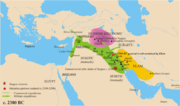
) were a people of the Ancient Near East
Ancient Near East
The ancient Near East was the home of early civilizations within a region roughly corresponding to the modern Middle East: Mesopotamia , ancient Egypt, ancient Iran The ancient Near East was the home of early civilizations within a region roughly corresponding to the modern Middle East: Mesopotamia...
who lived in Northern Mesopotamia
Al-Jazira, Mesopotamia
Upper Mesopotamia is the name used for the uplands and great outwash plain of northwestern Iraq and northeastern Syria and southeastern Turkey which is known by the traditional Arabic name of Al-Jazira , variously transliterated into Roman script as Djazirah, Djezirah and Jazirah...
and adjacent regions during the Bronze Age
Bronze Age
The Bronze Age is a period characterized by the use of copper and its alloy bronze as the chief hard materials in the manufacture of some implements and weapons. Chronologically, it stands between the Stone Age and Iron Age...
.The largest and most influential Hurrian nation was the kingdom of Mitanni
Mitanni
Mitanni or Hanigalbat was a loosely organized Hurrian-speaking state in northern Syria and south-east Anatolia from ca. 1500 BC–1300 BC...
. The population of the Hittite Empire in Anatolia to a large part consisted of Hurrians, and there is significant Hurrian influence in Hittite mythology
Hittite mythology
Most of the narratives embodying Hittite mythology are lost, and the elements that would give a balanced view of Hittite religion are lacking among the tablets recovered at the Hittite capital Hattusa and other Hittite sites: "there are no canonical scriptures, no theological disquisitions or...
. By the Early Iron Age, the Hurrians had been assimilated with other peoples, except perhaps in the kingdom of Urartu
Urartu
Urartu , corresponding to Ararat or Kingdom of Van was an Iron Age kingdom centered around Lake Van in the Armenian Highland....
. According to I.M. Diakonoff and S. Starostin
Sergei Starostin
Dr. Sergei Anatolyevich Starostin was a Russian historical linguist and scholar, best known for his work with hypothetical proto-languages, including his work on the reconstruction of the Proto-Borean language, the controversial theory of Altaic languages and the formulation of the Dené–Caucasian...
, the Hurrian, Hattic
Hattic
Hattic may refer to:* An ancient people of Anatolia, the Hattians.* An extinct language spoken in that region, the Hattic language....
, and Urartaean languages are related to the Northeast Caucasian languages
Northeast Caucasian languages
The Northeast Caucasian languages constitute a language family spoken in the Russian republics of Dagestan, Chechnya, Ingushetia, northern Azerbaijan, and in northeastern Georgia, as well as in diaspora populations in Russia, Turkey, and the Middle East...
.
Language
The Hurrians spoke an ergativeErgative-absolutive language
An ergative–absolutive language is a language that treats the argument of an intransitive verb like the object of a transitive verb, but differently from the agent of a transitive verb.-Ergative vs...
-agglutinative language
Agglutinative language
An agglutinative language is a language that uses agglutination extensively: most words are formed by joining morphemes together. This term was introduced by Wilhelm von Humboldt in 1836 to classify languages from a morphological point of view...
, conventionally called Hurrian
Hurrian language
Hurrian is a conventional name for the language of the Hurrians , a people who entered northern Mesopotamia around 2300 BC and had mostly vanished by 1000 BC. Hurrian was the language of the Mitanni kingdom in northern Mesopotamia, and was likely spoken at least initially in Hurrian settlements in...
, unrelated to neighboring Semitic
Semitic languages
The Semitic languages are a group of related languages whose living representatives are spoken by more than 270 million people across much of the Middle East, North Africa and the Horn of Africa...
or Indo-European languages
Indo-European languages
The Indo-European languages are a family of several hundred related languages and dialects, including most major current languages of Europe, the Iranian plateau, and South Asia and also historically predominant in Anatolia...
.
The Iron Age Urartian language
Urartian language
Urartian, Vannic, and Chaldean are conventional names for the language spoken by the inhabitants of the ancient kingdom of Urartu that was located in the region of Lake Van, with its capital near the site of the modern town of Van, in the Armenian Highland, modern-day Eastern Anatolia region of...
is closely related to or a direct descendant of Hurrian. Several notable Russian linguists, such as S. A. Starostin and V. V. Ivanov
Vyacheslav Vsevolodovich Ivanov
Vyacheslav Vsevolodovich Ivanov is a prominent Soviet/Russian philologist and Indo-Europeanist probably best known for his glottalic theory of Indo-European consonantism and for placing the Indo-European urheimat in the area of the Armenian Highlands and Lake Urmia.-Early life:Vyacheslav Ivanov's...
, have claimed that the Hurrian and the Hattic were related to the Northeast Caucasian languages
Northeast Caucasian languages
The Northeast Caucasian languages constitute a language family spoken in the Russian republics of Dagestan, Chechnya, Ingushetia, northern Azerbaijan, and in northeastern Georgia, as well as in diaspora populations in Russia, Turkey, and the Middle East...
.
The Hurrians adopted the Akkadian cuneiform
Cuneiform script
Cuneiform script )) is one of the earliest known forms of written expression. Emerging in Sumer around the 30th century BC, with predecessors reaching into the late 4th millennium , cuneiform writing began as a system of pictographs...
script for their own language about 2000 BCE. Texts in the Hurrian language have been found at Hattusa
Hattusa
Hattusa was the capital of the Hittite Empire in the late Bronze Age. It was located near modern Boğazkale, Turkey, within the great loop of the Kızıl River ....
, Ugarit
Ugarit
Ugarit was an ancient port city in the eastern Mediterranean at the Ras Shamra headland near Latakia, Syria. It is located near Minet el-Beida in northern Syria. It is some seven miles north of Laodicea ad Mare and approximately fifty miles east of Cyprus...
(Ras Shamra), as well as one of the longest of the Amarna letters
Amarna letters
The Amarna letters are an archive of correspondence on clay tablets, mostly diplomatic, between the Egyptian administration and its representatives in Canaan and Amurru during the New Kingdom...
, written by King Tushratta
Tushratta
Tushratta was a king of Mitanni at the end of the reign of Amenhotep III and throughout the reign of Akhenaten -- approximately the late 14th century BC. He was the son of Shuttarna II...
of Mitanni to Pharaoh Amenhotep III
Amenhotep III
Amenhotep III also known as Amenhotep the Magnificent was the ninth pharaoh of the Eighteenth dynasty. According to different authors, he ruled Egypt from June 1386 to 1349 BC or June 1388 BC to December 1351 BC/1350 BC after his father Thutmose IV died...
. It was the only long Hurrian text known until a multi-tablet collection of literature in Hurrian with a Hittite translation was discovered at Hattusa in 1983.
Middle Bronze Age
Hurrian names occur sporadically in northern Mesopotamia and the area of KirkukKirkuk
Kirkuk is a city in Iraq and the capital of Kirkuk Governorate.It is located in the Iraqi governorate of Kirkuk, north of the capital, Baghdad...
in modern Iraq
Iraq
Iraq ; officially the Republic of Iraq is a country in Western Asia spanning most of the northwestern end of the Zagros mountain range, the eastern part of the Syrian Desert and the northern part of the Arabian Desert....
by the Middle Bronze Age. Their presence was attested at Nuzi
Nuzi
Nuzi was an ancient Mesopotamian city southwest of Kirkuk in modern Al Ta'amim Governorate of Iraq, located near the Tigris river...
, Urkesh
Urkesh
Urkesh or Urkish is a tell, or settlement mound, located in the foothills of the Taurus Mountains in Al-Hasakah Governorate, northeastern Syria...
and other sites. They eventually infiltrated and occupied a broad arc of fertile farmland stretching from the Khabur River
Khabur River
The Khabur River , , , ) is the largest perennial tributary to the Euphrates in Syrian territory. Although the Khabur originates in Turkey, the karstic springs around Ra's al-'Ayn are the river's main source of water. Several important wadis join the Khabur north of Al-Hasakah, together creating...
valley to the foothills of the Zagros Mountains
Zagros Mountains
The Zagros Mountains are the largest mountain range in Iran and Iraq. With a total length of 1,500 km , from northwestern Iran, and roughly correlating with Iran's western border, the Zagros range spans the whole length of the western and southwestern Iranian plateau and ends at the Strait of...
. I. J. Gelb and E. A. Speiser believed Subarians
Subarians
The land of Subartu or Subar is mentioned in Bronze Age literature...
had been the linguistic and ethnic substratum of northern Mesopotamia since earliest times, while Hurrians were merely late arrivals.
Urkesh
The Khabur River valley became the heart of the Hurrian lands for a millennium. The first known Hurrian kingdom emerged around the city of UrkeshUrkesh
Urkesh or Urkish is a tell, or settlement mound, located in the foothills of the Taurus Mountains in Al-Hasakah Governorate, northeastern Syria...
(modern Tell Mozan) during the third millennium BCE. There is evidence that they were allied with the Akkadian Empire indicating they had a firm hold on the area by the reign of Naram-Sin of Akkad (ca. 2254–2218 BCE). This region hosted other rich cultures (see Tell Halaf
Tell Halaf
Tell Halaf is an archaeological site in the Al Hasakah governorate of northeastern Syria, near the Turkish border, just opposite Ceylanpınar. It was the first find of a Neolithic culture, subsequently dubbed the Halaf culture, characterized by glazed pottery painted with geometric and animal designs...
and Tell Brak
Nagar, Syria
Tell Brak, ancient Nagar, is a tell, or settlement mound, in the Upper Khabur area in Al-Hasakah Governorate, northeastern Syria. The site was occupied between the sixth and second millennia BCE...
). The city-state of Urkesh had some powerful neighbors. At some point in the early second millennium BCE, the Amorite kingdom of Mari
Mari, Syria
Mari was an ancient Sumerian and Amorite city, located 11 kilometers north-west of the modern town of Abu Kamal on the western bank of Euphrates river, some 120 km southeast of Deir ez-Zor, Syria...
to the south subdued Urkesh and made it a vassal state. In the continuous power struggles over Mesopotamia, another Amorite dynasty made themselves masters over Mari in the eighteenth century BCE. Shubat-Enlil (modern Tell Leilan), the capital of this Old Assyria
Assyria
Assyria was a Semitic Akkadian kingdom, extant as a nation state from the mid–23rd century BC to 608 BC centred on the Upper Tigris river, in northern Mesopotamia , that came to rule regional empires a number of times through history. It was named for its original capital, the ancient city of Assur...
n kingdom, was founded some distance from Urkesh at another Hurrian settlement in the Khabur River valley.
Yamhad
The Hurrians also migrated west in this period. By 1725 BCE they are found also in parts of northern SyriaSyria
Syria , officially the Syrian Arab Republic , is a country in Western Asia, bordering Lebanon and the Mediterranean Sea to the West, Turkey to the north, Iraq to the east, Jordan to the south, and Israel to the southwest....
, such as Alalakh
Alalakh
Alalakh is the name of an ancient city-state near modern Antakya in the Amuq River valley of Turkey's Hatay Province.Now represented by an extensive mound, the name of the modern archaeological site is Tell Atchana.-History:...
. The Amoritic-Hurrian kingdom of Yamhad
Yamhad
Yamhad was an ancient Amorite kingdom centered at Halab . A substantial Hurrian population also settled in the kingdom, and the Hurrian culture influenced the area. The kingdom was powerful during the Middle Bronze Age, ca. 1800-1600 BC. Its biggest rival was Qatna further south...
is recorded as struggling for this area with the early Hittite king Hattusilis I around 1600 BCE. Hurrians also settled in the coastal region of Adaniya in the country of Kizzuwatna
Kizzuwatna
Kizzuwatna , is the name of an ancient Anatolian kingdom in the second millennium BC. It was situated in the highlands of southeastern Anatolia, near the Gulf of İskenderun in modern-day Turkey. It encircled the Taurus Mountains and the Ceyhan river. The center of the kingdom was the city of...
. Yamhad eventually weakened to the powerful Hittites
Hittites
The Hittites were a Bronze Age people of Anatolia.They established a kingdom centered at Hattusa in north-central Anatolia c. the 18th century BC. The Hittite empire reached its height c...
, but this also opened Anatolia
Anatolia
Anatolia is a geographic and historical term denoting the westernmost protrusion of Asia, comprising the majority of the Republic of Turkey...
for Hurrian cultural influences. The Hittites were influenced by the Hurrian culture over the course of several centuries.
Mitanni
The Hittites continued expanding south after the defeat of YamhadYamhad
Yamhad was an ancient Amorite kingdom centered at Halab . A substantial Hurrian population also settled in the kingdom, and the Hurrian culture influenced the area. The kingdom was powerful during the Middle Bronze Age, ca. 1800-1600 BC. Its biggest rival was Qatna further south...
. The army of the Hittite king Mursili I
Mursili I
Mursili I was a king of the Hittites ca. 1556–1526 BC , and was likely a grandson of his predecessor, Hattusili I. His sister was Harapšili.- Biography :...
made its way down to Babylon
Babylon
Babylon was an Akkadian city-state of ancient Mesopotamia, the remains of which are found in present-day Al Hillah, Babil Province, Iraq, about 85 kilometers south of Baghdad...
and sacked the city. The destruction of the Babylonian kingdom, as well as the kingdom of Yamhad, helped the rise of another Hurrian dynasty. The first ruler was a legendary king called Kirta
Kirta
Kirta is a legendary Hurrian king. He is thought to have founded the dynasty of Mitanni, but no contemporary inscriptions from his time are known to exist. He may have lived around 1500 BC....
who founded the kingdom of Mitanni around 1500 BCE. Mitanni gradually grew from the region around Khabur valley and became the most powerful kingdom of the Near East in c. 1450-1350 BCE.
Some theonyms, proper names and other terminology of the Mitanni exhibit an Indo-Aryan
Indo-Aryan languages
The Indo-Aryan languages constitutes a branch of the Indo-Iranian languages, itself a branch of the Indo-European language family...
superstrate, suggesting that an Indo-Aryan
Indo-Aryans
Indo-Aryan is an ethno-linguistic term referring to the wide collection of peoples united as native speakers of the Indo-Aryan branch of the Indo-Iranian family of Indo-European languages...
elite imposed itself over the Hurrian population in the course of the Indo-Aryan expansion
Indo-Aryan migration
Models of the Indo-Aryan migration discuss scenarios of prehistoric migrations of the proto-Indo-Aryans to their historically attested areas of settlement in the northwest of the Indian subcontinent...
.
Arrapha
Another Hurrian kingdom also benefited from the demise of Babylonian power in sixteenth century BCE. Hurrians had inhabited the region northeast of river TigrisTigris
The Tigris River is the eastern member of the two great rivers that define Mesopotamia, the other being the Euphrates. The river flows south from the mountains of southeastern Turkey through Iraq.-Geography:...
, around the modern Kirkuk. This was the kingdom of Arrapha
Arrapha
Arrapha was an ancient Assyrian city that existed in what is today the city of Kirkuk, Iraq. The city was founded around 2000 BC and derived its name from the old Assyrian word Arabkha which was later changed to Arrapha...
. Excavations at Yorgan Tepe, ancient Nuzi, proved to be one of the most important sites for our knowledge about the Hurrians. Hurrian kings such as Ithi-Teshup and Ithiya ruled over Arrapha, yet by the mid-fifteenth century BCE they had become vassals of the Great King of Mitanni. Arrapha itself was destroyed by the Assyrians in the fourteenth century BCE.
Bronze Age collapse
By the thirteenth century BCE all of the Hurrian states had been vanquished by other peoples. The heart of the Hurrian lands, the Khabur river valley, became an Assyrian province. It is not clear what happened to the Hurrian people at the end of the Bronze Age. Some scholars have suggested Hurrians lived on in the country of SubartuSubartu
The land of Subartu or Subar is mentioned in Bronze Age literature...
north of Assyria during the early Iron Age. The Hurrian population of Syria in the following centuries seems to have given up their language in favor of the Assyrian dialect of Akkadian
Akkadian language
Akkadian is an extinct Semitic language that was spoken in ancient Mesopotamia. The earliest attested Semitic language, it used the cuneiform writing system derived ultimately from ancient Sumerian, an unrelated language isolate...
or, more likely, Aramaic
Aramaic language
Aramaic is a group of languages belonging to the Afroasiatic language phylum. The name of the language is based on the name of Aram, an ancient region in central Syria. Within this family, Aramaic belongs to the Semitic family, and more specifically, is a part of the Northwest Semitic subfamily,...
. This was around the same time that an aristocracy speaking Urartian, similar to old Hurrian, seems to have first imposed itself on the population around Lake Van, and formed the Kingdom of Urartu
Urartu
Urartu , corresponding to Ararat or Kingdom of Van was an Iron Age kingdom centered around Lake Van in the Armenian Highland....
.
Culture and society
Knowledge of Hurrian culture relies on archaeological excavations at sites such as Nuzi and AlalakhAlalakh
Alalakh is the name of an ancient city-state near modern Antakya in the Amuq River valley of Turkey's Hatay Province.Now represented by an extensive mound, the name of the modern archaeological site is Tell Atchana.-History:...
as well as on cuneiform tablets, primarily from Hattusa
Hattusa
Hattusa was the capital of the Hittite Empire in the late Bronze Age. It was located near modern Boğazkale, Turkey, within the great loop of the Kızıl River ....
(Boghazköy), the capital of the Hittites, whose civilization was greatly influenced by the Hurrians. Tablets from Nuzi, Alalakh
Alalakh
Alalakh is the name of an ancient city-state near modern Antakya in the Amuq River valley of Turkey's Hatay Province.Now represented by an extensive mound, the name of the modern archaeological site is Tell Atchana.-History:...
, and other cities with Hurrian populations (as shown by personal names) reveal Hurrian cultural features even though they were written in Akkadian. Hurrian cylinder seal
Cylinder seal
A cylinder seal is a cylinder engraved with a 'picture story', used in ancient times to roll an impression onto a two-dimensional surface, generally wet clay. Cylinder seals were invented around 3500 BC in the Near East, at the contemporary site of Susa in south-western Iran and at the early site...
s were carefully carved and often portrayed mythological motifs. They are a key to the understanding of Hurrian culture and history.
Ceramic ware
The Hurrians were masterful ceramists. Their pottery is commonly found in Mesopotamia and in the lands west of the Euphrates; it was highly valued in distant Egypt, by the time of the New KingdomNew Kingdom
The New Kingdom of Egypt, also referred to as the Egyptian Empire is the period in ancient Egyptian history between the 16th century BC and the 11th century BC, covering the Eighteenth, Nineteenth, and Twentieth Dynasties of Egypt....
. Archaeologists use the terms Khabur ware
Khabur ware
Khabur ware is a specific type of pottery named after the Khabur River region, in northeastern Syria, where large quantities of it were found by the archaeologist Max Mallowan at the site of Chagar Bazar. The pottery's distribution is not confined to the Khabur region, but spreads across northern...
and Nuzi ware for two types of wheel-made pottery used by the Hurrians. Khabur ware is characterized by reddish painted lines with a geometric triangular pattern and dots, while Nuzi ware has very distinctive forms, and are painted in brown or black.
Metallurgy
The Hurrians had a reputation in metallurgyMetallurgy
Metallurgy is a domain of materials science that studies the physical and chemical behavior of metallic elements, their intermetallic compounds, and their mixtures, which are called alloys. It is also the technology of metals: the way in which science is applied to their practical use...
. The Sumer
Sumer
Sumer was a civilization and historical region in southern Mesopotamia, modern Iraq during the Chalcolithic and Early Bronze Age....
ians borrowed their copper terminology from the Hurrian vocabulary. Copper was traded south to Mesopotamia
Mesopotamia
Mesopotamia is a toponym for the area of the Tigris–Euphrates river system, largely corresponding to modern-day Iraq, northeastern Syria, southeastern Turkey and southwestern Iran.Widely considered to be the cradle of civilization, Bronze Age Mesopotamia included Sumer and the...
from the highlands of Anatolia
Anatolia
Anatolia is a geographic and historical term denoting the westernmost protrusion of Asia, comprising the majority of the Republic of Turkey...
. The Khabur Valley had a central position in the metal trade, and copper, silver and even tin were accessible from the Hurrian-dominated countries Kizzuwatna
Kizzuwatna
Kizzuwatna , is the name of an ancient Anatolian kingdom in the second millennium BC. It was situated in the highlands of southeastern Anatolia, near the Gulf of İskenderun in modern-day Turkey. It encircled the Taurus Mountains and the Ceyhan river. The center of the kingdom was the city of...
and Ishuwa
Ishuwa
Isuwa was the ancient Hittite name for one of its neighboring Anatolian kingdoms to the east, in an area which later became the Luwian Neo-Hittite state of Kammanu.- The land :...
situated in the Anatolian highland. Gold was in short supply, and the Amarna letters
Amarna letters
The Amarna letters are an archive of correspondence on clay tablets, mostly diplomatic, between the Egyptian administration and its representatives in Canaan and Amurru during the New Kingdom...
inform us that it was acquired from Egypt. Not many examples of Hurrian metal work have survived, except from the later Urartu. Some small fine bronze lion figurines were discovered at Urkesh.
The horse
The Mitanni were closely associated with horses. The name of the country of Ishuwa, which might have had a substantial Hurrian population, meant “horse-land”. A famous text discovered at Hattusa deals with the training of horses. The man who was responsible for the horse-training was a Hurrian called KikkuliKikkuli
Kikkuli, "master horse trainer of the land Mitanni" was the author of a chariot horse training text written in the Hittite language, dating to the Hittite New Kingdom...
. The terminology used in connection with horses contains many Indo-Aryan loan-words (Mayrhofer, 1974).
Music
Among the Hurrian texts from Ugarit are the oldest known instances of written music, dating from c. 1400 BCE. Amongst these fragments are found the names of four Hurrian composers, Tapšiẖuni, Puẖiya(na), Urẖiya, and Ammiya.Religion
The Hurrian culture made a great impact on the religion of the Hittites. From the Hurrian cult centre at Kummanni in Kizzuwatna Hurrian religion spread to the Hittite people. Syncretism merged the Old Hittite and Hurrian religions. Hurrian religion spread to Syria, where BaalBaal
Baʿal is a Northwest Semitic title and honorific meaning "master" or "lord" that is used for various gods who were patrons of cities in the Levant and Asia Minor, cognate to Akkadian Bēlu...
became the counterpart of Teshub
Teshub
Teshub was the Hurrian god of sky and storm. He was derived from the Hattian Taru. His Hittite and Luwian name was Tarhun , although this name is from the Hittite root *tarh- to defeat, conquer.- Depiction and myths :He is depicted holding a triple...
. The later kingdom of Urartu also venerated gods of Hurrian origin. The Hurrian religion, in different forms, influenced the entire ancient Near East, except ancient Egypt
Ancient Egypt
Ancient Egypt was an ancient civilization of Northeastern Africa, concentrated along the lower reaches of the Nile River in what is now the modern country of Egypt. Egyptian civilization coalesced around 3150 BC with the political unification of Upper and Lower Egypt under the first pharaoh...
and southern Mesopotamia.
The main gods in the Hurrian pantheon were:
- TeshubTeshubTeshub was the Hurrian god of sky and storm. He was derived from the Hattian Taru. His Hittite and Luwian name was Tarhun , although this name is from the Hittite root *tarh- to defeat, conquer.- Depiction and myths :He is depicted holding a triple...
, Teshup; the mighty weathergod. - HebatHebatHebat, also transcribed Kheba or Khepat, was the mother goddess of the Hurrians, known as "the mother of all living".- Family :Hebat is the consort of Teshub and the mother of Sarruma. Originally, as Kheba or "Kubau" it is thought she may have had a Southern Mesopotamian origin, being the divinised...
, Hepa; his wife, the mother goddess, regarded as the Sun goddess among the Hittites. Drawn from the Sumerian goddess KubauKubabaKubaba is the only queen on the Sumerian King List, which states she reigned for 100 years – roughly in the Early Dynastic III period of Sumerian history...
, known as Hawwah amongst the AramaeansAramaeansThe Aramaeans, also Arameans , were a Northwest Semitic semi-nomadic and pastoralist people who originated in what is now modern Syria during the Late Bronze Age and the Iron Age...
. - Sharruma, or SarrumaSarrumaŠarruma or Sharruma is an originally Hurrian god who was adopted into the Hittite pantheon. There was a prince named after him - Ašmi-Šarruma, son of Arnuwanda I.- Mythology :...
, Šarruma; their son. - KumarbiKumarbiKumarbi is the chief god of the Hurrians. He is the son of Anu , and father of the storm-god Teshub. He was identified by the Hurrians with Sumerian Enlil, and by the Ugaritians with El....
; the ancient father of TeshubTeshubTeshub was the Hurrian god of sky and storm. He was derived from the Hattian Taru. His Hittite and Luwian name was Tarhun , although this name is from the Hittite root *tarh- to defeat, conquer.- Depiction and myths :He is depicted holding a triple...
; his home as described in mythology is the city of Urkesh. - ShaushkaShaushkaŠauška or Shaushka was a Hurrian goddess who was also adopted into the Hittite pantheon. She is known in detail because she became the patron goddess of the Hittite king Hattusili III following his marriage to Puduhepa, the daughter of the goddess's high priest...
, or Shawushka, Šauska; was the Hurrian counterpart of Assyrian IshtarIshtarIshtar is the Assyrian and Babylonian goddess of fertility, love, war, and sex. She is the counterpart to the Sumerian Inanna and to the cognate north-west Semitic goddess Astarte.-Characteristics:...
, and a goddess of fertility, war and healing. - Shimegi, Šimegi; the sun god.
- Kushuh, Kušuh; the moon god. Symbols of the sun and the crescent moon appear joined together in the Hurrian iconographyIconographyIconography is the branch of art history which studies the identification, description, and the interpretation of the content of images. The word iconography literally means "image writing", and comes from the Greek "image" and "to write". A secondary meaning is the painting of icons in the...
. - NergalNergalThe name Nergal, Nirgal, or Nirgali refers to a deity in Babylon with the main seat of his cult at Cuthah represented by the mound of Tell-Ibrahim. Nergal is mentioned in the Hebrew bible as the deity of the city of Cuth : "And the men of Babylon made Succoth-benoth, and the men of Cuth made Nergal"...
; a Babylonian deity of the netherworld, whose Hurrian name is unknown. - EaEnkiEnki is a god in Sumerian mythology, later known as Ea in Akkadian and Babylonian mythology. He was originally patron god of the city of Eridu, but later the influence of his cult spread throughout Mesopotamia and to the Canaanites, Hittites and Hurrians...
; was also Babylonian in origin, and may have influenced Canaanite El, and also YamYam (god)Yam, from the Canaanite word Yam, meaning "Sea", also written "Yaw", is one name of the Ugaritic god of Rivers and Sea. Also titled Judge Nahar , he is also one of the 'ilhm or sons of El, the name given to the Levantine pantheon...
, God of the Sea and River.
Names of Indo-Aryan gods Mitra
Mitra
*Mitra was an important Indo-Iranian divinity. Following the prehistoric cultural split of Indo-Aryan and Iranian cultures, names descended from *mitra were used for the following religious entities:...
and Varuna
Varuna
In Vedic religion, Varuna is a god of the sky, of water and of the celestial ocean, as well as a god of law and of the underworld...
especially, from the Vedic religion
Historical Vedic religion
The religion of the Vedic period is a historical predecessor of Hinduism. Its liturgy is reflected in the mantra portion of the four Vedas, which are compiled in Sanskrit. The religious practices centered on a clergy administering rites...
have survived in texts and personal names, but it is not known if any religious centers actually existed.
Hurrian cylinder seal
Cylinder seal
A cylinder seal is a cylinder engraved with a 'picture story', used in ancient times to roll an impression onto a two-dimensional surface, generally wet clay. Cylinder seals were invented around 3500 BC in the Near East, at the contemporary site of Susa in south-western Iran and at the early site...
s often depict mythological creatures such as winged humans or animals, dragons and other monsters. The interpretation of these depictions of gods and demons is uncertain. They may have been both protective and evil spirits. Some is reminiscent of the Assyrian shedu.
The Hurrian gods do not appear to have had particular "home temples", like in the Mesopotamian religion
Mesopotamian religion
Mesopotamian religion refers to the religious beliefs and practices followed by the Sumerian and Akkadian peoples living in Mesopotamia that dominated the region for a period of 4200 years from the fourth millennium BC to approximately the 3rd century AD...
or Ancient Egyptian religion. Some important cult centres were Kummanni in Kizzuwatna, and Hittite Yazilikaya
Yazilikaya
Yazılıkaya was a sanctuary of Hattusa, the capital city of the Hittite Empire, today in the Çorum Province, Turkey....
. Harran
Harran
Harran was a major ancient city in Upper Mesopotamia whose site is near the modern village of Altınbaşak, Turkey, 24 miles southeast of Şanlıurfa...
was at least later a religious centre for the moon god, and Shauskha had an important temple in Nineve, when the city was under Hurrian rule. A temple of Nergal
Nergal
The name Nergal, Nirgal, or Nirgali refers to a deity in Babylon with the main seat of his cult at Cuthah represented by the mound of Tell-Ibrahim. Nergal is mentioned in the Hebrew bible as the deity of the city of Cuth : "And the men of Babylon made Succoth-benoth, and the men of Cuth made Nergal"...
was built in Urkesh in the late third millennium BCE. The town of Kahat was a religious centre in the kingdom of Mitanni.
The Hurrian myth “The Songs of Ullikummi”, preserved among the Hittites, is a parallel to Hesiod
Hesiod
Hesiod was a Greek oral poet generally thought by scholars to have been active between 750 and 650 BC, around the same time as Homer. His is the first European poetry in which the poet regards himself as a topic, an individual with a distinctive role to play. Ancient authors credited him and...
's Theogony
Theogony
The Theogony is a poem by Hesiod describing the origins and genealogies of the gods of the ancient Greeks, composed circa 700 BC...
; the castration of Uranus
Uranus (mythology)
Uranus , was the primal Greek god personifying the sky. His equivalent in Roman mythology was Caelus. In Ancient Greek literature, according to Hesiod in his Theogony, Uranus or Father Sky was the son and husband of Gaia, Mother Earth...
by Cronus
Cronus
In Greek mythology, Cronus or Kronos was the leader and the youngest of the first generation of Titans, divine descendants of Gaia, the earth, and Uranus, the sky...
may be derived from the castration of Anu
Anu
In Sumerian mythology, Anu was a sky-god, the god of heaven, lord of constellations, king of gods, Consort of Antu, spirits and demons, and dwelt in the highest heavenly regions. It was believed that he had the power to judge those who had committed crimes, and that he had created the stars as...
by Kumarbi
Kumarbi
Kumarbi is the chief god of the Hurrians. He is the son of Anu , and father of the storm-god Teshub. He was identified by the Hurrians with Sumerian Enlil, and by the Ugaritians with El....
, while Zeus
Zeus
In the ancient Greek religion, Zeus was the "Father of Gods and men" who ruled the Olympians of Mount Olympus as a father ruled the family. He was the god of sky and thunder in Greek mythology. His Roman counterpart is Jupiter and his Etruscan counterpart is Tinia.Zeus was the child of Cronus...
's overthrow of Cronus and Cronus's regurgitation of the swallowed gods is like the Hurrian myth of Teshub
Teshub
Teshub was the Hurrian god of sky and storm. He was derived from the Hattian Taru. His Hittite and Luwian name was Tarhun , although this name is from the Hittite root *tarh- to defeat, conquer.- Depiction and myths :He is depicted holding a triple...
and Kumarbi. It has been argued that the worship of Attis
Attis
Attis was the consort of Cybele in Phrygian and Greek mythology. His priests were eunuchs, as explained by origin myths pertaining to Attis and castration...
drew on Hurrian myth. The Phrygia
Phrygia
In antiquity, Phrygia was a kingdom in the west central part of Anatolia, in what is now modern-day Turkey. The Phrygians initially lived in the southern Balkans; according to Herodotus, under the name of Bryges , changing it to Phruges after their final migration to Anatolia, via the...
n goddess Cybele
Cybele
Cybele , was a Phrygian form of the Earth Mother or Great Mother. As with Greek Gaia , her Minoan equivalent Rhea and some aspects of Demeter, Cybele embodies the fertile Earth...
would then be the counterpart of the Hurrian goddess Hebat
Hebat
Hebat, also transcribed Kheba or Khepat, was the mother goddess of the Hurrians, known as "the mother of all living".- Family :Hebat is the consort of Teshub and the mother of Sarruma. Originally, as Kheba or "Kubau" it is thought she may have had a Southern Mesopotamian origin, being the divinised...
.
Urbanism
The Hurrian urban culture was not represented by a large number of cities. Urkesh was the only Hurrian city in the third millennium BCE. In the second millennium BCE we know a number of Hurrian cities, such as Arrapha, Harran, Kahat, Nuzi, TaiduTaidu
Taidu can refer to:* Taite, an ancient Middle Eastern city* Taiwan independence, as the Mandarin Chinese pronunciation of the term...
and Washukanni
Washukanni
Washukanni was the capital of the Hurrian kingdom of Mitanni, from c. 1500 BC to the 13th century BC. Its precise location is unknown, but it is widely thought to have existed on one of the tributaries of the Khabur River. Some scholars believe it is identical with the later, ancient city of Sikan...
– the capital of Mitanni. Although the site of Washukanni, alleged to be at Tell Fakhariya, is not known for certain, no tell
Tell
A tell or tel, is a type of archaeological mound created by human occupation and abandonment of a geographical site over many centuries. A classic tell looks like a low, truncated cone with a flat top and sloping sides.-Archaeology:A tell is a hill created by different civilizations living and...
(city mound) in the Khabur Valley much exceeds the size of 1 square kilometer (250 acres), and the majority of sites are much smaller. The Hurrian urban culture appears to have been quite different from the centralized state administrations of Assyria and ancient Egypt. An explanation could be that the feudal organization of the Hurrian kingdoms did not allow large palace or temple estates to develop.
Archaeology
Hurrian settlements are distributed over three modern countries, Iraq, Syria and Turkey. The heart of the Hurrian world is dissected by the modern border between Syria and Turkey. Several sites are situated within the border zone, making access for excavations problematic. A threat to the ancient sites are the dam many projects in the EuphratesEuphrates
The Euphrates is the longest and one of the most historically important rivers of Western Asia. Together with the Tigris, it is one of the two defining rivers of Mesopotamia...
, Tigris
Tigris
The Tigris River is the eastern member of the two great rivers that define Mesopotamia, the other being the Euphrates. The river flows south from the mountains of southeastern Turkey through Iraq.-Geography:...
and Khabur valleys. Several rescue operations have already been undertaken when the construction of dams put entire river valleys under water.
The first major excavations of Hurrian sites in Iraq and Syria began in the 1920s and 1930s. They were led by the American archaeologist Edward Chiera at Yorghan Tepe (Nuzi), and the British archaeologist Max Mallowan
Max Mallowan
Sir Max Edgar Lucien Mallowan, CBE was a prominent British archaeologist, specialising in ancient Middle Eastern history, and the second husband of Dame Agatha Christie.-Life and work:...
at Chagar Bazar
Chagar Bazar
Chagar Bazar is an ancient site in northern Syria, about 35 kilometers north of Al-Hasakah, occupied from the sixth to the second millennium BC. It is situated by the small river Dara, a tributary to the Khabur River. Alternative spellings are Tell Chagar Bazar, or Šagir Bazar.-History:Chagar...
and Tell Brak. Recent excavations and surveys in progress are conducted by American, Belgian, Danish, Dutch, French, German and Italian teams of archaeologists, with international participants, in cooperation with the Syrian Department of Antiquities. The tells, or city mounds, often reveal a long occupation beginning in the Neolithic
Neolithic
The Neolithic Age, Era, or Period, or New Stone Age, was a period in the development of human technology, beginning about 9500 BC in some parts of the Middle East, and later in other parts of the world. It is traditionally considered as the last part of the Stone Age...
and ending in the Roman period or later. The characteristic Hurrian pottery, the Khabur ware, is helpful in determining the different strata of occupation within the mounds. The Hurrian settlements are usually identified from the Middle Bronze Age to the end of the Late Bronze Age, with Tell Mozan (Urkesh) being the main exception.
Important sites
The list includes some important ancient sites from the area dominated by the Hurrians. Excavation reports and images are found at the websites linked. As noted above, important discoveries of Hurrian culture and history were also made at Alalakh, Amarna, Hattusa and Ugarit.- Tell Mozan (ancient Urkesh)
- Yorghan Tepe (ancient Nuzi)
- Tell Brak (ancient Nagar)
- Tell Leilan (ancient Shehna and Shubat-Enlil)
- Tell BarriTell BarriTell Barri is an archaeological site in north-eastern Syria inthe Al-Hasakah Governorate. Its ancient name was Kahat as proved by a threshold found on the south-western slope of the mound....
(ancient Kahat) - Tell BeydarTell BeydarTell Beydar in modern Al-Hasakah Governorate, Syria, was the Ancient Near Easterncity of Nabada.-History:Nabada was first settled during the Early Dynastic period circa 2600 BC. By around 2500 BC a medium sized independent city-state had developed. At that point, it became a provincial capital...
(ancient Nabada) - Kenan Tepe
- Tell Tuneinir
- Umm el-MarraUmm el-MarraUmm el-Marra, , east of modern Aleppo in the Jabbul Plain of northern Syria, was one of the ancient Near East's oldest cities, located on a crossroads of two trade routes northwest of Ebla, in a landscape that was much more fertile than it is today...
(ancient Tuba?) - Tell Chuera
- Hammam al Turkman (ancient Zalpa?)
- Tell Sabi Abyad
- HamoukarHamoukarHamoukar is a large archaeological site located in the Jazira region of northeastern Syria near the Iraqi border and Turkey.-History:...
- Chagar BazarChagar BazarChagar Bazar is an ancient site in northern Syria, about 35 kilometers north of Al-Hasakah, occupied from the sixth to the second millennium BC. It is situated by the small river Dara, a tributary to the Khabur River. Alternative spellings are Tell Chagar Bazar, or Šagir Bazar.-History:Chagar...
- Tell el Fakhariya / Ras el Ayn (ancient Washukanni?)
- Tell HamidiyaTaiteTaite was one of the capitals of the Mitanni Empire. Its exact location is still unknown, although it is speculated to be in the Khabur region...
(ancient Taidu?)
External links
- Vyacheslav V. Ivanov, "Comparative Notes on Hurro-Urartian, Indo-European, and Northern Caucasian" discusses the difficulties and disagreements faced by linguists working in this area, the term Alarodian being created especially for the Hurro-Urartian-Nakh-Avar languages as a family.
- The Indo-European Elements in Hurrian
- A bibliography on Hurrian
- A bibliography on Urartian
- The Rise of the Hurrians (full text by Robert Antonio)
- The Hurrians and the Ancient Near East History (full text by Jeremiah Genest)
- Vahan Kurkjian, "History of Armenia", Michigan, 1968, "The Hurri-Mitanni kingdom of Armenia"