


Ancient Near East

Encyclopedia
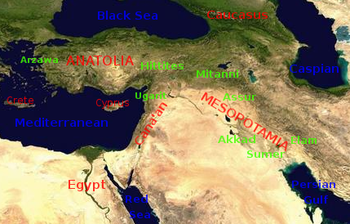
The ancient Near East was the home of early civilization
Civilization
Civilization is a sometimes controversial term that has been used in several related ways. Primarily, the term has been used to refer to the material and instrumental side of human cultures that are complex in terms of technology, science, and division of labor. Such civilizations are generally...
s within a region roughly corresponding to the modern Middle East
Middle East
The Middle East is a region that encompasses Western Asia and Northern Africa. It is often used as a synonym for Near East, in opposition to Far East...
: Mesopotamia
Mesopotamia
Mesopotamia is a toponym for the area of the Tigris–Euphrates river system, largely corresponding to modern-day Iraq, northeastern Syria, southeastern Turkey and southwestern Iran.Widely considered to be the cradle of civilization, Bronze Age Mesopotamia included Sumer and the...
(modern Iraq
Iraq
Iraq ; officially the Republic of Iraq is a country in Western Asia spanning most of the northwestern end of the Zagros mountain range, the eastern part of the Syrian Desert and the northern part of the Arabian Desert....
and northeastern Syria
Syria
Syria , officially the Syrian Arab Republic , is a country in Western Asia, bordering Lebanon and the Mediterranean Sea to the West, Turkey to the north, Iraq to the east, Jordan to the south, and Israel to the southwest....
), ancient Egypt
Ancient Egypt
Ancient Egypt was an ancient civilization of Northeastern Africa, concentrated along the lower reaches of the Nile River in what is now the modern country of Egypt. Egyptian civilization coalesced around 3150 BC with the political unification of Upper and Lower Egypt under the first pharaoh...
, ancient Iran
History of Iran
The history of Iran has been intertwined with the history of a larger historical region, comprising the area from the Danube River in the west to the Indus River and Jaxartes in the east and from the Caucasus, Caspian Sea, and Aral Sea in the north to the Persian Gulf and the Gulf of Oman and Egypt...
(Elam
Elam
Elam was an ancient civilization located in what is now southwest Iran. Elam was centered in the far west and the southwest of modern-day Iran, stretching from the lowlands of Khuzestan and Ilam Province, as well as a small part of southern Iraq...
, Media
Medes
The MedesThe Medes...
, Parthia
Parthia
Parthia is a region of north-eastern Iran, best known for having been the political and cultural base of the Arsacid dynasty, rulers of the Parthian Empire....
and Persia, Anatolia
Anatolia
Anatolia is a geographic and historical term denoting the westernmost protrusion of Asia, comprising the majority of the Republic of Turkey...
(modern Turkey
Turkey
Turkey , known officially as the Republic of Turkey , is a Eurasian country located in Western Asia and in East Thrace in Southeastern Europe...
) and the Levant
Levant
The Levant or ) is the geographic region and culture zone of the "eastern Mediterranean littoral between Anatolia and Egypt" . The Levant includes most of modern Lebanon, Syria, Jordan, Israel, the Palestinian territories, and sometimes parts of Turkey and Iraq, and corresponds roughly to the...
(modern Syria
Syria
Syria , officially the Syrian Arab Republic , is a country in Western Asia, bordering Lebanon and the Mediterranean Sea to the West, Turkey to the north, Iraq to the east, Jordan to the south, and Israel to the southwest....
, Lebanon
Lebanon
Lebanon , officially the Republic of LebanonRepublic of Lebanon is the most common term used by Lebanese government agencies. The term Lebanese Republic, a literal translation of the official Arabic and French names that is not used in today's world. Arabic is the most common language spoken among...
, Israel
Israel
The State of Israel is a parliamentary republic located in the Middle East, along the eastern shore of the Mediterranean Sea...
, and Jordan
Jordan
Jordan , officially the Hashemite Kingdom of Jordan , Al-Mamlaka al-Urduniyya al-Hashemiyya) is a kingdom on the East Bank of the River Jordan. The country borders Saudi Arabia to the east and south-east, Iraq to the north-east, Syria to the north and the West Bank and Israel to the west, sharing...
). The ancient Near East is studied in the fields of Near Eastern archaeology
Near Eastern archaeology
Near Eastern Archaeology is a regional branch of the wider, global discipline of Archaeology...
and ancient history
Ancient history
Ancient history is the study of the written past from the beginning of recorded human history to the Early Middle Ages. The span of recorded history is roughly 5,000 years, with Cuneiform script, the oldest discovered form of coherent writing, from the protoliterate period around the 30th century BC...
. It begins with the rise of Sumer
Sumer
Sumer was a civilization and historical region in southern Mesopotamia, modern Iraq during the Chalcolithic and Early Bronze Age....
in the 4th millennium BC
4th millennium BC
The 4th millennium BC saw major changes in human culture. It marked the beginning of the Bronze Age and of writing.The city states of Sumer and the kingdom of Egypt were established and grew to prominence. Agriculture spread widely across Eurasia...
, though the date it ends varies: either covering the Bronze Age
Bronze Age
The Bronze Age is a period characterized by the use of copper and its alloy bronze as the chief hard materials in the manufacture of some implements and weapons. Chronologically, it stands between the Stone Age and Iron Age...
and the Iron Age
Iron Age
The Iron Age is the archaeological period generally occurring after the Bronze Age, marked by the prevalent use of iron. The early period of the age is characterized by the widespread use of iron or steel. The adoption of such material coincided with other changes in society, including differing...
in the region, until the conquest by the Achaemenid Empire
Achaemenid Empire
The Achaemenid Empire , sometimes known as First Persian Empire and/or Persian Empire, was founded in the 6th century BCE by Cyrus the Great who overthrew the Median confederation...
in the 6th century BC or Alexander the Great in the 4th century BC.
The ancient Near East is considered the cradle of civilization
Cradle of Civilization
The cradle of civilization is a term referring to any of the possible locations for the emergence of civilization.It is usually applied to the Ancient Near Eastern Chalcolithic , especially in the Fertile Crescent , but also extended to sites in Armenia, and the Persian Plateau, besides other Asian...
. It was the first to practice intensive year-round agriculture
Agriculture
Agriculture is the cultivation of animals, plants, fungi and other life forms for food, fiber, and other products used to sustain life. Agriculture was the key implement in the rise of sedentary human civilization, whereby farming of domesticated species created food surpluses that nurtured the...
, it gave the rest of the world the first writing system
History of writing
The history of writing records the development of expressing language by letters or other marks. In the history of how systems of representation of language through graphic means have evolved in different human civilizations, more complete writing systems were preceded by proto-writing, systems of...
, invented the potter's wheel
Potter's wheel
In pottery, a potter's wheel is a machine used in asma of round ceramic ware. The wheel may also be used during process of trimming the excess body from dried ware and for applying incised decoration or rings of color...
and then the vehicular- and mill wheel
Wheel
A wheel is a device that allows heavy objects to be moved easily through rotating on an axle through its center, facilitating movement or transportation while supporting a load, or performing labor in machines. Common examples found in transport applications. A wheel, together with an axle,...
, created the first centralized government
Centralized government
A centralized or centralised government is one in which power or legal authority is exerted or coordinated by a de facto political executive to which federal states, local authorities, and smaller units are considered subject...
s, law codes and empire
Empire
The term empire derives from the Latin imperium . Politically, an empire is a geographically extensive group of states and peoples united and ruled either by a monarch or an oligarchy....
s, as well as introducing social stratification
Social stratification
In sociology the social stratification is a concept of class, involving the "classification of persons into groups based on shared socio-economic conditions ... a relational set of inequalities with economic, social, political and ideological dimensions."...
, slavery
Slavery
Slavery is a system under which people are treated as property to be bought and sold, and are forced to work. Slaves can be held against their will from the time of their capture, purchase or birth, and deprived of the right to leave, to refuse to work, or to demand compensation...
and organized warfare, and it laid the foundation for the fields of astronomy
Astronomy
Astronomy is a natural science that deals with the study of celestial objects and phenomena that originate outside the atmosphere of Earth...
and mathematics
Mathematics
Mathematics is the study of quantity, space, structure, and change. Mathematicians seek out patterns and formulate new conjectures. Mathematicians resolve the truth or falsity of conjectures by mathematical proofs, which are arguments sufficient to convince other mathematicians of their validity...
.
The concept of Near East
The term "ancient Near East" utilizes the 19th-century distinction between Near EastNear East
The Near East is a geographical term that covers different countries for geographers, archeologists, and historians, on the one hand, and for political scientists, economists, and journalists, on the other...
and Far East
Far East
The Far East is an English term mostly describing East Asia and Southeast Asia, with South Asia sometimes also included for economic and cultural reasons.The term came into use in European geopolitical discourse in the 19th century,...
as global regions of interest to the British Empire
British Empire
The British Empire comprised the dominions, colonies, protectorates, mandates and other territories ruled or administered by the United Kingdom. It originated with the overseas colonies and trading posts established by England in the late 16th and early 17th centuries. At its height, it was the...
. The distinction began during the Crimean War
Crimean War
The Crimean War was a conflict fought between the Russian Empire and an alliance of the French Empire, the British Empire, the Ottoman Empire, and the Kingdom of Sardinia. The war was part of a long-running contest between the major European powers for influence over territories of the declining...
. The last major exclusive partition of the east between these two terms was current in diplomacy in the late 19th century with the Hamidian Massacres
Hamidian massacres
The Hamidian massacres , also referred to as the Armenian Massacres of 1894–1896, refers to the massacring of Armenians by the Ottoman Empire, with estimates of the dead ranging from anywhere between 80,000 to 300,000, and at least 50,000 orphans as a result...
of the Armenians and Assyrians
Assyrian people
The Assyrian people are a distinct ethnic group whose origins lie in ancient Mesopotamia...
by the Ottoman Empire
Ottoman Empire
The Ottoman EmpireIt was usually referred to as the "Ottoman Empire", the "Turkish Empire", the "Ottoman Caliphate" or more commonly "Turkey" by its contemporaries...
in 1894-1896 and the Sino-Japanese War
Sino-Japanese War
There were two wars known as the Sino-Japanese War :* The First Sino-Japanese War between China and Japan , primarily over control of Korea....
of 1894-1895. The two theatres were described by the statesmen and advisors of the British Empire
British Empire
The British Empire comprised the dominions, colonies, protectorates, mandates and other territories ruled or administered by the United Kingdom. It originated with the overseas colonies and trading posts established by England in the late 16th and early 17th centuries. At its height, it was the...
as "the Near East" and "the Far East." Shortly they were to share the stage with Middle East
Middle East
The Middle East is a region that encompasses Western Asia and Northern Africa. It is often used as a synonym for Near East, in opposition to Far East...
, which came to prevail in the 20th century and continues in modern times.
As Near East had meant the lands of the Ottoman Empire
Ottoman Empire
The Ottoman EmpireIt was usually referred to as the "Ottoman Empire", the "Turkish Empire", the "Ottoman Caliphate" or more commonly "Turkey" by its contemporaries...
at roughly maximum extent, on the fall of that empire the use of Near East in diplomacy was reduced significantly in favor of Middle East. In the meanwhile, ancient Near East had become distinct. It referred primarily to the Biblical lands. The Near East ruled by the Ottoman Empire ranged from Vienna
Vienna
Vienna is the capital and largest city of the Republic of Austria and one of the nine states of Austria. Vienna is Austria's primary city, with a population of about 1.723 million , and is by far the largest city in Austria, as well as its cultural, economic, and political centre...
to the north to the tip of the Arabian Peninsula
Arabian Peninsula
The Arabian Peninsula is a land mass situated north-east of Africa. Also known as Arabia or the Arabian subcontinent, it is the world's largest peninsula and covers 3,237,500 km2...
to the south, from Egypt in the west to the borders of Iraq in the east. The 19th-century archaeologists added Iran, which was never under the Ottomans.
Periodization
Ancient Near East periodizationPeriodization
Periodization is the attempt to categorize or divide time into named blocks. The result is a descriptive abstraction that provides a useful handle on periods of time with relatively stable characteristics...
is the attempt to categorize or divide time into discrete named blocks, or eras, of the Near east. The result is a descriptive abstraction that provides a useful handle on Near East periods of time with relatively stable characteristics.
| Copper Age Copper Age The Chalcolithic |stone]]") period or Copper Age, also known as the Eneolithic/Æneolithic , is a phase of the Bronze Age in which the addition of tin to copper to form bronze during smelting remained yet unknown by the metallurgists of the times... |
Chalcolithic (4500 BC - 3300 BC) |
Early Chalcolithic | 4500 BC - 4000 BC | Ubaid period Ubaid period The Ubaid period is a prehistoric period of Mesopotamia. The tell of al-`Ubaid west of nearby Ur in southern Iraq's Dhi Qar Governorate has given its name to the prehistoric Pottery Neolithic to Chalcolithic culture, which represents the earliest settlement on the alluvial plain of southern... |
| Late Chalcolithic | 4000 BC - 3300 BC | Ghassulian Ghassulian Ghassulian refers to a culture and an archaeological stage dating to the Middle Chalcolithic Period in the Southern Levant... , Uruk period Uruk period The Uruk period existed from the protohistoric Chalcolithic to Early Bronze Age period in the history of Mesopotamia, following the Ubaid period and succeeded by the Jemdet Nasr period. Named after the Sumerian city of Uruk, this period saw the emergence of urban life in Mesopotamia. It was... , Gerzeh Gerzeh Gerzeh, also Girza or Jirzah, was a predynastic Egyptian cemetery located along the west bank of the Nile and today named after al-Girza, the nearby present day town in Egypt. Gerzeh is situated only several miles due east of the lake of the Al Fayyum.The Gerzean culture is a material culture... , Predynastic Egypt Predynastic Egypt The Prehistory of Egypt spans the period of earliest human settlement to the beginning of the Early Dynastic Period of Egypt in ca. 3100 BC, starting with King Menes/Narmer.... |
||
| Bronze Age Bronze Age The Bronze Age is a period characterized by the use of copper and its alloy bronze as the chief hard materials in the manufacture of some implements and weapons. Chronologically, it stands between the Stone Age and Iron Age... (3300 BC - 1200 BC) |
Early Bronze Age (3300 BC - 2000 BC) |
Early Bronze Age I | 3300 BC - 3000 BC | Protodynastic to Early Dynastic Period of Egypt Early Dynastic Period of Egypt The Archaic or Early Dynastic Period of Egypt immediately follows the unification of Lower and Upper Egypt c. 3100 BC. It is generally taken to include the First and Second Dynasties, lasting from the Protodynastic Period of Egypt until about 2686 BC, or the beginning of the Old Kingdom... |
| Early Bronze Age II | 3000 BC - 2700 BC | Early Dynastic Period of Sumer | ||
| Early Bronze Age III | 2700 BC - 2200 BC | Old Kingdom of Egypt, Akkadian Empire | ||
| Early Bronze Age IV | 2100 BC - 2100 BC | First Intermediate Period of Egypt First Intermediate Period of Egypt The First Intermediate Period, often described as a “dark period” in ancient Egyptian history, spanned approximately one hundred years after the end of the Old Kingdom from ca. 2181-2055 BC. It included the seventh, eighth, ninth, tenth, and part of the eleventh dynasties. Very little monumental... |
||
| Middle Bronze Age (2000 BC - 1550 BC) |
Middle Bronze Age I | 2100 BC - 2000 BC | Middle Kingdom of Egypt Middle Kingdom of Egypt The Middle Kingdom of Egypt is the period in the history of ancient Egypt stretching from the establishment of the Eleventh Dynasty to the end of the Fourteenth Dynasty, between 2055 BC and 1650 BC, although some writers include the Thirteenth and Fourteenth dynasties in the Second Intermediate... |
|
| Middle Bronze Age II A | 2000 BC - 1750 BC | Minoan civilization Minoan civilization The Minoan civilization was a Bronze Age civilization that arose on the island of Crete and flourished from approximately the 27th century BC to the 15th century BC. It was rediscovered at the beginning of the 20th century through the work of the British archaeologist Arthur Evans... |
||
| Middle Bronze Age II B | 1750 BC - 1650 BC | Second Intermediate Period of Egypt Second Intermediate Period of Egypt The Second Intermediate Period marks a period when Ancient Egypt fell into disarray for a second time, between the end of the Middle Kingdom and the start of the New Kingdom... |
||
| Middle Bronze Age II C | 1650 BC - 1550 BC | Hittite Old Kingdom, Minoan eruption | ||
| Late Bronze Age (1550 BC - 1200 BC) |
Late Bronze Age I | 1550 BC - 1400 BC | Hittite Middle Kingdom | |
| Late Bronze Age II A | 1400 BC - 1300 BC | Hittite New Kingdom, Mitanni Mitanni Mitanni or Hanigalbat was a loosely organized Hurrian-speaking state in northern Syria and south-east Anatolia from ca. 1500 BC–1300 BC... , Ugarit Ugarit Ugarit was an ancient port city in the eastern Mediterranean at the Ras Shamra headland near Latakia, Syria. It is located near Minet el-Beida in northern Syria. It is some seven miles north of Laodicea ad Mare and approximately fifty miles east of Cyprus... |
||
| Late Bronze Age II B | 1300 BC - 1200 BC | (Dark Age Bronze Age collapse The Bronze Age collapse is a transition in southwestern Asia and the Eastern Mediterranean from the Late Bronze Age to the Early Iron Age that some historians believe was violent, sudden and culturally disruptive... , Sea Peoples Sea Peoples The Sea Peoples were a confederacy of seafaring raiders of the second millennium BC who sailed into the eastern Mediterranean, caused political unrest, and attempted to enter or control Egyptian territory during the late 19th dynasty and especially during year 8 of Ramesses III of the 20th Dynasty... ) |
||
| Iron Age Iron Age The Iron Age is the archaeological period generally occurring after the Bronze Age, marked by the prevalent use of iron. The early period of the age is characterized by the widespread use of iron or steel. The adoption of such material coincided with other changes in society, including differing... (1200 BC - 539 BC) |
Iron Age I Bronze Age collapse The Bronze Age collapse is a transition in southwestern Asia and the Eastern Mediterranean from the Late Bronze Age to the Early Iron Age that some historians believe was violent, sudden and culturally disruptive... (1200 BC - 1000 BC) |
Iron Age I A | 1200 BC - 1150 BC | Troy VII Troy VII Troy VII, in the mound at Hisarlik, is an archaeological layer of Troy representing late Hittite Empire to Neo-Hittite times . It was a walled city with towers reaching a height of nine meters; the foundations of one of its bastions measure 18 meters by 18 meters... , Hekla 3 eruption Hekla 3 eruption The Hekla 3 eruption circa 1000 BC is considered the most severe eruption of Hekla during the Holocene. It threw about 7.3 km3 of volcanic rock into the atmosphere, placing its Volcanic Explosivity Index at 5... |
| Iron Age I B | 1150 BC - 1000 BC | Neo-Hittite states Neo-Hittite The states that are called Neo-Hittite, or more recently Syro-Hittite, were Luwian, Aramaic and Phoenician-speaking political entities of the Iron Age northern Syria and southern Anatolia that arose following the collapse of the Hittite Empire around 1180 BC and lasted until roughly 700 BC... |
||
| Iron Age II (1000 BC - 539 BC) |
Iron Age II A | 1000 BC - 900 BC | Neo-Assyrian Empire | |
| Iron Age II B | 900 BC - 700 BC | Kingdom of Israel, Urartu Urartu Urartu , corresponding to Ararat or Kingdom of Van was an Iron Age kingdom centered around Lake Van in the Armenian Highland.... , Phrygia Phrygia In antiquity, Phrygia was a kingdom in the west central part of Anatolia, in what is now modern-day Turkey. The Phrygians initially lived in the southern Balkans; according to Herodotus, under the name of Bryges , changing it to Phruges after their final migration to Anatolia, via the... |
||
| Iron Age II C | 700 BC - 539 BC | Neo-Babylonian Empire Neo-Babylonian Empire The Neo-Babylonian Empire or Second Babylonian Empire was a period of Mesopotamian history which began in 626 BC and ended in 539 BC. During the preceding three centuries, Babylonia had been ruled by their fellow Akkadian speakers and northern neighbours, Assyria. Throughout that time Babylonia... |
||
Early Mesopotamia
The Uruk periodUruk period
The Uruk period existed from the protohistoric Chalcolithic to Early Bronze Age period in the history of Mesopotamia, following the Ubaid period and succeeded by the Jemdet Nasr period. Named after the Sumerian city of Uruk, this period saw the emergence of urban life in Mesopotamia. It was...
(c. 4000 to 3100 BC) existed from the protohistoric
Protohistory
Protohistory refers to a period between prehistory and history, during which a culture or civilization has not yet developed writing, but other cultures have already noted its existence in their own writings...
Chalcolithic to Early Bronze Age period in the history of Mesopotamia
Mesopotamia
Mesopotamia is a toponym for the area of the Tigris–Euphrates river system, largely corresponding to modern-day Iraq, northeastern Syria, southeastern Turkey and southwestern Iran.Widely considered to be the cradle of civilization, Bronze Age Mesopotamia included Sumer and the...
, following the Ubaid period
Ubaid period
The Ubaid period is a prehistoric period of Mesopotamia. The tell of al-`Ubaid west of nearby Ur in southern Iraq's Dhi Qar Governorate has given its name to the prehistoric Pottery Neolithic to Chalcolithic culture, which represents the earliest settlement on the alluvial plain of southern...
. Named after the Sumerian city of Uruk
Uruk
Uruk was an ancient city of Sumer and later Babylonia, situated east of the present bed of the Euphrates river, on the ancient dry former channel of the Euphrates River, some 30 km east of modern As-Samawah, Al-Muthannā, Iraq.Uruk gave its name to the Uruk...
, this period saw the emergence of urban life in Mesopotamia. It was followed by the Sumerian civilization
Sumer
Sumer was a civilization and historical region in southern Mesopotamia, modern Iraq during the Chalcolithic and Early Bronze Age....
. The late Uruk period (34th to 32nd centuries) saw the gradual emergence of the cuneiform script
Cuneiform script
Cuneiform script )) is one of the earliest known forms of written expression. Emerging in Sumer around the 30th century BC, with predecessors reaching into the late 4th millennium , cuneiform writing began as a system of pictographs...
and corresponds to the Early Bronze Age.
Sumer & Akkad
Sumer
Sumer
Sumer was a civilization and historical region in southern Mesopotamia, modern Iraq during the Chalcolithic and Early Bronze Age....
, located in southern Mesopotamia
Mesopotamia
Mesopotamia is a toponym for the area of the Tigris–Euphrates river system, largely corresponding to modern-day Iraq, northeastern Syria, southeastern Turkey and southwestern Iran.Widely considered to be the cradle of civilization, Bronze Age Mesopotamia included Sumer and the...
, is the earliest known civilization
Civilization
Civilization is a sometimes controversial term that has been used in several related ways. Primarily, the term has been used to refer to the material and instrumental side of human cultures that are complex in terms of technology, science, and division of labor. Such civilizations are generally...
in the world. It lasted from the first settlement of Eridu
Eridu
Eridu is an ancient Sumerian city in what is now Tell Abu Shahrain, Dhi Qar Governorate, Iraq. Eridu was considered the earliest city in southern Mesopotamia, and is one of the oldest cities in the world...
in the Ubaid period
Ubaid period
The Ubaid period is a prehistoric period of Mesopotamia. The tell of al-`Ubaid west of nearby Ur in southern Iraq's Dhi Qar Governorate has given its name to the prehistoric Pottery Neolithic to Chalcolithic culture, which represents the earliest settlement on the alluvial plain of southern...
(late 6th millennium BC) through the Uruk period
Uruk period
The Uruk period existed from the protohistoric Chalcolithic to Early Bronze Age period in the history of Mesopotamia, following the Ubaid period and succeeded by the Jemdet Nasr period. Named after the Sumerian city of Uruk, this period saw the emergence of urban life in Mesopotamia. It was...
(4th millennium BC) and the Dynastic periods (3rd millennium BC) until the rise of Assyria
Assyria
Assyria was a Semitic Akkadian kingdom, extant as a nation state from the mid–23rd century BC to 608 BC centred on the Upper Tigris river, in northern Mesopotamia , that came to rule regional empires a number of times through history. It was named for its original capital, the ancient city of Assur...
and Babylon
Babylon
Babylon was an Akkadian city-state of ancient Mesopotamia, the remains of which are found in present-day Al Hillah, Babil Province, Iraq, about 85 kilometers south of Baghdad...
in the late 3rd millennium BC and early 2nd millennium BC respectively. The Akkadian Empire, founded by Sargon the Great, lasted from the 24th to the 21st century BC, and was regarded by many as the world's first Empire. The Akkadians eventually fragmented into Assyria and Babylonia.
Elam
Ancient Elam
Elam
Elam was an ancient civilization located in what is now southwest Iran. Elam was centered in the far west and the southwest of modern-day Iran, stretching from the lowlands of Khuzestan and Ilam Province, as well as a small part of southern Iraq...
lay to the east of Sumer
Sumer
Sumer was a civilization and historical region in southern Mesopotamia, modern Iraq during the Chalcolithic and Early Bronze Age....
and Akkad
Akkad
The Akkadian Empire was an empire centered in the city of Akkad and its surrounding region in Mesopotamia....
, in the far west and southwest of modern-day Iran
Iran
Iran , officially the Islamic Republic of Iran , is a country in Southern and Western Asia. The name "Iran" has been in use natively since the Sassanian era and came into use internationally in 1935, before which the country was known to the Western world as Persia...
, stretching from the lowlands of Khuzestan and Ilam Province
Ilam Province
Ilam Province is one of the 31 provinces of Iran. It is in the south-west of the country, bordering Iraq. Its provincial center is the city of Ilam. Covering an area of 19,086 square kilometers, the cities of the province are Ilam, Mehran, Dehloran, Dareh Shahr, Sarable, Eyvan, Abdanan and Arkwaz...
. In the Old Elamite period c. 3200 BC, it consisted of kingdoms on the Iranian plateau
Iranian plateau
The Iranian plateau, or Iranic plateau, is a geological formation in Southwest Asia. It is the part of the Eurasian Plate wedged between the Arabian and Indian plates, situated between the Zagros mountains to the west, the Caspian Sea and the Kopet Dag to the north, the Hormuz Strait and Persian...
, centered in Anshan
Anshan (Persia)
Anshan - History :Before 1973, when it was identified as Tall-i Malyan, Anshan had been assumed by scholars to be somewhere in the central Zagros mountain range....
, and from the mid-2nd millennium BC
2nd millennium BC
The 2nd millennium BC marks the transition from the Middle to the Late Bronze Age.Its first half is dominated by the Middle Kingdom of Egypt and Babylonia. The alphabet develops. Indo-Iranian migration onto the Iranian plateau and onto the Indian subcontinent propagates the use of the chariot...
, it was centered in Susa
Susa
Susa was an ancient city of the Elamite, Persian and Parthian empires of Iran. It is located in the lower Zagros Mountains about east of the Tigris River, between the Karkheh and Dez Rivers....
in the Khuzestan lowlands. Elam was absorbed into the Assyrian Empire in the 8th and 7th centuries BC, however the civilization endured up until 539 BC when it was finally overrun by the Iranic Persians. The Proto-Elamite civilization
Proto-Elamite
The Proto-Elamite period is the time of ca. 3200 BC to 2700 BC when Susa, the later capital of the Elamites, began to receive influence from the cultures of the Iranian plateau. In archaeological terms this corresponds to the late Banesh period...
existed during the time of c. 3200 BC to 2700 BC when Susa
Susa
Susa was an ancient city of the Elamite, Persian and Parthian empires of Iran. It is located in the lower Zagros Mountains about east of the Tigris River, between the Karkheh and Dez Rivers....
, the later capital of the Elamites began to receive influence from the cultures of the Iranian plateau
Iranian plateau
The Iranian plateau, or Iranic plateau, is a geological formation in Southwest Asia. It is the part of the Eurasian Plate wedged between the Arabian and Indian plates, situated between the Zagros mountains to the west, the Caspian Sea and the Kopet Dag to the north, the Hormuz Strait and Persian...
. In archaeological terms this corresponds to the late Banesh period. This civilization is recognized as the oldest in Iran and was largely contemporary with its neighbour, Sumer
Sumer
Sumer was a civilization and historical region in southern Mesopotamia, modern Iraq during the Chalcolithic and Early Bronze Age....
ian civilization. The Proto-Elamite script is an Early Bronze Age writing system briefly in use for the ancient Elamite language
Elamite language
Elamite is an extinct language spoken by the ancient Elamites. Elamite was the primary language in present day Iran from 2800–550 BCE. The last written records in Elamite appear about the time of the conquest of the Persian Empire by Alexander the Great....
(which was a Language isolate
Language isolate
A language isolate, in the absolute sense, is a natural language with no demonstrable genealogical relationship with other languages; that is, one that has not been demonstrated to descend from an ancestor common with any other language. They are in effect language families consisting of a single...
) before the introduction of Elamite Cuneiform
Elamite Cuneiform
Elamite cuneiform was a logo-syllabic script used to write the Elamite Language.- History and Decipherment:The Elamite Language is the now extinct language spoken by Elamites, who inhabited the regions of Khuzistān and Fārs in Southern Iran...
.
The Amorites
The Amorite
Amorite
Amorite refers to an ancient Semitic people who occupied large parts of Mesopotamia from the 21st Century BC...
s were a nomadic Semitic people who occupied the country west of the Euphrates
Euphrates
The Euphrates is the longest and one of the most historically important rivers of Western Asia. Together with the Tigris, it is one of the two defining rivers of Mesopotamia...
from the second half of the third millennium BC
3rd millennium BC
The 3rd millennium BC spans the Early to Middle Bronze Age.It represents a period of time in which imperialism, or the desire to conquer, grew to prominence, in the city states of the Middle East, but also throughout Eurasia, with Indo-European expansion to Anatolia, Europe and Central Asia. The...
. In the earliest Sumerian sources, beginning about 2400 BC, the land of the Amorites ("the Mar.tu land") is associated with the West, including Syria
Syria
Syria , officially the Syrian Arab Republic , is a country in Western Asia, bordering Lebanon and the Mediterranean Sea to the West, Turkey to the north, Iraq to the east, Jordan to the south, and Israel to the southwest....
and Canaan
Canaan
Canaan is a historical region roughly corresponding to modern-day Israel, Palestine, Lebanon, and the western parts of Jordan...
, although their ultimate origin may have been Arabia. They ultimately settled in Mesopotamia, ruling Isin
Isin
Isin was an ancient city-state of lower Mesopotamia about 20 miles south of Nippur at the site of modern Ishan al-Bahriyat in Iraq's Al-Qādisiyyah Governorate.-History:...
, Larsa
Larsa
Larsa was an important city of ancient Sumer, the center of the cult of the sun god Utu. It lies some 25 km southeast of Uruk in Iraq's Dhi Qar Governorate, near the east bank of the Shatt-en-Nil canal at the site of the modern settlement Tell as-Senkereh or Sankarah.-History:According to...
, and later Babylon
Babylon
Babylon was an Akkadian city-state of ancient Mesopotamia, the remains of which are found in present-day Al Hillah, Babil Province, Iraq, about 85 kilometers south of Baghdad...
.
Middle Bronze Age
- AssyriaAssyriaAssyria was a Semitic Akkadian kingdom, extant as a nation state from the mid–23rd century BC to 608 BC centred on the Upper Tigris river, in northern Mesopotamia , that came to rule regional empires a number of times through history. It was named for its original capital, the ancient city of Assur...
after enduring a short period of MitanniMitanniMitanni or Hanigalbat was a loosely organized Hurrian-speaking state in northern Syria and south-east Anatolia from ca. 1500 BC–1300 BC...
domination, emerged as a great power from the assecion of Ashur-uballit IAshur-uballit IAshur-uballit I , was king of the Assyrian empire . His reign marks Assyria's independence from the kingdom of Mitanni, by defeating Shuttarna II; and the beginning of Assyria's emergence as a powerful empire...
in 1365 BC to the death of Tiglath-Pileser ITiglath-Pileser ITiglath-Pileser I was a king of Assyria during the Middle Assyrian period . According to Georges Roux, Tiglath-Pileser was "one of the two or three great Assyrian monarchs since the days of Shamshi-Adad I"...
in 1076 BC. Assyria rivalled Egypt during this period, and dominated much of the near east. - BabyloniaBabyloniaBabylonia was an ancient cultural region in central-southern Mesopotamia , with Babylon as its capital. Babylonia emerged as a major power when Hammurabi Babylonia was an ancient cultural region in central-southern Mesopotamia (present-day Iraq), with Babylon as its capital. Babylonia emerged as...
, originally founded as a state by AmoriteAmoriteAmorite refers to an ancient Semitic people who occupied large parts of Mesopotamia from the 21st Century BC...
tribes, found itself under the rule of KassitesKassitesThe Kassites were an ancient Near Eastern people who gained control of Babylonia after the fall of the Old Babylonian Empire after ca. 1531 BC to ca. 1155 BC...
for 435 years. The nation stagnated during the Kassite period, and Babylonia often found itself under Assyrian or Elamite domination. - CanaanCanaanCanaan is a historical region roughly corresponding to modern-day Israel, Palestine, Lebanon, and the western parts of Jordan...
: UgaritUgaritUgarit was an ancient port city in the eastern Mediterranean at the Ras Shamra headland near Latakia, Syria. It is located near Minet el-Beida in northern Syria. It is some seven miles north of Laodicea ad Mare and approximately fifty miles east of Cyprus...
, KadeshKadeshThis article is about Kadesh in the lands of the Amurru, bordering on Damascus Syria up to Hammath; see also Kadesh or Kedesh Kadesh was an ancient city of the Levant, located on or near the headwaters or ford of the Orontes River...
, MegiddoMegiddo (place)Megiddo is a tell in modern Israel near Megiddo Kibbutz, known for its historical, geographical, and theological importance especially under its Greek name Armageddon. In ancient times Megiddo was an important city-state. Excavations have unearthed 26 layers of ruins, indicated a long period of...
, Kingdom of Israel - The Hittite Empire was founded some time after 2000 BC, and existed as a major power, dominating Asia MinorAsia MinorAsia Minor is a geographical location at the westernmost protrusion of Asia, also called Anatolia, and corresponds to the western two thirds of the Asian part of Turkey...
and the LevantLevantThe Levant or ) is the geographic region and culture zone of the "eastern Mediterranean littoral between Anatolia and Egypt" . The Levant includes most of modern Lebanon, Syria, Jordan, Israel, the Palestinian territories, and sometimes parts of Turkey and Iraq, and corresponds roughly to the...
until 1200 BC when it was first overrun by the Phrygians, and then appropriated by Assyria.
Late Bronze Age
The Hurrians lived in northern MesopotamiaMesopotamia
Mesopotamia is a toponym for the area of the Tigris–Euphrates river system, largely corresponding to modern-day Iraq, northeastern Syria, southeastern Turkey and southwestern Iran.Widely considered to be the cradle of civilization, Bronze Age Mesopotamia included Sumer and the...
and areas to the immediate east and west, beginning approximately 2500 BC. They probably originated in the Caucasus
Caucasus
The Caucasus, also Caucas or Caucasia , is a geopolitical region at the border of Europe and Asia, and situated between the Black and the Caspian sea...
and entered from the north, but this is not certain. Their known homeland was centred in Subartu
Subartu
The land of Subartu or Subar is mentioned in Bronze Age literature...
, the Khabur River
Khabur River
The Khabur River , , , ) is the largest perennial tributary to the Euphrates in Syrian territory. Although the Khabur originates in Turkey, the karstic springs around Ra's al-'Ayn are the river's main source of water. Several important wadis join the Khabur north of Al-Hasakah, together creating...
valley, and later they established themselves as rulers of small kingdoms throughout northern Mesopotamia and Syria
Syria
Syria , officially the Syrian Arab Republic , is a country in Western Asia, bordering Lebanon and the Mediterranean Sea to the West, Turkey to the north, Iraq to the east, Jordan to the south, and Israel to the southwest....
. The largest and most influential Hurrian nation was the kingdom of Mitanni
Mitanni
Mitanni or Hanigalbat was a loosely organized Hurrian-speaking state in northern Syria and south-east Anatolia from ca. 1500 BC–1300 BC...
. The Hurrians played a substantial part in the History of the Hittites
History of the Hittites
Hittites were an ancient people who spoke an Indo-European language and established a kingdom centered in Hattusa in northern Anatolia from the 18th century BC. In the 14th century BC, the Hittite Kingdom was at its height, encompassing central Anatolia, south-western Syria as far as Ugarit, and...
.
Ishuwa
Ishuwa
Isuwa was the ancient Hittite name for one of its neighboring Anatolian kingdoms to the east, in an area which later became the Luwian Neo-Hittite state of Kammanu.- The land :...
was an ancient kingdom in Anatolia
Anatolia
Anatolia is a geographic and historical term denoting the westernmost protrusion of Asia, comprising the majority of the Republic of Turkey...
. The name is first attested in the second millennium BC, and is also spelled Išuwa. In the classical period the land was a part of Armenia
Armenia
Armenia , officially the Republic of Armenia , is a landlocked mountainous country in the Caucasus region of Eurasia...
. Ishuwa was one of the places where agriculture developed very early in the Neolithic
Neolithic
The Neolithic Age, Era, or Period, or New Stone Age, was a period in the development of human technology, beginning about 9500 BC in some parts of the Middle East, and later in other parts of the world. It is traditionally considered as the last part of the Stone Age...
. Urban centres emerged in the upper Euphrates
Euphrates
The Euphrates is the longest and one of the most historically important rivers of Western Asia. Together with the Tigris, it is one of the two defining rivers of Mesopotamia...
river valley around 3500 BC. The first states followed in the third millennium BC. The name Ishuwa is not known until the literate period of the second millennium BC. Few literate sources from within Ishuwa have been discovered and the primary source material comes from Hittite texts. To the west of Ishuwa lay the kingdom of the Hittites
Hittites
The Hittites were a Bronze Age people of Anatolia.They established a kingdom centered at Hattusa in north-central Anatolia c. the 18th century BC. The Hittite empire reached its height c...
, and this nation was an untrustworthy neighbour. The Hittite king Hattusili I
Hattusili I
Hattusili I was a king of the Hittite Old Kingdom. He reigned ca. 1586–1556 BC .He used the title of Labarna at the beginning of his reign...
(c. 1600 BC) is reported to have marched his army across the Euphrates
Euphrates
The Euphrates is the longest and one of the most historically important rivers of Western Asia. Together with the Tigris, it is one of the two defining rivers of Mesopotamia...
river and destroyed the cities there. This corresponds well with burnt destruction layers discovered by archaeologists at town sites in Ishuwa of roughly the same date. After the end of the Hittite empire in the early 12th century BC a new state emerged in Ishuwa. The city of Malatya
Malatya
Malatya ) is a city in southeastern Turkey and the capital of its eponymous province.-Overview:The city site has been occupied for thousands of years. The Assyrians called the city Meliddu. Following Roman expansion into the east, the city was renamed in Latin as Melitene...
became the centre of one of the so called Neo-Hittite
Neo-Hittite
The states that are called Neo-Hittite, or more recently Syro-Hittite, were Luwian, Aramaic and Phoenician-speaking political entities of the Iron Age northern Syria and southern Anatolia that arose following the collapse of the Hittite Empire around 1180 BC and lasted until roughly 700 BC...
kingdom. The movement of nomadic people may have weakened the kingdom of Malatya before the final Assyrian invasion. The decline of the settlements and culture in Ishuwa from the 7th century BC until the Roman period was probably caused by this movement of people. The Armenians
Armenians
Armenian people or Armenians are a nation and ethnic group native to the Armenian Highland.The largest concentration is in Armenia having a nearly-homogeneous population with 97.9% or 3,145,354 being ethnic Armenian....
later settled in the area since they were natives of the Armenian Plateau and related to the earlier inhabitants of Ishuwa.
Kizzuwatna
Kizzuwatna
Kizzuwatna , is the name of an ancient Anatolian kingdom in the second millennium BC. It was situated in the highlands of southeastern Anatolia, near the Gulf of İskenderun in modern-day Turkey. It encircled the Taurus Mountains and the Ceyhan river. The center of the kingdom was the city of...
is the name of an ancient kingdom of the second millennium BC. It was situated in the highlands of southeastern Anatolia
Anatolia
Anatolia is a geographic and historical term denoting the westernmost protrusion of Asia, comprising the majority of the Republic of Turkey...
, near the Gulf of İskenderun
Gulf of Iskenderun
The Gulf of İskenderun is a gulf or inlet of the Levantine Sea, the easternmost part of Mediterranean Sea, of which it forms the easternmost tip, on the southern coast of Turkey near its border with Syria. It also contains the northernmost point of the Levantine Sea...
in modern-day Turkey
Turkey
Turkey , known officially as the Republic of Turkey , is a Eurasian country located in Western Asia and in East Thrace in Southeastern Europe...
. It encircled the Taurus Mountains
Taurus Mountains
Taurus Mountains are a mountain complex in southern Turkey, dividing the Mediterranean coastal region of southern Turkey from the central Anatolian Plateau. The system extends along a curve from Lake Eğirdir in the west to the upper reaches of the Euphrates and Tigris rivers in the east...
and the Ceyhan river. The centre of the kingdom was the city of Kummanni, situated in the highlands. In a later era, the same region was known as Cilicia
Cilicia
In antiquity, Cilicia was the south coastal region of Asia Minor, south of the central Anatolian plateau. It existed as a political entity from Hittite times into the Byzantine empire...
.
Luwian is an extinct language of the Anatolian branch
Anatolian languages
The Anatolian languages comprise a group of extinct Indo-European languages that were spoken in Asia Minor, the best attested of them being the Hittite language.-Origins:...
of the Indo-European
Indo-European languages
The Indo-European languages are a family of several hundred related languages and dialects, including most major current languages of Europe, the Iranian plateau, and South Asia and also historically predominant in Anatolia...
language family
Language family
A language family is a group of languages related through descent from a common ancestor, called the proto-language of that family. The term 'family' comes from the tree model of language origination in historical linguistics, which makes use of a metaphor comparing languages to people in a...
. Luwian speakers gradually spread through Anatolia and became a contributing factor to the downfall, after c. 1180 BC, of the Hittite Empire, where it was already widely spoken. Luwian was also the language spoken in the Neo-Hittite
Neo-Hittite
The states that are called Neo-Hittite, or more recently Syro-Hittite, were Luwian, Aramaic and Phoenician-speaking political entities of the Iron Age northern Syria and southern Anatolia that arose following the collapse of the Hittite Empire around 1180 BC and lasted until roughly 700 BC...
states of Syria
Syria
Syria , officially the Syrian Arab Republic , is a country in Western Asia, bordering Lebanon and the Mediterranean Sea to the West, Turkey to the north, Iraq to the east, Jordan to the south, and Israel to the southwest....
, such as Melid and Carchemish
Carchemish
Carchemish or Kargamış was an important ancient city of the Mitanni, Hittite and Neo Assyrian Empires, now on the frontier between Turkey and Syria. It was the location of an important battle between the Babylonians and Egyptians, mentioned in the Bible...
, as well as in the central Anatolian kingdom of Tabal
Tabal
Tabal was a Luwian speaking Neo-Hittite kingdom of South Central Anatolia. According to archaeologist Kurt Bittel, the kingdom of Tabal first appeared after the collapse of the Hittite Empire....
that flourished around 900 BC. Luwian has been preserved in two forms, named after the writing systems used to represent them: Cuneiform Luwian, and Hieroglyphic Luwian.
Mari
Mari, Syria
Mari was an ancient Sumerian and Amorite city, located 11 kilometers north-west of the modern town of Abu Kamal on the western bank of Euphrates river, some 120 km southeast of Deir ez-Zor, Syria...
was an ancient Sumer
Sumer
Sumer was a civilization and historical region in southern Mesopotamia, modern Iraq during the Chalcolithic and Early Bronze Age....
ian and Amorite
Amorite
Amorite refers to an ancient Semitic people who occupied large parts of Mesopotamia from the 21st Century BC...
city, located 11 kilometres north-west of the modern town of Abu Kamal
Abu Kamal
Al-Bukamal or Al-Bu-Kamal , also referred to as Abu Kamal, is a city in eastern Syria on the Euphrates River near the border with Iraq...
on the western bank of Euphrates
Euphrates
The Euphrates is the longest and one of the most historically important rivers of Western Asia. Together with the Tigris, it is one of the two defining rivers of Mesopotamia...
river, some 120 km southeast of Deir ez-Zor, Syria
Syria
Syria , officially the Syrian Arab Republic , is a country in Western Asia, bordering Lebanon and the Mediterranean Sea to the West, Turkey to the north, Iraq to the east, Jordan to the south, and Israel to the southwest....
. It is thought to have been inhabited since the 5th millennium BC
5th millennium BC
The 5th millennium BC saw the spread of agriculture from the Near East throughout southern and central Europe.Urban cultures in Mesopotamia and Anatolia flourished, developing the wheel. Copper ornaments became more common, marking the Chalcolithic. Animal husbandry spread throughout Eurasia,...
, although it flourished from 2900 BC until 1759 BC, when it was sacked by Hammurabi
Hammurabi
Hammurabi Hammurabi Hammurabi (Akkadian from Amorite ʻAmmurāpi, "the kinsman is a healer", from ʻAmmu, "paternal kinsman", and Rāpi, "healer"; (died c...
.
Mitanni
Mitanni
Mitanni or Hanigalbat was a loosely organized Hurrian-speaking state in northern Syria and south-east Anatolia from ca. 1500 BC–1300 BC...
was a Hurrian
Hurrians
The Hurrians were a people of the Ancient Near East who lived in Northern Mesopotamia and adjacent regions during the Bronze Age.The largest and most influential Hurrian nation was the kingdom of Mitanni. The population of the Hittite Empire in Anatolia to a large part consisted of Hurrians, and...
kingdom in northern Mesopotamia
Mesopotamia
Mesopotamia is a toponym for the area of the Tigris–Euphrates river system, largely corresponding to modern-day Iraq, northeastern Syria, southeastern Turkey and southwestern Iran.Widely considered to be the cradle of civilization, Bronze Age Mesopotamia included Sumer and the...
from c. 1500 BC, at the height of its power, during the 14th century BC
14th century BC
The 14th century BC is a century which lasted from the year 1400 BC until 1301 BC.-Events:* 1397 BC: Pandion I, legendary King of Athens, dies after a reign of 40 years and is succeeded by his son Erechtheus II of Athens....
, encompassing what is today southeastern Turkey
Turkey
Turkey , known officially as the Republic of Turkey , is a Eurasian country located in Western Asia and in East Thrace in Southeastern Europe...
, northern Syria
Syria
Syria , officially the Syrian Arab Republic , is a country in Western Asia, bordering Lebanon and the Mediterranean Sea to the West, Turkey to the north, Iraq to the east, Jordan to the south, and Israel to the southwest....
and northern Iraq
Iraq
Iraq ; officially the Republic of Iraq is a country in Western Asia spanning most of the northwestern end of the Zagros mountain range, the eastern part of the Syrian Desert and the northern part of the Arabian Desert....
(roughly corresponding to Kurdistan), centred around the capital Washukanni
Washukanni
Washukanni was the capital of the Hurrian kingdom of Mitanni, from c. 1500 BC to the 13th century BC. Its precise location is unknown, but it is widely thought to have existed on one of the tributaries of the Khabur River. Some scholars believe it is identical with the later, ancient city of Sikan...
whose precise location has not yet been determined by archaeologists. The Mitanni kingdom is thought to have been a feudal state led by a warrior nobility of Indo-Aryan
Indo-Aryans
Indo-Aryan is an ethno-linguistic term referring to the wide collection of peoples united as native speakers of the Indo-Aryan branch of the Indo-Iranian family of Indo-European languages...
descent, who invaded the Levant region at some point during the 17th century BC, their influence apparent in a linguistic superstratum
Indo-Aryan superstrate in Mitanni
Some theonyms, proper names and other terminology of the Mitanni exhibit an Indo-Aryan superstrate, suggesting that an Indo-Aryan elite imposed itself over the Hurrian population in the course of the Indo-Aryan expansion....
in Mitanni records. The spread to Syria of a distinct pottery type associated with the Kura-Araxes culture
Kura-Araxes culture
The Kura-Araxes culture or the Early trans-Caucasian culture, was a civilization that existed from 3400 BC until about 2000 BC. The earliest evidence for this culture is found on the Ararat plain; thence it spread to Georgia by 3000 BC, and during the next millennium it proceeded westward to the...
has been connected with this movement, although its date is somewhat too early.
Yamhad
Yamhad
Yamhad was an ancient Amorite kingdom centered at Halab . A substantial Hurrian population also settled in the kingdom, and the Hurrian culture influenced the area. The kingdom was powerful during the Middle Bronze Age, ca. 1800-1600 BC. Its biggest rival was Qatna further south...
was an ancient Amorite
Amorite
Amorite refers to an ancient Semitic people who occupied large parts of Mesopotamia from the 21st Century BC...
kingdom. A substantial Hurrian population also settled in the kingdom, and the Hurrian culture influenced the area. The kingdom was powerful during the Middle Bronze Age
Bronze Age
The Bronze Age is a period characterized by the use of copper and its alloy bronze as the chief hard materials in the manufacture of some implements and weapons. Chronologically, it stands between the Stone Age and Iron Age...
, c. 1800-1600 BC. Its biggest rival was Qatna
Qatna
Qatna is an archaeological site in the Wadi il-Aswad, a tributary of the Orontes, 18 km northeast of Homs, Syria. It consists in a tell occupying 1 km², which makes it one of the largest Bronze Age towns in western Syria...
further south. Yamhad was finally destroyed by the Hittites
Hittites
The Hittites were a Bronze Age people of Anatolia.They established a kingdom centered at Hattusa in north-central Anatolia c. the 18th century BC. The Hittite empire reached its height c...
in the sixteenth century BC.
The Aramaeans
Aramaeans
The Aramaeans, also Arameans , were a Northwest Semitic semi-nomadic and pastoralist people who originated in what is now modern Syria during the Late Bronze Age and the Iron Age...
were a Semitic
Semitic
In linguistics and ethnology, Semitic was first used to refer to a language family of largely Middle Eastern origin, now called the Semitic languages...
(West Semitic language group), semi-nomadic and pastoralist people who had lived in upper Mesopotamia
Mesopotamia
Mesopotamia is a toponym for the area of the Tigris–Euphrates river system, largely corresponding to modern-day Iraq, northeastern Syria, southeastern Turkey and southwestern Iran.Widely considered to be the cradle of civilization, Bronze Age Mesopotamia included Sumer and the...
and Syria
Aram (Biblical region)
Aram is the name of a region mentioned in the Bible located in central Syria, including where the city of Aleppo now stands.-Etymology:The etymology is uncertain. One standard explanation is an original meaning of "highlands"...
. Aramaeans have never had a unified empire; they were divided into independent kingdoms all across the Near East
Near East
The Near East is a geographical term that covers different countries for geographers, archeologists, and historians, on the one hand, and for political scientists, economists, and journalists, on the other...
. Yet to these Aramaeans befell the privilege of imposing their language and culture upon the entire Near East
Near East
The Near East is a geographical term that covers different countries for geographers, archeologists, and historians, on the one hand, and for political scientists, economists, and journalists, on the other...
and beyond, fostered in part by the mass relocations enacted by successive empires, including the Assyria
Assyria
Assyria was a Semitic Akkadian kingdom, extant as a nation state from the mid–23rd century BC to 608 BC centred on the Upper Tigris river, in northern Mesopotamia , that came to rule regional empires a number of times through history. It was named for its original capital, the ancient city of Assur...
ns and Babylonia
Babylonia
Babylonia was an ancient cultural region in central-southern Mesopotamia , with Babylon as its capital. Babylonia emerged as a major power when Hammurabi Babylonia was an ancient cultural region in central-southern Mesopotamia (present-day Iraq), with Babylon as its capital. Babylonia emerged as...
ns. Scholars even have used the term 'Aramaization' for the Assyro-Babylonian peoples' languages and cultures, that have become Aramaic-speaking.
The Sea peoples
Sea Peoples
The Sea Peoples were a confederacy of seafaring raiders of the second millennium BC who sailed into the eastern Mediterranean, caused political unrest, and attempted to enter or control Egyptian territory during the late 19th dynasty and especially during year 8 of Ramesses III of the 20th Dynasty...
is the term used for a confederacy of seafaring raiders of the second millennium BC who sailed into the eastern shores of the Mediterranean, caused political unrest, and attempted to enter or control Egypt
Egypt
Egypt , officially the Arab Republic of Egypt, Arabic: , is a country mainly in North Africa, with the Sinai Peninsula forming a land bridge in Southwest Asia. Egypt is thus a transcontinental country, and a major power in Africa, the Mediterranean Basin, the Middle East and the Muslim world...
ian territory during the late 19th dynasty
Nineteenth dynasty of Egypt
The Nineteenth Dynasty of ancient Egypt was one of the periods of the Egyptian New Kingdom. Founded by Vizier Ramesses I, whom Pharaoh Horemheb chose as his successor to the throne, this dynasty is best known for its military conquests in Palestine, Lebanon, and Syria.The warrior kings of the...
, and especially during Year 8 of Ramesses III
Ramesses III
Usimare Ramesses III was the second Pharaoh of the Twentieth Dynasty and is considered to be the last great New Kingdom king to wield any substantial authority over Egypt. He was the son of Setnakhte and Queen Tiy-Merenese. Ramesses III is believed to have reigned from March 1186 to April 1155 BCE...
of the 20th Dynasty
Twentieth dynasty of Egypt
The Eighteenth, Nineteenth, and Twentieth Dynasties of ancient Egypt are often combined under the group title, New Kingdom. This dynasty is considered to be the last one of the New Kingdom of Egypt, and was followed by the Third Intermediate Period....
. The Egyptian Pharaoh Merneptah
Merneptah
Merneptah was the fourth ruler of the Nineteenth Dynasty of Ancient Egypt. He ruled Egypt for almost ten years between late July or early August 1213 and May 2, 1203 BC, according to contemporary historical records...
explicitly refers to them by the term "the foreign-countries (or 'peoples') of the sea" in his Great Karnak Inscription
Great Karnak Inscription
Located on the wall of the Cachette Court, in the Precinct of Amun-Re of the Karnak temple complex, in modern Luxor, the Great Karnak Inscription of Merneptah is a record of the campaigns of this king against the Sea Peoples....
. Although some scholars believe that they "invaded" Cyprus
Cyprus
Cyprus , officially the Republic of Cyprus , is a Eurasian island country, member of the European Union, in the Eastern Mediterranean, east of Greece, south of Turkey, west of Syria and north of Egypt. It is the third largest island in the Mediterranean Sea.The earliest known human activity on the...
, Hatti and the Levant
Levant
The Levant or ) is the geographic region and culture zone of the "eastern Mediterranean littoral between Anatolia and Egypt" . The Levant includes most of modern Lebanon, Syria, Jordan, Israel, the Palestinian territories, and sometimes parts of Turkey and Iraq, and corresponds roughly to the...
, this hypothesis is disputed.
Bronze Age collapse
The Bronze Age collapse
Bronze Age collapse
The Bronze Age collapse is a transition in southwestern Asia and the Eastern Mediterranean from the Late Bronze Age to the Early Iron Age that some historians believe was violent, sudden and culturally disruptive...
is the name given by those historians who see the transition from the Late Bronze Age to the Early Iron Age as violent, sudden and culturally disruptive, expressed by the collapse of palace economies
Palace economy
A palace economy or redistribution economy is a system of economic organisation in which a substantial share of the wealth flows into the control of a centralized administration, the palace, and out from there to the general population, which may be allowed its own sources of income but relies...
of the Aegean
Aegean civilization
Aegean civilization is a general term for the Bronze Age civilizations of Greece around the Aegean Sea. There are three distinct but communicating and interacting geographic regions covered by this term: Crete, the Cyclades and the Greek mainland. Crete is associated with the Minoan civilization...
and Anatolia
Anatolia
Anatolia is a geographic and historical term denoting the westernmost protrusion of Asia, comprising the majority of the Republic of Turkey...
, which were replaced after a hiatus by the isolated village cultures of the Dark Age period in history of the ancient Middle East. Some have gone so far as to call the catalyst that ended the Bronze Age a "catastrophe". The Bronze Age collapse may be seen in the context of a technological history that saw the slow, comparatively continuous spread of iron-working technology in the region, beginning with precocious iron-working in what is now Romania
Romania
Romania is a country located at the crossroads of Central and Southeastern Europe, on the Lower Danube, within and outside the Carpathian arch, bordering on the Black Sea...
in the 13th and 12th centuries. The cultural collapse of the Mycenaean kingdoms
Mycenaean Greece
Mycenaean Greece was a cultural period of Bronze Age Greece taking its name from the archaeological site of Mycenae in northeastern Argolis, in the Peloponnese of southern Greece. Athens, Pylos, Thebes, and Tiryns are also important Mycenaean sites...
, the Hittite Empire
Hittites
The Hittites were a Bronze Age people of Anatolia.They established a kingdom centered at Hattusa in north-central Anatolia c. the 18th century BC. The Hittite empire reached its height c...
in Anatolia
Anatolia
Anatolia is a geographic and historical term denoting the westernmost protrusion of Asia, comprising the majority of the Republic of Turkey...
and Syria
Syria
Syria , officially the Syrian Arab Republic , is a country in Western Asia, bordering Lebanon and the Mediterranean Sea to the West, Turkey to the north, Iraq to the east, Jordan to the south, and Israel to the southwest....
, and the Egyptian Empire
Ancient Egypt
Ancient Egypt was an ancient civilization of Northeastern Africa, concentrated along the lower reaches of the Nile River in what is now the modern country of Egypt. Egyptian civilization coalesced around 3150 BC with the political unification of Upper and Lower Egypt under the first pharaoh...
in Syria
Syria
Syria , officially the Syrian Arab Republic , is a country in Western Asia, bordering Lebanon and the Mediterranean Sea to the West, Turkey to the north, Iraq to the east, Jordan to the south, and Israel to the southwest....
and Israel
Israel
The State of Israel is a parliamentary republic located in the Middle East, along the eastern shore of the Mediterranean Sea...
, the scission of long-distance trade
Trade route
A trade route is a logistical network identified as a series of pathways and stoppages used for the commercial transport of cargo. Allowing goods to reach distant markets, a single trade route contains long distance arteries which may further be connected to several smaller networks of commercial...
contacts and sudden eclipse of literacy occurred between 1206 and 1150 BC. In the first phase of this period, almost every city between Troy
Troy
Troy was a city, both factual and legendary, located in northwest Anatolia in what is now Turkey, southeast of the Dardanelles and beside Mount Ida...
and Gaza
Gaza
Gaza , also referred to as Gaza City, is a Palestinian city in the Gaza Strip, with a population of about 450,000, making it the largest city in the Palestinian territories.Inhabited since at least the 15th century BC,...
was violently destroyed, and often left unoccupied thereafter (for example, Hattusas, Mycenae
Mycenae
Mycenae is an archaeological site in Greece, located about 90 km south-west of Athens, in the north-eastern Peloponnese. Argos is 11 km to the south; Corinth, 48 km to the north...
, Ugarit
Ugarit
Ugarit was an ancient port city in the eastern Mediterranean at the Ras Shamra headland near Latakia, Syria. It is located near Minet el-Beida in northern Syria. It is some seven miles north of Laodicea ad Mare and approximately fifty miles east of Cyprus...
). The gradual end of the Dark Age that ensued saw the rise of settled Neo-Hittite
Neo-Hittite
The states that are called Neo-Hittite, or more recently Syro-Hittite, were Luwian, Aramaic and Phoenician-speaking political entities of the Iron Age northern Syria and southern Anatolia that arose following the collapse of the Hittite Empire around 1180 BC and lasted until roughly 700 BC...
Aramaean kingdoms of the mid-10th century BC, and the rise of the Neo-Assyrian Empire.
Iron Age
During the Early Iron Age, Assyria assumed a position as a great regional power, vying with BabyloniaBabylonia
Babylonia was an ancient cultural region in central-southern Mesopotamia , with Babylon as its capital. Babylonia emerged as a major power when Hammurabi Babylonia was an ancient cultural region in central-southern Mesopotamia (present-day Iraq), with Babylon as its capital. Babylonia emerged as...
and other lesser powers for dominance of the region, though not until the reforms of Tiglath-Pileser III
Tiglath-Pileser III
Tiglath-Pileser III was a prominent king of Assyria in the eighth century BC and is widely regarded as the founder of the Neo-Assyrian Empire. Tiglath-Pileser III seized the Assyrian throne during a civil war and killed the royal family...
in the 8th century BC, did it become a powerful and vast empire. In the Middle Assyrian period of the Late Bronze Age, Assyria had been a kingdom of northern Mesopotamia (modern-day northern Iraq
Iraq
Iraq ; officially the Republic of Iraq is a country in Western Asia spanning most of the northwestern end of the Zagros mountain range, the eastern part of the Syrian Desert and the northern part of the Arabian Desert....
), competing for dominance with its southern Mesopotamian rival Babylonia. From 1365-1076 it had been a major imperial power, rivalling Egypt and the Hittite Empire. Beginning with the campaign of Adad-nirari II
Adad-nirari II
Adad-nirari II is generally considered to be the first King of Assyria in the Neo-Assyrian period. He firmly subjugated the areas previously under only nominal Assyrian vassalage, conquering and deporting troublesome Aramean, Neo-Hittite and Hurrian populations in the north to far-off places...
, it became a vast empire, growing to be a serious threat to, and eventually overthrowing 25th dynasty Egypt
Twenty-fifth dynasty of Egypt
The twenty-fifth dynasty of Egypt, known as the Nubian Dynasty or the Kushite Empire, was the last dynasty of the Third Intermediate Period of Ancient Egypt....
. The Neo-Assyrian Empire succeeded the Middle Assyrian period (14th to 10th century BC). Some scholars, such as Richard Nelson Frye
Richard Nelson Frye
Richard Nelson Frye is an American scholar of Iranic and Central Asian Studies, and Aga Khan Professor Emeritus of Iranian Studies at Harvard University...
, regard the Neo-Assyrian Empire to be the first real empire in human history. During this period, Aramaic
Aramaic language
Aramaic is a group of languages belonging to the Afroasiatic language phylum. The name of the language is based on the name of Aram, an ancient region in central Syria. Within this family, Aramaic belongs to the Semitic family, and more specifically, is a part of the Northwest Semitic subfamily,...
was also made an official language of the empire, alongside the Akkadian language
Akkadian language
Akkadian is an extinct Semitic language that was spoken in ancient Mesopotamia. The earliest attested Semitic language, it used the cuneiform writing system derived ultimately from ancient Sumerian, an unrelated language isolate...
.
The states of the Neo-Hittite kingdoms were Luwian
Luwian language
Luwian is an extinct language of the Anatolian branch of the Indo-European language family. Luwian is closely related to Hittite, and was among the languages spoken during the second and first millennia BC by population groups in central and western Anatolia and northern Syria...
, Aramaic and Phoenician
Phoenician languages
Phoenician was a language originally spoken in the coastal region then called "Canaan" in Phoenician, Arabic, Hebrew, and Aramaic, "Phoenicia" in Greek and Latin, and "Pūt" in Ancient Egyptian. Phoenician is a Semitic language of the Canaanite subgroup; its closest living relative is Hebrew, to...
-speaking political entities of Iron Age
Iron Age
The Iron Age is the archaeological period generally occurring after the Bronze Age, marked by the prevalent use of iron. The early period of the age is characterized by the widespread use of iron or steel. The adoption of such material coincided with other changes in society, including differing...
northern Syria
Syria
Syria , officially the Syrian Arab Republic , is a country in Western Asia, bordering Lebanon and the Mediterranean Sea to the West, Turkey to the north, Iraq to the east, Jordan to the south, and Israel to the southwest....
and southern Anatolia
Anatolia
Anatolia is a geographic and historical term denoting the westernmost protrusion of Asia, comprising the majority of the Republic of Turkey...
that arose following the collapse of the Hittite Empire around 1180 BC and lasted until roughly 700 BC. The term "Neo-Hittite" is sometimes reserved specifically for the Luwian-speaking principalities like Melid (Malatya
Malatya
Malatya ) is a city in southeastern Turkey and the capital of its eponymous province.-Overview:The city site has been occupied for thousands of years. The Assyrians called the city Meliddu. Following Roman expansion into the east, the city was renamed in Latin as Melitene...
) and Karkamish (Carchemish
Carchemish
Carchemish or Kargamış was an important ancient city of the Mitanni, Hittite and Neo Assyrian Empires, now on the frontier between Turkey and Syria. It was the location of an important battle between the Babylonians and Egyptians, mentioned in the Bible...
), although in a wider sense the broader cultural term "Syro-Hittite" is now applied to all the entities that arose in south-central Anatolia following the Hittite collapse — such as Tabal
Tabal
Tabal was a Luwian speaking Neo-Hittite kingdom of South Central Anatolia. According to archaeologist Kurt Bittel, the kingdom of Tabal first appeared after the collapse of the Hittite Empire....
and Quwê
Quwê
Quwê – also spelled Que, Kue, Qeve, Coa, Kuê and Keveh – was a "Neo-Hittite" Assyrian vassal state or province at various times from the 9th century BCE to shortly after the death of Ashurbanipal around 627 BCE in the lowlands of eastern Cilicia, and the name of its capital city,...
— as well as those of northern and coastal Syria.
Urartu
Urartu
Urartu , corresponding to Ararat or Kingdom of Van was an Iron Age kingdom centered around Lake Van in the Armenian Highland....
was an ancient kingdom of Armenia
Armenia
Armenia , officially the Republic of Armenia , is a landlocked mountainous country in the Caucasus region of Eurasia...
and North Mesopotamia
Mesopotamia
Mesopotamia is a toponym for the area of the Tigris–Euphrates river system, largely corresponding to modern-day Iraq, northeastern Syria, southeastern Turkey and southwestern Iran.Widely considered to be the cradle of civilization, Bronze Age Mesopotamia included Sumer and the...
which existed from c. 860 BC
860s BC
-Events and trends:* 865 BC—Kar Kalmaneser was conquered by the Assyrian king Ashurnasirpal II.* 864 BC—Diognetus, King of Athens, dies after a reign of 28 years and is succeeded by his son Pherecles.* 860 BC—The kingdom of Urartu is unified....
, emerging from the Late Bronze Age until 585 BC. The Kingdom of Urartu was located in the mountainous plateau between Asia Minor
Asia Minor
Asia Minor is a geographical location at the westernmost protrusion of Asia, also called Anatolia, and corresponds to the western two thirds of the Asian part of Turkey...
, Mesopotamia
Mesopotamia
Mesopotamia is a toponym for the area of the Tigris–Euphrates river system, largely corresponding to modern-day Iraq, northeastern Syria, southeastern Turkey and southwestern Iran.Widely considered to be the cradle of civilization, Bronze Age Mesopotamia included Sumer and the...
, and Caucasus mountains
Caucasus Mountains
The Caucasus Mountains is a mountain system in Eurasia between the Black Sea and the Caspian Sea in the Caucasus region .The Caucasus Mountains includes:* the Greater Caucasus Mountain Range and* the Lesser Caucasus Mountains....
, later known as the Armenian Highland
Armenian Highland
The Armenian Highland is the central-most and highest of three land-locked plateaus that together form the northern sector of the Middle East...
, and it centered around Lake Van
Lake Van
Lake Van is the largest lake in Turkey, located in the far east of the country in Van district. It is a saline and soda lake, receiving water from numerous small streams that descend from the surrounding mountains. Lake Van is one of the world's largest endorheic lakes . The original outlet from...
(present-day eastern Turkey
Turkey
Turkey , known officially as the Republic of Turkey , is a Eurasian country located in Western Asia and in East Thrace in Southeastern Europe...
). The name corresponds to the Biblical
Bible
The Bible refers to any one of the collections of the primary religious texts of Judaism and Christianity. There is no common version of the Bible, as the individual books , their contents and their order vary among denominations...
Ararat.
The term Neo-Babylonian Empire
Neo-Babylonian Empire
The Neo-Babylonian Empire or Second Babylonian Empire was a period of Mesopotamian history which began in 626 BC and ended in 539 BC. During the preceding three centuries, Babylonia had been ruled by their fellow Akkadian speakers and northern neighbours, Assyria. Throughout that time Babylonia...
refers to Babylonia
Babylonia
Babylonia was an ancient cultural region in central-southern Mesopotamia , with Babylon as its capital. Babylonia emerged as a major power when Hammurabi Babylonia was an ancient cultural region in central-southern Mesopotamia (present-day Iraq), with Babylon as its capital. Babylonia emerged as...
under the rule of the 11th ("Chaldean") dynasty, from the revolt of Nabopolassar
Nabopolassar
Nabopolassar was the king of the Babylonia and played a key role in the demise of the Assyrian Empire following the death of the last powerful Assyrian king, Ashurbanipal...
in 626 BC until the invasion of Cyrus the Great
Cyrus the Great
Cyrus II of Persia , commonly known as Cyrus the Great, also known as Cyrus the Elder, was the founder of the Achaemenid Empire. Under his rule, the empire embraced all the previous civilized states of the ancient Near East, expanded vastly and eventually conquered most of Southwest Asia and much...
in 539 BC, notably including the reign of Nebuchadrezzar II
Nebuchadrezzar II
Nebuchadnezzar II was king of the Neo-Babylonian Empire, who reigned c. 605 BC – 562 BC. According to the Bible, he conquered Judah and Jerusalem, and sent the Jews into exile. He is credited with the construction of the Hanging Gardens of Babylon and also known for the destruction...
. Through the centuries of Assyria
Assyria
Assyria was a Semitic Akkadian kingdom, extant as a nation state from the mid–23rd century BC to 608 BC centred on the Upper Tigris river, in northern Mesopotamia , that came to rule regional empires a number of times through history. It was named for its original capital, the ancient city of Assur...
n domination, Babylonia enjoyed a prominent status, and revolted at the slightest indication that it did not. However, the Assyrians always managed to restore Babylonian loyalty, whether through granting of increased privileges, or militarily. That finally changed in 627 BC with the death of the last strong Assyrian ruler, Ashurbanipal
Ashurbanipal
Ashurbanipal |Ashur]] is creator of an heir"; 685 BC – c. 627 BC), also spelled Assurbanipal or Ashshurbanipal, was an Assyrian king, the son of Esarhaddon and the last great king of the Neo-Assyrian Empire...
, and Babylonia rebelled under Nabopolassar
Nabopolassar
Nabopolassar was the king of the Babylonia and played a key role in the demise of the Assyrian Empire following the death of the last powerful Assyrian king, Ashurbanipal...
the Chaldean the following year. With help from the Medes
Medes
The MedesThe Medes...
, Nineveh
Nineveh
Nineveh was an ancient Assyrian city on the eastern bank of the Tigris River, and capital of the Neo Assyrian Empire. Its ruins are across the river from the modern-day major city of Mosul, in the Ninawa Governorate of Iraq....
was sacked in 612, and the seat of empire was again transferred to Babylonia.
The Achaemenid Empire
Achaemenid Empire
The Achaemenid Empire , sometimes known as First Persian Empire and/or Persian Empire, was founded in the 6th century BCE by Cyrus the Great who overthrew the Median confederation...
was the first of the Persian Empires to rule over significant portions of Greater Iran
Greater Iran
Greater Iran refers to the regions that have significant Iranian cultural influence. It roughly corresponds to the territory on the Iranian plateau and its bordering plains, stretching from Iraq, the Caucasus, and Turkey in the west to the Indus River in the east...
, and the second great Iranian
Iranian peoples
The Iranian peoples are an Indo-European ethnic-linguistic group, consisting of the speakers of Iranian languages, a major branch of the Indo-European language family, as such forming a branch of Indo-European-speaking peoples...
empire (after the Medean Empire). At the height of its power, encompassing approximately 7.5 million square kilometers, the Achaemenid Empire was territorially the largest empire of classical antiquity
Classical antiquity
Classical antiquity is a broad term for a long period of cultural history centered on the Mediterranean Sea, comprising the interlocking civilizations of ancient Greece and ancient Rome, collectively known as the Greco-Roman world...
. It spanned three continents, including territories of modern Afghanistan
Afghanistan
Afghanistan , officially the Islamic Republic of Afghanistan, is a landlocked country located in the centre of Asia, forming South Asia, Central Asia and the Middle East. With a population of about 29 million, it has an area of , making it the 42nd most populous and 41st largest nation in the world...
, parts of Pakistan
Pakistan
Pakistan , officially the Islamic Republic of Pakistan is a sovereign state in South Asia. It has a coastline along the Arabian Sea and the Gulf of Oman in the south and is bordered by Afghanistan and Iran in the west, India in the east and China in the far northeast. In the north, Tajikistan...
, Central Asia
Central Asia
Central Asia is a core region of the Asian continent from the Caspian Sea in the west, China in the east, Afghanistan in the south, and Russia in the north...
, Asia Minor
Asia Minor
Asia Minor is a geographical location at the westernmost protrusion of Asia, also called Anatolia, and corresponds to the western two thirds of the Asian part of Turkey...
, Thrace
Thrace
Thrace is a historical and geographic area in southeast Europe. As a geographical concept, Thrace designates a region bounded by the Balkan Mountains on the north, Rhodope Mountains and the Aegean Sea on the south, and by the Black Sea and the Sea of Marmara on the east...
, many of the Black Sea
Black Sea
The Black Sea is bounded by Europe, Anatolia and the Caucasus and is ultimately connected to the Atlantic Ocean via the Mediterranean and the Aegean seas and various straits. The Bosphorus strait connects it to the Sea of Marmara, and the strait of the Dardanelles connects that sea to the Aegean...
coastal regions, Iraq
Iraq
Iraq ; officially the Republic of Iraq is a country in Western Asia spanning most of the northwestern end of the Zagros mountain range, the eastern part of the Syrian Desert and the northern part of the Arabian Desert....
, northern Saudi Arabia
Saudi Arabia
The Kingdom of Saudi Arabia , commonly known in British English as Saudi Arabia and in Arabic as as-Sa‘ūdiyyah , is the largest state in Western Asia by land area, constituting the bulk of the Arabian Peninsula, and the second-largest in the Arab World...
, Jordan
Jordan
Jordan , officially the Hashemite Kingdom of Jordan , Al-Mamlaka al-Urduniyya al-Hashemiyya) is a kingdom on the East Bank of the River Jordan. The country borders Saudi Arabia to the east and south-east, Iraq to the north-east, Syria to the north and the West Bank and Israel to the west, sharing...
, Israel
Israel
The State of Israel is a parliamentary republic located in the Middle East, along the eastern shore of the Mediterranean Sea...
, Lebanon
Lebanon
Lebanon , officially the Republic of LebanonRepublic of Lebanon is the most common term used by Lebanese government agencies. The term Lebanese Republic, a literal translation of the official Arabic and French names that is not used in today's world. Arabic is the most common language spoken among...
, Syria
Syria
Syria , officially the Syrian Arab Republic , is a country in Western Asia, bordering Lebanon and the Mediterranean Sea to the West, Turkey to the north, Iraq to the east, Jordan to the south, and Israel to the southwest....
, and all significant population centers of ancient Egypt
Egypt
Egypt , officially the Arab Republic of Egypt, Arabic: , is a country mainly in North Africa, with the Sinai Peninsula forming a land bridge in Southwest Asia. Egypt is thus a transcontinental country, and a major power in Africa, the Mediterranean Basin, the Middle East and the Muslim world...
as far west as Libya
Libya
Libya is an African country in the Maghreb region of North Africa bordered by the Mediterranean Sea to the north, Egypt to the east, Sudan to the southeast, Chad and Niger to the south, and Algeria and Tunisia to the west....
. It is noted in western history as the foe of the Greek city states in the Greco-Persian Wars
Greco-Persian Wars
The Greco-Persian Wars were a series of conflicts between the Achaemenid Empire of Persia and city-states of the Hellenic world that started in 499 BC and lasted until 449 BC. The collision between the fractious political world of the Greeks and the enormous empire of the Persians began when Cyrus...
, for freeing the Israelites from their Babylonian captivity
Babylonian captivity
The Babylonian captivity was the period in Jewish history during which the Jews of the ancient Kingdom of Judah were captives in Babylon—conventionally 587–538 BCE....
, and for instituting Aramaic as the empire's official language.
Religions
Ancient civilizations in the Near East were deeply influenced by their spiritualSpirituality
Spirituality can refer to an ultimate or an alleged immaterial reality; an inner path enabling a person to discover the essence of his/her being; or the “deepest values and meanings by which people live.” Spiritual practices, including meditation, prayer and contemplation, are intended to develop...
beliefs, which generally did not distinguish between heaven
Heaven
Heaven, the Heavens or Seven Heavens, is a common religious cosmological or metaphysical term for the physical or transcendent place from which heavenly beings originate, are enthroned or inhabit...
and Earth. They believed that divine
Divinity
Divinity and divine are broadly applied but loosely defined terms, used variously within different faiths and belief systems — and even by different individuals within a given faith — to refer to some transcendent or transcendental power or deity, or its attributes or manifestations in...
action influenced all mundane matters, and also believed in divination
Divination
Divination is the attempt to gain insight into a question or situation by way of an occultic standardized process or ritual...
(ability to predict the future). Omen
Omen
An omen is a phenomenon that is believed to foretell the future, often signifying the advent of change...
s were often inscribed in ancient Egypt and Mesopotamia, as were records of major events.
See also
- Ancient Near East studiesAncient Near East studiesAncient Near East studies is the field of academic study of the Ancient Near East . As such it is an umbrella term for Assyriology, in some cases extending to Egyptology.-History of ANE studies:...
- Ancient historyAncient historyAncient history is the study of the written past from the beginning of recorded human history to the Early Middle Ages. The span of recorded history is roughly 5,000 years, with Cuneiform script, the oldest discovered form of coherent writing, from the protoliterate period around the 30th century BC...
- History of pottery in the Southern LevantHistory of pottery in the Southern LevantThe history of pottery in Palestine describes the discovery and cultural development of pottery in Syro-Palestinian archaeology in the historical region of Palestine, which includes the modern day polities of Israel, the Palestinian Authority administered areas of the West Bank and the Gaza strip,...
Further reading
- Fletcher, BanisterBanister FletcherSir Banister Flight Fletcher was an English architect and architectural historian, as was his father, also named Banister Fletcher....
; Cruickshank, Dan, Sir Banister Fletcher's a History of Architecture, Architectural Press, 20th edition, 1996 (first published 1896). ISBN 0-7506-2267-9. Cf. Part One, Chapter 4. - William W. Hallo & William Kelly Simpson, The Ancient Near East: A History, Holt Rinehart and Winston Publishers, 2nd edition, 1997. ISBN 0-15-503819-2.
- Jack Sasson, The Civilizations of the Ancient Near East, New York, 1995
- Marc Van de Mieroop, History of the Ancient Near East: Ca. 3000-323 B.C., Blackwell Publishers, 2nd edition, 2006 (first published 2003). ISBN 1-4051-4911-6.
External links
- The History of the Ancient Near East — A database of the prehistoric Near East as well as its ancient history up to approximately the destruction of Jerusalem by the Romans ...
- Vicino Oriente — Vicino Oriente is the journal of the Section Near East of the Department of Historical, Archaeological and Anthropological Sciences of Antiquity of Rome ‘La Sapienza’ University. The Journal, which is published yearly, deals with Near Eastern History, Archaeology, Epigraphy, extending its view also on the whole Mediterranean with the study of Phoenician and Punic documents. It is accompanied by ‘Quaderni di Vicino Oriente’, a monograph series.
- Ancient Near East.net — an information and content portal for the archaeology, ancient history, and culture of the ancient Near East and Egypt
- Freer Gallery of Art, Smithsonian Institution The Freer Gallery houses a famous collection of ancient Near Eastern artefacts and records, notebooks and photographs of excavations in SamarraSamarraSāmarrā is a city in Iraq. It stands on the east bank of the Tigris in the Salah ad-Din Governorate, north of Baghdad and, in 2003, had an estimated population of 348,700....
(Iraq), PersepolisPersepolisPerspolis was the ceremonial capital of the Achaemenid Empire . Persepolis is situated northeast of the modern city of Shiraz in the Fars Province of modern Iran. In contemporary Persian, the site is known as Takht-e Jamshid...
and PasargadaePasargadaePasargadae , the capital of Cyrus the Great and also his last resting place, was a city in ancient Persia, and is today an archaeological site and one of Iran's UNESCO World Heritage Sites.-History:...
(Iran) - The Freer Gallery of Art and Arthur M. Sackler Gallery Archives The archives for The Freer Gallery of Art and Arthur M. Sackler Gallery houses the papers of Ernst HerzfeldErnst HerzfeldErnst Emil Herzfeld was a German archaeologist and Iranologist.-Life:Herzfeld was born in Celle, Province of Hanover...
regarding his many excavations, along with records of other archeological excavations in the ancient Near East. - Ancient Near East.org—a database of the prehistoric Near East as well as its ancient history up to approximately the destruction of Jerusalem by the Romans
- Archaeowiki.org—a wiki for the research and documentation of the ancient Near East and Egypt
- ETANA — website hosted by a consortium of universities in the interests of providing digitized resources and relevant web links
- Resources on Biblical Archaeology
- Ancient Near East Photographs This collection, created by Professor Scott Noegel, documents artifacts and archaeological sites of the ancient Near East; from the University of Washington Libraries Digital Image Collection
- Near East Images A directory of archaeological images of the ancient Near East
- Bioarchaeology of the Near East An Open Access journal
----