
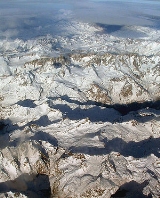
The
Andes is the world's longest
continentalThe continental crust is the layer of igneous, sedimentary, and metamorphic rocks which form the continents and the areas of shallow seabed close to their shores, known as continental shelves. This layer is sometimes called sial due to more felsic, or granitic, bulk composition, which lies in...
mountain rangeA mountain range is a single, large mass consisting of a succession of mountains or narrowly spaced mountain ridges, with or without peaks, closely related in position, direction, formation, and age; a component part of a mountain system or of a mountain chain...
. It is a continual range of highlands along the western coast of
South AmericaSouth America is a continent situated in the Western Hemisphere, mostly in the Southern Hemisphere, with a relatively small portion in the Northern Hemisphere. The continent is also considered a subcontinent of the Americas. It is bordered on the west by the Pacific Ocean and on the north and east...
. This range is about 7000 km (4,349.6 mi) long, about 200 km (124.3 mi) to 700 km (435 mi) wide (widest between 18
degreeA degree , usually denoted by ° , is a measurement of plane angle, representing 1⁄360 of a full rotation; one degree is equivalent to π/180 radians...
s South and 20 degrees South
latitudeIn geography, the latitude of a location on the Earth is the angular distance of that location south or north of the Equator. The latitude is an angle, and is usually measured in degrees . The equator has a latitude of 0°, the North pole has a latitude of 90° north , and the South pole has a...
), and of an average height of about 4000 m (13,123.4 ft).
Along its length, the Andes is split into several ranges, which are separated by intermediate
depressionA depression in geology is a landform sunken or depressed below the surrounding area. Depressions may be formed by various mechanisms.Structural or tectonic related:...
s. The Andes is the location of several high
plateauIn geology and earth science, a plateau , also called a high plain or tableland, is an area of highland, usually consisting of relatively flat terrain. A highly eroded plateau is called a dissected plateau...
x – some of which host major
citiesA city is a relatively large and permanent settlement. Although there is no agreement on how a city is distinguished from a town within general English language meanings, many cities have a particular administrative, legal, or historical status based on local law.For example, in the U.S...
such as
QuitoSan Francisco de Quito, most often called Quito , is the capital city of Ecuador in northwestern South America. It is located in north-central Ecuador in the Guayllabamba river basin, on the eastern slopes of Pichincha, an active stratovolcano in the Andes mountains...
,
BogotáBogotá, Distrito Capital , from 1991 to 2000 called Santa Fé de Bogotá, is the capital, and largest city, of Colombia. It is also designated by the national constitution as the capital of the department of Cundinamarca, even though the city of Bogotá now comprises an independent Capital district...
,
ArequipaArequipa is the capital city of the Arequipa Region in southern Peru. With a population of 836,859 it is the second most populous city of the country...
,
MedellínMedellín , officially the Municipio de Medellín or Municipality of Medellín, is the second largest city in Colombia. It is in the Aburrá Valley, one of the more northerly of the Andes in South America. It has a population of 2.3 million...
,
SucreSucre, also known historically as Charcas, La Plata and Chuquisaca is the constitutional capital of Bolivia and the capital of the department of Chuquisaca. Located in the south-central part of the country, Sucre lies at an elevation of 2750m...
, and
La PazNuestra Señora de La Paz is the administrative capital of Bolivia, as well as the departmental capital of the La Paz Department, and the second largest city in the country after Santa Cruz de la Sierra...
.
The so-called
Altiplano plateauThe Altiplano , in west-central South America, where the Andes are at their widest, is the most extensive area of high plateau on Earth outside of Tibet...
is the world's second-highest plateau following the
Tibetan plateauThe Tibetan Plateau , also known as the Qinghai–Tibetan Plateau is a vast, elevated plateau in Central Asia covering most of the Tibet Autonomous Region and Qinghai, in addition to smaller portions of western Sichuan, southwestern Gansu, and northern Yunnan in Western China and Ladakh in...
. The Andes extend from north to south through seven South American countries;
ArgentinaArgentina , officially the Argentine Republic , is the second largest country in South America by land area, after Brazil. It is constituted as a federation of 23 provinces and an autonomous city, Buenos Aires...
,
BoliviaBolivia officially known as Plurinational State of Bolivia , is a landlocked country in central South America. It is the poorest country in South America...
,
ChileChile ,officially the Republic of Chile , is a country in South America occupying a long, narrow coastal strip between the Andes mountains to the east and the Pacific Ocean to the west. It borders Peru to the north, Bolivia to the northeast, Argentina to the east, and the Drake Passage in the far...
,
ColombiaColombia, officially the Republic of Colombia , is a unitary constitutional republic comprising thirty-two departments. The country is located in northwestern South America, bordered to the east by Venezuela and Brazil; to the south by Ecuador and Peru; to the north by the Caribbean Sea; to the...
,
EcuadorEcuador , officially the Republic of Ecuador is a representative democratic republic in South America, bordered by Colombia on the north, Peru on the east and south, and by the Pacific Ocean to the west. It is one of only two countries in South America, along with Chile, that do not have a border...
,
PeruPeru , officially the Republic of Peru , is a country in western South America. It is bordered on the north by Ecuador and Colombia, on the east by Brazil, on the southeast by Bolivia, on the south by Chile, and on the west by the Pacific Ocean....
and
VenezuelaVenezuela , officially called the Bolivarian Republic of Venezuela , is a tropical country on the northern coast of South America. It borders Colombia to the west, Guyana to the east, and Brazil to the south...
.
The Andes range is the world's highest mountain range outside of the
continentA continent is one of several very large landmasses on Earth. They are generally identified by convention rather than any strict criteria, with seven regions commonly regarded as continents—they are : Asia, Africa, North America, South America, Antarctica, Europe, and Australia.Plate tectonics is...
of
AsiaAsia is the world's largest and most populous continent, located primarily in the eastern and northern hemispheres. It covers 8.7% of the Earth's total surface area and with approximately 3.879 billion people, it hosts 60% of the world's current human population...
. The highest peak, Mt.
AconcaguaAconcagua is the highest mountain in the Americas at . It is located in the Andes mountain range, in the Argentine province of Mendoza and it lies west by north of its capital, the city of Mendoza. The summit is also located about 5 kilometres from San Juan Province and 15 kilometres from the...
, rises to an elevation of about 6962 m (22,841.2 ft) above
sea levelMean sea level is a measure of the average height of the ocean's surface ; used as a standard in reckoning land elevation...
. The
peakIn topography, a summit is a point on a surface that is higher in elevation than all points immediately adjacent to it. Mathematically, a summit is a local maximum in elevation...
of
ChimborazoChimborazo is a currently inactive stratovolcano located in the Cordillera Occidental range of the Andes. Its last known eruption is believed to have occurred around 550 AD....
in the Ecuadorean Andes is farther from the centre of the Earth than any other location on the Earth's surface. This is because of the
equatorial bulgeAn equatorial bulge is a difference between the equatorial and polar diameters of a planet, due to the centrifugal force of its rotation. A rotating body tends to form an oblate spheroid rather than a sphere...
that results from the Earth's
rotationA rotation is a circular movement of an object around a center of rotation. A three-dimensional object rotates always around an imaginary line called a rotation axis. If the axis is within the body, and passes through its center of mass the body is said to rotate upon itself, or spin. A rotation...
. The world's highest
volcano2. Bedrock3. Conduit 4. Base5. Sill6. Dike7. Layers of ash emitted by the volcano8. Flank| 9. Layers of lava emitted by the volcano10. Throat11. Parasitic cone12. Lava flow13. Vent14. Crater15...
es are in the Andes, including
Ojos del SaladoNevado Ojos del Salado is a massive stratovolcano in the Andes on the Argentina-Chile border and the highest volcano in the world at . It is also the second highest mountain in the Western Hemisphere and Southern Hemisphere and the highest in Chile...
on the Chile-Argentina frontier which rises to 6,893 m (22,615 ft), and over 50 other volcanoes that rise above 6,000 m.
Name
The etymology of the word
Andes has been debated. The major consensus is that it derives from the
QuechuaQuechua is a Native South American language family and dialect cluster spoken primarily in the Andes of South America, derived from an original common ancestor language, Proto-Quechua. It is the most widely spoken language family of the indigenous peoples of the Americas, with a total of probably...
word
anti, which means "high crest". Others believe that
Andes comes from
Anti SuyuAnti Suyu was the eastern part of the Inca Empire which bordered with modern-day Upper Amazon region where the Anti inhabited. Antis is a collective term for the many varied ethnic groups living in the Antisuyu such as, for example, the Pano or the Campa....
, one of the four regions of the
Inca empireThe Inca Empire, or Inka Empire , was the largest empire in pre-Columbian America. The administrative, political and military center of the empire was located in Cusco in modern-day Peru. The Inca civilization arose from the highlands of Peru sometime in the early 13th century...
. It is more likely however that the word
Antisuyo derives from the use of
Anti to designate mountain chains. Derivation from the
SpanishSpanish , also known as Castilian , is a Romance language in the Ibero-Romance group that evolved from several languages and dialects in central-northern Iberia around the 9th century and gradually spread with the expansion of the Kingdom of Castile into central and southern Iberia during the...
andén (in the sense of cultivation
terraceTerraces are used in farming to cultivate sloped land. Graduated terrace steps are commonly used to farm on hilly or mountainous terrain. Terraced fields decrease erosion and surface runoff, and are effective for growing crops requiring much water, such as rice...
) has also been proposed, yet considered very unlikely.
Geography
The Andes can be divided into three sections:
I. The Southern Andes in Argentina and Chile;
II. The Central Andes, including the Chilean and Peruvian cordilleras and parts of Bolivia;
III. The Northern Andes in Venezuela, Colombia, and Ecuador that consists of two parallel ranges, the Cordillera Occidental and the Cordillera Oriental. In Colombia, north of its the border with Ecuador, the Andes split in three parallel ranges, the western, central, and eastern ranges. (The cordillera occidental, central, and oriental).
In the northern part of the Andes, the isolated
Sierra Nevada de Santa MartaThe Sierra Nevada de Santa Marta is an isolated mountain range apart from the Andes chain that runs through Colombia. Reaching an altitude of 5,700 metres above sea level just 42 km from the Caribbean coast, the Sierra Nevada is the world's highest coastal range...
range is often considered to be part of the Andes. The eastern range of Colombia is the only one that extends to Venezuela. The term
cordillera comes from the Spanish word meaning "cuerda", meaning "rope". The Andes range is about 200 km (124 mi) wide throughout its length, except in the Bolivian flexure where it is about 640 kilometres (398 mi) wide. The islands of the Dutch Caribbean
ArubaAruba is a 33 km-long island of the Lesser Antilles in the southern Caribbean Sea, located 27 km north of the coast of Venezuela and 130 km east of Guajira Peninsula...
,
Bonaire, and
CuraçaoCuraçao is an island in the southern Caribbean Sea, off the Venezuelan coast. The Country of Curaçao , which includes the main island plus the small, uninhabited island of Klein Curaçao , is a constituent country of the Kingdom of the Netherlands...
, which lie in the
Caribbean SeaThe Caribbean Sea is a sea of the Atlantic Ocean located in the tropics of the Western hemisphere. It is bounded by Mexico and Central America to the west and southwest, to the north by the Greater Antilles, and to the east by the Lesser Antilles....
off the coast of Venezuela, were thought to represent the submerged peaks of the extreme northern edge of the Andes range, but ongoing geological studies indicate that such a simplification does not do justice to the complex tectonic boundary between the South-American and Caribbean plates.
Geology
The Andes are a
MesozoicThe Mesozoic era is an interval of geological time from about 250 million years ago to about 65 million years ago. It is often referred to as the age of reptiles because reptiles, namely dinosaurs, were the dominant terrestrial and marine vertebrates of the time...
–
TertiaryThe Tertiary is a deprecated term for a geologic period 65 million to 2.6 million years ago. The Tertiary covered the time span between the superseded Secondary period and the Quaternary...
orogenic belt of mountains along the
Pacific Ring of FireThe Pacific Ring of Fire is an area where large numbers of earthquakes and volcanic eruptions occur in the basin of the Pacific Ocean. In a horseshoe shape, it is associated with a nearly continuous series of oceanic trenches, volcanic arcs, and volcanic belts and/or plate movements...
, a zone of volcanic activity that encompasses the Pacific rim of the Americas as well as the
Asia-PacificAsia-Pacific or Asia Pacific is the part of the world in or near the Western Pacific Ocean...
region. The Andes are the result of
plate tectonicsPlate tectonics is a scientific theory that describes the large scale motions of Earth's lithosphere...
processes, caused by the
subductionIn geology, subduction is the process that takes place at convergent boundaries by which one tectonic plate moves under another tectonic plate, sinking into the Earth's mantle, as the plates converge. These 3D regions of mantle downwellings are known as "Subduction Zones"...
of
oceanic crustOceanic crust is the part of Earth's lithosphere that surfaces in the ocean basins. Oceanic crust is primarily composed of mafic rocks, or sima, which is rich in iron and magnesium...
beneath the
South American plateThe South American Plate is a continental tectonic plate which includes the continent of South America and also a sizeable region of the Atlantic Ocean seabed extending eastward to the Mid-Atlantic Ridge....
. The main cause of the rise of the Andes is the compression of western rim of the
South American PlateThe South American Plate is a continental tectonic plate which includes the continent of South America and also a sizeable region of the Atlantic Ocean seabed extending eastward to the Mid-Atlantic Ridge....
due to the subduction of the
Nazca Plate]The Nazca Plate, named after the Nazca region of southern Peru, is an oceanic tectonic plate in the eastern Pacific Ocean basin off the west coast of South America. The ongoing subduction along the Peru-Chile Trench of the Nazca Plate under the South American Plate is largely responsible for the...
and the
Antarctic PlateThe Antarctic Plate is a tectonic plate covering the continent of Antarctica and extending outward under the surrounding oceans. The Antarctic Plate has a boundary with the Nazca Plate, the South American Plate, the African Plate, the Indo-Australian Plate, the Scotia Plate and a divergent boundary...
. To the east, the Andes range is bounded by several
sedimentary basinThe term sedimentary basin is used to refer to any geographical feature exhibiting subsidence and consequent infilling by sedimentation. As the sediments are buried, they are subjected to increasing pressure and begin the process of lithification...
s such as
OrinocoThe Orinoco is one of the longest rivers in South America at . Its drainage basin, sometimes called the Orinoquia, covers , with 76.3% of it in Venezuela and the remainder in Colombia...
,
Amazon BasinThe Amazon Basin is the part of South America drained by the Amazon River and its tributaries that drains an area of about , or roughly 40 percent of South America. The basin is located in the countries of Bolivia, Brazil, Colombia, Ecuador, Guyana, Peru, and Venezuela...
,
Madre de DiosThe Madre de Dios River, homonymous to the Peruvian region it runs through, then becomes the Beni River in Bolivia and then turns northward into Brazil, where it is called the Madeira River...
and
Gran ChacoThe Gran Chaco is a sparsely populated, hot and semi-arid lowland region of the Río de la Plata basin, divided among eastern Bolivia, Paraguay, northern Argentina and a portion of the Brazilian states of Mato Grosso and Mato Grosso do Sul, where it is connected with the Pantanal region...
which separates the Andes from the ancient
cratonA craton is an old and stable part of the continental lithosphere. Having often survived cycles of merging and rifting of continents, cratons are generally found in the interiors of tectonic plates. They are characteristically composed of ancient crystalline basement rock, which may be covered by...
s in eastern South America. In the south the Andes shares a long boundary with the former Patagonia Terrane. To the west, the Andes end at the
Pacific OceanThe Pacific Ocean is the largest of the Earth's oceanic divisions. It extends from the Arctic in the north to the Southern Ocean in the south, bounded by Asia and Australia in the west, and the Americas in the east.At 165.2 million square kilometres in area, this largest division of the World...
, although the
Peru-Chile trenchThe Peru-Chile Trench, also known as the Atacama Trench, is an oceanic trench in the eastern Pacific Ocean, about 160 kilometres off the coast of Peru and Chile...
can be considered its ultimate western limit. From a geographical approach the Andes are considered to have their western boundaries marked by the appearance of coastal lowlands and a less rugged topography.
Orogeny
The western rim of the
South American PlateThe South American Plate is a continental tectonic plate which includes the continent of South America and also a sizeable region of the Atlantic Ocean seabed extending eastward to the Mid-Atlantic Ridge....
has been the place of several pre-Andean orogenies since at least the of the late
ProterozoicThe Proterozoic is a geological eon representing a period before the first abundant complex life on Earth. The name Proterozoic comes from the Greek "earlier life"...
and early
PaleozoicThe Paleozoic era is the earliest of three geologic eras of the Phanerozoic eon, spanning from roughly...
when several
terraneA terrane in geology is short-hand term for a tectonostratigraphic terrane, which is a fragment of crustal material formed on, or broken off from, one tectonic plate and accreted or "sutured" to crust lying on another plate...
s and microcontinents collided and amalgamated with the ancient
cratonA craton is an old and stable part of the continental lithosphere. Having often survived cycles of merging and rifting of continents, cratons are generally found in the interiors of tectonic plates. They are characteristically composed of ancient crystalline basement rock, which may be covered by...
s of eastern South America, by then the
South American partThe South American Plate is a continental tectonic plate which includes the continent of South America and also a sizeable region of the Atlantic Ocean seabed extending eastward to the Mid-Atlantic Ridge....
of
GondwanaIn paleogeography, Gondwana , originally Gondwanaland, was the southernmost of two supercontinents that later became parts of the Pangaea supercontinent. It existed from approximately 510 to 180 million years ago . Gondwana is believed to have sutured between ca. 570 and 510 Mya,...
.
The formation of the modern Andes began with the events of the
TriassicThe Triassic is a geologic period and system that extends from about 250 to 200 Mya . As the first period of the Mesozoic Era, the Triassic follows the Permian and is followed by the Jurassic. Both the start and end of the Triassic are marked by major extinction events...
when Pangea began to break up and several
riftIn geology, a rift or chasm is a place where the Earth's crust and lithosphere are being pulled apart and is an example of extensional tectonics....
s developed. It continued through the
JurassicThe Jurassic is a geologic period and system that extends from about Mya to Mya, that is, from the end of the Triassic to the beginning of the Cretaceous. The Jurassic constitutes the middle period of the Mesozoic era, also known as the age of reptiles. The start of the period is marked by...
Period. It was during the
CretaceousThe Cretaceous , derived from the Latin "creta" , usually abbreviated K for its German translation Kreide , is a geologic period and system from circa to million years ago. In the geologic timescale, the Cretaceous follows the Jurassic period and is followed by the Paleogene period of the...
Period that the Andes began to take its present form, by the
upliftingTectonic uplift is a geological process most often caused by plate tectonics which increases elevation. The opposite of uplift is subsidence, which results in a decrease in elevation. Uplift may be orogenic or isostatic.-Orogenic uplift:...
, faulting and
foldingThe term fold is used in geology when one or a stack of originally flat and planar surfaces, such as sedimentary strata, are bent or curved as a result of permanent deformation. Synsedimentary folds are those due to slumping of sedimentary material before it is lithified. Folds in rocks vary in...
of sedimentary and metamorphic rocks of the ancient cratons to the east. The rise of the Andes has not been constant and different regions have had different degrees of tectonic stress, uplift, and
erosionErosion is when materials are removed from the surface and changed into something else. It only works by hydraulic actions and transport of solids in the natural environment, and leads to the deposition of these materials elsewhere...
.
Tectonic forces above the subduction zone along the entire west coast of South America where the
Nazca Plate]The Nazca Plate, named after the Nazca region of southern Peru, is an oceanic tectonic plate in the eastern Pacific Ocean basin off the west coast of South America. The ongoing subduction along the Peru-Chile Trench of the Nazca Plate under the South American Plate is largely responsible for the...
and a part of the
Antarctic PlateThe Antarctic Plate is a tectonic plate covering the continent of Antarctica and extending outward under the surrounding oceans. The Antarctic Plate has a boundary with the Nazca Plate, the South American Plate, the African Plate, the Indo-Australian Plate, the Scotia Plate and a divergent boundary...
are sliding beneath the
South American PlateThe South American Plate is a continental tectonic plate which includes the continent of South America and also a sizeable region of the Atlantic Ocean seabed extending eastward to the Mid-Atlantic Ridge....
continue to produce an ongoing
orogenic eventOrogeny refers to forces and events leading to a severe structural deformation of the Earth's crust due to the engagement of tectonic plates. Response to such engagement results in the formation of long tracts of highly deformed rock called orogens or orogenic belts...
resulting in minor to major
earthquakeAn earthquake is the result of a sudden release of energy in the Earth's crust that creates seismic waves. The seismicity, seismism or seismic activity of an area refers to the frequency, type and size of earthquakes experienced over a period of time...
s and volcanic eruptions to this day. In the extreme south a major
transform faultA transform fault or transform boundary, also known as conservative plate boundary since these faults neither create nor destroy lithosphere, is a type of fault whose relative motion is predominantly horizontal in either sinistral or dextral direction. Furthermore, transform faults end abruptly...
separates
Tierra del FuegoTierra del Fuego is an archipelago off the southernmost tip of the South American mainland, across the Strait of Magellan. The archipelago consists of a main island Isla Grande de Tierra del Fuego divided between Chile and Argentina with an area of , and a group of smaller islands including Cape...
from the small
Scotia PlateThe Scotia Plate is an oceanic tectonic plate bordering the South American Plate on the north, the South Sandwich Plate to the east, and the Antarctic Plate on the south and west....
. Across the 1000 km (621.4 mi) wide
Drake PassageThe Drake Passage or Mar de Hoces—Sea of Hoces—is the body of water between the southern tip of South America at Cape Horn, Chile and the South Shetland Islands of Antarctica...
lie the mountains of the
Antarctic PeninsulaThe Antarctic Peninsula is the northernmost part of the mainland of Antarctica. It extends from a line between Cape Adams and a point on the mainland south of Eklund Islands....
south of the Scotia Plate which appear to be a continuation of the Andes chain.
Volcanism
The Andes range has many active volcanoes, which are distributed in four volcanic zones separated by areas of inactivity. The Andean volcanism is a result of
subductionIn geology, subduction is the process that takes place at convergent boundaries by which one tectonic plate moves under another tectonic plate, sinking into the Earth's mantle, as the plates converge. These 3D regions of mantle downwellings are known as "Subduction Zones"...
of the Nazca Plate and Antarctic Plate underneath the South American Plate. The belt is subdivided into four main volcanic zones that are separated from each other by volcanic gaps. The volcanoes of the belt are diverse in terms of activity style, products and morphology. While some differences can be explained by which volcanic zone a volcano belongs to, there are significant differences inside volcanic zones and even between neighboring volcanoes. Despite being a type location for calc-alkalic and subduction volcanism, the Andean Volcanic Belt has a large range of volcano-tectonic settings, such as rift systems and extrensional zones, transpressional faults, subduction of
mid-ocean ridgeA mid-ocean ridge is a general term for an underwater mountain system that consists of various mountain ranges , typically having a valley known as a rift running along its spine, formed by plate tectonics. This type of oceanic ridge is characteristic of what is known as an oceanic spreading...
s and
seamountA seamount is a mountain rising from the ocean seafloor that does not reach to the water's surface , and thus is not an island. These are typically formed from extinct volcanoes, that rise abruptly and are usually found rising from a seafloor of depth. They are defined by oceanographers as...
chains apart from a large range on crustal thicknesses and
magmaMagma is a mixture of molten rock, volatiles and solids that is found beneath the surface of the Earth, and is expected to exist on other terrestrial planets. Besides molten rock, magma may also contain suspended crystals and dissolved gas and sometimes also gas bubbles. Magma often collects in...
ascent paths, and different amount of crustal assimilations.
Ore deposits and evaporites
The Andes mountains host large
oreAn ore is a type of rock that contains minerals with important elements including metals. The ores are extracted through mining; these are then refined to extract the valuable element....
and
saltIn chemistry, salts are ionic compounds that result from the neutralization reaction of an acid and a base. They are composed of cations and anions so that the product is electrically neutral...
deposits and some of its eastern fold and thrust belt acts as traps for commercially exploitable amounts of hydrocarbons. In the forelands of the
Atacama desertThe Atacama Desert is a plateau in South America, covering a strip of land on the Pacific coast, west of the Andes mountains. It is, according to NASA, National Geographic and many other publications, the driest desert in the world...
some of the largest porphyry copper mineralizations occurs making Chile and Peru the first and second largest exporters of
copperCopper is a chemical element with the symbol Cu and atomic number 29. It is a ductile metal with very high thermal and electrical conductivity. Pure copper is soft and malleable; an exposed surface has a reddish-orange tarnish...
in the world. Porphyry copper in the western slopes of the Andes has been generated by hydrothermal fluids (mostly water) during the cooling of plutons or
volcanic systems2. Bedrock3. Conduit 4. Base5. Sill6. Dike7. Layers of ash emitted by the volcano8. Flank| 9. Layers of lava emitted by the volcano10. Throat11. Parasitic cone12. Lava flow13. Vent14. Crater15...
. The porphyry mineralization further benefited from the dry climate that let them largely out of the disturbing actions of
meteoric waterMeteoric water is a hydrologic term of long standing for water in the ground which originates from precipitation. This includes water from lakes, rivers, and icemelts, which all originate from precipitation indirectly.- Overview :...
. The dry climate in the central western Andes have also led to the creation of extensive
saltpeterSaltpeter or saltpetre often refers to:*Potassium nitrate, or the mineral niter, the critical oxidizing component of gunpowder, and a food preservative.It may also refer to:...
deposits which were extensively mined until the invention of synthetic nitrates. Yet another result of the dry climate are the
salarsDry lakes are ephemeral lakebeds, or a remnant of an endorheic lake. Such flats consist of fine-grained sediments infused with alkali salts. Dry lakes are also referred to as alkali flats, sabkhas, playas or mud flats...
of
AtacamaSalar de Atacama is the largest salt flat in Chile. It is located south of San Pedro de Atacama, is surrounded by mountains and has no drainage outlets. To the east is enclosed by the main chain of the Andes, while to the west lies a secondary mountain range of the Andes called Cordillera de Domeyko...
and
UyuniSalar de Uyuni is the world's largest salt flat at . It is located in the Potosí and Oruro departments in southwest Bolivia, near the crest of the Andes, and is elevated above the mean sea level. The Salar was formed as a result of transformations between several prehistoric lakes...
, the first one being the largest source of
lithiumLithium is a soft, silver-white metal that belongs to the alkali metal group of chemical elements. It is represented by the symbol Li, and it has the atomic number 3. Under standard conditions it is the lightest metal and the least dense solid element. Like all alkali metals, lithium is highly...
today and the second the world’s largest reserve of the element. Early
MesozoicThe Mesozoic era is an interval of geological time from about 250 million years ago to about 65 million years ago. It is often referred to as the age of reptiles because reptiles, namely dinosaurs, were the dominant terrestrial and marine vertebrates of the time...
and
NeogeneThe Neogene is a geologic period and system in the International Commission on Stratigraphy Geologic Timescale starting 23.03 ± 0.05 million years ago and ending 2.588 million years ago...
plutonism in Bolivias Cordillera Central created the Bolivian
tinTin is a chemical element with the symbol Sn and atomic number 50. It is a main group metal in group 14 of the periodic table. Tin shows chemical similarity to both neighboring group 14 elements, germanium and lead and has two possible oxidation states, +2 and the slightly more stable +4...
belt as well as the famous, now depleted, deposits of Cerro Rico de Potosí.
Climate and hydrology
The climate in the Andes varies greatly depending on location, altitude, and proximity to the sea. Temperature, atmospheric pressure and humidity decrease in higher elevations. The southern section is rainy and cool, the central Andes are dry. The northern Andes are typically rainy and warm, with an average temperature of 18 °C (64 °F) in Colombia. The climate is known to change drastically in rather short distances.
RainforestRainforests are forests characterized by high rainfall, with definitions based on a minimum normal annual rainfall of 1750-2000 mm...
s exist just miles away from the snow covered peak Cotopaxi. The mountains have a large effect on the temperatures of nearby areas. The
snow lineThe climatic snow line is the point above which snow and ice cover the ground throughout the year. The actual snow line may seasonally be significantly lower....
depends on the location. It is at between 4,500 and 4,800 m (14,800–15,800 ft) in the tropical Ecuadorian, Colombian, Venezuelan, and northern Peruvian Andes, rising to 4,800–5,200 m (15,800–17,060 ft) in the drier mountains of southern Peru south to northern Chile south to about 30°S, then descending to 4500 m (14,763.8 ft) on Aconcagua at 32°S, 2000 m (6,561.7 ft) at 40°S, 500 m (1,640.4 ft) at 50°S, and only 300 m (984.3 ft) in
Tierra del FuegoTierra del Fuego is an archipelago off the southernmost tip of the South American mainland, across the Strait of Magellan. The archipelago consists of a main island Isla Grande de Tierra del Fuego divided between Chile and Argentina with an area of , and a group of smaller islands including Cape...
at 55°S; from 50°S, several of the larger glaciers descend to sea level.
The Andes of Chile and Argentina can be divided in two climatic and glaciological zones; the
Dry AndesThe Dry Andes is a climatic and glaciological subregion of the Andes. Together with the Wet Andes it is one of the two subregions of the Argentine and Chilean Andes. The Dry Andes runs from the Atacama Desert in northern Chile and Argentina south to a latitude of 35°S in Chile. In Argentina the Dry...
and the
Wet AndesThe Wet Andes is a climatic and glaciological subregion of the Andes. Together with the Dry Andes it is one of the two subregions of the Argentine and Chilean Andes. The Wet Andes runs from a latitude of 35°S to Cape Horn at 56°S. According to Luis Lliboutry the Wet Andes can be classified after...
. Since the Dry Andes extends from the latitudes of
Atacama DesertThe Atacama Desert is a plateau in South America, covering a strip of land on the Pacific coast, west of the Andes mountains. It is, according to NASA, National Geographic and many other publications, the driest desert in the world...
to the area of
Maule RiverThe Maule river is one of the most important rivers of Chile and is inextricably linked to this country's pre-Hispanic times, the country's conquest, colonial period, wars of Independence, modern history, agriculture , culture , religion, economy and politics...
, precipitation is more sporadic and there are strong temperature oscillations. The line of equilibrium may shift drastically over short periods of time, leaving a whole glacier in the
ablationAblation is removal of material from the surface of an object by vaporization, chipping, or other erosive processes. This occurs in spaceflight during ascent and atmospheric reentry, glaciology, medicine, and passive fire protection.-Spaceflight:...
area or in the
accumulation areaGlacier ice accumulation occurs through accumulation of snow and other frozen precipitation, as well as through other means including rime ice , avalanching from hanging glaciers on cliffs and mountainsides above, and re-freezing of glacier meltwater as superimposed ice...
.
In the high Andes of central Chile and
Mendoza ProvinceThe Province of Mendoza is a province of Argentina, located in the western central part of the country in the Cuyo region. It borders to the north with San Juan, the south with La Pampa and Neuquén, the east with San Luis, and to the west with the republic of Chile; the international limit is...
rock glacierRock glaciers are distinctive geomorphological landforms of angular rock debris frozen in interstitial ice which may extend outward and downslope from talus cones, glaciers or terminal moraines of glaciers. There are two types of rock glaciers: periglacial glaciers, or talus-derived glaciers, and...
s are larger and more common than glaciers; this is due to the high exposure to solar radiation.
Flora
The Andean region cuts across several natural and floristc regions due to is large extension from
CaribbeanThe Caribbean is a crescent-shaped group of islands more than 2,000 miles long separating the Gulf of Mexico and the Caribbean Sea, to the west and south, from the Atlantic Ocean, to the east and north...
Venezuela to cold, windy and wet
Cape HornCape Horn is the southernmost headland of the Tierra del Fuego archipelago of southern Chile, and is located on the small Hornos Island...
passing trough hyperarid
Atacama DesertThe Atacama Desert is a plateau in South America, covering a strip of land on the Pacific coast, west of the Andes mountains. It is, according to NASA, National Geographic and many other publications, the driest desert in the world...
. Rainforests used to encircle much of the northern Andes but are now greatly
diminishedDeforestation is the removal of a forest or stand of trees where the land is thereafter converted to a nonforest use. Examples of deforestation include conversion of forestland to farms, ranches, or urban use....
, especially in the Chocó and inter-Andean valleys of Colombia. As a direct opposite of the humid Andean slopes are the relatively dry Andean slopes in most of western Peru, Chile and Argentina. Along with several
Interandean VallesDry valleys in the central Andes of Peru, Bolivia, and Argentina, known as "valles", are marked by a rain shadow effect of the surrounding mountains, and thus rainfall is limited, and mostly falls in a brief rainy season...
, they are typically dominated by
deciduousDeciduous means "falling off at maturity" or "tending to fall off", and is typically used in reference to trees or shrubs that lose their leaves seasonally, and to the shedding of other plant structures such as petals after flowering or fruit when ripe...
woodland, shrub and xeric vegetation, reaching the extreme in the slopes near the virtually lifeless
Atacama DesertThe Atacama Desert is a plateau in South America, covering a strip of land on the Pacific coast, west of the Andes mountains. It is, according to NASA, National Geographic and many other publications, the driest desert in the world...
.
About 30,000 species of vascular plants live in the Andes with roughly half being endemic to the region, surpassing the diversity of any other
hotspotA biodiversity hotspot is a biogeographic region with a significant reservoir of biodiversity that is under threat from humans.The concept of biodiversity hotspots was originated by Norman Myers in two articles in “The Environmentalist” , revised after thorough analysis by Myers and others in...
. The small tree
Cinchona pubescensCinchona pubescens is known for its bark's high quinine content- and has similar uses to Cinchona officinalis in the production of quinine, most famously used for treatment of malaria . Its native range spans Costa Rica, Venezuela, Ecuador, Peru and Bolivia. In Ecuador, C...
, a source of
quinineQuinine is a natural white crystalline alkaloid having antipyretic , antimalarial, analgesic , anti-inflammatory properties and a bitter taste. It is a stereoisomer of quinidine which, unlike quinine, is an anti-arrhythmic...
which is used to treat
malariaMalaria is a mosquito-borne infectious disease of humans and other animals caused by eukaryotic protists of the genus Plasmodium. The disease results from the multiplication of Plasmodium parasites within red blood cells, causing symptoms that typically include fever and headache, in severe cases...
, is found widely in the Andes as far south as Bolivia. Other important crops that originated from the Andes are
tobaccoTobacco is an agricultural product processed from the leaves of plants in the genus Nicotiana. It can be consumed, used as a pesticide and, in the form of nicotine tartrate, used in some medicines...
and potatoes. The high-altitude
PolylepisPolylepis is a genus containing about twenty species of shrubs or trees native to the mid- and high-elevation regions of the tropical Andes. This group is unique in the rose family in that it is predominantly wind-pollinated. They are usually gnarled in shape, but in certain areas some trees are...
forests and woodlands are found in the Andean areas of Colombia, Ecuador, Peru, Bolivia and Chile. These trees, by locals referred to as Queñua, Yagual and other names, can be found at altitudes of 4500 m (14,763.8 ft) above sea level. It remains unclear if the patchy distribution of these forests and woodlands is natural, or the result of clearing which began during the Incan period. Regardless, in
modern timesModern history, or the modern era, describes the historical timeline after the Middle Ages. Modern history can be further broken down into the early modern period and the late modern period after the French Revolution and the Industrial Revolution...
the clearance has accelerated, and the trees are now considered to be highly endangered, with some believing that as little as 10% of the original woodland remains.
Fauna
The Andes is rich in fauna: With almost 3,500 species, of which roughly 2/3 are endemic to the region, the Andes is the most important region in the world for amphibians.
The diversity of animals in the Andes is high, with almost 600 species of mammals (13% endemic), more than 1,700 species of birds (about 1/3 endemic), more than 600 species of
reptileReptiles are members of a class of air-breathing, ectothermic vertebrates which are characterized by laying shelled eggs , and having skin covered in scales and/or scutes. They are tetrapods, either having four limbs or being descended from four-limbed ancestors...
(about 45% endemic), and almost 400 species of
fishFish are a paraphyletic group of organisms that consist of all gill-bearing aquatic vertebrate animals that lack limbs with digits. Included in this definition are the living hagfish, lampreys, and cartilaginous and bony fish, as well as various extinct related groups...
(about 1/3 endemic).
The
VicuñaThe vicuña or vicugna is one of two wild South American camelids, along with the guanaco, which live in the high alpine areas of the Andes. It is a relative of the llama, and is now believed to share a wild ancestor with domesticated alpacas, which are raised for their fibre...
and Guanaco can be found living in the
AltiplanoThe Altiplano , in west-central South America, where the Andes are at their widest, is the most extensive area of high plateau on Earth outside of Tibet...
, while the closely related domesticated
LlamaThe llama is a South American camelid, widely used as a meat and pack animal by Andean cultures since pre-Hispanic times....
and
AlpacaAn alpaca is a domesticated species of South American camelid. It resembles a small llama in appearance.Alpacas are kept in herds that graze on the level heights of the Andes of southern Peru, northern Bolivia, Ecuador, and northern Chile at an altitude of to above sea level, throughout the year...
are widely kept by locals as
pack animalA pack animal or beast of burden is a working animal used by humans as means of transporting materials by attaching them so their weight bears on the animal's back; the term may be applied to either an individual animal or a species so employed...
s and for their
meatMeat is animal flesh that is used as food. Most often, this means the skeletal muscle and associated fat and other tissues, but it may also describe other edible tissues such as organs and offal...
and
woolWool is the textile fiber obtained from sheep and certain other animals, including cashmere from goats, mohair from goats, qiviut from muskoxen, vicuña, alpaca, camel from animals in the camel family, and angora from rabbits....
. The nocturnal
chinchillaChinchillas are crepuscular rodents, slightly larger and more robust than ground squirrels, and are native to the Andes mountains in South America. Along with their relatives, viscachas, they make up the family Chinchillidae....
s, two threatened members of the
rodentRodentia is an order of mammals also known as rodents, characterised by two continuously growing incisors in the upper and lower jaws which must be kept short by gnawing....
order, inhabit the Andes' alpine regions. The
Andean CondorThe Andean Condor is a species of South American bird in the New World vulture family Cathartidae and is the only member of the genus Vultur...
, the largest bird of its kind in the
Western HemisphereThe Western Hemisphere or western hemisphere is mainly used as a geographical term for the half of the Earth that lies west of the Prime Meridian and east of the Antimeridian , the other half being called the Eastern Hemisphere.In this sense, the western hemisphere consists of the western portions...
, occurs throughout much of the Andes but generally in very low densities. Other animals found in the relatively open habitats of the high Andes include the
huemulHippocamelus is a genus of Cervidae, the deer family. It comprises two endangered Andean species, commonly known as Huemul , and Taruca. The huemul have a stocky, thick, and short-legged body. These mammals live at high altitudes in the summer, then move down the mountains in the fall and spend the...
, cougar, foxes in the genus
PseudalopexLycalopex is the genus name for some South American members of the Canidae family. They are sometimes referred to collectively by the common name South American Fox. The name Lycalopex is from the Greek words lycos meaning wolf and alopex meaning fox. The common name for the genus is zorro, from...
, and, for birds, certain species of
tinamouThe tinamous are a family comprising 47 species of birds found in Central and South America. One of the most ancient living groups of bird, they are related to the ratites. Generally ground dwelling, they are found in a range of habitats....
s (notably members of the genus
NothoproctaNothoprocta is a genus of birds belonging to the tinamou family Tinamidae. They inhabit scrubland, grassland and open woodland in western South America, particularly in the Andes. They are poor fliers and spend most of their time on the ground. Their diet includes seeds and insects. They nest on...
),
Andean GooseThe Andean Goose, Chloephaga melanoptera, is a member of the duck, goose and swan family Anatidae. It is in the shelduck subfamily Tadorninae.It is resident around lakes and marshes in the high Andes, usually well above 3000 m...
,
Giant CootThe Giant Coot is a species of bird found at lakes in the altiplano from central Peru, through western Bolivia, to north-eastern Chile and extreme north-western Argentina. With a total length of 48–64 cm , it is the second largest extant member of the Rallidae family, after the Takahe, and...
,
flamingoFlamingos or flamingoes are gregarious wading birds in the genus Phoenicopterus , the only genus in the family Phoenicopteridae...
s (mainly associated with hypersaline lakes), Lesser Rhea,
Andean FlickerThe Andean Flicker is a South American species of woodpecker. It is found in grassland, shrubland and Polylepis woodland at altitudes of in the Andes from southern Ecuador to northern Chile and northwestern Argentina...
,
Diademed Sandpiper-ploverThe Diademed Plover or Diademed Sandpiper-Plover is a species of bird in the Charadriidae family. It is monotypic within the genus Phegornis.It is found in Argentina, Bolivia, Chile, and Peru....
,
minersGeositta is a genus of passerine birds in the ovenbird family, Furnariidae. They are known as miners due to the tunnels they dig for nesting. There are 11 species including the Campo Miner which was formerly classified in a genus of its own, Geobates...
,
sierra-finchesPhrygilus is a genus of mainly Andean seed-eating tanagers commonly known as sierra-finches. Phrygilos means finch in Ancient Greek. Sometimes classified in the bunting and American sparrow family Emberizidae, more recent studies have shown them to belong in the Thraupidae...
and
diuca-finchesDiuca is a small genus of Andean seed-eating tanagers.-Species list:* White-winged Diuca-finch, Diuca speculifera* Common Diuca-finch, Diuca diuca...
.
Lake TiticacaLake Titicaca is a lake located on the border of Peru and Bolivia. It sits 3,811 m above sea level, making it the highest commercially navigable lake in the world...
hosts several endemics, among them the highly endangered
Titicaca Flightless GrebeThe Titicaca Grebe or Titicaca Flightless Grebe is a grebe found on the altiplano of Peru and Bolivia. As its name implies, its main population occurs on Lake Titicaca. Lake Uru Uru and Poopó, the Rio Desaguadero, and small lakes that connect to Lake Titicaca in wet years, serve as "spillovers"...
and Titicaca Water Frog. A few species of hummingbirds, notably some
hillstarsThe hillstars are several species of hummingbirds from the genus Oreotrochilus...
, can be seen at altitudes above 4000 m (13,123.4 ft), but far higher
diversitiesSpecies richness is the number of different species in a given area. It is represented in equation form as S.Species richness is the fundamental unit in which to assess the homogeneity of an environment. Typically, species richness is used in conservation studies to determine the sensitivity of...
can be found at lower altitudes, especially in the humid Andean forests ("
cloud forestA cloud forest, also called a fog forest, is a generally tropical or subtropical evergreen montane moist forest characterized by a persistent, frequent or seasonal low-level cloud cover, usually at the canopy level. Cloud forests often exhibit an abundance of mosses covering the ground and...
s") growing on slopes in Colombia, Ecuador, Peru, Bolivia and far northwestern Argentina. These forest-types, which includes the
YungasThe Yungas is a stretch of forest along the eastern slope of the Andes Mountains from southeastern Peru through central Bolivia. It is a transitional zone between the Andean highlands and the eastern forests. Like the surrounding areas, it has characteristics of the Neotropic ecozone...
and parts of the Chocó, are very rich in flora and fauna, although few large mammals exists, exceptions being the threatened
Mountain TapirThe Mountain Tapir or Woolly Tapir is the smallest of the four species of tapir and is the only one to live outside of tropical rainforests in the wild...
,
Spectacled BearThe spectacled bear , also known as the Andean bear and locally as ukuko, jukumari or ucumari, is the last remaining short-faced bear and the closest living relative to the Florida spectacled bear and short-faced bears of the Middle Pleistocene to Late Pleistocene age.The spectacled bear is a...
and
Yellow-tailed Woolly MonkeyThe yellow-tailed woolly monkey is a New World monkey endemic to Peru. It is a rare primate species found only in the Peruvian Andes, in the departments of Amazonas and San Martin as well as bordering areas of La Libertad, Huanuco and Loreto...
.
Birds of humid Andean forests include mountain-toucans,
quetzalQuetzals are strikingly colored birds in the trogon family . They are found in forests and woodlands, especially in humid highlands, with the five species from the genus Pharomachrus being exclusively Neotropical, while the single Euptilotis species is almost entirely restricted to western Mexico...
s and the
Andean Cock-of-the-rockThe Andean Cock-of-the-rock is a medium-sized passerine bird of the Cotinga family native to Andean cloud forests in South America. The plural is Andean Cocks-of-the-rock...
, while mixed species flocks dominated by tanagers and Furnariids commonly are seen - in contrast to several vocal but typically
crypticIn ecology, crypsis is the ability of an organism to avoid observation or detection by other organisms. It may be either a predation strategy or an antipredator adaptation, and methods include camouflage, nocturnality, subterranean lifestyle, transparency, and mimicry...
species of wrens,
tapaculoThe tapaculos are a group of small suboscine passeriform birds with numerous species, found mainly in South America and with the highest diversity in the Andean regions...
s and antpittas.
A number of species such as the
Royal CinclodesThe Royal Cinclodes is a passerine bird which breeds in the Andes of south-east Peru and adjacent Bolivia. It was formerly considered to be a subspecies of the Stout-billed Cinclodes C. excelsior....
and
White-browed Tit-spinetailThe White-browed Tit-spinetail is a species of bird in the Furnariidae family. It is endemic to Peru.Its natural habitat is subtropical or tropical moist montanes. It is threatened by habitat loss.-References:...
are associated with
Polylepis, and consequently also threatened.
Human activity
The Andes mountains form a north-south axis of cultural influences. A long series of cultural development culminated in the expansion of the
Inca civilizationThe Andean civilizations made up a loose patchwork of different cultures that developed from the highlands of Colombia to the Atacama Desert. The Andean civilizations are mainly based on the cultures of Ancient Peru and some others such as Tiahuanaco. The Inca Empire was the last sovereign...
and
Inca EmpireThe Inca Empire, or Inka Empire , was the largest empire in pre-Columbian America. The administrative, political and military center of the empire was located in Cusco in modern-day Peru. The Inca civilization arose from the highlands of Peru sometime in the early 13th century...
in the central Andes during the 15th century. The Incas formed this civilization through imperialistic militarism as well as careful and meticulous governmental management. The government sponsored the construction of aqueducts and roads in addition to preexisting installations. Some of these constructions are still in existence today.
Devastated by European diseases to which they had no
immunityImmunity is a biological term that describes a state of having sufficient biological defenses to avoid infection, disease, or other unwanted biological invasion. Immunity involves both specific and non-specific components. The non-specific components act either as barriers or as eliminators of wide...
, and civil wars, in 1532 the Incas were defeated by an alliance composed of tens of thousands allies from nations they had subjugated (e.g. Huancas,
ChachapoyasThe Chachapoyas, also called the Warriors of the Clouds, were an Andean people living in the cloud forests of the Amazonas region of present-day Peru. The Incas conquered their civilization shortly before the arrival of the Spanish in Peru. When the Spanish arrived in Peru in the 16th century, the...
,
CañarisThe Cañari are an indigenous ethnic group traditionally inhabiting the territory of the modern provinces of Azuay and Cañar in Ecuador; the term also refers to an independent pre-Hispanic tribal confederation of the same name, from which the modern people are descended. They are particularly noted...
) and a small army of 180 Spaniards led by
Francisco PizarroFrancisco Pizarro González, Marquess was a Spanish conquistador, conqueror of the Incan Empire, and founder of Lima, the modern-day capital of the Republic of Peru.-Early life:...
. One of the few Inca sites the Spanish never found in their conquest was
Machu PicchuMachu Picchu is a pre-Columbian 15th-century Inca site located above sea level. It is situated on a mountain ridge above the Urubamba Valley in Peru, which is northwest of Cusco and through which the Urubamba River flows. Most archaeologists believe that Machu Picchu was built as an estate for...
, which lay hidden on a peak on the eastern edge of the Andes where they descend to the Amazon. The main surviving languages of the Andean peoples are those of the
QuechuaQuechua is a Native South American language family and dialect cluster spoken primarily in the Andes of South America, derived from an original common ancestor language, Proto-Quechua. It is the most widely spoken language family of the indigenous peoples of the Americas, with a total of probably...
and
Aymara languageAymara is an Aymaran language spoken by the Aymara people of the Andes. It is one of only a handful of Native American languages with over three million speakers. Aymara, along with Quechua and Spanish, is an official language of Peru and Bolivia...
families.
Woodbine ParishSir Woodbine Parish KCH was a British diplomat, traveller and scientist.Educated at Eton College, he took up his first diplomatic post in 1814, and was involved in events immediately following the defeat of Napoleon at Waterloo...
and
Joseph Barclay PentlandJoseph Barclay Pentland was an Irish geographer, natural scientist, and traveller. Born in Ireland, Pentland was educated at Armagh. He also studied in Paris, and worked with Georges Cuvier....
surveyed a large part of the Bolivian Andes from 1826 to 1827.
In modern times, the largest Andean cities are Bogota, Colombia, with a population of about eight million, La Paz, Bolivia, and Quito, Ecuador.
Transportation
Several major cities exist either in the Andes or in the foothills, among which are
BogotáBogotá, Distrito Capital , from 1991 to 2000 called Santa Fé de Bogotá, is the capital, and largest city, of Colombia. It is also designated by the national constitution as the capital of the department of Cundinamarca, even though the city of Bogotá now comprises an independent Capital district...
and Cali, Colombia; Quito, Ecuador; Mérida, Venezuela; La Paz, Bolivia;
Santiago, ChileSantiago , also known as Santiago de Chile, is the capital and largest city of Chile, and the center of its largest conurbation . It is located in the country's central valley, at an elevation of above mean sea level...
, and Cusco, Peru. These and most other cities and large towns are now connected with
asphaltAsphalt or , also known as bitumen, is a sticky, black and highly viscous liquid or semi-solid that is present in most crude petroleums and in some natural deposits, it is a substance classed as a pitch...
-paved roads, while smaller towns are often connected by dirt roads, which may require a four-wheel-drive vehicle.
The rough terrain has historically put the costs of building
highwayA highway is any public road. In American English, the term is common and almost always designates major roads. In British English, the term designates any road open to the public. Any interconnected set of highways can be variously referred to as a "highway system", a "highway network", or a...
s and railroads that cross the Andes out of reach of most neighboring countries, even with modern
civil engineeringCivil engineering is a professional engineering discipline that deals with the design, construction, and maintenance of the physical and naturally built environment, including works like roads, bridges, canals, dams, and buildings...
practices. For example, the main cross over the Andes between Argentina and Chile is still accomplished through the Paso Internacional Los Libertadores, and only recently the ends of some highways that came rather close to one another from the east and the west have been connected. Much of the transportation of passengers is done via
airlineAn airline provides air transport services for traveling passengers and freight. Airlines lease or own their aircraft with which to supply these services and may form partnerships or alliances with other airlines for mutual benefit...
.
For decades, Chile claimed ownership of land on the eastern side of the Andes. However, these claims were given up in about 1870 during the
War of the PacificThe War of the Pacific took place in western South America from 1879 through 1883. Chile fought against Bolivia and Peru. Despite cooperation among the three nations in the war against Spain, disputes soon arose over the mineral-rich Peruvian provinces of Tarapaca, Tacna, and Arica, and the...
between Chile, and the allied Bolivia and Peru, in a diplomatic deal to keep Argentina out of the war. The
Chilean ArmyThe Chilean Army is the land arm of the Military of Chile. This 45,000-person army is organized into seven divisions, a special operations brigade and an air brigade....
and
Chilean Navy-Independence Wars of Chile and Peru :The Chilean Navy dates back to 1817. A year before, following the Battle of Chacabuco, General Bernardo O'Higgins prophetically declared "this victory and another hundred shall be of no significance if we do not gain control of the sea".This led to the...
defeated the combined forces of Bolivia and Peru, and Chile took over Bolivia's only province on the Pacific Coast, and some land from Peru, also - that was returned to Peru later. Bolivia has been a
landlockedA landlocked country is a country entirely enclosed by land, or whose only coastlines lie on closed seas. There are 48 landlocked countries in the world, including partially recognized states...
country ever since then.
However, if Chile had kept some land to the east, the difficulties in transportation between east and west would have been enormous. There has also been bad blood between Bolivia and Chile ever since 1870, and these two countries have not had diplomatic relations since about 1974.
Because of the tortuous terrain in places, villages and towns in which motorized vehicles are of little use are still present. Locally, the relatives of the
camelA camel is an even-toed ungulate within the genus Camelus, bearing distinctive fatty deposits known as humps on its back. There are two species of camels: the dromedary or Arabian camel has a single hump, and the bactrian has two humps. Dromedaries are native to the dry desert areas of West Asia,...
, the
llamaThe llama is a South American camelid, widely used as a meat and pack animal by Andean cultures since pre-Hispanic times....
and the
alpacaAn alpaca is a domesticated species of South American camelid. It resembles a small llama in appearance.Alpacas are kept in herds that graze on the level heights of the Andes of southern Peru, northern Bolivia, Ecuador, and northern Chile at an altitude of to above sea level, throughout the year...
continue to carry out important uses as pack animals, but this use has generally diminished in modern times.
Agriculture
The ancient peoples of the Andes such as the Incas have practiced
irrigationIrrigation may be defined as the science of artificial application of water to the land or soil. It is used to assist in the growing of agricultural crops, maintenance of landscapes, and revegetation of disturbed soils in dry areas and during periods of inadequate rainfall...
techniques for over 6,000 years. Because of the mountain slopes,
terracingTerraces are used in farming to cultivate sloped land. Graduated terrace steps are commonly used to farm on hilly or mountainous terrain. Terraced fields decrease erosion and surface runoff, and are effective for growing crops requiring much water, such as rice...
has been a common practice. Terracing, however, was only extensively employed after Incan imperial expansions to fuel their expanding realm. The
potatoThe potato is a starchy, tuberous crop from the perennial Solanum tuberosum of the Solanaceae family . The word potato may refer to the plant itself as well as the edible tuber. In the region of the Andes, there are some other closely related cultivated potato species...
holds a very important role as an internally consumed staple crop.
MaizeMaize known in many English-speaking countries as corn or mielie/mealie, is a grain domesticated by indigenous peoples in Mesoamerica in prehistoric times. The leafy stalk produces ears which contain seeds called kernels. Though technically a grain, maize kernels are used in cooking as a vegetable...
was also an important crop for these people. However, they were mainly used for the production of the culturally important
chichaFor the musical genre, see Peruvian cumbiaChicha is a term used in some regions of Latin America for several varieties of fermented and non-fermented beverages, rather often to those derived from maize and similar non-alcoholic beverages...
. Currently,
tobaccoTobacco is an agricultural product processed from the leaves of plants in the genus Nicotiana. It can be consumed, used as a pesticide and, in the form of nicotine tartrate, used in some medicines...
,
cottonCotton is a soft, fluffy staple fiber that grows in a boll, or protective capsule, around the seeds of cotton plants of the genus Gossypium. The fiber is almost pure cellulose. The botanical purpose of cotton fiber is to aid in seed dispersal....
and
coffeeCoffee is a brewed beverage with a dark,init brooo acidic flavor prepared from the roasted seeds of the coffee plant, colloquially called coffee beans. The beans are found in coffee cherries, which grow on trees cultivated in over 70 countries, primarily in equatorial Latin America, Southeast Asia,...
are the main export crops.
CocaCoca, Erythroxylum coca, is a plant in the family Erythroxylaceae, native to western South America. The plant plays a significant role in many traditional Andean cultures...
, despite eradication programmes in some countries, remains an important crop for legal local use in a mildly stimulating herbal tea, and, both controversially and illegally, for the production of
cocaineCocaine is a crystalline tropane alkaloid that is obtained from the leaves of the coca plant. The name comes from "coca" in addition to the alkaloid suffix -ine, forming cocaine. It is a stimulant of the central nervous system, an appetite suppressant, and a topical anesthetic...
.
Mining
The Andes rose to fame for its mineral wealth during the
Spanish conquest of South AmericaColonial expansion under the Spanish Empire was initiated by the Spanish conquistadores and developed by the Monarchy of Spain through its administrators and missionaries. The motivations for colonial expansion were trade and the spread of the Christian faith through indigenous conversions...
. Although Andean Amerindian peoples crafted ceremonial jewelry of gold and other metals the
mineralizationIn geology, mineralization is the hydrothermal deposition of economically important metals in the formation of ore bodies or "lodes".The first scientific studies of this process took place in Cornwall, United Kingdom by J.W.Henwood FRS and later by R.W...
s of the Andes were first mined in large scale after the Spanish arrival.
PotosíPotosí is a city and the capital of the department of Potosí in Bolivia. It is one of the highest cities in the world by elevation at a nominal . and it was the location of the Spanish colonial mint, now the National Mint of Bolivia...
in present-day
BoliviaBolivia officially known as Plurinational State of Bolivia , is a landlocked country in central South America. It is the poorest country in South America...
was one of the principal mines of the Spanish Empire in the New World.
Río de la PlataThe Río de la Plata —sometimes rendered River Plate in British English and the Commonwealth, and occasionally rendered [La] Plata River in other English-speaking countries—is the river and estuary formed by the confluence of the Uruguay River and the Paraná River on the border between Argentina and...
and
ArgentinaArgentina , officially the Argentine Republic , is the second largest country in South America by land area, after Brazil. It is constituted as a federation of 23 provinces and an autonomous city, Buenos Aires...
derive their names from the silver of Potosí.
Currently, mining in the Andes of
ChileChile ,officially the Republic of Chile , is a country in South America occupying a long, narrow coastal strip between the Andes mountains to the east and the Pacific Ocean to the west. It borders Peru to the north, Bolivia to the northeast, Argentina to the east, and the Drake Passage in the far...
and
PeruPeru , officially the Republic of Peru , is a country in western South America. It is bordered on the north by Ecuador and Colombia, on the east by Brazil, on the southeast by Bolivia, on the south by Chile, and on the west by the Pacific Ocean....
place these countries as the 1st and 3rd major producers of
copperCopper is a chemical element with the symbol Cu and atomic number 29. It is a ductile metal with very high thermal and electrical conductivity. Pure copper is soft and malleable; an exposed surface has a reddish-orange tarnish...
in the world. The Bolivian Andes produce principally
tinTin is a chemical element with the symbol Sn and atomic number 50. It is a main group metal in group 14 of the periodic table. Tin shows chemical similarity to both neighboring group 14 elements, germanium and lead and has two possible oxidation states, +2 and the slightly more stable +4...
although historically silver mining had a huge impact on the
economyUsed generally to describe a series of economic events from the second half of the 15th century to the first half of the 17th, the price revolution refers most specifically to the relatively high rate of inflation that characterized the period across Western Europe, with prices on average rising...
of 17th century Europe.
There is a long history of mining in the Andes, from the Spanish
silverSilver is a metallic chemical element with the chemical symbol Ag and atomic number 47. A soft, white, lustrous transition metal, it has the highest electrical conductivity of any element and the highest thermal conductivity of any metal...
mineMining is the extraction of valuable minerals or other geological materials from the earth, from an ore body, vein or seam. The term also includes the removal of soil. Materials recovered by mining include base metals, precious metals, iron, uranium, coal, diamonds, limestone, oil shale, rock...
s in
PotosíPotosí is a city and the capital of the department of Potosí in Bolivia. It is one of the highest cities in the world by elevation at a nominal . and it was the location of the Spanish colonial mint, now the National Mint of Bolivia...
in the 16th century to the vast current
porphyry copper depositPorphyry copper deposits are copper orebodies which are associated with porphyritic intrusive rocks and the fluids that accompany them during the transition and cooling from magma to rock. Circulating surface water or underground fluids may interact with the plutonic fluids...
s of
ChuquicamataChuquicamata, or "Chuqui" as it is more familiarly known, is by digged volume the biggest open pit copper mine in the world, located in the north of Chile, 215 km northeast of Antofagasta and 1,240 km north of the capital, Santiago...
and
EscondidaMinera Escondida, which means 'hidden' in Spanish, is a mining company that operates two open pit copper mines in the Atacama Desert, 170 km southeast of Antofagasta in northern Chile. It is currently the highest producing copper mine in the world...
in Chile and
ToquepalaThe Toquepala mine is a large porphyry copper mine in the Tacna Province, Tacna Department, Peru. The mine is an open-pit mine producing copper, molybdenum, rhenium and silver with minor gold and zinc....
in Peru. Other metals including iron, gold and tin in addition to non-metallic resources are also important.
Peaks
This list contains some of the major peaks in the Andes mountain range. The highest peak is Aconcagua of Argentina (see below).
Argentina
- Aconcagua
Aconcagua is the highest mountain in the Americas at . It is located in the Andes mountain range, in the Argentine province of Mendoza and it lies west by north of its capital, the city of Mendoza. The summit is also located about 5 kilometres from San Juan Province and 15 kilometres from the...
, 6962 m (22,841 ft)
- Cerro Bonete, 6759 m (22,175 ft)
- Galán
Cerro Galán is a caldera in Catamarca Province, Argentina, considered to be the best exposed large caldera in the world. It was formed 2.2 million years ago when 1,050 km3 of material was erupted, producing ignimbrite deposits stretching up to 100 km away...
, 5912 m (19,396 ft)
- Mercedario
Cerro Mercedario is the highest peak of the Cordillera de la Ramada range and the eighth highest mountain of the Andes. It is located 100 km to the north of Aconcagua, in the Argentine province of San Juan...
, 6720 m (22,047 ft)
- Pissis
Monte Pissis is an extinct volcano in La Rioja Province, Argentina. The mountain is the third-highest in the Western Hemisphere, and is located about 550 km north of Aconcagua....
, 6795 m (22,293 ft)
Border between Argentina and Chile
- Cerro Bayo, 5401 m (17,720 ft)
- Cerro Chaltén
Monte Fitz Roy is a mountain located near El Chaltén village, in the Southern Patagonian Ice Field in Patagonia, on the border between Argentina and Chile...
, 3375 m (11,073 ft) or 3,405 m, PatagoniaPatagonia is a region located in Argentina and Chile, integrating the southernmost section of the Andes mountains to the southwest towards the Pacific ocean and from the east of the cordillera to the valleys it follows south through Colorado River towards Carmen de Patagones in the Atlantic Ocean...
, also known as Cerro Fitz Roy
- Cerro Escorial, 5447 m (17,871 ft)
- Cordón del Azufre
Cordón del Azufre is a small, inactive complex volcano located on the Central Andes, at the border of Argentina and Chile.-External links:* - Volcanology at the University of North Dakota...
, 5463 m (17,923 ft)
- Falso Azufre, 5890 m (19,324 ft)
- Incahuasi
Incahuasi or Nevado de Incahuasi is a mountain between the Argentine province of Catamarca, and the Atacama Region of Chile. Located at approximate coordinates , it has a height of 6,621m....
, 6620 m (21,719 ft)
- Lastarria
Lastarria, also known as Azufre, is a stratovolcano along the border of Argentina and Chile....
, 5697 m (18,691 ft)
- Llullaillaco
Llullaillaco is a stratovolcano at the border of Argentina and Chile. It lies in the Puna de Atacama, a region of very high volcanic peaks on a high plateau within the Atacama Desert, one of the driest places in the world...
, 6739 m (22,110 ft)
- Maipo
Maipo is a stratovolcano in the Andes, lying on the border between Argentina and Chile. It is located south of Tupungato and about southeast of Santiago....
, 5264 m (17,270 ft)
- Marmolejo
Volcán Marmolejo is a high Pleistocene stratovolcano in the Andes on the border between Argentina and Chile. It is located NNE of the active San José volcano, and has the distinction of being the southernmost -plus peak in the world.- See also :...
, 6110 m (20,046 ft)
- Ojos del Salado
Nevado Ojos del Salado is a massive stratovolcano in the Andes on the Argentina-Chile border and the highest volcano in the world at . It is also the second highest mountain in the Western Hemisphere and Southern Hemisphere and the highest in Chile...
, 6893 m (22,615 ft)
- Olca
Olca is a stratovolcano on the border of Chile and Bolivia. It lies in the middle of a 15 km long ridge composed of several stratovolcanos. Cerro Minchincha lies to the west and Paruma to the east. It is also close to the pre-Holocene Cerro Paruma. It is andesitic and dacitic in composition,...
, 5407 m (17,740 ft)
- Sierra Nevada de Lagunas Bravas
Sierra Nevada, also known as Sierra Nevada de Lagunas Bravas, is a volcanic complex which lies in both Chile and Argentina. Some of the complex is of Holocene age, but there is also an older Pleistocene volcanism evident. The older material is to the east in Argentina. The complex lies in one of...
, 6127 m (20,102 ft)
- Socompa
Socompa is a large complex stratovolcano at the border of Argentina and Chile. It is best known for its large debris avalanche deposit, which is widely accepted as the best-preserved example of this type of deposit in the world, and also notable as the home of the world's most elevated known...
, 6051 m (19,852 ft)
- Nevado Tres Cruces
Nevado Tres Cruces is a massif of volcanic origin in the Andes Mountains. It has two main summits, Tres Cruces Sur at 6,749 m and Tres Cruces Central at 6,629 m and a third more minor summit, Tres Cruces Norte 6030m. The former marks the border between Argentina and Chile...
, 6,749 m (south summit) (III Region)
- Tronador
Tronador is an extinct stratovolcano in the southern Andes, located along the border between Argentina and Chile near the city of Bariloche. The mountain was named Tronador by locals in reference to the sound of falling seracs...
, 3491 m (11,453 ft)
- Tupungato
Tupungato, one of the highest mountains in South America, is a massive stratovolcano dating to Pleistocene times. It lies on the border between the Chilean Metropolitan Region and the , near a major international highway about 80 km east of Santiago, Chile. It is located about south of Monte...
, 6570 m (21,555 ft)
- Nacimiento
Nacimiento is a Chilean city situated in the Biobío Province, Biobío Region, south of Santiago, and from the closest major city in the region, Concepción....
, 6492 m (21,299 ft)
Bolivia
- Ancohuma
Ancohuma is the third highest mountain in Bolivia . It is located in the northern section of the Cordillera Real, part of the Andes, east of Lake Titicaca...
, 6427 m (21,086 ft)
- Cabaray
Cabaray is a stratovolcano in Bolivia. It lies between the volcanoes Isluga and Tata Sabaya, immediately east of the border with Chile....
, 5860 m (19,226 ft)
- Chacaltaya
Chacaltaya is a mountain in the Cordillera Real, one of the mountain ranges of the Cordillera Oriental, itself a range of the Bolivian Andes. Its elevation is . Chacaltaya's glacier - which was as old as 18,000 years – had in 1940 an area of , reduced to in 2007 and was completely gone by 2009....
, 5421 m (17,785 ft)
- Huayna Potosí
Huayna Potosí is a mountain in Bolivia, located about 25 km north of La Paz in the Cordillera Real.Huayna Potosí is the closest high mountain to La Paz, a city which is surrounded by high mountains, and itself is the highest capital city in the world. Huayna Potosí is roughly fifteen miles due...
, 6088 m (19,974 ft)
- Illampu
Illampú is the fourth highest mountain in Bolivia. It is located in the northern section of the Cordillera Real, part of the Andes, east of Lake Titicaca. It lies just north of the slightly higher Ancohuma, near the town of Sorata...
, 6368 m (20,892 ft)
- Illimani
Illimani is the highest mountain in the Cordillera Real of western Bolivia. It lies just south of La Paz at the eastern edge of the Altiplano. It is the second highest peak in Bolivia, after Nevado Sajama, and the eighteenth highest peak in South America...
, 6438 m (21,122 ft)
- Macizo de Larancagua
Macizo de Larancagua is a stratovolcano in Bolivia. It lies west of Turco and is composed of andesite and dacite. The date of its last eruptive episode is unclear, but some authors have assigned it as Holocene....
, 5520 m (18,110 ft)
- Macizo de Pacuni
Macizo de Pacuni is a stratovolcano in Bolivia. Its composition is andesitic and dacitic, and its last eruption date is unknown, although the volcano is possibly Holocene....
, 5400 m (17,716.5 ft)
- Nevado Anallajsi
Nevado Anallajsi is a stratovolcano in Bolivia. The date of its last eruption is unknown, but its youngest lava flows appear to have erupted from a vent on the north flank of the mountain. The main composition of the volcano is andesitic and dacitic. It overlies a plateau which is composed of...
, 5750 m (18,865 ft)
- Nevado Sajama
Nevado Sajama is an extinct stratovolcano and the highest peak in Bolivia. The mountain is located in the Oruro Department, Sajama Province, Curahuara de Carangas Municipality, Sajama Canton. It is situated in the Sajama National Park in the southwest area of the country some 16–24 km from...
, 6542 m (21,463 ft)
- Patilla Pata
Patilla Pata is a stratovolcano in Bolivia. The date of its last eruption is unclear, but it is unlikely to be during the Holocene as the mountain is heavily glaciated. The composition of the volcano is largely andesitic, but there are also a number of basaltic lava flows....
, 5300 m (17,388.5 ft)
- Tata Sabaya
Tata Sabaya is a stratovolcano in Bolivia. It is located at the northern end of the Salar de Coipasa, which lies in the Altiplano. It also lies at eastern end of a line of volcanoes starting with Isluga in the west, and continuing with Cabaray. Its last eruption date is unknown, but it is assigned...
, 5430 m (17,815 ft)
Border between Bolivia and Chile
- Acotango
Volcán Acotango - is the central and highest of a group of stratovolcanoes straddling the border of Bolivia and Chile. The group is known as Nevados de Quimsachata and consists, apart of Acotango, of Volcán Humarata - to its north and Cerro Capurata - on its south.The group lies along a...
, 6052 m (19,856 ft)
- Cerro Minchincha
Cerro Minchincha is a stratovolcano on the border of Bolivia and Chile. It is part of an east-west trending ridge of stratovolcanoes. To its east lies Olca. The only historical activity from the complex was a flank eruption from 1865-1867....
, 5305 m (17,405 ft)
- Irruputuncu
Irruputuncu is a stratovolcano which lies on the border of Chile and Bolivia. It is a relatively small peak, lying within the collapse scarp of a debris avalanche from earlier in the Holocene, which was built up by eruptions to fill much of that feature. There are two craters lying at the summit,...
, 5163 m (16,939 ft)
- Licancabur
Licancabur is a highly symmetrical stratovolcano on the southernmost part of the border between Chile and Bolivia. It is located just southwest of Laguna Verde in Bolivia. The volcano dominates the landscape of the Salar de Atacama area...
, 5920 m (19,423 ft)
- Olca
Olca is a stratovolcano on the border of Chile and Bolivia. It lies in the middle of a 15 km long ridge composed of several stratovolcanos. Cerro Minchincha lies to the west and Paruma to the east. It is also close to the pre-Holocene Cerro Paruma. It is andesitic and dacitic in composition,...
, 5407 m (17,740 ft)
- Parinacota, 6348 m (20,827 ft)
- Paruma
Paruma is a stratovolcano that lies on the border of Bolivia and Chile. It is part of a ridge that contains several stratovolcanos. Paruma lies at the eastern end of the ridge, with Olca to its west. The older volcano Cerro Paruma lies to east of Paruma. Paruma has clearly been active during the...
, 5420 m (17,782 ft)
- Pomerape
Pomerape is a stratovolcano lying on the border of Chile and Bolivia . It is part of the Nevados de Payachata complex of volcanoes together with Parinacota Volcano to the south. It is of Pleistocene age.Climbing the volcano is alpine AD grade, sometimes on 50+ degree snow/rubble slope...
, 6282 m (20,610 ft)
Chile
- Monte San Valentin
Monte San Valentin, also known as Monte San Clemente, is the highest mountain in Chilean Patagonia and the highest mountain south of 40°S outside Antarctica. It stands at the north end of the North Patagonian Icefield....
, 4058 m (13,314 ft)
- Cerro Paine Grande
The Cordillera del Paine is a small but spectacular mountain group in Torres del Paine National Park in Chilean Patagonia. It is located north of Punta Arenas, and about 1,960 km south of the Chilean capital Santiago. It belongs to the Commune of Torres del Paine in Última Esperanza Province...
, c.2750 m (9,022 ft)
- Cerro Macá
Cerro Macá is a stratovolcano located to the north of the Aisén Fjord and to the east of the Moraleda Channel, in the Aisén Region of Chile. This glacier-covered volcano lies along the regional Liquiñe-Ofqui Fault Zone....
, c.2300 m (7,546 ft)
- Monte Darwin, c.2500 m (8,202 ft)
- Volcan Hudson, c.1900 m (6,234 ft)
- Cerro Castillo Dynevor
Cerro Castillo Dynevor, also known as Castillo Dynevor is located on the Northwest coast of Skyring Sound, in Magallanes Region, Chile. It's named after its resemblance with Dynevor Castle in Wales, which was noticed by British explorers in 1830....
, c.1100 m (3,609 ft)
- Mount Tarn
Mount Tarn is a small mountain located on the southernmost part of the Strait of Magellan, in Brunswick Peninsula, about 70 km south of Punta Arenas, Chile...
, c.825 m (2,707 ft)
- Polleras, 5993 m (19,662 ft)
Colombia
- Pico Cristóbal Colón
Pico Cristóbal Colón is the highest mountain in Colombia and the fifth most prominent in the world . The nearest peak that is higher is Cayambe, some away. There is a permanent snowcap on this peak and on the nearby mountains. It is part of the Sierra Nevada de Santa Marta range, along with Pico...
, 5775 m (18,947 ft)
- Nevado del Huila
Nevado del Huila , at , is the highest volcano in Colombia, located in Huila Department. After being dormant for more than 500 years, the volcano showed heavy signs of activity in 2007 and 2008. As of February 20, 2007, there were more than 7000 "minor" seismic events, and a high state of...
, 5365 m (17,602 ft)
- Nevado del Ruiz
The Nevado del Ruiz, also known as La Mesa de Herveo or Kumanday in the language of the local pre-Columbian indigenous people, is a volcano located on the border of the departments of Caldas and Tolima in Colombia, about west of the capital city Bogotá. It is a stratovolcano, composed of many...
, 5321 m (17,457 ft)
- Nevado del Tolima
Nevado del Tolima is a stratovolcano located in Tolima Department, Colombia, south of Nevado del Ruiz volcano.The steep-sided, glacier-clad Nevado del Tolima volcano contrasts with the broad profile of Nevado del Ruiz volcano to the north...
, 5205 m (17,077 ft)
- Pico Pan de Azucar
The Sierra Nevada del Cocuy Chita o Guican National Natural Park The Sierra Nevada del Cocuy Chita o Guican National Natural Park The Sierra Nevada del Cocuy Chita o Guican National Natural Park (or Sierra Nevada de Chita or Sierra Nevada de Güicán, is a national park and a set of highlands within...
, 5200 m (17,060 ft)
- Ritacuba Negra
The Sierra Nevada del Cocuy Chita o Guican National Natural Park The Sierra Nevada del Cocuy Chita o Guican National Natural Park The Sierra Nevada del Cocuy Chita o Guican National Natural Park (or Sierra Nevada de Chita or Sierra Nevada de Güicán, is a national park and a set of highlands within...
, 5320 m (17,454 ft)
- Nevado del Cumbal
Cumbal is a stratovolcano located in Nariño Department, Colombia. It is the southernmost historically active volcano of Colombia.The volcano was the crash site of TAME Flight 120, which crashed in one of its hills while approaching Tulcán on January 28, 2002. There were no survivors....
, 4764 m (15,630 ft)
- Cerro Negro de Mayasquer
Cerro Negro de Mayasquer is a volcano on the border of Colombia and Ecuador. It lies north-west of the volcano Chiles, and the two peaks are considered part of the same Chiles-Cerro Negro volcanic complex...
, 4445 m (14,583 ft)
- Ritacuba Blanco
Ritacuba Blanco is the highest peak of Cordillera Oriental, in the Andes Mountains of Colombia. It's also named Ritak'uwa, an ancient name from the Uwa indigenous people that live in the lowlands of the National Park Sierra Nevada del Cocuy y Güicán, where the Ritacuba Blanco is located.The summit...
, 5410 m (17,749 ft)
- Nevado del Quindío, 5215 m (17,110 ft)
- Purace
Puracé is a stratovolcano located in the Puracé National Natural Park in the Cauca Department, Colombia. It is one of the most active volcanoes in Colombia. Large explosive eruptions occurred in 1849, 1869, and 1885, and the latest eruption was in 1977....
, 4655 m (15,272 ft)
- Santa Isabel
Santa Isabel is a shield volcano located in Tolima Department, Colombia, southwest of Nevado del Ruiz volcano....
, 4955 m (16,257 ft)
- Doña Juana
Doña Juana volcano is a stratovolcano located within the Doña Juana-Cascabel Volcanic Complex National Natural Park in Nariño Department, Colombia....
, 4150 m (13,615 ft)
- Galeras
Galeras is an Andean stratovolcano in the Colombian department of Nariño, near the departmental capital Pasto. Its summit rises above sea level. It has erupted frequently since the Spanish conquest, with its first historical eruption being recorded on December 7, 1580...
, 4276 m (14,029 ft)
- Azufral
Azufral is a volcano located in the department of Nariño in southern Colombia, west of the town of Túquerres. Its name derives from the Spanish word for sulfur, azufre. The volcano is considered semi-dormant but there are numerous fumaroles in the summit crater...
. 4070 m (13,353 ft)
Ecuador
- Antisana
Antisana is a stratovolcano of the northern Andes, in Ecuador. It is the fourth highest volcano in Ecuador, at , and is located 50 km SE of the capital city of Quito.Antisana presents one of the most challenging technical climbs in the Ecuadorian Andes....
, 5752 m (18,871 ft)
- Cayambe
Cayambe is the name of a volcano located in the Cordillera Oriental, a branch of the Ecuadorian Andes. It is located in Pichincha province some 70 km northeast of Quito. It is the third highest mountain in Ecuador....
, 5790 m (18,996 ft)
- Chimborazo
Chimborazo is a currently inactive stratovolcano located in the Cordillera Occidental range of the Andes. Its last known eruption is believed to have occurred around 550 AD....
, 6268 m (20,564 ft)
- Corazón, 4790 m (15,715 ft)
- Cotopaxi
Cotopaxi is a stratovolcano in the Andes Mountains, located about south of Quito, Ecuador, South America. It is the second highest summit in the country, reaching a height of...
, 5897 m (19,347 ft)
- El Altar
El Altar is an extinct volcano on the western side of Sangay National Park in Ecuador, 170 km south of Quito. Spaniards named it so because it resembled two Nuns and four Friars listening to a Bishop around a church altar...
, 5320 m (17,454 ft)
- Illiniza
The Illinizas are a pair of mountains that are located to the south of Quito. They are found in the ecological reserve that shares its name with the mountains. These twin mountains are separated in the middle by a saddle that is about a kilometer long...
, 5248 m (17,218 ft)
- Pichincha, 4784 m (15,696 ft)
- Quilotoa
Quilotoa is a water-filled caldera and the most western volcano in the Ecuadorian Andes. The wide caldera was formed by the collapse of this dacite volcano following a catastrophic VEI-6 eruption about 800 years ago, which produced pyroclastic flows and lahars that reached the Pacific...
, 3914 m (12,841 ft)
- Reventador
Reventador is an active stratovolcano which lies in the eastern Andes of Ecuador. It lies in a remote area of the national park of the same name. Since 1541 it has erupted over 25 times, although its isolated location means that many of its eruptions have gone unreported. Its most recent eruption...
, 3562 m (11,686 ft)
- Sangay
Sangay is a constantly active stratovolcano in central Ecuador. It is the southernmost and most active volcano in the country, and is known for its explosive venting of thick ash clouds, which has built a dome since 1976.-See also:...
, 5230 m (17,159 ft)
- Tungurahua
Tungurahua, , rahua : "Throat of Fire" or from Panzaleo) is an active stratovolcano located in the Cordillera Oriental of Ecuador. The volcano gives its name to the province of Tungurahua...
, 5023 m (16,480 ft)
- Titicacha, 5035 m (16,519 ft)
Peru
- Alpamayo
Alpamayo is one of the most conspicuous peaks in the Cordillera Blanca mountain range of the Peruvian Andes.It is a steep , almost perfect pyramid of ice, one of a number of peaks that compose the Santa Cruz massif, the northernmost massif of the Cordillera Blanca...
, 5947 m (19,511 ft)
- Artesonraju
Artesonraju is a peak in the Cordillera Blanca mountain range, a part of the Peruvian Andes, is also known as Arteson. To reach the lake there is a dirt road from Caraz which climbs +2000m along 32km in about 1:40 hours. At Pueblo Paron there's a check point and a gate, where visitors must pay...
, 6025 m (19,767 ft)
- Carnicero, 5960 m (19,554 ft)
- El Misti
El Misti, also known as Guagua-Putinais a stratovolcano located in southern Peru near the city of Arequipa. With its seasonally snow-capped, symmetrical cone, El Misti stands at above sea level and lies between the mountain Chachani and the volcano Pichu-Pichu . Its last eruption was in...
, 5822 m (19,101 ft)
- El Toro, 5830 m (19,127 ft)
- Huandoy
Huandoy is the second-tallest peak of the Cordillera Blanca section of the Andes, after Nevado Huascarán. These two peaks are rather nearby, separated only by the Llanganuco ravine with its Lagunas Llanganuco ....
, 6395 m (20,981 ft)
- Huascarán
Huascarán or Nevado Huascarán is a mountain in the Peruvian province of Yungay, situated in the Cordillera Blanca range of the Western Andes. The highest southern summit of Huascarán is the highest point in Peru, and all the Earth's Tropics...
, 6768 m (22,205 ft)
- Jirishanca
Jirishanca is a mountain of the of the Cordillera Huayhuash in west central Peru, part of the Andes. At 6,126 m m/24,118 ft it is the tenth highest in Peru and the third in the Cordillera Huayhuash...
, 6094 m (19,993 ft)
- Nevado de Huaytapallana
Nevado de Huaytapallana is a peak of the Andean mountain range of Peru. Its name comes from the Quechuan term "huayta", which means flower, and “pallar”, which means to gather. Therefore, Huaytapallana means "place where the flowers take shelter" or "place where the flowers gather".The Nevado de...
, 5557 m (18,232 ft)
- Pumasillo, 5991 m (19,656 ft)
- Rasac, 6040 m (19,816 ft)
- Rondoy, 5870 m (19,259 ft)
- Sarapo, 6127 m (20,102 ft)
- Seria Norte, 5860 m (19,226 ft)
- Siula Grande
Siula Grande is a mountain in the Cordillera Huayhuash, in the Peruvian Andes. It is 6344 m high and has a subpeak, Siula Chico, 6260 m high.-Touching the Void ascent:In 1985 Siula Grande was climbed by Joe Simpson and Simon Yates...
, 6344 m (20,814 ft)
- Yerupaja
Yerupajá or Nevado Yerupajá is a mountain of the Cordillera Huayhuash in west central Peru, part of the Andes. At 6,635 m/21,768 ft it is the second-highest in Peru and the highest in the Cordillera Huayhuash...
, 6635 m (21,768 ft)
- Yerupaja Chico, 6089 m (19,977 ft)
Venezuela
- Pico Bolívar
Pico Bolívar is the highest mountain in Venezuela, at 4,981 metres. Located in Mérida State, its top is permanently covered with névé snow and three small glaciers. It can be reached only by walking; the Mérida cable car, the highest cable car in the world, only reaches Pico Espejo. From there it...
, 4981 m (16,342 ft)
- Pico Humboldt
Pico Humboldt is Venezuela's second highest peak, at 4,940 metres above sea level. It is located in the Sierra Nevada de Merida, in the Venezuelan Andes of...
, 4940 m (16,207 ft)
- Pico Bonpland
Pico Bonpland is Venezuela's third highest peak, at 4,883 metres above sea level. It is located in the Sierra Nevada de Merida, in the Venezuelan Andes of . The peak with its sister peak Pico Humboldt, and the surrounding páramos are protected by the Sierra Nevada National Park. It shares with the...
, 4880 m (16,010 ft)
- Pico La Concha
Pico La Concha is a mountain in the Andes of Venezuela. It has a height of 4,922 metres....
, 4870 m (15,978 ft)
- Pico Piedras Blancas
The Pico Piedras Blancas , at , is the highest mountain of the Sierra de la Culata range in the Mérida State, and the fifth highest mountain in Venezuela. Its name, meaning "White Stones", is of doubted origin, since the massif is predominantly grey in color . Pico Piedras Blancas lacks glaciers...
, 4740 m (15,551 ft)
See also
- Andean Geology
Andean Geology is a scientific journal published by Servicio Nacional de Geología y Minería, Chile's geology and mining agency. It contains articles that are published in the field of geology and related earth sciences, primarily on issues that are relevant to Chile and the Andes...
- a scientific journalIn academic publishing, a scientific journal is a periodical publication intended to further the progress of science, usually by reporting new research. There are thousands of scientific journals in publication, and many more have been published at various points in the past...
- Andesite line
The andesite line is the most significant regional geologic distinction in the Pacific Ocean basin. It separates the mafic basaltic volcanic rocks of the Central Pacific Basin from the partially submerged continental areas of more felsic andesitic volcanic rock on its margins. The andesite line...
- Apu (god)
In the religion and mythology of Peru, Ecuador, and Bolivia, apus are the spirits of the mountains that protect the local people in the highlands. The term dates back to the Inca Empire.-Meanings of Apu:...
- Cordillera Mountains in the Philippines
The Philippines , officially known as the Republic of the Philippines , is a country in Southeast Asia in the western Pacific Ocean. To its north across the Luzon Strait lies Taiwan. West across the South China Sea sits Vietnam...
- Mountain Passes of the Andes
External links