

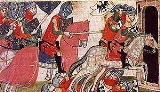
Battle of Benevento

Encyclopedia
The Battle of Benevento was fought near Benevento
, in present-day Southern Italy
, on February 26, 1266, between the troops of Charles of Anjou
and Manfred of Sicily
. Manfred's defeat and death resulted in the capture of the Kingdom of Sicily
by Charles.
over their rule in Italy. At the time of the battle, the Hohenstaufen ruler in the Kingdom of Sicily (which included Sicily and southern Italy) was Manfred, illegitimate son of Frederick II, Holy Roman Emperor
. While the rightful heir to the kingdom was Frederick's legitimate grandson Conradin
, he was young and safely across the Alps
in Bavaria
. Taking advantage of a false rumor of Conradin's death, Manfred had usurped the throne in 1258. Pope Urban IV
determined to wrench the Kingdom from him, and in 1263, concluded a secret treaty with Charles of Anjou
, giving him the Sicilian throne.
in 1265, but was temporarily halted by financial embarrassments. Manfred, however, did not take the field against him until January 1266, when Charles' main army had crossed the Alps. Alarmed by desertions among his followers and fearing further treachery, Manfred sought to bring Charles to battle as swiftly as possible. Charles attempted to turn Manfred's position at Capua
by a perilous crossing of the Apennines
which wrecked his supply line; but Manfred had intelligence of his move and lay in a strong position across the River Calore, crossed only by one bridge.
Charles had divided his cavalry into three "battles". The infantry and the first battle, consisting of 900 Provençals were at the front, commanded by Hugh of Mirepoix and Philip of Montfort, Lord of Castres
. Behind them were the second battle, which consisted of 400 Italians and 1,000 men of Languedoc
and central France. Charles would command the second battle in person. Behind them, the third battle of consisted of about 700 men from the county of Flanders
under Gilles II de Trasignies, Constable of France
, and Robert III of Flanders
.
Manfred had adopted similar dispositions. His Saracen
archers were in the fore. Behind them was the first battle, 1,200 German mercenaries armed in coats of plates
(a novelty at the time), commanded by his cousin Giordano d'Anglano and Galvano of Anglona. The second battle consisted of the Italian mercenaries, about 1,000, and 300 Saracen light horse, commanded by his uncle Galvano Lancia. The third battle, numbering 1,400, were the feudatories of the Kingdom, under Manfred's personal command.
The tide of battle now rapidly turned against Manfred. His troops were forced to defile
across the single bridge over the Calore to reach the field. By the time his second battle had crossed the bridge, Charles had ordered his third battle to charge them on both flanks and they were swiftly destroyed. Upon the defeat of the Italians, most of the nobles in Manfred's third battle deserted him, leaving only the king and a few faithful followers. After exchanging the royal surcoat with his friend Tebaldo Annibaldi, Manfred and his followers charged into the fray and were slain.
.
Benevento
Benevento is a town and comune of Campania, Italy, capital of the province of Benevento, 50 km northeast of Naples. It is situated on a hill 130 m above sea-level at the confluence of the Calore Irpino and Sabato...
, in present-day Southern Italy
Italy
Italy , officially the Italian Republic languages]] under the European Charter for Regional or Minority Languages. In each of these, Italy's official name is as follows:;;;;;;;;), is a unitary parliamentary republic in South-Central Europe. To the north it borders France, Switzerland, Austria and...
, on February 26, 1266, between the troops of Charles of Anjou
Charles I of Sicily
Charles I , known also as Charles of Anjou, was the King of Sicily by conquest from 1266, though he had received it as a papal grant in 1262 and was expelled from the island in the aftermath of the Sicilian Vespers of 1282...
and Manfred of Sicily
Manfred of Sicily
Manfred was the King of Sicily from 1258 to 1266. He was a natural son of the emperor Frederick II of Hohenstaufen but his mother, Bianca Lancia , is reported by Matthew of Paris to have been married to the emperor while on her deathbed.-Background:Manfred was born in Venosa...
. Manfred's defeat and death resulted in the capture of the Kingdom of Sicily
Kingdom of Sicily
The Kingdom of Sicily was a state that existed in the south of Italy from its founding by Roger II in 1130 until 1816. It was a successor state of the County of Sicily, which had been founded in 1071 during the Norman conquest of southern Italy...
by Charles.
Background
The Papacy had long been in conflict with the Imperial house of HohenstaufenHohenstaufen
The House of Hohenstaufen was a dynasty of German kings in the High Middle Ages, lasting from 1138 to 1254. Three of these kings were also crowned Holy Roman Emperor. In 1194 the Hohenstaufens also became Kings of Sicily...
over their rule in Italy. At the time of the battle, the Hohenstaufen ruler in the Kingdom of Sicily (which included Sicily and southern Italy) was Manfred, illegitimate son of Frederick II, Holy Roman Emperor
Frederick II, Holy Roman Emperor
Frederick II , was one of the most powerful Holy Roman Emperors of the Middle Ages and head of the House of Hohenstaufen. His political and cultural ambitions, based in Sicily and stretching through Italy to Germany, and even to Jerusalem, were enormous...
. While the rightful heir to the kingdom was Frederick's legitimate grandson Conradin
Conradin
Conrad , called the Younger or the Boy, but usually known by the diminutive Conradin , was the Duke of Swabia , King of Jerusalem , and King of Sicily .-Early childhood:Conradin was born in Wolfstein, Bavaria, to Conrad...
, he was young and safely across the Alps
Alps
The Alps is one of the great mountain range systems of Europe, stretching from Austria and Slovenia in the east through Italy, Switzerland, Liechtenstein and Germany to France in the west....
in Bavaria
Bavaria
Bavaria, formally the Free State of Bavaria is a state of Germany, located in the southeast of Germany. With an area of , it is the largest state by area, forming almost 20% of the total land area of Germany...
. Taking advantage of a false rumor of Conradin's death, Manfred had usurped the throne in 1258. Pope Urban IV
Pope Urban IV
Pope Urban IV , born Jacques Pantaléon, was Pope, from 1261 to 1264. He was not a cardinal, and there have been several Popes since him who have not been Cardinals, including Urban V and Urban VI.-Biography:...
determined to wrench the Kingdom from him, and in 1263, concluded a secret treaty with Charles of Anjou
Charles I of Sicily
Charles I , known also as Charles of Anjou, was the King of Sicily by conquest from 1266, though he had received it as a papal grant in 1262 and was expelled from the island in the aftermath of the Sicilian Vespers of 1282...
, giving him the Sicilian throne.
Prelude
Charles reached RomeRome
Rome is the capital of Italy and the country's largest and most populated city and comune, with over 2.7 million residents in . The city is located in the central-western portion of the Italian Peninsula, on the Tiber River within the Lazio region of Italy.Rome's history spans two and a half...
in 1265, but was temporarily halted by financial embarrassments. Manfred, however, did not take the field against him until January 1266, when Charles' main army had crossed the Alps. Alarmed by desertions among his followers and fearing further treachery, Manfred sought to bring Charles to battle as swiftly as possible. Charles attempted to turn Manfred's position at Capua
Capua
Capua is a city and comune in the province of Caserta, Campania, southern Italy, situated 25 km north of Naples, on the northeastern edge of the Campanian plain. Ancient Capua was situated where Santa Maria Capua Vetere is now...
by a perilous crossing of the Apennines
Apennine mountains
The Apennines or Apennine Mountains or Greek oros but just as often used alone as a noun. The ancient Greeks and Romans typically but not always used "mountain" in the singular to mean one or a range; thus, "the Apennine mountain" refers to the entire chain and is translated "the Apennine...
which wrecked his supply line; but Manfred had intelligence of his move and lay in a strong position across the River Calore, crossed only by one bridge.
Charles had divided his cavalry into three "battles". The infantry and the first battle, consisting of 900 Provençals were at the front, commanded by Hugh of Mirepoix and Philip of Montfort, Lord of Castres
Philip of Montfort, Lord of Castres
Philip of Montfort was a French nobleman, then Lord of Castres in 1270. He was the son of Philip of Montfort, Lord of Tyre and Eleonore of Courtenay...
. Behind them were the second battle, which consisted of 400 Italians and 1,000 men of Languedoc
Languedoc
Languedoc is a former province of France, now continued in the modern-day régions of Languedoc-Roussillon and Midi-Pyrénées in the south of France, and whose capital city was Toulouse, now in Midi-Pyrénées. It had an area of approximately 42,700 km² .-Geographical Extent:The traditional...
and central France. Charles would command the second battle in person. Behind them, the third battle of consisted of about 700 men from the county of Flanders
County of Flanders
The County of Flanders was one of the territories constituting the Low Countries. The county existed from 862 to 1795. It was one of the original secular fiefs of France and for centuries was one of the most affluent regions in Europe....
under Gilles II de Trasignies, Constable of France
Constable of France
The Constable of France , as the First Officer of the Crown, was one of the original five Great Officers of the Crown of France and Commander in Chief of the army. He, theoretically, as Lieutenant-general of the King, outranked all the nobles and was second-in-command only to the King...
, and Robert III of Flanders
Robert III of Flanders
Robert III of Flanders , also called Robert of Bethune and nicknamed The Lion of Flanders , was Count of Nevers 1273–1322 and Count of Flanders 1305–1322.-History:...
.
Manfred had adopted similar dispositions. His Saracen
Saracen
Saracen was a term used by the ancient Romans to refer to a people who lived in desert areas in and around the Roman province of Arabia, and who were distinguished from Arabs. In Europe during the Middle Ages the term was expanded to include Arabs, and then all who professed the religion of Islam...
archers were in the fore. Behind them was the first battle, 1,200 German mercenaries armed in coats of plates
Coat of plates
A coat of plates is a form of torso armour consisting of metal plates sewn or riveted inside a cloth or leather garment. The coat of plates makes a fairly brief appearance in the history of European armour during the era of transitional armour, during a portion of the 14th century...
(a novelty at the time), commanded by his cousin Giordano d'Anglano and Galvano of Anglona. The second battle consisted of the Italian mercenaries, about 1,000, and 300 Saracen light horse, commanded by his uncle Galvano Lancia. The third battle, numbering 1,400, were the feudatories of the Kingdom, under Manfred's personal command.
Battle
The battle began in the morning, when Manfred advanced his Saracens (archers and a few light cavalry) across the bridge to skirmish. They drove off Charles' infantry, but were put to flight by his first battle. Rashly (whether on their own initiative or by Manfred's order is not known), Manfred's first battle crossed the bridge and counter-charged. At first, the German mercenaries seemed unstoppable; all blows rebounded from their armor plates, and Charles was forced to commit his second battle. The Germans continued to advance, but then the French discovered that the new plate armor did not protect the armpits when the arm was lifted to strike. The Germans were swiftly broken.The tide of battle now rapidly turned against Manfred. His troops were forced to defile
Defile (geography)
Defile is a geographic term for a narrow pass or gorge between mountains or hills. It has its origins as a military description of a pass through which troops can march only in a narrow column or with a narrow front...
across the single bridge over the Calore to reach the field. By the time his second battle had crossed the bridge, Charles had ordered his third battle to charge them on both flanks and they were swiftly destroyed. Upon the defeat of the Italians, most of the nobles in Manfred's third battle deserted him, leaving only the king and a few faithful followers. After exchanging the royal surcoat with his friend Tebaldo Annibaldi, Manfred and his followers charged into the fray and were slain.
Aftermath
The destruction of Manfred's army marked the collapse of Hohenstaufen rule in Italy. The remainder of the Kingdom of Sicily was conquered almost without resistance. Settled in his new kingdom, Charles could await the coming of Conradin, the last hope of the Hohenstaufen, in 1268, and meet him at the Battle of TagliacozzoBattle of Tagliacozzo
The Battle of Tagliacozzo was fought on 23 August 1268 between the French, Provençal, and Italian forces of Charles of Anjou and the Italian, Spanish, Roman, Arab and German troops of the Hohenstaufen army, led by Conradin , the sixteen year old Duke of Swabia and claimant to the throne of Sicily...
.