

Neo-Hittite

Encyclopedia
The states that are called Neo-Hittite, or more recently Syro-Hittite, were Luwian
, Aramaic and Phoenician
-speaking political entities of the Iron Age
northern Syria
and southern Anatolia
that arose following the collapse of the Hittite Empire around 1180 BC and lasted until roughly 700 BC. The term "Neo-Hittite" is sometimes reserved specifically for the Luwian-speaking principalities like Milid
and Carchemish
, although in a wider sense the broader cultural term "Syro-Hittite" is now applied to all the entities that arose in south-central Anatolia following the Hittite collapse — such as Tabal
and Quwê
— as well as those of northern and coastal Syria.
s speaking ancient Dorian dialects moved from the north through the Balkan region to the south.The Thracians who occupied this region and northern Greece were forced to move to the western coasts of Anatolia
and later to the inland where they are mentioned as Phrygians and Mysians.At the end of the 13th century the Mycenean
palaces in the inland Greece were destroyed by invaders and sea-raiders devastated the palace at Pylos
almost simultaneously.A few decades later,at the beginning of the 12th century the Homeric Troy
was destroyed and the Hittite Empire suffered a sudden devastating attack from the Caska who occupied the coasts around the Black Sea
and joined with the Mysians
.They procceeded destroying almost all the Hittite sites and they were finally defeated by the Assyrian
s beyond the south borders near Tigris
These great population movements in Eastern-Meditterannean are echoed in the records of Ramesses III
as an invasion by the so-called sea peoples
.Among them are mentioned the people of Adana
(Dnnym or Danuna) in Cilicia
and probably the Troyan
s.Hatti
, Arzawa
(Lydia
), Alashiya
(Cyprus
), Ugarit
and Alalakh
were destroyed.The invaders were defeated near the borders of Egypt
.
It seems that the sea-peoples contributed to the collapse of the Empire,although they are only mentioned in the Egyptian
records and the archaeological evidence is insufficient.Their invasion was involved with the movement of large populations by land and sea seeking new land to settle.In fact it is recorded that the foreign countries made a conspiracy in their islands and that no land could stand before their arms.The Hittites were strong enough to survive from the first stream of emigrations but they didn't escape from the second.Anyway they were surrounded by enemies.The Caska were a continuous trouble,the borders with Arzawa were never considered safe, Mitanni
at the south was always an enemy and a few decades earlier the Hittites suffered a great defeat by the Assyrian
s beyond the borders.
Hattusa
, the Hittite
capital was completely destroyed Following this collapse of large cities and the Hittite state, the Early Iron Age in northern Mesopotamia
saw a dispersal of settlements and ruralization, with the appearance of large numbers of hamlets, villages, and farmsteads. Syro-Hittite states emerged in the process of such major landscape transformation, in the form of regional states with new political structures and cultural affiliations. David Hawkins was able to trace a dynastic link between the Hittite imperial dynasty and the "Great Kings" and "Country-lords" of Melid and Karkamish of the Early Iron Age, proving an uninterrupted continuity between the Late Bronze Age and the Early Iron Age at those sites.
Aside from literary evidence from inscriptions, the uninterrupted cultural continuity in the region of Neo-Hittite
states from the Late Bronze Age to the Early Iron Age is now further confirmed by the recent archaeological work at the sites of Aleppo
(Temple of the Storm God on the Citadel) and Ain Dara (Temple of Ishtar-Shawushka)
, where temples built in the Late Bronze Age continue into the Iron Age without hiatus, and those temples witness multiple rebuildings in the Early Iron Age.
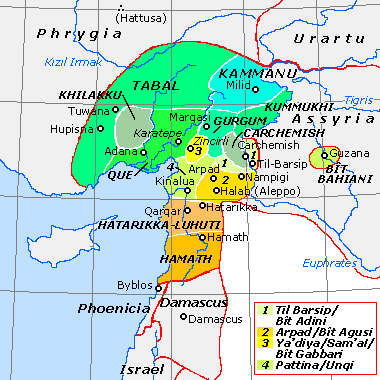 The Syro-Hittite states may be divided into two groups: a northern group where Hittite
rulers remained in power, and a southern group where Aramaeans
came to rule from about 1000 BC. Although these states are considered somewhat unified, they were though to actually be disunified, even in separate kingdoms.
The northern group includes:
The southern, Aramaic, group includes:
monumental inscriptions in Anatolian hieroglyphs
continue uninterrupted from the thirteenth-century Hittite imperial monuments to the Early Iron Age Syro-Hittite inscriptions of Karkamish, Melid, Aleppo and elsewhere. Luwian hieroglyphs was chosen by many of the Syro-Hittite regional kingdoms for their monumental inscriptions, which often appear in bi or tri-lingual inscriptions with Aramaic, Phoenician
or Akkadian
versions. The Early Iron Age in Northern Mesopotamia
also saw a gradual spread of alphabetic writing in Aramaic and Phoenician
. During the cultural interactions on the Levantine coast of Syro-Palestine and North Syria in the tenth through eighth centuries BC, Greeks and Phrygians adopted the alphabetic writing from the Phoenicians.
Luwian language
Luwian is an extinct language of the Anatolian branch of the Indo-European language family. Luwian is closely related to Hittite, and was among the languages spoken during the second and first millennia BC by population groups in central and western Anatolia and northern Syria...
, Aramaic and Phoenician
Phoenician languages
Phoenician was a language originally spoken in the coastal region then called "Canaan" in Phoenician, Arabic, Hebrew, and Aramaic, "Phoenicia" in Greek and Latin, and "Pūt" in Ancient Egyptian. Phoenician is a Semitic language of the Canaanite subgroup; its closest living relative is Hebrew, to...
-speaking political entities of the Iron Age
Iron Age
The Iron Age is the archaeological period generally occurring after the Bronze Age, marked by the prevalent use of iron. The early period of the age is characterized by the widespread use of iron or steel. The adoption of such material coincided with other changes in society, including differing...
northern Syria
Syria
Syria , officially the Syrian Arab Republic , is a country in Western Asia, bordering Lebanon and the Mediterranean Sea to the West, Turkey to the north, Iraq to the east, Jordan to the south, and Israel to the southwest....
and southern Anatolia
Anatolia
Anatolia is a geographic and historical term denoting the westernmost protrusion of Asia, comprising the majority of the Republic of Turkey...
that arose following the collapse of the Hittite Empire around 1180 BC and lasted until roughly 700 BC. The term "Neo-Hittite" is sometimes reserved specifically for the Luwian-speaking principalities like Milid
Milid
Melid was an ancient city on the Tohma River, a tributary of the upper Euphrates rising in the Taurus Mountains...
and Carchemish
Carchemish
Carchemish or Kargamış was an important ancient city of the Mitanni, Hittite and Neo Assyrian Empires, now on the frontier between Turkey and Syria. It was the location of an important battle between the Babylonians and Egyptians, mentioned in the Bible...
, although in a wider sense the broader cultural term "Syro-Hittite" is now applied to all the entities that arose in south-central Anatolia following the Hittite collapse — such as Tabal
Tabal
Tabal was a Luwian speaking Neo-Hittite kingdom of South Central Anatolia. According to archaeologist Kurt Bittel, the kingdom of Tabal first appeared after the collapse of the Hittite Empire....
and Quwê
Quwê
Quwê – also spelled Que, Kue, Qeve, Coa, Kuê and Keveh – was a "Neo-Hittite" Assyrian vassal state or province at various times from the 9th century BCE to shortly after the death of Ashurbanipal around 627 BCE in the lowlands of eastern Cilicia, and the name of its capital city,...
— as well as those of northern and coastal Syria.
Late Bronze Age-Early Iron Age transition
The collapse of the Hittite Empire is usually associated with the gradual decline of Eastern Mediterranean trade networks and the resulting collapse of major Late Bronze Age cities in the Levantine coast, Anatolia and the Aegean.In the middle of 13th century BC great groups of GreekGreeks
The Greeks, also known as the Hellenes , are a nation and ethnic group native to Greece, Cyprus and neighboring regions. They also form a significant diaspora, with Greek communities established around the world....
s speaking ancient Dorian dialects moved from the north through the Balkan region to the south.The Thracians who occupied this region and northern Greece were forced to move to the western coasts of Anatolia
Anatolia
Anatolia is a geographic and historical term denoting the westernmost protrusion of Asia, comprising the majority of the Republic of Turkey...
and later to the inland where they are mentioned as Phrygians and Mysians.At the end of the 13th century the Mycenean
Mycenaean Greece
Mycenaean Greece was a cultural period of Bronze Age Greece taking its name from the archaeological site of Mycenae in northeastern Argolis, in the Peloponnese of southern Greece. Athens, Pylos, Thebes, and Tiryns are also important Mycenaean sites...
palaces in the inland Greece were destroyed by invaders and sea-raiders devastated the palace at Pylos
Pylos
Pylos , historically known under its Italian name Navarino, is a town and a former municipality in Messenia, Peloponnese, Greece. Since the 2011 local government reform it is part of the municipality Pylos-Nestoras, of which it is the seat and a municipal unit. It was the capital of the former...
almost simultaneously.A few decades later,at the beginning of the 12th century the Homeric Troy
Troy
Troy was a city, both factual and legendary, located in northwest Anatolia in what is now Turkey, southeast of the Dardanelles and beside Mount Ida...
was destroyed and the Hittite Empire suffered a sudden devastating attack from the Caska who occupied the coasts around the Black Sea
Black Sea
The Black Sea is bounded by Europe, Anatolia and the Caucasus and is ultimately connected to the Atlantic Ocean via the Mediterranean and the Aegean seas and various straits. The Bosphorus strait connects it to the Sea of Marmara, and the strait of the Dardanelles connects that sea to the Aegean...
and joined with the Mysians
Mysians
Mysians were the inhabitants of Mysia, a region in northwestern Asia Minor.-Origins according to ancient authors:Their first mention is by Homer, in his list of Trojans allies in the Iliad, and according to whom the Mysians fought in the Trojan War on the side of Troy, under the command of Chromis...
.They procceeded destroying almost all the Hittite sites and they were finally defeated by the Assyrian
Assyria
Assyria was a Semitic Akkadian kingdom, extant as a nation state from the mid–23rd century BC to 608 BC centred on the Upper Tigris river, in northern Mesopotamia , that came to rule regional empires a number of times through history. It was named for its original capital, the ancient city of Assur...
s beyond the south borders near Tigris
Tigris
The Tigris River is the eastern member of the two great rivers that define Mesopotamia, the other being the Euphrates. The river flows south from the mountains of southeastern Turkey through Iraq.-Geography:...
These great population movements in Eastern-Meditterannean are echoed in the records of Ramesses III
Ramesses III
Usimare Ramesses III was the second Pharaoh of the Twentieth Dynasty and is considered to be the last great New Kingdom king to wield any substantial authority over Egypt. He was the son of Setnakhte and Queen Tiy-Merenese. Ramesses III is believed to have reigned from March 1186 to April 1155 BCE...
as an invasion by the so-called sea peoples
Sea Peoples
The Sea Peoples were a confederacy of seafaring raiders of the second millennium BC who sailed into the eastern Mediterranean, caused political unrest, and attempted to enter or control Egyptian territory during the late 19th dynasty and especially during year 8 of Ramesses III of the 20th Dynasty...
.Among them are mentioned the people of Adana
Adana
Adana is a city in southern Turkey and a major agricultural and commercial center. The city is situated on the Seyhan River, 30 kilometres inland from the Mediterranean, in south-central Anatolia...
(Dnnym or Danuna) in Cilicia
Cilicia
In antiquity, Cilicia was the south coastal region of Asia Minor, south of the central Anatolian plateau. It existed as a political entity from Hittite times into the Byzantine empire...
and probably the Troyan
Troyan
Troyan is a town in Lovech Province in central Bulgaria with population of 21,997 inhabitants, as of December 2009,. It is the administrative centre of the homonymous Troyan Municipality. The town is about 160 km away from the country capital Sofia. The nearest civilian airport is Gorna...
s.Hatti
Hatti
Hatti may refer to*Hatti in Bronze Age Anatolia:**the area of Hattusa, roughly delimited by the Halys bend**the Hattians of the 3rd and 2nd millennia BC**the Hittite Empire of ca 1400 BC–1200 BC...
, Arzawa
Arzawa
Arzawa in the second half of the second millennium BC was the name of a region and a political entity in Western Anatolia, the core area of which was centered on the Hermos and Maeander river valleys, corresponding with the Late Bronze Age kingdoms of the...
(Lydia
Lydia
Lydia was an Iron Age kingdom of western Asia Minor located generally east of ancient Ionia in the modern Turkish provinces of Manisa and inland İzmir. Its population spoke an Anatolian language known as Lydian....
), Alashiya
Alashiya
Alashiya or Alasiya was a state which existed in the Middle and Late Bronze Ages, and was situated somewhere in the Eastern Mediterranean. It was a major source of goods, especially copper, for Ancient Egypt and other states in the Ancient Near East. It is referred to in a number of the surviving...
(Cyprus
Cyprus
Cyprus , officially the Republic of Cyprus , is a Eurasian island country, member of the European Union, in the Eastern Mediterranean, east of Greece, south of Turkey, west of Syria and north of Egypt. It is the third largest island in the Mediterranean Sea.The earliest known human activity on the...
), Ugarit
Ugarit
Ugarit was an ancient port city in the eastern Mediterranean at the Ras Shamra headland near Latakia, Syria. It is located near Minet el-Beida in northern Syria. It is some seven miles north of Laodicea ad Mare and approximately fifty miles east of Cyprus...
and Alalakh
Alalakh
Alalakh is the name of an ancient city-state near modern Antakya in the Amuq River valley of Turkey's Hatay Province.Now represented by an extensive mound, the name of the modern archaeological site is Tell Atchana.-History:...
were destroyed.The invaders were defeated near the borders of Egypt
Egypt
Egypt , officially the Arab Republic of Egypt, Arabic: , is a country mainly in North Africa, with the Sinai Peninsula forming a land bridge in Southwest Asia. Egypt is thus a transcontinental country, and a major power in Africa, the Mediterranean Basin, the Middle East and the Muslim world...
.
It seems that the sea-peoples contributed to the collapse of the Empire,although they are only mentioned in the Egyptian
Egypt
Egypt , officially the Arab Republic of Egypt, Arabic: , is a country mainly in North Africa, with the Sinai Peninsula forming a land bridge in Southwest Asia. Egypt is thus a transcontinental country, and a major power in Africa, the Mediterranean Basin, the Middle East and the Muslim world...
records and the archaeological evidence is insufficient.Their invasion was involved with the movement of large populations by land and sea seeking new land to settle.In fact it is recorded that the foreign countries made a conspiracy in their islands and that no land could stand before their arms.The Hittites were strong enough to survive from the first stream of emigrations but they didn't escape from the second.Anyway they were surrounded by enemies.The Caska were a continuous trouble,the borders with Arzawa were never considered safe, Mitanni
Mitanni
Mitanni or Hanigalbat was a loosely organized Hurrian-speaking state in northern Syria and south-east Anatolia from ca. 1500 BC–1300 BC...
at the south was always an enemy and a few decades earlier the Hittites suffered a great defeat by the Assyrian
Assyria
Assyria was a Semitic Akkadian kingdom, extant as a nation state from the mid–23rd century BC to 608 BC centred on the Upper Tigris river, in northern Mesopotamia , that came to rule regional empires a number of times through history. It was named for its original capital, the ancient city of Assur...
s beyond the borders.
Hattusa
Hattusa
Hattusa was the capital of the Hittite Empire in the late Bronze Age. It was located near modern Boğazkale, Turkey, within the great loop of the Kızıl River ....
, the Hittite
Hittites
The Hittites were a Bronze Age people of Anatolia.They established a kingdom centered at Hattusa in north-central Anatolia c. the 18th century BC. The Hittite empire reached its height c...
capital was completely destroyed Following this collapse of large cities and the Hittite state, the Early Iron Age in northern Mesopotamia
Mesopotamia
Mesopotamia is a toponym for the area of the Tigris–Euphrates river system, largely corresponding to modern-day Iraq, northeastern Syria, southeastern Turkey and southwestern Iran.Widely considered to be the cradle of civilization, Bronze Age Mesopotamia included Sumer and the...
saw a dispersal of settlements and ruralization, with the appearance of large numbers of hamlets, villages, and farmsteads. Syro-Hittite states emerged in the process of such major landscape transformation, in the form of regional states with new political structures and cultural affiliations. David Hawkins was able to trace a dynastic link between the Hittite imperial dynasty and the "Great Kings" and "Country-lords" of Melid and Karkamish of the Early Iron Age, proving an uninterrupted continuity between the Late Bronze Age and the Early Iron Age at those sites.
Aside from literary evidence from inscriptions, the uninterrupted cultural continuity in the region of Neo-Hittite
Neo-Hittite
The states that are called Neo-Hittite, or more recently Syro-Hittite, were Luwian, Aramaic and Phoenician-speaking political entities of the Iron Age northern Syria and southern Anatolia that arose following the collapse of the Hittite Empire around 1180 BC and lasted until roughly 700 BC...
states from the Late Bronze Age to the Early Iron Age is now further confirmed by the recent archaeological work at the sites of Aleppo
Aleppo
Aleppo is the largest city in Syria and the capital of Aleppo Governorate, the most populous Syrian governorate. With an official population of 2,301,570 , expanding to over 2.5 million in the metropolitan area, it is also one of the largest cities in the Levant...
(Temple of the Storm God on the Citadel) and Ain Dara (Temple of Ishtar-Shawushka)
Ain Dara temple
The Ain Dara temple, located northwest of Aleppo, Syria, is an Iron Age Syro-Hittite temple noted for its similarities to Solomon's Temple as described in the Hebrew Bible...
, where temples built in the Late Bronze Age continue into the Iron Age without hiatus, and those temples witness multiple rebuildings in the Early Iron Age.
List of Syro-Hittite states
Hittites
The Hittites were a Bronze Age people of Anatolia.They established a kingdom centered at Hattusa in north-central Anatolia c. the 18th century BC. The Hittite empire reached its height c...
rulers remained in power, and a southern group where Aramaeans
Aramaeans
The Aramaeans, also Arameans , were a Northwest Semitic semi-nomadic and pastoralist people who originated in what is now modern Syria during the Late Bronze Age and the Iron Age...
came to rule from about 1000 BC. Although these states are considered somewhat unified, they were though to actually be disunified, even in separate kingdoms.
The northern group includes:
- TabalTabalTabal was a Luwian speaking Neo-Hittite kingdom of South Central Anatolia. According to archaeologist Kurt Bittel, the kingdom of Tabal first appeared after the collapse of the Hittite Empire....
. It may have included a group of city states called the Tyanitis (TuwanaTyanaTyana or Tyanna was an ancient city in the Anatolian region of Cappadocia, in modern south-central Turkey. It was the capital of a Luwian-speaking Neo-Hittite kingdom in the 1st millennium BC.-History:...
, TunnaTunnaTunna was an ancient Anatolian city during the Syro-Hittite period, and later was a part of the Classical Trunna....
, Hupisna, Shinukhtu, Ishtunda) - KammanuKammanuthumb|200px|right|Historical map of the Neo-Hittite states, ca. 800 BC, showing the location of Kammanu with Melid.Kammanu was a Luwian speaking Neo-Hittite state in South Central Anatolia in the late 2nd millennium BC, formed from part of Kizzuwatna after the collapse of the Hittite Empire. Its...
(with Melid) - Hilakku
- QuwêQuwêQuwê – also spelled Que, Kue, Qeve, Coa, Kuê and Keveh – was a "Neo-Hittite" Assyrian vassal state or province at various times from the 9th century BCE to shortly after the death of Ashurbanipal around 627 BCE in the lowlands of eastern Cilicia, and the name of its capital city,...
(with a stronghold at modern KaratepeKaratepeKaratepe is a late Hittite fortress and open air museum in Osmaniye Province in southern Turkey lying at a distance of about 23 km from the district center of Kadirli. It is sited in the Taurus Mountains, on the right bank of the Ceyhan River...
) - Gurgum
- KummuhKummuhthumb|250px|right|Historical map of the Neo-Hittite states, ca. 800 BC, showing the location of Kummuh.Kummuh is an Iron Age Neo-Hittite kingdom located on the west bank of the Upper Euphrates within the easternly loop of the river between Malatya and Carchemish. Assyrian sources refer both to the...
- CarchemishCarchemishCarchemish or Kargamış was an important ancient city of the Mitanni, Hittite and Neo Assyrian Empires, now on the frontier between Turkey and Syria. It was the location of an important battle between the Babylonians and Egyptians, mentioned in the Bible...
The southern, Aramaic, group includes:
- Bit Gabbari (with Sam'alSam'alSam'al was a Hittite and Aramaean city located at Zincirli Höyük in the Anti-Taurus Mountains of modern Turkey's Gaziantep Province.-History:thumb|200px|right|Historical map of the Neo-Hittite states, ca...
) - Bit-Adini (with the city of Til BarsipTil BarsipTil Barsip or Til Barsib is an ancient site situated by the Euphrates river about 20 kilometers south of ancient Carchemish.-History:...
) - Bit-Bahiani (with Guzana)
- Unqi or Pattina (with the city of Kinalua, maybe modern Tell TayinatTell TayinatTell Ta'yinat is a low-lying ancient occupation mound on the east bank at the bend of the ancient Orontes river, in the Hatay province of present southeastern Turkey about 25 kilometers south east of Antakya . The site lies some 800 meters from Tell Atchana, the site of the ancient city of Alalakh...
) - Ain DaraAin Dara templeThe Ain Dara temple, located northwest of Aleppo, Syria, is an Iron Age Syro-Hittite temple noted for its similarities to Solomon's Temple as described in the Hebrew Bible...
, a religious center - Bit Agusi (with the cities of ArpadArpad (Syria)Arpad was an ancient Aramaean city located in north-western Syria, north of Aleppo. In 743 BC, the Assyrian king Tiglath-pileser III led a military expedition to Syria, defeating there the Uraratian army. But the city of Arpad, which had formed an alliance with Urartu, did not surrender easily...
, Nampigi, and (later on) AleppoAleppoAleppo is the largest city in Syria and the capital of Aleppo Governorate, the most populous Syrian governorate. With an official population of 2,301,570 , expanding to over 2.5 million in the metropolitan area, it is also one of the largest cities in the Levant...
) - Hatarikka-Luhuti (the capital city of which was at first AleppoAleppoAleppo is the largest city in Syria and the capital of Aleppo Governorate, the most populous Syrian governorate. With an official population of 2,301,570 , expanding to over 2.5 million in the metropolitan area, it is also one of the largest cities in the Levant...
, and then Hatarikka) - Hamath
Inscriptions
LuwianLuwian language
Luwian is an extinct language of the Anatolian branch of the Indo-European language family. Luwian is closely related to Hittite, and was among the languages spoken during the second and first millennia BC by population groups in central and western Anatolia and northern Syria...
monumental inscriptions in Anatolian hieroglyphs
Anatolian hieroglyphs
Anatolian hieroglyphs are an indigenous logographic script native to central Anatolia, consisting of some 500 signs. They were once commonly known as Hittite hieroglyphs, but the language they encode proved to be Luwian, not Hittite, and the term Luwian hieroglyphs is used in English publications...
continue uninterrupted from the thirteenth-century Hittite imperial monuments to the Early Iron Age Syro-Hittite inscriptions of Karkamish, Melid, Aleppo and elsewhere. Luwian hieroglyphs was chosen by many of the Syro-Hittite regional kingdoms for their monumental inscriptions, which often appear in bi or tri-lingual inscriptions with Aramaic, Phoenician
Phoenician languages
Phoenician was a language originally spoken in the coastal region then called "Canaan" in Phoenician, Arabic, Hebrew, and Aramaic, "Phoenicia" in Greek and Latin, and "Pūt" in Ancient Egyptian. Phoenician is a Semitic language of the Canaanite subgroup; its closest living relative is Hebrew, to...
or Akkadian
Akkadian language
Akkadian is an extinct Semitic language that was spoken in ancient Mesopotamia. The earliest attested Semitic language, it used the cuneiform writing system derived ultimately from ancient Sumerian, an unrelated language isolate...
versions. The Early Iron Age in Northern Mesopotamia
Mesopotamia
Mesopotamia is a toponym for the area of the Tigris–Euphrates river system, largely corresponding to modern-day Iraq, northeastern Syria, southeastern Turkey and southwestern Iran.Widely considered to be the cradle of civilization, Bronze Age Mesopotamia included Sumer and the...
also saw a gradual spread of alphabetic writing in Aramaic and Phoenician
Phoenician alphabet
The Phoenician alphabet, called by convention the Proto-Canaanite alphabet for inscriptions older than around 1050 BC, was a non-pictographic consonantal alphabet, or abjad. It was used for the writing of Phoenician, a Northern Semitic language, used by the civilization of Phoenicia...
. During the cultural interactions on the Levantine coast of Syro-Palestine and North Syria in the tenth through eighth centuries BC, Greeks and Phrygians adopted the alphabetic writing from the Phoenicians.
See also
- HittitesHittitesThe Hittites were a Bronze Age people of Anatolia.They established a kingdom centered at Hattusa in north-central Anatolia c. the 18th century BC. The Hittite empire reached its height c...
- Luwians
- AramaeansAramaeansThe Aramaeans, also Arameans , were a Northwest Semitic semi-nomadic and pastoralist people who originated in what is now modern Syria during the Late Bronze Age and the Iron Age...
- Iron AgeIron AgeThe Iron Age is the archaeological period generally occurring after the Bronze Age, marked by the prevalent use of iron. The early period of the age is characterized by the widespread use of iron or steel. The adoption of such material coincided with other changes in society, including differing...
- Bronze Age collapseBronze Age collapseThe Bronze Age collapse is a transition in southwestern Asia and the Eastern Mediterranean from the Late Bronze Age to the Early Iron Age that some historians believe was violent, sudden and culturally disruptive...
External links
- Neo-Hittite Monuments
- http://www.bible-history.com/ancient_art/orthostat_relief_hunting_scene.html