
Encyclopedia
Southeast Asia or
Southeastern Asia is a
subregion of
Asia, consisting of the countries that are geographically east of
India but south of
China. The region lies on the intersection of geological plates, with heavy seismic and volcanic activity.
Southeast Asia consists of two geographic sections: the Asian mainland, and Island arcs and
archipelagoes to the east and southeast. Culturally, the region has been influenced by its two large neighbors , with
Myanmar being once a part of India and
Vietnam considered the most Chinese-influenced.
The part of the region that lies on the Asian mainland is the most homogeneously
Buddhist region of the world, while in the archipelagic section of the region
Islam and
Christianity predominate.
Name and definition
Southeast Asia frequently refers to the area consist of the following, although in general and certain specific usage, the area it refers to can be broader or narrower.
...
All of the above are members of the
Association of South East Asian Nations, except
Timor Leste, which is a candidate.
The area, together with part of
South Asia, was in the past known as the
East Indies or simply
Indies.
Although politically external territories of Australia.
Christmas Island and
Cocos Islands are culturally part of south-east Asia.
Although politically a part of India, the
Andaman Islands are geographically considered part of south-east Asia.
IATA definition
For international travel, the airline industry looks to
IATA for definitions of regions such as Southeast Asia. IATA defines Southeast Asia as:
Brunei Darussalam,
Cambodia,
China excluding Hong Kong SAR and Macau SAR,
Chinese Taipei ,
Christmas Island, Cocos Islands,
Guam,
Hong Kong Special Administrative Region, China,
Indonesia,
Kazakhstan,
Kyrgyzstan,
Laos, Macao Special Administrative Region, China,
Malaysia,
Marshall Islands,
Micronesia,
Mongolia,
Myanmar,
Northern Mariana Islands,
Palau,
Philippines,
Russia in
Asia ,
Singapore,
Tajikistan,
Thailand,
Timor Leste,
Turkmenistan,
Uzbekistan, and
Viet Nam. This definition is used world-wide for airfare and tax calculations.
Geography
Southeast Asia is geographically divided into two regions, namely Indochina and the Malay Archipelago.
Indochina or sometimes mainland Southeast Asia includes all of:
- Myanmar
- Cambodia
- Laos
- Thailand
- Vietnam
The Malay archipelago , variously Malay World, an ethno-cultural notion, or maritime Southeast Asia consists of:
- Brunei
- East Timor
- Indonesia
- Philippines
- Malaysia
- Singapore
Malaysia is divided by the South China Sea. Peninsular Malaysia is on the mainland while East Malaysia is on Borneo, the largest islands in the region. However, Malaysia is often considered an archipelagic nation.
Geologically the Malay archipelago is very interesting, being one of the most active vulcanology regions in the world. Geological tectonic uplifts in the region have also produced some impressive mountains, culminating in Mount Kinabalu in Sabah, Malaysia on the island of Borneo with a height of 13,455 ft and also Puncak Jaya in Irian Jaya, Indonesia at 16,024 ft, on the island of New Guinea.
There are various conflicting territorial and/or maritime claims, both among these countries and even involving other parties notably both Chinas in the case of the Spratly Islands.
Contrary to common misconception, most of the inhabitants of archipelagic Southeast Asia are not Pacific Islanders as that term is defined by the U.S. Census. However, most of the people of the Malay Archipelago have in common with Pacific Islanders that they
are Austronesian people. Also, the eastern parts of Indonesia and Timor-Leste are geographically parts of Oceania.
Population
Southeast Asia has an area of approx. 4,000,000 km² .
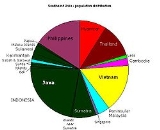
As of 2004, more than 593 million people lived in the region, far over a sixth of them on the Indonesian island of
Java, the most densely populated large island in the world. The distribution of the religions and people is diverse in Southeast Asia and varies by country. Some 30 million Overseas Chinese also live in Southeast Asia, most prominently in
Malaysia,
Singapore and
Thailand, and also, as the
Hoa, in
Vietnam. See also
Chinatowns.
Ethnic groups in the subregion
Southeast Asians are primarily of Asiatic stock. According to a recent
Stanford , the Southeast Asian population is entirely far from being homogeneous. Although primarily descendants of
Austronesian, Tai, and Mon-Khmer-speaking immigrants who migrated from Southern China during the Iron Age, there are overlays of Chinese, European, and Papuan genes. The Philippines, Malaysia, and Singapore have substantial Eurasian populations.
- Brunei: Malay , Chinese , Indigenous Bruneians , Others
- Cambodia: Khmer , Chinese , Vietnamese , Others
- East Timor: Tetun , Mambae , Makasae , Tukudede , Bunak , Galoli , Kemak , Fataluku , Baikeno , Others
- Indonesia: Javanese , Sundanese , Malay , Madurese , Batak , Minangkabau , Betawi , Buginese , Others %
- Laos: Lowland Lao , Lao Theung , Lao Soung
- Malaysia: Malay and other Bumiputras , Chinese , Indians , Others
- Myanmar: Bamar , Shan , Karen , Rakhine , Others
- Philippines: Filipino [including Filipino Mestizo
...
and Negrito ] , Chinese , Others
- Singapore: Chinese , Malay , Indians , Others
- Thailand: Thai , Chinese , Malay , Khmer , Others
- Vietnam: Vietnamese , Chinese , Thai , Others
Religions in the subregion
Countries in Southeast Asia practise many different religions.
Mainland SEA countries, that is, Thailand, Vietnam, Laos, Cambodia and Myanmar, practise predominantly
Buddhism.
Singapore is also predominantly Buddhist. In the Malay Archipelago, people living in Malaysia, Indonesia and Brunei practise mainly
Islam.
Christianity is predominant in the Philippines, Eastern Indonesia and East Timor.
The religious composition for each country is as follows:
...
, and others
...
,
Buddhism , other
- Laos: Theravada Buddhism , Animism, and others
- Malaysia: Islam , Mahayana Buddhism , Christianity, Hinduism, and Animism
- Myanmar: Theravada Buddhism , Islam , Christianity , Hinduism , and Animism
- Philippines: Christianity , Islam , Buddhism and others
- Singapore: Chinese Religions , Islam , Christianity , Hinduism
- Thailand: Theravada Buddhism , Islam , Hinduism, Sikhism, Christianity, and Taoism
- Vietnam: Mahayana Buddhism , Confucianism, Christianity, and Islam.
Religions and peoples are diverse in Southeast Asia and not one country is homogeneous. In the world's most populous Muslim nation, Indonesia, Hinduism is dominant on islands such as
Bali. Christianity also predominates in
Philippines, Papua and
Timor. Pockets of Hindu population can also be found around Southeast Asia in Singapore, Malaysia etc.
Garuda , the phoenix who is the mount of
Vishnu, is a national symbol in both
Thailand and
Indonesia; in the
Philippines, gold images of Garuda have been found on
Palawan; gold images of other Hindu gods and goddesses have also been found on
Mindanao. Balinese Hinduism is somewhat different from Hinduism practised elsewhere, as Animism and local culture is incorporated into it. Christians can also be found throughout Southeast Asia; they are in the majority in East Timor and the Philippines, Asia's largest Christian nation. In addition, there are also older tribal religious practices in remote areas of
Sarawak in East Malaysia and Papua in eastern Indonesia. In Myanmar, Sakka is revered as a
nat. In Vietnam, Mahayana Buddhism is practiced, which is influenced by native animism but with strong emphasis on
Ancestor Worship.
Languages in the subregion
Each of the languages have been influenced by cultural pressures due to trade and historical colonization as well. Thus, for example, a Filipino, educated in English and Tagalog, as well as in his native tongue , might well speak another language, such as Japanese for economic reasons; a Malaysian might well speak Chinese as well as English, again for economic reasons.
The official languages have been bolded- Brunei: Malay, Chinese dialects, indigenous Borneian dialects
- Cambodia: Khmer, Chinese dialects, Vietnamese, Chamic dialects
- East Timor: Tetun, Portuguese, Mambae, Makasae, Tukudede, Bunak, Galoli, Kemak, Fataluku, Baikeno, other Timorese dialects
- Indonesia: Indonesian, Acehnese, Batak, Sundanese, Javanese, Sasak, Tetum of Timor, Dayak, Minahasa, Toraja, Buginese, Halmahera, Ambonese, Ceramese, and several Papuanese languages. Chinese dialects like Hokkien, Hakka and Mandarin and Dutch, 583 others languages.
- Laos: Lao, Miao, Mien, Dao, Shan, and other Tibeto-Burman derived languages
- Malaysia: Malay, English, Chinese dialects, Tamil, other Indian languages, various indigenous languages .
- Myanmar: Burmese, English, Shan dialects, Karen dialects, Rakhine, Kachin, Chin, Chinese dialects , Mon, Indian languages, hilltribe languages
- Philippines: Filipino, English, Tagalog, Cebuano, Hiligaynon, Waray, Ilocano, Kapampangan, Spanish and its dialects and creoles, Pangasinense, Bicolano, Maranao, Maguindanao, Tausug, Kinaray-a, Chabacano, Lán-lâng-oe , other Philippine languages and dialects, , other Chinese dialects, Indian languages, Arabic dialects
- Singapore: Mandarin Chinese, Malay, Tamil, English, other Chinese dialects, other Indian languages, Arabic dialects.
- Thailand: Thai, Chinese dialects, Isan, Shan, Lue, Phutai, Khmer, Mon, Mein, Hmong, Karen, Jawi, Malay
- Vietnam: Vietnamese, Tay, Muong, Khmer, Chinese dialects, Nung, Hmong, Tai Dam, Malay and other languages and dialects.
Environment
The animals of Southeast Asia are diverse; on the islands of
Borneo and
Sumatra, the
Orangutan , the
Asian Elephant, the Malayan
tapir, the
Sumatran Rhinoceros and the
Clouded Leopard can be also found. The
bearcat can be found on the island of
Palawan.
The
Water Buffalo, both domesticated and wild, can be found all over Southeast Asia, where once it was found in much greater extent in South Asia, for example. The
mouse deer, a small tusked deer as large as a toy dog or cat, can be found on Sumatra, Borneo and Palawan Islands.
Birds such as the
peafowl and drongo live in this subregion as far east as
Indonesia. The
babirusa, a four-tusked pig, can be found in Indonesia as well. The
hornbill was prized for its beak and used in trade with China. The horn of the rhinoceros, not part of its skull, was prized in China as well.
The Indonesian Archipelago is split by the
Wallace Line. This line runs along what is now known to be a tectonic plate boundary, and separates Asian species from Australasian species. The islands between Java/Borneo and Papua form a mixed zone, where both types occur, known as Wallacea.
The shallow waters of the Southeast Asian coral reefs have the highest levels of
biodiversity for the world's marine ecosystems, where coral, fish and molluscs abound. The
whale shark can be found in the
South China Sea.
The trees and other plants of the region are tropical; in some countries where the mountains are tall enough, temperate-climate vegetation can be found. These rainforest areas are currently being logged-over, especially in Borneo.
While Southeast Asia is rich in flora and fauna, Southeast Asia is facing severe
deforestation which causes habitat loss for various
endangered species such as orangutan, the Sumatran tiger, and the King Cobra. At the same time,
haze has been a regular occurrence. The worst regional haze occurred in 1998 in which multiple countries were covered with thick haze. In reaction, several countries in Southeast Asia signed the
ASEAN Agreement on Transboundary Haze Pollution in order to combat haze pollution.
Culture
Rice paddy agriculture has existed in Southeast Asia for thousands of years, ranging across the subregion. Some dramatic examples of these rice paddies populate the
Banaue Rice Terraces in the mountains
of Northern Luzon in the Philippines, and in Indonesia. Maintenance of these paddies is very labor-intensive. The rice paddies are well-suited to the monsoon climate of the region.
Stilt houses can be found all over Southeast Asia, from Thailand and Laos, to Borneo, to Luzon in the Philippines, to Papua New Guinea.
The chief cultural influences over the Southeast Asian peoples in past two millennia have been from South Asia as evidenced by the forms of writing, such as the
Balinese writing shown on split palm leaf called
lontar, below:
The antiquity of this form of writing extends before the invention of paper 100, in
China. Note each palm leaf section was only several lines, written longitudinally across the leaf, and bound by twine to the other sections. The outer portion was decorated. The alphabets of Southeast Asia tended to be abugidas, until the arrival of the Europeans, who used words that also ended in consonants, not just vowels. Other forms of official documents, which did not use paper, included Javanese copperplate scrolls. This would have been more durable in the tropical climate of Southeast Asia.
Besides writing and weaponry, such as the distinctive
Kris, other metalworking was used for musical instruments; the
gamelan instruments consisted of
gongs and other tonal, but percussive music. Most of the traditional music is based on a
pentatonic scale as per Chinese influences.
Dance in Southeast Asia also includes movement of the hands, as well as the feet. Puppetry and shadow plays were also a favoured form of entertainment in past centuries. The Arts and Literature in South East Asia is quite influenced by Hinduism brought to them centuries ago. In Indonesia and Malaysia, though they converted to Islam, they retained many forms of Hindu influenced practices, Cultures, Arts and Literature. An example will be the
Wayang Kulit and literatures like the Ramayana. This is also true for mainland South East Asia . Dance movements, Hindu gods, Arts were also fused into Thai, Khmer, Laotian and
Burmese cultures. In Vietnam, the Vietnamese share many cultural similarities with the Chinese. Examples would be the national costume of Vietnam,
Ao Dai influenced by the
Qi pao of
China and the Mahayana form of Buddhism which the
Chinese and
Vietnamese alike adhere to.
The peoples of Southeast Asia were trained to carry burdens on their heads; it was a common sight to see a child balancing a small object like a bowl on her head, in distinction to her mother or aunt balancing a much larger load.
As a rule, the peoples who ate with their fingers were more likely influenced by the culture of India, for example, than the culture of China, where the peoples first ate with
chopsticks;
tea, as a beverage, can be found across the region. The
fish sauces distinctive to the region tend to vary.
The indigenous religious patterns of Southeast Asia were originally
animist, then arrived Brahmanic Hinduism, which would then later be replaced by Theravada Buddhism . Later influences in Indonesia and Malaysia were from Islam and Christianity . The last Hindu court in Indonesia was to retreat to
Bali by the later 1400s. In Mainland South East Asia, Myanmar, Cambodia and Thailand retained the Theravada form of Buddhism that was brought to them from Sri Lanka and fused Buddhism with Hindu influenced Khmer culture. Countries in South East Asia, like Thailand, also eschewed from Christianity even though Christian missionaries were widespread. However, the Thais absorbed the science and technology from these Christian missionaries from the west so as to resist colonialism. King
Mongkut once remarked to a Christian missionary friend: "What you teach us to do is admirable, but what you teach us to believe is foolish".
The peoples of the South East have been seafarers for thousands of years, some reaching the island of
Madagascar, others reaching
Easter Island in
South America. Their vessels were ocean-worthy well before the explorers from Europe were to reach them. Magellan's voyage records how much more manœuvrable their vessels were, as compared to the European ships.
Chinese merchants have followed the winds and currents of the monsoon season across Southeast Asia for thousands of years. Magellan's voyage records that
Brunei possessed more
cannon than the European ships; it was Chinese engineers who fortified Brunei, before 1521.
Peranakans
The
Peranakan are a unique Straits Chinese community that are found mostly in Malaysia and Singapore, though many can also be found in Indonesia. Large communities of the Peranakans can be found in
Penang and
Malacca and
Singapore. They have roots tracing to that of
Hokkien from
Fujian province, Southern China who intermarried with non Muslims Indonesian people like the Bataks and Balinese. Others say they were descendants of servants of
Hang Li Poh who intermarried with locals. They retained the names, religions and cultures of their Chinese fathers while absorbing the language, food and culture of their Malay mothers.
Historical ties with the rest of the world
The
Indian Ocean is comparatively more tranquil than the
Southern Ocean, which aided the colonization of Madagascar by the
Malay people, and the commerce between
West Asia and Southeast Asia. The Indian Ocean is far calmer and thus opens to trade earlier than the
Atlantic or
Pacific. The powerful
monsoons also meant ships could easily sail them west early in the season, then wait a few months and return eastwards.
The gold from
Sumatra reached as far west as Rome, two thousand years ago. Gold coins were in use on the coasts, but not inland of Sumatra. By the 1500s, European explorers were reaching Southeast Asia from the west
Portugal and from the east
Spain. A regular trade between the sailing ships east, from the Indian Ocean and south from mainland Asia provided goods in return for natural products such as honey and hornbill beaks from the islands of the archipelago.
A Chinese emperor who wished to maintain ties with Southeast Asia sent a princess,
Hang Li Po, with a retinue of 500 to
Malacca, to marry its
Sultan after he was impressed by the wisdom of King Mansur. Hang Li Po's well is now a tourist attraction there, as is Bukit Cina, where her retinue settled. The strategic value of the
Strait of Malacca