
Espionage or
spying involves an individual obtaining information that is considered
secretSecrecy is the practice of hiding information from certain individuals or groups, perhaps while sharing it with other individuals...
or confidential without the permission of the holder of the information. Espionage is inherently
clandestineA clandestine operation is an intelligence or military operation carried out in such a way that the operation goes unnoticed.The United States Department of Defense Dictionary of Military and Associated Terms defines "clandestine operation" as "An operation sponsored or conducted by governmental...
, lest the legitimate holder of the information change plans or take other countermeasures once it is known that the information is in unauthorized hands.
Espionage is usually part of an institutional effort by a
governmentGovernment refers to the legislators, administrators, and arbitrators in the administrative bureaucracy who control a state at a given time, and to the system of government by which they are organized...
or corporation, and the term is most readily associated with
stateA sovereign state, or simply, state, is a state with a defined territory on which it exercises internal and external sovereignty, a permanent population, a government, and the capacity to enter into relations with other sovereign states. It is also normally understood to be a state which is neither...
spying on potential or actual enemies primarily for
militaryA military is an organization authorized by its greater society to use lethal force, usually including use of weapons, in defending its country by combating actual or perceived threats. The military may have additional functions of use to its greater society, such as advancing a political agenda e.g...
purposes. Spying involving corporations is known as
industrial espionageIndustrial espionage, economic espionage or corporate espionage is a form of espionage conducted for commercial purposes instead of purely national security purposes...
.
One of the most effective ways to gather data and information about an enemy (or potential enemy) is by infiltrating the enemy's ranks. This is the job of the spy. Spies can bring back all sorts of information concerning the size and strength of an enemy army. They can also find dissidents within the enemy's forces and influence them to defect. In times of crisis, spies can also be used to steal technology and to sabotage the enemy in various ways. Counterintelligence operatives can feed false information to enemy spies, protecting important domestic secrets and preventing attempts at subversion. Nearly every society has very strict laws concerning espionage, and the penalty for being caught is often severe. However, the benefits that can be gained through espionage are generally felt to outweigh the risks.
Further information on
clandestine HUMINTClandestine HUMINT includes a wide range of espionage sources. This includes the classic spy who collects intelligence, but also couriers and other personnel, who handle their secure communications...
(
human intelligenceHUMINT, a syllabic abbreviation of the words HUMan INTelligence, refers to intelligence gathering by means of interpersonal contact, as opposed to the more technical intelligence gathering disciplines such as SIGINT, IMINT and MASINT...
) information collection techniques is available, including discussions of
operational techniquesThe Clandestine HUMINT page deals with the functions of that discipline, including espionage and active counterintelligence. This page deals with Clandestine HUMINT operational techniques, also called "tradecraft". It applies to clandestine operations for espionage, and for a clandestine phase...
,
asset recruitingThis section deals with the recruiting of human agents who work for a foreign government, or other targets of intelligence interest. For techniques of detecting and "doubling" host nation intelligence personnel who betray their oaths to work on behalf of a foreign intelligence agency, see...
and the
tradecraftTradecraft is a general term that denotes a skill acquired through experience in a trade.The term is also used within the intelligence community as a collective word for the techniques used in modern espionage...
used to collect this information.
History
Incidents of espionage are well documented throughout
historyHistory is the discovery, collection, organization, and presentation of information about past events. History can also mean the period of time after writing was invented. Scholars who write about history are called historians...
. The ancient writings of
ChineseChinese civilization originated in various regional centers along both the Yellow River and the Yangtze River valleys in the Neolithic era, but the Yellow River is said to be the Cradle of Chinese Civilization. With thousands of years of continuous history, China is one of the world's oldest...
and
IndianThe history of India begins with evidence of human activity of Homo sapiens as long as 75,000 years ago, or with earlier hominids including Homo erectus from about 500,000 years ago. The Indus Valley Civilization, which spread and flourished in the northwestern part of the Indian subcontinent from...
military strategists such as Sun-Tzu and
ChanakyaChānakya was a teacher to the first Maurya Emperor Chandragupta , and the first Indian emperor generally considered to be the architect of his rise to power. Traditionally, Chanakya is also identified by the names Kautilya and VishnuGupta, who authored the ancient Indian political treatise...
contain information on deception and subversion. Chanakya's student
Chandragupta MauryaChandragupta Maurya , was the founder of the Maurya Empire. Chandragupta succeeded in conquering most of the Indian subcontinent. Chandragupta is considered the first unifier of India and its first genuine emperor...
, founder of the
Maurya EmpireThe Maurya Empire was a geographically extensive Iron Age historical power in ancient India, ruled by the Mauryan dynasty from 321 to 185 BC...
in India, made use of
assassinationTo carry out an assassination is "to murder by a sudden and/or secret attack, often for political reasons." Alternatively, assassination may be defined as "the act of deliberately killing someone, especially a public figure, usually for hire or for political reasons."An assassination may be...
s, spies and secret agents, which are described in Chanakya's
Arthasastra. The
ancient EgyptAncient Egypt was an ancient civilization of Northeastern Africa, concentrated along the lower reaches of the Nile River in what is now the modern country of Egypt. Egyptian civilization coalesced around 3150 BC with the political unification of Upper and Lower Egypt under the first pharaoh...
ians had a thoroughly developed system for the acquisition of intelligence, and the
HebrewsHebrews is an ethnonym used in the Hebrew Bible...
used spies as well, as in the story of
RahabRahab, was, according to the Book of Joshua, a woman who lived in Jericho in the Promised Land and assisted the Israelites in capturing the city...
. Spies were also prevalent in the
GreekAncient Greece is a civilization belonging to a period of Greek history that lasted from the Archaic period of the 8th to 6th centuries BC to the end of antiquity. Immediately following this period was the beginning of the Early Middle Ages and the Byzantine era. Included in Ancient Greece is the...
and
RomanAncient Rome was a thriving civilization that grew on the Italian Peninsula as early as the 8th century BC. Located along the Mediterranean Sea and centered on the city of Rome, it expanded to one of the largest empires in the ancient world....
empires. During the 13th and 14th centuries, the
MongolsThe Mongol Empire , initially named as Greater Mongol State was a great empire during the 13th and 14th centuries...
relied heavily on espionage in their conquests in Asia and Europe. Feudal Japan often used
ninjaA or was a covert agent or mercenary of feudal Japan specializing in unorthodox arts of war. The functions of the ninja included espionage, sabotage, infiltration, and assassination, as well as open combat in certain situations...
to gather intelligence. More recently, spies played a significant part in Elizabethan
EnglandEngland is a country that is part of the United Kingdom. It shares land borders with Scotland to the north and Wales to the west; the Irish Sea is to the north west, the Celtic Sea to the south west, with the North Sea to the east and the English Channel to the south separating it from continental...
(see
Francis WalsinghamSir Francis Walsingham was Principal Secretary to Elizabeth I of England from 1573 until 1590, and is popularly remembered as her "spymaster". Walsingham is frequently cited as one of the earliest practitioners of modern intelligence methods both for espionage and for domestic security...
). Many modern espionage methods were well established even then. Aztecs used
PochtecaPochteca were professional, long-distance traveling merchants in the Aztec Empire. They were a small, but important class as they not only facilitated commerce, but also communicated vital information across the empire and beyond its borders. The trade or commerce was referred to as pochtecayotl...
s, people in charge of commerce, as spies and diplomats, and had
diplomatic immunityDiplomatic immunity is a form of legal immunity and a policy held between governments that ensures that diplomats are given safe passage and are considered not susceptible to lawsuit or prosecution under the host country's laws...
.
The
Cold WarThe Cold War was the continuing state from roughly 1946 to 1991 of political conflict, military tension, proxy wars, and economic competition between the Communist World—primarily the Soviet Union and its satellite states and allies—and the powers of the Western world, primarily the United States...
involved intense
espionageCold War espionage describes the intelligence gathering activities during the Cold War between NATO and the Warsaw Pact. Because each side was preparing to fight the other, intelligence on the opposing side's intentions, military, and technology was of paramount importance. To gather this...
activity between the
United States of AmericaThe United States of America is a federal constitutional republic comprising fifty states and a federal district...
and its allies and the
Soviet UnionThe Soviet Union , officially the Union of Soviet Socialist Republics , was a constitutionally socialist state that existed in Eurasia between 1922 and 1991....
and the
People's Republic of ChinaChina , officially the People's Republic of China , is the most populous country in the world, with over 1.3 billion citizens. Located in East Asia, the country covers approximately 9.6 million square kilometres...
and their allies, particularly related to
nuclear weaponA nuclear weapon is an explosive device that derives its destructive force from nuclear reactions, either fission or a combination of fission and fusion. Both reactions release vast quantities of energy from relatively small amounts of matter. The first fission bomb test released the same amount...
s secrets. Recently, espionage agencies have targeted the
illegal drug tradeThe illegal drug trade is a global black market, dedicated to cultivation, manufacture, distribution and sale of those substances which are subject to drug prohibition laws. Most jurisdictions prohibit trade, except under license, of many types of drugs by drug prohibition laws.A UN report said the...
and those considered to be
terroristsTerrorism is the systematic use of terror, especially as a means of coercion. In the international community, however, terrorism has no universally agreed, legally binding, criminal law definition...
. Since 2008 the United States has charged at least 57 defendants for attempting to spy for China.
Different intelligence services value certain
intelligence collection techniques over others. The former Soviet Union, for example, preferred
human sourcesHUMINT, a syllabic abbreviation of the words HUMan INTelligence, refers to intelligence gathering by means of interpersonal contact, as opposed to the more technical intelligence gathering disciplines such as SIGINT, IMINT and MASINT...
over research in open sources, while the United States has tended to emphasize technological methods such as SIGINT and
IMINTImagery Intelligence , is an intelligence gathering discipline which collects information via satellite and aerial photography. As a means of collecting intelligence, IMINT is a subset of intelligence collection management, which, in turn, is a subset of intelligence cycle management...
. Both Soviet political (
KGBThe KGB was the commonly used acronym for the . It was the national security agency of the Soviet Union from 1954 until 1991, and was the premier internal security, intelligence, and secret police organization during that time.The State Security Agency of the Republic of Belarus currently uses the...
) and military intelligence (
GRUGRU or Glavnoye Razvedyvatel'noye Upravleniye is the foreign military intelligence directorate of the General Staff of the Armed Forces of the Russian Federation...
) officers were judged by the number of agents they recruited.
Targets of espionage
Espionage agents are usually trained
experts in a specific targeted field. This allows them to differentiate mundane information from a target which has intrinsic value to own organisational development. Correct identification of the target at its execution is the sole purpose of the espionage operation.
The broad areas of espionage targeting expertise are:
- Natural resource
Natural resources occur naturally within environments that exist relatively undisturbed by mankind, in a natural form. A natural resource is often characterized by amounts of biodiversity and geodiversity existent in various ecosystems....
strategic production identification and assessment (food, energy, materials)
- Agents are usually found among bureaucrats that administer these resources in own countries
- Popular sentiment
Public opinion is the aggregate of individual attitudes or beliefs held by the adult population. Public opinion can also be defined as the complex collection of opinions of many different people and the sum of all their views....
towards domestic and foreign policies (popular, middle class, elites)
- Agents often recruited from field journalistic crews, exchange postgraduate students and sociology researchers
- Strategic economic strengths (production, research, manufacture, infrastructure)
- Agents recruited from science and technology academia, commercial enterprises, and more rarely from military technologists
- Military capability
Military capability is defined by the Australian Defence Force as "the ability to achieve a desired effect in a specific operating environment". It is defined by three interdependent factors: combat readiness, sustainable capability and force structure....
intelligence (offensive, defensive, manoeuvre, naval, air, space)
- Agents are trained by special military espionage education facilities, and posted to area of operation with covert identities to prevent prosecution
Methods and terminology
While news media may speak of "spy satellites" and the like, espionage is not a synonym for all intelligence functions. It is a specific form of human source intelligence (
HUMINTHUMINT, a syllabic abbreviation of the words HUMan INTelligence, refers to intelligence gathering by means of interpersonal contact, as opposed to the more technical intelligence gathering disciplines such as SIGINT, IMINT and MASINT...
). Codebreaking (
cryptanalysisCryptanalysis is the study of methods for obtaining the meaning of encrypted information, without access to the secret information that is normally required to do so. Typically, this involves knowing how the system works and finding a secret key...
or COMINT), aircraft or satellite photography (
IMINTImagery Intelligence , is an intelligence gathering discipline which collects information via satellite and aerial photography. As a means of collecting intelligence, IMINT is a subset of intelligence collection management, which, in turn, is a subset of intelligence cycle management...
) and research in open publications (OSINT) are all intelligence gathering disciplines, but none of them are espionage. Many HUMINT activities, such as prisoner
interrogationInterrogation is interviewing as commonly employed by officers of the police, military, and Intelligence agencies with the goal of extracting a confession or obtaining information. Subjects of interrogation are often the suspects, victims, or witnesses of a crime...
, reports from military reconnaissance patrols and from diplomats, etc., are not espionage.
Unlike other forms of
intelligence collection disciplines, espionage usually involves accessing the place where the desired information is stored, or accessing the people who know the information and will divulge it through some kind of subterfuge. There are exceptions to physical meetings, such as the
Oslo ReportThe Oslo Report was one of the most spectacular leaks in the history of military intelligence. Written by German mathematician and physicist Hans Ferdinand Mayer on November 1 and 2, 1939 during a business trip to Oslo, Norway, it described several German weapons systems, current and future.Mayer...
, or the insistence of
Robert HanssenRobert Philip Hanssen is a former American FBI agent who spied for Soviet and Russian intelligence services against the United States for 22 years from 1979 to 2001...
in never meeting the people to whom he was selling information.
The US defines espionage towards itself as "The act of obtaining, delivering, transmitting, communicating, or receiving information about the national defense with an intent, or reason to believe, that the information may be used to the injury of the United States or to the advantage of any foreign nation.
Black's Law DictionaryBlack's Law Dictionary is the most widely used law dictionary in the United States. It was founded by Henry Campbell Black. It is the reference of choice for definitions in legal briefs and court opinions and has been cited as a secondary legal authority in many U.S...
(1990) defines espionage as: "...gathering, transmitting, or losing...information related to the
national defenseDefense has several uses in the sphere of military application.Personal defense implies measures taken by individual soldiers in protecting themselves whether by use of protective materials such as armor, or field construction of trenches or a bunker, or by using weapons that prevent the enemy...
". Espionage is a violation of United States law, and Article 106 of the
Uniform Code of Military JusticeThe Uniform Code of Military Justice , is the foundation of military law in the United States. It is was established by the United States Congress in accordance with the authority given by the United States Constitution in Article I, Section 8, which provides that "The Congress shall have Power . ....
". The United States, like most nations, conducts espionage against other nations, under the control of the
National Clandestine ServiceThe National Clandestine Service is one of the four main components of the Central Intelligence Agency...
. Britain's espionage activities are controlled by the
Secret Intelligence ServiceThe Secret Intelligence Service is responsible for supplying the British Government with foreign intelligence. Alongside the internal Security Service , the Government Communications Headquarters and the Defence Intelligence , it operates under the formal direction of the Joint Intelligence...
.
Organization
A spy is a person employed to obtain such secrets. Within the
United States Intelligence CommunityThe United States Intelligence Community is a cooperative federation of 16 separate United States government agencies that work separately and together to conduct intelligence activities considered necessary for the conduct of foreign relations and the protection of the national security of the...
, "asset" is a more common usage. A case officer, who may have
diplomatic statusIn international law, diplomatic protection is a means for a State to take diplomatic and other action against another State on behalf of its national whose rights and interests have been injured by the other State...
(i.e.
official coverOfficial cover is a term used in espionage to refer to operatives who assume positions in organizations with diplomatic ties to the government for which they work....
or
non-official coverNon-official cover is a term used in espionage, particularly by national intelligence services, for agents or operatives who assume covert roles in organizations without ties to the government for which they work. Such agents or operatives are typically abbreviated in espionage lingo as a NOC...
), supports and directs the human collector. Cutouts are
courierA courier is a person or a company who delivers messages, packages, and mail. Couriers are distinguished from ordinary mail services by features such as speed, security, tracking, signature, specialization and individualization of express services, and swift delivery times, which are optional for...
s who do not know the agent or case officer, but transfer messages. A
safe houseIn the jargon of law enforcement and intelligence agencies, a safe house is a secure location, suitable for hiding witnesses, agents or other persons perceived as being in danger...
is a refuge for spies.
In larger networks the organization can be complex with many methods to avoid detection, including
clandestine cell systemA clandestine cell structure is a method for organizing a group of people in such a way that it can more effectively resist penetration by an opposing organization. Depending on the group's philosophy, its operational area, the communications technologies available, and the nature of the mission,...
s. Often the players have never met. Case officers are stationed in foreign countries to recruit and to supervise intelligence agents, who in turn spy on targets in their countries where they are assigned. A spy need not be a citizen of the target country. While the more common practice is to recruit a person already trusted with access to sensitive information, sometimes a person with a well-prepared synthetic identity, called a
Legend in tradecraft, may attempt to infiltrate a target organization.
These agents can be
molesA mole is a spy who works for an enemy nation, but whose loyalty ostensibly lies with his own nation's government. In some usage, a mole differs from a defector in that a mole is a spy before gaining access to classified information, while a defector becomes a spy only after gaining access...
(who are recruited before they get access to secrets), defectors (who are recruited after they get access to secrets and leave their country) or defectors in place (who get access but do not leave).
Spies may also be used to spread disinformation in the organization in which they are planted, such as giving false reports about their country's military movements, or about a competing company's ability to bring a product to market. Spies may be given other roles that also require infiltration, such as
sabotageSabotage is a deliberate action aimed at weakening another entity through subversion, obstruction, disruption, or destruction. In a workplace setting, sabotage is the conscious withdrawal of efficiency generally directed at causing some change in workplace conditions. One who engages in sabotage is...
.
Many governments routinely spy on their allies as well as their enemies, although they typically maintain a policy of not commenting on this. Governments also employ private companies to collect information on their behalf such as
SCG International RiskSCG International was founded in 1996 to provide government and private sectors with domestic and international security, logistics and training services.-History:...
and others.
Industrial espionage
Reportedly
CanadaCanada is a North American country consisting of ten provinces and three territories. Located in the northern part of the continent, it extends from the Atlantic Ocean in the east to the Pacific Ocean in the west, and northward into the Arctic Ocean...
is losing $12 billion and
GermanGermany , officially the Federal Republic of Germany , is a federal parliamentary republic in Europe. The country consists of 16 states while the capital and largest city is Berlin. Germany covers an area of 357,021 km2 and has a largely temperate seasonal climate...
companies are estimated to be losing about €50 billion ($87 billion) and 30,000 jobs to industrial espionage every year.
Agents in espionage
An
Agent is someone that has been authorized to function on behalf of another. There are several types of
agent in use today.
- Double agent
A double agent, commonly abbreviated referral of double secret agent, is a counterintelligence term used to designate an employee of a secret service or organization, whose primary aim is to spy on the target organization, but who in fact is a member of that same target organization oneself. They...
, "is a person who engages in clandestine activity for two intelligence or security services (or more in joint operations), who provides information about one or about each to the other, and who wittingly withholds significant information from one on the instructions of the other or is unwittingly manipulated by one so that significant facts are withheld from the adversary. Peddlers, fabricators, and others who work for themselves rather than a service are not double agents because they are not agents. The fact that doubles have an agent relationship with both sides distinguishes them from penetrations, who normally are placed with the target service in a staff or officer capacity."
- Re-doubled agent, an agent who gets caught as a double agent and is forced to mislead the foreign intelligence service.
- Unwitting double agent, an agent who offers or is forced to recruit as a double or re-doubled agent and in the process is recruited by either a third party intelligence service or his own government without the knowledge of the intended target intelligence service or the agent. This can be useful in capturing important information from an agent that is attempting to seek allegiance with another country. The double agent usually has knowledge of both intelligence services and can identify operational techniques of both, thus making third party recruitment difficult or impossible. The knowledge of operational techniques can also effect the relationship between the Operations Officer (or case officer) and the agent if the case is transferred by an Operational Targeting Officer to a new Operations Officer, leaving the new officer vulnerable to attack. This type of transfer may occur when an officer has completed his term of service or when his cover is blown.
- Triple agent, an agent that is working for three intelligence services.
- Intelligence agent: Provides access to sensitive information through the use of special privileges. If used in corporate intelligence gathering, this may include gathering information of a corporate business venture or stock portfolio. In economic intelligence, "Economic Analysts may use their specialized skills to analyze and interpret economic trends and developments, assess and track foreign financial activities, and develop new econometric and modeling methodologies." This may also include information of trade or tariff.
- Access agent: Provides access to other potential agents by providing profiling information that can help lead to recruitment into an intelligence service.
- Agent of influence: Someone who may provide political influence in an area of interest or may even provide publications needed to further an intelligence service agenda. I.e. The use of the media to print a story to mislead a foreign service into action, exposing their operations while under surveillance.
- Agent provocateur
Traditionally, an agent provocateur is a person employed by the police or other entity to act undercover to entice or provoke another person to commit an illegal act...
: This type of agent will instigate trouble or may provide information to gather as many people as possible into one location for an arrest.
- Facilities agent: A facilities agent may provide access to buildings such as garages or offices used for staging operations, resupply, etc.
- Principal agent: This agent functions as a handler for an established network of agents usually Blue Chip.
- Confusion agent: May provide misleading information to an enemy intelligence service or attempt to discredit the operations of the target in an operation.
- Sleeper agent
A sleeper agent is a spy who is placed in a target country or organization, not to undertake an immediate mission, but rather to act as a potential asset if activated...
: A sleeper agent is a person who is recruited to an intelligence service to wake up and perform a specific set of tasks or functions while living under cover in an area of interest. This type of agent is not the same as a deep cover operative who is continually in contact with their case officer in order to file intelligence reports. A sleeper agent will not be in contact with anyone until activated.
- Illegal agent: This is a person who is living in another country under false credentials that does not report to a local station. A non official cover operative is a type of cover used by an intelligence operative and can be dubbed an "Illegal" when working in another country without diplomatic protection.
Law
Espionage is a crime under the
legal codeA legal code is a body of law written by a governmental body, such as a U.S. state, a Canadian Province or German Bundesland or a municipality...
of many nations. The risks of espionage vary. A spy breaking the host country's laws may be deported, imprisoned, or even executed. A spy breaking his/her own country's laws can be imprisoned for espionage or/and
treasonIn law, treason is the crime that covers some of the more extreme acts against one's sovereign or nation. Historically, treason also covered the murder of specific social superiors, such as the murder of a husband by his wife. Treason against the king was known as high treason and treason against a...
, or even executed, as the Rosenbergs were. For example, when
Aldrich AmesAldrich Hazen Ames is a former Central Intelligence Agency counter-intelligence officer and analyst, who, in 1994, was convicted of spying for the Soviet Union and Russia...
handed a stack of dossiers of CIA agents in the
Eastern BlocThe term Eastern Bloc or Communist Bloc refers to the former communist states of Eastern and Central Europe, generally the Soviet Union and the countries of the Warsaw Pact...
to his KGB-officer "handler", the
KGBThe KGB was the commonly used acronym for the . It was the national security agency of the Soviet Union from 1954 until 1991, and was the premier internal security, intelligence, and secret police organization during that time.The State Security Agency of the Republic of Belarus currently uses the...
"rolled up" several networks, and at least ten people were secretly shot. When Ames was arrested by the FBI, he faced life in prison; his contact, who had
diplomatic immunityDiplomatic immunity is a form of legal immunity and a policy held between governments that ensures that diplomats are given safe passage and are considered not susceptible to lawsuit or prosecution under the host country's laws...
, was declared
persona non grataPersona non grata , literally meaning "an unwelcome person", is a legal term used in diplomacy that indicates a proscription against a person entering the country...
and taken to the airport. Ames's wife was threatened with life imprisonment if her husband did not cooperate; he did, and she was given a five-year sentence.
Hugh Francis RedmondA former World War II paratrooper and native of Yonkers, New York, Hugh Francis Redmond later worked for the CIA in their storied Special Activities Division...
, a CIA officer in China, spent nineteen years in a Chinese prison for espionage—and died there—as he was operating without diplomatic cover and immunity.
Many organizations, both national and non-national, conduct espionage operations. It should not be assumed that espionage is always directed at the most secret operations of a target country. National and terrorist organizations and other groups are also targets.
Communications both are necessary to espionage and clandestine operations, and also a great vulnerability when the adversary has sophisticated SIGINT detection and interception capability. Agents must also transfer money securely.
The United States in World War I passed the
Espionage Act of 1917The Espionage Act of 1917 is a United States federal law passed on June 15, 1917, shortly after the U.S. entry into World War I. It has been amended numerous times over the years. It was originally found in Title 50 of the U.S. Code but is now found under Title 18, Crime...
. Over the years many spies, such as the Soble spy ring, Robert Lee Johnson,
the Rosenberg ringEthel Greenglass Rosenberg and Julius Rosenberg were American communists who were convicted and executed in 1953 for conspiracy to commit espionage during a time of war. The charges related to their passing information about the atomic bomb to the Soviet Union...
, Aldrich Hazen Ames, Robert Philip Hanssen,
Jonathan PollardJonathan Jay Pollard worked as a civilian intelligence analyst before being convicted of spying for Israel. He received a life sentence in 1987....
,
John Anthony WalkerJohn Anthony Walker, Jr. is a former United States Navy Chief Warrant Officer and communications specialist convicted of spying for the Soviet Union from 1968 to 1985, at the height of the Cold War...
,
James Hall IIIJames W. Hall, III is a former United States Army warrant officer and signals intelligence analyst in Germany who sold eavesdropping and code secrets to East Germany and the Soviet Union from 1983 to 1988...
, and others have been prosecuted under this law.
However espionage laws are also used to prosecute non-spies. In the United States the
Espionage Act of 1917The Espionage Act of 1917 is a United States federal law passed on June 15, 1917, shortly after the U.S. entry into World War I. It has been amended numerous times over the years. It was originally found in Title 50 of the U.S. Code but is now found under Title 18, Crime...
was used against socialist politician
Eugene V. DebsEugene Victor Debs was an American union leader, one of the founding members of the International Labor Union and the Industrial Workers of the World , and several times the candidate of the Socialist Party of America for President of the United States...
. It was later used to suppress publication of periodicals, for example of Father Coughlin in WWII. In the early 21st century, the act was used to prosecute officials who communicated with US journalists, such as
Thomas Andrews DrakeThomas Andrews Drake is a former senior official of the U.S. National Security Agency , decorated United States Air Force and United States Navy veteran, computer software expert, linguist, management and leadership specialist, and whistleblower. In 2010 the government alleged that he 'mishandled'...
and
Stephen Jin-Woo KimStephen Jin-Woo Kim is a Senior Analyst at the Office of National Security at Lawrence Livermore National Laboratory with a distinguished career in academia and government service. He lives in McLean, Virginia...
List of famous spies
Espionage in the American Revolution
- Thomas Knowlton
Thomas Knowlton was an American patriot who served in the French and Indian War and was a Colonel during the American Revolution. Knowlton is considered America's first Intelligence professional, and his unit, Knowlton's Rangers, made a significant contribution to intelligence gathering during...
, The First American Spy
- Nathan Hale
Nathan Hale was a soldier for the Continental Army during the American Revolutionary War. He volunteered for an intelligence-gathering mission in New York City but was captured by the British...
- John Andre
John André was a British army officer hanged as a spy during the American War of Independence. This was due to an incident in which he attempted to assist Benedict Arnold's attempted surrender of the fort at West Point, New York to the British.-Early life:André was born on May 2, 1750 in London to...
- James Armistead
James Armistead Lafayette was the first African American double spy. An African American slave, Armistead was owned by William Armistead in Virginia during the American Revolution....
Espionage in the American Civil War
One of the innovations in the American Civil War was the use of proprietary companies for intelligence collection. See
Allan PinkertonAllan Pinkerton was a Scottish American detective and spy, best known for creating the Pinkerton National Detective Agency.-Early life, career and immigration:...
.
- Belle Boyd
Isabella Marie Boyd Isabella Marie Boyd Isabella Marie Boyd (May 9, 1844 – June 11, 1900, best known as Belle Boyd or Cleopatra of the Secession, was a Confederate spy in the American Civil War...
Espionage in the Aceh War
Dutch professor Snouck Hurgronje world leading authority on Islam was a proponent of espionage to quell Muslim resistance in
AcehAceh is a special region of Indonesia, located on the northern tip of the island of Sumatra. Its full name is Daerah Istimewa Aceh , Nanggroë Aceh Darussalam and Aceh . Past spellings of its name include Acheh, Atjeh and Achin...
in the
Dutch East IndiesThe Dutch East Indies was a Dutch colony that became modern Indonesia following World War II. It was formed from the nationalised colonies of the Dutch East India Company, which came under the administration of the Netherlands government in 1800....
. In his role as Colonial Advisor of Oriental affairs he gathered intelligence under the name "Haji Abdul Ghaffar".
His knowledge of Islamic and Aceh culture enabled him to devise strategies which significantly helped crush the resistance of the Aceh inhabitants and impose Dutch colonial rule on them, ending the 40 year
Aceh WarThe Aceh War, also known as the Dutch War or the Infidel War , was an armed military conflict between the Sultanate of Aceh and the Netherlands which was triggered by discussions between representatives of Aceh and the U.S. in Singapore during early 1873...
with varying casualty estimates of between 50,000 and 100,000 inhabitants dead and about a million wounded.
- Christiaan Snouck Hurgronje
Christiaan Snouck Hurgronje was a Dutch scholar of Oriental cultures and languages and Advisor on Native Affairs to the colonial government of the Netherlands East Indies ....
Espionage in World War I
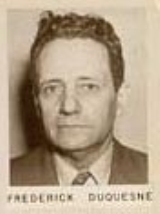
- Fritz Joubert Duquesne
- Jules C. Silber
Jules Crawford Silber was a German spy working as a censor with the United Kingdom, during the First World War.He was born in Breslau, Silesia.-Biography:...
- Mata Hari
Mata Hari was the stage name of Margaretha Geertruida "M'greet" Zelle , a Dutch exotic dancer, courtesan, and accused spy who was executed by firing squad in France under charges of espionage for Germany during World War I.-Early life:Margaretha Geertruida Zelle was born in Leeuwarden, Friesland,...
- Howard Burnham
Mather Howard Burnham , went by the name of Howard and his brother was the celebrated scout Frederick Russell Burnham. He traveled the world, frequently worked as a mining engineer and, during World War I, he became an intelligence officer and spy for the government of France...
- T.E. Lawrence
Espionage in World War II
Informants were common in
World War IIWorld War II, or the Second World War , was a global conflict lasting from 1939 to 1945, involving most of the world's nations—including all of the great powers—eventually forming two opposing military alliances: the Allies and the Axis...
. In November 1939, the German
Hans Ferdinand Mayer Hans Ferdinand Mayer was a German mathematician and physicist and perhaps most notable for the Oslo Report which revealed German technological secrets to the British Government shortly after the start of World War II.-Biography:Hans Ferdinand Mayer studied mathematics, physics and astronomy at...
sent what is called the
Oslo ReportThe Oslo Report was one of the most spectacular leaks in the history of military intelligence. Written by German mathematician and physicist Hans Ferdinand Mayer on November 1 and 2, 1939 during a business trip to Oslo, Norway, it described several German weapons systems, current and future.Mayer...
to inform the British of German technology and projects in an effort to undermine the Nazi regime.
The
Réseau AGIRThe Réseau AGIR was a World War II espionage group founded by French wartime resister Michel Hollard that provided human intelligence on V-1 flying bomb facilities)....
was a French network developed after the fall of France that reported the start of construction of V-weapon installations in Occupied France to the British.
Counterespionage included the use of turned
Double Cross agentsThe Double Cross System, or XX System, was a World War II anti-espionage and deception operation of the British military intelligence arm, MI5. Nazi agents in Britain - real and false - were captured, turned themselves in or simply announced themselves and were then used by the British to broadcast...
to misinform
Nazi GermanyNazi Germany , also known as the Third Reich , but officially called German Reich from 1933 to 1943 and Greater German Reich from 26 June 1943 onward, is the name commonly used to refer to the state of Germany from 1933 to 1945, when it was a totalitarian dictatorship ruled by...
of impact points during
the BlitzThe Blitz was the sustained strategic bombing of Britain by Nazi Germany between 7 September 1940 and 10 May 1941, during the Second World War. The city of London was bombed by the Luftwaffe for 76 consecutive nights and many towns and cities across the country followed...
and
internment of JapaneseJapanese-American internment was the relocation and internment by the United States government in 1942 of approximately 110,000 Japanese Americans and Japanese who lived along the Pacific coast of the United States to camps called "War Relocation Camps," in the wake of Imperial Japan's attack on...
in the US against "Japan's wartime spy program". Additional WWII espionage examples include
Soviet spyingKlaus Emil Julius Fuchs was a German theoretical physicist and atomic spy who in 1950 was convicted of supplying information from the American, British and Canadian atomic bomb research to the USSR during and shortly after World War II...
on the US
Manhattan projectThe Manhattan Project was a research and development program, led by the United States with participation from the United Kingdom and Canada, that produced the first atomic bomb during World War II. From 1942 to 1946, the project was under the direction of Major General Leslie Groves of the US Army...
, the German
Duquesne Spy RingThe Duquesne Spy Ring is the largest espionage case in United States history that ended in convictions. A total of thirty-three members of a German espionage network headed by Frederick "Fritz" Joubert Duquesne were convicted after a lengthy espionage investigation by the Federal Bureau of...
convicted in the US, and the Soviet Red Orchestra spying on
Nazi GermanyNazi Germany , also known as the Third Reich , but officially called German Reich from 1933 to 1943 and Greater German Reich from 26 June 1943 onward, is the name commonly used to refer to the state of Germany from 1933 to 1945, when it was a totalitarian dictatorship ruled by...
. The US lacked a specific agency at the start of the war, but quickly formed the
Office of Strategic ServicesThe Office of Strategic Services was a United States intelligence agency formed during World War II. It was the wartime intelligence agency, and it was a predecessor of the Central Intelligence Agency...
(OSS).
Spying has sometimes been considered a
gentlemanThe term gentleman , in its original and strict signification, denoted a well-educated man of good family and distinction, analogous to the Latin generosus...
ly pursuit, with recruiting focused on military officers, or at least on persons of the class from whom officers are recruited. However, the demand for male soldiers, an increase in women's rights, and the tactical advantages of female spies led the
Special Operations ExecutiveThe Special Operations Executive was a World War II organisation of the United Kingdom. It was officially formed by Prime Minister Winston Churchill and Minister of Economic Warfare Hugh Dalton on 22 July 1940, to conduct guerrilla warfare against the Axis powers and to instruct and aid local...
(SOE) to set aside any lingering
Victorian EraThe Victorian era of British history was the period of Queen Victoria's reign from 20 June 1837 until her death on 22 January 1901. It was a long period of peace, prosperity, refined sensibilities and national self-confidence...
prejudices and begin employing them in April 1942. Their task was to transmit information from Nazi occupied France back to Allied Forces. The main strategic reason was that men in France faced a high risk of being interrogated by Nazi troops but women were less likely to arouse suspicion. In this way they made good couriers and proved equal to, if not more effective than, their male counterparts. Their participation in Organization and Radio Operation was also vital to the success of many operations, including the main network between Paris and London.
- See also Honeypot
Espionage post World War II
In the
United StatesThe United States of America is a federal constitutional republic comprising fifty states and a federal district...
, there are several federal agencies that form the
United States Intelligence CommunityThe United States Intelligence Community is a cooperative federation of 16 separate United States government agencies that work separately and together to conduct intelligence activities considered necessary for the conduct of foreign relations and the protection of the national security of the...
. The
Central Intelligence AgencyThe Central Intelligence Agency is a civilian intelligence agency of the United States government. It is an executive agency and reports directly to the Director of National Intelligence, responsible for providing national security intelligence assessment to senior United States policymakers...
operates a Clandestine Service (NCS) to collect human intelligence and perform
Covert operationA covert operation is a military, intelligence or law enforcement operation that is carried clandestinely and, often, outside of official channels. Covert operations aim to fulfill their mission objectives without any parties knowing who sponsored or carried out the operation...
s. The
National Security AgencyThe National Security Agency/Central Security Service is a cryptologic intelligence agency of the United States Department of Defense responsible for the collection and analysis of foreign communications and foreign signals intelligence, as well as protecting U.S...
collects Signals Intelligence. Other agencies do similar work. The CIA used to head the IC but after the September 11 attacks a new agency was formed, the Director of National Intelligence, to lead the group.
Espionage technology and techniques
- Agent handling
In intelligence organizations, agent handling is the management of agents, principal agents, and agent networks by intelligence officers typically known as case officers.-Human intelligence:...
- Concealment device
Concealment devices or diversion safes are used to hide things for the purpose of secrecy or security. They are made from an ordinary household object such as a book, a soda can, a candle, a can, or something as small as a coin...
- Covert agent
-Covert agents in the United States:As it is used in the United States Intelligence Community, it is legally defined in 50 USCA §426.The definition is subject to judicial interpretation, but a reading of the plain language of that statute reveals that a covert agent can be an employee of the US...
- Covert listening device
A covert listening device, more commonly known as a bug or a wire, is usually a combination of a miniature radio transmitter with a microphone. The use of bugs, called bugging, is a common technique in surveillance, espionage and in police investigations.A bug does not have to be a device...
- Cut-out
In espionage parlance, a cutout is a mutually trusted intermediary, method or channel of communication, facilitating the exchange of information between agents. Cutouts usually only know the source and destination of the information to be transmitted, but are unaware of the identities of any other...
- Cyber spying
Cyber spying or Cyber espionage is the act or practice of obtaining secrets without the permission of the holder of the information , from individuals, competitors, rivals, groups, governments and enemies for personal, economic, political or military advantage using illegal exploitation methods on...
- Dead drop
A dead drop or dead letter box is a method of espionage tradecraft used to pass items between two individuals by using a secret location and thus does not require them to meet directly. Using a dead drop permits a Case Officer and his Agent to exchange objects and information while maintaining...
- False flag
False flag operations are covert operations designed to deceive the public in such a way that the operations appear as though they are being carried out by other entities. The name is derived from the military concept of flying false colors; that is flying the flag of a country other than one's own...
operations
- Honeypot
- Interrogation
Interrogation is interviewing as commonly employed by officers of the police, military, and Intelligence agencies with the goal of extracting a confession or obtaining information. Subjects of interrogation are often the suspects, victims, or witnesses of a crime...
- Numbers messaging
A numbers station is a shortwave radio station of uncertain origin. In the 1950s, Time magazine reported that the numbers stations first appeared shortly after World War II and were using a format that had been used to send weather data during that war.Numbers stations generally broadcast...
- Non-official cover
Non-official cover is a term used in espionage, particularly by national intelligence services, for agents or operatives who assume covert roles in organizations without ties to the government for which they work. Such agents or operatives are typically abbreviated in espionage lingo as a NOC...
- Official cover
Official cover is a term used in espionage to refer to operatives who assume positions in organizations with diplomatic ties to the government for which they work....
- One-way voice link
A one-way voice link is a shortwave radio communication method used by spy networks to communicate with agents in the field. This system often employs recorders to transmit pre-recorded messages in real time or in 'burst transmissions,' which minimize the time that a spy needs to be 'on the...
- Safe house
In the jargon of law enforcement and intelligence agencies, a safe house is a secure location, suitable for hiding witnesses, agents or other persons perceived as being in danger...
- Side channel attack
In cryptography, a side channel attack is any attack based on information gained from the physical implementation of a cryptosystem, rather than brute force or theoretical weaknesses in the algorithms...
- Steganography
Steganography is the art and science of writing hidden messages in such a way that no one, apart from the sender and intended recipient, suspects the existence of the message, a form of security through obscurity...
- Surveillance
Surveillance is the monitoring of the behavior, activities, or other changing information, usually of people. It is sometimes done in a surreptitious manner...
Spy fiction
An early example of espionage literature is
KimKim is a picaresque novel by Rudyard Kipling. It was first published serially in McClure's Magazine from December 1900 to October 1901 as well as in Cassell's Magazine from January to November 1901, and first published in book form by Macmillan & Co. Ltd in October 1901...
by the English novelist
Rudyard KiplingJoseph Rudyard Kipling was an English poet, short-story writer, and novelist chiefly remembered for his celebration of British imperialism, tales and poems of British soldiers in India, and his tales for children. Kipling received the 1907 Nobel Prize for Literature...
, with a description of the training of an intelligence agent in the Great Game between the
UKThe United Kingdom of Great Britain and Ireland was the formal name of the United Kingdom during the period when what is now the Republic of Ireland formed a part of it....
and
RussiaRussia or , officially known as both Russia and the Russian Federation , is a country in northern Eurasia. It is a federal semi-presidential republic, comprising 83 federal subjects...
in 19th century
Central AsiaCentral Asia is a core region of the Asian continent from the Caspian Sea in the west, China in the east, Afghanistan in the south, and Russia in the north...
. An even earlier work was
James Fenimore CooperJames Fenimore Cooper was a prolific and popular American writer of the early 19th century. He is best remembered as a novelist who wrote numerous sea-stories and the historical novels known as the Leatherstocking Tales, featuring frontiersman Natty Bumppo...
's classic novel,
The Spy, written in 1821, about an American spy in New York during the
Revolutionary WarThe American Revolutionary War , the American War of Independence, or simply the Revolutionary War, began as a war between the Kingdom of Great Britain and thirteen British colonies in North America, and ended in a global war between several European great powers.The war was the result of the...
.
During the many 20th century spy scandals, much information became publicly known about national spy agencies and dozens of real-life secret agents. These sensational stories piqued public interest in a profession largely off-limits to
human interest news reportingA human interest story is a feature story that discusses a person or people in an emotional way. It presents people and their problems, concerns, or achievements in a way that brings about interest or sympathy in the reader or viewer....
, a natural consequence of the secrecy inherent to their work. To fill in the blanks, the popular conception of the secret agent has been formed largely by 20th and 21st century
literatureLiterature is the art of written works, and is not bound to published sources...
and
cinemaA film, also called a movie or motion picture, is a series of still or moving images. It is produced by recording photographic images with cameras, or by creating images using animation techniques or visual effects...
. Attractive and sociable real-life agents such as
Valerie PlameValerie Elise Plame Wilson , known as Valerie Plame, Valerie E. Wilson, and Valerie Plame Wilson, is a former United States CIA Operations Officer and the author of a memoir detailing her career and the events leading up to her resignation from the CIA.-Early life :Valerie Elise Plame was born on...
find little employment in serious fiction, however. The fictional secret agent is more often a loner, sometimes amoral—an
existentialExistentialism is a term applied to a school of 19th- and 20th-century philosophers who, despite profound doctrinal differences, shared the belief that philosophical thinking begins with the human subject—not merely the thinking subject, but the acting, feeling, living human individual...
hero operating outside the everyday constraints of society. Loner spy personalities may have been a stereotype of convenience for authors who already knew how to write loner
private investigatorA private investigator , private detective or inquiry agent, is a person who can be hired by individuals or groups to undertake investigatory law services. Private detectives/investigators often work for attorneys in civil cases. Many work for insurance companies to investigate suspicious claims...
characters that sold well from the 1920s to the present.
Johnny FedoraJohnny Fedora is a fictional British secret agent who was the protagonist of 16 novels published between 1951 and 1984. Written by Shaun Lloyd McCarthy, under the pseudonym of Desmond Cory, Fedora was dubbed by literary critics as the 'thinking man's James Bond'...
achieved popularity as a fictional agent of early
Cold War espionageCold War espionage describes the intelligence gathering activities during the Cold War between NATO and the Warsaw Pact. Because each side was preparing to fight the other, intelligence on the opposing side's intentions, military, and technology was of paramount importance. To gather this...
, but
James BondJames Bond, code name 007, is a fictional character created in 1953 by writer Ian Fleming, who featured him in twelve novels and two short story collections. There have been a six other authors who wrote authorised Bond novels or novelizations after Fleming's death in 1964: Kingsley Amis,...
is the most commercially successful of the many spy characters created by intelligence insiders during that struggle. His less fantastic rivals include Le Carre's
George SmileyGeorge Smiley is a fictional character created by John le Carré. Smiley is an intelligence officer working for MI6 , the British overseas intelligence agency...
.
Jumping on the spy bandwagon, other writers also started writing about spy fiction featuring female spies as protagonists, such as
The Baroness, which has more graphic action and sex, as compared to other novels featuring male protagonists.
See also
- Nations
- Chinese Intelligence Operations in the United States
The People's Republic of China has and is currently using a widespread effort to acquire U.S. military technology and classified information. To fulfill its long-term military development goals, the PRC uses a variety of methods to obtain U.S. technology; including espionage, the exploitation of...
- Covert United States foreign regime change actions
- History of Soviet espionage
Coming to power as a clandestine organization, having been schooled in the secret police tactics of the Czarist Okhrana the new Soviet government of the Soviet Union tended to overestimate the degree to which the other European powers of the day, especially the United Kingdom, were plotting its...
- People
- Labor spies
Labor spies are persons recruited or employed for the purpose of gathering intelligence, committing sabotage, sowing dissent, or engaging in other similar activities, typically within the context of an employer/labor organization relationship....
- List of cryptographers
- Mole (espionage)
A mole is a spy who works for an enemy nation, but whose loyalty ostensibly lies with his own nation's government. In some usage, a mole differs from a defector in that a mole is a spy before gaining access to classified information, while a defector becomes a spy only after gaining access...
- Ninja
A or was a covert agent or mercenary of feudal Japan specializing in unorthodox arts of war. The functions of the ninja included espionage, sabotage, infiltration, and assassination, as well as open combat in certain situations...
- Spymaster
A spymaster is a ring leader of a spy ring, run by a secret service.-Historical spymasters:*Dai Li *Francis Walsingham *James Jesus Angleton *Joseph Peters...
- Stalker
-In media:* Stalker , a 1995 dark ambient album by Lustmord & Robert Rich, inspired by the film* Stalker , an episode of the American television series CSI...
- Wikileaks
WikiLeaks is an international self-described not-for-profit organisation that publishes submissions of private, secret, and classified media from anonymous news sources, news leaks, and whistleblowers. Its website, launched in 2006 under The Sunshine Press organisation, claimed a database of more...
- Artefacts
- Classified information
Classified information is sensitive information to which access is restricted by law or regulation to particular groups of persons. A formal security clearance is required to handle classified documents or access classified data. The clearance process requires a satisfactory background investigation...
- Dumpster diving
Dumpster diving is the practice of sifting through commercial or residential trash to find items that have been discarded by their owners, but that may be useful to the dumpster diver.-Etymology and alternate names:...
- Mitrokhin Archive
The Mitrokhin Archive is a collection of notes made secretly by KGB Major Vasili Mitrokhin during his thirty years as a KGB archivist in the foreign intelligence service and the First Chief Directorate...
- Operation Snow White
Operation Snow White was the Church of Scientology's name for a conspiracy during the 1970s to purge unfavorable records about Scientology and its founder L. Ron Hubbard...
- Safe house
In the jargon of law enforcement and intelligence agencies, a safe house is a secure location, suitable for hiding witnesses, agents or other persons perceived as being in danger...
- Security clearance
A security clearance is a status granted to individuals allowing them access to classified information, i.e., state secrets, or to restricted areas after completion of a thorough background check. The term "security clearance" is also sometimes used in private organizations that have a formal...
- Types
- Corporate espionage
- Counter-espionage
-Cast:* Warren William as Michael Lanyard* Eric Blore as Jamison* Hillary Brooke as Pamela Hart* Thurston Hall as Insp. Crane* Fred Kelsey as Detective Wesley Dickens* Forrest Tucker as Anton Schugg* Matthew Boulton as Inspector J...
- Economic and Industrial Espionage
Industrial espionage, economic espionage or corporate espionage is a form of espionage conducted for commercial purposes instead of purely national security purposes...
- Intelligence (information gathering)
Intelligence assessment is the development of forecasts of behaviour or recommended courses of action to the leadership of an organization, based on a wide range of available information sources both overt and covert. Assessments are developed in response to requirements declared by the leadership...
- Military intelligence
Military intelligence is a military discipline that exploits a number of information collection and analysis approaches to provide guidance and direction to commanders in support of their decisions....
- Sabotage
Sabotage is a deliberate action aimed at weakening another entity through subversion, obstruction, disruption, or destruction. In a workplace setting, sabotage is the conscious withdrawal of efficiency generally directed at causing some change in workplace conditions. One who engages in sabotage is...
Further reading
- Jenkins, Peter Surveillance Tradecraft: The Professionals Guide to Surveillance Training ISBN 978-9535378-22
- Felix, Christopher A Short Course in the Secret War, 4th Edition Madison Books November 19, 2001
- West, Nigel MI6: British Secret Intelligence Service Operations 1909-1945 1983
- Smith Jr., W. Thomas Encyclopedia of the Central Intelligence Agency 2003
- Richelson, Jeffery T. The U.S. Intelligence Community 1999 fourth edition
- Richelson, Jeffery T. A Century of Spies: Intelligence in the Twentieth Century 1977
- Owen, David Hidden Secrets: A Complete History of Espionage and the Technology Used to Support It
- O'Toole, George Honorable Treachery: A History of U.S. Intelligence, Espionage, Covert Action from the American Revolution to the CIA 1991
- Lerner, Brenda Wilmoth & K. Lee Lerner, eds. Terrorism: essential primary sources Thomas Gale 2006 ISBN 978-1-4144-0621-3
- Lerner, K. Lee and Brenda Wilmoth Lerner, eds. Encyclopedia of Espionage, Intelligence and Security 2003 1100 pages.
- Knightley, Philip The Second Oldest Profession: Spies and Spying in the Twentieth Century Norton 1986
- Kahn, David The Codebreakers: The Comprehensive History of Secret Communication from Ancient Times to the Internet 1996 Revised edition. First published in 1967.
- Johnson, Robert Spying for Empire: The Great Game in Central and South Asia, 1757-1947 London: Greenhill 2006
- Friedman, George America's Secret War: Inside the Hidden Worldwide Struggle Between the United States and Its Enemies 2005
- Doyle, David W.
David W. Doyle is a British-born American author and former Central Intelligence Agency officer.Born at Harrow, in Greater London, Doyle is the son of Donald and Joyce Doyle. The family moved to Brussels, the capital of Belgium, in 1925 and returned to London in 1932, when Doyle began to attend...
, A Memoir of True Men and Traitors (2000)
- Tunney, Thomas Joseph and Paul Merrick Hollister Throttled!: The Detection of the German and Anarchist Bomb Plotters Boston: Small, Maynard & company 1919 | available on Wikisource
Wikisource is an online digital library of free content textual sources on a wiki, operated by the Wikimedia Foundation. Its aims are to host all forms of free text, in many languages, and translations. Originally conceived as an archive to store useful or important historical texts, it has...
: s:Throttled!
- Beesly, Patrick || Room 40 1982
- Burnham, Frederick Russell
Frederick Russell Burnham, DSO was an American scout and world traveling adventurer known for his service to the British Army in colonial Africa and for teaching woodcraft to Robert Baden-Powell, thus becoming one of the inspirations for the founding of the international Scouting Movement.Burnham...
Taking Chances 1944
- May, Ernest (ed.) Knowing One's Enemies: Intelligence Assessment before the Two World Wars 1984
- Tuchman, Barbara W. The Zimmermann Telegram Ballantine Books 1966
World War II: 1939–1945
| Author(s) |
Title |
Publisher |
Date |
Notes |
| Babington-Smith, Constance |
Air Spy: The Story of Photo Intelligence in World War II |
- |
1957 |
- |
| Bryden, John |
Best-Kept Secret: Canadian Secret Intelligence in the Second World War |
Lester |
1993 |
- |
| Hinsley, F. H. and Alan Stripp |
Codebreakers: The Inside Story of Bletchley Park |
- |
2001 |
- |
| Hinsley, F. H. |
British Intelligence in the Second World War |
- |
1996 |
Abridged version of multivolume official history. |
| Hohne, Heinz |
Canaris: Hitler's Master Spy |
- |
1979 |
- |
| Jones, R. V. |
The Wizard War: British Scientific Intelligence 1939-1945 |
- |
1978 |
- |
| Kahn, David |
Hitler's Spies: German Military Intelligence in World War II' |
- |
1978 |
- |
| Kahn, David |
Seizing the Enigma: The Race to Break the German U-Boat Codes, 1939-1943 |
- |
1991 |
FACE |
| Kitson, Simon |
The Hunt for Nazi Spies: Fighting Espionage in Vichy France |
| 2008 |
| Lewin, Ronald |
The American Magic: Codes, Ciphers and the Defeat of Japan |
- |
1982 |
- |
| Masterman, J. C. |
The Double Cross System in the War of 1935 to 1945 |
Yale |
1972 |
- |
| Persico, Joseph |
Roosevelt's Secret War: FDR and World War II Espionage |
- |
2001 |
- |
| Persico, Joseph |
Casey: The Lives and Secrets of William J. Casey-From the OSS to the CIA |
- |
1991 |
- |
| Ronnie, Art |
Counterfeit Hero: Fritz Duquesne, Adventurer and Spy |
- |
1995 |
ISBN 1-55750-733-3 |
| Sayers, Michael & Albert E. Kahn |
Sabotage! The Secret War Against America |
- |
1942 |
- |
| Smith, Richard Harris |
OSS: The Secret History of America's First Central Intelligence Agency |
- |
2005 |
- |
| Stanley, Roy M. |
World War II Photo Intelligence |
- |
1981 |
- |
| Wark, Wesley |
The Ultimate Enemy: British Intelligence and Nazi Germany, 1933-1939 |
- |
1985 |
- |
| Wark, Wesley |
"Cryptographic Innocence: The Origins of Signals Intelligence in Canada in the Second World War" in Journal of Contemporary History 22 |
- |
1987 |
- |
| West, Nigel |
Secret War: The Story of SOE, Britain's Wartime Sabotage Organization |
- |
1992 |
- |
| Winterbotham, F. W. |
The Ultra Secret |
Harper & Row |
1974 |
- |
| Winterbotham, F. W. |
The Nazi Connection |
Harper & Row |
1978 |
- |
| Cowburn, B. |
No Cloak No Dagger |
Brown, Watson, Ltd. |
1960 |
- |
| Wohlstetter, Roberta. |
Pearl Harbor: Warning and Decision |
- |
1962 |
- |
Cold War era: 1945–1991
| Author(s) |
Title |
Publisher |
Date |
Notes |
| Aldrich, Richard J. |
The Hidden Hand: Britain, America and Cold War Secret Intelligence |
- |
2002 |
- |
| Ambrose, Stephen E. |
Ike's Spies: Eisenhower and the Intelligence Establishment |
- |
1981- |
- |
| Andrew, Christopher and Vasili Mitrokhin |
The Sword and the Shield: The Mitrokhin Archive and the Secret History of the KGB |
Basic Books |
1991, 2005 |
ISBN 0465003117 |
| Andrew, Christopher, and Oleg Gordievsky |
KGB: The Inside Story of Its Foreign Operations from Lenin to Gorbachev |
- |
1990 |
- |
| Aronoff, Myron J. |
The Spy Novels of John Le Carré: Balancing Ethics and Politics |
- |
1999 |
- |
| Bissell, Richard |
Reflections of a Cold Warrior: From Yalta to the Bay of Pigs' |
- |
1996 |
- |
| Bogle, Lori, ed. |
Cold War Espionage and Spying |
- |
2001- |
essays |
| Christopher Andrew and Vasili Mitrokhin |
The World Was Going Our Way: The KGB and the Battle for the Third World |
- |
- |
- |
| Christopher Andrew and Vasili Mitrokhin |
The Mitrokhin Archive: The KGB in Europe and the West |
Gardners Books |
2000 |
ISBN 978-0-14-028487-4 |
| Colella, Jim |
My Life as an Italian Mafioso Spy |
- |
2000 |
- |
|
| Craig, R. Bruce |
Treasonable Doubt: The Harry Dexter Spy Case |
University Press of Kansas |
2004 |
ISBN 978-0-7006-1311-3 |
| Dorril, Stephen |
MI6: Inside the Covert World of Her Majesty's Secret Intelligence Service |
- |
2000 |
- |
| Dziak, John J. |
Chekisty: A History of the KGB |
- |
1988 |
- |
| Gates, Robert M. |
From The Shadows: The Ultimate Insider's Story Of Five Presidents And How They Won The Cold War' |
- |
1997 |
- |
| Frost, Mike and Michel Gratton |
Spyworld: Inside the Canadian and American Intelligence Establishments |
Doubleday Canada |
1994 |
- |
| Haynes, John Earl, and Harvey Klehr |
Venona: Decoding Soviet Espionage in America |
- |
1999 |
- |
| Helms, Richard |
A Look over My Shoulder: A Life in the Central Intelligence Agency |
- |
2003 |
- |
| Koehler, John O. |
Stasi: The Untold Story of the East German Secret Police' |
- |
1999 |
- |
| Persico, Joseph |
Casey: The Lives and Secrets of William J. Casey-From the OSS to the CIA |
- |
1991 |
- |
| Murphy, David E., Sergei A. Kondrashev, and George Bailey |
Battleground Berlin: CIA vs. KGB in the Cold War |
- |
1997 |
- |
| Prados, John |
Presidents' Secret Wars: CIA and Pentagon Covert Operations Since World War II |
- |
1996 |
- |
| Rositzke, Harry. |
The CIA's Secret Operations: Espionage, Counterespionage, and Covert Action |
- |
1988 |
- |
| Srodes, James |
Allen Dulles: Master of Spies |
Regnery |
2000 |
CIA head to 1961 |
| Sontag Sherry, and Christopher Drew |
Blind Man's Bluff: The Untold Story of American Submarine Espinonage |
Harper |
1998 |
|
| | Encyclopedia of Cold War Espionage, Spies and Secret Operations |
Greenwood Press/Questia |
2004 |
- |
- Anderson, Nicholas NOC Enigma Books 2009 - Post Cold War era
- Ishmael Jones
Ishmael Jones is the pseudonym used by a former CIA officer. He resigned from the CIA and became a leading proponent of American intelligence reform, with special emphasis on the improvement of human source intelligence collection...
The Human Factor: Inside the CIA's Dysfunctional Intelligence Culture Encounter Books 2008, rev. 2010
- Michael Ross
Michael Ross is a Canadian-Israeli expert on intelligence and a former Mossad officer, or “combatant” with a focus upon human source intelligence collection...
The Volunteer: The Incredible True Story of an Israeli Spy on the Trail of International Terrorists McClelland & Stewart 2007, rev. 2008
External links