
All Topics  
Al-Walid I

 
Al Walid I

   Email Print
   Bookmark   Link


Al-Walid I


Al-Walid ibn Abd al-Malik or Al-Walid I (668 - 715) was an Umayyad caliph
Caliph

The Caliph is the head of state in a Caliphate, and the title for the leader of the Islamic Ummah, an Islamic community ruled by the Shari'ah....
 who ruled from 705 - 715. He continued the expansion of the Islamic empire that was sparked by his father, and was an effective ruler.

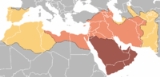
Al-Walid I (705-715 AD/86-96 AH), began the Islamic conquests and took the early Islamic empire to its farthest extents. He reconquered parts of Egypt from the Byzantines and moved on into Carthage and across to the west of North Africa.


Discussion
Ask a question about 'Al-Walid I'
Start a new discussion about 'Al-Walid I'
Answer questions from other users
Full Discussion Forum


Encyclopedia


Al-Walid ibn Abd al-Malik or Al-Walid I (668 - 715) was an Umayyad caliph
Caliph

The Caliph is the head of state in a Caliphate, and the title for the leader of the Islamic Ummah, an Islamic community ruled by the Shari'ah....
 who ruled from 705 - 715. He continued the expansion of the Islamic empire that was sparked by his father, and was an effective ruler.

Al-Walid I (705-715 AD/86-96 AH), began the Islamic conquests and took the early Islamic empire to its farthest extents. He reconquered parts of Egypt from the Byzantines and moved on into Carthage and across to the west of North Africa. Then, in 711, Muslim armies crossed the Strait of Gibraltar and began to conquer Spain using North African Berber armies. By 716, the Visigoths of Spain had been defeated and Spain was under Muslim control. This would be the farthest extent of Islamic control of Europe—in 736, they were stopped in their expansion into Europe south of Tours, France. In the east, Islamic armies made it as far as the Indus River in 710—under Al-Walid, the caliphate empire stretched from Spain to India. Al-Hajjaj bin Yousef
Al-Hajjaj bin Yousef

Al-?ajjaj ibn Yusuf , born in early June 661 in Taif and died 714 in Wasit, Iraq, was an important Arab administrator during the Umayyad Caliphate....
 played a crucial role in the organization and selection of military commanders.

Al-Walid paid great attention to the expansion of an organized military, building the strongest navy in Ummayad era, it was this tactic that supported the ultimate expansion to Spain. His reign is considered as the apex of Islamic power.

Al-Walid also began the first great buiilding projects of Islam, the most famous of which is the mosque at Damascus. The long history of Islamic architecture really begins with al-Walid. This is also the period, however, in which Islamic court culture begins to germinate. With the caliph as a patron, artists and writers begin to develop a new, partly secular culture based on Islamic ideas.

It was also al-Walid that coupled islamicization with arabicization. Conversion was not forced on conquered peoples; however, since non-believers had to pay an extra tax and were not technically citizens, many people did convert for religious and non-religious reasons. This created several problems, particularly since Islam was so closely connected with being Arab—being Arab, of course, was more than an ethnic identity, it was a tribal identity based on kinship and descent. As more and more Muslims were non-Arabs, the status of Arabs and their culture became threatened. In particular, large numbers of Coptic-speaking (Egypt) and Persian-speaking Muslims threatened the primacy of the very language that Islam is based on. In part to alleviate that threat, al-Walid instituted Arabic as the only official language of the empire. He decreed that all administration was to be done only in Arabic. It was this move that would cement the primacy of Arabic language and culture in the Islamic world.

Like his father, Al-Walid continued to allow Al-Hajjaj bin Yousef
Al-Hajjaj bin Yousef

Al-?ajjaj ibn Yusuf , born in early June 661 in Taif and died 714 in Wasit, Iraq, was an important Arab administrator during the Umayyad Caliphate....
 free rein, and his trust in Al-Hajjaj paid off with the successful conquests of Transoxiana
Transoxiana

Transoxiana is the ancient name used for the portion of Central Asia corresponding approximately with modern-day Uzbekistan, Tajikistan and southwest Kazakhstan....
 and Sindh
Sindh

Sindh is one of the four Subdivisions of Pakistan of Pakistan and historically is home to the Sindhi people. Different cultural and ethnic groups also reside in Sindh including Urdu-speaking Muslim refugees who migrated to Pakistan from India upon independence as well as the people migrated from other provinces after independence....
. Musa ibn Nusayr and his retainer Tariq ibn Ziyad conquered Al-Andalus
Al-Andalus

Al-Andalus was the Arabic name given to the parts of the Iberian Peninsula governed by Arab Muslims, at various times in the period between 711 and 1492....
. Al-Hajjaj was responsible for picking the generals who led the successful eastern campaigns, and was well known from his own successful campaign against Ibn Zubayr during the reign of Al-Walid's father. Others, such as al-Walid's brother Salamah, advanced against the Byzantines and into Adharbayjan.

Valladolid
Valladolid

||-||} is a historic city and municipality in north-central Spain, upon the Pisuerga River and within the Ribera del Duero wine-making region. It is the capital of the Valladolid and of the autonomous communities of Spain of Castile and Leon, therefore is part of the historical region of Castile ....
 is an industrial city and it is a municipality in north-central Spain, upon the Rio Pisuerga and within the Ribera del Duero region. It is the capital of the province of Valladolid and of the autonomous community of Castile and Leon, therefore is part of the historical region of Castile. The name "Valladolid" is linked with the Arabic name for the city ??? ?????? meaning The City of Al- Walid.

Muhammad ibn Jarir al-Tabari

Abu Ja'far Muhammad ibn Jarir al-Tabari was one of the earliest, most prominent and famous Persian people historian and tafsir,who wrote exclusively in Arabic , most famous for his History of the Prophets and Kings and Tafsir al-Tabari....
 describes how Qutaibah bin Muslim
Qutaibah bin Muslim

Qutaibah bin Muslim was an Arab commander of the Umayyad Caliphate army in the East, and made his greatest gains during the reign of Caliph Al-Walid I....
, Khurasan
Khorasan

Khorasan Khorasan is famous world wide for its saffron and Berberis#Zereshk which are produced in the southern cities of the province. Production is more than 170 tons per year....
's governor, led forces extending the caliphate to the east. Qutaibah campaigned in most, if not all, years of this reign, conquering Samarqand
Samarkand

Samarkand , is the second-largest city in Uzbekistan and the capital of Samarqand Province.The city is most noted for its central position on the Silk Road between China and the West, and for being an Islamic centre for scholarly study....
, advancing into Farghana
Fergana

Fergana or Farghana is a city , the capital of Fergana Province in eastern Uzbekistan, at the southern edge of the Fergana Valley in southern Central Asia, cutting across the borders of Kyrgyzstan, Tajikistan, and Uzbekistan....
 and sending envoys to China
China

China is a Culture of China, an ancient civilization, and, depending on perspective, a national or multinational entity extending over a large area in East Asia....
. (v. 23)

Al-Tabari records how al-Hajjaj tortured Yazid ibn al-Muhallab
Yazid ibn al-Muhallab

Yazid ibn al-Muhallab was a provincial governor in the time of the Umayyad dynasty.In A.H. 78 Al-Hajjaj bin Yousef appointed al-Muhallab Khurasan's governor....
. Yazid escaped and made his way to al-Walid's brother Suleiman ibn Abd al-Malik who granted him refuge. Al-Hajjaj pressed al-Walid about this and al-Walid commanded Suleiman to send him Yazid in chains. Suleiman had his own son approach al-Walid chained to Yazid and speak in favour of Yazid's safety. Al-Walid accepted this and told al-Hajjaj to desist. (v. 23, p. 156f)
Omayyad Mosque
Al-Walid himself continued the effective rule that was characteristic of his father, he developed a welfare system, built hospitals, educational institutions and measures for the appreciation of art.

In 691, Caliph Abd al-Malik ibn Marwan ordered that the Dome of the Rock
Dome of the Rock

The Dome of the Rock is an Islamic shrine and a major landmark located on the Temple Mount in Jerusalem. It was completed in 691, making it the oldest extant Islamic building in the world....
 be built on the site where the Islamic prophet Muhammad is believed by Muslims to have begun his nocturnal journey to heaven, on the Temple Mount
Temple Mount

The Temple Mount , also known as Mount Moriah and by Muslims as the Noble Sanctuary , is a religious site in the Old City of Jerusalem of Jerusalem....
. About a decade afterward, Caliph Al-Walid I ordered the building of Al-Aqsa Mosque
Al-Aqsa Mosque

Al-Aqsa Mosque , also known as al-Aqsa, is an Holiest sites in Islam in the Old City of Jerusalem. The mosque itself forms part of the al-Haram ash-Sharif or "Sacred Noble Sanctuary" , a site also known as the Temple Mount and considered the holiest site in Judaism, since it is believed to be where the Temple in Jerusalem once stoo...
.[73] It was under Umayyad rule of Al- Walid and his father Abd al-Malik that Christians and Jews were granted the official title of "Peoples of the Book" to underline the common monotheistic roots they shared with Islam

Al-Walid himself was an enthusiast of architecture and he repaired and refurbished Masjid al Nabawi in Medina
Medina

Medina is a city in the Hejaz region of western Saudi Arabia, and serves as the capital of the Al Madinah Province. It is the second holiest city in Islam, and the burial place of the Prophet Muhammad....
. He also improved mountain passes and wells in Hijaz (al-Tabari v. 23, p. 144). In addition, he demolished the Christian Basilica of St. John the Baptist to build a great mosque, now known as the Great Mosque of Damascus or simply the Umayyad Mosque (John the Baptist is considered a Prophet of Islam and is known as Yahya).

The Grand Mosque of Damascus, also known as the Umayyad Mosque (Arabic: ???? ??? ???? ??????, transl. Gam' Bani 'Umayyah al-Kabir), is one of the largest and oldest mosques in the world. Located in one of the holiest sites in the old city of Damascus, it is of great architectural importance.

The mosque holds a shrine which is said to contain the head of John the Baptist, honoured as a prophet by Muslims and Christians alike. The head was supposedly found during the excavations for the building of the mosque. The tomb of Saladin stands in a small garden adjoining the north wall of the mosque.

In 2001 Pope John Paul II visited the mosque, primarily to visit the relics of John the Baptist. It was the first time a pope paid a visit to a mosque.

In an article titled “Syria: Crossroads of the Levant”, featured on Syria’s Ministry of Tourism website [1], Richard Moore reports that “the highlight to the Old City was the Umayyad Mosque.

Initially, the Muslim conquest of Damascus in 636 did not affect the church, as the building was shared by Muslim and Christian worshippers. It remained a church although the Muslims built a mud brick structure against the southern wall so that they could pray.

Under the Umayyad caliph Al-Walid I, however, the church was demolished and between 706 and 715 the current mosque built in its place. According to the legend, Al-Walid I himself initiated the demolition by driving a golden spike into the church. At that point in time, Damascus was one of the most important cities in the Middle East and would later become the capital of the Umayyad caliphate.

He was also known for his own personal piety, and many stories tell of his continual reciting of the Qur'an
Qur'an

The Qur?an is the central religious text of Islam. Muslims believe the Qur?an to be the book of divine guidance and direction for mankind, and consider the original Arabic text to be the final revelation of God....
 and the large feasts he hosted for those fasting during Ramadan
Ramadan

Rama?an is an Islamic religious observance that takes place during the ninth month of the Islamic calendar; the month in which the Qur'an was revealed to the Prophet of Islam Muhammad....
. He was married to Umm Banin bint Abdul Aziz ibn Marwan ibn Hakam.

Al-Walid was succeeded by his brother Suleiman.

Bibliography


Muhammad ibn Jarir al-Tabari

Abu Ja'far Muhammad ibn Jarir al-Tabari was one of the earliest, most prominent and famous Persian people historian and tafsir,who wrote exclusively in Arabic , most famous for his History of the Prophets and Kings and Tafsir al-Tabari....
, v. 23 "The Zenith of the Marwanid House," transl. Martin Hinds, SUNY, Albany, 1990