


Ramesses II

Encyclopedia
Ramesses II referred to as Ramesses the Great, was the third Egyptian pharaoh
(reigned 1279 BC – 1213 BC) of the Nineteenth dynasty
. He is often regarded as the greatest, most celebrated, and most powerful pharaoh of the Egyptian Empire. His successors and later Egyptians called him the "Great Ancestor".
Ramesses II led several military expeditions into the Levant
, re-asserting Egyptian control over Canaan
. He also led expeditions to the south, into Nubia
, commemorated in inscriptions at Beit el-Wali and Gerf Hussein.
At age fourteen, Ramesses was appointed Prince Regent
by his father Seti I
. He is believed to have taken the throne in his late teens and is known to have ruled Egypt from 1279 BC to 1213 BC for 66 years and 2 months, according to both Manetho
and Egypt's contemporary historical records. He was once said to have lived to be 99 years old, but it is more likely that he died in his 90th or 91st year. If he became Pharaoh in 1279 BC as most Egyptologists today believe, he would have assumed the throne on May 31, 1279 BC, based on his known accession date of III Shemu
day 27.
Ramesses II celebrated an unprecedented 14 sed festival
s (the first held after thirty years of a pharaoh's reign, and then every three years) during his reign—more than any other pharaoh. On his death, he was buried in a tomb
in the Valley of the Kings
; his body was later moved to a royal cache
where it was discovered in 1881, and is now on display in the Cairo Museum.
The early part of his reign was focused on building cities, temples and monuments. He established the city of Pi-Ramesses
in the Nile Delta as his new capital and main base for his campaigns in Syria. This city was built on the remains of the city of Avaris
, the capital of the Hyksos
when they took over, and was the location of the main Temple of Set
.
He is also known as Ozymandias
in the Greek sources, from a transliteration into Greek
of a part of Ramesses's throne name, , "Ra
's mighty truth
, chosen of Ra".
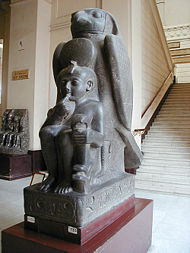 Early in his life, Ramesses II embarked on numerous campaigns to return previously held territories back from Nubian and Hittite hands and to secure Egypt's borders. He was also responsible for suppressing some Nubia
n revolts and carrying out a campaign in Libya
. Although the famous Battle of Kadesh
often dominates the scholarly view of Ramesses II's military prowess and power, he nevertheless enjoyed more than a few outright victories over the enemies of Egypt. During Ramesses II's reign, the Egyptian army is estimated to have totaled about 100,000 men; a formidable force that he used to strengthen Egyptian influence.
or Sherden sea pirates who were wreaking havoc along Egypt's Mediterranean coast by attacking cargo-laden vessels travelling the sea routes to Egypt
. The Sherden people probably came from the coast of Ionia
or possibly south-west Turkey
. Ramesses posted troops and ships at strategic points along the coast and patiently allowed the pirates to attack their prey before skillfully catching them by surprise in a sea battle and capturing them all in a single action. A stele
from Tanis
speaks of their having come "in their war-ships from the midst of the sea, and none were able to stand before them". There must have been a naval battle somewhere near the mouth of the Nile, as shortly afterwards many Sherden are seen in the Pharaoh's body-guard where they are conspicuous by their horned helmets with a ball projecting from the middle, their round shields and the great Naue II swords with which they are depicted in inscriptions of the Battle of Kadesh. In that sea battle, together with the Shardana, the pharaoh also defeated the Lukka (L'kkw, possibly the later Lycians), and the Šqrsšw (Shekelesh) peoples.
and Palestine
. His first campaign seems to have taken place in the fourth year of his reign and was commemorated by the erection of a stele near modern Beirut
. The inscription is almost totally illegible due to weathering. His records tell us that he was forced to fight a Palestinian prince who was mortally wounded by an Egyptian archer, and whose army was subsequently routed. Ramesses carried off the princes of Palestine as live prisoners to Egypt. Ramesses then plundered the chiefs of the Asiatics in their own lands, returning every year to his headquarters at Riblah to exact tribute. In the fourth year of his reign, he captured the Hittite vassal state of Amurru
during his campaign in Syria
.
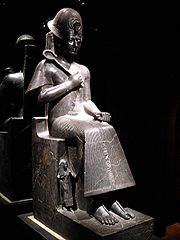
The Battle of Kadesh in his fifth regnal year was the climactic engagement in a campaign that Ramesses fought in Syria, against the resurgent Hittite forces of Muwatallis. The pharaoh wanted a victory at Kadesh both to expand Egypt's frontiers into Syria and to emulate his father Seti I's triumphal entry into the city just a decade or so earlier. He also constructed his new capital, Pi-Ramesses
where he built factories to manufacture weapons, chariots, and shields. Of course, they followed his wishes and manufactured some 1,000 weapons in a week, about 250 chariots in 2 weeks, and 1,000 shields in a week and a half. After these preparations, Ramesses moved to attack territory in the Levant
which belonged to a more substantial enemy than any he had ever faced before: the Hittite Empire.
Although Ramesses's forces were caught in a Hittite ambush and outnumbered at Kadesh, the pharaoh fought the battle to a stalemate and returned home a hero. Ramesses II's forces suffered major losses particularly among the 'Ra' division which was routed by the initial charge of the Hittite chariots during the battle. Once back in Egypt, Ramesses proclaimed that he had won a great victory. He had amazed everybody by almost winning a lost battle. The Battle of Kadesh was a personal triumph for Ramesses, as after blundering into a devastating Hittite ambush, the young king courageously rallied his scattered troops to fight on the battlefield while escaping death or capture. Still, many historians regard the battle as a strategic defeat for the Egyptians as they were unable to occupy the city or territory around Kadesh.
Ramesses decorated his monuments with reliefs and inscriptions describing the campaign as a whole, and the battle in particular as a major victory. Inscriptions of his victory decorate the Ramesseum
, Abydos, Karnak, Luxor and Abu Simbel. For example, on the temple walls of Luxor the near catastrophe was turned into an act of heroism:
while Syria
fell into Hittite hands. Canaanite princes, seemingly influenced by the Egyptian incapacity to impose their will, and goaded on by the Hittites, began revolts against Egypt. In the seventh year of his reign, Ramesses II returned to Syria once again. This time he proved more successful against his Hittite foes. During this campaign he split his army into two forces. One was led by his son, Amun-her-khepeshef
, and it chased warriors of the Šhasu tribes across the Negev
as far as the Dead Sea
, and captured Edom
-Seir. It then marched on to capture Moab
. The other force, led by Ramesses, attacked Jerusalem and Jericho
. He, too, then entered Moab, where he rejoined his son. The reunited army then marched on Hesbon, Damascus
, on to Kumidi, and finally recaptured Upi, reestablishing Egypt's former sphere of influence.
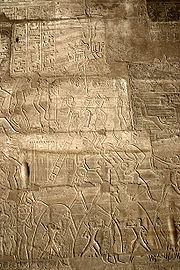 Ramesses extended his military successes in his eighth and ninth years. He crossed the Dog River (Nahr el-Kelb) and pushed north into Amurru. His armies managed to march as far north as Dapur, where he erected a statue of himself. The Egyptian pharaoh thus found himself in northern Amurru, well past Kadesh
, in Tunip
, where no Egyptian soldier had been seen since the time of Thutmose III
almost 120 years earlier. He laid siege to the city before capturing it. His victory proved to be ephemeral. In year nine, Ramesses erected a stele at Beth Shean. After having reasserted his power over Canaan, Ramesses led his army north. A mostly illegible stele near Beirut
, which appears to be dated to the king's second year, was probably set up there in his tenth. The thin strip of territory pinched between Amurru and Kadesh
did not make for a stable possession. Within a year, they had returned to the Hittite fold, so that Ramesses had to march against Dapur
once more in his tenth year. This time he claimed to have fought the battle without even bothering to put on his corslet until two hours after the fighting began. Six of Ramesses's sons, still wearing their side locks, took part in this conquest. He took towns in Retenu, and Tunip in Naharin, later recorded on the walls of the Ramesseum. This second success here was equally as meaningless as his first, as neither power could decisively defeat the other in battle.
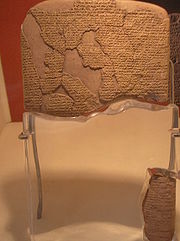 The deposed Hittite king, Mursili III fled to Egypt, the land of his country's enemy, after the failure of his plots to oust his uncle from the throne. Hattusili III responded by demanding that Ramesses II extradite his nephew back to Hatti.
This demand precipitated a crisis in relations between Egypt and Hatti when Ramesses denied any knowledge of Mursili's whereabouts in his country, and the two Empires came dangerously close to war. Eventually, in the twenty-first year of his reign (1258 BC), Ramesses decided to conclude an agreement with the new Hittite king at Kadesh
, Hattusili III, to end the conflict. The ensuing document is the earliest known peace treaty
in world history.
The peace treaty was recorded in two versions, one in Egyptian hieroglyphs
, the other in Akkadian
, using cuneiform script; both versions survive. Such dual-language recording is common to many subsequent treaties. This treaty differs from others however, in that the two language versions are differently worded. Although the majority of the text is identical, the Hittite version claims that the Egyptians
came suing for peace, while the Egyptian version claims the reverse. The treaty was given to the Egyptians in the form of a silver plaque, and this "pocket-book" version was taken back to Egypt and carved into the Temple of Karnak.
The treaty was concluded between Ramesses II and Hattusili III
in Year 21 of Ramesses's reign. (c. 1258 BC) Its 18 articles call for peace between Egypt and Hatti and then proceeds to maintain that their respective gods also demand peace. The frontiers are not laid down in this treaty but can be inferred from other documents. The Anastasy A papyrus
describes Canaan
during the latter part of the reign of Ramesses II and enumerates and names the Phoenicia
n coastal towns under Egyptian control. The harbour town of Sumur north of Byblos
is mentioned as being the northern-most town belonging to Egypt, which points to it having contained an Egyptian garrison.
No further Egyptian campaigns in Canaan are mentioned after the conclusion of the peace treaty. The northern border seems to have been safe and quiet, so the rule of the pharaoh was strong until Ramesses II's death, and the waning of the dynasty. When the King of Mira attempted to involve Ramesses in a hostile act against the Hittites, the Egyptian responded that the times of intrigue in support of Mursili III
, had passed. Hattusili III wrote to Kadashman-Enlil II, King of Karduniash (Babylon
) in the same spirit, reminding him of the time when his father, Kadashman-Turgu, had offered to fight Ramesses II, the king of Egypt. The Hittite king encouraged the Babylonian to oppose another enemy, which must have been the king of Assyria
whose allies had killed the messenger of the Egyptian king. Hattusili encouraged Kadashman-Enlil to come to his aid and prevent the Assyrians from cutting the link between the Canaanite province of Egypt and Mursili III, the ally of Ramesses.
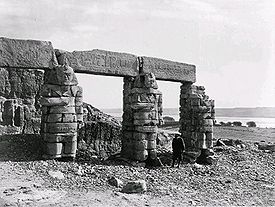 Ramesses II also campaigned south of the first cataract
into Nubia
. When Ramesses was about 22, two of his own sons, including Amun-her-khepeshef
, accompanied him in at least one of those campaigns. By the time of Ramesses, Nubia had been a colony for two hundred years, but its conquest was recalled in decoration from the temples Ramesses II built at Beit el-Wali (which was the subject of epigraphic work by the Oriental Institute during the Nubian salvage campaign of the 1960s), Gerf Hussein and Kalabsha in northern Nubia. On the south wall of the Beit el-Wali temple, Ramesses II is depicted charging into battle against the Nubians in a war chariot, while his two young sons Amun-her-khepsef and Khaemwaset are shown being present behind him, also in war chariots. On one of the walls of Ramesses's temples it says that in one of the battles with the Nubians he had to fight the whole battle alone without any help from his soldiers.
. Although the exact events surrounding the foundation of the coastal forts and fortresses is not clear, some degree of political and military control must have been held over the region to allow their construction.
There are no detailed accounts of Ramesses II's undertaking large military actions against the Libyans
, only generalised records of his conquering and crushing them, which may or may not refer to specific events that were otherwise unrecorded. It may be that some of the records, such as the Aswan
Stele of his year 2, are harking back to Ramesses's presence on his father's Libyan campaigns. Perhaps it was Seti I
who achieved this supposed control over the region, and who planned to establish the defensive system, in a manner similar to how he rebuilt those to the east, the Ways of Horus across Northern Sinai.
from history. He, more than any other pharaoh
, sought deliberately to deface the Amarna
monuments and change the nature of the religious structure and the structure of the priesthood, in order to try to bring it back to where it had been prior to the reign of Akhenaten
.
's longest-lived kings. By tradition, in the 30th year of his reign Ramesses celebrated a jubilee called the Sed festival, during which the king was ritually transformed into a god. Only halfway through what would be a 66-year reign, Ramesses had already eclipsed all but a few greatest kings in his achievements. He had brought peace, maintained Egypt
ian borders and built great and numerous monuments across the empire. His country was more prosperous and powerful than it had been in nearly a century. By becoming a god, Ramesses dramatically changed not just his role as ruler of Egypt
, but also the role of his firstborn son, Amun-her-khepsef. As the chosen heir and commander and chief of Egyptian armies, his son effectively became ruler in all but name.
_(room_4).jpg) Ramesses built extensively throughout Egypt and Nubia, and his cartouches are prominently displayed even in buildings that he did not actually construct. There are accounts of his honor hewn on stone, statues, remains of palaces and temples
Ramesses built extensively throughout Egypt and Nubia, and his cartouches are prominently displayed even in buildings that he did not actually construct. There are accounts of his honor hewn on stone, statues, remains of palaces and temples
, most notably the Ramesseum
in the western Thebes
and the rock temples of Abu Simbel
. He covered the land from the Delta
to Nubia
with buildings in a way no king
before him had done. He also founded a new capital city in the Delta during his reign called Pi-Ramesses
; it had previously served as a summer palace during Seti I's reign.
His memorial temple Ramesseum
, was just the beginning of the pharaoh's obsession with building. When he built, he built on a scale unlike almost anything before. In the third year of his reign Ramesses started the most ambitious building project after the pyramids, that were built 1,500 years earlier. The population was put to work on changing the face of Egypt
. In Thebes
, the ancient temples were transformed, so that each one of them reflected honour to Ramesses as a symbol of this divine nature and power. Ramesses decided to eternalize himself in stone, and so he ordered changes to the methods used by his masons. The elegant but shallow reliefs of previous pharaohs were easily transformed, and so their images and words could easily be obliterated by their successors. Ramesses insisted that his carvings be deeply engraved in the stone, which made them not only less susceptible to later alteration, but also made them more prominent in the Egyptian sun, reflecting his relationship with the sun god, Ra
.
Ramesses constructed many large monuments, including the archeological complex of Abu Simbel
, and the Mortuary temple
known as the Ramesseum
. He built on a monumental scale to ensure that his legacy would survive the ravages of time. Ramesses used art as a means of propaganda for his victories over foreigners and are depicted on numerous temple reliefs. Ramesses II also erected more colossal statues of himself than any other pharaoh. He also usurped many existing statues by inscribing his own cartouche
on them.
, due to the amount of statuary and other material from Pi-Ramesses found there, but it is now recognised that the Ramasside remains at Tanis were brought there from elsewhere, and the real Pi-Ramesses lies about 30 km south, near modern Qantir
. The colossal feet of the statue of Ramesses are almost all that remains above ground today, the rest is buried in the fields.
and the desert has been known as the Ramesseum
since the 19th century. The Greek historian
Diodorus Siculus
marveled at the gigantic and famous temple, now no more than a few ruins.
Oriented northwest and southeast, the temple itself was preceded by two courts. An enormous pylon stood before the first court, with the royal palace at the left and the gigantic statue of the king looming up at the back. Only fragments of the base and torso remain of the syenite
statue of the enthroned pharaoh, 17 metres (55.8 ft) high and weighing more than 1000 tonnes (984.2 LT). The scenes of the great pharaoh and his army triumphing over the Hittite forces fleeing before Kadesh
, represented on the pylon. Remains of the second court include part of the internal facade of the pylon and a portion of the Osiride portico on the right. Scenes of war and the alleged rout of the Hittites
at Kadesh are repeated on the walls. In the upper registers
, feast and honor of the phallic god Min
, god of fertility. On the opposite side of the court the few Osiride pillars and columns still left can furnish an idea of the original grandeur.
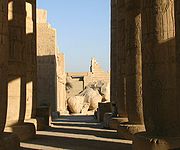 Scattered remains of the two statues of the seated king can also be seen, one in pink granite and the other in black granite, which once flanked the entrance to the temple. Thirty-nine out of the forty-eight columns in the great hypostyle hall (m 41x 31) still stand in the central rows. They are decorated with the usual scenes of the king before various gods. Part of the ceiling decorated with gold stars on a blue ground has also been preserved. Ramesses's children appear in the procession on the few walls left. The sanctuary was composed of three consecutive rooms, with eight columns and the tetrastyle cell. Part of the first room, with the ceiling decorated with astral scenes, and few remains of the second room are all that is left. Vast storerooms built in mud bricks stretched out around the temple. Traces of a school for scribes were found among the ruins.
A temple of Seti I
, of which nothing is now left but the foundations, once stood to the right of the hypostyle hall.
had traveled into Nubia
to inaugurate a new temple, the great Abu Simbel
. It is an ego cast in stone; the man who built it intended not only to become Egypt's greatest pharaoh but also one of its gods.
The great temple of Ramesses II at Abu Simbel
was discovered in 1813 by the famous Swiss Orientalist and traveler Johann Ludwig Burckhardt
. However, four years passed before anyone could enter the temple, because an enormous pile of sand almost completely covered the facade and its colossal statues, blocking the entrance. This feat was achieved by the great Padua
n explorer Giovanni Battista Belzoni
, who managed to reach the interior on 4 August 1817.
). Other temples dedicated to Ramesses are Derr
and Gerf Hussein (also relocated to New Kalabsha).
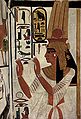 The most important and famous of Ramesses's consort
s was discovered by Ernesto Schiaparelli
in 1904. Although it had been looted in ancient times, the tomb of Nefertari
is extremely important, because its magnificent wall painting decoration is regarded as one of the greatest achievements of ancient Egyptian art
. A flight of steps cut out of the rock gives access to the antechamber, which is decorated with paintings based on chapter 17 of the Book of the Dead
. This astronomical ceiling represents the heavens and is painted in dark blue, with a myriad of golden five-pointed stars. The east wall of the antechamber is interrupted by a large opening flanked by representation of Osiris
at left and Anubis
at right; this in turn leads to the side chamber, decorated with offering scenes, preceded by a vestibule in which the paintings portray Nefertari being presented to the gods who welcome her. On the north wall of the antechamber is the stairway that goes down to the burial chamber. This latter is a vast quadrangular room covering a surface area of about 90 square metres (107.6 sq yd), the astronomical ceiling of which is supported by four pillars entirely covered with decoration. Originally, the queen's red granite sarcophagus
lay in the middle of this chamber. According to religious doctrines of the time, it was in this chamber, which the ancient Egyptians called the golden hall that the regeneration of the deceased took place. This decorative pictogram of the walls in the burial chamber drew inspirations from chapters 144 and 146 of the Book of the Dead: in the left half of the chamber, there are passages from chapter 144 concerning the gates and doors of the kingdom of Osiris, their guardians, and the magic formulas that had to be uttered by the deceased in order to go past the doors.
. It has proven to be the largest tomb in the Valley of the Kings, and originally contained the mummified remains of some of this king's estimated 52 sons. Approximately 150 corridors and tomb chambers have been located in this tomb as of 2006 and the tomb may contain as many as 200 corridors and chambers. It is believed that at least 4 of Ramesses's sons including Meryatum, Sety, Amun-her-khepeshef
(Ramesses's first born son) and "the King's Principal Son of His Body, the Generalissimo Ramesses, justified" (i.e.: deceased) were buried there from inscriptions, ostracas
or canopic jar
s discovered in the tomb. Joyce Tyldesley
writes that thus far
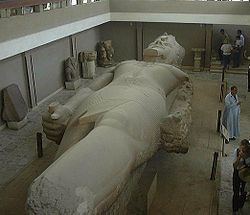
The colossal statue of Ramesses II was reconstructed and erected in Ramesses Square in Cairo in 1955. In August 2006, contractors moved his 3,200-year-old statue from Ramesses Square, to save it from exhaust fumes that were causing the 83 tonnes (81.7 LT) statue to deteriorate. The statue was originally taken from a temple in Memphis. The new site will be located near the future Grand Egyptian Museum
.
and hardening of the arteries. He had made Egypt rich from all the supplies and riches he had collected from other empires. He had outlived many of his wives and children and left great memorials all over Egypt
, especially to his beloved first queen Nefertari
. Nine more pharaohs took the name Ramesses in his honour, but none equalled his greatness. Nearly all of his subjects had been born during his reign and thought the world would end without him. Ramesses II did become the legendary figure he so desperately wanted to be, but this was not enough to protect Egypt. New enemies were attacking the empire, which also suffered internal problems and could not last indefinitely. Less than 150 years after Ramesses died the Egyptian empire fell and the New Kingdom
came to an end.
in the Valley of the Kings
but, because of looting, priests later transferred the body to a holding area, re-wrapped it, and placed it inside the tomb of queen Inhapy. 72 hours later it was again moved, to the tomb
of the high priest Pinudjem II. All of this is recorded in hieroglyphics on the linen covering the body. His mummy is today in Cairo
's Egyptian Museum
.
The pharaoh's mummy reveals a hooked nose and strong jaw, and stands at some 1.7 metre. His ultimate successor was his thirteenth son, Merneptah
.
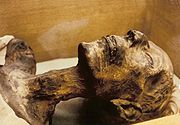 In 1974 Egyptologists visiting his tomb noticed that the mummy's condition was rapidly deteriorating and flew it to Paris
for examination. Ramesses II was issued an Egyptian passport that listed his occupation as "King (deceased)". The mummy was received at Le Bourget airport, just outside Paris, with the full military honours befitting a king.
In Paris, it was found that Ramesses's mummy was being attacked by fungus
, which it was treated for. During the examination, scientific analysis revealed battle wound
s and old fracture
s, as well as the pharaoh's arthritis
and poor circulation.
Egyptologists were also interested by the mummy's noticeably thin neck. An X-ray revealed that the neck had a piece of wood lodged into the upper chest, essentially keeping the head in place. It is believed that during the mummification process the head had accidentally been knocked off by those performing the mummification. In Egyptian culture if any part of the body were to come off, the soul of the body would not continue to exist in the afterlife, so those performing the mummification carefully placed the head back and lodged a wooden stick into the neck in order to keep the head in place.
It is believed that Ramesses II was essentially crippled with arthritis and walked with a hunched back for the last decades of his life. A recent study excluded ankylosing spondylitis
as a possible cause of the pharaoh's arthritis
. A significant hole in the pharaoh's mandible was detected. Researchers observed "an abscess by his teeth (which) was serious enough to have caused death by infection, although this cannot be determined with certainty." Microscopic inspection of the roots of Ramesses II's hair proved that the king's hair was originally red, which suggests that he came from a family of redheads. This has more than just cosmetic significance: in ancient Egypt people with red hair were associated with the god Seth, the slayer of Osiris, and the name of Ramesses II's father, Seti I, means "follower of Seth." After Ramesses's mummy returned to Egypt it was visited by President Anwar Sadat
and his wife.
's famous poem "Ozymandias
". Diodorus Siculus
gives an inscription on the base of one of his sculptures as: "King of Kings
am I, Osymandias. If anyone would know how great I am and where I lie, let him surpass one of my works." This is paraphrased in Shelley's poem.
The life of Ramesses II has inspired a large number of fictional representations, including the historical novel
s of the French writer Christian Jacq
, the Ramsès, series, the graphic novel Watchmen
, the character of Adrian Veidt uses Ramesses II to form part of the inspiration for his alter-ego known as 'Ozymandias' and Norman Mailer
's novel Ancient Evenings
is largely concerned with the life of Ramesses II, though from the perspective of Egyptians living during the reign of Ramesses IX
, and Ramesses was the main character in the Anne Rice
book The Mummy
or Ramses the Damned (1989).
Ramesses II is one of the more popular candidates for the Pharaoh of the Exodus.
He is cast in this role in the 1944 novella Das Gesetz ("The Law") by Thomas Mann
. Although not a major character, Ramesses appears in Joan Grant
's So Moses Was Born, a first person account from Nebunefer, the brother of Ramoses, which paints the picture of the life of Ramoses from the death of Seti, with all the power play, intrigue, plots to assassinate, following relationships are depicted: Bintanath
, Queen Tuya
, Nefertari
, and Moses
.
In film, Ramesses was played by Yul Brynner
in the classic film The Ten Commandments
(1956). Here Ramesses was portrayed as a vengeful tyrant as well as the main antagonist of the film, ever scornful of his father's preference for Moses over "the son of [his] body". The animated film The Prince of Egypt
(1998), also featured a depiction of Ramesses (voiced by Ralph Fiennes
), portrayed as Moses' adoptive brother, and ultimately as the film's de facto villain. The Ten Commandments: The Musical (2006) co-starred Kevin Earley
as Ramesses.
Pharaoh
Pharaoh is a title used in many modern discussions of the ancient Egyptian rulers of all periods. The title originates in the term "pr-aa" which means "great house" and describes the royal palace...
(reigned 1279 BC – 1213 BC) of the Nineteenth dynasty
Nineteenth dynasty of Egypt
The Nineteenth Dynasty of ancient Egypt was one of the periods of the Egyptian New Kingdom. Founded by Vizier Ramesses I, whom Pharaoh Horemheb chose as his successor to the throne, this dynasty is best known for its military conquests in Palestine, Lebanon, and Syria.The warrior kings of the...
. He is often regarded as the greatest, most celebrated, and most powerful pharaoh of the Egyptian Empire. His successors and later Egyptians called him the "Great Ancestor".
Ramesses II led several military expeditions into the Levant
Levant
The Levant or ) is the geographic region and culture zone of the "eastern Mediterranean littoral between Anatolia and Egypt" . The Levant includes most of modern Lebanon, Syria, Jordan, Israel, the Palestinian territories, and sometimes parts of Turkey and Iraq, and corresponds roughly to the...
, re-asserting Egyptian control over Canaan
Canaan
Canaan is a historical region roughly corresponding to modern-day Israel, Palestine, Lebanon, and the western parts of Jordan...
. He also led expeditions to the south, into Nubia
Nubia
Nubia is a region along the Nile river, which is located in northern Sudan and southern Egypt.There were a number of small Nubian kingdoms throughout the Middle Ages, the last of which collapsed in 1504, when Nubia became divided between Egypt and the Sennar sultanate resulting in the Arabization...
, commemorated in inscriptions at Beit el-Wali and Gerf Hussein.
At age fourteen, Ramesses was appointed Prince Regent
Prince Regent
A prince regent is a prince who rules a monarchy as regent instead of a monarch, e.g., due to the Sovereign's incapacity or absence ....
by his father Seti I
Seti I
Menmaatre Seti I was a Pharaoh of Ancient Egypt , the son of Ramesses I and Queen Sitre, and the father of Ramesses II...
. He is believed to have taken the throne in his late teens and is known to have ruled Egypt from 1279 BC to 1213 BC for 66 years and 2 months, according to both Manetho
Manetho
Manetho was an Egyptian historian and priest from Sebennytos who lived during the Ptolemaic era, approximately during the 3rd century BC. Manetho wrote the Aegyptiaca...
and Egypt's contemporary historical records. He was once said to have lived to be 99 years old, but it is more likely that he died in his 90th or 91st year. If he became Pharaoh in 1279 BC as most Egyptologists today believe, he would have assumed the throne on May 31, 1279 BC, based on his known accession date of III Shemu
Season of the Harvest
Season of the Harvest is the third and final season of the Egyptian calendar. The word Shemu literally translates as "low-water", and falls roughly between early May and early September. During this season, the crops of the grain harvest are collected...
day 27.
Ramesses II celebrated an unprecedented 14 sed festival
Sed festival
The Sed festival was an ancient Egyptian ceremony that celebrated the continued rule of a pharaoh...
s (the first held after thirty years of a pharaoh's reign, and then every three years) during his reign—more than any other pharaoh. On his death, he was buried in a tomb
KV7
Tomb KV7 in the Valley of the Kings was the final resting place of Ancient Egyptian Pharaoh Ramesses II of the Nineteenth Dynasty. It is located in the main valley, opposite the tomb of his sons, KV5, and near to the tomb of his son and successor, Merenptah, KV8...
in the Valley of the Kings
Valley of the Kings
The Valley of the Kings , less often called the Valley of the Gates of the Kings , is a valley in Egypt where, for a period of nearly 500 years from the 16th to 11th century BC, tombs were constructed for the Pharaohs and powerful nobles of the New Kingdom .The valley stands on the west bank of...
; his body was later moved to a royal cache
DB320
Tomb DB320 is located next to Deir el-Bahri, in the Theban Necropolis, opposite modern Luxor contained an extraordinary cache of mummified remains and funeral equipment of more than 50 kings, queens, royals and various nobility.-Usage of tomb:The tomb is thought to have initially been the last...
where it was discovered in 1881, and is now on display in the Cairo Museum.
The early part of his reign was focused on building cities, temples and monuments. He established the city of Pi-Ramesses
Pi-Ramesses
Pi-Ramesses was the new capital built by the Nineteenth Dynasty of Egypt Pharaoh Ramesses II at Qantir near the old site of Avaris. The city had previously served as a summer palace under Seti I and may have been originally founded by Ramesses I Pi-Ramesses (Pi-Ramesses Aa-nakhtu, meaning...
in the Nile Delta as his new capital and main base for his campaigns in Syria. This city was built on the remains of the city of Avaris
Avaris
Avaris , capital of Egypt under the Hyksos , was located near modern Tell el-Dab'a in the northeastern region of the Nile Delta, at the juncture of the 8th, 14th, 19th and 20th Nomes...
, the capital of the Hyksos
Hyksos
The Hyksos were an Asiatic people who took over the eastern Nile Delta during the twelfth dynasty, initiating the Second Intermediate Period of ancient Egypt....
when they took over, and was the location of the main Temple of Set
Set (mythology)
Set was in Ancient Egyptian religion, a god of the desert, storms, and foreigners. In later myths he was also the god of darkness, and chaos...
.
He is also known as Ozymandias
Ozymandias
"Ozymandias" is a sonnet by Percy Bysshe Shelley, published in 1818 in the January 11 issue of The Examiner in London. It is frequently anthologised and is probably Shelley's most famous short poem...
in the Greek sources, from a transliteration into Greek
Greek language
Greek is an independent branch of the Indo-European family of languages. Native to the southern Balkans, it has the longest documented history of any Indo-European language, spanning 34 centuries of written records. Its writing system has been the Greek alphabet for the majority of its history;...
of a part of Ramesses's throne name, , "Ra
Ra
Ra is the ancient Egyptian sun god. By the Fifth Dynasty he had become a major deity in ancient Egyptian religion, identified primarily with the mid-day sun...
's mighty truth
Maat
Maat is a naval rank of the German navy equivalent to the army rank of Unteroffizier. A Maat is considered the equivalent of a junior Petty Officer in the navies of many other nations....
, chosen of Ra".
Campaigns and battles
Nubia
Nubia is a region along the Nile river, which is located in northern Sudan and southern Egypt.There were a number of small Nubian kingdoms throughout the Middle Ages, the last of which collapsed in 1504, when Nubia became divided between Egypt and the Sennar sultanate resulting in the Arabization...
n revolts and carrying out a campaign in Libya
Libya
Libya is an African country in the Maghreb region of North Africa bordered by the Mediterranean Sea to the north, Egypt to the east, Sudan to the southeast, Chad and Niger to the south, and Algeria and Tunisia to the west....
. Although the famous Battle of Kadesh
Battle of Kadesh
The Battle of Kadesh took place between the forces of the Egyptian Empire under Ramesses II and the Hittite Empire under Muwatalli II at the city of Kadesh on the Orontes River, in what is now the Syrian Arab Republic....
often dominates the scholarly view of Ramesses II's military prowess and power, he nevertheless enjoyed more than a few outright victories over the enemies of Egypt. During Ramesses II's reign, the Egyptian army is estimated to have totaled about 100,000 men; a formidable force that he used to strengthen Egyptian influence.
Battle against Sherden sea pirates
In his second year, Ramesses II decisively defeated the ShardanaShardana
The Sherden are one of several groups of "Sea Peoples" who appear in fragmentary historical records for the Mediterranean region in the second millennium B.C.; little is known about them. On reliefs they are shown carrying a round shield and a long thrusting Naue II type sword...
or Sherden sea pirates who were wreaking havoc along Egypt's Mediterranean coast by attacking cargo-laden vessels travelling the sea routes to Egypt
Egypt
Egypt , officially the Arab Republic of Egypt, Arabic: , is a country mainly in North Africa, with the Sinai Peninsula forming a land bridge in Southwest Asia. Egypt is thus a transcontinental country, and a major power in Africa, the Mediterranean Basin, the Middle East and the Muslim world...
. The Sherden people probably came from the coast of Ionia
Ionia
Ionia is an ancient region of central coastal Anatolia in present-day Turkey, the region nearest İzmir, which was historically Smyrna. It consisted of the northernmost territories of the Ionian League of Greek settlements...
or possibly south-west Turkey
Turkey
Turkey , known officially as the Republic of Turkey , is a Eurasian country located in Western Asia and in East Thrace in Southeastern Europe...
. Ramesses posted troops and ships at strategic points along the coast and patiently allowed the pirates to attack their prey before skillfully catching them by surprise in a sea battle and capturing them all in a single action. A stele
Stele
A stele , also stela , is a stone or wooden slab, generally taller than it is wide, erected for funerals or commemorative purposes, most usually decorated with the names and titles of the deceased or living — inscribed, carved in relief , or painted onto the slab...
from Tanis
Tanis, Egypt
Tanis , the Greek name of ancient Djanet , is a city in the north-eastern Nile delta of Egypt. It is located on the Tanitic branch of the Nile which has long since silted up.-History:...
speaks of their having come "in their war-ships from the midst of the sea, and none were able to stand before them". There must have been a naval battle somewhere near the mouth of the Nile, as shortly afterwards many Sherden are seen in the Pharaoh's body-guard where they are conspicuous by their horned helmets with a ball projecting from the middle, their round shields and the great Naue II swords with which they are depicted in inscriptions of the Battle of Kadesh. In that sea battle, together with the Shardana, the pharaoh also defeated the Lukka (L'kkw, possibly the later Lycians), and the Šqrsšw (Shekelesh) peoples.
First Syrian campaign
The immediate antecedents to the Battle of Kadesh were the early campaigns of Ramesses II into CanaanCanaan
Canaan is a historical region roughly corresponding to modern-day Israel, Palestine, Lebanon, and the western parts of Jordan...
and Palestine
Palestine
Palestine is a conventional name, among others, used to describe the geographic region between the Mediterranean Sea and the Jordan River, and various adjoining lands....
. His first campaign seems to have taken place in the fourth year of his reign and was commemorated by the erection of a stele near modern Beirut
Beirut
Beirut is the capital and largest city of Lebanon, with a population ranging from 1 million to more than 2 million . Located on a peninsula at the midpoint of Lebanon's Mediterranean coastline, it serves as the country's largest and main seaport, and also forms the Beirut Metropolitan...
. The inscription is almost totally illegible due to weathering. His records tell us that he was forced to fight a Palestinian prince who was mortally wounded by an Egyptian archer, and whose army was subsequently routed. Ramesses carried off the princes of Palestine as live prisoners to Egypt. Ramesses then plundered the chiefs of the Asiatics in their own lands, returning every year to his headquarters at Riblah to exact tribute. In the fourth year of his reign, he captured the Hittite vassal state of Amurru
Amurru kingdom
Amurru was an Amorite kingdom located at the territory of modern Lebanon during the 14th–12th centuries BCThe first documented leader of Amurru was Abdi-Ashirta, under whose leadership Amurru was part of the Egyptian empire...
during his campaign in Syria
Syria
Syria , officially the Syrian Arab Republic , is a country in Western Asia, bordering Lebanon and the Mediterranean Sea to the West, Turkey to the north, Iraq to the east, Jordan to the south, and Israel to the southwest....
.
Second Syrian campaign
The Battle of Kadesh in his fifth regnal year was the climactic engagement in a campaign that Ramesses fought in Syria, against the resurgent Hittite forces of Muwatallis. The pharaoh wanted a victory at Kadesh both to expand Egypt's frontiers into Syria and to emulate his father Seti I's triumphal entry into the city just a decade or so earlier. He also constructed his new capital, Pi-Ramesses
Pi-Ramesses
Pi-Ramesses was the new capital built by the Nineteenth Dynasty of Egypt Pharaoh Ramesses II at Qantir near the old site of Avaris. The city had previously served as a summer palace under Seti I and may have been originally founded by Ramesses I Pi-Ramesses (Pi-Ramesses Aa-nakhtu, meaning...
where he built factories to manufacture weapons, chariots, and shields. Of course, they followed his wishes and manufactured some 1,000 weapons in a week, about 250 chariots in 2 weeks, and 1,000 shields in a week and a half. After these preparations, Ramesses moved to attack territory in the Levant
Levant
The Levant or ) is the geographic region and culture zone of the "eastern Mediterranean littoral between Anatolia and Egypt" . The Levant includes most of modern Lebanon, Syria, Jordan, Israel, the Palestinian territories, and sometimes parts of Turkey and Iraq, and corresponds roughly to the...
which belonged to a more substantial enemy than any he had ever faced before: the Hittite Empire.
Although Ramesses's forces were caught in a Hittite ambush and outnumbered at Kadesh, the pharaoh fought the battle to a stalemate and returned home a hero. Ramesses II's forces suffered major losses particularly among the 'Ra' division which was routed by the initial charge of the Hittite chariots during the battle. Once back in Egypt, Ramesses proclaimed that he had won a great victory. He had amazed everybody by almost winning a lost battle. The Battle of Kadesh was a personal triumph for Ramesses, as after blundering into a devastating Hittite ambush, the young king courageously rallied his scattered troops to fight on the battlefield while escaping death or capture. Still, many historians regard the battle as a strategic defeat for the Egyptians as they were unable to occupy the city or territory around Kadesh.
Ramesses decorated his monuments with reliefs and inscriptions describing the campaign as a whole, and the battle in particular as a major victory. Inscriptions of his victory decorate the Ramesseum
Ramesseum
The Ramesseum is the memorial temple of Pharaoh Ramesses II . It is located in the Theban necropolis in Upper Egypt, across the River Nile from the modern city of Luxor...
, Abydos, Karnak, Luxor and Abu Simbel. For example, on the temple walls of Luxor the near catastrophe was turned into an act of heroism:
Third Syrian campaign
Egypt's sphere of influence was now restricted to CanaanCanaan
Canaan is a historical region roughly corresponding to modern-day Israel, Palestine, Lebanon, and the western parts of Jordan...
while Syria
Syria
Syria , officially the Syrian Arab Republic , is a country in Western Asia, bordering Lebanon and the Mediterranean Sea to the West, Turkey to the north, Iraq to the east, Jordan to the south, and Israel to the southwest....
fell into Hittite hands. Canaanite princes, seemingly influenced by the Egyptian incapacity to impose their will, and goaded on by the Hittites, began revolts against Egypt. In the seventh year of his reign, Ramesses II returned to Syria once again. This time he proved more successful against his Hittite foes. During this campaign he split his army into two forces. One was led by his son, Amun-her-khepeshef
Amun-her-khepeshef
Amun-her-khepeshef or Amonhirkhopshef or Amun-her-wenemef was the firstborn son of Pharaoh Ramesses II and Queen Nefertari.-Name:...
, and it chased warriors of the Šhasu tribes across the Negev
Negev
The Negev is a desert and semidesert region of southern Israel. The Arabs, including the native Bedouin population of the region, refer to the desert as al-Naqab. The origin of the word Neghebh is from the Hebrew root denoting 'dry'...
as far as the Dead Sea
Dead Sea
The Dead Sea , also called the Salt Sea, is a salt lake bordering Jordan to the east and Israel and the West Bank to the west. Its surface and shores are below sea level, the lowest elevation on the Earth's surface. The Dead Sea is deep, the deepest hypersaline lake in the world...
, and captured Edom
Edom
Edom or Idumea was a historical region of the Southern Levant located south of Judea and the Dead Sea. It is mentioned in biblical records as a 1st millennium BC Iron Age kingdom of Edom, and in classical antiquity the cognate name Idumea was used to refer to a smaller area in the same region...
-Seir. It then marched on to capture Moab
Moab
Moab is the historical name for a mountainous strip of land in Jordan. The land lies alongside much of the eastern shore of the Dead Sea. The existence of the Kingdom of Moab is attested to by numerous archeological findings, most notably the Mesha Stele, which describes the Moabite victory over...
. The other force, led by Ramesses, attacked Jerusalem and Jericho
Jericho
Jericho ; is a city located near the Jordan River in the West Bank of the Palestinian territories. It is the capital of the Jericho Governorate and has a population of more than 20,000. Situated well below sea level on an east-west route north of the Dead Sea, Jericho is the lowest permanently...
. He, too, then entered Moab, where he rejoined his son. The reunited army then marched on Hesbon, Damascus
Damascus
Damascus , commonly known in Syria as Al Sham , and as the City of Jasmine , is the capital and the second largest city of Syria after Aleppo, both are part of the country's 14 governorates. In addition to being one of the oldest continuously inhabited cities in the world, Damascus is a major...
, on to Kumidi, and finally recaptured Upi, reestablishing Egypt's former sphere of influence.
Later campaigns in Syria
Kadesh
This article is about Kadesh in the lands of the Amurru, bordering on Damascus Syria up to Hammath; see also Kadesh or Kedesh Kadesh was an ancient city of the Levant, located on or near the headwaters or ford of the Orontes River...
, in Tunip
Tunip
Tunip was a city/'city-state' in western Syria during the 1350-1335 BC, , Amarna letters correspondence. The name "Syria" did not exist, though Assyria was beginning...
, where no Egyptian soldier had been seen since the time of Thutmose III
Thutmose III
Thutmose III was the sixth Pharaoh of the Eighteenth Dynasty. During the first twenty-two years of Thutmose's reign he was co-regent with his stepmother, Hatshepsut, who was named the pharaoh...
almost 120 years earlier. He laid siege to the city before capturing it. His victory proved to be ephemeral. In year nine, Ramesses erected a stele at Beth Shean. After having reasserted his power over Canaan, Ramesses led his army north. A mostly illegible stele near Beirut
Beirut
Beirut is the capital and largest city of Lebanon, with a population ranging from 1 million to more than 2 million . Located on a peninsula at the midpoint of Lebanon's Mediterranean coastline, it serves as the country's largest and main seaport, and also forms the Beirut Metropolitan...
, which appears to be dated to the king's second year, was probably set up there in his tenth. The thin strip of territory pinched between Amurru and Kadesh
Kadesh
This article is about Kadesh in the lands of the Amurru, bordering on Damascus Syria up to Hammath; see also Kadesh or Kedesh Kadesh was an ancient city of the Levant, located on or near the headwaters or ford of the Orontes River...
did not make for a stable possession. Within a year, they had returned to the Hittite fold, so that Ramesses had to march against Dapur
Siege of Dapur
The Siege of Dapur occurred as part of Ramesses II's campaign to suppress Galilee and conquer Syria in 1269 BC. He inscribed his campaign on the wall of his mortuary temple, the Ramesseum in Thebes. The inscriptions say that Dapur was "in the land of Hatti"...
once more in his tenth year. This time he claimed to have fought the battle without even bothering to put on his corslet until two hours after the fighting began. Six of Ramesses's sons, still wearing their side locks, took part in this conquest. He took towns in Retenu, and Tunip in Naharin, later recorded on the walls of the Ramesseum. This second success here was equally as meaningless as his first, as neither power could decisively defeat the other in battle.
Peace treaty with the Hittites
This demand precipitated a crisis in relations between Egypt and Hatti when Ramesses denied any knowledge of Mursili's whereabouts in his country, and the two Empires came dangerously close to war. Eventually, in the twenty-first year of his reign (1258 BC), Ramesses decided to conclude an agreement with the new Hittite king at Kadesh
Kadesh
This article is about Kadesh in the lands of the Amurru, bordering on Damascus Syria up to Hammath; see also Kadesh or Kedesh Kadesh was an ancient city of the Levant, located on or near the headwaters or ford of the Orontes River...
, Hattusili III, to end the conflict. The ensuing document is the earliest known peace treaty
Peace treaty
A peace treaty is an agreement between two or more hostile parties, usually countries or governments, that formally ends a state of war between the parties...
in world history.
The peace treaty was recorded in two versions, one in Egyptian hieroglyphs
Egyptian hieroglyphs
Egyptian hieroglyphs were a formal writing system used by the ancient Egyptians that combined logographic and alphabetic elements. Egyptians used cursive hieroglyphs for religious literature on papyrus and wood...
, the other in Akkadian
Akkadian language
Akkadian is an extinct Semitic language that was spoken in ancient Mesopotamia. The earliest attested Semitic language, it used the cuneiform writing system derived ultimately from ancient Sumerian, an unrelated language isolate...
, using cuneiform script; both versions survive. Such dual-language recording is common to many subsequent treaties. This treaty differs from others however, in that the two language versions are differently worded. Although the majority of the text is identical, the Hittite version claims that the Egyptians
Egyptians
Egyptians are nation an ethnic group made up of Mediterranean North Africans, the indigenous people of Egypt.Egyptian identity is closely tied to geography. The population of Egypt is concentrated in the lower Nile Valley, the small strip of cultivable land stretching from the First Cataract to...
came suing for peace, while the Egyptian version claims the reverse. The treaty was given to the Egyptians in the form of a silver plaque, and this "pocket-book" version was taken back to Egypt and carved into the Temple of Karnak.
The treaty was concluded between Ramesses II and Hattusili III
Hattusili III
Hattusili III was a king of the Hittite empire ca. 1267–1237 BC . He was the fourth and last son of Mursili II...
in Year 21 of Ramesses's reign. (c. 1258 BC) Its 18 articles call for peace between Egypt and Hatti and then proceeds to maintain that their respective gods also demand peace. The frontiers are not laid down in this treaty but can be inferred from other documents. The Anastasy A papyrus
Papyrus
Papyrus is a thick paper-like material produced from the pith of the papyrus plant, Cyperus papyrus, a wetland sedge that was once abundant in the Nile Delta of Egypt....
describes Canaan
Canaan
Canaan is a historical region roughly corresponding to modern-day Israel, Palestine, Lebanon, and the western parts of Jordan...
during the latter part of the reign of Ramesses II and enumerates and names the Phoenicia
Phoenicia
Phoenicia , was an ancient civilization in Canaan which covered most of the western, coastal part of the Fertile Crescent. Several major Phoenician cities were built on the coastline of the Mediterranean. It was an enterprising maritime trading culture that spread across the Mediterranean from 1550...
n coastal towns under Egyptian control. The harbour town of Sumur north of Byblos
Byblos
Byblos is the Greek name of the Phoenician city Gebal . It is a Mediterranean city in the Mount Lebanon Governorate of present-day Lebanon under the current Arabic name of Jubayl and was also referred to as Gibelet during the Crusades...
is mentioned as being the northern-most town belonging to Egypt, which points to it having contained an Egyptian garrison.
No further Egyptian campaigns in Canaan are mentioned after the conclusion of the peace treaty. The northern border seems to have been safe and quiet, so the rule of the pharaoh was strong until Ramesses II's death, and the waning of the dynasty. When the King of Mira attempted to involve Ramesses in a hostile act against the Hittites, the Egyptian responded that the times of intrigue in support of Mursili III
Mursili III
Mursili III, also known as Urhi-Teshub, was a king of the Hittites who assumed the throne of the Hittite empire at Tarhuntassa upon his father's death around 1272 BCE. He was a cousin of Tudhaliya IV and Queen Maathorneferure.- Biography :...
, had passed. Hattusili III wrote to Kadashman-Enlil II, King of Karduniash (Babylon
Babylon
Babylon was an Akkadian city-state of ancient Mesopotamia, the remains of which are found in present-day Al Hillah, Babil Province, Iraq, about 85 kilometers south of Baghdad...
) in the same spirit, reminding him of the time when his father, Kadashman-Turgu, had offered to fight Ramesses II, the king of Egypt. The Hittite king encouraged the Babylonian to oppose another enemy, which must have been the king of Assyria
Assyria
Assyria was a Semitic Akkadian kingdom, extant as a nation state from the mid–23rd century BC to 608 BC centred on the Upper Tigris river, in northern Mesopotamia , that came to rule regional empires a number of times through history. It was named for its original capital, the ancient city of Assur...
whose allies had killed the messenger of the Egyptian king. Hattusili encouraged Kadashman-Enlil to come to his aid and prevent the Assyrians from cutting the link between the Canaanite province of Egypt and Mursili III, the ally of Ramesses.
Campaigns in Nubia
Aswan
Aswan , formerly spelled Assuan, is a city in the south of Egypt, the capital of the Aswan Governorate.It stands on the east bank of the Nile at the first cataract and is a busy market and tourist centre...
into Nubia
Nubia
Nubia is a region along the Nile river, which is located in northern Sudan and southern Egypt.There were a number of small Nubian kingdoms throughout the Middle Ages, the last of which collapsed in 1504, when Nubia became divided between Egypt and the Sennar sultanate resulting in the Arabization...
. When Ramesses was about 22, two of his own sons, including Amun-her-khepeshef
Amun-her-khepeshef
Amun-her-khepeshef or Amonhirkhopshef or Amun-her-wenemef was the firstborn son of Pharaoh Ramesses II and Queen Nefertari.-Name:...
, accompanied him in at least one of those campaigns. By the time of Ramesses, Nubia had been a colony for two hundred years, but its conquest was recalled in decoration from the temples Ramesses II built at Beit el-Wali (which was the subject of epigraphic work by the Oriental Institute during the Nubian salvage campaign of the 1960s), Gerf Hussein and Kalabsha in northern Nubia. On the south wall of the Beit el-Wali temple, Ramesses II is depicted charging into battle against the Nubians in a war chariot, while his two young sons Amun-her-khepsef and Khaemwaset are shown being present behind him, also in war chariots. On one of the walls of Ramesses's temples it says that in one of the battles with the Nubians he had to fight the whole battle alone without any help from his soldiers.
Campaigns in Libya
During the reign of Ramesses II, there is evidence that the Egyptians were active on a 300 kilometres (186.4 mi) stretch along the Mediterranean coast, at least as far as Zawiyet Umm el-RakhamZawiyet Umm el-Rakham
Zawiyet Umm el-Rakham is located on the North coast of Egypt 20 km to the west of Marsa Matruh, and about 300 km to the west of Alexandria...
. Although the exact events surrounding the foundation of the coastal forts and fortresses is not clear, some degree of political and military control must have been held over the region to allow their construction.
There are no detailed accounts of Ramesses II's undertaking large military actions against the Libyans
Ancient Libya
The Latin name Libya referred to the region west of the Nile Valley, generally corresponding to modern Northwest Africa. Climate changes affected the locations of the settlements....
, only generalised records of his conquering and crushing them, which may or may not refer to specific events that were otherwise unrecorded. It may be that some of the records, such as the Aswan
Aswan
Aswan , formerly spelled Assuan, is a city in the south of Egypt, the capital of the Aswan Governorate.It stands on the east bank of the Nile at the first cataract and is a busy market and tourist centre...
Stele of his year 2, are harking back to Ramesses's presence on his father's Libyan campaigns. Perhaps it was Seti I
Seti I
Menmaatre Seti I was a Pharaoh of Ancient Egypt , the son of Ramesses I and Queen Sitre, and the father of Ramesses II...
who achieved this supposed control over the region, and who planned to establish the defensive system, in a manner similar to how he rebuilt those to the east, the Ways of Horus across Northern Sinai.
Religious impact
Ramesses was the pharaoh most responsible for erasing the Amarna PeriodAmarna Period
The Amarna Period was an era of Egyptian history during the latter half of the Eighteenth Dynasty when the royal residence of the pharaoh and his queen was shifted to Akhetaten in what is now modern-day Amarna...
from history. He, more than any other pharaoh
Pharaoh
Pharaoh is a title used in many modern discussions of the ancient Egyptian rulers of all periods. The title originates in the term "pr-aa" which means "great house" and describes the royal palace...
, sought deliberately to deface the Amarna
Amarna
Amarna is an extensive Egyptian archaeological site that represents the remains of the capital city newly–established and built by the Pharaoh Akhenaten of the late Eighteenth Dynasty , and abandoned shortly afterwards...
monuments and change the nature of the religious structure and the structure of the priesthood, in order to try to bring it back to where it had been prior to the reign of Akhenaten
Akhenaten
Akhenaten also spelled Echnaton,Ikhnaton,and Khuenaten;meaning "living spirit of Aten") known before the fifth year of his reign as Amenhotep IV , was a Pharaoh of the Eighteenth dynasty of Egypt who ruled for 17 years and died perhaps in 1336 BC or 1334 BC...
.
Sed festival
After reigning for 30 years, Ramesses joined a selected group that included only a handful of EgyptEgypt
Egypt , officially the Arab Republic of Egypt, Arabic: , is a country mainly in North Africa, with the Sinai Peninsula forming a land bridge in Southwest Asia. Egypt is thus a transcontinental country, and a major power in Africa, the Mediterranean Basin, the Middle East and the Muslim world...
's longest-lived kings. By tradition, in the 30th year of his reign Ramesses celebrated a jubilee called the Sed festival, during which the king was ritually transformed into a god. Only halfway through what would be a 66-year reign, Ramesses had already eclipsed all but a few greatest kings in his achievements. He had brought peace, maintained Egypt
Egypt
Egypt , officially the Arab Republic of Egypt, Arabic: , is a country mainly in North Africa, with the Sinai Peninsula forming a land bridge in Southwest Asia. Egypt is thus a transcontinental country, and a major power in Africa, the Mediterranean Basin, the Middle East and the Muslim world...
ian borders and built great and numerous monuments across the empire. His country was more prosperous and powerful than it had been in nearly a century. By becoming a god, Ramesses dramatically changed not just his role as ruler of Egypt
Egypt
Egypt , officially the Arab Republic of Egypt, Arabic: , is a country mainly in North Africa, with the Sinai Peninsula forming a land bridge in Southwest Asia. Egypt is thus a transcontinental country, and a major power in Africa, the Mediterranean Basin, the Middle East and the Muslim world...
, but also the role of his firstborn son, Amun-her-khepsef. As the chosen heir and commander and chief of Egyptian armies, his son effectively became ruler in all but name.
Building activity and monuments
Egyptian temple
Egyptian temples were built for the official worship of the gods and commemoration of pharaohs in Ancient Egypt and in regions under Egyptian control. These temples were seen as houses for the gods or kings to whom they were dedicated...
, most notably the Ramesseum
Ramesseum
The Ramesseum is the memorial temple of Pharaoh Ramesses II . It is located in the Theban necropolis in Upper Egypt, across the River Nile from the modern city of Luxor...
in the western Thebes
Thebes, Egypt
Thebes is the Greek name for a city in Ancient Egypt located about 800 km south of the Mediterranean, on the east bank of the river Nile within the modern city of Luxor. The Theban Necropolis is situated nearby on the west bank of the Nile.-History:...
and the rock temples of Abu Simbel
Abu Simbel
Abu Simbel temples refers to two massive rock temples in Abu Simbel in Nubia, southern Egypt on the western bank of Lake Nasser about 230 km southwest of Aswan...
. He covered the land from the Delta
River delta
A delta is a landform that is formed at the mouth of a river where that river flows into an ocean, sea, estuary, lake, reservoir, flat arid area, or another river. Deltas are formed from the deposition of the sediment carried by the river as the flow leaves the mouth of the river...
to Nubia
Nubia
Nubia is a region along the Nile river, which is located in northern Sudan and southern Egypt.There were a number of small Nubian kingdoms throughout the Middle Ages, the last of which collapsed in 1504, when Nubia became divided between Egypt and the Sennar sultanate resulting in the Arabization...
with buildings in a way no king
Monarch
A monarch is the person who heads a monarchy. This is a form of government in which a state or polity is ruled or controlled by an individual who typically inherits the throne by birth and occasionally rules for life or until abdication...
before him had done. He also founded a new capital city in the Delta during his reign called Pi-Ramesses
Pi-Ramesses
Pi-Ramesses was the new capital built by the Nineteenth Dynasty of Egypt Pharaoh Ramesses II at Qantir near the old site of Avaris. The city had previously served as a summer palace under Seti I and may have been originally founded by Ramesses I Pi-Ramesses (Pi-Ramesses Aa-nakhtu, meaning...
; it had previously served as a summer palace during Seti I's reign.
His memorial temple Ramesseum
Ramesseum
The Ramesseum is the memorial temple of Pharaoh Ramesses II . It is located in the Theban necropolis in Upper Egypt, across the River Nile from the modern city of Luxor...
, was just the beginning of the pharaoh's obsession with building. When he built, he built on a scale unlike almost anything before. In the third year of his reign Ramesses started the most ambitious building project after the pyramids, that were built 1,500 years earlier. The population was put to work on changing the face of Egypt
Egypt
Egypt , officially the Arab Republic of Egypt, Arabic: , is a country mainly in North Africa, with the Sinai Peninsula forming a land bridge in Southwest Asia. Egypt is thus a transcontinental country, and a major power in Africa, the Mediterranean Basin, the Middle East and the Muslim world...
. In Thebes
Thebes, Egypt
Thebes is the Greek name for a city in Ancient Egypt located about 800 km south of the Mediterranean, on the east bank of the river Nile within the modern city of Luxor. The Theban Necropolis is situated nearby on the west bank of the Nile.-History:...
, the ancient temples were transformed, so that each one of them reflected honour to Ramesses as a symbol of this divine nature and power. Ramesses decided to eternalize himself in stone, and so he ordered changes to the methods used by his masons. The elegant but shallow reliefs of previous pharaohs were easily transformed, and so their images and words could easily be obliterated by their successors. Ramesses insisted that his carvings be deeply engraved in the stone, which made them not only less susceptible to later alteration, but also made them more prominent in the Egyptian sun, reflecting his relationship with the sun god, Ra
Ra
Ra is the ancient Egyptian sun god. By the Fifth Dynasty he had become a major deity in ancient Egyptian religion, identified primarily with the mid-day sun...
.
Ramesses constructed many large monuments, including the archeological complex of Abu Simbel
Abu Simbel
Abu Simbel temples refers to two massive rock temples in Abu Simbel in Nubia, southern Egypt on the western bank of Lake Nasser about 230 km southwest of Aswan...
, and the Mortuary temple
Mortuary temple
Mortuary temples were temples constructed adjacent to, or in the vicinity of, royal tombs in the Ancient Egypt. The temples were designed to commemorate the reign of the pharaoh by whom they were built, as well as for use by the pharaoh's cult after death.-History:Mortuary temples were built...
known as the Ramesseum
Ramesseum
The Ramesseum is the memorial temple of Pharaoh Ramesses II . It is located in the Theban necropolis in Upper Egypt, across the River Nile from the modern city of Luxor...
. He built on a monumental scale to ensure that his legacy would survive the ravages of time. Ramesses used art as a means of propaganda for his victories over foreigners and are depicted on numerous temple reliefs. Ramesses II also erected more colossal statues of himself than any other pharaoh. He also usurped many existing statues by inscribing his own cartouche
Cartouche
In Egyptian hieroglyphs, a cartouche is an ellipse with a horizontal line at one end, indicating that the text enclosed is a royal name, coming into use during the beginning of the Fourth Dynasty under Pharaoh Sneferu, replacing the earlier serekh...
on them.
Pi-Ramesses
Ramesses II moved the capital of his kingdom from Thebes in the Nile valley to a new site in the eastern Delta. His motives are uncertain, though he possibly wished to be closer to his territories in Palestine and Syria. The new city of Pi-Ramesses (or to give the full name, Pi-Ramesses Aa-nakhtu, meaning "Domain of Ramesses, Great in Victory") was dominated by huge temples and the king's vast residential palace, complete with its own zoo. For a time the site was misidentified as that of TanisTanis, Egypt
Tanis , the Greek name of ancient Djanet , is a city in the north-eastern Nile delta of Egypt. It is located on the Tanitic branch of the Nile which has long since silted up.-History:...
, due to the amount of statuary and other material from Pi-Ramesses found there, but it is now recognised that the Ramasside remains at Tanis were brought there from elsewhere, and the real Pi-Ramesses lies about 30 km south, near modern Qantir
Qantir
Qantir is a modern village in Egypt. Qantir is believed to mark what was probably the ancient site of Ramesses II's great capital, Pi-Ramesse or Per-Ramesses . This city is situated about north of Faqus in Sharqiyah province of the eastern Nile Delta, about 60 miles north-east of Cairo.-...
. The colossal feet of the statue of Ramesses are almost all that remains above ground today, the rest is buried in the fields.
Ramesseum
The temple complex built by Ramesses II between QurnaKurna
Kurna are various spelling for a group of three closely related villages located on the West Bank of the River Nile opposite the modern city of Luxor in Egypt near the Theban Hills.New Qurna was designed and built in the late 1940s and early 1950s by...
and the desert has been known as the Ramesseum
Ramesseum
The Ramesseum is the memorial temple of Pharaoh Ramesses II . It is located in the Theban necropolis in Upper Egypt, across the River Nile from the modern city of Luxor...
since the 19th century. The Greek historian
Historian
A historian is a person who studies and writes about the past and is regarded as an authority on it. Historians are concerned with the continuous, methodical narrative and research of past events as relating to the human race; as well as the study of all history in time. If the individual is...
Diodorus Siculus
Diodorus Siculus
Diodorus Siculus was a Greek historian who flourished between 60 and 30 BC. According to Diodorus' own work, he was born at Agyrium in Sicily . With one exception, antiquity affords no further information about Diodorus' life and doings beyond what is to be found in his own work, Bibliotheca...
marveled at the gigantic and famous temple, now no more than a few ruins.
Oriented northwest and southeast, the temple itself was preceded by two courts. An enormous pylon stood before the first court, with the royal palace at the left and the gigantic statue of the king looming up at the back. Only fragments of the base and torso remain of the syenite
Syenite
Syenite is a coarse-grained intrusive igneous rock of the same general composition as granite but with the quartz either absent or present in relatively small amounts Syenite is a coarse-grained intrusive igneous rock of the same general composition as granite but with the quartz either absent or...
statue of the enthroned pharaoh, 17 metres (55.8 ft) high and weighing more than 1000 tonnes (984.2 LT). The scenes of the great pharaoh and his army triumphing over the Hittite forces fleeing before Kadesh
Kadesh
This article is about Kadesh in the lands of the Amurru, bordering on Damascus Syria up to Hammath; see also Kadesh or Kedesh Kadesh was an ancient city of the Levant, located on or near the headwaters or ford of the Orontes River...
, represented on the pylon. Remains of the second court include part of the internal facade of the pylon and a portion of the Osiride portico on the right. Scenes of war and the alleged rout of the Hittites
Hittites
The Hittites were a Bronze Age people of Anatolia.They established a kingdom centered at Hattusa in north-central Anatolia c. the 18th century BC. The Hittite empire reached its height c...
at Kadesh are repeated on the walls. In the upper registers
Register (sculpture)
In art and archaeology, a register is a vertical level in a work that consists of several levels, especially where the levels are clearly separated by lines; modern comic books typically use similar conventions...
, feast and honor of the phallic god Min
Min (god)
Min is an Ancient Egyptian god whose cult originated in predynastic times . He was represented in many different forms, but was often represented in male human form, shown with an erect penis which he holds in his left hand and an upheld right arm holding a flail...
, god of fertility. On the opposite side of the court the few Osiride pillars and columns still left can furnish an idea of the original grandeur.
A temple of Seti I
Seti I
Menmaatre Seti I was a Pharaoh of Ancient Egypt , the son of Ramesses I and Queen Sitre, and the father of Ramesses II...
, of which nothing is now left but the foundations, once stood to the right of the hypostyle hall.
Abu Simbel
In 1255 BC Ramesses and his queen NefertariNefertari
Nefertari also known as Nefertari Merytmut was one of the Great Royal Wives of Ramesses the Great. Nefertari means 'Beautiful Companion' and Meritmut means 'Beloved of [the Goddess] Mut'. She is one of the best known Egyptian queens, next to Cleopatra, Nefertiti and Hatshepsut...
had traveled into Nubia
Nubia
Nubia is a region along the Nile river, which is located in northern Sudan and southern Egypt.There were a number of small Nubian kingdoms throughout the Middle Ages, the last of which collapsed in 1504, when Nubia became divided between Egypt and the Sennar sultanate resulting in the Arabization...
to inaugurate a new temple, the great Abu Simbel
Abu Simbel
Abu Simbel temples refers to two massive rock temples in Abu Simbel in Nubia, southern Egypt on the western bank of Lake Nasser about 230 km southwest of Aswan...
. It is an ego cast in stone; the man who built it intended not only to become Egypt's greatest pharaoh but also one of its gods.
The great temple of Ramesses II at Abu Simbel
Abu Simbel
Abu Simbel temples refers to two massive rock temples in Abu Simbel in Nubia, southern Egypt on the western bank of Lake Nasser about 230 km southwest of Aswan...
was discovered in 1813 by the famous Swiss Orientalist and traveler Johann Ludwig Burckhardt
Johann Ludwig Burckhardt
Johann Ludwig Burckhardt was a Swiss traveller and orientalist. He wrote his letters in French and signed Louis...
. However, four years passed before anyone could enter the temple, because an enormous pile of sand almost completely covered the facade and its colossal statues, blocking the entrance. This feat was achieved by the great Padua
Padua
Padua is a city and comune in the Veneto, northern Italy. It is the capital of the province of Padua and the economic and communications hub of the area. Padua's population is 212,500 . The city is sometimes included, with Venice and Treviso, in the Padua-Treviso-Venice Metropolitan Area, having...
n explorer Giovanni Battista Belzoni
Giovanni Battista Belzoni
Giovanni Battista Belzoni , sometimes known as The Great Belzoni, was a prolific Venetian explorer of Egyptian antiquities.-Early life:...
, who managed to reach the interior on 4 August 1817.
Other Nubian monuments
As well as the famous temples of Abu Simbel, Ramesses left other monuments to himself in Nubia. His early campaigns are illustrated on the walls of Beit el-Wali (now relocated to New KalabshaNew Kalabsha
New Kalabsha is a promontory located near Aswan in Egypt. It houses several important temples, structures, and other remains that have been relocated here from the site of Old Kalabsha to avoid the rising waters of Lake Nasser caused by the construction of the Aswan High Dam...
). Other temples dedicated to Ramesses are Derr
Temple of Derr
The Temple of Derr or el-Derr is a speos or rock-cut Egyptian temple built by pharaoh Ramesses II in Lower Nubia. It is the only rock-cut temple in Nubia which was constructed by this pharaoh on the right bank of the Nile and used to stand at el-Derr...
and Gerf Hussein (also relocated to New Kalabsha).
Tomb of Nefertari
Queen consort
A queen consort is the wife of a reigning king. A queen consort usually shares her husband's rank and holds the feminine equivalent of the king's monarchical titles. Historically, queens consort do not share the king regnant's political and military powers. Most queens in history were queens consort...
s was discovered by Ernesto Schiaparelli
Ernesto Schiaparelli
Ernesto Schiaparelli was an Italian Egyptologist, born in Occhieppo Inferiore , who found Queen Nefertari's tomb in Deir el-Medina in the Valley of the Queens and excavated the TT8 tomb of the royal architect Kha , found intact and displayed in toto in Turin...
in 1904. Although it had been looted in ancient times, the tomb of Nefertari
Nefertari
Nefertari also known as Nefertari Merytmut was one of the Great Royal Wives of Ramesses the Great. Nefertari means 'Beautiful Companion' and Meritmut means 'Beloved of [the Goddess] Mut'. She is one of the best known Egyptian queens, next to Cleopatra, Nefertiti and Hatshepsut...
is extremely important, because its magnificent wall painting decoration is regarded as one of the greatest achievements of ancient Egyptian art
Art of Ancient Egypt
Ancient Egyptian art is the painting, sculpture, architecture and other arts produced by the civilization in the lower Nile Valley from 5000 BC to 300 AD. Ancient Egyptian art reached a high level in painting and sculpture, and was both highly stylized and symbolic...
. A flight of steps cut out of the rock gives access to the antechamber, which is decorated with paintings based on chapter 17 of the Book of the Dead
Book of the Dead
The Book of the Dead is the modern name of an ancient Egyptian funerary text, used from the beginning of the New Kingdom to around 50 BC. The original Egyptian name for the text, transliterated rw nw prt m hrw is translated as "Book of Coming Forth by Day". Another translation would be "Book of...
. This astronomical ceiling represents the heavens and is painted in dark blue, with a myriad of golden five-pointed stars. The east wall of the antechamber is interrupted by a large opening flanked by representation of Osiris
Osiris
Osiris is an Egyptian god, usually identified as the god of the afterlife, the underworld and the dead. He is classically depicted as a green-skinned man with a pharaoh's beard, partially mummy-wrapped at the legs, wearing a distinctive crown with two large ostrich feathers at either side, and...
at left and Anubis
Anubis
Anubis is the Greek name for a jackal-headed god associated with mummification and the afterlife in ancient Egyptian religion. In the ancient Egyptian language, Anubis is known as Inpu . According to the Akkadian transcription in the Amarna letters, Anubis' name was vocalized as Anapa...
at right; this in turn leads to the side chamber, decorated with offering scenes, preceded by a vestibule in which the paintings portray Nefertari being presented to the gods who welcome her. On the north wall of the antechamber is the stairway that goes down to the burial chamber. This latter is a vast quadrangular room covering a surface area of about 90 square metres (107.6 sq yd), the astronomical ceiling of which is supported by four pillars entirely covered with decoration. Originally, the queen's red granite sarcophagus
Sarcophagus
A sarcophagus is a funeral receptacle for a corpse, most commonly carved or cut from stone. The word "sarcophagus" comes from the Greek σαρξ sarx meaning "flesh", and φαγειν phagein meaning "to eat", hence sarkophagus means "flesh-eating"; from the phrase lithos sarkophagos...
lay in the middle of this chamber. According to religious doctrines of the time, it was in this chamber, which the ancient Egyptians called the golden hall that the regeneration of the deceased took place. This decorative pictogram of the walls in the burial chamber drew inspirations from chapters 144 and 146 of the Book of the Dead: in the left half of the chamber, there are passages from chapter 144 concerning the gates and doors of the kingdom of Osiris, their guardians, and the magic formulas that had to be uttered by the deceased in order to go past the doors.
Tomb KV5
In 1995, Professor Kent Weeks, head of the Theban Mapping Project rediscovered Tomb KV5KV5
Tomb KV5 is a subterranean, rock-cut tomb in the Valley of the Kings.It belonged to the sons of Ramesses II. Though KV5 was partially excavated as early as 1825, its true extent was discovered by Dr Kent R. Weeks and his exploration team. The tomb is now known to be the largest in the Valley of the...
. It has proven to be the largest tomb in the Valley of the Kings, and originally contained the mummified remains of some of this king's estimated 52 sons. Approximately 150 corridors and tomb chambers have been located in this tomb as of 2006 and the tomb may contain as many as 200 corridors and chambers. It is believed that at least 4 of Ramesses's sons including Meryatum, Sety, Amun-her-khepeshef
Amun-her-khepeshef
Amun-her-khepeshef or Amonhirkhopshef or Amun-her-wenemef was the firstborn son of Pharaoh Ramesses II and Queen Nefertari.-Name:...
(Ramesses's first born son) and "the King's Principal Son of His Body, the Generalissimo Ramesses, justified" (i.e.: deceased) were buried there from inscriptions, ostracas
Ostracon
An ostracon is a piece of pottery , usually broken off from a vase or other earthenware vessel. In archaeology, ostraca may contain scratched-in words or other forms of writing which may give clues as to the time when the piece was in use...
or canopic jar
Canopic jar
Canopic jars were used by the Ancient Egyptians during the mummification process to store and preserve the viscera of their owner for the afterlife. They were commonly either carved from limestone or were made of pottery...
s discovered in the tomb. Joyce Tyldesley
Joyce Tyldesley
Joyce Tyldesley is a British archaeologist and Egyptologist, academic, writer and broadcaster.Tyldesley was born in Bolton, Lancashire and attended Bolton School. In 1981, she earned a first-class honours degree in archaeology from Liverpool University, and a doctorate in Prehistoric Archaeology...
writes that thus far
- "no intact burials have been discovered and there have been little substantial funeral debris: thousands of potsherds, faience ushabti figures, beads, amulets, fragments of Canopic jars, of wooden coffins ... but no intact sarcophagi, mummies or mummyMummyA mummy is a body, human or animal, whose skin and organs have been preserved by either intentional or incidental exposure to chemicals, extreme coldness , very low humidity, or lack of air when bodies are submerged in bogs, so that the recovered body will not decay further if kept in cool and dry...
cases, suggesting that much of the tomb may have been unused. Those burials which were made in KV5 were thoroughly looted in antiquity, leaving little or no remains."
Colossal statue
The colossal statue of Ramesses II was reconstructed and erected in Ramesses Square in Cairo in 1955. In August 2006, contractors moved his 3,200-year-old statue from Ramesses Square, to save it from exhaust fumes that were causing the 83 tonnes (81.7 LT) statue to deteriorate. The statue was originally taken from a temple in Memphis. The new site will be located near the future Grand Egyptian Museum
Grand Egyptian Museum
The Grand Egyptian Museum , also known as the Giza Museum, is a planned museum of artifacts of ancient Egypt. Described as the largest archaeological museum in the world, the USD 550 million museum is scheduled to open in 2013...
.
Death and legacy
By the time of his death, aged about 90 years, Ramesses was suffering from severe dental problems and was plagued by arthritisArthritis
Arthritis is a form of joint disorder that involves inflammation of one or more joints....
and hardening of the arteries. He had made Egypt rich from all the supplies and riches he had collected from other empires. He had outlived many of his wives and children and left great memorials all over Egypt
Egypt
Egypt , officially the Arab Republic of Egypt, Arabic: , is a country mainly in North Africa, with the Sinai Peninsula forming a land bridge in Southwest Asia. Egypt is thus a transcontinental country, and a major power in Africa, the Mediterranean Basin, the Middle East and the Muslim world...
, especially to his beloved first queen Nefertari
Nefertari
Nefertari also known as Nefertari Merytmut was one of the Great Royal Wives of Ramesses the Great. Nefertari means 'Beautiful Companion' and Meritmut means 'Beloved of [the Goddess] Mut'. She is one of the best known Egyptian queens, next to Cleopatra, Nefertiti and Hatshepsut...
. Nine more pharaohs took the name Ramesses in his honour, but none equalled his greatness. Nearly all of his subjects had been born during his reign and thought the world would end without him. Ramesses II did become the legendary figure he so desperately wanted to be, but this was not enough to protect Egypt. New enemies were attacking the empire, which also suffered internal problems and could not last indefinitely. Less than 150 years after Ramesses died the Egyptian empire fell and the New Kingdom
New Kingdom
The New Kingdom of Egypt, also referred to as the Egyptian Empire is the period in ancient Egyptian history between the 16th century BC and the 11th century BC, covering the Eighteenth, Nineteenth, and Twentieth Dynasties of Egypt....
came to an end.
Mummy
Ramesses II was originally buried in the tomb KV7KV7
Tomb KV7 in the Valley of the Kings was the final resting place of Ancient Egyptian Pharaoh Ramesses II of the Nineteenth Dynasty. It is located in the main valley, opposite the tomb of his sons, KV5, and near to the tomb of his son and successor, Merenptah, KV8...
in the Valley of the Kings
Valley of the Kings
The Valley of the Kings , less often called the Valley of the Gates of the Kings , is a valley in Egypt where, for a period of nearly 500 years from the 16th to 11th century BC, tombs were constructed for the Pharaohs and powerful nobles of the New Kingdom .The valley stands on the west bank of...
but, because of looting, priests later transferred the body to a holding area, re-wrapped it, and placed it inside the tomb of queen Inhapy. 72 hours later it was again moved, to the tomb
DB320
Tomb DB320 is located next to Deir el-Bahri, in the Theban Necropolis, opposite modern Luxor contained an extraordinary cache of mummified remains and funeral equipment of more than 50 kings, queens, royals and various nobility.-Usage of tomb:The tomb is thought to have initially been the last...
of the high priest Pinudjem II. All of this is recorded in hieroglyphics on the linen covering the body. His mummy is today in Cairo
Cairo
Cairo , is the capital of Egypt and the largest city in the Arab world and Africa, and the 16th largest metropolitan area in the world. Nicknamed "The City of a Thousand Minarets" for its preponderance of Islamic architecture, Cairo has long been a centre of the region's political and cultural life...
's Egyptian Museum
Egyptian Museum
The Museum of Egyptian Antiquities, known commonly as the Egyptian Museum, in Cairo, Egypt, is home to an extensive collection of ancient Egyptian antiquities. It has 120,000 items, with a representative amount on display, the remainder in storerooms....
.
The pharaoh's mummy reveals a hooked nose and strong jaw, and stands at some 1.7 metre. His ultimate successor was his thirteenth son, Merneptah
Merneptah
Merneptah was the fourth ruler of the Nineteenth Dynasty of Ancient Egypt. He ruled Egypt for almost ten years between late July or early August 1213 and May 2, 1203 BC, according to contemporary historical records...
.
Paris
Paris is the capital and largest city in France, situated on the river Seine, in northern France, at the heart of the Île-de-France region...
for examination. Ramesses II was issued an Egyptian passport that listed his occupation as "King (deceased)". The mummy was received at Le Bourget airport, just outside Paris, with the full military honours befitting a king.
In Paris, it was found that Ramesses's mummy was being attacked by fungus
Fungus
A fungus is a member of a large group of eukaryotic organisms that includes microorganisms such as yeasts and molds , as well as the more familiar mushrooms. These organisms are classified as a kingdom, Fungi, which is separate from plants, animals, and bacteria...
, which it was treated for. During the examination, scientific analysis revealed battle wound
Wound
A wound is a type of injury in which skin is torn, cut or punctured , or where blunt force trauma causes a contusion . In pathology, it specifically refers to a sharp injury which damages the dermis of the skin.-Open:...
s and old fracture
Fracture
A fracture is the separation of an object or material into two, or more, pieces under the action of stress.The word fracture is often applied to bones of living creatures , or to crystals or crystalline materials, such as gemstones or metal...
s, as well as the pharaoh's arthritis
Arthritis
Arthritis is a form of joint disorder that involves inflammation of one or more joints....
and poor circulation.
Egyptologists were also interested by the mummy's noticeably thin neck. An X-ray revealed that the neck had a piece of wood lodged into the upper chest, essentially keeping the head in place. It is believed that during the mummification process the head had accidentally been knocked off by those performing the mummification. In Egyptian culture if any part of the body were to come off, the soul of the body would not continue to exist in the afterlife, so those performing the mummification carefully placed the head back and lodged a wooden stick into the neck in order to keep the head in place.
It is believed that Ramesses II was essentially crippled with arthritis and walked with a hunched back for the last decades of his life. A recent study excluded ankylosing spondylitis
Ankylosing spondylitis
Ankylosing spondylitis , previously known as Bekhterev's disease, Bekhterev syndrome, and Marie-Strümpell disease is a chronic inflammatory disease of the axial skeleton with variable involvement of peripheral joints and nonarticular structures...
as a possible cause of the pharaoh's arthritis
Arthritis
Arthritis is a form of joint disorder that involves inflammation of one or more joints....
. A significant hole in the pharaoh's mandible was detected. Researchers observed "an abscess by his teeth (which) was serious enough to have caused death by infection, although this cannot be determined with certainty." Microscopic inspection of the roots of Ramesses II's hair proved that the king's hair was originally red, which suggests that he came from a family of redheads. This has more than just cosmetic significance: in ancient Egypt people with red hair were associated with the god Seth, the slayer of Osiris, and the name of Ramesses II's father, Seti I, means "follower of Seth." After Ramesses's mummy returned to Egypt it was visited by President Anwar Sadat
Anwar Sadat
Muhammad Anwar al-Sadat was the third President of Egypt, serving from 15 October 1970 until his assassination by fundamentalist army officers on 6 October 1981...
and his wife.
Popular culture
Ramesses was considered the inspiration for Percy Bysshe ShelleyPercy Bysshe Shelley
Percy Bysshe Shelley was one of the major English Romantic poets and is critically regarded as among the finest lyric poets in the English language. Shelley was famous for his association with John Keats and Lord Byron...
's famous poem "Ozymandias
Ozymandias
"Ozymandias" is a sonnet by Percy Bysshe Shelley, published in 1818 in the January 11 issue of The Examiner in London. It is frequently anthologised and is probably Shelley's most famous short poem...
". Diodorus Siculus
Diodorus Siculus
Diodorus Siculus was a Greek historian who flourished between 60 and 30 BC. According to Diodorus' own work, he was born at Agyrium in Sicily . With one exception, antiquity affords no further information about Diodorus' life and doings beyond what is to be found in his own work, Bibliotheca...
gives an inscription on the base of one of his sculptures as: "King of Kings
King of Kings
King of Kings is a title that has been used by several monarchies and empires throughout history. The title originates in the Ancient Near East. It is broadly the equivalent of the later title Emperor....
am I, Osymandias. If anyone would know how great I am and where I lie, let him surpass one of my works." This is paraphrased in Shelley's poem.
The life of Ramesses II has inspired a large number of fictional representations, including the historical novel
Historical novel
According to Encyclopædia Britannica, a historical novel is-Development:An early example of historical prose fiction is Luó Guànzhōng's 14th century Romance of the Three Kingdoms, which covers one of the most important periods of Chinese history and left a lasting impact on Chinese culture.The...
s of the French writer Christian Jacq
Christian Jacq
Christian Jacq is a French author and Egyptologist. He has written several novels about ancient Egypt, notably a five book suite about pharaoh Ramses II, a character whom Jacq admires greatly....
, the Ramsès, series, the graphic novel Watchmen
Watchmen
Watchmen is a twelve-issue comic book limited series created by writer Alan Moore, artist Dave Gibbons, and colourist John Higgins. The series was published by DC Comics during 1986 and 1987, and has been subsequently reprinted in collected form...
, the character of Adrian Veidt uses Ramesses II to form part of the inspiration for his alter-ego known as 'Ozymandias' and Norman Mailer
Norman Mailer
Norman Kingsley Mailer was an American novelist, journalist, essayist, poet, playwright, screenwriter, and film director.Along with Truman Capote, Joan Didion, Hunter S...
's novel Ancient Evenings
Ancient Evenings
Ancient Evenings is a novel by American author Norman Mailer. It deals with the lives of two protagonists, one young, one old, in a very alien Ancient Egypt marked by journeys by the dead, reincarnation, and violent and hyper-sexual gods and mortals in a complex combination of historical fiction,...
is largely concerned with the life of Ramesses II, though from the perspective of Egyptians living during the reign of Ramesses IX
Ramesses IX
Ramesses IX was the eighth king of the Twentieth dynasty of Egypt. He was the third longest serving king of this Dynasty after Ramesses III and Ramesses XI...
, and Ramesses was the main character in the Anne Rice
Anne Rice
Anne Rice is a best-selling Southern American author of metaphysical gothic fiction, Christian literature and erotica from New Orleans, Louisiana. Her books have sold nearly 100 million copies, making her one of the most widely read authors in modern history...
book The Mummy
The Mummy (novel)
The Mummy, or Ramses the Damned, is a 1989 standalone historical-horror novel by Anne Rice. Taking place during the early twentieth century, it follows the collision between a British archeologist's family and a resurrected mummy...
or Ramses the Damned (1989).
Ramesses II is one of the more popular candidates for the Pharaoh of the Exodus.
He is cast in this role in the 1944 novella Das Gesetz ("The Law") by Thomas Mann
Thomas Mann
Thomas Mann was a German novelist, short story writer, social critic, philanthropist, essayist, and 1929 Nobel Prize laureate, known for his series of highly symbolic and ironic epic novels and novellas, noted for their insight into the psychology of the artist and the intellectual...
. Although not a major character, Ramesses appears in Joan Grant
Joan Grant
Joan Grant was an author of historical novels and reincarnationist. Her first and most famous novel was Winged Pharaoh . Grant shot to unexpected fame upon publication...
's So Moses Was Born, a first person account from Nebunefer, the brother of Ramoses, which paints the picture of the life of Ramoses from the death of Seti, with all the power play, intrigue, plots to assassinate, following relationships are depicted: Bintanath
Bintanath
Bintanath was the firstborn daughter and later Great Royal Wife of the Egyptian Pharaoh Ramesses II.-Family:Bintanath was likely born during the reign of her grandfather Seti I. Her mother was Isetnofret, one of the two most prominent wives of Ramesses II...
, Queen Tuya
Queen Tuya
Queen Tuya was the wife of Pharaoh Seti I of Egypt and mother of Princess Tia, Ramesses II and perhaps Henutmire. She was the daughter of Raia who was a military officer based on his title of Lieutenant of the chariotry...
, Nefertari
Nefertari
Nefertari also known as Nefertari Merytmut was one of the Great Royal Wives of Ramesses the Great. Nefertari means 'Beautiful Companion' and Meritmut means 'Beloved of [the Goddess] Mut'. She is one of the best known Egyptian queens, next to Cleopatra, Nefertiti and Hatshepsut...
, and Moses
Moses
Moses was, according to the Hebrew Bible and Qur'an, a religious leader, lawgiver and prophet, to whom the authorship of the Torah is traditionally attributed...
.
In film, Ramesses was played by Yul Brynner
Yul Brynner
Yul Brynner was a Russian-born actor of stage and film. He was best known for his portrayal of Mongkut, king of Siam, in the Rodgers and Hammerstein musical The King and I, for which he won an Academy Award for Best Actor for the film version; he also played the role more than 4,500 times on...
in the classic film The Ten Commandments
The Ten Commandments (1956 film)
The Ten Commandments is a 1956 American epic film that dramatized the biblical story of the Exodus, in which the Hebrew-born Moses, an adopted Egyptian prince, becomes the deliverer of the Hebrew slaves. The film, released by Paramount Pictures in VistaVision on October 5, 1956, was directed by...
(1956). Here Ramesses was portrayed as a vengeful tyrant as well as the main antagonist of the film, ever scornful of his father's preference for Moses over "the son of [his] body". The animated film The Prince of Egypt
The Prince of Egypt
The Prince of Egypt is a 1998 American animated musical drama film and the first traditionally animated film produced and released by DreamWorks Animation. The film is an adaptation of the Book of Exodus and follows the life of Moses from being a prince of Egypt to his ultimate destiny to lead the...
(1998), also featured a depiction of Ramesses (voiced by Ralph Fiennes
Ralph Fiennes
Ralph Nathaniel Twisleton-Wykeham-Fiennes is an English actor and film director. He has appeared in such films as The English Patient, In Bruges, The Constant Gardener, Strange Days, The Duchess and Schindler's List....
), portrayed as Moses' adoptive brother, and ultimately as the film's de facto villain. The Ten Commandments: The Musical (2006) co-starred Kevin Earley
Kevin Earley
Kevin Earley is an American stage, film, and television actor.Kevin Earley was trained at the Webster Conservatory in St. Louis, Missouri where he earned his B.F.A...
as Ramesses.
See also
- Abu SimbelAbu SimbelAbu Simbel temples refers to two massive rock temples in Abu Simbel in Nubia, southern Egypt on the western bank of Lake Nasser about 230 km southwest of Aswan...
- Battle of KadeshBattle of KadeshThe Battle of Kadesh took place between the forces of the Egyptian Empire under Ramesses II and the Hittite Empire under Muwatalli II at the city of Kadesh on the Orontes River, in what is now the Syrian Arab Republic....
- Nineteenth dynasty of Egypt Family TreeNineteenth dynasty of Egypt Family TreeThe family tree of the Egyptian Nineteenth dynasty is the usual mixture of conjecture and interpretation. The family history starts with the appointment of Ramesses I as the successor to Horemheb, the last king of the Eighteenth Dynasty who had no heirs ). From Ramesses's line came perhaps the...
- OzymandiasOzymandias"Ozymandias" is a sonnet by Percy Bysshe Shelley, published in 1818 in the January 11 issue of The Examiner in London. It is frequently anthologised and is probably Shelley's most famous short poem...
- RamesseumRamesseumThe Ramesseum is the memorial temple of Pharaoh Ramesses II . It is located in the Theban necropolis in Upper Egypt, across the River Nile from the modern city of Luxor...
- List of Pharaohs