
All Topics  
Commodus

 
Commodus

   Email Print
   Bookmark   Link


Commodus


Lucius Aurelius Commodus Antoninus (31 August 161 – 31 December 192), was a Roman Emperor
Roman Emperor

The Roman Emperor was the ruler of the Roman Empire during the imperial period . The Romans had no single term for the office: Latin language titles such as imperator , Augustus , Caesar and princeps were all associated with it....
 who ruled from 180 to 192 (also with his father, Marcus Aurelius
Marcus Aurelius

Marcus Aurelius Antoninus Augustus was Roman Emperor from 161 to his death in 180. He was the last of the "Five Good Emperors", and is also considered one of the most important stoicism philosophy....
, from 177 until 180). The name given here was his official name at his accession to sole rule; see 'Changes of Name
Commodus

Lucius Aurelius Commodus Antoninus , was a Roman Emperor who ruled from 180 to 192 . The name given here was his official name at his accession to sole rule; see 'Commodus#Changes of name' for earlier and later forms....
' for earlier and later forms. His accession as emperor was the first time a son had succeeded his father since Titus
Titus

Titus Flavius Vespasianus, commonly known as Titus , was a Roman Emperor who briefly reigned from 79 until his death in 81. Titus was the second emperor of the Flavian dynasty, which ruled the Roman Empire between 69 and 96, encompassing the reigns of Titus's father Vespasian , Titus himself and his younger brother Domitian ....
 succeeded Vespasian
Vespasian

Titus Flavius Vespasianus, commonly known as Vespasian , was a Roman Emperor who reigned from 69 A.D. until his death in 79 A.D. Vespasian was the founder of the short lived Flavian dynasty, which ruled the Roman Empire between 69 A.D....
 in 79. Commodus was the first emperor "born to the purple;" i.e., born during his father's reign.

odus was born as Lucius Aurelius Commodus in Lanuvium
Lanuvium

Lanuvium is an ancient city of Latium, some 32 km southeast of Rome, a little southwest of the Via Appia.Lanuvium was situated on an isolated hill projecting south from the main mass of the Alban Hills, and commanding an extensive view over the low country between it and the sea....
, near Rome, the son of the reigning emperor Marcus Aurelius
Marcus Aurelius

Marcus Aurelius Antoninus Augustus was Roman Emperor from 161 to his death in 180. He was the last of the "Five Good Emperors", and is also considered one of the most important stoicism philosophy....
.


Discussion
Ask a question about 'Commodus'
Start a new discussion about 'Commodus'
Answer questions from other users
Full Discussion Forum


Timeline

161   Born

176   Commodus becomes co-emperor to his father, Marcus Aurelius.

177   Marcus Aurelius' son, Commodus, becomes Imperatur then Augustus as a coequal of his father.

178   Commodus and Marcus Aurelius travel to the Danube to engage the Marcomanni.

180   Commodus succeeds his father Marcus Aurelius as Roman Emperor.

182   Commodus exiles his sister Lucilla to Capreae.

183   Failed assassination attempt on Roman Emperor Commodus by members of the Senate.

185   Perennis, his family and many others are executed for conspiring against Commodus.

190   A part of Rome burns, and emperor Commodus orders the city to be rebuilt under the name ''Colonia Commodiana''.

192   Commodus assassinated by a wrestler named Narcissus at the behest of Commodus' concubine, chamberlain and Praetorian prefect.


Encyclopedia


Lucius Aurelius Commodus Antoninus (31 August 161 – 31 December 192), was a Roman Emperor
Roman Emperor

The Roman Emperor was the ruler of the Roman Empire during the imperial period . The Romans had no single term for the office: Latin language titles such as imperator , Augustus , Caesar and princeps were all associated with it....
 who ruled from 180 to 192 (also with his father, Marcus Aurelius
Marcus Aurelius

Marcus Aurelius Antoninus Augustus was Roman Emperor from 161 to his death in 180. He was the last of the "Five Good Emperors", and is also considered one of the most important stoicism philosophy....
, from 177 until 180). The name given here was his official name at his accession to sole rule; see 'Changes of Name
Commodus

Lucius Aurelius Commodus Antoninus , was a Roman Emperor who ruled from 180 to 192 . The name given here was his official name at his accession to sole rule; see 'Commodus#Changes of name' for earlier and later forms....
' for earlier and later forms. His accession as emperor was the first time a son had succeeded his father since Titus
Titus

Titus Flavius Vespasianus, commonly known as Titus , was a Roman Emperor who briefly reigned from 79 until his death in 81. Titus was the second emperor of the Flavian dynasty, which ruled the Roman Empire between 69 and 96, encompassing the reigns of Titus's father Vespasian , Titus himself and his younger brother Domitian ....
 succeeded Vespasian
Vespasian

Titus Flavius Vespasianus, commonly known as Vespasian , was a Roman Emperor who reigned from 69 A.D. until his death in 79 A.D. Vespasian was the founder of the short lived Flavian dynasty, which ruled the Roman Empire between 69 A.D....
 in 79. Commodus was the first emperor "born to the purple;" i.e., born during his father's reign.

Early life and rise to power (161–180)


Childhood

Commodus was born as Lucius Aurelius Commodus in Lanuvium
Lanuvium

Lanuvium is an ancient city of Latium, some 32 km southeast of Rome, a little southwest of the Via Appia.Lanuvium was situated on an isolated hill projecting south from the main mass of the Alban Hills, and commanding an extensive view over the low country between it and the sea....
, near Rome, the son of the reigning emperor Marcus Aurelius
Marcus Aurelius

Marcus Aurelius Antoninus Augustus was Roman Emperor from 161 to his death in 180. He was the last of the "Five Good Emperors", and is also considered one of the most important stoicism philosophy....
. He had an elder twin brother, Titus Aurelius Fulvus Antoninus, who died in 165. On 12 October 166, Commodus was made Caesar together with his younger brother Marcus Annius Verus
Marcus Annius Verus

Marcus Annius Verus was a Ancient Rome man who lived in the 1st century and 2nd century. He was the son of an elder Annius Verus, who gained the rank of senator and praetor....
; the latter also died in 169, having failed to recover from an operation, which left Commodus as Marcus Aurelius’s sole surviving son. He was looked after by his father’s physician, Galen
Galen

Aelius Galenus or Claudius Galenus , better known as Galen of Pergamum , was a prominent Ancient Rome physician and philosopher of Greek origin, and probably the most accomplished medical researcher of the Roman period....
, in order to keep him healthy and alive. Galen treated many of Commodus's common illnesses. Commodus received extensive tuition at the hands of what Marcus Aurelius called ‘an abundance of good masters’. The focus of Commodus’s education appears to have been intellectual, possibly at the expense of military training.

Teenage years

Commodus is known to have been at Carnuntum
Carnuntum

Carnuntum was an important Roman Empire army camp in what is now Austria. It belonged originally to Noricum province, but after the 1st century was part of Pannonia....
, Marcus Aurelius’s headquarters during the Marcomannic Wars
Marcomannic Wars

The Marcomannic Wars were a series of wars lasting over a dozen years from about 166 until 180. These wars pitted the Roman Empire against the Marcomanni, Quadi and other Germanic peoples, along both sides of the upper and middle Danube....
, in 172. It was presumably there that, on 15 October 172, he was given the victory title Germanicus in the presence of the army. The title suggests that Commodus was present at his father’s victory over the Marcomanni
Marcomanni

The Marcomanni were a Germanic tribe, probably related to the Buri , Suebi or Suevi....
. On 20 January 175, Commodus entered the College of Pontiffs
College of Pontiffs

The College of Pontiffs or Collegium Pontificum was a body of the ancient Rome state whose members were the highest-ranking priests of the polytheism Religion in ancient Rome....
, the starting-point of a career in public life.

In April 175, Avidius Cassius
Avidius Cassius

Gaius Avidius Cassius was a Roman usurper who briefly ruled Aegyptus Province and Syria in 175.A native of Cyrrhus, Syria, he was the son of Gaius Avidius Heliodorus, a noted orator who had become prefect of Egypt....
, governor of Syria
Syria

Syria , officially the Syrian Arab Republic , is an Arab-majority country in Southwest Asia, bordering Lebanon and the Mediterranean Sea to the west, Israel to the southwest, Jordan to the south, Iraq to the east, and Turkey to the north....
, declared himself emperor following rumors that Marcus Aurelius had died. Having been accepted as emperor by Syria
Syria

Syria , officially the Syrian Arab Republic , is an Arab-majority country in Southwest Asia, bordering Lebanon and the Mediterranean Sea to the west, Israel to the southwest, Jordan to the south, Iraq to the east, and Turkey to the north....
, Palestine
Palestine

Palestine is a name which has been widely used since Roman times to refer to the region between the Mediterranean Sea and the Jordan River. It is derived from a name used already much earlier for a narrower geographical region, mainly along the coastal region....
 and Egypt
Egypt

Egypt is a country mainly in North Africa, with the Sinai Peninsula forming a land bridge in Western Asia. Covering an area of about , Egypt borders the Mediterranean Sea to the north, the Gaza Strip and Israel to the northeast, the Red Sea to the east, Sudan to the south and Libya to the west....
, Cassius carried on his rebellion even after it had become obvious that Marcus was still alive. During the preparations for the campaign against Cassius, the prince assumed his toga virilis on the Danubian front on 7 July 175, thus formally entering adulthood. Cassius, however, was killed by one of his centurions before the campaign against him could begin.

Commodus subsequently accompanied his father on a lengthy trip to the eastern provinces, during which he visited Antioch
Antioch

Antioch on the Orontes was an ancient city on the eastern side of the Orontes River. It is near the modern city of Antakya, Turkey.Founded near the end of the 4th century BC by Seleucus I Nicator, one of Alexander the Great's generals, Antioch eventually rivaled Alexandria as the chief city of the nearer East and was a cradle of gentile hi...
. The emperor and his son then traveled to Athens
Athens

Athens , the Capital and largest city of Greece, dominates the Attica periphery; as one of the List of cities by time of continuous habitation, its recorded history spans around 3,400 years....
, where they were initiated into the Eleusinian mysteries
Eleusinian Mysteries

The Eleusinian Mysteries were initiation ceremony held every year for the Cult of Demeter and Persephone based at Eleusis in ancient Greece. Of all the mysteries celebrated in ancient times, these were held to be the ones of greatest importance....
. They then returned to Rome in the autumn of 176.

Joint rule with father

Marcus Aurelius was the first Emperor since Vespasian
Vespasian

Titus Flavius Vespasianus, commonly known as Vespasian , was a Roman Emperor who reigned from 69 A.D. until his death in 79 A.D. Vespasian was the founder of the short lived Flavian dynasty, which ruled the Roman Empire between 69 A.D....
 to have a son of his own, and though he himself was the fifth in the line of the so-called Five Good Emperors
Five Good Emperors

The Five Good Emperors is a term that refers to five consecutive emperors of the Roman Empire who represented a line of virtuous and just rule ? Nerva, Trajan, Hadrian, Antoninus Pius, and Marcus Aurelius....
 who had each adopted their successor, it seems to have been his firm intention that Commodus should be his heir. On 27 November 176, Marcus Aurelius granted Commodus rank of Imperator
Imperator

The Latin word Imperator was a title originally roughly equivalent to commander during the period of the Roman Republic. It later went on to become a part of the titulature of the Roman Emperors as part of their cognomen....
, in the middle of 177 the title Augustus, giving his son the same status as his own and formally sharing power. On 23 December of the same year, the two Augusti celebrated a joint triumph
Roman triumph

A Roman triumph was a civil religion and religious rite of ancient Rome, held to publically celebrate the achievements of an army commander who had won great military successes, originally and traditionally, who had successfully completed a war....
, and Commodus was given tribunician power. On 1 January 177, Commodus became consul
Consul

Consul was the highest elected office of the Roman Republic and an appointive office under the Roman Empire. The title was also used in other city states, and revived in modern states, notably French Republic before the Napoleon I of Franceic counter-revolution....
 for the first time, which made him, aged 15, the youngest consul in Roman history up to that time. He subsequently married Bruttia Crispina
Bruttia Crispina

Bruttia Crispina was the Empress of Rome and wife of Roman Emperor Commodus.Crispina?s mother is unknown and her father was twice consul Gaius Bruttius Praesens....
 before accompanying his father to the Danubian front once more in 178, where Marcus Aurelius died on 17 March 180, leaving the 19-year-old Commodus sole emperor.

Sole reign (180–192)

Whereas the reign of Marcus Aurelius
Marcus Aurelius

Marcus Aurelius Antoninus Augustus was Roman Emperor from 161 to his death in 180. He was the last of the "Five Good Emperors", and is also considered one of the most important stoicism philosophy....
 had been marked by almost continuous warfare, that of Commodus was comparatively peaceful in the military sense, but was marked by political strife and the increasingly arbitrary and capricious behaviour of the Emperor himself. In the view of Dio Cassius
Dio Cassius

Lucius Cassius Dio Cocceianus , known in English language as Cassius Dio, Dio Cassius, or Dio was a noted Roman Empire historian and public servant....
, a contemporary observer, his accession marked the descent "from a kingdom of gold to one of rust and iron" – a famous comment which has led some historians, notably Edward Gibbon
Edward Gibbon

Edward Gibbon was an English historian and Member of Parliament. His most important work, The History of the Decline and Fall of the Roman Empire, was published in six volumes between 1776 and 1788....
, to take Commodus's reign as the beginning of the decline of the Roman Empire
Decline of the Roman Empire

The English historian Edward Gibbon, author of The Decline and Fall of the Roman Empire made this concept part of the framework of the English language, but he was neither the first nor the last to speculate on why and when the Empire collapsed....
. Despite his notoriety, and considering the importance of his reign, Commodus’s years in power are not well chronicled. The principal surviving literary sources are Dio Cassius (a contemporary and sometimes first hand observer, but for this reign only transmitted in fragments and abbreviations), Herodian
Herodian

Herodian or Herodianus of Syria was a minor Roman civil servant who wrote a colourful history titled History of the Empire from the Death of Marcus in eight books covering the years 180 to 238....
 and the Historia Augusta (untrustworthy for its character as a work of literature rather than history, with elements of fiction embedded within its biographies. In the case of Commodus it may well be embroidering upon what the author found in reasonably good contemporary sources).

Commodus remained with the Danube armies for only a short time before negotiating a peace treaty with the Danubian tribes. He then returned to Rome and celebrated a triumph for the conclusion of the wars on 22 October 180. Unlike the preceding Emperors Trajan
Trajan

Marcus Ulpius Nerva Traianus, commonly known as Trajan , was a Roman Emperors who reigned from 98 until his death in 117. Born Marcus Ulpius Traianus into a nonpatrician family in the Hispania Baetica province , Trajan rose to prominence during the reign of emperor Domitian, serving as a general in the Roman army along the Limes G...
, Hadrian
Hadrian

Publius Aelius Hadrianus , as emperor Imperator Caesar Divi Traiani filius Traianus Hadrianus Augustus, and Divus Hadrianus after his apotheosis, known as Hadrian in English language, was Roman Emperor of Roman Empire from AD 117 to 138, as well as a Stoicism and Epicureanism philosopher....
, Antoninus Pius
Antoninus Pius

Titus Aurelius Fulvus Boionius Arrius Antoninus , generally known in English as Antoninus Pius was Roman Emperors from 138 to 161. He was the fourth of the Five Good Emperors and a member of the Aurelii....
 and Marcus Aurelius
Marcus Aurelius

Marcus Aurelius Antoninus Augustus was Roman Emperor from 161 to his death in 180. He was the last of the "Five Good Emperors", and is also considered one of the most important stoicism philosophy....
, he seems to have had little interest in the business of administration and tended throughout his reign to leave the practical running of the state to a succession of favourites, beginning at this time with Saoterus
Saoterus

Saoterus was a Bithynia Greek freedman who served as the Roman Emperor Commodus's palace chamberlain . His career is sketched by Herodian, Dio Cassius and the Historia Augusta....
, a freedman from Nicomedia
Nicomedia

Nicomedia was founded by Nicomedes I of Bithynia at the head of the Gulf of Astacus which opens to the Propontis. In earlier antiquity, the city was called Astacus or Olbia ....
 who had become his chamberlain
Chamberlain (office)

A chamberlain is an officer in charge of managing a great house. In many countries there are ceremonial posts associated with the household of the sovereign....
. Dissatisfaction with this state of affairs would lead to a series of conspiracies and attempted coups, which in turn eventually provoked Commodus to take charge of affairs, which he did in an increasingly dictatorial manner. Nevertheless, though the senatorial order came to hate and fear him, the evidence suggests that he remained popular with the army and the common people for much of his reign, not least because of his lavish shows of largesse (recorded on his coinage) and because he staged and took part in spectacular gladiatorial combats. One of the ways he paid for his donatives and mass entertainments was to tax the senatorial order, and on many inscriptions the traditional order of the two nominal powers of the state, the Senate and People (Senatus Populusque Romanum) is provocatively reversed (Populus Senatusque ...).

The conspiracies of 182

At the outset of his reign Commodus, aged 19, inherited many of his father’s senior advisers, notably Tiberius Claudius Pompeianus (the second husband of Commodus’s sister Lucilla
Lucilla

Annia Aurelia Galeria Lucilla was the second daughter and third child of Roman Emperor Marcus Aurelius and Roman Empress Faustina the Younger and an elder sister to future Roman Emperor Commodus....
), his father-in-law Gaius Bruttius Praesens
Gaius Bruttius Praesens

Lucius Fulvius Gaius Bruttius Praesens Laberius Maximus Polyonymus was a prominent Roman senator and twice consul during the reigns of Roman emperors Antoninus Pius, Marcus Aurelius and Commodus....
, Vitrasius Pollio, and Aufidius Victorinus, who was Prefect of the City of Rome. He also had five surviving sisters, all of them with husbands who were potential rivals. Four of his sisters were considerably older than he; the eldest, Lucilla, held the rank of Augusta as the widow of her first husband, Lucius Verus
Lucius Verus

Lucius Aurelius Verus , born as Lucius Ceionius Commodus, known simply as Lucius Verus, was Roman Emperors with Marcus Aurelius , from 161 until his death....
.

The first crisis of the reign came in 182, when Lucilla engineered a conspiracy against her brother. Her motive is alleged to have been envy of the Empress Crispina. Her husband Pompeianus was not involved, but two men alleged to have been her lovers, Marcus Ummidius Quadratus (the consul of 167, who was also her first cousin) and Appius Claudius Quintianus, attempted to murder Commodus as he entered the theatre. They bungled the job and were seized by the Emperor’s bodyguard. Quadratus and Quintianus were executed; Lucilla was exiled to Capri
Capri

Capri is an Italy island off the Sorrentine Peninsula, on the south side of the Gulf of Naples. It has been a resort since the time of the Roman Republic....
 and later killed. Pompeianus retired from public life. One of the two praetorian prefect
Praetorian prefect

Praetorian prefect was the constant title of a high office in the Roman Empire state that changed fundamentally in nature.The praetorian prefect was commander of the Praetorian Guard until Constantine I abolished the guard in 314....
s, Tarrutenius Paternus, had actually been involved in the conspiracy but was not detected at this time, and in the aftermath he and his colleague Tigidius Perennis
Tigidius Perennis

Sextus Tigidius Perennis was a Praetorian prefect of the Ancient Rome imperial bodyguard, known as the Praetorian Guard, during the reigns of the Roman Emperor Marcus Aurelius and Commodus....
 were able to arrange for the murder of Saoterus, the hated chamberlain.

Commodus took the loss of Saoterus badly, and Perennis now seized the chance to advance himself by implicating Paternus in a second conspiracy, one apparently led by Publius Salvius Julianus, who was the son of the jurist, Salvius Julianus
Salvius Julianus

Lucius Octavius Cornelius Publius Salvius Julianus Aemilianus , generally referred to as Salvius Julianus or Julian the Jurist, was a famous Roman Empire jurist and public official....
 and was betrothed to Paternus’s daughter. Salvius and Paternus were executed along with a number of other prominent consulars and senators. Didius Julianus
Didius Julianus

Marcus Didius Severus Julianus was briefly Roman Emperor from 28 March 193 to 1 June 193. He ascended the throne after buying it from the Praetorian Guard, who had assassinated his predecessor Pertinax....
, the future Emperor, a relative of Salvius Julianus, was dismissed from the governorship of Germania Inferior. Perennis took over the reins of government and Commodus found a new chamberlain and favourite in Cleander
Cleander

Marcus Aurelius Cleander, commonly known as Cleander , was a Ancient Rome freedman who gained extraordinary power as Chamberlain and favourite of the Roman Emperor Commodus, rising to command the Praetorian Guard and bringing the principal offices of the Roman state into disrepute by selling them to the highest bidder....
, a Phrygia
Phrygia

In antiquity, Phrygia was a kingdom in the west central part of Anatolia, in what is now modern-day Turkey. The Phrygians initially lived in the Southern Balkans; according to Herodotus, under the name of Bryges, changing it to Phruges after their final migration to Anatolia, via the Hellespont....
n freedman
Freedman

Freedman is the term used to describe a former Slavery who has been Manumission or Emancipation. The first means the freeing of an individual by the owner, often through deed or will, and sometimes by legislative petition....
 who had married one of the Emperor’s mistresses, Demostratia. Cleander was in fact the person who had murdered Saoterus. After those attempts on his life, Commodus spent much of his time outside Rome, mostly on the family estates at Lanuvium
Lanuvium

Lanuvium is an ancient city of Latium, some 32 km southeast of Rome, a little southwest of the Via Appia.Lanuvium was situated on an isolated hill projecting south from the main mass of the Alban Hills, and commanding an extensive view over the low country between it and the sea....
. Though physically strong he was mentally lazy, and his chief interest was in sport: taking part in horse-racing, chariot-racing, and combats with beasts and men, mostly in private but also on occasion in public.

Dacia and Britain

Commodus was inaugurated in 183 as consul with Aufidius Victorinus for a colleague and assumed the title 'Pius'. War broke out in Dacia
Dacia

In ancient geography, Dacia was the land of the Dacians. It was named by the ancient Greeks "Getae". Dacia was a large district of East-Central Europe, bounded on the north by the Carpathian Mountains, on the south by the Danube, on the west by the Tisia or Tisza, on the east by the Tyras or Dniester, now in eastern Moldova....
: few details are available but it appears two future contenders for the throne, Clodius Albinus
Clodius Albinus

Decimus Clodius Septimius Al?binus was a Roman usurper proclaimed Roman Emperor by the legions in Roman Britain and Hispania upon the murder of Pertinax....
 and Pescennius Niger
Pescennius Niger

Gaius Pescennius Niger was a Roman usurper from 193 to 194. Niger was born of an old Italian equestrian family.File:Denarius-Pescennius Niger-RIC 0015var.jpg...
, both distinguished themselves in the campaign. Also in Britain in 184 the governor Ulpius Marcellus
Ulpius Marcellus

Ulpius Marcellus was a Roman Empire consular governor of Roman Britain who returned there as general of the later 2nd century.Ulpius Marcellus is recorded as governor of Roman Britain in an inscription of 176-80, and apparently returned to Rome after a tenure without serious incident....
 re-advanced the Roman frontier northward to the Antonine Wall
Antonine Wall

The Antonine Wall also known as the Severan Wall, is a rock and sod fortification, built by the Roman Empire across what is now the central belt of Scotland and is also known as the Clyde-Forth frontier line....
 but the legionaries revolted against his harsh discipline and acclaimed another legate, Priscus, as Emperor. Priscus refused to accept their acclamations, but Perennis had all the legionary legates in Britain cashiered. On 15 October 184
184

Events...
 at the Capitoline Games
Capitoline Games

In Ancient Rome, the Capitoline Games were annual games, or combats instituted by Marcus Furius Camillus, 387 BC, in honor of Temple of Jupiter , and in commemoration of the Capitoline Hill's not being taken by the Gauls that same year....
 a Cynic
Cynic

The Cynics were an influential group of philosophers from the ancient School of Cynicism. Their philosophy was that the purpose of Personal life was to live a life of Virtue in agreement with Nature....
 philosopher publicly denounced Perennis before Commodus, who was watching, but was immediately put to death. According to Dio Cassius, Perennis, though ruthless and ambitious, was not personally corrupt and generally administered the state well. However the following year a detachment of soldiers from Britain (they had been drafted to Italy to suppress brigands) also denounced Perennis to the Emperor as plotting to make his own son Emperor (they had been enabled to do so by Cleander, who was seeking to dispose of his rival) and Commodus gave them permission to execute him as well as his wife and sons. The fall of Perennis brought a new spate of executions: Aufidius Victorinus committed suicide. Ulpius Marcellus was replaced as governor of Britain by Pertinax
Pertinax

Publius Helvius Pertinax, commonly known as Pertinax , was a Roman emperor who briefly reigned from December 31 192 until his death on March 28 193....
; brought to Rome and tried for treason, Marcellus narrowly escaped death.

Cleander's zenith and fall (185–190)

Cleander proceeded to concentrate power in his own hands and to enrich himself by becoming responsible for all public offices: he sold and bestowed entry to the Senate, army commands, governorships and, increasingly, even the suffect consulships to the highest bidder. Unrest around the Empire increased, with large numbers of army deserters causing trouble in Gaul
Gaul

Gaul is the name used for the region of Western Europe comprising part of present day northern Italy, France, Belgium, western Switzerland and the parts of the Netherlands and Germany on the west bank of the River Rhine....
 and Germany. Pescennius Niger mopped up the deserters in Gaul in a military campaign, and a revolt in Brittany
Brittany

Brittany is a former independent Celtic nations monarchy and duchy, now incorporated into France. It is also, more generally, the name of the cultural area whose limits correspond to the historic province and independent duchy....
 was put down by two legions brought over from Britain. In 187 one of the leaders of the deserters, Maternus, came from Gaul intending to assassinate Commodus at the Festival of the Great Goddess in March, but he was betrayed and executed. In the same year Pertinax
Pertinax

Publius Helvius Pertinax, commonly known as Pertinax , was a Roman emperor who briefly reigned from December 31 192 until his death on March 28 193....
 unmasked a conspiracy by two enemies of Cleander – Antistius Burrus (one of Commodus’s brothers-in-law) and Arrius Antoninus. As a result Commodus appeared even more rarely in public, preferring to live on his estates. Early in 188 Cleander disposed of the current praetorian prefect, Atilius Aebutianus
Publius Atilius Aebutianus

Publius Atilius Aebutianus was a Praetorian prefect of the Ancient Rome Roman Empire bodyguard, known as the Praetorian Guard, during the reign of Roman emperor Commodus, from 185 until his death in 188....
, and himself took over supreme command of the Praetorians at the new rank of a pugione (dagger-bearer) with two praetorian prefects subordinate to him. Now at the zenith of his power, Cleander continued to sell public offices as his private business. The climax came in the year 190 which had 25 suffect consuls – a record in the 1,000-year history of the Roman consulship – all appointed by Cleander (they included the future Emperor Septimius Severus
Septimius Severus

Lucius Septimius Severus was a Roman Empire general, and Roman Emperor from April 14 193 to 211. He was born in what is now the Libyan part of Rome's historic Africa Province, making him the first emperor to be born in the Roman province of Africa Province....
).

In the spring of 190 Rome was afflicted by a food shortage, for which the praefectus annonae Papirius Dionysius, the official actually in charge of the grain supply, contrived to lay the blame on Cleander. At the end of June a mob demonstrated against Cleander during a horse-race in the Circus Maximus
Circus Maximus

The Circus Maximus is an ancient hippodrome and mass entertainment venue located in Rome. Situated in the valley between the Aventine Hill and Palatine Hill hills, it was the first and largest circus in ancient Rome....
: he sent the praetorian guard to put down the disturbances but Pertinax, who was now City Prefect of Rome, despatched the vigiles to oppose them. Cleander fled to Commodus, who was at Laurentium in the house of the Quintillii, for protection, but the mob followed him calling for his head. At the urging of his mistress Marcia, Commodus had Cleander beheaded and his son killed. Other victims at this time were the praetorian prefect Julius Julianus, Commodus’s aunt Annia Fundania Faustina, and his brother-in-law Mamertinus. Papirius Dionysius was executed too. The Emperor now changed his name to Lucius Aelius Aurelius Commodus and, at 29, took over more of the reins of power, though he continued to rule through a cabal consisting of Marcia, his new chamberlain Eclectus, and the new praetorian prefect Quintus Aemilius Laetus
Quintus Aemilius Laetus

Quintus Aemilius Laetus was a Praetorian prefect of the Ancient Rome imperial bodyguard, known as the Praetorian Guard, from 191 until his death in 193....
 who about this time also had many Christians freed from working in the mines in Sardinia
Sardinia

Sardinia is the Mediterranean islands#By area island in the Mediterranean Sea . The area of Sardinia is . The island is surrounded by the France island of Corsica, the Italian Peninsula, Tunisia and the Balearic Islands....
. Marcia, the widow of Quadratus who had been executed in 182, is alleged to have been a Christian
Christianity

Christianity is a Monotheistic religion #Christian view religion centered on the life and teachings of Jesus as New Testament view on Jesus' life....
.

A new order (190–192)


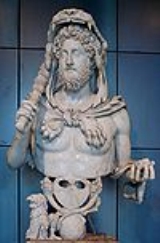
In opposition to the Senate, in his pronouncements and iconography Commodus had always laid stress on his unique status as a source of god-like power, liberality and physical prowess. Innumerable statues around the Empire were set up portraying him in the guise of Hercules
Hercules

Hercules is the Ancient Rome name for the mythical Ancient Greece hero Heracles, son of Zeus and the mortal Alcmene. Early Roman sources suggest that the imported Greek hero supplanted a mythic Italian shepherd called "Recaranus" or "Garanus", famous for his strength....
, reinforcing the image of him as a demigod, a physical giant, a protector and a battler against beasts and men (see "Commodus and Hercules" and "Commodus the Gladiator" below). Moreover as Hercules he could claim to be the son of Jupiter
Jupiter

Jupiter is the fifth planet from the Sun and the Solar system by size planet within the Solar System. It is two and a half times as massive as all of the other planets in our Solar System combined....
, the representative of the supreme god of the Roman pantheon
Pantheon (gods)

A pantheon is a set of all the gods of a particular polytheistic religion or mythology.Max Weber's 1922 opus, Economy and Society discusses the link between a pantheon of gods and the development of monotheism....
. These tendencies now increased to megalomaniac proportions. Far from celebrating his descent from Marcus Aurelius
Marcus Aurelius

Marcus Aurelius Antoninus Augustus was Roman Emperor from 161 to his death in 180. He was the last of the "Five Good Emperors", and is also considered one of the most important stoicism philosophy....
, the actual source of his power, he stressed his own personal uniqueness as the bringer of a new order, seeking to re-cast the Empire in his own image. During 191 the city of Rome was extensively damaged by a fire which raged for several days, during which many public buildings including the Temple of Pax, the Temple of Vesta and parts of the imperial palace were destroyed. Perhaps seeing this as an opportunity, early in 192 Commodus, declaring himself the new Romulus
Romulus

Romulus may refer to any of these articles:...
, ritually re-founded Rome, renaming the city Colonia Lucia Annia Commodiana. All the months were renamed to correspond exactly with his (now twelve) names: Lucius, Aelius, Aurelius, Commodus, Augustus, Herculeus, Romanus, Exsuperatorius, Amazonius, Invictus, Felix, Pius. The legions were renamed Commodianae, the fleet which imported grain from Africa was termed Alexandria Commodiana Togata, the Senate was entitled the Commodian Fortunate Senate, his palace and the Roman people themselves were all given the name Commodianus, and the day on which these reforms were decreed was to be called Dies Commodianus. Thus he presented himself as the fountainhead of the Empire and Roman life and religion. He also had the head of the Colossus of Nero
Colossus of Nero

The Colossus of Nero was an enormous gold statue that the Emperor Nero had erected in his image in the vestibule of the Domus Aurea, his palatial residence on the Palatine Hill....
 adjacent to the Colosseum
Colosseum

The Colosseum or Roman Coliseum, originally the Flavian Amphitheatre , is an elliptical amphitheatre in the center of the city of Rome, Italy, the largest ever built in the Roman Empire....
 replaced with his own portrait, gave it a club and placed a bronze lion at its feet to make it look like Hercules, and added an inscription boasting of being "the only left-handed fighter to conquer twelve times one thousand men".

Character and physical prowess


Character and motivations

Dio Cassius, a first-hand witness who had no reason to defend Commodus, describes him as "not naturally wicked but, on the contrary, as guiltless as any man that ever lived. His great simplicity, however, together with his cowardice, made him the slave of his companions, and it was through them that he at first, out of ignorance, missed the better life and then was led on into lustful and cruel habits, which soon became second nature." His recorded actions do tend to show a rejection of his father’s policies, his father’s advisers, and especially his father’s austere lifestyle, and an alienation from the surviving members of his family. Whether this was a wholesale psychological rejection of his father is not something that can be assessed at this distance in time. It seems likely, however, that he was brought up in an atmosphere of Stoic
Stoicism

Stoicism was a school of Hellenistic philosophy founded in Athens by Zeno of Citium in the early third century B.C. The stoics considered passionate emotions to be the result of errors in judgment, and that a Sage , or person of "moral and intellectual perfection," would not have such emotions....
 asceticism, which he rejected entirely upon his accession to sole rule. After repeated attempts on Commodus' life, Roman citizens were often killed for raising his ire. One such notable event was the attempted extermination of the house of the Quintilii. Condianus and Maximus were executed on the pretext that, while they weren't implicated in any plots, their wealth and talent would make them unhappy with the current state of affairs.

Changes of name

On his accession as sole ruler Commodus added the name Antoninus to his official nomenclature. In October 180 he changed his praenomen
Praenomen

In Roman naming conventions, the praenomen was the only name in which parents had some choice, roughly equivalent to the given name of today....
 from Lucius to Marcus, presumably in honour of his father. In 182 he took the title Pius and in 185 that of Felix. In 191 he restored his praenomen to Lucius and added the family name Aelius, apparently linking himself to Hadrian and Hadrian's adopted son Lucius Aelius Caesar, whose original name was also Commodus. Later that year he had dropped 'Antoninus' and adopted as his full style Lucius Aelius Aurelius Commodus Augustus Herculeus Romanus Exsuperatorius Amazonius Invictus Felix Pius (the order of some of these titles varies in the sources). Exsuperatorius (the supreme) was a title given to Jupiter, and Amazonius identified him again with Hercules. An inscribed altar from Dura-Europos
Dura-Europos

Hellenistic EraIt was founded in 303 BC by the Seleucid Empire on the intersection of an east-west trade route and the trade route along the Euphrates....
 on the Euphrates shows that Commodus's titles and the renaming of the months were disseminated to the furthest reaches of the Empire; moreover, that even auxiliary military units received the title Commodiana, and that Commodus claimed two additional titles: Pacator Orbis (pacifier of the world) and Dominus Noster (Our Lord). The latter eventually would be used as a conventional title by Roman Emperors, starting about a century later, but Commodus seems to have been the first to assume it.

Commodus and Hercules

Disdaining the more philosophic inclinations of his father, Commodus was extremely proud of his physical prowess. He was generally acknowledged to be extremely handsome. As mentioned above he ordered many statues to be made showing him dressed as Hercules
Hercules

Hercules is the Ancient Rome name for the mythical Ancient Greece hero Heracles, son of Zeus and the mortal Alcmene. Early Roman sources suggest that the imported Greek hero supplanted a mythic Italian shepherd called "Recaranus" or "Garanus", famous for his strength....
 with a lion's hide and a club. He thought of himself as the reincarnation of Hercules, frequently emulating the legendary hero's feats by appearing in the arena to fight a variety of wild animals. He was left-handed, and very proud of the fact. Cassius Dio and the writers of the Augustan History say that Commodus was a skilled archer, who could shoot the heads off ostriches in full gallop, and kill a panther
Black panther

A black panther is a black color variant of one of several species of larger Felidae which are known by the term panther in various parts of the world, and belong to the feline genus panthera which contains lions, tigers, leopards and jaguars....
 as it attacked a victim in the arena.

Commodus the gladiator

The emperor also had a passion for gladiator
Gladiator

A Gladiator was a slave, criminal or professional fighter in ancient Rome. Gladiators fought other gladiators, wild animals and condemned criminals, sometimes to the death, for the entertainment of Spectator sport in cities and towns of the Roman Republic and the Roman Empire, from the 3rd century BCE to the 5th century CE....
ial combat, which he took so far as to take to the arena
Arena

An arena is an enclosed area, often circular or oval-shaped, designed to showcase theater, musical performances, or sporting events. It is composed of a large open space surrounded on most or all sides by tiered seating for spectators....
 himself, dressed as a gladiator. This action was considered to be unusual conduct for an emperor by the people of Rome. The Roman people also found Commodus' naked gladiatorial combats to be disgraceful and disgusting. It was rumoured that he was actually the son, not of Marcus, but of a gladiator whom his mother Faustina had taken as a lover at the coastal resort of Caieta
Caieta

In Roman mythology, Caieta was the wet-nurse of Aeneas.*Virgil, Aeneid 7.1-4.The name is an etymological invention to explain the name of the city and gulf of Gaeta....
. In the arena Commodus always won, since his opponents always submitted to the emperor. Thus, these public fights would not end in a death. Privately, it was his custom to slay his practice opponents. For each appearance in the arena, he charged the city of Rome a million sesterces
Sestertius

The sestertius, or sesterce, was an Ancient Rome coin. During the Roman Republic it was a small, silver coin issued only on rare occasions....
, straining the Roman economy.

Commodus did raise the ire of many military officials in Rome for his Hercules persona in the arena. Often, wounded soldiers and amputees would be placed in the arena for Commodus to slay with a sword. Commodus' eccentric behaviour would not stop there. Citizens of Rome missing their feet through accident or illness were taken to the arena, where they were tethered together for Commodus to club to death while pretending they were giants. These acts may have contributed to his assassination.

Commodus was also known for fighting exotic animals in the arena, often to the horror of the Roman people. According to Gibbon, Commodus once killed 100 lions in a single day. Later, he decapitated a running ostrich with a specially designed dart and afterwards carried the bleeding head of the dead bird and his sword over to the section where the Senators sat and gesticulated as though they were next. On another occasion, Commodus killed three elephants on the floor of the arena by himself. Finally, Commodus killed a giraffe which was considered to be a strange and helpless beast.

The end of the reign (192)


In November 192, Commodus held Plebian Games in which he shot hundreds of animals with arrows and javelins every morning, and fought as a gladiator every afternoon, naturally winning all the bouts. In December he announced his intention to inaugurate the year 193 as both consul and gladiator on 1 January.

At this point the prefect Laetus formed a conspiracy with Eclectus to supplant Commodus with Pertinax, taking Marcia into their confidence. On 31 December Marcia poisoned his food, but he vomited up the poison and the conspirators therefore sent the wrestler Narcissus
Narcissus (murderer)

Narcissus was a ancient Rome athlete, likely a wrestler, from the 2nd century A.D. He is best known to history as the assassin of the Roman Emperor Commodus, by whom he was employed as a wrestling partner, and personal trainer in order to train Commodus for his self-indulgent appearances in the Colosseum as a gladiator....
 to strangle him in his bath. Upon his death, the Senate declared him a public enemy (a de facto damnatio memoriae
Damnatio memoriae

Damnatio memoriae is the Latin language literally meaning "damnation of memory", in the sense of removed from the remembrance. It was a form of dishonor that could be passed by the Roman Senate upon treachery or others who brought discredit to the Roman State....
) and restored the original name to the city of Rome and its institutions. Commodus' statues were thrown down. His body was buried in the Mausoleum of Hadrian. However, in 195, the emperor Septimius Severus
Septimius Severus

Lucius Septimius Severus was a Roman Empire general, and Roman Emperor from April 14 193 to 211. He was born in what is now the Libyan part of Rome's historic Africa Province, making him the first emperor to be born in the Roman province of Africa Province....
, trying to gain favour with the family of Marcus Aurelius, rehabilitated Commodus's memory and had the Senate deify him.

Commodus was succeeded by Pertinax
Pertinax

Publius Helvius Pertinax, commonly known as Pertinax , was a Roman emperor who briefly reigned from December 31 192 until his death on March 28 193....
, whose reign was short lived, being the first to fall victim to the Year of the Five Emperors
Year of the Five Emperors

The Year of the Five Emperors refers to 193, in which there were five claimants for the title of Roman Emperor.The year 193 opened with the murder of Commodus on New Year's Eve, 31 December 192 and the proclamation of the City Prefect Pertinax as Emperor on New Year's Day, 1 January 193....
. Commodus's death marked the end of the Nervan-Antonian dynasty
Nervan-Antonian dynasty

Nervan-Antonian dynasty is a dynasty of six loosely connected Roman Emperors, who ruled over the Roman Empire for almost the whole 2nd century ....
.

Commodus in popular culture


Film

  • In 1964's The Fall of the Roman Empire, he is portrayed by Christopher Plummer
    Christopher Plummer

    Arthur Christopher Orme Plummer, Order of Canada is a Canadian theater, film and television acting. In a career that spans over five decades and includes substantial roles in film, television, and theater, Plummer is perhaps best known for the iconic role of Georg Ludwig von Trapp in The Sound of Music ....
    .
  • In 2000's Academy Award-winner for Best Picture, Gladiator
    Gladiator (2000 film)

    Gladiator is a 2000 in film epic film directed by Ridley Scott, starring Russell Crowe, Joaquin Phoenix, Connie Nielsen, Oliver Reed, Djimon Hounsou, Derek Jacobi, and Richard Harris....
    , he is portrayed by Joaquin Phoenix
    Joaquin Phoenix

    Joaquin Rafael Phoenix , formerly credited as "Leaf Phoenix", is a Puerto Rico film actor, musician, and occasional rapper. Born in Puerto Rico, he was raised in the continental United States, Mexico, and South America, due to his family's nomadic lifestyle....
    .


Both films are fictional works and do not depict actual history.

Other

  • British adventure writer Talbot Mundy's novel Caesar Dies deals with Commodus' murder and events leading up to it.
  • The video game Colosseum: Road to Freedom
    Colosseum: Road to Freedom

    Colosseum: Road to Freedom is a video game for the Sony Computer Entertainment PlayStation 2 video game console. It is a hybrid Fighting game/Role-Playing Game game loosely based on the Roman Empire around the time of the Commodus....
     included Commodus as an opponent in the Colosseum.
  • Along with other contemporary figures, Commodus also features prominently in the historically authentic MMORPG
    MMORPG

    A massively multiplayer online role-playing game is a genre of computer role-playing games in which a large number of player interact with one another in a virtual world....
     Roma Victor
    Roma Victor

    Roma Victor is a MMORPG based on the Roman Empire in Britain in the latter half of the second century AD. Roma Victor is developed by RedBedlam Ltd....
    , which is set in the 180s.


Ancestors

Commodus' ancestors in three generations
Commodus Father:
Marcus Aurelius
Marcus Aurelius

Marcus Aurelius Antoninus Augustus was Roman Emperor from 161 to his death in 180. He was the last of the "Five Good Emperors", and is also considered one of the most important stoicism philosophy....
Paternal Grandfather:
Marcus Annius Verus
Paternal Great-grandfather:
Marcus Annius Verus
Marcus Annius Verus

Marcus Annius Verus was a Ancient Rome man who lived in the 1st century and 2nd century. He was the son of an elder Annius Verus, who gained the rank of senator and praetor....
Paternal Great-grandmother:
Rupilia Faustina
Rupilia

Rupilia Faustina was a Roman woman. She was daughter to Salonina Matidia from her third marriage to Lucius Scribonius Libo Rupilio Frugi Bonus consul of 88, who died in 101....
Paternal Grandmother:
Domitia Lucilla
Domitia Lucilla

Domitia Lucilla, Lucilla or Domitia Calvilla was a noble Roman woman who lived in the 2nd century. She is famous as the mother of the future emperor Marcus Aurelius, and also as the patron of another future emperor, Didius Julianus....
Paternal Great-grandfather:
Tullus Domitius Calvisius
Paternal Great-grandmother:
Catilia
Mother:
Faustina the Younger

Annia Galeria Faustina Minor , Faustina Minor or Faustina the Younger was a daughter of Roman Emperor Antoninus Pius and Roman Empress Faustina the Elder....
Maternal Grandfather:
Antoninus Pius
Antoninus Pius

Titus Aurelius Fulvus Boionius Arrius Antoninus , generally known in English as Antoninus Pius was Roman Emperors from 138 to 161. He was the fourth of the Five Good Emperors and a member of the Aurelii....
Maternal Great-grandfather:
Titus Aurelius Fulvus

In the 1st century there were two men with the name Titus Aurelius Fulvus. One was the paternal grandfather and the other the father to the Names of the Greeks Emperor Antoninus Pius....
Maternal Great-grandmother:
Arria Fadilla
Maternal Grandmother:
Faustina the Elder
Faustina the Elder

Annia Galeria Faustina, more familiarly referred to as Faustina the Elder , was a Roman Empress and wife of Roman Emperor Antoninus Pius....
Maternal Great-grandfather:
Marcus Annius Verus
Marcus Annius Verus

Marcus Annius Verus was a Ancient Rome man who lived in the 1st century and 2nd century. He was the son of an elder Annius Verus, who gained the rank of senator and praetor....
Maternal Great-grandmother:
Rupilia Faustina
Rupilia

Rupilia Faustina was a Roman woman. She was daughter to Salonina Matidia from her third marriage to Lucius Scribonius Libo Rupilio Frugi Bonus consul of 88, who died in 101....


External links