
The
Crusades were a series of
religious warsA religious war; Latin: bellum sacrum; is a war caused by, or justified by, religious differences. It can involve one state with an established religion against another state with a different religion or a different sect within the same religion, or a religiously motivated group attempting to...
, blessed by the
PopeThe Pope is the Bishop of Rome, a position that makes him the leader of the worldwide Catholic Church . In the Catholic Church, the Pope is regarded as the successor of Saint Peter, the Apostle...
and the Catholic Church with the main goal of restoring Christian access to the holy places in and near
Jerusalem. The Crusades were originally launched in response to a call from the leaders of the
Byzantine EmpireThe Byzantine Empire was the Eastern Roman Empire during the periods of Late Antiquity and the Middle Ages, centred on the capital of Constantinople. Known simply as the Roman Empire or Romania to its inhabitants and neighbours, the Empire was the direct continuation of the Ancient Roman State...
for help to fight Muslim Seljuk Turks expansion into
AnatoliaAnatolia is a geographic and historical term denoting the westernmost protrusion of Asia, comprising the majority of the Republic of Turkey...
; these Turks had cut off access to Jerusalem. The crusaders comprised military units from all over western Europe, and were not under unified command. The main series of Crusades occurred between 1095 and 1291; historians have given them numbers, later unnumbered crusades were also taken up for a variety of reasons. The Crusades were fought by Roman Catholics primarily against
MuslimA Muslim, also spelled Moslem, is an adherent of Islam, a monotheistic, Abrahamic religion based on the Quran, which Muslims consider the verbatim word of God as revealed to prophet Muhammad. "Muslim" is the Arabic term for "submitter" .Muslims believe that God is one and incomparable...
s. After some early successes, the later crusades failed and the crusaders were defeated and forced to return home.
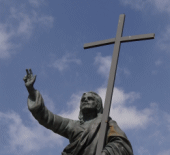
Several hundred thousand soldiers became Crusaders by taking vows; the Pope granted them plenary indulgence. Their emblem was the cross--"crusade" is derived from the French term for taking up the cross. Many were from France and called themselves "Franks," which became the common term used by Muslims.
The term "crusade" is also used to describe religiously motivated campaigns conducted between 1100 and 1600 in territories outside the
LevantThe Levant or ) is the geographic region and culture zone of the "eastern Mediterranean littoral between Anatolia and Egypt" . The Levant includes most of modern Lebanon, Syria, Jordan, Israel, the Palestinian territories, and sometimes parts of Turkey and Iraq, and corresponds roughly to the...
usually against pagans, heretics, and peoples under the ban of
excommunicationExcommunication is a religious censure used to deprive, suspend or limit membership in a religious community. The word means putting [someone] out of communion. In some religions, excommunication includes spiritual condemnation of the member or group...
for a mixture of religious, economic, and political reasons. Rivalries among both Christian and Muslim powers led also to alliances between religious factions against their opponents, such as the Christian alliance with the
Sultanate of RûmThe Sultanate of Rum , also known as the Anatolian Seljuk State , was a Turkic state centered in in Anatolia, with capitals first at İznik and then at Konya. Since the court of the sultanate was highly mobile, cities like Kayseri and Sivas also functioned at times as capitals...
during the
Fifth CrusadeThe Fifth Crusade was an attempt to reacquire Jerusalem and the rest of the Holy Land by first conquering the powerful Ayyubid state in Egypt....
.
The Crusades had major far-reaching political, economic, and social impacts on western Europe, and as well ruined the Byzantine Empire.
The
ReconquistaThe Reconquista was a period of almost 800 years in the Middle Ages during which several Christian kingdoms succeeded in retaking the Muslim-controlled areas of the Iberian Peninsula broadly known as Al-Andalus...
, a long period of wars in Spain (
IberiaThe name Iberia refers to three historical regions of the old world:* Iberian Peninsula, in Southwest Europe, location of modern-day Portugal and Spain** Prehistoric Iberia...
) where Christian forces reconquered the peninsula from Muslims, is closely tied to the Crusades.
Background
Middle Eastern situation
The Holy Land is significant in Christianity because of the land's association as the place of
nativityThe Nativity of Jesus, or simply The Nativity, refers to the accounts of the birth of Jesus in two of the Canonical gospels and in various apocryphal texts....
, ministry,
crucifixionCrucifixion is an ancient method of painful execution in which the condemned person is tied or nailed to a large wooden cross and left to hang until dead...
and
resurrection of JesusThe Christian belief in the resurrection of Jesus states that Jesus returned to bodily life on the third day following his death by crucifixion. It is a key element of Christian faith and theology and part of the Nicene Creed: "On the third day he rose again in fulfillment of the Scriptures"...
, whom Christians regard as the Saviour or
MessiahA messiah is a redeemer figure expected or foretold in one form or another by a religion. Slightly more widely, a messiah is any redeemer figure. Messianic beliefs or theories generally relate to eschatological improvement of the state of humanity or the world, in other words the World to...
. By the end of the 4th century, following the Roman Emperor Constantine's conversion to Christianity (313) and later the founding of the
Byzantine EmpireThe Byzantine Empire was the Eastern Roman Empire during the periods of Late Antiquity and the Middle Ages, centred on the capital of Constantinople. Known simply as the Roman Empire or Romania to its inhabitants and neighbours, the Empire was the direct continuation of the Ancient Roman State...
after the partition of the
Roman EmpireThe Roman Empire was the post-Republican period of the ancient Roman civilization, characterised by an autocratic form of government and large territorial holdings in Europe and around the Mediterranean....
, the Holy Land had become a predominantly Christian region. Churches commemorating various events in the life of Jesus had been erected at key sites.
Jerusalem in particular holds a significance in Islam as it holds it to be the site of the ascension into
heavenHeaven, the Heavens or Seven Heavens, is a common religious cosmological or metaphysical term for the physical or transcendent place from which heavenly beings originate, are enthroned or inhabit...
of the
prophetIn religion, a prophet, from the Greek word προφήτης profitis meaning "foreteller", is an individual who is claimed to have been contacted by the supernatural or the divine, and serves as an intermediary with humanity, delivering this newfound knowledge from the supernatural entity to other people...
MuhammadMuhammad |ligature]] at U+FDF4 ;Arabic pronunciation varies regionally; the first vowel ranges from ~~; the second and the last vowel: ~~~. There are dialects which have no stress. In Egypt, it is pronounced not in religious contexts...
whom Muslims believe to be the foremost prophet of
AllahAllah is a word for God used in the context of Islam. In Arabic, the word means simply "God". It is used primarily by Muslims and Bahá'ís, and often, albeit not exclusively, used by Arabic-speaking Eastern Catholic Christians, Maltese Roman Catholics, Eastern Orthodox Christians, Mizrahi Jews and...
and Jerusalem is often regarded as the third most sacred site in Islam. The Muslim presence in the Holy Land began with the initial
Muslim conquest of SyriaThe Muslim conquest of Syria occurred in the first half of the 7th century, and refers to the region known as the Bilad al-Sham, the Levant, or Greater Syria...
in the 7th century under the Rashidun
CaliphThe Caliph is the head of state in a Caliphate, and the title for the ruler of the Islamic Ummah, an Islamic community ruled by the Shari'ah. It is a transcribed version of the Arabic word which means "successor" or "representative"...
s. The Muslim armies' successes put increasing pressure on the Eastern Orthodox Byzantine Empire which had originally claimed the region (part of the Eastern Roman Empire which the Byzantines inherited) as their territory – this included eventual incursions by the
SeljukThe Great Seljuq Empire was a medieval Persianate, Turko-Persian Sunni Muslim empire, originating from the Qynyq branch of Oghuz Turks. The Seljuq Empire controlled a vast area stretching from the Hindu Kush to eastern Anatolia and from Central Asia to the Persian Gulf...
Turks.
Jerusalem also holds historical and religious importance for Jews as both the ancient capital of their ancestral home and the site of the
Western WallThe Western Wall, Wailing Wall or Kotel is located in the Old City of Jerusalem at the foot of the western side of the Temple Mount...
, the last standing part of the
Second TempleThe Jewish Second Temple was an important shrine which stood on the Temple Mount in Jerusalem between 516 BCE and 70 CE. It replaced the First Temple which was destroyed in 586 BCE, when the Jewish nation was exiled to Babylon...
, the most sacred site in Judaism. Jews consider Jerusalem as their ancestral homeland, and had been visiting the city since its destruction in 70 CE and its
occupationAelia Capitolina was a city built by the emperor Hadrian, and occupied by a Roman colony, on the site of Jerusalem, which was in ruins since 70 AD, leading in part to the Bar Kokhba revolt of 132–136.-Politics:...
in AD 136.
Another factor that contributed to the change in Western attitudes towards the East came in the year 1009, when the Fatimid Caliph
al-Hakim bi-Amr AllahAbu ‘Ali Mansur Tāriqu l-Ḥākim, called Al-Hakim bi Amr al-Lāh , was the sixth Fatimid caliph and 16th Ismaili imam .- History :...
ordered the destruction of the
Church of the Holy SepulchreThe Church of the Holy Sepulchre, also called the Church of the Resurrection by Eastern Christians, is a church within the walled Old City of Jerusalem. It is a few steps away from the Muristan....
. In 1039 his successor, after requiring large sums be paid for the right, permitted the Byzantine Empire to rebuild it. Pilgrimages were allowed to the Holy Lands before and after the Sepulchre was rebuilt. The Muslims eventually realized that much of the wealth of Jerusalem came from the pilgrims; for this reason and others, the persecution of pilgrims eventually stopped. However, the damage was already done, and the violence of the Seljuk Turks became part of the concern that spread support for the Crusades across the Christian world.
Western European situation
The origins of the Crusades were the Christian response to the
Islamic invasion of Gaul (France)The Islamic invasion of Gaul followed the invasion of Spain by the Muslim Commander Tariq ibn Ziyad in 711. During the 8th century Arab and Berber armies invaded Southern France, as far as Poitiers and the Rhône valley as far as Avignon, Lyon, Autun, until the turning point of the Battle of Tours...
earlier in the
Middle AgesThe Middle Ages is a periodization of European history from the 5th century to the 15th century. The Middle Ages follows the fall of the Western Roman Empire in 476 and precedes the Early Modern Era. It is the middle period of a three-period division of Western history: Classic, Medieval and Modern...
, as well as the deterioration of the
Byzantine EmpireThe Byzantine Empire was the Eastern Roman Empire during the periods of Late Antiquity and the Middle Ages, centred on the capital of Constantinople. Known simply as the Roman Empire or Romania to its inhabitants and neighbours, the Empire was the direct continuation of the Ancient Roman State...
caused by a new wave of Turkish Muslim attacks. In 1063,
Pope Alexander IIPope Alexander II , born Anselmo da Baggio, was Pope from 1061 to 1073.He was born in Milan. As bishop of Lucca he had been an energetic coadjutor with Hildebrand of Sovana in endeavouring to suppress simony, and to enforce the celibacy of the clergy...
had given his blessing to Iberian Christians in their wars against the Muslims, granting both a papal standard (the
vexillum sancti Petri) and an
indulgenceIn Catholic theology, an indulgence is the full or partial remission of temporal punishment due for sins which have already been forgiven. The indulgence is granted by the Catholic Church after the sinner has confessed and received absolution...
to those who were killed in battle. Pleas from the Byzantine Emperors, now threatened by the Seljuks. In 1074, Emperor
Michael VIIMichael VII Doukas or Ducas , nicknamed Parapinakēs , was Byzantine emperor from 1071 to 1078.- Life :...
to
Pope Gregory VIIPope St. Gregory VII , born Hildebrand of Sovana , was Pope from April 22, 1073, until his death. One of the great reforming popes, he is perhaps best known for the part he played in the Investiture Controversy, his dispute with Henry IV, Holy Roman Emperor affirming the primacy of the papal...
and in 1095, from Emperor
Alexios I KomnenosAlexios I Komnenos, Latinized as Alexius I Comnenus , was Byzantine emperor from 1081 to 1118, and although he was not the founder of the Komnenian dynasty, it was during his reign that the Komnenos family came to full power. The title 'Nobilissimus' was given to senior army commanders,...
to
Pope Urban II Pope Urban II , born Otho de Lagery , was Pope from 12 March 1088 until his death on July 29 1099...
blessed Christian armies who fought to reclaim lands lost to Muslim invaders in previous centuries.
The Crusades were, in part, an outlet for an intense religious piety which rose up in the late 11th century among the lay public. A crusader would, after pronouncing a solemn vow, receive a cross from the hands of the pope or his
legateA papal legate – from the Latin, authentic Roman title Legatus – is a personal representative of the pope to foreign nations, or to some part of the Catholic Church. He is empowered on matters of Catholic Faith and for the settlement of ecclesiastical matters....
s, and was thenceforth considered a "soldier of the Church". This was partly because of the
Investiture ControversyThe Investiture Controversy or Investiture Contest was the most significant conflict between Church and state in medieval Europe. In the 11th and 12th centuries, a series of Popes challenged the authority of European monarchies over control of appointments, or investitures, of church officials such...
, which had started around 1075 and was still on-going during the First Crusade.
As both sides of the Investiture Controversy tried to marshal public opinion in their favor, people became personally engaged in a dramatic religious controversy. The result was an awakening of intense Christian piety and public interest in religious affairs, and was further strengthened by religious propaganda, which advocated
Just WarJust war theory is a doctrine of military ethics of Roman philosophical and Catholic origin, studied by moral theologians, ethicists and international policy makers, which holds that a conflict ought to meet philosophical, religious or political criteria.-Origins:The concept of justification for...
in order to retake the Holy Land from the Muslims. The Holy Land included Jerusalem (where the death and resurrection of Jesus had taken place according to Christian history and the Bible) and
AntiochAntioch on the Orontes was an ancient city on the eastern side of the Orontes River. It is near the modern city of Antakya, Turkey.Founded near the end of the 4th century BC by Seleucus I Nicator, one of Alexander the Great's generals, Antioch eventually rivaled Alexandria as the chief city of the...
(the first Christian city). Further, the remission of sin was a driving factor and provided any God-fearing man who had committed sins with an irresistible way out of eternal damnation in hell.
It was a hotly debated issue throughout the Crusades as what exactly "remission of sin" meant. Most believed that by retaking Jerusalem they would go straight to heaven after death. However, much controversy surrounds exactly what was promised by the popes of the time. One theory was that one had to die fighting for Jerusalem for the remission to apply, which would hew more closely to what
Pope Urban II Pope Urban II , born Otho de Lagery , was Pope from 12 March 1088 until his death on July 29 1099...
said in his speeches. This meant that if the crusaders were successful, and retook Jerusalem, the survivors would not be given remission.
Reconquista in the Iberian Peninsula
When the First Crusade was preached in 1095, the Christian princes of northern Iberia had been fighting their way out of the mountains of
GaliciaThe Kingdom of Galicia was a political entity located in southwestern Europe, which at its territorial zenith occupied the entire northwest of the Iberian Peninsula. Founded by Suebic king Hermeric in the year 409, the Galician capital was established in Braga, being the first kingdom which...
and
AsturiasThe Principality of Asturias is an autonomous community of the Kingdom of Spain, coextensive with the former Kingdom of Asturias in the Middle Ages...
, the Basque Country and
NavarreThe Kingdom of Navarre , originally the Kingdom of Pamplona, was a European kingdom which occupied lands on either side of the Pyrenees alongside the Atlantic Ocean....
, with increasing success, for about a hundred years. The fall of Moorish
ToledoToledo's Alcázar became renowned in the 19th and 20th centuries as a military academy. At the outbreak of the Spanish Civil War in 1936 its garrison was famously besieged by Republican forces.-Economy:...
to the
Kingdom of LeónThe Kingdom of León was an independent kingdom situated in the northwest region of the Iberian Peninsula. It was founded in AD 910 when the Christian princes of Asturias along the northern coast of the peninsula shifted their capital from Oviedo to the city of León...
in 1085 was a major victory, but the turning points of the
ReconquistaThe Reconquista was a period of almost 800 years in the Middle Ages during which several Christian kingdoms succeeded in retaking the Muslim-controlled areas of the Iberian Peninsula broadly known as Al-Andalus...
still lay in the future. The disunity of Muslim emirs was an essential factor.
While the
Reconquista was the most prominent example of European reactions against
Muslim conquestsMuslim conquests also referred to as the Islamic conquests or Arab conquests, began with the Islamic prophet Muhammad. He established a new unified polity in the Arabian Peninsula which under the subsequent Rashidun and Umayyad Caliphates saw a century of rapid expansion of Muslim power.They...
, it is not the only such example. The
NormanThe Normans were the people who gave their name to Normandy, a region in northern France. They were descended from Norse Viking conquerors of the territory and the native population of Frankish and Gallo-Roman stock...
adventurer
Robert GuiscardRobert d'Hauteville, known as Guiscard, Duke of Apulia and Calabria, from Latin Viscardus and Old French Viscart, often rendered the Resourceful, the Cunning, the Wily, the Fox, or the Weasel was a Norman adventurer conspicuous in the conquest of southern Italy and Sicily...
had conquered
CalabriaCalabria , in antiquity known as Bruttium, is a region in southern Italy, south of Naples, located at the "toe" of the Italian Peninsula. The capital city of Calabria is Catanzaro....
in 1057 and was holding what had traditionally been Byzantine territory against the Muslims of
SicilySicily is a region of Italy, and is the largest island in the Mediterranean Sea. Along with the surrounding minor islands, it constitutes an autonomous region of Italy, the Regione Autonoma Siciliana Sicily has a rich and unique culture, especially with regard to the arts, music, literature,...
. The maritime states of
PisaPisa is a city in Tuscany, Central Italy, on the right bank of the mouth of the River Arno on the Tyrrhenian Sea. It is the capital city of the Province of Pisa...
,
GenoaGenoa |Ligurian]] Zena ; Latin and, archaically, English Genua) is a city and an important seaport in northern Italy, the capital of the Province of Genoa and of the region of Liguria....
and
CataloniaCatalonia is an autonomous community in northeastern Spain, with the official status of a "nationality" of Spain. Catalonia comprises four provinces: Barcelona, Girona, Lleida, and Tarragona. Its capital and largest city is Barcelona. Catalonia covers an area of 32,114 km² and has an...
were all actively fighting Islamic strongholds in Majorca, freeing the coasts of Italy and Catalonia from Muslim raids. Much earlier, the Christian homelands of
SyriaSyria , officially the Syrian Arab Republic , is a country in Western Asia, bordering Lebanon and the Mediterranean Sea to the West, Turkey to the north, Iraq to the east, Jordan to the south, and Israel to the southwest....
,
LebanonLebanon , officially the Republic of LebanonRepublic of Lebanon is the most common term used by Lebanese government agencies. The term Lebanese Republic, a literal translation of the official Arabic and French names that is not used in today's world. Arabic is the most common language spoken among...
, Palestine,
EgyptEgypt , officially the Arab Republic of Egypt, Arabic: , is a country mainly in North Africa, with the Sinai Peninsula forming a land bridge in Southwest Asia. Egypt is thus a transcontinental country, and a major power in Africa, the Mediterranean Basin, the Middle East and the Muslim world...
, and so on had been conquered by Muslim armies. This long history of losing territories to a religious enemy created a powerful motive to respond to Byzantine Emperor Alexius I's call for holy war to defend Christendom, and to recapture the lost lands starting with Jerusalem.
Just war doctrine
The papacy of
Pope Gregory VIIPope St. Gregory VII , born Hildebrand of Sovana , was Pope from April 22, 1073, until his death. One of the great reforming popes, he is perhaps best known for the part he played in the Investiture Controversy, his dispute with Henry IV, Holy Roman Emperor affirming the primacy of the papal...
had struggled with reservations about the doctrinal validity of a holy war and the shedding of blood for the Lord and had, with difficulty, resolved the question in favour of justified violence. More importantly to the Pope, the Christians who made pilgrimages to the Holy Land were being persecuted. Saint
Augustine of HippoAugustine of Hippo , also known as Augustine, St. Augustine, St. Austin, St. Augoustinos, Blessed Augustine, or St. Augustine the Blessed, was Bishop of Hippo Regius . He was a Latin-speaking philosopher and theologian who lived in the Roman Africa Province...
, Gregory's intellectual model, had justified the use of force in the service of Christ in
The City of God, and a Christian "
Just WarJust war theory is a doctrine of military ethics of Roman philosophical and Catholic origin, studied by moral theologians, ethicists and international policy makers, which holds that a conflict ought to meet philosophical, religious or political criteria.-Origins:The concept of justification for...
" might enhance the wider standing of an aggressively ambitious leader of Europe, as Gregory saw himself.
The northerners would be cemented to Rome, and their troublesome knights could see the only kind of action that suited them. Previous attempts by the church to stem such violence, such as the concept of the "Peace of God", were not as successful as hoped. To the south of Rome, Normans were showing how such energies might be unleashed against both Arabs (in Sicily) and Byzantines (on the mainland). A Latin hegemony in the
LevantThe Levant or ) is the geographic region and culture zone of the "eastern Mediterranean littoral between Anatolia and Egypt" . The Levant includes most of modern Lebanon, Syria, Jordan, Israel, the Palestinian territories, and sometimes parts of Turkey and Iraq, and corresponds roughly to the...
would provide leverage in resolving the Papacy's claims of supremacy over the
Patriarch of ConstantinopleThe Ecumenical Patriarch is the Archbishop of Constantinople – New Rome – ranking as primus inter pares in the Eastern Orthodox communion, which is seen by followers as the One, Holy, Catholic, and Apostolic Church....
, which had resulted in the
Great SchismThe East–West Schism of 1054, sometimes known as the Great Schism, formally divided the State church of the Roman Empire into Eastern and Western branches, which later became known as the Eastern Orthodox Church and the Roman Catholic Church, respectively...
of 1054, a rift that might yet be resolved through the force of Frankish arms.
Byzantine weakness
In the Byzantine homelands, the Eastern Emperor's weakness was revealed by the stinging defeat at the
Battle of ManzikertThe Battle of Manzikert , was fought between the Byzantine Empire and Seljuq Turks led by Alp Arslan on August 26, 1071 near Manzikert...
in 1071, which reduced the Empire's Asian territory to a region in western Anatolia and around
ConstantinopleConstantinople was the capital of the Roman, Eastern Roman, Byzantine, Latin, and Ottoman Empires. Throughout most of the Middle Ages, Constantinople was Europe's largest and wealthiest city.-Names:...
. The Empire was on the verge of collapse, with its treasury bankrupt, its armies poorly deployed, and its aged emperor ineffective. A sure sign of Byzantine desperation was the appeal of
Alexios IAlexios I Komnenos, Latinized as Alexius I Comnenus , was Byzantine emperor from 1081 to 1118, and although he was not the founder of the Komnenian dynasty, it was during his reign that the Komnenos family came to full power. The title 'Nobilissimus' was given to senior army commanders,...
to his enemy, the Pope, for aid. But Gregory was occupied with the
Investiture ControversyThe Investiture Controversy or Investiture Contest was the most significant conflict between Church and state in medieval Europe. In the 11th and 12th centuries, a series of Popes challenged the authority of European monarchies over control of appointments, or investitures, of church officials such...
and could not call on the German emperor, so a crusade never took shape.
For Gregory's more moderate successor,
Pope Urban II Pope Urban II , born Otho de Lagery , was Pope from 12 March 1088 until his death on July 29 1099...
, a crusade would serve to reunite Christendom, bolster the Papacy, and perhaps bring the East under his control. The disaffected Germans and the Normans were not to be counted on, but the heart and backbone of a crusade could be found in Urban's own homeland among the northern French.
Pope Urban II
The immediate cause of the First Crusade was the Byzantine emperor
Alexios IAlexios I Komnenos, Latinized as Alexius I Comnenus , was Byzantine emperor from 1081 to 1118, and although he was not the founder of the Komnenian dynasty, it was during his reign that the Komnenos family came to full power. The title 'Nobilissimus' was given to senior army commanders,...
's appeal to
Pope Urban II Pope Urban II , born Otho de Lagery , was Pope from 12 March 1088 until his death on July 29 1099...
for mercenaries to help him resist Muslim advances into territory of the Byzantine Empire. In 1071, at the
Battle of ManzikertThe Battle of Manzikert , was fought between the Byzantine Empire and Seljuq Turks led by Alp Arslan on August 26, 1071 near Manzikert...
, the Byzantine Empire was defeated, which led to the loss of all of Asia Minor (modern Turkey) save the coastlands. Although attempts at reconciliation after the
East–West SchismThe East–West Schism of 1054, sometimes known as the Great Schism, formally divided the State church of the Roman Empire into Eastern and Western branches, which later became known as the Eastern Orthodox Church and the Roman Catholic Church, respectively...
between the Catholic Church in western Europe and the
Eastern Orthodox ChurchThe Orthodox Church, officially called the Orthodox Catholic Church and commonly referred to as the Eastern Orthodox Church, is the second largest Christian denomination in the world, with an estimated 300 million adherents mainly in the countries of Belarus, Bulgaria, Cyprus, Georgia, Greece,...
had failed, Alexius I hoped for a positive response from Urban II.
Pope Urban II defined and launched the crusades at the
Council of ClermontThe Council of Clermont was a mixed synod of ecclesiastics and laymen of the Catholic Church, which was held from November 18 to November 28, 1095 at Clermont, France...
in 1095. He was a reformer worried about the evils which had hindered the spiritual success of the church and its clergy and the need for a revival of religiosity. He was moved by the urgent appeal for help from Byzantine Emperor Alexius I. Urban's solution was announced on the last day of the council when the pope suddenly proclaimed the Crusade against the infidel Muslims. He called for Christian princes across Europe to launch a holy war in the Holy Land. He contrasted the sanctity of Jerusalem and the holy places with the plunder and desecration by the infidel Turks. He caused outrage by vividly describing attacks upon the Christian pilgrims. He also noted the military threat to the fellow Christians of Byzantium. He charged Christians to take up the holy cause, promising to all those who went remission of sins and to all who died in the expedition immediate entry into heaven.
Then Urban raised secular motives, talking of the feudal love of tournaments and warfare. He urged the barons to give up their fratricidal and unrighteous wars in the West for the holy war in the East. He also suggested material rewards, regarding feudal fiefdoms, land ownership, wealth, power, and prestige, all at the expense of the Arabs and Turks. He said they could be defeated very easily by the Christian forces. When he finished, his listeners shouted "Deus volt" (God wills it). This became the battle cry of the crusaders. Urban put the bishop of Le Puy in charge of encouraging prelates and priests to join the cause. Word spread rapidly that war against unbelief would be fused with the practice of pilgrimage to holy sites, and the pilgrims' reward would be great on earth, as in heaven. Immediately thousands pledged themselves to go on the first crusade.Pope Urban's speech ranks as one of the most influential speeches ever made: it launched the holy wars which occupied the minds and forces of western Europe for two hundred years.
After the First Crusade
On a popular level, the first crusades unleashed a wave of impassioned, personally felt pious Christian fury that was expressed in the massacres of
JewsThe Jews , also known as the Jewish people, are a nation and ethnoreligious group originating in the Israelites or Hebrews of the Ancient Near East. The Jewish ethnicity, nationality, and religion are strongly interrelated, as Judaism is the traditional faith of the Jewish nation...
that accompanied the movement of the Crusader mobs through Europe, as well as the violent treatment of "
schismA schism , from Greek σχίσμα, skhísma , is a division between people, usually belonging to an organization or movement religious denomination. The word is most frequently applied to a break of communion between two sections of Christianity that were previously a single body, or to a division within...
atic" Orthodox Christians of the east.
In the 13th century, Crusades never expressed such a popular fever, and after
AcreThe Siege of Acre took place in 1291 and resulted in the loss of the Crusader-controlled city of Acre to the Muslims. It is considered one of the most important battles of the time period. Although the crusading movement continued for several more centuries, the capture of the city marked the end...
fell for the last time in 1291 and the
OccitanOccitania , also sometimes lo País d'Òc, "the Oc Country"), is the region in southern Europe where Occitan was historically the main language spoken, and where it is sometimes still used, for the most part as a second language...
CatharCatharism was a name given to a Christian religious sect with dualistic and gnostic elements that appeared in the Languedoc region of France and other parts of Europe in the 11th century and flourished in the 12th and 13th centuries...
s were exterminated during the
Albigensian CrusadeThe Albigensian Crusade or Cathar Crusade was a 20-year military campaign initiated by the Catholic Church to eliminate Catharism in Languedoc...
, the crusading ideal became devalued by Papal justifications of political and territorial aggressions within Catholic Europe.
The last crusading order of knights to hold territory were the
Knights HospitallerThe Sovereign Military Hospitaller Order of Saint John of Jerusalem of Rhodes and of Malta , also known as the Sovereign Military Order of Malta , Order of Malta or Knights of Malta, is a Roman Catholic lay religious order, traditionally of military, chivalrous, noble nature. It is the world's...
. After the final fall of Acre, they took control of the island of
RhodesRhodes is an island in Greece, located in the eastern Aegean Sea. It is the largest of the Dodecanese islands in terms of both land area and population, with a population of 117,007, and also the island group's historical capital. Administratively the island forms a separate municipality within...
, and in the 16th century, were driven to
MaltaMalta , officially known as the Republic of Malta , is a Southern European country consisting of an archipelago situated in the centre of the Mediterranean, south of Sicily, east of Tunisia and north of Libya, with Gibraltar to the west and Alexandria to the east.Malta covers just over in...
, before being finally unseated by
Napoleon BonaparteNapoleon Bonaparte was a French military and political leader during the latter stages of the French Revolution.As Napoleon I, he was Emperor of the French from 1804 to 1815...
in 1798.
List
A traditional numbering scheme for the crusades totals nine during the 11th to 13th centuries. This division is arbitrary and excludes many important expeditions, among them those of the 14th, 15th, and 16th centuries. In reality, the crusades continued until the end of the 17th century, the
Battle of LepantoThe Battle of Lepanto normally refers to the 1571 Holy League victory over the Ottoman fleet. There were also three earlier battles fought in the vicinity of Lepanto:*Battle of Naupactus in 429 BC, an Athenian victory during the Peleoponnesian War...
occurring in 1571, that of Hungary in 1664, and the crusade to
CandiaThe Siege of Candia was a military conflict in which Ottoman forces besieged the Venetian-ruled city and were ultimately victorious. Lasting from 1648 to 1669, it was the longest siege in history.-Background:...
in 1669. The
Knights HospitallerThe Sovereign Military Hospitaller Order of Saint John of Jerusalem of Rhodes and of Malta , also known as the Sovereign Military Order of Malta , Order of Malta or Knights of Malta, is a Roman Catholic lay religious order, traditionally of military, chivalrous, noble nature. It is the world's...
continued to crusade in the
Mediterranean SeaThe Mediterranean Sea is a sea connected to the Atlantic Ocean surrounded by the Mediterranean region and almost completely enclosed by land: on the north by Anatolia and Europe, on the south by North Africa, and on the east by the Levant...
around
MaltaMalta , officially known as the Republic of Malta , is a Southern European country consisting of an archipelago situated in the centre of the Mediterranean, south of Sicily, east of Tunisia and north of Libya, with Gibraltar to the west and Alexandria to the east.Malta covers just over in...
until their defeat by Napoleon in 1798. There were frequent "minor" Crusades throughout this period, not only in the area the crusaders called
OutremerOutremer, French for "overseas", was a general name given to the Crusader states established after the First Crusade: the County of Edessa, the Principality of Antioch, the County of Tripoli and especially the Kingdom of Jerusalem...
but also in the Iberian Peninsula and central Europe, against Muslims and also Christian heretics and personal enemies of the Papacy or other powerful monarchs.
First Crusade 1095–1099
Byzantine Emperor
Alexius IAlexios I Komnenos, Latinized as Alexius I Comnenus , was Byzantine emperor from 1081 to 1118, and although he was not the founder of the Komnenian dynasty, it was during his reign that the Komnenos family came to full power. The title 'Nobilissimus' was given to senior army commanders,...
in 1095 sent ambassadors to plead for military help from western Europeans at the
Council of PiacenzaThe Council of Piacenza was a mixed synod of ecclesiastics and laymen of the Roman Catholic Church, which took place from March 1 to March 5, 1095, at Piacenza....
. His empire was threatened by the Seljuk Turks. Later that year, at the
Council of ClermontThe Council of Clermont was a mixed synod of ecclesiastics and laymen of the Catholic Church, which was held from November 18 to November 28, 1095 at Clermont, France...
,
Pope Urban II Pope Urban II , born Otho de Lagery , was Pope from 12 March 1088 until his death on July 29 1099...
called upon all Christians to join a war against the Turks, promising those who died in the endeavour would receive immediate remission of their sins.
The official crusader armies set off from France and Italy on the papally ordained date of 15 August 1096. The armies journeyed eastward by land toward Constantinople, where they received a wary welcome from the Byzantine Emperor. Pledging to restore lost territories to the empire, the main army, mostly French and Norman knights under baronial leadership—Godfrey of Bouillon (1060–1100), Baldwin of Flanders, Raymond of Toulouse, Robert of Normandy, Bohemond of Taranto, marched south through Anatolia. They captured Antioch (June 3, 1098) and finally Jerusalem (July 15, 1099) in savage battles. They created four
crusader statesThe Crusader states were a number of mostly 12th- and 13th-century feudal states created by Western European crusaders in Asia Minor, Greece and the Holy Land , and during the Northern Crusades in the eastern Baltic area...
along the Syrian and Palestinian coast.
Campaigns
The Crusader armies fought the Turks. The lengthy
Siege of AntiochThe Siege of Antioch took place during the First Crusade in 1097 and 1098. The first siege, by the crusaders against the Muslim city, lasted from October 21, 1097, to June 2, 1098. The second siege, against the crusaders who had occupied it, lasted from June 7 to June 28, 1098.-Background:Antioch...
began in October 1097 and endured until June of 1098. Once inside the city, as was standard military practice when an enemy had refused to surrender, the Crusaders massacred the Muslim inhabitants, destroyed mosques and pillaged the city. However, a large Muslim relief army under
KerboghaKerbogha was Atabeg of Mosul during the First Crusade and was renowned as a soldier. He was a Turk who owed his success to his military talent. In 1098, when he heard that the Crusaders had besieged Antioch, he gathered his troops and marched to relieve the city. By the time he arrived, around...
immediately besieged the victorious Crusaders within Antioch. Bohemund of Taranto led a successful break-out and defeat of Kerbogha's army on 28 June. The starving crusader army marched south, moving from town to town along the coast, finally reaching the walls of Jerusalem on 7 June 1099 with only a fraction of their original forces.
Siege of Jerusalem
The Jews and Muslims fought together to defend Jerusalem against the invading Franks. They were unsuccessful though and on 15 July 1099 the crusaders entered the city. They proceeded to massacre the remaining Jewish and Muslim civilians and pillaged or destroyed mosques and the city itself. One historian has written that the "isolation, alienation and fear" felt by the Franks so far from home helps to explain the atrocities they committed, including the cannibalism which was recorded after the Siege of Ma'arra in 1098. As a result of the First Crusade, several small
Crusader statesThe Crusader states were a number of mostly 12th- and 13th-century feudal states created by Western European crusaders in Asia Minor, Greece and the Holy Land , and during the Northern Crusades in the eastern Baltic area...
were created, notably the
Kingdom of JerusalemThe Kingdom of Jerusalem was a Catholic kingdom established in the Levant in 1099 after the First Crusade. The kingdom lasted nearly two hundred years, from 1099 until 1291 when the last remaining possession, Acre, was destroyed by the Mamluks, but its history is divided into two distinct periods....
. In the Kingdom of Jerusalem at most 120,000 Franks (predominantly
FrenchFrench is a Romance language spoken as a first language in France, the Romandy region in Switzerland, Wallonia and Brussels in Belgium, Monaco, the regions of Quebec and Acadia in Canada, and by various communities elsewhere. Second-language speakers of French are distributed throughout many parts...
-speaking Western Christians) ruled over 350,000 Muslims, Jews, and native Eastern Christians who had remained since the Arab occupation began in 638 AD.
The Crusaders also tried to gain control of the city of Tyre, but were defeated by the Muslims. The people of Tyre asked
Zahir al-Din AtabekZahir ad-Din Toghtekin was a Turkic military leader, who was atabeg of Damascus from 1104 to 1128. He was the founder of the Burid dynasty of Damascus.-Biography:...
, the leader of
DamascusDamascus , commonly known in Syria as Al Sham , and as the City of Jasmine , is the capital and the second largest city of Syria after Aleppo, both are part of the country's 14 governorates. In addition to being one of the oldest continuously inhabited cities in the world, Damascus is a major...
, for help defending their city from the Franks with the promise to surrender Tyre to him. When the Franks were defeated the people of Tyre did not surrender the city, but Zahir al-Din simply said “What I have done I have done only for the sake of God and the Muslims, not out of desire for wealth and kingdom.”
After gaining control of Jerusalem the Crusaders created four Crusader states: the
Kingdom of JerusalemThe Kingdom of Jerusalem was a Catholic kingdom established in the Levant in 1099 after the First Crusade. The kingdom lasted nearly two hundred years, from 1099 until 1291 when the last remaining possession, Acre, was destroyed by the Mamluks, but its history is divided into two distinct periods....
, the
County of EdessaThe County of Edessa was one of the Crusader states in the 12th century, based around Edessa, a city with an ancient history and an early tradition of Christianity....
, the
Principality of AntiochThe Principality of Antioch, including parts of modern-day Turkey and Syria, was one of the crusader states created during the First Crusade.-Foundation:...
and the
County of TripoliThe County of Tripoli was the last Crusader state founded in the Levant, located in what today are parts of western Syria and northern Lebanon, where exists the modern city of Tripoli. The Crusader state was captured and created by Christian forces in 1109, originally held by Bertrand of Toulouse...
. Initially, Muslims did very little about the Crusader states due to internal conflicts.
Eventually, the Muslims began to reunite under the leadership of
Imad ad-Din ZengiImad ad-Din Zengi was the atabeg of Mosul, Aleppo, Hama and Edessa and founder of the Zengid dynasty, to which he gave his name.-Early life:...
. He began by re-taking Edessa in 1144. It was the first city to fall to the Crusaders, and became the first to be recaptured by the Muslims. This led the Pope to call for a second Crusade.
Crusaders' perspectives

The story of the first crusade from the crusaders' perspective recounts the struggles of the first wave of crusaders to reach the hinterlands of Byzantium, of Islamic Syria, and then of Jerusalem; of the terrible slaughters of Jewish populations committed by a second wave as it marched through the Rhineland; of finding food and facing starvation; of the "miracles" associated with the alleged finding of the Holy Lance in Antioch; of the competition between European princes for leadership; and of the eventual taking of Jerusalem itself. It was an achievement to coordinate crusaders with sharply different languages, styles of leadership, and modes of fighting. That such a band even made it to Jerusalem is remarkable, and was possible, first, because of divisions within the realm of Islam, and second, because Muslims in the various provinces misinterpreted the presence of the crusading army. They seem to have regarded the Christian forces as renegades, escapees from the poverty and oppression of the "territory of war." This interpretation led to a low estimate of the threat posed to Muslim security by an army that, despite weaknesses, was motivated by a profound religious fervor.
Scholarly debates
According to the interpretation of historian
Steven Runciman The Hon. Sir James Cochran Stevenson Runciman CH — known as Steven Runciman — was a British historian known for his work on the Middle Ages...
(1951), the First Crusade was like a barbarian invasion of the civilized and sophisticated Byzantine empire and ultimately brought about the ruin of Byzantine civilization. The crusade was unwittingly triggered by the Byzantine emperor, Alexius I Comnenus, when he had sent ambassadors to the pope in 1095 to ask for mercenary soldiers to enroll in his armies. The emotive appeal made in response by Pope Urban II, however, had the effect of sending thousands of Frankish knights to Constantinople under their own leaders, quite a different outcome from what Alexius had expected. There had been long-distance intellectual disputes between Byzantium and the West in the past, but since contact between the two societies was sporadic, there was little open hostility. Now that the westerners arrived in the center of the empire in large numbers, those differences became a serious matter. Especially important, Runciman argues, was tension between the Byzantine patriarch and the pope, and the more tolerant attitude of the Byzantines towards Muslim powers. Although Runciman lays some of the blame at the door of the Byzantine emperors who reigned after 1143, the sack of Constantinople by the Fourth Crusade in April 1204 was the culmination of the mounting dislike and suspicion that all western Christendom now felt towards the Byzantines.
Ever since Runciman published his interpretation in 1951, it has been under challenge by scholars. They say he was too uncritical in accepting the main Byzantine source, the narrative by Anna Comnena (the daughter of Emperor Alexius I), which presents Alexius I’s actions as motivated solely by superhuman charity and places the blame entirely on the crusaders, particularly on the Norman, Bohemond of Taranto. Critics say Runciman takes at face value Anna Comnena’s descriptions of some of the crusaders as uncouth louts and this is largely the basis for belief that the two peoples were mutually estranged from the start. Scholars argue that the classicising literary genre in which Comnena wrote dictated that foreign peoples be presented as ‘barbarians’ and that this did not necessarily mean that the entire populations of the two halves of Christendom were in a constantly increasing state of mutual antipathy.

Among recent scholars, Paul Magdalino’s and Ralph-Johannes Lilie’s close studies of Byzantine policies towards the crusader states of Syria show not steadily mounting tension, but periods of animosity interspersed with co-operation and alliance. Jonathan Shepard re-examines the whole question of Byzantine involvement with the genesis of the First Crusade in two influential articles. Adopting a more critical stance towards Anna Comnena, Shepard argues that there was far more to the episode than an innocent Byzantine emperor taken aback by the turn of events and that Alexius was cleverly exploiting the situation for his own ends. While Runciman denounces Bohemond, the Norman leader, as a "villain" whose greed soured relations with the Byzantines, Shepard argues that this picture depends on an uncritical reading of Anna Comnena, who glorified her own family and vilified Bohemond mercilessly. In reality in 1096-7, Alexius viewed Bohemond as a potential tool, ally and recruit, a kind of imperial agent to oversee the re-conquest of Asia Minor.
Harris (2003) rejects the "clash of civilizations" model. He argues that trouble arose because the West misunderstood Byzantine foreign policy. That policy was narrowly focused on three goals which the West did not accept: acceptance of the theory that the Roman inheritance had shifted from Rome to Constantinople (called
translatio imperii), that the suzerainty of Byzantine emperors ought to be recognized by the West, and commitment to the security of the
Oikumene (that is, the civilized, Christian world centered around Constantinople). Although the Byzantines employed many high-ranking Latins in their government, Harris finds repeated instances of Byzantine hostility toward Latins, based on deep-rooted and long-standing antipathy that was rooted in a conviction of Byzantine cultural and religious superiority, and perhaps heightened by a growing fear of Byzantium's military inferiority and political weakness.
Crusade of 1101
Following this crusade there was a second, less successful wave of crusaders, in which Turks led by
Kilij ArslanKilij Arslan was the Seljuq Sultan of Rûm from 1092 until his death in 1107. He ruled the Sultanate during the time of the First Crusade and thus faced the brunt of the entire attack...
defeated the Crusaders in three separate battles in a well-managed response to the
First CrusadeThe First Crusade was a military expedition by Western Christianity to regain the Holy Lands taken in the Muslim conquest of the Levant, ultimately resulting in the recapture of Jerusalem...
. This is known as the
Crusade of 1101The Crusade of 1101 was a minor crusade of three separate movements, organized in 1100 and 1101 in the successful aftermath of the First Crusade. It is also called the Crusade of the Faint-Hearted due to the number of participants who joined this crusade after having turned back from the First...
and may be considered an adjunct of the First Crusade.
Norwegian Crusade 1107–1110
Sigurd I of NorwaySigurd I Magnusson , also known as Sigurd the Crusader , was King of Norway from 1103 to 1130. His rule, together with his brother Eystein I of Norway , has been regarded by historians as a golden age for the medieval Kingdom of Norway...
was the first European king who went on a crusade and his crusader armies defeated Muslims in
Al-AndalusAl-Andalus was the Arabic name given to a nation and territorial region also commonly referred to as Moorish Iberia. The name describes parts of the Iberian Peninsula and Septimania governed by Muslims , at various times in the period between 711 and 1492, although the territorial boundaries...
, the Baleares, and in The Holy Land where they joined the king of Jerusalem in the
Siege of SidonThe Siege of Sidon was an event in the aftermath of the First Crusade. The coastal city of Sidon was captured by the forces of Baldwin I of Jerusalem and Sigurd I of Norway, with assistance from the Ordelafo Faliero, Doge of Venice.- Background :...
.
Second Crusade 1147–1149
After a period of relative peace in which Christians and Muslims co-existed in the Holy Land, Muslims conquered the town of
EdessaThe County of Edessa was one of the Crusader states in the 12th century, based around Edessa, a city with an ancient history and an early tradition of Christianity....
. A new crusade was called for by various preachers, most notably by
Bernard of ClairvauxBernard of Clairvaux, O.Cist was a French abbot and the primary builder of the reforming Cistercian order.After the death of his mother, Bernard sought admission into the Cistercian order. Three years later, he was sent to found a new abbey at an isolated clearing in a glen known as the Val...
. French and South German armies, under the Kings
Louis VIILouis VII was King of France, the son and successor of Louis VI . He ruled from 1137 until his death. He was a member of the House of Capet. His reign was dominated by feudal struggles , and saw the beginning of the long rivalry between France and England...
and
Conrad IIIConrad III was the first King of Germany of the Hohenstaufen dynasty. He was the son of Frederick I, Duke of Swabia, and Agnes, a daughter of the Salian Emperor Henry IV.-Life and reign:...
respectively, marched to Jerusalem in 1147 but failed to win any major victories, launching a failed pre-emptive siege of Damascus, an independent city that would soon fall into the hands of Nur ad-Din Zangi, the main enemy of the Crusaders. On the other side of the Mediterranean, however, the Second Crusade met with great success as a group of Northern European Crusaders stopped in
PortugalPortugal , officially the Portuguese Republic is a country situated in southwestern Europe on the Iberian Peninsula. Portugal is the westernmost country of Europe, and is bordered by the Atlantic Ocean to the West and South and by Spain to the North and East. The Atlantic archipelagos of the...
, allied with the
Portuguese King,
Afonso I of PortugalAfonso I or Dom Afonso Henriques , more commonly known as Afonso Henriques , nicknamed "the Conqueror" , "the Founder" or "the Great" by the Portuguese, and El-Bortukali and Ibn-Arrik by the Moors whom he fought, was the first King of Portugal...
, and
retook LisbonThe Siege of Lisbon, from July 1 to October 25, 1147, was the military action that brought the city of Lisbon under definitive Portuguese control and expelled its Moorish overlords. The Siege of Lisbon was one of the few Christian victories of the Second Crusade—it was "the only success of the...
from the Muslims in 1147. A detachment from this group of crusaders helped
Count Raymond Berenguer IV of BarcelonaRamon Berenguer IV , sometimes called the Holy, was the Count of Barcelona who effected the union between the Kingdom of Aragon and the Principality of Catalonia into the Crown of Aragon....
conquer the city of
Tortosa-External links:* *** * * *...
the following year. In the Holy Land by 1150, both the kings of France and Germany had returned to their countries without any result. St. Bernard of Clairvaux, who in his preachings had encouraged the Second Crusade, was upset with the amount of misdirected violence and slaughter of the Jewish population of the Rhineland. North Germans and Danes attacked the
WendsWends is a historic name for West Slavs living near Germanic settlement areas. It does not refer to a homogeneous people, but to various peoples, tribes or groups depending on where and when it is used...
during the 1147
Wendish CrusadeThe Wendish Crusade was an 1147 campaign, one of the Northern Crusades and also a part of the Second Crusade, led primarily by the Kingdom of Germany inside the Holy Roman Empire and directed against the Polabian Slavs ....
, which was unsuccessful as well.
Third Crusade 1187–1192
The Muslims had long fought among themselves, but they were finally united by
SaladinṢalāḥ ad-Dīn Yūsuf ibn Ayyūb , better known in the Western world as Saladin, was an Arabized Kurdish Muslim, who became the first Sultan of Egypt and Syria, and founded the Ayyubid dynasty. He led Muslim and Arab opposition to the Franks and other European Crusaders in the Levant...
, who created a single powerful state. Following his victory at the
Battle of HattinThe Battle of Hattin took place on Saturday, July 4, 1187, between the Crusader Kingdom of Jerusalem and the forces of the Ayyubid dynasty....
he easily overwhelmed the disunited crusaders in 1187 and all of the crusader holdings except a few coastal cities. The Byzantines, fearful of the crusaders, made an alliance with Saladin.
Saladin's victories shocked Europe. To reverse this disaster Emperor
Frederick I BarbarossaFrederick I Barbarossa was a German Holy Roman Emperor. He was elected King of Germany at Frankfurt on 4 March 1152 and crowned in Aachen on 9 March, crowned King of Italy in Pavia in 1155, and finally crowned Roman Emperor by Pope Adrian IV, on 18 June 1155, and two years later in 1157 the term...
(r. 1152-1190) of Germany, King
Philip II AugustusPhilip II Augustus was the King of France from 1180 until his death. A member of the House of Capet, Philip Augustus was born at Gonesse in the Val-d'Oise, the son of Louis VII and his third wife, Adela of Champagne...
of France, (r. 1180-1223), and King
Richard the Lion-HeartedRichard I was King of England from 6 July 1189 until his death. He also ruled as Duke of Normandy, Duke of Aquitaine, Duke of Gascony, Lord of Cyprus, Count of Anjou, Count of Maine, Count of Nantes, and Overlord of Brittany at various times during the same period...
(r. 1189-1199) of England established a crusade; the pope's role was minor. Frederick died en route and few of his men reached the Holy Land. The other two armies arrived but were beset by political quarrels. King Philip feigned illness and returned to France, there scheming to win back the duchy of Normandy from Richard's control. Richard captured the island of
CyprusCyprus , officially the Republic of Cyprus , is a Eurasian island country, member of the European Union, in the Eastern Mediterranean, east of Greece, south of Turkey, west of Syria and north of Egypt. It is the third largest island in the Mediterranean Sea.The earliest known human activity on the...
from the Byzantines in 1191. Cyprus served as a Crusader base for centuries to come, and remained in European hands until 1571. After a long siege, Richard the Lionheart recaptured the city of
AcreAcre , is a city in the Western Galilee region of northern Israel at the northern extremity of Haifa Bay. Acre is one of the oldest continuously inhabited sites in the country....
and placed the entire Muslim garrison under captivity (they were executed after a series of failed negotiations). The Crusader army headed south along the Mediterranean coast. They defeated the Muslims near
ArsufArsuf also known as Arsur or Apollonia, was an ancient city and fortress located in Israel, about 15 kilometres north of modern Tel Aviv, on a cliff above the Mediterranean Sea. The city site, Tel Arsuf, was intensively excavated from 1994...
, recaptured the port city of
JaffaJaffa is an ancient port city believed to be one of the oldest in the world. Jaffa was incorporated with Tel Aviv creating the city of Tel Aviv-Yafo, Israel. Jaffa is famous for its association with the biblical story of the prophet Jonah.-Etymology:...
, and were in sight of Jerusalem. However, Richard did not believe he would be able to hold Jerusalem once it was captured, as the majority of Crusaders would then return to Europe, and the crusade ended without the taking of Jerusalem. Richard left the following year after negotiating a treaty with Saladin. The treaty allowed trade for merchants and unarmed Christian pilgrims to make pilgrimages to the Holy Land (Jerusalem), while it remained under Muslim control.
Richard the Lion-Hearted's exploits gave rise to the legends of the Lion-Hearted, and, through them, Richard acquired a greatly exaggerated posthumous prestige. More showman than statesman, a brave knight but a bad king, his stature was measured by
Winston ChurchillSir Winston Leonard Spencer-Churchill, was a predominantly Conservative British politician and statesman known for his leadership of the United Kingdom during the Second World War. He is widely regarded as one of the greatest wartime leaders of the century and served as Prime Minister twice...
" "His life was one magnificent parade which, when ended, left only an empty plain." Richard did regain Acre and Jaffa for the Christians, but that was all. The agreement he finally reached with Saladin gave pilgrims free access to Jerusalem and little else. The city itself and the adjoining kingdom, except for some coastal cities, were still subject to the same law—that of the Koran, not the Bible.
Fourth Crusade 1202–1204
The Fourth Crusade was initiated in 1202 by
Pope Innocent IIIPope Innocent III was Pope from 8 January 1198 until his death. His birth name was Lotario dei Conti di Segni, sometimes anglicised to Lothar of Segni....
, with the intention of invading the Holy Land through Egypt. Because the Crusaders lacked the funds to pay for the fleet and provisions that they had contracted from the
VenetiansThe Republic of Venice or Venetian Republic was a state originating from the city of Venice in Northeastern Italy. It existed for over a millennium, from the late 7th century until 1797. It was formally known as the Most Serene Republic of Venice and is often referred to as La Serenissima, in...
,
DogeThe Doge of Venice , often mistranslated Duke was the chief magistrate and leader of the Most Serene Republic of Venice for over a thousand years. Doges of Venice were elected for life by the city-state's aristocracy. Commonly the person selected as Doge was the shrewdest elder in the city...
Enrico DandoloEnrico Dandolo — anglicised as Henry Dandolo and Latinized as Henricus Dandulus — was the 41st Doge of Venice from 1195 until his death...
enlisted the crusaders to restore the Christian city of Zara (
ZadarZadar is a city in Croatia on the Adriatic Sea. It is the centre of Zadar county and the wider northern Dalmatian region. Population of the city is 75,082 citizens...
) to obedience. At this point, they lost the support of the pope who considered them excommunicated. Because they subsequently lacked provisions and time on their vessel lease, the leaders decided to go to
ConstantinopleConstantinople was the capital of the Roman, Eastern Roman, Byzantine, Latin, and Ottoman Empires. Throughout most of the Middle Ages, Constantinople was Europe's largest and wealthiest city.-Names:...
, where they attempted to place a Byzantine exile on the throne. After a series of misunderstandings and outbreaks of violence, the Crusaders
sacked the cityThe Siege of Constantinople occurred in 1204; it destroyed parts of the capital of the Byzantine Empire as it was confiscated by Western European and Venetian Crusaders...
in 1204, and established the so-called
Latin EmpireThe Latin Empire or Latin Empire of Constantinople is the name given by historians to the feudal Crusader state founded by the leaders of the Fourth Crusade on lands captured from the Byzantine Empire. It was established after the capture of Constantinople in 1204 and lasted until 1261...
and a series of other Crusader states throughout the territories of the Greek Byzantine Empire. While deploring the means, the pope finally supported this apparent forced reunion between the Eastern and Western churches. This is often seen as the final breaking point of the
Great SchismThe East–West Schism of 1054, sometimes known as the Great Schism, formally divided the State church of the Roman Empire into Eastern and Western branches, which later became known as the Eastern Orthodox Church and the Roman Catholic Church, respectively...
between the
Eastern Orthodox ChurchThe Orthodox Church, officially called the Orthodox Catholic Church and commonly referred to as the Eastern Orthodox Church, is the second largest Christian denomination in the world, with an estimated 300 million adherents mainly in the countries of Belarus, Bulgaria, Cyprus, Georgia, Greece,...
and (Western)
Roman Catholic ChurchThe Catholic Church, also known as the Roman Catholic Church, is the world's largest Christian church, with over a billion members. Led by the Pope, it defines its mission as spreading the gospel of Jesus Christ, administering the sacraments and exercising charity...
.
Albigensian Crusade
The
Albigensian CrusadeThe Albigensian Crusade or Cathar Crusade was a 20-year military campaign initiated by the Catholic Church to eliminate Catharism in Languedoc...
was launched in 1209 to eliminate the
hereticalHeresy is a controversial or novel change to a system of beliefs, especially a religion, that conflicts with established dogma. It is distinct from apostasy, which is the formal denunciation of one's religion, principles or cause, and blasphemy, which is irreverence toward religion...
Cathars of
OccitaniaOccitania , also sometimes lo País d'Òc, "the Oc Country"), is the region in southern Europe where Occitan was historically the main language spoken, and where it is sometimes still used, for the most part as a second language...
(the south of modern-day
FranceThe French Republic , The French Republic , The French Republic , (commonly known as France , is a unitary semi-presidential republic in Western Europe with several overseas territories and islands located on other continents and in the Indian, Pacific, and Atlantic oceans. Metropolitan France...
). It was a decade-long struggle that had as much to do with the concerns of northern France to extend its control southwards as it did with heresy. In the end, both the Cathars and the independence of southern France were exterminated.
Children's Crusade
A spontaneous youth movement in France and Germany in 1212 attracted large numbers of peasant teenagers and young people (few were under age 15). They were convinced they could succeed where older and more sinful crusaders had failed: the miraculous power of their faith would triumph where the force of arms had not. Many parish priests and parents encouraged such religious fervor and urged them on. The pope and bishops opposed the attempt but failed to stop it entirely. A band of several thousand youths and young men led by a German named Nicholas set out for Italy. About a third survived the march over the Alps and got as far as Genoa; another group came to Marseilles. The luckier ones eventually managed to get safely home, but many others were sold as lifetime slaves on the auction blocks of Marseilles slave dealers. The sources are scattered and unclear and historians are still not sure exactly what happened.
Fifth Crusade 1217–1221
By processions, prayers, and preaching, the Church attempted to set another crusade afoot, and the
Fourth Council of the LateranThe Fourth Council of the Lateran was convoked by Pope Innocent III with the papal bull of April 19, 1213, and the Council gathered at Rome's Lateran Palace beginning November 11, 1215. Due to the great length of time between the Council's convocation and meeting, many bishops had the opportunity...
(1215) formulated a plan for the recovery of the Holy Land. In the first phase, a crusading force from
AustriaAustria , officially the Republic of Austria , is a landlocked country of roughly 8.4 million people in Central Europe. It is bordered by the Czech Republic and Germany to the north, Slovakia and Hungary to the east, Slovenia and Italy to the south, and Switzerland and Liechtenstein to the...
and
HungaryHungary , officially the Republic of Hungary , is a landlocked country in Central Europe. It is situated in the Carpathian Basin and is bordered by Slovakia to the north, Ukraine and Romania to the east, Serbia and Croatia to the south, Slovenia to the southwest and Austria to the west. The...
joined the forces of the king of Jerusalem and the
prince of AntiochThe Principality of Antioch, including parts of modern-day Turkey and Syria, was one of the crusader states created during the First Crusade.-Foundation:...
to take back Jerusalem. In the second phase, crusader forces achieved a remarkable feat in the capture of
DamiettaDamietta , also known as Damiata, or Domyat, is a port and the capital of the Damietta Governorate in Egypt. It is located at the intersection between the Mediterranean Sea and the Nile, about north of Cairo.-History:...
in Egypt in 1219, but under the urgent insistence of the
papal legateA papal legate – from the Latin, authentic Roman title Legatus – is a personal representative of the pope to foreign nations, or to some part of the Catholic Church. He is empowered on matters of Catholic Faith and for the settlement of ecclesiastical matters....
,
PelagiusPelagio Galvani was a Leonese Cardinal, and canon lawyer. He became a papal legate and leader of the Fifth Crusade....
, they then launched a foolhardy attack on
CairoCairo , is the capital of Egypt and the largest city in the Arab world and Africa, and the 16th largest metropolitan area in the world. Nicknamed "The City of a Thousand Minarets" for its preponderance of Islamic architecture, Cairo has long been a centre of the region's political and cultural life...
in July of 1221. The crusaders were turned back after their dwindling supplies led to a forced retreat. A night-time attack by the ruler of Egypt, the powerful Ayyubid
SultanSultan is a title with several historical meanings. Originally, it was an Arabic language abstract noun meaning "strength", "authority", "rulership", and "dictatorship", derived from the masdar سلطة , meaning "authority" or "power". Later, it came to be used as the title of certain rulers who...
Al-KamilAl-Kamil was a Kurdish Ayyubid sultan who ruled North Africa. During his tenure as sultan, the Ayyubids defeated two crusades. In a temporary agreement with the Crusaders, he ceded Jerusalem to the Christians.-Biography:He was the son of sultan al-Adil, a brother of Saladin...
, resulted in a great number of crusader losses and eventually in the surrender of the army. Al-Kamil agreed to an eight-year peace agreement with Europe.
Al-Kamil had put a bounty of a Byzantine gold piece for every Christian head brought to him during the war. During 1219, St. Francis of Assisi crossed the battle lines at Damietta in order to speak with Al-Kamil. He and his companion Illuminatus were captured and beaten and brought before the Sultan. St. Bonaventure, in his Major Life of St. Francis, says that the Sultan was impressed by Francis and spent some time with him. Francis was given safe passage and although he was offered many gifts, all he accepted was a horn for calling the faithful to prayer. This act eventually led to the establishment of the Franciscan Custody of the Holy Land.
Sixth Crusade 1228–1229
Emperor Frederick II had repeatedly vowed a crusade but failed to live up to his words, for which he was excommunicated by
Pope Gregory IXPope Gregory IX, born Ugolino di Conti, was pope from March 19, 1227 to August 22, 1241.The successor of Pope Honorius III , he fully inherited the traditions of Pope Gregory VII and of his uncle Pope Innocent III , and zealously continued their policy of Papal supremacy.-Early life:Ugolino was...
in 1228. He nonetheless set sail from
BrindisiBrindisi is a city in the Apulia region of Italy, the capital of the province of Brindisi, off the coast of the Adriatic Sea.Historically, the city has played an important role in commerce and culture, due to its position on the Italian Peninsula and its natural port on the Adriatic Sea. The city...
, landed in
Saint-Jean d'AcreAcre , is a city in the Western Galilee region of northern Israel at the northern extremity of Haifa Bay. Acre is one of the oldest continuously inhabited sites in the country....
. There were no battles as Frederick made a peace treaty with
Al-KamilAl-Kamil was a Kurdish Ayyubid sultan who ruled North Africa. During his tenure as sultan, the Ayyubids defeated two crusades. In a temporary agreement with the Crusaders, he ceded Jerusalem to the Christians.-Biography:He was the son of sultan al-Adil, a brother of Saladin...
, the ruler of Egypt. This treaty allowed Christians to rule over most of Jerusalem and a strip of territory from Acre to Jerusalem, while the Muslims were given control of the
Dome of the RockThe Dome of the Rock is a shrine located on the Temple Mount in the Old City of Jerusalem. The structure has been refurbished many times since its initial completion in 691 CE at the order of Umayyad Caliph Abd al-Malik...
and the
Al-Aqsa MosqueAl-Aqsa Mosque also known as al-Aqsa, is the third holiest site in Sunni Islam and is located in the Old City of Jerusalem...
. Thus he achieved unexpected success. In 1225 he married Yolanda, the young heiress to the kingdom of Jerusalem; upon her death in 1228, Frederick crowned himself king of Jerusalem. The peace lasted for about ten years. Many of the Muslims though were not happy with Al-Kamil for giving up control of Jerusalem. In 1244, following the
siege of JerusalemFrederick II, Holy Roman Emperor led the Sixth Crusade to the Holy Land in 1228, and claimed the kingship of Jerusalem by right of his wife, Queen Yolande of Jerusalem, who had inherited the title of 'Queen of Jerusalem' from her mother, Maria of Montferrat, the wife of John of Brienne.The size of...
, the Muslims regained control of the city.
Seventh Crusade 1248–1254
The papal interests represented by the
TemplarsThe Poor Fellow-Soldiers of Christ and of the Temple of Solomon , commonly known as the Knights Templar, the Order of the Temple or simply as Templars, were among the most famous of the Western Christian military orders...
brought on a conflict with Egypt in 1243, and in the following year a Khwarezmian force summoned by the latter stormed Jerusalem. The crusaders were drawn into battle at
La ForbieThe Battle of La Forbie, also known as the Battle of Harbiyah, was fought October 17, 1244 – October 18, 1244 between the allied armies and the Egyptian army of the Ayyubid Sultan as-Salih Ayyub, reinforced with Khwarezmian mercenaries.-Prelude:The capture of...
in
GazaGaza , also referred to as Gaza City, is a Palestinian city in the Gaza Strip, with a population of about 450,000, making it the largest city in the Palestinian territories.Inhabited since at least the 15th century BC,...
. The crusader army and its Bedouin mercenaries were completely defeated within forty-eight hours by
BaibarsBaibars or Baybars , nicknamed Abu l-Futuh , was a Mamluk Sultan of Egypt. He was one of the commanders of the forces which inflicted a devastating defeat on the Seventh Crusade of King Louis IX of France and he led the vanguard of the Egyptian army at the Battle of Ain Jalut in 1260, which marked...
' force of Khwarezmian tribesmen. This battle is considered by many historians to have been the death knell to the
Kingdom of Outremer.Outremer, French for "overseas", was a general name given to the Crusader states established after the First Crusade: the County of Edessa, the Principality of Antioch, the County of Tripoli and especially the Kingdom of Jerusalem...
Louis IX of FranceLouis IX , commonly Saint Louis, was King of France from 1226 until his death. He was also styled Louis II, Count of Artois from 1226 to 1237. Born at Poissy, near Paris, he was an eighth-generation descendant of Hugh Capet, and thus a member of the House of Capet, and the son of Louis VIII and...
organized a crusade against Egypt from 1248 to 1254, leaving from the newly constructed port of
Aigues-MortesAigues-Mortes is a commune in the Gard department in southern France.The medieval city walls surrounding the city are well preserved.-History:...
in southern France. The crusaders were decisively defeated en-route to Cairo and King Louis was captured; the Arabs demanded and received a huge ransom for the release of the hapless king.
Eighth Crusade 1270
Ignoring his advisers, in 1270
King Louis IXLouis IX , commonly Saint Louis, was King of France from 1226 until his death. He was also styled Louis II, Count of Artois from 1226 to 1237. Born at Poissy, near Paris, he was an eighth-generation descendant of Hugh Capet, and thus a member of the House of Capet, and the son of Louis VIII and...
again attacked the Arabs in Tunis in North Africa. He picked the hottest season of the year for campaigning and his army was devastated by disease. The king himself died, ending the last major attempt to free the Holy Land. The numbering of crusades is problematical. The Eighth Crusade is sometimes counted as the Seventh, if the Fifth and Sixth Crusades are counted as a single crusade. The Ninth Crusade is sometimes also counted as part of the Eighth.
Ninth Crusade 1271–1272
The future
Edward I of EnglandEdward I , also known as Edward Longshanks and the Hammer of the Scots, was King of England from 1272 to 1307. The first son of Henry III, Edward was involved early in the political intrigues of his father's reign, which included an outright rebellion by the English barons...
undertook another expedition against
BaibarsBaibars or Baybars , nicknamed Abu l-Futuh , was a Mamluk Sultan of Egypt. He was one of the commanders of the forces which inflicted a devastating defeat on the Seventh Crusade of King Louis IX of France and he led the vanguard of the Egyptian army at the Battle of Ain Jalut in 1260, which marked...
in 1271, after having accompanied Louis on the Eighth Crusade. Louis died in Tunisia. The Ninth Crusade was deemed a failure and ended the Crusades in the Middle East.
In their later years, faced with the threat of the Egyptian
MamlukA Mamluk was a soldier of slave origin, who were predominantly Cumans/Kipchaks The "mamluk phenomenon", as David Ayalon dubbed the creation of the specific warrior...
s, the Crusaders' hopes rested with a
Franco-Mongol allianceFranco-Mongol relations were established in the 13th century, as attempts were made towards forming a Franco-Mongol alliance between the Christian Crusaders and the Mongol Empire against various Muslim empires. Such an alliance would have seemed a logical choice: the Mongols were sympathetic to...
. The
IlkhanateThe Ilkhanate, also spelled Il-khanate , was a Mongol khanate established in Azerbaijan and Persia in the 13th century, considered a part of the Mongol Empire...
's
MongolsMongols ) are a Central-East Asian ethnic group that lives mainly in the countries of Mongolia, China, and Russia. In China, ethnic Mongols can be found mainly in the central north region of China such as Inner Mongolia...
were thought to be sympathetic to Christianity, and the Frankish princes were most effective in gathering their help, engineering their invasions of the Middle East on several occasions. Although the Mongols successfully attacked as far south as Damascus on these campaigns, the ability to effectively coordinate with Crusades from the west was repeatedly frustrated most notably at the
Battle of Ain JalutThe Battle of Ain Jalut took place on 3 September 1260 between Mamluks and the Mongols in eastern Galilee, in the Jezreel Valley, not far from Ein Harod....
in 1260. The Mamluks, led by Baibars, eventually made good their pledge to cleanse the entire Middle East of the Franks. With the fall of
AntiochThe Principality of Antioch, including parts of modern-day Turkey and Syria, was one of the crusader states created during the First Crusade.-Foundation:...
(1268),
TripoliThe County of Tripoli was the last Crusader state founded in the Levant, located in what today are parts of western Syria and northern Lebanon, where exists the modern city of Tripoli. The Crusader state was captured and created by Christian forces in 1109, originally held by Bertrand of Toulouse...
(1289), and
AcreThe Siege of Acre took place in 1291 and resulted in the loss of the Crusader-controlled city of Acre to the Muslims. It is considered one of the most important battles of the time period. Although the crusading movement continued for several more centuries, the capture of the city marked the end...
(1291), those Christians unable to leave the cities were massacred or
enslavedThe history of slavery covers slave systems in historical perspective in which one human being is legally the property of another, can be bought or sold, is not allowed to escape and must work for the owner without any choice involved...
and the last traces of Christian rule in the
LevantThe Levant or ) is the geographic region and culture zone of the "eastern Mediterranean littoral between Anatolia and Egypt" . The Levant includes most of modern Lebanon, Syria, Jordan, Israel, the Palestinian territories, and sometimes parts of Turkey and Iraq, and corresponds roughly to the...
disappeared.
Aftermath
The island of
RuadArwad – formerly known as Arado , Arados , Arvad, Arpad, Arphad, and Antiochia in Pieria , also called Ruad Island – located in the Mediterranean Sea, is the only inhabited island in Syria. The town of Arwad takes up the entire island...
, three kilometers from the Syrian shore, was occupied for several years by the
Knights TemplarThe Poor Fellow-Soldiers of Christ and of the Temple of Solomon , commonly known as the Knights Templar, the Order of the Temple or simply as Templars, were among the most famous of the Western Christian military orders...
but was ultimately lost to the
MamlukA Mamluk was a soldier of slave origin, who were predominantly Cumans/Kipchaks The "mamluk phenomenon", as David Ayalon dubbed the creation of the specific warrior...
s in the Siege of Ruad on September 26, 1302. The
Armenian Kingdom of CiliciaThe Armenian Kingdom of Cilicia , also known as the Cilician Armenia, Kingdom of Cilician Armenia or New Armenia, was an independent principality formed during the High Middle Ages by Armenian refugees fleeing the Seljuk invasion of Armenia...
, which was not itself a crusader state, and was not Latin Christian, but was closely associated with the crusader states and was ruled by the Latin Christian Lusignan dynasty for its last 34 years, survived until 1375. Other echoes of the crusader states survived for longer, but well away from the Holy Land itself. The Knights of St John carved out a new territory based on the Aegean island of Rhodes, which they ruled until
1522The Siege of Rhodes of 1522 was the second and ultimately successful attempt by the Ottoman Empire to expel the Knights of Rhodes from their island stronghold and thereby secure Ottoman control of the Eastern Mediterranean. The first siege, in 1480, had been unsuccessful.-Setting:The Knights of St...
. Cyprus remained under the rule of the House of Lusignan until 1474/89 (the precise date depends on how Venice's highly unusual takeover is interpreted – see Caterina Cornaro) and subsequently that of Venice until 1570. By this time the Knights of St John had moved to Malta – even further from the Holy Land – which they ruled until 1798.
Crusades of the Teutonic Order
A German religious and military order originally founded during the siege of Acre in the Third Crusade and modeled after the Knights Templar and Hospitalers, the Teutonic Knights moved to eastern Europe early in the 13th century. There, under their grand master, Hermann von Salza, they became powerful and prominent.
In 1198, the Teutonic Order started the
Livonian CrusadeThe Livonian Crusade refers to the German and Danish conquest and colonization of medieval Livonia, the territory constituting modern Latvia and Estonia, during the Northern Crusades...
. Despite numerous setbacks and rebellions, by 1290, Livonians,
LatgaliansThe term Latgalians The term Latgalians The term Latgalians (Latgalian: latgalīši, latgali, (also spelt Latgallians and sometimes known as Lettigalls, Latgolans, or Lettigallians) can refer to the inhabitants of the Latgale region in eastern Latvia in general, the ethnic Latvians of Latgale...
,
SeloniansSelonians were a tribe of Baltic peoples. The Selonians lived until the 15th century in Selonia, located in southeastern Latvia and northeastern Lithuania. They merged with neighbouring tribes, contributing to the ethnogenesis of Latvians and Lithuanians....
,
EstoniansEstonians are a Finnic people closely related to the Finns and inhabiting, primarily, the country of Estonia. They speak a Finnic language known as Estonian...
(including
OeseliansThe Oeselians were a historical Finnic people inhabiting Saaremaa , an Estonian island in the Baltic Sea. They are first thought to be mentioned as early as the 2nd century BC in Ptolemy's Geography III. The Oeselians along with Curonians were known in the Old Norse Icelandic Sagas and in...
),
CuroniansThe Curonians or Kurs were a Baltic tribe living on the shores of the Baltic sea in what are now the western parts of Latvia and Lithuania from the 5th to the 16th centuries, when they merged with other Baltic tribes. They gave their name to the region of Courland , and they spoke the Old...
and
SemigalliansSemigallians were the Baltic tribe that lived in the southcentral part of contemporary Latvia and northern Lithuania...
had been all gradually subjugated.
DenmarkDenmark is a Scandinavian country in Northern Europe. The countries of Denmark and Greenland, as well as the Faroe Islands, constitute the Kingdom of Denmark . It is the southernmost of the Nordic countries, southwest of Sweden and south of Norway, and bordered to the south by Germany. Denmark...
and
SwedenSweden , officially the Kingdom of Sweden , is a Nordic country on the Scandinavian Peninsula in Northern Europe. Sweden borders with Norway and Finland and is connected to Denmark by a bridge-tunnel across the Öresund....
also participated in fight against Estonians.
In 1229, responding to an appeal from the Duke of Poland, they began a crusade against the pagan Slavs of Prussia. They became sovereigns over lands they conquered over the next century. In a series of campaigns, the Teutonic Knights gained control over the whole Baltic coast, founding numerous towns and fortresses and establishing Christianity.
The Teutonic Order's attempts to conquer
OrthodoxThe Orthodox Church, officially called the Orthodox Catholic Church and commonly referred to as the Eastern Orthodox Church, is the second largest Christian denomination in the world, with an estimated 300 million adherents mainly in the countries of Belarus, Bulgaria, Cyprus, Georgia, Greece,...
RussiaRussia or , officially known as both Russia and the Russian Federation , is a country in northern Eurasia. It is a federal semi-presidential republic, comprising 83 federal subjects...
(particularly the Republics of
PskovPskov, known at various times as the Principality of Pskov or the Pskov Republic , was a medieval state on the south shore of Lake Pskov. The capital city, also named Pskov, was located at the southern end of the Peipus–Pskov Lake system at the southeast corner of Ugandi, about southwest of...
and
NovgorodThe Novgorod Republic was a large medieval Russian state which stretched from the Baltic Sea to the Ural Mountains between the 12th and 15th centuries, centred on the city of Novgorod...
), an enterprise endorsed by
Pope Gregory IXPope Gregory IX, born Ugolino di Conti, was pope from March 19, 1227 to August 22, 1241.The successor of Pope Honorius III , he fully inherited the traditions of Pope Gregory VII and of his uncle Pope Innocent III , and zealously continued their policy of Papal supremacy.-Early life:Ugolino was...
, can also be considered as a part of the Northern Crusades. One of the major blows for the idea of the conquest of Russia was the
Battle of the IceThe Battle of the Ice , also known as the Battle of Lake Peipus , was a battle between the Republic of Novgorod and the Livonian branch of the Teutonic Knights on April 5, 1242, at Lake Peipus...
in 1242. With or without the Pope's blessing, Sweden also undertook several crusades against Orthodox Novgorod.
Swedish Crusades
The
SwedishSweden , officially the Kingdom of Sweden , is a Nordic country on the Scandinavian Peninsula in Northern Europe. Sweden borders with Norway and Finland and is connected to Denmark by a bridge-tunnel across the Öresund....
conquest of
FinlandFinland , officially the Republic of Finland, is a Nordic country situated in the Fennoscandian region of Northern Europe. It is bordered by Sweden in the west, Norway in the north and Russia in the east, while Estonia lies to its south across the Gulf of Finland.Around 5.4 million people reside...
in the
Middle AgesThe Middle Ages is a periodization of European history from the 5th century to the 15th century. The Middle Ages follows the fall of the Western Roman Empire in 476 and precedes the Early Modern Era. It is the middle period of a three-period division of Western history: Classic, Medieval and Modern...
has traditionally been divided into three "crusades": the
First Swedish CrusadeFirst Swedish Crusade is a legendary military expedition presumably in the 1150s that has traditionally been seen as the conquest of Finland by Sweden, with pagan Finns converting to Christianity. According to the legend, the crusade was conducted by King Eric IX of Sweden...
around 1155 AD, the
Second Swedish CrusadeThe Second Swedish Crusade was a Swedish military expedition to areas in present-day Finland by Birger jarl in the 13th century. As a result of the crusade, Finland became permanently part of Sweden for the next 550 years.-Year of the crusade:...
about 1249 AD and the
Third Swedish CrusadeThe Third Swedish Crusade was a Swedish military expedition to Karelia in 1293, an area controlled by Novgorod. As the result of the attack, Viborg Castle was established and western Karelia remained under Swedish rule for over 400 years....
in 1293 AD.
The First Swedish Crusade is considered legendary by some historians. No historical record has also survived describing the second one, but it probably did take place and ended up in the concrete conquest of southwestern Finland. The third one was against Novgorod, and is properly documented by both parties of the conflict.
According to archaeological finds, Finland was largely Christian already before the said crusades. Thus the "crusades" can rather be seen as ordinary expeditions of conquest whose main target was territorial gain. The expeditions were dubbed as actual crusades only in the 19th century by the national-romanticist Swedish and Finnish historians.
Wendish Crusade
Contemporaneous with the Second Crusade,
SaxonsThe Saxons were a confederation of Germanic tribes originating on the North German plain. The Saxons earliest known area of settlement is Northern Albingia, an area approximately that of modern Holstein...
and Danes fought against
Polabian SlavsPolabian Slavs - is a collective term applied to a number of Lechites tribes who lived along the Elbe river, between the Baltic Sea to the north, the Saale and the Limes Saxoniae to the west, the Ore Mountains and the Western Sudetes to the south, and Poland to the east. They have also been known...
in the 1147
Wendish CrusadeThe Wendish Crusade was an 1147 campaign, one of the Northern Crusades and also a part of the Second Crusade, led primarily by the Kingdom of Germany inside the Holy Roman Empire and directed against the Polabian Slavs ....
.
Stedinger Crusade
Between 1232 and 1234, there was a crusade against the
StedingersStedingen is an area north of Bremen in the delta of the Weser river in north-western Germany.-Founding:In the year 1106, five Dutchmen made a long journey from the mouth of the Rhine to Bremen. They wanted to talk to the Archbishop of Bremen about taking over settling land on the Weser River,...
. This crusade was special, because the Stedingers were not heathens or heretics, but fellow Roman Catholics. They were free
FrisianThe Frisians are a Germanic ethnic group native to the coastal parts of the Netherlands and Germany. They are concentrated in the Dutch provinces of Friesland and Groningen and, in Germany, East Frisia and North Frisia, that was a part of Denmark until 1864. They inhabit an area known as Frisia...
farmers who resented attempts of the count of Oldenburg and the archbishop
Bremen-HamburgThe Archdiocese of Bremen was a historical Roman Catholic diocese and formed from 1180 to 1648 an ecclesiastical state , named Prince-Archbishopric of Bremen within the Holy Roman Empire...
to make an end to their freedoms. The archbishop excommunicated them, and
Pope Gregory IXPope Gregory IX, born Ugolino di Conti, was pope from March 19, 1227 to August 22, 1241.The successor of Pope Honorius III , he fully inherited the traditions of Pope Gregory VII and of his uncle Pope Innocent III , and zealously continued their policy of Papal supremacy.-Early life:Ugolino was...
declared a crusade in 1232. The Stedingers were defeated in 1234.
Aragonese Crusade
The
Aragonese CrusadeThe Aragonese Crusade or Crusade of Aragon, a part of the larger War of the Sicilian Vespers, was declared by Pope Martin IV against the King of Aragon, Peter III the Great, in 1284 and 1285...
, or Crusade of Aragón, was declared by
Pope Martin IVPope Martin IV, born Simon de Brion held the papacy from February 21, 1281 until his death....
against the
King of Aragón, Peter III the GreatPeter the Great was the King of Aragon of Valencia , and Count of Barcelona from 1276 to his death. He conquered Sicily and became its king in 1282. He was one of the greatest of medieval Aragonese monarchs.-Youth and succession:Peter was the eldest son of James I of Aragon and his second wife...
, in 1284 and 1285.
Alexandrian Crusade
The
Alexandrian CrusadeThe brief Alexandrian Crusade occurred in October of 1365 and was led by Peter I of Cyprus against Alexandria. Almost completely devoid of religious impetus, it differs from the more prominent Crusades in that it seems to have been motivated entirely by economic interests.-History:Peter I spent...
of October 1365 was a minor seaborne crusade against Muslim
AlexandriaAlexandria is the second-largest city of Egypt, with a population of 4.1 million, extending about along the coast of the Mediterranean Sea in the north central part of the country; it is also the largest city lying directly on the Mediterranean coast. It is Egypt's largest seaport, serving...
led by
Peter I of CyprusPeter I of Cyprus or Pierre I de Lusignan was King of Cyprus, and Titular King of Jerusalem from his father's abdication on 24 November 1358 until his own death in 1369. He was also Latin King of Armenia from either 1361 or 1368...
. His motivation was at least as commercial as religious.
Mahdian Crusade
The Mahdian Crusade of Summer 1390 was a French-Genoese enterprise against Muslim pirates in North Africa and their main base at
MahdiaMahdia is a provincial centre north of Sfax. It is important for the associated fish-processing industry, as well as weaving. It is the capital of Mahdia Governorate.- History :...
led by
Louis II, Duke of BourbonLouis de Bourbon, called the Good , son of Peter de Bourbon and Isabella de Valois, was the third Duke of Bourbon....
.
Crusades in the Balkans
To counter the expanding
Ottoman EmpireThe Ottoman EmpireIt was usually referred to as the "Ottoman Empire", the "Turkish Empire", the "Ottoman Caliphate" or more commonly "Turkey" by its contemporaries...
, several crusades were launched in the 15th century.
The most notable are:
- the Crusade of Nicopolis (1396) organized by Sigismund of Luxemburg, king of Hungary, culminated in the Battle of Nicopolis
The Battle of Nicopolis took place on 25 September 1396 and resulted in the rout of an allied army of Hungarian, Wallachian, French, Burgundian, German and assorted troops at the hands of an Ottoman force, raising of the siege of the Danubian fortress of Nicopolis and leading to the end of the...
- the Crusade of Varna
The Crusade of Varna was a string of events in 1443–44 between the Kingdom of Hungary, the Serbian Despotate, the Principality of Wallachia and the Ottoman Empire...
(1444) led by the Polish-Hungarian king, Władysław Warneńczyk, ended in the Battle of VarnaThe Battle of Varna took place on November 10, 1444 near Varna in eastern Bulgaria. In this battle the Ottoman Empire under Sultan Murad II defeated the Polish and Hungarian armies under Władysław III of Poland and János Hunyadi...
- and the Crusade of 1456 organized to lift the Siege of Belgrade led by John Hunyadi
John Hunyadi John Hunyadi (Hungarian: Hunyadi János , Medieval Latin: Ioannes Corvinus or Ioannes de Hunyad, Romanian: Iancu (Ioan) de Hunedoara, Croatian: Janko Hunjadi, Serbian: Сибињанин Јанко / Sibinjanin Janko, Slovak: Ján Huňady) John Hunyadi (Hungarian: Hunyadi János , Medieval Latin: ...
and Giovanni da CapistranoSaint John of Capistrano, O.F.M., was a Franciscan friar and Catholic priest from Italy...
Crusade against the Tatars
In 1259, Mongols led by
BurundaiBoroldai or Burundai Боролдай was a notable Mongol general of the mid 13th century. He participated in the Mongol invasion of Russia and Europe in 1236-1242....
and
Nogai KhanNogai , also called Isa Nogai, was a general and de facto ruler of the Golden Horde and a great-great-grandson of Genghis Khan. His grandfather was Baul/Teval Khan, the 7th son of Jochi...
ravaged the principality of Halych-Volynia,
LithuaniaLithuania , officially the Republic of Lithuania is a country in Northern Europe, the biggest of the three Baltic states. It is situated along the southeastern shore of the Baltic Sea, whereby to the west lie Sweden and Denmark...
and
PolandPoland , officially the Republic of Poland , is a country in Central Europe bordered by Germany to the west; the Czech Republic and Slovakia to the south; Ukraine, Belarus and Lithuania to the east; and the Baltic Sea and Kaliningrad Oblast, a Russian exclave, to the north...
. After that
Pope Alexander IVPope Alexander IV was Pope from 1254 until his death.Born as Rinaldo di Jenne, in Jenne , he was, on his mother's side, a member of the de' Conti di Segni family, the counts of Segni, like Pope Innocent III and Pope Gregory IX...
tried without success to create a crusade against the Blue Horde (see
Mongol invasion of PolandThe Mongol Invasion of Poland from late 1240 to 1241 culminated in the battle of Legnica, where the Mongols defeated an alliance which included forces from fragmented Poland and members of various Christian military orders, led by Henry II the Pious, the Duke of Silesia. The first invasion's...
).
In the 14th century, Khan
TokhtamyshTokhtamysh was the prominent khan of the White Horde, who briefly unified the White Horde and Blue Horde subdivisions of the Golden Horde into a single state. He was a descendant of Genghis Khan's eldest grandson, Orda Khan or his brother Tuqa-Timur...
combined the Blue and White Hordes forming the
Golden HordeThe Golden Horde was a Mongol and later Turkicized khanate that formed the north-western sector of the Mongol Empire...
. It seemed that the power of the Golden Horde had begun to rise, but in 1389, Tokhtamysh made the disastrous decision of waging war on his former master, the great Tamerlane. Tamerlane's hordes rampaged through southern
RussiaRussia or , officially known as both Russia and the Russian Federation , is a country in northern Eurasia. It is a federal semi-presidential republic, comprising 83 federal subjects...
, crippling the Golden Horde's economy and practically wiping out its defenses in those lands.
After losing the war, Tokhtamysh was then dethroned by the party of Khan Temur Kutlugh and Emir Edigu, supported by Tamerlane. When Tokhtamysh asked
Vytautas the GreatVytautas ; styled "the Great" from the 15th century onwards; c. 1350 October 27, 1430) was one of the most famous rulers of medieval Lithuania. Vytautas was the ruler of the Grand Duchy of Lithuania which chiefly encompassed the Lithuanians and Ruthenians...
for assistance in retaking the Horde, the latter readily gathered a huge army which included Lithuanians, Ruthenians, Russians,
MongolsMongols ) are a Central-East Asian ethnic group that lives mainly in the countries of Mongolia, China, and Russia. In China, ethnic Mongols can be found mainly in the central north region of China such as Inner Mongolia...
,
MoldaviaMoldavia is a geographic and historical region and former principality in Eastern Europe, corresponding to the territory between the Eastern Carpathians and the Dniester river...
ns, Poles, Romanians and
Teutonic KnightsThe Order of Brothers of the German House of Saint Mary in Jerusalem , commonly the Teutonic Order , is a German medieval military order, in modern times a purely religious Catholic order...
.
In 1398, the huge army moved from Moldavia and conquered the southern steppe all the way to the
Dnieper RiverThe Dnieper River is one of the major rivers of Europe that flows from Russia, through Belarus and Ukraine, to the Black Sea.The total length is and has a drainage basin of .The river is noted for its dams and hydroelectric stations...
and northern
CrimeaCrimea , or the Autonomous Republic of Crimea , is a sub-national unit, an autonomous republic, of Ukraine. It is located on the northern coast of the Black Sea, occupying a peninsula of the same name...
. Inspired by their great successes, Vytautas declared a 'Crusade against the Tatars' with
PapalPope Boniface IX , born Piero Tomacelli, was the second Roman Pope of the Western Schism from November 2, 1389, until October 1, 1404...
backing. Thus, in 1399, the army of Vytautas once again moved on the Horde. His army met the Horde's at the
Vorskla RiverThe Vorskla River , located in Russia and northeastern Ukraine, is a south-flowing tributary of the Dnieper River.An ancient fort, thought to be Gelonos, is on the Vorskla south of Okhtyrka. In 1399, the Battle of the Vorskla River was fought in the area...
, slightly inside Lithuanian territory.
Although the Lithuanian army was well equipped with
cannonA cannon is any piece of artillery that uses gunpowder or other usually explosive-based propellents to launch a projectile. Cannon vary in caliber, range, mobility, rate of fire, angle of fire, and firepower; different forms of cannon combine and balance these attributes in varying degrees,...
, it could not resist a rear attack from Edigu's reserve units. Vytautas hardly escaped alive. Many princes of his kin—possibly as many as 20—were killed (for example, Stefan Musat, Prince of Moldavia and two of his brothers, while a fourth was badly injured ), and the victorious Tatars besieged
KievKiev or Kyiv is the capital and the largest city of Ukraine, located in the north central part of the country on the Dnieper River. The population as of the 2001 census was 2,611,300. However, higher numbers have been cited in the press....
. "And the Christian blood flowed like water, up to the Kievan walls," as one chronicler put it. Meanwhile, Temur Kutlugh died from the wounds received in the battle, and Tokhtamysh was killed by one of his own men.
Hussite Crusade
The Hussite Crusade(s), also known as the "
Hussite WarsThe Hussite Wars, also called the Bohemian Wars involved the military actions against and amongst the followers of Jan Hus in Bohemia in the period 1419 to circa 1434. The Hussite Wars were notable for the extensive use of early hand-held gunpowder weapons such as hand cannons...
," or the "Bohemian Wars," involved the military actions against and amongst the followers of
Jan HusJan Hus , often referred to in English as John Hus or John Huss, was a Czech priest, philosopher, reformer, and master at Charles University in Prague...
in Bohemia in the period 1420 to circa 1434. The Hussite Wars were arguably the first European war in which hand-held gunpowder weapons such as
musketA musket is a muzzle-loaded, smooth bore long gun, fired from the shoulder. Muskets were designed for use by infantry. A soldier armed with a musket had the designation musketman or musketeer....
s made a decisive contribution. The
TaboriteThe Taborites were members of a religious community considered heretical by the Catholic Church. The Taborites were centered on the Bohemian city of Tábor during the Hussite Wars in the 15th century. The religious reform movement in Bohemia splintered into various religious sects...
faction of the
HussiteThe Hussites were a Christian movement following the teachings of Czech reformer Jan Hus , who became one of the forerunners of the Protestant Reformation...
warriors were basically infantry, and their many defeats of larger armies with heavily armoured knights helped affect the infantry revolution. In the end, it was an inconclusive war.
Role of women
Most writings stress the crusades as a masculine movement symbolic of honour and male courage. But women were also involved behind the scenes, and as direct victims.
Women at home were intricately connected whether aware of it or not in the recruitment of crusading men. Their encouragement and familial ties would present men friendly connections which made the prospect of taking the cross more appealing for those risking their lives. Arguably the most significant role that women played in the West during the crusades was their preservation of the home. The best known example is of
Adela of BloisAdela of Normandy also known as Adela of Blois and Adela of England was, by marriage, Countess of Blois, Chartres, and Meaux. She was a daughter of William the Conqueror and Matilda of Flanders...
, wife of
Stephen of BloisStephen II Henry , Count of Blois and Count of Chartres, was the son of Theobald III, count of Blois, and Garsinde du Maine. He married Adela of Normandy, a daughter of William the Conqueror around 1080 in Chartres...
whose correspondence with her husband while he was on Crusade and she was at home managing his fief has survived in part. It appears she was rather more keen on his crusading than he was. Men could journey to The Holy Land without having to worry about their home because their wives were in charge of their estates and families.
Even though most women showed their support for the crusades at home, some women took the cross themselves to go on the crusade. Aristocratic women who joined the movement often found that they had new positions of authority they did not have in the West.
Eleanor of AquitaineEleanor of Aquitaine was one of the wealthiest and most powerful women in Western Europe during the High Middle Ages. As well as being Duchess of Aquitaine in her own right, she was queen consort of France and of England...
, the wealthy queen of France and the wife of king
Louis VIILouis VII was King of France, the son and successor of Louis VI . He ruled from 1137 until his death. He was a member of the House of Capet. His reign was dominated by feudal struggles , and saw the beginning of the long rivalry between France and England...
, took the cross from St. Bernard of Clairvaux on Easter Sunday 1145 to join her husband. Another woman who had ultimate political power in the East was
Melisende of JerusalemMelisende was Queen of Jerusalem from 1131 to 1153, and regent for her son between 1153 and 1161 while he was on campaign. She was the eldest daughter of King Baldwin II of Jerusalem, and the Armenian princess Morphia of Melitene. She was named after her paternal grandmother, Melisende of...
, who under law gained hereditary rights to the crown upon her husband’s death. Like Eleanor, Melisende never led troops into battle, but she did participate in acts of political diplomacy. Less successful was her granddaughter
Sibylla of JerusalemSibylla of Jerusalem was the Countess of Jaffa and Ascalon from 1176 and Queen of Jerusalem from 1186 to 1190. She was the eldest daughter of Amalric I of Jerusalem and Agnes of Courtenay, sister of Baldwin IV and half-sister of Isabella I of Jerusalem, and mother of Baldwin V of Jerusalem...
, whose choice of husband had been a crucial political issue since her childhood. Her second marriage to
Guy of LusignanGuy of Lusignan was a Poitevin knight, son of Hugh VIII of the prominent Lusignan dynasty. He was king of the crusader state of Jerusalem from 1186 to 1192 by right of marriage to Sibylla of Jerusalem, and of Cyprus from 1192 to 1194...
made him the king-consort on the death of Baldwin IV, with disastrous results. While most women were there to help and care for the crusading men by bringing them water or raising their spirits by offering emotional support, there were women who had specific tasks which defined their feminine characteristics like the washerwoman.
The permanent residents of the Crusader kingdoms, if born in Europe, had usually come unmarried. Very many married women from
ApuliaApulia is a region in Southern Italy bordering the Adriatic Sea in the east, the Ionian Sea to the southeast, and the Strait of Òtranto and Gulf of Taranto in the south. Its most southern portion, known as Salento peninsula, forms a high heel on the "boot" of Italy. The region comprises , and...
in Southern Italy, where living conditions were often harsh, encouraged young women to take ship for Palestine in the knowledge that many men there were looking for wives.
The most controversial role that women had in the crusades was of course the role which threatened their femininity, actual militancy. When analyzing the primary documentation of female militancy, one must be cautious. The accounts of women fighting come mostly from Muslim historians whose aim was to portray Christian women as barbaric and ungodly because of their acts of killing. The contrasting view from Christian accounts portray women fighting only in emergency situations for the preservation of the camps and their own lives. In these cases women are seen as more feminine while behaving like ‘proper women’. Virtually all crusade writings came from men, and women would have been interpreted subjectively no matter what roles they played.
Criticism
Elements of the Crusades were criticized by some from the time of their inception in 1095. For example,
Roger BaconRoger Bacon, O.F.M. , also known as Doctor Mirabilis , was an English philosopher and Franciscan friar who placed considerable emphasis on the study of nature through empirical methods...
felt the Crusades were not effective because, "those who survive, together with their children, are more and more embittered against the Christian faith." In spite of such criticism, the movement was widely supported in Europe long after the fall of Acre in 1291.
St. Francis of AssisiSaint Francis of Assisi was an Italian Catholic friar and preacher. He founded the men's Franciscan Order, the women’s Order of St. Clare, and the lay Third Order of Saint Francis. St...
crossed enemy lines to meet the Sultan of Egypt. Hoeberichts cast doubt on the intentions most Christian historians assign to Francis.
From the fall of Acre forward, the Crusades to recover
JerusalemThe Kingdom of Jerusalem was a Catholic kingdom established in the Levant in 1099 after the First Crusade. The kingdom lasted nearly two hundred years, from 1099 until 1291 when the last remaining possession, Acre, was destroyed by the Mamluks, but its history is divided into two distinct periods....
and the Christian East were largely lost. Later,
18th century Enlightenment thinkersThe Age of Enlightenment was an elite cultural movement of intellectuals in 18th century Europe that sought to mobilize the power of reason in order to reform society and advance knowledge. It promoted intellectual interchange and opposed intolerance and abuses in church and state...
judged the Crusaders harshly. Likewise, some modern historians in the West expressed moral outrage. In the 1950s, Sir
Steven Runciman The Hon. Sir James Cochran Stevenson Runciman CH — known as Steven Runciman — was a British historian known for his work on the Middle Ages...
wrote a resounding condemnation:
- "High ideals were besmirched by cruelty and greed ... the Holy War was nothing more than a long act of intolerance in the name of God".
Ibn JubayrIbn Jubayr was a geographer, traveler and poet from al-Andalus.-Early life:Born in Valencia in Spain, then the seat of an independent emirate. Ibn Jubayr was descendant of a tribe of Andalusian origins, Jubayr was the son of a civil servant...
's described the Muslims living under the Christian crusaders'
Kingdom of JerusalemThe Kingdom of Jerusalem was a Catholic kingdom established in the Levant in 1099 after the First Crusade. The kingdom lasted nearly two hundred years, from 1099 until 1291 when the last remaining possession, Acre, was destroyed by the Mamluks, but its history is divided into two distinct periods....
:
One aspect of the crusades that shocked some easterners was the formation in the west of military religious orders. This went against canon law.
Another criticism was raised that the crusaders had sworn to uphold the
emperor'sAlexios I Komnenos, Latinized as Alexius I Comnenus , was Byzantine emperor from 1081 to 1118, and although he was not the founder of the Komnenian dynasty, it was during his reign that the Komnenos family came to full power. The title 'Nobilissimus' was given to senior army commanders,...
claims to the holy land, but upon taking Jerusalem the crusaders established "Latin" states there.
Further criticisms have been leveled; the misdirection of the crusading movement being one. This is especially evident in the Fourth Crusade which instead of attacking Islam attacked another Christian power - the (Eastern) Roman Empire, viewed as a
change in direction, not just literally, but in the ethos behind the movement where material considerations became more pronounced.
Historical perspective
Western and Eastern
historiographyHistoriography refers either to the study of the history and methodology of history as a discipline, or to a body of historical work on a specialized topic...
present variously different views on the crusades, in large part because "crusade" invokes dramatically opposed sets of associations—"crusade" as a valiant struggle for a supreme cause, and "crusade" as a byword for barbarism and aggression.
Politics and culture
The Crusades had an enormous influence on the European
Middle AgesThe Middle Ages is a periodization of European history from the 5th century to the 15th century. The Middle Ages follows the fall of the Western Roman Empire in 476 and precedes the Early Modern Era. It is the middle period of a three-period division of Western history: Classic, Medieval and Modern...
. At times, much of the continent was united under a powerful Papacy, but by the 14th century, the development of centralized bureaucracies (the foundation of the modern nation state) was well on its way in France, England, Spain, Burgundy, and
PortugalPortugal , officially the Portuguese Republic is a country situated in southwestern Europe on the Iberian Peninsula. Portugal is the westernmost country of Europe, and is bordered by the Atlantic Ocean to the West and South and by Spain to the North and East. The Atlantic archipelagos of the...
, and partly because of the dominance of the church at the beginning of the crusading era.
Although Europe had been exposed to Islamic culture for centuries through contacts in Iberian Peninsula and
SicilySicily is a region of Italy, and is the largest island in the Mediterranean Sea. Along with the surrounding minor islands, it constitutes an autonomous region of Italy, the Regione Autonoma Siciliana Sicily has a rich and unique culture, especially with regard to the arts, music, literature,...
, much knowledge in areas such as science, medicine, and architecture was transferred from the Islamic to the western world during the crusade era.
The military experiences of the crusades also had a limited degree of influence on European castle design; for example,
Caernarfon CastleCaernarfon Castle is a medieval building in Gwynedd, north-west Wales. There was a motte-and-bailey castle in the town of Caernarfon from the late 11th century until 1283 when King Edward I of England began replacing it with the current stone structure...
, in
WalesWales is a country that is part of the United Kingdom and the island of Great Britain, bordered by England to its east and the Atlantic Ocean and Irish Sea to its west. It has a population of three million, and a total area of 20,779 km²...
, begun in 1283, directly reflects the style of fortresses Edward I had observed while fighting in the Crusades.
Crusader society in the Kingdom of Jerusalem was also characterized by a culture of innovation, including in economic and social structures, governance and taxation, social mobility, and agricultural technology.
In addition, the Crusades are seen as having opened up European culture for the world, especially Asia:
Along with trade, new scientific discoveries and inventions made their way east or west. Arab and classical Greek advances (including the development of
algebraAlgebra is the branch of mathematics concerning the study of the rules of operations and relations, and the constructions and concepts arising from them, including terms, polynomials, equations and algebraic structures...
, optics, and refinement of engineering) made their way west and sped the course of advancement in European universities that led to the Renaissance in later centuries
The invasions of German crusaders prevented formation of the large Lithuanian state incorporating all Baltic nations and tribes. Lithuania was destined to become a small country and forced to expand to the East looking for resources to combat the crusaders. The Northern Crusades caused great loss of life among the pagan
Polabian SlavsPolabian Slavs - is a collective term applied to a number of Lechites tribes who lived along the Elbe river, between the Baltic Sea to the north, the Saale and the Limes Saxoniae to the west, the Ore Mountains and the Western Sudetes to the south, and Poland to the east. They have also been known...
, and they consequently offered little opposition to German colonization (known as
OstsiedlungOstsiedlung , also called German eastward expansion, was the medieval eastward migration and settlement of Germans from modern day western and central Germany into less-populated regions and countries of eastern Central Europe and Eastern Europe. The affected area roughly stretched from Slovenia...
) of the Elbe-Oder region and were gradually assimilated by the
GermansThe Germans are a Germanic ethnic group native to Central Europe. The English term Germans has referred to the German-speaking population of the Holy Roman Empire since the Late Middle Ages....
, with the exception of
SorbsSorbs are a Western Slavic people of Central Europe living predominantly in Lusatia, a region on the territory of Germany and Poland. In Germany they live in the states of Brandenburg and Saxony. They speak the Sorbian languages - closely related to Polish and Czech - officially recognized and...
.
The First Crusade ignited a long tradition of organized violence against
JewsThe Jews , also known as the Jewish people, are a nation and ethnoreligious group originating in the Israelites or Hebrews of the Ancient Near East. The Jewish ethnicity, nationality, and religion are strongly interrelated, as Judaism is the traditional faith of the Jewish nation...
in European culture.
The Albigensian Crusade was initiated by the Catholic Church to eliminate the Cathar heresy in
LanguedocLanguedoc is a former province of France, now continued in the modern-day régions of Languedoc-Roussillon and Midi-Pyrénées in the south of France, and whose capital city was Toulouse, now in Midi-Pyrénées. It had an area of approximately 42,700 km² .-Geographical Extent:The traditional...
. The violence led to France's acquisition of lands with closer cultural and linguistic ties to
CataloniaThe Principality of Catalonia , is a historic territory in the northeastern Iberian Peninsula, mostly in Spain and with an adjoining portion in southern France....
. The Albigensian Crusade also had a role in the creation and institutionalization of both the
Dominican OrderThe Order of Preachers , after the 15th century more commonly known as the Dominican Order or Dominicans, is a Catholic religious order founded by Saint Dominic and approved by Pope Honorius III on 22 December 1216 in France...
and the
Medieval InquisitionThe Medieval Inquisition is a series of Inquisitions from around 1184, including the Episcopal Inquisition and later the Papal Inquisition...
.
Trade
The need to raise, transport and supply large armies led to a flourishing of
trade throughout EuropeA trade route is a logistical network identified as a series of pathways and stoppages used for the commercial transport of cargo. Allowing goods to reach distant markets, a single trade route contains long distance arteries which may further be connected to several smaller networks of commercial...
. Roads largely unused since the days of
RomeThe Roman Empire was the post-Republican period of the ancient Roman civilization, characterised by an autocratic form of government and large territorial holdings in Europe and around the Mediterranean....
saw significant increases in traffic as local merchants began to expand their horizons. This was not only because the Crusades
prepared Europe for travel, but also because many
wanted to travel after being reacquainted with the products of the Middle East. This also aided in the beginning of the
RenaissanceThe Renaissance was a cultural movement that spanned roughly the 14th to the 17th century, beginning in Italy in the Late Middle Ages and later spreading to the rest of Europe. The term is also used more loosely to refer to the historical era, but since the changes of the Renaissance were not...
in Italy, as various Italian
city-stateA city-state is an independent or autonomous entity whose territory consists of a city which is not administered as a part of another local government.-Historical city-states:...
s from the very beginning had important and profitable trading colonies in the crusader states, both in the
Holy LandThe Holy Land is a term which in Judaism refers to the Kingdom of Israel as defined in the Tanakh. For Jews, the Land's identifiction of being Holy is defined in Judaism by its differentiation from other lands by virtue of the practice of Judaism often possible only in the Land of Israel...
and later in captured
ByzantineByzantine usually refers to the Roman Empire during the Middle Ages.Byzantine may also refer to:* A citizen of the Byzantine Empire, or native Greek during the Middle Ages...
territory.
Increased trade brought many things to Europeans that were once unknown or extremely rare and costly. These goods included a variety of spices, ivory, jade, diamonds, improved glass-manufacturing techniques, early forms of gun powder, oranges, apples, and other Asian crops, and many other products.
The
Crusades were a series of
religious warsA religious war; Latin: bellum sacrum; is a war caused by, or justified by, religious differences. It can involve one state with an established religion against another state with a different religion or a different sect within the same religion, or a religiously motivated group attempting to...
, blessed by the
PopeThe Pope is the Bishop of Rome, a position that makes him the leader of the worldwide Catholic Church . In the Catholic Church, the Pope is regarded as the successor of Saint Peter, the Apostle...
and the Catholic Church with the main goal of restoring Christian access to the holy places in and near
Jerusalem. The Crusades were originally launched in response to a call from the leaders of the
Byzantine EmpireThe Byzantine Empire was the Eastern Roman Empire during the periods of Late Antiquity and the Middle Ages, centred on the capital of Constantinople. Known simply as the Roman Empire or Romania to its inhabitants and neighbours, the Empire was the direct continuation of the Ancient Roman State...
for help to fight Muslim Seljuk Turks expansion into
AnatoliaAnatolia is a geographic and historical term denoting the westernmost protrusion of Asia, comprising the majority of the Republic of Turkey...
; these Turks had cut off access to Jerusalem. The crusaders comprised military units from all over western Europe, and were not under unified command. The main series of Crusades occurred between 1095 and 1291; historians have given them numbers, later unnumbered crusades were also taken up for a variety of reasons. The Crusades were fought by Roman Catholics primarily against
MuslimA Muslim, also spelled Moslem, is an adherent of Islam, a monotheistic, Abrahamic religion based on the Quran, which Muslims consider the verbatim word of God as revealed to prophet Muhammad. "Muslim" is the Arabic term for "submitter" .Muslims believe that God is one and incomparable...
s. After some early successes, the later crusades failed and the crusaders were defeated and forced to return home.
Several hundred thousand soldiers became Crusaders by taking vows; the Pope granted them plenary indulgence. Their emblem was the cross--"crusade" is derived from the French term for taking up the cross. Many were from France and called themselves "Franks," which became the common term used by Muslims.
The term "crusade" is also used to describe religiously motivated campaigns conducted between 1100 and 1600 in territories outside the
LevantThe Levant or ) is the geographic region and culture zone of the "eastern Mediterranean littoral between Anatolia and Egypt" . The Levant includes most of modern Lebanon, Syria, Jordan, Israel, the Palestinian territories, and sometimes parts of Turkey and Iraq, and corresponds roughly to the...
usually against pagans, heretics, and peoples under the ban of
excommunicationExcommunication is a religious censure used to deprive, suspend or limit membership in a religious community. The word means putting [someone] out of communion. In some religions, excommunication includes spiritual condemnation of the member or group...
for a mixture of religious, economic, and political reasons. Rivalries among both Christian and Muslim powers led also to alliances between religious factions against their opponents, such as the Christian alliance with the
Sultanate of RûmThe Sultanate of Rum , also known as the Anatolian Seljuk State , was a Turkic state centered in in Anatolia, with capitals first at İznik and then at Konya. Since the court of the sultanate was highly mobile, cities like Kayseri and Sivas also functioned at times as capitals...
during the
Fifth CrusadeThe Fifth Crusade was an attempt to reacquire Jerusalem and the rest of the Holy Land by first conquering the powerful Ayyubid state in Egypt....
.
The Crusades had major far-reaching political, economic, and social impacts on western Europe, and as well ruined the Byzantine Empire.
The
ReconquistaThe Reconquista was a period of almost 800 years in the Middle Ages during which several Christian kingdoms succeeded in retaking the Muslim-controlled areas of the Iberian Peninsula broadly known as Al-Andalus...
, a long period of wars in Spain (
IberiaThe name Iberia refers to three historical regions of the old world:* Iberian Peninsula, in Southwest Europe, location of modern-day Portugal and Spain** Prehistoric Iberia...
) where Christian forces reconquered the peninsula from Muslims, is closely tied to the Crusades.
Background
Middle Eastern situation
The Holy Land is significant in Christianity because of the land's association as the place of
nativityThe Nativity of Jesus, or simply The Nativity, refers to the accounts of the birth of Jesus in two of the Canonical gospels and in various apocryphal texts....
, ministry,
crucifixionCrucifixion is an ancient method of painful execution in which the condemned person is tied or nailed to a large wooden cross and left to hang until dead...
and
resurrection of JesusThe Christian belief in the resurrection of Jesus states that Jesus returned to bodily life on the third day following his death by crucifixion. It is a key element of Christian faith and theology and part of the Nicene Creed: "On the third day he rose again in fulfillment of the Scriptures"...
, whom Christians regard as the Saviour or
MessiahA messiah is a redeemer figure expected or foretold in one form or another by a religion. Slightly more widely, a messiah is any redeemer figure. Messianic beliefs or theories generally relate to eschatological improvement of the state of humanity or the world, in other words the World to...
. By the end of the 4th century, following the Roman Emperor Constantine's conversion to Christianity (313) and later the founding of the
Byzantine EmpireThe Byzantine Empire was the Eastern Roman Empire during the periods of Late Antiquity and the Middle Ages, centred on the capital of Constantinople. Known simply as the Roman Empire or Romania to its inhabitants and neighbours, the Empire was the direct continuation of the Ancient Roman State...
after the partition of the
Roman EmpireThe Roman Empire was the post-Republican period of the ancient Roman civilization, characterised by an autocratic form of government and large territorial holdings in Europe and around the Mediterranean....
, the Holy Land had become a predominantly Christian region. Churches commemorating various events in the life of Jesus had been erected at key sites.
Jerusalem in particular holds a significance in Islam as it holds it to be the site of the ascension into
heavenHeaven, the Heavens or Seven Heavens, is a common religious cosmological or metaphysical term for the physical or transcendent place from which heavenly beings originate, are enthroned or inhabit...
of the
prophetIn religion, a prophet, from the Greek word προφήτης profitis meaning "foreteller", is an individual who is claimed to have been contacted by the supernatural or the divine, and serves as an intermediary with humanity, delivering this newfound knowledge from the supernatural entity to other people...
MuhammadMuhammad |ligature]] at U+FDF4 ;Arabic pronunciation varies regionally; the first vowel ranges from ~~; the second and the last vowel: ~~~. There are dialects which have no stress. In Egypt, it is pronounced not in religious contexts...
whom Muslims believe to be the foremost prophet of
AllahAllah is a word for God used in the context of Islam. In Arabic, the word means simply "God". It is used primarily by Muslims and Bahá'ís, and often, albeit not exclusively, used by Arabic-speaking Eastern Catholic Christians, Maltese Roman Catholics, Eastern Orthodox Christians, Mizrahi Jews and...
and Jerusalem is often regarded as the third most sacred site in Islam. The Muslim presence in the Holy Land began with the initial
Muslim conquest of SyriaThe Muslim conquest of Syria occurred in the first half of the 7th century, and refers to the region known as the Bilad al-Sham, the Levant, or Greater Syria...
in the 7th century under the Rashidun
CaliphThe Caliph is the head of state in a Caliphate, and the title for the ruler of the Islamic Ummah, an Islamic community ruled by the Shari'ah. It is a transcribed version of the Arabic word which means "successor" or "representative"...
s. The Muslim armies' successes put increasing pressure on the Eastern Orthodox Byzantine Empire which had originally claimed the region (part of the Eastern Roman Empire which the Byzantines inherited) as their territory – this included eventual incursions by the
SeljukThe Great Seljuq Empire was a medieval Persianate, Turko-Persian Sunni Muslim empire, originating from the Qynyq branch of Oghuz Turks. The Seljuq Empire controlled a vast area stretching from the Hindu Kush to eastern Anatolia and from Central Asia to the Persian Gulf...
Turks.
Jerusalem also holds historical and religious importance for Jews as both the ancient capital of their ancestral home and the site of the
Western WallThe Western Wall, Wailing Wall or Kotel is located in the Old City of Jerusalem at the foot of the western side of the Temple Mount...
, the last standing part of the
Second TempleThe Jewish Second Temple was an important shrine which stood on the Temple Mount in Jerusalem between 516 BCE and 70 CE. It replaced the First Temple which was destroyed in 586 BCE, when the Jewish nation was exiled to Babylon...
, the most sacred site in Judaism. Jews consider Jerusalem as their ancestral homeland, and had been visiting the city since its destruction in 70 CE and its
occupationAelia Capitolina was a city built by the emperor Hadrian, and occupied by a Roman colony, on the site of Jerusalem, which was in ruins since 70 AD, leading in part to the Bar Kokhba revolt of 132–136.-Politics:...
in AD 136.
Another factor that contributed to the change in Western attitudes towards the East came in the year 1009, when the Fatimid Caliph
al-Hakim bi-Amr AllahAbu ‘Ali Mansur Tāriqu l-Ḥākim, called Al-Hakim bi Amr al-Lāh , was the sixth Fatimid caliph and 16th Ismaili imam .- History :...
ordered the destruction of the
Church of the Holy SepulchreThe Church of the Holy Sepulchre, also called the Church of the Resurrection by Eastern Christians, is a church within the walled Old City of Jerusalem. It is a few steps away from the Muristan....
. In 1039 his successor, after requiring large sums be paid for the right, permitted the Byzantine Empire to rebuild it. Pilgrimages were allowed to the Holy Lands before and after the Sepulchre was rebuilt. The Muslims eventually realized that much of the wealth of Jerusalem came from the pilgrims; for this reason and others, the persecution of pilgrims eventually stopped. However, the damage was already done, and the violence of the Seljuk Turks became part of the concern that spread support for the Crusades across the Christian world.
Western European situation
The origins of the Crusades were the Christian response to the
Islamic invasion of Gaul (France)The Islamic invasion of Gaul followed the invasion of Spain by the Muslim Commander Tariq ibn Ziyad in 711. During the 8th century Arab and Berber armies invaded Southern France, as far as Poitiers and the Rhône valley as far as Avignon, Lyon, Autun, until the turning point of the Battle of Tours...
earlier in the
Middle AgesThe Middle Ages is a periodization of European history from the 5th century to the 15th century. The Middle Ages follows the fall of the Western Roman Empire in 476 and precedes the Early Modern Era. It is the middle period of a three-period division of Western history: Classic, Medieval and Modern...
, as well as the deterioration of the
Byzantine EmpireThe Byzantine Empire was the Eastern Roman Empire during the periods of Late Antiquity and the Middle Ages, centred on the capital of Constantinople. Known simply as the Roman Empire or Romania to its inhabitants and neighbours, the Empire was the direct continuation of the Ancient Roman State...
caused by a new wave of Turkish Muslim attacks. In 1063,
Pope Alexander IIPope Alexander II , born Anselmo da Baggio, was Pope from 1061 to 1073.He was born in Milan. As bishop of Lucca he had been an energetic coadjutor with Hildebrand of Sovana in endeavouring to suppress simony, and to enforce the celibacy of the clergy...
had given his blessing to Iberian Christians in their wars against the Muslims, granting both a papal standard (the
vexillum sancti Petri) and an
indulgenceIn Catholic theology, an indulgence is the full or partial remission of temporal punishment due for sins which have already been forgiven. The indulgence is granted by the Catholic Church after the sinner has confessed and received absolution...
to those who were killed in battle. Pleas from the Byzantine Emperors, now threatened by the Seljuks. In 1074, Emperor
Michael VIIMichael VII Doukas or Ducas , nicknamed Parapinakēs , was Byzantine emperor from 1071 to 1078.- Life :...
to
Pope Gregory VIIPope St. Gregory VII , born Hildebrand of Sovana , was Pope from April 22, 1073, until his death. One of the great reforming popes, he is perhaps best known for the part he played in the Investiture Controversy, his dispute with Henry IV, Holy Roman Emperor affirming the primacy of the papal...
and in 1095, from Emperor
Alexios I KomnenosAlexios I Komnenos, Latinized as Alexius I Comnenus , was Byzantine emperor from 1081 to 1118, and although he was not the founder of the Komnenian dynasty, it was during his reign that the Komnenos family came to full power. The title 'Nobilissimus' was given to senior army commanders,...
to
Pope Urban II Pope Urban II , born Otho de Lagery , was Pope from 12 March 1088 until his death on July 29 1099...
blessed Christian armies who fought to reclaim lands lost to Muslim invaders in previous centuries.
The Crusades were, in part, an outlet for an intense religious piety which rose up in the late 11th century among the lay public. A crusader would, after pronouncing a solemn vow, receive a cross from the hands of the pope or his
legateA papal legate – from the Latin, authentic Roman title Legatus – is a personal representative of the pope to foreign nations, or to some part of the Catholic Church. He is empowered on matters of Catholic Faith and for the settlement of ecclesiastical matters....
s, and was thenceforth considered a "soldier of the Church". This was partly because of the
Investiture ControversyThe Investiture Controversy or Investiture Contest was the most significant conflict between Church and state in medieval Europe. In the 11th and 12th centuries, a series of Popes challenged the authority of European monarchies over control of appointments, or investitures, of church officials such...
, which had started around 1075 and was still on-going during the First Crusade.
As both sides of the Investiture Controversy tried to marshal public opinion in their favor, people became personally engaged in a dramatic religious controversy. The result was an awakening of intense Christian piety and public interest in religious affairs, and was further strengthened by religious propaganda, which advocated
Just WarJust war theory is a doctrine of military ethics of Roman philosophical and Catholic origin, studied by moral theologians, ethicists and international policy makers, which holds that a conflict ought to meet philosophical, religious or political criteria.-Origins:The concept of justification for...
in order to retake the Holy Land from the Muslims. The Holy Land included Jerusalem (where the death and resurrection of Jesus had taken place according to Christian history and the Bible) and
AntiochAntioch on the Orontes was an ancient city on the eastern side of the Orontes River. It is near the modern city of Antakya, Turkey.Founded near the end of the 4th century BC by Seleucus I Nicator, one of Alexander the Great's generals, Antioch eventually rivaled Alexandria as the chief city of the...
(the first Christian city). Further, the remission of sin was a driving factor and provided any God-fearing man who had committed sins with an irresistible way out of eternal damnation in hell.
It was a hotly debated issue throughout the Crusades as what exactly "remission of sin" meant. Most believed that by retaking Jerusalem they would go straight to heaven after death. However, much controversy surrounds exactly what was promised by the popes of the time. One theory was that one had to die fighting for Jerusalem for the remission to apply, which would hew more closely to what
Pope Urban II Pope Urban II , born Otho de Lagery , was Pope from 12 March 1088 until his death on July 29 1099...
said in his speeches. This meant that if the crusaders were successful, and retook Jerusalem, the survivors would not be given remission.
Reconquista in the Iberian Peninsula
When the First Crusade was preached in 1095, the Christian princes of northern Iberia had been fighting their way out of the mountains of
GaliciaThe Kingdom of Galicia was a political entity located in southwestern Europe, which at its territorial zenith occupied the entire northwest of the Iberian Peninsula. Founded by Suebic king Hermeric in the year 409, the Galician capital was established in Braga, being the first kingdom which...
and
AsturiasThe Principality of Asturias is an autonomous community of the Kingdom of Spain, coextensive with the former Kingdom of Asturias in the Middle Ages...
, the Basque Country and
NavarreThe Kingdom of Navarre , originally the Kingdom of Pamplona, was a European kingdom which occupied lands on either side of the Pyrenees alongside the Atlantic Ocean....
, with increasing success, for about a hundred years. The fall of Moorish
ToledoToledo's Alcázar became renowned in the 19th and 20th centuries as a military academy. At the outbreak of the Spanish Civil War in 1936 its garrison was famously besieged by Republican forces.-Economy:...
to the
Kingdom of LeónThe Kingdom of León was an independent kingdom situated in the northwest region of the Iberian Peninsula. It was founded in AD 910 when the Christian princes of Asturias along the northern coast of the peninsula shifted their capital from Oviedo to the city of León...
in 1085 was a major victory, but the turning points of the
ReconquistaThe Reconquista was a period of almost 800 years in the Middle Ages during which several Christian kingdoms succeeded in retaking the Muslim-controlled areas of the Iberian Peninsula broadly known as Al-Andalus...
still lay in the future. The disunity of Muslim emirs was an essential factor.
While the
Reconquista was the most prominent example of European reactions against
Muslim conquestsMuslim conquests also referred to as the Islamic conquests or Arab conquests, began with the Islamic prophet Muhammad. He established a new unified polity in the Arabian Peninsula which under the subsequent Rashidun and Umayyad Caliphates saw a century of rapid expansion of Muslim power.They...
, it is not the only such example. The
NormanThe Normans were the people who gave their name to Normandy, a region in northern France. They were descended from Norse Viking conquerors of the territory and the native population of Frankish and Gallo-Roman stock...
adventurer
Robert GuiscardRobert d'Hauteville, known as Guiscard, Duke of Apulia and Calabria, from Latin Viscardus and Old French Viscart, often rendered the Resourceful, the Cunning, the Wily, the Fox, or the Weasel was a Norman adventurer conspicuous in the conquest of southern Italy and Sicily...
had conquered
CalabriaCalabria , in antiquity known as Bruttium, is a region in southern Italy, south of Naples, located at the "toe" of the Italian Peninsula. The capital city of Calabria is Catanzaro....
in 1057 and was holding what had traditionally been Byzantine territory against the Muslims of
SicilySicily is a region of Italy, and is the largest island in the Mediterranean Sea. Along with the surrounding minor islands, it constitutes an autonomous region of Italy, the Regione Autonoma Siciliana Sicily has a rich and unique culture, especially with regard to the arts, music, literature,...
. The maritime states of
PisaPisa is a city in Tuscany, Central Italy, on the right bank of the mouth of the River Arno on the Tyrrhenian Sea. It is the capital city of the Province of Pisa...
,
GenoaGenoa |Ligurian]] Zena ; Latin and, archaically, English Genua) is a city and an important seaport in northern Italy, the capital of the Province of Genoa and of the region of Liguria....
and
CataloniaCatalonia is an autonomous community in northeastern Spain, with the official status of a "nationality" of Spain. Catalonia comprises four provinces: Barcelona, Girona, Lleida, and Tarragona. Its capital and largest city is Barcelona. Catalonia covers an area of 32,114 km² and has an...
were all actively fighting Islamic strongholds in Majorca, freeing the coasts of Italy and Catalonia from Muslim raids. Much earlier, the Christian homelands of
SyriaSyria , officially the Syrian Arab Republic , is a country in Western Asia, bordering Lebanon and the Mediterranean Sea to the West, Turkey to the north, Iraq to the east, Jordan to the south, and Israel to the southwest....
,
LebanonLebanon , officially the Republic of LebanonRepublic of Lebanon is the most common term used by Lebanese government agencies. The term Lebanese Republic, a literal translation of the official Arabic and French names that is not used in today's world. Arabic is the most common language spoken among...
, Palestine,
EgyptEgypt , officially the Arab Republic of Egypt, Arabic: , is a country mainly in North Africa, with the Sinai Peninsula forming a land bridge in Southwest Asia. Egypt is thus a transcontinental country, and a major power in Africa, the Mediterranean Basin, the Middle East and the Muslim world...
, and so on had been conquered by Muslim armies. This long history of losing territories to a religious enemy created a powerful motive to respond to Byzantine Emperor Alexius I's call for holy war to defend Christendom, and to recapture the lost lands starting with Jerusalem.
Just war doctrine
The papacy of
Pope Gregory VIIPope St. Gregory VII , born Hildebrand of Sovana , was Pope from April 22, 1073, until his death. One of the great reforming popes, he is perhaps best known for the part he played in the Investiture Controversy, his dispute with Henry IV, Holy Roman Emperor affirming the primacy of the papal...
had struggled with reservations about the doctrinal validity of a holy war and the shedding of blood for the Lord and had, with difficulty, resolved the question in favour of justified violence. More importantly to the Pope, the Christians who made pilgrimages to the Holy Land were being persecuted. Saint
Augustine of HippoAugustine of Hippo , also known as Augustine, St. Augustine, St. Austin, St. Augoustinos, Blessed Augustine, or St. Augustine the Blessed, was Bishop of Hippo Regius . He was a Latin-speaking philosopher and theologian who lived in the Roman Africa Province...
, Gregory's intellectual model, had justified the use of force in the service of Christ in
The City of God, and a Christian "
Just WarJust war theory is a doctrine of military ethics of Roman philosophical and Catholic origin, studied by moral theologians, ethicists and international policy makers, which holds that a conflict ought to meet philosophical, religious or political criteria.-Origins:The concept of justification for...
" might enhance the wider standing of an aggressively ambitious leader of Europe, as Gregory saw himself.
The northerners would be cemented to Rome, and their troublesome knights could see the only kind of action that suited them. Previous attempts by the church to stem such violence, such as the concept of the "Peace of God", were not as successful as hoped. To the south of Rome, Normans were showing how such energies might be unleashed against both Arabs (in Sicily) and Byzantines (on the mainland). A Latin hegemony in the
LevantThe Levant or ) is the geographic region and culture zone of the "eastern Mediterranean littoral between Anatolia and Egypt" . The Levant includes most of modern Lebanon, Syria, Jordan, Israel, the Palestinian territories, and sometimes parts of Turkey and Iraq, and corresponds roughly to the...
would provide leverage in resolving the Papacy's claims of supremacy over the
Patriarch of ConstantinopleThe Ecumenical Patriarch is the Archbishop of Constantinople – New Rome – ranking as primus inter pares in the Eastern Orthodox communion, which is seen by followers as the One, Holy, Catholic, and Apostolic Church....
, which had resulted in the
Great SchismThe East–West Schism of 1054, sometimes known as the Great Schism, formally divided the State church of the Roman Empire into Eastern and Western branches, which later became known as the Eastern Orthodox Church and the Roman Catholic Church, respectively...
of 1054, a rift that might yet be resolved through the force of Frankish arms.
Byzantine weakness
In the Byzantine homelands, the Eastern Emperor's weakness was revealed by the stinging defeat at the
Battle of ManzikertThe Battle of Manzikert , was fought between the Byzantine Empire and Seljuq Turks led by Alp Arslan on August 26, 1071 near Manzikert...
in 1071, which reduced the Empire's Asian territory to a region in western Anatolia and around
ConstantinopleConstantinople was the capital of the Roman, Eastern Roman, Byzantine, Latin, and Ottoman Empires. Throughout most of the Middle Ages, Constantinople was Europe's largest and wealthiest city.-Names:...
. The Empire was on the verge of collapse, with its treasury bankrupt, its armies poorly deployed, and its aged emperor ineffective. A sure sign of Byzantine desperation was the appeal of
Alexios IAlexios I Komnenos, Latinized as Alexius I Comnenus , was Byzantine emperor from 1081 to 1118, and although he was not the founder of the Komnenian dynasty, it was during his reign that the Komnenos family came to full power. The title 'Nobilissimus' was given to senior army commanders,...
to his enemy, the Pope, for aid. But Gregory was occupied with the
Investiture ControversyThe Investiture Controversy or Investiture Contest was the most significant conflict between Church and state in medieval Europe. In the 11th and 12th centuries, a series of Popes challenged the authority of European monarchies over control of appointments, or investitures, of church officials such...
and could not call on the German emperor, so a crusade never took shape.
For Gregory's more moderate successor,
Pope Urban II Pope Urban II , born Otho de Lagery , was Pope from 12 March 1088 until his death on July 29 1099...
, a crusade would serve to reunite Christendom, bolster the Papacy, and perhaps bring the East under his control. The disaffected Germans and the Normans were not to be counted on, but the heart and backbone of a crusade could be found in Urban's own homeland among the northern French.
Pope Urban II
The immediate cause of the First Crusade was the Byzantine emperor
Alexios IAlexios I Komnenos, Latinized as Alexius I Comnenus , was Byzantine emperor from 1081 to 1118, and although he was not the founder of the Komnenian dynasty, it was during his reign that the Komnenos family came to full power. The title 'Nobilissimus' was given to senior army commanders,...
's appeal to
Pope Urban II Pope Urban II , born Otho de Lagery , was Pope from 12 March 1088 until his death on July 29 1099...
for mercenaries to help him resist Muslim advances into territory of the Byzantine Empire. In 1071, at the
Battle of ManzikertThe Battle of Manzikert , was fought between the Byzantine Empire and Seljuq Turks led by Alp Arslan on August 26, 1071 near Manzikert...
, the Byzantine Empire was defeated, which led to the loss of all of Asia Minor (modern Turkey) save the coastlands. Although attempts at reconciliation after the
East–West SchismThe East–West Schism of 1054, sometimes known as the Great Schism, formally divided the State church of the Roman Empire into Eastern and Western branches, which later became known as the Eastern Orthodox Church and the Roman Catholic Church, respectively...
between the Catholic Church in western Europe and the
Eastern Orthodox ChurchThe Orthodox Church, officially called the Orthodox Catholic Church and commonly referred to as the Eastern Orthodox Church, is the second largest Christian denomination in the world, with an estimated 300 million adherents mainly in the countries of Belarus, Bulgaria, Cyprus, Georgia, Greece,...
had failed, Alexius I hoped for a positive response from Urban II.
Pope Urban II defined and launched the crusades at the
Council of ClermontThe Council of Clermont was a mixed synod of ecclesiastics and laymen of the Catholic Church, which was held from November 18 to November 28, 1095 at Clermont, France...
in 1095. He was a reformer worried about the evils which had hindered the spiritual success of the church and its clergy and the need for a revival of religiosity. He was moved by the urgent appeal for help from Byzantine Emperor Alexius I. Urban's solution was announced on the last day of the council when the pope suddenly proclaimed the Crusade against the infidel Muslims. He called for Christian princes across Europe to launch a holy war in the Holy Land. He contrasted the sanctity of Jerusalem and the holy places with the plunder and desecration by the infidel Turks. He caused outrage by vividly describing attacks upon the Christian pilgrims. He also noted the military threat to the fellow Christians of Byzantium. He charged Christians to take up the holy cause, promising to all those who went remission of sins and to all who died in the expedition immediate entry into heaven.
Then Urban raised secular motives, talking of the feudal love of tournaments and warfare. He urged the barons to give up their fratricidal and unrighteous wars in the West for the holy war in the East. He also suggested material rewards, regarding feudal fiefdoms, land ownership, wealth, power, and prestige, all at the expense of the Arabs and Turks. He said they could be defeated very easily by the Christian forces. When he finished, his listeners shouted "Deus volt" (God wills it). This became the battle cry of the crusaders. Urban put the bishop of Le Puy in charge of encouraging prelates and priests to join the cause. Word spread rapidly that war against unbelief would be fused with the practice of pilgrimage to holy sites, and the pilgrims' reward would be great on earth, as in heaven. Immediately thousands pledged themselves to go on the first crusade.Pope Urban's speech ranks as one of the most influential speeches ever made: it launched the holy wars which occupied the minds and forces of western Europe for two hundred years.
After the First Crusade
On a popular level, the first crusades unleashed a wave of impassioned, personally felt pious Christian fury that was expressed in the massacres of
JewsThe Jews , also known as the Jewish people, are a nation and ethnoreligious group originating in the Israelites or Hebrews of the Ancient Near East. The Jewish ethnicity, nationality, and religion are strongly interrelated, as Judaism is the traditional faith of the Jewish nation...
that accompanied the movement of the Crusader mobs through Europe, as well as the violent treatment of "
schismA schism , from Greek σχίσμα, skhísma , is a division between people, usually belonging to an organization or movement religious denomination. The word is most frequently applied to a break of communion between two sections of Christianity that were previously a single body, or to a division within...
atic" Orthodox Christians of the east.
In the 13th century, Crusades never expressed such a popular fever, and after
AcreThe Siege of Acre took place in 1291 and resulted in the loss of the Crusader-controlled city of Acre to the Muslims. It is considered one of the most important battles of the time period. Although the crusading movement continued for several more centuries, the capture of the city marked the end...
fell for the last time in 1291 and the
OccitanOccitania , also sometimes lo País d'Òc, "the Oc Country"), is the region in southern Europe where Occitan was historically the main language spoken, and where it is sometimes still used, for the most part as a second language...
CatharCatharism was a name given to a Christian religious sect with dualistic and gnostic elements that appeared in the Languedoc region of France and other parts of Europe in the 11th century and flourished in the 12th and 13th centuries...
s were exterminated during the
Albigensian CrusadeThe Albigensian Crusade or Cathar Crusade was a 20-year military campaign initiated by the Catholic Church to eliminate Catharism in Languedoc...
, the crusading ideal became devalued by Papal justifications of political and territorial aggressions within Catholic Europe.
The last crusading order of knights to hold territory were the
Knights HospitallerThe Sovereign Military Hospitaller Order of Saint John of Jerusalem of Rhodes and of Malta , also known as the Sovereign Military Order of Malta , Order of Malta or Knights of Malta, is a Roman Catholic lay religious order, traditionally of military, chivalrous, noble nature. It is the world's...
. After the final fall of Acre, they took control of the island of
RhodesRhodes is an island in Greece, located in the eastern Aegean Sea. It is the largest of the Dodecanese islands in terms of both land area and population, with a population of 117,007, and also the island group's historical capital. Administratively the island forms a separate municipality within...
, and in the 16th century, were driven to
MaltaMalta , officially known as the Republic of Malta , is a Southern European country consisting of an archipelago situated in the centre of the Mediterranean, south of Sicily, east of Tunisia and north of Libya, with Gibraltar to the west and Alexandria to the east.Malta covers just over in...
, before being finally unseated by
Napoleon BonaparteNapoleon Bonaparte was a French military and political leader during the latter stages of the French Revolution.As Napoleon I, he was Emperor of the French from 1804 to 1815...
in 1798.
List
A traditional numbering scheme for the crusades totals nine during the 11th to 13th centuries. This division is arbitrary and excludes many important expeditions, among them those of the 14th, 15th, and 16th centuries. In reality, the crusades continued until the end of the 17th century, the
Battle of LepantoThe Battle of Lepanto normally refers to the 1571 Holy League victory over the Ottoman fleet. There were also three earlier battles fought in the vicinity of Lepanto:*Battle of Naupactus in 429 BC, an Athenian victory during the Peleoponnesian War...
occurring in 1571, that of Hungary in 1664, and the crusade to
CandiaThe Siege of Candia was a military conflict in which Ottoman forces besieged the Venetian-ruled city and were ultimately victorious. Lasting from 1648 to 1669, it was the longest siege in history.-Background:...
in 1669. The
Knights HospitallerThe Sovereign Military Hospitaller Order of Saint John of Jerusalem of Rhodes and of Malta , also known as the Sovereign Military Order of Malta , Order of Malta or Knights of Malta, is a Roman Catholic lay religious order, traditionally of military, chivalrous, noble nature. It is the world's...
continued to crusade in the
Mediterranean SeaThe Mediterranean Sea is a sea connected to the Atlantic Ocean surrounded by the Mediterranean region and almost completely enclosed by land: on the north by Anatolia and Europe, on the south by North Africa, and on the east by the Levant...
around
MaltaMalta , officially known as the Republic of Malta , is a Southern European country consisting of an archipelago situated in the centre of the Mediterranean, south of Sicily, east of Tunisia and north of Libya, with Gibraltar to the west and Alexandria to the east.Malta covers just over in...
until their defeat by Napoleon in 1798. There were frequent "minor" Crusades throughout this period, not only in the area the crusaders called
OutremerOutremer, French for "overseas", was a general name given to the Crusader states established after the First Crusade: the County of Edessa, the Principality of Antioch, the County of Tripoli and especially the Kingdom of Jerusalem...
but also in the Iberian Peninsula and central Europe, against Muslims and also Christian heretics and personal enemies of the Papacy or other powerful monarchs.
First Crusade 1095–1099
Byzantine Emperor
Alexius IAlexios I Komnenos, Latinized as Alexius I Comnenus , was Byzantine emperor from 1081 to 1118, and although he was not the founder of the Komnenian dynasty, it was during his reign that the Komnenos family came to full power. The title 'Nobilissimus' was given to senior army commanders,...
in 1095 sent ambassadors to plead for military help from western Europeans at the
Council of PiacenzaThe Council of Piacenza was a mixed synod of ecclesiastics and laymen of the Roman Catholic Church, which took place from March 1 to March 5, 1095, at Piacenza....
. His empire was threatened by the Seljuk Turks. Later that year, at the
Council of ClermontThe Council of Clermont was a mixed synod of ecclesiastics and laymen of the Catholic Church, which was held from November 18 to November 28, 1095 at Clermont, France...
,
Pope Urban II Pope Urban II , born Otho de Lagery , was Pope from 12 March 1088 until his death on July 29 1099...
called upon all Christians to join a war against the Turks, promising those who died in the endeavour would receive immediate remission of their sins.
The official crusader armies set off from France and Italy on the papally ordained date of 15 August 1096. The armies journeyed eastward by land toward Constantinople, where they received a wary welcome from the Byzantine Emperor. Pledging to restore lost territories to the empire, the main army, mostly French and Norman knights under baronial leadership—Godfrey of Bouillon (1060–1100), Baldwin of Flanders, Raymond of Toulouse, Robert of Normandy, Bohemond of Taranto, marched south through Anatolia. They captured Antioch (June 3, 1098) and finally Jerusalem (July 15, 1099) in savage battles. They created four
crusader statesThe Crusader states were a number of mostly 12th- and 13th-century feudal states created by Western European crusaders in Asia Minor, Greece and the Holy Land , and during the Northern Crusades in the eastern Baltic area...
along the Syrian and Palestinian coast.
Campaigns
The Crusader armies fought the Turks. The lengthy
Siege of AntiochThe Siege of Antioch took place during the First Crusade in 1097 and 1098. The first siege, by the crusaders against the Muslim city, lasted from October 21, 1097, to June 2, 1098. The second siege, against the crusaders who had occupied it, lasted from June 7 to June 28, 1098.-Background:Antioch...
began in October 1097 and endured until June of 1098. Once inside the city, as was standard military practice when an enemy had refused to surrender, the Crusaders massacred the Muslim inhabitants, destroyed mosques and pillaged the city. However, a large Muslim relief army under
KerboghaKerbogha was Atabeg of Mosul during the First Crusade and was renowned as a soldier. He was a Turk who owed his success to his military talent. In 1098, when he heard that the Crusaders had besieged Antioch, he gathered his troops and marched to relieve the city. By the time he arrived, around...
immediately besieged the victorious Crusaders within Antioch. Bohemund of Taranto led a successful break-out and defeat of Kerbogha's army on 28 June. The starving crusader army marched south, moving from town to town along the coast, finally reaching the walls of Jerusalem on 7 June 1099 with only a fraction of their original forces.
Siege of Jerusalem
The Jews and Muslims fought together to defend Jerusalem against the invading Franks. They were unsuccessful though and on 15 July 1099 the crusaders entered the city. They proceeded to massacre the remaining Jewish and Muslim civilians and pillaged or destroyed mosques and the city itself. One historian has written that the "isolation, alienation and fear" felt by the Franks so far from home helps to explain the atrocities they committed, including the cannibalism which was recorded after the Siege of Ma'arra in 1098. As a result of the First Crusade, several small
Crusader statesThe Crusader states were a number of mostly 12th- and 13th-century feudal states created by Western European crusaders in Asia Minor, Greece and the Holy Land , and during the Northern Crusades in the eastern Baltic area...
were created, notably the
Kingdom of JerusalemThe Kingdom of Jerusalem was a Catholic kingdom established in the Levant in 1099 after the First Crusade. The kingdom lasted nearly two hundred years, from 1099 until 1291 when the last remaining possession, Acre, was destroyed by the Mamluks, but its history is divided into two distinct periods....
. In the Kingdom of Jerusalem at most 120,000 Franks (predominantly
FrenchFrench is a Romance language spoken as a first language in France, the Romandy region in Switzerland, Wallonia and Brussels in Belgium, Monaco, the regions of Quebec and Acadia in Canada, and by various communities elsewhere. Second-language speakers of French are distributed throughout many parts...
-speaking Western Christians) ruled over 350,000 Muslims, Jews, and native Eastern Christians who had remained since the Arab occupation began in 638 AD.
The Crusaders also tried to gain control of the city of Tyre, but were defeated by the Muslims. The people of Tyre asked
Zahir al-Din AtabekZahir ad-Din Toghtekin was a Turkic military leader, who was atabeg of Damascus from 1104 to 1128. He was the founder of the Burid dynasty of Damascus.-Biography:...
, the leader of
DamascusDamascus , commonly known in Syria as Al Sham , and as the City of Jasmine , is the capital and the second largest city of Syria after Aleppo, both are part of the country's 14 governorates. In addition to being one of the oldest continuously inhabited cities in the world, Damascus is a major...
, for help defending their city from the Franks with the promise to surrender Tyre to him. When the Franks were defeated the people of Tyre did not surrender the city, but Zahir al-Din simply said “What I have done I have done only for the sake of God and the Muslims, not out of desire for wealth and kingdom.”
After gaining control of Jerusalem the Crusaders created four Crusader states: the
Kingdom of JerusalemThe Kingdom of Jerusalem was a Catholic kingdom established in the Levant in 1099 after the First Crusade. The kingdom lasted nearly two hundred years, from 1099 until 1291 when the last remaining possession, Acre, was destroyed by the Mamluks, but its history is divided into two distinct periods....
, the
County of EdessaThe County of Edessa was one of the Crusader states in the 12th century, based around Edessa, a city with an ancient history and an early tradition of Christianity....
, the
Principality of AntiochThe Principality of Antioch, including parts of modern-day Turkey and Syria, was one of the crusader states created during the First Crusade.-Foundation:...
and the
County of TripoliThe County of Tripoli was the last Crusader state founded in the Levant, located in what today are parts of western Syria and northern Lebanon, where exists the modern city of Tripoli. The Crusader state was captured and created by Christian forces in 1109, originally held by Bertrand of Toulouse...
. Initially, Muslims did very little about the Crusader states due to internal conflicts.
Eventually, the Muslims began to reunite under the leadership of
Imad ad-Din ZengiImad ad-Din Zengi was the atabeg of Mosul, Aleppo, Hama and Edessa and founder of the Zengid dynasty, to which he gave his name.-Early life:...
. He began by re-taking Edessa in 1144. It was the first city to fall to the Crusaders, and became the first to be recaptured by the Muslims. This led the Pope to call for a second Crusade.
Crusaders' perspectives

The story of the first crusade from the crusaders' perspective recounts the struggles of the first wave of crusaders to reach the hinterlands of Byzantium, of Islamic Syria, and then of Jerusalem; of the terrible slaughters of Jewish populations committed by a second wave as it marched through the Rhineland; of finding food and facing starvation; of the "miracles" associated with the alleged finding of the Holy Lance in Antioch; of the competition between European princes for leadership; and of the eventual taking of Jerusalem itself. It was an achievement to coordinate crusaders with sharply different languages, styles of leadership, and modes of fighting. That such a band even made it to Jerusalem is remarkable, and was possible, first, because of divisions within the realm of Islam, and second, because Muslims in the various provinces misinterpreted the presence of the crusading army. They seem to have regarded the Christian forces as renegades, escapees from the poverty and oppression of the "territory of war." This interpretation led to a low estimate of the threat posed to Muslim security by an army that, despite weaknesses, was motivated by a profound religious fervor.
Scholarly debates
According to the interpretation of historian
Steven Runciman The Hon. Sir James Cochran Stevenson Runciman CH — known as Steven Runciman — was a British historian known for his work on the Middle Ages...
(1951), the First Crusade was like a barbarian invasion of the civilized and sophisticated Byzantine empire and ultimately brought about the ruin of Byzantine civilization. The crusade was unwittingly triggered by the Byzantine emperor, Alexius I Comnenus, when he had sent ambassadors to the pope in 1095 to ask for mercenary soldiers to enroll in his armies. The emotive appeal made in response by Pope Urban II, however, had the effect of sending thousands of Frankish knights to Constantinople under their own leaders, quite a different outcome from what Alexius had expected. There had been long-distance intellectual disputes between Byzantium and the West in the past, but since contact between the two societies was sporadic, there was little open hostility. Now that the westerners arrived in the center of the empire in large numbers, those differences became a serious matter. Especially important, Runciman argues, was tension between the Byzantine patriarch and the pope, and the more tolerant attitude of the Byzantines towards Muslim powers. Although Runciman lays some of the blame at the door of the Byzantine emperors who reigned after 1143, the sack of Constantinople by the Fourth Crusade in April 1204 was the culmination of the mounting dislike and suspicion that all western Christendom now felt towards the Byzantines.
Ever since Runciman published his interpretation in 1951, it has been under challenge by scholars. They say he was too uncritical in accepting the main Byzantine source, the narrative by Anna Comnena (the daughter of Emperor Alexius I), which presents Alexius I’s actions as motivated solely by superhuman charity and places the blame entirely on the crusaders, particularly on the Norman, Bohemond of Taranto. Critics say Runciman takes at face value Anna Comnena’s descriptions of some of the crusaders as uncouth louts and this is largely the basis for belief that the two peoples were mutually estranged from the start. Scholars argue that the classicising literary genre in which Comnena wrote dictated that foreign peoples be presented as ‘barbarians’ and that this did not necessarily mean that the entire populations of the two halves of Christendom were in a constantly increasing state of mutual antipathy.

Among recent scholars, Paul Magdalino’s and Ralph-Johannes Lilie’s close studies of Byzantine policies towards the crusader states of Syria show not steadily mounting tension, but periods of animosity interspersed with co-operation and alliance. Jonathan Shepard re-examines the whole question of Byzantine involvement with the genesis of the First Crusade in two influential articles. Adopting a more critical stance towards Anna Comnena, Shepard argues that there was far more to the episode than an innocent Byzantine emperor taken aback by the turn of events and that Alexius was cleverly exploiting the situation for his own ends. While Runciman denounces Bohemond, the Norman leader, as a "villain" whose greed soured relations with the Byzantines, Shepard argues that this picture depends on an uncritical reading of Anna Comnena, who glorified her own family and vilified Bohemond mercilessly. In reality in 1096-7, Alexius viewed Bohemond as a potential tool, ally and recruit, a kind of imperial agent to oversee the re-conquest of Asia Minor.
Harris (2003) rejects the "clash of civilizations" model. He argues that trouble arose because the West misunderstood Byzantine foreign policy. That policy was narrowly focused on three goals which the West did not accept: acceptance of the theory that the Roman inheritance had shifted from Rome to Constantinople (called
translatio imperii), that the suzerainty of Byzantine emperors ought to be recognized by the West, and commitment to the security of the
Oikumene (that is, the civilized, Christian world centered around Constantinople). Although the Byzantines employed many high-ranking Latins in their government, Harris finds repeated instances of Byzantine hostility toward Latins, based on deep-rooted and long-standing antipathy that was rooted in a conviction of Byzantine cultural and religious superiority, and perhaps heightened by a growing fear of Byzantium's military inferiority and political weakness.
Crusade of 1101
Following this crusade there was a second, less successful wave of crusaders, in which Turks led by
Kilij ArslanKilij Arslan was the Seljuq Sultan of Rûm from 1092 until his death in 1107. He ruled the Sultanate during the time of the First Crusade and thus faced the brunt of the entire attack...
defeated the Crusaders in three separate battles in a well-managed response to the
First CrusadeThe First Crusade was a military expedition by Western Christianity to regain the Holy Lands taken in the Muslim conquest of the Levant, ultimately resulting in the recapture of Jerusalem...
. This is known as the
Crusade of 1101The Crusade of 1101 was a minor crusade of three separate movements, organized in 1100 and 1101 in the successful aftermath of the First Crusade. It is also called the Crusade of the Faint-Hearted due to the number of participants who joined this crusade after having turned back from the First...
and may be considered an adjunct of the First Crusade.
Norwegian Crusade 1107–1110
Sigurd I of NorwaySigurd I Magnusson , also known as Sigurd the Crusader , was King of Norway from 1103 to 1130. His rule, together with his brother Eystein I of Norway , has been regarded by historians as a golden age for the medieval Kingdom of Norway...
was the first European king who went on a crusade and his crusader armies defeated Muslims in
Al-AndalusAl-Andalus was the Arabic name given to a nation and territorial region also commonly referred to as Moorish Iberia. The name describes parts of the Iberian Peninsula and Septimania governed by Muslims , at various times in the period between 711 and 1492, although the territorial boundaries...
, the Baleares, and in The Holy Land where they joined the king of Jerusalem in the
Siege of SidonThe Siege of Sidon was an event in the aftermath of the First Crusade. The coastal city of Sidon was captured by the forces of Baldwin I of Jerusalem and Sigurd I of Norway, with assistance from the Ordelafo Faliero, Doge of Venice.- Background :...
.
Second Crusade 1147–1149
After a period of relative peace in which Christians and Muslims co-existed in the Holy Land, Muslims conquered the town of
EdessaThe County of Edessa was one of the Crusader states in the 12th century, based around Edessa, a city with an ancient history and an early tradition of Christianity....
. A new crusade was called for by various preachers, most notably by
Bernard of ClairvauxBernard of Clairvaux, O.Cist was a French abbot and the primary builder of the reforming Cistercian order.After the death of his mother, Bernard sought admission into the Cistercian order. Three years later, he was sent to found a new abbey at an isolated clearing in a glen known as the Val...
. French and South German armies, under the Kings
Louis VIILouis VII was King of France, the son and successor of Louis VI . He ruled from 1137 until his death. He was a member of the House of Capet. His reign was dominated by feudal struggles , and saw the beginning of the long rivalry between France and England...
and
Conrad IIIConrad III was the first King of Germany of the Hohenstaufen dynasty. He was the son of Frederick I, Duke of Swabia, and Agnes, a daughter of the Salian Emperor Henry IV.-Life and reign:...
respectively, marched to Jerusalem in 1147 but failed to win any major victories, launching a failed pre-emptive siege of Damascus, an independent city that would soon fall into the hands of Nur ad-Din Zangi, the main enemy of the Crusaders. On the other side of the Mediterranean, however, the Second Crusade met with great success as a group of Northern European Crusaders stopped in
PortugalPortugal , officially the Portuguese Republic is a country situated in southwestern Europe on the Iberian Peninsula. Portugal is the westernmost country of Europe, and is bordered by the Atlantic Ocean to the West and South and by Spain to the North and East. The Atlantic archipelagos of the...
, allied with the
Portuguese King,
Afonso I of PortugalAfonso I or Dom Afonso Henriques , more commonly known as Afonso Henriques , nicknamed "the Conqueror" , "the Founder" or "the Great" by the Portuguese, and El-Bortukali and Ibn-Arrik by the Moors whom he fought, was the first King of Portugal...
, and
retook LisbonThe Siege of Lisbon, from July 1 to October 25, 1147, was the military action that brought the city of Lisbon under definitive Portuguese control and expelled its Moorish overlords. The Siege of Lisbon was one of the few Christian victories of the Second Crusade—it was "the only success of the...
from the Muslims in 1147. A detachment from this group of crusaders helped
Count Raymond Berenguer IV of BarcelonaRamon Berenguer IV , sometimes called the Holy, was the Count of Barcelona who effected the union between the Kingdom of Aragon and the Principality of Catalonia into the Crown of Aragon....
conquer the city of
Tortosa-External links:* *** * * *...
the following year. In the Holy Land by 1150, both the kings of France and Germany had returned to their countries without any result. St. Bernard of Clairvaux, who in his preachings had encouraged the Second Crusade, was upset with the amount of misdirected violence and slaughter of the Jewish population of the Rhineland. North Germans and Danes attacked the
WendsWends is a historic name for West Slavs living near Germanic settlement areas. It does not refer to a homogeneous people, but to various peoples, tribes or groups depending on where and when it is used...
during the 1147
Wendish CrusadeThe Wendish Crusade was an 1147 campaign, one of the Northern Crusades and also a part of the Second Crusade, led primarily by the Kingdom of Germany inside the Holy Roman Empire and directed against the Polabian Slavs ....
, which was unsuccessful as well.
Third Crusade 1187–1192
The Muslims had long fought among themselves, but they were finally united by
SaladinṢalāḥ ad-Dīn Yūsuf ibn Ayyūb , better known in the Western world as Saladin, was an Arabized Kurdish Muslim, who became the first Sultan of Egypt and Syria, and founded the Ayyubid dynasty. He led Muslim and Arab opposition to the Franks and other European Crusaders in the Levant...
, who created a single powerful state. Following his victory at the
Battle of HattinThe Battle of Hattin took place on Saturday, July 4, 1187, between the Crusader Kingdom of Jerusalem and the forces of the Ayyubid dynasty....
he easily overwhelmed the disunited crusaders in 1187 and all of the crusader holdings except a few coastal cities. The Byzantines, fearful of the crusaders, made an alliance with Saladin.
Saladin's victories shocked Europe. To reverse this disaster Emperor
Frederick I BarbarossaFrederick I Barbarossa was a German Holy Roman Emperor. He was elected King of Germany at Frankfurt on 4 March 1152 and crowned in Aachen on 9 March, crowned King of Italy in Pavia in 1155, and finally crowned Roman Emperor by Pope Adrian IV, on 18 June 1155, and two years later in 1157 the term...
(r. 1152-1190) of Germany, King
Philip II AugustusPhilip II Augustus was the King of France from 1180 until his death. A member of the House of Capet, Philip Augustus was born at Gonesse in the Val-d'Oise, the son of Louis VII and his third wife, Adela of Champagne...
of France, (r. 1180-1223), and King
Richard the Lion-HeartedRichard I was King of England from 6 July 1189 until his death. He also ruled as Duke of Normandy, Duke of Aquitaine, Duke of Gascony, Lord of Cyprus, Count of Anjou, Count of Maine, Count of Nantes, and Overlord of Brittany at various times during the same period...
(r. 1189-1199) of England established a crusade; the pope's role was minor. Frederick died en route and few of his men reached the Holy Land. The other two armies arrived but were beset by political quarrels. King Philip feigned illness and returned to France, there scheming to win back the duchy of Normandy from Richard's control. Richard captured the island of
CyprusCyprus , officially the Republic of Cyprus , is a Eurasian island country, member of the European Union, in the Eastern Mediterranean, east of Greece, south of Turkey, west of Syria and north of Egypt. It is the third largest island in the Mediterranean Sea.The earliest known human activity on the...
from the Byzantines in 1191. Cyprus served as a Crusader base for centuries to come, and remained in European hands until 1571. After a long siege, Richard the Lionheart recaptured the city of
AcreAcre , is a city in the Western Galilee region of northern Israel at the northern extremity of Haifa Bay. Acre is one of the oldest continuously inhabited sites in the country....
and placed the entire Muslim garrison under captivity (they were executed after a series of failed negotiations). The Crusader army headed south along the Mediterranean coast. They defeated the Muslims near
ArsufArsuf also known as Arsur or Apollonia, was an ancient city and fortress located in Israel, about 15 kilometres north of modern Tel Aviv, on a cliff above the Mediterranean Sea. The city site, Tel Arsuf, was intensively excavated from 1994...
, recaptured the port city of
JaffaJaffa is an ancient port city believed to be one of the oldest in the world. Jaffa was incorporated with Tel Aviv creating the city of Tel Aviv-Yafo, Israel. Jaffa is famous for its association with the biblical story of the prophet Jonah.-Etymology:...
, and were in sight of Jerusalem. However, Richard did not believe he would be able to hold Jerusalem once it was captured, as the majority of Crusaders would then return to Europe, and the crusade ended without the taking of Jerusalem. Richard left the following year after negotiating a treaty with Saladin. The treaty allowed trade for merchants and unarmed Christian pilgrims to make pilgrimages to the Holy Land (Jerusalem), while it remained under Muslim control.
Richard the Lion-Hearted's exploits gave rise to the legends of the Lion-Hearted, and, through them, Richard acquired a greatly exaggerated posthumous prestige. More showman than statesman, a brave knight but a bad king, his stature was measured by
Winston ChurchillSir Winston Leonard Spencer-Churchill, was a predominantly Conservative British politician and statesman known for his leadership of the United Kingdom during the Second World War. He is widely regarded as one of the greatest wartime leaders of the century and served as Prime Minister twice...
" "His life was one magnificent parade which, when ended, left only an empty plain." Richard did regain Acre and Jaffa for the Christians, but that was all. The agreement he finally reached with Saladin gave pilgrims free access to Jerusalem and little else. The city itself and the adjoining kingdom, except for some coastal cities, were still subject to the same law—that of the Koran, not the Bible.
Fourth Crusade 1202–1204
The Fourth Crusade was initiated in 1202 by
Pope Innocent IIIPope Innocent III was Pope from 8 January 1198 until his death. His birth name was Lotario dei Conti di Segni, sometimes anglicised to Lothar of Segni....
, with the intention of invading the Holy Land through Egypt. Because the Crusaders lacked the funds to pay for the fleet and provisions that they had contracted from the
VenetiansThe Republic of Venice or Venetian Republic was a state originating from the city of Venice in Northeastern Italy. It existed for over a millennium, from the late 7th century until 1797. It was formally known as the Most Serene Republic of Venice and is often referred to as La Serenissima, in...
,
DogeThe Doge of Venice , often mistranslated Duke was the chief magistrate and leader of the Most Serene Republic of Venice for over a thousand years. Doges of Venice were elected for life by the city-state's aristocracy. Commonly the person selected as Doge was the shrewdest elder in the city...
Enrico DandoloEnrico Dandolo — anglicised as Henry Dandolo and Latinized as Henricus Dandulus — was the 41st Doge of Venice from 1195 until his death...
enlisted the crusaders to restore the Christian city of Zara (
ZadarZadar is a city in Croatia on the Adriatic Sea. It is the centre of Zadar county and the wider northern Dalmatian region. Population of the city is 75,082 citizens...
) to obedience. At this point, they lost the support of the pope who considered them excommunicated. Because they subsequently lacked provisions and time on their vessel lease, the leaders decided to go to
ConstantinopleConstantinople was the capital of the Roman, Eastern Roman, Byzantine, Latin, and Ottoman Empires. Throughout most of the Middle Ages, Constantinople was Europe's largest and wealthiest city.-Names:...
, where they attempted to place a Byzantine exile on the throne. After a series of misunderstandings and outbreaks of violence, the Crusaders
sacked the cityThe Siege of Constantinople occurred in 1204; it destroyed parts of the capital of the Byzantine Empire as it was confiscated by Western European and Venetian Crusaders...
in 1204, and established the so-called
Latin EmpireThe Latin Empire or Latin Empire of Constantinople is the name given by historians to the feudal Crusader state founded by the leaders of the Fourth Crusade on lands captured from the Byzantine Empire. It was established after the capture of Constantinople in 1204 and lasted until 1261...
and a series of other Crusader states throughout the territories of the Greek Byzantine Empire. While deploring the means, the pope finally supported this apparent forced reunion between the Eastern and Western churches. This is often seen as the final breaking point of the
Great SchismThe East–West Schism of 1054, sometimes known as the Great Schism, formally divided the State church of the Roman Empire into Eastern and Western branches, which later became known as the Eastern Orthodox Church and the Roman Catholic Church, respectively...
between the
Eastern Orthodox ChurchThe Orthodox Church, officially called the Orthodox Catholic Church and commonly referred to as the Eastern Orthodox Church, is the second largest Christian denomination in the world, with an estimated 300 million adherents mainly in the countries of Belarus, Bulgaria, Cyprus, Georgia, Greece,...
and (Western)
Roman Catholic ChurchThe Catholic Church, also known as the Roman Catholic Church, is the world's largest Christian church, with over a billion members. Led by the Pope, it defines its mission as spreading the gospel of Jesus Christ, administering the sacraments and exercising charity...
.
Albigensian Crusade
The
Albigensian CrusadeThe Albigensian Crusade or Cathar Crusade was a 20-year military campaign initiated by the Catholic Church to eliminate Catharism in Languedoc...
was launched in 1209 to eliminate the
hereticalHeresy is a controversial or novel change to a system of beliefs, especially a religion, that conflicts with established dogma. It is distinct from apostasy, which is the formal denunciation of one's religion, principles or cause, and blasphemy, which is irreverence toward religion...
Cathars of
OccitaniaOccitania , also sometimes lo País d'Òc, "the Oc Country"), is the region in southern Europe where Occitan was historically the main language spoken, and where it is sometimes still used, for the most part as a second language...
(the south of modern-day
FranceThe French Republic , The French Republic , The French Republic , (commonly known as France , is a unitary semi-presidential republic in Western Europe with several overseas territories and islands located on other continents and in the Indian, Pacific, and Atlantic oceans. Metropolitan France...
). It was a decade-long struggle that had as much to do with the concerns of northern France to extend its control southwards as it did with heresy. In the end, both the Cathars and the independence of southern France were exterminated.
Children's Crusade
A spontaneous youth movement in France and Germany in 1212 attracted large numbers of peasant teenagers and young people (few were under age 15). They were convinced they could succeed where older and more sinful crusaders had failed: the miraculous power of their faith would triumph where the force of arms had not. Many parish priests and parents encouraged such religious fervor and urged them on. The pope and bishops opposed the attempt but failed to stop it entirely. A band of several thousand youths and young men led by a German named Nicholas set out for Italy. About a third survived the march over the Alps and got as far as Genoa; another group came to Marseilles. The luckier ones eventually managed to get safely home, but many others were sold as lifetime slaves on the auction blocks of Marseilles slave dealers. The sources are scattered and unclear and historians are still not sure exactly what happened.
Fifth Crusade 1217–1221
By processions, prayers, and preaching, the Church attempted to set another crusade afoot, and the
Fourth Council of the LateranThe Fourth Council of the Lateran was convoked by Pope Innocent III with the papal bull of April 19, 1213, and the Council gathered at Rome's Lateran Palace beginning November 11, 1215. Due to the great length of time between the Council's convocation and meeting, many bishops had the opportunity...
(1215) formulated a plan for the recovery of the Holy Land. In the first phase, a crusading force from
AustriaAustria , officially the Republic of Austria , is a landlocked country of roughly 8.4 million people in Central Europe. It is bordered by the Czech Republic and Germany to the north, Slovakia and Hungary to the east, Slovenia and Italy to the south, and Switzerland and Liechtenstein to the...
and
HungaryHungary , officially the Republic of Hungary , is a landlocked country in Central Europe. It is situated in the Carpathian Basin and is bordered by Slovakia to the north, Ukraine and Romania to the east, Serbia and Croatia to the south, Slovenia to the southwest and Austria to the west. The...
joined the forces of the king of Jerusalem and the
prince of AntiochThe Principality of Antioch, including parts of modern-day Turkey and Syria, was one of the crusader states created during the First Crusade.-Foundation:...
to take back Jerusalem. In the second phase, crusader forces achieved a remarkable feat in the capture of
DamiettaDamietta , also known as Damiata, or Domyat, is a port and the capital of the Damietta Governorate in Egypt. It is located at the intersection between the Mediterranean Sea and the Nile, about north of Cairo.-History:...
in Egypt in 1219, but under the urgent insistence of the
papal legateA papal legate – from the Latin, authentic Roman title Legatus – is a personal representative of the pope to foreign nations, or to some part of the Catholic Church. He is empowered on matters of Catholic Faith and for the settlement of ecclesiastical matters....
,
PelagiusPelagio Galvani was a Leonese Cardinal, and canon lawyer. He became a papal legate and leader of the Fifth Crusade....
, they then launched a foolhardy attack on
CairoCairo , is the capital of Egypt and the largest city in the Arab world and Africa, and the 16th largest metropolitan area in the world. Nicknamed "The City of a Thousand Minarets" for its preponderance of Islamic architecture, Cairo has long been a centre of the region's political and cultural life...
in July of 1221. The crusaders were turned back after their dwindling supplies led to a forced retreat. A night-time attack by the ruler of Egypt, the powerful Ayyubid
SultanSultan is a title with several historical meanings. Originally, it was an Arabic language abstract noun meaning "strength", "authority", "rulership", and "dictatorship", derived from the masdar سلطة , meaning "authority" or "power". Later, it came to be used as the title of certain rulers who...
Al-KamilAl-Kamil was a Kurdish Ayyubid sultan who ruled North Africa. During his tenure as sultan, the Ayyubids defeated two crusades. In a temporary agreement with the Crusaders, he ceded Jerusalem to the Christians.-Biography:He was the son of sultan al-Adil, a brother of Saladin...
, resulted in a great number of crusader losses and eventually in the surrender of the army. Al-Kamil agreed to an eight-year peace agreement with Europe.
Al-Kamil had put a bounty of a Byzantine gold piece for every Christian head brought to him during the war. During 1219, St. Francis of Assisi crossed the battle lines at Damietta in order to speak with Al-Kamil. He and his companion Illuminatus were captured and beaten and brought before the Sultan. St. Bonaventure, in his Major Life of St. Francis, says that the Sultan was impressed by Francis and spent some time with him. Francis was given safe passage and although he was offered many gifts, all he accepted was a horn for calling the faithful to prayer. This act eventually led to the establishment of the Franciscan Custody of the Holy Land.
Sixth Crusade 1228–1229
Emperor Frederick II had repeatedly vowed a crusade but failed to live up to his words, for which he was excommunicated by
Pope Gregory IXPope Gregory IX, born Ugolino di Conti, was pope from March 19, 1227 to August 22, 1241.The successor of Pope Honorius III , he fully inherited the traditions of Pope Gregory VII and of his uncle Pope Innocent III , and zealously continued their policy of Papal supremacy.-Early life:Ugolino was...
in 1228. He nonetheless set sail from
BrindisiBrindisi is a city in the Apulia region of Italy, the capital of the province of Brindisi, off the coast of the Adriatic Sea.Historically, the city has played an important role in commerce and culture, due to its position on the Italian Peninsula and its natural port on the Adriatic Sea. The city...
, landed in
Saint-Jean d'AcreAcre , is a city in the Western Galilee region of northern Israel at the northern extremity of Haifa Bay. Acre is one of the oldest continuously inhabited sites in the country....
. There were no battles as Frederick made a peace treaty with
Al-KamilAl-Kamil was a Kurdish Ayyubid sultan who ruled North Africa. During his tenure as sultan, the Ayyubids defeated two crusades. In a temporary agreement with the Crusaders, he ceded Jerusalem to the Christians.-Biography:He was the son of sultan al-Adil, a brother of Saladin...
, the ruler of Egypt. This treaty allowed Christians to rule over most of Jerusalem and a strip of territory from Acre to Jerusalem, while the Muslims were given control of the
Dome of the RockThe Dome of the Rock is a shrine located on the Temple Mount in the Old City of Jerusalem. The structure has been refurbished many times since its initial completion in 691 CE at the order of Umayyad Caliph Abd al-Malik...
and the
Al-Aqsa MosqueAl-Aqsa Mosque also known as al-Aqsa, is the third holiest site in Sunni Islam and is located in the Old City of Jerusalem...
. Thus he achieved unexpected success. In 1225 he married Yolanda, the young heiress to the kingdom of Jerusalem; upon her death in 1228, Frederick crowned himself king of Jerusalem. The peace lasted for about ten years. Many of the Muslims though were not happy with Al-Kamil for giving up control of Jerusalem. In 1244, following the
siege of JerusalemFrederick II, Holy Roman Emperor led the Sixth Crusade to the Holy Land in 1228, and claimed the kingship of Jerusalem by right of his wife, Queen Yolande of Jerusalem, who had inherited the title of 'Queen of Jerusalem' from her mother, Maria of Montferrat, the wife of John of Brienne.The size of...
, the Muslims regained control of the city.
Seventh Crusade 1248–1254
The papal interests represented by the
TemplarsThe Poor Fellow-Soldiers of Christ and of the Temple of Solomon , commonly known as the Knights Templar, the Order of the Temple or simply as Templars, were among the most famous of the Western Christian military orders...
brought on a conflict with Egypt in 1243, and in the following year a Khwarezmian force summoned by the latter stormed Jerusalem. The crusaders were drawn into battle at
La ForbieThe Battle of La Forbie, also known as the Battle of Harbiyah, was fought October 17, 1244 – October 18, 1244 between the allied armies and the Egyptian army of the Ayyubid Sultan as-Salih Ayyub, reinforced with Khwarezmian mercenaries.-Prelude:The capture of...
in
GazaGaza , also referred to as Gaza City, is a Palestinian city in the Gaza Strip, with a population of about 450,000, making it the largest city in the Palestinian territories.Inhabited since at least the 15th century BC,...
. The crusader army and its Bedouin mercenaries were completely defeated within forty-eight hours by
BaibarsBaibars or Baybars , nicknamed Abu l-Futuh , was a Mamluk Sultan of Egypt. He was one of the commanders of the forces which inflicted a devastating defeat on the Seventh Crusade of King Louis IX of France and he led the vanguard of the Egyptian army at the Battle of Ain Jalut in 1260, which marked...
' force of Khwarezmian tribesmen. This battle is considered by many historians to have been the death knell to the
Kingdom of Outremer.Outremer, French for "overseas", was a general name given to the Crusader states established after the First Crusade: the County of Edessa, the Principality of Antioch, the County of Tripoli and especially the Kingdom of Jerusalem...
Louis IX of FranceLouis IX , commonly Saint Louis, was King of France from 1226 until his death. He was also styled Louis II, Count of Artois from 1226 to 1237. Born at Poissy, near Paris, he was an eighth-generation descendant of Hugh Capet, and thus a member of the House of Capet, and the son of Louis VIII and...
organized a crusade against Egypt from 1248 to 1254, leaving from the newly constructed port of
Aigues-MortesAigues-Mortes is a commune in the Gard department in southern France.The medieval city walls surrounding the city are well preserved.-History:...
in southern France. The crusaders were decisively defeated en-route to Cairo and King Louis was captured; the Arabs demanded and received a huge ransom for the release of the hapless king.
Eighth Crusade 1270
Ignoring his advisers, in 1270
King Louis IXLouis IX , commonly Saint Louis, was King of France from 1226 until his death. He was also styled Louis II, Count of Artois from 1226 to 1237. Born at Poissy, near Paris, he was an eighth-generation descendant of Hugh Capet, and thus a member of the House of Capet, and the son of Louis VIII and...
again attacked the Arabs in Tunis in North Africa. He picked the hottest season of the year for campaigning and his army was devastated by disease. The king himself died, ending the last major attempt to free the Holy Land. The numbering of crusades is problematical. The Eighth Crusade is sometimes counted as the Seventh, if the Fifth and Sixth Crusades are counted as a single crusade. The Ninth Crusade is sometimes also counted as part of the Eighth.
Ninth Crusade 1271–1272
The future
Edward I of EnglandEdward I , also known as Edward Longshanks and the Hammer of the Scots, was King of England from 1272 to 1307. The first son of Henry III, Edward was involved early in the political intrigues of his father's reign, which included an outright rebellion by the English barons...
undertook another expedition against
BaibarsBaibars or Baybars , nicknamed Abu l-Futuh , was a Mamluk Sultan of Egypt. He was one of the commanders of the forces which inflicted a devastating defeat on the Seventh Crusade of King Louis IX of France and he led the vanguard of the Egyptian army at the Battle of Ain Jalut in 1260, which marked...
in 1271, after having accompanied Louis on the Eighth Crusade. Louis died in Tunisia. The Ninth Crusade was deemed a failure and ended the Crusades in the Middle East.
In their later years, faced with the threat of the Egyptian
MamlukA Mamluk was a soldier of slave origin, who were predominantly Cumans/Kipchaks The "mamluk phenomenon", as David Ayalon dubbed the creation of the specific warrior...
s, the Crusaders' hopes rested with a
Franco-Mongol allianceFranco-Mongol relations were established in the 13th century, as attempts were made towards forming a Franco-Mongol alliance between the Christian Crusaders and the Mongol Empire against various Muslim empires. Such an alliance would have seemed a logical choice: the Mongols were sympathetic to...
. The
IlkhanateThe Ilkhanate, also spelled Il-khanate , was a Mongol khanate established in Azerbaijan and Persia in the 13th century, considered a part of the Mongol Empire...
's
MongolsMongols ) are a Central-East Asian ethnic group that lives mainly in the countries of Mongolia, China, and Russia. In China, ethnic Mongols can be found mainly in the central north region of China such as Inner Mongolia...
were thought to be sympathetic to Christianity, and the Frankish princes were most effective in gathering their help, engineering their invasions of the Middle East on several occasions. Although the Mongols successfully attacked as far south as Damascus on these campaigns, the ability to effectively coordinate with Crusades from the west was repeatedly frustrated most notably at the
Battle of Ain JalutThe Battle of Ain Jalut took place on 3 September 1260 between Mamluks and the Mongols in eastern Galilee, in the Jezreel Valley, not far from Ein Harod....
in 1260. The Mamluks, led by Baibars, eventually made good their pledge to cleanse the entire Middle East of the Franks. With the fall of
AntiochThe Principality of Antioch, including parts of modern-day Turkey and Syria, was one of the crusader states created during the First Crusade.-Foundation:...
(1268),
TripoliThe County of Tripoli was the last Crusader state founded in the Levant, located in what today are parts of western Syria and northern Lebanon, where exists the modern city of Tripoli. The Crusader state was captured and created by Christian forces in 1109, originally held by Bertrand of Toulouse...
(1289), and
AcreThe Siege of Acre took place in 1291 and resulted in the loss of the Crusader-controlled city of Acre to the Muslims. It is considered one of the most important battles of the time period. Although the crusading movement continued for several more centuries, the capture of the city marked the end...
(1291), those Christians unable to leave the cities were massacred or
enslavedThe history of slavery covers slave systems in historical perspective in which one human being is legally the property of another, can be bought or sold, is not allowed to escape and must work for the owner without any choice involved...
and the last traces of Christian rule in the
LevantThe Levant or ) is the geographic region and culture zone of the "eastern Mediterranean littoral between Anatolia and Egypt" . The Levant includes most of modern Lebanon, Syria, Jordan, Israel, the Palestinian territories, and sometimes parts of Turkey and Iraq, and corresponds roughly to the...
disappeared.
Aftermath
The island of
RuadArwad – formerly known as Arado , Arados , Arvad, Arpad, Arphad, and Antiochia in Pieria , also called Ruad Island – located in the Mediterranean Sea, is the only inhabited island in Syria. The town of Arwad takes up the entire island...
, three kilometers from the Syrian shore, was occupied for several years by the
Knights TemplarThe Poor Fellow-Soldiers of Christ and of the Temple of Solomon , commonly known as the Knights Templar, the Order of the Temple or simply as Templars, were among the most famous of the Western Christian military orders...
but was ultimately lost to the
MamlukA Mamluk was a soldier of slave origin, who were predominantly Cumans/Kipchaks The "mamluk phenomenon", as David Ayalon dubbed the creation of the specific warrior...
s in the Siege of Ruad on September 26, 1302. The
Armenian Kingdom of CiliciaThe Armenian Kingdom of Cilicia , also known as the Cilician Armenia, Kingdom of Cilician Armenia or New Armenia, was an independent principality formed during the High Middle Ages by Armenian refugees fleeing the Seljuk invasion of Armenia...
, which was not itself a crusader state, and was not Latin Christian, but was closely associated with the crusader states and was ruled by the Latin Christian Lusignan dynasty for its last 34 years, survived until 1375. Other echoes of the crusader states survived for longer, but well away from the Holy Land itself. The Knights of St John carved out a new territory based on the Aegean island of Rhodes, which they ruled until
1522The Siege of Rhodes of 1522 was the second and ultimately successful attempt by the Ottoman Empire to expel the Knights of Rhodes from their island stronghold and thereby secure Ottoman control of the Eastern Mediterranean. The first siege, in 1480, had been unsuccessful.-Setting:The Knights of St...
. Cyprus remained under the rule of the House of Lusignan until 1474/89 (the precise date depends on how Venice's highly unusual takeover is interpreted – see Caterina Cornaro) and subsequently that of Venice until 1570. By this time the Knights of St John had moved to Malta – even further from the Holy Land – which they ruled until 1798.
Crusades of the Teutonic Order
A German religious and military order originally founded during the siege of Acre in the Third Crusade and modeled after the Knights Templar and Hospitalers, the Teutonic Knights moved to eastern Europe early in the 13th century. There, under their grand master, Hermann von Salza, they became powerful and prominent.
In 1198, the Teutonic Order started the
Livonian CrusadeThe Livonian Crusade refers to the German and Danish conquest and colonization of medieval Livonia, the territory constituting modern Latvia and Estonia, during the Northern Crusades...
. Despite numerous setbacks and rebellions, by 1290, Livonians,
LatgaliansThe term Latgalians The term Latgalians The term Latgalians (Latgalian: latgalīši, latgali, (also spelt Latgallians and sometimes known as Lettigalls, Latgolans, or Lettigallians) can refer to the inhabitants of the Latgale region in eastern Latvia in general, the ethnic Latvians of Latgale...
,
SeloniansSelonians were a tribe of Baltic peoples. The Selonians lived until the 15th century in Selonia, located in southeastern Latvia and northeastern Lithuania. They merged with neighbouring tribes, contributing to the ethnogenesis of Latvians and Lithuanians....
,
EstoniansEstonians are a Finnic people closely related to the Finns and inhabiting, primarily, the country of Estonia. They speak a Finnic language known as Estonian...
(including
OeseliansThe Oeselians were a historical Finnic people inhabiting Saaremaa , an Estonian island in the Baltic Sea. They are first thought to be mentioned as early as the 2nd century BC in Ptolemy's Geography III. The Oeselians along with Curonians were known in the Old Norse Icelandic Sagas and in...
),
CuroniansThe Curonians or Kurs were a Baltic tribe living on the shores of the Baltic sea in what are now the western parts of Latvia and Lithuania from the 5th to the 16th centuries, when they merged with other Baltic tribes. They gave their name to the region of Courland , and they spoke the Old...
and
SemigalliansSemigallians were the Baltic tribe that lived in the southcentral part of contemporary Latvia and northern Lithuania...
had been all gradually subjugated.
DenmarkDenmark is a Scandinavian country in Northern Europe. The countries of Denmark and Greenland, as well as the Faroe Islands, constitute the Kingdom of Denmark . It is the southernmost of the Nordic countries, southwest of Sweden and south of Norway, and bordered to the south by Germany. Denmark...
and
SwedenSweden , officially the Kingdom of Sweden , is a Nordic country on the Scandinavian Peninsula in Northern Europe. Sweden borders with Norway and Finland and is connected to Denmark by a bridge-tunnel across the Öresund....
also participated in fight against Estonians.
In 1229, responding to an appeal from the Duke of Poland, they began a crusade against the pagan Slavs of Prussia. They became sovereigns over lands they conquered over the next century. In a series of campaigns, the Teutonic Knights gained control over the whole Baltic coast, founding numerous towns and fortresses and establishing Christianity.
The Teutonic Order's attempts to conquer
OrthodoxThe Orthodox Church, officially called the Orthodox Catholic Church and commonly referred to as the Eastern Orthodox Church, is the second largest Christian denomination in the world, with an estimated 300 million adherents mainly in the countries of Belarus, Bulgaria, Cyprus, Georgia, Greece,...
RussiaRussia or , officially known as both Russia and the Russian Federation , is a country in northern Eurasia. It is a federal semi-presidential republic, comprising 83 federal subjects...
(particularly the Republics of
PskovPskov, known at various times as the Principality of Pskov or the Pskov Republic , was a medieval state on the south shore of Lake Pskov. The capital city, also named Pskov, was located at the southern end of the Peipus–Pskov Lake system at the southeast corner of Ugandi, about southwest of...
and
NovgorodThe Novgorod Republic was a large medieval Russian state which stretched from the Baltic Sea to the Ural Mountains between the 12th and 15th centuries, centred on the city of Novgorod...
), an enterprise endorsed by
Pope Gregory IXPope Gregory IX, born Ugolino di Conti, was pope from March 19, 1227 to August 22, 1241.The successor of Pope Honorius III , he fully inherited the traditions of Pope Gregory VII and of his uncle Pope Innocent III , and zealously continued their policy of Papal supremacy.-Early life:Ugolino was...
, can also be considered as a part of the Northern Crusades. One of the major blows for the idea of the conquest of Russia was the
Battle of the IceThe Battle of the Ice , also known as the Battle of Lake Peipus , was a battle between the Republic of Novgorod and the Livonian branch of the Teutonic Knights on April 5, 1242, at Lake Peipus...
in 1242. With or without the Pope's blessing, Sweden also undertook several crusades against Orthodox Novgorod.
Swedish Crusades
The
SwedishSweden , officially the Kingdom of Sweden , is a Nordic country on the Scandinavian Peninsula in Northern Europe. Sweden borders with Norway and Finland and is connected to Denmark by a bridge-tunnel across the Öresund....
conquest of
FinlandFinland , officially the Republic of Finland, is a Nordic country situated in the Fennoscandian region of Northern Europe. It is bordered by Sweden in the west, Norway in the north and Russia in the east, while Estonia lies to its south across the Gulf of Finland.Around 5.4 million people reside...
in the
Middle AgesThe Middle Ages is a periodization of European history from the 5th century to the 15th century. The Middle Ages follows the fall of the Western Roman Empire in 476 and precedes the Early Modern Era. It is the middle period of a three-period division of Western history: Classic, Medieval and Modern...
has traditionally been divided into three "crusades": the
First Swedish CrusadeFirst Swedish Crusade is a legendary military expedition presumably in the 1150s that has traditionally been seen as the conquest of Finland by Sweden, with pagan Finns converting to Christianity. According to the legend, the crusade was conducted by King Eric IX of Sweden...
around 1155 AD, the
Second Swedish CrusadeThe Second Swedish Crusade was a Swedish military expedition to areas in present-day Finland by Birger jarl in the 13th century. As a result of the crusade, Finland became permanently part of Sweden for the next 550 years.-Year of the crusade:...
about 1249 AD and the
Third Swedish CrusadeThe Third Swedish Crusade was a Swedish military expedition to Karelia in 1293, an area controlled by Novgorod. As the result of the attack, Viborg Castle was established and western Karelia remained under Swedish rule for over 400 years....
in 1293 AD.
The First Swedish Crusade is considered legendary by some historians. No historical record has also survived describing the second one, but it probably did take place and ended up in the concrete conquest of southwestern Finland. The third one was against Novgorod, and is properly documented by both parties of the conflict.
According to archaeological finds, Finland was largely Christian already before the said crusades. Thus the "crusades" can rather be seen as ordinary expeditions of conquest whose main target was territorial gain. The expeditions were dubbed as actual crusades only in the 19th century by the national-romanticist Swedish and Finnish historians.
Wendish Crusade
Contemporaneous with the Second Crusade,
SaxonsThe Saxons were a confederation of Germanic tribes originating on the North German plain. The Saxons earliest known area of settlement is Northern Albingia, an area approximately that of modern Holstein...
and Danes fought against
Polabian SlavsPolabian Slavs - is a collective term applied to a number of Lechites tribes who lived along the Elbe river, between the Baltic Sea to the north, the Saale and the Limes Saxoniae to the west, the Ore Mountains and the Western Sudetes to the south, and Poland to the east. They have also been known...
in the 1147
Wendish CrusadeThe Wendish Crusade was an 1147 campaign, one of the Northern Crusades and also a part of the Second Crusade, led primarily by the Kingdom of Germany inside the Holy Roman Empire and directed against the Polabian Slavs ....
.
Stedinger Crusade
Between 1232 and 1234, there was a crusade against the
StedingersStedingen is an area north of Bremen in the delta of the Weser river in north-western Germany.-Founding:In the year 1106, five Dutchmen made a long journey from the mouth of the Rhine to Bremen. They wanted to talk to the Archbishop of Bremen about taking over settling land on the Weser River,...
. This crusade was special, because the Stedingers were not heathens or heretics, but fellow Roman Catholics. They were free
FrisianThe Frisians are a Germanic ethnic group native to the coastal parts of the Netherlands and Germany. They are concentrated in the Dutch provinces of Friesland and Groningen and, in Germany, East Frisia and North Frisia, that was a part of Denmark until 1864. They inhabit an area known as Frisia...
farmers who resented attempts of the count of Oldenburg and the archbishop
Bremen-HamburgThe Archdiocese of Bremen was a historical Roman Catholic diocese and formed from 1180 to 1648 an ecclesiastical state , named Prince-Archbishopric of Bremen within the Holy Roman Empire...
to make an end to their freedoms. The archbishop excommunicated them, and
Pope Gregory IXPope Gregory IX, born Ugolino di Conti, was pope from March 19, 1227 to August 22, 1241.The successor of Pope Honorius III , he fully inherited the traditions of Pope Gregory VII and of his uncle Pope Innocent III , and zealously continued their policy of Papal supremacy.-Early life:Ugolino was...
declared a crusade in 1232. The Stedingers were defeated in 1234.
Aragonese Crusade
The
Aragonese CrusadeThe Aragonese Crusade or Crusade of Aragon, a part of the larger War of the Sicilian Vespers, was declared by Pope Martin IV against the King of Aragon, Peter III the Great, in 1284 and 1285...
, or Crusade of Aragón, was declared by
Pope Martin IVPope Martin IV, born Simon de Brion held the papacy from February 21, 1281 until his death....
against the
King of Aragón, Peter III the GreatPeter the Great was the King of Aragon of Valencia , and Count of Barcelona from 1276 to his death. He conquered Sicily and became its king in 1282. He was one of the greatest of medieval Aragonese monarchs.-Youth and succession:Peter was the eldest son of James I of Aragon and his second wife...
, in 1284 and 1285.
Alexandrian Crusade
The
Alexandrian CrusadeThe brief Alexandrian Crusade occurred in October of 1365 and was led by Peter I of Cyprus against Alexandria. Almost completely devoid of religious impetus, it differs from the more prominent Crusades in that it seems to have been motivated entirely by economic interests.-History:Peter I spent...
of October 1365 was a minor seaborne crusade against Muslim
AlexandriaAlexandria is the second-largest city of Egypt, with a population of 4.1 million, extending about along the coast of the Mediterranean Sea in the north central part of the country; it is also the largest city lying directly on the Mediterranean coast. It is Egypt's largest seaport, serving...
led by
Peter I of CyprusPeter I of Cyprus or Pierre I de Lusignan was King of Cyprus, and Titular King of Jerusalem from his father's abdication on 24 November 1358 until his own death in 1369. He was also Latin King of Armenia from either 1361 or 1368...
. His motivation was at least as commercial as religious.
Mahdian Crusade
The Mahdian Crusade of Summer 1390 was a French-Genoese enterprise against Muslim pirates in North Africa and their main base at
MahdiaMahdia is a provincial centre north of Sfax. It is important for the associated fish-processing industry, as well as weaving. It is the capital of Mahdia Governorate.- History :...
led by
Louis II, Duke of BourbonLouis de Bourbon, called the Good , son of Peter de Bourbon and Isabella de Valois, was the third Duke of Bourbon....
.
Crusades in the Balkans
To counter the expanding
Ottoman EmpireThe Ottoman EmpireIt was usually referred to as the "Ottoman Empire", the "Turkish Empire", the "Ottoman Caliphate" or more commonly "Turkey" by its contemporaries...
, several crusades were launched in the 15th century.
The most notable are:
- the Crusade of Nicopolis (1396) organized by Sigismund of Luxemburg, king of Hungary, culminated in the Battle of Nicopolis
The Battle of Nicopolis took place on 25 September 1396 and resulted in the rout of an allied army of Hungarian, Wallachian, French, Burgundian, German and assorted troops at the hands of an Ottoman force, raising of the siege of the Danubian fortress of Nicopolis and leading to the end of the...
- the Crusade of Varna
The Crusade of Varna was a string of events in 1443–44 between the Kingdom of Hungary, the Serbian Despotate, the Principality of Wallachia and the Ottoman Empire...
(1444) led by the Polish-Hungarian king, Władysław Warneńczyk, ended in the Battle of VarnaThe Battle of Varna took place on November 10, 1444 near Varna in eastern Bulgaria. In this battle the Ottoman Empire under Sultan Murad II defeated the Polish and Hungarian armies under Władysław III of Poland and János Hunyadi...
- and the Crusade of 1456 organized to lift the Siege of Belgrade led by John Hunyadi
John Hunyadi John Hunyadi (Hungarian: Hunyadi János , Medieval Latin: Ioannes Corvinus or Ioannes de Hunyad, Romanian: Iancu (Ioan) de Hunedoara, Croatian: Janko Hunjadi, Serbian: Сибињанин Јанко / Sibinjanin Janko, Slovak: Ján Huňady) John Hunyadi (Hungarian: Hunyadi János , Medieval Latin: ...
and Giovanni da CapistranoSaint John of Capistrano, O.F.M., was a Franciscan friar and Catholic priest from Italy...
Crusade against the Tatars
In 1259, Mongols led by
BurundaiBoroldai or Burundai Боролдай was a notable Mongol general of the mid 13th century. He participated in the Mongol invasion of Russia and Europe in 1236-1242....
and
Nogai KhanNogai , also called Isa Nogai, was a general and de facto ruler of the Golden Horde and a great-great-grandson of Genghis Khan. His grandfather was Baul/Teval Khan, the 7th son of Jochi...
ravaged the principality of Halych-Volynia,
LithuaniaLithuania , officially the Republic of Lithuania is a country in Northern Europe, the biggest of the three Baltic states. It is situated along the southeastern shore of the Baltic Sea, whereby to the west lie Sweden and Denmark...
and
PolandPoland , officially the Republic of Poland , is a country in Central Europe bordered by Germany to the west; the Czech Republic and Slovakia to the south; Ukraine, Belarus and Lithuania to the east; and the Baltic Sea and Kaliningrad Oblast, a Russian exclave, to the north...
. After that
Pope Alexander IVPope Alexander IV was Pope from 1254 until his death.Born as Rinaldo di Jenne, in Jenne , he was, on his mother's side, a member of the de' Conti di Segni family, the counts of Segni, like Pope Innocent III and Pope Gregory IX...
tried without success to create a crusade against the Blue Horde (see
Mongol invasion of PolandThe Mongol Invasion of Poland from late 1240 to 1241 culminated in the battle of Legnica, where the Mongols defeated an alliance which included forces from fragmented Poland and members of various Christian military orders, led by Henry II the Pious, the Duke of Silesia. The first invasion's...
).
In the 14th century, Khan
TokhtamyshTokhtamysh was the prominent khan of the White Horde, who briefly unified the White Horde and Blue Horde subdivisions of the Golden Horde into a single state. He was a descendant of Genghis Khan's eldest grandson, Orda Khan or his brother Tuqa-Timur...
combined the Blue and White Hordes forming the
Golden HordeThe Golden Horde was a Mongol and later Turkicized khanate that formed the north-western sector of the Mongol Empire...
. It seemed that the power of the Golden Horde had begun to rise, but in 1389, Tokhtamysh made the disastrous decision of waging war on his former master, the great Tamerlane. Tamerlane's hordes rampaged through southern
RussiaRussia or , officially known as both Russia and the Russian Federation , is a country in northern Eurasia. It is a federal semi-presidential republic, comprising 83 federal subjects...
, crippling the Golden Horde's economy and practically wiping out its defenses in those lands.
After losing the war, Tokhtamysh was then dethroned by the party of Khan Temur Kutlugh and Emir Edigu, supported by Tamerlane. When Tokhtamysh asked
Vytautas the GreatVytautas ; styled "the Great" from the 15th century onwards; c. 1350 October 27, 1430) was one of the most famous rulers of medieval Lithuania. Vytautas was the ruler of the Grand Duchy of Lithuania which chiefly encompassed the Lithuanians and Ruthenians...
for assistance in retaking the Horde, the latter readily gathered a huge army which included Lithuanians, Ruthenians, Russians,
MongolsMongols ) are a Central-East Asian ethnic group that lives mainly in the countries of Mongolia, China, and Russia. In China, ethnic Mongols can be found mainly in the central north region of China such as Inner Mongolia...
,
MoldaviaMoldavia is a geographic and historical region and former principality in Eastern Europe, corresponding to the territory between the Eastern Carpathians and the Dniester river...
ns, Poles, Romanians and
Teutonic KnightsThe Order of Brothers of the German House of Saint Mary in Jerusalem , commonly the Teutonic Order , is a German medieval military order, in modern times a purely religious Catholic order...
.
In 1398, the huge army moved from Moldavia and conquered the southern steppe all the way to the
Dnieper RiverThe Dnieper River is one of the major rivers of Europe that flows from Russia, through Belarus and Ukraine, to the Black Sea.The total length is and has a drainage basin of .The river is noted for its dams and hydroelectric stations...
and northern
CrimeaCrimea , or the Autonomous Republic of Crimea , is a sub-national unit, an autonomous republic, of Ukraine. It is located on the northern coast of the Black Sea, occupying a peninsula of the same name...
. Inspired by their great successes, Vytautas declared a 'Crusade against the Tatars' with
PapalPope Boniface IX , born Piero Tomacelli, was the second Roman Pope of the Western Schism from November 2, 1389, until October 1, 1404...
backing. Thus, in 1399, the army of Vytautas once again moved on the Horde. His army met the Horde's at the
Vorskla RiverThe Vorskla River , located in Russia and northeastern Ukraine, is a south-flowing tributary of the Dnieper River.An ancient fort, thought to be Gelonos, is on the Vorskla south of Okhtyrka. In 1399, the Battle of the Vorskla River was fought in the area...
, slightly inside Lithuanian territory.
Although the Lithuanian army was well equipped with
cannonA cannon is any piece of artillery that uses gunpowder or other usually explosive-based propellents to launch a projectile. Cannon vary in caliber, range, mobility, rate of fire, angle of fire, and firepower; different forms of cannon combine and balance these attributes in varying degrees,...
, it could not resist a rear attack from Edigu's reserve units. Vytautas hardly escaped alive. Many princes of his kin—possibly as many as 20—were killed (for example, Stefan Musat, Prince of Moldavia and two of his brothers, while a fourth was badly injured ), and the victorious Tatars besieged
KievKiev or Kyiv is the capital and the largest city of Ukraine, located in the north central part of the country on the Dnieper River. The population as of the 2001 census was 2,611,300. However, higher numbers have been cited in the press....
. "And the Christian blood flowed like water, up to the Kievan walls," as one chronicler put it. Meanwhile, Temur Kutlugh died from the wounds received in the battle, and Tokhtamysh was killed by one of his own men.
Hussite Crusade
The Hussite Crusade(s), also known as the "
Hussite WarsThe Hussite Wars, also called the Bohemian Wars involved the military actions against and amongst the followers of Jan Hus in Bohemia in the period 1419 to circa 1434. The Hussite Wars were notable for the extensive use of early hand-held gunpowder weapons such as hand cannons...
," or the "Bohemian Wars," involved the military actions against and amongst the followers of
Jan HusJan Hus , often referred to in English as John Hus or John Huss, was a Czech priest, philosopher, reformer, and master at Charles University in Prague...
in Bohemia in the period 1420 to circa 1434. The Hussite Wars were arguably the first European war in which hand-held gunpowder weapons such as
musketA musket is a muzzle-loaded, smooth bore long gun, fired from the shoulder. Muskets were designed for use by infantry. A soldier armed with a musket had the designation musketman or musketeer....
s made a decisive contribution. The
TaboriteThe Taborites were members of a religious community considered heretical by the Catholic Church. The Taborites were centered on the Bohemian city of Tábor during the Hussite Wars in the 15th century. The religious reform movement in Bohemia splintered into various religious sects...
faction of the
HussiteThe Hussites were a Christian movement following the teachings of Czech reformer Jan Hus , who became one of the forerunners of the Protestant Reformation...
warriors were basically infantry, and their many defeats of larger armies with heavily armoured knights helped affect the infantry revolution. In the end, it was an inconclusive war.
Role of women
Most writings stress the crusades as a masculine movement symbolic of honour and male courage. But women were also involved behind the scenes, and as direct victims.
Women at home were intricately connected whether aware of it or not in the recruitment of crusading men. Their encouragement and familial ties would present men friendly connections which made the prospect of taking the cross more appealing for those risking their lives. Arguably the most significant role that women played in the West during the crusades was their preservation of the home. The best known example is of
Adela of BloisAdela of Normandy also known as Adela of Blois and Adela of England was, by marriage, Countess of Blois, Chartres, and Meaux. She was a daughter of William the Conqueror and Matilda of Flanders...
, wife of
Stephen of BloisStephen II Henry , Count of Blois and Count of Chartres, was the son of Theobald III, count of Blois, and Garsinde du Maine. He married Adela of Normandy, a daughter of William the Conqueror around 1080 in Chartres...
whose correspondence with her husband while he was on Crusade and she was at home managing his fief has survived in part. It appears she was rather more keen on his crusading than he was. Men could journey to The Holy Land without having to worry about their home because their wives were in charge of their estates and families.
Even though most women showed their support for the crusades at home, some women took the cross themselves to go on the crusade. Aristocratic women who joined the movement often found that they had new positions of authority they did not have in the West.
Eleanor of AquitaineEleanor of Aquitaine was one of the wealthiest and most powerful women in Western Europe during the High Middle Ages. As well as being Duchess of Aquitaine in her own right, she was queen consort of France and of England...
, the wealthy queen of France and the wife of king
Louis VIILouis VII was King of France, the son and successor of Louis VI . He ruled from 1137 until his death. He was a member of the House of Capet. His reign was dominated by feudal struggles , and saw the beginning of the long rivalry between France and England...
, took the cross from St. Bernard of Clairvaux on Easter Sunday 1145 to join her husband. Another woman who had ultimate political power in the East was
Melisende of JerusalemMelisende was Queen of Jerusalem from 1131 to 1153, and regent for her son between 1153 and 1161 while he was on campaign. She was the eldest daughter of King Baldwin II of Jerusalem, and the Armenian princess Morphia of Melitene. She was named after her paternal grandmother, Melisende of...
, who under law gained hereditary rights to the crown upon her husband’s death. Like Eleanor, Melisende never led troops into battle, but she did participate in acts of political diplomacy. Less successful was her granddaughter
Sibylla of JerusalemSibylla of Jerusalem was the Countess of Jaffa and Ascalon from 1176 and Queen of Jerusalem from 1186 to 1190. She was the eldest daughter of Amalric I of Jerusalem and Agnes of Courtenay, sister of Baldwin IV and half-sister of Isabella I of Jerusalem, and mother of Baldwin V of Jerusalem...
, whose choice of husband had been a crucial political issue since her childhood. Her second marriage to
Guy of LusignanGuy of Lusignan was a Poitevin knight, son of Hugh VIII of the prominent Lusignan dynasty. He was king of the crusader state of Jerusalem from 1186 to 1192 by right of marriage to Sibylla of Jerusalem, and of Cyprus from 1192 to 1194...
made him the king-consort on the death of Baldwin IV, with disastrous results. While most women were there to help and care for the crusading men by bringing them water or raising their spirits by offering emotional support, there were women who had specific tasks which defined their feminine characteristics like the washerwoman.
The permanent residents of the Crusader kingdoms, if born in Europe, had usually come unmarried. Very many married women from
ApuliaApulia is a region in Southern Italy bordering the Adriatic Sea in the east, the Ionian Sea to the southeast, and the Strait of Òtranto and Gulf of Taranto in the south. Its most southern portion, known as Salento peninsula, forms a high heel on the "boot" of Italy. The region comprises , and...
in Southern Italy, where living conditions were often harsh, encouraged young women to take ship for Palestine in the knowledge that many men there were looking for wives.
The most controversial role that women had in the crusades was of course the role which threatened their femininity, actual militancy. When analyzing the primary documentation of female militancy, one must be cautious. The accounts of women fighting come mostly from Muslim historians whose aim was to portray Christian women as barbaric and ungodly because of their acts of killing. The contrasting view from Christian accounts portray women fighting only in emergency situations for the preservation of the camps and their own lives. In these cases women are seen as more feminine while behaving like ‘proper women’. Virtually all crusade writings came from men, and women would have been interpreted subjectively no matter what roles they played.
Criticism
Elements of the Crusades were criticized by some from the time of their inception in 1095. For example,
Roger BaconRoger Bacon, O.F.M. , also known as Doctor Mirabilis , was an English philosopher and Franciscan friar who placed considerable emphasis on the study of nature through empirical methods...
felt the Crusades were not effective because, "those who survive, together with their children, are more and more embittered against the Christian faith." In spite of such criticism, the movement was widely supported in Europe long after the fall of Acre in 1291.
St. Francis of AssisiSaint Francis of Assisi was an Italian Catholic friar and preacher. He founded the men's Franciscan Order, the women’s Order of St. Clare, and the lay Third Order of Saint Francis. St...
crossed enemy lines to meet the Sultan of Egypt. Hoeberichts cast doubt on the intentions most Christian historians assign to Francis.
From the fall of Acre forward, the Crusades to recover
JerusalemThe Kingdom of Jerusalem was a Catholic kingdom established in the Levant in 1099 after the First Crusade. The kingdom lasted nearly two hundred years, from 1099 until 1291 when the last remaining possession, Acre, was destroyed by the Mamluks, but its history is divided into two distinct periods....
and the Christian East were largely lost. Later,
18th century Enlightenment thinkersThe Age of Enlightenment was an elite cultural movement of intellectuals in 18th century Europe that sought to mobilize the power of reason in order to reform society and advance knowledge. It promoted intellectual interchange and opposed intolerance and abuses in church and state...
judged the Crusaders harshly. Likewise, some modern historians in the West expressed moral outrage. In the 1950s, Sir
Steven Runciman The Hon. Sir James Cochran Stevenson Runciman CH — known as Steven Runciman — was a British historian known for his work on the Middle Ages...
wrote a resounding condemnation:
- "High ideals were besmirched by cruelty and greed ... the Holy War was nothing more than a long act of intolerance in the name of God".
Ibn JubayrIbn Jubayr was a geographer, traveler and poet from al-Andalus.-Early life:Born in Valencia in Spain, then the seat of an independent emirate. Ibn Jubayr was descendant of a tribe of Andalusian origins, Jubayr was the son of a civil servant...
's described the Muslims living under the Christian crusaders'
Kingdom of JerusalemThe Kingdom of Jerusalem was a Catholic kingdom established in the Levant in 1099 after the First Crusade. The kingdom lasted nearly two hundred years, from 1099 until 1291 when the last remaining possession, Acre, was destroyed by the Mamluks, but its history is divided into two distinct periods....
:
One aspect of the crusades that shocked some easterners was the formation in the west of military religious orders. This went against canon law.
Another criticism was raised that the crusaders had sworn to uphold the
emperor'sAlexios I Komnenos, Latinized as Alexius I Comnenus , was Byzantine emperor from 1081 to 1118, and although he was not the founder of the Komnenian dynasty, it was during his reign that the Komnenos family came to full power. The title 'Nobilissimus' was given to senior army commanders,...
claims to the holy land, but upon taking Jerusalem the crusaders established "Latin" states there.
Further criticisms have been leveled; the misdirection of the crusading movement being one. This is especially evident in the Fourth Crusade which instead of attacking Islam attacked another Christian power - the (Eastern) Roman Empire, viewed as a
change in direction, not just literally, but in the ethos behind the movement where material considerations became more pronounced.
Historical perspective
Western and Eastern
historiographyHistoriography refers either to the study of the history and methodology of history as a discipline, or to a body of historical work on a specialized topic...
present variously different views on the crusades, in large part because "crusade" invokes dramatically opposed sets of associations—"crusade" as a valiant struggle for a supreme cause, and "crusade" as a byword for barbarism and aggression.
Politics and culture
The Crusades had an enormous influence on the European
Middle AgesThe Middle Ages is a periodization of European history from the 5th century to the 15th century. The Middle Ages follows the fall of the Western Roman Empire in 476 and precedes the Early Modern Era. It is the middle period of a three-period division of Western history: Classic, Medieval and Modern...
. At times, much of the continent was united under a powerful Papacy, but by the 14th century, the development of centralized bureaucracies (the foundation of the modern nation state) was well on its way in France, England, Spain, Burgundy, and
PortugalPortugal , officially the Portuguese Republic is a country situated in southwestern Europe on the Iberian Peninsula. Portugal is the westernmost country of Europe, and is bordered by the Atlantic Ocean to the West and South and by Spain to the North and East. The Atlantic archipelagos of the...
, and partly because of the dominance of the church at the beginning of the crusading era.
Although Europe had been exposed to Islamic culture for centuries through contacts in Iberian Peninsula and
SicilySicily is a region of Italy, and is the largest island in the Mediterranean Sea. Along with the surrounding minor islands, it constitutes an autonomous region of Italy, the Regione Autonoma Siciliana Sicily has a rich and unique culture, especially with regard to the arts, music, literature,...
, much knowledge in areas such as science, medicine, and architecture was transferred from the Islamic to the western world during the crusade era.
The military experiences of the crusades also had a limited degree of influence on European castle design; for example,
Caernarfon CastleCaernarfon Castle is a medieval building in Gwynedd, north-west Wales. There was a motte-and-bailey castle in the town of Caernarfon from the late 11th century until 1283 when King Edward I of England began replacing it with the current stone structure...
, in
WalesWales is a country that is part of the United Kingdom and the island of Great Britain, bordered by England to its east and the Atlantic Ocean and Irish Sea to its west. It has a population of three million, and a total area of 20,779 km²...
, begun in 1283, directly reflects the style of fortresses Edward I had observed while fighting in the Crusades.
Crusader society in the Kingdom of Jerusalem was also characterized by a culture of innovation, including in economic and social structures, governance and taxation, social mobility, and agricultural technology.
In addition, the Crusades are seen as having opened up European culture for the world, especially Asia:
Along with trade, new scientific discoveries and inventions made their way east or west. Arab and classical Greek advances (including the development of
algebraAlgebra is the branch of mathematics concerning the study of the rules of operations and relations, and the constructions and concepts arising from them, including terms, polynomials, equations and algebraic structures...
, optics, and refinement of engineering) made their way west and sped the course of advancement in European universities that led to the Renaissance in later centuries
The invasions of German crusaders prevented formation of the large Lithuanian state incorporating all Baltic nations and tribes. Lithuania was destined to become a small country and forced to expand to the East looking for resources to combat the crusaders. The Northern Crusades caused great loss of life among the pagan
Polabian SlavsPolabian Slavs - is a collective term applied to a number of Lechites tribes who lived along the Elbe river, between the Baltic Sea to the north, the Saale and the Limes Saxoniae to the west, the Ore Mountains and the Western Sudetes to the south, and Poland to the east. They have also been known...
, and they consequently offered little opposition to German colonization (known as
OstsiedlungOstsiedlung , also called German eastward expansion, was the medieval eastward migration and settlement of Germans from modern day western and central Germany into less-populated regions and countries of eastern Central Europe and Eastern Europe. The affected area roughly stretched from Slovenia...
) of the Elbe-Oder region and were gradually assimilated by the
GermansThe Germans are a Germanic ethnic group native to Central Europe. The English term Germans has referred to the German-speaking population of the Holy Roman Empire since the Late Middle Ages....
, with the exception of
SorbsSorbs are a Western Slavic people of Central Europe living predominantly in Lusatia, a region on the territory of Germany and Poland. In Germany they live in the states of Brandenburg and Saxony. They speak the Sorbian languages - closely related to Polish and Czech - officially recognized and...
.
The First Crusade ignited a long tradition of organized violence against
JewsThe Jews , also known as the Jewish people, are a nation and ethnoreligious group originating in the Israelites or Hebrews of the Ancient Near East. The Jewish ethnicity, nationality, and religion are strongly interrelated, as Judaism is the traditional faith of the Jewish nation...
in European culture.
The Albigensian Crusade was initiated by the Catholic Church to eliminate the Cathar heresy in
LanguedocLanguedoc is a former province of France, now continued in the modern-day régions of Languedoc-Roussillon and Midi-Pyrénées in the south of France, and whose capital city was Toulouse, now in Midi-Pyrénées. It had an area of approximately 42,700 km² .-Geographical Extent:The traditional...
. The violence led to France's acquisition of lands with closer cultural and linguistic ties to
CataloniaThe Principality of Catalonia , is a historic territory in the northeastern Iberian Peninsula, mostly in Spain and with an adjoining portion in southern France....
. The Albigensian Crusade also had a role in the creation and institutionalization of both the
Dominican OrderThe Order of Preachers , after the 15th century more commonly known as the Dominican Order or Dominicans, is a Catholic religious order founded by Saint Dominic and approved by Pope Honorius III on 22 December 1216 in France...
and the
Medieval InquisitionThe Medieval Inquisition is a series of Inquisitions from around 1184, including the Episcopal Inquisition and later the Papal Inquisition...
.
Trade
The need to raise, transport and supply large armies led to a flourishing of
trade throughout EuropeA trade route is a logistical network identified as a series of pathways and stoppages used for the commercial transport of cargo. Allowing goods to reach distant markets, a single trade route contains long distance arteries which may further be connected to several smaller networks of commercial...
. Roads largely unused since the days of
RomeThe Roman Empire was the post-Republican period of the ancient Roman civilization, characterised by an autocratic form of government and large territorial holdings in Europe and around the Mediterranean....
saw significant increases in traffic as local merchants began to expand their horizons. This was not only because the Crusades
prepared Europe for travel, but also because many
wanted to travel after being reacquainted with the products of the Middle East. This also aided in the beginning of the
RenaissanceThe Renaissance was a cultural movement that spanned roughly the 14th to the 17th century, beginning in Italy in the Late Middle Ages and later spreading to the rest of Europe. The term is also used more loosely to refer to the historical era, but since the changes of the Renaissance were not...
in Italy, as various Italian
city-stateA city-state is an independent or autonomous entity whose territory consists of a city which is not administered as a part of another local government.-Historical city-states:...
s from the very beginning had important and profitable trading colonies in the crusader states, both in the
Holy LandThe Holy Land is a term which in Judaism refers to the Kingdom of Israel as defined in the Tanakh. For Jews, the Land's identifiction of being Holy is defined in Judaism by its differentiation from other lands by virtue of the practice of Judaism often possible only in the Land of Israel...
and later in captured
ByzantineByzantine usually refers to the Roman Empire during the Middle Ages.Byzantine may also refer to:* A citizen of the Byzantine Empire, or native Greek during the Middle Ages...
territory.
Increased trade brought many things to Europeans that were once unknown or extremely rare and costly. These goods included a variety of spices, ivory, jade, diamonds, improved glass-manufacturing techniques, early forms of gun powder, oranges, apples, and other Asian crops, and many other products.
The
Crusades were a series of
religious warsA religious war; Latin: bellum sacrum; is a war caused by, or justified by, religious differences. It can involve one state with an established religion against another state with a different religion or a different sect within the same religion, or a religiously motivated group attempting to...
, blessed by the
PopeThe Pope is the Bishop of Rome, a position that makes him the leader of the worldwide Catholic Church . In the Catholic Church, the Pope is regarded as the successor of Saint Peter, the Apostle...
and the Catholic Church with the main goal of restoring Christian access to the holy places in and near
Jerusalem. The Crusades were originally launched in response to a call from the leaders of the
Byzantine EmpireThe Byzantine Empire was the Eastern Roman Empire during the periods of Late Antiquity and the Middle Ages, centred on the capital of Constantinople. Known simply as the Roman Empire or Romania to its inhabitants and neighbours, the Empire was the direct continuation of the Ancient Roman State...
for help to fight Muslim Seljuk Turks expansion into
AnatoliaAnatolia is a geographic and historical term denoting the westernmost protrusion of Asia, comprising the majority of the Republic of Turkey...
; these Turks had cut off access to Jerusalem. The crusaders comprised military units from all over western Europe, and were not under unified command. The main series of Crusades occurred between 1095 and 1291; historians have given them numbers, later unnumbered crusades were also taken up for a variety of reasons. The Crusades were fought by Roman Catholics primarily against
MuslimA Muslim, also spelled Moslem, is an adherent of Islam, a monotheistic, Abrahamic religion based on the Quran, which Muslims consider the verbatim word of God as revealed to prophet Muhammad. "Muslim" is the Arabic term for "submitter" .Muslims believe that God is one and incomparable...
s. After some early successes, the later crusades failed and the crusaders were defeated and forced to return home.
Several hundred thousand soldiers became Crusaders by taking vows; the Pope granted them plenary indulgence. Their emblem was the cross--"crusade" is derived from the French term for taking up the cross. Many were from France and called themselves "Franks," which became the common term used by Muslims.
The term "crusade" is also used to describe religiously motivated campaigns conducted between 1100 and 1600 in territories outside the
LevantThe Levant or ) is the geographic region and culture zone of the "eastern Mediterranean littoral between Anatolia and Egypt" . The Levant includes most of modern Lebanon, Syria, Jordan, Israel, the Palestinian territories, and sometimes parts of Turkey and Iraq, and corresponds roughly to the...
usually against pagans, heretics, and peoples under the ban of
excommunicationExcommunication is a religious censure used to deprive, suspend or limit membership in a religious community. The word means putting [someone] out of communion. In some religions, excommunication includes spiritual condemnation of the member or group...
for a mixture of religious, economic, and political reasons. Rivalries among both Christian and Muslim powers led also to alliances between religious factions against their opponents, such as the Christian alliance with the
Sultanate of RûmThe Sultanate of Rum , also known as the Anatolian Seljuk State , was a Turkic state centered in in Anatolia, with capitals first at İznik and then at Konya. Since the court of the sultanate was highly mobile, cities like Kayseri and Sivas also functioned at times as capitals...
during the
Fifth CrusadeThe Fifth Crusade was an attempt to reacquire Jerusalem and the rest of the Holy Land by first conquering the powerful Ayyubid state in Egypt....
.
The Crusades had major far-reaching political, economic, and social impacts on western Europe, and as well ruined the Byzantine Empire.
The
ReconquistaThe Reconquista was a period of almost 800 years in the Middle Ages during which several Christian kingdoms succeeded in retaking the Muslim-controlled areas of the Iberian Peninsula broadly known as Al-Andalus...
, a long period of wars in Spain (
IberiaThe name Iberia refers to three historical regions of the old world:* Iberian Peninsula, in Southwest Europe, location of modern-day Portugal and Spain** Prehistoric Iberia...
) where Christian forces reconquered the peninsula from Muslims, is closely tied to the Crusades.
Background
Middle Eastern situation
The Holy Land is significant in Christianity because of the land's association as the place of
nativityThe Nativity of Jesus, or simply The Nativity, refers to the accounts of the birth of Jesus in two of the Canonical gospels and in various apocryphal texts....
, ministry,
crucifixionCrucifixion is an ancient method of painful execution in which the condemned person is tied or nailed to a large wooden cross and left to hang until dead...
and
resurrection of JesusThe Christian belief in the resurrection of Jesus states that Jesus returned to bodily life on the third day following his death by crucifixion. It is a key element of Christian faith and theology and part of the Nicene Creed: "On the third day he rose again in fulfillment of the Scriptures"...
, whom Christians regard as the Saviour or
MessiahA messiah is a redeemer figure expected or foretold in one form or another by a religion. Slightly more widely, a messiah is any redeemer figure. Messianic beliefs or theories generally relate to eschatological improvement of the state of humanity or the world, in other words the World to...
. By the end of the 4th century, following the Roman Emperor Constantine's conversion to Christianity (313) and later the founding of the
Byzantine EmpireThe Byzantine Empire was the Eastern Roman Empire during the periods of Late Antiquity and the Middle Ages, centred on the capital of Constantinople. Known simply as the Roman Empire or Romania to its inhabitants and neighbours, the Empire was the direct continuation of the Ancient Roman State...
after the partition of the
Roman EmpireThe Roman Empire was the post-Republican period of the ancient Roman civilization, characterised by an autocratic form of government and large territorial holdings in Europe and around the Mediterranean....
, the Holy Land had become a predominantly Christian region. Churches commemorating various events in the life of Jesus had been erected at key sites.
Jerusalem in particular holds a significance in Islam as it holds it to be the site of the ascension into
heavenHeaven, the Heavens or Seven Heavens, is a common religious cosmological or metaphysical term for the physical or transcendent place from which heavenly beings originate, are enthroned or inhabit...
of the
prophetIn religion, a prophet, from the Greek word προφήτης profitis meaning "foreteller", is an individual who is claimed to have been contacted by the supernatural or the divine, and serves as an intermediary with humanity, delivering this newfound knowledge from the supernatural entity to other people...
MuhammadMuhammad |ligature]] at U+FDF4 ;Arabic pronunciation varies regionally; the first vowel ranges from ~~; the second and the last vowel: ~~~. There are dialects which have no stress. In Egypt, it is pronounced not in religious contexts...
whom Muslims believe to be the foremost prophet of
AllahAllah is a word for God used in the context of Islam. In Arabic, the word means simply "God". It is used primarily by Muslims and Bahá'ís, and often, albeit not exclusively, used by Arabic-speaking Eastern Catholic Christians, Maltese Roman Catholics, Eastern Orthodox Christians, Mizrahi Jews and...
and Jerusalem is often regarded as the third most sacred site in Islam. The Muslim presence in the Holy Land began with the initial
Muslim conquest of SyriaThe Muslim conquest of Syria occurred in the first half of the 7th century, and refers to the region known as the Bilad al-Sham, the Levant, or Greater Syria...
in the 7th century under the Rashidun
CaliphThe Caliph is the head of state in a Caliphate, and the title for the ruler of the Islamic Ummah, an Islamic community ruled by the Shari'ah. It is a transcribed version of the Arabic word which means "successor" or "representative"...
s. The Muslim armies' successes put increasing pressure on the Eastern Orthodox Byzantine Empire which had originally claimed the region (part of the Eastern Roman Empire which the Byzantines inherited) as their territory – this included eventual incursions by the
SeljukThe Great Seljuq Empire was a medieval Persianate, Turko-Persian Sunni Muslim empire, originating from the Qynyq branch of Oghuz Turks. The Seljuq Empire controlled a vast area stretching from the Hindu Kush to eastern Anatolia and from Central Asia to the Persian Gulf...
Turks.
Jerusalem also holds historical and religious importance for Jews as both the ancient capital of their ancestral home and the site of the
Western WallThe Western Wall, Wailing Wall or Kotel is located in the Old City of Jerusalem at the foot of the western side of the Temple Mount...
, the last standing part of the
Second TempleThe Jewish Second Temple was an important shrine which stood on the Temple Mount in Jerusalem between 516 BCE and 70 CE. It replaced the First Temple which was destroyed in 586 BCE, when the Jewish nation was exiled to Babylon...
, the most sacred site in Judaism. Jews consider Jerusalem as their ancestral homeland, and had been visiting the city since its destruction in 70 CE and its
occupationAelia Capitolina was a city built by the emperor Hadrian, and occupied by a Roman colony, on the site of Jerusalem, which was in ruins since 70 AD, leading in part to the Bar Kokhba revolt of 132–136.-Politics:...
in AD 136.
Another factor that contributed to the change in Western attitudes towards the East came in the year 1009, when the Fatimid Caliph
al-Hakim bi-Amr AllahAbu ‘Ali Mansur Tāriqu l-Ḥākim, called Al-Hakim bi Amr al-Lāh , was the sixth Fatimid caliph and 16th Ismaili imam .- History :...
ordered the destruction of the
Church of the Holy SepulchreThe Church of the Holy Sepulchre, also called the Church of the Resurrection by Eastern Christians, is a church within the walled Old City of Jerusalem. It is a few steps away from the Muristan....
. In 1039 his successor, after requiring large sums be paid for the right, permitted the Byzantine Empire to rebuild it. Pilgrimages were allowed to the Holy Lands before and after the Sepulchre was rebuilt. The Muslims eventually realized that much of the wealth of Jerusalem came from the pilgrims; for this reason and others, the persecution of pilgrims eventually stopped. However, the damage was already done, and the violence of the Seljuk Turks became part of the concern that spread support for the Crusades across the Christian world.
Western European situation
The origins of the Crusades were the Christian response to the
Islamic invasion of Gaul (France)The Islamic invasion of Gaul followed the invasion of Spain by the Muslim Commander Tariq ibn Ziyad in 711. During the 8th century Arab and Berber armies invaded Southern France, as far as Poitiers and the Rhône valley as far as Avignon, Lyon, Autun, until the turning point of the Battle of Tours...
earlier in the
Middle AgesThe Middle Ages is a periodization of European history from the 5th century to the 15th century. The Middle Ages follows the fall of the Western Roman Empire in 476 and precedes the Early Modern Era. It is the middle period of a three-period division of Western history: Classic, Medieval and Modern...
, as well as the deterioration of the
Byzantine EmpireThe Byzantine Empire was the Eastern Roman Empire during the periods of Late Antiquity and the Middle Ages, centred on the capital of Constantinople. Known simply as the Roman Empire or Romania to its inhabitants and neighbours, the Empire was the direct continuation of the Ancient Roman State...
caused by a new wave of Turkish Muslim attacks. In 1063,
Pope Alexander IIPope Alexander II , born Anselmo da Baggio, was Pope from 1061 to 1073.He was born in Milan. As bishop of Lucca he had been an energetic coadjutor with Hildebrand of Sovana in endeavouring to suppress simony, and to enforce the celibacy of the clergy...
had given his blessing to Iberian Christians in their wars against the Muslims, granting both a papal standard (the
vexillum sancti Petri) and an
indulgenceIn Catholic theology, an indulgence is the full or partial remission of temporal punishment due for sins which have already been forgiven. The indulgence is granted by the Catholic Church after the sinner has confessed and received absolution...
to those who were killed in battle. Pleas from the Byzantine Emperors, now threatened by the Seljuks. In 1074, Emperor
Michael VIIMichael VII Doukas or Ducas , nicknamed Parapinakēs , was Byzantine emperor from 1071 to 1078.- Life :...
to
Pope Gregory VIIPope St. Gregory VII , born Hildebrand of Sovana , was Pope from April 22, 1073, until his death. One of the great reforming popes, he is perhaps best known for the part he played in the Investiture Controversy, his dispute with Henry IV, Holy Roman Emperor affirming the primacy of the papal...
and in 1095, from Emperor
Alexios I KomnenosAlexios I Komnenos, Latinized as Alexius I Comnenus , was Byzantine emperor from 1081 to 1118, and although he was not the founder of the Komnenian dynasty, it was during his reign that the Komnenos family came to full power. The title 'Nobilissimus' was given to senior army commanders,...
to
Pope Urban II Pope Urban II , born Otho de Lagery , was Pope from 12 March 1088 until his death on July 29 1099...
blessed Christian armies who fought to reclaim lands lost to Muslim invaders in previous centuries.
The Crusades were, in part, an outlet for an intense religious piety which rose up in the late 11th century among the lay public. A crusader would, after pronouncing a solemn vow, receive a cross from the hands of the pope or his
legateA papal legate – from the Latin, authentic Roman title Legatus – is a personal representative of the pope to foreign nations, or to some part of the Catholic Church. He is empowered on matters of Catholic Faith and for the settlement of ecclesiastical matters....
s, and was thenceforth considered a "soldier of the Church". This was partly because of the
Investiture ControversyThe Investiture Controversy or Investiture Contest was the most significant conflict between Church and state in medieval Europe. In the 11th and 12th centuries, a series of Popes challenged the authority of European monarchies over control of appointments, or investitures, of church officials such...
, which had started around 1075 and was still on-going during the First Crusade.
As both sides of the Investiture Controversy tried to marshal public opinion in their favor, people became personally engaged in a dramatic religious controversy. The result was an awakening of intense Christian piety and public interest in religious affairs, and was further strengthened by religious propaganda, which advocated
Just WarJust war theory is a doctrine of military ethics of Roman philosophical and Catholic origin, studied by moral theologians, ethicists and international policy makers, which holds that a conflict ought to meet philosophical, religious or political criteria.-Origins:The concept of justification for...
in order to retake the Holy Land from the Muslims. The Holy Land included Jerusalem (where the death and resurrection of Jesus had taken place according to Christian history and the Bible) and
AntiochAntioch on the Orontes was an ancient city on the eastern side of the Orontes River. It is near the modern city of Antakya, Turkey.Founded near the end of the 4th century BC by Seleucus I Nicator, one of Alexander the Great's generals, Antioch eventually rivaled Alexandria as the chief city of the...
(the first Christian city). Further, the remission of sin was a driving factor and provided any God-fearing man who had committed sins with an irresistible way out of eternal damnation in hell.
It was a hotly debated issue throughout the Crusades as what exactly "remission of sin" meant. Most believed that by retaking Jerusalem they would go straight to heaven after death. However, much controversy surrounds exactly what was promised by the popes of the time. One theory was that one had to die fighting for Jerusalem for the remission to apply, which would hew more closely to what
Pope Urban II Pope Urban II , born Otho de Lagery , was Pope from 12 March 1088 until his death on July 29 1099...
said in his speeches. This meant that if the crusaders were successful, and retook Jerusalem, the survivors would not be given remission.
Reconquista in the Iberian Peninsula
When the First Crusade was preached in 1095, the Christian princes of northern Iberia had been fighting their way out of the mountains of
GaliciaThe Kingdom of Galicia was a political entity located in southwestern Europe, which at its territorial zenith occupied the entire northwest of the Iberian Peninsula. Founded by Suebic king Hermeric in the year 409, the Galician capital was established in Braga, being the first kingdom which...
and
AsturiasThe Principality of Asturias is an autonomous community of the Kingdom of Spain, coextensive with the former Kingdom of Asturias in the Middle Ages...
, the Basque Country and
NavarreThe Kingdom of Navarre , originally the Kingdom of Pamplona, was a European kingdom which occupied lands on either side of the Pyrenees alongside the Atlantic Ocean....
, with increasing success, for about a hundred years. The fall of Moorish
ToledoToledo's Alcázar became renowned in the 19th and 20th centuries as a military academy. At the outbreak of the Spanish Civil War in 1936 its garrison was famously besieged by Republican forces.-Economy:...
to the
Kingdom of LeónThe Kingdom of León was an independent kingdom situated in the northwest region of the Iberian Peninsula. It was founded in AD 910 when the Christian princes of Asturias along the northern coast of the peninsula shifted their capital from Oviedo to the city of León...
in 1085 was a major victory, but the turning points of the
ReconquistaThe Reconquista was a period of almost 800 years in the Middle Ages during which several Christian kingdoms succeeded in retaking the Muslim-controlled areas of the Iberian Peninsula broadly known as Al-Andalus...
still lay in the future. The disunity of Muslim emirs was an essential factor.
While the
Reconquista was the most prominent example of European reactions against
Muslim conquestsMuslim conquests also referred to as the Islamic conquests or Arab conquests, began with the Islamic prophet Muhammad. He established a new unified polity in the Arabian Peninsula which under the subsequent Rashidun and Umayyad Caliphates saw a century of rapid expansion of Muslim power.They...
, it is not the only such example. The
NormanThe Normans were the people who gave their name to Normandy, a region in northern France. They were descended from Norse Viking conquerors of the territory and the native population of Frankish and Gallo-Roman stock...
adventurer
Robert GuiscardRobert d'Hauteville, known as Guiscard, Duke of Apulia and Calabria, from Latin Viscardus and Old French Viscart, often rendered the Resourceful, the Cunning, the Wily, the Fox, or the Weasel was a Norman adventurer conspicuous in the conquest of southern Italy and Sicily...
had conquered
CalabriaCalabria , in antiquity known as Bruttium, is a region in southern Italy, south of Naples, located at the "toe" of the Italian Peninsula. The capital city of Calabria is Catanzaro....
in 1057 and was holding what had traditionally been Byzantine territory against the Muslims of
SicilySicily is a region of Italy, and is the largest island in the Mediterranean Sea. Along with the surrounding minor islands, it constitutes an autonomous region of Italy, the Regione Autonoma Siciliana Sicily has a rich and unique culture, especially with regard to the arts, music, literature,...
. The maritime states of
PisaPisa is a city in Tuscany, Central Italy, on the right bank of the mouth of the River Arno on the Tyrrhenian Sea. It is the capital city of the Province of Pisa...
,
GenoaGenoa |Ligurian]] Zena ; Latin and, archaically, English Genua) is a city and an important seaport in northern Italy, the capital of the Province of Genoa and of the region of Liguria....
and
CataloniaCatalonia is an autonomous community in northeastern Spain, with the official status of a "nationality" of Spain. Catalonia comprises four provinces: Barcelona, Girona, Lleida, and Tarragona. Its capital and largest city is Barcelona. Catalonia covers an area of 32,114 km² and has an...
were all actively fighting Islamic strongholds in Majorca, freeing the coasts of Italy and Catalonia from Muslim raids. Much earlier, the Christian homelands of
SyriaSyria , officially the Syrian Arab Republic , is a country in Western Asia, bordering Lebanon and the Mediterranean Sea to the West, Turkey to the north, Iraq to the east, Jordan to the south, and Israel to the southwest....
,
LebanonLebanon , officially the Republic of LebanonRepublic of Lebanon is the most common term used by Lebanese government agencies. The term Lebanese Republic, a literal translation of the official Arabic and French names that is not used in today's world. Arabic is the most common language spoken among...
, Palestine,
EgyptEgypt , officially the Arab Republic of Egypt, Arabic: , is a country mainly in North Africa, with the Sinai Peninsula forming a land bridge in Southwest Asia. Egypt is thus a transcontinental country, and a major power in Africa, the Mediterranean Basin, the Middle East and the Muslim world...
, and so on had been conquered by Muslim armies. This long history of losing territories to a religious enemy created a powerful motive to respond to Byzantine Emperor Alexius I's call for holy war to defend Christendom, and to recapture the lost lands starting with Jerusalem.
Just war doctrine
The papacy of
Pope Gregory VIIPope St. Gregory VII , born Hildebrand of Sovana , was Pope from April 22, 1073, until his death. One of the great reforming popes, he is perhaps best known for the part he played in the Investiture Controversy, his dispute with Henry IV, Holy Roman Emperor affirming the primacy of the papal...
had struggled with reservations about the doctrinal validity of a holy war and the shedding of blood for the Lord and had, with difficulty, resolved the question in favour of justified violence. More importantly to the Pope, the Christians who made pilgrimages to the Holy Land were being persecuted. Saint
Augustine of HippoAugustine of Hippo , also known as Augustine, St. Augustine, St. Austin, St. Augoustinos, Blessed Augustine, or St. Augustine the Blessed, was Bishop of Hippo Regius . He was a Latin-speaking philosopher and theologian who lived in the Roman Africa Province...
, Gregory's intellectual model, had justified the use of force in the service of Christ in
The City of God, and a Christian "
Just WarJust war theory is a doctrine of military ethics of Roman philosophical and Catholic origin, studied by moral theologians, ethicists and international policy makers, which holds that a conflict ought to meet philosophical, religious or political criteria.-Origins:The concept of justification for...
" might enhance the wider standing of an aggressively ambitious leader of Europe, as Gregory saw himself.
The northerners would be cemented to Rome, and their troublesome knights could see the only kind of action that suited them. Previous attempts by the church to stem such violence, such as the concept of the "Peace of God", were not as successful as hoped. To the south of Rome, Normans were showing how such energies might be unleashed against both Arabs (in Sicily) and Byzantines (on the mainland). A Latin hegemony in the
LevantThe Levant or ) is the geographic region and culture zone of the "eastern Mediterranean littoral between Anatolia and Egypt" . The Levant includes most of modern Lebanon, Syria, Jordan, Israel, the Palestinian territories, and sometimes parts of Turkey and Iraq, and corresponds roughly to the...
would provide leverage in resolving the Papacy's claims of supremacy over the
Patriarch of ConstantinopleThe Ecumenical Patriarch is the Archbishop of Constantinople – New Rome – ranking as primus inter pares in the Eastern Orthodox communion, which is seen by followers as the One, Holy, Catholic, and Apostolic Church....
, which had resulted in the
Great SchismThe East–West Schism of 1054, sometimes known as the Great Schism, formally divided the State church of the Roman Empire into Eastern and Western branches, which later became known as the Eastern Orthodox Church and the Roman Catholic Church, respectively...
of 1054, a rift that might yet be resolved through the force of Frankish arms.
Byzantine weakness
In the Byzantine homelands, the Eastern Emperor's weakness was revealed by the stinging defeat at the
Battle of ManzikertThe Battle of Manzikert , was fought between the Byzantine Empire and Seljuq Turks led by Alp Arslan on August 26, 1071 near Manzikert...
in 1071, which reduced the Empire's Asian territory to a region in western Anatolia and around
ConstantinopleConstantinople was the capital of the Roman, Eastern Roman, Byzantine, Latin, and Ottoman Empires. Throughout most of the Middle Ages, Constantinople was Europe's largest and wealthiest city.-Names:...
. The Empire was on the verge of collapse, with its treasury bankrupt, its armies poorly deployed, and its aged emperor ineffective. A sure sign of Byzantine desperation was the appeal of
Alexios IAlexios I Komnenos, Latinized as Alexius I Comnenus , was Byzantine emperor from 1081 to 1118, and although he was not the founder of the Komnenian dynasty, it was during his reign that the Komnenos family came to full power. The title 'Nobilissimus' was given to senior army commanders,...
to his enemy, the Pope, for aid. But Gregory was occupied with the
Investiture ControversyThe Investiture Controversy or Investiture Contest was the most significant conflict between Church and state in medieval Europe. In the 11th and 12th centuries, a series of Popes challenged the authority of European monarchies over control of appointments, or investitures, of church officials such...
and could not call on the German emperor, so a crusade never took shape.
For Gregory's more moderate successor,
Pope Urban II Pope Urban II , born Otho de Lagery , was Pope from 12 March 1088 until his death on July 29 1099...
, a crusade would serve to reunite Christendom, bolster the Papacy, and perhaps bring the East under his control. The disaffected Germans and the Normans were not to be counted on, but the heart and backbone of a crusade could be found in Urban's own homeland among the northern French.
Pope Urban II
The immediate cause of the First Crusade was the Byzantine emperor
Alexios IAlexios I Komnenos, Latinized as Alexius I Comnenus , was Byzantine emperor from 1081 to 1118, and although he was not the founder of the Komnenian dynasty, it was during his reign that the Komnenos family came to full power. The title 'Nobilissimus' was given to senior army commanders,...
's appeal to
Pope Urban II Pope Urban II , born Otho de Lagery , was Pope from 12 March 1088 until his death on July 29 1099...
for mercenaries to help him resist Muslim advances into territory of the Byzantine Empire. In 1071, at the
Battle of ManzikertThe Battle of Manzikert , was fought between the Byzantine Empire and Seljuq Turks led by Alp Arslan on August 26, 1071 near Manzikert...
, the Byzantine Empire was defeated, which led to the loss of all of Asia Minor (modern Turkey) save the coastlands. Although attempts at reconciliation after the
East–West SchismThe East–West Schism of 1054, sometimes known as the Great Schism, formally divided the State church of the Roman Empire into Eastern and Western branches, which later became known as the Eastern Orthodox Church and the Roman Catholic Church, respectively...
between the Catholic Church in western Europe and the
Eastern Orthodox ChurchThe Orthodox Church, officially called the Orthodox Catholic Church and commonly referred to as the Eastern Orthodox Church, is the second largest Christian denomination in the world, with an estimated 300 million adherents mainly in the countries of Belarus, Bulgaria, Cyprus, Georgia, Greece,...
had failed, Alexius I hoped for a positive response from Urban II.
Pope Urban II defined and launched the crusades at the
Council of ClermontThe Council of Clermont was a mixed synod of ecclesiastics and laymen of the Catholic Church, which was held from November 18 to November 28, 1095 at Clermont, France...
in 1095. He was a reformer worried about the evils which had hindered the spiritual success of the church and its clergy and the need for a revival of religiosity. He was moved by the urgent appeal for help from Byzantine Emperor Alexius I. Urban's solution was announced on the last day of the council when the pope suddenly proclaimed the Crusade against the infidel Muslims. He called for Christian princes across Europe to launch a holy war in the Holy Land. He contrasted the sanctity of Jerusalem and the holy places with the plunder and desecration by the infidel Turks. He caused outrage by vividly describing attacks upon the Christian pilgrims. He also noted the military threat to the fellow Christians of Byzantium. He charged Christians to take up the holy cause, promising to all those who went remission of sins and to all who died in the expedition immediate entry into heaven.
Then Urban raised secular motives, talking of the feudal love of tournaments and warfare. He urged the barons to give up their fratricidal and unrighteous wars in the West for the holy war in the East. He also suggested material rewards, regarding feudal fiefdoms, land ownership, wealth, power, and prestige, all at the expense of the Arabs and Turks. He said they could be defeated very easily by the Christian forces. When he finished, his listeners shouted "Deus volt" (God wills it). This became the battle cry of the crusaders. Urban put the bishop of Le Puy in charge of encouraging prelates and priests to join the cause. Word spread rapidly that war against unbelief would be fused with the practice of pilgrimage to holy sites, and the pilgrims' reward would be great on earth, as in heaven. Immediately thousands pledged themselves to go on the first crusade.Pope Urban's speech ranks as one of the most influential speeches ever made: it launched the holy wars which occupied the minds and forces of western Europe for two hundred years.
After the First Crusade
On a popular level, the first crusades unleashed a wave of impassioned, personally felt pious Christian fury that was expressed in the massacres of
JewsThe Jews , also known as the Jewish people, are a nation and ethnoreligious group originating in the Israelites or Hebrews of the Ancient Near East. The Jewish ethnicity, nationality, and religion are strongly interrelated, as Judaism is the traditional faith of the Jewish nation...
that accompanied the movement of the Crusader mobs through Europe, as well as the violent treatment of "
schismA schism , from Greek σχίσμα, skhísma , is a division between people, usually belonging to an organization or movement religious denomination. The word is most frequently applied to a break of communion between two sections of Christianity that were previously a single body, or to a division within...
atic" Orthodox Christians of the east.
In the 13th century, Crusades never expressed such a popular fever, and after
AcreThe Siege of Acre took place in 1291 and resulted in the loss of the Crusader-controlled city of Acre to the Muslims. It is considered one of the most important battles of the time period. Although the crusading movement continued for several more centuries, the capture of the city marked the end...
fell for the last time in 1291 and the
OccitanOccitania , also sometimes lo País d'Òc, "the Oc Country"), is the region in southern Europe where Occitan was historically the main language spoken, and where it is sometimes still used, for the most part as a second language...
CatharCatharism was a name given to a Christian religious sect with dualistic and gnostic elements that appeared in the Languedoc region of France and other parts of Europe in the 11th century and flourished in the 12th and 13th centuries...
s were exterminated during the
Albigensian CrusadeThe Albigensian Crusade or Cathar Crusade was a 20-year military campaign initiated by the Catholic Church to eliminate Catharism in Languedoc...
, the crusading ideal became devalued by Papal justifications of political and territorial aggressions within Catholic Europe.
The last crusading order of knights to hold territory were the
Knights HospitallerThe Sovereign Military Hospitaller Order of Saint John of Jerusalem of Rhodes and of Malta , also known as the Sovereign Military Order of Malta , Order of Malta or Knights of Malta, is a Roman Catholic lay religious order, traditionally of military, chivalrous, noble nature. It is the world's...
. After the final fall of Acre, they took control of the island of
RhodesRhodes is an island in Greece, located in the eastern Aegean Sea. It is the largest of the Dodecanese islands in terms of both land area and population, with a population of 117,007, and also the island group's historical capital. Administratively the island forms a separate municipality within...
, and in the 16th century, were driven to
MaltaMalta , officially known as the Republic of Malta , is a Southern European country consisting of an archipelago situated in the centre of the Mediterranean, south of Sicily, east of Tunisia and north of Libya, with Gibraltar to the west and Alexandria to the east.Malta covers just over in...
, before being finally unseated by
Napoleon BonaparteNapoleon Bonaparte was a French military and political leader during the latter stages of the French Revolution.As Napoleon I, he was Emperor of the French from 1804 to 1815...
in 1798.
List
A traditional numbering scheme for the crusades totals nine during the 11th to 13th centuries. This division is arbitrary and excludes many important expeditions, among them those of the 14th, 15th, and 16th centuries. In reality, the crusades continued until the end of the 17th century, the
Battle of LepantoThe Battle of Lepanto normally refers to the 1571 Holy League victory over the Ottoman fleet. There were also three earlier battles fought in the vicinity of Lepanto:*Battle of Naupactus in 429 BC, an Athenian victory during the Peleoponnesian War...
occurring in 1571, that of Hungary in 1664, and the crusade to
CandiaThe Siege of Candia was a military conflict in which Ottoman forces besieged the Venetian-ruled city and were ultimately victorious. Lasting from 1648 to 1669, it was the longest siege in history.-Background:...
in 1669. The
Knights HospitallerThe Sovereign Military Hospitaller Order of Saint John of Jerusalem of Rhodes and of Malta , also known as the Sovereign Military Order of Malta , Order of Malta or Knights of Malta, is a Roman Catholic lay religious order, traditionally of military, chivalrous, noble nature. It is the world's...
continued to crusade in the
Mediterranean SeaThe Mediterranean Sea is a sea connected to the Atlantic Ocean surrounded by the Mediterranean region and almost completely enclosed by land: on the north by Anatolia and Europe, on the south by North Africa, and on the east by the Levant...
around
MaltaMalta , officially known as the Republic of Malta , is a Southern European country consisting of an archipelago situated in the centre of the Mediterranean, south of Sicily, east of Tunisia and north of Libya, with Gibraltar to the west and Alexandria to the east.Malta covers just over in...
until their defeat by Napoleon in 1798. There were frequent "minor" Crusades throughout this period, not only in the area the crusaders called
OutremerOutremer, French for "overseas", was a general name given to the Crusader states established after the First Crusade: the County of Edessa, the Principality of Antioch, the County of Tripoli and especially the Kingdom of Jerusalem...
but also in the Iberian Peninsula and central Europe, against Muslims and also Christian heretics and personal enemies of the Papacy or other powerful monarchs.
First Crusade 1095–1099
Byzantine Emperor
Alexius IAlexios I Komnenos, Latinized as Alexius I Comnenus , was Byzantine emperor from 1081 to 1118, and although he was not the founder of the Komnenian dynasty, it was during his reign that the Komnenos family came to full power. The title 'Nobilissimus' was given to senior army commanders,...
in 1095 sent ambassadors to plead for military help from western Europeans at the
Council of PiacenzaThe Council of Piacenza was a mixed synod of ecclesiastics and laymen of the Roman Catholic Church, which took place from March 1 to March 5, 1095, at Piacenza....
. His empire was threatened by the Seljuk Turks. Later that year, at the
Council of ClermontThe Council of Clermont was a mixed synod of ecclesiastics and laymen of the Catholic Church, which was held from November 18 to November 28, 1095 at Clermont, France...
,
Pope Urban II Pope Urban II , born Otho de Lagery , was Pope from 12 March 1088 until his death on July 29 1099...
called upon all Christians to join a war against the Turks, promising those who died in the endeavour would receive immediate remission of their sins.
The official crusader armies set off from France and Italy on the papally ordained date of 15 August 1096. The armies journeyed eastward by land toward Constantinople, where they received a wary welcome from the Byzantine Emperor. Pledging to restore lost territories to the empire, the main army, mostly French and Norman knights under baronial leadership—Godfrey of Bouillon (1060–1100), Baldwin of Flanders, Raymond of Toulouse, Robert of Normandy, Bohemond of Taranto, marched south through Anatolia. They captured Antioch (June 3, 1098) and finally Jerusalem (July 15, 1099) in savage battles. They created four
crusader statesThe Crusader states were a number of mostly 12th- and 13th-century feudal states created by Western European crusaders in Asia Minor, Greece and the Holy Land , and during the Northern Crusades in the eastern Baltic area...
along the Syrian and Palestinian coast.
Campaigns
The Crusader armies fought the Turks. The lengthy
Siege of AntiochThe Siege of Antioch took place during the First Crusade in 1097 and 1098. The first siege, by the crusaders against the Muslim city, lasted from October 21, 1097, to June 2, 1098. The second siege, against the crusaders who had occupied it, lasted from June 7 to June 28, 1098.-Background:Antioch...
began in October 1097 and endured until June of 1098. Once inside the city, as was standard military practice when an enemy had refused to surrender, the Crusaders massacred the Muslim inhabitants, destroyed mosques and pillaged the city. However, a large Muslim relief army under
KerboghaKerbogha was Atabeg of Mosul during the First Crusade and was renowned as a soldier. He was a Turk who owed his success to his military talent. In 1098, when he heard that the Crusaders had besieged Antioch, he gathered his troops and marched to relieve the city. By the time he arrived, around...
immediately besieged the victorious Crusaders within Antioch. Bohemund of Taranto led a successful break-out and defeat of Kerbogha's army on 28 June. The starving crusader army marched south, moving from town to town along the coast, finally reaching the walls of Jerusalem on 7 June 1099 with only a fraction of their original forces.
Siege of Jerusalem
The Jews and Muslims fought together to defend Jerusalem against the invading Franks. They were unsuccessful though and on 15 July 1099 the crusaders entered the city. They proceeded to massacre the remaining Jewish and Muslim civilians and pillaged or destroyed mosques and the city itself. One historian has written that the "isolation, alienation and fear" felt by the Franks so far from home helps to explain the atrocities they committed, including the cannibalism which was recorded after the Siege of Ma'arra in 1098. As a result of the First Crusade, several small
Crusader statesThe Crusader states were a number of mostly 12th- and 13th-century feudal states created by Western European crusaders in Asia Minor, Greece and the Holy Land , and during the Northern Crusades in the eastern Baltic area...
were created, notably the
Kingdom of JerusalemThe Kingdom of Jerusalem was a Catholic kingdom established in the Levant in 1099 after the First Crusade. The kingdom lasted nearly two hundred years, from 1099 until 1291 when the last remaining possession, Acre, was destroyed by the Mamluks, but its history is divided into two distinct periods....
. In the Kingdom of Jerusalem at most 120,000 Franks (predominantly
FrenchFrench is a Romance language spoken as a first language in France, the Romandy region in Switzerland, Wallonia and Brussels in Belgium, Monaco, the regions of Quebec and Acadia in Canada, and by various communities elsewhere. Second-language speakers of French are distributed throughout many parts...
-speaking Western Christians) ruled over 350,000 Muslims, Jews, and native Eastern Christians who had remained since the Arab occupation began in 638 AD.
The Crusaders also tried to gain control of the city of Tyre, but were defeated by the Muslims. The people of Tyre asked
Zahir al-Din AtabekZahir ad-Din Toghtekin was a Turkic military leader, who was atabeg of Damascus from 1104 to 1128. He was the founder of the Burid dynasty of Damascus.-Biography:...
, the leader of
DamascusDamascus , commonly known in Syria as Al Sham , and as the City of Jasmine , is the capital and the second largest city of Syria after Aleppo, both are part of the country's 14 governorates. In addition to being one of the oldest continuously inhabited cities in the world, Damascus is a major...
, for help defending their city from the Franks with the promise to surrender Tyre to him. When the Franks were defeated the people of Tyre did not surrender the city, but Zahir al-Din simply said “What I have done I have done only for the sake of God and the Muslims, not out of desire for wealth and kingdom.”
After gaining control of Jerusalem the Crusaders created four Crusader states: the
Kingdom of JerusalemThe Kingdom of Jerusalem was a Catholic kingdom established in the Levant in 1099 after the First Crusade. The kingdom lasted nearly two hundred years, from 1099 until 1291 when the last remaining possession, Acre, was destroyed by the Mamluks, but its history is divided into two distinct periods....
, the
County of EdessaThe County of Edessa was one of the Crusader states in the 12th century, based around Edessa, a city with an ancient history and an early tradition of Christianity....
, the
Principality of AntiochThe Principality of Antioch, including parts of modern-day Turkey and Syria, was one of the crusader states created during the First Crusade.-Foundation:...
and the
County of TripoliThe County of Tripoli was the last Crusader state founded in the Levant, located in what today are parts of western Syria and northern Lebanon, where exists the modern city of Tripoli. The Crusader state was captured and created by Christian forces in 1109, originally held by Bertrand of Toulouse...
. Initially, Muslims did very little about the Crusader states due to internal conflicts.
Eventually, the Muslims began to reunite under the leadership of
Imad ad-Din ZengiImad ad-Din Zengi was the atabeg of Mosul, Aleppo, Hama and Edessa and founder of the Zengid dynasty, to which he gave his name.-Early life:...
. He began by re-taking Edessa in 1144. It was the first city to fall to the Crusaders, and became the first to be recaptured by the Muslims. This led the Pope to call for a second Crusade.
Crusaders' perspectives

The story of the first crusade from the crusaders' perspective recounts the struggles of the first wave of crusaders to reach the hinterlands of Byzantium, of Islamic Syria, and then of Jerusalem; of the terrible slaughters of Jewish populations committed by a second wave as it marched through the Rhineland; of finding food and facing starvation; of the "miracles" associated with the alleged finding of the Holy Lance in Antioch; of the competition between European princes for leadership; and of the eventual taking of Jerusalem itself. It was an achievement to coordinate crusaders with sharply different languages, styles of leadership, and modes of fighting. That such a band even made it to Jerusalem is remarkable, and was possible, first, because of divisions within the realm of Islam, and second, because Muslims in the various provinces misinterpreted the presence of the crusading army. They seem to have regarded the Christian forces as renegades, escapees from the poverty and oppression of the "territory of war." This interpretation led to a low estimate of the threat posed to Muslim security by an army that, despite weaknesses, was motivated by a profound religious fervor.
Scholarly debates
According to the interpretation of historian
Steven Runciman The Hon. Sir James Cochran Stevenson Runciman CH — known as Steven Runciman — was a British historian known for his work on the Middle Ages...
(1951), the First Crusade was like a barbarian invasion of the civilized and sophisticated Byzantine empire and ultimately brought about the ruin of Byzantine civilization. The crusade was unwittingly triggered by the Byzantine emperor, Alexius I Comnenus, when he had sent ambassadors to the pope in 1095 to ask for mercenary soldiers to enroll in his armies. The emotive appeal made in response by Pope Urban II, however, had the effect of sending thousands of Frankish knights to Constantinople under their own leaders, quite a different outcome from what Alexius had expected. There had been long-distance intellectual disputes between Byzantium and the West in the past, but since contact between the two societies was sporadic, there was little open hostility. Now that the westerners arrived in the center of the empire in large numbers, those differences became a serious matter. Especially important, Runciman argues, was tension between the Byzantine patriarch and the pope, and the more tolerant attitude of the Byzantines towards Muslim powers. Although Runciman lays some of the blame at the door of the Byzantine emperors who reigned after 1143, the sack of Constantinople by the Fourth Crusade in April 1204 was the culmination of the mounting dislike and suspicion that all western Christendom now felt towards the Byzantines.
Ever since Runciman published his interpretation in 1951, it has been under challenge by scholars. They say he was too uncritical in accepting the main Byzantine source, the narrative by Anna Comnena (the daughter of Emperor Alexius I), which presents Alexius I’s actions as motivated solely by superhuman charity and places the blame entirely on the crusaders, particularly on the Norman, Bohemond of Taranto. Critics say Runciman takes at face value Anna Comnena’s descriptions of some of the crusaders as uncouth louts and this is largely the basis for belief that the two peoples were mutually estranged from the start. Scholars argue that the classicising literary genre in which Comnena wrote dictated that foreign peoples be presented as ‘barbarians’ and that this did not necessarily mean that the entire populations of the two halves of Christendom were in a constantly increasing state of mutual antipathy.

Among recent scholars, Paul Magdalino’s and Ralph-Johannes Lilie’s close studies of Byzantine policies towards the crusader states of Syria show not steadily mounting tension, but periods of animosity interspersed with co-operation and alliance. Jonathan Shepard re-examines the whole question of Byzantine involvement with the genesis of the First Crusade in two influential articles. Adopting a more critical stance towards Anna Comnena, Shepard argues that there was far more to the episode than an innocent Byzantine emperor taken aback by the turn of events and that Alexius was cleverly exploiting the situation for his own ends. While Runciman denounces Bohemond, the Norman leader, as a "villain" whose greed soured relations with the Byzantines, Shepard argues that this picture depends on an uncritical reading of Anna Comnena, who glorified her own family and vilified Bohemond mercilessly. In reality in 1096-7, Alexius viewed Bohemond as a potential tool, ally and recruit, a kind of imperial agent to oversee the re-conquest of Asia Minor.
Harris (2003) rejects the "clash of civilizations" model. He argues that trouble arose because the West misunderstood Byzantine foreign policy. That policy was narrowly focused on three goals which the West did not accept: acceptance of the theory that the Roman inheritance had shifted from Rome to Constantinople (called
translatio imperii), that the suzerainty of Byzantine emperors ought to be recognized by the West, and commitment to the security of the
Oikumene (that is, the civilized, Christian world centered around Constantinople). Although the Byzantines employed many high-ranking Latins in their government, Harris finds repeated instances of Byzantine hostility toward Latins, based on deep-rooted and long-standing antipathy that was rooted in a conviction of Byzantine cultural and religious superiority, and perhaps heightened by a growing fear of Byzantium's military inferiority and political weakness.
Crusade of 1101
Following this crusade there was a second, less successful wave of crusaders, in which Turks led by
Kilij ArslanKilij Arslan was the Seljuq Sultan of Rûm from 1092 until his death in 1107. He ruled the Sultanate during the time of the First Crusade and thus faced the brunt of the entire attack...
defeated the Crusaders in three separate battles in a well-managed response to the
First CrusadeThe First Crusade was a military expedition by Western Christianity to regain the Holy Lands taken in the Muslim conquest of the Levant, ultimately resulting in the recapture of Jerusalem...
. This is known as the
Crusade of 1101The Crusade of 1101 was a minor crusade of three separate movements, organized in 1100 and 1101 in the successful aftermath of the First Crusade. It is also called the Crusade of the Faint-Hearted due to the number of participants who joined this crusade after having turned back from the First...
and may be considered an adjunct of the First Crusade.
Norwegian Crusade 1107–1110
Sigurd I of NorwaySigurd I Magnusson , also known as Sigurd the Crusader , was King of Norway from 1103 to 1130. His rule, together with his brother Eystein I of Norway , has been regarded by historians as a golden age for the medieval Kingdom of Norway...
was the first European king who went on a crusade and his crusader armies defeated Muslims in
Al-AndalusAl-Andalus was the Arabic name given to a nation and territorial region also commonly referred to as Moorish Iberia. The name describes parts of the Iberian Peninsula and Septimania governed by Muslims , at various times in the period between 711 and 1492, although the territorial boundaries...
, the Baleares, and in The Holy Land where they joined the king of Jerusalem in the
Siege of SidonThe Siege of Sidon was an event in the aftermath of the First Crusade. The coastal city of Sidon was captured by the forces of Baldwin I of Jerusalem and Sigurd I of Norway, with assistance from the Ordelafo Faliero, Doge of Venice.- Background :...
.
Second Crusade 1147–1149
After a period of relative peace in which Christians and Muslims co-existed in the Holy Land, Muslims conquered the town of
EdessaThe County of Edessa was one of the Crusader states in the 12th century, based around Edessa, a city with an ancient history and an early tradition of Christianity....
. A new crusade was called for by various preachers, most notably by
Bernard of ClairvauxBernard of Clairvaux, O.Cist was a French abbot and the primary builder of the reforming Cistercian order.After the death of his mother, Bernard sought admission into the Cistercian order. Three years later, he was sent to found a new abbey at an isolated clearing in a glen known as the Val...
. French and South German armies, under the Kings
Louis VIILouis VII was King of France, the son and successor of Louis VI . He ruled from 1137 until his death. He was a member of the House of Capet. His reign was dominated by feudal struggles , and saw the beginning of the long rivalry between France and England...
and
Conrad IIIConrad III was the first King of Germany of the Hohenstaufen dynasty. He was the son of Frederick I, Duke of Swabia, and Agnes, a daughter of the Salian Emperor Henry IV.-Life and reign:...
respectively, marched to Jerusalem in 1147 but failed to win any major victories, launching a failed pre-emptive siege of Damascus, an independent city that would soon fall into the hands of Nur ad-Din Zangi, the main enemy of the Crusaders. On the other side of the Mediterranean, however, the Second Crusade met with great success as a group of Northern European Crusaders stopped in
PortugalPortugal , officially the Portuguese Republic is a country situated in southwestern Europe on the Iberian Peninsula. Portugal is the westernmost country of Europe, and is bordered by the Atlantic Ocean to the West and South and by Spain to the North and East. The Atlantic archipelagos of the...
, allied with the
Portuguese King,
Afonso I of PortugalAfonso I or Dom Afonso Henriques , more commonly known as Afonso Henriques , nicknamed "the Conqueror" , "the Founder" or "the Great" by the Portuguese, and El-Bortukali and Ibn-Arrik by the Moors whom he fought, was the first King of Portugal...
, and
retook LisbonThe Siege of Lisbon, from July 1 to October 25, 1147, was the military action that brought the city of Lisbon under definitive Portuguese control and expelled its Moorish overlords. The Siege of Lisbon was one of the few Christian victories of the Second Crusade—it was "the only success of the...
from the Muslims in 1147. A detachment from this group of crusaders helped
Count Raymond Berenguer IV of BarcelonaRamon Berenguer IV , sometimes called the Holy, was the Count of Barcelona who effected the union between the Kingdom of Aragon and the Principality of Catalonia into the Crown of Aragon....
conquer the city of
Tortosa-External links:* *** * * *...
the following year. In the Holy Land by 1150, both the kings of France and Germany had returned to their countries without any result. St. Bernard of Clairvaux, who in his preachings had encouraged the Second Crusade, was upset with the amount of misdirected violence and slaughter of the Jewish population of the Rhineland. North Germans and Danes attacked the
WendsWends is a historic name for West Slavs living near Germanic settlement areas. It does not refer to a homogeneous people, but to various peoples, tribes or groups depending on where and when it is used...
during the 1147
Wendish CrusadeThe Wendish Crusade was an 1147 campaign, one of the Northern Crusades and also a part of the Second Crusade, led primarily by the Kingdom of Germany inside the Holy Roman Empire and directed against the Polabian Slavs ....
, which was unsuccessful as well.
Third Crusade 1187–1192
The Muslims had long fought among themselves, but they were finally united by
SaladinṢalāḥ ad-Dīn Yūsuf ibn Ayyūb , better known in the Western world as Saladin, was an Arabized Kurdish Muslim, who became the first Sultan of Egypt and Syria, and founded the Ayyubid dynasty. He led Muslim and Arab opposition to the Franks and other European Crusaders in the Levant...
, who created a single powerful state. Following his victory at the
Battle of HattinThe Battle of Hattin took place on Saturday, July 4, 1187, between the Crusader Kingdom of Jerusalem and the forces of the Ayyubid dynasty....
he easily overwhelmed the disunited crusaders in 1187 and all of the crusader holdings except a few coastal cities. The Byzantines, fearful of the crusaders, made an alliance with Saladin.
Saladin's victories shocked Europe. To reverse this disaster Emperor
Frederick I BarbarossaFrederick I Barbarossa was a German Holy Roman Emperor. He was elected King of Germany at Frankfurt on 4 March 1152 and crowned in Aachen on 9 March, crowned King of Italy in Pavia in 1155, and finally crowned Roman Emperor by Pope Adrian IV, on 18 June 1155, and two years later in 1157 the term...
(r. 1152-1190) of Germany, King
Philip II AugustusPhilip II Augustus was the King of France from 1180 until his death. A member of the House of Capet, Philip Augustus was born at Gonesse in the Val-d'Oise, the son of Louis VII and his third wife, Adela of Champagne...
of France, (r. 1180-1223), and King
Richard the Lion-HeartedRichard I was King of England from 6 July 1189 until his death. He also ruled as Duke of Normandy, Duke of Aquitaine, Duke of Gascony, Lord of Cyprus, Count of Anjou, Count of Maine, Count of Nantes, and Overlord of Brittany at various times during the same period...
(r. 1189-1199) of England established a crusade; the pope's role was minor. Frederick died en route and few of his men reached the Holy Land. The other two armies arrived but were beset by political quarrels. King Philip feigned illness and returned to France, there scheming to win back the duchy of Normandy from Richard's control. Richard captured the island of
CyprusCyprus , officially the Republic of Cyprus , is a Eurasian island country, member of the European Union, in the Eastern Mediterranean, east of Greece, south of Turkey, west of Syria and north of Egypt. It is the third largest island in the Mediterranean Sea.The earliest known human activity on the...
from the Byzantines in 1191. Cyprus served as a Crusader base for centuries to come, and remained in European hands until 1571. After a long siege, Richard the Lionheart recaptured the city of
AcreAcre , is a city in the Western Galilee region of northern Israel at the northern extremity of Haifa Bay. Acre is one of the oldest continuously inhabited sites in the country....
and placed the entire Muslim garrison under captivity (they were executed after a series of failed negotiations). The Crusader army headed south along the Mediterranean coast. They defeated the Muslims near
ArsufArsuf also known as Arsur or Apollonia, was an ancient city and fortress located in Israel, about 15 kilometres north of modern Tel Aviv, on a cliff above the Mediterranean Sea. The city site, Tel Arsuf, was intensively excavated from 1994...
, recaptured the port city of
JaffaJaffa is an ancient port city believed to be one of the oldest in the world. Jaffa was incorporated with Tel Aviv creating the city of Tel Aviv-Yafo, Israel. Jaffa is famous for its association with the biblical story of the prophet Jonah.-Etymology:...
, and were in sight of Jerusalem. However, Richard did not believe he would be able to hold Jerusalem once it was captured, as the majority of Crusaders would then return to Europe, and the crusade ended without the taking of Jerusalem. Richard left the following year after negotiating a treaty with Saladin. The treaty allowed trade for merchants and unarmed Christian pilgrims to make pilgrimages to the Holy Land (Jerusalem), while it remained under Muslim control.
Richard the Lion-Hearted's exploits gave rise to the legends of the Lion-Hearted, and, through them, Richard acquired a greatly exaggerated posthumous prestige. More showman than statesman, a brave knight but a bad king, his stature was measured by
Winston ChurchillSir Winston Leonard Spencer-Churchill, was a predominantly Conservative British politician and statesman known for his leadership of the United Kingdom during the Second World War. He is widely regarded as one of the greatest wartime leaders of the century and served as Prime Minister twice...
" "His life was one magnificent parade which, when ended, left only an empty plain." Richard did regain Acre and Jaffa for the Christians, but that was all. The agreement he finally reached with Saladin gave pilgrims free access to Jerusalem and little else. The city itself and the adjoining kingdom, except for some coastal cities, were still subject to the same law—that of the Koran, not the Bible.
Fourth Crusade 1202–1204
The Fourth Crusade was initiated in 1202 by
Pope Innocent IIIPope Innocent III was Pope from 8 January 1198 until his death. His birth name was Lotario dei Conti di Segni, sometimes anglicised to Lothar of Segni....
, with the intention of invading the Holy Land through Egypt. Because the Crusaders lacked the funds to pay for the fleet and provisions that they had contracted from the
VenetiansThe Republic of Venice or Venetian Republic was a state originating from the city of Venice in Northeastern Italy. It existed for over a millennium, from the late 7th century until 1797. It was formally known as the Most Serene Republic of Venice and is often referred to as La Serenissima, in...
,
DogeThe Doge of Venice , often mistranslated Duke was the chief magistrate and leader of the Most Serene Republic of Venice for over a thousand years. Doges of Venice were elected for life by the city-state's aristocracy. Commonly the person selected as Doge was the shrewdest elder in the city...
Enrico DandoloEnrico Dandolo — anglicised as Henry Dandolo and Latinized as Henricus Dandulus — was the 41st Doge of Venice from 1195 until his death...
enlisted the crusaders to restore the Christian city of Zara (
ZadarZadar is a city in Croatia on the Adriatic Sea. It is the centre of Zadar county and the wider northern Dalmatian region. Population of the city is 75,082 citizens...
) to obedience. At this point, they lost the support of the pope who considered them excommunicated. Because they subsequently lacked provisions and time on their vessel lease, the leaders decided to go to
ConstantinopleConstantinople was the capital of the Roman, Eastern Roman, Byzantine, Latin, and Ottoman Empires. Throughout most of the Middle Ages, Constantinople was Europe's largest and wealthiest city.-Names:...
, where they attempted to place a Byzantine exile on the throne. After a series of misunderstandings and outbreaks of violence, the Crusaders
sacked the cityThe Siege of Constantinople occurred in 1204; it destroyed parts of the capital of the Byzantine Empire as it was confiscated by Western European and Venetian Crusaders...
in 1204, and established the so-called
Latin EmpireThe Latin Empire or Latin Empire of Constantinople is the name given by historians to the feudal Crusader state founded by the leaders of the Fourth Crusade on lands captured from the Byzantine Empire. It was established after the capture of Constantinople in 1204 and lasted until 1261...
and a series of other Crusader states throughout the territories of the Greek Byzantine Empire. While deploring the means, the pope finally supported this apparent forced reunion between the Eastern and Western churches. This is often seen as the final breaking point of the
Great SchismThe East–West Schism of 1054, sometimes known as the Great Schism, formally divided the State church of the Roman Empire into Eastern and Western branches, which later became known as the Eastern Orthodox Church and the Roman Catholic Church, respectively...
between the
Eastern Orthodox ChurchThe Orthodox Church, officially called the Orthodox Catholic Church and commonly referred to as the Eastern Orthodox Church, is the second largest Christian denomination in the world, with an estimated 300 million adherents mainly in the countries of Belarus, Bulgaria, Cyprus, Georgia, Greece,...
and (Western)
Roman Catholic ChurchThe Catholic Church, also known as the Roman Catholic Church, is the world's largest Christian church, with over a billion members. Led by the Pope, it defines its mission as spreading the gospel of Jesus Christ, administering the sacraments and exercising charity...
.
Albigensian Crusade
The
Albigensian CrusadeThe Albigensian Crusade or Cathar Crusade was a 20-year military campaign initiated by the Catholic Church to eliminate Catharism in Languedoc...
was launched in 1209 to eliminate the
hereticalHeresy is a controversial or novel change to a system of beliefs, especially a religion, that conflicts with established dogma. It is distinct from apostasy, which is the formal denunciation of one's religion, principles or cause, and blasphemy, which is irreverence toward religion...
Cathars of
OccitaniaOccitania , also sometimes lo País d'Òc, "the Oc Country"), is the region in southern Europe where Occitan was historically the main language spoken, and where it is sometimes still used, for the most part as a second language...
(the south of modern-day
FranceThe French Republic , The French Republic , The French Republic , (commonly known as France , is a unitary semi-presidential republic in Western Europe with several overseas territories and islands located on other continents and in the Indian, Pacific, and Atlantic oceans. Metropolitan France...
). It was a decade-long struggle that had as much to do with the concerns of northern France to extend its control southwards as it did with heresy. In the end, both the Cathars and the independence of southern France were exterminated.
Children's Crusade
A spontaneous youth movement in France and Germany in 1212 attracted large numbers of peasant teenagers and young people (few were under age 15). They were convinced they could succeed where older and more sinful crusaders had failed: the miraculous power of their faith would triumph where the force of arms had not. Many parish priests and parents encouraged such religious fervor and urged them on. The pope and bishops opposed the attempt but failed to stop it entirely. A band of several thousand youths and young men led by a German named Nicholas set out for Italy. About a third survived the march over the Alps and got as far as Genoa; another group came to Marseilles. The luckier ones eventually managed to get safely home, but many others were sold as lifetime slaves on the auction blocks of Marseilles slave dealers. The sources are scattered and unclear and historians are still not sure exactly what happened.
Fifth Crusade 1217–1221
By processions, prayers, and preaching, the Church attempted to set another crusade afoot, and the
Fourth Council of the LateranThe Fourth Council of the Lateran was convoked by Pope Innocent III with the papal bull of April 19, 1213, and the Council gathered at Rome's Lateran Palace beginning November 11, 1215. Due to the great length of time between the Council's convocation and meeting, many bishops had the opportunity...
(1215) formulated a plan for the recovery of the Holy Land. In the first phase, a crusading force from
AustriaAustria , officially the Republic of Austria , is a landlocked country of roughly 8.4 million people in Central Europe. It is bordered by the Czech Republic and Germany to the north, Slovakia and Hungary to the east, Slovenia and Italy to the south, and Switzerland and Liechtenstein to the...
and
HungaryHungary , officially the Republic of Hungary , is a landlocked country in Central Europe. It is situated in the Carpathian Basin and is bordered by Slovakia to the north, Ukraine and Romania to the east, Serbia and Croatia to the south, Slovenia to the southwest and Austria to the west. The...
joined the forces of the king of Jerusalem and the
prince of AntiochThe Principality of Antioch, including parts of modern-day Turkey and Syria, was one of the crusader states created during the First Crusade.-Foundation:...
to take back Jerusalem. In the second phase, crusader forces achieved a remarkable feat in the capture of
DamiettaDamietta , also known as Damiata, or Domyat, is a port and the capital of the Damietta Governorate in Egypt. It is located at the intersection between the Mediterranean Sea and the Nile, about north of Cairo.-History:...
in Egypt in 1219, but under the urgent insistence of the
papal legateA papal legate – from the Latin, authentic Roman title Legatus – is a personal representative of the pope to foreign nations, or to some part of the Catholic Church. He is empowered on matters of Catholic Faith and for the settlement of ecclesiastical matters....
,
PelagiusPelagio Galvani was a Leonese Cardinal, and canon lawyer. He became a papal legate and leader of the Fifth Crusade....
, they then launched a foolhardy attack on
CairoCairo , is the capital of Egypt and the largest city in the Arab world and Africa, and the 16th largest metropolitan area in the world. Nicknamed "The City of a Thousand Minarets" for its preponderance of Islamic architecture, Cairo has long been a centre of the region's political and cultural life...
in July of 1221. The crusaders were turned back after their dwindling supplies led to a forced retreat. A night-time attack by the ruler of Egypt, the powerful Ayyubid
SultanSultan is a title with several historical meanings. Originally, it was an Arabic language abstract noun meaning "strength", "authority", "rulership", and "dictatorship", derived from the masdar سلطة , meaning "authority" or "power". Later, it came to be used as the title of certain rulers who...
Al-KamilAl-Kamil was a Kurdish Ayyubid sultan who ruled North Africa. During his tenure as sultan, the Ayyubids defeated two crusades. In a temporary agreement with the Crusaders, he ceded Jerusalem to the Christians.-Biography:He was the son of sultan al-Adil, a brother of Saladin...
, resulted in a great number of crusader losses and eventually in the surrender of the army. Al-Kamil agreed to an eight-year peace agreement with Europe.
Al-Kamil had put a bounty of a Byzantine gold piece for every Christian head brought to him during the war. During 1219, St. Francis of Assisi crossed the battle lines at Damietta in order to speak with Al-Kamil. He and his companion Illuminatus were captured and beaten and brought before the Sultan. St. Bonaventure, in his Major Life of St. Francis, says that the Sultan was impressed by Francis and spent some time with him. Francis was given safe passage and although he was offered many gifts, all he accepted was a horn for calling the faithful to prayer. This act eventually led to the establishment of the Franciscan Custody of the Holy Land.
Sixth Crusade 1228–1229
Emperor Frederick II had repeatedly vowed a crusade but failed to live up to his words, for which he was excommunicated by
Pope Gregory IXPope Gregory IX, born Ugolino di Conti, was pope from March 19, 1227 to August 22, 1241.The successor of Pope Honorius III , he fully inherited the traditions of Pope Gregory VII and of his uncle Pope Innocent III , and zealously continued their policy of Papal supremacy.-Early life:Ugolino was...
in 1228. He nonetheless set sail from
BrindisiBrindisi is a city in the Apulia region of Italy, the capital of the province of Brindisi, off the coast of the Adriatic Sea.Historically, the city has played an important role in commerce and culture, due to its position on the Italian Peninsula and its natural port on the Adriatic Sea. The city...
, landed in
Saint-Jean d'AcreAcre , is a city in the Western Galilee region of northern Israel at the northern extremity of Haifa Bay. Acre is one of the oldest continuously inhabited sites in the country....
. There were no battles as Frederick made a peace treaty with
Al-KamilAl-Kamil was a Kurdish Ayyubid sultan who ruled North Africa. During his tenure as sultan, the Ayyubids defeated two crusades. In a temporary agreement with the Crusaders, he ceded Jerusalem to the Christians.-Biography:He was the son of sultan al-Adil, a brother of Saladin...
, the ruler of Egypt. This treaty allowed Christians to rule over most of Jerusalem and a strip of territory from Acre to Jerusalem, while the Muslims were given control of the
Dome of the RockThe Dome of the Rock is a shrine located on the Temple Mount in the Old City of Jerusalem. The structure has been refurbished many times since its initial completion in 691 CE at the order of Umayyad Caliph Abd al-Malik...
and the
Al-Aqsa MosqueAl-Aqsa Mosque also known as al-Aqsa, is the third holiest site in Sunni Islam and is located in the Old City of Jerusalem...
. Thus he achieved unexpected success. In 1225 he married Yolanda, the young heiress to the kingdom of Jerusalem; upon her death in 1228, Frederick crowned himself king of Jerusalem. The peace lasted for about ten years. Many of the Muslims though were not happy with Al-Kamil for giving up control of Jerusalem. In 1244, following the
siege of JerusalemFrederick II, Holy Roman Emperor led the Sixth Crusade to the Holy Land in 1228, and claimed the kingship of Jerusalem by right of his wife, Queen Yolande of Jerusalem, who had inherited the title of 'Queen of Jerusalem' from her mother, Maria of Montferrat, the wife of John of Brienne.The size of...
, the Muslims regained control of the city.
Seventh Crusade 1248–1254
The papal interests represented by the
TemplarsThe Poor Fellow-Soldiers of Christ and of the Temple of Solomon , commonly known as the Knights Templar, the Order of the Temple or simply as Templars, were among the most famous of the Western Christian military orders...
brought on a conflict with Egypt in 1243, and in the following year a Khwarezmian force summoned by the latter stormed Jerusalem. The crusaders were drawn into battle at
La ForbieThe Battle of La Forbie, also known as the Battle of Harbiyah, was fought October 17, 1244 – October 18, 1244 between the allied armies and the Egyptian army of the Ayyubid Sultan as-Salih Ayyub, reinforced with Khwarezmian mercenaries.-Prelude:The capture of...
in
GazaGaza , also referred to as Gaza City, is a Palestinian city in the Gaza Strip, with a population of about 450,000, making it the largest city in the Palestinian territories.Inhabited since at least the 15th century BC,...
. The crusader army and its Bedouin mercenaries were completely defeated within forty-eight hours by
BaibarsBaibars or Baybars , nicknamed Abu l-Futuh , was a Mamluk Sultan of Egypt. He was one of the commanders of the forces which inflicted a devastating defeat on the Seventh Crusade of King Louis IX of France and he led the vanguard of the Egyptian army at the Battle of Ain Jalut in 1260, which marked...
' force of Khwarezmian tribesmen. This battle is considered by many historians to have been the death knell to the
Kingdom of Outremer.Outremer, French for "overseas", was a general name given to the Crusader states established after the First Crusade: the County of Edessa, the Principality of Antioch, the County of Tripoli and especially the Kingdom of Jerusalem...
Louis IX of FranceLouis IX , commonly Saint Louis, was King of France from 1226 until his death. He was also styled Louis II, Count of Artois from 1226 to 1237. Born at Poissy, near Paris, he was an eighth-generation descendant of Hugh Capet, and thus a member of the House of Capet, and the son of Louis VIII and...
organized a crusade against Egypt from 1248 to 1254, leaving from the newly constructed port of
Aigues-MortesAigues-Mortes is a commune in the Gard department in southern France.The medieval city walls surrounding the city are well preserved.-History:...
in southern France. The crusaders were decisively defeated en-route to Cairo and King Louis was captured; the Arabs demanded and received a huge ransom for the release of the hapless king.
Eighth Crusade 1270
Ignoring his advisers, in 1270
King Louis IXLouis IX , commonly Saint Louis, was King of France from 1226 until his death. He was also styled Louis II, Count of Artois from 1226 to 1237. Born at Poissy, near Paris, he was an eighth-generation descendant of Hugh Capet, and thus a member of the House of Capet, and the son of Louis VIII and...
again attacked the Arabs in Tunis in North Africa. He picked the hottest season of the year for campaigning and his army was devastated by disease. The king himself died, ending the last major attempt to free the Holy Land. The numbering of crusades is problematical. The Eighth Crusade is sometimes counted as the Seventh, if the Fifth and Sixth Crusades are counted as a single crusade. The Ninth Crusade is sometimes also counted as part of the Eighth.
Ninth Crusade 1271–1272
The future
Edward I of EnglandEdward I , also known as Edward Longshanks and the Hammer of the Scots, was King of England from 1272 to 1307. The first son of Henry III, Edward was involved early in the political intrigues of his father's reign, which included an outright rebellion by the English barons...
undertook another expedition against
BaibarsBaibars or Baybars , nicknamed Abu l-Futuh , was a Mamluk Sultan of Egypt. He was one of the commanders of the forces which inflicted a devastating defeat on the Seventh Crusade of King Louis IX of France and he led the vanguard of the Egyptian army at the Battle of Ain Jalut in 1260, which marked...
in 1271, after having accompanied Louis on the Eighth Crusade. Louis died in Tunisia. The Ninth Crusade was deemed a failure and ended the Crusades in the Middle East.
In their later years, faced with the threat of the Egyptian
MamlukA Mamluk was a soldier of slave origin, who were predominantly Cumans/Kipchaks The "mamluk phenomenon", as David Ayalon dubbed the creation of the specific warrior...
s, the Crusaders' hopes rested with a
Franco-Mongol allianceFranco-Mongol relations were established in the 13th century, as attempts were made towards forming a Franco-Mongol alliance between the Christian Crusaders and the Mongol Empire against various Muslim empires. Such an alliance would have seemed a logical choice: the Mongols were sympathetic to...
. The
IlkhanateThe Ilkhanate, also spelled Il-khanate , was a Mongol khanate established in Azerbaijan and Persia in the 13th century, considered a part of the Mongol Empire...
's
MongolsMongols ) are a Central-East Asian ethnic group that lives mainly in the countries of Mongolia, China, and Russia. In China, ethnic Mongols can be found mainly in the central north region of China such as Inner Mongolia...
were thought to be sympathetic to Christianity, and the Frankish princes were most effective in gathering their help, engineering their invasions of the Middle East on several occasions. Although the Mongols successfully attacked as far south as Damascus on these campaigns, the ability to effectively coordinate with Crusades from the west was repeatedly frustrated most notably at the
Battle of Ain JalutThe Battle of Ain Jalut took place on 3 September 1260 between Mamluks and the Mongols in eastern Galilee, in the Jezreel Valley, not far from Ein Harod....
in 1260. The Mamluks, led by Baibars, eventually made good their pledge to cleanse the entire Middle East of the Franks. With the fall of
AntiochThe Principality of Antioch, including parts of modern-day Turkey and Syria, was one of the crusader states created during the First Crusade.-Foundation:...
(1268),
TripoliThe County of Tripoli was the last Crusader state founded in the Levant, located in what today are parts of western Syria and northern Lebanon, where exists the modern city of Tripoli. The Crusader state was captured and created by Christian forces in 1109, originally held by Bertrand of Toulouse...
(1289), and
AcreThe Siege of Acre took place in 1291 and resulted in the loss of the Crusader-controlled city of Acre to the Muslims. It is considered one of the most important battles of the time period. Although the crusading movement continued for several more centuries, the capture of the city marked the end...
(1291), those Christians unable to leave the cities were massacred or
enslavedThe history of slavery covers slave systems in historical perspective in which one human being is legally the property of another, can be bought or sold, is not allowed to escape and must work for the owner without any choice involved...
and the last traces of Christian rule in the
LevantThe Levant or ) is the geographic region and culture zone of the "eastern Mediterranean littoral between Anatolia and Egypt" . The Levant includes most of modern Lebanon, Syria, Jordan, Israel, the Palestinian territories, and sometimes parts of Turkey and Iraq, and corresponds roughly to the...
disappeared.
Aftermath
The island of
RuadArwad – formerly known as Arado , Arados , Arvad, Arpad, Arphad, and Antiochia in Pieria , also called Ruad Island – located in the Mediterranean Sea, is the only inhabited island in Syria. The town of Arwad takes up the entire island...
, three kilometers from the Syrian shore, was occupied for several years by the
Knights TemplarThe Poor Fellow-Soldiers of Christ and of the Temple of Solomon , commonly known as the Knights Templar, the Order of the Temple or simply as Templars, were among the most famous of the Western Christian military orders...
but was ultimately lost to the
MamlukA Mamluk was a soldier of slave origin, who were predominantly Cumans/Kipchaks The "mamluk phenomenon", as David Ayalon dubbed the creation of the specific warrior...
s in the Siege of Ruad on September 26, 1302. The
Armenian Kingdom of CiliciaThe Armenian Kingdom of Cilicia , also known as the Cilician Armenia, Kingdom of Cilician Armenia or New Armenia, was an independent principality formed during the High Middle Ages by Armenian refugees fleeing the Seljuk invasion of Armenia...
, which was not itself a crusader state, and was not Latin Christian, but was closely associated with the crusader states and was ruled by the Latin Christian Lusignan dynasty for its last 34 years, survived until 1375. Other echoes of the crusader states survived for longer, but well away from the Holy Land itself. The Knights of St John carved out a new territory based on the Aegean island of Rhodes, which they ruled until
1522The Siege of Rhodes of 1522 was the second and ultimately successful attempt by the Ottoman Empire to expel the Knights of Rhodes from their island stronghold and thereby secure Ottoman control of the Eastern Mediterranean. The first siege, in 1480, had been unsuccessful.-Setting:The Knights of St...
. Cyprus remained under the rule of the House of Lusignan until 1474/89 (the precise date depends on how Venice's highly unusual takeover is interpreted – see Caterina Cornaro) and subsequently that of Venice until 1570. By this time the Knights of St John had moved to Malta – even further from the Holy Land – which they ruled until 1798.
Crusades of the Teutonic Order
A German religious and military order originally founded during the siege of Acre in the Third Crusade and modeled after the Knights Templar and Hospitalers, the Teutonic Knights moved to eastern Europe early in the 13th century. There, under their grand master, Hermann von Salza, they became powerful and prominent.
In 1198, the Teutonic Order started the
Livonian CrusadeThe Livonian Crusade refers to the German and Danish conquest and colonization of medieval Livonia, the territory constituting modern Latvia and Estonia, during the Northern Crusades...
. Despite numerous setbacks and rebellions, by 1290, Livonians,
LatgaliansThe term Latgalians The term Latgalians The term Latgalians (Latgalian: latgalīši, latgali, (also spelt Latgallians and sometimes known as Lettigalls, Latgolans, or Lettigallians) can refer to the inhabitants of the Latgale region in eastern Latvia in general, the ethnic Latvians of Latgale...
,
SeloniansSelonians were a tribe of Baltic peoples. The Selonians lived until the 15th century in Selonia, located in southeastern Latvia and northeastern Lithuania. They merged with neighbouring tribes, contributing to the ethnogenesis of Latvians and Lithuanians....
,
EstoniansEstonians are a Finnic people closely related to the Finns and inhabiting, primarily, the country of Estonia. They speak a Finnic language known as Estonian...
(including
OeseliansThe Oeselians were a historical Finnic people inhabiting Saaremaa , an Estonian island in the Baltic Sea. They are first thought to be mentioned as early as the 2nd century BC in Ptolemy's Geography III. The Oeselians along with Curonians were known in the Old Norse Icelandic Sagas and in...
),
CuroniansThe Curonians or Kurs were a Baltic tribe living on the shores of the Baltic sea in what are now the western parts of Latvia and Lithuania from the 5th to the 16th centuries, when they merged with other Baltic tribes. They gave their name to the region of Courland , and they spoke the Old...
and
SemigalliansSemigallians were the Baltic tribe that lived in the southcentral part of contemporary Latvia and northern Lithuania...
had been all gradually subjugated.
DenmarkDenmark is a Scandinavian country in Northern Europe. The countries of Denmark and Greenland, as well as the Faroe Islands, constitute the Kingdom of Denmark . It is the southernmost of the Nordic countries, southwest of Sweden and south of Norway, and bordered to the south by Germany. Denmark...
and
SwedenSweden , officially the Kingdom of Sweden , is a Nordic country on the Scandinavian Peninsula in Northern Europe. Sweden borders with Norway and Finland and is connected to Denmark by a bridge-tunnel across the Öresund....
also participated in fight against Estonians.
In 1229, responding to an appeal from the Duke of Poland, they began a crusade against the pagan Slavs of Prussia. They became sovereigns over lands they conquered over the next century. In a series of campaigns, the Teutonic Knights gained control over the whole Baltic coast, founding numerous towns and fortresses and establishing Christianity.
The Teutonic Order's attempts to conquer
OrthodoxThe Orthodox Church, officially called the Orthodox Catholic Church and commonly referred to as the Eastern Orthodox Church, is the second largest Christian denomination in the world, with an estimated 300 million adherents mainly in the countries of Belarus, Bulgaria, Cyprus, Georgia, Greece,...
RussiaRussia or , officially known as both Russia and the Russian Federation , is a country in northern Eurasia. It is a federal semi-presidential republic, comprising 83 federal subjects...
(particularly the Republics of
PskovPskov, known at various times as the Principality of Pskov or the Pskov Republic , was a medieval state on the south shore of Lake Pskov. The capital city, also named Pskov, was located at the southern end of the Peipus–Pskov Lake system at the southeast corner of Ugandi, about southwest of...
and
NovgorodThe Novgorod Republic was a large medieval Russian state which stretched from the Baltic Sea to the Ural Mountains between the 12th and 15th centuries, centred on the city of Novgorod...
), an enterprise endorsed by
Pope Gregory IXPope Gregory IX, born Ugolino di Conti, was pope from March 19, 1227 to August 22, 1241.The successor of Pope Honorius III , he fully inherited the traditions of Pope Gregory VII and of his uncle Pope Innocent III , and zealously continued their policy of Papal supremacy.-Early life:Ugolino was...
, can also be considered as a part of the Northern Crusades. One of the major blows for the idea of the conquest of Russia was the
Battle of the IceThe Battle of the Ice , also known as the Battle of Lake Peipus , was a battle between the Republic of Novgorod and the Livonian branch of the Teutonic Knights on April 5, 1242, at Lake Peipus...
in 1242. With or without the Pope's blessing, Sweden also undertook several crusades against Orthodox Novgorod.
Swedish Crusades
The
SwedishSweden , officially the Kingdom of Sweden , is a Nordic country on the Scandinavian Peninsula in Northern Europe. Sweden borders with Norway and Finland and is connected to Denmark by a bridge-tunnel across the Öresund....
conquest of
FinlandFinland , officially the Republic of Finland, is a Nordic country situated in the Fennoscandian region of Northern Europe. It is bordered by Sweden in the west, Norway in the north and Russia in the east, while Estonia lies to its south across the Gulf of Finland.Around 5.4 million people reside...
in the
Middle AgesThe Middle Ages is a periodization of European history from the 5th century to the 15th century. The Middle Ages follows the fall of the Western Roman Empire in 476 and precedes the Early Modern Era. It is the middle period of a three-period division of Western history: Classic, Medieval and Modern...
has traditionally been divided into three "crusades": the
First Swedish CrusadeFirst Swedish Crusade is a legendary military expedition presumably in the 1150s that has traditionally been seen as the conquest of Finland by Sweden, with pagan Finns converting to Christianity. According to the legend, the crusade was conducted by King Eric IX of Sweden...
around 1155 AD, the
Second Swedish CrusadeThe Second Swedish Crusade was a Swedish military expedition to areas in present-day Finland by Birger jarl in the 13th century. As a result of the crusade, Finland became permanently part of Sweden for the next 550 years.-Year of the crusade:...
about 1249 AD and the
Third Swedish CrusadeThe Third Swedish Crusade was a Swedish military expedition to Karelia in 1293, an area controlled by Novgorod. As the result of the attack, Viborg Castle was established and western Karelia remained under Swedish rule for over 400 years....
in 1293 AD.
The First Swedish Crusade is considered legendary by some historians. No historical record has also survived describing the second one, but it probably did take place and ended up in the concrete conquest of southwestern Finland. The third one was against Novgorod, and is properly documented by both parties of the conflict.
According to archaeological finds, Finland was largely Christian already before the said crusades. Thus the "crusades" can rather be seen as ordinary expeditions of conquest whose main target was territorial gain. The expeditions were dubbed as actual crusades only in the 19th century by the national-romanticist Swedish and Finnish historians.
Wendish Crusade
Contemporaneous with the Second Crusade,
SaxonsThe Saxons were a confederation of Germanic tribes originating on the North German plain. The Saxons earliest known area of settlement is Northern Albingia, an area approximately that of modern Holstein...
and Danes fought against
Polabian SlavsPolabian Slavs - is a collective term applied to a number of Lechites tribes who lived along the Elbe river, between the Baltic Sea to the north, the Saale and the Limes Saxoniae to the west, the Ore Mountains and the Western Sudetes to the south, and Poland to the east. They have also been known...
in the 1147
Wendish CrusadeThe Wendish Crusade was an 1147 campaign, one of the Northern Crusades and also a part of the Second Crusade, led primarily by the Kingdom of Germany inside the Holy Roman Empire and directed against the Polabian Slavs ....
.
Stedinger Crusade
Between 1232 and 1234, there was a crusade against the
StedingersStedingen is an area north of Bremen in the delta of the Weser river in north-western Germany.-Founding:In the year 1106, five Dutchmen made a long journey from the mouth of the Rhine to Bremen. They wanted to talk to the Archbishop of Bremen about taking over settling land on the Weser River,...
. This crusade was special, because the Stedingers were not heathens or heretics, but fellow Roman Catholics. They were free
FrisianThe Frisians are a Germanic ethnic group native to the coastal parts of the Netherlands and Germany. They are concentrated in the Dutch provinces of Friesland and Groningen and, in Germany, East Frisia and North Frisia, that was a part of Denmark until 1864. They inhabit an area known as Frisia...
farmers who resented attempts of the count of Oldenburg and the archbishop
Bremen-HamburgThe Archdiocese of Bremen was a historical Roman Catholic diocese and formed from 1180 to 1648 an ecclesiastical state , named Prince-Archbishopric of Bremen within the Holy Roman Empire...
to make an end to their freedoms. The archbishop excommunicated them, and
Pope Gregory IXPope Gregory IX, born Ugolino di Conti, was pope from March 19, 1227 to August 22, 1241.The successor of Pope Honorius III , he fully inherited the traditions of Pope Gregory VII and of his uncle Pope Innocent III , and zealously continued their policy of Papal supremacy.-Early life:Ugolino was...
declared a crusade in 1232. The Stedingers were defeated in 1234.
Aragonese Crusade
The
Aragonese CrusadeThe Aragonese Crusade or Crusade of Aragon, a part of the larger War of the Sicilian Vespers, was declared by Pope Martin IV against the King of Aragon, Peter III the Great, in 1284 and 1285...
, or Crusade of Aragón, was declared by
Pope Martin IVPope Martin IV, born Simon de Brion held the papacy from February 21, 1281 until his death....
against the
King of Aragón, Peter III the GreatPeter the Great was the King of Aragon of Valencia , and Count of Barcelona from 1276 to his death. He conquered Sicily and became its king in 1282. He was one of the greatest of medieval Aragonese monarchs.-Youth and succession:Peter was the eldest son of James I of Aragon and his second wife...
, in 1284 and 1285.
Alexandrian Crusade
The
Alexandrian CrusadeThe brief Alexandrian Crusade occurred in October of 1365 and was led by Peter I of Cyprus against Alexandria. Almost completely devoid of religious impetus, it differs from the more prominent Crusades in that it seems to have been motivated entirely by economic interests.-History:Peter I spent...
of October 1365 was a minor seaborne crusade against Muslim
AlexandriaAlexandria is the second-largest city of Egypt, with a population of 4.1 million, extending about along the coast of the Mediterranean Sea in the north central part of the country; it is also the largest city lying directly on the Mediterranean coast. It is Egypt's largest seaport, serving...
led by
Peter I of CyprusPeter I of Cyprus or Pierre I de Lusignan was King of Cyprus, and Titular King of Jerusalem from his father's abdication on 24 November 1358 until his own death in 1369. He was also Latin King of Armenia from either 1361 or 1368...
. His motivation was at least as commercial as religious.
Mahdian Crusade
The Mahdian Crusade of Summer 1390 was a French-Genoese enterprise against Muslim pirates in North Africa and their main base at
MahdiaMahdia is a provincial centre north of Sfax. It is important for the associated fish-processing industry, as well as weaving. It is the capital of Mahdia Governorate.- History :...
led by
Louis II, Duke of BourbonLouis de Bourbon, called the Good , son of Peter de Bourbon and Isabella de Valois, was the third Duke of Bourbon....
.
Crusades in the Balkans
To counter the expanding
Ottoman EmpireThe Ottoman EmpireIt was usually referred to as the "Ottoman Empire", the "Turkish Empire", the "Ottoman Caliphate" or more commonly "Turkey" by its contemporaries...
, several crusades were launched in the 15th century.
The most notable are:
- the Crusade of Nicopolis (1396) organized by Sigismund of Luxemburg, king of Hungary, culminated in the Battle of Nicopolis
The Battle of Nicopolis took place on 25 September 1396 and resulted in the rout of an allied army of Hungarian, Wallachian, French, Burgundian, German and assorted troops at the hands of an Ottoman force, raising of the siege of the Danubian fortress of Nicopolis and leading to the end of the...
- the Crusade of Varna
The Crusade of Varna was a string of events in 1443–44 between the Kingdom of Hungary, the Serbian Despotate, the Principality of Wallachia and the Ottoman Empire...
(1444) led by the Polish-Hungarian king, Władysław Warneńczyk, ended in the Battle of VarnaThe Battle of Varna took place on November 10, 1444 near Varna in eastern Bulgaria. In this battle the Ottoman Empire under Sultan Murad II defeated the Polish and Hungarian armies under Władysław III of Poland and János Hunyadi...
- and the Crusade of 1456 organized to lift the Siege of Belgrade led by John Hunyadi
John Hunyadi John Hunyadi (Hungarian: Hunyadi János , Medieval Latin: Ioannes Corvinus or Ioannes de Hunyad, Romanian: Iancu (Ioan) de Hunedoara, Croatian: Janko Hunjadi, Serbian: Сибињанин Јанко / Sibinjanin Janko, Slovak: Ján Huňady) John Hunyadi (Hungarian: Hunyadi János , Medieval Latin: ...
and Giovanni da CapistranoSaint John of Capistrano, O.F.M., was a Franciscan friar and Catholic priest from Italy...
Crusade against the Tatars
In 1259, Mongols led by
BurundaiBoroldai or Burundai Боролдай was a notable Mongol general of the mid 13th century. He participated in the Mongol invasion of Russia and Europe in 1236-1242....
and
Nogai KhanNogai , also called Isa Nogai, was a general and de facto ruler of the Golden Horde and a great-great-grandson of Genghis Khan. His grandfather was Baul/Teval Khan, the 7th son of Jochi...
ravaged the principality of Halych-Volynia,
LithuaniaLithuania , officially the Republic of Lithuania is a country in Northern Europe, the biggest of the three Baltic states. It is situated along the southeastern shore of the Baltic Sea, whereby to the west lie Sweden and Denmark...
and
PolandPoland , officially the Republic of Poland , is a country in Central Europe bordered by Germany to the west; the Czech Republic and Slovakia to the south; Ukraine, Belarus and Lithuania to the east; and the Baltic Sea and Kaliningrad Oblast, a Russian exclave, to the north...
. After that
Pope Alexander IVPope Alexander IV was Pope from 1254 until his death.Born as Rinaldo di Jenne, in Jenne , he was, on his mother's side, a member of the de' Conti di Segni family, the counts of Segni, like Pope Innocent III and Pope Gregory IX...
tried without success to create a crusade against the Blue Horde (see
Mongol invasion of PolandThe Mongol Invasion of Poland from late 1240 to 1241 culminated in the battle of Legnica, where the Mongols defeated an alliance which included forces from fragmented Poland and members of various Christian military orders, led by Henry II the Pious, the Duke of Silesia. The first invasion's...
).
In the 14th century, Khan
TokhtamyshTokhtamysh was the prominent khan of the White Horde, who briefly unified the White Horde and Blue Horde subdivisions of the Golden Horde into a single state. He was a descendant of Genghis Khan's eldest grandson, Orda Khan or his brother Tuqa-Timur...
combined the Blue and White Hordes forming the
Golden HordeThe Golden Horde was a Mongol and later Turkicized khanate that formed the north-western sector of the Mongol Empire...
. It seemed that the power of the Golden Horde had begun to rise, but in 1389, Tokhtamysh made the disastrous decision of waging war on his former master, the great Tamerlane. Tamerlane's hordes rampaged through southern
RussiaRussia or , officially known as both Russia and the Russian Federation , is a country in northern Eurasia. It is a federal semi-presidential republic, comprising 83 federal subjects...
, crippling the Golden Horde's economy and practically wiping out its defenses in those lands.
After losing the war, Tokhtamysh was then dethroned by the party of Khan Temur Kutlugh and Emir Edigu, supported by Tamerlane. When Tokhtamysh asked
Vytautas the GreatVytautas ; styled "the Great" from the 15th century onwards; c. 1350 October 27, 1430) was one of the most famous rulers of medieval Lithuania. Vytautas was the ruler of the Grand Duchy of Lithuania which chiefly encompassed the Lithuanians and Ruthenians...
for assistance in retaking the Horde, the latter readily gathered a huge army which included Lithuanians, Ruthenians, Russians,
MongolsMongols ) are a Central-East Asian ethnic group that lives mainly in the countries of Mongolia, China, and Russia. In China, ethnic Mongols can be found mainly in the central north region of China such as Inner Mongolia...
,
MoldaviaMoldavia is a geographic and historical region and former principality in Eastern Europe, corresponding to the territory between the Eastern Carpathians and the Dniester river...
ns, Poles, Romanians and
Teutonic KnightsThe Order of Brothers of the German House of Saint Mary in Jerusalem , commonly the Teutonic Order , is a German medieval military order, in modern times a purely religious Catholic order...
.
In 1398, the huge army moved from Moldavia and conquered the southern steppe all the way to the
Dnieper RiverThe Dnieper River is one of the major rivers of Europe that flows from Russia, through Belarus and Ukraine, to the Black Sea.The total length is and has a drainage basin of .The river is noted for its dams and hydroelectric stations...
and northern
CrimeaCrimea , or the Autonomous Republic of Crimea , is a sub-national unit, an autonomous republic, of Ukraine. It is located on the northern coast of the Black Sea, occupying a peninsula of the same name...
. Inspired by their great successes, Vytautas declared a 'Crusade against the Tatars' with
PapalPope Boniface IX , born Piero Tomacelli, was the second Roman Pope of the Western Schism from November 2, 1389, until October 1, 1404...
backing. Thus, in 1399, the army of Vytautas once again moved on the Horde. His army met the Horde's at the
Vorskla RiverThe Vorskla River , located in Russia and northeastern Ukraine, is a south-flowing tributary of the Dnieper River.An ancient fort, thought to be Gelonos, is on the Vorskla south of Okhtyrka. In 1399, the Battle of the Vorskla River was fought in the area...
, slightly inside Lithuanian territory.
Although the Lithuanian army was well equipped with
cannonA cannon is any piece of artillery that uses gunpowder or other usually explosive-based propellents to launch a projectile. Cannon vary in caliber, range, mobility, rate of fire, angle of fire, and firepower; different forms of cannon combine and balance these attributes in varying degrees,...
, it could not resist a rear attack from Edigu's reserve units. Vytautas hardly escaped alive. Many princes of his kin—possibly as many as 20—were killed (for example, Stefan Musat, Prince of Moldavia and two of his brothers, while a fourth was badly injured ), and the victorious Tatars besieged
KievKiev or Kyiv is the capital and the largest city of Ukraine, located in the north central part of the country on the Dnieper River. The population as of the 2001 census was 2,611,300. However, higher numbers have been cited in the press....
. "And the Christian blood flowed like water, up to the Kievan walls," as one chronicler put it. Meanwhile, Temur Kutlugh died from the wounds received in the battle, and Tokhtamysh was killed by one of his own men.
Hussite Crusade
The Hussite Crusade(s), also known as the "
Hussite WarsThe Hussite Wars, also called the Bohemian Wars involved the military actions against and amongst the followers of Jan Hus in Bohemia in the period 1419 to circa 1434. The Hussite Wars were notable for the extensive use of early hand-held gunpowder weapons such as hand cannons...
," or the "Bohemian Wars," involved the military actions against and amongst the followers of
Jan HusJan Hus , often referred to in English as John Hus or John Huss, was a Czech priest, philosopher, reformer, and master at Charles University in Prague...
in Bohemia in the period 1420 to circa 1434. The Hussite Wars were arguably the first European war in which hand-held gunpowder weapons such as
musketA musket is a muzzle-loaded, smooth bore long gun, fired from the shoulder. Muskets were designed for use by infantry. A soldier armed with a musket had the designation musketman or musketeer....
s made a decisive contribution. The
TaboriteThe Taborites were members of a religious community considered heretical by the Catholic Church. The Taborites were centered on the Bohemian city of Tábor during the Hussite Wars in the 15th century. The religious reform movement in Bohemia splintered into various religious sects...
faction of the
HussiteThe Hussites were a Christian movement following the teachings of Czech reformer Jan Hus , who became one of the forerunners of the Protestant Reformation...
warriors were basically infantry, and their many defeats of larger armies with heavily armoured knights helped affect the infantry revolution. In the end, it was an inconclusive war.
Role of women
Most writings stress the crusades as a masculine movement symbolic of honour and male courage. But women were also involved behind the scenes, and as direct victims.
Women at home were intricately connected whether aware of it or not in the recruitment of crusading men. Their encouragement and familial ties would present men friendly connections which made the prospect of taking the cross more appealing for those risking their lives. Arguably the most significant role that women played in the West during the crusades was their preservation of the home. The best known example is of
Adela of BloisAdela of Normandy also known as Adela of Blois and Adela of England was, by marriage, Countess of Blois, Chartres, and Meaux. She was a daughter of William the Conqueror and Matilda of Flanders...
, wife of
Stephen of BloisStephen II Henry , Count of Blois and Count of Chartres, was the son of Theobald III, count of Blois, and Garsinde du Maine. He married Adela of Normandy, a daughter of William the Conqueror around 1080 in Chartres...
whose correspondence with her husband while he was on Crusade and she was at home managing his fief has survived in part. It appears she was rather more keen on his crusading than he was. Men could journey to The Holy Land without having to worry about their home because their wives were in charge of their estates and families.
Even though most women showed their support for the crusades at home, some women took the cross themselves to go on the crusade. Aristocratic women who joined the movement often found that they had new positions of authority they did not have in the West.
Eleanor of AquitaineEleanor of Aquitaine was one of the wealthiest and most powerful women in Western Europe during the High Middle Ages. As well as being Duchess of Aquitaine in her own right, she was queen consort of France and of England...
, the wealthy queen of France and the wife of king
Louis VIILouis VII was King of France, the son and successor of Louis VI . He ruled from 1137 until his death. He was a member of the House of Capet. His reign was dominated by feudal struggles , and saw the beginning of the long rivalry between France and England...
, took the cross from St. Bernard of Clairvaux on Easter Sunday 1145 to join her husband. Another woman who had ultimate political power in the East was
Melisende of JerusalemMelisende was Queen of Jerusalem from 1131 to 1153, and regent for her son between 1153 and 1161 while he was on campaign. She was the eldest daughter of King Baldwin II of Jerusalem, and the Armenian princess Morphia of Melitene. She was named after her paternal grandmother, Melisende of...
, who under law gained hereditary rights to the crown upon her husband’s death. Like Eleanor, Melisende never led troops into battle, but she did participate in acts of political diplomacy. Less successful was her granddaughter
Sibylla of JerusalemSibylla of Jerusalem was the Countess of Jaffa and Ascalon from 1176 and Queen of Jerusalem from 1186 to 1190. She was the eldest daughter of Amalric I of Jerusalem and Agnes of Courtenay, sister of Baldwin IV and half-sister of Isabella I of Jerusalem, and mother of Baldwin V of Jerusalem...
, whose choice of husband had been a crucial political issue since her childhood. Her second marriage to
Guy of LusignanGuy of Lusignan was a Poitevin knight, son of Hugh VIII of the prominent Lusignan dynasty. He was king of the crusader state of Jerusalem from 1186 to 1192 by right of marriage to Sibylla of Jerusalem, and of Cyprus from 1192 to 1194...
made him the king-consort on the death of Baldwin IV, with disastrous results. While most women were there to help and care for the crusading men by bringing them water or raising their spirits by offering emotional support, there were women who had specific tasks which defined their feminine characteristics like the washerwoman.
The permanent residents of the Crusader kingdoms, if born in Europe, had usually come unmarried. Very many married women from
ApuliaApulia is a region in Southern Italy bordering the Adriatic Sea in the east, the Ionian Sea to the southeast, and the Strait of Òtranto and Gulf of Taranto in the south. Its most southern portion, known as Salento peninsula, forms a high heel on the "boot" of Italy. The region comprises , and...
in Southern Italy, where living conditions were often harsh, encouraged young women to take ship for Palestine in the knowledge that many men there were looking for wives.
The most controversial role that women had in the crusades was of course the role which threatened their femininity, actual militancy. When analyzing the primary documentation of female militancy, one must be cautious. The accounts of women fighting come mostly from Muslim historians whose aim was to portray Christian women as barbaric and ungodly because of their acts of killing. The contrasting view from Christian accounts portray women fighting only in emergency situations for the preservation of the camps and their own lives. In these cases women are seen as more feminine while behaving like ‘proper women’. Virtually all crusade writings came from men, and women would have been interpreted subjectively no matter what roles they played.
Criticism
Elements of the Crusades were criticized by some from the time of their inception in 1095. For example,
Roger BaconRoger Bacon, O.F.M. , also known as Doctor Mirabilis , was an English philosopher and Franciscan friar who placed considerable emphasis on the study of nature through empirical methods...
felt the Crusades were not effective because, "those who survive, together with their children, are more and more embittered against the Christian faith." In spite of such criticism, the movement was widely supported in Europe long after the fall of Acre in 1291.
St. Francis of AssisiSaint Francis of Assisi was an Italian Catholic friar and preacher. He founded the men's Franciscan Order, the women’s Order of St. Clare, and the lay Third Order of Saint Francis. St...
crossed enemy lines to meet the Sultan of Egypt. Hoeberichts cast doubt on the intentions most Christian historians assign to Francis.
From the fall of Acre forward, the Crusades to recover
JerusalemThe Kingdom of Jerusalem was a Catholic kingdom established in the Levant in 1099 after the First Crusade. The kingdom lasted nearly two hundred years, from 1099 until 1291 when the last remaining possession, Acre, was destroyed by the Mamluks, but its history is divided into two distinct periods....
and the Christian East were largely lost. Later,
18th century Enlightenment thinkersThe Age of Enlightenment was an elite cultural movement of intellectuals in 18th century Europe that sought to mobilize the power of reason in order to reform society and advance knowledge. It promoted intellectual interchange and opposed intolerance and abuses in church and state...
judged the Crusaders harshly. Likewise, some modern historians in the West expressed moral outrage. In the 1950s, Sir
Steven Runciman The Hon. Sir James Cochran Stevenson Runciman CH — known as Steven Runciman — was a British historian known for his work on the Middle Ages...
wrote a resounding condemnation:
- "High ideals were besmirched by cruelty and greed ... the Holy War was nothing more than a long act of intolerance in the name of God".
Ibn JubayrIbn Jubayr was a geographer, traveler and poet from al-Andalus.-Early life:Born in Valencia in Spain, then the seat of an independent emirate. Ibn Jubayr was descendant of a tribe of Andalusian origins, Jubayr was the son of a civil servant...
's described the Muslims living under the Christian crusaders'
Kingdom of JerusalemThe Kingdom of Jerusalem was a Catholic kingdom established in the Levant in 1099 after the First Crusade. The kingdom lasted nearly two hundred years, from 1099 until 1291 when the last remaining possession, Acre, was destroyed by the Mamluks, but its history is divided into two distinct periods....
:
One aspect of the crusades that shocked some easterners was the formation in the west of military religious orders. This went against canon law.
Another criticism was raised that the crusaders had sworn to uphold the
emperor'sAlexios I Komnenos, Latinized as Alexius I Comnenus , was Byzantine emperor from 1081 to 1118, and although he was not the founder of the Komnenian dynasty, it was during his reign that the Komnenos family came to full power. The title 'Nobilissimus' was given to senior army commanders,...
claims to the holy land, but upon taking Jerusalem the crusaders established "Latin" states there.
Further criticisms have been leveled; the misdirection of the crusading movement being one. This is especially evident in the Fourth Crusade which instead of attacking Islam attacked another Christian power - the (Eastern) Roman Empire, viewed as a
change in direction, not just literally, but in the ethos behind the movement where material considerations became more pronounced.
Historical perspective
Western and Eastern
historiographyHistoriography refers either to the study of the history and methodology of history as a discipline, or to a body of historical work on a specialized topic...
present variously different views on the crusades, in large part because "crusade" invokes dramatically opposed sets of associations—"crusade" as a valiant struggle for a supreme cause, and "crusade" as a byword for barbarism and aggression.
Politics and culture
The Crusades had an enormous influence on the European
Middle AgesThe Middle Ages is a periodization of European history from the 5th century to the 15th century. The Middle Ages follows the fall of the Western Roman Empire in 476 and precedes the Early Modern Era. It is the middle period of a three-period division of Western history: Classic, Medieval and Modern...
. At times, much of the continent was united under a powerful Papacy, but by the 14th century, the development of centralized bureaucracies (the foundation of the modern nation state) was well on its way in France, England, Spain, Burgundy, and
PortugalPortugal , officially the Portuguese Republic is a country situated in southwestern Europe on the Iberian Peninsula. Portugal is the westernmost country of Europe, and is bordered by the Atlantic Ocean to the West and South and by Spain to the North and East. The Atlantic archipelagos of the...
, and partly because of the dominance of the church at the beginning of the crusading era.
Although Europe had been exposed to Islamic culture for centuries through contacts in Iberian Peninsula and
SicilySicily is a region of Italy, and is the largest island in the Mediterranean Sea. Along with the surrounding minor islands, it constitutes an autonomous region of Italy, the Regione Autonoma Siciliana Sicily has a rich and unique culture, especially with regard to the arts, music, literature,...
, much knowledge in areas such as science, medicine, and architecture was transferred from the Islamic to the western world during the crusade era.
The military experiences of the crusades also had a limited degree of influence on European castle design; for example,
Caernarfon CastleCaernarfon Castle is a medieval building in Gwynedd, north-west Wales. There was a motte-and-bailey castle in the town of Caernarfon from the late 11th century until 1283 when King Edward I of England began replacing it with the current stone structure...
, in
WalesWales is a country that is part of the United Kingdom and the island of Great Britain, bordered by England to its east and the Atlantic Ocean and Irish Sea to its west. It has a population of three million, and a total area of 20,779 km²...
, begun in 1283, directly reflects the style of fortresses Edward I had observed while fighting in the Crusades.
Crusader society in the Kingdom of Jerusalem was also characterized by a culture of innovation, including in economic and social structures, governance and taxation, social mobility, and agricultural technology.
In addition, the Crusades are seen as having opened up European culture for the world, especially Asia:
Along with trade, new scientific discoveries and inventions made their way east or west. Arab and classical Greek advances (including the development of
algebraAlgebra is the branch of mathematics concerning the study of the rules of operations and relations, and the constructions and concepts arising from them, including terms, polynomials, equations and algebraic structures...
, optics, and refinement of engineering) made their way west and sped the course of advancement in European universities that led to the Renaissance in later centuries
The invasions of German crusaders prevented formation of the large Lithuanian state incorporating all Baltic nations and tribes. Lithuania was destined to become a small country and forced to expand to the East looking for resources to combat the crusaders. The Northern Crusades caused great loss of life among the pagan
Polabian SlavsPolabian Slavs - is a collective term applied to a number of Lechites tribes who lived along the Elbe river, between the Baltic Sea to the north, the Saale and the Limes Saxoniae to the west, the Ore Mountains and the Western Sudetes to the south, and Poland to the east. They have also been known...
, and they consequently offered little opposition to German colonization (known as
OstsiedlungOstsiedlung , also called German eastward expansion, was the medieval eastward migration and settlement of Germans from modern day western and central Germany into less-populated regions and countries of eastern Central Europe and Eastern Europe. The affected area roughly stretched from Slovenia...
) of the Elbe-Oder region and were gradually assimilated by the
GermansThe Germans are a Germanic ethnic group native to Central Europe. The English term Germans has referred to the German-speaking population of the Holy Roman Empire since the Late Middle Ages....
, with the exception of
SorbsSorbs are a Western Slavic people of Central Europe living predominantly in Lusatia, a region on the territory of Germany and Poland. In Germany they live in the states of Brandenburg and Saxony. They speak the Sorbian languages - closely related to Polish and Czech - officially recognized and...
.
The First Crusade ignited a long tradition of organized violence against
JewsThe Jews , also known as the Jewish people, are a nation and ethnoreligious group originating in the Israelites or Hebrews of the Ancient Near East. The Jewish ethnicity, nationality, and religion are strongly interrelated, as Judaism is the traditional faith of the Jewish nation...
in European culture.
The Albigensian Crusade was initiated by the Catholic Church to eliminate the Cathar heresy in
LanguedocLanguedoc is a former province of France, now continued in the modern-day régions of Languedoc-Roussillon and Midi-Pyrénées in the south of France, and whose capital city was Toulouse, now in Midi-Pyrénées. It had an area of approximately 42,700 km² .-Geographical Extent:The traditional...
. The violence led to France's acquisition of lands with closer cultural and linguistic ties to
CataloniaThe Principality of Catalonia , is a historic territory in the northeastern Iberian Peninsula, mostly in Spain and with an adjoining portion in southern France....
. The Albigensian Crusade also had a role in the creation and institutionalization of both the
Dominican OrderThe Order of Preachers , after the 15th century more commonly known as the Dominican Order or Dominicans, is a Catholic religious order founded by Saint Dominic and approved by Pope Honorius III on 22 December 1216 in France...
and the
Medieval InquisitionThe Medieval Inquisition is a series of Inquisitions from around 1184, including the Episcopal Inquisition and later the Papal Inquisition...
.
Trade
The need to raise, transport and supply large armies led to a flourishing of
trade throughout EuropeA trade route is a logistical network identified as a series of pathways and stoppages used for the commercial transport of cargo. Allowing goods to reach distant markets, a single trade route contains long distance arteries which may further be connected to several smaller networks of commercial...
. Roads largely unused since the days of
RomeThe Roman Empire was the post-Republican period of the ancient Roman civilization, characterised by an autocratic form of government and large territorial holdings in Europe and around the Mediterranean....
saw significant increases in traffic as local merchants began to expand their horizons. This was not only because the Crusades
prepared Europe for travel, but also because many
wanted to travel after being reacquainted with the products of the Middle East. This also aided in the beginning of the
RenaissanceThe Renaissance was a cultural movement that spanned roughly the 14th to the 17th century, beginning in Italy in the Late Middle Ages and later spreading to the rest of Europe. The term is also used more loosely to refer to the historical era, but since the changes of the Renaissance were not...
in Italy, as various Italian
city-stateA city-state is an independent or autonomous entity whose territory consists of a city which is not administered as a part of another local government.-Historical city-states:...
s from the very beginning had important and profitable trading colonies in the crusader states, both in the
Holy LandThe Holy Land is a term which in Judaism refers to the Kingdom of Israel as defined in the Tanakh. For Jews, the Land's identifiction of being Holy is defined in Judaism by its differentiation from other lands by virtue of the practice of Judaism often possible only in the Land of Israel...
and later in captured
ByzantineByzantine usually refers to the Roman Empire during the Middle Ages.Byzantine may also refer to:* A citizen of the Byzantine Empire, or native Greek during the Middle Ages...
territory.
Increased trade brought many things to Europeans that were once unknown or extremely rare and costly. These goods included a variety of spices, ivory, jade, diamonds, improved glass-manufacturing techniques, early forms of gun powder, oranges, apples, and other Asian crops, and many other products.
From a larger perspective, and certainly from that of noted naval/maritime historian Archibald Lewis, the Crusades must be viewed as part of a massive macrohistorical event during which Western Europe, primarily by its ability in naval warfare, amphibious siege, and maritime trade, was able to advance in all spheres of civilization. Recovering from the Dark Ages of AD 700–1000, throughout the 11th century Western Europe began to push the boundaries of its civilization. Prior to the
First CrusadeThe First Crusade was a military expedition by Western Christianity to regain the Holy Lands taken in the Muslim conquest of the Levant, ultimately resulting in the recapture of Jerusalem...
the Italian city-state of
VeniceVenice is a city in northern Italy which is renowned for the beauty of its setting, its architecture and its artworks. It is the capital of the Veneto region...
, along with the
Byzantine EmpireThe Byzantine Empire was the Eastern Roman Empire during the periods of Late Antiquity and the Middle Ages, centred on the capital of Constantinople. Known simply as the Roman Empire or Romania to its inhabitants and neighbours, the Empire was the direct continuation of the Ancient Roman State...
, had cleared the
Adriatic SeaThe Adriatic Sea is a body of water separating the Italian Peninsula from the Balkan peninsula, and the system of the Apennine Mountains from that of the Dinaric Alps and adjacent ranges...
of Islamic pirates, and loosened the Islamic hold on the
Mediterranean SeaThe Mediterranean Sea is a sea connected to the Atlantic Ocean surrounded by the Mediterranean region and almost completely enclosed by land: on the north by Anatolia and Europe, on the south by North Africa, and on the east by the Levant...
(Byzantine-Muslim War of 1030–1035). The
NormansThe Normans were the people who gave their name to Normandy, a region in northern France. They were descended from Norse Viking conquerors of the territory and the native population of Frankish and Gallo-Roman stock...
, with the assistance of the Italian city-states of
GenoaGenoa |Ligurian]] Zena ; Latin and, archaically, English Genua) is a city and an important seaport in northern Italy, the capital of the Province of Genoa and of the region of Liguria....
and
PisaPisa is a city in Tuscany, Central Italy, on the right bank of the mouth of the River Arno on the Tyrrhenian Sea. It is the capital city of the Province of Pisa...
, had retaken
SicilySicily is a region of Italy, and is the largest island in the Mediterranean Sea. Along with the surrounding minor islands, it constitutes an autonomous region of Italy, the Regione Autonoma Siciliana Sicily has a rich and unique culture, especially with regard to the arts, music, literature,...
from the Muslims from 1061–1091. These conflicts prior to the
First CrusadeThe First Crusade was a military expedition by Western Christianity to regain the Holy Lands taken in the Muslim conquest of the Levant, ultimately resulting in the recapture of Jerusalem...
had both retaken Western European territory and weakened the Islamic hold on the Mediterranean, allowing for the rise of Western European Mediterranean trading and naval powers such as the Sicilian Normans and the Italian city-states of Venice, Genoa, and Pisa.
During the Middle Ages, the key trading region of Western Europe was the
Black SeaThe Black Sea is bounded by Europe, Anatolia and the Caucasus and is ultimately connected to the Atlantic Ocean via the Mediterranean and the Aegean seas and various straits. The Bosphorus strait connects it to the Sea of Marmara, and the strait of the Dardanelles connects that sea to the Aegean...
-
Mediterranean SeaThe Mediterranean Sea is a sea connected to the Atlantic Ocean surrounded by the Mediterranean region and almost completely enclosed by land: on the north by Anatolia and Europe, on the south by North Africa, and on the east by the Levant...
-
Red SeaThe Red Sea is a seawater inlet of the Indian Ocean, lying between Africa and Asia. The connection to the ocean is in the south through the Bab el Mandeb strait and the Gulf of Aden. In the north, there is the Sinai Peninsula, the Gulf of Aqaba, and the Gulf of Suez...
. It was the aforementioned pre-First Crusade actions, along with the Crusades themselves, which allowed Western Europe to contest the trade of the Mediterranean Sea and Black Sea, for a period which began in the 11th century and would only be ended by the Turkish Ottoman Empire beginning in the mid-to-late 15th century. This Western European contestation of vital sea lanes allowed the economy of Western Europe to advance to previously unknown degrees, most obviously as regards the Maritime Republics of Venice, Genoa, and Pisa. Indeed, it is no coincidence that the Renaissance began in Italy, as the Maritime Republics, through their control of the Eastern Mediterranean and Black Seas, were able to return to Italy the ancient knowledge of the Greeks and Romans, as well as the products of distant East Asia.
Combined with the Mongol Empire, Western Europe traded extensively with East Asia, the security of the Mongol Empire allowing the products of Asia to be brought to such Western European controlled ports as
AcreAcre , is a city in the Western Galilee region of northern Israel at the northern extremity of Haifa Bay. Acre is one of the oldest continuously inhabited sites in the country....
,
AntiochAntioch on the Orontes was an ancient city on the eastern side of the Orontes River. It is near the modern city of Antakya, Turkey.Founded near the end of the 4th century BC by Seleucus I Nicator, one of Alexander the Great's generals, Antioch eventually rivaled Alexandria as the chief city of the...
, Kaffa (on the Black Sea) and even, for a time, Constantinople itself. The
Fifth CrusadeThe Fifth Crusade was an attempt to reacquire Jerusalem and the rest of the Holy Land by first conquering the powerful Ayyubid state in Egypt....
of 1217–1221 and the
Seventh CrusadeThe Seventh Crusade was a crusade led by Louis IX of France from 1248 to 1254. Approximately 800,000 bezants were paid in ransom for King Louis who, along with thousands of his troops, was captured and defeated by the Egyptian army led by the Ayyubid Sultan Turanshah supported by the Bahariyya...
of 1248–1254 were largely attempts to secure Western European control of the Red Sea trade region, as both Crusades were directed against Egypt, the power base of the Ayyubid, and then
MamelukeMameluke was an American Thoroughbred race horse. Bred and raced by Cornelius Vanderbilt Whitney, he was out of the mare, Schwester, and was sired by the 1936 Epsom Derby winner, Mahmoud who became the Leading sire in North America in 1946 and the Leading broodmare sire in North America in...
,
SultanSultan is a title with several historical meanings. Originally, it was an Arabic language abstract noun meaning "strength", "authority", "rulership", and "dictatorship", derived from the masdar سلطة , meaning "authority" or "power". Later, it came to be used as the title of certain rulers who...
ates. It was only in the 14th century, as the stability of trade with Asia collapsed with the Mongol Empire, the Mamelukes destroyed the Middle Eastern Crusader States, and the rising Ottoman Empire impeded further Western European trade with Asia, that Western Europeans sought alternate trade routes to Asia, ultimately leading to
ColumbusChristopher Columbus was an explorer, colonizer, and navigator, born in the Republic of Genoa, in northwestern Italy. Under the auspices of the Catholic Monarchs of Spain, he completed four voyages across the Atlantic Ocean that led to general European awareness of the American continents in the...
's voyage of 1492.
Caucasus
In the
Caucasus MountainsThe Caucasus Mountains is a mountain system in Eurasia between the Black Sea and the Caspian Sea in the Caucasus region .The Caucasus Mountains includes:* the Greater Caucasus Mountain Range and* the Lesser Caucasus Mountains....
of
GeorgiaGeorgia is a sovereign state in the Caucasus region of Eurasia. Located at the crossroads of Western Asia and Eastern Europe, it is bounded to the west by the Black Sea, to the north by Russia, to the southwest by Turkey, to the south by Armenia, and to the southeast by Azerbaijan. The capital of...
, in the remote highland region of
KhevsuretiKhevsureti/Khevsuria is a historical-ethnographic region in eastern Georgia. They are the branch of Kartvelian people located along both the northern and southern slopes of the Great Caucasus...
, a tribe called the Khevsurs are thought to possibly be direct descendants of a party of crusaders who got separated from a larger army and have remained in isolation with some of the crusader culture intact. Into the 20th century, relics of armor, weaponry and chain mail were still being used and passed down in such communities. Russian serviceman and ethnographer Arnold Zisserman who spent 25 years (1842–1867) in the Caucasus, believed the exotic group of Georgian highlanders were descendants of the last Crusaders based on their customs, language, art and other evidence. American traveler
Richard HalliburtonRichard Halliburton was an American traveler, adventurer, and author. Best known today for having swum the length of the Panama Canal and paying the lowest toll in its history—thirty-six cents—Halliburton was headline news for most of his brief career...
saw and recorded the customs of the tribe in 1935.
Etymology and usage
The crusades were never referred to as such by their participants. The original crusaders were known by various terms, including
fideles Sancti Petri (the faithful of
Saint PeterSaint Peter or Simon Peter was an early Christian leader, who is featured prominently in the New Testament Gospels and the Acts of the Apostles. The son of John or of Jonah and from the village of Bethsaida in the province of Galilee, his brother Andrew was also an apostle...
) or
(knights of Christ). They saw themselves as undertaking an
iter, a journey, or a
peregrinatio, a
pilgrimageA pilgrimage is a journey or search of great moral or spiritual significance. Typically, it is a journey to a shrine or other location of importance to a person's beliefs and faith...
, though pilgrims were usually forbidden from carrying arms.
Like pilgrims, each crusader swore a vow (a
votus), to be fulfilled on successfully reaching Jerusalem, and they were granted a cloth cross (
crux) to be sewn into their clothes. This "taking of the cross", the
crux, eventually became associated with the entire journey; the word "crusade" (coming into English from the Medieval
FrenchFrench is a Romance language spoken as a first language in France, the Romandy region in Switzerland, Wallonia and Brussels in Belgium, Monaco, the regions of Quebec and Acadia in Canada, and by various communities elsewhere. Second-language speakers of French are distributed throughout many parts...
croisade and
SpanishSpanish , also known as Castilian , is a Romance language in the Ibero-Romance group that evolved from several languages and dialects in central-northern Iberia around the 9th century and gradually spread with the expansion of the Kingdom of Castile into central and southern Iberia during the...
cruzada) developed from this.
See also
- Bull of the Crusade
A Bull of the Crusade was a Papal bull that granted indulgences to those who took part in the crusades against Muslims, pagans or sometimes heretics...
- Persecution of Jews in the First Crusade
- History of the Jews and the Crusades
The history of the Jews and the crusades became a part of the history of anti-Semitism for the Jews in the Middle Ages. The call for the First Crusade touched off new persecutions of the Jews that would continue on and off for centuries.-Background:...
- Religious war
A religious war; Latin: bellum sacrum; is a war caused by, or justified by, religious differences. It can involve one state with an established religion against another state with a different religion or a different sect within the same religion, or a religiously motivated group attempting to...
- Medieval demography
This article discusses human demography in Europe during the Middle Ages, including population trends and movements. Demographic changes helped to shape and define the Middle Ages...
- Islamic Golden Age
During the Islamic Golden Age philosophers, scientists and engineers of the Islamic world contributed enormously to technology and culture, both by preserving earlier traditions and by adding their own inventions and innovations...
- Mongol conquests
Mongol invasions progressed throughout the 13th century, resulting in the vast Mongol Empire which covered much of Asia and Eastern Europe by 1300....
- Byzantine–Ottoman Wars
- Ottoman wars in Europe
The wars of the Ottoman Empire in Europe are also sometimes referred to as the Ottoman Wars or as Turkish Wars, particularly in older, European texts.- Rise :...
- Siege of Antioch (1268)
The Siege of Antioch occurred in 1268 when the Mamelukes under Baibars finally succeeded in capturing the city of Antioch. Prior to the siege, the Crusader Principality was oblivious to the loss of the city as demonstrated when Baibars sent negotiators to the leader of the former Crusader state and...
Some results of the crusades
- Crusader states
The Crusader states were a number of mostly 12th- and 13th-century feudal states created by Western European crusaders in Asia Minor, Greece and the Holy Land , and during the Northern Crusades in the eastern Baltic area...
- List of Crusader castles
- Letter of the Karaite elders of Ascalon
The Letter of the Karaite elders of Ascalon was a communication written by six elders of the Karaite Jewish community of Ascalon and sent to their coreligionists in Alexandria nine months after the fall of Jerusalem during the First Crusade...
Background to crusades
- Byzantine–Arab Wars
- Byzantine–Seljuk Wars
- Muslim conquests
Muslim conquests also referred to as the Islamic conquests or Arab conquests, began with the Islamic prophet Muhammad. He established a new unified polity in the Arabian Peninsula which under the subsequent Rashidun and Umayyad Caliphates saw a century of rapid expansion of Muslim power.They...
- Islamic conquest of southern Italy
The history of Islam in southern Italy begins with the Islamic conquest and subsequent rule of Sicily and Malta, a process that started in the 9th century. Islamic rule over Sicily was effective from 902, and the complete rule of the island lasted from 965 until 1061...
- Umayyad conquest of Hispania
The Umayyad conquest of Hispania is the initial Islamic Ummayad Caliphate's conquest, between 711 and 718, of the Christian Visigothic Kingdom of Hispania, centered in the Iberian Peninsula, which was known to them under the Arabic name al-Andalus....
- Great German Pilgrimage of 1064–1065
- War of Barbastro
The War of Barbastro was an international expedition, sanctioned by Pope Alexander II, to take the Spanish city of Barbastro from the Moors. A large army composed of elements from all over Western Europe took part in the successful siege of the city...
Events named "crusade" but not included in historical crusades
- Shepherds' Crusade
The Shepherds' Crusade refers to separate events from the 13th and 14th century. The first took place in 1251 during the Seventh Crusade; the second occurred in 1320.-Shepherds' Crusade, 1251:...
- Hussite Wars
The Hussite Wars, also called the Bohemian Wars involved the military actions against and amongst the followers of Jan Hus in Bohemia in the period 1419 to circa 1434. The Hussite Wars were notable for the extensive use of early hand-held gunpowder weapons such as hand cannons...
- Tenth Crusade
The Tenth Crusade is a rhetorical device that builds an analogy between the US-led War on Terrorism and the historical Crusades. Critics of this term claim the analogy is misleading.-Crusade:The word "crusade" was used by US President George W...
Media and culture
- Art of the Crusades
The art of the Crusades, meaning primarily the art produced in Middle Eastern areas under Crusader control, spanned two artistic periods in Europe, the Romanesque and the Gothic, but in the Crusader kingdoms of the Levant the Gothic style barely appeared...
- Assassin's Creed
Assassin's Creed is an award-winning historical third person, stealth action-adventure video game developed by Ubisoft for PlayStation 3, Xbox 360 and Microsoft Windows. The bulk of the game takes place during the Third Crusade, with the plot revolving around a sect known as the Secret Order of...
- Crusade cycle
The Crusade cycle is an Old French cycle of chansons de geste concerning the First Crusade and its aftermath.-History:The cycle contains a number of initially unrelated texts, collated into interconnected narratives by later redactors...
- Kingdom of Heaven (film)
Kingdom of Heaven is a 2005 epic action film directed by Ridley Scott and written by William Monahan. It stars Orlando Bloom, Eva Green, Jeremy Irons, David Thewlis, Marton Csokas, Brendan Gleeson, Kevin McKidd, Alexander Siddig, Ghassan Massoud, Edward Norton, Jon Finch, Michael Sheen and Liam...
- List of operas set in the Crusades
Knightly Orders:
- Military order
A military order is a Christian society of knights that was founded for crusading, i.e. propagating or defending the faith , either in the Holy Land or against Islam or pagans in Europe...
s
- Knights of Malta
The Sovereign Military Hospitaller Order of Saint John of Jerusalem of Rhodes and of Malta , also known as the Sovereign Military Order of Malta , Order of Malta or Knights of Malta, is a Roman Catholic lay religious order, traditionally of military, chivalrous, noble nature. It is the world's...
- Knights Templar
The Poor Fellow-Soldiers of Christ and of the Temple of Solomon , commonly known as the Knights Templar, the Order of the Temple or simply as Templars, were among the most famous of the Western Christian military orders...
- Teutonic Knights
The Order of Brothers of the German House of Saint Mary in Jerusalem , commonly the Teutonic Order , is a German medieval military order, in modern times a purely religious Catholic order...
Participants
- List of principal Crusaders
- Hashshashin
The Assassins were an order of Nizari Ismailis, particularly those of Persia that existed from around 1092 to 1265...
- Frisian participation in the Crusades
Frisian participation in the Crusades is attested from the very beginning of the First Crusade, but their presence is only felt substantially during the Fifth Crusade. They participated in almost all the major Crusades and the Reconquista...
- Famous Opponents:
- Saladin
Ṣalāḥ ad-Dīn Yūsuf ibn Ayyūb , better known in the Western world as Saladin, was an Arabized Kurdish Muslim, who became the first Sultan of Egypt and Syria, and founded the Ayyubid dynasty. He led Muslim and Arab opposition to the Franks and other European Crusaders in the Levant...
- Nur ad-Din Zangi
- Baibars
Baibars or Baybars , nicknamed Abu l-Futuh , was a Mamluk Sultan of Egypt. He was one of the commanders of the forces which inflicted a devastating defeat on the Seventh Crusade of King Louis IX of France and he led the vanguard of the Egyptian army at the Battle of Ain Jalut in 1260, which marked...
- Kilij Arslan
Kilij Arslan was the Seljuq Sultan of Rûm from 1092 until his death in 1107. He ruled the Sultanate during the time of the First Crusade and thus faced the brunt of the entire attack...
- al-Ashraf Khalil
- Zengi
Imad ad-Din Zengi was the atabeg of Mosul, Aleppo, Hama and Edessa and founder of the Zengid dynasty, to which he gave his name.-Early life:...
Introductions
- Andrea, Alfred J. Encyclopedia of the Crusades. (2003).
- Asbridge, Thomas. The First Crusade: A New History: The Roots of Conflict between Christianity and Islam (2005) excerpt and text search
- Asbridge, Thomas. The Crusades: The Authoritative History of the War for the Holy Land (2011) excerpt and text search
- France, John. Western Warfare in the Age of the Crusades, 1000-1300 (1999) online edition
- Hillenbrand, Carole. The Crusades, Islamic Perspectives. (2000). excerpt and text search
- Holt, P.M. The Age of the Crusades: The Near East from the Eleventh Century to 1517. (1986).
- Madden, Thomas F. The New Concise History of the Crusades. (2005).
- Phillips, Jonathan. Holy Warriors: A Modern History of the Crusades (2010)
- Riley-Smith, Jonathan. The Crusades: A History (2005) excerpt and text search
- Riley-Smith, Jonathan, ed. The Oxford History of the Crusades. (1995). online edition; excerpt and text search
- Riley-Smith, Jonathan, ed. The Atlas of the Crusades (1991)
- Runciman, Steven. A History of the Crusades, Volume I: The First Crusade and the Foundations of the Kingdom of Jerusalem.; Volume II: The Kingdom of Jerusalem and the Frankish East 1100-1187. and Volume III: The Kingdom of Acre and the Later Crusades (1951–53), the classic narrative history; hostile toward the crusaders
- Tyerman, Christopher. God's War: A New History of the Crusades (2006)
Specialized studies
- Abulafia, David. Frederick II: A Medieval Emperor (1988)
- Baldin, M. W., ed. The first hundred years (A History of the Crusades, volume, I) 1969 online
- Boas, Adrian J. Jerusalem in the Time of the Crusades: Society, Landscape, and Art in the Holy City under Frankish Rule (2001) online edition
- Bréhier, Louis. "Crusades," Catholic Encyclopedia (1908) vol 4. online
- Bréhier, Louis. "Latin Kingdom of Jerusalem (1099-1291)," Catholic Encyclopedia (1910) vol 8. online
- Bull, Marcus, and Norman Housley, eds. The Experience of Crusading Volume 1, Western Approaches. (2003) 323pp)
- Butler, R. Urban. "Urban II," Catholic Encyclopedia (1911) online
- Constable, Giles. "The Historiography of the Crusades" in Angeliki E. Laiou, ed. The Crusades from the Perspective of Byzantium and the Muslim World (2001); major overview of scholarship online
- Edbury, Peter, and Jonathan Phillips, eds. The Experience of Crusading Volume 2, Defining the Crusader Kingdom. (2003) 326pp; specialized articles by scholars
- Edgington, Susan B., and Sarah Lambert, eds. Gendering the Crusades. (2002) 232pp essays by scholars.
- Florean, Dana. "East Meets West: Cultural Confrontation and Exchange after the First Crusade." Language & Intercultural Communication, 2007, Vol. 7 Issue 2, pp144–151 in EBSCO
- Folda, Jaroslav. Crusader Art in the Holy Land, From the Third Crusade to the Fall of Acre (2005) excerpt and text search
- France, John. Victory in the East: A Military History of the First Crusade (1996)
- Harris, Jonathan. Byzantium and the Crusades. (2003). Pp. 276pp
- Hillenbrand, Car. The Crusades: Islamic Perspectives (1999) excerpt and text search
- Housley, Norman. The Later Crusades, 1274-1580: From Lyons to Alcazar (1992) online edition
- James, Douglas. "Christians and the First Crusade." History Review (Dec 2005), Issue 53; online at EBSCO
- Kagay, Donald J., and L. J. Andrew Villalon, eds. Crusaders, Condottieri, and Cannon: Medieval Warfare in Societies around the Mediterranean. (2003) online edition
- Lane-Poole, Stanley. Saladin and the Fall of the Kingdom of Jerusalem (1898) full text online
- Maalouf, Amin. Crusades Through Arab Eyes (1989) excerpt and text search
- Madden, Thomas F. ed. The Crusades: The Essential Readings (2002) ISBN 0-631-23023-8 284pp, articles by scholars
- Madden, Thomas F. et al., eds. Crusades Medieval Worlds in Conflict (2010), essays by specialists
- Munro, Dana Carleton. "War and History,' American Historical Review 32:2 (January 1927): 219–31. On medieval histories of the crusades. online edition
- Munro, Dana Carleton. The Kingdom of the Crusaders (1936) online edition
- Peters, Edward. Christian Society and the Crusades, 1198-1229 (1971) online edition
- Powell, James M. Anatomy of a Crusade, 1213-1221, (1986) online edition
- Queller, Donald E., and Thomas F. Madden. The Fourth Crusade: The Conquest of Constantinople (2nd ed. 1999) excerpt and text search
- Richard, Jean. Saint Louis: Crusader King of France (1992)
- Riley-Smith, Jonathan.The First Crusade and the Idea of Crusading. (1986).
- Runciman, Steven. A History of the Crusades, Volume I: The First Crusade and the Foundations of the Kingdom of Jerusalem.; Volume II: The Kingdom of Jerusalem and the Frankish East 1100-1187. and Volume III: The Kingdom of Acre and the Later Crusades (1951-53), the classic history; very hostile toward the crusaders
- Setton, Kenneth ed., A History of the Crusades. (1969-1989), the standard scholarly history in six volumes, published by the University of Wisconsin Press complete text online.
- Smail, R. C. "Crusaders' Castles of the Twelfth Century" Cambridge Historical Journal Vol. 10, No. 2. (1951), pp. 133–149. in JSTOR
- Stark, Rodney. God's Battalions: The Case for the Crusades (2010) excerpt and text search
- Tyerman, Christopher. England and the Crusades, 1095-1588. (1988). 492 pp.
Primary sources
- Barber, Malcolm
Malcolm Charles Barber is a British scholar of medieval history, described as the world's leading living expert on the Knights Templar. He is considered to have written the two most comprehensive books on the subject, The Trial of the Templars and The New Knighthood: A History of the Order of the...
, Bate, Keith (2010). Letters from the East: Crusaders, Pilgrims and Settlers in the 12th-13th Centuries (Crusade Texts in Translation Volume 18, Ashgate Publishing Ltd). ISBN 9780754663560
- Housley, Norman, ed. Documents on the Later Crusades, 1274-1580 (1996)
- Krey, August C. The First Crusade: The Accounts of Eye-Witnesses and Participants (1958).
- Shaw, M. R. B. ed.Chronicles of the Crusades (1963) online edition
- Villehardouin, Geoffrey, and Jean de Joinville. Chronicles of the Crusades ed. by Sir Frank Marzials (2007) excerpt and text search
- Villehardouin's Conquest of Constantinople is a standard reference work on the Fourth Crusade; it is the first work in medieval French prose. Joinville's life of St. Louis is a classic description of the life and times of King Louis IX; it is written in Old French and is considered perhaps the best biography written in the Middle Ages.
External links
- The Crusades Wiki
- The Crusades, a virtual college course through Boise State University
Boise State University is a public university located in Boise, Idaho. Originally founded in 1932 as a junior college by the Episcopal Church, the university became an independent institution in 1934, and has been awarding baccalaureate and master degrees since 1965...
ed. by E. L. Knox.
- links to resources on crusades
- "All About All Crusades" by Hans Doeleman; with timeline, maps, bibliography
- Crusades: A Guide to Online Resources, Paul Crawford, 1999.
- The Society for the Study of the Crusades and the Latin East—an international organization of professional Crusade scholars
- De Re Militari: The Society for Medieval Military History—contains articles and primary sources related to the Crusades
- Resources > Medieval Jewish History > The Crusades The Jewish History Resource Center – Project of the Dinur Center for Research in Jewish History, The Hebrew University of Jerusalem
The Hebrew University of Jerusalem ; ; abbreviated HUJI) is Israel's second-oldest university, after the Technion – Israel Institute of Technology. The Hebrew University has three campuses in Jerusalem and one in Rehovot. The world's largest Jewish studies library is located on its Edmond J...
- The Crusades Encyclopedia – articles, primary and secondary sources, and bibliographies
- An Islamic View of the Battlefield an article that provides indepth analysis of the theological basis of human wars
- A History of the Crusades