


Sui Dynasty

Encyclopedia
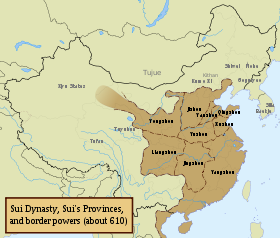
The Sui Dynasty was a powerful, but short-lived Imperial Chinese dynasty. Preceded by the Southern and Northern Dynasties
, it ended nearly four centuries of division between rival regimes. It was followed by the Tang Dynasty
.
Founded by Emperor Wen of Sui
, the Sui Dynasty capital was at Chang'an
(being renamed as Daxing). His reign saw the reunification of Southern and Northern China and the construction of the Grand Canal
. Emperors Wen
and Yang
undertook various reforms including the Equal-field system
, which was initiated to reduce the rich-poor social gap that resulted in enhanced agricultural productivity, centralization of government power. The Three Departments and Six Ministries
system was officially instituted, coinage was standardized and re-unified, defense was improved and the Great Wall
expanded. Buddhism
was also spread and encouraged throughout the empire, uniting the varied peoples and cultures of China.
This dynasty has often been compared to the earlier Qin Dynasty
in tenor and in the ruthlessness of its accomplishments. The Sui dynasty's early demise was attributed to the government's tyrannical demands on the people, who bore the crushing burden of taxes and compulsory labor. These resources were overstrained by the completion of the Grand Canal
—a monumental engineering feat— and in the undertaking of other construction projects, including the reconstruction of the Great Wall. Weakened by costly and disastrous military campaigns
against Goguryeo
which ended with the defeat of Sui in the early seventh century, the dynasty disintegrated through a combination of popular revolts, disloyalty, and assassination.
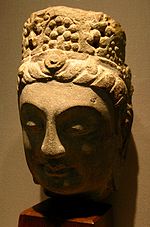 When the Northern Zhou
Dynasty defeated the Northern Qi
Dynasty in 577 CE, this was the culminating moment and ultimate advantage for the northern Chinese to face south. The southern dynasties had lost hope in conquering the north, and the situation of conquest from north-to-south was only delayed in 523 with civil war.
The Sui Dynasty began when Emperor Wen's daughter became the Empress Dowager of Northern Zhou, with her stepson as the new emperor. After crushing an army disused in the eastern provinces as the prime minister of Zhou, Emperor Wen took the throne by force and proclaimed himself emperor. In a bloody purge, he had fifty-nine princes of the Zhou royal family eliminated yet nevertheless became known as the 'Cultured Emperor' (581 - 604 CE). Emperor Wen abolished the anti-Han policies of Zhou and reclaimed his Han surname of Yang. Having won the support of Confucian scholars who had powered previous Han dynasties (abandoning the nepotism and corruption of the nine-rank system
), Emperor Wen initiated a series of reforms aimed at strengthening his empire for the wars that would reunify China.
 In his campaign for southern conquest, Emperor Wen assembled thousands of boats to confront the naval forces of the Chen Dynasty
on the Yangtze River
. The largest of these ships were very tall, having five layered decks and the capacity for 800 passengers. They were outfitted with six 50-foot-long booms that were used to swing and damage enemy ships, or to pin them down so that Sui marine troops could use act-and-board techniques. Besides employing Xianbei
and other Chinese ethnic groups for the fight against Chen, Emperor Wen also employed the service of aborigines from southeastern Sichuan
, a people that Sui had recently conquered.
In 588 CE, the Sui had amassed 518,000 troops along the northern bank of the Yangtze River, stretching from Sichuan to the Pacific Ocean
. Meanwhile, the Chen Dynasty was collapsing and could not withstand such an assault. By 589 CE, Sui troops entered Jiankang (Nanjing
) and the last emperor of the southern Chen dynasty surrendered. The city was razed to the ground, while Sui troops escorted Chen nobles back north, where the northern aristocrats became fascinated with everything the south had to provide culturally and intellectually.
Although Emperor Wen was famous for bankrupting the state treasury with warfare and construction projects, he made many improvements to infrastructure during his early reign. He established granaries as sources of food and as a means to regulate market prices from the taxation of crops, much like the earlier Han Dynasty
.
Emperor Yang of Sui gained the throne after his father's death, possibly by murder. He further extended the empire but unlike his father he did not seek to gain support from the nomads. Instead, he restored Confucian education
and the Confucian examination system
for bureaucrats. By supporting educational reforms, he lost the support of the nomads. He also started many expensive construction projects such as the Grand Canal of China
, and became embroiled in several costly wars. Between these policies, invasions into China from Turthkic nomads, and his growing life of decadent luxury at the expense of the peasantry, he lost public support and was eventually assassinated by his own ministers.
Both Emperors Wen and Yang sent military expeditions into Vietnam
as Annam
in northern Vietnam had been incorporated into the Chinese empire over 600 years earlier during the Han Dynasty
(202 BC - 220 CE). However, the ancient Kingdom of Champa
in southern Vietnam became a major counterpart to Chinese invasions to its north. According to Ebrey, Walthall, and Palais, these invasions became known as the Linyi-Champa Campaign (602-605 CE).
 The Hanoi
area formerly held by the Han and Jin dynasties was easily recovered from the local ruler in 602. A few years later the Sui army pushed farther south and was attacked by troops on war elephant
s from Champa
in southern Vietnam. The Sui army feigned retreat and dug pits to trap the elephants, lured the Champan troops to attack then used crossbows against the elephants causing them to turn around and trample their own soldiers. Although Sui troops were victorious many succumbed to disease as northern soldiers did not have immunity to tropical disease
s such as malaria
.
to invade Goguryeo
, one of the Three Kingdoms of Korea
. The war that conscripted the most soldiers was caused by Emperor Yang of Sui. This army was so enormous it recorded in historical texts that it took 30 days for all the armies to exit their last rallying point near Shanhaiguan
before invading Korea. In one instance the soldiers—both conscripted and paid—listed over 3000 warships, 1.15 million infantry, 50,000 cavalry, 5000 artillery, and more. There were as many supporting laborers and an exorbitant military budget that included mounds of equipment and rations (most of which never reached the Chinese vanguard, as they were captured by Goguryeo armies already). The army stretched to 1000 li
or about 410 kilometers across rivers and valleys, over mountains and hills.
In all four main campaigns, the military conquest ended in failure. Nearly all the Chinese soldiers were defeated by the prominent army leader Eulji Mundeok
of Goguryeo. According to the Book of Tang
, of the 305,000 Chinese troops, only 2,700 returned to China. Soldiers in summer conquests would return several years later, barely living through the cold and famishing winter. Many died of frostbite and hunger.
, but this, along with other large projects, strained the economy and angered the resentful workforce employed. During the last few years of the Sui Dynasty, the rebellion that rose against it took many of China's able-bodied men from rural farms and other occupations, which in turn damaged the agricultural base and the economy further. Men would deliberately break their limbs in order to avoid military conscription
, calling the practice "propitious paws" and "fortunate feet." In the year 642, Emperor Taizong of Tang
made an effort to eradicate this practice by issuing a decree of a stiffer punishment for those who were found to deliberately injure and heal themselves.
Although the Sui Dynasty was relatively short (581-618 CE), much was accomplished during its tenure. The Grand Canal was one of the main accomplishments. It was extended north from the Hangzhou region across the Yangzi to Yangzhou and then northwest to the region of Luoyang. The eventual fall of the Sui dynasty was due to the many losses in Southern Manchuria and North Korea. It was after these defeats and losses that the country was left in ruins and rebels soon took control of the government. Emperor Yang was assassinated in 618. He had gone South after being defeated by Korea and was killed by his advisors. Meanwhile, in the North, aristocrat Li Yuan (李淵) held an uprising after which he ended up ascending the throne to become Emperor Gaozu of Tang
. This was the start of the Tang Dynasty
, one of the most-noted dynasties in Chinese history.
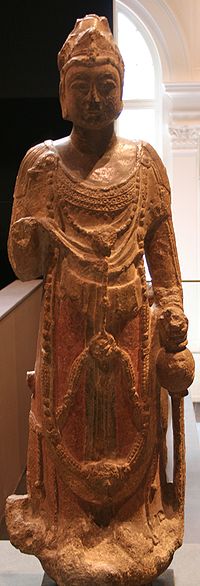
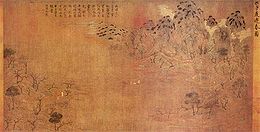 Buddhism
was popular during the Six Dynasties
period that preceded the Sui dynasty, spreading from India through Kushan Afghanistan into China during the Late Han
period. Buddhism gained prominence during the period when central political control was limited. Buddhism created a unifying cultural force that uplifted the people out of war and into the Sui Dynasty. In many ways, Buddhism was responsible for the rebirth of culture in China under the Sui Dynasty.
Emperor Wen and his empress had converted to Buddhism to legitimize imperial authority over China and the conquest of Chen. The emperor presented himself as a Cakravartin king, a Buddhist monarch who would use military force to defend the Buddhist faith. In the year 601 CE, Emperor Wen had relics of the Buddha distributed to temples throughout China, with edicts that expressed his goals, "all the people within the four seas may, without exception, develop enlightenment and together cultivate fortunate karma, bringing it to pass that present existences will lead to happy future lives, that the sustained creation of good causation will carry us one and all up to wondrous enlightenment". Ultimately, this act was an imitation of the ancient Mauryan Emperor Ashoka
of India
.
Southern and Northern Dynasties
The Southern and Northern Dynasties was a period in the history of China that lasted from 420 to 589 AD. Though an age of civil war and political chaos, it was also a time of flourishing arts and culture, advancement in technology, and the spreading of Mahayana Buddhism and Daoism...
, it ended nearly four centuries of division between rival regimes. It was followed by the Tang Dynasty
Tang Dynasty
The Tang Dynasty was an imperial dynasty of China preceded by the Sui Dynasty and followed by the Five Dynasties and Ten Kingdoms Period. It was founded by the Li family, who seized power during the decline and collapse of the Sui Empire...
.
Founded by Emperor Wen of Sui
Emperor Wen of Sui
Emperor Wen of Sui — personal name Yang Jian , Xianbei name Puliuru Jian , nickname Naluoyan — was the founder and first emperor of China's Sui Dynasty . He was a hard-working administrator and a micromanager. As a Buddhist, he encouraged the spread of Buddhism through the state...
, the Sui Dynasty capital was at Chang'an
Chang'an
Chang'an is an ancient capital of more than ten dynasties in Chinese history, today known as Xi'an. Chang'an literally means "Perpetual Peace" in Classical Chinese. During the short-lived Xin Dynasty, the city was renamed "Constant Peace" ; yet after its fall in AD 23, the old name was restored...
(being renamed as Daxing). His reign saw the reunification of Southern and Northern China and the construction of the Grand Canal
Grand Canal of China
The Grand Canal in China, also known as the Beijing-Hangzhou Grand Canal is the longest canal or artificial river in the world. Starting at Beijing, it passes through Tianjin and the provinces of Hebei, Shandong, Jiangsu and Zhejiang to the city of Hangzhou...
. Emperors Wen
Emperor Wen of Sui
Emperor Wen of Sui — personal name Yang Jian , Xianbei name Puliuru Jian , nickname Naluoyan — was the founder and first emperor of China's Sui Dynasty . He was a hard-working administrator and a micromanager. As a Buddhist, he encouraged the spread of Buddhism through the state...
and Yang
Emperor Yang of Sui
Emperor Yang of Sui , personal name Yang Guang , alternative name Ying , nickname Amo , known as Emperor Ming during the brief reign of his grandson Yang Tong), was the second son of Emperor Wen of Sui, and the second emperor of China's Sui Dynasty.Emperor Yang's original name was Yang Ying, but...
undertook various reforms including the Equal-field system
Equal-field system
The Equal-field system land system was a historical system of land ownership and distribution in China used from the Six Dynasties to Mid-Tang dynasty....
, which was initiated to reduce the rich-poor social gap that resulted in enhanced agricultural productivity, centralization of government power. The Three Departments and Six Ministries
Three Departments and Six Ministries
The Three Departments and Six Ministries system was the main central administrative system adopted in ancient China. The system first took shape after the Western Han Dynasty , was officially instituted in Sui Dynasty , and matured during Tang Dynasty...
system was officially instituted, coinage was standardized and re-unified, defense was improved and the Great Wall
Great Wall of China
The Great Wall of China is a series of stone and earthen fortifications in northern China, built originally to protect the northern borders of the Chinese Empire against intrusions by various nomadic groups...
expanded. Buddhism
Buddhism
Buddhism is a religion and philosophy encompassing a variety of traditions, beliefs and practices, largely based on teachings attributed to Siddhartha Gautama, commonly known as the Buddha . The Buddha lived and taught in the northeastern Indian subcontinent some time between the 6th and 4th...
was also spread and encouraged throughout the empire, uniting the varied peoples and cultures of China.
This dynasty has often been compared to the earlier Qin Dynasty
Qin Dynasty
The Qin Dynasty was the first imperial dynasty of China, lasting from 221 to 207 BC. The Qin state derived its name from its heartland of Qin, in modern-day Shaanxi. The strength of the Qin state was greatly increased by the legalist reforms of Shang Yang in the 4th century BC, during the Warring...
in tenor and in the ruthlessness of its accomplishments. The Sui dynasty's early demise was attributed to the government's tyrannical demands on the people, who bore the crushing burden of taxes and compulsory labor. These resources were overstrained by the completion of the Grand Canal
Grand Canal of China
The Grand Canal in China, also known as the Beijing-Hangzhou Grand Canal is the longest canal or artificial river in the world. Starting at Beijing, it passes through Tianjin and the provinces of Hebei, Shandong, Jiangsu and Zhejiang to the city of Hangzhou...
—a monumental engineering feat— and in the undertaking of other construction projects, including the reconstruction of the Great Wall. Weakened by costly and disastrous military campaigns
Goguryeo-Sui Wars
The Goguryeo–Sui Wars were a series of campaigns launched by the Sui Dynasty of China against the Goguryeo of Korea between 598 and 614. It resulted in the defeat of Sui and contributed to the eventual downfall of the dynasty in 618.-Background:...
against Goguryeo
Goguryeo
Goguryeo or Koguryŏ was an ancient Korean kingdom located in present day northern and central parts of the Korean Peninsula, southern Manchuria, and southern Russian Maritime province....
which ended with the defeat of Sui in the early seventh century, the dynasty disintegrated through a combination of popular revolts, disloyalty, and assassination.
Emperor Wen and the founding of the Sui Dynasty
Northern Zhou
The Northern Zhou Dynasty followed the Western Wei, and ruled northern China from 557 to 581. It was overthrown by the Sui Dynasty.Northern Zhou's basis of power was established by Yuwen Tai, who was paramount general of Western Wei, following the split of Northern Wei into Western Wei and...
Dynasty defeated the Northern Qi
Northern Qi
The Northern Qi Dynasty was one of the Northern dynasties of Chinese history and ruled northern China from 550 to 577.-History:The Chinese state of Northern Qi was the successor state of the Chinese/Xianbei state of Eastern Wei and was founded by Emperor Wenxuan...
Dynasty in 577 CE, this was the culminating moment and ultimate advantage for the northern Chinese to face south. The southern dynasties had lost hope in conquering the north, and the situation of conquest from north-to-south was only delayed in 523 with civil war.
The Sui Dynasty began when Emperor Wen's daughter became the Empress Dowager of Northern Zhou, with her stepson as the new emperor. After crushing an army disused in the eastern provinces as the prime minister of Zhou, Emperor Wen took the throne by force and proclaimed himself emperor. In a bloody purge, he had fifty-nine princes of the Zhou royal family eliminated yet nevertheless became known as the 'Cultured Emperor' (581 - 604 CE). Emperor Wen abolished the anti-Han policies of Zhou and reclaimed his Han surname of Yang. Having won the support of Confucian scholars who had powered previous Han dynasties (abandoning the nepotism and corruption of the nine-rank system
Nine-rank system
The nine rank system , or much less commonly nine grade controller system, was a civil service nomination system during the Three Kingdoms and the Southern and Northern Dynasties in China...
), Emperor Wen initiated a series of reforms aimed at strengthening his empire for the wars that would reunify China.
Chen Dynasty
The Chen Dynasty , also known as the Southern Chen Dynasty, was the fourth and last of the Southern dynasties in China, eventually destroyed by the Sui Dynasty....
on the Yangtze River
Yangtze River
The Yangtze, Yangzi or Cháng Jiāng is the longest river in Asia, and the third-longest in the world. It flows for from the glaciers on the Tibetan Plateau in Qinghai eastward across southwest, central and eastern China before emptying into the East China Sea at Shanghai. It is also one of the...
. The largest of these ships were very tall, having five layered decks and the capacity for 800 passengers. They were outfitted with six 50-foot-long booms that were used to swing and damage enemy ships, or to pin them down so that Sui marine troops could use act-and-board techniques. Besides employing Xianbei
Xianbei
The Xianbei were a significant Mongolic nomadic people residing in Manchuria, Inner Mongolia and eastern Mongolia. The title “Khan” was first used among the Xianbei.-Origins:...
and other Chinese ethnic groups for the fight against Chen, Emperor Wen also employed the service of aborigines from southeastern Sichuan
Sichuan
' , known formerly in the West by its postal map spellings of Szechwan or Szechuan is a province in Southwest China with its capital in Chengdu...
, a people that Sui had recently conquered.
In 588 CE, the Sui had amassed 518,000 troops along the northern bank of the Yangtze River, stretching from Sichuan to the Pacific Ocean
Pacific Ocean
The Pacific Ocean is the largest of the Earth's oceanic divisions. It extends from the Arctic in the north to the Southern Ocean in the south, bounded by Asia and Australia in the west, and the Americas in the east.At 165.2 million square kilometres in area, this largest division of the World...
. Meanwhile, the Chen Dynasty was collapsing and could not withstand such an assault. By 589 CE, Sui troops entered Jiankang (Nanjing
Nanjing
' is the capital of Jiangsu province in China and has a prominent place in Chinese history and culture, having been the capital of China on several occasions...
) and the last emperor of the southern Chen dynasty surrendered. The city was razed to the ground, while Sui troops escorted Chen nobles back north, where the northern aristocrats became fascinated with everything the south had to provide culturally and intellectually.
Although Emperor Wen was famous for bankrupting the state treasury with warfare and construction projects, he made many improvements to infrastructure during his early reign. He established granaries as sources of food and as a means to regulate market prices from the taxation of crops, much like the earlier Han Dynasty
Han Dynasty
The Han Dynasty was the second imperial dynasty of China, preceded by the Qin Dynasty and succeeded by the Three Kingdoms . It was founded by the rebel leader Liu Bang, known posthumously as Emperor Gaozu of Han. It was briefly interrupted by the Xin Dynasty of the former regent Wang Mang...
.
Emperor Yang of Sui
Emperor Yang of Sui gained the throne after his father's death, possibly by murder. He further extended the empire but unlike his father he did not seek to gain support from the nomads. Instead, he restored Confucian education
Confucianism
Confucianism is a Chinese ethical and philosophical system developed from the teachings of the Chinese philosopher Confucius . Confucianism originated as an "ethical-sociopolitical teaching" during the Spring and Autumn Period, but later developed metaphysical and cosmological elements in the Han...
and the Confucian examination system
Imperial examination
The Imperial examination was an examination system in Imperial China designed to select the best administrative officials for the state's bureaucracy. This system had a huge influence on both society and culture in Imperial China and was directly responsible for the creation of a class of...
for bureaucrats. By supporting educational reforms, he lost the support of the nomads. He also started many expensive construction projects such as the Grand Canal of China
Grand Canal of China
The Grand Canal in China, also known as the Beijing-Hangzhou Grand Canal is the longest canal or artificial river in the world. Starting at Beijing, it passes through Tianjin and the provinces of Hebei, Shandong, Jiangsu and Zhejiang to the city of Hangzhou...
, and became embroiled in several costly wars. Between these policies, invasions into China from Turthkic nomads, and his growing life of decadent luxury at the expense of the peasantry, he lost public support and was eventually assassinated by his own ministers.
Both Emperors Wen and Yang sent military expeditions into Vietnam
Vietnam
Vietnam – sometimes spelled Viet Nam , officially the Socialist Republic of Vietnam – is the easternmost country on the Indochina Peninsula in Southeast Asia. It is bordered by China to the north, Laos to the northwest, Cambodia to the southwest, and the South China Sea –...
as Annam
Annam (Chinese Province)
Annam or Jiaozhi was the southernmost province of the Chinese Empire. It is now part of present-day Vietnam...
in northern Vietnam had been incorporated into the Chinese empire over 600 years earlier during the Han Dynasty
Han Dynasty
The Han Dynasty was the second imperial dynasty of China, preceded by the Qin Dynasty and succeeded by the Three Kingdoms . It was founded by the rebel leader Liu Bang, known posthumously as Emperor Gaozu of Han. It was briefly interrupted by the Xin Dynasty of the former regent Wang Mang...
(202 BC - 220 CE). However, the ancient Kingdom of Champa
Champa
The kingdom of Champa was an Indianized kingdom that controlled what is now southern and central Vietnam from approximately the 7th century through to 1832.The Cham people are remnants...
in southern Vietnam became a major counterpart to Chinese invasions to its north. According to Ebrey, Walthall, and Palais, these invasions became known as the Linyi-Champa Campaign (602-605 CE).
Hanoi
Hanoi , is the capital of Vietnam and the country's second largest city. Its population in 2009 was estimated at 2.6 million for urban districts, 6.5 million for the metropolitan jurisdiction. From 1010 until 1802, it was the most important political centre of Vietnam...
area formerly held by the Han and Jin dynasties was easily recovered from the local ruler in 602. A few years later the Sui army pushed farther south and was attacked by troops on war elephant
War elephant
A war elephant was an elephant trained and guided by humans for combat. Their main use was to charge the enemy, trampling them and breaking their ranks. A division of war elephants is known as elephantry....
s from Champa
Champa
The kingdom of Champa was an Indianized kingdom that controlled what is now southern and central Vietnam from approximately the 7th century through to 1832.The Cham people are remnants...
in southern Vietnam. The Sui army feigned retreat and dug pits to trap the elephants, lured the Champan troops to attack then used crossbows against the elephants causing them to turn around and trample their own soldiers. Although Sui troops were victorious many succumbed to disease as northern soldiers did not have immunity to tropical disease
Disease
A disease is an abnormal condition affecting the body of an organism. It is often construed to be a medical condition associated with specific symptoms and signs. It may be caused by external factors, such as infectious disease, or it may be caused by internal dysfunctions, such as autoimmune...
s such as malaria
Malaria
Malaria is a mosquito-borne infectious disease of humans and other animals caused by eukaryotic protists of the genus Plasmodium. The disease results from the multiplication of Plasmodium parasites within red blood cells, causing symptoms that typically include fever and headache, in severe cases...
.
Goguryeo-Sui wars
The biggest factor that led to the downfall of Sui Dynasty was a series of massive expeditions into the Korean PeninsulaKorean Peninsula
The Korean Peninsula is a peninsula in East Asia. It extends southwards for about 684 miles from continental Asia into the Pacific Ocean and is surrounded by the Sea of Japan to the south, and the Yellow Sea to the west, the Korea Strait connecting the first two bodies of water.Until the end of...
to invade Goguryeo
Goguryeo
Goguryeo or Koguryŏ was an ancient Korean kingdom located in present day northern and central parts of the Korean Peninsula, southern Manchuria, and southern Russian Maritime province....
, one of the Three Kingdoms of Korea
Three Kingdoms of Korea
The Three Kingdoms of Korea refer to the ancient Korean kingdoms of Goguryeo, Baekje and Silla, which dominated the Korean peninsula and parts of Manchuria for much of the 1st millennium...
. The war that conscripted the most soldiers was caused by Emperor Yang of Sui. This army was so enormous it recorded in historical texts that it took 30 days for all the armies to exit their last rallying point near Shanhaiguan
Shanhaiguan District
Shanhaiguan District is a district of the city of Qinhuangdao, Hebei province, People's Republic of China, named after the pass of the Great Wall within the district, Shanhai Pass...
before invading Korea. In one instance the soldiers—both conscripted and paid—listed over 3000 warships, 1.15 million infantry, 50,000 cavalry, 5000 artillery, and more. There were as many supporting laborers and an exorbitant military budget that included mounds of equipment and rations (most of which never reached the Chinese vanguard, as they were captured by Goguryeo armies already). The army stretched to 1000 li
Li (unit)
The li is a traditional Chinese unit of distance, which has varied considerably over time but now has a standardized length of 500 meters or half a kilometer...
or about 410 kilometers across rivers and valleys, over mountains and hills.
In all four main campaigns, the military conquest ended in failure. Nearly all the Chinese soldiers were defeated by the prominent army leader Eulji Mundeok
Eulji Mundeok
Eulji Mundeok was a noted military leader of early 7th century Goguryeo, one of the Three Kingdoms of Korea. Often numbered among the greatest heroes in Korean military history, he defended Goguryeo against the Sui Chinese...
of Goguryeo. According to the Book of Tang
Book of Tang
The Book of Tang , Jiu Tangshu or the Old Book of Tang is the first classic work about the Tang Dynasty. The book began when Gaozu of Later Jin ordered its commencement in 941...
, of the 305,000 Chinese troops, only 2,700 returned to China. Soldiers in summer conquests would return several years later, barely living through the cold and famishing winter. Many died of frostbite and hunger.
Fall
Eventually resentment of the emperor increased and the wars, coupled with revolts and assassinations, led to the fall of the Sui Dynasty. One great accomplishment was rebuilding the Great Wall of ChinaGreat Wall of China
The Great Wall of China is a series of stone and earthen fortifications in northern China, built originally to protect the northern borders of the Chinese Empire against intrusions by various nomadic groups...
, but this, along with other large projects, strained the economy and angered the resentful workforce employed. During the last few years of the Sui Dynasty, the rebellion that rose against it took many of China's able-bodied men from rural farms and other occupations, which in turn damaged the agricultural base and the economy further. Men would deliberately break their limbs in order to avoid military conscription
Conscription
Conscription is the compulsory enlistment of people in some sort of national service, most often military service. Conscription dates back to antiquity and continues in some countries to the present day under various names...
, calling the practice "propitious paws" and "fortunate feet." In the year 642, Emperor Taizong of Tang
Emperor Taizong of Tang
Emperor Taizong of Tang , personal name Lǐ Shìmín , was the second emperor of the Tang Dynasty of China, ruling from 626 to 649...
made an effort to eradicate this practice by issuing a decree of a stiffer punishment for those who were found to deliberately injure and heal themselves.
Although the Sui Dynasty was relatively short (581-618 CE), much was accomplished during its tenure. The Grand Canal was one of the main accomplishments. It was extended north from the Hangzhou region across the Yangzi to Yangzhou and then northwest to the region of Luoyang. The eventual fall of the Sui dynasty was due to the many losses in Southern Manchuria and North Korea. It was after these defeats and losses that the country was left in ruins and rebels soon took control of the government. Emperor Yang was assassinated in 618. He had gone South after being defeated by Korea and was killed by his advisors. Meanwhile, in the North, aristocrat Li Yuan (李淵) held an uprising after which he ended up ascending the throne to become Emperor Gaozu of Tang
Emperor Gaozu of Tang
Emperor Gāozǔ of Táng , born Lǐ Yuān , courtesy name Shūdé , was the founder of the Tang Dynasty of China, and the first emperor of this dynasty from 618 to 626. Under the Sui dynasty, Li Yuan was the governor in the area of modern-day Shanxi, and was based in Taiyuan.In 615, Li Yuan was assigned...
. This was the start of the Tang Dynasty
Tang Dynasty
The Tang Dynasty was an imperial dynasty of China preceded by the Sui Dynasty and followed by the Five Dynasties and Ten Kingdoms Period. It was founded by the Li family, who seized power during the decline and collapse of the Sui Empire...
, one of the most-noted dynasties in Chinese history.
Buddhism
Buddhism
Buddhism is a religion and philosophy encompassing a variety of traditions, beliefs and practices, largely based on teachings attributed to Siddhartha Gautama, commonly known as the Buddha . The Buddha lived and taught in the northeastern Indian subcontinent some time between the 6th and 4th...
was popular during the Six Dynasties
Six Dynasties
Six Dynasties is a collective noun for six Chinese dynasties during the periods of the Three Kingdoms , Jin Dynasty , and Southern and Northern Dynasties ....
period that preceded the Sui dynasty, spreading from India through Kushan Afghanistan into China during the Late Han
Han Dynasty
The Han Dynasty was the second imperial dynasty of China, preceded by the Qin Dynasty and succeeded by the Three Kingdoms . It was founded by the rebel leader Liu Bang, known posthumously as Emperor Gaozu of Han. It was briefly interrupted by the Xin Dynasty of the former regent Wang Mang...
period. Buddhism gained prominence during the period when central political control was limited. Buddhism created a unifying cultural force that uplifted the people out of war and into the Sui Dynasty. In many ways, Buddhism was responsible for the rebirth of culture in China under the Sui Dynasty.
Emperor Wen and his empress had converted to Buddhism to legitimize imperial authority over China and the conquest of Chen. The emperor presented himself as a Cakravartin king, a Buddhist monarch who would use military force to defend the Buddhist faith. In the year 601 CE, Emperor Wen had relics of the Buddha distributed to temples throughout China, with edicts that expressed his goals, "all the people within the four seas may, without exception, develop enlightenment and together cultivate fortunate karma, bringing it to pass that present existences will lead to happy future lives, that the sustained creation of good causation will carry us one and all up to wondrous enlightenment". Ultimately, this act was an imitation of the ancient Mauryan Emperor Ashoka
Ashoka
Ashok Maurya or Ashoka , popularly known as Ashoka the Great, was an Indian emperor of the Maurya Dynasty who ruled almost all of the Indian subcontinent from ca. 269 BC to 232 BC. One of India's greatest emperors, Ashoka reigned over most of present-day India after a number of military conquests...
of India
India
India , officially the Republic of India , is a country in South Asia. It is the seventh-largest country by geographical area, the second-most populous country with over 1.2 billion people, and the most populous democracy in the world...
.
Rulers of the Sui Dynasty
| Posthumous Name (Shi Hao 諡號) Convention: "Sui" + name |
Birth Name | Period of Reign | Era Names (Nian Hao 年號) and their according range of years |
| Wéndì (文帝) Emperor Wen of Sui Emperor Wen of Sui — personal name Yang Jian , Xianbei name Puliuru Jian , nickname Naluoyan — was the founder and first emperor of China's Sui Dynasty . He was a hard-working administrator and a micromanager. As a Buddhist, he encouraged the spread of Buddhism through the state... |
Yáng Jiān (楊堅) | 581-604 | Kāihuáng (開皇) 581-600 Rénshòu (仁壽) 601-604 |
| Yángdì (煬帝) Emperor Yang of Sui Emperor Yang of Sui , personal name Yang Guang , alternative name Ying , nickname Amo , known as Emperor Ming during the brief reign of his grandson Yang Tong), was the second son of Emperor Wen of Sui, and the second emperor of China's Sui Dynasty.Emperor Yang's original name was Yang Ying, but... or Míngdì (明帝) |
Yáng Guǎng (楊廣) | 604-618 | Dàyè (大業) 605-618 |
| Gōngdì (恭帝) Emperor Gong of Sui Emperor Gong of Sui , personal name Yang You , was an emperor of the Chinese Sui Dynasty. Traditionally, he was considered the last emperor of the dynasty because he was the one who formally yielded the throne to the founding emperor to the succeeding Tang Dynasty, Emperor Gaozu of Tang ,... |
Yáng Yòu (楊侑) | 617-618 | Yìníng (義寧) 617-618 |
| Gōngdì (恭帝) | Yáng Tóng Yang Tong Yang Tong , known in traditional histories by his princely title of Prince of Yue or by his era name as Lord Huangtai , posthumous name Emperor Gong , courtesy name Renjin , was an emperor of the Chinese Sui Dynasty... (楊侗) |
618-619 | Huángtài (皇泰) 618-619 |
See also
- Chinese sovereignChinese sovereignChinese sovereign is the ruler of a particular period in ancient China. Several titles and naming schemes have been used throughout history.-Emperor Title:...
- Grand Canal of ChinaGrand Canal of ChinaThe Grand Canal in China, also known as the Beijing-Hangzhou Grand Canal is the longest canal or artificial river in the world. Starting at Beijing, it passes through Tianjin and the provinces of Hebei, Shandong, Jiangsu and Zhejiang to the city of Hangzhou...
- History of ChinaHistory of ChinaChinese civilization originated in various regional centers along both the Yellow River and the Yangtze River valleys in the Neolithic era, but the Yellow River is said to be the Cradle of Chinese Civilization. With thousands of years of continuous history, China is one of the world's oldest...
- List of tributaries of Imperial China
Further reading
- Bingham, Woodbridge. 1941. The Founding of the T'ang Dynasty: The Fall of the Sui and Rise of the T'ang. Baltimore: Waverly Press.
- Ebrey, Patricia. 1996. The Cambridge Illustrated History of China. Cambridge University Press, Hong Kong. ISBN 0-521-43519-6
- Wright, Arthur F.Arthur F. WrightArthur Frederick Wright was an American academic, sinologist, editor and professor of history at Yale University. He specialized in Chinese social and intellectual history of the pre-modern period.- Early life:...
1978. The Sui Dynasty: The Unification of China. A.D. 581-617. Alfred A. Knopf, New York. ISBN 0-394-49187-4 ; 0-394-32332-7 (pbk).
External links
- http://www.mnsu.edu/emuseum/prehistory/china/classical_imperial_china/sui.html
- History of China: A good catalogue of info