
Encyclopedia
The
Industrial Revolution was the major
technological, socioeconomic and
cultural change in the late
18th and early
19th century that began in
Britain and spread throughout the world. During that time, an economy based on manual labour was replaced by one dominated by industry and the manufacture of
machinery. It began with the mechanisation of the
textile industries and the development of
iron-making techniques, and trade expansion was enabled by the introduction of
canals, improved
roads and then
railways. The introduction of
steam power and powered machinery underpinned the dramatic increases in production capacity. The development of all-metal machine tools in the first two decades of the 19th century facilitated the manufacture of more production machines for manufacturing in other industries.
The period of time covered by the Industrial Revolution varies with different historians. Eric Hobsbawm held that it 'broke out' in the 1780s and wasn't fully felt until the 1830s or 1840s, while T.S. Ashton held that it occurred roughly between 1760 and 1830 .
The effects spread throughout
Western Europe and
North America during the 19th century, eventually affecting most of the world. The impact of this change on
society was enormous and is often compared to the Neolithic revolution, when various human subgroups embraced
agriculture and in the process, forswore the
nomadic lifestyle.
The first Industrial Revolution merged into the Second Industrial Revolution around 1850, when technological and economic progress gained momentum with the development of steam-powered
ships, railways, and later in the nineteenth century with the
internal combustion engine and
electrical power generation. At the turn of the century, innovator
Henry Ford, father of the
assembly line, stated, "There is but one rule for the industrialist, and that is: Make the highest quality goods possible at the lowest cost possible, paying the highest wages possible."
It has been argued that
GDP per capita was much more stable and progressed at a much slower rate until the Industrial Revolution and the emergence of the modern
capitalist economy, and that it has since increased rapidly in capitalist countries.
The idea and the name
The term 'Industrial Revolution' applied to technological change was common in the 1830s. Louis-Auguste Blanqui in 1837 spoke of
la révolution industrielle.
Friedrich Engels in
The Condition of the Working Class in England in 1844 spoke of "an industrial revolution, a revolution which at the same time changed the whole of civil society".
The radical nature of the process had been noted before that, in his book
Raymond Williams states in the entry for
Industry:
The idea of a new social order based on major industrial change was clear in Southey and Owen, between 1811 and 1818, and was implicit as early as Blake in the early 1790s and Wordsworth at the turn of the century.Credit for popularising the term may be given to Arnold Toynbee, whose lectures given in 1881 gave a detailed account of the process.
Causes
The causes of the Industrial Revolution were complex and remain a topic for debate, with some historians seeing the Revolution as an outgrowth of social and institutional changes brought by the end of
feudalism in Britain after the
English Civil War in the 17th century. As national border controls became more effective, the spread of disease was lessened, therefore preventing the epidemics common in previous times. The percentage of children who lived past infancy rose significantly, leading to a larger workforce. The Enclosure movement and the British Agricultural Revolution made food production more efficient and less labour-intensive, encouraging the surplus population who could no longer find employment in
agriculture into cottage industry, for example
weaving, and in the longer term into the cities and the newly-developed
factories. The
colonial expansion of the 17th century with the accompanying development of international
trade, creation of financial markets and accumulation of
capital are also cited as factors, as is the scientific revolution of the 17th century.
Technological innovation protected by patents was, of course, at the heart of it and the key enabling technology was the invention and improvement of the
steam engine.
The presence of a large domestic market should also be considered an important driver of the Industrial Revolution, particularly explaining why it occurred in Britain. In other nations, such as
France, markets were split up by local regions, which often imposed tolls and
tariffs on goods traded amongst them.
Causes for occurrence in Europe
One question of active interest to historians is why the Industrial Revolution started in 18th century Europe and not other times like in
Ancient Greece, which already had developed a primitive
steam engine, and other parts of the world in the 18th century, particularly
China and
India.
Numerous factors have been suggested, including
ecology, government, and
culture. Benjamin Elman argues that China was in a high level equilibrium trap in which the non-industrial methods were efficient enough to prevent use of industrial methods with high costs of capital. Kenneth Pomeranz, in the
Great Divergence, argues that Europe and China were remarkably similar in 1700, and that the crucial differences which created the Industrial Revolution in Europe were sources of
coal near manufacturing centres, and raw materials such as food and wood from the New World, which allowed Europe to expand economically in a way that China could not.
However, modern estimates of per capita income in Western Europe in the late 18th century are of roughly 1,500 dollars in purchasing power parity whereas China, by comparison, had only 450 dollars. Also, the average
interest rate was about 5% in Britain and over 30% in China, which illustrates how capital was much more abundant in Britain; capital that was available for investment.
Some historians credit the different belief systems in China and Europe with dictating where the revolution occurred. The religion and beliefs of Europe were largely products of
Christianity,
Socrates,
Plato, and
Aristotle. Conversely, Chinese society was founded on men like
Confucius,
Mencius, Han Feizi ,
Lao Tzu , and
Buddha . The key difference between these belief systems was that those from Europe focused on the individual, while Chinese beliefs centered around relationships between people. The family unit was more important than the individual for the large majority of Chinese history, and this may have played a role in why the Industrial Revolution took much longer to occur in China. There was the additional difference as to whether people looked backwards to a reputedly glorious past for answers to their questions or looked hopefully to the future. Furthermore, Western European peoples had experienced the
Renaissance and
Reformation; other parts of the world had not had a similar intellectual breakout, a condition that holds true even into the 21st century.
In
India, the noted historian Rajni Palme Dutt has been quoted as saying, "The capital to finance the Industrial Revolution in India instead went into financing the Industrial Revolution in
England." In direct contrast to
China, India was split up into many different kingdoms all fighting for supremacy, with the three major ones being the
Marathas,
Sikhs and the
Mughals. In addition, the economy was highly dependent on two sectors--agriculture of subsistence and cotton, and technical innovation was non-existent. The vast amounts of wealth were stored away in palace treasuries, and as such, were easily moved to
Britain.
Causes for occurrence in Britain
The debate about the start of the Industrial Revolution also concerns the massive lead that Britain had over other countries. Some have stressed the importance of natural or financial resources that Britain received from its many overseas
colonies or that profits from the British
slave trade between Africa and the Caribbean helped fuel industrial investment. It has been pointed out however that slavery provided only 5% of the British national income during the years of the Industrial Revolution
Alternatively, the greater liberalisation of trade from a large merchant base may have allowed Britain to produce and utilise emerging scientific and technological developments more effectively than countries with stronger monarchies, particularly China and Russia. Britain emerged from the
Napoleonic Wars as the only European nation not ravaged by financial plunder and economic collapse, and possessing the only merchant fleet of any useful size . Britain's extensive exporting cottage industries also ensured markets were already available for many early forms of manufactured goods. The conflict resulted in most British warfare being conducted overseas, reducing the devastating effects of territorial conquest that affected much of Europe. This was further aided by Britain's geographical position— an island separated from the rest of mainland Europe.
Another theory is that Britain was able to succeed in the Industrial Revolution due to the availability of key resources it possessed. It had a dense population for its small geographical size. Enclosure of common land and the related Agricultural Revolution made a supply of this labour readily available. There was also a local coincidence of natural resources in the
North of England, the English
Midlands,
South Wales and the Scottish Lowlands. Local supplies of coal, iron, lead, copper, tin, limestone and water power, resulted in excellent conditions for the development and expansion of industry.
The stable political situation in Britain from around 1688, and British society's greater receptiveness to change can also be said to be factors favouring the Industrial Revolution.
Protestant work ethic
Another theory is that the British advance was due to the presence of an entrepreneurial class which believed in progress, technology and hard work.
1 The existence of this class is often linked to the Protestant work ethic and the particular status of dissenting Protestant sects, such as the
Quakers,
Baptists and
Presbyterians that had flourished with the
English Civil War. Reinforcement of confidence in the rule of law, which followed establishment of the prototype of constitutional monarchy in Britain in the
Glorious Revolution of 1688, and the emergence of a stable financial market there based on the management of the national debt by the
Bank of England, contributed to the capacity for, and interest in, private financial investment in industrial ventures.
Dissenters found themselves barred or discouraged from almost all public offices, as well as education at England's only two Universities at the time, Oxford and Cambridge . When the restoration of the monarchy took place and membership in the official
Anglican church became mandatory due to the Test Act. They thereupon became active in banking, manufacturing and education. The
Unitarians, in particular, were very involved in education, by running Dissenting Academies, where, in contrast to the Universities of Oxford and Cambridge, and schools such as Eton and Harrow, much attention was given to mathematics and the sciences--areas of scholarship vital to the development of manufacturing technologies.
Historians sometimes consider this social factor to be extremely important, along with the nature of the national economies involved. While members of these sects were excluded from certain circles of the government, they were considered fellow Protestants, to a limited extent, by many in the
middle class, such as traditional financiers or other businessmen. Given this relative tolerance and the supply of capital, the natural outlet for the more enterprising members of these sects would be to seek new opportunities in the technologies created in the wake of the Scientific revolution of the 17th century.
Lunar Society
The work ethic argument has, on the whole, tended to neglect the fact that several inventors and entrepreneurs were rational free thinkers or "Philosophers" typical of a specific class of British intellectuals in the late 18th century, and were by no means normal church goers or members of religious sects. Examples of these free thinkers were the Lunar Society of
Birmingham which flourished from 1765 to 1809. Its members were exceptional in that they were among the very few who were conscious that an industrial revolution was then taking place in Britain. They actively worked as a group to encourage it, not least by investing in it and conducting scientific experiments which led to innovative products such as the invention of commercial gas lighting and turning the steam engine into the powerplant of the Industrial era.
Innovations
The invention of the
steam engine was the most important innovation of the Industrial Revolution, James Watt, later to be a member of the Lunar Society, developed the idea of using steam to power machines into a practicality thus enabling rapid development of efficient semi-automated factories on a previously unimaginable scale. This was applied to all aspects of industry and engineering. Earlier improvements in iron smelting and metal working based on the use of coke rather than charcoal allowed Watt and others before him to exploit the possibilities of using steam as a form of power. Earlier in the 18th century the textile industry had harnessed water power to drive improved
spinning machines and looms. These textile mills became the model for the organisation of human labour in factories, epitomised by Cottonopolis the name given to the vast collection of mills,
factories and administration offices based in
Manchester.
Besides the innovation of machinery in factories, the assembly line greatly improved efficiency too. With a series of men trained to do a single task on a product, then having it moved along to the next worker, the number of finished goods also rose significantly.
Transmission of innovation
Knowledge of new innovation was spread by several means. Workers who were trained in the technique might move to another employer, or might be poached. A common method was for someone to make a study tour, gathering information where he could. During the whole of the Industrial Revolution and for the century before, all European countries and America engaged in study-touring; some nations, like Sweden and France, even trained civil servants or technicians to undertake it as a matter of state policy. In other countries, notably Britain and America, this practice was carried out by individual manufacturers anxious to improve their own methods. Study tours were common then, as now, as was the keeping of travel diaries. Records made by industrialists and technicians of the period are an incomparable source of information about their methods.
Another means for the spread of innovation was by the network of informal philosophical societies like the Lunar Society of Birmingham, in which members met to discuss science and often its application to manufacturing. Some of these societies published volumes of proceedings and transactions, and the London-based
Society for the encouragement of Arts, Manufactures and Commerce or, more commonly,
Society of Arts published an illustrated volume of new inventions, as well as papers about them in its annual Transactions.
There were publications describing technology.
Encyclopedias such as Harris's
Lexicon technicum and Dr Abraham Rees's
Cyclopaedia was an encyclopedia [i] published by Ephraim Chambers [i]...
contain much of value. Rees's
Cyclopaedia contains an enormous amount of information about the science and technology of the first half of the Industrial Revolution, very well illustrated by fine engravings. Foreign printed sources such as the
Descriptions des Arts et Métiers and Diderot's
Encyclopédie was an early encyclopedia [i] ...
explained foreign methods with fine engraved plates.
Periodical publications about manufacturing and technology began to appear in the last decade of the 18th century, and a number regularly included notice of the latest patents. Foreign periodicals, such as the Annales des Mines, published accounts of travels made by French engineers who observed British methods on study tours.
Industry
Mining
Coal mining in Britain, particularly in South Wales started early. Before the steam engine,
pits were often shallow bell pits following a seam of coal along the surface and being abandoned as the coal was extracted. In other cases, if the geology was favourable, the coal was mined by means of an
adit driven into the side of a hill.
Shaft mining was done in some areas, but the limiting factor was the problem of removing water. It could be done by hauling buckets of water up the shaft or to a sough, a tunnel driven into a hill to drain a mine. In either case, the water had to be discharged into a stream or ditch at level where it could flow away by gravity. The introduction of the
steam engine greatly facilitated the removal of water and enabled shafts to be made deeper, enabling more mineral to be extracted. These were developments that had begun before the Industrial Revolution, but the adoption of
James Watt's more efficient steam engine with its separate condenser from the 1770s reduced the fuel costs of engines, making mines more profitable particularly in areas , where
coal does not occur.
Metallurgy
The major change in the metal industries during the era of the Industrial Revolution was the replacement of organic fuels based on
wood with
fossil fuel based on coal. Much of this happened somewhat before the Industrial Revolution, based on innovations by Sir Clement Clerke and others from 1678, using coal
reverberatory furnaces known as cupolas. These were operated by the flames, which contained
carbon monoxide, playing on the
ore and
reducing the oxide to metal. This has the advantage that impurities in the coal do not migrate into the metal. This technology was applied to lead from 1678 and to copper from 1687. It was also applied to iron foundry work in the 1690s, but in this case the reverberatory furnace was known as an air furnace. The foundry cupola is a different innovation.
This was followed by the first Abraham Darby, who made great strides using coke to fuel his
blast furnaces at
Coalbrookdale . However the coke
pig iron he made was largely only used for the production of cast iron goods such as pots and kettles. In this he had an advantage over his rivals in that his pots, cast by his patented process, were thinner and hence cheaper than those of his rivals. Coke
pig iron was hardly used to produce bar iron in forges until the mid 1750s when his son Abraham Darby II built Horsehay and Ketley furnaces . By this time coke pig iron was cheaper than charcoal pig iron.
Throughout this period, bar iron for smiths to forge into consumer goods was still made in finery forges, as it long had been. However, new processes were adopted in the ensuing years. The first is referred to today as potting and stamping, but this was superseded by Henry Cort's
puddling process. From 1785, perhaps because the improved version of potting and stamping was about to come out of patent, a great expansion in the output of the British iron industry began. The new processes did not depend on the use of charcoal at all, and were therefore not limited by the speed at which trees grow.
Up to that time, British iron manufacturers had used considerable amounts of imported iron to supplement native supplies. This came principally from
Sweden from the mid 17th century and later also from
Russia from the end of the 1720s. However, from 1785, imports decreased, leading to Britain becoming an exporter of bar iron as well as manufactured
wrought iron consumer goods.
As a result of these developments, the reliance on overseas supplies was diminished.
The use of iron and steel in the development of the railways became possible, and improvements in machine tools further boosted the industrial growth of Britain. Following the building of the Iron Bridge in 1778 by Abraham Darby III, iron also became a major structural material.
An improvement was made in the production of
steel, which was an expensive commodity and used only where iron would not do, such as for the cutting edge of tools and for springs. Benjamin Huntsman developed his crucible steel technique in the 1740s. The raw material for this was blister steel, made by the cementation process, whose raw material was largely imported Swedish iron.
Chemicals
The large scale production of chemicals was an important development during the Industrial Revolution. The first of these was the production of
sulfuric acid by the lead chamber process invented by the Englishman John Roebuck in 1746. He was able to greatly increase the scale of the manufacture by replacing the relatively expensive glass vessels formerly used with larger, less expensive chambers made of riveted sheets of lead. Instead of a few pounds at a time, he was able to make a hundred pounds or so at a time in each of the chambers.
The production of an alkali on a large scale became an important goal as well, and a Frenchman,
Nicolas Leblanc, succeeded in 1791 in introducing a method for the production of
sodium carbonate. The Leblanc process was done by reacting sulfuric acid to sodium chloride to give sodium sulfate and hydrochloric acid. The sodium sulfate was heated with limestone and coal to give a mixture of sodium carbonate and calcium sulfide. Addition of it to water separated the soluble sodium carbonate from the calcium sulfide. The process produced a large amount of pollution but proved economical over the previous method of deriving it from wood ashes,
barilla, or
kelp.
These two chemicals were very important in that they enabled the introduction of a host of other inventions, replacing many small-scale operations with more cost-effective and controllable processes. Sodium carbonate saw many uses in the glass, textile, soap, and paper industries. Early uses for sulfuric acid included pickling iron and steel, and as a
bleach for cloth.
The development of bleaching powder by Scottish chemist Charles Tennant in about 1800, based on the discoveries of French chemist
Claude Louis Berthollet, revolutionized the bleaching processes in the textile industry by dramatically reducing the time required for the traditional process then in use, which required repeated exposure to the sun in bleach fields after soaking the textiles with alkali or sour milk. Tennant's factory at St. Rollox, North
Glasgow became the largest chemical plant in the world at that time.
Steam power
The development of the stationary steam engine was an essential early element of the Industrial Revolution, however it should be remembered that for most of the period of the Industrial Revolution the majority of industries still relied on wind and water power as well as horse and man-power for driving small machines.
The industrial use of steam power started with Thomas Savery in 1698. He constructed and patented in London the first engine, which he called the "Miner's Friend" as he intended it to pump water from mines. This machine used steam at 8 to 10 atmospheres and didn't use a piston and cylinder but applied the steam pressure directly on to the surface of water in a cylinder to force it along an outlet pipe. It also used condensed steam to produce a partial vacuum to suck water into the cylinder. It generated about one horsepower . It was used as a low-lift water pump in a few mines and a number of water works, but was not a success, being limited in the height it could raise water and was prone to boiler explosions.
The first successful machine was the
atmospheric engine, a low performance steam engine invented by Thomas Newcomen in 1712. Newcomen apparently conceived his machine quite independently of Savery. His engines used a piston and cylinder, and operated with steam just above atmospheric pressure which was used to produce a partial vacuum in the cylinder when condensed by jets of cold water. The vacuum sucked a piston into the cylinder which moved under pressure from the atmosphere. The engine produced a succession of power strokes which could work a pump, but could not drive a rotating wheel. They were successfully put to use for pumping out mines in Britain, with the engine on the surface working a pump at the bottom of the mine by a long connecting rod. These were large machines, requiring a lot of capital to build, but produced about 5 hp. They were inefficient but when located where coal was cheap at pit heads they were usefully employed in pumping water from mines. They opened up a great expansion in coal mining by allowing mines to go deeper. Despite being fuel hungry, Newcomen engines continued to be used in the coalfields until the early decades of the nineteenth century as they were reliable and easy to maintain.
By 1729, when Newcomen died, his engines had spread to France, Germany, Austria, Hungary and Sweden. A total of 110 are known to have been built by 1733 when the patent expired of which 14 were abroad. According to Rolt and Allen, p 145, a grand total of 1454 engines had been built by 1800.
Its working was fundamentally unchanged until
James Watt succeeded in 1769 in making his
Watt steam engine which incorporated a series of improvements, especially the separate steam condenser chamber. This improved engine efficiency by about a factor of five saving 75% on coal costs. The Watt steam engine's ability to drive rotary machinery also meant it could be used to drive a factory or mill directly. They were commercially very successful and by 1800 the firm Boulton & Watt had constructed 496 engines, with 164 acting as pumps, 24 serving
blast furnaces, and 308 to power mill machinery. Most of the engines generated between 5 to 10 horsepower.
The development of machine tools such as the lathe, planing and shaping machines powered by these engines, enabled all the metal parts of the engines to be easily and accurately cut and in turn made it possible to build larger and more powerful engines.
Until about 1800, the most common pattern of steam engine was the
beam engine, which was built within a stone or brick engine-house but around that time various patterns of portable were developed, such as the table engine.
Richard Trevithick, a Cornish blacksmith, began to use high pressure steam with improved boilers in 1799. This allowed engines to be compact enough to be used on mobile road and rail
locomotives and
steam boats.
The further development of the steam engine in the early 19th century after the expiration of Watt's patent saw many improvements by a host of inventors and engineers.
Textile manufacture
In the early 18th century, British
textile manufacture was based on
wool which was processed by individual
artisans, doing the spinning and
weaving on their own premises. This system is called a cottage industry.
Flax and
cotton were also used for fine materials, but the processing was difficult because of the pre-processing needed, and thus goods in these materials made only a small proportion of the output.
Use of the
spinning wheel and
hand loom restricted the production capacity of the industry, but a number of incremental advances increased productivity to the extent that manufactured cotton goods became the dominant British export by the early decades of the 19th century.
India was displaced as the premier supplier of cotton goods.
Lewis Paul and John Wyatt, of Birmingham, patented the Roller Spinning machine and the flyer-and-bobbin system, for drawing
Wool to a more even thickness, later Paul and Wyatt opened a mill in Birmingham which used their new rolling machine powered by the humble
Donkey. In 1743 a factory was opened in
Northampton, fifty spindles turned on five of Paul and Wyatt's machines proving more successful than their first Mill this operated until 1764. Lewis Paul also invented the hand driven
carding machine. Using two sets of rollers that travelled at different speeds this was later to be used in the first
Cotton spinning
Mill, Lewis's invention was later developed and improved by
Richard Arkwright and
Samuel Crompton, although this came about under great suspicion after a fire at Daniel Bourn's factory in Leominster which specifically used Paul and Wyatt's spindles. Borne produced a similar patent in the same year. Step by step, other inventors increased the efficiency of the individual steps of spinning so that the supply of
yarn fed a weaving industry that itself was advancing with improvements to shuttles and the loom or 'frame'. The output of an individual labourer increased dramatically, with the effect that these new
machines were seen as a threat to employment, and early innovators were attacked and their inventions were destroyed. The inventors often failed to exploit their inventions, and fell on hard times.
To capitalize upon these advances it took a class of entrepreneurs, of which the most famous is
Richard Arkwright. He is credited with a list of inventions, but these were actually developed by people such as
Thomas Highs and John Kay; Arkwright nurtured the inventors, patented the ideas, financed the initiatives, and protected the machines. He created the
cotton mill which brought the production processes together in a
factory, and he developed the use of power – first horse power, then
water power and finally
steam power – which made cotton manufacture a mechanized industry.
Factories
Industrialisation also led to the creation of the
factory. John Lombe's
water-powered silk mill at
Derby was operational by 1721. In 1746, an integrated brass mill was working at Warmley near
Bristol. Raw material went in at one end, was smelted into brass, and was turned into pans, pins, wire, and other goods. Housing was provided for workers on-site.
Josiah Wedgwood and
Matthew Boulton were other prominent early industrialists.
The factory system was largely responsible for the rise of the modern
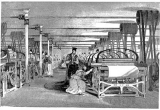
city, as workers migrated into the cities in search of employment in the factories. Nowhere was this better illustrated than the mills and associated industries of
Manchester, nicknamed Cottonopolis, and arguably the world's first industrial city. For much of the 19th century, production was done in small mills, which were typically powered by water and built to serve local needs.
The transition to industrialisation was not wholly smooth. For example, a group of English workers known as Luddites formed to protest against industrialisation and sometimes
sabotaged factories.
One of the earliest reformers of factory conditions was
Robert Owen.
Machine tools
The Industrial Revolution could not have developed without machine tools, for they enabled manufacturing machines to be made. They have their origins in the tools developed in the 18th century by makers of clocks and watches, and scientific instrument makers to enable them to batch-produce small mechanisms. The mechanical parts of early textile machines were sometimes called 'clock work' due to the metal spindles and gears they incorporated. The manufacture of textile machines drew craftsmen from these trades and is the origin of the modern engineering industry. Machine makers early developed special purpose machines for making parts.
Machines were built by various craftsmen--
carpenters made wooden framings, and smiths and turners made metal parts. A good example of how machine tools changed manufacturing took place in
Birmingham, England in 1830. The invention of a new machine by William Joseph Gillott, William Mitchell and James Stephen Perry allowed mass manufacture of robust, cheap
steel