
Encyclopedia
Caliph is the title for the Islamic leader of the
Ummah, or community of
Islam. It is a transliterated version of the Arabic word ?????
Khalifah which means "successor" or "representative". Some of the early leaders of the Muslim community following the prophet
Muhammad's death called themselves "Khalifat Allah", meaning representative of God, but the alternative title of "Khalifat rasul Allah", meaning the successor to the prophet of God, eventually became the standard title. Some academics prefer to transliterate the term as
Khalif.
Caliphs were often also referred to as
Amir al-Mu'minin "Commander of the Faithful", or, more colloquially, leader of the
Muslims. This title has been shortened and romanized to "emir". It is also found as a personal name in some countries .
After the first four caliphs , the title was claimed by the Umayyads, the
Abbasids, and the
Ottomans, as well as by other, competing lineages in
Spain,
Northern Africa, and
Egypt. Most historical Muslim rulers simply titled themselves
sultans or
amirs, and gave token obedience to a caliph who often had very little real authority. The title has been defunct since the
Republic of Turkey abolished the
Ottoman caliphate in 1924.
Origins of the caliphate
Most academic scholars agree that Muhammad had not explicitly established how the Muslim community was to be governed after his death. Two questions faced these early Muslims: who was to succeed Muhammad, and what sort of authority he was to exercise.
Succession to Prophet Muhammad
Fred M. Donner, in his book
The Early Islamic Conquests , argues that the standard Arabian practice at the time was for the prominent men of a kinship group, or tribe, to gather after a leader's death and choose a leader from amongst themselves. There was no specified procedure for this shura, or consultation. Candidates were usually from the same lineage as the deceased leader, but they were not necessarily his sons. Capable men who would lead well were preferred over an ineffectual direct heir.
This is also the argument advanced by Sunni Muslims, who believe that Muhammad's lieutenant
Abu Bakr was chosen by the community and that this was the proper procedure. They further argue that a caliph is ideally chosen by election or community consensus, even though the caliphate soon became a hereditary office, or the prize of the strongest general.
Shi'a Muslims disagree. They believe that Muhammad had given many indications that he considered , his cousin and son-in-law, as his chosen successor. They say that Abu Bakr seized power by force and trickery. All caliphs other than were usurpers. and his descendents are believed to have been the only proper Muslim leaders, or imams. This matter is covered in much greater detail in the article Succession to Muhammad, and in the article on
Shi'a Islam.
A third branch of Islam, the Ibadi, believes that the caliphate rightly belongs to the greatest spiritual leader among Muslims, regardless of his lineage. They are currently an extremely small sect, found mainly in
Oman.
The authority of the caliph
Who should succeed Muhammad was not the only issue that faced the early Muslims; they also had to clarify the extent of the leader's powers. Muhammad, during his lifetime, was not only the Muslim leader, but the Muslim prophet and the Muslim judge. All law and spiritual practice proceeded from Muhammad. Was his successor to have the same status?
None of the early caliphs claimed to receive divine revelations, as did Muhammad; since Muhammad is the last divine messenger, none of them claimed to be a
nabi, "a prophet" or a "rasul" or divine messenger. Muhammad's revelations were soon codified and written down as the
Qur'an, which was accepted as a supreme authority, limiting what a caliph could legitimately command.
However, there is some evidence that the early caliphs did believe that they had authority to rule in matters not specified in the Qur'an. They believed themselves to be the spiritual and temporal leaders of Islam, and insisted that implicit obedience to the caliph in all things was the hallmark of the good Muslim. The modern scholars Patricia Crone and Martin Hinds, in their book
God's Caliph, outline the evidence for an early, expansive view of the caliph's importance and authority. They argue that this view of the caliphate was eventually nullified by the rising power of the
ulema, or Islamic scholars, clerics, and religious specialists. The ulema insisted on
their right to determine what was legal and orthodox. The proper Muslim leader, in the ulema's opinion, was the leader who enforced the rulings of the ulema, rather than making rulings of his own. Conflict between caliph and ulema was a recurring theme in early Islamic history, and ended in the victory of the ulema. The caliph was henceforth limited to temporal rule. He would be considered a righteous caliph if he were guided by the ulema. Crone and Hinds argue that Shi'a Muslims, with their expansive view of the powers of the imamate, have preserved some of the beliefs of early Islam. Crone and Hinds' thesis is not accepted by all scholars.
Most Sunni Muslims now believe that the caliph has always been a merely temporal ruler, and that the ulema has always been responsible for adjudicating orthodoxy and Islamic law . The first four caliphs are called the Rashidun, the Rightly Guided Caliphs, because they are believe to have followed the Qur'an and the way or sunnah of Muhammad in all things. This formulation itself presumes the Sunni ulema's view of history.
The Role of a Caliphate
Ibn Taymiyah characterizes political authority or leadership as a trust and not as absolute and unanswerable to authority. Many primary sources were used by Islamic jurists to prove this point such as the hadith, “It is a trust, and on the Day of Judgment it will be a thing of sorrow and humiliation except for those who were deserving of it and did well.” This contrasts deeply with the Medieval European doctrine of the “divine right of kings.” The human being is obliged to obey the Divine hence the Imam is simply a means to facilitate that obedience and is not “above the law.”."
The role of a Caliphate was written by mostly by Islamic theologians and jurists. Imam Najm al-Din al-Nasafi summarized the roles of the Caliphate in his widely accepted Nasafi Creed, a codified Sunni Maturidite creed and doctrine.
"The Muslims cannot do without a leader who shall occupy himself with the enforcing of their decisions, and in maintaining their boundaries and guarding their frontiers, and equipping their armies, and receiving their alms, and putting down robberies and thieving and highwaymen, and maintaining the Friday services and the Festivals, and removing quarrels that fall between creatures, and receiving evidence bearing on legal claims, and marrying minors, male and female, and those who have no guardians, and dividing booty. And it is necessary that the leader should be visible, not hidden and expected to appear , and that he should be of the tribe of Quraysh and not of any other. And he is not assigned exclusively to the sons of Hashim nor to the children of Ali. And it is not a condition that he should be protected by Allah from sin , nor that he should be the most excellent of the people of his time, but it is a condition that he should have administrative ability, should be a good governor and be able to carry out decrees and to guard the restrictive ordinances of Islam and to protect the wronged against him who wrongs him. And he is not to be deposed from the leadership on account of immorality or tyranny."
Ibn Khaldun reaffirms this and further explains the role of the Caliph in more simple terms:
"[T]he caliphate means to cause the masses to act as required by religious insight into their interests in the other world as well as in this world. have bearing upon , since according to the Lawgiver , all worldly conditions are to be considered in their relation to their value for the other world. Thus, in reality substitutes for the Lawgiver , in as much as it serves, like him, to protect the religion and to exercise leadership of the world."
The Removal of the Caliphate
Most Sunni jurists strongly disapproved of the removal of a Caliphate once he was in office. Although there have been historical precedents in the contrary, such as Imam Husayn's revolution in Karbala against the tyrannical Yazid or Ibn al-Zubayr's withdrawal of allegience to Yazid, for the most part these were limited occurances.
The Classical jurists are almost unanimous in their ruling – one must submit to tyrannical authority be patient since the need for authority outweighs the evil of tyrannical government. The lack of authority, anarchy, and sedition must be avoided at all costs. While it is forbidden to obey the Imam in his injustice or to aid him in corruption – it is forbidden to attempt to overthrow him as this will destroy any solid peace. The basis for this ruling comes from a hadith of Muhammad, “Sixty days when an unjust Imam is better than one night without a Sultan.” Dr. Abdul `Aziz Islahi compares this to the history of Western thought:
Following the Greek philosophers, St. Thomas Aquinas also adopts this view, on which William Archibald Dunning has commented: 'In respect to individual action in slaying tyrants, he observes that it is more often bad men than the good that undertake such an enterprise, and that, since bad men find the rule of kings no less burdensome than that of tyrants, the recognition of the right of private citizens to kill tyrants involves rather more chance of losing a king than of being relieved of a tyrant.
al-Ghazali and the Ethics of Administration
Imam al-Ghazali wrote the "Nasihat al-Muluk" or "Advice for Kings" to a Seljuq Caliph in which he gave ten different ethics of royal administration:
- The ruler should understand the importance and danger of the authority entrusted to him. In authority there is great blessing, since he who exercises it righteously obtained unsurpassed happiness but if any ruler fails to do so he incurs torment surpassed only by the torment for unbelief.
- The ruler should always be thirsting to meet devout religious scholars and ask them for advice.
- The ruler should understand that he must not be content with personally refraining from injustice, but must discipline his slave-troops, servants, and officers and never tolerate unjust conduct by them; for he will be interrogated not only about his own unjust deeds but also about those of his staff.
- The ruler should not be dominated by pride; for pride gives rise to the dominance of anger, and will impel him to revenge. Anger is the evil genius and blight of the intellect. If anger is becoming dominant it will be necessary for the ruler in all his affairs to bend his inclinations in the direction of forgiveness and make a habit of generosity and forbearance unless he is to be like the wild beasts.
- In every situation that arises, the ruler should figure that he is the subject and the other person is the holder of authority. He should not sanction for others anything that he would not sanction for himself. For if he would do so he would be making fraudulent and treasonable use of the authority entrusted to him.
- The ruler should not disregard the attendance of petitioners at his court and should beware of the danger of so doing. He should solve the grievances of the Muslims.
- The ruler should not form a habit of indulging the passions. Although he might dress more finely or eat more sumptuously, he should be content with all that he has; for without contentment, just conduct will not be possible.
- The ruler should make the utmost effort to behave gently and avoid governing harshly.
- The ruler should endeavor to keep all the subjects pleased with him. The ruler should not let himself be so deluded by the praise he gets from any who approach him as to believe that all the subjects are pleased with him. On the contrary, such praise is entirely due to fear. He must therefore appoint trustworthy persons to carry on espionage and inquire about his standing among the people, so that he may be able to learn his faults from men’s tongues.
- The ruler should not give satisfaction to any person if a contravention of God’s law would be required to please him for no harm will come from such a person’s displeasure.
History
Abu Bakr nominated Umar as his successor on his deathbed, and the Muslim community submitted to his choice. His successor, Uthman, was elected by a council of electors, but was soon perceived by some to be ruling as a "king" rather than an elected leader. Uthman was killed by members of a disaffected group. then took control, but was not universally accepted as caliph. He faced numerous rebellions and was assassinated after a tumultuous rule of only five years. This period is known as the Fitna, or the first Islamic civil war.
One of 's challengers was , a relative of Uthman. After 's death, managed to overcome all other claimants to the Caliphate. He is remembered by history as , the founder of the Umayyad dynasty. Under , the caliphate became a hereditary office.
Umayyads
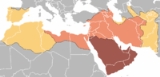
Under the Umayyads, the Muslim empire grew rapidly. To the West, Muslim rule expanded across
North Africa and into
Spain. To the East, it expanded through
Iran and ultimately to
India. This made it one of the largest empires in the
history of West Eurasia, extending its entire breadth.
However, the Umayyad dynasty was not universally supported within Islam itself. Some Muslims supported prominent early Muslims like az-Zubayr; others felt that only members of Muhammad's clan, the Banu Hashim, or his own lineage, the descendants of , should rule. There were numerous rebellions against the Umayyads, as well as splits within the Umayyad ranks . Eventually, supporters of the Banu Hisham and Alid claims united to bring down the Umayyads in 750. However, the
, "the Party of ", were again disappointed when the
Abbasid dynasty took power, as the Abbasids were descended from Muhammad's uncle, Abbas ibn Abd al-Muttalib and not from . Following this disappointment, the finally split from the majority Sunni Muslims and formed what are today the several denominations.
Abbasids
The
Abbasids would provide an unbroken line of caliphs for over three centuries, consolidating Islamic rule and cultivating great intellectual and cultural developments in the Middle East. But by 940 the power of the caliphate under the Abbasids was waning as non-Arabs, particularly the
Turkish , gained influence, and
sultans and
emirs became increasingly independent. However, the caliphate endured as both a symbolic position and a unifying entity for the Islamic world.
During the period of the Abassid dynasty, Abassid claims to the caliphate did not go unchallenged. The Said ibn Husayn of the Fatimid dynasty, which claimed descendancy of Muhammad through his daughter, claimed the title of Caliph in 909, creating a separate line of caliphs in
North Africa. Initially covering Morocco, Algeria, Tunisia and Libya, the Fatimid caliphs extended their rule for the next 150 years, taking
Egypt and
Palestine, before the Abbassid dynasty was able to turn the tide, limiting Fatimid rule to Egypt. The Fatimid dynasty finally ended in 1171. The Umayyad dynasty, which had survived and come to rule over the Muslim provinces of
Spain, reclaimed the title of Caliph in 929, lasting until it was overthrown in 1031.
Shadow Caliphate
1258 saw the conquest of
Baghdad and the execution of Abassid caliph al-Musta'sim by
Mongol forces under
Hulagu Khan. A surviving member of the Abbasid House was installed as Caliph at
Cairo under the patronage of the
Mamluk Sultanate three years later. However, the authority of this line of Caliphs was confined to ceremonial and religious matters, and later Muslim historians referred to it as a "shadow" caliphate.
Ottomans
See the article Ottoman Caliphate.
As the
Ottoman Empire grew in size and strength, Ottoman rulers beginning with Mehmed II began to claim caliphal authority. Their claim was strengthened when the Ottoman Empire defeated the Mamluk Sultanate in 1517 and took control of most Arab lands. The last Abbasid Caliph at Cairo, al-Mutawakkil III, was taken prisoner and transported to
Istanbul, where he reportedly surrendered the Caliphate to Selim I.
Ottoman rulers were known primarily by the title of Sultan and used the title of caliph only sporadically. Mehmed II and his grandson Selim used it to justify their conquest of Islamic countries.
According to Barthold, the first time the title of caliph was used as a political instead of symbolic religious title by the
Ottomans was the peace treaty with
Russia in 1774. The outcome of this war was disastrous for the Ottomans. Large territories, including those with large muslim populations such as
Crimea, were lost to the Christian
Russian Empire. However, the Ottomans under
Abdulhamid I claimed a diplomatic victory by assigning themselves the protectors of Muslims in Russia as part of the peace treaty. This was the first time the
Ottoman caliph was acknowledged as having political significance outside of Ottoman borders by a
European power.
As a consequence of this diplomatic victory, as the Ottoman borders were shrinking, the powers of the Ottoman caliph increased.
Around 1880 Sultan Abdulhamid II reasserted the title as a way of countering creeping European colonialism in Muslim lands. His claim was most fervently accepted by the Muslims of British India. By the eve of the
First World War, the Ottoman state, despite its weakness vis-a-vis Europe, represented the largest and most powerful independent Islamic political entity. But the sultan also enjoyed some authority beyond the borders of his shrinking empire as caliph of Muslims in Egypt, India and Central Asia.
End of Caliphate
On March 3, 1924, the first
President of the Turkish Republic and its leader,
Gazi Mustafa Kemal Atatürk, constitutionally abolished the institution of the Caliphate. Its powers within Turkey were transferred to the
Turkish Grand National Assembly of the newly formed Turkish Republic and the title has since been inactive. Though very unlikely, the Turkish Republic still retains the right to reinstate the Caliphate, if it ever chooses to do so.
Scattered attempts to revive the Caliphate elsewhere in the Muslim World were made in the years immediately following its abandonment by
Turkey, but none were successful. Hussein bin Ali, a former
Ottoman governor of the
Hejaz who aided the
British during
World War I and revolted against
Istanbul, declared himself Caliph two days after Turkey relinquished the title. But his claim was largely ignored, and he was soon ousted and driven out of Arabia by the
Saudis, a rival clan that would have no interest in the Caliphate. The last Ottoman
Sultan Mehmed VI made a similar attempt to re-establish himself as Caliph in the Hejaz after leaving Turkey, but he was also unsuccessful. A summit was convened at Cairo in 1926 to discuss the revival of the Caliphate, but most Muslim countries did not participate and no action was taken to implement the summit's resolutions.
Khilafat Movement
In the 1920s the Khilafat Movement, a movement to restore the Turkish Caliphate, spread throughout the British colonial territories in Asia. It was particularly strong in India, where it was a rallying point for Muslim communities. A summit was convened in
Cairo in 1926 to discuss the revival of the Caliphate, but most Muslim countries did not participate and no action was taken to implement the summit’s resolutions. Though the title
Ameer al-Mumineen was adopted by the King of
Morocco and Mullah
Mohammed Omar, former head of the now-defunct
Taliban regime of
Afghanistan, neither claimed any legal standing or authority over Muslims outside the borders of their respective countries. The closest thing to a Caliphate in existence today is the
Organization of the Islamic Conference , an international organization founded in 1969 consisting of the governments of most Muslim-majority countries. But the OIC has limited influence.
Current Situation
Once the subject of intense conflict and rivalry amongst Muslim rulers, the caliphate has lain dormant and largely unclaimed for much of the past 82 years.
Though Islam is still a dominant influence in most Muslim societies and many Muslims might favor a caliphate in the abstract, tight restrictions on political activity in many Muslim countries coupled with the tremendous practical obstacles to uniting over fifty disparate nation-states under a single institution have prevented efforts to revive the caliphate from garnering much active support, even amongst devout Muslims. Popular apolitical Islamic movements such as the Tablighi Jamaat identify a lack of spirituality and decline in personal religious observance as the root cause of the Muslim World's problems, and claim that the caliphate cannot be successfully revived until these deficiencies are addressed. No attempts at rebuilding a power structure based on Islam were successful anywhere in the Muslim World until the
Iranian Revolution in 1979, which was based on
Shia principles and whose leaders did not outwardly call for the restoration of a global Caliphate .
Various Sunni Islamist movements have gained momentum in recent years; however, they differ widely in their methodology and approach. Many, such as the Justice and Development Party in
Turkey, are locally-oriented, mainstream political parties that have no apparent transnational objectives. Others, such as various branches of the
Muslim Brotherhood, have stated goals of fostering pan-Islamic unity and implementing Islamic Law. In any case, Islamist movements have as yet been unable to agree on a roadmap or a coherent model of Islamic governance, and dialog on this issue amongst Muslim activists and intellectuals has yielded no clear consensus on what a modern Islamic state should look like. Islamic religious scholars and institutions have struggled to define the applicability of centuries-old doctrines within the context of a modern society, and Islamic scholarship is generally thought to have failed to keep pace with scientific, technological, and social progress. Many questions on the form a modern Islamic caliphate would take, such as whether the concept of the caliphate is compatible with the modern nation-state construct, have received minimal attention in traditional Islamic scholarly circles. Mainstream Islamic institutions in Muslim countries today have generally not made the restoration of the caliphate a top priority and have instead focused on other issues.
One transnational group, the
Hizb ut-Tahrir, has tried to recruit the world's Muslims to a renewed caliphate, aiming to ultimately form a global theocratic totalitarian regime.
Famous caliphs
- Abu Bakr - First rightly guided caliph of the Sunnis. Subdued rebel tribes in the Ridda Wars.
- Umar ibn al-Khattab - Second rightly guided caliph. During his reign, the Islamic empire expanded to include Egypt, Jerusalem, and Persia.
- Uthman ibn Affan - Third rightly guided caliph. The Qur'an was compiled under his direction. Killed by rebels.
- Ali ibn Abi Talib - Fourth and last rightly guided caliph, and considered the first imam by Shi'a Muslims. His reign was fraught with internal conflict.
- Muawiya I - First caliph of the Umayyad dynasty. Muawiya instituted dynastic rule by appointing his son Yazid as his successor, a trend that would continue through subsequent caliphates.
- Umar ibn Abd al-Aziz - Umayyad caliph considered by some to be a fifth rightly guided caliph.
- Haroon al-Rasheed - Abbasid caliph during whose reign Baghdad became the world's preeminent center of trade, learning, and culture. Haroon is the subject of many stories in the famous work 1001 Arabian Nights.
- Suleiman the Magnificent - Early Ottoman Sultan during whose reign the Ottoman Empire reached its zenith.
Several Arabic surnames found throughout the Middle East are derived from the word
khalifa. These include: Khalif, Khalifa, Khillif, Kalif, Kalaf, Khalaf, and Kaylif. The usage of this title as a surname is comparable to the existence of surnames such as King, Duke, and Noble in the English language.
Dynasties
The more important dynasties include:
...
- The Shi'ite Fatimid dynasty in North Africa and Egypt . Not universally accepted and not currently included in the list here.
- The Rahmanids, a surviving branch of the Damascus Umayyads, established 'in exile' as Emirs of Córdoba, Spain, declared themselves Caliphs
- The Almohad dynasty in North Africa and Spain . Traced their descent not from Muhammad, but from a puritanic reformer in Morocco who claimed to be the Mahdi whose son established a sultanate and claimed to be a caliph.
- The Ottomans , assumed the title after defeating the Mamluk Sultanate and used it sporadically between the 16th and early 20th century
Note on the overlap of Umayyad and Abbasid Caliphates: After the massacre of the Umayyad clan by the Abbassids, one lone prince escaped and fled to North Africa, which remained loyal to the Umayyads. This was Abd-ar-rahman I. From there, he proceeded to Spain, where he overthrew and united the provinces conquered by previous Umayyad Caliphs . From 756 to 929, this Umayyad domain in Spain was an independent emirate, until Abd-ar-rahman III reclaimed the title of Caliph for his dynasty. The Umayyad Emirs of Spain are not listed in the summary below because they did not claim the caliphate until 929. For a full listing of all the Umayyad rulers in Spain see the Umayyad article.
Claims to the caliphate
Many local rulers throughout Islamic history have claimed to be caliphs. Most claims were ignored outside their limited domains. In many cases, these claims were made by rebels against established authorities and died when the rebellion was crushed. Notable claimants include:
- al-Zubayr, who held the Hijaz against the Ummayad
- Caliph of the Sudan, a Songhai king of the Sahel
- Hussein bin Ali, Sharif of Mecca, who claimed Caliphate at Medina two days after it was abandoned by the Republic of Turkey; subsequently defeated and ousted from Arabia by the Saudis, who ignored the title.
See also
...
References
- Crone, Patricia & Hinds, Martin -- God's Caliph, Cambridge University Press, 1986
- Donner, Fred -- The Early Islamic Conquests, Princeton University Press, 1981
External links