


Principality of Antioch

Encyclopedia
The Principality of Antioch, including parts of modern-day Turkey
and Syria
, was one of the crusader states
created during the First Crusade
.
and Tancred
headed east from Asia Minor
to set up the County of Edessa
, the main army of the First Crusade continued south to besiege Antioch
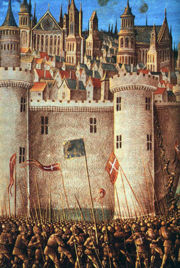
. Bohemond of Taranto led the siege, beginning in October, 1097. With over four hundred towers, the city was almost impenetrable. The siege lasted throughout the winter, with much suffering among the Crusaders, who were often forced to eat their own horses, or, as legend has it, the bodies of their fellow Christian
s who had not survived.
 However, Bohemond convinced a guard in one of the towers, an Armenian former Christian named Firouz
, to let the Crusaders enter the city. He did so on June 3, 1098, and a massacre of the Muslim
inhabitants followed. Only four days later, a Muslim army from Mosul
led by Kerbogha
arrived to besiege the Crusaders themselves. Alexius I Comnenus, the Byzantine emperor, was on his way to assist the Crusaders, but turned back when he heard the city had already been retaken.
However, the Crusaders were withstanding the siege, with help from a mystic named Peter Bartholomew
. Peter claimed he had been visited by St. Andrew
, who told him that the Holy Lance
, which pierced Christ's side as he was on the cross, was located in Antioch
. The cathedral of St. Peter was excavated, and the Lance was discovered by Peter himself. Although Peter most likely planted it there himself (even the papal legate Adhemar of Le Puy
believed this to be the case), it helped raise the spirits of the Crusaders. With the newly discovered relic at the head of the army, Bohemond marched out to meet Kerbogha, who was miraculously defeated — miraculously, according to the Crusaders, because an army of saints had appeared to help them on the battlefield.
There was a lengthy dispute over who should control the city. Bohemond and the other Italian Normans eventually won, and Bohemond named himself prince. Bohemond was already prince (allodial lord) of Taranto
in Italy, and he desired to continue such independence in his new lordship; thus he did not attempt to receive the title of Duke from the Byzantine Emperor (in whose name he had taken an oath to fight), nor any other title with deep feudal obligations, such as count. Meanwhile, an unknown epidemic spread throughout the Crusader camp; Adhemar of Le Puy
was one of the victims.
 Bohemond I was captured in battle with the Danishmends
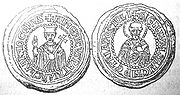
in 1100, and his nephew Tancred became regent. Tancred expanded the borders of the Principality, taking the cities of Tarsus and Latakia
from the Byzantine Empire
. Those cities along with other territory were lost after the Battle of Harran
when Baldwin II
was captured. Bohemond was released in 1103, but left Tancred as regent again when he went to Italy to raise more troops in 1105. He used these troops to attack the Byzantines in 1107, and when he was defeated at Dyrrhachium
in 1108 he was forced by Alexius I to sign the Treaty of Devol
, which would make Antioch a vassal state of the Byzantine Empire upon Bohemond's death; Bohemond had actually promised to return any land that was reconquered when the Crusaders passed through Constantinople
in 1097. Bohemond also fought Aleppo
with Baldwin and Joscelin of the County of Edessa
; when Baldwin and Joscelin were captured, Tancred became regent in Edessa as well. Bohemond left Tancred as regent once more and returned to Italy, where he died in 1111.
Alexius wanted Tancred to return the Principality entirely to Byzantium, but Tancred was supported by the County of Tripoli
and the Kingdom of Jerusalem
; Tancred, in fact, had been the only Crusade leader who did not swear to return conquered land to Alexius (though none of the other leaders, save for Raymond IV of Toulouse
, kept their oaths anyway). Tancred died in 1112 and was succeeded by Bohemond II, under the regency of Tancred's nephew Roger of Salerno
, who defeated a Seljuk attack in 1113.
However, on June 27, 1119, Roger was killed at the Ager Sanguinis
(the Field of Blood), and Antioch became a vassal state of Jerusalem with King Baldwin II
as regent until 1126 (although Baldwin spent much of this time in captivity in Aleppo). Bohemond II, who married Baldwin's daughter Alice
, ruled for only four short years, and the Principality was inherited by his young daughter Constance
; Baldwin II acted as regent again until his death in 1131, when Fulk of Jerusalem
took power. In 1136 Constance, still only 10 years old, married Raymond of Poitiers
, who was 36.
Raymond, like his predecessors, attacked the Byzantine province of Cilicia
. This time, however, Emperor John II Comnenus fought back. He arrived in Antioch in 1138 and forced Raymond to swear fealty to him, but a riot instigated by Joscelin II of Edessa forced him to leave. John had plans to reconquer all the Crusader states, but he died in 1143.
in 1144, Antioch was attacked by Nur ad-Din during the Second Crusade
. Much of the eastern part of the Principality was lost, and Raymond was killed at the battle of Inab
in 1149. Baldwin III of Jerusalem
was technically regent for Raymond's widow Constance until 1153 when she married Raynald of Châtillon
. Raynald, too, immediately found himself in conflict with the Byzantines, this time in Cyprus
; he made peace with Manuel I Comnenus, however, in 1158, and the next year Manuel arrived to take personal control of the Principality. Henceforth, the Principality of Antioch was to be a vassal of Byzantium
until Manuel's death in 1180. Although this arrangement meant that the Principality had to provide a contingent for the Byzantine Army (troops from Antioch participated in an attack on the Seljuk Turks in 1176), it also safeguarded the City against Nur ad-Din at a time when it was in serious danger of being overrun.
Raynald was taken prisoner by the Muslims in 1160, and the regency fell to the Patriarch of Antioch
(Raynald was not released until 1176, and never returned to Antioch). Meanwhile, Manuel married Constance's daughter Maria
, but as Constance was only nominally in charge of Antioch, she was deposed in 1163 and replaced by her son Bohemond III. Bohemond was taken captive by Nur ad-Din the following year at the Battle of Harim
, and the Orontes River
became the permanent boundary between Antioch and Aleppo. Bohemond returned to Antioch in 1165, and married one of Manuel's nieces; he was also convinced to install a Greek Orthodox patriarch in the city.
The Byzantine alliance came to an end with the death of the Emperor Manuel in 1180. Suddenly, Antioch was deprived of the Empire's protection, which had been enough to frighten Nur ad-Din away from intervening in the area for the past twenty years. Nevertheless, with help from the fleets of the Italian city-states Antioch survived Saladin
's assault on the Kingdom of Jerusalem in 1187. Neither Antioch nor Tripoli participated in the Third Crusade
, although the remnants of Frederick Barbarossa
's army briefly stopped in Antioch in 1190 to bury their king. Bohemond III's son, also named Bohemond, had become count of Tripoli after the Battle of Hattin
, and Bohemond III's eldest son Raymond
married an Armenian
princess in 1194. Bohemond III died in 1201.
Bohemond's death resulted in a struggle for control between Antioch, represented by Bohemond of Tripoli, and Armenia, represented by Bohemond III's grandson Raymond-Roupen
. Bohemond of Tripoli, as Bohemond IV, took control by 1207, but Raymond briefly ruled as a rival from 1216 to 1219. Bohemond died in 1233, and Antioch, ruled by his son Bohemond V, played no important role in the Fifth Crusade
, Holy Roman Emperor Frederick II
's struggles to take back Jerusalem in the Sixth Crusade
, or Louis IX of France
's Seventh Crusade
.
. In 1260, under the influence of his father-in-law, the Armenian king Hetoum I, Bohemond VI submitted to the Mongols
under Hulagu, making Antioch a tributary state of the Mongol Empire
. Bohemond and Hetoum fought on the side of the Mongols during the conquests of Muslim Syria
, taking together the city of Aleppo
, and later Damascus
.
When the Mongols were defeated at the Battle of Ain Jalut
in 1260, Baibars
, the Mamluk Sultan of Egypt, began to threaten Antioch, which (as a vassal of the Armenians) had supported the Mongols. Baibars finally took the city in 1268, and all of northern Syria
was quickly lost; twenty-three years later, Acre was taken, and the Crusader states ceased to exist.
In the colophons of the Malatia Gospel of 1268 (MS No. 10675), Armenian manuscript illuminator
Toros Roslin
described the brutal sack of Antioch by Baibars: "...at this time great Antioch was captured by the wicked king of Egypt, and many were killed and became his prisoners, and a cause of anguish to the holy and famous temples, houses of God, which are in it; the wonderful elegance of the beauty of those that were destroyed by fire is beyond the power of words." The empty title of "Prince of Antioch" passed, with the extinction of the Counts of Tripoli, to the Kings of Cyprus
, and was sometimes granted as a dignity to junior members of the royal house.
(lost in 1134) and Balatanos. Saône was captured by Saladin
from the last lord, Matthew, in 1188.
Like Jerusalem, Antioch had its share of great offices, including Constable
, Marshal
, Seneschal
, Duc, Vicomte, Butler
, Chamberlain
, and Chancellor
.
Turkey
Turkey , known officially as the Republic of Turkey , is a Eurasian country located in Western Asia and in East Thrace in Southeastern Europe...
and Syria
Syria
Syria , officially the Syrian Arab Republic , is a country in Western Asia, bordering Lebanon and the Mediterranean Sea to the West, Turkey to the north, Iraq to the east, Jordan to the south, and Israel to the southwest....
, was one of the crusader states
Crusader states
The Crusader states were a number of mostly 12th- and 13th-century feudal states created by Western European crusaders in Asia Minor, Greece and the Holy Land , and during the Northern Crusades in the eastern Baltic area...
created during the First Crusade
First Crusade
The First Crusade was a military expedition by Western Christianity to regain the Holy Lands taken in the Muslim conquest of the Levant, ultimately resulting in the recapture of Jerusalem...
.
Foundation
While Baldwin of BoulogneBaldwin I of Jerusalem
Baldwin I of Jerusalem, formerly Baldwin I of Edessa, born Baldwin of Boulogne , 1058? – 2 April 1118, was one of the leaders of the First Crusade, who became the first Count of Edessa and then the second ruler and first titled King of Jerusalem...
and Tancred
Tancred, Prince of Galilee
Tancred was a Norman leader of the First Crusade who later became Prince of Galilee and regent of the Principality of Antioch...
headed east from Asia Minor
Asia Minor
Asia Minor is a geographical location at the westernmost protrusion of Asia, also called Anatolia, and corresponds to the western two thirds of the Asian part of Turkey...
to set up the County of Edessa
County of Edessa
The County of Edessa was one of the Crusader states in the 12th century, based around Edessa, a city with an ancient history and an early tradition of Christianity....
, the main army of the First Crusade continued south to besiege Antioch
Siege of Antioch
The Siege of Antioch took place during the First Crusade in 1097 and 1098. The first siege, by the crusaders against the Muslim city, lasted from October 21, 1097, to June 2, 1098. The second siege, against the crusaders who had occupied it, lasted from June 7 to June 28, 1098.-Background:Antioch...
. Bohemond of Taranto led the siege, beginning in October, 1097. With over four hundred towers, the city was almost impenetrable. The siege lasted throughout the winter, with much suffering among the Crusaders, who were often forced to eat their own horses, or, as legend has it, the bodies of their fellow Christian
Christian
A Christian is a person who adheres to Christianity, an Abrahamic, monotheistic religion based on the life and teachings of Jesus of Nazareth as recorded in the Canonical gospels and the letters of the New Testament...
s who had not survived.
Firouz
Firouz was a wealthy Armenian Christian convert to Islam and armor maker who held a high post in Yaghi-Siyan's Seljuk Turkish government during the Crusades. Notably, he also served as a spy for Bohemund during the Siege of Antioch. Bohemund had offered Firouz riches and safety guarantees in...
, to let the Crusaders enter the city. He did so on June 3, 1098, and a massacre of the Muslim
Muslim
A Muslim, also spelled Moslem, is an adherent of Islam, a monotheistic, Abrahamic religion based on the Quran, which Muslims consider the verbatim word of God as revealed to prophet Muhammad. "Muslim" is the Arabic term for "submitter" .Muslims believe that God is one and incomparable...
inhabitants followed. Only four days later, a Muslim army from Mosul
Mosul
Mosul , is a city in northern Iraq and the capital of the Ninawa Governorate, some northwest of Baghdad. The original city stands on the west bank of the Tigris River, opposite the ancient Assyrian city of Nineveh on the east bank, but the metropolitan area has now grown to encompass substantial...
led by Kerbogha
Kerbogha
Kerbogha was Atabeg of Mosul during the First Crusade and was renowned as a soldier. He was a Turk who owed his success to his military talent. In 1098, when he heard that the Crusaders had besieged Antioch, he gathered his troops and marched to relieve the city. By the time he arrived, around...
arrived to besiege the Crusaders themselves. Alexius I Comnenus, the Byzantine emperor, was on his way to assist the Crusaders, but turned back when he heard the city had already been retaken.
However, the Crusaders were withstanding the siege, with help from a mystic named Peter Bartholomew
Peter Bartholomew
Peter Bartholomew was a soldier and mystic from France who was part of the First Crusade.In December, 1097, during the siege of Antioch, Peter began to have visions, mostly of St. Andrew. Peter claimed St. Andrew took him to the Church of St. Peter, inside Antioch, and showed him where the relic...
. Peter claimed he had been visited by St. Andrew
Saint Andrew
Saint Andrew , called in the Orthodox tradition Prōtoklētos, or the First-called, is a Christian Apostle and the brother of Saint Peter. The name "Andrew" , like other Greek names, appears to have been common among the Jews from the 3rd or 2nd century BC. No Hebrew or Aramaic name is recorded for him...
, who told him that the Holy Lance
Holy Lance
The Holy Lance is the name given to the lance that pierced Jesus' side as he hung on the cross in John's account of the Crucifixion.-Biblical references:The lance is mentioned only in the Gospel of John and not in any of the...
, which pierced Christ's side as he was on the cross, was located in Antioch
Antioch
Antioch on the Orontes was an ancient city on the eastern side of the Orontes River. It is near the modern city of Antakya, Turkey.Founded near the end of the 4th century BC by Seleucus I Nicator, one of Alexander the Great's generals, Antioch eventually rivaled Alexandria as the chief city of the...
. The cathedral of St. Peter was excavated, and the Lance was discovered by Peter himself. Although Peter most likely planted it there himself (even the papal legate Adhemar of Le Puy
Adhemar of Le Puy
Adhemar de Monteil , one of the principal figures of the First Crusade, was bishop of Puy-en-Velay from before 1087...
believed this to be the case), it helped raise the spirits of the Crusaders. With the newly discovered relic at the head of the army, Bohemond marched out to meet Kerbogha, who was miraculously defeated — miraculously, according to the Crusaders, because an army of saints had appeared to help them on the battlefield.
There was a lengthy dispute over who should control the city. Bohemond and the other Italian Normans eventually won, and Bohemond named himself prince. Bohemond was already prince (allodial lord) of Taranto
Taranto
Taranto is a coastal city in Apulia, Southern Italy. It is the capital of the Province of Taranto and is an important commercial port as well as the main Italian naval base....
in Italy, and he desired to continue such independence in his new lordship; thus he did not attempt to receive the title of Duke from the Byzantine Emperor (in whose name he had taken an oath to fight), nor any other title with deep feudal obligations, such as count. Meanwhile, an unknown epidemic spread throughout the Crusader camp; Adhemar of Le Puy
Adhemar of Le Puy
Adhemar de Monteil , one of the principal figures of the First Crusade, was bishop of Puy-en-Velay from before 1087...
was one of the victims.
Early history
Danishmends
The Danishmend dynasty was a Turcoman dynasty that ruled in north-central and eastern Anatolia in the 11th and 12th centuries. The centered originally around Sivas, Tokat, and Niksar in central-northeastern Anatolia, they extended as far west as Ankara and Kastamonu for a time, and as far south as...
in 1100, and his nephew Tancred became regent. Tancred expanded the borders of the Principality, taking the cities of Tarsus and Latakia
Latakia
Latakia, or Latakiyah , is the principal port city of Syria, as well as the capital of the Latakia Governorate. In addition to serving as a port, the city is a manufacturing center for surrounding agricultural towns and villages...
from the Byzantine Empire
Byzantine Empire
The Byzantine Empire was the Eastern Roman Empire during the periods of Late Antiquity and the Middle Ages, centred on the capital of Constantinople. Known simply as the Roman Empire or Romania to its inhabitants and neighbours, the Empire was the direct continuation of the Ancient Roman State...
. Those cities along with other territory were lost after the Battle of Harran
Battle of Harran
The Battle of Harran took place on May 7, 1104 between the Crusader states of the Principality of Antioch and the County of Edessa, and the Seljuk Turks. It was the first major battle against the newfound Crusader states in the aftermath of the First Crusade marking a key turning point against...
when Baldwin II
Baldwin II of Jerusalem
Baldwin II of Jerusalem , formerly Baldwin II of Edessa, also called Baldwin of Bourcq, born Baldwin of Rethel was the second count of Edessa from 1100 to 1118, and the third king of Jerusalem from 1118 until his death.-Ancestry:Baldwin was the son of Hugh, count of Rethel, and his wife Melisende,...
was captured. Bohemond was released in 1103, but left Tancred as regent again when he went to Italy to raise more troops in 1105. He used these troops to attack the Byzantines in 1107, and when he was defeated at Dyrrhachium
Durrës
Durrës is the second largest city of Albania located on the central Albanian coast, about west of the capital Tirana. It is one of the most ancient and economically important cities of Albania. Durres is situated at one of the narrower points of the Adriatic Sea, opposite the Italian ports of Bari...
in 1108 he was forced by Alexius I to sign the Treaty of Devol
Treaty of Devol
The Treaty of Devol was an agreement made in 1108 between Bohemond I of Antioch and Byzantine Emperor Alexios I Komnenos, in the wake of the First Crusade. It is named after the Byzantine fortress of Devol in Macedonia...
, which would make Antioch a vassal state of the Byzantine Empire upon Bohemond's death; Bohemond had actually promised to return any land that was reconquered when the Crusaders passed through Constantinople
Constantinople
Constantinople was the capital of the Roman, Eastern Roman, Byzantine, Latin, and Ottoman Empires. Throughout most of the Middle Ages, Constantinople was Europe's largest and wealthiest city.-Names:...
in 1097. Bohemond also fought Aleppo
Aleppo
Aleppo is the largest city in Syria and the capital of Aleppo Governorate, the most populous Syrian governorate. With an official population of 2,301,570 , expanding to over 2.5 million in the metropolitan area, it is also one of the largest cities in the Levant...
with Baldwin and Joscelin of the County of Edessa
County of Edessa
The County of Edessa was one of the Crusader states in the 12th century, based around Edessa, a city with an ancient history and an early tradition of Christianity....
; when Baldwin and Joscelin were captured, Tancred became regent in Edessa as well. Bohemond left Tancred as regent once more and returned to Italy, where he died in 1111.
Alexius wanted Tancred to return the Principality entirely to Byzantium, but Tancred was supported by the County of Tripoli
County of Tripoli
The County of Tripoli was the last Crusader state founded in the Levant, located in what today are parts of western Syria and northern Lebanon, where exists the modern city of Tripoli. The Crusader state was captured and created by Christian forces in 1109, originally held by Bertrand of Toulouse...
and the Kingdom of Jerusalem
Kingdom of Jerusalem
The Kingdom of Jerusalem was a Catholic kingdom established in the Levant in 1099 after the First Crusade. The kingdom lasted nearly two hundred years, from 1099 until 1291 when the last remaining possession, Acre, was destroyed by the Mamluks, but its history is divided into two distinct periods....
; Tancred, in fact, had been the only Crusade leader who did not swear to return conquered land to Alexius (though none of the other leaders, save for Raymond IV of Toulouse
Raymond IV of Toulouse
Raymond IV of Toulouse , sometimes called Raymond of St Gilles, was Count of Toulouse, Duke of Narbonne, and Margrave of Provence and one of the leaders of the First Crusade. He was a son of Pons of Toulouse and Almodis de La Marche...
, kept their oaths anyway). Tancred died in 1112 and was succeeded by Bohemond II, under the regency of Tancred's nephew Roger of Salerno
Roger of Salerno
Roger of Salerno was regent of the Principality of Antioch from 1112 to 1119.He was the son of Richard of the Principate and the 2nd cousin of Tancred, Prince of Galilee, both participants on the First Crusade. He became regent of Antioch when Tancred died in 1112; the actual prince, Bohemund II,...
, who defeated a Seljuk attack in 1113.
However, on June 27, 1119, Roger was killed at the Ager Sanguinis
Battle of Ager Sanguinis
In the Battle of Ager Sanguinis, also known as the Battle of the Field of Blood, the Battle of Sarmada, or the Battle of Balat, Roger of Salerno's Crusader army of the Principality of Antioch was annihilated by the army of Ilghazi of Mardin, the Artuqid ruler of Aleppo on June 28,...
(the Field of Blood), and Antioch became a vassal state of Jerusalem with King Baldwin II
Baldwin II of Jerusalem
Baldwin II of Jerusalem , formerly Baldwin II of Edessa, also called Baldwin of Bourcq, born Baldwin of Rethel was the second count of Edessa from 1100 to 1118, and the third king of Jerusalem from 1118 until his death.-Ancestry:Baldwin was the son of Hugh, count of Rethel, and his wife Melisende,...
as regent until 1126 (although Baldwin spent much of this time in captivity in Aleppo). Bohemond II, who married Baldwin's daughter Alice
Alice of Antioch
Alice of Jerusalem was a Princess of Jerusalem. She later became Princess of Antioch.- Biography :Alice was the second daughter of King Baldwin II of Jerusalem and Morphia of Melitene. She has three sisters...
, ruled for only four short years, and the Principality was inherited by his young daughter Constance
Constance of Antioch
Constance of Antioch was the only daughter of Bohemund II of Antioch by his wife Alice, princess of Jerusalem. She was also Princess regnant of the Principality of Antioch from 1130 to her death.-Early life:...
; Baldwin II acted as regent again until his death in 1131, when Fulk of Jerusalem
Fulk of Jerusalem
Fulk , also known as Fulk the Younger, was Count of Anjou from 1109 to 1129, and King of Jerusalem from 1131 to his death...
took power. In 1136 Constance, still only 10 years old, married Raymond of Poitiers
Raymond of Antioch
Raymond of Poitiers was Prince of Antioch 1136–1149. He was the younger son of William IX, Duke of Aquitaine and his wife Philippa, Countess of Toulouse, born in the very year that his father the Duke began his infamous liaison with Dangereuse de Chatelherault.-Assumes control:Following the...
, who was 36.
Raymond, like his predecessors, attacked the Byzantine province of Cilicia
Cilicia
In antiquity, Cilicia was the south coastal region of Asia Minor, south of the central Anatolian plateau. It existed as a political entity from Hittite times into the Byzantine empire...
. This time, however, Emperor John II Comnenus fought back. He arrived in Antioch in 1138 and forced Raymond to swear fealty to him, but a riot instigated by Joscelin II of Edessa forced him to leave. John had plans to reconquer all the Crusader states, but he died in 1143.
Antioch in the Byzantine Empire
After the fall of EdessaSiege of Edessa
The Siege of Edessa took place from November 28 to December 24, 1144, resulting in the fall of the capital of the crusader County of Edessa to Zengi, the atabeg of Mosul and Aleppo.- Background :...
in 1144, Antioch was attacked by Nur ad-Din during the Second Crusade
Second Crusade
The Second Crusade was the second major crusade launched from Europe. The Second Crusade was started in response to the fall of the County of Edessa the previous year to the forces of Zengi. The county had been founded during the First Crusade by Baldwin of Boulogne in 1098...
. Much of the eastern part of the Principality was lost, and Raymond was killed at the battle of Inab
Battle of Inab
The Battle of Inab, also called Battle of Ard al-Hâtim or Fons Muratus, was fought on June 29, 1149, during the Second Crusade. The Syrian army of Nur ad-Din Zangi destroyed the Crusader army of Raymond of Antioch and the allied followers of Ali ibn-Wafa.-Background:Nur ad-Din had gained control...
in 1149. Baldwin III of Jerusalem
Baldwin III of Jerusalem
Baldwin III was king of Jerusalem from 1143 to 1163. He was the eldest son of Melisende and Fulk of Jerusalem, and the grandson of Baldwin II of Jerusalem.-Succession:...
was technically regent for Raymond's widow Constance until 1153 when she married Raynald of Châtillon
Raynald of Chatillon
Raynald of Châtillon was a knight who served in the Second Crusade and remained in the Holy Land after its defeat...
. Raynald, too, immediately found himself in conflict with the Byzantines, this time in Cyprus
Cyprus
Cyprus , officially the Republic of Cyprus , is a Eurasian island country, member of the European Union, in the Eastern Mediterranean, east of Greece, south of Turkey, west of Syria and north of Egypt. It is the third largest island in the Mediterranean Sea.The earliest known human activity on the...
; he made peace with Manuel I Comnenus, however, in 1158, and the next year Manuel arrived to take personal control of the Principality. Henceforth, the Principality of Antioch was to be a vassal of Byzantium
Byzantium
Byzantium was an ancient Greek city, founded by Greek colonists from Megara in 667 BC and named after their king Byzas . The name Byzantium is a Latinization of the original name Byzantion...
until Manuel's death in 1180. Although this arrangement meant that the Principality had to provide a contingent for the Byzantine Army (troops from Antioch participated in an attack on the Seljuk Turks in 1176), it also safeguarded the City against Nur ad-Din at a time when it was in serious danger of being overrun.
Raynald was taken prisoner by the Muslims in 1160, and the regency fell to the Patriarch of Antioch
Latin Patriarch of Antioch
The Latin Patriarch of Antioch was an office created in 1098 by Bohemund, founder of the Principality of Antioch, one of the crusader states....
(Raynald was not released until 1176, and never returned to Antioch). Meanwhile, Manuel married Constance's daughter Maria
Maria of Antioch
Maria of Antioch was a Byzantine empress as the wife of the Byzantine Emperor Manuel I Komnenos. She was the daughter of Constance of Antioch and her first husband Raymond of Poitiers...
, but as Constance was only nominally in charge of Antioch, she was deposed in 1163 and replaced by her son Bohemond III. Bohemond was taken captive by Nur ad-Din the following year at the Battle of Harim
Battle of Harim
The Battle of Harim was fought on 12 August 1164 between the forces of Nur ad-Din Zangi and a combined army from the County of Tripoli, the Principality of Antioch, the Byzantine Empire and Armenia...
, and the Orontes River
Orontes River
The Orontes or ‘Āṣī is a river of Lebanon, Syria and Turkey.It was anciently the chief river of the Levant, also called Draco, Typhon and Axius...
became the permanent boundary between Antioch and Aleppo. Bohemond returned to Antioch in 1165, and married one of Manuel's nieces; he was also convinced to install a Greek Orthodox patriarch in the city.
The Byzantine alliance came to an end with the death of the Emperor Manuel in 1180. Suddenly, Antioch was deprived of the Empire's protection, which had been enough to frighten Nur ad-Din away from intervening in the area for the past twenty years. Nevertheless, with help from the fleets of the Italian city-states Antioch survived Saladin
Saladin
Ṣalāḥ ad-Dīn Yūsuf ibn Ayyūb , better known in the Western world as Saladin, was an Arabized Kurdish Muslim, who became the first Sultan of Egypt and Syria, and founded the Ayyubid dynasty. He led Muslim and Arab opposition to the Franks and other European Crusaders in the Levant...
's assault on the Kingdom of Jerusalem in 1187. Neither Antioch nor Tripoli participated in the Third Crusade
Third Crusade
The Third Crusade , also known as the Kings' Crusade, was an attempt by European leaders to reconquer the Holy Land from Saladin...
, although the remnants of Frederick Barbarossa
Frederick I, Holy Roman Emperor
Frederick I Barbarossa was a German Holy Roman Emperor. He was elected King of Germany at Frankfurt on 4 March 1152 and crowned in Aachen on 9 March, crowned King of Italy in Pavia in 1155, and finally crowned Roman Emperor by Pope Adrian IV, on 18 June 1155, and two years later in 1157 the term...
's army briefly stopped in Antioch in 1190 to bury their king. Bohemond III's son, also named Bohemond, had become count of Tripoli after the Battle of Hattin
Battle of Hattin
The Battle of Hattin took place on Saturday, July 4, 1187, between the Crusader Kingdom of Jerusalem and the forces of the Ayyubid dynasty....
, and Bohemond III's eldest son Raymond
Raymond IV of Tripoli
Raymond IV of Tripoli was the count of Tripoli and prince regent of Antioch . He was the son of Bohemond III of Antioch and Orgueilleuse d'Harenc....
married an Armenian
Armenian Kingdom of Cilicia
The Armenian Kingdom of Cilicia , also known as the Cilician Armenia, Kingdom of Cilician Armenia or New Armenia, was an independent principality formed during the High Middle Ages by Armenian refugees fleeing the Seljuk invasion of Armenia...
princess in 1194. Bohemond III died in 1201.
Bohemond's death resulted in a struggle for control between Antioch, represented by Bohemond of Tripoli, and Armenia, represented by Bohemond III's grandson Raymond-Roupen
Raymond-Roupen of Antioch
Raymond-Roupen of Antioch or Raimond Rupen de Poitiers was Prince of Antioch between 1205 and 1208 and between 1216 and 1219/1221 and "Rex Iunior" of Armenia between 1199 and 1221/1222....
. Bohemond of Tripoli, as Bohemond IV, took control by 1207, but Raymond briefly ruled as a rival from 1216 to 1219. Bohemond died in 1233, and Antioch, ruled by his son Bohemond V, played no important role in the Fifth Crusade
Fifth Crusade
The Fifth Crusade was an attempt to reacquire Jerusalem and the rest of the Holy Land by first conquering the powerful Ayyubid state in Egypt....
, Holy Roman Emperor Frederick II
Frederick II, Holy Roman Emperor
Frederick II , was one of the most powerful Holy Roman Emperors of the Middle Ages and head of the House of Hohenstaufen. His political and cultural ambitions, based in Sicily and stretching through Italy to Germany, and even to Jerusalem, were enormous...
's struggles to take back Jerusalem in the Sixth Crusade
Sixth Crusade
The Sixth Crusade started in 1228 as an attempt to regain Jerusalem. It began seven years after the failure of the Fifth Crusade. It involved very little actual fighting...
, or Louis IX of France
Louis IX of France
Louis IX , commonly Saint Louis, was King of France from 1226 until his death. He was also styled Louis II, Count of Artois from 1226 to 1237. Born at Poissy, near Paris, he was an eighth-generation descendant of Hugh Capet, and thus a member of the House of Capet, and the son of Louis VIII and...
's Seventh Crusade
Seventh Crusade
The Seventh Crusade was a crusade led by Louis IX of France from 1248 to 1254. Approximately 800,000 bezants were paid in ransom for King Louis who, along with thousands of his troops, was captured and defeated by the Egyptian army led by the Ayyubid Sultan Turanshah supported by the Bahariyya...
.
Fall of the Principality
In 1254 Bohemond VI married Sibylla, an Armenian princess, ending the power struggle between the two states, although by this point Armenia was the more powerful of the two and Antioch was essentially a vassal state. Both, however, were swept up by the conflict between the Mameluks and the MongolsMongols
Mongols ) are a Central-East Asian ethnic group that lives mainly in the countries of Mongolia, China, and Russia. In China, ethnic Mongols can be found mainly in the central north region of China such as Inner Mongolia...
. In 1260, under the influence of his father-in-law, the Armenian king Hetoum I, Bohemond VI submitted to the Mongols
Mongols
Mongols ) are a Central-East Asian ethnic group that lives mainly in the countries of Mongolia, China, and Russia. In China, ethnic Mongols can be found mainly in the central north region of China such as Inner Mongolia...
under Hulagu, making Antioch a tributary state of the Mongol Empire
Mongol Empire
The Mongol Empire , initially named as Greater Mongol State was a great empire during the 13th and 14th centuries...
. Bohemond and Hetoum fought on the side of the Mongols during the conquests of Muslim Syria
Syria
Syria , officially the Syrian Arab Republic , is a country in Western Asia, bordering Lebanon and the Mediterranean Sea to the West, Turkey to the north, Iraq to the east, Jordan to the south, and Israel to the southwest....
, taking together the city of Aleppo
Aleppo
Aleppo is the largest city in Syria and the capital of Aleppo Governorate, the most populous Syrian governorate. With an official population of 2,301,570 , expanding to over 2.5 million in the metropolitan area, it is also one of the largest cities in the Levant...
, and later Damascus
Damascus
Damascus , commonly known in Syria as Al Sham , and as the City of Jasmine , is the capital and the second largest city of Syria after Aleppo, both are part of the country's 14 governorates. In addition to being one of the oldest continuously inhabited cities in the world, Damascus is a major...
.
When the Mongols were defeated at the Battle of Ain Jalut
Battle of Ain Jalut
The Battle of Ain Jalut took place on 3 September 1260 between Mamluks and the Mongols in eastern Galilee, in the Jezreel Valley, not far from Ein Harod....
in 1260, Baibars
Baibars
Baibars or Baybars , nicknamed Abu l-Futuh , was a Mamluk Sultan of Egypt. He was one of the commanders of the forces which inflicted a devastating defeat on the Seventh Crusade of King Louis IX of France and he led the vanguard of the Egyptian army at the Battle of Ain Jalut in 1260, which marked...
, the Mamluk Sultan of Egypt, began to threaten Antioch, which (as a vassal of the Armenians) had supported the Mongols. Baibars finally took the city in 1268, and all of northern Syria
Syria
Syria , officially the Syrian Arab Republic , is a country in Western Asia, bordering Lebanon and the Mediterranean Sea to the West, Turkey to the north, Iraq to the east, Jordan to the south, and Israel to the southwest....
was quickly lost; twenty-three years later, Acre was taken, and the Crusader states ceased to exist.
In the colophons of the Malatia Gospel of 1268 (MS No. 10675), Armenian manuscript illuminator
Armenian illuminated manuscript
Armenian illuminated manuscripts form a separate tradition, related to other forms of Medieval Armenian art, but also to the Byzantine tradition. The earliest surviving examples date from the Golden Age of Armenian art and literature in the 5th century...
Toros Roslin
Toros Roslin
Toros Roslin ; circa 1210–1270) was the most prominent Armenian manuscript illuminator in the High Middle Ages. Roslin introduced a wider range of narrative in his iconography based on his knowledge of western European art while continuing the conventions established by his predecessors...
described the brutal sack of Antioch by Baibars: "...at this time great Antioch was captured by the wicked king of Egypt, and many were killed and became his prisoners, and a cause of anguish to the holy and famous temples, houses of God, which are in it; the wonderful elegance of the beauty of those that were destroyed by fire is beyond the power of words." The empty title of "Prince of Antioch" passed, with the extinction of the Counts of Tripoli, to the Kings of Cyprus
Kingdom of Cyprus
The Kingdom of Cyprus was a Crusader kingdom on the island of Cyprus in the high and late Middle Ages, between 1192 and 1489. It was ruled by the French House of Lusignan.-History:...
, and was sometimes granted as a dignity to junior members of the royal house.
Geography and demographics
The Principality of Antioch was, even at its greatest extent, much smaller than Edessa and Jerusalem. It extended around the northeastern edge of the Mediterranean, bordering on the County of Tripoli to the south, Edessa to the east, and the Byzantine Empire or the Kingdom of Armenia to the northwest, depending on the date. It probably had about 20,000 inhabitants in the 12th century, most of whom were Armenians and Greek Orthodox Christians, with a few Muslims outside the city itself. Most of the crusaders who settled there were of Norman origin and/or from southern Italy, as were the first rulers of the principality who surrounded themselves with their own loyal subjects. There were few Roman Catholics apart from the Crusaders who set up the Principality, even though the city was turned into a Latin Patriarchate in 1100.Princes of Antioch, 1098–1268
- Bohemond I 1098–1111
- Tancred, Prince of GalileeTancred, Prince of GalileeTancred was a Norman leader of the First Crusade who later became Prince of Galilee and regent of the Principality of Antioch...
, regent, 1100–1103; 1105–1112
- Tancred, Prince of Galilee
- Bohemond II 1111–1130
- Roger of SalernoRoger of SalernoRoger of Salerno was regent of the Principality of Antioch from 1112 to 1119.He was the son of Richard of the Principate and the 2nd cousin of Tancred, Prince of Galilee, both participants on the First Crusade. He became regent of Antioch when Tancred died in 1112; the actual prince, Bohemund II,...
, regent, 1112–1119 - Baldwin II of JerusalemBaldwin II of JerusalemBaldwin II of Jerusalem , formerly Baldwin II of Edessa, also called Baldwin of Bourcq, born Baldwin of Rethel was the second count of Edessa from 1100 to 1118, and the third king of Jerusalem from 1118 until his death.-Ancestry:Baldwin was the son of Hugh, count of Rethel, and his wife Melisende,...
, regent, 1119–1126; 1130–1131
- Roger of Salerno
- ConstanceConstance of AntiochConstance of Antioch was the only daughter of Bohemund II of Antioch by his wife Alice, princess of Jerusalem. She was also Princess regnant of the Principality of Antioch from 1130 to her death.-Early life:...
1130–1163- Fulk of JerusalemFulk of JerusalemFulk , also known as Fulk the Younger, was Count of Anjou from 1109 to 1129, and King of Jerusalem from 1131 to his death...
, regent, 1131–1136
- Fulk of Jerusalem
- Raymond of PoitiersRaymond of AntiochRaymond of Poitiers was Prince of Antioch 1136–1149. He was the younger son of William IX, Duke of Aquitaine and his wife Philippa, Countess of Toulouse, born in the very year that his father the Duke began his infamous liaison with Dangereuse de Chatelherault.-Assumes control:Following the...
1136–1149 (by marriage) - Raynald of ChâtillonRaynald of ChatillonRaynald of Châtillon was a knight who served in the Second Crusade and remained in the Holy Land after its defeat...
1153–1160 (by marriage) - Bohemond III 1163–1201
- RaymondRaymond IV of TripoliRaymond IV of Tripoli was the count of Tripoli and prince regent of Antioch . He was the son of Bohemond III of Antioch and Orgueilleuse d'Harenc....
1193–1194 (regent)
- Raymond
- Bohemond IV 1201–1216
- Raymond-RoupenRaymond-Roupen of AntiochRaymond-Roupen of Antioch or Raimond Rupen de Poitiers was Prince of Antioch between 1205 and 1208 and between 1216 and 1219/1221 and "Rex Iunior" of Armenia between 1199 and 1221/1222....
1216–1219 - Bohemond IV (restored) 1219–1233
- Bohemond V 1233–1252
- Bohemond VI 1252–1268
Titular Princes of Antioch 1268–1457
- Bohemond VI 1268–1275
- Bohemond VII 1275–1287
- LuciaLucia of TripoliLucia was the last countess of Tripoli.She was the daughter of Bohemund VI, Prince of Antioch and Sibylla of Armenia. Her brother was Bohemund VII of Tripoli. When Bohemund VII died in 1287, their mother appointed as regent Bertrand of Gibelet. He proved to be very unpopular with the commune of...
1287–c. 1299 - Philip of Toucy c.1299–1300
- passes to the Kings of Cyprus and Jerusalem
- Marguerite de Lusignan, d. 1308, sister of Hugh III, last lady of Tyre
- John I (of Lusignan)John of LusignanJohn of Lusignan , Regent of Cyprus and Titular Prince of Antioch. He was son of King Hugh IV of Cyprus and his second wife, Alix of Ibelin.He married twice, firstly in 1343 to Constance of Sicily John of Lusignan (or Jean de Lusignan) (ca 1329 or 1329/1330–1375), Regent of Cyprus and Titular...
bef. 1364–1375, third son of king Hugh IV - John IIJohn II of CyprusJohn II or III of Cyprus was the King of Cyprus and Armenia and also titular King of Jerusalem from 1432 to 1458. He was previously a Titular Prince of Antioch...
bef. 1432–1456? as crown prince of king Janus - John III (of Coimbra) c. 1456–1457, infante of Portugal, married to the future queen Charlotte
Lords of Saône
The Lordship of Saône was centered on the castle of Saône, but included the towns of SarmadaSarmada
Sarmada is a town in the Harem District, Idlib Governorate of Syria. It is also the place in which the Battle of Sarmada took place between the Principality of Antioch and the Ortoqids on June 28th, 1119....
(lost in 1134) and Balatanos. Saône was captured by Saladin
Saladin
Ṣalāḥ ad-Dīn Yūsuf ibn Ayyūb , better known in the Western world as Saladin, was an Arabized Kurdish Muslim, who became the first Sultan of Egypt and Syria, and founded the Ayyubid dynasty. He led Muslim and Arab opposition to the Franks and other European Crusaders in the Levant...
from the last lord, Matthew, in 1188.
- Robert "the Leprous" (d. 1119)
- William (1119–1132)
- ?
- Matthew
Great Officers of Antioch
- Main article: Officers of the Principality of AntiochOfficers of the Principality of AntiochThe Principality of Antioch mirrored the Latin Kingdom of Jerusalem in it selection of great offices: constable, marshal, seneschal, admiral, Chamberlain, butler, chancellor and at certain times also bailiff....
Like Jerusalem, Antioch had its share of great offices, including Constable
Constable
A constable is a person holding a particular office, most commonly in law enforcement. The office of constable can vary significantly in different jurisdictions.-Etymology:...
, Marshal
Marshal
Marshal , is a word used in several official titles of various branches of society. The word is an ancient loan word from Old French, cf...
, Seneschal
Seneschal
A seneschal was an officer in the houses of important nobles in the Middle Ages. In the French administrative system of the Middle Ages, the sénéchal was also a royal officer in charge of justice and control of the administration in southern provinces, equivalent to the northern French bailli...
, Duc, Vicomte, Butler
Butler
A butler is a domestic worker in a large household. In great houses, the household is sometimes divided into departments with the butler in charge of the dining room, wine cellar, and pantry. Some also have charge of the entire parlour floor, and housekeepers caring for the entire house and its...
, Chamberlain
Chamberlain (office)
A chamberlain is an officer in charge of managing a household. In many countries there are ceremonial posts associated with the household of the sovereign....
, and Chancellor
Chancellor
Chancellor is the title of various official positions in the governments of many nations. The original chancellors were the Cancellarii of Roman courts of justice—ushers who sat at the cancelli or lattice work screens of a basilica or law court, which separated the judge and counsel from the...
.