
Encyclopedia
Ancient Egypt was a long-lived ancient
civilization in north-eastern
Africa. It was concentrated along the middle to lower reaches of the
Nile River reaching its greatest extension during the second millennium BCE, which is referred to as the New Kingdom period. It reached broadly from the
Nile Delta in the north, as far south as Jebel Barkal at the
Fourth Cataract of the Nile. Extensions to the geographical range of ancient Egyptian civilization included, at different times, areas of the southern
Levant, the Eastern Desert and the
Red Sea coastline, the
Sinai Peninsula and the Western Desert .
Ancient Egypt developed over at least three and a half millennia. It began with the incipient unification of Nile Valley polities around 3500 BCE and is conventionally thought to have ended in 51 BCE when the early
Roman Empire conquered and absorbed
Ptolemaic Egypt as a province. .
The civilization of ancient Egypt was based on a finely balanced control of natural and human resources, characterised primarily by controlled
irrigation of the fertile Nile Valley; the mineral exploitation of the valley and surrounding desert regions; the early development of an independent
writing system and
literature; the organization of collective projects;
trade with surrounding regions in east / central Africa and the eastern
Mediterranean; finally,
military ventures that exhibited strong characteristics of imperial hegemony and territorial domination of neighbouring cultures at different periods. Motivating and organising these activities were a socio-political and economic
elite that achieved social consensus by means of an elaborate system of
religious belief under the figure of a -divine ruler from a succession of ruling dynasties and which related to the larger world by means of polytheistic beliefs.
History
- Main article: History of ancient Egypt
Archaeological evidence indicates that a developed Egyptian
society extends far into
prehistory . The
Nile River, around which much of the population of the country clusters, has been the lifeline for Egyptian culture since nomadic hunter-gatherers began living along the Nile during the
Pleistocene. Traces of these early peoples appear in the form of artifacts and rock carvings along the terraces of the Nile and in the oases.
Along the
Nile, in the 10th millennium BCE, a
grain-grinding
culture using the earliest type of
sickle blades had been replaced by another culture of
hunters,
fishers, and gathering peoples using
stone tools. Evidence also indicates human habitation in the southwestern corner of Egypt, near the
Sudan border, before
8000 BCE. Climate changes and/or overgrazing around
8000 BCE began to desiccate the pastoral lands of
Egypt, eventually forming the
Sahara , and early tribes naturally migrated to the Nile River where they developed a settled
agricultural economy and more centralized
society . There is evidence of pastoralism and cultivation of
cereals in the East
Sahara in the 7th millennium BCE.
By about 6000 BCE, organized agriculture and large building construction had appeared in the Nile Valley. At this time, Egyptians in the southwestern corner of Egypt were
herding cattle and also
constructing large buildings. Mortar was in use by 4000 BC. The Predynastic Period continues through this time, variously held to begin with the Naqada culture. Some authorities however place the start of the Predynastic Period earlier, in the Lower Paleolithic.
Between 5500 and 3100 BCE, during Egypt's Predynastic Period, small settlements flourished along the Nile. By 3300 BCE, just before the first Egyptian dynasty, Egypt was divided into two kingdoms, known as
Upper Egypt and
Lower Egypt Adkins, L. and Adkins, R.
The Little Book of Egyptian Hieroglyphics, p155. London: Hodder and Stoughton. ISBN 0-340-79485-2.. The dividing line was drawn roughly in the area of modern Cairo.
The
history of ancient Egypt proper starts with Egypt as a unified state, which occurred sometime around 3000 BCE.
Narmer, who unified Upper and Lower Egypt, was the first king. Egyptian culture was remarkably stable and changed little over a period of nearly 3000 years. This includes religion, customs, art expression, architecture and social structure.
Egyptian chronology, which involves regnal years, began around this time. The conventional Egyptian chronology is the chronology accepted during the 20th century, but it does not include any of the major revision proposals that have also been made in that time. Even within a single work, often archeologists will offer several possible dates or even several whole chronologies as possibilities. Consequently, there may be discrepancies between dates shown here and in articles on particular rulers. Often there are also several possible spellings of the names. Typically, Egyptologists divide the history of pharaonic civilization using a schedule laid out first by
Manetho's
Aegyptaica .
- List of pharaohs: The time of the pharaohs stretches from before 3000 BC to about 30 BC.
- Dynasties :
- Early Dynastic Period of Egypt
- Old Kingdom
- First Intermediate Period
- Middle Kingdom of Egypt
- Second Intermediate Period
- New Kingdom of Egypt
- Third Intermediate Period
- Late Period of Ancient Egypt
- Graeco-Roman Egypt
People
Many theories have been proposed regarding the origin of the early Egyptians, a subject still imbued with controversy today .
Egyptian society was a merging of
North and
East African as well as
Southwest Asian peoples. Modern
genetics reveals
that the Egyptian population today is characterized by
paternal lineages common to
North Africans primarily, and to some Near Eastern peoples. Studies based on the
maternal lineages closely links modern Egyptians with people from modern
Eritrea and
Ethiopia.
The ancient Egyptians themselves traced their origin to a land they called Punt,which most Egyptologists locate in the area encompassing
Eritrea and the
Ethiopian Highlands and as far south as
Somalia.
A recent bioanthropological study on the dental morphology of ancient Egyptians confirms dental traits most characteristic of
North African and to a lesser extent
Southwest Asian populations. The study also establishes biological continuity from the predynastic to the post-pharaonic periods. Among the samples included is skeletal material from the Hawara tombs of Fayum, which was found to most closely resemble the Badarian series of the predynastic
.
A study based on stature and body proportions suggests that Nilotic or tropical body characteristics were also present in some later groups
.
Champollion the Younger, who deciphered the
Rosetta Stone, claimed in
Expressions et Termes Particuliers that
kmt referred to a 'negroid' population. Modern day professional Egyptologists, anthropologists, and linguists, however, overwhelmingly agree that the term referred to the dark soil of the Nile Valley rather than the people, which contrasted with
dSrt or the "red land" of the
Sahara desert. This is still a somewhat controversial view; afrocentrists still believe that "kmt" means "Land of the Black People".
In c. 450 BCE,
Herodotus wrote, "the Colchians are Egyptians... on the fact that they are dark-skinned and wooly-haired " .
Melanchros was also used by
Homer to describe the sunburnt complexion of
Odysseus .
Although analyzing the hair of ancient Egyptian
mummies from the Late Middle Kingdom has revealed evidence of a stable diet , mummies from circa 3200 BC show signs of severe anemia and hemolytic disorders .
Administration and taxation
For administrative purposes, ancient Egypt was divided into nomes . The division into nomes can be traced back to the Predynastic Period , when the nomes originally existed as autonomous city-states. The nomes remained in place for more than three millennia, with the area of the individual nomes and their order of numbering remaining remarkably stable. Under the system that prevailed for most of pharaonic Egypt's history, the country was divided into 42 nomes: 20 comprising
Lower Egypt, whilst Upper Egypt was divided into 22. Each nome was governed by a nomarch, a provincial governor who held regional authority. The position of the nomarch was at times hereditary, at times appointed by the pharaoh.
The ancient Egyptian government imposed a number of different
taxes upon its people. As there was no known form of currency during that time period, taxes were paid for "in kind" . The Vizier controlled the taxation system through the departments of state. The departments had to report daily on the amount of stock available, and how much was expected in the future. Taxes were paid for depending on a person's craft or duty. Landowners paid their taxes in
grain and other produce grown on their property.
Craftsmen paid their taxes in the goods that they produced. Hunters and fishermen paid their taxes with produce from the river, marshes, and desert. One person from every household was required to pay a
corvée or labor tax by doing public work for a few weeks every year, such as digging canals or mining. However, a richer
noble could hire a poorer man to fulfill his labor tax.
Language
Ancient Egyptian constitutes an independent branch of the
Afro-Asiatic language phylum. Its closest relatives are the
Berber,
Semitic, and Beja groups of languages. Written records of the
Egyptian language have been dated from about 3200 BC, making it one of the oldest and longest documented languages. Scholars group Egyptian into six major chronological divisions:
- Consists of inscriptions from the late Predynastic and Early Dynastic period. The earliest known evidence of Egyptian hieroglyphic writing appears on Naqada II pottery vessels.
- The language of the Old Kingdom and First Intermediate Period. The Pyramid Texts are the largest body of literature written in this phase of the language. Tomb walls of elite Egyptians from this period also bear autobiographical writings representing Old Egyptian. One of its distinguishing characteristics is the tripling of ideograms, phonograms, and determinatives to indicate the plural. Overall, it does not differ significantly from the next stage.
- Often dubbed Classical Egyptian, this stage is known from a variety of textual evidence in hieroglyphic and hieratic scripts dated from about the Middle Kingdom. It includes funerary texts inscribed on sarcophagi such as the Coffin Texts; wisdom texts instructing people on how to lead a life that exemplified the ancient Egyptian philosophical worldview ; tales detailing the adventures of a certain individual, for example the Story of Sinuhe; medical and scientific texts such as the Edwin Smith Papyrus and the Ebers papyrus; and poetic texts praising a god or a pharaoh, such as the Hymn to the Nile. The Egyptian vernacular already began to change from the written language as evidenced by some Middle Kingdom hieratic texts, but classical Middle Egyptian continued to be written in formal contexts well into the Late Dynastic period .
- Records of this stage appear in the second part of the New Kingdom, considered by many as the "Golden Age" of ancient Egyptian civilization. It contains a rich body of religious and secular literature, comprising such famous examples as the Story of Wenamun and the Instructions of Ani. It was also the language of Ramesside administration. Late Egyptian is not totally distinct from Middle Egyptian, as many "classicisms" appear in historical and literary documents of this phase. However, the difference between Middle and Late Egyptian is greater than that between Middle and Old Egyptian. It's also a better representative than Middle Egyptian of the spoken language in the New Kingdom and beyond. Hieroglyphic orthography saw an enormous expansion of its graphemic inventory between the Late Dynastic and Ptolemaic periods.
Writing
For many years, the earliest known hieroglyphic inscription was the
Narmer Palette, found during excavations at Hierakonpolis in the
1890s, which has been dated to c.3200 BC. However recent
archaeological findings reveal that symbols on Gerzean pottery,
c.4000 BC, resemble the traditional hieroglyph forms . Also in 1998 a German archeological team under Gunter Dreyer excavating at
Abydos uncovered tomb U-j, which belonged to a Predynastic ruler, and they recovered three hundred clay labels inscribed with proto-hieroglyphics dating to the Naqada IIIA period, circa 33rd century BC
Glass making was highly developed in ancient Egypt, as is evident from the glass beads, jars, figures and ornaments discovered in the tombs. Recent archeology has uncovered the remains of an ancient Egyptian glass factory.
Timeline
'
Predynastic
See main article and timeline: Predynastic Egypt.Dynastic


- 3300 BC: Bronze works
- 3200 BC: Egyptian hieroglyphs fully developed
- 3200 BC: Narmer Palette, world's earliest known historical document
- 3100 BC: Decimal system, world's earliest use
- 3100 BC: Wine cellars, world's earliest known
- 3050 BC: Shipbuilding in Abydos
- 3000 BC: Exports from Nile to Palestine and Levant: wine
- 3000 BC: Copper plumbing
- 3000 BC: Papyrus, world's earliest known paper
- 3000 BC: Medical Institutions
- 2900 BC: possible steel: carbon-containing iron
- 2700 BC: Surgery, world's earliest known
- 2700 BC: precision Surveying
- 2700 BC: Uniliteral signs, forming basis of world's earliest known alphabet
- 2600 BC: Sphinx, still today the world's largest single-stone statue
- 2600s–2500 BC: Shipping expeditions: King Sneferu and Pharaoh Sahure. See also , .
- 2600 BC: Barge transportation, stone blocks
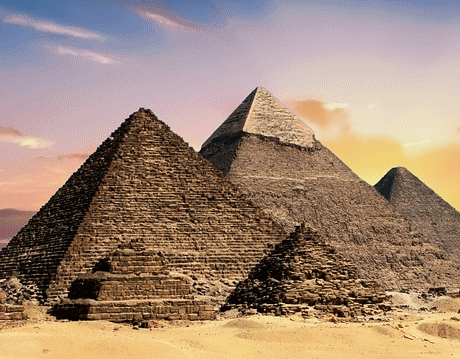
- 2600 BC: Pyramid of Djoser, world's earliest known large-scale stone building
- 2600 BC: Menkaure's Pyramid & Red Pyramid, world's earliest known works of carved granite
- 2600 BC: Red Pyramid, world's earliest known "true" smooth-sided pyramid; solid granite work
- 2580 BC: Great Pyramid of Giza, the world's tallest structure until AD 1300
- 2500 BC: Beekeeping
- 2400 BC: Astronomical Calendar, used even in the Middle Ages for its mathematical regularity
- 2200 BC: Beer
- 1860 BC: possible Nile-Red Sea Canal
- 1800 BC: Alphabet, world's oldest known
- 1800 BC: Moscow Mathematical Papyrus, generalized formula for volume of frustum
- 1650 BC: Rhind Mathematical Papyrus: geometry, cotangent analogue, algebraic equations, arithmetic series, geometric series
- 1600 BC: Edwin Smith papyrus, medical tradition traces as far back as c. 3000 BC
- 1550 BC: Ebers Medical Papyrus, traditional empiricism; world's earliest known documented tumors
- 1500 BC: Glass-making, world's earliest known
- 1300 BC: Berlin Mathematical Papyrus, 19th dynasty - 2nd order algebraic equations
- 1258 BC: Peace treaty, world's earliest known
- 1160 BC: Turin papyrus, world's earliest known geologic and topographic map
- 1000 BC: Petroleum tar used in mummification
- 5th–4th century BC : battle games petteia and seega; possible precursors to Chess
Open problems
There is a question as to the sophistication of ancient Egyptian technology, and there are several open problems concerning real and alleged ancient Egyptian achievements. Certain artifacts and records do not fit with conventional technological development systems. It is not known why there seems to be no neat progression to an Egyptian
Iron Age nor why the historical record shows the Egyptians possibly taking a long time to begin using
iron. A study of the rest of Africa could point to the reasons: Sub-saharan Africa confined their use of the metal to agricultural purposes for many centuries. The ancient Egyptians had a much easier form of agriculture with the annual nile floods and fertile sediment delivery. They thus had no impetus for the development of agricultural implements that would have spurred the adoption of iron. It is unknown how the Egyptians shaped and worked
granite. A clue is found in the exquisite granite carvings of the Yoruba in West Africa. For years researchers could not fathom how they were carved so smoothly until contemporary workmen demonstrated the simple system of rubbing the quartz with sand and water. The exact date the Egyptians started producing
glass is debated.
There is some question whether the Egyptians were capable of long distance
navigation in their
boats and when they became knowledgeable sailors. It is also contentiously disputed as to whether or not the Egyptians had some understanding of