

.gif)
Civil law (legal system)

Encyclopedia
Roman law
Roman law is the legal system of ancient Rome, and the legal developments which occurred before the 7th century AD — when the Roman–Byzantine state adopted Greek as the language of government. The development of Roman law comprises more than a thousand years of jurisprudence — from the Twelve...
and whose primary feature is that laws are codified into collections, as compared to common law
Common law
Common law is law developed by judges through decisions of courts and similar tribunals rather than through legislative statutes or executive branch action...
systems that gives great precedential weight to common law on the principle that it is unfair to treat similar facts differently on different occasions.
Conceptually, it is the group of legal ideas and systems ultimately derived from the Code of Justinian, but heavily overlaid by Germanic
Early Germanic law
Several Latin law codes of the Germanic peoples written in the Early Middle Ages survive, dating to between the 5th and 9th centuries...
, ecclesiastical, feudal, and local practices, as well as doctrinal strains such as natural law
Natural law
Natural law, or the law of nature , is any system of law which is purportedly determined by nature, and thus universal. Classically, natural law refers to the use of reason to analyze human nature and deduce binding rules of moral behavior. Natural law is contrasted with the positive law Natural...
, codification, and legislative positivism.
Materially, civil law proceeds from abstractions, formulates general principles, and distinguishes substantive rules from procedural rules. It holds legislation as the primary source of law, and the court system is usually inquisitorial, unbound by precedent, and composed of specially trained judicial officers with a limited authority to interpret law. Juries
Jury
A jury is a sworn body of people convened to render an impartial verdict officially submitted to them by a court, or to set a penalty or judgment. Modern juries tend to be found in courts to ascertain the guilt, or lack thereof, in a crime. In Anglophone jurisdictions, the verdict may be guilty,...
separate from the judges are not used, although in some cases, volunteer lay judge
Lay judge
A lay judge is a person assisting a judge in a trial. Lay judges are used in some civil law jurisdictions, such as Germany, Sweden and Finland. Japan began implementing a new lay judge system in 2009....
s participate along with legally trained career judges.
Overview
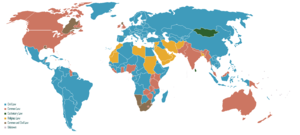
The principle of civil law is to provide all citizens with an accessible and written collection of the laws which apply to them and which judges must follow. It is the most widespread system of law in the world, in force in various forms in about 150 countries, and draws heavily from arguably the most intricate legal system we know of from before the modern era. Colonial expansion spread the civil law which has been received in much of Latin AmericaLatin America
Latin America is a region of the Americas where Romance languages – particularly Spanish and Portuguese, and variably French – are primarily spoken. Latin America has an area of approximately 21,069,500 km² , almost 3.9% of the Earth's surface or 14.1% of its land surface area...
and parts of Asia
Asia
Asia is the world's largest and most populous continent, located primarily in the eastern and northern hemispheres. It covers 8.7% of the Earth's total surface area and with approximately 3.879 billion people, it hosts 60% of the world's current human population...
and Africa
Africa
Africa is the world's second largest and second most populous continent, after Asia. At about 30.2 million km² including adjacent islands, it covers 6% of the Earth's total surface area and 20.4% of the total land area...
.
Where codes exist, the primary source of law is the law code
Civil code
A civil code is a systematic collection of laws designed to comprehensively deal with the core areas of private law. A jurisdiction that has a civil code generally also has a code of civil procedure...
, which is a systematic collection of interrelated articles, arranged by subject matter in some pre-specified order, and that explain the principles of law, rights and entitlements, and how basic legal mechanisms work. Law codes are usually created by a legislature
Legislature
A legislature is a kind of deliberative assembly with the power to pass, amend, and repeal laws. The law created by a legislature is called legislation or statutory law. In addition to enacting laws, legislatures usually have exclusive authority to raise or lower taxes and adopt the budget and...
's enactment of a new statute that embodies all the old statutes relating to the subject and including changes necessitated by court decisions. In some cases, the change results in a new statutory concept. Other major legal systems in the world include common law
Common law
Common law is law developed by judges through decisions of courts and similar tribunals rather than through legislative statutes or executive branch action...
, Halakha
Halakha
Halakha — also transliterated Halocho , or Halacha — is the collective body of Jewish law, including biblical law and later talmudic and rabbinic law, as well as customs and traditions.Judaism classically draws no distinction in its laws between religious and ostensibly non-religious life; Jewish...
, canon law
Canon law
Canon law is the body of laws & regulations made or adopted by ecclesiastical authority, for the government of the Christian organization and its members. It is the internal ecclesiastical law governing the Catholic Church , the Eastern and Oriental Orthodox churches, and the Anglican Communion of...
, and Islamic law
Sharia
Sharia law, is the moral code and religious law of Islam. Sharia is derived from two primary sources of Islamic law: the precepts set forth in the Quran, and the example set by the Islamic prophet Muhammad in the Sunnah. Fiqh jurisprudence interprets and extends the application of sharia to...
.
Civilian countries can be divided into:
- those where civil law in some form is still living law but there has been no attempt to create a civil codeCivil codeA civil code is a systematic collection of laws designed to comprehensively deal with the core areas of private law. A jurisdiction that has a civil code generally also has a code of civil procedure...
: AndorraAndorraAndorra , officially the Principality of Andorra , also called the Principality of the Valleys of Andorra, , is a small landlocked country in southwestern Europe, located in the eastern Pyrenees mountains and bordered by Spain and France. It is the sixth smallest nation in Europe having an area of...
, MaltaMaltaMalta , officially known as the Republic of Malta , is a Southern European country consisting of an archipelago situated in the centre of the Mediterranean, south of Sicily, east of Tunisia and north of Libya, with Gibraltar to the west and Alexandria to the east.Malta covers just over in...
, and San MarinoSan MarinoSan Marino, officially the Republic of San Marino , is a state situated on the Italian Peninsula on the eastern side of the Apennine Mountains. It is an enclave surrounded by Italy. Its size is just over with an estimated population of over 30,000. Its capital is the City of San Marino... - those with uncodified mixed systems in which civil law is an academic source of authority but common law is also influential: ScotlandScotlandScotland is a country that is part of the United Kingdom. Occupying the northern third of the island of Great Britain, it shares a border with England to the south and is bounded by the North Sea to the east, the Atlantic Ocean to the north and west, and the North Channel and Irish Sea to the...
and Roman-Dutch law countries (South AfricaSouth AfricaThe Republic of South Africa is a country in southern Africa. Located at the southern tip of Africa, it is divided into nine provinces, with of coastline on the Atlantic and Indian oceans...
, ZambiaZambiaZambia , officially the Republic of Zambia, is a landlocked country in Southern Africa. The neighbouring countries are the Democratic Republic of the Congo to the north, Tanzania to the north-east, Malawi to the east, Mozambique, Zimbabwe, Botswana and Namibia to the south, and Angola to the west....
, ZimbabweZimbabweZimbabwe is a landlocked country located in the southern part of the African continent, between the Zambezi and Limpopo rivers. It is bordered by South Africa to the south, Botswana to the southwest, Zambia and a tip of Namibia to the northwest and Mozambique to the east. Zimbabwe has three...
, Sri LankaSri LankaSri Lanka, officially the Democratic Socialist Republic of Sri Lanka is a country off the southern coast of the Indian subcontinent. Known until 1972 as Ceylon , Sri Lanka is an island surrounded by the Indian Ocean, the Gulf of Mannar and the Palk Strait, and lies in the vicinity of India and the...
and GuyanaGuyanaGuyana , officially the Co-operative Republic of Guyana, previously the colony of British Guiana, is a sovereign state on the northern coast of South America that is culturally part of the Anglophone Caribbean. Guyana was a former colony of the Dutch and of the British...
) - those with codified mixed systems in which civil law is the background law but has had its public law heavily influenced by common law: LouisianaLouisianaLouisiana is a state located in the southern region of the United States of America. Its capital is Baton Rouge and largest city is New Orleans. Louisiana is the only state in the U.S. with political subdivisions termed parishes, which are local governments equivalent to counties...
, QuebecQuebecQuebec or is a province in east-central Canada. It is the only Canadian province with a predominantly French-speaking population and the only one whose sole official language is French at the provincial level....
, Puerto RicoPuerto RicoPuerto Rico , officially the Commonwealth of Puerto Rico , is an unincorporated territory of the United States, located in the northeastern Caribbean, east of the Dominican Republic and west of both the United States Virgin Islands and the British Virgin Islands.Puerto Rico comprises an...
, PhilippinesPhilippinesThe Philippines , officially known as the Republic of the Philippines , is a country in Southeast Asia in the western Pacific Ocean. To its north across the Luzon Strait lies Taiwan. West across the South China Sea sits Vietnam... - those with comprehensive codes that exceed a single civil code, such as FranceFranceThe French Republic , The French Republic , The French Republic , (commonly known as France , is a unitary semi-presidential republic in Western Europe with several overseas territories and islands located on other continents and in the Indian, Pacific, and Atlantic oceans. Metropolitan France...
, GermanyGermanyGermany , officially the Federal Republic of Germany , is a federal parliamentary republic in Europe. The country consists of 16 states while the capital and largest city is Berlin. Germany covers an area of 357,021 km2 and has a largely temperate seasonal climate...
, GreeceGreeceGreece , officially the Hellenic Republic , and historically Hellas or the Republic of Greece in English, is a country in southeastern Europe....
, JapanJapanJapan is an island nation in East Asia. Located in the Pacific Ocean, it lies to the east of the Sea of Japan, China, North Korea, South Korea and Russia, stretching from the Sea of Okhotsk in the north to the East China Sea and Taiwan in the south...
, MexicoMexicoThe United Mexican States , commonly known as Mexico , is a federal constitutional republic in North America. It is bordered on the north by the United States; on the south and west by the Pacific Ocean; on the southeast by Guatemala, Belize, and the Caribbean Sea; and on the east by the Gulf of...
: it is this last category that is normally regarded as typical of civil law systems, and is discussed in the rest of this article.
The Scandinavian systems are of a hybrid character since their background law is a mix of civil law and Scandinavian customary law and have been partially codified. Likewise, the laws of the Channel Islands
Channel Islands
The Channel Islands are an archipelago of British Crown Dependencies in the English Channel, off the French coast of Normandy. They include two separate bailiwicks: the Bailiwick of Guernsey and the Bailiwick of Jersey...
(Jersey
Jersey
Jersey, officially the Bailiwick of Jersey is a British Crown Dependency off the coast of Normandy, France. As well as the island of Jersey itself, the bailiwick includes two groups of small islands that are no longer permanently inhabited, the Minquiers and Écréhous, and the Pierres de Lecq and...
, Guernsey
Guernsey
Guernsey, officially the Bailiwick of Guernsey is a British Crown dependency in the English Channel off the coast of Normandy.The Bailiwick, as a governing entity, embraces not only all 10 parishes on the Island of Guernsey, but also the islands of Herm, Jethou, Burhou, and Lihou and their islet...
, Alderney
Alderney
Alderney is the most northerly of the Channel Islands. It is part of the Bailiwick of Guernsey, a British Crown dependency. It is long and wide. The area is , making it the third-largest island of the Channel Islands, and the second largest in the Bailiwick...
, Sark
Sark
Sark is a small island in the Channel Islands in southwestern English Channel, off the French coast of Normandy. It is a royal fief, geographically located in the Channel Islands in the Bailiwick of Guernsey, with its own set of laws based on Norman law and its own parliament. It has a population...
) are hybrids which mix Norman customary law
Norman law
Norman law refers to the customary law of Normandy which developed between the 10th and 13th centuries following the establishment of the Vikings there and which survives today still through the legal systems of Jersey and Guernsey in the Channel Islands....
and French civil law.
A prominent example of a civil-law code would be the Napoleonic Code
Napoleonic code
The Napoleonic Code — or Code Napoléon — is the French civil code, established under Napoléon I in 1804. The code forbade privileges based on birth, allowed freedom of religion, and specified that government jobs go to the most qualified...
(1804), named after French emperor Napoleon Bonaparte. The Code comprises three components: the law of persons, property law, and commercial law. Rather than a compendium of statutes or catalog of caselaw, the Code sets out general principles as rules of law.
Civil law is sometimes referred to as neo-Roman law, Romano-Germanic law or Continental law. The expression civil law is a translation of Latin jus civile, or “citizens’ law”, which was the late imperial term for its legal system, as opposed to the laws governing conquered peoples (jus gentium).
History
The civil law takes as its major inspiration classical Roman lawRoman law
Roman law is the legal system of ancient Rome, and the legal developments which occurred before the 7th century AD — when the Roman–Byzantine state adopted Greek as the language of government. The development of Roman law comprises more than a thousand years of jurisprudence — from the Twelve...
(c. AD 1–250), and in particular Justinian
Justinian I
Justinian I ; , ; 483– 13 or 14 November 565), commonly known as Justinian the Great, was Byzantine Emperor from 527 to 565. During his reign, Justinian sought to revive the Empire's greatness and reconquer the lost western half of the classical Roman Empire.One of the most important figures of...
law
Corpus Juris Civilis
The Corpus Juris Civilis is the modern name for a collection of fundamental works in jurisprudence, issued from 529 to 534 by order of Justinian I, Eastern Roman Emperor...
(6th century AD), and further expounding and developments in the late Middle Ages
Medieval Roman law
Medieval Roman law is the continuation and development of ancient Roman law that developed in the European Late Middle Ages. Based on the ancient text of Roman law, the Corpus iuris civilis, it added many new concepts, and formed the basis of the later civil law systems that prevail in most...
under the influence of canon law. The Justinian Code's doctrines provided a sophisticated model for contracts, rules of procedure, family law, wills, and a strong monarchical constitutional system. Roman law was received differently in different countries. In some it went into force wholesale by legislative act, i.e., it became positive law
Positive law
Positive law is the term generally used to describe man-made laws which bestow specific privileges upon, or remove them from, an individual or group...
, whereas in others it was diffused into society by increasingly influential legal experts and scholars.
Roman law continued without interruption in the Byzantine Empire
Byzantine Empire
The Byzantine Empire was the Eastern Roman Empire during the periods of Late Antiquity and the Middle Ages, centred on the capital of Constantinople. Known simply as the Roman Empire or Romania to its inhabitants and neighbours, the Empire was the direct continuation of the Ancient Roman State...
until its final fall in the 15th century. However, subject as it was to multiple incursions and occupations by Western European powers in the late medieval period, its laws became widely available in the West. It was first received into the Holy Roman Empire
Holy Roman Empire
The Holy Roman Empire was a realm that existed from 962 to 1806 in Central Europe.It was ruled by the Holy Roman Emperor. Its character changed during the Middle Ages and the Early Modern period, when the power of the emperor gradually weakened in favour of the princes...
partly because it was considered imperial law, and it spread in Europe mainly because its students were the only trained lawyers. It became the basis of Scots law
Scots law
Scots law is the legal system of Scotland. It is considered a hybrid or mixed legal system as it traces its roots to a number of different historical sources. With English law and Northern Irish law it forms the legal system of the United Kingdom; it shares with the two other systems some...
, though partly rivaled by received feudal Norman law
Norman law
Norman law refers to the customary law of Normandy which developed between the 10th and 13th centuries following the establishment of the Vikings there and which survives today still through the legal systems of Jersey and Guernsey in the Channel Islands....
. In England, it was taught academically at Oxford and Cambridge, but underlay only probate and matrimonial law insofar as both were inherited from canon law, and maritime law, adapted from the law merchant
Lex mercatoria
Lex mercatoria is the body of commercial law used by merchants throughout Europe during the medieval period. It evolved similar to English common law as a system of custom and best practice, which was enforced through a system of merchant courts along the main trade routes. It functioned as the...
through the Bordeaux trade.
Consequently, neither of the two waves of Romanism completely dominated in Europe. Roman law was a secondary source that was applied only when local customs and laws were found lacking on a certain subject. However, after a time, even local law came to be interpreted and evaluated primarily on the basis of Roman law (it being a common European legal tradition of sorts), thereby in turn influencing the main source of law. Eventually, the works of civilian glossators and commentators led to the development of a common body of law and writing about law, a common legal language, and a common method of teaching and scholarship, all termed the jus commune, or law common to Europe, which consolidated canon law and Roman law, and to some extent, feudal law.
Codification
An important common characteristic of civil law, aside from its origins in Roman law, is the comprehensive codification of received Roman law, i.e., its inclusion in civil codes. The earliest codification known is the Code of HammurabiCode of Hammurabi
The Code of Hammurabi is a well-preserved Babylonian law code, dating to ca. 1780 BC . It is one of the oldest deciphered writings of significant length in the world. The sixth Babylonian king, Hammurabi, enacted the code, and partial copies exist on a human-sized stone stele and various clay...
, written in ancient Babylon
Babylon
Babylon was an Akkadian city-state of ancient Mesopotamia, the remains of which are found in present-day Al Hillah, Babil Province, Iraq, about 85 kilometers south of Baghdad...
during the 18th century BC. However, this, and many of the codes that followed, were mainly lists of civil and criminal wrongs and their punishments. Codification of the type typical of modern civilian systems did not first appear until the Justinian Code.
Germanic codes appeared over the 6th and 7th centuries to clearly delineate the law in force for Germanic privileged classes versus their Roman subjects and regulate those laws according to folk-right. Under feudal law, a number of private custumal
Custumal
A custumal is a medieval English document, usually edited and composed over time, that stipulates the economic, political, and social customs of a manor or town...
s were compiled, first under the Norman empire (Très ancien coutumier, 1200–1245), then elsewhere, to record the manorial – and later regional – customs, court decisions, and the legal principles underpinning them. Custumals were commissioned by lords who presided as lay judges over manorial courts in order to inform themselves about the court process. The use of custumals from influential towns soon became commonplace over large areas. In keeping with this, certain monarchs consolidated their kingdoms by attempting to compile custumals that would serve as the law of the land for their realms, as when Charles VII of France commissioned in 1454 an official custumal of Crown law. Two prominent examples include the Coutume de Paris (written 1510; revised 1580), which served as the basis for the Napoleonic Code, and the Sachsenspiegel
Sachsenspiegel
The Sachsenspiegel is the most important law book and legal code of the German Middle Ages. Written ca...
(c. 1220) of the bishoprics of Magdeburg
Magdeburg
Magdeburg , is the largest city and the capital city of the Bundesland of Saxony-Anhalt, Germany. Magdeburg is situated on the Elbe River and was one of the most important medieval cities of Europe....
and Halberstadt
Halberstadt
Halberstadt is a town in the German state of Saxony-Anhalt and the capital of the district of Harz. It is located on the German Half-Timbered House Road and the Magdeburg–Thale railway....
which was used in northern Germany
Germany
Germany , officially the Federal Republic of Germany , is a federal parliamentary republic in Europe. The country consists of 16 states while the capital and largest city is Berlin. Germany covers an area of 357,021 km2 and has a largely temperate seasonal climate...
, Poland
Poland
Poland , officially the Republic of Poland , is a country in Central Europe bordered by Germany to the west; the Czech Republic and Slovakia to the south; Ukraine, Belarus and Lithuania to the east; and the Baltic Sea and Kaliningrad Oblast, a Russian exclave, to the north...
, and the Low Countries
Low Countries
The Low Countries are the historical lands around the low-lying delta of the Rhine, Scheldt, and Meuse rivers, including the modern countries of Belgium, the Netherlands, Luxembourg and parts of northern France and western Germany....
.
The concept of codification was further developed during the 17th and 18th centuries AD, as an expression of both natural law
Natural law
Natural law, or the law of nature , is any system of law which is purportedly determined by nature, and thus universal. Classically, natural law refers to the use of reason to analyze human nature and deduce binding rules of moral behavior. Natural law is contrasted with the positive law Natural...
and the ideas of the Enlightenment
Age of Enlightenment
The Age of Enlightenment was an elite cultural movement of intellectuals in 18th century Europe that sought to mobilize the power of reason in order to reform society and advance knowledge. It promoted intellectual interchange and opposed intolerance and abuses in church and state...
. The political ideal of that era was expressed by the concepts of democracy
Democracy
Democracy is generally defined as a form of government in which all adult citizens have an equal say in the decisions that affect their lives. Ideally, this includes equal participation in the proposal, development and passage of legislation into law...
, protection of property
Property
Property is any physical or intangible entity that is owned by a person or jointly by a group of people or a legal entity like a corporation...
and the rule of law
Rule of law
The rule of law, sometimes called supremacy of law, is a legal maxim that says that governmental decisions should be made by applying known principles or laws with minimal discretion in their application...
. That ideal required the creation of certainty of law, through the recording of law and through its uniformity. So, the aforementioned mix of Roman law and customary and local law ceased to exist, and the road opened for law codification, which could contribute to the aims of the above mentioned political ideal.
Another reason that contributed to codification was that the notion of the nation-state
Nation-state
The nation state is a state that self-identifies as deriving its political legitimacy from serving as a sovereign entity for a nation as a sovereign territorial unit. The state is a political and geopolitical entity; the nation is a cultural and/or ethnic entity...
required the recording of the law
Law
Law is a system of rules and guidelines which are enforced through social institutions to govern behavior, wherever possible. It shapes politics, economics and society in numerous ways and serves as a social mediator of relations between people. Contract law regulates everything from buying a bus...
that would be applicable to that state.
Certainly, there was also a reaction to law codification. The proponents of codification regarded it as conducive to certainty, unity and systematic recording of the law; whereas its opponents claimed that codification would result in the ossification of the law.
In the end, despite whatever resistance to codification, the codification of European private laws moved forward. Codifications were completed by Denmark (1687), Sweden (1734), Prussia (1794), France
Napoleonic code
The Napoleonic Code — or Code Napoléon — is the French civil code, established under Napoléon I in 1804. The code forbade privileges based on birth, allowed freedom of religion, and specified that government jobs go to the most qualified...
(1804), and Austria (1811). The French codes were imported into areas conquered by Emperor Napoleon and later adopted with modifications in Poland (Duchy of Warsaw
Duchy of Warsaw
The Duchy of Warsaw was a Polish state established by Napoleon I in 1807 from the Polish lands ceded by the Kingdom of Prussia under the terms of the Treaties of Tilsit. The duchy was held in personal union by one of Napoleon's allies, King Frederick Augustus I of Saxony...
/Congress Poland
Congress Poland
The Kingdom of Poland , informally known as Congress Poland , created in 1815 by the Congress of Vienna, was a personal union of the Russian parcel of Poland with the Russian Empire...
; Kodeks cywilny 1806/1825), Louisiana (1807), Canton of Vaud (Switzerland; 1819), the Netherlands
Burgerlijk Wetboek
The Burgerlijk Wetboek is the civil code of the Netherlands. Early permutations were largely based on the Napoleonic code. The Dutch Civil Code was given substantive reform in 1992. The Code deals with the rights of individuals , legal entities , the rights of assets and succession...
(1838), Italy and Romania (1865), Portugal (1867), Spain (1888), Germany
Bürgerliches Gesetzbuch
The Bürgerliches Gesetzbuch is the civil code of Germany. In development since 1881, it became effective on January 1, 1900, and was considered a massive and groundbreaking project....
(1900), and Switzerland (1912). These codifications were in turn imported into colonies at one time or another by most of these countries. The Swiss version was adopted in Brazil (1916) and Turkey (1926).
Because Germany was a rising power in the late 19th century and its legal system was well organized, when many Asian nations were developing, the German Civil Code became the basis for the legal systems of Japan
Japan
Japan is an island nation in East Asia. Located in the Pacific Ocean, it lies to the east of the Sea of Japan, China, North Korea, South Korea and Russia, stretching from the Sea of Okhotsk in the north to the East China Sea and Taiwan in the south...
and South Korea
South Korea
The Republic of Korea , , is a sovereign state in East Asia, located on the southern portion of the Korean Peninsula. It is neighbored by the People's Republic of China to the west, Japan to the east, North Korea to the north, and the East China Sea and Republic of China to the south...
. In China
China
Chinese civilization may refer to:* China for more general discussion of the country.* Chinese culture* Greater China, the transnational community of ethnic Chinese.* History of China* Sinosphere, the area historically affected by Chinese culture...
, the German Civil Code was introduced in the later years of the Qing Dynasty
Qing Dynasty
The Qing Dynasty was the last dynasty of China, ruling from 1644 to 1912 with a brief, abortive restoration in 1917. It was preceded by the Ming Dynasty and followed by the Republic of China....
and formed the basis of the law of the Republic of China
Republic of China
The Republic of China , commonly known as Taiwan , is a unitary sovereign state located in East Asia. Originally based in mainland China, the Republic of China currently governs the island of Taiwan , which forms over 99% of its current territory, as well as Penghu, Kinmen, Matsu and other minor...
, which remains in force in Taiwan
Taiwan
Taiwan , also known, especially in the past, as Formosa , is the largest island of the same-named island group of East Asia in the western Pacific Ocean and located off the southeastern coast of mainland China. The island forms over 99% of the current territory of the Republic of China following...
.
Some authors consider civil law to have served as the foundation for socialist law
Socialist law
Socialist law denotes a general type of legal system which has been used in communist and formerly communist states. It is based on the civil law system, with major modifications and additions from Marxist-Leninist ideology. There is controversy as to whether socialist law ever constituted a...
used in communist
Communism
Communism is a social, political and economic ideology that aims at the establishment of a classless, moneyless, revolutionary and stateless socialist society structured upon common ownership of the means of production...
countries, which in this view would basically be civil law with the addition of Marxist–Leninist ideas. Even if this is so, civil law was generally the legal system in place before the rise of socialist law, and some Eastern European countries reverted back to the pre-Socialist civil law following the fall of socialism, while others continued using their socialist legal systems.
Several civil-law mechanisms seem to have been borrowed from medieval Islamic Sharia
Sharia
Sharia law, is the moral code and religious law of Islam. Sharia is derived from two primary sources of Islamic law: the precepts set forth in the Quran, and the example set by the Islamic prophet Muhammad in the Sunnah. Fiqh jurisprudence interprets and extends the application of sharia to...
and fiqh
Fiqh
Fiqh is Islamic jurisprudence. Fiqh is an expansion of the code of conduct expounded in the Quran, often supplemented by tradition and implemented by the rulings and interpretations of Islamic jurists....
. For example, the Islamic hawala
Hawala
Hawala is an informal value transfer system based on the performance and honor of a huge network of money brokers, which are primarily located in the Middle East, North Africa, the Horn of Africa, and South Asia...
(hundi) underlies the avallo of Italian
Italy
Italy , officially the Italian Republic languages]] under the European Charter for Regional or Minority Languages. In each of these, Italy's official name is as follows:;;;;;;;;), is a unitary parliamentary republic in South-Central Europe. To the north it borders France, Switzerland, Austria and...
law and the aval
Aval
Aval , in Spain, is a joint commitment to payment of an obligation in favor of the creditor or beneficiary. It is granted by a third party, in case the principal debtor does not fulfil the obligation of payment of a credit title....
of French and Spanish law.
Differentiation from other major legal systems
It should be noted that it has been said that little is known of continental European civil law systems from a comparative lawComparative law
Comparative law is the study of differences and similarities between the law of different countries. More specifically, it involves study of the different legal systems in existence in the world, including the common law, the civil law, socialist law, Islamic law, Hindu law, and Chinese law...
perspective. The table below contains essential disparities (and in some cases similarities) between the world's four major legal systems.
| Common law | Civil law | Socialist law | Islamic law | |
|---|---|---|---|---|
| Other names | Anglo-American, English, judge-made | Continental, Romano-Germanic | Social | Religious law, Sharia Law |
| Source of law | Case law, statutes/legislation | Statutes/legislation | Statutes/legislation | Religious documents, case law |
| Lawyers | Control courtroom | Judges dominate trials | Judges dominate trials | Secondary role |
| Judges' qualifications | Experienced lawyers (appointed or elected) | Career judges | Career bureaucrats, Party members | Religious as well as legal training |
| Degree of judicial independence | High | High; separate from the executive and the legislative branches of government | Very limited | Ranges from very limited to high |
| Juries | Provided at trial level | May adjudicate in conjunction with judges in serious criminal matters | Often used at lowest level | Allowed in Maliki Maliki The ' madhhab is one of the schools of Fiqh or religious law within Sunni Islam. It is the second-largest of the four schools, followed by approximately 25% of Muslims, mostly in North Africa, West Africa, the United Arab Emirates, Kuwait, and in some parts of Saudi Arabia... school, not allowed in other schools |
| Policy-making role | Courts share in balancing power | Courts have equal but separate power | Courts are subordinate to the legislature | Courts and other government branches are theoretically subordinate to the Shari'a Sharia Sharia law, is the moral code and religious law of Islam. Sharia is derived from two primary sources of Islamic law: the precepts set forth in the Quran, and the example set by the Islamic prophet Muhammad in the Sunnah. Fiqh jurisprudence interprets and extends the application of sharia to... . In practice, courts historically made the Shari'a, while today, the religious courts are generally subordinate to the executive. |
| Examples | Australia, UK (except Scotland), India (except Goa), Ireland, Hong Kong, USA (except Louisiana), Canada (except Quebec), Pakistan, Malaysia, Norway(to some extent) | All European Union states except UK (excluding Scotland) and Ireland, Brazil, Canada (Quebec only), China (except Hong Kong), Japan, Mexico, Russia, Switzerland, Turkey, USA (Louisiana only), India (Goa only) | Soviet Union and other communist regimes | Pakistan, Saudi Arabia, Afghanistan, Bangladesh, Gambia, Iran, Libya, Mauritania, Morocco, Oman, Sudan, Yemen |
Civil law is primarily contrasted with common law
Common law
Common law is law developed by judges through decisions of courts and similar tribunals rather than through legislative statutes or executive branch action...
, which is the legal system developed first in England, and later among English-speaking
English-speaking world
The English-speaking world consists of those countries or regions that use the English language to one degree or another. For more information, please see:Lists:* List of countries by English-speaking population...
peoples of the world. Despite their differences, the two systems are quite similar from a historical point of view. Both evolved in much the same way, though at different paces. The Roman law underlying civil law developed mainly from customary law that was refined with caselaw and legislation. Canon law further refined court procedure. Similarly, English law developed from Norman and Anglo-Saxon customary law, further refined by caselaw and legislation. The differences of course being that (1) Roman law had crystallised many of its principles and mechanisms in the form of the Justinian Code, which drew from caselaw, scholarly commentary, and senatorial statutes; and (2) civilian caselaw has persuasive authority, not binding authority as under common law.
Codification, however, is by no means a defining characteristic of a civil law system. For example, the statutes that govern the civil law systems of Sweden
Sweden
Sweden , officially the Kingdom of Sweden , is a Nordic country on the Scandinavian Peninsula in Northern Europe. Sweden borders with Norway and Finland and is connected to Denmark by a bridge-tunnel across the Öresund....
and other Nordic countries
Nordic countries
The Nordic countries make up a region in Northern Europe and the North Atlantic which consists of Denmark, Finland, Iceland, Norway and Sweden and their associated territories, the Faroe Islands, Greenland and Åland...
or Roman-Dutch countries are not grouped into larger, expansive codes like those found in France and Germany.
Subgroups
The term "civil law" as applied to a legal tradition actually originates in English-speaking countries, where it was used to lump all non-English legal traditions together and contrast them to the English common law. However, since continental European traditions are by no means uniform, scholars of comparative lawComparative law
Comparative law is the study of differences and similarities between the law of different countries. More specifically, it involves study of the different legal systems in existence in the world, including the common law, the civil law, socialist law, Islamic law, Hindu law, and Chinese law...
and economists promoting the legal origins theory
Legal origins theory
In economics, the legal origins theory states that many aspects of a country's economic state of development are the result of their legal system, most of all where a particular country received its law from...
usually subdivide civil law into four distinct groups:
- Romanistic: FranceFranceThe French Republic , The French Republic , The French Republic , (commonly known as France , is a unitary semi-presidential republic in Western Europe with several overseas territories and islands located on other continents and in the Indian, Pacific, and Atlantic oceans. Metropolitan France...
, BelgiumBelgiumBelgium , officially the Kingdom of Belgium, is a federal state in Western Europe. It is a founding member of the European Union and hosts the EU's headquarters, and those of several other major international organisations such as NATO.Belgium is also a member of, or affiliated to, many...
, LuxembourgLuxembourgLuxembourg , officially the Grand Duchy of Luxembourg , is a landlocked country in western Europe, bordered by Belgium, France, and Germany. It has two principal regions: the Oesling in the North as part of the Ardennes massif, and the Gutland in the south...
, QuebecQuebecQuebec or is a province in east-central Canada. It is the only Canadian province with a predominantly French-speaking population and the only one whose sole official language is French at the provincial level....
(CanadaCanadaCanada is a North American country consisting of ten provinces and three territories. Located in the northern part of the continent, it extends from the Atlantic Ocean in the east to the Pacific Ocean in the west, and northward into the Arctic Ocean...
), LouisianaLouisianaLouisiana is a state located in the southern region of the United States of America. Its capital is Baton Rouge and largest city is New Orleans. Louisiana is the only state in the U.S. with political subdivisions termed parishes, which are local governments equivalent to counties...
(U.S.), ItalyItalyItaly , officially the Italian Republic languages]] under the European Charter for Regional or Minority Languages. In each of these, Italy's official name is as follows:;;;;;;;;), is a unitary parliamentary republic in South-Central Europe. To the north it borders France, Switzerland, Austria and...
, RomaniaRomaniaRomania is a country located at the crossroads of Central and Southeastern Europe, on the Lower Danube, within and outside the Carpathian arch, bordering on the Black Sea...
, the NetherlandsNetherlandsThe Netherlands is a constituent country of the Kingdom of the Netherlands, located mainly in North-West Europe and with several islands in the Caribbean. Mainland Netherlands borders the North Sea to the north and west, Belgium to the south, and Germany to the east, and shares maritime borders...
, ScotlandScotlandScotland is a country that is part of the United Kingdom. Occupying the northern third of the island of Great Britain, it shares a border with England to the south and is bounded by the North Sea to the east, the Atlantic Ocean to the north and west, and the North Channel and Irish Sea to the...
, SpainSpainSpain , officially the Kingdom of Spain languages]] under the European Charter for Regional or Minority Languages. In each of these, Spain's official name is as follows:;;;;;;), is a country and member state of the European Union located in southwestern Europe on the Iberian Peninsula...
, and their former colonies; - Germanic: GermanyGermanyGermany , officially the Federal Republic of Germany , is a federal parliamentary republic in Europe. The country consists of 16 states while the capital and largest city is Berlin. Germany covers an area of 357,021 km2 and has a largely temperate seasonal climate...
, AustriaAustriaAustria , officially the Republic of Austria , is a landlocked country of roughly 8.4 million people in Central Europe. It is bordered by the Czech Republic and Germany to the north, Slovakia and Hungary to the east, Slovenia and Italy to the south, and Switzerland and Liechtenstein to the...
, SwitzerlandSwitzerlandSwitzerland name of one of the Swiss cantons. ; ; ; or ), in its full name the Swiss Confederation , is a federal republic consisting of 26 cantons, with Bern as the seat of the federal authorities. The country is situated in Western Europe,Or Central Europe depending on the definition....
, GreeceGreeceGreece , officially the Hellenic Republic , and historically Hellas or the Republic of Greece in English, is a country in southeastern Europe....
, BrazilBrazilBrazil , officially the Federative Republic of Brazil , is the largest country in South America. It is the world's fifth largest country, both by geographical area and by population with over 192 million people...
, PortugalPortugalPortugal , officially the Portuguese Republic is a country situated in southwestern Europe on the Iberian Peninsula. Portugal is the westernmost country of Europe, and is bordered by the Atlantic Ocean to the West and South and by Spain to the North and East. The Atlantic archipelagos of the...
, TurkeyTurkeyTurkey , known officially as the Republic of Turkey , is a Eurasian country located in Western Asia and in East Thrace in Southeastern Europe...
, JapanJapanJapan is an island nation in East Asia. Located in the Pacific Ocean, it lies to the east of the Sea of Japan, China, North Korea, South Korea and Russia, stretching from the Sea of Okhotsk in the north to the East China Sea and Taiwan in the south...
, South KoreaSouth KoreaThe Republic of Korea , , is a sovereign state in East Asia, located on the southern portion of the Korean Peninsula. It is neighbored by the People's Republic of China to the west, Japan to the east, North Korea to the north, and the East China Sea and Republic of China to the south...
, and TaiwanTaiwanTaiwan , also known, especially in the past, as Formosa , is the largest island of the same-named island group of East Asia in the western Pacific Ocean and located off the southeastern coast of mainland China. The island forms over 99% of the current territory of the Republic of China following...
(Republic of ChinaRepublic of ChinaThe Republic of China , commonly known as Taiwan , is a unitary sovereign state located in East Asia. Originally based in mainland China, the Republic of China currently governs the island of Taiwan , which forms over 99% of its current territory, as well as Penghu, Kinmen, Matsu and other minor...
); - Scandinavian: DenmarkDenmarkDenmark is a Scandinavian country in Northern Europe. The countries of Denmark and Greenland, as well as the Faroe Islands, constitute the Kingdom of Denmark . It is the southernmost of the Nordic countries, southwest of Sweden and south of Norway, and bordered to the south by Germany. Denmark...
, FinlandFinlandFinland , officially the Republic of Finland, is a Nordic country situated in the Fennoscandian region of Northern Europe. It is bordered by Sweden in the west, Norway in the north and Russia in the east, while Estonia lies to its south across the Gulf of Finland.Around 5.4 million people reside...
, IcelandIcelandIceland , described as the Republic of Iceland, is a Nordic and European island country in the North Atlantic Ocean, on the Mid-Atlantic Ridge. Iceland also refers to the main island of the country, which contains almost all the population and almost all the land area. The country has a population...
, NorwayNorwayNorway , officially the Kingdom of Norway, is a Nordic unitary constitutional monarchy whose territory comprises the western portion of the Scandinavian Peninsula, Jan Mayen, and the Arctic archipelago of Svalbard and Bouvet Island. Norway has a total area of and a population of about 4.9 million...
, and SwedenSwedenSweden , officially the Kingdom of Sweden , is a Nordic country on the Scandinavian Peninsula in Northern Europe. Sweden borders with Norway and Finland and is connected to Denmark by a bridge-tunnel across the Öresund....
. - ChineseChinese lawChinese law is one of the oldest legal traditions in the world. In the 20th and 21st century, law in China has been a complex mix of traditional Chinese approaches and Western influences....
(except Hong Kong) is a mixture of civil law and socialist lawSocialist lawSocialist law denotes a general type of legal system which has been used in communist and formerly communist states. It is based on the civil law system, with major modifications and additions from Marxist-Leninist ideology. There is controversy as to whether socialist law ever constituted a...
. Hong Kong, although part of China, uses common law. The Basic Law of Hong Kong ensures the use and status of common law in Hong Kong.
Portugal
Portugal
Portugal , officially the Portuguese Republic is a country situated in southwestern Europe on the Iberian Peninsula. Portugal is the westernmost country of Europe, and is bordered by the Atlantic Ocean to the West and South and by Spain to the North and East. The Atlantic archipelagos of the...
, Brazil
Brazil
Brazil , officially the Federative Republic of Brazil , is the largest country in South America. It is the world's fifth largest country, both by geographical area and by population with over 192 million people...
and Italy
Italy
Italy , officially the Italian Republic languages]] under the European Charter for Regional or Minority Languages. In each of these, Italy's official name is as follows:;;;;;;;;), is a unitary parliamentary republic in South-Central Europe. To the north it borders France, Switzerland, Austria and...
have evolved from French to German influence, as their 19th century civil codes were close to the Napoleonic Code and their 20th century civil codes are much closer to the German Bürgerliches Gesetzbuch
Bürgerliches Gesetzbuch
The Bürgerliches Gesetzbuch is the civil code of Germany. In development since 1881, it became effective on January 1, 1900, and was considered a massive and groundbreaking project....
(BGB). More recently, Brazil
Brazil
Brazil , officially the Federative Republic of Brazil , is the largest country in South America. It is the world's fifth largest country, both by geographical area and by population with over 192 million people...
's 2002 Civil Code took inspiration from the Italian civil code, aiming at the unification of private law
Private law
Private law is that part of a civil law legal system which is part of the jus commune that involves relationships between individuals, such as the law of contracts or torts, as it is called in the common law, and the law of obligations as it is called in civilian legal systems...
; legal culture and law schools have also come near to the German system. The other law in these countries is often said to be of a hybrid nature.
Some systems of civil law do not fit neatly into this typology, however. The Polish civil law
Law of Poland
The Polish law, or legal system in Poland. has been developing since the first centuries of Polish history, over 1,000 years ago. The public and private laws of Poland are codified. The supreme law in Poland is the Constitution of Poland...
developed as a mixture of French and German civil law in the 19th century. After the reunification of Poland
Poland
Poland , officially the Republic of Poland , is a country in Central Europe bordered by Germany to the west; the Czech Republic and Slovakia to the south; Ukraine, Belarus and Lithuania to the east; and the Baltic Sea and Kaliningrad Oblast, a Russian exclave, to the north...
in 1918, five legal systems (French Napoleonic Code from the Duchy of Warsaw
Duchy of Warsaw
The Duchy of Warsaw was a Polish state established by Napoleon I in 1807 from the Polish lands ceded by the Kingdom of Prussia under the terms of the Treaties of Tilsit. The duchy was held in personal union by one of Napoleon's allies, King Frederick Augustus I of Saxony...
, German BGB from Western Poland, Austrian ABGB from Southern Poland, Russian law from Eastern Poland, and Hungarian law from Spisz and Orawa) were merged into one.
Louisiana private law
Louisiana law
Law in the State of Louisiana is based in part on civil law. Louisiana is unique among the 50 U.S. states in having a legal system partially based on French and Spanish codes and ultimately Roman law, as opposed to English common law...
is primarily based on civil law. Louisiana
Louisiana
Louisiana is a state located in the southern region of the United States of America. Its capital is Baton Rouge and largest city is New Orleans. Louisiana is the only state in the U.S. with political subdivisions termed parishes, which are local governments equivalent to counties...
is the only U.S. state
U.S. state
A U.S. state is any one of the 50 federated states of the United States of America that share sovereignty with the federal government. Because of this shared sovereignty, an American is a citizen both of the federal entity and of his or her state of domicile. Four states use the official title of...
partially based on French
Law of France
In academic terms, French law can be divided into two main categories: private or judicial law and public law .Judicial law includes, in particular:*civil law ; and*criminal law ....
and Spanish
Law of Spain
The Law of Spain is the term used to describe the legislation which is in force in the Kingdom of Spain, which is understood to mean Spanish territory, Spanish waters, consulates and embassies, and ships flying the Spanish flag in international waters. It is also applicable to the Spanish armed...
codes and ultimately Roman law
Roman law
Roman law is the legal system of ancient Rome, and the legal developments which occurred before the 7th century AD — when the Roman–Byzantine state adopted Greek as the language of government. The development of Roman law comprises more than a thousand years of jurisprudence — from the Twelve...
, as opposed to English common law
Common law
Common law is law developed by judges through decisions of courts and similar tribunals rather than through legislative statutes or executive branch action...
. In Louisiana, private law was codified into the Louisiana Civil Code. Current Louisiana law has converged considerably with American law, especially in its public law
Public law
Public law is a theory of law governing the relationship between individuals and the state. Under this theory, constitutional law, administrative law and criminal law are sub-divisions of public law...
, its judicial system, and adoption of the Uniform Commercial Code
Uniform Commercial Code
The Uniform Commercial Code , first published in 1952, is one of a number of uniform acts that have been promulgated in conjunction with efforts to harmonize the law of sales and other commercial transactions in all 50 states within the United States of America.The goal of harmonizing state law is...
and certain legal devices of American common law. The law of Quebec
Quebec
Quebec or is a province in east-central Canada. It is the only Canadian province with a predominantly French-speaking population and the only one whose sole official language is French at the provincial level....
, whose private law is similarly of French civilian origin, has developed along the same lines, having been forced in the same way as Louisiana to adopt the public law and judicial system of the common-law majority as a pre-condition for its incorporation.
Several Islamic countries have civil law systems that contain elements of Islamic law
Sharia
Sharia law, is the moral code and religious law of Islam. Sharia is derived from two primary sources of Islamic law: the precepts set forth in the Quran, and the example set by the Islamic prophet Muhammad in the Sunnah. Fiqh jurisprudence interprets and extends the application of sharia to...
. As an example, the Egyptian Civil Code
Egyptian Civil Code
The Egyptian Civil Code is the primary source of civil law for Egypt.The first version of Egyptian Civil Code was written in 1949 containing 1149 articles. The prime author of the 1949 code was the jurist Abd El-Razzak El-Sanhuri, who received assistance from Dean Edouard Lambert of the University...
of 1949—which remains in force in Egypt is the basis for the civil law in many countries of the Arab world
Arab world
The Arab world refers to Arabic-speaking states, territories and populations in North Africa, Western Asia and elsewhere.The standard definition of the Arab world comprises the 22 states and territories of the Arab League stretching from the Atlantic Ocean in the west to the Arabian Sea in the...
where the civil law is used— is based on the Napoleonic Code, but its primary author Abd El-Razzak El-Sanhuri attempted to integrate principles and features of Islamic law in deference to the unique circumstances of Egyptian society.
External links
- A collection of Roman Law resources maintained by professor Ernest Metzger.
- The Roman Law Library by Professor Yves Lassard and Alexandr Koptev
- A Primer on the Civil Law System from the Federal Judicial CenterFederal Judicial CenterThe Federal Judicial Center is the education and research agency of the United States federal courts. It was established by an Act of Congress in 1967, at the recommendation of the Judicial Conference of the United States....
- Brasil Law Articles in English
- A Civil Law to Common Law Dictionary by N. Stephan Kinsella, Louisiana Law Review (1994)
- Brehon Law (King Ollamh Fodhla)