


Chagatai Khanate

Encyclopedia
The Chagatai Khanate was a Turko-Mongol khanate
that comprised the lands ruled by Chagatai Khan
(alternative spellings Chagata, Chugta, Chagta, Djagatai, Jagatai, Chaghtai), second son of the Great Khan Genghis Khan
, and his descendents and successors. Initially it was considered a part of the Mongol Empire
, but it later became fully independent.
At its height in the late 13th century, the Khanate extended from the Amu Darya
south of the Aral Sea
to the Altai Mountains in the border of modern-day Mongolia and China.
The khanate lasted in one form or another from 1220s until the late 17th century, although the western half of the khanate was lost to Tamerlane in the 1360s. The eastern half remained under Chagatai khans who were, at times, allied or at war with Timur's successors. Finally, in the 17th century, the remaining Chagatai domains fell under the theocratic regime of Apaq Khoja and his descendants, the Khojijans, who ruled East Turkestan
under Dzungar
and Manchu
overlordships consecutively.
's empire was inherited by his third son, Ögedei
, the designated Great Khan who personally controlled the lands east of Lake Balkash as far as Mongolia
. Tolui
, the youngest, the keeper of the hearth, was accorded the northern Mongolian
homeland
. Chagatai
, the second son, received Transoxania, between the Amu Darya
and Syr Darya
rivers in modern Uzbekistan
, and the area around Kashgar
. He made his capital at Almalik near what is now Kulja in northwestern China. Apart from problems of lineage and inheritance, the Mongol Empire was endangered by the great cultural and ethnic divide between the Mongols themselves and their mostly Islam
ic Turkic
subjects.
When Ögedei died before achieving his dream of conquering all of China
, there was an unsettled transition to his son Güyük
(1241) overseen by Ögedei's wife Töregene who had assumed the regency for the five years following Ögedei's death. The transition had to be ratified in a kurultai
, which was duly celebrated, but without the presence of Batu
, the independent-minded khan of the Golden Horde
. After Güyük's death, Batu sent Berke
, who maneuvered with Tolui's widow
, and, in the next kurultai (1253), the Ögedite line was passed over for Möngke
, Tolui's son, who was said to be favorable to Nestorian Christianity. The Ögedite ulus was dismembered; only the Ögedites who not immediately go into opposition were given minor fiefs.
, while located within the boundaries of the khanate, were administrated by officials who answered directly to the Great Khan.
This state of subservience to the central government was ended during the reign of Chagatai's grandson Alghu
(1260–1266), who took advantage of the civil war between Khubilai and Ariq Boke
by revolting against the latter, seizing new territories and gaining the allegiance of the Great Khan's authorities in Transoxiana. Most of the Chagatayids first supported Khubilai but in 1269 they joined forces with the House of Ogedei
.
Alghu's eventual successor, Baraq
(1266–1271), who expelled the Khubilai Khan's governor in Chinese Turkestan, soon came into conflict with the Ögedite Kaidu
(Qaidu), who gained the support of the Golden Horde
and attacked the Chagatayids. Baraq was soon confined to Transoxiana and forced to become a vassal of Kaidu. At the same time, he was at odds with Abaqa, the Ilkhan, who ruled his Ilkhanate
in Persia. Baraq attacked first, but was defeated by the Ilkhanate army and forced to return to Transoxiana, where he died not long after.
The next several Chagatayid khans were appointed by Kaidu, who maintained a hold upon the khanate until his death. He finally found a suitable khan in Baraq's son Duwa
(1282–1307), who participated in Kaidu's wars with Khubilai khan and his successors of the Yuan Dynasty
. The two rulers also were active against the Ilkhanate. After Kaidu's death in 1301, Duwa threw off his allegiance to his successor. He also made peace with the Yuan Dynasty and paid tributes to the Yuan court; by the time of his death the Chagatai Khanate was a virtually independent state.
(1309, 1318–1326), who instituted a standardization of the coinage and selected a sedentary capital (at Qarshi
), and Tarmashirin
(1326–1334), who converted to Islam
and raided the Sultanate of Delhi in India
. The center of the khanate was shifting to the western regions, i.e. Transoxiana. Tarmashirin, however, was brought down by a rebellion of the tribes in the eastern provinces and the khanate became increasingly unstable in the following years. In 1346 a tribal chief, Qazaghan, killed the Chagatai khan Qazan
during a revolt.
Qazan's death marked the end of effective Chagatayid rule over Transoxiana. Administration of the region fell into the hands of the local tribes (which were mostly Turkic
or Turko-Mongol) who were loosely allied with one another. In order to legitimatize their rule, they maintained a member of the house of Genghis Khan on the throne, but these khans were no more than puppets. Using the disintegration, Janibeg Khan of the Golden Horde asserted Jochid dominance over the Chagatai Khanate, attempting to unite 3 khanates of the Mongol Empire. But the Jochids lost Azerbaijan
to the Jalayirids
and the Chagataids expelled his administrators after his death in 1357.
The only serious attempt to restore Chagatayid rule in Transoxiana came from Tughlugh Timur
(who will be discussed below), who invaded Transoxiana twice and attempted to neutralize the power of the tribes. He was unsuccessful, however, and died soon afterwards. When his army departed the region, control of Transoxiana was contested by two tribal leaders, Amir Husayn (the grandson of Qazaghan) and Timur
or Tamerlane. Timur eventually defeated Amir Husayn and took control of Transoxiana (1369–1405).
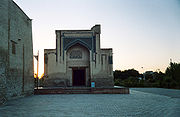 Like his predecessors, Timur maintained a puppet khan on the throne to legitimatize his rule, but his khans were members of the house of Ögedei
, not descendants of Chagatai. For over three decades, Timur used the Chagatai lands as the base for extensive conquests, conquering Herat
in Afghanistan, Shiraz
in Persia, Baghdad
in Iraq
, and Damascus
in Syria. After defeating the Ottoman Turks
at Angora
, Timur died in 1405 while marching on China. After his death his successors, the Timurids, are also reported to have had their own shadow khans until the mid-15th century. Nevertheless, the Chagatai legacy lived on; Timur's troops were called Chagatais, and the literary language
used the Timurids and their Moghul neighbors to the east was called Chagatai Turkic
.
. It is therefore considered to be a continuation of the Chagatai Khanate, but it is also referred to as the Moghul Khanate
, since its tribal inhabitants were originally considered to be pure "Moghuls" (i.e., Mongols), in contrast to the mostly Turkic and Turkicised Mongols of Transoxiana.
The eastern regions of the Chagatai Khanate in the early 14th century had been inhabited by a number of Mongol nomadic tribes. These tribes resented the conversion of Tarmashirin to Islam and the move of the khan to the sedentary areas of Transoxiana. They were behind the revolt that ended in Tarmashirin's death. One of the khans that followed Tarmashirin, Changshi
, favored the east and was anti-Muslim.
In the 1340s as a series of ephemeral khans struggled to hold power in Transoxiana, little attention was paid by the Chagatayids to the eastern regions. As a result, the eastern tribes there were virtually independent. The most powerful of the tribes, the Dughlats
, controlled extensive territories in Moghulistan
and the western Tarim Basin
. In 1347 the Dughlats decided to appoint a khan of their own, and raised the Chagatayid Tughlugh Timur
to the throne.
Tughlugh Timur (1347–1363) was thereby made the head of a tribal confederacy that governed the Tarim Basin and the steppe area of Moghulistan (named after the Moghuls). His reign was contemporaneous with the series of puppet khans that ruled in Transoxiana, meaning that there were now effectively two khanates headed by Chagatayids: one in the west, centered in Transoxiana, and one in the east, centered in Moghulistan. Unlike the khans in the west, however, Tughlugh Timur was a strong ruler who converted to Islam (1354) and sought to reduce the power of the Dughlats. In 1360 he took advantage of a breakdown of order in Transoxiana and his legitimacy as descendant of Chagatai Khan to invade the region and take control of it, thereby temporarily reuniting the two khanates. Despite invading a second time in 1361 and appointing his son Ilyas Khoja
as governor of Transoxiana, however, Tughlugh Timur was unable to keep a lasting hold on the region, and the Moghuls were ultimately expelled by Amir Husayn and Timur, who then fought amongst themselves for control of Transoxiana.
Chagatayid rule in Moghulistan was temporarily interrupted by the coup of the Dughlat amir Qamar ud-Din
, who likely killed Ilyas Khoja and several other Chagatayids. The Moghuls that remained obedient to him were constantly at war with Timur, who invaded Moghulistan several times but was unable to force its inhabitants into submission. A Chagatayid restoration occurred in the 1380s, but the Dughlats retained an important position within the khanate; for the next forty years they installed several khans of their own choosing.
This cycle was broken by Uvais Khan (1418–1428), a devout Muslim who was frequently at war with the Oirats
(Western Mongols) who roamed in the area east of Lake Balkash. He was usually defeated and even captured twice by the Oirat Esen Tayishi, but was able to secure his release both times. Uvais Khan was followed by Esen Buqa
(1428–1462), who frequently raided the Timurid Empire to the west. Late in his reign he was contested by his brother Yunus Khan
(1462–1487), who had raised to the khanship by the Timurids in an attempt to counter Esen Buqa. Yunus Khan defeated the Uzbeks
and maintained good relations with the Kazakhs
and Timurids, but the western Tarim Basin was lost to a revolt by the Dughlats. In 1484 he captured Tashkent
from the Timurids.
During the fifteenth century the Moghul khans became increasingly Turkified. Yunus Khan is even mentioned to have the looks of a Tajik instead of those of a Mongol. This Turkification may not have been as extensive amongst the general Moghul population, who were also slower to convert to Islam than the khan and top amirs (although by the mid-fifteenth century the Moghuls were considered to be largely Muslim). The khans also adopted the Islamic sharia
in favor of the Mongol yasa
.
.png) After Yunus Khan's death his territories were divided by his sons. Ahmad Khan
After Yunus Khan's death his territories were divided by his sons. Ahmad Khan
(1487–1503), who took eastern Moghulistan and Uighuristan, fought a series of successful wars against the Oirats, raided Chinese territory and attempted to seize the western Tarim Basin from the Dughlats, although he was ultimately unsuccessful. In 1503 he traveled west to assist his brother Mahmud Khan
(1487–1508), the ruler of Tashkent and western Moghulistan, against the Uzbeks under Muhammad Shaybani
. The brothers were defeated and captured; they were released but Tashkent was seized by the Uzbeks. Ahmad Khan died soon after and was succeeded by his son Mansur Khan
(1503–1545), who captured Hami, a Chinese dependency, in 1513. Mahmud Khan spent several years trying to regain his authority in Moghulistan; he eventually gave up and submitted to Muhammad Shaybani, who executed him.
Mansur Khan's brother Sultan Said Khan
(1514–1533) conquered the western Tarim Basin from the Dughlats in 1514 and set himself up in Kashgar
. Thereafter the Moghul Khanate was permanently divided, although Sultan Said Khan was nominally a vassal of Mansur Khan in Turpan. After Sultan Said Khan's death he was succeeded by Abdurashid Khan
(1533–1565), who began his reign by executing a member of the Dughlat family. A nephew of the dead amir, Mirza Muhammad Haidar Dughlat
fled to Mughal Empire
in India and eventually conquered Kashmir
, where he wrote a history of the Moghuls. Abdurrashid Khan also fought for control of Moghulistan against the Kirghiz and the Kazakhs, but Moghulistan was ultimately lost; thereafter the Moghuls were largely restricted to possession of the Tarim Basin.
and Khotan
. At the same time, the khans increasingly gave up secular power to the khojas, until they were the effectively the governing power in Kashgaria. The khojas themselves were divided into two sects: the Aq Taghlik and the Kara Taghlik. This situation persisted until the 1670s, when the Moghul khans apparently tried to reassert their authority by expelling the leader of the Aq Taghlik. The Aq Taghlik responded by requesting the assistance of the Dzungars (who were Oirats); the Dzungars invaded Kashgaria, imprisoned the khan, and installed the Aq Taghlik in Kashgar. They also helped the Aq Taghlik overcome the Kara Taghlik in Yarkand. A short time later, the Moghul kingdom of Turpan and Hami was also conquered by the Dzungars. The Tarim Basin fell under the overall rule of the Dzungars until it was taken by the Manchu Emperors of China in the mid-18th century.
Khanate
Khanate, or Chanat, is a Turco-Mongol-originated word used to describe a political entity ruled by a Khan. In modern Turkish, the word used is kağanlık, and in modern Azeri of the republic of Azerbaijan, xanlıq. In Mongolian the word khanlig is used, as in "Khereidiin Khanlig" meaning the Khanate...
that comprised the lands ruled by Chagatai Khan
Chagatai Khan
Chagatai Khan was the second son of Genghis Khan and first khan and origin of the names of the Chagatai Khanate, Chagatai language and Chagatai Turks....
(alternative spellings Chagata, Chugta, Chagta, Djagatai, Jagatai, Chaghtai), second son of the Great Khan Genghis Khan
Genghis Khan
Genghis Khan , born Temujin and occasionally known by his temple name Taizu , was the founder and Great Khan of the Mongol Empire, which became the largest contiguous empire in history after his death....
, and his descendents and successors. Initially it was considered a part of the Mongol Empire
Mongol Empire
The Mongol Empire , initially named as Greater Mongol State was a great empire during the 13th and 14th centuries...
, but it later became fully independent.
At its height in the late 13th century, the Khanate extended from the Amu Darya
Amu Darya
The Amu Darya , also called Oxus and Amu River, is a major river in Central Asia. It is formed by the junction of the Vakhsh and Panj rivers...
south of the Aral Sea
Aral Sea
The Aral Sea was a lake that lay between Kazakhstan in the north and Karakalpakstan, an autonomous region of Uzbekistan, in the south...
to the Altai Mountains in the border of modern-day Mongolia and China.
The khanate lasted in one form or another from 1220s until the late 17th century, although the western half of the khanate was lost to Tamerlane in the 1360s. The eastern half remained under Chagatai khans who were, at times, allied or at war with Timur's successors. Finally, in the 17th century, the remaining Chagatai domains fell under the theocratic regime of Apaq Khoja and his descendants, the Khojijans, who ruled East Turkestan
East Turkestan
East Turkestan is a controversial political term with multiple meanings depending on context and usage...
under Dzungar
Zunghar Khanate
The Zunghar Khanate was a nomadic power on the Eurasian steppe. It covered the area called Dzungaria and stretched from the west end of the Great Wall of China to present-day eastern Kazakhstan, and from present-day northern Kyrgyzstan to southern Siberia .In 1678 Galdan received from the Dalai...
and Manchu
Manchukuo
Manchukuo or Manshū-koku was a puppet state in Manchuria and eastern Inner Mongolia, governed under a form of constitutional monarchy. The region was the historical homeland of the Manchus, who founded the Qing Empire in China...
overlordships consecutively.
Formation
Genghis KhanGenghis Khan
Genghis Khan , born Temujin and occasionally known by his temple name Taizu , was the founder and Great Khan of the Mongol Empire, which became the largest contiguous empire in history after his death....
's empire was inherited by his third son, Ögedei
Ögedei Khan
Ögedei Khan, born Ögedei was the third son of Genghis Khan and second Great Khan of the Mongol Empire by succeeding his father...
, the designated Great Khan who personally controlled the lands east of Lake Balkash as far as Mongolia
Mongolia
Mongolia is a landlocked country in East and Central Asia. It is bordered by Russia to the north and China to the south, east and west. Although Mongolia does not share a border with Kazakhstan, its western-most point is only from Kazakhstan's eastern tip. Ulan Bator, the capital and largest...
. Tolui
Tolui
Tolui, was the youngest son of Genghis Khan by his chief khatun Börte...
, the youngest, the keeper of the hearth, was accorded the northern Mongolian
Outer Mongolia
Outer Mongolia was a territory of the Qing Dynasty = the Manchu Empire. Its area was roughly equivalent to that of the modern state of Mongolia, which is sometimes informally called "Outer Mongolia" today...
homeland
Homeland
A homeland is the concept of the place to which an ethnic group holds a long history and a deep cultural association with —the country in which a particular national identity began. As a common noun, it simply connotes the country of one's origin...
. Chagatai
Chagatai Khan
Chagatai Khan was the second son of Genghis Khan and first khan and origin of the names of the Chagatai Khanate, Chagatai language and Chagatai Turks....
, the second son, received Transoxania, between the Amu Darya
Amu Darya
The Amu Darya , also called Oxus and Amu River, is a major river in Central Asia. It is formed by the junction of the Vakhsh and Panj rivers...
and Syr Darya
Syr Darya
The Syr Darya , also transliterated Syrdarya or Sirdaryo, is a river in Central Asia, sometimes known as the Jaxartes or Yaxartes from its Ancient Greek name . The Greek name is derived from Old Persian, Yakhsha Arta , a reference to the color of the river's water...
rivers in modern Uzbekistan
Uzbekistan
Uzbekistan , officially the Republic of Uzbekistan is a doubly landlocked country in Central Asia and one of the six independent Turkic states. It shares borders with Kazakhstan to the west and to the north, Kyrgyzstan and Tajikistan to the east, and Afghanistan and Turkmenistan to the south....
, and the area around Kashgar
Kashgar
Kashgar or Kashi is an oasis city with approximately 350,000 residents in the western part of the Xinjiang Uyghur Autonomous Region of the People's Republic of China. Kashgar is the administrative centre of Kashgar Prefecture which has an area of 162,000 km² and a population of approximately...
. He made his capital at Almalik near what is now Kulja in northwestern China. Apart from problems of lineage and inheritance, the Mongol Empire was endangered by the great cultural and ethnic divide between the Mongols themselves and their mostly Islam
Islam
Islam . The most common are and . : Arabic pronunciation varies regionally. The first vowel ranges from ~~. The second vowel ranges from ~~~...
ic Turkic
Turkic peoples
The Turkic peoples are peoples residing in northern, central and western Asia, southern Siberia and northwestern China and parts of eastern Europe. They speak languages belonging to the Turkic language family. They share, to varying degrees, certain cultural traits and historical backgrounds...
subjects.
When Ögedei died before achieving his dream of conquering all of China
China
Chinese civilization may refer to:* China for more general discussion of the country.* Chinese culture* Greater China, the transnational community of ethnic Chinese.* History of China* Sinosphere, the area historically affected by Chinese culture...
, there was an unsettled transition to his son Güyük
Guyuk
Guyuk may refer to:*Guyuk, Nigeria, a town*Uğurtaş, a town in Turkey, formerly called Güyük*Güyük Khan , the Great Khan of the Mongol Empire...
(1241) overseen by Ögedei's wife Töregene who had assumed the regency for the five years following Ögedei's death. The transition had to be ratified in a kurultai
Kurultai
Kurultai is a political and military council of ancient Mongol and Turkic chiefs and khans. The root of the word "Khural" means political "meeting" or "assembly" in the Mongolian language, it is also a verb for "to be established"...
, which was duly celebrated, but without the presence of Batu
Batu Khan
Batu Khan was a Mongol ruler and founder of the Ulus of Jochi , the sub-khanate of the Mongol Empire. Batu was a son of Jochi and grandson of Genghis Khan. His ulus was the chief state of the Golden Horde , which ruled Rus and the Caucasus for around 250 years, after also destroying the armies...
, the independent-minded khan of the Golden Horde
Golden Horde
The Golden Horde was a Mongol and later Turkicized khanate that formed the north-western sector of the Mongol Empire...
. After Güyük's death, Batu sent Berke
Berke
Berke Khan was the ruler of the Golden Horde who effectively consolidated the power of the Blue Horde and White Hordes from 1257 to 1266. He succeeded his brother Batu Khan of the Blue Horde and was responsible for the first official establishment of Islam in a khanate of the Mongol Empire...
, who maneuvered with Tolui's widow
Sorghaghtani Beki
Sorghaghtani Beki or Bekhi , also written Sorkaktani, Sorkhokhtani, Sorkhogtani, Siyurkuktiti; , a Kereyid princess of the Nestorian Christian faith and daughter-in-law of Temüjin , was one of the most powerful and competent women in the Mongol Empire...
, and, in the next kurultai (1253), the Ögedite line was passed over for Möngke
Mongke
Mongke means "eternal" in Mongolian language and may refer to:-Medieval:* Möngke Khan , Great khan of the Mongol Empire* Yesü Möngke, khan of Chagatai khanate, 1247-1252* Mengu-Timur Mongke (also Mönkh, Monkh, Munkh) means "eternal" in Mongolian language and may refer to:-Medieval:* Möngke Khan...
, Tolui's son, who was said to be favorable to Nestorian Christianity. The Ögedite ulus was dismembered; only the Ögedites who not immediately go into opposition were given minor fiefs.
The Chagatai Khanate after Chagatai
Chagatai died in 1242, shortly after his brother Ögedei. For nearly twenty years after this the Chagatai Khanate was little more than a dependency of the Mongol central government, which deposed and appointed khans as it pleased. The cities of TransoxianaTransoxiana
Transoxiana is the ancient name used for the portion of Central Asia corresponding approximately with modern-day Uzbekistan, Tajikistan, southern Kyrgystan and southwest Kazakhstan. Geographically, it is the region between the Amu Darya and Syr Darya rivers...
, while located within the boundaries of the khanate, were administrated by officials who answered directly to the Great Khan.
This state of subservience to the central government was ended during the reign of Chagatai's grandson Alghu
Alghu
Alghu was a khan of the Chagatai Khanate . He was the son of Baidar and the grandson of Chagatai Khan.In 1260 he was appointed as head of the ulus of the Chagatai Khanate by the Great Khan claimant Ariq Böke, in opposition to the child khan Mubarak Shah and his mother Orghina...
(1260–1266), who took advantage of the civil war between Khubilai and Ariq Boke
Ariq Boke
Ariq Böke , the components of his name also spelled Arigh, Arik, Bukha, Buka , was the youngest son of Tolui , a son of Genghis Khan. After the death of his brother the Great Khan Mongke, Ariq Boke briefly took power while his brothers Kublai and Hulagu were absent...
by revolting against the latter, seizing new territories and gaining the allegiance of the Great Khan's authorities in Transoxiana. Most of the Chagatayids first supported Khubilai but in 1269 they joined forces with the House of Ogedei
House of Ogedei
The House of Ogedei, sometimes called the Ogedeids were an influential family of Mongol Borjigin from the 12th to 14th centuries. They were descended from Ogedei Khan , a son of Genghis Khan who had become his father's successor, second Great Khan of the Mongol Empire. Ogedei continued the...
.
Alghu's eventual successor, Baraq
Baraq
Baraq may refer to one of the following:* Baraq , khan of the Chagatai Khanate* Baraq * Barak, biblical general who commanded the army of Deborah and delivered the Israelites from the yoke of Jabin-See also:...
(1266–1271), who expelled the Khubilai Khan's governor in Chinese Turkestan, soon came into conflict with the Ögedite Kaidu
Kaidu
Kaidu was the leader of the House of Ogedei and the de facto khan of the Chagatai Khanate. He ruled part of modern-day Xinjiang and Central Asia during the 13th century, and actively opposed his uncle, Kublai Khan, who established the Yuan Dynasty in China until his death in 1301...
(Qaidu), who gained the support of the Golden Horde
Golden Horde
The Golden Horde was a Mongol and later Turkicized khanate that formed the north-western sector of the Mongol Empire...
and attacked the Chagatayids.
Ilkhanate
The Ilkhanate, also spelled Il-khanate , was a Mongol khanate established in Azerbaijan and Persia in the 13th century, considered a part of the Mongol Empire...
in Persia. Baraq attacked first, but was defeated by the Ilkhanate army and forced to return to Transoxiana, where he died not long after.
The next several Chagatayid khans were appointed by Kaidu, who maintained a hold upon the khanate until his death. He finally found a suitable khan in Baraq's son Duwa
Duwa
Duwa , also known as Du'a, was khan of the Chagatai Khanate . He was the second son of Baraq. He was the longest reigning monarch of the Chagatayid Khanate and accepted the Great Khan's supremacy...
(1282–1307), who participated in Kaidu's wars with Khubilai khan and his successors of the Yuan Dynasty
Yuan Dynasty
The Yuan Dynasty , or Great Yuan Empire was a ruling dynasty founded by the Mongol leader Kublai Khan, who ruled most of present-day China, all of modern Mongolia and its surrounding areas, lasting officially from 1271 to 1368. It is considered both as a division of the Mongol Empire and as an...
. The two rulers also were active against the Ilkhanate. After Kaidu's death in 1301, Duwa threw off his allegiance to his successor. He also made peace with the Yuan Dynasty and paid tributes to the Yuan court; by the time of his death the Chagatai Khanate was a virtually independent state.
End of Chagatayid rule in Transoxiana
Duwa left behind numerous sons, many of whom became khans themselves. Included among these are KebekKebek
Kebek was khan of the Chagatai Khanate from 1309 until 1310, and again from c. 1318 until his death.-First Reign:Kebek was the son of Duwa, who was khan from 1282 until 1307...
(1309, 1318–1326), who instituted a standardization of the coinage and selected a sedentary capital (at Qarshi
Qarshi
Qarshi is a city in southern Uzbekistan. It is the capital of Qashqadaryo Province and has a population of 197,600 . It is about 520 km south-southwest of Tashkent, and about 335 km north of Uzbekistan's border with Afghanistan. It is located at latitude 38° 51' 48N; longitude 65° 47'...
), and Tarmashirin
Tarmashirin
Tarmashirin Khan was the khan of the Chagatai Khanate following Duwa Timur.Tarmashirin is famous for his campaign in India in 1327 before he was enthroned. He destroyed every army on his way to Delhi. The Delhi Sultan gave him a large tribute to spare his life...
(1326–1334), who converted to Islam
Islam
Islam . The most common are and . : Arabic pronunciation varies regionally. The first vowel ranges from ~~. The second vowel ranges from ~~~...
and raided the Sultanate of Delhi in India
India
India , officially the Republic of India , is a country in South Asia. It is the seventh-largest country by geographical area, the second-most populous country with over 1.2 billion people, and the most populous democracy in the world...
. The center of the khanate was shifting to the western regions, i.e. Transoxiana. Tarmashirin, however, was brought down by a rebellion of the tribes in the eastern provinces and the khanate became increasingly unstable in the following years. In 1346 a tribal chief, Qazaghan, killed the Chagatai khan Qazan
Qazan Khan ibn Yasaur
-Biography:Qazan was the son of Yasa'ur, a Chagatayid prince who had revolted in the 1310s. Upon his ascension to the throne, he attempted to increase his power within the ulus. These measures provoked the anger of the nobility, who threw their support behind the Qara'unas Amir Qazaghan. The two...
during a revolt.
Qazan's death marked the end of effective Chagatayid rule over Transoxiana. Administration of the region fell into the hands of the local tribes (which were mostly Turkic
Turkic peoples
The Turkic peoples are peoples residing in northern, central and western Asia, southern Siberia and northwestern China and parts of eastern Europe. They speak languages belonging to the Turkic language family. They share, to varying degrees, certain cultural traits and historical backgrounds...
or Turko-Mongol) who were loosely allied with one another. In order to legitimatize their rule, they maintained a member of the house of Genghis Khan on the throne, but these khans were no more than puppets. Using the disintegration, Janibeg Khan of the Golden Horde asserted Jochid dominance over the Chagatai Khanate, attempting to unite 3 khanates of the Mongol Empire. But the Jochids lost Azerbaijan
Azerbaijan
Azerbaijan , officially the Republic of Azerbaijan is the largest country in the Caucasus region of Eurasia. Located at the crossroads of Western Asia and Eastern Europe, it is bounded by the Caspian Sea to the east, Russia to the north, Georgia to the northwest, Armenia to the west, and Iran to...
to the Jalayirids
Jalayirids
The Jalayirids were a Mongol Jalayir dynasty which ruled over Iraq and western Persia after the breakup of the Mongol Khanate of Persia in the 1330s....
and the Chagataids expelled his administrators after his death in 1357.
The only serious attempt to restore Chagatayid rule in Transoxiana came from Tughlugh Timur
Tughlugh Timur
Tughlugh Timur was the Khan of Moghulistan from c. 1347 and Khan of the whole Chagatai Khanate from c. 1360 until his death. He is believed to be the son of Esen Buqa...
(who will be discussed below), who invaded Transoxiana twice and attempted to neutralize the power of the tribes. He was unsuccessful, however, and died soon afterwards. When his army departed the region, control of Transoxiana was contested by two tribal leaders, Amir Husayn (the grandson of Qazaghan) and Timur
Timur
Timur , historically known as Tamerlane in English , was a 14th-century conqueror of West, South and Central Asia, and the founder of the Timurid dynasty in Central Asia, and great-great-grandfather of Babur, the founder of the Mughal Dynasty, which survived as the Mughal Empire in India until...
or Tamerlane. Timur eventually defeated Amir Husayn and took control of Transoxiana (1369–1405).
House of Ogedei
The House of Ogedei, sometimes called the Ogedeids were an influential family of Mongol Borjigin from the 12th to 14th centuries. They were descended from Ogedei Khan , a son of Genghis Khan who had become his father's successor, second Great Khan of the Mongol Empire. Ogedei continued the...
, not descendants of Chagatai. For over three decades, Timur used the Chagatai lands as the base for extensive conquests, conquering Herat
Herat
Herāt is the capital of Herat province in Afghanistan. It is the third largest city of Afghanistan, with a population of about 397,456 as of 2006. It is situated in the valley of the Hari River, which flows from the mountains of central Afghanistan to the Karakum Desert in Turkmenistan...
in Afghanistan, Shiraz
Shiraz
Shiraz may refer to:* Shiraz, Iran, a city in Iran* Shiraz County, an administrative subdivision of Iran* Vosketap, Armenia, formerly called ShirazPeople:* Hovhannes Shiraz, Armenian poet* Ara Shiraz, Armenian sculptor...
in Persia, Baghdad
Baghdad
Baghdad is the capital of Iraq, as well as the coterminous Baghdad Governorate. The population of Baghdad in 2011 is approximately 7,216,040...
in Iraq
Iraq
Iraq ; officially the Republic of Iraq is a country in Western Asia spanning most of the northwestern end of the Zagros mountain range, the eastern part of the Syrian Desert and the northern part of the Arabian Desert....
, and Damascus
Damascus
Damascus , commonly known in Syria as Al Sham , and as the City of Jasmine , is the capital and the second largest city of Syria after Aleppo, both are part of the country's 14 governorates. In addition to being one of the oldest continuously inhabited cities in the world, Damascus is a major...
in Syria. After defeating the Ottoman Turks
Ottoman Empire
The Ottoman EmpireIt was usually referred to as the "Ottoman Empire", the "Turkish Empire", the "Ottoman Caliphate" or more commonly "Turkey" by its contemporaries...
at Angora
Angora
Angora is the historic name of Ankara, Turkey Angora may also refer to:* Angora, Philadelphia, Pennsylvania** Angora , a commuter rail station* Angora Township, Minnesota* Angora, Nebraska* Angora , a musical group...
, Timur died in 1405 while marching on China. After his death his successors, the Timurids, are also reported to have had their own shadow khans until the mid-15th century. Nevertheless, the Chagatai legacy lived on; Timur's troops were called Chagatais, and the literary language
Literary language
A literary language is a register of a language that is used in literary writing. This may also include liturgical writing. The difference between literary and non-literary forms is more marked in some languages than in others...
used the Timurids and their Moghul neighbors to the east was called Chagatai Turkic
Chagatai language
The Chagatai language is an extinct Turkic language which was once widely spoken in Central Asia, and remained the shared literary language there until the early twentieth century...
.
Chagatayid rule continued in East Turkestan
Beginning in the mid-14th century a new khanate, in the form of a nomadic tribal confederacy headed by a member of the family of Chagatai, arose in the region of the Ili RiverIli River
thumb|right|300px|Map of the Lake Balkhash drainage basin showing the Ili River and its tributariesThe Ili River is a river in northwestern China and southeastern Kazakhstan .It is long, of which is in Kazakhstan...
. It is therefore considered to be a continuation of the Chagatai Khanate, but it is also referred to as the Moghul Khanate
Moghulistan
Moghulistan or Mughalistan is a historical geographic unit in Central Asia that included parts of modern-day Kazakhstan, Kyrgyzstan, and the Chinese Autonomous Region of Xinjiang...
, since its tribal inhabitants were originally considered to be pure "Moghuls" (i.e., Mongols), in contrast to the mostly Turkic and Turkicised Mongols of Transoxiana.
The eastern regions of the Chagatai Khanate in the early 14th century had been inhabited by a number of Mongol nomadic tribes. These tribes resented the conversion of Tarmashirin to Islam and the move of the khan to the sedentary areas of Transoxiana. They were behind the revolt that ended in Tarmashirin's death. One of the khans that followed Tarmashirin, Changshi
Changshi
Changshi was one of the last effective khans of the Chagatai Khanate. His father was prince Ebugen who was the son of Duwa, the Chagatai Khan....
, favored the east and was anti-Muslim.
In the 1340s as a series of ephemeral khans struggled to hold power in Transoxiana, little attention was paid by the Chagatayids to the eastern regions. As a result, the eastern tribes there were virtually independent. The most powerful of the tribes, the Dughlats
Dughlats
The Dughlat clan was a Mongol clan that served the Chagatai khans as hereditary vassal rulers of the several cities of the western Tarim Basin from the 14th century until the 16th century...
, controlled extensive territories in Moghulistan
Moghulistan
Moghulistan or Mughalistan is a historical geographic unit in Central Asia that included parts of modern-day Kazakhstan, Kyrgyzstan, and the Chinese Autonomous Region of Xinjiang...
and the western Tarim Basin
Tarim Basin
The Tarim Basin is a large endorheic basin occupying an area of about . It is located in the Xinjiang Uyghur Autonomous Region in China's far west. Its northern boundary is the Tian Shan mountain range and its southern is the Kunlun Mountains on the northern edge of the Tibetan Plateau. The...
. In 1347 the Dughlats decided to appoint a khan of their own, and raised the Chagatayid Tughlugh Timur
Tughlugh Timur
Tughlugh Timur was the Khan of Moghulistan from c. 1347 and Khan of the whole Chagatai Khanate from c. 1360 until his death. He is believed to be the son of Esen Buqa...
to the throne.
Tughlugh Timur (1347–1363) was thereby made the head of a tribal confederacy that governed the Tarim Basin and the steppe area of Moghulistan (named after the Moghuls). His reign was contemporaneous with the series of puppet khans that ruled in Transoxiana, meaning that there were now effectively two khanates headed by Chagatayids: one in the west, centered in Transoxiana, and one in the east, centered in Moghulistan. Unlike the khans in the west, however, Tughlugh Timur was a strong ruler who converted to Islam (1354) and sought to reduce the power of the Dughlats. In 1360 he took advantage of a breakdown of order in Transoxiana and his legitimacy as descendant of Chagatai Khan to invade the region and take control of it, thereby temporarily reuniting the two khanates. Despite invading a second time in 1361 and appointing his son Ilyas Khoja
Ilyas Khoja
Ilyas Khoja was Khan in Transoxiana and Khan of Moghulistan from 1363 to 1368. He was the son of Tughlugh Timur.In 1363 Tughlugh Timur, who had recently taken control of Transoxiana and had executed many of its local leaders, appointed Ilyas Khoja as its ruler...
as governor of Transoxiana, however, Tughlugh Timur was unable to keep a lasting hold on the region, and the Moghuls were ultimately expelled by Amir Husayn and Timur, who then fought amongst themselves for control of Transoxiana.
Chagatayid rule in Moghulistan was temporarily interrupted by the coup of the Dughlat amir Qamar ud-Din
Qamar ud-Din
Qamar ud-Din, or Kamaruddin etc. is a Muslim male or female given name or surname. It may refer to-Males:*Qamar Ud-Din , Mongol ruler of Moghulistan between 1368 and 1392...
, who likely killed Ilyas Khoja and several other Chagatayids. The Moghuls that remained obedient to him were constantly at war with Timur, who invaded Moghulistan several times but was unable to force its inhabitants into submission. A Chagatayid restoration occurred in the 1380s, but the Dughlats retained an important position within the khanate; for the next forty years they installed several khans of their own choosing.
This cycle was broken by Uvais Khan (1418–1428), a devout Muslim who was frequently at war with the Oirats
Oirats
Oirats are the westernmost group of the Mongols who unified several tribes origin whose ancestral home is in the Altai region of western Mongolia. Although the Oirats originated in the eastern parts of Central Asia, the most prominent group today is located in the Republic of Kalmykia, a federal...
(Western Mongols) who roamed in the area east of Lake Balkash. He was usually defeated and even captured twice by the Oirat Esen Tayishi, but was able to secure his release both times. Uvais Khan was followed by Esen Buqa
Esen Buqa II
Esen Buqa II was Khan of Moghulistan from 1429 until his death. He was the younger son of Uwais Khan.When Uwais Khan was killed in 1428 the Moghuls were thrown into a state of confusion. Some of them supported Esen Buqa, while others supported his older brother, Yunus Khan...
(1428–1462), who frequently raided the Timurid Empire to the west. Late in his reign he was contested by his brother Yunus Khan
Yunus Khan
Yunus Khan , was Khan of Moghulistan from 1462 until his death. He is identified by many historians with Ḥājjī `Ali , of the contemporary Chinese records.- Background and Family :...
(1462–1487), who had raised to the khanship by the Timurids in an attempt to counter Esen Buqa. Yunus Khan defeated the Uzbeks
Uzbeks
The Uzbeks are a Turkic ethnic group in Central Asia. They comprise the majority population of Uzbekistan, and large populations can also be found in Afghanistan, Tajikstan, Kyrgyzstan, Turkmenistan, Kazakhstan, Russia, Pakistan, Mongolia and the Xinjiang Uyghur Autonomous Region of China...
and maintained good relations with the Kazakhs
Kazakhs
The Kazakhs are a Turkic people of the northern parts of Central Asia ....
and Timurids, but the western Tarim Basin was lost to a revolt by the Dughlats. In 1484 he captured Tashkent
Tashkent
Tashkent is the capital of Uzbekistan and of the Tashkent Province. The officially registered population of the city in 2008 was about 2.2 million. Unofficial sources estimate the actual population may be as much as 4.45 million.-Early Islamic History:...
from the Timurids.
During the fifteenth century the Moghul khans became increasingly Turkified. Yunus Khan is even mentioned to have the looks of a Tajik instead of those of a Mongol. This Turkification may not have been as extensive amongst the general Moghul population, who were also slower to convert to Islam than the khan and top amirs (although by the mid-fifteenth century the Moghuls were considered to be largely Muslim). The khans also adopted the Islamic sharia
Sharia
Sharia law, is the moral code and religious law of Islam. Sharia is derived from two primary sources of Islamic law: the precepts set forth in the Quran, and the example set by the Islamic prophet Muhammad in the Sunnah. Fiqh jurisprudence interprets and extends the application of sharia to...
in favor of the Mongol yasa
Yasa
Yasa was a bhikkhu during the time of Gautama Buddha. He was the sixth bhikkhu in the Buddha’s sangha and was the sixth to achieve arahanthood. Yasa lived in the 6th century BCE in what is now Uttar Pradesh and Bihar in northern India....
.
Ahmad Alaq
Ahmad Alaq , was Khan of eastern Moghulistan from 1487 to 1503. He was the second son of Yunus Khan. His mother was Shah Begum, fourth daughter of Badakhshan prince Lali, who was considered to be the descendant of Alexander the Great....
(1487–1503), who took eastern Moghulistan and Uighuristan, fought a series of successful wars against the Oirats, raided Chinese territory and attempted to seize the western Tarim Basin from the Dughlats, although he was ultimately unsuccessful. In 1503 he traveled west to assist his brother Mahmud Khan
Mahmud Khan (Moghul Khan)
Sultan Mahmud Khan , was Khan of Tashkent and of the Moghuls of western Moghulistan . He was the eldest son of Yunus Khan...
(1487–1508), the ruler of Tashkent and western Moghulistan, against the Uzbeks under Muhammad Shaybani
Muhammad Shaybani
Abu 'I-Fath Muhammad , known in later centuries as Shaybani Khan , was a khan of the Uzbeks who continued consolidating various Uzbek tribes and laid foundations for their ascendance in Transoxiana. of Genghis Khan through his grandson Shayban and considered the Timurids as usurpers of the...
. The brothers were defeated and captured; they were released but Tashkent was seized by the Uzbeks. Ahmad Khan died soon after and was succeeded by his son Mansur Khan
Mansur Khan (Moghul Khan)
Mansur Khan , was the khan of Eastern Moghulistan from 1503 until his death. He was the eldest son of Ahmad Alach.-Life:...
(1503–1545), who captured Hami, a Chinese dependency, in 1513. Mahmud Khan spent several years trying to regain his authority in Moghulistan; he eventually gave up and submitted to Muhammad Shaybani, who executed him.
Mansur Khan's brother Sultan Said Khan
Sultan Said Khan
Sultan Said Khan ruled the state of Yarkand in Uyghurstan/Eastern Turkestan from September, 1514, to July, 1533. He was born in 1487 in Moghulistan and was a direct descendant of the first Moghul Khan, Tughlugh Timur, who had founded the state of Moghulistan in 1348...
(1514–1533) conquered the western Tarim Basin from the Dughlats in 1514 and set himself up in Kashgar
Kashgar
Kashgar or Kashi is an oasis city with approximately 350,000 residents in the western part of the Xinjiang Uyghur Autonomous Region of the People's Republic of China. Kashgar is the administrative centre of Kashgar Prefecture which has an area of 162,000 km² and a population of approximately...
. Thereafter the Moghul Khanate was permanently divided, although Sultan Said Khan was nominally a vassal of Mansur Khan in Turpan. After Sultan Said Khan's death he was succeeded by Abdurashid Khan
Abdurashid Khan
Abdurashid Khan , was the ruler of Yarkand Khanate in Uyghurstan between 1533 and 1560 years.Khan was a descendant of the first moghul khan-Tughluk Timur Khan and was born in 1508...
(1533–1565), who began his reign by executing a member of the Dughlat family. A nephew of the dead amir, Mirza Muhammad Haidar Dughlat
Mirza Muhammad Haidar Dughlat
Mirza Muhammad Haidar Dughlat was a Chagatai Turko-Mogol military general, ruler of Kashmir, and a historical writer. He was a Turkic speaking Dughlat prince who wrote in Persian and Chagatai languages. Prince Haider was a first cousin of Prince Zahir .-Life:He first campaigned in Kashmir in 1533,...
fled to Mughal Empire
Mughal Empire
The Mughal Empire , or Mogul Empire in traditional English usage, was an imperial power from the Indian Subcontinent. The Mughal emperors were descendants of the Timurids...
in India and eventually conquered Kashmir
Kashmir
Kashmir is the northwestern region of the Indian subcontinent. Until the mid-19th century, the term Kashmir geographically denoted only the valley between the Great Himalayas and the Pir Panjal mountain range...
, where he wrote a history of the Moghuls. Abdurrashid Khan also fought for control of Moghulistan against the Kirghiz and the Kazakhs, but Moghulistan was ultimately lost; thereafter the Moghuls were largely restricted to possession of the Tarim Basin.
End of Chagatayid rule
In the late sixteenth and early seventeenth centuries, the Moghul khanate of Kashgar underwent a period of decentralization, with numerous subkhanates springing up with centers at Kashgar, Yarkand, AksuAksu
Aksu , is a city in the Chinese autonomous region of Xinjiang and the capital of Aksu Prefecture...
and Khotan
Khotan
Hotan , or Hetian , also spelled Khotan, is the seat of the Hotan Prefecture in Xinjiang, China. It was previously known in Chinese as 于窴/於窴 and to 19th-century European explorers as Ilchi....
. At the same time, the khans increasingly gave up secular power to the khojas, until they were the effectively the governing power in Kashgaria. The khojas themselves were divided into two sects: the Aq Taghlik and the Kara Taghlik. This situation persisted until the 1670s, when the Moghul khans apparently tried to reassert their authority by expelling the leader of the Aq Taghlik. The Aq Taghlik responded by requesting the assistance of the Dzungars (who were Oirats); the Dzungars invaded Kashgaria, imprisoned the khan, and installed the Aq Taghlik in Kashgar. They also helped the Aq Taghlik overcome the Kara Taghlik in Yarkand. A short time later, the Moghul kingdom of Turpan and Hami was also conquered by the Dzungars. The Tarim Basin fell under the overall rule of the Dzungars until it was taken by the Manchu Emperors of China in the mid-18th century.