
All Topics  
Peloponnesian War


   Email Print
   Bookmark   Link


Peloponnesian War


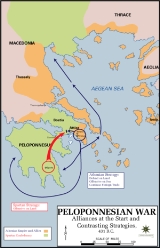
The Peloponnesian War which lasted from 431-404BC was an Ancient Greek
Ancient Greece

The term Ancient Greece refers to the period of History of Greece lasting from the Greek Dark Ages ca. 1100 BC and the Dorian invasion, to 146 BC and the Roman Republic conquest of Greece after the Battle of Corinth ....
 military conflict, fought by Athens and its empire against the Peloponnesian League
Peloponnesian League

The Peloponnesian League was an alliance of states in the Peloponnese in the 6th century BC and 5th century BC.By the end of the 6th century, Sparta had become the most powerful state in the Peloponnese, and was the political and military hegemon over Argos, the next most powerful state....
, led by Sparta
Sparta

Sparta was a city-state in ancient Greece, situated on the Eurotas River in the southern part of the Peloponnese. From circa 650 BC it rose to become the dominant military power in the region and as such was recognized as the overall leader of the combined Greek forces during the Greco-Persian Wars....
. Historians have traditionally divided the war into three phases. In the first, the Archidamian War, Sparta launched repeated invasions of Attica
Attica

Attica is a Peripheries of Greece in Greece, containing Athens, the capital of Greece. Attica is subdivided into the prefectures of Greece of Athens Prefecture, Piraeus Prefecture, East Attica and West Attica....
, while Athens took advantage of its naval supremacy to raid the coast of the Peloponnese
Peloponnese

The Peloponnese or Peloponnesus is a large peninsula and Regions of Greece in southern Greece, forming the part of the country south of the Gulf of Corinth....
 attempting to suppress signs of unrest in its empire.


Discussion
Ask a question about 'Peloponnesian War'
Start a new discussion about 'Peloponnesian War'
Answer questions from other users
Full Discussion Forum


Encyclopedia


The Peloponnesian War which lasted from 431-404BC was an Ancient Greek
Ancient Greece

The term Ancient Greece refers to the period of History of Greece lasting from the Greek Dark Ages ca. 1100 BC and the Dorian invasion, to 146 BC and the Roman Republic conquest of Greece after the Battle of Corinth ....
 military conflict, fought by Athens and its empire against the Peloponnesian League
Peloponnesian League

The Peloponnesian League was an alliance of states in the Peloponnese in the 6th century BC and 5th century BC.By the end of the 6th century, Sparta had become the most powerful state in the Peloponnese, and was the political and military hegemon over Argos, the next most powerful state....
, led by Sparta
Sparta

Sparta was a city-state in ancient Greece, situated on the Eurotas River in the southern part of the Peloponnese. From circa 650 BC it rose to become the dominant military power in the region and as such was recognized as the overall leader of the combined Greek forces during the Greco-Persian Wars....
. Historians have traditionally divided the war into three phases. In the first, the Archidamian War, Sparta launched repeated invasions of Attica
Attica

Attica is a Peripheries of Greece in Greece, containing Athens, the capital of Greece. Attica is subdivided into the prefectures of Greece of Athens Prefecture, Piraeus Prefecture, East Attica and West Attica....
, while Athens took advantage of its naval supremacy to raid the coast of the Peloponnese
Peloponnese

The Peloponnese or Peloponnesus is a large peninsula and Regions of Greece in southern Greece, forming the part of the country south of the Gulf of Corinth....
 attempting to suppress signs of unrest in its empire. This period of the war was concluded in 421 BC, with the signing of the Peace of Nicias
Peace of Nicias

The Peace of Nicias was a peace treaty signed between the Ancient Greece city-states of Athens and Sparta in the March of 421 BC, ending the first half of the Peloponnesian War....
. That treaty, however, was soon undermined by renewed fighting in the Peloponnesus. In 415 BC, Athens dispatched a massive expeditionary force
Sicilian Expedition

The Sicilian Expedition was an Athens expedition to Sicily from 415 BC to 413 BC, during the Peloponnesian War. The expedition was hampered from the outset by uncertainty in its purpose and command structure?political maneuvering in Athens swelled a lightweight force of twenty ships into a massive armada, and the expedition's primary propone...
 to attack Syracuse
Syracuse, Italy

Syracuse is a historic city in southern Italy, the Capital of the province of Syracuse. The city is noted for its rich Greek history, culture, amphitheatres, architecture and association to Archimedes, playing an important role in ancient times as one of the top powers of the Mediterranean world; it is over 2,700 years old....
 in Sicily
Sicily

Sicily is an Autonomous regions with special statute of Italy. Of all the regions of Italy, Sicily covers the largest land area at 25,708 km? and currently has just over five million inhabitants....
; the attack failed disastrously, with the destruction of the entire force, in 413 BC. This ushered in the final phase of the war, generally referred to either as the Decelean War, or the Ionian War. In this phase, Sparta, now receiving support from Persia, supported rebellions in Athens' subject states in the Aegean Sea
Aegean Sea

The Aegean Sea is an elongated embayment of the Mediterranean Sea located between the southern Balkans and Anatolian peninsulas, i.e., between the mainlands of Greece and Turkey respectively....
 and Ionia
Ionia

Ionia is an ancient region of central coastal Anatolia in present-day Turkey, the region nearest Izmir, which was historically Smyrna. It consisted of the northernmost territories of the Ionian League of Hellenes settlements....
, undermining Athens' empire, and, eventually, depriving the city of naval supremacy. The destruction of Athens' fleet at Aegospotami
Battle of Aegospotami

The naval Battle of Aegospotami took place in 405 BC and was the last major battle of the Peloponnesian War. In the battle, a Spartan fleet under Lysander completely destroyed the Athenian navy....
 effectively ended the war, and Athens surrendered in the following year.

The Peloponnesian War reshaped the Ancient Greek world. On the level of international relations, Athens, the strongest city-state in Greece prior to the war's beginning, was reduced to a state of near-complete subjection, while Sparta was established as the leading power of Greece. The economic costs of the war were felt all across Greece; poverty became widespread in the Peloponnese, while Athens found itself completely devastated, and never regained its pre-war prosperity. The war also wrought subtler changes to Greek society; the conflict between democratic
Democracy

Democracy is a form of government in which power is held directly or indirectly by citizens under a free electoral system. It is derived from the Greek language d?????at?a , "popular government" which was coined from d???? , "people" and ???t?? , "rule, strength" in the middle of the 5th-4th century BC to denote the political syst...
 Athens and oligarchic
Oligarchy

Oligarchy is a form of government where political power effectively rests with a small Elitism segment of society distinguished by royalty, wealth, family, military influence or occult spiritual hegemony....
 Sparta, each of which supported friendly political factions within other states, made civil war a common occurrence in the Greek world.

Greek warfare, meanwhile, originally a limited and formalized form of conflict, transformed into an all-out struggle between city-states, complete with atrocities on a large scale. Shattering religious and cultural taboos, devastating vast swathes of countryside, and destroying whole cities -- the Peloponnesian War marked the dramatic end to the fifth-century-B.C. golden age of Greece.

Prelude

The preeminent Athenian historian, Thucydides
Thucydides

Thucydides was a Greeks history and author of the History of the Peloponnesian War, which recounts the 5th century B.C. war between Sparta and Athens to the year 411 B.C....
, states in his History of the Peloponnesian War, "The growth of the power of Athens, and the alarm which this inspired in Lacedaemon
Sparta

Sparta was a city-state in ancient Greece, situated on the Eurotas River in the southern part of the Peloponnese. From circa 650 BC it rose to become the dominant military power in the region and as such was recognized as the overall leader of the combined Greek forces during the Greco-Persian Wars....
, made war inevitable." Indeed, the nearly fifty years of Greek history that preceded the outbreak of the Peloponnesian War had been marked by the development of Athens as a major power in the Mediterranean world. After defeating the Persian invasion of Greece in the year 480 BC, Athens led the coalition of Greek city-states that continued the Greco-Persian Wars
Greco-Persian Wars

For other Persian wars, see Roman-Persian Wars, Islamic conquest of Persia, Iraq war , and Military history of Iran.The Greco-Persian Wars were a series of conflicts between several ancient Greece city-states and the Achaemenid Empire that started in 499 BC and lasted until 448 BC....
, known as the Delian League, with attacks on Persian territories in the Aegean and Ionia. What ensued was a period, referred to as the Pentecontaetia
Pentecontaetia

Pentecontaetia is the term used to refer to the period in Ancient Greece history between the defeat of the second Persian Empire invasion of Greece at Battle of Plataea in 480 BC and the beginning of the Peloponnesian War in 433 BC....
 (the name given by Thucydides), in which Athens increasingly came to be recognized as an Athenian Empire, carrying out an aggressive war against Persia. By the middle of the century, the Persians had been driven from the Aegean and forced to cede control of a vast range of territories to Athens. At the same time, Athens greatly increased its own power; a number of its formerly independent allies were reduced, over the course of the century, to the status of tribute-paying subject states of the Delian League; this tribute was used to support a powerful fleet and, after the middle of the century, to fund massive public works programs in Athens.

Friction between Athens and Peloponnesian states, including Sparta, began early in the Pentecontaetia; in the wake of the departure of the Persians from Greece, Sparta attempted to prevent the reconstruction of the walls of Athens (without the walls, Athens would have been defenseless against a land attack and subject to Spartan control), but was rebuffed. According to Thucydides, although the Spartans took no action at this time, they "secretly felt aggrieved."

Conflict between the states flared up again in 465 BC, when a helot revolt broke out in Sparta. The Spartans summoned forces from all of their allies, including Athens, to help them suppress the revolt. Athens sent out a sizable contingent (4,000 Hoplites), but upon its arrival, this force was dismissed by the Spartans, while those of all the other allies were permitted to remain. According to Thucydides, the Spartans acted in this way out of fear that the Athenians would switch sides and support the helots; the offended Athenians repudiated their alliance with Sparta. When the rebellious helots were finally forced to surrender and permitted to evacuate the country, the Athenians settled them at the strategic city of Naupactus
Naupactus

Naupactus or Nafpaktos , is the second largest town in the prefectures of Greece of Aetolia-Acarnania, Greece, situated on a bay on the north side of the straits of Lepanto....
 on the Corinthian Gulf.

In 459 BC, Athens took advantage of a war between its neighbor Megara
Megara

Megara is an ancient city in Attica, Greece. It lies in the northern section of the Isthmus of Corinth opposite the island of Salamis Island, which belonged to Megara in archaic times, before being taken by Athens....
 and Corinth
Corinth

Corinth, or Korinth Corinth is now the capital of the Prefectures of Greece of Corinthia. The city is surrounded by the coastal townlets of Lechaio, Isthmia, Kechries, and the inland townlets of Examilia and the archaeological site....
, both Spartan allies, to conclude an alliance with Megara, giving the Athenians a critical foothold on the isthmus of Corinth
Isthmus of Corinth

The Isthmus of Corinth is the narrow land bridge which connects the Peloponnese peninsula with the mainland of Greece, near the city of Corinth....
. A fifteen year conflict, commonly known as the First Peloponnesian War
First Peloponnesian War

The First Peloponnesian War was fought between Sparta as the leaders of the Peloponnesian League and Sparta's other allies, most notably Thebes, Greece, and the Delian League led by Athens with support from Argos....
, ensued, in which Athens fought intermittently against Sparta, Corinth, Aegina
Aegina

Aegina is one of the Greek islands of Greece in the Saronic Gulf, 17 miles from Athens. Tradition derives the name from Aegina, the mother of Aeacus, who was born in and ruled the island....
, and a number of other states. For a time during this conflict, Athens controlled not only Megara but also Boeotia
Boeotia

Boeotia, Beotia, or B?otia , formerly Cadmeis, was a region of ancient Greece, north of the eastern part of the Gulf of Corinth. It was bounded on the south by Megaris and the Kithairon mountain range that forms a natural barrier with Attica, on the north by Opuntian Locris and the Euripus Strait at the Gulf of Euboea, and on the...
; at its end, however, in the face of a massive Spartan invasion of Attica, the Athenians ceded the lands they had won on the Greek mainland, and Athens and Sparta recognized each other's right to control their respective alliance systems. The war was officially ended by the Thirty Years' Peace
Thirty Years' Peace

The Thirty Years' Peace was a treaty, signed between the ancient Greek city-states Athens and Sparta, in the year 445 BCE. The treaty brought an end to the conflict commonly known as the First Peloponnesian War, which had been raging since 460....
, signed in the winter of 446/5 BC.

Breakdown of the peace

The Thirty Year's Peace was first tested in 440 BC, when Athens' powerful ally Samos
Samos Island

Samos is a Greece island in the North Aegean sea, south of Chios, north of Patmos and the Dodecanese, and off the Ionian coast of Turkey....
 rebelled from its alliance with Athens. The rebels quickly secured the support of a Persian satrap
Satrap

Satrap was the name given to the governors of the provinces of ancient Medes and Persian Empire empires, including the Achaemenid Empire and in several of their heirs, such as the Sassanid Empire and the Hellenistic civilization empires....
, and Athens found itself facing the prospect of revolts throughout the empire. The Spartans, whose intervention would have been the trigger for a massive war to determine the fate of the empire, called a congress of their allies to discuss the possibility of war with Athens. Sparta's powerful ally of Corinth
Corinth

Corinth, or Korinth Corinth is now the capital of the Prefectures of Greece of Corinthia. The city is surrounded by the coastal townlets of Lechaio, Isthmia, Kechries, and the inland townlets of Examilia and the archaeological site....
 was notably opposed to intervention, and the congress voted against war with Athens. The Athenians crushed the revolt, and peace was maintained.

The more immediate events that led to war involved Athens and Corinth. After suffering a defeat at the hands of their colony of Corcyra, a sea power that was not allied to either Sparta or Athens, Corinth began to build an allied naval force. Alarmed, Corcyra sought an alliance with Athens, which after debate and input from both Corcyra and Corinth, decided to swear to a defensive alliance with Corcyra. At the Battle of Sybota
Battle of Sybota

The Battle of Sybota took place in 433 BC between Corcyra and Corinth, Greece, and was, according to Thucydides, the largest naval battle between Greek city states until that time....
, a small contingent of Athenian ships played a critical role in preventing a Corinthian fleet from capturing Corcyra. It is worth noting, however, that the Athenians were instructed not to intervene in the battle unless it was clear that Corinth was going to press onward to invade Corcyra. This was done in order to uphold the Thirty Years Peace. The presence of Athenian warships standing off from the engagement was enough to dissuade the Corinthians from exploiting their victory, thus sparing much of the routed Corcyraean fleet.

Following this, Athens instructed Potidaea
Battle of Potidaea

The Battle of Potidaea was, with the Battle of Sybota, one of the catalysts for the Peloponnesian War. It was fought near Potidaea in 432 BC between Athens and a combined army from Corinth, Greece and Potidaea, along with their various allies....
, a tributary ally of Athens but a colony of Corinth, to tear down its walls, to send hostages to Athens, to dismiss the Corinthian magistrates from office, and to refuse the magistrates that the city would send in the future . The Corinthians, outraged by these actions, encouraged Potidaea to revolt and assured them that they would ally with them should they revolt from Athens. Meanwhile, the Corinthians were unofficially aiding Potidaea by sneaking contingents of men into the besieged city to help defend it. This was a direct violation of the Thirty Years' Peace, which had (among other things) stipulated that the Delian League and the Peloponnesian League would respect each other's autonomy and internal affairs.

A further source of provocation was an Athenian decree, issued in 433/2 BC, imposing stringent trade sanctions on Megarian citizens (once more a Spartan ally after the conclusion of the First Peloponnesian War). These sanctions, known as the Megarian decree
Megarian decree

The Megarian Decree was a set of economic sanctions levied upon Megara circa 432 BC by the Athenian Empire shortly before the outbreak of the Peloponnesian War....
, were largely ignored by Thucydides, but some modern economic historians have noted that forbidding Megara to trade with the prosperous Athenian empire would have been disastrous for the Megarans, and have accordingly considered the decree to be a contributing factor in bringing about the war.. Historians that attribute responsibility for the war to Athens cite this event as the main cause for blame .

At the request of the Corinthians, the Spartans summoned members of the Peloponnesian League to Sparta in 432 BC, especially those who had grievances with Athens to make their complaints to the Spartan assembly. This debate was attended by members of the league and a delegation from Athens (that was not invited) also asked to speak, and became the scene of a debate between the Athenians and the Corinthians. Thucydides reports that the Corinthians condemned Sparta's inactivity up to that point, warning the Spartans that if they continued to remain passive while the Athenians were energetically active, they would soon find themselves outflanked and without allies. The Athenians, in response, reminded the Spartans of their record of military success and opposition to Persia, and warned them of the dangers of confronting such a powerful state, ultimately encouraging Sparta to seek arbitration as provided by the Thirty Years Peace. Undeterred, a majority of the Spartan assembly voted to declare that the Athenians had broken the peace, essentially declaring war.

The "Archidamian War"

Sparta and its allies, with the exception of Corinth, were almost exclusively land-based powers, able to summon large land armies which were very nearly unbeatable (thanks to the legendary Spartan forces
Spartan Army

The Spartan Army was the military force of Sparta, one of the leading city-states of ancient Greece. The army stood at the centre of the Spartan state, whose citizens' primary obligation was to be good soldiers....
). The Athenian Empire, although based in the peninsula of Attica, spread out across the islands of the Aegean Sea
Aegean Sea

The Aegean Sea is an elongated embayment of the Mediterranean Sea located between the southern Balkans and Anatolian peninsulas, i.e., between the mainlands of Greece and Turkey respectively....
; Athens drew its immense wealth from tribute paid from these islands. Athens maintained its empire through naval power. Thus, the two powers were relatively unable to fight decisive battles.

The Spartan strategy during the first war, known as the Archidamian War after Sparta's king Archidamus II
Archidamus II

Archidamus II was a king of Sparta who reigned from approximately 476 BC to 427 BC. He was of the Eurypontid dynasty. His father was Zeuxidamus , who died before his father, Leotychidas, after having his son, Archidamus....
, was to invade the land surrounding Athens. While this invasion deprived Athens of the productive land around their city, Athens itself was able to maintain access to the sea, and did not suffer much. Many of the citizens of Attica abandoned their farms and moved inside the long walls
Long Walls

The Long Walls , in Ancient Greece, were walls built from a city to its port, providing a secure connection to the sea even during times of siege....
, which connected Athens to its port of Piraeus
Piraeus

Piraeus is a city in the periphery of Attica, Greece, and a municipality within Athens urban area, located 10 km southwest of its center....
. The Spartans also occupied Attica for periods of only three weeks at a time; in the tradition of earlier hoplite
Hoplite

The word hoplite derives from hoplon , meaning an item of armour or equipment, thus 'hoplite' may approximate to 'armoured man'. Hoplites were the citizen-soldiers of the Ancient Greece City-states....
 warfare the soldiers expected to go home to participate in the harvest. Moreover, Spartan slaves, known as helots
Helots

The helots were an unfree population group that formed the main population of Laconia and the whole of Messenia . Their exact status was already disputed in Antiquity: according to Critias, they were "especially Slavery in ancient Greece" whereas to Pollux, they occupied a status "between free men and slaves"....
, needed to be kept under control, and could not be left unsupervised for long periods of time. The longest Spartan invasion, in 430 BC, lasted just forty days.

The Athenian strategy was initially guided by the strategos
Strategos

The term strategos is used in Greek language to mean "general". In the Hellenistic and Byzantine Empires the term was also used to describe a military governor....
,
or general, Pericles
Pericles

Pericles was a prominent and influential statesman, orator, and general of History of Athens during the city's Age of Pericles?specifically, the time between the Greco-Persian Wars and Peloponnesian War wars....
, who advised the Athenians to avoid open battle with the far more numerous and better trained Spartan hoplites, relying instead on the fleet. The Athenian fleet, the most dominant in Greece, went on the offensive, winning victories at Naupactus
Battle of Naupactus (429 BC)

The Battle of Naupactus was a naval battle in the Peloponnesian War. The battle, which took place a week after the Athenian victory at Battle of Rhium, set an Athenian fleet of 20 ships, commanded by Phormio, against a Peloponnesian League fleet of 77 ships, commanded by Cnemus....
 (now known as "Návpaktos"). In 430
430 BC

Events...
, however, an outbreak of a plague
Plague of Athens

The Plague of Athens was a devastating epidemic which hit the city-state of History of Athens in ancient Greece during the second year of the Peloponnesian War , when an Athenian victory still seemed within reach....
 hit Athens. The plague ravaged the densely packed city, and in the long run, was a significant cause of its final defeat. The plague wiped out over 30,000 citizens, sailors and soldiers and even Pericles and his sons. Roughly one third to two thirds of the Athenian population died. Athenian manpower was correspondingly drastically reduced and even foreign mercenaries refused to hire themselves out to a city riddled with plague. The fear of plague was so widespread that the Spartan invasion of Attica was abandoned, their troops being unwilling to risk contact with the diseased enemy.

After the death of Pericles, the Athenians turned somewhat against his conservative, defensive strategy and to the more aggressive strategy of bringing the war to Sparta and its allies. Rising to particular importance in Athenian democracy at this time was Cleon
Cleon

Cleon was an Athens statesman and a Strategos during the Peloponnesian War. He was the first prominent representative of the commercial class in Athenian politics, although he was an aristocrat himself....
, a leader of the hawkish elements of the Athenian democracy. Led militarily by a clever new general Demosthenes
Demosthenes (general)

Demosthenes , son of Alcisthenes, was an Athens general during the Peloponnesian War.He first appears in history in 426 BC in an invasion of Aetolia....
 (not to be confused with the later Athenian orator Demosthenes
Demosthenes

Demosthenes was a prominent Greeks statesman and orator of History of Athens. His oratorys constitute a significant expression of contemporary Athenian intellectual prowess and provide an insight into the politics and culture of ancient Greece during the 4th century BC....
), the Athenians managed some successes as they continued their naval raids on the Peloponnese. Athens stretched their military activities into Boeotia
Boeotia

Boeotia, Beotia, or B?otia , formerly Cadmeis, was a region of ancient Greece, north of the eastern part of the Gulf of Corinth. It was bounded on the south by Megaris and the Kithairon mountain range that forms a natural barrier with Attica, on the north by Opuntian Locris and the Euripus Strait at the Gulf of Euboea, and on the...
 and Aetolia
Aetolia

Aetolia is a mountainous region of Greece on the north coast of the Gulf of Corinth, forming the eastern part of the modern prefectures of Greece of Aetolia-Acarnania....
, and began fortifying posts around the Peloponnese. One of these posts was near Pylos
Pylos

This article is about the Greek geographical feature and town. For the mythological figure see Pylus . For board game see Pylos .Pylos, or P?los , is a large bay and a town on the west coast of the Peloponnese, in the district of Messenia in southern Greece....
 on a tiny island called Sphacteria
Sphacteria

File:Sfakteria.jpgSphacteria is a small island at the entrance to the bay of Pylos in the Peloponnese, Greece. Its modern name is Sphagia.In ancient times it was the site of the Battle of Sphacteria in the Peloponnesian war....
, where the course of the first war turned in Athens's favour. The post off Pylos struck Sparta where it was weakest: its dependence on the helots. Sparta was dependent on a class of slaves, known as helots, to tend the fields while its citizens trained to become soldiers. The helots made the Spartan system possible, but now the post off Pylos began attracting helot runaways. In addition, the fear of a general revolt of helots emboldened by the nearby Athenian presence drove the Spartans to action. Demosthenes, however, outmanoeuvred the Spartans and trapped a group of Spartan soldiers on Sphacteria as he waited for them to surrender. Weeks later, though, Demosthenes proved unable to finish off the Spartans. After boasting that he could put an end to the affair in the Assembly, the inexperienced Cleon won a great victory at the Battle of Pylos
Battle of Pylos

The naval Battle of Pylos took place in 425 BC during the Peloponnesian War at the peninsula of Pylos, on the Bay of Navarino in Messenia, and was an Athens victory over Sparta....
 and the related Battle of Sphacteria
Battle of Sphacteria

The Battle of Sphacteria was a land battle of the Peloponnesian War, fought in 425 BC between Athens and Sparta. It resulted from the failure of peace negotiations after the earlier Battle of Pylos....
 in 425 BC. The Athenians captured between 300 and 400 Spartan hoplites. The hostages gave the Athenians a bargaining chip.

After these battles, the Spartan general Brasidas
Brasidas

Brasidas was a Spartan officer during the first decade of the Peloponnesian War.He was the son of Tellis and Argileonis, and won his first laurels by the relief of Methone, which was besieged by the Athens ....
 raised an army of allies and helots and marched the length of Greece to the Athenian colony of Amphipolis
Amphipolis

Amphipolis was an Ancient Greece Greece Polis in the region once inhabited by the Edoni people in the present-day Peripheries of Greece of Central Macedonia....
 in Thrace, which controlled several nearby silver
Silver

Silver is a chemical element with the chemical symbol Ag and atomic number 47. A soft, white, lustrous transition metal, it has the highest electrical conductivity of any element and the highest thermal conductivity of any metal....
 mines; their product supplied much of the Athenian war fund. Thucydides
Thucydides

Thucydides was a Greeks history and author of the History of the Peloponnesian War, which recounts the 5th century B.C. war between Sparta and Athens to the year 411 B.C....
 was dispatched with a force which arrived too late to stop Brasidas capturing Amphipolis; Thucydides was exiled for this, and, as a result, had the conversations with both sides of the war which inspired him to record its history. Both Brasidas and Cleon were killed in Athenian efforts to retake Amphipolis (see Battle of Amphipolis
Battle of Amphipolis

The Battle of Amphipolis was fought in 422 BC during the Peloponnesian War between Athens and Sparta. It was the culmination of events that began in 424 BC with the capture of Amphipolis by the Spartans....
). The Spartans and Athenians agreed to exchange the hostages for the towns captured by Brasidas, and signed a truce.

Peace of Nicias


With the death of Cleon
Cleon

Cleon was an Athens statesman and a Strategos during the Peloponnesian War. He was the first prominent representative of the commercial class in Athenian politics, although he was an aristocrat himself....
 and Brasidas
Brasidas

Brasidas was a Spartan officer during the first decade of the Peloponnesian War.He was the son of Tellis and Argileonis, and won his first laurels by the relief of Methone, which was besieged by the Athens ....
, zealous war hawks for both nations, the Peace of Nicias was able to last for some six years. However, it was a time of constant skirmishing in and around the Peloponnese. While the Spartans refrained from action themselves, some of their allies began to talk of revolt. They were supported in this by Argos
Argos

Argos is a city in Greece in the Peloponnese near Nafplion, which was its historic harbour, named for Nauplius ....
, a powerful state within the Peloponnese that had remained independent of Lacedaemon. With the support of the Athenians, the Argives succeeded in forging a coalition of democratic states within the Peloponnese, including the powerful states of Mantinea and Elis
Elis

Elis, or Eleia is an ancient district, that corresponds with the modern Elis Prefecture. It is in southern Greece on the Peloponnesos peninsula, bounded on the north by Achaea, east by Arcadia, south by Messenia, and west by the Ionian Sea....
. Early Spartan attempts to break up the coalition failed, and the leadership of the Spartan king Agis
Agis II

Agis II was the 17th Eurypontid king of Sparta, the eldest son of Archidamus II by his first wife, and half brother of Agesilaus. He ruled with his Agiad co-monarch Pausanias of Sparta....
 was called into question. Emboldened, the Argives and their allies, with the support of a small Athenian force under Alcibiades
Alcibiades

Alcibiades Cleiniou Scambonides , was a prominent History of Athens statesman, oratory, and general. He was the last famous member of his mother's aristocratic family, the Alcmaeonidae, which fell from prominence after the Peloponnesian War....
, moved to seize the city of Tegea
Tegea

Tegea was a settlement in ancient Greece, and it is also a municipality in modern Arcadia, Greece, with its seat in the village Stadio.Ancient Tegea was an important religious center of ancient Greece, containing the Temple of Athena Alea....
, near Sparta.

The Battle of Mantinea
Battle of Mantinea (418 BC)

The Battle of Mantinea was a significant battle in the Peloponnesian War. The battle took place in 418 BC between Sparta and its allies on the one hand, and an army led by Argos and Athens on the other....
 was the largest land battle fought within Greece during the Peloponnesian War. The Lacedaemonians, with their neighbors the Tegeans, faced the combined armies of Argos
Argos

Argos is a city in Greece in the Peloponnese near Nafplion, which was its historic harbour, named for Nauplius ....
, Athens
Athens

Athens , the Capital and largest city of Greece, dominates the Attica periphery; as one of the List of cities by time of continuous habitation, its recorded history spans around 3,400 years....
, Mantinea, and Arcadia
Arcadia

Arcadia, Arkad?a , or Arcady is a region of Greece in the Peloponnesus. It takes its name from the mythological character Arcas....
. In the battle, the allied coalition scored early successes, but failed to capitalize on them, which allowed the Spartan elite forces to defeat the forces opposite them. The result was a complete victory for the Spartans, which rescued their city from the brink of strategic defeat. The democratic alliance was broken up, and most of its members were reincorporated into the Peloponnesian League
Peloponnesian League

The Peloponnesian League was an alliance of states in the Peloponnese in the 6th century BC and 5th century BC.By the end of the 6th century, Sparta had become the most powerful state in the Peloponnese, and was the political and military hegemon over Argos, the next most powerful state....
. With its victory at Mantinea, Sparta pulled itself back from the brink of utter defeat, and re-established its hegemony throughout the Peloponnese.

Sicilian Expedition


In the 17th year of the war, word came to Athens that one of their distant allies in Sicily
Sicily

Sicily is an Autonomous regions with special statute of Italy. Of all the regions of Italy, Sicily covers the largest land area at 25,708 km? and currently has just over five million inhabitants....
 was under attack from Syracuse
Syracuse, Italy

Syracuse is a historic city in southern Italy, the Capital of the province of Syracuse. The city is noted for its rich Greek history, culture, amphitheatres, architecture and association to Archimedes, playing an important role in ancient times as one of the top powers of the Mediterranean world; it is over 2,700 years old....
. The people of Syracuse were ethnically Dorian (as were the Spartans), while the Athenians, and their ally in Sicilia, were Ionian
Ionia

Ionia is an ancient region of central coastal Anatolia in present-day Turkey, the region nearest Izmir, which was historically Smyrna. It consisted of the northernmost territories of the Ionian League of Hellenes settlements....
. The Athenians felt obliged to assist their ally.

The Athenians did not act solely from altruism: rallied on by Alcibiades
Alcibiades

Alcibiades Cleiniou Scambonides , was a prominent History of Athens statesman, oratory, and general. He was the last famous member of his mother's aristocratic family, the Alcmaeonidae, which fell from prominence after the Peloponnesian War....
, the leader of the expedition, they held visions of conquering all of Sicily. Syracuse, the principal city of Sicily, was not much smaller than Athens, and conquering all of Sicily would have brought Athens an immense amount of resources. In the final stages of the preparations for departure, the hermai (religious statues) of Athens were mutilated by unknown persons, and Alcibiades was charged with religious crimes. Alcibiades demanded that he be put on trial at once, so that he might defend himself before the expedition. The Athenians however allowed Alcibiades to go on the expedition without being tried (many believed in order to better plot against him). After arriving in Sicily, Alcibiades was recalled back to Athens for trial. Fearing that he would be unjustly condemned, Alcibiades defected to Sparta and Nicias
Nicias

Nicias or Nikias was an Ancient Athens politician and general during the period of the Peloponnesian War. Nicias was a member of the Athenian aristocracy because he had inherited a large fortune from his father, which was invested into the silver mines around Attica's Mt....
 was placed in charge of the mission. After his defection, Alcibiades informed the Spartans that the Athenians planned to use Sicily as a springboard for the conquest of all of Italy
Italy

Italy , officially the Italian Republic , is a country located on the Italian Peninsula in Southern Europe and on the two largest islands in the Mediterranean Sea, Sicily and Sardinia....
, and to use the resources and soldiers from these new conquests to conquer all of the Peloponnese.

The Athenian force consisted of over 100 ships and some 5,000 infantry and light-armored troops. Cavalry was limited to about 30 horses, which proved to be no match for the large and highly trained Syracusan cavalry. Upon landing in Sicily, several cities immediately joined the Athenian cause. Instead of attacking at once, Nicias procrastinated and the campaigning season of 415 BC ended with Syracuse scarcely damaged. With winter approaching, the Athenians were then forced to withdraw into their quarters, and they spent the winter gathering allies and preparing to destroy Syracuse. The delay allowed the Syracusans to send for help from Sparta, who sent their general Gylippus
Gylippus

Gylippus was a Spartan general of the 5th century BC; he was the son of Cleandridas, who was the adviser of King Pleistoanax and had been expelled from Sparta for accepting Athens bribes in 446 BC and fled to Thurii, a pan-Hellenic colony then being founded in the instep of Italy with Athenian help and participation....
 to Sicily with reinforcements. Upon arriving, he raised up a force from several Sicilian cities, and went to the relief of Syracuse. He took command of the Syracusan troops, and in a series of battles defeated the Athenian forces, and prevented them from invading the city.

Nicias then sent word to Athens asking for reinforcements. Demosthenes was chosen and led another fleet to Sicily, joining his forces with those of Nicias. More battles ensued and again, the Syracusans and their allies defeated the Athenians. Demosthenes argued for a retreat to Athens, but Nicias at first refused. After additional setbacks, Nicias seemed to agree to a retreat until a bad omen, in the form of a lunar eclipse
Lunar eclipse

A lunar eclipse occurs whenever the Moon passes through some portion of the Earth's shadow. This can occur only when the Sun, Earth, and Moon are aligned exactly, or very closely so, with the Earth in the middle....
, delayed any withdrawal. The delay was costly and forced the Athenians into a major sea battle in the Great Harbor of Syracuse. The Athenians were thoroughly defeated. Nicias and Demosthenes marched their remaining forces inland in search of friendly allies. The Syracusan cavalry rode them down mercilessly, eventually killing or enslaving all who were left of the mighty Athenian fleet.

The Second War


The Lacedaemonians were not content with simply sending aid to Sicily; they also resolved to take the war to the Athenians. On the advice of Alcibiades, they fortified Decelea
Decelea

Decelea , modern Dekeleia or Dekelia, Deceleia or Decelia, previous name Tatoi, was an ancient village in northern Attica serving as a source of supplies and trade route connecting Euboea with Athens, Greece....
, near Athens, and prevented the Athenians from making use of their land year round. The fortification
Fortification

Fortifications are military constructions and buildings designed for defense in warfare and military bases. Humans have constructed defensive works for many thousands of years, in a variety of increasingly complex designs....
 of Decelea prevented the shipment of supplies overland to Athens, and forced all supplies to be brought in by sea at increased expense. Perhaps worst of all, the nearby silver mines were totally disrupted, with as many as 20,000 Athenian slaves freed by the Spartan hoplites at Decelea. With the treasury and emergency reserve fund of 1,000 talents dwindling away, the Athenians were forced to demand even more tribute from her subject allies, further increasing tensions and the threat of further rebellion
Rebellion

Rebellion is a refusal of obedience. It may, therefore, be seen as encompassing a range of behaviors from civil disobedience and mass nonviolent resistance, to violent and organized attempts to destroy an established authority such as the government....
 within the Empire.

The Corinthians, the Spartans, and others in the Peloponnesian League sent more reinforcements to Syracuse, in the hopes of driving off the Athenians; but instead of withdrawing, the Athenians sent another hundred ships and another 5,000 troops to Sicily. Under Gylippus, the Syracusans and their allies were able to decisively defeat the Athenians on land; and Gylippus encouraged the Syracusans to build a navy, which was able to defeat the Athenian fleet when they attempted to withdraw. The Athenian army, attempting to withdraw overland to other, more friendly Sicilian cities, was divided and defeated; the entire Athenian fleet was destroyed, and virtually the entire Athenian army was sold off into slavery.

Following the defeat of the Athenians in Sicily, it was widely believed that the end of the Athenian Empire was at hand. Her treasury was nearly empty, her docks were depleted, and the flower of her youth was dead or imprisoned in a foreign land. They underestimated the strength of the Athenian Empire, but the beginning of the end was indeed at hand.

Athens recovers


Following the destruction of the Sicilian Expedition, Lacedaemon encouraged the revolt of Athens's tributary allies, and indeed, much of Ionia rose in revolt against Athens. The Syracusans sent their fleet to the Peloponnesians, and the Persians decided to support the Spartans with money and ships. Revolt and faction threatened in Athens itself.

The Athenians managed to survive for several reasons. First, their foes were severely lacking in vigor. Corinth and Syracuse were slow to bring their fleets into the Aegean, and Sparta's other allies were also slow to furnish troops or ships. The Ionian states that rebelled expected protection, and many rejoined the Athenian side. The Persians were slow to furnish promised funds and ships, frustrating battle plans. Perhaps most importantly, Spartan officers were not trained to be diplomats, and were insensitive and politically inept.

At the start of the war, the Athenians had prudently put aside some money and 100 ships that were to be used only as a last resort.

These ships were then released, and served as the core of the Athenians' fleet throughout the rest of the war. An oligarchical revolution
Athenian coup of 411 BC

The Athenian coup of 411 BC was a revolutionary movement during the Peloponnesian War which overthrew the Athenian democracy of ancient Athens, replacing it with a short-lived oligarchy....
 occurred in Athens, in which a group of 400 seized power. A peace with Sparta might have been possible, but the Athenian fleet, now based on the island of Samos
Samos Island

Samos is a Greece island in the North Aegean sea, south of Chios, north of Patmos and the Dodecanese, and off the Ionian coast of Turkey....
, refused to accept the change. In 411 BC this fleet engaged the Spartans at the Battle of Syme
Battle of Syme

The Battle of Syme was a naval battle in 411 BC between Sparta and Athens, during the Peloponnesian War. It took place near the island of Symi in the south-eastern Aegean Sea....
. The fleet appointed Alcibiades
Alcibiades

Alcibiades Cleiniou Scambonides , was a prominent History of Athens statesman, oratory, and general. He was the last famous member of his mother's aristocratic family, the Alcmaeonidae, which fell from prominence after the Peloponnesian War....
 their leader, and continued the war in Athens's name. Their opposition led to the reinstitution of a democratic government in Athens within two years.

Alcibiades, while condemned as a traitor, still carried weight in Athens. He prevented the Athenian fleet from attacking Athens; instead, he helped restore democracy by more subtle pressure. He also persuaded the Athenian fleet to attack the Spartans at the battle of Cyzicus
Battle of Cyzicus

The naval Battle of Cyzicus took place in 410 BC during the Peloponnesian War. In the battle, an Athens fleet commanded by Alcibiades, Thrasybulus, and Theramenes routed and completely destroyed a Spartan fleet commanded by Mindarus....
 in 410
410 BC

Events...
. In the battle, the Athenians obliterated the Spartan fleet, and succeeded in re-establishing the financial basis of the Athenian Empire.

Between 410 and 406, Athens won a continuous string of victories, and eventually recovered large portions of its empire. All of this was due, in no small part, to Alcibiades.

Lysander triumphs, Athens surrenders

Faction triumphed in Athens: following a minor Spartan victory by their skillful general Lysander
Lysander

Lysander was a Spartan General and the commander of the Spartan fleet in the Hellespont which was victorious against the Ancient Athens at battle of Aegospotami in 405 BC....
 at the naval battle of Notium
Battle of Notium

The Battle of Notium in 406 BC, was a Spartan naval victory in the Peloponnesian War. Prior to the battle, the Athens commander, Alcibiades, left his helmsman, Antiochus, in command of the Athenian fleet, which was blockading the Spartan fleet in Ephesus....
 in 406 BC. Alcibiades
Alcibiades

Alcibiades Cleiniou Scambonides , was a prominent History of Athens statesman, oratory, and general. He was the last famous member of his mother's aristocratic family, the Alcmaeonidae, which fell from prominence after the Peloponnesian War....
 was not re-elected general by the Athenians and he exiled himself from the city. He would never again lead Athenians in battle. Athens was then victorious at the naval battle of Arginusae
Battle of Arginusae

The naval Battle of Arginusae took place in 406 BC during the Peloponnesian War just east of the island of Lesbos. In the battle, an Athens fleet commanded by eight strategos defeated a Spartan fleet under Callicratidas....
. The Spartan fleet under Callicratidas
Callicratidas

Callicratidas was a Spartan naval commander in the Peloponnesian War. In 406 BC, he was sent to the Aegean Sea to take command of the Spartan fleet from Lysander, the first navarch....
 lost 70 ships and the Athenians lost 25 ships. But, due to bad weather, the Athenians were unable to rescue their stranded crews or to finish off the Spartan fleet. Despite their victory, these failures caused outrage in Athens and led to a controversial trial
Battle of Arginusae

The naval Battle of Arginusae took place in 406 BC during the Peloponnesian War just east of the island of Lesbos. In the battle, an Athens fleet commanded by eight strategos defeated a Spartan fleet under Callicratidas....
. The trial resulted in the execution of six of Athens’s top naval commanders. Athens’s naval supremacy would now be challenged without several of its most able military leaders and a demoralized navy.

Unlike some of his predecessors the new Spartan general, Lysander, was not a member of the Spartan royal families and was also formidable in naval strategy; he was an artful diplomat, who had even cultivated good personal relationships with the Persian prince Cyrus, the son of Darius II. Seizing its opportunity, the Spartan fleet sailed at once to the Hellespont
Hellespont

Hellespont was the ancient name of the narrow strait, now known by the modern European term 'Dardanelles'. It was so called from Helle , the daughter of Athamas, who was drowned here in the mythology of the Golden Fleece....
, the source of Athens' grain
Cereal

Cereals, or cereal grains, are mostly Poaceae cultivated for their edible brans or fruit seeds . Cereal grains are grown in greater quantities and provide more energy worldwide than any other type of crop; they are therefore staple foods....
. Threatened with starvation, the Athenian fleet had no choice but to follow. Through cunning strategy, Lysander totally defeated the Athenian fleet, in 405 BC, at the battle of Aegospotami
Battle of Aegospotami

The naval Battle of Aegospotami took place in 405 BC and was the last major battle of the Peloponnesian War. In the battle, a Spartan fleet under Lysander completely destroyed the Athenian navy....
, destroying 168 ships and capturing some three or four thousand Athenian sailors. Only 12 Athenian ships escaped, and several of these sailed to Cyprus
Cyprus

Cyprus , officially the Republic of Cyprus , is an island country situated in the eastern Mediterranean Sea, east of Greece, west of Lebanon, Syria, and Israel, south of Turkey and north of Egypt....
, carrying the "strategos
Strategos

The term strategos is used in Greek language to mean "general". In the Hellenistic and Byzantine Empires the term was also used to describe a military governor....
" (General) Conon
Conon

Conon was an Athens general at the end of the Peloponnesian War, in charge during the decisive loss of the navy at the Battle of Aegospotami. He had been sent out following the recall of Alcibiades in 406 BC, and pursued the Peloponnesian fleet under Lysander to the Hellespont....
, who was anxious not to face the judgment of the Assembly
Ecclesia (ancient Athens)

The ecclesia or ekklesia was the principal assembly of the Athenian democracy of ancient Athens during its Age of Pericles . It was the popular assembly, opened to all male citizens over the age of 18 by Solon in 594 BC meaning that all classes of citizens in Athens were able to participate, even the thetes....
.

Facing starvation and disease from the prolonged siege, Athens surrendered in 404 BC, and her allies soon surrendered as well. The democrats at Samos
Samos Island

Samos is a Greece island in the North Aegean sea, south of Chios, north of Patmos and the Dodecanese, and off the Ionian coast of Turkey....
, loyal to the bitter last, held on slightly longer, and were allowed to flee with their lives. The surrender stripped Athens of her walls, her fleet, and all of her overseas possessions. Corinth and Thebes
Thebes, Greece

Thebes is a city in Greece, situated to the north of the Cithaeron range, which divides Boeotia from Attica, Greece, and on the southern edge of the Boeotian plain....
 demanded that Athens should be destroyed and all its citizens should be enslaved. However the Spartans announced their refusal to destroy a city that had done a good service at a time of greatest danger to Greece, and took Athens into their own system. Athens was "to have the same friends and enemies" as Sparta.

By doing so the victorious Spartans proved to be the most clement state that fought Athens and at the same time they turned out to be her saviour as neither Corinth nor Thebes at the time could challenge their decision.

Aftermath


For a short period of time, Athens was ruled by the 'Thirty Tyrants
Thirty Tyrants

The Thirty Tyrants were a pro-Spartan oligarchy installed in Classical Athens after its defeat in the Peloponnesian War in 404 BC. Contemporary Athenians referred to them simply as "the oligarchy" or "the Thirty"; the expression "Thirty Tyrants" is due to later historians....
' and democracy was suspended. This was a reactionary
Reactionary

Reactionary refers to any movement or ideology that opposes change or progress in society, and which seeks a return to a previous state . The term originated in the French Revolution, to denote the Counter-revolutionary who wanted to restore the real or imagined conditions of the Monarchy Ancien R?gime....
 regime set up by Sparta. The oligarchs
Oligarchy

Oligarchy is a form of government where political power effectively rests with a small Elitism segment of society distinguished by royalty, wealth, family, military influence or occult spiritual hegemony....
 were overthrown and a democracy was restored by Thrasybulus
Thrasybulus

Thrasybulus was an Athens general and democracy leader. In 411 BC, in the wake of an oligarchy coup at Athens, the pro-democracy sailors at Samos Island elected him as a general, making him a primary leader of the successful democratic resistance to that coup....
 in 403 BC.

Although the power of Athens was broken, it made something of a recovery as a result of the Corinthian War
Corinthian War

The Corinthian War was an Ancient Greece conflict lasting from 395 BC until 387 BC, pitting Sparta against a coalition of four allied states; Thebes , History of Athens#Classical Athens, Corinth, and Argos; which were initially backed by Achaemenid Dynasty....
 and continued to play an active role in Greek politics. Sparta was later humbled by Thebes at the Battle of Leuctra
Battle of Leuctra

The Battle of Leuctra was a battle fought between the Thebes and the History of Spartans and their respective allies amidst the post-Corinthian War conflict....
 in 371 BC, but it was all brought to an end a few years later when Philip II of Macedon
Philip II of Macedon

Philip II of Macedon,...
 conquered all of Greece.

The Peloponnesian War continues to fascinate later generations, because of the way it engulfed the Greek world. The insight Thucydides provides into the motivations of its participants is deeper than that which is known about any other war in ancient time.

Classical authors

  • Diodorus Siculus
    Diodorus Siculus

    Diodorus Siculus , was a Roman Greece historian who flourished in the 1st century BC. According to Diodorus' own work, he was born at Agira in Sicily ....
  • Plutarch
    Plutarch

    Lucius Mestrius Plutarchus , c. AD 46 ? 120 ? commonly known in English as Plutarch ? was a Ancient Rome historian , biographer, essayist, and Middle Platonism....
  • Thucydides
    Thucydides

    Thucydides was a Greeks history and author of the History of the Peloponnesian War, which recounts the 5th century B.C. war between Sparta and Athens to the year 411 B.C....
    , History of the Peloponnesian War
    History of the Peloponnesian War

    The History of the Peloponnesian War is an account of the Peloponnesian War in Ancient Greece, fought between the Peloponnesian League and the Delian League ....
  • Xenophon
    Xenophon

    Xenophon , son of Gryllus, of the deme Erchia of Athens, also known as Xenophon of Athens and Xenophon of Thebes, was a soldier, mercenary and a contemporary and admirer of Socrates....
    , Hellenica
  • Aristophanes
    Aristophanes

    Aristophanes , son of Philippus, of the deme Cydathenaus, was a prolific and much acclaimed comedy playwright of ancient Athens. Eleven of his forty plays have come down to us virtually complete....
    , "Lysistrata
    Lysistrata

    Lysistrata is one of the few surviving plays written by the master of Aristophanes#Aristophanes and Old Comedy, Aristophanes. Originally performed in Classical Athens in 411 BC, it is a comic account of one woman's extraordinary mission to end The Peloponnesian War....
    "


Modern authors

  • Bagnall, Nigel. The Peloponnesian War: Athens, Sparta, And The Struggle For Greece. New York: Thomas Dunne Books, 2006 (hardcover, ISBN 0-312-34215-2).
  • Cawkwell, G.L. Thucydides and the Peloponnesian War. London: Routledge, 1997 (hardcover, ISBN 0-415-16430-3; paperback, ISBN 0-415-16552-0).
  • Hanson, Victor Davis. A War Like No Other: How the Athenians and Spartans Fought the Peloponnesian War. New York: Random House, 2005 (hardcover, ISBN 1-4000-6095-8); New York: Random House, 2006 (paperback, ISBN 0-8129-6970-7).
  • Heftner, Herbert. Der oligarchische Umsturz des Jahres 411 v. Chr. und die Herrschaft der Vierhundert in Athen: Quellenkritische und historische Untersuchungen. Frankfurt am Main: Peter Lang, 2001 (ISBN 3-631-37970-6).
  • Hutchinson, Godfrey. Attrition: Aspects of Command in the Peloponnesian War. Stroud, Gloucestershire, UK: Tempus Publishing, 2006 (hardcover, ISBN 1-86227-323-5).
  • Kagan, Donald
    Donald Kagan

    Donald Kagan is an American historian at Yale University specializing in ancient Greece, notable for his four-volume history of the Peloponnesian War....
    :
    • The Outbreak of the Peloponnesian War. Ithaca, NY: Cornell University Press
      Cornell University

      Cornell University located in Ithaca, New York, USA, is a private university with four Statutory college. Its two medical campuses are in New York City and Education City, Qatar....
      , 1969 (hardcover, ISBN 0-8014-0501-7); 1989 (paperback, ISBN 0-8014-9556-3).
    • The Archidamian War. Ithaca, NY: Cornell University Press, 1974 (hardcover, ISBN 0-8014-0889-X); 1990 (paperback, ISBN 0-8014-9714-0).
    • The Peace of Nicias and the Sicilian Expedition. Ithaca, NY: Cornell University Press, 1981 (hardcover, ISBN 0-8014-1367-2); 1991 (paperback, ISBN 0-8014-9940-2).
    • The Fall of the Athenian Empire. Ithaca, NY: Cornell University Press, 1987 (hardcover, ISBN 0-8014-1935-2); 1991 (paperback, ISBN 0-8014-9984-4).
    • The Peloponnesian War. New York: Viking, 2003 (hardcover, ISBN 0-670-03211-5); New York: Penguin, 2004 (paperback, ISBN 0-14-200437-5); a one-volume version of his earlier tetralogy.
  • Kallet, Lisa. Money and the Corrosion of Power in Thucydides: The Sicilian Expedition and its Aftermath. Berkeley: University of California Press, 2001 (hardcover, ISBN 0-520-22984-3).
  • Krentz, Peter. The Thirty at Athens. Ithaca, NY: Cornell University Press, 1982 (hardcover, ISBN 0-8014-1450-4).
  • The Landmark Thucydides: A Comprehensive Guide to the Peloponnesian War, edited by Robert B. Strassler. New York: The Free Press, 1996 (hardcover, ISBN 0-684-82815-4); 1998 (paperback, ISBN 0-684-82790-5).


External links


  • (Public Domain
    Public domain

    File:PD-icon.svgThe public domain is a range of abstract materials?commonly referred to as intellectual property?which are not owned or controlled by anyone....
     Audiobooks in the USA - 20:57:23 hours, at least 603.7 MB)
  • (Translation of Thukydides' books - in )