
All Topics  
Parthian Empire


   Email Print
   Bookmark   Link


Parthian Empire


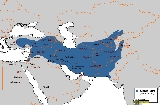
The Arsacid Empire (Persian: ???????? [Ashkanian]) (247 BCE - 224 CE), was a significant political and cultural power in the ancient Near East, and a counterweight to the Roman Empire
Roman Empire

The Roman Empire was the Roman Republic phase of the Ancient Rome, characterised by an autocracy form of government and large territorial holdings in Europe and around the Mediterranean....
 in the region. Its ruling dynasty was founded by Arsaces, hence the origin of the term Arsacid dynasty. The Arsacid dynasts were from Parthia
Parthia

Parthia is a region of north-eastern Iran, best known for having been the political and cultural base of the Arsacid dynasty, after which the Arsacid Empire is then also known as the 'Parthian Empire'....
 ("roughly western Khurasan
Greater Khorasan

Greater Khorasan is a modern term for a geographic region spanning north-eastern Iran, Turkmenistan, Uzbekistan, Tajikistan and north-western Afghanistan....
" in Iran's
Greater Iran

Greater Iran refers to the regions that have significant Iranian cultural influence. It roughly corresponds to the territory surrounding the Iranian plateau, stretching from the Caucasus to the Indus River, and conform to the historical understanding of the full territory of "Etymology of Iran."...
 north-east), and the Empire is thus also referred to as the Parthian Empire.

After defeating and deposing the Hellenistic Seleucid Empire the Arsacids became the third native dynasty of ancient Iran (after the Median
Median

In probability theory and statistics, a median is described as the number separating the higher half of a sample, a population, or a probability distribution, from the lower half....
 and the Achaemenid dynasties), albeit of Hellenistic
Hellenization

Hellenization is a term used to describe the spread of Greek culture. It is mainly used to describe the spread of Hellenistic civilization during the Hellenistic period following the campaigns of Alexander the Great of Macedon....
 influence to the extent that they identified themselves on their coins as philhellenes "friend of Greeks." This was subsequently portrayed by the Persians as a betrayal of Iranian values, and thus a justification to overthrow them.


Discussion
Ask a question about 'Parthian Empire'
Start a new discussion about 'Parthian Empire'
Answer questions from other users
Full Discussion Forum


Encyclopedia


The Arsacid Empire (Persian: ???????? [Ashkanian]) (247 BCE - 224 CE), was a significant political and cultural power in the ancient Near East, and a counterweight to the Roman Empire
Roman Empire

The Roman Empire was the Roman Republic phase of the Ancient Rome, characterised by an autocracy form of government and large territorial holdings in Europe and around the Mediterranean....
 in the region. Its ruling dynasty was founded by Arsaces, hence the origin of the term Arsacid dynasty. The Arsacid dynasts were from Parthia
Parthia

Parthia is a region of north-eastern Iran, best known for having been the political and cultural base of the Arsacid dynasty, after which the Arsacid Empire is then also known as the 'Parthian Empire'....
 ("roughly western Khurasan
Greater Khorasan

Greater Khorasan is a modern term for a geographic region spanning north-eastern Iran, Turkmenistan, Uzbekistan, Tajikistan and north-western Afghanistan....
" in Iran's
Greater Iran

Greater Iran refers to the regions that have significant Iranian cultural influence. It roughly corresponds to the territory surrounding the Iranian plateau, stretching from the Caucasus to the Indus River, and conform to the historical understanding of the full territory of "Etymology of Iran."...
 north-east), and the Empire is thus also referred to as the Parthian Empire.

After defeating and deposing the Hellenistic Seleucid Empire the Arsacids became the third native dynasty of ancient Iran (after the Median
Median

In probability theory and statistics, a median is described as the number separating the higher half of a sample, a population, or a probability distribution, from the lower half....
 and the Achaemenid dynasties), albeit of Hellenistic
Hellenization

Hellenization is a term used to describe the spread of Greek culture. It is mainly used to describe the spread of Hellenistic civilization during the Hellenistic period following the campaigns of Alexander the Great of Macedon....
 influence to the extent that they identified themselves on their coins as philhellenes "friend of Greeks." This was subsequently portrayed by the Persians as a betrayal of Iranian values, and thus a justification to overthrow them. This portrayal as morally and culturally corrupt was followed by academia for decades, but there is today significant evidence that the Arsacids not only saw themselves as legitimate heirs of the "(divinely bestowed) Iranian glory", but were commited to the idea of an Iranian nation
Greater Iran

Greater Iran refers to the regions that have significant Iranian cultural influence. It roughly corresponds to the territory surrounding the Iranian plateau, stretching from the Caucasus to the Indus River, and conform to the historical understanding of the full territory of "Etymology of Iran."...
.

At the apex of their might, the Arsacids had subjugated most of Greater Iran
Greater Iran

Greater Iran refers to the regions that have significant Iranian cultural influence. It roughly corresponds to the territory surrounding the Iranian plateau, stretching from the Caucasus to the Indus River, and conform to the historical understanding of the full territory of "Etymology of Iran."...
, Mesopotamia
Mesopotamia

Mesopotamia is the area of the Tigris-Euphrates river system, along the Tigris and Euphrates rivers, largely corresponding to modern Iraq, as well as some parts of northeastern Syria, some parts of southeastern Turkey, and some parts of the Khuzestan Province of southwestern Iran....
, and Armenia
Armenia

Armenia , officially the Republic of Armenia , is a landlocked mountainous country in South Caucasus between the Black Sea and the Caspian Sea....
. But unlike most other Iranian monarchies, the Arsacids followed a vassalary system, which they adopted from the Seleucids. The Arsacid Empire was thus not a single coherent state, but instead made up of numerous tributary (but otherwise independent) kingdoms.

The Arsacids were in an almost perpetual state of war, either to capture and hold territory from the Seleucids, or to prevent vassal states from breaking away, or defending themselves against the Roman Empire
Roman Empire

The Roman Empire was the Roman Republic phase of the Ancient Rome, characterised by an autocracy form of government and large territorial holdings in Europe and around the Mediterranean....
 in the west and nomadic tribes in the east. Economically and militarily severely weakened by the incessant warring, and from the infighting among the Parthian nobility, the Parthian Arsacids were finally vanquished by the Persian Sassanids
Sassanid Empire

The Sassanid Empire or Sassanian Dynasty is the name of the last pre-Islamic Iranian empire. It was one of the two main powers in Western Asia for a period of more than 400 years....
, a minor vassal from southwestern Iran, around 220 CE. In Armenia, a branch of the Arsacid dynasty
Arsacid Dynasty of Armenia

The Arsacid Dynasty ruled the Kingdom of Armenia from 54 AD to 428 AD. Formerly a branch of the Iranian Parthian Arsacids, they became a distinctly Armenian dynasty....
 continued to rule their kingdom until the 5th century.

History


Early period

Around 250 BCE, Arsaces I
Arsaces I of Parthia

Arsaces I was the 3rd century BCE founder of the Arsacid dynasty, and after whom all 30+ monarchs of the Arsacid empire officially named themselves....
 became the leader of the Parni
Parni

The Parni were an "Eastern Iranian language people" of the Ochos/Ochus River valley, south-east of the Caspian Sea. The Parni were one of the three tribes of the Dahae confederacy....
, a north-eastern Iranian tribe. Under his command, the Parni established themselves in Astabene, the administrative capital of which was Kabuchan. In ca. 247 BCE, Arsaces was crowned king in "Asaak" (precise location unknown, probably near Kuchan), an event that in Arsacid chronology was understood to mark the beginning of the Arsacid epoch.

Meanwhile, Andragoras, the Seleucid governor of Parthia, proclaimed independence and established his own kingdom. Around 238 BCE, Arsaces and the Parni battled Andragoras, during the course of which Andragoras was killed, and Arsaces captured Andragoras' kingdom.

From the base in Parthia (and from then identified as Parthian), Arsaces then ventured westwards and seized Hyrcania
Hyrcania

Hyrcania was the name of a satrapy located in the territories of present day Golestan Province, Mazandaran, Gilan and part of Turkmenistan, lands south of the Caspian Sea....
. Around 230 BCE, the Seleucids mounted a counter-campaign to recapture Parthia, but failed. In 209 BCE, by which time Arsaces I had died and control had passed to Arsaces II, the Seleucids under Antiochus III attempted to recapture Parthia again. Antiochus occupied Parthia's capital at Hecatompylus, then pushed into Hyrcania before Arsaces II recognized Seleucid authority.

Soon afterwards Antiochus was defeated by the Romans, which severely weakened the Seleucids and allowed Parthia to maintain its freedom from the Seleucids. Arsaces II died in 191 BC and was succeeded by Phriapatius
Phriapatius of Parthia

Phriapatius ruled the Parthia from 191 BC to 176 BC. He was the grandson of Tiridates I of Parthia , the brother of Arsaces I of Parthia , the founder of the Parthian Empire....
.

In 171 BC, Phraates I
Phraates I of Parthia

Phraates I of Parthia, son of Phriapatius of Parthia , ruled the Parthia from 176 BC to 171 BC. He subdued the Mardi, tribe, a mountainous tribe in the Elburz....
 subdued the Mardi tribe, but was killed in battle against nomads. His brother Mithridates I
Mithridates I of Parthia

Mithridates I was the "Great King" of Parthia from ca. 171 BC - 138 BC, succeeding his brother Phraates I of Parthia. His father was King Phriapatius of Parthia, who died ca....
 survived the battle and ascended the throne, and ushered in the period when the Arsacids became a major power.

Rise to major power

Mithradatesi
Profiting from the continuing erosion of the Seleucid Empire, Mithridates captured Herat
Herat

Herat , classically called the Aria, is a city in western Afghanistan, in the province also known as Herat province. It is situated in the valley of the Hari River, Afghanistan, which flows from the mountains of central Afghanistan to the Karakum Desert in Turkmenistan....
 in 167 BC, which disrupted the trade routes to India and effectively split the Hellenistic world into two parts. The Seleucid monarchs resisted Arsacid expansion as best as they could; Antiochus IV Epiphanes
Antiochus IV Epiphanes

Antiochus IV Epiphanes ruled the Seleucid Empire from 175 BC until his death in 164 BC. He was a son of King Antiochus III the Great and the brother of Seleucus IV Philopator....
 spent his last years campaigning against the newly emerging Iranian states. After initial successes in Armenia, his sudden death in 164 BC allowed the Arsacids to take advantage of the ensuing dynastic squabbles to make even greater gains.

In the second half of 148 BCE, Mithridates I conquered Media
Medes

The Medes were an Ancient Iranian peoples who lived in the northwestern portions of present-day Iran. This area was known in Greek as Media or Medea ....
. About 141 BCE, Arsacid troops overwhelmed Mesopotamia
Mesopotamia

Mesopotamia is the area of the Tigris-Euphrates river system, along the Tigris and Euphrates rivers, largely corresponding to modern Iraq, as well as some parts of northeastern Syria, some parts of southeastern Turkey, and some parts of the Khuzestan Province of southwestern Iran....
 and seized the Seleucid capital of Seleucia
Seleucia

Seleucia was the first capital of the Seleucid Empire, and one of the great cities of antiquity standing in Mesopotamia, on the Tigris River....
. Mithridates I had himself crowned king of Seleucia.

Shortly thereafter, around 140 BCE, the Empire suffered the first of the eastern incursions by nomads, perhaps Saka
Saka

The Sakas or Sacae were a population of Central Asian nomadic tribes speaking an eastern Iranian languages language....
s. Mithridates took command himself, even though the Seleucids were preparing to attempt to retake Seleucia. Mithridates repulsed the invasion in the northeast, and then returned to Mesopotamia, where Demetrius II Nicator, who had made some initial gains, was taken prisoner (Demetrius II would be held hostage for 10 years). Around 139/138 BCE, shortly before his death, Mithridates also conquered Elymais
Elymais

Elymais or Elamais, were a people who were subject to Parthian control from 247 BC to 221 AD, and was the name of the region they inhabited ....
.

In 130 BCE, Antiochus VII Sidetes succeeded in making substantial gains in Babylonia and Media, but the inhabitants of the Seleucid garrison towns revolted and allied themselves with the Arsacids. In the battle that followed in 129 BCE against Mithridates I's son and successor Phraates II, the Seleucids suffered a crushing defeat and Antiochus VII was killed. From then on, the Seleucids ceased to be a serious rival to the Arsacids.

By then, the nomads on the eastern frontier had become a serious problem, and in battles with which Phraates II and Artabanus I were successively killed (in 127 BCE and in 124 BCE respectively). Simultaneously, a new kingdom was formed in Characene
Characene

Characene, also known as Mesene, was a kingdom within the Parthian Empire at the head of the Persian Gulf. Its capital was Charax , "The Fort of Hyspaosines"....
, and its king Hyspaosines
Hyspaosines

Hyspaosines or Aspasine was the first king of Characene. He is mainly known from coins, but also appears in texts of cuneiform script ....
, succeeded in conquering parts of Mesopotamia, reaching Babylon.

Artabanus I was succeeded by Mithridates II in 124/123 BCE. In quick succession, Mithridates II defeated Hyspaosines in ca. 122 BCE, subjugated the northern Mesopotamian kingdoms of Adiabene, Gordyene, and Osrhoene as vassal states, and conquered Dura-Europos
Dura-Europos

Hellenistic EraIt was founded in 303 BC by the Seleucid Empire on the intersection of an east-west trade route and the trade route along the Euphrates....
 in 113 BCE. In ca. 97 BCE, Mithridates II conquered Artavasdes of Armenia, and put Artavasdes' son (or nephew) Tigranes II
Tigranes the Great

This article is about a king of Armenia in the 1st century Common Era. For other historical figures with the same name see Tigranes.Tigranes the Great was a king of Kingdom of Armenia under whom the country became, for a short time, the strongest state east of the Roman Republic....
 on the throne in exchange for "70 valleys" (Strabo 11.14.15). The two countries would be in constant contact with each other from then on.

Around 115 BC, Mithridates II was visited by an embassy from the Chinese emperor Wu-ti, and the two agreed to open a trade route today known as the "Silk road
Silk Road

The Silk Road is an extensive interconnected network of trade routes across the Asian continent connecting East, South, and Western Asia with the Mediterranean world, including North Africa and Europe....
". Around 109 BCE, Mithridates II assumed the title "King of Kings" (basileus ton basiléon), a title that his successors would also bear.

From ca. 105 BCE until his death in ca. 88 BCE, Mithridates II began to be crippled by a handful of Parthian noble families whose power and influence was such that they frequently opposed the monarch, and would eventually contribute to the downfall of the dynasty. A series of monarchs followed Mithridates II – Gotarzes, Orodes I, Sinatruces, Phraates III – but about whom little but their names is known. The disorder created by the Parthian nobility gave the Armenians the opportunity to reconquer the "seventy valleys" that they had previously ceded to Mithridates II. Phraates III was murdered by his sons Mithridates (III) and Orodes (II), who then began to fight with each other for control.

Conflict with Rome


In early 53 BCE, an ambitious Roman commander, Marcus Licinius Crassus
Marcus Licinius Crassus

Marcus Licinius Crassus was a Roman Republic general and politician who commanded Sulla's decisive victory at Battle of the Colline Gate, suppressed the Slavery revolt led by Spartacus and entered into a secret pact, known as the First Triumvirate, with Pompey and Julius Caesar....
, sought to invade Mesopotamia
Mesopotamia

Mesopotamia is the area of the Tigris-Euphrates river system, along the Tigris and Euphrates rivers, largely corresponding to modern Iraq, as well as some parts of northeastern Syria, some parts of southeastern Turkey, and some parts of the Khuzestan Province of southwestern Iran....
. He and his army walked into a trap set for them by the Parthian commander Surena
Surena

Surena may refer to either a noble family of Parthia also known as the #House of Suren, or to a renowned 1st century BCE #General Surena who was a member of that family....
, and in the resultant Battle of Carrhae
Battle of Carrhae

The Battle of Carrhae in 53 BC was a decisive victory for the Parthian Spahbod Surena over the Roman Republic general Marcus Licinius Crassus near the town of Carrhae ....
 roughly one half of the Roman army of about 40,000 men – including Crassus and his son – were killed. Of the remaining 20,000 men, 10,000 were made captive and only 10,000 were able to escape. The Arsacids did not capitalize on their victory, and Surena was himself executed by Orodes II.

In late 41 BCE or early 40 BCE, the Arsacid army under the command of Pacorus
Pacorus

Two kings of ancient Parthia were named Pacorus:* Pacorus I of Parthia, possibly co-regent with his father Orodes II, c. 38 BC* Pacorus II of Parthia, c. 78–105...
 (son of Orodes II) and Quintus Labienus
Quintus Labienus

Quintus Labienus , the son of Titus Labienus, was a Roman republican general, later in the service of Parthia.After Julius Caesar was murdered in 44 BC, Labienus took the side of Marcus Junius Brutus and Gaius Cassius Longinus, the latter whom he served in the capacity of an ambassador to the Parthians....
 (who had defected to the Arsacids following the defeat of the Republicans in the Roman civil war) attacked the Romans. The expeditions were initially successful; Pacorus took Syria and Palestine, while Labienus occupied large parts of Asia Minor. In 39 BCE, the Romans counterattacked, defeating both Labienus and Pacorus and killing both.

Following Pacorus' death, Orodes appointed his eldest son Phraates IV as his successor. Phraates IV promptly murdered his father, and then his other brothers and even his own son. He also began a campaign against the nobility, many of whom left the country. Marc Antony took the opportunity to attack with 100,000 troops in 36 BCE. The Roman rear-guard (including provisions and siege engines) was destroyed by an Arsacid attack from the rear, but Anthony continued briefly, briefly laid siege to Phraata/Phraaspa (location uncertain), but had to retreat when supplies began to run low. Plutarch (Antonius 50) states 24,000 men were lost in the expedition.

In 32 BCE/31 BCE, civil war broke out when a certain Tiridates rebelled against Phraates IV, probably with the support of the nobility that Phraates had previously persecuted. The revolt was initially successful, but failed by 25 BCE. The Romans capitalized on the civil war and in 20 BCE marched on Armenia. They also renewed their demands for the standards of the legions that had been seized in battle. Phraates complied, and although the return of standards was seen as a great victory in Rome, there was no battle fought; the Romans recognized the Euphrates as a frontier, and the Arsacids accepted Roman suzerainty over Armenia.

Augustus also sent Phraates IV an Italian slave-girl named Musa, who became the Arsacid's favorite wife and bore him a son. Hoping to avoid any complications over the line of succession, Phraates sent his first four sons to Rome where they would be protected. But Musa had Phraates poisoned and put her son Phraataces on the throne.

Fall

From about 220 CE onwards, a minor Parthian vassal in Persia named Ardashir
Ardashir I

Ardashir I, founder of the Sassanid dynasty, was ruler of Istakhr , subsequently Fars , and finally "King of Kings of Etymology of Iran" . The dynasty Ardashir founded would rule for four centuries until overthrown by the Rashidun Caliphate in 651....
 began to subjugate territories around his city fief, reaching as far east as Kerman
Kerman

Kerman is a city in Iran. It is the center of Kerman province. Located in a large and flat plain, this city is located 1,076 km south of Tehran, capital of Iran....
, on the margin of the great salt deserts. Artabanus IV proceeded to take counter action in 224, meeting Ardashir in battle at Golpayegan
Gulpaigan

Gulpaigan or Golpayegan is a town in west-central Iran, 90 miles northwest of Isfahan . According to the 1986 census, its population was 35,253....
 on 28 April 224. Artabanus IV was killed, and the Arsacid Parthian Empire came to an end. The victor crowned himself 'King of Kings of Iran' in 226. Thus the Sassanid Empire
Sassanid Empire

The Sassanid Empire or Sassanian Dynasty is the name of the last pre-Islamic Iranian empire. It was one of the two main powers in Western Asia for a period of more than 400 years....
 was established

Bibliography

. . . .