
All Topics  
United States Declaration of Independence

 
United States Declaration of Independence

   Email Print
   Bookmark   Link


United States Declaration of Independence


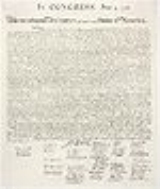
The United States Declaration of Independence is a statement adopted by the Continental Congress
Second Continental Congress

The Second Continental Congress was a convention of delegates from the Thirteen Colonies that met beginning in May 10, 1775, in Philadelphia, Pennsylvania, soon after shooting in the American Revolutionary War had begun....
 on July 4, 1776, which announced that the thirteen American colonies
Thirteen Colonies

The Thirteen Colonies were part of what became known as British America, a name that was used by Great Britain until the Treaty of Paris recognized the independence of the original thirteen United States of America in 1783....
 then at war with Great Britain
Kingdom of Great Britain

The Kingdom of Great Britain, also known as the United Kingdom of Great Britain, was a country in North-West Europe, in existence from 1707 to 1801....
 were now independent states, and thus no longer a part of the British Empire
British Empire

The British Empire comprised the dominions, Crown colony, protectorates, League of Nations mandate, and other Dependent territory ruled or administered by the United Kingdom , that had originated with the overseas colonies and trading posts established by England in the late 16th and early 17th centuries....
. Written primarily by Thomas Jefferson
Thomas Jefferson

Thomas Jefferson was the List of Presidents of the United States President of the United States , the principal author of the United States Declaration of Independence , and one of the most influential Founding Fathers of the United States for his promotion of the ideals of republicanism in the United States....
, the Declaration is a formal explanation of why Congress had voted on July 2 to declare independence
Lee Resolution

The Lee Resolution, also known as the resolution of independence, was an act of the Second Continental Congress declaring the Thirteen Colonies to be independent of the British Empire....
 from Great Britain, more than a year after the outbreak of the American Revolutionary War
American Revolutionary War

The American Revolutionary War , also known as the American War of Independence, began as a war between the Kingdom of Great Britain and Thirteen Colonies on the North America, and ended in a global war between several European great powers....
. The birthday of the United States of America
United States

The United States of America is a Federal government constitutional republic comprising U.S. state and a federal district. The country is situated mostly in central North America, where its Contiguous United States and Washington, D.C., the Capital districts and territories, lie between the Pacific Ocean and Atlantic Oceans, Borders of the U...
Independence Day
Independence Day (United States)

In the United States, Independence Day, commonly known as the Fourth of July, is a federal holiday commemorating the adoption of the United States Declaration of Independence on July 4, 1776, declaring independence from the Kingdom of Great Britain....
—is celebrated on July 4, the day the wording of the Declaration was approved by Congress.

After finalizing the text on July 4, Congress issued the Declaration of Independence in several forms. It was initially published as a printed broadside
Dunlap broadside

The Dunlap broadsides were the first published copies of the United States Declaration of Independence, printed on the night of July 4, 1776, by John Dunlap of Philadelphia....
 that was widely distributed and read to the public.


Discussion
Ask a question about 'United States Declaration of Independence'
Start a new discussion about 'United States Declaration of Independence'
Answer questions from other users
Full Discussion Forum


Recent Posts


Encyclopedia


The United States Declaration of Independence is a statement adopted by the Continental Congress
Second Continental Congress

The Second Continental Congress was a convention of delegates from the Thirteen Colonies that met beginning in May 10, 1775, in Philadelphia, Pennsylvania, soon after shooting in the American Revolutionary War had begun....
 on July 4, 1776, which announced that the thirteen American colonies
Thirteen Colonies

The Thirteen Colonies were part of what became known as British America, a name that was used by Great Britain until the Treaty of Paris recognized the independence of the original thirteen United States of America in 1783....
 then at war with Great Britain
Kingdom of Great Britain

The Kingdom of Great Britain, also known as the United Kingdom of Great Britain, was a country in North-West Europe, in existence from 1707 to 1801....
 were now independent states, and thus no longer a part of the British Empire
British Empire

The British Empire comprised the dominions, Crown colony, protectorates, League of Nations mandate, and other Dependent territory ruled or administered by the United Kingdom , that had originated with the overseas colonies and trading posts established by England in the late 16th and early 17th centuries....
. Written primarily by Thomas Jefferson
Thomas Jefferson

Thomas Jefferson was the List of Presidents of the United States President of the United States , the principal author of the United States Declaration of Independence , and one of the most influential Founding Fathers of the United States for his promotion of the ideals of republicanism in the United States....
, the Declaration is a formal explanation of why Congress had voted on July 2 to declare independence
Lee Resolution

The Lee Resolution, also known as the resolution of independence, was an act of the Second Continental Congress declaring the Thirteen Colonies to be independent of the British Empire....
 from Great Britain, more than a year after the outbreak of the American Revolutionary War
American Revolutionary War

The American Revolutionary War , also known as the American War of Independence, began as a war between the Kingdom of Great Britain and Thirteen Colonies on the North America, and ended in a global war between several European great powers....
. The birthday of the United States of America
United States

The United States of America is a Federal government constitutional republic comprising U.S. state and a federal district. The country is situated mostly in central North America, where its Contiguous United States and Washington, D.C., the Capital districts and territories, lie between the Pacific Ocean and Atlantic Oceans, Borders of the U...
Independence Day
Independence Day (United States)

In the United States, Independence Day, commonly known as the Fourth of July, is a federal holiday commemorating the adoption of the United States Declaration of Independence on July 4, 1776, declaring independence from the Kingdom of Great Britain....
—is celebrated on July 4, the day the wording of the Declaration was approved by Congress.

After finalizing the text on July 4, Congress issued the Declaration of Independence in several forms. It was initially published as a printed broadside
Dunlap broadside

The Dunlap broadsides were the first published copies of the United States Declaration of Independence, printed on the night of July 4, 1776, by John Dunlap of Philadelphia....
 that was widely distributed and read to the public. The most famous version of the Declaration, a signed copy that is usually regarded as the Declaration of Independence, is on display at the National Archives
National Archives and Records Administration

The United States National Archives and Records Administration is an Independent agencies of the United States government charged with preserving and documenting government and historical records and with increasing public access to those documents....
 in Washington, D.C. According to most historians, Congress signed this document on August 2, 1776, and not on July 4, as is often believed.

The sources and interpretation of the Declaration have been the subject of much scholarly inquiry. The Declaration justified the independence of the United States by listing colonial grievances against King George III
George III of the United Kingdom

George III was Kingdom of Great Britain and Kingdom of Ireland from 25 October 1760 until the union of these two countries on 1 January 1801, after which he was King of the United Kingdom of Great Britain and Ireland until his death....
, and by asserting certain natural rights, including a right of revolution
Right of revolution

In political philosophy, the right of revolution is a right or duty, variously stated throughout history, possessed by subjects of a state that justifies their action to Revolution the government to whom the subjects otherwise would owe allegiance....
. Having served its original purpose in announcing independence, the text of the Declaration was initially ignored after the American Revolution
American Revolution

The American Revolution refers to the political upheaval during the last half of the 18th century in which the Thirteen Colonies of North America overthrew the governance of the British Empire and then rejected the British monarchy to become the sovereign United States of America....
. Its stature grew over the years, particularly the second sentence, a sweeping statement of human rights
Human rights

Human rights refer to the "basic rights and freedom to which all humans are entitled." Examples of rights and freedoms which have come to be commonly thought of as human rights include civil and political rights, such as the right to life and liberty, freedom of speech, and equality before the law; and social, cultural and economic rights, i...
:

We hold these truths to be self-evident, that all men are created equal
All men are created equal

The quotation "All men are created equal" is arguably the best-known phrase in any of United States's political documents, as the idea it expresses is generally considered the foundation of American government....
, that they are endowed by their Creator with certain unalienable Rights, that among these are Life, Liberty and the pursuit of Happiness
Life, liberty and the pursuit of happiness

"Life, liberty, and the pursuit of happiness " is one of the most famous phrases in the United States Declaration of Independence. These three aspects are listed among the "inalienable rights" of man....
.


This sentence has been called "one of the best-known sentences in the English language" and "the most potent and consequential words in American history". The passage has often been used to promote the rights of marginalized groups, and came to represent for many people a moral standard for which the United States should strive. This view was greatly influenced by Abraham Lincoln
Abraham Lincoln

Abraham Lincoln was the List of Presidents of the United States President of the United States. He successfully led the country through its greatest internal crisis, the American Civil War, preserving the Union and ending slavery....
, who considered the Declaration to be the foundation of his political philosophy, and promoted the idea that the Declaration is a statement of principles through which the United States Constitution
United States Constitution

The Constitution of the United States of America is the supreme law of the United States. It is the foundation and source of the legal authority underlying the existence of the United States of America; the Federal Government of the United States; and all the State & local governments and Territorial Administrative bodies contained therein....
 should be interpreted.

Background

Thomas Jefferson Rev


By the time the Declaration of Independence was adopted in July 1776, the Thirteen Colonies
Thirteen Colonies

The Thirteen Colonies were part of what became known as British America, a name that was used by Great Britain until the Treaty of Paris recognized the independence of the original thirteen United States of America in 1783....
 and Great Britain had been at war for more than a year. Relations between the colonies and the mother country
Motherland

Motherland is a term that may refer to a mother country, i.e. the place of one's birth, the place of origin of an ethnic group or immigrant, or a Metropole in contrast to its colony....
 had been deteriorating since the end of the Seven Years' War
Seven Years' War

The Seven Years' War lasted between 1756?1763 and involved all of the major European powers of the period. The war pitted Kingdom of Prussia and Kingdom of Great Britain and a coalition of smaller German states against an alliance consisting of Archduchy of Austria, Early Modern France, Russian Empire, Kingdom of Sweden, and Electorate of Sa...
 in 1763. The war had plunged the British government deep into debt, and so Parliament
Parliament of Great Britain

The Parliament of Great Britain was formed in 1707 following the ratification of the Act of Union 1707 by both the Parliament of England and Parliament of Scotland....
 enacted a series of measures to increase tax revenue from the colonies. Parliament believed that these acts, such as the Stamp Act
Stamp Act 1765

The Stamp Act of 1765 was a tax imposed by the Parliament of Great Britain on the colonies of British America. The act required that many printed materials in the colonies carry a tax stamp....
 of 1765 and the Townshend Acts
Townshend Acts

The Townshend Acts were a series of Act of Parliament passed beginning in 1767 by the Parliament of Great Britain relating to the British America in North America....
 of 1767, were a legitimate means of having the colonies pay their fair share of the costs to keep the colonies in the British Empire
British Empire

The British Empire comprised the dominions, Crown colony, protectorates, League of Nations mandate, and other Dependent territory ruled or administered by the United Kingdom , that had originated with the overseas colonies and trading posts established by England in the late 16th and early 17th centuries....
.

Many colonists, however, had developed a different conception of the empire. Because the colonies were not directly represented in Parliament, colonists argued that Parliament had no right to levy taxes
No taxation without representation

"No taxation without representation" began as a slogan in the period 1763?1776 that summarized a primary grievance of the United Kingdom of Great Britain colonists in the Thirteen Colonies....
 upon them. This tax dispute was part of a larger divergence between British and American interpretations of the British Constitution and the extent of Parliament's authority in the colonies. The orthodox British view, dating from the Glorious Revolution
Glorious Revolution

The Glorious Revolution, also called the Revolution of 1688, was the overthrow of British monarchy James II of England in 1688 by a union of Parliament of England with an invading army led by the Dutch Republic stadtholder William III of England , who as a result ascended the English throne as William III of England....
 of 1688, was that Parliament was the supreme authority
Parliamentary sovereignty

Parliamentary sovereignty, Sovereignty of Parliament, parliamentary supremacy, or legislative supremacy is a concept in constitutional law that applies to some parliamentary democracy....
 throughout the empire, and so by definition anything Parliament did was constitutional. In the colonies, however, the idea had developed that the British Constitution recognized certain fundamental rights that no government—not even Parliament—could violate. After the Townshend Acts, some essayists even began to question whether Parliament had any legitimate jurisdiction in the colonies at all. Anticipating the arrangement of the British Commonwealth
Commonwealth of Nations

The Commonwealth of Nations, also known as the Commonwealth or the British Commonwealth, is an intergovernmental organization of fifty-three independent member states....
, by 1774 American writers such as Samuel Adams
Samuel Adams

Samuel Adams was a statesman, Political philosophy, and one of the Founding Fathers of the United States. As a politician in Province of Massachusetts Bay, Adams was a leader of the movement that became the American Revolution, and was one of the architects of the principles of Republicanism in the United States that shaped the political cul...
, James Wilson
James Wilson

James Wilson , was a Scotland lawyer, most notable as a signer of the United States Declaration of Independence. He was twice elected to the Continental Congress, a major force in the drafting of the United States Constitution, a leading legal theoretician and one of the six original justices appointed by George Washington to the Supreme Cour...
, and Thomas Jefferson were arguing that Parliament was the legislature of Great Britain only, and that the colonies, which had their own legislatures, were connected to the rest of the empire only through their allegiance to the Crown.

Congress convenes

The issue of Parliament's authority in the colonies became a crisis after Parliament passed the Coercive Acts in 1774 to punish the Province of Massachusetts for the Boston Tea Party
Boston Tea Party

The Boston Tea Party was an act of direct action protest by the American colonists against the Kingdom of Great Britain in which they destroyed many crates of tea belonging to the British East India Company and dumped it into the Boston Harbor....
. Many colonists saw the Coercive Acts as a violation of the British Constitution and thus a threat to the liberties of all of British America
British America

For American people of British descent, see British American.British America consisted of the British Empire in continental North America in the 17th century and 18th century....
. In September 1774, the First Continental Congress
First Continental Congress

The First Continental Congress was a convention of delegates from twelve of the thirteen Kingdom of Great Britain North American colonies that met on September 5, 1774, in Philadelphia Pennsylvania, early in the American Revolution....
 convened in Philadelphia to coordinate a response. Congress organized a boycott of British goods and petitioned the king
Petition to the King (1774)

The Petition to the King was a petition sent to George III of the United Kingdom by the First Continental Congress. The petition expressed loyalty to the king and hoped for redress of grievances relating to the Intolerable Acts and other issues that helped foment the American Revolution....
 for repeal of the acts. These measures were unsuccessful because King George III
George III of the United Kingdom

George III was Kingdom of Great Britain and Kingdom of Ireland from 25 October 1760 until the union of these two countries on 1 January 1801, after which he was King of the United Kingdom of Great Britain and Ireland until his death....
 and the North ministry
North Ministry

The MinistryThe North Ministry governed the Kingdom of Great Britain from 1770 until 1782. Overseeing in this time the Falklands Crisis, the Gordon Riots and much of the American War of Independence....
 were determined not to retreat on the question of parliamentary supremacy. As the king wrote to Prime Minister
Prime Minister of the United Kingdom

The Prime Minister of the United Kingdom of Great Britain and Northern Ireland is the political leader of the United Kingdom and the head of government Her Majesty's Government....
 Lord North
Frederick North, Lord North

Frederick North, 2nd Earl of Guilford, Order of the Garter, Privy Council of the United Kingdom , more often known by his courtesy title, Lord North, which he used from 1752 until 1790, was Prime Minister of the United Kingdom of Kingdom of Great Britain from 1770 to 1782....
 in November 1774, "blows must decide whether they are to be subject to this country or independent".

Even after fighting in the American Revolutionary War
American Revolutionary War

The American Revolutionary War , also known as the American War of Independence, began as a war between the Kingdom of Great Britain and Thirteen Colonies on the North America, and ended in a global war between several European great powers....
 began at Lexington and Concord
Battles of Lexington and Concord

The Battles of Lexington and Concord were the first military engagements of the American Revolutionary War. They were fought on April 19, 1775, in Middlesex County, Massachusetts, Province of Massachusetts Bay, within the towns of Lexington, Massachusetts, Concord, Massachusetts, Lincoln, Massachusetts, Arlington, Massachusetts, and Cambridge...
 in April 1775, most colonists still hoped for reconciliation with Great Britain. When the Second Continental Congress
Second Continental Congress

The Second Continental Congress was a convention of delegates from the Thirteen Colonies that met beginning in May 10, 1775, in Philadelphia, Pennsylvania, soon after shooting in the American Revolutionary War had begun....
 convened at the Pennsylvania State House in Philadelphia in May 1775, some delegates hoped for eventual independence, but no one yet advocated declaring it. Although many colonists no longer believed that Parliament had any sovereignty over them, they still professed loyalty to King George, whom they hoped would intercede on their behalf. They were to be disappointed: in late 1775, the king rejected Congress's second petition
Olive Branch Petition

When the Second Continental Congress convened in May 1775, most delegates followed John Dickinson in his quest to reconcile with George III of Great Britain....
, issued a Proclamation of Rebellion
Proclamation of Rebellion

The Proclamation of Rebellion, officially titled A Proclamation for Suppressing Rebellion and Sedition, was the response of George III of the United Kingdom to the news of the Battle of Bunker Hill at the outset of the American Revolutionary War....
, and announced before Parliament on October 26 that he was even considering "friendly offers of foreign assistance" to suppress the rebellion. A pro-American minority in Parliament warned that the government was driving the colonists towards independence.

Towards independence

In January 1776, just as it became clear in the colonies that the king was not inclined to act as a conciliator, Thomas Paine
Thomas Paine

Thomas Paine was a UK pamphleteer, revolutionary, Radicalism , inventor, and intellectual. He lived and worked in Britain until age 37, when he emigrated to the British American colonies, in time to participate in the American Revolution....
's pamphlet Common Sense
Common Sense (pamphlet)

Common Sense was a pamphlet written by Thomas Paine. It was first published anonymously on January 10, 1776, during the American Revolution....
 was published. Paine, who had only recently arrived in the colonies from England, argued in favor of colonial independence, advocating republicanism
Republicanism

Republicanism is the ideology of governing a nation as a republic, where the head of state is appointed by other means than hereditary, often elections....
 as an alternative to monarchy and hereditary rule. Common Sense introduced no new ideas, and probably had little direct effect on Congress's thinking about independence; its importance was in stimulating public debate on a topic that few had previously dared to openly discuss. Public support for separation from Great Britain steadily increased after the publication of Paine's enormously popular pamphlet.

Independence Hall Assembly Room
Although some colonists still held out hope for reconciliation, developments in early 1776 further strengthened public support for independence. In February 1776, colonists learned of Parliament's passage of the Prohibitory Act
Prohibitory Act

The Prohibitory Act of 1775 was Great Britain's way of retaliating against an United States revolt. This was enacted as one of the precursors to the American Revolutionary War....
, which established a blockade of American ports and declared American ships to be enemy vessels. John Adams
John Adams

John Adams was an Politics of the United States and the List of Presidents of the United States President of the United States , after being the List of Vice Presidents of the United States Vice President of the United States for two terms....
, a strong supporter of independence, believed that Parliament had effectively declared American independence before Congress had been able to. Adams labeled the Prohibitory Act the "Act of Independency", calling it "a compleat Dismemberment of the British Empire". Support for declaring independence grew even more when it was confirmed that King George had hired German mercenaries to use against his American subjects.

Despite this growing popular support for independence, Congress lacked the clear authority to declare it. Delegates had been elected to Congress by thirteen different governments—which included extralegal conventions, ad hoc committees, and elected assemblies—and were bound by the instructions given to them. Regardless of their personal opinions, delegates could not vote to declare independence unless their instructions permitted such an action. Several colonies, in fact, expressly prohibited their delegates from taking any steps towards separation from Great Britain, while other delegations had instructions that were ambiguous on the issue. As public sentiment for separation from Great Britain grew, advocates of independence sought to have the Congressional instructions revised. For Congress to declare independence, a majority of delegations would need authorization to vote for independence, and at least one colonial government would need to specifically instruct its delegation to propose a declaration of independence in Congress. Between April and July 1776, a "complex political war" was waged in order to bring this about.

Revising instructions

In the campaign to revise Congressional instructions, many Americans formally expressed their support for separation from Great Britain in what were effectively state and local declarations of independence. Historian Pauline Maier
Pauline Maier

Pauline Maier, born in 1938 in St. Paul, Minnesota, is the William R. Kenan Jr. Professor of American History at the Massachusetts Institute of Technology....
 identified more than ninety such declarations that were issued throughout the Thirteen Colonies from April to July 1776. These "declarations" took a variety of forms. Some were formal, written instructions for Congressional delegations, such as the Halifax Resolves
Halifax Resolves

The Halifax Resolves is the name later given to a resolution adopted by the North Carolina Provincial Congress of the Province of North Carolina on April 12, 1776, during the American Revolution....
 of April 12, with which North Carolina became the first colony to explicitly authorize its delegates to vote for independence. Others were legislative acts that officially ended British rule in individual colonies, such as on May 4, when the Rhode Island legislature became to the first to declare its independence from Great Britain. Many "declarations" were resolutions adopted at town or county meetings that offered support for independence. A few came in the form of jury instructions, such as the statement issued on April 23, 1776, by Chief Justice William Henry Drayton
William Henry Drayton

Other notable men have similar names, see: William Drayton .William Henry Drayton , was an United States planter and lawyer from Charleston, South Carolina....
 of South Carolina: "the law of the land authorizes me to declare...that George the Third, King of Great Britain...has no authority over us, and we owe no obedience to him." Most of these declarations are now obscure, having been overshadowed by the declaration approved by Congress on July 4.

Some colonies held back from endorsing independence. Resistance was centered in the middle colonies
Middle Colonies

The Middle Colonies, also known as the Bread Colonies for the region's production of wheat and grain, were one area of Thirteen Colonies in pre-Revolutionary War Northern America....
 of New York, New Jersey, Maryland, Pennsylvania, and Delaware. Advocates of independence saw Pennsylvania as the key: if that colony could be converted to the pro-independence cause, it was believed that the others would follow. On May 1, however, opponents of independence retained control of the Pennsylvania Assembly
Pennsylvania Provincial Assembly

The Pennsylvania Provincial Assembly, also known as the Colonial Assembly, the General Assembly, or simply the Pennsylvania Assembly, was the representative branch of government in the Province of Pennsylvania....
 in a special election that had focused on the question of independence. In response, on May 10 Congress passed a resolution, which had been introduced by John Adams, calling on colonies without a "government sufficient to the exigencies of their affairs" to adopt new governments. The resolution passed unanimously, and was even supported by Pennsylvania's John Dickinson
John Dickinson (delegate)

John Dickinson was an United States lawyer and a politician from Philadelphia, Pennsylvania, Pennsylvania and Wilmington, Delaware, Delaware. He was a militia officer during the American Revolution, a Continental Congressman from Pennsylvania and Delaware, a delegate to the Philadelphia Convention, Governor of Delaware, Governor of Pennsylv...
, the leader of the anti-independence faction in Congress, who believed that it did not apply to his colony.

As was the custom, Congress appointed a committee to draft a preamble
Preamble

A preamble is an introductory and explanatory statement in a document that explains the document's purpose and underlying philosophy. When applied to the opening paragraphs of a statute, it may recite historical facts pertinent to the subject of the statute....
 that would explain the purpose of the resolution. John Adams wrote the preamble, which stated that because King George had rejected reconciliation and was even hiring foreign mercenaries to use against the colonies, "it is necessary that the exercise of every kind of authority under the said crown should be totally suppressed". Everyone understood that Adams's preamble was meant to encourage the overthrow of the governments of Pennsylvania and Maryland, which were still under proprietary
Proprietary colony

A proprietary colony is a colony in which one or more private land owners retain rights that are normally the privilege of the state, and in all cases eventually became so....
 governance. Congress passed the preamble on May 15 after several days of debate, but four of the middle colonies voted against it, and the Maryland delegation walked out in protest. Adams regarded his May 15 preamble as effectively an American declaration of independence, although he knew that a formal declaration would still have to be made.

Lee's resolution and the final push

On the same day that Congress passed Adams's radical preamble, the Virginia Convention
Virginia Conventions

The Virginia Conventions were a series of five political meetings in the Colony of Virginia during the American Revolution. Because the House of Burgesses had been dissolved in 1774 by Royal Governor John Murray, 4th Earl of Dunmore, the conventions served as a revolutionary provisional government until the establishment of the independent Vi...
 set the stage for a formal Congressional declaration of independence. On May 15, the Convention instructed Virginia's congressional delegation "to propose to that respectable body to declare the United Colonies free and independent States, absolved from all allegiance to, or dependence upon, the Crown or Parliament of Great Britain". In accordance with those instructions, Richard Henry Lee
Richard Henry Lee

Richard Henry Lee was an United States statesman from Virginia best known for the motion in the Second Continental Congress calling for the colonies' independence from Great Britain....
 of Virginia presented a three-part resolution
Lee Resolution

The Lee Resolution, also known as the resolution of independence, was an act of the Second Continental Congress declaring the Thirteen Colonies to be independent of the British Empire....
 to Congress on June 7. The motion, which was seconded by John Adams, called on Congress to declare independence, form foreign alliances, and prepare a plan of colonial confederation. The part of the resolution relating to declaring independence read:

Resolved, that these United Colonies are, and of right ought to be, free and independent States, that they are absolved from all allegiance to the British Crown, and that all political connection between them and the State of Great Britain is, and ought to be, totally dissolved.


Lee's resolution met with resistance in the ensuing debate. Opponents of the resolution, while conceding that reconciliation with Great Britain was unlikely, argued that declaring independence was premature, and that securing foreign aid should take priority. Advocates of the resolution countered that foreign governments would not intervene in an internal British struggle, and so a formal declaration of independence was needed before foreign aid was possible. All Congress needed to do, they insisted, was to "declare a fact which already exists". Delegates from Pennsylvania, Delaware, New Jersey, Maryland, and New York were still not yet authorized to vote for independence, however, and some of them threatened to leave Congress if the resolution were adopted. Congress therefore voted on June 10 to postpone further discussion of Lee's resolution for three weeks. Until then, Congress decided that a committee should prepare a document announcing and explaining independence in the event that Lee's resolution was approved when it was brought up again in July.

Support for a Congressional declaration of independence was consolidated in the final weeks of June 1776. On June 14, the Connecticut Assembly instructed its delegates to propose independence, and the following day the legislatures of New Hampshire and Delaware authorized their delegates to declare independence. In Pennsylvania, political struggles ended with the dissolution of the colonial assembly, and on June 18 a new Conference of Committees under Thomas McKean
Thomas McKean

Thomas McKean was a lawyer and politician from New Castle, Delaware, Delaware, and Philadelphia, Pennsylvania. During the American Revolution, he was a delegate to the Continental Congress, where he signed the United States Declaration of Independence and served as a President of the Continental Congress....
 authorized Pennsylvania's delegates to declare independence. On June 15, the Provincial Congress of New Jersey
Provincial Congress of New Jersey

The Provincial Congress of New Jersey was a transitional governing body of New Jersey in the early part of the American Revolution. It first met in 1775 with representatives from all New Jersey's then thirteen counties....
, which had been governing the province since January 1776, resolved that Royal Governor William Franklin
William Franklin

William Franklin was the last Colonial Governor of New Jersey. William was a steadfast Loyalist throughout the American Revolutionary War, despite his father's role as one of the most prominent Patriot during the conflict, a difference that tore the two apart....
 was "an enemy to the liberties of this country" and had him arrested. On June 21, they chose new delegates to Congress and empowered them to join in a declaration of independence.

Only Maryland and New York had yet to authorize independence. When the Continental Congress had adopted Adams's radical May 15 preamble, Maryland's delegates walked out and sent to the Maryland Convention for instructions. On May 20, the Maryland Convention rejected Adams's preamble, instructing its delegates to remain against independence, but Samuel Chase
Samuel Chase

Samuel Chase , was an Associate Justice of the United States Supreme Court and earlier was a signatory to the United States Declaration of Independence as a representative of Maryland....
 went to Maryland and, thanks to local resolutions in favor of independence, was able to get the Maryland Convention to change its mind on June 28. Only the New York delegates were unable to get revised instructions. When Congress had been considering the resolution of independence on June 8, the New York Provincial Congress
New York Provincial Congress

The New York Provincial Congress was an organization formed by rebels in 1775, during the American Revolution, as a replacement for the Province of New York Assembly, and as a replacement for the Committee of Sixty....
 told the delegates to wait. But on June 30, the Provincial Congress evacuated New York as British forces approached, and would not convene again until July 10. This meant that New York's delegates would not be authorized to declare independence until after Congress had made its decision.

Draft and adoption

While political maneuvering was setting the stage for an official declaration of independence, a document explaining the decision was being written. On June 11, 1776, Congress appointed a "Committee of Five
Committee of Five

The Committee of Five was the Committee delegated by the Second Continental Congress on June 11, 1776, to draft the United States United States Declaration of Independence....
", consisting of John Adams of Massachusetts, Benjamin Franklin
Benjamin Franklin

Benjamin Franklin was one of the Founding Fathers of the United States of the United States. A noted polymath, Franklin was a leading author and Printer , Satire, list of political philosophers, politician, scientist, inventor, activism, statesman, and diplomacy....
 of Pennsylvania, Thomas Jefferson
Thomas Jefferson

Thomas Jefferson was the List of Presidents of the United States President of the United States , the principal author of the United States Declaration of Independence , and one of the most influential Founding Fathers of the United States for his promotion of the ideals of republicanism in the United States....
 of Virginia, Robert R. Livingston
Robert Livingston (1746-1813)

Robert R Livingston , was an American lawyer, politician and diplomat from New York....
 of New York, and Roger Sherman
Roger Sherman

Roger Sherman was an early United States lawyer and politician. He served as the first mayor of New Haven, Connecticut, Connecticut, and served on the Committee of Five that drafted the United States Declaration of Independence, and was also a representative and senator in the new republic....
 of Connecticut, to draft a declaration. Because the committee left no minutes, there is some uncertainty about how the drafting process proceeded—accounts written many years later by Jefferson and Adams, although frequently cited, are contradictory and not entirely reliable. What is certain is that the committee, after discussing the general outline that the document should follow, decided that Jefferson would write the first draft. Considering Congress's busy schedule, Jefferson probably had limited time for writing over the next seventeen days, and likely wrote the draft quickly. He then consulted the others, made some changes, and then produced another copy incorporating these alterations. The committee presented this copy to the Congress on June 28, 1776. The title of the document was "A Declaration by the Representatives of the United States of America, in General Congress assembled." Congress ordered that the draft "lie on the table
Table (parliamentary)

In American parliamentary procedure, the motion to table or more properly, to lay on the table, is a proposal to suspend consideration of the pending motion....
".

Declaration Independence
On Monday, July 1, having tabled the draft of the declaration, Congress resolved itself into a committee of the whole
Committee of the Whole

A Committee of the Whole is a device in which a legislative body or other deliberative assembly is considered one large committee. All members of the legislative body are members of such a committee....
 and resumed debate on Lee's resolution of independence. John Dickinson
John Dickinson (delegate)

John Dickinson was an United States lawyer and a politician from Philadelphia, Pennsylvania, Pennsylvania and Wilmington, Delaware, Delaware. He was a militia officer during the American Revolution, a Continental Congressman from Pennsylvania and Delaware, a delegate to the Philadelphia Convention, Governor of Delaware, Governor of Pennsylv...
 made one last effort to delay the decision, arguing that Congress should not declare independence without first securing a foreign alliance and finalizing the Articles of Confederation
Articles of Confederation

The Articles of Confederation and Perpetual Union was the constitution of the revolutionary wartime alliance of the thirteen United States. The Articles' ratification was completed in 1781, and legally federated several sovereign and independent states, allied under the Articles of Association into a new federation styled the "United States...
. John Adams gave a speech in reply to Dickinson, restating the case for an immediate declaration.

After a long day of speeches, a vote was taken. As always, each colony cast a single vote; the delegation for each colony—numbering two to seven members—voted amongst themselves to determine the colony's vote. Pennsylvania and South Carolina voted against declaring independence. The New York delegation, lacking permission to vote for independence, abstained. Delaware cast no vote because the delegation was split between Thomas McKean
Thomas McKean

Thomas McKean was a lawyer and politician from New Castle, Delaware, Delaware, and Philadelphia, Pennsylvania. During the American Revolution, he was a delegate to the Continental Congress, where he signed the United States Declaration of Independence and served as a President of the Continental Congress....
 (who voted yes) and George Read
George Read (signer)

George Read was an United States lawyer and politician from New Castle, Delaware, in New Castle County, Delaware, Delaware. He was a signer of the Declaration of Independence , a Continental Congress, a delegate to the Philadelphia Convention, Governor of Delaware, and a member of the Federalist Party , who served as United States Senate and...
 (who voted no). The remaining nine delegations voted in favor of independence, which meant that the resolution had been approved by the committee of the whole. The next step was for the resolution to be voted upon by the Congress itself. Edward Rutledge
Edward Rutledge

Edward Rutledge , was an USA politician and a signer of the United States Declaration of Independence. He later served as governor of South Carolina....
 of South Carolina, who was opposed to Lee's resolution but desirous of unanimity, moved that the vote be postponed until the following day.

On July 2, South Carolina reversed its position and voted for independence. In the Pennsylvania delegation, Dickinson and Robert Morris abstained, allowing the delegation to vote three-to-two in favor of independence. The tie in the Delaware delegation was broken by the timely arrival of Caesar Rodney
Caesar Rodney

Caesar Rodney , was an United States lawyer and politician from St. Jones Neck, in East Dover Hundred, Kent County, Delaware, Delaware, east of Dover, Delaware....
, who voted for independence. The New York delegation abstained once again, since they were still not authorized to vote for independence, although they would be allowed to do so by the New York Provincial Congress
New York Provincial Congress

The New York Provincial Congress was an organization formed by rebels in 1775, during the American Revolution, as a replacement for the Province of New York Assembly, and as a replacement for the Committee of Sixty....
 a week later. The resolution of independence had been adopted with twelve affirmative votes and one abstention. With this, the colonies had officially severed political ties with Great Britain. In a now-famous letter written to his wife on the following day, John Adams predicted that July 2 would become a great American holiday. Adams thought that the vote for independence would be commemorated; he did not foresee that Americans—including himself—would instead celebrate Independence Day
Independence Day (United States)

In the United States, Independence Day, commonly known as the Fourth of July, is a federal holiday commemorating the adoption of the United States Declaration of Independence on July 4, 1776, declaring independence from the Kingdom of Great Britain....
 on the date that the announcement of that act was finalized.

After voting in favor of the resolution of independence, Congress turned its attention to the committee's draft of the declaration. Over several days of debate, Congress made a few changes in wording and deleted nearly a fourth of the text, most notably a passage critical of the slave trade
Atlantic slave trade

The Atlantic slave trade, also known as the transatlantic slave trade, was the trade of primarily African people supplied to the colonies of the New World that occurred in and around the Atlantic Ocean....
, changes that Jefferson resented. On July 4, 1776, the wording of the Declaration of Independence was approved and sent to the printer for publication.

Text

Yale Dunlap Broadside
The first sentence of the Declaration asserts as a matter of Natural Law the ability of a people to assume political independence, and acknowledges that the grounds for such independence must be reasonable, and therefore explicable, and ought to be explained.

When in the Course of human events, it becomes necessary for one people to dissolve the political bands which have connected them with another, and to assume among the powers of the earth, the separate and equal station to which the Laws of Nature
Natural law

Natural law or the law of nature is a theory that posits the existence of a law whose content is set by nature and that therefore has validity everywhere....
 and of Nature's God entitle them, a decent respect to the opinions of mankind requires that they should declare the causes which impel them to the separation.


The next section, the famous preamble, includes the ideas and ideals that were principles of the Declaration. It is also an assertion of what is known as the "right of revolution
Right of revolution

In political philosophy, the right of revolution is a right or duty, variously stated throughout history, possessed by subjects of a state that justifies their action to Revolution the government to whom the subjects otherwise would owe allegiance....
": that is, people have certain rights, and when a government violates these rights, the people have the right to "alter or abolish" that government.

We hold these truths to be self-evident
Self-evidence

In epistemology , a self-evident proposition is one that is known to be true by understanding its meaning without Logical argument.Some epistemologists deny that any proposition can be self-evident....
, that all men are created equal
All men are created equal

The quotation "All men are created equal" is arguably the best-known phrase in any of United States's political documents, as the idea it expresses is generally considered the foundation of American government....
, that they are endowed by their Creator
Creator deity

A creator deity is a deity in a creation myth responsible for the creation of the world .In monotheism, the single God is necessarily also the creator deity, while polytheistic traditions may or may not have creator deities....
 with certain unalienable Rights, that among these are Life, Liberty and the pursuit of Happiness
Life, liberty and the pursuit of happiness

"Life, liberty, and the pursuit of happiness " is one of the most famous phrases in the United States Declaration of Independence. These three aspects are listed among the "inalienable rights" of man....
.

That to secure these rights, Governments are instituted among Men, deriving their just powers from the consent of the governed
Consent of the governed

"Consent of the governed" is a political philosophy stating that a government's political legitimacy and moral right to use state power are, or ought to be, derived from the people or society over which that power is exercised....
, That whenever any Form of Government becomes destructive of these ends, it is the Right of the People to alter or to abolish it
Right of revolution

In political philosophy, the right of revolution is a right or duty, variously stated throughout history, possessed by subjects of a state that justifies their action to Revolution the government to whom the subjects otherwise would owe allegiance....
, and to institute new Government, laying its foundation on such principles and organizing its powers in such form, as to them shall seem most likely to effect their Safety and Happiness.

Prudence, indeed, will dictate that Governments long established should not be changed for light and transient causes; and accordingly all experience hath shewn, that mankind are more disposed to suffer, while evils are sufferable, than to right themselves by abolishing the forms to which they are accustomed. But when a long train of abuses and usurpations, pursuing invariably the same Object evinces a design to reduce them under absolute Despotism
Despotism

Despotism is a form of government by a single authority, either an autocracy or oligarchy, which rules with absolute political power. In its classical form, a despotism is a state where a single individual wields all the power and authority embodying the state, and everyone else is a subsidiary person....
, it is their right, it is their duty, to throw off such Government, and to provide new Guards for their future security.


The next section is a list of charges against King George which aim to demonstrate that he has violated the colonists' rights and is therefore unfit to be their ruler:

Such has been the patient sufferance of these Colonies; and such is now the necessity which constrains them to alter their former Systems of Government. The history of the present King of Great Britain is a history of repeated injuries and usurpations, all having in direct object the establishment of an absolute Tyranny over these States. To prove this, let Facts be submitted to a candid world.

He has refused his Assent to Laws, the most wholesome and necessary for the public good.
He has forbidden his Governors to pass Laws of immediate and pressing importance, unless suspended in their operation till his Assent should be obtained; and when so suspended, he has utterly neglected to attend to them.
He has refused to pass other Laws for the accommodation of large districts of people, unless those people would relinquish the right of Representation in the Legislature, a right inestimable to them and formidable to tyrants only.
He has called together legislative bodies at places unusual, uncomfortable, and distant from the depository of their public Records, for the sole purpose of fatiguing them into compliance with his measures.
He has dissolved Representative Houses repeatedly, for opposing with manly firmness his invasions on the rights of the people.
He has refused for a long time, after such dissolutions, to cause others to be elected; whereby the Legislative powers, incapable of Annihilation, have returned to the People at large for their exercise; the State remaining in the mean time exposed to all the dangers of invasion from without, and convulsions within.
He has endeavoured to prevent the population of these States; for that purpose obstructing the Laws for Naturalization of Foreigners; refusing to pass others to encourage their migrations hither, and raising the conditions of new Appropriations of Lands.


He has obstructed the Administration of Justice, by refusing his Assent to Laws for establishing Judiciary powers.
He has made Judges dependent on his Will alone, for the tenure of their offices, and the amount and payment of their salaries.
He has erected a multitude of New Offices, and sent hither swarms of Officers to harrass our people, and eat out their substance.
He has kept among us, in times of peace, Standing Armies without the Consent of our legislatures.
He has affected to render the Military independent of and superior to the Civil power.
He has combined with others to subject us to a jurisdiction foreign to our constitution, and unacknowledged by our laws; giving his Assent to their Acts of pretended Legislation:
For Quartering large bodies of armed troops among us: For protecting them, by a mock Trial, from punishment for any Murders which they should commit on the Inhabitants of these States: For cutting off our Trade with all parts of the world: For imposing Taxes on us without our Consent: For depriving us in many cases, of the benefits of Trial by Jury: For transporting us beyond Seas to be tried for pretended offences For abolishing the free System of English Laws in a neighbouring Province, establishing therein an Arbitrary government, and enlarging its Boundaries so as to render it at once an example and fit instrument for introducing the same absolute rule into these Colonies: For taking away our Charters, abolishing our most valuable Laws, and altering fundamentally the Forms of our Governments: For suspending our own Legislatures, and declaring themselves invested with power to legislate for us in all cases whatsoever.
He has abdicated Government here, by declaring us out of his Protection and waging War against us.
He has plundered our seas, ravaged our Coasts, burnt our towns, and destroyed the lives of our people.
He is at this time transporting large Armies of foreign Mercenaries to compleat the works of death, desolation and tyranny, already begun with circumstances of Cruelty & perfidy scarcely paralleled in the most barbarous ages, and totally unworthy the Head of a civilized nation.
He has constrained our fellow Citizens taken Captive on the high Seas to bear Arms against their Country, to become the executioners of their friends and Brethren, or to fall themselves by their Hands.
He has excited domestic insurrections amongst us, and has endeavoured to bring on the inhabitants of our frontiers, the merciless Indian Savages, whose known rule of warfare, is an undistinguished destruction of all ages, sexes and conditions.


In every stage of these Oppressions We have Petitioned for Redress in the most humble terms: Our repeated Petitions have been answered only by repeated injury. A Prince whose character is thus marked by every act which may define a Tyrant
Tyrant

This article is about the political ruler. For other uses see Tyrant and Tyranny In modern usage, a tyrant is a single ruler holding absolute political power over a state or within an organization....
, is unfit to be the ruler of a free people.


Many Americans still felt a kinship with the people of Great Britain, and had appealed in vain to the prominent among them, as well as to Parliament
Parliament of Great Britain

The Parliament of Great Britain was formed in 1707 following the ratification of the Act of Union 1707 by both the Parliament of England and Parliament of Scotland....
, to convince the King to relax his more objectionable policies toward the colonies. The next section represents disappointment that these attempts had been unsuccessful.

Nor have We been wanting in attentions to our British brethren. We have warned them from time to time of attempts by their legislature to extend an unwarrantable jurisdiction over us. We have reminded them of the circumstances of our emigration and settlement here. We have appealed to their native justice and magnanimity, and we have conjured them by the ties of our common kindred to disavow these usurpations, which, would inevitably interrupt our connections and correspondence. They too have been deaf to the voice of justice and of consanguinity. We must, therefore, acquiesce in the necessity, which denounces our Separation, and hold them, as we hold the rest of mankind, Enemies in War, in Peace Friends.


In the final section, the signers assert that there exist conditions under which people must change their government, that the British have produced such conditions, and by necessity the colonies must throw off political ties with the British Crown and become independent states. The conclusion incorporates language from Lee's resolution of independence that had been passed on July 2.

We, therefore, the Representatives of the united States of America, in General Congress, Assembled, appealing to the Supreme Judge of the world for the rectitude of our intentions, do, in the Name, and by Authority of the good People of these Colonies, solemnly publish and declare, That these United Colonies are, and of Right ought to be Free and Independent States; that they are Absolved from all Allegiance to the British Crown, and that all political connection between them and the State of Great Britain, is and ought to be totally dissolved; and that as Free and Independent States, they have full Power to levy War, conclude Peace, contract Alliances, establish Commerce, and to do all other Acts and Things which Independent States may of right do. And for the support of this Declaration, with a firm reliance on the protection of divine Providence, we mutually pledge to each other our Lives, our Fortunes and our sacred Honor.


Influences

John Locke
Historians have often sought to identify the sources that most influenced the words of the Declaration of Independence. By Jefferson's own admission, the Declaration contained no original ideas, but was instead a statement of sentiments widely shared by supporters of the American Revolution. As he explained in 1825:

Neither aiming at originality of principle or sentiment, nor yet copied from any particular and previous writing, it was intended to be an expression of the American mind, and to give to that expression the proper tone and spirit called for by the occasion.


Jefferson's most immediate sources were two documents written in June 1776: his own draft of the preamble of the Constitution of Virginia
Constitution of Virginia

The Constitution of the Commonwealth of Virginia is the document that defines and limits the powers of the state government and the basic rights of the citizens of the United States Commonwealth of Virginia....
, and George Mason
George Mason

George Mason IV was an United States Patriot , statesman, and delegate from Virginia to the U.S. Constitutional Convention. Along with James Madison, he is called the "Father of the Bill of Rights." For these reasons he is considered one of the "Founding Fathers of the United States" of the United States....
's draft of the Virginia Declaration of Rights
Virginia Declaration of Rights

The Virginia Declaration of Rights is a document drafted in 1776 to proclaim the inherent natural rights of men, including the right to rebel against "inadequate" government....
. Ideas and phrases from both of these documents appear in the Declaration of Independence. They were in turn directly influenced by the 1689 English Declaration of Rights
Bill of Rights 1689

The Bill of Rights is an Act of Parliament of the Parliament of England, whose long title is An Act Declaring the Rights and Liberties of the Subject and Settling the Succession of the Crown....
, which formally ended the reign of King James II
James II of England

James II and VII was List of English monarchs, List of Scottish monarchs, and King of Ireland from 6 February 1685. He was the last Roman Catholic Church monarch to reign over the Kingdoms of Kingdom of England, Kingdom of Scotland, and Kingdom of Ireland....
. During the American Revolution, Jefferson and other Americans looked to the English Declaration of Rights as a model of how to end the reign of an unjust king.

English political theorist John Locke
John Locke

John Locke was an English philosopher. Locke is considered the first of the British Empiricism, but is equally important to social contract theory....
 is usually cited as a primary influence on the Declaration. As historian Carl L. Becker
Carl L. Becker

Carl Lotus Becker was an USA historian. He was born in Waterloo, Iowa, Black Hawk County, Iowa. He studied at the University of Wisconsin-Madison....
 wrote in 1922, "Most Americans had absorbed Locke's works as a kind of political gospel; and the Declaration, in its form, in its phraseology, follows closely certain sentences in Locke's second treatise on government
Two Treatises of Government

The Two Treatises of Government is a work of political philosophy published anonymously in 1689 by John Locke. The First Treatise attacks patriarchalism in the form of sentence-by-sentence refutation of Robert Filmer's Patriarcha and the Second Treatise outlines a theory of political or Civil_society#Pre-modern_history based...
." The extent of Locke's influence on the American Revolution was questioned by some subsequent scholars, however, who emphasized the influence of republicanism
Republicanism

Republicanism is the ideology of governing a nation as a republic, where the head of state is appointed by other means than hereditary, often elections....
 rather than Locke's classical liberalism
Classical liberalism

Classical liberalism is a doctrine stressing individual freedom, free markets, and limited government. This includes the importance of human rationality, individual property rights, natural rights, the protection of civil liberties, individual freedom from restraint, equality under the law, constitutional limitation of government, free marke...
. Historian Garry Wills
Garry Wills

Garry Wills is an author, journalist, and historian specializing in politics, ideology, and Roman Catholicism. Between 1961 and 2008 inclusive, he has written nearly 40 books....
 argued that Jefferson was influenced by the Scottish Enlightenment
Scottish Enlightenment

The Scottish Enlightenment was the period in 18th century Scotland characterised by an outpouring of intellectual and scientific accomplishments....
, particularly Francis Hutcheson
Francis Hutcheson (philosopher)

Francis Hutcheson was a philosopher born in Kingdom of Ireland to a family of Scotland Presbyterians who became one of the founding fathers of the Scottish Enlightenment....
, rather than Locke, an interpretation that has been strongly criticized. The Scottish Declaration of Arbroath
Declaration of Arbroath

The Declaration of Arbroath was a declaration of Scottish independence, and set out to confirm Scotland's status as an Independence, Sovereignty state and its use of military action when unjustly attacked....
 (1320) and the Dutch Act of Abjuration (1581) have also been offered as models for Jefferson's Declaration, but these arguments have been disputed.

Signing


The date when the Declaration was signed has long been the subject of debate. Within a decade after the event, Thomas Jefferson, Benjamin Franklin, and John Adams all wrote that the Declaration had been signed by Congress on July 4, 1776. This seemed to be confirmed by the signed copy of the Declaration, which is dated July 4. Additional support was provided by the Journals of Congress, the official public record of the Continental Congress. When the proceedings for 1776 were first published in 1777, the entry for July 4, 1776, stated that the Declaration was engrossed (carefully handwritten) and signed on that date.

In 1796, signer Thomas McKean
Thomas McKean

Thomas McKean was a lawyer and politician from New Castle, Delaware, Delaware, and Philadelphia, Pennsylvania. During the American Revolution, he was a delegate to the Continental Congress, where he signed the United States Declaration of Independence and served as a President of the Continental Congress....
 disputed that the Declaration had been signed on July 4, pointing out that some signers were not then present, including several who were not even elected to Congress until after that date. "[N]o person signed it on that day nor for many days after", he later wrote. Although Jefferson and Adams disagreed with McKean, his claim gained support when the Secret Journals of Congress were published in 1821. The Secret Journals contained two previously unpublished entries about the Declaration. The entry for July 19 reads:

The entry for August 2 stated:

In 1884, historian Mellen Chamberlain argued that these entries indicated that the famous signed version of the Declaration had been created following the July 19 resolution, and had not been signed by Congress until August 2. Historian John Hazelton confirmed in 1906 that many of the signers had not been present in Congress on July 4, that the fifty-six signers had never been together as a group, and that some delegates must have added their signatures even after August 2. While it is possible that Congress signed a document on July 4 that has since been lost, historians do not think that this is likely.

Although most historians have accepted the argument that the Declaration was not signed on July 4, and that the engrossed copy was not created until after July 19, legal historian Wilfred Ritz wrote in 1986 that "the historians and scholars are wrong". Ritz argued that the engrossed copy of the Declaration was signed by Congress on July 4, as Jefferson, Adams, and Franklin had stated, and that it was implausible that all three men had been mistaken. Ritz believed that McKean's testimony was questionable, and that historians had misinterpreted the July 19 resolution. According to Ritz, this resolution did not call for a new document to be created, but rather for the existing one to be given a new title, which was necessary after New York had joined the other twelve states in declaring independence. Ritz argued that the phrase "signed by every member of Congress" in the July 19 resolution meant that delegates who had not signed the Declaration on the 4th were now required to do so.

Ritz argued that about thirty-four delegates signed the Declaration on July 4, and that the others signed on or after August 2. Historians who reject a July 4 signing maintain that most delegates signed on August 2, and that those eventual signers who were not present added their names later.

List of signers

Fifty-six delegates eventually signed the Declaration:

President of Congress
President of the Continental Congress

The President of the Continental Congress was the presiding officer of the Continental Congress, the convention of delegates that emerged as the first national government of the United States during the American Revolution....
1. John Hancock
John Hancock

John Hancock was a merchant, statesman, and prominent Patriot of the American Revolution. He served as President of the Continental Congress of the Second Continental Congress and was the first Governor of Massachusetts of the Massachusetts....
 (Massachusetts)


New Hampshire
New Hampshire

New Hampshire is a U.S. state in the New England region of the Northeastern United States United States of America. The state was named after the southern English Counties of England of Hampshire....
2. Josiah Bartlett
Josiah Bartlett

Josiah Bartlett , was an United States physician and statesman, delegate to the Continental Congress for New Hampshire, and signatory of the United States Declaration of Independence....
3. William Whipple
William Whipple

William Whipple, Jr. , was a signer of the United States Declaration of Independence as a representative of New Hampshire.Whipple was born at Kittery, Maine, and educated at a common school studying how to be a merchant, judge, and a soldier until he went off to sea....
4. Matthew Thornton
Matthew Thornton

Matthew Thornton , was a signer of the United States United States Declaration of Independence as a representative of New Hampshire.He was born in Ireland: his family immigrated to 13 colonies when he was three years old, settling first at Wiscasset, Maine, and removing shortly thereafter to Worcester, Massachusetts....


Massachusetts
Massachusetts

The Commonwealth of Massachusetts is a U.S. state located in the New England region of the Northeastern United States United States. It borders Rhode Island and Connecticut to the south, New York to the west, and Vermont and New Hampshire to the north....
5. Samuel Adams
Samuel Adams

Samuel Adams was a statesman, Political philosophy, and one of the Founding Fathers of the United States. As a politician in Province of Massachusetts Bay, Adams was a leader of the movement that became the American Revolution, and was one of the architects of the principles of Republicanism in the United States that shaped the political cul...
6. John Adams
John Adams

John Adams was an Politics of the United States and the List of Presidents of the United States President of the United States , after being the List of Vice Presidents of the United States Vice President of the United States for two terms....
7. Robert Treat Paine
Robert Treat Paine

Robert Treat Paine was a signer of the United States Declaration of Independence as a representative of Massachusetts....
8. Elbridge Gerry
Elbridge Gerry

Elbridge Thomas Gerry was an United States statesman and diplomat. As a Democratic-Republican he was selected as the fifth Vice President of the United States of America, serving under James Madison, from March 4, 1813 until his death a year and a half later....


Rhode Island
Rhode Island

Rhode Island and Providence Plantations, more commonly referred to as Rhode Island , is a U.S. state in the New England region of the United States....
9. Stephen Hopkins
Stephen Hopkins (politician)

Stephen Hopkins was an American political leader from Rhode Island who signed the United States Declaration of Independence. He served as the Chief Justice and Governor of colonial Rhode Island and was a Delegate to the Albany Congress in 1754 and to the Continental Congress from 1774 to 1776....
10. William Ellery
William Ellery

William Ellery , was a signer of the United States United States Declaration of Independence as a representative of Rhode Island....


Connecticut
Connecticut

Connecticut is a U.S. state located in the New England region of the northeastern United States. The state borders New York to the west and south , Massachusetts to the north, and Rhode Island to the east....
11. Roger Sherman
Roger Sherman

Roger Sherman was an early United States lawyer and politician. He served as the first mayor of New Haven, Connecticut, Connecticut, and served on the Committee of Five that drafted the United States Declaration of Independence, and was also a representative and senator in the new republic....
12. Samuel Huntington
Samuel Huntington (statesman)

Samuel Huntington was a jurist, statesman, and Patriot in the American Revolution from Connecticut. As a delegate to the Continental Congress, he signed the United States Declaration of Independence and the Articles of Confederation....
13. William Williams
William Williams (signer)

William Williams was a merchant, and a delegate for Connecticut to the Continental Congress in 1776, and a Founding Fathers of the United States of the United States Declaration of Independence....
14. Oliver Wolcott
Oliver Wolcott

Oliver Wolcott , was a signer of the United States Declaration of Independence and also the Articles of Confederation as a Representation of Connecticut....


New York
New York

The State of New York is a U.S. state in the Mid-Atlantic States and Northeastern United States regions of the United States and is the nation's List of U.S....
15. William Floyd
William Floyd

William Floyd , was a signer of the United States United States Declaration of Independence as a representative of New York.He was born in Brookhaven, New York, Long Island, Province of New York into a family of Welsh origin and took over the family farm when his father died....
16. Philip Livingston
Philip Livingston

Philip Livingston , was an United States merchant and statesman from New York City. He was a delegate for New York to the Continental Congress from 1775 to 1778, and signed the Declaration of Independence ....
17. Francis Lewis
Francis Lewis

Francis Lewis , was a signer of the United States United States Declaration of Independence as a representative of New York.Born in Llandaff, Cardiff, Wales, he was the only child of Reverend Francis Lewis, but was orphaned at an early age....
18. Lewis Morris
Lewis Morris

Lewis Morris was an United States landowner and developer from Morrisania, New York. He was born at the manor of Morrisania. He signed the U.S....


New Jersey
New Jersey

New Jersey is a state in the Mid-Atlantic States and Northeastern United States regions of the United States. It is bordered on the north by New York, on the east by the Hudson River and the Atlantic Ocean, on the southwest by Delaware, and on the west by Pennsylvania....
19. Richard Stockton
20. John Witherspoon
John Witherspoon

John Witherspoon was a signatory of the United States Declaration of Independence as a representative of New Jersey. He was both the only active clergyman and college president to sign the Declaration....
21. Francis Hopkinson
Francis Hopkinson

File:Francis Hopkinson sepia print.jpgFile:Francis Hopkinson signature.pngFrancis Hopkinson , an United States author, was one of the signers of the United States Declaration of Independence as a delegate from New Jersey....
22. John Hart
John Hart

John Hart was a Delegate from New Jersey to the Continental Congress and a signer of the United States United States Declaration of Independence....
23. Abraham Clark
Abraham Clark

Abraham Clark was an Politics of the United States and American Revolutionary War figure. He was delegate for New Jersey to the Continental Congress where he signed the United States Declaration of Independence and later served in the United States House of Representatives in both the Second United States Congress and Third United States...


Pennsylvania
Pennsylvania

The Commonwealth of Pennsylvania , often colloquially referred to as PA by natives and Northeasterners, is a U.S. state located in the Northeastern United States and Mid-Atlantic States regions of the United States....
24. Robert Morris
25. Benjamin Rush
Benjamin Rush

Benjamin Rush was a Founding Fathers of the United States of the United States. Rush lived in the U.S. state of Pennsylvania and was a physician, writer, Education in the United States, Humanitarianism and a devout Christian, as well as the founder of Dickinson College in Carlisle, Pennsylvania....
26. Benjamin Franklin
Benjamin Franklin

Benjamin Franklin was one of the Founding Fathers of the United States of the United States. A noted polymath, Franklin was a leading author and Printer , Satire, list of political philosophers, politician, scientist, inventor, activism, statesman, and diplomacy....
27. John Morton
John Morton (politician)

John Morton was a farmer, surveyor, and jurist from the Province of Pennsylvania. As a delegate to the Continental Congress during the American Revolution, he provided the swing vote that allowed Pennsylvania to vote in favor of the United States Declaration of Independence....
28. George Clymer
George Clymer

George Clymer was an Politics of the United States and Founding Fathers of the United States. He was one of the first Patriot to advocate complete independence from Kingdom of Great Britain....
29. James Smith
30. George Taylor
George Taylor (delegate)

George Taylor , was a Colonial history of the United States ironmaster and a signer of the United States United States Declaration of Independence as a representative of Pennsylvania....
31. James Wilson
James Wilson

James Wilson , was a Scotland lawyer, most notable as a signer of the United States Declaration of Independence. He was twice elected to the Continental Congress, a major force in the drafting of the United States Constitution, a leading legal theoretician and one of the six original justices appointed by George Washington to the Supreme Cour...
32. George Ross
George Ross (delegate)

George Ross , was a signer of the United States United States Declaration of Independence as a representative of Pennsylvania.He was born in New Castle, Delaware and educated at home....


Delaware
Delaware

Delaware is a U.S. state located on the East Coast of the United States in the Mid-Atlantic States region of the United States. The state takes its name from Thomas West, 3rd Baron De La Warr, a British nobleman and Virginia's first colonial governor, after whom Cape Henlopen was originally named....
33. George Read
George Read (signer)

George Read was an United States lawyer and politician from New Castle, Delaware, in New Castle County, Delaware, Delaware. He was a signer of the Declaration of Independence , a Continental Congress, a delegate to the Philadelphia Convention, Governor of Delaware, and a member of the Federalist Party , who served as United States Senate and...
34. Caesar Rodney
Caesar Rodney

Caesar Rodney , was an United States lawyer and politician from St. Jones Neck, in East Dover Hundred, Kent County, Delaware, Delaware, east of Dover, Delaware....
35. Thomas McKean
Thomas McKean

Thomas McKean was a lawyer and politician from New Castle, Delaware, Delaware, and Philadelphia, Pennsylvania. During the American Revolution, he was a delegate to the Continental Congress, where he signed the United States Declaration of Independence and served as a President of the Continental Congress....


Maryland
Maryland

Maryland is a U.S. state located in the Mid Atlantic States of the United States, bordering Virginia, West Virginia and the Washington, D.C. to the south and west, Pennsylvania to the north, and Delaware to the east....
36. Samuel Chase
Samuel Chase

Samuel Chase , was an Associate Justice of the United States Supreme Court and earlier was a signatory to the United States Declaration of Independence as a representative of Maryland....
37. William Paca
William Paca

William Paca , was a signatory to the United States United States Declaration of Independence as a representative of Maryland....
38. Thomas Stone
Thomas Stone

Thomas Stone was an United States planter who signed the United States Declaration of Independence as a delegate for Maryland. He later worked on the committee that formed the Articles of Confederation in 1777....
39. Charles Carroll of Carrollton
Charles Carroll of Carrollton

Charles Carroll of Carrollton, Maryland was a delegate to the Continental Congress and later United States United States Senate for Maryland. He was the only Catholicism signer of the United States Declaration of Independence....


Virginia
Virginia

The Commonwealth of Virginia is an United States U.S. state on the East Coast of the United States of the Southern United States. The state is known as the "Old Dominion" and sometimes as "Mother of Presidents", because it is the birthplace of Lists of United States Presidents by place of birth#By state....
40. George Wythe
George Wythe

George Wythe , was a lawyer, a judge, a prominent law professor and "Virginia's foremost classical scholar." Wythe's signature is positioned at the head of the list of seven Virginia signatories on the United States Declaration of Independence....
41. Richard Henry Lee
Richard Henry Lee

Richard Henry Lee was an United States statesman from Virginia best known for the motion in the Second Continental Congress calling for the colonies' independence from Great Britain....
42. Thomas Jefferson
Thomas Jefferson

Thomas Jefferson was the List of Presidents of the United States President of the United States , the principal author of the United States Declaration of Independence , and one of the most influential Founding Fathers of the United States for his promotion of the ideals of republicanism in the United States....
43. Benjamin Harrison
Benjamin Harrison V

Benjamin Harrison V was an United States planter and American Revolution leader from Charles City County, Virginia. He was educated at the College of William and Mary and was, perhaps, the first figure in the Harrison family to gain national attention....
44. Thomas Nelson, Jr.
Thomas Nelson, Jr.

Thomas Nelson, Jr. , was an United States planter, soldier, and statesman from Yorktown, Virginia. He represented Virginia in the Continental Congress and was its Governor in 1781....
45. Francis Lightfoot Lee
Francis Lightfoot Lee

Francis Lightfoot Lee , was a member of the House of Burgesses in the Colony of Virginia. He was active in protesting issues such as the Stamp Act which moved the Colony in the direction of seeking Independence from British control....
46. Carter Braxton
Carter Braxton

Carter Braxton , was a signer of the United States Declaration of Independence and a representative of Virginia.He was born on Newington Plantation in King and Queen County, Virginia and educated at the College of William and Mary....


North Carolina
North Carolina

North Carolina is a U.S. state located on the Atlantic Seaboard in the southeastern United States. The state borders South Carolina and Georgia to the south, Tennessee to the west and Virginia to the north....
47. William Hooper
William Hooper

William Hooper was an American lawyer, politician, and a member of the Continental Congress representing North Carolina from 1774 through 1777....
48. Joseph Hewes
Joseph Hewes

Joseph Hewes , was a native of Princeton, New Jersey, where he was born in 1730. Hewes?s parents were part of the Quaker Society of Friends....
49. John Penn
John Penn (delegate)

John Penn , was a signer of the United States United States Declaration of Independence as a representative of North Carolina along with Joseph Hewes and William Hooper....


South Carolina
South Carolina

South Carolina is a U.S. state in the Southern United States of the United States. It borders Georgia to the south and North Carolina to the north....
50. Edward Rutledge
Edward Rutledge

Edward Rutledge , was an USA politician and a signer of the United States Declaration of Independence. He later served as governor of South Carolina....
51. Thomas Heyward, Jr.
Thomas Heyward, Jr.

Thomas Heyward, Jr. , was a signer of the United States United States Declaration of Independence and of the Articles of Confederation as a representative of South Carolina....
52. Thomas Lynch, Jr.
Thomas Lynch, Jr.

Thomas Lynch, Jr. , was a signer of the United States United States Declaration of Independence as a representative of South Carolina.He was born at Prince George Parish, Winyah, in what is now South Carolina, South Carolina, the son of Thomas Lynch ....
53. Arthur Middleton
Arthur Middleton

Arthur Middleton , of Charleston, South Carolina, South Carolina, was a signer of the United States Declaration of Independence.His parents were Henry Middleton and Mary Baker Williams....


Georgia
Georgia (U.S. state)

Georgia is a U.S. state in the United States and was one of the original Thirteen Colonies that revolted against United Kingdom rule in the American Revolution....
54. Button Gwinnett
Button Gwinnett

Button Gwinnett , was second of the signatories on the United States Declaration of Independence as a representative of Georgia . He was also briefly the provisional president of Georgia in 1777, and Gwinnett County was named after him....
55. Lyman Hall
Lyman Hall

Lyman Hall , physician, clergyman, and statesman, was a signer of the United States United States Declaration of Independence as a representative of Georgia ....
56. George Walton
George Walton

George Walton signed the United States United States Declaration of Independence as a representative of Georgia and also served as Governor of that state....


Signer details

Of the approximately fifty delegates who are thought to have been present in Congress during the voting on independence in early July 1776, eight never signed the Declaration: John Alsop
John Alsop

John Alsop was an American merchant and politician from New York City during the American Revolution. He was a delegate for New York to the Continental Congress from 1774 to 1776....
, George Clinton
George Clinton (vice president)

George Clinton was an United States soldier and politician. He was the first Governor of New York, and then the Vice President of the United States under Thomas Jefferson and James Madison....
, John Dickinson
John Dickinson (delegate)

John Dickinson was an United States lawyer and a politician from Philadelphia, Pennsylvania, Pennsylvania and Wilmington, Delaware, Delaware. He was a militia officer during the American Revolution, a Continental Congressman from Pennsylvania and Delaware, a delegate to the Philadelphia Convention, Governor of Delaware, Governor of Pennsylv...
, Charles Humphreys
Charles Humphreys

Charles Humphreys was an United States miller and statesman from Haverford Township, Pennsylvania. He served as a delegate for Pennsylvania to the Continental Congress from 1774 to 1776....
, Robert R. Livingston, John Rogers
John Rogers (Maryland)

John Rogers was an United States lawyer from Upper Marlboro, Maryland. He was a delegate for Maryland to the Continental Congress in 1775 and 1776....
, Thomas Willing
Thomas Willing

Thomas Willing was an American merchant and financier and a Delegate to the Continental Congress from Pennsylvania.Born in Philadelphia, the son of Charles Willing, Thomas Willing completed preparatory studies in Bath, England....
, and Henry Wisner
Henry Wisner

Henry Wisner was an United States miller from Goshen , New York. He was a patriot leader during the American Revolution and represented New York in the Continental Congress....
. Clinton, Livingston, and Wisner were attending to duties away from Congress when the signing took place. Willing and Humphreys, who voted against the resolution of independence, were replaced in the Pennsylvania delegation before the August 2 signing. Rogers had voted for the resolution of independence but was no longer a delegate on August 2. Alsop, who favored reconciliation with Great Britain, resigned rather than add his name to the document. Dickinson refused to sign, believing the Declaration premature, but remained in Congress. Although George Read
George Read (signer)

George Read was an United States lawyer and politician from New Castle, Delaware, in New Castle County, Delaware, Delaware. He was a signer of the Declaration of Independence , a Continental Congress, a delegate to the Philadelphia Convention, Governor of Delaware, and a member of the Federalist Party , who served as United States Senate and...
 had voted against the resolution of independence, and Robert Morris had abstained, they both signed the Declaration.

The most famous signature on the engrossed copy is that of John Hancock, who, as President of Congress, presumably signed first. Hancock's large, flamboyant signature became iconic, and John Hancock emerged in the United States an informal synonym for "signature". Two future presidents, Thomas Jefferson and John Adams, were among the signatories. Edward Rutledge
Edward Rutledge

Edward Rutledge , was an USA politician and a signer of the United States Declaration of Independence. He later served as governor of South Carolina....
 (age 26) was the youngest signer, and Benjamin Franklin
Benjamin Franklin

Benjamin Franklin was one of the Founding Fathers of the United States of the United States. A noted polymath, Franklin was a leading author and Printer , Satire, list of political philosophers, politician, scientist, inventor, activism, statesman, and diplomacy....
 (age 70) was the oldest signer.

Johnhancocksignature
Some delegates, including Samuel Chase
Samuel Chase

Samuel Chase , was an Associate Justice of the United States Supreme Court and earlier was a signatory to the United States Declaration of Independence as a representative of Maryland....
, were away on business when the Declaration was debated, but were back in Congress to sign on August 2. Other delegates were present when the Declaration was debated but added their names after August 2, including Elbridge Gerry
Elbridge Gerry

Elbridge Thomas Gerry was an United States statesman and diplomat. As a Democratic-Republican he was selected as the fifth Vice President of the United States of America, serving under James Madison, from March 4, 1813 until his death a year and a half later....
, Lewis Morris
Lewis Morris

Lewis Morris was an United States landowner and developer from Morrisania, New York. He was born at the manor of Morrisania. He signed the U.S....
, Oliver Wolcott
Oliver Wolcott

Oliver Wolcott , was a signer of the United States Declaration of Independence and also the Articles of Confederation as a Representation of Connecticut....
, and Thomas McKean
Thomas McKean

Thomas McKean was a lawyer and politician from New Castle, Delaware, Delaware, and Philadelphia, Pennsylvania. During the American Revolution, he was a delegate to the Continental Congress, where he signed the United States Declaration of Independence and served as a President of the Continental Congress....
. Richard Henry Lee
Richard Henry Lee

Richard Henry Lee was an United States statesman from Virginia best known for the motion in the Second Continental Congress calling for the colonies' independence from Great Britain....
 and George Wythe
George Wythe

George Wythe , was a lawyer, a judge, a prominent law professor and "Virginia's foremost classical scholar." Wythe's signature is positioned at the head of the list of seven Virginia signatories on the United States Declaration of Independence....
 were in Virginia during July and August, but returned to Congress and signed the Declaration probably in September and October, respectively.

As new delegates joined the Congress, they were also allowed to sign. Eight men signed the Declaration who did not takes seats in Congress until after July 4: Matthew Thornton
Matthew Thornton

Matthew Thornton , was a signer of the United States United States Declaration of Independence as a representative of New Hampshire.He was born in Ireland: his family immigrated to 13 colonies when he was three years old, settling first at Wiscasset, Maine, and removing shortly thereafter to Worcester, Massachusetts....
, William Williams
William Williams (signer)

William Williams was a merchant, and a delegate for Connecticut to the Continental Congress in 1776, and a Founding Fathers of the United States of the United States Declaration of Independence....
, Benjamin Rush
Benjamin Rush

Benjamin Rush was a Founding Fathers of the United States of the United States. Rush lived in the U.S. state of Pennsylvania and was a physician, writer, Education in the United States, Humanitarianism and a devout Christian, as well as the founder of Dickinson College in Carlisle, Pennsylvania....
, George Clymer
George Clymer

George Clymer was an Politics of the United States and Founding Fathers of the United States. He was one of the first Patriot to advocate complete independence from Kingdom of Great Britain....
, James Smith, George Taylor
George Taylor (delegate)

George Taylor , was a Colonial history of the United States ironmaster and a signer of the United States United States Declaration of Independence as a representative of Pennsylvania....
, George Ross
George Ross (delegate)

George Ross , was a signer of the United States United States Declaration of Independence as a representative of Pennsylvania.He was born in New Castle, Delaware and educated at home....
, and Charles Carroll of Carrollton
Charles Carroll of Carrollton

Charles Carroll of Carrollton, Maryland was a delegate to the Continental Congress and later United States United States Senate for Maryland. He was the only Catholicism signer of the United States Declaration of Independence....
. Because of a lack of space, Thornton was unable to sign next to the other New Hampshire delegates; he instead placed his signature at the end of the document, on the lower right.

The first published version of the Declaration, the Dunlap broadside
Dunlap broadside

The Dunlap broadsides were the first published copies of the United States Declaration of Independence, printed on the night of July 4, 1776, by John Dunlap of Philadelphia....
, did not list the signers. The public did not learn who had signed the engrossed copy until January 18, 1777, when the Congress ordered that an "authenticated copy", including the names of the signers, be sent to each of the thirteen states. This copy, the Goddard Broadside
Goddard Broadside

The Goddard Broadside was the second printed version of the United States Declaration of Independence to be distributed by the Second Continental Congress and the first to include the names of the signatories....
, was the first to list the signers.

Various legends about the signing of the Declaration emerged years later, when the document had become an important national symbol. In one famous story, John Hancock supposedly said that Congress, having signed the Declaration, must now "all hang together", and Benjamin Franklin replied: "Yes, we must indeed all hang together, or most assuredly we shall all hang separately." The quote did not appear in print until more than fifty years after Franklin's death.

Publication and reaction


After Congress approved the final wording of the Declaration on July 4, a handwritten copy was sent a few blocks away to the printing shop of John Dunlap
John Dunlap

John Dunlap was the Printer of the first copies of the United States Declaration of Independence and one of the most successful American printers of his era....
. Through the night between 150 and 200 copies were made, now known as "Dunlap broadside
Dunlap broadside

The Dunlap broadsides were the first published copies of the United States Declaration of Independence, printed on the night of July 4, 1776, by John Dunlap of Philadelphia....
s". Before long, the Declaration was read to audiences and reprinted in newspapers across the thirteen states. The first official public reading of the document was by John Nixon
John Nixon (financier)

John Nixon was a financier and official from Philadelphia who served as a militia officer in the American Revolutionary War.He was born in Philadelphia, the son of a shipping merchant....
 in the yard of Independence Hall on July 8; public readings also took place on that day in Trenton, New Jersey
Trenton, New Jersey

Trenton is the Capital of the U.S. state of New Jersey and the county seat of Mercer County, New Jersey. As of 2007, the United States Census Bureau estimated that the City of Trenton had a population of 82,804....
, and Easton, Pennsylvania
Easton, Pennsylvania

Easton is a city in Northampton County, Pennsylvania, located on the eastern Pennsylvania side of the Pennsylvania-New Jersey border, in the United States....
. A German translation of the Declaration was published in Philadelphia by July 9.

President of Congress John Hancock sent a broadside to General George Washington
George Washington

George Washington was the leader of the Continental Army in the American Revolutionary War and served as the List of Presidents of the United States President of the United States of the United States of Americas ....
, instructing him to have it proclaimed "at the Head of the Army in the way you shall think it most proper". Washington had the Declaration read to his troops in New York City
New York City

The City of New York is the List of United States cities by population in the United States, while the New York metropolitan area ranks among the List of urban areas by population....
 on July 9, with the British forces not far away. Washington and Congress hoped the Declaration would inspire the soldiers, and encourage others to join the army. After hearing the Declaration, crowds in many cities tore down and destroyed signs or statues representing royalty. An equestrian statue of King George in New York City was pulled down and the lead used to make musket balls.

British officials in North America sent copies of the Declaration to Great Britain. It was published in British newspapers beginning in mid-August; translations appeared in European newspapers soon after. The North ministry did not give an official answer to the Declaration, but instead secretly commissioned pamphleteer John Lind to publish a response, which was entitled Answer to the Declaration of the American Congress. Thomas Hutchinson, the former royal governor of Massachusetts, also published a rebuttal. These pamphlets challenged various aspects of the Declaration. Hutchinson argued that the American Revolution was the work of a few conspirators who wanted independence from the outset, and who had finally achieved it by inducing otherwise loyal colonists to rebel. Lind's pamphlet included an anonymous attack on the concept of natural rights
Natural rights

Some philosophy and political science make a distinction between natural and legal rights. Natural rights are rights which are not contingent upon the laws, customs, or beliefs of a particular society or polity....
 written by Jeremy Bentham
Jeremy Bentham

Jeremy Bentham was an England jurist, philosopher, and legal and social reformer. He was the brother of Samuel Bentham. He was a political radical, and a leading theorist in Anglo-American philosophy of law....
, an argument he would repeat during the French Revolution
French Revolution

The French Revolution was a period of political and social upheaval and radical change in the history of France, during which the French governmental structure, previously an absolute monarchy with feudalism for the aristocracy and Roman Catholic Church clergy, underwent radical change to forms based on Age of Enlightenment principles of cit...
. Both pamphlets asked how slave owners in Congress could proclaim that "all men are created equal" without then freeing their own slaves.

History of the documents

Although the document signed by Congress and enshrined in the National Archives is usually regarded as the Declaration of Independence, historian Julian P. Boyd
Julian P. Boyd

Julian Parks Boyd was Professor of history at Princeton University. He served as president of the American Historical Association in 1964. For his efforts in preserving the site of the Battle of Hastings, he was named an honorary Commander of the British Empire....
, editor of Jefferson's papers, argued that the Declaration of Independence, like Magna Carta
Magna Carta

Magna Carta , also called Magna Carta Libertatum , is an Kingdom of England legal charter, originally issued in the year 1215. It was written in Latin....
, is not a single document. The version signed by Congress is, according to Boyd, "only the most notable of several copies legitimately entitled to be designated as official texts". By Boyd's count there were five "official" versions of the Declaration, in addition to unofficial drafts and copies.

Drafts and Fair Copy

Jefferson preserved a four-page draft that late in life he called the "original Rough draught". Known to historians as the Rough Draft, early students of the Declaration believed that this was a draft written alone by Jefferson and then presented to the Committee of Five. Scholars now believe that the Rough Draft was not actually an "original Rough draught", but was instead a revised version completed by Jefferson after consultation with the Committee. How many drafts Jefferson wrote prior to this one, and how much of the text was contributed by other committee members, is unknown. In 1947, Boyd discovered a fragment in Jefferson's handwriting that predates the Rough Draft. Known as the Composition Draft, this fragment is the earliest known version of the Declaration.

Draftcrop
Jefferson showed the Rough Draft to Adams and Franklin, and perhaps other committee members, who made a few more changes. Franklin, for example, may have been responsible for changing Jefferson's original phrase "We hold these truths to be sacred and undeniable" to "We hold these truths to be self-evident". Jefferson incorporated these changes into a copy that was submitted to Congress in the name of the Committee. Jefferson kept the Rough Draft and made additional notes on it as Congress revised the text. He also made several copies of the Rough Draft without the changes made by Congress, which he sent to friends, including Richard Henry Lee
Richard Henry Lee

Richard Henry Lee was an United States statesman from Virginia best known for the motion in the Second Continental Congress calling for the colonies' independence from Great Britain....
 and George Wythe
George Wythe

George Wythe , was a lawyer, a judge, a prominent law professor and "Virginia's foremost classical scholar." Wythe's signature is positioned at the head of the list of seven Virginia signatories on the United States Declaration of Independence....
, after July 4. At some point in the process, Adams also wrote out a copy.

The copy that was submitted to Congress by the Committee on June 28 is known as the Fair Copy. Presumably, the Fair Copy was marked up by secretary Charles Thomson
Charles Thomson

File:CharlesThomson.jpgCharles Thomson was a Patriot leader in Philadelphia during the American Revolution and the secretary of the Continental Congress throughout its existence....
 while Congress debated and revised the text. This document was the one that Congress approved on July 4, making it what Boyd called the "official" copy of the Declaration. The Fair Copy was sent to be printed under the title "A Declaration by the Representatives of the , in General Congress assembled". The Fair Copy has been lost, and was perhaps destroyed in the printing process, or destroyed during the debates in accordance with Congress's secrecy rule.

Broadsides


The Declaration was first published as a broadside
Broadside (printing)

A broadside is a large sheet of paper, generally printed on one side and folded into a smaller size, often used as a direct-mail piece or for door-to-door distribution....
 printed the night of July 4 by John Dunlap
John Dunlap

John Dunlap was the Printer of the first copies of the United States Declaration of Independence and one of the most successful American printers of his era....
 of Philadelphia. John Hancock's eventually famous signature was not on this document; his name appeared in type under "Signed by Order and in Behalf of the Congress", with Thomson listed as a witness. It is unknown exactly how many Dunlap broadside
Dunlap broadside

The Dunlap broadsides were the first published copies of the United States Declaration of Independence, printed on the night of July 4, 1776, by John Dunlap of Philadelphia....
s were originally printed, but the number is estimated at about 200, of which 25 are known to survive. One broadside was pasted into Congress's journal, making it what Boyd called the "second official version" of the Declaration. Boyd considered the engrossed copy to be the third official version, and the Goddard Broadside
Goddard Broadside

The Goddard Broadside was the second printed version of the United States Declaration of Independence to be distributed by the Second Continental Congress and the first to include the names of the signatories....
 to be the fourth.

Engrossed copy

The copy of the Declaration that was signed by Congress is known as the engrossed or parchment
Parchment

Parchment is a thin material made from calfskin, sheepskin or Goatskin . Its most common use is as the pages of a book, codex or manuscript. It is distinct from leather in that parchment is not tanned, but stretched, scraped, and dried under tension, creating a stiff white, yellowish or translucent animal skin....
 copy. Whether first signed on July 4 or August 2, it was probably handwritten by clerk Timothy Matlack
Timothy Matlack

Timothy Matlack was a merchant, surveyor, architect, statesman and patriot in the American Revolution. A delegate from Pennsylvania to the Continental Congress in 1780, he emerged during the Revolutionary period as one of Pennsylvania's most provocative and influential political figures....
, and given the title of "The unanimous declaration of the thirteen United States of America".

Throughout the Revolutionary War, the engrossed copy was moved with the Continental Congress, which relocated several times to avoid the British army. In 1789, after creation of a new government under the United States Constitution
United States Constitution

The Constitution of the United States of America is the supreme law of the United States. It is the foundation and source of the legal authority underlying the existence of the United States of America; the Federal Government of the United States; and all the State & local governments and Territorial Administrative bodies contained therein....
, the engrossed Declaration was transferred to the custody of the secretary of state
United States Secretary of State

The United States Secretary of State is the head of the United States Department of State, concerned with foreign affairs. The Secretary is a member of the President's United States Cabinet and the highest-ranking cabinet secretary both in United States presidential line of succession and United States order of precedence....
. The document was evacuated to Virginia when the British attacked Washington, D.C.
Burning of Washington

The Burning of Washington took place in August 1814, during the continental North-American War of 1812 between the British Empire and the United States of America....
 during the War of 1812
War of 1812

The War of 1812, between the United States of America and the British Empire , was fought from 1812 to 1815.There were several immediate stated causes for the U.S....
.

1951preservationofdeclarationofindependencebynbs
After the War of 1812, the symbolic stature of the Declaration steadily increased even as the engrossed copy was noticeably fading. In 1820, Secretary of State John Quincy Adams
John Quincy Adams

John Quincy Adams was an Foreign relations of the United States and Politics of the United States who served as the List of Presidents of the United States President of the United States from March 4, 1825 to March 4, 1829....
 commissioned printer William J. Stone to create an engraving
Engraving

Engraving is the practice of incising a design onto a hard, usually flat surface, by cutting grooves into it. The result may be a decorated object in itself, as when silver, gold, steel, or glass engraving are engraved, or may provide an intaglio printing plate, of copper or another metal, for printing images on paper as prints or illustra...
 essentially identical to the engrossed copy. Boyd called this copy the "fifth official version" of the Declaration. Stone's engraving was made using a wet-ink transfer process, where the surface of the document was moistened, and some of the original ink transferred to the surface of a copper plate, which was then etched so that copies could be run off the plate on a press. When Stone finished his engraving in 1823, Congress ordered 200 copies to be printed on parchment. Because of poor conservation of the engrossed copy through the 19th century, Stone's engraving, rather than the original, has become the basis of most modern reproductions.

From 1841 to 1876, the engrossed copy was publicly exhibited at the Patent Office building in Washington, D.C. Exposed to sunlight and variable temperature and humidity, the document faded badly. In 1876, it was sent to Independence Hall in Philadelphia for exhibit during the Centennial Exposition
Centennial Exposition

The Centennial International Exhibition of 1876, the first official World's Fair in the United States, was held in Philadelphia, Pennsylvania, to celebrate the 100th anniversary of the signing of the United States Declaration of Independence in Philadelphia....
, which was held in honor of the Declaration's 100th anniversary, and then returned to Washington the next year. In 1892, preparations were made for the engrossed copy to be exhibited at the World's Columbian Exposition
World's Columbian Exposition

The World's Columbian Exposition , a World's Fair, was held in Chicago in 1893, to celebrate the 400th anniversary of Christopher Columbus's arrival in the New World....
 in Chicago, but the poor condition of the document led to the cancellation of those plans and the removal of the document from public exhibition. The document was sealed between two plates of glass and placed in storage. For nearly thirty years, it was exhibited only on rare occasions at the discretion of the secretary of state.

Nationalarchives2
In 1921, custody of the Declaration, along with the United States Constitution
United States Constitution

The Constitution of the United States of America is the supreme law of the United States. It is the foundation and source of the legal authority underlying the existence of the United States of America; the Federal Government of the United States; and all the State & local governments and Territorial Administrative bodies contained therein....
, was transferred from the State Department
United States Department of State

The United States Department of State, often referred to as the State Department, is the United States Cabinet-level foreign affairs agency of the United States Federal government of the United States, similar to foreign ministries, foreign offices, ministries of external relations, etc....
 to the Library of Congress
Library of Congress

The Library of Congress is the de facto national library of the United States and the research arm of the United States Congress. Located in three buildings in Washington, D.C., it is the largest library in the world by shelf space and holds the largest number of books....
. Funds were appropriated to preserve the documents in a public exhibit that opened in 1924. After the Japanese attack on Pearl Harbor
Attack on Pearl Harbor

The attack on Pearl Harbor was a surprise military strike conducted by the Empire of Japan Imperial Japanese Navy against the United States' naval base at Pearl Harbor, Hawaii, on the morning of Sunday, December 7, 1941, later resulting in the United States becoming militarily involved in World War II....
 in 1941, the documents were moved for safekeeping to the United States Bullion Depository
United States Bullion Depository

The United States Bullion Depository, commonly called Fort Knox, is a fortified bank vault building located near Fort Knox, Kentucky, which is used to store a large portion of United States official gold reserves and, occasionally, other precious items belonging or entrusted to the Federal government of the United States....
 at Fort Knox
Fort Knox

Fort Knox is a United States United States Army post in Kentucky south of Louisville, Kentucky and north of Elizabethtown, Kentucky. The base, , covers parts of Bullitt County, Kentucky, Hardin County, Kentucky, and Meade County, Kentucky counties, with Hardin county receiving the largest benefit, economically....
 in Kentucky, where they were kept until 1944.

For many years, officials at the National Archives
National Archives and Records Administration

The United States National Archives and Records Administration is an Independent agencies of the United States government charged with preserving and documenting government and historical records and with increasing public access to those documents....
 believed that they, rather than the Library of Congress, should have custody of the Declaration and the Constitution. The transfer finally took place in 1952, and the documents, along with the Bill of Rights
United States Bill of Rights

In the United States, the Bill of Rights is the name by which the first ten amendments to the United States Constitution are known. They were introduced by James Madison to the First United States Congress in 1789 as a series of constitutional amendments, and came into effect on December 15, 1791, when they had been United_States_Constitution...
, are now on permanent display at the National Archives in the "Rotunda for the Charters of Freedom
Charters of Freedom

The term Charters of Freedom is used to describe the three documents in early United States of America history which are considered instrumental to its founding and philosophy....
". Although encased in helium, by the early 1980s the documents were threatened by further deterioration. In 2001, using the latest in preservation technology, conservators treated the documents and re-encased them in encasements made of titanium and aluminum, filled with inert argon gas. They were put on display again with the opening of the remodeled National Archives Rotunda in 2003.

Legacy

Having served its original purpose in announcing the independence of the United States, the Declaration was initially neglected following the American Revolution. Early celebrations of Independence Day
Independence Day (United States)

In the United States, Independence Day, commonly known as the Fourth of July, is a federal holiday commemorating the adoption of the United States Declaration of Independence on July 4, 1776, declaring independence from the Kingdom of Great Britain....
, like early histories of the Revolution, largely ignored the Declaration. Although the act of declaring independence was considered important, the text announcing that act attracted little attention. The Declaration was rarely mentioned during the debates about the United States Constitution
United States Constitution

The Constitution of the United States of America is the supreme law of the United States. It is the foundation and source of the legal authority underlying the existence of the United States of America; the Federal Government of the United States; and all the State & local governments and Territorial Administrative bodies contained therein....
, and its language was not incorporated into that document. George Mason's draft of the Virginia Declaration of Rights was more influential, and its language was echoed in state constitutions and state bills of rights more often than Jefferson's words. "In none of these documents", wrote Pauline Maier, "is there any evidence whatsoever that the Declaration of Independence lived in men's minds as a classic statement of American political principles."

Although some leaders of the French Revolution
French Revolution

The French Revolution was a period of political and social upheaval and radical change in the history of France, during which the French governmental structure, previously an absolute monarchy with feudalism for the aristocracy and Roman Catholic Church clergy, underwent radical change to forms based on Age of Enlightenment principles of cit...
 admired the Declaration of Independence, they were more interested in the new American state constitutions. The French Declaration of the Rights of Man and Citizen (1789) borrowed language from George Mason and not Jefferson's Declaration, although Jefferson was in Paris at the time and was consulted during the drafting process. According to historian David Armitage, the United States Declaration of Independence did prove to be internationally influential, but not as a statement of human rights. Armitage argued that the Declaration was the first in a new genre of declarations of independence
Declaration of independence

This article is about declarations of independence in general. Specific declarations of independence are listed below in alphabetical order. For the painting of this name, see Trumbull's Declaration of Independence....
 that announced the creation of new states. The Manifesto of the Province of Flanders (1790) was the first foreign derivation of the Declaration; others include the Venezuelan Declaration of Independence
Venezuelan Declaration of Independence

By means of the signing of the Venezuelan Declaration of Independence on July 5, 1811, Venezuelans of the time took the decision, supported by several politicians, of breaking away from the Spain and to build a Venezuela to split the premises of equality between individuals, abolition of censorship and dedication to the freedom of expression...
 (1811), the Liberian Declaration of Independence (1847), the declarations of secession by the Confederate States of America
Confederate States of America

The Confederate States of America formed as the government set up from 1861 to 1865 by eleven Southern United States U.S. state of the United States of America that had declared their secession from the U.S....
 (1860–61), and the Vietnam Declaration of Independence (1945). These declarations echoed the United States Declaration of Independence in announcing the independence of a new state, without necessarily endorsing the political philosophy of the original.

Revival of interest

In the United States, interest in the Declaration was revived in the 1790s with the emergence of America's first political parties
First Party System

The First Party System is a term of periodization used by some political scientists and historians to describe the political system existing in the United States between roughly 1792 and 1824....
. Throughout the 1780s, few Americans knew, or cared, who wrote the Declaration. But in the next decade, Jeffersonian Republicans sought political advantage over their rival Federalists by promoting both the importance of the Declaration and Jefferson as its author. Federalists responded by casting doubt on Jefferson's authorship or originality, and by emphasizing that independence was declared by the whole Congress, with Jefferson as just one member of the drafting committee. Federalists insisted that Congress's act of declaring independence, in which Federalist John Adams had played a major role, was more important than the document announcing that act. But this view, like the Federalist Party, would fade away, and before long the act of declaring independence would become synonymous with the document.

A less partisan appreciation for the Declaration emerged in the years following the War of 1812, thanks to a growing American nationalism and a renewed interest in the history of the Revolution. In 1817, Congress commissioned John Trumbull
John Trumbull

John Trumbull was an United States artist during the period of the American Revolutionary War famous for his historical paintings including his Trumbull's Declaration of Independence, which appears on the reverse of the United States two-dollar bill....
's famous painting
Trumbull's Declaration of Independence

John Trumbull's Declaration of Independence is a 12-by 18-Foot oil painting in the United States United States Capitol United States Capitol rotunda that depicts the presentation of the wikt:draft of the United States Declaration of Independence to Second Continental Congress....
 of the signers, which was exhibited to large crowds before being installed in the Capitol. The earliest commemorative printings of the Declaration also appeared at this time, offering many Americans their first view of the signed document. Collective biographies of the signers were first published in the 1820s, giving birth to what Garry Wills called the "cult of the signers". In the years that followed, many stories about the writing and signing of the document would be published for the first time.

When interest in the Declaration was revived, the sections that were most important in 1776—the announcement of the independence of the United States and the grievances against King George—were no longer relevant. But the second paragraph, with its talk of self-evident truths and unalienable rights, had lost none of its relevance. Because the Constitution and the Bill of Rights lacked sweeping statements about rights and equality, advocates of marginalized groups turned to the Declaration for support. Starting in the 1820s, variations of the Declaration were issued to proclaim the rights of workers, farmers, women, and others. In 1848, for example, the Seneca Falls Convention
Seneca Falls Convention

The Seneca Falls Convention, was held in Seneca Falls , New York, New York. It was the first women's rights convention held in the United States....
, a meeting of women's rights advocates, declared
Declaration of Sentiments

The Declaration of Sentiments is a document signed in 1848 by 68 women and 32 men, delegates to the first women's rights convention, in Seneca Falls, New York, now known to historians as the 1848 Women's Rights Convention....
 that "all men and women are created equal". But the Declaration would have its most prominent influence on the debate over slavery.

Slavery and the Declaration

The contradiction between the claim that "all men are created equal" and the existence of American slavery attracted comment when the Declaration was first published. "If there be an object truly ridiculous in nature", English abolitionist Thomas Day
Thomas Day

Thomas Day , was a Great Britain author. He is most well-known for the children's book The History of Sandford and Merton which emphasized Rousseauvian educational ideals....
 wrote in a 1776 letter, "it is an American patriot, signing resolutions of independency with the one hand, and with the other brandishing a whip over his affrighted slaves." In the 19th century, the Declaration took on a special significance for the abolitionist movement. Historian Bertram Wyatt-Brown wrote that "abolitionists tended to interpret the Declaration of Independence as a theological as well as a political document". Abolitionist leaders Benjamin Lundy
Benjamin Lundy

Benjamin Lundy was an American Quaker abolitionist who established several anti-slavery newspapers and worked for many others. He traveled widely seeking to limit the expansion of slavery, and in seeking to establish a colony to which freed slaves might be located, outside of the United States....
 and William Lloyd Garrison
William Lloyd Garrison

William Lloyd Garrison was a prominent United States abolitionism, journalist, and social reformer. He is best known as the editor of the radical abolitionist newspaper, The Liberator, and as one of the founders of the American Anti-Slavery Society, he promoted "immediate emancipation" of slaves in the United States....
 adopted the "twin rocks" of "the Bible and the Declaration of Independence" as the basis for their philosophies. "As long as there remains a single copy of the Declaration of Independence, or of the Bible, in our land," wrote Garrison, "we will not despair." For radical abolitionists like Garrison, the most important part of the Declaration was its assertion of the right of revolution
Right of revolution

In political philosophy, the right of revolution is a right or duty, variously stated throughout history, possessed by subjects of a state that justifies their action to Revolution the government to whom the subjects otherwise would owe allegiance....
: Garrison called for the destruction of the government under the Constitution, and the creation of a new state dedicated to the principles of the Declaration.

The controversial question of whether to add additional slave state
Slave state

A slave state was a U.S. state in which slavery of African Americans was legal. Slavery was one of the Origins of the American Civil War of the American Civil War and was abolished by the Thirteenth Amendment of the United States Constitution in 1865....
s to the United States coincided with the growing stature of the Declaration. The first major public debate about slavery and the Declaration took place during the Missouri controversy
Missouri Compromise

The Missouri Compromise was an agreement passed in 1820 between the slave state and free state factions in the United States Congress, involving primarily the regulation of slavery in the Historic regions of the United States....
 of 1819 to 1821. Antislavery Congressmen argued that the language of the Declaration indicated that the Founding Fathers of the United States
Founding Fathers of the United States

The Founding Fathers of the United States were the political leaders who signed the United States Declaration of Independence or otherwise participated in the American Revolution as leaders of the Patriot s, or who participated in drafting the United States Constitution eleven years later....
 had been opposed to slavery in principle, and so new slaves states should not be added to the country. Proslavery Congressmen, led by Senator Nathaniel Macon
Nathaniel Macon

Nathaniel Macon was a spokesman for the Old Republican faction of the Democratic-Republican Party that wanted to strictly limit the federal government....
 of North Carolina, argued that since the Declaration was not a part of the Constitution, it had no relevance to the question.

From this time forward, defenders of slavery, from John Randolph
John Randolph of Roanoke

John Randolph , known as John Randolph of Roanoke, was a leader in Congress from Virginia and spokesman for the "Old Republican" or "Quids" faction of the Democratic-Republican Party that wanted to restrict the federal government's roles....
 in the 1820s to John C. Calhoun
John C. Calhoun

John Caldwell Calhoun was the List of Vice Presidents of the United States Vice President of the United States. He was a leading United States Southern politician from South Carolina during the first half of the 19th century....
 in the 1840s and Stephen A. Douglas
Stephen A. Douglas

Stephen Arnold Douglas was an United States politician from the western state of Illinois, and was the History of the United States Democratic Party nominee for President of the United States in United States presidential election, 1860....
 in the 1850s, found it necessary to argue that the Declaration's assertion that "all men are created equal" was false, or at least that it did not apply to black people. During the debate over the Kansas-Nebraska Act
Kansas-Nebraska Act

The Kansas-Nebraska Act of 1854 created the territories of Kansas Territory and Nebraska Territory, opened new lands, repealed the Missouri Compromise of 1820, and allowed settlers in those territories to determine if they would allow slavery within their boundaries....
 in 1853, for example, Senator John Pettit
John Pettit

John Pettit was a United States Representative and United States Senate from Indiana.Born in Sackets Harbor, New York, he completed preparatory studies and admitted to the bar in 1831....
 of Indiana argued that "all men are created equal", rather than a "self-evident truth", was a "self-evident lie". Opponents of the Kansas-Nebraska Act, including Salmon P. Chase
Salmon P. Chase

Salmon Portland Chase was an United States politician and jurist in the American Civil War era who served as United States Senator from Ohio and List of Governors of Ohio of Ohio; as United States Secretary of the Treasury under President of the United States Abraham Lincoln; and as Chief Justice of the United States....
 and Benjamin Wade
Benjamin Wade

Benjamin Franklin "Bluff" Wade was a United States lawyer and United States Senator. In the Senate, he was associated with the Radical Republican of that time....
, defended the Declaration and what they saw as its antislavery principles.

Lincoln and the Declaration

The Declaration's relationship to slavery was taken up in 1854 by Abraham Lincoln
Abraham Lincoln

Abraham Lincoln was the List of Presidents of the United States President of the United States. He successfully led the country through its greatest internal crisis, the American Civil War, preserving the Union and ending slavery....
, a little-known former Congressman who idolized the Founding Fathers. Lincoln thought that the Declaration of Independence expressed the highest principles of the American Revolution, and that the Founding Fathers had tolerated slavery with the expectation that it would ultimately wither away. For the United States to legitimize the expansion of slavery in the Kansas-Nebraska Act, thought Lincoln, was to repudiate the principles of the Revolution. In his October 1854 Peoria speech
Abraham Lincoln Peoria speech

Abraham Lincoln's Peoria speech was made in Peoria, Illinois on October 16, 1854. The speech, with its specific arguments against slavery, was an important step in Abraham Lincoln's political ascension....
, Lincoln said:

The meaning of the Declaration was a recurring topic in the famed debates
Lincoln-Douglas debates of 1858

The Lincoln-Douglas Debates of 1858 were a series of seven debates between Abraham Lincoln, the Republican Party candidate, and the incumbent Stephen A....
 between Lincoln and Stephen Douglas in 1858. Douglas argued that "all men are created equal" in the Declaration referred to white men only. The purpose of the Declaration, he said, had simply been to justify the independence of the United States, and not to proclaim the equality of any "inferior or degraded race". Lincoln, however, thought that the language of the Declaration was deliberately universal, setting a high moral standard for which the American republic should aspire. "I had thought the Declaration contemplated the progressive improvement in the condition of all men everywhere", he said. According to Pauline Maier, Douglas's interpretation was more historically accurate, but Lincoln's view ultimately prevailed. "In Lincoln's hands", wrote Maier, "the Declaration of Independence became first and foremost a living document" with "a set of goals to be realized over time".

Like Daniel Webster
Daniel Webster

Daniel Webster was a leading American statesman during the nation's antebellum. He first rose to regional prominence through his defense of New England shipping interests....
, James Wilson
James Wilson

James Wilson , was a Scotland lawyer, most notable as a signer of the United States Declaration of Independence. He was twice elected to the Continental Congress, a major force in the drafting of the United States Constitution, a leading legal theoretician and one of the six original justices appointed by George Washington to the Supreme Cour...
, and Joseph Story
Joseph Story

'Joseph Story' was an United States lawyer and jurist who served on the Supreme Court of the United States from 1811 to 1845. He is most remembered today for his opinions in Martin v....
 before him, Lincoln argued that the Declaration of Independence was a founding document of the United States, and that this had important implications for interpreting the Constitution, which had been ratified more than a decade after the Declaration. Although the Constitution did not use the word "equality", Lincoln believed that the Declaration's "all men are created equal" remained a part of the nation's founding principles. He famously expressed this belief in the opening sentence of his 1863 Gettysburg Address
Gettysburg Address

The Gettysburg Address was a speech by President of the United States Abraham Lincoln and one of the most quoted speeches in history of the United States....
: "Four score and seven years ago [i.e. in 1776] our fathers brought forth on this continent, a new nation, conceived in Liberty, and dedicated to the proposition that all men are created equal."

Lincoln's view of the Declaration
Declarationism

Declarationism is a legal philosophy that incorporates the United States Declaration of Independence into the body of case law on level with the United States Constitution....
 as a moral guide to interpreting the Constitution became widespread. "For most people now," wrote Garry Wills in 1992, "the Declaration means what Lincoln told us it means, as a way of correcting the Constitution itself without overthrowing it." Admirers of Lincoln, such as Harry V. Jaffa
Harry V. Jaffa

Harry V. Jaffa is a conservative author and distinguished fellow of the Claremont Institute, a California think tank.He obtained a Bachelor of Arts in English Literature from Yale University and a Ph.D....
, praised this development. Critics of Lincoln, notably Willmoore Kendall
Willmoore Kendall

Willmoore Kendall was an United States conservatism writer and Professor of political philosophy....
 and Mel Bradford
Mel Bradford

Melvin E. "Mel" Bradford was a Conservatism political commentator and professor of literature at the University of Dallas.Bradford is seen as a leading figure of the paleoconservative wing of the conservative movement....
, argued that Lincoln dangerously expanded the scope of the national government, and violated states' rights
States' rights

States' rights refers to the idea, in politics of the United States and United States constitutional law, that U.S. states possess certain rights and political powers in relation to the federal government of the United States....
, by reading the Declaration into the Constitution.

In popular culture

The adoption of the Declaration of Independence was dramatized in the 1969 Tony Award
Tony Award

The Antoinette Perry Awards for Excellence in Theatre, more commonly known as the Tony Awards, recognize achievement in live United States theatre and are presented by the American Theatre Wing and The Broadway League at an annual ceremony in New York City....
-winning musical play 1776
1776 (musical)

1776 is a Tony Award winning musical theatre with music and lyrics by Sherman Edwards and a book by Peter Stone. It is based on the events leading to the writing and signing of the United States Declaration of Independence in Philadelphia, Pennsylvania, in 1776....
, and the 1972 movie of the same name
1776 (film)

1776 is a 1972 in film United States musical film directed by Peter H. Hunt. The screenplay by Peter Stone was adapted from his libretto for the 1776 ....
, as well as in the 2008 television miniseries John Adams. The engrossed copy of the Declaration is central to the 2004 Hollywood film National Treasure
National Treasure (film)

National Treasure is a 2004 in film adventure film from Walt Disney Pictures written by Jim Kouf, Ted Elliott, Terry Rossio, Cormac Wibberley, and Marianne Wibberley, produced by Jerry Bruckheimer, and directed by Jon Turteltaub....
, in which the main character steals the document because he believes it has secret clues to a treasure hidden by some of the Founding Fathers of the United States
Founding Fathers of the United States

The Founding Fathers of the United States were the political leaders who signed the United States Declaration of Independence or otherwise participated in the American Revolution as leaders of the Patriot s, or who participated in drafting the United States Constitution eleven years later....
. The Declaration figures prominently in The Probability Broach
The Probability Broach

The Probability Broach is the first novel by science fiction writer L. Neil Smith. It is set in an Alternate history , the so-called Albert Gallatin Universe, where a libertarian society has formed on the North American continent, styled the North American Confederacy....
, wherein the point of divergence rests in the addition of a single word to the document, causing it to state that governments "derive their just power from the unanimous consent of the governed."

External links

  • Library of Congress:
  • Colonial Williamsburg Foundation:
  • University of Virginia:
  • PBS/NOVA:
  • Colonial Hall:
  • Online Library of Liberty: (London 1776), Thomas Hutchinson's reaction to the Declaration, which he regarded as "false and frivolous"


Audio and video
  • with Hollywood actors reading the Declaration; produced by Norman Lear
    Norman Lear

    Norman Milton Lear is an American television writer and Television producer who produced such popular sitcoms as All in the Family, Sanford and Son, One Day at a Time, The Jeffersons, Good Times and Maude ....
     with an introduction by Morgan Freeman
    Morgan Freeman

    Morgan Porterfield Freeman, Jr. is an American actor, film director, and narrator. Freeman is noted for his reserved demeanor and authoritative speaking voice....


Lesson plans